Article

Effects of Dietary Tryptophan on Growth, Protein Degradation, and Antioxidant Enzyme Activity in Juvenile Meagre (Argyrosomus regius)


by
Margarida Saavedra
1,2,*,
Ana Vasconcelos
1,
Ana Catarina Matias
3,4,
Florbela Soares
3,4,
Marisa Barata
3 and
Pedro Pousão-Ferreira
3,4
1
Portuguese Institute of the Sea and Atmosphere, (IPMA, I.P.), Division of Aquaculture, Upgrading and Bioprospection, 1495-165 Lisbon, Portugal
2
MARE-Marine and Environmental Sciences Centre & ARNET-Aquatic Research Network Associated Laboratory, NOVA School of Science and Technology, NOVA University of Lisbon, 2829-516 Lisbon, Portugal
3
Aquaculture Research Station of IPMA, 8700-305 Olhão, Portugal
4
S2AQUA–Collaborative Laboratory, Association for a Sustainable and Smart Aquaculture, 8700-194 Olhão, Portugal
*
Author to whom correspondence should be addressed.
Fishes 2026, 11(5), 303; https://doi.org/10.3390/fishes11050303

Submission received: 7 April 2026 / Revised: 12 May 2026 / Accepted: 18 May 2026 / Published: 20 May 2026

Abstract

Tryptophan has been shown to affect fish feed intake and growth performance. Moreover, it is the precursor of several bioactive molecules such as serotonin, which can be converted into melatonin. Melatonin is a potent antioxidant that directly neutralises free radicals and reduces oxidative stress. Diets rich in tryptophan may contribute to reduced oxidative stress, potentially through its role as a precursor of serotonin and melatonin. In this study, three diets containing different contents of tryptophan: 0.5 (Trip1), 0.6 (Trip2) and 0.8% (Trip3), were tested in triplicate in 112-day-old meagre with an initial weight of 32.6 ± 3.4 g and 14.4 ± 0.5 cm length for 56 days. Although the results showed no significant differences for growth and FCR between treatments, there was a tendency toward increased growth and a decrease in FCR in meagre fed higher levels of tryptophan. The main protein degradation systems in the liver and white muscle were evaluated. The activity of the tested proteases in the muscle was unaffected by dietary tryptophan levels. A decrease in oxidative stress was also observed as the level of tryptophan in the diets increased, although not statistically significant. A trend of decreasing superoxide dismutase, catalase, and selenium-independent glutathione peroxidase levels in tryptophan-rich diets was also observed.
Key Contribution: Tryptophan is an essential amino acid involved in growth regulation and stress physiology in fish, acting as a precursor of serotonin and melatonin. While serotonin modulates feeding behaviour and stress responses, melatonin contributes to antioxidant defence by reducing oxidative stress. In this study, juvenile meagre were fed diets containing 0.5%, 0.6%, or 0.8% tryptophan for 56 days to evaluate effects on growth, protein degradation, and oxidative status. Although growth performance and feed conversion ratio were not significantly affected, fish receiving higher tryptophan levels showed a slight trend toward improved performance. Protein degradation pathways in the liver and muscle were unchanged across treatments. Higher dietary tryptophan was also associated with a tendency toward reduced oxidative stress, reflected by lower antioxidant enzyme activity. Overall, the results indicate that tryptophan levels above the estimated requirement do not markedly enhance performance but may contribute to subtle improvements in physiological balance.

1. Introduction

Optimising dietary formulations is important for improving growth efficiency and physiological conditions in aquaculture species [1]. Among the indispensable amino acids, tryptophan has received considerable attention because of its involvement in metabolic pathways [2]. Besides its role in protein synthesis, tryptophan also acts as a precursor of bioactive compounds, including serotonin and melatonin [3,4]. Serotonin has been linked to the regulation of feeding behaviour and stress responses in fish [5], whereas melatonin contributes to antioxidant protection through the neutralisation of reactive oxygen species [3]. Tryptophan and its metabolites have been associated with modulation of reactive oxygen species production and antioxidant and inflammatory pathways [3,6]. Through these metabolic pathways, dietary tryptophan may affect growth, nutrient utilisation, oxidative status, and protein metabolism in fish [7]. A balanced dietary amino acid profile has been suggested as a strategy to improve productive performance and physiological status in aquaculture species [8]. However, despite increasing interest in tryptophan metabolism, the effects of graded dietary supplementation on muscle proteolytic systems and muscle cellularity remain insufficiently characterised in carnivorous fish species. This represents an important knowledge gap, as these processes are directly linked to muscle growth regulation and overall feed efficiency.
Meagre, Argyrosomus regius, is a carnivorous species of increasing relevance for Mediterranean aquaculture due to its rapid growth and high-quality flesh [9]. Despite its commercial importance, information regarding the effects of dietary tryptophan levels on muscle cellularity and proteolytic activity in this species remains limited [10]. The aim of this study was to evaluate the effects of increasing dietary tryptophan levels (0.5%, 0.6%, and 0.8%) on growth performance, feed conversion ratio, muscle cellularity, muscle protease activity, and oxidative stress indicators in juvenile meagre during a 56-day feeding trial. This work contributes to a better understanding of the nutritional role of tryptophan in aquafeeds and its potential implications for growth efficiency and redox balance in this species.

2. Materials and Methods

This study was carried out at the Aquaculture Research Station of the Portuguese Institute of the Sea and Atmosphere (IPMA).

2.1. Husbandry and Experimental Set-Up

112-day-old juvenile meagre, averaging 32.6 ± 3.4 g in body weight and 14.4 ± 0.5 cm in total length, were randomly distributed into nine circular fibreglass tanks (1500 L capacity), with 100 fish assigned to each tank. The system operated under an open-flow regime, and incoming water was filtered through a cartridge filter before reaching the tanks. The water flow rate was maintained at approximately 15.9 L/min. Throughout the experiment, dissolved oxygen levels averaged 5.6 ± 0.2 mg/L, water temperature was kept at 21.4 ± 0.2 °C, and salinity remained at 38 ± 1 ppt. A photoperiod of 14 h light and 10 h dark was applied. An acclimatisation period of six days was given before the start of the experimental trial.

2.2. Experimental Diets

Three diets containing different contents of tryptophan were tested in triplicate. The first diet (Trip1) had a tryptophan content of 0.5%, the second diet (Trip2) had 0.6%, and the third (Trip3) had 0.8%. The first diet was formulated to have an amount of tryptophan close to the meagre requirement estimated for this age. Unpublished preliminary trials carried out by Sparos Lda (Olhão, Portugal) using meagre, have pointed to an optimal dietary tryptophan percentage of approximately 0.5%. The other two diets were formulated to have a higher level of tryptophan. The diets were formulated and produced by Sparos Lda. Powder ingredients were mixed in a double-helix mixer and ground twice in a micropulveriser hammer mill (SH1, Hosokawa-Alpine, Augsburg, Germany). Later, the oil fraction was added to the mixture, the diets were humidified, agglomerated through low-shear extrusion (Dominioni Group, Lurate Caccivio, Italy) and then dried in a convection oven (OP 750-UF, LTE Scientifics, Greenfield, UK) for 4 h at 60 °C. The diets were later crumbled (Neuero Farm, Melle, Germany) and sieved to 3 and 4 mm. The formulation of the three diets is presented in Table 1. Fish were hand-fed the diets ad libitum at 9 am, 11:30 am, 2 pm and 4:30 pm. The amount of feed given was quantified daily. The experimental trial lasted 56 days.

2.3. Sampling and Biochemical Analysis

Prior to the beginning of the feeding trial, 60 fish were individually weighed and measured for total length. Among these, 10 individuals were randomly selected for whole-body proximate composition analysis. The initial biomass in each tank was estimated by weighing the fish collectively in groups of 10. At the end of the experiment, all remaining fish were batch-weighed to calculate the final biomass. Additionally, 61 fish per tank were individually measured and weighed. For the assessment of final whole-body composition, five fish per tank (15 per treatment) were collected and stored at −20 °C until analysis.
Fish used for morphometric measurements were anaesthetised with 100 ppm 2-phenoxyethanol, following the protocol described by Barata et al. (2016) [12]. Individuals designated for whole-body composition and blood analysis were euthanised using an overdose of the same anaesthetic. All experimental procedures were carried out by qualified personnel in accordance with FELASA category B standards and complied with the Directive 2010/63/EU on the protection of animals used for scientific purposes.

2.4. Analytical Component

2.4.1. Proximate Composition of Fish and Feed

Proximate composition of experimental diets and whole-body samples was determined according to the procedures described by the Official Association of Chemical Analysts [13]. All analyses were done in duplicate, and both feed and fish samples were ground prior to laboratory analyses. The dry matter was measured after drying the samples at 105 °C for 24 h, and the ash content was quantified by combusting the dried material in a muffle furnace at 450 °C for 16 h. Total lipid content was determined using a modified Soxhlet extraction method (1879). Gross energy was determined by direct combustion with an adiabatic bomb calorimeter (PARR model 1261, PARR Instruments, Moline, IL, USA). The crude protein content in fish samples was analysed using the modified Kjeldahl (1883) [14] method.

2.4.2. Amino Acids Profile

Hydrolysis
The amino acid composition of the three experimental diets was determined following the hydrolysis procedures described by the AOAC International [15] and adapted from Saavedra et al. (2015) [16]. Samples were subjected to acid and alkaline hydrolysis prior to chromatographic analysis. Norvaline and sarcosine were used as internal standards. Hydrolysed samples were filtered and stored at −80 °C until analysis. Each sample was analysed in triplicate.
HPLC Analysis
Amino acid separation and quantification were performed by reverse-phase high-performance liquid chromatography (HPLC) following the methodology described by Henderson et al. (2000) [17]. Analyses were carried out using an Agilent 1100 HPLC system (Santa Clara, CA, USA) equipped with fluorescence detection. Amino acid identification and quantification were achieved by comparison with certified amino acid standards. All samples were analysed in triplicate.

2.4.3. Protein Degradation Systems in the Liver and White Muscle

Hepatic Protein Oxidation
Liver tissue (the larger, paler lobe) and white muscle samples were collected from nine fish per treatment. All samples were immediately flash-frozen in liquid nitrogen and stored at −80 °C until further analysis. Advanced oxidation protein products (AOPPs) were quantified following the procedure described by Sanchez-Nuño et al. (2008) [18]. Liver samples were homogenised in cold phosphate-buffered saline (PBS; 137 mM NaCl, 2.7 mM KCl, 10 mM Na2HPO4, 1.8 mM KH2PO4; pH 7.4) at a ratio of 10 mL/g tissue. Homogenisation was carried out using a TissueLyser II (QIAGEN, Hilden, Germany) at 30 Hz for two 20 s cycles, employing two stainless steel beads (5 mm diameter; SI-BS05, Scientific Industries Inc. (Bohemia, NY, USA). The homogenates were centrifuged at 5000× g for 10 min at 4 °C. Supernatants were collected and diluted in PBS to obtain a final concentration corresponding to 25 µg of total protein per well. Subsequently, 100 µL of each diluted sample was transferred to a 96-well microplate, together with chloramine-T standards ranging from 0 to 100 µM. Following the addition of 10 µL of 1.16 M potassium iodide and a 5 min incubation period, 20 µL of glacial acetic acid were added to each well. Absorbance was immediately recorded at 340 nm using a spectrophotometer. The AOPP concentration was expressed as µM chloramine-T per µg of total protein.
Activity Measurement of Proteases in Liver and White Muscle
Liver and white muscle samples were homogenised in cold lysis buffer (0.5% v/v NP-40 in PBS: 137 mM NaCl, 2.7 mM KCl, 10 mM Na2HPO4, 1.8 mM KH2PO4; pH 7.4) at concentrations of 4 mL g−1 tissue for liver and 6 mL g−1 tissue for muscle. Homogenisation was performed using a TissueLyser II (QIAGEN) at 30 Hz for two 20 s cycles with two stainless steel beads (5 mm diameter; SI-BS05, Scientific Industries Inc.). The resulting homogenates were centrifuged at 15,000× g for 20 min at 4 °C, and the supernatants were collected and transferred to clean microcentrifuge tubes for subsequent analyses. Cathepsin activity was assessed following the methodology described by Matias et al. (2020) [19], using 50 µg of total protein per well and enzymatic activity was expressed as relative fluorescence units (RFU) per microgram of total protein. Proteasome activity was determined using 50 µg of total protein per well for liver samples and 75 µg per well for muscle samples following the protocol described in Matias et al. (2020) [19]. Results were expressed as milliunits per milligram of total protein.

2.4.4. Oxidative Stress

Liver samples (the smaller, darker lobe) were collected from six fish per tank, flash-frozen in liquid nitrogen, and stored at −80 °C until analysis. For lipid peroxidation (LPO) and antioxidant enzyme analyses, liver tissues were homogenised in phosphate-buffered saline (PBS, pH 7.4) at a 1:10 (w/v) ratio. LPO levels were determined by measuring malondialdehyde (MDA), following the method described by Erdelmeier et al. (1998) [20]. Superoxide dismutase (SOD) activity was assessed based on the inhibition of nitroblue tetrazolium (NBT) reduction, according to Sun et al. (1988) [21]. Catalase (CAT) activity was measured by monitoring the consumption of hydrogen peroxide (H2O2), observed as a linear decrease in absorbance over time, following the method of Beers and Sizer (1952) [22], as adapted for microplate assays by Li and Schellhorn (2007) [23]. Selenium-independent and selenium-dependent glutathione peroxidase activities (GPx and SeGPx) were determined according to Flohé and Günzler (1984) [24] using a coupled assay with glutathione reductase.

2.4.5. Muscle Cellularity

In this study, muscle fibre area and density were analysed in a 1 cm cross-section obtained at the level of the first dorsal fin ray. A total of six fish per treatment were examined. The detailed methodology is described in Saavedra et al. (2022) [25].

2.5. Statistical Analysis

For proximate composition, growth (except final length, initial biomass, and survival), oxidative stress and muscle cellularity, one-way ANOVAs were used. For post hoc tests, Tukey’s test was used. For the parameters that did not satisfy the ANOVA assumptions, such as final length, initial biomass, and survival, a non-parametric analysis (Kruskal–Wallis) was used. For all analyses, the experimental unit was the tank, except for the enzymatic activity measurements, where an individual fish was considered the experimental unit. The specific growth rate (SGR) was calculated as S G R = ln D W f ln D W i t × 100 , where DWf and DWi are the final (f) and initial (i) dry weights (DW), respectively, and t the trial duration in days. The protein efficiency ratio (PER) was calculated as P E R = B I O f B I O i P r o t e i n   i n t a k e , where BIOf and BIOi are the final (f) and initial (i) biomass (BIO), respectively. The protein intake was calculated as F e e d   i n t a k e × P r o t e i n   p e r c e n t a g e . The feed conversion ratio (FCR) was calculated as F C R = F e e d   i n t a k e w e i g h t   g a i n .

3. Results

3.1. Amino Acid Diet Composition

Chemical analysis confirmed that the experimental diets differed in tryptophan concentration (Table 2). Diet Trip1 contained 0.5% tryptophan, Trip2 contained 0.6%, and Trip3 had the highest level at 0.8%. Analysis of the overall amino acid composition revealed minor variations among diets, particularly for aspartate, serine, threonine, and isoleucine, with the most pronounced differences observed between Trip1 and Trip2 (Table 2).

3.2. Survival and Growth

Survival rates ranged from 94 to 96%, without statistically significant differences detected among dietary treatments (Table 3). By the end of the experimental period, fish from all groups showed similar final body weight and total length. Similarly, performance indicators including total biomass, specific growth rate (SGR), feed conversion ratio (FCR), and protein efficiency ratio (PER) did not differ significantly between treatments (Table 3). Diet composition did not affect fish proximate composition, being approximately 15% protein and 4.7% lipid content (Table 4).

3.3. Protein Degradation Systems

In relation to protein degradation, the activities of the tested proteases in muscle were not affected by the different dietary tryptophan concentrations (cathepsin B, p = 0.2; cathepsin L, p = 0.7; proteasome, p = 0.7) (Table 5). Similarly, proteolytic activity in the liver was not influenced by dietary tryptophan levels (cathepsin B, p = 0.5; cathepsin L, p = 0.9; proteasome, p = 0.5). These results suggest that the tested dietary tryptophan levels did not modulate protein degradation pathways in either tissue.

3.4. Oxidative Stress and Antioxidant Enzyme Activity

The effects of dietary tryptophan levels on hepatic oxidative stress and antioxidant enzyme activity in meagre juveniles are presented in Table 6. Lipid peroxidation (LPO), measured as malondialdehyde, showed a decreasing trend with increasing dietary tryptophan levels, with the lowest values observed in fish fed the Trip3 diet. However, the relatively high variability among samples, reflected by the high coefficient of variation for LPO values, likely contributed to the absence of statistically significant differences among treatments (p = 0.305). Similarly, dietary tryptophan levels did not significantly affect hepatic AOPP concentrations (p = 0.390), measured based on the formation of Chloramine-T equivalents. The activities of the main antioxidant enzymes evaluated, including superoxide dismutase (SOD), catalase (CAT), selenium-independent glutathione peroxidase (GPx), and selenium-dependent glutathione peroxidase (SeGPx), also tended to decrease with increasing dietary tryptophan levels, although not significantly different (SOD: p = 0.092, CAT: p = 0.363, GPx: p = 0.350, SeGPx: p = 0.750). Fish fed the lowest tryptophan diet (Trip1) generally exhibited the highest enzyme activities, while those fed the highest tryptophan level (Trip3) showed lower values.

3.5. Muscle Cellularity

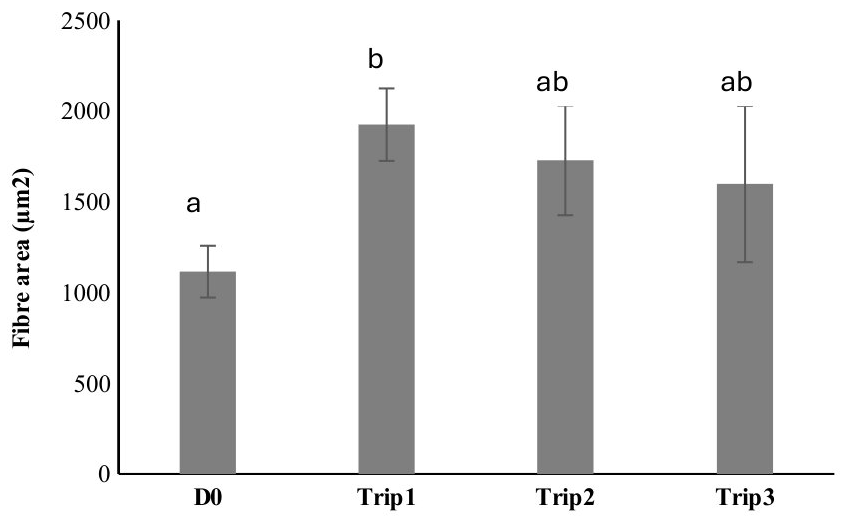
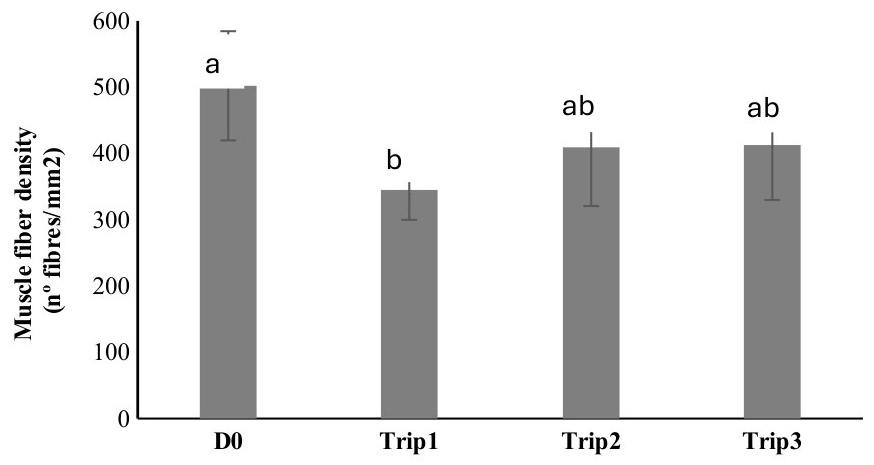
The muscle fibre area and density differed significantly among groups (Figure 1 and Figure 2). The muscle fibre area showed significant differences (one-way ANOVA, F3,20 = 6.04, p = 0.004), with Trip1 fish having a significantly larger fibre area at the end of the trial compared with the initial sampling group (D0), while Trip2 and Trip3 showed intermediate values that did not differ significantly from the other groups (Figure 1). Muscle fibre density also differed significantly among groups (F3,20 = 4.24, p = 0.017). The post hoc test revealed that Trip1 showed significantly lower fibre density than the D0 (p < 0.05), whereas Trip2 and Trip3 did not differ significantly from the remaining groups (Figure 2).

4. Discussion

The optimum dietary tryptophan requirement for meagre juveniles has previously been estimated to be around 0.5% (preliminary trials, unpublished results), corresponding to the tryptophan level present in the Trip1 diet. The present study further explored whether supplementation above this requirement (0.6% and 0.8%) could enhance growth performance, protein metabolism, or oxidative status.
Survival rates ranged from 94 to 96%, which is within the expected range for meagre juveniles under culture conditions [1,26]. Mortality observed during the trial was mainly associated with escape-related mortality (jumping behaviour), a behaviour commonly reported in this species and often linked to stress episodes [11].
No significant differences in growth performance were observed among dietary treatments. Final body weight, total length, specific growth rate (SGR), feed conversion ratio (FCR), and protein efficiency ratio (PER) were similar among groups. These findings are in line with Teixeira et al. (2023) [27], who also reported that dietary tryptophan supplementation above requirement did not significantly improve growth performance in meagre juveniles under non-stressful conditions. Together, these results reinforce the concept that once dietary tryptophan requirements are met, additional supplementation does not translate into enhanced protein accretion or growth. Although no statistically significant differences were observed, in both studies, fish fed higher dietary tryptophan levels consistently showed slight trends toward improved growth performance (e.g., slightly higher final weight and lower FCR in Trip2 and Trip3). These tendencies may suggest subtle physiological effects of tryptophan supplementation that were not fully detectable under the present experimental conditions. These effects may become more evident under stress conditions, where tryptophan-derived metabolites such as serotonin could modulate stress responsiveness, feeding behaviour, and energy allocation. In fact, a previous study in meagre juveniles by Ana Vasconcelos et al. (2023) [11] suggested that dietary tryptophan supplementation, particularly at higher inclusion levels (0.8%), may reduce anxiety-like behaviour in fish exposed to acute stress conditions, such as the novel tank test. Although the remaining responses observed in that study were generally modest, the results provided indications of the potential role of tryptophan as a stress-mitigating dietary component in aquaculture.
The SGR and FCR values obtained in this study were comparable to those reported in previous studies with meagre juveniles [28]. Similarly, dietary treatments did not affect fish proximate composition, which remained consistent among groups, in agreement with previous studies [25]. Comparable results have also been reported in other fish species. For instance, Hoseini et al. (2020) [29] observed no significant differences in the carcass composition of rainbow trout (Oncorhynchus mykiss) that were fed diets containing different tryptophan levels, whereas Sharf and Khan (2022) [30] reported increases in lipid and protein content in Channa punctatus, highlighting species-specific responses.
Muscle cellularity results further support the limited impact of dietary tryptophan on growth dynamics. Although some differences were observed between the initial sampling group and experimental groups, no consistent differences were detected among dietary treatments at the end of the trial. The tendency toward larger fibre area in Trip1 suggests that muscle growth occurred mainly through hypertrophy. Similarly, Teixeira et al. (2023) [27] reported no major changes in growth-related parameters, supporting the view that muscle development in meagre juveniles is relatively unaffected by dietary tryptophan levels within adequate ranges.
Regarding protein metabolism, the activities of the main proteolytic systems evaluated in this study were not affected by dietary tryptophan levels in either liver or white muscle. Lysosomal proteases (cathepsins B and L) and the ubiquitin–proteasome pathway showed similar activities among fish fed the different diets. This suggests that the tested dietary tryptophan levels were sufficient to maintain normal protein degradation processes. These findings are consistent with previous studies reporting that dietary tryptophan supplementation below 1% does not significantly influence growth performance [28].
Beyond growth and protein turnover, tryptophan plays an important role in physiological regulation through its conversion into serotonin and melatonin [3]. Reactive oxygen species (ROS) can induce oxidative damage to proteins and lipids, leading to the formation of advanced oxidation protein products (AOPP) and lipid peroxidation products such as malondialdehyde. In this study, oxidative stress markers (AOPP and LPO) and antioxidant enzyme activities (SOD, CAT, GPx, SeGPx) were not significantly affected by dietary treatments. However, lipid peroxidation showed a decreasing trend with increasing dietary tryptophan levels, and a similar tendency was observed for antioxidant enzyme activities. Nevertheless, the relatively high biological variability observed for oxidative stress markers, particularly LPO, likely reduced the statistical power to detect significant treatment effects. The pattern of results observed in this study is particularly relevant when interpreted alongside Teixeira et al. (2023) [27], who demonstrated that tryptophan supplementation can modulate physiological responses, especially under stress conditions. The lower antioxidant enzyme activities observed in fish fed higher tryptophan levels may reflect a reduced requirement for antioxidant defence, suggesting a lower oxidative challenge rather than impaired antioxidant capacity. This interpretation is consistent with the role of melatonin as a potent antioxidant derived from the tryptophan metabolism. Nevertheless, the lack of statistical significance and the relatively high variability observed in oxidative stress parameters indicate that these effects were modest under the experimental conditions. It is possible that the benefits of increased dietary tryptophan on oxidative status are context-dependent and become more pronounced under stress conditions such as handling, high stocking density, or environmental fluctuations, as suggested by Vasconcelos et al. (2023) [11].

5. Conclusions

Increasing dietary tryptophan levels above the estimated requirement of juvenile meagre did not significantly affect the growth performance, muscle cellularity, proteolytic activity, or oxidative stress indicators under the present rearing conditions. Nevertheless, fish receiving higher tryptophan inclusion levels showed a tendency toward a lower feed conversion ratio and reduced oxidative stress markers, suggesting modest physiological effects that may become more evident under challenging environmental conditions. Overall, the results indicate that dietary tryptophan supplementation above the requirement does not substantially alter protein turnover or growth under standard culture conditions, although potential benefits related to oxidative balance deserve further investigation.

Author Contributions

M.S. designed the study and supervised. A.V. and M.B. carried out the experimental trial and took care of the animal husbandry necessary. A.C.M. was responsible for the protein degradation analysis. F.S. was responsible for the oxidative stress markers and antioxidant enzyme activities. P.P.-F. is responsible for the Aquaculture Research Station of IPMA and provided the fish. All authors participated in the discussion of the results. All authors have read and agreed to the published version of the manuscript.

Funding

This research was funded by INOVAQUA (grant number MAR-021.1.3-FEAMPA-00004).

Institutional Review Board Statement

The fish trial was conducted at the Aquaculture Research Station (EPPO) of the Portuguese Institute of the Sea and Atmosphere (IPMA) (Olhão, Portugal). This facility is certified by the Direção Geral da Alimentação e Veterinária (DGAV) to carry out animal experimentation under authorisation 0421/2018. The experiment was overseen by trained scientists in accordance with FELASA category C recommendations and was conducted following European guidelines for the protection of animals used for scientific purposes (Directive 2010/63/UE of the European Parliament and the European Union Council) and related Portuguese legislation (Decreto-lei 113/2013). The experimental design adhered to all the procedures to protect animal welfare and ensured the application of the 3Rs (reduce, refine, replace).

Informed Consent Statement

Not applicable.

Data Availability Statement

Data used in the manuscript for tables and figures are available upon request.

Conflicts of Interest

The authors declare that they have no competing conflicts of interest.

References

  1. Saavedra, M.; Barata, M.; Matias, A.C.; Couto, A.; Salem, A.; Ribeiro, L.; Pereira, T.G.; Gamboa, M.; Marques, C.L.; Soares, F.; et al. Effect of dietary incorporation of yellow mealworm as a partial fishmeal replacer on growth, metabolism and intestinal histomorphology in juvenile meagre (Argyrosomus regius). Aquac. Nutr. 2023, 2023, 6572421. [Google Scholar] [CrossRef] [PubMed]
  2. Kalaiselvan, P.; Ranjan, A.; Thangarani, A.J.; Felix, N.; Akamad, D.K. The fate of dietary tryptophan in fish: Unveiling its sources, transport, metabolism, and multifaceted impacts. J. Nutr. 2025, 155, 2017–2042. [Google Scholar] [CrossRef] [PubMed]
  3. Hoseini, S.M.; Pérez-Jiménez, A.; Costas, B.; Azeredo, R.; Gesto, M. Physiological roles of tryptophan in teleosts: Current knowledge and perspectives for future studies. Rev. Aquac. 2019, 11, 3–24. [Google Scholar] [CrossRef]
  4. Cabanillas-Gámez, M.A.; Bardullas, U.; Galaviz, M.A.; Rodriguez, S.; Rodriguez, V.M.; López, L.M. Tryptophan supplementation helps totoaba (Totoaba macdonaldi) juveniles to regain homeostasis in high-density culture conditions. Fish Physiol. Biochem. 2020, 46, 597–6115. [Google Scholar] [CrossRef]
  5. Peixoto, D.; Carvalho, I.; Machado, M.; Aragão, C.; Costas, B.; Azeredo, R. Dietary tryptophan intervention counteracts stress-induced transcriptional changes in a teleost fish HPI axis during inflammation. Sci. Rep. 2024, 14, 7354. [Google Scholar] [CrossRef]
  6. Martins, C.I.M.; Silva, P.I.M.; Costas, B.; Larsen, B.K.; Santos, G.A.; Conceição, L.E.C.; Dias, J.; Øverli, Ø.; Höglund, E.; Schrama, J.W. The effect of tryptophan supplemented diets on brain serotonergic activity and plasma cortisol under undisturbed and stressed conditions in grouped-housed Nile tilapia Oreochromis niloticus. Aquaculture 2013, 400–401, 129–134. [Google Scholar] [CrossRef]
  7. Sahu, P.A.; Wgasotter, S.; Mog, M.; Tesia, S.; Sharma, S.; Dayakar, B.; Waikhom, D. Role of tryptophan in fish nutrition and physiology: A review. J. Entomol. Zool. Stud. 2020, 8, 1234–1240. [Google Scholar]
  8. Ciji, A.; Akhtar, M.S. Stress management in aquaculture: A review of dietary interventions. Rev. Aquac. 2021, 13, 2190–2247. [Google Scholar] [CrossRef]
  9. Saavedra, M.; Pereira, T.G.; Carvalho, L.M.; Pousão-Ferreira, P.; Grade, A.; Teixeira, B.; Quental-Ferreira, H.; Mendes, R.; Bandarra, N.; Gonçalves, A. Wild and Farmed Meagre, Argyrosomus regius: A Nutritional, Sensory and Histological Assessment of Quality Differences. J. Food Compos. Anal. 2017, 63, 8–14. [Google Scholar] [CrossRef]
  10. Li, N.; Xie, J.; Chu, Y.M. Degradation and evaluation of myofibril proteins induced by endogenous protease in aquatic products during storage: A review. Food Sci. Biotechnol. 2023, 32, 1005–1018. [Google Scholar] [CrossRef]
  11. Vasconcelos, A.; Soares, M.C.; Barata, M.; Couto, A.; Teixeira, B.; Ribeiro, L.; Pousão-Ferreira, P.; Mendes, R.; Saavedra, M. Effect of Tryptophan Dietary Content on Meagre, Argyrosomus regius, Juveniles Stress and Behavioral Response. Animals 2023, 13, 3762. [Google Scholar] [CrossRef] [PubMed]
  12. Barata, M.; Soares, F.; Aragão, C.; Almeida, A.C.; Pousão-Ferreira, P.; Ribeiro, L. Efficiency of 2-phenoxyethanol and Clove Oil for Reducing Handling Stress in Reared Meagre, Argyrosomus regius (Pisces: Sciaenidae). J. World Aquacult. Soc. 2016, 47, 82–92. [Google Scholar] [CrossRef]
  13. AOAC. Official Methods of Analysis of AOAC International, 17th ed.; Association of Official Analytical Chemists International, Inc.: Gaithersburg, MD, USA, 2020. [Google Scholar]
  14. Kjeldahl, J. New Method for the Determination of Nitrogen in Organic Matter. J. Anal. Chem. 1883, 22, 366–382. [Google Scholar]
  15. AOAC. Official Methods of Analysis of AOAC International, 16th ed.; Association of Official Analytical Chemists International, Inc.: Gaithersburg, MD, USA, 1998; 4th Revision. [Google Scholar]
  16. Saavedra, M.; Candeias-Mendes, A.; Castanho, S.; Teixeira, B.; Mendes, R.; Pousão-Ferreira, P. Amino acid profiles of meagre (Argyrosomus regius) larvae: Towards the formulation of an amino acid balanced diet. Aquaculture 2015, 448, 315–320. [Google Scholar] [CrossRef]
  17. Henderson, J.W.; Ricker, R.D.; Bidlingmeyer, B.A.; Woodward, C. Rapid, Accurate, Sensitive and Reproducible Analysis of Amino Acids; Agilent Publication 5980-1193EN; Agilent Technologies: Palo Alto, CA, USA, 2000. [Google Scholar]
  18. Sánchez-Niño, M.D.; Benitez del Castillo, M.D.; Izquierdo, M.C. Mechanisms of AOPP-induced renal cell injury and inflammatory responses. Am. J. Physiol. Ren. Physiol. 2008, 200295, F449–F458. [Google Scholar]
  19. Matias, A.C.; Ribeiro, L.; Barata, M.; Araújo, R.L.; Pousão-Ferreira, P. Postprandial pattern of digestive enzymes and protein turnover in meagre (Argyrosomus regius) juveniles. Comp. Biochem. Physiol. B 2020, 265, 110828. [Google Scholar] [CrossRef]
  20. Erdelmeier, I.; Gérard-Monnier, D.; Yadan, J.-C.; Chaudière, J. Reactions of N-Methyl-2-phenylindole with Malondialdehyde and 4Hydroxyalkenals. Mechanistic aspects of the colorimetric assay of lipid peroxidation. Chem. Res. Toxicol. 1998, 11, 1184–1194. [Google Scholar] [CrossRef] [PubMed]
  21. Sun, Y.; Oberley, L.W.; Li, Y. A simple method for clinical assay of superoxide dismutase. Clin. Chem. 1988, 34, 497–500. [Google Scholar] [CrossRef]
  22. Beers, R.F., Jr.; Sizer, I.W. A spectrophotometric method for measuring the breakdown of hydrogen peroxide by catalase. J. Biol. Chem. 1952, 195, 133–140. [Google Scholar] [CrossRef] [PubMed]
  23. Li, Y.; Schellhorn, H.E. Rapid kinetic microassay for catalase activity. J. Biomol. Tech. 2007, 18, 185–187. [Google Scholar]
  24. Flohé, L.; Günzler, W.A. Assays of glutathione peroxidase. Methods Enzymol. 1984, 105, 114–121. [Google Scholar]
  25. Saavedra, M.; Pereira, T.G.; Barata, M.; Aragão, C.; Requeijo, B.; Conceição, L.E.C.; Pousão-Ferreira, P. Plant-based diets fed to juvenile meagre Argyrosomus regius with low methionine and taurine supplementation led to an overall reduction on fish performance and to an increase in muscle fibre recruitment. J. Fish Biol. 2022, 101, 1182–1188. [Google Scholar] [CrossRef] [PubMed]
  26. Mansour, A.T.E.; Goda, A.A.; Omar, E.A.; Khalil, H.S.; Esteban, M.Á. Dietary supplementation of organic selenium improves growth, survival, antioxidant and immune status of meagre, Argyrosomus regius, juveniles. Fish Shellfish Immunol. 2017, 68, 516–524. [Google Scholar] [CrossRef]
  27. Teixeira, C.; Pedrosa, R.; Castro, C.; Magalhães, R.; Matos, E.; Oliva-Teles, A.; Peres, H.; Pérez-Jiménez, A. Dietary Tryptophan supplementation implications on performance, plasma metabolites, and amino acid catabolism enzymes in meagre (Argyrosomus regius). Fishes 2023, 8, 141. [Google Scholar] [CrossRef]
  28. Herrera, M.; Fernández-Alacid, L.; Sanahuja, I.; Ibarz, A.; Salamanca, N.; Morales, E.; Giráldez, I. Physiological and metabolic effects of a tryptophan-enriched diet to face up chronic stress in meagre (Argyrosomus regius). Aquaculture 2020, 522, 735102. [Google Scholar] [CrossRef]
  29. Hoseini, S.M.; Taheri Mirghaed, A.; Ghelichpour, M.; Pagheh, E.; Iri, Y.; Kor, A. Effects of dietary tryptophan supplementation and stocking density on growth performance and stress responses in rainbow trout (Oncorhynchus mykiss). Aquaculture 2020, 519, 734908. [Google Scholar] [CrossRef]
  30. Sharf, Y.; Khan, M.A. Dietary tryptophan requirement of fingerling Channa punctatus (Bloch) based on growth, hematological parameters, intestinal enzymes, non-specific immune response, and antioxidant capacity. Aquaculture 2022, 562, 738745. [Google Scholar] [CrossRef]
Figure 1. Mean muscle fibre area of the initial sampling group (D0) and juvenile meagre (Argyrosomus regius) fed diets containing 0.5% (Trip1), 0.6% (Trip2), and 0.8% (Trip3) tryptophan. Different letters mean significant differences for p < 0.05.
Fishes 11 00303 g001
Figure 2. Mean muscle fibre density of the initial sampling group (D0) and juvenile meagre (Argyrosomus regius) fed diets containing 0.5% (Trip1), 0.6% (Trip2), and 0.8% (Trip3) tryptophan. Different letters mean significant differences for p < 0.05.
Fishes 11 00303 g002
Table 1. Formulation ingredients and proximate analysis of experimental diets. Trip1-with 0.5% of dietary tryptophan; Trip2-0.6%; Trip3-0.8%. Data previously published in Vasconcelos et al. (2023) [11].
Ingredients (%)Trip1Trip2Trip3
Casein555
Porcine gelatin666
Soy protein concentrate303030
Pea protein concentrate151515
Wheat gluten151515
Potato starch76.65.6
Fish oil777
Rapeseed oil777
Rapeseed lecithin222
Vitamin and mineral premix111
Vitamin C0.10.10.1
Vitamin E0.10.10.1
Betaine HCl111
Antioxidant0.30.30.3
Monoammonium phosphate222
L-Lysine0.10.10.1
L-Tryptophan0.20.40.8
Table 2. Amino acid composition (g/100 g) of the diets. Trip1—with 0.5% of dietary tryptophan; Trip2—0.6%; Trip3—0.8%. Values are the mean and standard error. Different letters represent significant differences for p < 0.05, nd—non-detected. Data previously published in Vasconcelos et al. (2023) [11].
Amino AcidsTrip1Trip2Trip3
Indispensable AA   
Leucine4.0 ± 0.04.3 ± 0.04.2 ± 0.0
Lysine0.4 ± 0.00.3 ± 0.00.3 ± 0.0
Arginine2.1 ± 0.02.3 ± 0.02.2 ± 0.0
Valine1.6 ± 0.0 a1.7 ± 0.0 b1.6 ± 0.0 a
Methionine0.7 ± 0.00.7 ± 0.00.7 ± 0.0
Tryptophan0.5 ± 0.0 a0.6 ± 0.0 b0.8 ± 0.0 c
Phenylalanine1.9 ± 0.0 a2.0 ± 0.0 b2.0 ± 0.0 ab
Isoleucine1.3 ± 0.0 a1.4 ± 0.0 b1.3 ± 0.0 ab
Threonine2.1 ± 0.0 a2.3 ± 0.0 b2.2 ± 0.0 ab
Histidine0.6 ± 0.00.7 ± 0.00.7 ± 0.0
Tyrosine1.4 ± 0.01.6 ± 0.01.5 ± 0.0
Cysteinendndnd
Dispensable AA   
Glutamate8.1 ± 0.08.7 ± 0.08.6 ± 0.1
Alanine3.2 ± 0.03.4 ± 0.03.2 ± 0.0
Taurine2.5 ± 0.0 a2.3 ± 0.0 b2.2 ± 0.0 b
Hydroxyproline0.9 ± 0.0 a1.0 ± 0.0 b0.9 ± 0.0 a
Proline4.0 ± 0.0 a4.4 ± 0.0 b4.1 ± 0.0 ab
Serine2.0 ± 0.0 a2.1 ± 0.0 b2.1 ± 0.0 ab
Glycine3.4 ± 0.03.4 ± 0.03.1 ± 0.0
Aspartate2.7 ± 0.0 a2.9 ± 0.0 b2.9 ± 0.0 ab
Table 3. Meagre juvenile biometry in the beginning (112 days) and end (174 days) of the experimental trial, which tested three diets with 0.5%, 0.6% and 0.8% of tryptophan. SGR—specific growth rate; FCR—feed conversion rate; PER—protein efficiency rate. Values are the mean and standard error. Data previously published in Vasconcelos et al. (2023) [11].
TreatmentSurvival (%)Initial Weight (g)Final Weight (g)Initial Length (cm)Final Length (cm)SGRFCRPER
Trip195.3 ± 0.632.6 ± 0.161.6 ± 1.114.4 ± 0.018.5 ± 0.11.1 ± 0.031.2 ± 0.031.6 ± 0.04
Trip295.7 ± 0.232.6 ± 0.163.5 ± 0.314.4 ± 0.018.6 ± 0.01.2 ± 0.011.1 ± 0.011.7 ± 0.01
Trip394.3 ± 1.532.6 ± 0.164.3 ± 0.614.4 ± 0.018.5 ± 0.01.2 ± 0.021.1 ± 0.031.7 ± 0.05
Table 4. Proximate composition in the dry matter of the three diets and of meagre juveniles at the end of the trial fed three diets with 0.5%, 0.6% and 0.8% of tryptophan. Values are the mean and standard error. Data previously published in Vasconcelos et al. (2023) [11].
Feed Fish
TreatmentTrip1Trip2Trip3Trip1Trip2Trip3
Crude protein52.0 ± 0.152.3 ± 0.152.2 ± 0.115.7 ± 0.015.4 ± 0.215.4 ± 0.1
Crude fat16.0 ± 0.117.5 ± 0.716.0 ± 0.04.9 ± 0.14.7 ± 0.24.6 ± 0.1
% Dry matter88.4 ± 0.192.7 ± 0.089.9 ± 0.024.9 ± 0.025.0 ± 0.024.8 ± 0.0
% Ashes7.6 ± 0.17.4 ± 0.07.8 ± 0.115.1 ± 0.216.1 ± 0.414.5 ± 0.1
Energy KJ/g (FM)23.9 ± 0.024.1 ± 0.124.1 ± 0.05.6 ± 0.05.6 ± 0.05.6 ± 0.0
Table 5. Proteolytic markers in the liver and white muscle of meagre juveniles (Argyrosomus regius) fed experimental diets (Trip1 to Trip3). Lysosomal activity was determined by cathepsin B and L activities (RFU µg−1 protein), and proteasome activity by the chymotrypsin-like activity of the β5 subunit of the 20S proteasome (mU mg−1 protein). Values are mean ± SEM (n = 9).
Protease ActivityDiets
Trip1Trip2Trip3
Liver   
Cathepsin B331.4 ± 15.7310.3 ± 22.7346.0 ± 25.5
Cathepsin L484.3 ± 36.1502.6 ± 71.7464.3 ± 48.7
Proteasome19.0 ± 1.721.4 ± 2.222.5 ± 2.6
Muscle   
Cathepsin B26.4 ± 2.122.2 ± 1.726.7 ± 2.2
Cathepsin L43.7 ± 4.039.2 ± 2.242.2 ± 3.8
Proteasome1.91 ± 0.292.20 ± 0.381.91 ± 0.16
Table 6. Hepatic oxidative stress and antioxidant capacity of meagre juveniles (Argyrosomus regius) fed experimental diets (Trip1, Trip2 and Trip3). (a) LPO—lipid peroxidation analysis; (b) AOPPs—Advanced protein oxidation products; (c) SOD—Superoxide dismutase; (d) CAT—catalase; (e) GPx—Selenium-independent glutathione peroxidase; and (f) SeGPx—Selenium-dependent glutathione peroxidase. Values are presented as mean ± SD (n = 6), except for AOPPs, which are reported as mean ± SEM (n = 9).
Oxidative Stress and Antioxidant Enzyme ActivityDiets
Trip1Trip2Trip3
LPO (MDA nmol/g total protein)57.2 ± 26.054.8 ± 25.934.0 ± 25.4
AOPPs (Chloramine-T μM μg−1 total protein)0.82 ± 0.080.74 ± 0.080.69 ± 0.05
SOD (mU mg−1 protein)12.9 ± 5.58.7 ± 1.79.3 ± 1.1 
CAT (mU mg−1 protein)56.8 ± 25.745.3 ± 7.1  45.1 ± 4.8 
GPx Activity (nmol NADPH/min/mL)24.5 ± 8.722.9 ± 4.119.2 ± 5.0
SeGPx Activity (nmol NADPH/min/mL)22.7 ± 9.4 21.2 ± 4.519.5 ± 7.2
Disclaimer/Publisher’s Note: The statements, opinions and data contained in all publications are solely those of the individual author(s) and contributor(s) and not of MDPI and/or the editor(s). MDPI and/or the editor(s) disclaim responsibility for any injury to people or property resulting from any ideas, methods, instructions or products referred to in the content.