
Article

Integrative Transcriptome and GWAS Analyses Reveal Growth-Associated Molecular Architecture in Pacific Abalone (Haliotis discus hannai)

1
Biotechnology Research Division, National Institute of Fisheries Science, Busan 46083, Republic of Korea
2
Genetics and Breeding Research Center, National Institute of Fisheries Science, Geoje 53334, Republic of Korea
3
Department of Animal Resources Science, Kongju National University, Yesan 32439, Republic of Korea
4
Department of Integrated Biological Science, Pusan National University, Busan 46241, Republic of Korea
*
Author to whom correspondence should be addressed.
Fishes 2026, 11(5), 293; https://doi.org/10.3390/fishes11050293

Submission received: 19 April 2026 / Revised: 11 May 2026 / Accepted: 13 May 2026 / Published: 15 May 2026
(This article belongs to the Special Issue Applications of Genome-Based Technologies in Aquaculture)

Abstract

Pacific abalone (Haliotis discus hannai) is a widely cultured and economically important abalone species in aquaculture yet improving growth performance remains a major challenge for stable production. To clarify the molecular architecture associated with growth performance in Pacific abalone, we integrated transcriptome and genome-wide association study (GWAS) data from high-growth and low-growth groups showing significant growth differences. Transcriptome profiles from hepatopancreas and mantle tissues were used to construct a co-expression network of 43,125 genes, summarized into 22 modules associated with tissue specificity and growth-related variation. In parallel, analysis of a custom 60K SNP array identified 67 significant growth-associated SNPs. Integration of these GWAS signals into the co-expression network revealed a core module most strongly correlated with growth index and enriched for SNP-derived candidate genes. Functional enrichment indicated that the core module was associated with proteostasis and growth-related signaling pathways, including insulin, Ras, and MAPK signaling. Protein–protein interaction analysis further identified 11 hub genes with high intramodular connectivity and direct interactions with SNP-derived genes, most of which participate in receptor-mediated and intracellular growth-regulatory functions. These findings provide an integrated molecular framework for growth performance in Pacific abalone and candidate targets for future molecular breeding strategies.
Key Contribution: By integrating transcriptome-wide co-expression networks with GWAS signals, this study provides an integrative framework for prioritizing growth-related candidate genes in Pacific abalone.

1. Introduction

Abalones (family Haliotidae) are marine gastropod mollusks distributed throughout temperate and tropical coastal waters. They are recognized as one of the most valuable shellfish in marine fisheries and aquaculture. Global abalone production has increased markedly over the past two decades, from 14.6 kt in 2001 to 253.1 kt in 2021, reflecting the continued expansion of market demand [1,2]. Pacific abalone (Haliotis discus hannai) is one of the most widely cultured abalone species and has substantial economic importance [3,4]. In 2021, South Korea ranked second in global production, producing 23.2 kt with a market value of approximately USD 606 million [1,2].
To improve abalone production, diverse breeding strategies, including selective breeding and interspecific hybridization, have been applied in abalone aquaculture [5,6]. In addition, improving growth-related traits is an important challenge for Pacific abalone aquaculture to meet market demand and support stable production. Many studies have been conducted to establish high-growth Pacific abalone stocks through selective breeding for superior growth performance [7,8,9,10]. Additional studies have estimated genetic parameters for growth-related traits in Pacific abalone [7,8]. Linkage- and QTL-based analyses have identified genomic regions associated with growth traits in Pacific abalone [9,10]. However, despite these efforts, the molecular and physiological basis underlying high-growth phenotypes in Pacific abalone is still not fully understood.
Growth-related traits such as body weight and shell size are complex quantitative phenotypes influenced by multiple genetic factors and coordinated regulatory processes [11,12,13]. Transcriptome analysis of Pacific oyster has linked enhanced growth to complex cellular processes, including protein biosynthesis, metabolism, and cytoskeletal regulation [11]. In pearl oysters, comparative expression analysis revealed that growth differences are associated not only with genes related to shell formation but also with genes related to immune regulation [12]. More recently, transcriptional profiling of freshwater pearl mussel suggested a close connection between growth, mineralization, signaling, and biomineralization-related pathways [13]. Therefore, an in-depth understanding of growth-related biological processes is required to support the establishment of Pacific abalone stocks with stable production performance and commercially desirable traits.
Transcriptome analysis provides an effective approach for investigating the molecular basis of complex growth-related traits. RNA sequencing (RNA-seq) enables genome-wide characterization of gene expression under specific biological conditions to elucidate diverse physiological mechanisms [14,15,16]. Among transcriptome-based approaches, weighted gene co-expression network analysis (WGCNA) is well-suited for complex trait analysis. By examining pairwise expression correlations among all genes across samples, WGCNA can identify co-expression modules and hub genes associated with biological traits [17,18]. This network-based strategy has been successfully applied in bivalve and shellfish studies to identify candidate genes and pathways associated with shell formation, biomineralization, and stress responses [19,20]. Furthermore, recent advances in multi-omics technologies have enabled transcriptome data to be integrated with genomic information [21]. In particular, integrating transcriptome data with GWAS results can improve the interpretation of complex genotype–phenotype relationships [22,23,24]. Therefore, integrating WGCNA-based co-expression modules with GWAS-derived candidate genes can improve the interpretation of growth-related expression patterns and provide additional physiological evidence for GWAS signals relevant to aquaculture breeding.
The objective of this study was to investigate the biological architecture underlying growth performance in Pacific abalone. To address this, we employed an integrative strategy combining transcriptome-based network analysis with GWAS-derived genomic information. WGCNA was used to capture coordinated gene expression patterns associated with growth-related traits. GWAS signals were then incorporated as complementary genomic evidence to prioritize the growth-associated core module. To support integration across datasets of different scales, we examined protein–protein interaction relationships between SNP-derived genes and core module genes. Through this multi-omics approach, we aimed to refine key candidates involved in growth-related mechanisms and to provide a useful basis for future molecular breeding efforts in Pacific abalone.

2. Materials and Methods

2.1. Sample Collection

A schematic overview of the study design and analytical workflow used in this study is presented in Figure S1. A total of 1892 Pacific abalones (H. discus hannai) were used in this study, representing the same breeding population previously used to validate the Pacific abalone custom 60K SNP array [25]. This population comprised 192 families generated from 181 parents, with some parents shared among families. All individuals were reared at the Genetics and Breeding Research Center in Geoje, South Korea, under standardized culture conditions. The abalones were maintained in flow-through seawater tanks (1.2 × 3.0 × 0.8 m) at a flow rate of approximately 90 L/min, and the direction of water flow was adjusted to minimize direct physical disturbance. During the rearing period, dissolved oxygen and water temperature were maintained at 7.8 ± 0.5 mg/L and ≤24 °C, respectively.
After 2.5 years of rearing, three growth-related traits, body weight (BW), shell length (SL), and shell height (SH), were measured in all individuals. To maximize phenotypic contrast between growth groups, the 30 abalones with the highest and lowest overall growth performance were selected as high-growth (HG) and low-growth (LG) groups, respectively. For transcriptome analysis, seven individuals whose growth traits were closest to the mean of their respective group were selected to represent the typical phenotype of each group. Hepatopancreas and mantle tissues were collected from each selected individual, rinsed in 1× phosphate-buffered saline, immediately frozen in liquid nitrogen, and stored at −80 °C until RNA extraction.

2.2. RNA Extraction and Sequencing

Total RNA was extracted from hepatopancreas and mantle tissues collected from the selected HG and LG abalones. Frozen tissues were pulverized in liquid nitrogen using a pre-chilled mortar and pestle, and RNA was isolated using TRIzol reagent (Invitrogen, Waltham, MA, USA) according to the manufacturer’s instructions. RNA quantity and purity were assessed using a NanoDrop spectrophotometer (Thermo Fisher Scientific, Waltham, MA, USA), and RNA integrity was evaluated using an Agilent 2100 Bioanalyzer (Agilent Technologies, Santa Clara, CA, USA). Only samples with an RNA integrity number (RIN) greater than 7.0 were used for library construction.
RNA-seq libraries were prepared from 1 μg of total RNA per sample using the TruSeq Stranded mRNA Sample Prep Kit (Illumina, San Diego, CA, USA) following the manufacturer’s instructions to generate paired-end mRNA libraries. Briefly, mRNA was purified using oligo(dT)-attached magnetic beads, fragmented, and reverse-transcribed to generate first-strand cDNA, followed by second-strand synthesis. After adapter ligation and PCR amplification, 28 libraries were sequenced on the Illumina NovaSeq platform to generate paired-end reads of 2 × 101 bp. Raw sequence quality, including base quality distribution and sequence duplication levels, was evaluated using FastQC v0.12.0 [26].

2.3. Transcriptome Analysis

Raw reads from each transcriptome library were quality-filtered using FASTX-Toolkit v0.0.13 [27] according to the following criteria: (1) trimming of adapter sequences, (2) removal of low-quality reads with an average Phred score < 28 across more than 50% of the read length, and (3) removal of reads shorter than 30 bp after trimming. Filtered paired-end reads were synchronized using an in-house Python script. The processed reads were aligned to the Pacific abalone reference genome (accession no. GCA_044707095.1) using HISAT2 v2.2.1 [28]. The resulting SAM files were converted to BAM format and sorted by genomic coordinates using SAMtools v1.13 [29]. Alignment quality was assessed using Qualimap v2.3 [30], including read distribution, mismatch rate, and genome coverage. Gene-level read counts were generated using featureCounts [31], and gene expression levels were normalized as reads per kilobase of transcript per million mapped reads (RPKM) [32].

2.4. Weighted Gene Co-Expression Network Analysis (WGCNA)

A weighted gene co-expression network was constructed using the WGCNA package in R v4.1.2 [18]. Genes with no detectable expression across all samples (RPKM = 0 in all 28 libraries) were excluded prior to network construction, resulting in 43,125 expressed genes for WGCNA. Gene expression values were log2-transformed as log2(RPKM + 1) to stabilize variance and improve comparability among samples. Pairwise Pearson correlation coefficients were calculated among all expressed genes and converted into an adjacency matrix using a soft-thresholding power (β) selected based on the scale-free topology criterion. A soft-thresholding power of β = 12, which achieved a scale-free topology fit index of R2 ≥ 0.8 (Figure S2), was used to construct a signed co-expression network.
The adjacency matrix was transformed into a topological overlap matrix (TOM), and the corresponding dissimilarity matrix was calculated as 1 − TOM. Genes were hierarchically clustered based on TOM dissimilarity, and co-expression modules were identified using the dynamic tree-cutting algorithm with deepSplit = 2 and a minimum module size of 200 genes. This threshold was selected to obtain stable and interpretable modules from the large-scale transcriptome dataset. Module eigengenes (MEs), defined as the first principal component of each module, were calculated to summarize module-level expression patterns.
To assess the association between co-expression modules and growth performance, a composite growth index was derived from BW, SL, and SH using principal component analysis (PCA). PCA was performed using the prcomp function in R with centering and scaling enabled (center = TRUE and scale = TRUE). The first principal component (PC1), which explained the largest proportion of total phenotypic variance, was used as the growth index. Module–trait relationships were then evaluated by correlating MEs with the growth index. Modules showing significant positive correlations with the growth index (cor > 0.5 and p < 0.01) were considered growth-associated modules for downstream analyses.

2.5. Genome-Wide Association Analysis (GWAS)

Genotype data were obtained from 1892 individuals using the Pacific abalone custom 60K SNP array developed in a previous study [25]. Growth-related traits of these individuals were measured at both 1.5 and 2.5 years of age. These two ages were considered distinct growth stages for evaluating age-specific growth performance in Pacific abalone aquaculture. Genotype quality control was performed using PLINK v1.9 [33]. SNPs were excluded according to the following criteria: (i) genotype missingness > 10%, (ii) minor allele frequency < 0.05, and (iii) Hardy–Weinberg equilibrium p-value < 1 × 10⁻⁶. After quality control filtering, 46,860 high-quality SNPs were retained for subsequent association analyses.
GWAS were conducted independently for BW, SL, and SH at 1.5 and 2.5 years of age using the FarmCPU (Fixed and Random Model Circulating Probability Unification) algorithm implemented in the GAPIT package in R [34,35]. FarmCPU was used to improve statistical power while reducing both false-positive and false-negative signals. Generation and sex were included as fixed-effect covariates in the model, with the intercept fitted by default. Quantile–quantile (Q–Q) plots were used to compare observed and expected association statistics for each trait, and genomic inflation factors (λ) were calculated from the median of the observed chi-square statistics using qqman v0.1.8 in R [36]. Manhattan plots were generated using ggplot2 v3.5.2 in R [37] to visualize genome-wide SNP–trait associations across scaffold positions. Multiple-testing correction was performed using the Benjamini–Hochberg false discovery rate (FDR) procedure [38], and SNP–trait associations with FDR-adjusted p-values < 0.05 were considered significant.

2.6. Screening of SNP-Derived Candidate Genes

Significant SNP–trait associations identified by GWAS were mapped to the Pacific abalone reference genome (accession no. GCA_044707095.1). The positional relationship between each significant SNP and annotated genes was determined using an in-house Python 2 script. When a significant SNP was located within an annotated gene, that gene was assigned directly as a SNP-derived candidate gene. For intergenic SNPs, genes located within 50 kb upstream or downstream of the SNP were additionally considered as SNP-derived candidate genes. This flanking distance was selected as a conservative positional window for candidate gene screening, considering the limited functional genomic and regulatory annotation information in Pacific abalone.
To integrate GWAS signals with transcriptome-based co-expression analysis, SNP-derived candidate genes were further compared with genes assigned to the four growth-associated modules identified by WGCNA. Functional classification of SNP-derived candidate genes was performed using KOG annotation [39]. Protein sequences of the candidate genes were aligned against the KOG database using DIAMOND BLASTp v0.9.25 [40], and hits with query coverage ≥ 30%, sequence identity ≥ 30%, and E-value ≤ 1 × 10⁻¹⁰ were retained. Each gene was assigned to its corresponding KOG functional category based on the filtered results, and the number of genes in each category was summarized to examine the functional distribution of SNP-derived candidate genes.

2.7. Functional Annotation and Enrichment Analysis

Functional annotation and enrichment analyses were conducted using the GO and KEGG databases for genes belonging to the selected WGCNA modules. Functional annotation of protein-coding genes in the reference genome of Pacific abalone was conducted using OmicsBox v3.0 [41]. BLASTp results against the NCBI non-redundant database were imported into OmicsBox and annotated using the integrated Blast2GO workflow, including InterProScan for conserved domain identification [42], GO mapping, and GO term annotation.
KEGG-based functional annotation was additionally performed using the KEGG Automatic Annotation Server (KAAS) [43]. To improve taxonomic relevance, a eukaryotic reference dataset including molluscan species and two crustacean species was used. Both single-directional best hit and bi-directional best hit methods were applied to assign KEGG orthology (KO) terms, which were subsequently mapped to KEGG pathways using the KEGG pathway reconstruction tool (https://www.genome.jp/kegg/tool/map_pathway.html, accessed on 7 March 2026). For both GO and KO annotation, BLAST v2.15.0 searches were performed using the following parameters: maximum number of hits = 20, E-value ≤ 1.0 × 10⁻⁵, and alignment score ≥ 60.
For the GO term and KEGG pathway, enrichment significance was assessed using a hypergeometric test implemented with the phyper function in R [44]. The following parameters were applied: N, the total number of annotated genes in the genome; n, the number of genes in the target module; M, the number of genes annotated to a given GO term or KEGG pathway; and m, the number of genes in the target module annotated to that category. Given the more hierarchical nature of GO terms compared with KEGG pathways, significance thresholds were set at p-values ≤ 0.01 for GO enrichment and p-values ≤ 0.05 for KEGG pathway enrichment.

2.8. Hub Gene Analysis

Hub gene analysis was focused on the core growth-associated module for co-expression network analysis. Within the module, module membership (MM) was calculated as the correlation between individual gene expression profiles and the MEs, and gene significance (GS) was calculated as the correlation between gene expression and the growth index. Genes with MM > 0.90 and GS > 0.50, with both associations significant at p-value < 0.01, were selected as highly interconnected growth-related genes. To further assess their biological relevance, these genes were evaluated in the context of the functional annotation and enrichment results described above. Genes belonging to significantly enriched biological pathways (p ≤ 0.05) were defined as the preliminary hub gene candidate set.
To integrate transcriptome-based network information with GWAS evidence, protein–protein interaction (PPI) analysis was performed between the preliminary hub gene candidate set and the SNP-derived candidate genes within the core growth-associated module. Because Pacific abalone is a non-model organism with limited PPI information, interaction analysis was conducted using STRING based on orthology to Homo sapiens, Mus musculus, and Danio rerio [45]. A minimum interaction confidence score of 0.30 was applied, and only direct interactions without additional interaction layers were considered. Genes in the preliminary hub gene candidate set that showed direct interactions with SNP-derived candidate genes were designated as hub genes in this study.

3. Results

3.1. Growth Trait Differences in Pacific Abalones

The growth-related traits of the HG and LG groups (n = 30 per group) are summarized in Table S1. In the LG group, the average BW, SL, and SH were 8.90 ± 1.41 g, 42.69 ± 1.97 mm, and 7.60 ± 0.49 mm, respectively (Table 1). In contrast, the HG group showed significantly higher values, with mean BW, SL, and SH of 43.34 ± 4.50 g, 70.50 ± 2.86 mm, and 15.04 ± 0.75 mm, respectively. Student’s t-test revealed that all three traits differed significantly between the two groups (p < 1 × 10⁻⁵). The HG/LG ratios were approximately 1.65 for SL and 1.98 for SH, whereas the BW ratio was approximately 4.87, reflecting its nature as a three-dimensional growth trait that includes shell mass, soft tissue mass, and body water.

3.2. Overview of Transcriptome Datasets

For transcriptome analysis, hepatopancreas and mantle tissues were collected from 14 representative abalones selected from the HG and LG groups (7 individuals per group), whose growth trait values were closest to the within-group mean across BW, SL, and SH (Table S1). The hepatopancreas and mantle are responsible for two major biological components of growth performance in abalone: nutrient metabolism and shell formation. The hepatopancreas is closely associated with digestion, lipid and carbohydrate metabolism, and growth-related signaling responses [46,47], whereas the mantle is the principal shell-forming tissue responsible for shell matrix secretion and biomineralization [48,49]. Thus, these tissues were considered suitable for profiling growth-associated transcriptomic variation in Pacific abalone. Total RNA was successfully extracted from all samples. RNA concentration ranged from 74.5 to 982.7 ng/µL in the HG group and from 72.8 to 993.3 ng/µL in the LG group. All RNA samples had RIN values greater than 7.0, confirming their suitability for library construction.
High-throughput paired-end sequencing generated a total of 162.03 Gb of RNA-seq data. The average number of reads was 59,539,571 in the HG group and 55,047,970 in the LG group (Table S2). Quality assessment showed that Q30 values exceeded 95% across all samples, confirming the high quality of the sequencing data (Figure S3). The average GC content of hepatopancreas samples was 47.75% in the HG group and 47.44% in the LG group, whereas that of mantle samples was 45.70% and 44.10%, respectively. These results indicate that the RNA-seq datasets were of sufficient quality and depth for subsequent genome-wide expression profiling and integrative multi-omics analyses. The raw data have been deposited in the NCBI GEO database (https://www.ncbi.nlm.nih.gov/geo/, accessed on 15 May 2026) under accession number GSE328229.

3.3. Gene Expression Profiling

After filtering low-quality, unpaired, and incomplete reads, an average of 58,967,912 and 54,594,836 paired reads were retained in the HG and LG groups, respectively (Table S3). The Pacific abalone reference genome used in this study (accession no. GCA_044707095.1) [50] spans 1,883,591,751 bp, with a GC content of 40.51%, and comprises 22,772 scaffolds and 47,532 annotated genes (Table S4). Alignment of the processed reads to the reference genome yielded average mapping rates of 99.23% across all samples. Gene expression levels of all annotated genes were profiled using the RPKM method (Table S5). Among the 47,532 annotated genes, 4407 genes showing no detectable expression in any sample were excluded from subsequent analyses.

3.4. Co-Expression Network Construction

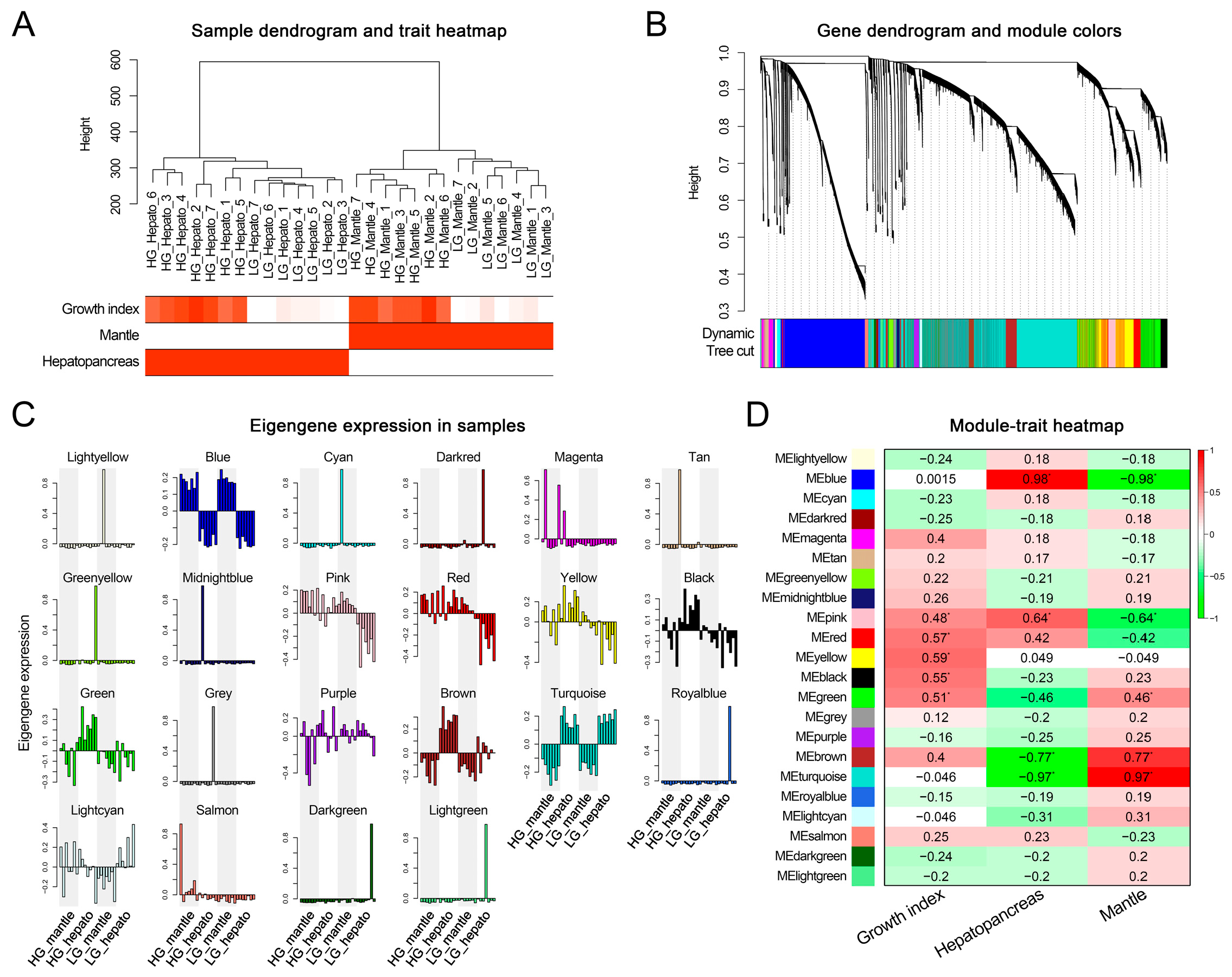
To characterize transcriptomic patterns associated with growth performance in Pacific abalone, WGCNA was performed using the integrated expression profiles of 43,125 genes retained after filtering across all 28 RNA-seq libraries described above (Table S5). Hierarchical clustering of samples revealed a clear separation according to tissue type (hepatopancreas vs. mantle), with consistent clustering of biological replicates within the HG and LG groups (Figure 1A). This result indicates that tissue type was a major source of variation in the transcriptome dataset, while growth-related differences were also captured within each tissue.
Using the selected soft-thresholding power (β = 12), the adjacency matrix was converted into a TOM, and genes were grouped into co-expression modules using the dynamic tree-cutting method. A total of 22 distinct modules were identified from the integrated transcriptome datasets, with each module assigned a unique color label (Figure 1B). Module size ranged from 208 genes in the dark green module to 14,187 genes in the turquoise module (Table S6). MEs, representing the overall expression pattern of each module, were calculated for all modules. In Figure 1C, bar plots of MEs summarize the representative expression patterns of individual modules across the transcriptome libraries.
Subsequently, MEs were correlated with experimental traits, including growth and tissue specificity (Figure 1D). To represent overall growth performance, BW, SL, and SH were integrated into a single growth index using PCA (Figure S4). The first principal component explained 99.3% of the total variance among the three growth-related traits. Correlation analysis between MEs and the growth index identified four modules significantly and positively associated with growth performance (cor > 0.5, p < 0.01). Among these, the yellow module showed the strongest positive correlation with growth index (cor = 0.59, p = 0.001), followed by the red (cor = 0.57, p = 0.002), black (cor = 0.55, p = 0.002), and green (cor = 0.51, p = 0.006) modules.
For tissue-specific associations (Figure 1D), the blue module showed the strongest positive correlation with hepatopancreas (cor = 0.98, p = 3.0 × 10⁻²¹), whereas the turquoise module showed the strongest negative correlation with hepatopancreas (cor = −0.97, p = 7.0 × 10⁻¹⁷). In contrast, the turquoise module was positively correlated with mantle (cor = 0.97, p = 7.0 × 10⁻¹⁷), whereas the blue module showed the strongest negative correlation with mantle (cor = −0.98, p = 3.0 × 10⁻²¹). These results indicate that the co-expression network captured both growth-associated and tissue-dependent transcriptomic patterns in Pacific abalone.

3.5. Genome-Wide Association Study

To identify genetic loci associated with growth-related traits in Pacific abalone, GWAS was performed using genotype data generated from the Pacific abalone custom 60K SNP array developed in a previous study [25]. After quality-control filtering, 46,860 high-quality SNPs were retained and tested for association with BW, SL, and SH measured at 1.5 and 2.5 years of age.
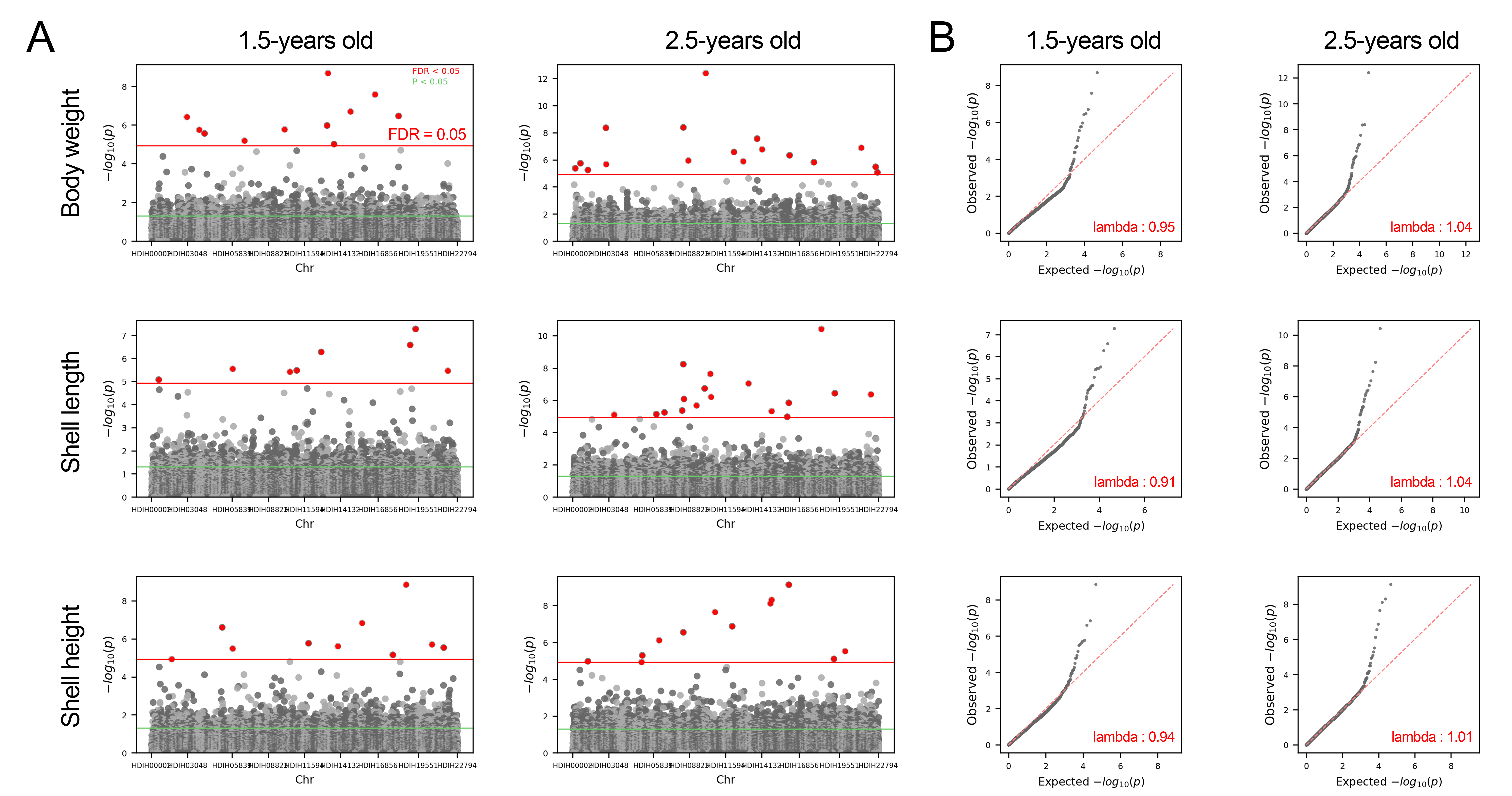
Across the GWAS analyses, a total of 9110 SNP–trait associations reached the nominal significance threshold of p-value < 0.05 (Figure 2A). These associations were distributed across multiple scaffolds throughout the genome, with the highest numbers observed on scaffolds HDIH16211 (117 SNPs), HDIH03253 (109 SNPs), HDIH16787 (103 SNPs), HDIH12073 (90 SNPs), and HDIH11230 (90 SNPs). Q–Q plots showed that most observed p-values closely followed the expected null distribution, while the upper tail exhibited a deviation from expectations, consistent with the existence of trait-associated loci (Figure 2B). Genomic inflation factors (λ) ranged from 0.91 to 1.04, indicating adequate control of systematic inflation by the FarmCPU model. After Benjamini–Hochberg FDR correction, 67 significant SNP–trait associations remained at an FDR threshold of <0.05, and these were considered growth-associated loci for subsequent integrative analyses with transcriptome data (Table S7).

3.6. Distribution of SNP-Derived Candidate Genes Within Growth-Associated Modules

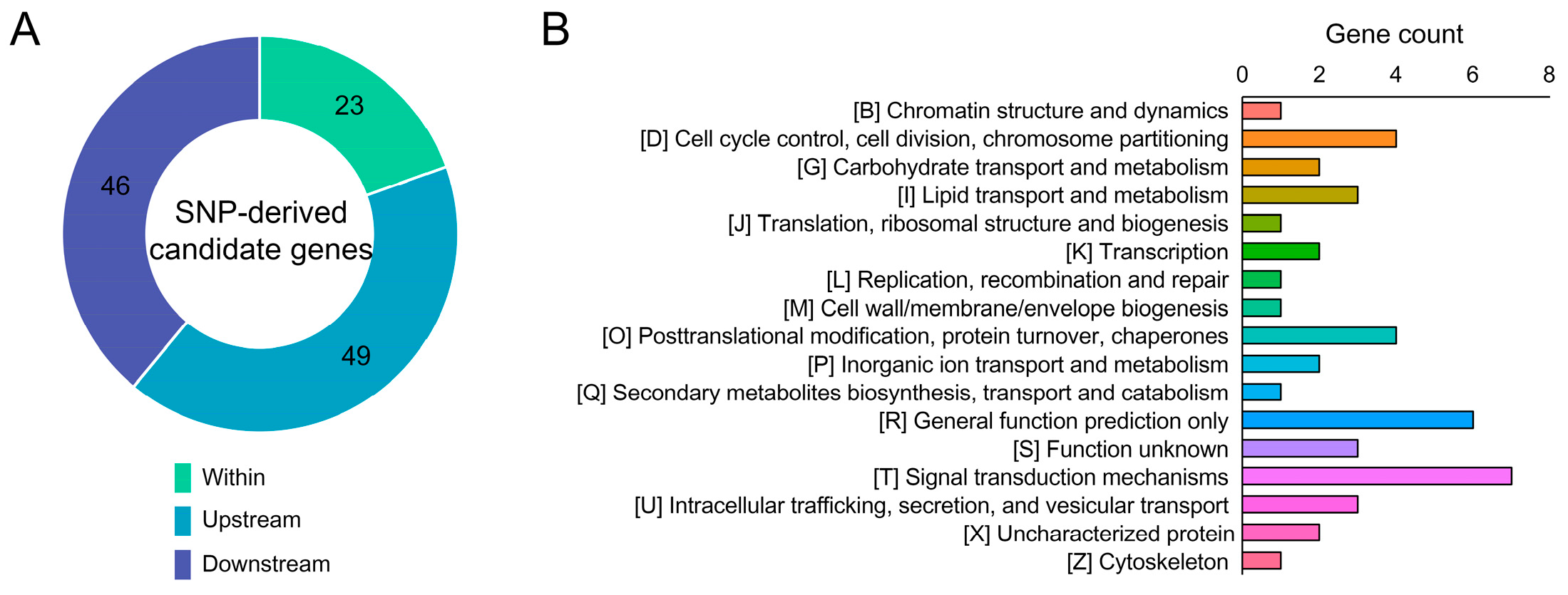
SNP-derived candidate genes were screened based on the genomic positions of significant SNPs in the Pacific abalone reference genome. A total of 118 candidate genes were identified within 50 kb of significant SNP loci, including 23 genes that directly harbored significant SNPs (Figure 3A; Table S8). Among these, 44 genes were successfully annotated using the KOG database and assigned to 17 functional categories (Figure 3B). Excluding categories with limited functional interpretability, signal transduction mechanisms (T; n = 7) was the most represented category, followed by cell cycle control, cell division, and chromosome partitioning (D; n = 4), and posttranslational modification, protein turnover, and chaperones (O; n = 4).
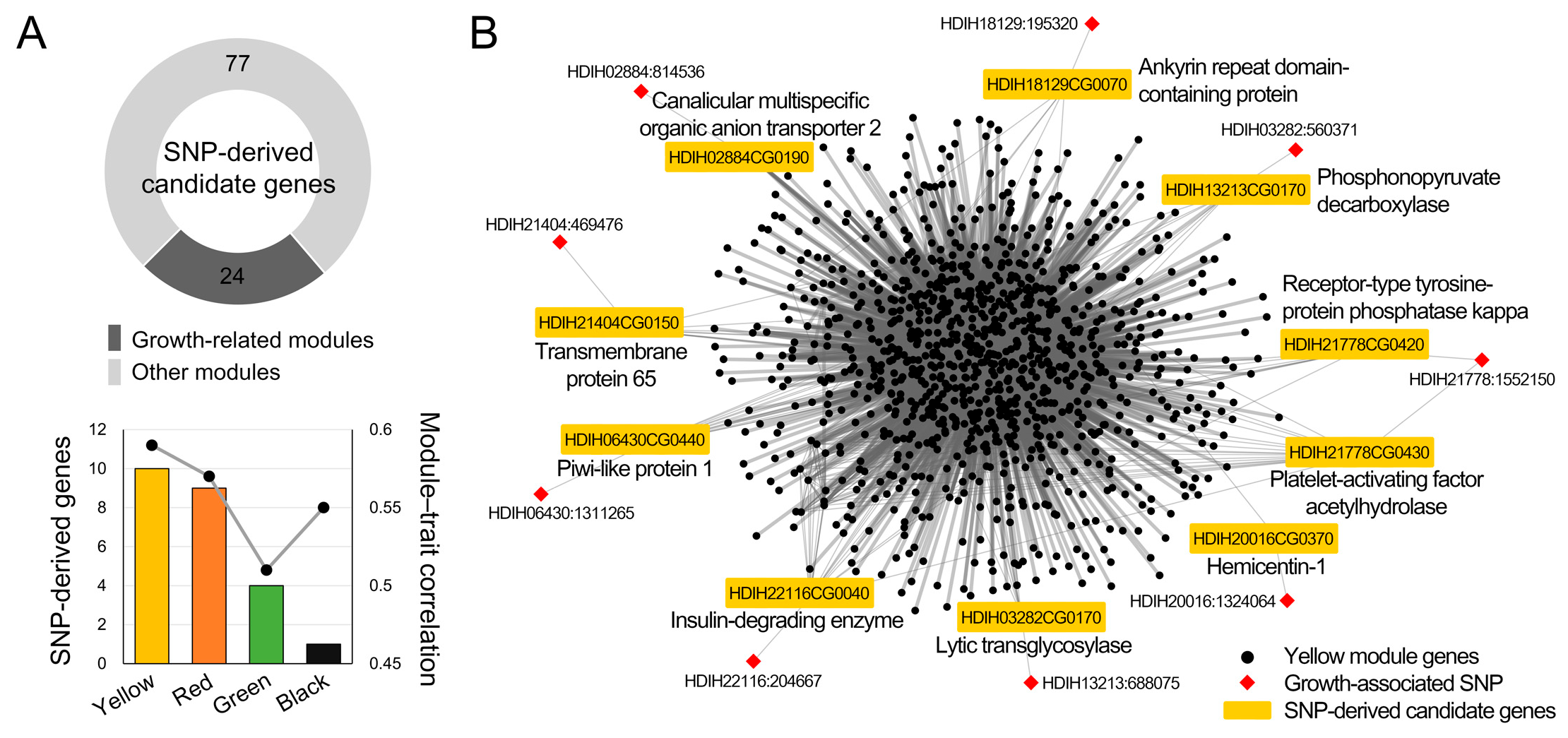
To integrate GWAS signals with co-expression network analysis, the 118 SNP-derived candidate genes were examined based on their module assignments in the WGCNA network. As a result, 101 of these genes were assigned to one of the 22 co-expression modules identified by WGCNA. Among these 101 module-assigned genes, 24 were located in the four growth-associated modules: yellow, red, green, and black (Figure 4A). The yellow module contained the largest number of SNP-derived candidate genes (n = 10), followed by the red (9), green (4), and black (1) modules. Notably, the yellow module, which showed the strongest positive correlation with the growth index (cor = 0.59), included several genes with known roles in growth regulation and development, such as insulin-degrading enzyme (HDIH22116CG0040), receptor-type tyrosine protein kinase (HDIH21778CG0420), piwi1 (HDIH06430CG0440), and ankyrin repeat domain-containing protein (HDIH18129CG0070) (Figure 4B).
These results indicate that integration of growth-associated GWAS signals with transcriptome-based co-expression modules enabled more refined identification of biologically meaningful growth-associated modules than transcriptome network analysis alone. Therefore, we prioritized the yellow module, which contained a substantial number of growth-associated SNP-derived candidate genes, as the core module for subsequent integrative multi-omics interpretation.

3.7. Biological Functions of Core Modules

To establish a functional annotation framework for downstream analyses, GO and KEGG annotations were generated for all 47,532 predicted genes in the Pacific abalone reference genome. Among these, 37,073 genes (78.0%) were annotated with at least one GO term, 28,408 genes (59.8%) were assigned KO identifiers, and 24,217 genes received both GO and KEGG annotations. Because individual genes could be associated with multiple GO terms, a total of 9467 distinct GO terms were assigned, of which 5442 belonged to the biological process (BP) category. The KO-annotated genes were further mapped to 442 KEGG pathways.
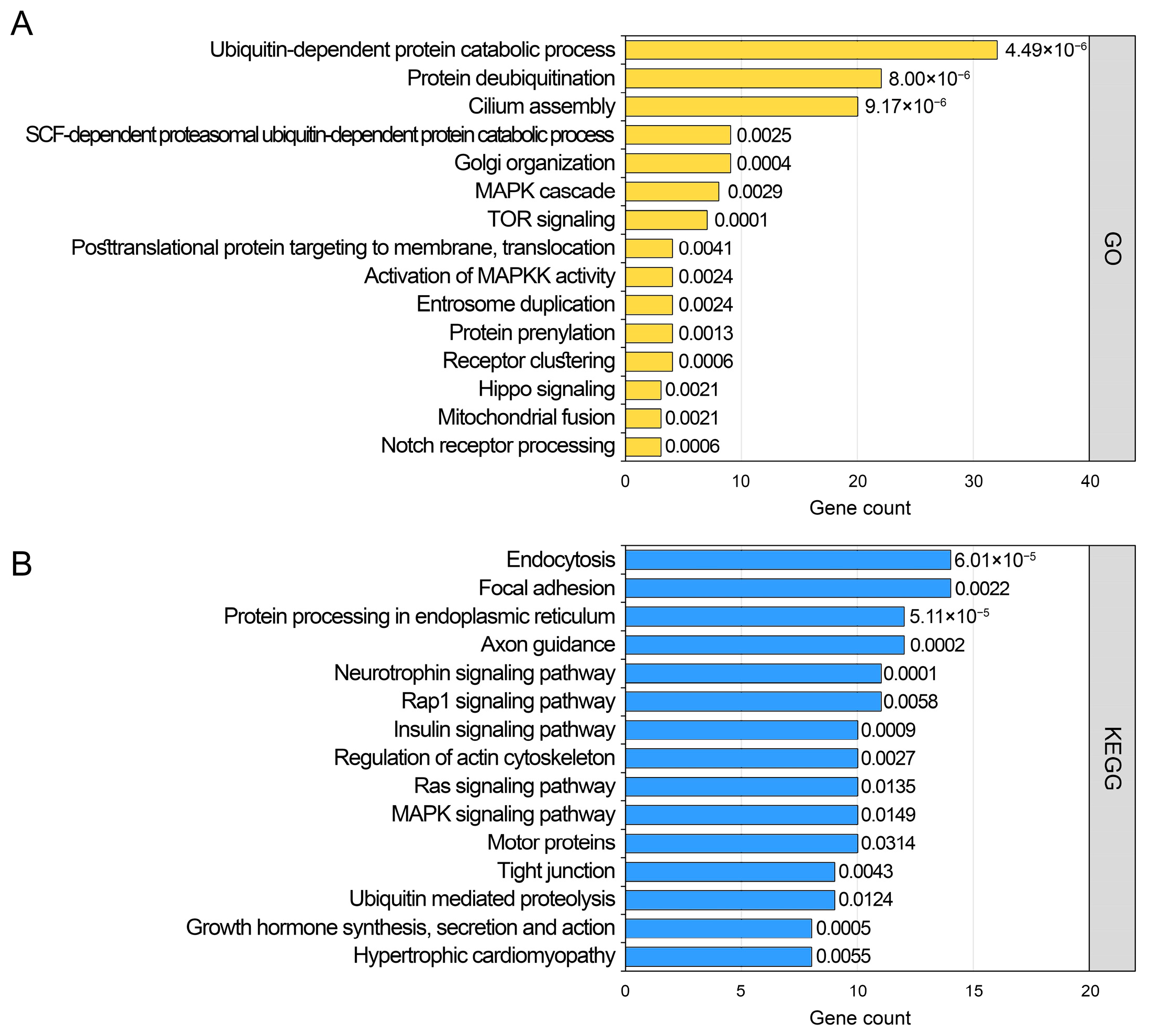
Within the yellow module, which was prioritized as the core growth-associated module, GO enrichment analysis of the BP category was first performed for all module genes to characterize its overall functional landscape. The enriched BP terms were predominantly associated with proteostasis-related processes, including ubiquitin-dependent protein catabolic process (GO:0006511; p = 4.49 × 10⁻⁶), protein deubiquitination (GO:0016579; p = 8.00 × 10⁻⁶), and protein prenylation (GO:0018342; p = 0.0013), thereby corroborating active regulation of protein turnover and post-translational control within this module (Figure 5A). In addition, several signaling-associated terms, including TOR signaling (GO:0031929; p = 0.0001) and receptor clustering (GO:0043113; p = 0.0006), were also significantly enriched, indicating that the yellow module broadly encompassed both protein homeostasis and regulatory signaling functions. Additionally, GO enrichment analysis was performed to further examine the functional characteristics of the red module, which showed the second strongest positive correlation with the growth index. The enriched GO terms were mainly related to autophagy (GO:0006914; p = 6.07 × 10⁻⁸), protein polyubiquitination (GO:0000209; p = 1.23 × 10⁻⁶), and cellular response to starvation (GO:0009267; p = 3.97 × 10⁻⁵) (Figure S5). In addition, lipid-associated processes, including intracellular cholesterol transport (GO:0032365), fatty acid elongation (GO:0034625), and very long-chain fatty acid biosynthetic processes (GO:0042761), were also significantly enriched in the red module. These results suggest that the red module may reflect complementary metabolic and catabolic support processes associated with growth performance.
To further resolve the biologically central component of the yellow module, genes with strong intramodular connectivity and close association with growth were extracted using the MM and GS analyses. Of the 3788 genes assigned to the yellow module, 576 showed strong module connectivity (MM ≥ 0.90, p ≤ 0.01), and 408 genes were finally retained after additional consideration of growth relevance (GS ≥ 0.50, p ≤ 0.01). GO enrichment analysis of these 408 highly connected genes showed significant enrichment of positive regulation of GTPase activity (GO:0043547; p = 1.47 × 10⁻⁵), small GTPase-mediated signal transduction (GO:0007264; p = 0.0003), ubiquitin-dependent protein catabolic process (GO:0006511; p = 0.0008), and intracellular protein transport (GO:0006886; p = 0.0036) (Figure S6). Compared with the full yellow module, these 408 genes were more specifically associated with protein turnover, small GTPase-mediated signaling, and intracellular trafficking. Consistent with these GO enrichment results, KEGG pathway enrichment analysis of these highly connected 408 genes identified 15 significant pathways (Figure 5B), among which growth-related signaling pathways were prominently represented. In particular, growth hormone synthesis, secretion and action (map04935; 8 genes) were the most significantly enriched among the growth-related signaling pathways, followed by the insulin signaling pathway (map04910; 10 genes), Ras signaling pathway (map04014; 10 genes), and MAPK signaling pathway (map04010; 10 genes). Together, these results suggest that whereas the yellow module as a whole reflects a broad proteostasis-oriented functional background, its highly connected core genes are more strongly concentrated in signaling pathways directly relevant to growth regulation.
In contrast to the growth-associated yellow module, the tissue-associated core modules showed distinct biological process enrichments consistent with the functional characteristics of Pacific abalone tissues (Figure S7). The turquoise module, which was strongly associated with mantle-specific expression, was enriched for processes related to external signal perception and membrane transport, including G protein-coupled receptor signaling pathway (GO:0007186; p = 1.31 × 10⁻¹¹), ion transmembrane transport (GO:0034220; p = 6.11 × 10⁻⁹), signal transduction (GO:0007165; p = 2.47 × 10⁻⁶), protein dephosphorylation (GO:0006470; p = 8.05 × 10⁻¹⁰), and peptidyl-tyrosine dephosphorylation (GO:0035335; p = 9.63 × 10⁻¹⁰). These enrichment patterns suggest that the mantle-associated module is functionally characterized by environmental signal recognition, membrane-associated regulatory responses, and ion transport processes. In contrast, the blue module, which was strongly associated with hepatopancreas-specific expression, was primarily enriched for diverse metabolic and catabolic processes, including metabolic process (GO:0008152; p = 2.22 × 10⁻¹⁶), oxidation-reduction process (GO:0055114; p = 1.11 × 10⁻¹⁵), transmembrane transport (GO:0055085; p = 1.39 × 10⁻¹⁴), carbohydrate metabolic process (GO:0005975; p = 1.60 × 10⁻¹⁰), and generation of precursor metabolites and energy (GO:0006091; p = 8.97 × 10⁻⁶). Additional enrichment of carbohydrate- and degradation-related terms further supported the metabolic specialization of the blue module. Together, these results indicate that the turquoise and blue modules effectively represent the tissue-specific functional identities of mantle and hepatopancreas, respectively.

3.8. Hub Genes in the Yellow Module

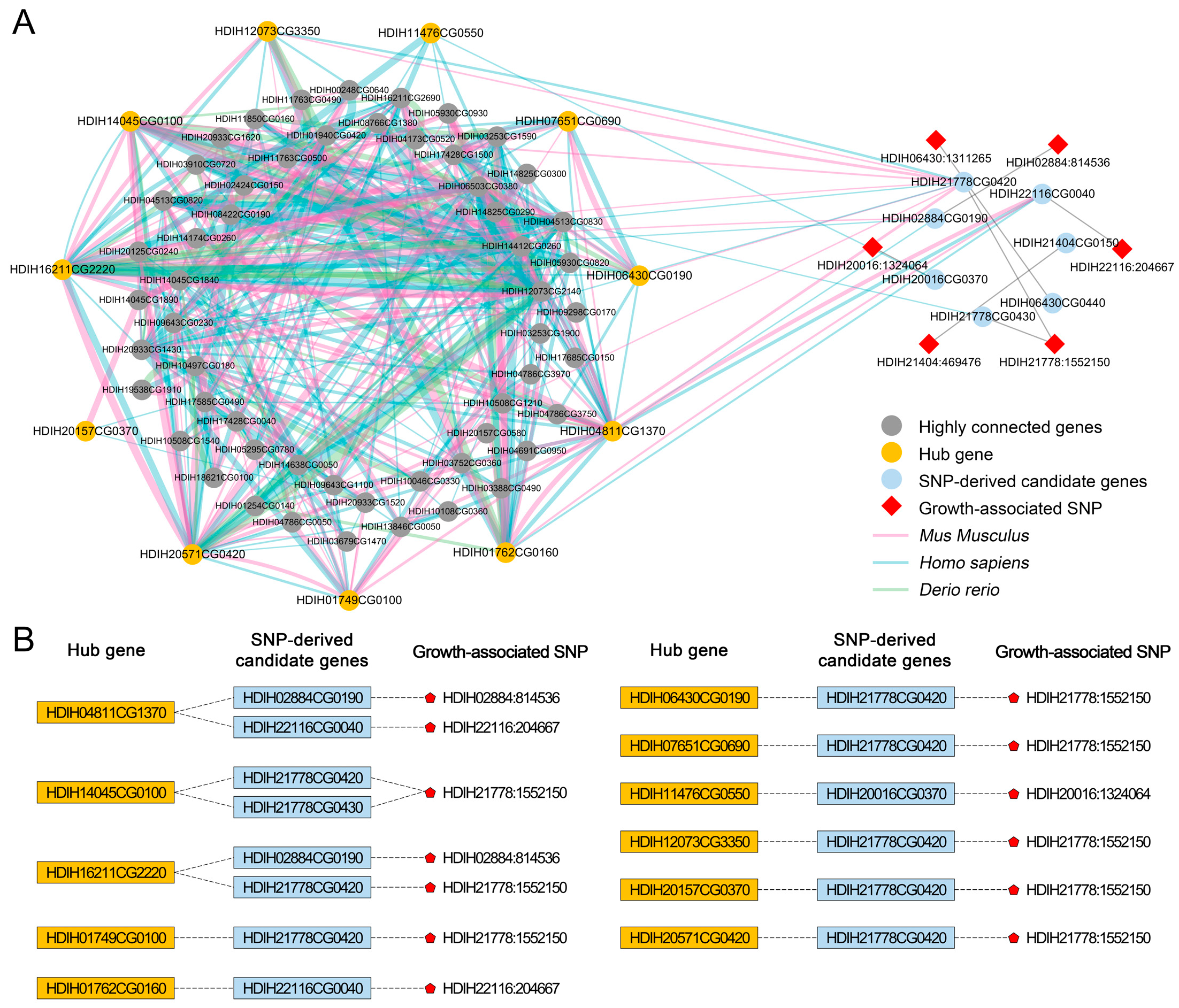
An analysis of hub genes within the yellow module was conducted to identify key factors underlying the biological regulation of growth performance in Pacific abalone. To integrate both transcriptomic and GWAS-based genomic evidence, we analyzed protein–protein interactions between growth-associated core genes from the co-expression network and growth-associated SNP-derived candidate genes (Figure 4). For this purpose, 55 genes belonging to the 15 significantly enriched KEGG pathways were selected from the 408 highly connected genes in the yellow module and designated as the preliminary hub gene candidate set. These genes were then integrated with the 7 SNP-derived candidate genes assigned to the yellow module to construct a PPI network. As shown in Figure 6A, the resulting PPI network comprised 79 gene nodes connected by 406 unique edges. The network formed a single connected structure, with an average degree of 10.28 and an edge density of 0.132.
Using this network, we identified 11 hub genes that directly interacted with SNP-derived candidate genes at a confidence score of ≥0.3. These hub genes formed a hub-centered subnetwork linked to five SNP-associated genes and four associated SNP loci (Figure 6B). Among the identified hub genes, hepatocyte growth factor receptor-like, vascular endothelial growth factor receptor 1-like isoform X4, and glycogen synthase kinase-3 beta each showed two direct connections within the subnetwork, whereas the others showed a single direct interaction with a SNP-related gene. These results indicate that the identified hub genes occupy the most direct integrative positions linking the transcriptome-derived core network to growth-associated genomic variation.
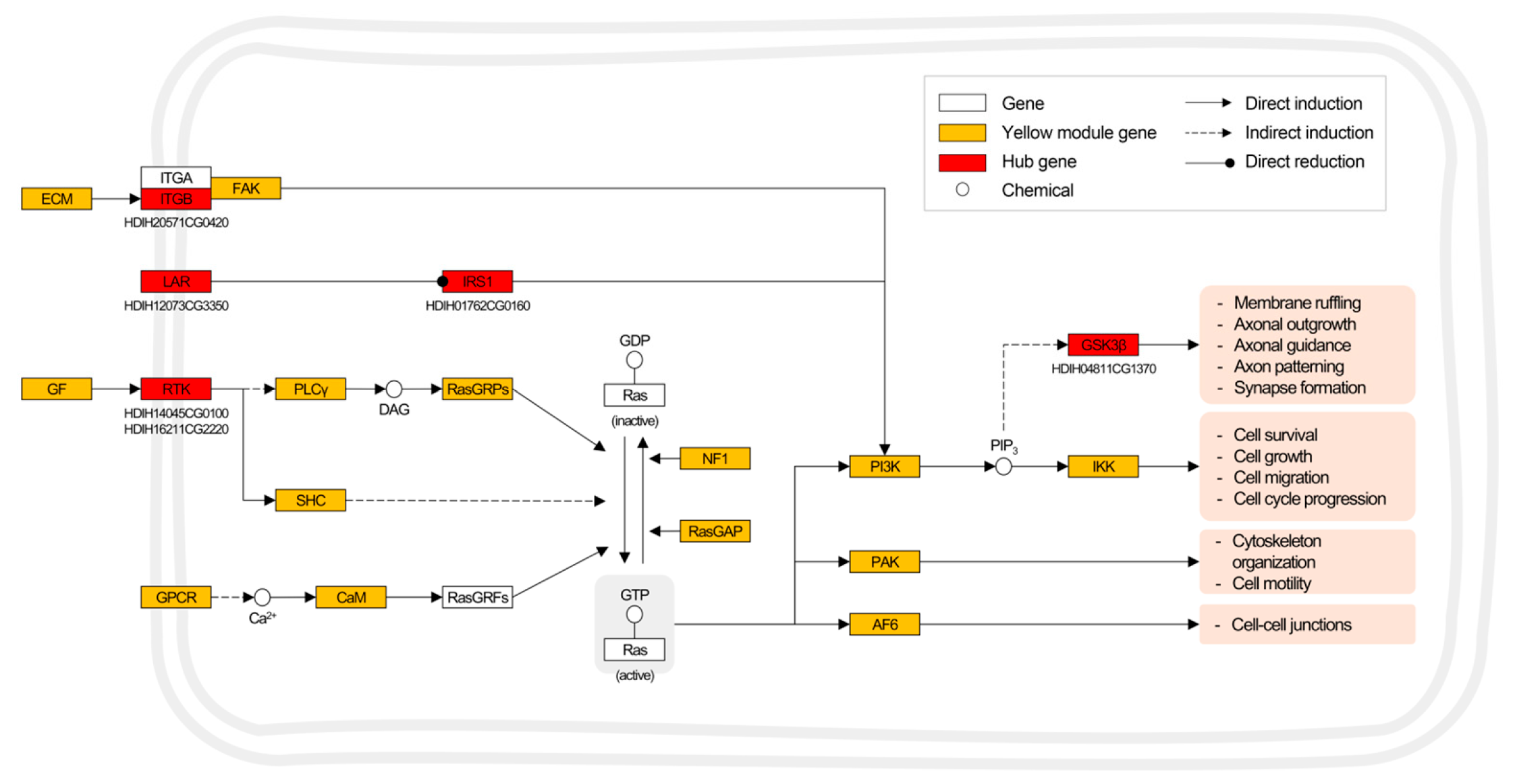
To understand the functional details of the identified hub genes, we reconstructed a molecular-level mechanism network based on the interaction and reaction relationships between the hub genes and the yellow module genes. Notably, six of the eleven hub genes were positioned within regulatory pathways directly related to growth-related biological processes (Figure 7). The four hub genes were mapped to receptor- or membrane-associated positions, including integrin beta (ITGB), leukocyte common antigen-related phosphatase (LAR), and two receptor tyrosine kinase genes (RTKs). In addition, the remaining two genes were responsible for intracellular signaling reactions such as insulin receptor substrate 1 (IRS1) and glycogen synthase kinase-3 beta (GSK3β). These hub genes were connected through additional yellow-module genes, including PLCγ and SHC downstream of receptor-related components, RasGRPs, RasGAP, and NF1 involved in Ras signaling activation and regulation, and PI3K, IKK, PAK, and AF6 distributed across the intracellular signaling reaction. Collectively, these results indicate that the identified hub genes participate in a coordinated growth-related regulatory cascade, spanning signal perception, intracellular transduction, and downstream cellular responses associated with growth promotion in Pacific abalone.

4. Discussion

This study suggests that an integrative multi-omics approach can help clarify the molecular architecture underlying growth performance in Pacific abalone. This approach combined transcriptome-wide co-expression analysis with GWAS signals. Instead of focusing on differential expression between the high-growth and low-growth groups, integration of WGCNA with growth-associated SNP signals enabled the identification of a core module closely related to growth performance and the prioritization of biologically relevant hub genes within that module. These results support a network-based view of growth regulation in Pacific abalone and highlight the limitations of interpretations based only on individual genes or loci. A recent study in hybrid abalone likewise showed that integrating GWAS and transcriptomic data can refine the prioritization of growth-related candidate genes [51]. Based on this approach, this study was extended through co-expression network analysis, allowing candidate genes to be interpreted in terms of module structure and hub gene connectivity. Similar applications of comparative transcriptomics and WGCNA in shellfish aquaculture have identified trait-associated modules and hub genes with clear biological relevance to the mechanisms underlying complex traits [52,53]. Collectively, these findings suggest that growth performance in Pacific abalone is best understood as an outcome of a coordinated molecular network rather than isolated expression differences or single loci.
One important strength of this co-expression network analysis was its ability to distinguish growth-related expression patterns from the strong effect of tissue identity. In multi-tissue transcriptome datasets, tissue type is often the major source of gene expression variation. This pattern was clearly reflected in the hierarchical clustering, where mantle and hepatopancreas samples formed distinct groups (Figure 1). Nevertheless, the module–trait analysis identified growth-associated modules that were distinct from the turquoise and blue modules associated with each tissue. This suggests that the co-expression network detected not only tissue-specific transcriptional features but also regulatory signals more directly associated with growth performance. The tissue-specific modules also supported the biological validity of the network because their functional enrichments were consistent with the representative transcriptional features of the corresponding tissues. The turquoise module, which was positively correlated with mantle tissue, was mainly enriched for receptor-mediated signaling, regulatory dephosphorylation, ion transport, and response-related functions (Figure S7). These functional profiles are consistent with the known roles of the mantle in shell formation, environmental sensing, and physiological regulation in mollusks [48,49]. In addition to its role in biomineralization and shell repair, mantle tissue exhibits transcriptional responses to environmental stress [54,55], supporting the interpretation that the turquoise module reflects mantle-specific regulatory activity. By contrast, the blue module associated with the hepatopancreas was enriched for metabolic and oxidation-reduction processes (Figure S7), consistent with the role of this tissue in nutrient processing, energy metabolism, and physiological adaptation in Pacific abalone [56,57]. The concordance between functional enrichment and tissue specificity indicates that the co-expression network preserved biologically meaningful transcriptomic structure.
Within this biologically supported network, the yellow module appears to represent a growth-related molecular state characterized by active proteostasis and post-translational regulation. These processes are compatible with the molecular requirements for sustained growth, particularly stable proteome maintenance and efficient intracellular transport [58,59,60]. Consistent with this interpretation, enrichment of terms related to ubiquitin-dependent protein catabolism, deubiquitination, protein prenylation, and post-translational protein targeting suggests coordinated regulation of protein turnover, quality control, and intracellular trafficking within this module (Figure 5). Ubiquitin-mediated protein degradation is a central component of cellular proteostasis, functioning in both protein quality control and the regulation of signaling factor abundance [61,62,63]. In mollusks such as the brackish water clam (Corbicula japonica), suppression of ubiquitin-dependent protein catabolic processes has been linked to disrupted energy homeostasis and growth retardation, supporting a close relationship between proteostatic regulation and growth potential [64]. Protein prenylation also contributes to the membrane association and functional activity of signaling proteins such as Ras-family GTPases [65]. Consistent with the importance of coordinated protein and metabolic regulation, Ma et al. reported that inappropriate dietary protein levels suppressed both growth and TOR signaling in Pacific abalone [66]. These observations support the interpretation that the yellow module captures proteostasis-related and trafficking-related functions associated with growth performance.
Genes with high module membership and strong trait association are often interpreted as core components of a module [18,67]. When the analysis was restricted to the highly connected core genes of the yellow module, enrichment for growth-related signaling pathways became more apparent (Figure 5B). In the present study, the central structure of the yellow module in Pacific abalone was enriched for conserved signaling pathways, including insulin, PI3K-AKT, Ras, and MAPK signaling. Comparable pathway-level relationships have been reported in other mollusks, where insulin-related peptide signaling has been implicated in growth regulation and linked to downstream PI3K-AKT- and MAPK-related cascades [68,69,70]. For example, the insulin-like peptide PfILP increased cell viability and proliferation of mantle cells and activated AKT- and MAPK-related signaling in the pearl oyster Pinctada fucata martensii [68]. In the bivalve Mulinia lateralis, RNAi-mediated knockdown of the insulin-like peptide mlILP or its receptor mlIRR significantly reduced shell growth and shell height [69]. This growth retardation was accompanied by altered expression of downstream genes, including Ras, MEK1, IRS1, and AKT, consistent with disruption of conserved intracellular signaling responses. The identification of Hdh-GSK as a biologically relevant candidate in Pacific abalone further supports the importance of intracellular signaling components in growth-related regulation [71]. Together, the highly connected core genes of the yellow module may reflect a growth-associated signaling network in Pacific abalone, potentially linking insulin-related signaling to downstream pathways involved in cellular growth and metabolic regulation.
Although co-expression analysis identified several growth-associated modules, expression patterns alone could not clearly determine which highly connected genes were most closely linked to the genetic architecture of growth performance. Incorporating GWAS signals into the co-expression network provided complementary genomic evidence for candidate prioritization. Genes identified from growth-associated SNPs were preferentially assigned to growth-associated modules, most prominently in the yellow module (Figure 6). Their co-localization with highly connected genes within the same network region suggests that the central structure of this module is supported by both transcriptomic and genomic associations. This distinction is particularly important because genes occupying central positions in a co-expression module may represent either potential growth-related regulators or secondary transcriptional responses to phenotypic divergence [72]. For a polygenic trait such as growth, which is influenced by multiple genes [73,74], integrated analysis helps refine a broad candidate list to a smaller set of genes for further investigation. Similar patterns have been reported in recent shellfish studies. In hybrid abalone, combined GWAS and transcriptome analysis reduced a broad set of growth-related candidates to a more focused group of genes [51,75]. A comparable pattern was also reported in the Portuguese oyster (Magallana angulata) [76]. Therefore, GWAS helped prioritize highly connected genes in the growth-related network that also had supporting genomic association evidence in Pacific abalone.
The hub genes in the yellow module suggest that this growth-associated module is organized around a growth signaling cascade spanning extracellular signal perception and intracellular response processes (Figure 7). At the membrane level, ITGB1-like and RTK-like genes, including hepatocyte growth factor receptor-like and VEGFR1-like genes, point to receptor-mediated growth signaling in this module. Among these, the presence of ITGB1-like hub genes suggests that adhesion-dependent cellular responses may form part of the signaling structure of the yellow module. In mollusks, functional studies of integrin-related molecules remain limited, but available evidence supports their involvement in adhesion-dependent cellular regulation [77,78,79]. Previous studies have also linked HGF/c-MET and VEGFR-related pathways to developmental growth and molluscan shell regulation, respectively [80,81]. The presence of LAR and IRS1 among the hub genes further suggests a link between receptor-associated inputs and intracellular PI3K- and Ras/MAPK-related signaling in the yellow module. A recent bivalve study has revealed that insulin-related receptors can activate PI3K- and MAPK-associated pathways [82]. These pathways have also been linked to downstream components involved in growth-related regulation, including IRS1, Ras, and AKT [69]. GSK3β, together with PI3K, IKK, PAK, and AF6, suggests that this signaling framework may extend to downstream processes related to cellular regulation, including survival, cytoskeletal organization, motility, and cell–cell junction regulation [83,84,85]. These features indicate that the yellow module encompasses multiple signaling processes associated with growth-related cellular activity. This interpretation is supported by molluscan studies showing that insulin-related peptide receptor signaling activates MAPK and PI3K/AKT pathways linked to growth-related expression patterns. In addition, the identification of Hdh-GSK in Pacific abalone supports the species-specific relevance of GSK-related signaling components within this framework [71]. Taken together, these hub genes outline a functionally connected signaling framework spanning extracellular signal perception and intracellular processes relevant to growth regulation.
What biological significance can be inferred from the linkage between SNP-derived candidate genes and the hub genes in the yellow module? These connections suggest that growth-associated SNPs are functionally linked to hub genes within the growth-related network. This pattern raises the possibility that growth-related variation in Pacific abalone involves genes that modulate signaling activity within the core module. One notable example is protein tyrosine phosphatase receptor type K (PTPRK), which was connected to several hub genes, including ITGB, hepatocyte growth factor receptor-like, VEGFR1, and LAR. In the present network, this pattern suggests a possible relationship between SNP-derived candidate genes and receptor-associated signaling components. This association is biologically important because receptor-mediated signaling is influenced by the balance between tyrosine kinase activity and counteracting phosphatases such as PTPRK, which can modulate signal intensity near the receptor [86]. Additional evidence shows that alteration of PTPRK affects pEGFR, pERK, and cell proliferation, suggesting that changes in phosphatase activity may influence growth-related signaling responses [87,88]. These findings raise the possibility that variation in the regulation of receptor-mediated signaling contributes to growth differences in Pacific abalone. A second informative example is the linkage of insulin-degrading enzyme (IDE) to IRS1-like and GSK3β. In Drosophila, IDE antagonizes insulin-dependent tissue growth through modulation of the PI3K pathway [89,90]. In addition, activation of GSK3β promotes IRS1 degradation, providing a mechanistic connection between insulin signaling and the IRS1/GSK3β signaling node [91,92]. Together with the reported association of insulin-related peptides with body and shell growth in Pacific abalone [93], these observations suggest that the IDE-linked SNP signal may influence the duration or intensity of insulin-related signaling within the growth-related signaling framework. Although the present study prioritized hub genes associated with growth-related mechanisms, their expression patterns and biological roles remain to be experimentally validated. Future studies using qPCR-based expression analysis, knockdown experiments, or other functional assays will help confirm their relevance to growth regulation in Pacific abalone. Overall, the present results suggest an integrated view of growth regulation in Pacific abalone, in which co-expression network structure and growth-associated SNPs jointly improve interpretation of the molecular architecture underlying growth performance. This integrative approach provides new insight into growth-related mechanisms and may serve as a useful foundation for future breeding and aquaculture applications.

5. Conclusions

In conclusion, this study provides an integrated view of the molecular architecture underlying growth performance in Pacific abalone by combining transcriptome-wide co-expression analysis with GWAS data. This integrative approach enabled the identification of a core module closely associated with growth performance and the prioritization of hub genes within the co-expression network. The results suggest that growth performance in Pacific abalone is best understood as the outcome of a coordinated molecular network rather than isolated gene expression differences or individual loci. Integration of growth-associated SNPs with co-expression modules further improved the biological interpretation of growth-related variation and highlighted hub genes occupying central positions in the growth-related network. These hub genes outline a functionally connected growth-related signaling framework spanning extracellular signal perception and intracellular response processes. Given the polygenic characteristics of growth-related traits, these findings provide in-depth insight into growth-related mechanisms in Pacific abalone and help identify candidate genes for future molecular breeding strategies.

Supplementary Materials

The following supporting information can be downloaded at: https://www.mdpi.com/article/10.3390/fishes11050293/s1, Figure S1: Data analysis workflow; Figure S2: Determination of the soft-thresholding power for weighted gene co-expression network analysis; Figure S3: Quality assessment of RNA-seq libraries from Pacific abalone; Figure S4: Principal component analysis (PCA) of growth-related traits in Pacific abalone; Figure S5: Functional enrichment of red modules in Pacific abalone; Figure S6: Functional enrichment of the highly connected genes within the yellow module; Figure S7: Functional enrichment of tissue-associated modules in Pacific abalone; Table S1: Growth-related traits of Pacific abalones used in this study; Table S2: Summary of raw RNA-seq reads and quality metrics; Table S3: Summary of RNA-seq read preprocessing and genome mapping; Table S4: Statistics of Pacific abalone reference genome; Table S5: RPKM-based gene expression profiles of Pacific abalone samples; Table S6: Distribution of genes across WGCNA co-expression modules; Table S7: List of growth-associated SNP in Pacific abalone; Table S8: List of SNP-derived candidate genes and WGCNA module assignment.

Author Contributions

Conceptualization, J.P. and H.J.; methodology, J.P., E.S.N. and H.-B.P.; software, H.J., H.-B.P. and Y.-S.S.; validation, I.J.H. and J.-H.K.; formal analysis, J.P. and H.J.; investigation, H.J. and J.P.; resources, H.K. and H.J.K.; data curation, J.P. and H.J.; writing—original draft preparation, J.P. and H.J.; writing—review and editing, J.P. and Y.-S.S.; visualization, H.J. and H.-B.P.; supervision, J.P.; project administration, J.P.; funding acquisition, J.P. All authors have read and agreed to the published version of the manuscript.

Funding

This research was supported by a grant from the National Institute of Fisheries Science, Republic of Korea (grant number R2026019 and R2026032).

Institutional Review Board Statement

Ethical review and approval were waived for this study because specific ethical approval is not mandated for research involving Pacific abalone, as they are aquatic invertebrates. All procedures were conducted in accordance with relevant institutional and national guidelines.

Data Availability Statement

The RNA-seq raw data have been deposited in the NCBI GEO database under accession number GSE328229.

Conflicts of Interest

The authors declare no conflicts of interest.

Abbreviations

The following abbreviations are used in this manuscript:
SNPSingle-nucleotide polymorphism
GOGene ontology
KEGGKyoto encyclopedia of genes and genomes
GEOGene Expression Omnibus
QTLQuantitative trait locus
KOGEukaryotic orthologous group

References

  1. Pratiwi, D.Y.; Choi, M.J.; Oh, Y.D.; Lim, H.K. Effects of Ocean Acidification on Abalone (Haliotis spp.) Reproduction, Early Development, and Growth: A Review. Fish. Aquat. Sci. 2024, 27, 728–743. [Google Scholar] [CrossRef]
  2. FAO. FishStatJ: Global Aquaculture Production Quantity and Value 1950–2022; FAO: Rome, Italy, 2024; Available online: https://www.fao.org/fishery/en/statistics/software/FishStatJ (accessed on 7 March 2026).
  3. Zhang, M.; Gao, X.; Lyu, M.; Lin, S.; Luo, X.; You, W.; Ke, C. Effect of Stocking Density on the Growth and Settlement of Haliotis discus hannai Larvae in a Recirculating Aquaculture System. Aquac. Res. 2022, 53, 1468–1480. [Google Scholar] [CrossRef]
  4. Elliott, N.G. Genetic Improvement Programmes in Abalone: What Is the Future? Aquac. Res. 2000, 31, 51–59. [Google Scholar] [CrossRef]
  5. You, W.; Guo, Q.; Fan, F.; Ren, P.; Luo, X.; Ke, C. Experimental Hybridization and Genetic Identification of Pacific Abalone Haliotis discus hannai and Green Abalone H. fulgens. Aquaculture 2015, 448, 243–249. [Google Scholar] [CrossRef]
  6. Park, C.J.; Park, C.-J.; Lee, J.-H.; Noh, J.K.; Kim, H.C.; Won Park, J.; Hwang, I.J.; Kim, S.Y. Growth of Pacific Abalone, Haliotis discus hannai, Using Selection Breeding Techniques. Korean J. Malacol. 2012, 28, 343–347. [Google Scholar] [CrossRef][Green Version]
  7. Zhou, M.; Chen, J.; Peng, W.; Liu, J.; Yu, F.; Lin, W.; Xie, Q.; You, W.; Ke, C.; Luo, X. Estimation of Genetic Parameters for Growth Relevant Traits in Adult Pacific Abalone (Haliotis discus hannai). Aquac. Res. 2022, 53, 5018–5028. [Google Scholar] [CrossRef]
  8. Choe, M.-K.; Han, S.-J.; Yang, S.-G.; Won, S.-H.; Park, C.; Yeo, I. Estimation of Genetic Parameters for Growth-Related Traits in 1-Year Old of Two Korean Abalone Subspecies, Haliotis discus hannai and H. discus discus, by Using Multiple Traits of Animal Model. Korean J. Malacol. 2008, 24, 121–130. [Google Scholar]
  9. Kho, K.H.; Sukhan, Z.P.; Hossen, S.; Cho, Y.; Kim, S.C.; Sharker, M.R.; Jung, H.J.; Nou, I.S. Construction of a Genetic Linkage Map Based on SNP Markers, QTL Mapping and Detection of Candidate Genes of Growth-Related Traits in Pacific Abalone Using Genotyping-by-Sequencing. Front. Mar. Sci. 2021, 8, 713783. [Google Scholar] [CrossRef]
  10. Liu, X.; Liu, X.; Zhang, G. Identification of Quantitative Trait Loci for Growth-Related Traits in the Pacific Abalone Haliotis discus hannai Ino. Aquac. Res. 2007, 38, 789–797. [Google Scholar] [CrossRef]
  11. Zhang, F.; Hu, B.; Fu, H.; Jiao, Z.; Li, Q.; Liu, S. Comparative Transcriptome Analysis Reveals Molecular Basis Underlying Fast Growth of the Selectively Bred Pacific Oyster, Crassostrea gigas. Front. Genet. 2019, 10, 610. [Google Scholar] [CrossRef]
  12. Chen, Y.; Yao, Y.; Shen, X.; Fu, Y.; Bian, X.; Li, W.; Liu, S. Transcription Profiling Reveals Co-Regulation Mechanism of Gene Expression Related to Growth and Mineralization Induced by Pearl Cultivation in Hyriopsis cumingii. Front. Mar. Sci. 2024, 11, 1443863. [Google Scholar] [CrossRef]
  13. Shi, Y.; He, M. Differential Gene Expression Identified by RNA-Seq and QPCR in Two Sizes of Pearl Oyster (Pinctada fucata). Gene 2014, 538, 313–322. [Google Scholar] [CrossRef]
  14. Hu, G.; Gu, W.; Sun, P.; Bai, Q.; Wang, B. Transcriptome Analyses Reveal Lipid Metabolic Process in Liver Related to the Difference of Carcass Fat Content in Rainbow Trout (Oncorhynchus mykiss). Int. J. Genom. 2016, 2016, 7281585. [Google Scholar] [CrossRef]
  15. Lin, C.W.; Huang, L.Y.; Huang, C.L.; Wang, Y.C.; Lai, P.H.; Wang, H.V.; Chang, W.C.; Chiang, T.Y.; Huang, H.J. Common Stress Transcriptome Analysis Reveals Functional and Genomic Architecture Differences between Early and Delayed Response Genes. Plant Cell Physiol. 2017, 58, 546–559. [Google Scholar] [CrossRef] [PubMed][Green Version]
  16. Wang, Z.; Gerstein, M.; Snyder, M. RNA-Seq: A Revolutionary Tool for Transcriptomics. Nat. Rev. Genet. 2009, 10, 57–63. [Google Scholar] [CrossRef] [PubMed]
  17. van Dam, S.; Võsa, U.; van der Graaf, A.; Franke, L.; de Magalhães, J.P. Gene Co-Expression Analysis for Functional Classification and Gene-Disease Predictions. Brief. Bioinform. 2018, 19, 575–592. [Google Scholar] [CrossRef]
  18. Langfelder, P.; Horvath, S. WGCNA: An R Package for Weighted Correlation Network Analysis. BMC Bioinform. 2008, 9, 559. [Google Scholar] [CrossRef]
  19. Zhou, C.; Song, H.; Feng, J.; Hu, Z.; Yu, Z.-L.; Yang, M.-J.; Shi, P.; Li, Y.-R.; Guo, Y.-J.; Zhang, T. RNA-Seq Analysis and WGCNA Reveal Dynamic Molecular Responses to Air Exposure in the Hard Clam Mercenaria mercenaria. Genomics 2021, 113, 2847–2859. [Google Scholar] [CrossRef]
  20. Guo, X.; Li, X.; Zhao, F.; Liu, D.; Yang, Z.; Li, M.; Li, Y.; Wei, H.; Wang, H.; Qin, Z.; et al. Full-Length Transcriptome Analysis Provides Insights into Larval Shell Formation in Mulinia lateralis. Front. Mar. Sci. 2023, 9, 1111241. [Google Scholar] [CrossRef]
  21. Yu, X.; Faggion, S.; Liu, Y.; Wang, B.; Zeng, Q.; Lu, C.; Hu, J.; Bargelloni, L.; Fang, L.; Bao, Z. Role of Multi-Omics in Aquaculture Genetics and Breeding: Current Status and Future Perspective. Sci. China Life Sci. 2025, 68, 2591–2604. [Google Scholar] [CrossRef]
  22. Wang, W.; Chang, M.; Tan, S.; Hu, Y.; Ren, X.; Xue, H.; Gao, L.; Cao, X.; Wang, Y.; Li, Q.; et al. Integrative Genomics and Multi-Tissue Transcriptomics Identify Key Loci and Pathways for Hypoxia Tolerance in Grass Carp. Animals 2025, 15, 3518. [Google Scholar] [CrossRef]
  23. Jiang, B.; Tao, Y.; Tao, W.; Lu, S.; Badran, M.F.; Saleh, M.H.L.; Aboueleila, R.H.M.; Xu, P.; Qiang, J.; Liu, K. Genome-Wide Association Study and RNA-Seq Analysis Uncover Candidate Genes Controlling Growth Traits in Red Tilapia (Oreochromis spp.) under Hyperosmotic Stress. Int. J. Mol. Sci. 2025, 26, 6492. [Google Scholar] [CrossRef]
  24. Tai, Y.; Liu, L.; Zeng, Y.; Li, M.; Luo, M.; Li, W.; Zhou, H.; Zhang, J.; Han, X.; Yang, C.; et al. Integrated GWAS and Transcriptome Analysis Reveals Regulatory Networks Underlying Growth in Improved Grass Carp. Aquaculture 2025, 603, 742393. [Google Scholar] [CrossRef]
  25. Shin, J.W.; Yoon, S.; Lee, S.H.; Park, J.Y.; Park, J.W.; Kim, H.C.; Kim, W.J.; Kim, Y.O.; Seo, D.; Noh, E.S. Development and Validation of a Pacific Abalone (Haliotis discus hannai) Custom 60K SNP Array. Aquac. Rep. 2025, 42, 102770. [Google Scholar] [CrossRef]
  26. Andrews, S. FastQC: A Quality Control Tool for High Throughput Sequence Data; Babraham Bioinformatics: Cambridge, UK, 2010. [Google Scholar]
  27. Gordon, A.; Hannon, G. FASTX-Toolkit. 2010. Available online: http://hannonlab.cshl.edu/fastx_toolkit/ (accessed on 23 August 2023).
  28. Kim, D.; Paggi, J.M.; Park, C.; Bennett, C.; Salzberg, S.L. Graph-Based Genome Alignment and Genotyping with HISAT2 and HISAT-Genotype. Nat. Biotechnol. 2019, 37, 907–915. [Google Scholar] [CrossRef]
  29. Li, H.; Handsaker, B.; Wysoker, A.; Fennell, T.; Ruan, J.; Homer, N.; Marth, G.; Abecasis, G.; Durbin, R. The Sequence Alignment/Map (SAM) Format and SAMtools. Bioinformatics 2009, 25, 2078–2079. [Google Scholar] [CrossRef] [PubMed]
  30. García-Alcalde, F.; Okonechnikov, K.; Carbonell, J.; Cruz, L.M.; Götz, S.; Tarazona, S.; Dopazo, J.; Meyer, T.F.; Conesa, A. Qualimap: Evaluating next-Generation Sequencing Alignment Data. Bioinformatics 2012, 28, 2678–2679. [Google Scholar] [CrossRef] [PubMed]
  31. Liao, Y.; Smyth, G.K.; Shi, W. FeatureCounts: An Efficient General Purpose Program for Assigning Sequence Reads to Genomic Features. Bioinformatics 2014, 30, 923–930. [Google Scholar] [CrossRef] [PubMed]
  32. Mortazavi, A.; Williams, B.A.; McCue, K.; Schaeffer, L.; Wold, B. Mapping and Quantifying Mammalian Transcriptomes by RNA-Seq. Nat. Methods 2008, 5, 621–628. [Google Scholar] [CrossRef]
  33. Purcell, S.; Neale, B.; Todd-Brown, K.; Thomas, L.; Ferreira, M.A.R.; Bender, D.; Maller, J.; Sklar, P.; De Bakker, P.I.W.; Daly, M.J.; et al. PLINK: A Tool Set for Whole-Genome Association and Population-Based Linkage Analyses. Am. J. Hum. Genet. 2007, 81, 559–575. [Google Scholar] [CrossRef]
  34. Liu, X.; Huang, M.; Fan, B.; Buckler, E.S.; Zhang, Z. Iterative Usage of Fixed and Random Effect Models for Powerful and Efficient Genome-Wide Association Studies. PLoS Genet. 2016, 12, e1005767. [Google Scholar] [CrossRef]
  35. Wang, J.; Zhang, Z. GAPIT Version 3: Boosting Power and Accuracy for Genomic Association and Prediction. Genom. Proteom. Bioinform. 2021, 19, 629–640. [Google Scholar] [CrossRef]
  36. Turner, S.D. Qqman: An R Package for Visualizing GWAS Results Using Q-Q and Manhattan Plots. J. Open Source Softw. 2018, 3, 731. [Google Scholar] [CrossRef]
  37. Wilkinson, L. Ggplot2: Elegant Graphics for Data Analysis by WICKHAM, H. Biometrics 2011, 67, 678–679. [Google Scholar] [CrossRef]
  38. Benjamini, Y.; Hochberg, Y. Controlling the False Discovery Rate: A Practical and Powerful Approach to Multiple Testing. J. R. Stat. Soc. Ser. B (Methodol.) 1995, 57, 289–300. [Google Scholar] [CrossRef]
  39. Tatusov, R.L.; Fedorova, N.D.; Jackson, J.D.; Jacobs, A.R.; Kiryutin, B.; Koonin, E.V.; Krylov, D.M.; Mazumder, R.; Smirnov, S.; Nikolskaya, A.N.; et al. The COG Database: An Updated Version Includes Eukaryotes. BMC Bioinform. 2003, 4, 41. [Google Scholar] [CrossRef]
  40. Buchfink, B.; Xie, C.; Huson, D.H. Fast and Sensitive Protein Alignment Using DIAMOND. Nat. Methods 2015, 12, 59–60. [Google Scholar] [CrossRef]
  41. Götz, S.; García-Gómez, J.M.; Terol, J.; Williams, T.D.; Nagaraj, S.H.; Nueda, M.J.; Robles, M.; Talón, M.; Dopazo, J.; Conesa, A. High-Throughput Functional Annotation and Data Mining with the Blast2GO Suite. Nucleic Acids Res. 2008, 36, 3420–3435. [Google Scholar] [CrossRef] [PubMed]
  42. Blum, M.; Andreeva, A.; Florentino, L.C.; Chuguransky, S.R.; Grego, T.; Hobbs, E.; Pinto, B.L.; Orr, A.; Paysan-Lafosse, T.; Ponamareva, I.; et al. InterPro: The Protein Sequence Classification Resource in 2025. Nucleic Acids Res. 2025, 53, D444–D456. [Google Scholar] [CrossRef] [PubMed]
  43. Moriya, Y.; Itoh, M.; Okuda, S.; Yoshizawa, A.C.; Kanehisa, M. KAAS: An Automatic Genome Annotation and Pathway Reconstruction Server. Nucleic Acids Res. 2007, 35, W182–W185. [Google Scholar] [CrossRef]
  44. Qureshi, R.; Sacan, A. Weighted Set Enrichment of Gene Expression Data. BMC Syst. Biol. 2013, 7, S10. [Google Scholar] [CrossRef] [PubMed]
  45. Szklarczyk, D.; Kirsch, R.; Koutrouli, M.; Nastou, K.; Mehryary, F.; Hachilif, R.; Gable, A.L.; Fang, T.; Doncheva, N.T.; Pyysalo, S.; et al. The STRING Database in 2023: Protein-Protein Association Networks and Functional Enrichment Analyses for Any Sequenced Genome of Interest. Nucleic Acids Res. 2023, 51, D638–D646. [Google Scholar] [CrossRef] [PubMed]
  46. Guo, Y.; Huang, D.; Chen, F.; Ma, S.; Zhou, W.; Zhang, W.; Mai, K. Lipid Deposition in Abalone Haliotis discus hannai Affected by Dietary Lipid Levels through AMPKα2/PPARα and JNK/MTOR/SREBP-1c Pathway. Aquaculture 2021, 532, 736040. [Google Scholar] [CrossRef]
  47. Guo, J.; Fu, Y.; Wu, Z.; Yu, X.; Guo, Y.; Liu, J.; Zhang, W.; Mai, K. Effects of Dietary Carbohydrate Levels on Growth Performance, Body Composition, Glucose/Lipid Metabolism and Insulin Signaling Pathway in Abalone Haliotis discus hannai. Aquaculture 2022, 557, 738284. [Google Scholar] [CrossRef]
  48. Sharker, M.R.; Kim, S.C.; Hossen, S.; Sumi, K.R.; Choi, S.K.; Choi, K.S.; Kho, K.H. Carbonic Anhydrase in Pacific Abalone Haliotis discus hannai: Characterization, Expression, and Role in Biomineralization. Front. Mol. Biosci. 2021, 8, 655115. [Google Scholar] [CrossRef]
  49. Hanif, M.A.; Han, J.D.; Kim, S.C.; Hossen, S.; Kho, K.H. EF-Hand-Binding Secreted Protein Hdh-SMP5 Regulates Shell Biomineralization and Responses to Stress in Pacific Abalone, Haliotis discus hannai. Curr. Issues Mol. Biol. 2023, 45, 10079–10096. [Google Scholar] [CrossRef]
  50. Nam, B.H.; Kwak, W.; Kim, Y.O.; Kim, D.G.; Kong, H.J.; Kim, W.J.; Kang, J.H.; Park, J.Y.; An, C.M.; Moon, J.Y.; et al. Genome Sequence of Pacific Abalone (Haliotis discus hannai): The First Draft Genome in Family Haliotidae. Gigascience 2017, 6, gix014. [Google Scholar] [CrossRef]
  51. Sui, L.; Lin, X.; Zhang, J.; Cai, M.; Wang, Y.; Zhang, Z. Mechanism of Formation of Hybrid Abalone (Haliotis discus hannai and H. fulgens) Heterosis on Growth Trait Based on Allele-Specific Expression Analysis. Aquaculture 2025, 596, 741867. [Google Scholar] [CrossRef]
  52. Chi, Y.; Yang, H.; Shi, C.; Yang, B.; Bai, X.; Li, Q. Comparative Transcriptome and Gene Co-Expression Network Analysis Identifies Key Candidate Genes Associated with Resistance to Summer Mortality in the Pacific Oyster (Crassostrea gigas). Aquaculture 2023, 577, 739922. [Google Scholar] [CrossRef]
  53. Yang, H.; Zheng, Y.; Yu, T.; Wu, B.; Liu, Z.; Liu, S.; Sun, X.; Zhou, L. A Functional Role for Myostatin in Muscle Hyperplasia and Hypertrophy Revealed by Comparative Transcriptomics in Yesso Scallop Patinopecten yessoensis. Int. J. Biol. Macromol. 2025, 307, 142308. [Google Scholar] [CrossRef]
  54. Cho, Y.; Hanif, M.A.; Hossen, S.; Kim, S.C.; Han, J.D.; Cho, D.H.; Kho, K.H. The Isolation and Characterization of Perlucin in Pacific Abalone, Haliotis discus hannai: A Shell Morphogenic Protein with Potential Responses to Thermal Stress and Starvation. Biology 2024, 13, 944. [Google Scholar] [CrossRef] [PubMed]
  55. Zúñiga-Soto, N.; Pinto-Borguero, I.; Quevedo, C.; Aguilera, F. Secretory and Transcriptomic Responses of Mantle Cells to Low PH in the Pacific Oyster (Crassostrea gigas). Front. Mar. Sci. 2023, 10, 1156831. [Google Scholar] [CrossRef]
  56. Xu, F.; Gao, T.; Liu, X. Metabolomics Adaptation of Juvenile Pacific Abalone Haliotis discus hannai to Heat Stress. Sci. Rep. 2020, 10, 6353. [Google Scholar] [CrossRef]
  57. Zhang, S.; Chen, X.; Shao, M.; Zhang, J.; Wang, K.; Lin, G.; Li, M. Hepatopancreatic Transcriptome Profiles Reveal the Effects of Toxic Dietary Concentrations of Selenium on the Immunity and Growth of Juvenile Abalone Haliotis discus hannai. Aquac. Rep. 2023, 28, 101449. [Google Scholar] [CrossRef]
  58. Labbadia, J.; Morimoto, R.I. The Biology of Proteostasis in Aging and Disease. Annu. Rev. Biochem. 2015, 84, 435–464. [Google Scholar] [CrossRef]
  59. Mok, J.H.; Duong, V.A.; Jeon, Y.; Park, J.M.; Kim, M.A.; Han, J.H.; Sohn, Y.C.; Lee, H. Comparative Proteomic Analysis of the Three Developmental Stages and Adults of Pacific Abalone. Aquac. Rep. 2026, 46, 103300. [Google Scholar] [CrossRef]
  60. Balch, W.E.; Morimoto, R.I.; Dillin, A.; Kelly, J.W. Adapting Proteostasis for Disease Intervention. Science 2008, 319, 916–919. [Google Scholar] [CrossRef]
  61. Amm, I.; Sommer, T.; Wolf, D.H. Protein Quality Control and Elimination of Protein Waste: The Role of the Ubiquitin–Proteasome System. Biochim. Et Biophys. Acta (BBA)—Mol. Cell Res. 2014, 1843, 182–196. [Google Scholar] [CrossRef]
  62. Medicherla, B.; Goldberg, A.L. Heat Shock and Oxygen Radicals Stimulate Ubiquitin-Dependent Degradation Mainly of Newly Synthesized Proteins. J. Cell Biol. 2008, 182, 663–673. [Google Scholar] [CrossRef] [PubMed]
  63. Winston, J.T.; Strack, P.; Beer-Romero, P.; Chu, C.Y.; Elledge, S.J.; Harper, J.W. The SCFβ-TRCP–Ubiquitin Ligase Complex Associates Specifically with Phosphorylated Destruction Motifs in IκBα and β-Catenin and Stimulates IκBα Ubiquitination in Vitro. Genes Dev. 1999, 13, 283. [Google Scholar] [CrossRef]
  64. Park, K.; Kwak, I.S. Growth Retardation and Suppression of Ubiquitin-Dependent Catabolic Processes in the Brackish Water Clam Corbicula Japonica in Response to Salinity Changes and Bioaccumulation of Toxic Heavy Metals. Environ. Pollut. 2023, 337, 122554. [Google Scholar] [CrossRef]
  65. Jung, D.; Bachmann, H.S. Regulation of Protein Prenylation. Biomed. Pharmacother. 2023, 164, 114915. [Google Scholar] [CrossRef]
  66. Ma, S.; Guo, Y.; Sun, L.; Fan, W.; Liu, Y.; Liu, D.; Huang, D.; Li, X.; Zhang, W.; Mai, K. Over High or Low Dietary Protein Levels Depressed the Growth, TOR Signaling, Apoptosis, Immune and Anti-Stress of Abalone Haliotis discus hannai. Fish Shellfish Immunol. 2020, 106, 241–251. [Google Scholar] [CrossRef]
  67. Presson, A.P.; Sobel, E.M.; Papp, J.C.; Suarez, C.J.; Whistler, T.; Rajeevan, M.S.; Vernon, S.D.; Horvath, S. Integrated Weighted Gene Co-Expression Network Analysis with an Application to Chronic Fatigue Syndrome. BMC Syst. Biol. 2008, 2, 95. [Google Scholar] [CrossRef] [PubMed]
  68. Zhang, H.; He, M. The Role of a New Insulin-like Peptide in the Pearl Oyster Pinctada fucata martensii. Sci. Rep. 2020, 10, 433. [Google Scholar] [CrossRef] [PubMed]
  69. Kong, L.; Kong, X.; Meng, D.; Zhang, X.; Meng, J.; Bao, Z.; Hu, X. Molecular Insights into Insulin-like Signaling and Its Positive Role in Growth of the Bivalve Mulinia Lateralis. Mar. Life Sci. Technol. 2026, 2026, 1–14. [Google Scholar] [CrossRef]
  70. Li, Y.; Yang, B.; Shi, C.; Tan, Y.; Ren, L.; Mokrani, A.; Li, Q.; Liu, S. Integrated Analysis of MRNAs and LncRNAs Reveals Candidate Marker Genes and Potential Hub LncRNAs Associated with Growth Regulation of the Pacific Oyster, Crassostrea gigas. BMC Genom. 2023, 24, 453. [Google Scholar] [CrossRef]
  71. Hanif, M.A.; Cho, D.H.; Kim, S.C.; Do Han, J.; Lee, W.K.; Kho, K.H. Hdh-GSK in Pacific Abalone: Insights into Its Roles in Metamorphosis, Stress Response, and Innate Immunity. Mol. Immunol. 2025, 188, 154–167. [Google Scholar] [CrossRef]
  72. Piran, M.; Karbalaei, R.; Piran, M.; Aldahdooh, J.; Mirzaie, M.; Ansari-pour, N.; Tang, J.; Jafari, M. Can We Assume the Gene Expression Profile as a Proxy for Signaling Network Activity? Biomolecules 2020, 10, 850. [Google Scholar] [CrossRef]
  73. MacKay, T.F.C.; Stone, E.A.; Ayroles, J.F. The Genetics of Quantitative Traits: Challenges and Prospects. Nat. Rev. Genet. 2009, 10, 565–577. [Google Scholar] [CrossRef]
  74. Hill, W.G. Understanding and Using Quantitative Genetic Variation. Philos. Trans. R. Soc. Lond. B Biol. Sci. 2010, 365, 73–85. [Google Scholar] [CrossRef]
  75. Xiao, Q.; Gong, S.; Huang, Z.; Peng, W.; Han, Z.; Gan, Y.; Shen, Y.; You, W.; Ke, C.; Luo, X. Ten Candidate Genes Were Identified to Be Associated with the Great Growth Differentiation in the Three-Way Cross Hybrid Abalone. Animals 2025, 15, 211. [Google Scholar] [CrossRef]
  76. Xie, J.; Ning, Y.; Han, Y.; Su, C.; Zhou, X.; Wu, Q.; Guo, X.; Qi, J.; Ge, H.; Ke, Y.; et al. Identification of SNPs and Candidate Genes Associated with Growth Using GWAS and Transcriptome Analysis in Portuguese Oyster (Magallana angulata). Fishes 2024, 9, 471. [Google Scholar] [CrossRef]
  77. Maiorova, M.A.; Odintsova, N.A. β Integrin-like Protein-Mediated Adhesion and Its Disturbances during Cell Cultivation of the Mussel Mytilus Trossulus. Cell Tissue Res. 2015, 361, 581–592. [Google Scholar] [CrossRef]
  78. Lv, Z.; Wang, L.; Jia, Z.; Sun, J.; Wang, W.; Liu, Z.; Qiu, L.; Wang, M.; Song, L. Hemolymph C1qDC Promotes the Phagocytosis of Oyster Crassostrea gigas Hemocytes by Interacting with the Membrane Receptor β-Integrin. Dev. Comp. Immunol. 2019, 98, 42–53. [Google Scholar] [CrossRef] [PubMed]
  79. Lv, Z.; Qiu, L.; Wang, W.; Liu, Z.; Liu, Q.; Wang, L.; Song, L. The Members of the Highly Diverse Crassostrea gigas Integrin Family Cooperate for the Generation of Various Immune Responses. Front. Immunol. 2020, 11, 507075. [Google Scholar] [CrossRef]
  80. Ivanina, A.V.; Borah, B.; Rimkevicius, T.; Macrander, J.; Piontkivska, H.; Sokolova, I.M.; Beniash, E. The Role of the Vascular Endothelial Growth Factor (VEGF) Signaling in Biomineralization of the Oyster Crassostrea gigas. Front. Mar. Sci. 2018, 5, 373547. [Google Scholar] [CrossRef]
  81. Nakamura, T.; Mizuno, S. The Discovery of Hepatocyte Growth Factor (HGF) and Its Significance for Cell Biology, Life Sciences and Clinical Medicine. Proc. Jpn. Acad. Ser. B Phys. Biol. Sci. 2010, 86, 588–610. [Google Scholar] [CrossRef]
  82. Shi, Y.; He, M.X. PfIRR Interacts with HrIGF-I and Activates the MAP-Kinase and PI3-Kinase Signaling Pathways to Regulate Glycogen Metabolism in Pinctada fucata. Sci. Rep. 2016, 6, 22063. [Google Scholar] [CrossRef]
  83. Kim, E.Y.; Choi, Y.H. Regulation of Adductor Muscle Growth by the IGF-1/AKT Pathway in the Triploid Pacific Oyster, Crassostrea gigas. Fish. Aquat. Sci. 2019, 22, 19. [Google Scholar] [CrossRef]
  84. Itoh, S.; Saito, T.; Hirata, M.; Ushita, M.; Ikeda, T.; Woodgett, J.R.; Algül, H.; Schmid, R.M.; Chung, U.I.; Kawaguchi, H. GSK-3α and GSK-3β Proteins Are Involved in Early Stages of Chondrocyte Differentiation with Functional Redundancy through RelA Protein Phosphorylation. J. Biol. Chem. 2012, 287, 29236. [Google Scholar] [CrossRef]
  85. Cao, Q.; Lu, X.; Feng, Y.J. Glycogen Synthase Kinase-3β Positively Regulates the Proliferation of Human Ovarian Cancer Cells. Cell Res. 2006, 16, 671–677. [Google Scholar] [CrossRef]
  86. Kim, M.; Reinhard, C.; Niehrs, C. A MET-PTPRK Kinase-Phosphatase Rheostat Controls ZNRF3 and Wnt Signaling. eLife 2021, 10, e70885. [Google Scholar] [CrossRef]
  87. Nanayakkara, M.; Bellomo, C.; Furone, F.; Maglio, M.; Marano, A.; Lania, G.; Porpora, M.; Nicoletti, M.; Auricchio, S.; Barone, M.V. PTPRK, an EGFR Phosphatase, Is Decreased in CeD Biopsies and Intestinal Organoids. Cells 2022, 12, 115. [Google Scholar] [CrossRef] [PubMed]
  88. Xu, Y.; Tan, L.J.; Grachtchouk, V.; Voorhees, J.J.; Fisher, G.J. Receptor-Type Protein-Tyrosine Phosphatase-κ Regulates Epidermal Growth Factor Receptor Function. J. Biol. Chem. 2005, 280, 42694–42700. [Google Scholar] [CrossRef] [PubMed]
  89. Galagovsky, D.; Katz, M.J.; Acevedo, J.M.; Sorianello, E.; Glavic, A.; Wappner, P. The Drosophila Insulin-Degrading Enzyme Restricts Growth by Modulating the PI3K Pathway in a Cell-Autonomous Manner. Mol. Biol. Cell 2014, 25, 916–924. [Google Scholar] [CrossRef] [PubMed]
  90. Tsuda, M.; Kobayashi, T.; Matsuo, T.; Aigaki, T. Insulin-Degrading Enzyme Antagonizes Insulin-Dependent Tissue Growth and Abeta-Induced Neurotoxicity in Drosophila. FEBS Lett. 2010, 584, 2916–2920. [Google Scholar] [CrossRef]
  91. Leng, S.; Zhang, W.; Zheng, Y.; Liberman, Z.; Rhodes, C.J.; Eldar-Finkelman, H.; Sun, X.J. Glycogen Synthase Kinase 3 Beta Mediates High Glucose-Induced Ubiquitination and Proteasome Degradation of Insulin Receptor Substrate 1. J. Endocrinol. 2010, 206, 171–181. [Google Scholar] [CrossRef]
  92. Greene, M.W.; Sakaue, H.; Wang, L.; Alessi, D.R.; Roth, R.A. Modulation of Insulin-Stimulated Degradation of Human Insulin Receptor Substrate-1 by Serine 312 Phosphorylation. J. Biol. Chem. 2003, 278, 8199–8211. [Google Scholar] [CrossRef]
  93. Choi, M.J.; Oh, Y.D.; Chung, J.S.; Kim, J.M.; Lim, H.K. Molecular Characterization of Four Genes Encoding Abalone Insulin-Related Peptides and Their Roles in Regulation of Hemolymph Glucose in the Pacific Abalone Haliotis discus hannai. Aquaculture 2023, 577, 739992. [Google Scholar] [CrossRef]
Figure 1. Weighted gene co-expression network analysis of transcriptome profiles in Pacific abalone. (A) Hierarchical clustering of 28 transcriptome libraries with sample traits (growth index and tissue type). The growth index was defined as the first principal component of body weight, shell length, and shell height. (B) Gene dendrogram based on topological overlap matrix dissimilarity. The color bars below the dendrogram represent co-expression module assignments. (C) Module eigengene expression pattern across samples. (D) Heatmap of correlations between module eigengenes and sample traits. Each cell shows the Pearson correlation coefficient, and asterisks indicate significant correlations at p < 0.01. HG, high-growth group; LG, low-growth group.
Fishes 11 00293 g001
Figure 2. Genome-wide association analysis of growth-related traits in Pacific abalone. (A) Manhattan plots showing SNP–trait associations for body weight, shell length, and shell height at 1.5 and 2.5 years of age. Significant SNPs exceeding the Benjamini–Hochberg false discovery rate (FDR) threshold of 0.05 are highlighted in red. (B) Quantile–quantile plots of observed versus expected association signals for the corresponding analyses. The red dashed diagonal represents the expected null distribution. The genomic inflation factor (λ) is shown in each plot.
Fishes 11 00293 g002
Figure 3. SNP-derived candidate genes from growth-associated GWAS signals in Pacific abalone. (A) Donut chart illustrating the positional distribution of SNP-derived candidate genes. Candidate genes were classified according to whether the significant SNP was located within the annotated gene or within the 50 kb upstream or downstream flanking region of the gene. (B) KOG functional classification of SNP-derived candidate genes.
Fishes 11 00293 g003
Figure 4. Distribution of SNP-derived candidate genes in growth-associated co-expression modules. (A) Distribution of SNP-derived candidate genes across the growth-associated modules. The donut chart shows the number of SNP-derived candidate genes assigned to co-expression modules. The lower plot summarizes the number of SNP-derived candidate genes across four growth-associated modules, together with their corresponding correlation coefficients with the growth index. (B) Co-expression network of the yellow module incorporating SNP-derived candidate genes. Black circles represent yellow-module genes, red diamonds indicate growth-associated SNPs, and yellow boxes denote SNP-derived candidate genes assigned to the yellow module.
Fishes 11 00293 g004
Figure 5. Functional enrichment of the growth-associated yellow module in Pacific abalone. (A) Significantly enriched GO terms for genes in the yellow module. (B) Significantly enriched KEGG pathways for the highly connected genes within the yellow module. In both panels, bar length represents the number of genes assigned to each functional category, and the corresponding p-values are shown above the bars.
Fishes 11 00293 g005
Figure 6. Protein–protein interaction (PPI) network between transcriptome-derived core genes and SNP-derived candidate genes in the yellow module. (A) Orthology-based PPI network of highly connected genes and SNP-derived candidate genes in the yellow module. Grey, yellow, and blue circles represent highly connected genes, hub genes, and SNP-derived candidate genes. Red diamonds represent the corresponding growth-associated SNPs. Edge colors indicate the orthology background, and edge width reflects the combined interaction score. (B) Hub-centered subnetwork showing the direct links between hub genes, SNP-derived candidate genes, and corresponding SNPs.
Fishes 11 00293 g006
Figure 7. Growth-related signaling network of hub genes in the yellow module. Schematic network illustrating the inferred molecular positions and regulatory connections of hub genes and associated yellow-module genes within growth-related signaling pathways. Rectangular nodes represent genes, and circular nodes represent chemical compounds. Hub genes and other yellow module genes are highlighted in red and orange, respectively.
Fishes 11 00293 g007
Table 1. Growth-related traits of high-growth and low-growth Pacific abalone groups.
GroupBody Weight (g)Shell Length (mm)Shell Height (mm)
High-growth43.34 ± 4.5070.50 ± 2.8615.04 ± 0.75
Low-growth8.90 ± 1.4142.69 ± 1.977.60 ± 0.49
Student’s t-testp < 1 × 10⁻⁵p < 1 × 10⁻⁵p < 1 × 10⁻⁵
Disclaimer/Publisher’s Note: The statements, opinions and data contained in all publications are solely those of the individual author(s) and contributor(s) and not of MDPI and/or the editor(s). MDPI and/or the editor(s) disclaim responsibility for any injury to people or property resulting from any ideas, methods, instructions or products referred to in the content.