Article

Dietary Glycerides of Short- and Medium-Chain Fatty Acids Modulate Intestinal Barrier and Protect Against Vibrio anguillarum in Juvenile Gilthead Sea Bream (Sparus aurata)


1
Grupo de Investigación en Acuicultura (GIA), IU-ECOAQUA, Universidad de Las Palmas de Gran Canaria, 35214 Las Palmas, Canary Islands, Spain
2
BASF, FZE, Dubai 61309, United Arab Emirates
3
Aquaculture Program, Institut de Recerca i Tecnología Agroalimentaries (IRTA), 43540 La Rápita, Spain
*
Author to whom correspondence should be addressed.
Fishes 2026, 11(5), 284; https://doi.org/10.3390/fishes11050284

Submission received: 23 March 2026 / Revised: 2 May 2026 / Accepted: 4 May 2026 / Published: 10 May 2026

Abstract

As aquaculture adopts more sustainable feed formulations, interest in functional feed additives has grown to help mitigate the health and performance challenges associated with low-marine-ingredient diets. This study evaluated the effects of dietary supplementation with a commercial blend of mono-, di-, and triglycerides of short- and medium-chain fatty acids (SCFAs and MCFAs; BalanGUT™ AQ P, BASF) on growth, health, and disease resistance to Vibrio anguillarum in juvenile gilthead sea bream (Sparus aurata) fed practical low fishmeal and fish oil diets. Over an 8-week trial, fish were fed diets containing 0.3%, 0.5%, or 1% of a glyceride blend of SCFAs and MCFAs (BalanGUT™ AQ P) or a Control diet without functional additive supplementation. Growth performance and feed utilization were not affected by the supplementation of SCFAs/MCFAs glycerides, although non-significant trends (p > 0.05) toward improved specific growth rate (up to 12%) and reduced feed conversion ratio (up to 17%) were observed in sea bream fed supplemented diets, particularly during the 4 initial weeks and at the highest inclusion level (1%). Moderate (0.5%) and high (1%) supplementation levels of SCFAs and MCFAs significantly improved survival following Vibrio anguillarum challenge, despite no significant changes being observed in general systemic innate immune markers, such as serum lysozyme or ACH50 activities. SCFAs/MCFAs supplementation, particularly at 0.3% or 0.5%, also modulated intestinal morphology, including thinner submucosa and smaller goblet cell area in the posterior intestine, suggestive of a more homeostatic mucosa and reduced basal inflammation when feeding a low-FM/FO-based diet. These results suggest that the protective effects of this SCFAs/MCFAs glyceride blend are mediated primarily through local rather than systemic immune modulation. Overall, this study supports the use of functional SCFAs and MCFAs glyceride blends as a functional strategy to promote resilience and health in fish fed sustainable, low-marine-ingredient diets.
Key Contribution: Dietary supplementation with blends of SCFA/MCFA glyceride enhances disease resistance and modulates intestinal morphology in Sparus aurata fed low-marine-ingredient diets, indicating that their primary mode of action is through local gut-level immune modulation rather than systemic immune responses, thereby supporting their use as functional additives to improve resilience in sustainable aquaculture systems.

1. Introduction

Aquaculture has become an important contributor to global food security, providing a significant proportion of the animal protein consumed worldwide [1]. In recent decades, the drive towards sustainable aquafeeds has led to a progressive reduction in the use of fishmeal (FM) and fish oil (FO), with practical commercial diets relying more heavily on plant- and novel-based ingredients. These changes were essential to reduce the environmental footprint of aquaculture feeds and to protect wild fish stocks. However, despite the recent holistic approach, aiming not only to replace FM and FO but to expand the ingredient basket and optimize nutritional balance, functionality, and sustainability, current low-FM/FO formulations still face important nutritional limitations. High inclusion levels of plant ingredients, for instance, can introduce inflammatory anti-nutritional factors (ANFs) and alter important nutrient profiles, such as the n−3/n−6 fatty acid ratio, thereby affecting gut morphology and function, promoting inflammation, disrupting the intestinal microbiota, and compromising gut-associated lymphoid tissue (GALT). These effects ultimately increase the susceptibility of fish to disease outbreaks [2,3,4,5,6]. Indeed, recent studies in gilthead sea bream (Sparus aurata) have shown that low-FM/FO diets can induce shifts in gut microbiota composition, GALT and alter intestinal physiological responses [7,8].
To address these limitations, dietary supplementation with functional ingredients is a common strategy to maintain fish health and performance under sustainable feeding strategies, including low-FM/FO diets [9,10,11,12]. Short-chain fatty acids (SCFAs; typically comprising two to six carbon atoms, for example, butyric and propionic acids) and medium-chain fatty acids (MCFAs; comprising six to twelve carbon atoms, for example, caproic to lauric acid) have been highlighted for their roles in modulating gut health, immune responses, and pathogen resistance, although their effects are dose-dependent and may vary according to species, diet, and excessive inclusion may not necessarily yield additional benefits [10]. SCFAs are produced within the intestinal lumen via bacterial fermentation of undigested dietary carbohydrates and fibres, whereas MCFAs are primarily derived from dietary triglycerides found in natural sources such as coconut oil, palm kernel oil, and milk. Several studies have reported positive effects of dietary SCFAs and MCFAs supplementation on gut morphology, nutrient absorption, and resilience to enteric stressors across a range of aquaculture fish species, especially given the role of the gut as a major site for pathogen entry and for early host–pathogen interactions [10,13,14,15,16,17,18,19,20]. The beneficial effects of SCFAs and MCFAs are attributable to their mode of action as energy substrates for enterocytes, reinforcing gut barrier integrity, and exerting anti-inflammatory and antimicrobial effects [13,15,21,22]. Previous studies have focused on addressing the effects of individual SCFAs or MCFAs, including butyric, propionic, or caproic acids, on fish health. For instance, butyric acid has been studied for its anti-inflammatory potential and ability to stimulate epithelial cell proliferation and maintain mucosal homeostasis [23,24,25,26]. Propionic acid has been reported to modulate immune responses and influence the gut microbial balance, whereas caproic acid, and other MCFAs, have demonstrated antimicrobial properties and the potential to support gut health [10,18,27]. While several studies have focused on the effects of individual SCFAs or MCFAs in free or salt forms, the combination of multiple SCFAs and MCFAs in glyceride forms, including mono-, di-, and triglycerides, has shown potential for additive or synergistic benefits possibly by targeting different compartments of the gut and covering a wider spectrum of microbial and inflammatory challenges [10,14]. Moreover, glycerides offer several advantages over free acids and their salt forms, as they provide a protected release, ensuring that fatty acids are delivered gradually and locally along the gastrointestinal tract, thus improving the bioavailability and stability of the active compounds and enhancing their functional effects [14,20]. Despite this promising potential, there are comparatively less studies assessing the effect of using complex blends of SCFAs and MCFAs, on fish disease resistance and mucosal health, particularly in the context of realistic commercial-like dietary conditions with practical low-marine-ingredient diets. Therefore, the present study aimed to evaluate the potential of targeted SCFA/MCFA dietary supplementation to support mucosal health and resilience in juvenile gilthead sea bream (Sparus aurata) fed practical, low-FM/FO diets. The effects of graded dietary supplementation with a commercial blend of mono-, di-, and triglycerides of SCFAs and MCFAs (BalanGUT™ AQ P) were assessed on growth performance, intestinal morphometric parameters, immune parameters, and disease resistance to Vibrio anguillarum.

2. Materials and Methods

2.1. Ethical Statement

All experimental procedures were performed in accordance with the provisions of the European Union Directive (2010/63/EU) and Spanish legislation (RD 53/2013) on animal experimentation. The Bioethics Committee of the University of Las Palmas de Gran Canaria approved all protocols used in this study (approval number OEBA-ULPCG 18/2021).

2.2. Experimental Diets

Four isonitrogenous, isolipidic, and isoenergetic diets (Table 1) were formulated to meet the nutritional requirements of juvenile gilthead sea bream (Sparus aurata). Three experimental diets included 0.3% (BG0.3), 0.5% (BG0.5), or 1% (BG1) of a commercial blend of mono-, di-, and triglycerides of short- and medium-chain fatty acids, specifically propionic (C3), butyric (C4), caproic (C6), heptanoic (C7), caprylic (C8), nonanoic (C9), capric (C10), and lauric (C12) acids (BalanGUT™ AQ P; BASF, Ludwigshafen, Germany), in replacement of the standard carbohydrate source (wheat meal). The selected inclusion levels (0.3%, 0.5%, and 1%) were chosen to represent a practical and biologically relevant range based on previous studies evaluating SCFAs and MCFAs or their derivatives in aquaculture species [14,16,18,28,29,30]. The Control diet was devoid of the functional ingredient. The product contained 43–49% total glycerides of these fatty acids (with butyric acid at 18–22% and all short- and medium-chain fatty acids together at 3–6%). All diets included 15% FM, 5% poultry meal, and 6% FO, and were formulated to provide 46% crude protein, 16% crude lipid, and an energy content of 21.4 MJ/kg. All diets were manufactured by SPAROS Lda (Olhão, Portugal). For diet production, all powder ingredients were mixed in a double-helix mixer (TGC Extrusion model 500 L, Roullet-Saint-Estèphe, France) and ground (<400 mm) before being manufactured with a twin-screw extruder (Clextral model BC45, Firminy, France). The extrusion conditions were feeder rate (80–85 kg/h), screw speed (247–266 rpm), water addition in barrel 1 (345 mL/min), temperature in barrel 1 (32–34 °C), temperature in barrel 2 (59–62 °C), and temperature in barrel 3 (111–114 °C). After production, pellets were dried and cooled, and oils were added by vacuum coating (Dinnissen model PG-10VCLAB, Sevenum, The Netherlands).

2.3. Experimental Fish and Feeding Trial

The experimental trial was conducted at the facilities of the Parque Científico-Tecnológico Marino (PCTM) of the University of Las Palmas de Gran Canaria (Telde, Canary Islands, Spain). Gilthead sea bream juveniles of own production (61.2 ± 2.3 g initial body weight) were randomly distributed into fifteen 500 L tanks, under an open flow water system, at an initial density of 3.7 kg/m3 (30 fish/tank), and no differences in mean weight were found among tanks. After an acclimatation period of two weeks to the experimental conditions (6.0 ± 1.0 ppm dissolved oxygen and 22.9–18.9 °C; water quality parameters monitored daily) and natural photoperiod (12L:12D), diets were tested in triplicate. Fish were fed to apparent satiation three times a day, six days a week, for 8 weeks. Two sets of three tanks were assigned to the Control diet and used as negative and positive controls for the challenge test (methodology described in Section 2.4). Feed intake was calculated, survival was monitored daily, and growth performance was assessed at the 4th and 8th week of the feeding period by weighing all fish in each tank in subsequent determination of feed conversion ratio (FCR) and specific growth rate (SGR). Before sampling, fish were anesthetized with natural clove oil (0.02 mL/L; Guinama S.L.; Spain, ref. Mg83168).
At the end of the feeding trial, five fish per tank (n triplicate tanks per diet) were euthanized with an overdose of natural clove oil, and fish intestines were collected and fixed in 4% formaldehyde for morphological analysis. Blood was collected from the caudal vein of 5 fish per tank (n = 5 fish × 3 tanks per diet), left to clot overnight, and serum was isolated by centrifugation (5000× g for 3 min, 4 °C). The obtained serum samples were stored at −80 °C for further determination of immune parameter activities.

2.4. Pathogen Challenge Test

After the feeding trial, 25 fish per tank were transported to the Marine Biosecurity facility at ULPGC for a pathogen challenge trial and acclimated during 10 days with the same environmental conditions. The fish were challenged with Vibrio anguillarum O1 (strain 507, isolated from a clinical outbreak in the Canary Islands) via intraperitoneal injection for 10 days. The inoculum was prepared by growing the bacteria to the logarithmic phase, followed by centrifugation at 4000× g for 10 min. The bacterial pellet was resuspended in sterile phosphate-buffered saline (PBS) and adjusted to the target concentration (107 CFU/fish). The virulence of the strain was previously confirmed through its ability to induce characteristic symptoms of V. anguillarum infection in gilthead sea bream (internal standardized protocols at ULPGC’s facilities). A negative Control group was established under identical conditions to the other experimental groups, except for being injected with sterile PBS. Throughout the 10-day challenge period, fish survival was monitored daily and described by Kaplan–Meier curves. During the challenge test, and to comply with strict biosecurity protocols in the experimental challenge facility, fish were fed with their respective diets two times a day, and water quality parameters (temperature, dissolved oxygen) were controlled and were like the feeding period. Dead fish were necropsied to confirm V. anguillarum as the cause of death.

2.5. Morphological Studies

Fish intestines were separated into their anterior and posterior segments, as previously described [31]. Transverse sections were obtained from each segment and embedded in paraffin blocks for subsequent sectioning at 4 μm and staining with Alcian blue (pH = 2.5) [32]. Digital scanning of the slides was performed using an Olympus VS120 digital scanner (Olympus Optic system BX61VS, Tokyo, Japan) equipped with VC50 and VS-XM10 cameras, and the images were acquired using Olympus VS software (VS-NIS-SQL-V2.6, Tokyo, Japan). Morphometric measurements of intestinal folds and submucosa, and goblet cell area (μm2), minimum diameter (μm), and minimum perimeter (μm) were performed in Alcian blue-stained intestinal sections using calibrated CellSens Dimension software (Olympus Iberia, L’Hospitalet de Llobregat, Spain) [31] All morphometric measurements (intestinal folds, submucosa thickness, goblet cell area) were performed blind to treatment by a trained researcher.

2.6. Immune Parameters

Serum lysozyme activity was measured by turbidimetry using hen egg white lysozyme as a standard [33]. Bacteriolytic and bacteriostatic activities of serum were determined [34]. Alternative complement pathway activity (ACH50) was measured using rabbit red blood cells, with the results expressed as the reciprocal serum dilution causing 50% lysis in ACH50 units per millilitre (U/mL).

2.7. Statistical Analysis

Data are presented as mean ± standard deviation (SD). All data were checked for normality (Shapiro–Wilk test) and homogeneity of variance (Levene’s test). Group means (n = 3 tanks/diet) were compared by one-way ANOVA followed by Tukey’s post hoc test [35]. When necessary (i.e., data expressed as percentages) were arcsine square-root transformed prior to statistical analysis [36]. Non-parametric analyses (Mann–Whitney U test) were used if assumptions were not met. Kaplan–Meier survival analysis was used for the challenge test. Significance was accepted at p < 0.05 for all analyses, except for the survival analysis after bacterial challenge, for which differences were considered significant at p < 0.1 as an exploratory criterion to account for the high variability in pathogen challenge trials. All the analyses were conducted using SPSS v21.0 and GraphPad Prism 8.

3. Results

3.1. Growth Performance

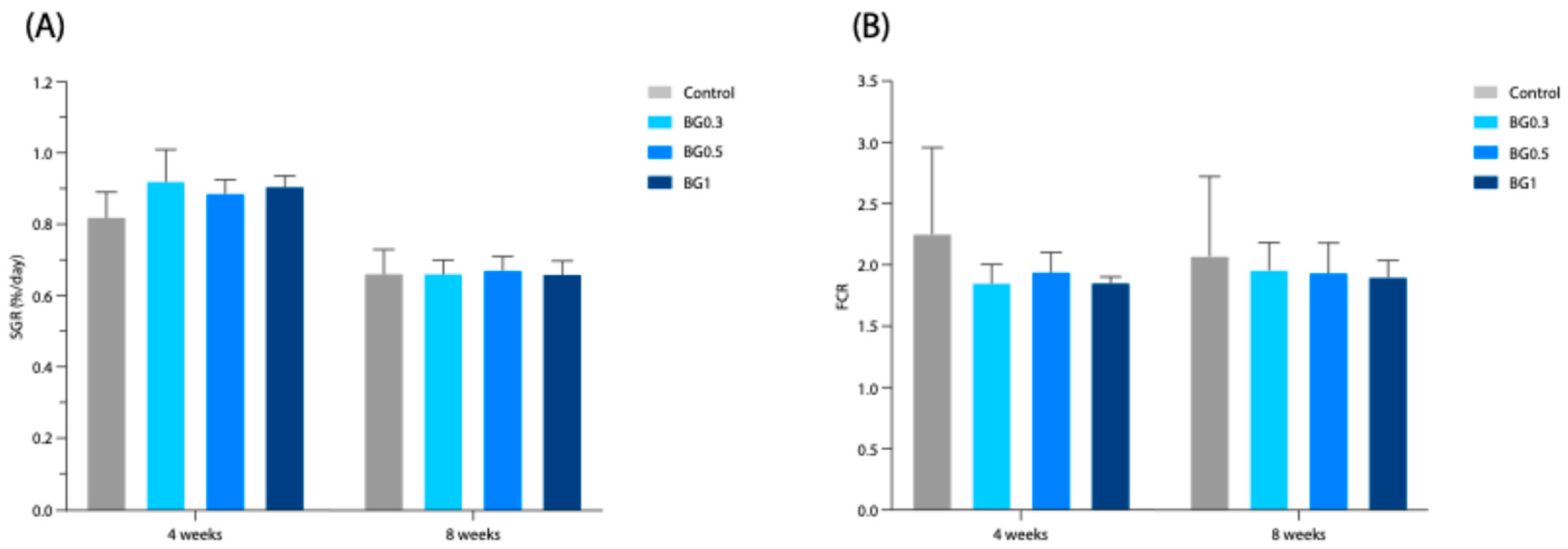
All diets were well accepted by the fish, and survival and condition factors were unaffected by the dietary treatment. No significant differences in weight gain, specific growth rate (SGR), or feed conversion ratio (FCR) were detected among groups after 4 or 8 weeks of feeding (Figure 1). Nevertheless, fish fed the BG diets showed a non-significant trend towards an 8–12% increase in SGR after 4 weeks of supplementation, as well as an optimized FCR of 13–17% and 5–8% after 4 and 8 weeks of feeding, respectively, compared to fish fed the Control diet, with the highest FCR numerical improvement being recorded in the BG1 treatment group (Figure 1).

3.2. Pathogen Challenge Test and Selected Immune Parameters

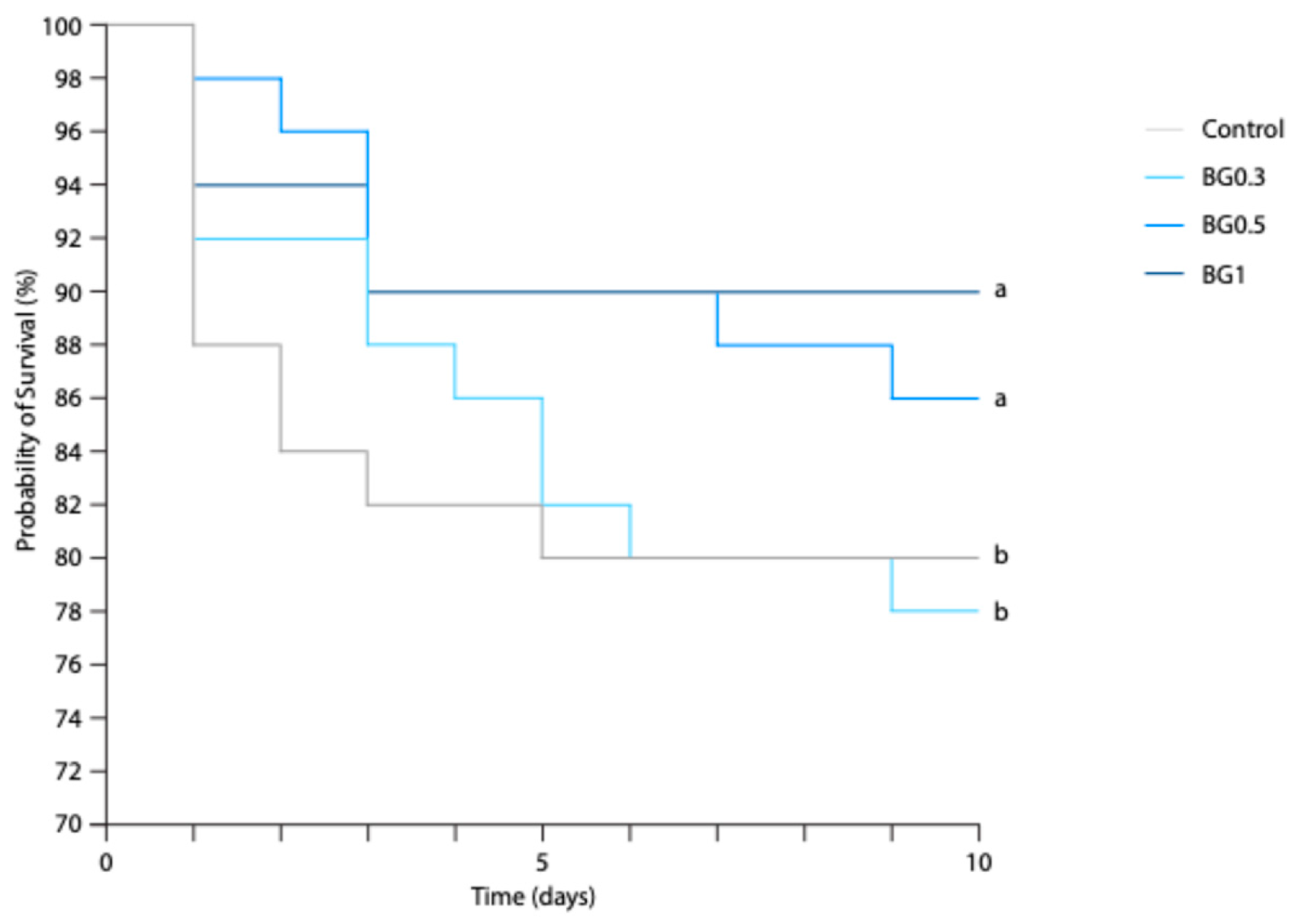
Fish fed the BG0.5 and BG1 diets showed improved cumulative survival after the V. anguillarum challenge compared to fish fed the BG0.3 and Control diets (p < 0.1, Kaplan–Meier; Figure 2). However, no significant effect of dietary treatment was observed on serum ACH50 or lysozyme activity (Table 2). Bacteriolytic and bacteriostatic activities were numerically lower in fish fed the BG0.5 and BG1 diets than in those fed the Control diet, whereas the BG0.3 experimental group showed higher values for both parameters, although those trends were not significant. Fish fed the BG0.3 diet showed significantly higher bacteriolytic activity than those fed the BG1 diet (p < 0.05), and bacteriostatic activity was significantly higher in those fed the BG0.3 diet than in those fed the BG0.5 and BG1 diets (p < 0.05; Table 2). No dose-dependent patterns were noted.

3.3. Intestinal Morphometry

In the posterior intestine, fish fed the BG0.3 diet presented shorter intestinal folds than those fed Control or BG1 diets (p < 0.05; Table 3), whereas in the anterior intestine, no significant differences were observed in fold lengths among fish fed the different treatments. The anterior intestine submucosa was thinner in BG0.5-fed fish than in fish from the other experimental groups, whereas the posterior intestine submucosa was thinner in fish fed the BG0.3 and BG0.5 diets than in fish fed the BG1 and Control diets (p < 0.05; Table 3).
Goblet cell area and perimeter in the posterior intestine were smaller in fish fed the BG0.3 diet compared to fish fed the Control diet (p < 0.05). In the anterior intestine, no significant differences among fish fed the different experimental diets were observed in the in goblet cell area or perimeter, although fish fed the BG0.3 and the BG0.5 diets showed a non-significant trend toward smaller intestinal goblet cell area (p = 0.075 and p = 0.068, respectively) compared with those fed the Control diet (Table 3).

4. Discussion

The present study investigated the potential of dietary supplementation with a commercial blend of mono-, di-, and triglycerides of SCFAs and MCFAs as functional feed additives in practical low-FM/FO diets for gilthead sea bream. This was achieved by including graded levels (low: 0.3%, moderate: 0.5%, high: 1%) of a commercial blend containing butyric, propionic, caproic, heptanoic, caprylic, nonanoic, capric, and lauric acids (BalanGUT™ AQ P) in the diets. The present results showed that while supplementation with SCFAs and MCFAs did not induce significant effects on fish growth performance or feed conversion, a non-significant trend toward an improved SGR and a lower FCR was observed in sea bream fed the supplemented diets, particularly with the highest inclusion level (1%) and in the first four weeks of feeding. These results are consistent with previous studies in gilthead sea bream and other fish species, in which dietary inclusion of SCFAs and MCFAs, particularly monoglycerides of butyric, propionic, and/or caproic acids, also resulted in slight, non-significant improvements in growth performance [13,14,15,37]. More specifically, the dietary supplementation with 0.5% SCFAs and MCFAs for eight weeks did not significantly improve growth performance in gilthead sea bream, although a numerical increase of approximately 3% in SGR relative to the Control group was observed [14]. Comparable non-significant trends have also been described in gilthead sea bream and common carp (Cyprinus carpio), with dietary butyrate supplementation [13,37]. In European sea bass (Dicentrarchus labrax) and giant grouper (Epinephelus lanceolatus) fed similar or lower inclusion levels (0.2–0.5%) of sodium butyrate, acetate, or propionate for six weeks, and 1% butyrate for eight weeks, respectively, no significant improvements in fish performance were observed [38,39]. In contrast, more pronounced growth benefits have been recorded in other species under a disease challenge or following extended periods of supplementation. For instance, sturgeon (Acipenser transmontanus) fed with 0.8% of SCFAs and MCFAS 1-monoglycerides showed increased growth when challenged with Aeromonas hydrophila [40]. In Nile tilapia, FCR was significantly reduced compared to the basal diet when a 0.5% blend of SCFA and MCFA was fed for 21 days, before and after challenge with Francisella orientalis [16]. Such discrepancies among studies suggest the influence of optimal time–dose feeding strategies in relation to fish species, age, dietary composition, time of supplementation, and experimental conditions [20,31,41]. Indeed, in the present study, responses did not follow a consistent dose–response pattern, since 1% showed the best feed efficiency trends, while 0.3% induced greater morphological changes without improving survival. This suggests different processes are modulated at different inclusion levels, without a clear mechanistic linkage.
Indeed, despite the lack of significant effects of the SCFAs and MCFAs blend in fish growth performance, moderate (0.5%) and high (1%) supplementation levels were associated with increased survival following the V. anguillarum challenge (Kaplan–Meier survival analysis, p < 0.1), whereas the BG0.3 group remained statistically indistinguishable from the Control. This protective effect was observed despite no significant differences in general systemic innate immune markers, such as serum lysozyme and ACH50 activity. Additionally, the lack of concordance between serum bacteriolytic/bacteriostatic activities and survival results suggests that these systemic humoral parameters were not the main determinants of protection in the present study and may be associated with other protective mechanisms not captured by the serum markers evaluated. These findings are consistent with a predominantly local mode of action, which may involve direct antimicrobial effects and intestinal-level mechanisms, potentially occurring at the intestinal level rather than through systemic immune modulation [38]. Such local effects may include the direct antimicrobial activity of medium-chain fatty acids (particularly C8–C12) and their glyceride forms. Monoglycerides can act as non-ionic surfactants that incorporate into bacterial plasma membranes, increasing permeability and leading to membrane disintegration [42]. In addition, short- and medium-chain fatty acids can diffuse into bacterial cells in their undissociated form and dissociate intracellularly, causing acidification of the cytoplasm, which may impair enzymatic activity and nutrient transport processes [28,43]. Further studies, including in vitro antimicrobial assays, for instance, minimum inhibitory concentration (MIC) against V. anguillarum, would be valuable to directly assess the contribution of these mechanisms. In agreement with the present results, and as an example that systemic innate markers may remain unchanged despite improved survival after challenge, Nile tilapia fed a 0.15–0.5% monoglyceride blend composed of propionic, butyric, valeric, caproic, heptanoic, caprylic, nonanoic, capric, and lauric acids for 21 days showed lower mortality following Streptococcus agalactiae challenge compared to non-supplemented groups, despite no significant changes in innate immune markers, including serum lysozyme, ACH50, or antibacterial activity [29]. Similarly, in gilthead sea bream, supplementation with 0.3% of MCFAs in the form of a sodium salt of coconut fatty acid distillate, rich in lauric acid, did not affect hematological markers [28]. In European sea bass, sodium propionate or butyrate supplementation (0.2–0.5%) also showed no effects on innate immune parameters in unchallenged juveniles [38]. In contrast, increased innate immune markers, haematocrit, hemoglobin, lysozyme, and bactericidal activity were reported in rainbow trout (Oncorhynchus mykiss) fed sodium butyrate [44] or European sea bass fed 0.2–0.3% of sodium propionate [18], suggesting that the potential effect of SCFAs and MCFAs supplementation on innate immunity of fish is highly context dependent and are modulated in a time and compound-dependent manner.
The observed changes in gut morphology, including thinner submucosa across all intestinal segments in sea bream fed supplemented diets at low and moderate levels (0.3% and 0.5%), as well as smaller goblet cell area and perimeter in the posterior intestine of fish fed 0.3%, further support the hypothesis of a local intestinal effect of SCFAs and MCFAs supplementation. These changes may reflect a less reactive mucosal state; however, alternative interpretations, such as reduced mucus production or structural alterations, cannot be excluded based on the present data. Indeed, thickening of the submucosa and enlargement of goblet cells are typically associated with intestinal inflammation, often caused by ANFs presented in high plant-based diets or a disruption of the eicosanoid cascade associated with an unbalanced n−6/n−3 fatty acid ratio in plant raw materials [45]. Importantly, these morphological changes were not associated with impaired growth performance or increased susceptibility to disease in the present study. Furthermore, it is consistent with the known potential anti-inflammatory, epithelial-stabilizing effect of moderate dietary SCFAs and MCFAs supplementation, which may inhibit pathogenic bacterial growth and support proliferation of beneficial microbiota [9]. Although not analyzed in the present study, gut microbiota is recognized as an important factor for maintaining gut barrier integrity and regulating immune responses, with a balanced microbiota reducing the susceptibility to disease by supporting epithelial health, limiting pathogen colonization, and helping prevent inflammatory processes that may compromise barrier function and pathogen entry [46]. Indeed, previous studies showed that SCFAs and MCFAs supplementation promoted a beneficial effect in fish microbiota linked with an improved disease resistance. For instance, in gilthead sea bream, butyrate supplementation alone or in combination with other SCFAs and MCFAs (propionic, and caproic acids) positively modulated fish gut microbiota by increasing microbiota diversity, the number of beneficial lactic acid bacteria, and reducing potential pathogenic along that reversed changes associated with a plant diet in the gut proteome, ultimately increasing resistance to parasitic infection with Enteromyxum leei [14,47]. Therefore, while the present results are consistent with a local intestinal mode of action, these interpretations are indirect and further studies integrating microbiome approaches, such as 16S rRNA sequencing or targeted qPCR of key bacterial group, as well as targeted molecular analyses, including qPCR of intestinal barrier-related genes such as occludin, claudins and ZO-1, as well as inflammatory cytokines, are warranted to further elucidate the underlying mechanisms. Overall, these positive effects of SCFAs and MCFAs supplementation reported here are consistent with other studies demonstrating that these organic acids positively modulate gut function in fish. For instance, in gilthead sea bream, 0.8% sodium butyrate supplementation improved intestinal mucosal folding, immune cell infiltration, and upregulated genes associated with epithelial renewal [48]. MCFAs supplementation with lauric acid was also linked to increased intestinal complexity and altered gene expression supporting nutrient absorption and adaptation in the same species [28]. Similarly, in European sea bass, sodium propionate supplementation led to increased villus area and goblet cell number [18], and 0.2% sodium butyrate modulated immune gene expression and intestinal morphology [15]. It is also noteworthy that the most evident effects of SCFAs and MCFAs supplementation observed in the present study were on the posterior intestine of the fish, which could be likely attributable to the glycerol esterification effect of the blend used. Indeed, glyceride forms are known to protect organic acids from early absorption, ensuring their targeted release and action in the posterior intestine [14]. Comparable protective effects on gut structure were also observed in Nile tilapia (Oreochromis niloticus), black sea bream (Acanthopagrus schlegelii) and giant grouper fed a monoglyceride blend or butyrate glyceride, where increased lamina propria width, greater numbers of goblet and intraepithelial lymphocytes, improved villus height, microvillus density and antioxidant capacity suggested reduced intestinal damage, before and after stress [29,30,49].
While most studies have focused on individual SCFAs and MCFAs, mainly butyric, propionic, and caproic acids, which are the main components of the present blend, it is important to acknowledge that the blend here tested (BalanGUT™ AQ P) also contained smaller amounts of other organic acids, including heptanoic, caprylic, nonanoic, capric, and lauric acids. Although less studied in fish, these minor components might have also provided antimicrobial and metabolic benefits, potentially acting additively or synergistically with the major acids of the blend. Therefore, the overall effects observed likely reflected both the primary action of the major acids, particularly butyrate, and a possible minor contribution from these additional SCFAs and MCFAs, highlighting the potential of multi-supplementation of SCFAs and MCFAs for supporting fish mucosal health. In addition, further research is needed to fully understand the mechanistic action of SCFAs and MCFAs in fish species. In mammals, SCFAs regulate innate immune and inflammatory responses as well as energy metabolism by binding to specific G-protein coupled receptors (GPCRs), including GPR41, GPR43, and GPR109A [50,51]. These receptors are expressed in the intestinal epithelium and immune cells, where they play a crucial role in immune function within the intestinal tract [52]. However, in teleost fish, canonical mammalian SCFA receptors are not fully conserved, and recent studies have identified a family of GPR40-like receptors (GPR40L) as potential functional homologues involved in fatty acid sensing and immune modulation. These receptors appear to be phylogenetically related to mammalian FFAR2/GPR43 and are conserved across multiple fish species, suggesting a relevant role in mediating host responses to microbial metabolites [52]. Functional studies in teleosts have further shown that free fatty acid receptors are expressed in intestinal tissues and can respond to dietary lipids, supporting their involvement in gut-level signalling and metabolic regulation [53]. Therefore, receptor-mediated sensing of SCFAs and MCFAs through gpr40L or related receptors may represent a plausible mechanism contributing to the local intestinal effects observed in the present study. However, further studies assessing the expression of these receptors in different intestinal segments would be valuable to confirm their role in mediating the observed responses.

5. Conclusions

Dietary supplementation with a blend of mono-, di-, and triglycerides of SCFAs and MCFAs (BalanGUT™ AQ P) over an eight-week feeding period did not significantly affect growth performance or feed conversion in juvenile gilthead sea bream fed practical low-FM/FO diets. However, moderate (0.5%) and high (1%) supplementation levels significantly enhanced resistance to V. anguillarum infection, as indicated by higher post-challenge cumulative survival compared to the Control and to a lower supplementation level (0.3%). Notably, the 0.5% inclusion level combined improved disease resistance with favourable intestinal morphological responses, suggesting a balanced effect at a moderate supplementation level. From a practical perspective, this inclusion level may represent a suitable and potentially cost-effective strategy, as it provides functional benefits without the need for higher inclusion rates. This observation is based on biological efficacy and that a full economic analysis remains a separate requirement for commercial verification. These findings highlight the potential of SCFA/MCFA blends as functional additives to support mucosal health and disease resilience in aquaculture species maintained on sustainable, low-marine-ingredient diets.

Author Contributions

Conceptualization, D.M., E.A. and S.T.; methodology, D.M., S.T. and S.S.; validation, D.M. and S.T.; formal analysis, D.M., M.C., F.A., L.M.-A. and S.T.; investigation, D.M., S.S., M.C., F.A. and S.T.; resources, D.M., A.G., E.A. and S.T.; data curation, D.M. and S.T.; writing—original draft preparation, D.M., M.C. and S.T.; writing—review and editing, D.M., M.C. and S.T.; visualization, D.M. and S.T.; supervision, D.M., F.A. and S.T.; project administration, D.M. and S.T.; funding acquisition, D.M., A.G., E.A. and S.T. All authors have read and agreed to the published version of the manuscript.

Funding

This work was partially supported by BASF, FZE (Dubai, United Arab Emirates) (contract number C2021/126), which also provided the functional product and diets, and support in the form of salaries for authors EA and AG but did not have any additional role in the study design, data collection, and analyses. ST was supported by a Ramon y Cajal contract (ref. RYC2021-031414-I) from the Ministerio de Ciencia e Innovación (MICINN).

Institutional Review Board Statement

All experimental procedures were performed in accordance with the provisions of the European Union Directive (2010/63/EU) and Spanish legislation (RD 53/2013) on animal experimentation. The Bioethics Committee of the University of Las Palmas de Gran Canaria approved all protocols used in this study (approval number OEBA-ULPCG 18/2021; Approval date: 17 September 2021).

Data Availability Statement

The data presented in this study are available on request from the corresponding author.

Acknowledgments

The authors have reviewed and edited the output and take full responsibility for the content of this publication.

Conflicts of Interest

The authors declare the following financial interests/personal relationships which may be considered as potential competing interests: Ehab Aboelsaadat reports financial support was provided by BASF SE. Ehab Aboelsaadat reports a relationship with BASF SE that includes employment. This work was partially supported by BASF, FZE (Dubai, United Arab Emirates), which provided the functional product and diets, and support in the form of salaries for authors E.A. and A.G. but did not have any additional role in the study design, data collection and analyses. The funders had no role in the design of the study; in the collection, analyses, or interpretation of data; in the writing of the manuscript; or in the decision to publish the results.

Abbreviations

The following abbreviations are used in this manuscript:
ACH50Alternative complement pathway activity
ANFsanti-nutritional factors
CFUcolony forming units
FCRFood conversion ratio
FMFishmeal
FOFish oil
GALTgut-associated lymphoid tissue
GPRG-Protein receptor
MCFAsmedium-chain fatty acids
PBSphosphate-buffered saline
SCFAsshort-chain fatty acids
SDstandard deviation
SGRSpecific growth rate
ULPGCUniversity of Las Palmas de Gran Canaria

References

  1. FAO. The State of World Fisheries and Aquaculture 2024—Blue Transformation in Action; Food and Agriculture Organisation of the United Nations: Rome, Italy, 2024. [Google Scholar] [CrossRef]
  2. Montero, D.; Izquierdo, M.S. Welfare and health of sh fed vegetable oils as alternative lipid sources to sh oil. In Fish Oil Replacement and Alternative Lipid Sources in Aquaculture Feeds; CRC Press: Boca Raton, FL, USA, 2010; pp. 439–485. [Google Scholar] [CrossRef]
  3. Aragão, C.; Cabano, M.; Colen, R.; Fuentes, J.; Dias, J. Alternative Formulations for Gilthead Seabream Diets: Towards a More Sustainable Production. Aquac. Nutr. 2020, 26, 444–455. [Google Scholar] [CrossRef]
  4. Aragão, C.; Gonçalves, A.T.; Costas, B.; Azeredo, R.; Xavier, M.J.; Engrola, S. Alternative Proteins for Fish Diets: Implications beyond Growth. Animals 2022, 12, 1211. [Google Scholar] [CrossRef]
  5. Øverland, M.; Bikker, P.; Fledderus, J. Potassium Diformate in the Diet of Reproducing Sows: Effect on Performance of Sows and Litters. Livest. Sci. 2009, 122, 241–247. [Google Scholar] [CrossRef]
  6. Estruch, G.; Collado, M.C.; Monge-Ortiz, R.; Tomás-Vidal, A.; Jover-Cerdá, M.; Peñaranda, D.S.; Pérez Martínez, G.; Martínez-Llorens, S. Long-Term Feeding with High Plant Protein Based Diets in Gilthead Seabream (Sparus aurata, L.) Leads to Changes in the Inflammatory and Immune Related Gene Expression at Intestinal Level. BMC Vet. Res. 2018, 14, 302. [Google Scholar] [CrossRef]
  7. Naya-Català, F.; Piazzon, M.C.; Torrecillas, S.; Calduch-Giner, J.A.; Fontanilla, A.; Sitjà-Bobadilla, A.; Pérez-Sánchez, J. Genetics and Nutrition Drive the Gut Microbiota Succession and Host-Transcriptome Interactions through the Gilthead Sea Bream (Sparus aurata) Production Cycle. Biology 2022, 11, 1744. [Google Scholar] [CrossRef]
  8. Daniso, E.; Sarropoulou, E.; Kaitetzidou, E.; Beraldo, P.; Tibaldi, E.; Cerri, R.; Cardinaletti, G. Effect of Increasing Levels of Hermetia Illucens in a Fishmeal-Free Diet at Sea Bream (Sparus aurata, L.) Gastrointestinal Level. Aquac. Rep. 2024, 39, 102410. [Google Scholar] [CrossRef]
  9. Hoseinifar, S.H.; Sun, Y.-Z.; Caipang, C.M. Short-Chain Fatty Acids as Feed Supplements for Sustainable Aquaculture: An Updated View. Aquac. Res. 2017, 48, 1380–1391. [Google Scholar] [CrossRef]
  10. Tran, N.T.; Li, Z.; Wang, S.; Zheng, H.; Aweya, J.J.; Wen, X.; Li, S. Progress and Perspectives of Short-chain Fatty Acids in Aquaculture. Rev. Aquac. 2020, 12, 283–298. [Google Scholar] [CrossRef]
  11. Mustafa, S.A.; Al-Faragi, J.K. Supplementation of Feed Additives on Aquaculture Feeds: A Review. Int. J. Pharm. Res. 2021, 13, 561–567. [Google Scholar] [CrossRef]
  12. Dawood, M.A.O.; Koshio, S.; Esteban, M.Á. Beneficial Roles of Feed Additives as Immunostimulants in Aquaculture: A Review. Rev. Aquac. 2018, 10, 950–974. [Google Scholar] [CrossRef]
  13. Robles, R.; Lozano, A.B.; Sevilla, A.; Márquez, L.; Nuez-Ortín, W.; Moyano, F.J. Effect of Partially Protected Butyrate Used as Feed Additive on Growth and Intestinal Metabolism in Sea Bream (Sparus aurata). Fish Physiol. Biochem. 2013, 39, 1567–1580. [Google Scholar] [CrossRef] [PubMed]
  14. Rimoldi, S.; Gliozheni, E.; Ascione, C.; Gini, E.; Terova, G. Effect of a Specific Composition of Short- and Medium-Chain Fatty Acid 1-Monoglycerides on Growth Performances and Gut Microbiota of Gilthead Sea Bream (Sparus aurata). PeerJ 2018, 6, e5355. [Google Scholar] [CrossRef] [PubMed]
  15. Rimoldi, S.; Finzi, G.; Ceccotti, C.; Girardello, R.; Grimaldi, A.; Ascione, C.; Terova, G. Butyrate and Taurine Exert a Mitigating Effect on the Inflamed Distal Intestine of European Sea Bass Fed with a High Percentage of Soybean Meal. Fish. Aquat. Sci. 2016, 19, 40. [Google Scholar] [CrossRef]
  16. da Silva, V.G.; Favero, L.M.; Mainardi, R.M.; Ferrari, N.A.; Chideroli, R.T.; Di Santis, G.W.; de Souza, F.P.; da Costa, A.R.; Gonçalves, D.D.; Nuez-Ortin, W.G.; et al. Effect of an Organic Acid Blend in Nile Tilapia Growth Performance, Immunity, Gut Microbiota, and Resistance to Challenge against Francisellosis. Res. Vet. Sci. 2023, 159, 214–224. [Google Scholar] [CrossRef]
  17. Serradell, A.; Montero, D.; Terova, G.; Rimoldi, S.; Makol, A.; Acosta, F.; Bajek, A.; Haffray, P.; Allal, F.; Torrecillas, S. Functional Additives in a Selected European Sea Bass (Dicentrarchus labrax) Genotype: Effects on the Stress Response and Gill Antioxidant Response to Hydrogen Peroxide (H2O2) Treatment. Animals 2023, 13, 2265. [Google Scholar] [CrossRef]
  18. Wassef, E.A.; Saleh, N.E.; Abdel-Meguid, N.E.; Barakat, K.M.; Abdel-Mohsen, H.H.; El-bermawy, N.M. Sodium Propionate as a Dietary Acidifier for European Seabass (Dicentrarchus labrax) Fry: Immune Competence, Gut Microbiome, and Intestinal Histology Benefits. Aquac. Int. 2020, 28, 95–111. [Google Scholar] [CrossRef]
  19. Abdel-Latif, H.M.R.; Abdel-Tawwab, M.; Dawood, M.A.O.; Menanteau-Ledouble, S.; El-Matbouli, M. Benefits of Dietary Butyric Acid, Sodium Butyrate, and Their Protected Forms in Aquafeeds: A Review. Rev. Fish. Sci. Aquac. 2020, 28, 421–448. [Google Scholar] [CrossRef]
  20. Ng, W.-K.; Koh, C.-B. The Utilization and Mode of Action of Organic Acids in the Feeds of Cultured Aquatic Animals. Rev. Aquac. 2017, 9, 342–368. [Google Scholar] [CrossRef]
  21. Guilloteau, P.; Savary, G.; Jaguelin-Peyrault, Y.; Romé, V.; Le Normand, L.; Zabielski, R. Dietary Sodium Butyrate Supplementation Increases Digestibility and Pancreatic Secretion in Young Milk-Fed Calves. J. Dairy Sci. 2010, 93, 5842–5850. [Google Scholar] [CrossRef]
  22. Guilloteau, P.; Martin, L.; Eeckhaut, V.; Ducatelle, R.; Zabielski, R.; Van Immerseel, F. From the Gut to the Peripheral Tissues: The Multiple Effects of Butyrate. Nutr. Res. Rev. 2010, 23, 366–384. [Google Scholar] [CrossRef] [PubMed]
  23. Canani, R.B.; Costanzo, M.D.; Leone, L.; Pedata, M.; Meli, R.; Calignano, A. Potential Beneficial Effects of Butyrate in Intestinal and Extraintestinal Diseases. World J. Gastroenterol. 2011, 17, 1519–1528. [Google Scholar] [CrossRef] [PubMed]
  24. Terova, G.; Díaz, N.; Rimoldi, S.; Ceccotti, C.; Gliozheni, E.; Piferrer, F. Effects of Sodium Butyrate Treatment on Histone Modifications and the Expression of Genes Related to Epigenetic Regulatory Mechanisms and Immune Response in European Sea Bass (Dicentrarchus labrax) Fed a Plant-Based Diet. PLoS ONE 2016, 11, e0160332. [Google Scholar] [CrossRef]
  25. Hamer, H.M.; Jonkers, D.M.A.E.; Bast, A.; Vanhoutvin, S.A.L.W.; Fischer, M.A.J.G.; Kodde, A.; Troost, F.J.; Venema, K.; Brummer, R.-J.M. Butyrate Modulates Oxidative Stress in the Colonic Mucosa of Healthy Humans. Clin. Nutr. 2009, 28, 88–93. [Google Scholar] [CrossRef]
  26. Tian, L.; Zhou, X.-Q.; Jiang, W.-D.; Liu, Y.; Wu, P.; Jiang, J.; Kuang, S.-Y.; Tang, L.; Tang, W.-N.; Zhang, Y.-A.; et al. Sodium Butyrate Improved Intestinal Immune Function Associated with NF-κB and p38MAPK Signalling Pathways in Young Grass Carp (Ctenopharyngodon idella). Fish Shellfish Immunol. 2017, 66, 548–563. [Google Scholar] [CrossRef]
  27. Wang, J.; Wu, X.; Simonavicius, N.; Tian, H.; Ling, L. Medium-Chain Fatty Acids as Ligands for Orphan G Protein-Coupled Receptor GPR84. J. Biol. Chem. 2006, 281, 34457–34464. [Google Scholar] [CrossRef] [PubMed]
  28. Simó-Mirabet, P.; Piazzon, M.C.; Calduch-Giner, J.; Ortiz, Á.; Puyalto, M.; Sitjà-Bobadilla, A.; Pérez-Sánchez, J. Sodium Salt Medium-Chain Fatty Acids and Bacillus-Based Probiotic Strategies to Improve Growth and Intestinal Health of Gilthead Sea Bream (Sparus aurata). PeerJ 2017, 5, e4001. [Google Scholar] [CrossRef] [PubMed]
  29. Ferrari, N.A.; Mainardi, R.M.; da Silva, M.B.; Guimarães, G.D.; Takashe, J.V.G.; de Oliveira Júnior, A.G.; Hayashi, R.M.; Di Santis, G.W.; Pereira, U.P. Effect of a Monoglyceride Blend in Nile Tilapia Growth Performance, Immunity, Gut Microbiota, and Resistance to Challenge against Streptoccocosis and Francisellosis. Fishes 2024, 9, 351. [Google Scholar] [CrossRef]
  30. Li, X.; Ray, G.W.; Kou, S.; Liang, M.; Yang, Q.; Tan, B.; Chi, S. Glycerol monolaurate (GML), a medium-chain fatty acid derivative, ameliorate growth performance, immune function, disease resistance and intestinal microbiota in juvenile hybrid grouper (Epinephelus fuscoguttatus♀ × Epinephelus lanceolatus♂). Fish Shellfish Immunol 2022, 128, 634–643. [Google Scholar] [CrossRef]
  31. Torrecillas, S.; Terova, G.; Makol, A.; Serradell, A.; Valdenegro, V.; Gini, E.; Izquierdo, M.; Acosta, F.; Montero, D. Dietary phytogenics and galactomannan oligosaccharides in low fish meal and fish oil-based diets for European sea bass (Dicentrarchus labrax) juveniles: Effects on gut health and implications on in vivo gut bacterial translocation. PLoS ONE 2019, 14, e0222063. [Google Scholar] [CrossRef]
  32. Martoja, R.; Martoja-Pierson, M. Técnicas de Histología Animal; Toray-Masson: Barcelona, Spain, 1970. [Google Scholar]
  33. Anderson, D.P.; Siwicki, A.K. Duration of protection against Aeromonas salmonicida in brook trout immunostimulated with glucan or chitosan by injection or immersion. Progress. Fish-Cult. 1994, 56, 258–261. [Google Scholar] [CrossRef]
  34. Sunyer, J.O.; Tort, L. Natural hemolytic and bactericidal activities of sea bream Sparus aurata serum are effected by the alternative complement pathway. Vet. Immunol. Immunopathol. 1995, 45, 333–345. [Google Scholar] [CrossRef] [PubMed]
  35. Tukey, J.W. Comparing Individual Means in the Analysis of Variance. Biometrics 1949, 5, 99–114. [Google Scholar] [CrossRef]
  36. Fowler, J.; Cohen, L.; Jarvis, P. Practical Statistics for Field Biology, 2nd ed.; Wiley: Chichester, UK, 2013; ISBN 978-1-118-68564-8. [Google Scholar]
  37. Liu, W.; Yang, Y.; Zhang, J.; Gatlin, D.M.; Ringø, E.; Zhou, Z. Effects of Dietary Microencapsulated Sodium Butyrate on Growth, Intestinal Mucosal Morphology, Immune Response and Adhesive Bacteria in Juvenile Common Carp (Cyprinus carpio) Pre-Fed with or without Oxidised Oil. Br. J. Nutr. 2014, 112, 15–29. [Google Scholar] [CrossRef] [PubMed]
  38. Fontinha, F.; Martins, N.; Bonin, F.; Magalhães, R.; Santos, R.; Peres, H.; Oliva-Teles, A. Effect of Dietary Short-Chain Fatty Acids on the Immune Status and Disease Resistance of European Seabass Juveniles. Fishes 2024, 9, 363. [Google Scholar] [CrossRef]
  39. Yong, A.S.K.; Abang Zamhari, D.N.J.B.; Shapawi, R.; Zhuo, L.-C.; Lin, Y.-H. Physiological changes of giant grouper (Epinephelus lanceolatus) fed with high plant protein with and without supplementation of organic acid. Aquac. Rep. 2020, 18, 100499. [Google Scholar] [CrossRef]
  40. Parini, P. Species independent efficacy of a specific composition of monoglycerides of short and medium chain fatty acids in preventing EMS and controlling Vibrio parahaemolyticus, Aeromonas spp., Streptococcus uberis, Flavobacterium spp., Yersinia ruckery, Pseudomonas spp. and Bacillus cereus affecting shrimps and other aquatic species. In Proceedings of the 2nd Global Summit on Aquaculture & Fisheries, Kuala Lumpur, Malaysia, 11–13 July 2016. [Google Scholar]
  41. Torrecillas, S.; Aboelsaadat, E.; Carvalho, M.; Acosta, F.; Monzón-Atienza, L.; Gordillo, Á.; Montero, D. Dietary Supplementation of a Combination of Formic Acid and Sodium Formate in Practical Diets Promotes Gilthead Sea Bream (Sparus aurata) Gut Morphology and Disease Resistance. Aquac. Rep. 2024, 35, 101951. [Google Scholar] [CrossRef]
  42. Vinolo, M.A.R.; Rodrigues, H.G.; Hatanaka, E.; Sato, F.T.; Sampaio, S.C.; Curi, R. Suppressive Effect of Short-Chain Fatty Acids on Production of Proinflammatory Mediators by Neutrophils. J. Nutr. Biochem. 2011, 22, 849–855. [Google Scholar] [CrossRef]
  43. Kollanoor, A.; Vasudevan, P.; Nair, M.K.M.; Hoagland, T.; Venkitanarayanan, K. Inactivation of Bacterial Fish Pathogens by Medium-Chain Lipid Molecules (Caprylic Acid, Monocaprylin and Sodium Caprylate). Aquac. Res. 2007, 38, 1293–1300. [Google Scholar] [CrossRef]
  44. Lin, X.; Zhang, C.; Cao, K.; Li, Z.; Zhao, Z.; Li, X.; Leng, X. Dietary Sodium Butyrate Changed Intestinal Histology and Microbiota of Rainbow Trout (Oncorhynchus mykiss), but Did Not Promote Growth and Nutrient Utilization. Aquac. Nutr. 2023, 3706109. [Google Scholar] [CrossRef]
  45. Francis, G.; Makkar, H.P.S.; Becker, K. Antinutritional Factors Present in Plant-Derived Alternate Fish Feed Ingredients and Their Effects in Fish. Aquaculture 2001, 199, 197–227. [Google Scholar] [CrossRef]
  46. Yukgehnaish, K.; Kumar, P.; Sivachandran, P.; Marimuthu, K.; Arshad, A.; Paray, B.A.; Arockiaraj, J. Gut Microbiota Metagenomics in Aquaculture: Factors Influencing Gut Microbiome and Its Physiological Role in Fish. Rev. Aquac. 2020, 12, 1903–1927. [Google Scholar] [CrossRef]
  47. Piazzon, M.C.; Calduch-Giner, J.A.; Fouz, B.; Estensoro, I.; Simó-Mirabet, P.; Puyalto, M.; Karalazos, V.; Palenzuela, O.; Sitjà-Bobadilla, A.; Pérez-Sánchez, J. Under Control: How a Dietary Additive Can Restore the Gut Microbiome and Proteomic Profile, and Improve Disease Resilience in a Marine Teleostean Fish Fed Vegetable Diets. Microbiome 2017, 5, 164. [Google Scholar] [CrossRef]
  48. Estensoro, I.; Ballester-Lozano, G.; Benedito-Palos, L.; Grammes, F.; Martos-Sitcha, J.A.; Mydland, L.-T.; Calduch-Giner, J.A.; Fuentes, J.; Karalazos, V.; Ortiz, Á.; et al. Dietary Butyrate Helps to Restore the Intestinal Status of a Marine Teleost (Sparus aurata) Fed Extreme Diets Low in Fish Meal and Fish Oil. PLoS ONE 2016, 11, e0166564. [Google Scholar] [CrossRef] [PubMed]
  49. Volatiana, J.A.; Sagada, G.; Xu, B.; Zhang, J.; Ng, W.-K.; Shao, Q. Effects of Butyrate Glycerides Supplementation in High Soybean Meal Diet on Growth Performance, Intestinal Morphology and Antioxidative Status of Juvenile Black Sea Bream, Acanthopagrus schlegelii. Aquac. Nutr. 2020, 26, 15–25. [Google Scholar] [CrossRef]
  50. Huang, W.; Guo, H.-L.; Deng, X.; Zhu, T.-T.; Xiong, J.-F.; Xu, Y.-H.; Xu, Y. Short-chain fatty acids inhibit oxidative stress and inflammation in mesangial cells induced by high glucose and lipopolysaccharide. Exp. Clin. Endocrinol. Diabetes 2017, 125, 98–105. [Google Scholar] [CrossRef]
  51. Miyamoto, J.; Hasegawa, S.; Kasubuchi, M.; Ichimura, A.; Nakajima, A.; Kimura, I. Nutritional signaling via free fatty acid receptors. Int. J. Mol. Sci. 2016, 17, 450. [Google Scholar] [CrossRef] [PubMed]
  52. Petit, J.; Wiegertjes, G.F. Conservation of Members of the Free Fatty Acid Receptor Gene Family in Common Carp. Dev. Comp. Immunol. 2022, 126, 104240. [Google Scholar] [CrossRef]
  53. Roy, J.; Baranek, E.; Marandel, L. Characterization of Free Fatty Acid Receptor Family in Rainbow Trout (Oncorhynchus mykiss): Towards a Better Understanding of Their Involvement in Fatty Acid Signalisation. BMC Genom. 2023, 24, 130. [Google Scholar] [CrossRef]
Figure 1. Effects of graded dietary supplementation with glycerides of short- and medium-chain fatty acids on gilthead sea bream growth performance parameters after 4 and 8 weeks of feeding (error bars represent standard deviation). (A) Specific growth rate and (B) feed conversion ratio. Control: no supplementation; BG0.3: 0.3% BalanGUTTM AQ P; BG0.5: 0.5% BalanGUTTM AQ P; BG1: 1% BalanGUTTM AQ P.
Fishes 11 00284 g001
Figure 2. Effects of graded dietary supplementation with glycerides of short- and medium-chain fatty acids on gilthead sea bream cumulative survival (%) during the Vibrio anguillarum challenge test. Different letters denote statistical differences (p = 0.07; Kaplan–Meier survival). Control: no supplementation; BG0.3: 0.3% BalanGUT™ AQ P; BG0.5: 0.5% BalanGUT™ AQ P; BG1: 1% BalanGUT™ AQ P.
Fishes 11 00284 g002
Table 1. Composition of the experimental diets used in the study.
Experimental Diets
Raw material (%)ControlBG (0.3, 0.5, 1)
Fishmeal Super Prime 115.0015.00
Poultry meal 25.005.00
Soy protein concentrate 315.0015.00
Wheat gluten 412.5012.50
Corn gluten meal 59.609.60
Soybean meal 44 65.005.00
Sunflower meal 40 76.006.00
Wheat meal10.089.78/9.58/9.08
Faba beans (low tannins) 86.006.00
Vitamin and mineral premix 91.001.00
Antioxidant 100.100.10
Monocalcium phosphate1.301.30
L-Lysine HCl 99% 110.200.20
Fish oil 126.006.00
Rapeseed oil7.207.20
BalanGUT™ AQ P 130.000.3/0.5/1
Control diet. BG: BalanGUTTM functional diet. 1 Fishmeal Super Prime: Pequera Diamante (Peru). 2 Poultry meal: SAVINOR UTS (Portugal). 3 Soya protein concentrate: ADM (The Netherlands). 4 Wheat gluten: Roquette (France). 5 Corn gluten meal: COPAM (Portugal). 6 Soybean meal 44, solvent extracted: Ribero &Sousa Lda (Portugal). 7 Sunflower meal 40 (HiPro), dehulled, solvent extracted: AGP Slovakia s.r.o. (Slovakia). 8 Faba beans: Ribero &Sousa Lda (Portugal). 9 Mineral and Vitamin premix: Premix Lda (Portugal). Vitamins (IU or mg/Kg diet): DL-alpha-tocopherol acetate, 100 mg; sodium menadione bisulfate, 25 mg; retinyl acetate, 20,000 IU; DL-cholecalciferol, 2000 IU; thiamine, 30 mg; riboflavin, 30 mg; pyridoxine, 20 mg; cyanocobalamin, 0.1 mg; nicotidin acid, 200 mg; folic acid, 15 mg; ascorbic acid, 1000 mg; inositol, 500 mg; biotin, 3 mg; calcium panthotenate, 100 mg; choline chloride, 1000 mg, betaine, 500 mg. Minerals (g or mg/kg diet): cobalt carbonate, 0.65 mg; copper sulfate, 9 mg; ferric sulfate, 6 mg; potassium iodide, 0.5 mg; manganese oxide, 9.6 mg; sodium selenite, 0.01 mg; and zinc sulfate. 7.5 mg; sodium chloride, 400 mg; calcium carbonate, 1.86 g; excipient wheat middlings. 10 Verdilox (Kemin Europe NV, Belgium). 11 L-Lysine HCl 99%: Ajinomoto EUROLYSINE S.A.S (France). 12 Fish oil: Sopropêche (France). 13 BalanGUTTM BASF (Germany).
Table 2. Effects of graded dietary supplementation with glycerides of short and medium-chain fatty acids on gilthead sea bream serum immune parameters after 8 weeks of feeding.
Diets
Immune Parameters ActivityControlBG0.3BG0.5BG1
ACH50 (U/mL)32.70 ± 13.7936.83 ± 10.4032.49 ± 8.3131.69 ± 8.81
Lysozyme (IU/mL)515.6 ± 19.73533.9 ± 37.22546.6 ± 50.78516.9 ± 16.66
Bacteriolytic activity (%)51.97 ± 15.72 ab61.69 ± 20.22 a44.08 ± 25.12 ab41.39 ± 11.19 b
Bacteriostatic activity (%)71.29 ± 11.08 ab77.54 ± 13.00 a63.65 ± 19.54 b63.85 ± 8.18 b
Values expressed in mean ± SD. (n = 3 tanks/diet). ACH50, alternative complement pathway activity; Different superscript letters indicate significant differences (p < 0.05) based on one-way ANOVA and Tukey’s post hoc analyses. Control: No supplementation; BG0.3: 0.3% BalanGUTTM AQ P; BG0.5: 0.5% BalanGUTTM AQ P; BG1: 1% BalanGUTTM AQ P).
Table 3. Effects of graded dietary supplementation with glycerides of short and medium-chain fatty acids on gilthead sea bream intestinal goblet cells morphometric parameters after 8 weeks of feeding.
Diets
ControlBG0.3BG0.5BG1
Fold length (μm)     
Anterior intestine1667.3 ± 78.791574.9 ± 50.51585.5 ± 41.421753.5 ± 130.9
Posterior intestine765.5 ± 79.08 a579.52 ± 58.53 b749.18 ± 47.16 ab808.02 ± 45.82 a
Submucosa width (μm)    
Anterior intestine42.51 ± 1.35 a43.03 ± 1.32 a36.94 ± 1.48 b43.46 ± 1.63 a
Posterior intestine53.62 ± 6.49 a47.20 ± 3.32 b48.46 ± 3.07 b54.50 ± 4.66 a
Goblet cell area (μm2)    
Anterior intestine152.3 ± 13.82141.8 ± 12.66141.2 ± 7.46148.4 ± 9.20
Posterior intestine95.57 ± 21.07 a76.99 ± 15.88 b82.35 ± 13.60 ab88.75 ± 13.29 ab
Goblet cell perimeter (μm)    
Anterior intestine63.47 ± 3.3463.19 ± 4.5162.69 ± 4.7461.97 ± 1.83
Posterior intestine49.28 ± 6.69 a44.22 ± 5.44 b46.46 ± 5.18 ab49.09 ± 5.08 ab
Values expressed in mean ± SD. (n = 3 tanks/diet). Different superscript letters are significantly different (p < 0.05) based on one-way ANOVA and Tukey’s post hoc analyses. Control: reference diet 0% BalanGUTTM AQ P; BG0.3: 0.3% BalanGUTTM AQ P; BG0.5: 0.5% BalanGUTTM AQ P; BG1: 1% BalanGUTTM AQ P).
Disclaimer/Publisher’s Note: The statements, opinions and data contained in all publications are solely those of the individual author(s) and contributor(s) and not of MDPI and/or the editor(s). MDPI and/or the editor(s) disclaim responsibility for any injury to people or property resulting from any ideas, methods, instructions or products referred to in the content.