1. Introduction
Members of the order Sepiida (commonly known as cuttlefishes) belong to the phylum Mollusca and class Cephalopoda, and most commercially important species are placed within the family Sepiidae [
1]. A defining morphological characteristic of cuttlefish is the presence of an internal calcareous cuttlebone, which serves a critical function in buoyancy regulation [
2]. More than 100 species have been reported worldwide, primarily inhabiting tropical and temperate continental shelf waters [
1,
3]. In Korean coastal waters, economically important species such as
Sepia esculenta and
Sepia lycidas are widely distributed, and regional species composition varies depending on hydrographic and thermal conditions [
4].
Cuttlefishes are generally benthic or benthopelagic organisms inhabiting shallow coastal environments with sandy, muddy, or mixed substrates [
1]. During spawning seasons, they migrate to specific coastal areas to form localized spawning aggregations. Most species exhibit an annual, semelparous life history characterized by rapid growth and pronounced interannual fluctuations in abundance [
5]. These biological traits render cuttlefish populations particularly sensitive to environmental variability and fishing pressure, increasing the need for precise, species-level monitoring.
Globally, cephalopod populations and fisheries have shown substantial long-term variability, with regional increases reported in some areas and declines associated with overfishing and environmental change in others [
5,
6]. According to official fisheries production statistics from the Ministry of Oceans and Fisheries [
7] and the Korean Statistical Information Service [
8], annual cuttlefish landings in Korean waters have exhibited substantial interannual fluctuations over the past decade, reflecting variability in coastal resource abundance and fishing pressure. National trade records from the Korea Customs Service further indicate that cephalopod imports—including cuttlefish products—have increased in both volume and diversity, constituting a significant component of the seafood supply in Korea [
9]. These trends underscore the growing need for accurate species-level identification systems to support fisheries monitoring, stock assessment, and market verification.
In Korean seafood markets, multiple cuttlefish species are frequently marketed under common trade names without clear taxonomic distinction. Because closely related cuttlefish species often exhibit high morphological similarity and considerable intraspecific variation in coloration and body patterns, reliable identification based solely on external morphology can be challenging [
1]. This limitation becomes particularly pronounced in processed seafood products—such as frozen blocks, fillets, rings, or minced meat—in which diagnostic morphological characters are removed or no longer observable during processing. Under such conditions, traditional morphology-based identification becomes impractical, increasing the risk of species substitution and seafood mislabeling, which has been documented in molecular authentication studies of seafood products [
10].
In addition, imported cuttlefish products distributed in Korean markets are often traded under broad commercial names, which can complicate species-level verification during distribution and market surveillance. Beyond fisheries monitoring, accurate species authentication therefore has increasing regulatory and trade implications. Global initiatives aimed at combating illegal, unreported, and unregulated (IUU) fishing emphasize the development of robust traceability systems throughout harvesting, processing, and distribution chains [
11,
12]. Reliable molecular identification tools are therefore essential not only for biological monitoring and fisheries management but also for customs compliance, origin verification, and fair trade enforcement [
12].
The mitochondrial DNA (mtDNA) cytochrome c oxidase subunit I (COI) gene has been widely adopted as a standard barcode marker for species identification [
13,
14]. COI-based DNA barcoding has demonstrated effectiveness across diverse marine taxa, including cephalopods [
15,
16]. However, most previous studies have focused on single-species authentication or general phylogenetic inference. Comparative genetic analyses encompassing multiple commercially co-distributed cuttlefish species within a unified diagnostic framework—particularly in Korean markets—remain limited. Furthermore, practical molecular systems designed specifically for multiplex species discrimination and regulatory applications are still lacking. While COI-based DNA barcoding has been widely applied for species identification, most studies rely on sequencing-based approaches, which can be time-consuming and costly for routine monitoring. PCR-based methods have been widely applied for seafood authentication, with mitochondrial COI being one of the most commonly used markers due to its high discriminatory power [
17]. DNA barcoding studies have reported substantial levels of seafood mislabeling in commercial products, further emphasizing the need for reliable molecular identification tools [
18]. Although sequencing-based methods provide high accuracy, they are often time-consuming and less suitable for routine monitoring, highlighting the importance of rapid, cost-effective alternatives such as multiplex PCR [
19].
Accordingly, this study aimed to (1) assess intra- and interspecific sequence variation in the mtDNA COI region among seven commercially important cuttlefish species distributed in Korean markets, (2) identify diagnostic single-nucleotide polymorphisms (SNPs), and (3) develop a two-set multiplex PCR assay based on extended COI sequences for rapid species authentication. By integrating molecular diagnostics with fisheries and trade management considerations, this study provides a scientific basis for improving species-specific landing statistics, verifying imported products, preventing mislabeling, and strengthening seafood product traceability.
2. Materials and Methods
2.1. Sampling and DNA Isolation
Specimens representing six species of the genus
Sepia and one species of the genus
Sepiella, commercially imported and distributed in Korea, were collected for this study (
Table 1). Taxonomic nomenclature followed the reference used for species identification [
1].
Sepiella inermis is currently recognized as a valid species distinct from
Sepiella japonica based on taxonomic databases [
20]; therefore, the name
S. inermis was consistently adopted throughout this study.
Genomic DNA was extracted from mantle muscle tissue using the DNeasy® 96 Blood & Tissue Kit (QIAGEN, Hilden, Germany) in accordance with the manufacturer’s protocol. Approximately 15 mg of mantle muscle tissue was excised from each specimen and transferred into a sterile 1.5 mL microcentrifuge tube. The tissue was finely minced and incubated in 200 μL of ATL buffer with 10 μL of Proteinase K at 56 °C for 10 h with intermittent mixing until complete digestion was achieved.
Following lysis, 250 μL of AL buffer was added and thoroughly mixed, and the mixture was incubated at room temperature for 3 min. Subsequently, 250 μL of 99% ethanol was added to promote DNA binding to the silica membrane.
The lysate was transferred onto a DNeasy 96 plate mounted on an S-Block and centrifuged at 6000× g for 3 min. The membrane was washed sequentially with 550 μL of AW1 buffer and 550 μL of AW2 buffer, followed by centrifugation at 6000× g for 3 min and 14,000× g for 5 min, respectively. After the washing steps, residual ethanol was removed by air-drying at room temperature. Genomic DNA was eluted with 80 μL of AE buffer.
DNA quality was assessed by electrophoresis on a 1.8% agarose gel using an E-Graph Gel Documentation System (ATTO Corporation, Tokyo, Japan). DNA concentration was determined using a NanoPhotometer N60 Touch (Implen GmbH, Munich, Germany), and purity was evaluated based on the A260/A280 ratio. Only DNA samples showing acceptable integrity on agarose gels and A260/A280 ratios between 1.8 and 2.0 were used for subsequent analyses. All extracted DNA samples were stored at −20 °C until further use.
2.2. PCR Amplification and Sequence Analysis of the COI Gene
A fragment of the mitochondrial cytochrome c oxidase subunit I (COI) gene was first amplified using the universal primer pair LCO1490 and HCO2198 [
13] to obtain the standard DNA barcode region (~658 bp). This size corresponds to the untrimmed PCR product. After trimming low-quality terminal regions and performing sequence alignment, a consensus region of 530 bp that was consistently recovered across all samples was selected for subsequent analyses. The annealing temperature for this primer set was 54 °C.
To develop species-specific markers, a longer COI fragment (~1200 bp) was amplified using LCO1490 in combination with a newly designed cephalopod-specific reverse primer (CE-1R). The CE-1R primer was designed from conserved regions identified through multiple sequence alignment of publicly available cephalopod COI sequences retrieved from GenBank. For this primer combination, the annealing temperature was set to 45 °C (
Table 2).
PCR was performed in a final volume of 30 µL containing 3 µL of 10× PCR buffer (manufacturer supplied; final MgCl2 concentration, 2.0 mM), 0.8 µL of dNTP mixture (10 mM each), 1.5 µL of each primer (10 pmol/µL; final concentration, 0.5 µM), 0.4 µL of hot-start Taq DNA polymerase (1 U), 2 µL of template DNA (40 ng), and nuclease-free water to volume. Amplification was performed using a Veriti™ 96-Well Fast Thermal Cycler (Applied Biosystems, Thermo Fisher Scientific, Waltham, MA, USA) with the following program: an initial denaturation at 95 °C for 9 min; 35 cycles of 95 °C for 55 s, annealing at 54 °C (LCO1490/HCO2198) or 45 °C (LCO1490/CE-1R) for 55 s, and 72 °C for 55 s; followed by a final extension step at 72 °C for 4 min.
PCR products were examined on 1.8% agarose gels stained with ethidium bromide and visualized using an E-Graph Gel Documentation System (ATTO Corporation, Tokyo, Japan). Fragment sizes were estimated using a 1 kb Plus DNA ladder (Invitrogen, Carlsbad, CA, USA).
The amplified fragments were purified with the QIAquick PCR Purification Kit (QIAGEN GmbH, Hilden, Germany) following the manufacturer’s protocol. Sequencing was conducted using the BigDye™ Terminator v3.1 Cycle Sequencing Kit (Applied Biosystems), and products were analyzed on an ABI 3730XL DNA Analyzer (Applied Biosystems).
Sequence chromatograms were edited and assembled using SeqMan™ Pro 17 (DNASTAR Inc., Madison, WI, USA) and BioEdit v7.2. Species identity was assessed by comparison with the NCBI BLASTn database using a minimum identity threshold of 98%, an E-value cutoff of <1 × 10−50, and concordance with alignment-based sequence comparison and haplotype-based species separation.
Genetic diversity parameters, including the number of haplotypes (H), haplotype diversity (Hd), number of polymorphic sites (S), and nucleotide diversity (π), were estimated using DnaSP v5.10.01 [
21]. A median-joining haplotype network was constructed using NETWORK v5.0 (Fluxus Engineering, Colchester, UK) [
22]. The sequences generated in this study were deposited in GenBank under accession numbers PZ263820–PZ263826.
2.3. Identification of Diagnostic SNPs and Primer Design
Extended COI sequences were aligned with reference sequences available in GenBank (S. esculenta NC_009690.1; S. inermis NC_022693.1; S. lycidas NC_022468.1; S. aculeata NC_022959.1; S. hierredda MH293081.1; S. recurvirostra AB430413.1; S. officinalis NC_007895.1) to investigate interspecific nucleotide variation. S. officinalis (NC_007895.1) was used as the reference sequence for alignment.
The extended COI sequences were comparatively analyzed to identify candidate species-specific single-nucleotide polymorphism (SNP) sites.
Species-specific forward primers were designed such that the diagnostic nucleotide was positioned at the 3′ terminus. Primer design parameters included appropriate GC content, melting temperature, and the absence of secondary structures. Expected amplicon sizes were adjusted to allow clear discrimination by agarose gel electrophoresis.
Primer specificity was evaluated using conventional PCR and agarose gel electrophoresis.
2.4. Multiplex PCR Assay Development
A multiplex PCR system was constructed using seven species-specific forward primers in combination with a cephalopod-universal reverse primer (CE-1R). Reactions were prepared in a final volume of 20 µL, comprising 2 µL of 10× PCR buffer (containing 20 mM MgCl2; final concentration 2.0 mM), 0.6 µL of dNTP mix (10 mM each), 0.2 µL of each forward primer (10 pmol/µL; final concentration 0.1 µM each), 0.6 µL of the CE-1R primer (10 pmol/µL), 0.1 µL (0.5 U) of hot-start Taq DNA polymerase (Anti-HS Taq, TNT Research Co., Ltd., Jeonju-si, Republic of Korea), 2 µL of template DNA (40 ng), and nuclease-free water to reach the final volume.
Simultaneous amplification of all seven primer pairs initially resulted in reduced amplification efficiency and poor band separation. To improve assay performance, the multiplex system was divided into two independent reaction sets: Set 1 (S. inermis, S. lycidas, S. esculenta, and S. aculeata) and Set 2 (S. hierredda, S. recurvirostra, and S. officinalis).
Thermal cycling was conducted using a Veriti™ 96-Well Fast Thermal Cycler under the following conditions: initial denaturation at 95 °C for 9 min, followed by 35 cycles of denaturation at 95 °C for 55 s, annealing at 56 °C for 55 s, and extension at 72 °C for 55 s, with a final extension step at 72 °C for 4 min. PCR products were separated on 1.8% agarose gels and visualized under UV illumination. Fragment sizes were determined using a 1 kb Plus DNA ladder (Invitrogen, Carlsbad, CA, USA).
3. Results
3.1. COI Sequence Characteristics and Interspecific Genetic Diversity
The mitochondrial cytochrome c oxidase subunit I (COI) gene region was amplified using the universal primers LCO1490 and HCO2198 [
13], generating the standard COI barcode PCR amplicon of approximately 658 bp. After trimming ambiguous ends and aligning the sequences, a 530 bp region that was consistently aligned across all individuals was retained for genetic diversity analysis.
BLASTn comparison against the NCBI GenBank confirmed species identity, showing 99–100% sequence similarity to conspecific reference sequences deposited in GenBank (e.g.,
S. inermis NC_022693.1;
S. lycidas NC_022468.1;
S. esculenta NC_009690.1;
S. aculeata LC121560.1;
S. hierredda MH293081.1;
S. recurvirostra AB430413.1;
S. officinalis EF416423.1). Reference accession numbers used for SNP identification (
Section 2.3) correspond to complete mitochondrial genome sequences, whereas the BLAST matches reported here represent the closest available reference sequences for each sample in GenBank.
The number of haplotypes (H) detected per species ranged from 5 to 21. Specifically, 21 haplotypes were identified in S. inermis, 5 in S. lycidas, 15 in S. esculenta, 19 in S. aculeata, 14 in S. hierredda, 10 in S. recurvirostra, and 20 in S. officinalis.
The frequency of the dominant haplotype varied among species, ranging from 25% to 56%. Among the analyzed species, S. hierredda showed the highest dominant haplotype frequency (Hap3, 56%), followed by S. esculenta (Hap2, 54%), whereas other species exhibited lower frequencies.
Haplotype diversity (Hd) ranged from 0.667 (
S. hierredda) to 1.000 (
S. lycidas), with intermediate values observed in the remaining species (
S. inermis 0.866;
S. esculenta 0.683;
S. aculeata 0.825;
S. recurvirostra 0.788;
S. officinalis 0.867). No haplotypes were shared among species (
Table 3).
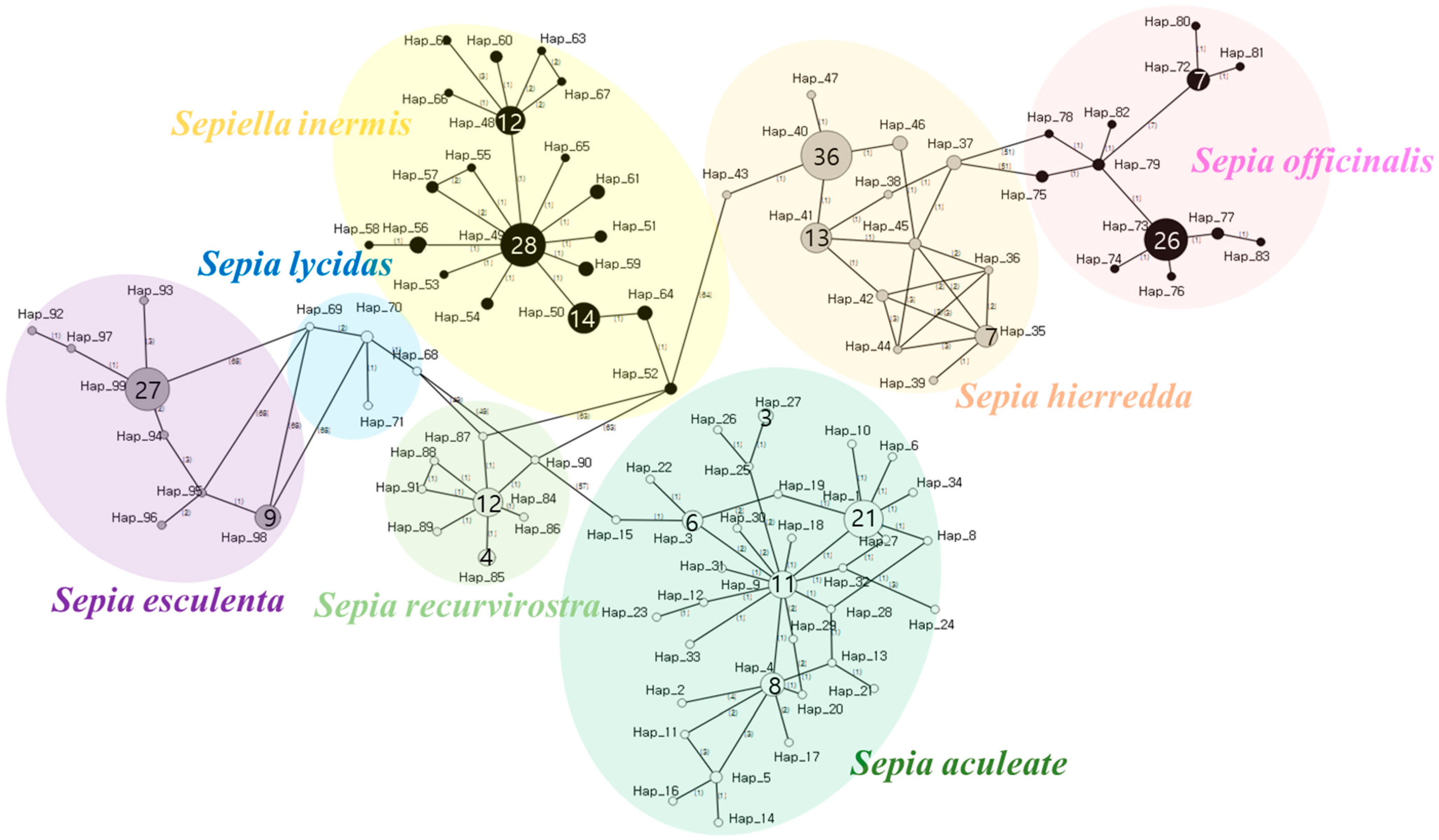
Median-joining haplotype network analysis based on the 530 bp COI region showed that the seven species formed distinct clusters with no shared haplotypes (
Figure 1). These results indicate that the analyzed COI region provided clear genetic differentiation among the seven examined species. Although the sample size for
S. lycidas was relatively small (
n = 5), because of limited availability in the Korean seafood market during the study period, no intraspecific variation was detected at the diagnostic SNP positions among the analyzed individuals, supporting the reliability of marker development for this species.
3.2. Identification of Diagnostic SNPs in the Extended COI Region
To identify diagnostic interspecific variation for marker development, an extended COI fragment (~1200 bp) was amplified using the primer combination LCO1490 (forward) and CE-1R (reverse). A single amplification product of the expected size was consistently obtained in all seven species without detectable nonspecific bands.
The amplified fragment encompassed a broader region of the COI gene than the standard barcode fragment, increasing the likelihood of detecting diagnostic interspecific polymorphisms.
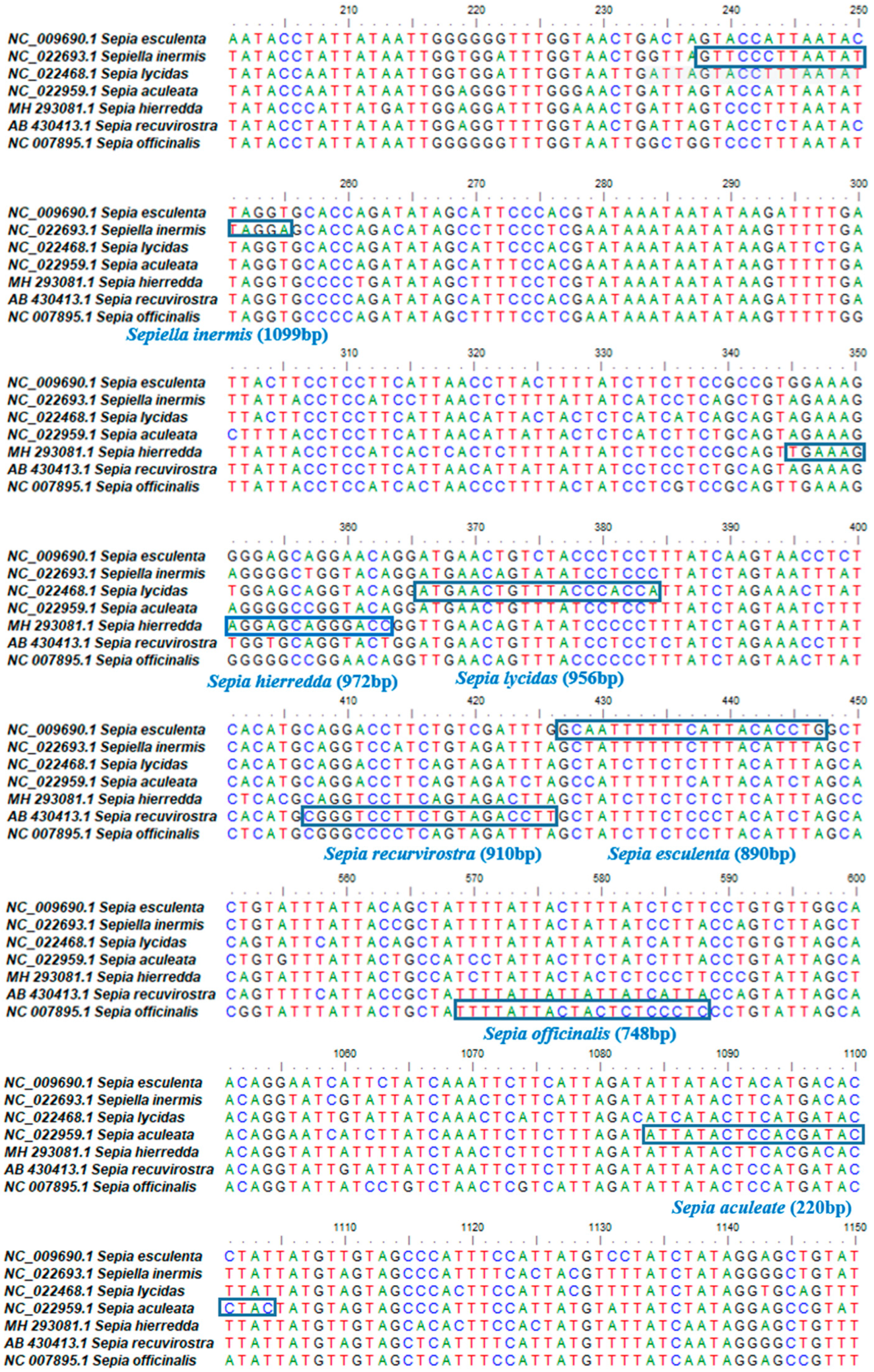
The extended COI sequences were aligned with reference sequences available in GenBank (
S. esculenta NC_009690.1;
S. inermis NC_022693.1;
S. lycidas NC_022468.1;
S. aculeata NC_022959.1;
S. hierredda MH293081.1;
S. recurvirostra AB430413.1;
S. officinalis NC_007895.1) (
Figure 2). For positional reference, nucleotide numbering was based on the complete mitochondrial COI sequence of
S. officinalis (NC_007895.1; 1533 bp), and the diagnostic SNP sites are summarized in
Table 4.
Comparative alignment identified seven diagnostic single-nucleotide polymorphism (SNP) sites that consistently differentiated the seven species (
Table 4). No intraspecific variation was observed at these positions among the individuals analyzed in this study.
3.3. Development and Validation of the Species-Specific Multiplex PCR Assay
Based on the identified diagnostic SNPs, species-specific forward primers were designed by positioning the diagnostic nucleotide at the 3′ terminus to maximize amplification specificity. The expected amplicon sizes were intentionally differentiated (220–1099 bp) to allow discrimination based solely on agarose gel electrophoresis (
Table 5). Initial attempts to amplify all seven primer pairs simultaneously resulted in reduced amplification efficiency and insufficient band resolution, presumably due to primer competition. Therefore, the assay was divided into two independent multiplex sets to improve amplification stability and band separation.
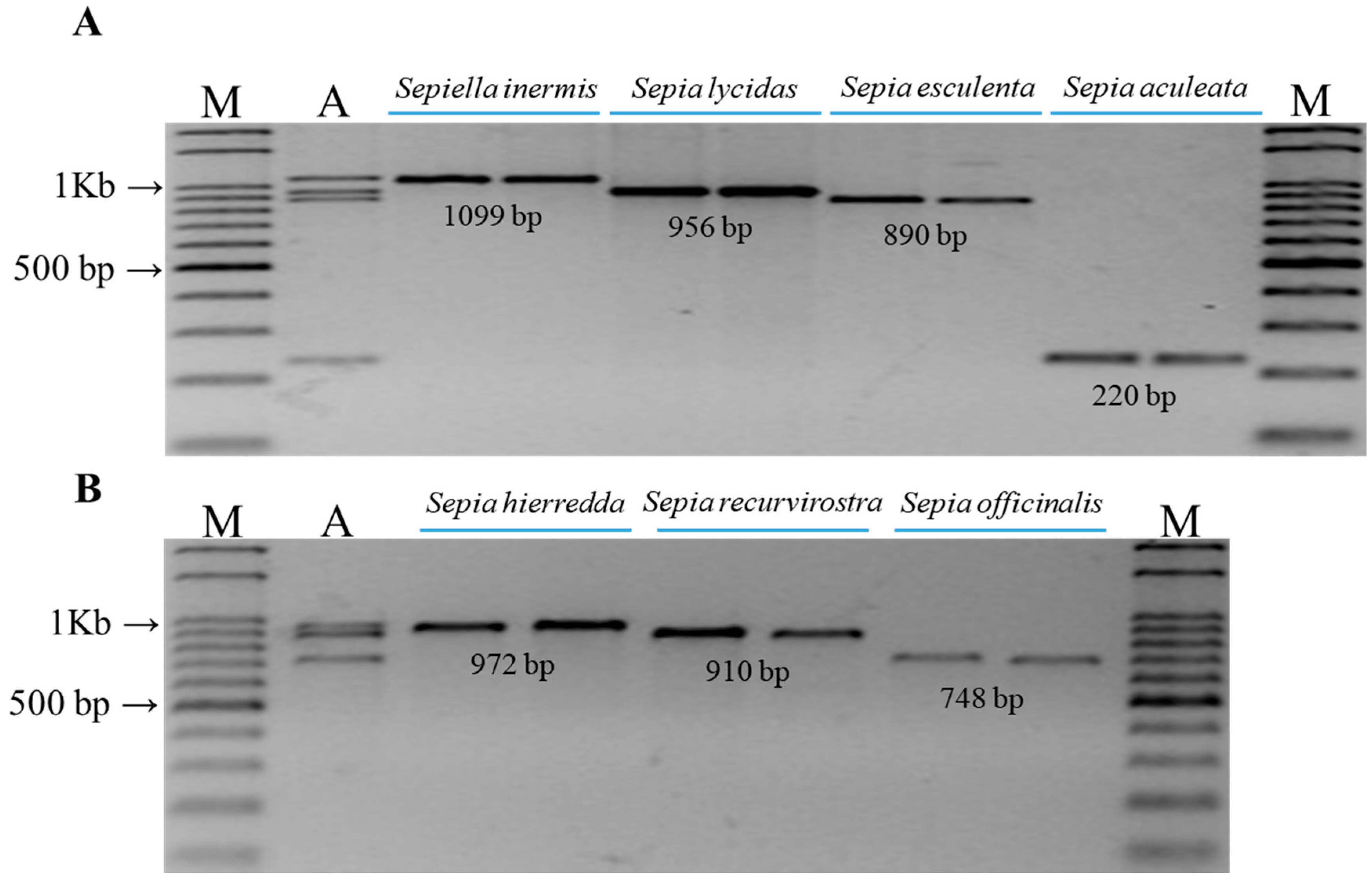
Multiplex Set 1 simultaneously discriminated
S. inermis (1099 bp),
S. lycidas (956 bp),
S. esculenta (890 bp), and
S. aculeata (220 bp). Multiplex Set 2 discriminated
S. hierredda (972 bp),
S. recurvirostra (910 bp), and
S. officinalis (748 bp) (
Figure 3). Within each multiplex set, the expected amplicons were sufficiently separated to allow unambiguous discrimination by agarose gel electrophoresis.
Under optimized annealing conditions (56 °C), each species produced a single clear band corresponding to the expected fragment size. No cross-amplification or nonspecific products were detected in either multiplex set, confirming high primer specificity and robustness of the assay.
Collectively, these results demonstrate that the developed two-set multiplex PCR system enables rapid and accurate discrimination of the seven cuttlefish species. Nevertheless, increasing the sample size for certain species in future studies would further strengthen the robustness and general applicability of the diagnostic system.
4. Discussion
In this study, mitochondrial COI sequence analysis was applied to seven commercially traded cuttlefish species distributed in Korea, and a species-specific multiplex PCR assay was developed based on diagnostic SNPs.
The mitochondrial COI gene has been widely adopted as a standard molecular marker for animal species identification since the introduction of universal primers by Folmer et al. (1994) [
13], and its establishment as the core locus for DNA barcoding [
14]. The effectiveness of COI in marine taxa has been repeatedly demonstrated across fishes and invertebrates [
15], including cephalopods [
16].
Consistent with previous studies, the 530 bp COI region analyzed here showed complete haplotype separation among the seven examined species. Haplotype network analysis demonstrated the formation of distinct, species-specific clusters with no haplotype sharing. Although COI barcode overlap and limited interspecific divergence have been reported in certain closely related cephalopod taxa [
23], no such overlap was observed among the species evaluated in the present study. Nevertheless, the resolution of COI may be insufficient for discriminating closely related taxa in some cases. In such situations, the use of additional mitochondrial markers or complete mitochondrial genome sequencing may be required to achieve accurate species identification [
19,
24]. These findings indicate clear molecular differentiation among the surveyed species within the Korean market context.
Reliable species-level discrimination is particularly important in fisheries science, where accurate stock assessment, catch reporting, and monitoring depend on correct taxonomic identification [
15,
25]. Molecular tools capable of distinguishing morphologically similar taxa can therefore contribute to improving data quality in fisheries-dependent statistics and resource management.
Beyond conventional sequencing-based DNA barcoding, this study translated diagnostic interspecific variation into a practical multiplex PCR assay. Unlike previous studies that primarily focused on single-species identification or general DNA barcoding, the present study provides a multiplex PCR system for the simultaneous discrimination of multiple commercially distributed cuttlefish species within a single analytical framework. By targeting an extended COI fragment and positioning diagnostic SNPs at the 3′ terminus of forward primers, high amplification specificity was achieved. Positioning the diagnostic nucleotide at the 3′ terminus was intended to enhance amplification specificity by reducing primer extension when mismatched templates were present.
Although simultaneous amplification of all seven primer pairs in a single reaction reduced amplification efficiency due to primer competition, separation into two independent multiplex sets ensured stable amplification and clear band resolution. This design was necessary to minimize primer competition and improve amplification reliability. Although dividing the assay into two sets reduces operational efficiency, it significantly improves amplification stability, reproducibility, and overall assay robustness, which are critical for routine diagnostic applications. Future optimization strategies, including primer rebalancing, redesign, or the use of advanced multiplex platforms, may enable consolidation into a single reaction system. Under optimized annealing conditions, each species produced a single expected amplicon without cross-amplification, confirming the reliability of the assay.
Compared with sequencing-based approaches, the developed assay enables rapid species discrimination using standard PCR and agarose gel electrophoresis platforms.
Multiplex PCR assays have been successfully applied for the authentication of commercially important seafood species, demonstrating high specificity and clear discrimination among target taxa [
26]. Compared with previously reported multiplex PCR assays targeting a limited number of species or requiring sequencing confirmation, the present system provides a simplified and direct gel-based discrimination of multiple co-distributed cuttlefish species. DNA-based authentication systems have become increasingly important for seafood traceability and market verification [
18,
27]. In contrast to previous studies focusing on single-species identification, the multiplex PCR system developed in this study enables simultaneous discrimination of multiple commercially important cuttlefish species in a rapid and cost-effective manner. This advantage is particularly relevant for routine monitoring in fisheries management and seafood authentication, where high-throughput and low-cost diagnostic tools are required. In this context, the multiplex PCR system developed here provides a cost-effective and time-efficient molecular tool that may support fisheries monitoring and species-level verification of commercially distributed cuttlefish products. Recent studies have demonstrated that multiplex PCR systems can be integrated with rapid detection platforms to enable sensitive and field-applicable species identification [
28]. Although the assay showed clear species specificity for the seven target species examined here, further validation across geographically diverse populations and additional closely related cephalopod taxa will enhance the applicability of this diagnostic system in broader monitoring and commercial verification settings. Although the analytical sensitivity and minimum detectable DNA concentration of the assay were not quantitatively evaluated in this study, stable amplification was consistently achieved with approximately 40 ng of template DNA under the experimental conditions used. Future studies should assess detection limits and performance using degraded or low-concentration DNA samples, particularly for processed seafood products.
The present assay was validated using authenticated tissue samples of the seven target species and was not tested on heavily processed commercial products or non-target cephalopod taxa. Therefore, further validation using degraded DNA samples, processed seafood matrices, and taxonomically related non-target species would strengthen the robustness and practical applicability of the assay.
5. Conclusions
This study demonstrated that mitochondrial COI variation provides sufficient resolution to distinguish seven commercially traded cuttlefish species in the Korean market. A 530 bp COI region showed complete haplotype separation among species, and analysis of an extended COI fragment enabled the identification of seven diagnostic SNP sites.
Based on these markers, a two-set multiplex PCR assay was developed, generating species-specific amplicons distinguishable by agarose gel electrophoresis. The assay showed high amplification specificity under optimized conditions and does not require sequencing.
The proposed multiplex system offers a practical molecular tool for rapid and sequencing-free authentication of the seven target cuttlefish species and may support routine species verification in fisheries monitoring and seafood market surveillance.



 ,
,