
Article

Geographical Traceability of Anguilla japonica from Different Habitats Successfully Achieved Using Muscle Elemental Fingerprint Analysis


1
East China Sea Fisheries Research Institute, Chinese Academy of Fishery Sciences, Shanghai 200090, China
2
School of Environment and Architecture, University of Shanghai for Science and Technology, Shanghai 200093, China
3
College of Fisheries and Life Science, Dalian Ocean University, Dalian 116023, China
4
National Engineering Research Center for Marine Aquaculture, Zhejiang Ocean University, Zhoushan 316022, China
*
Authors to whom correspondence should be addressed.
Fishes 2026, 11(1), 68; https://doi.org/10.3390/fishes11010068
Submission received: 20 November 2025 / Revised: 2 January 2026 / Accepted: 20 January 2026 / Published: 22 January 2026
(This article belongs to the Special Issue Conservation and Population Genetics of Fishes)

Abstract

Anguilla japonica is a catadromous fish, and the Yangtze River Estuary serves as a crucial passage for A. japonica migrating downstream to the sea. A large number of adult A. japonica appear on the market during the peak migration period. Due to the lack of effective discrimination basis, it is difficult to distinguish the source of samples in market supervision. Therefore, there is an urgent need to trace the origin of A. japonica from different water bodies. This study analyzed muscle elemental fingerprints of 21 elements to determine the geographical origin of A. japonica. The results showed that A. japonica from different habitats had distinct elemental compositions in their muscles. Specifically, A. japonica from estuary waters (EW) was characterized by significantly higher levels of V and Hg compared to other water bodies. Na was identified as a key discriminant element among different habitats, with its content significantly increasing in river waters (RW), EW, and offshore waters (OW), respectively. Discriminant analysis selected four discriminant elements (V, Hg, Na and Cu) from 21 elemental compositions, among which V, Hg, and Na were the three key distinguishing elements. Based on the composition of these four discriminant elements in the muscles of A. japonica from different habitats, hierarchical cluster analysis (HCA), orthogonal partial least squares discriminant analysis (OPLS-DA), and linear discriminant analysis (LDA) were applied and validated, successfully achieving rapid and accurate origin tracing and verification for new samples, achieving 100% classification accuracy. Therefore, the application of muscle EFA can achieve the geographical traceability of A. japonica from different habitats. The analytical method and verification process for origin tracing established in this study can be successfully applied to market supervision for tracing the origin of samples with unknown sources.
Key Contribution: The Yangtze Estuary is an important migration channel for the catadromous migratory fish of Anguilla japonica, and a large number of adult individuals appear in the market during the migration season. However, due to the lack of effective methods for origin traceability, it is difficult to achieve the effective supervision and protection of adult A. japonica in market regulation. As muscle tissue is easy to obtain and has effective element enrichment and transformation functions, this study, based on muscle EFA, employed multivariate analysis methods to determine the geographical origin of A. japonica from different sources. Through linear discriminant analysis (LDA), four discriminant elements were identified. Based on the composition of these selected elements, the successful traceability of new source samples to their origins was achieved. The muscle EFA method and traceability verification process established in this study can be successfully applied to trace the origin of samples of unknown sources in market regulation.

1. Introduction

Anguilla japonica is widely distributed in coastal countries such as China, North Korea, and Japan. In China, it is found in coastal waters, major rivers, and their affiliated water bodies [1]. A. japonica is known for its tender meat, delicious taste, and high nutritional value, making it highly popular among consumers. The Yangtze River Estuary serves as a critical passage for the species, facilitating the downstream migration of adult A. japonica to the sea and the upstream migration of juvenile glass eels. As the estuary of China’s largest river, it supports abundant resources of A. japonica. Notably, from late September to early November each year, during the peak migration period for adult A. japonica moving seaward through the Yangtze Estuary, a significant number of adult individuals can be observed in these waters. Additionally, A. japonica is also distributed in lakes, rivers, and adjacent coastal waters connected to the Yangtze River. However, long-term pressures such as overfishing, infrastructure development, and environmental pollution have led to a continuous decline in the resources of both adult and juvenile A. japonica in the Yangtze River and its associated waters [2,3,4]. In recent years, to protect the fish resources in the Yangtze River, China has implemented the Yangtze River Protection Law. As fishing has been completely prohibited in the Yangtze River and its affiliated waters, the eel resources have shown signs of recovery. However, some vendors illegally capture adult A. japonica and introduce them into the market. The inability to effectively identify the source of these individuals, coupled with a lack of effective measures in supervision, hinders the effective protection of the adult A. japonica population.
Currently, various methods exist for discriminating and tracing the origin of species, such as individual morphology [5], otolith morphology [6], genetic sequences [7], fatty acid composition [8], isotopes [9], and elemental fingerprinting [10]. Elemental fingerprint analysis (EFA) has proven to be a highly useful technique for distinguishing biological species or populations and has been widely applied in studies on geographical origin tracing and safety assessments of aquatic products, animals, and plants [11,12,13,14,15]. EFA further includes otolith elemental fingerprinting [16], whole-fish elemental fingerprinting [17], and tissue-specific elemental fingerprinting of muscle, skin, etc. [18,19,20]. Previously, otolith elemental fingerprinting has often been used in ecological studies of various fish species, particularly research related to fish life history [16]. However, the otolith microchemistry method typically requires complex sample pretreatment procedures and advanced instrumentation [21,22]. Since different discrimination methods vary in their applicability, sample acquisition difficulty, and discrimination sensitivity, the choice of method must be tailored to the specific context. For the adult A. japonica in this study, using the whole body as a sample entails a large sample size and difficulty in achieving uniform mixing [1], which leads to significant sampling errors when analyzing a small portion from it. Alternatively, using otoliths as samples presents challenges in both acquisition and analysis [21,22]. In contrast, muscle tissue, which is abundant in the fish body, is relatively easy to obtain. Moreover, the elemental composition in muscle tissue primarily results from accumulation from the habitat and diet, allowing it to intuitively and rapidly reflect the elemental conditions of both the habitat and the diets [23,24,25]. Consequently, this study selected muscle tissue samples from A. japonica of different origins and utilized EFA to trace and determine their geographical sources.
In recent years, EFA has been widely applied in the identification and geographical traceability of illegally sourced aquatic products in the market [26,27,28]. Therefore, this study focused on tracing the origin of A. japonica samples found in the market by selecting muscle tissue as the experimental material. Based on EFA, we aimed to distinguish the geographical origins of A. japonica from river waters (RW), estuary waters (EW), and offshore waters (OW), thereby achieving traceability of samples from freshwater, brackish water, and marine habitats. By adopting a more convenient, cost-effective, and sample-efficient method, and through a series of multivariate analytical techniques to screen discriminant elements, this study enables the traceability of samples from different origins. The research results can be applied to market supervision, where small muscle samples from specimens of unknown origin can be used for geographical origin determination. This provides an effective technical method for the traceability of aquatic products in market regulation, supporting the management of traceability for illegally caught aquatic products and facilitating evidence-based law enforcement.

2. Materials and Methods

2.1. Sampling Sites, Sample Collection, and Processing

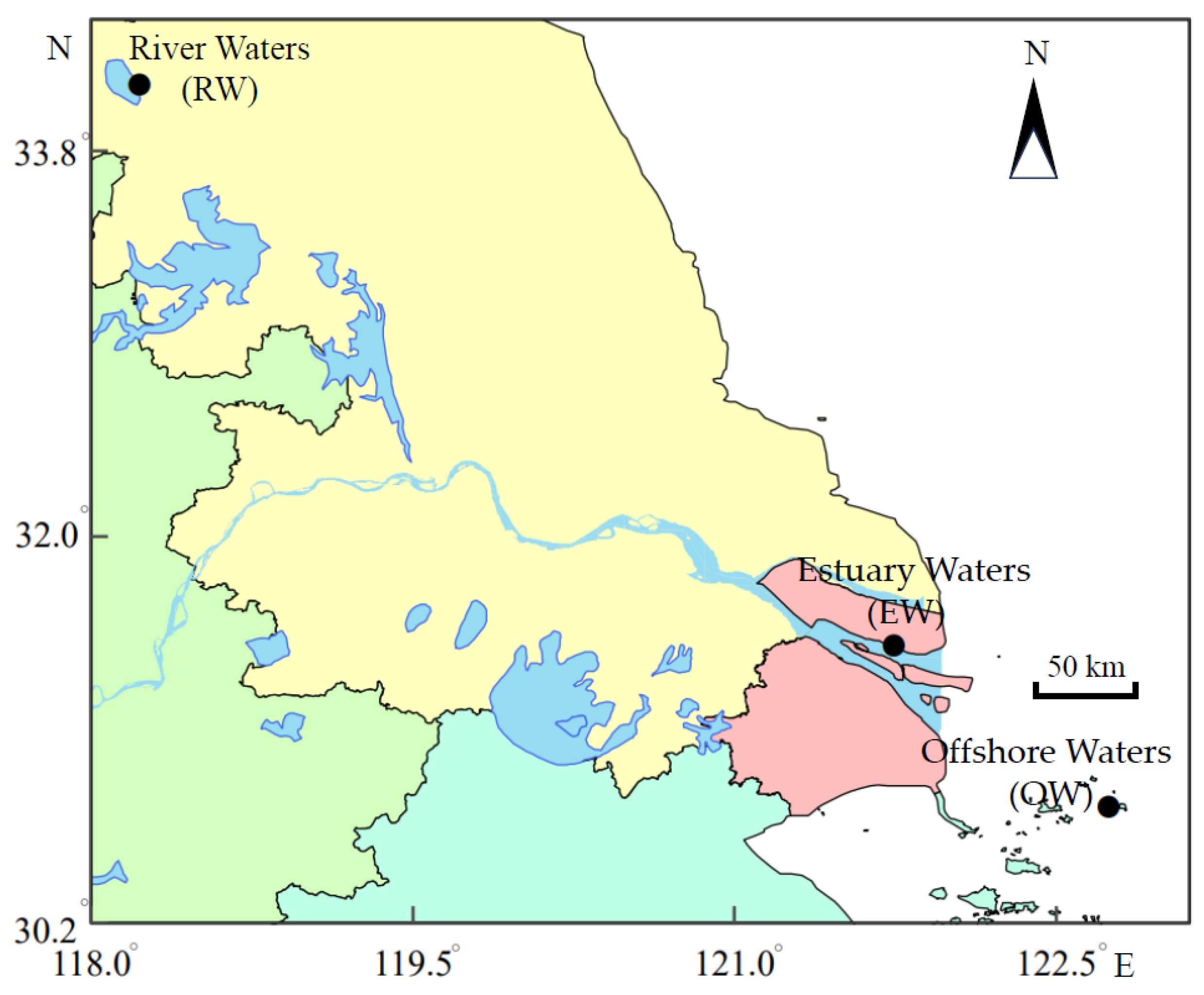
In order to avoid the interference between samples from different sources in the peak migration period of September, ensure the collection of migratory adults, and screen out effective geographical traceability basis for market supervision, this study selected July before the migratory flood season for sampling. A total of 12 A. japonica samples with a standard length of 69.28 ± 12.37 cm and wet weight of 632.88 ± 342.54 g were collected from three distinct aquatic habitats, i.e., 4 individuals from inland river waters (RW) in Xinyi River near Luoma Lake, 4 individuals from the Yangtze River Estuary waters (EW) in the south branch of the Yangtze River Estuary, and 4 individuals from offshore waters (OW) of the Zhoushan Islands in the East China Sea (Figure 1), for origin traceability research. To validate the traceability method for newly sourced samples, one additional individual was randomly selected from the Yangtze River Estuary waters as a positive control (EW-PC) for traceability verification analysis. All samples were obtained by fishermen angling, and samples were purchased from fishermen. After collection, the samples were placed in labeled plastic bags and stored at −20 °C for subsequent analysis.
In the laboratory, all samples were thawed, and biological data such as body length and body weight of the A. japonica were measured. Standard length was measured in centimeters (cm), and wet weight was measured in grams (g) (Table 1). Judging from the body length and weight (more than 200 g) [1], as well as the anatomical gonad development status, all the samples were mature individuals. To minimize sample processing errors, all samples were first rinsed six times with Milli-Q water (Millipore Corp., Burlington, USA). Subsequently, the dorsal from the starting point of the dorsal fin to the starting point of the anal fin was collected and divided into three sections from front, middle, and back, the skin removed, and muscle samples from the surface to a 1 cm depth using a ceramic scalpel. Then, the muscle samples were cut into small pieces and thoroughly mixed. After freeze-drying for 24 h at −48 °C, the samples were powdered using a tissue grinder and immediately stored in a desiccator for subsequent analysis [29].

2.2. Digestion Scheme

The digestion process includes three steps. First, the dried sample (0.5 ± 0.005 g) was placed into a digestion tube, to which 10 mL of purified HNO3 (MOS Reagent, Sinopharm Chemical Reagent Co., Ltd., Shanghai, China) was added for preliminary oxidation. In this process, as muscle tissue is rich in protein and fat, in order to let HNO3 slowly penetrate into muscle tissue and gradually destroy the structure of organic matter, the mixture was allowed to stand for 3 h for pre-digestion, which lays the foundation for subsequent strong acid digestion. Then, 2 mL of purified HClO4 was added to each tube, and the samples were digested using an electric heating plate at 150 °C until white smoke was exhausted to obtain a colorless and transparent digestion solution. Finally, the completely digested samples were quantitatively transferred into 100 mL calibrated flasks and diluted to volume with Milli-Q water [17].

2.3. Elemental Analysis

Quality assurance and quality control (QA/QC) procedures were rigorously implemented throughout the analysis. These included the analysis of blanks with each batch of samples to monitor and correct for potential background contamination, perform three duplicate analyses on randomly selected samples to evaluate analytical precision, and given that the samples in this study were biological in nature and a wide range of elements were determined, rhodium (Rh) and indium (In) were selected as internal standard elements, with HNO3 serving as the matrix for the internal standard solution. Additionally, recovery experiments were conducted by adding known amounts of standard solutions to a subset of samples prior to digestion and to ensure the accuracy of the element detection results. The content of 21 elements in the samples was determined using the instruments and methods of ICP-OES (720ES, Agilent, Santa Clara, CA, USA) for the elements of potassium (K), sodium (Na), and calcium (Ca), and ICP-MS (7700, Agilent, Santa Clara, CA, USA) for the elements of aluminum (Al), titanium (Ti), vanadium (V), chromium (Cr), manganese (Mn), iron (Fe), cobalt (Co), nickel (Ni), copper (Cu), zinc (Zn), arsenic (As), strontium (Sr), molybdenum (Mo), cadmium (Cd), barium (Ba), mercury (Hg), lead (Pb), and magnesium (Mg) [30,31]. The blanks were an excellent pure concentrated HNO3 solution digested with ultrapure water at constant volume. The standard reference material (CRM) included mixed-element substances (Al, Ti, V, Cr, Mn, Fe, Co, Ni, Cu, Zn, As, Sr, Cd, Ba, Cu, Mg) (GSB 04-1767-2004) and single-element materials: Hg (GSB 04-1729-2004), Na (GSB 04-1738-2004), K (GSB 04-1733-2004), Ca (GSB 04-1720-2004), and Mo (GSB 04-1737-2004) (National Nonferrous Metals and Electronic Materials Analysis and Testing Center, National Standard (Beijing) Inspection and Certification Co., Ltd., Beijing, China). All 21 elements with the units of concentration (mg/kg dry weight) analyses were performed in triplicate.

2.4. Data Analysis

According to the different purposes of analysis, combined with the applicable conditions of different analytical methods, the non-parametric test and one-way analysis of variance (ANOVA) were used to analyze the elemental composition of samples in turn. Firstly, the general non-parametric test was used to analyze the difference of elements between samples from different sources as a whole, which laid the foundation for the selection and application of multivariate analysis methods in the later stage. Then, when the data met the conditions of normality and homogeneity of variance, ANOVA was further used to examine the differences among these groups (with a significance level set at 0.05), and the characteristic difference elements between samples from different sources were preliminarily screened. Subsequently, multivariate analysis models were employed to analyze the spatial patterns of A. japonica from the three habitat origins [32]. First, principal component analysis (PCA), an unsupervised pattern recognition method, was applied to the standardized dataset to reduce its complexity and identify the dominant sources of variation. The analysis aimed to detect the overall compositional characteristics of the elements by examining their loadings on the principal components (PCs), which indicate the contribution and correlation strength of each element to a given PC. Simultaneously, the scores plot of the PCs was used to visualize the correlation and potential separation between the muscle elemental compositions of the three groups in a low-dimensional space, revealing whether their elemental fingerprint were distinct or overlapping. Second, to construct a robust classification model and identify the most diagnostic elements, stepwise linear discriminant analysis (LDA) was employed. The procedure was conducted as follows. First, the dataset was divided into a training set and a validation set. On the training set, a stepwise algorithm was applied to iteratively select a parsimonious subset of elements that provided the strongest discriminatory power among the three groups. Based on these selected elements, a set of discriminant functions was derived to maximize the separation between groups. The model’s classification performance was then rigorously assessed, typically through cross-validation on the training set and subsequently by applying it to the independent validation set. Then, the validated model, comprising the established functions and the key discriminant elements, was used to determine the origin of newly sourced samples [33]. Next, based on the screened discriminant elements, hierarchical cluster analysis (HCA) was first utilized for an exploratory visualization of sample clustering. Subsequently, orthogonal partial least squares-discriminant analysis (OPLS-DA), a supervised method, was employed to construct a robust predictive model for group separation. To ensure the validity and prevent overfitting of the OPLS-DA model, it was rigorously validated using a permutation test (typically with n > 200 permutations) and by examining key model parameters: the goodness-of-fit (R2Y) and the predictive ability (Q2). This analysis was conducted to identify the elements most responsible for discriminating the groups in the positive control group [34]. Finally, LDA was used to discriminatively validate the traceability results of the positive control samples, testing the validity of the traceability outcomes. Statistical analyses were performed using IBM SPSS Statistics 26.0 and OriginPro 2021 (64-bit) 9.8.0.200 software.

3. Results

3.1. Elemental Fingerprints Composition

A non-parametric test was conducted on the contents of 21 elements in the muscle tissues of A. japonica from three different habitat waters to analyze the differences in muscle elemental composition among the various sources. The results showed that four elements (V, Hg, Mg and Na) exhibited significant differences (p < 0.05) in the muscles among the three groups of A. japonica, while the remaining 17 elements showed no significant differences (p > 0.05). A one-way analysis of variance (ANOVA) was performed on the composition of 21 elements in the muscles of A. japonica from three different origins to compare the differences in elemental composition. The results revealed significant differences (p < 0.05) in three elements (V, Hg and Na) between A. japonica from RW and EW, two elements (Mg and Na) between A. japonica from RW and OW, and four elements (V, Hg, Mg and Na) between A. japonica from EW and OW. Specifically, the V and Hg levels were significantly higher in A. japonica from EW compared to that from RW and OW, while the Mg and Na levels were significantly higher in A. japonica from OW compared to that from RW and EW (Table 2).
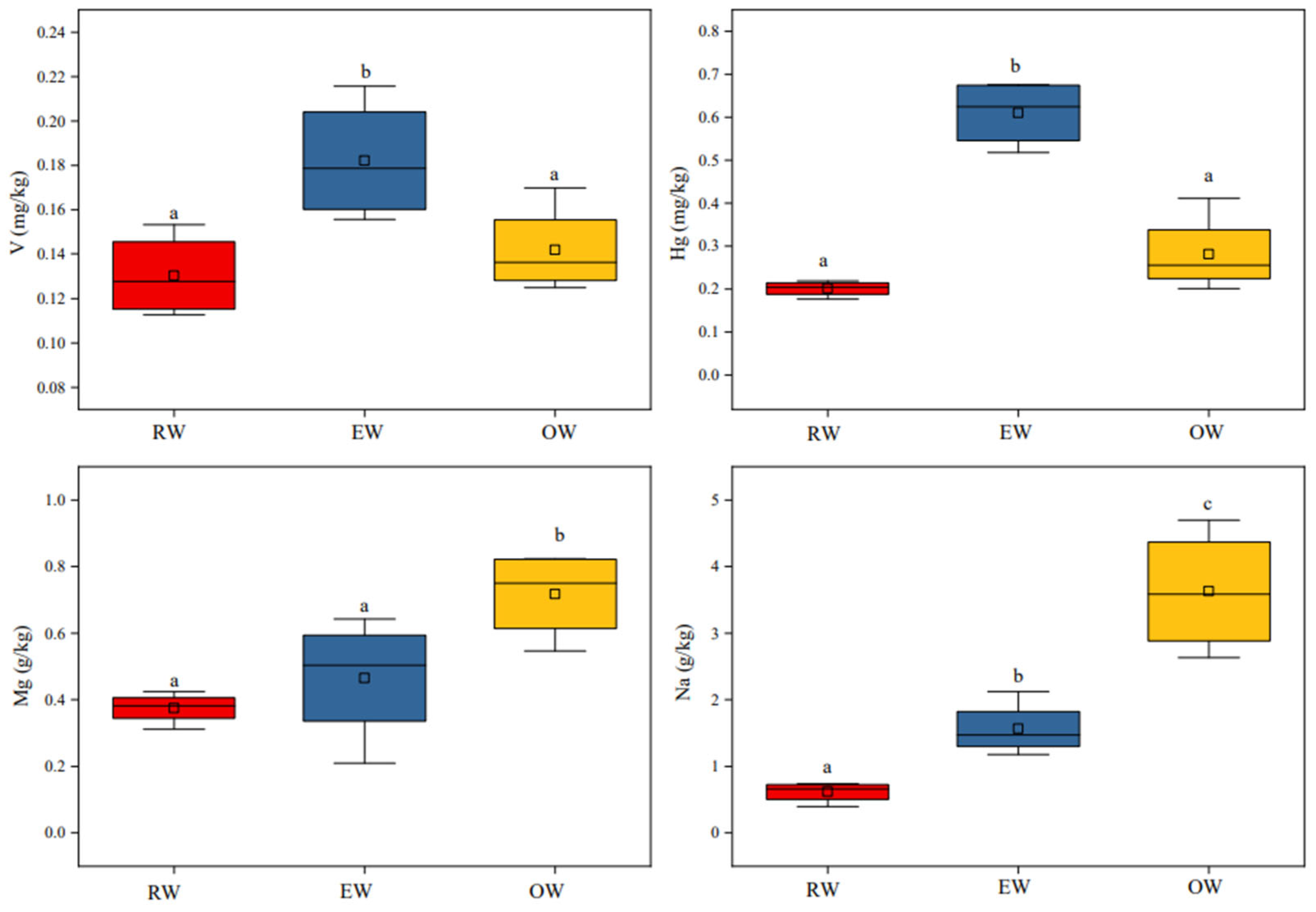
Regarding the four key discriminant elements (V, Hg, Mg, and Na) across the three habitats (Figure 2), significant differences were observed, i.e., the V and Hg levels showed significant variations between the EW and RW groups and between the EW and OW groups; Mg levels differed significantly between the OW and RW groups and between the OW and EW groups (p < 0.05); and Na levels exhibited significant differences among all three habitat groups (p < 0.05). A comparison of the content levels of these discriminant elements in the muscles from different origins further demonstrated that the V and Hg levels were significantly higher in the EW group compared to the RW and OW groups, with no significant difference between the other two groups. Mg levels were significantly higher in the OW group compared to the RW and EW groups, and Na levels showed substantial variation across all three groups. Therefore, V and Hg can serve as characteristic elemental indicators for the EW group, Mg can serve as characteristic elemental indicators for the OW group, and Na can be used as a typical element to indicate the differences among different habitats.

3.2. Principal Component Analysis (PCA)

To identify the key characteristic elemental indicators for distinguishing A. japonica from different habitats, principal component analysis (PCA) was performed on the composition of 21 elements. A total of 5 principal components (PC1 to PC5) were extracted (Table 3).
As shown in Table 3, the three elements with the highest contributions in principal component 1 (PC1) were Sr, Al, and Mg; in PC2, they were Pb, Ti, and Ni; and in PC3, they were Ca, Cr, and Mo. Based on the results in Table 2, among these 9 major contributing elements across the three principal components, only Mg showed significant differences between OW and EW groups. The other eight major contributing elements exhibited no significant differences among these three groups, indicating minimal variation in the overall elemental composition of muscle tissues across the three habitats.
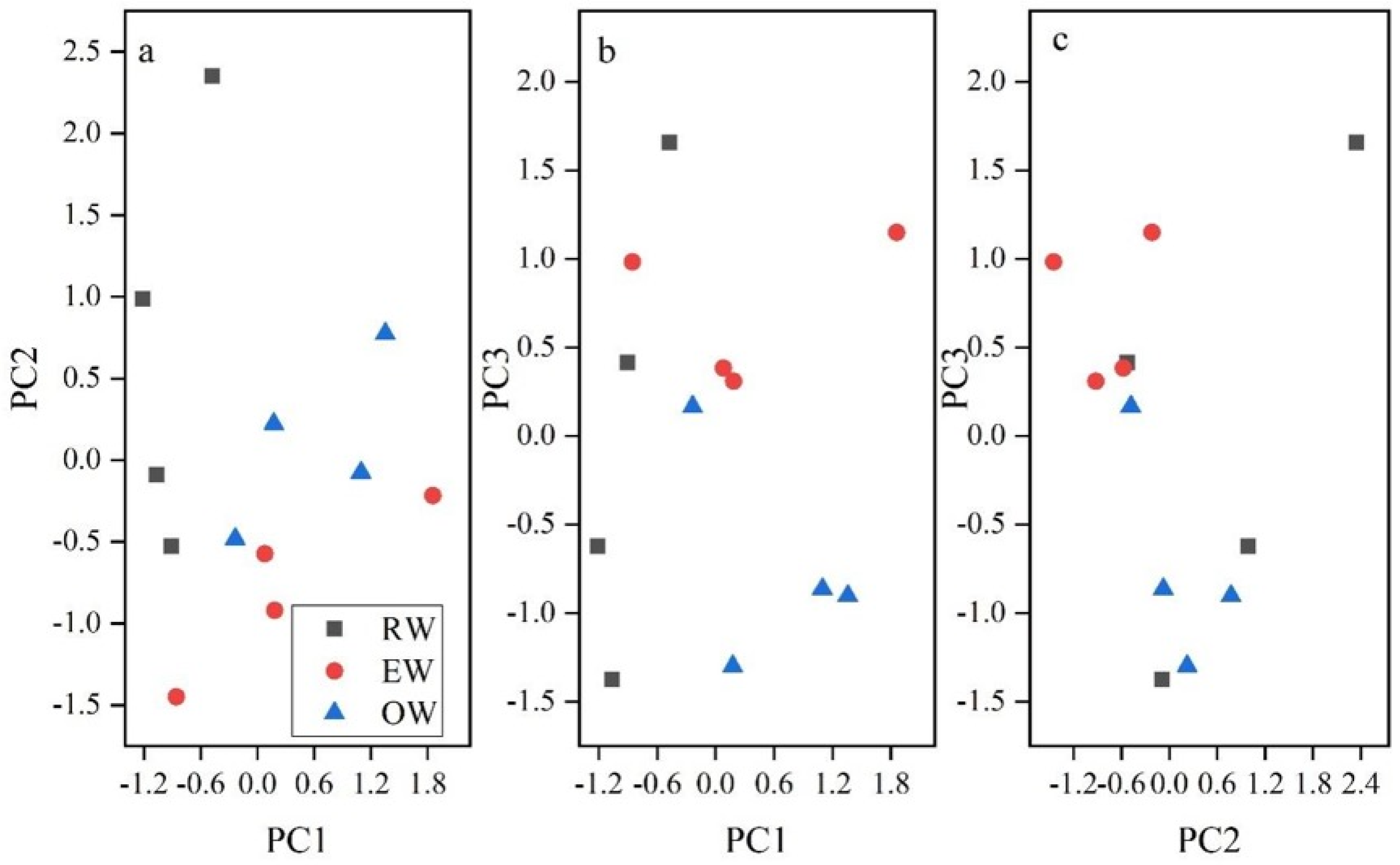
The three main contributing elements in PC1 were present at the lowest levels in RW, reflecting a low-content elemental profile characteristic of this group. Similarly, the three main contributing elements in PC2 were lowest in EW, representing a low-content profile for this group. Consequently, in the scatter plot formed by PC1 and PC2 (Figure 3a), RW and EW were relatively separated. The three main contributing elements in PC3 were lowest in OW, indicating a low-content profile for this group. However, the contribution rate of these three elements in PC3 was relatively low, and their concentrations did not differ significantly among the A. japonica from different origins. As a result, in the scatter plots formed by PC1 and PC3 (Figure 3b) and PC2 and PC3 (Figure 3c), the A. japonica from the three habitats overlapped and were difficult to distinguish. These findings demonstrate that the scatter plots generated from PC1 and PC2, PC1 and PC3, and PC2 and PC3 could not effectively separate A. japonica from the three habitats, indicating a high overall similarity in the muscle elemental composition of A. japonica from different waters.

3.3. Discriminant Element Screening

Linear discriminant analysis (LDA) was performed on the composition of 21 elements in the muscle tissues of A. japonica from three distinct habitats. The analysis gained discriminant equations with four elemental indicators (V, Hg, Na and Cu) as independent variables (Table 4). A comparison of the discriminant coefficients of these elements across the three aquatic habitats revealed that V had the highest discriminant coefficient, followed by Hg and Na, while Cu had the smallest discriminant coefficient. Among these, the first two discriminant elements (V and Hg) showed significant differences between the EW and the others. The third discriminant element of Na exhibited significant differences across all three habitats. These results indicate that V, Hg, and Na serve as the primary discriminant elements for distinguishing among the three aquatic habitats.
Based on the stepwise discriminant results, the overall discriminant success rate for the 12 individuals from the three habitat origins reached 100.00%. The cross-validation results were consistent with the stepwise discriminant outcomes (Table S1). As visually evident from the discriminant analysis scatter plot (Figure S1), the muscle elemental compositions of A. japonica from the three habitat origins can be clearly distinguished. This demonstrates that the discriminant equations, formed using the four elemental indicators screened from the 21 elements, exhibited excellent performance in discriminating among A. japonica from the three origins.

3.4. Traceability and Verification Analysis

To validate the effectiveness of using the four screened discriminant elements for tracing the origin of newly sourced samples, a random new sample from EW was selected as a positive control (EW-PC) for traceability analysis. First, hierarchical cluster analysis (HCA) was performed by grouping the samples from the three habitat origins separately and treating the newly sourced sample as an additional group. This analysis aimed to assess the similarity between the newly sourced sample and the other groups. The results showed that EW-PC clustered with EW (Figure S2). Thus, using the four discriminant elements for HCA of A. japonica samples from different origins can preliminarily trace the origin of newly sourced samples.
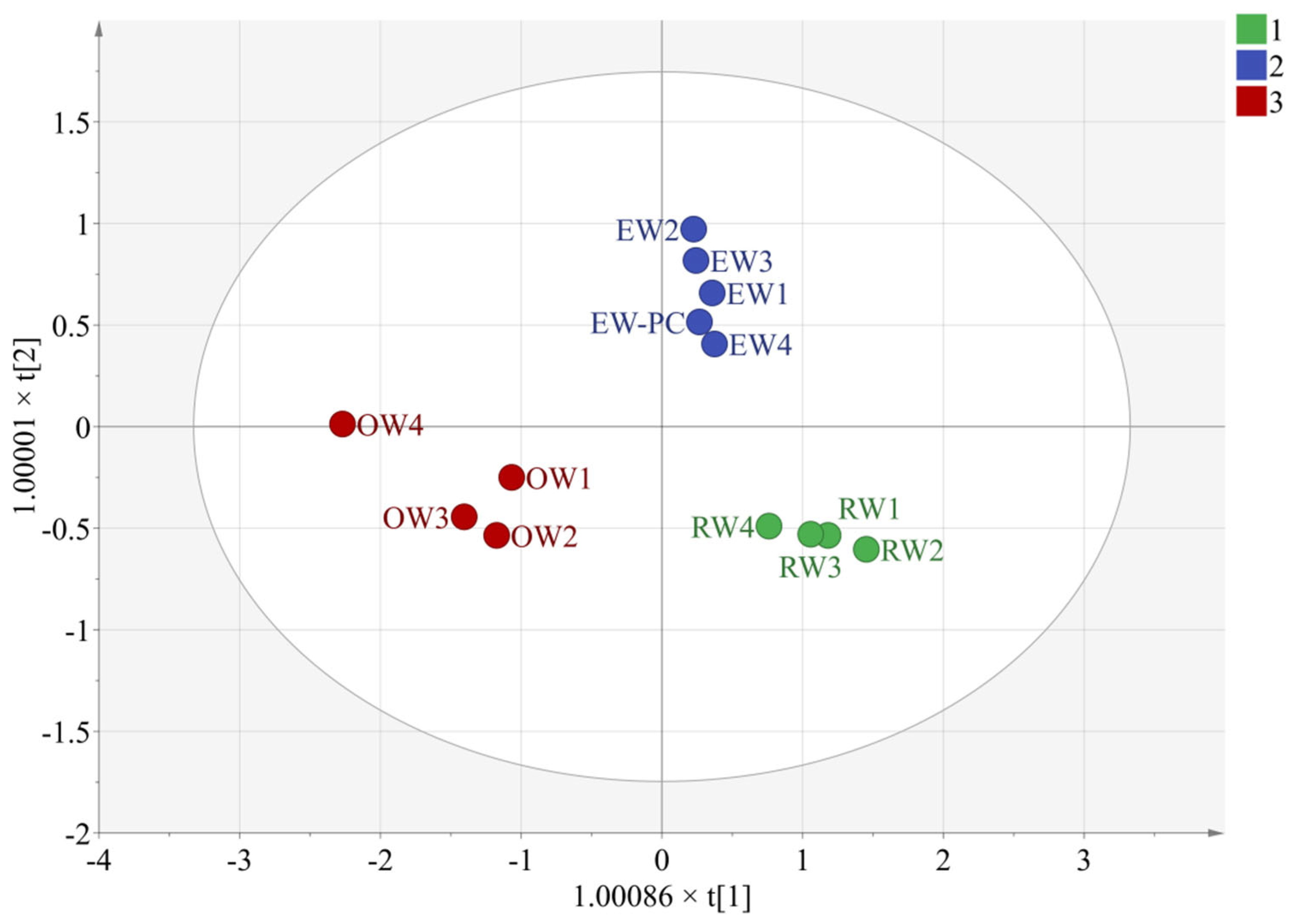
To further evaluate the traceability relationship between EW-PC and the individuals from the three habitat groups, orthogonal partial least squares-discriminant analysis (OPLS-DA) was performed on the composition of the four discriminant elements in the muscle tissues of the EW-PC and the three habitat groups. EW-PC exhibited clear clustering and separation from the EW and the other two groups (Figure 4). The model fit parameters indicated a dependent variable fit index of R2X = 0.995, R2Y = 0.916, and a model prediction rate of Q2 = 0.815. All three values exceeded 0.8, demonstrating the model’s ability to explain differences and its reliability in prediction.
The permutation test was conducted on the OPLS-DA model with 200 permutations to prevent potential overfitting of the Q2 value. The results revealed permutation model R2 and Q2 values for the RW, EW, and OW groups as 0.0988 and −0.677, 0.0911 and −0.743, and 0.0663 and −0.782, respectively (Figure S3). The R2 values for all three groups were greater than 0, while the Q2 values were all below 0.05, indicating that the OPLS-DA model possesses good generalization and fitting capabilities. These results demonstrate that the four screened discriminant elements can effectively determine the origin of newly sourced samples.
In order to validate the traceability effectiveness for newly sourced samples, the LDA of the four discriminant elements of three habitat-originated A. japonica and the EW-PC were performed. Figure S2 and Figure 4 clearly show that the EW-PC and EW group were fused into one group, so the EW-PC group was included into the EW group for further verification in the subsequent discriminant analysis, and the overall discriminant success rate of the total samples of EW and EW-PC was obtained as 100.00% (Table 5). The results showed that with the addition of the EW-PC group, the overall discrimination success rate for all individuals from the three habitat waters was still 100.00%. The results of cross verification were consistent with the results of stepwise discrimination (Table 5). It can be seen that the new samples could be effectively traced by the four discriminant elements that were screened.

4. Discussion

This study demonstrates that using muscle EFA for the geographical traceability of A. japonica from different habitats is scientific, practical, and effective. Currently, numerous methods exist for tracing the geographical origin of biological species, such as analyses based on individual morphology, otolith morphology, otolith microchemistry, isotopes, elemental profiles, fatty acid composition, and genetic sequence [6,7,8,9,10]. For tracing A. japonica from different aquatic habitats, where the distributed A. japonica belong to the same species with similar genetic structures, traceability based on genetic sequence differences is ineffective [35]. Additionally, A. japonica has an elongated, cylindrical body with few measurable and countable external morphological characteristics, making it difficult to distinguish their origins based on individual morphology and requires a high sample size [36]. Traditional otolith morphology and otolith microchemistry methods can distinguish different fish populations with relatively stable indicator parameters and high discriminant accuracy. However, due to the small size and fragility of the otoliths, the extraction of otoliths, acquisition of morphological indicators, and microchemical analysis are challenging and also require a large sample size [37]. This study comprehensively evaluated the limitations of the external morphology, otolith extraction and analysis, fully considered the accumulation differences of elemental composition from the habitats and diets in A. japonica from different waters, and established EFA as the method for tracing the origin of A. japonica from different habitats.
Given the varying accumulation effects of different elements in the whole body and different parts of fish, this study analyzed the differences in ease of acquisition and elemental accumulation effects among whole body, muscle, otoliths, bones, skin, and other samples to select the most suitable sample for elemental analysis [18,19,20]. For adult A. japonica in this study, using the whole body as a sample involved a large sample volume and difficulty in achieving homogeneity during processing, which directly affects the representativeness of subsamples taken for subsequent analysis. Skin tissue is thin, exposed, has relatively low element accumulation, and is easily interfered with by externally distributed elements [38]. Bone tissue, while having strong element accumulation capacity, responds poorly to short-term changes in environmental elements [39]. In contrast, muscle tissue constitutes a large proportion of the whole body, is easy to obtain, and can rapidly reflect changes in elemental composition from the habitat and diet over a period of time [40]. In this study, based on the stability of elemental accumulation in muscle and the unique advantages of EFA in sample processing and analysis [41], the application of muscle EFA for origin determination of A. japonica from different habitats is scientific, practical and effective.
This study employed discriminant analysis to screen four discriminant elements from the 21 elements measured in the muscles of A. japonica from different habitats. Among these, three discriminant elements with high coefficient values (V, Hg, and Na) showed significant differences among A. japonica from different habitats. The concentrations of V and Hg were highest in the muscle of EW, identifying them as characteristic elements for EW. Although the contents of V and Hg in EW were relatively high, these were relative to the relatively low content in RW and OW. In terms of absolute content, the contents of V and Hg in the muscle samples from these three waters were low, which were far below the food standard (GB 2762-2022) and in a safe range [42]. Na concentration was highest in OW, followed by EW, and lowest in RW, directly corresponding to the salinity gradients of the different habitats, thus establishing Na as a characteristic element for distinguishing these three habitats. The differences in muscle elemental composition among A. japonica from different habitats were closely related to their respective ecological environments. It was found that the composition of different characteristic elements in different waters has its own characteristics. Firstly, studies indicate that V is relatively abundant in the Yangtze River Estuary [43], and Hg was historically a common potential risk element in the Yangtze River Estuary. Although industrial and agricultural activities have decreased in recent years, Hg distribution in the Yangtze River Estuary remains relatively higher compared to other waters [44,45]. The highest distributions of both V and Hg in the Yangtze River Estuary correlate with the relatively higher environmental concentrations of these two elements in the estuarine waters. V mainly comes from the combustion of fossil fuels and industrial operation, and it is easy to adsorb on the sedimentation of particulate matter. Although it has no obvious biomagnification, its high concentration will directly harm aquatic organisms and ecological health [46]. Hg in the environment mainly comes from industrial emissions and coal burning, which is easily converted into highly toxic methylmercury in sediments and highly enriched and amplified through the food chain, which is extremely harmful to the fish and human nervous system [47]. Although it does not constitute pollution, we should always pay attention to its ecological risks. In addition, from the relatively high content of V and Hg in the EW, it reflects that there may have been V and Hg pollution in this water area and there is a certain risk of environmental pollution, indicating that the characteristic elements in different regions can be used to indicate the environmental risk of this water area. Na showed significant differences among A. japonica from the three habitats, attributable to the distinct salinity environments of freshwater (river), brackish water (estuary), and seawater (offshore). The pronounced increase in salinity from river to offshore waters corresponds to the sequentially and significantly increasing Na concentrations found in the muscle of A. japonica inhabiting these respective areas.
In summary, the successful application of muscle EFA in this study for origin traceability of A. japonica is closely linked to the habitat characteristics of the three distribution waters, the ecological habits of the A. japonica, and the accumulation patterns of different elements in the muscle tissue. Based on the differences in muscle elemental composition of A. japonica from different habitats, multivariate analysis, including non-parametric tests, one-way ANOVA, PCA, and LDA were sequentially applied to screen a small number of typical discriminant elements from multiple elements. Utilizing these screened discriminant elements, subsequent analyses including HCA, OPLS-DA, and discriminant verification successfully achieved and verified the origin traceability of the newly sourced A. japonica sample. This confirms that origin traceability can be accomplished using a limited set of screened discriminant elements, effectively reducing the number of elements required for determination, saving costs, and improving efficiency. The established traceability pathway ensures the simplicity of subsequent verification methods and their practical applicability in market regulation, holding significant practical value. Although the selected discriminant elements were used to successfully verify the origin of the new source samples and effective results were obtained, however, considering that the sample size in this study was small, there was little analysis of biological information such as sample specifications, gender, and gonad development, and there are still some shortcomings in the correlation analysis between the element composition of muscle samples from different waters and that in the corresponding environment. Therefore, in order to make the results of this study more universal, in future research, it is necessary to expand the breadth of sample collection, increase the sample size, and strengthen the correlation analysis between the biological information of samples and the element composition in their environment, so as to make the research results more widely applicable.

5. Conclusions

This study utilized multivariate statistical analysis to examine the composition of 21 elements in the muscles of A. japonica from different habitats. The primary differential elemental profiles in the muscles of A. japonica distributed across distinct water bodies were identified, leading to the screening of characteristic discriminant elements for tracing their origin. The successful application of this method for the origin traceability of newly sourced A. japonica was demonstrated, and validation analyses confirmed that muscle EFA is a feasible and effective approach for distinguishing the geographic origin of A. japonica. The study identified four discriminant elements in the muscles of A. japonica from different habitats, among which V, Hg, and Na served as characteristic indicators for distinguishing samples from various origins. The characteristic elements of different waters can directly indicate the environmental pollution risk status of the corresponding waters. In market supervision, we should investigate the source of pollution, diagnose the enrichment and transformation of pollutants from habitats to organisms, trace the source and flow direction of pollutants, and formulate effective environmental governance and ecological restoration plans in management, according to the directive function of the characteristic elements of a certain water area. This research provides theoretical guidance and technical support for the origin traceability of A. japonica, demonstrating strong practical value and potential for application in market regulation and ecological risk indication function.

Supplementary Materials

The following supporting information can be downloaded at https://www.mdpi.com/article/10.3390/fishes11010068/s1. Table S1: Results of discriminant analysis by 21 elements in the muscles of three habitat-originated A. japonica. Figure S1: Scatter plot of scores based on the first two canonical discriminant functions for the 21 elements in the muscles of three habitat-originated A. japonica; Figure S2: Clustering dendrogram for 4 discriminant elements in the muscles of three habitat-originated A. japonica and the EW-PC; Figure S3: Results of the 200-permutation test for the OPLS-DA model of discriminant element composition in the muscles of A. japonica from different habitats (a—RW, b—EW, c—OW).

Author Contributions

Conceptualization and writing—original draft, C.S. and C.Y.; writing—review and editing, C.S., C.Y., X.H. and S.W.; investigation and methodology, Y.L. and D.S.; resources and funding acquisition, C.S. and F.Z.; validation and supervision, F.Z. and H.T. All authors have read and agreed to the published version of the manuscript.

Funding

This research was supported by the National Key R&D Program Key Special Project (2024YFD2401000), Shanghai Science and Technology Innovation Action Plan (24N12800500) and Central Public-interest Scientific Institution Basal Research Fund, CAFS (2023TD14).

Institutional Review Board Statement

The experiments comply with the current laws of China. All the samples in this study were obtained from legal sample collection, and the samples were dead when they were obtained.

Data Availability Statement

The data presented in this study are available in the article. Further information is available upon request from the corresponding authors.

Conflicts of Interest

The authors declare no conflicts of interest.

References

  1. Zhuang, P.; Zhang, T.; Li, S.F.; Ni, Y.; Wang, Y.H.; Deng, S.M.; Zhang, L.Z.; Ling, J.Z.; Hu, F.; Yang, G.; et al. Fishes of the Yangtze Estuary; China Agriculture Press: Beijing, China, 2018; pp. 91–99. [Google Scholar]
  2. Wang, M.; Hu, W.; Feng, G.; Zhuang, P.; Zhao, F.; Zhang, T.; Wang, S.; Yang, G. Study on the Conservation and Sustainable Utilization Management of Anguilla japonica Fry Resources in the Yangtze River Estuary. Mod. Fish. Inf. 2024, 39, 165–173. [Google Scholar]
  3. Choi, H.; Park, J.S.; Hwang, J.-A.; Kim, S.-K.; Cha, Y.; Oh, S.-Y. Influence of Biofloc Technology and Continuous Flow Systems on Aquatic Microbiota and Water Quality in Japanese Eel Aquaculture. Diversity 2024, 16, 601. [Google Scholar] [CrossRef]
  4. Huang, T.; Zang, X.; Kondyukov, G.; Hou, Z.; Peng, G.; Pander, J.; Knott, J.; Geist, J.; Melesse, M.B.; Jacobson, P.; et al. Towards Automated and Real-Time Multi-Object Detection of Anguilliform Fishes from Sonar Data Using YOLOv8 Deep Learning Algorithm. Ecol. Inform. 2025, 91, 103381. [Google Scholar] [CrossRef]
  5. Yin, X.; Hua, C.; Zhu, Q. Analysis of morphological differences and discrimination between female and male Cololabis saira based on geometric morphometrics. South China Fish. Sci. 2024, 20, 104–111. [Google Scholar]
  6. Zhou, J.; Peng, Y.; Zhu, G. Identification of Geographical Populations of Nototheniops larseni Based on Geometric Shape of Otoliths. Mar. Fish. 2025, 47, 263–272. [Google Scholar]
  7. Chen, W.; Shao, B.; Miao, T.; Peng, J.; Chen, B.; Zhang, Z.; Jiang, S. Identification of Six Eel Species Using Polygenic DNA Barcoding. Food Sci. 2018, 39, 163–169. [Google Scholar]
  8. Zhou, L.; Li, X. Salmon Origin Traceability Based on Fatty Acid Fingerprints. Food Res. Dev. 2025, 46, 177–183. [Google Scholar]
  9. Fan, Z.; Wang, H.; Feng, J.; Feng, Z.; Li, W.; Tang, Z. Origin Traceability of “Jinwan Huangliyu” Based on Stable Isotope Ratio Signature. Mod. Agric. Sci. Technol. 2025, 136–140+144. [Google Scholar] [CrossRef]
  10. Li, M.; Zhang, Q.; Han, G.; Liang, T.; Liu, J.; Wang, D.; Zhong, Q. Multivariate Discrimination of Chinese Vinegars Using Multi-Element: Implications for Origin Traceability and Dietary Safety. J. Food Compos. Anal. 2025, 145, 107807. [Google Scholar] [CrossRef]
  11. Chilaka, C.A.; Aparicio-Muriana, M.d.M.; Petchkongkaew, A.; Quinn, B.; Birse, N.; Elliott, C.T. A Combined Elementomics, Metabolomics, and Chemometrics Approach as Tools to Identify the Geographic Origins of Black Pepper. Food Chem. 2025, 492, 145420. [Google Scholar] [CrossRef]
  12. Ji, X. Multielemental Analysis Using Inductively Coupled Plasma Mass Spectrometry and Optical Emission Spectroscopy for Tracing the Geographical Origin of Food. J. Anal. Chem. 2025, 80, 1140–1151. [Google Scholar] [CrossRef]
  13. Santos, A.; Ricardo, F.; Mamede, R.; Díaz, S.; Patinha, C.; Calado, R. Spatio-Temporal Variation of Elemental Fingerprints of Ruditapes philippinarum Shells and Its Influence on the Confirmation of Harvesting Location and Time. Estuar. Coast. Shelf Sci. 2025, 324, 109444. [Google Scholar] [CrossRef]
  14. Mamede, R.; Duarte, I.A.; Tanner, S.E.; Fonseca, V.F.; Duarte, B. Multi-Elemental Fingerprints of Edible Tissues of Common Cockles (Cerastoderma edule) to Promote Geographic Origin Authentication, Valorization, and Food Safety. J. Food Compos. Anal. 2025, 140, 107291. [Google Scholar] [CrossRef]
  15. Bai, Y.; Wang, X.; Ha, L.; Ao, Q.; Dong, X.; Guo, J.; Zhao, Y. Application of Stable Isotopes and Mineral Elements Fingerprinting for Beef Traceability and Authenticity in Inner Mongolia of China. Food Chem. 2025, 465, 141911. [Google Scholar] [CrossRef]
  16. Chen, L.; Xuan, Z.; Ma, F.; Yang, Y.; Liu, K. Otolith microchemistry provides evidence for the existence of migratory Coilia nasus in Chaohu Lake and traces their natal origins. J. Fish. Sci. China 2025, 32, 742–752. [Google Scholar]
  17. Lai, J.; Zhao, L.; Fan, Y.; Qu, X.; Liu, D.; Guo, Z.; Wang, Y.; Liu, Q.; Chen, Y. Using Whole Body Elemental Fingerprint Analysis to Distinguish Different Populations of Coilia nasus in a Large River Basin. Biochem. Syst. Ecol. 2015, 60, 249–257. [Google Scholar] [CrossRef]
  18. Kunito, T.; Watanabe, I.; Yasunaga, G.; Fujise, Y.; Tanabe, S. Using Trace Elements in Skin to Discriminate the Populations of Minke Whales in Southern Hemisphere. Mar. Environ. Res. 2002, 53, 175–197. [Google Scholar] [CrossRef]
  19. El Deghel, N.; Vieira, H.C.; Bordalo, M.D.; Peuble, S.; Gallice, F.; Bedell, J.-P. Metallic Trace Elements in Wild and Farmed Fish from the Aveiro Region (Portugal). Mar. Pollut. Bull. 2025, 222, 118774. [Google Scholar] [CrossRef]
  20. Carretero, J.; García-Cegarra, A.M.; Martínez-López, E. Heavy Metals and Trace Elements in a Threatened Population of Guanay Cormorants (Leucocarbo bougainvilliorum) from an Industrialized Bay in the Humboldt Current System, Chile. J. Trace Elem. Med. Biol. 2025, 92, 127749. [Google Scholar] [CrossRef]
  21. Boussinet, E.; Daverat, F.; Bareille, G.; Scharbert, A.; Stoll, S. Determining the Natal Origin of the Reintroduced Allis Shad (Alosa alosa) in the Rhine River Using Otolith Microchemistry. Environ. Biol. Fishes 2025, 108, 1307–1323. [Google Scholar] [CrossRef]
  22. Xiao, Z.; Liu, M.; Shan, X.; Jiang, R.; Yin, R. Habitat use history of Coilia nusus in Oujiang River Estuary based on otolith microchemistry. J. Fish. China 2025, 49, 079308. [Google Scholar]
  23. Roy, P.K.; Lall, S.P. Mineral Nutrition of Haddock Melanogrammus aeglefinus (L.): A Comparison of Wild and Cultured Stock. J. Fish Biol. 2006, 68, 1460–1472. [Google Scholar] [CrossRef]
  24. Varol, M.; Kaçar, E. Bioaccumulation of Metals in Various Tissues of Fish Species in Relation to Fish Size and Gender and Health Risk Assessment. Curr. Pollut. Rep. 2023, 9, 327–337. [Google Scholar] [CrossRef]
  25. Horimoto, T.; Tanii, T.; Kuwae, T.; Watanabe, K.; Ito, M. Diet–Tissue Discrimination Factors and Turnover Rates of Carbon and Nitrogen Stable Isotopes in the Mottled Skate Beringraja pulchra Based on Diet-Switching Experiments. Fish. Res. 2024, 274, 107006. [Google Scholar] [CrossRef]
  26. Bai, S.; Du, N.; Wu, S.; Tang, S.; Li, C.; Chen, Z.; Wang, P.; Gao, L.; Qin, D. Multi-Element Fingerprints of Muscle Tissues of Eriocheir Sinensis from 8 Major Production Areas in China to Promote Geographical Origin and Food Safety Authentication. Food Chem. X 2025, 31, 103088. [Google Scholar] [CrossRef] [PubMed]
  27. Rahman, M.M.; Sultana, S.; Kabiraj, M.; Das, M. Role of Micro and Macronutrients Enrich Fertilizers on the Growth Performance of Prawn (Macrobrachium rosenbergii), Rohu (Labeo rohita) and Mola (Amblypharyngodon mola) in a Polyculture System. Int. J. Agric. Res. Innov. Technol. 2018, 8, 47–53. [Google Scholar] [CrossRef]
  28. Zhang, Q.; Li, M.; Dou, C.; Yan, X.; Wang, B.; Zhang, H.; Lin, Y.; Zhao, D. Exploring the Feasibility of Multi-Element Fingerprinting with Chemometrics for Discriminating the Geographical Origins of Asparagus and Its Risk Assessment. Food Chem. 2025, 495, 146395. [Google Scholar] [CrossRef]
  29. Cabral, A.E.; Ricardo, F.; Patinha, C.; Silva, E.F.D.; Correia, M.; Palma, J.; Planas, M.; Calado, R. Successful Use of Geochemical Tools to Trace the Geographic Origin of Long-Snouted Seahorse Hippocampus guttulatus Raised in Captivity. Animals 2021, 11, 1534. [Google Scholar] [CrossRef]
  30. de Jesus, R.C.; de Souza, T.L.; Latif, A.L.O.; Souza e Souza, L.B.; de Freitas Santos Júnior, A.; dos Santos Lobo, L.; Junior, J.B.P.; Araujo, R.G.O.; Souza, L.A.; Santos, D.C.M.B. Quantification of Essential and Potentially Toxic Elements in Paprika (Capsicum annuum L.) Varieties by ICP OES and Application of PCA and HCA. Food Chem. 2025, 482, 144152. [Google Scholar] [CrossRef]
  31. Costa, G.C.; dos Santos, A.S.; Araujo, R.G.O.; Korn, M.G.A.; Santana, R.M.M. Multivariate Optimization of the Infrared Radiation-Assisted Digestion of Bivalve Mollusk Samples from Brazil for Arsenic and Trace Metals Determination Using ICP OES. Food Chem. 2025, 477, 143460. [Google Scholar] [CrossRef]
  32. Alharbi, H.; Kahfi, J.; Dutta, A.; Jaremko, M.; Emwas, A.-H. The Detection of Adulteration of Olive Oil with Various Vegetable Oils—A Case Study Using High-Resolution 700 MHz NMR Spectroscopy Coupled with Multivariate Data Analysis. Food Control 2024, 166, 110679. [Google Scholar] [CrossRef]
  33. Cuthill, I.C. Vital Statistics: Experimental Design for the Life Sciences by G.D. Ruxton and N. Colegrave. Oxford University Press, 2003. £14.99 Pbk (132 Pages) ISBN 0 19 925232 7. Modern Statistics for the Life Sciences by A. Grafen and R. Hails. Oxford University Press, 2002. £22.99 Pbk (384 Pages) ISBN 0 19 925231 9. Experimental Design and Data Analysis for Biologists by G.P. Quinn and M.J. Keough. Cambridge University Press, 2002. £75.00 Hbk (556 Pages) ISBN 0 521 00976 6. Trends Ecol. Evol. 2003, 18, 559–560. [Google Scholar]
  34. Wang, J.; Xiao, Q.; Huang, H.; Wu, D.; Zeng, G.; Chen, W.; Tao, Y.; Ding, B. Non-Target Screening and Identification of the Significant Quality Markers in the Wild and Cultivated Cordyceps sinensis Using OPLS-DA and Feature-Based Molecular Networking. Chin. J. Anal. Chem. 2023, 51, 100302. [Google Scholar] [CrossRef]
  35. Rosabal, M.; Pierron, F.; Couture, P.; Baudrimont, M.; Hare, L.; Campbell, P.G.C. Subcellular Partitioning of Non-Essential Trace Metals (Ag, As, Cd, Ni, Pb, and Tl) in Livers of American (Anguilla rostrata) and European (Anguilla anguilla) Yellow Eels. Aquat. Toxicol. 2015, 160, 128–141. [Google Scholar] [CrossRef]
  36. Sakai, K.; Mochioka, N. Morphological and Genetic Identification of Bathyuroconger parvibranchialis (Anguilliformes: Congridae) Leptocephali from Kuroshio Extension. Ichthyol. Res. 2025, 72, 365–371. [Google Scholar] [CrossRef]
  37. Windom, H.L.; Savidge, W.B. Sources and Transport Pathways of Trace Metals to the Outer Continental Shelf off South Carolina and Georgia, USA Revealed from the Otoliths of Moray Eels. Cont. Shelf Res. 2024, 282, 105331. [Google Scholar] [CrossRef]
  38. Turkoglu, S.; Kaya, G. Biomonitoring of Toxic and Essential Trace Elements in Different Tissues of Fish Species in Turkiye. Food Addit. Contam. Part B-Surveill. 2023, 16, 332–339. [Google Scholar] [CrossRef]
  39. Kalantzi, I.; Pergantis, S.A.; Black, K.D.; Shimmield, T.M.; Papageorgiou, N.; Tsapakis, M.; Karakassis, I. Metals in Tissues of Seabass and Seabream Reared in Sites with Oxic and Anoxic Substrata and Risk Assessment for Consumers. Food Chem. 2016, 194, 659–670. [Google Scholar] [CrossRef]
  40. Wu, D.; Feng, H.; Zou, Y.; Xiao, J.; Zhang, P.; Ji, Y.; Lek, S.; Guo, Z.; Fu, Q. Feeding Habit-Specific Heavy Metal Bioaccumulation and Health Risk Assessment of Fish in a Tropical Reservoir in Southern China. Fishes 2023, 8, 211. [Google Scholar] [CrossRef]
  41. Lehel, J.; Plachy, M.; Palotás, P.; Bartha, A.; Budai, P. Possible Metal Burden of Potentially Toxic Elements in Rainbow Trout (Oncorhynchus mykiss) on Aquaculture Farm. Fishes 2024, 9, 252. [Google Scholar] [CrossRef]
  42. Ojewole, A.E. On Growth-Related Bioaccumulation of Toxic Metals and Molecular Interaction with Selenium in Asian Carps in the Lower Illinois River. Master’s Thesis, Southern Illinois University at Edwardsville, Edwardsville, IL, USA, 2022. [Google Scholar]
  43. Bai, Y.; Zhang, H.; Zheng, L.; Ji, W.; Ruan, W.; Xu, Y. Different Fractions and Potential Ecological Risk Assessment of V, Cr, Co, Ni in Sediments of the Yangtze River Estuary. Mar. Fish. 2023, 45, 490–499. [Google Scholar]
  44. Cao, F.; Yang, S.; Yin, D.; Wang, R. Geochemical Controls on the Distribution of Total Mercury and Methylmercury in Sediments and Porewater from the Yangtze River Estuary to the East China Sea. Sci. Total Environ. 2023, 892, 164737. [Google Scholar] [CrossRef]
  45. Hu, Y.; He, N.; Wu, M.; Wu, P.; He, P.; Yang, Y.; Wang, Q.; Wang, M.; Fang, S. Sources and Ecological Risk Assessment of the Seawater Potentially Toxic Elements in Yangtze River Estuary during 2009–2018. Environ. Monit. Assess. 2021, 193, 44. [Google Scholar] [CrossRef]
  46. Tambat, V.S.; Patel, A.K.; Singhania, R.R.; Chen, C.-W.; Dong, C.-D. Marine Vanadium Pollution: Sources, Ecological Impacts and Cutting-Edge Mitigation Strategies. Mar. Pollut. Bull. 2024, 209, 117199. [Google Scholar] [CrossRef]
  47. Yang, S.; Li, P.; Sun, K.; Wei, N.; Liu, J.; Feng, X. Mercury Isotope Compositions in Seawater and Marine Fish Revealed the Sources and Processes of Mercury in the Food Web within Differing Marine Compartments. Water Res. 2023, 241, 120150. [Google Scholar] [CrossRef]
Figure 1. A. japonica sampling waters.
Fishes 11 00068 g001
Figure 2. Comparison of the different element content of A. japonica from three habitats of RW, EW, and OW. RW: river waters; EW: estuary waters; OW: offshore waters. Different letters (a, b, c) denote significant differences between groups of samples. Red, blue, and yellow colors represent RW, EW and OW, respectively, which correspond to river-origin, estuary-origin, and offshore-origin eels. The horizontal line inside each box indicates the median. The two ends of the vertical line segments above and below the box represent the maximum and minimum values, respectively. The empty square (□) denotes the mean value.
Fishes 11 00068 g002
Figure 3. Scatter diagram of PC1 and PC2 (a), PC1 and PC3 (b), PC2 and PC3 (c) of 21 elements in the muscles of A. japonica from three habitats of RW, EW, and OW. RW: river waters; EW: estuary waters; OW: offshore waters.
Fishes 11 00068 g003
Figure 4. OPLS-DA score plot of discriminant element composition in the muscle tissue of A. japonica from different habitats of RW, EW, and OW. RW: river waters; EW: estuary waters; OW: offshore waters.
Fishes 11 00068 g004
Table 1. Basic parameters of A. japonica samples from three aquatic habitats of RW, EW, and OW.
GroupsSampling WatersCollection MonthNumberStandard Length (cm)Wet Weight (g)
RWRiver watersJuly468.65 ± 5.36 a580.34 ± 154.12 a
EWEstuary watersJuly471.30 ± 22.53 a759.63 ± 636.30 a
OWOffshore watersJuly472.40 ± 6.11 a666.30 ± 96.89 a
Note: The same letters after the standard deviation of the same column means that the difference was not significant (p > 0.05).
Table 2. The content of the 21 elements in the muscle of the three habitat-originated A. japonica (mean ± SD).
IndexRWEWOWp
Al2.150 ± 1.035 a4.653 ± 2.067 a4.165 ± 1.623 a0.077
Ti1.895 ± 0.965 a1.517 ± 0.425 a1.613 ± 0.092 a0.874
V0.131 ± 0.018 a0.183 ± 0.027 b0.142 ± 0.020 a0.044
Cr5.579 ± 0.413 a5.985 ± 0.342 a5.097 ± 0.848 a0.174
Mn0.833 ± 0.556 a1.406 ± 0.696 a0.845 ± 0.110 a0.298
Fe74.093 ± 135.460 a18.160 ± 8.556 a14.298 ± 3.852 a0.551
Co0.147 ± 0.132 a0.061 ± 0.034 a0.044 ± 0.005 a0.694
Ni0.843 ± 0.669 a0.476 ± 0.093 a0.717 ± 0.344 a0.491
Cu1.513±0.955 a0.795 ± 0.655 a1.205 ± 0.847 a0.551
Zn42.306 ± 7.280 a63.862 ± 18.447 a57.310 ± 14.201 a0.167
As0.409 ± 0.092 a0.733 ± 0.443 a0.896 ± 0.703 a0.390
Sr1.571 ± 0.668 a3.661 ± 3.156 a3.668 ± 1.894 a0.155
Mo0.131 ± 0.106 a0.075 ± 0.020 a0.062 ± 0.008 a0.292
Cd0.031 ± 0.024 a0.030 ± 0.023 a0.040 ± 0.014 a0.758
Ba0.627 ± 0.164 a0.969 ± 0.373 a0.895 ± 0.279 a0.123
Hg0.201 ± 0.018 a0.611 ± 0.078 b0.281 ± 0.091 a0.012
Pb0.598 ± 0.569 a0.302 ± 0.125 a0.400 ± 0.029 a0.735
Ca1.311 ± 0.808 a1.583 ± 0.834 a0.840 ± 0.452 a0.397
K4.930 ± 1.120 a6.200 ± 1.880 a6.820 ± 0.508 a0.116
Mg0.375 ± 0.047 a0.465 ± 0.186 a0.718 ± 0.132 b0.031
Na0.617 ± 0.156 a1.561 ± 0.401 b3.628 ± 0.920 c0.007
Note: The unit for K, Ca, Mg and Na is g/kg, the unit of other 17 elements is mg/kg. The same letter (a) after the standard deviation of the same line means that the difference was not significant (p > 0.05) and including the different letters (a, b, c) means that the difference was significant (p < 0.05).
Table 3. Principal component matrix and contribution rates of 21 elements in the muscles of three habitat-originated A. japonica.
VariablePrincipal Component
12345
Al0.852−0.2920.2380.122−0.196
Ti0.1120.8590.2980.1910.162
V0.036−0.6340.2360.2160.479
Cr−0.31−0.4810.6410.130.166
Mn−0.053−0.4260.3980.644−0.365
Fe−0.3460.275−0.1940.7980.157
Co−0.3920.187−0.3730.6660.352
Ni0.0720.8150.34−0.3290.016
Cu0.2130.707−0.3370.4840.136
Zn0.809−0.234−0.0090.175−0.06
As0.7560.137−0.22−0.0890.085
Sr0.9140.090.0730.2030.004
Mo−0.2410.6230.639−0.066−0.286
Cd0.1470.029−0.3660.775−0.435
Ba0.7−0.1030.4760.072−0.001
Hg0.451−0.5850.4720.1810.249
Pb−0.0160.870.4020.0070.054
Ca0.4070.3410.6560.382−0.066
K0.7640.198−0.024−0.0640.473
Mg0.8440.205−0.412−0.1410.023
Na0.7480−0.425−0.147−0.218
Characteristic Value6.024.693.1652.8671.246
Contribution Rate28.66822.33115.07113.6535.934
Cumulative Contribution28.66850.99966.0779.72485.658
Table 4. Linear discriminated function coefficient of 21 elements in the muscles of three habitat-originated Anguilla japonica.
Discriminative ElementsRWEWOW
V324.172277.1821105.952
Hg11.313176.282−416.413
Na4.846−10.19186.957
Cu1.4146.211−30.246
Constant−25.954−74.715−160.480
Table 5. Results of the discriminant verification analysis for three habitat-originated A. japonica using the four discriminant elements in the muscles.
MethodGroupsPrediction CategoryDiscriminant Accuracy (%)Comprehensive Discrimination Rate (%)
RWEW + PCOW
Stepwise DiscriminationRW400100.0100.0
EW + PC050100.0
OW004100.0
Cross VerificationRW400100.0100.0
EW+PC050100.0
OW004100.0
Disclaimer/Publisher’s Note: The statements, opinions and data contained in all publications are solely those of the individual author(s) and contributor(s) and not of MDPI and/or the editor(s). MDPI and/or the editor(s) disclaim responsibility for any injury to people or property resulting from any ideas, methods, instructions or products referred to in the content.