
Article

A Snapshot of Species Composition and Mercury Bioaccumulation in Fish from Natural and Constructed Wetlands

by
Lucas Cabrera Monteiro
1,2,3,*,
Thiago Nascimento da Silva Campos
4,
Vitória Cristhina da Silva Santos
2,
Layon Junior Silva Santos
2,
Danilo Couto
5,
Crispim Pereira de Almeida
6,
Fabrício Barreto Teresa
4,
Ronaldo de Almeida
7,
Wanderley Rodrigues Bastos
7,
José Vicente Elias Bernardi
3 and
Ludgero Cardoso Galli Vieira
2
1
Programa de Pós-Graduação em Ecologia, Instituto de Ciências Biológicas Universidade de Brasília, Brasilia 70910-900, Brazil
2
Núcleo de Estudos e Pesquisas Ambientais e Limnológicas, Faculdade UnB Planaltina, Universidade de Brasília, Brasilia 73345-010, Brazil
3
Laboratório de Geoestatística e Geodésia, Faculdade UnB Planaltina, Universidade de Brasília, Brasilia 73345-010, Brazil
4
Laboratório de Biogeografia e Ecologia Aquática, Universidade Estadual de Goiás, Anápolis 75132-400, Brazil
5
Distrito de Irrigação de Luiz Alves do Araguaia—DILA, São Miguel do Araguaia 89132-899, Brazil
6
Associação de Barqueiros de Luiz Alves, São Miguel do Araguaia 76590-000, Brazil
7
Laboratório de Biogeoquímica Ambiental WCP, Universidade Federal de Rondônia, Porto Velho 76800-500, Brazil
*
Author to whom correspondence should be addressed.
Fishes 2026, 11(3), 176; https://doi.org/10.3390/fishes11030176
Submission received: 5 February 2026 / Revised: 3 March 2026 / Accepted: 11 March 2026 / Published: 17 March 2026
(This article belongs to the Special Issue Toxicology of Anthropogenic Pollutants on Fish)

Abstract

We compared fish assemblage structure and total mercury (THg) bioaccumulation between a natural floodplain lake and a constructed irrigation canal in central Brazil. A total of 473 individuals representing 34 species were recorded, and dorsal muscle samples from 62 specimens representing shared species or species occupying comparable trophic positions were analyzed for THg (Curimatella immaculata, Hemiodus microlepis, Astyanax aff. bimaculatus, Triportheus albus, Geophagus sveni, Pimelodus blochii, Pygocentrus nattereri, Lycengraulis batesii, and Cichla kelberi). The floodplain lake exhibited higher species richness, diversity, and evenness, whereas the irrigation canal supported a simplified assemblage dominated by fewer species. Total Hg concentrations were significantly higher in the lake than in the irrigation canal; however, this pattern was observed only for the carnivorous guild (t = 5.384, p < 0.0001) and the detritivorous guild (t = 4.183, p = 0.0001). THg increased significantly with trophic level in both systems, from detritivores to carnivores (F2,4 = 15.127, p = 0.009), yielding comparable trophic magnification slopes (lake: 1.46, 95% CI: 1.11–1.81; canal: 1.36, 95% CI: 0.94–1.77). Despite lower diversity and THg concentrations in the irrigation canal, Hg transfer efficiency across trophic levels was conserved between systems.
Key Contribution: This study provides an integrated assessment of how wetland modification alters fish community structure and mercury (Hg) bioaccumulation by directly comparing natural floodplain habitats with a constructed irrigation system. We show that artificial wetlands support simplified fish assemblages with reduced Hg bioaccumulation, while maintaining comparable trophic magnification slopes, indicating that Hg transfer efficiency across food webs can be conserved despite strong habitat alteration.

1. Introduction

River–floodplain wetlands are among the most productive and multifunctional ecosystems on Earth, providing essential services such as water storage, flood regulation, nutrient cycling, and support for high biodiversity [1,2,3]. In tropical regions, floodplain wetlands play a key role in sustaining fisheries, agriculture, and human livelihoods [3], while also acting as biogeochemical hotspots for elements such as carbon and mercury (Hg) [4,5]. Despite their ecological and socio-economic importance, wetlands are increasingly threatened by water abstraction, flow regulation, land-use change, and the construction of artificial aquatic systems, which often alter hydrological regimes, habitat heterogeneity, and biogeochemical processes [6,7]. Understanding how these transformations affect biological communities and contaminant dynamics is therefore critical for wetland conservation and management.
Fish communities respond strongly to environmental complexity, hydrological connectivity, and resource availability, making them sensitive indicators of ecosystem integrity [8,9]. In natural wetlands, high habitat heterogeneity and seasonal connectivity typically support diverse and evenly structured assemblages [10], whereas artificial or highly managed systems, such as irrigation canals, tend to harbor simplified communities dominated by tolerant or opportunistic species [11]. Despite these structural differences, artificial water bodies in agricultural floodplains, including constructed wetlands, can still support diverse native fish assemblages, indicating that modified habitats may retain ecological relevance despite strong anthropogenic alteration [12]. However, integrated assessments of fish community composition across natural and constructed wetlands, particularly in paddy-dominated systems, remain scarce.
Mercury uptake in fish occurs through direct exposure to the water column and sediments [13,14], and predominantly via dietary intake [15]. Inorganic Hg deposited in bottom sediments is converted to methylmercury (MeHg), mainly by sulfate-reducing and methanogenic bacteria [16]. This organic compound is subsequently incorporated by primary producers and transferred through the food web, with concentrations progressively increasing across trophic levels and reaching the highest values in predatory fish [17,18,19]. MeHg is considerably more toxic than inorganic Hg due to its high affinity for thiol groups, efficient gastrointestinal absorption, and ability to cross biological membranes [20]. Once incorporated through the diet, the negligible elimination of MeHg from muscle tissue and its efficient transport from other organs favor its bioaccumulation in the dorsal muscle of fish [21]. Consequently, MeHg is the dominant chemical form of Hg in fish dorsal muscle [17,22,23].
The Araguaia River basin, located in the Cerrado biome, hosts one of the richest freshwater fish faunas in South America, reflecting its extensive floodplains, high hydrological connectivity, and strong seasonal dynamics [24]. At the same time, the basin has been increasingly affected by land-use changes that modify hydrological dynamics, sediment transport, and biogeochemical conditions [25,26], with potential consequences for Hg mobilization and bioaccumulation in aquatic food webs [27,28]. While Hg dynamics in large Amazonian rivers have been broadly studied, information on Hg distribution and bioaccumulation in the fish fauna of the Araguaia basin remains limited. To date, only Moraes et al. [28] have evaluated Hg bioaccumulation in fish from the Araguaia River floodplain, reporting a clear increase in concentrations with trophic level and suggesting higher Hg levels in areas subjected to more intensive land use. At the global scale, Hg accumulation and transformation have been investigated in paddy systems and irrigation canals [29,30,31]; however, only one study has explicitly compared Hg bioaccumulation between natural and constructed freshwater wetlands [32]. In this study, we compared fish assemblage diversity and Hg dynamics between a natural floodplain lake and a constructed irrigation canal connected to the Araguaia River. We aimed to (i) quantify differences in fish community structure using complementary diversity metrics, (ii) assess how total Hg concentrations vary among environments and trophic guilds, and (iii) evaluate whether Hg biomagnification efficiency differs between natural and artificial wetland systems.

2. Materials and Methods

2.1. Study Area

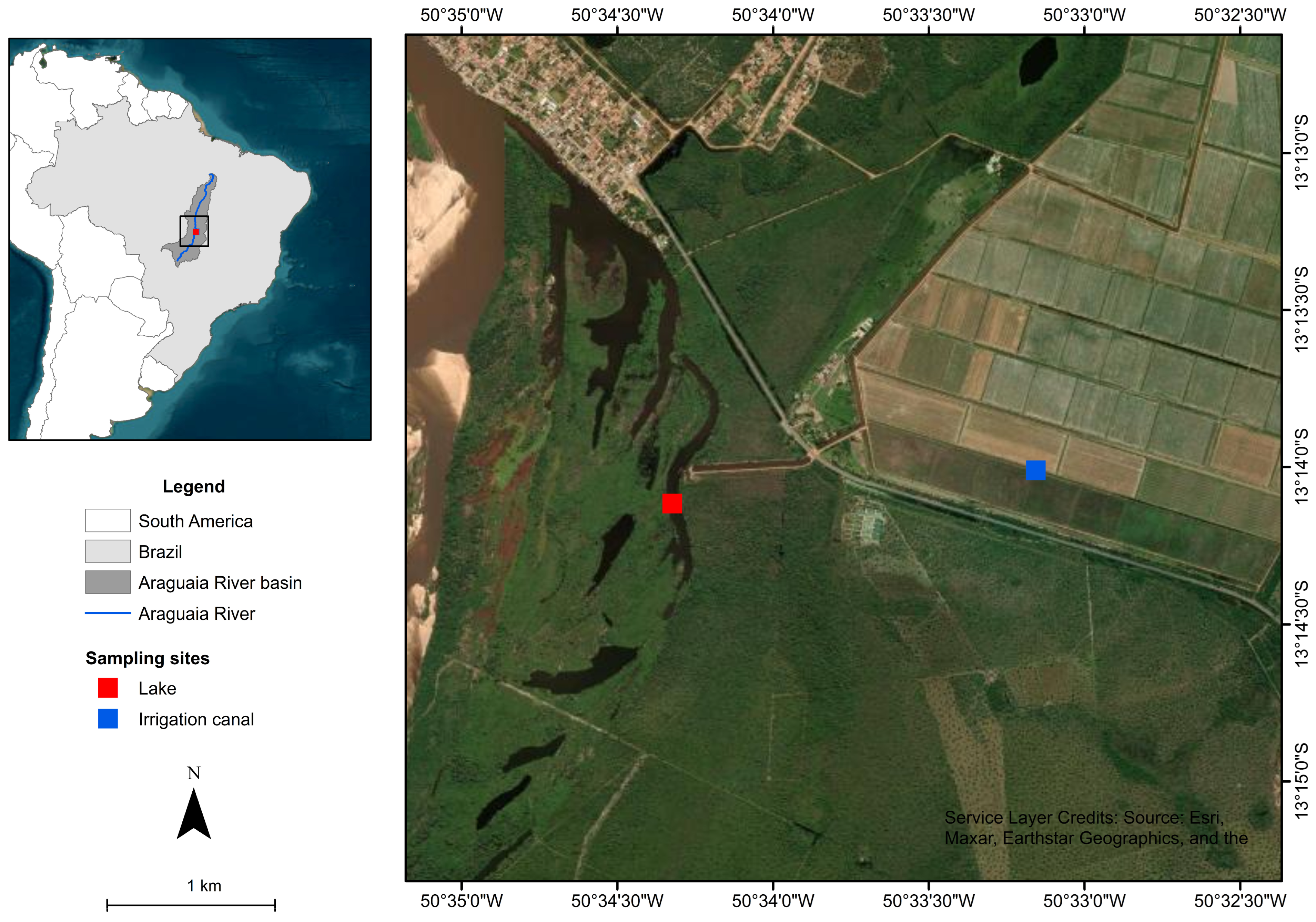
Samples were collected from natural and constructed wetlands located in the Central-West region of Brazil, in the municipality of São Miguel do Araguaia (state of Goiás) (Figure 1). Luiz Alves Lake is a natural lake classified as an abandoned canal, permanently connected to the Araguaia River. The lake exhibits substantial seasonal fluctuations in water level, with an area ranging from 0.65 to 0.98 km2, a perimeter between 15 and 17 km, and depths from 1.4 to 4.6 m [33]. The Luiz Alves do Araguaia irrigation project is a public agricultural production scheme [34]. Water is withdrawn directly from the lake into the main canal and distributed to rural properties through secondary canals, with flow regulated by sluice gates. Canal water is used for rice irrigation during the rainy season and mainly for soybean cultivation during the dry season. The canals are confined, with no seasonal variation in area or perimeter. The Araguaia basin has experienced spatially restricted gold mining episodes in the Crixás-Açu sub-basin, upstream of our study area. Mining activities were conducted during the 18th century, with some occasional activities in the 20th century [35,36]. Currently, gold mining is carried out at an industrial scale and does not use Hg in the extraction process.

2.2. Sampling Design

Samples were collected in November 2025, during the rising-water hydrological period. For collecting fishes, gillnets with mesh sizes of 3, 4, 7, 8, and 10 cm, each 10 m in length, were deployed in both study areas during morning (07:30–10:30) and afternoon (15:30–18:30), with hourly inspections. All captured individuals were counted and identified to the species level to assess community structure. For total Hg analysis, 62 specimens representing different trophic levels and occurring in both environments were selected for quantification, totaling 31 samples per sampling site: 10 detritivores, 9 omnivores, and 12 carnivores. (Table S1). Selected individuals were measured for total weight and standard length. An aliquot of dorsal muscle tissue from each specimen was collected using a stainless-steel scalpel and stored frozen until THg analysis. Feeding habits and trophic guild classifications were obtained from the FishBase platform [37], including detritivorous, omnivorous, and carnivorous guilds (Table S1). Sampling was authorized by the Brazilian Institute for Biodiversity Conservation (ICMBio) under SISBIO license no. 75299.

2.3. Total Mercury (THg) Quantification

The quantification of total Hg (THg) in dorsal muscle samples (n = 62) was carried out using a Lumex RA-915+ spectrometer coupled with a Pyro-915+ pyrolysis chamber (Lumex Instruments, St. Petersburg, Russia), based on thermal decomposition atomic absorption spectrometry (TDAAS). Dorsal muscle samples were thawed at room temperature, weighed into quartz boats (50–100 mg), and introduced into the atomizer operating in Mode 1 (680–740 °C). Six-point calibration curves were performed with the certified reference material DORM-2 (Dogfish muscle) [38]. The detection limit (LOD) for each analytical batch was calculated as LOD = 3.3 × σ/b, where σ is the standard deviation of analytical blanks obtained by quantifying THg in empty quartz boats for 45 s, and b is the slope of the calibration curve (LOD = 1 ng g−1).
The accuracy of the analytical method was assessed using certified reference materials ERM-CE101 (Trout Muscle) and ERM-CE278k (Mussel Tissue), manufactured by the Joint Research Centre (Brussels, Belgium). Mean recovery rates were 98.6 ± 3.3% and 104.2 ± 0.9%, respectively (n = 3 each). Reproducibility was assessed by analyzing 10% of the samples in duplicate, with relative percent differences ranging from 1.37 to 19.41%, and by analyzing certified reference materials in triplicate, which yielded relative standard deviations of 0.85% (ERM-CE278k) and 3.35% (ERM-CE101).

2.4. Diversity Metrics

Fish community structure was characterized using a set of complementary diversity metrics. Species richness was used as a measure of the number of taxa present in each system. Shannon and Simpson indices were calculated to quantify diversity by jointly considering richness and relative abundance, with the Shannon index being more sensitive to changes in richness and evenness and the Simpson index giving greater weight to dominant taxa. Pielou’s evenness was used to describe how uniformly individuals were distributed among taxa, whereas Margalef’s index emphasized richness in relation to total abundance. All analyses were performed in R [39], using the vegan package.

2.5. Data Analysis

The concentrations of total Hg determined in fish muscle were compared with safety thresholds established by national and international agencies. Brazilian legislation sets maximum limits of 0.5 mg kg−1 for non-predatory species and 1.0 mg kg−1 for predatory species [40], whereas the World Health Organization (WHO) establishes a guideline value of 0.5 mg kg−1 [41]. Subsequently, a generalized linear mixed model was used to compare THg concentrations between study areas (lake and irrigation canal) and trophic guilds (detritivorous, omnivorous, and carnivorous) (lme4 package). Species identity was included as a random effect to account for differences in species composition and repeated measures. Post hoc analysis was performed by estimated marginal means using t-tests with Holm correction (emmeans package). Total Hg concentrations were log-transformed to meet GLMM assumptions, which were evaluated using a simulation-based approach to calculate the residuals (DHARMa package). Pearson’s correlation was used to assess the relationship between THg concentrations and total weight and standard length. All variables were log-normalized.
Biomagnification was assessed using two complementary approaches. Biomagnification factors (BMFs) between trophic guilds were estimated by a non-parametric bootstrap to account for within-guild variability, defined as the ratio between mean Hg concentrations of carnivorous species and those of detritivorous or omnivorous species [42]. For each system, individuals were resampled with replacement over 5000 iterations, from which BMF means and 95% confidence intervals (2.5th–97.5th percentiles) were obtained. Trophic magnification was additionally evaluated at the community level using the trophic magnification slope (TMS), defined as the regression coefficient (b) of the relationship between log-transformed THg concentrations (lnTHg) and trophic level derived from FishBase [37,43]. Differences in TMS between systems were tested using analysis of covariance (ANCOVA) with a Monte Carlo permutation procedure (9999 permutations) based on the Freedman–Lane method (permuco package). All analyses were conducted in R [39].

3. Results

3.1. Diversity Patterns in the Lake and Irrigation Canal

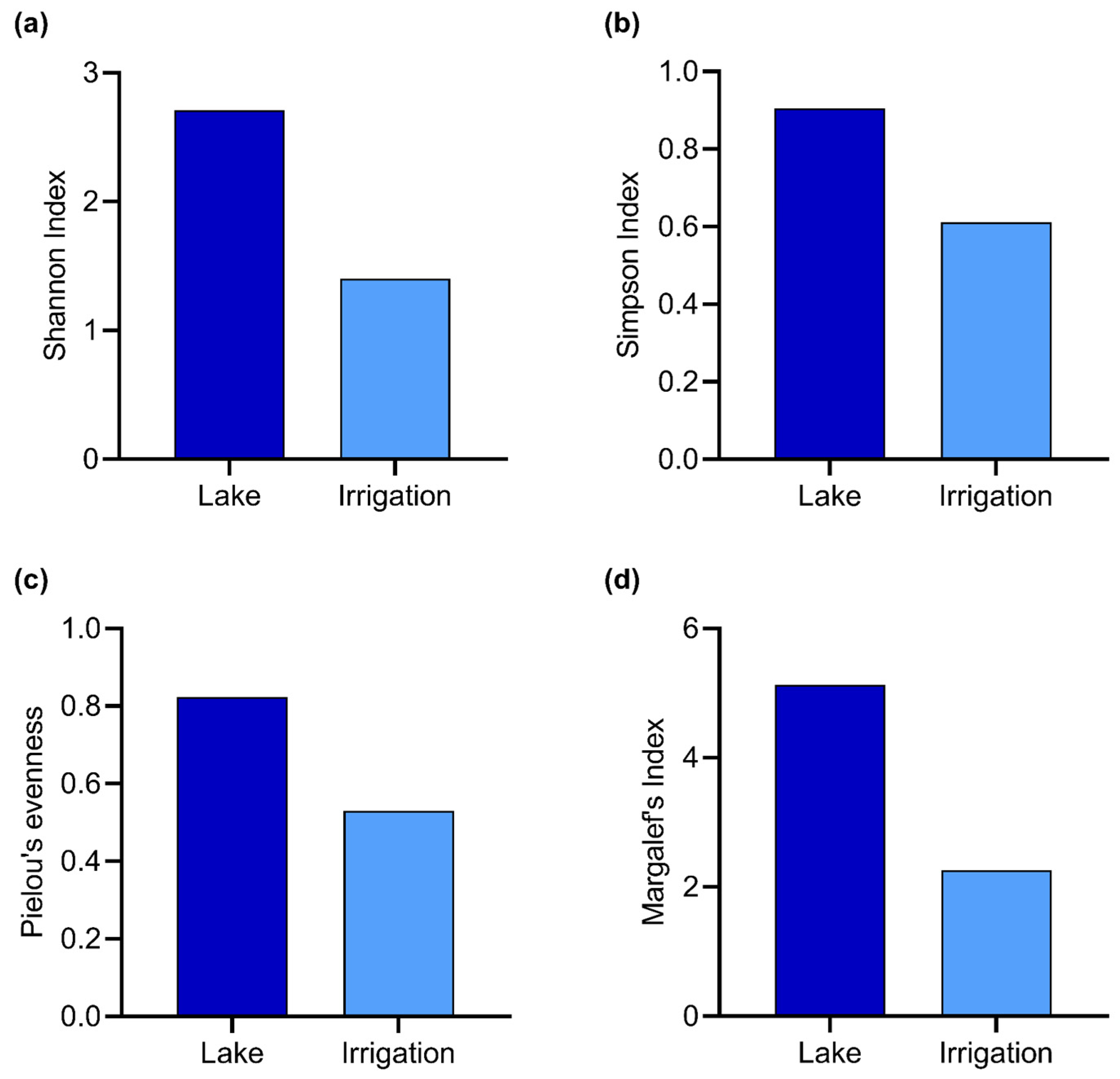
Diversity metrics revealed marked differences between the irrigation canal and the floodplain lake. Despite higher total abundance in the irrigation canal (IR; N = 314), species richness was markedly lower than in the lake (LA; N = 159), with only 14 species recorded in IR compared to 27 in LA (Table S2). The most abundant species in the irrigation canal were Curimatella immaculata (n = 185), Moenkhausia dichroura (n = 51), Lycengraulis batesii (n = 30), and Astyanax aff. bimaculatus (n = 22). In the lake, the most abundant species were Serrasalmus rhombeus (n = 31), Cyphocharax gouldingi (n = 21), and Hemiodus microlepis (n = 18). Diversity and evenness were substantially higher in LA, as indicated by Shannon (H′ = 2.71 vs. 1.40), Simpson (0.91 vs. 0.61), and Pielou’s indices (J′ = 0.83 vs. 0.53). Margalef’s index further confirmed greater richness in LA (d = 5.13) relative to IR (d = 2.26), demonstrating that observed differences in community structure were not driven by variation in total abundance but rather reflect a more complex and evenly structured assemblage in the lake than in the irrigation canal (Figure 2).

3.2. Mercury Bioaccumulation in the Lake and Irrigation Canal

A total of 62 individuals were selected for total Hg determination, including 20 detritivores, 18 omnivores, and 24 carnivores (Table S1). In the lake, the species were Curimatella immaculata, Hemiodus microlepis, Triportheus albus, Geophagus sveni, Pimelodus blochii, Pygocentrus nattereri, and Cichla kelberi, with concentrations ranging from 7.39 to 371.7 ng g−1. In the irrigation canal, THg concentrations ranged from 2.28 to 149.0 ng g−1, including the species Curimatella immaculata, Hemiodus microlepis, Astyanax aff. bimaculatus, Geophagus sveni, Pimelodus blochii, Lycengraulis batesii, and Pygocentrus nattereri. None of the analyzed samples presented Hg concentrations exceeding the national (0.5–1.0 mg kg−1; [40]) or international safety limits (0.5 mg kg−1; [41]).
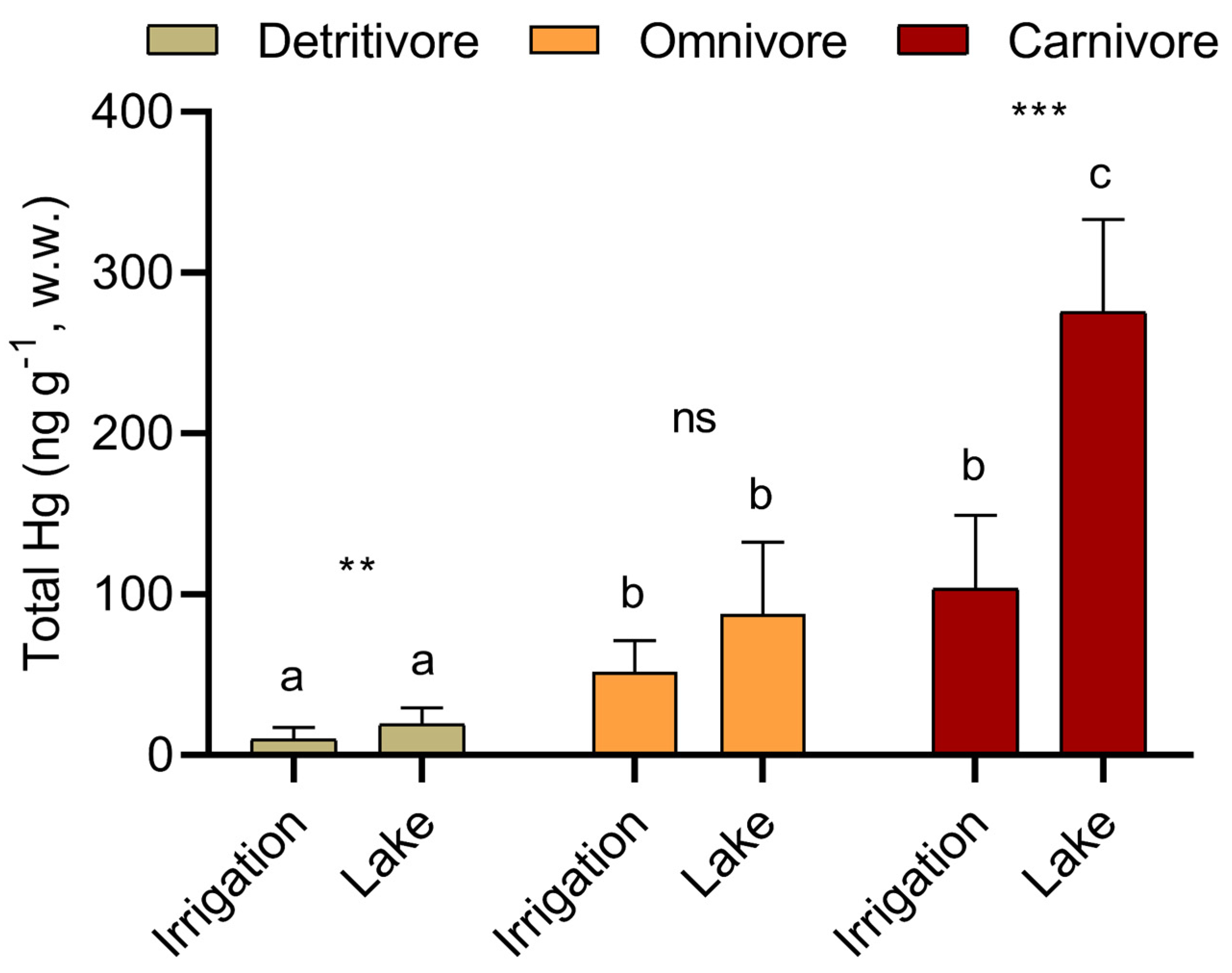
Total Hg concentrations differed significantly between study areas (F1,53 = 45.801, p < 0.0001) and trophic guilds (F2,4 = 15.127, p = 0.009) (Figure 3). There was a significant interaction between these factors, indicating that system-level differences in Hg concentrations depended on trophic guild (F2,53 = 4.671, p = 0.013). Total Hg concentrations were higher in the lake than in the irrigation channel, but this pattern was observed only for the carnivorous guild (t = 5.384, p < 0.0001) and the detritivorous guild (t = 4.183, p = 0.0001). No significant differences were detected for the omnivorous guild between systems (t = 1.809, p = 0.076). In the lake, carnivores showed higher THg concentrations (275.5 ± 58.6 ng g−1) compared with omnivores (87.7 ± 44.7 ng g−1, t = 3.457, p = 0.022) and detritivores (19.12 ± 10.37 ng g−1, t = 6.107, p = 0.002. Omnivorous species also had higher concentrations than detritivores (t = 3.066, p = 0.047). In the irrigation canal, detritivores exhibited lower THg concentrations (9.97 ± 7.21 ng g−1) than omnivores (51.69 ± 19.33 ng g−1, t = −3.675, p = 0.022) and carnivores (103.5 ± 45.6 ng g−1, t = −4.005, p = 0.015), although no significant difference was detected between omnivores and carnivores (t = 0.653, p = 0.796).
Significant correlations between THg and biometric variables were limited to a few cases. In the irrigation canal, a significant negative correlation was observed between THg and total weight for carnivorous fish (r = −0.698, p = 0.012). In the lake, THg was positively correlated with standard length (r = 0.534, p = 0.002) and total weight (r = 0.598, p < 0.001) when all species were considered together. No other significant correlations were detected (p > 0.05).

3.3. Mercury Biomagnification in the Trophic Chain

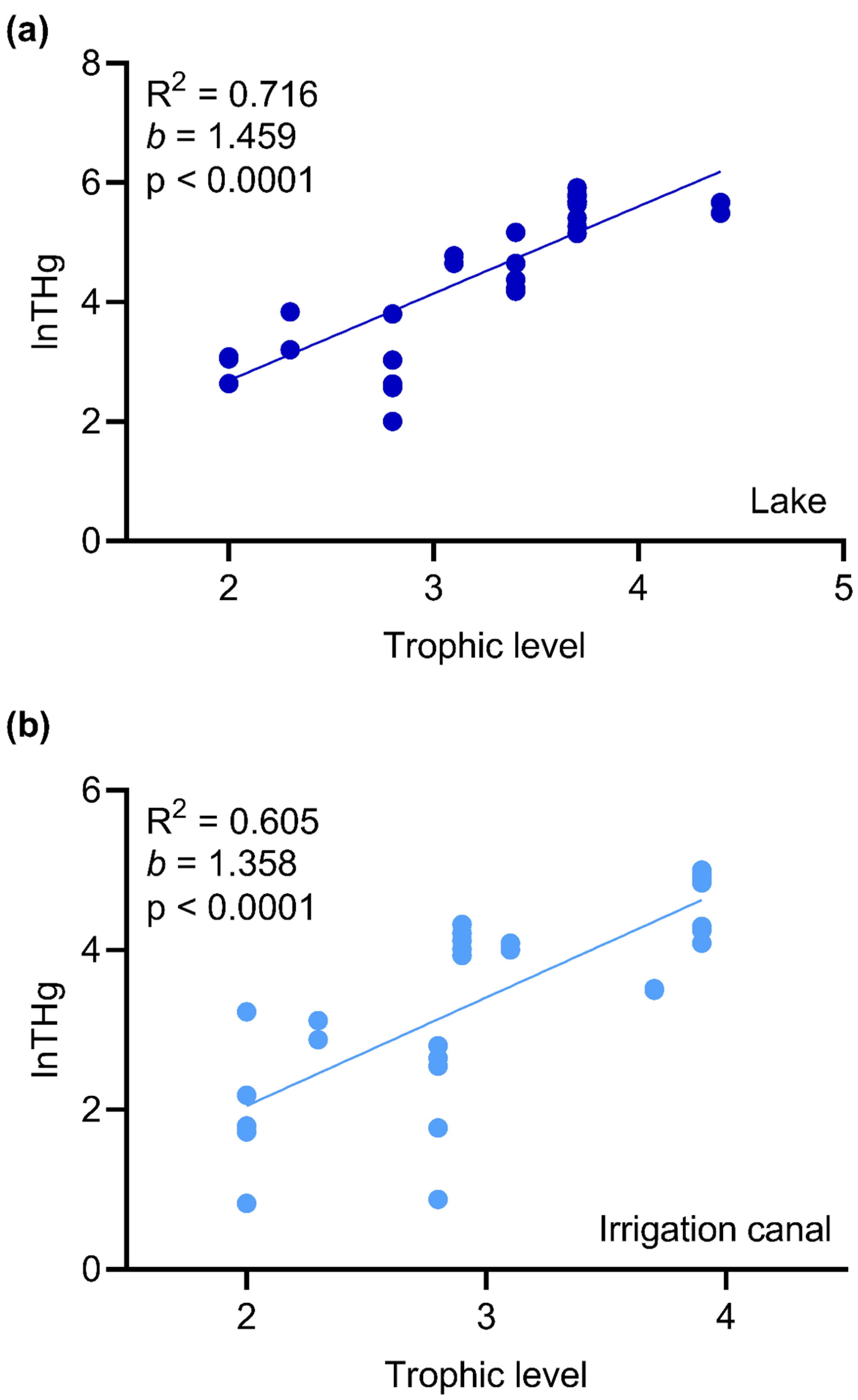
Total Hg concentrations increased with trophic level in both systems, indicating trophic biomagnification. System-specific regressions yielded similar trophic magnification slopes, with TMS values of 1.46 in the lake (95% CI: 1.11–1.81) and 1.36 in the irrigation canal (95% CI: 0.94–1.77) (Figure 4). The analysis of covariance showed that trophic magnification slopes did not differ between environments. However, biomagnification factors differed in magnitude between systems, with consistently higher BMFs observed in the lake compared to the irrigation canal. For carnivores relative to detritivores, the BMF was higher in the lake (mean = 14.07; 95% CI = 10.06–19.07) than in the irrigation canal (mean = 10.89; 95% CI = 6.50–17.91). A similar pattern was observed for the carnivore–omnivore contrast, with the lake exhibiting a higher BMF (mean = 3.22; 95% CI = 2.31–4.52) than the irrigation canal (mean = 2.03; 95% CI = 1.42–2.85).

4. Discussion

The pronounced differences in fish assemblage structure between the floodplain lake and the irrigation canal highlight the influence of habitat complexity on community organization. The higher richness, diversity, and evenness observed in the lake reflect the heterogeneous nature of floodplain environments, which provide a mosaic of habitats, food resources, and refuge opportunities associated with seasonal flooding [44,45]. Such structural complexity promotes niche partitioning and supports the coexistence of multiple trophic guilds, resulting in a more balanced assemblage [46,47]. In contrast, the irrigation canal supported a simplified fish community despite higher total abundance. This pattern is characteristic of artificial aquatic systems, where hydrological regulation, uniform canal morphology, and reduced connectivity constrain habitat availability and favor a limited number of tolerant or opportunistic species [11,48].
In the irrigation canal, the strong dominance of Curimatella immaculata is consistent with its detritivorous feeding strategy and high efficiency in exploiting fine particulate organic matter and biofilms accumulated in sediments [49,50]. Such traits are particularly advantageous in artificial canals, where homogeneous substrates and continuous sediment inputs favor detritus-based food webs [51]. The dominance of Serrasalmus rhombeus in the floodplain lake reflects a distinct ecological context. Although less numerically pronounced than the dominance of detritivores in the irrigation canal, its prevalence indicates higher prey diversity and a more functionally structured food web, in which top predators are supported by abundant and diverse lower trophic levels [52]. In addition, flood-pulse-driven morphometric changes in lakes and associated physicochemical variations in water can directly influence fish community structure in the Araguaia River floodplain, reshaping species distributions and prey availability for carnivorous and piscivorous fishes [53,54]. Therefore, the dominance patterns observed in each system reflect contrasting resource availability and environmental simplification.
The bioaccumulation pattern observed across the species pool followed the order detritivores < omnivores < carnivores. Higher Hg concentrations in predatory guilds reflect biomagnification processes, a pattern widely reported for floodplain lakes of the Solimões [42], Bacajá [18], Madeira [55], and Tapajós rivers [56]. To date, the only study that has assessed Hg bioaccumulation in fishes from the Araguaia River floodplain also reported a progressive increase in Hg concentrations with trophic level [28]. Detritivorous food chains are relatively shorter than those of other trophic guilds, being largely based on planktonic detritus, periphyton associated with sediments and macrophytes, and particulate organic matter [57,58,59]. As a result, detritivorous fishes experience lower variability in food availability across sites and seasonal periods [60], which likely contributes to reduced variability in Hg concentrations. Conversely, the diet of omnivorous fish is more diversified and strongly influenced by seasonal hydrological variations. The flood pulse enhances connectivity among rivers, terrestrial ecosystems, and adjacent lakes, expanding fish foraging areas [61] and intensifying the transport of phytoplankton [62], zooplankton [63], invertebrates, and terrestrial vegetation into floodplain lakes [44], thereby increasing the diversity of Hg exposure sources.
Differences in THg concentrations between the lake and the irrigation canal were also consistent with contrasting biogeochemical conditions. Higher Hg concentrations in lake fish, particularly among carnivorous and detritivorous guilds, suggest enhanced Hg availability and retention within the floodplain system. Floodplain lakes are well recognized as biogeochemical hotspots, where high organic matter inputs, frequent sediment–water interactions, and reducing conditions favor Hg retention and methylation [27,64], increasing its bioavailability to aquatic food webs [19,65]. Although Hg data is not available for the irrigation canal, previous findings from Luiz Alves Lake provide insights into potential drivers of Hg bioaccumulation in fish. Monteiro et al. [66] reported low THg concentrations in water (1.2 ng L−1), but substantially higher concentrations in sediments (67.2 ng g−1) and in periphyton associated with the macrophyte Paspalum repens (73.8 ng g−1), indicating potential Hg sources for detritivorous species. Periphyton associated with P. repens has been highlighted as a hotspot for Hg methylation in floodplain systems [67], further enhancing trophic transfer. Additionally, THg concentrations of 50.4 ng g−1 were reported in aquatic macrophytes and 104 ng g−1 in plankton [66]. Thus, the absence of significant differences in omnivorous species between systems likely reflects dietary flexibility, which may buffer Hg exposure by integrating resources from multiple basal compartments [68,69].
The pronounced system-level differences observed for carnivorous fishes, particularly Pygocentrus nattereri, highlight the cumulative nature of Hg bioaccumulation and the sensitivity of top predators to variations in food-web structure. Total Hg concentrations in P. nattereri ranged from 172.57 to 371.70 ng g−1 in the floodplain lake, compared with 33.04 to 33.66 ng g−1 in the irrigation canal. It is noteworthy that, despite the marked difference in THg concentrations, the body size of P. nattereri individuals was similar between study areas, ranging from 12.0 to 16.5 cm in the lake and from 16.0 to 17.8 cm in the irrigation canal. This species is a carnivore with a strong tendency toward piscivory [47,70,71]. In a floodplain lake of the lower Solimões River, Andrade et al. [47] showed that predatory serrasalmids coexist through niche partitioning, with P. nattereri feeding predominantly on omnivorous fishes rather than detritivores and herbivores. Given the high bioaccumulation potential of omnivores, which exploit multiple food resources, this trophic pathway likely enhances Hg biomagnification in P. nattereri. In addition, sampling was conducted during the transition between the dry and rainy seasons, a period associated with increased feeding activity in P. nattereri due to higher prey availability resulting from fish concentration in the main river canal during the dry season [70], further increasing Hg bioaccumulation.
Despite marked differences in community structure and Hg concentrations, trophic magnification slopes were similar between the lake and the irrigation canal, indicating that the efficiency of Hg transfer across trophic levels is conserved across systems. However, the higher biomagnification factors observed in the lake demonstrate that while transfer efficiency is comparable, the absolute magnitude of Hg accumulation is strongly system-dependent. Higher BMFs in the lake reflect greater Hg availability at the base of the food web and longer, more complex trophic pathways that promote Hg amplification. In contrast, the simplified trophic structure of the irrigation canal constrains Hg accumulation, even though biomagnification still occurs. The absence of a clear pattern between THg concentrations and fish weight and length reinforces the importance of environmental characteristics and trophic transfer in Hg bioaccumulation.
In this context, two main factors should be considered. The Luiz Alves do Araguaia Irrigation Project (PILAA) comprises primary canals directly supplied by Lake Luiz Alves and smaller secondary canals. Fish sampling was conducted in a secondary canal, where water flow is regulated and hydrological connectivity is periodically restricted, explaining the observed differences in species’ richness and dominance. The gates are closed during the dry season, coinciding with the soybean growing period, but may be opened during the rainy season due to intense rainfall or rice harvesting. The hydrological connectivity is also expected to limit Hg bioaccumulation in fish. The floodplain lake is continuously connected to the Araguaia River, receiving long-term Hg inputs and encompassing a wide range of microhabitats that favor Hg methylation [64,72]. The irrigation canal, by comparison, was constructed and flooded between 1998 and 1999, excavated in sandy–clayey soils, and characterized by a shallow sediment layer with limited conditions for methylation. Therefore, despite its lower fish diversity, the irrigation canal presents a reduced potential for Hg bioaccumulation in fish.

5. Conclusions

Our results demonstrate that natural floodplain lakes support more diverse and structurally complex fish assemblages than artificial irrigation canals, and that this ecological complexity is closely associated with higher Hg bioaccumulation in aquatic food webs. Although trophic magnification slopes were similar between systems, indicating conserved trophic transfer efficiency, biomagnification factors and overall Hg concentrations were consistently higher in the lake. These findings indicate that habitat modification reduces biodiversity and Hg bioaccumulation primarily by limiting habitat connectivity, sedimentary development, and Hg availability at the base of the food web, rather than by altering the fundamental mechanisms of Hg biomagnification.
Despite providing novel evidence on Hg bioaccumulation in natural and constructed wetlands, some limitations should be acknowledged. The sample size was sufficient to detect trophic magnification patterns and system-level differences; however, a larger and more balanced sampling design would improve representativeness. Additionally, Hg was measured only in fish muscle, without complementary data from water, sediments, basal food-web compartments, or nutrient concentrations, limiting direct inferences about underlying biogeochemical drivers. Finally, MeHg was not quantified. Although total Hg is widely used as a proxy for MeHg in fish muscle, direct speciation would provide a more comprehensive understanding of Hg dynamics. Future studies should therefore integrate multi-matrix sampling and Hg speciation analyses.

Supplementary Materials

The following supporting information can be downloaded at: https://www.mdpi.com/article/10.3390/fishes11030176/s1, Table S1: Total mercury (Hg) concentrations, standard length, and total weight of individuals collected from the lake and irrigation canal; Table S2: List of species and count of individuals in the lake and irrigation canal.

Author Contributions

Conceptualization, L.C.M., J.V.E.B. and L.C.G.V.; methodology, T.N.d.S.C.; formal analysis, L.C.M. and T.N.d.S.C.; investigation, L.C.M., T.N.d.S.C., V.C.d.S.S., L.J.S.S., D.C., C.P.d.A. and J.V.E.B.; writing—original draft preparation, L.C.M.; writing—review and editing, D.C., F.B.T., R.d.A., W.R.B., J.V.E.B. and L.C.G.V.; resources. F.B.T.; funding acquisition, L.C.G.V.; supervision, L.C.G.V. All authors have read and agreed to the published version of the manuscript.

Funding

This work is a contribution of the National Institute of Science and Technology (INCT) in Ecology, Evolution, and Biodiversity Conservation funded by CNPq (grant 465610/2014-5/409197/2024-6) and FAPEG (grant 201810267000023). It is also developed in the context of the “Araguaia Vivo 2030” program (TWRA/FAPEG agreement, proc. 202210267000536), “PPBio Araguaia” project supported by CNPq (proc. 441114/2023-7), “PELD Araguaia” (CNPq 445733/2024-1/FAPEG 202510267001637), FAPDF (Edital 04/2021; proc.: 00193-00001567/2021-80), and FUNBIO (Programa de Bolsas FUNBIO 2021; proc: 017/2022). Field sampling was funded by the Coordination for the Improvement of Higher Education Personnel (CAPES) through the PROAP program (Graduate Program in Environmental Sciences), with logistical support from the University of Brasília, Planaltina campus.

Institutional Review Board Statement

Fish sampling and dorsal muscle excision were approved by the Brazilian Institute for Biodiversity Conservation (ICMBio) under SISBIO license no. 75299 (approval date: 22 October 2025).

Data Availability Statement

Data is contained within the Supplementary Materials.

Acknowledgments

We thank the administration of the Luiz Alves do Araguaia Irrigation Project for logistical support and the Chico Mendes Institute for Biodiversity Conservation (ICMBio) for granting collection permits.

Conflicts of Interest

The authors declare no conflicts of interest.

References

  1. Junk, W.J.; Wantzen, K.M. Flood pulsing and the development and maintenance of biodiversity in floodplains. Ecol. Freshw. Estuar. Wetl. 2006, 407–435. [Google Scholar]
  2. Jakubínský, J.; Prokopova, M.; Raška, P.; Salvati, L.; Bezak, N.; Cudlín, O.; Lepeška, T. Managing floodplains using nature-based solutions to support multiple ecosystem functions and services. WIREs Water 2021, 8, e1545. [Google Scholar] [CrossRef]
  3. Petsch, D.K.; Cionek, V.D.M.; Thomaz, S.M.; Dos Santos, N.C.L. Ecosystem services provided by river-floodplain ecosystems. Hydrobiologia 2023, 850, 2563–2584. [Google Scholar] [CrossRef]
  4. Mitsch, W.J.; Bernal, B.; Nahlik, A.M.; Mander, Ü.; Zhang, L.; Anderson, C.J.; Brix, H. Wetlands, carbon, and climate change. Landsc. Ecol. 2013, 28, 583–597. [Google Scholar] [CrossRef]
  5. Schneider, L.; Fisher, J.A.; Diéguez, M.C.; Fostier, A.H.; Guimaraes, J.R.; Leaner, J.J.; Mason, R. A synthesis of mercury research in the Southern Hemisphere, part 1: Natural processes. Ambio 2023, 52, 897–917. [Google Scholar] [CrossRef] [PubMed]
  6. Tockner, K.; Pusch, M.; Borchardt, D.; Lorang, M.S. Multiple stressors in coupled river–floodplain ecosystems. Freshw. Biol. 2010, 55, 135–151. [Google Scholar] [CrossRef]
  7. Rajib, A.; Zheng, Q.; Lane, C.R.; Golden, H.E.; Christensen, J.R.; Isibor, I.I.; Johnson, K. Human alterations of the global floodplains 1992–2019. Sci. Data 2023, 10, 499. [Google Scholar] [CrossRef]
  8. Baber, M.J.; Childers, D.L.; Babbitt, K.J.; Anderson, D.H. Controls on fish distribution and abundance in temporary wetlands. Can. J. Fish. Aquat. Sci. 2002, 59, 1441–1450. [Google Scholar] [CrossRef]
  9. O’Mara, K.; Venarsky, M.; Stewart-Koster, B.; McGregor, G.B.; Schulz, C.; Marshall, J.; Bunn, S.E. Hydrological connectivity and environmental characteristics explain spatial variation in fish assemblages in a wet–dry tropical river. Hydrobiologia 2024, 851, 5207–5221. [Google Scholar] [CrossRef]
  10. Maltchik, L.; Lanés, L.E.K.; Keppeler, F.W.; Rolon, A.S.; Stenert, C. Landscape and habitat characteristics associated with fish occurrence and richness in southern Brazil palustrine wetland systems. Environ. Biol. Fishes 2014, 97, 297–308. [Google Scholar] [CrossRef]
  11. Katano, O.; Hosoya, K.; Iguchi, K.I.; Yamaguchi, M.; Aonuma, Y.; Kitano, S. Species diversity and abundance of freshwater fishes in irrigation ditches around rice fields. Environ. Biol. Fishes 2003, 66, 107–121. [Google Scholar] [CrossRef]
  12. Davis, A.M.; Moore, A.R. Conservation potential of artificial water bodies for fish communities on a heavily modified agricultural floodplain. Aquat. Conserv. 2016, 26, 1184–1196. [Google Scholar] [CrossRef]
  13. Wang, R.; Wong, M.H.; Wang, W.X. Mercury exposure in the freshwater tilapia Oreochromis niloticus. Environ. Pollut. 2010, 158, 2694–2701. [Google Scholar] [CrossRef] [PubMed]
  14. Gehrke, G.E.; Blum, J.D.; Slotton, D.G.; Greenfield, B.K. Mercury isotopes link mercury in San Francisco Bay forage fish to surface sediments. Environ. Sci. Technol. 2011, 45, 1264–1270. [Google Scholar] [CrossRef]
  15. Bradley, M.A.; Barst, B.D.; Basu, N. A review of mercury bioavailability in humans and fish. Int. J. Environ. Res. Public Health 2017, 14, 169. [Google Scholar] [CrossRef] [PubMed]
  16. Peng, X.; Yang, Y.; Yang, S.; Li, L.; Song, L. Recent advance of microbial mercury methylation in the environment. Appl. Microbiol. Biotechnol. 2024, 108, 235. [Google Scholar] [CrossRef]
  17. Bastos, W.R.; Dórea, J.G.; Bernardi, J.V.E.; Lauthartte, L.C.; Mussy, M.H.; Lacerda, L.D.; Malm, O. Mercury in fish of the Madeira River (temporal and spatial assessment), Brazilian Amazon. Environ. Res. 2015, 140, 191–197. [Google Scholar] [CrossRef]
  18. Souza-Araujo, J.; Giarrizzo, T.; Lima, M.O.; Souza, M.B.G. Mercury and methyl mercury in fishes from Bacajá River (Brazilian Amazon): Evidence for bioaccumulation and biomagnification. J. Fish Biol. 2016, 89, 249–263. [Google Scholar] [CrossRef]
  19. Nyholt, K.; Jardine, T.D.; Villamarín, F.; Jacobi, C.M.; Hawes, J.E.; Campos-Silva, J.V.; Magnusson, W.E. High rates of mercury biomagnification in fish from Amazonian floodplain-lake food webs. Sci. Total Environ. 2022, 833, 155161. [Google Scholar] [CrossRef]
  20. Sakamoto, M.; Murata, K.; Kakita, A.; Sasaki, M. A review of mercury toxicity with special reference to methylmercury. In Environmental Chemistry and Toxicology of Mercury; John Wiley & Sons, Inc.: Hoboken, NJ, USA, 2012; pp. 501–516. [Google Scholar]
  21. Peng, X.; Liu, F.; Wang, W.X. Organ-specific accumulation, transportation, and elimination of methylmercury and inorganic mercury in a low Hg accumulating fish. Environ. Toxicol. Chem. 2016, 35, 2074–2083. [Google Scholar] [CrossRef]
  22. Lino, A.S.; Kasper, D.; Guida, Y.S.; Thomaz, J.R.; Malm, O. Mercury and selenium in fishes from the Tapajós River in the Brazilian Amazon: An evaluation of human exposure. J. Trace Elem. Med. Biol. 2018, 48, 196–201. [Google Scholar] [CrossRef]
  23. Mussy, M.H.; Almeida, R.; Carvalho, D.P.; Lauthartte, L.C.; de Holanda, I.B.B.; de Almeida, M.G.; Sousa-Filho, I.F.; de Rezende, C.E.; Malm, O.; Bastos, W.R. Evaluating total mercury and methylmercury biomagnification using stable isotopes of carbon and nitrogen in fish from the Madeira River basin, Brazilian Amazon. Environ. Sci. Pollut. Res. 2023, 30, 33543–33554. [Google Scholar] [CrossRef]
  24. Latrubesse, E.M.; Arima, E.; Ferreira, M.E.; Nogueira, S.H.; Wittmann, F.; Dias, M.S.; Bayer, M. Fostering water resource governance and conservation in the Brazilian Cerrado biome. Conserv. Sci. Pract. 2019, 1, e77. [Google Scholar] [CrossRef]
  25. Latrubesse, E.M.; Amsler, M.L.; Morais, R.P.; Aquino, S. The geomorphologic response of a large pristine alluvial river to tremendous deforestation in the South American tropics: The case of the Araguaia River. Geomorphology 2009, 113, 239–252. [Google Scholar] [CrossRef]
  26. Teixeira, A.S.; Vieira, L.C.G.; Souza, C.A.; Bernardi, J.V.E.; Monteiro, L.C. Evidence of water surface and flow reduction in the main hydrographic basin of the Brazilian savannah: The Araguaia River. Hydrobiologia 2024, 851, 2503–2518. [Google Scholar] [CrossRef]
  27. Monteiro, L.C.; Vieira, L.C.G.; Bernardi, J.V.E.; Moraes, L.C.; Rodrigues, Y.O.S.; Souza, J.P.R.; Dórea, J.G. Ecological risk of mercury in bottom sediments and spatial correlation with land use in Neotropical savanna floodplain lakes. Environ. Res. 2023, 238, 117231. [Google Scholar] [CrossRef] [PubMed]
  28. Moraes, L.; Bernardi, J.V.E.; Souza, J.P.R.; Portela, J.F.; Vieira, L.C.G.; Sousa Passos, C.J.; Dórea, J.G. Sediment mercury, geomorphology and land use in the Middle Araguaia River floodplain. Soil Syst. 2023, 7, 97. [Google Scholar] [CrossRef]
  29. Zhao, L.; Anderson, C.W.N.; Qiu, G.; Meng, B.; Wang, D.; Feng, X. Mercury methylation in paddy soil: Source and distribution of mercury species. Biogeosciences 2016, 13, 2429–2440. [Google Scholar] [CrossRef]
  30. Wang, Y.L.; Fang, M.D.; Chien, L.C.; Lin, C.C.; Hsi, H.C. Distribution of mercury and methylmercury in surface water and surface sediment of river, irrigation canal, reservoir, and wetland in Taiwan. Environ. Sci. Pollut. Res. 2019, 26, 17762–17773. [Google Scholar] [CrossRef]
  31. Qin, C.; Du, B.; Yin, R.; Meng, B.; Fu, X.; Li, P.; Feng, X. Isotopic fractionation and source appointment of methylmercury in a paddy ecosystem. Environ. Sci. Technol. 2020, 54, 14334–14342. [Google Scholar] [CrossRef]
  32. Kütter, V.T.; Kütter, M.T.; Silva-Filho, E.V.; Marques, E.D.; Gomes, O.V.O.; Mirlean, N. Bioaccumulation of mercury in fish in a rice field in southern Brazil. Acta Limnol. Bras. 2015, 27, 191–201. [Google Scholar] [CrossRef]
  33. Morais, R.P.; Oliveira, L.G.; Latrubesse, E.M.; Pinheiro, R.C.D. Morfometria de sistemas lacustres da planície aluvial do médio rio Araguaia. Acta Sci. Biol. Sci. 2005, 27, 203–213. [Google Scholar] [CrossRef]
  34. Terra Consultoria. Projeto de Irrigação Luiz Alves do Araguaia—PILAA: Relatório Semestral de Monitoramento Ambiental; Terra Consultoria: Goiania, Brazil, 2019; Volume 1. [Google Scholar]
  35. Silva, N. O garimpeiro eventual na bacia do Rio Vermelho no município de Goiás (1981–1991). Rev. Expedições Teor. Hist. Historiogr. 2018, 9, 75–89. [Google Scholar]
  36. Ulrich, S.; Hageman, S.; Marques, J.C.; Figueiredo, F.L.A.; Ramires, J.E.; Frantz, J.C.; Petersen, K. The orogenic Crixás gold deposit, Goiás, Brazil: A review and new constraints on the structural control of ore bodies. Minerals 2021, 11, 1050. [Google Scholar] [CrossRef]
  37. Froese, R.; Pauly, D. FishBase. Available online: https://www.fishbase.org/ (accessed on 10 December 2025).
  38. Panichev, N.A.; Panicheva, S.E. Determination of total mercury in fish and sea products by direct thermal decomposition atomic absorption spectrometry. Food Chem. 2015, 166, 432–441. [Google Scholar] [CrossRef]
  39. R Core Team. R: A Language and Environment for Statistical Computing; R Foundation for Statistical Computing: Vienna, Austria, 2025. [Google Scholar]
  40. Agência Nacional de Vigilância Sanitária. Resolução Nº42, de 29 de Agosto de 2013: Dispõe Sobre o Regulamento Técnico MERCOSUL Sobre Limites Máximos de Contaminantes Inorgânicos em Alimentos; Agência Nacional de Vigilância Sanitária: Brasília, Brazil, 2013. [Google Scholar]
  41. WHO—World Health Organization. Guidance for Identifying Populations at Risk from Mercury Exposure; World Health Organization: Geneva, Switzerland, 2008. [Google Scholar]
  42. Beltran-Pedreros, S.; Zuanon, J.; Leite, R.G.; Peleja, J.R.P.; Mendonça, A.B.; Forsberg, B.R. Mercury bioaccumulation in fish of commercial importance from different trophic categories in an Amazon floodplain lake. Neotrop. Ichthyol. 2011, 9, 901–908. [Google Scholar] [CrossRef]
  43. Lavoie, R.A.; Jardine, T.D.; Chumchal, M.M.; Kidd, K.A.; Campbell, L.M. Biomagnification of mercury in aquatic food webs: A worldwide meta-analysis. Environ. Sci. Technol. 2013, 47, 13385–13394. [Google Scholar] [CrossRef]
  44. Correa, S.B.; Winemiller, K.O. Terrestrial–aquatic trophic linkages support fish production in a tropical oligotrophic river. Oecologia 2018, 186, 1069–1078. [Google Scholar] [CrossRef]
  45. Winemiller, K.O.; Andrade, M.C.; Arantes, C.C.; Bokhutlo, T.; Bower, L.M.; Cunha, E.R.; Robertson, C.R. Can spatial food web subsidies associated with river hydrology and lateral connectivity be detected using stable isotopes? Food Webs 2023, 34, e00264. [Google Scholar] [CrossRef]
  46. Correa, S.B.; Winemiller, K.O. Niche partitioning among frugivorous fishes in response to fluctuating resources in the Amazonian floodplain forest. Ecology 2014, 95, 210–224. [Google Scholar] [CrossRef]
  47. Andrade, F.S.; Possamai, B.; Freitas, C.E.C.; Silva Batista, J.; Hoeinghaus, D.J.; Clements, L.; Siqueira-Souza, F.K. Niche partitioning and seasonality may mediate coexistence of piranha species in Amazonian floodplain lakes. Hydrobiologia 2024, 851, 4325–4340. [Google Scholar] [CrossRef]
  48. Mitsuo, Y.; Tsunoda, H.; Takiguchi, A.; Senga, Y. Environmental influences on fish assemblages in irrigation ponds. Aquat. Ecol. 2011, 45, 473–482. [Google Scholar] [CrossRef]
  49. Cella-Ribeiro, A.; Torrente-Vilara, G.; Lima-Filho, J.A.; Doria, C.R.C. Ecologia e Biologia de Peixes do Rio Madeira; EDUFRO: Porto Velho, Brazil, 2016. [Google Scholar]
  50. Oliveira, J.C.D.; Oliveira, J.F.; Marques, A.O.; Peretti, D.; Costa, R.S.; Novaes, J.L.C. Trophic ecology of detritivorous fish along a reservoir cascade in a tropical semi-arid region. Ecol. Freshw. Fish 2021, 30, 234–243. [Google Scholar] [CrossRef]
  51. Pilati, A.; Vanni, M.J.; González, M.J.; Gaulke, A.K. Effects of agricultural subsidies of nutrients and detritus on fish and plankton of shallow-reservoir ecosystems. Ecol. Appl. 2009, 19, 942–960. [Google Scholar] [CrossRef] [PubMed]
  52. Seabra, L.B.; Huckembeck, S.; Freitas, T.M.S.; Lobato, C.M.C.; Penha, I.C.S.; Prata, E.G.; Montag, L.F.A. Variation in basal sources contribution to the diet of a predator fish in an altered flood pulse area in the Amazon. Hydrobiologia 2025, 852, 909–925. [Google Scholar] [CrossRef]
  53. Tejerina-Garro, F.L.; Fortin, R.; Rodríguez, M.A. Fish community structure in relation to environmental variation in floodplain lakes of the Araguaia River. Environ. Biol. Fishes 1998, 51, 399–410. [Google Scholar] [CrossRef]
  54. Melo, T.L.D.; Tejerina-Garro, F.L.; Melo, C.E.D. Influence of environmental parameters on fish assemblage of a neotropical river with a flood pulse regime. Neotrop. Ichthyol. 2009, 7, 421–428. [Google Scholar] [CrossRef]
  55. Azevedo, L.S.; Pestana, I.A.; Nery, A.F.C.; Bastos, W.R.; Souza, C.M.M. Mercury concentration in six fish guilds from a floodplain lake in western Amazonia. Ecol. Indic. 2020, 111, 106056. [Google Scholar] [CrossRef]
  56. Lino, A.S.; Kasper, D.; Guida, Y.S.; Thomaz, J.R.; Malm, O. Total and methyl mercury distribution along the Tapajós River basin. Chemosphere 2019, 235, 690–700. [Google Scholar] [CrossRef]
  57. Fugi, R.; Hahn, N.S.; Agostinho, A.A. Feeding styles of bottom-feeding fishes of the high Paraná River. Environ. Biol. Fishes 1996, 46, 297–307. [Google Scholar] [CrossRef]
  58. Rejas, D. Trophic structure of a floodplain fish assemblage in the upper Amazon basin. Rev. Biol. Trop. 2018, 66, 1258–1271. [Google Scholar] [CrossRef]
  59. Peel, R.A.; Hill, J.M.; Taylor, G.C.; Weyl, O.L. Food web structure and trophic dynamics of a fish community in an ephemeral floodplain lake. Front. Environ. Sci. 2019, 7, 192. [Google Scholar] [CrossRef]
  60. Winemiller, K.O. Spatial and temporal variation in tropical fish trophic networks. Ecol. Monogr. 1990, 60, 331–367. [Google Scholar] [CrossRef]
  61. Dorea, J.G.; Barbosa, A.C.; Silva, G.S. Fish mercury bioaccumulation as a function of feeding behavior and hydrological cycles of the Rio Negro. Comp. Biochem. Physiol. C 2006, 142, 275–283. [Google Scholar] [CrossRef]
  62. Bortolini, J.C.; Bovo-Scomparin, V.M.; Paula, A.C.M.; Moresco, G.A.; Reis, L.M.; Jati, S.; Rodrigues, L.C. Composition and species richness of phytoplankton in a subtropical floodplain lake. Acta Limnol. Bras. 2014, 26, 296–305. [Google Scholar] [CrossRef]
  63. Santos, K.N.J.; Carvalho, P.D.; Vieira, L.C.G.; Granzotti, R.V.; Bini, L.M. Zooplankton occupancy and abundance mediated by hydrological regime. Acta Limnol. Bras. 2022, 34, e29. [Google Scholar] [CrossRef]
  64. Maia, P.D.; Maurice, L.; Tessier, E.; Amouroux, D.; Cossa, D.; Moreira-Turcq, P.; Etcheber, H. Role of floodplain lakes in methylmercury exchanges with the Amazon River. J. Environ. Sci. 2018, 68, 24–40. [Google Scholar] [CrossRef]
  65. Paiva, T.C.; Dary, E.P.; Pestana, I.A.; Amadio, S.A.; Malm, O.; Kasper, D. Flood pulse and trophic position modulate mercury in fishes. Environ. Res. 2022, 215, 114307. [Google Scholar] [CrossRef] [PubMed]
  66. Monteiro, L.C.; Vieira, L.C.G.; Bernardi, J.V.E.; Bastos, W.R.; de Souza, J.P.R.; Recktenvald, M.C.N.N.; Nery, A.F.D.C.; Oliveira, I.A.D.S.; Cabral, C.D.S.; Moraes, L.C. Local and landscape factors influencing mercury distribution in water, bottom sediment, and biota from lakes of the Araguaia River floodplain, Central Brazil. Sci. Total Environ. 2024, 908, 168336. [Google Scholar] [CrossRef]
  67. Coelho-Souza, S.A.; Guimarães, J.R.; Miranda, M.R.; Poirier, H.; Mauro, J.B.; Lucotte, M.; Mergler, D. Mercury and flooding cycles in the Tapajós river basin, Brazilian Amazon: The role of periphyton of a floating macrophyte (Paspalum repens). Sci. Total Environ. 2011, 409, 2746–2753. [Google Scholar] [CrossRef]
  68. Azevedo, L.S.; Pestana, I.A.; Nery, A.F.C.; Bastos, W.R.; Souza, C.M.M. Influence of flood pulse on mercury accumulation in fish guilds. Ecotoxicology 2019, 28, 478–485. [Google Scholar] [CrossRef]
  69. Hacon, S.S.; Oliveira-da-Costa, M.; Gama, C.S.; Ferreira, R.; Basta, P.C.; Schramm, A.; Yokota, D. Mercury exposure through fish consumption in traditional Amazonian communities. Int. J. Environ. Res. Public Health 2020, 17, 5269. [Google Scholar] [CrossRef]
  70. Ferreira, F.S.; Vicentin, W.; Costa, F.E.S.; Súarez, Y.R. Trophic ecology of two piranha species in the Pantanal floodplain. Acta Limnol. Bras. 2014, 26, 381–391. [Google Scholar] [CrossRef]
  71. Bezerra-Neto, E.B.; Sousa, R.G.C.; Alves, J.A.; Faria Junior, C.H. Dieta e distribuição sazonal de piranhas no Rio São Miguel. Bol. Inst. Pesca 2024, 50, e926. [Google Scholar]
  72. Pestana, I.A.; Almeida, M.G.; Bastos, W.R.; Souza, C.M. Total Hg and methylmercury dynamics in a river-floodplain system. Sci. Total Environ. 2019, 656, 388–399. [Google Scholar] [CrossRef] [PubMed]
Figure 1. Location of the study area showing the sampling sites in the floodplain lake (red) and the irrigation canal (blue).
Fishes 11 00176 g001
Figure 2. Comparison of diversity metrics between the lake and the irrigation canal: (a) Shannon Index, (b) Simpson Index, (c) Pielou’s evenness, and (d) Margalef’s Index.
Fishes 11 00176 g002
Figure 3. Comparison of total mercury (THg) concentrations among trophic guilds in the lake and in the irrigation canal. Letters above the bars indicate significant differences among trophic guilds based on multiple t-test comparisons with Holm correction. Asterisks indicate differences in each trophic guild between systems. ns: not significant; **: p = 0.0001; ***: p < 0.0001.
Fishes 11 00176 g003
Figure 4. Relationship between log-normalized total mercury (lnTHg) and trophic level in the lake (a) and in the irrigation canal (b). R2: coefficient of determination; b: trophic magnification slope (TMS); p: significance of the linear regression model.
Fishes 11 00176 g004
Disclaimer/Publisher’s Note: The statements, opinions and data contained in all publications are solely those of the individual author(s) and contributor(s) and not of MDPI and/or the editor(s). MDPI and/or the editor(s) disclaim responsibility for any injury to people or property resulting from any ideas, methods, instructions or products referred to in the content.