
Article

In Situ Cultivation of Autotrophic Bioflocs Enables Zero-Water-Exchange Intensive Shrimp Farming: Mechanisms and Applications

1
Guangdong Provincial Key Laboratory of Aquatic Animal Disease Control and Healthy Culture, College of Fishery, Guangdong Ocean University, Zhanjiang 524088, China
2
Key Laboratory of Diseases Controlling for Aquatic Economic Animals of Guangdong Higher Education Institutions, Zhanjiang 524088, China
3
Southern Marine Science and Engineering Guangdong Laboratory, Zhanjiang 524025, China
4
Guangdong Provincial Engineering Research Center for Aquatic Animal Health Assessment, Shenzhen 518000, China
*
Authors to whom correspondence should be addressed.
Fishes 2026, 11(3), 148; https://doi.org/10.3390/fishes11030148
Submission received: 26 January 2026 / Revised: 27 February 2026 / Accepted: 27 February 2026 / Published: 2 March 2026

Abstract

Research on heterotrophic bioflocs is extensive, whereas investigations into autotrophic bioflocs remain limited. This study established an in situ autotrophic biofloc (ABF) system for intensive Pacific white shrimp (Penaeus vannamei) farming, aiming for zero water exchange and optimized water quality. A 120-day indoor experiment tested three stocking densities (300 (T1), 250 (T2), and 200 shrimp per m3 (T3)) with no water exchange. Water quality was monitored every two days, and bacterial communities were analyzed on days 10 and 70. The results indicated that ABF maturation was achieved by day 70 across all treatments, marked by three key indicators: (1) synchronous declines in nitrite and nitrate concentrations; (2) concurrent decreases in pH and total alkalinity approaching maturation; and (3) sustained high nitrogen removal efficiency (nitrite < 0.7 mg/L, ammonia < 0.6 mg/L). All density groups displayed similar patterns in both water quality dynamics and microbial community evolution. Bacterial analysis revealed that dominant genera such as Ruegeria, Bacillus, Muricauda, SM1A02, and Nitrospira played critical roles in toxic nitrogen removal, while pathogenic Klebsiella and Vibrio significantly decreased post-maturation. Heterotrophic nitrification and aerobic denitrification microorganisms (HNADMs) were identified as potentially responsible for nitrite accumulation. Nitrite accumulation was found in all groups. T2 and T3 achieved satisfactory breeding performance despite pre-maturation nitrate peaks exceeding 40 mg/L, whereas T1 suffered a low survival rate (27.47%) due to severe nitrite accumulation (>50 mg/L). A biofloc volume (BFV) of 4–8 mL/L effectively managed daily feed inputs of 75–110 g/m3. These findings lay a theoretical and technical foundation for the application of in situ ABF cultivation in intensive farming and enhance the sustainability of aquaculture.
Key Contribution: This study is the first to identify the synchronous decline in nitrite and nitrate as a key indicator of biofloc maturation, elucidating the interplay among nitrification, denitrification, and water quality parameters. It further reveals the role of diverse heterotrophic nitrifying–aerobic denitrifying microbes (HNADMs) in nitrogen cycling and provides a practical strategy for autotrophic bioflocs cultivation, offering a theoretical basis for applying in situ biofloc technology in intensive aquaculture.

1. Introduction

The global aquaculture industry, producing 100 million tons annually [1], has intensified to meet rising protein demand. This expansion has triggered environmental concerns, including antibiotic overuse, chemical pollution, and nutrient-rich wastewater discharge, leading to eutrophication, harmful algal blooms, and disease outbreaks. In response, innovative technologies that reduce environmental impact are gaining traction. Biofloc technology (BFT) has emerged as a promising solution for intensive systems. Adopted worldwide [2,3,4], BFT offers benefits such as significant reduction in water exchange, efficient water quality management, and lower disease incidence [5]. By improving feed conversion ratios, boosting production yields, and significantly reducing water exchange requirements, BFT supports sustainable aquaculture productivity while minimizing environmental impact.
Bioflocs are aggregates composed of diverse microorganisms, including bacteria, microalgae, ciliates, fungi, protozoans, and zooplankton, as well as organic debris [4,6,7]. These microbial communities are critical for the formation and maintenance of bioflocs, facilitating nutrient cycling, and act as a nutritional supplement for aquatic species. Among the microorganisms in bioflocs, bacteria play a central role in preserving water quality: they convert toxic nitrogenous wastes into microbial biomass [8] and harmless nitrogen compounds, thereby enabling minimal or even zero-water exchange in intensive aquaculture systems. Traditionally, organic nitrogen is first converted to total ammonia nitrogen (TAN) by heterotrophic microorganisms. Subsequently, nitrifying bacteria oxidize ammonia to nitrite and further convert nitrite to nitrate [9]. While ammonia and nitrite are toxic to aquatic animals, nitrate is typically removed by denitrifying bacteria, which reduce it to nitrogen gas under locally anaerobic conditions [10]. Additionally, recent research indicates that heterotrophic nitrifying bacteria (HNB) with both nitrification and denitrification capabilities may dominate nitrogen cycling in biofloc systems [11,12], simplifying the entire process.
Bacterial communities are essential in BFT systems, crucial for sustaining host health [13] and water quality. Probiotics from bioflocs can colonize aquatic animals’ intestines, enhancing immune performance by modulating gut microbiota [14]. These microorganisms also remove toxic nitrogen compounds, maintaining a stable aquatic environment. However, this microbial stability is fragile. Nitrifying bacteria reproduction can be inhibited by a high carbon-to-nitrogen (C/N) ratio, significant pH fluctuations, or insufficient alkalinity [15,16]. Furthermore, incomplete denitrification, often due to an inadequate supply of electron donors or high dissolved oxygen (DO) levels, leads to nitrite accumulation [17]. This problem is worsened by the inherent growth disparities between key bacteria: heterotrophic bacteria produce far more biomass than autotrophic nitrifying bacteria [18], and nitrite-oxidizing bacteria (NOB) have a longer generation time than ammonia-oxidizing bacteria (AOB) [19]. Consequently, nitrite levels frequently rise and remain high until nitrifying and denitrifying communities are fully established. Water exchange offers only temporary nitrite control, as concentrations rebound quickly due to microbial growth rate differences. A standard strategy is ex situ biofloc culture until maturity before introduction to the main system. However, establishing a fully mature nitrifying biofloc system can take one to two months [20], prolonging production cycles. Therefore, in situ cultivation of autotrophic bioflocs has emerged as a promising alternative strategy.
The Pacific white shrimp (Penaeus vannamei) is increasingly farmed in intensive BFT systems [21], which have transitioned from traditional outdoor ponds to indoor setups that deliver higher productivity with minimal water exchange. A critical challenge in these systems lies in maintaining stable inorganic nitrogen processing to prevent the accumulation of toxic nitrite, which can cause shrimp mortality and require water exchanges, thereby compromising the sustainability goal of BFT. Heterotrophic biofloc (HBF) systems, which depend on continuous organic carbon inputs, have been extensively researched [22,23,24,25], whereas ABF systems derived from HBF remain less explored, particularly in terms of their in situ nitrification mechanisms. This study established an in situ ABF system by domesticating HBF, aiming to achieve zero-water-exchange shrimp farming with optimal water quality. This study aimed to (1) investigate the establishment process and nitrogen transformation mechanisms of an in situ cultivated ABF system; (2) elucidate the dynamic characteristics of the system from start-up to maturation; and (3) evaluate the efficacy of this system in maintaining water quality stability. To achieve these objectives, shrimp growth performance, feed conversion ratio, survival rates, bacterial community dynamics, and key water quality parameters (ammonia, nitrite, nitrate, pH, alkalinity) were monitored, while optimal stocking densities and biofloc volume (BFV) control strategies were also assessed.

2. Materials and Methods

2.1. Experimental Design

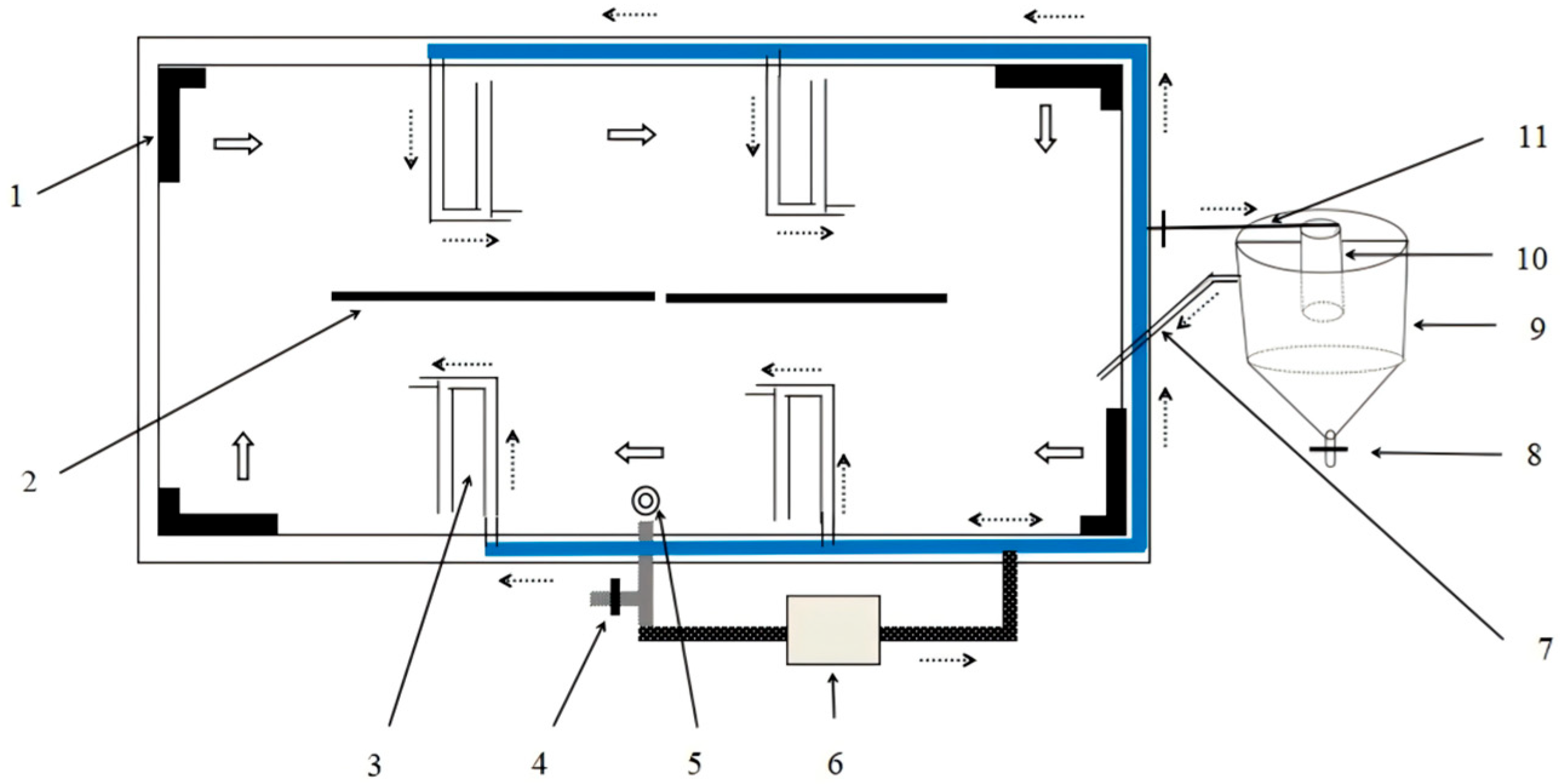
The 120-day experiment was conducted collaboratively at Haimao Seed Industry Technology Co., Ltd. and Guangdong Ocean University (Zhanjiang, China) within an indoor intensive shrimp aquaculture system under limited light exposure conditions (approximately 50 lx). The system comprised 9 experimental tanks (3 biofloc treatments × 3 replicates) and 3 reservoir tanks, totaling 12 concrete tanks (24 m3 each). The rearing system was equipped with runway circulation facilities, including a centrifugal pump, nanotube, air tube, and bioflocs volume controller (Haimao Seed Industry Technology Co., Ltd., Zhanjiang, China) (Figure 1). Every 3 tanks were arranged in a tandem array and shared 2 sets of circulating systems with a centrifugal pump (1 kw). Each tank was equipped with 4 nanotube arrays and 4 venturi tubes for oxygenation and water propulsion.
Healthy juvenile shrimps (P. vannamei) with a mean initial weight of 0.267 ± 0.002 g were randomly stocked in three biofloc-based concrete tanks at different stocking densities: 300 ind./m3 (T1), 250 ind./m3 (T2), and 200 ind./m3 (T3). The shrimps were fed with a commercial pellet diet (Guangdong Yuehai Feed Co., Ltd., Zhanjiang, China) three times daily at a rate of 5–10% of their total biomass. Each tank was equipped with a feeding platform to facilitate the observation of feed intake, particularly during periods of elevated nitrite concentrations during the earlier breeding phase. Throughout the trial, strict control was maintained over the feed supply, ensuring that the feed was consumed within 45 min to 1 h.

2.2. Water Management and Bioflocs Culture

All the clean seawater used in this experiment was collected from coastal waters surrounding Donghai Island (Zhanjiang, China). The raw seawater was first filtered by sand and then sterilized with 1–2 ppm chlorine dioxide before use. Sterilized clean seawater (salinity: 30‰) in each tank was kept at a depth of 1 m. Throughout the trial, no water exchange was performed. To compensate for water loss due to evaporation and biofloc removal, water was supplemented every 4 days, adding a depth of 10 cm starting from day 73.
Sucrose (42% w/w carbon) was utilized daily over a 40-day period during the initial breeding stage as an organic carbon source for biofloc formation, aiming for a final concentration range of 2–21.8 ppm. Sucrose consumption increased steadily during the initial 30 days and then progressively declined over the final 10 days. This process supported the formation of bioflocs, effectively creating an advanced habitat for functional microorganisms, particularly autotrophic nitrifying bacteria. Concurrently, probiotics, including Lactic acid Bacteria, Yeast, and Bacillus sp. (supplied by Shandong Baolai-Leelai Bio-Industrial Co., Ltd., Taian, China), were introduced into the tanks every 72 h to facilitate the directional culture of dominant bacteria, thereby reducing the accumulation of ammonia nitrogen and nitrite in the breeding system. Both sucrose and the probiotics inputs were dynamically adjusted based on biofloc development, shrimp performance, and water quality parameters. Excessive bioflocs were removed based on their concentration to maintain a consistent level of 10–15 mL/L. For pH stabilization, sodium bicarbonate (NaHCO3) was introduced into the tanks to achieve an initial concentration of 100 mg/L of total alkalinity during the early phase. The total alkalinity was incrementally increased to a range of 200–300 mg/L to support the rapid reproduction of autotrophic bacteria.

2.3. Water Quality Analysis

Water samples were collected every other day (daily during biofloc maturation phases) from each tank at a depth of 30 cm for TAN, nitrite-nitrogen (NO2-N), nitrate-nitrogen (NO3-N), and total alkalinity analysis. Prior to analysis, samples were subjected to suction filtration through a 0.45 μm membrane. TAN, NO2-N, NO3-N, and alkalinity were quantified using a DR1900 portable spectrophotometer (Hach Company, Loveland, CO, USA) in accordance with the manufacturer’s instructions and the accompanying prefabricated reagents. Meanwhile, water temperature, pH, salinity, and dissolved oxygen (DO) were monitored every 48 h with an AZ86031 multi-parameter probe (AZ Instrument Corp., Taiwan, China).

2.4. Biofloc Volume and Microbial Detection

The Biofloc volume (BFV) in each tank was quantified daily using an Imhoff cone from day 10 post-stocking. Excessive bioflocs were removed by a biofloc volume controller once the BFV reached 15 mL/L. Biofloc samples from various groups were collected on day 10 (biofloc formation phase) and on day 70 (system stabilization phase characterized by sustained low levels of nitrate and nitrite). Approximately 50 mL of each biofloc suspension was vacuum-filtered through a sterile 0.22 μm polycarbonate membrane. The membrane, containing the microbial biomass, was aseptically placed into a 2 mL sterile cryotube and immediately frozen in liquid nitrogen, then stored at −80 °C for subsequent analysis.
Total genomic DNA was extracted from the samples using the Tiangen Bacterial Genomic DNA Extraction Kit (Tiangen, Beijing, China) following the manufacturer’s protocol. The concentration and purity of the extracted DNA were checked using a NanoDrop 2000 spectrophotometer (Thermo Fisher Scientific Inc., Waltham, MA, USA). The hypervariable V3-V4 region of the bacterial 16S rRNA gene was amplified using the universal primer pair 341F (5′-CCTACGGGNGGCWGCAG-3′) and 806R (5′-GGACTACHVGGGTATCTAAT-3′). The amplicon libraries were constructed and subjected to paired-end sequencing (2 × 250 bp) on the Illumina NovaSeq platform by Guangzhou Gidio Biotechnology Co., Ltd. (Guangzhou, China).
The raw paired-end reads were first demultiplexed and quality-filtered using Trimmomatic to remove low-quality bases and adapter sequences. The cleaned reads were then merged using FLASH (v1.2.11), and chimeric sequences were detected and removed using UCHIME within the VSEARCH package (v2.15.0). High-quality, non-chimeric sequences were clustered into operational taxonomic units (OTUs) at a 97% sequence similarity cutoff using the UPARSE algorithm (implemented in USEARCH v7.0). Representative sequences for each OTU were taxonomically classified against the SILVA database (release 138) using the RDP classifier with a confidence threshold of 0.7. All analyses were performed using QIIME2 (version 2022.8). The raw sequencing data have been deposited in the NCBI SRA database under the accession number PRJNA1295813.
It should be noted that the analysis of microbial community changes in this study is primarily based on relative abundance data. Due to the inherent compositional nature of microbiome data, changes in relative abundance should be interpreted as a reassignment of proportions within the community, rather than direct evidence of changes in absolute abundance. Future studies incorporating metagenomics, absolute quantification methods (such as qPCR), or employing statistical tools specifically designed for compositional data (e.g., ANCOM-BC v2.13.0) will more accurately elucidate the dynamics of absolute abundance changes for specific taxa.

2.5. Shrimp Performance

Thirty to forty shrimp from each tank were randomly collected weekly for mean weight determination starting from the initiation of breeding. After 120 days of culture, all the tanks were drained, and shrimp from each tank were harvested and counted. The growth performance parameters of shrimp were determined using standard formulae [26]:
  • Survival Rate (SR, %): (final number of live shrimp/Initial number of stocking shrimp) × 100;
  • Feed Conversion Ratio (FCR): total weight of feed given (g)/total shrimp weight gained (g);
  • Yield (kg/m3): total weight of shrimp harvested/water volume;
  • Weight Gain (WG, g): final body weight −Initial body weight;
  • Specific Growth Rate (SGR,%/day): (lnWt − lnW0)/t × 100;
  • Water Usage (L/kg) = total weight of shrimp harvested/total water volume used.
Where W0 is the initial weight of shrimp, Wt is the final weight of shrimp, and t is the culture duration in days.

2.6. Statistical Analysis

All statistical analyses were performed using Excel 2017 (Microsoft Corporation, Redmond, WA, USA), GraphPad Prism 10.4 (GraphPad Software, San Diego, CA, USA), and SPSS Statistics (version 22 for Windows, IBM Corporation, Armonk, NY, USA). Data normality and homogeneity of variances were assessed using the Shapiro–Wilk test and Levene’s test, respectively. For data satisfying both assumptions, one-way analysis of variance (ANOVA) was applied, followed by Tukey’s honestly significant difference (HSD) test for post hoc multiple comparisons. For parameters measured over time (e.g., water quality indicators, biomass), a repeated-measures ANOVA was performed with culture time as the within-subjects factor and stocking density as the between-subjects factor. When significant interaction or main effects were found, Bonferroni’s post hoc test was used for multiple comparisons between specific time points or treatment groups. The results are presented as means ± standard deviation (mean ± SD). A p-value < 0.05 was considered statistically significant.

3. Results

3.1. Water Quality Parameters

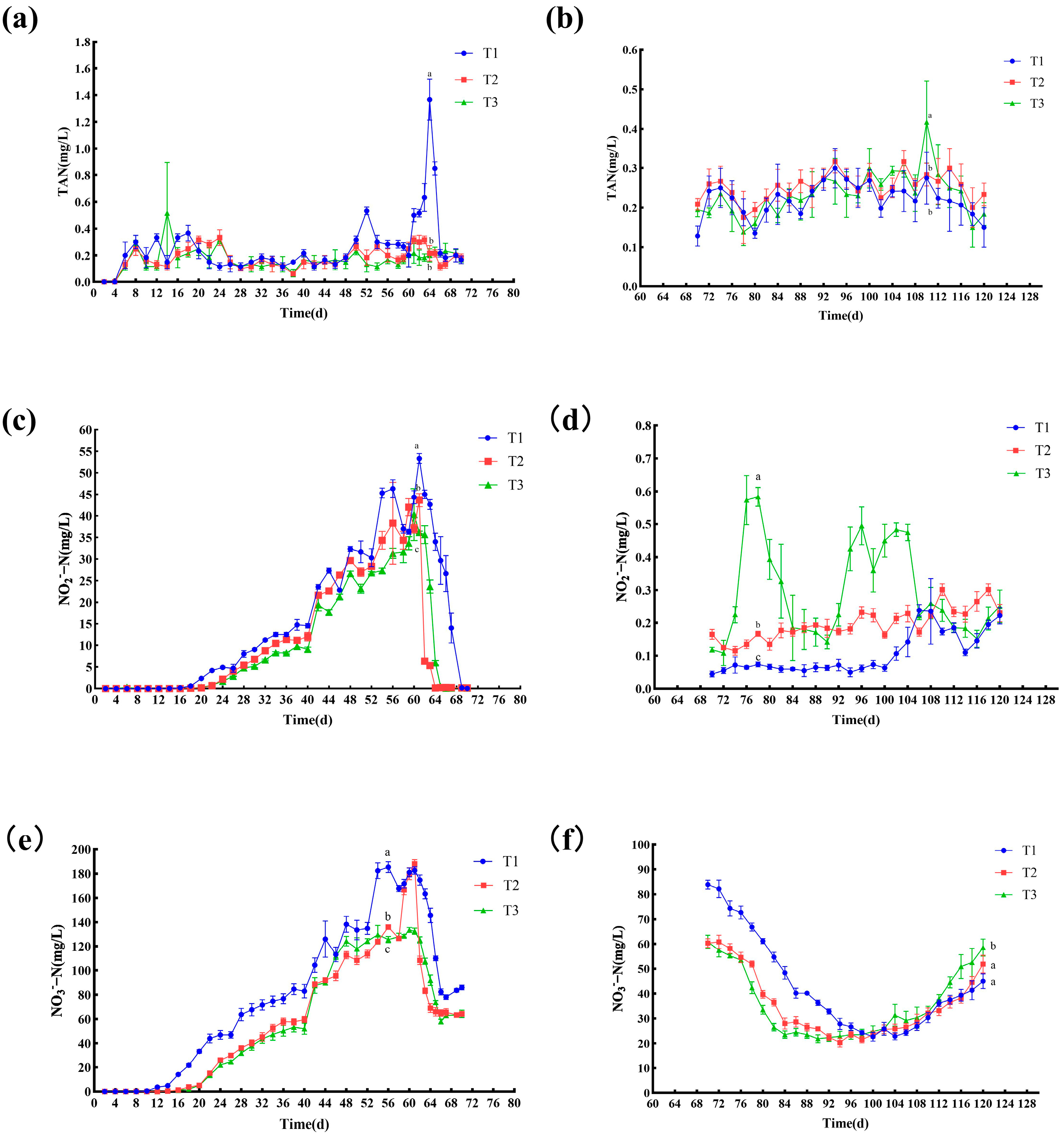
Water quality parameters (temperature, salinity, pH, and dissolved oxygen) remained stable across all treatments (p > 0.05) (Table 1). However, the dynamics of nitrogen compounds revealed two distinct phases before and after day 70, marking ABF maturity (Figure 2). Total ammonia nitrogen (TAN) concentrations stayed low (<0.6 mg/L) throughout the experimental period and decreased further to below 0.5 mg/L after day 70. A transient TAN peak (1.37 ± 0.15 mg/L) was detected only in T1 on day 64, which was significantly higher than that in T2 (0.22 ± 0.06 mg/L) and T3 (0.20 ± 0.05 mg/L) (p < 0.001). No significant difference was found between T2 and T3 (p = 0.977 > 0.05). On day 61, NO2-N peak levels in T1 (53.33 ± 1.15 mg/L) were significantly higher than those in T2 (43.67 ± 1.53 mg/L, p = 0.0001) and in T3 (36.17 ± 0.29 mg/L, p < 0.0001), and the values in T2 were significantly higher than those in T3 (p = 0.0004). This was followed by a sharp decline, with concentrations dropping below 0.2 mg/L by day 70 and remaining low (<0.7 mg/L) afterward. Nitrate nitrogen (NO3-N) exhibited a similar trend, peaking at 185.33 ± 4.51 mg/L in T1 on day 56, which was significantly higher than that in T2 (136.00 ± 2.00 mg/L, p < 0.0001) and in T3 (125.67 ± 2.52 mg/L, p < 0.0001). Furthermore, the values in T2 were significantly higher than those in T3 (p = 0.0175). After biofloc maturation, a synchronized sharp decrease in both NO3-N and NO2-N was observed. Once NO3-N reached its lowest level, it stabilized briefly before showing a slight upward trend starting from day 100. On harvest day, no significant difference was found in NO3-N levels between T2 (51.83 ± 3.55 mg/L) and T3 (58.50 ± 3.50 mg/L) (p = 0.1114 > 0.05), and between T1 (45.00 ± 3.00 mg/L) and T2 (p = 0.1031). The values in T1 were significantly lower than those in T3 (p = 0.0063).
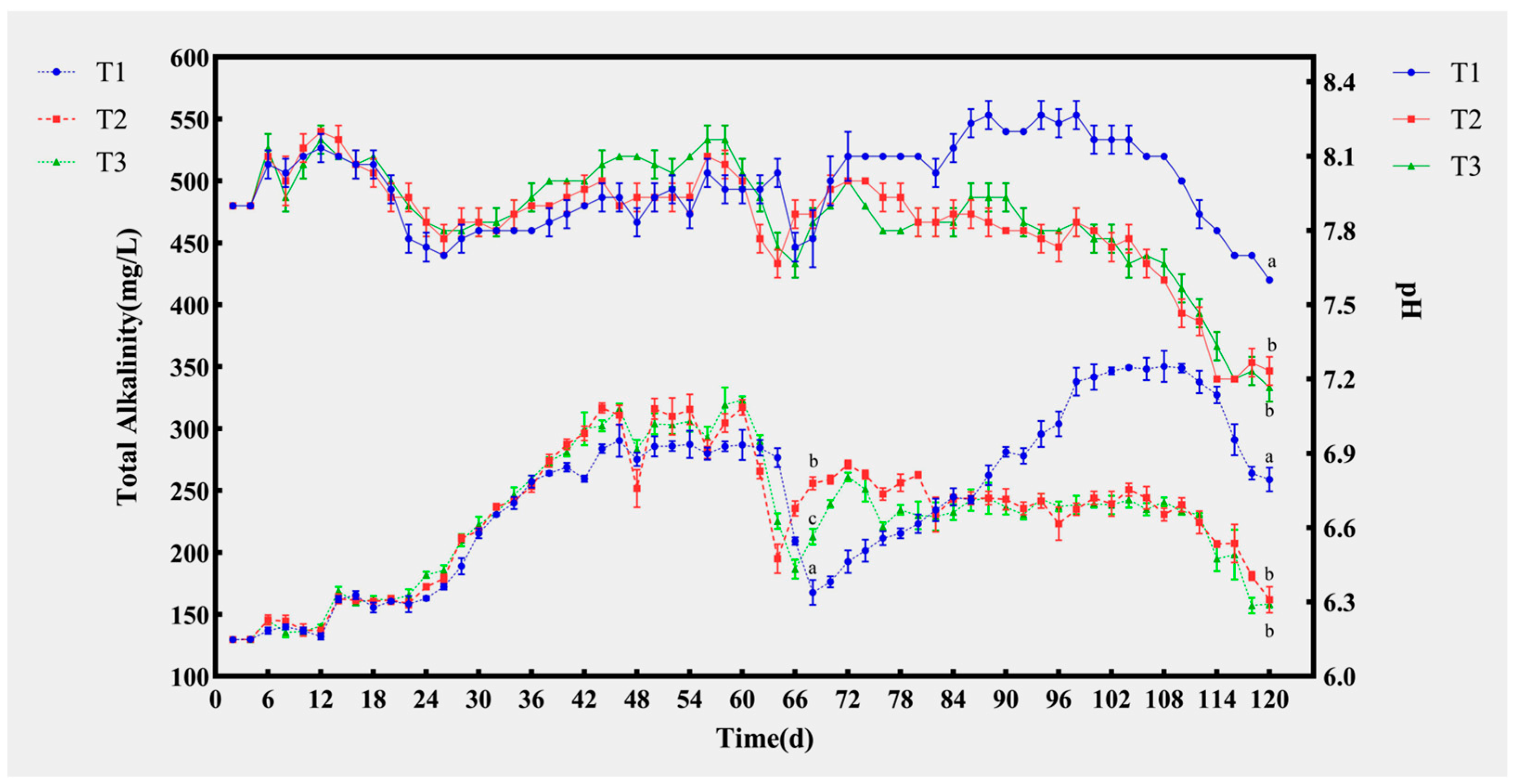
The relationship between pH and total alkalinity is shown in Figure 3. Throughout the trial, pH values across all treatments remained within a range of 7.1–8.3. A significant and rapid decrease in pH was observed as the ABF approached maturity, with a more gradual decline noted during the final 30 days. On day 68, pH had decreased to 7.77 ± 0.11, 7.87 ± 0.06, and 7.83 ± 0.06 in T1, T2, and T3, respectively. No significant difference was found among them (p = 0.3732). However, total alkalinity in T2 (256.00 ± 5.29 mg/L) was significantly higher than that in T1 (167.67 ± 10.02 mg/L, p < 0.0001) and in T3 (212.67 ± 6.43 mg/L, p = 0.0008). Meanwhile, a significant difference was found between T1 and T3 (p = 0.001). By harvest, pH had decreased significantly from an initial value of 7.9 to 7.6, 7.23 ± 0.06, and 7.17 ± 0.06 in T1, T2, and T3, respectively. Moreover, pH in T1 was significantly higher than that in T2 and in T3 (p < 0.0001). Total alkalinity showed variations corresponding to these pH changes. On harvest day, alkalinity decreased to 259 ± 9.64 mg/L in T1, 162 ± 10.58 mg/L in T2, and 158.33 ± 2.89 mg/L in T3, down from their respective peak recorded values. A significant difference was found between T1 and T2 (p < 0.0001) and between T1 and T3 (p < 0.0001). Meanwhile, no significant difference was found between T2 and T3 (p = 0.8587). This parallel decline in pH and alkalinity is consistent with the acid-producing nature of nitrification processes within the biofloc system.

3.2. BFV and Daily Feed Input

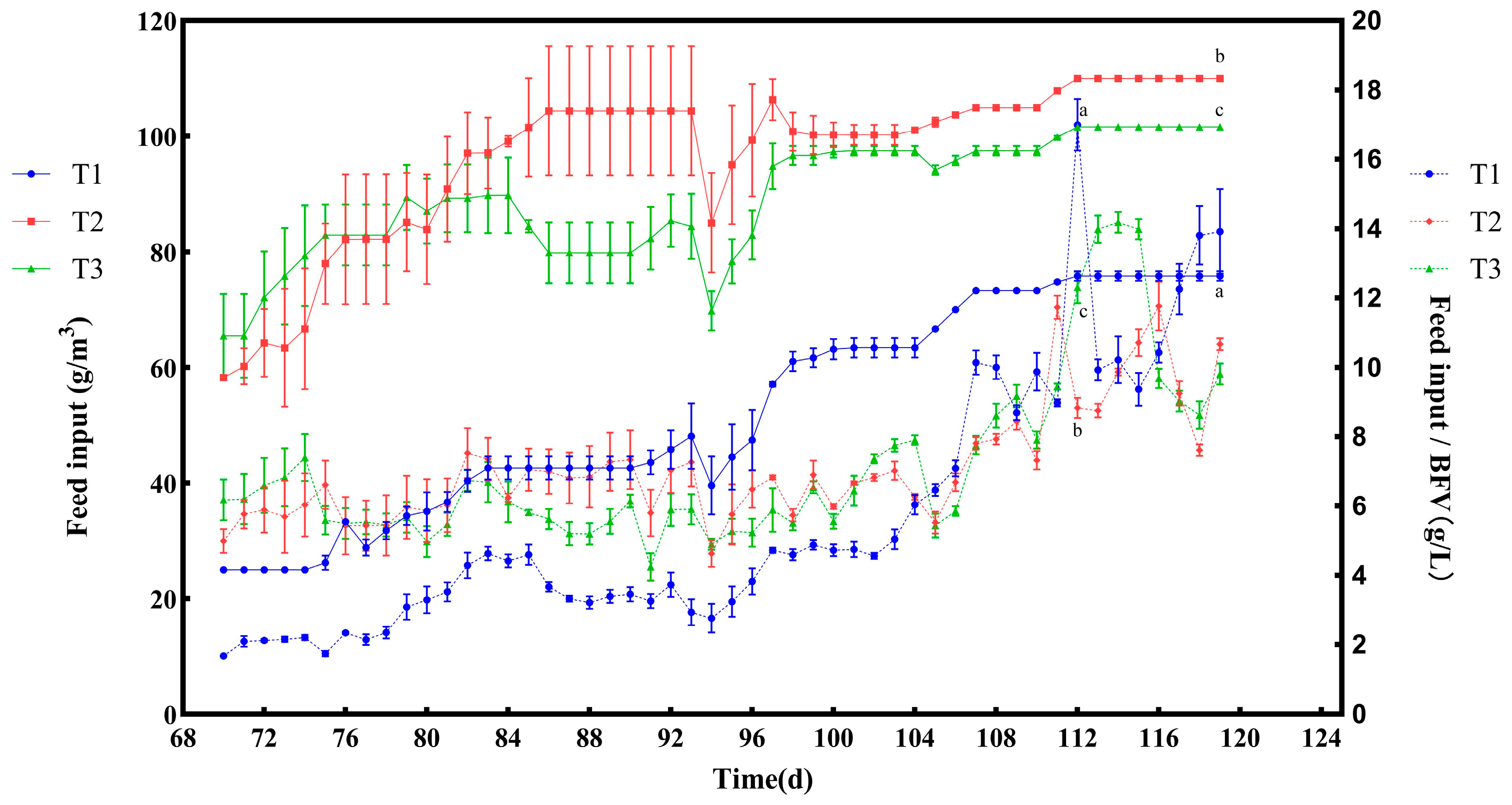
Figure 4 illustrates the relationship between biofloc volume (BFV) and daily feed input during the mature phase of the ABF system. Across all treatments, BFV showed a general increasing trend, with a noticeable decline toward the harvest period. Peak BFV values reached 16.37 ± 0.51 mL/L in T1, 18.60 ± 1.15 mL/L in T2, and 19.40 ± 0.85 mL/L in T3. Daily feed input increased steadily in all groups until day 94, when a typhoon caused a sharp reduction. After day 96, feed inputs stabilized. The highest daily feed inputs were 75.83 ± 0.84 g/m3 (T1), 110.0 g/m3 (T2), and 101.67 g/m3 (T3) (p < 0.0001). During ABF maturity, the feed input-to-BFV ratio also rose consistently, reaching maximum values of 17.0 ± 0.74 (T1) on day 112, which was significantly higher than that in T2 (8.83 ± 0.29) and in T3 (12.31 ± 0.45) (p < 0.0001).

3.3. Morphology of Biofolcs

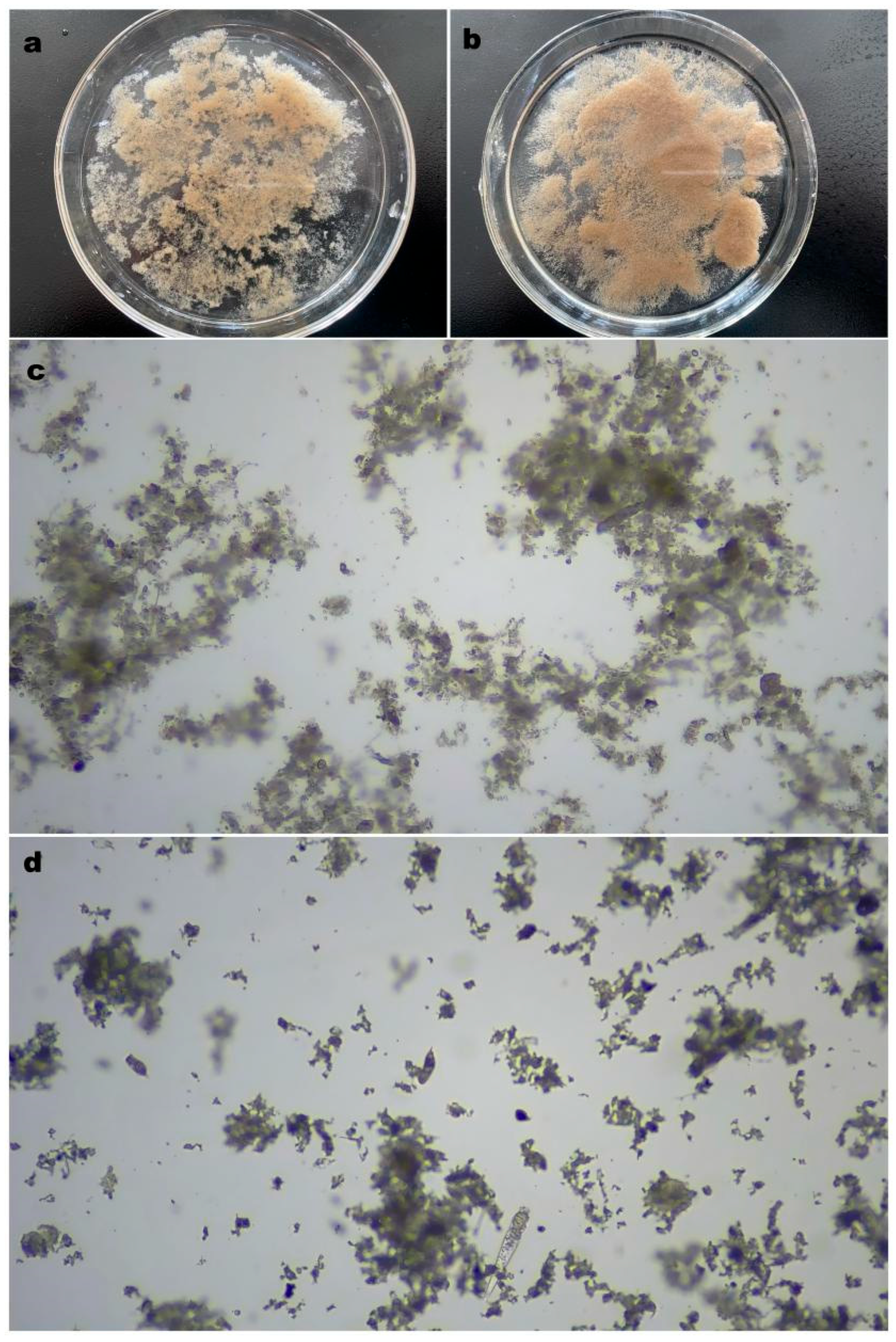
The morphological changes in bioflocs at both macroscopic and microscopic levels were illustrated in Figure 5. On day 70, bioflocs at the macroscopic level displayed a light brown coloration and a loose, flocculent aggregate structure, differing from their dark brown coloration and compact structure noted on day 100. At the macroscopic level, the biofloc particles observed on day 100 exhibited a smaller size and a denser morphology compared to those observed on day 70.

3.4. Microbial Communities Analysis

3.4.1. Alpha Diversity Indexes

High-throughput sequencing of 16S rRNA genes was performed to analyze the microbial community structural changes within bioflocs collected on days 10 and 70, representing the ABF at pre-maturity and post-maturity stages. As shown in Table 2, the Chao1 index in the treatments of bioflocs on day 70 was significantly higher than that on day 10 (p = 0.0002), reaching 1818.53 ± 54.27, 1778.34 ± 32.45, and 1800.94 ± 62.80 in the T1, T2, and T3 treatments, respectively. However, no significant differences were found among the treatments in the Shannon index (p > 0.05).

3.4.2. Bacterial Diversity

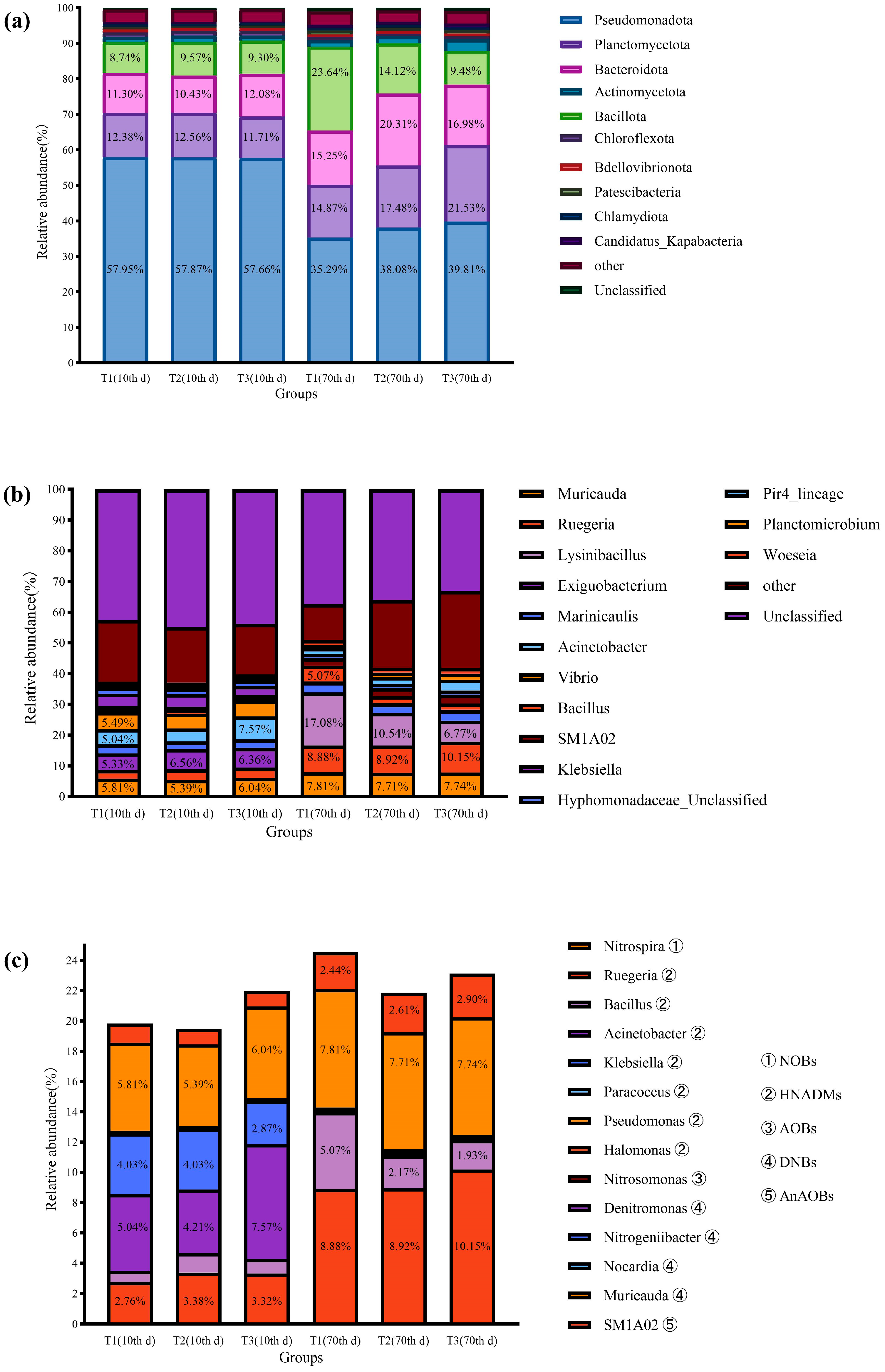
Microbial community structures were analyzed at both phylum and genus levels (Figure 6a,b), revealing significant shifts between day 10 (pre-maturity) and day 70 (post-maturity) of biofloc development. At the phylum level, Pseudomonadota, Bacteroidota, Planctomycetota, and Bacillota were the dominant groups (>5% relative abundance) across all samples. By day 70, all phyla except Pseudomonadota increased in relative abundance, while Pseudomonadota decreased significantly in all treatments. At the genus level, the dominant taxa on day 10 included Muricauda, Exiguobacterium, Acinetobacter, Vibrio, Klebsiella, Ruegeria, and Marinicaulis (each > 2% abundance). By day 70, the community shifted, with Muricauda, Ruegeria, Lysinibacillus, Marinicaulis, Bacillus, SM1A02, and Pir4_lineage becoming dominant. This transition was marked by a notable reduction in Exiguobacterium, Acinetobacter, Klebsiella, and Vibrio, alongside a substantial increase in Ruegeria, Lysinibacillus, Bacillus, SM1A02, and Pir4_lineage. Treatment-specific variations were observed: on day 70, the highest abundances of Lysinibacillus (17.08%) and Bacillus (5.07%) were detected in T1, whereas Ruegeria was most abundant in T3 (10.15%), compared to 8.88% in T1 and 8.92% in T2. Key functional groups involved in nitrogen cycling were also identified (Figure 6c). Ammonia-oxidizing bacteria (AOB) were represented solely by Nitrosomonas, which maintained minimal abundance (0.007–0.03%) even on day 70, and was barely detectable on day 10. Similarly, Nitrospira was the only nitrite-oxidizing bacterium (NOB) detected, with abundances below 0.03% on day 70 (highest in T3 at 0.03%). The primary HNADMs shifted from Ruegeria, Klebsiella, and Acinetobacter on day 10 to Ruegeria (>8%) and Bacillus (>1%) on day 70, with Klebsiella and Acinetobacter declining to below 0.05%. Other HNADMs, such as Paracoccus, Pseudomonas, and Halomonas, remained at low abundances (<0.2%). Muricauda served as the predominant denitrifying bacterium (DNB) on both days, exceeding 7% abundance on day 70. Other DNBs, including Denitromonas, Nitrogeniibacter, and Nocardia, increased slightly but remained below 0.2%. Remarkably, SM1A02, identified as the sole anaerobic ammonia-oxidizing bacterium (AnAOB), doubled in abundance by day 70, surpassing 2%.

3.5. Shrimp Growth Performance

The growth performance of shrimp reared at varying densities in an ABF system is shown in Table 3. The initial weight of shrimp larvae across various treatments was uniformly maintained at approximately 0.267 g. On harvest day, no substantial difference was detected between T1 and T3 regarding final body weight, weight gain, and specific growth rate (p > 0.05). However, a pronounced disparity emerged between T2 and the other two treatments in these parameters (p < 0.05). Meanwhile, no substantial difference was detected between T2 and T3 regarding yield, survival rate and water usage (p > 0.05). T1 treatments presented significantly lower yield, survival rate and higher water usage than the other two treatments. Also, no significant difference was found among the three treatments regarding the feed conversion ratio (p > 0.05).

4. Discussion

4.1. Effects of ABF on Water Quality

BFT is widely utilized for managing toxic nitrogenous compounds through microbial-mediated conversions, effectively converting harmful ammonia into a non-toxic form of nitrogen [27]. Heterotrophic assimilation of ammonia serves as the principal method for ammonia removal in a HBF system. However, within a mature ABF breeding system, chemoautotrophic nitrification (CAN) is the key process responsible for managing ammonia nitrogen [28]. Ammonia nitrogen was initially converted into nitrite nitrogen by AOB or archaea (AOA), and subsequently transformed into less toxic nitrate nitrogen by NOB. Autotrophic nitrifying bacteria are highly sensitive to variations in pH, C/N ratio, temperature, and other environmental factors, and they possess a significantly slower growth rate compared to heterotrophic bacteria [29]. Furthermore, NOB multiply at a slower rate compared to AOB [30]. Thus, in practice, CAN may develop significantly later than heterotrophic assimilation in a BFT system [31].
The in situ mature ABF effectively removed harmful nitrogenous compounds and maintained optimal water quality. TAN concentrations remained consistently low (<0.6 mg/L) across all treatments, underscoring the efficacy of ABF in ammonia control. A notable nitrite accumulation phase occurred prior to ABF maturation, peaking between 40.33 and 53.33 mg/L. The highest value (53.33 mg/L) was observed in the T1 treatment, which had the highest stocking density, suggesting a positive correlation between breeding density and nitrite accumulation. This aligns with previous reports of nitrite buildup in BFT systems [32,33]. Meanwhile, a significant and synchronous decline in both nitrite and nitrate levels marked the approach of ABF maturity. Following maturation, nitrite was consistently maintained below 0.7 mg/L, a safe concentration for shrimp growth, demonstrating the mature ABF’s capacity for efficient nitrite management. The concurrent decline in nitrate levels indicated that denitrification processes were active alongside nitrite reduction. After maturation, nitrate levels continued to decrease, suggesting a temporary predominance of denitrification over nitrification. A minor nitrate rebound was observed near the harvest period, which may be attributed to the gradual dominance of nitrifying bacteria in the ABF system [34]. The gradual establishment of nitrifying bacterial predominance within the system can also be reflected by changes in pH, total alkalinity, and the morphology of bioflocs.
As the ABF matured gradually, CAN emerged as the crucial strategy to eliminate the ammonia and nitrite, while denitrification served as the primary pathway for nitrate reduction. Since CAN is an alkalinity-consuming process and denitrification only partially replenishes alkalinity—specifically, 7.07 g of alkalinity (calculated as CaCO3) is consumed per gram of TAN oxidized [35], while 3.57 g is generated per gram of nitrate reduced [36]—a net decrease in alkalinity occurs during simultaneous nitrification and denitrification (SND). This loss of alkalinity led to a corresponding decline in pH, which acted as a clear indicator of ABF maturation. In the later rearing stage, a gradual increase in nitrate coincided with decreases in pH, total alkalinity, and BFV. This suggested that nitrification began to outpace denitrification, likely due to biofloc aging and the predominance of CAN. As biofloc particles gradually became smaller and denser over time (Figure 5), the localized anaerobic microenvironments within the flocs, which were critical for denitrification, had diminished, further disrupting the nitrogen balance.
Both HBF and ABF can effectively remove harmful nitrogen compounds from water. The HBF system primarily relies on heterotrophic microorganisms to maintain good water quality through the assimilation of ammonia nitrogen. This process requires maintaining a high C:N ratio (typically >10:1), necessitating continuous addition of organic carbon sources (e.g., molasses, starch) to the water [28]. Although the heterotrophic pathway removes ammonia rapidly, the ongoing input of carbon directly increases production costs. Moreover, the vigorous metabolism of heterotrophic bacteria leads to high oxygen consumption and significant CO2 production, demanding more powerful aeration equipment and thereby raising electricity costs. Substantial production of CO2 may lead to a decrease in total alkalinity and pH in the water [37]. In addition, excess biofloc may clog the gills of cultured animals, impairing respiration, or settle to form anaerobic zones that promote the growth of harmful bacteria such as sulfate-reducing bacteria [38,39]. In contrast, the ABF system depends mainly on chemoautotrophic nitrifying bacteria to gradually oxidize ammonia nitrogen into less toxic nitrate. Once matured, this process does not require extra organic carbon input, which helps reduce long-term farming costs. Due to its independence from external carbon, water quality parameters (e.g., pH, DO) remain more stable, and the system exhibits stronger resistance to disturbances. Autotrophic systems generally do not need to maintain high biofloc biomass to achieve effective nitrogen control, thereby avoiding intense competition between heterotrophic and nitrifying bacteria for oxygen, nutrients, and space [40]. However, the slow growth of nitrifying bacteria delays system maturation for several weeks [31], hindering its ability to respond rapidly to high ammonia loads during early culture phases or under sudden surges. Therefore, in practice, a widely adopted strategy is to utilize the rapid ammonia removal capability of heterotrophic bioflocs during the initial culture phase or under high loading, and then, in the mid- to late stages, gradually reduce carbon addition and enhance aeration to steer the system toward a stable, autotrophic nitrification-dominated mode [41]. This “heterotrophic initiation-autotrophic maintenance” sequence, achieved through in situ cultivation of autotrophic bioflocs, effectively balances nitrogen removal efficiency with system stability.

4.2. BFV Control

BFV serves as a critical control parameter in BFT systems, directly influencing oxygen demand, energy consumption, and microbial ecology. As daily feed and carbon sources are added, BFV typically increases, but elevated BFV can lead to significant fluctuations in DO due to higher respiratory demands from bacteria and cultured species, necessitating intensified aeration and raising electricity costs [42]. In this study, a BFV controller effectively removed surplus bioflocs whenever levels exceeded 15 mL/L to maintain stability. Bioflocs act as carriers for nitrifying bacteria, which detoxify inorganic nitrogen compounds; thus, mature ABF systems—enriched with nitrifying bacteria—require lower BFV compared to HBF systems, where microbial biomass proliferates more rapidly [41]. Sun et al. [33] reported optimal water quality at a BFV of around 8 mL/L in ABF systems. Here, post-ABF maturation, BFV fluctuated between 9 and 20 mL/L before declining after day 105, reaching lows of 4.60 ± 0.02 mL/L (T1), 8.30 ± 0.02 mL/L (T2), and 8.57 ± 0.04 mL/L (T3), likely due to floc aging, the gradual depletion of dissolved organic carbon and consumption by shrimp. The feed input/BFV ratio, peaking at 17.0 ± 0.37 g/m3 per mL/L BFV, indicated that 1 mL of ABF per liter of water can process up to 17.0 g/m3 of daily feed, clarifying relationships among target yield, minimum BFV, and feeding rates. Consequently, in a mature ABF system, BFV need not be fixed arbitrarily; for example, a target yield of 5 kg/m3 with daily feed of 125 g/m3 (at 2.5% biomass) necessitates a minimum BFV of 7.35 mL/L, demonstrating how BFV can be derived dynamically from production goals.

4.3. Carbon Addition Strategy

In the initial phase of biofloc culture, a high carbon-to-nitrogen (C/N > 15:1) strategy is recommended to rapidly stimulate HBF formation [33], as feed input is minimal at this point. While establishing nitrification typically requires 30–60 days [20], prolonged carbon addition may delay the development of an ABF system [29]. In this study, sucrose was supplemented for 40 days. ABF was established within 21–26 days after sucrose cessation and reached full maturity across all treatments between days 62 and 67. This timeline was longer than anticipated. A prolonged establishment period extends nitrite accumulation, potentially reducing survival and growth rates in aquatic animal breeding. Due to a conservative operational approach, initial sucrose usage was relatively low. Bioflocs began forming around day 10 but reached only a low concentration (<1 mL/L), which was not conducive to efficient ABF establishment. To optimize the process, it is advised to add an organic carbon source at a high C/N ratio immediately at the start of the rearing cycle. Once the BFV reaches 8–10 mL/L, carbon input should be gradually reduced or ceased to promote the growth of autotrophic nitrifying bacteria, thereby facilitating a timely transition from HBF to ABF.

4.4. Microbial Communities Shifts

The maturation of ABF was driven by dynamic shifts in microbial community composition, reflecting a complex interplay between biofloc formation and diverse microbial populations [43]. Dominant phyla, Pseudomonadota, Bacteroidota, Planctomycetota, Bacillota, Actinomycetota, and Chloroflexota, remained consistent throughout the rearing period but exhibited significant abundance variations between day 10 and day 70, collectively accounting for over 90% of the microbial community. Notably, Planctomycetota emerged as the second-most abundant phylum (11.71–21.53%), exceeding levels reported in previous studies [19,41].
Pseudomonadota, the most abundant group, comprises functional bacteria involved in nitrogen cycling and organic matter degradation [44,45]. Its relative abundance decreased as ABF matured, likely due to reduced dissolved organic matter in later rearing stages [46]. In contrast, Planctomycetota, key heterotrophs involved in biogeochemical cycles [47], anaerobic ammonium oxidation (anammox) [48] and nitrogen fixation [49], increased significantly. This rise is likely attributed to the increased quantity and size of bioflocs, which provide more attachment sites for these particle-associated bacteria [47]. Bacteroidota and Bacillota, important participants in the nitrogen cycling [50], also increased significantly during ABF maturation. Bacteroidota, adapted to hypoxic conditions and organic particles [19], may thrive due to accumulated humic substances, while Bacillota’s rise could be linked to probiotic supplementation (e.g., Bacillus) and organic matter accumulation.
At the genus level, pathogenic Vibrio and Klebsiella declined to 0.02–0.027% in mature ABF, suggesting inhibitory effects through microbial competition or antibacterial substances released by probiotics [51,52,53]. The reduction in Acinetobacter (Pseudomonadota) may correlate with decreased sucrose supplementation.

4.5. Functional Bacteria Involved in Nitrogen Cycling and Nitrite Accumulation

Most dominant genera were associated with nitrogen cycling, categorized into AOBs, NOBs, AnAOB, DNBs, and HNADMs, highlighting the critical role of microbial dynamics in ABF functionality. Nitrospira, as the sole NOB, was the primary autotrophic nitrifying bacterium present in ABF systems [19]. Despite its low abundance, its high efficiency in nitrite oxidation was crucial for converting nitrite to nitrate. In contrast, Nitrosomonas, as the sole AOB, maintained a minimal abundance (0–0.03%), indicating its negligible contribution to nitrite accumulation. The potential anammox bacterium SM1A02 [54,55], which produces N2 as its final product, doubled in abundance by day 70, but was also not responsible for nitrite accumulation.
HNADMs and DNBs were the most diverse functional groups, with 11 members identified. HNAD bacteria, as widely distributed nitrogen-removing microorganisms with diverse metabolic pathways and distinct enzyme systems, are involved in various nitrogen conversion processes such as ammonia assimilation or oxidation, denitrification, assimilatory nitrate reduction, and heterotrophic nitrate reduction [56]. In an ideal HNAD system, heterotrophic nitrification produces NO2 or NO3, while aerobic denitrification yields N2 or N2O, avoiding nitrite accumulation [57]. However, some strains accumulate nitrite under high dissolved oxygen due to the low oxygen tolerance of enzymes like nitrite reductase (NiR) and nitrous oxide reductase (NoS) [17].
By day 70, Ruegeria [29] and Bacillus [58] replaced Acinetobacter [59] and Klebsiella [55] as the predominant HNADMs. Concurrently, Muricauda [60], a facultative anaerobic DNB, showed a significant increase. The rise of DNB and SM1A02 suggested that oxygen-limited zones persisted even in aerated systems, enabling SND. The maturation of bioflocs provides a substrate and creates oxic-anoxic gradient environments, supporting diverse microbial communities with different oxygen demands. The concurrent marked decrease in nitrite and nitrate levels, alongside the increased abundance of HNADMs, DNBs, NOB, and AnAOBs during ABF maturation, suggested that these microbes may collaborate in a coupled simultaneous SND pathway. This pathway likely proceeds as follows: HNADMs oxidize NH4+ to NO2 or NO3, subsequently Nitrospira oxidizes NO2 to NO3, and finally HNADMs/DNBs reduce NO2 or NO3 to nitrogen gas, or AnAOBs directly utilize NH4+ and NO2 to generate N2, enabling simultaneous nitrite and nitrate reduction. The consistently high abundance of HNADMs throughout the rearing period suggested that they were primarily responsible for maintaining low ammonia levels. A slight increase in nitrate levels was observed in the latter rearing stage. This was attributed to the highly efficient nitrite-converting capability of Nitrospira, coupled with a reduction in anaerobic microenvironments within aging bioflocs and in dissolved organic carbon, which was less conducive to denitrification. In summary, efficient nitrogen removal in ABF systems relies on a complex network of autotrophic and heterotrophic microorganisms. The maturation of bioflocs fosters synergistic interactions among these microbes within their structured microenvironment, facilitating effective nitrogen cycling.

4.6. Effects of ABF on Shrimp Performance

Numerous studies have confirmed that BFT systems support favorable shrimp growth and high survival rates [33,61,62]. However, a common challenge in these systems, particularly before biofloc maturation, is the accumulation of NO2. Prior to ABF maturation, the highest stocking density (T1) corresponded to the greatest feeding input and ammonia production rate. This imposed substantial stress on the yet-unestablished nitrifying bacterial community, leading to rapid and excessive accumulation of nitrite, which peaked at 53.33 mg/L. Even at a high salinity of 30‰, prolonged exposure to such elevated nitrite concentrations can cause significant oxidative stress, hemocyanin dysfunction, and growth suppression in the shrimp [32]. Additionally, higher density likely intensified intraspecific competition (e.g., for feed and space) and physical-environmental stress (e.g., increased floc concentration potentially impairing gill function and accelerating local oxygen depletion). Consequently, T1 exhibited the lowest survival rate. For the T2 and T3 groups, a relatively conservative feeding strategy was adopted in this study to control system risks, particularly during the immature phase. This may have somewhat constrained the higher growth potential that could have been realized in the low-density group (T3), causing its performance to align more closely with that of the intermediate-density group (T2). After system maturation, the robust water-quality regulation capability of the ABF eliminated the negative effects associated with density differences, such as water-quality fluctuations, thereby rendering the performance difference between the intermediate and low-density groups statistically insignificant. Stocking density dynamically interacts with the maturation state of the biofloc system by influencing the initial pollutant load. During the immature phase, high density led to acute nitrite toxicity and high mortality. After maturation, the system’s strong self-purification capacity buffered density-related stress, allowing the intermediate- and low-density groups to achieve similarly favorable performance in a stable environment. The in situ cultivated ABF system represents a promising strategy for high-density, low-water-exchange culture modes; however, its successful application critically depends on precise management during the start-up (high-risk) phase [41].
Additionally, in this study, the peak nitrite concentrations recorded (40.33–53.33 mg/L) substantially exceeded recommended safe levels for P. vannamei at lower salinities (15 ppt and 25 ppt) [63]. However, as the shrimp were reared at a salinity of 30 ppt, the survival rates in the T2 and T3 treatments were notably higher than those reported in other studies where nitrite levels were around 20 mg/L but likely at a similar salinity [33]. In contrast, the T1 treatment experienced a progressive increase in nitrite to 53.33 mg/L, which correlated with a significant decline in both survival rate and final yield. This contrast indicates that for a salinity of 30 ppt, nitrite concentration should be controlled below approximately 40 mg/L prior to biofloc maturation to ensure higher survival and productivity.
The management strategy involved stringent control of feed input to prevent severe nitrite accumulation in the immature biofloc system, resulting in FCRs between 1.89 and 2.17. These FCRs were higher than those in some previous studies [33,62,64], a discrepancy potentially attributed to the conservative feeding regime and the initial nitrite accumulation. Importantly, despite the challenging initial conditions, no water exchange was necessary in any treatment due to effective water quality maintenance by the mature biofloc system. The total water usage per tank was 50.4 m3, which is only 2.1 times the initial water volume, demonstrating that this in situ ABF culture is a highly water-efficient strategy suitable for water-scarce regions. This approach, by drastically reducing water consumption and effluent discharge, contributes significantly to the environmental and economic sustainability of the aquaculture industry.

5. Conclusions

This study successfully established in situ ABF cultivation within 60–70 days through controlled carbon reduction in a light-limited, zero-water-exchange system. Similar water quality dynamics and microbial community evolution were found in different density groups. Toxic nitrogen compounds, including NH4+ and NO2, were controlled at very low concentrations after the maturation of ABF. Synchronized declines in pH/alkalinity and nitrogen compounds may be considered a sign of ABF maturation. The shift in bacterial communities revealed that nitrogen cycling in ABF was driven by HNADMs, DNBs, NOB and AnAOBs. HNADMs may be responsible for nitrite accumulation in aquaculture waters. Pathogens (Vibrio/Klebsiella) were reduced significantly after the maturation of ABF. The recommended stocking density for Pacific white shrimp is 200–250 shrimp/m3 in an in situ ABF system. The 4–8 mL/L BFV is capable of maintaining optimal water quality in mature ABF systems.

Author Contributions

Conceptualization, M.X.; methodology, Y.L. (Yongkui Liu); software, X.H.; validation, M.Z.; formal analysis, H.P.; investigation, Y.L. (Yishan Lu); resources, J.C.; data curation, M.X.; writing—original draft preparation, M.X.; writing—review and editing, Y.H.; visualization, Y.H.; supervision, Y.H.; project administration, Y.H.; funding acquisition, J.J. All authors have read and agreed to the published version of the manuscript.

Funding

This research was funded by the National Natural Science Foundation of China (No. 32573551) and the Modern Seed Industry Park for Whiteleg Shrimp of Guangdong Province (K22219) and Open Fund of Tianjin Key Lab of Aquatic Ecology and Aquaculture (TJAE201506).

Institutional Review Board Statement

The study was conducted in accordance with the Declaration of Helsinki and approved by the Ethics Committee of the Guangdong Ocean University (Approval Code: (2023)1, Approval Date: 10 March 2023).

Data Availability Statement

The data presented in this study are available on request from the corresponding authors due to commercial restrictions.

Conflicts of Interest

The authors declare no conflict of interest.

References

  1. SOFIA. The State of World Fisheries and Aquaculture; Food and Agriculture Organization of the United Nations (FAO): Rome, Italy, 2022. [Google Scholar] [CrossRef]
  2. Ekasari, J.; Napitupulu, A.D.; Djurstedt, M.; Wiyoto, W.; Baruah, K.; Kiessling, A. Production performance, fillet quality and cost effectiveness of red Tilapia (Oreochromis sp.) culture in different biofloc systems. Aquaculture 2023, 563, 738956. [Google Scholar] [CrossRef]
  3. Haraz, Y.G.; Shourbela, R.M.; El-Hawarry, W.N.; Mansour, A.M.; Elblehi, S.S. Performance of juvenile Oreochromis niloticus (Nile tilapia) raised in conventional and biofloc technology systems as influenced by probiotic water supplementation. Aquaculture 2023, 566, 739180. [Google Scholar] [CrossRef]
  4. Khanjani, M.H.; Mohammadi, A.; Emerenciano, M.G.C. Microorganisms in biofloc aquaculture system. Aquac. Rep. 2022, 26, 101300. [Google Scholar] [CrossRef]
  5. Soliman, A.M.; Abdel-Tawwab, M. Effects of different carbon sources on water quality, biofloc quality, and the productivity of Nile tilapia reared in biofloc-based ponds. Ann. Anim. Sci. 2022, 22, 1281–1289. [Google Scholar] [CrossRef]
  6. Khanjani, M.H.; Sharifinia, M. Biofloc technology as a promising tool to improve aquaculture production. Rev. Aquac. 2020, 12, 1836–1850. [Google Scholar] [CrossRef]
  7. Khanjani, M.H.; Mozanzadeh, M.T.; Sharifinia, M.; Emerenciano, M.G.C. Biofloc: A sustainable dietary supplement, nutritional value and functional properties. Aquaculture 2023, 562, 738757. [Google Scholar] [CrossRef]
  8. Kumar, V.S.; Pandey, P.; Anand, T.; Bhuvaneswari, G.R.; Dhinakaran, A.; Kumar, S. Biofloc improves water, effluent quality and growth parameters of Penaeus vannamei in an intensive culture system. J. Environ. Manag. 2018, 215, 206–215. [Google Scholar] [CrossRef]
  9. Black, A.; Wakelin, S.; Hamonts, K.; Gerard, E.; Condron, L. Impacts of long term copper exposure on abundance of nitrogen cycling genes and denitrification activity in pasture soils. Appl. Soil Ecol. 2019, 138, 253–261. [Google Scholar] [CrossRef]
  10. Shi, M.Z.; Zhao, Y.; Zhu, L.J.; Song, X.Y.; Tang, Y.; Qi, H.S.; Cao, H.J.; Wei, Z.M. Denitrification during composting: Biochemistry, implication and perspective. Int. Biodeterior. Biodegrad. 2020, 153, 105043. [Google Scholar] [CrossRef]
  11. Duan, S.; Zhang, Y.; Zheng, S. Heterotrophic nitrifying bacteria in wastewater biological nitrogen removal systems: A review. Crit. Rev. Environ. Sci. Technol. 2021, 52, 2302–2338. [Google Scholar] [CrossRef]
  12. Shi, S.; He, X.; He, L.; Fan, X.; Shu, B.; Zhou, J.; He, Q. Overlooked pathways of endogenous simultaneous nitrification and denitrification in anaerobic/aerobic/anoxic sequencing batch reactors with organic supplementation. Water Res. 2023, 230, 119493. [Google Scholar] [CrossRef]
  13. Guo, H.; Fu, X.; He, J.; Wang, R.; Yan, M.; Wang, J.; Dong, P.; Huang, L.; Zhang, D. Gut bacterial consortium enriched in a biofloc system protects shrimp against Vibrio parahaemolyticus infection. Microbiome 2023, 11, 230. [Google Scholar] [CrossRef]
  14. Tepaamorndech, S.; Nookaew, I.; Higdon, S.M.; Santiyanont, P.; Phromson, M.; Chantarasakha, K.; Mhuantong, W.; Plengvidhya, V.; Visessanguan, W. Metagenomics in bioflocs and their effects on gut microbiome and immune responses in Pacific white shrimp. Fish Shellfish Immunol. 2020, 106, 733–741. [Google Scholar] [CrossRef]
  15. Okabe, S.; Oozawa, Y.; Hirata, K.; Watanabe, Y. Relationship between population dynamics of nitrifiers in biofilms and reactor performance at various C:N ratios. Water Res. 1996, 30, 1563–1572. [Google Scholar] [CrossRef]
  16. Yue, X.; Liu, H.; Wei, H.; Chang, L.; Gong, Z.; Zheng, L.; Yin, F. Reactive and microbial inhibitory mechanisms depicting the panoramic view of pH stress effect on common biological nitrification. Water Res. 2023, 231, 119660. [Google Scholar] [CrossRef]
  17. Di Capua, F.; Pirozzi, F.; Lens, P.N.; Esposito, G. Electron donors for autotrophic denitrification. Chem. Eng. J. 2019, 362, 922–937. [Google Scholar] [CrossRef]
  18. Brandão, H.; Xavier, Í.V.; Santana, G.K.K.; Santana, H.J.K.; Krummenauer, D.; Wasielesky, W. Heterotrophic versus mixed BFT system: Impacts on water use, suspended solids production and growth performance of Pacific white shrimp. Aquac. Eng. 2021, 95, 102194. [Google Scholar] [CrossRef]
  19. Li, M.; Luan, Y.; Qin, Z.; Lu, D. Startup of a large height-diameter ratio bioreactor by alternate feeding: Performance of partial nitrification and enrichment of ammonia-oxidizing bacteria (AOB). Environ. Technol. 2024, 45, 2171–2179. [Google Scholar] [CrossRef] [PubMed]
  20. Zheng, H.; Luo, G.; Abakari, G.; Lv, G.; Tan, H.; Liu, W. Effect of seeding biofloc on the nitrification establishment in moving bed biofilm reactor (MBBR). Aquac. Fish. 2023, 8, 617–625. [Google Scholar] [CrossRef]
  21. Raza, B.; Zheng, Z.; Zhu, J.; Yang, W. A Review: Microbes andTheir Effect on Growth Performance of Litopenaeus vannamei (White LegShrimps) during Culture in Biofloc Technology System. Microorganisms 2024, 12, 1013. [Google Scholar] [CrossRef] [PubMed]
  22. Ferreira, J.D.N.; Gagliardi, T.R.; Vieira, F.N.; Martins, C.P.; Rosa, R.D.; Perazzolo, L.M. Assessing the impact of chemoautotrophic and heterotrophic biofloc cultivation systems on the immunity and intestinal bacteriome of shrimp. Aquac. Int. 2024, 32, 4647–4663. [Google Scholar] [CrossRef]
  23. Khanjani, M.H.; Alizadeh, M.; Sharifinia, M. Effects of different carbon sources on water quality, biofloc quality, and growth performance of Nile tilapia (Oreochromis niloticus) fingerlings in a heterotrophic culture system. Aquac. Int. 2021, 29, 307–321. [Google Scholar] [CrossRef]
  24. Sambhu, C.; Al Harbi, M.; Broom, M.; Nasser, A.K.V.; Sherly, D. Culture strategy for production of Indian white prawn, Fenneropenaeus indicus in semi-arid conditions using biofloc technology. Iran. J. Fish. Sci. 2023, 22, 238–251. [Google Scholar] [CrossRef]
  25. Martins, M.A.; Poli, M.A.; Legarda, E.C.; Pinheiro, I.C.; Carneiro, R.F.S.; Pereira, S.A.; Martins, M.L.; Gonçalves, P.; Schleder, D.D.; Vieira, F.D.N. Heterotrophic and mature biofloc systems in the integrated culture of Pacific white shrimp and Nile tilapia. Aquaculture 2020, 514, 734517. [Google Scholar] [CrossRef]
  26. Nakayama, C.L.; Silva, L.F.S.; dos Santos, F.A.C.; Boaventura, T.P.; Favero, G.C.; Palheta, G.D.A.; de Melo, N.F.A.C.; Romano, L.A.; Luz, R.K. Zootechnical Performance and Some Physiological Indices of Tambaqui, Colossoma macropomum Juveniles during BioflocMaturation and in Different FeedRegimes. Agriculture 2022, 12, 1025. [Google Scholar] [CrossRef]
  27. Souza, J.; Cardozo, A.; Wasielesky, W.; Abreu, P.C. Does the biofloc size matter to the nitrification process in Biofloc Technology (BFT) systems? Aquaculture 2019, 500, 443–450. [Google Scholar] [CrossRef]
  28. Nootong, K.; Pavasant, P.; Powtongsook, S. Effects of Organic Carbon Addition in Controlling Inorganic Nitrogen Concentrations in a Biofloc System. J. World Aquac. Soc. 2011, 42, 339–346. [Google Scholar] [CrossRef]
  29. Song, C.; Zhou, Y.; Du, L.; Dong, R.; Li, X.; Dong, D.; Huang, Z.; Song, X. Evaluating nutrient transformation and fate in the recirculating aquaculture system of Apostichopus japonicus and its environmental impact from a diet perspective. J. Water Process Eng. 2025, 72, 107552. [Google Scholar] [CrossRef]
  30. McCarty, P.L. Stoichiometry of biological reactions. Prog. Water Technol. 1975, 7, 157–172. [Google Scholar]
  31. Luo, G.; Xu, J.; Meng, H. Nitrate accumulation in biofloc aquaculture systems. Aquaculture 2020, 520, 734675. [Google Scholar] [CrossRef]
  32. Al-Sayegh, S.Y.; Rosas, V.T.; Vethamony, P.; Kasan, N.A.; Liew, H.J.; Ikhwanuddin, M.; Al Disi, Z.A.; Elsayed, H.; Al-Khayat, J.A. Maturation of the biofloc system in Penaeus vannamei culture under different salinities and its effects on the microbial communities. Aquac. Rep. 2024, 40, 102568. [Google Scholar] [CrossRef]
  33. Sun, Y.; Zhang, J.; Dong, D.; Li, M.; Yang, X.; Song, X.; Li, X. Effects of carbon source addition strategies on water quality, growth performance, and microbial community in shrimp BFT aquaculture systems. Aquaculture 2024, 578, 740027. [Google Scholar] [CrossRef]
  34. Silva, K.R.; Wasielesky, W.; Abreu, P.C. Nitrogen and phosphorus dynamics in the biofloc production of the pacific white shrimp, Litopenaeus vannamei. J. World Aquac. Soc. 2013, 44, 30–41. [Google Scholar] [CrossRef]
  35. Furtado, P.S.; Gaona, C.A.P.; Poersch, L.H.; Wasielesky, W. Application of different doses of calcium hydroxide in the farming shrimp Pacific white shrimp with the biofloc technology (BFT). Aquac. Int. 2014, 22, 1009–1023. [Google Scholar] [CrossRef]
  36. Ugurlu, A.; Ozturkcu, S.D. Treatment of Nitrocellulose Industry Watewaters by Upflow Denitrification Filter: Effect of Packing Media and Recirculation. Environ. Process. 2018, 5, 81–94. [Google Scholar] [CrossRef]
  37. Ebeling, J.M.; Timmons, M.B.; Bisogni, J. Engineering analysis of the stoichiometry of photoautotrophic, autotrophic, and heterotrophic removal of ammonia-nitrogen in aquaculture systems. Aquaculture 2006, 257, 346–358. [Google Scholar] [CrossRef]
  38. Hosain, E.; Amin, S.M.N.; Karim, M.; Arshad, A.; Kamarudin, M.S.; Shohaimi, S.; Naser, N.; Brown, C.L. Effect of biofloc volume on growth, survival, economics and proximate composition of Macrobrachium rosenbergii postlarvae cultured in brackish water biofloc system. Blue Biotechnol. 2025, 2, 4. [Google Scholar] [CrossRef]
  39. Nisar, U.; Peng, D.; Mu, Y.; Sun, Y. A Solution for Sustainable Utilization of Aquaculture Waste: A Comprehensive Review of Biofloc Technology and Aquamimicry. Front. Nutr. 2022, 8, 791738. [Google Scholar] [CrossRef]
  40. Khanjani, M.H.; Mohammadi, A.; Emerenciano, M.G.C. Water quality in biofloc technology (BFT): An applied review for an evolving aquaculture. Aquac. Int. 2024, 32, 9321–9374. [Google Scholar] [CrossRef]
  41. Xu, W.; Huang, F.; Zhao, Y.; Su, H.; Hu, X.; Xu, Y.; Wen, G.; Cao, Y. Carbohydrate addition strategy affects nitrogen dynamics, budget and utilization, and its microbial mechanisms in biofloc-based Penaeus vannamei culture. Aquaculture 2024, 589, 740907. [Google Scholar] [CrossRef]
  42. Browdy, C.L.; Ray, A.J.; Leffler, J.W.; Avnimelech, Y. Biofloc-based Aquaculture Systems. In Aquaculture Production Systems; Tidwell, J.H., Ed.; Wiley-Blackwell: Oxford, UK, 2012. [Google Scholar] [CrossRef]
  43. Wei, G.; Shan, D.; Li, G.; Li, X.; Tian, R.; He, J.; Shao, Z. Prokaryotic communities vary with floc size in a biofloc technology based aquaculture system. Aquaculture 2020, 529, 735632. [Google Scholar] [CrossRef]
  44. Wietz, M.; Hall, M.R.; Høj, L. Effects of seawater ozonation on biofilm development in aquaculture tanks. Syst. Appl. Microbiol. 2009, 32, 266–277. [Google Scholar] [CrossRef] [PubMed]
  45. Zhang, Y.; Xiang, Y.; Xu, R.; Huang, J.; Deng, J.; Zhang, X.; Wu, Z.; Huang, Z.; Yang, Z.; Xu, J.; et al. Magnetic biochar promotes the risk of mobile genetic elements propagation in sludge anaerobic digestion. J. Environ. Manag. 2023, 335, 117492. [Google Scholar] [CrossRef]
  46. Tian, Z.; Li, G.; Xiong, Y.; Cao, X.; Pang, H.; Tang, W.; Liu, Y.; Bai, M.; Zhu, Q.; Du, C.; et al. Step-feeding food waste fermentation liquid as supplementary carbon source for low C/N municipal wastewater treatment: Bench scale performance and response of microbial community. J. Environ. Manag. 2023, 345, 118434. [Google Scholar] [CrossRef] [PubMed]
  47. Vitorino, I.R.; Gambardella, N.; Semedo, M.; Magalhães, C.; Lage, O.M. Diversity and Vertical Distribution of Planctomycetota in the Water Column of the Remote North Pacific. Environ. Microbiol. Rep. 2025, 17, e70063. [Google Scholar] [CrossRef]
  48. Salazar, G.; Cornejo-Castillo, F.M.; Borrull, E.; Díez-Vives, C.; Lara, E.; Vaqué, D.; Arrieta, J.M.; Duarte, C.M.; Gasol, J.M.; Acinas, S.G. Particle-association lifestyle is a phylogenetically conserved trait in bathypelagic prokaryotes. Mol. Ecol. 2015, 24, 5692–5706. [Google Scholar] [CrossRef]
  49. Kapili, B.J.; Barnett, S.E.; Buckley, D.H.; Dekas, A.E. Evidence for phylogenetically and catabolically diverse active diazotrophs in deep-sea sediment. ISME J. 2020, 14, 971–983. [Google Scholar] [CrossRef]
  50. Cardona, E.; Gueguen, Y.; Magré, K.; Lorgeoux, B.; Piquemal, D.; Pierrat, F.; Noguier, F.; Saulnier, D. Bacterial community characterization of water and intestine of the shrimp Litopenaeus stylirostris in a biofloc system. BMC Microbiol. 2016, 16, 157. [Google Scholar] [CrossRef]
  51. Liu, W.; Yang, Y.; Lu, Z.; Li, X.; Ning, M.; He, H. Innovative approaches for enhanced nutrient (N and P) removal and biosecurity in marine recirculating aquaculture systems using biofloc and ultrafiltration combined systems. Sep. Purif. Technol. 2025, 356, 129766. [Google Scholar] [CrossRef]
  52. Gao, X.-Y.; Liu, Y.; Miao, L.-L.; Liu, Z.-P. Pseudomonas sp. AOB-7 utilizes PHA granules as a sustained-release carbon source and biofilm carrier for aerobic denitrification of aquaculture water. Appl. Microbiol. Biotechnol. 2020, 104, 3183–3192. [Google Scholar] [CrossRef]
  53. Ferreira, G.S.; Bolívar, N.C.; Pereira, S.A.; Guertler, C.; Vieira, F.D.N.; Mouriño, J.L.P.; Seiffert, W.Q. Microbial biofloc as source of probiotic bacteria for the culture of Pacific white shrimp. Aquaculture 2015, 448, 273–279. [Google Scholar] [CrossRef]
  54. Xie, F.; Ma, X.; Zhao, B.; Cui, Y.; Zhang, X.; Yue, X. Promoting the nitrogen removal of anammox process by Fe-C micro-electrolysis. Bioresour. Technol. 2020, 297, 122429. [Google Scholar] [CrossRef]
  55. Gao, Y.; Li, J.; Dong, H.; Qiang, Z. Nitrogen removal mechanism of marine anammox bacteria treating nitrogen-laden saline wastewater in response to ultraviolet (UV) irradiation: High UV tolerance and microbial community shift. Bioresour. Technol. 2021, 320, 124325. [Google Scholar] [CrossRef] [PubMed]
  56. Hu, B.; Lu, J.; Qin, Y.; Zhou, M.; Tan, Y.; Wu, P.; Zhao, J. A critical review of heterotrophic nitrification and aerobic denitrification process: Influencing factors and mechanisms. J. Water Process Eng. 2023, 54, 103995. [Google Scholar] [CrossRef]
  57. Fu, W.; Song, G.; Wang, Y.; Wang, Q.; Duan, P.; Liu, C.; Zhang, X.; Rao, Z. Advances in Research Into and Applications of Heterotrophic Nitrifying and Aerobic Denitrifying Microorganisms. Front. Environ. Sci. 2022, 10, 887093. [Google Scholar] [CrossRef]
  58. Rout, P.R.; Bhunia, P.; Dash, R.R. Simultaneous removal of nitrogen and phosphorous from domestic wastewater using Bacillus cereus GS-5 strain exhibiting heterotrophic nitrification, aerobic denitrification and denitrifying phosphorous remova. Bioresour. Technol. 2017, 244, 484–495. [Google Scholar] [CrossRef]
  59. Yao, S.; Ni, J.; Ma, T.; Li, C. Heterotrophic nitrification and aerobic denitrification at low temperature by a newly isolated bacterium, Acinetobacter sp. HA2. Bioresour. Technol. 2013, 139, 80–86. [Google Scholar] [CrossRef]
  60. Xiang, Z.; Chen, X.; Bai, J.; Rong, H.; Li, H.; Zhao, Y.; Huang, X. A novel anaerobic/aerobic-moving bed-dynamic membrane combined biofilm reactor (A/O-MB-DMBR) treating mariculture wastewater with chitosan (CTS): Performance, control and microbial community. Environ. Technol. Innov. 2023, 29, 103009. [Google Scholar] [CrossRef]
  61. Lyu, X.; Kuang, H.; Liu, W.; Tan, H.; Luo, G.; Hu, X.; Zhao, Z. Evaluation of short-term anaerobic fermentation using bioflocs waste and performance assessment. Aquaculture 2023, 577, 739929. [Google Scholar] [CrossRef]
  62. Xu, W.; Xu, Y.; Su, H.; Hu, X.; Xu, Y.; Li, Z.; Wen, G.; Cao, Y. Production performance, inorganic nitrogen control and bacterial community characteristics in a controlled biofloc-based system for indoor and outdoor super-intensive culture of Pacific white shrimp. Aquaculture 2021, 531, 735749. [Google Scholar] [CrossRef]
  63. Lin, Y.-C.; Chen, J.-C. Acute toxicity of nitrite on Pacific white shrimp (Boone) juveniles at different salinity levels. Aquaculture 2003, 224, 193–201. [Google Scholar] [CrossRef]
  64. Jing, L.; Ren, H.; Xu, W.; Su, H.; Hu, X.; Wen, G.; Xu, Y.; Tu, L.; Cao, Y. Intensive cultivation of whiteleg shrimp (Penaeus vannamei) under biofloc condition in land-based ponds. Aquac. Rep. 2025, 41, 102690. [Google Scholar] [CrossRef]
Figure 1. The illustration of the runway circulation system architecture: 1. Nanotube arrays (oxygenation and water pushing); 2. Midfeather; 3. Venturi tubes (oxygenation and water pushing); 4. Drainage switch; 5. Waterspout; 6. Centrifugal pump; 7. Recirculatory pipe; 8. Biofloc removal switch; 9. Bioflocs volume controller; 10. Polyvinyl chloride pipe; 11. Hosepipe. Arrows indicate: Fishes 11 00148 i001 The direction of water flow in the pipe. Fishes 11 00148 i002 The direction of water flow in the tank. Fishes 11 00148 i003 PVC pipe (ø90 mm). Fishes 11 00148 i004 PVC pipe (ø63 mm). Fishes 11 00148 i005 PVC pipe (ø50 mm).
Fishes 11 00148 g001
Figure 2. The water quality dynamics before and after the maturation of ABF: (a,b) ammonia–nitrogen (NH4+-N); (c,d) nitrite–nitrogen (NO2-N); (e,f) nitrate–nitrogen (NO3-N). Different superscript letters in the same row represent significant differences (p < 0.05).
Fishes 11 00148 g002
Figure 3. The pH and total alkalinity variations during the rearing course. Different superscript letters in the same row represent significant differences (p < 0.05).
Fishes 11 00148 g003
Figure 4. The BFV values and the relationship between daily feed input and BFV after the maturation of ABF. Different superscript letters in the same row represent significant differences (p < 0.05).
Fishes 11 00148 g004
Figure 5. Morphological evolution of bioflocs during maturation: (a) macroscopic view at day 70: light brown, loose aggregates; (b) macroscopic view at day 100: dark brown, compact clusters; (c) microscopic view (10×) at day 70; (d) microscopic view (10×) at day 100. Scale bars: 1 cm (a,b), 100 μm (c,d).
Fishes 11 00148 g005
Figure 6. Microbial community shifts during ABF maturation: (a) phylum-level composition (relative abundance > 5%); (b) genus-level composition (relative abundance > 1%); (c) nitrogen-cycling functional genera. NOB: nitrite-oxidizing bacteria; HNADMs: heterotrophic nitrification-aerobic denitrification microorganisms; AOB: ammonia-oxidizing bacteria; DNB: denitrifying bacteria; AnAOB: anaerobic ammonia-oxidizing bacteria.
Fishes 11 00148 g006
Table 1. Water quality in different culture density treatments.
TreatmentsStocking Density (ind/m3)Means ± SD
Temperature (°C)Salinity (g L−1)DO (mg L−1)
T130031.55 ± 1.23 a30.16 ± 1.03 a5.66 ± 0.44 a
T225031.58 ± 1.18 a30.17 ± 1.00 a5.63 ± 0.41 a
T320031.61 ± 1.14 a30.12 ± 1.02 a5.62 ± 0.43 a
Different superscript letters in the same row represent significant differences (p < 0.05).
Table 2. The OTUs and alpha diversity of biofloc bacteria in all treatments before and after the maturity of ABF.
GroupsOTUChao1Shannon
T1 (d10)1412.50 ± 68.951637.29 ± 76.72 b6.91 ± 0.26 a
T2 (d10)1322.75 ± 65.701525.30 ± 40.07 b6.85 ± 0.30 a
T3 (d10)1380.50 ± 93.751565.69 ± 84.52 b6.72 ± 0.40 a
T1 (d70)1639.50 ± 25.161818.53 ± 54.27 a6.94 ± 0.35 a
T2 (d70)1576.50 ± 16.051778.34 ± 32.45 a7.24 ± 0.33 a
T3 (d70)1619.75 ± 56.891800.94 ± 62.80 a7.37 ± 0.08 a
p-Value-0.00020.085
Different superscript letters in the same column represent significant differences (p < 0.05).
Table 3. The growth performance of shrimp cultured at varying densities in the ABF system.
ParametersT1T2T3p-Value
Initial body weight (g)0.267 ± 0.0020.267 ± 0.0020.267 ± 0.002-
Final body weight (g)24.07 ± 0.81 a20.18 ± 1.09 b25.06 ± 0.22 a0.0006
Gained weight (g)23.80 ± 0.81 a19.91 ± 1.09 b24.77 ± 0.22 a0.0006
Yield (kg·m−3)2.05 ± 0.17 b3.43 ± 0.04 a3.40 ± 0.22 a<0.0001
Specific growth rate (% day−1)3.75 ± 0.03 a3.60 ± 0.04 b3.78 ± 0.01 a0.0008
Survival rate (%)27.47 ± 1.10 b68.0 ± 0.92 a67.83 ± 4.92 a<0.0001
Feed conversion ratio2.17 ± 0.10 a1.95 ± 0.03 a1.89 ± 0.24 a0.1265
Water usage (L·kg−1)1059.85 ± 21.26 b611.82 ± 6.50 a618.58 ± 72.26 a<0.0001
Different superscript letters in the same row represent significant differences (p < 0.05).
Disclaimer/Publisher’s Note: The statements, opinions and data contained in all publications are solely those of the individual author(s) and contributor(s) and not of MDPI and/or the editor(s). MDPI and/or the editor(s) disclaim responsibility for any injury to people or property resulting from any ideas, methods, instructions or products referred to in the content.