1. Introduction
Aquaculture of marine finfish has expanded in the past few decades, in part due to the development of live-feed culture for early rearing of altricial larvae. After the endogenous yolk reserves are depleted, altricial larvae feed on zooplankton for an extended period while undergoing developmental milestones, such as swim bladder inflation, rapid skeletal growth, and notochord flexion. This larval stage is often characterized by substantial mortality, especially if nutritional requirements are not met. Significant improvements in survivorship during this period have been observed in larvae fed live feeds rather than inert diets [
1]. Rotifers (
Brachionus spp.) and
Artemia spp. nauplii have been widely used as live feeds during marine fish larviculture. However, both rotifers and
Artemia spp. nauplii can be too large for the limited mouth gape of first-feeding marine larvae [
1,
2]. Additionally, the nutritional profiles of these live feeds are often incomplete for marine larvae that require specific quantities and ratios of readily digestible, highly unsaturated fatty acids.
To address these limitations, marine copepod nauplii are used during early larviculture of marine finfish, as they are a natural prey item for fish larvae in the wild [
3]. Pelagic copepods within the orders Calanoida and Cyclopoida produce nauplii that are small and nutrient-dense, making them an ideal prey item for the smaller larvae of high-value ornamental finfish. Observed improvements in growth and survival of marine fish larvae offered copepods at first feeding have been attributed to beneficial ratios of docosahexaenoic acid and eicosapentaenoic acid inherent to copepods when compared with rotifers and
Artemia spp. nauplii [
4,
5]. Despite this, the use of copepods as live feeds have been limited by challenges in developing reliable mass-culture techniques. Some key limitations to the mass production of copepods include their requirement for live microalgae, their sensitivity to water quality parameters, and their susceptibility to contamination from bacterial blooms and other zooplankton groups [
3,
4,
6]. Large reductions in fecundity and survival have been observed in calanoid copepods when exposed to high concentrations of unionized ammonia (NH
3 > 0.40 mg/L) and low dissolved oxygen (d.o. < 1.0 mg/L) [
7,
8,
9,
10]. Additionally, contamination by other zooplankton groups, such as motile ciliates, can be detrimental to a copepod culture, as ciliates are often more tolerant of suboptimal water quality and can rapidly overpopulate [
11]. Intensive culture methods for copepod production have been developed to improve reliability; however, contamination remains a frequent issue even under controlled conditions.
Protists such as hypotrich ciliates
Euplotes spp. are a common contaminant in live feed cultures and can quickly outcompete copepods, resulting in mortality of adults and decreased egg production [
12,
13]. Similar impacts on production have been observed in rotifer cultures contaminated with non-target protozoa [
14,
15].
Euplotes spp. can thrive on microalgae and commercial rotifer feeds, reproducing rapidly in intensive culture systems, primarily through binary fission. Under optimal conditions, they exhibit log phase growth, with populations nearly doubling every 24 h [
16,
17,
18]. In contrast, most copepods reproduce sexually and, under optimal conditions, exhibit a minimum generation time of approximately one week, with some species exhibiting prolonged development rates that depend on environmental factors such as temperature, salinity, and food supply [
3]. Ciliate blooms often result in degraded water quality. However,
Euplotes spp. are largely tolerant of these conditions, with studies showing continued population growth in the presence of high unionized ammonia (0.7–7.1 mg/L), low dissolved oxygen (d.o. < 0.3 mg/L), and wide salinity ranges (15–35 g/L) [
11,
19]. Thus, maintaining ciliate-free cultures is paramount to preserving reliable naupliar production.
Traditional ciliate removal methods include manual sieving of contaminated cultures through a mesh screen intended to catch copepods while allowing ciliates to fall through, or starving the population to slow ciliate growth. However, these methods rarely result in complete ciliate removal [
3]. The removal of contaminants through chemical surface disinfection via bath immersion of eggs is a common biosecurity practice in marine finfish aquaculture, though less commonly used in live-feed culture. Industry-standard disinfectants for finfish eggs include household bleach (sodium hypochlorite), iodophors, hydrogen peroxide, and formaldehyde [
20,
21,
22]. The use of surface disinfectants has been studied in a limited number of copepod and rotifer species (
Table 1). Næss and Bergh [
23] significantly reduced the bacterial load on resting eggs of two Calanoid copepod species through the use of the iodophor FAM-30
TM (Evans Vanodine, Preston, Lancashire, UK) and glutaraldehyde as surface disinfectants. Douillet [
24] reportedly obtained axenic rotifer cysts using sodium hypochlorite and sterile filtration. Daw et al. [
25] investigated the use of sodium hypochlorite to remove ciliates from Calanoid copepod eggs with success. However, significant decreases in hatch were observed for many of the concentrations and durations applied to
Parvocalanus spp. eggs.
Due to the reported variability of ciliate removal success and hatch success, more research is needed to develop species-specific copepod culture disinfection protocols to remove nuisance ciliates while maintaining acceptable hatch rates. This study aims to build on the methods of Daw et al. [
25] by investigating the efficacy of iodine, hydrogen peroxide, and sodium hypochlorite for the removal of
Euplotes spp. ciliates from stock cultures of the Calanoid copepod
Parvocalanus crassirostris and Cyclopoid copepod
Oithona colcarva, while preserving egg viability. For each of the disinfectants, a range-finding trial was conducted to determine concentrations and exposure durations that would result in complete mortality of free-living ciliates. These results were then used to inform the concentrations and exposure times of each disinfectant tested in three subsequent experiments. In these, eggs of
P. crassirostris and
O. colcarva were exposed to three different concentrations of each disinfectant, and the resulting hatch rates were assessed to evaluate their effect on the viability of eggs from these copepod species.
2. Materials and Methods
2.1. Ciliate and Copepod Culture
Euplotes spp. ciliates were isolated from rotifer (Brachionus plicatilis) cultures at the University of Florida’s Tropical Aquaculture Laboratory, in Ruskin, FL. Ciliates were isolated by sieving culture water through a 35 μm mesh screen to retain rotifers, with subsequent sieving of the filtrate through a 20 μm mesh screen to retain ciliates. The isolated ciliates were cultured in 20 L static containers with moderate aeration at 28 ± 1 °C and 32 ± 1 g/L salinity. Ciliate cultures were fed RotiGrow Plus® (Reed Mariculture Inc., Campbell, CA, USA) daily per manufacturer’s recommendation. For experimental trials, ciliates were concentrated into 1 L containers, and the population density was estimated via manual counting using a Sedgewick–Rafter cell (1 mL). Counts were repeated n = 3–6 times, and an average population density was obtained.
Copepod eggs were obtained from stock cultures of Parvocalanus crassirostris and Oithona colcarva housed at the UF/IFAS Tropical Aquaculture Laboratory. Cultures were maintained in static tanks with moderate aeration at 25 ± 1 °C and 30 ± 1 g/L salinity. P. crassirostris adults were fed a live microalgae diet comprising Tisochrysis lutea and Chaetoceros muelleri. O. colcarva adults were fed a diet of Tetraselmis chuii and T. lutea. Eggs from P. crassirostris were isolated from the stock culture by sieving the culture water through a 75-micron screen to remove copepodite and adult stages, then sieving the filtrate through a 40-micron screen to retain eggs and nauplii, which were rinsed down into a graduated pitcher of seawater. The negatively buoyant eggs were then pipetted off the bottom of the container after a brief period without aeration and transferred to a 1000 mL graduated beaker of sterile seawater. O. colcarva eggs were isolated from the stock culture by rinsing egg-bearing adults vigorously over a 100-micron screen, forcing the egg sacs to fall off the adults and through the screen. The egg sacs were then collected on a 55-micron screen and rinsed down into a 1000 mL graduated beaker of sterile seawater. Copepod eggs were enumerated as previously described for Euplotes spp. An average egg density was obtained by counting three to six subsamples drawn with a pipette after vigorous resuspension. Because O. colcarva eggs are produced within an ovisac, the eggs in each sac were counted individually to ensure homogeneity of the quantity used in each experiment.
2.2. Disinfectants and Seawater
Artificial seawater used in this study was made with Instant Ocean® salt (Instant Ocean Spectrum Brands, Blacksburg, VA, USA) and reverse osmosis water. Seawater was prepared in batches using a YSI® EcoSense® EC300M handheld meter (YSI Inc., Yellow Springs, OH, USA) to ensure the salinity was adjusted to 30 g/L. The water was then autoclaved in one-liter batches for one hour at 121 °C the day prior to use.
The disinfectants used in this study are standard in the aquaculture industry and reasonably accessible to producers. HDX Germicidal Bleach (KIK International LLC, Concord, ON, Canada), containing 7.13% available chlorine, was used as the source of sodium hypochlorite. For the bleach trials, a 10,000 mg/L available chlorine stock solution was prepared by diluting bleach in sterile seawater per the manufacturer’s guide. The stock solution was then used to prepare disinfectant baths by further diluting with sterile seawater. OVADINE® (PVP Iodine) fish egg disinfectant (Syndel, Ferndale, WA, USA) was used as the source of iodine. Fisher Bioreagents Hydrogen Peroxide 30% in water (CAT# BP2633500; Fisher Scientific, Waltham, MA, USA) was used as the source of hydrogen peroxide. Iodine and hydrogen peroxide disinfectant baths were prepared fresh for each experiment by pipetting the full-strength chemicals directly into sterile seawater, according to the concentration guides provided by the manufacturer.
2.3. Range Finding Trials
Preliminary trials were conducted to evaluate the efficacy of various doses of sodium hypochlorite (25–200 mg/L), iodine (2.5–5 mg/L), and hydrogen peroxide (25–132 g/L) for ciliate removal. A range of doses for each disinfectant was added to a 24-well plate with n = 6 replicates per dose. To achieve a final volume of 500 μL per well, the appropriate volume of Euplotes spp. stock culture (approximately 100 ciliates/mL) was added, and the movement of ciliates was monitored continuously under a dissection microscope (Olympus SZ61 Stereo Microscope, Evident Scientific Inc., Tokyo, Japan). Time to total ciliate mortality (s) was monitored and recorded for each well for a maximum of 5 min. Successful disinfection was defined as the time at which all ciliates in the well plate visibly stopped moving. Once a range of successful concentrations and exposure times was established, subsequent trials were conducted to ensure complete ciliate removal after a 24-h of incubation. These trials examined Euplotes spp. ciliates exposed to three treatments of each disinfectant, where the doses and exposure durations were determined by the range-finding experiment, compared to a control of sterile seawater. For each treatment, six replicates of approximately 1500 ciliates were pipetted into 30 mL cups with 20-micron screen bottoms and submerged in individual disinfectant baths. After the exposure period, each cup was rinsed with sterile seawater, then nested in a larger cup containing sterile seawater, sealed with parafilm, and incubated for 24 h at 27 °C (Thermo Scientific IMC18 Heratherm Bench Top Incubator, Fisher Scientific, Waltham, MA, USA). After the incubation period, each replicate cup was examined under a dissecting scope for any surviving free-swimming ciliates. If live ciliates were observed, subsequent trials repeated these steps with progressively higher disinfectant concentrations until complete mortality was achieved 24 h post-exposure. Once treatments that resulted in complete ciliate mortality were determined for each disinfectant, preliminary trials ceased, and these treatments were used in subsequent trials with copepod eggs.
2.4. Copepod Egg Disinfection Experiments
The doses and exposure durations of sodium hypochlorite, iodine, and hydrogen peroxide chosen for the evaluation of their effect on the hatch rate and recovery of both
P. crassirostris and
O. colcarva eggs were determined through the trials described in
Section 2.3. For each disinfectant, three successful concentrations and exposure times were selected and are summarized in
Table 2. Treatment baths were prepared as described above according to the manufacturer’s provided concentration guide. Approximately 200 eggs and 1500 ciliates were pipetted into each 30 mL replicate cup (n = 6 per treatment) with a 20-micron screen bottom and partially submerged in a disinfectant bath. After the exposure period, the cups were rinsed with sterile seawater, nested in 50 mL cups of sterile seawater, sealed with parafilm, and incubated for 18 h at 27 °C. For the
P. crassirostris trials, after the incubation period, each replicate cup was carefully rinsed into a Bogorov counting chamber and assessed under a dissection microscope. The total number of eggs and nauplii was recorded, and free-living ciliates were noted as either present or absent. Hatch rate (%) was calculated for each replicate as the proportion of nauplii relative to the total number of nauplii and unhatched eggs counted after disinfection:
Percent recovery was calculated as the number of eggs and nauplii counted after disinfection relative to the number of eggs stocked prior to disinfection:
In cases where recovery exceeded 200, the initial number of eggs stocked per replicate was adjusted to 200 to account for sampling error [
25].
Due to the smaller size and greater translucency of O. colcarva nauplii compared to P. crassirostris, evaluation of replicates using a dissection microscope was ineffective. Consequently, an alternative enumeration protocol was used for the O. colcarva trials. Following incubation, each replicate cup was carefully rinsed down into a 10 mL graduated cylinder, and a 1 mL subsample was enumerated under a compound microscope using a Sedgewick–Rafter counting cell. The total number of eggs and nauplii was recorded for each subsample, and a volumetric estimate was calculated to determine the total number of eggs and nauplii for each replicate. Hatch rate, percent recovery, and ciliate presence/absence for each replicate were calculated as described above.
2.5. Data Analysis
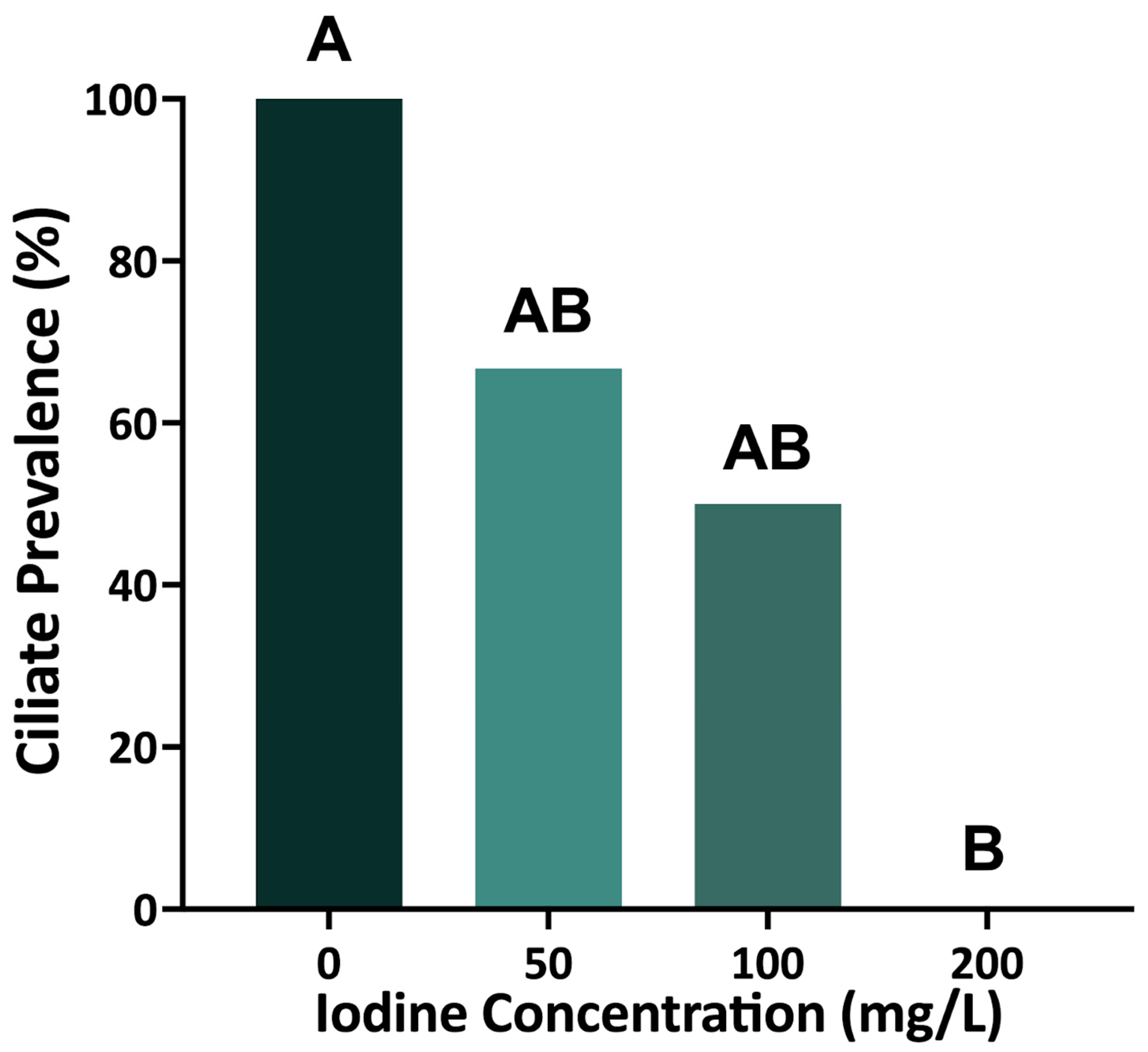
Ciliate presence/absence was recorded as a binary response (1 = present, 0 = absent) for each replicate following disinfection. Because all disinfectants exhibited complete elimination of ciliates (0% prevalence), while controls consistently showed 100% prevalence, the data displayed no variation; therefore, no statistical analysis was conducted for these data. However, a single trial (O. colcarva iodine) did show variability of ciliate presence/absence among treatments. For this trial, differences in ciliate prevalence were analyzed using Fisher’s Exact Test (‘fisher.test’) and pairwise Fisher’s Exact Tests (‘pairwise.fisher.test’) with Bonferroni-adjusted p-values for pairwise comparisons (R package ‘fmsb’).
Hatch rate and recovery data were analyzed using generalized linear mixed models (GLMM) using the ‘glmer’ function in the ‘lme4’ R package. Hatch rate was modeled using a binomial GLMM with a logit link, with treatment set as the fixed factor and replicate set as the random factor. Recovery data were modeled similarly, except the response was specified as the number of recovered and unrecovered eggs/nauplii (200—recovered). Pairwise comparisons were made using estimated marginal means with a Tukey adjustment for multiple comparisons (‘emmeans’ R package). Statistical significance was accepted at α = 0.05. All analyses were conducted in R (version 2024.12.0+467; R Core Team, 2024). Figures were generated in GraphPad Prism 10 (version 10.3.1) with error bars representing the standard error of the mean.
4. Discussion
All disinfectants used in this study were effective at eliminating
Euplotes spp. depending upon concentration and exposure time. Treatment with either sodium hypochlorite or hydrogen peroxide at any tested concentration and exposure duration resulted in complete ciliate removal, as validated 18 h post-exposure. The lowest sodium hypochlorite dose and exposure time (1 min at 50 mg/L NaClO or approximately 24 mg/L total chlorine) resulted in complete ciliate removal, which is not consistent with the findings of Daw et al. [
25], who observed that the minimum chlorine dose required to eliminate
Euplotes spp. from
P. crassirostris and
A. tonsa cultures was 55 mg/L total chlorine with a 5-min exposure time. Daw et al. [
25] also found that ciliates were not successfully removed using 55 mg/L total chlorine with a 15-s exposure in
A. tonsa cultures. These differences suggest that exposure time is likely a critical factor to consider when using sodium hypochlorite as a ciliate removal method. Similarly, Wang et al. [
17] found that sodium hypochlorite levels below 20 mg/L resulted in some ciliate survival after twenty-four hours, mirroring observations made in the range-finding portion of this study, where sodium hypochlorite doses below 50 mg/L consistently failed to remove ciliates. Out of the disinfectants tested in this study, iodine was the least effective at total removal of ciliates, with only the highest dose tested (200 mg/L) resulting in total ciliate removal after 18 h. The failure to remove ciliates at the 50 and 100 mg/L doses may indicate a need for a longer exposure duration at lower doses. Although all disinfectants tested in this study are oxidizers, the PVP iodine mechanism of action is different compared to sodium hypochlorite and hydrogen peroxide. PVP iodine is a form of iodine that slowly releases the iodine molecule and requires adequate time for oxidation of proteins to occur [
27]. Therefore, further research is necessary to elucidate whether increasing the exposure time of the lower doses of iodine may result in total ciliate removal.
Euplotes spp. ciliates exhibit a vegetative life stage known as encystment under conditions of environmental stress, such as low food availability [
28]. These cysts possess a thickened cell wall, which may allow them to survive greater concentrations of chemical exposure compared to free-swimming life stages. The efficacy of the disinfectants on the inactivation of
Euplotes spp. cysts was not assessed in this study. The survival of ciliates in some of the replicate cups after chemical exposure could be the result of encysted specimens potentially present in the
Euplotes spp. stock culture at the time of the trials.
Euplotes spp. cysts complete excystment often within five hours of being placed into a new medium [
28]. If encysted specimens were present in the stock culture, it is likely that they would have begun the process of excystment after being introduced to the fresh sterile seawater used for this study, thereby allowing them to survive chemical exposure, with fully free-swimming specimens appearing in the treatments after the 18 h incubation period. Research exploring the inactivation of
Euplotes spp. cysts could help further elucidate the efficacy of surface disinfectants for ciliate removal.
Percent recovery was calculated to determine whether disinfectant exposure influenced the retention or degradation of eggs after 18 h. For
P. crassirostris, all tested disinfectants in the present study had a positive effect on the recovery of eggs and nauplii compared to the control. This increase in recovery may have been due to the reduction in microbiota (e.g., bacteria and fungi) that could have degraded eggs over the incubation period, thus resulting in a higher number of countable eggs in treated groups compared to the control. [
29]. The effects of each disinfectant on the hatch rate of
P. crassirostris followed a more variable pattern. Hydrogen peroxide was found to be the least inhibitive of hatching success in the
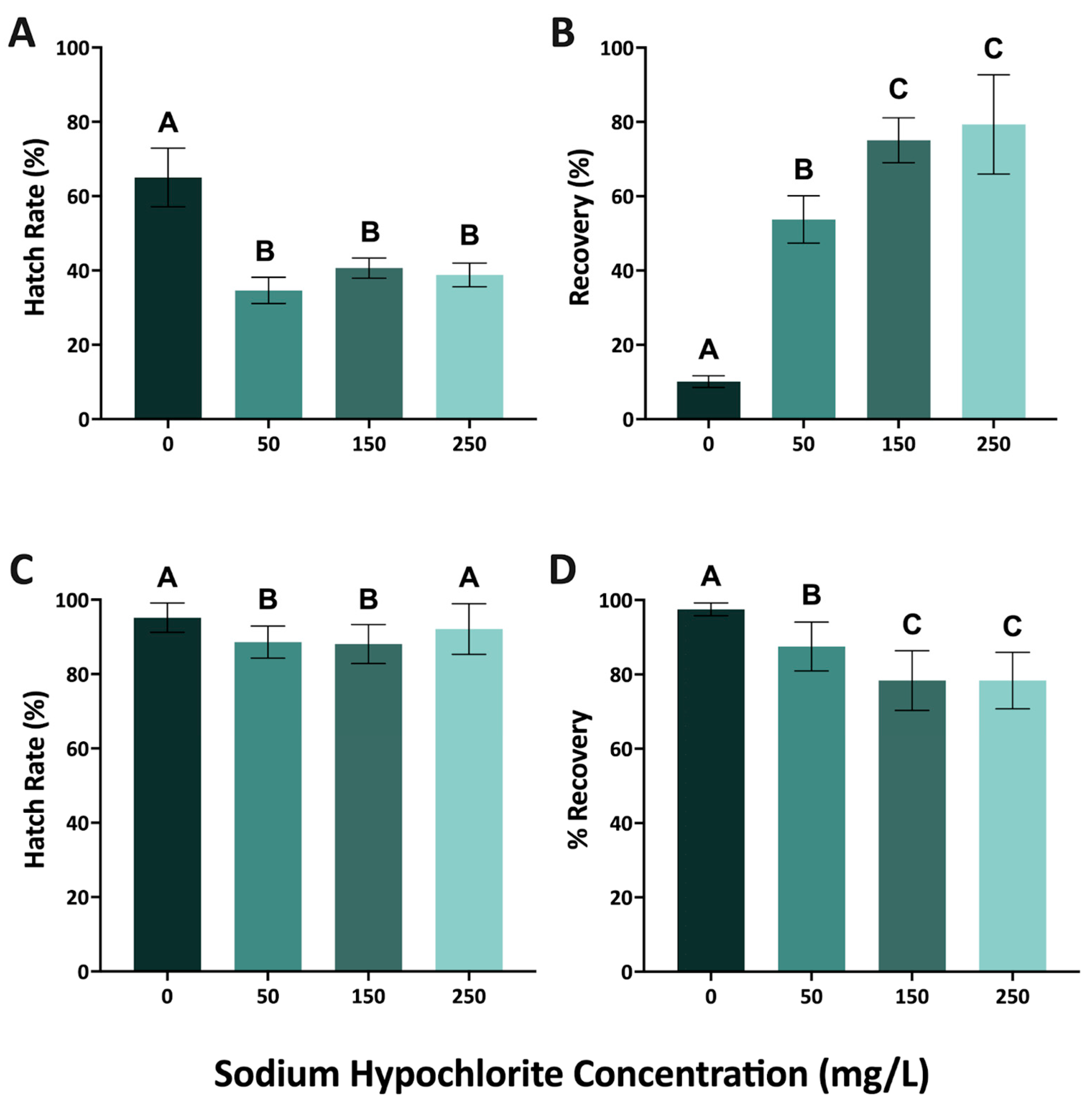
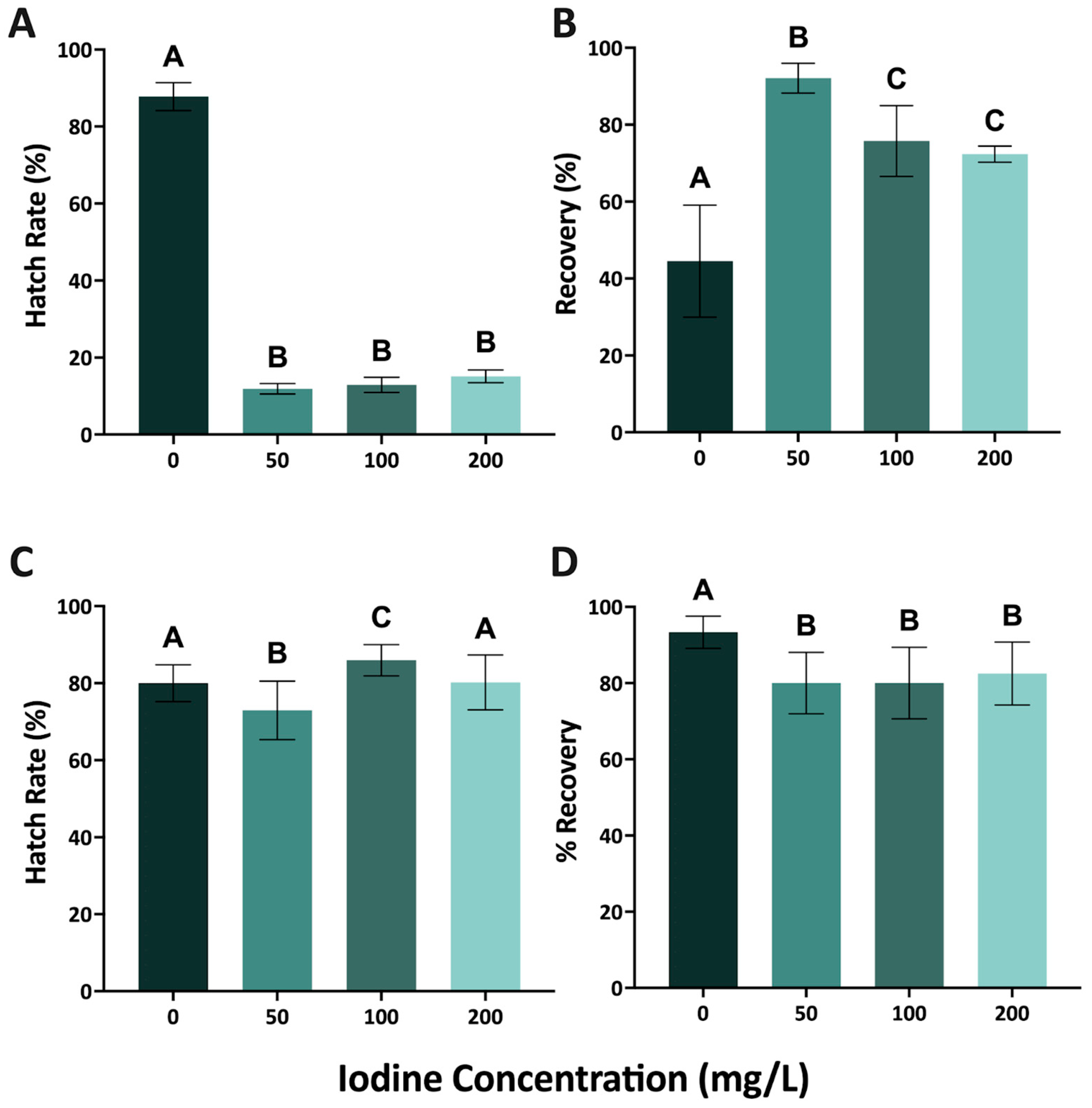
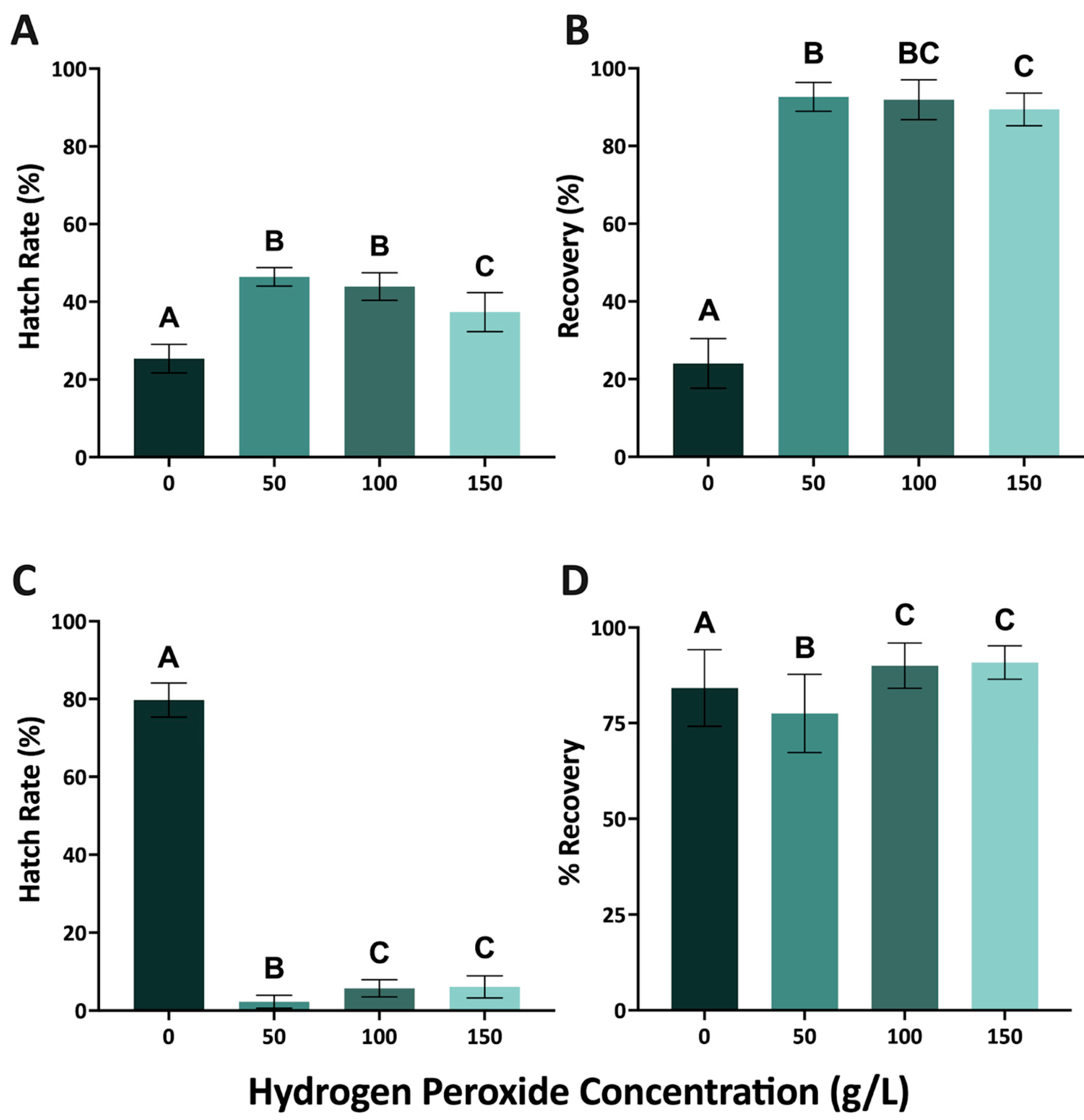
P. crassirostris trials, with the highest hatch rate being observed in treatments exposed to 50 g/L (46.4%) and 100 g/L (43.9%) for one minute. This was in contrast to the control hatch rate, which was significantly lower than the hydrogen peroxide treatments at just 25.4%. The low hatch rate in the control treatment was inconsistent with the hatch rates of the controls in the other disinfectant trials, suggesting that there may have been differences in the levels of bacterial and fungal colonization on the surface of the copepod eggs across the various trials. Iodine was found to be the most inhibitive of hatching success, with hatch rates significantly reduced in even the lowest concentrations used. Sodium hypochlorite exposure resulted in hatch success of approximately 38.0 ± 1.8% across all treatments, which was significantly reduced when compared with controls. This pattern was consistent with that of Daw et al. [
25], who hypothesized that the relatively short embryonic development period of
P. crassirostris, along with a thin outer envelope, may cause the eggs of this species to be more sensitive to chemical treatments. The present study suggests that hydrogen peroxide can be used to remove
Euplotes spp. ciliates from
P. crassirostris eggs with an expected outcome of close to 50% hatch. Further research into refining exposure durations and concentrations of hydrogen peroxide as a ciliate removal method for
P. crassirostris cultures may help further improve copepod hatch rate and survival.
Eggs of O. colcarva exhibited contrasting responses to each disinfectant when compared to P. crassirostris, which indicates that the sensitivity to different disinfectants may be species-specific. Percent recovery was consistently higher in the control compared to the disinfectant-treated eggs, except for the higher doses of hydrogen peroxide. This pattern suggests that the eggs of O. colcarva may be less affected by degradation via bacteria and fungi compared to P. crassirostris and that a balanced microbiome may be beneficial for O. colcarva incubation. Though the disinfectants had a negative effect on the recovery of O. colcarva eggs in the iodine and sodium hypochlorite trials as compared to the control, the average hatch rates were at times higher, if not statistically similar to the control treatments. The highest hatch rate observed for O. colcarva eggs was found in the sodium hypochlorite trial, with a concentration of 250 mg/L and an exposure duration of one minute, resulting in 92% hatch, markedly different from the effects of this disinfectant on P. crassirostris hatch rate. Iodine was also effective in preserving the viability of the eggs, with some treatments exhibiting a higher hatch rate than the control. This result, however, was tempered by the survival of some Euplotes spp. ciliates in the 50 and 100 mg/L iodine treatments. Conversely, hatch was significantly reduced in all treatments of O. colcarva eggs exposed to hydrogen peroxide (2.28–6.09%). These results suggest that sodium hypochlorite is most suited for the removal of Euplotes spp. ciliates from O. colcarva cultures while preserving egg viability.
Throughout the study,
O. colcarva exhibited higher average hatch rates than those of
P. crassirostris after chemical exposure, with the exclusion of hydrogen peroxide. The hatch rates of
O. colcarva in the control treatments were also generally higher than those of
P. crassirostris. The species-specific responses to each disinfectant observed in this study may be due to various factors, including biological differences in embryonic development and varying susceptibility to different modes of oxidation presented by each disinfectant. The ovisac of
O. colcarva may provide a greater barrier of protection against mechanical and chemical degradation than the individual envelopes encasing
P. crassirostris eggs, though more research is needed to confirm this.
O. colcarva also exhibits a longer embryonic stage, with eggs typically hatching within 36 h of spawning, while the embryonic duration of
P. crassirostris is typically less than 24 h [
30,
31]. Differences in the diel periodicity of egg production may exist between the two species as well;
O. colcarva females follow a consistent diel rhythm, producing egg sacs in the morning with hatching occurring the following day in the afternoon. Little research exists on the diel variability of
Parvocalanus spp. reproduction. Some calanoid species reproduce continuously while others have been documented to follow a nightly spawning pattern [
32]. These factors could have resulted in the eggs of
P. crassirostris being further along in development than
O. colcarva at the time of chemical exposure, potentially resulting in greater mortality. Additionally, although the oxidative pathways are not fully understood in copepods, each disinfectant utilized in this study interacts differently with cellular membranes, proteins, and other biomolecules, leading to distinct toxicity profiles [
33]. Fundamental biological differences in reproductive strategy and egg characteristics among calanoid and cyclopoid copepods, such as variability in egg structure and developmental physiology, may contribute to the species-specific responses to chemical exposure.
Although the disinfection trials produced generally consistent patterns in ciliate removal and egg viability, several logistical constraints should be noted. The disinfectants were evaluated in separate experiments due to limited egg availability and space, which prevented a fully integrated statistical comparison. Additionally, logistical constraints associated with manual counting of copepod eggs required volumetric stocking of the replicates, likely increasing variability in the replicate estimates. Despite these limitations, this study provides valuable insight into potential improvements in the reliability of copepod production for the aquaculture industry. Future studies exploring the impacts of egg disinfection on the survivorship of nauplii post-hatch could provide further insight into the efficacy of surface egg disinfection for copepod production.



 ,
,