Article

Food Restriction and Thermal Stress as Independent Inducers of Sexual Reproduction and Ephippia Production in Daphnia magna


by
Paola Andrea Alméciga-Díaz
1,2 and
Ricardo Vieira Rodrigues
1,2,*
1
Graduate Program in Aquaculture, Institute of Oceanography (IO), Federal University of Rio Grande—FURG, Rua do Hotel, n°2, Cassino, Rio Grande 96210-030, RS, Brazil
2
Laboratory of Marine Fish Culture (LAPEM), Institute of Oceanography (IO), Federal University of Rio Grande—FURG, Rua do Hotel, n°2, Cassino, Rio Grande 96210-030, RS, Brazil
*
Author to whom correspondence should be addressed.
Fishes 2026, 11(3), 189; https://doi.org/10.3390/fishes11030189
Submission received: 19 February 2026 / Revised: 16 March 2026 / Accepted: 19 March 2026 / Published: 21 March 2026
(This article belongs to the Special Issue Zooplankton Production Applied to Aquaculture)

Abstract

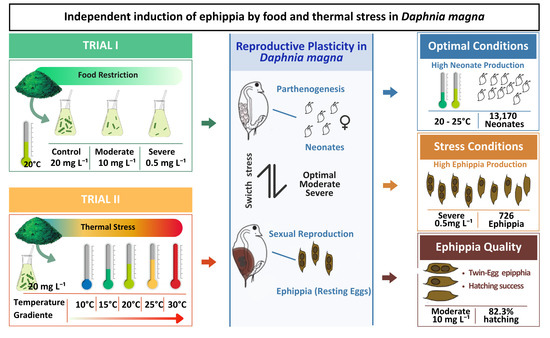
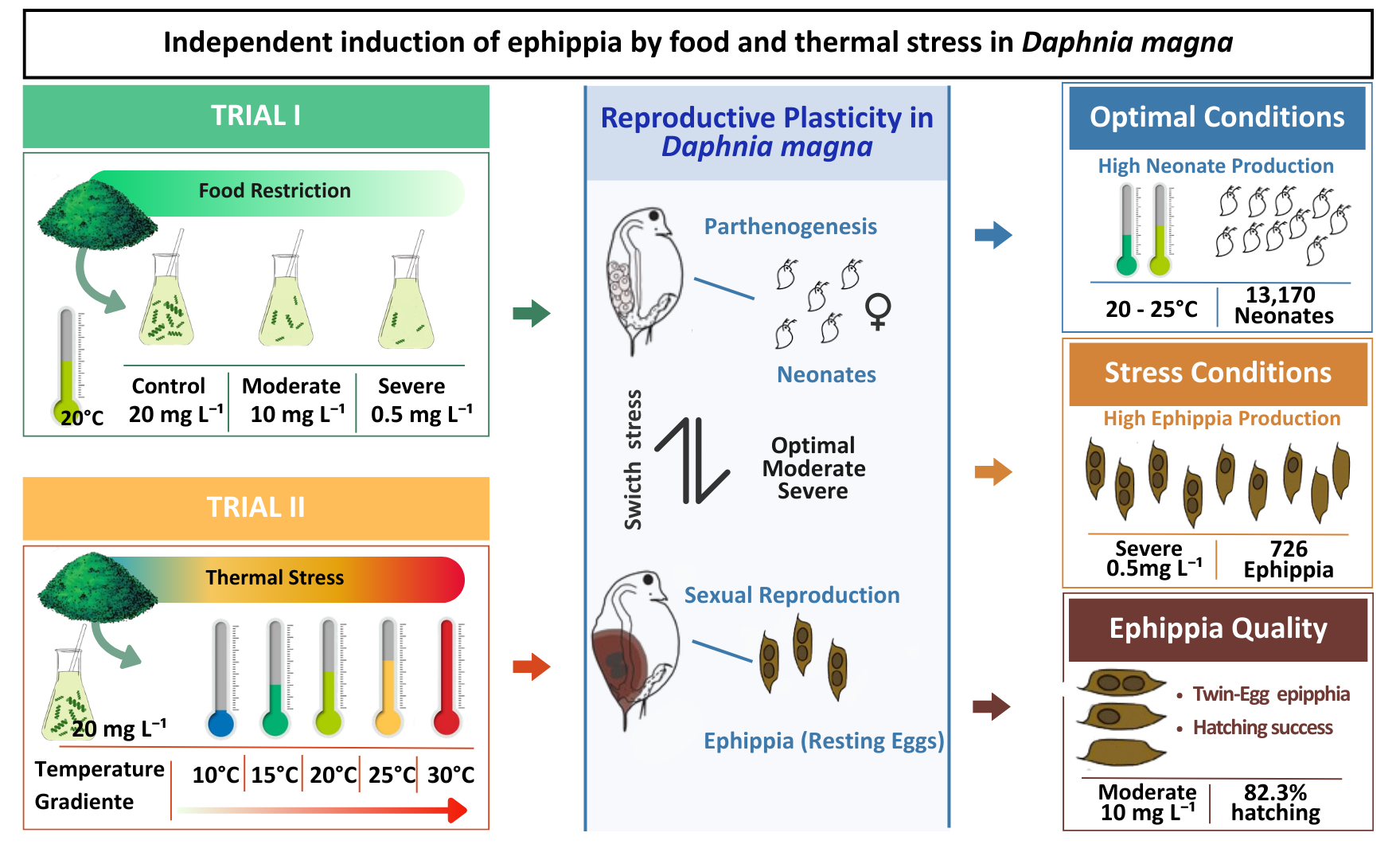
Daphnia magna exhibits reproductive plasticity, alternating between parthenogenesis and sexual reproduction with ephippia (resting eggs) formation under stressful conditions. This study evaluated food restriction or thermal stress as independent inducing factors of ephippia in two consecutive 60-day trials (one per treatment) under controlled conditions. In Trial I, neonates were fed Arthrospira platensis at 20 (control), 10 (moderate), or 0.5 (severe) mg L−1 day−1. In Trial II, neonates were maintained at 10, 15, 20, 25, and 30 °C with optimal feeding. Control food levels and temperatures of 20 °C promoted exclusive parthenogenesis, yielding up to 13,170 ± 515 neonates on treatment fed with 20 mg L−1 of A. platensis day−1. Conversely, severe restriction (0.5 mg L−1 day−1) suppressed asexual reproduction by 99.3% and maximized ephippia production (726 ± 10) over 60 days. Thermal extremes (10 and 30 °C) also induced ephippia formation, peaking at 30 °C (85 ± 7). Ephippia quality was stress-dependent: moderate restriction (10 mg L−1 day−1) yielded the highest proportion of twin-egg ephippia (82.3%) and hatching success (82%), whereas severe food restriction or high temperature (30 °C) increased quantity but reduced the viability of ephippia. These findings suggest independent thresholds for inducing sexual reproduction in D. magna. The study provides a standardized protocol for ephippia production with applications in aquaculture, ecotoxicology, and conservation purposes.
Key Contribution: Severe food restriction (0.5 mg L−1) and thermal stress (30 °C) independently induce sexual reproduction in Daphnia magna. Moderate food restriction (10 mg L−1) optimizes ephippia quality, yielding 82.3% twin-egg capsules and the highest hatching success.

Graphical Abstract

1. Introduction

The cladoceran Daphnia spp. is a keystone organism in aquatic ecosystems, acting as a primary link in the trophic chain [1], and is extensively used as live feed for freshwater fish in their larval and juvenile stages [2]. Its usefulness in aquaculture is due to their ease of cultivation, suitable size, favorable nutritional profile [2,3], and capacity for nutrient bioencapsulation [4]. Daphnia spp. exhibits a short life cycle and notable reproductive plasticity, allowing them to alternate between parthenogenesis and sexual reproduction [1]. Under optimal environmental conditions, females produce female clones through diploid eggs; conversely, under stressful conditions such as temperature fluctuations [1,5], limited food availability, photoperiod changes, high population density [6,7], detection of predators via chemical cues [1], or the presence of metals in the water [5], a shift in its reproductive strategy is induced. This shift results in the production of haploid eggs, that form dormant resting eggs (ephippia) after fertilization [8]. These structures enable Daphnia magna to survive adverse periods, facilitating dispersal and maintaining genetic diversity, and also represent a key adaptation for population persistence [1]. Consequently, they are of significant interest in aquaculture for the storage and subsequent reactivation of cultures [9].
Limited food availability, particularly of phytoplankton, acts as a signal of environmental deterioration, triggering ephippia formation as an adaptive response for population persistence [10]. Low food levels (≤0.05 mg/individual) generate a stimulus [11] that redirects resource allocation towards sexual reproduction, prioritizing the energy required for the production of resting eggs [11]. However, the subsequent quality and viability of these resting eggs can be influenced by the nutritional profile of the diet [12,13].
In contrast, temperature is a critical environmental modulator of physiological processes, such as metabolism, growth, and reproduction [14]. In cladocerans, suboptimal or extreme temperatures operate as abiotic stimuli, inducing the termination of the parthenogenetic phase and initiating sexual reproduction to ensure survival through dormant cyst formation [5,14]. This response to thermal stress accelerates the development (molting and maturation) of Moina micrura [15] and alters fundamental reproductive parameters, such as fecundity and reproductive precocity [16]. Given that global warming represents a priority threat to aquatic systems [17], it is crucial to understand the effects of thermal stress on organisms naturally exposed to significant thermal variability.
Therefore, the present study into the induction of ephippia formation in Daphnia sp. has dual importance: ecological, by ensuring population persistence, and applied, due to its potential uses in aquaculture, ecotoxicology, and aquatic environment management. Although previous studies on D. magna and D. pulex, have identified food restriction, thermal variations, and photoperiod as key inducers of sexual reproduction [18,19], these factors have been primarily evaluated in combination. Kleiven et al. [18] showed that ephippia induction requires three simultaneous stimuli (short photoperiod, high population density, and food limitation), with no single factor being sufficient. Deng [19] also reported strong genotype-by-environment interactions for photoperiod and food in D. pulex, but these factors were assessed separately only under laboratory conditions, not in controlled hatchery settings. Moreover, these studies typically cover limited ranges, leaving the effect of these factors as independent inducers under controlled hatchery-like conditions unexplored. Furthermore, there is a scarcity of standardized and quantitative protocols to efficiently and reproducibly induce ephippia production in hatchery conditions, while simultaneously evaluating cyst quality parameters. To address this gap, the present study aimed to evaluate, in two stages: (1) the effect of food restriction on the production of ephippia in Daphnia magna, and (2) the influence of different incubation temperatures on their formation, viability, and hatching success, in order to develop protocols applicable to aquaculture production systems. We hypothesized that both food restriction and thermal stress independently induce ephippia production in D. magna, but with differential effects on ephippia quantity and quality depending on stress intensity.

2. Materials and Methods

2.1. Experimental Organisms and Pre-Conditioning

The experiment was conducted using the cladoceran Daphnia magna, which were acquired from the Tropcol Ornamental Fish Farm (Bogotá, Colombia). Prior to the experimental setup, parthenogenetic adult females aged between 7 and 10 days, a range that ensures optimal reproductive maturity [20], with an average size of 2.5 ± 0.2 mm, were selected. The organisms were healthy and showed no signs of stress or ephippia production before the start of the experiment. The females were maintained in 2 L tanks at a density of 10 ind. L−1 under controlled water quality parameters, a temperature of 20 °C, pH of 8.0, dissolved oxygen of 6.0 mg/L, alkalinity of 120 mg/L, and a total ammonia (NH3 + NH4+) concentration of ≤0.5 mg/L. The physicochemical parameters of the water were monitored twice a week, and water exchanges were performed weekly, replacing 10% of the total volume, following the standardized protocols for D. magna culture [21]. A photoperiod of 14 h light: 10 h darkness with a light intensity of 3000 lx was maintained using artificial white lighting. The diet consisted of powdered Spirulina (commercial-grade Arthrospira platensis; Naturela®, Bogotá, Colombia; 64% crude protein, 26% total carbohydrates, and 9.6% dietary fiber, dry weight basis), administered in three feedings daily (08:00, 14:00, and 20:00 h) at a concentration of 20 mg L−1 day−1. Neonates (<24 h old) were collected from these cultures and distributed to the experimental treatments.

2.2. Experimental Design

The study was structured into two consecutive experimental trials of 60 days each, designed to independently evaluate the effects of food restriction or thermal stress on ephippia production in D. magna.

2.2.1. Trial I: Effect of Food Restriction

To evaluate ephippia induction in response to food availability, neonates (<24 h) were distributed into circular, flat-bottomed 15 L tanks at a density of 10 ind. L−1, establishing three replicates per treatment: a control (D20) with A. platensis at 20 mg L−1 day−1, a moderate restriction (D10) at 10 mg L−1 day−1, and a severe restriction (D0.5) at 0.5 mg L−1 day−1, with each tank considered an independent experimental unit. Population density was maintained at 10 ind. L−1 by the daily removal of neonates, retaining the initial females. Food was administered in three daily rations (08:00, 14:00, and 20:00 h). The water quality parameters and partial water exchange protocols were identical to those described in the broodstock conditioning phase.

2.2.2. Trial II: Effect of Thermal Stress

To evaluate induction by thermal stress, neonates (<24 h) were distributed in 2 L glass containers at a density of 10 ind. L−1, with three replicates per treatment, whereby each tank was considered an independent experimental unit. All groups were fed A. platensis at 20 mg L−1 day−1 in three daily rations. Population density was maintained at 10 ind. L−1 throughout the experiment by the daily removal of excess neonates. Five temperatures were evaluated: a control (TC: 20 °C), and four thermal stress treatments. T25 (25 °C) and T30 (30 °C) were controlled with submerged thermostats, whereas T10 (10 °C) and T15 (15 °C) were controlled using external water baths with an indirect ice-bottle rotation system. Temperature adjustments from the acclimation condition (20 °C) were made gradually at a rate of 1 °C per hour to minimize thermal shock. Water quality parameters and partial water exchange protocols were maintained as described for Trial I.

2.3. Biometric Measurements

On day 14 of each experimental trial, biometric measurements were performed on 21 females per treatment, distinguishing between females in parthenogenetic reproduction and those carrying ephippia (dormant eggs). The dimensions of the ephippia were measured. Body length (measured in a straight line from the anterior margin of the compound eye to the base of the caudal spine, excluding the spine itself) [22,23] and maximum width were determined by analyzing digital images captured with a Nikon SMZ800N stereomicroscope (Nikon Corporation, Tokyo, Japan) using ImageJ software (version 1.54r, National Institutes of Health, Bethesda, MD, USA).

2.4. Handling of Ephippia and Neonates

Neonate production and ephippia release were monitored daily for both treatments. The released ephippia were collected from the bottom of the tanks using a Pasteur pipette, counted, and transferred to Petri dishes labeled according to the corresponding treatment. Subsequently, they were dried at room temperature (17 °C) in darkness for 48 h and stored at 4 °C for 20 days to ensure preservation [24]. Neonates produced by asexual reproduction were collected daily, counted, and isolated to avoid interference in the experiments.
Ephippia decapsulation was performed after the storage period had ended. Following the validated protocol of Paes et al. (2016a) [25], ephippia from each treatment were placed on a 100 μm zooplankton mesh and submerged in 10 mL of 2% sodium hypochlorite solution for 20 min. Preliminary test under Nikon SMZ800N stereomicroscope confirmed that this duration achieved full transparency without compromising egg integrity. Subsequently, ephippia were rinsed with distilled water to remove residual solution and examined under a Nikon SMZ800N stereomicroscope. The number of eggs (0, 1, or 2) within each ephippium was recorded [25].

2.5. Ephippia Hatching Assay

Decapsulated ephippia from each treatment were subjected to hatching assays to evaluate their viability. They were placed in 2 L conical plastic tanks with water under the following optimal reactivation conditions: temperature of 20 °C, photoperiod of 24 h of continuous light, and constant aeration provided by air stones [24]. The tanks were fed A. platensis at a concentration of 20 mg L−1 day−1 and monitored twice daily (08:00 and 20:00 h), and the day on which the neonates hatched was recorded.

2.6. Statistical Analysis

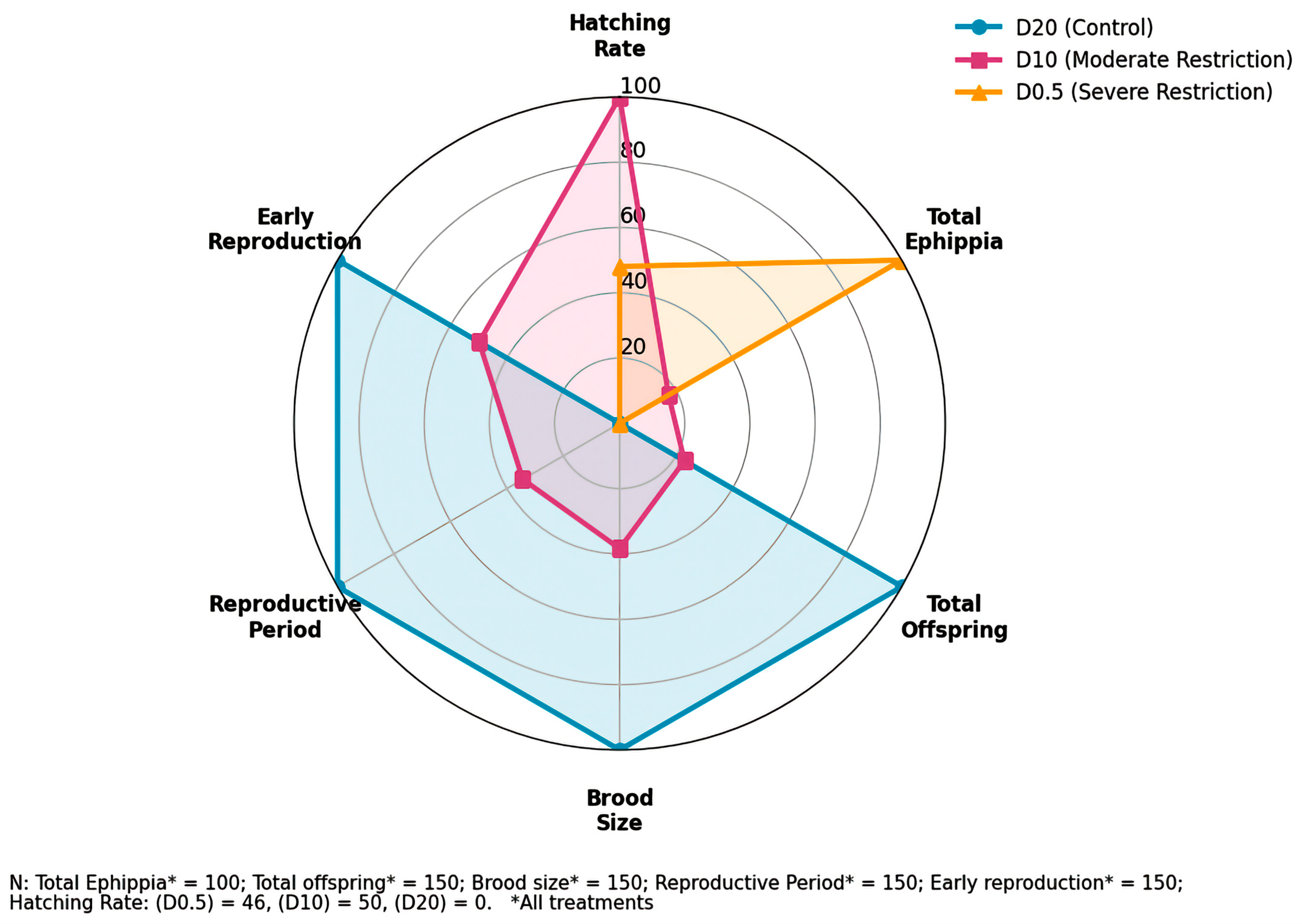
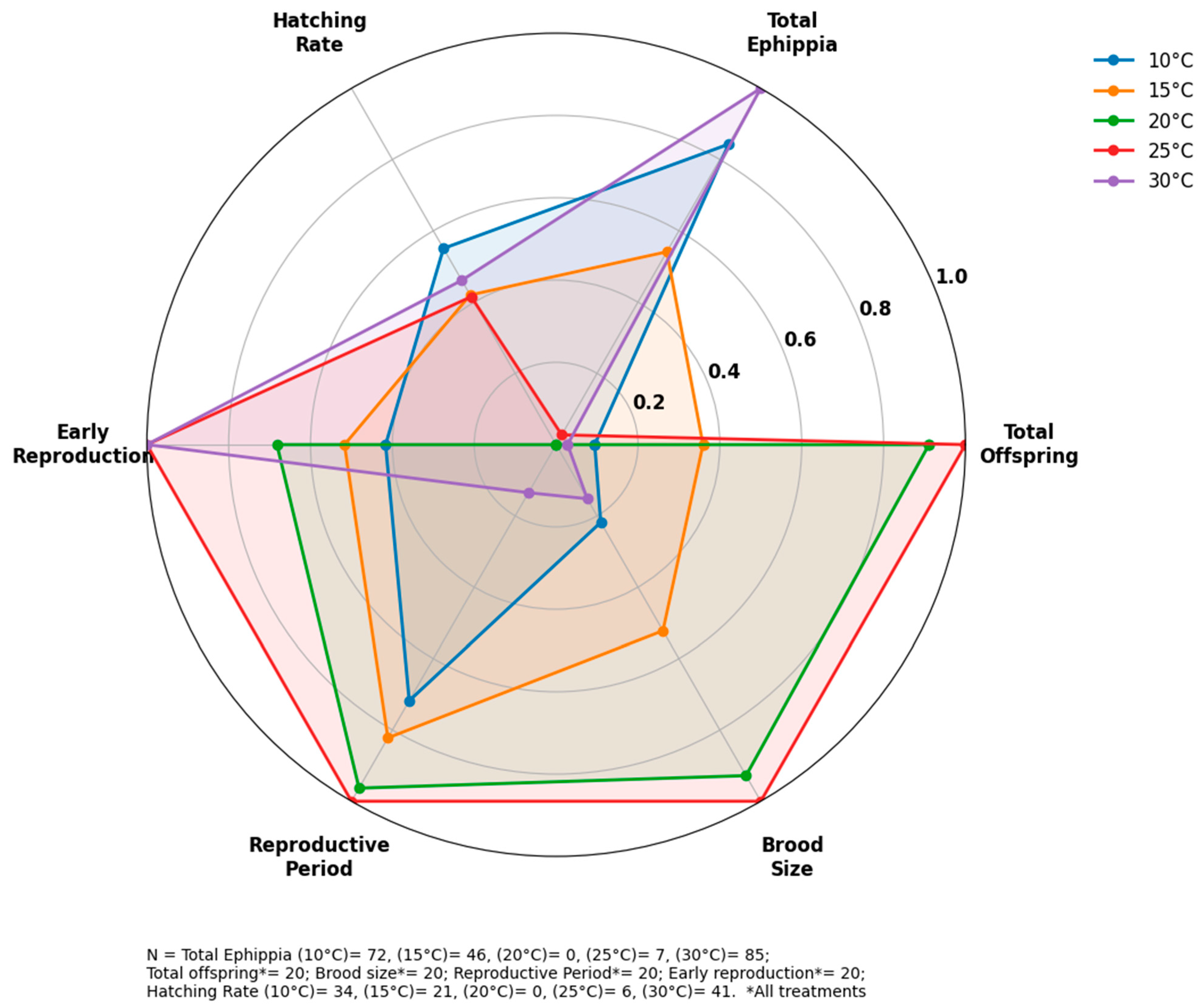
Normality and homoscedasticity were assessed using the Shapiro–Wilk and Levene tests, respectively. Data meeting both assumptions were analyzed with one-way ANOVA followed by Tukey’s HSD post hoc test; non-parametric data were analyzed with Kruskal–Wallis followed by Dunn’s post hoc tests. Effect sizes (ε2) were calculated as ε 2 = ( H k + 1 ) / ( N k ) , where H is the Kruskal–Wallis statistic, k is the number of groups, and N is the total number of observations [25]. Significance was set at p < 0.05. Principal component analysis (PCA, FactoMineR package version 2.12) was performed to identify key variables differentiating the treatments. Radar charts of these variables were created with normalized data for integrated visualization. For radar charts, data were normalized to allow comparison across variables using two methods: min–max rescaling (value − min)/(max − min) × 100, resulting in a 0–100% scale; and relative-to-maximum normalization (value/max), resulting in a 0–1.0 scale. All analyses were conducted using R (v4.5.1, R Foundation for Statistical Computing).

3. Results

3.1. Trial I: Effect of Food Restriction on Reproductive Strategy and Ephippia Production

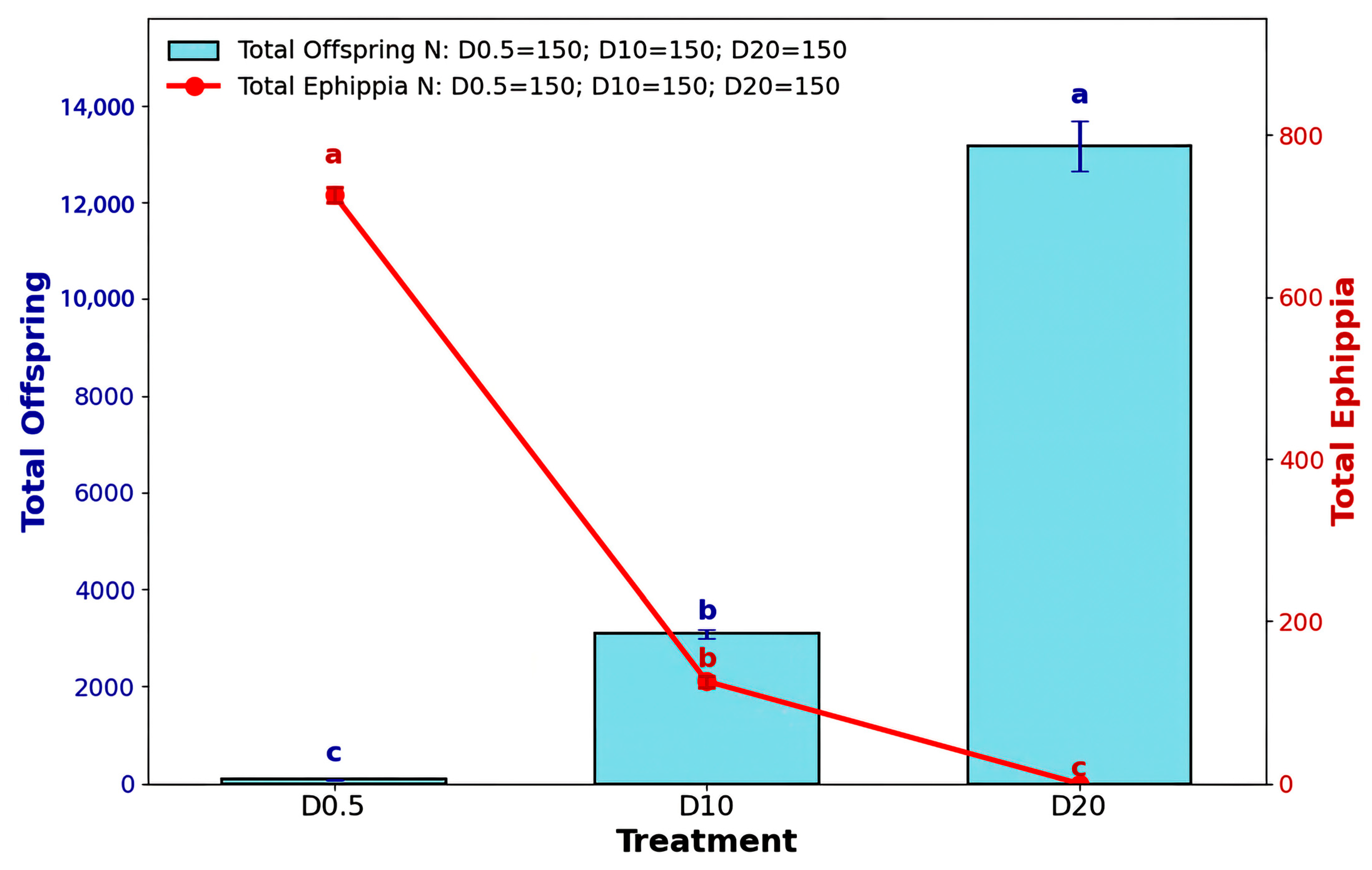
Food availability induced an opposing reproductive response in D. magna, characterized by a pronounced trade-off between parthenogenesis and sexual reproduction. In the control treatment (D20), reproduction was almost exclusively asexual, whereas moderate restriction (D10) shifted the strategy towards a mixed-investment parthenogenetic and sexual reproduction. Under severe restriction (D0.5), parthenogenesis was almost completely suppressed, whereas ephippia production reached its highest level (Figure 1; Table 1). All parthenogenetic parameters showed very large effect sizes, except peak release day (ε2 = 0.30, moderate, p = 0.138). This resulted in a near-complete strategic inversion, where the peak outputs of the two reproductive modes occurred under opposing food regimes and did not overlap.
The asexual reproductive period shortened as food restriction became more severe, a pattern that was exactly opposite to that observed in sexual reproduction, where the duration of ephippia production increased significantly in the restricted treatments, reaching its maximum at D0.5. Similarly, the age at first asexual reproduction was delayed under food scarcity. In contrast, the age at first ephippia was similar among the food-restricted treatments, occurring at approximately 9.5 days, suggesting that the initiation of sexual reproduction is triggered once a minimum stress threshold is crossed, whereas subsequent ephippia output depends on stress intensity. Early reproductive efficiency also reflects this trade-off. A higher proportion of total offspring was released early in D0.5 than in the D20 treatment. However, subsequent growth was limited in D0.5 and was the most pronounced in D20 pots. In sexual reproduction, early ephippia production was notably higher in D0.5, nearly double that of D10. All significant variables related to ephippia production exhibited large effects, while non-significant traits had negligible effects (ε2 = 0.00) (Table 1 and Table 2).
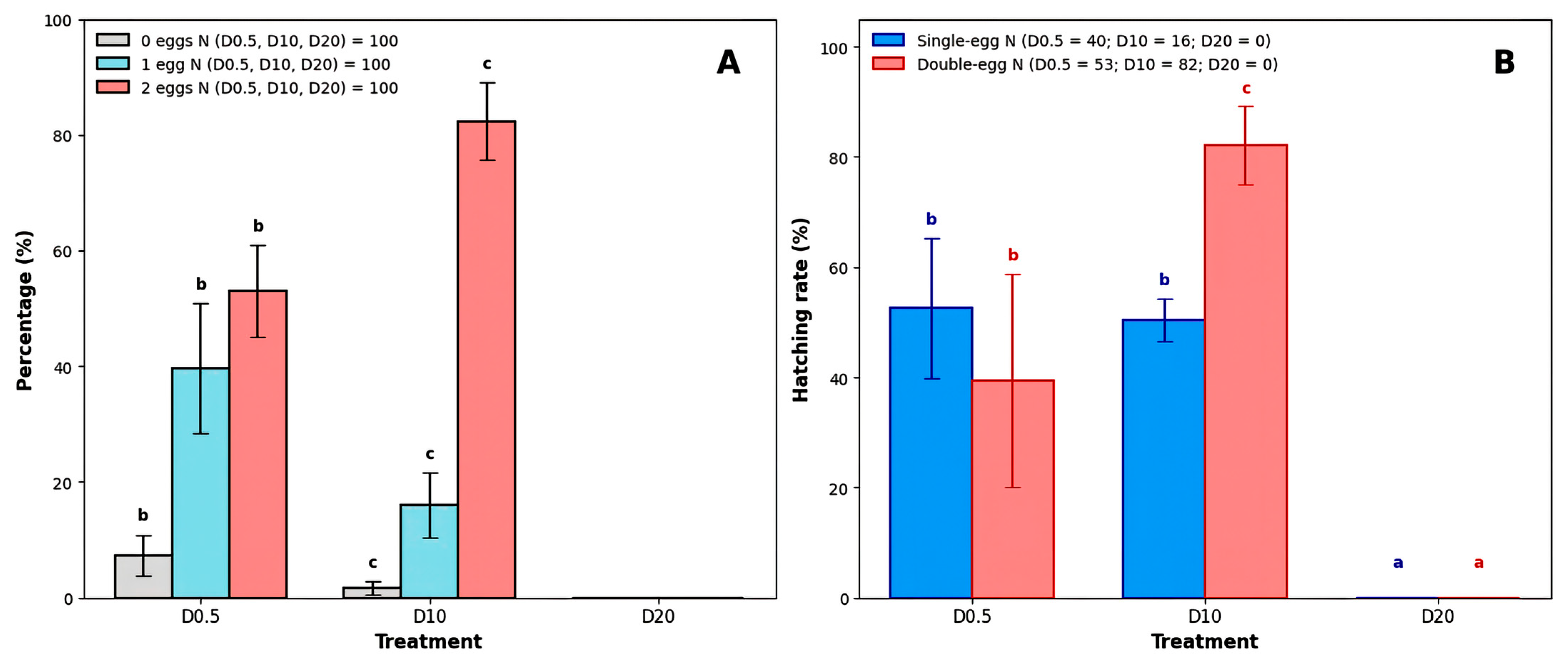
These results reveal a clear trade-off between quantity and quality, with severe stress (D0.5) maximizing ephippia output and moderate stress (D10) optimizing ephippia quality and hatching potential. D10 produced higher-quality ephippia, with more twin-egg ephippia than D0.5. In contrast, D0.5 exhibited substantially higher proportions of single egg and empty ephippia (Figure 2A). This compositional difference directly affected the hatching rate as double eggs had notably higher hatching rates in D10, whereas the rates for single eggs were similar among the treatments (Figure 2B).
Dietary variation induced significant morphometric changes in D. magna. Although the length of parthenogenetic females remained similar across treatments, their width decreased under food restriction (D0.5 and D10) compared to D20, resulting in a higher length-to-width (LW) ratio in the former group. Ephippia-carrying females were smaller than their parthenogenetic counterparts, with the greatest difference observed at D0.5. Furthermore, ephippia size responded directly to food availability, with those from D10 being larger in both length and width than those from D0.5. Most morphometric traits showed large effect sizes (ε2 ≥ 0.57), especially in ephippia-carrying females and ephippia dimensions (ε2 ≥ 0.71) (Table 3).
D20 exhibited a profile dominated by asexual output (high offspring production and prolonged reproductive period) and no ephippia production, whereas D0.5 exhibited the opposite pattern, with maximal investment in ephippia and minimal parthenogenesis activity. Nevertheless, D10 presented an intermediate balance profile, with better hatching rates of ephippia (Figure 3).

3.2. Trial II: Effect of Thermal Stress on Reproductive Strategy and Ephippia Production

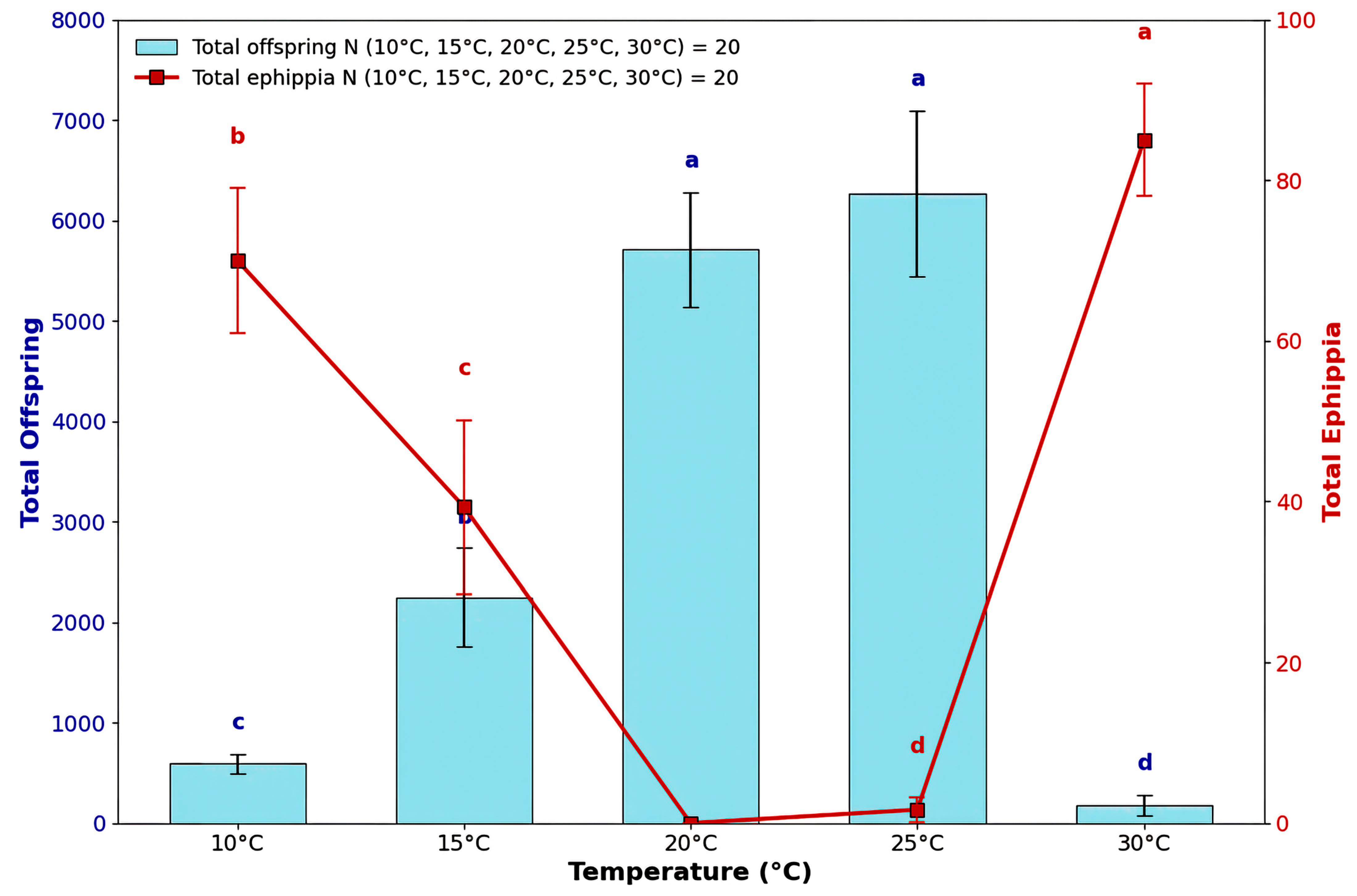
A clear relationship between temperature and reproductive performance was found. For parthenogenetic reproduction, the highest total offspring production occurred at 25 °C, which was higher than that of 10 °C, 15 °C, and 30 °C. In contrast, ephippia formation was minimal within the optimal thermal range for growth (20–25 °C) and was significantly induced at both thermal extremes. The highest ephippia yield was obtained at 30 °C, with no production at 20 °C (Figure 4).
The effects of temperature on the production parameters of D. magna showed an optimization of parthenogenesis in the moderate range (20–25 °C), reflected in a longer reproductive period, higher fecundity, and earlier maturation. In contrast, the sexual response was maximal under thermal stress, with the highest and longest period of ephippia formation at 30 °C. This thermal switch was also evident in the timing of the first release; neonates appeared earlier at 25 °C and 30 °C, whereas ephippia were produced earlier at 30 °C and markedly later at 25 °C (Table 4 and Table 5). Temperature strongly affected parthenogenetic traits (ε2 ≥ 0.86), with the largest effect on reproductive period (ε2 = 0.94); peak release day had a moderate effect (ε2 = 0.19, p = 0.201). Significant sexual parameters under thermal stress had large effects (ε2 ≥ 0.75); non-significant traits showed moderate effects (ε2 = 0.46–0.53), suggesting biological relevance.
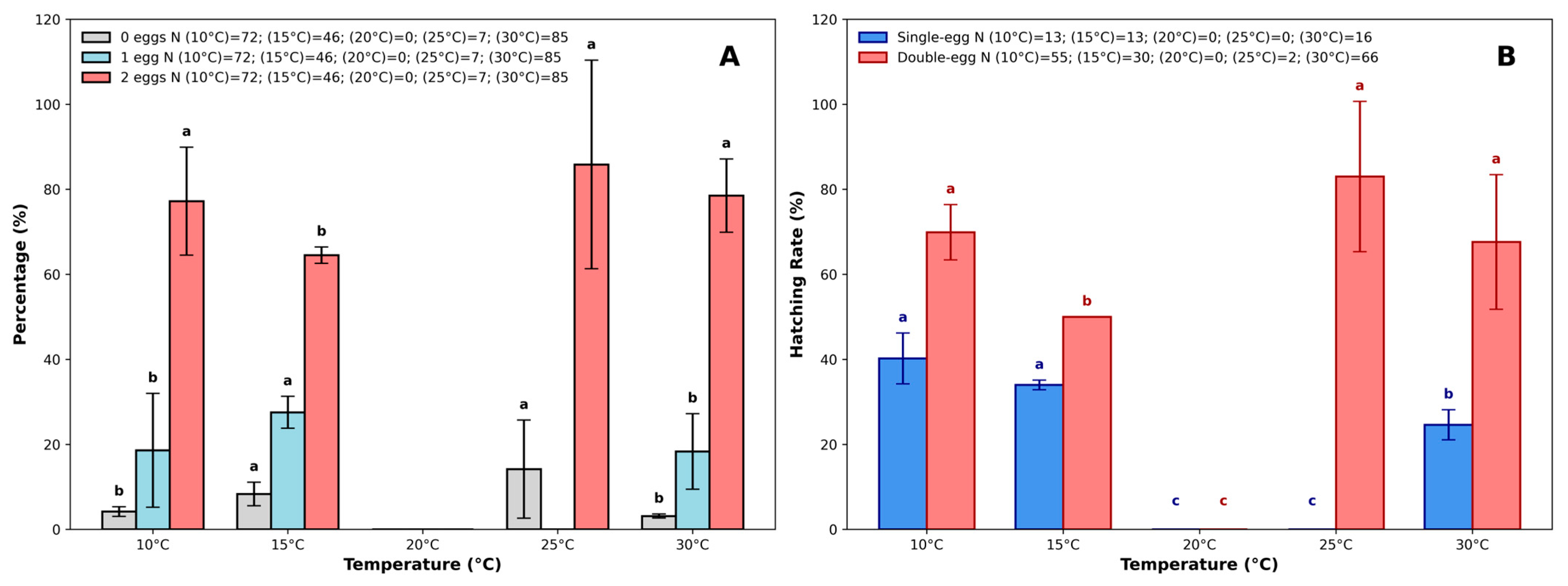
Ephippia production was maximized at thermal extremes (10 °C and 30 °C), where two-egg ephippia predominated (Figure 5A). However, hatching success followed an opposite pattern, with ephippia formed at 25 °C presenting the highest viability for double eggs and single-eggs, surpassing the rates observed at 10 °C and 30 °C. This reveals a clear trade-off, whereby extreme temperatures favor a high yield of resistant eggs, whereas moderate thermal stress (25 °C) optimizes embryonic survival (Figure 5B).
Parthenogenetic females reached their largest size at the elevated temperatures (25 °C and 30 °C), whereas ephippia-carrying females were consistently smaller than their asexual counterparts across all treatments. In contrast, ephippia size increased with temperature, with those produced at 30 °C being the largest compared to those formed at 10 °C. This pattern of morphological divergence suggests a thermally modulated allocation of resources between growth and investment in dormancy structures. Parthenogenetic females exhibited very large effects, while ephippia dimensions also showed large effects, and ephippial females had smaller effects (Table 6).
PCA confirms that thermal extremes triggered divergent reproductive strategies. To maximize ephippia quantity, treatment T4 (30 °C) was optimal, whereas T3 (25 °C) favored parthenogenic performance. T1 (10 °C) represented an intermediate point, maintaining significant ephippia production along with acceptable viability, demonstrating a compromise between the two strategies. The high ephippia output under thermal stress (T4) came at an evident cost to asexual reproductive parameters and ephippia quality, illustrating a fundamental quantity–quality trade-off driven by temperature (Figure 6).

4. Discussion

4.1. Reproductive Trade-Off as an Adaptive Response to Stress

The results of this study confirm that reproductive investment in Daphnia magna is governed by a fundamental trade-off between parthenogenesis and sexual reproduction, which is activated as a central adaptive response to environmental stress. However, this reproductive shift exhibits differential sensitivity to the type of stress applied. Temperatures between 20 and 25 °C sustained high parthenogenetic output, a response consistent with long-term physiological acclimatation that optimizes energy allocation towards direct reproduction [1,27]. In contrast, severe food restriction and thermal extremes acted as independent and potent inducers of ephippia production, drastically suppressing asexual reproduction in D. magna. This transition aligns with the classical model, in which environmental stress promotes a shift from asexual to sexual reproduction [18,19]. However, while Kleiven et al. [18] proposed that three simultaneous stimuli are strictly required to induce ephippia, the present study demonstrates that a single severe stressor, whether nutritional or thermal, can independently trigger a sexual pathway. This likely reflects strain-specific genetic differences, well-documented in D. magna. The Colombian hatchery strain used in this study may thus possess a distinct genetic background, explaining induction by a single severe stressor and reinforcing its sensitivity to habitat deterioration signals [28,29,30].
The response to severe food restriction reached a critical induction threshold consistent with earlier reports [30], whereas thermal extremes functioned as a potent abiotic signal, redirecting energy from growth towards dormancy [5,14]. This pattern reflects a strategic resource allocation, where clonal reproduction prevails under favorable conditions, promoting rapid colonization, whereas severe stress diverts resources towards long-term persistence via ephippia formation, fitting models of adaptive life-history plasticity [31]. This shift in investment from exponential growth to the production of few, highly resistant dormant eggs under deteriorating habitats enhances genetic diversity and survival through diapause [1,29,32]. Together with evidence from tropical ecosystems [33], these findings confirm that abiotic factors such as temperature and food availability act as key switches modulating phenotypic plasticity, which encompasses not only reproductive but also physiological and behavioral traits, enabling a single clone to acclimate to different temperatures and efficiently exploit favorable thermal windows for parthenogenesis [27].
Another distinction from the Kleiven et al. [18] model lies in the sequence of sexual induction. Their study reported that male offspring production and sex-ratio adjustment preceded ephippia formation, whereas the present experimental design did not track offspring sex ratios. This difference highlights that while the terminal output (ephippia production) can be triggered by a single acute stressor, the underlying physiological pathway may still involve intermediate steps, such as male production, which warrants further investigation under these simplified induction protocols.

4.2. Reproductive Response to Stress Severity

A comparison of the results with key studies revealed how the intensity and nature of stress modulate the efficiency and outcome of the reproductive response. The results presented here contrast with those of Bae et al. [5], who showed a complementary relationship in identifying the 20–25 °C range as optimal for asexual reproduction. This optimum coincides with the range in which McKee [27] accounted for the high asexual production observed at 25 °C. However, this study adds a crucial dimension by directly quantifying ephippia production, which was minimal or absent within this thermal range. This suggests that a moderate temperature increase (up to 25 °C) is not perceived by D. magna as a severe threat, justifying a shift towards sexual reproduction. The true induction threshold for the strain in this study was reached at 30 °C, where asexual production collapsed and ephippia formation was maximal, a finding that complements the interpretation of Bae et al. [5] regarding the reallocation of energy towards defense mechanisms under heat stress. The earlier induction at 30 °C reflects the temperature-dependent acceleration of metabolism, a well-established principle in ectotherms where higher temperatures increase developmental rates [27]. In contrast, at 15 °C, the intermediate production of neonates and low induction of ephippia confirm that this temperature is suboptimal for both reproductive modes, coinciding with the lower limit of the optimal growth range reported for D. magna [31].
Similarly, food availability behaved as a gradual stress factor, corroborating and expanding upon the framework proposed by Bednarska [29]. Although that study documented a linear positive relationship between food quantity and parthenogenetic performance (size, fecundity, and growth), the results also showed that sexual reproduction followed the opposite pattern. Severe restriction (0.5 mg L−1) was the most potent inducer of ephippia. This response can be explained by the mechanism proposed by Burns [34], where a depression in the feeding rate triggers reproductive reprogramming towards the formation of resistant structures, prioritizing long-term survival over immediate reproduction. Notably, despite severe restriction, ephippia production and survival were sustained throughout the experiment, contrasting with Mezgebu et al. [35], who reported no survival at similar concentrations.
The inverse relationship between high ephippia production and its lower viability at 30 °C reveals an energy reallocation under severe thermal stress. Although females in this treatment were larger, ephippia-carrying females were smaller and the ephippia produced were the largest recorded, suggesting a priority investment in the resistant structure, even at the cost of reduced viability. This morphophysiological pattern coincides with principles such as the temperature–size rule [36] and demonstrates the capacity of D. magna to modulate its reproductive strategy under conditions of extreme stress.

4.3. Ephippia Quality and Hatching Viability

The results of this study revealed a secondary trade-off within sexual reproduction itself; ephippia induction is not only activated by stress, but its quantity and quality vary inversely with stress intensity. These findings complement and expand upon those of prior studies. While Kleiven et al. [18] focused on the prerequisites for ephippia induction, this study additionally evaluated the quality and viability of the ephippia. Similarly, whereas Bednarska [29] assessed the quality (size and content) of parthenogenetic eggs, this study quantified ephippia quality in terms of egg content per capsule and hatching success rates. Severe restriction (D0.5) maximized ephippia quantity at the expense of its quality (more empty capsules or those with a single egg, and a lower hatching rate), whereas moderate restriction (D10) optimized quality (higher proportion of double eggs and greater hatching success). This may indicate that under acute stress, D. magna prioritizes the massive production of resistant structures, whereas moderate stress allows a more balanced investment that maximizes the survival probability of offspring.
This compensation principle was corroborated by comparisons with other stress inducers. As reported by Deng et al. [32] for D. pulex under cyanobacterial stress and Paes et al. [33] for Daphnia spp. in tropical lakes, the intensification of stress (whether nutritional or thermal) increases ephippia production but compromises its viability or fecundity. This study advances the field by identifying an optimal induction point (D10) that achieves a balance between production and quality, thereby overcoming the limitation of low viability reported in laboratory ephippia [37].
This trade-off is likely mediated by resource allocation. Severe restriction could limit the energy available to complete vitellogenesis for two viable eggs per ephippium in the present study. Research by Turcihan et al. [38] suggests that the body composition and lipid reserves of D. magna, shaped by diet, are crucial. Therefore, the nutritional quality of the diet prior to induction could be key to producing ephippia that are not only more numerous but also have greater energy reserves and higher viability. This aspect could have a direct applied implication; the efficient induction of high-quality ephippia under controlled conditions can ensure banks of resistant eggs for aquaculture and provide high-performance individuals for recruitment, as observed in exephippial individuals (individuals hatched from ephippia) [39].

4.4. Morphometric Costs of Reproduction

Morphometric findings evidence that the phenotypic plasticity of D. magna transcends the changes in reproductive mode, encompassing integrated adjustments in body size and the resistant structures. The balance between offspring size and number and the energy allocated per egg is influenced by factors such as maternal size and food availability [1]. As reviewed by Ebert [1], Daphnia produces fewer but larger offspring when food is scarce, a pattern consistent with theoretical models predicting a non-linear response of egg size to food availability [40,41]. This framework coincides with the results obtained and with those of Bednarska [29], who observed that severe quantitative restriction induced larger parthenogenetic eggs, whereas low dietary quality produced smaller ones.
In the thermal context, an apparent discrepancy was observed with previous studies reporting a reduction in body size at high temperatures, such as in Bae et al. [5] and Hoefnagel et al. [36], who attribute this pattern to the temperature–size rule (TSR) and the reallocation of energy towards defense mechanisms. In this study, females at 25–30 °C were larger, which could be due to controlled feeding conditions and experimental duration. However, the consistent finding that ephippia-carrying females were significantly smaller than their asexual counterparts in all treatments revealed a direct morphological cost associated with sexual reproduction. This suggests a resource allocation channel that diverts energy from somatic growth towards the production of resistant structures, a principle coherent with observations of resource limitation under stress [36] and similar density-dependent effects [42]. Furthermore, ephippia size responded directly to the inducing conditions; they were larger in the moderate restriction treatment (D10) and at 30 °C. This could indicate that, within the investment in sexual reproduction, there is also plasticity in the allocation of resources towards the protective structure itself, possibly modulated by the energy available at the time of formation.

5. Conclusions

This study establishes a protocol to control reproduction in Daphnia magna, which shifts from clonal proliferation to ephippia formation as a long-term survival mechanism under stress. Under optimal conditions (20 mg L−1 of A. platensis day−1, 20–25 °C), parthenogenesis yields maximum clone production, a strategy that is suppressed by specific stressors such as severe food restriction (0.5 mg L−1 day−1) and extreme thermal stress (10 and 30 °C). These stressors were efficient in redirecting reproductive investment towards ephippia production. While 30 °C is the most effective thermal inducer, moderate food restriction (10 mg L−1 day−1) represents the optimal trade-off, balancing high induction with maximum embryo viability. Therefore, for aquaculture applications, this dietary protocol should be prioritized over thermal induction. Future research should focus on optimizing pre-induction nutrition to maximize the efficiency of this technique.

Author Contributions

Conceptualization, P.A.A.-D. and R.V.R.; methodology, P.A.A.-D. and R.V.R.; validation, P.A.A.-D. and R.V.R.; formal analysis, P.A.A.-D.; investigation, P.A.A.-D.; resources, R.V.R.; data curation, P.A.A.-D.; writing—original draft preparation, P.A.A.-D.; writing—review and editing, R.V.R.; supervision, R.V.R.; All authors have read and agreed to the published version of the manuscript.

Funding

This study was financially supported by the Brazilian National Council of Scientific and Technological Development (CNPq)—Schorlarship for P. A. Alméciga-Díaz.

Institutional Review Board Statement

Not applicable. This study used the invertebrate cladoceran Daphnia magna, which is not subject to ethical approval requirements in accordance with local/national legislation.

Informed Consent Statement

Not applicable.

Data Availability Statement

The original contributions presented in this study are included in the article. Further inquiries can be directed to the corresponding author.

Acknowledgments

The authors would like to thank the Tropcol Ornamental Fish Farm staff.

Conflicts of Interest

The authors declare no conflicts of interest.

References

  1. Ebert, D. Daphnia as a versatile model system in ecology and evolution. EvoDevo 2022, 13, 16. [Google Scholar] [CrossRef]
  2. Ocampo, L.E.; Botero, M.C.; Restrepo, L.F. Evaluación del crecimiento de un cultivo de Daphnia magna alimentado con Saccharomyces cereviseae y un enriquecimiento con avena soya. Rev. Colomb. Cienc. Pecu. 2010, 23, 78–85. [Google Scholar] [CrossRef]
  3. Cheban, L.; Grynko, O.; Marchenko, M. Nutritional value of Daphnia magna (Straus, 1820) under conditions of co-cultivation with fodder microalgae. Biol. Syst. 2017, 9, 166–170. [Google Scholar] [CrossRef]
  4. Vasina, L.; Kraievska, I.; Khudyi, O.; Khuda, L.; Cheban, L. Application of an association of yeast and lactic acid bacteria to bioencapsulate carotenoids in Daphnia magna (Straus, 1820). Fish. Aquat. Life 2020, 28, 225–233. [Google Scholar] [CrossRef]
  5. Bae, E.; Samanta, P.; Yoo, J.; Jung, J. Effects of multigenerational exposure to elevated temperature on reproduction, oxidative stress, and Cu toxicity in Daphnia magna. Ecotoxicol. Environ. Saf. 2016, 132, 366–371. [Google Scholar] [CrossRef] [PubMed]
  6. Issa, S.; Simonsen, A.; Jaspers, V.L.; Einum, S. Population dynamics and resting egg production in Daphnia: Interactive effects of mercury, population density and temperature. Sci. Total Environ. 2020, 755, 143625. [Google Scholar] [CrossRef] [PubMed]
  7. Gowler, C.D.; Rogalski, M.A.; Shaw, C.L.; Hunsberger, K.K.; Duffy, M.A. Density, parasitism, and sexual reproduction are strongly correlated in lake Daphnia populations. Ecol. Evol. 2021, 11, 10446–10456. [Google Scholar] [CrossRef]
  8. Kato, Y.; Nitta, J.H.; Perez, C.A.G.; Adhitama, N.; Religia, P.; Toyoda, A.; Iwasaki, W.; Watanabe, H. Identification of gene isoforms and their switching events between male and female embryos of the parthenogenetic crustacean Daphnia magna. Sci. Rep. 2024, 14, 9407. [Google Scholar] [CrossRef]
  9. Schröder, T. Diapause in Monogonont Rotifers. Hydrobiologia 2025, 546, 291–306. [Google Scholar] [CrossRef]
  10. Tsugeki, N.K.; Ishida, S.; Urabe, J. Sedimentary records of reduction in resting egg production of Daphnia galeata in Lake Biwa during the 20th century: A possible effect of winter warming. J. Paleolimnol. 2008, 42, 155–165. [Google Scholar] [CrossRef]
  11. Maruoka, N.; Makino, T.; Urabe, J. RNA-seq analysis to identify genes related to resting egg production of panarctic Daphnia pulex. BMC Genom. 2023, 24, 262. [Google Scholar] [CrossRef]
  12. Koch, U.; Von Elert, E.; Straile, D. Food quality triggers the reproductive mode in the cyclical parthenogen Daphnia (Cladocera). Oecologia 2008, 159, 317–324. [Google Scholar] [CrossRef] [PubMed]
  13. Mabruroh, A.A.; Mubarak, A.S.; Tjahjaningsih, W. Quantity and quality of ephippia from moina (Moina macrocopa) culture with bran suspension feed with Lemuru fish oil. IOP Conf. Ser. Earth Environ. Sci. 2023, 1273, 012072. [Google Scholar] [CrossRef]
  14. Chen, X.; Stillman, J.H. Multigenerational analysis of temperature and salinity variability affects on metabolic rate, generation time, and acute thermal and salinity tolerance in Daphnia pulex. J. Therm. Biol. 2012, 37, 185–194. [Google Scholar] [CrossRef]
  15. Chen, R.; Xu, N.; Zhao, F.; Wu, Y.; Huang, Y.; Yang, Z. Temperature-dependent effect of food size on the reproductive performances of the small-sized cladoceran Moina micrura. Biochem. Syst. Ecol. 2015, 59, 297–301. [Google Scholar] [CrossRef]
  16. Engert, A.; Chakrabarti, S.; Saul, N.; Bittner, M.; Menzel, R.; Steinberg, C.E. Interaction of temperature and an environmental stressor: Moina macrocopa responds with increased body size, increased lifespan, and increased offspring numbers slightly above its temperature optimum. Chemosphere 2012, 90, 2136–2141. [Google Scholar] [CrossRef]
  17. Williams, P.J.; Dick, K.B.; Yampolsky, L.Y. Heat tolerance, temperature acclimation, acute oxidative damage and canalization of haemoglobin expression in Daphnia. Evol. Ecol. 2011, 26, 591–609. [Google Scholar] [CrossRef]
  18. Kleiven, O.T.; Larsson, P.; Hobæk, A.; Hobaek, A. Sexual reproduction in Daphnia magna requires three stimuli. Oikos 1992, 65, 197. [Google Scholar] [CrossRef]
  19. Deng, H. Environmental and genetic control of sexual reproduction in Daphnia. Heredity 1996, 76, 449–458. [Google Scholar] [CrossRef][Green Version]
  20. Frost, P.C.; Caudle, S.L.; Han, S.; O’Brien, J.M.J.; Tobin, S.W. Rearing and experimental uses of Daphnia: Controlling animal nutrition and assessing lifespan and life-history traits. Curr. Protoc. 2024, 4, e1064. [Google Scholar] [CrossRef]
  21. Associação Brasileira de Normas Técnicas (ABNT). NBR 12713: Ecotoxicologia Aquática—Toxicidade Aguda—Método de Ensaio com Daphnia spp. (Crustacea, Cladocera); ABNT: São Paulo, Brazil, 2016. [Google Scholar]
  22. Cambronero, M.C.; Orsini, L. Resurrection of dormant Daphnia magna: Protocol and applications. J. Vis. Exp. 2018, 131, e56637. [Google Scholar] [CrossRef]
  23. Ku, D.; Chae, Y.; Choi, Y.; Ji, C.W.; Park, Y.; Kwak, I.; Kim, Y.; Chang, K.; Oh, H. Optimal method for biomass estimation in a cladoceran species, Daphnia magna (Straus, 1820): Evaluating length–weight regression equations and deriving estimation equations using body length, width and lateral area. Sustainability 2022, 14, 9216. [Google Scholar] [CrossRef]
  24. Pérez-Martínez, C.; Jiménez, L.; Moreno, E.; Conde-Porcuna, J.M. Emergence pattern and hatching cues of Daphnia pulicaria (Crustacea, Cladocera) in an alpine lake. Hydrobiologia 2013, 707, 47–57. [Google Scholar] [CrossRef]
  25. Paes, T.A.S.V.; Rietzler, A.C.; Maia-Barbosa, P.M. Methods for selection of Daphnia resting eggs: The influence of manual decapsulation and sodium hypoclorite solution on hatching rates. Braz. J. Biol. 2016, 76, 1058–1063. [Google Scholar] [CrossRef]
  26. Cohen, J. Statistical Power Analysis for the Behavioral Sciences, 2nd ed.; Lawrence Erlbaum Associates: Hillsdale, NJ, USA, 1988. [Google Scholar]
  27. McKee, D. Long-term temperature acclimation in Daphnia magna: Effects on filtering rates. J. Plankton Res. 1992, 14, 379–391. [Google Scholar] [CrossRef]
  28. Alekseev, V.; Lampert, W. Maternal control of resting-egg production in Daphnia. Nature 2001, 414, 899–901. [Google Scholar] [CrossRef] [PubMed]
  29. Bednarska, A. Food quantity and quality shapes reproductive strategies of Daphnia. Ecol. Evol. 2022, 12, e9163. [Google Scholar] [CrossRef] [PubMed]
  30. Carvalho, G.R.; Hughes, R.N. The effect of food availability, female culture-density and photoperiod on ephippia production in Daphnia magna Straus (Crustacea: Cladocera). Freshw. Biol. 1983, 13, 37–46. [Google Scholar] [CrossRef]
  31. Bruijning, M.; Berge, A.C.M.T.; Jongejans, E. Population-level responses to temperature, density and clonal differences in Daphnia magna as revealed by integral projection modelling. Funct. Ecol. 2018, 32, 2407–2422. [Google Scholar] [CrossRef]
  32. Deng, D.; Zhang, S.; Li, Y.; Meng, X.; Yang, W.; Li, Y.; Li, X. Effects of Microcystis aeruginosa on population dynamics and sexual reproduction in two Daphnia species. J. Plankton Res. 2010, 32, 1385–1392. [Google Scholar] [CrossRef]
  33. Paes, T.A.; Rietzler, A.C.; Pujoni, D.G.; Maia-Barbosa, P.M. High temperatures and absence of light affect the hatching of resting eggs of Daphnia in the tropics. An. Acad. Bras. Ciências 2016, 88, 179–186. [Google Scholar] [CrossRef] [PubMed]
  34. Burns, C.W. Effects of crowding and different food levels on growth and reproductive investment of Daphnia. Oecologia 1995, 101, 234–244. [Google Scholar] [CrossRef] [PubMed]
  35. Mezgebu, A.; Liu, X.; Mingist, M.; Ban, S. Evaluating food quality of Arthrospira platensis for culturing Daphnia magna. Aquac. Int. 2024, 32, 3533–3544. [Google Scholar] [CrossRef]
  36. Hoefnagel, K.N.; De Vries, E.H.J.; Jongejans, E.; Verberk, W.C.E.P. The temperature-size rule in Daphnia magna across different genetic lines and ontogenetic stages: Multiple patterns and mechanisms. Ecol. Evol. 2018, 8, 3828–3841. [Google Scholar] [CrossRef] [PubMed]
  37. Poage, D.W. Ephippia Production, Activation, and Use of Ex-Ephippio Neonates of Ceriodaphnia Dubia as Toxicity Test Organisms. Master’s Thesis, UNT Digital Library, University of North Texas, Denton, TX, USA, 1992. [Google Scholar]
  38. Turcihan, G.; Isinibilir, M.; Zeybek, Y.G.; Eryalçın, K.M. Effect of different feeds on reproduction performance, nutritional components and fatty acid composition of cladocer water flea (Daphnia magna). Aquac. Res. 2022, 53, 2420–2430. [Google Scholar] [CrossRef]
  39. Arbačiauskas, K.; Gasiūnaitė, Z.R. Growth and fecundity of Daphnia after diapause and their impact on the development of a population. Hydrobiologia 1996, 320, 209–222. [Google Scholar] [CrossRef]
  40. Glazier, D.S. Effects of food, genotype, and maternal size and age on offspring investment in Daphnia magna. Ecology 1992, 73, 910–926. [Google Scholar] [CrossRef]
  41. Trubetskova, I.; Lampert, W. Egg size and egg mass of Daphnia magna: Response to food availability. Hydrobiologia 1995, 307, 139–145. [Google Scholar] [CrossRef]
  42. Guisande, C. Reproductive strategy as population density varies in Daphnia magna (Cladocera). Freshw. Biol. 1993, 29, 463–467. [Google Scholar] [CrossRef]
Figure 1. Effects of food restriction on total offspring production and ephippia formation in Daphnia. D0.5 = 0.5 mg L−1 A. platensis day−1; D10 = 10 mg L−1 A. platensis day−1; D20 = 20 mg L−1 A. platensis day−1. Different letters above the bars or points indicate significant differences among treatments (p < 0.05).
Fishes 11 00189 g001
Figure 2. Effect of food restriction on the composition and viability of Daphnia magna ephippia. (A) Percentage distribution of egg content in ephippia (empty, single-egg, double-egg) produced under each treatment. (B) Hatching success of single and double resting eggs contained in the ephippia. Different letters above the bars indicate statistically significant differences (p < 0.05) among the treatments. In (B), comparisons were performed separately for single-egg and double-egg ephippia using the Kruskal–Wallis test followed by Dunn’s post hoc test with Bonferroni correction.
Fishes 11 00189 g002
Figure 3. PCA analysis of reproductive period, early reproduction, brood size, total offspring, hatching rate, and total ephippia production of Daphnia magna subjected to food restriction. The radar chart displays the normalized performance (0–100%) of treatments D20 (20 mg L−1 A. platensis day−1, control), D10 (10 mg L−1 A. platensis day−1, moderate restriction), and D0.5 (0.5 mg L−1 A. platensis day−1, severe restriction) across six key parameters. A higher value indicates better performance; for early reproduction, a younger age at first reproduction corresponds to a higher score. The figure illustrates the trade-off between investment in asexual reproduction (left-side axis) and sexual reproduction (right-side axis). Values are normalized to 0–100% by min–max rescaling.
Fishes 11 00189 g003
Figure 4. Effects of thermal stress on total offspring production and ephippia formation in Daphnia magna. Reproductive output across five thermal treatments (T1 = 10 °C, T2 = 15 °C, TC = 20 °C, T3 = 25 °C, and T4 = 30 °C). Different letters above the bars or data points indicate statistically significant differences among treatments (p < 0.05).
Fishes 11 00189 g004
Figure 5. Effects of temperature on ephippia egg composition and hatching success in Daphnia magna. (A) Distribution of egg content within ephippia across temperature treatments, expressed as the percentage of empty, single-egg, and double-egg ephippia. (B) Hatching success of resting eggs from single-egg and double-egg ephippia across temperature treatments. The bars represent mean values ± standard deviation (SD). Different letters above the bars indicate significant differences among the temperature treatments within the same category (p < 0.05).
Fishes 11 00189 g005
Figure 6. PCA analysis of reproductive period, early reproduction, brood size, total offspring, hatching rate, and total ephippia production of Daphnia magna exposed to different temperatures. The radar chart displays the normalized performance of temperature treatments T1 (10 °C), T2 (15 °C), TC (20 °C), T3 (25 °C), and T4 (30 °C) across six key reproductive parameters. Higher values indicate better performances. The bottom axes represent investment in asexual reproduction, whereas the top axes represent investment in sexual reproduction and the quality of ephippia. The data were normalized relative to the maximum observed value for each parameter. Values are normalized relative to maximum (0–1.0 scale).
Fishes 11 00189 g006
Table 1. Food restriction effects on parthenogenetic reproduction: neonate production, maturation, and population dynamics of Daphnia magna.
Treatment
ParameterD0.5D10D20p-Valuesε2
Fecundity and production
Total offspring87.00 ± 10.21 c3091.33 ± 85.37 b13,170.33 ± 515.01 a0.02730.87
Number of broods4.33 ± 0.67 c23.00± 0.58 b51.67 ± 1.76 a0.02650.87
Daily offspring production rate1.45 ± 0.29 c51.52 ± 2.46 b219.51 ± 14.9 a0.02730.87
Maturation and population dynamics
Age at first reproduction (days)8.00 ± 00.00 b6.67 ± 0.33 a5.33 ± 0.33 a0.02670.93
Peak release day13.00 ± 2.52 b7.33 ± 0.33 a7.00 ± 1.53 a0.13840.30
Brood size at peak release39.00 ± 8.74 c301.33 ± 23.10 b722.33 ± 28.92 a0.02730.87
Reproductive period (days)8.33 ± 0.33 c23.33 ± 0.67 b52.00 ± 1.53 a0.02570.87
Values are expressed as the mean ± standard deviation. Different letters (a, b, c) within the same row indicate statistically significant differences (p < 0.05) among treatments, according to the Kruskal–Wallis test with Dunn’s post hoc comparisons. Effect size (ε2) was calculated using the Kruskal–Wallis test and interpreted according to Cohen (1988) [26]: small effect (ε2 < 0.01), medium effect (0.01 ≤ ε2 < 0.06), and large effect (ε2 ≥ 0.06).
Table 2. Effects of food restriction on sexual reproductive performance, induction, and population dynamics of Daphnia magna.
Treatment
Parameter D0.5D10D20p-Valuesε2
Ephippia production
Total ephippia 726.33 ± 9.94 a126.00 ± 6.66 bNA0.04950.71
Number of ephippia broods 30.00 ± 0.5 a10.33 ± 0.33 bNA0.04630.71
Daily ephippia production rate 12.11 ± 0.17 a2.10 ± 0.11 bNA0.04950.71
Sexual induction and dynamics
Age at first ephippia (days) 9.67 ± 0.33 a9.00 ± 0.58 aNA0.34580.00
Peak release day 21.00 ± 3.51 a21.67 ± 3.18 aNA0.50020.00
Brood size at peak release 80.00 ± 2.89 a29.67 ± 1.33 bNA0.04630.71
Ephippia production period (days) 41.00 ± 00.00 a33.67 ± 0.88 bNA0.03690.71
Values are expressed as the mean ± standard deviation. Different letters (a, b) within the same row indicate statistically significant differences (p < 0.05) among treatments, according to the Kruskal–Wallis test with Dunn’s post hoc comparisons. Effect size (ε2) was calculated using the Kruskal–Wallis test and interpreted according to Cohen (1988) [26]: small effect (ε2 < 0.01), medium effect (0.01 ≤ ε2 < 0.06), and large effect (ε2 ≥ 0.06). N/A: not applicable.
Table 3. Morphometric parameters of parthenogenetic females, ephippial females, and ephippia in Daphnia magna under different food regimes.
Treatment
ParameterD0.5D10D20p-Valueε2
Parthenogenetic Daphnia (Daphnia with embryos)
Female length (mm)3.10 ± 0.06 a3.13 ± 0.0 a3.15 ± 0.02 a0.1210.44
Female width (mm)2.11 ± 0.03 b2.11 ± 0.08 b2.23 ± 0.02 a<0.0010.57
Female LW ratio1.47 ± 0.04 a1.49 ± 0.06 a1.41 ± 0.01 b0.0010.60
Ephippial Daphnia (carrying ephippia)
Female length (mm)2.98 ± 0.03 a3.09 ± 0.08 bNA0.0020.71
Female width (mm)2.09 ± 0.03 a2.08 ± 0.05 bNA0.4090.00
Female LW ratio1.42 ± 0.01 a1.48 ± 0.02 bNA<0.0010.71
Ephippia measurements
Ephippium length (mm)1.04 ± 0.02 a1.27 ± 0.03 bNA<0.0010.71
Ephippium width (mm)0.57 ± 0.01 a0.69 ± 0.02 bNA<0.0010.71
Ephippium LW ratio1.81 ± 0.06 a1.84 ± 0.02 aNA0.0160.71
Values are expressed as the mean ± standard deviation. Different letters (a, b) within the same row indicate statistically significant differences (p < 0.05) among treatments, according to the Kruskal–Wallis test with Dunn’s post hoc comparisons. NA: not applicable. D0.5 = 0.5 mg L−1 A. platensis day−1; D10 = 10 mg L−1 A. platensis day−1; D20 = 20 mg L−1 A. platensis day−1. Effect size (ε2) was calculated using the Kruskal–Wallis test and interpreted according to Cohen (1988) [26]: small effect (ε2 < 0.01), medium effect (0.01 ≤ ε2 < 0.06), and large effect (ε2 ≥ 0.06).
Table 4. Temperature effects on parthenogenetic reproduction: neonate production, maturation, and population dynamics of Daphnia magna.
Treatment
Parameter T1 (10 °C)T2 (15 °C)TC (20 °C)T3 (25 °C)T4 (30 °C)p-Valueε2
Fecundity and production
Total offspring 591.00 ± 94.69 c2248.67 ± 487.57 b5707.67 ± 574.60 a6265.33 ± 828.99 a175.67 ± 105.37 d0.0120.89
Number of broods 10.67 ± 1.15 c16.67 ± 3.06 b33.33 ± 2.89 a31.00 ± 4.36 a4.00 ± 1.73 d0.0110.90
Daily offspring production rate9.85± 1.60 c37.50 ± 8.14 b95.13 ± 9.58 a104.42 ± 13.41 a2.93 ± 1.76 c0.0140.89
Maturation and population dynamics
Age at first reproduction (days)12.00 ± 1.00 a9.67 ± 0.58 b7.33 ± 0.58 c5.00 ± 1.00 d5.00 ± 1.00 d0.0120.88
Peak release day20.00 ± 10.40 ab37.71 ± 4.20 a18.00 ± 19.10 ab21.74 ± 22.95 ab7.00 ± 2.00 b0.2010.19
Brood size at peak release 89.00 ± 25.53 c213.00 ± 46.13 b378.67 ± 29.74 a408.00 ± 44.54 a62.00 ± 20.66 c0.0140.86
Reproductive period (days) 39.00 ± 6.24 c44.67 ± 0.58 c52.33± 0.58 b54.33 ± 0.58 a7.33 ± 3.79 d0.0090.94
Values are expressed as mean ± standard deviation. Different letters (a, b, c, d) within the same row indicate statistically significant differences (p < 0.05) among treatments, according to the Kruskal–Wallis test with Dunn’s post hoc comparisons. Effect size (ε2) was calculated using the Kruskal–Wallis test and interpreted according to Cohen (1988) [26]: small effect (ε2 < 0.01), medium effect (0.01 ≤ ε2 < 0.06), and large effect (ε2 ≥ 0.06).
Table 5. Temperature effects on sexual reproductive performance, induction, and population dynamics of Daphnia magna.
Treatment
ParameterT1 (10 °C)T2 (15 °C)TC (20 °C)T3 (25 °C)T4 (30 °C)p-Valueε2
Ephippia production
Total ephippia70.00 ± 9.01 b 39.33 ± 10.79 c NA1.67 ± 1.53 d85.00 ± 7.00 a0.03030.75
Number of ephippia broods15.31 ± 0.61 b 12.31 ± 2.10 cNA1.30 ± 1.22 d20.71 ± 1.22 a0.02290.77
Daily ephippia production rate1.17 ± 2.52 b 0.66 ± 1.62 cNA0.03 ± 0.20 d1.42 ± 2.57 a0.03030.75
Sexual induction and dynamics
Age at first ephippia (days)26.00 ± 1.71 b 32.00 ± 5.30 b NP50.00 ± 1.40 a4.72 ± 0.60 c0.02580.83
Peak release day48.01 ± 5.60 a46.00 ± 5.01 aNA50.00 ± 1.41 a14.31 ± 3.22 b 0.08600.46
Brood size at peak release11.33 ± 4.93 ab 7.33 ± 2.08 b NA1.00 ± 1.00 c10.67 ± 0.58 a0.06560.53
Ephippia production period (days)32.3 ± 2.30 bc26.00 ± 5.60 cNA6.00 ± 2.82 d36.30 ± 1.21 a0.03910.75
Values are expressed as mean ± standard deviation. Different letters (a, b, c, d) within the same row indicate statistically significant differences (p < 0.05) among treatments, according to the Kruskal–Wallis test with Dunn’s post hoc comparisons. Effect size (ε2) was calculated using the Kruskal–Wallis test and interpreted according to Cohen (1988) [26]: small effect (ε2 < 0.01), medium effect (0.01 ≤ ε2 < 0.06), and large effect (ε2 ≥ 0.06). NA: not applicable. NP: no production.
Table 6. Morphometric parameters of parthenogenetic females, ephippial females, and ephippia in Daphnia magna under different temperature regimes.
Treatment
Parameter T1 (10 °C)T2 (15 °C)TC (20 °C)T3 (25 °C)T4 (30 °C)p-Valueε2
Parthenogenetic Daphnia (Daphnia with embryos)
Female length (mm) 3.56 ± 0.09 a 3.68 ± 0.10 a 4.09 ± 0.05 b 4.19 ± 0.04 c 4.19 ± 0.09 c<0.0010.93
Female width (mm) 2.12 ± 0.02 a 2.16 ± 0.03 a 2.25 ± 0.02 b 2.24 ± 0.02 b 2.48 ± 0.10 c<0.0010.92
Female LW ratio 1.67 ± 0.05 a 1.69 ± 0.05 a 1.82 ± 0.03 b 1.87 ± 0.03 c 1.69 ± 0.07 a<0.0010.91
Ephippial Daphnia (carrying ephippia)
Female length (mm) 3.15 ± 0.013.13 ± 0.04NA3.14 ± 0.053.15 ± 0.030.4340.00
Female width (mm) 2.10 ± 0.042.08 ± 0.02NA2.06 ± 0.032.09 ± 0.030.0270.50
Female LW ratio 1.50 ± 0.031.51 ± 0.03NA1.52 ± 0.041.51 ± 0.020.3310.20
Ephippia measurements
Ephippium length (mm) 1.039 ± 0.02 a 1.249 ± 0.01 bNA 1.258 ± 0.01 b 1.278 ± 0.03 b<0.0010.86
Ephippium width (mm) 0.573 ± 0.01 a 0.674 ± 0.01 bNA 0.683 ± 0.01 b 0.696 ± 0.02 b<0.0010.86
Ephippium LW ratio 1.815 ± 0.02 a 1.852 ± 0.01 bNA 1.841 ± 0.01 ab 1.836 ± 0.02 ab<0.0010.82
Values are expressed as the mean ± standard deviation. Different letters indicate statistically significant differences (p < 0.05) according to the Kruskal–Wallis test with Dunn’s post hoc comparisons. Effect size (ε2) was calculated using the Kruskal–Wallis test and interpreted according to Cohen (1988) [26]: small effect (ε2 < 0.01), medium effect (0.01 ≤ ε2 < 0.06), and large effect (ε2 ≥ 0.06).
Disclaimer/Publisher’s Note: The statements, opinions and data contained in all publications are solely those of the individual author(s) and contributor(s) and not of MDPI and/or the editor(s). MDPI and/or the editor(s) disclaim responsibility for any injury to people or property resulting from any ideas, methods, instructions or products referred to in the content.