
Article

Gonadal Transcriptome Analysis Identifies Sex-Related Genes and Regulatory Pathways in Spotted Longbarbel Catfish (Hemibagrus guttatus)

1
Key Laboratory of Aquatic Ecology and Aquaculture of Tianjin, College of Fisheries, Tianjin Agricultural University, Tianjin 300384, China
2
Pearl River Fisheries Research Institute, Chinese Academy of Fishery Sciences Key Laboratory of Control for Aquatic Invasive Species, Ministry of Agriculture and Rural Affairs Guangdong Provincial Engineering Research Center for Modern Leisure Fisheries Guangzhou, Guangzhou 510380, China
3
Agricultural Law Enforcement Monitoring Brigade of Nanhai District Foshan, Foshan 528299, China
*
Authors to whom correspondence should be addressed.
Fishes 2026, 11(1), 43; https://doi.org/10.3390/fishes11010043

Submission received: 14 November 2025 / Revised: 4 January 2026 / Accepted: 5 January 2026 / Published: 9 January 2026
(This article belongs to the Special Issue Germplasm Resources and Genetic Breeding of Aquatic Animals)

Abstract

Hemibagrus guttatus is a large omnivorous fish of significant economic value, listed as a Class II protected species in the National Key Protected Wildlife List in 2021 in China. To provide a theoretical foundation for the artificial breeding of H. guttatus, this study employs high-throughput transcriptome sequencing of testes and ovaries to elucidate the molecular regulatory pathways involved in sex differentiation. Because H. guttatus exhibits no obvious sexual dimorphism even during the breeding season, the distinctive contribution of this study compared with previous gonadal-transcriptomic investigations in other Siluriformes lies not only in documenting sex-biased genes but also in providing a molecular foundation for developing non-lethal sex-identification methods for this morphologically indistinguishable species. A total of 303,192,896 raw reads were obtained, with an effective data rate of 98.4%, indicating high sequencing quality. Differential expression analysis identified 8694 genes, including 6369 upregulated in testes and 2325 upregulated in ovaries. Among these, 88 genes were functionally annotated as sex-related, with 62 testis-biased genes such as spata17, sox9, and dmrt1, and 26 ovary-biased genes including cyp19a, wnt8, and sox12. KEGG pathway enrichment analysis revealed that the TGF-β signaling pathway, insulin secretion, and steroid hormone biosynthesis may play crucial roles in gonadal development and differentiation in H. guttatus. The expression patterns of key genes such as hsd11b1, amh, and insl3 were validated by quantitative real-time PCR, showing consistency with the transcriptome results. These findings lay a molecular foundation for understanding the regulatory mechanisms of sex differentiation in H. guttatus, and provide candidate genes for further investigation into the genetic basis of gonadal development, which is essential for improving artificial reproduction and selective breeding practices.
Key Contribution: This study delineated the gonadal developmental characteristics of H. guttatus through histological examination and identified key sex-related genes and signaling pathways via comparative transcriptomic analysis of female and male gonad.

1. Introduction

Hemibagrus guttatus, also called spotted longbarbel catfish, is a freshwater catfish belonging to the family Bagridae in the order Siluriformes. Its distribution spans several major river systems in China, including the Qiantang, Jiulong, Han, Pearl, and Yuanjiang Rivers, as well as the Mekong River basin in Southeast Asia and inland river networks in Malaysia and Indonesia [1]. Prized for its tender flesh and high nutritional value, H. guttatus is traditionally recognized in southern China as one of the “Four Famous Freshwater Delicacies” of the Pearl River [2], and has thus gained commercial importance in local aquaculture. However, overfishing, habitat degradation, and water pollution have led to a severe decline in wild populations of H. guttatus, resulting in fragmented distribution and conservation concern [3]. In response, wild H. guttatus was listed as a Category II protected species under China’s National Key Protected Wildlife List in 2021 [4]. This dual status, as both a high-value aquaculture candidate and a protected native species, underscores the urgent need to reconcile utilization and conservation through scientific management.
H. guttatus reaches sexual maturity at two years of age. Xie et al. [5] reported that, under artificial culture conditions, germ-cell development in this species is asynchronous: ovaries at stage V still contain stage-II and stage-III oocytes. Moreover, H. guttatus is a single-spawner; after spawning, the stage-III and stage-IV oocytes remaining in the ovary require substantial nutrient accumulation before they can advance to stage V, resulting in low fecundity and a small number of eggs [5]. A major obstacle in the artificial breeding of H. guttatus is the absence of distinguishable external sexual characteristics, which makes non-destructive sex identification nearly impossible [6]. Males and females are externally almost identical and lack conspicuous secondary sexual characteristics. During the spawning season, the difference in genital-opening morphology remains subtle and is strongly influenced by developmental stage [4]. Consequently, traditional morphological identification is highly error-prone, posing a major bottleneck for accurate broodstock pairing and successful induced breeding in aquaculture [4]. As a result, female individuals are often inadvertently sacrificed during broodstock selection, leading to increased breeding costs and reduced reproductive efficiency. To address this challenge, it is essential to investigate the molecular mechanisms underlying sex differentiation in H. guttatus. Such research will provide critical insights for understanding the species’ sex-regulatory pathways and lay the groundwork for developing molecular tools to support more efficient and sustainable breeding practices.
Gonadal transcriptome analysis has become a widely used approach for investigating the molecular basis of sex differentiation in aquatic species. By comparing gene expression profiles between testes and ovaries, researchers can identify sex-biased genes and explore the regulatory pathways involved in gonadal development [7]. For instance, Hayashida et al. [8] identified key sex-determining genes such as foxl2 and dmrt1 in Thunnus orientalis through comparative transcriptomic analysis. Tang [9] et al. revealed sex-biased expression patterns in Portunus trituberculatus, highlighting pathways such as oocyte maturation, androgen secretion, and steroid biosynthesis. Domingos et al. [10] employed an integrated transcriptomic and methylomic approach to identify sex-specific splicing isoforms and methylation differences of dmrt1 and cyp19a1 in Lates calcarifer, which serve as critical regulatory nodes in sex reversal. Kaitlyn et al. [11] performed RNA-seq on testes and ovaries of the Astyanax mexicanus, identifying 47 transcription factors that exhibited significant expression differences between females and males. Among these, gsdf was exclusively highly expressed in males, suggesting its potential involvement in testicular differentiation and maintenance. Through comparative transcriptomic analysis of male and female gonads in Scatophagus argus, He et al. [12] selected 14 genes potentially involved in sex differentiation. Among these, genes such as cyp17a1 were specifically upregulated in males, whereas others including sox3 showed female-specific upregulation.
In this study, we performed comparative transcriptome analysis of H. guttatus by sequencing gonadal tissues from both males (testes) and females (ovaries). By analyzing differences in gene expression profiles between the two sexes, we aim to identify sex-biased genes and screen candidate genes potentially involved in sex differentiation and gonadal development. These genes may play essential roles in the molecular pathways governing sexual development in this species, the findings will contributing to a deeper understanding of the genetic and regulatory mechanisms underlying sex differentiation in H. guttatus. Furthermore, the results will provide valuable reference data for future studies on reproductive biology in bagrid catfishes, and offer theoretical support for improving broodstock selection, sex ratio control, and the overall efficiency of artificial breeding programs.

2. Materials and Methods

2.1. Sample Collection and Handling

Gonadal samples from adult H. guttatus were collected at the Pearl River Sub-center of the National Freshwater Fisheries Germplasm Resource Center. The experiment was approved by the Laboratory Animal Ethics Committee of the Pearl River Fisheries Research Institute (code: LAEC-PRFRI-2025-01-02; date: 2 January 2025). The collected gonad samples are divided into three parts according to their uses, a portion of the gonadal samples was utilized for RNA extraction and subsequent cDNA synthesis, another subset was allocated for transcriptome sequencing, while the remainder was reserved for histological observation. All the samples used for the experiment are shown in Table 1. The fish gonadal developmental stages used in the table are based on the criteria established in the study by Liu et al. [13]. For transcriptome sequencing, three male and three female individuals were sampled. The females had an average body length of 29.27 ± 0.51 cm and an average weight of 471.67 ± 53.85 g, while the males averaged 28.00 ± 2.71 cm in length and 343.33 ± 78.89 g in weight. An additional three males and three females were used for RT-qPCR validation, the females had an average body length of 35.67 ± 4.92 cm and an average weight of 708.33 ± 47.84 g, while the males averaged 32.25 ± 2.25 cm in length and 226.7 ± 38.3 g in weight. Prior to tissue collection, all fish were anesthetized with MS-222 (Sigma-Aldrich, St. Louis, MO, USA). Gonadal tissues were then rapidly dissected, immediately flash-frozen in liquid nitrogen, and stored at −80°C until RNA extraction and subsequent sequencing.

2.2. Paraffin Sectioning of H. guttatus Gonads

To identify the histological characteristics of H. guttatus gonads at each stage, we collected samples from four stages and performed HE staining. This provided insights into gonadal developmental features at different stages and offered morphological evidence of cell composition and tissue architecture, thereby supporting the functional interpretation of differentially expressed genes. Gonadal tissues were fixed in 4% paraformaldehyde for 24 h, followed by standard paraffin embedding procedures. The samples were sequentially processed through graded ethanol dehydration, xylene clearing, and paraffin infiltration. Serial sections of 5–6 μm thickness were prepared using a microtome and subsequently stained with hematoxylin and eosin (HE; Servicebio, Wuhan, China). Finally, the stained sections were mounted with neutral resin and examined under a light microscope for morphological assessment.

2.3. Total RNA Extraction and Library Construction for Sequencing

Total RNA was extracted from H. guttatus testicular and ovarian tissues using the TRIzol reagent (Life Technologies, Foster City, CA, USA) according to the manufacturer’s protocol [14]. RNA concentration and purity were quantified via a NanoDrop 2000 spectrophotometer (Thermo Fisher Scientific, Wilmington, DE, USA), and RNA integrity was assessed using an Agilent 4200 Bioanalyzer (Agilent Technologies, Santa Clara, CA, USA). Samples meeting stringent quality criteria (concentration ≥ 40 ng/μL, total mass ≥ 1 μg, RNA Integrity Number [RIN] ≥ 6.0) were selected for transcriptomic library construction.
Eukaryotic mRNA was enriched using oligo(dT)-attached magnetic beads, followed by fragmentation under high-temperature and divalent cation conditions. The resulting RNA fragments were reverse-transcribed into double-stranded cDNA using the NEB Next Ultra RNA Library Prep Kit for Illumina (New England Biolabs, Ipswich, MA, USA). The cDNA was purified with AMPure XP Beads (1.8×), subjected to end repair, A-tailing, and size selection using magnetic bead-based fractionation. Subsequently, adapter-ligated fragments were PCR-amplified to generate the final libraries, which were purified and prepared for downstream high-throughput sequencing.

2.4. Data Quality Control and Comparison

To ensure high-quality data for downstream analyses, raw sequencing reads were first subjected to rigorous quality control using Fastp (version 0.23.4) [15]. This filtering step removed reads containing adapter sequences, reads with >1% ambiguous bases (N), and reads in which >50% of bases had a Phred quality score ≤ 20. Ribosomal RNA was subsequently filtered out using SortMeRNA (version 4.3.7) [16]. The remaining clean reads were aligned to the female H. guttatus reference genome [6] using STAR (version 2.7.11b) [17] with default parameters. Finally, mapping efficiency was assessed using the flagstat function in Samtools (version 1.14) [18] to evaluate alignment rates.

2.5. Gene Expression Quantification and Differential Expression Analysis

Gene expression levels were quantified using Salmon (version 1.10.1) [19] through an alignment-free method for transcript abundance estimation. Transcript-level estimates were summarized to gene-level raw count data for downstream differential expression analysis. For expression normalization and visualization, FPKM (Fragments Per Kilobase of transcript per Million mapped fragments) values were calculated and used for Pearson correlation analysis to assess sample consistency. Differential expression analysis was performed using EdgeR (version 3.19) [20] based on raw count data under a generalized linear model framework. Genes with |log2 fold change| > 2 and p-value < 0.05 were identified as differentially expressed genes (DEGs).

2.6. Enrichment Analysis

Gene Ontology (GO) enrichment analysis was performed based on protein sequence function annotations to explore the functional distribution of DEGs. Enriched GO terms across three major categories, including biological processes, cellular components, and molecular functions, were visualized using bar plots to illustrate the functional enrichment patterns. Subsequently, KEGG pathway enrichment analysis was conducted to identify significantly enriched biological pathways and to reveal coordinated gene interactions involved in specific physiological processes. All enrichment analyses were carried out using the ClusterProfiler package (version 4.12.6) [21] based on the over-representation analysis (ORA) method with a hypergeometric test. Enrichment terms with q-value (false discovery rate (FDR)) < 0.05 were considered statistically significant and selected for visualization.

2.7. Protein–Protein Interaction Network Construction

Protein–protein interaction (PPI) analysis was performed to explore the interaction landscape of sex-related DEGs. Protein sequences corresponding to these DEGs were aligned to the STRING database (functional protein association networks; https://string-db.org (accessed on 15 March 2025)) using the BLASTp (version 2.13.0) algorithm. Interactions with a confidence score > 0.4 (medium confidence) were retained to construct the PPI network. This network was used to identify potential protein complexes and functional modules associated with sex differentiation in H. guttatus.

2.8. Real-Time Quantitative PCR (RT-qPCR) Validation

Total RNA was extracted from H. guttatus gonadal tissues using TRIzol reagent (Life Technologies, Foster City, CA, USA) and the OMEGA E.Z.N.A.® Total RNA Kit II (Omega Bio-tek, Norcross, GA, USA). For each sample, 1 μg of total RNA was assessed for integrity by 1% agarose gel electrophoresis and quantified using an Agilent Bioanalyzer (Agilent Technologies, Santa Clara, CA, USA). Genomic DNA was removed, and first-strand cDNA synthesis was performed using the PrimeScript™ RT Master Mix kit (Takara Bio Inc., Kusatsu, Shiga, Japan) following the manufacturer protocols.
Primers for sex-related DEGs (Table 2) were designed using Primer Premier 5 software and synthesized by Wuhan Tianyi Huayu Gene Technology Co., Ltd. (Wuhan, China) Subsequent RT-qPCR reactions were conducted using TB Green Fast qPCR Mix on a QuantStudio 6 Flex system under the following cycling conditions: pre-denaturation at 95 °C for 2 min; followed by 40 cycles of 95 °C for 30 s and 60 °C for 30 s. All reactions were performed in triplicate, with β-actin used as the internal control. The stability of β-actin was assessed empirically based on RNA-seq expression patterns and Ct value consistency, without the application of formal validation algorithms.
Relative gene expression levels were calculated using the 2−ΔΔCt method. Statistical analysis by Student’s t-test (p < 0.05) and data visualization were performed using GraphPad Prism version 9 (GraphPad Software, San Diego, CA, USA).

3. Results

3.1. Histological Observation

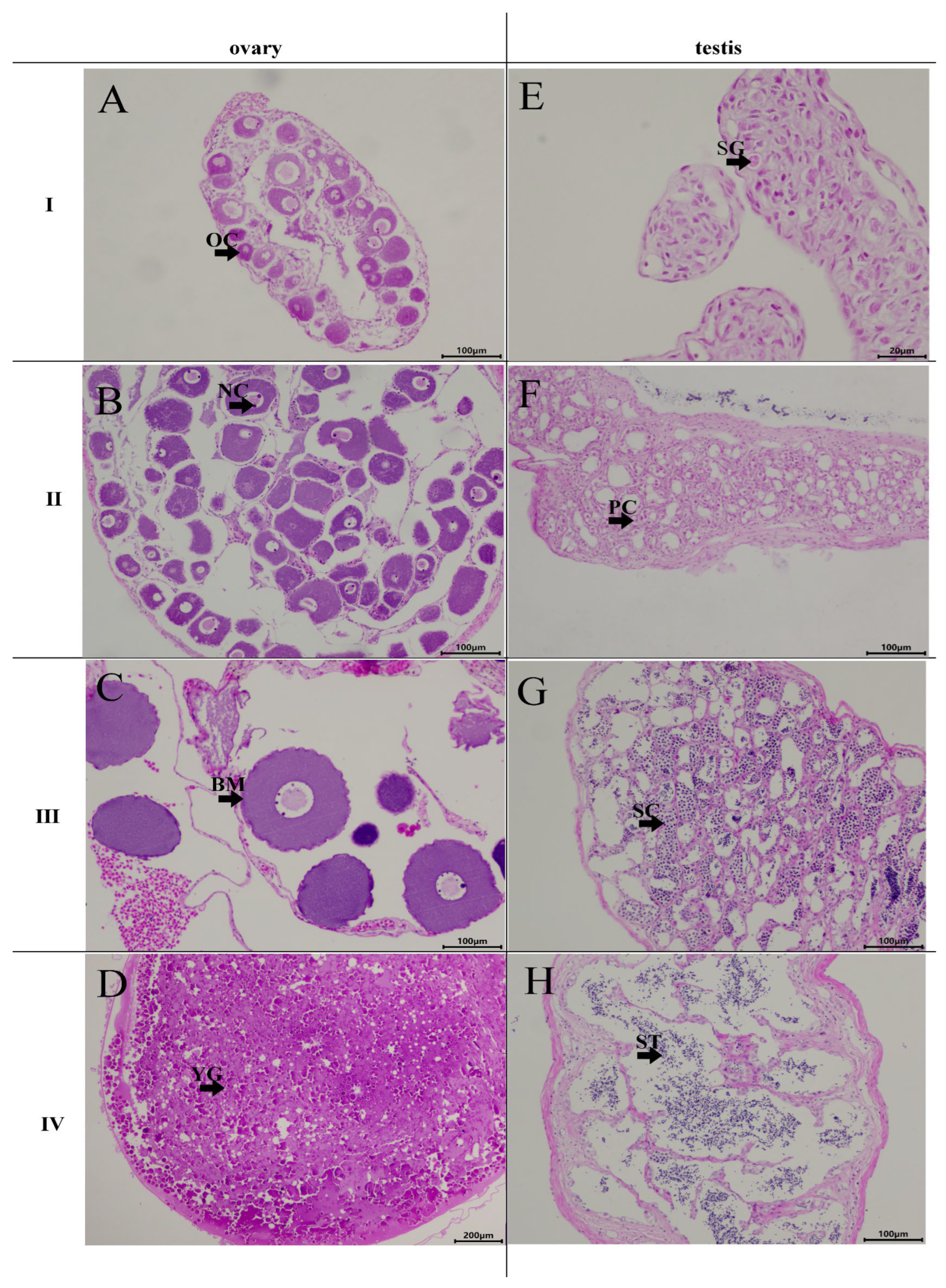
Histological analysis of H. guttatus gonadal tissues (Figure 1) demonstrated progressive developmental stages [22]. The criteria for the developmental staging of fish testes and ovaries presented in this section are based on the perspectives outlined in the study by Liu et al. [13].
In Stage I ovaries, stage I oocytes were the most abundant germ cell type. These oocytes, which exhibited an irregular morphology and possessed one to two nucleoli, numerically dominated the germ cell population [5]. Stage II oocytes adopted a spherical shape, developed a single layer of follicular cells, and exhibited multiple nucleoli within the nucleus (Figure 1B, arrow showing the nucleolus). Stage III oocytes showed further volume expansion, reduced basophilic cytoplasm, nucleoli aligned along the nuclear membrane, and a dual-layer follicular membrane (Figure 1C, arrow showing the follicular bilayer membrane). Stage IV oocytes showed a significant increase in size compared to Stage III oocytes, and yolk granules (Figure 1D, arrow showing the yolk granules) occupying the entire cytoplasm.
In Stage I testes, spermatogonia were the most numerous. They displayed distinct cell membranes, deeply stained nuclei (Figure 1E, arrow showing the spermatogonia), and an overall eosinophilic (red) appearance after HE staining [23]. Stage II testes contained both spermatogonia and spermatocytes, the latter being smaller with basophilic (bluish-purple) staining, indicating transitional meiosis, and spermatocytes are in the primary developmental stage (Figure 1F, arrow showing the primary spermatocytes). Stage III testes were dominated by densely packed spermatocytes, accompanied by thinned interstitial tissue and emerging luminal spaces, and Spermatocytes are in the secondary developmental stage (Figure 1G, arrow showing the secondary spermatocytes). Stage IV testes exhibited expanded lobular cavities filled with spermatid (Figure 1H, arrow showing the spermatid).

3.2. Transcriptome Sequencing Results

Transcriptomic sequencing was conducted on six gonadal samples (three ovaries and three testes) from H. guttatus, as summarized in Table 3. A total of 303,192,896 raw reads were generated across all libraries, of which 298,585,578 clean reads were retained after filtering (valid data ratio: 98.4%). The clean reads exhibited high sequencing quality, with average Q20 and Q30 values of 98.48% and 95.43%, respectively, and an average GC content of 48.67%, meeting the thresholds for high-throughput sequencing quality (Q20 > 95%, Q30 > 85%) [24]. These results indicate robust sequencing performance suitable for downstream transcriptomic analysis. Following alignment to the reference genome, ovarian samples yielded an average of 48,530,511 valid mapped reads, while testicular samples yielded 50,998,015 on average.

3.3. Transcriptomic Divergence Between Male and Female Gonads

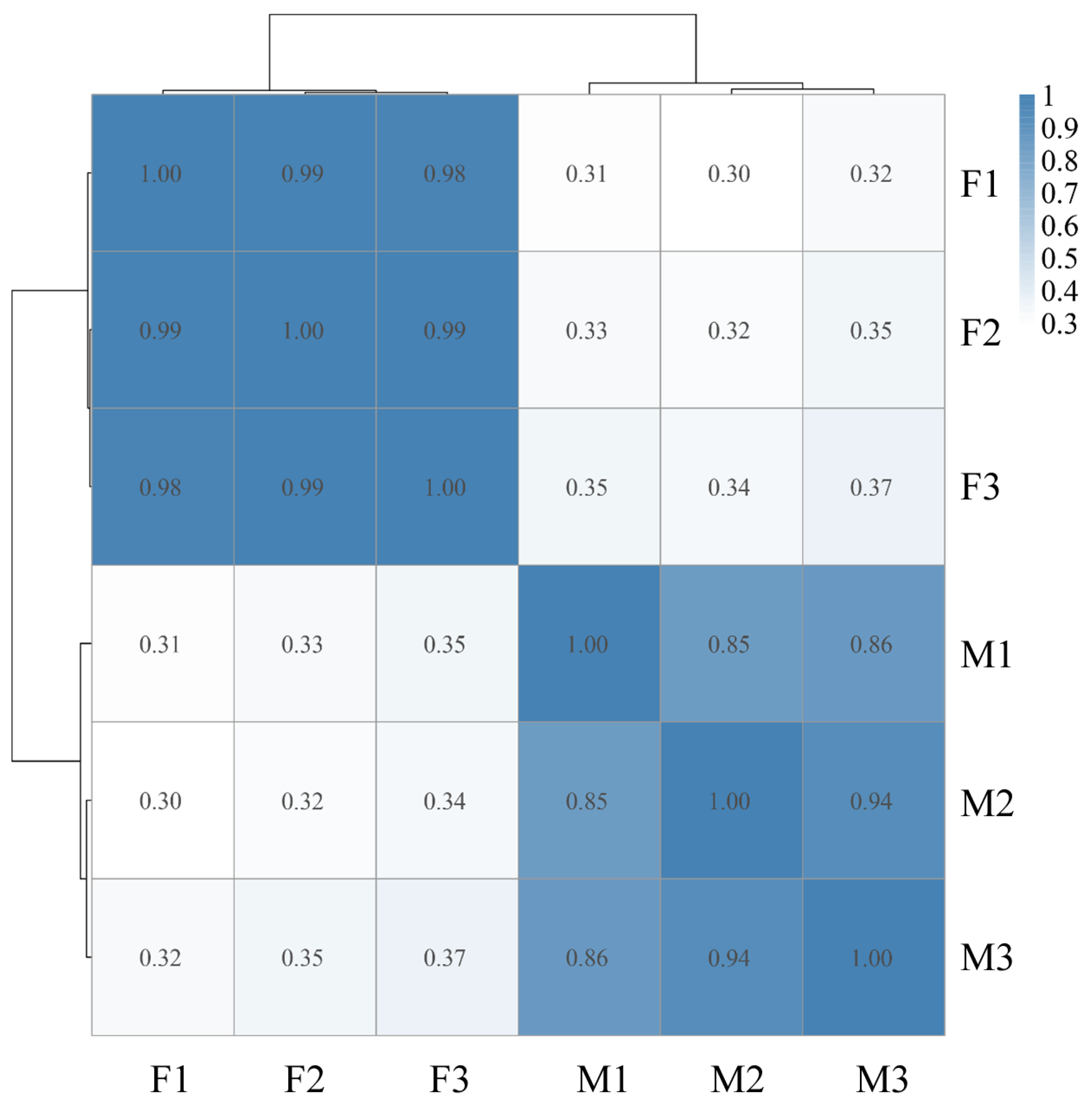
Figure 2 presents a correlation heatmap of H. guttatus gonadal transcriptomes, with correlation coefficients ranging from 0.30 to 1.00 indicating the degree of similarity among samples (higher values denote greater similarity, where 1.00 represents identical replicates). The gonadal samples were categorized into female and male groups, and a correlation analysis was subsequently performed. Intra-group correlations consistently exceeded 0.8 [25], demonstrating high homogeneity within male and female groups, while inter-group correlations remained below 0.40, suggesting substantial transcriptomic divergence between the sexes.
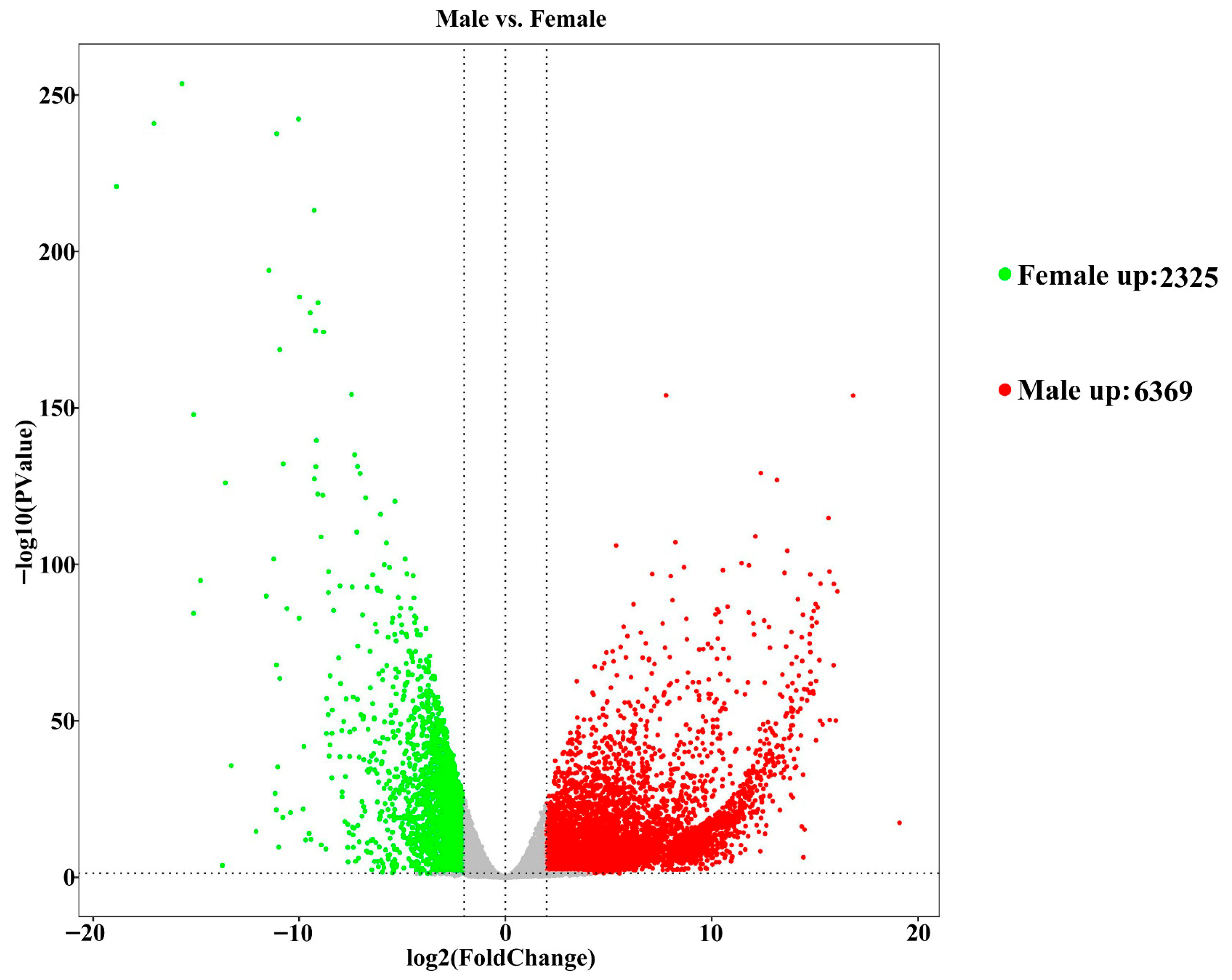
Comparative analysis of male and female gonadal transcriptomes (Figure 3) identified 8694 DEGs. Among them, 6369 genes (73.3%) were significantly up-regulated in testes, while 2325 genes (26.7%) were up-regulated in ovaries. These results reveal pronounced transcriptional divergence between the two sexes, reflecting distinct regulatory landscapes underlying gonadal function.

3.4. GO and KEGG Enrichment Analysis

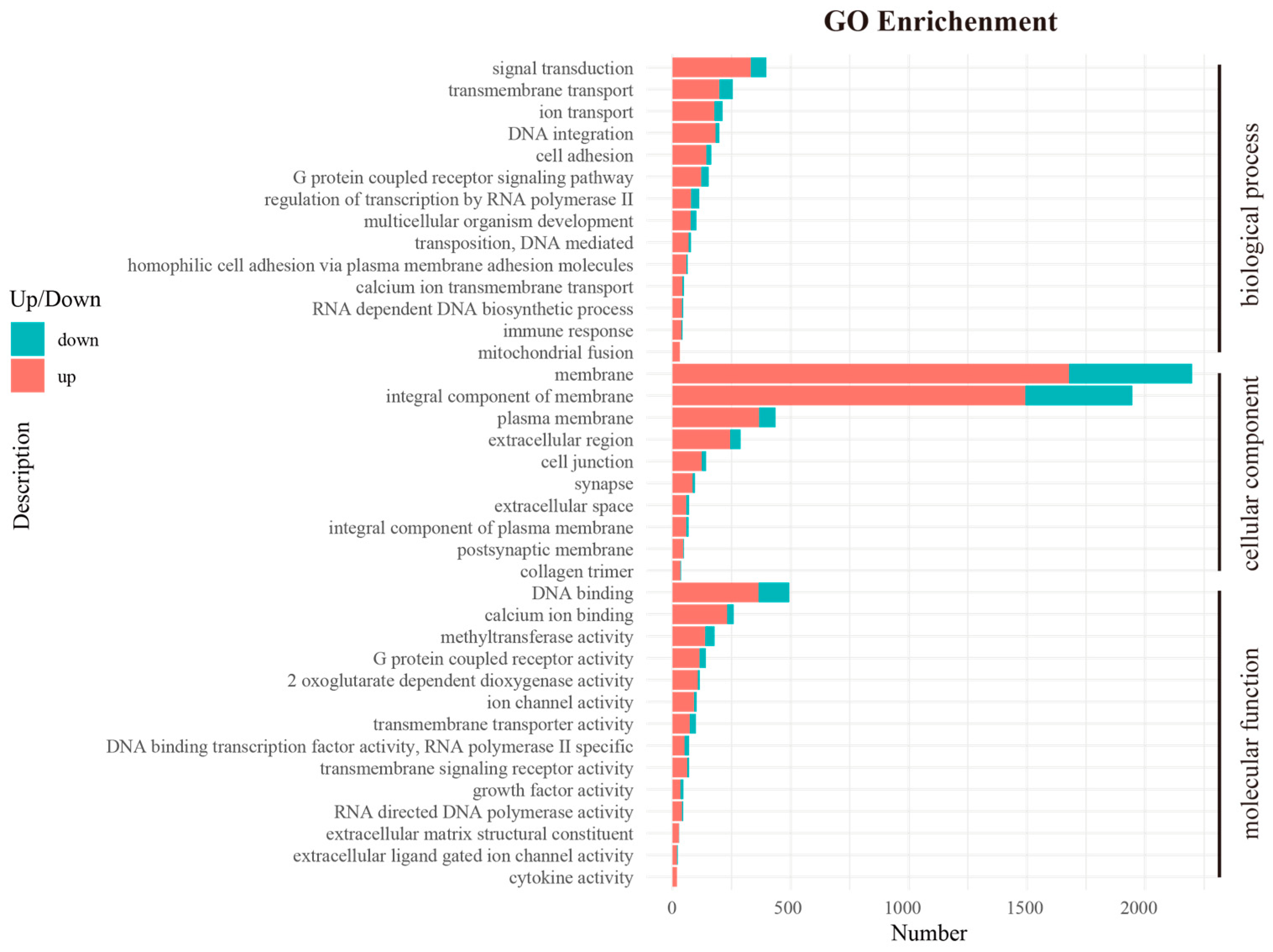
GO enrichment analysis of DEGs (Figure 4) assigned 8694 DEGs to three primary ontological domains: molecular function, cellular component, and biological process. In the molecular function category (14 enriched terms), the most significantly represented annotations included DNA binding, calcium ion binding, and methyltransferase activity. In the cellular component category (10 terms), DEGs were primarily associated with membrane, integral component of membrane, and plasma membrane; for biological process (14 terms), dominant pathways included signal transduction, transmembrane transport, and ion transport. Notably, membrane, integral component of membrane, and DNA binding were among the most significantly enriched terms across all three GO categories, highlighting their central roles in gonadal function and sex-related transcriptomic differentiation.
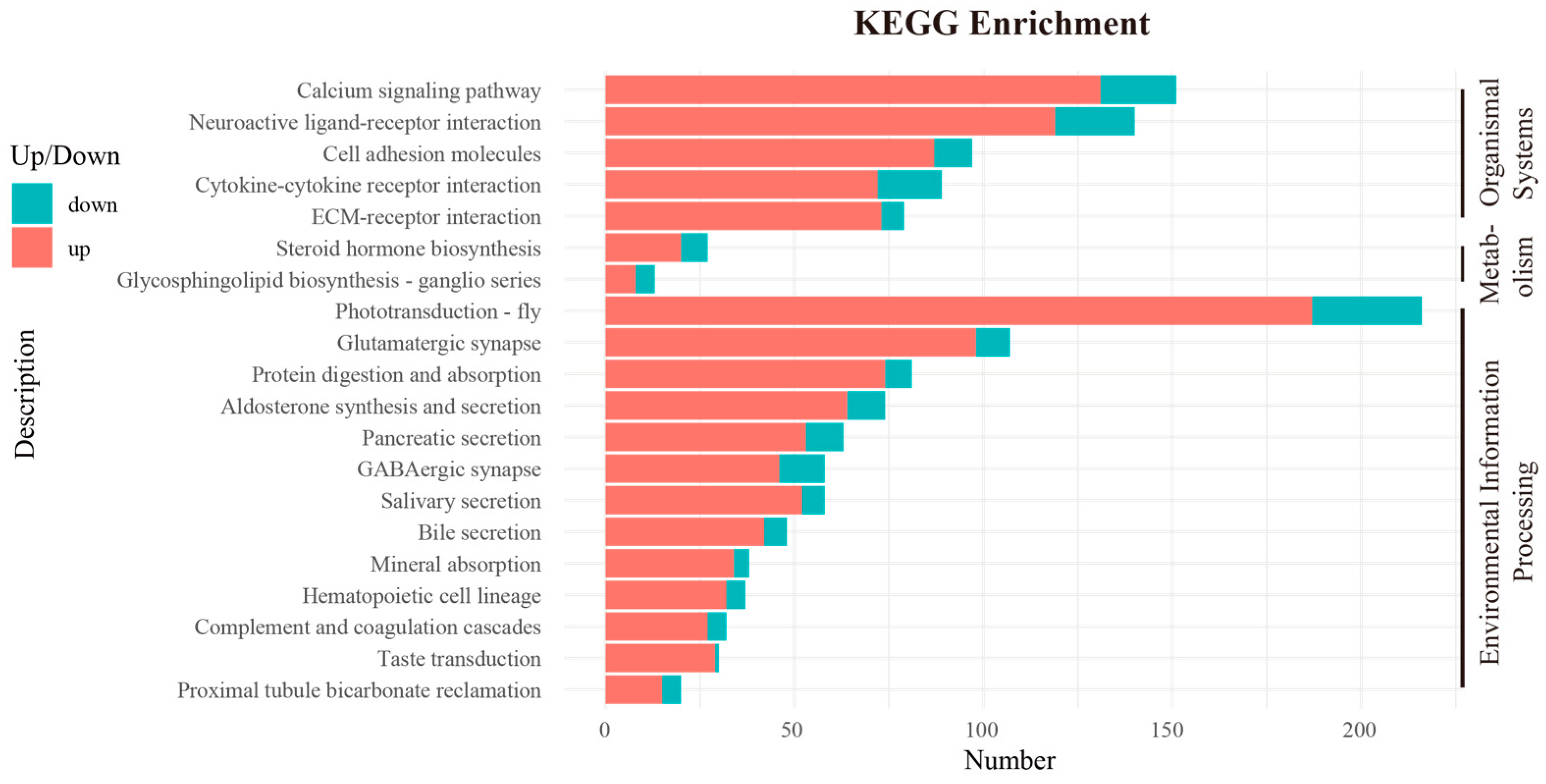
KEGG pathway enrichment analysis revealed that all DEGs were mapped to 293 pathways spanning five major functional categories (Figure 5). Notably, 20 pathways under the categories of Environmental Information Processing, Metabolism, and Organismal Systems exhibited significant differential enrichment between testes and ovaries. Among these, the phototransduction–fly (251 DEGs), calcium signaling (151 DEGs), and neuroactive ligand-receptor interaction (140 DEGs) pathways showed the highest enrichment levels, suggesting their pivotal roles in regulating gonadal dimorphism.

3.5. Screening of Sex-Related Differentially Expressed Genes

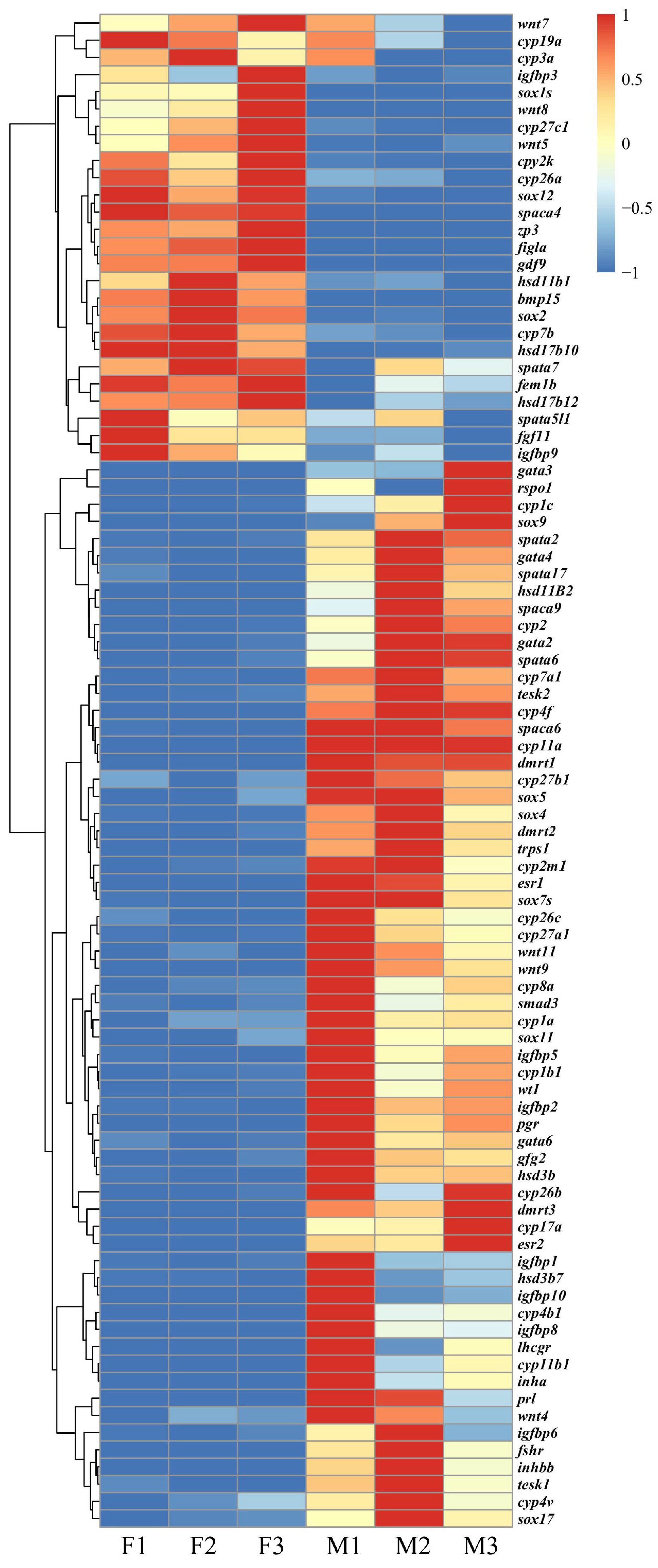
Integrated GO and KEGG enrichment analyses identified a total of 88 sex-related DEGs (Figure 6). Among them, 62 genes were highly expressed in testes, including SPATA family members associated with spermatogenesis- (spata2, spata6, spata17), SOX family genes (sox4, sox5, sox7, sox9, sox11, sox17), and DMRT family genes (dmrt1, dmrt2, dmrt3). Conversely, 26 genes showed higher expression levels in ovaries, encompassing WNT family genes (wnt5, wnt7, wnt8) involved in embryonic development and cell migration, as well as CYP family genes (cyp19a, cyp3a, cyp27cl, cyp26a) implicated in steroid hormone biosynthesis. The complete list of DEGs is provided in Supplementary Table S2.

3.6. PPI Network Analysis of Sex-Related DEGs

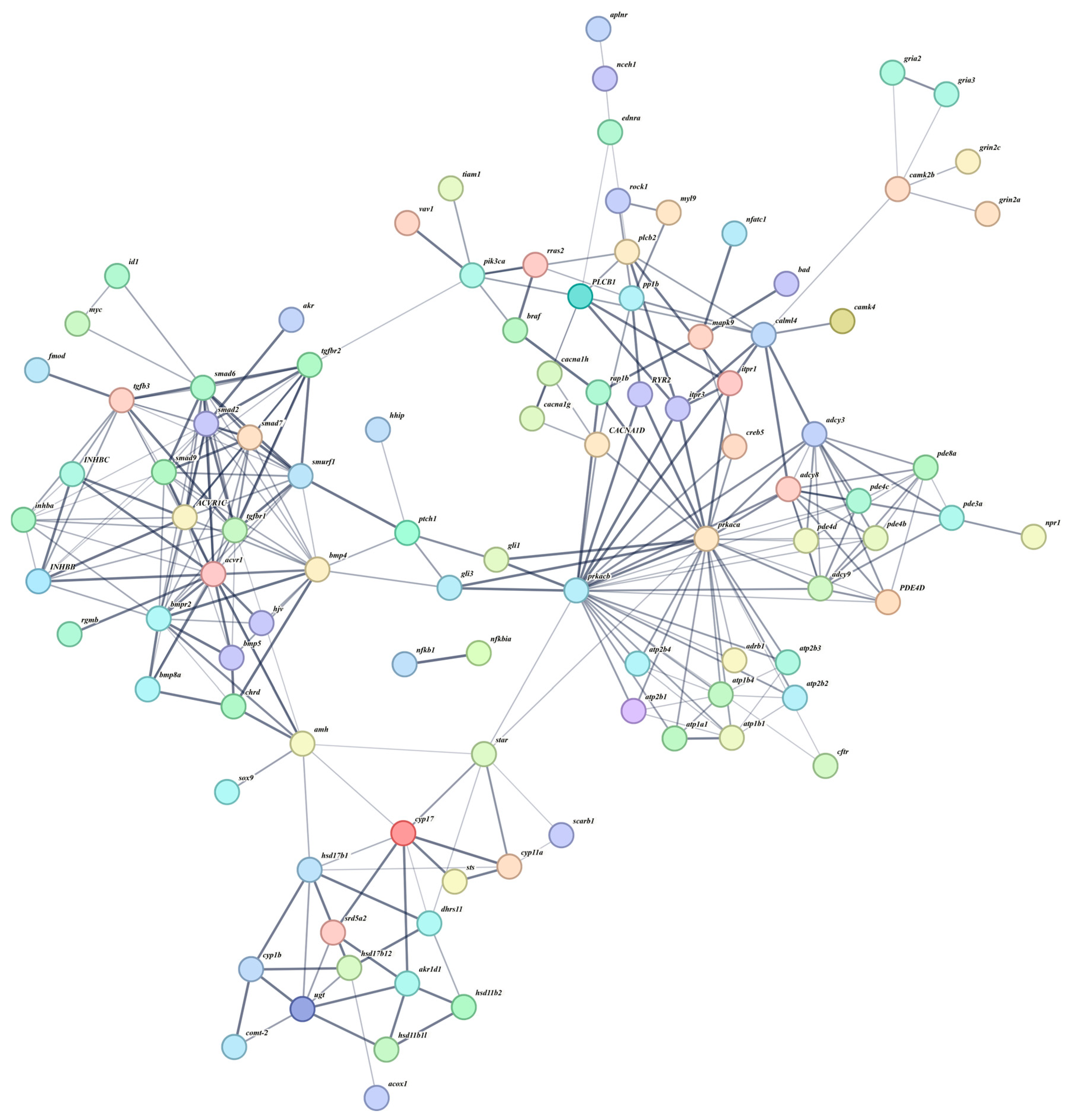
A protein–protein interaction (PPI) network was constructed based on the 88 sex-associated DEGs (Figure 7), resulting in 100 nodes and 570 interactions edges. Among these, 273 interactions exhibited high confidence (interaction scores > 0.7) [26]. The PPI network analysis identified several computationally predicted interactions, including nfkb1–nfkbia, smad7–smurf1, and smad6–smurf1. In addition, multiple sex-related gene pairs (e.g., cyp11a–cyp17, amh–acvr1, and hsd17b1–hsd17b12) showed high predicted confidence scores (>0.9), suggesting potential functional associations that warrant further experimental validation in the context of sex differentiation in H. guttatus. Furthermore, prkaca was predicted to interact with a relatively large number of genes in the network, indicating a possible central role and suggesting that it may be an important component of gonadal signaling pathways in H. guttatus.

3.7. RT-qPCR Validation

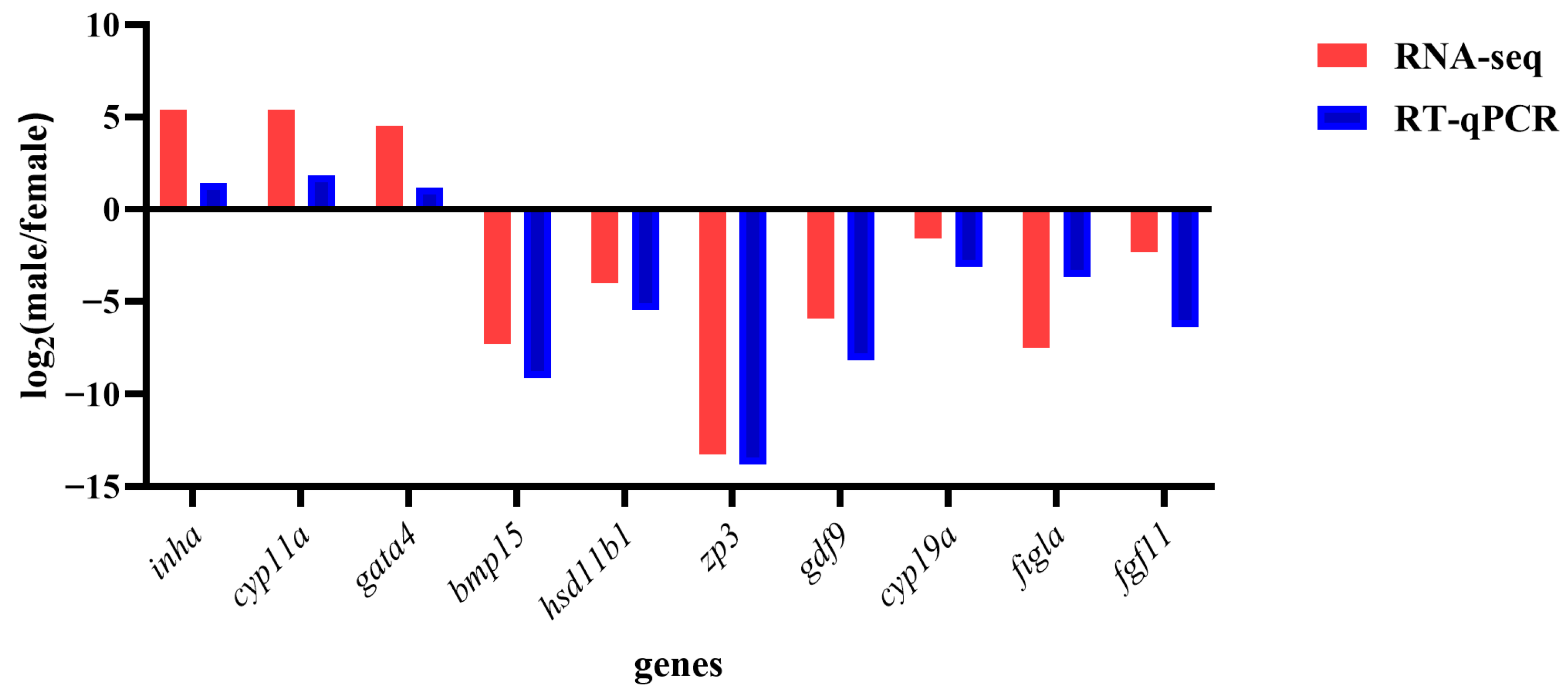
To validate the transcriptomic results, RT-qPCR was performed on ten selected sex-related genes (Figure 8). The expression patterns obtained from RT-qPCR were consistent with the transcriptomic data, with amh and insl3 showing significantly higher expression in testes, whereas hsd11b1 and zp3 were predominantly expressed in ovaries. All tested genes exhibited consistent expression trends, and this high level of concordance reinforces the accuracy of the RNA-seq dataset and supports the reliability of the identified DEGs.

4. Discussion

To gain insight into the molecular basis of sex differentiation in H. guttatus, we performed a transcriptomic comparison between testes and ovaries. The identified sex-biased DEGs and enriched signaling pathways provide a valuable framework for dissecting the regulatory networks underlying gonadal dimorphism. In the following sections, we discuss the key genes and pathways involved in sex differentiation in H. guttatus. The sample size in this transcriptomic analysis (n = 3 per sex) was constrained by the rarity of H. guttatus. While this limited sample size may reduce statistical power for detecting subtle expression differences, the major sex-biased expression patterns identified in this study are robust and provide a foundational transcriptomic resource for this species.

4.1. Sex-Related Genes Identified in H. guttatus

In this study, a total of 88 sex-biased genes were identified as potentially involved in sex differentiation and gonadal development in H. guttatus. Among them, several DMRT family genes (dmrt1, dmrt2, and dmrt3) showed significantly higher expression in the testes. Genes such as dmrt1, which play critical roles in testicular differentiation and development across fish species, exhibit conserved expression patterns in H. guttatus, aligning with observations in other teleost models [27]. DMRT family is characterized by a conserved DNA-binding DM domain critical for vertebrate sex differentiation [27]. dmrt1 is a master regulator of male sex determination, as highlighted by its Y-chromosome homolog dmrt1by (dmy) in Oryzias latipes, which governs male development [28], In Oreochromis niloticus, it is specifically expressed in testicular Sertoli and somatic cells, and its deficiency causes testicular degeneration and germ cell loss [29]. In C. semilaevis, dmrt1 knockout severely disrupts testicular development, and partial knockdown leads to sex reversal in genetic males [30]. dmrt2 participates in neurodevelopment, somitogenesis, myogenesis, and sex determination [26], and contributes to sex-regulatory networks alongside other sex-determination genes [31]. In Siniperca chuatsi, its expression may be influenced by exogenous hormones like 17α-methyltestosterone [32]. dmrt3 is predominantly expressed during early gonadal development in fish, with context-dependent patterns potentially related to sex-specific functions [31]. The DMRT gene family members (dmrt1, dmrt2, and dmrt3) exhibited significantly higher expression levels in the testes compared to ovaries of H. guttatus, suggesting their crucial involvement in testicular development and maintenance, as well as their potential role in male sex differentiation. Compared with H. guttatus, the dmrt gene family plays a broadly similar role in other bagrids [33,34]; the difference is that dmrt3 is highly expressed in the testis of H. guttatus, whereas its expression is higher in the ovary of Pelteobagrus fulvidraco [34]. This finding indicates that, within different bagrid species, the DMRT family may have undergone functional divergence: in addition to governing male development, some members also participate in the regulation of female gonadal development. Several SPATA genes (spata2, spata6, spata17) also exhibit testis-biased expression in H. guttatus. The SPATA gene family, widely recognized for its association with spermatogenesis in teleost fishes, consistently demonstrates testis-biased expression patterns across species [35], a finding corroborated by the present study in H. guttatus. spata2 regulates spermatogenesis via cellular proliferation and apoptosis [36], spata6 contributes to male germ cell development [37], and spata17 is involved in sperm cell proliferation, differentiation, and maturation [38]. Studies on the SPATA gene family in bagrids are scarce. In the available work, SPATA members were found to be highly expressed in the testis and weakly or not expressed in the ovary of both Hemibagrus wyckioides [39] and P. fulvidraco [34], a pattern that matches the expression trend observed for the SPATA family in H. guttatus. These findings collectively demonstrate that both DMRT and SPATA gene families may contribute to male reproductive development in H. guttatus.
The cytochrome P450 (CYP) gene family, comprising heme-containing monooxygenases, plays crucial roles in processes such as drug metabolism, cholesterol biosynthesis, and steroid hormone synthesis [40]. The CYP supergene family influences sex determination and differentiation in fish by catalyzing the biosynthesis of gonadal steroid hormones, with expression observed in both ovarian and testicular tissues [41]. In H. guttatus, two CYP family members cyp4f [42] and cyp11a [43] were found to be highly expressed in the testes. The cyp4f gene may indirectly affect sex differentiation in fish by modulating sex hormone precursor metabolism and responding to environmental changes, while cyp11a is a key regulator of testicular steroidogenesis, influencing sex determination, reversal, and gonadal development through genetic factors, environmental cues, and downstream gene networks [44]. Their testis-biased expression implies roles in testicular steroid metabolism and sperm maturation in H. guttatus.
However, cyp19a and cyp26a were significantly more highly expressed in the ovaries of H. guttatus than in the testes. As a key CYP family member, cyp19a encodes aromatase, which converts testosterone to estradiol and is essential for ovarian development, with its ovarian-biased expression pattern consistent with observations across diverse fish species [40]. Its strong expression in ovarian follicular cells, in contrast to low testicular levels, suggests a fundamental role in female gonadal differentiation and maintenance through estrogen biosynthesis [45]. In Danio rerio, knockout of cyp26a results in excessive retinoic acid (RA) accumulation, leading to premature meiotic entry in female germ cells and disrupted ovarian development [46]. Based on this evidence, we propose that in H. guttatus, cyp19a likely promotes ovarian maturation by participating in the estrogen biosynthesis pathway, whereas cyp26a may be associated with germ cell development. Within bagrids, the expression of the CYP gene family is highly conserved: except for cyp4f, which is not a classic sex-biased gene, the remaining members—such as cyp11a and cyp19a—show identical expression trends in H. guttatus, H. wyckioides [39] and P. fulvidraco [34].
Additionally, SOX family genes, including sox2, were highly expressed in the ovaries in H. guttatus. sox2 is known for its roles in embryonic development and pluripotency, and emerging evidence suggests it may also support ovarian development by suppressing male pathway genes [47]. Given that sox2 is not a canonical sex-determination switch in teleosts, we hypothesize that it may participate in H. guttatus sex regulation through collaborative interactions with other sex-related genes. In addition, bmp15 was also highly expressed in the ovaries. In other bagrids [34,39,48], several SOX-family genes—such as Sox11 and Sox3—have been detected as highly expressed, and most of them serve as testis-specific core regulators; these same genes were not found to be highly expressed in the testis of H. guttatus, suggesting that the SOX family exhibits a certain degree of functional divergence within bagrids. As a member of the TGF-β superfamily, bmp15 plays a key role in reproduction across species, particularly in oocyte maturation and follicular development [49]. In D. rerio, mutations in bmp15 reduce estrogen production, causing fertile sex reversal in genetic females [50]. Additionally, bmp15 interacts with cyp19a1a, as its mutations significantly lower cyp19a1a expression in granulosa cells, disrupting estrogen synthesis and sex differentiation [51]. The high expression of bmp15 in the ovary observed in H. guttatus is consistent with its conserved role across species, suggesting it may help maintain ovarian function and female sex by regulating genes involved in estrogen production and folliculogenesis. Furthermore, multiple genes within the HSD11B superfamily were identified as highly expressed in H. guttatus ovaries, consistent with observations in other fish species, such as D. rerio [37] and Oncorhynchus mykiss [52]. These genes are typically involved in catalyzing oxidation-reduction reactions of steroid hormones, suggesting their conserved role in ovarian steroidogenesis. hsd11b1 affects sex determination primarily by regulating the hypothalamic-pituitary-gonadal (HPG) axis [37]. It encodes 11β-hydroxysteroid dehydrogenase type 1, a key enzyme in glucocorticoid metabolism [53]. hsd17b10 exhibits sexually dimorphic expression during key gonadal developmental stages. In D. rerio [54], it shows higher ovarian expression during ovarian development compared to testicular development, suggesting its potential role in promoting ovarian maturation via steroidogenesis regulation [55]. Meanwhile, hsd17b12 catalyzes the conversion of testosterone to estradiol in ovarian tissues, playing a key role in female reproductive regulation [56]. The high expression observed for hsd11b1, hsd17b10, and hsd17b12 in H. guttatus ovary suggests their collective role in maintaining female gonadal function and supporting ovarian development through regulated steroid hormone biosynthesis.

4.2. Signaling Pathways Related to Gender Regulation

KEGG enrichment analysis of sex-related differentially expressed genes in H. guttatus revealed key signaling pathways involved in gonadal regulation, primarily including steroid hormone biosynthesis, TGF-β signaling, calcium signaling, cortisol synthesis and secretion, cAMP signaling, and insulin secretion pathways.
The steroid hormone biosynthesis pathway is critically involved in sex determination and differentiation across teleost species, primarily by regulating the estrogen/androgen balance to direct and maintain gonadal development trajectories [57]. In this study, several pathway-associated genes (e.g., cyp19a, cyp11a, hsd17b10) showed sexually dimorphic expression in H. guttatus, suggesting roles in regulating steroid production and metabolism, thus influencing sex differentiation and gonadal development in this species. KEGG enrichment analysis additionally identified the TGF-β signaling pathway, a highly conserved pathway in teleost fishes, as being significantly enriched. Within this pathway, multiple genes play key roles in sex differentiation. The anti-Müllerian hormone (amh), a TGF-β superfamily member, is central to vertebrate sex determination and gonadal development. In fish such as O. niloticus, amh expression increases during sexual differentiation and is positively correlated with male gonadal development, while its knockout results in female development [58]. Additionally, other TGF-β pathway components like gdf6 [59] and gdf9 [60] participate in regulating somatic cell differentiation and development in gonads. In this study, amh and gdf9 showed testis- and ovary-biased expression, respectively, in H. guttatus, indicating specialized roles in mediating gonadal cell proliferation, differentiation, and hormonal regulation via the TGF-β pathway during sexual development.
Calcium ions (Ca2+) act as key secondary messengers regulating diverse cellular processes through multiple mechanisms [61]. Within the calcium signaling pathway, genes such as camk4, α7nachr, and pmca play key roles in environmental sex determination in certain fish. For example, in Oreochromis mossambicus, environmental factors such as temperature can disrupt intracellular Ca2+; homeostasis and alter sexual differentiation [61]. In this study, the differential expression of prkcb in H. guttatus gonads suggests calcium signaling may mediate gonadal cell differentiation via intracellular transduction, underscoring its conserved role in teleost sex differentiation. The cortisol signaling pathway, which is closely associated with sex differentiation [62], was also identified as significantly enriched in the KEGG analysis of H. guttatus. Cortisol, a key glucocorticoid, is synthesized from cholesterol via a multi-step enzymatic process. Initiated by cytochrome P450 enzymes (e.g., cyp11a1) cleaving cholesterol to pregnenolone, the pathway proceeds through conversions by 3β-hydroxysteroid dehydrogenase (3β-HSD) and other steroidogenic enzymes such as cyp11b1 to ultimately produce cortisol [63]. In P. fulvidraco, elevated cortisol during critical sex differentiation windows suppresses ovarian development and promotes testicular differentiation. These findings suggest cortisol mediates gonadal differentiation by modulating key sex-determination genes like foxl2, dmrt1, and cyp19a [63], revealing complex endocrine interactions in teleost sexual development. Meanwhile, the cAMP signaling pathway regulates both synthesis/secretion of sex hormones and is itself modulated by these hormones, collectively contributing to sexual differentiation in fish [40]. In O. niloticus, gonadotropins upregulate ovarian cyp19a1a via cAMP signaling to promote female development [40]. Mascoli et al. [64] found that in dicentrarchus labrax and O. latipes, amh, by binding to its receptor amhr2, activates PKA, thereby upregulating steroidogenic enzyme expression and increasing androgen production—a process demonstrated to be crucial in early testis development. In this study, the pathway effector pka showed testis-biased expression in H. guttatus, suggesting a role in male sex differentiation through PKA-mediated phosphorylation that may integrate crosstalk with pathways such as Wnt and TGF-β, forming an interconnected regulatory network in gonadal differentiation. While the role of insulin secretion signaling in fish sex differentiation remains poorly characterized, our findings suggest its potential significance in H. guttatus, supported by emerging evidence from recent studies in other teleost species. For instance, in Epinephelus coioides, insl3 overexpression promotes germ cell proliferation and upregulates male-specific genes, driving testicular development [65]. In the current study, insl3 was identified as a putative regulator of male determination in H. guttatus, indicating that the insulin secretion pathway may significantly influence gonadal fate in this species.

5. Conclusions

Histological observation reveals that ovarian development in H. guttatus (Stages I–IV) progressed from small oocytes with large nuclei (I), to spherical, mono-follicular forms with multiple nucleoli (II), then to larger cells with reduced basophilia, peripheral nucleoli and a double follicular layer (III), and finally to yolk-filled oocytes lacking nucleoli (IV). Testicular development advanced from spermatogonia-only tissue (I), to the presence of primary spermatocytes (II), then to dense secondary spermatocytes with initial lumens (III), and finally to lobules packed with spermatid (IV).
In addition, this study identified 8694 differentially expressed genes (DEGs) through transcriptomic analysis of H. guttatus gonads, with 6369 genes showing testis-biased expression and 2325 exhibiting ovary-biased expression. Key candidate genes associated with testicular development included amh, insl3, and spata2, while cyp19a, bmp15, and hsd17b12 emerged as crucial for ovarian development. KEGG enrichment analysis revealed that the TGF-β signaling pathway, insulin secretion pathway, and steroid hormone biosynthesis pathway likely play pivotal roles in sex differentiation and gonadal development in H. guttatus. These findings establish a critical foundation for future functional studies of sex-related genes in this species.
The discussion in this study is based on transcriptome sequencing results; therefore, we acknowledge certain limitations in the current analytical approach. While we identified differentially expressed genes and signaling pathways potentially related to sex differentiation in H. guttatus, further functional validation is needed to substantiate these findings. To better investigate the roles of these candidate genes and pathways, we plan to incorporate functional assays such as gene silencing (e.g., RNA interference) in future experimental studies to verify their involvement in sexual differentiation. Additionally, although paraffin sectioning was performed for histological observation of gonads at different developmental stages, sample scarcity limited comparative analysis across stages. We also intend to introduce quantitative analyses of germ cell dynamics and gonadal microstructure in subsequent research to better characterize developmental differences between sexes and stages. These approaches are expected to help clarify the mechanisms underlying sexual differences in H. guttatus. For a full list of abbreviations used in this study, please refer to Supplementary Table S1.

Supplementary Materials

The following supporting information can be downloaded at: https://www.mdpi.com/article/10.3390/fishes11010043/s1, Table S1—Abbreviations; Table S2—Different express genes.

Author Contributions

Conceptualization, X.M. and J.S.; methodology, K.Z. and Y.W.; software, Y.W.; validation, K.Z., C.L. and Y.W.; formal analysis, K.Z. and Y.W.; investigation, K.Z. and S.Z.; resources, Y.W.; data curation, K.Z.; writing—original draft preparation, K.Z.; writing—review and editing, K.Z., Y.W., Y.Y., Y.L., C.L., S.Z., J.S. and X.M.; visualization, K.Z. and Y.W.; supervision, Y.L.; project administration, X.M. and Y.Y.; funding acquisition, X.M. All authors have read and agreed to the published version of the manuscript.

Funding

This research was funded by the Research Project of Modern Agricultural Industrial Park Institute of Nanhai District, Foshan City (Grant No. JF2024(NH)WS0019), National Freshwater Fisheries Germplasm Resources Center (Grant No. FGRC18537), the Innovation Team Construction Project of Modern Agricultural Industry Technology System of Guangdong Province (Grant No. 2024CXTD26) and the Rural Revitalization Strategy Special Provincial Organization and Implementation Project Funds (2023SBH00001).

Institutional Review Board Statement

This study was conducted in accordance with ethical guidelines and received approval from the Laboratory Animal Ethics Committee of the Pearl River Fisheries Research Institute (code: LAEC-PRFRI-2025-01-02; date: 2 January 2025).

Data Availability Statement

The data presented in this study are openly available in NCBI, accession numbers SRR35832001; SRR35832000; SRR35831999; SRR35831998; SRR35831997; SRR35831996.

Conflicts of Interest

The authors declare no conflicts of interest.

References

  1. Tan, D.; Liu, Q.; Xu, H.; Wei, X.; He, N.; Wei, X.; He, X.; Tan, D. Study on artificial propagation technique of Hemibagrus guttatus. Hubei Agric. Sci. 2020, 59, 127–130. [Google Scholar] [CrossRef]
  2. Zhou, L.; Yang, X.; Li, Z.Y.; Li, D.Y.; Liu, Y.F.; Guan, M. Analysis of nutritional components in muscle of Mystus guttatus. Reserv. Fish. 2006, 36–37. [Google Scholar] [CrossRef]
  3. Yang, L.; He, S. Phylogeography of the freshwater catfish Hemibagrus guttatus (Siluriformes, Bagridae): Implications for South China biogeography and influence of sea-level changes. Mol. Phylogenet. Evol. 2008, 49, 393–398. [Google Scholar] [CrossRef]
  4. Chen, J.W.; Wang, S.G.; Meng, Q.M.; Mo, X.Y.; Ma, L. Artificial propagation technology of Mystus guttatus in Southwest China. North. Chin. Fish. 2024, 43, 236–239. [Google Scholar]
  5. Xie, S.; Fang, W.; Chen, J.; Wang, C.; Zou, J. Gonadal Development and Histological Observation of Cultured Mystus guttatus. J. Dalian Ocean Univ. 2014, 29, 147–150. [Google Scholar]
  6. Yang, Y.; Liu, Y.; Chen, F.; Wang, Y.; Wu, Y.; He, Z.; Liu, C.; Jiang, Z.; Mu, X.; Bian, C. Gap-free chromosome-level genomes of male and female spotted longbarbel catfish Hemibagrus guttatus. Sci. Data 2024, 11, 572. [Google Scholar] [CrossRef] [PubMed]
  7. Ji, L.; Li, X. Transcriptome sequencing (RNA-seq) technology and its applications. Agric. Sci. Serv. 2015, 32, 171–172. [Google Scholar]
  8. Hayashida, T.; Soma, S.; Nakamura, Y.; Higuchi, K.; Kazeto, Y.; Gen, K. Transcriptome characterization of gonadal sex differentiation in Pacific bluefin tuna, Thunnus orientalis (Temminck et Schlegel). Sci. Rep. 2023, 13, 13867. [Google Scholar] [CrossRef]
  9. Tang, Y.J.; Ji, H.F.; Wang, H.; Li, Y. Commparative transcriptome analysis of female and male gonads of Portunus trituberculatus. Oceanol. Limnol. Sin. 2019, 50, 197–203. [Google Scholar]
  10. Domingos, J.A.; Budd, A.M.; Banh, Q.Q.; Goldsbury, J.A.; Zenger, K.R.; Jerry, D.R. Sex-specific dmrt1 and cyp19a1 methylation and alternative splicing in gonads of the protandrous hermaphrodite barramundi. PLoS ONE 2018, 13, e0204182. [Google Scholar] [CrossRef]
  11. Webster, K.A.; Ponte, B.; Vasquez-Gross, H.; Petereit, J.; Hutchinson, J.; Riddle, M.R. Differential expression of sex regulatory genes in gonads of Astyanax mexicanus surface fish and cavefish. BMC Ecol. Evol. 2025, 25, 57. [Google Scholar] [CrossRef]
  12. He, F.; Jiang, D.; Huang, Y.; Mustapha, U.F.; Yang, W.; Cui, X.; Tian, C.; Chen, H.; Shi, H.; Deng, S.; et al. Comparative transcriptome analysis of male and female gonads reveals sex-biased genes in spotted scat (Scatophagus argus). Fish Physiol. Biochem. 2019, 45, 1963–1980. [Google Scholar] [CrossRef]
  13. Liu, Y. Reproductive Physiology of Cultured Fishes in China; China Agriculture Press: Beijing, China, 1993; pp. 22–40. [Google Scholar]
  14. Wu, D.; Chen, S.Q.; Ke, L.; Zang, Z.; Zhu, J.; Pan, L.; Li, F.; Xu, R.; Peng, L.; Bian, L.; et al. Comparative analysis of the male and female gonadal transcriptome of Thamnaconus septentrionali. Prog. Fish. Sci. 2024, 45, 53–64. [Google Scholar] [CrossRef]
  15. Chen, S.; Zhou, Y.; Chen, Y.; Gu, J. fastp: An ultra-fast all-in-one FASTQ preprocessor. Bioinformatics 2018, 34, i884–i890. [Google Scholar] [CrossRef]
  16. Kopylova, E.; Noé, L.; Touzet, H. SortMeRNA: Fast and accurate filtering of ribosomal RNAs in metatranscriptomic data. Bioinformatics 2012, 28, 3211–3217. [Google Scholar] [CrossRef] [PubMed]
  17. Dobin, A.; Davis, C.A.; Schlesinger, F.; Drenkow, J.; Zaleski, C.; Jha, S.; Batut, P.; Chaisson, M.; Gingeras, T.R. STAR: Ultrafast universal RNA-seq aligner. Bioinformatics 2013, 29, 15–21. [Google Scholar] [CrossRef] [PubMed]
  18. Danecek, P.; Bonfield, J.K.; Liddle, J.; Marshall, J.; Ohan, V.; Pollard, M.O.; Whitwham, A.; Keane, T.; McCarthy, S.A.; Davies, R.M.; et al. Twelve years of SAMtools and BCFtools. GigaScience 2021, 10, giab008. [Google Scholar] [CrossRef]
  19. Patro, R.; Duggal, G.; Love, M.I.; Irizarry, R.A.; Kingsford, C. Salmon provides fast and bias-aware quantification of transcript expression. Nat. Methods 2017, 14, 417–419. [Google Scholar] [CrossRef]
  20. Robinson, M.D.; McCarthy, D.J.; Smyth, G.K. edgeR: A Bioconductor package for differential expression analysis of digital gene expression data. Bioinformatics 2010, 26, 139–140. [Google Scholar] [CrossRef]
  21. Wu, T.; Hu, E.; Xu, S.; Chen, M.; Guo, P.; Dai, Z.; Feng, T.; Zhou, L.; Tang, W.; Zhan, L.I.; et al. clusterProfiler 4.0: A universal enrichment tool for interpreting omics data. Innovation 2021, 2, 100141. [Google Scholar] [CrossRef]
  22. Liu, Y.; Zhao, T.; Hu, Y.; Luo, J.; Mou, X. Histological study on gonadal development of Tilapia buttikoferi. J. Jiangxi Agric. Univ. 2019, 41, 340–346. [Google Scholar] [CrossRef]
  23. Yang, S.; Wang, Y.Z.; Zheng, N.; Wang, L.Z.; Yu, K. Structure of Testis and Spermatozoa of Mystus guttatus. Chin. J. Fish. 2025, 38, 43–50. [Google Scholar]
  24. Illumina NGS Platforms. Sequencing Platforms. Available online: https://www.illumina.com/systems/sequencing-platforms.html (accessed on 20 December 2024).
  25. Cohen, J. Statistical Power Analysis for the Behavioral Sciences, 2nd ed.; Routledge: New York, NY, USA, 1988; p. 567. [Google Scholar]
  26. Bozhilova, L.V.; Whitmore, A.V.; Wray, J.; Reinert, G.; Deane, C.M. Measuring rank robustness in scored protein interaction networks. BMC Bioinform. 2019, 20, 446. [Google Scholar] [CrossRef]
  27. Dong, J.; Li, J.; Hu, J.; Sun, C.; Tian, Y.; Li, W.; Yan, N.; Sun, C.; Sheng, X.; Yang, S.; et al. Comparative Genomics Studies on the dmrt Gene Family in Fish. Front. Genet. 2020, 11, 563947. [Google Scholar] [CrossRef]
  28. Veith, A.M.; Froschauer, A.; Körting, C.; Nanda, I.; Hanel, R.; Schmid, M.; Schartl, M.; Volff, J.N. Cloning of the dmrt1 gene of Xiphophorus maculatus: dmY/dmr1Y is not the master sex-detertnining gene in the platyfish. Gene 2003, 317, 59–66. [Google Scholar] [CrossRef] [PubMed]
  29. Qi, S.; Dai, S.; Zhou, X.; Wei, X.; Chen, P.; He, Y.; Kocher, T.D.; Wang, D.; Li, M. Dmrt1 is the only male pathway gene tested indispensable for sex determination and functional testis development in Tilapia. PLoS Genet. 2024, 20, e1011210. [Google Scholar] [CrossRef]
  30. Zarkower, D.; Murphy, M.W. DMRT1: An Ancient Sexual Regulator Required for Human Gonadogenesis. Sex. Dev. 2021, 16, 112–125. [Google Scholar] [CrossRef] [PubMed]
  31. Wang, Q.; Cao, T.; Wang, Y.; Li, X.; Wang, Y. Genome-wide identification and comparative analysis of Dmrt genes in echinoderms. Sci. Rep. 2023, 13, 7664. [Google Scholar] [CrossRef] [PubMed]
  32. Han, C.; Wang, C.; Ouyang, H.; Zhu, Q.; Huang, J.; Han, L.; Li, S.; Li, G.; Lin, H.; Zhang, Y. Characterization of dmrts and their potential role in gonadal development of mandarin fish (Siniperca chuatsi). Aquac. Rep. 2021, 21, 100802. [Google Scholar] [CrossRef]
  33. Liang, H.; Cao, L.; Li, Z.; Zou, G.; Liu, X. Mitochondrial genome sequence of the shining catfish (Pelteobagrus nitidus). Mitochondrial DNA 2012, 23, 280–282. [Google Scholar] [CrossRef]
  34. Xu, H.; Lin, W.; Ma, X.; Jawad, M.; Wu, M.; Qiu, J.; Li, M. A timecourse analysis of gonadal histology and transcriptome during the sexual development of yellow catfish, Pelteobagrus fulvidraco. Comp. Biochem. Phys. D 2025, 56, 101576. [Google Scholar] [CrossRef]
  35. Henri, V.K.; Guernsey, M.W.; Baker, J.C.; Kloet, S.L.; Groenen, M.A.M.; Pollux, B.J.A.; Hendrik-Jan, M. The Genomes of the Livebearing Fish Species Poeciliopsis retropinna and Poeciliopsis turrubarensis Reflect Their Different Reproductive Strategies. Mol. Biol. Evol. 2020, 37, 1376–1386. [Google Scholar] [CrossRef]
  36. Maurizio, O.; Liliana, S.M.; Romina, G.; Lorenza, Z.; Alessandro, N.; Maurizio, M.; Enrico, M.; Carlo, F. Evidence for FSH-Dependent Upregulation of SPATA2 (Spermatogenesis-Associated Protein 2). Biochem. Biophys. Res. Commun. 2001, 283, 86–92. [Google Scholar] [CrossRef] [PubMed]
  37. Sandeep, T.C.; Yau, J.L.W.; Maclullich, A.M.J.; Noble, J.; Deary, I.J.; Walker, B.R.; Seckl, J.R. 11β-Hydroxysteroid dehydrogenase inhibition improves cognitive function in healthy elderly men and type 2 diabetics. Proc. Natl. Acad. Sci. USA 2004, 101, 6734–6739. [Google Scholar] [CrossRef]
  38. Nie, D.S.; Liu, Y.; Juan, H.; Yang, X. Overexpression of human SPATA17 protein induces germ cell apoptosis in transgenic male mice. Mol. Biol. Rep. 2012, 40, 1905–1910. [Google Scholar] [CrossRef]
  39. Wei, W.; Gong, Y.; Guo, X.; Liu, M.; Zhou, Y.; Li, Z.; Zhou, L.; Wang, Z.; Gui, J. Gonadal transcriptomes reveal sex-biased expression genes associated with sex determination and differentiation in red-tail catfish (Hemibagrus wyckioides). BMC Genom. 2023, 24, 183. [Google Scholar] [CrossRef] [PubMed]
  40. Ma, X.; Liu, Q.; Wang, L.; Wu, L.; Liu, H.; Li, X. Research progress on the role of cyp19a1 gene in fish sex differentiation and development. J. Henan Norm. Univ. (Nat. Sci. Ed.) 2019, 47, 7. [Google Scholar]
  41. Lanying, Y.; Xuefeng, Z.; Shujun, L.; Chenhua, Z.; Yiyang, M.; Li, J.; Deshou, W.; Linyan, Z. Cyp17a1 is Required for Female Sex Determination and Male Fertility by Regulating Sex Steroid Biosynthesis in Fish. Endocrinology 2021, 162, bqab205. [Google Scholar] [CrossRef]
  42. Wang, Y.; Liang, Q.; Xu, L.; Xiong, J.; Gao, K.; Xu, P.; Huang, W. Cuproptosis-related IncRNAs ovarian cancer: Multi-omics analysis of molecular mechanisms and potential therapeutic targets. Environ. Toxicol. 2024, 39, 1650–1665. [Google Scholar] [CrossRef]
  43. Li, N.; Oakes, J.A.; Storbeck, K.H.; Cunliffe, V.T.; Krone, N.P. The P450 side-chain cleavage enzyme Cyp11a2 facilitates steroidogenesis in zebrafish. J. Endocrinol. 2020, 244, 309–321. [Google Scholar] [CrossRef] [PubMed]
  44. Liang, D.; Fan, Z.; Zou, Y.; Tan, X.; Wu, Z.; Jiao, S.; Li, J.; Zhang, P.; You, F. Characteristics of Cyp11a during Gonad Differentiation of the Olive Flounder Paralichthys olivaceus. Int. J. Mol. Sci. 2018, 19, 2641. [Google Scholar] [CrossRef]
  45. Fan, Z.; Zou, Y.; Jiao, S.; Tan, X.; Wu, Z.; Liang, D.; Zhang, P.; You, F. Significant association of cyp19a promoter methylation with environmental factors and gonadal differentiation in olive flounder Paralichthys olivaceus. Comp. Biochem. Physiol. Part A Mol. Integr. Physiol. 2017, 208, 70–79. [Google Scholar] [CrossRef] [PubMed]
  46. Albalat, R.; Ca Estro, C. Identification of Aldh1a, Cyp26 and RAR orthologs in protostomes pushes back the retinoic acid genetic machinery in evolutionary time to the bilaterian ancestor. Chem.-Biol. Interact. 2009, 178, 188–196. [Google Scholar] [CrossRef] [PubMed]
  47. Collignon, J.; Sockanathan, S.; Hacker, A.; Cohen-Tannoudji, M.; Norris, D.; Rastan, S.; Stevanovic, M.; Goodfellow, P.N.; Lovell-Badge, R. A comparison of the properties of Sox-3 with Sry and two related genes, Sox-1 and Sox-2. Development 1996, 122, 509–520. [Google Scholar] [CrossRef] [PubMed]
  48. Zhu, C.; Liu, H.; Pan, Z.; Cheng, L.; Sun, Y.; Wang, H.; Chang, G.; Wu, N.; Ding, H.; Zhao, H.; et al. Insights into chromosomal evolution and sex determination of Pseudobagrus ussuriensis (Bagridae, Siluriformes) based on a chromosome-level genome. DNA Res. 2022, 29, dsac028. [Google Scholar] [CrossRef] [PubMed]
  49. Shukla, V.; Dhiman, N.; Nayak, P.; Dahanukar, N.; Deshpande, G.; Ratnaparkhi, G. Stonewall and Brickwall: Two Partially Redundant Determinants Required for the Maintenance of Female Germline in Drosophila. G3 2018, 8, 2027–2041. [Google Scholar] [CrossRef]
  50. Zhai, Y.; Zhang, X.; Zhao, C.; Geng, R.; Wu, K.; Yuan, M.; Ai, N.; Ge, W. Rescue of bmp15 deficiency in zebrafish by mutation of inha reveals mechanisms of BMP15 regulation of folliculogenesis. PLoS Genet. 2023, 19, e1010954. [Google Scholar] [CrossRef]
  51. Long, J.; Zheng, S.; Wang, X.; Zhang, S.; Wang, D. Role of the TGF-β signaling pathway in sex determination and differentiation of fish. J. Fish. China 2020, 44, 12. [Google Scholar]
  52. Makoto, K.; Ikumi, N.; Graham, Y. 11β-Hydroxysteroid Dehydrogenase Complementary Deoxyribonucleic Acid in Rainbow Trout: Cloning, Sites of Expression, and Seasonal Changes in Gonads. Endocrinology 2003, 144, 2534–2545. [Google Scholar] [CrossRef]
  53. Huang, P.; Li, Y.; Xu, C.; Melino, G.; Shao, C.; Shi, Y. HSD11B1 is upregulated synergistically by IFNγ and TNFα and mediates TSG-6 expression in human UC-MSCs. Cell Death Discov. 2020, 6, 24. [Google Scholar] [CrossRef]
  54. Lin, X.; Xie, X.Y.; Ou, Y.J.; Li, J. Effects of dissolved oxygen on gill tissue of juvenile Eleutheronema tetradactylum based on transcriptome sequencing. J. South. Agric. 2024, 55, 660–669. [Google Scholar]
  55. Liu, L.; Chen, S.; Yu, M.; Ge, C.; Luo, J. Deacetylation of HSD17B10 by SIRT3 regulates cell growth and cell resistance under oxidative and starvation stresses. Cell Death Dis. 2020, 11, 563. [Google Scholar] [CrossRef]
  56. Heidi, K.; Marion, A.; Jenni, M.; Pauliina, D.; Damdimopoulos, A.E.; Juha, K.; Outi, H.; Laajala, T.D.; Tero, A.; Jerzy, A. The Hydroxysteroid (17β) Dehydrogenase Family Gene HSD17B12 Is Involved in the Prostaglandin Synthesis Pathway, the Ovarian Function, and Regulation of Fertility. Endocrinology 2016, 157, 3719–3730. [Google Scholar] [CrossRef]
  57. Shu, T. Mechanisms by Which Sex Steroid Hormones Regulate Sex Differentiation and Gonadal Development in Cyprinid Fish Based on cyp17a1 Knockout. Ph.D. Thesis, University of Chinese Academy of Sciences, Beijing, China, 2023. [Google Scholar]
  58. Pan, Q.; Kay, T.; Depincé, A.; Adolfi, M.; Schartl, M.; Guiguen, Y.; Herpin, A. Evolution of master sex determiners: TGF-β signalling pathways at regulatory crossroads. Philos. Trans. R. Soc. B Biol. Sci. 2021, 376, 20200091. [Google Scholar] [CrossRef] [PubMed]
  59. Richter, A.; Mörl, H.; Thielemann, M.; Kleemann, M.; Geißen, R.; Schwarz, R.; Albertz, C.; Koch, P.; Petzold, A.; Kroll, T.; et al. The master male sex determinant Gdf6Y of the turquoise killifish arose through allelic neofunctionalization. Nat. Commun. 2025, 16, 540. [Google Scholar] [CrossRef]
  60. Cui, F.; Wang, Y.; Liang, H.; Yang, Y.; Jiang, Z.; Song, J.; Liu, C.; Wu, Y.; Mu, X.; Liu, Y. Comparative Transcriptomic Analysis of Male and Female Gonads in the Zig-Zag Eel (Mastacembelus armatus). Fishes 2025, 10, 117. [Google Scholar] [CrossRef]
  61. He, Z.; Ye, L.; Yang, D.; Ma, Z.; Deng, F.; He, Z.; Hu, J.; Chen, H.; Zheng, L.; Pu, Y.; et al. Identification, characterization and functional analysis of gonadal long noncoding RNAs in a protogynous hermaphroditic teleost fish, the ricefield eel (Monopterus albus). BMC Genom. 2022, 23, 450. [Google Scholar] [CrossRef]
  62. Goikoetxea, A.; Todd, E.V.; Gemmell, N.J. Stress and sex: Does cortisol mediate sex change in fish? Reproduction 2017, 154, R149–R160. [Google Scholar] [CrossRef]
  63. Qi, P.P.; Chen, M.; Yu, Y. Effects of high temperature and cortisol on sex differentiation of yellow catfish (Tachysurus fulvidraco). Acta Hydrobiol. Sin. 2021, 45, 106–117. [Google Scholar] [CrossRef]
  64. Mascoli, A.; Zapater, C.; Ibañez, S.; Adolfi, M.C.; Schartl, M.; Gómez, A. A Novel Steroidogenic Action of Anti-Müllerian Hormone in Teleosts: Evidence from the European Sea Bass Male (Dicentrarchus labrax). Int. J. Mol. Sci. 2025, 26, 7554. [Google Scholar] [CrossRef] [PubMed]
  65. Zhang, J.; Wang, J.; Zhang, W.; Lin, J.; Yang, J.; Peng, J.; Peng, S.; Li, S.; Zhang, Y.; Peng, C. Identification and functional analysis of insulin-like 3 during gonad development in the hermaphroditic orange-spotted grouper, Epinephelus coioides. Aquaculture 2024, 584, 740635. [Google Scholar] [CrossRef]
Figure 1. Histological observation of the gonads at different developmental stages in H. guttatus ((AD) correspond to the ovaries of H. guttatus stages I–IV; (EH) correspond to the testis of H. guttatus stages I–IV; OC. oocytes; SG. spermatogonia; NC. Nucleolus; PC. primary spermatocytes; BM. bilayer membrane; SC. secondary spermatocytes; YG. yolk granules; ST. spermatid).
Fishes 11 00043 g001
Figure 2. Correlation analysis of gonadal transcriptome samples from H. guttatus, illustrating intra-group and inter-group expression similarity. F represents female; M represents male. The numbers 1–3 represent different biological replicates within the same experimental group.
Fishes 11 00043 g002
Figure 3. Volcano plot of differentially expressed genes between male and female gonads of H. guttatus. The horizontal dashed line represents log10 (FDR = 0.05), and the vertical dashed line represents |log2 fold change| = 1. Grey dots represent unchanged genes.
Fishes 11 00043 g003
Figure 4. GO enrichment analysis of DEGs between male and female gonads of H. guttatus.
Fishes 11 00043 g004
Figure 5. KEGG enrichment analysis of DEGs between male and female gonads of the H. guttatus.
Fishes 11 00043 g005
Figure 6. Expression heatmap of sex-related DEGs in the gonads of the H. guttatus. F, represents female; M, represents male. The numbers 1–3 represent different biological replicates within the same experimental group.
Fishes 11 00043 g006
Figure 7. Protein–protein interaction (PPI) network of sex-related DEGs in H. guttatus.
Fishes 11 00043 g007
Figure 8. RT-qPCR validation of selected DEGs in male and female gonads of H. guttatus.
Fishes 11 00043 g008
Table 1. Sample specification table for experimental use.
PurposeSamplesGonadal Development Period
histological observationF7, F8, F9I
M7, M8, M9
F10, F11, F12II
M10, M11, M12
F13, F14, F15III
M13, M14, M15
F1, F2, F3IV
M1, M2, M3
RNA-seqF1, F2, F3IV
M1, M2, M3
RT-qPCRF4, F5, F6IV
M4, M5, M6
(F represents female; M represents male. The numbers 1–15 represent different biological replicates within the same experimental group).
Table 2. Primer sequences used for real-time fluorescence quantitative PCR.
GeneSequences from (5′-3′)
β-actinF:AGGTTCTATTTTGTGGGTTTTCGG
R:ATGCTTTCGCTTTCGTCCGTCTTG
inhaF:TCTGTGGACTTCTGGTTT
R:GCGTTTAGATGGTCTTTG
amhF:TAAACAACAGTGAAGGGGAAAATCGC
R:GATGAAAACTGGGAATAACGCACGCC
insl3F:AAGGGATTTGGGGAAAAGATGC
R:TTCAGATTGGAAAACAGATCAC
cyp11aF:TTTATGGCGAGCGTATTG
R:TGGTGTGTAGAAGCGGAG
gata4F:TGCCACACCACAACCACC
R:CGCGTCTGAATACCTTCC
hsd11b1F:GCTATGGAAAAAATCAAA
R:AGAAGGTGTACCAGGGGT
zp3F:AGTTCGTGTGCTTTTGGC
R:AGGATGTGCTGGCTTGTT
gdf9F:CGCCTTCAGACAAGCACA
R:ACATCCACCTCCACCCAC
figlaF:GACCGAAAGCCCAGTAAA
R:GCAATGTGAAAAAATCCT
fgf11F:GTCCACTCTGTATCGTCA
R:GCAGGGTTTGGTTTTCTT
Table 3. Transcriptome sequencing data of the gonads, testes and ovaries, in H. guttatus.
ItemF1F2F3M1M2M3
Raw DataReads55,788,20849,012,70043,174,88850,192,80043,958,01461,066,286
GC (%)50.0149.8949.847.2846.9548.18
Q20 (%)99.0298.4498.4298.1398.1298.14
Q30 (%)97.0495.3395.3194.5994.6294.61
Clean DataReads54,909,01248,190,01242,492,51049,522,19843,329,69060,142,156
GC (%)49.9849.8749.7747.2546.9148.15
Q20 (%)99.1898.6298.6298.3598.3798.38
Q30 (%)97.3395.6495.6594.9795.0595.04
Total reads54,909,01248,190,01242,492,51049,522,19843,329,69060,142,156
Total mapped reads53,034,20346,523,39840,955,53346,490,84840,140,99256,450,980
Reads mapped to exon51,999,38345,642,22140,117,98143,754,91238,205,33754,337,808
Percent of reads mapped to exon of genome94.70%94.71%94.41%88.35%88.17%90.35%
F represents female; M represents male. The numbers 1–3 represent different biological replicates within the same experimental group.
Disclaimer/Publisher’s Note: The statements, opinions and data contained in all publications are solely those of the individual author(s) and contributor(s) and not of MDPI and/or the editor(s). MDPI and/or the editor(s) disclaim responsibility for any injury to people or property resulting from any ideas, methods, instructions or products referred to in the content.