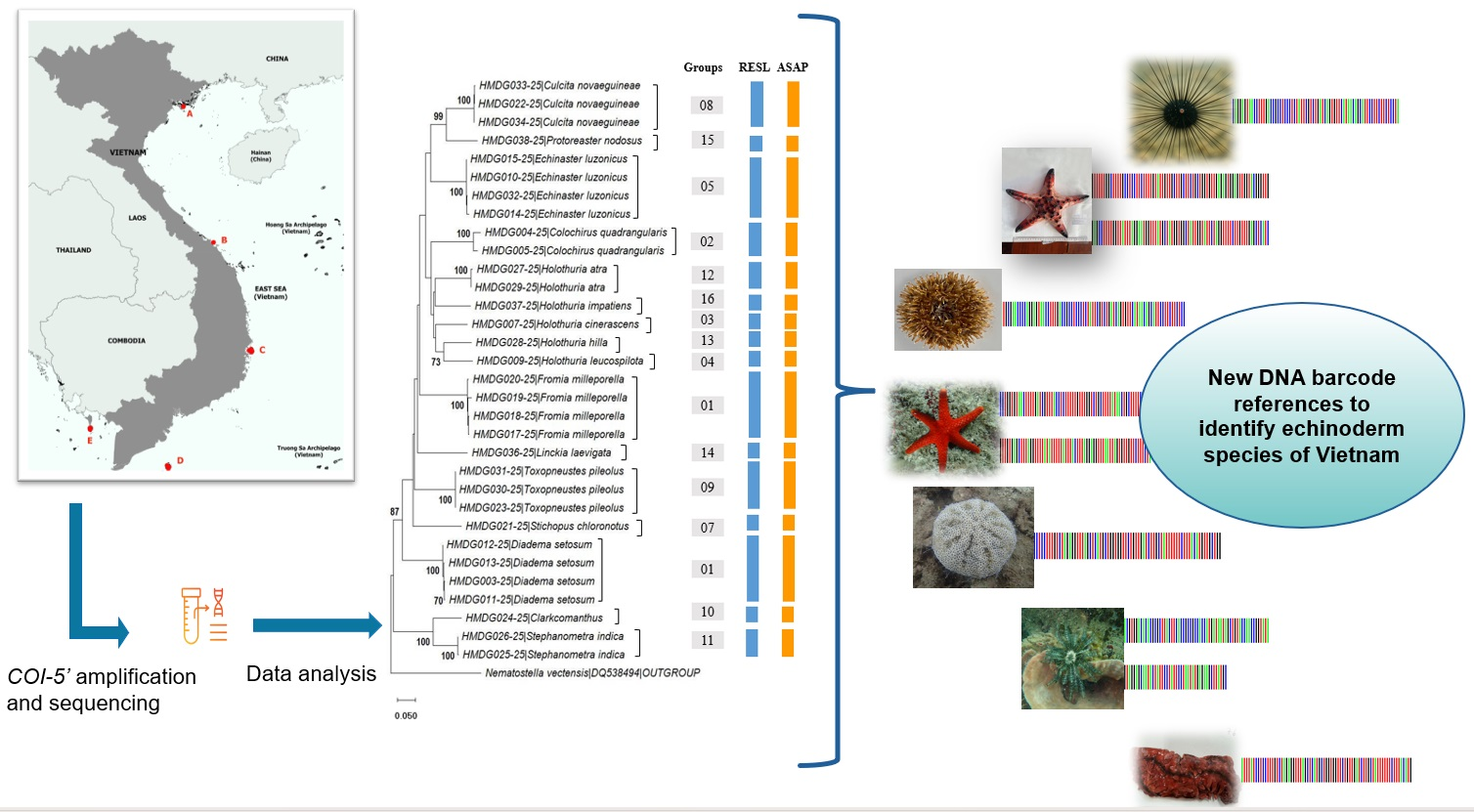

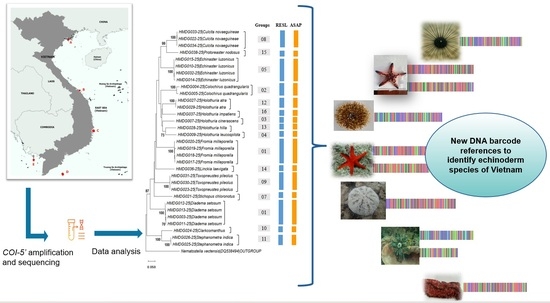
Integrative COI Barcoding and Species Delimitation in Echinodermata from Vietnam
 , , , , , , , , , and
Abstract
1. Introduction
2. Materials and Methods
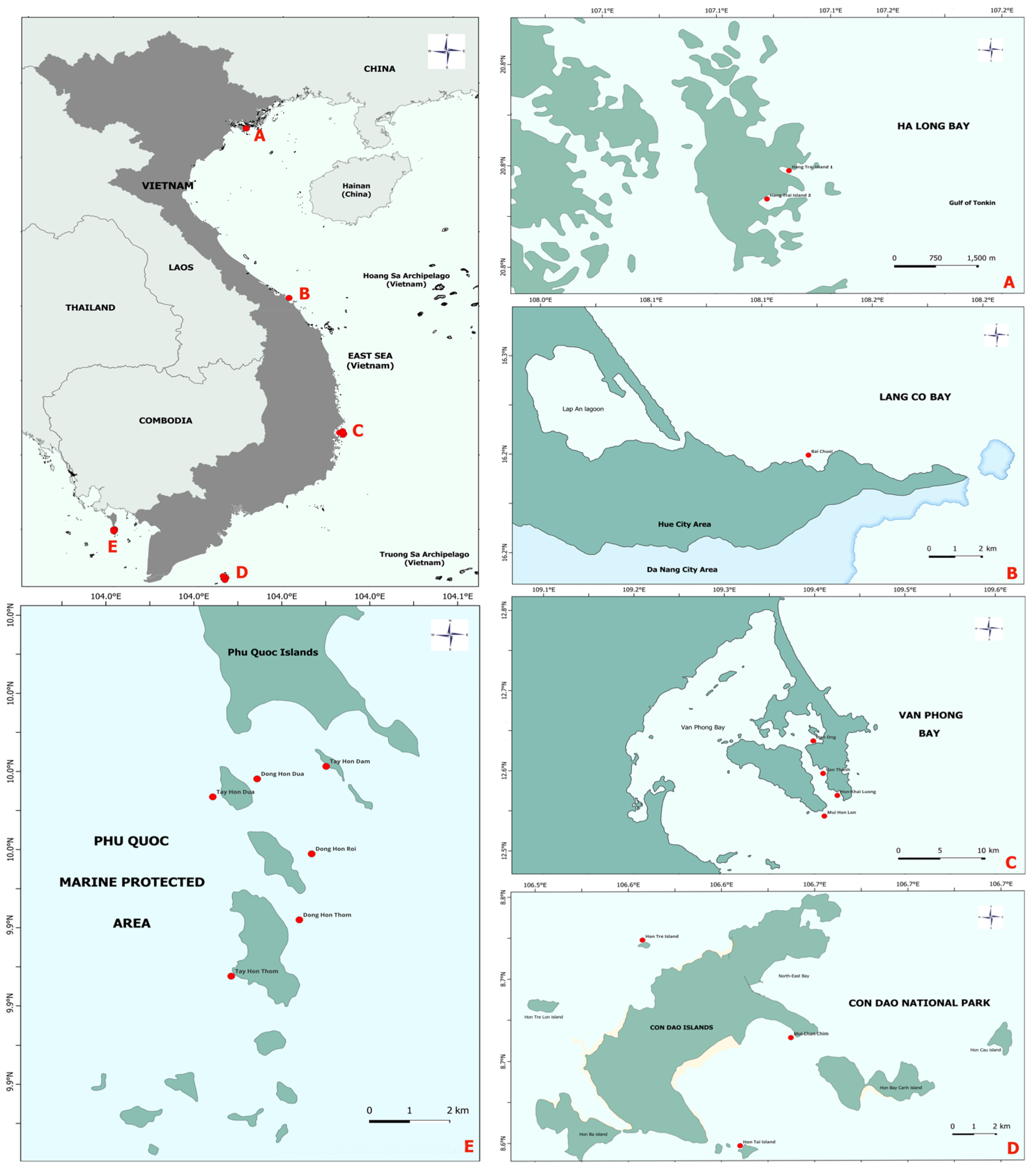
2.1. Sampling
2.2. DNA Extraction, COI Amplification, and Sequencing
2.3. Molecular Data Analysis
3. Results
3.1. Species Identification via Morphology and BLAST (GenBank and BOLD)
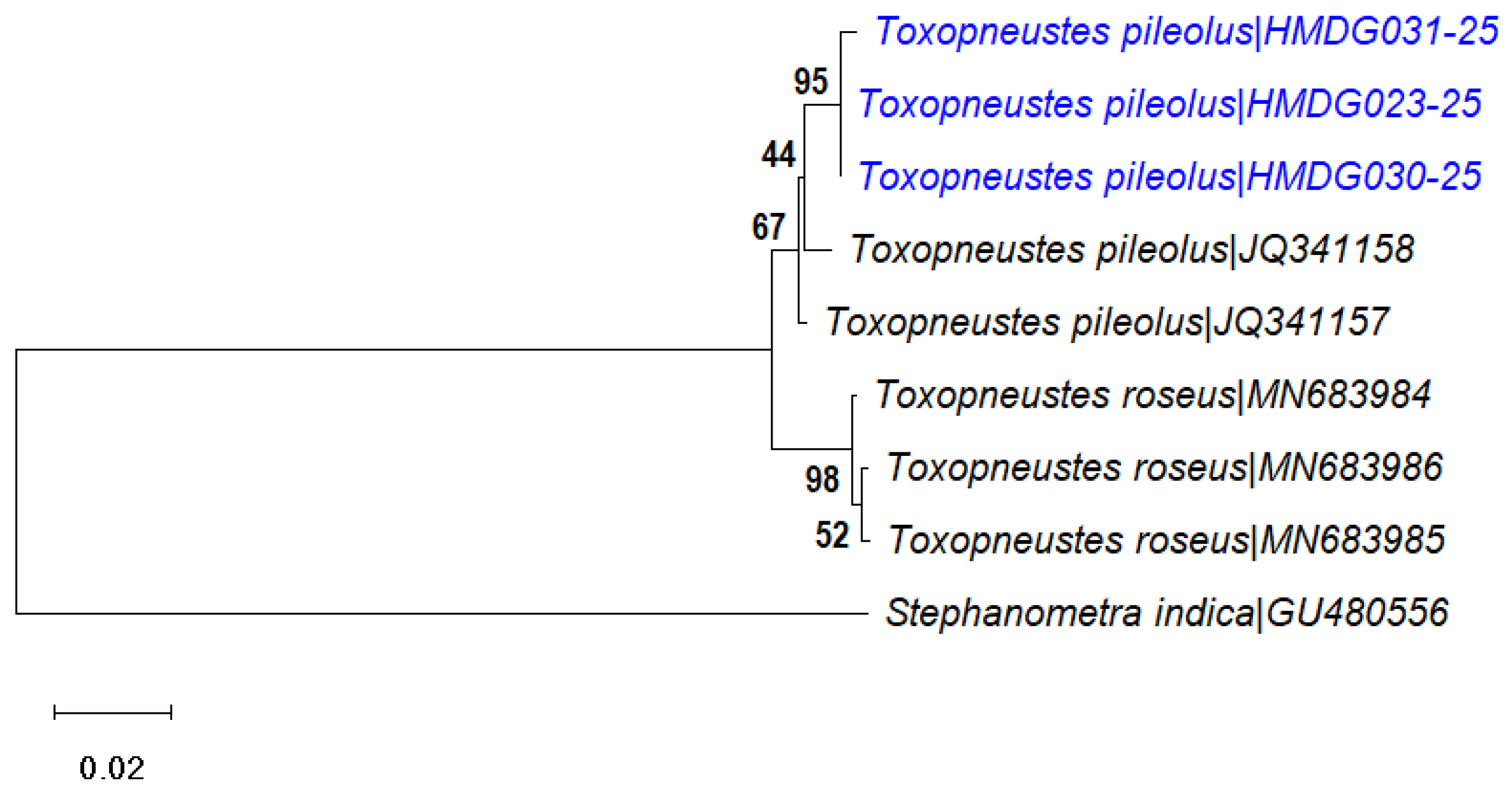
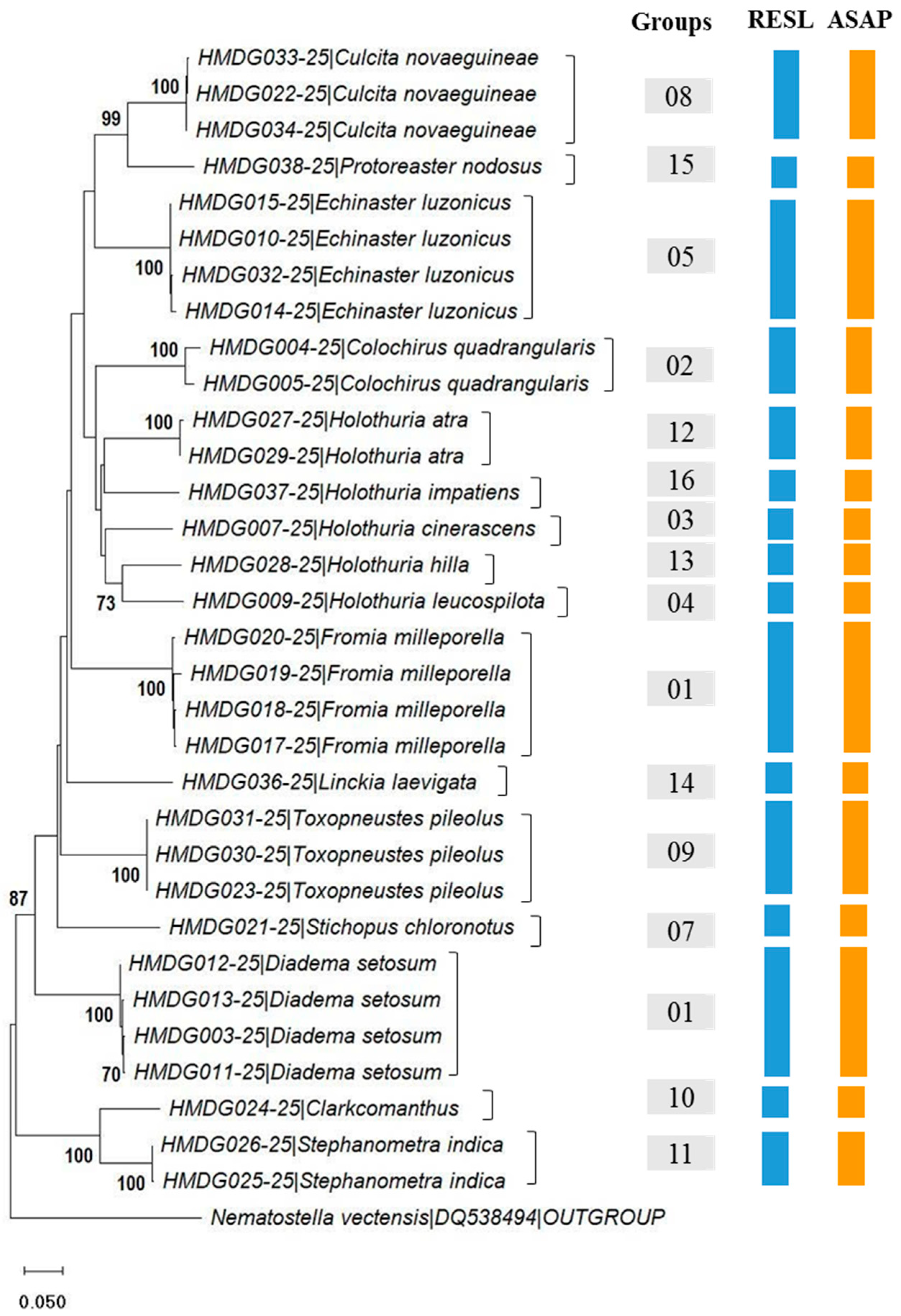
3.2. Monophyletic and Cluster Sequence Analysis
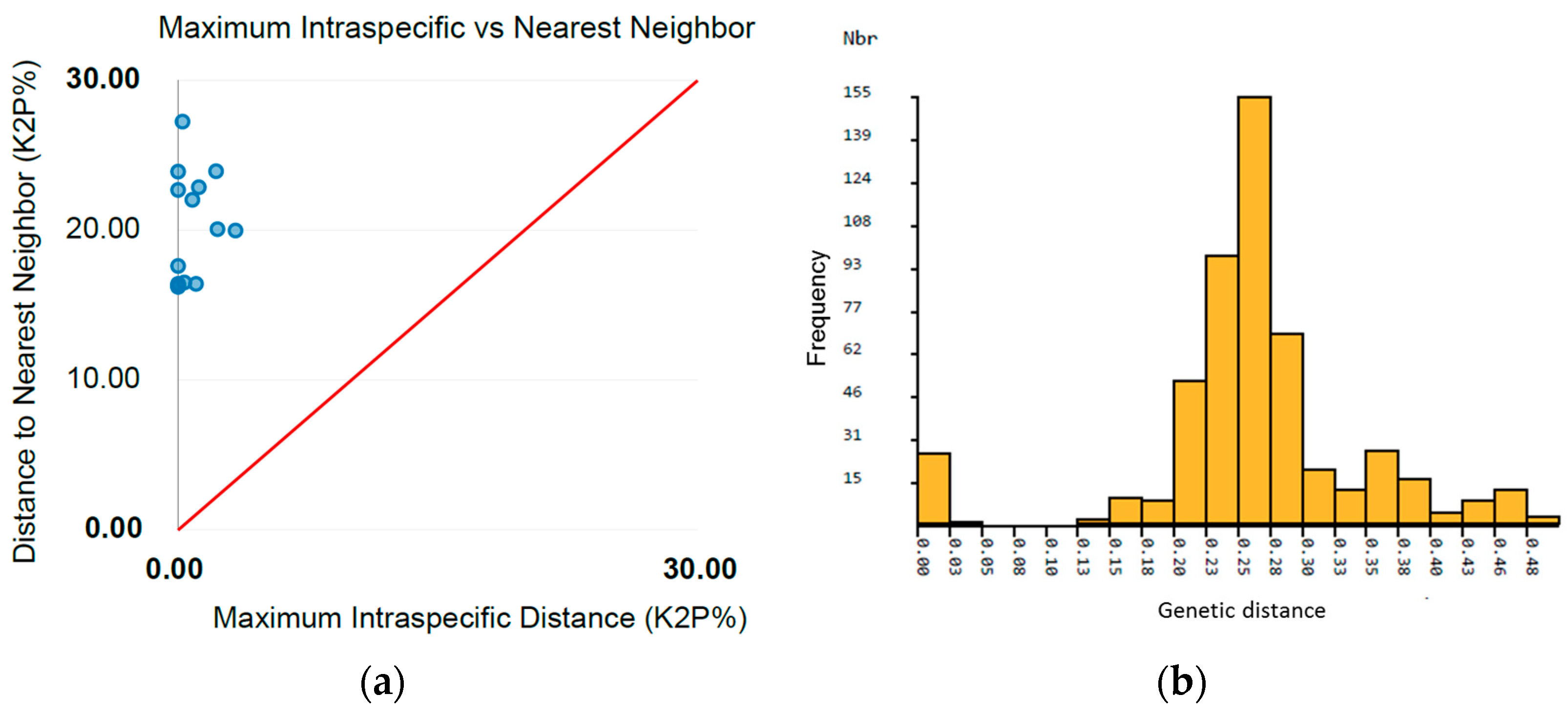
3.3. Barcode Gap Analysis
4. Discussion
5. Conclusions
Supplementary Materials
Author Contributions
Funding
Institutional Review Board Statement
Data Availability Statement
Conflicts of Interest
References
- Brusca, R.; Giribet, G.; Moore, W. Invertebrates, 4th ed.; Sinauer Associates/Oxford University Press: New York, NY, USA, 2022; p. 1104. [Google Scholar]
- Mah, C.L. New genera, species and occurrence records of Goniasteridae (Asteroidea; Echinodermata) from the Indian Ocean. Zootaxa 2018, 4539, 1–116. [Google Scholar] [CrossRef] [PubMed]
- Solís-Marín, F.A.; Conejeros-Vargas, C.A.; Caballero-Ochoa, A.A.; Arriaga-Ochoa, J.A. Epitomapta simentalae sp. n., a new species of apodous sea cucumber from the Central Eastern Pacific coast of Mexico (Echinodermata, Holothuroidea, Apodida). ZooKeys 2019, 817, 1–9. [Google Scholar] [CrossRef]
- Mooi, R.; Noordenburg, H.V. A new species and comparative morphology of Philippine sea biscuits (Echinoidea: Clypeaster). Zootaxa 2021, 4964, 1–36. [Google Scholar] [CrossRef] [PubMed]
- Martins, L.; Tavares, M. A new species of Parathyone (Holothuroidea: Dendrochirotida: Cucumariidae) from northeastern Brazil, with a key to species. Zootaxa 2021, 4985, 245–252. [Google Scholar] [CrossRef] [PubMed]
- Meyer, D.L.; Hoggett, A.; Huang, D.; Rouse, G.W.; Vail, L.; Yen, Y.-H.; Messing, C.G. A new species of the feather star Capillaster within C. multiradiatus species complex (Crinoidea, Comatulidae) in Palau and the Great Barrier Reef. Zootaxa 2025, 5647, 275–288. [Google Scholar] [CrossRef]
- Lobine, D.; Rengasamy, K.R.R.; Mahomoodally, M.F. Functional foods and bioactive ingredients harnessed from the ocean: Current status and future perspectives. Crit. Rev. Food Sci. Nutr. 2022, 62, 5794–5823. [Google Scholar] [CrossRef]
- Zhukova, N.V. Fatty acids of echinoderms: Diversity, current applications and future opportunities. Mar. Drugs 2022, 21, 21. [Google Scholar] [CrossRef]
- Laryssa, B.; Araújo, G.; Ramos, L.; Caldas Sodré, L.; Figueiredo, I. Bioprospecting of echinoderms: An integrative review of bioactive potentials for medicinal use. Obs. Econ. Latinoam. 2025, 23, e11468. [Google Scholar] [CrossRef]
- Peterson, K.J.; Arenas-Mena, C.; Davidson, E.H. The A/P axis in echinoderm ontogeny and evolution: Evidence from fossils and molecules. Evol. Dev. 2000, 2, 93–101. [Google Scholar] [CrossRef]
- Mooi, R.; David, B. Radial symmetry, the Anterior/Posterior axis, and echinoderm Hox genes. Annu. Rev. Ecol. Evol. Syst. 2008, 39, 43–62. [Google Scholar] [CrossRef]
- Smith, A.B. Deuterostomes in a twist: The origins of a radical new body plan. Evol. Dev. 2008, 10, 493–503. [Google Scholar] [CrossRef]
- Ezhova, O.; Malakhov, V. Origin of Echinodermata. J. Paleontol 2022, 56, 938–973. [Google Scholar] [CrossRef]
- Hsu, C.-H.; Chang, K.-C. Sea urchins of Hong Kong: Corrections of misidentifications and an updated species list. Zootaxa 2025, 5683, 142–150. [Google Scholar] [CrossRef]
- Yamana, Y.; Hirashima, K.; Sato, M.; Yamamori, L. First revision of the apodid holothurian genus Patinapta Heding, 1928 (Synaptidae) in Japanese waters, with establishment of four new species from Kyushu Island and Ryukyu Islands, southwestern Japan. Zootaxa 2025, 5569, 1–54. [Google Scholar] [CrossRef]
- Setyastuti, A.; Solis-Marin, F.A.; Lüter, C. Sea cucumbers of the genus Labidodemas (Holothuroidea: Holothuriida: Holothuriidae) from Indonesia, with the description of a new species and a revised key to the genus. Zootaxa 2024, 5506, 227–244. [Google Scholar] [CrossRef]
- Courville, E.; Poulin, E.; Saucede, T.; Mooi, R.; Lessios, H.; Salinas, A.M.; Diaz, A. Taxonomic reassessment of Tetrapygus niger (Arbacioida, Echinoidea): Molecular and morphological evidence support its placement in Arbacia. Zootaxa 2023, 5375, 249–261. [Google Scholar] [CrossRef] [PubMed]
- Hebert, P.D.; Cywinska, A.; Ball, S.L.; de Waard, J.R. Biological identifications through DNA barcodes. Proc. Biol. Sci. 2003, 270, 313–321. [Google Scholar] [CrossRef] [PubMed]
- Hebert, P.D.; Ratnasingham, S.; deWaard, J.R. Barcoding animal life: Cytochrome c oxidase subunit 1 divergences among closely related species. Proc. Biol. Sci. 2003, 270, S96–S99. [Google Scholar] [CrossRef]
- Ward, R.D.; Holmes, B.H.; O’hara, T.D. DNA barcoding discriminates echinoderm species. Mol. Ecol. Resour. 2008, 8, 1202–1211. [Google Scholar] [CrossRef]
- Kress, W.J.; García-Robledo, C.; Uriarte, M.; Erickson, D.L. DNA barcodes for ecology, evolution, and conservation. Trends Ecol. Evol. 2015, 30, 25–35. [Google Scholar] [CrossRef] [PubMed]
- Solovyeva, E.N.; Dunayev, E.A.; Nazarov, R.A.; Bondarenko, D.A.; Poyarkov, N.A. COI-Barcoding and species delimitation assessment of toad-headed agamas of the genus Phrynocephalus (Agamidae, Squamata) reveal unrecognized diversity in Central Eurasia. Diversity 2023, 15, 149. [Google Scholar] [CrossRef]
- Velo-Antón, G.; Chambers, E.; Poyarkov, N.; Canestrelli, D.; Bisconti, R.; Naumov, B.; Benéitez, M.; Borisenko, A.; Martinez-Solano, I. COI barcoding provides reliable species identification and pinpoints cryptic diversity in Western Palearctic amphibians. Amphib.-Reptil 2023, 44, 399–413. [Google Scholar] [CrossRef]
- Torres, A.F.; Wangensteen, O.S.; Renema, W.; Meyer, C.P.; Fontanilla, I.K.C.; Todd, J.A. Global species hotspots and COI barcoding cold spots of marine Gastropoda. Biodivers. Conserv. 2024, 33, 2925–2947. [Google Scholar] [CrossRef]
- Zhou, Y.; Trujillo-González, A.; Nicol, S.; Huerlimann, R.; Sarre, S.D.; Gleeson, D. Evaluation of DNA barcoding reference databases for marine species in the western and central Pacific Ocean. PeerJ 2025, 13, e19674. [Google Scholar] [CrossRef] [PubMed]
- Folmer, O.; Black, M.; Hoeh, W.; Lutz, R.; Vrijenhoek, R. DNA primers for amplification of mitochondrial cytochrome c oxidase subunit I from diverse metazoan invertebrates. Mol. Mar. Biol. Biotechnol. 1994, 3, 294–299. [Google Scholar] [PubMed]
- Ratnasingham, S.; Hebert, P.D. Bold: The Barcode of Life Data System (http://www.barcodinglife.org). Mol. Ecol. Notes 2007, 7, 355–364. [Google Scholar] [CrossRef]
- Ratnasingham, S.; Hebert, P.D. A DNA-based registry for all animal species: The barcode index number (BIN) system. PLoS ONE 2013, 8, e66213. [Google Scholar] [CrossRef]
- Layton, K.K.S.; Corstorphine, E.A.; Hebert, P.D.N. Exploring Canadian echinoderm diversity through DNA barcodes. PLoS ONE 2016, 11, e0166118. [Google Scholar] [CrossRef]
- Sonet, G.; Smitz, N.; Vangestel, C.; Samyn, Y. DNA barcoding echinoderms from the East Coast of South Africa. The challenge to maintain DNA data connected with taxonomy. PLoS ONE 2022, 17, e0270321. [Google Scholar] [CrossRef]
- BOLD Systems, Barcode of Life Data System. Available online: https://boldsystems.org/ (accessed on 10 December 2025).
- Chacón-Monge, J.; Abarca-Odio, J.; González Sánchez, K. Evaluating the reliability of DNA barcoding for Central American Pacific shallow water echinoderms identification: A molecular taxonomy and database accuracy analysis. Rev. Biol. Trop. 2024, 72, e58997. [Google Scholar] [CrossRef]
- Catalma, M.N.; Diaz, M.; Garcia, R.; Ocampo, P.; Laurena, A.; Tecson-Mendoza, E. DNA barcoding and diversity analysis of 19 economically important Philippine sea sucumbers (Holothuroidea). Philipp. J. Sci. 2020, 149, 309–320. [Google Scholar] [CrossRef]
- Sulardiono, B.; Hartoko, A.; Nur Aini, A.; Wulandari, D.; Budiharjo, A. Genetic diversity of commercial sea cucumbers Stichopus (Echinoderm: Stichopodidae) based on DNA barcoding in Karimunjawa, Indonesia. Biodiversitas 2022, 23, 922–927. [Google Scholar] [CrossRef]
- Do, C.T.; Dao, M.D. Diversity of echinoderms (Echinodermata) in the Northeastern islands, Vietnam. VJMST 2018, 18, 296–303. [Google Scholar] [CrossRef]
- Hoang, D.T. Diversity of echinoderms and molluscs in Xuan Dai Bay, Phu Yen. Sci. Technol. Dev. J.-Nat. Sci. 2019, 3, 285–294. [Google Scholar] [CrossRef]
- Otero, M.D.M.; Vu, U. Sea cucumber fisheries around Phu Quoc Archipelago: A cross-border issue between South Vietnam and Cambodia. SPC Beche-De-Mer Inf. Bull. 2007, 25, 32–37. [Google Scholar] [CrossRef]
- Saad, L.O.; Cunha, C.M.; Colpo, K.D.; Valdés, A. It’s not what it looks like: Molecular data fails to substantiate morphological differences in two sea hares (Mollusca, Heterobranchia, Aplysiidae) from southern Brazil. Helgol. Mar. Res. 2014, 68, 523–530. [Google Scholar] [CrossRef]
- Puillandre, N.; Brouillet, S.; Achaz, G. ASAP: Assemble species by automatic partitioning. Mol. Ecol. Resour. 2021, 21, 609–620. [Google Scholar] [CrossRef]
- Kimura, M. A simple method for estimating evolutionary rates of base substitutions through comparative studies of nucleotide sequences. J. Mol. Evol. 1980, 16, 111–120. [Google Scholar] [CrossRef]
- Miralles, A.; Ducasse, J.; Brouillet, S.; Flouri, T.; Fujisawa, T.; Kapli, P.; Knowles, L.L.; Kumari, S.; Stamatakis, A.; Sukumaran, J.; et al. SPART: A versatile and standardized data exchange format for species partition information. Mol. Ecol. Resour. 2022, 22, 430–438. [Google Scholar] [CrossRef] [PubMed]
- Tamura, K.; Stecher, G.; Kumar, S. MEGA11: Molecular Evolutionary Genetics Analysis Version 11. Mol. Biol. Evol. 2021, 38, 3022–3027. [Google Scholar] [CrossRef]
- Meyer, C.P.; Paulay, G. DNA barcoding: Error rates based on comprehensive sampling. PLoS Biol. 2005, 3, e422. [Google Scholar] [CrossRef]
- Audzijonyte, A.; Krylova, E.M.; Sahling, H.; Vrijenhoek, R.C. Molecular taxonomy reveals broad trans-oceanic distributions and high species diversity of deep-sea clams (Bivalvia: Vesicomyidae: Pliocardiinae) in chemosynthetic environments. Syst. Biodivers. 2012, 10, 403–415. [Google Scholar] [CrossRef]
- Breure, A.S.H. Caribbean Bulimulus revisited: Physical moves and molecular traces (Mollusca, Gastropoda, Bulimulidae). PeerJ 2016, 4, e1836. [Google Scholar] [CrossRef]
- Buršić, M.; Iveša, L.; Jaklin, A.; Arko Pijevac, M.; Kučinić, M.; Štifanić, M.; Neal, L.; Bruvo Mađarić, B. DNA barcoding of marine mollusks associated with Corallina officinalis Turfs in Southern Istria (Adriatic Sea). Diversity 2021, 13, 196. [Google Scholar] [CrossRef]
- Miller, A.K.; Kerr, A.M.; Paulay, G.; Reich, M.; Wilson, N.G.; Carvajal, J.I.; Rouse, G.W. Molecular phylogeny of extant Holothuroidea (Echinodermata). Mol. Phylogenetics Evol. 2017, 111, 110–131. [Google Scholar] [CrossRef]
- Bucklin, A.; Peijnenburg, K.T.C.A.; Kosobokova, K.N.; O’Brien, T.D.; Blanco-Bercial, L.; Cornils, A.; Falkenhaug, T.; Hopcroft, R.R.; Hosia, A.; Laakmann, S.; et al. Toward a global reference database of COI barcodes for marine zooplankton. Mar. Biol. 2021, 168, 78. [Google Scholar] [CrossRef]
- Hickerson, M.J.; Meyer, C.P.; Moritz, C. DNA barcoding will often fail to discover new animal species over broad parameter space. Syst. Biol. 2006, 55, 729–739. [Google Scholar] [CrossRef]
- Hebert, P.D.N.; Stoeckle, M.Y.; Zemlak, T.S.; Francis, C.M. Identification of birds through DNA barcodes. PLoS Biol. 2004, 2, e312. [Google Scholar] [CrossRef] [PubMed]
- Phillips, J.D.; Gillis, D.J.; Hanner, R.H. Incomplete estimates of genetic diversity within species: Implications for DNA barcoding. Ecol. Evol. 2019, 9, 2996–3010. [Google Scholar] [CrossRef] [PubMed]
- James Harris, D. Can you bank on GenBank? Trends Ecol. Evol. 2003, 18, 317–319. [Google Scholar] [CrossRef]
- Radulovici, A.; Vieira, P.; Duarte, S.; Teixeira, M.; Borges, L.; Deagle, B.; Majaneva, S.; Redmond, N.; Schultz, J.; Costa, F. Revision and annotation of DNA barcode records for marine invertebrates: Report of the 8th iBOL conference hackathon. MBMG 2021, 5, e67862. [Google Scholar] [CrossRef]



| No | Sample ID | COI-5′ seq. Size (bp) | Processed ID (BOLD) | Morphological Identification | Species Names on GenBank and BOLD | Blast | |
|---|---|---|---|---|---|---|---|
| GenBank Similarity (%) | BOLD Similarity (%) | ||||||
| 1 | DG6DTh-76 | 758 | HMDG022-25 | Culcita novaeguineae | Culcita novaeguineae | 99.36 | 98.98 |
| 2 | DGVP60 | 747 | HMDG033-25 | Culcita novaeguineae | Culcita novaeguineae | 99.78 | 99.26 |
| 3 | DGVP93 | 747 | HMDG034-25 | Culcita novaeguineae | Culcita novaeguineae | 99.78 | 99.56 |
| 4 | DG3C-22 | 454 | HMDG010-25 | Echinaster sp. | Echinaster luzonicus | 99.12 | 99.78 |
| 5 | DG1THD-65 | 745 | HMDG014-25 | Echinaster sp. | Echinaster luzonicus | 98.47 | 99.59 |
| 6 | DG1Ta-48 | 495 | HMDG015-25 | Echinaster sp. | Echinaster luzonicus | 99.37 | 98.73 |
| 7 | DG2HT-108 | 752 | HMDG032-25 | Echinaster sp. | Echinaster luzonicus | 98.39 | 99.60 |
| 8 | DG6HT-11 | 508 | HMDG017-25 | Fromia milleporella | Fromia milleporella | 95.15 | 97.24 |
| 9 | DG2TT-157 | 509 | HMDG018-25 | Fromia milleporella | Fromia milleporella | 95.35 | 97.25 |
| 10 | DG5C-7 | 508 | HMDG019-25 | Fromia milleporella | Fromia milleporella | 94.69 | 96.85 |
| 11 | DG5THD-19 | 509 | HMDG020-25 | Fromia milleporella | Fromia milleporella | 95.15 | 97.25 |
| 12 | DGVP40 | 626 | HMDG036-25 | Linckia laevigata | Linckia laevigata | 100 | 100 |
| 13 | DG52-106 | 517 | HMDG003-25 | Echinotrix diadema | Diadema setosum | 99.02 | 99.02 |
| 14 | DG3TD-2 | 1127 | HMDG011-25 | Diadema savignyi | Diadema setosum | 99.79 | 99.71 |
| 15 | DG2DR-293 | 1127 | HMDG012-25 | Diadema setosum | Diadema setosum | 99.73 | 99.81 |
| 16 | DG5DTh-23 | 482 | HMDG013-25 | Diadema setosum | Diadema setosum | 99.79 | 99.79 |
| 17 | DG7THD-135 | 758 | HMDG023-25 | Toxopneustes pileolus | Toxopneustes pileolus | 100 | 99.00 |
| 18 | DG2DTh-266 | 614 | HMDG030-25 | Toxopneustes pileolus | Toxopneustes pileolus | 99.67 | 98.84 |
| 19 | DG4TD-314 | 614 | HMDG031-25 | Toxopneustes pileolus | Toxopneustes pileolus | 99.51 | 99.01 |
| 20 | DG5TT-12 | 1003 | HMDG025-25 | Stephanometra indica | Stephanometra indica | 99.20 | 99.35 |
| 21 | DG3DD-86 | 1004 | HMDG026-25 | Stephanometra indica | Stephanometra indica | 99.60 | 99.60 |
| 22 | DG4C-244 | 740 | HMDG024-25 | Clarkcomanthus sp. | Clarkcomanthus sp. | 98.52 | 98.52 |
| 23 | DG76-63 | 583 | HMDG004-25 | Colochirus quadrangularis | Colochirus quadrangularis | 97.70 | 97.70 |
| 24 | DG101-47 | 563 | HMDG005-25 | Stichopus chloronotus | Colochirus quadrangularis | 99.82 | 99.82 |
| 25 | DG3DTh-18 | 563 | HMDG027-25 | Holothuria atra | Holothuria atra | 100 | 100 |
| 26 | DG3Ta-234 | 562 | HMDG029-25 | Holothuria atra | Holothuria atra | 99.82 | 99.82 |
| 27 | DG3HT-112 | 533 | HMDG028-25 | Holothuria hilla | Holothuria hilla | 100 | 100 |
| 28 | DG4DD-28 | 1173 | HMDG009-25 | Holothuria leucospilota | Holothuria leucospilota | 99.91 | 100 |
| 29 | DGVP55-262 | 747 | HMDG037-25 | Stichopus herrmanni | Holothuria impatiens | 99.85 | 99.85 |
| 30 | DGDLB-41 | 616 | HMDG007-25 | Holothuria cinerascens | Holothuria cinerascens | 99.32 | 98.78 |
| 31 | DG1DTh-223 | 1049 | HMDG021-25 | Stichopus chloronotus | Stichopus chloronotus | 99.43 | 99.43 |
| 32 | DG8TT-20 | 623 | HMDG038-25 | Protoreaster nodosus | Protoreaster nodosus | 100 | 100 |
| No. | Species | BINs 1 | Max. Intra Sp. 2 (%) | Min Inter Sp. 3 (%) |
|---|---|---|---|---|
| 1 | Clarkcomanthus sp. | BOLD:AHA1014 (*) | 0 | 3.06 |
| 2 | Colochirus quadrangularis | BOLD:ABA3321 | 2.73 | 10.89 |
| 3 | Culcita novaeguineae | BOLD:ABA1943 | 3.23 | 75 |
| 4 | Diadema setosum | BOLD:ABA3950 | 2.46 | 11.7 |
| 5 | Echinaster luzonicus | BOLD:AAF8608 | 2.28 | 7.07 |
| 6 | Fromia milleporella | BOLD:AHA5186 | 1.2 | 2.84 |
| 7 | Holothuria atra | BOLD:AAB2668 | 2.96 | 13.29 |
| 8 | Holothuria cinerascens | BOLD:ABA2112 | 1.62 | 10.59 |
| 9 | Holothuria hilla | BOLD:AAF0588 | 1.14 | 12.44 |
| 10 | Holothuria impatiens | BOLD:ABA1766 | 1.03 | 17.13 |
| 11 | Holothuria leucospilota | BOLD:AAI8215 | 5.29 | 14.38 |
| 12 | Linckia laevigata | BOLD:AAA1544 | 5.17 | 15.79 |
| 13 | Protoreaster nodosus | BOLD:AAA4270 | 1.75 | 7.67 |
| 14 | Stephanometra indica | BOLD:ABA5375 | 2.53 | 8.98 |
| 15 | Stichopus chloronotus | BOLD:AAB6442 | 1.14 | 12.36 |
| 16 | Toxopneustes pileolus | BOLD:ACB6445 | 1.18 | 2.1 |
Disclaimer/Publisher’s Note: The statements, opinions and data contained in all publications are solely those of the individual author(s) and contributor(s) and not of MDPI and/or the editor(s). MDPI and/or the editor(s) disclaim responsibility for any injury to people or property resulting from any ideas, methods, instructions or products referred to in the content. |
© 2025 by the authors. Licensee MDPI, Basel, Switzerland. This article is an open access article distributed under the terms and conditions of the Creative Commons Attribution (CC BY) license.
Share and Cite
Linh, T.M.; Mai, N.C.; Hoe, P.T.; Trung, L.Q.; Van, N.T.; Hoa, L.X.; Chieu, H.D.; Nho, P.T.D.; Thoa, N.K.; Lien, L.Q.; et al. Integrative COI Barcoding and Species Delimitation in Echinodermata from Vietnam. Fishes 2026, 11, 15. https://doi.org/10.3390/fishes11010015
Linh TM, Mai NC, Hoe PT, Trung LQ, Van NT, Hoa LX, Chieu HD, Nho PTD, Thoa NK, Lien LQ, et al. Integrative COI Barcoding and Species Delimitation in Echinodermata from Vietnam. Fishes. 2026; 11(1):15. https://doi.org/10.3390/fishes11010015
Chicago/Turabian StyleLinh, Tran My, Nguyen Chi Mai, Pham Thi Hoe, Le Quang Trung, Nguyen Tuong Van, Luu Xuan Hoa, Hoang Dinh Chieu, Pham Tran Dinh Nho, Nguyen Kim Thoa, Le Quynh Lien, and et al. 2026. "Integrative COI Barcoding and Species Delimitation in Echinodermata from Vietnam" Fishes 11, no. 1: 15. https://doi.org/10.3390/fishes11010015
APA StyleLinh, T. M., Mai, N. C., Hoe, P. T., Trung, L. Q., Van, N. T., Hoa, L. X., Chieu, H. D., Nho, P. T. D., Thoa, N. K., Lien, L. Q., & Thung, D. C. (2026). Integrative COI Barcoding and Species Delimitation in Echinodermata from Vietnam. Fishes, 11(1), 15. https://doi.org/10.3390/fishes11010015