Article

Impact of Effective Probiotic Microorganisms (EPMs) on Growth Performance, Hematobiochemical Panel, Immuno-Antioxidant Status, and Gut Cultivable Microbiota in Striped Catfish (Pangasianodon hypophthalmus)


by
Mahmoud Abdullah Elnakeeb
1,
Ahmed Mohamed Ashry
2,
Ahmed Mohamed El-Zayat
1,
Abdel Wahab Abdel-Moez Abdel-Warith
3,*,
Mahmoud Mohamed Habiba
2,
Elsayed Mohamed Ibrahim Younis
3,
Simon John Davies
4,
Ibrahim Mohamed Ibrahim
5,
Fatma Elzhraa
6,7 and
Ahmed Mohammed El-Sebaey
8,*
1
Fish Production Department, Faculty of Agriculture, Al-Azhar University, Nasr City, Cairo 11884, Egypt
2
National Institute of Oceanography and Fisheries (NIOF), Cairo 11865, Egypt
3
Department of Zoology, College of Science, King Saud University, P.O. Box 2455, Riyadh 11451, Saudi Arabia
4
Aquaculture Nutrition Research Unit ANRU, Carna Research Station, Ryan Institute, College of Science and Engineering, University of Galway, H91V8Y1 Galway, Ireland
5
Department of Agricultural Microbiology, Faculty of Agriculture, Fayoum University, El Fayoum 63514, Egypt
6
Department of Food Microbiology, Hygiene and Safety, Institute of Food Science and Technology, Hungarian University of Agriculture and Life Sciences, Somlói út 14-16, H-1118 Budapest, Hungary
7
Department of Food Hygiene and Control, Faculty of Veterinary Medicine, Mansoura University, Mansoura 35516, Egypt
8
Department of Clinical Pathology, Faculty of Veterinary Medicine, Mansoura University, Mansoura 35516, Egypt
*
Authors to whom correspondence should be addressed.
Fishes 2025, 10(11), 573; https://doi.org/10.3390/fishes10110573
Submission received: 4 October 2025 / Revised: 29 October 2025 / Accepted: 3 November 2025 / Published: 7 November 2025

Abstract

Striped catfish, Pangasianodon hypophthalmus, has recently emerged as a promising candidate for Egyptian aquaculture owing to its rapid growth; however, under intensive culture, it is vulnerable to Aeromonas hydrophila. The efficacy of dietary supplementation with effective probiotic microorganisms (EPMs) in enhancing growth performance, feed utilization, physiological health, and disease resistance of P. hypophthalmus against A. hydrophila challenge was evaluated. A 90-day feeding trial was conducted with 300 fish randomly distributed into four triplicate groups (25 fish per replicate) reared in 12 indoor fiberglass tanks: a control and three groups receiving EPMs at inclusion levels of 1.5%, 3%, and 4.5%. The results showed significant, dose-dependent improvements across all EPMs-supplemented groups in survival, growth rates, feed utilization, and hematological parameters (RBC, Hb, PCV, WBC, and lymphocytes). Dietary EPMs led to significant improvements (p ≤ 0.001) in digestive efficiency, protein and lipid metabolism, antioxidant enzyme activity, immune performance, and the ability of striped catfish to withstand A. hydrophila infection. Hepatobiliary enzyme activities (ALT, AST, and ALKP), glucose levels, lipid profile markers, and hepatic MDA exhibited a significant linear decrease (p ≤ 0.0001) with increasing EPMs levels. The gut microbial composition showed a dose-dependent increase in beneficial lactic acid bacteria (LAB) and a reduction in TAPC, pathogenic coliforms (TFCC), and Vibrio spp. (TVC). These results demonstrate the dose-dependent effects of EPMs on enhancing aquafeed efficiency, overall health, and innate immunity in striped catfish.
Key Contribution: EPMs supplementation enhanced growth performance, immunity, antioxidant response, and disease resistance in striped catfish, demonstrating its potential to enhance fish health and resilience under aquaculture conditions.

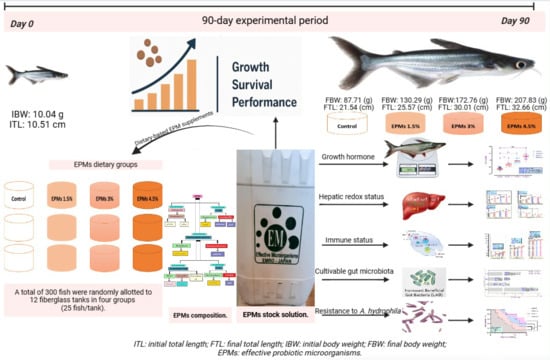
Graphical Abstract

1. Introduction

Our world is facing an increasing shortage of food, particularly protein-rich sources. Commercial aquaculture plays a vital role in ensuring global food security and sustaining long-term economic growth, serving as an efficient alternative source of high-quality animal protein [1,2]. Egypt was ranked sixth in global aquaculture production and holds the largest share in Africa [3], producing approximately one million tons annually [4]. African catfish, a commonly cultured freshwater fish in Egypt, contributes around 8305 tons [5]. Recently, striped catfish (Pangasianodon hypophthalmus) has been marketed as an inexpensive alternative to African catfish and other fleshy fish, enhancing its competitiveness in local markets [6]. P. hypophthalmus is an aquatic, omnivorous species belonging to the order Siluriformes and is highly adaptable to various environmental conditions [7]. Domesticated initially in Asian aquaculture, this exotic species has been recently introduced and rapidly developed in Egypt [8]. In its native range, P. hypophthalmus demonstrates remarkable growth and feed utilization efficiency compared with other cultured fish species, including Nile tilapia [8,9]. However, laboratory experiments, pilot-scale trials, and large-scale production in Egypt have frequently resulted in suboptimal or inconsistent growth rates [10]. These variations are mainly attributed to various local environmental challenges that hinder its growth and sustainability outside its native range. Key issues include seasonal fluctuations in water temperature, salinity, overall water quality, and disease outbreaks, particularly in farms with high stocking densities and inadequate biosecurity measures [10].
The shift in P. hypophthalmus’s native habitat and intensification of its aquaculture practices restrict proper rearing conditions, compromising fish health, overall physiological performance, and immune response, thereby increasing disease prevalence in aquaculture systems [11,12]. Recent surveillance identified Aeromonas hydrophila (A. hydrophila) as the causative agent of massive striped catfish mortality events in several Egyptian farms [8,13]. In addition, global reports of A. hydrophila infections in P. hypophthalmus further illustrate the species’ susceptibility to disease under intensive culture [14,15,16]. Farmers often use antibiotics to treat or avert pathogenic bacteria due to their affordable price and rapid efficacy. Nonetheless, the use of antibiotics has been restricted due to their negative impacts on aquatic ecosystems and gut microbiota [17], as well as the prohibition against the overuse or misuse of antibiotics not prescribed for fish, which propagate the emergence of virulent antimicrobial-resistant (AMR) bacteria “superbugs” within food chains and ecological niches [18]. These deleterious diseases have serious drawbacks to the worldwide predicament for contemporary and prospective disease control and prevention. Thus, the current intensive production of P. hypophthalmus necessitates optimizing dietary strategies by substituting antibiotics and chemical treatments with eco-friendly, non-hazardous alternatives to be used routinely as aquafeed-promoting additives. Diet supplementation with probiotics represents a promising approach to modulate the immune response, cellular antioxidant capacity, and disease resistance in P. hypophthalmus, thus improving productivity while mitigating the risks associated with overusing or misusing antibacterial drugs and the subsequent emergence of AMR pathogens [19].
Over the past two decades, microbiome manipulation in aquaculture through the supplementation of beneficial microbial communities, synbiotics, and prebiotics has emerged as a highly effective strategy. This approach reduces organic waste accumulation, improves water quality, minimizes environmental impacts, enhances nitrification efficiency, regulates host–microbiota interactions, strengthens disease resistance, decreases antibiotic dependence, and promotes healthier, more sustainable aquatic production systems [20,21,22]. Formulated single- or multi-strain live or lyophilized microorganisms possessing biofilm-forming capabilities, such as Bacillus subtilis, Enterococcus faecium, Saccharomyces cerevisiae, and Lactobacillus plantarum, have been utilized as feed supplements for Clarias batrachus fingerlings [23] and P. hypophthalmus [24] to promote disease resistance and the development of diverse, stable, and beneficial microbial communities within the intensive farming systems [25].
The potential use of lactic acid bacteria (LAB), bifidobacteria, and yeast in aquafeed has recently been recognized for its ability to enhance mucosal immunization in the gut and gills, providing antimicrobial peptides, essential nutrients, and extracellular digestive enzymes (α-amylases, proteases, glucoamylases, and lipases). These microorganisms improve digestive efficiency, enhance nutrient bioavailability, prevent gut dysbiosis, and contribute to increased weight gain and feed conversion efficiency in intensive aquaculture systems [26,27]. Dietary supplementation with LAB strains such as Lactobacillus lactis and Lactobacillus plantarum has been shown to enhance growth rates, stress resistance, and innate immunity (lysozyme and phagocytic activities) while reducing pathogenic bacterial colonization in the gut of Nile tilapia [28] and Cyprinus carpio fingerlings [29]. The cell walls of yeast comprise β-glucans, mannoproteins, and chitin bioactive compounds, which are recognized as fungal postbiotics that trigger the synthesis of macrophages, lymphocytes, and cytokines, as well as resistance to disease in fish [30,31]. Candida sp. and other yeast species were characterized as “an alternative to antibiotics” gut-associated microbiota that degrade tannins or phytate in Nile tilapia and rainbow trout for sustainable fish farming [32]. Aquafeed supplementation with Saccharomyces cerevisiae yeast improved Oreochromis niloticus resistance toward Aeromonas hydrophila (A. hydrophila) by enhancing total antioxidant capacity, immune-related gene expressions, phagocytic activity of leucocytes, intestinal physical barriers, and gut microbiota composition [32,33].
Probiotic strains exhibit varying effects across different fish species, necessitating a species-specific approach to probiotic strains in aquaculture. This strategy leverages the synergistic interactions between the most beneficial probiotic strains (Bacillus subtilis, LAB, bifidobacteria, and yeasts), which are collectively known as effective probiotic microorganisms (EPMs), to achieve better overall aquaculture outcomes [30,34]. It is important to note that a few studies have shown that adding EPMs to a fish’s diet can have a positive effect on its growth, digestive enzymes, blood chemistry, immune system, liver antioxidant levels, and diversity of beneficial intestinal bacteria.
Notably, limited trials have validated that adding EPMs to aquafeed can exert a positive effect on the growth, digestive enzymes, blood chemistry, immune system, liver antioxidant levels, and diversity of beneficial intestinal bacteria of many fish species, such as Nile tilapia [35,36], Seabass (Dicentrarchus labrax) [37] and Common Carp (Cyprinus carpio L.) [38]. Despite this, the improved benefits and different mechanisms of dietary combinations of multi-strain probiotics at once have been inadequately described in P. hypophthalmus [32]. As such, the current investigation aimed to indicate the optimal dosage and efficacy of EPMs in formulating a cost-effective, nutritionally balanced diet for striped catfish. Therefore, the goal was to enhance growth performance, digestive enzyme activity, metabolic status, hepato-renal function, redox balance, innate immunity, and survival against infections. These improvements align with the broader objective of promoting sustainable and efficient multispecies probiotic applications in P. hypophthalmus aquaculture, ultimately reducing dependence on antibiotics and chemical treatments.

2. Materials and Methods

2.1. Source of Fish, Basal Diet, and Probiotics

Healthy striped catfish were sourced from a commercial fish hatchery in Borg El-Arab, Alexandria, Egypt, with an average total length of 9.68 ± 0.57 cm and an average body weight of 8.71 ± 0.63 g. A commercially available balanced basal diet containing 30% CP was obtained from Aller Aqua group® (6 October City-Giza, Egypt). The EPMs stock solution [36,39] was purchased as a liquid product from EMRO Japanese Institute—Okinawa, Japan (https://emrojapan.com/aquaculture/, accessed on 4 September 2025), under the supervision of the Ministry of Agriculture and the Environment of Egypt (batch # EM60347, EM716521, and 88435).

2.2. Design of Experiments and Fish Husbandry

Fish acclimatization and culturing were conducted in sanitized fiberglass tanks at a private freshwater fish farm located in Edku City, Egypt (31.3040° N, 30.3065° E). Following a two-week adaptation period, 300 P. hypophthalmus fingerlings with an average initial total length (ITL) of 10.51 ± 0.34 cm and an average initial body weight (IBW) of 10.04 ± 0.60 g were randomly assigned to four triplicate groups, with 25 fish per replicate, and reared in 12 indoor circular fiberglass tanks. Each tank had a total volume of 500 L of water.

2.3. Feeding Protocol and Water Quality

Based on microbiological isolation, characterization, and identification in our lab, together with the manufacturer’s formula specifications and recent reports by Jwher and Al-Sarhan [38], the commercial liquid EPMs stock solution (Japanese company EMRO, Okinawa, Japan) was mainly composed of the following five types of beneficial microorganisms: LAB at 2.75 × 10⁸ CFU/mL, actinomycetes at 6.5 × 10⁶ CFU/mL, yeast at 1.5 × 10⁸ CFU/mL, fermenting fungi at 2.70 × 10⁷ CFU/mL, and photosynthetic bacteria at 5.9 × 10⁷ CFU/mL (Figure 1).
Following the established aquafeed multispecies probiotics preparation method, as described by Abdel-Latif et al. [11], the required volume of EPMs stock solution was first diluted in 1 L of sterile and dechlorinated water. A prediluted solution of EPMs was added to the basal diet in clean containers at inclusion levels of 0.0%, 1.5%, 3.0%, and 4.5% (w/w), equivalent to 0, 15, 30, and 45 g of EPMs stock solution per one Kg feed for the control, EPMs 1.5%, EPMs 3%, and EPMs 4.5% groups, respectively. Then, the feed was manually tumbled for 15 min to formulate a soft paste and ensure a uniform distribution of the EPMs solution. The prepared paste was pelletized via a meat mincer to make uniform 2.0 mm nutritional pellets. Thereafter, the formed pellets were subjected to a drying process for a period of 24 h at ambient temperature. Subsequently, the pellets were vacuum packaged in labeled Ziploc plastic bags and stored in a refrigerated environment maintained at a temperature of 4 °C until utilization. Finally, the microbiological investigation confirmed that the EPMs were still viable following the diet preparation and retained the original five functional microbial groups (LAB, actinomycetes, yeasts, fermenting fungi, and photosynthetic bacteria) with varying concentrations (CFU/g feed) according to the inclusion levels of the EPMs stock solution (Table S1).
Throughout the 90-day experimental period, the fish were manually fed to apparent satiation twice daily at 9:00 a.m. and 3:00 p.m., with continuous monitoring of their body weight and overall health status. The composition and characterization of the formulated diets are detailed in Table 1. Approximately 30% of the water in each tank was replaced every two days with fresh, unchlorinated, well-aerated water, and the excreta was siphoned out to maintain optimal water quality parameters [10].
On-site assessment of water physicochemical parameters, such as temperature, dissolved oxygen (DO), and pH, was performed as outlined in Rice et al. [40] using a waterproof portable HI9829 multi-parameter probe (HANNA Instruments, Woonsocket, RI, USA). The unionized ammonia (NH3) concentration was routinely measured using a portable spectrophotometer 2000 (HACH Co., Loveland, CO, USA), with a limit of detection (LOD) of 0.01 mg L−1 and a limit of quantification (LOQ) of 0.03 mg L−1. Throughout the experiment, all parameters were sustained within optimal ranges: temperature, 26.3–29.2 °C; DO, 5.3–7 mg L−1; pH, 7.3–8.6; and NH3, 0.02–0.03 mg L−1.

2.4. Sample Collection and Processing

On the final day of the feeding investigation, the fish utilized for experimentation were subjected to 24 h of food withdrawal on the scheduled sampling days; then, they were collected, counted, and anesthetized by immersing them in water containing 100 mg L−1 buffered Tricaine-S® (Washington 08248, DC, USA) until complete loss of reflexes and cessation of opercular movement for 30 min as total handling duration [41]. The sampled fish were then individually subjected to length measurement and weighing to compute growth performance and feeding efficiency indicators. After this, five fish per set of replicates (15 fish per group) were humanely euthanized for tissue sample collection after 35 min of total exposure to an overdose of buffered tricaine-S® (250 mg L−1) [42] for harvesting of internal viscera and intestinal tissue to discern biometric indices and diversity of the intestinal microbial composition. Similarly, five fish were randomly selected from each replicate and washed before carcass composition was assessed. Whole blood samples were withdrawn from the previously selected fish (five fish per replicate) into two separate aliquots from the caudal vein. One aliquot was anticoagulated with heparin sodium (Jiangsu Wanli Biotechnology Co., Ltd., Jiangsu, China) to evaluate routine hemogram, phagocytic activity, and phagocyte oxidative burst reaction (NBT). To ensure complete clot retraction and serum separation, 2 mL aliquots of blood were maintained in a tilted position for a duration of 15 min at ambient temperature. Subsequent to this, the samples were subjected to a centrifugal process at 3000× g for a period of 8 min to collect and preserve the non-hemolyzed serum at −20 °C for later measurement of biochemical changes, growth hormones, and lysozyme activity. About 0.5 g of intestine and liver was strictly gathered from the previously sampled fish (five fish per replicate) and then minced and homogenized in 4.5 mL (1:9 w/v) ice-cold phosphate-buffered solution (Code# B-01868, oxford lab fine chem llp, Maharashtra, India, PBS, pH 7.2). After this, the homogenates obtained were pelleted by centrifugation at 4930× g for 5 min at 4 °C to collect a clear supernatant, which was maintained at −20 °C until further evaluation of intestinal digestive enzyme activities and hepatic redox status.

2.5. Rates of Survival, Growth Performance, Utilization of Feed, and Somatic Indices

The survival rate (SR, %) was ascertained by calculating the percentage of P. hypophthalmus that remained alive after the feeding studies, divided by their initial quantity.
In accordance with Ashry et al. [43], growth indices, feed utilization efficiency, and somatic indexes were computed as follows:
Weight gain (WG, g) was calculated by subtracting the final weight (FBW, g) from the initial weight (IBW, g);
Average daily gain (ADG, g day−1) was calculated by dividing WG (g) by the number of days in the trial (TD, days);
Specific growth rate (SGR, %·day−1) = [ln(FBW) − ln(IBW)] × 100/TD (days);
Relative growth rate (RGR, %) = [(FBW − IBW)/IBW] × 100;
Total dry-feed intake (TFI, g feed day−1 fish−1) was calculated as the comprehensive measure of dry sustenance ingested by the fish over the course of the entire TD (day);
Feed conversion ratio (FCR) = TFI/WG;
Protein efficiency ratio (PER) = WG/Protein Intake (PI);
The hepatosomatic index (HSI, %) was calculated as 100× the liver’s net weight (g) divided by its FBW (g);
The condition factor of Fulton (K, %) was calculated by dividing the FBW (g) by the body length3 (cm) multiplied by 100;
The viscerosomatic index (VSI) was calculated by dividing visceral weight (g) by FBW (g) multiplied by 100;
RGL was defined as the ratio of gut length (cm) to total body length (cm).

2.6. Total-Body Proximate Composition

Representative samples (five fish per replicate) were immediately frozen and maintained at −20 °C to preserve their integrity for subsequent whole carcass composition evaluation. The analysis encompassed the determination of various key components [44], including moisture (%) at 105 °C for 24 h using a PO-EKO dry oven (Wodzisław Śląski, Poland), crude protein (% DM basis) using a 2300 Kjeltec® Kjeldahl unit (FOSS Analytical, Höganäs, Sweden) with nitrogen factor 6.25, crude lipids (% DM basis) by the alcoholic extraction method with petroleum ether using Soxhlet (HT6, Tecator, Höganäs, Sweden), and ash (% DM basis) by burning at 600 °C for 6 h in a MF-05 furnace muffler (hyscien, Seoul, Korea).

2.7. Serum Growth Hormone Assessment

The levels of growth hormone (GH) in the serum were measured using a fish-specific colorimetric ELISA kit commercially supplied by Cusabio Technology® (Cat# CSB-E12121Fh, Houston, TX, USA), for which the generated dynamic range was 0.325–5 ng/mL, the sensitivity was 0.325 ng/mL, the inter- and intra-assay CV % (SD/mean × 100) values were <15%, the average spike-recovery reached 96%, the cross reactivity was 10%, and the within-sample linearity values were within a range of 80% to 120% of the expected values. In line with the enclosed kit leaflet, samples (n = 5/replicate), standards, and controls were evaluated in duplicate. Following the methodology outlined in Lal and Singh [45], GH in the samples and standards competed with biotin-conjugated GH (detection reagent) for 10 min to bind to pre-coated antibodies in the wells. After adding the stop reagent, the reaction produced a blue solution, which became yellow with varied intensities. The optical density (OD) was measured at 450 nm using a Stat Fax® 4700 ELISA-reader system (Palm City, FL, USA).

2.8. Digestive Enzyme Efficiencies

The Bradford method [46] was followed to estimate protein values in intestinal tissue extract by working with a calibration curve designed using a bovine serum albumin standard (BSA, Cat#A3294, Sigma-Aldrich, St. Louis, MO, USA) of known concentration. Before measuring the activity of each enzyme, dilution studies were run to ensure the ideal substrate-to-protein ratio. The activity of a given unit (U) of enzyme was considered as the amount of enzyme that catalyzes the hydrolysis of one micromole (μmol) of substrate per minute at 37 °C. Enzyme activity (U/L) was evaluated spectrophotometrically by the Chem-7 semi-automatic analyzer (ERBA Diagnostics, Mannheim, Germany). To normalize for variations in tissue protein content, the specific activity was calculated by dividing the enzyme activity (U/L) by the protein concentration (mg/mL) of the corresponding homogenate, as determined by the Bradford method, and expressed as U·mg protein−1.
The digestive activity of α-amylase and lipase (U/L) was evaluated using commercial Spinreact kits® (Girona, Spain). In step with Morishita et al.’s [47] methodology for α-amylase (Ref # 41201) estimation, a kinetic assay was applied to estimate the rate of 2-chloro-4-nitrophenol formation photometrically at an OD of 405 nm. The kinetic colorimetric assay method outlined in Panteghini et al. [48] was followed to assess the catalytic activity of lipase (Ref # 1001274), which was proportional to the increase in absorbance rate due to gradual methyl resorufin formation at an OD of 580 nm.
The digestive potential of total alkaline protease activity (TAP) was determined using Sigma-Aldrich® azocasein substrate (A2765, USA) according to a modified end-point assay described in Ross et al. [49]. In brief, prepared intestinal tissue extract (100 μL) was added to ammonium bicarbonate (100 mM, pH 7.8) buffer (v/v) and azocasein (0.7% w/v; Sigma, St. Louis, MO, USA) for 19 h in a prewarmed (30 °C) Innova@ orbital shaker (Hamburg, Germany). The reaction was blocked, and the undigested substrate was precipitated by aliquoting 200 μL of 5% trichloroacetic acid (TCA, w/v, Sigma, St. Louis, MO, USA). The substrate precipitate was condensed by cool (4 °C) centrifugation at 7000× g for 8 min. Then, the clear supernatant (200 μL) was separated and thoroughly mixed with 0.5 N NaOH (v/v, El-Gomhoria Company, Cairo, Egypt) to measure the increase in absorbance within one minute (ΔA min−1) at OD of 405 nm against a blank (azocasein was added after TCA).

2.9. Routine Hemogram Variable Assessment

Red and white blood corpuscles (RBCs and WBCs) were enumerated under a microscope attached to a Neubauer chamber (BOECO, Hamburg, Germany) using Elasmobranch-modified Natt and Herrick diluting fluid at a ratio of 1:200 [50]. The erythrogram was fulfilled by colorimetric measurement of hemoglobin values (Hb, gm dL−1) at 540 nm using Drabkin reagent (Diamond diagnostics®, Cairo, Egypt) and centrifugation to remove free nuclei and membranes of erythrocytes [51], and capillary tubes (15 µL), ultra-centrifugation for 5 min at 12,000× g using a microhematocrit centrifuge to estimate packed erythrocyte percentage (PCV%) [51]. Moreover, erythrocyte indices such as MCV (the average corpuscular volume, fL), MCH (the average corpuscular hemoglobin content, pg), and MCHC (the average corpuscular hemoglobin concentration, %) were computed following standard equations provided by Sirois [52] as follows:
M C V   ( f L ) = ( H e m a t o c r i t   % / R B C   c o u n t × 10 12 / L ) × 10
M C H   ( p g ) = ( H e m o g l o b i n   g / d L / R B C   c o u n t × 10 12 / L ) × 10
M C H C   ( % ) = ( H e m o g l o b i n   g / d L / H e m a t o c r i t   % ) × 100
An optical microscopic investigation of Diff-Quik-stained blood smears was performed under an oil immersion ×100 objective lens. To determine the relative percentage of different leukocyte fractions, each WBC (neutrophil, lymphocyte, monocyte, basophil, and eosinophil) encountered was classified and recorded depending on its morphologic features until 100 WBCs were counted [50]. Then, the absolute number of each leukocyte per µL of blood was counted using the following formula:
A b s o l u t e   n u m b e r   o f   l e u k o c y t e   f r a c t i o n / µ L = l e u k o c y t e %   i n   d i f f e r e n t i a l × ( T o t a l   W B C   c o u n t / µ L )

2.10. Assessment of Liver and Kidney Functions and Lipid Profile

In strict adherence to the instructions labeled within the commercial Agape® diagnostics (Kerala, India) reagents, the activities of cytosolic alanine and mitochondrial aspartate aminotransferases [ALT (Cat# 51214005) and AST (Cat# 51213005)] and alkaline phosphatase (ALKP, Cat# 51401002), in addition to the levels of total protein (T. Protein, Cat# 51013002), albumin (Cat# 51001002), urea (Cat# 51216001), creatinine (Cat# 51009003), glucose (Cat# 51406001), and total bilirubin (T. Bilirubin, Cat# 51003003), as well as fasting lipid panels, such as total lipids (T. Lipids, Cat# 51418002), total cholesterol (T. CHOL Cat# 51403007), triglycerides (TGs, Cat# 51410002), low-density lipoproteins (LDLs, Cat# 51415003), and high-density lipoproteins (HDLs, Cat# 51414003) were evaluated by a spectrophotometric technique using COBAS 6000 as an automated chemistry analyzer (e601 module, Roche® Diagnostics, Rotkreuz, Switzerland). In line with the formula developed by Friedewald et al. [53], the VLDL level was computed as TGs (mg/dL) multiplied by 1/5. Furthermore, the circulatory free lipid removal index (TGs: HDL) and the atherogenic index (LDL: HDL) were derived based on the corresponding mean lipoprotein concentrations.

2.11. Assessment of Hepatic Antioxidant Status and Lipid Peroxidation

Antioxidant capacity and oxidative stress parameters were assayed in the hepatic tissue extract using Elabscience® colorimetric assay kits (Houston, TX, USA) following the manufacturer’s guidelines using an ELISA reader (Stat Fax-4700, Palm City, FL, USA). Visibly hemolyzed homogenate samples were excluded from the redox status evaluation to avoid interference.
Maintaining redox homeostasis and protecting cells against superoxide radical (O2•−)-mediated oxidative tissue damage was assessed by evaluating the dismutation potential of superoxide dismutase (SOD, Cat# E-BCK020-M) by the water-soluble tetrazolium salt-1 assay (WST-1) method according to Peskin and Winterbourn [54].
Sufficient neutralization of H2O2, a byproduct of cellular metabolism and O2•− dismutation in mitochondria and peroxisomes, was judged by evaluating the catalase (CAT) enzyme activity (Cat# E-BCK031-M) according to Hamza and Hadwan [55].
A shift toward the concept of “homeostatic ROS levels” despite the high oxidative metabolism was evaluated by measuring glutathione peroxidase (GSH-Px, Cat# E-BC-K096-M) activity using the classic GPx-DTNB assay as per Sattar et al. [56].
The extent of oxidative tissue damage and cytotoxicity caused by peroxidative lipid degradation was identified by measuring byproducts of oxidative degradation of polyunsaturated fatty acids, such as the reactive malondialdehyde (MDA) levels (Cat# E-BCK025-M), by the thiobarbituric acid (TBA) method reported by Uchiyama and Mihara [57].
Bradford’s method [46] was followed to estimate the total levels of soluble protein for each tissue extract sample by working with a standard calibration curve prepared from BSA. The estimated protein level was applied to calculate the final activity of SOD, CAT, and GSH-Px as antioxidant enzymes (U/mg protein) and the MDA levels as an oxidation-associated product (pmols/mg protein).

2.12. Cellular and Humoral Immune Response Assays

2.12.1. Phagocytic Activities in Whole Blood

Blood films were prepared for phagocytic activity visualization as per the modified methodology of Anderson and Siwicki [58] and Ulzanah et al. [59]. In U-shaped microtiter wells, 50 µL of heparinized blood (Jiangsu Wanli Biotechnology Co., Ltd., Dongtai City, China) was combined with a quantity of 50 µL 107 CFU/mL PBS (pH 7.2) of freshly prepared Staphylococcus aureus (National Research Center, Giza, Egypt). The mixture was incubated at 30 °C for 28 min with continuous shaking. Then, it was smeared across labeled microscope slides, allowed to air-dry, fixed, and subsequently Diff-Quik-stained. Random high-power fields (HPFs) were visualized at 1000× magnification to identify the functional capacity of immune cells to engulf pathogens as follows:
P h a g o c y t i c   a c t i v i t y % = N u m b e r   o f   p h a g o c y t i c   c e l l   w i t h   i n t e r n a l i z e d   b a c t e r i a T o t a l   n u m b e r   o f   p h a g o c y t i c   c e l l s n = 300 × 100

2.12.2. Oxidative Burst Reaction (NBT)

In accordance with Nurani et al. [60], the phagocytic oxidative burst was assessed by spectrophotometric measurement of Nitro Blue Tetrazolium (NBT) reducing ability. First, 50 µL of whole blood was incubated in a U-shaped microtiter plate at 30 °C to encourage cell adhesion for 1 h. Then, the cells were treated with a 0.2% Acros® NBT solution (Geel, Belgium) after being rinsed with PBS (pH 7.4) following supernatant decantation. After fixation with methanol (100% v/v), a 30% methanol rinse was performed. Wells with phorbol 12-myristate 13-acetate (PMA, Cat #P8139, Sigma-Aldrich®, St. Louis, MO, USA, 1 μg/mL)-stimulated leukocytes and PBS-incubated cells served as positive and negative controls, respectively. The reduction rate was assayed by reporting the absorbance at 630 nm by an ELISA reader (Stat Fax-4700, Palm City, FL, USA) after dissolving formazan crystals in DMSO (70 µL; SDFCL, Mumbai, India) and 2 M KOH (60 µL).

2.12.3. Serum Lysozyme Activity

The intrinsic immune response in serum was determined by evaluating the lysozyme activity against Micrococcus luteus (M. luteus, Prod. # SIGMA-M0508, St. Louis, MO, USA) in accordance with a modified procedure described by Parry et al. [61]. To accomplish this, about 25 µL of each sample was assayed in triplicate using microtiter plate wells (U-shaped) containing a suspension of M. luteus ATCC in PBS (pH 7.2) at 0.75 mg/mL at 25 °C, with control wells devoid of serum serving as blanks. Lysozyme activity was assessed by a 0.001 decrease in absorbance value per minute at 450 nm, resulting from peptidoglycan-rich bacterial cell wall lysis, recorded with an ELISA reader (Stat Fax-4700, Palm City, FL, USA) after 30 s (R1) and 20 min (R2). The activity in U/mL was transformed to µg/mL serum utilizing a standard curve created using lysozymes extracted from freeze-dried egg white (Fluka analytical®, Mr ~ 14,600, cat# 62970, Munich, Germany).

2.13. Assessment of Intestinal Microbial Compositional Differences

The contents of intestinal tracts were aseptically gathered from five fish per replicate, weighed, and then homogenized in 0.1% buffered peptone water (10% w:v, Becton-Dickinson, Beijing, China) by vortexing and using a benchtop FastPrep®-24 semisolid sample homogenizer (MP Biomedicals, Irvine, CA) to prepare decimal dilution series (10−1 to 10−8). Bacterial colonies were enumerated in three parallel cultures by the plate count technique as CFU/g intestine by plating 100 µL of the selected dilution on the surface of differential and/or selective media. Further, a control plate was inoculated with sterilized peptone water for disinfection judgment.
The total viable aerobic bacterial plate count (TAPC) was computed by spreading the diluted sample on the surface of Hi Media® plate count agar (Cat# M091S, Mumbai, India) and incubating for 46 ± 12 h at 30 °C [62]. The total count of enteropathogenic Vibrio spp. (TVC) was enumerated with modified thiosulfate citrate bile salts sucrose (MTCBS) culture medium (Hi Media®, cat# M870A, Mumbai, India) after overnight incubation at 37 °C [63]. The total fecal coliforms count (TFCC) was reported by plating pre-diluted samples on chromogenic ChromoBio® Coliform agar (ISO# 9308, Biolab, Budapest, Hungary) after incubating at 37 °C for 36 h, in line with Kamarinou et al. [64]. The selective count of mesophilic and thermophilic LAB rods and cocci was determined after an anaerobic incubation for 48–72 h at 30 ± 2 °C onto De Man-Rogosa Sharpe media (MRS, ISO# 15214, Oxoid, Basingstoke, England) and M17 Agar (Biolab®, Budapest, Hungary), respectively. Visualized colonies were distinguished based on their biochemical characteristics using APIE-20 kits (Biomerieux®, Marcy-I’Etoile, France) and the usual morphological appearance as per Carroll and Patel [65], as well as the detailed prescription of each provided differential medium. The logarithm (log10) of the colonies counted was computed and illustrated as the log10 CFU/g intestine.

2.14. Resistance to Bacterial Infection

The A. hydrophila strain utilized in our study was previously recovered from dead fish cases and identified based on its metabolic and biochemical profiling using the automated VITEK® 2-C15 system (bioMérieux, Marcy-l’Étoile, France) at the Microbiology Department, National Research Centre, Egypt [66]. A copy of this strain was obtained by the National Institute of Oceanography and Fisheries, Egypt, and confirmed to be a virulent and pathogenic strain following the protocol previously reported by El-Son et al. [67]. To achieve the logarithmic growth phase, an A. hydrophila strain was streaked onto tubes of a tryptic soy broth (Cat #1054590500, Merck, Darmstadt, Germany) and left for 12 h with continuous shaking at 28 °C. Then, the cultured bacterial broth was subjected to 3000× g centrifugation at 25 °C for 10 min to form a bacterial pellet. The pellet was washed twice with sterile PBS to remove broth residues, and after that, the supernatant was carefully discarded. The A. hydrophila suspension was adjusted to 1 × 10⁸ CFU/mL by matching with the scale of 0.5 McFarland’s standard at an OD of 600 nm [11]. To achieve the targeted sublethal dose of 1 × 10⁶ CFU/mL, a 10-fold serial dilution of the adjusted suspension was made by adding 1 mL (1 × 10⁸ CFU) to 99 mL of sterile PBS. This concentration was selected based on preliminary LD50 determination by Abdelhamid et al. [13], demonstrating that it induces measurable pathological responses without causing acute mortality, allowing the prospective assessment of the effects of dietary treatments.
The challenge trial was applied per the protocol of Abdelhamid et al. [13], with some modifications. On the final day of the feeding investigation, 5 fish per replicate (fifteen fish/group) were kept under the same rearing conditions for the experimental infection with pathogenic A. hydrophila. In brief, the tested fish were deprived of food for 24 h and anesthetized by being immersed in water containing 100 mg L−1 buffered Tricaine-S® (Ferndale, WA, USA). After this, individual fish received 100 µL of A. hydrophila suspended in isotonic (0.85%) saline solution by intraperitoneal injection at a sublethal concentration (1 × 10⁶ CFU/mL). Finally, all fish were returned to their rearing tanks and fed with a formulated diet for another 15 days. The injected fish were observed thrice daily. Dead fish or those with instances of infection were reported and aseptically removed from the rearing tank and euthanized by immersion in an overdose of buffered tricaine-S® (250 mg L−1, Ferndale, WA, USA) for 35 min total exposure [42]. The cause of death and infection signs was affirmed by re-isolating the A. hydrophila from the affected fish’s skin lesions, gills, liver, and kidneys.

2.15. Statistical Analysis

All statistical data were tabulated using version 20.00 of SPSS software (Chicago, IL, USA). The normality and homogeneity of the raw data were checked by selecting the Shapiro–Wilk and Levene tests. The probability (p) value exceeded 0.05, and the null hypothesis about the normal data distribution was accepted. To avoid pseudo-replication, for each independent replicate tank, mean values were computed from the sampled fish and used for data analysis. The routine parametric one-way ANOVA test was run on tank means, and the data were reported as an arithmetic mean and pooled standard deviation of the mean (SDM) or standard deviation (SD) at the group level (n = 3 replicates per treatment group), ensuring independence among replicates. The incidence of significance (p < 0.05) between group means was obtained based on the Bonferroni correction test to overcome the increase in Type I error (false positive significance) for multiple comparison tests [68]. Furthermore, orthogonal polynomial contrasts were applied to observe the linear and/or quadratic influences of EPMs inclusion levels on the estimated variables. The survivability of infected fish groups over 15 days of challenge with A. hydrophila was evaluated by the Kaplan–Meier method and the Log-Rank (Mantel–Cox) test to identify the significant differences among the EPMs-supplemented groups and the control one. GraphPad Prism software (Version 9, San Diego, CA, USA) was used to visualize interleaved scatter plots, grouped data plots, and Kaplan–Meier survival rates. Multiple-grouped bar graphs of antioxidant and immunity response variables were created using OriginPro (Origin Lab 2022) software. The biplots of Principal Component Analysis (PCA) were illustrated by R coding software (R Studio, version 4.2.3) to outline the alignment across the studied groups and all variables with significant differences.

3. Results

3.1. Growth Performance, Feed Efficiency, and Survival Rates

The findings in Table 2 indicate that a diet supplemented with EPMs significantly improved the growth, feed efficiency, and survival rates of P. hypophthalmus. FTL, FBW, WG, and ADG levels showed a steady linear rise (p ≤ 0.0001) as EPMs levels increased, with the highest significance values (p ≤ 0.001) achieved in the EPMs 4.5 diet group in comparison with those that were fed with the basal diet. Similarly, SGR, RGR, and PER exhibited a significant linear trend (p ≤ 0.0001) in an EPMs dose-dependent manner. Concurrently, a minor quadratic effect was noted for SGR (p < 0.05), indicating a potential plateau at 4.5% supplementation levels.
FCR followed a robust linear (p ≤ 0.0001) and minor quadratic (p < 0.05) trend and significantly improved in fish within the EPMs 1.5 (p ≤ 0.01), EPMs 3 (p ≤ 0.001), and EPMs 4.5 (p ≤ 0.001) groups when compared with the fish that were maintained on the commercial diet. Indeed, the SR% was improved significantly (p ≤ 0.001) throughout the experimental period with increasing EPMs supplementation levels, exhibiting a strong linear trend (p ≤ 0.0001). The highest SR% was achieved in the EPMs 4.5 (98.00%) and EPMs 3 (90.67%) diet groups, followed by the EPMs 1.5 diet group (82.33%). Of interest, all feed intake indicators (TFI, DM, PI, and LI) did not show significant diversity (p > 0.05) among the EPMs groups and the basal diet group.

3.2. Body Proximate Composition and Organ Biometric Indicators

The results presented in Table 3 demonstrate that following 90 days of EPMs supplementation, VSI and RGL were significantly influenced in a dose-dependent manner for the EPMs 1.5 (p < 0.01), EPMs 3 (p ≤ 0.001), and EPMs 4.5 (p ≤ 0.001) dietary groups in comparison with the basal diet cohort. The Fulton factor (K) exhibited a significant reduction (p ≤ 0.001), indicating linear alterations in body morphology and density. The HSI exhibited no considerable variation (p > 0.05), indicating stable liver weight relative to the total BW. EPMs supplementation led to a significant linear improvement in dry matter and protein constituents (p < 0.05). In contrast, lipids decreased linearly (p < 0.05), suggesting improved nutrient assimilation and flesh composition in a dose-responsive manner. Nonetheless, no significant variations (p > 0.05) were reported in the mean ash% values between the studied groups.

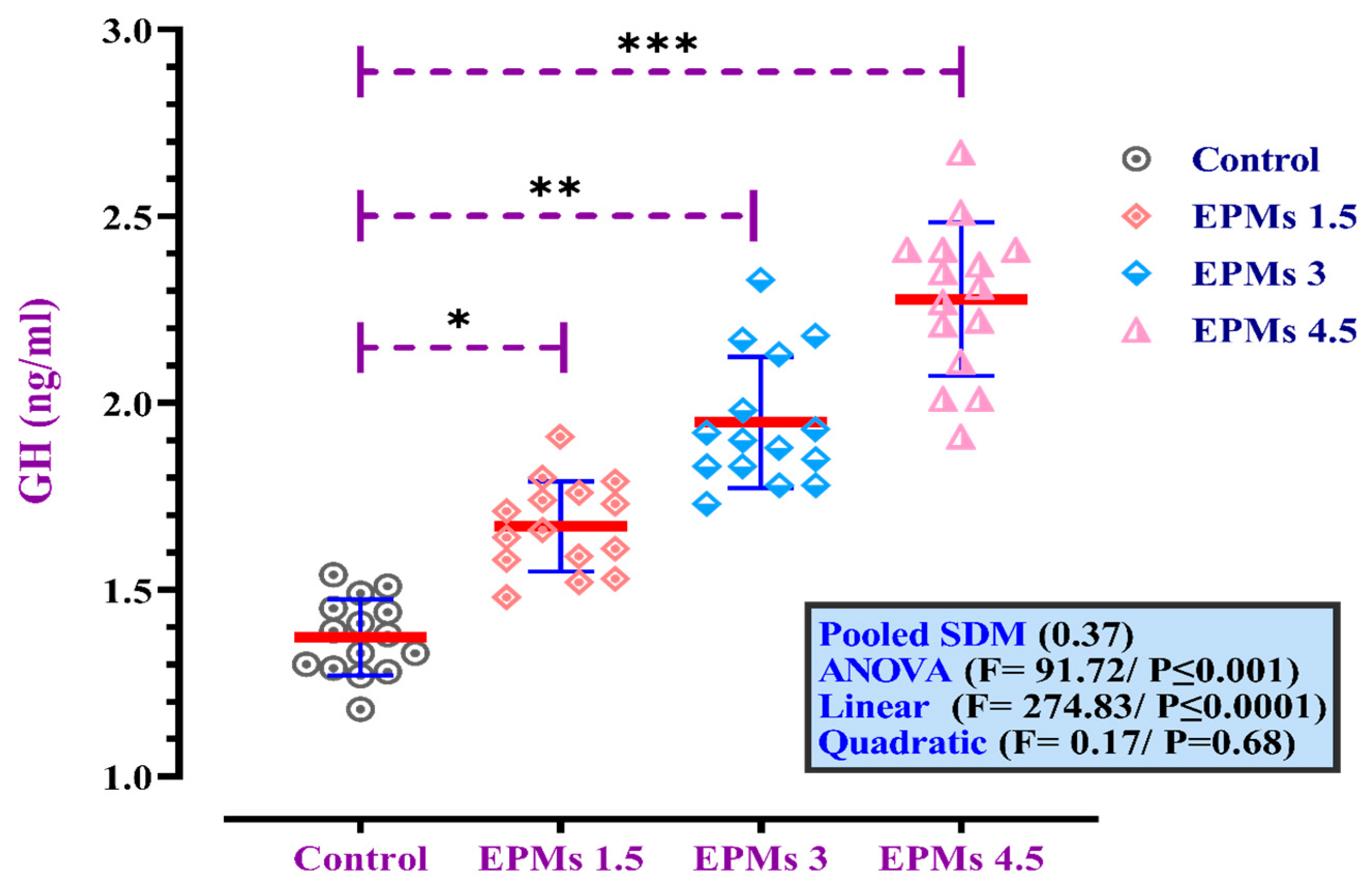
3.3. Serum Growth Hormone Levels

As shown in Figure 2, serum GH levels were significantly increased in the EPMs 1.5 (p < 0.05), EPMs 3 (p ≤ 0.01), and EPMs 4.5 (p ≤ 0.001) groups when compared to the fish fed the basal diet throughout the study period. Moreover, as the supplementation of EPMs increased from 1.5% to 4.5% DM, the mean values of GH exhibited a significant linear dose-dependent enhancement (F = 274.83, p ≤ 0.0001). The insignificance of the quadratic effect (F = 0.17, p = 0.68) indicates that the advantages of EPMs on GH secretion continue to climb with larger doses, contrary to the principle of diminishing returns within the tested range of EPMs inclusion levels.

3.4. Digestive Enzyme Efficiency

The digestive enzyme (TAP, lipase, and α-amylase) activities demonstrated a significant dose-dependent surge within the intestinal homogenates of the striped catfish in the EPMs 1.5 (p < 0.05), EPMs 3.0 (p ≤ 0.01), and EPMs 4.5 (p ≤ 0.01) groups when compared with the basal diet group (Table 4). The quadratic effects were insignificantly changed (p > 0.05), indicating that the relationship across EPMs supplementation dosage and enzyme activity is predominantly linear (p ≤ 0.0001).

3.5. Routine Hemogram Findings

The erythropoiesis potential parameters (RBC, Hb, and PCV) were significantly improved in a dose-responsive linear pattern in the EPMs 1.5 (p < 0.05), EPMs 3 (p ≤ 0.01), and EPMs 4.5 (p ≤ 0.001) dietary groups in comparison with the basal diet group (Table 5). Further, the integrity of erythrocytes was preliminarily identified by the insignificant (p > 0.05) variation in the computed indices of erythrocyte morphology (MCV) and Hb density (MCH and MCHC) and subsequently validated through the visualization of normocytic, salmon-colored nucleated erythrocytes in Giemsa-stained blood films of all the EPMs groups and the control group. The WBC count was significantly increased with equal significance levels (p ≤ 0.001). In contrast, the absolute lymphocyte count increased significantly in a linear crescendo (p ≤ 0.0001), indicating an enhanced immune response in a dose-dependent manner. However, the groups studied had no statistically significant difference in neutrophils, monocytes, and eosinophils (p > 0.05).

3.6. Serum Biochemical Metabolites and Lipid Profile

Table 6 illustrates the significant linear and quadratic impacts of EPMs supplementation on liver metabolic function, hepatocyte integrity biomarkers, and the lipid profile in P. hypophthalmus. A significant decrease in hepatobiliary enzyme (ALT, AST, and ALKP) activities was reported in all EPMs-supplemented trials with equal significant levels (p ≤ 0.01) with respect to the reference diet group in robust linear (p ≤ 0.001–≤ 0.0001) and mild quadratic (p < 0.05–≤ 0.01) trends. The significant linear effects (p ≤ 0.0001) of EPMs supplementation on the hepatocyte protein synthetic capacity with T. Protein and globulin levels exhibited a significant surge in a dose-dependent fashion in the EPMs 1.5 (p < 0.05), EPMs 3 (p ≤ 0.01), and EPMs 4.5 (p ≤ 0.001) dietary groups compared to the control cohort. The EPMs 3 and EPMs 4.5 groups exhibited the most significant dual linear and quadratic improvements in glucose and the lipid profile, including reductions in the values of T. Lipids, T. CHOL, TGs, VLDL, LDL, LDL: HDL, and the TGs: HDL index, alongside a harmonious increase in HDL levels when compared with their levels in the EPMs 1.5 (p < 0.05) and control groups. Notably, the serum levels of albumin, T. Bilirubin, urea, and creatinine remained statistically insignificant (p > 0.05) among all the studied groups.

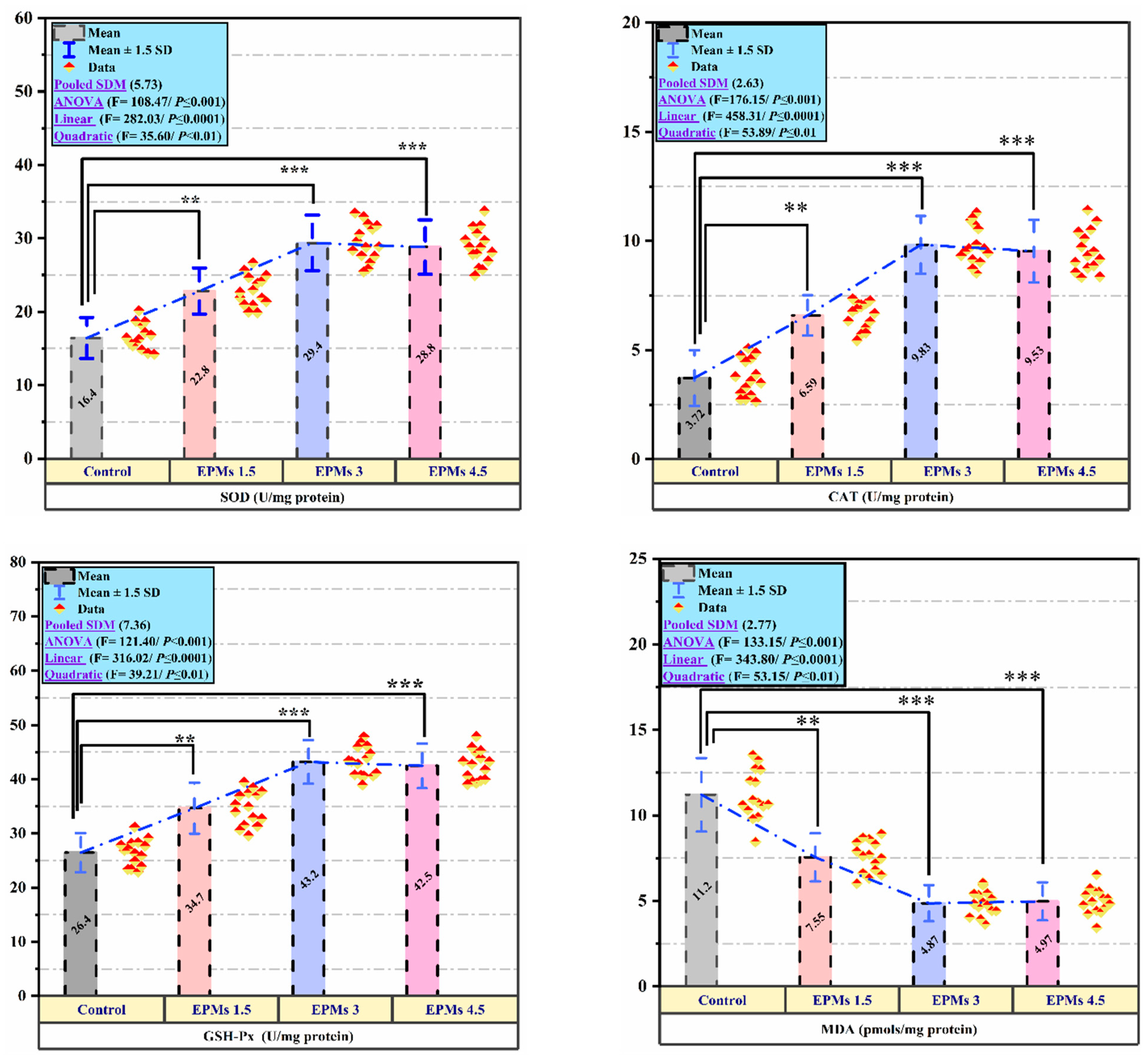
3.7. Hepatic Reduction/Oxidation Balance

Supplementation with EPMs at 1.5%, 3%, and 4.5% DM significantly (p ≤ 0.001) promoted the values of key antioxidant defense parameters (SOD, GSH-Px, and CAT), as evidenced by their robust linear (p ≤ 0.0001) and quadratic (p ≤ 0.01) trends with respect to the control group (Figure 3). Moreover, hepatic lipid peroxidation (MDA) levels were significantly decreased in linear (p ≤ 0.0001) and quadratic patterns (p ≤ 0.01). These data highlight the dual role of EPMs in optimal stress mitigation and fortifying antioxidant defenses with dose-dependent efficacy that peaks with an equal ANOVA significant level (p ≤ 0.001) at intermediate (3%) and high (4.5%) EPMs concentrations.

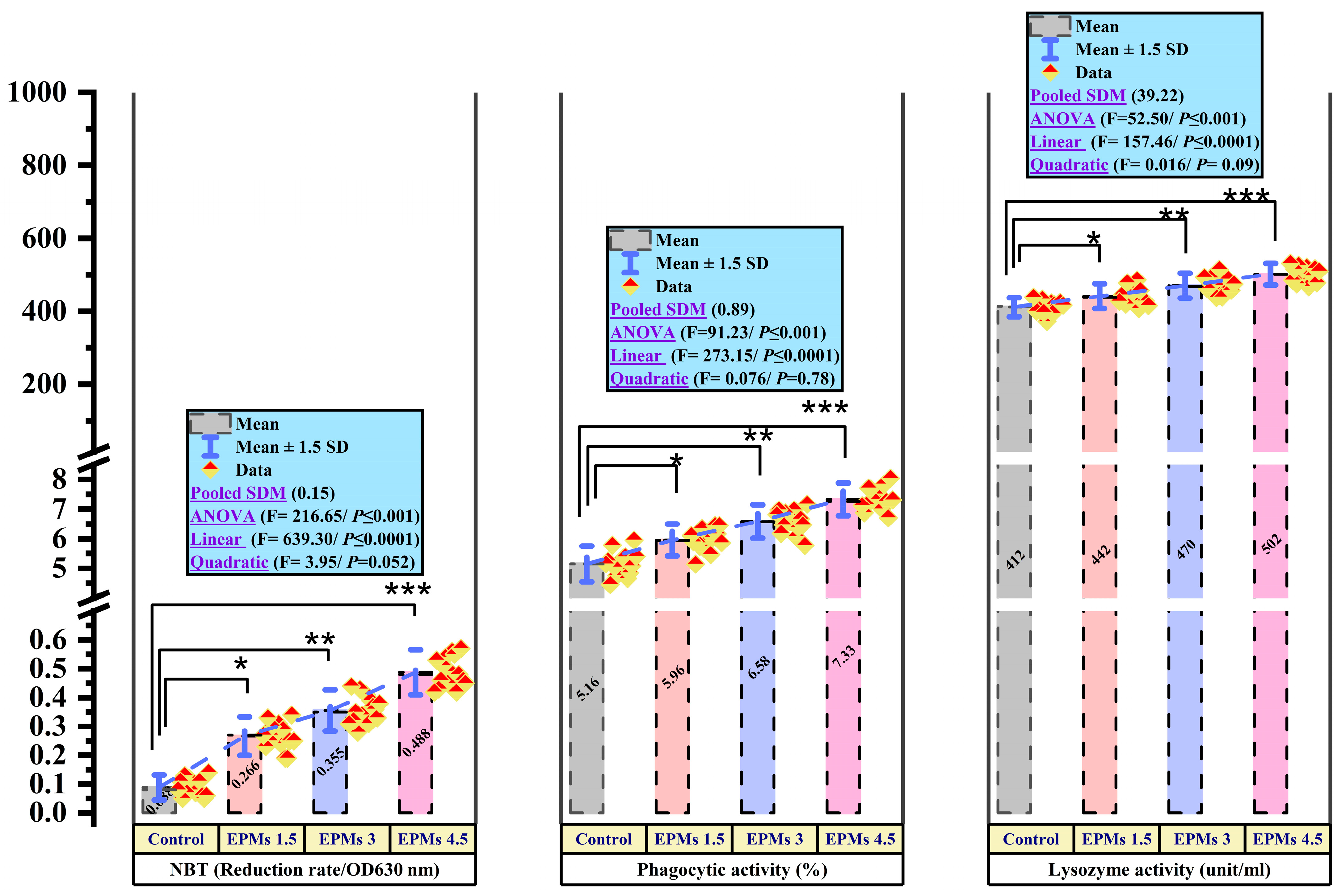
3.8. Cellular and Humoral Immune Response

As illustrated in Figure 4, the NBT reduction rate and phagocytic and lysozyme activity of farmed P. hypophthalmus showed significant (p ≤ 0.001) increases in a dose-responsive manner with low (p < 0.05), moderate (p ≤ 0.01), and high (p ≤ 0.001) significance values in the EPMs 1.5, EPMs 3.0, and EPMs 4.5 groups, respectively, when compared with the control one. These findings suggest that EPMs supplementation linearly augmented the immune responses without notable quadratic (p > 0.05) trends at higher doses.

3.9. Intestinal Microbial Diversity

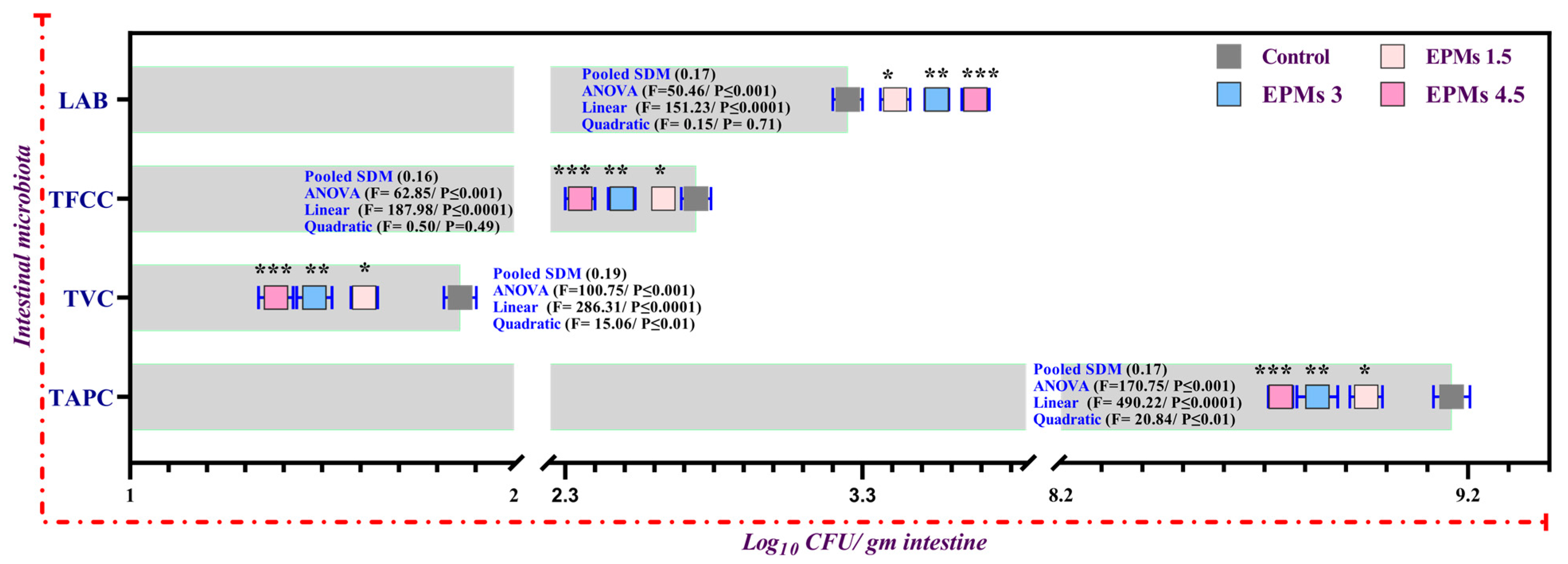
As summarized in Figure 5, EPMs supplementation displayed a dose-dependent positive impact on the gut microbial community modulation by enhancing beneficial LAB and reducing TAPC, TFCC, and TVC with the same significance levels in the EPMs 1.5 (p < 0.05), EPMs 3 (p ≤ 0.01), and EPMs 4.5 (p ≤ 0.001) groups when compared with the baseline microbial counts (log 10 CFU/g intestine) in the control group. Henceforth, the linear models demonstrated a significant (p ≤ 0.0001) dose-dependent response, indicating that higher EPMs concentrations (3% and 4.5% DM) consistently enhanced beneficial LAB while reducing pathogenic bacteria. The quadratic effects of EPMs were also significant (F = 15.06 to 20.84, p ≤ 0.01) for TAPC and TVC. These findings emphasize the potential of EPMs to optimize intestinal health through linear and quadratic pathways.

3.10. Resistance to Infection

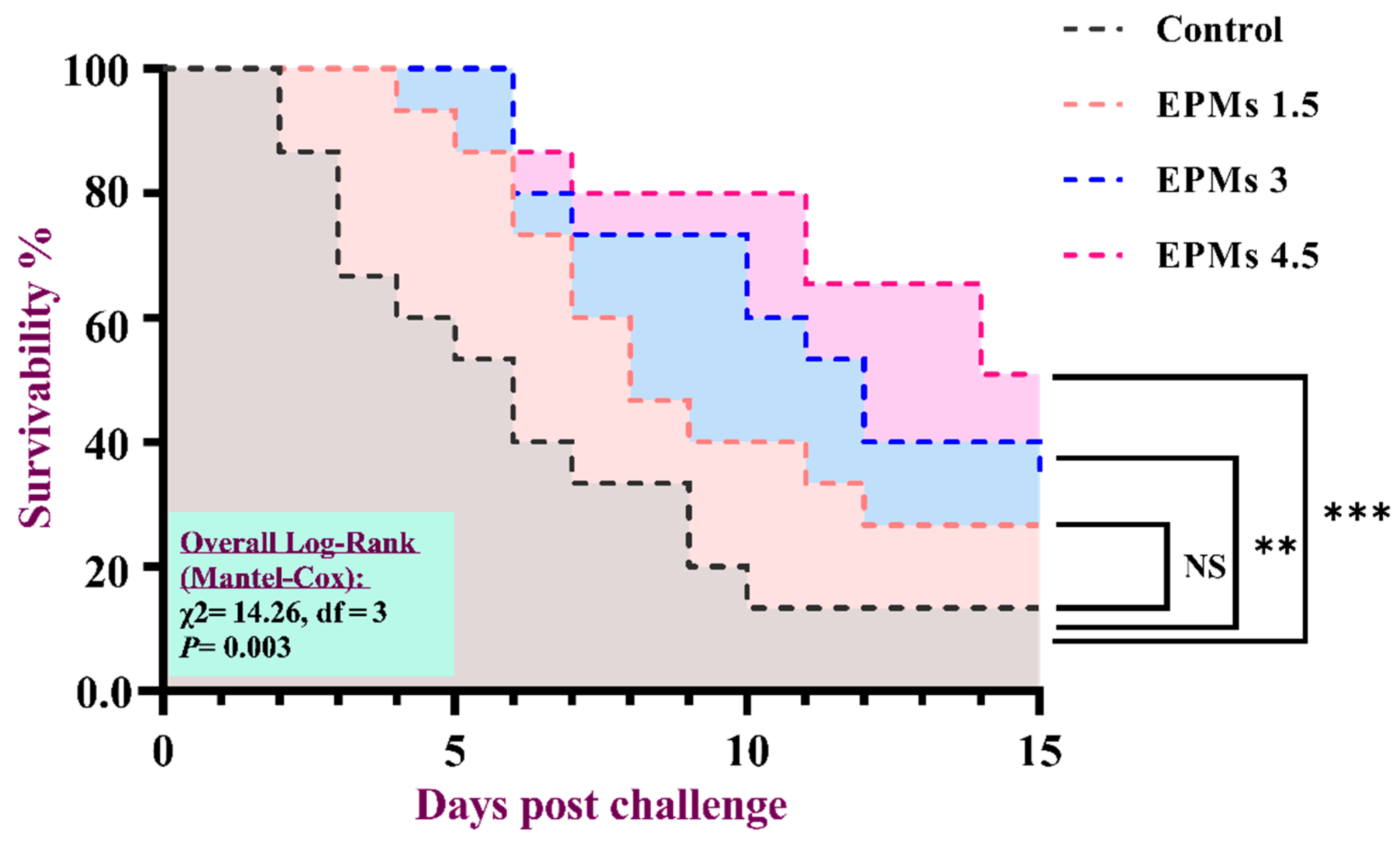
As shown in Figure 6, the survival of P. hypophthalmus toward A. hydrophila infection was significantly strengthened in fish fed with EPMs 3 and 4.5% DM (g/kg) when compared to the control (χ2EPMs3 = 6.39, df = 1, p ≤ 0.01, and χ2EPMs4.5 = 10.60, df = 1, p ≤ 0.001). However, there was no significant difference in survival between the EPMs 1.5-supplemented group and the control one (χ2EPMs1.5 = 2.54, df = 1, p = 0.11). After the 15-day challenge period, EPMs 4.5 displayed the greatest cumulative percentage of survival with 53.3%, followed by 33.3%, 26.7%, and 13.3% for the EPMs 3, EPMs 1.5, and control groups, respectively.

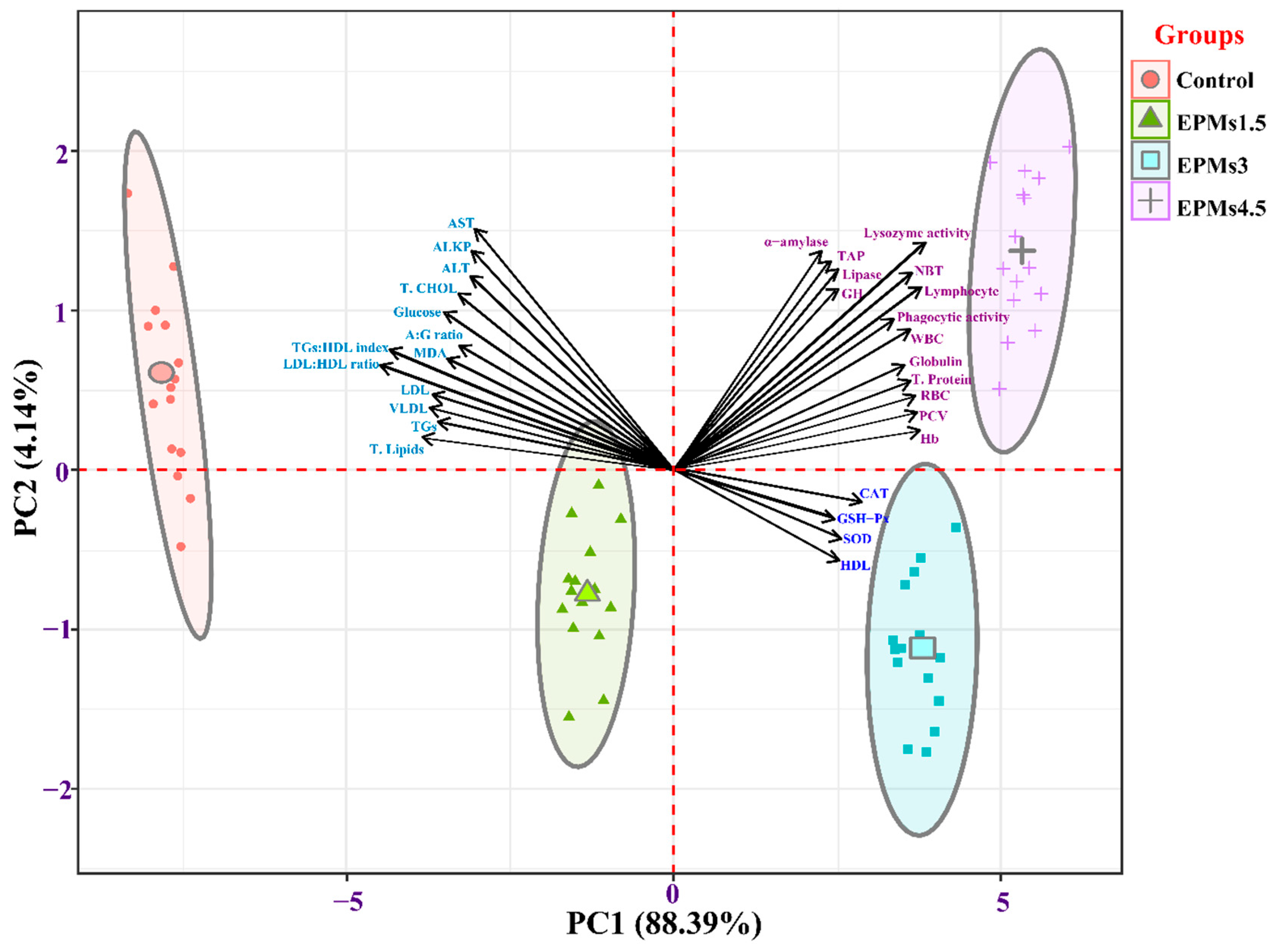
3.11. Principal Component Analysis (PCA) on the Significantly Enhanced Hemato-Biochemical, Hepatic Redox Status, Digestive Enzymes, and Immunity Response Parameters

The PCA biplot (Figure 7) illustrates the loadings of variables, distinct clustering patterns of control and EPMs-treated groups, and the key correlations among the estimated parameters and trends in EPMs supplementation levels. At eigenvalues > 1, principal components (PCs) 1 and 2 account for around 92.53% of the variance. PC1 accounts for 88.39% of the total variance, while PC2 explains 4.14%, indicating that most of the data variation is reported by PC1. The biplot’s clustering pattern indicated that the control samples (red circles) constituted a distinct cluster on the left, whereas EPMs 1.5, EPMs 3, and EPMs 4.5 were clustered on the right. This reflects shifts in physiological and immune responses corresponding to the dose supplementation of EPMs.
Markers of liver antioxidant capacity (CAT, SOD, GSH-Px) and good cholesterol (HDL) are positively loaded on PC1 and show a strong correlation with the EPMs 3 group, reflecting an enhanced hepatic antioxidant defense at this cutoff probiotic level. These variables load the opposite on PC1 and are inversely related to disturbance in hepatic integrity parameters (ALT, AST, and ALKP), the lipid profile (T. Lipids, T. CHOL, TGs, VLDL, LDL, LDL-C: HDL ratio, and TGs: HDL index), glucose, lipid peroxidation and oxidative stress marker (MDA), and the inflammatory/nutritional status marker (A: G ratio), which are strongly linked to the control group. On the other side, immune-related parameters (WBC, lymphocytes, phagocytic activity, NBT), erythropoiesis indicators (RBC, Hb, and PCV), proteinogram (T. Protein, and globulin), and GH are positively loaded in the upper quadrant of PCI and exhibit a strong correlation with the EPMs 4.5 group, suggesting an immunomodulatory effect of the higher EPMs dosage. These findings highlight a clear separation between the control and probiotic-treated groups, with higher EPMs levels favoring enhanced immune and antioxidant responses.

4. Discussion

In catfish farming, feeding strategies targeting immunogenicity have gained scholarly attention in recent years, with feed additives playing a crucial role in optimizing fish overall health and feed utilization during adverse farming conditions [11,12]. Probiotics, particularly multispecies consortia, have emerged as promising alternatives, offering synergistic benefits in improving fish welfare and productivity [32]. Compared to single-strain probiotic applications, diets co-supplemented with more probiotic organisms have the potential to generate enhanced benefits, as multi-strain probiotics may facilitate the integration of a comprehensive range of actions into a single entity [32,69].
Recent reports on the diverse functional roles of entire multispecies probiotics and their subcomponents have been widely practiced in fish farming to improve biometric indices, carcass composition, feed conversion rates, and survival rates [32,33,70,71]. Thus, our study found that although FI did not vary significantly between groups, FTL, FBW, WG, ADG, SGR, and RGR exhibited significant increases, while FCR showed a significant decrease. Such exciting linear outcomes could be related to improved feed utilization, protein synthesis capacity, and hepatic glycolysis, providing sustained energy for growth while modulating appetite regulation; however, the lack of a plateau response in FBW and WG with increasing EPMs levels suggests that the investigated range may not have captured the optimal inclusion level for maximum growth performance.
The improvement in PER observed in the present study is likely mechanistically attributed to the enzymatic and metabolic activities of the EPMs’ microbial consortium in the EPMs-supplemented diets. These microbes produce extracellular proteases and peptidases that hydrolyze complex dietary proteins into more digestible peptides and free amino acids, thereby enhancing amino acid bioavailability [32]. Furthermore, LAB and photosynthetic microbes can contribute to the de novo synthesis of essential amino acids, B vitamins, and cofactors that facilitate transamination and protein assimilation processes [71]. These combined effects likely improved nitrogen retention, protein deposition, and the overall efficiency of amino acid utilization, ultimately leading to a higher PER in fish fed supplemented diets. Such microbial-mediated improvements in protein metabolism have been similarly documented in tilapia and catfish supplemented with multi-strain probiotics [72].
In line with the current findings, digestibility and protein absorption in cultured tilapia, shrimp [32], carp, and catfish [73,74] were promoted by bioactive antimicrobial peptides and digestive enzymes synthesized by fermenting fungi and actinomycetes, which biodegrade complex feed components into readily absorbable nutrients. These growth-promoting effects might be attributed to the fact that yeast (Saccharomyces cerevisiae and Candida utilis)-derived β-glucans and mannan oligosaccharides, as well as LAB-produced bacteriocins and short-chain fatty acids (SCFAs), exert advantages as essential nutrients for gut microbiota modulation, whole-body growth rate, and protein turnover in Nile Tilapia [66,75], rainbow trout [76,77], and African catfish [70]. Additionally, red basidiomycetes (Rhodobacter sphaeroides and Rhodopseudomonas palustris) accumulate β-carotene, torulene, torularhodin, and polyhydroxyalkanoates cofactors in the prawn and tilapia gut to improve intestinal epithelium integrity, the synthesis and release of growth hormone, protein retention, and food conversion efficiency [32]. In accordance with Cadangin et al. [78] and Ferdous et al. [79], the linear trend in serum GH levels with higher EPMs concentrations in the current investigation suggests that enhanced growth rates are potentially linked to the modification of growth-related endocrine regulators and growth-promoting activities of GH by triggering the synthesis and release of IGFs. This GH-IGF-1 axis is essential for overall nutrient metabolism, responses to environmental and nutritional cues, and improving muscle cell proliferation [31].
Indeed, the synergistic interactions and adaptability of the multi-strain probiotics, including Actinomycetes, Aspergillus oryzae, Lactobacillus plantarum, photosynthetic bacteria, yeasts, and Saccharomyces cerevisiae, are more effective than single-strain probiotics or their cellular subcomponents in enhancing feed efficiency, digestive enzyme activities, growth performance, carcass composition, and biometric indices in Nile tilapia [28,35,80] and other fish species [32,71,72,81,82]. As such, the analysis of whole-body proximate composition and biometric indices in fish fed EPMs-supplemented diets revealed a significant increase in crude protein and a decrease in lipid content. Additionally, the survival rate (SR), visceral somatic index (VSI), relative gut length (RGL), and condition factor (K) were improved in a dose-dependent manner. These findings align with and surpass previous studies on multispecies [11,83,84] and single-strain [24,85] probiotic supplementation in striped catfish. This suggests that the synergistic action of the probiotics mixture in the current study strengthened the intestinal barrier and facilitated more effective nutrient deposition, digestive enzyme activities, protein synthesis, lipid efficiency, muscle growth, and carcass protein content by directing nutrient allocation toward growth rather than concentrating it in the liver, thereby ensuring efficient energy utilization and optimal growth rates. Our finding corroborates these interpretations because the fish treated with EPMs 4.5 supplementation showed a pronounced linear enhancement in digestive enzyme activity (TAP, lipase, and α-amylase) and greater growth rates compared to those in the EPMs 3%, EPMs 1.5%, and control groups. Moderate outcomes of increased digestive enzyme activity were also observed in P. hypophthalmus supplemented with Lactobacillus plantarum, Bacillus subtilis, Enterococcus faecium, and Saccharomyces cerevisiae combinations (0.5–1.5 g kg−1 diet) for 56 days [11]. The findings indicate that dietary overdose of EPMs consortia can secrete exogenous enzymes in fish, which may potentially augment the host’s natural digestive enzyme secretion, thereby improving overall digestive efficiency, gut microbiota reconstruction, nutrient absorption, and growth performance.
Biotic and abiotic stressors in intensive fish culture disrupt their physiological hemostasis [84,86]. Indeed, hematological panel indicators are critical tools for evaluating the overall health and physiological disturbance of aquatic species receiving functional aquafeed additives and probiotics, offering valuable insights into their impact and effectiveness [34,36,79]. In the current investigation, P. hypophthalmus fed a supplemented diet exhibited a better health status and cellular immunity, with no adverse effects on the hematological profile. In accordance with recent studies [11,27,79,84], our findings indicate that the Hb concentration and PCV % were higher in the EPMs-supplemented groups than in the control group, probably due to the hematinic minerals, active compounds, and vitamins synthesized and released by diverse strains of probiotics in gut media, which positively regulate effective normocytic normochromic RBC production, blood oxygen-carrying capacity, and acquired or adaptive immunity to help fish counteract stress and prevalent diseases [86,87,88,89]. WBCs increase as a defensive cellular adaptation to oxidative stress and infectious diseases, which ultimately raises fish immune response or survivability [90]. Thus, the fish in the supplemented groups showed significant linear enhancement in absolute WBC count and their lymphocyte proportion, suggesting immune-bolstering impacts of the multispecies prebiotics admixed diet. Similar findings were reported for the leukocyte count and innate immunity defense in Nile Tilapia [91], juvenile Asian seabass [92], hybrid groupers [31], and striped catfish [93] supplemented with diverse strains of probiotics (lactobacillus casei, Streptococcus lactis, and a mixture of bacteria and yeast), which create immune-related bioactive molecules (bacteriocins, exopolysaccharides, peptidoglycans, β-glucans, antimicrobial peptides, secreted immunoglobulin A, and mannoproteins) involved in pathogen recognition, immune cell proliferation, and AMR pathogen mitigation in aquaculture systems in an eco-friendly manner [11,32,93].
Blood metabolites are known as critical variables of fish nutritional status, stable metabolic rates, and overall hepato-renal function; they provide valuable insights into the safety and efficacy of dietary supplements [35,43]. In this regard, EPMs supplementation significantly influenced liver metabolic functions, hepatocyte integrity biomarkers, and lipid metabolism in P. hypophthalmus. A significant reduction in serum ALT, AST, and ALKP activities was observed across all the EPMs-supplemented groups, following strong linear and quadratic trends. In contrast to this, Abdel-Latif et al. [11] reported that hepatic enzyme activity showed insignificant change following multispecies probiotic supplementation at 0.5–1.5 g kg−1 diet for 56 days. Our findings reflect the clear modulation of hepatic biomarkers, which may influence the differences in probiotics mix, formulations, dosages, or aquaculture practices. The outcomes suggest that EPMs contribute to improved hepatic function and hepatocyte stability, consistent with previous findings on functional feed additives in other fish species [86,94]. Furthermore, T. Protein and globulin levels were linearly increased, particularly in the EPMs 3 and EPMs 4.5 groups, indicating enhanced protein synthesis and immune competence [35]. However, albumin, T. Bilirubin, creatinine, and urea levels remained unchanged. This finding corroborates the safety and non-toxic characteristics of EPMs dietary supplementation and confirms that the cultured P. hypophthalmus was healthy, exhibiting no nutritional, metabolic, or physiological disturbances.
Lipid biotransformation efficiency and glucose metabolism in the EPMs-supplemented groups were consistent with those obtained by Hassaan et al. [87], as evidenced by the significant reductions in glucose, total lipids, cholesterol, triglycerides, VLDL, and LDL, alongside remarkably increased HDL levels. The circulatory lipid clearance rate was correlated with EPMs supplementation and beneficial gut microbiome abundance and their active metabolites, including SCFAs (butyrate and propionate), bile salt hydrolases, and lipases, which play crucial roles in triggering triglyceride transport, apoprotein A and B synthesis, lipoprotein assembly, HDL production, and energy metabolism optimization [32,95]. Efficient lipid utilization mitigates lipid and glycogen accumulation in the liver, hence reducing body lipid content, liver steatosis, and retarded growth, as discussed in this study and recent reports [96,97]. The reduced TG: HDL index and LDL: HDL ratio further demonstrate the significance of dietary EPMs in enhancing lipid balance, fish quality, and cardiovascular health of P. hypophthalmus.
Indeed, aquaculture stressors provoke excessive free radical (ROS) accumulation, oxidative damage to essential cellular components (proteins, lipids, and nucleic acids), and impaired metabolic status in aquatic animals [31,88]. This situation necessitates enhancing antioxidant defense systems for scavenging excess ROS and maintaining a balanced cellular redox state. In our study, the incorporation of EPMs into the basal fish meal mitigated ROS-induced damage in the hepatic tissue of cultured P. hypophthalmus fingerlings by the dual role of EPMs in reducing hepatic lipid peroxidation (MDA) while strengthening liver antioxidant capacity (SOD, CAT, and GSH-Px) with dose-dependent efficacy relative to the control group. These potent antioxidant benefits may result from the bioactive peptides, bacteriocins, exopolysaccharides, SCFAs, and B-complex vitamins produced and released by the functional probiotics to support mitochondrial function and ROS-binding potential [30]. Similar to our results, mixed feeding with multispecies probiotics enhanced hepatic redox status in P. hypophthalmus by promoting CAT, SOD, and GSH-Px activity values, together with a reduction in MDA concentrations [11]. A similar kind of observation was also reported by Xie et al. [31] after administering feed admixed with B. cereus and E. acetylicum to Hybrid Groupers, and by Bhatnagar and Mann [81] after the coadministration of Bacillus cereus SL1 and Ocimum sanctum combination to mrigal (Cirrhinus mrigala).
The immunostimulatory and antioxidative effects of EPMs are driven by bioactive compounds (e.g., exopolysaccharides, β-glucans, bacteriocins, and short-chain fatty acids) that act as crucial signaling molecules. The dual function of these bioactive metabolites is clearly demonstrated. They simultaneously enhance the efficacy of pivotal antioxidant enzymes (SOD, CAT, and GSH-Px) and actively modulate immune-related signaling cascades (e.g., TLRs/NF-κB). This interaction subsequently stimulates a heightened immune response, evidenced by increased cytokine release, phagocytic activity, and oxidative burst [72,81,82,83]. Consequently, while the current evidence is strong at the phenotypic level, subsequent research should focus on gene-level analysis to definitively confirm these proposed molecular mechanisms [36,81].
Previous studies have emphasized the role of mixed probiotics in enhancing innate immunity over single strains due to their synergistic effects on triggering various immune defense mechanisms [32,36,94]. The main defense mechanism of fish is the vital link between innate and adaptive immune systems, which guarantees a quick and efficient immune response and prompt protection against various diseases. Our study found that adding multi-strain probiotics to P. hypophthalmus basal aquafeed augmented innate immune response. This was evident through a linear trend in the oxidative burst activity measured by NBT reduction, increased serum lysozyme-mediated bacterial cell wall degradation activity, and improved phagocytic function of neutrophils and macrophages in ingesting exogenous pathogens. Similar immune-enhancing properties have been reported for various Bacillus strains incorporated in the diet of Scophthalmus maximus and P. hypophthalmus [93]. Consistent with Dias and Filho [72] and El-Kady et al. [36], multi-strain probiotics significantly increased O. niloticus’s innate immunity compared to single strains. Reyes-Becerril et al. [98] and Torres-Maravilla et al. [99] attributed these immunomodulatory impacts to the immune-modulating compounds (antimicrobial peptides, phenols, lactones, bacteriocins, tryptophan, exopolysaccharides, propionate, butyrate, and B-complex vitamins) synthesized by EPMs. These compounds promote cytokine upregulation, pattern recognition receptor expression in phagocytes, and pathogen opsonization via antibody or complement pathways to regulate immune responses, intestinal barrier function, and AMR bacteria elimination.
Nowadays, the use of probiotics as a substitute for antibiotics aims to reduce the colonization of larval, fry, and juvenile intestines by bacterial pathogens and shift the gut microbial composition toward a nutritionally essential beneficial microbiome [71,100] to enhance enzymatic activity, nutrient digestion, intestinal integrity, and overall fish health, thereby supporting sustainable aquaculture practices [32]. In keeping with this approach, a diet mixed with EPMs at higher concentrations (3 and 4.5% DM g/kg) significantly improved the abundance of beneficial LAB, together with reducing the pathogenic TFCC and TVC load in P. hypophthalmus gut mucosa in a linear dose-responsive manner with respect to the control group. As evidenced, LAB, actinomycetes, and Aspergillus sp., encountered in EPMs, mitigate gut microbial dysbiosis by competing for resources, producing active metabolites (bacteriocins, vitamins K and B2) integral for membrane integrity, antimicrobial activities, and cellular and humoral immune responses, thereby minimizing the risk of gastrointestinal diseases in aquaculture systems, improving optimal metabolic function, fish health, and stress resilience [12,32,89]. Similar results were recently outlined by Opiyo et al. [101], who found that baker’s yeast (Saccharomyces cerevisiae) exerted favorable effects on pathogenic bacteria load in Nile Tilapia and was more effective than Bacillus subtilis in influencing the functional microbiota composition. Another study using juvenile crucian carp demonstrated that extracellular enzymes of photosynthetic bacteria detoxify water and combat organic matter build-up stress through the degradation of toxic ammonia and nitrite compounds in aquatic ecosystems to make water more suitable for culture organisms and gut microbiota, providing additional protein sources, novel metabolites, growth-promoting factors for more efficient feed digestion, nutrient assimilation, and stress tolerance [88,102].
Infections caused by A. hydrophila induce hemorrhagic septicemia, exophthalmia, abdominal distension, and reddening of fins; in Southeast Asia, mortalities reached 80–100% within 14 days in catfish, leading to huge economic losses [103,104]. A diet containing multiple probiotic strains could effectively safeguard against A. hydrophila infections in fish cultured in stressed aquatic environments. Notably, a 90-day regimen of feeding with EPMs at 3% and 4.5% supplementation was sufficient to augment the P. hypophthalmus immune system and improve its survival toward A. hydrophila infection compared to the control diet. This result is critically important for striped catfish aquaculture practices, as A. hydrophila is among the most widespread pathogenic bacteria globally, especially in intensive farming systems [103]. Survival rates following A. hydrophila challenges are attributed to enhanced innate immune responses in farmed fish, supported by probiotic strains in EPMs. As previously discussed, the active metabolites and subcellular components in these probiotics promoted the antioxidant capacity, phagocytic activity, and lysozyme function. These immune responses augment the modulation of gut microbiota and suppression of A. hydrophila colonization. The current outcomes are consistent with the existing literature supporting the beneficial impacts of mixed probiotics in aquaculture to improve disease resistance [11,105], reduce pathogen load [82], and promote overall fish health [24]. Consequently, dietary inclusion of EPMs at 3% and 4.5% DM over three months presents a promising strategy for mitigating bacterial infections in aquaculture.

5. Conclusions

Dietary supplementation with multispecies EPMs was investigated in this study, which provided valuable insights into enhancing growth performance, feed efficiency, digestive enzyme activity, antioxidant capacity, immune response, and disease resistance against A. hydrophila infection. The 4.5% inclusion level yielded the greatest overall benefits without adverse effects on the hematobiochemical profile and health status, marking it as an optimal inclusion level. The noted hypolipidemic effect indicated that EPMs help regulate lipid metabolism, which adds to their value as a functional feed ingredient. These findings highlight EPMs as potent health-promoting and prophylactic agents; however, they should complement rather than replace therapeutic antibiotics. Prospective studies must involve comparisons with conventional antibiotics, such as oxytetracycline or enrofloxacin, through double-blind challenge trials and detailed antimicrobial resistance profiling. Further research should elucidate the molecular pathways underlying EPMs’ beneficial effects through transcriptomic approaches, evaluate their long-term impacts across diverse fish species, and optimize their formulations for commercial-scale application. Addressing these aspects will strengthen their potential as sustainable, eco-friendly alternatives to antibiotics, conventional growth enhancers, and immunostimulants in aquaculture.

Supplementary Materials

The following supporting information can be downloaded at https://www.mdpi.com/article/10.3390/fishes10110573/s1, Table S1: Genus and strains of the investigated EPMs and their respective (Mean ± SD) CFU/g formulated feed.

Author Contributions

Conceptualization, M.A.E., A.M.A., A.M.E.-Z., M.M.H., and A.M.E.-S.; methodology, M.A.E., A.M.A., A.M.E.-Z., M.M.H., I.M.I., F.E., and A.M.E.-S.; investigation, M.A.E., A.M.A., A.M.E.-Z., M.M.H., A.W.A.-M.A.-W., F.E., and A.M.E.-S.; software, M.A.E.; validation, A.M.A., A.M.E.-Z., M.M.H., A.W.A.-M.A.-W., and A.M.E.-S.; formal analysis, M.A.E. and A.M.E.-S.; resources, M.A.E., A.W.A.-M.A.-W., E.M.I.Y., and S.J.D.; data curation, M.A.E., F.E., and A.M.E.-S.; visualization, A.M.E.-S.; supervision, A.M.A., A.M.E.-Z., M.M.H., A.W.A.-M.A.-W., and A.M.E.-S.; funding acquisition, A.W.A.-M.A.-W., E.M.I.Y., and S.J.D.; project administration, A.W.A.-M.A.-W., E.M.I.Y., and S.J.D.; writing—original draft preparation, M.A.E., A.M.A., A.M.E.-Z., M.M.H., A.W.A.-M.A.-W., E.M.I.Y., S.J.D., and A.M.E.-S.; writing—review and editing, I.M.I., F.E., and A.M.E.-S. All authors have read and agreed to the published version of the manuscript.

Funding

This research received no external funding.

Institutional Review Board Statement

This study was conducted under the approval of the Animal Care and Use Committee at the faculty of Veterinary Medicine, Mansoura University (MU-ACUC, Approval No: VM.R.25.01.207 and approval date: 23 January 2025). All experimental procedures complied with institutional ethical standards for the use of animals in research and were reported in accordance with the ARRIVE guidelines (https://arriveguidelines.org (accessed on 4 September 2025).

Data Availability Statement

The original contributions presented in this study are included in this article. The data could be provided upon request, directed to the corresponding author.

Acknowledgments

This research was supported by the ongoing research funding program (ORF-2025-700), King Saud University, Riyadh, Saudi Arabia. So, the authors would like to extend their deepest thanks to the members of several such groups for their outstanding support.

Conflicts of Interest

The authors declare no conflicts of interest.

References

  1. Ottinger, M.; Clauss, K.; Kuenzer, C. Opportunities and challenges for the estimation of aquaculture production based on earth observation data. Remote Sens. 2018, 10, 1076. [Google Scholar] [CrossRef]
  2. Griffin, W.; Wang, W.; de Souza, M.C. The sustainable development goals and the economic contribution of fisheries and aquaculture. FAO Aquac. Newsl. 2019, 60, 51–52. [Google Scholar]
  3. Kaleem, O.; Sabi, A.-F.B.S. Overview of aquaculture systems in Egypt and Nigeria, prospects, potentials, and constraints. Aquac. Fish. 2021, 6, 535–547. [Google Scholar] [CrossRef]
  4. Feidi, I. Will the new large-scale aquaculture projects make Egypt self sufficient in fish supplies? Mediterr. Fish. Aquac. Res. 2018, 1, 31–41. [Google Scholar]
  5. Mansour, A.T.; Allam, B.W.; Srour, T.M.; Omar, E.A.; Nour, A.A.M.; Khalil, H.S. The feasibility of monoculture and polyculture of striped catfish and Nile tilapia in different proportions and their effects on growth performance, productivity, and financial revenue. J. Mar. Sci. Eng. 2021, 9, 586. [Google Scholar] [CrossRef]
  6. Noseda, B.; Islam, M.T.; Eriksson, M.; Heyndrickx, M.; De Reu, K.; Van Langenhove, H.; Devlieghere, F. Microbiological spoilage of vacuum and modified atmosphere packaged Vietnamese Pangasius hypophthalmus fillets. Food Microbiol. 2012, 30, 408–419. [Google Scholar] [CrossRef]
  7. Singh, A.K. Assessing the Sustainability and Food Security Implications of Introduced (Sauvage, 1878) and (Burchell, 1822) Into Indian Aquaculture: A OneHealth Perspective. Rev. Aquac. 2025, 17, e12990. [Google Scholar] [CrossRef]
  8. Abd-Elaziz, R.A. Striped catfish (Pangasianodon hypophthalmus) with special emphasis on its suitability to the Egyptian aquaculture: An overview. Egyp. J. Anim. Health 2024, 4, 148–153. [Google Scholar] [CrossRef]
  9. Mohamad, N.F.A.; Daud, H.H.M.; Ruhil Hayati, H.; Manaf, S.R.; Zin, A.A.M.; Fauzi, N.N.F.N.M. Identification of Fatty Acid Profile of Clariid Catfish Species: Clarias gariepinus (Burchell, 1822), Clarias macrocephalus (Gunther, 1864) and their Hybrids. Adv. Anim. Vet. Sci. 2022, 10, 712–954. [Google Scholar] [CrossRef]
  10. Zaki, M.A.A.; Khalil, H.S.; Allam, B.W.; Khalil, R.H.; Basuini, M.F.E.; Nour, A.E.-A.M.; Labib, E.M.H.; Elkholy, I.S.E.; Verdegem, M.; Abdel-Latif, H.M.R. Assessment of zootechnical parameters, intestinal digestive enzymes, haemato-immune responses, and hepatic antioxidant status of Pangasianodon hypophthalmus fingerlings reared under different stocking densities. Aquac. Int. 2023, 31, 2451–2474. [Google Scholar] [CrossRef]
  11. Abdel-Latif, H.M.; Chaklader, M.R.; Shukry, M.; Ahmed, H.A.; Khallaf, M.A. A multispecies probiotic modulates growth, digestive enzymes, immunity, hepatic antioxidant activity, and disease resistance of Pangasianodon hypophthalmus fingerlings. Aquaculture 2023, 563, 738948. [Google Scholar] [CrossRef]
  12. Naiel, M.A.E.; Farag, M.R.; Gewida, A.G.A.; Elnakeeb, M.A.; Amer, M.S.; Alagawany, M. Using lactic acid bacteria as an immunostimulants in cultured shrimp with special reference to Lactobacillus spp. Aquac. Int. 2021, 29, 219–231. [Google Scholar] [CrossRef]
  13. Abdelhamid, A.F.; Ayoub, H.F.; Abd El-Gawad, E.A.; Abdelghany, M.F.; Abdel-Tawwab, M. Potential effects of dietary seaweeds mixture on the growth performance, antioxidant status, immunity response, and resistance of striped catfish (Pangasianodon hypophthalmus) against Aeromonas hydrophila infection. Fish Shellfish Immunol. 2021, 119, 76–83. [Google Scholar] [CrossRef]
  14. Bartie, K.L.; Ngô, T.P.H.; Bekaert, M.; Hoang Oanh, D.T.; Hoare, R.; Adams, A.; Desbois, A.P. Aeromonas hydrophila ST251 and Aeromonas dhakensis are major emerging pathogens of striped catfish in Vietnam. Front. Microbiol. 2023, 13, 1067235. [Google Scholar] [CrossRef]
  15. Mamun, A.-A.; Nasren, S.; Rathore, S.S.; Mahbub Alam, M. Histopathological Analysis of Striped Catfish, Pangasianodon hypophthalmus (Sauvage, 1878) Spontaneously Infected with Aeromonas hydrophila. Jordan J. Biol. Sci 2022, 15, 93–100. [Google Scholar] [CrossRef]
  16. Xu, T.; Rasmussen-Ivey, C.R.; Moen, F.S.; Fernández-Bravo, A.; Lamy, B.; Beaz-Hidalgo, R.; Khan, C.D.; Escarpulli, G.C.; Yasin, I.S.M.; Figueras, M.J.; et al. A Global Survey of Hypervirulent Aeromonas hydrophila (vAh) Identified vAh Strains in the Lower Mekong River Basin and Diverse Opportunistic Pathogens from Farmed Fish and Other Environmental Sources. Microbiol. Spectr. 2023, 11, e03705–e03722. [Google Scholar] [CrossRef]
  17. Limbu, S.M.; Chen, L.Q.; Zhang, M.L.; Du, Z.Y. A global analysis on the systemic effects of antibiotics in cultured fish and their potential human health risk: A review. Rev. Aquac. 2021, 13, 1015–1059. [Google Scholar] [CrossRef]
  18. Dang, L.T.; Nguyen, L.H.T.; Pham, V.T.; Bui, H.T.T. Usage and knowledge of antibiotics of fish farmers in small-scale freshwater aquaculture in the Red River Delta, Vietnam. Aquac. Res. 2021, 52, 3580–3590. [Google Scholar] [CrossRef]
  19. Abdel-Latif, H.M.R.; Shukry, M.; Noreldin, A.E.; Ahmed, H.A.; El-Bahrawy, A.; Ghetas, H.A.; Khalifa, E. Milk thistle (Silybum marianum) extract improves growth, immunity, serum biochemical indices, antioxidant state, hepatic histoarchitecture, and intestinal histomorphometry of striped catfish, Pangasianodon hypophthalmus. Aquaculture 2023, 562, 738761. [Google Scholar] [CrossRef]
  20. Khanjani, M.H.; Mozanzadeh, M.T.; Gisbert, E.; Hoseinifar, S.H. Probiotics, prebiotics, and synbiotics in shrimp aquaculture: Their effects on growth performance, immune responses, and gut microbiome. Aquac. Rep. 2024, 38, 102362. [Google Scholar] [CrossRef]
  21. Status, H.; Toutou, M.M.; Ali, A.; Soliman, A.; Mahrous, M.; Farrag, S. Effect of Probiotic and Synbiotic Food Supplementation on Growth Effect of Probiotic and Synbiotic Food Supplementation on Growth Performance and Healthy Status of Grass Carp, Ctenopharyngodon idella (Valenciennes, 1844). Int. J. Ecotoxicol. Ecobiol. 2016, 1, 111–117. Available online: https://www.sciencepublishinggroup.com/article/10.11648/j.ijee.20160103.18 (accessed on 28 September 2025).
  22. Rohani, M.F.; Islam, S.M.M.; Hossain, M.K.; Ferdous, Z.; Siddik, M.A.B.; Nuruzzaman, M.; Padeniya, U.; Brown, C.; Shahjahan, M. Probiotics, prebiotics and synbiotics improved the functionality of aquafeed: Upgrading growth, reproduction, immunity and disease resistance in fish. Fish Shellfish Immunol. 2022, 120, 569–589. [Google Scholar] [CrossRef] [PubMed]
  23. Tanveer, A.; Khan, N.; Fatima, M.; Ali, W.; Nazir, S.; Bano, S.; Asghar, M. Effect of multi-strain probiotics on the growth, hematological profile, blood biochemistry, antioxidant capacity, and physiological responses of Clarias batrachus fingerlings. Aquac. Int. 2024, 32, 1817–1833. [Google Scholar] [CrossRef]
  24. Liaqat, R.; Fatima, S.; Komal, W.; Minahal, Q.; Kanwal, Z.; Suleman, M.; Carter, C.G. Effects of Bacillus subtilis as a single strain probiotic on growth, disease resistance and immune response of striped catfish (Pangasius hypophthalmus). PLoS ONE 2024, 19, e0294949. [Google Scholar] [CrossRef]
  25. Puvanasundram, P.; Chong, C.M.; Sabri, S.; Yusoff, M.S.; Karim, M. Multi-strain probiotics: Functions, effectiveness and formulations for aquaculture applications. Aquac. Rep. 2021, 21, 100905. [Google Scholar] [CrossRef]
  26. Todorov, S.D.; Lima, J.M.S.; Bucheli, J.E.V.; Popov, I.V.; Tiwari, S.K.; Chikindas, M.L. Probiotics for Aquaculture: Hope, Truth, and Reality. Probiotics Antimicrob. Proteins 2024, 16, 2007–2020. [Google Scholar] [CrossRef] [PubMed]
  27. Ghanei-Motlagh, R.; Mohammadian, T.; Gharibi, D.; Khosravi, M.; Mahmoudi, E.; Zarea, M.; El-Matbouli, M.; Menanteau-Ledouble, S. Quorum quenching probiotics modulated digestive enzymes activity, growth performance, gut microflora, haemato-biochemical parameters and resistance against Vibrio harveyi in Asian seabass (Lates calcarifer). Aquaculture 2021, 531, 735874. [Google Scholar] [CrossRef]
  28. Cano-Lozano, J.A.; Villamil Diaz, L.M.; Melo Bolivar, J.F.; Hume, M.E.; Ruiz Pardo, R.Y. Probiotics in tilapia (Oreochromis niloticus) culture: Potential probiotic Lactococcus lactis culture conditions. J. Biosci. Bioeng. 2022, 133, 187–194. [Google Scholar] [CrossRef]
  29. Amit; Pandey, A.; Tyagi, A.; Khairnar, S.O. Oral feed-based administration of Lactobacillus plantarum enhances growth, haematological and immunological responses in Cyprinus carpio. Emerg. Anim. Species 2022, 3, 100003. [Google Scholar] [CrossRef]
  30. Chugh, B.; Kamal-Eldin, A. Bioactive compounds produced by probiotics in food products. Curr. Opin. Food Sci. 2020, 32, 76–82. [Google Scholar] [CrossRef]
  31. Xie, G.; Chen, X.; Feng, Y.; Yu, Z.; Lu, Q.; Li, M.; Ye, Z.; Lin, H.; Yu, W.; Shu, H. Effects of dietary multi-strain probiotics on growth performance, antioxidant status, immune response, and intestinal microbiota of hybrid groupers (Epinephelus fuscoguttatus♀ × E. Lanceolatus♂). Microorganisms 2024, 12, 1358. [Google Scholar] [CrossRef]
  32. Ghosh, K.; Harikrishnan, R.; Mukhopadhyay, A.; Ringø, E. Fungi and Actinobacteria: Alternative Probiotics for Sustainable Aquaculture. Fishes 2023, 8, 575. [Google Scholar] [CrossRef]
  33. Abd El-Naby, A.S.; El Asely, A.M.; Hussein, M.N.; Khattaby, A.E.-R.A.; Sabry, E.A.; Abdelsalam, M.; Samir, F. Effects of dietary fermented Saccharomyces cerevisiae extract (Hilyses) supplementation on growth, hematology, immunity, antioxidants, and intestinal health in Nile tilapia. Sci. Rep. 2024, 14, 12583. [Google Scholar] [CrossRef]
  34. Balami, S.; Paudel, K.; Shrestha, N. A review: Use of probiotics in striped catfish larvae culture. Int. J. Fish. aquat. Stud. 2022, 10, 41–49. [Google Scholar]
  35. Abdel-Aziz, M.; Bessat, M.; Fadel, A.; Elblehi, S. Responses of dietary supplementation of probiotic effective microorganisms (EMs) in Oreochromis niloticus on growth, hematological, intestinal histopathological, and antiparasitic activities. Aquac. Int. 2020, 28, 947–963. [Google Scholar] [CrossRef]
  36. El-Kady, A.A.; Magouz, F.I.; Mahmoud, S.A.; Abdel-Rahim, M.M. The effects of some commercial probiotics as water additive on water quality, fish performance, blood biochemical parameters, expression of growth and immune-related genes, and histology of Nile tilapia (Oreochromis niloticus). Aquaculture 2022, 546, 737249. [Google Scholar] [CrossRef]
  37. Hadir, A.A.; Mohamed, M.A.R.; Ayman, M.L.; Basem, S.A.; Ghada, M.S. The Applicability of Activated Carbon, Natural Zeolites, and Probiotics (EM®) and Its Effects on Ammonia Removal Efficiency and Fry Performance of European Seabass Dicentrarchus labrax. J. Aquac. Res. Dev. 2016, 7, 459–466. [Google Scholar] [CrossRef]
  38. Jwher, D.M.; Al-Sarhan, M. Evaluation the role of effective microorganisms (EM) on the growth performance and health parameters on common carp (Cyprinus carpio L.). J. Appl. Vet. Sci. 2022, 7, 46–52. [Google Scholar] [CrossRef]
  39. Chesyk, I.; Puzan, N.; Nikitin, A. EM–Multifunctional Microbiological Preparation; AIJR Publisher: Utraula, Uttar Pradesh, India, 2020; pp. 159–160. Available online: https://books.aijr.org/index.php/press/catalog/download/93/26/535-1?inline=1 (accessed on 21 September 2025).
  40. Rice, E.W.; Baird, R.B.; Eaton, A.D.; Clesceri, L.S. Standard Methods for the Examination of Water and Wastewater; American Public Health Association: Washington, DC, USA; American Water Works Association: Denver, CO, USA; Water Environment Federation: Alexandria, VA, USA, 2012. [Google Scholar]
  41. Oladipupo, A.A.; Kelly, A.M.; Davis, D.A.; Bruce, T.J. Investigation of dietary exogenous protease and humic substance on growth, disease resistance to Flavobacterium covae and immune responses in juvenile channel catfish (Ictalurus punctatus). J. Fish Dis. 2023, 5, 1–19. [Google Scholar] [CrossRef]
  42. Coyle, S.D.; Durborow, R.M.; Tidwell, J.H. Anesthetics in Aquaculture; Southern Regional Aquaculture Center: Stoneville, MS, USA, 2004; Volume 3900, p. 6. [Google Scholar]
  43. Ashry, A.M.; Habiba, M.M.; Abdel-Warith, A.-w.A.; Younis, E.M.; Davies, S.J.; Elnakeeb, M.A.; Abdelghany, M.F.; El-Zayat, A.M.; El-Sebaey, A.M. Dietary effect of powdered herbal seeds on zootechnical performance, hemato-biochemical indices, immunological status, and intestinal microbiota of European sea bass (Dicentrarchus labrax). Aquac. Rep. 2024, 36, 102074. [Google Scholar] [CrossRef]
  44. Thiex, N.; Novotny, L.; Crawford, A. Determination of ash in animal feed: AOAC official method 942.05 revisited. J. AOAC Int. 2012, 95, 1392–1397. [Google Scholar] [CrossRef]
  45. Lal, B.; Singh, A.K. Immunological and physiological validation of enzyme-linked immunosorbent assay for growth hormone of the Asian catfish, Clarias batrachus. Fish Physiol. Biochem. 2005, 31, 289–293. [Google Scholar] [CrossRef]
  46. Bradford, M.M. A rapid and sensitive method for the quantitation of microgram quantities of protein utilizing the principle of protein-dye binding. Anal. Biochem. 1976, 72, 248–254. [Google Scholar] [CrossRef] [PubMed]
  47. Morishita, Y.; Iinuma, Y.; Nakashima, N.; Majima, K.; Mizuguchi, K.; Kawamura, Y. Total and Pancreatic Amylase Measured with 2-Chloro-4-nitrophenyl-4-O-β-d-galactopyranosylmaltoside. Clin. Chem. 2000, 46, 928–933. [Google Scholar] [CrossRef] [PubMed]
  48. Panteghini, M.; Bonora, R.; Pagani, F. Measurement of pancreatic lipase activity in serum by a kinetic colorimetric assay using a new chromogenic substrate. Ann. Clin. Biochem. 2001, 38, 365–370. [Google Scholar] [CrossRef]
  49. Ross, N.; Firth, K.; Wang AnPing, W.A.; Burka, J.; Johnson, S. Changes in hydrolytic enzyme activities of naive Atlantic salmon, Salmo salar, skin mucus due to infection with the salmon louse, Lepeophtheirus salmonis, and cortisol implantation. Dis. Aquat. Organ. 2000, 41, 43–51. [Google Scholar] [CrossRef] [PubMed]
  50. Walsh, C.J. Elasmobranch hematology: Identification of cell types and practical applications. In Elasmobranch Husbandry Manual: Captive Care of Sharks, Rays, and their Relatives; Mark Smith, D.W., Thoney, D., Hueter, E., Eds.; Ohio Biological Survey, Inc.: Hilliard, OH, USA, 2004; pp. 307–323. [Google Scholar]
  51. Wells, R.M.; Pankhurst, N.W. Evaluation of simple instruments for the measurement of blood glucose and lactate, and plasma protein as stress indicators in fish. J. World Aquac. Soc. 1999, 30, 276–284. [Google Scholar] [CrossRef]
  52. Sirois, M. Hemoglobin, PCV, and Erythrocyte Indices. In Laboratory Procedures for Veterinary Technicians; Sirois, M., Ed.; Elsevier Inc.: Maryland, MO, USA, 2014; pp. 51–56. [Google Scholar]
  53. Friedewald, W.T.; Levy, R.I.; Fredrickson, D.S. Estimation of the Concentration of Low-Density Lipoprotein Cholesterol in Plasma, Without Use of the Preparative Ultracentrifuge. Clin. Chem. 1972, 18, 499–502. [Google Scholar] [CrossRef]
  54. Peskin, A.V.; Winterbourn, C.C. Assay of superoxide dismutase activity in a plate assay using WST-1. Free Radic. Biol. Med. 2017, 103, 188–191. [Google Scholar] [CrossRef] [PubMed]
  55. Hamza, T.A.; Hadwan, M.H. New spectrophotometric method for the assessment of catalase enzyme activity in biological tissues. Curr. Anal. Chem. 2020, 16, 1054–1062. [Google Scholar] [CrossRef]
  56. Sattar, A.A.; Matin, A.A.; Hadwan, M.H.; Hadwan, A.M.; Mohammed, R.M. Rapid and effective protocol to measure glutathione peroxidase activity. Bull. Natl. Res. Cent. 2024, 48, 100. [Google Scholar] [CrossRef]
  57. Uchiyama, M.; Mihara, M. Determination of malonaldehyde precursor in tissues by thiobarbituric acid test. Anal. Biochem. 1978, 86, 271–278. [Google Scholar] [CrossRef] [PubMed]
  58. Anderson, D.P.; Siwicki, A.K. Basic Hematology and Serology for Fish Health Programs; Shariff, M., Arthur, J.R., Subasinghe, J.P., Eds.; Fish Health Section, Asian Fisheries Society: Manila, Phillipines, 1995; p. 18. [Google Scholar]
  59. Ulzanah, N.; Wahjuningrum, D.; Widanarni, W.; Kusumaningtyas, E. Peptide hydrolysate from fish skin collagen to prevent and treat Aeromonas hydrophila infection in Oreochromis niloticus. Vet. Res. Commun. 2023, 47, 487–494. [Google Scholar] [CrossRef]
  60. Nurani, F.S.; Sukenda, S.; Nuryati, S. Maternal immunity of tilapia broodstock vaccinated with polyvalent vaccine and resistance of their offspring against Streptococcus agalactiae. Aquac. Res. 2020, 51, 1513–1522. [Google Scholar] [CrossRef]
  61. Parry, R.M.; Chandan, R.C.; Shahani, K.M. A Rapid and Sensitive Assay of Muramidase. Proc. Soc. Exp. Biol. Med. 1965, 119, 384–386. [Google Scholar] [CrossRef]
  62. Hussein, E.E.; El Basuini, M.F.; Ashry, A.M.; Habiba, M.M.; Teiba, I.I.; El-Rayes, T.K.; Khattab, A.A.A.; El-Hais, A.M.; Shahin, S.A.; El-Ratel, I.T.; et al. Effect of dietary sage (Salvia officinalis L.) on the growth performance, feed efficacy, blood indices, non-specific immunity, and intestinal microbiota of European sea bass (Dicentrarchus labrax). Aquac. Rep. 2023, 28, 101460. [Google Scholar] [CrossRef]
  63. Tagliavia, M.; Salamone, M.; Bennici, C.; Quatrini, P.; Cuttitta, A. A modified culture medium for improved isolation of marine vibrios. MicrobiologyOpen 2019, 8, e00835. [Google Scholar] [CrossRef]
  64. Kamarinou, C.S.; Papadopoulou, O.S.; Doulgeraki, A.I.; Tassou, C.C.; Galanis, A.; Chorianopoulos, N.G.; Argyri, A.A. Mapping the key technological and functional characteristics of indigenous lactic acid bacteria isolated from Greek traditional dairy products. Microorganisms 2022, 10, 246. [Google Scholar] [CrossRef]
  65. Carroll, K.C.; Patel, R. Systems for Identification of Bacteria and Fungi. In Manual of Clinical Microbiology; Wiley Online Library: London, UK, 2015; pp. 29–43. [Google Scholar]
  66. Hassanin, M.E.; El-Murr, A.; El-Khattib, A.R.; Abdelwarith, A.A.; Younis, E.M.; Metwally, M.M.M.; Ismail, S.H.; Davies, S.J.; Abdel Rahman, A.N.; Ibrahim, R.E. Nano-Bacillus amyloliquefaciens as a dietary intervention in nile tilapia (Oreochromis niloticus): Effects on resistance to Aeromonas hydrophila challenge, immune-antioxidant responses, digestive/absorptive capacity, and growth. Heliyon 2024, 10, e40418. [Google Scholar] [CrossRef]
  67. El-Son, M.A.M.; Nofal, M.I.; Abdel-Latif, H.M.R. Co-infection of Aeromonas hydrophila and Vibrio parahaemolyticus isolated from diseased farmed striped mullet (Mugil cephalus) in Manzala, Egypt—A case report. Aquaculture 2021, 530, 735738. [Google Scholar] [CrossRef]
  68. Kim, H.-Y. Statistical notes for clinical researchers: Post-hoc multiple comparisons. Restor. Dent. Endod. 2015, 40, 172–176. [Google Scholar] [CrossRef] [PubMed]
  69. Mukherjee, A.; Chandra, G.; Ghosh, K. Single or conjoint application of autochthonous Bacillus strains as potential probiotics: Effects on growth, feed utilization, immunity and disease resistance in Rohu, Labeo rohita (Hamilton). Aquaculture 2019, 512, 734302. [Google Scholar] [CrossRef]
  70. Arciuch-Rutkowska, M.; Nowosad, J.; Łuczyński, M.K.; Jasiński, S.; Kucharczyk, D. Effects of the diet enrichment with β-glucan, sodium salt of butyric acid and vitamins on growth parameters and the profile of the gut microbiome of juvenile African catfish (Clarias gariepinus). Anim. Feed Sci. Technol. 2024, 310, 115941. [Google Scholar] [CrossRef]
  71. Guerreiro, I.; Oliva-Teles, A.; Enes, P. The Effect of Probiotics and Prebiotics on Feed Intake in Cultured Fish. Rev. Aquac. 2025, 17, e12982. [Google Scholar] [CrossRef]
  72. Dias, J.A.R.; Alves, L.L.; Barros, F.A.L.; Cordeiro, C.A.M.; Meneses, J.O.; Santos, T.B.R.; Santos, C.C.M.; Paixão, P.E.G.; Filho, R.M.N.; Martins, M.L.; et al. Comparative effects of using a single strain probiotic and multi-strain probiotic on the productive performance and disease resistance in Oreochromis niloticus. Aquaculture 2022, 550, 737855. [Google Scholar] [CrossRef]
  73. Khalid, H.; Tariq, A.; Jurrat, H.; Musaddaq, R.; Liaqat, I.; Muhammad, N. Actinomycetes: Ultimate Potential Source of Bioactive Compounds Production: Actinomycetes for Bioactive Compounds Production. Futurist. Biotechnol. 2024, 4, 02–11. [Google Scholar] [CrossRef]
  74. Onomu, A.J.; Okuthe, G.E. The Application of Fungi and Their Secondary Metabolites in Aquaculture. J. Fungi 2024, 10, 711. [Google Scholar] [CrossRef]
  75. Eissa, E.-S.H.; Okon, E.M.; Abdel-Warith, A.-W.A.; Younis, E.M.; Munir, M.B.; Eissa, H.A.; Ghanem, S.F.; Mahboub, H.H.; Abd Elghany, N.A.; Dighiesh, H.S.; et al. Influence of a mixture of oligosaccharides and β-glucan on growth performance, feed efficacy, body composition, biochemical indices, combating Streptococcus iniae infection, and gene expression of Nile tilapia (Oreochromis niloticus). Aquac. Int. 2024, 32, 5353–5371. [Google Scholar] [CrossRef]
  76. Singh, A.; Vidakovic, A.; Hjertner, B.; Krikigianni, E.; Karnaouri, A.; Christakopoulos, P.; Rova, U.; Dicksved, J.; Baruah, K.; Lundh, T. Effects of dietary supplementation of lignocellulose-derived cello-oligosaccharides on growth performance, antioxidant capacity, immune response, and intestinal microbiota in rainbow trout (Oncorhynchus mykiss). Aquaculture 2024, 578, 740002. [Google Scholar] [CrossRef]
  77. Omidi, A.H.; Adel, M.; Bahri, A.H.; Yahyavi, M.; Mohammadizadeh, F.; Impellitteri, F.; Faggio, C. Synergistic dietary influence of fermented red grape vinegar and Lactobacillus acidophilus on growth performance, carcass composition, and intestinal morphology of rainbow trout (Oncorhynchus mykiss). Aquac. Rep. 2024, 36, 102122. [Google Scholar] [CrossRef]
  78. Cadangin, J.; Lee, J.-H.; Jeon, C.-Y.; Lee, E.-S.; Moon, J.-S.; Park, S.-J.; Hur, S.-W.; Jang, W.-J.; Choi, Y.-H. Effects of dietary supplementation of Bacillus, β-glucooligosaccharide and their synbiotic on the growth, digestion, immunity, and gut microbiota profile of abalone, Haliotis discus hannai. Aquac. Rep. 2024, 35, 102027. [Google Scholar] [CrossRef]
  79. Ferdous, Z.; Fariha, F.; Jahan, N.; Shahriar, S.I.M.; Hossain, M.K.; Uddin, M.J.; Shahjahan, M. Influence of Multistrain Probiotics on Growth, Hematology, Gut and Liver Morphometry, and GH and IGFs Genes Expression in Rohu (Labeo Rohita) Fry. Aquac. Res. 2025, 2025, 5892568. [Google Scholar] [CrossRef]
  80. do Carmo Alves, A.P.; Orlando, T.M.; de Oliveira, I.M.; Libeck, L.T.; Silva, K.K.S.; Rodrigues, R.A.F.; da Silva Cerozi, B.; Cyrino, J.E.P. Synbiotic microcapsules of Bacillus subtilis and oat β-glucan on the growth, microbiota, and immunity of Nile tilapia. Aquac. Int. 2024, 32, 3869–3888. [Google Scholar] [CrossRef]
  81. Bhatnagar, A.; Mann, D. The Synergic Effect of Gut-Derived Probiotic Bacillus cereus SL1 And Ocimum sanctum on Growth, Intestinal Histopathology, Innate Immunity, and Expression of Enzymatic Antioxidant Genes in Fish, Cirrhinus mrigala (Hamilton, 1822). Probiotics Antimicrob. Proteins 2025, 17, 271–291. [Google Scholar] [CrossRef]
  82. Shahriar, F.; Ibnasina, A.H.E.A.; Uddin, N.; Munny, F.J.; Hussain, M.A.; Jang, W.J.; Lee, J.M.; Lee, E.-W.; Hasan, M.T.; Kawsar, M.A. Effects of Commercial Probiotics on the Growth, Hematology, Immunity, and Resistance to Aeromonas hydrophila Challenge in Climbing Perch, Anabas testudineus. Aquac. Res. 2024, 2024, 3901035. [Google Scholar] [CrossRef]
  83. Sutriana, A.; Akter, M.N.; Hashim, R.; Nor, S.A.M. Effectiveness of single and combined use of selected dietary probiotic and prebiotics on growth and intestinal conditions of striped catfish (Pangasianodon hypophthalmus, Sauvage, 1978) juvenile. Aquac. Int. 2021, 29, 2769–2791. [Google Scholar] [CrossRef]
  84. Zannat, M.M.; Rohani, M.F.; Jeba, R.-O.Z.; Shahjahan, M. Multi-Species Probiotics Ameliorate Salinity-Induced Growth Retardation in Striped Catfish Pangasianodon hypophthalmus. Int. J. Environ. Res. 2024, 18, 89. [Google Scholar] [CrossRef]
  85. Gobi, N.; Malaikozhundan, B.; Sekar, V.; Shanthi, S.; Vaseeharan, B.; Jayakumar, R.; Khudus Nazar, A. GFP tagged Vibrio parahaemolyticus Dahv2 infection and the protective effects of the probiotic Bacillus licheniformis Dahb1 on the growth, immune and antioxidant responses in Pangasius hypophthalmus. Fish Shellfish Immunol. 2016, 52, 230–238. [Google Scholar] [CrossRef]
  86. Hu, Z.; Han, D.; Zhang, T.; Li, D.; Tang, R. Ammonium induces oxidative stress, endoplasmic reticulum stress, and apoptosis of hepatocytes in the liver cell line of grass carp (Ctenopharyngodon idella). Environ. Sci. Pollut. Res. 2022, 30, 27092–27102. [Google Scholar] [CrossRef] [PubMed]
  87. Hassaan, M.S.; El-Sayed, A.M.I.; Mohammady, E.Y.; Zaki, M.A.A.; Elkhyat, M.M.; Jarmołowicz, S.; El-Haroun, E.R. Eubiotic effect of a dietary potassium diformate (KDF) and probiotic (Lactobacillus acidophilus) on growth, hemato-biochemical indices, antioxidant status and intestinal functional topography of cultured Nile tilapia Oreochromis niloticus fed diet free fishmeal. Aquaculture 2021, 533, 736147. [Google Scholar] [CrossRef]
  88. Alak, G.; Kotan, R.; Uçar, A.; Parlak, V.; Atamanalp, M. Pre-probiotic effects of different bacterial species in aquaculture: Behavioral, hematological and oxidative stress responses. Oceanol. Hydrobiol. Stud. 2022, 51, 133–142. [Google Scholar] [CrossRef]
  89. Ringø, E.; Harikrishnan, R.; Soltani, M.; Ghosh, K. The Effect of Gut Microbiota and Probiotics on Metabolism in Fish and Shrimp. Animals 2022, 12, 3016. [Google Scholar] [CrossRef]
  90. Feng, T.; Wang, J. Oxidative stress tolerance and antioxidant capacity of lactic acid bacteria as probiotic: A systematic review. Gut Microbes 2020, 12, 1801944. [Google Scholar] [CrossRef]
  91. Iwashita, M.K.P.; Nakandakare, I.B.; Terhune, J.S.; Wood, T.; Ranzani-Paiva, M.J.T. Dietary supplementation with Bacillus subtilis, Saccharomyces cerevisiae and Aspergillus oryzae enhance immunity and disease resistance against Aeromonas hydrophila and Streptococcus iniae infection in juvenile tilapia Oreochromis niloticus. Fish Shellfish Immunol. 2015, 43, 60–66. [Google Scholar] [CrossRef]
  92. Siddik, M.A.B.; Foysal, M.J.; Fotedar, R.; Francis, D.S.; Gupta, S.K. Probiotic yeast Saccharomyces cerevisiae coupled with Lactobacillus casei modulates physiological performance and promotes gut microbiota in juvenile barramundi, Lates calcarifer. Aquaculture 2022, 546, 737346. [Google Scholar] [CrossRef]
  93. Shawky, A.; Abd El-Razek, I.M.; El-Halawany, R.S.; Zaineldin, A.I.; Amer, A.A.; Gewaily, M.S.; Dawood, M.A.O. Dietary effect of heat-inactivated Bacillus subtilis on the growth performance, blood biochemistry, immunity, and antioxidative response of striped catfish (Pangasianodon hypophthalmus). Aquaculture 2023, 575, 739751. [Google Scholar] [CrossRef]
  94. Xie, X.; Wang, J.; Guan, Y.; Xing, S.; Liang, X.; Xue, M.; Wang, J.; Chang, Y.; Leclercq, E. Cottonseed protein concentrate as fishmeal alternative for largemouth bass (Micropterus salmoides) supplemented a yeast-based paraprobiotic: Effects on growth performance, gut health and microbiome. Aquaculture 2022, 551, 737898. [Google Scholar] [CrossRef]
  95. Wu, T.; Wang, G.; Xiong, Z.; Xia, Y.; Song, X.; Zhang, H.; Wu, Y.; Ai, L. Probiotics interact with lipids metabolism and affect gut health. Front. Nutr. 2022, 9, 917043. [Google Scholar] [CrossRef] [PubMed]
  96. Basto-Silva, C.; Enes, P.; Oliva-Teles, A.; Capilla, E.; Guerreiro, I. Dietary protein/carbohydrate ratio and feeding frequency affect feed utilization, intermediary metabolism, and economic efficiency of gilthead seabream (Sparus aurata) juveniles. Aquaculture 2022, 554, 738182. [Google Scholar] [CrossRef]
  97. Guo, Q.; Wang, Y.; Li, N.; Li, T.; Guan, Y.; Wang, Y.; Zhang, P.; Li, Z.; Liu, H. Effects of dietary carbohydrate levels on growth performance, feed utilization, liver histology and intestinal microflora of juvenile tiger puffer, Takifugu rubripes. Aquac. Rep. 2024, 36, 102035. [Google Scholar] [CrossRef]
  98. Reyes-Becerril, M.; Alamillo, E.; Angulo, C. Probiotic and immunomodulatory activity of marine yeast Yarrowia lipolytica strains and response against Vibrio parahaemolyticus in fish. Probiotics Antimicrob. Proteins 2021, 13, 1292–1305. [Google Scholar] [CrossRef]
  99. Torres-Maravilla, E.; Parra, M.; Maisey, K.; Vargas, R.A.; Cabezas-Cruz, A.; Gonzalez, A.; Tello, M.; Bermúdez-Humarán, L.G. Importance of Probiotics in Fish Aquaculture: Towards the Identification and Design of Novel Probiotics. Microorganisms 2024, 12, 626. [Google Scholar] [CrossRef] [PubMed]
  100. Diab, A.M.; El-Rahman, F.A.; Khalfallah, M.M.; Salah, A.S.; Farrag, F.; Darwish, S.I.; Shukry, M. Evaluating the Impact of Dietary and Water-Based Probiotics on Tilapia Health and Resistance to Aeromonas hydrophila. Probiotics Antimicrob. Proteins 2024. Available online: https://link.springer.com/article/10.1007/s12602-024-10415-z (accessed on 28 September 2025). [CrossRef]
  101. Opiyo, M.A.; Jumbe, J.; Ngugi, C.C.; Charo-Karisa, H. Different levels of probiotics affect growth, survival and body composition of Nile tilapia (Oreochromis niloticus) cultured in low input ponds. Sci. Afr. 2019, 4, e00103. [Google Scholar] [CrossRef]
  102. Wang, C.; Xu, S.; Jiang, C.; Peng, X.; Zhou, X.; Sun, Q.; Zhu, L.; Xie, X.; Zhuang, X. Improvement of the growth performance, intestinal health, and water quality in juvenile crucian carp (Carassius auratus gibelio) biofortified system with the bacteria-microalgae association. Aquaculture 2023, 562, 738848. [Google Scholar] [CrossRef]
  103. Chandra Segaran, T.; Azra, M.N.; Piah, R.M.; Lananan, F.; Téllez-Isaías, G.; Gao, H.; Torsabo, D.; Kari, Z.A.; Noordin, N.M. Catfishes: A global review of the literature. Heliyon 2023, 9, e20081. [Google Scholar] [CrossRef]
  104. FAO. Fisheries and Aquaculture Department. Cultured Aquatic Species Information Programme: Clarias gariepinus. Available online: http://www.fao.org/fishery/culturedspecies/Clarias_gariepinus/en (accessed on 28 September 2025).
  105. Akter, M.N.; Hashim, R.; Sutriana, A.; Nor, S.A.M.; Janaranjani, M. Lactobacillus acidophilus supplementation improves the innate immune response and disease resistance of Striped catfish (Pangasianodon hypophthalmus Sauvage, 1878) Juveniles against Aeromonas hydrophila. Trends Sci. 2023, 20, 4932. [Google Scholar] [CrossRef]
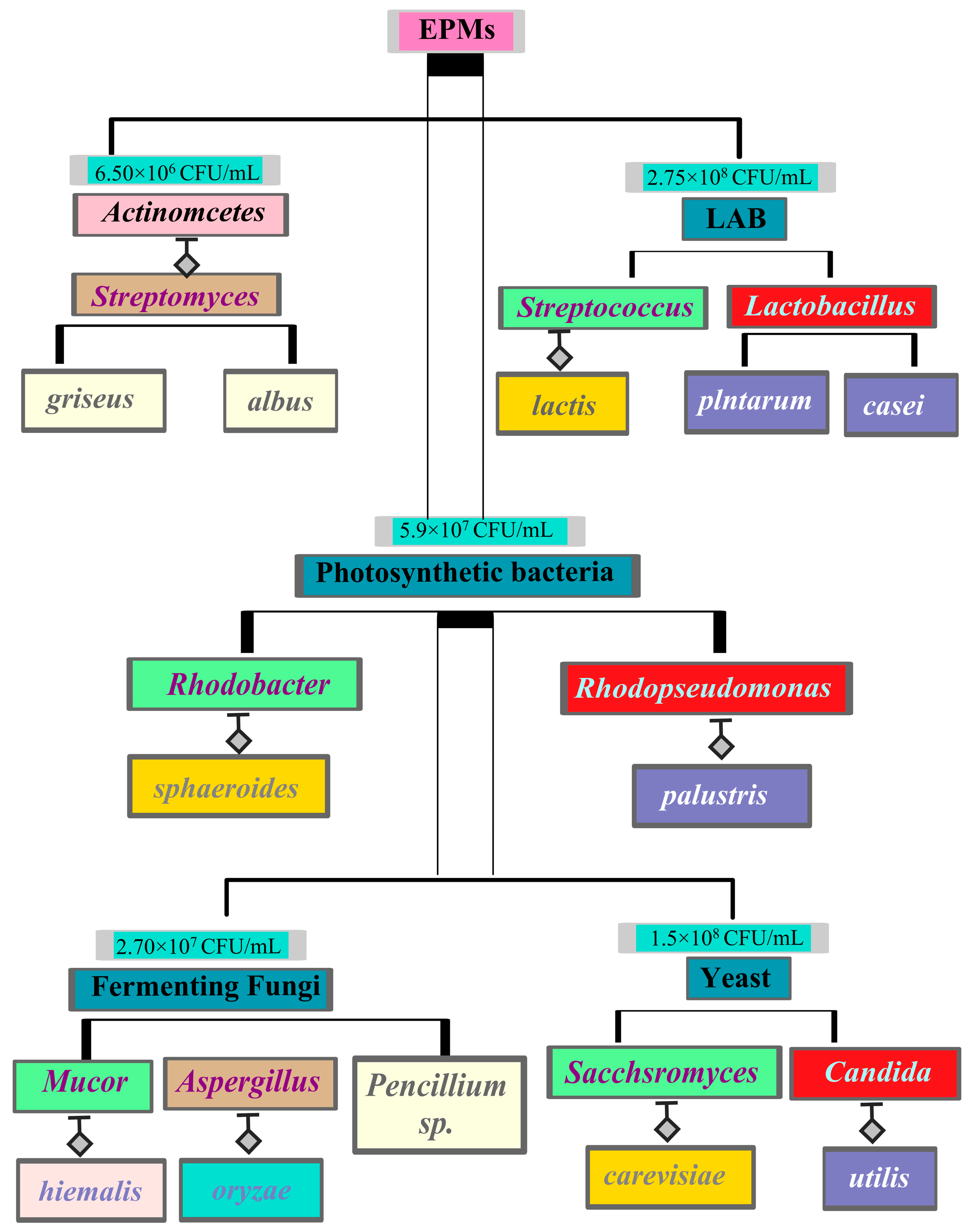
Figure 1. Diagrammatic visualization of the genera, strains, and their respective CFU/mL stock effective probiotic microorganisms (EPMs) solution.
Fishes 10 00573 g001
Figure 2. The interleaved scatter plot depicts the mean± SD of serum growth hormone (GH) levels in P. hypophthalmus supplemented with EPMs for 90 consecutive days. Circles, diamonds, and triangles represent the values of GH (triplicate mean) for each sampled fish per group. Error bars show ± standard deviation (SD) of the mean, whilst the thick middle line represents the mean values. Analyses were conducted using the mean per tanks (n = 3 tanks per treatment group, 5 fish per tank). Bars with asterisks (*) reflect significant variation between groups by the One-Way ANOVA and Bonferroni correction test. * p < 0.05, ** p ≤ 0.01, *** p ≤ 0.001. EPMs 1.5, EPMs 3, and EPMs 4.5 indicate the supplementation of effective probiotic microorganisms at the rate of 1.5%, 3%, and 4.5% DM (g/kg), respectively.
Fishes 10 00573 g002
Figure 3. Bar graphs depicting the mean± SD values of hepatic antioxidant/oxidant parameters in P. hypophthalmus supplemented with EPMs for 90 consecutive days. SOD: superoxide dismutase, CAT: catalase, GSH-Px: glutathione peroxidase, and MDA: malondialdehyde. Samples are symbolized as red–yellow-colored diamond data dots on the right side of the bar graphs. Analyses were conducted using the mean per tanks (n = 3 tanks per treatment group, 5 fish per tank). Bars with asterisks (*) reflect significant variation between groups by the One-Way ANOVA and Bonferroni correction test. ** p ≤ 0.01, *** p ≤ 0.001. EPMs 1.5, EPMs 3, and EPMs 4.5 indicate the supplementation of effective probiotic microorganisms at the rate of 1.5%, 3%, and 4.5% DM (g/kg), respectively.
Fishes 10 00573 g003
Figure 4. Bar graphs depicting the mean± SD values of cellular and humoral immune indicators of P. hypophthalmus supplemented with EPMs for 90 consecutive days. NBT: oxidative burst reaction. Each sample is represented as a red–yellow-colored diamond data dot on the right side of the bar graphs. Analyses were conducted using the mean per tanks (n = 3 tanks per treatment group, 5 fish per tank). Bars with asterisks (*) reflect significant variation between groups by the One-Way ANOVA and Bonferroni correction test. * p < 0.05, ** p ≤ 0.01, *** p ≤ 0.001. EPMs 1.5, EPMs 3, and EPMs 4.5 indicate the supplementation of effective probiotic microorganisms at the rate of 1.5%, 3%, and 4.5% DM (g/kg), respectively.
Fishes 10 00573 g004
Figure 5. Grouped data plots depicting the mean±SD of the intestinal microbial communities of P. hypophthalmus supplemented with EPMs for 90 consecutive days. LAB: lactic acid bacteria, TFCC: total fecal coliform count, TVC: total enteropathogenic Vibrio spp. count, and TAPC: total aerobic bacterial plate count. Analyses were conducted using the mean per tanks (n = 3 tanks per treatment group, 5 fish per tank). Bars with asterisks (*) reflect significant variation between groups by the One-Way ANOVA and Bonferroni correction test. * p < 0.05, ** p ≤ 0.01, *** p ≤ 0.001. EPMs 1.5, EPMs 3, and EPMs 4.5 indicate the supplementation of effective probiotic microorganisms at the rate of 1.5%, 3%, and 4.5% DM (g/kg), respectively.
Fishes 10 00573 g005
Figure 6. Kaplan–Meier survival curve for P. hypophthalmus supplemented with EPMs for 90 consecutive days, followed by a challenge with A. hydrophilia for an additional 15 days. Analyses were conducted using the mean per tanks (n = 3 tanks per treatment group, 5 fish per tank). Asterisks (*) reflect a significant difference between groups by the Log-rank (Mantel–Cox) test. ** p ≤ 0.01, *** p ≤ 0.001. NS (p > 0.05), insignificant differences. The shadow areas indicate 95% confidence intervals. EPMs 1.5, EPMs 3, and EPMs 4.5 indicate the supplementation of effective probiotic microorganisms at the rate of 1.5%, 3%, and 4.5% DM (g/kg), respectively.
Fishes 10 00573 g006
Figure 7. Principal component (PC) biplot of the significantly changed variables. Ellipses illustrate determined clusters in the investigated groups, while dots within the ellipses indicate the value of each sample. The arrow length reflects how much each variable influences the PCs; the arrow direction shows the variables’ crosstalk.
Fishes 10 00573 g007
Table 1. Ration constituents, formulation, and chemical components by proximate analytical values (g kg−1) on dry matter (DM basis) of prepared diets.
ItemsExperimental Diets 1
ControlEPMs Levels
1.534.5
Feed Ingredients (g kg−1)
     Fish meal 2100100100100
     Soybean meal 2220220220220
     Gluten 250505050
     Rich bran100100100100
     Wheat bran120120120120
     Wheat 120120120120
     Corn 240225210195
     Fish oil20202020
     Vitamin premix 310101010
     Mineral premix 410101010
     Dicalcium Phosphate10101010
     EPM levels0153045
     Total1000100010001000
Proximate analysis: DM Basis (g kg−1)
     Dry matter (DM)89.5289.5189.5389.55
     Crude protein (CP)30.0830.0430.0130.07
     Ether extract (EE)6.896.706.586.45
     Crude fiber (CF)5.135.105.115.13
     Ash6.626.546.476.90
     NFE 551.2851.6251.8351.45
1 EPMs 1.5, EPMs 3, and EPMs 4.5 indicate the supplementation of effective probiotic microorganisms at the rate of 1.5%, 3%, and 4.5% DM (g/kg), respectively. 2 Fishmeal, soybean meal, and corn gluten meal in aquafeed contain 62.0%, 46.0%, and 60.0% crude protein, respectively. 3 Each 1000 g of the vitamin premix contained the following: retinol: 500,000 IU cholecalciferol: 500,000 IU DL-α-tocopherol acetate: 30 mg menadione: 5.25 mg thiamine nitrate: 3.75 mg riboflavin: 6 mg pyridoxine hydrochloride: 6 mg niacin: 10 mg folic acid: 2 mg (96%) cyanocobalamin: 0.5 mg (10%) ascorbic acid: 100 mg (92%) calcium D-pantothenate: 15 mg. 4 Mineral premix (mg/kg diet) as follow: FeSO4·7H2O (30); CuSO4·5H2O (25% copper) (6); ZnSO4·7H2O (22.5% zinc) (600); MnSO4·H2O (31.8% manganese) (1.183); KI (3.8% iodine) (1); and CaCO3 (6). 5 Nitrogen-free extract (NFE) = 100 − (CP + EE + CF + ash).
Table 2. Growth and feed efficiency indices of P. hypophthalmus supplemented with EPMs for 90 consecutive days.
ParametersControlEPMs Levels % DM (g/kg) Orthogonal Contrast
1.534.5Pooled SDMANOVALinearQuadratic
(F Value)
p Value
ITL (cm)10.4910.37 NS10.62 NS10.57 NS0.34(0.245)
=0.863
(0.258)
=0.625
(0.028)
=0.872
FTL (cm)21.5425.57 *30.01 **32.66 ***4.46(285.64)
≤0.001
(848.45)
≤0.0001
(5.58)
=0.06
IBW (g)10.0410.02 NS10.06 NS10.08 NS0.61(0.004)
=1.00
(0.007)
=0.94
(0.002)
=0.962
FBW (g)87.71130.29 *172.76 **207.83 ***47.26(377.28
≤0.001
(1129.51)
≤0.0001
(1.97)
=0.20
WG (g)77.67120.27 **162.71 **197.76 ***47.24(376.22)
≤0.001
(1126.33)
≤0.0001
(1.98)
=0.22
ADG (g)0.8631.34 *1.81 **2.20 ***0.53(380.05)
≤0.001
(1137.05)
≤0.0001
(1.97)
=0.21
SGR (%day−1)1.932.13 *2.26 **2.34 ***0.16(269.04)
≤0.001
(781.07)
≤0.0001
(25.93)
<0.05
RGR (%)7.7512.04 *16.32 **19.63 ***4.70(63.61)
≤0.001
(190.16)
≤0.0001
(0.576)
=0.47
FCR 1.8901.270 **0.953 ***0.81 ***0.44(68.16)
≤0.001
(187.69)
≤0.0001
(16.53)
<0.05
PER 2.133.15 *4.21 **4.97 ***1.13(161.41)
≤0.001
(481.89)
≤0.0001
(1.733)
=0.22
SR (%)80.0088.00 *93.33 **98.67 ***30.05(5.504)
≤0.001
(16.328)
≤0.0001
(0.154)
=0.70
Intake (g kg−1 day−1)
TFI 146.05152.78 NS154.83 NS159.22 NS6.72(3.19)
=0.084
(9.17)
=0.06
(0.15)
=0.714
DM131.45137.50 NS139.35 NS143.29 NS6.05(3.21)
=0.082
(9.17)
=0.06
(0.13)
=0.618
PI36.5238.19 NS38.71 NS39.81 NS1.68(3.19)
=0.084
(9.15)
=0.06
(0.144)
=0.714
LI9.9310.39 NS10.53 NS10.83 NS0.46(33.22)
=0.073
(9.17)
=0.06
(0.17)
=0.68
Levels are reported as mean and pooled standard deviation of the mean (SDM). Analyses were conducted using the mean per tanks (n = 3 tanks per treatment group, 5 fish per tank). Means followed by an asterisk (*) indicate significant variation between groups by the One-Way ANOVA and Bonferroni correction test. * p < 0.05, ** p ≤ 0.01, *** p ≤ 0.001. NS (p > 0.05), insignificant differences. EPMs 1.5, EPMs 3, and EPMs 4.5 indicate the supplementation of effective probiotic microorganisms at the rate of 1.5%, 3%, and 4.5% DM (g/kg), respectively. ITL: initial total length, FTL: final total length, IBW: initial body weight, FBW: final body weight, WG: weight gain, SGR: specific growth rate, RGR: relative growth rate, FCR: feed conversion ratio, PER: protein efficiency ratio, SR: survival rate. TFI: total feed intake, DM: dry matter, PI: protein intake, and LI: lipid intake.
Table 3. Whole-body chemical composition and biometric indices of P. hypophthalmus supplemented with EPMs for 90 consecutive days.
ParametersControlEPMs Levels % DM (g/kg) Orthogonal Contrast
1.534.5Pooled SDMANOVALinearQuadratic
(F Value)
p Value
Indices (%)
HSI (%)2.652.70 NS2.57 NS2.67 NS0.23(0.13)
=0.94
(0.94)
=0.27
(0.01)
=0.87
VSI (%)9.9912.48 **13.98 ***14.09 ***1.76(71.58)
≤0.001
(186.94)
≤0.001
(27.66)
<0.05
K (%)0.880.78 **0.64 ***0.59 ***0.12(59.00)
≤0.001
(171.16)
≤0.001
(2.53)
=0.15
RGL (cm)1.491.89 **2.53 ***2.51 ***0.48(30.24)
≤0.001
(80.74)
≤0.001
(5.31)
=0.07
Chemical composition
Dry matter (g)25.1626.88 *27.60 *27.63 *1.27(5.45)
<0.05
(13.24)
≤0.01
(3.08)
=0.12
Protein % 59.8665.82 *66.20 *67.23 *3.98(3.60)
<0.05
(8.20)
<0.05
(1.97)
=0.20
Lipid % 23.3315.05 *14.13 *11.90 *5.16(6.78)
≤0.05
(21.79)
≤0.001
(3.22)
=0.11
Ash % 16.8119.13 NS19.67 NS20.86 NS2.22(2.45)
=0.138
(6.84)
≤0.05
(0.27)
=0.62
Levels are reported as mean and pooled standard deviation of the mean (SDM). Analyses were conducted using the mean per tanks (n = 3 tanks per treatment group, 5 fish per tank). Means followed by an asterisk (*) indicate significant variation between groups by the One-Way ANOVA and Bonferroni correction test. * p < 0.05, ** p ≤ 0.01, *** p ≤ 0.001. NS (p > 0.05), insignificant differences. EPMs 1.5, EPMs 3, and EPMs 4.5 indicate the supplementation of effective probiotic microorganisms at the rate of 1.5%, 3%, and 4.5% DM (g/kg), respectively. K: condition factor, HSI: hepatosomatic index; VSI: visceral–somatic index; RGL: relative gut length.
Table 4. Digestive enzyme efficiencies in intestinal tissue of P. hypophthalmus supplemented with EPMs for 90 consecutive days.
Enzymes
(U × mg tissue protein−1)
ControlEPMs Levels % DM (g/kg) Orthogonal Contrast
1.534.5Pooled SDMANOVALinearQuadratic
(F Value)
p Value
TAP 19.3124.45 *29.59 **34.62 ***6.12(51.23)
≤0.001
(153.68)
≤0.001
(0.04)
=0.95
Lipase 44.3651.34 *59.42 **66.38 ***8.90(48.19)
≤0.001
(144.44)
≤0.001
(0.01)
=1.00
α-amylase 0.660.78 *0.87 **0.98 ***0.12(44.55)
≤0.001
(133.47)
≤0.001
(0.03)
=0.87
Levels are reported as mean and pooled standard deviation of the mean (SDM). Analyses were conducted using the mean per tanks (n = 3 tanks per treatment group, 5 fish per tank). Means followed by an asterisk (*) indicate significant variation between groups by the One-Way ANOVA and Bonferroni correction test. * p < 0.05, ** p ≤ 0.01, *** p ≤ 0.001. TAP: total alkaline protease. EPMs 1.5, EPMs 3, and EPMs 4.5 indicate the supplementation of effective probiotic microorganisms at the rate of 1.5%, 3%, and 4.5% DM (g/kg), respectively.
Table 5. Routine hemogram of P. hypophthalmus supplemented with EPMs for 90 consecutive days.
ParametersControlEPMs Levels % DM (g/kg) Orthogonal Contrast
1.534.5Pooled SEMANOVALinearQuadratic
(F Value)
p Value
RBC (106 µL−1)1.772.67 *3.49 **4.36 ***1.03(50.91)
≤0.001
(152.69)
≤0.001
(0.94)
=0.92
Hb (g dL−1)8.6211.86 *14.10 **15.97 ***3.12(99.74)
≤0.001
(290.75)
≤0.001
(7.49)
<0.05
PCV (%)20.0031.33 *38.00 **45.00 ***9.77(83.12)
≤0.001
(245.00)
≤0.001
(3.45)
=0.10
MCV (fL)113.67119.22 NS109.36 NS103.37 NS13.63(0.66)
=0.60
(1.22)
=0.30
(0.49)
=0.51
MCH (pg)45.4844.79 NS40.27 NS36.75 NS4.91(3.54)
=0.07
(9.94)
≤0.01
(0.42)
=0.53
MCHC (%)40.1337.92 NS36.96 NS35.60 NS2.86(1.55
=0.27
(4.53)
=0.07
(0.08)
=0.79
WBC (103 µL−1)26.3043.15 ***39.36 ***44.96 ***7.34(59.18)
≤0.001
(175.53)
≤0.001
(1.19)
=0.31
Neutrophil (103 µL−1)6.949.37 NS9.18 NS9.31 NS2.18(0.84)
=0.51
(1.44)
=0.26
(0.80)
=0.40
Lymphocyte (103 µL−1)18.7524.15 *29.55 **35.02 ***6.53(40.73)
≤0.001
(122.20)
≤0.001
(0.001)
=0.98
Monocyte (103 µL−1)0.480.51 NS0.50 NS0.53 NS0.08(0.09
=0.96
(0.24
=0.64
(0.01)
=0.92
Eosinophil (103 µL−1)0.130.12 NS0.14 NS0.11 NS0.03(0.29)
=0.83
(0.53)
=0.49
(0.04)
=0.84
Levels are reported as mean and pooled standard deviation of the mean (SDM). Analyses were conducted using the mean per tanks (n = 3 tanks per treatment group, 5 fish per tank). Means followed by an asterisk (*) indicate significant variation between groups by the One-Way ANOVA and Bonferroni correction test. * p < 0.05, ** p ≤ 0.01, *** p ≤ 0.001. NS (p > 0.05), insignificant differences. EPMs 1.5, EPMs 3, and EPMs 4.5 indicate the supplementation of effective probiotic microorganisms at the rate of 1.5%, 3%, and 4.5% DM (g/kg), respectively. RBC: red blood corpuscle; Hb: hemoglobin; PCV: packed erythrocyte volume; MCV: mean corpuscular volume; MCH: mean corpuscular hemoglobin; MCHC: mean corpuscular hemoglobin concentration; WBC: white blood corpuscle.
Table 6. Hepatorenal function and lipid profile of P. hypophthalmus supplemented with EPMs for 90 consecutive days.
ParametersControlEPM Levels % DM (g/kg) Orthogonal Contrast
1.534.5Pooled SEMANOVALinearQuadratic
(F Value)
p Value
Indicators of liver and kidney function
ALT (U L−1)26.9120.08 **19.49 **18.89 **3.52(8.39)
≤0.01
(18.49)
≤0.001
(5.56)
<0.05
AST (U L−1)91.6782.89 **79.27 **81.26 **5.40(13.77)
≤0.01
(27.96)
≤0.001
(13.33)
=0.07
ALKP (U L−1)63.1754.78 **52.57 **53.73 **4.86(11.01)
≤0.01
(22.04)
≤0.001
(10.82)
≤0.01
T. Protein (g dL−1)2.853.65 *4.83 **5.11 ***0.90(40.73)
≤0.001
(121.06)
≤0.001
(0.05)
=0.83
Albumin (g dL−1)1.020.93 NS0.95 NS1.05 NS0.10(1.08)
=0.41
(0.30)
=0.61
(2.93)
=0.13
Globulin (g dL−1)1.842.72 *3.42 **4.05 ***0.90(30.72)
≤0.001
(91.60)
≤0.001
(0.54)
=0.48
A: G ratio0.580.35 *0.28 *0.26 *0.16(6.20)
<0.05
(15.18)
≤0.01
(3.24)
=0.11
T. Bilirubin (mg dL−1)0.580.54 NS0.51 NS0.57 NS0.04(3.59)
=0.07
(0.56)
=0.48
(8.52)
<0.05
Urea (mg dL−1)10.029.60 NS9.81 NS9.54 NS0.54(0.39)
=0.77
(0.60)
=0.46
(0.04)
=0.85
Creatinine (mg dL−1)0.380.40 NS0.43 NS0.41 NS0.02(0.68)
=0.59
(0.41)
=0.85
(0.50)
=0.33
Glucose (mg dL−1)94.8182.08 **74.06 ***75.33 ***8.93(47.42)
≤0.001
(115.61)
≤0.001
(26.11)
≤0.01
Lipid profile
T. Lipids (mg dL−1)932.23916.25 **879.14 ***883.96 ***23.82(84.56)
≤0.001
(214.58)
≤0.001
(14.84)
≤0.01
T. CHOL (mg dL−1)217.65192.67 **174.33 ***178.33 ***19.31(15.86)
≤0.001
(36.36)
≤0.001
(8.75)
<0.05
TGs (mg dL−1)165.97149.25 **130.39 ***131.69 ***15.67(41.69)
≤0.001
(109.41)
≤0.001
(11.99)
≤0.01
VLDL (mg dL−1)33.1929.85 **26.08 ***26.34 ***3.13(41.78)
≤0.001
(109.68)
≤0.001
(12.10)
≤0.01
LDL (mg dL−1)118.21106.61 **95.22 ***94.25 ***10.47(46.28)
≤0.001
(126.64)
≤0.001
(10.31)
≤0.01
HDL (mg dL−1)59.9966.52 **75.92 ***73.23 ***6.78(26.28)
≤0.001
(62.14)
≤0.001
(10.95)
≤0.01
TG: HDL index2.772.25 **1.72 ***1.79 ***0.44(84.88)
≤0.001
(215.39)
≤0.001
(32.46)
≤0.01
LDL: HDL ratio1.971.60 **1.26 ***1.29 ***0.31(50.810)
≤0.001
(131.85)
≤0.001
(17.81)
≤0.01
Levels are reported as mean and pooled standard deviation of the mean (SDM). Analyses were conducted using the mean per tanks (n = 3 tanks per treatment group, 5 fish per tank). Means followed by an asterisk (*) indicate significant variation between groups by the One-Way ANOVA and Bonferroni correction test. * p < 0.05, ** p ≤ 0.01, *** p ≤ 0.001. NS (p > 0.05), insignificant differences. EPMs 1.5, EPMs 3, and EPMs 4.5 indicate the supplementation of effective probiotic microorganisms at the rate of 1.5%, 3%, and 4.5% DM (g/kg), respectively. ALT: alanine transaminase, AST: aspartate transaminase, ALKP: alkaline phosphatase, T. Protein: total protein, A:G ratio: albumin–globulin ratio, T. Bilirubin: total circulating bilirubin, T. CHOL: total cholesterol, TGs: triglycerides, VLDL: very-low-density lipoprotein, LDL: low-density lipoprotein, and HDL: high-density lipoprotein.
Disclaimer/Publisher’s Note: The statements, opinions and data contained in all publications are solely those of the individual author(s) and contributor(s) and not of MDPI and/or the editor(s). MDPI and/or the editor(s) disclaim responsibility for any injury to people or property resulting from any ideas, methods, instructions or products referred to in the content.