Article

Effects of Dietary Carbohydrate Levels on Growth Performance, Antioxidant Capacity, and Hepatointestinal Health in Schizopygopsis younghusbandi

1
State Key Laboratory of Biocontrol, Guangdong Provincial Key Laboratory for Aquatic Economic Animals and Southern Marine Science and Engineering Guangdong Laboratory (Zhuhai), School of Life Sciences, Sun Yat-Sen University, Guangzhou 510275, China
2
Zhuhai Modern Agricultural Development Center, Zhuhai 519055, China
3
Institute of Fisheries Science, Tibet Academy of Agricultural and Animal Husbandry Sciences, Lhasa 850002, China
*
Authors to whom correspondence should be addressed.
Fishes 2025, 10(10), 489; https://doi.org/10.3390/fishes10100489
Submission received: 5 August 2025 / Revised: 25 September 2025 / Accepted: 30 September 2025 / Published: 1 October 2025
(This article belongs to the Section Nutrition and Feeding)

Abstract

Schizopygopsis younghusbandi is an endemic and ecologically important fish species on the Tibetan Plateau. However, its dietary carbohydrate requirement remains unexplored, limiting the development of cost-effective and physiological-friendly artificial feed. This study investigated the effects of different dietary carbohydrate levels on the growth performance, antioxidant capacity, and hepatointestinal morphology of S.younghusbandi. Six experimental diets were formulated with graded carbohydrate levels of 9% (C9), 12% (C12), 15% (C15), 18% (C18), 21% (C21), and 24% (C24). A total of 720 fish (initial weight 37.49 ± 0.25 g) were randomly allocated to six groups in quadruplicate (30 fish per replicate) and reared in tanks (0.6 m × 0.5 m × 0.4 m) for 8 weeks. Results demonstrated that the diet in the C12 group significantly improved weight gain rate (WGR), specific growth rate (SGR), and feed conversion ratio (FCR) (p < 0.05). Regression fitting analysis on growth performance indicated that the optimal carbohydrate level ranged from 10.42% to 10.49%. Additionally, the C12 group exhibited enhanced total superoxide dismutase (T-SOD) activities and reduced malondialdehyde (MDA) content in the liver, along with reduced interleukin-1β (IL-1β) levels in the serum (p < 0.05). Histological analysis revealed superior hepatointestinal integrity in the C12 group, characterized by lower hepatic lipid droplet accumulation, reduced vacuolation, decreased hepatosomatic index (HSI) (p < 0.05), as well as higher intestinal villus height and muscle thickness (p < 0.05). In conclusion, the C12 group optimally enhanced the growth, antioxidant response, and hepatointestinal health of S. younghusbandi, indicating that the suitable dietary carbohydrate level for this species is 12%.
Key Contribution: S.younghusbandi has low demand and utilization efficiency for carbohydrates, classifying it as a carbohydrate-intolerant fish species; A 12% carbohydrate feed is beneficial for S.younghusbandi, as it can not only promote growth, but also enhance anti-inflammatory and antioxidant capacities, and protect liver and intestinal health.

1. Introduction

The Qinghai–Tibet Plateau, renowned as the “Roof of the World” and “Asia’s Water Tower,” constitutes the highest-altitude plateau ecosystem on earth [1,2,3]. Its hydrological core, the Yarlung Zangbo River, sustains unique biodiversity [4,5]. Cold-water fishes within this ecosystem have evolved specialized survival strategies through long-term adaptation, serving both as keystone prey species and critical regulators of plankton populations [6]. As a representative endemic species, S.younghusbandi faces population decline and miniaturization driven by invasive species and overfishing [7,8,9]. Current conservation measures for this species primarily rely on stock enhancement and release programs. As a fish species with potential as a human protein source, it holds significant promise not only for species conservation but also for future specialized aquaculture development [10].Consequently, nutritional ecology research is imperative to formulate conservation strategies for this threatened Chinese endemic species [6,11].
Carbohydrates are essential nutrients crucial for fish growth, playing significant roles in metabolic processes and immune functions [12]. They not only provide important carbon skeletons but also serve as a vital energy source for the growth and overall health maintenance of aquatic animals [13]. Carbohydrates, as an inexpensive source of energy, are widely used in fish feeds, but the appropriate addition level varies among different species [14]. Especially in cold-water fish, the efficiency of carbohydrate metabolism is relatively low, and excessive addition is likely to lead to metabolic disorders [15]; the appropriate dietary carbohydrate level for carnivorous cold-water fish should not exceed 20%, and the optimal level for rainbow trout is 12% [16]. Excessive carbohydrate intake may lead to the accumulation of surplus lipids in the liver, disrupting normal hepatic function and impairing the overall health of fish. Moreover, oxidative stress induced by high carbohydrate consumption damages cellular components, triggering apoptosis and exacerbating inflammatory responses [17,18]. This cascade compromises immune competence and disrupts the normal morphology of hepatointestinal tissues, ultimately increasing disease susceptibility in fish. These adverse effects underscore the imperative to investigate species-specific carbohydrate tolerance thresholds in aquaculture [19,20,21]. Due to the low-temperature and low-oxygen characteristics of the plateau environment, whether its metabolic mechanism is similar to that of low-altitude fish in carbohydrate metabolism remains unclear [6].
With the rapid development of the global aquaculture industry, optimizing feed nutritional formulations has become crucial for enhancing farming efficiency and fish health. Although research on fish carbohydrate metabolism has gradually increased in recent years [22], most studies focus on economically significant species such as rainbow trout [16] and tilapia [23], lacking systematic evaluation of plateau fish species. Current research on carbohydrate requirements in plateau-endemic fish species remains scarce. For S.younghusbandi, studies had focused solely on determining its optimal protein intake levels. Such gaps hinder the advancement of sustainable aquaculture practices in high-altitude regions. Therefore, investigating the physiological responses of S.younghusbandi to dietary carbohydrate levels is essential for developing species-specific feed formulations.
This study employs graded-carbohydrate diets (9–24%) to systematically analyze growth performance, serum biochemical parameters, antioxidant indices, and histomorphological changes in the hepatic and intestinal tissues of S.younghusbandi. The findings will elucidate optimal dietary carbohydrate supplementation levels for S.younghusbandi, providing a theoretical foundation for developing highland fish feeds.

2. Materials and Methods

2.1. Experimental Fish and Diet

Healthy S.younghusbandi were provided by the Fisheries Science Institute, Tibet Academy of Agricultural and Animal Husbandry Sciences (Tibet Autonomous Region, China). Before the feeding experiment, fish were acclimated and fed a commercial diet (conventional nutritional composition: protein ~35%, fat ~8%, carbohydrate ~30%; Sichuan Siteja Biological Technology Co., Ltd., Sichuan, China) on a fixed feeding schedule for 2 weeks in tanks at the institute. The experimental diet formulations and compositions are shown in Table 1. Feeds were entirely acquired from Haima Feed Company (Fuzhou, China). Using wheat flour and corn starch as carbohydrate sources, six iso-lipidic and iso-protein experimental diets were formulated with carbohydrate levels and corresponding groups as follows: 9% (C9), 12% (C12), 15% (C15), 18% (C18), 21% (C21), and 24% (C24). Diets were prepared and processed following a previously standard procedure [24]. All dry ingredients were finely ground and sieved through a 60-mesh screen. Ingredients were mixed thoroughly using a high-speed mixer. Soybean oil was mixed with fish oil until homogeneous, then combined with the dry mixture. Distilled water was added to the mixture to achieve appropriate consistency, and the mixture was then extruded into 2.5 mm diameter pellets using a twin-screw cooking extruder (HQ, Zhaoqing, China). Pellets were dried at room temperature to reduce moisture content and stored at −20 °C until required for the feeding trial. Each feed ingredient was subjected to prior determination of its basic composition. Crude protein content was detected by the Dumas combustion method using a N pro (DT Ar/He Basic) instrument (Gerhardt GmbH & Co. KG, Königswinter, Germany), where nitrogen content × 6.25 = crude protein. Crude lipid was analyzed using the Soxhlet extraction method with a Soxtec System HT6 (Tecator), and moisture content was determined by drying the samples in an oven at 105 °C to obtain the dry weight. Crude ash content was measured by incineration in a muffle furnace at 550 °C for 6 h until constant weight was achieved. Carbohydrate content was calculated using the enzymatic hydrolysis method: after removing fat and soluble sugars from the sample, starch was enzymatically hydrolyzed by amylase and further broken down to glucose by hydrochloric acid hydrolysis. The glucose content was then measured and converted to starch content. The carbohydrate level in the feed was manipulated by adjusting the proportions of flour and corn starch (the form of carbohydrate is starch).

2.2. Experimental Design

After acclimatization, 720 healthy and uniform-sized S.younghusbandi (initial average weight 37.49 ± 0.25 g) were randomly divided into six groups with four replicates each. Each tank (0.6 m × 0.5 m × 0.4 m) stocked 30 fish and was fed one of the six experimental diets with graded carbohydrate levels. The fish were fed twice daily (10:00 and 18:00) to apparent satiation. The experiment utilized fully aerated well water as the culture water. A 24 h circulation system was maintained in the tanks at a flow rate of 120 L/h. During the 8-week culture period, water quality parameters were monitored using a water quality analyzer (model: 10043971784946, Huorde Electronic Technology Co., Ltd., Binzhou, Shandong, China): temperature of 12.5 ± 0.5 °C, pH of 8.0–8.5, dissolved oxygen of ≥6.0 mg/L, ammonia nitrogen of ≤0.01 mg/L, and nitrite of ≤0.02 mg/L.
After the feeding trial, sampling was conducted following a 24 h fasting period. Surviving fish in each tank were counted and weighed. All data analyses were performed based on replicate groups (n = 4 replicates per treatment). Within each replicate tank, three fish were sampled for whole-body composition analysis. Another six fish were collected for measurements of body length, body weight, and liver weight. The livers from these six fish were used for histological section preparation and biochemical analysis, blood was collected for biochemical assays, muscle tissues were used for proximate composition determination, and mid-intestinal tissues were collected for intestinal histological section preparation.

2.3. Determination of Proximate Composition

The samples were dried continuously at 105 °C for biochemical composition analysis. The chemical composition of whole-fish, liver, and muscle, including moisture, crude protein, and crude lipid, was determined using AOAC methods [25]. Specifically, crude protein content was detected by Dumas’s combustion method using N pro (DT Ar/He Basic) (Gerhardt GmbH & Co. KG, Königswinter, Germany): the nitrogen content × 6.25 = crude protein. Crude lipid was analyzed using the Soxhlet extraction method with the Soxtec System HT6 (Tecator), and moisture content was determined by drying the samples in an oven at 105 °C to obtain the dry weight.

2.4. Histological Analysis of the Hepatopancreas and Intestine

The tissue samples were collected following a standardized sampling protocol, with intestinal tissue specimens uniformly obtained from the mid-intestinal region. The hepatic and intestine tissue samples were stored in a 4% paraformaldehyde solution for 24 h. When preparing the sections, the tissues were first dehydrated in a graded ethanol series and then immersed in a solution of absolute ethanol and xylene (v:v 1:1) for 30 min, followed by immersion in xylene for another 30 min. Subsequently, the tissues were embedded in paraffin, and sections were prepared and stained with hematoxylin–eosin (H.E). Additionally, Oil Red O staining was performed on hepatic sections to specifically visualize and quantify lipid accumulation. Microtome (Model: RM2016, Shanghai Leica Instruments Co., Ltd., Shanghai, China), with a section thickness of approximately 4 μm, and with n = 3 per replicate. The stained sections were examined and captured with a microscope (Eclipse Ni-E, Nikon, Tokyo, Japan). The images were then measured and analyzed using a NS-Elements viewer (Nikon, Tokyo, Japan) and Image J software (version 1.4.7, National Institutes of Health, Bethesda, MD, USA).

2.5. Enzyme Activity Assays

Liver tissues were rapidly frozen in liquid nitrogen and stored at −80 °C. Prior to use, the tissues were homogenized in PBS at a mass-to-volume ratio of 1:9 and centrifuged at 8500 rpm for 25 min at 4 °C to collect the supernatant. Detection kits included superoxide dismutase (SOD with kit A001-3, Nanjing Jiancheng Bioengineering Institute, Nanjing, China), and malondialdehyde (MDA with kit A003-1, Nanjing Jiancheng Bioengineering Institute, Nanjing, China). The manufacturer’s protocols were strictly followed. Briefly, the supernatant was used directly without dilution. The SOD activity assay was based on the inhibition of nitroblue tetrazolium reduction by the xanthine oxidase system, and the absorbance was measured at 450 nm. The MDA content was quantified by the thiobarbituric acid method, and the absorbance was read at 532 nm. All reactions were incubated at 37 °C, and the specific incubation times were as instructed by the kits. All spectrophotometric measurements were performed with a UV-Vis spectrophotometer (Shimadzu UV-2450, Kyoto, Japan).

2.6. Biochemical Analysis of Serum

Hemolymph was allowed to coagulate at 4 °C, followed by homogenization and centrifugation at 3500 rpm for 5 min at 4 °C to obtain serum. Preserved serum samples were analyzed using a biochemical analyzer (HITACHI7180) at Guangzhou Xinhai Hospital, the Second Affiliated Hospital of Guangdong Pharmaceutical University (Guangzhou, China); its fundamental operational principle is based on photocolorimetry, supported by the Lambert–Beer law. By measuring the change in absorbance (optical density, OD) of the reaction mixture at a specific wavelength and applying the formula where the absorbance (A) of a solution is proportional to its concentration (C) and the path length (L) of the light—expressed as A = εCL—the concentration of the target substance is calculated. Serum parameters included alkaline phosphatase (ALP), glutathione reductase (GR), high-density lipoprotein cholesterol (HDL), low-density lipoprotein cholesterol (LDL), alanine aminotransferase (ALT), aspartate aminotransferase (AST), total protein (TP), total cholesterol (CH), albumin (ALB), and globulin (GLB); detection kits included interleukin-1β (Fish Interleukin 1β (IL-1β) with ELISA Kit CSB-E13259Fh, Wuhan Huamei Biological Engineering Co., Ltd., Wuhan, China).

2.7. Statistical Analysis

All data were expressed as mean ± standard error of the mean (SEM) and were performed using SPSS software (version 22.0, IBM Corp., Armonk, NY, USA). Graphical representations of data were created using GraphPad Prism (version 10.1.2, GraphPad Software, San Diego, CA, USA) to visualize the results clearly. The normality of the data distribution for all variables was assessed using the Shapiro–Wilk test. Homoscedasticity (homogeneity of variances) was confirmed using Levene’s test. All variables were confirmed to meet the assumptions of parametric tests (normally distributed and homogeneous variances). Therefore, one-way analysis of variance (ANOVA) was employed to determine significant differences among the groups for each variable. Whenever a significant difference was detected (p < 0.05), Duncan’s multiple range test was applied as a post hoc analysis to identify specific group differences. The relationship between the weight gain rate (WGR), the specific growth rate (SGR), and dietary carbohydrate levels was examined by regression analysis.

3. Results

3.1. Growth Performance

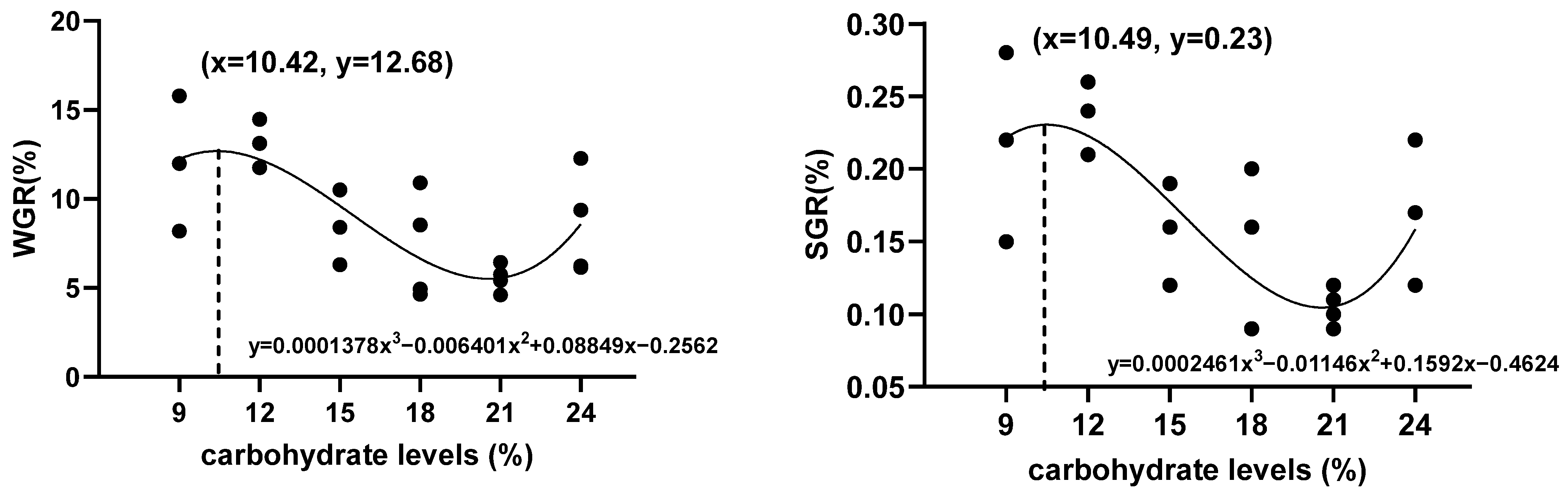
As depicted in Table 2, with increasing dietary carbohydrate levels, the weight gain rate (WGR) and specific growth rate (SGR) of S.younghusbandi initially increased and then decreased. Both the WGR and SGR reached their maximum values in the C12 group, showing no significant difference compared with the C9 group (p > 0.05), but were significantly higher than those in other groups (p < 0.05). For the feed conversion ratio (FCR), the C12 group exhibited the lowest value among the six groups, with no significant difference compared with the C9 and C15 groups (p > 0.05) but was significantly lower than the remaining groups (p < 0.05). In terms of the hepatosomatic index (HSI), the C18, C21, and C24 groups showed significantly higher values than the C9, C12, and C15 groups. For the viscerosomatic index (VSI), the C15, C18, C21, and C24 groups were significantly higher than the C9 and C12 groups. No significant differences were observed in the survival rate or condition factor (CF) among all groups (p > 0.05). The relationship between the dietary carbohydrate supplementation levels and weight gain rate (WGR)/specific growth rate (SGR) is illustrated in Figure 1. Figure 1 present regression curve fitting analyses of the WGR and SGR against dietary carbohydrate supplementation levels, respectively. The results indicated that the optimal carbohydrate supplementation levels for S. younghusbandi are 10.42% and 10.49%.

3.2. Proximate Composition

The statistical results of the proximate nutritional composition of S. younghusbandi are shown in Table 3. For the whole body, there were no significant differences in moisture, crude fat, or crude protein among the groups. In the muscle, the crude fat content of the C12 group was significantly lower than that of the other groups (p < 0.05), and the crude protein content was highest in the C9 group, being significantly higher than that in the C15 and C24 groups (p < 0.05). In the liver, the moisture content in the C9 group was significantly higher than that in the C24 group (p < 0.05). No significant differences were observed among the other groups.

3.3. Antioxidant Activity

Analysis of hepatic antioxidant capacity in S. younghusbandi is presented in Table 4. With increasing dietary carbohydrate levels, total superoxide dismutase (T-SOD) activity exhibited an initial increase followed by a decrease, peaking at the C12 group. Conversely, malondialdehyde (MDA) content demonstrated an inverse trend, decreasing initially and then increasing with elevated dietary carbohydrate levels. Specifically, the C12 group showed significantly higher T-SOD activity compared with the C24 group (p < 0.05). Furthermore, the C12 group significantly reduced in MDA content relative to other groups (p < 0.05).

3.4. Serum Biochemistry

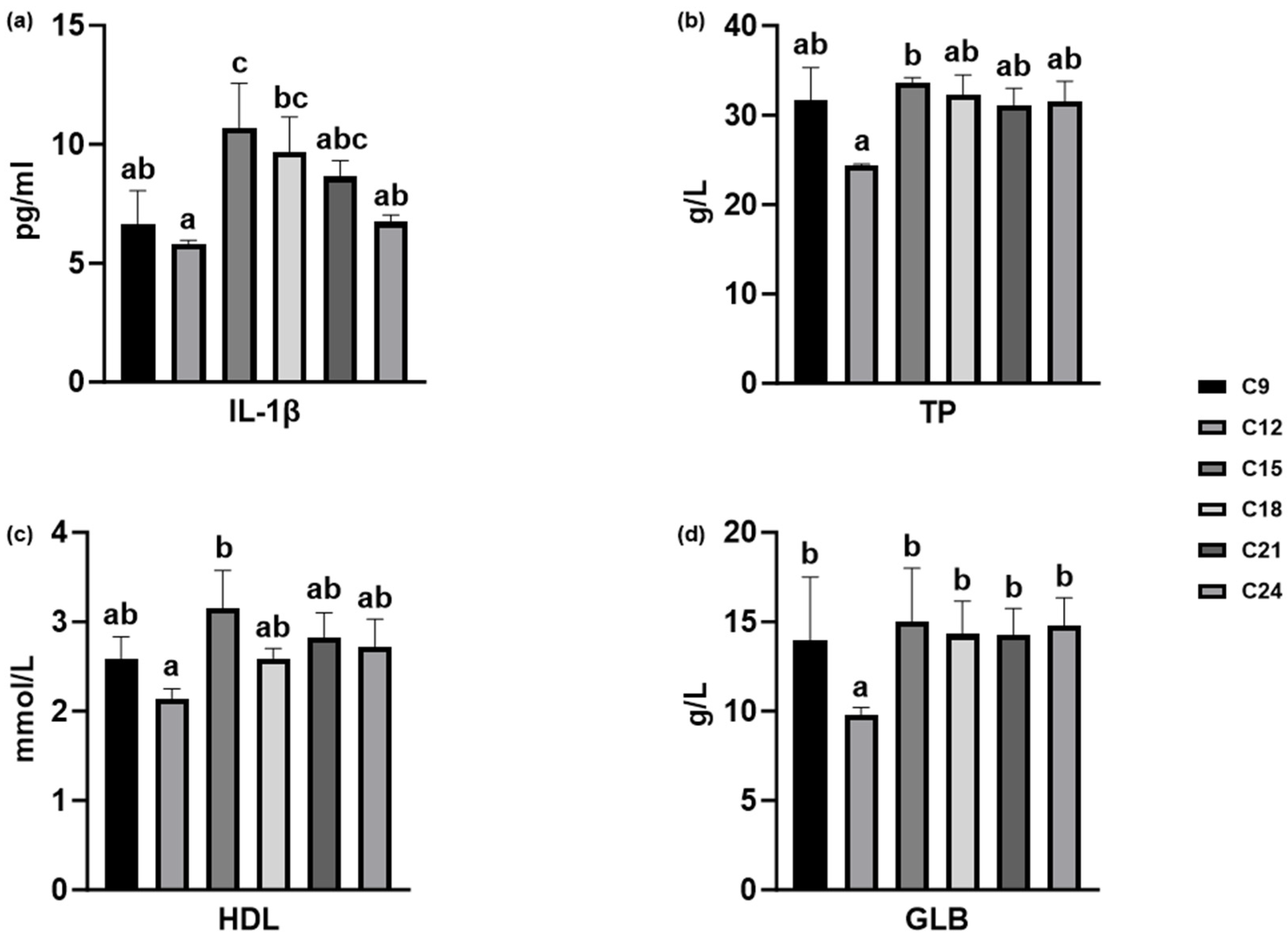
The serum biochemical indices of S.younghusbandi fed different experimental diets are presented in Figure 2. Differences (p < 0.05) in serum values were only observed for interleukin-1β (IL-1β), total protein (TP), high-density lipoprotein cholesterol (HDL), and globulin (GLB), with the C12 group always presenting lower values. All other serum biochemical analyses were alike.

3.5. Intestinal Morphology and Health Assessment

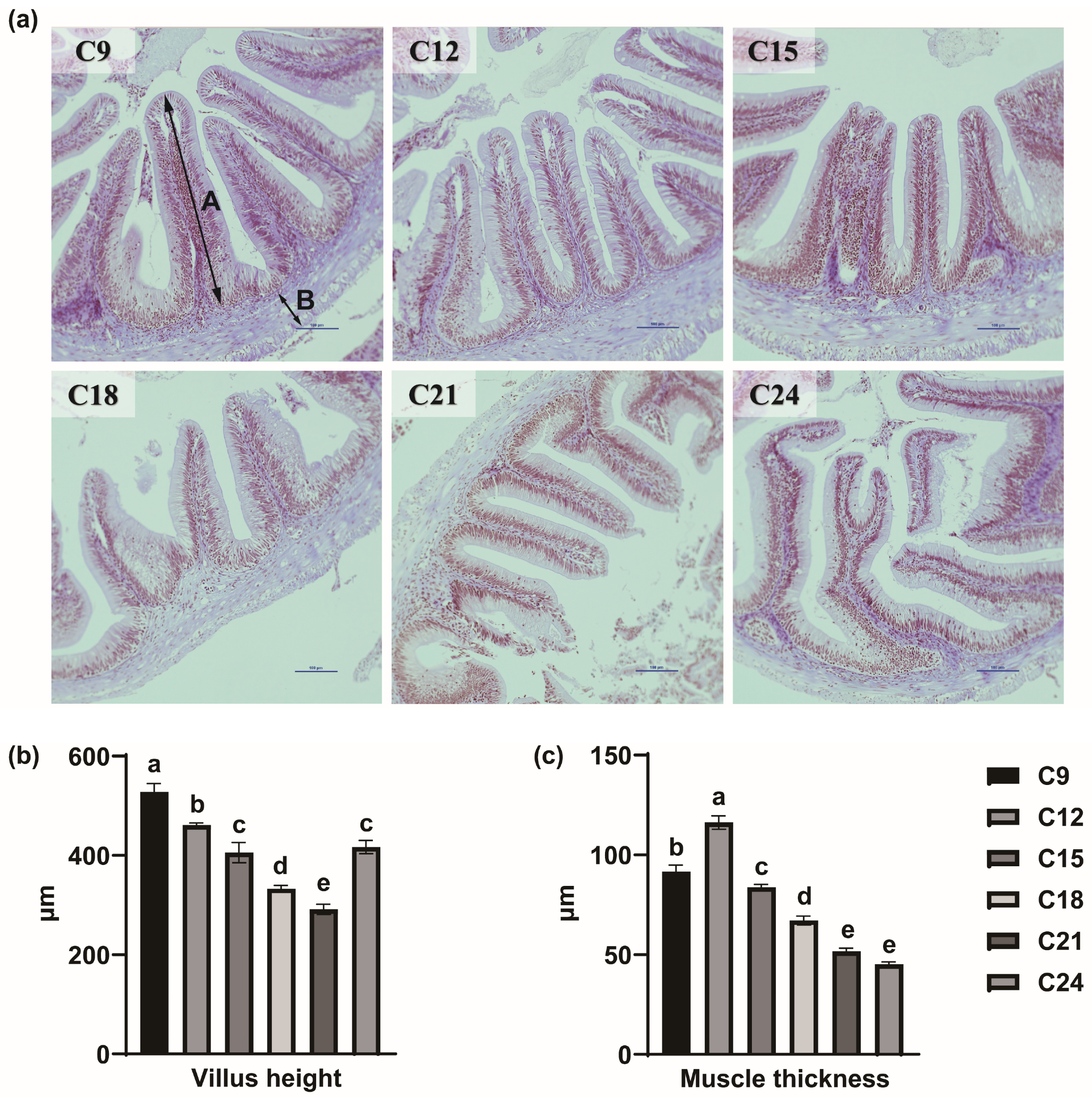
The results of the histological examination of intestinal tissue samples from the six experimental groups are shown in Figure 3. From the histological sections (Figure 3a), it can be observed that as dietary carbohydrate levels increased, the intestinal villi of S.younghusbandi gradually became rough and stunted and exhibited morphological variation, with the C24 group showing the most severe intestinal morphological disorganization. The results of statistical analysis on villus length and intestinal muscular layer thickness across the six experimental groups are presented in Figure 3b,c, respectively. Compared with the other groups, the C9 and C12 groups exhibited significantly longer villus height and thicker muscle thickness (p < 0.05).

3.6. The Microscopic Morphology of the Liver

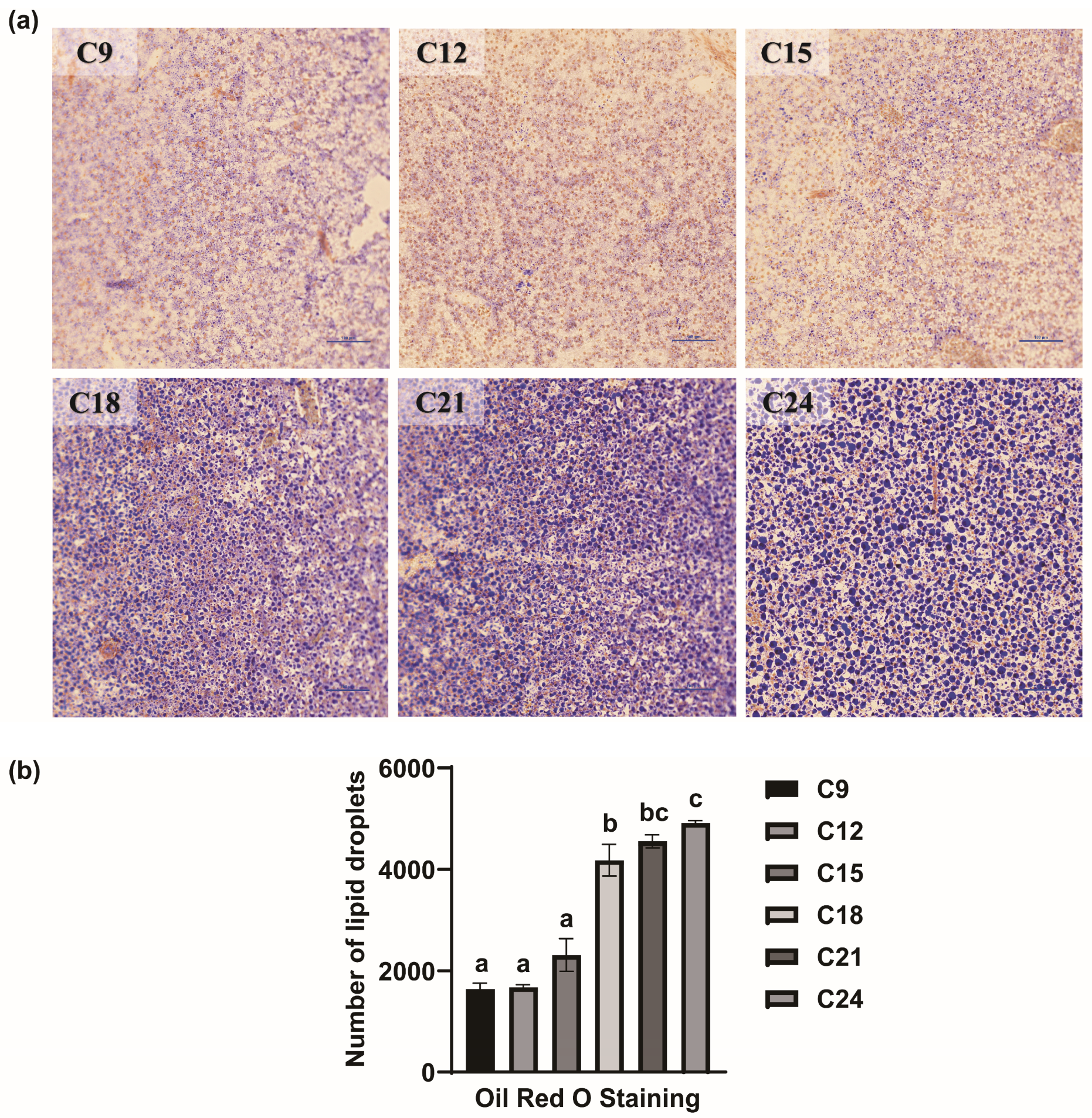
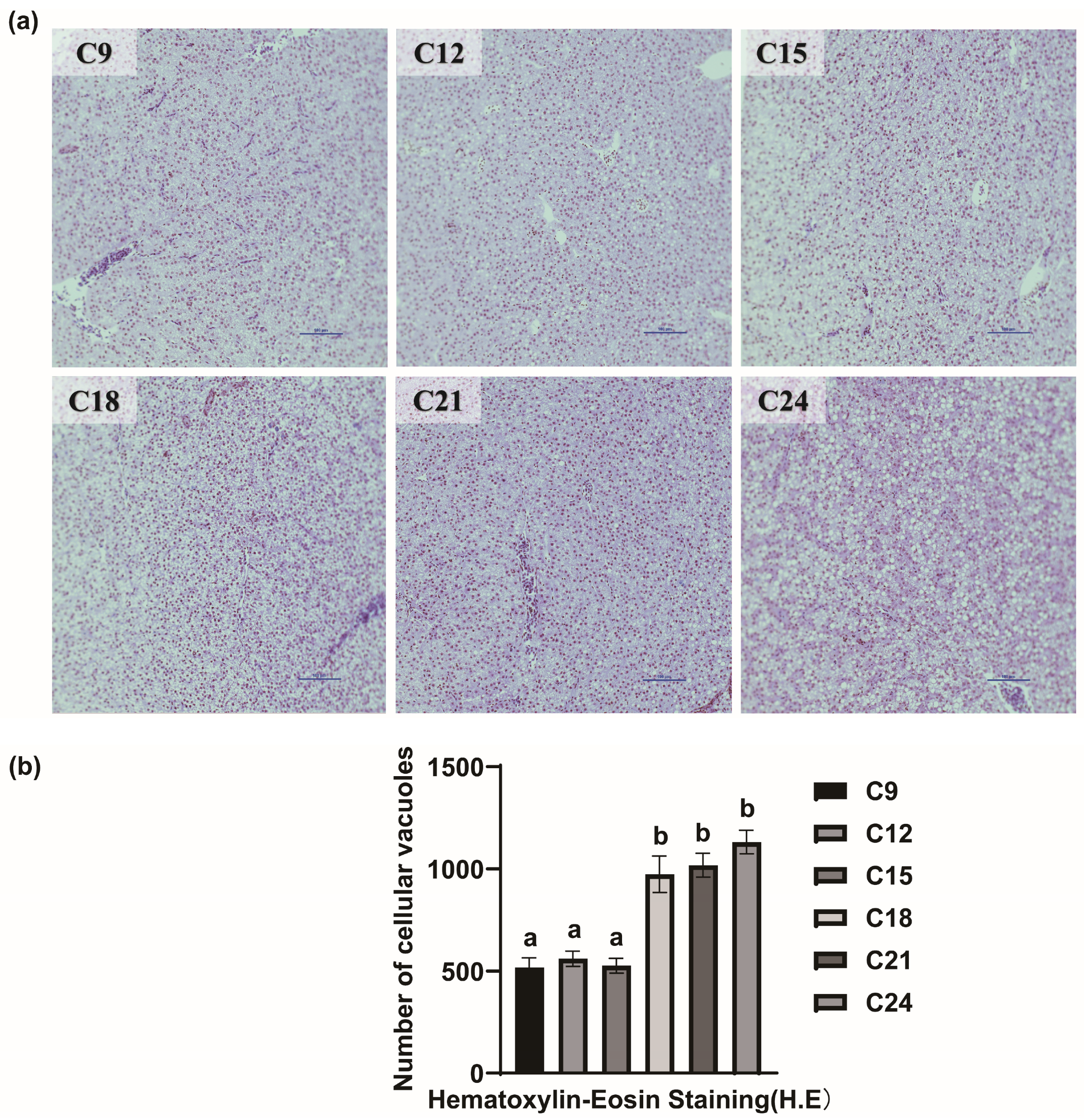
The effects of different dietary carbohydrate levels on the hepatic morphological histology of S.younghusbandi are shown in Figure 4 and Figure 5. Figure 4a,b shows the Oil Red O staining of hepatic tissues: as dietary carbohydrate levels increased, the degree of lipid droplet enrichment in the liver increased significantly. The lipid droplet enrichment in the C9, C12, and C15 groups was significantly lower than that in the C18 and C21 groups (p < 0.05). Figure 5a,b shows the H.E staining results of hepatic tissues: as dietary carbohydrate levels increased, hepatic cells exhibited more pronounced swelling and vacuolation. Compared with the C9, C12, and C15 groups, the degree of hepatic cell vacuolation in the C18 and C21 groups was significantly higher (p < 0.05).

4. Discussion

4.1. Low-Carbohydrate Diet Improves Growth Performance

The intake of dietary carbohydrates can enhance the growth performance of fish [26]. In comparison with high-carbohydrate intake, diets with low carbohydrate levels are more conducive to the growth and development of fish [12,27]. In typical cold-water fish species such as Atlantic salmon (Salmo salar), the optimal carbohydrate level is generally low (<20%) [28]. Previous studies have only explored the dietary protein requirements of S. younghusbandi. Given its long life cycle and the low-temperature environment that contributes to its slow maturation and low growth rate, investigating the carbohydrate requirements of S. younghusbandi is of heightened importance for ecological conservation purposes [10]. Based on the findings of this study, dietary carbohydrate levels of 9–12% are more suitable for S. younghusbandi, as evidenced by the higher weight gain rate and specific growth rate observed in these groups. These findings align with Hemre’s research on dietary carbohydrate utilization in Atlantic cod (Gadus morhua) (~12%) [29]. Similarly, as a cyprinid fish, the common carp (Cyprinus carpio) has an optimal dietary carbohydrate requirement of approximately 26% [30]. Studies on another typical plateau cold-water fish, Gymnocypris przewalskii, have found that its metabolism relies more heavily on proteins and lipids rather than carbohydrates [31]. In stark contrast, the significantly lower carbohydrate requirement of S. younghusbandi further highlights its conservative carbohydrate metabolism as a cold-water species and its physiological adaptation to low-energy aquatic environments. Notably, compared with other experimental groups, the C12 group exhibited the lowest FCR, further demonstrating that an appropriate carbohydrate level can reduce costs by enhancing feed utilization efficiency. For a long time, excessive carbohydrate intake has been recognized to induce metabolic disorders, contribute to obesity, compromise immune function, and lead to hepatic-renal impairment in both humans and animals [32,33]. Most fish species are glucose-intolerant [26,27]. Plateau-endemic fish species are mostly carnivorous or omnivorous, their digestive systems are dominated by proteases, with short intestines and low amylase activity, resulting in weak tolerance to carbohydrates [26,34]. Chronic consumption of high-carbohydrate diets leads to persistent postprandial hyperglycemia [15]. When dietary carbohydrate levels exceed 18%, growth performance declines significantly, potentially due to energy allocation imbalance caused by carbohydrate metabolic overload [15]. The underlying mechanism may involve prolonged postprandial hyperglycemia exceeding the fish’s carbohydrate metabolic tolerance, thereby inducing metabolic disorders, triggering excessive hepatic glycogen accumulation, and ultimately disrupting cellular homeostasis [35]. This likely explains the growth retardation observed at carbohydrate levels of >18%. However, this study did not investigate the molecular mechanisms of carbohydrate metabolism, necessitating future transcriptomic analyses for comprehensive elucidation.

4.2. Low-Carbohydrate Diets Enhance Antioxidant Capacity

Enhancing antioxidant enzyme activity helps mitigate peroxidative damage [36,37]. Higher T-SOD activity indicates stronger antioxidant capacity. When MDA exhibits low levels, the intestine can absorb glutathione (GSH) from other organs to protect the body against oxidative damage, thereby further enhancing the fish’s ability to cope with oxidative stress [38,39]. This study demonstrates that low-carbohydrate intake significantly enhances the total T-SOD activity in S.younghusbandi, while reducing the MDA and IL-1β. Notably, among all groups, the C12 group exhibited the most significant improvements. Dietary carbohydrate intake may influence the expression of the Nrf2-Keap1 pathway, which serves as a key regulator of antioxidant responses [40]. Excessive carbohydrate intake leads to overproduction of reactive oxygen species (ROS), which may disrupt the Keap1-Nrf2 complex. Subsequently, the nuclear translocation of Nrf2 activates the expression of SOD and GSH-related antioxidant enzymes [41,42]. Conversely, the high-carbohydrate group exhibited significantly higher MDA concentrations, potentially attributable to excessive mitochondrial ROS generation [21,43]. Furthermore, the significantly lower IL-1β levels further substantiate that an appropriate carbohydrate level can ameliorate fish health by suppressing inflammatory responses [44].

4.3. Low-Carbohydrate Diets Maintain Hepatointestinal Tissue Integrity

The architecture of hepatocytes directly governs multiple metabolic pathways and antioxidant capacity in fish [43]. Previous studies demonstrate that elevated dietary carbohydrate levels induce hepatocyte damage [43,45]. This study revealed that the C12 group exhibited normal hepatocyte morphology, with significantly fewer lipid droplets and reduced vacuolation compared with high-carbohydrate groups (C18, C21, C24). Marked hepatomegaly and lipid droplet accumulation were observed in high-carbohydrate groups (C18, C21, C24), the significantly higher hepatosomatic index (HSI) further corroborates this finding. Moreover, the reduced albumin levels in the C12 group may contribute to maintaining normal hepatic architecture, as albumin reduction mitigates diet-induced hepatic steatosis and enhances glucose metabolism [46]. Studies on turbot (Scophthalmus maximus) and Japanese flounder (Paralichthys olivaceus) revealed that excessive carbohydrate intake saturates hepatic glycogen synthesis, consequently triggering lipogenesis and inducing hepatic steatosis [43,47], These findings align with the results of the present study. Hepatic crude lipid content in S.younghusbandi reached its minimum in the C12 group, while escalating to 34.02% in the C24 group—a finding that further substantiates the adverse effects of high-carbohydrate diets on hepatic metabolism. The architectural integrity of intestinal tissues directly governs nutrient assimilation efficiency in fish [48,49,50]. This study revealed that the C9 and C12 groups exhibited significantly greater villus height and muscularis thickness among the experimental diets, best preserving the architectural integrity of intestinal tissues within the tested carbohydrate range (9–24%). Conversely, groups fed higher carbohydrate diets (C18, C21, and C24) exhibited signs of severe intestinal damage characterized by rough intestinal edges, shortened villi, and structural disruption. These pathological alterations critically compromised key morphometric parameters (villus height/muscularis thickness), ultimately impairing nutrient delivery to the intestinal mucosa.

5. Conclusions

Among the dietary carbohydrate levels tested in this study (9–24%), a 12% carbohydrate diet yielded the most favorable outcomes for S.younghusbandi. It not only promoted growth but also enhanced anti-inflammatory and antioxidant capacities while protecting hepatointestinal health. Furthermore, carbohydrate levels exceeding 12% (i.e., C18, C21, and C24) led to hepatic lipid accumulation, oxidative stress, and cellular damage, indicating a low tolerance to higher dietary carbohydrates. Therefore, within the scope of this study, a 12% carbohydrate inclusion level is suggested to be adequate for S.younghusbandi, which is characterized by low carbohydrate utilization efficiency.

Author Contributions

M.L., B.Z., and J.N. designed the study. T.Y. carried out the rearing trial. Z.L., X.H., W.Z., H.P., X.G., and X.L. analyzed parts of results. T.Y. wrote this paper with suggestions from J.N. and Z.L. All authors have read and agreed to the published version of the manuscript.

Funding

This research was funded by the Project of Science and Technology of Linzhi City (2023-SYQ-004).

Institutional Review Board Statement

All animal studies were approved by the Experimental Animal Ethics Committee of Sun Yat-sen University, in keeping with Chinese ethical Guidelines for Experimental Animals. The study protocol, experimental procedures, and fish in this study were reviewed and approved with an approval number of SYSU-IACUC-2023-B0475 (approval date: 2023-04-05).

Data Availability Statement

The original contributions presented in this study are included in the article. Further inquiries can be directed at the corresponding authors.

Acknowledgments

This research was supported by the Project of Science and Technology of Linzhi City (2023-SYQ-004).

Conflicts of Interest

The authors declare no conflicts of interest.

References

  1. Zhang, J.-W.; Yan, Y.-N.; Zhao, Z.-Q.; Liu, X.-M.; Li, X.-D.; Zhang, D.; Ding, H.; Meng, J.-L.; Liu, C.-Q. Spatiotemporal variation of Li isotopes in the Yarlung Tsangpo River basin (upper reaches of the Brahmaputra River): Source and process. Earth Planet. Sci. Lett. 2022, 600, 117875. [Google Scholar] [CrossRef]
  2. Yang, Q.; Zhang, P.; Li, X.; Yang, S.; Chao, X.; Liu, H.; Ba, S. Distribution patterns and community assembly processes of eukaryotic microorganisms along an altitudinal gradient in the middle reaches of the Yarlung Zangbo River. Water Res. 2023, 239, 120047. [Google Scholar] [CrossRef] [PubMed]
  3. Li, C.; Hao, J.; Zhang, G.; Fang, H.; Wang, Y.; Lu, H. Runoff variations affected by climate change and human activities in Yarlung Zangbo River, southeastern Tibetan Plateau. Catena 2023, 230, 107184. [Google Scholar] [CrossRef]
  4. Sun, W.; Wang, Y.; Fu, Y.H.; Xue, B.; Wang, G.; Yu, J.; Zuo, D.; Xu, Z. Spatial heterogeneity of changes in vegetation growth and their driving forces based on satellite observations of the Yarlung Zangbo River Basin in the Tibetan Plateau. J. Hydrol. 2019, 574, 324–332. [Google Scholar] [CrossRef]
  5. Liu, X.; Yang, J.; Zhao, L.; Liu, Y.; Gao, F.; Tang, J.; Wang, H.; Chen, Z.; Wang, S.; Li, G.; et al. Aeolian activity in the Yarlung Zangbo River Basin, southern Tibetan Plateau, began at 584 ka: Implications for the glaciation of the Tibetan Plateau. Quat. Sci. Rev. 2024, 337, 108799. [Google Scholar] [CrossRef]
  6. Han, H.; Wang, L.; Zhang, C.; Li, H.; Ma, B. Population structure, growth characteristics, resource dynamics, and management strategies of Schizopygopsis younghusbandi in four tributaries of the yarlung zangbo river, Tibet. Biology 2025, 14, 707. [Google Scholar] [CrossRef]
  7. Zhou, C.; Zhou, Y.; Xu, L.; Liu, F.; Lei, L.; Gao, H.; Li, J.; Fu, S.; Duan, Y.; Tan, Y.; et al. Chromosome-level genome assembly and population genomic analysis provide insights into the genetic diversity and adaption of Schizopygopsis younghusbandi on the Tibetan Plateau. Integr. Zool. 2024. [Google Scholar] [CrossRef]
  8. Chen, F.; Chen, Y.; He, D. Age and growth of Schizopygopsis younghusbandi younghusbandi in the Yarlung Zangbo River in Tibet, China. Environ. Biol. Fishes 2008, 86, 155–162. [Google Scholar] [CrossRef]
  9. Duan, Y.J.; Xie, C.X.; Zhou, X.J.; Ma, B.S.; Huo, B. Age and growth characteristics ofSchizopygopsis younghusbandiRegan, 1905 in the Yarlung Tsangpo River in Tibet, China. J. Appl. Ichthyol. 2014, 30, 948–954. [Google Scholar] [CrossRef]
  10. Zeng, B.; Wang, W.; Dong, Y. Dietary protein requirement of the high altitude’s representative teleost juveniles Schizopygopsis younghusbandi (Cypriniformes: Cyprinidae). Aquac. Res. 2020, 51, 2852–2862. [Google Scholar] [CrossRef]
  11. Chang, T.; Gong, Z.; Shang, K.; Hu, P. Dispersal limitation dominates riverine fish communities in the areas of the water diversion project in the western Sichuan Plateau, China. Animals 2025, 15, 730. [Google Scholar] [CrossRef] [PubMed]
  12. Wang, J.; Li, X.; Han, T.; Yang, Y.; Jiang, Y.; Yang, M.; Xu, Y.; Harpaz, S. Effects of different dietary carbohydrate levels on growth, feed utilization and body composition of juvenile grouper Epinephelus akaara. Aquaculture 2016, 459, 143–147. [Google Scholar] [CrossRef]
  13. Zhang, B.-Y.; Cai, G.-H.; Yang, H.-L.; Nie, Q.-J.; Liu, Z.-Y.; Sun, Y.-Z. New insights on intestinal microorganisms and carbohydrate metabolism in fish. Aquac. Int. 2023, 32, 2151–2170. [Google Scholar] [CrossRef]
  14. Hemre, G.I.; Mommsen, T.P.; Krogdahl, A. Carbohydrates in fish nutrition: Effects on growth, glucose metabolism and hepatic enzymes. Aquac. Nutr. 2002, 8, 175–194. [Google Scholar] [CrossRef]
  15. Polakof, S.; Panserat, S.; Soengas, J.L.; Moon, T.W. Glucose metabolism in fish: A review. J. Comp. Physiol. B 2012, 182, 1015–1045. [Google Scholar] [CrossRef]
  16. Jubouri, M.; Talarico, G.G.M.; Weber, J.-M.; Mennigen, J.A. Alanine alters the carbohydrate metabolism of rainbow trout: Glucose flux and cell signaling. J. Exp. Biol. 2021, 224, jeb232918. [Google Scholar] [CrossRef]
  17. Zhu, W.; Zhang, H.; Pan, H.; Zeng, H.; Wang, W.; Liu, Y.; Wang, Z.; Zhou, Q.; Yu, C. Sodium alginate ameliorates health in freshwater fish through gut-liver axis modulation under high carbohydrate diets. Aquac. Rep. 2024, 40, 102538. [Google Scholar] [CrossRef]
  18. Ning, L.; Zhang, H.; Chen, X.; Zhen, J.; Chen, S.; Guang, J.; Xu, C.; Li, Y. A comparative study on the tolerance of tilapia (Oreochromis niloticus) to high carbohydrate and high lipid diets. Anim. Nutr. 2023, 13, 160–172. [Google Scholar] [CrossRef]
  19. Wei, M.; Tian, Z.; Zhang, N.; Zhou, L.; Li, H.; Ji, H.; He, G.; Zhang, J.; Sun, J. Promoting adipocyte hyperplasia ameliorates high-carbohydrate diet-induced inflammation, oxidative stress, and metabolic disorders and enhances growth performance and immune function in grass carp (Ctenopharyngodon idellus). Fish Physiol. Biochem. 2025, 51, 51. [Google Scholar] [CrossRef]
  20. Wei, M.; Yuan, X.; Song, L.; Li, H.; Ji, H.; Sun, J. Comparative proteomic analysis of pathological characterization of adipose tissue remodeling induced by high-fat diet and high-carbohydrate diet in grass carp (Ctenopharyngodon idellus). Aquaculture 2024, 590, 741079. [Google Scholar] [CrossRef]
  21. Liu, F.; Xiaoze, G.; Xu-Fang, L. First feeding of grass carp (Ctenopharyngodon idellus) with a high-carbohydrate diet:the effect on glucose metabolism in juveniles. Aquac. Rep. 2021, 21, 100830. [Google Scholar] [CrossRef]
  22. Gao, B.; Zhang, X.; Zhang, Y.; Li, S.; Lu, L.; Xu, D.; Liu, X. Effects of dietary carbohydrate levels on the growth, glycometabolism, antioxidant capacity and metabolome of largemouth bass (Micropterus salmoides). Aquac. Res. 2022, 53, 3748–3758. [Google Scholar] [CrossRef]
  23. Chang, R.J.A.; Celino-Brady, F.T.; Breves, J.P.; Seale, A.P. Environmental salinity differentially impacts branchial and hepatic carbohydrate metabolism in tilapia. J. Fish Biol. 2025, 107, 932–945. [Google Scholar] [CrossRef] [PubMed]
  24. Yin, P.; Xie, S.; Zhuang, Z.; He, X.; Tang, X.; Tian, L.; Liu, Y.; Niu, J. Dietary supplementation of bile acid attenuate adverse effects of high-fat diet on growth performance, antioxidant ability, lipid accumulation and intestinal health in juvenile largemouth bass (Micropterus salmoides). Aquaculture 2021, 531, 735864. [Google Scholar] [CrossRef]
  25. Andersen, W.C.; Casey, C.R.; Nickel, T.J.; Young, S.L.; Turnipseed, S.B. Dye residue analysis in raw and processed aquaculture products: Matrix extension of aoac international official method 2012.25. J. AOAC Int. 2018, 101, 1927–1939. [Google Scholar] [CrossRef]
  26. Wilson, R.P. Utilization of dietary carbohydrate by fish. Aquaculture 1994, 124, 67–80. [Google Scholar] [CrossRef]
  27. Kamalam, B.S.; Medale, F.; Panserat, S. Utilisation of dietary carbohydrates in farmed fishes: New insights on influencing factors, biological limitations and future strategies. Aquaculture 2017, 467, 3–27. [Google Scholar] [CrossRef]
  28. Hemre, G.I.; Torrissen, O.; Krogdahl, Å.; Lie, Ø. Glucose tolerance in Atlantic salmon, Salmo salar L., dependence on adaption to dietary starch and water temperature. Aquac. Nutr. 1995, 1, 69–75. [Google Scholar] [CrossRef]
  29. Hemre, G.I.; Lie, O.; Sundby, A. Dietary carbohydrate utilization in cod (Gadus morhua): Metabolic responses to feeding and fasting. Fish Physiol. Biochem. 1993, 10, 455–463. [Google Scholar] [CrossRef]
  30. Sen, P.R.; Rao, N.G.S.; Ghosh, S.R.; Rout, M. Observations on the protein and carbohydrate requirements of carps. Aquaculture 1978, 13, 245–255. [Google Scholar] [CrossRef]
  31. Meng, Y.; Li, C.; Qin, Q.; Tong, Y.; Zhu, R.; Xu, G.; Shi, Y.; Shi, J.; Ma, R. Dietary Lipid Levels Affect the Growth Performance, Lipid Deposition, and Antioxidative Capacity of Juvenile Scaleless Carp, Gymnocypris przewalskii, on the Qinghai-Tibetan Plateau. J. World Aquac. Soc. 2017, 49, 788–797. [Google Scholar] [CrossRef]
  32. Semenkovich, C.F. Insulin resistance and atherosclerosis. J. Clin. Investig. 2006, 116, 1813–1822. [Google Scholar] [CrossRef]
  33. Vercalsteren, E.; Vranckx, C.; Corbeels, K.; Van der Schueren, B.; Velde, G.V.; Lijnen, R.; Scroyen, I. Carbohydrates to prevent and treat obesity in a murine model of diet-induced obesity. Obes. Facts 2021, 14, 370–381. [Google Scholar] [CrossRef] [PubMed]
  34. Song, X.; Marandel, L.; Skiba-Cassy, S.; Corraze, G.; Dupont-Nivet, M.; Quillet, E.; Geurden, I.; Panserat, S. Regulation by dietary carbohydrates of intermediary metabolism in liver and muscle of two isogenic lines of rainbow trout. Front. Physiol. 2018, 9, 1579. [Google Scholar] [CrossRef] [PubMed]
  35. Moon, T.W. Glucose intolerance in teleost fish: Fact or fiction? Comp. Biochem. Physiol. B Biochem. Mol. Biol. 2001, 129, 243–249. [Google Scholar] [CrossRef] [PubMed]
  36. Li, X.; Zheng, S.; Jia, S.; Song, F.; Zhou, C.; Wu, G. Oxidation of energy substrates in tissues of largemouth bass (Micropterus salmoides). Amino Acids 2020, 52, 1017–1032. [Google Scholar] [CrossRef]
  37. Taysı, M.R. Assessing the effects of cadmium on antioxidant enzymes and histological structures in rainbow trout liver and kidney. Sci. Rep. 2024, 14, 27453. [Google Scholar] [CrossRef]
  38. Wang, Y.; Chen, Y.; Zhang, X.; Lu, Y.; Chen, H. New insights in intestinal oxidative stress damage and the health intervention effects of nutrients: A review. J. Funct. Foods 2020, 75, 104248. [Google Scholar] [CrossRef]
  39. Liu, R.; Zhang, Y.; Liang, X.; Lou, B.; Zhu, J. Effects of glutamate on growth performance, gut digestion and antioxidant capacity in juvenile little yellow croaker. Fishes 2025, 10, 188. [Google Scholar] [CrossRef]
  40. Banerjee, P.; Wang, Y.; Carnevale, L.N.; Patel, P.; Raspur, C.K.; Tran, N.; Zhang, X.; Natarajan, R.; Roberts, A.J.; Baran, P.S.; et al. diAcCA, a Pro-Drug for Carnosic Acid That Activates the Nrf2 Transcriptional Pathway, Shows Efficacy in the 5xFAD Transgenic Mouse Model of Alzheimer’s Disease. Antioxidants 2025, 14, 293. [Google Scholar] [CrossRef]
  41. Yu, C.; Xiao, J.-H. The Keap1-Nrf2 System: A Mediator between Oxidative Stress and Aging. Oxidative Med. Cell. Longev. 2021, 2021, 6635460. [Google Scholar] [CrossRef]
  42. Yulong, S.; Wenzhuo, Z.; Jiteng, W.; Jiale, H.; Jiankun, Z.; Tao, H. Astaxanthin enhances antioxidant capacity to alleviate thermal stress-induced liver inflammation in largemouth bass (Micropterus salmoides): A multi-omics insight into glutathione metabolism remodeling. Front. Mar. Sci. 2025, 12, 1595039. [Google Scholar] [CrossRef]
  43. Zhang, Y.; Wei, Z.; Yang, M.; Liu, D.; Pan, M.; Wu, C.; Zhang, W.; Mai, K. Dietary taurine modulates hepatic oxidative status, ER stress and inflammation in juvenile turbot (Scophthalmus maximus L.) fed high carbohydrate diets. Fish Shellfish Immunol. 2021, 109, 1–11. [Google Scholar] [CrossRef]
  44. Xu, R.; Ding, F.-F.; Zhou, N.-N.; Wang, T.; Wu, H.-X.; Qiao, F.; Chen, L.-Q.; Du, Z.-Y.; Zhang, M.-L. Bacillus amyloliquefaciens protects Nile tilapia against Aeromonas hydrophila infection and alleviates liver inflammation induced by high-carbohydrate diet. Fish Shellfish Immunol. 2022, 127, 836–842. [Google Scholar] [CrossRef]
  45. Xu, C.; Liu, W.-B.; Remø, S.C.; Wang, B.-K.; Shi, H.-J.; Zhang, L.; Liu, J.-D.; Li, X.-F. Feeding restriction alleviates high carbohydrate diet-induced oxidative stress and inflammation of Megalobrama amblycephala by activating the AMPK-SIRT1 pathway. Fish Shellfish Immunol. 2019, 92, 637–648. [Google Scholar] [CrossRef]
  46. Abdollahi, A.; Narayanan, S.K.; Frankovich, A.; Lai, Y.-C.; Zhang, Y.; Henderson, G.C. Albumin deficiency reduces hepatic steatosis and improves glucose metabolism in a mouse model of diet-induced obesity. Nutrients 2023, 15, 2060. [Google Scholar] [CrossRef] [PubMed]
  47. Deng, K.; Pan, M.; Liu, J.; Yang, M.; Gu, Z.; Zhang, Y.; Liu, G.; Liu, D.; Zhang, W.; Mai, K. Chronic stress of high dietary carbohydrate level causes inflammation and influences glucose transport through SOCS3 in Japanese flounder Paralichthys olivaceus. Sci. Rep. 2018, 8, 7415. [Google Scholar] [CrossRef] [PubMed]
  48. Jiao, F.; Zhang, L.; Limbu, S.M.; Yin, H.; Xie, Y.; Yang, Z.; Shang, Z.; Kong, L.; Rong, H. A comparison of digestive strategies for fishes with different feeding habits: Digestive enzyme activities, intestinal morphology, and gut microbiota. Ecol. Evol. 2023, 13, e10499. [Google Scholar] [CrossRef] [PubMed]
  49. Sitjà-Bobadilla, A.; Gil-Solsona, R.; Estensoro, I.; Piazzon, M.C.; Martos-Sitcha, J.A.; Picard-Sánchez, A.; Fuentes, J.; Sancho, J.V.; Calduch-Giner, J.A.; Hernández, F.; et al. Disruption of gut integrity and permeability contributes to enteritis in a fish-parasite model: A story told from serum metabolomics. Parasites Vectors 2019, 12, 486. [Google Scholar] [CrossRef]
  50. Painefilú, J.C.; Bianchi, V.A.; Krock, B.; De Anna, J.S.; Kristoff, G.; Luquet, C.M. Effects of paralytic shellfish toxins on the middle intestine of Oncorhynchus mykiss: Glutathione metabolism, oxidative status, lysosomal function and ATP-binding cassette class C (ABCC) proteins activity. Ecotoxicol. Environ. Saf. 2020, 204, 111069. [Google Scholar] [CrossRef]
Figure 1. Analysis of regression curve fitting between weight gain rate (WGR), specific growth rate (SGR), and different carbohydrate level diets: The regression equation was described as WGR = 0.0001378x3 − 0.006401x2 + 0.08849x − 0.2562 (R2 = 0.5907); SGR = 0.0002461x3 − 0.01146x2 + 0.1592x − 0.4624 (R2 = 0.6010).
Fishes 10 00489 g001
Figure 2. The effects of different dietary carbohydrate addition levels on serum biochemical indices of S.younghusbandi: (a) effect of carbohydrate on serum interleukin-1β (IL-1β); (b) effect of carbohydrate on total protein (TP); (c) effect of carbohydrate on high-density lipoprotein cholesterol (HDL); and (d) effect of carbohydrate on globulin (GLB). Note: Values in the same row with different letters are significantly different (p < 0.05) (n = 4).
Fishes 10 00489 g002
Figure 3. Effects of different dietary carbohydrate levels on the intestinal tissue structure of S.younghusbandi. (a) Hematoxylin–eosin (H.E) staining sections of intestinal morphology, (A): reference marker for intestinal villus height; (B): reference marker for intestinal muscle thickness, magnified 20× (scale bar = 100 μm); (b) statistical analysis of intestinal villus height; and (c) statistical analysis of intestinal muscle thickness. Note: values in the same row with different letters are significantly different (p < 0.05) (n = 4).
Fishes 10 00489 g003
Figure 4. Effects of different dietary carbohydrate levels on the hepatic histomorphology of S.younghusbandi—(Oil Red O staining). (a) Oil Red O-stained sections of hepatic tissues, magnified 20× (bar = 100 μm); (b) statistical analysis of lipid droplets in hepatic tissues. Note: Values in the same row with different letters are significantly different (p < 0.05) (n = 4).
Fishes 10 00489 g004
Figure 5. Effects of different dietary carbohydrate levels on the hepatic histomorphology of S.younghusbandi—(H.E staining). (a) Hematoxylin–eosin (H.E) staining sections of hepatic tissues, magnified 20× (bar = 100 μm); (b) statistical analysis of vacuolation in hepatic tissues. Note: Values in the same row with different letters are significantly different (p < 0.05) (n = 4).
Fishes 10 00489 g005
Table 1. Formulation and proximate compositions of experimental diets (% of dry matter).
ItemC9C12C15C18C21C24
Ingredients (%)
Corn starch7.811.615.419.22326.8
Flour3.93.53.12.72.31.9
Fish meal131313131313
Mealworm meal101010101010
Beer yeast555555
Soybean meal28.628.628.628.628.628.6
Wheat gluten555555
Fish oil1.51.51.51.51.51.5
Soy oil1.51.51.51.51.51.5
Soya lecithin1.51.51.51.51.51.5
Vitamin premix 1111111
Mineral premix 2111111
Choline chloride (50%)0.50.50.50.50.50.5
Ca(H2PO4)21.51.51.51.51.51.5
Vitamin c0.20.20.20.20.20.2
Sodium alginate111111
Microcrystalline cellulose1713.610.26.83.40
Sum100100100100100100
Proximate analysis (% air dry matter)
Crude protein35.0835.0735.0635.0535.0335.03
Crude lipid6.996.996.986.986.986.98
Carbohydrate9.0712.0515.0318.0120.9923.97
Moisture10.85 ± 0.2410.44 ± 0.3111.01 ± 0.6311.27 ± 0.7710.94 ± 0.2111.42 ± 0.49
Crude ash10.38 ± 0.2210.29 ± 0.3210.42 ± 0.209.94 ± 0.1710.11 ± 0.169.67 ± 0.27
NFE22.6321.1620.5021.2820.9722.03
Gross energy (kJ g−1)18.73 ± 0.6218.82 ± 0.7418.77 ± 0.7718.65 ± 0.6518.69 ± 0.5918.72 ± 0.67
1 Vitamin premix (mg kg−1 diet): Vitamin B1, 3 g; Vitamin B2, 6 g; Vitamin B6, 2 g; Niacin, 20 g; Calcium pantothenate, 10 g; Inositol, 10 g; Biotin, 250 mg; Folic acid, 1 g; Vitamin B12, 10 mg; Vitamin K3, 4 g; Vitamin A, 1,000,000 IU; Vitamin D3, 200,000 IU; and Vitamin E, 16,000 IU. 2 Mineral premix (mg kg−1 diet): MgSO4·7H2O, 109 g; KH2PO4, 93.2 g; NaH2PO4·2H2O, 43.2 g; FeC6H5O7·5H2O, 18.1 g; ZnCl2, 8 g; CuSO4·5H2O, 6.3 g; AlCl3·6H2O, 5.1 g; MnSO4·H2O, 3.1 g; KI, 2.8 g; CoCl2·6H2O, 600 mg; and Na2SeO3·H2O, 80 mg. The data for moisture, crude ash, and gross energy are presented as mean ± SD.
Table 2. Growth performance of S.younghusbandi fed diets with different carbohydrate levels diets.
ItemC9C12C15C18C21C24
IBW37.57 ± 0.2737.53 ± 0.3037.43 ± 0.2937.63 ± 0.2937.32 ± 0.2637.48 ± 0.10
FBW42.28 ± 1.4942.41 ± 1.2441.02 ± 1.1240.37 ± 0.7339.39 ± 0.3740.69 ± 0.82
SR90.00 ± 1.2293.25 ± 2.6696.75 ± 1.4394.25 ± 1.7093.50 ± 5.5594.25 ± 3.81
WGR11.99 ± 1.55 bc13.12 ± 0.55 c8.41 ± 0.86 ab7.26 ± 1.51 a5.66 ± 0.38 a8.52 ± 1.46 ab
SGR0.22 ± 0.03 bc0.24 ± 0.01 c0.16 ± 0.01 ab0.14 ± 0.03 a0.11 ± 0.01 a0.16 ± 0.02 ab
FCR1.83 ± 0.25 ab1.21 ± 0.06 a2.15 ± 0.22 abc3.15 ± 0.66 cd3.71 ± 0.33 d2.44 ± 0.41 bc
CF1.12 ± 0.011.18 ± 0.021.20 ± 0.021.13 ± 0.021.17 ± 0.021.24 ± 0.05
HSI0.68 ± 0.04 a0.83 ± 0.07 a0.84 ± 0.04 a1.12 ± 0.09 b1.27 ± 0.07 b1.29 ± 0.10 b
VSI5.28 ± 0.18 a5.90 ± 0.19 ab6.51 ± 0.24 b6.18 ± 0.18 b6.50 ± 0.23 b6.09 ± 0.10 b
IPF0.42 ± 0.04 a0.59 ± 0.05 ab0.55 ± 0.04 ab0.50 ± 0.06 ab0.62 ± 0.07 b0.82 ± 0.09 c
Note: Values in the same row with different letters are significantly different (p < 0.05) (n = 4). Initial body weight (IBW, g) = initial body weight/initial number of fish; final body weight (FBW, g) = final body weight/final number of fish; survival rate (SR, %) = 100 × (final number of fish)/(initial number of fish); weight gain ratio (WGR, %) = 100 × (final body weight − initial body weight)/initial body weight; specific growth rate (%/day) = 100 × (Ln final body weight − Ln initial body weight)/days; feed conversion ratio (FCR) = feed consumed/(final body weight–initial body weight); condition factor (CF, g/cm3) = 100 × final body weight/(body length)3; hepatosomatic index (HSI, %) = 100 × liver weight (g)/body weight (g); viscerosomatic index (VSI, %) =100 × (viscera weight, g)/(whole-body weight, g); and intraperitoneal fat ratio (IPF, %) = 100 × Mesenteric fat weight (g)/Body weight (g).
Table 3. Proximate composition of S.younghusbandi fed diets with different carbohydrate levels diets (%dry matter).
Item (%)C9C12C15C18C21C24
Whole-fish Moisture69.74 ± 0.9570.74 ± 0.8070.69 ± 0.9068.22 ± 1.0667.67 ± 1.2667.39 ± 1.59
Whole-fish Crude fat21.12 ± 0.1219.14 ± 0.6820.43 ± 1.4025.85 ± 1.6919.51 ± 0.1719.18 ± 0.11
Whole-fish Crude protein63.92 ± 1.4164.07 ± 1.0163.45 ± 1.3962.35 ± 1.9664.10 ± 0.8364.54 ± 1.44
Muscle Moisture75.75 ± 0.3776.80 ± 0.4576.39 ± 0.7276.35 ± 0.4276.22 ± 0.3876.72 ± 0.17
Muscle Crude fat9.38 ± 1.31 d2.20 ± 0.62 a4.07 ± 0.27 b4.74 ± 0.43 b6.85 ± 0.18 c4.54 ± 0.31 b
Muscle Crude protein54.16 ± 2.29 c50.81 ± 0.99 bc42.84 ± 2.15 ab47.15 ± 3.24 bc46.09 ± 0.61 abc38.25 ± 3.11 a
Liver Moisture72.98 ± 1.05 b70.01 ± 0.71 ab68.44 ± 0.98 ab71.37 ± 1.51 ab71.09 ± 0.82 ab66.20 ± 2.52 a
Liver Crude fat23.56 ± 0.0426.36 ± 0.0232.15 ± 1.0629.78 ± 5.4728.28 ± 5.4434.02 ± 4.48
Liver Crude protein76.45 ± 2.8278.22 ± 1.5278.57 ± 1.0580.03 ± 1.7077.75 ± 2.2978.35 ± 0.76
Note: Values in the same row with different letters are significantly different (p < 0.05) (n = 4).
Table 4. Effects of different carbohydrate levels diets on oxidase activity in S.younghusbandi.
ItemC9C12C15C18C21C24
T-SOD58.23 ± 4.21 ab62.17 ± 4.75 a56.76 ± 6.12 ab55.81 ± 3.54 ab55.46 ± 5.52 ab51.44 ± 3.73 b
MDA5.66 ± 0.90 a5.18 ± 0.58 b6.49 ± 1.01 a6.65 ± 1.13 a6.39 ± 0.73 a7.54 ± 0.93 a
Note: The unit of T-SOD is (U·mgprot−1), and the unit of MDA is (nmol·mgprot−1); values in the same row with different letters are significantly different (p < 0.05) (n = 4).
Disclaimer/Publisher’s Note: The statements, opinions and data contained in all publications are solely those of the individual author(s) and contributor(s) and not of MDPI and/or the editor(s). MDPI and/or the editor(s) disclaim responsibility for any injury to people or property resulting from any ideas, methods, instructions or products referred to in the content.