1. Introduction
Internet of Things (IoT) technology connects billions of intelligent devices across domains such as smart homes, the industrial IoT, and smart healthcare, generating and transmitting vast amounts of data [
1,
2]. In IoT environments, it is common that devices cannot be legitimately accessed by third parties when the device owner is unavailable or that devices themselves lack sufficient computational resources to handle a large volume of requests. Due to limited computational capability or operational availability, a more powerful proxy—such as a fog node or edge server—could be delegated to cope with these situations, thereby improving operational flexibility, alleviating computational burden and reducing system latency.
Proxy signature schemes in cryptography provide a natural primitive for enabling such delegated authorization. A proxy signature scheme, firstly introduced by Mambo et al. [
3], is a specialized digital signature primitive that allows an original signer to delegate their signing authority to a proxy agent. It enables a proxy to generate valid signatures on behalf of the original signer, which can be publicly verified using the original signer’s public key.
Early proxy signature schemes were essentially full delegation signatures, in which the original signer directly provides its private key to the proxy signer [
4]. Such a design is clearly insecure in practical delegation scenarios, particularly in IoT environments. A more practical approach is delegation by warrant, where the original signer does not reveal its private key but instead issues an unforgeable delegation credential containing the description of the delegated rights and a signature on the proxy’s public key [
4]. However, this kind of schemes mostly rely on the proxy signer’s long-term identity and typically require synchronous interaction, which is unrealistic for resource-constrained IoT devices. To address this limitation, Frymann et al. proposed the cryptographic primitive asynchronous remote key generation (ARKG), which enables non-interactive key derivation [
5,
6]. They also constructed a certificate-based proxy signature scheme in which the delegation credential signs derived and unlinkable public keys rather than a fixed identity, by integrating ARKG into the Proxy Signature with Unlinkable Warrant (PSUW) framework [
7].
Existing proxy signature schemes can also be broadly categorized by their underlying hardness assumptions. Some schemes rely on classical mathematics problems such as discrete logarithms (DLP), integer factorization, or elliptic curve variants (ECC) [
3,
8,
9]. Other classical constructions employ Bilinear Pairings for application like the SE-IDPSC-CS scheme [
10] used in cloud data sharing. However, all these schemes are vulnerable to quantum attacks.
To address this threat, post-quantum cryptography (PQC), which aims to be quantum-safe, has been developed. In 2022, the National Institute of Standards and Technology (NIST) selected lattice-based CRYSTALS-Kyber (Kyber) [
11] and CRYSTALS-Dilithium (Dilithium) [
12] for PQC standardization, which were later standardized as the Module-Lattice-based Key-Encapsulation Mechanism (ML-KEM) [
13] and Module-Lattice-based Digital Signature Algorithm (ML-DSA) [
14] in 2024, respectively. PQC schemes based on MLWE achieve a good balance between efficiency and storage, making them widely suitable for resource-constrained IoT scenarios [
15]. For strong security guarantees, CRYSTALS-Dilithium was extended to a variant called Dilithium-QROM with tight security reductions in the Quantum Random Oracle Model (QROM) [
16]. At the same time, various identity-based proxy signature schemes based on lattice have been proposed [
17,
18,
19]. These schemes use identity strings (e.g., email addresses) as public keys with the risk of potential illegal impersonation or unauthorized signing [
20] and usually necessitate secure channels for secret key distribution. Moreover, they suffer the significant computational overhead of the lattice trapdoor. Beyond this, existing ARKG instantiations remain largely grounded in classical hardness assumptions [
6], and the extension to lattice-based cryptography is limited to asynchronous key generation of sKEM (split KEM) [
5], leaving lattice-based signature schemes without a dedicated instantiation. Motivated by the trapdoor-free structure of Dilithium-QROM and the PSUW framework, we propose DPS, an efficient post-quantum proxy signature scheme, addressing the synchronization challenges and privacy risks in IoT scenarios. By reconstructing ARKG to enable asynchronous remote key generation for Dilithium-QROM, DPS preserves the asynchrony and unlinkability properties of PSUW while completely eliminating the costly trapdoor computations, thereby significantly reducing the overhead for resource-constrained IoT devices.
1.1. Contribution
Motivated by the need to integrate lattice-based cryptographic primitives into practical IoT applications, we propose a new proxy signature scheme based on Dilithium-QROM tailored for IoT environments, with improved implementation efficiency over other lattice-based works. Our main contributions are as follows:
We proposed an ARKG scheme based on Kyber for the asynchronous key generation of Dilithium-QROM. It utilizes Kyber as its underlying module to derive, in a one-way manner, a key pair suitable for Dilithium-QROM. The derived key pair can be used as the input to the Dilithium-QROM signing algorithm without compromising its correctness or security guarantees.
We give the first Dilithium-based proxy signature scheme, denoted as DPS, by instantiating the PSUW framework with our proposed ARKG scheme and Dilithium-QROM. The proposed DPS achieves post-quantum security and provides verifiability, unforgeability, undeniability, and unlinkability, all supported by formal security proofs. Furthermore, constructing proxy signatures directly from Dilithium eliminates the need for lattice trapdoors, leading to improved efficiency.
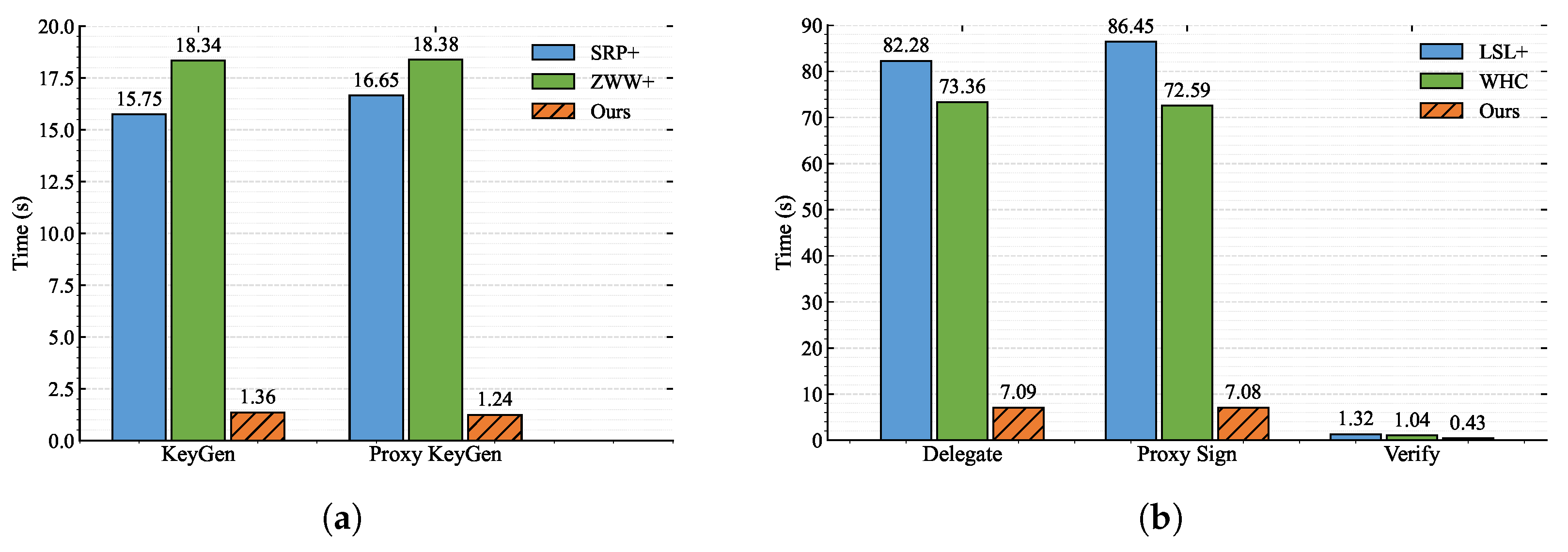
We provide an experimental evaluation of the proposed scheme using concrete parameter sets. The results demonstrate that our construction has a greater advantage over other lattice-based schemes in terms of proxy signature efficiency. Specifically, experimental results show that our scheme achieves approximately a 10× speedup for both the delegation and proxy signing phases, as well as a 2.4× performance improvement in the verification phase over comparable works.
1.2. Related Work
Proxy signatures, as a cryptographic primitive enabling the secure delegation of signing rights, hold significant application value in distributed scenarios such as the Industrial Internet of Things (IIoT), Internet of Vehicles (IoV), and cloud data sharing.
Mambo et al. [
3] first introduced the concept of proxy signatures, enabling an original signer to delegate signing authority to a proxy signer through a warrant-based mechanism, which laid the theoretical foundation for subsequent studies on delegation and security models. With the development of IoT and IIoT applications, Verma et al. [
2] proposed an efficient and provable certificate-based proxy signature scheme with low computational overhead and formal security. To reduce certificate management costs, lightweight certificateless signature schemes are proposed for IoT and IIoT systems [
21,
22]. However, their constructions suffer from key replacement and secret key distribution problems. Identity-based proxy signature schemes are developed to improve data integrity and authentication [
23,
24]. These schemes rely on centralized key generation centers and involve complex calculations. More proxy signature schemes for IoV and distributed scenarios are proposed based on algebraic or geometric structures (e.g., bilinear pairings, hyperelliptic curves), yet they generally exhibit poor efficiency [
9,
25,
26]. Notably, the security of these schemes fundamentally relies on traditional hardness assumptions (e.g., the discrete logarithm problem), which have been proven vulnerable to quantum cryptanalysis [
27,
28].
With the threat of quantum computing, lattice-based cryptography emerged as a leading post-quantum candidate. Wang et al. [
29] utilized fixed-dimension lattice basis delegation to optimize efficiency for resource-constrained IoT devices, avoiding the key size expansion inherent in previous techniques [
30]. To further enhance functionality, Zhu et al. [
18] integrated encryption with signing, proposing an identity-based proxy signcryption scheme that ensures both confidentiality and unforgeability. Guo et al. [
17] introduced the identity-based linearly homomorphic proxy signature scheme. This scheme allows a third party to perform linear operations on signed messages while maintaining the validity of the signature, facilitating secure data aggregation.
To mitigate the large key overhead of standard lattices, efficient structured variants like NTRU lattices have been adopted. Wu et al. [
29] presented an identity-based proxy signature (IBPS) scheme over NTRU lattices. By leveraging the ring structure of polynomial convolutions, their scheme achieves faster signing operations and more compact signatures compared to unstructured lattice counterparts. Building upon the NTRU framework, Singh et al. [
19] recently extended the functionality to blind signatures, preserving the privacy of the message content from the signer.
1.3. Organization
In
Section 2, we introduce the notation used throughout the paper and present the necessary preliminaries and basic components. In
Section 3, we abstract and model the application scenario and formally define the syntax of our scheme.
Section 4 describes the concrete construction of the proposed scheme and provides a security analysis. In
Section 5, we present the experimental results and a comparative evaluation with existing schemes. Finally,
Section 6 and
Section 7 conclude the paper and discusses directions for future work.
3. Problem Formulation
In this section, we first describe the workflow of proxy signatures in IoT scenarios and define the involved entities
Section 3.1. We then present the syntax of our scheme in detail in
Section 3.2. Finally, we formalize the corresponding security definitions in
Section 3.3.
3.1. System Model of IoT Proposed Scheme
In Internet of Things (IoT) environments, delegating signing capabilities to a proxy entity typically arises in two common situations: the original signer (e.g., the device owner) may be temporarily unavailable to participate in authentication procedures or IoT devices often have limited computational resources and cannot efficiently handle large volumes of authentication or signing requests.
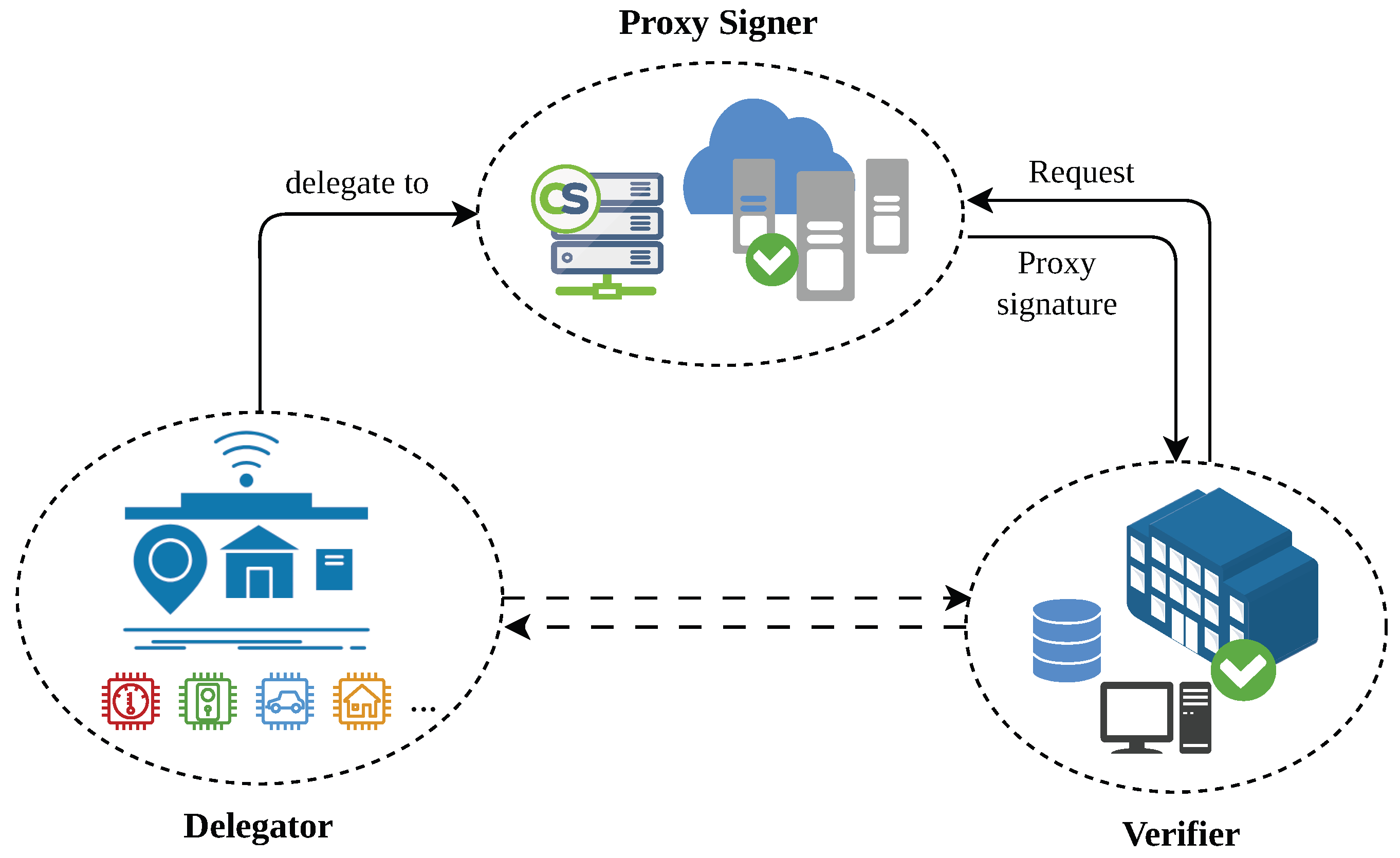
In both cases, the proxy entity performs signing operations on behalf of the original signer within the scope defined by a delegation credential while allowing external parties to verify the validity of the proxy-generated signatures. Based on these observations, we integrate these IoT delegation scenarios into a three-entity model as shown in
Figure 2, in which an IoT device or its data owner delegates signing capabilities to a more available or computationally powerful entity to perform authentication or signing tasks on their behalf.
Delegator: The delegator is typically an IoT device (e.g., a sensor or controller) or its owner, who possesses the original signing key pair and controls the device or its data. The delegator authorizes a proxy signer by issuing a verifiable delegation credential.
Proxy Signer: The proxy signer is the core entity in the proxy signature process. In IoT scenarios, it is usually a trusted entity with stronger computational capabilities, such as a fog node or a cloud server. The proxy signer holds its own long-term key pair and, after receiving authorization from the delegator, obtains the capability to generate proxy signatures on behalf of the delegator.
Verifier: The verifier represents external service providers or authentication servers, such as device manufacturers or data processing centers. In the system model, the verifier primarily interacts with the proxy signer but may also communicate with the delegator when necessary. Its role is to verify both the legitimacy of the delegation credential and the correctness of the proxy signature generated by the proxy signer.
Remark 1.
As illustrated in the system model, the delegator typically consists of low-power IoT terminals. To conserve energy, these devices frequently enter sleep mode, making real-time synchronization with the proxy signer impractical; thus, an asynchronous authorization mechanism is essential. Furthermore, the signing workload can be delegated to entities with stronger computational capabilities. Benefiting from Dilithium’s trapdoor-free design, DPS achieves a notable speedup over trapdoor-based schemes, as validated by our experiments, and supports flexible deployment on resource-constrained IoT nodes.
3.2. Syntax of Proposed Scheme
We propose a Dilithium-based proxy signature (DPS) scheme instantiated under the ARKG and PSUW frameworks. The proposed ARKG is a 5-tuple based on the Kyber KEM, consisting of the following PPT algorithms: (SetUp, KeyGen, DerivePK, DeriveSK, Check).
: On input the security parameter , this algorithm initializes the global system parameters and outputs two public parameter sets: for the key encapsulation component and for the signature component. The complete public parameter tuple is defined as .
: This algorithm invokes with and Dilithium-QROM. KeyGen with , obtaining the corresponding keys , where is the encapsulation key pair and is the proxy’s signature key pair.
: This algorithm, executed by the delegator, takes as input the proxy’s encapsulation public key and the proxy’s signature public key , outputs the derived public key for and credential .
: This algorithm, executed by the proxy, takes as input the credential transmitted by the delegator, the decapsulation private key , and its signature key pair , and outputs the derived signature private key .
: This algorithm returns if and form a valid public–private key pair, and otherwise.
We treat ARKG as an encapsulated cryptographic component and propose the DPS scheme based on the PSUW framework, which consists of six PPT algorithms as described below.
: This algorithm initializes the global environment of the delegation system. Given the security parameter , it outputs public parameters , including for the key encapsulation component and for the signature component.
In the key generation phase, the algorithm generates long-term identity keys. Since the delegator and the proxy assume different roles within the protocol, we distinguish between two key generation procedures. Specifically, given the public parameters , the algorithms are defined as follows.
: The key generation procedure for the delegator is denoted by DPS.dKeyGen. On inputting public parameter , the delegator invokes Dilithium-QROM. KeyGen to generate its signature key pairs .
: The key generation procedure for the proxy signer is denoted by DPS.pKeyGen. On inputting public parameter and , the proxy signer invokes ARKG. KeyGen to generate its key pairs for encapsulation and signature respectively.
: Taking as input the proxy’s signature public key , encapsulation public key and the delegator’s signing key , this algorithm invokes to obtain a derived public key and credential , where is packed into for the proxy to recover the corresponding signing key . The delegator then obtains the signature by signing the derived public key with , forming the warrant that cryptographically binds to the delegator’s identity and authorizes the proxy to sign on the delegator’s behalf, and returns .
: After verifying the warrant the proxy signing algorithm first invokes ARKG. DeriveSK with the credential extracted from and decapsulation key and proxy’s key pair to derive the proxy signing key , then signs message m with to output a valid proxy signature using Dilithium-QROM. Sign.
: The verification algorithm is executed by a third-party verification platform and aims to confirm that a signature has been generated by an authorized proxy. Given the delegator’s signature public key , the corresponding authorization , the message attached with its proxy signature , the algorithm verifies signature with and signature with . It outputs if both verifications pass, and otherwise.
3.3. Security Definitions
The DPS scheme satisfies the security properties of proxy signatures [
37], which are described as follows:
Unforgeability: A designated proxy signer can create a valid proxy signature for the original signer. But the original signer and other third parties who are not designated as a proxy signer cannot create a valid proxy signature.
Distinguishability: Proxy signatures are distinguishable from normal signatures by everyone.
Verifiability: From the proxy signature, the verifier can be convinced of the original signer’s agreement on the signed message.
Strong undeniability: Once a proxy signer creates a valid proxy signature of an original signer, he/she cannot repudiate the signature creation.
To satisfy the unforgeability property, an adversary
should not be able to forge a proxy signature with respect to a delegator’s public key
without knowledge of the corresponding secret key
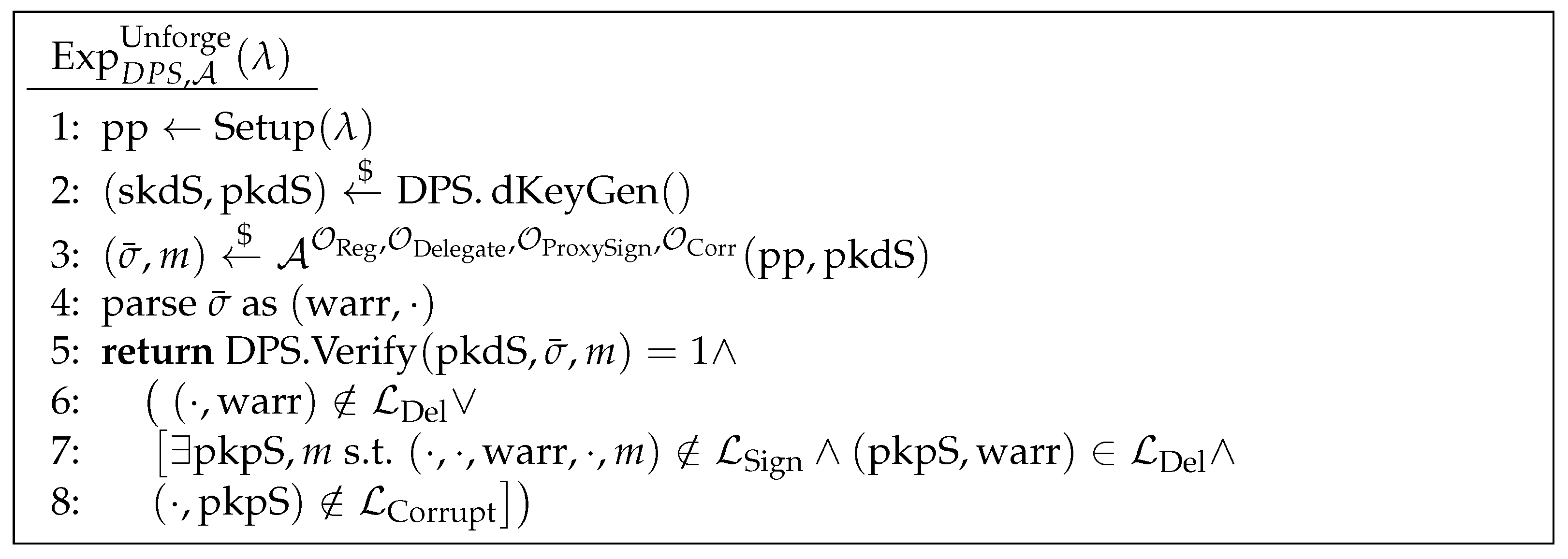
. Based on the PSUW framework [
7], we define the unforgeability experiment for our scheme in
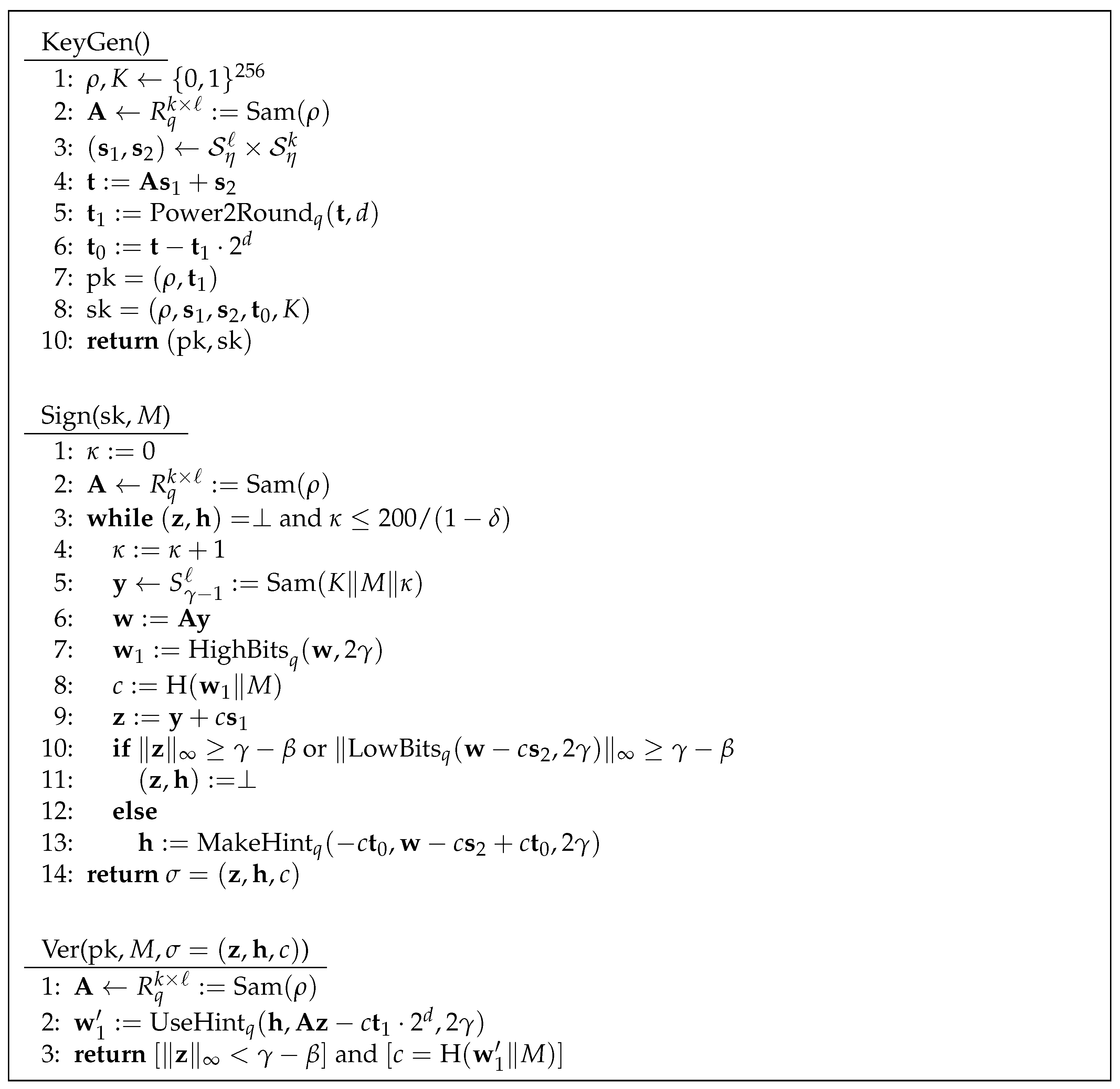
Figure 3. The adversary
is allowed to make a polynomial number of queries to the oracles modeling registration, delegation, proxy signing, and corruption, which are formally defined in
Appendix A.
Definition 3
(Unforgeability)
. Let be any probabilistic polynomial-time adversary against the unforgeability of the proposed scheme with security parameter λ. A DPS scheme provides unforgeability if the following advantage is negligible in λ: In addition, DPS provides an unlinkability property by using the PSUW framework. This property is described as follows:
4. Proposed Scheme
In this section, we first present an ARKG scheme based on Kyber KEM in
Section 4.1. Building upon this ARKG scheme and the PSUW framework, we propose a post-quantum proxy signature scheme in the QROM based on Dilithium in
Section 4.2. Finally, we provide the security proof and correctness proof of our scheme in
Section 4.3 and
Section 4.4, respectively.
4.1. ARKG Instantiated on KyberKEM
Inspired by [
31], we have instantiated the ARKG scheme based on Kyber KEM, and in this instance, the derived public and private keys can serve as input values for the Dilithium signature algorithm.
ARKG.SetUp Given the security parameters , the system initializes and generates the system public parameters and hash functions using the parameter setting method of the lattice cryptography. The specific algorithm is below.
- (1)
Runs to get parameter .
- (2)
Runs to get parameters , where and define the polynomial ring , k and l determine the matrix dimensions, d and are rounding parameters, and , , and specify the bounds used in key generation and signing.
- (3)
Initializes secure functions: Hash function , Extendable output function(XOF) , Deterministic sampling algorithms based on XOF , and .
- (4)
Publishes the public parameters , where .
: Taking the public parameter as input, it computes and outputs as described in Algorithm 1, where is the encapsulation key pair and is the proxy’s signature key pair.
ARKG.DerivePK: Given the proxy’s signature public key and the encapsulation public key , it computes and outputs as described in Algorithm 2, where is the derived key for and is a credential data which contains the link between the original key and the derived key.
ARKG.DeriveSK: Given the credential , the decapsulation private key , and the proxy’s signature key pair , it computes and outputs the derived secret key for as described in Algorithm 3.
ARKG.Check(): Given the derived key pair and , this algorithm outputs a boolean value as described in Algorithm 4.
| Algorithm 1 ARKG.KeyGen() |
Input: Public parameter . Output: An encapsulation key pair and a signature key pair.
- 1:
- 2:
- 3:
- 4:
- 5:
- 6:
- 7:
- 8:
- 9:
- 10:
- 11:
return
|
| Algorithm 2 ARKG.DerivePK() |
Input: Proxy’s signature public key and the encapsulation public key . Output: The derived public key , and credential data .
- 1:
- 2:
- 3:
- 4:
- 5:
- 6:
- 7:
return
|
| Algorithm 3 ARKG.DeriveSK() |
Input: The credential , the decapsulation private key , and the proxy’s signature key pair . Output: The derived secret key .
- 1:
- 2:
- 3:
- 4:
- 5:
- 6:
- 7:
- 8:
- 9:
return
|
| Algorithm 4 ARKG.Check() |
Input: The derived key pair and . Output: If the check passes, it outputs ; otherwise, .
- 1:
- 2:
- 3:
- 4:
- 5:
- 6:
if then - 7:
return true - 8:
end if - 9:
return false
|
4.2. Description of Proposed DPS Scheme
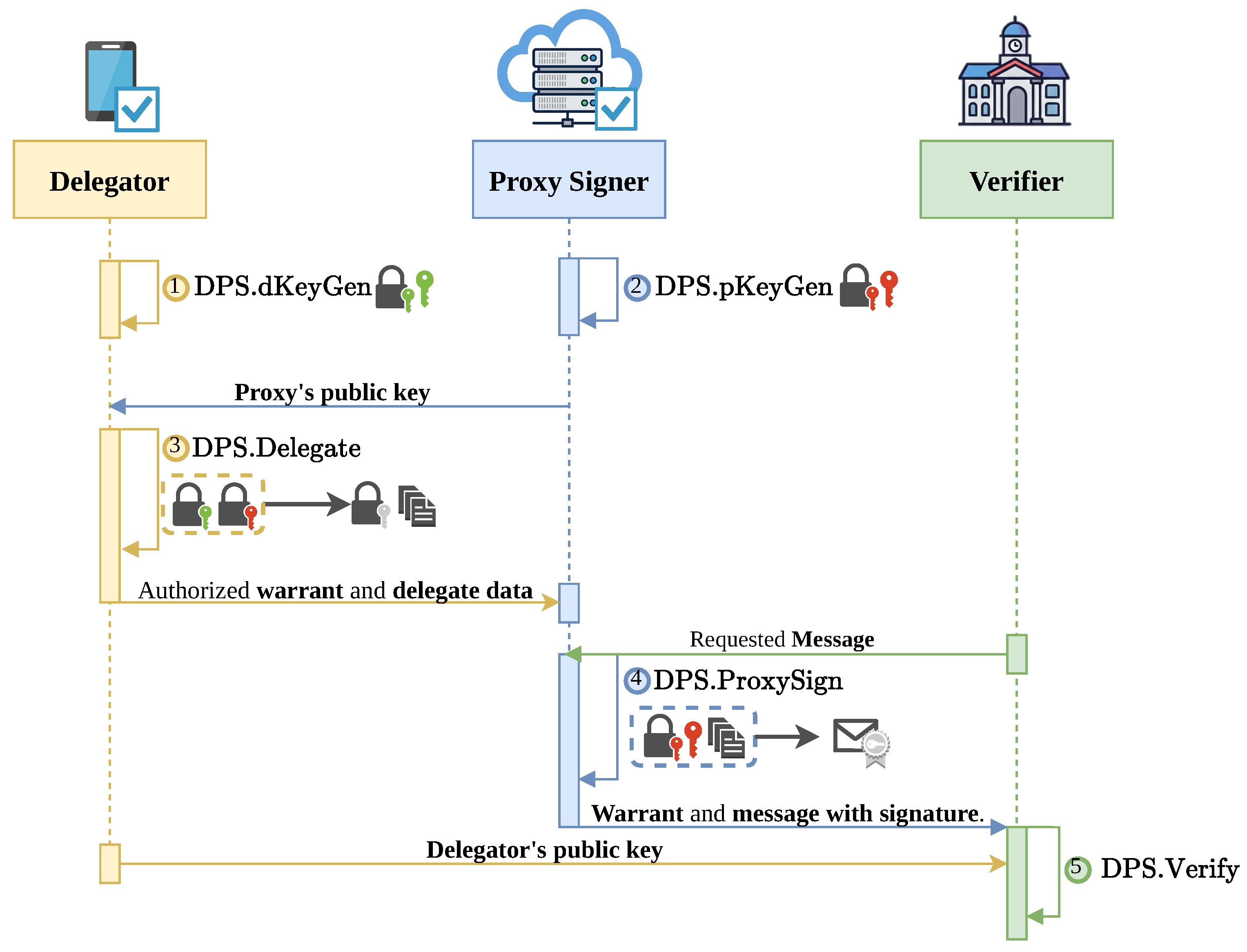
Based on the above building blocks, we propose an innovative lattice-based proxy signature scheme DPS, which relies on our proposed ARKG scheme and the PSUW framework. We also give the workflow of our scheme as shown in
Figure 4.
DPS.Setup: Given the security parameters , the system runs to get public parameters , and parse it as .
DPS.dKeyGen: Delegator generates its own key pair by running
to generate
:
DPS.pKeyGen
: The proxy signer generates its own key pairs by running
to generate
and
:
: This algorithm takes as input the proxy’s signature public key , encapsulation public key , and the delegator’s signature private key . It computes and outputs the derived public key for , the delegator’s signature on this derived public key, and the delegation data as auxiliary information. The formal procedure is described as follows.
- (1)
Given the proxy’s public key
and
, compute
- (2)
Compute , and output .
: The algorithm first verifies the warrant under the delegator’s public key . If the verification fails, it outputs ⊥. Otherwise, it invokes ARKG. DeriveSK on , , and the proxy signing key pair to derive the delegated signing key. It then uses the derived key to sign m and outputs the proxy signature . The detailed procedure is given in Algorithm 5.
| Algorithm 5 DPS.ProxySign(ddata, pkdS, skkem, pkpS, skpS, warr, m)) |
Input: The delegation data , the delegator’s public key , the decapsulation private key , the proxy’s signature key pair , the warrant , and the message m. Output: The signature for m and the warrant .
- 1:
if Dilithium-QROM.Verify then return ⊥ - 2:
end if - 3:
- 4:
- 5:
- 6:
while and do - 7:
- 8:
- 9:
- 10:
- 11:
- 12:
- 13:
if or then - 14:
- 15:
else - 16:
- 17:
end if - 18:
end while - 19:
- 20:
return
|
- 6.
DPS.Verify(): This verification algorithm takes as input the delegator’s signature public key , the warrant authorized by delegator , a proxy signature and the message m. It checks whether the signature is valid under the public key , and simultaneously verifies whether the warrant is valid using the verification function . The procedure is formally described in Algorithm 6.
| Algorithm 6 DPS.Verify(pkdS, warr, σm, m) |
Input: The delegator’s public key , the signature on requested message , the warrant , and the requested message m. Output: The algorithm outputs if both verifications succeed, and otherwise.
- 1:
- 2:
- 3:
if and then - 4:
return - 5:
else - 6:
return - 7:
end if
|
4.3. Security Proof
Unforgeability. Since the proposed scheme is instantiated using the Kyber KEM and the Dilithium-QROM signature scheme, it inherits their established security guarantees. In particular, the unforgeability of the underlying primitives directly implies the following lemma.
Lemma 1
(Unforgeability)
. Let be any probabilistic polynomial-time adversary against the unforgeability of the proposed DPS with security parameter λ, and be polynomials in the security parameter λ. Then we have Proof. We begin by observing that an adversary
wins the experiment
(
Figure 3) if it succeeds in either breaking the delegation of warrants or producing a forged signature. This is reflected in Line 5 of the experiment, within the procedure
, where two verification checks are performed, namely,
and
.
Accordingly, we decompose the advantage of
into two winning events, denoted by
and
, where
corresponds to a forgery of
and
corresponds to a forgery of
. We bound the adversary’s advantage by the sum of the probabilities of these two events.
For the forgery of
, we argue directly that the probability that an adversary wins this game is bounded by the unforgeability of the digital signature scheme Dilithium-QROM, namely,
For the forgery of
, from Theorem 2 of [
7] we have that
where
and
are polynomials in the security parameter
.
For the secret key security of our ARKG, in a secret key derivation procedure, we first invoke
to recover the
from the ciphertext. The value
is then concatenated with
and fed into a cryptographic hash function to generate pseudorandom key material. Therefore, the key security of our ARKG can be reduced to the IND-CCA security of Kyber, and we have
where
is a polynomials that is negligible in
. Let
and
, and finally we obtain
□
Distinguishability. When the verifier receives the signature of the message he requested with , double verification must be carried out. Namely, the verifier verifies the proxy certificate authorized by the delegator with the delegator’s public key , and simultaneously the signature of the message he requests with the proxy public key . After this procedure, the verifier can distinguish the proxy signatures and common signatures.
Verifiability. In the verification phase, the verifier first uses the delegator’s long-term public key to validate the authorization credential generated for the proxy signer. Subsequently, the proxy public key contained in is used to verify the signature produced by the proxy signer. It is the first step that guarantees that the delegator has explicitly authorized the proxy to perform operations on its behalf.
Strong undeniability. The proxy key pair is jointly generated by the delegator and a designated proxy, ensuring uniqueness. Furthermore, due to the unforgeability of the scheme, no third party can generate a valid proxy signature . Once the signature successfully passes the verification of its authorization credential, the proxy signer cannot repudiate the signature generation action.
Unlinkability. This is mainly attributed to the indistinguishability during key derivation under the PSUW framework. The shared secret is computationally indistinguishable from a random string. Thus, derived from is also random, leading to the distribution of being computationally indistinguishable from a uniform sample over the public key space. Additionally, since the signature carries no trace of the secret key or the original identity, an adversary cannot identify the underlying signer from the signature, either.
4.4. Correctness Proof
Our construction consists of two main components: the ARKG scheme and Dilithium-QROM signature scheme. The correctness of the overall DPS scheme follows from the correctness guarantees of these two building blocks. We first formalize this intuition below and then prove each component separately.
Lemma 2
(Correctness of DPS)
. Let and denote the failure probabilities of ARKG and Dilithium-QROM, respectively. If both and are negligible in the security parameter λ, then the overall failure probability of the DPS scheme satisfieswhich is also negligible. Hence, the DPS scheme is correct with overwhelming probability. Correctness of ARKG. Our ARKG construction is instantiated based on KyberKEM. We first recall the correctness notion of KyberKEM.
Definition 4
(KyberKEM Correctness [
36])
. Let . For and , the scheme is said to be -correct ifIf , the scheme is perfectly correct. According to the Kyber specification [
38], the decapsulation failure probability
is negligible across all security levels, ranging from
to
. To analyze the correctness of the ARKG, we adopt the notion introduced by Frymann et al. [
6].
Definition 5
(ARKG Correctness)
. An ARKG scheme is correct if for all and ,where We show in
Appendix B that the derived key pair
always satisfies the ARKG.Check predicate, except with probability stemming from KEM decapsulation failure. Combining the above, the overall correctness error of ARKG is dominated by the KyberKEM failure probability, i.e.,
which is negligible.
Correctness of Dilithium-QROM. We next analyze the correctness of the signature component. For correctness, it is required that for any valid key pair and any message m, a signature verifies successfully except with negligible probability.
Dilithium-QROM can be viewed as the Fiat–Shamir with aborts transform applied to an identification scheme [
39], i.e.,
[
16], where
denotes the maximum number of repetitions.
Lemma 3
(Lemma 4.4 of [
16,
31])
. Under the conditionswith , the identification scheme Dilithium-QROM-ID has correctness error Due to the use of rejection sampling (i.e., aborts), the signing algorithm repeats the identification protocol up to
times until a valid transcript is obtained. Therefore, the overall failure probability of the signature scheme is
Following the parameterization in [
14], we set
, which yields
and hence
is negligible.
Combining the above results, the total failure probability of the DPS scheme satisfies
where both
and
are negligible. Therefore, the proposed DPS scheme is correct with overwhelming probability.
6. Discussion
Choice of KEM. Our construction is instantiated with CRYSTALS-Kyber but is not restricted to it. Any post-quantum KEM satisfying CCA security can be used as the encapsulation primitive in DPS.ARKG. Kyber is chosen primarily for its natural compatibility with Dilithium: both are NIST-standardized, MLWE-based, and supported by QROM security proofs. This yields a uniform post-quantum security foundation for the overall DPS scheme. Owing to the modularity of ARKG, alternative post-quantum KEMs can be incorporated without severely changing the high-level proxy-signature design.
Implementation and Performance.We provide both theoretical and empirical evaluations of our lattice-based proxy signature scheme. And the experimental results show computational gains over existing identity-based post-quantum schemes. Notably, most lattice-based proxy constructions lack concrete benchmarks, highlighting opportunities for future work to optimize and rigorously compare these schemes.
Trade-offs and Limitations. As inherent to lattice-based cryptography, our scheme incurs larger public key and signature sizes and longer execution times than classical mathematical problem-based counterparts. While conventional proxy signatures typically run in milliseconds, lattice-based constructions execute in seconds. Integrating lattice-based schemes with specialized hardware is a key avenue for enabling deployment in resource-constrained environments.
Broader Applicability. Beyond the IoT, the scheme’s core framework supports post-quantum secure delegation in diverse authorization scenarios, providing a foundation for broader applications and future research.