Article

Improving Performance of Breast Lesion Classification Using a ResNet50 Model Optimized with a Novel Attention Mechanism


1
School of Electrical & Computer Engineering, University of Oklahoma, Norman, OK 73019, USA
2
Stephenson School of Biomedical Engineering, University of Oklahoma, Norman, OK 73019, USA
*
Authors to whom correspondence should be addressed.
Tomography 2022, 8(5), 2411-2425; https://doi.org/10.3390/tomography8050200

Submission received: 30 August 2022 / Revised: 22 September 2022 / Accepted: 24 September 2022 / Published: 28 September 2022
(This article belongs to the Special Issue Artificial Intelligence in Breast Cancer Screening)

Abstract

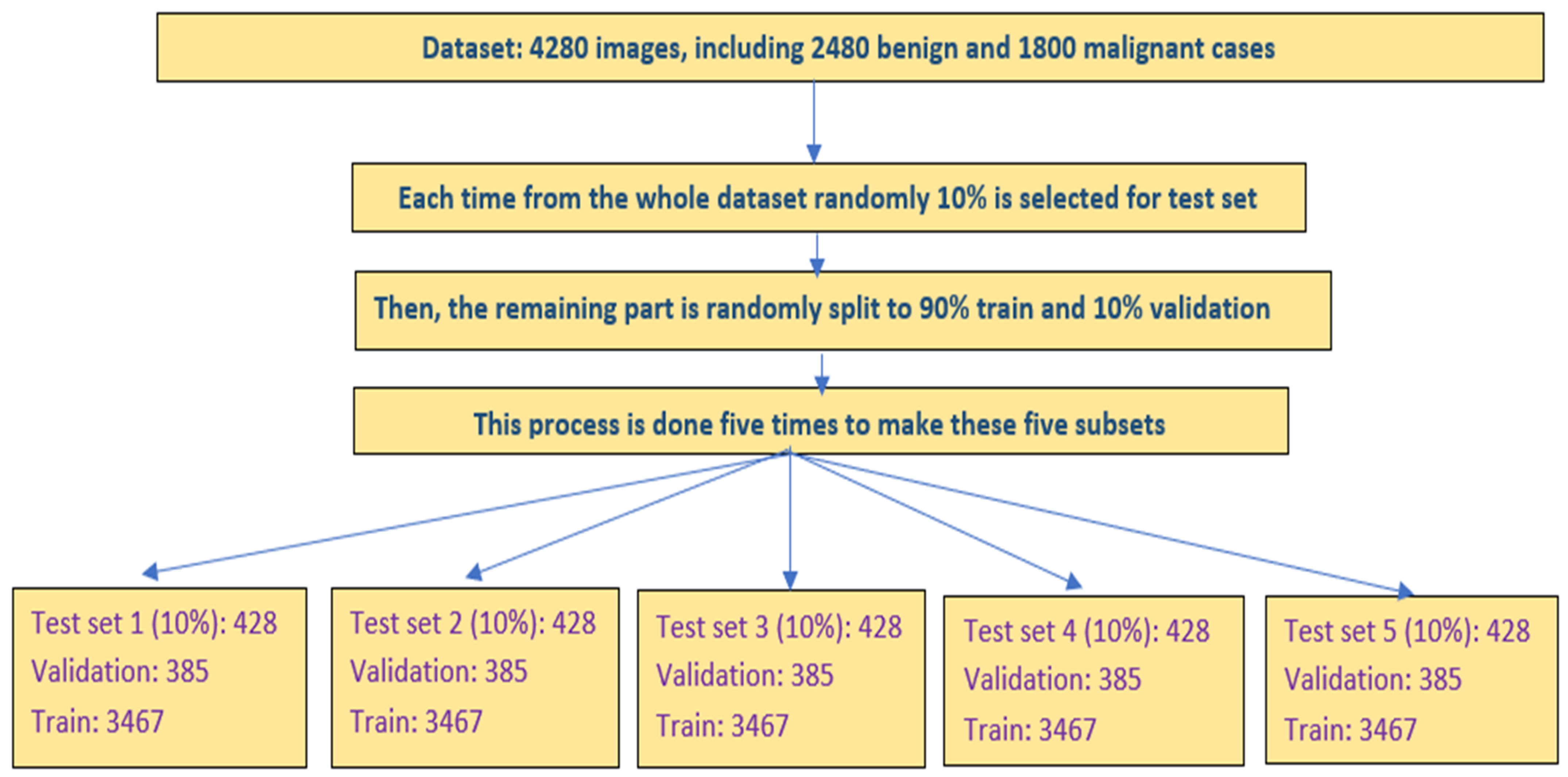
Background: The accurate classification between malignant and benign breast lesions detected on mammograms is a crucial but difficult challenge for reducing false-positive recall rates and improving the efficacy of breast cancer screening. Objective: This study aims to optimize a new deep transfer learning model by implementing a novel attention mechanism in order to improve the accuracy of breast lesion classification. Methods: ResNet50 is selected as the base model to develop a new deep transfer learning model. To enhance the accuracy of breast lesion classification, we propose adding a convolutional block attention module (CBAM) to the standard ResNet50 model and optimizing a new model for this task. We assembled a large dataset with 4280 mammograms depicting suspicious soft-tissue mass-type lesions. A region of interest (ROI) is extracted from each image based on lesion center. Among them, 2480 and 1800 ROIs depict verified benign and malignant lesions, respectively. The image dataset is randomly split into two subsets with a ratio of 9:1 five times to train and test two ResNet50 models with and without using CBAM. Results: Using the area under ROC curve (AUC) as an evaluation index, the new CBAM-based ResNet50 model yields AUC = 0.866 ± 0.015, which is significantly higher than that obtained by the standard ResNet50 model (AUC = 0.772 ± 0.008) (p < 0.01). Conclusion: This study demonstrates that although deep transfer learning technology attracted broad research interest in medical-imaging informatic fields, adding a new attention mechanism to optimize deep transfer learning models for specific application tasks can play an important role in further improving model performances.
Keywords: computer-aided diagnosis (CAD) scheme of mammograms; convolutional block attention module (CBAM); residual network (ResNet); breast lesion classification computer-aided diagnosis (CAD) scheme of mammograms; convolutional block attention module (CBAM); residual network (ResNet); breast lesion classification