Article

Cultivating Cooperative Relationships: Identifying Learning Gaps When Teaching Students Systems Thinking Biomimicry

1
Industrial Design Engineering, The Hague University of Applied Sciences, 2521 EN Den Haag, The Netherlands
2
Hybrid Futures, Strassmannstr., 10249 Berlin, Germany
*
Author to whom correspondence should be addressed.
Biomimetics 2022, 7(4), 184; https://doi.org/10.3390/biomimetics7040184

Submission received: 14 June 2022 / Revised: 29 September 2022 / Accepted: 19 October 2022 / Published: 31 October 2022

Abstract

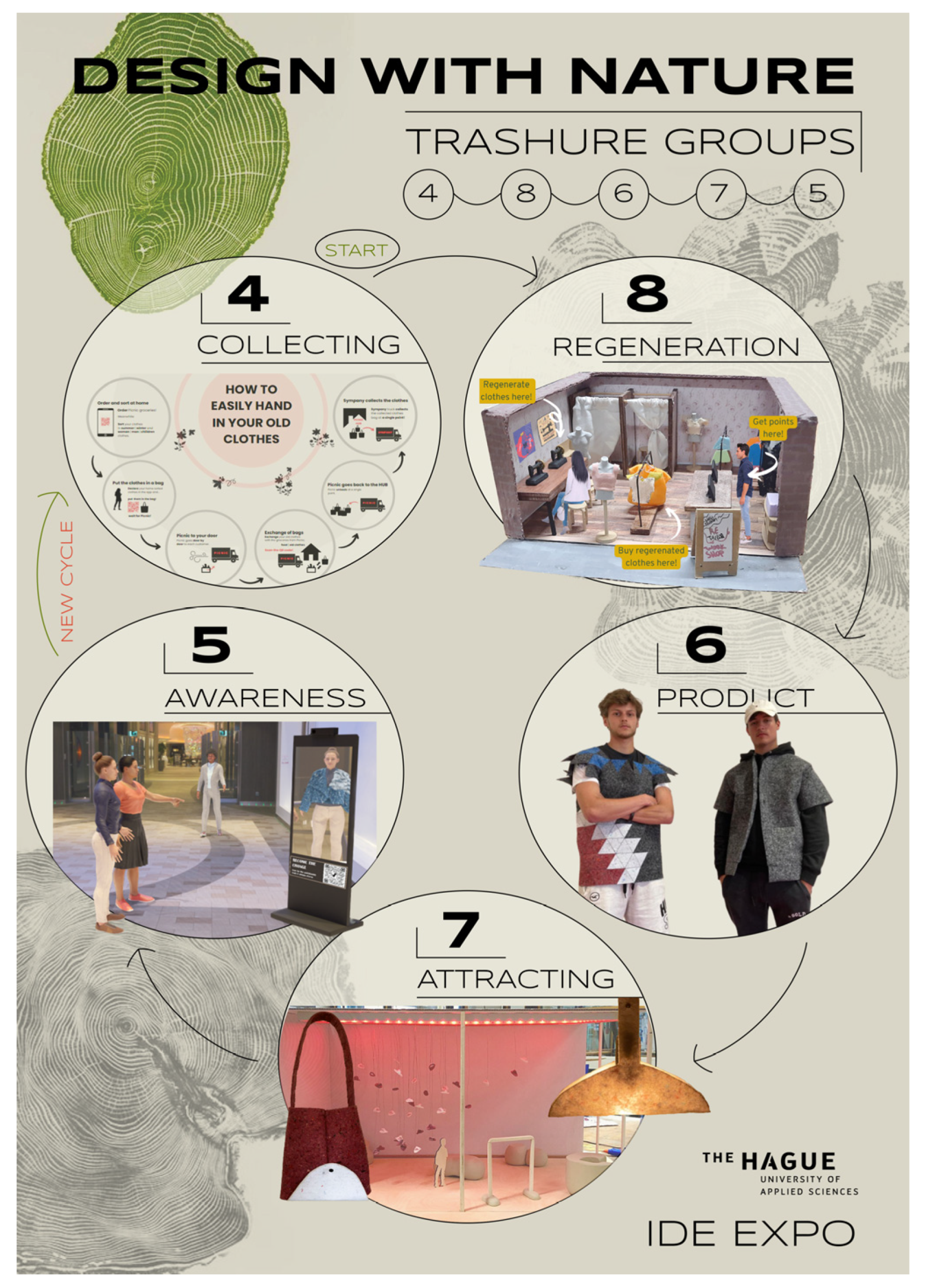
The methodology of biomimicry design thinking is based on and builds upon the overarching patterns that all life abides by. “Cultivating cooperative relationships” within an ecosystem is one such pattern we as humans can learn from to nurture our own mutualistic and symbiotic relationships. While form and process translations from biology to design have proven accessible by students learning biomimicry, the realm of translating biological functions in a systematic approach has proven to be more difficult. This study examines how higher education students can approach the gap that many companies in transition are struggling with today; that of thinking within the closed loops of their own ecosystem, to do good without damaging the system itself. Design students should be able to assess and advise on product design choices within such systems after graduation. We know when tackling a design challenge, teams have difficulties sifting through the mass of information they encounter, and many obstacles are encountered by students and their professional clients when trying to implement systems thinking into their design process. While biomimicry offers guidelines and methodology, there is insufficient research on complex, systems-level problem solving that systems thinking biomimicry requires. This study looks at factors found in course exercises, through student surveys and interviews that helped (novice) professionals initiate systems thinking methods as part of their strategy. The steps found in this research show characteristics from student responses and matching educational steps which enabled them to develop their own approach to challenges in a systems thinking manner. Experiences from the 2022 cohort of the semester “Design with Nature” within the Industrial Design Engineering program at The Hague University of Applied Sciences in the Netherlands have shown that the mixing and matching of connected biological design strategies to understand integrating functions and relationships within a human system is a promising first step.
Keywords: biomimicry; systems thinking; pedagogy; design thinking; science education; biology biomimicry; systems thinking; pedagogy; design thinking; science education; biology