1. Introduction
Ghost imaging (GI) has emerged as a powerful computational imaging technique with significant potential for remote sensing applications, offering innovative solutions to constraints inherent in conventional imaging systems [
1]. By leveraging the correlation between spatially structured illumination and a single-pixel detector (SPD), GI provides notable robustness to noise and reduced hardware complexity. However, its performance is critically degraded in scattering media, such as fog, haze, and turbulence, where image reconstruction suffers from severe contrast loss, blurred edges, and diminished detail fidelity [
2]. These challenges are particularly acute in real-time imaging, where stringent constraints on measurement time and sampling rates further impair practical utility.
To confront the challenge of imaging through obscurants, we can look to biological systems that have evolved advanced strategies for perception in degraded visual environments. From the neural circuitry in the mammalian visual cortex that performs selective noise suppression to the ability of certain marine species to discern structures in turbid water, biology demonstrates the power of attention-based processing to prioritize salient information from noisy sensory inputs [
3,
4,
5,
6]. This bio-inspired principle, which focuses computational resources on the most informative features, offers a compelling paradigm for advancing computational imaging under adverse conditions.
Driven by this insight, our work introduces a bio-inspired deep learning (DL) framework for GI that embeds a self-attention mechanism to mimic selective processing. Traditional techniques for improving GI, such as iterative denoising [
7], scalar matrix methods [
8], differential GI [
9], and Hadamard-based approaches [
10], are fundamentally based on linear correlation. Under high scattering conditions, the bucket signal becomes dominated by noise, causing these methods to fail as the underlying correlation assumption breaks down. While DL, particularly Convolutional Neural Networks (CNNs), has improved GI [
11,
12], their localized receptive fields struggle to model the long-range dependencies necessary to distinguish a coherent global structure from globally pervasive scattering noise. Our bio-inspired transformer architecture addresses this directly by using a self-attention mechanism to integrate global context, learning a nonlinear mapping from degraded bucket signals to clear images that is inherently robust to this noise [
13].
The advent of Transformer-based architectures, with their core Multi-Head Self-Attention (MHSA) mechanism [
14], presents a transformative opportunity to capture these global contextual relationships, as initially demonstrated in vision tasks by the Vision Transformer (ViT) [
14]. However, the direct application of standard Transformers to GI in low-visibility conditions is hampered by their prohibitive computational cost. Although efficient variants like SNR-Net [
15] and Uformer [
16] have been proposed to mitigate this through architectural optimizations, the potential of tailored attention mechanisms to simultaneously reduce sampling requirements, improve reconstruction fidelity, and maintain efficiency for GI in fog remains largely untapped.
The main objective of this study are:
To develop a novel, bio-inspired DL architecture incorporating a self-attention mechanism for robust GI reconstruction technique in foggy environments for remote sensing applications.
To enable high-fidelity image recovery from highly compressed and severely degraded bucket signals.
To rigorously evaluate the model performance against state-of-the-art methods and through an ablation study to quantify the contribution of the self-attention mechanism.
To demonstrate the hybrid model computational efficiency, ensuring its viability for real-time remote sensing applications.
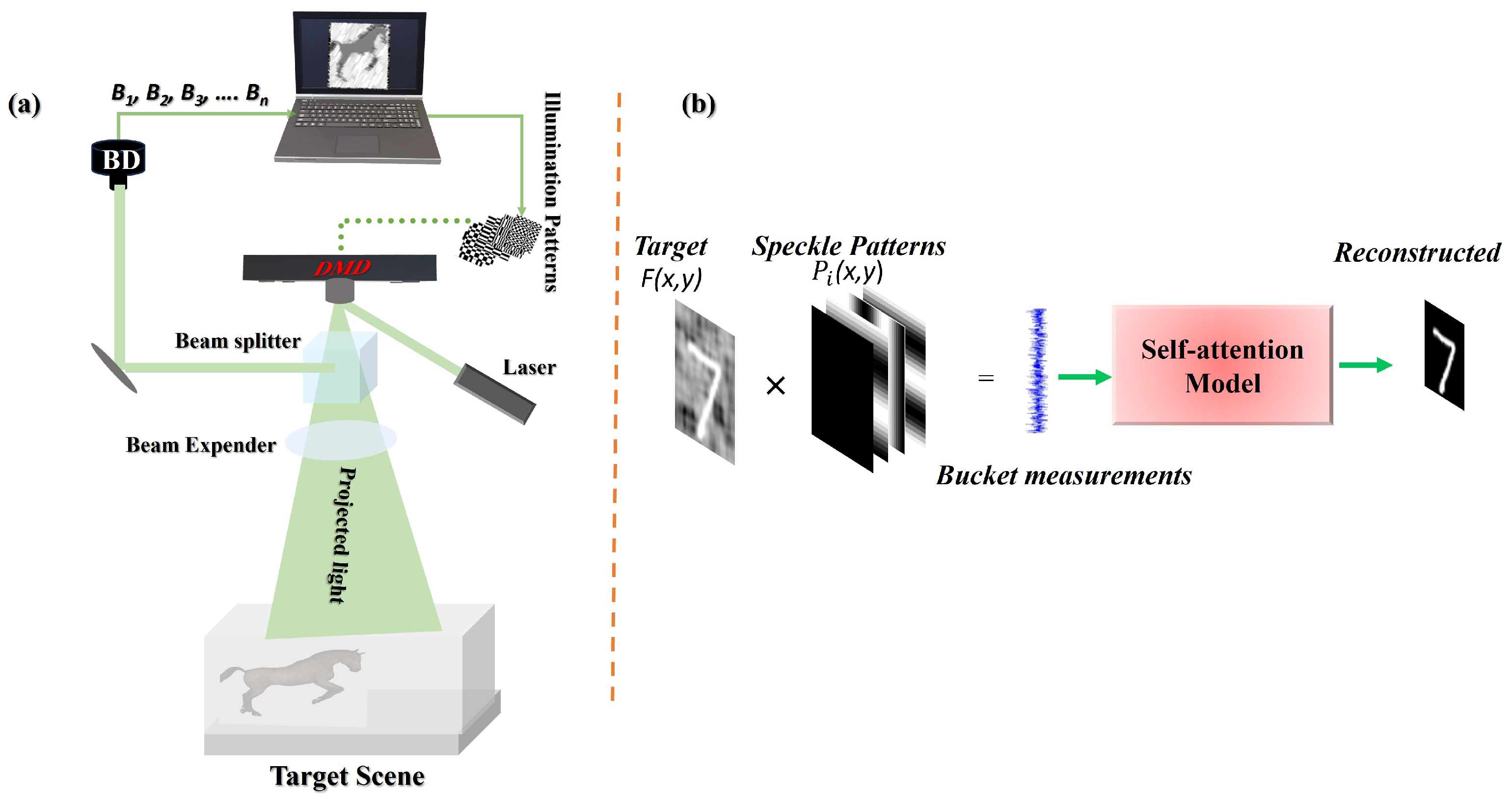
To overcome this gap by developing a bio-inspired self-attention architecture for GI, explicitly designed for a spectrum of fog density. This work introduces a novel, bio-inspired architecture that adapts self-attention to the unique challenge of reconstructing images from globally degraded, one-dimensional bucket signals. Our model is specifically designed to capture the long-range dependencies necessary to overcome scattering noise, a capability that localized convolutional filters lack. We rigorously train and validate our model on the MNIST and a remote sensing Human-Horse dataset under varying scattering coefficients ( dB/m) and sampling ratios (). The results demonstrate that our method achieves superior reconstruction quality, with PSNR values up to 24.5–25.5 dB and SSIM values of approximately 0.8–0.85 under high-fog conditions ( dB/m) and moderate sampling ratios (), underscoring its significant potential for applications in environmental monitoring, security surveillance, and defense.
3. Results
To validate the efficacy of our bio-inspired computational imaging framework, we conducted comprehensive numerical simulations under varying system parameters. The following analysis demonstrates how the self-attention mechanism modeled after neural selective attention enables robust image reconstruction in challenging foggy conditions across different sampling regimes and scattering intensities.
3.1. Reconstruction Performance Under Varying Sampling Ratios
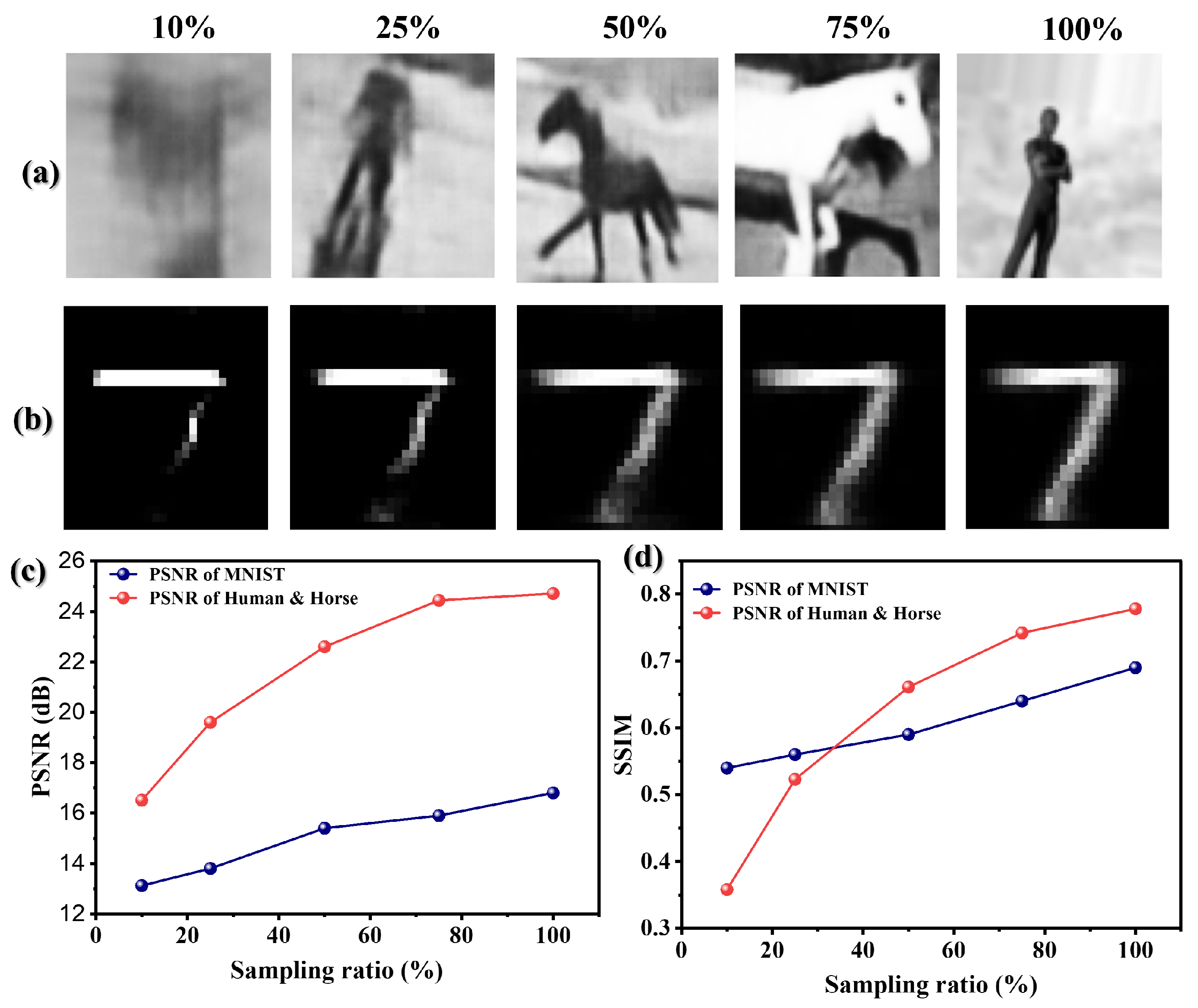
This section investigates the performance of our bio-inspired GI model under varying sampling ratios, evaluating its ability to reconstruct images from sparse measurements in foggy environments. The scattering coefficient was fixed at to simulate moderate fog conditions, while the sampling ratio N was varied across to assess data efficiency.
Figure 6 presents comprehensive qualitative and quantitative results for both the high-resolution Human and Horse dataset (64 × 64 pixels) and the low-resolution MNIST dataset (28 × 28 pixels). The bio-inspired architecture demonstrates remarkable capability in leveraging global contextual information emulating the brain’s ability to infer complete structures from partial data. At a sampling ratio of 25%, the Human and Horse dataset achieves near-complete reconstruction despite the scattering environment, with the self-attention mechanism effectively filling in missing spatial information. This mirrors biological vision systems that excel at perceiving coherent objects from fragmented visual cues in poor visibility.
Conversely, the MNIST dataset exhibits incomplete recovery at the same sampling ratio, reflecting the fundamental limitations of low-resolution data under scattering conditions. However, as sampling increases to 50%, both datasets achieve complete reconstruction, with the Human and Horse dataset maintaining superior visibility due to its richer structural information. The significant degradation observed at 10% sampling highlights the challenge of extreme undersampling in scattering media, where even sophisticated attention mechanisms struggle with insufficient signal content.
Quantitative metrics in
Figure 6c,d reveal asymptotic improvement in both PSNR and SSIM with increasing sampling ratios, validating the model’s data-efficient learning capability. The Human and Horse dataset achieves PSNR ≈ 24.5 dB and SSIM ≈ 0.8 at higher sampling ratios, demonstrating robust reconstruction quality. The MNIST dataset shows lower baseline performance but significant improvement with increased sampling, indicating the model’s adaptive capability across resolution domains.
These findings underscore the advantage of our bio-inspired approach: by emulating the brain’s contextual processing, the model achieves substantial reconstruction quality at lower sampling ratios, enabling energy-efficient and time-constrained sensing systems for practical deployment in challenging environmental conditions.
3.2. Robustness to Progressive Scattering Effects
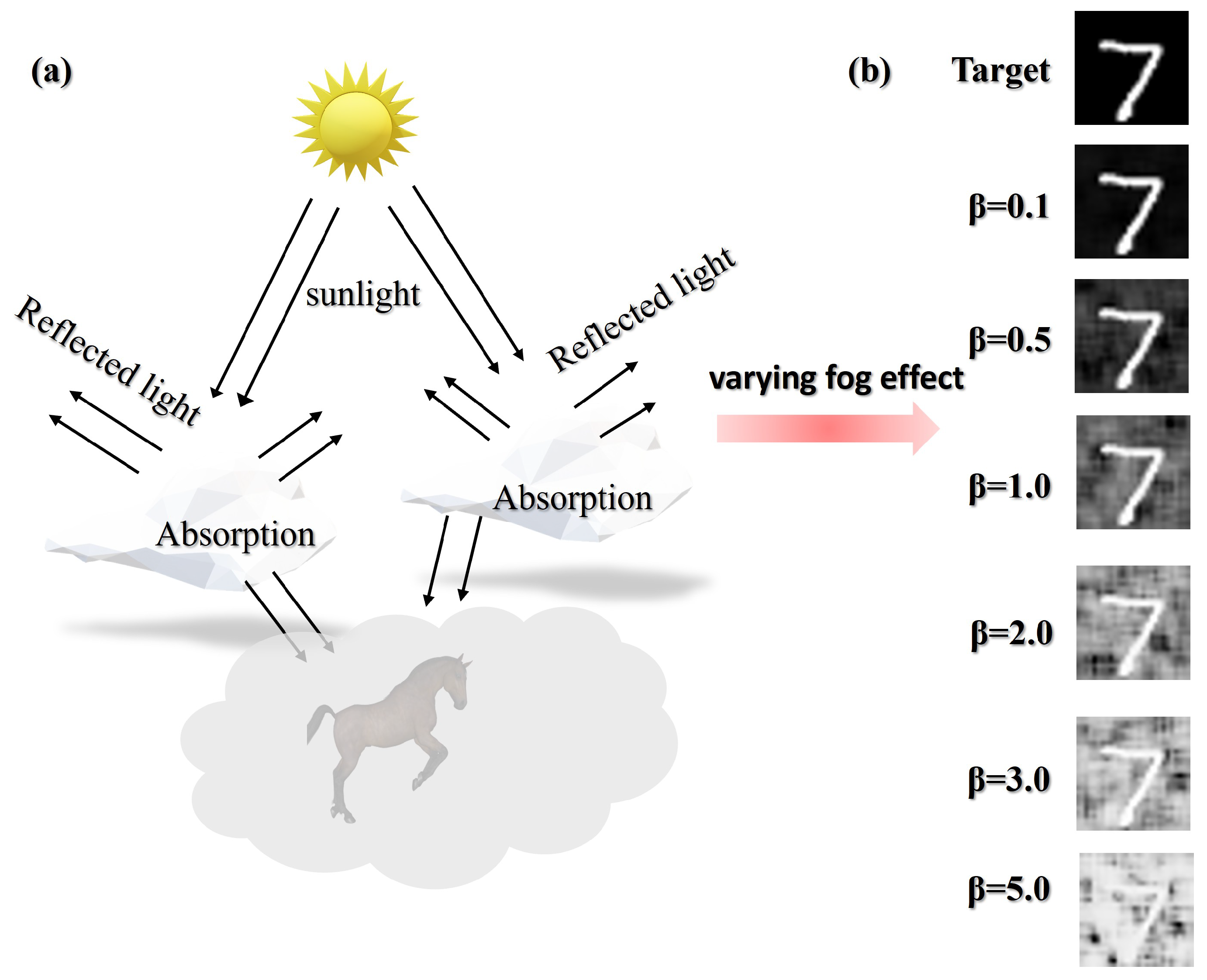
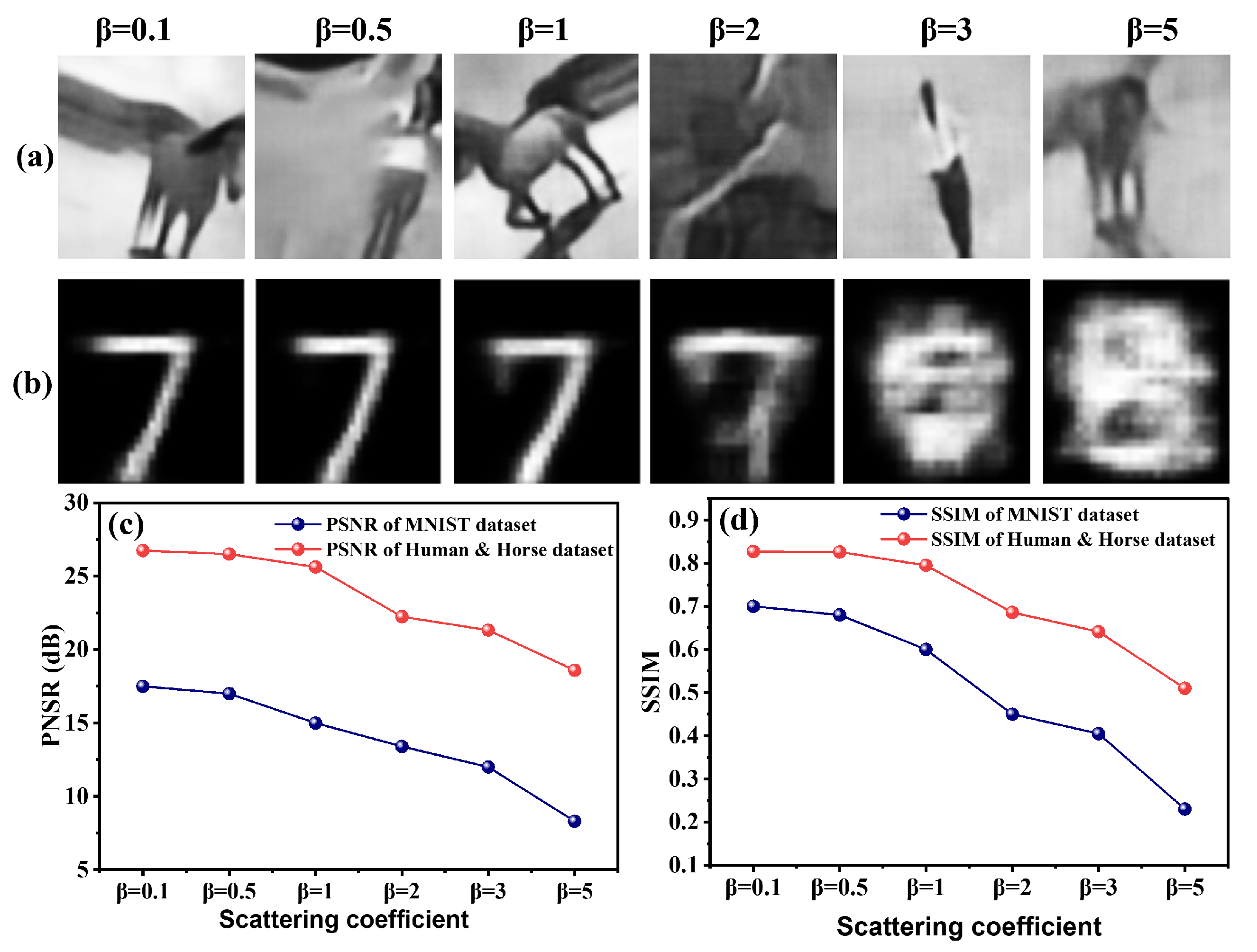
To evaluate the model’s resilience to increasingly adverse conditions, we systematically tested its performance under varying scattering coefficients while maintaining full sampling (). The scattering coefficient was varied across to emulate progressive fog density encountered in remote sensing applications.
Figure 7 presents the qualitative and quantitative results, revealing the model’s remarkable robustness to scattering-induced degradation. The bio-inspired attention mechanism demonstrates a capacity akin to biological vision in maintaining perceptual coherence despite signal deterioration. For the Human and Horse dataset (
Figure 7a), reconstructed images maintain structural integrity and key features even at extreme scattering (
), with only gradual quality degradation. This resilience stems from the attention mechanism’s ability to prioritize and preserve semantically important features while suppressing noise, directly mirroring the neural processes that enable biological systems to see through fog and haze.
The MNIST dataset (
Figure 7b) exhibits more pronounced degradation with increasing
, reflecting the inherent vulnerability of low-resolution, structurally simple images to scattering effects. The limited feature diversity in MNIST digits provides fewer robust cues for the attention mechanism to leverage under severe degradation, highlighting the interplay between image complexity and reconstruction robustness.
Quantitative analysis in
Figure 7c,d confirms these observations: PSNR values show a general decline with increasing
, reflecting the fundamental signal-to-noise ratio challenge in dense fog. However, the Human and Horse dataset maintains significantly higher PSNR across all scattering levels, demonstrating the model’s superior handling of complex scenes. Similarly, the SSIM values show a progressive decline, but the high-resolution dataset maintains a relatively stable perceptual quality, whereas MNIST experiences a sharp drop, particularly beyond
.
This scattering resilience demonstrates the practical value of our bio-inspired approach for real-world remote sensing, where atmospheric conditions can vary dramatically. The model’s ability to maintain reconstruction quality across a wide scattering range positions it as a robust solution for environmental monitoring, security surveillance, and defense applications operating in degraded visual environments.
3.3. Comparative Analysis
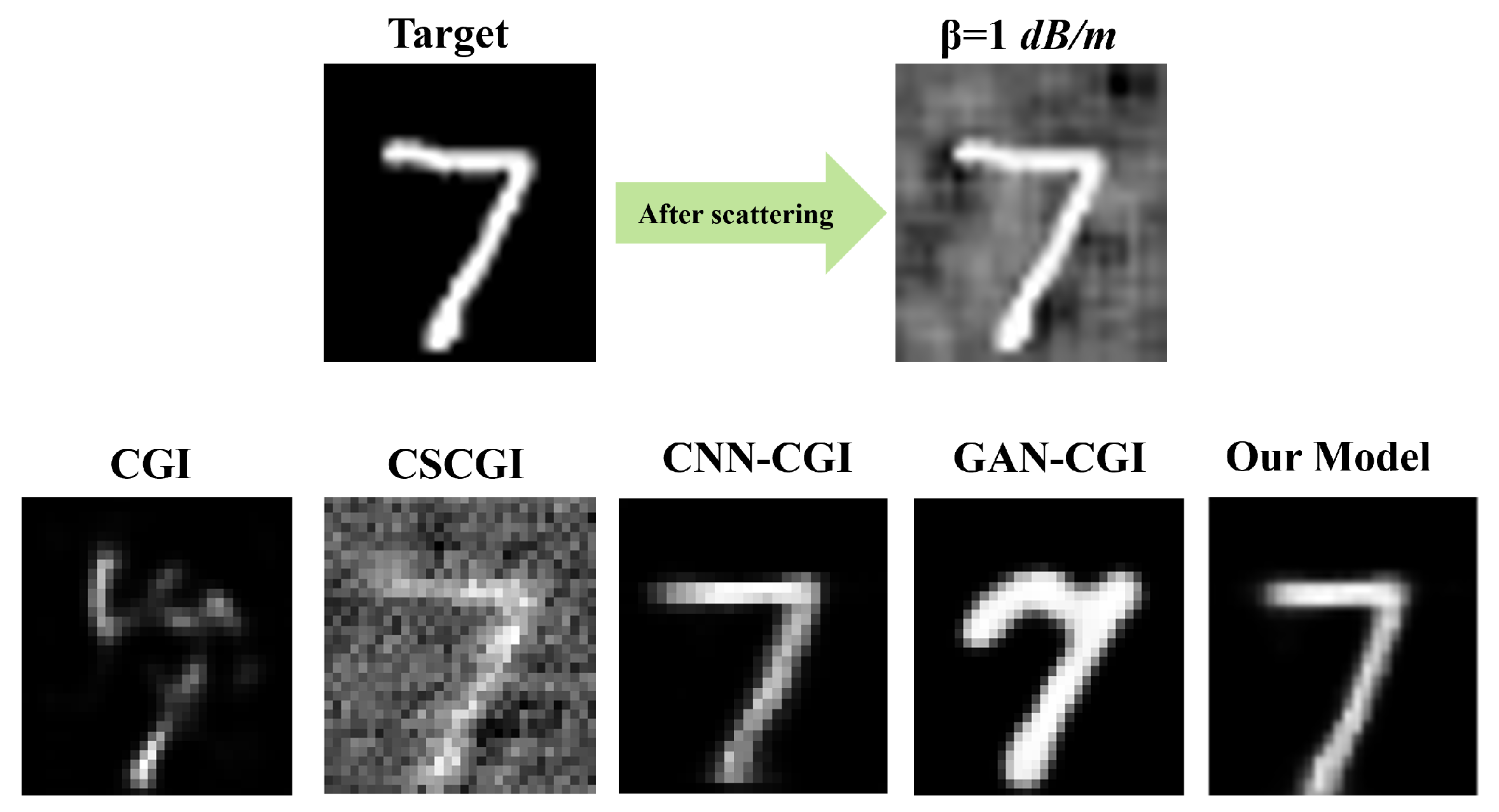
To objectively assess the performance of our proposed bio-inspired model (AMFR-GI), we conducted a qualitative and quantitative comparison against several established benchmark methods as illustrated in
Figure 8 and
Table 1, respectively. These included conventional computational GI (CGI), compressive sensing-based CGI (CSCGI), convolutional neural network-based CGI (CNN-CGI), and generative adversarial network-based CGI (GAN-CGI). The evaluation was performed under consistent scattering conditions
at full sampling (
) using the MNIST dataset. As illustrated in
Figure 8, visual inspection reveals that the proposed AMFR-GI method more effectively recovers structural details, enhances image contrast, and mitigates scattering-induced noise, demonstrating superior reconstruction quality compared to both traditional and DL-based GI approaches.
3.4. Computational Efficiency and Performance Analysis
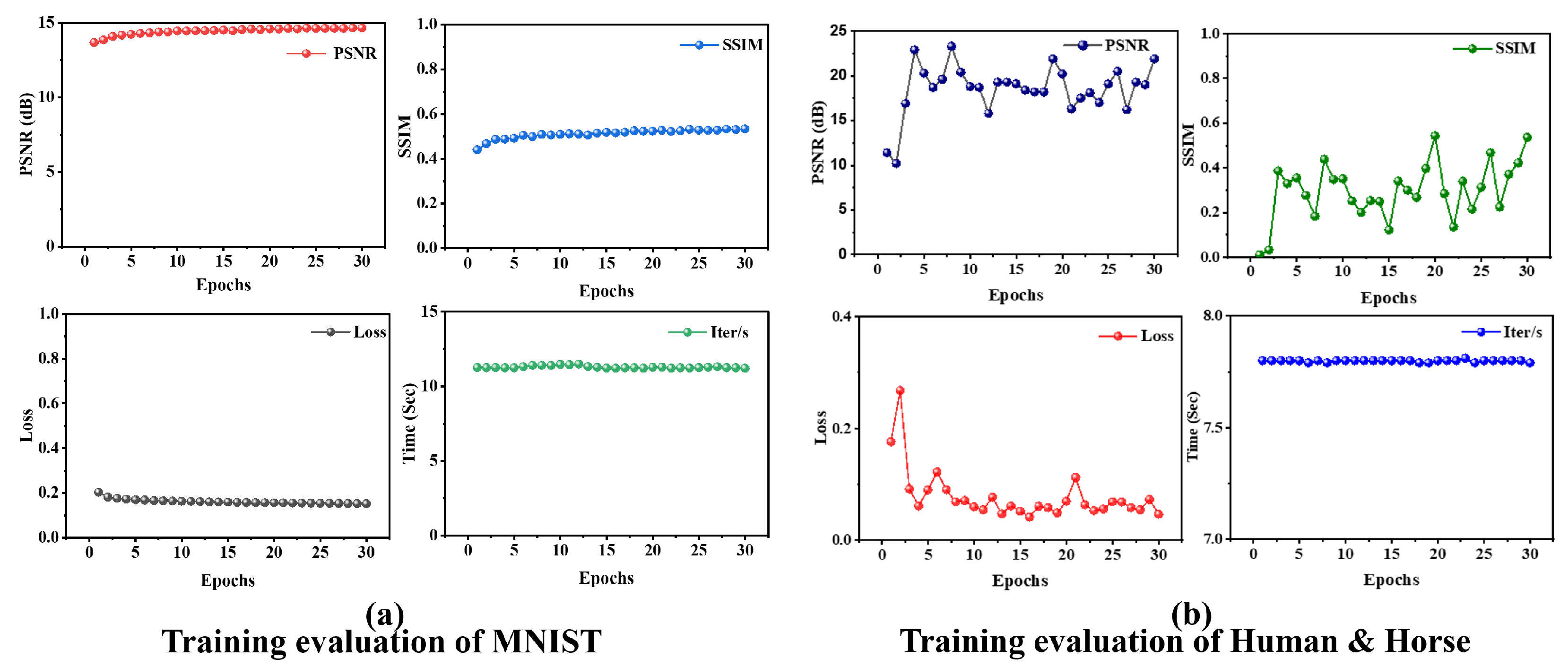
The proposed self-attention-based framework for GI demonstrate significant advancements in reconstruction quality, particularly under adverse foggy conditions. However, its computational efficiency and performance on low-resolution datasets, such as MNIST (28 × 28 pixels), warrant detailed examination to ensure scalability and applicability across diverse imaging scenarios.
3.4.1. Computational Efficiency of the Bio-Inspired Architecture
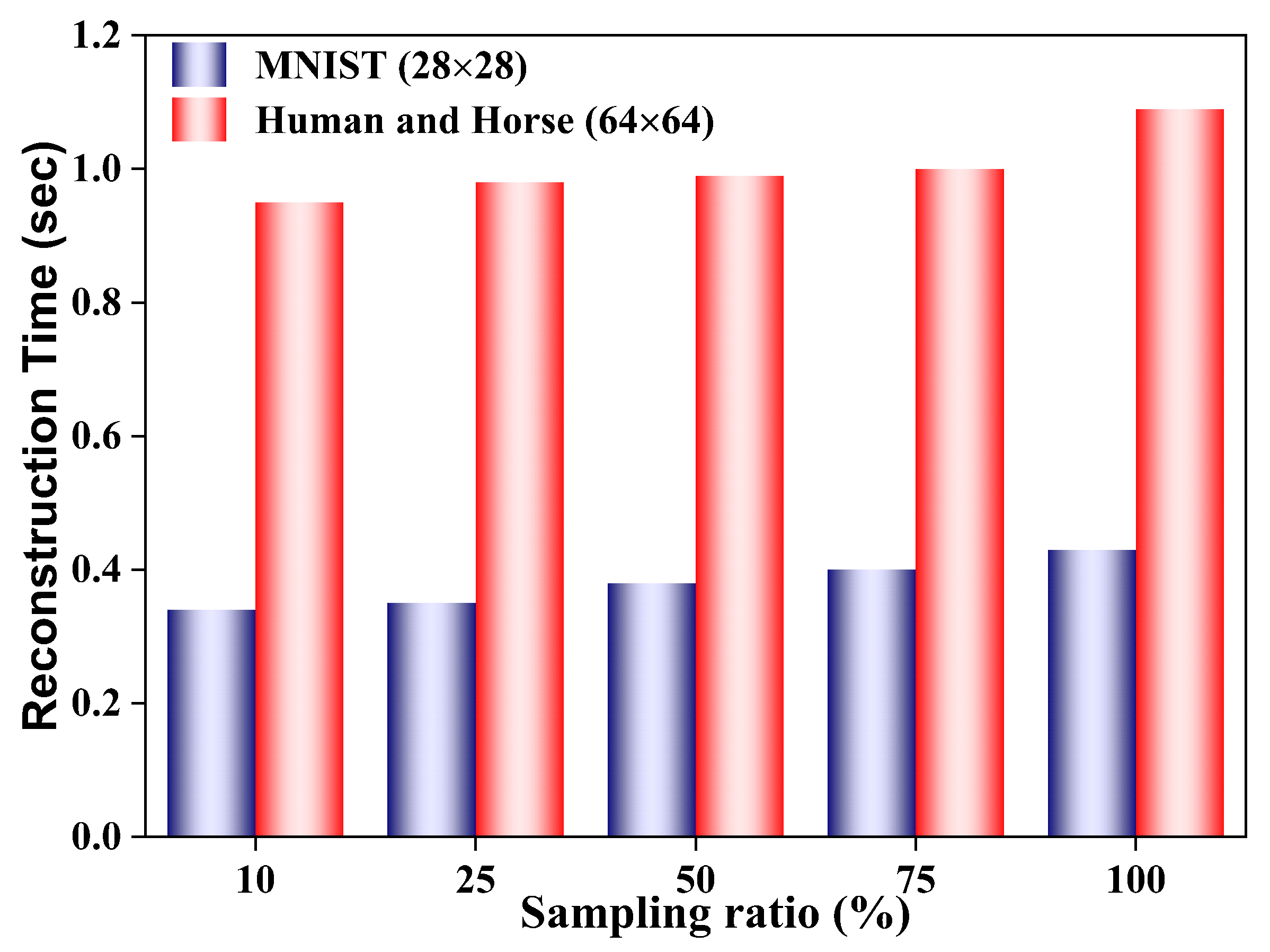
The self-attention mechanism, core to our bio-inspired architecture, introduces a computational overhead that scales with input resolution, a known trade-off for its superior capacity to model global context. To quantify this, we evaluated inference time and memory usage on an NVIDIA RTX 3060 GPU. As summarized in
Table 2, the model requires approximately 0.12 s per inference for the high-resolution Human and Horse dataset (64 × 64 pixels) and only 0.08 s for the MNIST dataset (28 × 28 pixels), with same GPU memory usage. These metrics confirm that the model’s computational cost is well within the bounds for real-time remote sensing applications, as the inference time remains orders of magnitude below the typical 1-s threshold for such tasks [
10]. The efficiency of this bio-inspired approach demonstrates that the benefits of global contextual processing can be achieved without prohibitive computational cost.
3.4.2. Performance Analysis Across Resolutions
The model’s performance exhibits a strong dependency on input complexity, a characteristic shared with biological visual systems that excel at parsing rich scenes. On low-resolution, structurally simple datasets like MNIST, performance at very low sampling ratios () is limited (PSNR ≈ 13.2 dB, SSIM ≈ 0.5), as the sparse measurements provide insufficient features for the attention mechanism to resolve. In stark contrast, the high-resolution Human and Horse dataset achieves near-complete reconstruction at (PSNR ≈ 20 dB, SSIM ≈ 0.57), underscoring the model’s strength in leveraging complex structural information. This dichotomy mirrors the principle that biological perception is most robust when sensory input is information-rich, highlighting that our bio-inspired model’s superiority is most pronounced in complex, real-world scenarios.
4. Discussion
The comprehensive results presented in this study demonstrate a clear performance difference between simple and complex datasets. For the structurally rich Human-Horse dataset, the self-attention mechanism effectively leverages the abundant global context, achieving robust reconstruction (PSNR ≥ 23.5 dB, SSIM ≥ 0.7) even at a low sampling ratio (
) and under high scattering. Conversely, the MNIST dataset, with its low resolution and simple shapes, provides fewer robust features for the attention mechanism to resolve, leading to poorer performance under aggressive undersampling (
) or extreme scattering. This indicates that the advantage of our bio-inspired approach is most pronounced for complex, real-world scenes, mirroring biological vision which excels in information-rich environments. The methodology positively affects sampling ratios by enabling high-fidelity reconstruction with fewer measurements, as the global context allows it to infer missing information. Self-attention-based GI model achieves robust high-fidelity reconstruction across a wide spectrum of foggy conditions, characterized by scattering coefficients from 0.1 dB/m to 5.0 dB/m and sampling ratios from 10% to 100%. This discussion contextualizes these findings by comparing our model’s performance against state-of-the-art methodologies, elucidating its unique contributions and inherent limitations for computational imaging in remote sensing. However, current limitation of our work is, the model trained and evaluated using a fixed basis of speckle illumination patterns and synthetic fog model based on atmospheric physics (Equations (
13)–(
16)). While this model is widely used in computational imaging literature [
17,
18] and provides a controlled environment for testing, its absolute fidelity to real-world fog conditions is a subject for further validation.
Comparison with Traditional and CNN-based GI: The proposed model’s ability to maintain reconstruction quality under high scattering and low sampling distinguishes it fundamentally from traditional GI approaches [
19]. For instance, compressive sensing GI [
20] achieves reasonable reconstruction with reduced measurements but relies on sparse representations that fail under significant scattering-induced noise. Similarly, while CNN-based methods [
21] improve upon traditional techniques, their localized receptive fields limit their ability to integrate global context, leading to pronounced degradation at low sampling ratios (
). In contrast, the self-attention mechanism of our model, inspired by the brain’s capacity for global feature integration, leverages long-range dependencies within the measurement data. This enables superior performance in high-scattering environments, as evidenced by the high PSNR (≈24.5 dB) and SSIM (≈0.8) achieved for the Human and Horse datasets at
dB/m (
Figure 7). The primary trade-off in our methodology is the increased computational complexity of the self-attention mechanism compared to simpler CNN architectures. This is a known cost for gaining the ability to model global context. However, as quantified in
Table 2 and
Figure 9, this cost is manageable and does not preclude real-time application.
Advancements Over Contemporary GI in Scattering Media: Recent work by Jiang et al. [
22] on GI in atmospheric turbulence achieved improved reconstruction through adaptive correlation but reported lower PSNR values (≈15 dB) under high scattering compared to our model. Our approach demonstrates that a dedicated, learnable attention mechanism is more effective than post-hoc correlation adjustments in mitigating the severe effects of fog. Furthermore, while transformer-based models such as TransUNet [
23] excel in domains such as medical image segmentation, their direct application to GI reconstruction in fog remains unexplored and is likely suboptimal because of their task-agnostic design. Our architecture is specifically tailored for the GI reconstruction task, optimizing the self-attention mechanism to directly address scattering-induced degradation, which is confirmed by its higher PSNR and SSIM across varying scattering coefficients (
Figure 6c and
Figure 7c). The limitation of existing GI methods in scattering media are shown in
Table 3.
The Bio-Inspired Advantage: The core of the robustness of our model stems from its bio-inspired design. The self-attention mechanism functionally mimics the selective context integration properties of biological visual systems. This allows the model to prioritize salient features and suppress noise, which is particularly advantageous when reconstructing complex scenes from highly degraded or undersampled data. This principled approach moves beyond mere architectural choice and establishes a new paradigm for bio-inspired computational imaging, offering a significant step toward robust remote sensing under real-world adverse conditions.
5. Conclusions
This study has presented a transformative, bio-inspired computational imaging framework that significantly advances the robustness of GI for remote sensing in foggy conditions. By integrating a self-attention mechanism explicitly modeled after the brain’s capacity for selective perceptual processing, the proposed model effectively captures both local details and long-range contextual dependencies within highly compressed, one-dimensional bucket signals. This neural-inspired approach enables high-fidelity image reconstruction across a wide spectrum of scattering coefficients () and sampling ratios (). The main results confirm the following: (1) Our model achieves high-fidelity reconstruction (PSNR 25 dB, SSIM 0.8) under severe scattering () and moderate sampling ( = 50%). (2) It outperforms conventional and CNN-based GI methods, particularly in global structure recovery. (3) An ablation study confirms the self-attention module achieved high quality reconstruction. (4) The framework is computationally efficient for real-time use.
The proposed bio-inspired GI framework can be directly integrated with active remote sensing systems such as LIDAR or airborne surveillance platforms. By replacing their conventional reconstruction algorithms with our AMFR-GI model, these systems could achieve significantly enhanced perception in fog, haze, and other obscurants. For real-world deployment, the next step involves training the model on large-scale, real paired data collected from these active systems operating in diverse weather conditions. These advancements position our bio-inspired computational imaging framework as a powerful tool for critical remote sensing applications, including environmental monitoring, security surveillance, autonomous navigation and defense operations under adverse atmospheric conditions.
Current limitations, such as the model’s reliance on a fixed illumination basis and the use of synthetic training data, highlight clear avenues for future work. Exploring hybrid architectures that combine the global context of self-attention with the spatial efficiency of lightweight convolutional layers promises to further optimize this paradigm. Extending the model to be pattern-agnostic and validating it with real-world GI data will be essential to bridge the simulation-to-reality gap. Such developments will continue to harness the principles of biological vision, ultimately creating computational imaging systems that see through obscurants with unprecedented resilience and efficiency.




 ,
,