1. Introduction
Workplace safety and occupational health remain critical challenges for organizations worldwide, with far-reaching implications for employee well-being, organizational performance, and societal sustainability. Despite substantial regulatory progress and technological advancements, occupational accidents continue to occur at concerning rates, generating significant human and economic costs, including injuries, productivity losses, absenteeism, and reputational damage [
1,
2,
3]. Consequently, improving safety performance has become a central priority in organizational risk management and accident prevention strategies.
Safety behaviour has been widely recognized as a key determinant of workplace safety outcomes. It encompasses both compliance with established safety procedures and proactive participation in activities that contribute to a safer work environment [
4]. A substantial body of research indicates that unsafe behaviours are among the most immediate causes of workplace accidents, highlighting the importance of understanding the factors that shape how individuals behave in risk-related situations [
2,
5].
Among these factors, individual characteristics—particularly personality traits—have received increasing attention. Personality influences how individuals regulate their behaviour, respond to demands, and perceive and manage risk in the workplace [
6,
7,
8]. In particular, conscientiousness and neuroticism have been consistently associated with safety-related outcomes [
9,
10]. Conscientious individuals tend to be organized, responsible, and rule-oriented, supporting adherence to safety procedures [
9,
10,
11]. In contrast, individuals high in neuroticism are more prone to emotional instability and stress reactivity, which may impair decision-making and increase vulnerability in hazardous situations [
7,
9]. Accordingly, conscientiousness is generally expected to be positively associated with safety behaviour, whereas neuroticism is expected to be negatively associated with safety behaviour.
However, safety behaviour cannot be fully explained by dispositional factors alone. Organizational practices, particularly safety training, play a crucial role in shaping employees’ knowledge, attitudes, and behaviours [
12]. Effective training can enhance hazard awareness, improve knowledge of safety procedures, and promote the adoption of safe work practices. As such, safety training is widely recognized as a key organizational lever for improving safety outcomes.
Although both personality traits and safety training have been extensively studied, less attention has been given to how these factors interact in shaping safety behaviour [
13]. Most existing research has focused on their independent effects, implicitly assuming that personality exerts a relatively stable influence across contexts. However, this assumption may overlook the role of organizational conditions in shaping, constraining, or amplifying the expression of individual differences [
14].
From a contextual and interactionist perspective, behaviour emerges from the dynamic interplay between individual characteristics and situational factors [
11,
14]. In this sense, organizational practices such as safety training may not only relate to behaviour directly but also influence the extent to which personality traits are expressed in work-related actions. Specifically, perceived safety training effectiveness may function as a contextual condition associated with lower behavioural variability by establishing clear expectations, standardizing procedures, and reinforcement of safe practices [
15].
When training is limited, employees may rely more strongly on their dispositional tendencies to guide behaviour. Under such conditions, traits such as conscientiousness may play a more prominent role in promoting adherence to safety procedures [
11]. Conversely, in environments where safety training is well developed and consistently implemented, behavioural expectations may become more structured and less dependent on individual differences. In such contexts, the influence of personality traits may be attenuated, as behaviour becomes increasingly guided by organizational norms and standardized practices [
11,
14].
This perspective suggests that safety training may function as a boundary condition of personality effects, shaping when and to what extent individual differences are reflected in safety behaviour [
14]. Rather than functioning primarily as a mediating mechanism, training may operate as a contextual resource associated with reduced reliance on dispositional tendencies when guiding safety-related behaviour.
Therefore, the present study aims to examine the role of personality traits—specifically conscientiousness and neuroticism—and perceived safety training effectiveness in predicting safety behaviour, with a particular focus on its moderating role. By adopting an interactionist perspective, the study suggests that perceived safety training effectiveness may function as a contextual condition associated with weaker relationships between personality traits and safety behaviour.
1.1. Safety Behavior
Safety behaviour plays a central role in accident prevention and the promotion of workplace safety. Although organizations implement formal safety regulations and procedures, their effectiveness ultimately depends on how workers interpret and apply them in practice [
4,
16]. Unsafe behaviours are frequently identified as the most immediate causes of workplace accidents, underscoring the importance of understanding their determinants [
2,
5,
17].
From a safety science perspective, safety behaviour is conceptualized as a set of actions aimed at maintaining and promoting safety in the workplace. These behaviours include both compliance with formal safety rules and proactive participation in safety-related activities [
4,
16]. Safety compliance refers to behaviours such as following procedures and using protective equipment, whereas safety participation involves discretionary actions that contribute to improving the safety environment, such as helping colleagues or engaging in safety initiatives.
Safety behaviour is shaped by both organizational and individual factors. Organizational variables, such as safety climate, leadership, and resource availability, play an important role in shaping safety performance [
18,
19]. At the same time, individual factors—including knowledge, motivation, attitudes, and psychological characteristics—are critical in determining how workers behave in risk-related situations [
3,
20].
In particular, human factors have been identified as a major source of failure in complex systems, with unsafe acts frequently reported as direct causes of accidents [
5]. These behaviours are influenced not only by situational conditions but also by stable individual characteristics that shape risk perception and decision-making. Consequently, increasing attention has been given to psychological variables, including cognitive, motivational, and dispositional factors.
Among these, personality traits have emerged as important predictors of safety-related outcomes. Stable individual differences influence how workers interpret hazards, regulate their behaviour, and respond to safety requirements, ultimately affecting their likelihood of engaging in safe or unsafe actions [
6].
However, the influence of personality traits on safety behaviour may not be uniform across contexts. Emerging perspectives suggest that organizational conditions can shape, constrain, or amplify the expression of individual differences. In particular, structured safety practices—such as safety training—may reduce behavioural variability by establishing clear expectations and standardized responses. As a result, the extent to which personality traits are reflected in safety behaviour may depend on the presence of such contextual factors [
13,
21].
1.2. Personality Traits and Safety Behaviour
Personality is a key factor in explaining individual differences in behaviour, including in occupational settings. From a trait perspective, personality refers to relatively stable patterns of thinking, feeling, and behaving that remain consistent across situations and over time [
22]. These characteristics influence how individuals interpret their environment, regulate their actions, and make decisions in everyday and work contexts.
The Five-Factor Model is one of the most widely accepted frameworks for understanding personality. It conceptualizes personality in terms of five broad dimensions: neuroticism, extraversion, openness to experience, agreeableness, and conscientiousness [
23]. These traits have demonstrated predictive validity across a wide range of outcomes, including job performance and risk-related behaviour [
7,
8].
Within workplace safety research, particular attention has been given to conscientiousness and neuroticism due to their consistent associations with safety behaviour. These traits are especially relevant in safety-critical environments, where workers are required to follow procedures, manage risks, and maintain behavioural control under potentially hazardous conditions. Although neuroticism and conscientiousness may be modestly correlated, they represent conceptually distinct dimensions within the Five-Factor Model and should not be interpreted as opposite poles of the same construct.
Personality traits can be conceptualized as personal resources or vulnerabilities that influence how individuals respond to work demands and safety requirements. Importantly, their effects do not occur in isolation but are embedded within organizational contexts that may reinforce, attenuate, or even override their influence. In structured work environments—particularly those characterized by clear procedures and systematic training—the expression of individual differences may be reduced, as behaviour becomes increasingly guided by standardized expectations. This perspective highlights the importance of considering personality within its contextual boundaries, rather than as a universally stable predictor of behaviour.
1.3. Neuroticism and Safety Behaviour
Neuroticism is characterized by a tendency to experience negative emotions such as anxiety, irritability, and emotional instability, as well as difficulties in coping with stress [
24]. Individuals high in neuroticism tend to exhibit heightened emotional reactivity and increased sensitivity to perceived threats [
25].
In occupational contexts, neuroticism is associated with lower emotional stability, reduced self-confidence, and greater vulnerability to stress [
26]. These characteristics may impair decision-making processes, reduce attentional control, and hinder effective responses in demanding or hazardous situations.
Although some studies suggest that neuroticism may increase risk awareness, potentially leading to more cautious behaviour, empirical findings remain mixed [
27,
28]. Overall, a substantial body of research has linked neuroticism to negative safety outcomes, including accidents, errors, and violations of safety procedures [
6,
24].
Given its association with emotional instability and reduced behavioural regulation, neuroticism is expected to negatively influence safety behaviour. However, the extent to which this influence is expressed may depend on contextual factors, such as the presence of structured safety practices, which can shape or constrain behavioural responses.
H1. Neuroticism is negatively associated with safety behaviour.
1.4. Conscientiousness and Safety Behaviour
Conscientiousness has been consistently identified as one of the strongest predictors of safe behaviour in the workplace. This trait encompasses characteristics such as organization, responsibility, reliability, and self-discipline [
29,
30].
Individuals high in conscientiousness tend to be careful, methodical, and attentive to detail, supporting compliance with safety procedures and reducing the likelihood of errors. They are also more likely to regulate their behaviour effectively, plan their actions, and adhere to organizational rules, all of which are critical in safety-sensitive environments.
Empirical evidence consistently shows that conscientiousness is positively associated with safety behaviour and negatively associated with accidents and risk-taking behaviour [
31,
32,
33]. These findings suggest that conscientiousness functions as a protective factor, promoting consistent and responsible behaviour in the workplace.
However, recent perspectives emphasize that the influence of conscientiousness may not be uniform across contexts. In structured environments characterized by clear rules, standardized procedures, and systematic training, behavioural expectations may become less dependent on individual dispositions. As a result, the predictive role of conscientiousness may become weaker under such conditions, highlighting the importance of considering contextual factors when examining its effects [
11,
14,
15].
Accordingly, conscientiousness is expected to be positively associated with safety behaviour.
H2. Conscientiousness is positively associated with safety behaviour.
1.5. Safety Training and Safety Behaviour
Safety training is a central component of occupational health and safety management systems and plays a critical role in accident prevention. By equipping employees with knowledge, skills, and competencies related to hazard identification, risk control, and safe work practices, training contributes to the development of safer workplaces and improved organizational performance [
34,
35].
However, the effectiveness of safety training depends largely on the extent to which learning is transferred to the workplace. Training transfer refers to the application of acquired knowledge, skills, and attitudes in real job contexts [
36,
37]. Empirical evidence suggests that this process is influenced not only by training design but also by individual and contextual factors.
In the present study, safety training is conceptualized as perceived training effectiveness rather than objective exposure. Perceived training effectiveness reflects the extent to which individuals believe that training has improved their knowledge, skills, and ability to work safely. This subjective evaluation is particularly relevant, as behavioural change is more directly influenced by how individuals interpret and internalize training experiences than by training exposure per se.
In this sense, employees’ motivation to learn, perceived usefulness of training, and intention to apply learned content have been identified as key determinants of behavioural change [
38,
39]. This suggests that safety training does not automatically translate into safer behaviour but operates through psychological and behavioural processes that shape how individuals apply what they have learned.
Importantly, beyond its direct effects, safety training may also contribute to structuring behaviour by establishing clear expectations, reinforcing norms, and reducing ambiguity in how tasks should be performed. In such contexts, employees are provided with more consistent guidelines for action, which may decrease reliance on individual dispositions when responding to safety demands.
Overall, safety training—conceptualized as perceived training effectiveness—represents a key organizational resource that can enhance knowledge, influence attitudes, and promote behavioural change in safety-critical contexts.
H3. Perceived safety training effectiveness is positively associated with safety behaviour.
1.6. The Role of Safety Training: A Contextual Perspective
Although personality traits have been shown to influence safety behaviour, their effects may not be uniform across contexts. Increasingly, research highlights the importance of adopting an interactionist perspective, in which behaviour is understood as the result of the dynamic interplay between individual characteristics and situational factors [
15].
From this perspective, organizational practices such as safety training may play a critical role not only in directly influencing behaviour but also in shaping the extent to which individual differences are expressed in work-related actions. Rather than functioning primarily as a mechanism through which personality operates, safety training can be conceptualized as a contextual condition that defines behavioural expectations and reduces variability in individual responses.
Drawing on the Job Demands–Resources (JD-R) model [
40,
41], safety training can be understood as an organizational resource that structures behaviour by providing employees with knowledge, clear guidelines, and consistent expectations regarding safe work practices. In such contexts, behavioural responses become less dependent on personal dispositions and more guided by standardized procedures.
In particular, in environments where safety training is limited, employees may rely more strongly on dispositional characteristics—such as conscientiousness—to guide their behaviour [
10,
21]. Conversely, when safety training is well developed and consistently implemented, behavioural expectations become clearer and more uniform, reducing the influence of individual differences. In this sense, safety training may act as a boundary condition that determines when and to what extent personality traits are reflected in safety behaviour [
12].
This perspective suggests that the relationship between personality traits and safety behaviour is contingent upon the level of safety training, rather than being stable across contexts. Accordingly, safety training is expected to moderate the relationship between personality traits and safety behaviour.
H4. Perceived safety training effectiveness moderates the relationship between personality traits and safety behaviour, such that the influence of personality traits is stronger at lower levels of perceived safety training effectiveness and weaker at higher levels.
1.7. Research Model
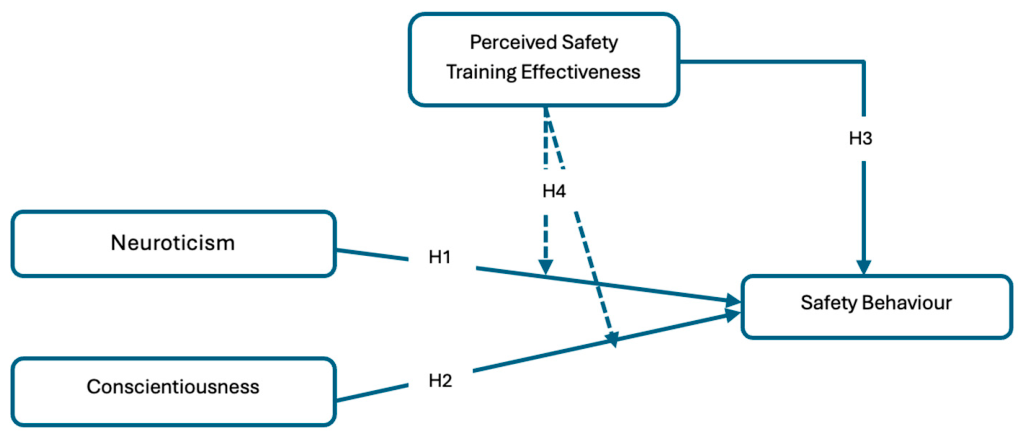
The present study proposes an integrative model to explain safety behaviour in the workplace by combining individual and organizational factors. Specifically, the model examines the role of personality traits—conscientiousness and neuroticism—as predictors of safety behaviour, together with the role of safety training, conceptualized as perceived training effectiveness.
Building on prior research, personality traits are expected to influence safety behaviour through their role in behavioural regulation, decision-making, and adherence to safety procedures. Conscientiousness is associated with rule compliance, responsibility, and self-discipline, whereas neuroticism is linked to emotional instability and reduced behavioural control, which may negatively affect safety-related actions.
At the same time, safety training is conceptualized as a key organizational resource that enhances employees’ knowledge, awareness, and ability to act safely. As such, safety training is expected to have a direct positive effect on safety behaviour.
Importantly, this study adopts a contextual and interactionist perspective on safety behaviour. Rather than assuming that personality traits exert stable effects across contexts, the proposed model suggests that their influence depends on organizational conditions, particularly the presence of safety training. In this sense, safety training is conceptualized as a contextual factor that shapes behavioural expectations and reduces variability in individual responses.
Accordingly, perceived safety training effectiveness is expected to moderate the relationship between personality traits and safety behaviour, determining when and to what extent individual differences are expressed in work-related actions. This approach provides a more nuanced understanding of safety behaviour by emphasizing the dynamic interplay between individual predispositions and organizational practices (
Figure 1).
2. Materials and Methods
2.1. Participants
The sample was obtained through convenience sampling and consisted of 268 working adults aged 18 years or older. Of the participants, 65.1% were female, 34.2% male, and 0.8% preferred not to disclose their gender. Participants’ ages ranged from 18 to 77 years (M = 43.92, SD = 10.44).
Regarding educational level, 70.9% held a higher education degree, 25.0% had completed secondary education, and 4.1% had basic education.
In terms of employment status, most participants were employed full-time (87.3%), with 90.3% working as employees. A small proportion reported working part-time (3.4%) or in shift systems (9.3%), and 16.8% indicated that they combined work with student status.
Participants represented a wide range of occupational categories, with the largest groups being technicians and associate professionals (36.2%), administrative staff (22.8%), and professionals in intellectual and scientific activities (18.3%).
2.2. Measures
Participants completed a structured questionnaire composed of validated psychometric scales assessing safety behaviour, personality traits, and safety training.
Safety Behaviour: Safety behaviour was assessed using the Physical and Psychosocial Safety Behaviour Scale [
42], based on the framework proposed by Neal and Griffin [
4]. The scale was translated into Portuguese using a translation–back translation procedure to ensure linguistic and conceptual equivalence. It consists of 12 items measuring both physical and psychosocial safety behaviours, including safety compliance and safety participation. Responses were provided on a 5-point Likert scale ranging from 1 (strongly disagree) to 5 (strongly agree). Example items include: “I follow all safety procedures and use the necessary protective equipment” and “I apply psychological safety protocols in my work”. The scale demonstrated excellent internal consistency in the present study (α = 0.95).
Personality Traits: Personality traits were measured using the Portuguese version of the Big Five Inventory previously validated for Portuguese samples [
43], based on the Five-Factor Model [
44]. For the purposes of this study, only the dimensions of neuroticism and conscientiousness were used. Neuroticism was assessed with 8 items capturing emotional instability, anxiety, and stress reactivity (e.g., “I see myself as someone who gets nervous easily”) and showed acceptable reliability (α = 0.75). Conscientiousness was assessed with 9 items reflecting organization, attention to detail, and persistence (e.g., “I see myself as someone who is thorough and careful in my work”) and also showed acceptable internal consistency (α = 0.77). All items were rated on a 5-point Likert scale ranging from 1 (strongly disagree) to 5 (strongly agree).
Perceived Safety Training Effectiveness: Perceived safety training effectiveness was assessed using selected dimensions from an instrument developed within the SafePotential project [
45]. For the present study, the selected dimensions were translated into Portuguese using a translation–back translation procedure to ensure linguistic equivalence. Two dimensions were included: Safety knowledge, which evaluates the extent to which training improves awareness of risks and the work environment (e.g., “Training improved my knowledge about workplace risks”); and Ability to work safely, which assesses the application of safe practices and responses to hazardous situations (e.g., “Training improved my ability to detect dangerous situations”). Responses were recorded on a 5-point Likert scale. The overall scale demonstrated excellent reliability (α = 0.99). Although the internal consistency was very high, suggesting strong coherence among items, future research could further examine the dimensionality and discriminant properties of the construct.
2.3. Procedure
Data were collected through an online self-report questionnaire as part of a cross-sectional quantitative study. The survey was administered between April and June 2025 using Google Forms and distributed via email and social media. Because recruitment relied primarily on online dissemination through email and social networks, the sample may overrepresent workers from white-collar and highly educated professional backgrounds.
Participation was voluntary and anonymous, and informed consent was obtained from all participants prior to data collection. Ethical approval for the study was granted by the Ethics Committee of the University of Algarve (CEUAlg; Pn. 9/2025). To minimize response bias, the specific objectives of the study were not fully disclosed at the beginning of the questionnaire.
Participants were required to be at least 18 years old, currently employed, and working in Portugal. The average completion time of the questionnaire was approximately 10–15 min.
2.4. Data Analysis
Data analysis was conducted using IBM SPSS Statistics (version 31, IBM Corp., Armonk, NY, USA) and the PROCESS macro (version 4.2; [
46]).
Initially, descriptive statistics (means and standard deviations) were computed to characterize the sample and examine the distribution of the variables. Pearson correlation analyses were conducted to explore associations among the main study variables. Multiple linear regression analyses were performed to examine the direct effects of personality traits (neuroticism and conscientiousness) and safety training on safety behaviour.
To further examine the contextual role of safety training, moderation analyses were conducted using PROCESS Model 1. Two separate moderation models were tested, one including neuroticism as the focal predictor and the other including conscientiousness, with safety training specified as the moderator in both models. Interaction terms (i.e., variables representing the combined effect of personality traits and perceived safety training effectiveness) were computed using mean-centered variables to reduce multicollinearity. Conditional effects were estimated at low, mean, and high levels of the moderator, corresponding to the 16th, 50th, and 84th percentiles. Age and gender were included as covariates in moderation analyses.
Although the total sample consisted of 268 participants, moderation analyses were conducted using complete cases (n = 213), following a listwise deletion approach implemented by the PROCESS macro. The reduction in sample size was mainly due to missing data in the safety training variable, along with a small number of missing values in demographic variables (gender and age). To assess the potential impact of listwise deletion, participants retained in the moderation analyses (n = 213) were compared with excluded participants (n = 55) on demographic and study variables. Independent-samples t-tests and chi-square analyses revealed no significant differences between groups regarding age, gender, neuroticism, conscientiousness, or safety behaviour (all p > 0.05). These findings suggest that the missing data pattern was unlikely to substantially bias the moderation analyses.
Given that all variables were collected using self-report measures within a single questionnaire administered at a single time point, Harman’s single-factor test was conducted to assess the potential influence of common method variance. An exploratory factor analysis including all measurement items was performed using an unrotated solution. The results indicated that the first factor accounted for 30.18% of the total variance, which is below the commonly suggested threshold of 50%, suggesting that common method variance is unlikely to substantially bias the results. Nevertheless, this test should be interpreted with caution, as it represents a limited diagnostic procedure, and future studies are encouraged to adopt multi-source or longitudinal designs.
All analyses were conducted using a significance level of p < 0.05.
4. Discussion
The present study aimed to examine the role of personality traits—specifically neuroticism and conscientiousness—and perceived safety training effectiveness in predicting safety behaviour, adopting an interactionist perspective that considers the interplay between individual characteristics and organizational conditions. Overall, the findings provide a more nuanced understanding of safety behaviour by demonstrating that the influence of personality traits is not uniform but contingent upon contextual factors.
Consistent with Hypothesis 1, neuroticism was negatively associated with safety behaviour. This finding aligns with previous research indicating that individuals high in neuroticism tend to exhibit greater emotional instability, higher stress reactivity, and reduced self-regulation, which may impair decision-making and increase vulnerability in risk-related situations [
6,
24,
47]. Notably, the absence of a moderation effect suggests that the influence of neuroticism is relatively stable across different levels of safety training. This pattern indicates that certain dispositional characteristics may operate independently of contextual conditions, reflecting more deeply rooted behavioural tendencies that are less susceptible to organizational interventions.
Hypothesis 2 received partial support. Although conscientiousness was positively correlated with safety behaviour, its effect was not statistically significant in the regression model when perceived safety training effectiveness was included. This finding suggests that the predictive role of conscientiousness is not universal but depends on contextual conditions. Rather than functioning as a consistently strong predictor, conscientiousness appears to be context-sensitive, with its influence attenuated in the presence of organizational structures such as training.
In line with Hypothesis 3, perceived safety training effectiveness emerged as a significant and robust predictor of safety behaviour, representing the strongest effect in the model. This result is consistent with training transfer theory [
36,
37] and previous research demonstrating that training enhances safety knowledge, awareness, and behavioural compliance [
35,
48]. Importantly, safety training was conceptualized as perceived training effectiveness, suggesting that behavioural outcomes are shaped not only by training exposure but also by how individuals interpret and internalize training experiences.
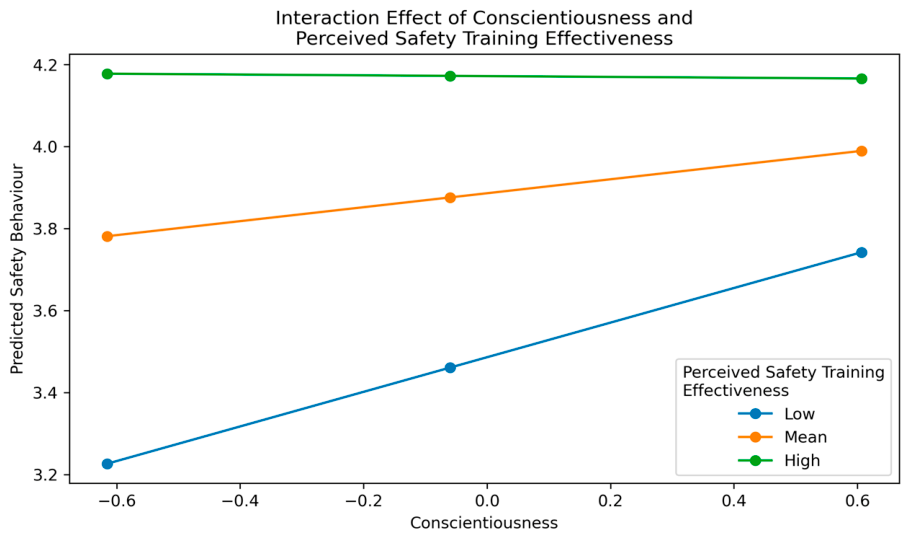
Support was found for Hypothesis 4, which proposed a moderating effect of perceived safety training effectiveness. The results showed that perceived safety training effectiveness significantly moderated the relationship between conscientiousness and safety behaviour, such that the positive effect of conscientiousness was stronger at low levels of training and weakened as training increased. In contrast, no moderation effect was observed for neuroticism. These findings highlight that not all personality traits are equally sensitive to contextual influences.
The moderation effect represents one of the main theoretical contributions of this study. Specifically, the results suggest that perceived safety training effectiveness functions as a contextual mechanism that may be associated with lower behavioural variability and limits the expression of individual differences. In low-training environments, employees appear to rely more heavily on their personal dispositions—such as conscientiousness—to guide their behaviour. However, in highly structured contexts where training is well established, behaviour becomes increasingly regulated by organizational norms, reducing the need for individual traits to drive behavioural responses.
From this perspective, safety training may contribute to the standardization of behaviour, providing employees with clear guidelines, structured procedures, and consistent expectations regarding safe work practices. In this sense, training may contribute to reducing the extent to which personality traits are reflected in behaviour, acting as a behavioural equalizer across individuals.
These findings extend previous research by challenging the assumption that personality traits exert stable effects across contexts. Instead, the results support an interactionist perspective, demonstrating that the relevance of personality depends on organizational conditions. This aligns with broader theoretical frameworks such as the Job Demands–Resources (JD-R) model [
40,
41], while also resonating with research on safety climate and human factors, which emphasize the role of structured environments and system-level influences in shaping behaviour.
Regarding the overall explanatory power of the model, the proportion of variance explained (R2 ≈ 0.21) is consistent with previous research in occupational safety, where behaviour is influenced by a complex combination of individual, organizational, and contextual factors. Although the interaction between conscientiousness and perceived safety training effectiveness was statistically significant, it explained a modest amount of additional variance. Therefore, this finding should be interpreted cautiously. Rather than suggesting a strong contextual effect, the result indicates that perceived safety training effectiveness was associated with a weaker relationship between conscientiousness and safety behaviour. Future longitudinal or experimental studies are needed to determine whether perceived training effectiveness can change the extent to which personality traits are expressed in safety-related behaviour.
Taken together, the findings demonstrate that the role of personality in safety behaviour is not uniform but may depend on the presence of organizational resources. While some traits, such as neuroticism, appear to exert relatively stable associations with safety behaviour, others—such as conscientiousness—seem to be more sensitive to contextual conditions. By showing that perceived safety training effectiveness may attenuate the relationship between conscientiousness and safety behaviour, this study contributes to a more dynamic and context-dependent understanding of safety-related behaviour in the workplace. These findings are also broadly consistent with situational strength perspectives, according to which strong organizational situations may reduce the behavioural expression of individual differences.
4.1. Theoretical and Practical Implications
Beyond the statistical findings, this study offers relevant contributions to both theory and practice in the field of occupational safety and health.
From a theoretical perspective, the results reinforce the importance of integrating individual factors (personality traits) and contextual factors (safety training) in understanding safety behaviour. The observed patterns are broadly consistent with previous research supporting the application of personality-based approaches to occupational safety contexts [
11,
26,
32,
49]. However, the present findings go beyond a simple trait-based explanation by showing that the relevance of personality depends on contextual conditions.
More specifically, the study extends existing literature by demonstrating that personality traits do not operate uniformly across work environments. While neuroticism appears to exert a relatively stable negative effect on safety behaviour, conscientiousness seems to be more sensitive to contextual influences. This finding supports more interactionist approaches to safety behaviour, according to which the effects of individual characteristics depend on the organizational conditions in which behaviour occurs.
Importantly, the results suggest that perceived safety training effectiveness does not merely enhance knowledge and awareness, but may also function as a mechanism of behavioural standardization. By establishing clear expectations, reinforcing procedures, and reducing ambiguity, training may limit the extent to which behavioural responses depend on individual dispositions. In this sense, the study contributes to theory by showing that organizational practices may reduce the extent to which behavioural responses depend on personality traits, particularly those related to self-regulation and rule adherence.
From a practical perspective, the findings emphasize the central role of safety training as a key organizational lever. Effective training programs can promote more consistent safety behaviours across employees, reducing variability associated with individual differences. This suggests that organizations should invest in structured, contextually relevant, and engaging training approaches, particularly in high-risk sectors such as aviation, construction, or healthcare, where behavioural consistency is critical for preventing accidents and ensuring safety.
Training should go beyond technical instruction and include behavioural and experiential components, such as simulations, case-based learning, feedback-based exercises, and interactive methods, which are more likely to enhance engagement and facilitate transfer [
35,
48]. In addition, organizations may benefit from designing training systems that are not only informative but also capable of strengthening behavioural consistency across different employee profiles.
The findings also suggest that employees higher in neuroticism may remain more vulnerable to unsafe behaviour regardless of training conditions. For this reason, organizations may benefit from complementing training with interventions aimed at emotional regulation and stress management, such as coaching, coping-skills development, or mindfulness-based approaches [
47,
50].
Finally, although personality traits may be considered in recruitment and selection processes, organizations should not rely solely on individual characteristics to ensure safety. Instead, well-designed training interventions appear to be a more actionable and equitable means of promoting safe behaviour across diverse employee profiles.
4.2. Limitations and Future Research
Despite its contributions, this study presents several limitations that should be acknowledged.
First, the use of a non-probabilistic convenience sample limits the generalizability of the findings. Although participants represented diverse professional backgrounds, this heterogeneity also introduces interpretive constraints, as the meaning, demands, and salience of safety behaviour may vary across occupations and sectors. Future research should therefore examine these relationships in more homogeneous samples and in specific high-risk sectors, where safety requirements are more clearly defined and contextually comparable [
51].
Second, the cross-sectional design precludes causal inferences. Although significant associations were identified, the directionality of the relationships cannot be firmly established. Future studies should adopt longitudinal, diary-based, or quasi-experimental designs to better understand the temporal dynamics between personality, perceived safety training effectiveness, and safety behaviour, as well as the stability of moderation effects over time [
7,
23]. In addition, all variables were assessed using self-report measures, which may increase the risk of socially desirable responding and common method bias. Although Harman’s single-factor test did not suggest that common method variance represented a substantial concern, this procedure has recognized limitations and cannot fully rule out common method bias, particularly in studies relying exclusively on self-report measures. As noted by Podsakoff et al. [
52], Harman’s test should be interpreted cautiously and complemented by procedural and methodological remedies whenever possible. Nevertheless, previous research has shown that self-reported safety compliance and participation are meaningfully associated with organizational safety outcomes, including accidents and injuries [
4,
16]. Future studies could benefit from incorporating multi-method approaches, such as supervisor ratings, behavioural observations, peer assessments, or objective safety indicators [
52,
53]. Additionally, moderation analyses were conducted using complete cases, which resulted in a reduced analytical sample. Although no significant differences were observed between retained and excluded participants, some degree of sampling bias cannot be entirely ruled out.
A further limitation concerns the conceptualization of safety training. In the present study, training was operationalized as perceived training effectiveness rather than objective exposure to training or verified training quality. Although this approach captures how individuals interpret and internalize training experiences—which may be more proximally related to behaviour—it also raises conceptual challenges. Although this operationalization captures subjective evaluations that may be more proximally related to behaviour, it may also overlap with general positive response tendencies. The very high internal consistency observed for the perceived safety training effectiveness scale may reflect substantial overlap among items, suggesting that future studies could further examine the dimensionality and discriminant properties of the construct. Future research should combine subjective and objective indicators of training, including exposure, duration, content, and quality, to better isolate its specific effects.
Additionally, the study did not examine the organizational context in which safety behaviour occurred. Variables such as safety climate, supervisory practices, leadership, workload, and social support were not included, despite their well-established relevance in explaining safety outcomes [
54,
55]. As a result, the present model captures only part of the broader organizational system in which safety-related behaviour is embedded. Future studies should incorporate these contextual variables to provide a more comprehensive and ecologically valid understanding of safety behaviour. Furthermore, the diversity of occupational backgrounds allowed the inclusion of workers from multiple professional contexts. However, safety demands and exposure to formal safety training may differ substantially across occupations, particularly between administrative and higher-risk operational sectors. Although age and gender were controlled for, other occupational variables (e.g., sector, job risk level, or type of safety exposure) were not included in the analyses. Given the heterogeneous sample, future studies should consider incorporating more detailed occupational controls.
Finally, although the study focused on neuroticism and conscientiousness due to their theoretical relevance, other personality dimensions may also play a role, particularly when interacting with contextual variables. Future research should consider more comprehensive and interaction-based models, including person–environment fit perspectives, to better capture the complexity of safety behaviour across work settings [
56,
57].
In summary, the findings highlight the need for more integrative approaches that combine individual, organizational, and contextual factors, contributing to a more comprehensive understanding of safety behaviour in the workplace.
5. Conclusions
This study contributes to the understanding of safety behaviour in the workplace by examining the combined role of personality traits and perceived safety training effectiveness from an interactionist perspective. The findings highlight that both individual characteristics and organizational practices are relevant, although their influence is not equally stable across contexts.
Neuroticism emerged as a significant negative predictor of safety behaviour, suggesting that emotional instability may hinder safe decision-making and behavioural regulation. In contrast, conscientiousness did not retain a significant direct effect when perceived safety training effectiveness was considered, indicating that its role may depend on contextual conditions rather than operating as a universally stable predictor.
Importantly, perceived safety training effectiveness was identified as the strongest predictor of safety behaviour and also moderated the relationship between conscientiousness and safety behaviour. Specifically, the positive effect of conscientiousness was stronger at lower levels of perceived safety training effectiveness and weakened as training increased. This pattern suggests that perceived safety training effectiveness may function not only as a direct organizational resource, but also as a contextual condition that reduces behavioural variability and attenuates the influence of certain personality traits.
Overall, these findings emphasize that promoting workplace safety requires more than identifying individual predispositions. Well-designed and effective safety training appears to be a particularly relevant lever because it is both actionable and capable of promoting more standardized and consistent safety behaviour across employees.
In conclusion, while personality traits provide useful insight into behavioural tendencies, safety training represents a more modifiable and organizationally relevant factor. By showing that training may reduce the extent to which individual differences are reflected in behaviour, this study contributes to a more dynamic and context-dependent understanding of occupational safety.