Article

Environmental and Human Health Risk Assessment of Pharmaceutical Pollutants Detected in the Sand River in Polokwane, South Africa


by
Jean Sagwati Mdumela
1,*,
Tsolanku Sidney Maliehe
2,
Yannick Nuapia
3,
Marks Matee Sebaiwa
4 and
Tlou Nelson Selepe
1
1
Department of Water and Sanitation, University of Limpopo, Private Bag X1106, Polokwane 0727, South Africa
2
Department of Biochemistry, Genetics and Microbiology, University of KwaZulu Natal, Private Bag X 54001, Durban 4000, South Africa
3
Department of Pharmacy, University of Limpopo, Private Bag X1106, Polokwane 0727, South Africa
4
Department of Geography, University of Limpopo, Private Bag X1106, Polokwane 0727, South Africa
*
Author to whom correspondence should be addressed.
Safety 2026, 12(3), 78; https://doi.org/10.3390/safety12030078 (registering DOI)
Submission received: 20 March 2026 / Revised: 28 May 2026 / Accepted: 28 May 2026 / Published: 3 June 2026

Abstract

Pharmaceutical and microbial pollution in urban rivers is an emerging concern, particularly in developing regions with limited wastewater treatment capacity, posing risks to human health and ecosystems. This study evaluated the risk profiles of selected pharmaceutical compounds and bacterial indicators in the Sand River, South Africa, and computed their ecological risks, antimicrobial resistance (AMR), and human health risk assessment. Surface water samples were collected from three sites during the wet season and analyzed for target antibiotics and non-steroidal anti-inflammatory drugs (NSAIDs) using High-Performance Liquid Chromatography (HPLC) with a photodiode array (PDA) detector, while total coliforms (TCs) and Escherichia coli (E. coli) were enumerated using the Colilert system. Ciprofloxacin, sulfamethoxazole, and erythromycin were the most abundant pharmaceuticals, with maximum concentrations of 2.50 µg/L, 2.76 µg/L, and 2.53 µg/L, respectively. TC and E. coli levels exceeded regulatory thresholds, indicating severe microbial contamination. Risk quotient analysis identified ciprofloxacin, erythromycin, and trimethoprim as high-risk compounds for potential resistance selection (RQ ≥ 1), while ciprofloxacin and erythromycin posed significant ecological risks to fish. Although non-carcinogenic health risk assessment remained below concern (HI < 1), children showed higher exposure levels. These findings underscore the urgent need for improved pharmaceutical waste management and wastewater treatment infrastructure.

1. Introduction

The discovery and application of pharmaceuticals, particularly antibiotics, remain one of the most significant breakthroughs in biomedical science, revolutionizing healthcare and improving the quality of life for both humans and animals. These compounds have been widely used for therapeutic, metaphylactic, and prophylactic purposes in human and veterinary medicine [1,2], leading to their large-scale production and consumption worldwide. It is estimated that more than 100,000 tons of active pharmaceutical ingredients (APIs) are produced annually [3], and pharmaceutical usage is predicted to increase by over 200% by 2030 [4]. Despite their benefits, many pharmaceutical products have not been systematically monitored for environmental occurrence, fate, or toxicity, even though they retain biological activity in the environment [5].
Pharmaceuticals are introduced into river systems via various routes. In many African countries, including South Africa, inadequate sanitation in rural areas and informal settlements contributes to direct fecal discharge into nearby rivers, particularly during rainfall events [6,7]. In urban settings, pharmaceuticals are transported through sewage networks to wastewater treatment plants (WWTPs) [8]. However, most WWTPs in Africa are not designed to remove pharmaceutical compounds efficiently, particularly antibiotics with high water solubility, resulting in their persistence in treated effluents [9]. Additionally, pharmaceutical residues can originate from agriculture, where they are used as growth promoters and veterinary drugs [10,11]. Runoff from livestock farms, leaking manure lagoons, and untreated animal waste can all contribute to contamination of surface waters [12,13].
More than 4000 APIs have been identified in pharmaceutical formulations globally [14], with antibiotics, antiretrovirals, and non-steroidal anti-inflammatory drugs (NSAIDs) among the most frequently detected compounds in African river systems [15,16]. South Africa accounts for over 60% of reported pharmaceutical pollution data across the continent [17], yet substantial knowledge gaps remain due to the lack of systematic monitoring and robust regulatory frameworks, limiting understanding of the long-term ecological and human health risks and hindering evidence-based policymaking in African freshwater systems [16]. The pharmaceuticals selected in this study include antibiotics (penicillin G, trimethoprim, sulfamethoxazole, ciprofloxacin, and erythromycin) and NSAIDs (naproxen and ketoprofen), which were chosen based on their high usage in South Africa, frequent occurrence in wastewater effluents, and environmental persistence, and are known to contribute to antimicrobial resistance and ecosystem disruption even at low concentrations; however, the combined exposure effects and cumulative risks of these compounds remain poorly characterized in South African rivers, underscoring the need for integrated mixture-based risk assessments and improved environmental surveillance.
Most existing studies emphasize the occurrence and concentration of pharmaceutical pollutants but rarely examine their ecological risks or potential to drive antimicrobial resistance (AMR) [18,19]. Sub-inhibitory concentrations of antibiotics in the environment may induce selective pressure, facilitating the emergence of resistant microbial strains [20]. Resistance driven by low-level antibiotic exposure may be irreversible, as newly emerged mutants tend to exhibit greater stability than those selected under higher concentrations [21]. This is of serious concern for public health, as AMR can render commonly used treatments ineffective, increase disease burden, and exacerbate mortality during pandemics [22].
Urban rivers often act as conduits for pharmaceutical and microbial pollutants. The water of the Sand River, an important watercourse in Limpopo Province, is used for domestic, industrial, and agricultural purposes. Moreover, it flows along the western boundary of Polokwane, receiving effluent from the Polokwane and Seshego WWTPs, as well as runoff from informal settlements and agricultural areas [23]. Although previous studies have documented heavy metal contamination in this river [24,25], data on pharmaceutical residues, their ecological risk, and their potential role in AMR remain limited.
Despite increasing evidence of pharmaceutical contamination in African aquatic environments, studies integrating pharmaceutical occurrence, antimicrobial resistance risk, ecological risk, and human health exposure assessment remain limited, particularly in urban rivers influenced by wastewater treatment plant effluent and informal settlements. Most previous studies in South Africa have focused primarily on occurrence data without evaluating the broader environmental and public health implications of pharmaceutical pollution. Furthermore, information on the Sand River remains scarce despite its importance as an urban watercourse receiving municipal wastewater and agricultural runoff. Therefore, this study provides a novel integrated assessment of pharmaceutical contamination, bacterial pollution, antimicrobial resistance risk, ecological risk, and human health risk in the Sand River, thereby contributing baseline data for environmental monitoring, health implications of pharmaceutical contamination, and policy development in under-studied African river systems.

2. Materials and Methods

2.1. Sampling Location

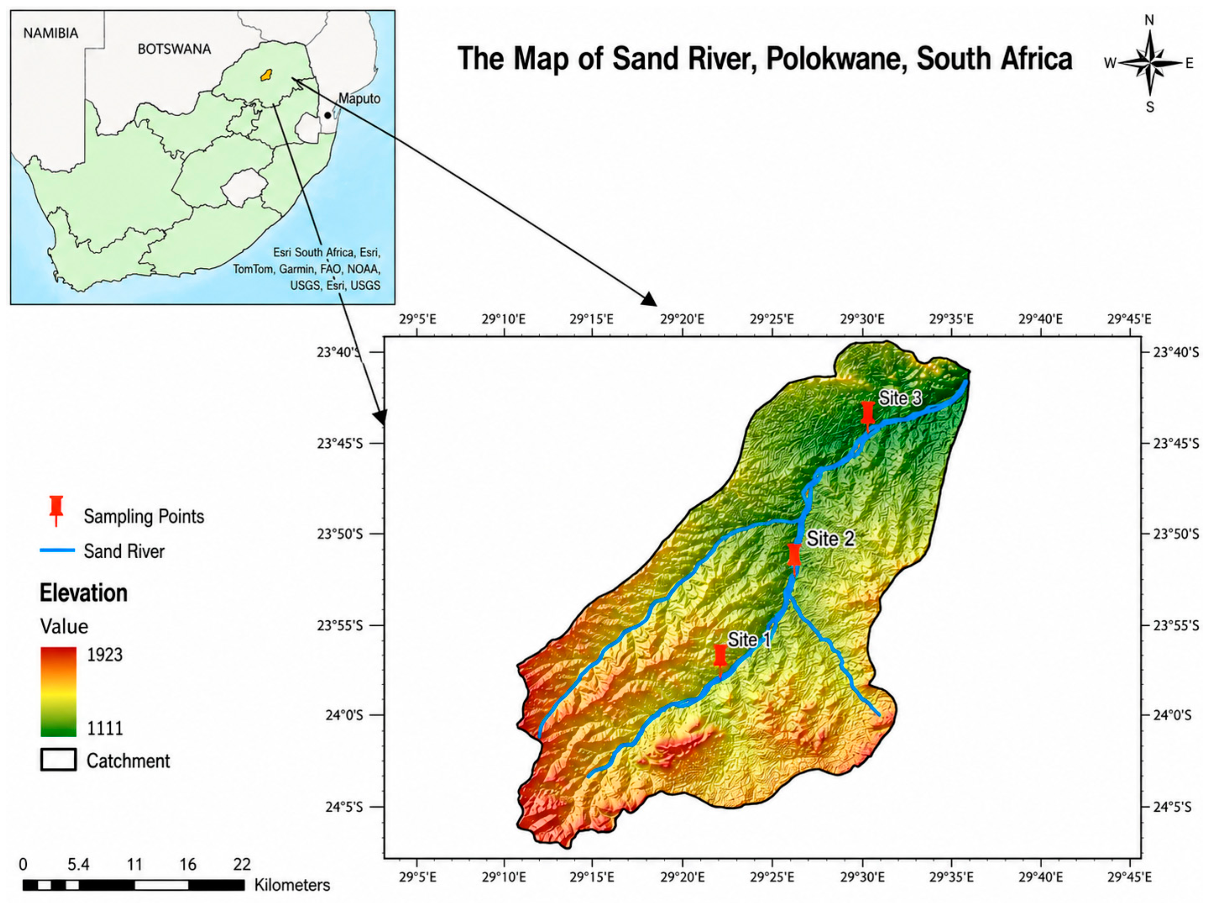
Water sampling was conducted in the Sand River in Polokwane, Limpopo Province, South Africa, during the wet season in January 2024. Three distinct sites were selected to represent a gradient of anthropogenic influence (Figure 1). The first site, located in the upper stream (S1), lies within the Central Business District (CBD) and is subject to informal urban activities such as car washing, street vending, and open defecation (Table 1). The second site, representing the middle stream (S2), is situated immediately downstream of the Polokwane Wastewater Treatment Plant (WWTP), where treated municipal effluent is discharged into the river. The third site (S3), positioned in the lower stream, is located downstream of the confluence with the Blood River. This area receives additional wastewater from the Seshego WWTP and is further impacted by surface runoff from surrounding agricultural land. At each of the three sites, grab samples were collected in triplicate using sterile 500 mL polypropylene bottles (DWK Life Science, Mainz, Germany), which were submerged approximately 30 cm below the water surface to avoid surface contaminants. The collected samples were placed in ice-cooled containers immediately after collection and transported without delay to the Capricorn District Municipality Laboratory, based at the University of Limpopo, where they were processed for microbiological and pharmaceutical analyses.

2.2. Solid-Phase Extraction of Pharmaceutical Pollutants

Pharmaceutical compounds present in the collected river water samples were isolated using solid-phase extraction (SPE), which was carried out with an automated Dionex™ Auto Trace™ 280 SPE system (Thermo Fisher Scientific, Waltham, MA, USA). The extraction procedure employed Oasis HLB cartridges (200 mg, 6 cc; Waters Corporation, Milford, MA, USA) as the sorbent phase due to their broad-spectrum retention of both polar and non-polar analytes. Prior to sample loading, the cartridges were sequentially preconditioned with 5 mL of HPLC-grade methanol and 5 mL of ultrapure water to activate and equilibrate the stationary phase. Each 500 mL water sample was then passed through the conditioned cartridges at a constant flow rate of 15 mL/min to facilitate the adsorption of pharmaceutical residues onto the sorbent material. Following sample loading, the cartridges were rinsed with 2 mL of ultrapure water to remove loosely bound impurities and dried under a gentle stream of nitrogen gas for five minutes to eliminate residual moisture. The adsorbed compounds were subsequently eluted using methanol at a flow rate of 1 mL/min. The collected eluates were evaporated to dryness under nitrogen and reconstituted in 1 mL of 0.1% formic acid in methanol to prepare them for instrumental analysis. This protocol ensured consistent analyte recovery while minimizing matrix interferences.

2.3. High-Performance Liquid Chromatography (HPLC)

Quantification of the pharmaceutical compounds was performed using a Shimadzu Prominence High-Performance Liquid Chromatography (HPLC) system equipped with a photodiode array (PDA) detector (Shimadzu Corporation, Kyoto, Japan). The separation of analytes was carried out on a C18 reversed-phase column (250 mm × 4.6 mm, 5 µm particle size), which was kept at a constant temperature of 30 °C to ensure stable chromatographic performance. The mobile phase consisted of two solvents: 0.1% formic acid in ultrapure water (Solvent A) and 0.1% formic acid in acetonitrile (Solvent B). A gradient elution method was employed, starting with 5% Solvent B, which was gradually increased to 90% over 22 min. This condition was held for one minute before re-equilibrating back to 5% over a 5 min period. The flow rate was maintained at 1.0 mL/min throughout the run, and each sample was injected at a volume of 20 µL. Detection was carried out at compound-specific wavelengths, allowing for the reliable identification and quantification of each pharmaceutical.
The compounds analyzed in this study included five commonly used antibiotics, penicillin G, trimethoprim, sulfamethoxazole, ciprofloxacin, and erythromycin, as well as two non-steroidal anti-inflammatory drugs (NSAIDs), naproxen and ketoprofen. These particular pharmaceuticals were selected because of their widespread use, frequent detection in environmental waters, and known persistence in aquatic systems. They also represent a diverse range of therapeutic classes and physicochemical characteristics, providing a broad perspective on pharmaceutical contamination and its ecological relevance.
Quantification of pharmaceutical compounds in the river water samples was carried out using external calibration with carefully prepared standard solutions. For each target analyte, individual stock solutions were prepared at a concentration of 1000 mg/L using HPLC-grade methanol (Fisher Scientific, Waltham, MA, USA). These stock solutions were stored in amber glass vials at 4 °C to protect the compounds from light and degradation over time. On the day of analysis, working standard mixtures were freshly prepared by diluting the stock solutions with a 1:1 mixture of methanol and ultrapure water. This dilution yielded five calibration levels corresponding to final concentrations of 100, 200, 400, 800, and 1000 µg/L for each pharmaceutical compound. Each standard mixture was analyzed under the same chromatographic conditions used for the environmental samples. Calibration curves were generated by plotting the peak area recorded by the photodiode array detector against the corresponding analyte concentrations. The linearity of each curve was assessed using the correlation coefficient (R2), with all analytes demonstrating values greater than 0.99. This high degree of linearity confirmed the suitability and accuracy of the method for quantifying pharmaceuticals over the selected concentration range. The use of freshly prepared standards on each analytical day further ensured consistency and minimized variability in response, contributing to the robustness of the quantification procedure.

2.4. Quality Assurance Evaluation

2.4.1. Matrix Match

To address potential matrix effects that could interfere with accurate quantification, matrix-matched calibration curves were employed. This approach involved the use of pre-screened blank water collected from the Sand River, confirmed to be free of detectable levels of the target pharmaceuticals. The blank matrix was spiked in triplicate with known concentrations of the target analytes at the same levels used in the external calibration—100, 200, 400, 800, and 1000 µg/L. These matrix-matched standards were then subjected to the same solid-phase extraction (SPE) protocol as the environmental water samples, ensuring that any potential interferences from dissolved organic matter, salts, or other natural constituents in the river water were reflected in the calibration.
By applying the same sample preparation and analytical conditions to both the matrix-matched standards and the unknowns, the method compensated for possible signal suppression or enhancement during detection by the photodiode array (PDA) detector. The resulting calibration curves were used for final quantification, thus improving the accuracy and reliability of the measured concentrations in complex environmental matrices.

2.4.2. Recovery, Precision and Method Validation

Method validation encompassed assessment of recovery, precision, and procedural integrity to confirm the reliability of the analytical workflow. Validation was carried out in triplicate by spiking both ultrapure water and Sand River water with a standard mixture of pharmaceutical compounds at various concentration levels. These fortified samples were processed using the same solid-phase extraction and HPLC-PDA conditions applied to environmental samples.
Recovery evaluation examined the effectiveness of the extraction procedure in retrieving the target analytes from complex aqueous matrices. Precision was assessed through calculation of relative standard deviation (RSD) across replicate measurements, providing a measure of analytical repeatability. Procedural and SPE cartridge blanks were incorporated into each extraction batch to detect any potential contamination introduced during sample handling or analysis.
Final quantification of pharmaceutical residues in environmental samples was based on matrix-matched calibration curves. Concentration values were further corrected for recovery performance to ensure accurate representation of analyte levels in river water under real-world conditions.

2.4.3. Limit of Detetction (LOD) and Limit of Quantification (LOQ)

The LOD and LOQ were determined using a linear regression approach based on the calibration curve method in accordance with International Conference on Harmonisation (ICH) Q2 guidelines. Therefore, LOD and LOQ were expressed as
LOD = 3Sa/b
LOQ = 10Sa/b
where Sa is the response standard deviation and b is the calibration curve’s slope.

2.5. Viable Total Coliform and Escherichia coli Analysis

Bacterial parameter analysis was conducted within 6 h of sample collection, following the recommendation of the American Public Health Association (APHA). Viable total coliforms and E. coli were quantified using the Colilert system. Briefly, 100 mL of the river water from different sampling points was added into Colilert media and mixed until completely dissolved. The solutions were poured into an IDEXX Quanti-Tray/2000 and sealed using the Quanti-Tray sealer (IDEXX Laboratories, Westbrook, ME, USA). Subsequently, the samples were incubated at 35 °C for 24 h. After incubation, trays that exhibited a yellow colour were considered total coliforms. Moreover, the wells that fluorescence under UV lamp at 365 nm were considered to exhibit the presence of E. coli. The counts for both total coliforms and E. coli were determined using the most probable number (MPN) table [26].

2.6. Risk Assessment of Occurrence of Antimicrobial Resistance

The potential risk of antimicrobial resistance (AMR) development was quantified using the risk quotient (RQAMR) for five selected antibiotics. RQAMR was calculated as the ratio of the measured environmental concentration (MEC) in the Sand River to the predicted no-effect concentration for AMR development (PNECAMR), as defined in Equation (3).
RQ AMR = M E C P N E C A M R
The antibiotic-specific PNECAMR values for risk assessment were adopted from the literature [27,28]. The RQAMR values were interpreted as low-risk (RQAMR < 1) and high-risk (RQAMR ≥ 1) [19].

2.7. Ecological Risk Assessment of the Pharmaceutical Pollutants

The ecological risk assessment was conducted using the risk quotient (RQECO) approach which was utilised to assess the ecological risk of the selected pharmaceuticals to fish and algae in the Sand River. It was calculated based on the ratio of the measured environmental concentration (MEC) and predicted non-effect concentration (PNEC). The PNECECO values were derived from Bengtsson-Palme and Larsson [27] and Farmaceutiska Specialiteter I Sverige [28], a Swedish pharmaceutical database. RQs were calculated using the following formula:
RQ EC 0 =   M E C P N E C E C O
The risk levels were divided into two categories: minimal risk (RQECO < 1) and extreme risk (RQECO ≥ 1) [29].

2.8. Non-Carcinogenic Health Risk Assessment of Pharmaceuticals

2.8.1. Chronic Intake of Pharmaceuticals

It was observed that homeless individuals bathe in the Sand River and may be exposed to the pharmaceutically polluted river water through incidental ingestion. Therefore, the daily chronic intake (CDIingestion) through incidental ingestion was estimated using Equation (5).
CDI ingestion = C W × C R × E T × E F × E D B W × A T
CW represents the concentration of pharmaceutical pollutants in the Sand River (μg/L), CR represents the contact rate while bathing (50 mL/h = 0.05 L/h), ET represents the exposure time (7 min = 0.11 h/day), EF represents the quantity of exposure (350 days/year), ED represents the duration of exposure (adults = 70 years and children = 10 years), BW represents body weight (adults = 70 kg and children = 30 kg) and AT represents the average lifespan (25,550 days for adults and 3650 days for children) [30].

2.8.2. Hazardous Intake of Pharmaceuticals

The hazardous index (HI) was used to calculate the hazardous risks associated with incidental ingestion of Sand River water. HI is the sum of the hazard quotients (HQs) of the selected pharmaceutical pollutants. HQ and HI were calculated using Equations (6) and (7), respectively.
HQ = C D I R f D
HI = ∑HQ,
where RfD is the reference dosage for pharmaceutical pollutants (µg/kg/day), and CDI represents the daily chronic intake of the pharmaceutical pollutant during water ingestion (μg/kg/day). According to Huang et al. [31], a HI value less than 1 indicates minor health effects and a HI value greater than 1 means adverse health effects. RfD was measured according to Equation (8)
RfD = LD50 × 4 × 10−5,
where LD50 (median lethal dose) represents the severe median fatal dose of the pharmaceutical pollutant. The LD50 of the targeted pharmaceuticals was obtained from the DrugBank website (https://go.drugbank.com) (accessed on 20 May 2025) [32].

2.9. Statistical Analysis

The experiments were conducted in triplicate, and the results were presented as the mean ± standard deviation for physicochemical parameters. To compare data differences, analysis of variance (ANOVA) and Tukey’s post hoc analysis was used, with p values ≤ 0.05 deemed statistically significant. The Pearson correlation was performed to assess the relationship between the tested parameters using OriginPro 2024b software. A value between 0 and 1 implied a positive correlation, while values between 0 and −1 signified a negative correlation between two variables at a significant level of p < 0.05. A zero value denotes no correlation between two parameters. A strong correlation is reflected when r > 0.7, whereas r between 0.5 and 0.7 indicates a positive moderate correlation [33]. Principal component analysis (PCA) was carried out using Originpro 2024b software to comprehensively determine the relationships between selected parameters. The principal components with an eigenvalue > 1 were selected [34]. Originpro 2024b software was also used to undertake a hierarchical cluster analysis (HCA) to analyze the generated data. Euclidean distance was used to determine the similarity between the selected sampling sites, and Ward’s method was employed as the joining rule [35].

3. Results

3.1. Quality Assurance

The analytical method demonstrated strong performance across all validation metrics, confirming its suitability for environmental monitoring of pharmaceutical pollutants in surface waters. Limits of detection (LOD) and quantification (LOQ) ranged from 0.006 to 0.097 µg/L and 0.016 to 0.269 µg/L, respectively, indicating high sensitivity for trace-level detection (Table 2). Calibration curves exhibited excellent linearity, with correlation coefficients (R2) ≥ 0.994 for all analytes, including erythromycin and sulfamethoxazole, which both achieved R2 = 0.999, underscoring reliable detector response over the tested range. Method accuracy was validated by recovery experiments, which yielded values between 85% (sulfamethoxazole) and 103% (naproxen), consistent with international method validation standards. Precision was equally robust, with relative standard deviations (RSD) below 10% for all compounds, demonstrating reproducibility. Matrix effects, calculated as percentage signal suppression, varied substantially among compounds, with notable suppression observed for trimethoprim (−88%), sulfamethoxazole (−91%), and ketoprofen (−71%). To mitigate these effects, matrix-matched calibration using pre-screened Sand River water was implemented, and recovery correction was applied to all final concentration values. This approach ensured accurate quantification in the presence of natural organic matter and potential interferents, validating the analytical workflow and reinforcing the reliability of the occurrence and risk assessment results reported in this study.

3.2. Occurrence of Pharmaceutical Pollutants

A total of seven pharmaceutical compounds, including five antibiotics and two non-steroidal anti-inflammatory drugs (NSAIDs), were detected in surface water samples from the Sand River (Table 3). The spatial distribution showed clear concentration gradients, with increasing levels from the upper stream (Site 1) to the lower stream (Site 3), suggesting cumulative anthropogenic inputs along the river’s course. The mean concentrations of sulfamethoxazole, ciprofloxacin, and erythromycin at Site 3 were the highest among the studied pharmaceuticals, reaching 2.76 µg/L, 2.50 µg/L, and 2.53 µg/L respectively. These were followed by naproxen (2.11 µg/L), ketoprofen (2.39 µg/L), and trimethoprim (1.99 µg/L). The lowest levels across the river were observed for penicillin G (0.38–0.89 µg/L). Significant differences (p < 0.05) were observed between sampling sites for most compounds, particularly between the upstream and downstream locations.

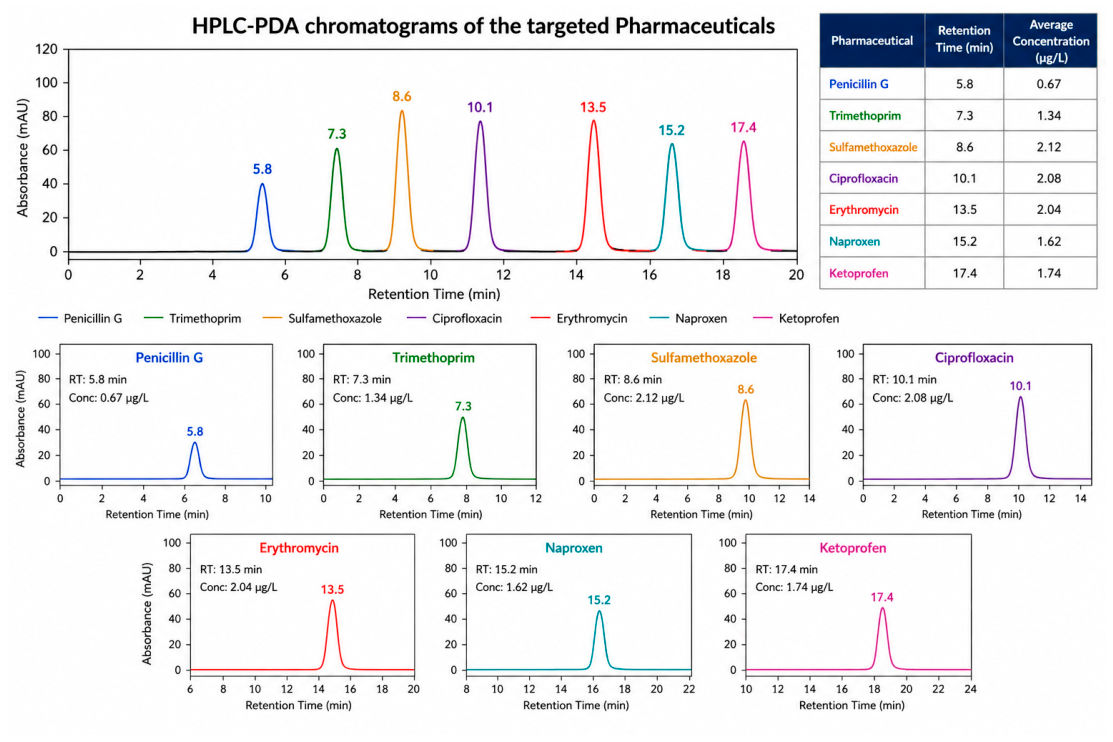
3.3. Chromatograms and Retention Time of the Pharmaceutical Pollutants

Figure 2 below shows representative chromatograms and retention time of the target pharmaceutical pollutants produced using the HPLC-PDA technique. Under the optimal chromatographic conditions, all analytes were satisfactorily separated into distinct and symmetrical peaks. Penicillin G eluted in 5.8 min, followed by trimethoprim (7.3 min), sulfamethoxazole (8.6 min), ciprofloxacin (10.1 min), erythromycin (13.5 min), naproxen (15.2 min), and ketoprofen (17.4 min). The chromatographic separation demonstrated satisfactory resolution and peak stability throughout the analytical run.

3.4. Viable TC and E. coli

The microbial quality of the Sand River was assessed and the results are shown in Table 4. TC levels ranged from 200 to 201 MPN/100 mL, while E. coli concentrations varied between 198 and 201 MPN/100 mL across all sites. The highest E. coli level (201 MPN/100 mL) was observed at the middle stream, whereas the lowest (198 MPN/100 mL) was found at the upper stream. Both indicators consistently exceeded the permissible limits for domestic use set by the Department of Water Affairs and Forestry [36], which stipulates 0 MPN/100 mL for E. coli and ≤5 MPN/100 mL for TC. Only the TC concentration at the lower stream met the DWAF guideline for agricultural use (≤200 MPN/100 mL). None of the sites complied with the World Health Organization [37] recreational water guideline of ≤1 MPN/100 mL for both indicators.

3.5. Pearson Correlation Analysis

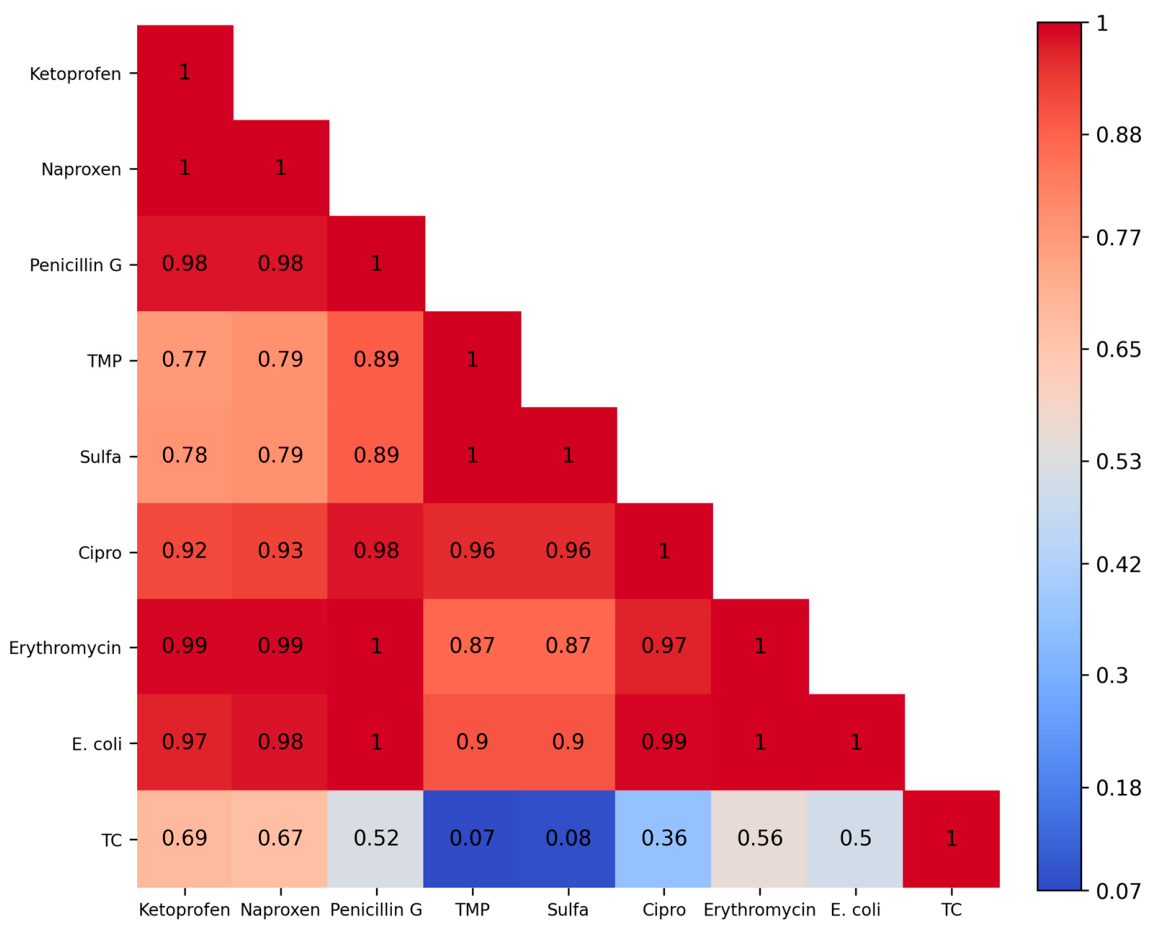
Pearson correlation analysis revealed strong and statistically significant positive relationships among pharmaceutical residues and E. coli concentrations (Figure 3). Ketoprofen showed a perfect correlation with naproxen (r = 1.00), and strong correlations with penicillin G (r = 0.77), trimethoprim (r = 0.78), sulfamethoxazole (r = 0.92), ciprofloxacin (r = 0.99), erythromycin (r = 0.99), and E. coli (r = 0.97). Naproxen correlated significantly with penicillin G (r = 0.98), trimethoprim (r = 0.79), and E. coli (r = 0.98). Penicillin G was significantly correlated with erythromycin and E. coli (r = 1.00), while trimethoprim and sulfamethoxazole displayed a perfect correlation (r = 1.00), reflecting their frequent co-administration.

3.6. Principal Component Analysis (PCA)

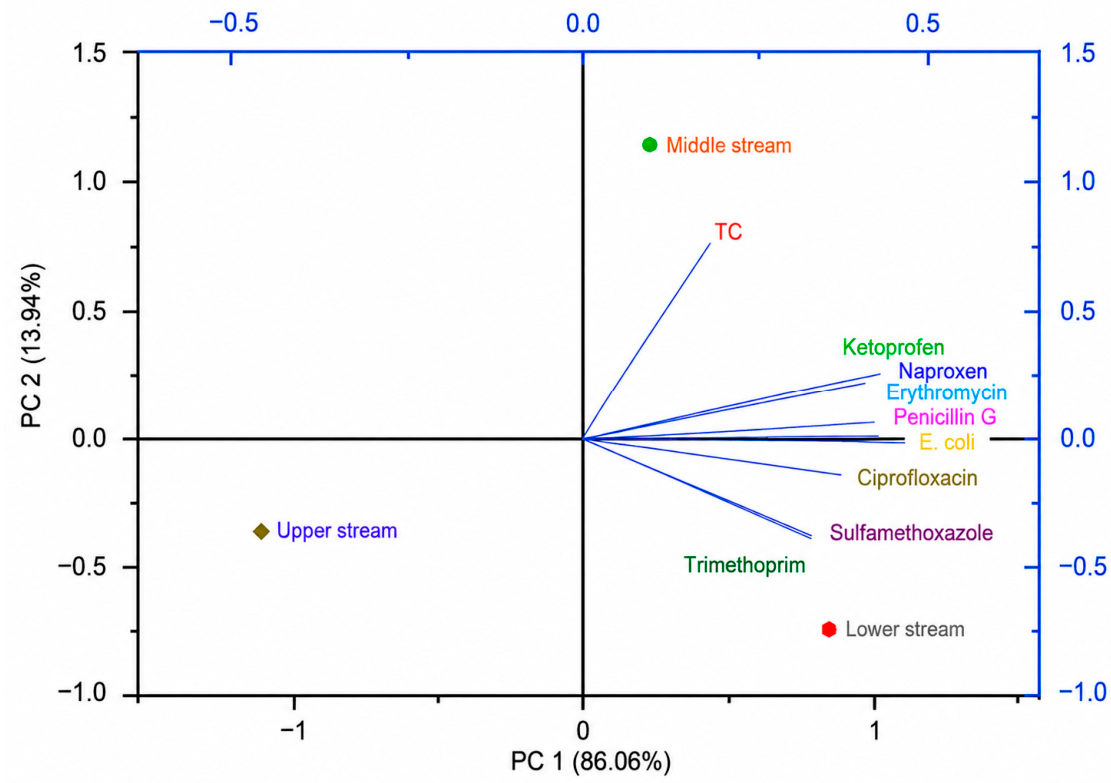
PCA identified two principal components (PCs) that explained 100% of the variance in the dataset see Figure 4 below. PC1 accounted for 86.06% of the total variance and showed the highest positive loadings for E. coli (0.3593), penicillin G (0.3592), and erythromycin (0.358), suggesting shared sources such as sewage discharge. PC2 contributed 13.94% of the variance, characterized by high loading for TC (0.772) and a strong negative loading for trimethoprim (−0.3947), indicating a divergence in distribution patterns.

3.7. Hierarchical Cluster Analysis (HCA)

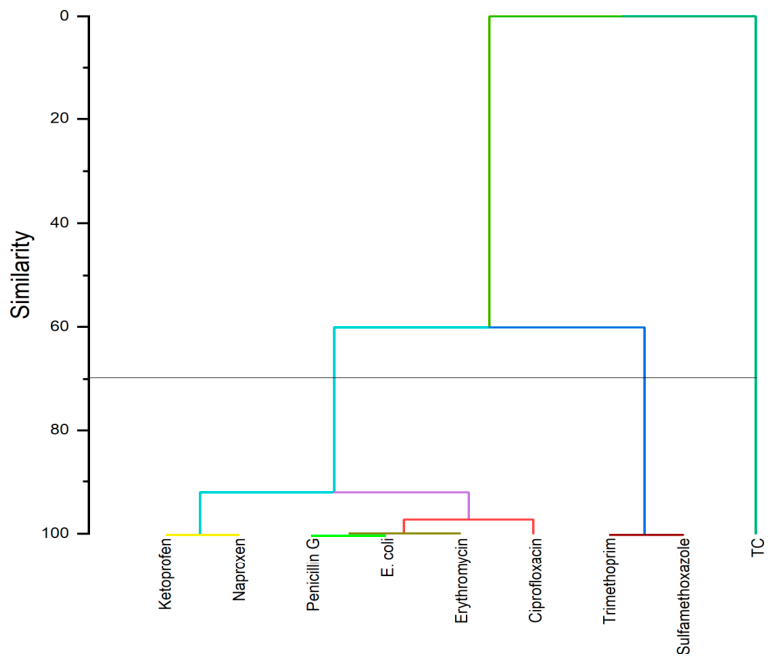
HCA produced a dendrogram with three major clusters (Figure 5). Cluster 1 included NSAIDs (ketoprofen, naproxen) and a subcluster of antibiotics (penicillin G, erythromycin, ciprofloxacin) with E. coli, indicating co-occurrence likely tied to wastewater influence. Cluster 2 consisted of trimethoprim and sulfamethoxazole. Cluster 3 was composed solely of TC, suggesting a different pollution pattern or source compared to the pharmaceutical–E. coli cluster.

3.8. Risk Assessment of Antibiotics for Resistance Selection

The antibiotic resistance risk associated with pharmaceutical residues in the Sand River was assessed using the RQAMR, and the RQAMR values are summarized in Table 5. Among the evaluated antibiotics, ciprofloxacin demonstrated the highest RQAMR values across all sites, ranging from 25.78 at the upper stream to 39.06 at the lower stream, with an average of 32.5. These values far exceed the critical threshold of 1, indicating a substantial risk of selecting for antimicrobial resistance in the aquatic environment. Similarly, trimethoprim and erythromycin showed high RQAMR values, with average values of 2.68 and 2.04, respectively, both significantly above the threshold. In contrast, penicillin (average RQAMR = 0.67) and sulfamethoxazole (average RQAMR = 0.13) exhibited RQ values below 1, suggesting a lower likelihood of contributing to resistance selection pressure.

3.9. Ecological Risk Assessment

The potential ecotoxicological risks of the detected pharmaceutical compounds to aquatic organisms in the Sand River are shown in Table 6. Among the studied compounds, ciprofloxacin and erythromycin exhibited the highest RQ values, especially for fish. Ciprofloxacin displayed extremely elevated RQ fish values of 18.54 (upper stream), 23.60 (middle stream), and 28.09 (lower stream), indicating a very high ecotoxicological risk to fish populations. Similarly, erythromycin demonstrated RQ fish values of 13.4, 21.55, and 24.56 across the three sites, all far exceeding the threshold value of 1, which indicates a significant threat. In contrast, NSAIDs such as ketoprofen and naproxen showed relatively low RQ values across both fish and algae (all < 0.1), suggesting a minimal acute ecological threat under current concentration levels. However, slight increases in exposure or chronic accumulation could shift these risk levels upward. Antibiotics like trimethoprim, penicillin G, and sulfamethoxazole showed intermediate risks. Penicillin G posed a higher risk to algae (RQ = 1.53 at the lower stream), while trimethoprim and sulfamethoxazole exhibited moderate RQ algae values (e.g., 0.12 for trimethoprim and 1.79 for sulfamethoxazole at the lower stream).

3.10. Non-Carcinogenic Health Risk Assessment of Pharmaceuticals

3.10.1. CDI of Pharmaceutical Pollutants

The chronic daily intake (CDI) of the pharmaceuticals studied in the Sand River exhibited a distinct spatial trend for both adults and children, with concentrations typically rising from the upper stream to the lower stream (Table 7). In adults, all pharmaceuticals, including ketoprofen, naproxen, penicillin G, trimethoprim, sulfamethoxazole, ciprofloxacin, and erythromycin, showed a steady increase downstream. The lowest CDI values were found in the upper stream, and the highest were found in the lower stream. Sulfamethoxazole and erythromycin had the highest CDI levels, with sulfamethoxazole reaching 2.17 × 10⁻⁴ μg/kg/day and erythromycin reaching 1.99 × 10⁻⁴ μg/kg/day. Penicillin G, on the other hand, had the lowest overall exposure. A similar trend was seen in children, but the CDI values were much higher than those of adults, which means they were at a higher risk of exposure. Most pharmaceutical pollutants showed the same trend of increasing downstream. Sulfamethoxazole had the highest CDI overall (up to 1.52 × 10⁻³ μg/kg/day), followed by erythromycin and ciprofloxacin. Ciprofloxacin stood out from the rest of the pharmaceuticals because it had the highest CDI in the upper stream and the lowest in the lower stream.

3.10.2. HQs of the Pharmaceutical Pollutants in the Sand River

For adults, all pharmaceuticals, including ketoprofen, naproxen, penicillin G, trimethoprim, sulfamethoxazole, ciprofloxacin, and erythromycin, recorded their lowest HQ values in the upper stream and highest in the lower stream. Among these, ketoprofen exhibited the highest HQ value (7.52 × 10⁻⁵), followed by naproxen and erythromycin, while trimethoprim and sulfamethoxazole had the lowest HQ values overall. A similar trend was observed for children, although HQ values were consistently higher than those of adults, indicating greater susceptibility. All pharmaceuticals showed a progressive downstream increase. Ketoprofen again recorded the highest HQ value (1.75 × 10⁻⁴) in the lower stream, followed by erythromycin and ciprofloxacin, whereas trimethoprim remained among the lowest (Table 8).

3.10.3. HI of the Pharmaceutical Pollutants

The HI values for adults were 2.78 × 10⁻⁵ (upper stream), 8.4 10−5 (middle stream) and 9.24 × 10⁻⁵ (lower stream). It is worth noting that the HI values displayed an increasing trend from the upper stream to the middle and lower stream. The HI values for children also illustrated an increasing trend from the upper stream to the middle and the lower stream. The HI values were 8.86 × 10⁻⁵ in the upper stream, 2.3 × 10⁻⁵ in the middle stream and 2.55 × 10⁻⁴ in the lower stream.

4. Discussion

Most, if not all wastewater treatment facilities in Africa were not designed and constructed to remove pharmaceutical pollutants from influents. Therefore, effluents discharged into receiving rivers are often highly contaminated with these pollutants. In this study, the presence of the detected targeted pharmaceuticals at all sites was an indication that they are commonly used medications in the Polokwane area. However, it was surprising to detect penicillin G as the least frequently occurring pollutant in the Sand River. This is because penicillins are the first-line-of-defence-subgroup antibiotics that are most often prescribed in South Africa, accounting for over 41% of all antibiotics recommended [38,39]. The lower concentration of penicillin G in this study might imply that penicillin G is rarely used in Polokwane. Penicillin G is a broad-spectrum β–lactam antibiotic that kills bacteria by inhibiting their cell wall synthesis [40]. It is recommended for the treatment of pneumonia, syphilis, diphtheria, cellulitis, and tetanus [41]. In its structure, penicillin G has a β–lactam ring, which facilitates its high degradation rate in aqueous solution [42]. Therefore, the lower proportion of penicillin G was not only linked presumably to its limited use in Polokwane but also its high degradation rate in the Sand River. The warm rainy sampling season is significantly more conducive to a high degradation rate, causing chemical hydrolysis and oxidation [43]. Thus, this might have been one of the factors that led to the low penicillin G level in this study. In addition, the high rainfalls during the sampling season in this study might have also contributed to the lower concentration of penicillin G in the Sand River due to the high dilution factor [44]. Our observations were similar to those obtained by Chukwu et al. [45], who reported a significantly lower penicillin G concentration (in comparison to other antibiotics) in effluent-receiving waterbodies in Durban, South Africa due to high rainfall. In addition, the average concentration of penicillin G in this study was higher than those recorded in the Msunduzi River in South Africa, which was in the range of 0.14398–0.50330 µg/L [46].
The average concentrations of sulfamethoxazole, ciprofloxacin and erythromycin were higher (>2 µg/L) in comparison to other pharmaceutical pollutants in this study, suggesting a wider usage of these antibiotics within Polokwane. Sulfamethoxazole is a broad-spectrum sulphonamide that targets or inhibits the folate synthesis in pathogens. It is mostly prescribed in combination with trimethoprim (as co-trimoxazole), an anti-folate diaminopyrimidine, to treat animal and human infections in the urinary tract, kidney, respiratory tract, and gastrointestinal system [41,47,48]. Used individually, sulfamethoxazole and trimethoprim tend to result in a bacteriostatic effect; however, as co-trimoxazoles, they exert a bactericidal effect [49].
It is also noteworthy to bear in mind that South Africa is one of the African countries with a very high human immunodeficiency virus (HIV) prevalence [35]. Therefore, sulfamethoxazole and trimethoprim prophylaxis are mostly recommended for patients with severe HIV-related infections (CD4+ cell level of less than 200 cells/mm) [50]. Thus, in the province of Limpopo, sulphonamide and trimethoprim are the second most recommended subgroups after penicillins [51]. Their high concentrations in the Sand River can be strongly linked to their wide use in the province of Limpopo. Sulfamethoxazole and trimethoprim have high resistance abilities to degradation due to their structure, and this enables them to accumulate to higher concentrations in water as was observed in this study. In the Gonubie River, Netshithothole and Madikizela [52] recorded sulfamethoxazole concentrations of 0.06 µg/L and 0.002 µg/L for trimethoprim, which were both much lower than those obtained in this study. However, the sulfamethoxazole concentration was lower than the highest concentration of 53.8 μg/L reported in the South African region of the Urban River of Maputo in Mozambique [53].
Ciprofloxacin is a broad-spectrum quinolone antibiotic used mostly to cure infections that are resistant to the regularly recommended allopathic antibiotics [54]. It exerts its bacteriostatic and/or bactericidal effects through the inhibition of DNA replication by targeting the DNA gyrase and topoisomerase enzymes [55]. Erythromycin is a narrow-spectrum macrolide, and it is a potent treatment agent against infections of the respiratory tract and skin as well as to treat syphilis [56,57]. It employs its bacteriostatic spectrum by distracting the protein synthesis via inhibition of the transpeptidation/translocation phase and the assemblage of the 50S ribosomal subunit [58]. Ciprofloxacin and erythromycin, like sulfamethoxazole and trimethoprim, are more stable against degradation; hence, they tend to exist for a longer time in rivers and eventually accumulate to higher concentrations [59,60,61]. This might be the reason they were detected in relatively higher concentrations in Sand River [62]. The average level of ciprofloxacin in this study was approximately thirty-five times higher than the global average concentration of 0.06 µg/L in rivers [63,64]. The concentrations of erythromycin and trimethoprim were significantly higher than those obtained in other African rivers [65,66].
ketoprofen and naproxen are the most frequently recommended NSAIDs. Their presence in the Sand River was not surprising, as these pharmaceuticals are readily available over the counter [65]. A significant increase in ketoprofen and naproxen concentrations from the upper to the middle stream likely indicated a source of input from the Polokwane WWTP, agricultural and/or urban runoffs. The average concentrations of these two pharmaceutical pollutants in the Sand River were relatively higher than those obtained in other rivers in South Africa, suggesting the Sand River is more pharmaceutically polluted. For instance, in Quenera River and Umgeni River, concentrations of 0.025 µg/L and 0.32 µg/L were obtained for naproxen, respectively [52,67]. Madikizela et al. [68] reported a concentration range of not detected to 2.0 µg/L of ketoprofen in the Mbokodweni River.
Han et al. [69] concluded that concentrations of pharmaceuticals in rivers that are exposed to effluents from wastewater treatment facilities are mostly higher than those that are not receiving effluents. This statement aligned with our observations whereby the levels of the selected pharmaceuticals were generally significantly higher in the middle and lower streams of Sand River than in the upper streams. These two streams (middle and lower) of the Sand River both receive effluent from the Polokwane Wastewater Treatment Plant, which is often poorly treated because of system malfunctions due to aging facilities and overload pressure on the deteriorating system. Although the Polokwane Wastewater Treatment Plant was designed to accommodate 28 ML/day of wastewater, due to a high increase in population and urbanization, generating large volumes of wastewater daily, the plant is currently overloaded and discharges over 30 ML/day [23]. The elevated pollution in the middle and lower streams implied that domestic and hospital wastes were the main sources of these pharmaceuticals in the Polokwane Wastewater Treatment Plant. The higher levels of pharmaceutical pollutants in the lower stream in comparison to the middle stream might be due to the accumulation and persistence of these pollutants. Moreover, the higher concentrations might be due to the inflow of polluted water from the Blood River (a tributary river to the Sand River), which receives discharge from the Seshego Wastewater Treatment Plant. Furthermore, the lower stream of the Sand River is situated in the vicinity of the agricultural farms. Therefore, the runoff from pharmaceutically contaminated manure from the farmlands might have contributed to the higher proportions of these pollutants in the Sand River [70]. The presence of these pharmaceutical pollutants in the Sand River may present ecotoxicological risks to aquatic life, cause the occurrence of multidrug resistance, and deteriorate the health of humans via the food chain [71]. In summary, the findings in this study aligned with the conclusion by Fekadu et al. [72] that African aquatic environments are significantly more pharmaceutically polluted than European aquatic areas, mainly due to the high consumption and poor treatment facilities in Africa.
Microorganisms of enteric origin are one of the most common pathogens encountered in aquatic environments. In this study, TC and E. coli were detected in high concentrations at all sampled sites, indicating the river to be polluted by these bacteria. Moreover, the E. coli and TC levels exceeded the recommended 0 counts/100 m/L for E. coli and ≤5 counts/100 m/L TC for domestic use, implying a high health risk. Even though TCs may not be pathogenic, their presence in the river may indicate fecal contamination, and the possible presence of some pathogenic bacteria [35]. Although the majority of E. coli strains are non-pathogenic, some strains may acquire genes, enabling them to encode virulence factors [73]. Pathogenic E. coli strains may cause infections with symptoms ranging from acute diarrhoea to chronic complications and even death [74]. The findings in this study were consistent with those observed by Seanego and Moyo [23], who also reported high levels of E. coli, fecal coliforms and total coliforms exceeding the locally set guidelines for domestic use (0 counts/100 mL) at different stretches of the Sand River. Therefore, the seemingly similar trend of microbial pollution in the Sand River calls for attention to stricter enforcement of water and environmental regulations to protect the health of the ecosystem and humans. Moreover, there should be proper maintenance of the plant and improvement in its design to enhance its treatment efficiency [70].
The Pearson correlation analysis revealed a perfect positive correlation between ketoprofen and naproxen, indicating a direct proportional relationship between their concentrations in river water. Ketoprofen and naproxen are both NSAIDs with similar pharmacological functions, making this strong correlation anticipated, as they are often used interchangeably for pain relief and inflammation management [75]. The significant positive correlations of ketoprofen and naproxen with E. coli implied a strong possible influence of these pollutants on bacterial growth, virulence, and general behaviour [76]. Some bacteria feed on pharmaceutical products; they metabolically break down pharmaceutical pollutants in rivers for carbon or nitrogen sources [77]. Therefore, the increase in ketoprofen and naproxen pollution in the river might lead to the proliferation of E. coli, indicating the non-inhibitory effects of these pollutants against E. coli or the possible occurrence of potential antimicrobial resistance [78].
Sulfamethoxazole and trimethoprim displayed a perfect positive correlation, which was expected since they are often used as a standard combination therapy known as co-trimoxazole [41]. Antibiotics, such as penicillin G, ciprofloxacin, erythromycin, trimethoprim and sulfamethoxazole, also exhibited high positive correlations with E. coli, suggesting a close relationship between these antibiotics and the bacteria. Therefore, the increase in these antibiotics in the Sand River might lead to the proliferation of E. coli, indicating the non-inhibitory effects of these pollutants. This further implied the possible degradation abilities of E. coli against these pharmaceuticals and the risk of the emergence of resistant E. coli strains to these pollutants. However, more studies are needed to justify this claim.
PCA was conducted to identify the sources and patterns of pharmaceutical and microbial pollutants in the Sand River. The upper stream was positioned negatively in PC1, suggesting it to have been less influenced by pharmaceutical and bacterial contamination, and therefore having less pollution compared to the middle and lower streams [79]. In contrast, the middle and lower streams are located on the positive side of PC1, indicating significant contamination from pharmaceuticals and bacteria. Moreover, the PCA results highlighted increasing contamination levels downstream. Among the pollutants, TC showed the highest positive loading in the middle stream, indicative of being the most significant pollutant in the Sand River [35]. Ketoprofen, naproxen, erythromycin and penicillin G exhibited low positive loadings in the middle stream and demonstrated moderate positive correlations with one another, suggesting a direct proportional relationship among these pollutants [80]. PC1 represented pollution from the Polokwane Wastewater Treatment Plant effluent, Seshego Wastewater Treatment Plant effluent through the tributary river (Blood River) and agricultural waste. In PC2, high loadings of TC, E. coli, ketoprofen, naproxen, erythromycin, and penicillin G were observed, confirming these substances as the main pollutants in the Sand River. Moreover, these pollutants were grouped together, suggesting that the anthropogenic sources of these pollutants are closely linked [81].
A hierarchical clustering dendrogram was utilized to categorize pharmaceutical and bacterial contamination based on their similarities. Ketoprofen and naproxen were grouped together at a very high similarity level, suggesting frequent co-occurrence under similar environmental conditions, likely due to their analogous chemical properties or usage patterns [82]. Penicillin G, E. coli and erythromycin clustered together, indicating a potential link between the presence of these pharmaceuticals and the bacterium. This clustering meant that the presence of penicillin G and erythromycin may promote the growth or resistance of E. coli [83]. Additionally, this cluster is connected to ciprofloxacin at a lower similarity level, implying that, while it shares some relationship with the other pharmaceuticals, it behaves differently, possibly due to its distinct chemical structure or environmental behaviour [84]. Trimethoprim and sulfamethoxazole formed a separate cluster, suggesting that they are commonly found together. This is consistent with their common use in combination to treat bacterial infections [85]. TC is clustered separately from the others at the highest dissimilarity level, indicating that it exhibits unique environmental behaviour or occurrence patterns compared to pharmaceuticals and E. coli. This clustering pattern is consistent with the results from the PCA, where TC displayed an independent variation pattern.
The constant exposure of bacteria to subminimum inhibitory concentrations of antibiotics in the rivers creates selective pressure, consequently favouring the gradual proliferation of potential antibiotic resistance among water pathogens [86]. The average concentrations of trimethoprim, ciprofloxacin and erythromycin in Sand River were higher than their corresponding PNECAMR values and the RQAMR values were above 1, suggesting heightened risk to proliferation of potential antibiotic resistance among the detected pathogens in the Sand River. Sulfamethoxazole and penicillin G had concentrations lower than their corresponding PNECAMR values and their RQAMR values were below 1, implying these antibiotics pose no or low risk to the evolution of potential antibiotic resistance among river pathogens. However, further studies are recommended to establish this conclusion. Our findings were in harmony with those obtained by Kuang et al. [87], where the concentrations of these antibiotics in Huangshui River were below their corresponding PNECAMR values and had low RQAMR values.
The ecological risk assessment of the pharmaceuticals detected in the Sand River revealed varying degrees of environmental concern for fish and algae across three sampling streams. Ketoprofen, naproxen, and trimethoprim exhibited low risk to both fish and algae throughout the Sand River, as their RQECO values remain well below 1, indicating minimal ecological concern. Penicillin G and sulfamethoxazole posed a low risk to fish but presented a significant threat to algae, particularly downstream, where its RQECO exceeds the threshold for high risk. Ciprofloxacin and erythromycin posed the most serious threats, with consistently high RQECO values for fish. High RQECO values indicated possible severe toxicity to fish populations, potential implications of physiological stress, reproductive impairment, and disruption of growth and development [88]. Pharmaceuticals tend to accumulate in fish tissues, leading to bioaccumulation and biomagnification through the food chain [89]. Our findings contradicted those of Netshithothole and Madikizela [52], who predicted that the detected concentrations of the targeted pharmaceuticals posed significant ecotoxicological risks to aquatic organisms and algae.
The health risk estimations in terms of the hazardous index (HI) for adults and children across the three streams of the Sand River revealed a clear increasing trend from the upper to the lower stream. The consistent increase in HI values along the stream could indicate cumulative contamination or pollution sources becoming more concentrated downstream, potentially due to runoff, anthropogenic discharges, or sediment deposition [90]. This pattern aligned with the study by Zhang et al. [91], showing increased pollutant loads and health risks in downstream river segments due to cumulative contamination. However, the HI values for adults and children were below 1 in all the sampling sites, which indicated minor health effects for both adults and children.
The main drivers that may have led to the prevalence of these pharmaceuticals and bacteria in the Sand River were perceived to be the high rate of population growth and urbanization around the river. Polokwane is the capital city of the Limpopo Province in South Africa. According to Statistics South Africa [92], the population in Polokwane has increased significantly in recent decades. This is because a large number of people migrate to Polokwane yearly for better living as it offers many job opportunities and a better lifestyle. With high population growth and urbanization comes elevated consumption of pharmaceutical products, which thereafter exert pressure on the river as large volumes of municipal and industrial wastewater are discharged by the Polokwane Wastewater Treatment Plant and Seshego Wastewater Treatment Plant directly or indirectly into the Sand River, consequently polluting it. Moreover, pathogenic strains such as E. coli proliferate as more “food” in the form of pharmaceutical pollutants is deposited into the Sand River, consequently heightening the risk of the occurrence of antimicrobial resistance.
There are various limitations to this study that must be considered when evaluating the results. Firstly, sampling occurred during a single wet season period, and thus the results may not fully reflect seasonal variations in pharmaceutical concentrations, microbiological contamination, and river hydrological behaviour. Second, due to economic and technological constraints, only few sampling points and a small number of pharmacological compounds were examined, and there may be other substances that fit into the category of emerging contaminants and would otherwise go undetected. This research was confined to river waters and did not consider other matrices such as sediments, biofilms, and aquatic life. Lastly, the assessment of health risks associated with pharmaceutical pollution did not consider dermal contact with the contaminated water during bathing activities noted in the field study. Therefore, future research should therefore incorporate multi-seasonal monitoring, a broader range of pharmaceuticals and emerging contaminants, sediment and bioaccumulation assessments, and integrated oral–dermal exposure models to provide a more comprehensive evaluation of environmental and human health risks associated with pharmaceutical pollution in African urban river systems.
Despite the above-stated limitations, the current study’s findings indicate that there is an immediate need for scientifically supported initiatives to reduce the Sand River’s contamination due to pharmaceuticals. The existing water treatment plants in Polokwane and Seshego should be updated with cutting-edge technologies such as activated carbon adsorption, membrane filtration, and advanced oxidation processes. The other important action that needs to be taken is the adoption of environmental monitoring programs to check for pharmaceutical residues, microorganisms, and indicators of antimicrobial resistance in urban rivers. There should also be pharmaceutical take-back programs and campaigns to increase awareness about proper drug disposal and prevent people from disposing of their unused medication incorrectly.

5. Conclusions

In this study, seven targeted pharmaceuticals were detected at all three sampling sites along the Sand River. Among those detected, sulfamethoxazole, ciprofloxacin, and erythromycin were found at high concentrations, indicating that they are frequently used in the Polokwane area. Additionally, the presence of TC and E. coli exceeded the guidelines set by the DWAF and WHO at all sampling points, suggesting that the river is heavily polluted with microorganisms. Pharmaceuticals such as trimethoprim, ciprofloxacin, and erythromycin exhibited a high risk of emergence of potential antibiotic resistance among the detected pathogens. The RQ for ciprofloxacin and erythromycin indicated that these pollutants pose an ecotoxicological risk to fish in the Sand River. Furthermore, penicillin G and sulfamethoxazole also showed a high ecotoxicological risk. However, the estimated health risks associated with these pharmaceuticals did not reveal any health threats to adults and children. Regular monitoring and stricter regulations regarding pharmaceutical discharge are recommended to reduce contamination levels. Additionally, improving wastewater treatment processes to effectively remove pharmaceuticals and microbial contaminants is crucial for preventing further environmental damage. Future studies should investigate the long-term effects of pharmaceutical pollution on aquatic ecosystems and biodiversity in the Sand River. Furthermore, future research should expand temporal coverage (multi-seasonal sampling), include a broader range of emerging contaminants, use larger sampling points, and incorporate molecular-level AMR analyses to better understand resistance dynamics in impacted river systems and should focus on developing advanced treatment technologies that can more efficiently eliminate pharmaceuticals and microbial contaminants.

Author Contributions

Conceptualization, T.S.M., M.M.S. and T.N.S.; methodology, Y.N.; software, J.S.M.; validation, M.M.S., Y.N. and T.S.M.; formal analysis, T.S.M.; investigation, J.S.M.; resources, Y.N.; data curation, T.S.M.; writing—original draft preparation, J.S.M. and T.S.M.; writing—review and editing, T.S.M.; supervision, T.N.S., T.S.M. and M.M.S.; project administration, T.N.S.; funding acquisition, J.S.M. All authors have read and agreed to the published version of the manuscript.

Funding

This research was funded by the South African Energy and Water Sector Education and Training Authority (EWSETA), grant number LE00026749.

Institutional Review Board Statement

Not applicable.

Informed Consent Statement

Not applicable.

Data Availability Statement

The original contributions presented in this study are included in the article. Further inquiries can be directed to the corresponding author.

Acknowledgments

We sincerely thank all the participants and the Biofloc group for their outstanding support.

Conflicts of Interest

The authors declare no conflicts of interest. The funders had no role in the design of the study; in the collection, analyses, or interpretation of data; in the writing of the manuscript; or in the decision to publish the results.

Abbreviations

The following abbreviations are used in this manuscript:
NSAIDNon-Steroidal Anti-Inflammatory Drugs
HPLCHigh-Performance Liquid Chromatography
PDAPhotodiode Array
TCTotal Coliforms
LD50Median Lethal Dose
AMRAntimicrobial Resistance
RQRisk Quotient
HIHazardous Index
PCAPrincipal Component Analysis
HCAHierarchical Cluster Analysis
WWTPWastewater Treatment Plant

References

  1. Enshaie, E.; Nigam, S.; Patel, S.; Rai, V. Livestock Antibiotics Use and Antimicrobial Resistance. Antibiotics 2025, 14, 621. [Google Scholar] [CrossRef] [PubMed]
  2. Caneschi, A.; Bardhi, A.; Barbarossa, A.; Zaghini, A. The Use of Antibiotics and Antimicrobial Resistance in Veterinary Medicine, a Complex Phenomenon: A Narrative Review. Antibiotics 2023, 12, 487. [Google Scholar] [CrossRef]
  3. Toma, A.; Crişan, O. Green Pharmacy—A Narrative Review. Clujul Med. 2018, 91, 391. [Google Scholar] [CrossRef]
  4. Maghsodian, Z.; Sanati, A.M.; Mashifana, T.; Sillanpää, M.; Feng, S.; Nhat, T.; Ramavandi, B. Occurrence and Distribution of Antibiotics in the Water, Sediment, and Biota of Freshwater and Marine Environments: A Review. Antibiotics 2022, 11, 1461. [Google Scholar] [CrossRef] [PubMed]
  5. Arnold, K.E.; Brown, A.R.; Ankley, G.T.; Sumpter, J.P. Medicating the Environment: Assessing Risks of Pharmaceuticals to Wildlife and Ecosystems. Philos. Trans. R. Soc. B Biol. Sci. 2014, 369, 20130569. [Google Scholar] [CrossRef] [PubMed]
  6. Okesanya, O.J.; Eshun, G.; Ukoaka, B.M.; Manirambona, E.; Olabode, O.N.; Adesola, R.O.; Okon, I.I.; Jamil, S.; Singh, A.; Lucero-Prisno, D.E., III; et al. Water, Sanitation, and Hygiene (WASH) Practices in Africa: Exploring the Effects on Public Health and Sustainable Development Plans. Trop. Med. Health 2024, 52, 68. [Google Scholar] [CrossRef]
  7. Gqomfa, B.; Maphanga, T.; Madonsela, B.S. An Analysis of the Effects that South Africa’s Informal Settlements Have Had on the Country’s River Systems. Nat. Environ. Pollut. Technol. 2023, 22, 1833–1843. [Google Scholar] [CrossRef]
  8. Selwe, K.P.; Thorn, J.P.; Desrousseaux, A.O.; Dessent, C.E.; Sallach, J.B. Emerging Contaminant Exposure to Aquatic Systems in the Southern African Development Community. Environ. Toxicol. Chem. 2022, 41, 382–395. [Google Scholar] [CrossRef]
  9. Adeleye, A.S.; Xue, J.; Zhao, Y.; Taylor, A.A.; Zenobio, J.E.; Sun, Y.; Han, Z.; Salawu, O.A.; Zhu, Y. Abundance, Fate, and Effects of Pharmaceuticals and Personal Care Products in Aquatic Environments. J. Hazard. Mater. 2022, 424, 127284. [Google Scholar] [CrossRef]
  10. Economou, V.; Gousia, P. Agriculture and Food Animals as a Source of Antimicrobial-Resistant Bacteria. Infect. Drug Resist. 2015, 8, 49–61. [Google Scholar] [CrossRef]
  11. Woolhouse, M.; Ward, M.; Bunnik, B.; Farrar, J. Antimicrobial Resistance in Humans, Livestock and the Wider Environment. Philos. Trans. R. Soc. B Biol. Sci. 2015, 370, 20140083. [Google Scholar] [CrossRef]
  12. Hejna, M.; Kapuścińska, D.; Aksmann, A. Pharmaceuticals in the Aquatic Environment: A Review on Ecotoxicology and the Remediation Potential of Algae. Int. J. Environ. Res. Public Health 2022, 19, 7717. [Google Scholar] [CrossRef]
  13. Finčur, N.; Sfîrloagă, P.; Putnik, P.; Despotović, V.; Lazarević, M.; Uzelac, M.; Abramović, B.; Vlazan, P.; Ianăși, C.; Alapi, T.; et al. Removal of Emerging Pollutants from Water Using Environmentally Friendly Processes: Photocatalysts Preparation, Characterization, Intermediates Identification and Toxicity Assessment. Nanomaterials 2021, 11, 215. [Google Scholar] [CrossRef] [PubMed]
  14. Hawash, H.B.; Abeer, A.M.; Ahmed, A.G.; Ahmed, M.E.; Walied, A.A.M.; Mahmoud, S.; Hesham, R.E.; Mohamed, S.G.; Mahmoud, F.M.; Nour, F.A. Occurrence and Spatial Distribution of Pharmaceuticals and Personal Care Products (PPCPs) in the Aquatic Environment, Their Characteristics, and Adopted Legislations. J. Water Process Eng. 2023, 52, 103490. [Google Scholar] [CrossRef]
  15. Horn, S.; Vogt, T.; Gerber, E.; Vogt, B.; Bouwman, H.; Pieters, R. HIV-Antiretrovirals in River Water from Gauteng, South Africa: Mixed Messages of Wastewater Inflows as Source. Sci. Total Environ. 2022, 806, 150346. [Google Scholar] [CrossRef] [PubMed]
  16. Munzhelele, E.P.; Mudzielwana, R.; Ayinde, W.B.; Gitari, W.M. Pharmaceutical Contaminants in Wastewater and Receiving Water Bodies of South Africa: A Review of Sources, Pathways, Occurrence, Effects, and Geographical Distribution. Water 2024, 16, 796. [Google Scholar] [CrossRef]
  17. Madikizela, L.M.; Ncube, S.; Chimuka, L. Analysis, Occurrence and Removal of Pharmaceuticals in African Water Resources: A Current Status. J. Environ. Manag. 2020, 253, 109741. [Google Scholar] [CrossRef]
  18. Maremane, S.R.; Belle, G.N.; Oberholster, P.J.; Omotola, E.O. Occurrence of Selected COVID-19 Drugs in Surface Water Resources: A Review of Their Sources, Pathways, Receptors, Fate, Ecotoxicity, and Possible Interactions with Heavy Metals in Aquatic Ecosystems. Environ. Geochem. Health 2025, 47, 3. [Google Scholar] [CrossRef]
  19. Kairigo, P.; Ngumba, E.; Sundberg, L.R.; Gachanja, A.; Tuhkanen, T. Occurrence of Antibiotics and Risk of Antibiotic Resistance Evolution in Selected Kenyan Wastewaters, Surface Waters and Sediments. Sci. Total Environ. 2020, 720, 137580. [Google Scholar] [CrossRef]
  20. Khan, H.K.; Rehman, M.Y.A.; Malik, R.N. Fate and Toxicity of Pharmaceuticals in Water Environment: An Insight on Their Occurrence in South Asia. J. Environ. Manag. 2020, 271, 111030. [Google Scholar] [CrossRef]
  21. Sandegren, L. Selection of Antibiotic Resistance at Very Low Antibiotic Concentrations. Upsala J. Med. Sci. 2014, 119, 103–107. [Google Scholar] [CrossRef]
  22. Knight, G.M.; Glover, R.E.; McQuaid, C.F.; Olaru, I.D.; Gallandat, K.; Leclerc, Q.J.; Fuller, N.M.; Willcocks, S.J.; Hasan, R.; van Kleef, E.; et al. Antimicrobial Resistance and COVID-19: Intersections and Implications. eLife 2021, 10, e64139. [Google Scholar] [CrossRef]
  23. Seanego, K.G.; Moyo, N.A.G. The Effect of Sewage Effluent on the Physico-Chemical and Biological Characteristics of the Sand River, Limpopo, South Africa. Phys. Chem. Earth 2013, 66, 75–82. [Google Scholar] [CrossRef]
  24. Moyo, N.A.G.; Rapatsa, M.M. Trace Metal Contamination and Risk Assessment of an Urban River in Limpopo Province, South Africa. Bull. Environ. Contam. Toxicol. 2019, 102, 492–497. [Google Scholar] [CrossRef]
  25. Nephale, L.E.; Moyo, N.A.; Rapatsa, M.M. Use of Biomarkers in Monitoring Pollution Status of Urban Rivers, Limpopo, South Africa. Environ. Sci. Pollut. Res. 2021, 28, 55116–55128. [Google Scholar] [CrossRef]
  26. Venkateswaran, K.; Murakoshi, A.; Satake, M. Comparison of Commercially Available Kits with Standard Methods for the Detection of Coliforms and Escherichia coli in Foods. Appl. Environ. Microbiol. 1996, 62, 2236–2243. [Google Scholar] [CrossRef]
  27. Bengtsson-Palme, J.; Larsson, D.J. Concentrations of Antibiotics Predicted to Select for Resistant Bacteria: Proposed Limits for Environmental Regulation. Environ. Int. 2016, 86, 140–149. [Google Scholar] [CrossRef] [PubMed]
  28. Farmaceutiska Specialiteter i Sverige. FASS—Farmaceutiska Specialiteter i Sverige. Available online: https://www.fass.se/LIF/startpage (accessed on 20 February 2025).
  29. Hernando, M.D.; Mezcua, M.; Fernández-Alba, A.R.; Barceló, D. Environmental Risk Assessment of Pharmaceutical Residues in Wastewater Effluents, Surface Waters and Sediments. Talanta 2006, 69, 334–342. [Google Scholar] [CrossRef]
  30. Derbalah, A.; Chidya, R.; Jadoon, W.; Sakugawa, H. Temporal Trends in Organophosphorus Pesticides Use and Concentrations in River Water in Japan, and Risk Assessment. J. Environ. Sci. 2019, 79, 135–152. [Google Scholar] [CrossRef] [PubMed]
  31. Huang, R.; Yang, L.; How, Z.T.; Fang, Z.; Bekele, A.; Letinski, D.J.; Redman, A.D.; El-Din, M.G. Characterization of Raw and Ozonated Oil Sands Process Water Utilizing Atmospheric Pressure Gas Chromatography Time-of-Flight Mass Spectrometry Combined with Solid Phase Microextraction. Chemosphere 2021, 266, 129017. [Google Scholar] [CrossRef]
  32. DrugBank. DrugBank Online Database. Available online: https://go.drugbank.com (accessed on 20 May 2025).
  33. Akoglu, H. User’s Guide to Correlation Coefficients. Turk. J. Emerg. Med. 2018, 18, 91–93. [Google Scholar] [CrossRef] [PubMed]
  34. Taşan, M.; Demir, Y.; Taşan, S. Groundwater Quality Assessment Using Principal Component Analysis and Hierarchical Cluster Analysis in Alaçam, Turkey. Water Supply 2022, 22, 3431–3447. [Google Scholar] [CrossRef]
  35. Maliehe, T.S.; Mavingo, N.; Selepe, T.N.; Masoko, P.; Mashao, F.M.; Nyamutswa, N. Quantitative Assessment of Human Health Risks Associated with Heavy Metal and Bacterial Pollution in Groundwater from Mankweng in Limpopo Province, South Africa. Int. J. Environ. Res. Public Health 2024, 21, 1489. [Google Scholar] [CrossRef] [PubMed]
  36. Department of Water Affairs and Forestry (DWAF). South African Water Quality Guidelines, Vol. 1: Domestic Use, 2nd ed.; Department of Water Affairs and Forestry: Pretoria, South Africa, 1996.
  37. World Health Organization. Guidelines for Drinking-Water Quality, 4th ed.; World Health Organization: Geneva, Switzerland, 2011. [Google Scholar]
  38. Skosana, P.P.; Schellack, N.; Godman, B.; Kurdi, A.; Bennie, M.; Kruger, D.; Meyer, J.C. A Point Prevalence Survey of Antimicrobial Utilisation Patterns and Quality Indices amongst Hospitals in South Africa; Findings and Implications. Expert Rev. Anti-Infect. Ther. 2021, 19, 1353–1366. [Google Scholar] [CrossRef]
  39. Alabi, M.E.; Essack, S.Y. Antibiotic Prescribing amongst South African General Practitioners in Private Practice: An Analysis of a Health Insurance Database. JAC-Antimicrob. Resist. 2022, 4, dlac101. [Google Scholar] [CrossRef]
  40. Lima, L.M.; da Silva, B.N.M.; Barbosa, G.; Barreiro, E.J. β-Lactam Antibiotics: An Overview from a Medicinal Chemistry Perspective. Eur. J. Med. Chem. 2020, 208, 112829. [Google Scholar] [CrossRef]
  41. Loffler, P.; Escher, B.I.; Baduel, C.; Virta, M.P.; Lai, F.Y. Antimicrobial Transformation Products in the Aquatic Environment: Global Occurrence, Ecotoxicological Risks, and Potential of Antibiotic Resistance. Environ. Sci. Technol. 2023, 57, 9474–9494. [Google Scholar] [CrossRef]
  42. Li, D.; Yang, M.; Hu, J.; Zhang, Y.; Chang, H.; Jin, F. Determination of Penicillin G and Its Degradation Products in a Penicillin Production Wastewater Treatment Plant and the Receiving River. Water Res. 2008, 42, 307–317. [Google Scholar] [CrossRef]
  43. Khuluza, F.; Chiumia, F.K.; Nyirongo, H.M.; Kateka, C.; Hosea, R.A.; Mkwate, W. Temperature Variations in Pharmaceutical Storage Facilities and Knowledge, Attitudes, and Practices of Personnel on Proper Storage Conditions for Medicines in Southern Malawi. Front. Public Health 2023, 11, 1209903. [Google Scholar] [CrossRef]
  44. Lei, K.; Zhu, Y.; Chen, W.; Pan, H.Y.; Cao, Y.X.; Zhang, X.; Guo, B.B.; Sweetman, A.; Lin, C.Y.; Ouyang, W.; et al. Spatial and Seasonal Variations of Antibiotics in River Waters in the Haihe River Catchment in China and Ecotoxicological Risk Assessment. Environ. Int. 2019, 130, 104919. [Google Scholar] [CrossRef] [PubMed]
  45. Chukwu, K.B.; Abafe, O.A.; Amoako, D.G.; Essack, S.Y.; Abia, A.L. Antibiotic, Heavy Metal, and Biocide Concentrations in a Wastewater Treatment Plant and Its Receiving Water Body Exceed PNEC Limits: Potential for Antimicrobial Resistance Selective Pressure. Antibiotics 2023, 12, 1166. [Google Scholar] [CrossRef]
  46. Addis, T.Z.; Adu, J.T.; Kumarasamy, M.; Demlie, M. Occurrence of Trace-Level Antibiotics in the Msunduzi River: An Investigation into South African Environmental Pollution. Antibiotics 2024, 13, 174. [Google Scholar] [CrossRef]
  47. Haseeb, A.; Abourehab, M.A.; Almalki, W.A.; Almontashri, A.M.; Bajawi, S.A.; Aljoaid, A.M.; Alsahabi, B.M.; Algethamy, M.; AlQarni, A.; Iqbal, M.S.; et al. Trimethoprim-Sulfamethoxazole (Bactrim) Dose Optimization in Pneumocystis jirovecii Pneumonia (PCP) Management: A Systematic Review. Int. J. Environ. Res. Public Health 2022, 19, 2833. [Google Scholar] [CrossRef]
  48. Wróbel, A.; Maliszewski, D.; Baradyn, M.; Drozdowska, D. Trimethoprim: An Old Antibacterial Drug as a Template to Search for New Targets. Synthesis, Biological Activity and Molecular Modeling Study of Novel Trimethoprim Analogs. Molecules 2019, 25, 116. [Google Scholar] [CrossRef]
  49. Eyler, R.F.; Shvets, K. Clinical Pharmacology of Antibiotics. Clin. J. Am. Soc. Nephrol. 2019, 14, 1080–1090. [Google Scholar] [CrossRef]
  50. Nel, J.; Dlamini, S.; Meintjies, G. Southern African HIV Clinicians Society Guidelines for Antiretroviral Therapy in Adults: 2020 Update. S. Afr. J. HIV Med. 2020, 21, 1115. [Google Scholar] [CrossRef]
  51. Mthombeni, T.C.; Burger, J.R.; Lubbe, M.S.; Julyan, M. Antibiotic Consumption in the Public Sector of the Limpopo Province, South Africa, 2014–2018. S. Afr. J. Infect. Dis. 2022, 37, a462. [Google Scholar] [CrossRef]
  52. Netshithothole, R.; Madikizela, L.M. Occurrence of Selected Pharmaceuticals in the East London Coastline Encompassing Major Rivers, Estuaries, and Seawater in the Eastern Cape Province of South Africa. ACS Meas. Sci. Au 2024, 4, 283–293. [Google Scholar] [CrossRef] [PubMed]
  53. Segura, P.A.; Takada, H.; Correa, J.A.; El Saadi, K.; Koike, T.; Onwona-Agyeman, S.; Ofosu-Anim, J.; Sabi, E.B.; Wasonga, O.V.; Mghalu, J.M.; et al. Global Occurrence of Anti-Infectives in Contaminated Surface Waters: Impact of Income Inequality between Countries. Environ. Int. 2015, 80, 89–97. [Google Scholar] [CrossRef] [PubMed]
  54. Ngumba, E.; Gachanja, A.; Tuhkanen, T. Occurrence of Selected Antibiotics and Antiretroviral Drugs in Nairobi River Basin, Kenya. Sci. Total Environ. 2016, 539, 206–213. [Google Scholar] [CrossRef] [PubMed]
  55. Almutairi, B.A.A.; Almotawa, A.A.; Almutairi, M.A.M.; Baabbad, R.S.; Abdullah, S.A.A.; Alagedi, H.S.K.; Aljaizani, E.A.H.; Alahmar, M.A.; Shabi, F.A.A.; Alharbi, S.A.; et al. Ciprofloxacin: An Overview of Uses, Mechanism of Action, and Adverse Effects. J. Ecohumanism 2024, 3, 9328. [Google Scholar] [CrossRef]
  56. Bret, K.P.; David, P.D.; Paula, J.G.; Kathi, J.H.; Forrest, W.O. Experience with Directly Observed Prophylaxis Using Erythromycin in Military Trainees Exposed to Pertussis. Mil. Med. 2004, 169, 417–420. [Google Scholar] [CrossRef][Green Version]
  57. Liu, M.; Fan, Y.; Chen, J.; Yang, J.; Gao, L.; Wu, X.; Xu, X.; Zhang, Y.; Yue, P.; Cao, W.; et al. Efficacy and Safety of Treatments for Different Stages of Syphilis: A Systematic Review and Network Meta-Analysis of Randomized Controlled Trials and Observational Studies. Microbiol. Spectr. 2022, 10, e02977-22. [Google Scholar] [CrossRef]
  58. Szczupak, M.; Jankowska, M.; Jankowski, B.; Wierzchowska, J.; Kobak, J.; Szczupak, P.; Kosydar-Bochenek, J.; Krupa-Nurcek, S. Prokinetic Effect of Erythromycin in the Management of Gastroparesis in Critically Ill Patients—Our Experience and Literature Review. Front. Med. 2024, 11, 1440992. [Google Scholar] [CrossRef]
  59. Giedraitienė, A.; Vitkauskienė, A.; Naginienė, R.; Pavilonis, A. Antibiotic Resistance Mechanisms of Clinically Important Bacteria. Medicina 2011, 47, 19. [Google Scholar] [CrossRef]
  60. Straub, J.O. Aquatic Environmental Risk Assessment for Human Use of the Old Antibiotic Sulfamethoxazole in Europe. Environ. Toxicol. Chem. 2015, 35, 767–779. [Google Scholar] [CrossRef]
  61. Ren, J.; Ni, S.; Shen, Y.; Niu, D.; Sun, R.; Wang, C.; Deng, L.; Zhang, Q.; Tang, Y.; Jiang, X.; et al. Characterization of the Erythromycin Degradation Pathway and Related Enzyme in Rhodococcus gordoniae RJJTX-2. J. Clean. Prod. 2022, 379, 134758. [Google Scholar] [CrossRef]
  62. Wang, L.; Zhao, X.; Wang, J.; Wang, J.; Zhu, L.; Ge, W. Macrolide- and Quinolone-Resistant Bacteria and Resistance Genes as Indicators of Antibiotic Resistance Gene Contamination in Farmland Soil with Manure Application. Ecol. Indic. 2019, 106, 105456. [Google Scholar] [CrossRef]
  63. Wilkinson, J.L.; Boxall, A.B.A.; Kolpin, D.W.; Leung, K.M.Y.; Lai, R.W.S.; Galbán-Malagón, C.; Adell, A.D.; Mondon, J.; Metian, M.; Marchant, R.A.; et al. Pharmaceutical Pollution of the World’s Rivers. Proc. Natl. Acad. Sci. USA 2022, 119, e2113947119. [Google Scholar] [CrossRef] [PubMed]
  64. Gestels, Z.; Abdellati, S.; Kenyon, C.; Manoharan-Basil, S.S. Ciprofloxacin Concentrations 100-Fold Lower than the MIC Can Select for Ciprofloxacin Resistance in Neisseria subflava: An In Vitro Study. Antibiotics 2024, 13, 560. [Google Scholar] [CrossRef]
  65. Matongo, S.; Birungi, G.; Moodley, B.; Ndungu, P. Occurrence of Selected Pharmaceuticals in Water and Sediment of Umgeni River, KwaZulu-Natal, South Africa. Environ. Sci. Pollut. Res. 2015, 22, 10298–10308. [Google Scholar] [CrossRef]
  66. Azanu, D.; Styrishave, B.; Darko, G.; Weisser, J.J.; Abaidoo, R.C. Occurrence and Risk Assessment of Antibiotics in Water and Lettuce in Ghana. Sci. Total Environ. 2018, 622, 293–305. [Google Scholar] [CrossRef]
  67. Hlengwa, N.B.; Mahlambi, P.N. SPE-LC-PDA Method Development and Application for the Analysis of Selected Pharmaceuticals in River and Wastewater Samples from South Africa. Water SA 2020, 46, 514–522. [Google Scholar] [CrossRef]
  68. Madikizela, L.M.; Muthwa, S.F.; Chimuka, L. Determination of Triclosan and Ketoprofen in River Water and Wastewater by Solid Phase Extraction and High Performance Liquid Chromatography. S. Afr. J. Chem. 2014, 67, 143–150. [Google Scholar]
  69. Han, Q.F.; Zhao, S.; Zhang, X.R.; Wang, X.L.; Song, C.; Wang, S.G. Distribution, Combined Pollution and Risk Assessment of Antibiotics in Typical Marine Aquaculture Farms Surrounding the Yellow Sea, North China. Environ. Int. 2020, 138, 105551. [Google Scholar] [CrossRef]
  70. Phungela, T.; Gqomfa, B.; Maphanga, T.; Shale, K. The Impact of Wastewater Treatment Effluent on Water Resources: A South African Perspective. Water Law 2021, 27, 140–148. [Google Scholar]
  71. Abafe, O.A.; Lawal, M.A.; Chokwe, T.B. Non-Targeted Screening of Emerging Contaminants in South African Surface and Wastewater. Emerg. Contam. 2023, 9, 100246. [Google Scholar] [CrossRef]
  72. Fekadu, S.; Alemayehu, E.; Dewil, R.; van der Bruggen, B. Pharmaceuticals in Freshwater Aquatic Environments: A Comparison of the African and European Challenge. Sci. Total Environ. 2019, 654, 324–337. [Google Scholar] [CrossRef]
  73. Adefisoye, M.A.; Okoh, A.I. Ecological and Public Health Implications of the Discharge of Multidrug-Resistant Bacteria and Physicochemical Contaminants from Treated Wastewater Effluents in the Eastern Cape, South Africa. Water 2017, 9, 562. [Google Scholar] [CrossRef]
  74. Pokharel, P.; Dhakal, S.; Dozois, C.M. The Diversity of Escherichia coli Pathotypes and Vaccination Strategies against This Versatile Bacterial Pathogen. Microorganisms 2023, 11, 344. [Google Scholar] [CrossRef]
  75. Nowak, J.Z. Non-Steroidal Anti-Inflammatory Drugs (NSAIDs) in Ophthalmology: Pharmacological and Clinical Characteristics. Mil. Pharm. Med. 2012, 5, 33–50. [Google Scholar]
  76. Zhang, D.; Liu, W.; Yin, C.; She, L.; Ren, J.; Xu, Q.; Wang, S.; Peng, Y. Occurrence of Contaminants of Emerging Concern in Surface and Wastewater from the Yangtze River Chemical Contiguous Zone, China: Distribution, Sources and Ecological Risk Assessment. Sci. Total Environ. 2024, 949, 175151. [Google Scholar] [CrossRef]
  77. Samal, K.; Mahapatra, S.; Ali, M.H. Pharmaceutical Wastewater as Emerging Contaminants (EC): Treatment Technologies, Impact on Environment and Human Health. Energy Nexus 2022, 6, 100076. [Google Scholar] [CrossRef]
  78. Mohy-u-Din, N.; Farhan, M.; Rashid, A.; Mohy-u-Din, M.; Campos, L.C. Degradation of Ciprofloxacin in Water Using Escherichia coli and Enterococcus faecium. Water 2024, 16, 3407. [Google Scholar] [CrossRef]
  79. Sangion, A.; Gramatica, P. Hazard of Pharmaceuticals for Aquatic Environment: Prioritization by Structural Approaches and Prediction of Ecotoxicity. Environ. Int. 2016, 95, 131–143. [Google Scholar] [CrossRef]
  80. Hossain, A.; Nakamichi, S.; Habibullah-Al-Mamun, M.; Tani, K.; Masunaga, S.; Matsuda, H. Occurrence and Ecological Risk of Pharmaceuticals in River Surface Water of Bangladesh. Environ. Res. 2018, 165, 258–266. [Google Scholar] [CrossRef]
  81. Keshav, K.A.; Rama, M.K. Distribution, Correlation, Ecological and Health Risk Assessment of Heavy Metal Contamination in Surface Soils around an Industrial Area, Hyderabad, India. Environ. Earth Sci. 2016, 75, 411. [Google Scholar] [CrossRef]
  82. Li, Y.; Qu, X.; Yu, R.; Ikehata, K. Health Effects Associated with Wastewater Treatment, Reuse, and Disposal. Water Environ. Res. 2015, 87, 1817–1848. [Google Scholar] [CrossRef]
  83. Heß, S.; Gallert, C. Growth Behaviour of E. coli, Enterococcus and Staphylococcus Species in the Presence and Absence of Sub-Inhibitory Antibiotic Concentrations: Consequences for Interpretation of Culture-Based Data. Microb. Ecol. 2016, 72, 898–908. [Google Scholar] [CrossRef]
  84. Ma, J.; Xiong, Y.; Dai, X.; Yu, F. Coadsorption Behavior and Mechanism of Ciprofloxacin and Cu (II) on Graphene Hydrogel Wetted Surface. Chem. Eng. J. 2020, 380, 122387. [Google Scholar] [CrossRef]
  85. Dieye, Y.; Hull, D.M.; Wane, A.A.; Harden, L.; Fall, C.; Sambe-Ba, B.; Seck, A.; Fedorka-Cray, P.J.; Thakur, S. Genomics of Human and Chicken Salmonella Isolates in Senegal: Broilers as a Source of Antimicrobial Resistance and Potentially Invasive Nontyphoidal Salmonellosis Infections. PLoS ONE 2022, 17, e0266025. [Google Scholar] [CrossRef] [PubMed]
  86. Kulik, K.; Lenart-Boroń, A.; Wyrzykowska, K. Impact of Antibiotic Pollution on the Bacterial Population within Surface Water with Special Focus on Mountain Rivers. Water 2023, 15, 975. [Google Scholar] [CrossRef]
  87. Kuang, Y.; Guo, X.; Hu, J.; Li, S.; Zhang, R.; Gao, Q.; Yang, X.; Chen, Q.; Sun, W. Occurrence and Risks of Antibiotics in an Urban River in Northeastern Tibetan Plateau. Sci. Rep. 2020, 10, 20054. [Google Scholar] [CrossRef]
  88. Wang, H.; Xi, H.; Xu, L.; Jin, M.; Zhao, W.; Liu, H. Ecotoxicological Effects, Environmental Fate and Risks of Pharmaceutical and Personal Care Products in the Water Environment: A Review. Sci. Total Environ. 2021, 788, 147819. [Google Scholar] [CrossRef]
  89. Xie, Z.; Lu, G.; Yan, Z.; Liu, J.; Wang, P.; Wang, Y. Bioaccumulation and Trophic Transfer of Pharmaceuticals in Food Webs from a Large Freshwater Lake. Environ. Pollut. 2017, 222, 356–366. [Google Scholar] [CrossRef] [PubMed]
  90. Akhtar, N.; Syakir, I.M.; Bhawani, S.A.; Umar, K. Various Natural and Anthropogenic Factors Responsible for Water Quality Degradation: A Review. Water 2021, 13, 2660. [Google Scholar] [CrossRef]
  91. Zhang, Y.; Xu, B.; Guo, Z.; Han, J.; Li, H.; Jin, L.; Chen, F.; Xiong, Y. Human Health Risk Assessment of Groundwater Arsenic Contamination in Jinghui Irrigation District, China. J. Environ. Manag. 2019, 237, 163–169. [Google Scholar] [CrossRef]
  92. Statistics South Africa. General Household Survey: 2019; Statistics South Africa: Pretoria, South Africa, 2019. Available online: https://www.statssa.gov.za/publications/P0318/P03182019.pdf (accessed on 18 February 2026).
Figure 1. Map of the Sand River.
Safety 12 00078 g001
Figure 2. Representative HPLC-PDA chromatograms showing the separation of the pharmaceutical pollutants.
Safety 12 00078 g002
Figure 3. Pearson correlation of pharmaceutical pollutants and bacteria. TMP denotes trimethoprim, Sulfa denotes sulfamethoxazole and Cipro denotes ciprofloxacin.
Safety 12 00078 g003
Figure 4. The biplot of the two extracted PCs of the pharmaceutical pollutants and bacteria.
Safety 12 00078 g004
Figure 5. Dendrogram of HCA for pharmaceuticals and bacteria. The coloured lines illustrate different main and subclusters, while the parallel line at 70 serves as a cut-off.
Safety 12 00078 g005
Table 1. The sampling sites, coordinates and activities that occur on the sampling sites.
Sampling SitesDescriptionCoordinatesActivities
Site 1Upper streamLatitude.: −23.910848; Longitude: 29.444531Street vendors, car washes, and homeless people who bathe in the river.
Site 2Middle streamLatitude: −23.870301; Longitude: 29.435670Polokwane Wastewater Treatment Plant discharges its final effluent.
Site 3Lower streamLatitude: −23.817696; Longitude: 29.444300Blood River joins Sand River (Blood River receives effluent from the Seshego Wastewater Treatment Plant). Agricultural practices.
Table 2. Method validation.
PharmaceuticalCalibration EquationLODLOQR2Recovery (%)RSDMatrix Effect
Penicillin Gy = 0.4395x + 1.96050.0060.0160.9941026−8
Trimethoprimy = 0.4834x + 2.15630.0970.1880.994918−88
Sulfamethoxazoley = 0.0987x + 0.01770.0780.2690.999857−91
Ciprofloxaciny = 0.067x − 0.00120.0550.0850.997885−6
Erythromyciny = 0.0952x + 0.01870.0420.1970.999906−45
Naproxeny = 0.2767x + 1.23420.0650.1970.9941038−67
Ketoprofeny = 0.585x + 2.60930.0200.1170.9941019−71
Table 3. Concentrations of pharmaceutical pollutants in Sand River sites (µg/L ± SD).
PharmaceuticalUpper StreamMiddle StreamLower StreamAverage
Ketoprofen0.62 ± 0.18a2.2 ± 0.08b2.39 ± 0.21b1.74
Naproxen0.82 ± 0.41a1.94 ± 0.47b2.11 ± 0.16b1.62
Penicillin G0.38 ± 0.12a0.73 ± 0.08b0.89 ± 0.12b0.67
Trimethoprim0.86 ± 0.2a1.16 ± 0.18a1.99 ± 0.07b1.34
Sulfamethoxazole1.64 ± 0.11a1.95 ± 0.1a2.76 ± 0.2b2.12
Ciprofloxacin1.65 ± 0.13a2.1 ± 0.15ab2.5 ± 0.4b2.08
Erythromycin1.38 ± 0.48a2.22 ± 0.56a2.53 ± 0.38a2.04
Different letters (a and b) signify significant differences (p < 0.05).
Table 4. The enumeration of TC and E. coli.
Parameters
(MPN/100 mL)
Upper StreamMiddle StreamLower StreamWHO
Standards
DWAF Standards
DomesticIndustrialAgricultural
TC201200201<1≤5≤200
E. coli198201199<10≤1000
– denotes unavailable data.
Table 5. RQAMR of antibiotic pollutants in the Sand River.
AntibioticPNECAMR (μg/L)RQAMR
Upper StreamMiddle StreamLower StreamAverage
Penicillin G10.380.730.890.67
Trimethoprim0.51.722.323.982.68
Sulfamethoxazole160.100.120.170.13
Ciprofloxacin0.06425.7832.8139.0632.5
Erythromycin11.382.222.532.04
Table 6. The ecological risk assessment of pharmaceutical pollutants in the Sand River.
PharmaceuticalPNECECO (μg/L)RQECO
FishAlgaeUpper StreamMiddle StreamLower Stream
FishAlgaeFishAlgaeFishAlgae
Ketoprofen322500.020.0020.070.0090.070.01
Naproxen343260.020.0030.060.0060.060.006
Penicillin G1000.580.0040.70.0071.30.0091.53
Trimethoprim100160.0090.050.010.070.020.12
Sulfamethoxazole562.51.540.0031.060.0341.270.0051.79
Ciprofloxacin0.06455.4318.540.0323.60.0428.090.05
Erythromycin0.1031613.40.0921.550.1424.560.2
Table 7. The chronic daily intake of pharmaceuticals for adults and children.
PharmaceuticalPopulation GroupCDI (mg/kg/Day)
Upper StreamMiddle StreamLower Stream
KetoprofenAdults4.87 × 10−51.73 × 10−41.88 × 10−4
Children1.14 × 10−44.03 × 10−44.38 × 10−4
NaproxenAdults6.44 × 10−51.51 × 10−41.66 × 10−4
Children1.50 × 10−43.56 × 10−43.87 × 10−4
Penicillin GAdults2.99 × 10−55.74 × 10−56.99 × 10−5
Children6.97 × 10−51.33 × 10−41.63 × 10−4
TrimethoprimAdults6.76 × 10−59.11 × 10−51.56 × 10−4
Children1.58 × 10−42.13 × 10−43.65 × 10−4
SulfamethoxazoleAdults1.29 × 10−41.53 × 10−42.17 × 10−4
Children9.02 × 10−41.07 × 10−31.52 × 10−3
CiprofloxacinAdults1.3 × 10−41.6 × 10−41.96 × 10−4
Children9.08 × 10−41.16 × 10−31.38 × 10−3
ErythromycinAdults1.08 × 10−41.74 × 10−41.99 × 10−4
Children7.59 × 10−41.22 × 10−31.39 × 10−3
Table 8. The hazard quotients of the pharmaceutical pollutants for adults and children.
PharmaceuticalsLD50
(μg/kg/Day)
RFD
(μg/kg/Day)
Population GroupHQ
Upper StreamMiddle StreamLower Stream
Ketoprofen6.24 × 1042.5Adults1.94 × 10−56.92 × 10−57.52 × 10−5
Children4.56 × 10−51.61 × 10−41.75 × 10−4
Naproxen5.43 × 10521.72Adults2.97 × 10−66.95 × 10−67.64 × 10−6
Children6.91 × 10−61.64 × 10−51.78 × 10−5
Penicillin G8.9 × 106356Adults8.4 × 10−81.61 × 10−71.96 × 10−7
Children1.96 × 10−73.74 × 10−74.58 × 10−7
Trimethoprim5.3 × 106212Adults3.19 × 10−74.3 × 10−77.36 × 10−7
Children7.45 × 10−71.0 × 10−61.72 × 10−6
Sulfamethoxazole6.2 × 106248Adults5.20 × 10−76.17 × 10−78.75 × 10−7
Children3.64 × 10−64.31 × 10−66.13 × 10−6
Ciprofloxacin2.0 × 10680Adults1.63 × 10−62.0 × 10−62.45 × 10−6
Children1.14 × 10−51.45 × 10−51.73 × 10−5
Erythromycin9.27 × 10537.08Adults2.91 × 10−64.69 × 10−65.37 × 10−6
Children2.01 × 10−53.23 × 10−53.68 × 10−5
Disclaimer/Publisher’s Note: The statements, opinions and data contained in all publications are solely those of the individual author(s) and contributor(s) and not of MDPI and/or the editor(s). MDPI and/or the editor(s) disclaim responsibility for any injury to people or property resulting from any ideas, methods, instructions or products referred to in the content.