Article

Promoting Safety Compliance and Citizenship Behaviors: Exploring the Effects of Safety Climate and Safety Self-Efficacy


1
Department of Life and Health Sciences, European University of Rome, 00163 Rome, Italy
2
Centre for Safety, University of Western Australia, Crawley, WA 6009, Australia
3
Department of Psychology, Baruch College and CUNY Graduate Center, New York, NY 10010, USA
4
Psychology Group, Leeds Beckett University, Leeds LS1 3HE, UK
*
Authors to whom correspondence should be addressed.
Safety 2026, 12(2), 55; https://doi.org/10.3390/safety12020055
Submission received: 30 December 2025 / Revised: 4 February 2026 / Accepted: 3 April 2026 / Published: 17 April 2026

Abstract

A cross-sectional correlational research design was used to investigate the relationship between organizational safety climate, supervisor safety climate, compliance, safety citizenship behaviors and safety self-efficacy. A sample of 728 workers located in a single Eastern European manufacturing plant completed self-report questionnaires regarding the aforementioned constructs. A path analysis revealed that supervisor safety climate partially mediated the relationship between organizational safety climate and the outcome variables, compliance and safety citizenship behaviors. Additionally, safety self-efficacy was found to be positively related to compliance and safety citizenship behaviors. Safety self-efficacy also moderated the relationship between supervisor safety climate and safety citizenship behaviors, such that a stronger positive correlation between safety citizenship behaviors and supervisor safety climate was present when safety self-efficacy was high. The findings suggest safety self-efficacy may be useful in predicting compliance and organizational citizenship behaviors. Further, it is likely that the presence of safety self-efficacy may serve as an enabling factor, which empowers employees who have been motivated by the supervisor safety climate to actually engage in safety citizenship behaviors. Organizations could aim to increase employee safety self-efficacy by encouraging supervisors to role model appropriate safety behaviors, by implementing adequate safety training programs and ensuring information about safety hazards and previous safety incidents is disseminated.

1. Introduction

Safety is a critical issue in many countries and industries given the large human, environmental and financial costs of workplace accidents and injuries [1,2]. In recent years, many studies have established that situational factors such as organizational and supervisor safety climate provide, through a complex relationship with one another, a strong motivational force that influences employees to engage in safe behavior [3,4,5,6]. Outside of safety research, self-efficacy has been proven to be valuable in predicting a range of behavioral outcomes [7,8]. Though person-related factors are often investigated in safety research [9], few studies have considered the role of self-efficacy in predicting safety outcomes or its relationship with safety climate [10]. To address this, the present study derived three aims, the first of which is to examine the route through which organizational and supervisory safety climate influence safety behavior [11,12]. Secondly, this study investigates whether a direct relationship exists between self-efficacy and safety behavior [13]. Lastly, this study explores whether self-efficacy influences the well-established relationship between safety climate and safety behavior [14].
After a brief summary of the workplace safety climate research, this introduction provides an overview of different measures of safety performance, followed by a discussion of safety climate. Following this is a discussion of how self-efficacy might directly impact safety behavior. Lastly, this study outlines how self-efficacy might influence the relationship between safety climate and safety behavior.

1.1. Theoretical Background

The concept of safety climate represents one of the most central dimensions in the occupational safety literature. It is defined as the set of shared perceptions among workers regarding how safety is genuinely valued, supported, and enacted within an organization. Originally introduced by Zohar [15] and subsequently consolidated by extensive empirical research, this notion posits that safety climate reflects employees’ perceptions of the policies, procedures, practices, and priorities that characterize an organization’s safety management system [16]. It is, therefore, a perceptual, collective construct emerging from workers’ daily experiences and interactions with colleagues, supervisors, and management, serving as an “immediate indicator” of the position that safety occupies within the organizational system.
A defining feature of safety climate is its collective nature [3,17,18]. Although it originates from individual perceptions, it becomes a climate when such perceptions are shared among a significant portion of the workforce [18]. This sharedness does not arise randomly; rather, it develops over time through sensemaking processes in which employees interpret observable organizational cues—such as the quality of training provided, the organization’s responsiveness to safety concerns, the alignment between written rules and managerial or supervisory activities, and the timeliness with which operational safety issues are addressed. These recurring elements coalesce into a shared interpretive framework that enables employees and work-teams to understand what the organization truly values [4,19,20]. As emphasized by Griffin and Curcuruto [16], safety climate thus constitutes a form of collective cognitive orientation that helps employees anticipate which behaviors are expected, encouraged, or rewarded within the organization.
The literature clearly distinguishes safety climate from deeper-level constructs, such as organizational culture. Safety climate represents an instantaneous “snapshot” of the state of safety—an accessible and immediate indicator of workers’ shared perceptions at a given point in time [21]. Owing to this accessibility and dynamism, safety climate is considered particularly valuable for monitoring organizational changes, identifying critical issues, and evaluating the impact of safety improvement initiatives. Griffin and Curcuruto [16] stress that safety climate is an intrinsically descriptive and cognitive construct, rooted in employees’ observation of enacted organizational practices rather than affective attitudes or personal opinions. This characteristic distinguishes it from individual safety beliefs or intentions.
Beyond offering a descriptive account of how safety is perceived by workers, safety climate is widely recognized as one of the most robust predictors of safety behavior across different industrial settings [22,23,24]. Large-scale meta-analyses have shown that a positive safety climate is associated with higher levels of compliance, greater voluntary participation in safety-related activities, and reductions in accidents and injuries [9,25]. Safety climate exerts its influence by shaping workers’ motivational processes. According to the model proposed by Griffin and Neal [26] and later elaborated on by Griffin and Curcuruto [16], safety climate provides normative signals about what is prioritized within the organization. When employees perceive that safety is genuinely valued, they develop stronger motivation to engage in safe actions and to contribute actively to prevention activities, including discretionary actions such as reporting issues, suggesting improvements, or supporting coworkers.
Research has also demonstrated that safety climate is not a monolithic construct but rather a multidimensional one. Workers’ perceptions may concern various aspects, such as training effectiveness, quality of communication, procedural consistency, availability of resources, adequacy of feedback, or the management of operational priorities [27,28]. This multidimensionality allows for a more nuanced understanding of organizational strengths and weaknesses. Moreover, recent studies emphasize that contextual differences may shape which dimensions of safety climate become most salient or influential [29]. Such findings underscore the importance of considering contextual specificity when assessing or intervening on safety climate within different organizational settings.

1.2. Objective and Behavioral Measures of Safety Performance

In accordance with the current state of the art, there is an established consensus in the scientific community that the investigation of safety outcomes may involve the consideration of two different categories of indicators [4]. One category involves objective measures such as safety accidents, micro-accidents, injuries and lost time reports, whereby the outcomes generally come at economic cost or at the cost of employee health [29]. A distinct disadvantage of using objective measures, such as lost-time injuries, is that occurrences are often low-frequency and are reported retrospectively [30,31].
An alternative and more common approach considers safe and unsafe behaviors performed by employees within an organization. Martínez-Córcoles et al. [29] proposed that a critical advantage of measuring behaviors is that it offers insight into employee values, beliefs and attitudes to safety, which are undoubtedly highly relevant when also investigating safety culture [13,32,33]. Previous research has established that safe and unsafe behaviors can predict objective safety outcomes with negative consequences, such as accidents and injuries [1,9]. In addition to this, a cross-lagged longitudinal study by Neal and Griffin [34] provided evidence for a top-down effect over time. Specifically, it was found that a positive safety climate increases an individual’s motivation to engage in safe behaviors, which, in turn, results in individuals engaging in safe behaviors. Neal and Griffin [34] were also able to establish that improvements in self-reports of safety behaviors were associated with fewer accidents and workplace injuries [35,36]. Given that the use of safety behaviors as an outcome is a widely used, accepted and valid practice, the present study adopted such an approach.

1.3. Compliance and Safety Citizenship Behaviors

In earlier studies concerned with safety behaviors, many researchers focused on employee reports of compliance with safety procedures and policies, such as wearing personal protective equipment, reporting incidents and performing work in line with safety procedures [26]. Much of this research was able to establish strong links between compliance behaviors and objective safety measures such as injuries and accidents. Indeed, a meta-analysis by Christian et al. [9] confirmed that compliance behaviors are significantly and negatively correlated with accidents and injuries [36,37].
In recent years, however, researchers have argued that other behavioral outcomes must be considered in addition to compliance. The reasoning being that established processes, procedures and policies cannot account for all possible scenarios; if it were possible, then such a system would likely be extremely onerous for employees to comply with [10,38]. Consequently, researchers such as Curcuruto and Griffin [39] have highlighted the need to investigate factors beyond compliance by also including outcomes such as safety participation [12,32]. Griffin and Neal [26] showed that compliance behaviors relate to engaging in mandatory behaviors, such as following safety procedures and policies. Participatory behaviors are voluntary, however, and involve actions that do not directly affect that individual’s personal safety; rather, these actions assist the development of an environment that supports safety [14,40].
As participatory behaviors tend to extend beyond the formal requirements of roles, they have been likened to organizational citizenship behaviors [41]. Researchers Hofman, Morgeson and Gerras [42] adapted existing measures of organizational citizenship to the context of safety, thus developing a measure of safety citizenship behavior that assesses whether employees participate in safety improvement activities, inform and assist co-workers with safety issues and seek further learning around safety [43,44]. Similarly, the present study investigates safety citizenship behaviors and compliance behaviors, with the former being analogous to safety participation [32,45].

1.4. Organizational Safety Climate and Supervisor Safety Climate

As previously mentioned, organizational safety climate tends to represent more day-to-day perceptions of safety [46] and is often measured by assessing employees’ shared perceptions about the importance of safety in the workplace and an organization’s safety policies [47,48,49]. Existing research has investigated the perception of organizational goals, policies and procedures regarding safety, with various studies having established that safety climate is a substantial predictor of variance in safety outcomes, such as accident rates, compliance with safety procedures and employee participation in safety practices [1,9,50]. In practice, there can be significant variation in how organizational goals, policies and procedures are implemented. Zohar purports that while senior management creates policies and establishes procedures, it is supervisors who must interpret and implement these, and they do so with varying levels of discretion, which introduces variance at a separate level [10,38]. As a consequence, Zohar argues that perceptions of safety climate relate to two levels: the first is the organizational level at which policies and procedures are set, and the second is at the group level, where supervisors implement set policies and procedures [10,51].
Regarding this multilevel conjecture, Zohar and Luria’s [6] study considered the impact of organizational safety climate and group-level safety climate on safety behaviors. Zohar and Luria [6] hypothesized that, given their proximity to employees, a group-level safety climate established by supervisors is likely to be more impactful than organizational-level expectancies [31]. Further, as a result of this proximity, the frequency and immediacy of outcomes from supervisors is deemed more salient than outcomes from less frequent or immediate sources, such as organizational policies. Accordingly, Zohar and Luria [6] found that the effect of organizational safety climate on safety behaviors was fully mediated by the group-level climate created by supervisors [38].
Findings from Zohar and Luria [6] are in line with previous studies by Simard and Marchard [52,53], which, taken together, provide compelling evidence that the organizational safety climate provides a limited incremental effect beyond that of supervisor safety climate. Notably, Zohar and Luria [6] only measured, via direct observation, compliance safety behaviors such as manual handling, use of personal protective equipment, materials handling and machine handling. Given the distinction between compliance and safety citizenship behaviors as outcome variables within the safety literature [9,26], the present study seeks to establish whether a mediation similar to that found in Zohar and Luria [6] will exist for the aforementioned outcome variables.
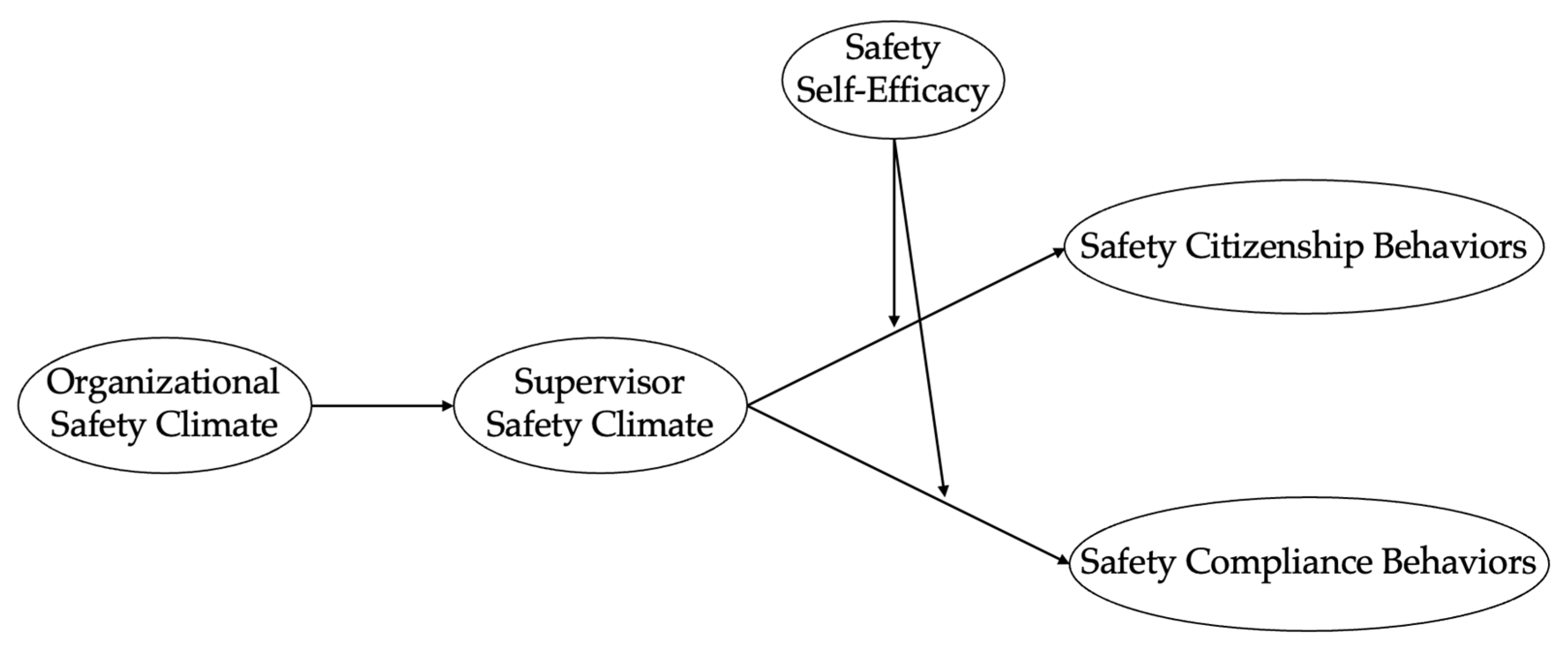
Throughout this article, we refer to organizational and supervisor safety climate as such for brevity and clarity; however, these variables are to be understood as employees’ individual perceptions of these climates [54], as we do not measure any of our variables at the organization or group level (see method section for details). Consequently, as one of three areas of investigation, the present study will test the following hypotheses:
H1: 
The relationship between organizational safety climate and compliance behaviors will be mediated by the supervisor safety climate.
H2: 
The relationship between organizational safety climate and safety citizenship behaviors will be mediated by the supervisor safety climate.

1.5. A Model of Workplace Safety and Self-Efficacy

Given the substantial research into safety in the workplace, there exists a very large array of factors known to predict safety outcomes. A meta-analysis by Christian et al. [9] found support for a unifying model depicting the relationship between these factors. It was found that the impact of distal situational factors (i.e., safety climate) and distal person-related factors (i.e., conscientiousness) on safety performance and outcomes was mediated by proximal person-related factors, such as safety motivation and safety knowledge [13,31]. Essentially, Christian et al. [9] argued that distal factors influence an individual’s motivation and knowledge regarding safety; these factors then impact safety performance behaviors, which ultimately lead to an effect on safety outcomes, such as near misses, injuries and accidents. Though the present study does not directly assess employee safety motivation, self-efficacy is arguably one of the most heavily researched cognitive factors known to influence motivation and predict engagement in specific behaviors [8,51,55]. As such, an investigation that considers the impact of factors such as safety climate and self-efficacy on safety behavior outcomes may yield valuable findings.
Self-efficacy can be defined as a personal belief of “how well one can execute courses of action required to deal with prospective situations” [56]. An individual’s perception of their own self-efficacy often determines the difficulty of the goal selected, how much effort they apply to the task, and how long they persist in the face of challenges [31,57,58]. Researchers have distinguished between two types of self-efficacy: general and task-specific self-efficacy. General self-efficacy is thought to be a global and almost trait-like form of self-efficacy, formed via aggregation of successes or failures across multiple domains [59]. Task-specific self-efficacy, however, relates to an individual’s domain-specific cognitions, an example being self-efficacy for dieting [57]. Researchers more frequently investigate task-specific self-efficacies, as measures of general self-efficacy are less able to predict specific motivational and behavioral outcomes [60,61,62].
A seminal study by Katz-Navon, Naveh and Stern [63] explored the role of self-efficacy in predicting near misses for nurses in a general hospital setting. Similar to previous researchers, Katz-Navon et al. [63] found that while the measure of safety-specific self-efficacy predicted near misses, the measure of general self-efficacy did not. This study provides initial evidence that safety self-efficacy may play a significant role in predicting safety-related outcomes [45]. As previously mentioned, researchers Griffin and Neal [26] have emphasized the need to assess multiple safety behaviors, such as compliance and safety citizenship behaviors. Regarding this, Zohar proposes that organizations benefit from a combination of compliance and safety citizenship behaviors, as compliance provides reliability in highly standardized environments, whereas in less frequent or unusual circumstances, safety citizenship behaviors improve overall safety capacity [32,37,38]. Consequently, the present study’s investigation into the role of self-efficacy will consider both compliance and safety citizenship behavioral outcomes [64,65].
Few studies have investigated the role of self-efficacy in predicting safety outcomes, and even fewer have looked specifically at whether self-efficacy is able to predict safety compliance behaviors [43]. In other research domains, researchers Chan, Woon and Kankanhalli [66] considered the impact of information security climate and information security self-efficacy on compliant behavior. Using measures mostly adapted from the safety literature, the authors found that both information security climate and information security self-efficacy were able to explain significant variance in compliance behaviors [36,37]. Similarly, the present study expects that safety self-efficacy will be related to compliance behaviors. The hypothesis regarding this is as follows:
H3: 
Safety self-efficacy will be positively related to compliance behaviors.
Within the empirical literature, several studies have explored the relationship between self-efficacy and organizational citizenship behaviors, though rarely within the domain of safety in the workplace. In a study involving university and government employees, Beauregard [67] posited that given individuals with higher self-efficacy employ more adaptive behavioral strategies [68,69], they are more likely to be aware of which citizenship behaviors are most suitable across a range of workplace scenarios, and they are more likely to be able to plan for and execute such behaviors. Consistent with this, Beauregard’s [67] study demonstrated that general self-efficacy is a significant predictor of organizational citizenship behaviors, with other studies finding similar results [70,71]. With regard to safety citizenship behaviors, the aforementioned qualities of individuals with high self-efficacy could manifest via such individuals being more likely to assist others to work safely, becoming involved in voluntary safety meetings or trying to improve safety procedures. It remains to be seen if Beauregard’s [67] findings relating to general self-efficacy and organizational citizenship behaviors can be replicated for safety self-efficacy and safety citizenship behaviors. Consequently, the present study seeks to test this relationship via the following hypothesis.
H4: 
Safety self-efficacy will be positively related to safety citizenship behaviors.

1.6. Safety Self-Efficacy and Supervisor Safety Climate

Christian et al.’s [9] meta-analysis showed that one of the strongest predictors of safety performance is supervisor safety climate. Christian et al. [9], Akanni et al. [72] and Byeon et al. [55] posit that safety climate exerts an effect on safety behavior in accordance with Campbell et al.’s [73] theory of performance [10,74]. This theory posits that the performance of behavior is determined by knowledge, skills and motivation to perform [75]. Given that task-specific self-efficacy is most often a product of previous successes or failures [62], there is arguably an intrinsic link between safety self-efficacy and safety knowledge, such that, logically, safety self-efficacy should require safety knowledge as a prerequisite [13,31]. Accordingly, the presence of safety self-efficacy may serve as an enabling factor, which empowers employees who have been motivated by the supervisor safety climate to actually engage in safe behavior [14,43,51].
This supposition is consistent with elements of the theory of planned behavior [76], whereby a self-efficacious belief in one’s ability to engage in a behavior combines with an individual’s perception of supervisor beliefs and behaviors, resulting in both intention and actual performance of the behavior [37]. For example, although employees in positive supervisor safety climates are motivated to work safely, if they lack the safety self-efficacy to act in ways consistent with this climate, then the relationship between supervisor safety climate and safety behavior outcomes will be weak [45]. Therefore, the present study expects that safety self-efficacy will moderate the relationship between supervisor safety climate and the safety behavior outcome variables, compliance, and safety citizenship behaviors [12,72].
The hypotheses regarding this are as follows:
H5: 
Safety self-efficacy will moderate the relationship between supervisor safety climate and compliance behaviors (i.e., stronger positive relationships when safety self-efficacy is high).
H6: 
Safety self-efficacy will moderate the relationship between the supervisor safety climate and safety citizenship behaviors (i.e., stronger positive relationships when safety self-efficacy is high).
Figure 1 provides a visual representation of the hypothesized research model.

2. Materials and Methods

2.1. Research Context and Participants

Industrial context. Cross-sectional data was obtained with a survey questionnaire from individuals employed at a large Russian chemical manufacturing plant affiliated with a broader multinational company active in the tobacco production business (Philip Morris Int., Saint Petersburg, Russian Federation). Overall, approximately 2000 workers were active in the plant, including employees and contractors. However, the research project involved only workers deployed in three production departments, allocated to the manufacture, treatment, and refinement of tobacco vegetable fibers. A significant part of the production processes in these departments is automated, and the functioning of the machinery and manufacturing lines is monitored by work teams composed of a variable number of operators, with many teams working simultaneously at different points of the manufacturing lines, and under a periodic shift rotation schedule. The individuals in each team reported to a single supervisor, who, in turn, reported directly to a superior manager of the department. In terms of risks for health and safety of the workforce, different sources of hazards include personal exposure to biological agents (bacteria, viruses, and parasites), exposure to chemical agents (nicotine, ammonia, and dehydrogenated alcohol), fire risk, and exposure to flammable products, as well as injury risks in the interaction with the machinery. The selection of the three production departments was driven by research reasons, as only in these three departments of the plant were work activities conducted within work teams or in safety-critical work contexts, with relevant risks for the health and safety of the workers in case of accidents. This choice appears to be coherent with the definition of safety climate provided by Zohar and Luria [6], which posits safety climate as a collective and shared perceptual phenomenon created by work teams in an organization. This choice was also coherent with our aim to investigate social phenomena in teams, such as safety citizenship behaviors, which entail a certain degree of interdependence in the work activities.
Participants. Questionnaires were collected from 728 employees, giving a response rate of 75.1%. Of the employees who completed the questionnaire, 90.4% were male. The average age of employees in the whole sample was 31 years (SD = 6; min. = 22; max = 58). Just over half of participants were educated to a high school diploma level (54.2%). In total, 35% participants reported job tenure between two and five years, and 32% reported job tenure between five and ten years. Fewer participants reported job tenure higher than ten years (21%), and even fewer had job tenure of less than two years (11%). In terms of typology of work activities, the majority of the participants (57%) were deployed in the larger manufacturing department allocated to the secondary assemblage of vegetable materials, with the remaining respondents deployed in the primary department responsible for the early treatment and storage of raw vegetable materials (23%) or in the third filter-making production department (21%).

2.2. Questionnaire Linguistic Translation and Adaptation in the Russian Language

All the measurement scales described in the following section were translated from English (the original versions) to Russian using the back-translation method. First, a certified translator with a psychological background translated the scales from English to Russian. Thereafter, two bilingual industry managers with expertise in occupational safety back-translated the scale back into English. The original and back-translation versions were then compared, and no translation issues were detected, apart from for two items of the safety self-efficacy scale, which originally referred to patient safety in healthcare research and, therefore, were considered inappropriate for use in the present industrial context. Therefore, only four of the original six items were kept in the Russian questionnaire administered to the workforce.

2.3. Measures

Organizational Safety Climate. Organizational safety climate was measured via Zohar and Luria’s [6] Organizational-Level Safety Climate Questionnaire. The measure consisted of 16 items; participants responded to items on a 5-point Likert scale ranging from 1 (strongly disagree) to 5 (strongly agree). Factor analytical studies have demonstrated that measures of safety climate tend to have a higher order or global factor [3,26]. At an organizational level, this tends to be described as management commitment to safety, whereas disagreement exists around the naming and meaning of first-order factors [16]. Example items of this measure include “Top management in this plant: reacts quickly to solve problems when told about safety hazards” and “Top management in this plant: is strict about working safely when work falls behind schedule”. In the present sample, the Cronbach alpha reliability index of the scale was 0.93.
Supervisor Safety Climate. Supervisor safety climate was measured via Zohar and Luria’s [6] Safety Climate Questionnaire. The measure consisted of 16 items; participants responded to items on a 5-point Likert scale ranging from 1 (strongly disagree) to 5 (strongly agree). In line with the organizational safety climate measure and Zohar and Luria’s [6] conceptualization, supervisor safety climate was also treated as an aggregated global measure of the priority supervisors give to safety. Example items include “My supervisor emphasizes safety procedures when we are working under pressure” and “My supervisor frequently checks to see if we are all obeying the safety rules”. In the present sample, the Cronbach alpha index of the scale was 0.94.
Safety Self-Efficacy. Safety self-efficacy was measured by using four items from Katz-Navon et al.’s [63] safety self-efficacy measure. The wording of the questions was slightly adapted to reflect a manufacturing context, as the original scale was validated for healthcare safety research. The measure consisted of four items; participants responded to items on a 7-point Likert scale ranging from 1 (strongly agree) to 7 (strongly disagree). Example items include: “I feel confident: managing risks in the workplace” and “I feel confident: preventing hazardous conditions in my work area”. In the present sample, the Cronbach alpha index of the scale was 0.89.
Safety Compliance. Behaviors relating to safety compliance were measured via a generalized safety compliance subscale contained within Hansez and Chmiel’s [77] safety behavior measure. The subscale consists of five items; participants responded to items on a 5-point Likert scale ranging from 1 (strongly disagree) to 5 (strongly agree). The Russian version of this scale showed factor and discriminant validity in a pre-existing study conducted by Renecle et al. [18]. Example items include “I always use safety equipment, even when it’s inconvenient and uncomfortable” and “I always carry out my work in a safe manner”. The Cronbach alpha index of the scale was 0.82.
Safety Citizenship Behaviors. Safety citizenship behaviors were measured via Hofmann, Morgeson, and Gerras’s [42] scale. The measure consisted of 27 items and the following six subscales: helping, voice, stewardship, whistleblowing, civic virtue and initiating safety-related change. Items were phrased so that participants responded regarding the frequency with which they engaged in specific behaviors. The subscales were combined to form an aggregated and unidimensional measure of safety citizenship behaviors, as findings from Lepine, Erez and Johnson’s [78] meta-analysis suggested that the closely related construct of organizational citizenship behavior is likely to be unidimensional. This is also coherent with a pre-existing cross-national study on the stability of the psychometric properties of the same questionnaire [79], which revealed a good statistical fit of a measurement model with a general super-ordinate factor of safety citizenship with six sub-dimensions. Participants responded to items on a 5-point Likert scale ranging from 1 (never) to 5 (frequently). Example items include “I take action to protect members of the group from risky situations”, “I make recommendations to colleagues on the safety of work activities”, and “I try to improve work procedures to make them safer”. The Cronbach alpha index of the scale was 0.96.

2.4. Procedure

The survey was administered in the context of a research project conducted between 2012 and 2014, where the leading researcher had the chance to familiarize and understand the multinational safety standards and production processes in place in the plant. The questionnaires for the present study were collected in the first quarter of 2012. Questionnaires were distributed to individual employees in a sealed envelope, which also included instructions for completing the questionnaire. This was done at the beginning of regular monthly meetings. Participation was voluntary, and all the participants were guaranteed anonymity and confidentiality and informed that their responses would be used mainly for scientific purposes, with a short summary of the overall findings to be submitted to their company for the purposes of organizational learning to gain insight into safety culture improvements in each department.

2.5. Informed Consent

Informed consent was obtained from all subjects involved in the study. Before filling out the questionnaire, each participant was given a brief informed consent document outlining the scientific aims of the research. By agreeing to voluntarily participate in the study by completing the questionnaire, each participant also agreed that the data provided with their answers would be statistically analyzed in an aggregate form and used in future scientific publications.

2.6. Data Screening and Analyses

Analyses were conducted using Mplus 8.10. The data was initially screened for outliers and missing values. As data that is missing in a systematic manner can be problematic, Little’s MCAR test was conducted. The results suggest that systematically missing data is unlikely to be an issue with the present sample, and that data was “missing completely at random”—χ2 (8747, N = 728) = 8763.71, p = 0.448. No variable exceeded 5% missing data. Univariate outlier Z-scores of a magnitude larger than 3.29 were assigned a new value one unit larger (or smaller) than the next most extreme score [80]. Data were analyzed via structural equation modeling, as this allows for multivariate analysis of a theoretical structure [81]. Given that the data in the present study is cross-sectional, the results should be interpreted with caution [82]. All models were estimated using a robust maximum likelihood estimator. Model fit to the data was assessed holistically [83], including indices of global fit, residuals, modification indices, theory, and parameter estimates.

3. Results

3.1. Preliminary Analyses

Means, standard deviations, reliability coefficients (Cronbach’s alpha) and correlations among study variables are presented in Table 1. Before estimating the structural relationships, we estimated a confirmatory factor analysis (CFA) model to ensure the measurement model fit the data satisfactorily [83]. Given that the safety citizenship scale included 27 items organized into six subdimensions, we used item parcels in the CFA to obtain a more parsimonious model with more reliable indicators by averaging out idiosyncratic item-specific variance, improving distributional properties, and stabilizing parameter estimates. Specifically, we formed one parcel per subdimension, under local unidimensionality, which is acceptable when the analytic focus is on latent relations rather than item-level diagnostics, as outlined by Little et al. [84]. For a similar approach used with the same scale, see Curcuruto et al. [79]. We estimated a CFA model including organizational safety climate, supervisor safety climate, safety citizen behaviors, safety compliance behaviors, and safety self-efficacy. The model fit the data marginally but could be improved (χ2(979) = 2892.69, CFI = 0.89, RMSEA = 0.05, SRMR = 0.06). To this end, we added a correlation between items 7 and 8 of the supervisor safety climate scale: these items are semantically close; hence, it is reasonable to assume (and model) that they may share variance. Doing so improved the model fit to the data (χ2(978) = 2780.17, CFI = 0.90, RMSEA = 0.05, SRMR = 0.05). Inspecting the residual matrix, no ill-fit was detected, and standardized parameter estimates were all substantial (range: 0.61–0.90) and significantly different from zero.

3.2. Mediation Analysis

Following recommendations [85], we evaluated mediation by estimating the direct and indirect effects and their confidence interval rather than classifying results as “full” or “partial” mediation. Parameter estimates, standard errors, p-values, and normal theory confidence intervals are presented in Table 2.
As predicted in Hypothesis 1, the effect of individual perceptions of organizational safety climate on safety citizenship behaviors was mediated by individual perceptions of supervisor safety climate (b = 0.27, p < 0.001; see Table 2 for estimates of the a and b paths of the mediation model). Similarly, Hypothesis 2 was supported: the effect of individual perceptions of organizational safety climate on safety compliance behaviors was mediated by individual perceptions of supervisor safety climate (b = 0.17, p < 0.001; see Table 2 for estimates of the a and b paths of the mediation model).

3.3. Moderation Analysis

The direct effects of safety self-efficacy on safety compliance and safety citizenship behaviors were both significant (b = 0.62, p < 0.001, and b = 0.47, p < 0.001, respectively), supporting Hypotheses 3 and 4. These results are also reported in Table 2.
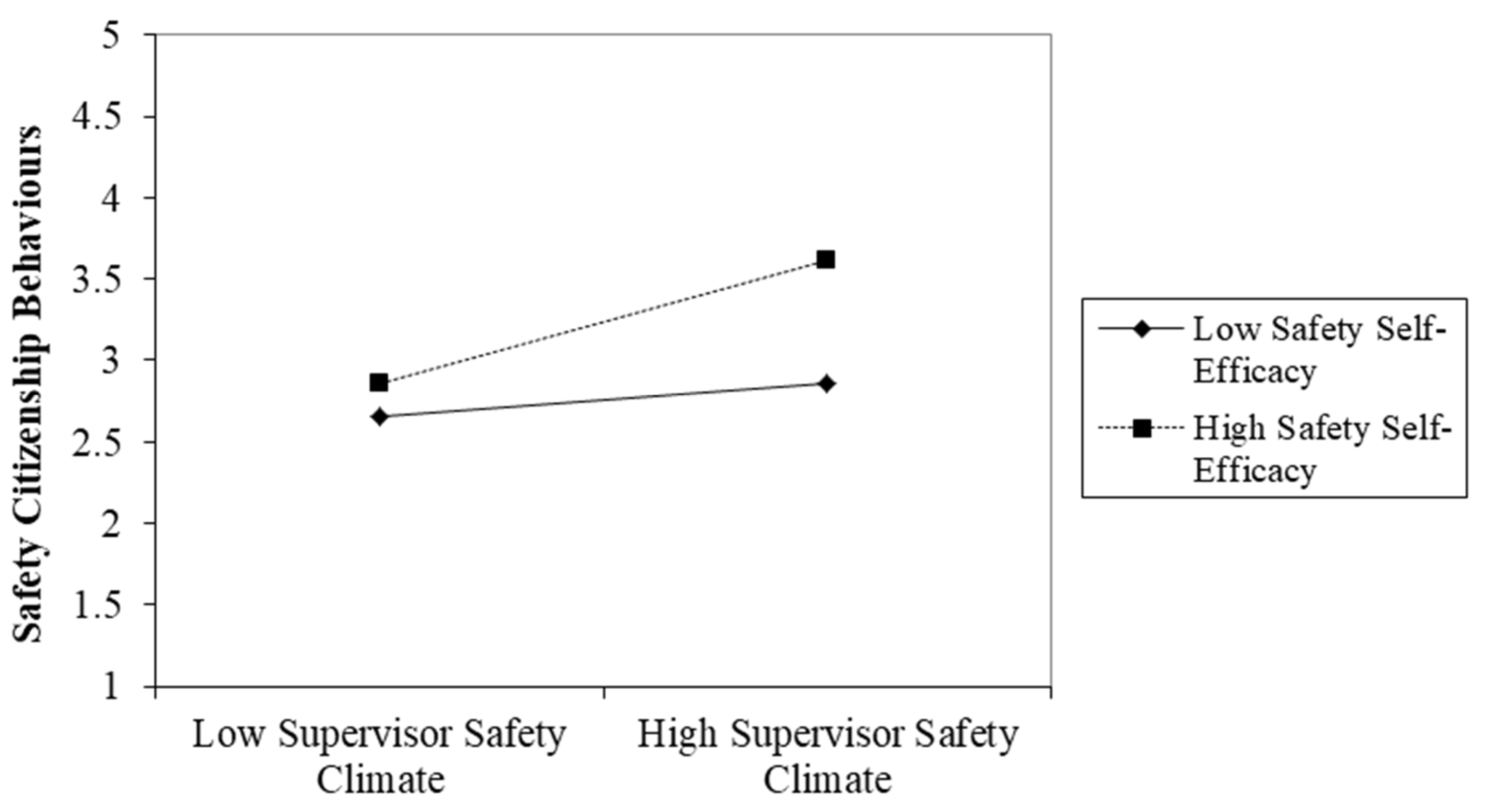
We estimated a latent moderation model (see Klein & Moosbrugger [86] for details) to test Hypotheses 5 and 6. With regard to safety compliance, the latent interaction term was not significant (b = −0.11, SE = 0.08, p = 0.17, 95% CI (−0.26, 0.05)); hence, Hypothesis 5 was not supported. However, with regard to safety citizenship behaviors, the latent interaction term was significant (b = 0.26, SE = 0.11, p = 0.02, 95% CI (0.05, 0.48)); hence, Hypothesis 6 was supported. The interaction is shown in Figure 2: as can be seen, individual perceptions of supervisor safety climate were more strongly associated with safety citizenship behaviors when perceptions of safety self-efficacy were higher.

4. General Discussion

The present study had three aims: firstly, to examine the route through which organizational and supervisory safety climate influence safety behavior outcomes; secondly, to investigate whether a direct relationship exists between self-efficacy and safety behavior outcomes; and thirdly, to explore whether self-efficacy influences the relationship between safety climate and safety behavior outcomes. The following discussion summarizes the results in relation to these aims, contextualizes the findings with regard to the existing literature, suggests theoretical and practical implications, and finally highlights the limitations and directions for future research.

4.1. Supervisor Safety Climate as a Mediator

The present study found that supervisor safety climate mediated the relationship between organizational safety climate and the outcomes, compliance and safety citizenship behaviors. These findings suggest that both organizational and supervisor safety climate influence the degree to which employees engage in compliance and safety citizenship behaviors, as recent studies seem to suggest [4,24]. Such results run contrary to Simard and Marchand’s [52,53] studies, which found that organizational-level influences provide limited incremental effects over supervisory practices. The mediation evidence found in the current study, however, suggests that some of the explanatory power of organizational safety climate is accounted for by the supervisor safety climate, as the direct effect of the organizational climate was also significant. A possible mechanism for this is that, given their proximity to employees, the safety climate established by a supervisor has a substantial impact. Further, given this proximity, the frequency and immediacy of outcomes from supervisors are deemed more salient than some, but perhaps not all, outcomes from less immediate sources, such as organizational policies [6].

4.2. Main Effect of Safety Self-Efficacy on Compliance and Safety Citizenship Behaviors

As task-specific self-efficacies have been shown to be strong predictors of behavior [8], the current study examined safety self-efficacy’s direct relationship with safety behavior outcomes. The results demonstrated that safety self-efficacy was positively related to compliance behaviors. This is consistent with Chan et al.’s [66] study, which similarly found that task-specific self-efficacy was positively related to compliance behaviors.
The results also show that safety self-efficacy was associated with engagement in safety citizenship behaviors. Few comparable studies exist, though previous researchers have found that higher general self-efficacy is associated with greater organizational citizenship behaviors [67]. A unique contribution of the present study, therefore, is that the task-specific self-efficacy (i.e., safety self-efficacy) was positively related to safety citizenship behaviors, a valuable yet seldom explored relationship in the safety literature. A possible explanation of this relationship is that individuals who display higher levels of safety self-efficacy are more able to engage in compliance and safety citizenship behaviors because they are better equipped to cope with and persist in the face of challenges [57,58]. For example, an employee with high safety self-efficacy may continue to wear personal protective equipment or assist co-workers with safety issues even when doing so is especially difficult. The results regarding the main effect of safety self-efficacy on safety outcomes are consistent with a study by Katz-Navon et al. [63], which found that higher safety self-efficacy was associated with fewer near-miss incidents. Taken together, the results of Katz-Navon et al. [63] and the present study suggest that safety self-efficacy is related to both behavioral and objective safety outcomes.

4.3. Safety Self-Efficacy as a Moderator

A key finding of this study was that safety self-efficacy moderates the relationship between supervisor safety climate and safety citizenship behaviors. That is, when safety self-efficacy is higher, the relationship between supervisor safety climate and safety citizenship behaviors is stronger. A substantial amount of research has found that supervisor safety climate provides a motivational force on employees to engage in safe behaviors [6,9,24,39] Despite this, the theory of planned behavior [76] purports that in addition to an individual’s perception of supervisor beliefs and behaviors (i.e., supervisor safety climate), individuals must have a self-efficacious belief in their own ability to successfully perform a behavior.
In contrast, safety self-efficacy did not moderate the relationship between supervisor safety climate and compliance behaviors. Safety self-efficacy did, however, have a direct relationship with compliance behaviors. This suggests that the supervisor safety climate is able to motivate employees to comply with safety procedures regardless of the level of an individual’s safety self-efficacy. This may be due to the limited complexity of compliance behaviors [38], which are unlikely to require an “enabling” force of safety self-efficacy, as required for safety citizenship behaviors. Instead, in situations where the supervisor safety climate is positive, employees will be strongly motivated to comply with safety procedures and will do so successfully.

4.4. Theoretical Implications

Our results provide further support for the role of safety self-efficacy in safety performance theory by demonstrating direct, positive associations with both compliance and safety citizenship behaviors. This extends classic evidence that efficacy beliefs are proximal, energizing determinants of work performance to the safety domain, where the focus on climate constructs has tended to eclipse person-centered mechanisms [8,9]. Specifically, the pattern we observed is consistent with the broader performance literature, in which self-efficacy facilitates effort initiation and persistence under constraint while complementing—but not substituting for—contextual supports. In safety settings, this means that capability beliefs help employees enact both routine and discretionary safety behaviors. In short, theories that privilege climate as the sole proximal antecedent under-specify the agentic capacity required to translate priorities into action; our findings support elevating safety self-efficacy to a core antecedent of safety behavior, alongside climate.
At the same time, our findings clarify how climate exerts its influence: the supervisor safety climate mediated the link from organizational safety climate to safety behaviors, supporting a model in which distal, organization-level signals are translated into frequent, concrete supervisory behaviors that then influence employee behavior. This is consistent with the wider climate literature showing that organizational climate shapes behavior primarily through workgroup-level climates and that variation at the supervisory layer reflects discretion in implementing competing priorities, such as safety versus productivity [6]. Beyond supervisors, complementary evidence indicates that other proximal “safety agents” (e.g., co-workers) can transmit and amplify distal climate, further underscoring the need to model other pathways rather than treat organizational and local climates as rival predictors [3].
Our findings also differentiate motivational pathways for compliance versus citizenship behaviors. The absence of moderation by safety self-efficacy in the supervisor climate → compliance path, paired with a significant moderation for citizenship behaviors, suggests that robust supervisory cues are often sufficient to elicit routinized, rule-bound compliance, whereas discretionary, change-oriented contributions require an enabling capability belief to convert priorities into extra-role behaviors. This pattern is in line with meta-analytic work that parses safety performance into distinct subdimensions and shows that antecedents can differentially predict compliance versus participation. It also aligns with evidence that citizenship behaviors include both prosocial and proactive forms whose enactment depends on motivational resources internalized by the individual [9,39]. Thus, theorizing safety performance as an overall criterion risks masking pathway-specific results; distinguishing outcomes instead yields sharper predictions.
Finally, the evidence positions safety self-efficacy as both a driver of behavior and a boundary condition that amplifies the effect of supervisor climate on citizenship behaviors. This dual role aligns with broader person–situation accounts in safety, which show that individual motivational resources and contextual signals jointly determine safety behavior, and it parallels prior work in healthcare demonstrating that the influence of efficacy can depend on the surrounding system design (e.g., standardization), highlighting its boundary-conditioning function [9,63].

4.5. Practical Implications

The pattern of findings indicates that organizations should treat safety self-efficacy as a buildable resource and not merely a dispositional correlate of performance. Capability-building tactics that emphasize enactive mastery, credible role modeling, and specific informational feedback are likely to raise safety self-efficacy and, in turn, day-to-day safe behavior [8,63]. In practice, this means designing short, scenario-based skill drills that allow employees to succeed progressively under realistic constraints; pairing less experienced workers with high-reliability exemplars; and giving granular feedback tied to observable behaviors rather than generic safety slogans [8,63]. Because our data show efficacy’s direct effect on compliance and safety citizenship, these interventions should be embedded close to the job (e.g., in pre-task briefings and post-task debriefs) so that belief change coincides with opportunities to act. This positioning is consistent with evidence that efficacy affects effort initiation and persistence when demands are high, which is precisely when safety lapses are more likely [8].
A key implication of the differentiated effects across outcomes is that compliance and safety citizenship should be developed through partially distinct pathways. For compliance, strong proximal cues from supervisors, such as clear rules, consistent monitoring, and timely corrective feedback, may be sufficient, given the routinized nature of these behaviors [9]. For safety citizenship, however, organizations should couple those same supervisory cues with efficacy-enhancing and voice-enabling practices (e.g., suggestion systems with visible uptake, briefings that solicit input, and time allowances for helping and improvement) because citizenship behaviors are discretionary and more effortful [9,38,39]. In practical terms, leaders should not expect the same intervention to impact both outcomes equally; a compliance-focused “rules-plus-monitoring” intervention can drive quick compliance increases, whereas a citizenship-oriented intervention must add capability and opportunity to contribute beyond formal role expectations [9,38,39].

4.6. Limitations and Directions for Future Research

The main limitation of this study is that the cross-sectional design does not allow for conclusions related to causality [81]. Further, as the data was collected at one time point, the directionality of the relationships cannot be established [81] using statistics. As such, we relied on theory to choose the ordering of variables. For this reason, we need to emphasize the need for future study replication relying on longitudinal or cross-lagged research designs to test the direction of causality among the different variables included in our proposed model. A longitudinal approach would also allow for the inclusion of lagging safety metrics, such as accident and injury rates, into the study design as objective outcomes. This was not possible in the present cross-sectional study.
In addition, by collecting all data at one time point, the current study only utilized self-report measures. Both of these factors may have introduced common method issues, such as inflation of the parameter estimates. A meta-analysis by Christian et al. [9] concluded that this inflationary bias is unlikely to be a major issue for self-reported climate measures or self-reported safety behavior measures. Despite this, future studies should consider using multiple sources of data to triangulate the measurement of constructs, for example, by utilizing peer or supervisor ratings of engagement in compliance and safety citizenship behaviors.
Finally, future studies could also assess whether existing measures of safety self-efficacy are well suited for predicting safety citizenship behaviors or specific sub-dimensions thereof. In the present study, we chose to use an existing scale of safety self-efficacy already published prior to our research project. However, we need to recognize that the measure of safety self-efficacy used is relatively brief and unidimensional, which may be more sensitive to measuring safety self-efficacy for compliance behaviors (like adhering to safety procedures and risk management standards) than for citizenship behaviors (like communication and peer-to-peer support). For this reason, it is recommended that future efforts should focus on the development and validation of a multidimensional safety self-efficacy scale that includes both citizenship and compliance behavior as foci.

5. Conclusions

The present study aimed to investigate the role of safety self-efficacy in predicting safety behavior outcomes and its relationship with supervisor safety climate. The results of this study provide several unique contributions to the literature. Contrary to previous research [6], the supervisor safety climate mediated the relationship between organizational safety climate and the outcome variables, compliance and safety citizenship behaviors. Additionally, safety self-efficacy was positively related to compliance and safety citizenship behaviors. Safety self-efficacy also moderated the relationship between supervisor safety climate and safety citizenship behaviors, such that a stronger positive correlation between safety citizenship behaviors and supervisor safety climate was present when safety self-efficacy was high. Consequently, safety self-efficacy not only directly impacted safety outcomes but likely served as an enabling factor, which empowered employees who had been motivated by the supervisor safety climate to actually engage in safety citizenship behaviors. To capitalize on these findings, organizations should aim to increase employee safety self-efficacy by encouraging supervisors to model appropriate safety behaviors, by implementing adequate safety training programs and by ensuring information about safety hazards and previous safety incidents is disseminated.

Author Contributions

Conceptualization, M.C., N.T.L. and J.M.; methodology, M.C. and N.T.L.; software, A.B., A.D.V., R.L. and V.V.; validation, M.C. and N.T.L.; formal analysis, A.B.; investigation, N.T.L., M.C., R.L., A.D.V. and V.V.; resources, N.T.L. and M.C.; data curation, N.T.L. and M.C., writing—original draft preparation, N.T.L., M.C., R.L. and A.D.V.; writing—review and editing, M.C., J.M., A.B. and V.V.; visualization, M.C., R.L., A.B. and A.D.V.; supervision, M.C.; project administration, M.C.; funding acquisition, M.C. All authors have read and agreed to the published version of the manuscript.

Funding

Part of the study was funded with a Marco Polo grant delivered internally by the Department of Psychology at the University of Bologna and awarded to Matteo Curcuruto for international mobility during the academic year 2012-13 (Funding number not applicable).

Institutional Review Board Statement

This study was conducted in accordance with the Declaration of Helsinki. The project received approval from the Ce.trans Research Centre and the Centre for Business Skills Development (CBSD) (protocol code: 88; date of approval: 28 October 2011).

Informed Consent Statement

Informed consent was obtained from all subjects.

Data Availability Statement

Subject to industry partner approval, the data is available from the corresponding authors upon request.

Acknowledgments

This project took place when Matteo Curcuruto was a post-doctoral research fellow at the University of Bologna. Data were collected within the framework of a research consultancy project between the Ce.Trans Research Centre at the University of Bologna and the Center for Business Skills Development (CBSD). The authors desire to express their gratitude to Mark Griffin and the Centre for Safety at the University of Western Australia for their precious valuable advice and support during the project. Some of the preliminary results presented in this article were part of Nicholas Lilleyman’s dissertation at the University of Western Australia.

Conflicts of Interest

The authors declare no conflicts of interest.

References

  1. Chen, Y.; Huang, W.; Li, H. Relationship between error management climate and workers’ safety performance in construction enterprises. China Saf. Sci. J. CSSJ 2022, 32, 28–34. [Google Scholar]
  2. Zohar, D. A group-level model of safety climate: Testing the effect of group climate on microaccidents in manufacturing jobs. J. Appl. Psychol. 2000, 85, 587. [Google Scholar] [CrossRef]
  3. Brondino, M.; Bazzoli, A.; Peiró, J.M.; Pasini, M. Safety climate, safety behaviors, and workplace accidents: What are the mechanisms? A multi-level lagged study. J. Saf. Res. 2025, 94, 459–468. [Google Scholar] [CrossRef] [PubMed]
  4. Morgan, J.; Jackson, L.; Curcuruto, M. Multilevel Safety Climate for Lone Heavy Vehicle Drivers in the UK Quarrying Industry: Validation of the Heavy Vehicle Safety Climate Scale (HVSCS). Safety 2025, 11, 86. [Google Scholar] [CrossRef]
  5. Qabool, S.; Jalees, T.; Aziz, A.; Anwar, A.; Pahi, M.H. Consequences of ethical leadership with the mediating role of self-efficacy and workplace climate. Acad. Strateg. Manag. J. 2021, 20, 1–13. [Google Scholar]
  6. Zohar, D.; Luria, G. A multilevel model of safety climate: Cross-level relationships between organization and group-level climates. J. Appl. Psychol. 2005, 90, 616. [Google Scholar] [CrossRef]
  7. Tian, X.; Chae, H.; Song, D.; Zhang, Y. Leader prohibitive voice shapes employee voice through psychological safety moderated by self-efficacy and generational differences. Sci. Rep. 2025, 15, 31469. [Google Scholar] [CrossRef] [PubMed]
  8. Stajkovic, A.D.; Luthans, F. Self-efficacy and work-related performance: A meta-analysis. Psychol. Bull. 1998, 124, 240. [Google Scholar] [CrossRef]
  9. Christian, M.S.; Bradley, J.C.; Wallace, J.C.; Burke, M.J. Workplace safety: A meta-analysis of the roles of person and situation factors. J. Appl. Psychol. 2009, 94, 1103. [Google Scholar] [CrossRef]
  10. Cui, L.; Mo, J. How Does Supportive Leadership Impact the Safety Behaviors of the New Generation of Construction Workers? Behav. Sci. 2025, 15, 110. [Google Scholar] [CrossRef] [PubMed]
  11. Loeb, C.; von Thiele Schwarz, U.; Hasson, H.; Tafvelin, S. Congruence rules! Increased self-efficacy after occupational health interventions-if leaders and teams agree on the participative safety climate. Scand. J. Work Organ. Psychol. 2022, 7, 8. [Google Scholar] [CrossRef]
  12. von Thiele Schwarz, U.; Hasson, H.; Tafvelin, S. Leadership training as an occupational health intervention: Improved safety and sustained productivity. Saf. Sci. 2016, 81, 35–45. [Google Scholar] [CrossRef]
  13. Xu, Z.; Wang, X.; Jin, X.; Zhou, M. The influence of proactive personality on laboratory safety attitude of graduate students: Chain mediating role of safety self-efficacy and safety motivation. Educ. Chem. Eng. 2025, 53, 56–61. [Google Scholar] [CrossRef]
  14. Sharma, V.; Carroll, M.; Mehta, R. A Theoretical Model to Understand Flight Instructors’ Safety Behaviors in the United States: Through Personality Traits, Self-Efficacy, Risk Perception, and Safety Climate. Coll. Aviat. Rev. Int. 2025, 43, 82–105. [Google Scholar]
  15. Zohar, D. Safety climate in industrial organizations: Theoretical and applied implications. J. Appl. Psychol. 1980, 65, 96. [Google Scholar] [CrossRef] [PubMed]
  16. Griffin, M.A.; Curcuruto, M. Safety climate in organizations. Annu. Rev. Organ. Psychol. Organ. Behav. 2016, 3, 191–212. [Google Scholar] [CrossRef]
  17. Platania, S.; Morando, M.; Caruso, A.; Scuderi, V.E. The Effect of Psychosocial Safety Climate on Engagement and Psychological Distress: A Multilevel Study on the Healthcare Sector. Safety 2022, 8, 62. [Google Scholar] [CrossRef]
  18. Renecle, M.; Curcuruto, M.; Gracia Lerín, F.J.; Tomás Marco, I. Enhancing safety in high-risk operations: A multilevel analysis of the role of mindful organising in translating safety climate into individual safety behaviours. Saf. Sci. 2021, 138, 105197. [Google Scholar] [CrossRef]
  19. Shuler, L. Workers and Technology. Issues Sci. Technol. 2025, 41. Available online: https://issues.org/workers-technology-forum/ (accessed on 2 April 2026).
  20. Silla, I.; Gajudo, J.-A.; Gracia, F.J. Safety in high-reliability organizations: The role of upward voice, team learning, and safety climate. J. Saf. Res. 2025, 93, 55–65. [Google Scholar] [CrossRef]
  21. Griffin, M.A.; Cordery, J.; Soo, C. Dynamic safety capability: How organizations proactively change core safety systems. Organ. Psychol. Rev. 2016, 6, 248–272. [Google Scholar] [CrossRef]
  22. Bayramova, A.; Edwards, D.J.; Roberts, C.; Rillie, I. Constructs of leading indicators: A synthesis of safety literature. J. Saf. Res. 2023, 85, 469–484. [Google Scholar] [CrossRef]
  23. Payne, S.C.; Bergman, M.E.; Beus, J.M.; Rodríguez, J.M.; Henning, J.B. Safety climate: Leading or lagging indicator of safety outcomes? J. Loss Prev. Process Ind. 2009, 22, 735–739. [Google Scholar] [CrossRef]
  24. Todaro, N.M.; Testa, F.; Rizzi, F.; Vizzoto, F.; Curcuruto, M. Safety climate in high safety maturity organisations: Development of a multidimensional and multilevel safety climate questionnaire. Saf. Sci. 2023, 166, 106231. [Google Scholar] [CrossRef]
  25. Clarke, S. An integrative model of safety climate: Linking psychological climate and work attitudes to individual safety outcomes using meta-analysis. J. Occup. Organ. Psychol. 2010, 83, 553–578. [Google Scholar] [CrossRef]
  26. Griffin, M.A.; Neal, A. Perceptions of safety at work: A framework for linking safety climate to safety performance, knowledge, and motivation. J. Occup. Health Psychol. 2000, 5, 347. [Google Scholar] [CrossRef]
  27. Znajmiecka-Sikora, M.; Sałagacka, M. Analysis of the relationship between psychological gender and risk perception style and attitudes towards safety in a group of women and men. Int. J. Occup. Saf. Ergon. 2022, 28, 364–375. [Google Scholar] [CrossRef]
  28. Schwatka, N.V.; Hecker, S.; Goldenhar, L.M. Defining and measuring safety climate: A review of the construction industry literature. Ann. Occup. Hyg. 2016, 60, 537–550. [Google Scholar] [CrossRef] [PubMed]
  29. Martínez-Córcoles, M.; Gracia, F.; Tomás, I.; Peiró, J.M. Leadership and employees’ perceived safety behaviours in a nuclear power plant: A structural equation model. Saf. Sci. 2011, 49, 1118–1129. [Google Scholar] [CrossRef]
  30. Cooper, M.; Phillips, R.A. Validation of a safety climate measure. In Occupational Psychology Conference of the British Psychological Society; British Psychological Society: Leicester, UK, 1994; Volume 3, pp. 104–116. [Google Scholar]
  31. De Miguel, M.S.; de Elguea, J.O.; Gómez-Gastiasoro, A.; Urcola, F.; Cid-Expósito, M.G.; Torres-Enamorado, D.; Orkaizagirre-Gomara, A. Patient safety and its relationship with specific self-efficacy, competence, and resilience among nursing students: A quantitative study. Nurse Educ. Today 2023, 121, 105701. [Google Scholar] [CrossRef] [PubMed]
  32. Liu, Q.; Xu, N.; Jiang, H.; Wang, S.; Wang, W.; Wang, J. Psychological driving mechanism of safety citizenship behaviors of construction workers: Application of the theory of planned behavior and norm activation model. J. Constr. Eng. Manag. 2020, 146, 04020027. [Google Scholar] [CrossRef]
  33. Mei, Y.; Huang, J.; Liu, J.; Jia, L. A study of factors influencing construction workers’ intention to share safety knowledge. Buildings 2024, 14, 440. [Google Scholar] [CrossRef]
  34. Neal, A.; Griffin, M.A. A study of the lagged relationships among safety climate, safety motivation, safety behavior, and accidents at the individual and group levels. J. Appl. Psychol. 2006, 91, 946. [Google Scholar] [CrossRef]
  35. Freitas, A.C.; Silva, S.A.; Santos, C.M. Predictors of safety training transfer support as in-role behavior of occupational health and safety professionals. Eur. J. Train. Dev. 2017, 41, 776–799. [Google Scholar] [CrossRef]
  36. Yen, C.-D.; Hsu, S.-W.; Ye, K.-D.; Shang, K.-C.; Wu, C.-H. A safety compliance model for container terminal operations: The roles of the safety climate, non-compliance cost and safety self-efficacy. Marit. Policy Manag. 2024, 51, 118–132. [Google Scholar] [CrossRef]
  37. Hu, X.; Jimmieson, N.L.; White, K.M. Understanding compliance with safe work practices: The role of ‘can-do’and ‘reason-to’factors. J. Occup. Organ. Psychol. 2022, 95, 405–430. [Google Scholar] [CrossRef]
  38. Dov, Z. Safety climate and beyond: A multi-level multi-climate framework. Saf. Sci. 2008, 46, 376–387. [Google Scholar] [CrossRef]
  39. Curcuruto, M.; Griffin, M.A. Prosocial and proactive “safety citizenship behaviour”(SCB): The mediating role of affective commitment and psychological ownership. Saf. Sci. 2018, 104, 29–38. [Google Scholar] [CrossRef]
  40. Longjun, L.; Jing, L.; Ruhong, L.; Wenhai, W. Influencing Mechanism of the Combination of Creative Self-Efficacy and Psychological Safety on Employees’ Bootleg Innovation. Front. Bus. Res. China 2024, 18, 441–464. [Google Scholar]
  41. Smith, C.; Organ, D.W.; Near, J.P. Organizational citizenship behavior: Its nature and antecedents. J. Appl. Psychol. 1983, 68, 653. [Google Scholar] [CrossRef]
  42. Hofmann, D.A.; Morgeson, F.P.; Gerras, S.J. Climate as a moderator of the relationship between leader-member exchange and content specific citizenship: Safety climate as an exemplar. J. Appl. Psychol. 2003, 88, 170. [Google Scholar] [CrossRef]
  43. Curcuruto, M.; Renecle, M.; Gracia, F.; Morgan, J.I.; Tomas, I. Improving workplace safety through mindful organizing: Participative safety self-efficacy as a mediational link between collective mindfulness and employees’ safety citizenship. J. Risk Res. 2024, 27, 85–107. [Google Scholar] [CrossRef]
  44. Ricci, F.; Bravo, G. Live-action role playing for safety training: Effectiveness evaluation in two Italian companies. New Solut. J. Environ. Occup. Health Policy 2022, 32, 144–154. [Google Scholar] [CrossRef]
  45. Özveren, C.G.; Ordun, G. The Relationship Between Pilot Candidates’ Self-Control, Self-Efficacy and Training Performance in Terms of Safety Climate. Int. J. Aerosp. Psychol. 2024, 34, 73–98. [Google Scholar] [CrossRef]
  46. Yule, S. Senior Management Influence on Safety Performance in the UK and US Energy Sectors. Unpublished Ph.D. Thesis, University of Aberdeen, Aberdeen, UK, 2003. [Google Scholar]
  47. Cabrera, D.D.; Isla, R.; Vilela, L.D. An evaluation of safety climate in ground handling activities. In Aviation Safety, Human Factors-System Engineering-Flight Operations-Economics-Strategies-Management; CRC Press: Boca Raton, FL, USA, 2020; pp. 255–268. [Google Scholar]
  48. He, Y.; Lee, J.; Huang, Y.-H.; Hu, C. Organizational and Individual Contributing Factors to Safety Climate in Healthcare Industries-Bayesian Network Predictive Modeling Approach. J. Occup. Environ. Med. 2024, 66, 908–918. [Google Scholar] [CrossRef]
  49. Wang, C.; Ning, Y. The employee’s perception of psychological safety: Construct dimensions, scale development and validation. BMC Psychol. 2024, 12, 770. [Google Scholar] [CrossRef]
  50. Pinto, K.; Gonçalves, G.; Sousa, C.; Sousa, A. Individual factors as predictors of risk perception: Mediation of the physical safety climate, in a sample of Portuguese workers. In Occupational and Environmental Safety and Health V; Springer: Berlin/Heidelberg, Germany, 2023; pp. 547–555. [Google Scholar]
  51. Arthachinda, P.; Charoensukmongkol, P. Effect of spiritual leadership on psychological safety climate and team innovation in consulting teams: The moderating role of occupational self-efficacy. Int. J. Product. Perform. Manag. 2024, 73, 3231–3251. [Google Scholar] [CrossRef]
  52. Simard, M.; Marchand, A. A multilevel analysis of organisational factors related to the taking of safety initiatives by work groups. Saf. Sci. 1995, 21, 113–129. [Google Scholar] [CrossRef]
  53. Simard, M.; Marchand, A. Workgroups’ propensity to comply with safety rules: The influence of micro-macro organisational factors. Ergonomics 1997, 40, 172–188. [Google Scholar] [CrossRef]
  54. Bazzoli, A.; French, B.F. A multilevel argument-based approach to validation and interpretation of safety climate scores. J. Occup. Organ. Psychol. 2025, 98, e70008. [Google Scholar] [CrossRef]
  55. Byeon, Y.V.; Brookman-Frazee, L.; Aarons, G.A.; Lau, A.S. Misalignment in community mental health leader and therapist ratings of psychological safety climate predicts therapist self-efficacy with evidence-based practices (EBPs). Adm. Policy Ment. Health Ment. Health Serv. Res. 2023, 50, 673–684. [Google Scholar] [CrossRef]
  56. Bandura, A. Self-efficacy mechanism in human agency. Am. Psychol. 1982, 37, 122. [Google Scholar] [CrossRef]
  57. Bandura, A. Self-Efficacy in Changing Societies; Cambridge University: New York, NY, USA, 1995. [Google Scholar]
  58. Bandura, A.; Cervone, D. Differential engagement of self-reactive mechanisms governing the motivational effects of goal systems. Organ. Behav. Hum. Decis. Process. 1986, 38, 92–113. [Google Scholar] [CrossRef]
  59. Hendy, J.; Lyons, E.; Breakwell, G.M. Genetic testing and the relationship between specific and general self-efficacy. Br. J. Health Psychol. 2006, 11, 221–233. [Google Scholar] [CrossRef]
  60. Lau-Walker, M. Predicting self-efficacy using illness perception components: A patient survey. Br. J. Health Psychol. 2006, 11, 643–661. [Google Scholar] [CrossRef] [PubMed]
  61. Luszczynska, A.; Gutiérrez-Doña, B.; Schwarzer, R. General self-efficacy in various domains of human functioning: Evidence from five countries. Int. J. Psychol. 2005, 40, 80–89. [Google Scholar] [CrossRef]
  62. Życińska, J.; Kuciej, A.; Syska-Sumińska, J. The relationship between general and specific self-efficacy during the decision-making process considering treatment. Pol. Psychol. Bull. 2012, 43, 278–287. [Google Scholar] [CrossRef]
  63. Katz-Navon, T.; Naveh, E.; Stern, Z. Safety self-efficacy and safety performance: Potential antecedents and the moderation effect of standardization. Int. J. Health Care Qual. Assur. 2007, 20, 572–584. [Google Scholar] [CrossRef] [PubMed]
  64. Shang, L.; Yang, L. A cross-level study of the relationship between ethical leadership and employee constructive deviance: Effects of moral self-efficacy and psychological safety climate. Front. Psychol. 2022, 13, 964787. [Google Scholar] [CrossRef]
  65. Maqsood, S.; Sohail, M.; Naeem, F.; Nazri, M.; Fatima, D. Psychosocial safety climate and self-efficacy: Moderating role of job-related expectations in Pakistani private-sector employees during the COVID-19 pandemic. Front. Psychol. 2023, 13, 1016050. [Google Scholar] [CrossRef] [PubMed]
  66. Chan, M.; Woon, I.; Kankanhalli, A. Perceptions of information security in the workplace: Linking information security climate to compliant behavior. J. Inf. Priv. Secur. 2005, 1, 18–41. [Google Scholar] [CrossRef]
  67. Alexandra Beauregard, T. Perfectionism, self-efficacy and OCB: The moderating role of gender. Pers. Rev. 2012, 41, 590–608. [Google Scholar] [CrossRef]
  68. Maddux, J.E.; Lewis, J. Self-efficacy and adjustment: Basic principles and issues. In Self-Efficacy, Adaptation, and Adjustment: Theory, Research, and Application; Springer: Berlin/Heidelberg, Germany, 1995; pp. 37–68. [Google Scholar]
  69. Raghuram, S.; Wiesenfeld, B.; Garud, R. Technology enabled work: The role of self-efficacy in determining telecommuter adjustment and structuring behavior. J. Vocat. Behav. 2003, 63, 180–198. [Google Scholar] [CrossRef]
  70. Speier, C.; Frese, M. Generalized self-efficacy as a mediator and moderator between control and complexity at work and personal initiative: A longitudinal field study in East Germany. In Organizational Citizenship Behavior and Contextual Performance; Psychology Press: Hove, UK, 2014; pp. 171–192. [Google Scholar]
  71. Morrison, E.W.; Phelps, C.C. Taking charge at work: Extrarole efforts to initiate workplace change. Acad. Manag. J. 1999, 42, 403–419. [Google Scholar] [CrossRef]
  72. Akanni, A.A.; Ajila, C.O.; Omisile, I.O.; Ndubueze, K.N. Mediating effect of work self-efficacy on the relationship between psychosocial safety climate and workplace safety behaviors among bank employees after Covid-19 lockdown. Cent. Eur. Manag. J. 2021, 29, 2–13. [Google Scholar] [CrossRef]
  73. Campbell, J.P. Modeling the performance prediction problem in industrial and organizational psychology. In Handbook of Industrial and Organizational Psychology; Dunnette, M.D., Hough, L.M., Eds.; Consulting Psychologists Press: Palo Alto, CA, USA, 1990; pp. 687–732. [Google Scholar]
  74. Dunne, D.; Asnes, A.; Berg, D.; Chen, A.; Dewey, J.; Gupta, S.; Fernandes, C.-S.; Huot, S.J. Developing CLOUT: A longitudinal, cross-program chief resident curriculum to increase psychological safety in the clinical learning environment. Acad. Med. 2024, 99, S87–S91. [Google Scholar] [CrossRef]
  75. Sumanth, J.J.; Hannah, S.T.; Herbst, K.C.; Thompson, R.L. Generating the moral agency to report peers’ counterproductive work behavior in normal and extreme contexts: The generative roles of ethical leadership, moral potency, and psychological safety. J. Bus. Ethics 2024, 195, 653–680. [Google Scholar] [CrossRef]
  76. Ajzen, I. The theory of planned behavior. Organ. Behav. Hum. Decis. Process. 1991, 50, 179–211. [Google Scholar] [CrossRef]
  77. Hansez, I.; Chmiel, N. Safety behavior: Job demands, job resources, and perceived management commitment to safety. J. Occup. Health Psychol. 2010, 15, 267. [Google Scholar] [CrossRef]
  78. LePine, J.A.; Erez, A.; Johnson, D.E. The nature and dimensionality of organizational citizenship behavior: A critical review and meta-analysis. J. Appl. Psychol. 2002, 87, 52. [Google Scholar] [CrossRef]
  79. Curcuruto, M.; Conchie, S.M.; Griffin, M.A. Safety citizenship behavior (SCB) in the workplace: A stable construct? Analysis of psychometric invariance across four European countries. Accid. Anal. Prev. 2019, 129, 190–201. [Google Scholar] [CrossRef] [PubMed]
  80. Fidell, B.; Tabachnick, B.G. Using Multivariate Statistics, 5th ed.; Allyn & Bacon: Boston, MA, USA, 2007. [Google Scholar]
  81. Byrne, B.M. Structural Equation Modeling with Lisrel, Prelis, and Simplis: Basic Concepts, Applications, and Programming; Psychology Press: Hove, UK, 2013. [Google Scholar]
  82. Bazzoli, A. Magic number. 95? or was it. 08? A refresher on SEM approximate fit indices thresholds for applied psychologists and management scholars. Group Organ. Manag. 2025, 50, 1136–1144. [Google Scholar] [CrossRef]
  83. Brown, T.A. Confirmatory Factor Analysis for Applied Research; Guilford Publications: New York, NY, USA, 2015. [Google Scholar]
  84. Little, T.D.; Rhemtulla, M.; Gibson, K.; Schoemann, A.M. Why the items versus parcels controversy needn’t be one. Psychol. Methods 2013, 18, 285. [Google Scholar] [CrossRef] [PubMed]
  85. Rucker, D.D.; Preacher, K.J.; Tormala, Z.L.; Petty, R.E. Mediation analysis in social psychology: Current practices and new recommendations. Soc. Pers. Psychol. Compass 2011, 5, 359–371. [Google Scholar] [CrossRef]
  86. Klein, A.; Moosbrugger, H. Maximum likelihood estimation of latent interaction effects with the LMS method. Psychometrika 2000, 65, 457–474. [Google Scholar] [CrossRef]
Figure 1. The hypothesized research model.
Safety 12 00055 g001
Figure 2. Interaction effect. Note. Supervisor safety climate is labeled as such for clarity; however, it is to be understood as individual perceptions of these same.
Safety 12 00055 g002
Table 1. Descriptive statistics and intercorrelations.
VariableMSDα12345
1. Organizational Safety Climate4.200.580.93-
2. Supervisor Safety Climate4.000.760.940.66 **-
3. Safety Self-Efficacy5.601.100.890.36 **0.37 **-
4. Compliance Behaviors4.300.680.820.40 **0.41 **0.46 **-
5. Safety Citizenship Behaviors3.300.820.960.39 **0.40 **0.34 **0.55 **-
Note. N = 728. M = mean; SD = standard deviation; α = Cronbach’s alpha. ** p < 0.01.
Table 2. Mediation analysis results.
ParametersEstimateSEp-ValueConfidence Interval
LLUL
Organization safety climate → supervisor safety climate0.960.09<0.0010.801.10
Supervisor safety climate → safety citizenship behaviors0.280.04<0.0010.200.37
Supervisor safety climate → safety compliance0.170.03<0.0010.110.24
Safety self-efficacy → safety citizenship behaviors0.470.08<0.0010.310.67
Safety self-efficacy → safety compliance0.620.05<0.0010.520.73
Indirect effect: Organization safety climate → safety citizenship behaviors0.270.05<0.0010.180.36
Indirect effect: Organization safety climate → safety compliance0.170.03<0.0010.100.23
Note. Organizational and supervisor climate variables are labeled as such in the table for clarity; however, they are to be understood as individual perceptions of these same variables. The arrow (→) indicates the direction of the influence effect, from the antecedent to the dependent variable.
Disclaimer/Publisher’s Note: The statements, opinions and data contained in all publications are solely those of the individual author(s) and contributor(s) and not of MDPI and/or the editor(s). MDPI and/or the editor(s) disclaim responsibility for any injury to people or property resulting from any ideas, methods, instructions or products referred to in the content.