
Testing of a Safety Leadership Model


Abstract
1. Introduction
2. Delphi Study Method
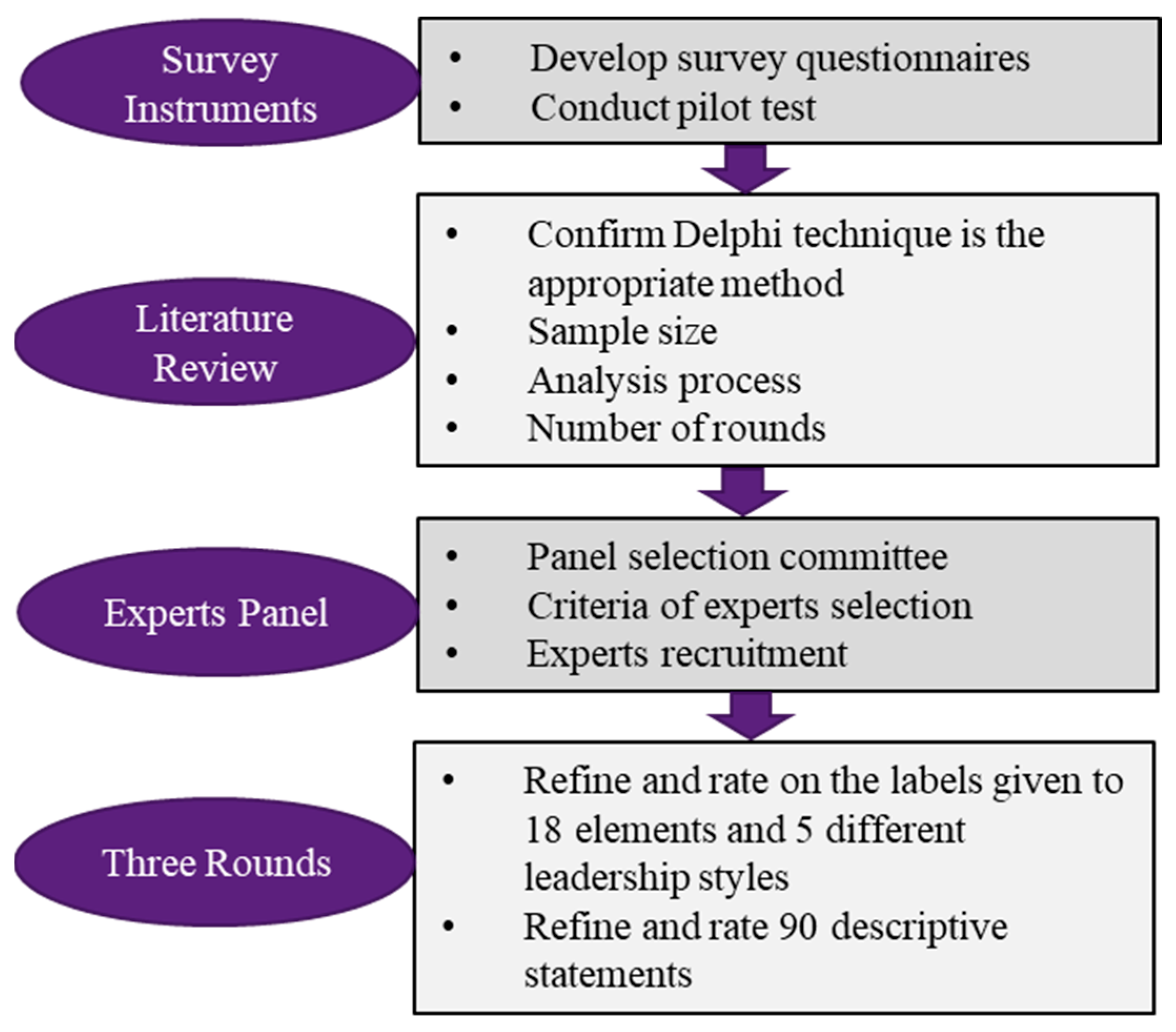
- Develop a survey instrument to test the leadership model, which includes conducting a pilot test to identify ambiguities in wording and check the layout of the instruments.
- Conduct a literature review to confirm that the Delphi technique is an appropriate method for the research and to decide sample size, analysis process, and number of rounds required to develop a refined model.
- Recruit experts using certain criteria through a panel selection committee.
- Implement three iterative rounds to review and refine the leadership model.
2.1. Survey Instrument Development
- The first part is an instruction providing context information and an explanation on how to complete the survey.
- The second part is a demographic question which collected experience, occupation, education, gender, and age data to allow the researchers to better understand and analyse the data.
- The third part is the context information, which included a brief overview of the leadership model, providing fundamental information in regard to the model and the background information; this part also explained the purpose of this research.
- The fourth part is questions about leadership styles and elements of the model, which originally derived from the systematic literature review [1]. Participants were asked to record their level of agreement with the labels given to the leadership styles and elements of safety management system using a four-point Likert scale where 1 meant Strongly Disagree, 2 meant Disagree, 3 meant Agree, and 4 meant Strongly Agree. The participants also had the option to select “Don’t know” if they do not have enough knowledge to rate particular leadership styles or elements given in the instrument. The neutral point was removed from the Likert scales intentionally because a neutral option provides very little information about the issues discussed and we prefer that the participants take a particular option. In other words, the nonneutral stance can promote a debate which aligns with the main objective of developing agreement and disagreement [24].
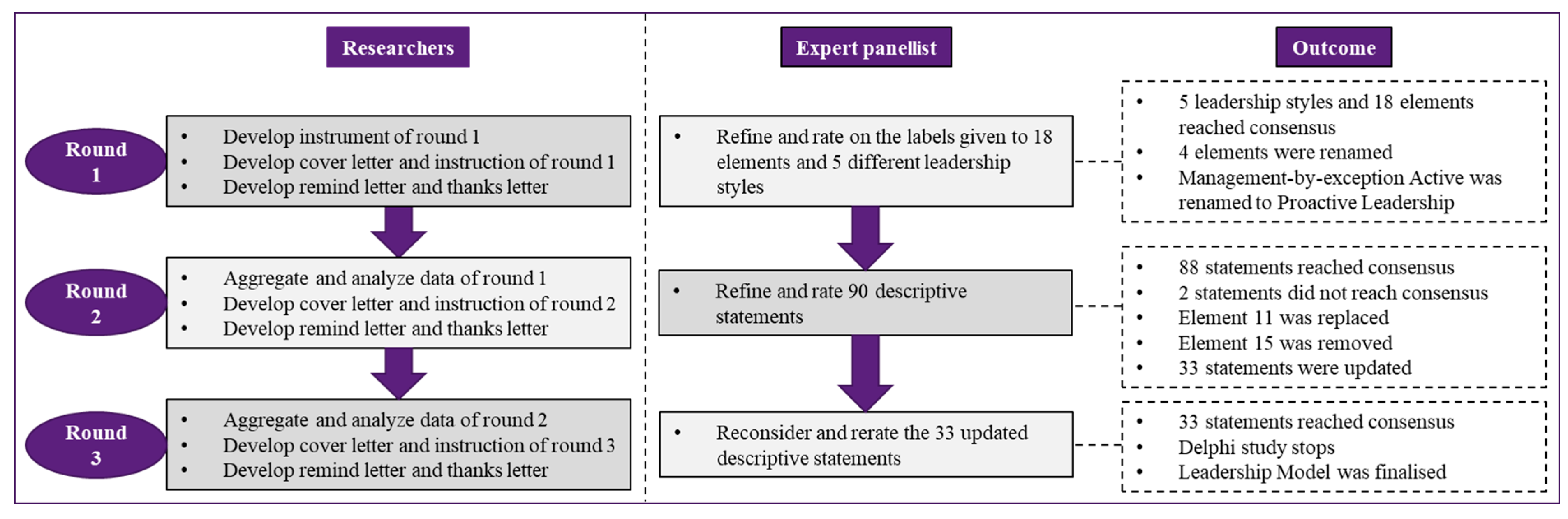
- Element 3—“Balance when making a decision” was renamed to “Balance priorities when making a decision”.
- Element 6—“Risk management perception” was renamed to “Perception of risk”.
- Element 7—“Hierarchy of risk controls” was renamed to “Risk controls”.
- Element 9—“Procurement” was renamed to “Contractor procurement”.
- Element 10—“Contractor management” was renamed to “Contractor management on the job”.
- Element 15—“Events management” was renamed to “Actioning of events”.
2.2. Selection of Experts
- The participants have at least 5 years of engagement in safety and/or risk management in the construction industry. The senior management of the organisations in the industry are identified in a list, subject to meeting the aforementioned criteria, and they are invited to participate in Delphi survey;
- Leastwise the participants have 5 years of construction and/or project management experience in the construction industry;
- The professionals have a minimum of 5 years of experience in safety and/or risk management in the construction industry, and are recognised by a government, institute, or association.
- The purpose of the Delphi study was explained to the participants along with the reasons for conducting this research, the significant meaning of the academia, and the implications for the construction industry.
- The process of the Delphi study stated how the survey works, how many rounds there were, the duration of the iterative process, and what efforts will be required from the participants. For this research, the prediction was that the Delphi study would involve up to 4 rounds over a 4-month period, with each round taking approximately 30–45 min to complete.
- The benefit of the Delphi study was illustrated to participants, including what they will gain from this survey, the benefit of having an opportunity to learn about the Delphi method, and an opportunity to hear the thoughts and gain information from other experts.
- The reason for being selected was described to the participants, namely why the individual was selected to participate in the survey.
2.3. Consensus of Delphi Study
3. Results
3.1. Round 1
3.2. Round 2
- Element 11—“Safety Integrated in Supply Chain” was changed to “Safety in Design”.
- Element 15—“Actioning of Events” was removed from the model because this element has been covered in Element 14—“Event Report” and Element 16—“Event Investigation”.
- The statement of Management-by-exception Passive for element 18 “The leader punishes workers when safety target (e.g., injury rate) is not achieved.” was changed to “The leader does not react on changes in safety targets (e.g., injury rate)” because consensus was not reached.
- The statement of Laissez-faire Leadership for Element 6 statement “The leader allows fatal risks in the workplace to persist and often to become acceptable” was changed to “The leader does not consider safety risks or risk assessment information thereby allowing serious and fatal risks in the workplace to persist and often to become acceptable” because consensus was not reached.
3.3. Round 3
4. Discussion
5. Conclusions
Author Contributions
Funding
Institutional Review Board Statement
Data Availability Statement
Acknowledgments
Conflicts of Interest
Appendix A

| Participants | 1 | 2 | 3 | 4 | 5 | 6 | 7 | 8 | 9 | 10 | 11 | Median | IQR |
|---|---|---|---|---|---|---|---|---|---|---|---|---|---|
| Leadership Styles | |||||||||||||
| Laissez-faire Leadership | 3 | 3 | 3 | 4 | 3 | 3 | 2 | 4 | 1 | 4 | 4 | 3 | 1 |
| Management-by-exception Passive | 3 | 3 | 4 | 4 | 3 | 3 | 2 | 4 | 4 | 3 | 4 | 3 | 1 |
| Compliance Leadership | 3 | 3 | 3 | 4 | 4 | 3 | 4 | 4 | 4 | 3 | 2 | 3 | 1 |
| Proactive Leadership | 3 | 3 | 4 | 4 | 4 | 3 | 2 | 4 | 4 | 3 | 2 | 3 | 1 |
| Transformational Leadership | 3 | 3 | 4 | 3 | 3 | 3 | 4 | 4 | 4 | 3 | 4 | 3 | 1 |
| Participants | 1 | 2 | 3 | 4 | 5 | 6 | 7 | 8 | 9 | 10 | 11 | Median | IQR |
|---|---|---|---|---|---|---|---|---|---|---|---|---|---|
| Elements | |||||||||||||
| Element 1 | 3 | 3 | 4 | 4 | 4 | 4 | 4 | 4 | 3 | 4 | 4 | 4 | 1 |
| Element 2 | 3 | 3 | 4 | 3 | 2 | 4 | 4 | 3 | 1 | 3 | 4 | 3 | 1 |
| Element 3 | 3 | 3 | 4 | 3 | 9 | 4 | 4 | 3 | 3 | 3 | 3 | 3 | 1 |
| Element 4 | 4 | 3 | 3 | 4 | 3 | 4 | 4 | 4 | 1 | 4 | 4 | 4 | 1 |
| Element 5 | 4 | 3 | 4 | 3 | 3 | 4 | 4 | 4 | 1 | 3 | 4 | 4 | 1 |
| Element 6 | 2 | 3 | 4 | 3 | 2 | 4 | 4 | 4 | 3 | 2 | 4 | 3 | 2 |
| Element 7 | 3 | 3 | 4 | 3 | 2 | 4 | 4 | 3 | 3 | 4 | 4 | 3 | 1 |
| Element 8 | 3 | 3 | 4 | 4 | 2 | 4 | 4 | 3 | 3 | 3 | 2 | 3 | 1 |
| Element 9 | 3 | 3 | 3 | 3 | 3 | 4 | 4 | 3 | 3 | 3 | 2 | 3 | 0 |
| Element 10 | 4 | 3 | 3 | 3 | 2 | 4 | 4 | 4 | 1 | 3 | 3 | 3 | 1 |
| Element 11 | 4 | 3 | 4 | 3 | 3 | 3 | 4 | 3 | 3 | 3 | 3 | 3 | 1 |
| Element 12 | 4 | 3 | 4 | 3 | 9 | 4 | 4 | 4 | 3 | 4 | 4 | 4 | 1 |
| Element 13 | 4 | 3 | 4 | 4 | 9 | 4 | 4 | 4 | 3 | 3 | 4 | 4 | 1 |
| Element 14 | 4 | 3 | 4 | 3 | 3 | 3 | 4 | 9 | 3 | 3 | 3 | 3 | 1 |
| Element 15 | 4 | 3 | 4 | 3 | 2 | 4 | 4 | 4 | 3 | 4 | 3 | 4 | 1 |
| Element 16 | 4 | 3 | 4 | 4 | 3 | 4 | 4 | 4 | 1 | 4 | 2 | 4 | 1 |
| Element 17 | 4 | 3 | 3 | 4 | 2 | 4 | 4 | 3 | 1 | 3 | 4 | 3 | 1 |
| Element 18 | 4 | 3 | 4 | 4 | 2 | 3 | 4 | 3 | 1 | 4 | 4 | 4 | 1 |
| Participants | 1 | 3 | 4 | 5 | 6 | 7 | 8 | 9 | 10 | 11 | Median | IQR |
|---|---|---|---|---|---|---|---|---|---|---|---|---|
| Statements | ||||||||||||
| Element 1—Laissez-faire Leadership | 4 | 4 | 3 | 4 | 9 | 4 | 4 | 1 | 3 | 4 | 4 | 1 |
| Element 1—Management-by-exception Passive | 3 | 3 | 4 | 3 | 3 | 4 | 3 | 1 | 3 | 2 | 3 | 0 |
| Element 1—Compliance Leadership | 3 | 4 | 4 | 4 | 3 | 4 | 3 | 3 | 3 | 4 | 4 | 1 |
| Element 1—Proactive Leadership | 4 | 4 | 4 | 4 | 3 | 4 | 3 | 1 | 3 | 4 | 4 | 1 |
| Element 1—Transformational Leadership | 4 | 4 | 3 | 4 | 4 | 4 | 3 | 1 | 3 | 2 | 4 | 2 |
| Element 2—Laissez-faire Leadership | 3 | 3 | 3 | 4 | 9 | 2 | 4 | 1 | 2 | 4 | 3 | 2 |
| Element 2—Management-by-exception Passive | 3 | 3 | 3 | 3 | 3 | 2 | 4 | 3 | 2 | 4 | 3 | 0 |
| Element 2—Compliance Leadership | 4 | 4 | 3 | 3 | 3 | 4 | 3 | 3 | 2 | 2 | 3 | 1 |
| Element 2—Proactive Leadership | 4 | 4 | 4 | 3 | 4 | 4 | 3 | 1 | 3 | 4 | 4 | 1 |
| Element 2—Transformational Leadership | 4 | 4 | 4 | 4 | 4 | 9 | 3 | 3 | 3 | 4 | 4 | 1 |
| Element 3—Laissez-faire Leadership | 4 | 4 | 3 | 4 | 9 | 4 | 4 | 1 | 3 | 4 | 4 | 1 |
| Element 3—Management-by-exception Passive | 3 | 3 | 3 | 4 | 3 | 4 | 4 | 3 | 3 | 2 | 3 | 1 |
| Element 3—Compliance Leadership | 3 | 4 | 4 | 4 | 3 | 4 | 3 | 3 | 3 | 4 | 4 | 1 |
| Element 3—Proactive Leadership | 3 | 4 | 3 | 3 | 3 | 4 | 3 | 1 | 3 | 4 | 3 | 1 |
| Element 3—Transformational Leadership | 4 | 4 | 3 | 3 | 4 | 3 | 4 | 3 | 3 | 4 | 4 | 1 |
| Element 4—Laissez-faire Leadership | 3 | 4 | 3 | 4 | 9 | 4 | 2 | 1 | 3 | 4 | 3 | 2 |
| Element 4—Management-by-exception Passive | 3 | 4 | 3 | 4 | 3 | 4 | 3 | 3 | 3 | 4 | 3 | 1 |
| Element 4—Compliance Leadership | 4 | 4 | 3 | 3 | 3 | 3 | 3 | 3 | 2 | 4 | 3 | 1 |
| Element 4—Proactive Leadership | 4 | 4 | 3 | 3 | 4 | 3 | 3 | 3 | 2 | 4 | 3 | 1 |
| Element 4—Transformational Leadership | 4 | 4 | 4 | 4 | 4 | 4 | 3 | 1 | 3 | 4 | 4 | 1 |
| Element 5—Laissez-faire Leadership | 3 | 4 | 3 | 3 | 9 | 4 | 3 | 1 | 3 | 4 | 3 | 1 |
| Element 5—Management-by-exception Passive | 4 | 4 | 3 | 3 | 4 | 4 | 3 | 3 | 3 | 4 | 4 | 1 |
| Element 5—Compliance Leadership | 4 | 4 | 3 | 3 | 3 | 4 | 3 | 3 | 3 | 4 | 3 | 1 |
| Element 5—Proactive Leadership | 3 | 4 | 3 | 3 | 3 | 4 | 4 | 1 | 3 | 4 | 3 | 1 |
| Element 5—Transformational Leadership | 4 | 4 | 4 | 3 | 3 | 4 | 4 | 1 | 3 | 4 | 4 | 1 |
| Element 6—Laissez-faire Leadership | 4 | 4 | 3 | 4 | 9 | 4 | 3 | 1 | 1 | 2 | 3 | 3 |
| Element 6—Management-by-exception Passive | 4 | 4 | 3 | 2 | 3 | 3 | 3 | 3 | 1 | 3 | 3 | 0 |
| Element 6—Compliance Leadership | 4 | 4 | 3 | 3 | 3 | 3 | 3 | 3 | 1 | 4 | 3 | 1 |
| Element 6—Proactive Leadership | 2 | 4 | 4 | 3 | 4 | 3 | 3 | 3 | 1 | 3 | 3 | 1 |
| Element 6—Transformational Leadership | 4 | 4 | 3 | 3 | 4 | 4 | 3 | 3 | 1 | 4 | 4 | 1 |
| Element 7—Laissez-faire Leadership | 3 | 3 | 3 | 3 | 9 | 4 | 3 | 1 | 2 | 3 | 3 | 1 |
| Element 7—Management-by-exception Passive | 3 | 4 | 3 | 3 | 4 | 3 | 3 | 3 | 2 | 3 | 3 | 0 |
| Element 7—Compliance Leadership | 2 | 4 | 3 | 3 | 3 | 3 | 2 | 3 | 1 | 4 | 3 | 1 |
| Element 7—Proactive Leadership | 3 | 4 | 3 | 3 | 4 | 3 | 3 | 3 | 3 | 4 | 3 | 1 |
| Element 7—Transformational Leadership | 4 | 4 | 3 | 3 | 4 | 3 | 3 | 3 | 3 | 4 | 3 | 1 |
| Element 8—Laissez-faire Leadership | 3 | 4 | 3 | 3 | 9 | 3 | 3 | 1 | 2 | 4 | 3 | 1 |
| Element 8—Management-by-exception Passive | 3 | 4 | 3 | 3 | 3 | 3 | 3 | 3 | 2 | 4 | 3 | 0 |
| Element 8—Compliance Leadership | 3 | 4 | 3 | 3 | 4 | 3 | 3 | 3 | 2 | 2 | 3 | 0 |
| Element 8—Proactive Leadership | 3 | 4 | 3 | 3 | 3 | 3 | 3 | 3 | 2 | 4 | 3 | 0 |
| Element 8—Transformational Leadership | 4 | 4 | 3 | 3 | 4 | 3 | 3 | 3 | 2 | 4 | 3 | 1 |
| Element 9—Laissez-faire Leadership | 4 | 4 | 3 | 3 | 9 | 3 | 3 | 1 | 2 | 4 | 3 | 2 |
| Element 9—Management-by-exception Passive | 4 | 4 | 3 | 3 | 4 | 3 | 3 | 1 | 2 | 2 | 3 | 2 |
| Element 9—Compliance Leadership | 3 | 4 | 3 | 3 | 4 | 3 | 3 | 1 | 2 | 2 | 3 | 1 |
| Element 9—Proactive Leadership | 3 | 3 | 3 | 2 | 3 | 3 | 3 | 3 | 2 | 4 | 3 | 0 |
| Element 9—Transformational Leadership | 4 | 4 | 3 | 3 | 3 | 3 | 3 | 1 | 2 | 4 | 3 | 1 |
| Element 10—Laissez-faire Leadership | 4 | 4 | 4 | 4 | 9 | 4 | 3 | 1 | 3 | 4 | 4 | 2 |
| Element 10—Management-by-exception Passive | 3 | 3 | 3 | 4 | 4 | 4 | 3 | 3 | 3 | 4 | 3 | 1 |
| Element 10—Compliance Leadership | 3 | 4 | 3 | 3 | 3 | 4 | 3 | 3 | 3 | 4 | 3 | 1 |
| Element 10—Proactive Leadership | 3 | 3 | 3 | 4 | 4 | 4 | 3 | 3 | 3 | 4 | 3 | 1 |
| Element 10—Transformational Leadership | 4 | 4 | 3 | 3 | 4 | 4 | 3 | 3 | 3 | 4 | 4 | 1 |
| Element 11—Laissez-faire Leadership | 3 | 4 | 3 | 3 | 9 | 3 | 3 | 1 | 2 | 4 | 3 | 1 |
| Element 11—Management-by-exception Passive | 3 | 4 | 3 | 3 | 3 | 3 | 3 | 3 | 2 | 4 | 3 | 0 |
| Element 11—Compliance Leadership | 3 | 3 | 3 | 3 | 3 | 3 | 3 | 1 | 2 | 4 | 3 | 0 |
| Element 11—Proactive Leadership | 3 | 3 | 3 | 3 | 4 | 4 | 3 | 3 | 3 | 4 | 3 | 1 |
| Element 11—Transformational Leadership | 4 | 4 | 4 | 3 | 4 | 4 | 3 | 3 | 3 | 4 | 4 | 1 |
| Element 12—Laissez-faire Leadership | 3 | 4 | 3 | 3 | 9 | 3 | 3 | 1 | 3 | 4 | 3 | 1 |
| Element 12—Management-by-exception Passive | 3 | 3 | 3 | 3 | 3 | 3 | 3 | 3 | 3 | 4 | 3 | 0 |
| Element 12—Compliance Leadership | 3 | 4 | 3 | 2 | 3 | 3 | 3 | 3 | 3 | 4 | 3 | 0 |
| Element 12—Proactive Leadership | 3 | 3 | 3 | 3 | 3 | 3 | 3 | 1 | 3 | 4 | 3 | 0 |
| Element 12—Transformational Leadership | 3 | 4 | 3 | 3 | 3 | 3 | 3 | 3 | 3 | 4 | 3 | 0 |
| Element 13—Laissez-faire Leadership | 3 | 4 | 3 | 3 | 9 | 3 | 3 | 1 | 3 | 4 | 3 | 1 |
| Element 13—Management-by-exception Passive | 3 | 3 | 3 | 3 | 3 | 3 | 3 | 3 | 3 | 4 | 3 | 0 |
| Element 13—Compliance Leadership | 3 | 3 | 3 | 3 | 4 | 3 | 3 | 3 | 3 | 4 | 3 | 0 |
| Element 13—Proactive Leadership | 3 | 3 | 3 | 3 | 3 | 3 | 3 | 3 | 3 | 4 | 3 | 0 |
| Element 13—Transformational Leadership | 4 | 4 | 4 | 3 | 3 | 3 | 3 | 3 | 3 | 4 | 3 | 1 |
| Element 14—Laissez-faire Leadership | 4 | 4 | 3 | 3 | 9 | 3 | 4 | 1 | 3 | 3 | 3 | 1 |
| Element 14—Management-by-exception Passive | 4 | 4 | 3 | 2 | 3 | 3 | 3 | 1 | 3 | 1 | 3 | 1 |
| Element 14—Compliance Leadership | 3 | 3 | 3 | 3 | 3 | 3 | 3 | 3 | 3 | 4 | 3 | 0 |
| Element 14—Proactive Leadership | 3 | 4 | 3 | 3 | 3 | 3 | 3 | 3 | 3 | 4 | 3 | 0 |
| Element 14—Transformational Leadership | 3 | 4 | 3 | 3 | 3 | 3 | 3 | 3 | 3 | 4 | 3 | 0 |
| Element 15—Laissez-faire Leadership | 3 | 4 | 3 | 3 | 9 | 3 | 3 | 1 | 3 | 2 | 3 | 1 |
| Element 15—Management-by-exception Passive | 3 | 4 | 3 | 3 | 3 | 3 | 3 | 3 | 3 | 4 | 3 | 0 |
| Element 15—Compliance Leadership | 3 | 4 | 3 | 2 | 3 | 3 | 3 | 3 | 2 | 1 | 3 | 1 |
| Element 15—Proactive Leadership | 3 | 4 | 3 | 3 | 4 | 3 | 3 | 3 | 3 | 4 | 3 | 1 |
| Element 15—Transformational Leadership | 4 | 4 | 3 | 3 | 3 | 3 | 3 | 3 | 3 | 4 | 3 | 1 |
| Element 16—Laissez-faire Leadership | 4 | 4 | 3 | 3 | 9 | 4 | 3 | 1 | 3 | 4 | 3 | 1 |
| Element 16—Management-by-exception Passive | 4 | 4 | 3 | 3 | 3 | 3 | 3 | 3 | 2 | 4 | 3 | 1 |
| Element 16—Compliance Leadership | 3 | 3 | 3 | 2 | 3 | 3 | 3 | 3 | 2 | 4 | 3 | 0 |
| Element 16—Proactive Leadership | 3 | 4 | 3 | 3 | 4 | 3 | 3 | 1 | 3 | 4 | 3 | 1 |
| Element 16—Transformational Leadership | 2 | 4 | 3 | 3 | 4 | 4 | 3 | 3 | 3 | 4 | 3 | 1 |
| Element 17—Laissez-faire Leadership | 4 | 4 | 3 | 3 | 9 | 4 | 3 | 1 | 3 | 4 | 3 | 1 |
| Element 17—Management-by-exception Passive | 3 | 3 | 3 | 3 | 4 | 4 | 3 | 3 | 2 | 3 | 3 | 0 |
| Element 17—Compliance Leadership | 3 | 4 | 3 | 2 | 4 | 4 | 3 | 3 | 2 | 4 | 3 | 1 |
| Element 17—Proactive Leadership | 3 | 4 | 3 | 3 | 4 | 4 | 3 | 3 | 2 | 4 | 3 | 1 |
| Element 17—Transformational Leadership | 4 | 4 | 3 | 3 | 4 | 4 | 3 | 1 | 2 | 3 | 3 | 1 |
| Element 18—Laissez-faire Leadership | 3 | 3 | 3 | 3 | 9 | 3 | 3 | 1 | 3 | 4 | 3 | 0 |
| Element 18—Management-by-exception Passive | 3 | 3 | 3 | 2 | 2 | 3 | 9 | 1 | 2 | 1 | 2 | 2 |
| Element 18—Compliance Leadership | 3 | 3 | 4 | 3 | 3 | 3 | 2 | 1 | 2 | 2 | 3 | 1 |
| Element 18—Proactive Leadership | 3 | 4 | 4 | 3 | 3 | 3 | 3 | 1 | 2 | 4 | 3 | 1 |
| Element 18—Transformational Leadership | 4 | 4 | 3 | 3 | 3 | 3 | 3 | 1 | 2 | 4 | 3 | 1 |
| Participants | 1 | 4 | 5 | 6 | 7 | 8 | 9 | 10 | 11 | Median | IQR |
|---|---|---|---|---|---|---|---|---|---|---|---|
| Statements | |||||||||||
| Element 1—Laissez-faire Leadership | 4 | 3 | 3 | 3 | 3 | 4 | 4 | 3 | 4 | 3 | 1 |
| Element 1—Management-By-Exception Passive | 4 | 3 | 3 | 3 | 3 | 4 | 4 | 4 | 4 | 4 | 1 |
| Element 1—Transformational Leadership | 4 | 4 | 3 | 4 | 4 | 4 | 4 | 3 | 4 | 4 | 1 |
| Element 2—Laissez-faire Leadership | 4 | 3 | 3 | 3 | 3 | 3 | 4 | 3 | 3 | 3 | 1 |
| Element 2—Management-By-Exception Passive | 4 | 3 | 3 | 3 | 3 | 3 | 4 | 3 | 4 | 3 | 1 |
| Element 2—Compliance Leadership | 4 | 4 | 3 | 3 | 3 | 3 | 4 | 3 | 4 | 3 | 1 |
| Element 3—Management-By-Exception Passive | 4 | 3 | 3 | 3 | 3 | 4 | 4 | 3 | 4 | 3 | 1 |
| Element 3—Proactive Leadership | 2 | 9 | 3 | 3 | 2 | 4 | 4 | 2 | 2 | 3 | 2 |
| Element 5—Compliance Leadership | 4 | 4 | 3 | 3 | 3 | 3 | 4 | 3 | 4 | 3 | 1 |
| Element 6—Laissez-faire Leadership | 4 | 3 | 3 | 9 | 3 | 4 | 4 | 2 | 4 | 4 | 1 |
| Element 6—Management-By-Exception Passive | 4 | 3 | 3 | 3 | 3 | 3 | 4 | 2 | 3 | 3 | 1 |
| Element 6—Compliance Leadership | 4 | 3 | 3 | 3 | 3 | 3 | 4 | 3 | 4 | 3 | 1 |
| Element 6—Proactive Leadership | 2 | 4 | 3 | 4 | 3 | 3 | 4 | 4 | 4 | 4 | 1 |
| Element 6—Transformational Leadership | 2 | 4 | 3 | 4 | 3 | 3 | 4 | 3 | 4 | 3 | 1 |
| Element 7—Management-By-Exception Passive | 4 | 3 | 3 | 3 | 3 | 4 | 4 | 3 | 4 | 3 | 1 |
| Element 7—Compliance Leadership | 2 | 3 | 2 | 3 | 3 | 4 | 4 | 3 | 4 | 3 | 2 |
| Element 7—Proactive Leadership | 2 | 4 | 3 | 4 | 3 | 4 | 4 | 3 | 4 | 4 | 1 |
| Element 7—Transformational Leadership | 2 | 3 | 3 | 4 | 3 | 4 | 4 | 4 | 4 | 4 | 1 |
| Element 9—Laissez-faire Leadership | 4 | 3 | 3 | 3 | 3 | 4 | 4 | 2 | 4 | 3 | 1 |
| Element 9—Management-By-Exception Passive | 4 | 3 | 2 | 3 | 3 | 3 | 4 | 2 | 4 | 3 | 2 |
| Element 9—Compliance Leadership | 4 | 3 | 3 | 3 | 3 | 3 | 4 | 2 | 4 | 3 | 1 |
| Element 9—Proactive Leadership | 2 | 3 | 3 | 3 | 3 | 3 | 4 | 2 | 4 | 3 | 1 |
| Element 9—Transformational Leadership | 4 | 3 | 3 | 3 | 4 | 3 | 4 | 3 | 4 | 3 | 1 |
| Element 11—Laissez-faire Leadership | 4 | 3 | 3 | 9 | 3 | 3 | 4 | 3 | 4 | 3 | 1 |
| Element 11—Management-By-Exception Passive | 3 | 3 | 3 | 2 | 2 | 3 | 4 | 3 | 4 | 3 | 1 |
| Element 11—Compliance Leadership | 4 | 3 | 3 | 2 | 3 | 3 | 4 | 2 | 4 | 3 | 2 |
| Element 11—Proactive Leadership | 4 | 3 | 3 | 4 | 3 | 3 | 4 | 3 | 4 | 3 | 1 |
| Element 11—Transformational Leadership | 4 | 3 | 3 | 4 | 3 | 4 | 4 | 3 | 4 | 4 | 1 |
| Element 17—Management-By-Exception Passive | 4 | 3 | 3 | 3 | 3 | 3 | 4 | 2 | 4 | 3 | 1 |
| Element 17—Compliance Leadership | 4 | 3 | 3 | 3 | 3 | 3 | 4 | 2 | 4 | 3 | 1 |
| Element 17—Transformational Leadership | 2 | 3 | 3 | 4 | 3 | 3 | 4 | 2 | 4 | 3 | 2 |
| Element 18—Management-By-Exception Passive | 4 | 3 | 2 | 4 | 3 | 3 | 4 | 2 | 3 | 3 | 2 |
| Element 18—Compliance Leadership | 4 | 3 | 3 | 3 | 3 | 3 | 4 | 2 | 2 | 3 | 1 |
| Components of Model | Styles of Leadership | ||||
| Laissez-Faire Leadership | Management-By-Exception Passive | Compliance Leadership | Proactive Leadership | Transformational Leadership | |
| Element 1 Commitment (e.g., attend safety walk and chair safety committee) | The leader is indifferent to safety, avoids or does not commit to safety even when incidents occur, sees it as another person’s responsibility | The leader only takes actions when an incident happens but does not change his/her underlying behaviours | The leader has commitment to safety by meeting the minimum standards and legislation requirements | The leader has strong individual commitment to safety beyond compliance because of concerns to workers’ safety, and demonstrates this commitment by his/her behaviour | The leader has strong emotional commitment to safety because they have care and compassion for workers’ safety. They work hard to inspire others to join their philosophy and journey, they proactively seek to continually learn and improve their safety knowledge |
| Element 2 Approach to Decision Making | Laissez-Faire Leadership | Management-By-Exception Passive | Compliance Leadership | Proactive Leadership | Transformational Leadership |
| The leader avoids making decisions or taking actions to address an unsafe act or condition | The leader makes decisions or takes actions to address an unsafe act or condition only following on from an incident | The leader makes decisions or takes actions to maintain compliance with rules and legislation | The leader consults with and listens to workers and safety personnel before making decisions, and communicates their decision and decision criteria widely | The leader empowers frontline workers to make decisions to manage site specific problems with management support when needed, such as change the work methods or stop unsafe work | |
| Element 3 Balance Priorities When Making a Decision | Laissez-Faire Leadership | Management-By-Exception Passive | Compliance Leadership | Proactive Leadership | Transformational Leadership |
| The leader does not consider safety at all because they see it as conflicting with other construction goals, such as schedule and cost | The leader only considers safety in list of priorities with other construction goals when an accident has happened. Safety is not considered as a priority when there are no accidents | The leader considers the importance of safety according to the requirements in the contract or legislation | The leader prioritises safety over other construction goals as long as the other construction goals are being met. If schedule and costs are under pressure, these will be considered together with safety | The leader thinks and manages safety, schedule and cost in a holistic way, the priority will be balanced between these multiple goals according to the constantly changing context. By doing this, both safety and other goals can be improved | |
| Element 4 Communication | Laissez-Faire Leadership | Management-By-Exception Passive | Compliance Leadership | Proactive Leadership | Transformational Leadership |
| The leader never communicates any about safety through conversations, actions or by other means | The leader only communicates about safety with workers or other stakeholders when accidents happened, but safety is forgotten after a period without an accident | The leader communicates about safety from top down rather than bottom up, e.g., by sharing the requirements in the policy during formal meetings or written materials as required | The leader regularly communicates about safety with workers and other stakeholders by two-way communication during formal and informal conversations | The leader continuously communicates about safety and its importance during formal, informal and personal conversations with workers and other stakeholders. They listen to people’s needs and concerns and the process is transparent | |
| Element 5 People Development (e.g., training and education) | Laissez-Faire Leadership | Management-By-Exception Passive | Compliance Leadership | Proactive Leadership | Transformational Leadership |
| The leader does not provide safety related training opportunities to workers | The leader provides training to workers if required to after an accident, but sees it as cost rather than investment | The leader has people development plans for workers, asks them to learn knowledge and skills that are required from legal or company rule compliance perspective. Sees it as a cost but accepts that cost is necessary | The leader has people development plans in place and provides opportunities and resources for workers to learn new knowledge and generic skills. Leaders see it as investment rather than cost | The leader provides continual opportunities and resources for workers to learn new knowledge and skills according to the individual training needs analysis, and encourages them to challenge something that is ok to make it better. Also leads by example by investing in to increasing their own safety knowledge | |
| Element 6 Risk Assessment | Laissez-Faire Leadership | Management-By-Exception Passive | Compliance Leadership | Proactive Leadership | Transformational Leadership |
| The leader does not consider safety risks or risk assessment information thereby allowing fatal and serious risks in the workplace to persist and often to become acceptable | The leader tolerates safety risks to achieve production/commercials goals because s/he thinks the likelihood of fatal or serious injury is low | The leader supports risk assessments and develops standardised procedures and methods, and asks workers to comply as per minimum standard required by law | The leader organizes risk assessments and updates them and associated procedures and task methods based on feedback from inspections and audits especially for fatal and serious risk exposures | The leader keeps constantly monitoring and improving fatal & serious risk assessment information and risk management approaches in response to the constantly changing construction environment and by continuously learning new knowledge, technology, and methods | |
| Element 7 Risk Controls | Laissez-Faire Leadership | Management-By-Exception Passive | Compliance Leadership | Proactive Leadership | Transformational Leadership |
| The leader does not implement the risk controls at all | The leader only emphasizes the importance of controls after workers get injured and focuses on easy to apply controls such as PPE. There is no verification of implementation and emphasis wanes after period without accident | The leader prefers to adhere to the specific site-based rules and use of administrative controls (e.g., procedures and training) to manage fatal and serious risks on construction sites without any onsite verification of implementation | The leader prefers to adopt higher-level controls used in industry (e.g., engineering or technical controls such as Residual-Current Devices) with multiple controls used for fatal and serious risk tasks. Control implementation is checked periodically | The leader will seek eliminate risk or isolate workers from risk first then consider the combination of controls required to reduce fatal and serious risk to acceptable level. The leader maintains discomfort about control performance and constantly monitors their effectiveness in operation | |
| Element 8 Risk management priority | Laissez-Faire Leadership | Management-By-Exception Passive | Compliance Leadership | Proactive Leadership | Transformational Leadership |
| The leader does not recognise the need to manage minor or fatal & serious safety risks | The leader does not have a risk management plan in place, will take some actions after an incident happens, but just focuses on minor risks that can be fixed easily with low cost | The leader has a risk management plan in place, but it stays at the paper level, such as policies and procedures | The leader focuses on monitoring and verifying the fatal and serious risk management is implemented by workers effectively and thoroughly for risks that have fatal and serious injury potential | The leader not only focuses on the management of fatal and serious risk, but also encourages workers to identify and report the antecedents (weak signals) of fatal and serious risks | |
| Element 9 Contractor procurement | Laissez-Faire Leadership | Management-By-Exception Passive | Compliance Leadership | Proactive Leadership | Transformational Leadership |
| The leader does not do any assessment of contractor safety capacity and will accept any convenient/available contractor | The leader selects contractors with lowest price, looks at safety performance, qualification and capabilities but does not take into consideration | The leader selects contractors as long as they have relevant licences and certifications from legal perspective, but does not investigate actual safety performance | The leader selects contractors according to the safety prequalification, and their published safety performance but does not always probe deeper into actual on job performance | The leader selects contractors after investigating comprehensively their actual on job performance, which covers cost, technical, safety and capability. Leader is prepared to invest into increasing the safety performance of the contractor | |
| Element 10 Contractor Management on The Job | Laissez-Faire Leadership | Management-By-Exception Passive | Compliance Leadership | Proactive Leadership | Transformational Leadership |
| The leader does not put any safety monitoring or supervision on the contractors as s/he thinks safety management is the responsibility of the contractors | The leader may take some actions after accidents happened, but s/he thinks that the contractors hold all the responsibilities | The leader puts some supervision measures on the contractors, but just for legal compliance | The leader provides monitoring and supervision on contractors to make sure their safety performance is at a high standard | The leader sees contractors as part of the team, builds trust relationship and fully engages with them, and helps them integrate into company safety system, achieve the same safety expectations and also to continually improve them | |
| Element 11 Safety in Design | Laissez-Faire Leadership | Management-By-Exception Passive | Compliance Leadership | Proactive Leadership | Transformational Leadership |
| The leader does not consider safety in design | The leader considers improving safety in design after an accident happened | The leader considers safety in design as required by company policy or the law | The leader considers safety in design to reduce risk exposure of construction workers (e.g., doing assembly work at ground level and structural work is fabricated in factory) through design review prior to construction | The leader stimulates subordinates, peers and other companies to protect construction workers by continuously improving safety in design during the project life cycle | |
| Element 12 Leader-Subordinates Relationship | Laissez-Faire Leadership | Management-By-Exception Passive | Compliance Leadership | Proactive Leadership | Transformational Leadership |
| The leader has little interaction and engagement with subordinates | The leader has distant relationship with workers, only has some interaction and engagement with subordinates when something goes wrong | The leader has reporting relationship between superior and subordinates, the interaction and engagement is just limited to the work | The leader has quality relationship with subordinates, the leader not only cares about the work done by workers, but also cares about the personal life of the workers | The leader has trusting relationship with subordinates, frequently interacting with them, treating every worker with equal respect and fairness, and actively demonstrating the heartfelt care about the safety of workers | |
| Element 13 Leader-Stakeholders Relationship | Laissez-Faire Leadership | Management-By-Exception Passive | Compliance Leadership | Proactive Leadership | Transformational Leadership |
| The leader has very little interaction with and engagement with other stakeholders | The leader has some interaction and engagement with other stakeholders when something goes wrong, s/he has to get advice and support from other stakeholders to solve problems | The leader has some interaction and engagement with other stakeholders but just limited to the agreements in the contract | The leader has good interaction and engagement with other stakeholders, and actively seek advice and information in a cooperated and consultative way | The leader has strong social and professional interaction and engagement with other stakeholders, sharing resources (knowledge, ideas, machineries and equipment), and treats every stakeholder equally no matter they are clients, principal contractors or subcontractors | |
| Element 14 Event Report | Laissez-Faire Leadership | Management-By-Exception Passive | Compliance Leadership | Proactive Leadership | Transformational Leadership |
| The leader is dismissive or disinterested in reporting bad news (e.g., near miss with fatal and serious injury potential) | The leader only reports bad news when s/he has to, and blames or even punish workers | The leader asks workers to report bad news, just for complying with the legislation or policies but misses opportunities to resolve the problems, and there is no feedback to workers who reported | The leader encourages workers to report bad news, provides feedback (e.g., results of investigation) to workers, and recognises them for reporting | The leader appreciates and recognises workers reporting bad news, the leader will take it as learning opportunity to improve not only in safety, but across the whole business | |
| Element 15 Event Investigations | Laissez-Faire Leadership | Management-By-Exception Passive | Compliance Leadership | Proactive Leadership | Transformational Leadership |
| The leader does not organize investigations after accident happened | The leader conducts informal accidents investigations, believes the unsafe behaviours (human errors) are the root causes, and workers are blamed or even punished | The leader conducts accident investigations, but just focuses on the attribution of responsibilities according to legislation | The leader conducts formal investigations to analyse the root causes, and put actions and changes to policies and procedures in place to prevent accident recurrence | The leader takes the accidents as opportunities to learn through a systems-thinking lens and improve the management system, rather than fixing problems based on root causes analysis because the leader believes that all the factors are closely connected and interacted under the complex sociotechnical system | |
| Element 16 Safety Performance Measurement | Laissez-Faire Leadership | Management-By-Exception Passive | Compliance Leadership | Proactive Leadership | Transformational Leadership |
| The leader does not measure safety performance | The leader measures safety performance when forced to and uses reactive measures like TRIFR (total recordable injury frequency rate) or LTIFR (lost time injury frequency rates) | The leader measures safety performance based on the agreement in the contract or as required by legislation | The leader measures safety performance based on leading indicators (e.g., training, audit and initiatives) and fatal & serious injury rate (the number of fatal & serious injuries and recordable injuries with potential to be a fatal & serious injury—divided by hours worked) | The leader measures safety performance based on best practice, leading and lagging measures with focus on the antecedents (weak signal) which has fatal and serious injury potential. Would include both leading & lagging measures with focus on the antecedents. | |
| Element 17 Performance Recognition | Laissez-Faire Leadership | Management-By-Exception Passive | Compliance Leadership | Proactive Leadership | Transformational Leadership |
| The leader does not recognise individual or team safety performance | The leader recognises safety performance when an incident occurs | The leader recognises workers safety performance when they achieve collective lagging measures, such as 1,000,000 manhours without LTI (lost time injury) | The leader recognises individual safety performance, and provides workers with opportunities for continuous improvement | The leader recognizes workers by providing public recognition and honours based on their daily performance, and challenges them go beyond their self-interests for the collective goals | |
References
- Shen, J.; Hassall, M. Development of A Safety Leadership Model. under review.
- Safe Work Australia. Fatality Statistics. 2024. Available online: https://www.safeworkaustralia.gov.au/data-and-research/work-related-fatalities (accessed on 13 December 2024).
- U.S. Bureau of Labor Statistics Fatality Statistics. 2022. Available online: https://www.bls.gov/iif/home.htm (accessed on 25 April 2024).
- UK HSE. Fatality Statistics. 2023. Available online: https://www.hse.gov.uk/statistics/ (accessed on 25 April 2024).
- Fleming, M. Safety Culture Maturity Model. In Health and Safety Executive; Keil Centre: Norwich, UK, 2001. [Google Scholar]
- Hudson, P.T.W. Safety management and safety culture: The long, hard and winding road. Occup. Health Saf. Manag. Syst. 2001, 2001, 3–32. [Google Scholar]
- Oswald, D.; Lingard, H. Development of a frontline H&S leadership maturity model in the construction industry. Saf. Sci. 2019, 118, 674–686. [Google Scholar] [CrossRef]
- Stemn, E.; Bofinger, C.; Cliff, D.; Hassall, M.E. Investigating the Maturity of Incident Investigations of the Ghanaian Mining Industry and Its Effect on Safety Performance. Safety 2019, 5, 3. [Google Scholar] [CrossRef]
- Bass, B.M. Is there universality in the full range model of leadership? Int. J. Public Adm. 1996, 19, 731–761. [Google Scholar] [CrossRef]
- Dalkey, N. An experimental study of group opinion: The Delphi method. Futures J. Policy Plan. Futures Stud. 1969, 1, 408–426. [Google Scholar] [CrossRef]
- Rowe, G.; Wright, G.; Bolger, F. Delphi: A reevaluation of research and theory. Technol. Forecast. Soc. Change 1991, 39, 235–251. [Google Scholar] [CrossRef]
- Martino, J.P. Technological Forecasting for Decision Making, 3rd ed.; McGraw-Hill: Columbus, OH, USA, 1992. [Google Scholar]
- Campbell, R.M. A Methodological Study of the Utilization of Experts in Business Forecasting; ProQuest Dissertations & Theses: Ann Arbor, MI, USA, 1966. [Google Scholar]
- Murphy, M.; Black, N.; Lamping, D.; McKee, C.; Sanderson, C.; Askham, J.; Marteau, T. Consensus development methods, and their use in clinical guideline development. Health Technol. Assess. 1998, 2, 1–88. [Google Scholar] [CrossRef]
- Keeney, S.; Hasson, F.; McKenna, H.P. The Delphi Technique in Nursing and Health Research; Wiley-Blackwell: Hoboken, NJ, USA, 2011. [Google Scholar]
- Oh, K.H. Forecasting Through Hierarchical Delphi; The Ohio State University: Columbus, OH, USA, 1974. [Google Scholar]
- de Villiers, M.R.; de Villiers, P.J.T.; Kent, A.P. The Delphi technique in health sciences education research. Med. Teach. 2005, 27, 639–643. [Google Scholar] [CrossRef]
- Murry, J.W., Jr.; Hammons, J.O. Delphi: A versatile methodology for conducting qualitative research. Rev. High. Educ. 1995, 18, 423–436. [Google Scholar] [CrossRef]
- Uhl, N.P. Using the delphi technique in institutional planning. New Dir. Institutional Res. 1983, 1983, 81–94. [Google Scholar] [CrossRef]
- Ludwig, B.G. Internationalizing Extension: An Exploration of the Characteristics Evident in a State University Extension System That Achieves Internationalization; The Ohio State University: Columbus, OH, USA, 1994. [Google Scholar]
- Rowe, G.; Wright, G. Expert Opinions in Forecasting: The Role of the Delphi Technique. In Principles of Forecasting; Armstrong, J.S., Ed.; Springer: New York, NY, USA, 2001; pp. 125–144. [Google Scholar] [CrossRef]
- Siniscalco, M.T.; Auriat, N. Questionnaire Design. Quantitative Research Methods in Educational Planning; UNESCO IIEP: Paris, France, 2005; Available online: https://raharjo.staff.telkomuniversity.ac.id/files/2015/05/Questionnaire-Design.pdf (accessed on 13 December 2024).
- Edwards, P.; Roberts, I.; Clarke, M.; DiGuiseppi, C.; Pratap, S.; Wentz, R.; Kwan, I. Increasing response rates to postal questionnaires: Systematic review. BMJ 2002, 324, 1183–1185. [Google Scholar] [CrossRef] [PubMed]
- Turoff, M. The design of a policy Delphi. Technol. Forecast. Soc. Change 1970, 2, 149–171. [Google Scholar] [CrossRef]
- Judd, R.C. Use of Delphi methods in higher education. Technol. Forecast. Soc. Change 1972, 4, 173–186. [Google Scholar] [CrossRef]
- Jacobs, J.M. Essential Assessment Criteria for Physical Education Teacher Education Programs: A Delphi Study. Ph.D. Dissertation, West Virginia University, Morgantown, WV, USA, 1996. [Google Scholar]
- Johnson, J.L. A ten-year Delphi forecast in the electronics industry. Ind. Mark. Manag. 1976, 5, 45–55. [Google Scholar] [CrossRef]
- Powell, C. The Delphi technique: Myths and realities. J. Adv. Nurs. 2003, 41, 376–382. [Google Scholar] [CrossRef]
- Gordon, T.J. The delphi method. Futures Res. Methodol. 1994, 2, 1–30. [Google Scholar]
- Clayton, M.J. Delphi: A technique to harness expert opinion for critical decision-making tasks in education. Educ. Psychol. 1997, 17, 373–386. [Google Scholar] [CrossRef]
- Sumsion, T. The Delphi Technique: An Adaptive Research Tool. Br. J. Occup. Ther. 1998, 61, 153–156. [Google Scholar] [CrossRef]
- Snowball Sampling. 2004. Available online: http://methods.sagepub.com/reference/the-sage-encyclopedia-of-social-science-research-methods/n931.xml (accessed on 20 March 2022).
- Klee, A.J. The utilization of expert opinion in decision-making. AIChE J. 1972, 18, 1107–1115. [Google Scholar] [CrossRef]
- Dalkey, N.; Helmer, O. An Experimental Application of the DELPHI Method to the Use of Experts. Manag. Sci. 1963, 9, 458–467. [Google Scholar] [CrossRef]
- Walker, A.; Selfe, J. The Delphi method: A useful tool for the allied health researcher. Br. J. Ther. Rehabil. 1996, 3, 677–681. [Google Scholar] [CrossRef]
- Mullen, P.M. Delphi: Myths and reality. J. Health Organ. Manag. 2003, 17, 37–52. [Google Scholar] [CrossRef]
- Fink, A.; Kosecoff, J.; Chassin, M.; Brook, R.H. Consensus methods: Characteristics and guidelines for use. Am. J. Public Health 1984, 74, 979–983. [Google Scholar] [CrossRef] [PubMed]
- Delbecq, A.L.; Van de Ven, A.H.; Gustafson, D.H. Group Techniques for Program Planning: A Guide to Nominal Group and Delphi Processes; Scott Foresman: Glenview, IL, USA, 1975. [Google Scholar]
- Johnson, D.E.; Meiller, L.R.; Miller, L.C.; Summers, G.F. Needs Assessment: Theory and Methods; Iowa State University Press: Ames, IA, USA, 1987. [Google Scholar]
- Linstone, H.A.; Turoff, M. The Delphi Method: Techniques and Applications; Addison-Wesley Pub. Co., Advanced Book Program: London, UK, 1975. [Google Scholar]
- Whitman, N.I. The Committee Meeting Alternative: Using the Delphi Technique. J. Nurs. Adm. 1990, 20, 30–36. [Google Scholar] [CrossRef] [PubMed]
- Brooks, K.W. Delphi Technique: Expanding Applications. North Cent. Assoc. Q. 1979, 53, 377. [Google Scholar]
- Hsu, C.C.; Sandford, B.A. The Delphi technique: Making sense of consensus. Pract. Assess. Res. Eval. 2007, 12, 1–8. [Google Scholar]
- Sackman, H. Delphi Critique: Expert Opinion, Forecasting, and Group Process; Lexington Books: Lanham, MD, USA, 1974. [Google Scholar]
- Bork, C.E. Research in Physical Therapy; Lippincott: New York, NY, USA, 1993. [Google Scholar]
- Pilon, M.; Sullivan, S.J.; Coulombe, J. Persistent Vegetative State: Which Sensory-Motor Variables Should the Physiotherapist Measure? Brain Inj. 1995, 9, 365–376. [Google Scholar] [CrossRef]
- Rauch, W. The decision Delphi. Technol. Forecast. Soc. Change 1979, 15, 159–169. [Google Scholar] [CrossRef]
- Sandrey, M.A.; Bulger, S.M. The Delphi Method: An Approach for Facilitating Evidence Based Practice in Athletic Training. Athl. Train. Educ. J. 2008, 3, 135–142. [Google Scholar] [CrossRef]
- Dillman, D.A. Mail and Telephone Surveys: The Total Design Method; Wiley: New York, NY, USA, 1978. [Google Scholar]
- Beretta, R. A critical review of the Delphi technique. Nurse Res. 1996, 3, 79–89. [Google Scholar] [CrossRef]
- Rudy, S.F. A review of Delphi surveys conducted to establish research priorities by specialty nursing organizations from 1985 to 1995. ORL-Head Neck Nurs. 1996, 14, 16–24. [Google Scholar]
- Bardecki, M.J. Participants’ response to the Delphi method: An attitudinal perspective. Technol. Forecast. Soc. Change 1984, 25, 281–292. [Google Scholar] [CrossRef]
- Linstone, H.A. Eight basic pitfalls: A checklist. In The Delphi Method: Techniques and Applications; Addison-Wesley: London, UK, 1975; pp. 56–78. [Google Scholar]
- Rowe, G.; Wright, G. The Delphi technique as a forecasting tool: Issues and analysis. Int. J. Forecast. 1999, 15, 353–375. [Google Scholar] [CrossRef]



Disclaimer/Publisher’s Note: The statements, opinions and data contained in all publications are solely those of the individual author(s) and contributor(s) and not of MDPI and/or the editor(s). MDPI and/or the editor(s) disclaim responsibility for any injury to people or property resulting from any ideas, methods, instructions or products referred to in the content. |
© 2025 by the authors. Licensee MDPI, Basel, Switzerland. This article is an open access article distributed under the terms and conditions of the Creative Commons Attribution (CC BY) license (https://creativecommons.org/licenses/by/4.0/).
Share and Cite
Shen, J.; Hassall, M. Testing of a Safety Leadership Model. Safety 2025, 11, 119. https://doi.org/10.3390/safety11040119
Shen J, Hassall M. Testing of a Safety Leadership Model. Safety. 2025; 11(4):119. https://doi.org/10.3390/safety11040119
Chicago/Turabian StyleShen, Jian, and Maureen Hassall. 2025. "Testing of a Safety Leadership Model" Safety 11, no. 4: 119. https://doi.org/10.3390/safety11040119
APA StyleShen, J., & Hassall, M. (2025). Testing of a Safety Leadership Model. Safety, 11(4), 119. https://doi.org/10.3390/safety11040119