
Article

Citrus Waste as a Source of High-Value Compounds: Effect of Solvent System and Extraction Time on Bioactive Compound Recovery

by
Noemi García-Gomez
1,†,
Roifer Pérez-Vásquez
1,†,
José Luis Pasquel-Reátegui
1,*,
Manuel Fernando Coronado-Jorge
1,
Enrique Navarro-Ramírez
1,
Karen Gabriela Documet-Petrlik
1,
Pierre Vidaurre-Rojas
2,
Keller Sánchez-Dávila
3 and
Ángel Cárdenas-García
4
1
Grupo de Investigación en Ingeniería y Tecnología Agroindustrial, Facultad de Ingeniería Agroindustrial, Universidad Nacional de San Martín (UNSM), Tarapoto 22000, Peru
2
Grupo de Investigación Gestión ATEC, Facultad de Ciencias Económicas, Universidad Nacional de San Martín (UNSM), Tarapoto 22000, Peru
3
Facultad de Medicina Humana, Universidad Nacional de San Martín (UNSM), Tarapoto 22000, Peru
4
Facultad de Ingeniería de Sistemas e Informática, Universidad Nacional de San Martín (UNSM), Tarapoto 22000, Peru
*
Author to whom correspondence should be addressed.
These authors contributed equally to this work.
Recycling 2026, 11(4), 77; https://doi.org/10.3390/recycling11040077
Submission received: 10 February 2026 / Revised: 21 March 2026 / Accepted: 8 April 2026 / Published: 12 April 2026

Abstract

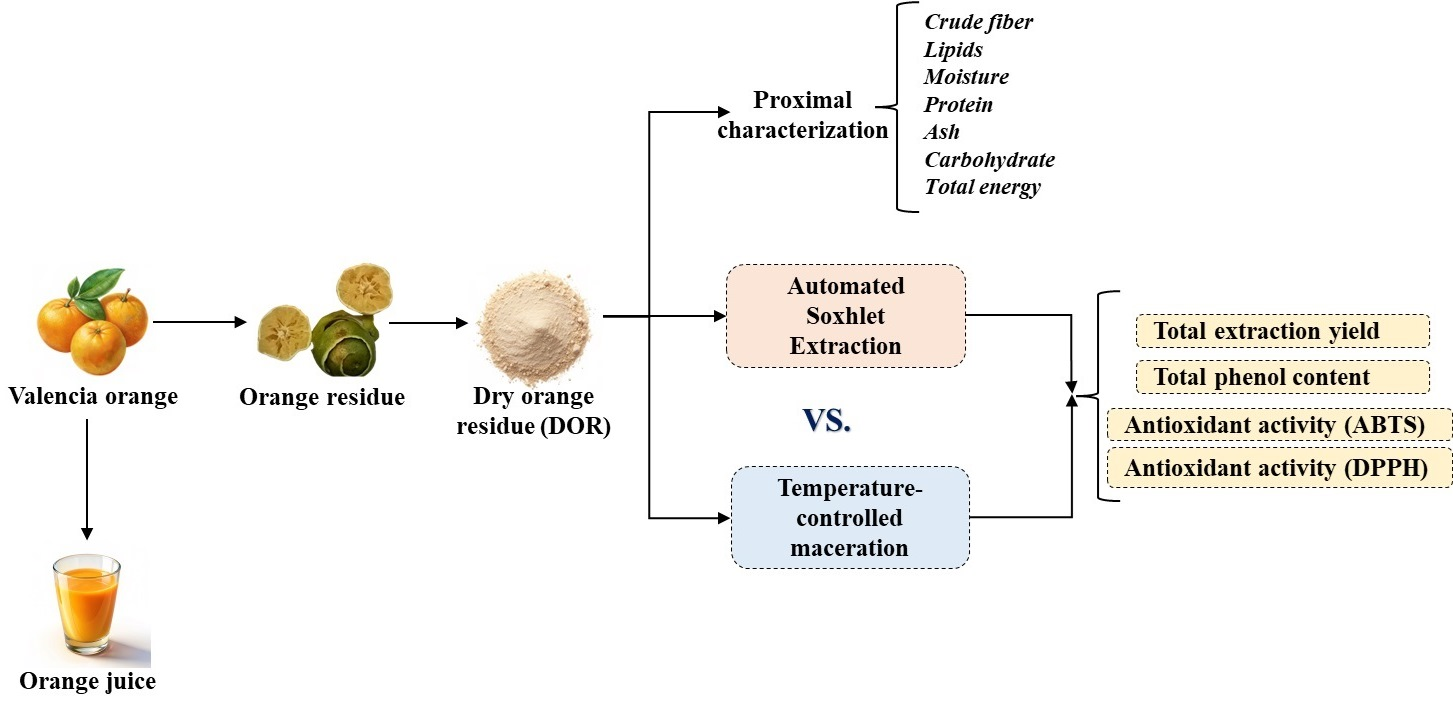
Orange waste, generally discarded, is a source of many bioactive compounds that could be used for the development of high-value-added products in the food, cosmetic, and pharmaceutical industries. The objective of this study was to evaluate the influence of extraction method (automated Soxhlet extraction and temperature-controlled maceration), solvent system, and extraction time on the recovery of bioactive compounds from Valencia orange (Citrus sinensis) by-products. Proximate characterization of the dried orange residue (DOR) was performed prior to extraction. The type of solvent (ethanol and methanol), solvent:water ratio (50, 75, and 100%), and extraction time (60 and 120 min) were evaluated in terms of total extraction yield (TEY), total phenolic content (TPC), and antioxidant capacity determined by ABTS and DPPH assays, for each extraction method. ASE generally provided higher extraction yield and total phenolic content, particularly with 75:25 ethanol:water at 120 min, whereas TCM combined with methanol produced the highest antioxidant capacity. Extracts with up to 46.32% TEY, 5.57 mg GAE/g dm, and antioxidant capacities of 66.49 and 11.10 µmol TE/g dm determined by ABTS and DPPH assays, respectively, were obtained. The results demonstrated that Valencia orange by-products are a source of phenolic compounds and antioxidants with potential for product development across different industrial sectors.

Graphical Abstract

1. Introduction

The citrus industry produces more than 120 Mt of fruits and generates up to 20 Mt of waste per year worldwide, contributing significantly to food waste. However, these citrus wastes are a source of high-value compounds, such as essential oils, antioxidants, pectin, and fermentable sugars, with potential industrial applications [1]. For the successful valorization of these residues, information regarding their chemical composition, market analysis, and availability is required [2]. In this sense, the management of citrus waste represents a real challenge for processing industries in this sector [3].
Orange is one of the most important crops worldwide and contains health-promoting compounds such as vitamin C, antioxidants, flavonoids, catechins, and folic acid [4]. Valencia-type oranges are among the most widely used fruits in the production of juices, jams, and pulps, due to their adaptability to different climatic conditions [2]. However, the parts considered non-edible (peel, oil glands, flavedo, core, segment membranes, and albedo) represent between 49% and 69% of the total fruit weight [5]. The disposal of citrus waste is costly and can cause environmental damage and health problems if not properly managed. Therefore, from an economic, environmental, and pharmaceutical perspective, these residues should be transformed into high-value resources [6,7].
The first step in the analysis of plant materials is the extraction of bioactive compounds, which play a significant role in their subsequent separation and characterization [8]. Maceration is the simplest and most commonly employed method and is considered suitable for the extraction of thermolabile compounds. Additionally, constant agitation increases diffusion and allows the dispersion of fresh extract to the surface of the material [9]. Soxhlet extraction was originally used mainly for lipid extraction, but it is currently also applied to obtain bioactive constituents; however, thermolabile compounds may be at risk of degradation due to prolonged heat exposure [9]. In any case, the study of solvents and extraction time allows for defining the final application of the extract [2].
Phenolic compounds are one of the most important groups of phytochemicals. The consumption of polyphenols has been associated with the prevention of various diseases, such as obesity, diabetes, cancer, and cardiovascular disorders [10]. They also have applications in the food industry, such as extending the shelf life of perishable products and providing antimicrobial properties; this use is considered safe due to their natural origin [3]. All of this aligns with the current consumer trend toward natural and high-quality products, rather than synthetic food additives commonly used by industries, which have been associated with allergic reactions, cancer, and neurodegenerative diseases [11].
Several studies have reported significant amounts of bioactive compounds in citrus by-products, mainly using non-conventional extraction techniques (such as microwave-assisted, ultrasound-assisted, or supercritical CO2 extraction), and, in some cases, comparing them with traditional methods [12,13,14]. However, it is important to consider the technological maturity level of novel extraction methods, as this may limit their application in real industrial contexts [2]. In this scenario, conventional methods continue to be widely used and represent a necessary reference point for evaluating the efficiency and feasibility of emerging technologies. Nevertheless, few studies have systematically compared temperature-controlled maceration and automated Soxhlet extraction while simultaneously considering the solvent system and extraction time on the recovery of bioactive compounds from Valencia orange (Citrus sinensis) waste.
The objective of this study was to evaluate the influence of extraction methods, temperature-controlled maceration (TCM) and automated Soxhlet extraction (ASE), solvent system, and time on the content of bioactive compounds in Valencia orange (Citrus sinensis) waste. To this end, the extraction techniques were compared, and the influence of solvent type (ethanol and methanol), solvent:water ratio, and extraction time on the total extraction yield (TEY), total phenolic content (TPC), and antioxidant capacity assessed by ABTS and DPPH assays was evaluated.

2. Results

2.1. Dry Orange Residue (DOR) Characterization

DOR was characterized in terms of crude fiber (11.20%), fat (1.50%), moisture (4.60%), total protein (5.20%), total ash (3.40%), carbohydrates (85.30%), and total energy (375.50 kcal). Other authors reported similar results with slight variations (Table 1).

2.2. Extracts Characterization

2.2.1. Total Extraction Yield (TEY)

The studied variables showed high significance on the total extraction yield in both methods used (Tables S1 and S5). In general, higher average TEY values were achieved with automated Soxhlet (Table 2). Since there is no significant difference between 50.22 ± 5.40 and 45.25 ± 4.09, it would be convenient to perform the extractions using ASE, employing 75% ethanol for 60 min.
In general, it is observed in Table 2 that aqueous solvent mixtures provided better TEY than pure solvents. This also suggests that DOR has a higher content of polar compounds than nonpolar ones. When ethanol was used as a solvent, there was an increase in TEY from 60 to 120 min, regardless of the extraction technique. On the other hand, with methanol in ASE, there was no significant difference, and in TCM, there was a decrease in TEY at longer extraction times.

2.2.2. Total Phenolic Content (TPC)

In the extraction of phenolic compounds, the studied variables were significant (Tables S2 and S6). Considering the moisture content of the sample at 4.6% (Table 1), the results were expressed on a dry matter (dm) basis. In both extraction methods, the highest TPC values (5.53 mg GAE/g dm and 5.57 mg GAE/g dm) were obtained at 120 min using 75% ethanol for ASE and 75% methanol for TCM (Table 3). Since ethanolic extracts are easier to use at the industrial level, TPC recovery from Valencia orange residues would be favored using automated Soxhlet, with 75% ethanol and 120 min.
When comparing the results in Table 3, certain trends can be observed. A higher amount of phenolic compounds was obtained when using 75% and 50% aqueous solvents, whereas pure solvents reached the lowest values. With longer extraction time, there was a clear tendency toward increased phenolic content in the extracts. In ASE, ethanol showed better results, while in TCM, methanol was the most efficient solvent.

2.2.3. Antioxidant Capacity

Table 4 shows the results obtained for antioxidant capacity by ABTS and DPPH assays of Valencia orange extracts obtained by automated Soxhlet and temperature-controlled maceration.
The highest antioxidant capacity in ASE was 48.12 and 10.70 µmol TE/g dm, and in TCM it was 66.49 and 11.10 µmol TE/g dm for ABTS and DPPH assays, respectively, although these values were statistically similar to those obtained under several other extraction conditions (Table 4). It is also observed that for the ABTS assay, TCM reached the highest values, whereas for the DPPH assay, ASE showed slightly higher values. The results suggest that DOR extracts are good free radical scavengers, making them potential antioxidant or nutraceutical agents.
In general, 50% and 75% aqueous mixtures were more efficient than 100% solvents for extracting antioxidants. Longer extraction times allowed obtaining extracts with higher antioxidant capacity, and regarding the solvent, ethanol performed better with automated Soxhlet, while methanol reached higher values in temperature-controlled maceration.

2.3. Correlation Between TPC and Antioxidant Capacity

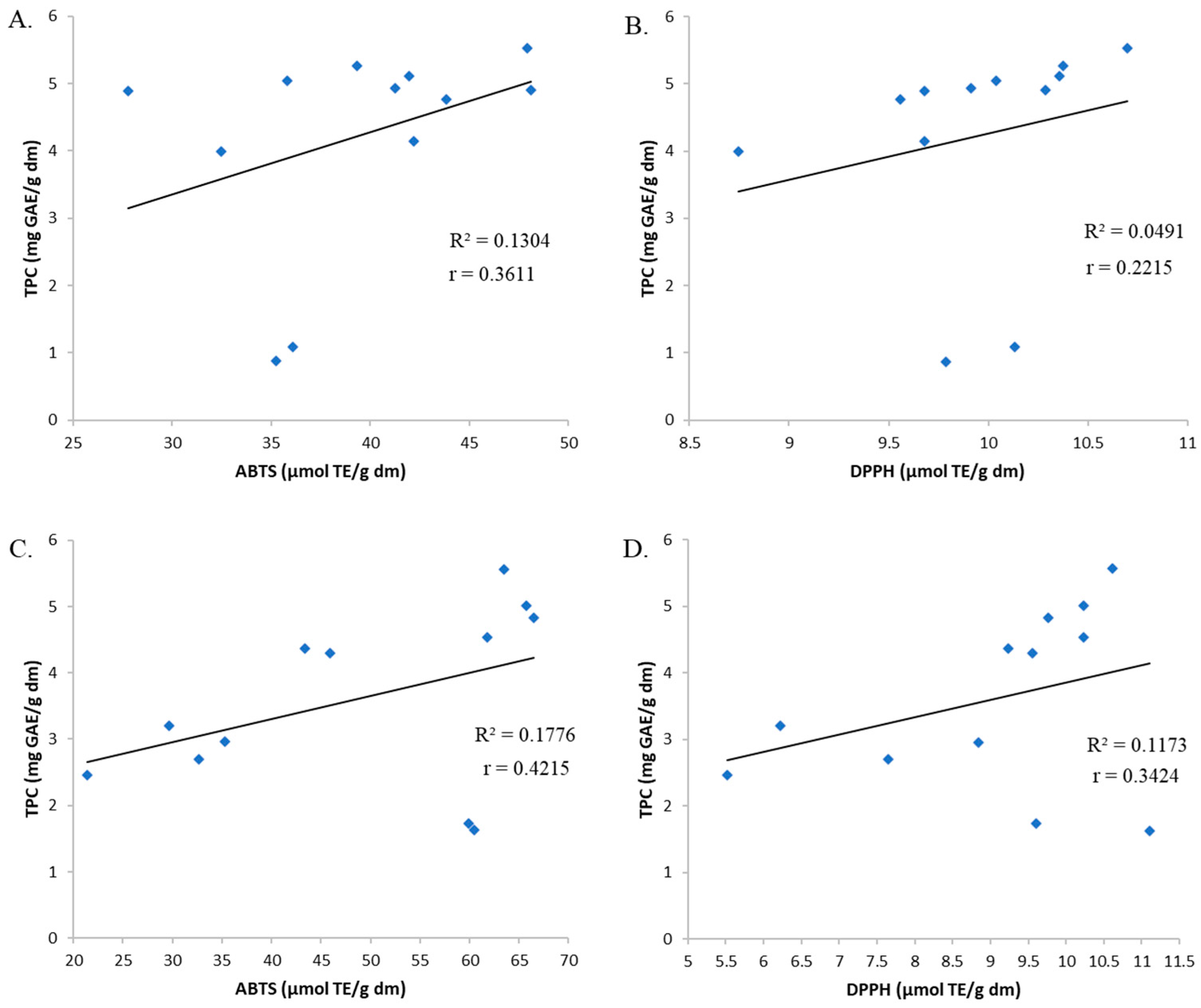
A low correlation was observed between total phenolic content and the antioxidant capacity of Valencia orange extracts (Figure 1).

3. Discussion

The variability in macronutrients can be related to different factors (such as genetics, climate, geographical area, growing conditions, shell thickness, degree of maturity, and drying method). Proteins, ash, and lipids are affected by the state of maturity, being present in higher amounts in green oranges [18].
The low moisture content of DOR confers a longer shelf life and allows it to be classified as low risk for fungal proliferation and mycotoxin formation. The fiber content of DOR makes it a suitable alternative, whose adequate consumption provides nutritional and functional benefits, such as improving oil adsorption and water retention, strengthening the immune system, and preventing cardiovascular diseases, diabetes, and colon cancer [19].
In general, higher yields were obtained with ASE. This trend was also reported in the study conducted by Medveďová et al. [20], possibly because Soxhlet extraction involves solvent recirculation, which facilitates mass transfer [21,22].
During maceration, the applied agitation and temperature control allow high values of bioactive compounds to be reached, since frequent agitation promotes diffusion and disrupts the concentrated solution layer on the material surface, allowing fresh solvent to interact with the matrix [23].
In Table 2, it can be observed that pure solvents are less effective than water mixtures, possibly because solvent–water mixtures increase diffusivity due to the presence of stronger hydrogen bonding interactions [24]. This agrees with the study conducted by Sajid et al. [25], who achieved better results using methanol–water (80:20) compared with aqueous ethanol and other solvents when performing maceration with orbital shaking. However, an excessive amount of water may require the application of significant thermal stress to rapidly heat the mixture [26].
Raharjani et al. [21] performed extractions of coffee pulp by agitation-assisted maceration with ethanol, showing that yield increases with longer extraction time due to extended contact between the solvent and the raw material. However, Table 2 shows that with methanol in ASE, there was no significant difference in yield between 60 and 120 min, and in TCM, there was a decrease at longer times. It is possible that methanol extracts certain thermosensitive compounds that degrade due to temperature as the extraction time increases [27].
On the other hand, for comparison, Benelli et al. [22] obtained an overall yield of 39.7% using Soxhlet extraction of orange pomace, while other techniques (ultrasound, supercritical fluid, and hydrodistillation) achieved lower yields ranging from 0.019 to 30%. This behavior was attributed to the high temperature, solvent recirculation, and solute–solvent interactions occurring during Soxhlet extraction. Nevertheless, the authors also mentioned that the supercritical CO2 extraction method is more selective, although it presented a lower TEY.
Ethanol has been classified as a good solvent for polyphenol extraction and is also environmentally friendly. On the other hand, methanol is more effective in extracting lower molecular weight polyphenols [28,29]. Based on this, it could be suggested that TCM mainly extracts low molecular weight polyphenols, while ASE would extract a broader group of polyphenols present in DOR, since in most treatments ASE was superior to TCM (Table 3). Raharjani et al. [21], also observed similar behavior in the extraction of phenolic compounds from coffee pulp when comparing agitation-assisted extraction and Soxhlet. Aqueous ethanol is capable of solubilizing both polar and nonpolar compounds; however, studies have reported that increasing the concentration above 75% causes a reduction in total extracted phenolic content [30,31].
In most cases, time had a positive effect on phenolic content. As shown in Table 3, significant increases were observed from 60 to 120 min of extraction; however, in ASE, when methanol was used as solvent, the effect of time was smaller, and statistically similar values were reached. In the study conducted by Chouhan et al. [32], a decrease in TPC was even observed with longer automated Soxhlet extraction time in Amaranthus viridis leaves when methanol was used as solvent. On the other hand, Zainal et al. [31] also observed an increase at longer extraction times in maceration extractions with constant agitation at room temperature. In this context, it is likely that phenolic extraction by automated Soxhlet is more susceptible to thermal and oxidative degradation effects, especially when methanol is used as the solvent, possibly due to heating and condensation cycles, whereas in temperature-controlled maceration there is a better system balance and therefore less degradation.
Similar TPC values from orange residues have been reported in other studies: 1.0596 mg GAE/g sample [33], 2.758 mg GAE/g fresh weight [34], 24.07 mg GAE/g dry weight [13], 3.9 mg GAE/g dry weight [12], 8.79 mg GAE/g dry matter [35], and 14.0 mg GAE/g sample [36]. In turn, our results are comparable and, in some cases, higher than TPC values reported for other fruit residues [37,38,39].
In all cases, ABTS values were higher than DPPH values (Table 4). This difference may be due to the fact that DPPH radicals mainly detect antioxidants from hydrophobic substances, whereas ABTS radicals detect both hydrophobic and hydrophilic antioxidants over a wide pH range. Likewise, the ability of extracts to react with and neutralize free radicals is influenced by radical stereoselectivity and extract solubility [40].
When methanol was used as a solvent, higher antioxidant capacity values were obtained with TCM (Table 4), probably due to the milder mass transfer conditions in TCM, which may favor the preservation and selective extraction of thermolabile antioxidant compounds compared to Soxhlet, where extraction is more aggressive due to thermal cycles [20]. However, when ethanol was used as a solvent, ASE was the method that achieved the highest antioxidant capacity values. Raharjani et al. [21], similarly to our study, observed that coffee pulp extracts obtained with Soxhlet had slightly higher DPPH antioxidant capacity than those obtained by agitation-assisted maceration, using 96% ethanol with 8% citric acid. In addition to the extraction method, solvent polarity has a significant impact, which quantitatively and qualitatively determines the antioxidants extracted. Vijayalaxmi et al. [37] performed agitation-assisted maceration of agricultural residues using different solvents (water, ethanol, and methanol at 50%, 70%, and 100%), and 50% methanol was the most effective solvent for extracting phenolic compounds with higher antioxidant capacity.
Other studies reported the following antioxidant capacity values for orange residues: 1.4 mg TE/g dry matter by DPPH [12], 3.39 mg/mL by DPPH and 182 µg/mL by ABTS [36], around 15 µmol TE/g orange residue by ABTS and around 50 µmol TE/g orange residue by DPPH [2]. Due to variations in samples, reagent amounts, measurement conditions, and even the way results are expressed, comparisons are difficult [35]. Variations in TEY, TPC, and antioxidant capacity between our results and those reported in other DOR studies may be attributed to extraction conditions, solvents, pretreatments, and intrinsic raw material attributes such as variety and harvest season [38].
Given the low correlation between TPC and antioxidant capacity, it is possible that most phenols present in DOR have weak free radical scavenging capacity [21]. Therefore, total phenolic content cannot be used to predict the antioxidant capacity of DOR extracts. Other studies have also not found a significant correlation between TPC and antioxidant capacity [40]. This may be explained by the fact that the antioxidant capacity of extracts is not limited only to phenolic and flavonoid content, but may also be due to the presence of other phytochemicals such as vitamins, volatile oils, carotenoids, and ascorbic acid, as well as to the synergistic action of several secondary metabolites [29].

4. Materials and Methods

4.1. Materials

The Valencia variety orange (Citrus sinensis) was acquired from the plot of Mr. Ronald Montenegro (San José de Sisa district, El Dorado province, San Martín region, Peru) in November 2024. Oranges were processed following the methodology described by Ferreira et al. [41]. Impurities were removed by washing with running drinking water. The orange residue was processed into flour by drying in an oven (Venticell 111—ECO line, BMT Medical, Kassel, Germany) at 50 °C for 48 h and then ground in a knife mill (OSTER) to homogenize the material and increase mass transfer during extraction. The dry orange residue (DOR) was placed in airtight glass bottles and stored under refrigeration at 2 °C until further analysis.
ABTS (2,2′-azino-bis-(3-ethylbenzothiazoline-6-sulfonic acid)), DPPH (1,1-diphenyl-2-picrylhydrazyl), potassium persulfate (CAS 7727-21-1), anhydrous gallic acid (CAS 149-91-7), and 6-hydroxy-2,5,7,8-tetramethylchromane-2-carboxylic acid (Trolox) were purchased from Merck KGaA (Darmstadt, Germany). Sodium carbonate (CAS 144-55-8) and Folin–Ciocalteu reagent were obtained from CDH—Central Drug House (New Delhi, India). Methanol (CAS 67-56-1, purity 99.8%) was purchased from Grupo Química (Lima, Peru), and commercial ethanol (96% purity) was used. Distilled water was obtained using a distillation unit (Model 2008, GFL, Burgwedel, Germany).

4.2. Characterization of Raw Material

The dried orange residue was characterized in terms of crude fiber according to the Peruvian Technical Standard (NTP 205.003:1980) [42], and fat, moisture, protein, and ash according to methods 930.09, 930.04, 978.04, and 930.05 of the Association of Official Analytical Chemists [43]. Carbohydrate content and energy were obtained by calculation.

4.3. Extraction Procedures

Bioactive compounds were extracted from the DOR using two extraction techniques: automated Soxhlet (ASE) and temperature-controlled maceration (TCM). In both cases, a full factorial experimental design was applied, considering three variables: type of solvent (ethanol and methanol), solvent/water ratio (50:50, 75:25, and 100:0% v/v), and extraction time (60 and 120 min), giving a total of 12 experiments for each extraction technique. Two experimental replicates and three analytical replicates were performed.
ASE was carried out using an automated Soxhlet-type extractor (FatExtractor E-500, BUCHI, Flawil, Switzerland). Briefly, 3 g of DOR was placed with 150 mL of the extracting solvent, and the temperature was set at 80 °C. Since the boiling point varies according to solvent composition, 80 °C was selected as the minimum operational temperature that ensured continuous solvent reflux for all solvent compositions evaluated. In TCM, the conditions of temperature, amount of DOR, and volume of the extracting solvent were the same as in the case of the ASE; during the TCM, the mixture was constantly stirred using a shaking water bath (H 20 SOW, LAUDA, Lauda-Königshofen, Germany). The extracts were then stored in amber bottles at 2 °C until further characterization.

4.4. Analytical Determinations of Extracts

4.4.1. Determination of Total Extraction Yield (TEY)

TEY was determined according to Vélez-Erazo et al. [44]. In a previously weighed Petri dish, 3 mL of the extract was placed, and then the samples were placed in a conventional oven at 105 °C until constant weight. The results were calculated according to Equation (1).
T E Y % = W 1 × 100 W 2
where W1 represents the dry extract weight and W2 is the initial weight of the sample.

4.4.2. Determination of Total Phenolic Content (TPC)

TPC was determined using the Folin–Ciocalteu spectrophotometric method described by Singleton et al. [45], with slight modifications. In 4 mL glass vials, 200 μL of diluted Folin–Ciocalteu reagent (1:2), 200 μL of undiluted extract, 400 μL of sodium carbonate (10% w/v), and 3200 μL of distilled water were mixed. The mixture was shaken and incubated for 30 min at 25 °C in the dark. The absorbance was measured in a spectrophotometer (S-220 UV/VIS, BOECO, Hamburg, Germany) at 765 nm. A calibration curve was prepared with a standard solution of gallic acid at different concentrations (0–0.12 mg/mL). The total phenolic content was calculated according to Equation (2).
T P C = c × V m
where c represents the concentration obtained from the calibration curve (mg/mL), V is the solvent volume (mL) used in extraction, and m is the weight (g) of the dry sample. Results were expressed as mg gallic acid equivalents (GAE) per gram of dry matter (dm).

4.4.3. Antioxidant Capacity—ABTS (2,2′-Azino-bis-(3-ethylbenzothiazoline-6-sulfonic acid) Assay

This was evaluated following Re et al. [46], with minor modifications. The ABTS+ cation was generated by reacting 5 mL of ABTS aqueous solution (7 mM) with 5 mL of potassium persulfate solution (2.45 mM). The mixture was stored in an amber bottle and kept in the dark for 16 h. The ABTS stock solution was diluted with ethanol (1:90) and adjusted to an absorbance of 0.700 ± 0.02 at 734 nm. For the samples, 20 μL of extract and 2 mL of the ABTS+ solution were mixed in glass vials, shaken manually for 5 s, and after 6 min of reaction, the absorbance was measured at 734 nm. A calibration curve was prepared using standard Trolox at different concentrations (500–2000 μM). The antioxidant capacity of the extracts was expressed as μmol Trolox equivalent (μmol TE)/g dm.

4.4.4. Antioxidant Capacity—DPPH (1,1-Diphenyl-2-picrylhydrazyl) Assay

The procedure explained by Brand-Williams et al. [47] was used with some adaptations. The calibration curve was constructed with a Trolox standard (20–200 µM). A solution was prepared by mixing the DPPH reagent with ethanol until an absorbance reading of 0.800 ± 0.02 at a wavelength of 515 nm. For the analysis of the samples, 500 μL of the extract was placed in 4 mL glass vials. Subsequently, 3 mL of ethanol and 300 μL of the DPPH solution were added; the mixtures were vortexed for 5 s and allowed to rest in darkness at room temperature for 45 min. The antioxidant capacity of the extracts was expressed as μmol Trolox equivalent (μmol TE)/g dm.

4.5. Statistical Analysis

Results obtained for the orange residue extracts were evaluated through one-way analysis of variance (ANOVA), with a significance level of 5%, followed by Tukey’s test (α = 0.05) for mean comparisons, using MINITAB® statistical software (version 18.1.0, Minitab Inc., State College, PA, USA). Microsoft Office Excel 2019 software was used to prepare the interaction graphs between factors and calculate the Pearson correlation coefficients between TPC and antioxidant capacity.

5. Conclusions

Two extraction methods were evaluated to obtain extracts rich in phenolic compounds with high antioxidant capacity from Valencia orange residues. In general, an extraction time of 120 min yielded the highest values. Seventy-five percent ethanol appears to be the most effective solvent in ASE, whereas 75% methanol seems more suitable in TCM. Therefore, the choice of extraction method will depend on equipment availability, target compounds, and solvent cost. Considering economic and environmental factors, as well as the interest in industrial applications, ethanol would be the preferred solvent.
TPC showed a weak correlation with antioxidant capacity; therefore, the antioxidant capacity observed in DOR extracts would be attributable to other compounds such as volatile oils, carotenoids, vitamins, or to a synergistic effect among several secondary metabolites. This opens the possibility for future studies on these compounds to better understand the bioactivity of Valencia orange residues, particularly through the isolation and characterization of the specific compounds responsible for such activity.
This study also presents the possibility for future research to compare the results obtained with ASE and TCM with other non-conventional extraction techniques, as well as to evaluate the effect of other variables such as temperature and solute:solvent ratio, in order to improve extraction processes and make them more efficient, taking into account the technological maturity level of such technologies.

Supplementary Materials

The following supporting information can be downloaded at: https://www.mdpi.com/article/10.3390/recycling11040077/s1, Table S1. Analysis of Variance for TEY of Valencia orange waste by TCM. Table S2. Analysis of Variance for TPC of Valencia orange waste by TCM. Table S3. Analysis of Variance for ABTS of Valencia orange waste by TCM. Table S4. Analysis of Variance for DPPH of Valencia orange waste by TCM. Table S5. Analysis of Variance for TEY of Valencia orange waste by ASE. Table S6. Analysis of Variance for TPC of Valencia orange waste by ASE. Table S7. Analysis of Variance for ABTS of Valencia orange waste by ASE. Table S8. Analysis of Variance for DPPH of Valencia orange waste by ASE.

Author Contributions

N.G.-G.: conceptualization, formal analysis, investigation. R.P.-V.: writing—original draft. J.L.P.-R.: funding acquisition, project administration, writing—review, visualization. M.F.C.-J.: methodology and editing. K.G.D.-P.: characterization of the raw material. E.N.-R.: supervision, Conceptualization. P.V.-R.: administration of resources. K.S.-D.: quantification of bioactive. Á.C.-G.: data analysis and interpretation. All authors have read and agreed to the published version of the manuscript.

Funding

The authors thank the Universidad Nacional de San Martín—PERU for the financial support according to Resolution N° 623-2022-UNSM/CU-R and Resolution N° 611-2022-UNSM/CU-R.

Data Availability Statement

The original contributions presented in this study are included in the article/Supplementary Material. Further inquiries can be directed to the corresponding author.

Conflicts of Interest

The authors declare no conflicts of interest.

References

  1. González-Miquel, M.; Díaz, I. Valorization of Citrus Waste Through Sustainable Extraction Processes. In Food Industry Wastes: Assessment and Recuperation of Commodities; Kosseva Maria, R., Colin, W., Eds.; Academic Press: London, UK, 2020; pp. 113–133. [Google Scholar]
  2. Ortiz-Sanchez, M.; Cardona Alzate, C.A.; Solarte-Toro, J.C. Orange Peel Waste as a Source of Bioactive Compounds and Valuable Products: Insights Based on Chemical Composition and Biorefining. Biomass 2024, 4, 107–131. [Google Scholar] [CrossRef]
  3. Lamine, M.; Gargouri, M.; Rahali, F.Z.; Mliki, A. Recovering and Characterizing Phenolic Compounds from Citrus By-Product: A Way Towards Agriculture of Subsistence and Sustainable Bioeconomy. Waste Biomass Valoriz. 2020, 12, 4721–4731. [Google Scholar] [CrossRef]
  4. Farag, M.A.; Abib, B.; Ayad, L.; Khattab, A.R. Sweet and Bitter Oranges: An Updated Comparative Review of Their Bioactives, Nutrition, Food Quality, Therapeutic Merits and Biowaste Valorization Practices. Food Chem. 2020, 331, 127306. [Google Scholar] [CrossRef] [PubMed]
  5. Ladaniya, M. Fruit Morphology, Anatomy and Physiology. In Citrus Fruit—Biology, Technology and Evaluation; Elseiver: Amsterdam, The Netherlands, 2023; pp. 145–171. [Google Scholar]
  6. Russo, C.; Maugeri, A.; Lombardo, G.E.; Musumeci, L.; Barreca, D.; Rapisarda, A.; Cirmi, S.; Navarra, M. The Second Life of Citrus Fruit Waste: A Valuable Source of Bioactive Compounds. Molecules 2021, 26, 5991. [Google Scholar] [CrossRef]
  7. Šafranko, S.; Ćorković, I.; Jerković, I.; Jakovljević, M.; Aladić, K.; Šubarić, D.; Jokić, S. Green Extraction Techniques for Obtaining Bioactive Compounds from Mandarin Peel (Citrus unshiu Var. Kuno): Phytochemical Analysis and Process Optimization. Foods 2021, 10, 1043. [Google Scholar] [CrossRef]
  8. Manousi, N.; Sarakatsianos, I.; Samanidou, V. Extraction Techniques of Phenolic Compounds and Other Bioactive Compounds from Medicinal and Aromatic Plants. In Engineering Tools in the Beverage Industry; Grumezescu, A.M., Holban, A.M., Eds.; Woodhead Publishing: Duxford, UK, 2019; pp. 283–314. [Google Scholar]
  9. Kamil Hussain, M.; Saquib, M.; Faheem Khan, M. Techniques for Extraction, Isolation, and Standardization of Bio-Active Compounds from Medicinal Plants. In Natural Bio-Active Compounds: Chemistry, Pharmacology and Health Care Practices; Swamy, M.K., Akhtar, M.S., Eds.; Springer: Singapore, 2019; Volume 2, pp. 179–200. [Google Scholar]
  10. Rana, A.; Samtiya, M.; Dhewa, T.; Mishra, V.; Aluko, R.E. Health Benefits of Polyphenols: A Concise Review. J. Food Biochem. 2022, 46, e14264. [Google Scholar] [CrossRef]
  11. Andrade, M.A.; Barbosa, C.H.; Shah, M.A.; Ahmad, N.; Vilarinho, F.; Khwaldia, K.; Silva, A.S.; Ramos, F. Citrus By-Products: Valuable Source of Bioactive Compounds for Food Applications. Antioxidants 2022, 12, 38. [Google Scholar] [CrossRef] [PubMed]
  12. Gómez-Mejía, E.; Rosales-Conrado, N.; León-González, M.E.; Madrid, Y. Citrus Peels Waste as a Source of Value-Added Compounds: Extraction and Quantification of Bioactive Polyphenols. Food Chem. 2019, 295, 289–299. [Google Scholar] [CrossRef] [PubMed]
  13. Wang, Z.; Mei, X.; Chen, X.; Rao, S.; Ju, T.; Li, J.; Yang, Z. Extraction and Recovery of Bioactive Soluble Phenolic Compounds from Brocade Orange (Citrus sinensis) Peels: Effect of Different Extraction Methods Thereon. LWT 2023, 173, 114337. [Google Scholar] [CrossRef]
  14. Vega Contreras, N.A.; Torres Salazar, M.L. Evaluacion de Compuestos Fenolicos de (Citrus sinensis) y Su Capacidad Antioxidante. Cienc. Desarro. 2021, 12, 109–117. [Google Scholar] [CrossRef]
  15. Haque, E.; Hanif, M.S.; Nadeem, M.; Mehmood, A.; Ibrar, M.; Iqbal, Z.; Jabbar, S. Physicochemical and Rheological Study of Orange Pulp Fortified Cookies. Sci. Lett. 2015, 3, 64–67. [Google Scholar]
  16. Abdelwahab, A.S.; Abouelyazeed, A.; Abdallah, A.E. Bioactive Compounds in Some Citrus Peels as Affected by Drying Processes and Quality Evaluation of Cakes Supplemented with Citrus Peels Powder. J. Adv. Agric. Res. 2018, 23, 44–67. [Google Scholar]
  17. Guerra, E.C.; Baños, M.I.; Luna-Jiménez, A.L.; González-Cortés, N.; Jiménez-Vera, R. Caracterización de Harina de Naranja (Citrus x sinensis) Para Uso Alimentario. Eur. Sci. J. 2020, 16, 12–18. [Google Scholar] [CrossRef][Green Version]
  18. Pascual-Chagman, G.J.; Encina-Zelada, C.R. Caracterización de Las Harinas de Trigo (Triticum aestivum), y de Residuo de Naranja (Citrus × aurantium) y de Manzana (Malus domestica) Para Su Aplicación En Alimentos. Agroindustrial Sci. 2022, 12, 279–286. [Google Scholar] [CrossRef]
  19. Garcia-Amezquita, L.E.; Tejada-Ortigoza, V.; Campanella, O.H.; Welti-Chanes, J. Influence of Drying Method on the Composition, Physicochemical Properties, and Prebiotic Potential of Dietary Fibre Concentrates from Fruit Peels. J. Food Qual. 2018, 2018, 9105237. [Google Scholar] [CrossRef]
  20. Medveďová, K.; Nahliková, L.; Strižincová, P.; Dubaj, T.; Kreps, F. Extraction of Biologically Active Compounds from Aronia melanocarpa: Comparison of Techniques and Multiple Response Optimization. Acta Chim. Slovaca 2023, 16, 92–98. [Google Scholar] [CrossRef]
  21. Raharjani, S.A.; Arlene; Angelia, J.; Kumalaputri, A.J.; Chahyadi, A.; Abduh, M.Y. Effect of Extraction Conditions on Yield and Bioactive Compounds of Coffee Pulp Extract. Biol. Nat. Resour. Eng. J. 2021, 5, 28–36. [Google Scholar] [CrossRef]
  22. Benelli, P.; Riehl, C.A.S.; Smânia, A.; Smânia, E.F.A.; Ferreira, S.R.S. Bioactive Extracts of Orange (Citrus sinensis L. Osbeck) Pomace Obtained by SFE and Low Pressure Techniques: Mathematical Modeling and Extract Composition. J. Supercrit. Fluids 2010, 55, 132–141. [Google Scholar] [CrossRef]
  23. Srivastava, N.; Singh, A.; Kumari, P.; Nishad, J.H.; Gautam, V.S.; Yadav, M.; Bharti, R.; Kumar, D.; Kharwar, R.N. Advances in Extraction Technologies: Isolation and Purification of Bioactive Compounds from Biological Materials. In Natural Bioactive Compounds: Technological Advancements; Academic Press: London, UK, 2021; pp. 409–433. [Google Scholar] [CrossRef]
  24. Farahmandfar, R.; Esmaeilzadeh Kenari, R.; Asnaashari, M.; Shahrampour, D.; Bakhshandeh, T. Bioactive Compounds, Antioxidant and Antimicrobial Activities of Arum maculatum Leaves Extracts as Affected by Various Solvents and Extraction Methods. Food Sci. Nutr. 2019, 7, 465–475. [Google Scholar] [CrossRef]
  25. Sajid, Z.I.; Anwar, F.; Shabir, G.; Rasul, G.; Alkharfy, K.M.; Gilani, A.H. Antioxidant, Antimicrobial Properties and Phenolics of Different Solvent Extracts from Bark, Leaves and Seeds of Pongamia pinnata (L.) Pierre. Molecules 2012, 17, 3917–3932. [Google Scholar] [CrossRef]
  26. Dahmoune, F.; Spigno, G.; Moussi, K.; Remini, H.; Cherbal, A.; Madani, K. Pistacia Lentiscus Leaves as a Source of Phenolic Compounds: Microwave-Assisted Extraction Optimized and Compared with Ultrasound-Assisted and Conventional Solvent Extraction. Ind. Crops Prod. 2014, 61, 31–40. [Google Scholar] [CrossRef]
  27. Kim, J.H. Extraction Time and Temperature Affect the Extraction Efficiencies of Coumarin and Phenylpropanoids from Cinnamomum Cassia Bark Using a Microwave-Assisted Extraction Method. J. Chromatogr. B 2017, 1063, 196–203. [Google Scholar] [CrossRef] [PubMed]
  28. Do, Q.D.; Angkawijaya, A.E.; Tran-Nguyen, P.L.; Huynh, L.H.; Soetaredjo, F.E.; Ismadji, S.; Ju, Y.H. Effect of Extraction Solvent on Total Phenol Content, Total Flavonoid Content, and Antioxidant Activity of Limnophila Aromatica. J. Food Drug Anal. 2014, 22, 296–302. [Google Scholar] [CrossRef]
  29. Adaramola, B.; Onigbinde, A. Effect of Extraction Solvent on the Phenolic Content, Flavonoid Content and Antioxidant Capacity of Clove Bud. IOSR J. Pharm. Biol. Sci. 2016, 11, 33–38. [Google Scholar]
  30. Sun, C.; Wu, Z.; Wang, Z.; Zhang, H. Effect of Ethanol/Water Solvents on Phenolic Profiles and Antioxidant Properties of Beijing Propolis Extracts. Evid.-Based Complement. Altern. Med. 2015, 2015, 595393. [Google Scholar] [CrossRef] [PubMed]
  31. Zainal, W.N.H.W.; Azian, N.A.A.M.; Albar, S.S.; Rusli, A.S. Effects of Extraction Method, Solvent and Time on the Bioactive Compounds and Antioxidant Activity of Tetrigona Apicalis Malaysian Propolis. J. Apic. Res. 2022, 61, 264–270. [Google Scholar] [CrossRef]
  32. Chouhan, K.B.S.; Tandey, R.; Sen, K.K.; Mehta, R.; Mandal, V. Extraction of Phenolic Principles: Value Addition through Effective Sample Pretreatment and Operational Improvement. J. Food Meas. Charact. 2019, 13, 177–186. [Google Scholar] [CrossRef]
  33. Montero-Calderon, A.; Cortes, C.; Zulueta, A.; Frigola, A.; Esteve, M.J. Green Solvents and Ultrasound-Assisted Extraction of Bioactive Orange (Citrus sinensis) Peel Compounds. Sci. Rep. 2019, 9, 16120. [Google Scholar] [CrossRef] [PubMed]
  34. Khan, M.K.; Abert-Vian, M.; Fabiano-Tixier, A.S.; Dangles, O.; Chemat, F. Ultrasound-Assisted Extraction of Polyphenols (Flavanone Glycosides) from Orange (Citrus sinensis L.) Peel. Food Chem. 2010, 119, 851–858. [Google Scholar] [CrossRef]
  35. Pérez-Nájera, V.; Lugo-Cervantes, E.; Gutiérrez-Lomelí, M.; Del-Toro-Sánchez, C.L. Extracción de Compuestos Fenólicos de La Cáscara de Lima (Citrus limetta Risso) y Determinación de Su Actividad Antioxidante. Biotecnia 2013, 15, 18–22. [Google Scholar] [CrossRef][Green Version]
  36. Ordoñez-Gómez, E.S.; Reátegui-Díaz, D.; Villanueva-Tiburcio, J.E. Polifenoles Totales y Capacidad Antioxidante En Cáscara y Hojas de Doce Cítricos. Sci. Agropecu. 2018, 9, 113–121. [Google Scholar] [CrossRef]
  37. Vijayalaxmi, S.; Jayalakshmi, S.K.; Sreeramulu, K. Polyphenols from Different Agricultural Residues: Extraction, Identification and Their Antioxidant Properties. J. Food Sci. Technol. 2015, 52, 2761–2769. [Google Scholar] [CrossRef] [PubMed]
  38. Machado, A.P.D.F.; Pasquel-Reátegui, J.L.; Barbero, G.F.; Martínez, J. Pressurized Liquid Extraction of Bioactive Compounds from Blackberry (Rubus fruticosus L.) Residues: A Comparison with Conventional Methods. Food Res. Int. 2015, 77, 675–683. [Google Scholar] [CrossRef]
  39. Viganó, J.; Brumer, I.Z.; de Campos Braga, P.A.; da Silva, J.K.; Maróstica Júnior, M.R.; Reyes Reyes, F.G.; Martínez, J. Pressurized Liquids Extraction as an Alternative Process to Readily Obtain Bioactive Compounds from Passion Fruit Rinds. Food Bioprod. Process. 2016, 100, 382–390. [Google Scholar] [CrossRef]
  40. Rafińska, K.; Pomastowski, P.; Rudnicka, J.; Krakowska, A.; Maruśka, A.; Narkute, M.; Buszewski, B. Effect of Solvent and Extraction Technique on Composition and Biological Activity of Lepidium Sativum Extracts. Food Chem. 2019, 289, 16–25. [Google Scholar] [CrossRef]
  41. Ferreira, M.S.L.; Santos, M.C.P.; Moro, T.M.A.; Basto, G.J.; Andrade, R.M.S.; Gonçalves, É.C.B.A. Formulation and Characterization of Functional Foods Based on Fruit and Vegetable Residue Flour. J. Food Sci. Technol. 2015, 52, 822–830. [Google Scholar] [CrossRef]
  42. Instituto Nacional de Calidad (INACAL). Norma Técnica Peruana. NTP 205.003:1980 (Revisada en 2011); Cereales y Menestras. Determinación de La Fibra Cruda. Diario Oficial El Peruano: Lima, Peru, 2011.
  43. AOAC International. Official Methods of Analysis of AOAC International, 21st ed.; Latimer, G.W., Jr., Ed.; AOAC International: Rockville, MD, USA, 2019. [Google Scholar]
  44. Vélez-Erazo, E.M.; Pasquel-Reátegui, J.L.; Dorronsoro-Guerrero, O.H.; Martínez-Correa, H.A. Phenolics and Carotenoids Recovery from Agroindustrial Mango Waste Using Microwave-Assisted Extraction: Extraction and Modeling. J. Food Process Eng. 2021, 44, e13774. [Google Scholar] [CrossRef]
  45. Singleton, V.L.; Orthofer, R.; Lamuela-Raventós, R.M. Analysis of Total Phenols and Other Oxidation Substrates and Antioxidants by Means of Folin-Ciocalteu Reagent. In Methods in Enzymology; Packer, L., Ed.; Academic Press: London, UK, 1999; Volume 299, pp. 152–178. [Google Scholar]
  46. Re, R.; Pellegrini, N.; Proteggente, A.; Pannala, A.; Yang, M.; Rice-Evans, C. Antioxidant Activity Applying an Improved ABTS Radical Cation Decolorization Assay. Free Radic. Biol. Med. 1999, 26, 1231–1237. [Google Scholar] [CrossRef]
  47. Brand-Williams, W.; Cuvelier, M.E.; Berset, C. Use of a Free Radical Method to Evaluate Antioxidant Activity. LWT-Food Sci. Technol. 1995, 28, 25–30. [Google Scholar] [CrossRef]
Figure 1. Correlation between antioxidant capacity and total phenolic content (TPC) of dried orange residue (DOR) extracts. Extracts obtained by automated Soxhlet extraction (A,B) and temperature-controlled maceration (C,D).
Recycling 11 00077 g001
Table 1. Proximal composition of orange residues.
This Study[15][16][17][18]
Crude fiber (%)11.20 ± 0.117.31 ± 0.10-11.27 ± 0.10-
Fat (%)1.50 ± 0.002.19 ± 0.082.82 ± 0.420.59 ± 0.082.65 ± 0.01
Moisture (%)4.60 ± 0.008.10 ± 0.1410.02 ± 0.818.73 ± 0.115.70 ± 0.03
Total protein (%)5.20 ± 0.007.40 ± 0.168.72 ± 0.925.63 ± 0.144.88 ± 0.10
Total ash (%)3.40 ± 0.012.55 ± 0.049.48 ± 0.283.33 ± 0.743.71 ± 0.07
Carbohydrate a (%)85.30--79.18 ± 0.2288.76 ± 0.18
Total energy (kcal)375.50---434.84 ± 0.49
Sum of bold values: 100%. a Carbohydrate content was determined by difference (fats, moisture, proteins, and ash).
Table 2. Full factorial design and total extraction yield (TEY) of Valencia orange (Citrus sinensis) waste.
Solvent TypeSolvent:Water (%)Time (min)TEY (%)
ASETCM
Ethanol50:506036.93 ± 3.42 cdA26.03 ± 1.83 eB
50:5012043.91 ± 1.40 bA34.03 ± 3.04 dB
75:256045.25 ± 4.09 abA31.99 ± 1.20 dB
75:2512050.22 ± 5.40 aA40.46 ± 0.43 bB
100:006035.67 ± 2.07 dA16.83 ± 1.43 fB
100:0012042.47 ± 2.08 bcA35.00 ± 1.52 cdB
Methanol50:506043.20 ± 1.36 bA44.26 ± 1.06 aA
50:5012042.93 ± 0.54 bA38.38 ± 2.96 bcB
75:256041.97 ± 2.08 bcA38.78 ± 1.35 bcB
75:2512042.49 ± 3.99 bcA41.16 ± 1.71 abA
100:006045.95 ± 2.51 abA42.22 ± 1.91 abB
100:0012046.32 ± 1.35 abA23.24 ± 1.36 eB
Note: Data are shown as means ± standard deviations (n = 3). Different lowercase letters in the same column indicate significant differences among treatments within each extraction method, whereas different uppercase letters in the same row indicate significant differences between extraction methods for the same treatment (p < 0.05).
Table 3. Full factorial design and total phenolic content (TPC) of Valencia orange (Citrus sinensis) waste extracts.
Solvent TypeSolvent:Water (%)Time (min)TPC (mg GAE/g dm)
ASETCM
Ethanol50:50604.15 ± 0.28 cA2.70 ± 0.07 cdB
50:501204.91 ± 0.23 bA4.37 ± 0.15 bB
75:25604.93 ± 0.19 bA2.96 ± 0.20 cdB
75:251205.53 ± 0.27 aA4.30 ± 0.26 bB
100:00603.99 ± 0.19 cA2.46 ± 0.13 dB
100:001204.77 ± 0.21 bA3.21 ± 0.20 cB
Methanol50:50605.12 ± 0.27 abA1.63 ± 0.11 eB
50:501205.27 ± 0.36 abA4.54 ± 0.40 bB
75:25604.90 ± 0.56 bA5.02 ± 0.69 abA
75:251205.04 ± 0.29 abB5.57 ± 0.03 aA
100:00600.87 ± 0.12 dB1.74 ± 0.08 eA
100:001201.09 ± 0.17 dB4.83 ± 0.19 abA
Note: Data are shown as means ± standard deviations (n = 3). Different lowercase letters in the same column indicate significant differences among treatments within each extraction method, whereas different uppercase letters in the same row indicate significant differences between extraction methods for the same treatment (p < 0.05).
Table 4. Full factorial design and antioxidant capacity of Valencia orange (Citrus sinensis) waste extracts determined by ABTS and DPPH assays.
Solvent TypeSolvent:Water (%)Time (min)ABTS (µmol TE/g dm)DPPH (µmol TE/g dm)
ASETCMASETCM
Ethanol50:506042.20 ± 4.36 abcA32.65 ± 1.50 dB9.68 ± 0.36 bcA7.65 ± 0.67 deB
50:5012048.12 ± 4.77 aA43.33 ± 3.15 bcA10.29 ± 0.70 abcA9.23 ± 0.81 bcdA
75:256041.25 ± 4.06 abcA35.26 ± 1.43 cdA9.91 ± 0.56 abcA8.84 ± 1.19 cdA
75:2512047.93 ± 4.35 aA45.87 ± 2.03 bA10.70 ± 0.23 aA9.55 ± 0.52 abcB
100:006032.46 ± 1.35 deA21.38 ± 3.43 eB8.74 ± 0.46 dA5.52 ± 0.14 eB
100:0012043.84 ± 3.38 abA29.70 ± 2.50 deB9.56 ± 0.20 cA6.22 ± 0.36 eB
Methanol50:506041.93 ± 3.56 abcB60.43 ± 6.32 aA10.36 ± 0.42 abcB11.10 ± 0.26 aA
50:5012039.34 ± 2.06 bcdB61.82 ± 3.66 aA10.38 ± 0.49 abA10.23 ± 0.30 abcA
75:256027.79 ± 2.68 eB65.72 ± 4.26 aA9.68 ± 0.36 bcA10.23 ± 1.46 abcA
75:2512035.80 ± 2.26 bcdeB63.52 ± 3.85 aA10.04 ± 0.28 abcA10.61 ± 1.28 abA
100:006035.23 ± 2.26 cdeB59.89 ± 3.66 aA9.79 ± 0.32 bcA9.60 ± 0.20 abcA
100:0012036.07 ± 2.20 bcdeB66.49 ± 5.62 aA10.13 ± 0.40 abcA9.77 ± 1.78 abcA
Note: Data are shown as means ± standard deviations (n = 3). Different lowercase letters in the same column indicate significant differences among treatments within each extraction method, whereas different uppercase letters in the same row indicate significant differences between extraction methods for the same treatment (p < 0.05).
Disclaimer/Publisher’s Note: The statements, opinions and data contained in all publications are solely those of the individual author(s) and contributor(s) and not of MDPI and/or the editor(s). MDPI and/or the editor(s) disclaim responsibility for any injury to people or property resulting from any ideas, methods, instructions or products referred to in the content.