Article

Recycling of Plastic Waste: How the Conditions of Thermal Cracking and the Composition of Plastic Mixtures Affect Product Yield

by
Ulyana A. Frolova
1,*,
Khoshim Kh. Urazov
1,
Nikita N. Sviridenko
1,* and
Ekaterina N. Kolobova
2
1
Institute of Petroleum Chemistry SB RAS, 4, Akademicheskiy Ave., Tomsk 634055, Russia
2
Research School of Chemistry and Applied Biomedical Sciences, Tomsk Polytechnic University, 30, Lenin Ave., Tomsk 634050, Russia
*
Authors to whom correspondence should be addressed.
Recycling 2026, 11(2), 31; https://doi.org/10.3390/recycling11020031
Submission received: 11 November 2025 / Revised: 16 January 2026 / Accepted: 19 January 2026 / Published: 2 February 2026

Abstract

This study examines the effect of different heat treatment conditions on different mixtures of plastic waste to produce fuel fractions. The mixtures included polypropylene, polystyrene, polyethylene terephthalate, low-density polyethylene, and high-density polyethylene in various ratios. The experiments revealed optimal process parameters, including the heating rate, process temperature, process duration, and environment, as well as the composition of the plastic waste mixture. This made it possible to extract more than 80% of the liquid, while gasoline and diesel fractions amounted to 35.7 and 30.5% wt., respectively. A detailed analysis of the gasoline fraction and diesel fuel obtained by cracking has demonstrated favorable properties confirming their potential as alternative sources of hydrocarbons or fuel components. A detailed study of the characteristics of the initial coke, as well as coke after alkaline treatment and calcination, revealed conditions conducive to the formation of porous carbon structures with a high specific surface area. The use of coke obtained from a mixture of plastic waste as a cracking additive slows down gas formation (by 1–5 ± 0.2% wt.) and increases the yield of low-boiling fractions (by 8.4 ± 0.4% wt.). Alkaline treatment of coke slows down its formation by increasing the specific area of micropores (from 154.8 to 219.1–286.5 m2/g) and decreasing the specific area of mesopores (from 311.2 to 76.4–187.3 m2/g), and also increases the yield of gasoline fractions. The results indicate effective ways to recycle plastic waste into valuable fuels and carbon materials, contributing to the development of technologies for sustainable waste management and resource recovery.

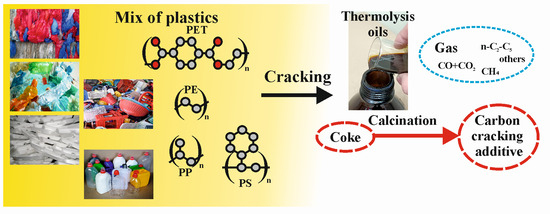
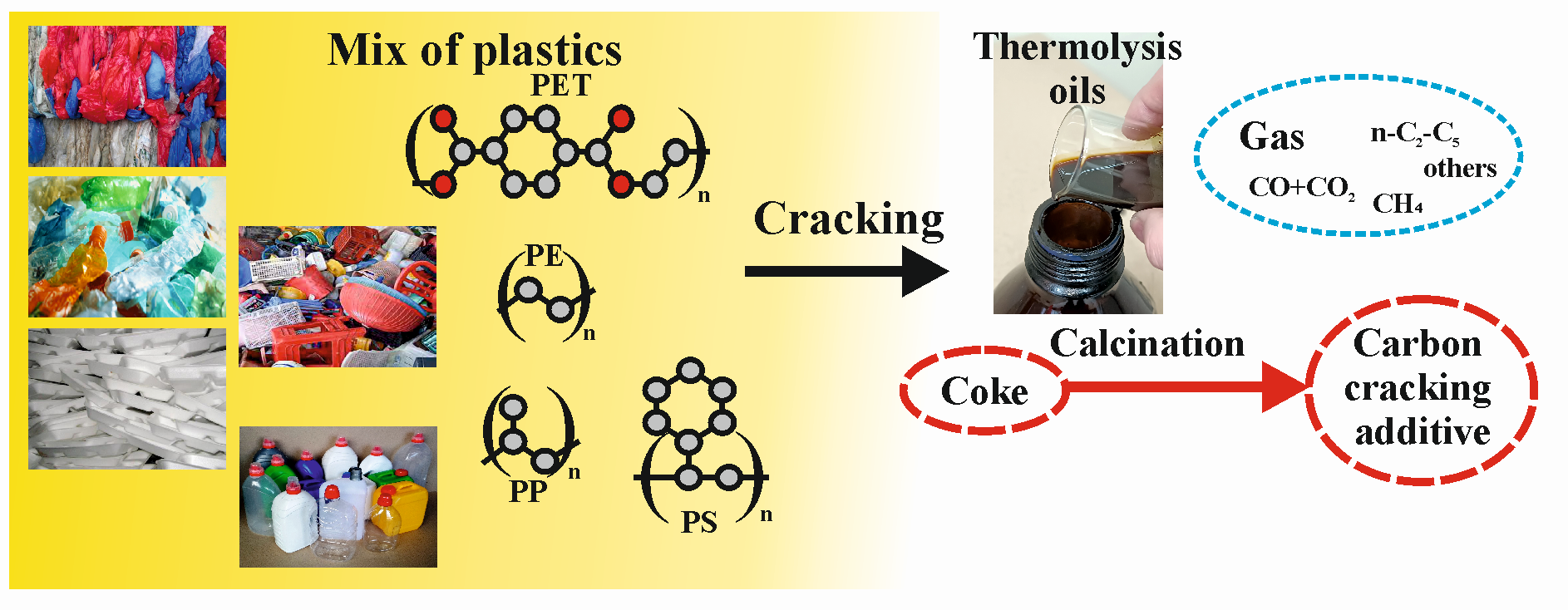
Graphical Abstract

1. Introduction

Global plastics production is inevitably growing, and will exceed 390 million tons per year by 2021 [1]. Owing to their high resistance to decomposition, plastics accumulate in the environment and pose a serious environmental threat. It is estimated that about 8 million tons of plastic waste end up in the oceans each year, disrupting marine ecosystems [2].
Concurrently, recycling rates persist at a remarkably low level, with a mere 9% of plastic waste being processed, with a substantial proportion being disposed of in landfills or incinerated [3]. The process of mechanical recycling is restricted to homogeneous and clean waste streams [4], whereas the majority of waste is mixed and contaminated. The necessity for the development of more sustainable and flexible waste management methods is becoming increasingly apparent.
Plastic recycling methods include mechanical recycling, chemical recycling, and energy recycling. Mechanical processes such as grinding and remelting are effective only for pure and homogeneous plastics [5]. Thermal processing—pyrolysis, gasification, and depolymerization—provides broader opportunities, allowing the production of fuels or monomers from mixed waste [6].
Energy utilization through combustion is widely used, for example, in Sweden and Japan, but it raises environmental concerns due to greenhouse gas emissions and the formation of hazardous substances such as dioxins [7]. Biological methods, including enzymatic decomposition of PET (polyethylene terephthalate), show promise at the laboratory level, but have not yet been scaled for industrial applications [8].
A plethora of studies are currently underway to explore the development of rational and environmentally sustainable methodologies for the recycling of plastic. As demonstrated in the extant literature, the utilisation of polymers as a raw material and energy resource has the potential to reduce the demand for primary raw materials, such as oil [9]. In particular, the work [10] posits that plastics yield a greater energy output than, for example, wood, food waste and textile waste.
A number of strategies for the effective degradation of plastic waste and its conversion into valuable fuels and materials have been the subject of study [8,11]. Chemical and thermal degradation are recognised as the most effective. The primary issues associated with thermal cracking encompass elevated energy consumption, diminished thermal conductivity in plastics, and substandard product quality [12]. One potential solution to these issues is the secondary catalytic and hydrotreating of thermolysis oils obtained from plastic waste [13,14,15,16]. The resulting refining products are a complex mixture of hydrocarbons with a wide boiling range [17].
A number of studies have demonstrated the efficacy of thermolysis oils when utilised in conjunction with diverse petroleum fractions, followed by their subsequent catalytic or hydrotreatment [16,18,19]. This approach facilitates the processing of heavy oil fractions under milder conditions [20], while concomitantly reducing the content of undesirable components and elements (nitrogen, sulfur, chlorine, etc.) [21,22]. The findings of the present studies have demonstrated that the utilisation of iron-containing materials has the capacity to reduce the chlorine content by almost 10 times.
The development of effective methods for the disposal/recycling of plastic waste is an urgent task in order to reduce its negative impact and extract valuable products from plastic mixtures. At the same time, thermal cracking or pyrolysis of plastic waste is more economically advantageous, since catalytic cracking involves additional costs in the form of creating catalysts and more complex installations. In this regard, the objective of the present study was to ascertain the optimal conditions for thermal cracking and to determine the composition of the studied mixtures of plastic waste with a view to producing valuable products.

2. Results and Discussion

2.1. Effect of Temperature and Composition of Plastic Mixtures on the Yield of Cracking Products

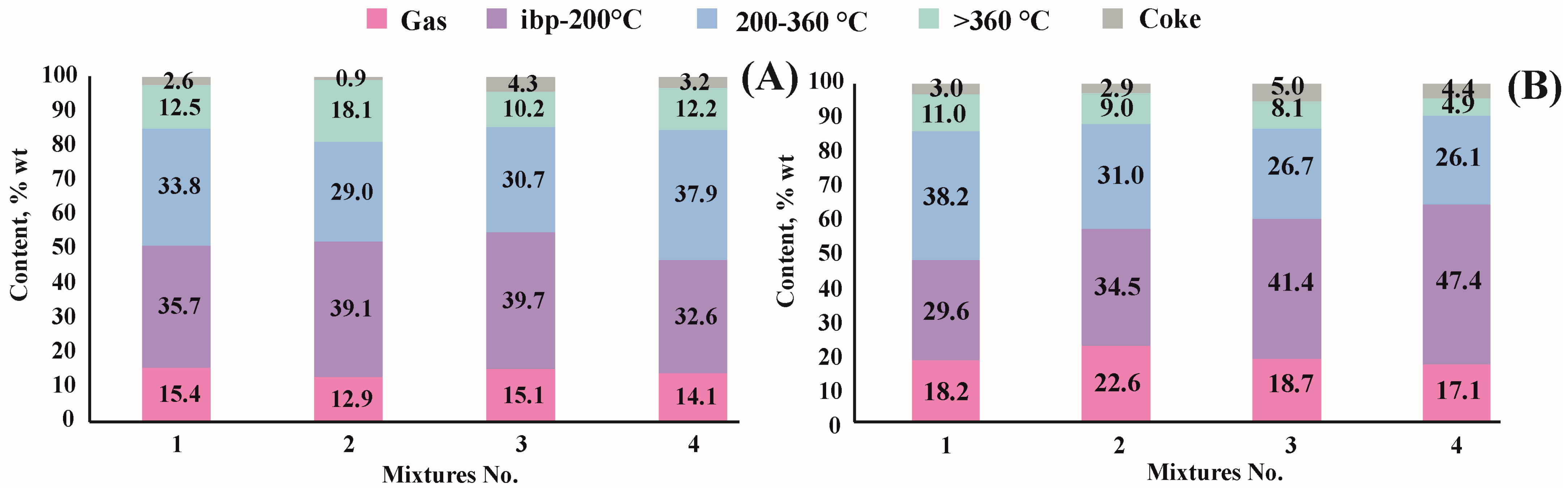
As illustrated in Table S1, the findings of the study encompass the extended results on the cracking temperature and duration of various plastic waste mixtures. As demonstrated by the data, a temperature of 450 °C is inadequate for the conversion of plastic waste, and at 525 °C, reactions involving the formation of by-products occur at excessively high levels. As illustrated in Figure 1A, the yield of plastic waste cracking products is observed at a temperature of 475 °C. The highest yield of liquid products (LPs) was observed in mixture No. 2, which was 86.2% wt. This is due to its composition—the maximum content of polypropylene (36.7% wt.) and polystyrene (17.1% wt.), with a minimum content of polyethylene terephthalate (PET) (4.3% wt.). Polypropylene (PP) is easily subject to thermal destruction, forming light hydrocarbons, and polystyrene (PS) is predominantly destroyed with the formation of styrene and other aromatic compounds that are part of the low-boiling fractions [23]. This composition contributes to a high liquid fraction yield and low coke formation (0.9% wt.). The highest content of PP and PS in the mixture determines a high yield of olefins, especially C4, despite a decrease in the total gas yield compared to other mixtures. The low content of PET determines an insignificant yield of CO and CO2 (Table 1).
Mixture No. 1, containing a significant proportion of PP (31.6% wt.) and a moderate amount of PET (12.7% wt.), also demonstrates a high yield of liquid products—82.0%—but is accompanied by a higher yield of gases (15.4% wt.) and coke (2.6% wt.), compared to mixture No. 2. This phenomenon can be attributed to the presence of PET, which has been observed to play an active role in the formation of coke and gaseous products, including CO and CO2, as evidenced in Table 1. A substantial yield of normal alkanes (particularly n-C2–C5) and methane has been identified in association with a high content of LDPE and PP in the composition of mixture No. 1.
Mixture No. 3 contains the maximum content of polyethylene terephthalate (PET)—15.1%—as well as a significant proportion of low-density polyethylene (LDPE)—28.8%. In addition, it contains moderate amounts of polystyrene (PS) and high-density polyethylene (HDPE), which contributes to a high yield of gasoline fractions—39.7% wt. However, the yield of liquid products is the lowest among all experiments, at 80.6% wt. This phenomenon can be attributed to a number of underlying reactions:
-
PET promotes coke formation [24] (the maximum value among all experiments is 4.3% wt.);
-
LDPE and PS promote the formation of light aliphatic and aromatic compounds. The LDPE structure, characterized by chain branching, facilitates its thermal decomposition to hydrocarbons in the C5–C20 range, which explains the high yield of gasoline fraction and gaseous products [25]. The mixture with the highest PET content demonstrates pronounced formation of carbon oxides (CO + CO2).
When cracking mixture No. 4, which contains the largest amount of LDPE and HDPE—31.8 and 26.9%, respectively, with PS—18.2% and PP—14.1% wt., the maximum yield of diesel fractions is observed. This phenomenon is primarily attributable to the degradation of HDPE and LDPE, which occurs concurrently with the formation of n-alkanes and olefins within the diesel fractions. It is hypothesised that the high content of aromatic polymers under these conditions is likely to result in the formation of coke, with a percentage content exceeding 3% wt. It can be hypothesised that the elevated proportion of PS within the mixture is a contributing factor to the formation of C2 olefins.
According to the fractional composition data, at a cracking temperature of 500 °C (Figure 1B), a significant contribution from secondary cracking reactions is observed. It is evident from the data presented in Figure 1 that a decrease in gasoline fractions (by 12–17%, relatively) and an increase in diesel fractions (by 7–12%, relatively) is observed for Mixtures No. 1 and No. 2. It has been established that the high content of HDPE in combination with LDPE in the studied mixtures contributes to significant gas formation at a cracking temperature of 500 °C, forming mainly saturated hydrocarbons. As demonstrated in Table 2, the maximum yield of CO + CO2 is observed for Mixtures No. 1 and No. 3, which contain more than 10% wt. of PET (Table 2).
With an increase in the cracking temperature to 500 °C, the cracking reactions intensify, which contributes to an increase in the yield of by-products. It should be noted that the coke yield increases with increasing temperature, but the trends observed at 475 °C remain: the minimum coke yield is recorded for mixture No. 2, and the maximum for mixture No. 3. The dynamics of the yield of gaseous products undergo a substantial alteration, with a notable increase observed in Mixture No. 4, from 14.1% to 17.1%, and a substantial rise evident in Mixture No. 2, from 12.9% to 22.6% wt. The high content of LDPE and HDPE, and the comparatively lower content of PP, is the reason for the greater volumes of gas produced. These gases are formed as a result of the thermal destruction of polymers.
In general, the results indicate that an increase in cracking temperature leads to a decrease in the yield of liquid products and an increase in the proportion of gases and coke in all the mixtures under study, and also causes a redistribution of the fractional composition of liquid products towards lighter hydrocarbons. The analysis indicates that the cracking of these mixtures at temperatures in excess of 475 °C is not a financially viable proposition. It was determined through analysis of the yield of cracking products that the optimal ratio of plastics is the ratio in the composition of mixture No. 1.
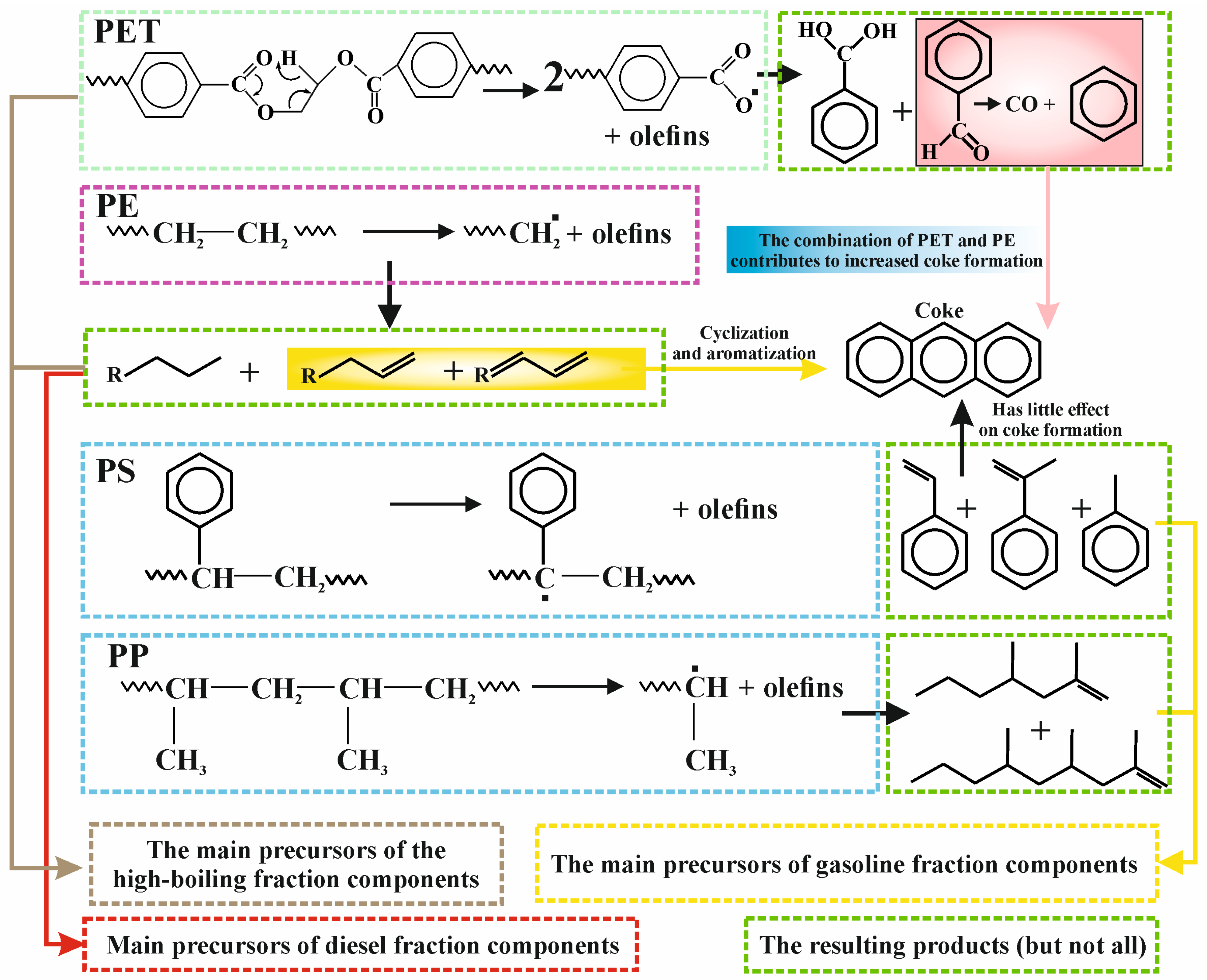
Based on the obtained data (Tables S1, Table 1 and Table 2, as well as Figure 1) and the literature data, a hypothetical mechanism for the interaction of components of various plastic wastes during the cracking process is presented (Figure 2) [15,24,25,26,27]. It was established that coke formation is due to the presence of PET and PE, where, due to cyclization and aromatization reactions, the PE degradation products form aromatic compounds. The resulting aromatic compounds condense during cracking, with the formation of coke. With an increase in the temperature and duration of the process, this becomes more noticeable, especially for mixture No. 3, where the coke yield reaches 9–12% by weight at a cracking temperature of 500–525 °C (Table S1). Polystyrene and polypropylene are primarily responsible for the formation of components included in the composition of gasoline fractions. At the same time, the degradation of polyethylene produces products with wide boiling ranges (homologous series of alkanes and olefins), which are primarily found in diesel fractions and, to a lesser extent, in high-boiling components. These are also enriched by the degradation of PET.
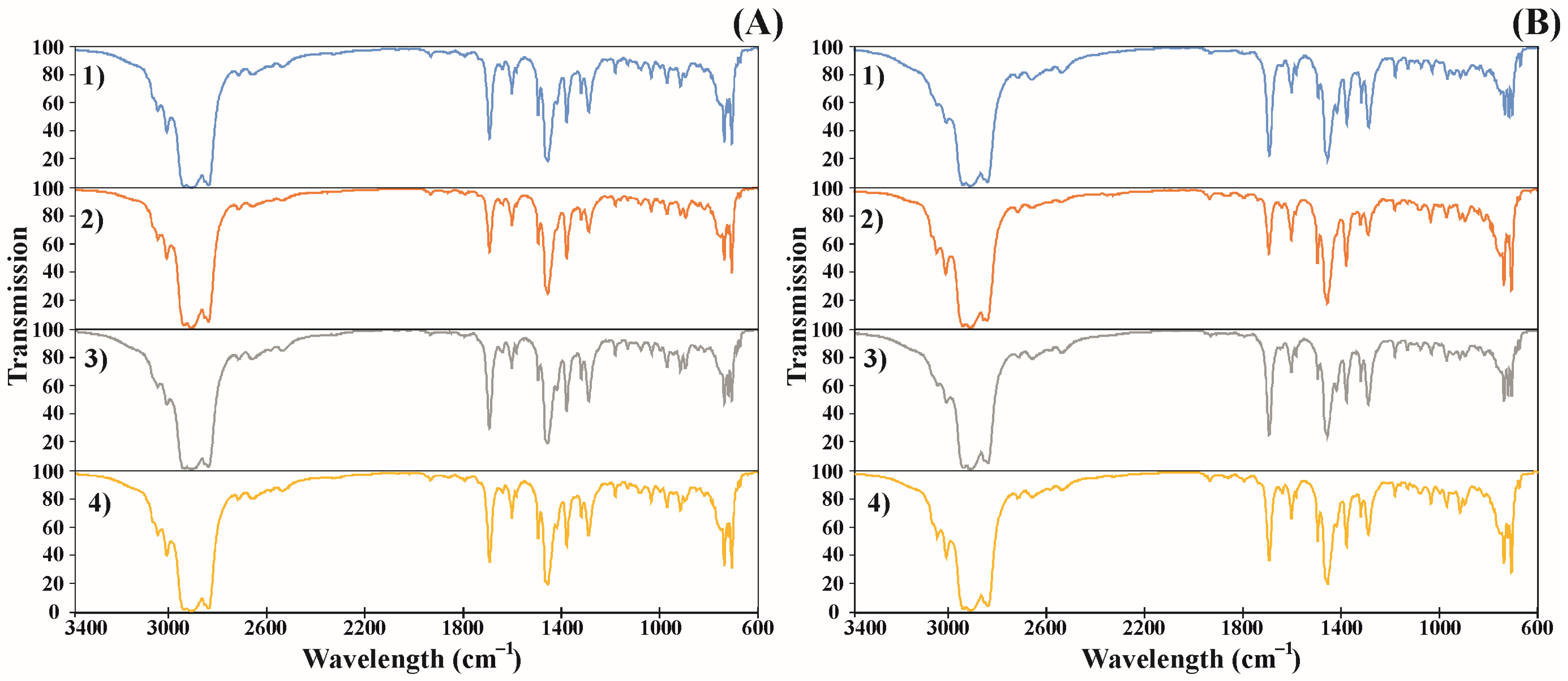
For qualitative analysis, FTIR spectroscopy was conducted on the liquid products formed during the thermal cracking of plastic waste mixtures at temperatures of 475 °C and 500 °C (Figure 3). All spectra show intense bands characteristic of hydrocarbon compounds, confirming the formation of predominantly aliphatic and aromatic hydrocarbons. It is evident that the spectra of the liquid products manifest distinct features that are intrinsically linked to the initial composition of the mixture and the cracking temperature.
As illustrated in Table 3, the process of cracking plastic waste mixtures results in the formation of specific functional groups. The destruction of LDPE and HDPE is characterized by strong bands corresponding to the valence vibrations of C–H bonds in methyl and methylene groups. This finding indicates the dominance of saturated aliphatic chains [28]. These components constitute the primary hydrocarbon matrix of the liquid products, comprising normal and branched alkanes and alkenes. As the temperature is increased to 500 °C, the intensity of the bands associated with aliphatic fragments decreases, indicating partial breakdown of long chains and enhanced destruction processes.
In the course of the thermal destruction of PS, the primary decomposition process is of a radical nature, which in turn leads to the formation of styrene monomers, dimers, and olefin hydrocarbons. It has been established that these structures retain double bonds, thus indicating incomplete aromatization and the concomitant presence of unsaturated aliphatic and aromatic compounds in the products [29]. As the temperature rises to 500 °C, the intensity of the process decreases, due to the effects of dehydration and cyclisation, which in turn lead to the formation of aromatic compounds. An increase in the proportion of PS content has been observed to result in an enhancement of the intensity of aromatic vibrations and a concomitant weakening of signals related to aliphatic groups. This phenomenon is indicative of an increase in the degree of aromatization.
The contribution of PET decomposition is expressed through the appearance of bands associated with carbonyl group vibrations. These signals are indicative of the formation of esters, ketones, and carboxylic acids within the liquid products. PET serves as a source of oxygen-containing compounds, thereby endowing the products with a more polar character. At an elevated temperature of 500 °C, the destruction of oxygen functional groups occurs, resulting in the formation of gaseous products. Concurrently, there is a decline in the intensity of these products in the spectra, indicative of progressive decarbonization and dehydration processes.
The thermal destruction of PP has been shown to contribute to the formation of i-alkane and i-alkene structures, which is reflected in the enhancement of vibrations associated with branched methyl groups [23]. The presence of the subject in question has been shown to increase the intensity of signals corresponding to asymmetric C–H vibrations, which are characteristic of branched hydrocarbons. Consequently, PP facilitates the formation of fractions with a higher proportion of light aliphatic compounds.
A comparison of the spectra at temperatures of 475 °C and 500 °C indicates that, as the temperature increases, the aromatization and dehydrogeneration processes are intensified. These processes are accompanied by an increase in the proportion of aromatic fragments and a decrease in saturated aliphatic chains. The decline in the intensity of signals associated with oxygen-containing groups is indicative of the thermal degradation of oxygen polymers, concomitant with an augmentation in the proportion of hydrocarbon products.
The studies, including variation of the heating rate and environment, were carried out at a temperature of 475 °C and process duration of 5 min, adopted as the optimal conditions for cracking plastic waste (Table 4). The data presented indicates that a modification in the heating rate of the raw material in an air environment, from 20 to 40 °C/min, results in a 2% wt. increase in the yield of gaseous products. Conversely, an augmentation in the heating rate to 50 °C/min in an air environment exerts an influence on the accumulation of compaction products, i.e., the course of condensation reactions. The coke yield is increased by almost 2% wt. A heating rate of the raw material of 60 °C/min promotes further acceleration of the destruction reactions, as indicated not only by an increase in the yield of gaseous products, but also by a decrease in the content of the fraction boiling at a temperature above 360 °C in the composition of thermolysis oils. A nitrogen environment at a heating rate of 40 °C/min helps to change the direction of the process, namely slowing down gas formation, which results in a higher yield of target products (by 0.7% wt.) in general, and gasoline fraction (by 4% wt.) in particular.
In conclusion, it can be stated that the optimal conditions for the effective destruction of plastic waste are the ratio of plastics in mixture No. 1 and the following conditions: a temperature of 475 °C and a heating rate of 40 °C/min in air. These conditions yield a high proportion of liquid products (82.0%), which is associated with the presence of polypropylene (PP) and a moderate amount of polyethylene terephthalate (PET). Concurrently, a balanced yield of gaseous products (15.4%) and coke (2.6% wt.) is observed, which allows minimization of the formation of undesirable by-products. Also, these conditions, in comparison with other works (Table 5), are more productive in the case of the output of target products and energy consumption. In comparison with other mixtures, mixture No. 1 has been demonstrated to be effective in the decomposition of polymers, with a concomitant maximization of target products.
Under these conditions, the target products were analysed in detail for compliance with commercial qualities (ASTM) (Table 6). The resulting gasoline is characterized by a low density value and a complete absence of sulfur in the composition (Table 5). According to PIONA analysis, the main content is n-alkanes (34.12%), olefins (24.87%) and i-alkanes (23.86% vol.). The high content of olefin hydrocarbons contributes to the instability and tendency to oxidation of this gasoline. It is observed that the gasoline in question is in accordance with the established regulations concerning the limits of aromatic hydrocarbons and benzene content. The obtained gasoline fraction is characterized by an octane number, according to the research method (RON), of 87.2.
An analysis of the temperature characteristics of diesel fuel showed that this fraction does not comply with ASTM D975 (Table 5). This fraction exceeds the regulated values for summer diesel fuel by 10, 12, and 8.6 °C in terms of the maximum filterability temperature, solidification temperature, and turbidity, respectively. This is due to the formation of a large number of paraffinic hydrocarbons. The sulfur content in this fraction is 0% wt. The cetane index is 53.7.
From the data presented in Table 6, it can be stated that the fractions isolated from the liquid products of cracking plastic waste can be used as a component of the corresponding fuels (compounding) or subjected to secondary hydrocracking processes.

2.2. Study of Solid Cracking Products

The present study investigates the application of coke formed as a result of the cracking of plastic waste in chemical processes. To this end, samples were treated with potassium hydroxide (at varying ratios and at a temperature of 30 °C) for the purpose of chemical activation. Subsequently, the samples were washed with distilled water, dried in a vacuum oven (at T = 60 °C for 24 h), and subsequently calcined at 450 °C for 15 min.
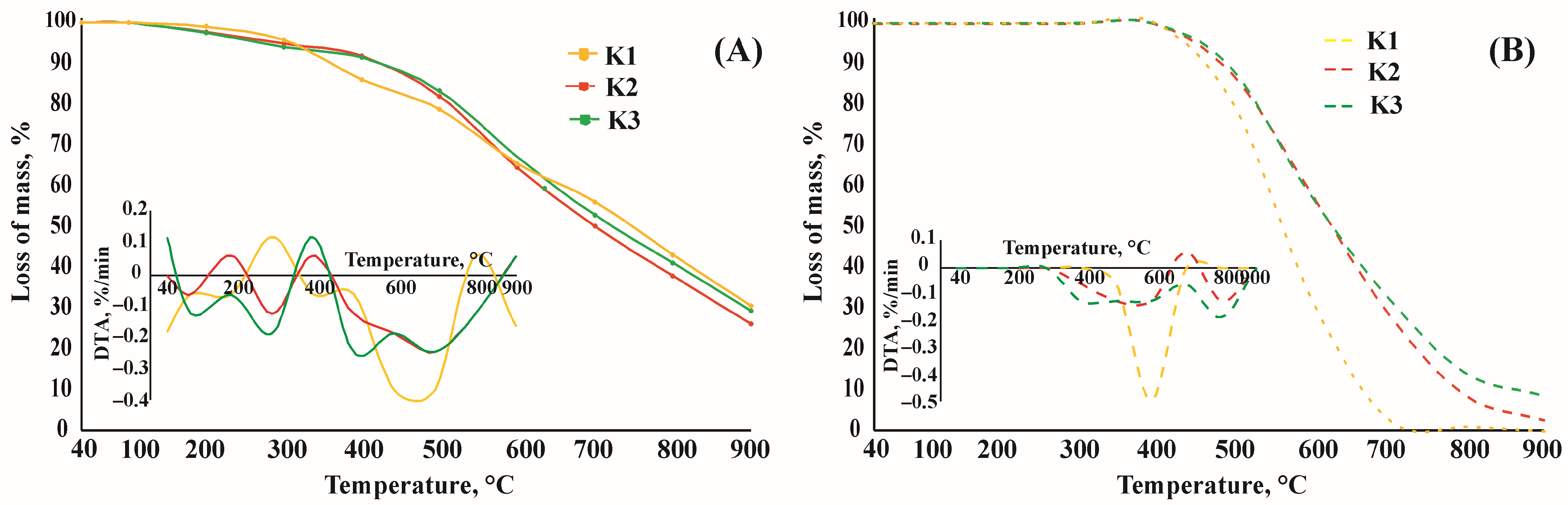
Figure 4 presents the results of thermogravimetric analysis, characterizing the mass loss (%) of the investigated coke samples as a function of temperature. The data analysis shows that with an increase in the calcination temperature of the coke, there is a significant mass loss for all samples. For the original coke (sample K1), the mass loss at 500 °C is 21.3%, and at 900 °C it is 69.5% wt. At the same time, preliminary calcination contributes to changes in the temperature intervals of mass loss of the sample, with 12.4% at 500 °C and 97.4% wt. at 900 °C.
As indicated by data provided by the TGA, the alkali-treated coke (coke: the KOH ratio of 1:1) (as observed in sample K2) exhibited a mass change profile analogous to that of sample K1 up to an approximate temperature of 600 °C, and subsequently to 900 °C. An augmentation in mass loss by 4.4% wt. was recorded at this latter temperature. The calcination of alkali-treated coke results in a temperature profile that differs from the original (see Figure 4A,B). Consequently, at 500 °C, the mass loss is 10.7%, and at 900 °C it is 91.3% wt. (which is 6.1% less).
When treating coke with alkali (coke: KOH ratio = 2:1 (sample K3)), the temperature profile obtained from TGA is between that of the sample K1 and sample K2. However, calcination leads to significant changes, with mass loss of 20.0% at 500 °C and 100.0% at 900 °C (Figure 4B). It is worth noting that this sample practically burns out completely at 700 °C (97.6% wt.). Thus, it has been established that increasing the KOH content contributes to more intense decomposition of coke at high temperatures.
Based on the DTA data in Figure 4A, it is evident that sorbed hydrocarbons, particularly paraffins and moisture, are removed up to 400 °C. For sample K1, compared to K2 and K3, an increase in the DTA value is observed at 300–380 °C, which is due to accelerated mass loss (6.5%). Sample K1 exhibits a single maximum at 480 °C, while samples K2 and K3 exhibit two maxima, at 400 °C and 495 °C, which are due to the presence of potassium salts (Figure 5B,C), which partially decompose in this temperature range. After pre-calcination, the DTA profiles undergo significant changes. Samples K2 and K3 exhibit two endothermic events in the range 380–390 to 580 °C and from 680 to 800 °C, while sample K1 exhibits a single region in the range of 400–580 °C [33,34]. This is due to the complete burnout of sample K1 at T = 700 °C, while samples K2 and K3 burn incompletely at 900 °C. This is also likely due to the residual content of K salts.
To determine the textural characteristics of the obtained coke samples, low-temperature adsorption analysis was conducted (Table 7). The specific surface area of the original coke before calcination is 46.1 m2/g, and, after calcination, this figure increases to 465.9 m2/g. This is due to the removal of residual adsorbed hydrocarbons, as well as water.
The application of alkali treatment (KOH) in varying ratios, with subsequent calcination, results in alterations to the parameters: sample K2—Ss = 362.9 m2/g, and K3—406.4 m2/g. Thus, it can be seen that the optimal increase in surface area is observed after calcination; however, increasing the amount of KOH during treatment leads to a decrease in this parameter. This may be related to excessive degradation of the structure due to a large excess of the activator.
As a result of treatment with different amounts of alkali, a redistribution of the share of meso- and micropores is observed. The maximum value of the mesopore area (Smeso) is observed in the original material (311.2 m2/g), whereas chemical activation leads to a reduction of this parameter (K2 = 76.4 m2/g, and for K3 = 187.3 m2/g). At the same time, the micropore area (Smicro) increases—from 154.8 m2/g (K1) to a maximum of 286.4 m2/g (K2). This indicates the formation of a predominantly microporous structure during KOH treatment, and that the alkali treatment can be used to control the porous structure of carbon materials.
The total pore volume is also maximal in the original material (0.223 cm3/g), and decreases after modification (to 0.164–0.184 cm3/g). The volume of mesopores decreases after activation (from 0.144 to 0.027 and 0.08 cm3/g), while the volume of micropores reaches a maximum at 1:1 (0.137 cm3/g). This confirms the predominant formation of micropores during KOH treatment. The average pore size decreases slightly.
Thus, the optimal ratio for coke/KOH treatment lies in the range of 1:1–2:1 to obtain a predominantly microporous structure with a high specific surface area. Further increasing KOH will lead to partial destruction of the structure and a decrease in all characteristics. This underscores the importance of controlling the amount of activator to form the necessary textural parameters of the carbon material. The obtained data are consistent with the results described in the literature [35,36,37].
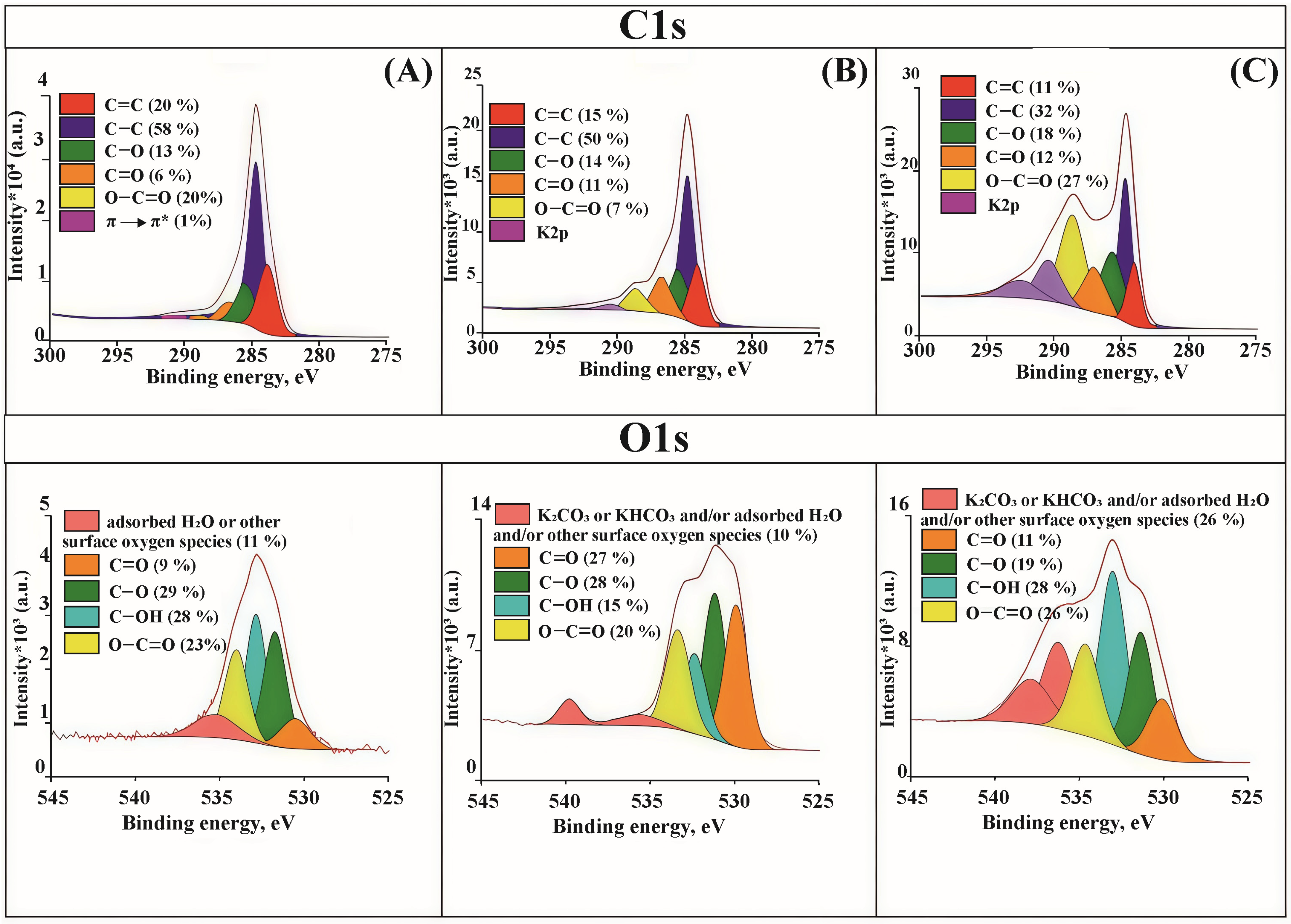
The composition of functional groups on the surface of cokes and their relative content were determined using X-ray photoelectron spectroscopy (XPS). The initial coke (K1) is characterized by the presence of carbon in the sp2 (20%) and sp3 (58%) hybrid states and carbon–oxygen-containing groups (21%) (Figure 5) [38,39,40,41,42].
Analysis of the XPS spectra of the C1s region (K2, Figure 5) showed that alkaline treatment of the initial coke leads to a decrease in the relative content of carbon in the form of C-C and C=C and an increase in the amount of carbon–oxygen-containing functional groups on its surface. It is worth noting that using a larger amount of potassium hydroxide leads to an increase in the content of oxygen-bound carbon, in particular carboxyl, of up to 27% on the coke surface (K3, Figure 4). This may be due to reactions between residual KOH and coke, according to the equations presented in [39,40,43].
The experimental XPS curves of oxygen (O1s, Figure 4) were deconvoluted into five components, indicating the presence of oxygen in the following groups: C=O, C-O, C-OH, O-C=O and K2CO3 or KHCO3 and/or adsorbed H2O and/or other surface oxygen species [30]. Alkaline treatment leads to a redistribution of surface oxygen-containing groups (K2, Figure 5), the mechanism of which is probably similar to the mechanism described in [44]. An increase in the amount of alkali used leads to an increase in the contribution of inorganic oxygen (K2CO3 or KHCO3 and/or H2O) (K3, Figure 5), which is consistent with the literature data [45].
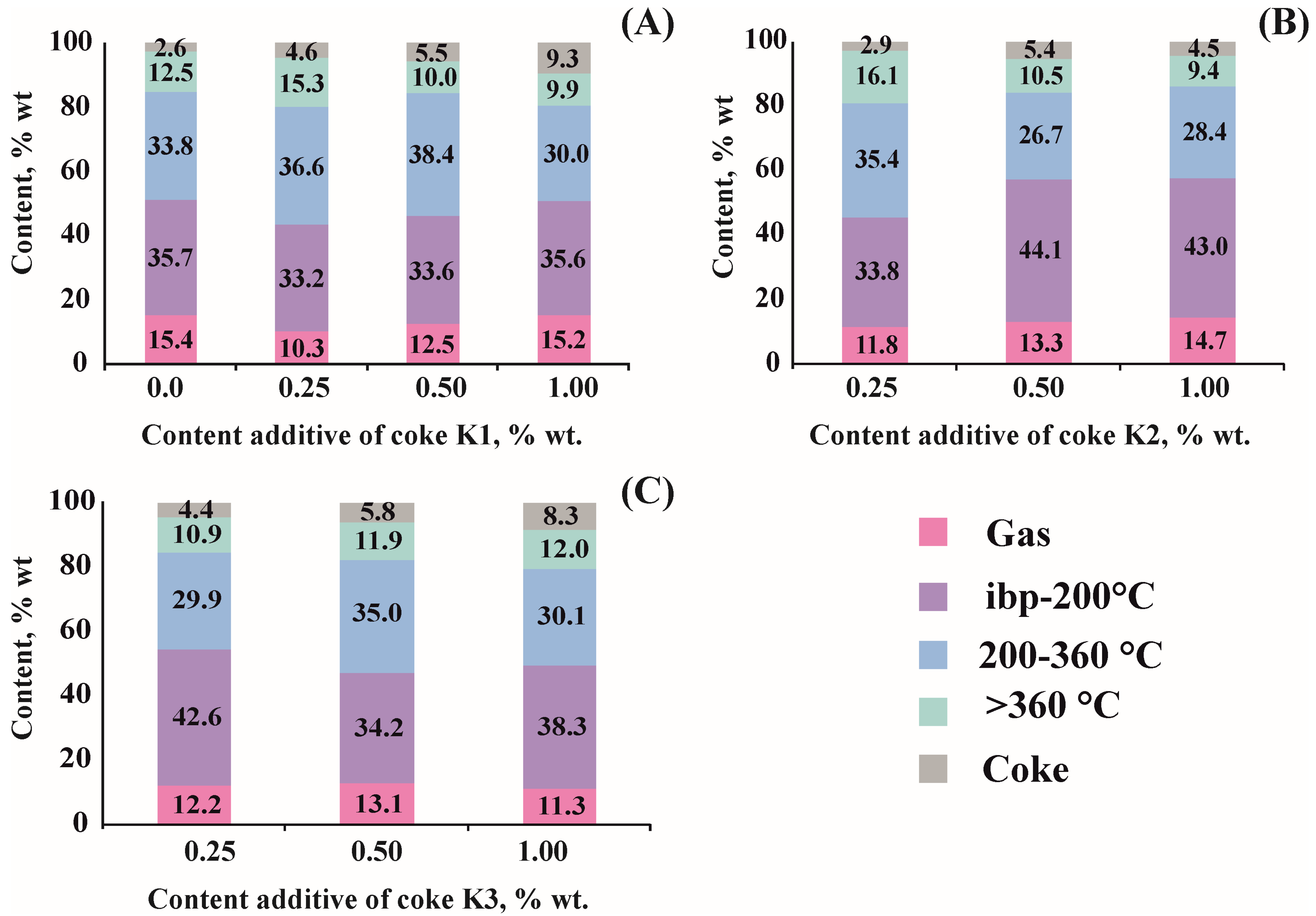
To study the possibility of further application of the products formed from the cracking of plastic waste mixtures, a series of experiments was conducted on the cracking of plastic mixture No. 1, using coke that had only been calcined at 450 °C (sample K1) and coke that had been treated with alkali in ratios of 1:1 and 2:1, also calcined at 450 °C (samples K2 and K3) (Figure 6). The research was conducted at various percentages of the additive in the plastic mixture (from 0.25% to 1%). It was established that the addition of coke affects the decomposition mechanism of the raw materials and the distribution of process products: a decrease in the yield of by-products and an increase in the formation of target fractions.
When adding sample K1 in amounts of 0.25–1.0%, a decrease in gas yield to 10.3% is observed, followed by an increase to 15.2% wt. with an increasing amount of additive. The increase in coke yield from 2.6% to 9.3% wt. with an increasing amount of additive reflects an enhancement in the adsorption processes of unsaturated and aromatic hydrocarbons on its surface, activating condensation reactions. At the same time, there is a decrease in the yield of heavy fractions boiling above 360 °C, indicating the occurrence of destruction and condensation reactions of high molecular-weight compounds. The presence of a significant number of mesopores in the initial sample K1—311.2 m2/g from 465.9 m2/g (which most often contribute to the formation of middle distillates)—leads to an increase in the yield of diesel fractions (with 0.25 and 0.5% wt. additive) by 2.8 and 4.6% wt., respectively, compared to thermal cracking [35].
Cracking the mixture in the presence of sample K2 leads to a noticeable change in the direction of cracking reactions. In this sample, the specific surface area of the mesopores decreases by a factor of 4, while that of the micropores increases by a factor of 1.9. As is known, the predominance of micropores over mesopores leads to changes in the fractions formed during cracking. When this sample is added at a concentration of 0.25% wt., the yield of light fractions (ibp–200 °C) increases to 33.8%, and, at 0.5%, it reaches a maximum value of 44.1% wt., significantly exceeding the values obtained with the addition of the original coke. Furthermore, residual potassium content after washing and calcination can also have a significant impact on the formation of gasoline fractions. The increase in gas yield indicates the intensification of hydrocarbon chain destruction reactions. The increase in the depth of polymer destruction is indicated by a reduction in the proportion of hydrocarbons boiling above 360 °C, which decreases from 16.1% to 9.4% wt. The amount of coke produced in these experiments does not exceed 5.4% wt. This behaviour can be explained by the fact that alkali activation alters the acid-base properties of the coke surface, facilitating easier breaking of C–C bonds. As a result, reactions proceed more selectively, leading to the formation of low molecular-weight products. These changes also indicate a reduced tendency for coking in the system compared to cracking of plastic waste in the presence of the untreated alkali sample K1.
When using sample K3, a similar trend is observed as with sample K2: further increases in selectivity for light fractions due to a decrease in the intensity of secondary condensation reactions. The yield of hydrocarbons boiling at 200 °C with 0.25% is 42.6% wt., while increasing the amount of additive to 1.0% results in a yield of 38.3% wt. This increase occurs because coke reduces the intensity of side reactions, such as polymerization and condensation, which decreases the formation of heavy fractions. The gas content varies between 11.3% and 13.1% wt., indicating intensified cracking reactions and accelerated decomposition of larger molecules into gaseous components, while the yield of fractions boiling between 200 and 360 °C is around 30–35% wt., indicating that the majority of products remain within the range of light and medium distillates. The proportion of heavy fractions does not exceed 12% wt., indicating that the cracking process remains efficient and aimed at producing light hydrocarbons. Differences in the yield of fractions obtained using samples K2 and K3 are due to changes in the porosity of the samples, residual alkali, etc. Thus, the yield of ibp–200 °C is higher when using K2 and 200–360 °C for K3, and the yield of coke is lower when using K2 (by 2–4% wt.) and gas for K3 (by 3% wt.).
Based on the textural characteristics and XPS data, it can be assumed that alkaline treatment of the initial coke leads to the formation of coke (K2) with an optimal ratio of micropore volume and area to macropores and content of acid-base groups on the surface for this process. The combination of these characteristics ensures the maximum yield of gasoline fractions and a lower yield of condensation products in experiments with sample K2.
Thus, it has been established that using calcined coke formed during the thermal cracking of plastic waste intensifies destruction and coking processes. At the same time, alkali-treated coke is more selective in forming light hydrocarbons that are part of gasoline fractions. This allows modified coke to be considered an effective cracking additive that promotes increased yields of gasoline fractions.


2.3. Economic Calculations

A preliminary investigation was conducted into the potential economic viability of scaling up the plastic recycling process using thermal cracking. This investigation involved approximate calculations of the associated expenses and profits (excluding duties, taxes and transportation costs). The total yield of liquid fractions amounted to 69.5% wt., which is equivalent to 695 kg of liquid hydrocarbons per ton of plastic feedstock. In volumetric terms, this is approximately 430 L of gasoline fraction and 390 L of diesel fraction, totalling about 820 L of fuel from each ton of processed plastic. Given that the technological facilities have already been purchased and installed, only operational costs are taken into account. For a facility with a capacity of 10 tons per day (≈300 tons per month), the yield of target products will be 210 tons per month. The average weighted selling price of the liquid product is approximately USD 900/ton, based on market prices for similar hydrocarbons (gasoline fraction—USD 950/ton, diesel—USD 850/ton). Table 8 presents the operational costs for processing 300 tons of plastic waste per month.
Thus, in the absence of capital investments, the net profitability of production reaches 55–60%, which significantly exceeds the indicators of mechanical and chemical recycling of plastics (Table 9). Even taking into account current taxes and administrative expenses, the company’s profit can amount to USD 100–120 thousand per month, ensuring payback in less than two weeks from the moment of launch with existing equipment.
Revenue = 210 ton × USD 900/ton = USD 189,000/month
Profit (before taxes) = 189,000 − 73,500 = USD 115,500/month
Therefore, provided that the technological equipment is available, thermal cracking followed by upgrading fuel fractions through hydroprocessing demonstrates maximum economic efficiency among all known methods of plastic waste recycling. It ensures high profitability, does not require clean or sorted feedstock, and creates an additional energy effect by using the gas fraction as fuel for heating the reactor.
With a fuel cost of USD 0.35–0.40/L and a selling price of USD 0.9–1.1/L, this process is capable of generating stable profits while simultaneously reducing environmental impact, making it a key element in the development of a circular economy and energy independence for regions.
Key assumptions:
  • The total yield of liquid fractions is reduced from 69.5% to 68.0% (due to by-product losses during hydroprocessing);
  • Additional OPEX for hydroprocessing is approximately USD 115/ton (including hydrogen—20 kg H2/ton at a price of USD 3/kg; catalyst replacement; additional energy and service);
  • After adding new costs, total OPEX = approximately USD 280/ton;
  • Product prices have increased: gasoline +5% → USD 997.5/ton, diesel +7.5% → USD 913.75/ton;
  • When processing 300 tons/month: gasoline ≈ 104.79 tons/month, diesel ≈ 99.21 tons/month, revenue ≈ USD 195,181/month, OPEX ≈ USD 79,500/month, profit ≈ USD 115,681/month (approximately);
  • This analysis is simplified, taking into account only operating costs and excluding CAPEX;
  • The gases produced during thermal cracking can be used to heat the reactor, but their quantity is not sufficient to fully support operation, so additional fuel must be used for heating;
  • Processing raw materials containing geratoms (sulfur, nitrogen, and chlorine) requires the inclusion of a stage of additional removal of unwanted compounds that cause corrosion of equipment.

3. Materials and Methods

3.1. Materials

The materials used in this work were plastic residues collected from objects of common use. The collected plastic waste was classified, washed, dried, and crushed using a crusher and stored until use. Table 10 shows the composition of plastic waste mixtures [3,26].

3.2. Cracking Test

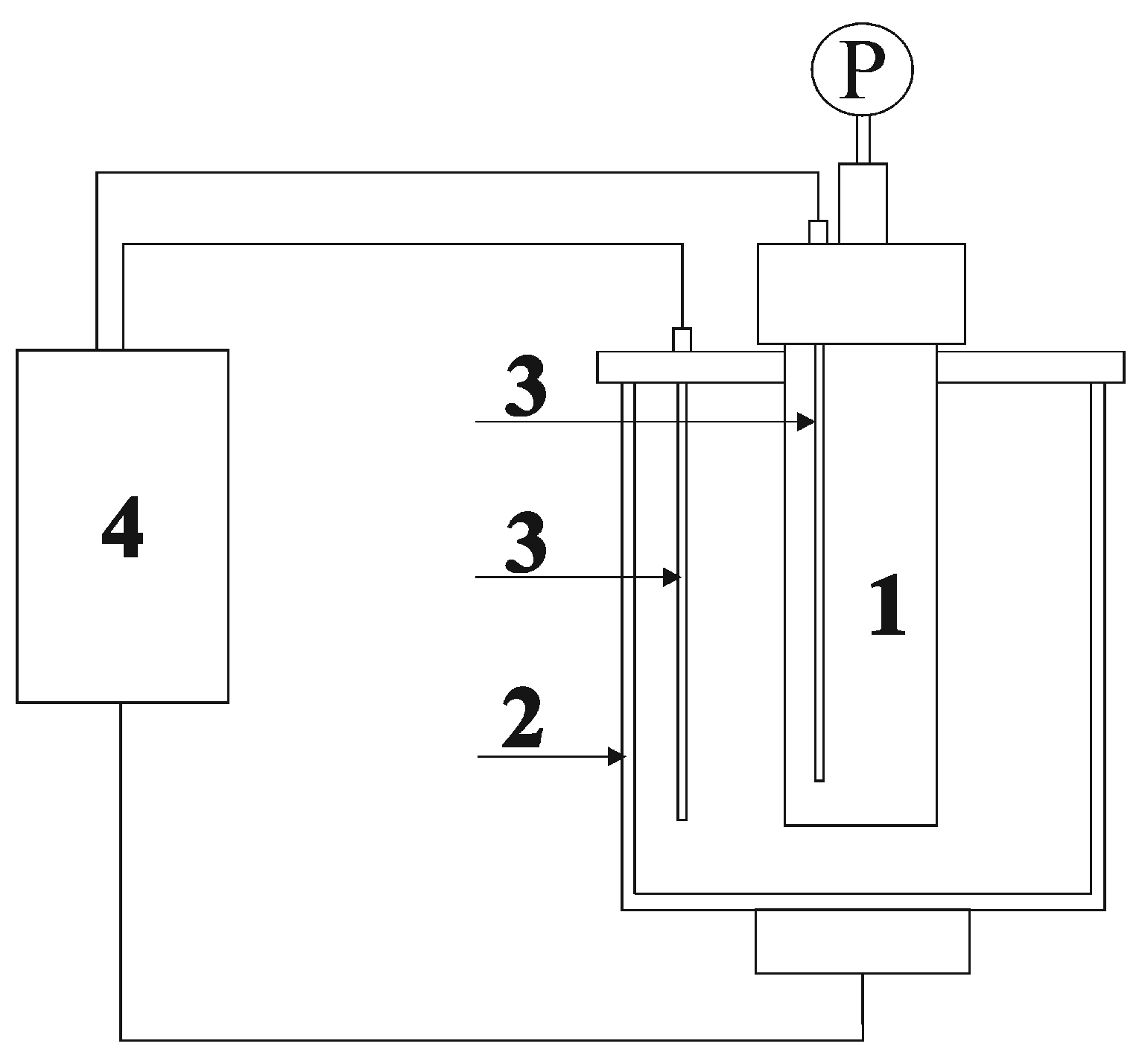
Plastic mixtures were subjected to cracking in a 12 cm3 autoclave at temperatures of 450–525 °C for 5–60 min, with heating rates of 20–60 °C/min (Figure 7). Gas yields were determined by the mass loss of the reactor after removal of gaseous products (by weighing the reactor before and after). Liquid products were collected, the reactor rinsed with chloroform, and weighed. The difference in reactor mass before and after was considered as solid residue (coke). To obtain the required amount of liquid products, plastic waste mixture No. 1 was cracked in a 250 cm3 reactor under optimal conditions.

3.3. Gas Product Analysis

The composition of gaseous products (C1–C5 hydrocarbons, hydrogen, CO, and CO2) from plastic mixture cracking was analysed via gas chromatography on a “Kristall-5000” chromatograph (Chromatek, Yoshkar-Ola, Russia), according to GOST 31371.3-2008 [49]. Detection of hydrogen, oxygen, and nitrogen was performed on a column filled with NaX molecular sieves (fraction 80–100 mesh, 3 m length, 2 mm inner diameter). Carrier gas (argon) flow rate was 30 mL/min. Separation of C1–C5 hydrocarbons was carried out on a column filled with Porapak R polymer sorbent (fraction 80–100 mesh, 3 m length, 2 mm inner diameter) with helium as carrier gas at 30 mL/min.

3.4. Analysis of Liquid Cracking Products

Physicochemical properties of raw materials and cracking products were determined per ASTM standards. Sulfur content was measured according to ASTM-D4294 [50]; distillation curves were obtained as per ASTM-D2887 [51]. Density values followed ASTM D1160-2003 (06) [52]. Gasoline fraction characteristics were assessed as per ASTM D6733 [53]. Diesel fractions’ temperature characteristics were determined via cloud point ASTM D2500 [54], freezing point ASTM D97 [55], and filtrability ASTM D6371 [56]. The FTIR spectra of liquid cracking products were taken on a NICOLET 5700 FTIR spectrometer (Thermo Fisher Scientific, Waltham, MA, USA)in the range of 400–4000 cm−1, with a resolution of 4 cm−1.

3.5. Nitrogen Adsorption at Low Temperatures

Porous structure parameters of obtained coke samples were determined by the Brunauer–Emmett–Teller (BET) method, using an automatic gas adsorption analyser TriStar II (3020, Micromeritics, Norcross, GA, USA). Specific surface area was calculated from nitrogen adsorption isotherms at liquid nitrogen temperature. Pore volume and size were determined by the BJH (Barrett–Joyner–Halenda) model, based on adsorption and desorption isotherms at relative pressure P/P0 = 0.99.

3.6. Differential Thermal Analysis

Coke samples were analysed using simultaneous thermogravimetric analysis (TGA-DTA/DSC 449 c/4 Jupiter, NETZSCH, Selb, Bavaria, Germany), in the temperature range 40–900 °C at a heating rate of 10 °C/min, in an argon environment.

3.7. X-Ray Photoelectron Spectroscopy (XPS)

To study the oxidation state of carbon and oxygen in the obtained cokes, X-ray photoelectron spectroscopy (XPS) was used using a XPS NEXSA spectrometer (Thermo Fisher Scientific, Waltham, MA, USA) with a monochromated Al Kα X-ray source (1486.6 eV) and a charge compensation system. The survey spectra were recorded with a pass energy rate of 200 eV and a step size of 1 eV, while a pass energy rate of 50 eV and a step size of 0.1 eV were applied for the high-resolution spectra. The analysed area was 200 μm2. It should be noted that XPS provides information about the electronic/chemical state of elements only in the near-surface layer (5–15 nm), the composition of which can change during the reaction and upon contact with the environment. The CASA XPS software (version 2.3.15, CASA Software Ltd., Teignmouth, UK, http://www.casaxps.com/, (accessed on 1 September 2022)) was used for processing the spectra.

4. Conclusions

As a result of the conducted research, it has been established that the optimal conditions for the thermal cracking of plastic waste are a temperature of 475 °C and a heating rate of 40 °C/min in an air environment, which ensures a high yield of liquid products (about 82% wt.) and minimizes the formation of undesirable by-products. Increasing the temperature to 500 °C has been shown to result in the formation of lighter hydrocarbons and an increase in the yield of solid residues (coke). However, this is considered to be undesirable from the perspective of process optimisation. The resulting thermolysis oil (taking into account the yield of gas and coke) is characterized by a gasoline fraction content of 35.7%, diesel fraction of 33.8%, and a residue boiling above 360 °C of 12.5% wt. The gasoline fraction obtained from plastic waste is characterised by good operational properties; however, the diesel fraction does not fully comply with ASTM D975 standards, due to the high content of paraffinic hydrocarbons.
Alkaline treatment has been shown to increase its formation by increasing the specific area of micropores (from 154.8 to 219.1–286.5 m2/g) and decreasing the specific area of mesopores (from 311.2 to 76.4–187.3 m2/g). In contrast, untreated coke has a larger specific surface area (by 15–28% rel.). The incorporation of coke during the thermal cracking of mixed plastic waste exerts a substantial influence on product distribution. Untreated coke has been shown to enhance secondary condensation and aromatization, resulting in increased solid residue formation by 2.0–6.7% wt. Conversely, alkali-treated coke has been observed to promote selective cracking towards light hydrocarbons by insignificant suppressing of coking and stabilizing intermediate radicals. Compared to untreated coke, the use of treated coke promotes additional formation of gasoline fractions (by 0.6–9.4% wt.). This pattern persists with increasing additive loading. The predominance of micropores over mesopores accelerates cracking reactions along the following pathway: components >360 °C => components 200–360 °C => components ibp–200 °C, with subsequent accumulation of gasoline fraction components. Optimum results were achieved using alkali-treated coke in a mixture with coke in a ratio of 2:1, providing the maximum total yield of gasoline (42.6% wt.) and diesel fractions (29.9% wt.).
Therefore, alkali-modified coke acts as an effective additive, increasing the efficiency of the process (reducing the yield of gaseous products by 3.2% and increasing the yield of light fractions by 3.0% wt.) and with the selectivity for gasoline fractions increased by 5.5% compared to thermal cracking of plastic waste.
Thermal cracking of plastic waste followed by hydrotreating provides a high yield of liquid fuels and profitability of about 55–60%, assuming the use of existing processing facilities. Compared to other methods, this method offers higher economic efficiency and enables the production of commercial gasoline and diesel fractions that meet national fuel standards.

Supplementary Materials

The following supporting information can be downloaded at https://www.mdpi.com/article/10.3390/recycling11020031/s1, Table S1: Impact of cracking conditions of various mixtures of plastic waste on the output of cracking products.

Author Contributions

Conceptualization, N.N.S.; methodology, U.A.F.; investigation, U.A.F., K.K.U. and E.N.K.; data curation, K.K.U.; writing—original draft preparation, U.A.F. and N.N.S.; writing—review and editing, U.A.F., K.K.U., N.N.S. and E.N.K.; funding acquisition, N.N.S. All authors have read and agreed to the published version of the manuscript.

Funding

The study was supported by a grant from the Russian Science Foundation No. 24-73-00058, https://rscf.ru/project/24-73-00058/ (accessed on 11 November 2025).

Data Availability Statement

Data are contained within the present article. The authors will provide additional data related to this paper upon request.

Conflicts of Interest

The authors declare no conflicts of interest.

Abbreviations

PPPolypropylene
LDPELow-density polyethylene (LDPE)
HDPEHigh-density polyethylene
PETPolyethylene terephthalate (PET)
PSPolystyrene (PS)
GOSTGovernment standard
ASTMAmerican Society for Testing and Materials
ibpInitial boiling point

References

  1. PlasticsEurope. Plastics—The Facts 2022. 2022. Available online: https://plasticseurope.org (accessed on 8 October 2025).
  2. Jambeck, J.R.; Geyer, R.; Wilcox, C.; Siegler, T.R.; Perryman, M.; Andrady, A.; Narayan, R.; Law, K.L. Plastic waste inputs from land into the ocean. Science 2015, 347, 768–771. [Google Scholar] [CrossRef]
  3. OECD. Global Plastics Outlook: Policy Scenarios to 2060; OECD Publishing: Paris, France, 2022; Available online: https://www.oecd.org/en/publications/global-plastics-outlook_aa1edf33-en.html (accessed on 18 August 2025).
  4. Hopewell, J.; Dvorak, R.; Kosior, E. Plastics recycling: Challenges and opportunities. Philos. Trans. R. Soc. B 2009, 364, 2115–2126. [Google Scholar] [CrossRef]
  5. Andrady, A.L.; Neal, M.A. Applications and societal benefits of plastics. Philos. Trans. R. Soc. B 2009, 364, 1977–1984. [Google Scholar] [CrossRef]
  6. Al Salem, S.M.; Lettieri, P.; Baeyens, J. Recycling and recovery routes of plastic solid waste (PSW): A review. Waste Manag. 2009, 29, 2625–2643. [Google Scholar] [CrossRef]
  7. Arena, U. Process and technological aspects of municipal solid waste gasification: A review. Waste Manag. 2012, 32, 625–639. [Google Scholar] [CrossRef]
  8. Yoshida, S.; Hiraga, K.; Takehana, T.; Taniguchi, I.; Yamaji, H.; Maeda, Y.; Toyohara, K.; Miyamoto, K.; Kimura, Y.; Oda, K. A bacterium that degrades and assimilates polyethylene terephthalate. Science 2016, 351, 1196–1199. [Google Scholar] [CrossRef]
  9. Korai, M.S.; Mahar, R.B.; Uqaili, M.A. Optimization of waste to energy routes through biochemical and thermochemical treatment options of municipal solid waste in Hyderabad, Pakistan. Energy Convers. Manag. 2016, 124, 333–343. [Google Scholar] [CrossRef]
  10. Shovon, S.M.; Akash, F.A.; Rahman, W.; Rahman, M.A.; Chakraborty, P.; Hossain, H.M.Z.; Monir, M.U. Strategies of managing solid waste and energy recovery for a developing country—A review. Heliyon 2024, 10, 24736. [Google Scholar] [CrossRef] [PubMed]
  11. Shah, J.; Jan, M.R. Metal-decorated montmorillonite as a catalyst for the degradation of polystyrene. J. Taiwan Inst. Chem. Eng. 2017, 80, 391–398. [Google Scholar] [CrossRef]
  12. Qureshi, M.S.; Oasmaa, A.; Pihkola, H.; Deviatkin, I.; Tenhunen, A.; Mannila, J.; Minkkinen, H.; Pohjakallio, M.; Laine-Ylijoki, J. Pyrolysis of plastic waste: Opportunities and challenges. J. Anal. Appl. Pyrolysis 2020, 152, 104804. [Google Scholar] [CrossRef]
  13. Adamou, P.; Harkou, E.; Bumajdad, A.; De Jong, X.; Van Haute, M.; Constantinou, A.; Al-Salem, S.M. Effect of Polyethylene Pyrolysis Oil Hydrotreatment on the Pt/Al2O3 Catalyst: Experimental Characterization. ACS Omega 2024, 9, 19057–19062. [Google Scholar] [CrossRef]
  14. Klimov, O.V.; Nadeina, K.A.; Potapenko, O.V.; Vatutina, Y.V.; Saiko, A.V.; Koveza, V.A.; Mukhacheva, P.P.; Krestyaninova, V.S.; Yurtaeva, A.S.; Bogomolova, T.S.; et al. Refining of chlorine containing plastic wastes by traditional hydrotreating and catalytic cracking processes. Fuel 2023, 349, 128651. [Google Scholar] [CrossRef]
  15. Palos, R.; Gutiérrez, A.; Vela, F.J.; Olazar, M.; Arandes, J.M.; Bilbao, J. Waste Refinery: The valorization of waste plastics and end-of-life tires in refinery units. A review. Energy Fuels 2021, 35, 3529–3557. [Google Scholar] [CrossRef]
  16. Kots, P.A.; Doika, P.A.; Vance, B.C.; Najmi, S.; Vlachos, D.G. Tuning high density polyethylene hydrocracking through mordenite zeolite crystal engineering. ACS Sustain. Chem. Eng. 2023, 11, 9000–9009. [Google Scholar] [CrossRef]
  17. Chen, Z.; Erwin, B.J.; Che, L. Recycling waste polyethylene into fuels over Fe/USY catalyst: Evaluation on the catalytic activities of varied iron states. Fuel 2024, 363, 131007. [Google Scholar] [CrossRef]
  18. Palos, R.; Crespo, I.; Trueba, D.; Klimov, O.V.; Kazakov, M.O.; Bilbao, J.; Gutiérrez, A. Hydrocracking of plastic pyrolysis oil (PPO) blended with vacuum gas oil (VGO) over Pt–Pd catalysts supported on USY–ASA–Al2O3 composites. Energy Fuels 2024, 38, 17866–17877. [Google Scholar] [CrossRef]
  19. Palos, R.; Rodríguez, E.; Gutiérrez, A.; Bilbao, J.; Arandes, J.M. Cracking of plastic pyrolysis oil over FCC equilibrium catalysts to produce fuels: Kinetic modeling. Fuel 2022, 316, 123341. [Google Scholar] [CrossRef]
  20. Lingaiah, N.; Uddin, M.A.; Muto, A.; Imai, T.; Sakata, Y. Removal of organic chlorine compounds by catalytic dehydrochlorination for the refinement of municipal waste plastic derived oil. Fuel 2001, 80, 1901–1905. [Google Scholar] [CrossRef]
  21. Pan, J.; Jiang, H.; Qing, T.; Zhang, J.; Tian, K. Transformation and kinetics of chlorine containing products during pyrolysis of plastic wastes. Chemosphere 2021, 284, 131348. [Google Scholar] [CrossRef]
  22. Lopez-Urionabarrenechea, A.; de Marco, I.; Caballero, B.M.; Laresgoiti, M.F.; Adrados, A. Upgrading of chlorinated oils coming from pyrolysis of plastic waste. Fuel Process. Technol. 2015, 137, 229–239. [Google Scholar] [CrossRef]
  23. Calero, M.; Solís, R.R.; Muñoz-Batista, M.J.; Pérez, A.; Blázquez, G.; Martín-Lara, M.Á. Oil and gas production from the pyrolytic transformation of recycled plastic waste: An integral study by polymer families. Chem. Eng. Sci. 2023, 271, 118569. [Google Scholar] [CrossRef]
  24. Sharuddin, S.D.A.; Abnisa, F.; Daud, W.M.A.W.; Aroua, M.K. A review on pyrolysis of plastic wastes. Energy Convers. Manag. 2016, 115, 308–326. [Google Scholar] [CrossRef]
  25. Schyns, Z.O.G.; Shaver, M.P. Mechanical Recycling of Packaging Plastics: A Review. Macromol. Rapid Commun. 2021, 42, 2000415. [Google Scholar] [CrossRef] [PubMed]
  26. Chang, S.H. Plastic waste as pyrolysis feedstock for plastic oil production: A review. Sci. Total Environ. 2023, 877, 162719. [Google Scholar] [CrossRef]
  27. Park, C.; Kim, S.; Kwon, Y.; Jeong, C.; Cho, Y.; Lee, C.-G.; Jung, S.; Choi, K.-Y.; Lee, J. Pyrolysis of Polyethylene Terephthalate over Carbon-Supported Pd Catalyst. Catalysts 2020, 10, 496. [Google Scholar] [CrossRef]
  28. Onwudili, J.A.; Insura, N.; Williams, P.T. Composition of products from the pyrolysis of polyethylene and polystyrene in a closed batch reactor: Effects of temperature and residence time. J. Anal. Appl. Pyrolysis 2009, 86, 293–303. [Google Scholar] [CrossRef]
  29. Budsaereechai, S.; Hunt, A.J.; Ngernyen, Y. Catalytic pyrolysis of plastic waste for the production of liquid fuels for engines. RSC Adv. 2019, 9, 5844–5857. [Google Scholar] [CrossRef]
  30. Rasul, S.B.; Som, U.; Hossain, M.S.; Rahman, M.W. Liquid fuel oil produced from plastic based medical wastes by thermal cracking. Sci. Rep. 2021, 11, 17048. [Google Scholar] [CrossRef] [PubMed]
  31. Simanjuntak, J.P.; Zainon, M.Z.; Mohd Zulkifli, N.W.B.; Tambunan, B.H.; Sihombing, J.L. Development of an Innovative Thermal Cracking of Mixed-Plastic Waste Without Catalyst as an Alternative Fuel Source. Int. J. Technol. 2024, 15, 1539–1549. [Google Scholar] [CrossRef]
  32. Donaj, P.J.; Kaminsky, W.; Buzeto, F.; Yang, W. Pyrolysis of polyolefins for increasing the yield of monomers’ recovery. Waste Manag. 2012, 32, 840–846. [Google Scholar] [CrossRef]
  33. Van, K.L.; Thu, T.L.T.; Thu, H.N.T.; Hoang, H.V. Activated Carbon by KOH and NaOH Activation: Preparation and Electrochemical Performance in K2SO4 and Na2SO4 Electrolytes. Russ. J. Electrochem. 2019, 55, 900–907. [Google Scholar] [CrossRef]
  34. Faizan, M.; Jallow, A.; Siddiqui, M.N.; Jameel, A.G.A. Pyrolytic upcycling of plastic waste into graphene and carbon nanostructures. J. Anal. Appl. Pyrolysis 2026, 194, 107407. [Google Scholar] [CrossRef]
  35. Pereira, L.; Castillo, V.; Calero, M.; Blázquez, G.; Solís, R.R.; Martín-Lara, M.Á. Insights into using plastic waste to produce activated carbons for wastewater treatment applications: A review. J. Water Proc. Eng. 2024, 62, 105386. [Google Scholar] [CrossRef]
  36. Nouira, A.; Bekri-Abbes, I.; Srasra, E.; Cansado, I.P.P.; Mourão, P.A.M. Valorisation of plastic waste from the beverage industry through its transformation into adsorbent and solid fuel materials. Comptes Rendus Chim. 2023, 26, 77–93. [Google Scholar] [CrossRef]
  37. Grau-Marin, D.; Silcestre-Albero, J.; Jardim, E.O.; Jagiello, J.; Betz, W.R.; Pena, L.E. Evaluation of the textural properties of ultramicroporous carbons using experimental and theoretical methods. Carbon 2020, 157, 495–505. [Google Scholar] [CrossRef]
  38. Eren, E.O.; Esen, C.; Scoppola, E.; Song, Z.; Senokos, E.; Zschiesche, H.; Cruz, D.; Lauermann, I.; Tarakina, N.V.; Kumru, B.; et al. Microporous Sulfur–Carbon Materials with Extended Sodium Storage Window. Adv. Sci. 2024, 11, 2310196. [Google Scholar] [CrossRef]
  39. Helen, M.; Diemant, T.; Schindler, S.; Behm, R.J.; Danzer, M.; Kaiser, U.; Fichtner, M.; Anji Reddy, M. Insight into Sulfur Confined in Ultramicroporous Carbon. ACS Omega 2018, 3, 11290–11299. [Google Scholar] [CrossRef] [PubMed]
  40. Kaur, B.; Gupta, R.K.; Bhunia, H. Chemically Activated Nanoporous Carbon Adsorbents from Waste Plastic for CO2 Capture: Breakthrough Adsorption Study. Microporous Mesoporous Mater. 2019, 282, 146–158. [Google Scholar] [CrossRef]
  41. Zheng, H.; Xu, R.; Zhang, J.; Daghagheleh, O.; Schenk, J.; Li, C.; Wang, W. A Comprehensive Review of Characterization Methods for Metallurgical Coke Structures. Materials 2022, 15, 174. [Google Scholar] [CrossRef]
  42. Chen, Y.; Lee, S.; Tahmasebi, A.; Bai, J.; Vongsvivut, J.; Yu, J. Chemical Structure Transformation during the Later Stage of Plastic Layers during Coking Using Synchrotron Infrared Microspectroscopy Technique. Fuel 2020, 273, 117764. [Google Scholar] [CrossRef]
  43. Hussin, F.; Aroua, M.K.; Kassim, M.A.; Md. Ali, U.F. Transforming Plastic Waste into Porous Carbon for Capturing Carbon Dioxide: A Review. Energies 2021, 14, 8421. [Google Scholar] [CrossRef]
  44. Chen, W.; Gong, M.; Li, K.; Xia, M.; Chen, Z.; Xiao, H.; Fang, Y.; Chen, Y.; Yang, H.; Chen, H. Insight into KOH Activation Mechanism during Biomass Pyrolysis: Chemical Reactions between O-Containing Groups and KOH. Appl. Energy 2020, 278, 115730. [Google Scholar] [CrossRef]
  45. Kim, J.-H.; Lee, G.; Park, J.-E.; Kim, S.-H. Limitation of K2CO3 as a Chemical Agent for Upgrading Activated Carbon. Processes 2021, 9, 1000. [Google Scholar] [CrossRef]
  46. Volk, R.; Stallkamp, C.; Steins, J.J.; Yogish, S.P.; Müller, R.C.; Stapf, D.; Schultmann, F. Techno-economic assessment and comparison of different plastic recycling pathways: A German case study. J. Ind. Ecol. 2021, 25, 1318–1337. [Google Scholar] [CrossRef]
  47. Pilapitiya, P.G.C.N.T.; Ratnayake, A.S. The world of plastic waste: A review. Clean. Mater. 2024, 11, 100220. [Google Scholar] [CrossRef]
  48. Alawa, B.; Chakma, S. A review on feasibility and techno-economic analysis of hydrocarbon liquid fuels production via catalytic pyrolysis of waste plastic materials. Carbon Capture Sci. Technol. 2025, 14, 100337. [Google Scholar] [CrossRef]
  49. GOST 31371.3-2008; Natural Gas. Determination of Composition with Defined Uncertainty by Gas Chromatography Method. Part 3. Determination of Hydrogen, Helium, Oxigen, Nitrogen, Carbon Dioxide and Hydrocarbons up to C Using Two Packed Columns. Interstate Council for Standardization, Metrology and Certification: Moscow, Russia, 2008.
  50. ASTM D4294-21; Standard Test Method for Sulfur in Petroleum and Petroleum Products by Energy Dispersive X-Ray Fluorescence Spectrometry. ASTM International: West Conshohocken, PA, USA, 2021.
  51. ASTM-D2887; Standard Test Method for Boiling Range Distribution of Petroleum Fractions by Gas Chromatography. ASTM International: West Conshohocken, PA, USA, 2024.
  52. ASTM D1160-2003 (06); Standard Test Method for Distillation of Petroleum Products at Reduced Pressure. ASTM International: West Conshohocken, PA, USA, 2006.
  53. ASTM D6733; Standard Test Method for Determination of Individual Components in Spark Ignition Engine Fuels by 50-Metre Capillary High Resolution Gas Chromatography. ASTM International: West Conshohocken, PA, USA, 2016.
  54. ASTM D2500; Standard Test Method for Cloud Point of Petroleum Products and Liquid Fuels. ASTM International: West Conshohocken, PA, USA, 2017.
  55. ASTM D97; Standard Test Method for Pour Point of Petroleum Products. ASTM International: West Conshohocken, PA, USA, 2022.
  56. ASTM D6371; Standard Test Method for Cold Filter Plugging Point of Diesel and Heating Fuels. ASTM International: West Conshohocken, PA, USA, 2017.
Figure 1. Material balance and fractional composition of cracking plastic waste at a temperature of (A) 475 °C and (B) 500 °C, and a duration of 5 min in the air environment.
Recycling 11 00031 g001
Figure 2. Proposed mechanism of interaction of various plastic wastes during co-cracking.
Recycling 11 00031 g002
Figure 3. FTIR spectra of liquid cracking products of a mixture of plastics obtained at 475 °C (A) and 500 °C (B): 1—mixture No. 1; 2—mixture No. 2; 3—mixture No. 3; 4—mixture No. 4.
Recycling 11 00031 g003
Figure 4. TGA and DTA of original coke and alkali-treated coke before (A) and after calcination (B).
Recycling 11 00031 g004
Figure 5. XPS spectra of coke samples (A)—K1, (B)—K2, and (C)—K3.
Recycling 11 00031 g005
Figure 6. The yield of cracking products of plastic waste mixture No. 1 with the addition of coke: (A) sample K1; (B) sample K2; (C) sample K3.
Recycling 11 00031 g006
Figure 7. Scheme of a laboratory unit with batch reactor: 1—batch reactor, 2—furnace, 3—thermocouple, 4—programmable logic controller, P—pressure gauge.
Recycling 11 00031 g007
Table 1. Composition of gaseous products of cracking plastic waste at a temperature of 475 °C and a duration of 5 min in the air environment.
Composition of Gaseous Products, % wt.
H20.030.030.030.03
CO + CO23.401.444.523.32
CH41.551.391.401.38
n-C2-C59.728.938.588.74
i-C4-C50.250.280.190.22
OlefinsC20.280.280.300.37
C40.150.540.080.04
Table 2. Composition of gaseous products of cracking plastic waste at a temperature of 500 °C and a duration of 5 min in the air environment.
Composition of Gaseous Products, % wt.
H20.040.030.030.03
CO + CO26.942.796.693.38
CH43.033.362.541.56
n-C2-C57.2115.298.7311.36
i-C4-C50.210.550.360.25
OlefinsC20.270.240.270.48
C40.490.440.070.05
Table 3. Characteristic peaks of the FTIR spectra of liquid cracking products of a mixture of plastics obtained at 475 °C and 500 °C.
BondFunctional GroupWavelength (cm−1)Plastic
νO–HAlcohols3062PS
νC–HAromatics3025PS
νC–HAlkanes2987, 2917, 2858PS, PP, PE
νC=OAldehydes1695PET, PP
νC=CAlkenes1641PE
νC=CAromatics1604,1494PS, PET
νC–H asymAlkanes1427, 1376PS, PET, PE, PP
C–OAromatics1319, 1288PET
δC–H i-pAromatics1178, 1126, 1070, 1029PET, PP, PS, PE
δC–H o-o-pAlkenes973, 964PE, PP, PS
δCH2 o-o-pAlkenes908, 836PS, PE,
δC–H o-o-pAromatics728, 711, 688PS, PE, PET, PP
Table 4. Material balance, fractional composition and composition of gaseous products of cracking mixture No. 1 at a temperature of 475 °C and duration of 5 min, with variation in the heating rate and reaction medium.
Heating Rate, °C/minReaction MediumContent, % wt.
GasCokeLPibp–200 °C200–360 °Cibp–360 °C>360 °C
20Air13.52.584.036.131.267.316.7
40Air15.42.682.035.733.869.512.5
40Nitrogen13.93.782.439.730.570.212.2
50Air15.54.580.033.035.768.711.3
60Air18.24.777.130.237.868.09.1
Table 5. Comparison of the results for the yield of liquid products under different conditions.
Temperature, °CTime Process, minYield Liquid Product, % wt.Heating Rate, °C/minReference
475582.040-
5004052.020[30]
5006069.010[31]
4006045.010[31]
7302948.0-[24]
400-39.010[24]
65013248.0-[32]
73024044.0-[32]
Table 6. Characteristics of the gasoline and diesel fraction obtained from plastic waste.
Gasoline
Research octane number87.2
Density, g/cm30.709
Saturated vapour pressure, kPA67.75
Content S, % wt.0.0
Content, % vol.n-alkanes34.12
i-alkanes23.86
olefins24.87
naphthenes6.47
arenes (benzene)10.68 (0.80)
Diesel
Temperature, °C
filterabilitypour pointcloud point
5.02.03.6
Content S, % wt.
0.0
Cetane index53.7
Table 7. Textural characteristics of original coke and alkali-treated coke using the BET method.
Coke/KOHK1K2K3
Textural Characteristics
Ss before calcination, m2/g46.140.429.4
Ss after calcination, m2/g465.9362.9406.4
Smeso, m2/g311.276.4187.3
Smicro, m2/g154.8286.5219.1
Vtotal, cm3/g0.2230.1640.184
Vmeso, cm3/g0.1440.0270.080
Vmicro, cm3/g0.0790.1370.104
Pore size, nm1.901.891.82
Table 8. Approximate costs of plastic waste recycling.
Cost ItemExpenditure USD/tonTotal, USD/month
Raw materials (purchase, waste delivery)8024,000
Electricity and auxiliary resources309000
Staff (5–6 people)257500
Maintenance, repairs, reagents206000
Other expenses103000
Hydrotreating11524,000
Total operating costs (OPEX)USD 280/tonUSD ≈ 73,500/month
Table 9. Comparison with alternative recycling methods.
MethodProductOutput: Product Yield, %Cost PriceMarket PriceProfitabilityLink
Mechanical processingSecondary granulate80–90%USD 0.9–1.2/kgUSD 1.2/kg15–20%[46]
Chemical depolymerizationMonomers60–70%USD 0.30–1.00/kgUSD 2.0/kg25–30%[47]
CombustionHeat, electrical energy10–15%USD 0.05–0.1/kWhUnprofitable[48]
Thermal cracking (no CAPEX)Gasoline, diesel65–70%USD 0.35–0.40/LUSD 0.9–1.1/L55–60%
Table 10. Composition of the plastic waste mixture.
MaterialMonomer FormulaMixtures No.
1234
Content, % wt.
Polypropylene (PP)(C3H6)n31.636.727.214.1
Low-density polyethylene (LDPE)(C2H4)n25.125.228.831.8
High-density polyethylene (HDPE)(C2H4)n22.816.719.826.9
Polyethylene terephthalate (PET)(C10H8O4)n12.74.315.19.1
Polystyrene (PS)(C8H8)n7.817.19.118.2
Disclaimer/Publisher’s Note: The statements, opinions and data contained in all publications are solely those of the individual author(s) and contributor(s) and not of MDPI and/or the editor(s). MDPI and/or the editor(s) disclaim responsibility for any injury to people or property resulting from any ideas, methods, instructions or products referred to in the content.