
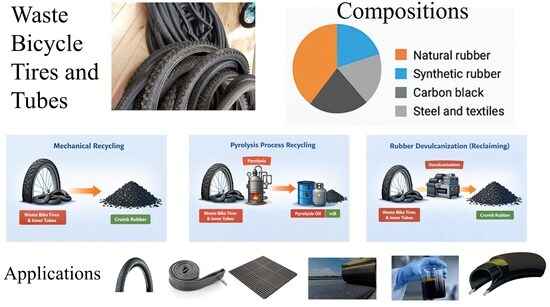
A Review of Current and Emerging Strategies for Recycling Waste: Bicycle Tires and Inner Tubes


Abstract
1. Introduction
Statistics
- British Columbia introduced a collection model in 2011 where bike shops can return used tubes alongside other regional tire waste streams [22].
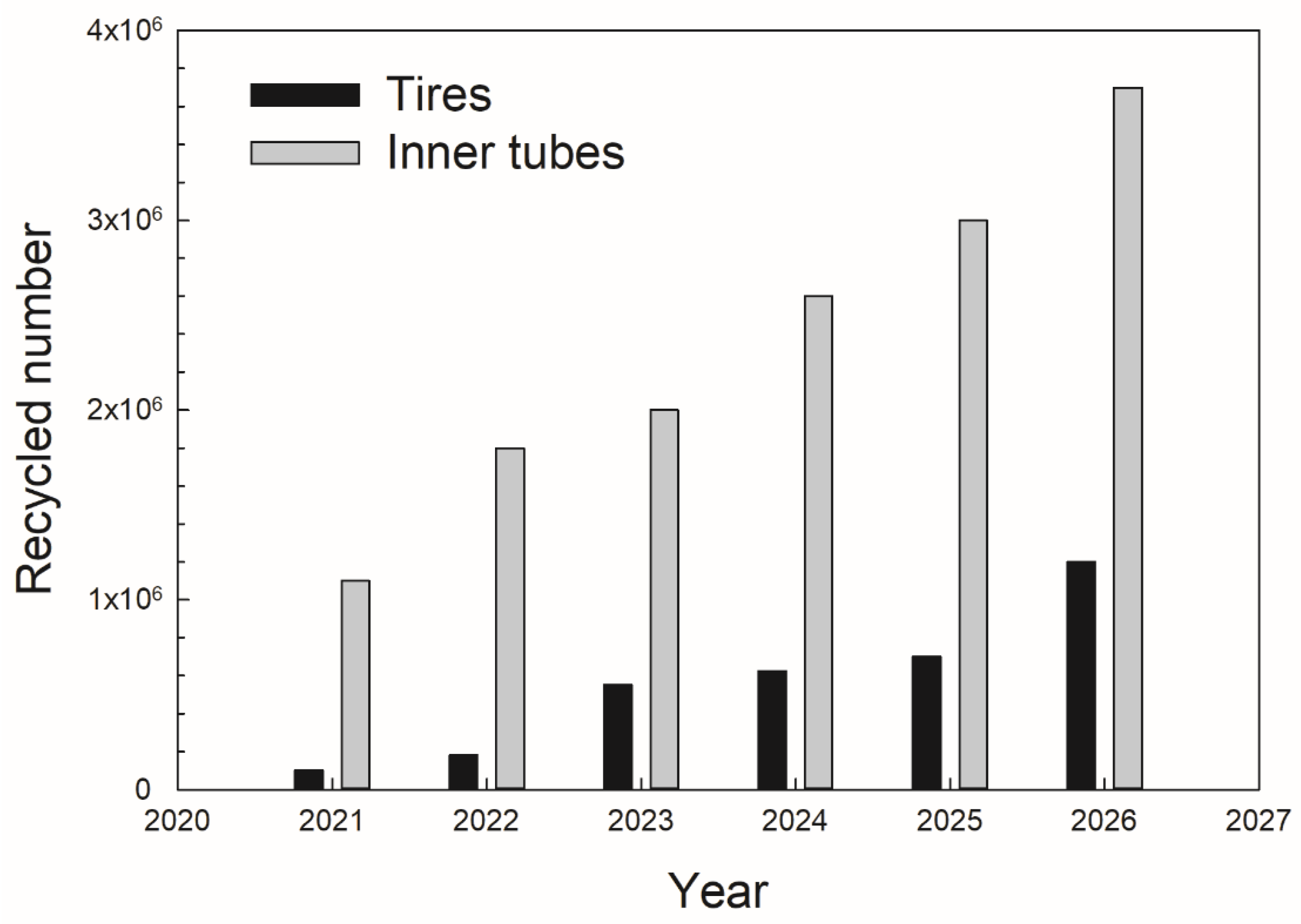
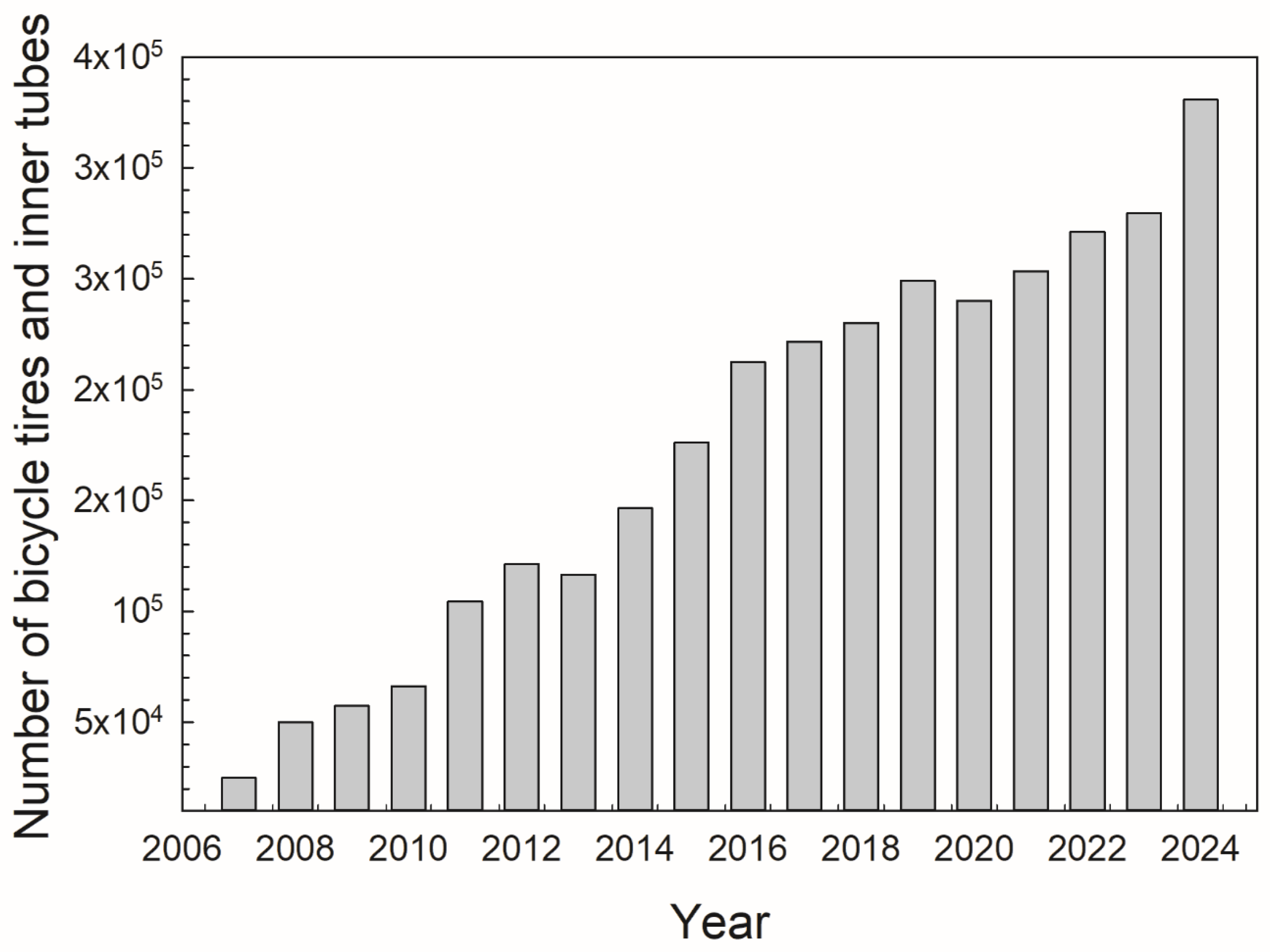
- New Brunswick expanded its waste-diversion regulations in 2018 to include bicycle tires and inner tubes [23]. In Québec, RECYC-QUÉBEC recovered more than 3.1 million used bicycle tires and inner tubes since the start of its program in 2007. To date, 50,000 of these items were repurposed by community organizations into products such as belts, juggling equipment, and keychains. The amounts collected each year are shown in Figure 2 [24]. When the program began in 2007, around 25,000 units were collected. By 2024, this number increased to 330,729 units, corresponding to a total of 120 tonnes (average mass of 360 g per unit).
2. Material Composition of Bicycle Tires and Inner Tubes
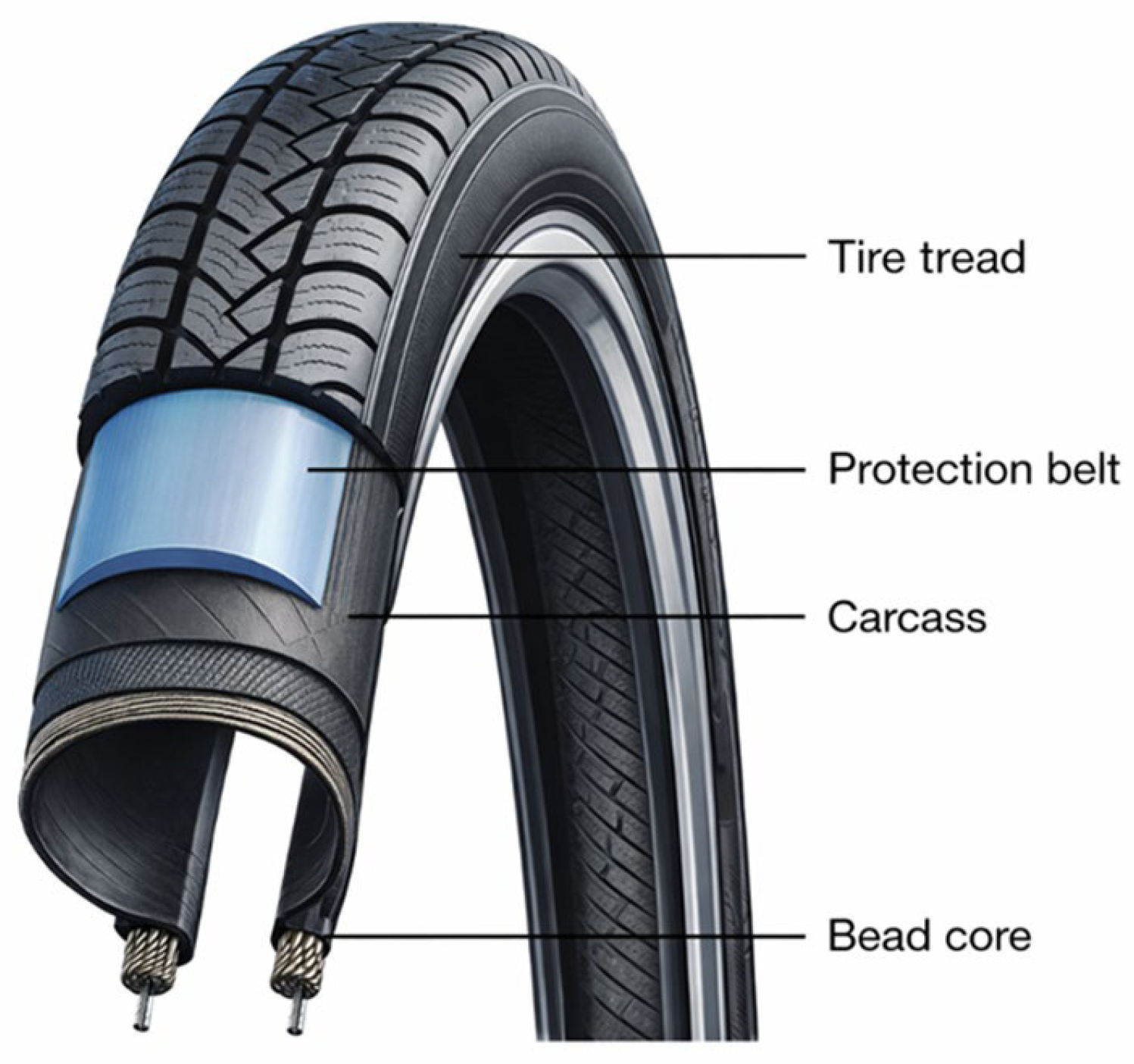
2.1. Composition of Bicycle Tires
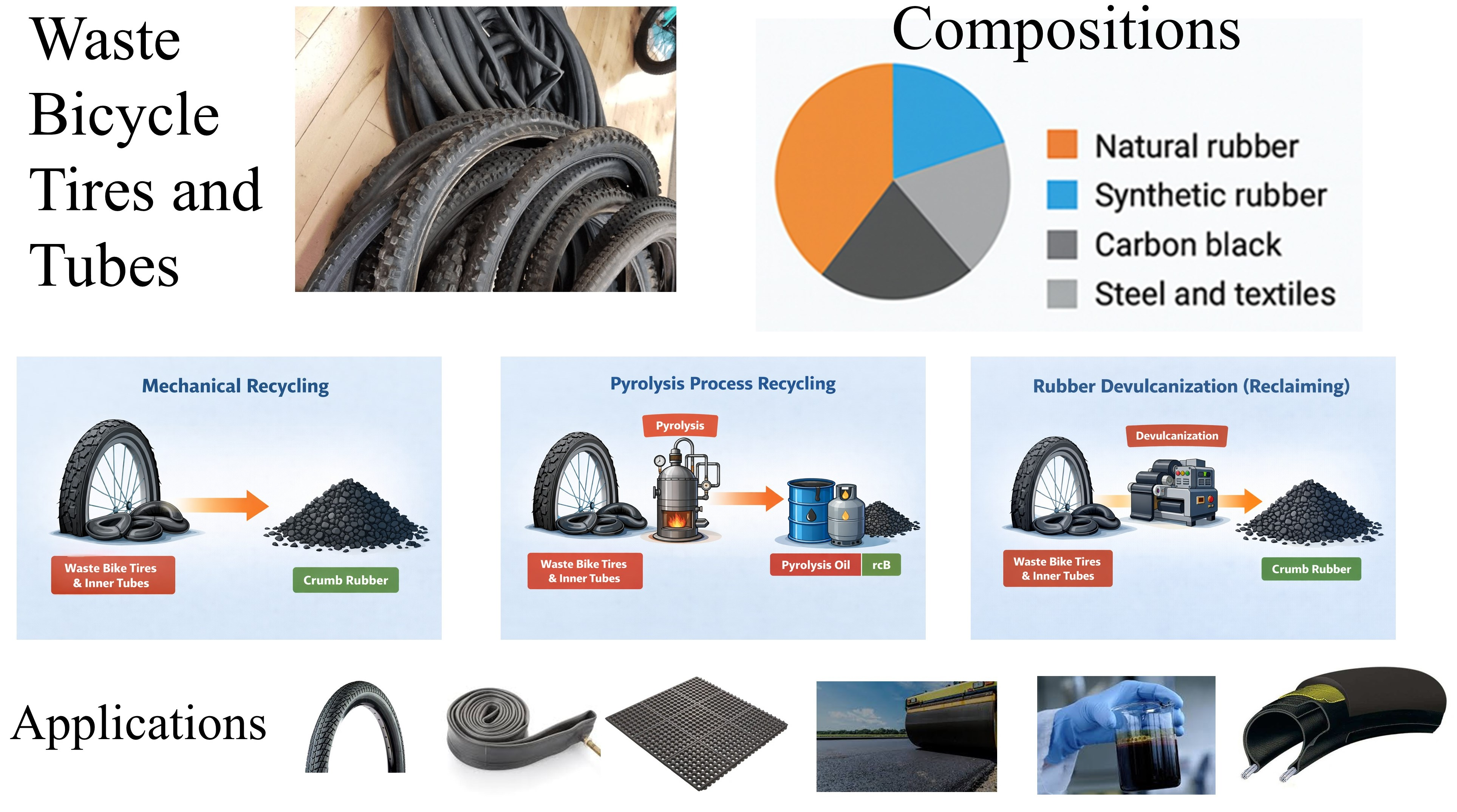
- natural and synthetic elastomers;
- reinforcing fillers such as carbon black, calcium carbonate, or silica;
- softeners (processing oils);
- anti-aging and antioxidant agents;
- sulfur and other vulcanizing components;
- vulcanization accelerators such as zinc-based compounds;
- pigments and colorants.
2.2. Composition of Bicycle Inner Tubes
3. Recycling and Recovery Technologies
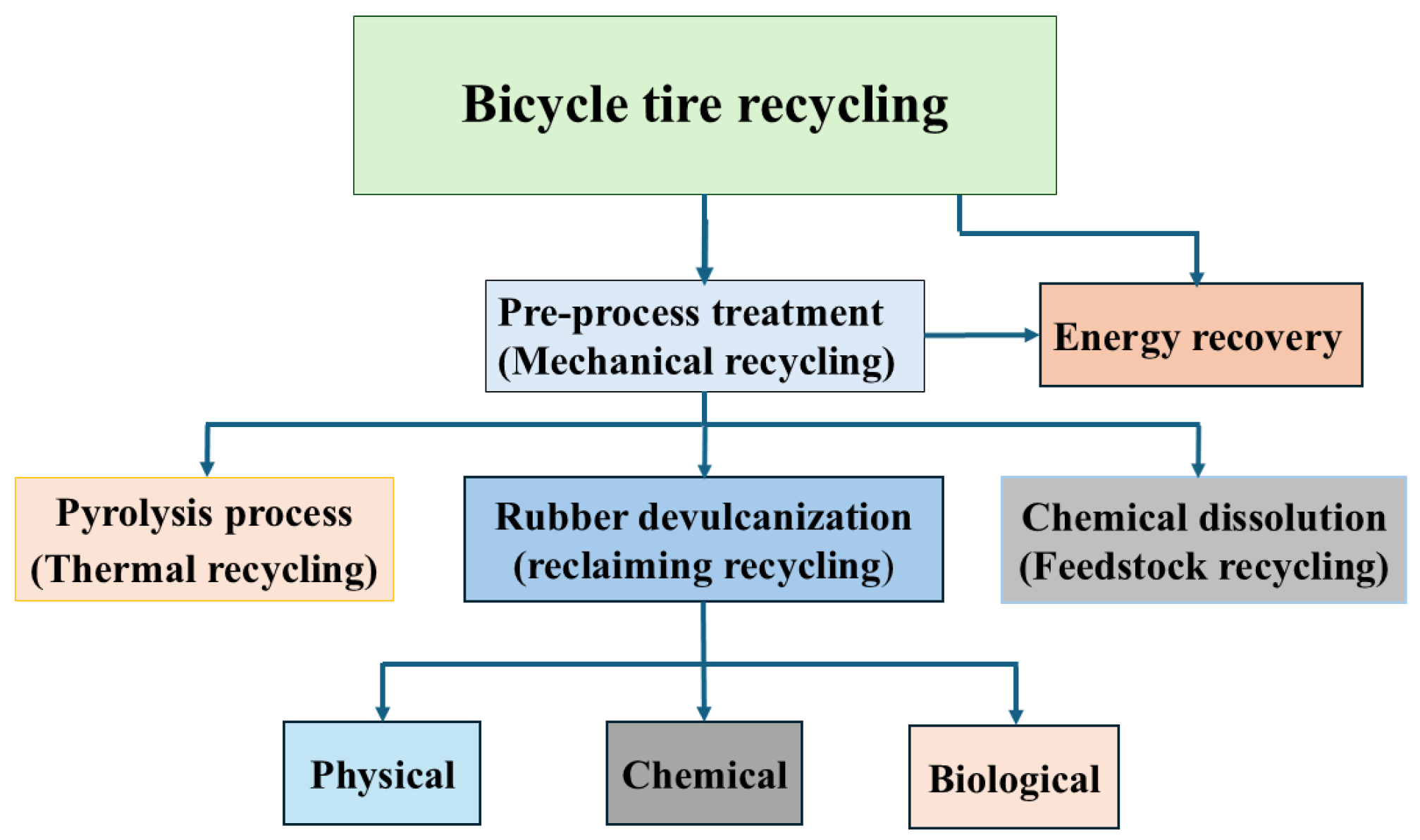
3.1. Bicycle Tire Recycling
- Direct reuse;
- Landfilling;
- Incineration;
- Retreading;
- Reclaimed-rubber production;
- Feedstock recycling via chemical dissolution;
- Pyrolysis.
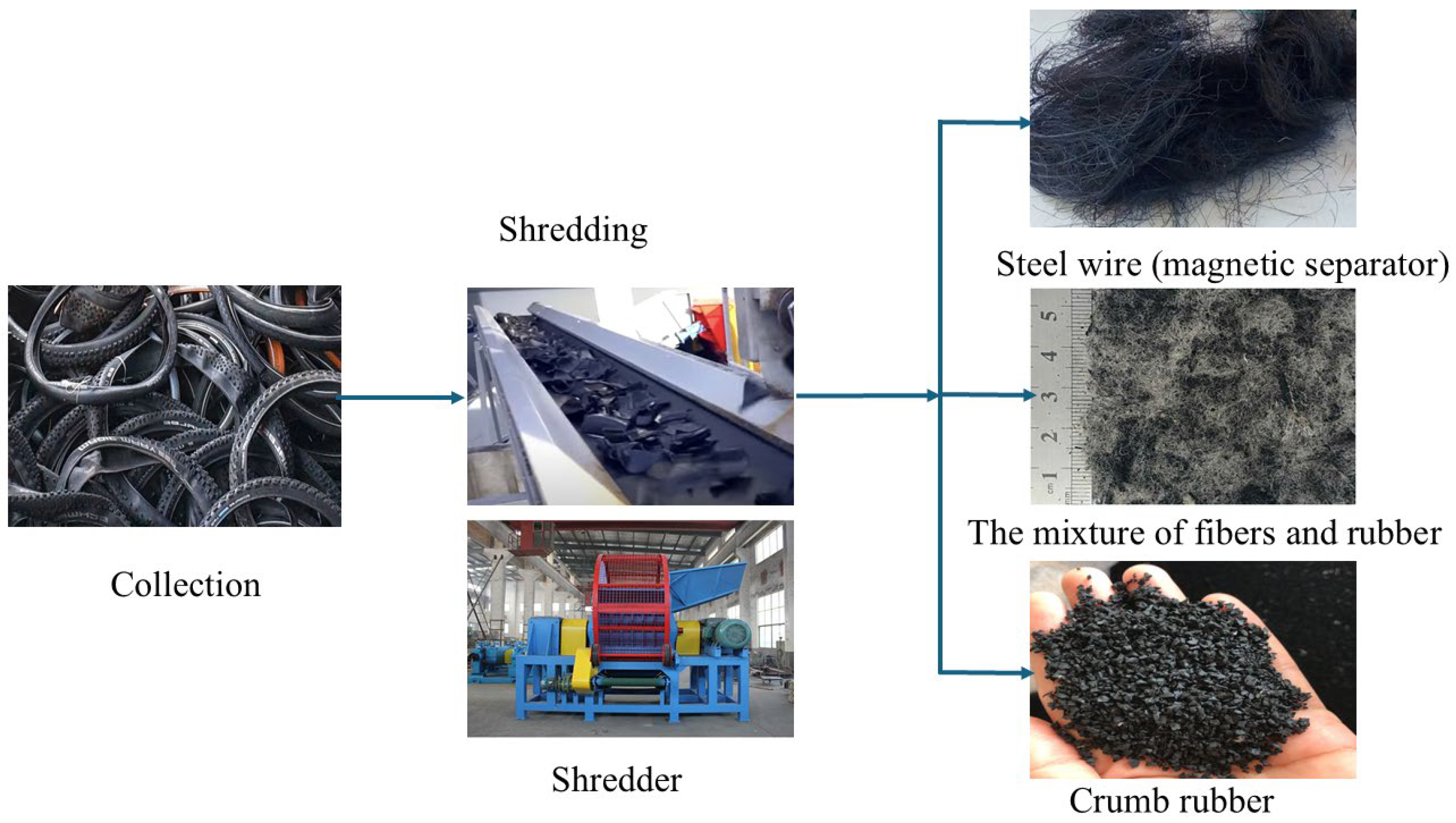
3.1.1. Mechanical Recycling (Pre-Process Treatment)
- Ambient grinding;
- Cryogenic grinding;
- Wet grinding.
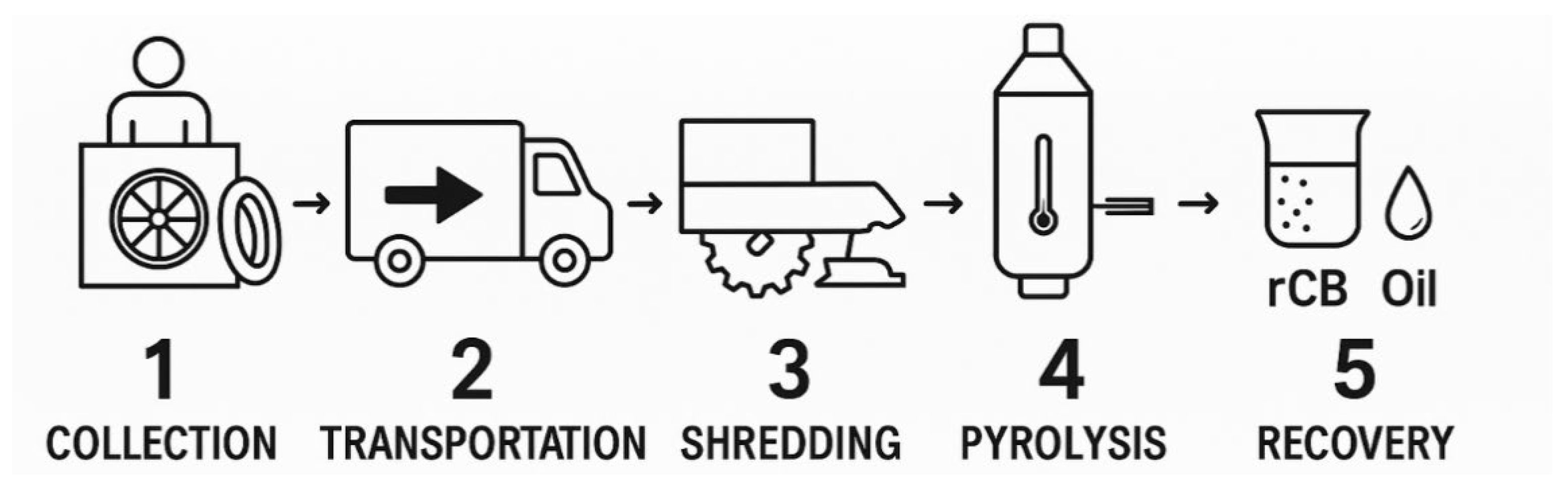
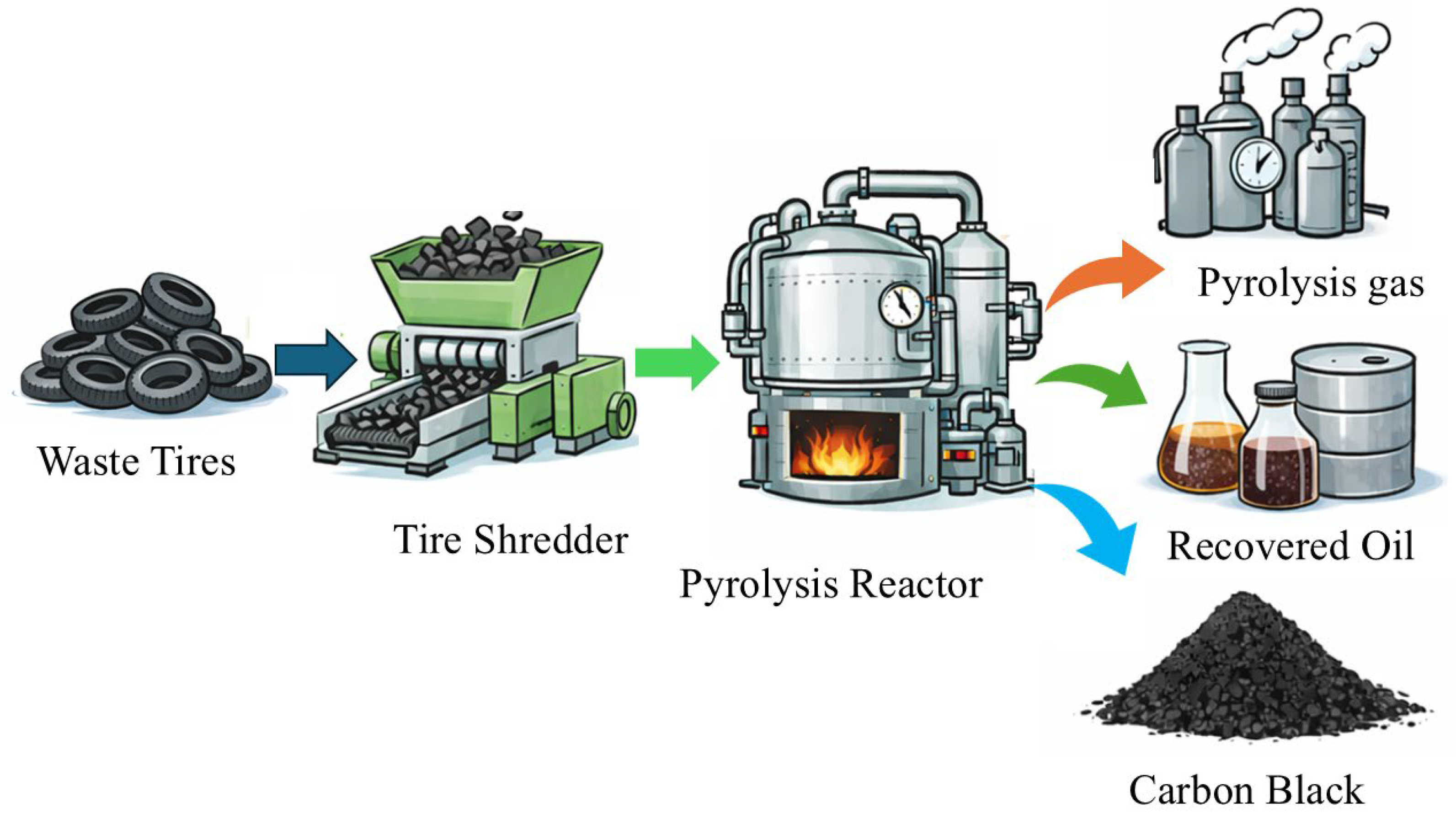
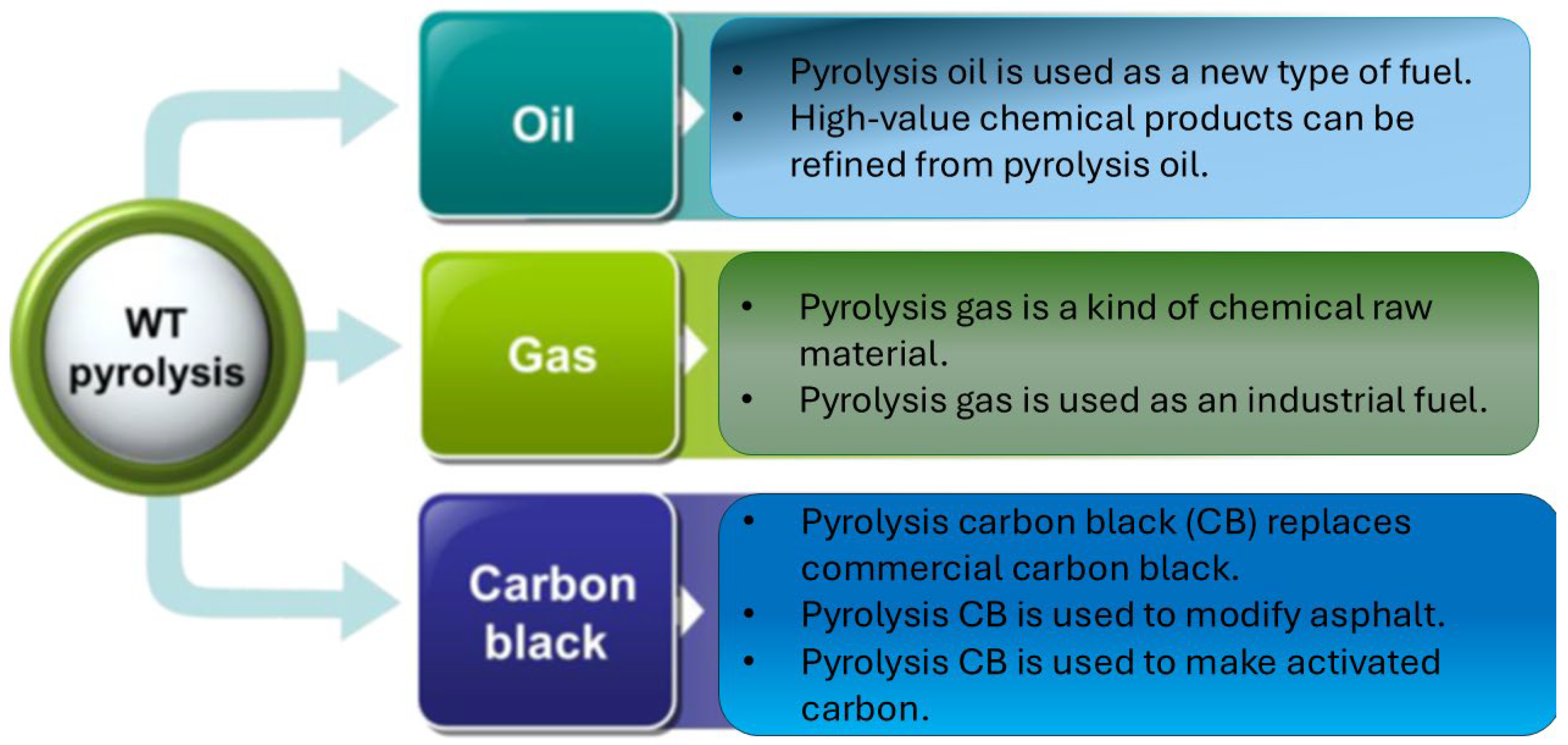
3.1.2. Pyrolysis Process Recycling
- Gas phase: mainly hydrogen, methane, and carbon oxides;
- Liquid phase: oils, tars, and condensed organic compounds;
- Solid residue (char): fixed carbon along with ash, metals, oxides, and inert materials.
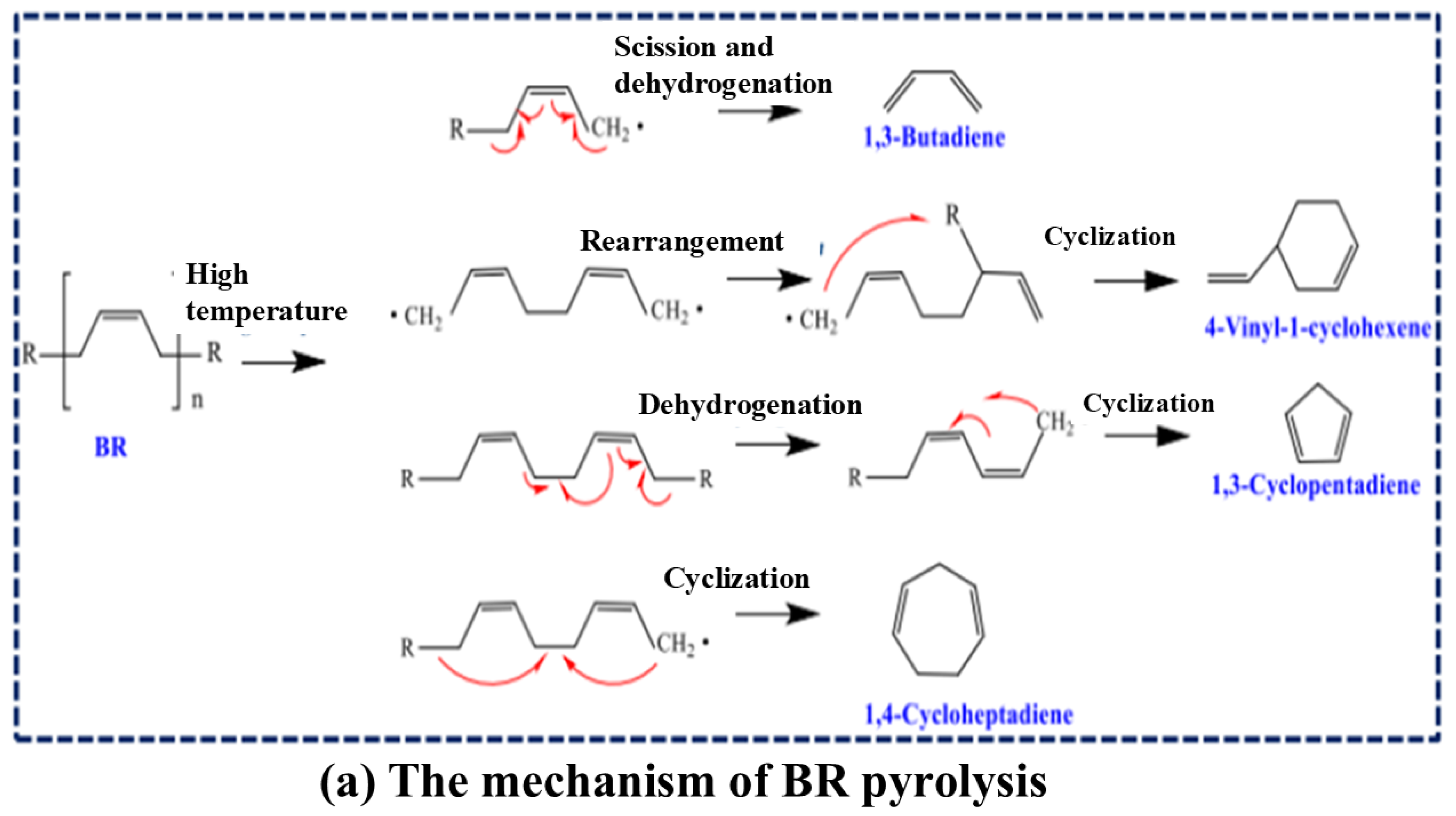
Pyrolysis Mechanism
- Chain cleavage and dehydrogenation, producing 1,3-butadiene;
- Radical rearrangement followed by cyclization, yielding 4-vinyl-1-cyclohexene;
- Dehydrogenation and subsequent ring-forming reactions, generating 1,3-cyclopentadiene;
- Cyclization processes leading to 1,4-cycloheptadiene.
Key Factors Influencing Pyrolysis
- A.
- Temperature
- <320 °C: evaporation of moisture and volatilization of plasticizers;
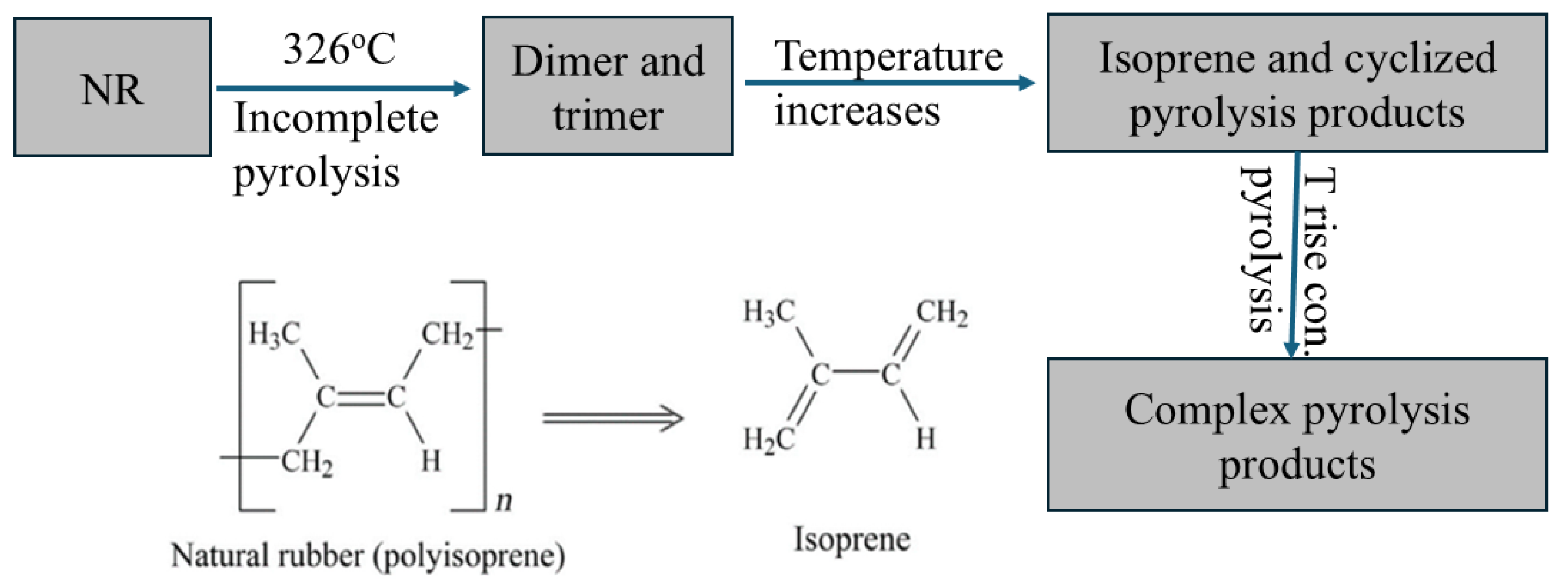
- 320–400 °C: primary decomposition of natural rubber (NR);
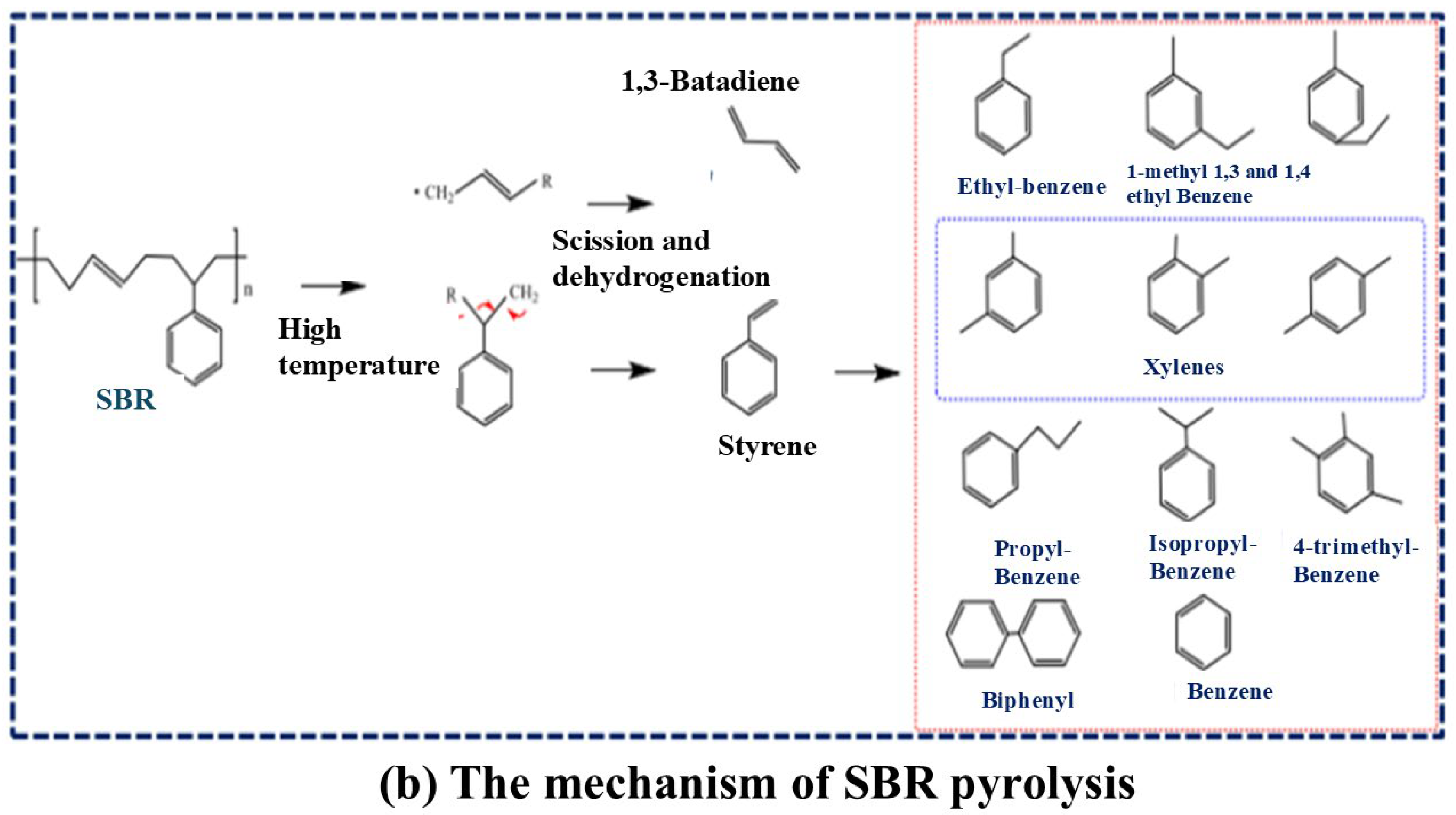
- 400–520 °C: breakdown of styrene–butadiene rubber (SBR) and butadiene rubber (BR);
- 520 °C: minimal additional mass loss.
- 200–350 °C: volatilization of oils, plasticizers, and other additives;
- 300–450 °C: degradation of NR;
- 400–500 °C: decomposition of SBR and BR.
- Additives and low-boiling species are removed starting around 200 °C;
- NR degradation follows around 300 °C;
- SBR and BR begin to decompose near 400 °C;
- The pyrolysis of most tire rubbers is essentially finished by 500 °C.
- B.
- Catalysts
- USY and HZSM-5 typically enhance gas formation and favor the production of aromatic hydrocarbons, such as benzene, toluene, and xylene (BTX).
- The behavior of USY is influenced by its SiO2/Al2O3 ratio: lower ratios tend to increase aromatic formation, while higher ratios tend towards olefin production.
- Larger-pore zeolites (USY) often generate more aromatics than HZSM-5 and also limit the formation of compounds such as limonene.
- Y-type zeolites increase saturated hydrocarbons and monoaromatic compounds, while decreasing heavy aromatics.
- SAPO-11 has been reported to give the highest gas yield with minimal carbon deposition, while HZSM-5 tends to produce the highest fraction of liquid oil.
3.1.3. Feedstock Recycling (Chemical Dissolution)
Decalin Dissolution Method
Gas-Oil Dissolution with Clay-Assisted Separation
Reductive Silylation Method
- Chemical dissolution offers a promising route to recover high-quality polymers from end-of-life tires.
- Decalin dissolution relies mainly on long-term swelling and solvent extraction.
- Gas-oil + clay separation enables more targeted separation of rubber and fillers with recyclable reagents.
- Reductive silylation provides the most efficient and selective dissolution, producing high-purity polymer oils with the possibility to form new elastomers.
3.1.4. Energy Recovery (Thermal Recycling)
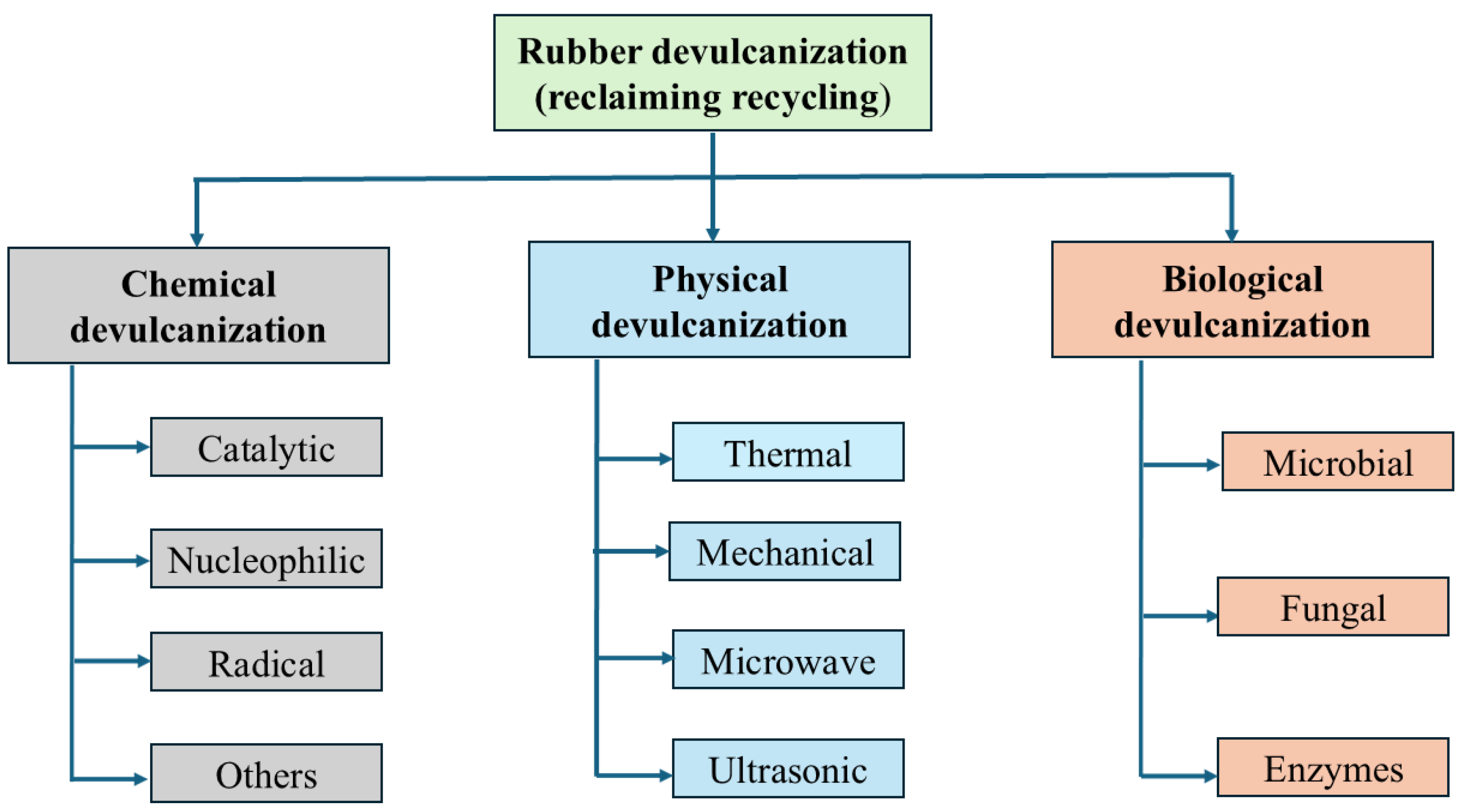
3.1.5. Rubber Devulcanization (Reclaiming)
Physical Devulcanization
- A.
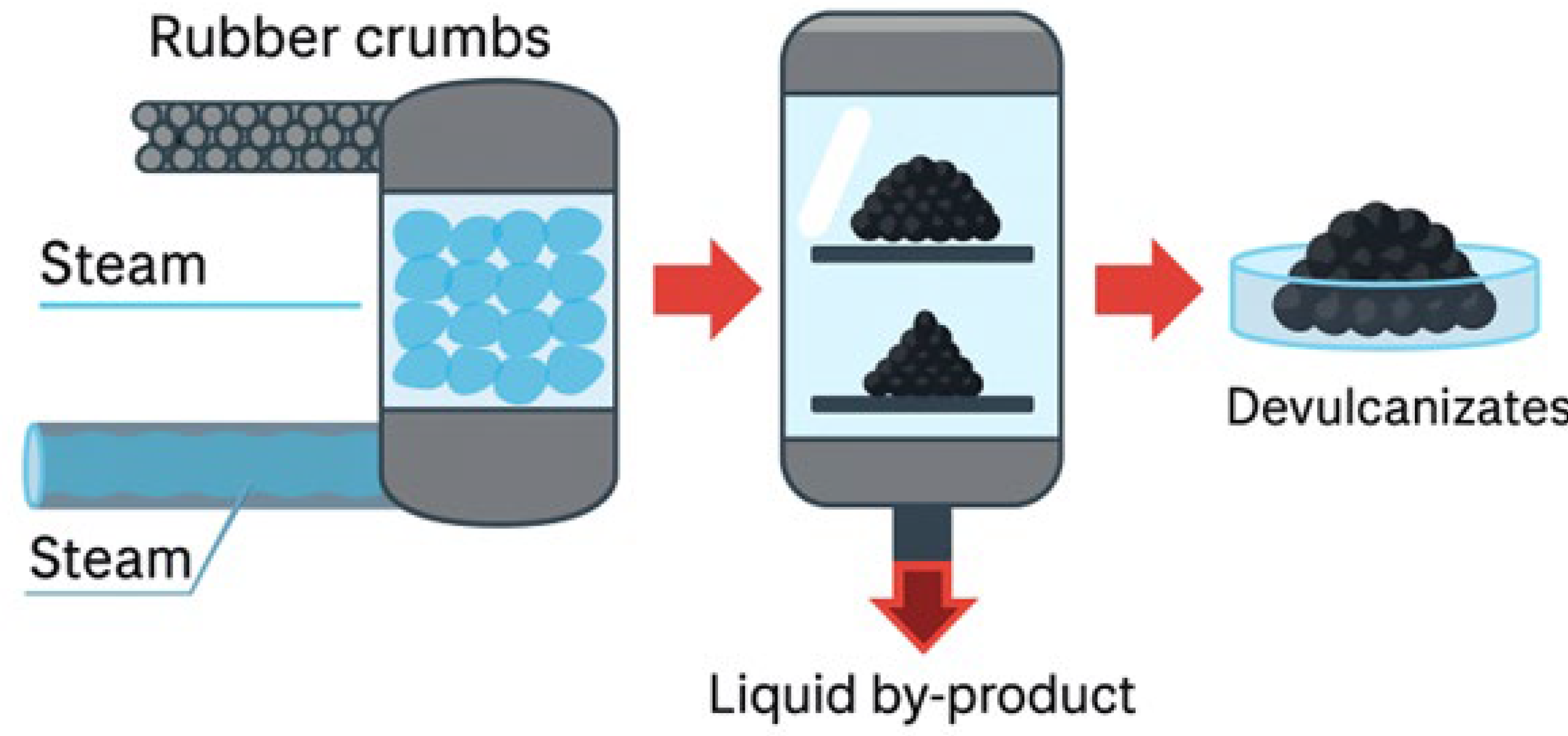
- Thermal devulcanization
- B.
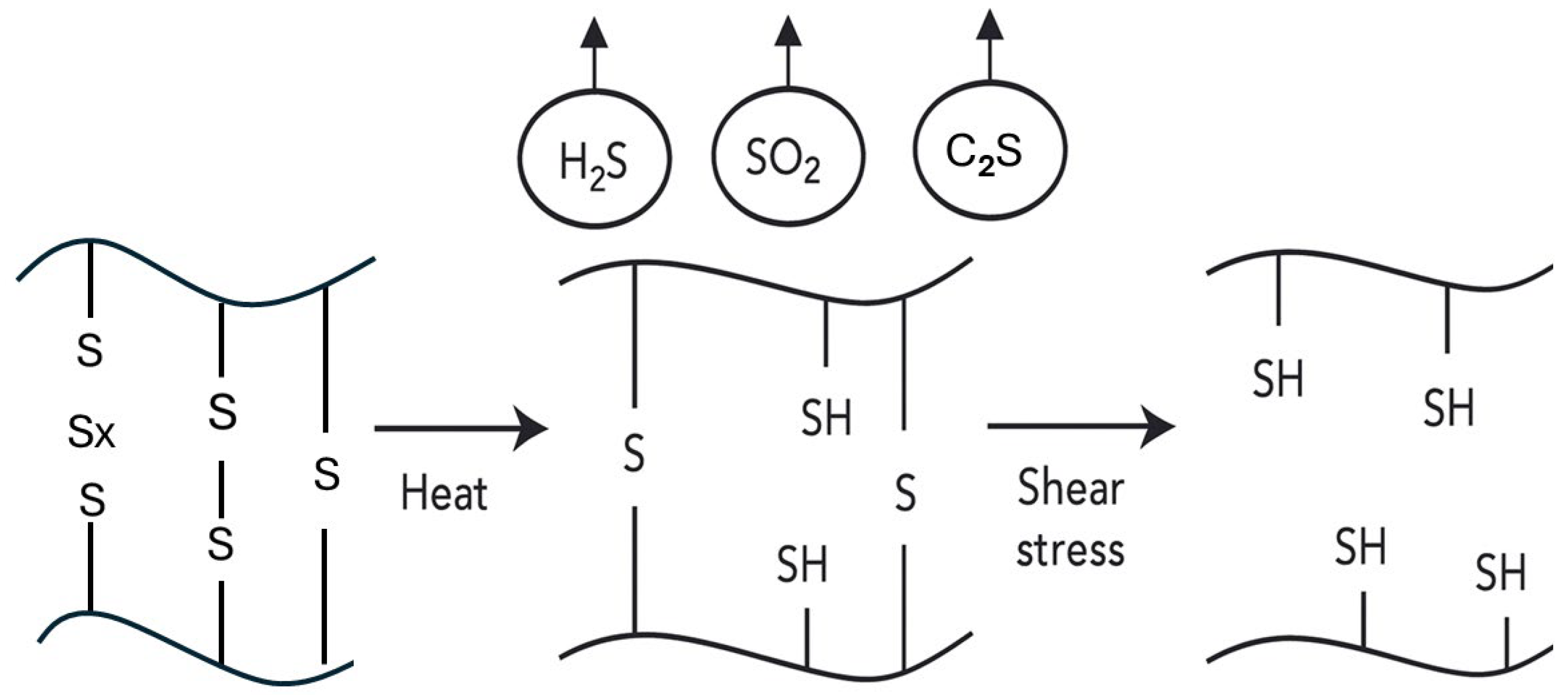
- Mechanical and thermo-mechanical devulcanization
- C.
- Microwave devulcanization
- D.
- Ultrasonic devulcanization
Chemical Devulcanization
- A.
- Catalytic devulcanization
- Gutierrez et al. [120] showed that natural rubber (NR) can undergo cross-metathesis with α-pinene using a ruthenium-based second-generation Grubbs catalyst, achieving 80–90% yield under solvent-free conditions. The molecular weight of the product could be tuned by adjusting the NR/α-pinene ratio.
- Smith et al. [121] reported catalytic depolymerization of polybutadiene and styrene-butadiene rubber using first- and second-generation Grubbs catalysts. The reactions proceeded at room temperature over 2–3 h with minimal chain degradation, highlighting the mild conditions enabled by these catalysts.
- Sodium desulfurization systems showed the possibility to selectively cleave mono-, di-, and polysulfidic crosslinks in swollen vulcanizates under high-temperature, oxygen-free conditions [122]. The resulting reclaimed rubber retained molecular weights similar to virgin material. However, the method is constrained by its use of organic solvents.
- B.
- Radical and nucleophilic devulcanization
- Radical-based mechanism [116]: In this route, sulfur bonds (mono-, di-, and polysulfidic links) undergo homolytic cleavage, generating macromolecular free radicals. Stabilizing reagents, such as diphenyl disulfide (DPDS), are often incorporated to inhibit radical recombination and favor controlled crosslink scission. Common radical initiators include DPDS, dithiobis(benzothiazole), tetramethylthiuram disulfide (TMTD), diallyl disulfide, and di(2-aminophenyl) disulfide.
- Nucleophilic mechanism [115]: Nucleophilic agents react directly with sulfur atoms in the crosslinks through substitution pathways, breaking S–S or C–S bonds without forming free radicals. Representative examples include 2-mercaptobenzothiazole, thiosalicylic acid, 1-hexadecylamine, and N-cyclohexyl-2-benzothiazolesulfenamide.
- De et al. [124] applied TMTD as a devulcanizing agent for GTR using a two-roll mill. The resulting reclaimed rubber was then blended with virgin NR, and the mechanical performance of the revulcanized blends was evaluated.
- C.
- Other chemical devulcanization
- Periodic acid (HIO4) acts as a strong oxidizing reagent that cleaves the polymer backbone through oxidative scission. Significant reductions in molecular weight are achieved but do not selectively target sulfur-based crosslinks [126].
- Additional strategies involve swelling-assisted devulcanization, in which additives, such as ionic liquids (IL) [129], supercritical carbon dioxide (scCO2) [130], or natural oils (soybean) [131], are used to swell the rubber network. Swelling increases the penetration of chemical agents, improves accessibility to sulfur bonds, and enhances overall devulcanization efficiency as chemical bonds under tension are easier to break.
Biological Devulcanization
- A.
- Bacterial desulfurization
- B.
- Fungal desulfurization
- C.
- Enzymatic desulfurization
3.2. Inner Tube Recycling
3.2.1. Butyl Recycling
3.2.2. Latex Recycling
3.2.3. TPU Recycling
4. Applications of Recycled Rubber
4.1. Application of Vulcanized Rubber
4.2. Applications of Devulcanized Rubber
4.2.1. Blending Devulcanized Rubber with Other Polymers
- A.
- Blends with Natural Rubber (NR)
- B.
- Blends based on synthetic rubbers
- C.
- Blends with thermoplastic elastomer (TPE)
4.2.2. Blend with Asphalt and Road Materials
4.3. Application for Pyrolysis Products
- Rubber reinforcement: used in products such as gaskets, hoses, belts, and some tire formulations (typically blended with virgin carbon black).
- Pigments: used in inks, paints, and coatings due to its coloring capacity and stability.
- Plastics: added to polymer matrices to enhance UV resistance, electrical conductivity, and color properties.
- Construction materials: incorporated into asphalt to improve pavement durability or used in mortars and concrete mainly as a coloring agent or functional filler, with limited structural contribution [156].
- Because of its multifunctionality, rCB supports both material circularity and cost reduction in manufacturing.
- Fueling the pyrolysis reactor, enabling partial or full-energy self-sufficiency;
- Generating electricity for plant operations;
- Potentially being supplied to local or national energy grids, improving the overall economic performance of the process [157].
4.4. Application of Recycled Bicycle Inner Tubes
5. Outlook and Future Directions for the Recycling of Bicycle Tires and Inner Tubes
- Complex material structure: Bicycle tires incorporate vulcanized rubber, steel wire, textile reinforcements, and additives, making disassembly and purification technically demanding and costly.
- Predominance of downcycling: Mechanical processing (shredding and grinding) mainly produces low-value crumb rubber, which is typically used in mats or playground surfaces and are unsuitable to manufacture new, high-performance tires.
- Collection and logistics constraints: Unlike automotive tires, bicycle tires are collected in much smaller volumes, making efficient nationwide collection systems and cost-effective transportation difficult to implement.
- Unstable end markets: Recycling systems depend on a reliable demand for secondary materials. When market demand fluctuates, large quantities of stored rubber can accumulate, creating environmental, storage, and fire risk concerns.
- Several gaps remain in the specialized literature: These include (i) a lack of material-specific recycling studies focusing on bicycle tires and inner tubes; (ii) limited comparative data on recycling technologies applied to small-sized, textile-rich rubber products; (iii) insufficient mechanistic understanding of devulcanization and pyrolysis processes applied to butyl-based inner tubes; and (iv) the absence of standard methods to evaluate the performance of recycled materials in bicycle-related applications.
5.1. Advanced Recycling Technologies
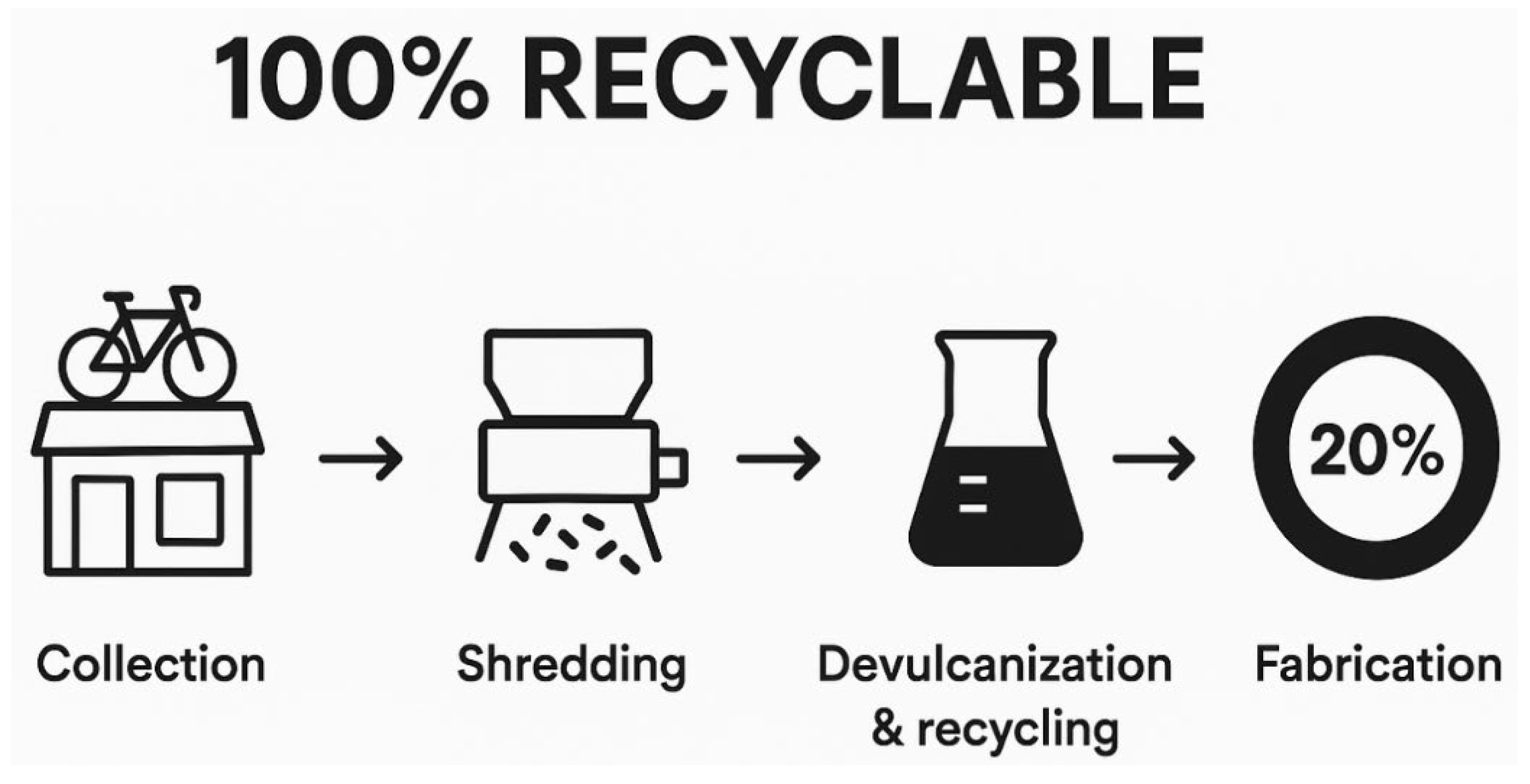
- Enhanced devulcanization processes: Modern devulcanization methods target sulfur crosslinks in vulcanized rubber, allowing the recovered material to be reprocessed. Companies such as Schwalbe already incorporate substantial quantities of devulcanized butyl rubber into new inner tubes (20%), demonstrating the feasibility of circular manufacturing. Current research aims to increase process efficiency, protect the polymer backbone during treatment, and boost recycled content in final products.
- Pyrolysis for material recovery: Pyrolysis converts waste tires into fractions such as recovered carbon black (rCB), oils, and gases under oxygen-free conditions. Partnerships between Schwalbe and Pyrum Innovations AG have shown that rCB can be reintegrated into new bicycle tires. For example, the “Green Marathon” tire is produced with 100% recycled carbon black, highlighting the potential for high-quality circular materials.
5.2. Incorporation of Circular Design Principles
- Using renewable or more recyclable materials: Research is progressing toward the adoption of biobased elastomers from crops such as dandelion and guayule. In parallel, the use of thermoplastic composites reinforced with recycled carbon fibers is being explored to improve durability while enhancing recyclability [158].
- Improving repairability and extended service life: Designing tires and inner tubes with features, such as retreadable treads, self-sealing layers, or self-healing polymers, can significantly reduce material consumption and waste generation over a product’s lifetime.
5.3. Industry-Wide Collaboration and Strengthened Responsibility Frameworks
- Shared recycling systems: Joint programs in which manufacturers participate collectively in the collection, processing, and recycling of waste tires can increase efficiency and reduce fragmentation across the sector.
- Extended producer responsibility (EPR): EPR models allocate responsibility for end-of-life management directly to manufacturers or retailers. Such frameworks stimulate improved product design, support large scale recycling infrastructure, and ensure long term accountability for material recovery.
- Progressing from downcycling to upcycling: Demonstrated successes, such as producing new inner tubes from recycled butyl rubber and using pyrolysis-derived recovered carbon black in new tire formulations, show that higher-value recycling is achievable. These innovations provide a model for future upcycling pathways keeping material quality rather than degrading it.
- Embedding circularity into product design and system infrastructure: Achieving true circularity will require manufacturers to prioritize designs facilitating disassembly, use more sustainable and recyclable materials, and actively participate in coordinated collection and recycling schemes. Such systemic integration enables more efficient material recovery and reduces reliance on low-value end uses.
- Empowering consumers through awareness and behavior: As cyclists become increasingly conscious of sustainability, their purchasing choices and participation in collection programs will play a crucial role. Actions such as returning used tubes to designated drop-off points or selecting bicycles and components designed with circular principles can significantly accelerate industry-wide adoption of circular practices.
6. Conclusions
Author Contributions
Funding
Data Availability Statement
Conflicts of Interest
Abbreviations
| 6PPD | N-(1,3-dimethylbutyl)-N′-phenyl-p-phenylenediamine |
| AlCl3 | Aluminum chloride |
| Al2O3 | Aluminum oxide (alumina) |
| Al-MCM-41 | Aluminum-substituted Mobil Composition of Matter No. 41 |
| Al-SBA-15 | Aluminum-substituted Santa Barbara Amorphous-15 |
| B(C6F5)3 | Tris(pentafluorophenyl)borane. |
| Bi2O3 | Bismuth(III) oxide (bismuth oxide) |
| BIIR | Bromobutyl rubber |
| BPO | Benzoyl peroxide |
| BR | Butadiene rubber |
| BTX | Benzene, toluene, and xylene |
| CaC2 | Calcium carbide |
| Ca(OH)2, | Calcium hydroxide |
| CIIR | Chlorobutyl rubber |
| COPE | Copolyester |
| CR | Crumb rubber |
| Cu/HBETA | Copper-loaded H-Beta zeolite |
| DszA | Sulfone monooxygenase |
| DszB | Desulfinase |
| DszC | Dibenzothiophene monooxygenase |
| DszD | Flavin reductase |
| DBU | 1,8-diazabicyclo undec-7-ene |
| DD | Diphenyl disulfide |
| DPDS | Diphenyl disulfide |
| DR | Devulcanized rubber |
| ELT | End-of-life tires |
| EPM/EPDM | Ethylene–propylene elastomers |
| EPR | Extended producer responsibility |
| FTIR | Fourier transform infrared spectroscopy |
| GMA | Glycidyl methacrylate |
| GTR | Ground tire rubber |
| IIR | Butyl rubber |
| IL | Ionic liquids |
| Hβ (H-Beta) | Proton-exchanged Beta zeolite |
| HDPE | High-density polyethylene |
| HIO4 | Periodic acid |
| HNO3 | Nitric acid |
| HPHTS | High-Pressure High-Temperature Sintering |
| HRP | Horseradish peroxidase |
| HSM | High Shear Mixing |
| HZSM-5 | Proton-form Zeolite Socony Mobil-5 |
| HZSM-22 | Proton-form Zeolite Socony Mobil-22 |
| LiAlH | Lithium aluminum hydride |
| MgCl2 | Magnesium chloride |
| MCM-41 | Mobil Composition of Matter No. 41 |
| MCM-48 | Mobil Composition of Matter No. 48 |
| MgO | Magnesium oxide |
| MH-HM | Tetramethyldisiloxane |
| MnP | Manganese peroxidase |
| MRF | Market Research Future |
| MS | Mass spectrometry |
| NDR | Non-devulcanized rubber |
| NR | Natural rubbers |
| PAH | Polycyclic aromatic hydrocarbons |
| PB | Polybutadiene |
| PS | Polystyrene |
| PP | Polypropylene |
| PPh3 | Triphenylphosphine |
| Py-GC-TOF/MS | Pyrolysis gas chromatography–time-of-flight mass spectrometry |
| rCB | Recovered carbon black |
| RTF | Recycled tire fibers |
| SBR | Styrene–butadiene rubber |
| SiO2 | Silicon dioxide (silica) |
| SAPO-11 | Silicoaluminophosphate-11 |
| scCO2 | Supercritical carbon dioxide |
| SCCS | Steel-cleaned cut shreds |
| TDF | Tire-derived fuel |
| TESPT | Bis(3-triethoxysilylpropyl) tetrasulfide |
| TiO2 | Titanium dioxide |
| TEPA | Tetraethylenepentamine |
| Tg | Glass transition temperature |
| TGA | Thermogravimetric analysis |
| TMTD | Tetramethylthiuram disulfide |
| TPO | Tire pyrolysis oil |
| TPE | Thermoplastic elastomers |
| TPU | Thermoplastic polyurethane |
| USY | Ultrastable Y zeolite |
| UV | Ultraviolet light |
| VRG | Vulcanized rubber granules |
| WBT | Waste bicycle tires |
| WTR | Waste tire rubber |
| WT | Waste tires |
| ZSM-5 | Zeolite Socony Mobil-5 |
References
- Nikitas, A.; Tsigdinos, S.; Karolemeas, C.; Kourmpa, E.; Bakogiannis, E. Cycling in the Era of COVID-19: Lessons Learnt and Best Practice Policy Recommendations for a More Bike-Centric Future. Sustainability 2021, 13, 4620. [Google Scholar] [CrossRef]
- Health Impacts of Low-Carbon Transport in Cities: Evidence for Better Policies. Available online: https://www.itf-oecd.org/health-impacts-low-carbon-transport-cities (accessed on 6 November 2025).
- The Case for Cycling: Tackling Climate Change, Cycling UK. Available online: https://www.cyclinguk.org/briefing/case-cycling-tackling-climate-change?utm_source (accessed on 6 November 2025).
- Houde, M.; Apparicio, P.; Séguin, A.-M. A Ride for Whom: Has Cycling Network Expansion Reduced Inequities in Accessibility in Montreal, Canada? J. Transp. Geogr. 2018, 68, 9–21. [Google Scholar] [CrossRef]
- Graveyard of the Bikes in China. Available online: https://pixabay.com/photos/bicycle-bike-bikes-biking-city-20608/ (accessed on 6 January 2026).
- How China Is Coping with Its Piles of Abandoned Shared Bikes. Available online: https://news.cgtn.com/news/2019-09-27/How-China-is-coping-with-its-piles-of-abandoned-shared-bikes-KjemNhws4E/index.html?utm_source=chatgpt.com (accessed on 9 December 2025).
- Bicycle Tire Construction, Schwalbe. Available online: https://www.schwalbe.com/en/technology-faq/tire-construction/ (accessed on 10 November 2025).
- Unlock the Secrets of Bicycle Tire Casing Design. Available online: https://analyzing-testing.netzsch.com/en/application-literature/composition-of-a-bicycle-tire-casing (accessed on 10 November 2025).
- Sabzekar, M.; Chenar, M.P.; Mortazavi, S.M.; Kariminejad, M.; Asadi, S.; Zohuri, G. Influence of Process Variables on Chemical Devulcanization of Sulfur-Cured Natural Rubber. Polym. Degrad. Stab. 2015, 118, 88–95. [Google Scholar] [CrossRef]
- Thomas, B.S.; Gupta, R.C. A Comprehensive Review on the Applications of Waste Tire Rubber in Cement Concrete. Renew. Sustain. Energy Rev. 2016, 54, 1323–1333. [Google Scholar] [CrossRef]
- Tian, Z.; Zhao, H.; Peter, K.T.; Gonzalez, M.; Wetzel, J.; Wu, C.; Hu, X.; Prat, J.; Mudrock, E.; Hettinger, R.; et al. A Ubiquitous Tire Rubber-Derived Chemical Induces Acute Mortality in Coho Salmon. Science 2021, 371, 185–189. [Google Scholar] [CrossRef]
- Arya, S.; Sharma, A.; Rawat, M.; Agrawal, A. Tyre Pyrolysis Oil as an Alternative Fuel: A Review. Mater. Today Proc. 2020, 28, 2481–2484. [Google Scholar] [CrossRef]
- Li, X.; Xu, H.; Gao, Y.; Tao, Y. Comparison of End-of-Life Tire Treatment Technologies: A Chinese Case Study. Waste Manag. 2010, 30, 2235–2246. [Google Scholar] [CrossRef]
- Can You Recycle Bike Tyres and Inner Tubes? Available online: https://resource.co/article/can-you-recycle-bike-tyres-and-inner-tubes (accessed on 6 November 2025).
- Rook, A.M. 10 Million Bicycle Inner Tubes End up in US Landfills Each Year—Schwalbe Aims to Recycle These Instead. Available online: https://www.cyclingweekly.com/news/10-million-bicycle-inner-tubes-end-up-in-us-landfills-each-year-schwalbe-aims-to-recycle-these-instead (accessed on 6 November 2025).
- Harker, J. Bicycle Tyre Recycling Scheme Focuses on Corporate Office Bike Stores. Cycling Industry News, 2025. Available online: https://cyclingindustry.news/bicycle-tyre-recycling-scheme-focuses-on-corporate-office-bike-stores/ (accessed on 6 November 2025).
- Bicycle Tube and Tire Market. Available online: https://www.marketdecipher.com/report/bicycle-tire-and-tube-market (accessed on 6 November 2025).
- Tire Material Market Size, Share, Growth Report, Trend 2025–2035. Available online: https://www.marketresearchfuture.com/reports/tire-material-market-8286 (accessed on 10 November 2025).
- Korniejenko, K.; Kozub, B.; Bąk, A.; Balamurugan, P.; Uthayakumar, M.; Furtos, G. Tackling the Circular Economy Challenges—Composites Recycling: Used Tyres, Wind Turbine Blades, and Solar Panels. J. Compos. Sci. 2021, 5, 243. [Google Scholar] [CrossRef]
- Jahirul, M.I.; Hossain, F.M.; Rasul, M.G.; Chowdhury, A.A. A Review on the Thermochemical Recycling of Waste Tyres to Oil for Automobile Engine Application. Energies 2021, 14, 3837. [Google Scholar] [CrossRef]
- Łach, M.; Kiszka, A.; Korniejenko, K.; Mikuła, J. The Mechanical Properties of Waste Tire Cords Reinforced Geopolymer Concretes. IOP Conf. Ser. Mater. Sci. Eng. 2018, 416, 012089. [Google Scholar] [CrossRef]
- Bicycle Tire Recycling. Tire Steward. BC. Available online: https://tsbc.ca/tire-recycling-in-bc/bike-tire-recycling/ (accessed on 10 November 2025).
- Recycle NB Adds Bicycle Tires and Tubes to Tire Recycling Program—TRACC. Available online: https://www.catraonline.ca/news-items/le-nouveau-brunswick-ajoute-les-pneus-et-chambres-a-air-de-velo (accessed on 10 November 2025).
- Programme Québécois de Gestions Des Pneus Hors D’usage 2004. Available online: https://ressources-naturelles.canada.ca/sites/www.nrcan.gc.ca/files/mineralsmetals/pdf/mms-smm/busi-indu/rad-rad/pdf/scr-tir-rec-fra.pdf (accessed on 10 November 2025).
- Schwalbe CSR-Report 2023. Available online: https://www.schwalbe.com/en/csr/csr-report-2023/ (accessed on 11 November 2025).
- AR Reclaim Rubber. Available online: https://www.arreclaimrubber.com (accessed on 11 November 2025).
- Scrap Tire Recycling in Canada. Available online: https://ressources-naturelles.canada.ca/sites/www.nrcan.gc.ca/files/mineralsmetals/pdf/mms-smm/busi-indu/rad-rad/pdf/scr-tir-rec-peh-eng.pdf (accessed on 12 November 2025).
- Bockstal, L.; Berchem, T.; Schmetz, Q.; Richel, A. Devulcanisation and Reclaiming of Tires and Rubber by Physical and Chemical Processes: A Review. J. Clean. Prod. 2019, 236, 117574. [Google Scholar] [CrossRef]
- Hassan, M.R.; Rodrigue, D. Application of Waste Tire in Construction: A Road towards Sustainability and Circular Economy. Sustainability 2024, 16, 3852. [Google Scholar] [CrossRef]
- Evans, A.; Evans, R. The Composition of a Tyre Typical Components. The Waste & Resources Action Programme, Banbury, 5.—References—Scientific Research Publishing. 2006. Available online: https://www.scirp.org/reference/referencespapers?referenceid=3508480 (accessed on 12 November 2025).
- Schwalbe-TechInfo-Bicycle Tires Edition 3, 2015. Available online: https://www.schwalbe.com/media/32/85/58/1694006374/Schwalbe-TechInfo-2015_GB.pdf (accessed on 12 November 2025).
- Fischer, C.; Rödel, J. Competitive Analysis of Bicycle Tube Rubber. Available online: https://analyzing-testing.netzsch.com/en/application-literature/competitive-analysis-of-the-rubber-of-bicycle-tubes-by-means-of-tga-ms (accessed on 12 November 2025).
- Zheng, S.; Liao, M.; Chen, Y.; Brook, M.A. Dissolving Used Rubber Tires. Green Chem. 2020, 22, 94–102. [Google Scholar] [CrossRef]
- Latex v TPU Inner Tubes: What’s the Difference and Should You Upgrade? Available online: https://www.bikeradar.com/advice/buyers-guides/latex-tpu-inner-tubes-versus-tubeless (accessed on 12 November 2025).
- Tracey, D.S.; Duvdevani, I.; Wang, H.-C.; Takeda, T.; Yamashita, S.S.P.; Parente, A.E. Inner Tube Compositions Having Improved Heat Resistance Characteristics. European Patent EP 1242475 B1, 27 April 2005. [Google Scholar]
- Kumar, A.; Dhanorkar, R.J.; Mohanty, S.; Gupta, V.K. Advances in Recycling of Waste Vulcanized Rubber Products via Different Sustainable Approaches. Mater. Adv. 2024, 5, 7584–7600. [Google Scholar] [CrossRef]
- Roychand, R.; Gravina, R.J.; Zhuge, Y.; Ma, X.; Youssf, O.; Mills, J.E. A Comprehensive Review on the Mechanical Properties of Waste Tire Rubber Concrete. Constr. Build. Mater. 2020, 237, 117651. [Google Scholar] [CrossRef]
- Han, W.; Han, D.; Chen, H. Pyrolysis of Waste Tires: A Review. Polymers 2023, 15, 1604. [Google Scholar] [CrossRef]
- Adhikari, B.; De, D.; Maiti, S. Reclamation and Recycling of Waste Rubber. Prog. Polym. Sci. 2000, 25, 909–948. [Google Scholar] [CrossRef]
- Ashaier Laftah, W.; Rahman, W.A.W.A. A Comprehensive Review of Tire Recycling Technologies and Applications. Mater. Adv. 2025, 6, 4992–5010. [Google Scholar] [CrossRef]
- Yu, J.; Liu, S.; Cardoso, A.; Han, Y.; Bikane, K.; Sun, L. Catalytic Pyrolysis of Rubbers and Vulcanized Rubbers Using Modified Zeolites and Mesoporous Catalysts with Zn and Cu. Energy 2019, 188, 116117. [Google Scholar] [CrossRef]
- Tariq, Z.; Bahadori-Jahromi, A.; Room, S. Sustainable Incorporation of Recycled Tire Steel and Textile Fibers as a Hybrid Mix in Concrete. Sustainability 2026, 18, 786. [Google Scholar] [CrossRef]
- Fazli, A.; Rodrigue, D. Sustainable Reuse of Waste Tire Textile Fibers (WTTF) as Reinforcements. Polymers 2022, 14, 3933. [Google Scholar] [CrossRef] [PubMed]
- Kazemi, H.; Fazli, A.; Ira, J.P.; Rodrigue, D. Recycled Tire Fibers Used as Reinforcement for Recycled Polyethylene Composites. Fibers 2023, 11, 74. [Google Scholar] [CrossRef]
- Fazli, A.; Rodrigue, D. Recycling Waste Tires into Ground Tire Rubber (GTR)/Rubber Compounds: A Review. J. Compos. Sci. 2020, 4, 103. [Google Scholar] [CrossRef]
- Xiao, Z.; Pramanik, A.; Basak, A.K.; Prakash, C.; Shankar, S. Material Recovery and Recycling of Waste Tyres—A Review. Clean. Mater. 2022, 5, 100115. [Google Scholar] [CrossRef]
- Annual Report Pyrum Innovations AG 2023. Available online: https://www.pyrum.net/wp-content/uploads/2024-05-15-Pyrum-Annual-Report-2023_EN_final.pdf (accessed on 12 November 2025).
- Han, W.; Jiang, C.; Wang, J.; Chen, H. Enhancement of Heat Transfer during Rubber Pyrolysis Process. J. Clean. Prod. 2022, 348, 131363. [Google Scholar] [CrossRef]
- Nisar, J.; Ali, G.; Ullah, N.; Awan, I.A.; Iqbal, M.; Shah, A.; Sirajuddin; Sayed, M.; Mahmood, T.; Khan, M.S. Pyrolysis of Waste Tire Rubber: Influence of Temperature on Pyrolysates Yield. J. Environ. Chem. Eng. 2018, 6, 3469–3473. [Google Scholar] [CrossRef]
- Li, D.; Lei, S.; Lin, F.; Zhong, L.; Ma, W.; Chen, G. Study of Scrap Tires Pyrolysis—Products Distribution and Mechanism. Energy 2020, 213, 119038. [Google Scholar] [CrossRef]
- Xu, F.; Wang, B.; Yang, D.; Ming, X.; Jiang, Y.; Hao, J.; Qiao, Y.; Tian, Y. TG-FTIR and Py-GC/MS Study on Pyrolysis Mechanism and Products Distribution of Waste Bicycle Tire. Energy Convers. Manag. 2018, 175, 288–297. [Google Scholar] [CrossRef]
- Seidelt, S.; Müller-Hagedorn, M.; Bockhorn, H. Description of Tire Pyrolysis by Thermal Degradation Behaviour of Main Components. J. Anal. Appl. Pyrolysis 2006, 75, 11–18. [Google Scholar] [CrossRef]
- González, J.F.; Encinar, J.M.; Canito, J.L.; Rodríguez, J.J. Pyrolysis of Automobile Tyre Waste. Influence of Operating Variables and Kinetics Study. J. Anal. Appl. Pyrolysis 2001, 58–59, 667–683. [Google Scholar] [CrossRef]
- Yang, Q.; Yu, S.; Zhong, H.; Liu, T.; Yao, E.; Zhang, Y.; Zou, H.; Du, W. Gas Products Generation Mechanism during Co-Pyrolysis of Styrene-Butadiene Rubber and Natural Rubber. J. Hazard. Mater. 2021, 401, 123302. [Google Scholar] [CrossRef] [PubMed]
- Han, J.; Li, W.; Liu, D.; Qin, L.; Chen, W.; Xing, F. Pyrolysis Characteristic and Mechanism of Waste Tyre: A Thermogravimetry-Mass Spectrometry Analysis. J. Anal. Appl. Pyrolysis 2018, 129, 1–5. [Google Scholar] [CrossRef]
- Kan, T.; Strezov, V.; Evans, T. Fuel Production from Pyrolysis of Natural and Synthetic Rubbers. Fuel 2017, 191, 403–410. [Google Scholar] [CrossRef]
- Islam, M.R.; Islam, M.N.; Mustafi, N.N.; Rahim, M.A.; Haniu, H. Thermal Recycling of Solid Tire Wastes for Alternative Liquid Fuel: The First Commercial Step in Bangladesh. Procedia Eng. 2013, 56, 573–582. [Google Scholar] [CrossRef]
- Kaminsky, W.; Mennerich, C. Pyrolysis of Synthetic Tire Rubber in a Fluidised-Bed Reactor to Yield 1,3-Butadiene, Styrene and Carbon Black. J. Anal. Appl. Pyrolysis 2001, 58–59, 803–811. [Google Scholar] [CrossRef]
- López, G.; Olazar, M.; Aguado, R.; Bilbao, J. Continuous Pyrolysis of Waste Tyres in a Conical Spouted Bed Reactor. Fuel 2010, 89, 1946–1952. [Google Scholar] [CrossRef]
- Kaminsky, W.; Mennerich, C.; Zhang, Z. Feedstock Recycling of Synthetic and Natural Rubber by Pyrolysis in a Fluidized Bed. J. Anal. Appl. Pyrolysis 2009, 85, 334–337. [Google Scholar] [CrossRef]
- Díez, C.; Martínez, O.; Calvo, L.F.; Cara, J.; Morán, A. Pyrolysis of Tyres. Influence of the Final Temperature of the Process on Emissions and the Calorific Value of the Products Recovered. Waste Manag. 2004, 24, 463–469. [Google Scholar] [CrossRef]
- Galvagno, S.; Casu, S.; Casabianca, T.; Calabrese, A.; Cornacchia, G. Pyrolysis Process for the Treatment of Scrap Tyres: Preliminary Experimental Results. Waste Manag. 2002, 22, 917–923. [Google Scholar] [CrossRef]
- Boxiong, S.; Chunfei, W.; Binbin, G.; Rui, W.; Liangcai. Pyrolysis of Waste Tyres with Zeolite USY and ZSM-5 Catalysts. Appl. Catal. B Environ. 2007, 73, 150–157. [Google Scholar] [CrossRef]
- Dick, D.T.; Agboola, O.; Ayeni, A.O.; Dick, D.T.; Agboola, O.; Ayeni, A.O. Pyrolysis of Waste Tyre for High-Quality Fuel Products: A Review. AIMS Energy 2020, 8, 869–895. [Google Scholar] [CrossRef]
- Boxiong, S.; Chunfei, W.; Cai, L.; Binbin, G.; Rui, W. Pyrolysis of Waste Tyres: The Influence of USY Catalyst/Tyre Ratio on Products. J. Anal. Appl. Pyrolysis 2007, 78, 243–249. [Google Scholar] [CrossRef]
- Williams, P.T.; Brindle, A.J. Aromatic Chemicals from the Catalytic Pyrolysis of Scrap Tyres. J. Anal. Appl. Pyrolysis 2003, 67, 143–164. [Google Scholar] [CrossRef]
- Wang, J.; Jiang, J.; Wang, X.; Liu, P.; Li, J.; Liu, G.; Wang, K.; Li, M.; Zhong, Z.; Xu, J.; et al. Catalytic Conversion of Rubber Wastes to Produce Aromatic Hydrocarbons over USY Zeolites: Effect of SiO2/Al2O3 Mole Ratio. Energy Convers. Manag. 2019, 197, 111857. [Google Scholar] [CrossRef]
- Vichaphund, S.; Aht-ong, D.; Sricharoenchaikul, V.; Atong, D. Effect of CV-ZSM-5, Ni-ZSM-5 and FA-ZSM-5 Catalysts for Selective Aromatic Formation from Pyrolytic Vapors of Rubber Wastes. J. Anal. Appl. Pyrolysis 2017, 124, 733–741. [Google Scholar] [CrossRef]
- Santos, B.P.S.; Almeida, D.D.; de Marques, M.F.V.; Henriques, C.A. Degradation of Polypropylene and Polyethylene Wastes Over HZSM-5 and USY Zeolites. Catal. Lett. 2019, 149, 798. [Google Scholar] [CrossRef]
- Manchantrarat, N.; Jitkarnka, S. Impact of HY as an Additive in Pd/HBETA Catalyst on Waste Tire Pyrolysis Products. Chem. Eng. Trans. 2012, 29, 733–738. [Google Scholar] [CrossRef]
- HZSM-5 and HY Zeolite Catalyst Performance in the Pyrolysis of Tires in a Conical Spouted Bed Reactor. Available online: https://pubs-acs-org.acces.bibl.ulaval.ca/doi/full/10.1021/ie800376d (accessed on 25 November 2025).
- Catalyst Effect on the Composition of Tire Pyrolysis Products, Energy & Fuels. Available online: https://pubs-acs-org.acces.bibl.ulaval.ca/doi/full/10.1021/ef8002153 (accessed on 25 November 2025).
- Li, W.; Huang, C.; Li, D.; Huo, P.; Wang, M.; Han, L.; Chen, G.; Li, H.; Li, X.; Wang, Y.; et al. Derived Oil Production by Catalytic Pyrolysis of Scrap Tires. Chin. J. Catal. 2016, 37, 526–532. [Google Scholar] [CrossRef]
- Hijazi, A.; Al-Muhtaseb, A.H.; Aouad, S.; Ahmad, M.N.; Zeaiter, J. Pyrolysis of Waste Rubber Tires with Palladium Doped Zeolite. J. Environ. Chem. Eng. 2019, 7, 103451. [Google Scholar] [CrossRef]
- Hijazi, A.; Boyadjian, C.; Ahmad, M.N.; Zeaiter, J. Solar Pyrolysis of Waste Rubber Tires Using Photoactive Catalysts. Waste Manag. 2018, 77, 10–21. [Google Scholar] [CrossRef]
- Basagiannis, A.C.; Verykios, X.E. Influence of the Carrier on Steam Reforming of Acetic Acid over Ru-Based Catalysts. Appl. Catal. B Environ. 2008, 82, 77–88. [Google Scholar] [CrossRef]
- Ali, M.A.; Kimura, T.; Suzuki, Y.; Al-Saleh, M.A.; Hamid, H.; Inui, T. Hydrogen Spillover Phenomenon in Noble Metal Modified Clay-Based Hydrocracking Catalysts. Appl. Catal. Gen. 2002, 227, 63–72. [Google Scholar] [CrossRef]
- Yuwapornpanit, R.; Jitkarnka, S. Cu-doped catalysts and their impacts on tire-derived oil and sulfur removal. J. Anal. Appl. Pyrolysis. 2015, 111, 200–208. [Google Scholar] [CrossRef]
- Dũng, N.A.; Klaewkla, R.; Wongkasemjit, S.; Jitkarnka, S. Light Olefins and Light Oil Production from Catalytic Pyrolysis of Waste Tire. J. Anal. Appl. Pyrolysis 2009, 86, 281–286. [Google Scholar] [CrossRef]
- Khalil, U.; Vongsvivut, J.; Shahabuddin, M.; Samudrala, S.P.; Srivatsa, S.C.; Bhattacharya, S. A Study on the Performance of Coke Resistive Cerium Modified Zeolite Y Catalyst for the Pyrolysis of Scrap Tyres in a Two-Stage Fixed Bed Reactor. Waste Manag. 2020, 102, 139–148. [Google Scholar] [CrossRef]
- Witpathomwong, C.; Longloilert, R.; Wongkasemjit, S.; Jitkarnka, S. Improving Light Olefins and Light Oil Production Using Ru/MCM-48 in Catalytic Pyrolysis of Waste Tire. Energy Procedia 2011, 9, 245–251. [Google Scholar] [CrossRef]
- Sultan, A.M.T.; Jabrail, F.H. Decalin Dissolving Method for Recover of Styrene–Butadiene Rubber from Scrap Tires. Am. J. Environ. Sci. 2019, 15, 145–153. [Google Scholar] [CrossRef]
- Abdulrahman, A.S.; Jabrail, F.H. Treatment of Scrap Tire for Rubber and Carbon Black Recovery. Recycling 2022, 7, 27. [Google Scholar] [CrossRef]
- Sharma, V.K.; Fortuna, F.; Mincarini, M.; Berillo, M.; Cornacchia, G. Disposal of Waste Tyres for Energy Recovery and Safe Environment. Appl. Energy 2000, 65, 381–394. [Google Scholar] [CrossRef]
- Tire Derived Fuel Market Size, Growth, Trends & Share, 2033. Available online: https://www.marketdataforecast.com/market-reports/tire-derived-fuel-market (accessed on 15 December 2025).
- Zedler, Ł.; Colom, X.; Cañavate, J.; Saeb, M.; Haponiuk, J.T.; Formela, K. Investigating the Impact of Curing System on Structure-Property Relationship of Natural Rubber Modified with Brewery By-Product and Ground Tire Rubber. Polymers 2020, 12, 545. [Google Scholar] [CrossRef]
- Dorigato, A.; Rigotti, D.; Fredi, G. Recent Advances in the Devulcanization Technologies of Industrially Relevant Sulfur-Vulcanized Elastomers. Adv. Ind. Eng. Polym. Res. 2023, 6, 288–309. [Google Scholar] [CrossRef]
- Burelo, M.; Gaytán, I.; Gutiérrez, S.; Cruz-Morales, J.A.; Trevino-Quintanilla, C.D.; Thomas Stringer, T.; Ramirez-Melgarejo, M. Recent advances in sustainable degradation processes of elastomers: A comprehensive review. Rev. Environ. Sci. Biotechnol. 2025, 24, 339–375. [Google Scholar] [CrossRef]
- De, S.K.; Isayev, A.I.; Khait, K. Rubber Recycling, 1st ed.; Taylor & Francis: New York, NY, USA, 2005; pp. 327–428. [Google Scholar]
- Seghar, S.; Asaro, L.; Aït Hocine, N. Experimental Validation of the Horikx Theory to Be Used in the Rubber Devulcanization Analysis. J. Polym. Environ. 2019, 27, 2318–2323. [Google Scholar] [CrossRef]
- Saputra, R.; Walvekar, R.; Khalid, M.; Mubarak, N.M.; Sillanpää, M. Current Progress in Waste Tire Rubber Devulcanization. Chemosphere 2021, 265, 129033. [Google Scholar] [CrossRef] [PubMed]
- Fisher, J.F. Method of Devulcanizing a Cross-Linked Elastomeric Material. Singapore Patent SG11201402537QA, 26 September 2014. [Google Scholar]
- Mouri, M.; Sato, N.; Okamoto, H.; Matsushita, M.; Honda, H.; Nakashima, K.; Takeuchi, K.; Suzuki, Y.; Owaki, M. Continuous devulcanization by shear flow stage reaction control technology for rubber recycling. Part 3. Study of devulcanization process for EPDM. J.-Soc. RUBBER Ind. Jpn. 1999, 72, 278–282. [Google Scholar][Green Version]
- Saiwari, S.; Dierkes, W.K.; Noordermeer, J.W.M. Comparative investigation of the devulcanization parameters of tire rubbers. Rubber Chem. Technol. 2014, 87, 31–42. [Google Scholar] [CrossRef]
- Joseph, A.M.; Madhusoodanan, K.N.; George, B. Stable free radical-assisted mechanical devulcanization of carbon black-filled natural rubber vulcanizates: Comparison with contemporary induxtrial devulcanization processes. Rubber Sci. 2022, 35, 103–116. [Google Scholar]
- Sutanto, P.; Laksmana, F.L.; Picchioni, F.; Janssen, L.P.B.M. Modeling on the Kinetics of an EPDM Devulcanization in an Internal Batch Mixer Using an Amine as the Devulcanizing Agent. Chem. Eng. Sci. 2006, 61, 6442–6453. [Google Scholar] [CrossRef]
- Yazdani, H.; Karrabi, M.; Ghasmi, I.; Azizi, H.; Bakhshandeh, G.R. Devulcanization of Waste Tires Using a Twin-Screw Extruder: The Effects of Processing Conditions. J. Vinyl Addit. Technol. 2011, 17, 64–69. [Google Scholar] [CrossRef]
- Li, Y.; Shen, A.; Lyu, Z.; Wang, S.; Formela, K.; Zhang, G. Ground Tire Rubber Thermo-Mechanically Devulcanized in the Presence of Waste Engine Oil as Asphalt Modifier. Constr. Build. Mater. 2019, 222, 588–600. [Google Scholar] [CrossRef]
- Ghorai, S.; Mondal, D.; Dhanania, S.; Chattopadhyay, S.; Roy, M.; De, D. Reclaiming of Waste Guayule Natural Rubber Vulcanizate—Reclaim Rubber for Green Tire Applications: An Approach for Sustainable Development. J. Elastomers Plast. 2019, 51, 193–210. [Google Scholar] [CrossRef]
- Tao, G.; He, Q.; Xia, Y.; Jia, G.; Yang, H.; Ma, W. The Effect of Devulcanization Level on Mechanical Properties of Reclaimed Rubber by Thermal-Mechanical Shearing Devulcanization. J. Appl. Polym. Sci. 2013, 129, 2598–2605. [Google Scholar] [CrossRef]
- Formela, K.; Cysewska, M. Efficiency of Thermomechanical Reclaiming of Ground Tire Rubber Conducted in Counter-Rotating and Co-Rotating Twin Screw Extruder. Polimery 2014, 59, 231–238. [Google Scholar] [CrossRef]
- Joseph, A.M.; George, B.; Madhusoodanan, K.N.; Alex, R. Current status of sulphur vulcanization and devulcanization chemistry: Processe of vulcanization. Rubber Sci. 2015, 28, 82–121. [Google Scholar]
- Asaro, L.; Gratton, M.; Seghar, S.; Aït Hocine, N. Recycling of Rubber Wastes by Devulcanization. Resour. Conserv. Recycl. 2018, 133, 250–262. [Google Scholar] [CrossRef]
- Aoudia, K.; Azem, S.; Aït Hocine, N.; Gratton, M.; Pettarin, V.; Seghar, S. Recycling of Waste Tire Rubber: Microwave Devulcanization and Incorporation in a Thermoset Resin. Waste Manag. 2017, 60, 471–481. [Google Scholar] [CrossRef]
- Novotny, D.S.; Marsh, R.L.; Masters, F.C.; Tally, D.N. Microwave Devulcanization of Rubber. U.S. Patent US4104205A, 1 August 1978. [Google Scholar]
- Garcia, P.S.; De Sousa, F.D.B.; De Lima, J.A.; Cruz, S.A.; Scuracchio, C.H. Devulcanization of Ground Tire Rubber: Physical and Chemical Changes after Different Microwave Exposure Times. Express Polym. Lett. 2015, 9, 1015–1026. [Google Scholar] [CrossRef]
- Chemical Modifications in Styrene–Butadiene Rubber After Microwave Devulcanization|Industrial & Engineering Chemistry Research. Available online: https://pubs-acs-org.acces.bibl.ulaval.ca/doi/full/10.1021/ie202077g (accessed on 27 November 2025).
- Pelofsky, A. Rubber Reclamation Using Ultrasonic Energy. U.S. Patent US3725314A, 3 April 1973. [Google Scholar]
- Tukachinsky, A.; Schworm, D.; Isayev, A.I. Devulcanization of Waste Tire Rubber by Powerful Ultrasound. Rubber Chem. Technol. 1996, 69, 92–103. [Google Scholar] [CrossRef]
- Yun, J. Ultrasonic Devulcanization of Carbon Black-Filled Ethylene Propylene Diene Monomer Rubber. J. Appl. Polym. Sci. 2004, 91, 1646–1656. [Google Scholar] [CrossRef]
- Yashin, V.V.; Isayev, A.I. The Effect of Polydispersity on Structure of Ultrasonically Treated Rubbers. Polymer 2004, 45, 6083–6094. [Google Scholar] [CrossRef]
- Isayev, A.I.; Liang, T.; Lewis, T.M. Effect of particle size on ultrasonic devulcanization of tire rubber in twin-screw extruder. Rubber Chem. Technol. 2014, 87, 86–102. [Google Scholar] [CrossRef]
- Mangili, I.; Lasagni, M.; Huang, K.; Isayev, A.I. Modeling and Optimization of Ultrasonic Devulcanization Using the Response Surface Methodology Based on Central Composite Face-Centered Design. Chemom. Intell. Lab. Syst. 2015, 144, 1–10. [Google Scholar] [CrossRef]
- McFarlane, R.A.; Lott, R.K.; Huang, H. Catalytic Devulcanization of Rubber. U.S. Patent 7425584B2, 16 September 2008. [Google Scholar]
- Guo, L.; Bai, L.; Zhao, J.; Liu, K.; Jian, X.; Chai, H.; Liu, F.; Guo, S.; Liu, G.; Liu, H. Enhancing Devulcanizing Degree and Efficiency of Reclaimed Rubber by Using Alcoholic Amines as the Devulcanizing Agent in Low-Temperature Mechano–Chemical Process. Polymers 2024, 16, 395. [Google Scholar] [CrossRef] [PubMed]
- Noël, J.-N.; Gaumont, A.-C.; Pilard, J.-F.; Dez, I. Recovery of Functionalized Rubber from Waste Tires by Radical Devulcanization. ACS Sustain. Chem. Eng. 2022, 10, 159–165. [Google Scholar] [CrossRef]
- Deepa, H.A.; Chandini, N.V.; Mishra, H.; Sahu, P.; Neelesh, R. Innovative Method of Devulcanizing Waste Rubber from the Automotive Industry. Curr. J. Appl. Sci. Technol. 2024, 43, 1–8. [Google Scholar] [CrossRef]
- Vorobyev, L.R.; Bosnik, V.B. Method of Devulcanization of Sulfur-Cured Rubber. European Patent EP3088455B1, 4 October 2017. [Google Scholar]
- Rooj, S.; Basak, G.C.; Maji, P.K.; Bhowmick, A.K. New Route for Devulcanization of Natural Rubber and the Properties of Devulcanized Rubber. J. Polym. Environ. 2011, 19, 382–390. [Google Scholar] [CrossRef]
- Gutiérrez, S.; Tlenkopatchev, M.A. Metathesis of Renewable Products: Degradation of Natural Rubber via Cross-Metathesis with β-Pinene Using Ru-Alkylidene Catalysts. Polym. Bull. 2011, 66, 1029–1038. [Google Scholar] [CrossRef]
- Smith, R.F.; Boothroyd, S.C.; Thompson, R.L.; Khosravi, E. A Facile Route for Rubber Breakdown via Cross Metathesis Reactions. Green Chem. 2016, 18, 3448–3455. [Google Scholar] [CrossRef]
- Myers, R.D.; Nicholson, P.; Macleod, J.B.; Moir, M.E. Rubber Devulcanization Process. U.S. Patent US5602186A, 11 February 1997. [Google Scholar]
- Zhang, T.; Asaro, L.; Gratton, M.; Aït Hocine, N. An Overview on Waste Rubber Recycling by Microwave Devulcanization. J. Environ. Manag. 2024, 353, 120122. [Google Scholar] [CrossRef]
- De, D.; De, D.; Singharoy, G.M. Reclaiming of Ground Rubber Tire by a Novel Reclaiming Agent. I. Virgin Natural Rubber/Reclaimed GRT Vulcanizates. Polym. Eng. Sci. 2007, 47, 1091–1100. [Google Scholar] [CrossRef]
- Walvekar, R.; Afiq, Z.M.; Ramarad, S.; Khalid, S. Devulcanization of Waste Tire Rubber Using Amine Based Solvents and Ultrasonic Energy. MATEC Web Conf. 2018, 152, 01007. [Google Scholar] [CrossRef][Green Version]
- Phinyocheep, P.; Phetphaisit, C.W.; Derouet, D.; Campistron, I.; Brosse, J.C. Chemical Degradation of Epoxidized Natural Rubber Using Periodic Acid: Preparation of Epoxidized Liquid Natural Rubber. J. Appl. Polym. Sci. 2005, 95, 6–15. [Google Scholar] [CrossRef]
- Ghowsi, M.A.; Jamshidi, M. Using a facile method to predict properties of recycled waste nitrile rubber (NBR) through devulcanization. Sci. Rep. 2023, 13, 15361. [Google Scholar] [CrossRef]
- Markl, E.; Lackner, M. Devulcanization Technologies for Recycling of Tire-Derived Rubber: A Review. Materials 2020, 13, 1246. [Google Scholar] [CrossRef]
- Seghar, S.; Ait Hocine, N.; Mittal, V.; Azem, S.; Al-Zohbi, F.; Schmaltz, B.; Poirot, N. Devulcanization of Styrene Butadiene Rubber by Microwave Energy: Effect of the Presence of Ionic Liquid. Express Polym. Lett. 2015, 9, 1076–1086. [Google Scholar] [CrossRef]
- Jiang, K.; Shi, J.; Ge, Y.; Zou, R.; Yao, P.; Li, X.; Zhang, L. Complete Devulcanization of Sulfur-Cured Butyl Rubber by Using Supercritical Carbon Dioxide. J. Appl. Polym. Sci. 2013, 127, 2397–2406. [Google Scholar] [CrossRef]
- Wang, Z.; Zhang, X.; Wang, R.; Kang, H.; Qiao, B.; Ma, J.; Zhang, L.; Wang, H. Synthesis and Characterization of Novel Soybean-Oil-Based Elastomers with Favorable Processability and Tunable Properties. Macromolecules 2012, 45, 9010–9019. [Google Scholar] [CrossRef]
- Vahdatbin, M.; Hajikarimi, P.; Fini, E.H. Devulcanization of Waste Tire Rubber via Microwave and Biological Methods: A Review. Polymers 2025, 17, 285. [Google Scholar] [CrossRef]
- Kaewpetch, B.; Prasongsuk, S.; Poompradub, S. Devulcanization of natural rubber vulcanizates by Bacillus cereus TISTR 2651. Express Polym. Lett. 2019, 13, 877–888. [Google Scholar] [CrossRef]
- Li, Y.; Zhao, S.; Wang, Y. Microbial Desulfurization of Ground Tire Rubber by Sphingomonas Sp.: A Novel Technology for Crumb Rubber Composites. J. Polym. Environ. 2012, 20, 372–380. [Google Scholar] [CrossRef]
- Bredberg, K.; Andersson, B.E.; Landfors, E.; Holst, O. Microbial Detoxification of Waste Rubber Material by Wood-Rotting Fungi. Bioresour. Technol. 2002, 83, 221–224. [Google Scholar] [CrossRef] [PubMed]
- Sato, S.; Honda, Y.; Kuwahara, M.; Kishimoto, H.; Yagi, N.; Muraoka, K.; Watanabe, T. Microbial Scission of Sulfide Linkages in Vulcanized Natural Rubber by a White Rot Basidiomycete, Ceriporiopsis subvermispora. Biomacromolecules 2004, 5, 511–515. [Google Scholar] [CrossRef] [PubMed]
- Sato, S.; Honda, Y.; Kuwahara, M.; Watanabe, T. Degradation of Vulcanized and Nonvulcanized Polyisoprene Rubbers by Lipid Peroxidation Catalyzed by Oxidative Enzymes and Transition Metals. Biomacromolecules 2003, 4, 321–329. [Google Scholar] [CrossRef] [PubMed]
- Ferreira, P.; Neves, R.P.P.; Miranda, F.P.; Cunha, A.V.; Havenith, R.W.A.; Ramos, M.J.; Fernandes, P.A. DszA Catalyzes C–S Bond Cleavage through N5–Hydroperoxyl Formation. J. Chem. Inf. Model. 2024, 64, 4218–4230. [Google Scholar] [CrossRef]
- Singh, M.V.; Saini, S.; Pan, D. Deformation of Waste Inner Tube Tyre into Valorized Reused Petrochemicals Through Pyrolysis Process. ES Energy Environ. 2024, 25, 1201. [Google Scholar] [CrossRef]
- Mathew, G.; Singh, R.P.; Nair, N.R.; Thomas, S. Recycling of Natural Rubber Latex Waste and Its Interaction in Epoxidised Natural Rubber. Polymer 2001, 42, 2137–2165. [Google Scholar] [CrossRef]
- Rajan, V.V.; Dierkes, W.K.; Joseph, R.; Noordermeer, J.W.M. Science and technology of rubber reclamation with special attention to NR-based waste latex products. Prog. Polym. Sci. 2006, 31, 811–834. [Google Scholar] [CrossRef]
- Kemona, A.; Piotrowska, M. Polyurethane Recycling and Disposal: Methods and Prospects. Polymers 2020, 12, 1752. [Google Scholar] [CrossRef]
- Landi, D.; Vitali, S.; Germani, M. Environmental Analysis of Different End of Life Scenarios of Tires Textile Fibers. Procedia CIRP 2016, 48, 508–513. [Google Scholar] [CrossRef]
- Ecopneus Sustainability Report 2013. Available online: https://www.ecopneus.it/_public-file/Ecopneus%20sustainability%20Report%202013.pdf (accessed on 27 November 2025).
- 2022 Sustainability Report. Available online: https://www.ecopneus.it/wp-content/uploads/2023/08/0208_ENG_Ecopneus_Report-2022-Pagina-Singola.pdf (accessed on 27 November 2025).
- Huang, Y.; Bird, R.N.; Heidrich, O. A Review of the Use of Recycled Solid Waste Materials in Asphalt Pavements. Resour. Conserv. Recycl. 2007, 52, 58–73. [Google Scholar] [CrossRef]
- Mangili, I.; Lasagni, M.; Anzano, M.; Collina, E.; Tatangelo, V.; Franzetti, A.; Caracino, P.; Isayev, A.I. Mechanical and Rheological Properties of Natural Rubber Compounds Containing Devulcanized Ground Tire Rubber from Several Methods. Polym. Degrad. Stab. 2015, 121, 369–377. [Google Scholar] [CrossRef]
- Valentini, F.; Dorigato, A.; Pegoretti, A. Evaluation of the Role of Devulcanized Rubber on the Thermo-Mechanical Properties of Polystyrene. J. Polym. Environ. 2020, 28, 1737–1748. [Google Scholar] [CrossRef]
- Karabork, F.; Pehlivan, E.; Akdemir, A. Characterization of Styrene Butadiene Rubber and Microwave Devulcanized Ground Tire Rubber Composites. J. Polym. Eng. 2014, 34, 543–554. [Google Scholar] [CrossRef]
- Hegazy, E. Thermo-Mechanical Properties of Devulcanized Rubber/High Crystalline Polypropylene Blends Modified by Ionizing Radiation. J. Ind. Eng. Chem. 2013, 19, 1241–1250. [Google Scholar] [CrossRef]
- Jiang, C.; Zhang, Y.; Ma, L.; Zhou, L.; He, H. Tailoring the Properties of Ground Tire Rubber/High-Density Polyethylene Blends by Combining Surface Devulcanization and in-Situ Grafting Technology. Mater. Chem. Phys. 2018, 220, 161–170. [Google Scholar] [CrossRef]
- Fazli, A.; Rodrigue, D. Thermoplastic Elastomers Based on Recycled High-Density Polyethylene/Ground Tire Rubber/Ethylene Vinyl Acetate: Effect of Ground Tire Rubber Regeneration on Morphological and Mechanical Properties. J. Thermoplast. Compos. Mater. 2023, 36, 2285–2310. [Google Scholar] [CrossRef]
- Sripornsawat, B.; Saiwari, S.; Pichaiyut, S.; Nakason, C. Influence of Ground Tire Rubber Devulcanization Conditions on Properties of Its Thermoplastic Vulcanizate Blends with Copolyester. Eur. Polym. J. 2016, 85, 279–297. [Google Scholar] [CrossRef]
- Hittini, W.; Mourad, A.-H.I.; Abu-Jdayil, B. Utilization of Devulcanized Waste Rubber Tire in Development of Heat Insulation Composite. J. Clean. Prod. 2021, 280, 124492. [Google Scholar] [CrossRef]
- Ban, I.; Barišić, I.; Cuculić, M.; Zvonarić, M. Performance Evaluation of Waste Rubber-Modified Asphalt Mixtures: A Comparative Study of Asphalt Concrete and Stone Mastic Asphalt Gradings. Infrastructures 2025, 10, 107. [Google Scholar] [CrossRef]
- Silva, C.M.C.; Maganinho, C.; Mendes, A.; Rocha, J.; Portugal, I.; Silva, C.M. Recovered Carbon Black: A Comprehensive Review of Activation, Demineralization, and Incorporation in Rubber Matrices. Carbon Resour. Convers. 2025, 9, 100334. [Google Scholar] [CrossRef]
- Czajczyńska, D.; Krzyżyńska, R.; Jouhara, H.; Spencer, N. Use of Pyrolytic Gas from Waste Tire as a Fuel: A Review. Energy 2017, 134, 1121–1131. [Google Scholar] [CrossRef]
- van Beilen, J.B.; Poirier, Y. Establishment of New Crops for the Production of Natural Rubber. Trends Biotechnol. 2007, 25, 522–529. [Google Scholar] [CrossRef]
- Rincón, L.; Coma, J.; Pérez, G.; Castell, A.; Boer, D.; Cabeza, L.F. Environmental performance of recycled rubber as drainage layer in extensive green roofs. A comparative Life Cycle Assessment. Build. Environ. 2014, 74, 22–30. [Google Scholar] [CrossRef]
- Costamagna, M.; Brunella, V.; Luda, M.P.; Romagnolli, U.; Muscato, B.; Girotto, M.; Baricco, M.; Rizzi, P. Environmental assessment of rubber recycling through an innovative thermo-mechanical devulcanization process using a co-rotating twin-screw extruder. J. Clean. Prod. 2022, 348, 131352. [Google Scholar] [CrossRef]
- Ghaleh, M.; Asadi, P.; Eftekhar, M.R. Life cycle assessment-based method for the environmental and mechanical evaluation of waste tire rubber concretes. Sci. Rep. 2025, 15, 10687. [Google Scholar] [CrossRef]




| Component | Content (wt.%) | Notes |
|---|---|---|
| Rubber compounds (NR, SBR, BR, IIR, etc.) | 40–60 | Includes tread, sidewalls and protective layers. |
| Carbon black/silica | 20–30 | Reinforcement and resistance to wear. |
| Textile cords (Nylon, polyester, cotton, aramid) | 10–20 | Carcass structure; determines flexibility (TPI). |
| Steel wires (edges, belts) | 5–10 | Fix the tire to the rim; folding tires use aramid (Kevlar). |
| Plasticizing oils, resins, waxes, antioxidants | 3–5 | Improves flexibility and resistance to aging. |
| Sulfur + activators (vulcanizing agents) | 1–2 | Necessary for vulcanization. |
| Pigments/other additives | <1 | Colored stripes, etc. |
| Composition | Passenger Tire | Truck Tire |
|---|---|---|
| Rubbers | 41–48 | 20–28 |
| Carbon black | 21–28 | 20–28 |
| Steel | 13–16 | 20–27 |
| Textiles | 4–6 | 0–10 |
| Additives | 10–12 | 7–10 |
| Component | Material | Content (wt.%) | Function |
|---|---|---|---|
| Base polymers | Butyl rubber (IIR) or halobutyl rubber (CIIR/BIIR) | 62–65 | Provide air impermeability, elasticity, and chemical resistance. |
| Fillers | Carbon black | 30–33 | Increase strength, wear resistance, and UV stability. |
| Plasticizers/oils, vulcanizing agents, antioxidants/antiozonants, pigments, etc. | Mineral oil, paraffinic oil, sulfur, zinc oxide, stearic acid, etc. | 3.5–6.5 | Improve flexibility and processability. Create crosslinks for elasticity and durability, prevents degradation by oxygen and ozone, improves color, etc. |
| Property | Butyl Rubber | Latex | TPU (Thermoplastic Polyurethane) |
|---|---|---|---|
| Material type | Synthetic rubber (isobutylene–isoprene) | Natural rubber (latex) | Thermoplastic polyurethane |
| Rolling resistance | Moderate–high | Lowest (best performance) | Low (better than butyl, but not as low as latex) |
| Comfort/ride feel | Firm, less flexible | Most flexible and comfortable | Moderate (between butyl and latex) |
| Air retention | Excellent (slow air loss) | Poor (requires frequent inflation) | Good (better than latex) |
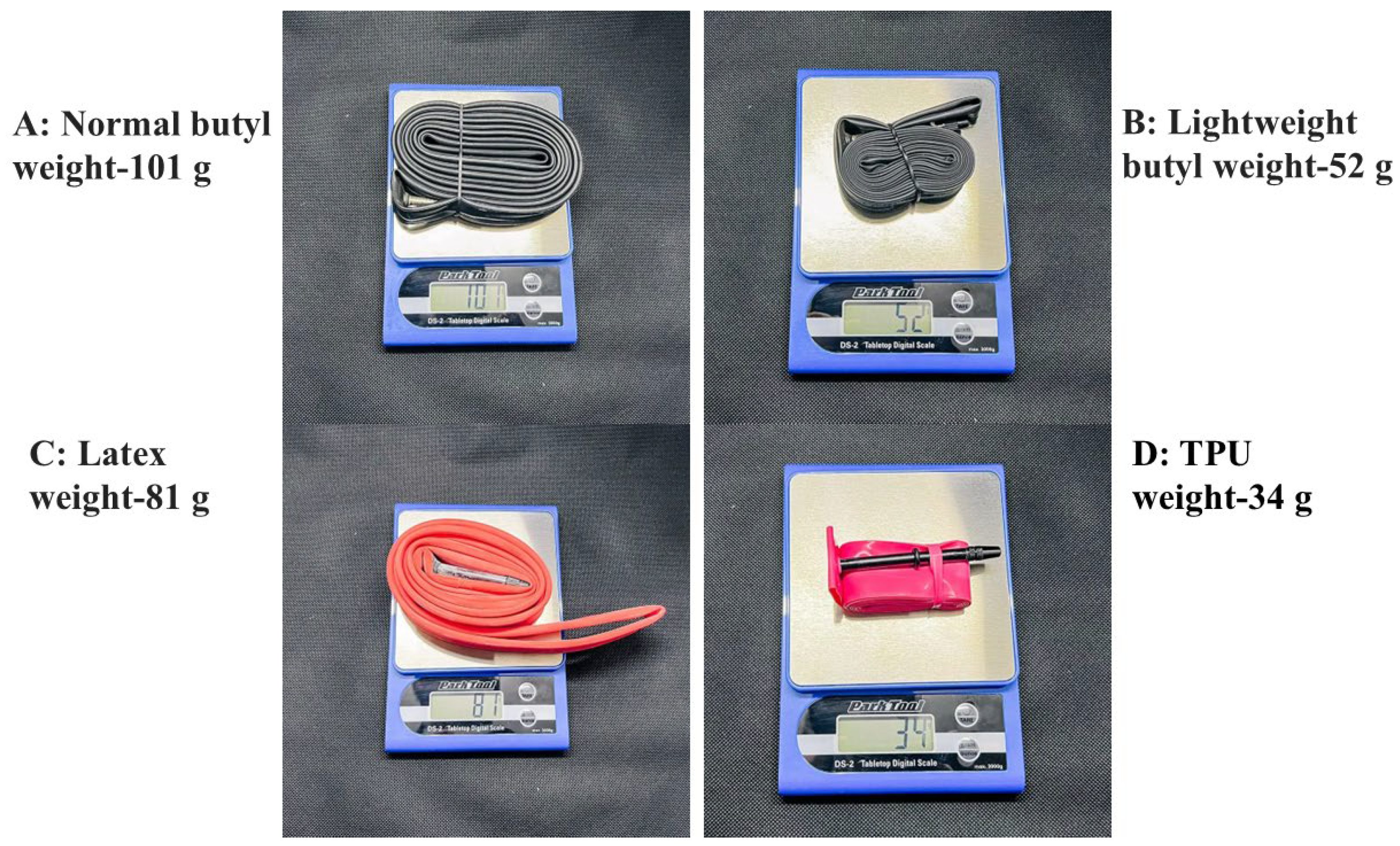
| Weight | 80–120 g (standard), 50–70 g (lightweight) | 60–80 g (lighter than butyl) | 22–50 g (lightest available) |
| Puncture resistance | Good | Fair | Good to very good (depends on brand) |
| Durability/Aging | Excellent | Moderate (sensitive to ozone and UV) | Good (resistant to temperature and aging) |
| Cost | Low (most affordable) | Moderate–high | Highest (brands like RideNow cheaper) |
| Best use | Everyday riding, commuting | Racing, performance riding | Hill climbing, weight-conscious racing |
| Typical brands/models | Continental, Schwalbe, Kenda | Vittoria, Challenge | Tubolito, RideNow, Pirelli SmartTube |
| Remarks | Reliable and low maintenance | Requires frequent inflation; best performance | Extremely light; more expensive but compact |
| Process | Description | Advantages | Disadvantages |
|---|---|---|---|
| Ambient grinding | Mechanical size reduction of vulcanized rubber at ambient temperature using grinding mills. | Simple process: particle size can be controlled by the number of grinding steps and mill type. | Generates significant heat leading to oxidation and degradation; high cost for very fine particles. |
| Cryogenic grinding | Rubber is frozen with liquid nitrogen below its Tg and then crushed to produce fine crumbs (powders). | Produces smaller, cleaner crumbs with smoother surfaces; faster process. | Requires liquid nitrogen; higher operational cost. |
| Wet grinding | Rubber is ground with water as a lubricant and cooling agent to produce very fine crumbs. | Produces very fine crumbs (10–20 μm); high purity; low energy consumption; water can be recycled. | Product requires drying; process involves handling water systems. |
| Yields (wt.%) | |||||
|---|---|---|---|---|---|
| Temperature (°C) | C1–C4 Fraction | C5–C10 Fraction | Tar or C11 Fraction | Total | Char |
| 425 | 1.81 | 54.96 | 9.30 | 66.07 | 33.93 |
| 500 | 4.24 | 52.41 | 9.24 | 65.89 | 34.11 |
| 600 | 8.26 | 44.46 | 11.48 | 64.20 | 35.80 |
| Temperature (°C) | Oil | Carbon Black (Char) | Gases | Ref. |
|---|---|---|---|---|
| 500 | 65 | 30 | 5 | [58] |
| 550 | 57 | 34 | 9.2 | |
| 600 | 51 | 40 | 9.1 | |
| 350 | 30 | 50 | 20 | [61] |
| 450 | 33 | 40 | 27 | |
| 550 | 38 | 33 | 29 | |
| 550 | 38.1 | 49.1 | 2.39 | [62] |
| 600 | 33.0 | 47.4 | 8.16 | |
| 680 | 32.8 | 48.9 | 10.75 | |
| 450 | 50.47 | 36.47 | 13.06 | [63] |
| 500 | 51.98 | 36.09 | 11.92 | |
| 550 | 52.61 | 35.69 | 11.70 | |
| 600 | 54.10 | 36.30 | 9.61 |
| Catalyst/Condition | Key Findings | Main Effect on Products | Ref. |
|---|---|---|---|
| General acid catalysts | Reduce liquid yield and increase gas yield | ↓ Oil, ↑ Gas | - |
| USY and HZSM-5 | Both increase gas yield | ↑ Gas | [65,66] |
| USY with SiO2/Al2O3 = 5.3 | Favors aromatic hydrocarbon formation | ↑ Aromatics | [67] |
| USY with SiO2/Al2O3 = 11.5 | Favors olefin formation | ↑ Olefins | [67] |
| HZSM-5 (increasing amount) | Promotes aromatics, especially BTX | ↑ Benzene, ↑ Toluene, ↑ Xylene; ↓ Non-aromatics | [68] |
| USY vs. HZSM-5 | USY has larger pore size → produces more aromatics | USY: ↑ Aromatics | [69] |
| Y-type zeolites | Increase saturated and monoaromatics; reduce diaromatics/polyaromatics | ↑ Saturates, ↑ Monoaromatics; ↓ Heavy aromatics | [70] |
| USY and HZSM-5 | Produce high concentrations of BTX; reduce oil and increase gas yield | ↑ BTX; ↓ Oil; ↑ Gas | [63,71] |
| USY | High BTX; reduced limonene due to larger pore size and lower acidity | ↑ BTX; ↓ Limonene | [72] |
| SAPO-11 and HZSM-22 | Gas yield order: SAPO-11 (10.45) > USY (9.97) > Hβ (8.24) > HZSM-5 (6.49) > HZSM-22 (6.17) > non-catalyst (4.5 wt.%) | SAPO-11 gives highest gas yield | [73] |
| HZSM-5 | Produces highest oil yield: 56% (non-catalyst 55.5 wt.%) | ↑ Oil, the other catalyst 53–55 wt.%. | [73] |
| SAPO-11 | Highest gas production: 10%; lowest carbonization: 34% (non-catalyst 40%) | ↑ Gas; ↓ Char | [73] |
| Catalyst/Modification | Key Findings | Main Effect on Products | Ref. |
|---|---|---|---|
| Hβ and Pd/Hβ | Gas yield: non-catalytic 20%, Hβ 28%, Pd/Hβ 37% | ↑ Gas; oil shifts to C9–C13 (gasoline–naphtha range) | [74] |
| TiO2, Pd/TiO2, Pt/Pd/TiO2, Bi2O3/SiO2 | Gas yield: non-cat 20%, TiO2 27%, Pd/TiO2 41%, Pd–Pt/TiO2 40% | ↑ Gas; improved catalytic activity due to morphology changes | [75] |
| Ru-doped zeolite | Increased activity; lower pyrolysis temperature; ↑ hydrogen production | ↑ H2; ↑ catalytic efficiency | [76] |
| Metal-doped zeolite | Promotes hydrogenation; removes sulfur and oxygen | ↑ Desulfurization; ↑ quality of oil | [77] |
| Cu-doped zeolite | Strong acid sites help reduce sulfur in products | ↓ Sulfur content; ↑ oil quality | [78] |
| MCM-41 and Ru/MCM-41 | ↑ Gas; ↓ liquid; lighter oil; Ru/MCM-41 gives 4× light olefins vs. non-catalytic | ↑ Light olefins; lighter fractions | [79] |
| MCM-41 (mesoporous) | Inhibits polyaromatics; promotes monoaromatics and saturates | ↑ Monoaromatics; ↓ PAH | [79] |
| MCM-41, ZSM-5, and zeolite Y | Gas yield increased and oil yield decreased, Coke is lowest (2.5%), ZSM-5 and zeolite Y of 2.7 and 11.7%. | ↑ Gas, ↓ Oil coke | [80] |
| Ru/MCM-48 (mesoporous, cubic) | Light olefins doubled; ↑ light oil; ↓ sulfur in aromatics | ↑ Light olefins; ↑ light oil; ↓ sulfur | [81] |
| Category | Mechanism | Representative Agents/Examples | Ref. |
|---|---|---|---|
| Catalytic | Catalysts selectively cleave S–S and C–S bonds | Grubbs catalysts (NR, SBR); PPh3; trialkyl phosphites; LiAlH4; methyl iodide | [120,121] |
| Radical-based | Homolytic cleavage of sulfur crosslinks | DPDS; TMTD; diallyl disulfide; dithiobis(benzothiazole) | [123,124] |
| Nucleophilic | Nucleophilic substitution at sulfur atoms | Amines; mercaptobenzothiazole; thiosalicylic acid | [115,123] |
| Oxidative/others | Oxidative or non-selective bond cleavage | Periodic acid (HIO4); nitric acid (HNO3); benzoyl peroxide (BPO) | [127,128] |
| Swelling-assisted | Swelling improves access to sulfur bonds | Ionic liquids; scCO2; soybean oil | [129,130,131] |
| Method | Advantages | Disadvantages |
|---|---|---|
| Bacterial | Selective sulfur bond cleavage; mild conditions; applicable to NR, GTR, latex; re-vulcanizable | Slow (days–weeks); surface-limited; contamination risk; scale-up challenges |
| Fungal | Highly selective via ligninolytic enzymes; mild and sustainable; effective on various rubbers | Very slow (weeks–months); surface-limited; specific growth media needed; scale-up difficult |
| Enzymatic | Targeted bond cleavage; high selectivity; controllable mechanism | Enzyme stability issues; inhibited by additives; costly; limited industrial adoption |
| Materials | Amount for 2023 (ton) | Relative Amount (%) |
|---|---|---|
| End-of-waste VRG | 47,762 | 26.8 |
| Shreds + chips + SCCS | 102,516 | 57.6 |
| Steel | 17,347 | 9.7 |
| Textile fibers | 10,222 | 5.7 |
| Production scraps | 107 | 0.2 |
| Total recuperation | 177,955 | 100 |
| Polymer/Matrix | Type of DR Used | Devulcanization Method(s) | Key Findings/Effect on Properties | Ref. |
|---|---|---|---|---|
| Natural rubber (NR) | DR from GTR | Supercritical CO2, ultrasonic, biological |
| [147] |
| ||||
| EPDM (synthetic rubber) | DR and NDR truck-tire rubber | Mechanical/chemical devulcanization |
| [148] |
| ||||
| SBR (synthetic rubber) | Microwave-devulcanized GTR; DR-modified SBR | Microwave devulcanization |
| [149] |
| ||||
| Polypropylene (PP) | Mechano-chemically devulcanized WTR | Mechano-chemical devulcanization, γ-irradiation studies |
| [150] |
| ||||
| High-density polyethylene (HDPE) | Surface-devulcanized GTR; DR-modified HDPE | TEPA surface devulcanization + in situ grafting (styrene, GMA) |
| [151,152] |
| ||||
| ||||
| Copolyester elastomer (COPE) | DR blended with COPE | Not specified (DR used as modifier) |
| [153] |
| Polystyrene (PS) | DR and NDR truck tire rubber; alkaline-treated DR | Mechanical or chemical DR; alkaline surface treatment |
| [148,154] |
| ||||
| ||||
| Asphalt/bitumen | Devulcanized rubber powder or granules | Various devulcanization pathways (thermal, mechanical, chemical) |
| [155] |
|
Disclaimer/Publisher’s Note: The statements, opinions and data contained in all publications are solely those of the individual author(s) and contributor(s) and not of MDPI and/or the editor(s). MDPI and/or the editor(s) disclaim responsibility for any injury to people or property resulting from any ideas, methods, instructions or products referred to in the content. |
© 2026 by the authors. Licensee MDPI, Basel, Switzerland. This article is an open access article distributed under the terms and conditions of the Creative Commons Attribution (CC BY) license.
Share and Cite
Chen, X.Y.; Rodrigue, D. A Review of Current and Emerging Strategies for Recycling Waste: Bicycle Tires and Inner Tubes. Recycling 2026, 11, 33. https://doi.org/10.3390/recycling11020033
Chen XY, Rodrigue D. A Review of Current and Emerging Strategies for Recycling Waste: Bicycle Tires and Inner Tubes. Recycling. 2026; 11(2):33. https://doi.org/10.3390/recycling11020033
Chicago/Turabian StyleChen, Xiao Yuan, and Denis Rodrigue. 2026. "A Review of Current and Emerging Strategies for Recycling Waste: Bicycle Tires and Inner Tubes" Recycling 11, no. 2: 33. https://doi.org/10.3390/recycling11020033
APA StyleChen, X. Y., & Rodrigue, D. (2026). A Review of Current and Emerging Strategies for Recycling Waste: Bicycle Tires and Inner Tubes. Recycling, 11(2), 33. https://doi.org/10.3390/recycling11020033