
Article

Valorizing the Organic Fraction of Municipal Solid Waste (OFMSW) as Composite Panels for Construction or Furniture

by
Cecilia Solís
1,
Armin Kriele
1,
Borja Oliver-Tomas
2,
Martin Hitzl
2,
Juan Carlos Guerrero Ramos
3,
José Luis Millá Tamarit
3,
Alicia Marco Aleixandre
3,
Rosa Maria Pérez Campos
3,
Arturo Valero
4 and
Michael Renz
4,*
1
German Engineering Materials Science Centre (GEMS) at Heinz Maier-Leibnitz Zentrum (MLZ), Helmholtz-Zentrum Hereon, 85748 Garching, Bavaria, Germany
2
Ingelia S.L., Calle Jaime Roig 19, 46010 Valencia, Valencia, Spain
3
Instituto Tecnológico Metalmecánico, Mueble, Madera, Embalaje y Afines (AIDIMME), Calle Benjamín Franklin 13, Parque Tecnológico, 46980 Paterna, Valencia, Spain
4
Instituto de Tecnología Química (UPV-CSIC), Universitat Politècnica de València—Consejo Superior de Investigaciones Científicas, Avenida de los Naranjos s/n, 46022 Valencia, Valencia, Spain
*
Author to whom correspondence should be addressed.
Recycling 2026, 11(2), 32; https://doi.org/10.3390/recycling11020032
Submission received: 10 December 2025 / Revised: 12 January 2026 / Accepted: 16 January 2026 / Published: 2 February 2026

Abstract

Residual lignocellulosic biomass represents a major resource to be incorporated into the circular economy, with up to 1400 Mt/y in EU27. Due to its complex composition of three biopolymers (cellulose, hemicellulose and lignin) combined with its seasonal and regional variability and high water content, its valorization involves manifold challenging aspects. Herein a three-step procedure is presented to transform this type of biomass into solid composite panels: hydrothermal carbonization (HTC), dry thermal treatment and curing a phenolic resin. HTC triggers chemical dehydration of the polysaccharide part of the lignocellulose and breaks up the cell structure of the plants. This facilitates the diffusion of the water and its separation by filtration, which is more energy efficient than evaporation. HTC and thermal treatment induce chemical changes that concentrate the carbon content and make the material suitable for crosslinking with a phenolic resin, achieving a 90% renewable content. The composite panels are competitive with products of the particle and fiberboard sector with respect to tensile strength and screw withdrawal resistance. Hence, the products can be employed for construction or in the furniture industry.

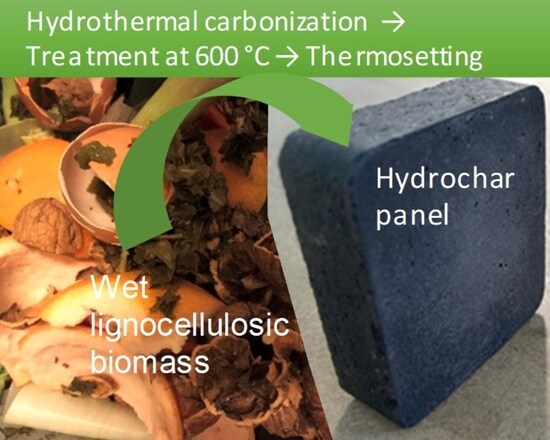
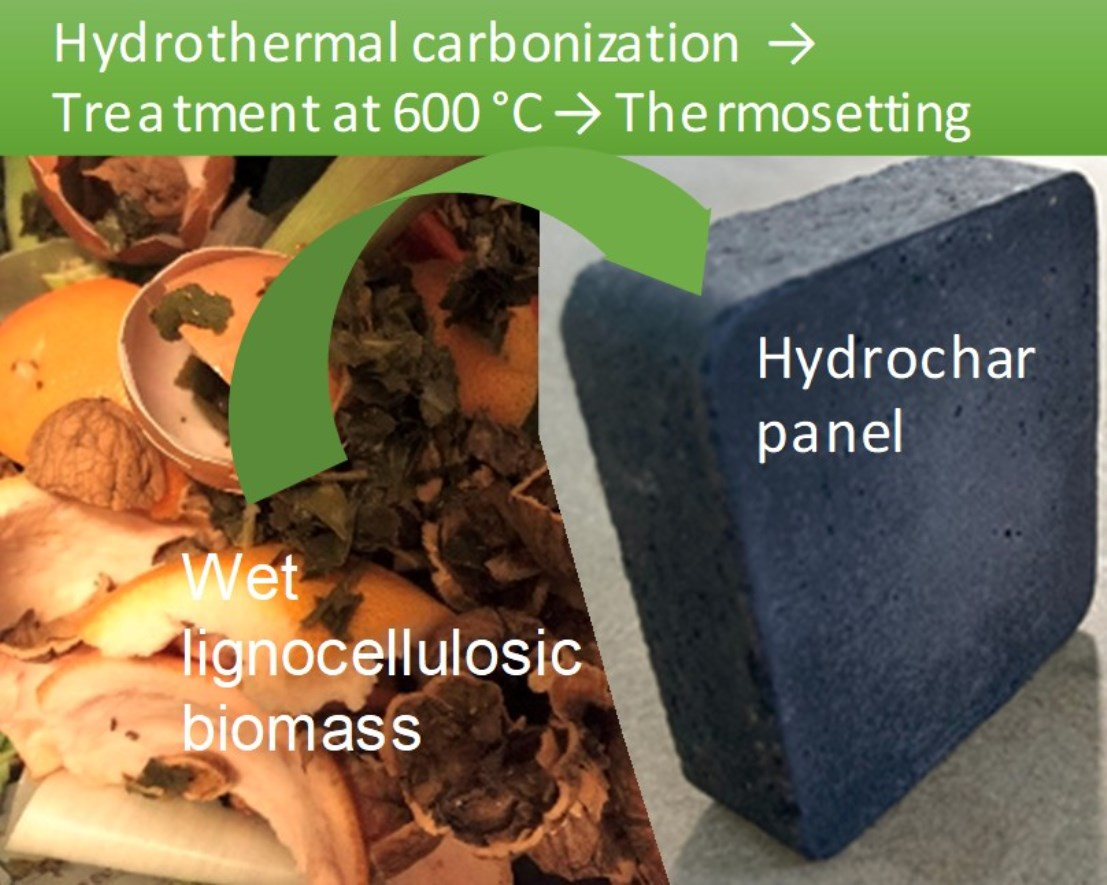
Graphical Abstract

1. Introduction

The European Green Deal was proposed by the European Commission in 2019 and approved by the European Parliament in 2020 and consists of a disrupting policy declaration for the subsequent decades [1,2]. This document was not only designed as a climate change mitigation action but also for increasing the well-being and health of citizens by demanding access to clean water, construction of energy efficient buildings, production of healthy and affordable food, support for public transport and many more benefits.
With respect to climate change mitigation, the aim is to reduce net greenhouse gas emissions by at least 55% by 2030 compared to 1990 levels [1]. Fossil-based heat and fuel in industry, buildings and the transport sector have to be replaced by renewables, as they are the cleanest energy source available. Furthermore, resources should be saved by increasing the circular economy, in addition to using biomass preferentially, i.e., by re-directing materials from the end of the value chain, such as textiles, electronics or biomass, towards other industrial sectors.
The residual lignocellulosic biomass potential in Europe is huge and adds up to 1400 Mt/year for EU-27 and Switzerland, with an energy content of 8500 PJ [3]. The main resources are straw (290 Mt/year) and forest residues (320 Mt/year) followed over a certain distance by the organic fraction of municipal solid waste (OFMSW; 90 Mt/year). Other feedstocks are pruning residues (15 Mt/year), agro-industrial food process waste (14 Mt/year), roadside vegetation (6.3 Mt/year) and biomass from urban green areas (2.4 Mt/year) [3].
Many lignocellulosic feedstocks have a rather high water content. Water evaporation consumes energy, which is a burden for economic and ecological balance. The high water content makes transport more expensive and poses an obstacle to valorization by classical thermochemical processes such as pyrolysis or gasification. An alternative is the processing of the biomass in the presence of water, as is performed in hydrothermal carbonization (HTC) [4,5]. This process mainly induces a chemical dehydration of polysaccharides and degrades the plant structure. The dehydration implies a concentration of the carbon content and an increase in the hydrophobicity of the material. These changes facilitate the separation of water by mechanical filtration, which is more energy efficient than water evaporation. The obtained carbonaceous solid product is called hydrochar.
Depending on the composition of the starting material of the HTC process, the hydrochar can be valorized in multiple applications. When employing refined (purified) biomass such as glucose, materials for energy storage can be produced when hydrochar is used for the production of electrodes in rechargeable batteries or supercapacitors [6]. Valorization as activated carbon is always an option for carbonaceous materials [7]. Pruning materials can be converted into a renewable solid fuel [8]. Application is still limited when heterogeneous waste materials such as the OFMSW are employed for HTC with variable compositions and involving inaccurately sorted contents [9]. In this case, hydrochar has been made suitable for its use as soil amendment material by the elimination of phytotoxic properties [10,11,12,13,14]. However, the economic revenues are rather low.
Hydrochar has been used as a filler to reinforce polymers. For instance, hydrochar was produced starting from rice husk and up to 20 wt% was incorporated into a polylactic acid polymer. Thereby, the tensile modulus of the composite material was increased by more than 60% compared to the neat polylactide [15]. A similar result has been reported for the reinforcement of poly(butylene adipate-co-terephthalate) (PBAT) with hydrochar produced from wood chips: the elastic modulus was almost doubled by incorporating 20 wt% of hydrochar produced under mild conditions (180 °C) [16]. In another study, carbon black was substituted partially when used as filler for rubber. It has been found by vulcanization rheology measurements that hydrochar influences vulcanization chemistry [17]. Again, up to approximately 20 wt% of hydrochar induced positive effects and this route might be a valorization pathway for hardwood waste. From these three examples, it can be seen that hydrochar is a promising material for crosslinking with polymers. However, the incorporation of pristine hydrochar, i.e., without further thermal refinement, is limited to amounts up to approximately 20 wt%.
Refined biomass has been incorporated into phenolic resins to produce composite materials. Phenolic resins were the first fossil-derived polymers invented more than a century ago and were commercialized under the brand name Bakelite [18,19]. In recent years, phenol has been partially substituted by biomass components such as lignin [20,21]. This replacement provides a renewable-based resin material and is a clear step forward from an ecological point of view. However, the relatively high price of lignin, caused by its separation process from lignocellulosic biomass, is a commercial drawback [22].
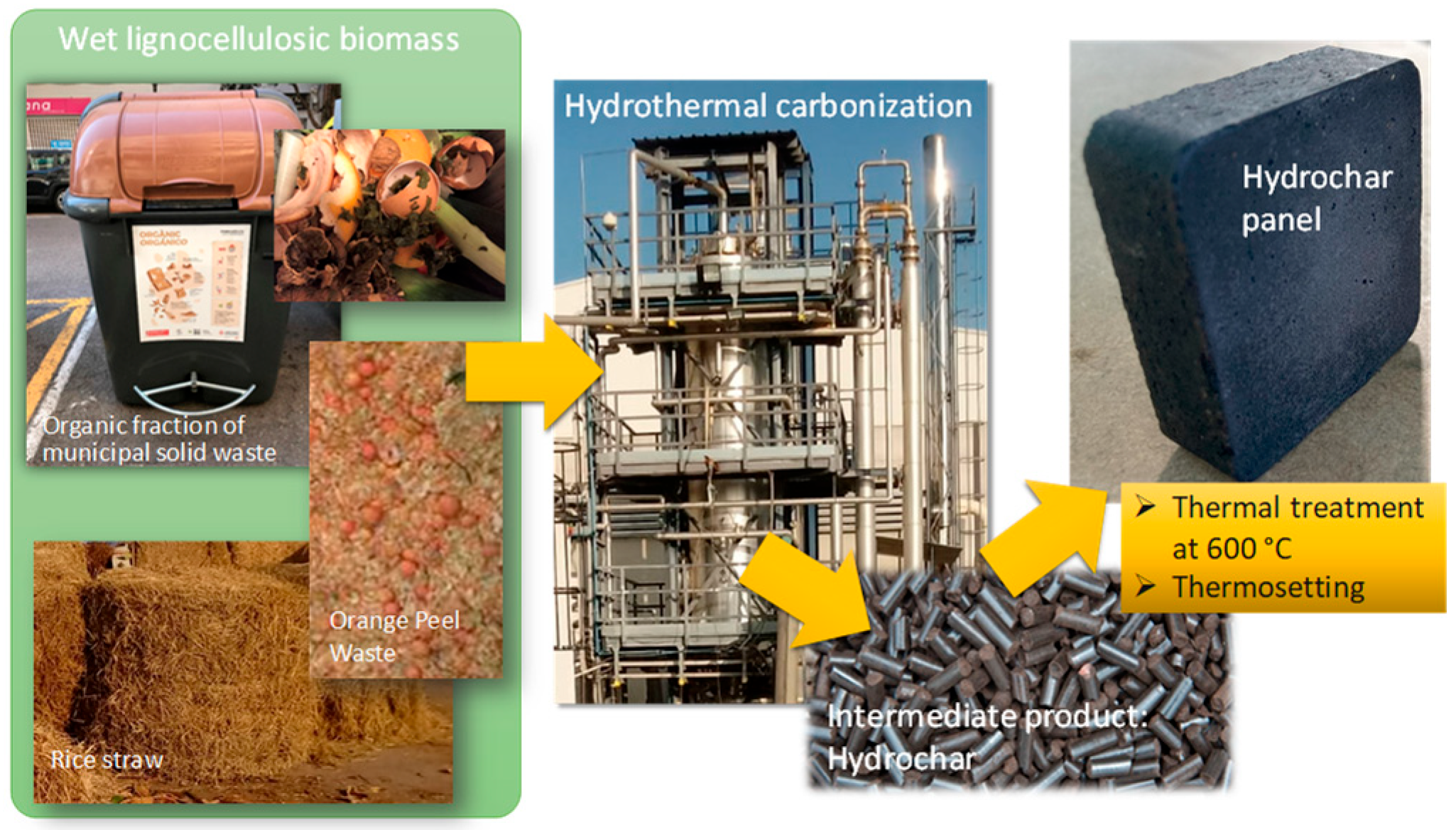
This issue can be overcome by employing refined hydrochar obtained from biomass without commercial value or with a negative one (saving disposal costs), such as, for instance, rice straw, orange peel waste or the OFMSW. Herein, we will show that the appropriate adaption processes, namely a second thermal treatment and suitable curing conditions, make these residues suitable for the new value chain (Figure 1). The final resin composite material will be commercialized as panels for the construction and furniture sectors. Panel models (Figure 1) are prepared and characterized by means of their tensile strength and screw withdrawal resistance, following standards established for particleboards and fiberboards. The first results are promising and it is demonstrated that suitable materials are produced.

2. Materials and Methods

2.1. Production of Pristine Hydrochar in an Industrial Reactor

For the production of pristine hydrochar in an industrial pilot reactor from OFMSW in 2016, see ref. [14], and from orange peel waste, see ref. [23].
Residual biomass, i.e., the organic fraction of municipal solid waste (OFMSW), was supplied by a municipality in the north of Spain, from separate collection, and contained minor amounts of impurities, including biodegradable plastic bags, glass and plastic bottles. A total of 12.6 t of this biomass, with a humidity of 75% (3180 kg of dry mass), was fed continuously into the reactor for 9.25 h. The temperature was maintained between 205 and 215 °C under an autogenous pressure of 18 to 20 bar, resulting in an approximate residence time of 4 h. Solid materials with high inorganic content, such as stones, sand, glass and metals, were separated from the hydrochar in a post-treatment by physical means (density). After removing the process water by filtration, hydrochar with approximately 50% humidity was dried thermally and pelletized. A total of 1563 kg (49.1% mass yield based on dry input) was obtained, together with 181 kg of other solid materials (5.7% yield). On a dry basis, the pellets contained 14.6% ash, 19.6% fixed carbon and 65.8% volatile matter. Ash, fixed carbon and volatile contents were determined as described below. On average, the carbon content was 65%, and on a dry and ash-free base, the hydrogen content and nitrogen content were 7.3% and 2.6%, respectively (Table S1). Sulphur content was below the detection limit of the elemental analysis CHNS.
Rice straw was received from the Albufera area, Valencia, Spain. A total of 3009 kg of this biomass with a humidity of 33% (2031 kg of dry mass) was fed continuously to the reactor and the temperature was maintained between 205 and 215 °C, which generated an autogenous pressure of 18 to 20 bar. Solid material with a high content of inorganic material (SiO2) was separated from the hydrochar by a post-treatment based on physical means (density). After removing the process water by filtration, hydrochar with approximately 50% humidity was dried thermally and pelletized. A total of 1010 kg (49.7% mass yield based on dry input) was obtained, together with 95.4 kg of other solid materials (4.7% yield). On a dry base, the pellets contained 17.5% of ash, 22.0% of fixed carbon and a remaining 59.9% of volatile matter. Ash content, fixed carbon content and volatiles were determined as described above. On average, the carbon content was 60%, and on a dry and ash-free base, hydrogen content and nitrogen content were 6.3% and 1.6%, respectively. Sulfur content was below the detection limit of the elemental analysis CHNS.

2.2. Feedstock Composition

Orange peels are not a typical lignocellulosic biomass as they contain a high water-soluble fraction [24]. Hence, glucose, fructose and sucrose account for 46% of the dry matter. Insoluble polysaccharides represent 20% of the dry matter, consisting primarily of cellulose (14%) and hemicellulose (6%). The non-saccharide component of lignocellulose, i.e., the lignin, is only present in marginal amounts of below 1 wt% of the dry matter. The ash content is low with values below 3 wt%. In addition, orange peels contain a significant amount of proteins (7%) and of pectin (19%).
Rice straw consists of cellulose (40–46%), hemicellulose (25–28%) and lignin (4–10%). The inorganic part accounts for 15 wt%, determined as ash content. The latter consists mainly of 68% SiO2 and 12% K2O [25].

2.3. Thermal Post-Treatment of Hydrochar

The thermal treatment of hydrochar was carried out in a vertical, tubular quartz reactor (Darío Lorusso, Cuarzo & Vidrio, Hontoria, Segovia, Spain, Figure S8a) at 600 °C for one hour, placing the thermocouple at the outer wall of the reactor within the heating mantle (Watlow, Ceramic fiber Heater, VC402A06A-0000R, Madrid, Spain; Figure S8b). Hydrochar pellets (50–100 g) were placed in the reactor and heated with a heating rate of 6 K/min to the desired temperature, which was maintained for one hour. During the treatment, a nitrogen flow of approximately 20 mL/min was applied. Liquids were condensed at the outlet under ambient conditions. After cooling down to room temperature, the hydrochar was recovered. Before employing the hydrochar for the resin preparation, it was milled in a Pulverisette 11 (Fritsch) (FRITSCH, Idar-Oberstein, Germany) for one minute at 7000 rpm. The particle size distribution was determined by sieving: 53% < 0.2 mm and 40% 0.2–0.6 mm.

2.4. Characterization of Hydrochar and Thermally Treated (Refined) Hydrochar

The ash content was determined as described in UNE 32004:1984 [26]. The sample was crushed in a mortar to a particle size of <0.2 mm and dried (105 °C). Approximately 1 g (weighed exactly) was placed in a crucible and heated in a muffle furnace from room temperature to 815 °C at a heating rate of 3 K·min−1. The temperature (815 °C) was maintained for one hour. The residue obtained was the ash of the sample. The ash content was calculated by the following formula:
Ash content/% = Mass/g (ash)/Mass/g (dry sample) × 100
The volatile content was measured following the standard UNE 32019:1984 [27], namely by heating a crushed, sieved and dried (105 °C) sample to 900 °C in a closed vessel for seven minutes. The volatile content was eliminated by the procedure and was calculated by the following formula:
Volatile content/% = (Mass/g (dry sample) − Mass/g (remaining))/Mass/g (dry sample) × 100
The fixed carbon content was calculated from the volatile content and the ash content by the following formula:
Fixed carbon/% = 100 − volatile content/% − ash content/%
For elemental analysis (CHNS), the samples were crushed in a mortar to a particle size < 0.2 mm. The samples were analyzed on a Thermo Scientific Flash 2000 Organic Element Analyzer apparatus (Thermo Fisher Scientific, Dreieich, Germany). Values are stated on a dry basis and, in addition, the carbon value on a dry-and-ash-free (daf) basis (Table S1). The composition of the ashes (Table S2), involving the elements Na, K, Mg, Al, Fe, Si and P, was determined by inductively coupled plasma optical emission spectroscopy (ICP OES). Therefore, a sample (20–30 mg) was disaggregated in a HNO3/HF/HCl mixture (1:1:3) and the solution analyzed on a Thermo Scientific iCAP PRO apparatus (Thermo Fisher Scientific, Dreieich, Germany). The calcium content (CaO and CaSO4) was measured by X-ray fluorescence of the solid ashes on a PANalytical MiniPal 4 apparatus (Malvern Panalytical, Kassel, Germany).
The textural analysis was performed by measuring CO2 isotherms at 0 °C on volumetric Micromeritics ASAP 2020 and 2420 devices (BSD instruments, Großröhrsdorf, Germany) after activation at 300 °C and under vacuum for the HC-x_600 samples and after activation at 150 °C for the hydrochar samples HC-x without any thermal post-treatment. The Dubinin–Astakhov (DA) method was used to calculate the surface area and the pore volume [28].
FT-IR spectra were obtained using the crushed powder on a JASCO FT/IR-4700 apparatus (JASCO Applied Sciences, Schwentinental, Germany) equipped with an ATR PRO ONE accessory (Figures S2 and S3). The 13C MAS NMR spectra were measured on a Bruker AVIII HD 400WB apparatus (Bruker, Bremen, Germany). Characterization of the surface morphology of the samples by means of scanning electron microscopy (SEM) was carried out on a ThermoFisher Scientific Quattro S field emission environmental scanning electron microscope (ESEM) (Thermo Fisher Scientific, Dreieich, Germany) operated by the Helmholtz-Zentrum Hereon and Jülich Center for Neutron Science (JCNS) at MLZ (Figures S4–S7). The SEM micrographs were taken at a working distance of 10 mm with a probe current of 7 pA and an acceleration voltage of 5 kV using an Everhart–Thornley detector (ETD) collecting surface near-secondary electrons to obtain high topography information. Energy-dispersive X-ray spectroscopy (EDS) was performed with a ThermoFisher EDS UltraDry Si-drift detector (Thermo Fisher Scientific, Dreieich, Germany) (60 mm2) at a take off angle of 40° with an energy resolution of 127 eV Mn Kα. The acceleration voltage was set to 15 kV and probe current to 2 pA, resulting in a count rate of 2–10 kcps and a detector dead time of 5%.
For the elemental mapping, the dwell time and repetitions were adjusted depending on the image size ranging from 2.3 × 1.6 mm2 (overview scans) to 150 × 97 µm2 (single particles), leading to a total acquisition time of 30 min and 10 min, respectively.
X-ray diffraction (XRD) patterns of the thermally treated hydrochar were obtained with synchrotron radiation at the HEMS beamline of PETRA III at the DESY side station (Figure S9) [29] by using a photon energy of 87.1 keV corresponding to a wavelength of 0.01423 nm. A PerkinElmer XRD1621 (PerkinElmer, Rodgau, Germany) image detector with a pixel size of 200 × 200 mm2 and a resolution of 2048 × 2048 pixels was used to record the XRD patterns. The sample-to-detector distance was 1674.6 mm, allowing us to record complete Debye–Scherrer rings. The calibration was performed by using a LaB6 standard sample (NIST standard reference material SRM-660a) for calibration. Fit2D (V17.052) [30] software was used to treat the 2D patterns from synchrotron measurements and the Full-Prof (V 5.20) software [31] was applied for Rietveld refinement [32] of the acquired synchrotron diffraction patterns.

2.5. Preparation of the Composite Panel

In a round-bottom flask equipped with a reflux condenser, the milled carbon powder (20 g) obtained from the two-step procedure of HTC and thermal post-treatment was placed together with phenol (2.22 g; 10 wt% of phenol with respect to the total carbon powder and phenol), ethanol (26.6 mL) and sodium hydroxide (1.20 g). The mixture was stirred and heated to 80 °C. Formaldehyde (37% in water, 30 mL) was added drop-wise. After 4 h the mixture was allowed to cool down and the solvent was removed at the rotavapor. A viscous paste was obtained which was placed onto an aluminum pressing mold (Figure S10, left-hand side). The mold was placed between two plates of a press and heated to 130 °C (Figure S11). A minimum pressure of 10 MPa was applied for 15 min. Afterwards, the pressure was released and the produced polymer unmolded (Figure S10, right-hand side).
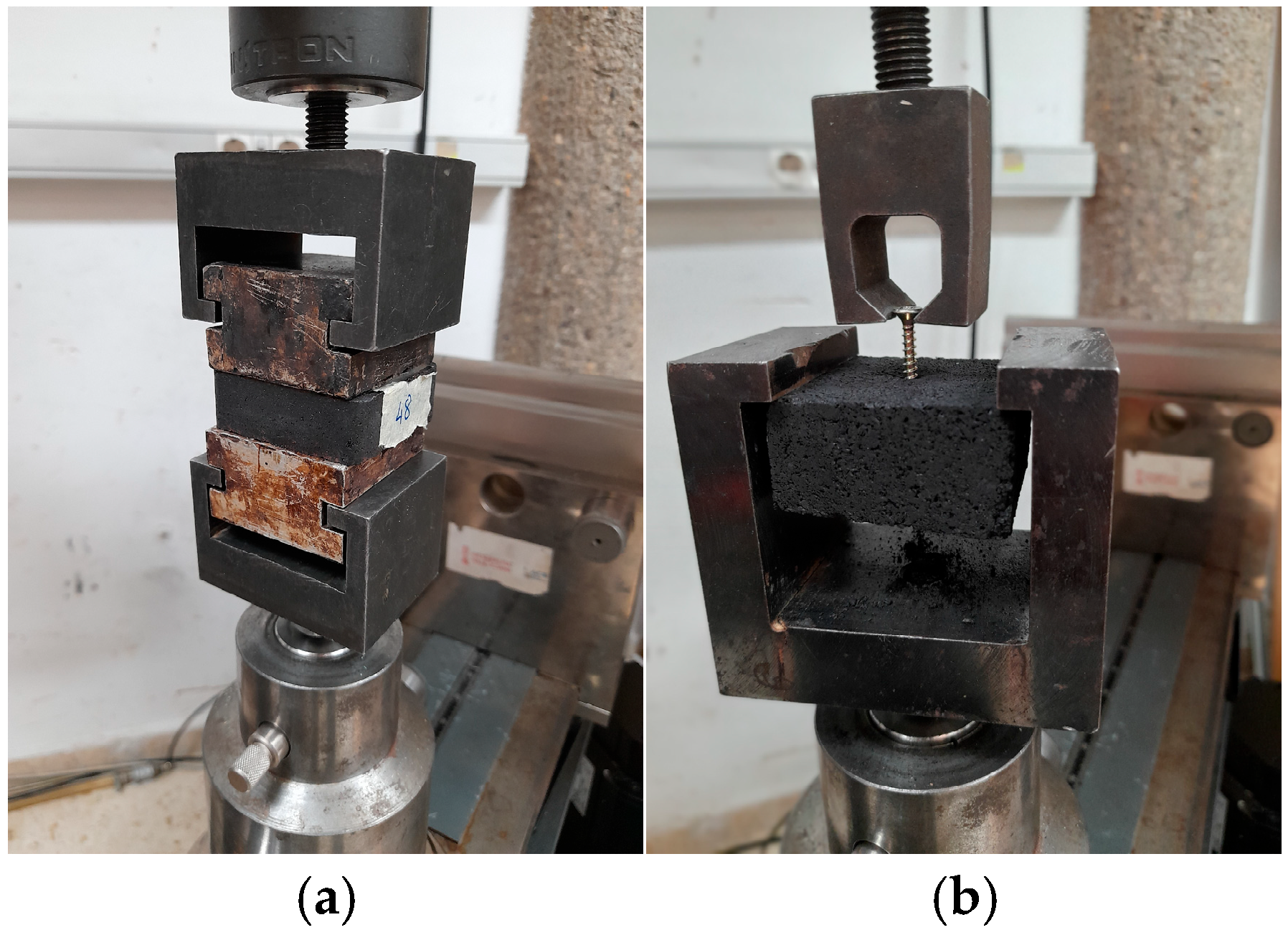
Material properties were determined following the standards for particleboards and fiberboards (Figure 2): UNE-EN 319 [33] for the tensile strength perpendicular to the plane of the board and UNE-EN 320 [34] for the resistance to axial withdrawal of screws.

3. Results

3.1. Hydrothermal Carbonization of Wet Lignocellulosic Biomass

Wet lignocellulosic biomass is not suitable for the direct production of phenolic resin composites, and its properties have to be adapted and the required functionalities have to be generated. This is achieved by the first two steps, namely hydrothermal carbonization (HTC) and subsequent thermal treatment in the absence of oxygen. The second process might be characterized as a (dry) pyrolytic treatment of the hydrochar, which is the solid product of the first transformation.
Three different biomass resources have been selected: the OFMSW, rice straw and orange peel waste. The HTC was carried out on industrial pilot scale, and the results are summarized in Table 1. The mass yield related to the dry content of the biomass was almost 50%. Therefore, it has to be taken into account that approximately 20 wt% of the dry mass was converted into water by chemical dehydration and 5 wt% into carbon dioxide. Hence, the carbon yield was much higher than the mass yield. Only for orange peel waste was the mass yield significantly lower at only 37%. The lower HTC mass yield for this feedstock is a general feature and has been reported in several cases [35,36]. The reason for this might be the elevated non-cellulosic content such as proteins (7%) and pectin components (19%) [24]. Both have a lower mass yield in the HTC process [37,38,39].
As a general rule, for the mass yield, it can be stated that a higher polysaccharide content decreases the mass yield as this part is dehydrated. In contrast, the lignin content is hardly modified, and its mass yield is nearly quantitative. Water-soluble organic matter is lost in the process water, resulting in mass yield deterioration. The inorganic content is incorporated almost entirely into the hydrochar and remains unchanged under the reaction conditions. An exception is the alkali content, especially the potassium, which is dissolved into the process water. Changes in the ash (inorganic) content of the hydrochar can be introduced on an industrial scale by mechanical separation of particles of higher density, such as stones or sand (cf. Table 1, footnotes [d] and [e]).
The OFMSW has been processed twice in different years. The hydrochar from the first trial has been used in earlier studies on the elimination of the phytotoxicity [14] and on phosphorus recovery [40]. When the results of both HTC trials are compared, it can be stated that the characteristics of the hydrochar were quite similar: both carbonization products were high-ash materials with 13.3 wt% and 14.6 wt% for hydrochar HC-1a and HC-1b, respectively (Table 1, entries 1 and 2), with similar ash compositions (Table S2, entries 1 and 2). Especially in these trials, a significant amount of improper (non-carbonic) materials such as stones, sand, glass, cans, etc., were separated from the hydrochar during the HTC pilot trials by physical means. The second hydrochar sample, HC-2, obtained from rice straw with a mass yield of 49.7%, also possessed a high ash content of almost 18%, even higher than HC-1 (Table 1, entry 3). Hydrochar HC-3 derived from orange peel waste was taken from a former trial [23]. It possessed a relatively low ash content of only 6.6 wt% (Table 1, entry 4).

3.2. Thermal Treatment as Refinement Process for Hydrochar

The second carbon concentration in the carbonaceous material and further structural transformations were induced by a pyrolysis-like thermal treatment of the hydrochar at 600 °C. A downflow nitrogen atmosphere avoided the presence of air, and the samples HC-1_600, HC-2_600 and HC-3_600 were produced. In Table 2, it can be seen that the mass yield of the pyrolytic treatment varied from 35 wt% up to 50 wt%, depending on the initial biomass employed for the hydrochar production. In the case of a lower yield, an organic liquid was co-produced during the thermal treatment (Table 2, footnote f). In general, ash content was increased by this treatment, and approximately doubled (Table 2). Volatile organic content (considered as such for solid fuels determined at 900 °C following standard UNE 32019:1984) dropped below 20% and the fixed carbon content increased to at least 50% of the dry matter (Table 2).
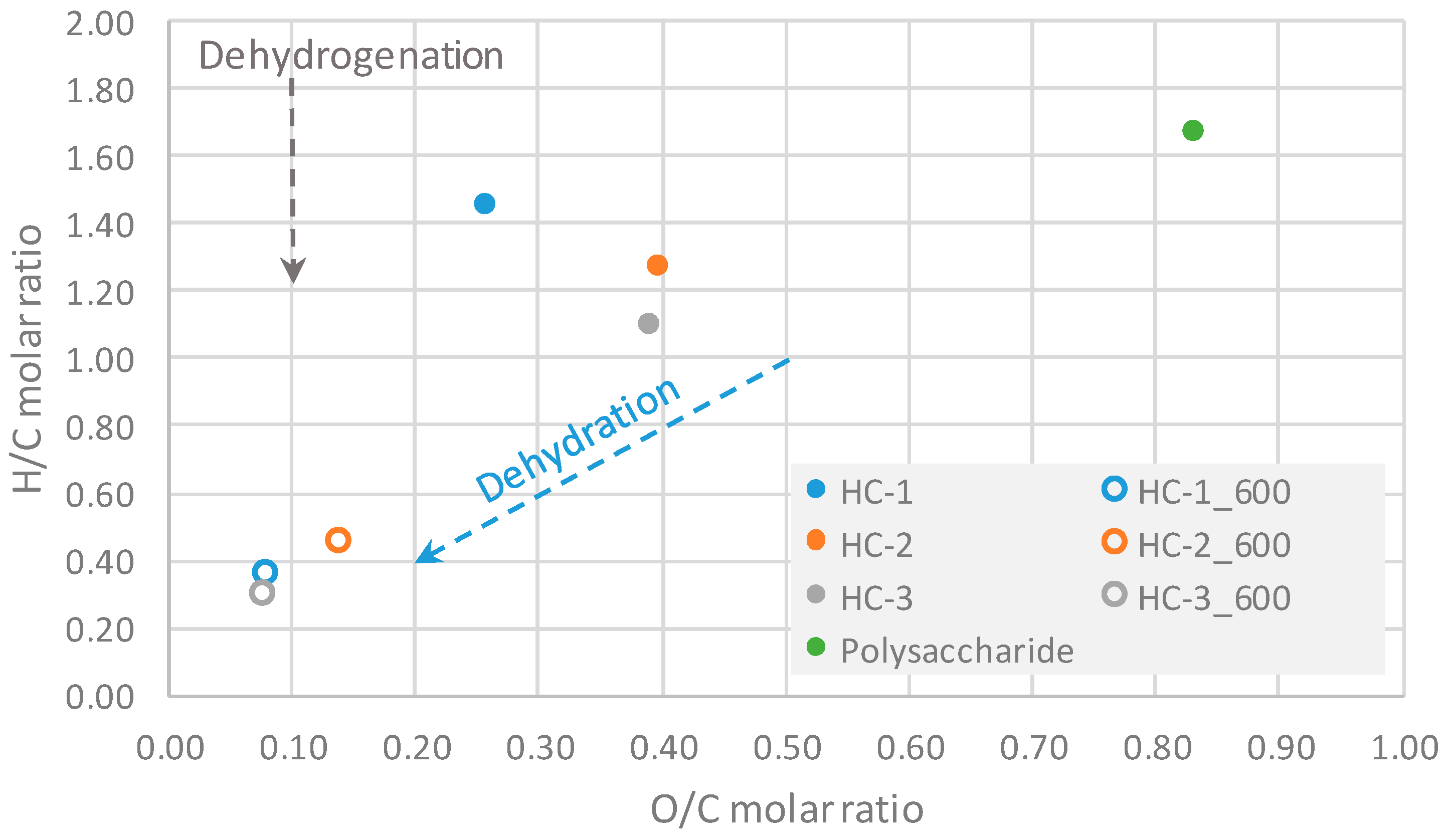
The two-step process for the transformation of the biomass into the resin precursor can be visualized in the van-Krevelen diagram (Figure 3). The positions of polysaccharides, such as cellulose or hemicellulose, are marked in the upper-left quadrant (0.83 and 1.67 for O/C and H/C molar ratios, respectively, for (C6H10O5)n). During the HTC process, the biomass is mainly dehydrated and to a small extent decarboxylated [23,41]. The hydrochar is located at the center of the diagram with O/C and H/C approximate molar ratios of 0.4 and 1.2, respectively, with the exception of HC-1, which involves a higher aliphatic content. With the pyrolytic treatment, the lower-left corner (0.08 and 0.3 for O/C and H/C molar ratios, respectively) is reached, indicating a high carbonaceous character of the material with a high energy density. Again, the main chemical transformation is dehydration. In addition, the small contribution of a dehydrogenation-type transformation is proposed. The latter may occur in cyclohexane rings which are transformed into aromatic rings.
A slightly different global transformation method is observed when starting from the OFMSW. The hydrochar HC-1 position is deviated from the point 0.4/1.2 to the point 0.25/1.4 (O/C and H/C molar ratios). This displaced localization can be rationalized by the adsorption of significant fatty acid content [14]. Fatty acids are abundant in the OFMSW and have a high aliphatic character with a low O/C ratio and a H/C of 2. Hence, the location of the data point for HC-1 has to be interpreted as an average value of the solid material and the adsorbate. During the heat treatment of HC-1 at temperatures up to 300 °C, the fatty acids are desorbed [14] and the “purified” hydrochar pyrolyzed when raising the temperature further, in the same way as in the other two cases.
The change in the chemical structure during the pyrolytic treatment is monitored by IR and 13C MAS NMR spectroscopy. The IR spectra document a de-functionalization of the material: typical C–H, C=O and C–O bands disappear after the treatment (Figure S2) [42]. Interestingly, the IR spectra are different from the ones of lignin, which show well-shaped bands for the aliphatic C–H bands (below 3000 cm−1) and C-O and C-C single and double bonds (1000–1700 cm−1; Figure S3) [42].
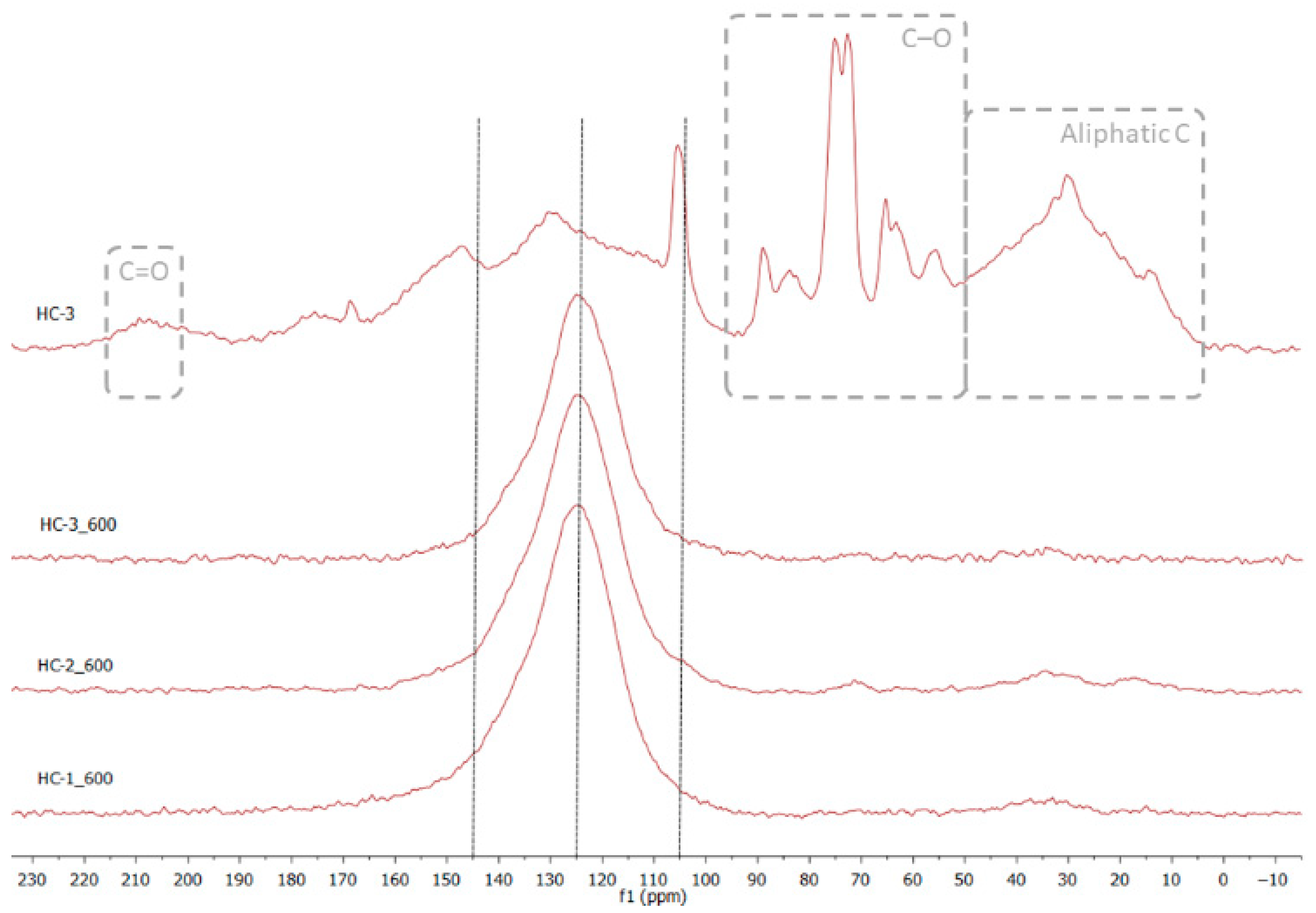
The 13C MAS NMR spectra support the same transformation pattern (Figure 4): the carbonyl signal (215–190 ppm) disappears as well as signals from the C–O region (90–60 ppm) and from the aliphatic carbon region (50–10 ppm). The remaining (broad) signal (140–110 ppm) is consistent with aromatic moieties. Interestingly, all thermally treated hydrochars give very similar 13C MAS NMR spectra (Figure 4). The transformation of the functional groups can also be monitored by FT-IR (Figure S2). Hydrochar samples involve narrow signals in the C–H, carbonyl or C–O regions. In contrast, pyrolyzed hydrochar samples show only broad hills or resemble flat lines. Interestingly, the FT-IR spectra of pyrolyzed hydrochar are quite different from those of organosolv lignin or Kraft lignin (Figure S3).
For the HC-1_600 and HC-2_600 samples, ashes accounted for one third of the material, and only the HC-3_600 was below 20 wt% (Table 2). Elemental composition (bulk; measured on the ashes by ICP-OES after acid digestion) showed a high calcium and phosphorus content for the HC-1-derived materials and a high silicon content for the HC-2-derived carbons (Table S2). When having a closer look at the elemental distribution on the surface by means of energy-dispersive X-ray spectroscopy (EDS; Table S3), it was observed that the locations of calcium and phosphorus were matching, indicating the presence of calcium-phosphate-type domains for the HC-1_600 sample (Figure S4). By XRD obtained from synchrotron radiation (Figure S9), a Ca10(PO4)6(OH)2, hydroxyapatite, crystallographic phase accounted for almost half of the total amount (Table S4).
When comparing the silicon distribution for the HC-2_600 (60 wt%; Table S2) and the HC-3_600 (22 wt%, Table S2), a different allocation was detected: in the case of the rice-straw-derived material, HC-2_600, small particles (often below µm scale) were found with a high dispersion over the carbon material (Figure S5), whereas in HC-3_600, bigger particles were detected with a diameter of up to 50 µm (Figure S6).

3.3. Preparation of the Composite Panels

The carbon material produced by the two-step procedure was employed for the synthesis of (resole-type) phenolic resin composites. Thereby, the aim was to substitute 90 wt% of fossil-derived phenol and to keep only 10 wt% to produce a resin composite from 90% renewable material. For the synthesis, refined hydrochar with phenol (90:10 wt%/wt%) was used together with formaldehyde in ethanol under basic conditions. Thereby, formaldehyde was considered a renewable chemical, as it can be obtained from a renewable source such as biomass-derived syngas [43,44] or renewable methanol [45,46].
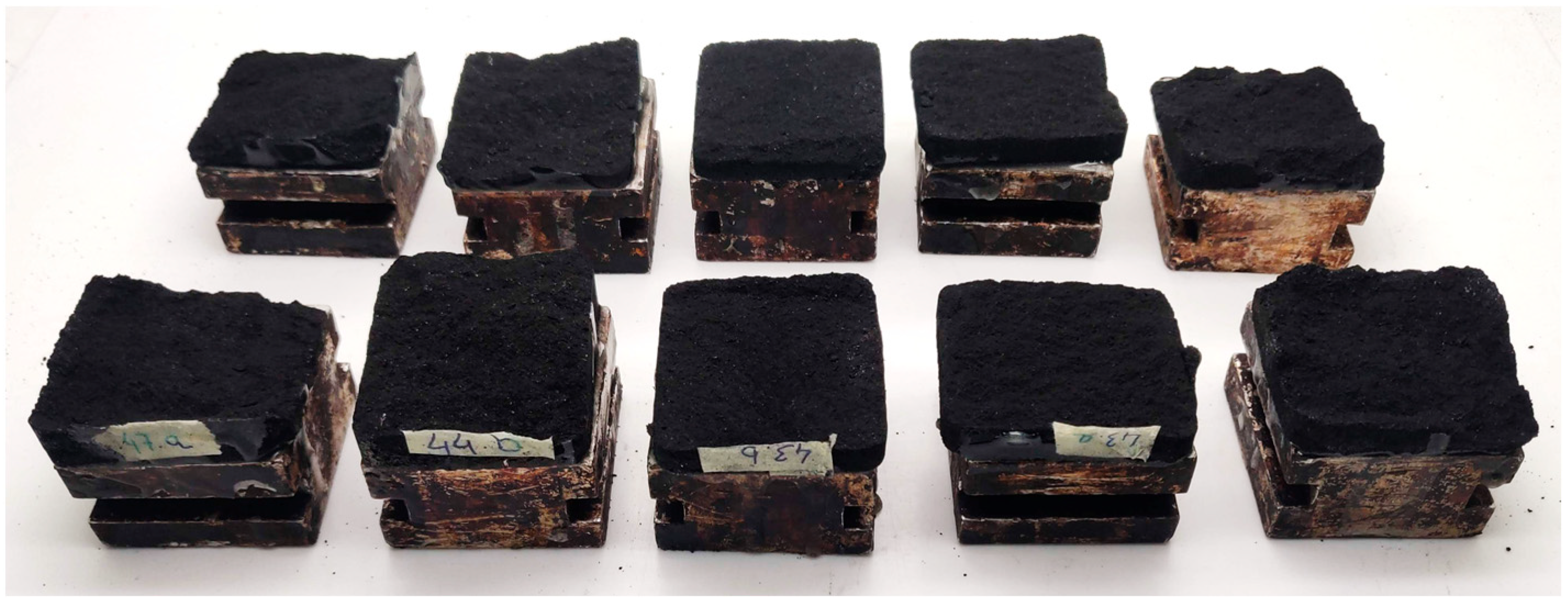
For curing the resin precursor, the mixture of refined hydrochar with the synthesized adhesive was filled into molds (Figure S10) and pressurized with 10 MPa at 130 °C for 15 min (Figure S11). The resulting panel model is shown in Figure 1 and Figure S10. Specific material properties were determined following the standards for particleboards and fiberboards. Tensile strength was measured corresponding to UNE-EN 319:1994 and values of 1.1 to 1.6 MPa were obtained (Table 3). A deformation was not observed and the failure was brittle (Figure 5). The screw withdrawal resistance (SWR) was higher at 2000 N, following UNE-EN 320:1994 (Table 3). Both values were in the range of commercial products in the particle- and fiberboard sector, i.e., 0.4–1.5 MPa and 700–1300 N for tensile strength and SWR, respectively (Table S5).

4. Discussion

The present study is based on the working hypothesis that lignocellulosic biomass can be made suitable for its incorporation into phenolic resins and, thereby, the lignin content is not relevant. Suitable aromatic domains with a similar reactivity as phenols or polyphenols are created by a two-step process involving HTC and pyrolytic treatment. Chemical transformation of the organic content supports this hypothesis as can be seen below.

4.1. Feedstock Properties and Selection Criteria

Three different biomass resources have been selected, guided by the following criteria: availability, composition and economic benefits. Straw, as already stated before, is one of the most abundant resources and involves a lignocellulosic composition that varies only within a small range. Therefore, it can be predicted that the properties of the final material will be reproducible independently from regions or changing climate conditions during its growth from year to year. Hence, election criteria are availability and composition in this case.
The interest in the next feedstock, orange peel waste (OPW), is mainly due to its composition; it provides substantial proof for the working hypothesis, although its use on an industrial scale is realistic. Considerable amounts (30 Mt/year worldwide; 3 Mt/year in Europe) [47] of this feedstock are available and it is generated at hot spots, namely juice producers, avoiding transportation costs. Its composition makes it singular: it is a lignocellulosic material with low lignin content (<1 wt%) [24,48]. In addition, in the same way as straw, its composition is constant with only small variations. For this reason, the resin precursor produced from this feedstock will have a low lignin-derived content. A successful production of the resin will demonstrate the insignificance of the lignin content of the residual biomass for the resin synthesis.
The third feedstock is the organic fraction of municipal solid waste (OFMSW), which is interesting for all three criteria: availability, composition and economic benefits. With respect to the availability, its production volume is significant in all European regions [49,50]. It is a resource that is already concentrated in municipal areas and requires only a low logistic effort. From the composition point of view, it represents the biggest challenge. It involves a high lignocellulosic part from vegetable waste. However, this matter is mixed with other organic biogenic leftovers such as proteins, and it contains inorganics such as eggshells or bones or inorganic waste that does not belong in the organic waste. If this resource can be converted into a resin composite, then it can be supposed that the procedure will accomplish its mission for a broad range of biogenic residues with a certain lignocellulosic content. In case of success, the economic balance of the process will be supplemented by the negative price of this resource, since current management of the OFMSW is quite expensive and does not fulfill European sustainability standards in many cases.
The OFMSW is very heterogeneous and therefore difficult to simulate at a laboratory scale. Hence, it is decided to carry out the hydrothermal carbonization on a ton-scale in an industrial pilot plant and to refrain from providing a detailed characterization in terms of moisture content and composition [8]. Thus, this first step will produce a certain homogenization for the OFMSW feedstock. At a later stage of this study, a detailed characterization of the hydrochar and the refined hydrochar will provide insights into the inorganic content of the raw materials, enabling conclusions to be drawn regarding their composition. The other two raw materials are processed in the same way, i.e., on a ton-scale at the pilot plant facility. As a side effect and additional benefit, this approach also initiates the pathway toward industrial implementation of the value chain.

4.2. Transformation of the Organic Content

Lignocellulose consists of three different biopolymers, namely cellulose, hemicellulose and lignin, all of which are highly oxy-functionalized. Basic functional groups are hydroxy groups and carbonyl groups, which build different functional groups such as ketones, aldehydes, carboxylic acids, aliphatic alcohols, phenols, cyclic and acyclic ethers, esters and lactones. Only lignin would have suitable functional groups, namely phenolic moieties, which are suitable for undergoing phenolic resin chemistry. However, in general, lignin is embedded into a dense three-dimensional structure in lignocellulose and the potential connection sites are not accessible. Therefore, a chemical transformation is required to relax the structural constraints and to generate additional suitable functional groups.
The two-step transformation process of HTC and thermal treatment eliminates the oxygen content to a great extent, as can be easily seen in the van-Krevelen diagram (Figure 3). This occurs mainly by aldol-type condensations of carbonyl groups, forming carbon–carbon bonds and eliminating water molecules. The dehydration is evidenced in the van-Krevelen diagram as displacement along a straight line with a slope of two, towards the origin, indicated by the blue arrow (Figure 3). All hydrochars produced involve a molar O/C ratio of 0.4 or lower. These ratios indicate an acceptable transformation of the lignocellulosic biomass into hydrochar, although under more severe conditions, O/C molar ratios of 0.3 can be achieved. However, as can be seen in the following, an O/C molar ratio of 0.4 is sufficient for the subsequent transformation (crosslinking to a phenolic resin after the second thermal treatment). The final O/C ratio is relatively independent from the initial composition of the lignocellulose and can be achieved with any lignocellulosic biomass.
In the same way, the elimination of oxygen functionalities is confirmed by the 13C MAS NMR (Figure 3) during the pyrolytic treatment. Hence, pristine hydrochar involves carbonyl groups and hydroxy groups, evidenced by signals around 200 ppm and in the range from 50 to 90 ppm, whereas the refined hydrochar does not involve these signals anymore. Instead, a broad singlet centered at 125 ppm is observed, characteristic of aromatic moieties. Due to the broad shape of the signal, oxygen-substituted carbon atoms cannot be identified. However, taking into account the elemental analysis indicating an oxygen content of 5 to 10 wt%, it can be concluded that phenol moieties must be present. On an atomic scale, the spectra indicate that carbon atoms, which have an sp3 configuration in the biomass and bear one hydroxy group, are transformed and adopt an sp2 configuration, forming plenty of double bonds and aromatic units. The transformation of the functional groups is also supported by FT-IR spectroscopy: narrow bands are transformed into broad hills (Figure S2). Furthermore, it can be concluded from the FT-IR that the generated material from the two-step process is different from typical lignin samples obtained by the organosolv process or the Kraft process; the obtained spectra are different (Figure S3).
In summary, it can be stated that the two-step procedure consisting of HTC and a pyrolytic treatment of the hydrochar product converts polysaccharides into carbon materials with a low oxygen content and low hydrogen content; carbon atom configurations change from an sp3 configuration to an sp2 one. By NMR spectroscopy, the transformation and homogenization of the organic part is best documented, resulting in an aromatic structure. The latter may be suitable for incorporation into phenolic resins by interlinkage to phenolic resin domains.

4.3. Ash Compositions

The ash content or inorganic content is a significant part of the final resin precursor: it ranges from 15 wt% up to one third of the “carbon” material (Table 2). In addition, it behaves like a footprint for the original type of biomass employed for the hydrochar production. During the two-step process, the inorganic content of the original biomass is accumulated due to the dehydration of the organic part and the elimination of the volatile organic part. In contrast, only a minor part of the initial inorganic material is dissolved, mainly involving alkali cations such as sodium or potassium. Other elements, such as mixed oxides of silicon, aluminum, iron, magnesium and calcium, are insoluble under the process conditions of HTC and non-volatile under the pyrolysis conditions.
Having a closer look into the compositions of the ashes, each carbon material turns out to be unique. As stated before for HC-1_600 and HC-2_600, a hydroxyapatite crystallographic phase accounts for almost half of the inorganic part (Table S4). It is a form of calcium phosphate and is the main inorganic mineral component of teeth and bones [50]. This finding is consistent with the origin of the carbon material, the OFMSW, which probably contains some bones from food waste. Ash composition shows a high silica content for hydrochar HC-2 (>70 wt%, Table S2, entry 5). This is to be expected as rice straw is considered a biobased silica source owing to its high silica content (ash content of 15 wt% with 68% SiO2) [25,51,52,53]. Also, the distribution of silicon and oxygen in small domains as observed by SEM/EDS (Figure S5) is consistent with the rice straw origin of the material.
Silicon oxide was also found in the orange-peel-waste-derived material (HC-3_600). However, the distribution was quite different to that observed for the rice-straw-derived hydrochar HC-2_600: the oxide was in bigger particles of a size of up to 0.05 mm (Figure S6). The shape was consistent with contamination of the orange peel waste with sand or dust. The ash content opened up certain variability for the incorporation of further elements into the carbon materials and, therewith, into the renewable resin composite.
For a final evaluation of the inorganic content, two conclusions can be drawn. Most importantly, the ash content, even up to one-third of the material, has no negative effect on the final objects; tensile strength or screw withdrawal resistance are in the range of those produced from low-ash material (Table 3). On the other hand, the inorganic part of biomass can be used to introduce certain elements such as calcium or phosphorus or to homogenously distribute silicon oxide domains into the phenolic resin without any effort. This might be interesting for special applications.

4.4. Production of Composite Panels

The carbon material produced by the two-step procedure is converted successfully into a small panel using 10 wt% of phenol together with formaldehyde. The preparation process can be considered a suspension of the carbon material, i.e., of the refined hydrochar, into a phenol–formaldehyde resin precursor which is then cured. It is supposed that the synthesis of the resin precursor in the presence of the carbon material permits the modification of the surface of the carbon material by phenol and formaldehyde reacting with suitable moieties such as phenolic groups. These surface “extensions” are then incorporated into the phenolic resin providing a strong chemical interconnection. A chemical crosslinking between the embedded carbon particles and the resin is substantiated by the excellent tensile strength and screw withdrawal resistance.
However, the preparation of the resin in the presence of the carbon material could be considered a bottleneck for upscaling the process. Given that the carbon material accounts for 90% of the mass, it is estimated that preparing the resin separately would reduce the required volume by a factor of 10. This issue must be given greater attention in future.
On the other hand, if the chemical bonds are formed and this is also the case for lignin-poor materials, then suitable groups are present in the carbon material. This is in line with the hypothesis of the transformation of the polysaccharide part into subunits suitable for phenolic resin chemistry and with the interpretation of the results of the solid-state NMR. For lignin-rich materials, this biopolymer part can add further strength to the structure as composite materials from lignin and phenolic resins are well known in the literature [20,21].
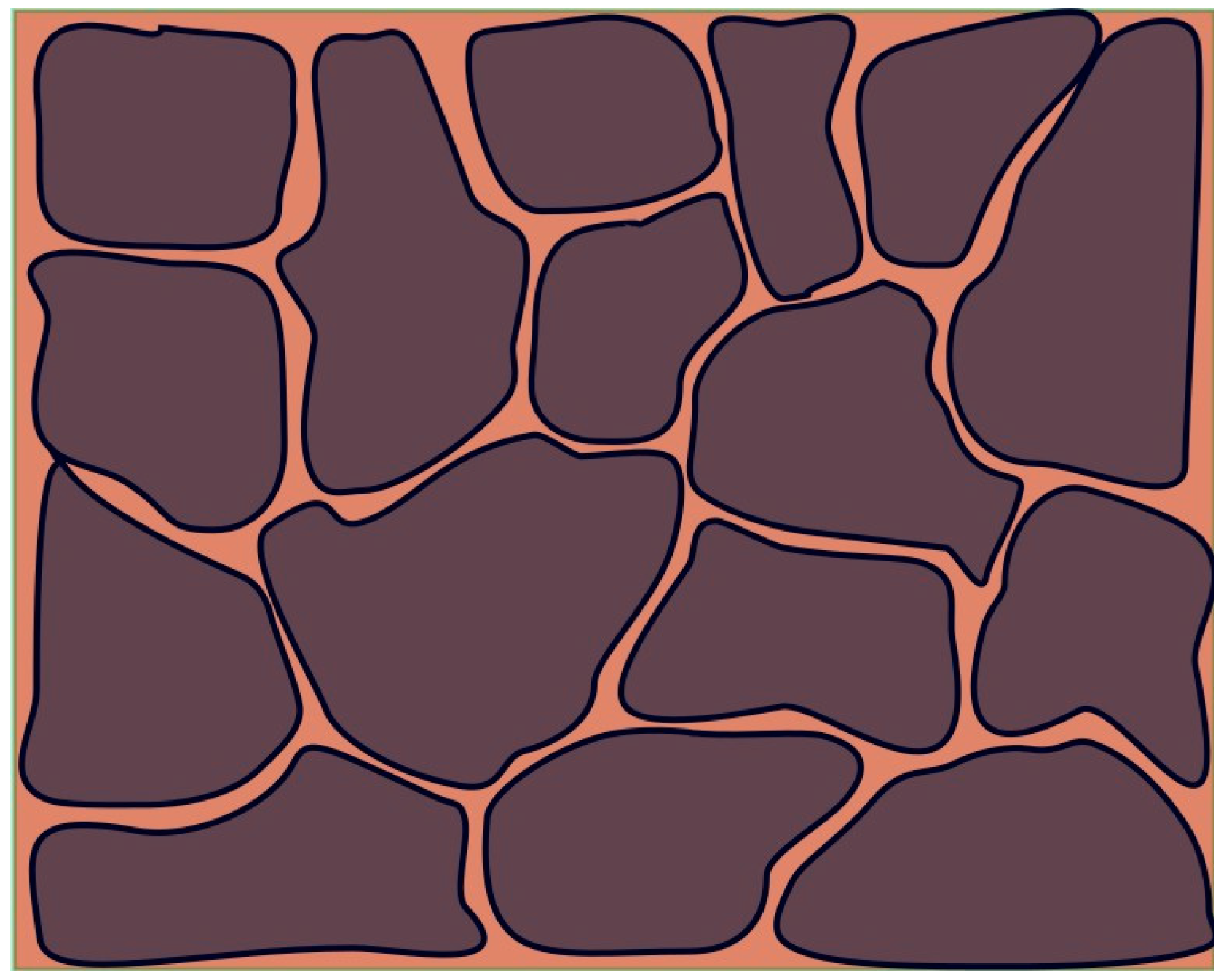
During the curing process, elevated temperature and pressure are necessary to achieve the desired material properties of the composite panel. Heat is necessary for providing the required activation energy for the chemical formation of the phenolic resin. In addition, the composite model of embedded carbon particles explains the need for pressure during curing: the carbon interparticle space has to be minimized so that it can be filled with the smallest possible amount of phenolic resin. An artistic representation of the model is depicted in Figure 6.
In summary, the composite model of carbon particles embedded within a phenolic resin network is fully consistent with the observations from NMR spectroscopy and the mechanical properties of the composite panels, provided that chemical crosslinking exists between the two components.

5. Conclusions

Lignocellulosic resources with high moisture content were transformed through a three-step process involving hydrothermal carbonization (HTC), thermal treatment and dispersing the carbon material in a phenolic resin. The first two steps primarily converted the polysaccharide parts of the lignocellulose, i.e., hemicellulose and cellulose, into aromatic, oxygen-containing moieties. These new-formed functionalities exhibited similar reactivity as lignin, the third major component of lignocellulose, allowing the material to be surface-functionalized and subsequently crosslinked with a phenolic resin matrix. Applying pressure during the curing process minimized the interparticle space and enhanced the mechanical properties of the resulting panels. Small-scale panel models produced in this way demonstrated mechanical properties that were competitive with commercial particle- and fiberboards. These panels involve a mass ratio of refined hydrochar to phenol of 9:1. Herewith, the incorporation is far larger than in the case when hydrochar (without refinement) is used as a filler for polymers (when the optimum is approximately 20 wt%).
The novel procedure presented here provides a promising route toward real-world applications of innovative composite materials derived from residual lignocellulosic biomass. It provides an alternative to more classical valorization routes such as incineration or composting. Life cycle assessment is mandatory for evaluating the real sustainability of the overall process and will be carried out in the near future.

6. Patents

This work forms the basis of a Spanish patent application with reference number P202430723.

Supplementary Materials

The following supporting information can be downloaded at https://www.mdpi.com/article/10.3390/recycling11020032/s1, Figure S1: Photos of the biomass processed. From the left to the right: OFMSW, rice straw and orange peel waste. Figure S2: FT-IR spectra (ATR) of the hydrochar samples before and after the thermal treatment at 600 °C. Figure S3: FT-IR spectra (ATR) of the hydrochar samples after the thermal treatment at 600 °C and lignin samples obtained by the organosolv process (LIG-OS) and the alkaline extraction process (LIG-ALK). Figure S4: SEM images of the HC-1_600 (OFMSW) material (a) and the calcium (b) and phosphorus (c) distribution in the same scene of the material measured with the EDS detector. Figure S5: SEM images of the HC-2_600 (rice straw) material (a) and the silicon (b) and oxygen (c) distribution in the same scene of the material measured with EDS. Figure S6: SEM images of the HC-3_600 (orange peel waste) material (a) and the silicon (b) and oxygen (c) distribution in the same scene of the material measured with EDS. Figure S7: SEM images of the HC-3_600 (orange peel waste) material (a) and the carbon (b) distribution in the same scene of the material measured with the EDS detector. Figure S8: Quartz reactor (a) and heating mantle (b) for the thermal treatment. Figure S9: XRD patterns obtained from synchrotron radiation of the different thermo-treated hydrochar samples, i.e., from top to bottom: HC-1_600 (OFMSW), HC-2_600 (rice straw) and HC3_600 (orange peel waste). Bragg peaks correspond to different inorganic phases (listed in the box). Broad peaks at approximately 2.3° and 3.9° (2Θ) correspond to diffuse graphite (002) and (100) bands, indicating a highly disordered structure. The background is caused by amorphous carbon [54,55]. Figure S10: Aluminum pressing mold with the dimensions 50 mm × 47 mm (left-hand side) and the piece obtained (right-hand side). Figure S11: Aluminum pressing mold placed between two plates of a press applying heat and pressure. Table S1: Elemental analysis CHNS of the hydrochar and the thermo-treated hydrochar samples on a dry base. Table S2: Ash composition of the hydrochar and the thermo-treated hydrochar samples, determined by ICP-OES after digestion of the ashes in acid solution, except for the CaO and CaSO4 values which were determined by X-ray fluorescence (XRF) on the solid ashes. Table S3: Elemental distribution in weight measured by EDS. The values do not match exactly with the bulk values obtained from the ash digestion since this is always a locally limited measurement. Table S4: Relative wt% of the different phases identified by XRD and obtained from Rietveld refinement. Table S5: Academic and commercial reference values of panel properties [56,57,58,59,60,61,62].

Author Contributions

Methodology: C.S. and M.R.; investigation: C.S., A.K., B.O.-T., J.C.G.R., J.L.M.T. and A.V.; resources: M.H.; writing–original draft preparation: M.R.; writing–review and editing: C.S., M.H., A.M.A., R.M.P.C. and M.R.; supervision: A.M.A. and M.R.; funding acquisition: C.S., M.H., A.M.A., R.M.P.C. and M.R. All authors have read and agreed to the published version of the manuscript.

Funding

This research was funded by the Valencian Agency of Innovation (AVI), grant numbers INNEST/2022/80, INNEST/2022/363 and INNEST/2022/381, and the Spanish Ministry of Science and Innovation, grant number MCIN/AEI/10.13039/501100011033.

Data Availability Statement

The original contributions presented in this study are included in the article/Supplementary Materials. Further inquiries can be directed to the corresponding author.

Acknowledgments

The Authors are grateful to the analytical service of the Instituto de Tecnología Química for their support, especially to Alejandro Vidal for the 13C MAS NMR measurements and to the workshop of the institute for their technical support.

Conflicts of Interest

Authors Borja Oliver-Tomás and Martin Hitzl were employed by the company Ingelia S.L. The remaining authors declare that the research was conducted in the absence of any commercial or financial relationships that could be construed as a potential conflict of interest.

Abbreviations

The following abbreviations are used in this manuscript:
EDSEnergy-Dispersive X-ray Spectroscopy
HCHydrochar
HTCHydrothermal Carbonization
OFMSWOrganic Fraction of Municipal Solid Waste
OPWOrange Peel Waste
SWRScrew Withdrawal Resistance
XRDX-Ray Diffraction on Powder

References

  1. European Commission. A European Green Deal; European Commission: Brussel, Belgium, 2019. Available online: https://ec.europa.eu/info/strategy/priorities-2019-2024/european-green-deal_en (accessed on 21 November 2025).
  2. European Union. The European Green Deal. COM/2019/640 Final; PDF Document; European Union: Brussel, Belgium, 2019. Available online: https://eur-lex.europa.eu/legal-content/EN/TXT/?uri=CELEX%3A52019DC0640 (accessed on 20 November 2025).
  3. Hamelin, L.; Borzęcka, M.; Kozak, M.; Pudełko, R. A Spatial Approach to Bioeconomy: Quantifying the Residual Biomass Potential in the EU-27. Renew. Sustain. Energy Rev. 2019, 100, 127–142. [Google Scholar] [CrossRef]
  4. Hu, B.; Wang, K.; Wu, L.; Yu, S.-H.; Antonietti, M.; Titirici, M.-M. Engineering Carbon Materials from the Hydrothermal Carbonization Process of Biomass. Adv. Mater. 2010, 22, 813–828. [Google Scholar] [CrossRef]
  5. Funke, A.; Ziegler, F. Hydrothermal Carbonization of Biomass: A Summary and Discussion of Chemical Mechanisms for Process Engineering. Biofuels Bioprod. Biorefining 2010, 4, 160–177. [Google Scholar] [CrossRef]
  6. Sevilla, M.; Fuertes, A.B.; Rezan, D.-C.; Titirici, M.-M. Applications of Hydrothermal Carbon in Modern Nanotechnology. In Sustainable Carbon Materials from Hydrothermal Processes; John Wiley & Sons, Ltd.: Hoboken, NJ, USA, 2013; pp. 213–294. [Google Scholar] [CrossRef]
  7. Lozano-Castell, D.; Marco-Lozar, J.P.; Falco, C.; Titirici, M.-M.; Cazorla-Amorós, D. Porous Biomass-Derived Carbons: Activated Carbons. In Sustainable Carbon Materials from Hydrothermal Processes; John Wiley & Sons, Ltd.: Hoboken, NJ, USA, 2013; pp. 75–100. [Google Scholar] [CrossRef]
  8. Hitzl, M.; Corma, A.; Pomares, F.; Renz, M. The Hydrothermal Carbonization (HTC) Plant as a Decentral Biorefinery for Wet Biomass. Catal. Today 2015, 257, 154–159. [Google Scholar] [CrossRef]
  9. Berge, N.D.; Kammann, C.; Ro, K.; Libra, J. Environmental Applications of Hydrothermal Carbonization Technology: Biochar Production, Carbon Sequestration, and Waste Conversion. In Sustainable Carbon Materials from Hydrothermal Processes; John Wiley & Sons, Ltd.: Hoboken, NJ, USA, 2013; pp. 295–340. [Google Scholar] [CrossRef]
  10. Schimmelpfennig, S.; Glaser, B. One Step Forward toward Characterization: Some Important Material Properties to Distinguish Biochars. J. Environ. Qual. 2012, 41, 1001–1013. [Google Scholar] [CrossRef]
  11. Fornes, F.; Belda, R.M. Acidification with Nitric Acid Improves Chemical Characteristics and Reduces Phytotoxicity of Alkaline Chars. J. Environ. Manag. 2017, 191, 237–243. [Google Scholar] [CrossRef]
  12. Fornes, F.; Belda, R.M.; Fernández de Córdova, P.; Cebolla-Cornejo, J. Assessment of Biochar and Hydrochar as Minor to Major Constituents of Growing Media for Containerized Tomato Production. J. Sci. Food Agric. 2017, 97, 3675–3684. [Google Scholar] [CrossRef]
  13. Busch, D.; Kammann, C.; Grünhage, L.; Müller, C. Simple Biotoxicity Tests for Evaluation of Carbonaceous Soil Additives: Establishment and Reproducibility of Four Test Procedures. J. Environ. Qual. 2012, 41, 1023–1032. [Google Scholar] [CrossRef]
  14. Hitzl, M.; Mendez, A.; Owsianiak, M.; Renz, M. Making Hydrochar Suitable for Agricultural Soil: A Thermal Treatment to Remove Organic Phytotoxic Compounds. J. Environ. Chem. Eng. 2018, 6, 7029–7034. [Google Scholar] [CrossRef]
  15. Nizamuddin, S.; Jadhav, A.; Qureshi, S.S.; Baloch, H.A.; Siddiqui, M.T.H.; Mubarak, N.M.; Griffin, G.; Madapusi, S.; Tanksale, A.; Ahamed, M.I. Synthesis and Characterization of Polylactide/Rice Husk Hydrochar Composite. Sci. Rep. 2019, 9, 5445. [Google Scholar] [CrossRef]
  16. Ye, C.; Yu, F.; Huang, Y.; Hua, M.; Zhang, S.; Feng, J. Hydrochar as an Environment-Friendly Additive to Improve the Performance of Biodegradable Plastics. Sci. Total Environ. 2022, 832, 155124. [Google Scholar] [CrossRef] [PubMed]
  17. Lubura, J.; Kobera, L.; Abbrent, S.; Pavlova, E.; Strachota, B.; Bera, O.; Pavličević, J.; Ikonić, B.; Kojić, P.; Strachota, A. Natural Rubber Composites Using Hydrothermally Carbonized Hardwood Waste Biomass as a Partial Reinforcing Filler Part I: Structure, Morphology, and Rheological Effects during Vulcanization. Polymers 2023, 15, 1176. [Google Scholar] [CrossRef] [PubMed]
  18. Baekeland, L.H. Method of Making Insoluble Products of Phenol and Formaldehyde. US942699A, 7 December 1907. [Google Scholar]
  19. Brydson, J.A. 23—Phenolic Resins, 7th ed.; Butterworth-Heinemann: Oxford, UK, 1999; pp. 635–667. [Google Scholar] [CrossRef]
  20. Gao, Z.; Lang, X.; Chen, S.; Zhao, C. Mini-Review on the Synthesis of Lignin-Based Phenolic Resin. Energy Fuels 2021, 35, 18385–18395. [Google Scholar] [CrossRef]
  21. Kalami, S.; Arefmanesh, M.; Master, E.; Nejad, M. Replacing 100% of Phenol in Phenolic Adhesive Formulations with Lignin. J. Appl. Polym. Sci. 2017, 134, 45124. [Google Scholar] [CrossRef]
  22. Maiorana, A. Phenolic Resins and Lignin. Available online: https://communities.acs.org/t5/blogs/blogarticleprintpage/blog-id/GCINexusBlog/article-id/716 (accessed on 6 January 2026).
  23. Burguete, P.; Corma, A.; Hitzl, M.; Modrego, R.; Ponce, E.; Renz, M. Fuel and Chemicals from Wet Lignocellulosic Biomass Waste Streams by Hydrothermal Carbonization. Green Chem. 2016, 18, 1051–1060. [Google Scholar] [CrossRef]
  24. Oberoi, H.S.; Vadlani, P.V.; Madl, R.L.; Saida, L.; Abeykoon, J.P. Ethanol Production from Orange Peels: Two-Stage Hydrolysis and Fermentation Studies Using Optimized Parameters through Experimental Design. J. Agric. Food Chem. 2010, 58, 3422–3429. [Google Scholar] [CrossRef]
  25. AboDalam, H.; Devra, V.; Ahmed, F.K.; Li, B.; Abd-Elsalam, K.A. Chapter 29—Rice Wastes for Green Production and Sustainable Nanomaterials: An Overview. In Nanobiotechnology for Plant Protection; Abd-Elsalam, K.A., Periakaruppan, R., Rajeshkumar, S.B.T.-A.-W., Eds.; Elsevier: Amsterdam, The Netherlands, 2022; pp. 707–728. [Google Scholar] [CrossRef]
  26. UNE 32004:1984; Combustibles Minerales Sólidos. Determinación de Cenizas. AENOR: Madrid, Spain, 1984.
  27. UNE 32019:1984; Combustibles Minerales Sólidos. Determinación del Contenido en Materias Volátiles. AENOR: Madrid, Spain, 1984.
  28. Hu, Y.H.; Ruckenstein, E. Applicability of Dubinin–Astakhov Equation to CO2 Adsorption on Single-Walled Carbon Nanotubes. Chem. Phys. Lett. 2006, 425, 306–310. [Google Scholar] [CrossRef]
  29. Schell, N.; King, A.; Beckmann, F.; Fischer, T.; Müller, M.; Schreyer, A. The High Energy Materials Science Beamline (HEMS) at PETRA III. Mater. Sci. Forum 2014, 772, 57–61. [Google Scholar] [CrossRef]
  30. Hammersley, A.P. FIT2D: A Multi-Purpose Data Reduction, Analysis and Visualization Program. J. Appl. Crystallogr. 2016, 49, 646–652. [Google Scholar] [CrossRef]
  31. Rodríguez-Carvajal, J. Recent Advances in Magnetic Structure Determination by Neutron Powder Diffraction. Phys. B Condens. Matter 1993, 192, 55–69. [Google Scholar] [CrossRef]
  32. Rietveld, H.M. A Profile Refinement Method for Nuclear and Magnetic Structures. J. Appl. Crystallogr. 1969, 2, 65–71. [Google Scholar] [CrossRef]
  33. UNE-EN 319:1994; Tableros de Partículas y Tableros de Fibras. Determinación de la Resistencia a la Tracción Perpendicular a las Caras del Tablero. AENOR: Madrid, Spain, 1994.
  34. UNE-EN 320:1994; Tableros de Fibras. Determinación de la Resistencia al Arranque de Tornillos en la Dirección del eje. AENOR: Madrid, Spain, 1994.
  35. Fernandez, M.E.; Ledesma, B.; Román, S.; Bonelli, P.R.; Cukierman, A.L. Development and Characterization of Activated Hydrochars from Orange Peels as Potential Adsorbents for Emerging Organic Contaminants. Bioresour. Technol. 2015, 183, 221–228. [Google Scholar] [CrossRef] [PubMed]
  36. Erdogan, E.; Atila, B.; Mumme, J.; Reza, M.T.; Toptas, A.; Elibol, M.; Yanik, J. Characterization of Products from Hydrothermal Carbonization of Orange Pomace Including Anaerobic Digestibility of Process Liquor. Bioresour. Technol. 2015, 196, 35–42. [Google Scholar] [CrossRef] [PubMed]
  37. Wang, T.; Zhai, Y.; Zhu, Y.; Peng, C.; Xu, B.; Wang, T.; Li, C.; Zeng, G. Influence of Temperature on Nitrogen Fate during Hydrothermal Carbonization of Food Waste. Bioresour. Technol. 2018, 247, 182–189. [Google Scholar] [CrossRef] [PubMed]
  38. Miyata, Y.; Fukushima, T.; Kihira, M.; Takisawa, K. Effect of Hydrothermal Reaction Conditions on Hydrochar from Microalgae. Biomass Convers. Biorefinery 2024, 14, 349–357. [Google Scholar] [CrossRef]
  39. Liu, T.; Jiao, H.; Yang, L.; Zhang, W.; Hu, Y.; Guo, Y.; Yang, L.; Leng, S.; Chen, J.; Chen, J.; et al. Co-Hydrothermal Carbonization of Cellulose, Hemicellulose, and Protein with Aqueous Phase Recirculation: Insight into the Reaction Mechanisms on Hydrochar Formation. Energy 2022, 251, 123965. [Google Scholar] [CrossRef]
  40. Oliver-Tomas, B.; Hitzl, M.; Owsianiak, M.; Renz, M. Evaluation of Hydrothermal Carbonization in Urban Mining for the Recovery of Phosphorus from the Organic Fraction of Municipal Solid Waste. Resour. Conserv. Recycl. 2019, 147, 111–118. [Google Scholar] [CrossRef]
  41. Baccile, N.; Falco, C.; Titirici, M.M. Characterization of Biomass and Its Derived Char Using 13C-Solid State Nuclear Magnetic Resonance. Green Chem. 2014, 16, 4839–4869. [Google Scholar] [CrossRef]
  42. Reyes-Rivera, J.; Terrazas, T. Lignin Analysis by HPLC and FTIR. Methods Mol. Biol. 2017, 1544, 193–299. [Google Scholar] [CrossRef]
  43. Heim, L.E.; Konnerth, H.; Prechtl, M.H.G. Future Perspectives for Formaldehyde: Pathways for Reductive Synthesis and Energy Storage. Green Chem. 2017, 19, 2347–2355. [Google Scholar] [CrossRef]
  44. Kazmi, B.; Shareef, R.; Noman, S.; Saeed, S.; Zehra, T.; Masood, Z.; Albasher, G.; Juchelková, D. Towards Greener Approach: Techno-Economic Insights into Formaldehyde Bio Production from a Hybrid Pine and Mustard Biomass Combination. Process Saf. Environ. Prot. 2024, 186, 969–979. [Google Scholar] [CrossRef]
  45. Bioenergy International. New Data Shows Growing Renewable and Low-Carbon Methanol Project Pipeline. Available online: https://bioenergyinternational.com/new-data-shows-growing-renewable-and-low-carbon-methanol-project-pipeline (accessed on 6 January 2026).
  46. Hexion Announces Adoption of Renewable Methanol to Produce a More Sustainable Product. Available online: https://www.businesswire.com/news/home/20220713005966/en/Hexion-Announces-Adoption-of-Renewable-Methanol-to-Produce-a-More-Sustainable-Product (accessed on 6 January 2026).
  47. Ángel Siles López, J.; Li, Q.; Thompson, I.P. Biorefinery of Waste Orange Peel. Crit. Rev. Biotechnol. 2010, 30, 63–69. [Google Scholar] [CrossRef] [PubMed]
  48. EUR-Lex—52008DC0811—EN—EUR-Lex. Available online: https://eur-lex.europa.eu/legal-content/EN/TXT/?uri=celex%3A52008DC0811 (accessed on 21 November 2025).
  49. Valorise the Organic Fraction of Municipal Solid Waste Through an Integrated Biorefinery at Commercial Level. 2023. Available online: https://cordis.europa.eu/programme/id/H2020_BBI-2019-SO1-F1/es (accessed on 21 November 2025).
  50. Sawada, M.; Sridhar, K.; Kanda, Y.; Yamanaka, S. Pure Hydroxyapatite Synthesis Originating from Amorphous Calcium Carbonate. Sci. Rep. 2021, 111, 11546. [Google Scholar] [CrossRef] [PubMed]
  51. Tessema, B.; Gonfa, G.; Mekuria Hailegiorgis, S.; Venkatesa Prabhu, S. An Overview of Current and Prognostic Trends on Synthesis, Characterization, and Applications of Biobased Silica. Adv. Mater. Sci. Eng. 2023, 2023, 4865273. [Google Scholar] [CrossRef]
  52. Seghir, B.B.; Hemmami, H.; Hocine, B.M.E.; Soumeia, Z.; Sharifi-Rad, M.; Awuchi, C.G.; Amor, I.B.; Kouadri, I.; Rebiai, A.; Bouthaina, S.; et al. Methods for the Preparation of Silica and Its Nanoparticles from Different Natural Sources. Biol. Trace Elem. Res. 2023, 201, 5871–5883. [Google Scholar] [CrossRef]
  53. Van Soest, P.J. Rice Straw, the Role of Silica and Treatments to Improve Quality. Anim. Feed Sci. Technol. 2006, 130, 137–171. [Google Scholar] [CrossRef]
  54. Guerrero, M.; Ruiz, M.P.; Millera, Á.; Alzueta, M.U.; Bilbao, R. Characterization of Biomass Chars Formed under Different Devolatilization Conditions: Differences between Rice Husk and Eucalyptus. Energy Fuels 2008, 22, 1275–1284. [Google Scholar] [CrossRef]
  55. Wu, W.; Yang, M.; Feng, Q.; McGrouther, K.; Wang, H.; Lu, H.; Chen, Y. Chemical Characterization of Rice Straw-Derived Biochar for Soil Amendment. Biomass Bioenergy 2012, 47, 268–276. [Google Scholar] [CrossRef]
  56. Bartoszuk, K.; Kowaluk, G. The Influence of the Content of Recycled Natural Leather Residue Particles on the Properties of High-Density Fiberboards. Materials 2023, 16, 5340. [Google Scholar] [CrossRef]
  57. Suchorab, B.; Wronka, A.; Kowaluk, G. Towards Circular Economy by Valorization of Waste Upholstery Textile Fibers in Fibrous Wood-Based Composites Production. Eur. J. Wood Wood Prod. 2023, 81, 571–577. [Google Scholar] [CrossRef]
  58. High-Quality Hardboards from Finland. LION HD Panel-TM-Downloads—LION BOARDS. Available online: https://finnishfibreboard.com/lion-hd-paneltmdownloads/ (accessed on 25 November 2025).
  59. Finsa. Technical Data Sheets. Available online: https://www.finsa.com/en/fichas-técnicas (accessed on 25 November 2025).
  60. MEDEPAN. Available online: https://www.kastamonuentegre.com/uploads/2023/01/004-ts-eng-001-2-medepan-technical-specifications.pdf (accessed on 25 November 2025).
  61. Hispanos. Available online: https://tableroshispanos.es/wp-content/uploads/2023/11/ficha-aglomerados-estandar-sep-2023.pdf (accessed on 25 November 2025).
  62. Masisa. Available online: https://www.madera21.cl/wp-content/uploads/2017/02/Ficha-MDF-RH2017_MASISA.pdf (accessed on 25 November 2025).
Figure 1. Schematic description of the transformation process of wet lignocellulosic biomass into panel models by hydrothermal carbonization (HTC), a thermal post-treatment at 600 °C and thermosetting of a phenolic-resin-type polymer.
Recycling 11 00032 g001
Figure 2. Test setup for (a) the tensile strength measurements following UNE EN319 and (b) the resistance to axial withdrawal of screws following UNE EN 320.
Recycling 11 00032 g002
Figure 3. Van-Krevelen diagram with the prepared hydrochar samples, the thermo-treated samples and cellulose as a reference (the exact O/C and H/C values are presented in Table 2 and can be calculated from the data presented in Table S1).
Recycling 11 00032 g003
Figure 4. 13C MAS NMR spectra for hydrochar sample HC-3 and for hydrochar samples after the thermal treatment at 600 °C.
Recycling 11 00032 g004
Figure 5. Exemplary photos of the specimens after failure in the tensile strength tests.
Recycling 11 00032 g005
Figure 6. Artistic representation of the assumed structure of the composite panels: the small particles represent the carbon material embedded into a (red) resin matrix.
Recycling 11 00032 g006
Table 1. HTC trials at an industrial pilot plant at 205 to 215 °C and a residence time of 4 h.
EntrySample
Name
Biomass FeedInput
Wet
Biomass
[t]
Water
Content
[%]
Dry
Material
[t]
Output
Hydrochar
[t]
Mass
Yield [a]
[%]
Average
Ash Content [b]
[%]
1HC-1a [c]OFMSW9.24752.311.0545.5 [d]13.3
2HC-1bOFMSW12.6753.181.5649.1 [e]14.6
3HC-2rice straw3.01332.031.0149.7 [f]17.5
4HC-3 [g]orange peel waste12.3841.960.72336.96.6
[a] Mass yield is defined as the mass ratio of dry output hydrochar to dry input material and expressed as a percentage. [b] Ash content of the hydrochar measured following UNE 32004:1984. [c] From reference [14]. [d] Additional solid material with higher ash content was obtained at a 12% yield. [e] Additional solid material with higher ash content was obtained at a 5.7% yield; in addition to the solid and the aqueous phase, an organic liquid was obtained which counted for 1.3 wt% of the dry matter of the starting material. [f] In addition, 4.7% was obtained and separated (by density) after the process with high inorganic content. [g] From reference [23].
Table 2. List of samples of renewable resin precursors prepared.
SampleStarting
Material
Yield
[%]
Ash
Content [a]
[% dry]
Volatiles [b]
[% dry]
Fixed
Carbon [b]
[% dry]
Pore
Volume [c]
[cm3/g]
Surface
Area [c]
[m2/g]
Molar Ratio [d]
O/CH/C
HC-1OFMSW45.5–49.113.3–14.665.8–68.418.3–19.6n.d. [e]n.d. [e]0.26 [f]1.44 [f]
HC-1_600HC-138.1 [g]34.313.552.258.93000.080.35
HC-2Rice straw49.717.559.922.0n.d. [e]n.d. [e]0.401.27
HC-2_600HC-247.131.217.151.7n.d. [e]n.d. [e]0.140.45
HC-3Orange peel waste36.96.673.619.817.3870.391.09
HC-3_600HC-346.214.120.065.968.03420.080.30
[a] Determined following standard UNE 32004:1984. [b] Determined following standard UNE 32019:1984. [c] Measured with carbon dioxide at 273 K. [d] Detailed information on the CHN analysis is listed in Table S1. [e] Not determined. [f] Value of the HC-1a sample. [g] Up to 30 wt% of a liquid was condensed during the thermal treatment.
Table 3. Determination of material characteristics applying standards for particleboards and fiberboards: tensile strength and resistance to axial withdrawal of screws.
EntryStarting MaterialDensity
[kg/m3]
Tensile
Strength [a]
UNE-EN 319
[MPa]
Screw Withdrawal
Resistance [b]
UNE-EN 320
[N]
1HC-1_60013001.552590
2HC-2_60011301.13not determined
3HC-3_60012031.582030
[a] Particleboards and fiberboards—Determination of tensile strength perpendicular to the plane of the board; 0.4–1.5 MPa for commercial boards, cf. Table S5. [b] Particle boards and fiberboards—Determination of resistance to axial withdrawal of screws; 700–1300 N for commercial boards; cf. Table S5.
Disclaimer/Publisher’s Note: The statements, opinions and data contained in all publications are solely those of the individual author(s) and contributor(s) and not of MDPI and/or the editor(s). MDPI and/or the editor(s) disclaim responsibility for any injury to people or property resulting from any ideas, methods, instructions or products referred to in the content.