
Article

Nitrogen-Enriched Shell Graphite-Core C–Si–N Composite for Reduced Swelling in Si/Graphite Negative Electrodes

1
Department of Future Convergence Technology, Graduate School, Soonchunhyang University, Soonchunhyang-ro 22-gil, Sinchang-myeon, Asan-si 31538, Chungcheongnam-do, Republic of Korea
2
Advanced Energy Research Center, Soonchunhyang University, Soonchunhyang-ro 22-gil, Sinchang-myeon, Asan-si 31538, Chungcheongnam-do, Republic of Korea
3
Department of Energy Engineering, Soonchunhyang University, Soonchunhyang-ro 22-gil, Sinchang-myeon, Asan-si 31538, Chungcheongnam-do, Republic of Korea
4
EGMaterials Ltd., 50-47, Hugi-gil, Ochang-eup, Cheongwon-gu, Cheongju-si 28105, Chungcheongbuk-do, Republic of Korea
*
Author to whom correspondence should be addressed.
Batteries 2026, 12(3), 98; https://doi.org/10.3390/batteries12030098
Submission received: 14 February 2026 / Revised: 7 March 2026 / Accepted: 10 March 2026 / Published: 13 March 2026
(This article belongs to the Special Issue Solid Polymer Electrolytes for Lithium Batteries and Beyond)

Abstract

This study reports a graphite-core, multiphase gradient C–Si–N composite architecture for Si-containing graphite-based negative electrodes in lithium-ion batteries. The increase in electrode thickness is used as a practical metric of expansion-driven degradation. The composite is prepared by the simultaneous nitridation and carbonization of a graphite core–Si precursor using polyvinylpyrrolidone (PVP) as the N source. Scanning electron microscopy coupled with energy-dispersive X-ray spectroscopy indicates a quasi-continuous radial trend in the relative N signal toward the outer shell, consistent with preferential N enrichment near the particle exterior. This spatially distributed N arrangement may spatially separate the Si-rich expansion-prone region from the carbon-rich exterior containing nitrides and other N-bearing species, thereby enabling stress partitioning. The shell architecture is designed to disperse expansion-induced stress and stabilize the electrode–electrolyte interface. During electrochemical cycling, the C–Si–N electrode with 10% PVP preserves its core–shell morphology and exhibits the smallest average electrode thickness expansion (~58% after 40 cycles, based on four independent cells). The reduced thickness growth is discussed in relation to a mechanically robust Si–N matrix (Si3N4-like/SiNx-like), potential Li–N interphase species, and N-containing carbon, together with the post-mortem morphology and electrochemical impedance evolution. This study presents reduced swelling as an electrode-level trend versus nominal PVP addition, along with associated nitride-related signatures, thereby highlighting spatially graded stress buffering as an electrode-level design principle.

1. Introduction

Si undergoes a large volume expansion (often exceeding 300%) during the lithiation process, where Li+ is inserted into the Si lattice to form LixSi alloys [1,2]. This large volume change induces severe mechanical stress within the Si particles, leading to the formation of microcracks. With repeated charge–discharge cycling, these cracks can propagate and cause particle pulverization. Such pulverization disrupts electrical percolation within the composite electrode network comprising the active material, conductive agent, and binder. This disruption can accelerate capacity fading and increase the internal resistance. These effects undermine the structural integrity and long-term cycling stability of Si-containing negative electrodes [3,4]. At the electrode level, these processes can manifest as the irreversible electrode thickness growth (swelling) and cracking, which are considered practical expansion-driven failure metrics [5,6]. Furthermore, the large volume variation in Si can compromise the stability of the solid-electrolyte interphase (SEI) layer formed at the electrode–electrolyte interface [7]. The SEI protects the electrode surface and is essential for stable cell operation. However, repeated Si expansion and contraction can fracture the SEI and drive repeated rupture and reformation, thereby promoting electrolyte decomposition, loss of cyclable Li, and capacity fade [8,9,10]. In the initial cycle, irreversible Li consumption for SEI formation decreases the initial Coulombic efficiency (ICE) and accelerates subsequent degradation [11,12]. These coupled degradations motivate strategies that target both stress accommodation and interphase stabilization.
Various approaches have been explored to address these mechanical issues (e.g., particle pulverization and electrical isolation) and chemical challenges (e.g., SEI instability and irreversible Li consumption) including electrolyte modification, prelithiation, and structural engineering. Nogales et al. [13] presented an improved early-cycle stability of Si negative electrodes by designing electrolytes that induced the formation of a LiF-rich SEI. However, the resulting SEI can still lack sufficient uniformity and mechanical ductility to accommodate repeated volume changes. Similarly, Zhang et al. [14] improved the ICE by replenishing the Li consumed during the initial SEI formation through a prelithiation strategy. In practical applications, this approach requires balancing Li replenishment against the reduced energy density and additional processing constraints. Accordingly, the expansion-driven mechanical degradation (including electrode-level swelling) can persist even when the interfacial chemistry is improved. In this context, structural engineering directly addresses expansion-driven stress, and is central to mitigating electrode-level damage.
Structural-design strategies can be grouped into two approaches: one focuses on downsizing Si to the nanoscale to shorten diffusion pathways and distribute mechanical stress, and the other improves mechanical stability by accommodating the volume changes in Si through morphological engineering. In the first approach, nanoscale architectures can disperse stress, but may aggravate the initial SEI growth because the increased surface area provides more sites for electrolyte decomposition. Son et al. reported stress-dispersive nanoscale designs accompanied by pronounced early SEI growth [15]. In morphology-based engineering, one-dimensional architectures (e.g., nanowires and nanotubes) can maintain continuous electronic pathways, thereby improving structural integrity, as reported by Favors et al. and Zhang et al. [16,17]. Jiang and Rage et al. showed that core–shell structures enhance the initial stability via a protective shell; however, a thickness-dependent trade-off remains, where thin shells can fracture under expansion pressure and thick shells reduce the energy density [18,19]. Furthermore, the yolk–shell and hollow structures proposed by Baasner and An et al. effectively absorb Si expansion and suppress SEI reformation [20,21]. Despite these advances, long-term stability is still limited by the weak interfacial bonding and modest mechanical strength of carbon matrices. Accordingly, structural buffering layers were introduced into Si/C composites [22]. Silicon oxide (SiOx) is a representative structural buffering material. SiOx is widely used because of its relatively low volume expansion; however, it is limited by a >20% initial irreversible capacity loss caused by the formation of electrochemically inactive byproducts [23,24]. However, the consistent suppression of electrode-level swelling remains challenging in practical composite electrodes, even when particle-level buffering concepts are implemented.
Given the limitations of SiOx, particularly its susceptibility to side reactions and low ICE during the first cycle, silicon nitride (Si3N4/SiNx) has been explored as an alternative buffering component for Si-containing negative electrodes. Depending on the composite design and phase distribution, it may help mitigate irreversible Li consumption and the associated ICE loss. Si3N4 formed through nitridation has been reported to exhibit high mechanical strength and fracture toughness (strength exceeding 1.1 GPa and toughness greater than 7.0 MPa m1/2) [25]. Xiao et al. demonstrated that a Si3N4 layer can function as a strong and dense structural buffering layer [25], and Si3N4-based matrices have been reported to enhance the cycling stability and rate capability of Si negative electrodes [26]. Nanostructured SiNx has also been reported to suppress excessive SEI growth and particle pulverization by acting as a structural buffer during SEI formation. In addition, Si-rich Si3N4/SiNx has been reported to react with Li to form Li3N-based phases that may provide high ionic conductivity and low ion-transfer resistance in the SEI or near-interfacial regions [27].
However, conventional Si3N4-based negative electrodes can suffer from limited electronic conductivity and constrained Li+ transport, which can increase the polarization under practical current densities. During cycling, Li+-conductive phases, such as Li3N, can form and facilitate Li+ transport at the interface. However, the extent of this advantage depends on the presence of a continuous electronic percolation network and electrochemically accessible transport pathways. Therefore, it may not directly improve the overall electrochemical performance. In particular, as the N content increases, the fraction of electrochemically inactive Si–N components can become more pronounced, leading to a structural trade-off in which efforts to enhance mechanical stability are accompanied by greater capacity loss [28,29]. Moreover, while SiNx protective layers have shown success in thin-film or nano-Si systems, replicating these benefits in micrometer-sized Si particles can be difficult because a larger absolute expansion and more complex surface morphologies can promote nonuniform stress evolution and localized interfacial rupture. Furthermore, Si3N4 and SiNx protective layers have been proposed to provide functions beyond mechanical protection, including Li+ transport pathways and interface stabilization. However, the underlying mechanisms and structure–property relationships (e.g., thickness, composition, and crystallinity) remain poorly understood. In addition, studies that systematically elucidate the influence of these variables on the electrochemical performance are still scarce, particularly when mechanical outcomes, such as electrode thickness increase, are explicitly quantified. Accordingly, the design space linking the nitride distribution to electrode-level swelling remains insufficiently constrained.
At the composite particle and electrode scales, rapid Si alloying-induced volume changes can concentrate stress and lead to structural collapse. Interfacial instability can further accelerate these processes. Previous studies have largely focused on interfacial stabilization through surface coatings or the introduction of buffering layers, whereas efforts to structurally control the stress distribution within the active material have remained relatively limited at these scales. In particular, while nitride-based phases possess excellent mechanical properties, simply utilizing them as an external protective layer may not be sufficient to suppress internal Si structural deformation within composite particles. This is because the Si-rich region can still undergo substantial constrained expansion beneath the shell. In practical composite electrodes, controlling the electrode-level swelling (thickness growth) remains an important yet underemphasized metric for evaluating mechanical degradation. This metric integrates the particle expansion, contact loss, and porosity and binder evolution into a single electrode-scale outcome that is directly relevant to the cell-level stack design and failure. This electrode-scale perspective motivates the localization of the reinforcement, where stress and interfacial reactions are concentrated.
However, many Si–nitride design approaches rely on homogeneous mixing or discrete coating layers. Thus, simultaneously retaining a Si-rich, capacity-contributing region and localizing a mechanically robust, nitride-rich component near the outer surface, where stress accumulation and interfacial reactions are often most pronounced, may be difficult. From a design perspective, placing a nitride-rich reinforcement in the outer region may provide a more targeted allocation of mechanically robust components than uniformly distributing them throughout the particle. A radially differentiated architecture that concentrates N-enriched, mechanically robust components near the outer shell while maintaining a conductive graphite core and Si-rich intermediate region may mitigate this trade-off. However, experimental reports that clearly describe such an outer-shell-biased N distribution and directly relate it to electrode-level swelling under controlled electrode fabrication conditions are limited. Therefore, approaches that explicitly relate spatially varying composition to electrode-scale mechanical outcomes under standardized fabrication conditions remain needed.
To address this gap, this study proposes a strategy in which the active material is designed as a multiphase hierarchical structure with spatially differentiated composition along the core–shell direction. By simultaneously applying nitridation and carbonization processes to a graphite core–Si composite using polyvinylpyrrolidone (PVP) as the N source, a quasi-continuous radial trend in the relative N signal from the Si-rich interior toward the C–Si–N outer shell is observed by scanning electron microscopy coupled with energy-dispersive X-ray spectroscopy (SEM–EDS), consistent with preferential N enrichment near the outer-shell region. Herein, “quasi-continuous” refers to a semiquantitative, spatially distributed radial trend in the relative SEM–EDS signal within the spatial resolution of the technique, rather than a rigorously quantified radial concentration profile. This design is intended to integrate the functional contributions of each component by spatially arranging a high-strength silicon nitride matrix to mitigate volume expansion, possible Li–N-related interphase species to facilitate ionic conductivity, and N-doped carbon matrix to enhance electronic transport. Furthermore, this study emphasizes electrode thickness increase (swelling) and post-cycling morphological integrity as primary evaluation metrics under identical electrode fabrication conditions. This framework enables a direct comparison between nominal PVP addition, structural characteristics, and macroscopic expansion behavior in micrometer-scale Si/graphite composite electrodes.

2. Materials and Methods

2.1. Preparation of Active Materials

The active materials were synthesized using a five-step process. First, the Si raw material (TSi99, TSA, Cheonan, Republic of Korea) was dispersed in isopropyl alcohol (IPA) and milled using a bead mill (WSP-6, Longxin (Changzhou) Smart Equipments Co., Ltd., Changzhou, China) for 24 h to obtain nanosized particles with an average particle size of approximately 100 nm, as confirmed by a particle-size analyzer (Mastersizer 3000, Malvern Panalytical, Malvern, UK). Second, the milled Si was mixed with spherical graphite (TN97-10, Qingdao Qingbei Carbon Products Co., Ltd., Laixi, Qingdao, China), PVP (K90, JH Nanhang Life Sciences Co., Ltd., Quzhou, China), and petroleum-based pitch (250 (T-1), Dalian Aoshenglong New Material Co., Ltd., Dalian, China) via wet mixing for 1 h. Third, the resulting slurry was dried in an oven (AM-8, Welcos, Seoul, Republic of Korea) for 8 h to obtain the precursor composite. Fourth, the precursor was heat-treated at 1000 °C for 1 h in a box furnace (Hantech, Suwon, Republic of Korea) under an N2 atmosphere. This was followed by natural cooling, during which carbonization of the pitch and nitridation of Si proceeded simultaneously to form the ternary C–Si–N composite. To investigate the influence of the nitride layer and its N content, three sample types were prepared based on the amount of added PVP: C–Si (PVP = 0%), C–Si–N (PVP = 5%), and C–Si–N (PVP = 10%). Accordingly, the samples are denoted by the nominal PVP addition level (0%, 5%, and 10%) and discussed with the corresponding structural and chemical signatures.

2.2. Electrode Fabrication

The working electrode slurry was prepared by mixing the composite (C–Si or C–Si–N), artificial graphite, conductive agent (Super-P), binders (styrene–butadiene rubber (SBR; BM-451B, Zeon, Tokyo, Japan), and carboxymethyl cellulose (CMC)) in deionized water at a weight ratio of 12.7:80.8:3:2:1.5 (composite: artificial graphite: Super-P: SBR: CMC). This composition was selected to target a practical electrode-level specific capacity of approximately 450 mAh g−1 while maintaining slurry processability and electrode integrity in the graphite-rich blended formulation. The mixture was homogenized using a planetary mixer (AM-8, Welcos, Seoul, Republic of Korea). The resulting slurry was coated onto an 18 μm-thick copper foil (UACJ, Tokyo, Japan) using a coater (CV-400, Rohtec, Gwangju, Republic of Korea), followed by drying at 60 °C for 20 min under vacuum. The fabricated electrodes were calendered using a rolling press to achieve an electrode density of approximately 1.50 g cm−3 and a mass loading of 7–8 mg cm−2. Unless otherwise stated, the electrode thickness refers to the coating layer only, excluding the 18 μm Cu current collector. Subsequently, the electrodes were dried in a vacuum oven (VO-27, HYSC, Seoul, Republic of Korea) at 120 °C for 12 h and punched into disks (15.95 mm in diameter).

2.3. Electrochemical Measurements

The electrochemical performances of the prepared electrodes were evaluated using CR2032-type coin cells assembled in an Ar-filled glove box (SK-G1200, Three-Shine, Daejeon, Republic of Korea), where the oxygen and moisture levels were each maintained at or below 1.0 ppm to ensure reproducible cell fabrication. The cells were configured as half-cells using the prepared graphite-based blended electrodes (Section 2.2) containing the C–Si or C–Si–N composite as the working electrode and a 500 μm-thick Li metal foil (Honjo Metal, Osaka, Japan) as the counter/reference electrode. A polypropylene membrane (Celgard A273, Celgard Korea, Chungbuk, Republic of Korea) was used as the separator. For the electrolyte, 1 M LiPF6 dissolved in a mixture of ethylene carbonate and ethyl methyl carbonate in a 3:7 (v/v) volume ratio (Dongwha Electrolyte, Nonsan, Chungnam, Republic of Korea) was used. For some tests, fluoroethylene carbonate (FEC; Enchem, Cheonan, Republic of Korea) was added to the base electrolytes at 5, 10, and 15 wt.% (based on total electrolyte mass). The electrolytes were stored in an Ar-filled glove box at a dew point of −70 °C to maintain low moisture levels. After cell assembly, the open-circuit voltage (OCV) was monitored to verify proper cell fabrication and to exclude cells exhibiting abnormal voltage behavior indicative of internal short circuits. A dedicated high-potential insulation (hi-pot) test was not conducted at the laboratory coin-cell scale; instead, OCV monitoring was used as a practical screening step prior to electrochemical testing.
Charge–discharge and cycling-performance tests were conducted using CR2032-type two-electrode coin cells and a battery test system (WBCS 3000, WonAtech, Seoul, Republic of Korea). The 1 C rate was defined as 450 mA g−1 based on the total active-material mass in the electrode, corresponding to a practical electrode-level specific capacity of 450 mAh g−1 determined from the designed blended-electrode composition. During the initial five cycles, the cells were charged to 0.01 V at a current density of 0.1 C under constant current, followed by a constant-voltage step until the current decreased to 0.01 C (cutoff). After a 5 min rest period, the cells were discharged to 1.5 V at 0.1 C. For the subsequent cycles, the cells were charged to 0.01 V at 1.0 C followed by a constant-voltage step until the current reached 0.01 C, and then discharged to 1.5 V at 1.0 C.
Cyclic voltammetry (CV) and electrochemical impedance spectroscopy (EIS) were performed using a multichannel impedance analyzer (ZIVE-MP2A, WonAtech, Seoul, Republic of Korea) in a three-electrode configuration. For electrochemical measurements, the working electrode, counter electrode, and electrolyte configurations were identical to those used in the two-electrode cells, and an additional Li-metal foil was employed as the reference electrode. CV was conducted over a voltage range of 0.01–1.5 V (vs. Li/Li+) at a scan rate of 0.5 mV s−1. EIS analysis was performed at a potential of 0.5 V (vs. Li/Li+) with an amplitude of 5 mV over a frequency range from 10 kHz to 0.01 Hz. All electrochemical tests were conducted at room temperature (25 ± 2 °C).

2.4. Structural and Surface Analysis

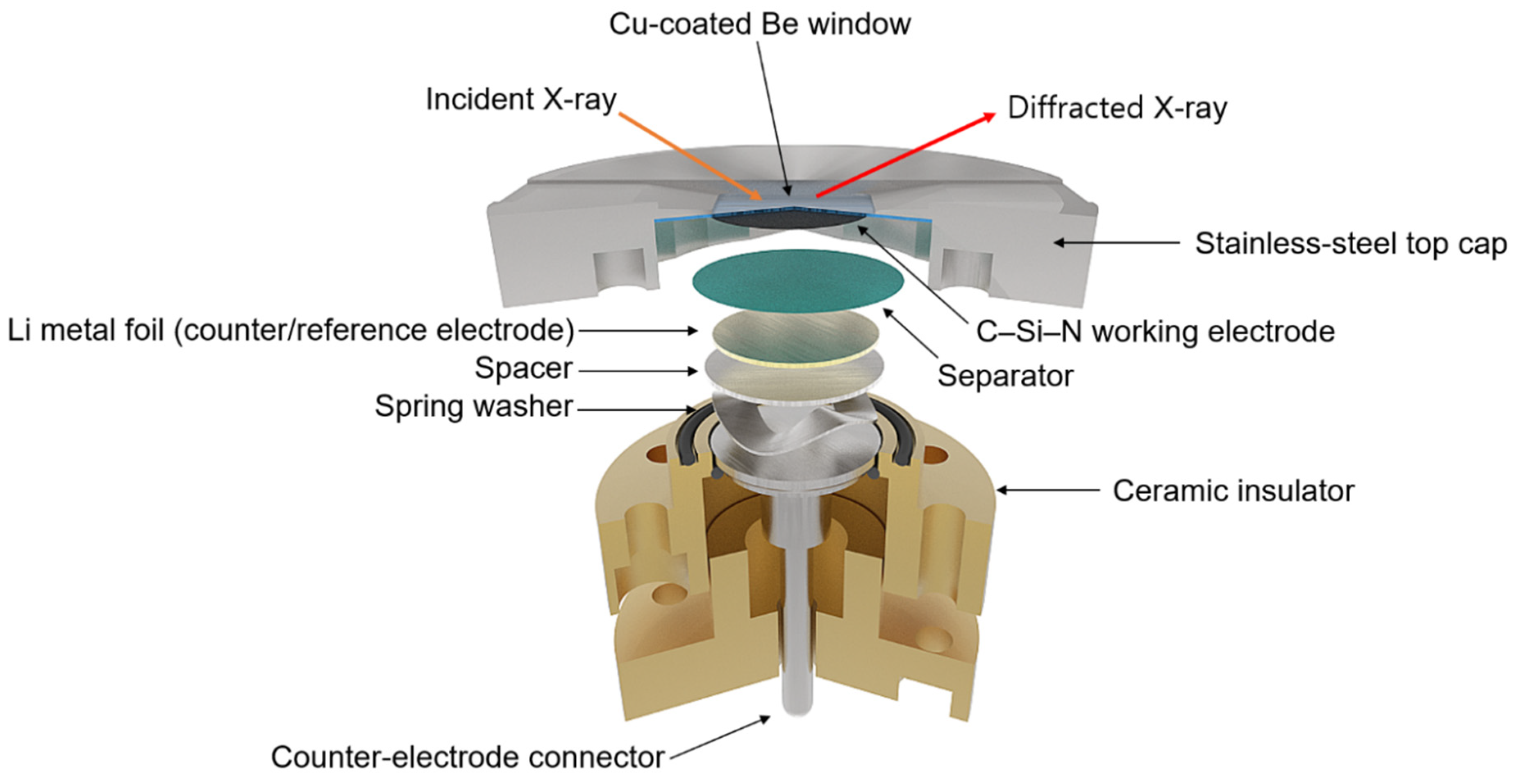
The crystal structure of the synthesized materials was analyzed by X-ray diffraction (XRD; MiniFlex 600, Rigaku, Tokyo, Japan) using Cu Kα radiation (λ = 0.15406 nm) at 40 kV and 15 mA. In situ XRD analysis (Empyrean, Malvern Panalytical, Malvern, UK) was conducted within a 2θ range of 23–80° using Cu Kα radiation (40 kV, 30 mA, λ = 0.15406 nm) to monitor the structural evolution during electrochemical cycling. An in situ XRD cell (PDC Tech, Daejeon, Republic of Korea) was assembled in an Ar-filled glove box using a Cu-coated Be window (current collector) to allow X-ray penetration. A schematic of the cell is shown in Figure 1. To investigate the chemical-bonding states, X-ray photoelectron spectroscopy (XPS; K-Alpha, Thermo Fisher Scientific, East Grinstead, UK) was performed using an Al Kα source (1486.6 eV).
For internal-structural analysis, cross-sectional images were obtained using a focused ion-beam system (FIB; Helios G4 PFIB CXe DualBeam, 30 kV, Thermo Fisher Scientific, Eindhoven, The Netherlands), and the elemental distribution was analyzed using EDS. The surface morphologies before and after the electrochemical testing were observed using SEM (ISP, IM-60, JEOL, Tokyo, Japan). Cross sections of the electrodes were prepared using an ion-milling system (Blade5000, Hitachi, Tokyo, Japan) with Ar gas to produce a smooth and representative cross-sectional surface while preserving the electrode microstructure. The thickness of the ion-milled cross sections was measured using high-resolution field-emission SEM (FE-SEM; Nova NanoSEM 450, FEI, Hillsboro, OR, USA) at an accelerating voltage of 10.00 kV. Multiple images were acquired at different locations along each electrode to ensure representative measurements, and the estimated thickness-readout uncertainty based on the FE-SEM image resolution was approximately ±0.1 μm.

3. Results and Discussion

3.1. Structure and Morphology of the Graphite-Core C–Si–N Composite

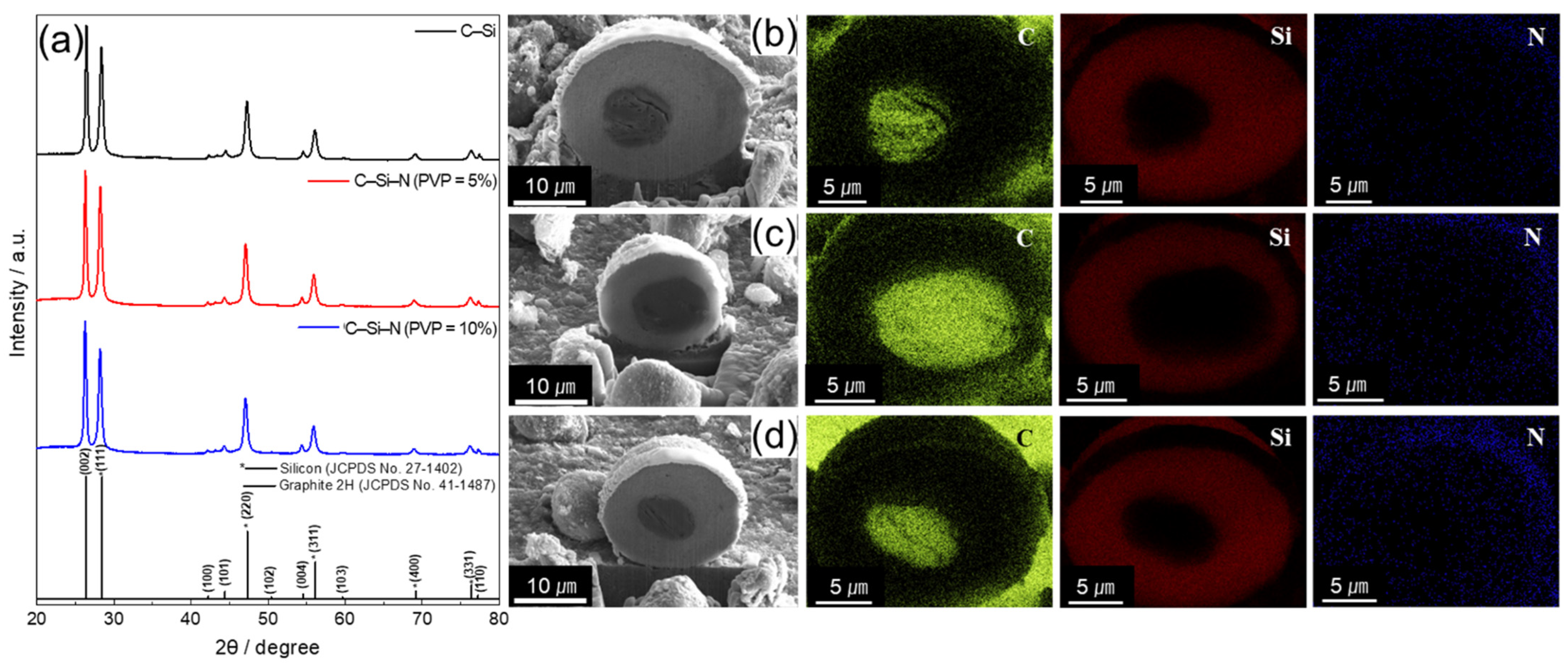
Figure 2 summarizes the structural and elemental characteristics of the C–Si–N active materials. Unlike conventional layer-by-layer designs, the proposed hierarchical structure comprises a Si-rich intermediate region intended to provide a high Li storage capacity and an N-rich C–Si–N outer shell designed to enhance the mechanical integrity and interfacial stability. This quasi-continuous radial trend in the relative N signal (within the spatial resolution of SEM–EDS; Figure S1) may influence the coupled electrochemical–mechanical response by spatially separating the primary expansion region (Si-rich intermediate layer) from the outer-shell region, where stress concentration and interfacial reactions are most pronounced. Therefore, the graphite core can serve as an electron-conducting backbone, whereas the outer-shell region containing Si–N and N-containing carbon may provide a mechanically reinforcing framework and partially limit the exposure of freshly generated Si surfaces to the electrolyte. This interpretation is based on the semiquantitative SEM–EDS trend and is not intended to imply a rigorously quantified radial concentration gradient across the particle cross-section.
The XRD results are presented to establish the crystalline phase composition before discussing the particle-scale morphology and elemental gradients. The crystalline structures of the synthesized active materials were examined using XRD (Figure 2a). The diffraction patterns were consistent with the Joint Committee on Powder Diffraction Standards (JCPDS) No. 27-1402 (Si) and No. 41-1487 (Graphite), indicating that the crystalline components were dominated by Si and graphite, with no additional crystalline-impurity peaks observed within the detection limit. The absence of crystalline silicon nitride peaks near 22.9°, 30.1°, and 34.6° is consistent with a Si–N phase that is predominantly amorphous and/or nanocrystalline or present below the XRD detection limit. Such a noncrystalline Si–N matrix may accommodate lithiation-induced strain by reducing cleavage-driven fracture pathways and distributing stress within the shell/matrix region. This can contribute to mechanical flexibility during repeated expansion and contraction [30].
The cross-sectional morphology and elemental distribution were examined to complement the phase information obtained from the XRD results. Figure 2b–d present the FIB–SEM images and EDS-mapping results, indicating that the active-material particles possessed a quasi-uniform spherical morphology with a total diameter of approximately 20 μm (core diameter of ~10 μm). Elemental mapping suggests that the graphite core was surrounded by a Si-containing shell. In the samples treated with PVP (C–Si–N with 5% and 10% PVP), the relative N signal was mainly distributed near the outer-shell region, consistent with preferential N enrichment near the particle exterior generated by PVP-assisted nitridation and carbonization (Figure S1). This outer-shell enrichment is consistent with an access- or diffusion-limited nitridation scenario, in which N-containing species derived from PVP preferentially react near the particle exterior during heat treatment, whereas the interior remains comparatively Si-rich. Carbonization was performed under a N2 atmosphere; therefore, a small N signal was also detected in the C–Si sample, suggesting background N incorporation during heat treatment.

3.2. Electrochemical Performance of Graphite-Based Blended Electrodes Containing C–Si and C–Si–N Composites

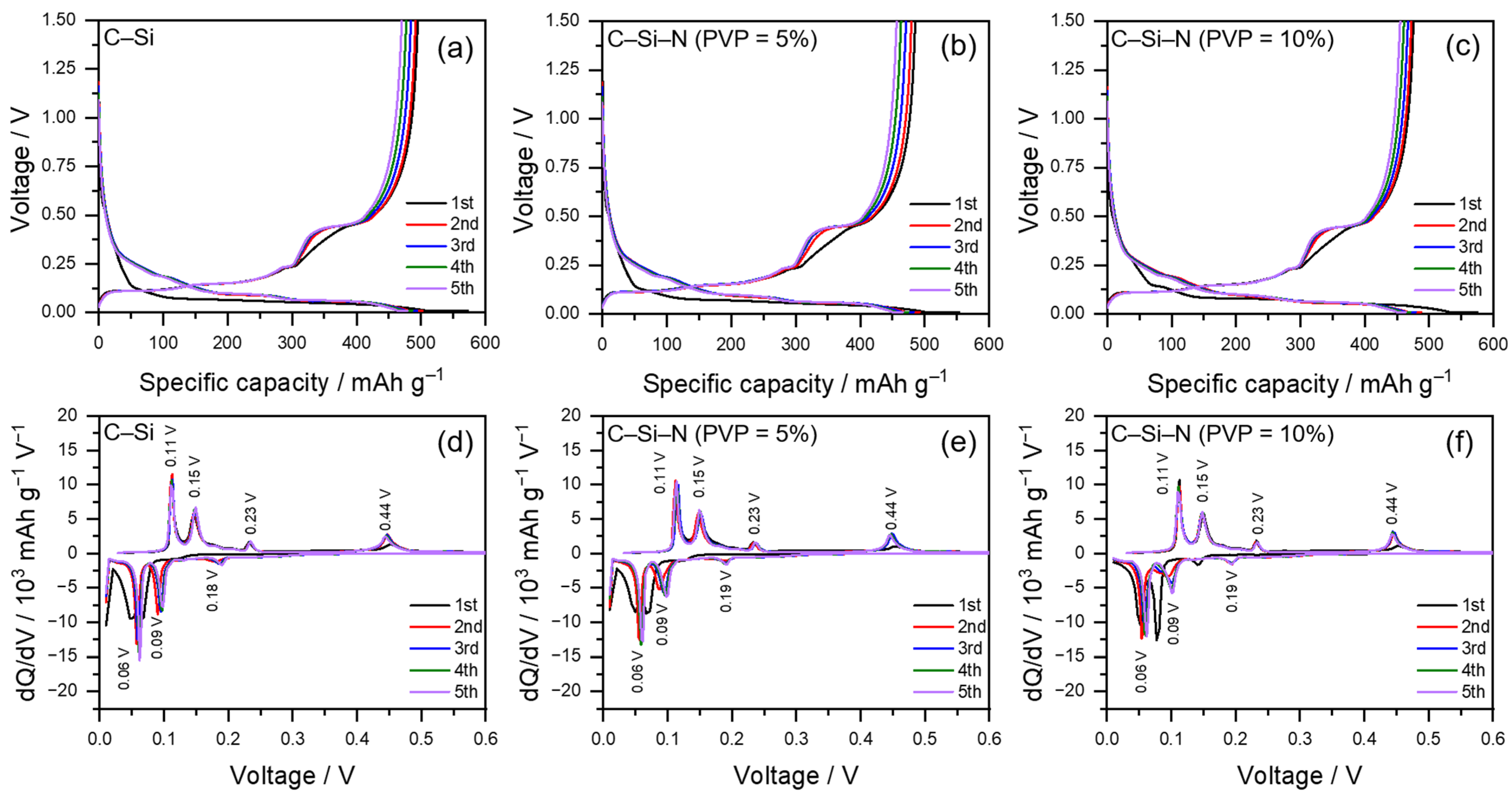
A charge–discharge test was conducted to analyze the electrochemical profiles and compare the initial capacities as a function of the silicon nitride content (Figure 3a–c). The initial discharge capacities for the C–Si, C–Si–N (PVP = 5%), and C–Si–N (PVP = 10%) electrodes were measured at 495, 485, and 476 mAh g−1, respectively. The specific capacities reported in this study were normalized to the total mass of the active materials (C–Si or C–Si–N composite + artificial graphite) in the electrode. This progressive decrease in capacity may be associated with (i) the formation of electrochemically inactive Si–N phases (Si3N4-like/SiNx-like) and/or (ii) a reduced electrochemically accessible Si fraction, thereby decreasing the Si-related contribution to Li storage on an electrode mass basis. The overall charge–discharge profile shapes were comparable among the three electrodes in Figure 3a–c, indicating that the graphite-dominated staging contribution was largely retained. Accordingly, the capacity differences mainly reflected changes in the Si-related reversible contribution and/or its electrochemical accessibility.
The ICE was examined to further interpret the initial irreversibility of the present formulation. The ICE was approximately 90% in the first cycle and gradually increased to approximately 98% in the subsequent cycles. These results suggest that compared with SiOx-based negative electrodes, where a low ICE is frequently reported, the initial irreversible capacity loss was reduced. As the present electrodes were graphite-rich blends (Section 2.2), the ICE values reflect the electrode-level response of the composite/graphite system under the present formulation. Within this context, the relatively high ICE is consistent with the absence of highly irreversible conversion products typical of SiOx systems (e.g., Li2O and Li4SiO4) and Si–N- and N-containing carbon-derived components, which may influence the chemistry and mechanical persistence of the initial interphase. Furthermore, the N-doped carbon layer may reduce undesired surface reactions and provide a stable interfacial environment for Li+ transport. Therefore, the nitride-related near-surface/interphase environment may limit initial Li consumption, thereby improving initial reversibility at the electrode level.
First-cycle irreversibility was further interpreted by examining the charge–discharge profiles in the potential region. During the first charge, the capacity observed above 0.25 V is generally attributed to the formation of the SEI layer. Below 0.25 V, the capacity reflects the Si–Li alloying reaction overlapping with graphite-staging reactions in graphite-rich blends [31,32]. The significant irreversible capacity loss observed in the first cycle appeared to occur across the entire voltage range rather than at a specific voltage, which is consistent with the distributed SEI formation on the electrode surface [33]. This distributed behavior makes precise voltage-segment-based quantitative separation difficult; therefore, the interpretation focuses on the evolution trends of the voltage profiles across cycles rather than explicit numerical partitioning. During the initial lithiation of the Si-based negative electrode, electrolyte decomposition is commonly considered to occur at voltages above 0.25 V, leading to SEI formation, as represented by C3H4O3 + 2Li+ + 2e → Li2CO3 + C2H4 and C4H8O3 + Li+ + e → ROCO2Li + C2H4/C2H6. At lower voltages, Si undergoes a reversible alloying reaction with Li (Si + xLi+ + xe ↔ LixSi), enabling lithiation and delithiation during charge–discharge cycles [34], while graphite-staging reactions also occur over a partially overlapping voltage range.
In the low-voltage region during the first lithiation, the rapid increase in the electrochemically active surface area as alloying proceeds is thought to necessitate a larger overvoltage to maintain a constant current density, shifting the voltage to lower levels [35]. A change in the voltage plateau was observed between the first and subsequent cycles. In the first cycle, the distinct plateau near 0.1 V is typically associated with the lithiation of crystalline Si, involving an inhomogeneous phase transition to an amorphous LixSi alloy. However, this region can partially overlap with the graphite-staging features of the blended electrodes. From the second cycle onward, the sharp plateau largely disappeared, and the reaction tended to begin at higher voltages as Li reacted with amorphous Si [36]. This electrochemical phase transition was accompanied by significant volume changes, stress redistribution, and interfacial restructuring that can lead to the formation of partially inactive regions. Consequently, the delithiation reaction during the initial cycles occurred over a broad voltage range of 0.25–0.5 V, appearing as a gradual slope rather than a distinct plateau [37]. As cycling proceeded, electrically or ionically isolated Si regions gradually became electrochemically less accessible, whereas regions that maintained a stable conductive network preferentially participated in the reaction. This electrochemical-conditioning mechanism is often used to explain improved electrode stability by reducing local voltage variations and promoting more homogeneous reaction pathways. In later cycles, delithiation occurred within a narrower voltage window, resulting in more pronounced shoulder features in the voltage profiles.
The differential capacity (dQ/dV) curves were compared to further resolve the redox behavior (Figure 3d–f). The dQ/dV features in the low-voltage region (<0.25 V) reflect the overlapping contributions from graphite staging and Si alloying in the graphite-rich blended electrodes. Because these processes occur over partially overlapping potential ranges, quantitative peak deconvolution would require model-dependent assumptions and arbitrary baseline selection. Therefore, the peak assignments are discussed primarily on a qualitative basis. A low-voltage lithiation feature below ~0.1 V and delithiation peak near 0.44 V are commonly associated with the alloying and dealloying reactions of Si. The staged Li+ intercalation/deintercalation of graphite is reflected by peaks around 0.19/0.09/0.06 V (lithiation) and 0.11/0.15/0.23 V (delithiation), as labeled in Figure 3d–f [38,39]. The persistence of these graphite-related peaks across all electrodes indicates that the graphite component remained electrochemically active during the initial cycles, whereas the modest capacity decrease with increasing PVP content is consistent with the reduced Si-related reversible contribution and/or lower electrochemical accessibility of Si. A comparison of the voltage hysteresis (polarization) revealed a decreasing trend in the order of C–Si, C–Si–N (PVP = 5%), and C–Si–N (PVP = 10%). This reduction in overvoltage may indicate lower energy loss and improved reversibility, possibly owing to differences in the interphase resistance and reaction distribution associated with the nitride-containing matrix and N-containing carbon. In addition, the dQ/dV curves at the 15th cycle show that the delithiation peaks of the C–Si–N electrodes shifted to lower voltages than those of the C–Si electrode (Figure S2). This shift may suggest reduced polarization and more stable electrochemical behavior of the silicon nitride-containing electrodes during cycling.
Complementary insights into early reduction and interphase-related processes were obtained from the CV results. The CV curves show an additional reduction peak near 0.40 V for the C–Si–N electrodes during the first cycle, which may reflect nitride- and N-containing carbon-related interphase formation and/or modified surface-reduction processes (Figure S3). In addition, the C–Si–N electrodes exhibit a smaller peak potential separation (ΔEp) and lower delithiation potentials, which may indicate improved electrochemical reversibility and structural stability compared to the C–Si electrode. However, in these blended electrodes, ΔEp reflects overlapping contributions from graphite staging and Si alloying reactions. Therefore, quantitative separation of individual processes based solely on peak parameters may lead to overinterpretation. Thus, the analysis focuses on a qualitative comparison of peak evolution across cycles.

3.3. In Situ Structural Analysis of the C–Si–N Composite During Charging and Discharging

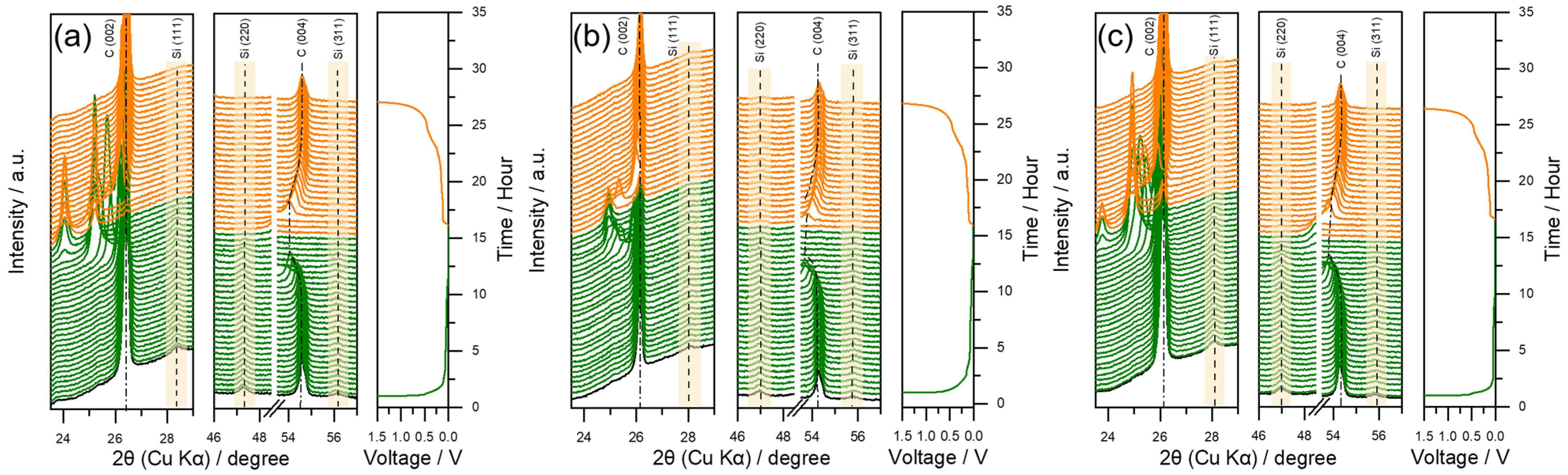
In situ XRD analysis was performed to investigate the structural evolution, reversibility, and phase transitions of the active materials during lithiation and delithiation (Figure 4a–c). In the pristine state prior to electrochemical cycling, graphite-related reflections shifted slightly to lower 2θ values as the nominal N content increased. The initial (002) and (004) peaks of the C–Si sample were observed at 26.43° and 54.58°, respectively, whereas those of C–Si–N (PVP = 5%) appeared at slightly lower angles of 26.15° and 54.30°, and those of C–Si–N (PVP = 10%) at 26.12° and 54.28°, respectively. Based on Bragg’s law, a decrease in the 2θ value corresponds to an increase in the interlayer spacing, suggesting that N introduction during the PVP-assisted synthesis is associated with defects and localized structural distortions within the carbon lattice, thereby slightly expanding the effective interlayer spacing [40].
During electrochemical cycling, as Li+ intercalated into the graphite layers during charging, the (002) and (004) diffraction peaks shifted to lower angles and then returned to higher angles during discharge. These reversible peak shifts reflected changes in the interlayer spacing of the graphite layers upon Li+ intercalation/deintercalation, indicating that the structural integrity of the carbon framework was largely maintained [41]. The continuous shift and splitting of the (002) peak reflect the typical staging behavior of graphite, that is, the coexistence and conversion between adjacent staged domains during (de)intercalation [42].
For the C–Si electrode, the (002) peak shifted to 26.22° upon initial charging, and two peaks subsequently coexisted at 26.45° and 25.22°, suggesting a two-phase region. At the end of lithiation, an additional low-angle peak emerged at 24.04°, which is close to the reported position of fully lithiated Stage-1 graphite (LiC6) [43]. In contrast, the (002) peak of the C–Si–N (PVP = 5%) electrode shifted modestly to 25.99°, followed by a coexistence stage at 26.17° and 24.94°, and a distinct Stage-1-related peak was not clearly observed at the end of lithiation. This may reflect the limited depth of lithiation and/or differences in the electrochemically accessible fraction in the in situ cell configuration. Potential contributors include in situ cell geometry, peak broadening/overlap in the low-angle region, and variations in ionic/electronic percolation through the outer shell (including thickness and continuity). Conversely, the C–Si–N (PVP = 10%) electrode exhibited the largest interlayer expansion among the three samples. The (002) peak shifted to 25.86°, followed by peak coexistence at 26.12° and 24.90°. A more pronounced low-angle peak at 23.76° appeared at the end of lithiation, approaching the typical Stage-1 graphite range. These observations suggest that the N-rich carbon matrix may increase the tolerance to lattice strain during Li+ intercalation, thereby facilitating more complete graphite staging and deeper graphite lithiation under the present in situ conditions [44].
In addition to the peak shifts, the full width at half maximum (FWHM) of the graphite-related peaks gradually increased with increasing PVP content, indicating an increase in the structural disorder and microstrain due to the introduction of N. Such defect-rich carbon structures may broaden the distribution of Li+ transport pathways and reduce localized diffusion barriers. This observation is consistent with a more disordered turbostratic stacking state that can broaden the graphite reflections [45].
In parallel, as Si alloying proceeded during lithiation, the diffraction peaks corresponding to crystalline Si ((111), (220), and (311) planes at 28.3°, 47.2°, and 56.1°, respectively) gradually broadened and decreased in intensity, eventually approaching the XRD-detection limit. This behavior is consistent with the progressive transformation of crystalline Si into the amorphous LixSi phase during lithiation, the diffraction features of which are typically difficult to detect using XRD [46,47]. Weak additional diffraction features near 48.5° and 49° were detected only for the C–Si–N (PVP = 10%) electrode and were tentatively assigned to crystalline Li12Si7 (Figure S4) [48]. In the other electrodes, the LixSi phase appeared to remain predominantly amorphous and was not clearly observable by XRD. The selective observation of this Li–Si alloy phase in the C–Si–N (PVP = 10%) electrode suggests a difference in the local reaction environments. However, this inference is not unique, and factors such as the microstructure and electrochemically accessible fraction may also contribute [49].

3.4. Electrochemical Impedance Spectroscopy Analysis and Cycling Performance

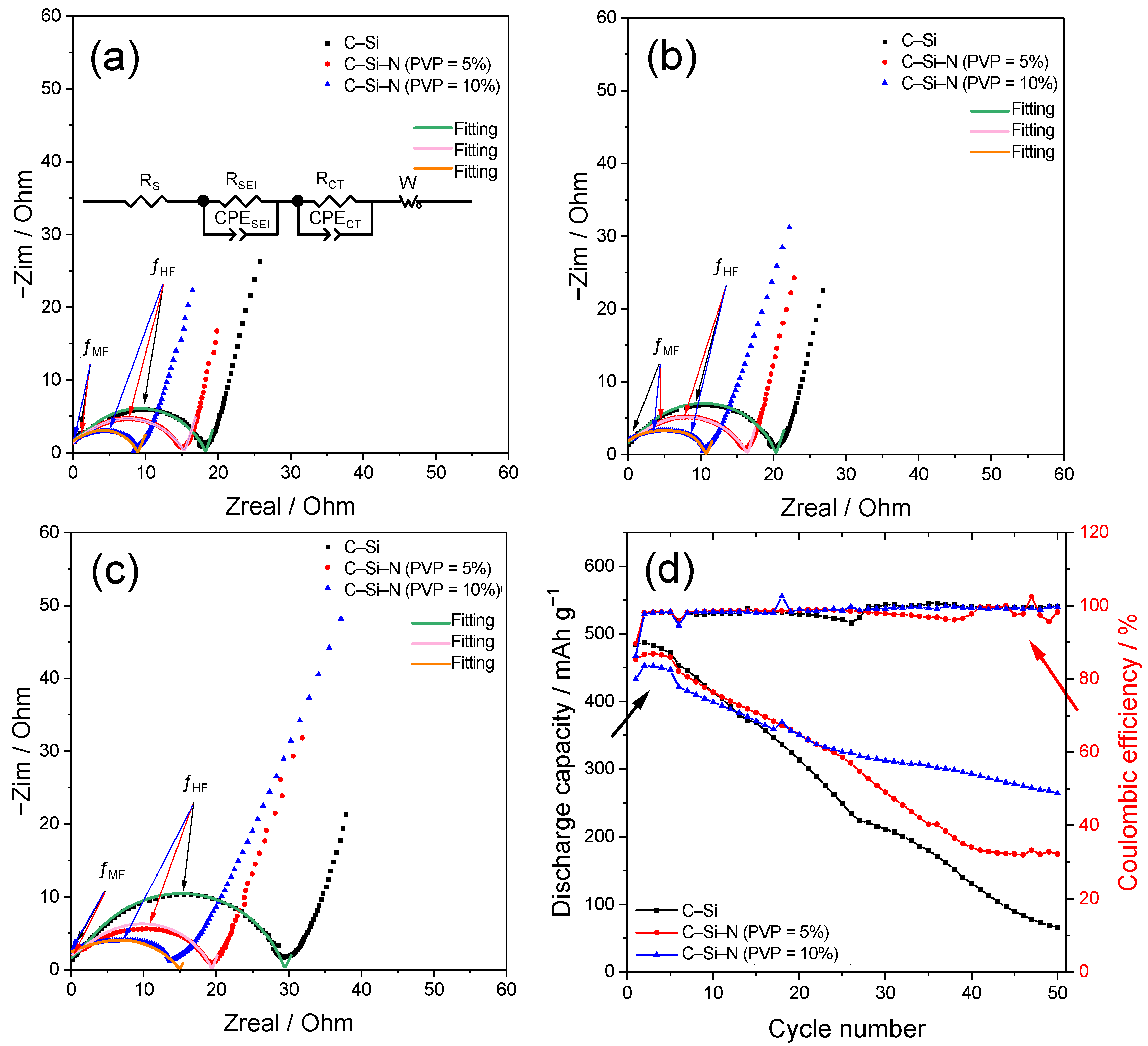
EIS was conducted to probe the charge-transfer behavior and Li+ transport at the electrode–electrolyte interface to further elucidate the differences in the interfacial kinetics between the C–Si, C–Si–N (PVP = 5%), and C–Si–N (PVP = 10%) electrodes identified in the preceding dQ/dV analysis. Three-electrode cells were assembled, and the impedance spectra were collected after 5, 15, and 30 cycles. At each time point, the impedance was measured at 0.5 V (vs. Li/Li+) with a 5 mV amplitude over 10 kHz–0.01 Hz to enable a comparison at an identical voltage state. The potential of 0.5 V (vs. Li/Li+) was selected as a practical intermediate state for comparative EIS measurements in the three-electrode configuration. The impedance measurements were performed on nine independent cells for each composition (n = 9). For clarity, Figure 5a–c shows representative Nyquist plots, and Table 1 summarizes the fitted parameters obtained from these representative spectra. Although impedance fitting can exhibit larger dispersion owing to interfacial variability and fitting sensitivity, the relative resistance trends among the electrodes and the progressive increase in impedance during cycling were consistently observed across repeated measurements. The characteristic frequencies of the high-frequency and mid-frequency semicircle components are indicated in Figure 5a–c as fHF and fMF, respectively. Because all EIS measurements were performed using the same electrode geometry and a narrow mass-loading range (7–8 mg cm−2) with a comparable electrode density (~1.50 g cm−3), the fitted resistance values in Table 1 were retained in raw units for direct comparison under identical fabrication and measurement conditions. The cycle numbers in Figure 5a–c denote the cycles in the three-electrode configuration, ensuring an identical potential history prior to each EIS measurement. The Nyquist plots in Figure 5a–c correspond to measurements after the 5th, 15th, and 30th cycles, respectively.
Based on the equivalent circuit shown in Figure 5a, the Nyquist plots for all the electrodes were analyzed using four components: electrolyte resistance (RS), resistance of Li+ transport through the SEI layer (RSEI), charge-transfer resistance at the electrode interface (RCT), and Warburg impedance (W) associated with the low-frequency transport-related response in the porous composite electrode. Here, the two semicircle components were fitted using constant phase elements (CPEs), rather than ideal capacitors, to account for the distributed and non-ideal interfacial behavior characteristic of porous battery electrodes. In the present analysis, the low-frequency element was retained as an empirical transport-related impedance contribution for comparative fitting under an identical protocol, rather than as a definitive descriptor of intrinsic solid-state diffusion. Because the semicircle components were represented by R–CPE branches rather than ideal R–C elements, simple ideal RC time constants were not used; instead, the characteristic frequencies and corresponding apparent characteristic timescales of the high-frequency and mid-frequency semicircle components were estimated from the fitted parameters and are summarized in Table S1. In the Nyquist plot, the diameter of the semicircle was proportional to the resistance. A high-frequency semicircle is typically attributed to the surface/SEI contribution, whereas a mid-frequency semicircle is associated with the charge-transfer resistance [50]. The fitted parameters depend on the selected equivalent circuit because these contributions can partially overlap in the composite electrodes. Accordingly, all the electrodes were compared using an identical circuit and fitting protocol. The quantitative values for each resistance component obtained from the equivalent circuit fitting are summarized in Table 1.
All the electrodes exhibited an increase in interfacial resistance with cycling; however, the silicon nitride-containing electrodes exhibited lower RSEI and RCT values than the C–Si electrode (Figure 5a–c). For example, after 30 cycles, RSEI and RCT increased to 28.16 and 2.22 Ω for C–Si, respectively, whereas lower values were retained for C–Si–N (PVP = 10%) (15.63 and 1.53 Ω, respectively) (Table 1). The growth of the semicircle from 15 to 30 cycles was more pronounced for the C–Si electrode than for the C–Si–N electrode (Figure 5b,c), which is consistent with the more rapid accumulation of resistive interphase components and/or contact-related impedance in C–Si under the same protocol. This electrode-to-electrode contrast is discussed along with the post-mortem thickness-increase results in Section 3.6. Expansion-driven cracking and contact loss can promote repeated SEI rupture/reformation, thereby increasing both thickness growth and interfacial impedance.
To rationalize these resistance trends, PVP-derived N-containing C and nitride formation were considered. PVP, used as a precursor in the synthesis, contains N in its molecular structure and is carbonized under inert heat-treatment conditions to form N-containing carbon species. During the concurrent carbonization and silicon nitride-formation processes, the N derived from PVP can be retained within the C framework, resulting in the N doping of the C layer. This N doping can enhance the electronic conductivity of the carbon matrix and modify its electronic structure. The resulting conductivity increase and electronic structure modification may facilitate interfacial charge-transfer kinetics and contribute to a reduction in RCT [51,52,53]. In addition, N-containing surface functionalities may influence the interphase chemistry and wettability, which may contribute to moderated RSEI growth. This interpretation is consistent with the larger polarization observed for the C–Si electrode in the 15th-cycle dQ/dV analysis (Figure S2). Because RCT is sensitive to electronic percolation and contact integrity, the reduced RCT for the C–Si–N electrodes may reflect better preservation of particle–particle/electrode connectivity under repeated expansion.
The Warburg term was analyzed to further compare the transport-related impedance contributions. The corresponding Warburg-derived parameter, reported here in DLi+ form, was estimated from the Warburg coefficient (σ) as follows [54,55]. Because this parameter was extracted from porous graphite-rich composite electrodes using equivalent-circuit fitting, it should be interpreted as an apparent electrode-level transport parameter rather than an intrinsic bulk diffusion coefficient of Si:
DLi+ = 0.5 × (RT)2 × (A n2 F2 C σ)−2,
where R is the gas constant (8.314 J mol−1 K−1), T is the absolute temperature (298.15 K), A is the electrode area (1.998 cm2), n is the number of electrons involved in the electrochemical reaction (n = 1 was used for Li+ lithiation/delithiation), F is the Faraday constant (96,485 C mol−1), and C is the molar concentration of Li+ (0.02518 mol cm−3). The Warburg coefficient, σ, was obtained from the slope of the linear relationship between the real impedance (Z′) and ω−1/2, where ω is the angular frequency (rad s−1):
In the low-frequency region, Z′ = RS + RSEI + RCT + σ ω−1/2.
The calculated DLi+ values were higher for the silicon nitride-containing electrodes than for the C–Si electrode. Because the present DLi+ values were extracted from porous graphite-rich composite electrodes, the Warburg-derived DLi+ represents an apparent electrode-level transport parameter rather than an intrinsic bulk diffusion coefficient of Si. Accordingly, these values are used here only to compare the relative transport-related trends among the electrodes under the same fitting procedure. Consistently, σ increased more strongly for C–Si (2.31 → 3.42 Ω s−1/2 from 5 to 30 cycles) than for C–Si–N (PVP = 10%) (0.98 → 1.45 Ω s−1/2), consistent with a relatively smaller increase in diffusion-related impedance for the nitride-containing electrodes (Table 1). This trend may indicate that the Si3N4 framework helps to maintain effective Li+ transport pathways during cycling. In addition to the structural role of the Si3N4 matrix, N-doped C is expected to introduce defect sites and modify the local electronic structure. Such defect formation and electronic structure modifications may facilitate the interfacial charge transfer and Li+ transport within the composites. These contributions are consistent with the reduced RCT and RSEI values with a smaller increase in the diffusion-related impedance during cycling. This kinetic trend may reflect the mechanical buffering role of Si3N4, which can moderate expansion-driven damage and help maintain a stable electrode–electrolyte interface.
As shown in Figure 5d, the electrodes with silicon nitride exhibited improved cycling stability while maintaining Coulombic efficiencies near 99–100% after the initial cycles. The cycling-performance data were obtained from twelve independent cells for each composition (n = 12). Figure 5d shows a representative cycling profile, whereas the reported capacities are expressed as mean ± standard deviation. The first-cycle discharge capacities were 492.23 ± 13.2 mAh g−1 for C–Si, 481.29 ± 12.9 mAh g−1 for C–Si–N (PVP = 5%), and 432.93 ± 13.3 mAh g−1 for C–Si–N (PVP = 10%). After 50 cycles, the corresponding discharge capacities were 78.03 ± 13.5, 238.07 ± 13.1, and 263.93 ± 12.8 mAh g−1, respectively. In contrast, the C–Si electrode showed rapid capacity fading. Despite the similarly high Coulombic efficiencies, the divergence in capacity retention suggests a progressive loss of electrochemically accessible Si (e.g., isolation and contact loss) rather than solely accelerated parasitic reactions. These results agree with the reduced interfacial resistance and ion-transport trends identified from the EIS analysis. The improved electrochemical performance is consistent with the presence of the Si3N4 phase, which can serve as a structural buffering matrix owing to its high mechanical strength and toughness. Such a matrix can help accommodate the mechanical stress arising from the volume expansion of Si during cycling, thereby preserving the structural integrity of the electrode [25]. The addition of FEC to the electrolyte further improved the cycling stability of the C–Si–N electrodes, supporting the formation of a more robust SEI on the Si surface (Figure S5).

3.5. XPS Analysis of Surface Chemical States Before and After Cycling

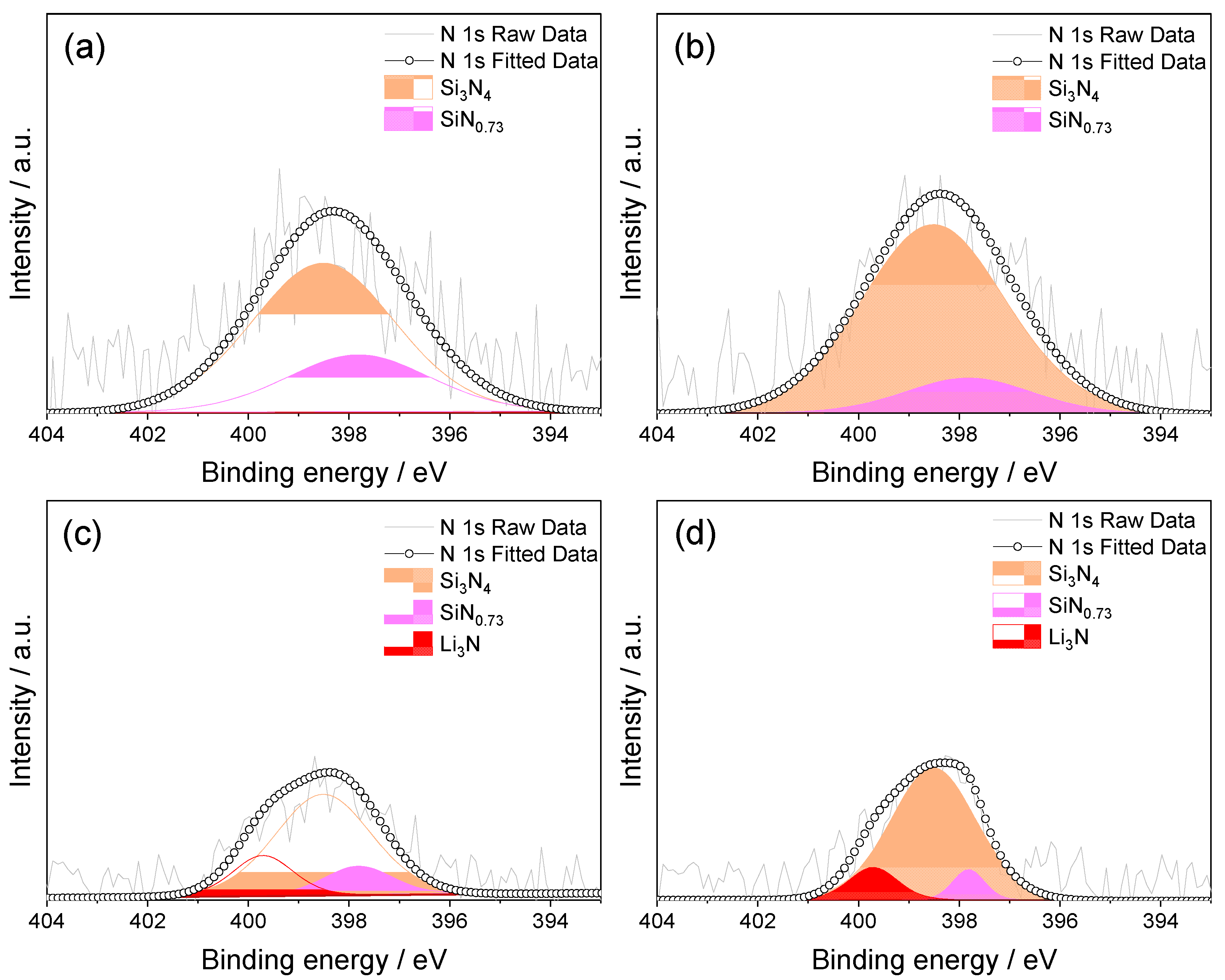
XPS analysis was conducted on the electrodes before cycling and after five cycles to examine the changes in the near-surface chemistry associated with SEI formation during electrochemical cycling. Figure 6a,b shows the N 1s spectra of the pristine electrodes, and Figure 6c,d shows those obtained after five cycles. In the N 1s spectra prior to cycling, peaks observed at 398.5 and 397.8 eV can be assigned to Si3N4- and SiN0.73-like bonding, respectively [56]. After five cycles, an additional component centered near 399.7 eV emerged, which is consistent with Li–N-containing species previously reported for nitride-containing Si electrodes [56,57]. Given the surface sensitivity of XPS and the possible overlap of this binding-energy region with N-containing carbon and SEI-related species, this feature is discussed as a Li–N-related interphase contribution and is only tentatively assigned to Li3N within the adopted fitting model, rather than treated as a definitive phase identification. Its emergence may reflect partial conversion of the SiN0.73-like environment during low-potential cycling and/or participation in Li–N-containing interphase formation. Accordingly, the following reaction is presented only as one plausible interfacial conversion pathway for the SiNx-like species and not as direct spectroscopic proof of Li3N formation by XPS alone [58]:
SiN0.73 + 2.19Li → Si + 0.73Li3N.
Overall, the N 1s spectra indicated the persistence of Si–N bonding components (Si3N4-like and SiNx-like) together with an additional Li–N-related component after cycling, which is consistent with the nitride-derived near-surface/interphase evolution. Si3N4 is known for its high mechanical strength; thus, its presence supported the mechanical stabilization of the composite framework. Therefore, a mechanically reinforced Si–N network near the outer shell/interphase region may help accommodate the volume changes in nano-Si during lithiation and delithiation. If the additional Li–N-related component includes a Li3N-like contribution, it may support Li+ transport within near-surface/interphase regions; however, this possibility is discussed here only as a tentative functional interpretation because the present XPS data do not allow definitive discrimination of Li3N from other nitrogen-containing interphase species. In contrast, the Si–N phases are discussed primarily in relation to mechanical stabilization.
Quantitative analysis based on the relative peak areas of the deconvoluted N 1s spectra indicated that, after cycling, the relative contributions of the fitted N 1s components to the C–Si–N (PVP = 5%) electrode were approximately Si3N4-like (69%), SiN0.73-like (14%), and Li–N-related (tentatively assigned to Li3N within the adopted fitting model) (17%). For the C–Si–N (PVP = 10%) electrode, the corresponding component contributions were Si3N4-like (82%), SiN0.73-like (7%), and Li–N-related (tentatively assigned to Li3N within the adopted fitting model) (11%). Because XPS probes the near-surface region, these fitted component ratios were used only to compare the relative surface/interphase compositions of the electrodes under the same peak-fitting model and should not be interpreted as definitive phase fractions. The relatively larger Li–N contribution in the PVP = 5% electrode (vs. PVP = 10%) may indicate a greater fraction of Li-reactive SiNx-like environments participating in the early interphase evolution. The higher relative contribution of the Si3N4-like component in the C–Si–N (PVP = 10%) electrode is consistent with a more nitride-rich near-surface environment, which may contribute to the improved mechanical stability of the composite framework, thereby mitigating Si volume expansion during lithiation. This trend aligns with the electrochemical-cycling results, where the C–Si–N (PVP = 10%) electrode exhibited a comparatively higher capacity retention.

3.6. Surface and Cross-Sectional SEM Analysis

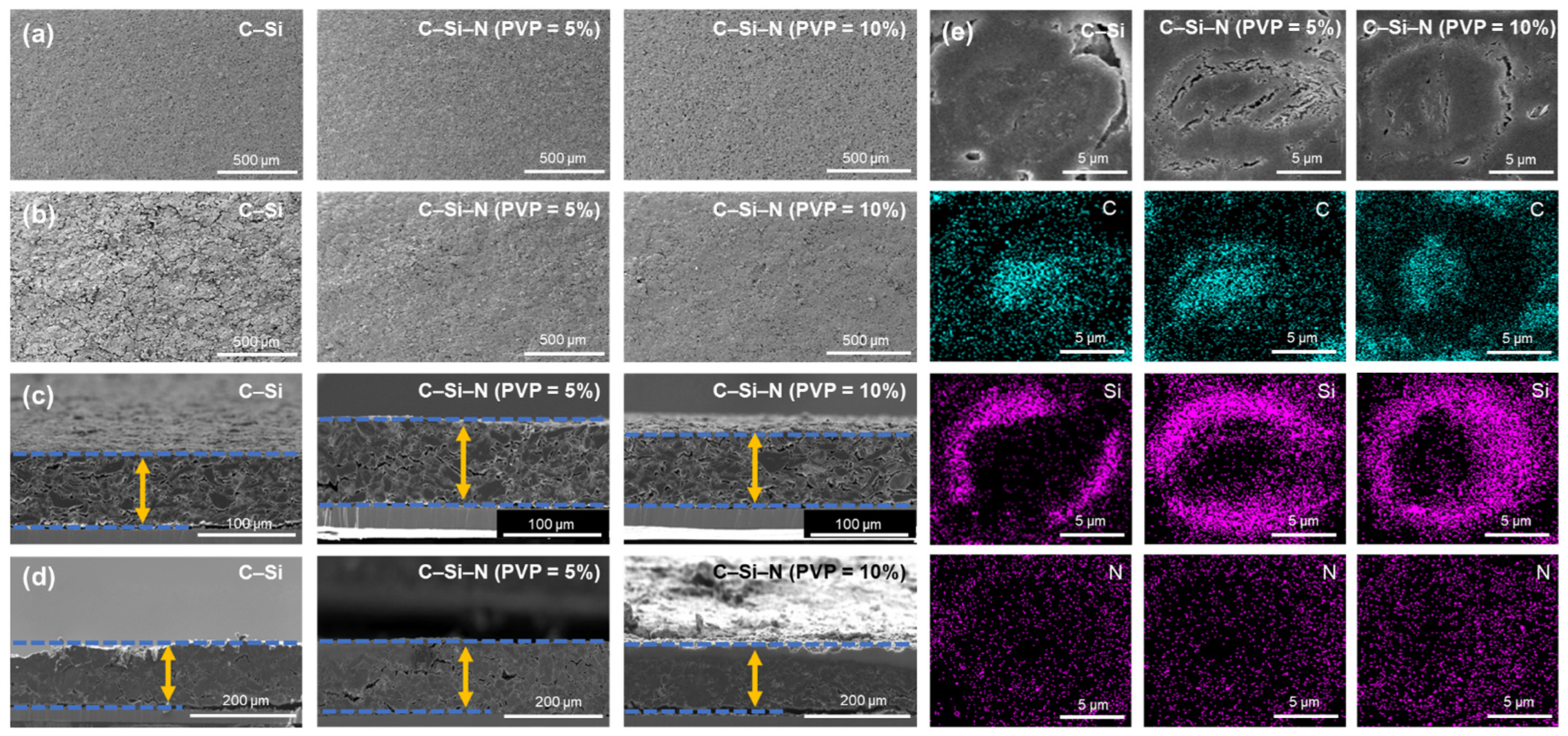
SEM and SEM–EDS analyses were conducted on both the electrode surface and ion-milled cross-sections before and after cycling to elucidate the role of the silicon nitride matrix in maintaining the electrode integrity during cycling (Figure 7). All post-cycling analyses in Figure 7 were performed after 40 cycles to capture representative mechanical degradation during the early-to-intermediate stage, before severe late-stage electrode collapse increasingly obscures design-dependent structural differences. In this study, the increase in electrode thickness (swelling) after cycling was treated as a primary metric of expansion-driven mechanical degradation in Si-containing negative electrodes. The pristine electrodes initially exhibited smooth and uniform surface morphologies, regardless of their composition (Figure 7a). However, after 40 cycles, the C–Si electrode developed surface cracks and a loss of surface uniformity, which is consistent with the stress accumulation associated with repeated Si alloying and dealloying-induced volume changes (Figure 7b). In contrast, the electrodes containing the silicon nitride matrix exhibited fewer macroscopic cracks and maintained surface features comparable to their initial states. This observation is consistent with the presence of a mechanically robust Si–N-rich (Si3N4-like/SiNx-like) matrix. Such a matrix may partially mitigate the expansion-induced stress and help preserve the structural integrity of the electrode and interparticle contact during cycling.
The ion-milled cross sections were analyzed to quantitatively assess the electrode thickness (Figure 7c,d). Electrode thickness values reported in this section correspond to the coating thickness excluding the Cu current collector (18 μm). Because thickness growth integrates active-material expansion with irreversible changes in porosity and interphase/binder accumulation, it is discussed herein as an electrode-scale outcome. All electrode thickness measurements were performed ex situ after cycling in the fully discharged state; therefore, the reported thickness increase corresponds to the net post-cycling electrode thickness after delithiation. The present ex situ thickness measurements do not allow quantitative separation of gas-evolution-induced swelling from solid-phase expansion, nor do they distinguish reversible lithiation-induced expansion from irreversible residual deformation. Accordingly, the reported thickness values are interpreted as net electrode-scale dimensional changes after cycling, integrating active-material expansion, porosity/interphase evolution, binder accumulation, and any gas-related deformation retained at the measurement state. To quantitatively compare fresh-to-cycled dimensional change, a swelling coefficient (S) was defined as:
S = (tcycled − tinitial)/tinitial × 100%,
where tinitial and tcycled denote the electrode thicknesses before and after cycling, respectively. Representative cross-sectional images are shown in Figure 7c,d, whereas the quantified thickness values were obtained from four independent cells for each composition (n = 4) and are reported as mean ± standard deviation. The average initial and 40-cycle thicknesses were 65.1 ± 4.4 and 119.9 ± 2.5 μm for the C–Si electrode, 61.7 ± 2.8 and 109.5 ± 3.3 μm for the C–Si–N (PVP = 5%) electrode, and 65.9 ± 1.0 and 104.2 ± 3.9 μm for the C–Si–N (PVP = 10%) electrode, corresponding to average thickness increases of ~84%, ~78%, and ~58%, respectively. Consistently, the C–Si–N (PVP = 10%) electrode, which exhibited the highest relative contribution of the Si3N4-like component to the surface-sensitive N 1s peak fitting (Section 3.5), exhibited the smallest thickness increase. Under identical electrode fabrication conditions (same slurry formulation, mass loading of 7–8 mg cm−2, and calendered density of ~1.50 g cm−3), a decreasing trend in thickness growth was observed with increasing PVP-derived nitride-formation signatures. The bulk Si fraction of each composite was not independently quantified; therefore, the swelling trend is discussed with respect to the nominal PVP addition and associated nitride-related signatures. Based on the initial specific capacities and mass-loading range, the initial areal capacities were comparable (~3.3–4.0 mAh cm−2).
This indicates that the observed swelling differences were not explained solely by differences in the initial areal capacity. Representative literature reports show that swelling or thickness-growth values for Si/graphite negative electrodes span a broad range depending on the electrode design and measurement protocol. Ma et al. [59] reported 35% electrode swelling after 100 cycles for a graphite–Si electrode and 19% for a macropore-coordinated graphite–Si electrode under industrial electrode conditions. Huang et al. [60] reported an electrode thickness increase of about 30% after cycling for a Si/graphite electrode employing a self-healing ionomer binder at a commercial areal capacity of 3 mAh cm−2. Lee et al. [61] reported an initial charged-state expansion of 16.0% and a cycling expansion of 6.7% over 50 cycles in a pouch full cell using a carbon-coated silicon/graphite granular composite with a negative-electrode areal capacity of 3.4 mAh cm−2. Vats et al. [62] reported an approximately 75% thickness increase for a graphite/bare-Si composite anode and approximately 35% for a graphite/Si@TiO2 core–shell composite after 100 cycles. These comparisons indicate that the absolute swelling magnitude depends strongly on the Si fraction, electrode architecture, areal loading, electrode density, cycling endpoint, and the definition of swelling itself. Therefore, the present values are used primarily to show the relative reduction in post-cycling thickness growth from the C–Si control (~84%) to the C–Si–N (PVP = 10%) electrode (~58%) under identical fabrication and cycling conditions, rather than as a strict one-to-one performance ranking against literature values.
Furthermore, SEM–EDS elemental mapping using cross-sectional SEM images of representative composite particles in the cycled electrodes was performed to examine the microstructural evolution after cycling (Figure 7e). In the C–Si electrode, the initial core–shell structure exhibited a partial collapse, with the Si shell showing fragmentation and crack opening, which is consistent with the structural changes under repeated electrochemical strain. In contrast, the silicon nitride-containing electrodes largely maintained a discernible core–shell architecture, with the Si particles remaining more confined within the matrix even after cycling. Consequently, such microstructural disruptions can increase the extent of the freshly exposed Si surface area and promote repeated SEI fracture and reformation, thereby contributing to gradual impedance growth and increased polarization. In comparison, silicon nitride-containing electrodes may better preserve electrical connectivity and a stable electrode–electrolyte interface through their mechanically robust matrices, consistent with the improved cycling stability.

4. Conclusions

This study reports a graphite-core C–Si–N multiphase core–shell architecture and its implications for the electrochemical behavior and expansion-driven mechanical degradation of Si-containing graphite-based negative electrodes. SEM–EDS indicated a quasi-continuous radial trend in the relative N signal toward the outer shell, consistent with preferential N enrichment near the particle exterior. This trend was accompanied by the formation of a carbon-rich matrix containing Si–N and N-containing carbon, both of which became more pronounced with increasing PVP content (0%, 5%, and 10%). After 40 cycles, the C–Si electrode exhibited an average increase in electrode thickness (excluding the Cu current collector) of ~84%, whereas the C–Si–N (PVP = 10%) electrode preserved the core–shell morphology with the smallest average thickness growth of ~58% based on four independent cells (n = 4). These observations suggest reduced expansion-driven damage at the particle and electrode levels, and the improved preservation of electrical connectivity under the present conditions. The XPS N 1s spectra indicate Si–N bonding components (Si3N4-like/SiNx-like) together with an additional Li–N-related component after cycling. This provides a comparative view of the nitride-derived near-surface and interphase chemistry that may contribute to mechanical reinforcement and interfacial transport stabilization. The results were obtained from 40-cycle Li-metal half-cell tests using graphite-based blended electrodes comprising a 12.7 wt.% Si-containing composite (based on electrode solids). Therefore, the electrochemical data are discussed primarily as a comparative assessment of the swelling mitigation and morphological retention under this relatively high composite loading. Future work should validate this concept in practical full cells and over long-term cycling, together with independent quantification of the bulk Si fraction in each composite.

Supplementary Materials

The following supporting information can be downloaded at: https://www.mdpi.com/article/10.3390/batteries12030098/s1.

Author Contributions

J.J.: writing—original draft, methodology, formal analysis, data curation, conceptualization. S.L. (Seongwoo Lee): methodology, formal analysis. S.L. (Sangyup Lee): original draft, formal analysis, conceptualization. P.M.N.: methodology, formal analysis. H.L.: methodology, formal analysis. S.Y.: methodology, formal analysis. M.K.: methodology, formal analysis. J.O.: methodology, formal analysis. S.-K.J.: writing—review & editing, supervision, funding acquisition, formal analysis, data curation, conceptualization. All authors have read and agreed to the published version of the manuscript.

Funding

This work was supported by the Korea Institute of Energy Technology Evaluation and Planning (KETEP) and the Ministry of Trade, Industry & Energy (MOTIE) of the Republic of Korea (No. RS-2024-00394769). This study was supported by “Materials/Parts Technology Development Program (20020300)” funded by the Ministry of Trade, Industry and Energy (MOTIE) of Korea. The study also received support from the Soonchunhyang University Research Fund.

Data Availability Statement

The original contributions presented in this study are included in the article and Supplementary Materials. Further inquiries can be directed to the corresponding author.

Conflicts of Interest

Authors Minji Kim and Jeonghun Oh were employed by the company EGMaterials Ltd. The remaining authors declare that the research was conducted in the absence of any commercial or financial relationships that could be construed as a potential conflict of interest.

References

  1. Ko, M.; Chae, S.; Cho, J. Challenges in accommodating volume change of Si anodes for Li-ion batteries. ChemElectroChem 2015, 2, 1645–1651. [Google Scholar] [CrossRef]
  2. Wu, H.; Cui, Y. Designing nanostructured Si anodes for high energy lithium ion batteries. Nano Today 2012, 7, 414–429. [Google Scholar] [CrossRef]
  3. Chae, S.; Ko, M.; Kim, K.; Ahn, K.; Cho, J. Confronting issues of the practical implementation of Si anode in high-energy lithium-ion batteries. Joule 2017, 1, 47–60. [Google Scholar] [CrossRef]
  4. Nitta, N.; Yushin, G. High-capacity anode materials for lithium-ion batteries: Choice of elements and structures for active particles. Part. Part. Syst. Charact. 2014, 31, 317–336. [Google Scholar] [CrossRef]
  5. Feng, K.; Li, M.; Liu, W.; Kashkooli, A.G.; Xiao, X.; Cai, M.; Chen, Z. Silicon-based anodes for lithium-ion batteries: From fundamentals to practical applications. Small 2018, 14, 1702737. [Google Scholar] [CrossRef]
  6. Sun, L.; Liu, Y.; Shao, R.; Wu, J.; Jiang, R.; Jin, Z. Recent progress and future perspective on practical silicon anode-based lithium ion batteries. Energy Storage Mater. 2022, 46, 482–502. [Google Scholar] [CrossRef]
  7. Galvez-Aranda, D.E.; Verma, A.; Hankins, K.; Seminario, J.M.; Mukherjee, P.P.; Balbuena, P.B. Chemical and mechanical degradation and mitigation strategies for Si anodes. J. Power Sources 2019, 419, 208–218. [Google Scholar] [CrossRef]
  8. Shin, J.; Kim, T.-H.; Lee, Y.; Cho, E. Key functional groups defining the formation of Si anode solid-electrolyte interphase towards high energy density Li-ion batteries. Energy Storage Mater. 2020, 25, 764–781. [Google Scholar]
  9. Liu, H.; Sun, Q.; Zhang, H.; Cheng, J.; Li, Y.; Zeng, Z.; Zhang, S.; Xu, X.; Ji, F.; Li, D. The application road of silicon-based anode in lithium-ion batteries: From liquid electrolyte to solid-state electrolyte. Energy Storage Mater. 2023, 55, 244–263. [Google Scholar] [CrossRef]
  10. Luo, W.; Chen, X.; Xia, Y.; Chen, M.; Wang, L.; Wang, Q.; Li, W.; Yang, J. Surface and interface engineering of silicon-based anode materials for lithium-ion batteries. Adv. Energy Mater. 2017, 7, 1701083. [Google Scholar] [CrossRef]
  11. Sun, L.; Liu, Y.; Wu, J.; Shao, R.; Jiang, R.; Tie, Z.; Jin, Z. A review on recent advances for boosting initial coulombic efficiency of silicon anodic lithium ion batteries. Small 2022, 18, 2102894. [Google Scholar] [CrossRef]
  12. Jin, Y.; Li, S.; Kushima, A.; Zheng, X.; Sun, Y.; Xie, J.; Sun, J.; Xue, W.; Zhou, G.; Wu, J. Self-healing SEI enables full-cell cycling of a silicon-majority anode with a coulombic efficiency exceeding 99.9%. Energy Environ. Sci. 2017, 10, 580–592. [Google Scholar] [CrossRef]
  13. Nogales, P.M.; Lee, S.; Yang, S.; Yang, I.; Choi, S.H.; Park, S.-M.; Lee, J.H.; Kim, C.J.; An, J.-C.; Jeong, S.-K. Stabilizing the solid electrolyte interphase of SiOx negative electrodes: The role of fluoroethylene carbonate in enhancing electrochemical performance. Batteries 2024, 10, 385. [Google Scholar] [CrossRef]
  14. Zhang, C.; Wang, F.; Han, J.; Bai, S.; Tan, J.; Liu, J.; Li, F. Challenges and recent progress on silicon-based anode materials for next-generation lithium-ion batteries. Small Struct. 2021, 2, 2100009. [Google Scholar] [CrossRef]
  15. Son, Y.; Ma, J.; Kim, N.; Lee, T.; Lee, Y.; Sung, J.; Choi, S.H.; Nam, G.; Cho, H.; Yoo, Y. Quantification of pseudocapacitive contribution in nanocage-shaped silicon–carbon composite anode. Adv. Energy Mater. 2019, 9, 1803480. [Google Scholar] [CrossRef]
  16. Favors, Z.; Bay, H.H.; Mutlu, Z.; Ahmed, K.; Ionescu, R.; Ye, R.; Ozkan, M.; Ozkan, C.S. Towards scalable binderless electrodes: Carbon coated silicon nanofiber paper via Mg reduction of electrospun SiO2 nanofibers. Sci. Rep. 2015, 5, 8246. [Google Scholar] [CrossRef]
  17. Zhang, X.-y.; Song, W.-L.; Liu, Z.; Chen, H.-S.; Li, T.; Wei, Y.; Fang, D.N. Geometric design of micron-sized crystalline silicon anodes through in situ observation of deformation fracture behaviors. J. Mater. Chem. A 2017, 5, 12793–12802. [Google Scholar] [CrossRef]
  18. Jiang, B.; Zeng, S.; Wang, H.; Liu, D.; Qian, J.; Cao, Y.; Yang, H.; Ai, X. Dual core–shell structured Si@ SiOx@ C nanocomposite synthesized via a one-step pyrolysis method as a highly stable anode material for lithium-ion batteries. ACS Appl. Mater. Interfaces 2016, 8, 31611–31616. [Google Scholar] [CrossRef] [PubMed]
  19. Rage, B.; Delbegue, D.; Louvain, N.; Lippens, P.E. Engineering of Silicon Core-Shell Structures for Li-ion Anodes. Chem.—Eur. J. 2021, 27, 16275–16290. [Google Scholar] [CrossRef]
  20. Baasner, A.; Dörfler, S.; Piwko, M.; Desilani, S.; Brückner, J.; Althues, H.; Kaskel, S. Sulfur: An intermediate template for advanced silicon anode architectures. J. Mater. Chem. A 2018, 6, 14787–14796. [Google Scholar] [CrossRef]
  21. An, W.; Gao, B.; Mei, S.; Xiang, B.; Fu, J.; Wang, L.; Zhang, Q.; Chu, P.K.; Huo, K. Scalable synthesis of ant-nest-like bulk porous silicon for high-performance lithium-ion battery anodes. Nat. Commun. 2019, 10, 1447. [Google Scholar]
  22. Hoeltgen, C.; Lee, J.-E.; Jang, B.-Y. Stepwise carbon growth on Si/SiOx core-shell nanoparticles and its effects on the microstructures and electrochemical properties for high-performance lithium-ion battery’s anode. Electrochim. Acta 2016, 222, 535–542. [Google Scholar] [CrossRef]
  23. Bai, X.; Yu, Y.; Kung, H.H.; Wang, B.; Jiang, J. Si@ SiOx/graphene hydrogel composite anode for lithium-ion battery. J. Power Sources 2016, 306, 42–48. [Google Scholar] [CrossRef]
  24. Yoo, S.; Lee, J.-I.; Shin, M.; Park, S. Large-Scale Synthesis of Interconnected Si/SiOx Nanowire Anodes for Rechargeable Lithium-Ion Batteries. ChemSusChem 2013, 6, 1153–1157. [Google Scholar] [CrossRef]
  25. Xiao, Z.; Lei, C.; Yu, C.; Chen, X.; Zhu, Z.; Jiang, H.; Wei, F. Si@ Si3N4@ C composite with egg-like structure as high-performance anode material for lithium ion batteries. Energy Storage Mater. 2020, 24, 565–573. [Google Scholar]
  26. Kilian, S.O.; Wankmiller, B.; Sybrecht, A.M.; Twellmann, J.; Hansen, M.R.; Wiggers, H. Active Buffer Matrix in Nanoparticle-Based Silicon-Rich Silicon Nitride Anodes Enables High Stability and Fast Charging of Lithium-Ion Batteries. Adv. Mater. Interfaces 2022, 9, 2201389. [Google Scholar]
  27. Sharma, A.K.; Sharma, K.; Gupta, M.K.; Guo, F.; Ichikawa, T.; Jain, A.; Agarwal, S. Si3N4 as an Alternative of Silicon for the Anode Application in All-Solid-State Li-Ion Batteries. Energy Storage 2024, 6, e70010. [Google Scholar]
  28. Zhang, X.; Pan, G.; Li, G.; Qu, J.; Gao, X. Si–Si3N4 composites as anode materials for lithium ion batteries. Solid. State Ion. 2007, 178, 1107–1112. [Google Scholar] [CrossRef]
  29. Shen, X.; Pan, H.; Chen, Y.; Li, Z.; Chen, J. Dynamic evolution analysis on mechanical instability of Si3N4–coated Si anodes during lithiation. J. Energy Storage 2025, 131, 117537. [Google Scholar]
  30. Hernandha, R.F.H.; Umesh, B.; Rath, P.C.; Trang, L.T.T.; Wei, J.C.; Chuang, Y.C.; Li, J.; Chang, J.K. N-Containing Carbon-Coated β-Si3N4 Enhances Si Anodes for High-Performance Li-Ion Batteries. Adv. Sci. 2023, 10, 2301218. [Google Scholar]
  31. Shen, Y.; Cao, Z.; Wu, Y.; Cheng, Y.; Xue, H.; Zou, Y.; Liu, G.; Yin, D.; Cavallo, L.; Wang, L. Catalysis of silica-based anode (de-) lithiation: Compositional design within a hollow structure for accelerated conversion reaction kinetics. J. Mater. Chem. A 2020, 8, 12306–12313. [Google Scholar] [CrossRef]
  32. Dupré, N.; Moreau, P.; De Vito, E.; Quazuguel, L.; Boniface, M.; Bordes, A.; Rudisch, C.; Bayle-Guillemaud, P.; Guyomard, D. Multiprobe study of the solid electrolyte interphase on silicon-based electrodes in full-cell configuration. Chem. Mater. 2016, 28, 2557–2572. [Google Scholar] [CrossRef]
  33. Nadimpalli, S.P.; Sethuraman, V.A.; Dalavi, S.; Lucht, B.; Chon, M.J.; Shenoy, V.B.; Guduru, P.R. Quantifying capacity loss due to solid-electrolyte-interphase layer formation on silicon negative electrodes in lithium-ion batteries. J. Power Sources 2012, 215, 145–151. [Google Scholar]
  34. Obrovac, M.; Krause, L. Reversible cycling of crystalline silicon powder. J. Electrochem. Soc. 2007, 154, A103–A108. [Google Scholar] [CrossRef]
  35. Klett, M.; Gilbert, J.A.; Pupek, K.Z.; Trask, S.E.; Abraham, D.P. Layered oxide, graphite and silicon-graphite electrodes for lithium-ion cells: Effect of electrolyte composition and cycling windows. J. Electrochem. Soc. 2017, 164, A6095–A6102. [Google Scholar] [CrossRef]
  36. Ma, D.; Cao, Z.; Hu, A. Si-based anode materials for Li-ion batteries: A mini review. Nano-Micro Lett. 2014, 6, 347–358. [Google Scholar]
  37. McDowell, M.T.; Lee, S.W.; Nix, W.D.; Cui, Y. 25th anniversary article: Understanding the lithiation of silicon and other alloying anodes for lithium-ion batteries. Adv. Mater. 2013, 25, 4966–4985. [Google Scholar] [CrossRef]
  38. Jo, Y.N.; Kim, Y.; Kim, J.S.; Song, J.H.; Kim, K.J.; Kwag, C.Y.; Lee, D.J.; Park, C.W.; Kim, Y.J. Si–graphite composites as anode materials for lithium secondary batteries. J. Power Sources 2010, 195, 6031–6036. [Google Scholar] [CrossRef]
  39. Yoon, Y.; Jee, S.; Lee, S.; Nam, S. Nano Si-coated graphite composite anode synthesized by semi-mass production ball milling for lithium secondary batteries. Surf. Coat. Technol. 2011, 206, 553–558. [Google Scholar] [CrossRef]
  40. Huang, K.; Tian, S.; Xu, H.; Fang, C.; Wu, L.; Wang, H.; Liu, F.; He, W.; Zhang, X. Ultrafast thermal shock synthesis of nitrogen-doped expanded graphite for high-performance sodium-ion battery anodes. Chem. Eng. J. 2025, 505, 159326. [Google Scholar] [CrossRef]
  41. Park, J.; Park, S.S.; Won, Y.S. In situ XRD study of the structural changes of graphite anodes mixed with SiOx during lithium insertion and extraction in lithium ion batteries. Electrochim. Acta 2013, 107, 467–472. [Google Scholar] [CrossRef]
  42. Placke, T.; Schmuelling, G.; Kloepsch, R.; Meister, P.; Fromm, O.; Hilbig, P.; Meyer, H.W.; Winter, M. In situ X-ray diffraction studies of cation and anion intercalation into graphitic carbons for electrochemical energy storage applications. Z. Anorg. Allg. Chem. 2014, 640, 1996–2006. [Google Scholar] [CrossRef]
  43. Yang, X.-Q.; McBreen, J.; Yoon, W.-S.; Yoshio, M.; Wang, H.; Fukuda, K.; Umeno, T. Structural studies of the new carbon-coated silicon anode materials using synchrotron-based in situ XRD. Electrochem. Commun. 2002, 4, 893–897. [Google Scholar] [CrossRef]
  44. Sasidharachari, K.; Na, B.-K.; Woo, S.-G.; Yoon, S.; Cho, K.Y. Facile conductive surface modification of Si nanoparticle with nitrogen-doped carbon layers for lithium-ion batteries. J. Solid State Electrochem. 2016, 20, 2873–2878. [Google Scholar] [CrossRef]
  45. Li, J.; Cai, Y.; Yao, X.; Zhang, Y.; Tian, H.; Su, Z. Nitrogen self-doped carbon with super high-rate and long cycle life as anode materials for lithium-ion batteries. RSC Adv. 2022, 12, 12377–12382. [Google Scholar] [CrossRef]
  46. Wang, F.; Wu, L.; Key, B.; Yang, X.Q.; Grey, C.P.; Zhu, Y.; Graetz, J. Electrochemical reaction of lithium with nanostructured silicon anodes: A study by in-situ synchrotron X-Ray diffraction and electron energy-loss spectroscopy. Adv. Energy Mater. 2013, 3, 1324–1331. [Google Scholar] [CrossRef]
  47. Zhang, G.; Xiong, T.; He, L.; Yan, M.; Zhao, K.; Xu, X.; Mai, L. Electrochemical in situ X-ray probing in lithium-ion and sodium-ion batteries. J. Mater. Sci. 2017, 52, 3697–3718. [Google Scholar] [CrossRef]
  48. Wang, Y.; Dahn, J. Phase changes in electrochemically lithiated silicon at elevated temperature. J. Electrochem. Soc. 2006, 153, A2314. [Google Scholar] [CrossRef]
  49. Liu, X.; Zhu, X.; Pan, D. Solutions for the problems of silicon–carbon anode materials for lithium-ion batteries. R. Soc. Open Sci. 2018, 5, 172370. [Google Scholar] [CrossRef]
  50. Radvanyi, E.; Porcher, W.; De Vito, E.; Montani, A.; Franger, S.; Larbi, S.J.S. Failure mechanisms of nano-silicon anodes upon cycling: An electrode porosity evolution model. Phys. Chem. Chem. Phys. 2014, 16, 17142–17153. [Google Scholar] [CrossRef]
  51. Ténégal, F.; De La Rocque, A.G.; Dufour, G.; Sénémaud, C.; Doucey, B.; Bahloul-Hourlier, D.; Goursat, P.; Mayne, M.; Cauchetier, M. Structural determination of sintered Si3N4/SiC nanocomposite using the XPS differential charge effect. J. Electron. Spectrosc. Relat. Phenom. 2000, 109, 241–248. [Google Scholar] [CrossRef]
  52. Bokhari, S.W.; Siddique, A.; Pan, H.; Li, Y.; Imtiaz, M.; Chen, Z.; Zhu, S.; Zhang, D. Nitrogen doping in the carbon matrix for Li-ion hybrid supercapacitors: State of the art, challenges and future prospective. RSC Adv. 2017, 7, 18926–18936. [Google Scholar] [CrossRef]
  53. Mohammed, S.J.; Mohammed, A.S.; Abdalla, K.K.; Hamad, D.S.; Mustafa, F.S.; Kader, D.A.; Kayani, K.F.; Abdalla, K.K.; Ahmed, H.R.; Aziz, S.B. Advances in nitrogen-doped carbon dots for electrochemical energy storage: From synthesis to applications. Adv. Energy Mater. 2025, 6, 8740–8773. [Google Scholar] [CrossRef]
  54. Zhang, Q.; Wan, H.; Liu, G.; Ding, Z.; Mwizerwa, J.P.; Yao, X. Rational design of multi-channel continuous electronic/ionic conductive networks for room temperature vanadium tetrasulfide-based all-solid-state lithium-sulfur batteries. Nano Energy 2019, 57, 771–782. [Google Scholar] [CrossRef]
  55. Guo, M.; Wang, J.; Dou, H.; Gao, G.; Wang, S.; Wang, J.; Xiao, Z.; Wu, G.; Yang, X.; Ma, Z.-F. Agglomeration-resistant 2D nanoflakes configured with super electronic networks for extraordinary fast and stable sodium-ion storage. Nano Energy 2019, 56, 502–511. [Google Scholar] [CrossRef]
  56. Wu, C.-Y.; Chang, C.-C.; Duh, J.-G. Silicon nitride coated silicon thin film on three dimensions current collector for lithium ion battery anode. J. Power Sources 2016, 325, 64–70. [Google Scholar] [CrossRef]
  57. Nakamura, N.; Hirao, K.; Yamauchi, Y. Investigation of wear surfaces in Si+-implanted uni-directionally aligned silicon nitride using TEM and XPS. Surf. Coat. Technol. 2004, 186, 339–345. [Google Scholar] [CrossRef]
  58. de Guzman, R.C.; Yang, J.; Cheng, M.M.-C.; Salley, S.O.; Ng, K.S. High capacity silicon nitride-based composite anodes for lithium ion batteries. J. Mater. Chem. A 2014, 2, 14577–14584. [Google Scholar] [CrossRef]
  59. Ma, J.; Sung, J.; Hong, J.; Chae, S.; Kim, N.; Choi, S.-H.; Nam, G.; Son, Y.; Kim, S.Y.; Ko, M.; et al. Towards maximized volumetric capacity via pore-coordinated design for large-volume-change lithium-ion battery anodes. Nat. Commun. 2019, 10, 475. [Google Scholar] [CrossRef] [PubMed]
  60. Huang, S.; Ren, J.; Liu, R.; Bai, Y.; Li, X.; Huang, Y.; Yue, M.; He, X.; Yuan, G. Low addition amount of self-healing ionomer binder for Si/graphite electrodes with enhanced cycling. New J. Chem. 2018, 42, 6742–6749. [Google Scholar] [CrossRef]
  61. Lee, D.; Kondo, A.; Lee, S.; Myeong, S.; Sun, S.; Hwang, I.; Song, T.; Naito, M.; Paik, U. Controlled swelling behavior and stable cycling of silicon/graphite granular composite for high energy density in lithium ion batteries. J. Power Sources 2020, 457, 228021. [Google Scholar] [CrossRef]
  62. Vats, B.N.; Gupta, R.; Gupta, A.; Fatima, S.; Kumar, D. Graphite-Si@TiO2 core-shell nanoparticles as composite anode for Li-ion batteries: Postcycling analysis. Energy Technol. 2025, 13, 2400874. [Google Scholar] [CrossRef]
Figure 1. Schematic of the cell configuration used for in situ XRD measurements.
Batteries 12 00098 g001
Figure 2. Structural and elemental characterization of the synthesized active materials: (a) XRD patterns of C–Si, C–Si–N (PVP = 5%), and C–Si–N (PVP = 10%). (bd) Cross-sectional SEM images and corresponding EDS elemental maps (C, Si, and N) for (b) C–Si, (c) C–Si–N (PVP = 5%), and (d) C–Si–N (PVP = 10%).
Batteries 12 00098 g002
Figure 3. Electrochemical performance of the graphite-based blended electrodes over the initial five cycles: (ac) Galvanostatic charge–discharge profiles and (df) corresponding differential capacity (dQ/dV) curves of (a,d) C–Si, (b,e) C–Si–N (PVP = 5%), and (c,f) C–Si–N (PVP = 10%) electrodes.
Batteries 12 00098 g003
Figure 4. In situ XRD patterns with voltage profiles for the (a) C–Si, (b) C–Si–N (PVP = 5%), and (c) C–Si–N (PVP = 10%) electrodes.
Batteries 12 00098 g004
Figure 5. (ac) Nyquist plots after 5, 15, and 30 cycles, and (d) cycling-performance profiles of C–Si, C–Si–N (PVP = 5%), and C–Si–N (PVP = 10%) electrodes. The inset in (a) shows the equivalent circuit used for fitting. In panels (ac), experimental data are shown as discrete points and the fitted curves as continuous lines; the characteristic frequencies of the high-frequency and mid-frequency semicircle components are indicated as fHF and fMF, respectively. Panels (ad) show representative impedance and cycling data, respectively. The numbers of independent cells are provided in the main text (n = 12 for cycling; n = 9 for EIS), and statistical values are reported for the cycling data.
Batteries 12 00098 g005
Figure 6. XPS N 1s spectra of C–Si–N electrodes: pristine ((a), PVP = 5%; (b), PVP = 10%) and after 5 cycles ((c), PVP = 5%; (d), PVP = 10%).
Batteries 12 00098 g006
Figure 7. Surface and cross-sectional SEM analysis of C–Si and C–Si–N electrodes before and after cycling. The thickness values in panel (c,d) were obtained from four independent cells for each composition and are reported as mean ± standard deviation; the thickness excludes the 18 μm Cu current collector. (a,b) Surface SEM images of (a) pristine electrodes and (b) electrodes after 40 cycles. (c,d) Cross-sectional SEM images of the electrode coatings (c) before cycling and (d) after 40 cycles; dashed lines mark the coating boundaries and double-headed arrows denote the coating thickness (excluding the Cu current collector). (e) Cross-sectional SEM images of representative composite particles in the cycled electrodes and corresponding SEM–EDS elemental maps (C, Si, and N). For each subpanel, columns are arranged from (left) to (right) as C–Si, C–Si–N (PVP = 5%), and C–Si–N (PVP = 10%). Scale bars: (a,b) 500 μm, (c) 100 μm, (d) 200 μm, and (e) 5 μm.
Batteries 12 00098 g007
Table 1. Representative fitted impedance parameters, Warburg coefficients (σ), and Warburg-derived apparent Li+ transport parameters (reported in DLi+ form) for the C–Si, C–Si–N (PVP = 5%), and C–Si–N (PVP = 10%) electrodes, obtained from the representative Nyquist plots shown in Figure 5a–c. Impedance measurements were repeated on nine independent cells for each composition (n = 9), and the relative trends among the electrodes were consistently observed across repeated measurements.
ElectrodeCyclesRSEIRCTσ/Ω s−1/2DLi+/cm2 s−1
C–Si517.901.162.312.62 × 10−12
1519.741.782.582.10 × 10−12
3028.162.223.421.19 × 10−12
C–Si–N (PVP = 5%)515.410.771.288.54 × 10−12
1516.391.531.655.14 × 10−12
3018.751.841.824.22 × 10−12
C–Si–N (PVP = 10%)59.470.500.981.46 × 10−11
1511.221.351.091.18 × 10−11
3015.631.531.456.66 × 10−12
Disclaimer/Publisher’s Note: The statements, opinions and data contained in all publications are solely those of the individual author(s) and contributor(s) and not of MDPI and/or the editor(s). MDPI and/or the editor(s) disclaim responsibility for any injury to people or property resulting from any ideas, methods, instructions or products referred to in the content.