
Article

Application of Li3InCl6-PEO Composite Electrolyte in All-Solid-State Battery

1
Laboratoire de Réactivité et de Chimie des Solides, UMR CNRS-UPJV 7314, Université de Picardie Jules Verne, 80039 Amiens Cedex, France
2
METAL Research Group, Department of Chemistry and Industrial Chemistry (DCC), University of Genoa, Via Dodecaneso 31, 16146 Genoa, Italy
*
Author to whom correspondence should be addressed.
Batteries 2026, 12(1), 21; https://doi.org/10.3390/batteries12010021
Submission received: 25 November 2025 / Revised: 30 December 2025 / Accepted: 3 January 2026 / Published: 6 January 2026
(This article belongs to the Special Issue Solid Polymer Electrolytes for Lithium Batteries and Beyond)

Abstract

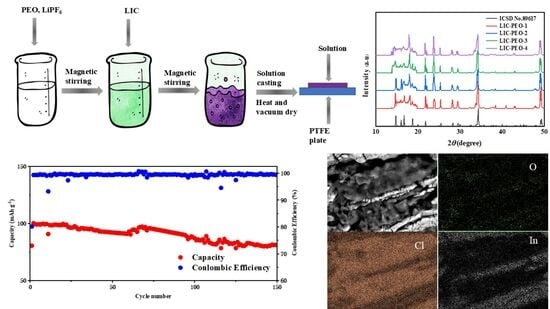
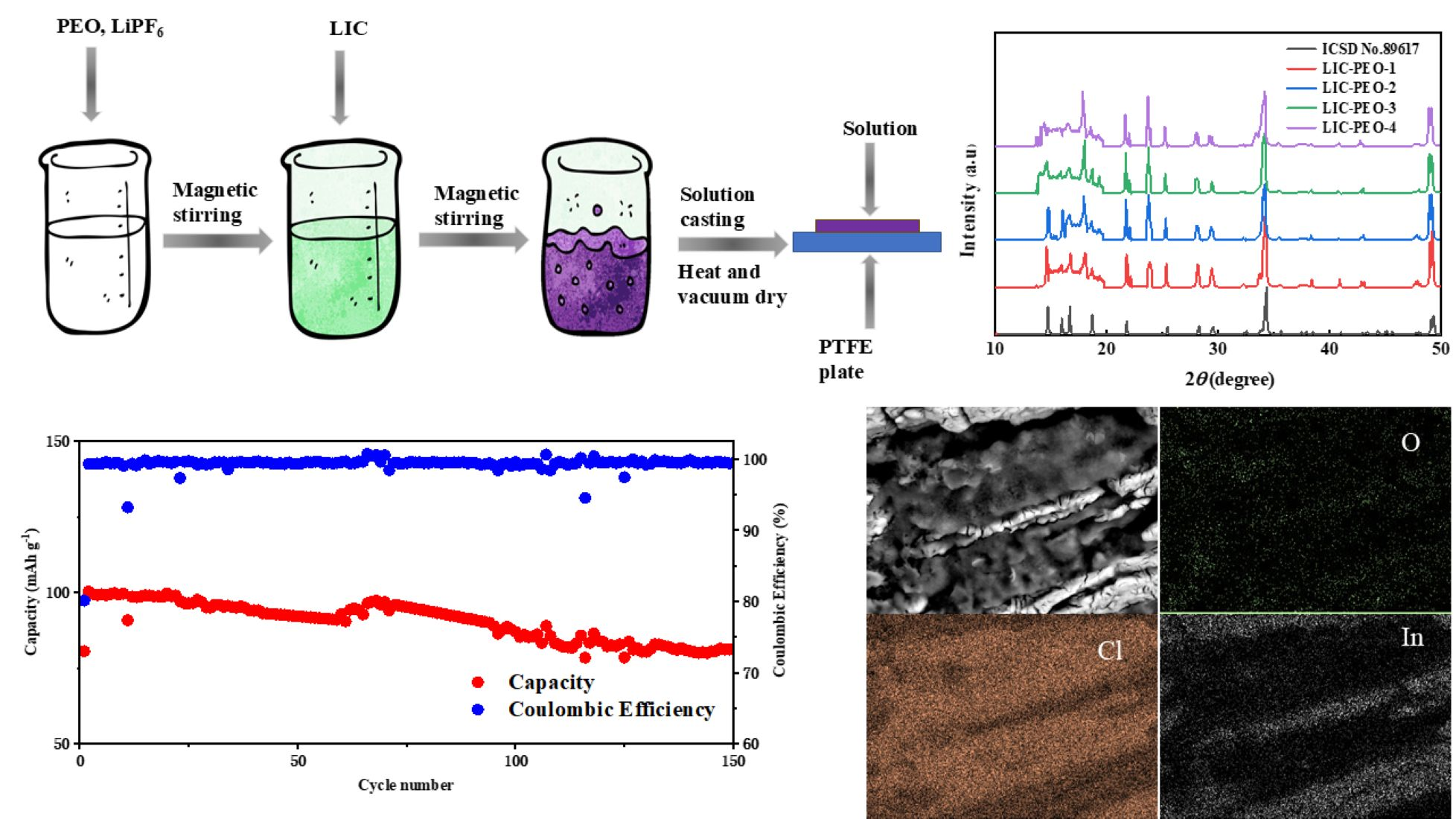
Poly(ethylene oxide) (PEO)-based solid polymer electrolytes typically suffer from limited ionic conductivity at near-room temperature and often require inorganic reinforcement. Halide solid-state electrolytes such as Li3InCl6 (LIC) offer fast Li+ transport but are moisture-sensitive and typically require pressure-assisted densification. Here, we fabricate a flexible LIC–PEO composite electrolyte via slurry casting in acetonitrile with a small amount of LiPF6 additive. The free-standing membrane delivers an ionic conductivity of 1.19 mS cm−1 at 35 °C and an electrochemical stability window up to 5.15 V. Compared with pristine LIC, the composite shows improved moisture tolerance, and its conductivity can be recovered by mild heating after exposure. The electrolyte enables stable Li|LIC–PEO|Li cycling for >620 h and supports Li|LIC–PEO|NCM111 cells with capacity retentions of 84.2% after 300 cycles at 0.2 C and 80.6% after 150 cycles at 1.2 C (35 °C). Structural and surface analyses (XRD, SEM/EDX, XPS) elucidate the composite microstructure and interfacial chemistry.

Graphical Abstract

1. Introduction

Many researchers regard all-solid-state batteries (ASSBs) as the ultimate solution for future electrochemical energy storage media due to their advantages in safety and energy density [1,2]. At this stage, the mainstream of solid-state electrolyte (SSE) research focuses on polymers, oxides, and sulfides [3]. Among them, PEO in the SPE was applied to the Bollore’s Bluecar as early as 2009 [4]. Moreover, the growth of dendrites can be significantly inhibited at low current densities, which has led to greater attention [5,6]. However, the low performance caused by high crystallinity at room temperature limits its practical application; it usually needs to be compounded with other materials for use [2,7,8,9,10,11,12]. On the other hand, halide solid-state electrolytes (HSSEs), such as Li3YCl6 (LYC), Li3InCl6 (LIC), etc., have received widespread attention in recent years due to their good overall performance since 2018 [13,14]. Since halides are not as soft as polymers, they cannot work under normal pressure in most cases [15,16]. The test method is similar to that of sulfide and oxide SSEs, which must always be made into pellets by the powder compression method under high pressure. The pellets are brittle, and the entire preparation and testing process is cumbersome and challenging to promote.
Based on previous research on SPEs and HSSEs, we were inspired by work on composite electrolytes and sought to combine LIC with PEO, successfully preparing a high-performance polymer halide solid-state electrolyte. The entire preparation process is based on the solution casting method, using acetonitrile as the solvent and LiPF6 as an additional electrolyte additive. This paper presents results obtained from a lab-made LIC-PEO film with respect to mechanical properties and electrochemical performance. The cycling and window-voltage resilience have been tested, as has the suitability for operation with all-solid-state batteries featuring state-of-the-art cathodes. At the same time, various properties of LIC-PEO were verified by SEM, XRD, and other tests. The LIC-PEO SSE prepared in this work shows good performance, has rarely been researched before, and has great application potential.

2. Materials and Methods

2.1. Preparation of LIC-PEO and Composite Cathode

The anhydrous lithium chloride (LiCl, Innochem N.V., Westerlo, Belgium, 99.99%) and anhydrous indium chloride (InCl3, Sigma-Aldrich Merck KGaA, Darmstadt, Germany, 98%) were dissolved in deionized water in the ratio of 3:1 (molar ratio) and dried at 100 °C until most of the water evaporated, finally dried under vacuum at 200 °C for 6 h to obtain Li3InCl6 powder.
LIC-PEO is prepared by dissolving/dispersing LIC, PEO (poly(ethylene oxide), Sigma-Aldrich Merck KGaA, Darmstadt, Germany, Mv = 6 × 10⁵), and LiPF6 (Sigma-Aldrich Merck KGaA, Darmstadt, Germany, 99.9%) in anhydrous acetonitrile (CH3CN, Sigma-Aldrich Merck KGaA, Darmstadt, Germany, 99.8%). The mixture is first sonicated to prevent flocculation and then stirred continuously for 24 h until completely dissolved/dispersed. The resulting viscous slurry is cast onto a PTFE (polytetrafluoroethylene) plate, then dried at 60 °C for 12 h and finally under vacuum for 4 h to obtain a LIC-PEO solid electrolyte film. Each component is pre-weighed before synthesis. The amount of LiPF6 in LIC-PEO is controlled by the molar ratio of EO groups (−CH2–CH2O−) to lithium ions at 12 (i.e., EO/Li+ = 12:1). The content of LIC in the LIC-PEO film is varied across experiments, as will be discussed later. The thickness of the LIC-PEO film is controlled by the volume of anhydrous acetonitrile and the blade. It ranges from 20 to 200 μm, can be easily peeled off with tweezers, and retains its shape under bending.
The composite cathode was prepared by mixing NCM111 powder, super carbon 65, PVDF, LIC, and LiPF6 with a weight ratio of 8:1:0.5:0.25:0.25 in N-methyl-2-pyrrolidone (NMP), stirring evenly, casting onto an aluminum foil base material, drying at 60 °C for 24 h, and storing under appropriate conditions.

2.2. Sample Characterization

The microscopic morphology and structure of the samples were observed using scanning electron microscopy, and the elemental distribution was determined using energy-dispersive spectroscopy. Ion conductivity, Electrochemical Impedance Spectroscopy (EIS), Cyclic Voltammetry (CV), and charge and discharge tests were performed on a Biologic VSP Potentiostat (Grenoble, France). The microstructure was visualized with an EV40 scanning electron microscope (SEM) (Zeiss, Oberkochen, Germany). The crystal structure was determined by X-ray diffraction (XRD) using a Rigaku MiniFlex X-ray diffractometer with Cu Kα radiation (λ = 1.54178 Å) (Tokyo, Japan). XRD patterns were processed using JADE (https://www.icdd.com/mdi-jade/, accessed on 24 November 2025). Background subtraction was performed by polynomial baseline fitting. No aggressive smoothing was applied. Information such as binding energy was collected using Al Ka source X-ray photoelectron spectroscopy (XPS) at 15 kV and 20 mA on a PHI 5800 workstation (Minneapolis, MN, USA).

2.3. Electrochemical Performance Measurement

The ionic conductivity was measured using LIC-PEO films by constructing an SS (stainless steel)/LIC-PEO/SS PAT-Cell (EL-CELL, Hamburg, Germany). The test bench setup is shown in Figure S1. The test was performed over a frequency range of 100 mHz to 1 MHz with an amplitude of 20 mV.
The electrochemical stability of LIC-PEO was measured by linear sweep voltammetry (LSV) using the cell structure Li/LIC-PEO/SS PAT-Cell at a scan rate of 1 mV/s from 2 V to 6 V.
The preparation process for Li symmetrical cells is similar, with the LIC-PEO film sandwiched between two circular lithium foils, each 60 μm thick, and tested in a coin cell. LIC Li symmetrical cells were tested using a special pressurized test bench (Figure S2). The experiment was performed by applying a constant current to both electrodes and then recording the voltage changes.
The Li+ transference number (tLi+) was measured using the Bruce–Vincent–Evans method in Li|LIC–PEO|Li symmetric cells at 35 °C [17]. After recording the initial EIS spectrum, a DC polarization (ΔV = 10 mV) was applied until a steady-state current was reached, after which a second EIS measurement was performed. The transference number was calculated as:
  t L i + = I s ( V I 0 R 1 0 ) I 0 ( V I s R 1 s )
where I0 and Is are the initial and steady-state currents, and R0, Rs are the interfacial resistances before and after polarization, respectively. Reversed-polarity validation was not performed in the current setup; however, the polarization was maintained until a stable Is was reached, and the test was repeated on independently assembled cells to ensure reproducibility.
The activation energy (Ea) was computed by fitting the temperature-dependent ionic conductivity to the Arrhenius relation:
  D = D 0   e x p ( E a R T )
Electrochemical cycling performance was evaluated using Li/LIC-PEO/composite NCM111 coin cells on a NEWARE BT4008 (Shenzhen, China) instrument in galvanostatic mode.

3. Results

3.1. Characterization of the Structure of LIC-PEO

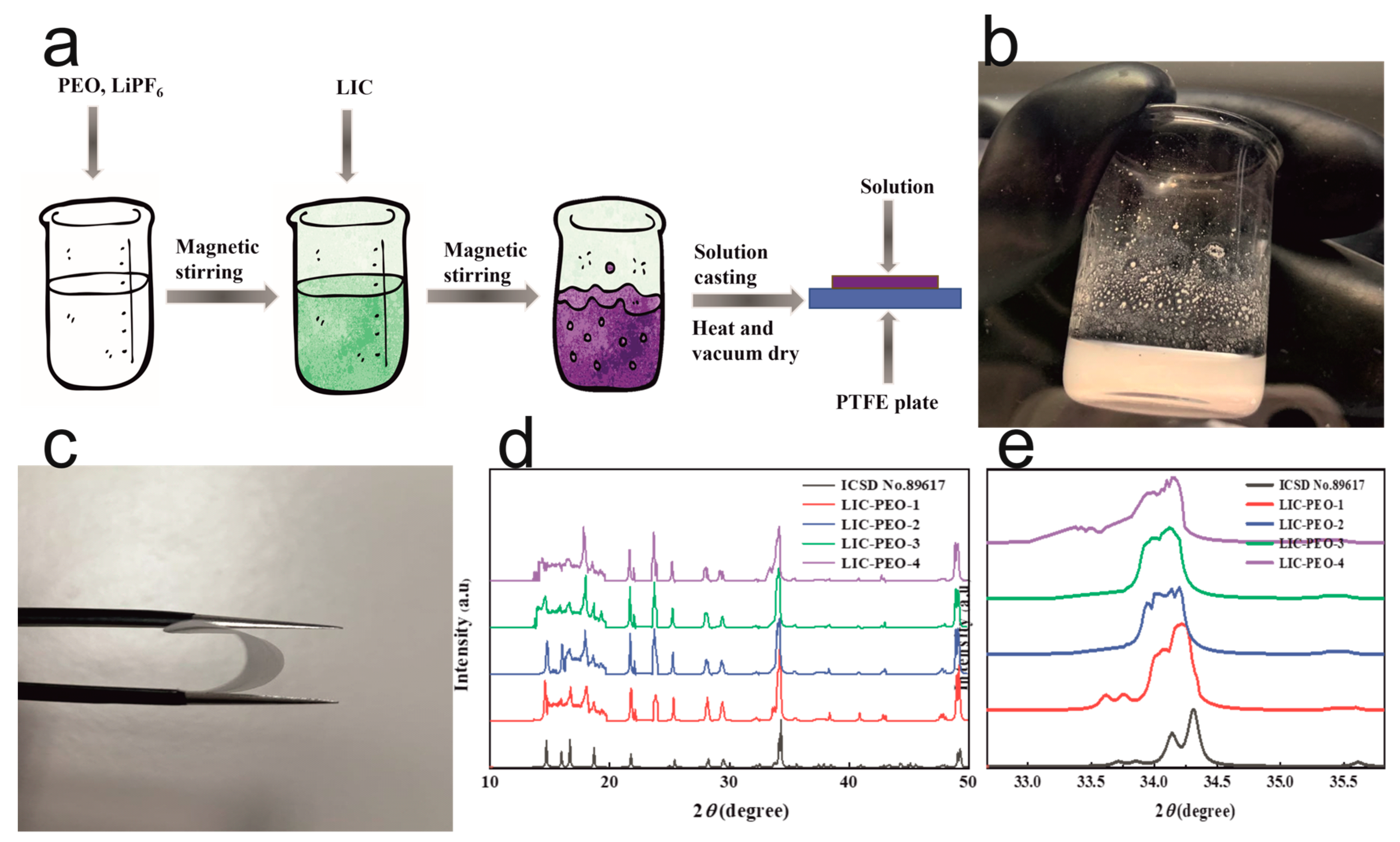
The preparation process of the LIC-PEO sample is shown in Figure 1a. It needs to be stirred until it is uniformly milky, then cast and dried, and finally, the edges are cut and modified to obtain the final sample (Figure 1b). Cut pieces of LIC-PEO can remain intact under bending (Figure 1c).
According to the PEO content (10%, 20%, 30%, and 40% wt), the samples were designated as LIC-PEO-1, LIC-PEO-2, LIC-PEO-3, and LIC-PEO-4. The phase evolution of LIC-PEO structures with varying PEO contents was studied using XRD. Most of the characteristic peaks in the different LIC-PEO samples can be indexed to Li3InCl6 (ICSD No. 89617, C2/m). The ICSD No. 89617 pattern is included only as a reference for peak indexing, whereas all other traces correspond to experimentally measured XRD patterns. The characteristic peaks at 13.5°, 34.2°, 49.2°, 28.1°, 29.5°, etc., are always present. Still, their intensities and widths change with varying PEO content (Figure 1d). The larger peak intensities at 28.1° and 29.5° can be attributed to LIC and a small amount of residual LiCl [18]. However, subsequent conductivity measurements proved that the residual amount was extremely small and did not affect performance. As the PEO content increased, the low-intensity peak between 36° and 48° gradually disappeared. Compared with the standard PDF, the overall pattern shifted slightly toward a lower angle (Figure 1e). This can be attributed to differences in tensile strength and other mechanical properties between PEO and LIC [19,20]. As the material crystallizes, differences in density and thermal expansion between the crystalline and amorphous phases create internal stress. When the PEO solution covers the surface of Li3InCl6 grains and shrinks during drying and solidification, the polymer may exert residual tensile stress on the inorganic grains. The tensile stress is along the crystal plane, which is why the characteristic peak shifts slightly to a lower angle. This stress becomes more significant with higher PEO content, likely because PEO influences crystallization, leading to greater structural changes and phase separation. The crystal structure of standard LIC in the Materials Project database (https://next-gen.materialsproject.org/, accessed on 2 January 2026) is shown in Figure S3. The characteristic peak at 14.2°, representing the (001) plane, gradually disappeared, and the peak intensity at 34.2°, representing the (131) plane, did not change significantly. This shows that after PEO addition, the (131) plane still occupied a dominant position. On the other hand, PEO and LIC formed a composite matrix in which LIC domains were embedded or dispersed within a PEO-rich phase, and no molecular-level miscibility is claimed based on the present data. The chemical environment and component fluctuations at the interface will introduce microscopic strain fields, causing the lattice constants to differ slightly across different regions. Additionally, the electrostatic and lattice interaction forces that must be overcome for Li+ transport are further reduced, facilitating Li+ transport, and reducing the impact of PEO addition on ion conductivity [21].
In the 15–30° (2θ) range, no pronounced amorphous halo centered around 22° (2θ) could be unambiguously identified in the XRD patterns under the present signal-to-background conditions [22]. Therefore, we did not assign an amorphous PEO contribution based on XRD in this work. For transparency, we provide the corresponding raw (unsubtracted) XRD patterns (LIC-PEO-1) in the Supplementary Materials (Figure S4), shown on both linear and logarithmic intensity scales, so that they can be assessed directly for potential weak broad features without relying on software background subtraction. The reflections at 14.2° and 34.2° (2θ) are consistent with reported crystalline LIC features. The reflections at 17.9° and 23.9° (2θ) are consistent with reported crystalline PEO features [23,24]. Compared with the neat-PEO reference pattern [25], the characteristic PEO crystalline reflections in the composite are weaker and broader, consistent with diminished coherent diffraction from crystalline PEO (e.g., smaller coherent domains and/or microstrain effects). We therefore avoid drawing any quantitative conclusion on PEO crystallinity from XRD; a quantitative crystallinity assessment would require amorphous/crystalline peak-area analysis and/or DSC. This conclusion is drawn qualitatively from the comparison. The segmental motion of PEO chains can be enhanced in the LIC–PEO composite, thereby facilitating Li+ transport [26]. Notably, the XRD patterns of LIC–PEO show the characteristic reflections of both LIC and PEO, and no additional crystalline impurity phases were detected within the XRD detection limit, indicating that no major crystalline reaction products formed during solution casting.

3.2. Characterization of Properties of LIC-PEO

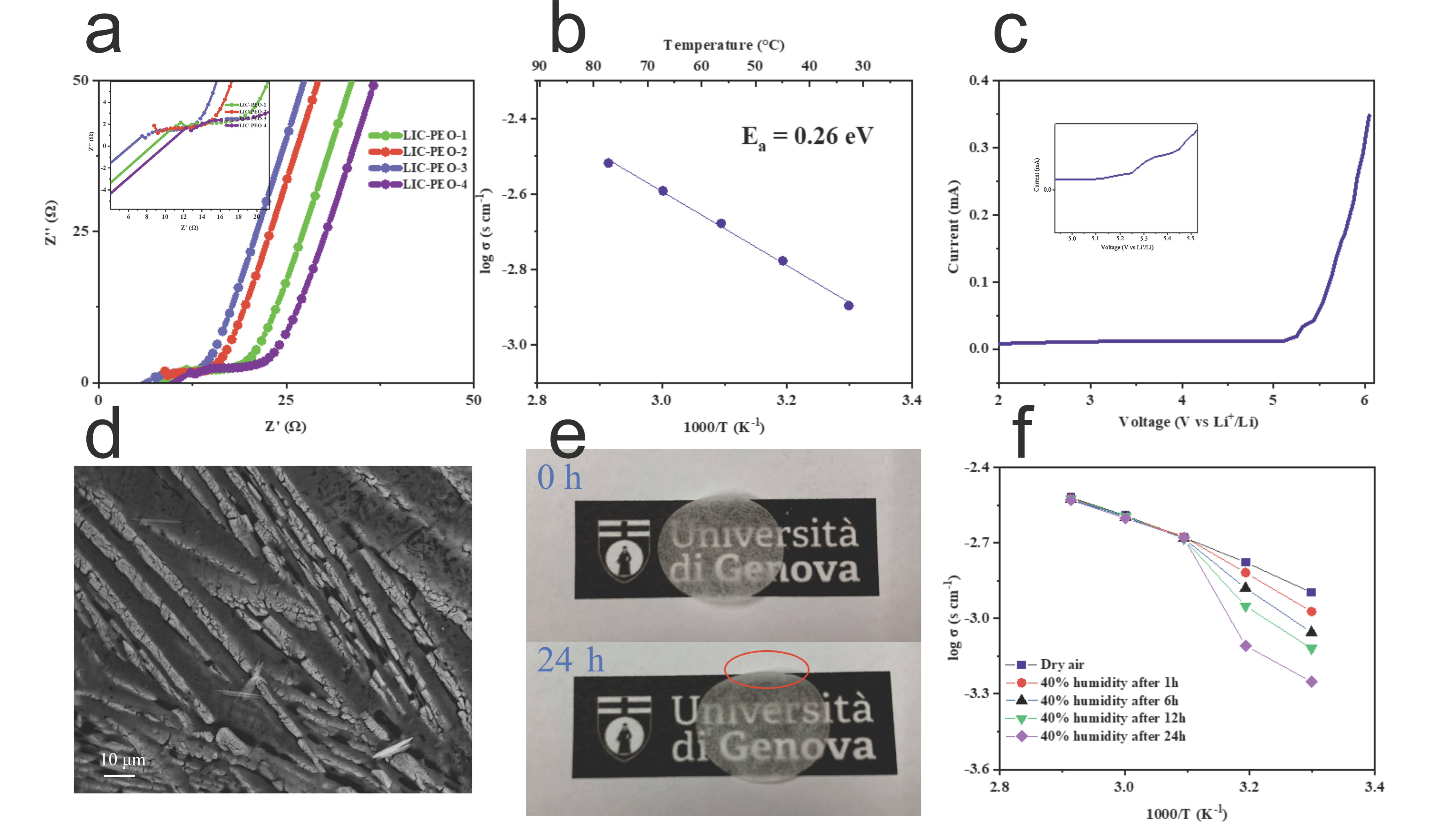
The ionic conductivity of the LIC–PEO composites was evaluated using SS|LIC–PEO|SS symmetric cells at 35 °C (Figure 2a). A non-monotonic composition dependence was observed: the resistance decreased from LIC–PEO–1 to LIC–PEO–3 and increased for LIC–PEO–4 (Figure 2a and Figure S5). This trend reflects a balance between the intrinsic high conductivity of the LIC phase and the effective ion-transport connectivity in a cast composite film measured under limited stack pressure.
For LIC–PEO–1 (10 wt% PEO), the polymer content was insufficient to form a compliant, continuous matrix that uniformly binds and separates LIC domains; as a result, particle agglomeration and voids, along with poorer interparticle and interfacial contact, can lead to higher apparent resistance in impedance measurements [27,28,29]. Increasing the PEO fraction to 20–30 wt% (LIC–PEO–2/3) improved film flexibility and contact compliance, enabling a more homogeneous dispersion of LIC and more effective ionic transport across LIC–PEO interfaces. Together with enhanced segmental motion in the polymer-rich interphase, this yielded a more continuous, low-resistance pathway for Li+ migration, resulting in the highest ionic conductivity for LIC–PEO–3 (1.19 mS cm−1 at 35 °C; Figure 2a and Figure S5) [30].
When the PEO fraction was further increased to 40 wt% (LIC–PEO–4), the composite became polymer-rich and the LIC fraction decreased; consequently, the continuity and percolation of fast LIC-based pathways are reduced, and overall transport becomes increasingly limited by the polymer phase, leading to a decrease in ionic conductivity. This optimum-composition behavior is consistent with the general understanding of inorganic–polymer composite electrolytes, where microstructural connectivity and mechanical compliance jointly govern the measured conductivity [31,32,33,34]. Compared with PEO SSEs reported in the past, the ionic conductivity of LIC-PEO-3 at low temperature was much higher [7,35,36,37], even exceeding that of some pure LIC (Table S1). LIC-PEO-3 had the best performance and was selected for further research. Unless otherwise stated, “LIC–PEO” hereafter refers to the optimized composition (LIC–PEO–3).
The variation of ionic conductivity with temperature was also studied. The ionic conductivity of LIC-PEO increased significantly at high temperatures due to the frequent movement of PEO segments in the amorphous state (Figure 2b). The activation energy (Ea) was calculated from the Arrhenius plot and Nyquist plots at different temperatures. The Ea of LIC-PEO was 0.26 eV. In previous reports, the Ea of LIC is usually between 0.27 and 0.38 eV [16,38,39,40]. The lower activation energy than that of LIC indicates that the Li+ migration barrier is reduced under the synergistic effect of an appropriate amount of PEO and lithium salt. In addition, tLi+ was tested by DC polarization and EIS before and after polarization. The results are shown in Figure S6, and the calculated tLi+ was 0.405, which was much higher than that of pure PEO SPE. The electrochemical stability window (ESW) of the electrolyte determines whether the electrolyte can be adapted to the high-voltage cathode. In the LSV test, the oxidation current of a typical PEO SPE electrolyte begins to increase significantly around 4.2 V due to violent oxidative decomposition [41,42]. LIC itself has a relatively wide ESW and has been shown to be compatible with most cathodes in previous studies [43]. From the LSV curve, when the potential is below 5.15 V, the current approaches 0. When the potential exceeds 5.15 V, the current begins to increase, indicating that LIC-PEO starts to decompose (Figure 2c). The ESW of LIC-PEO measured by LSV is almost 5.15 V. However, no conventional oxide cathode can achieve stable cycling at 5 V, and even LCO must be modified to operate at around 4.45 V. Therefore, the LIC-PEO ESW already meets the current research needs.
The microsurface morphology of LIC-PEO was then confirmed by SEM (Figure 2d). The white LIC in the SEM appeared mainly as rods, most of which were more than 50 μm in length. These rods were evenly distributed or partially embedded on the surface of the smooth gray PEO film and serve as a crucial component for efficient ion conduction. Higher-magnification images also showed the tight binding of LIC to PEO. The LIC inorganic phase tended to crystallize anisotropically under our solution-casting conditions, resulting in elongated rod-like particles. In particular, as the solvent evaporates, LIC recrystallization favors growth along specific crystallographic directions (consistent with its monoclinic crystal structure), yielding needle-shaped crystals. Additionally, the presence of PEO may moderate nucleation, but the inherent crystal habit of LIC leads to a predominantly rod-like morphology in the composite. EDX results prove that LIC not only exists as rods on the surface but is also evenly distributed inside the film, acting as part of the electrolyte filler and effectively improving internal ion conductivity (Figure S7). A small amount of PEO was also distributed within the rod-shaped LIC to maintain surface flexibility. Together, these factors enable LIC-PEO to exhibit high ionic conductivity at low pressure.
According to previous research, LIC readily absorbs moisture in humid environments to form corresponding hydrates, thereby reducing ionic conductivity and altering other properties. Therefore, we also studied the hygroscopicity of LIC-PEO. Given PEO’s high molecular weight and its encapsulation effects, after PEO absorbs moisture, a hydrogel layer forms at the interface or within pores. This gel layer can “pre-capture” moisture and slow subsequent moisture intrusion into the SSE film. The moisture resistance of LIC-PEO can be improved theoretically, and the presence of a small amount of PEO crystalline phase can also block moisture [44,45]. We placed LIC and LIC-PEO containing the exact weight of LIC in dry, 5%, and 40% humidity environments at room temperature. The weight changes of these samples were recorded using an electronic balance, and the ionic conductivity was measured after different exposure times. To facilitate observation of changes in transparency, a thinner LIC-PEO was prepared by controlling conditions, with a thickness of 43 μm (Figure S8). When exposed to a dry environment, the weight of LIC-PEO and LIC did not change; when exposed to a 5% humidity environment, the weight of LIC-PEO and LIC initially changed slightly; when exposed to a 40% humidity environment, the weight of LIC-PEO increased significantly in the first few minutes, but pure LIC in the same conditions increased its weight faster by absorbing more moisture (Figure S9). The trend in ionic conductivity was the same as that in mass. In dry and 5% humidity environments, ionic conductivity changed only slightly (±0.05 mS cm−1). Even at 40% relative humidity, the ionic conductivity decreased significantly; however, at the same exposure time, it remained higher than that of pristine LIC (Figure S10). The plot of Ea change with time is shown in Figure S11. After being exposed to 40% humidity for 24 h at room temperature, LIC-PEO showed slight stickiness, but the light transmittance and geometric shape did not change significantly, with only a slight upwarping at the edges (Figure 2e).
To investigate the effect of temperature on hygroscopicity, we measured the weight and ionic conductivity of LIC-PEO at different moisture levels (after exposure to the laboratory atmosphere for 1–24 h) and after further treatment of 1 h at various temperatures above RT (Figure 2f). When the temperature reached 55 °C, the moisture was removed entirely from LIC-PEO, as confirmed by the weight curve. The similar ionic conductivity observed after moisture removal indicates that the good ionic conduction structure of LIC-PEO was successfully restored after moisture removal.
The improved moisture resistance of LIC-PEO can be attributed to the formation of a dense network that wraps LIC, thereby essentially preventing moisture penetration. Therefore, moisture is easily removed by simple heating, and LIC-PEO can be restored to its original performance. In short, these results indicate that adding PEO improves the moisture resistance of LIC. The weight and ionic conductivity measurements together prove that LIC-PEO has better resistance to humid air than LIC.
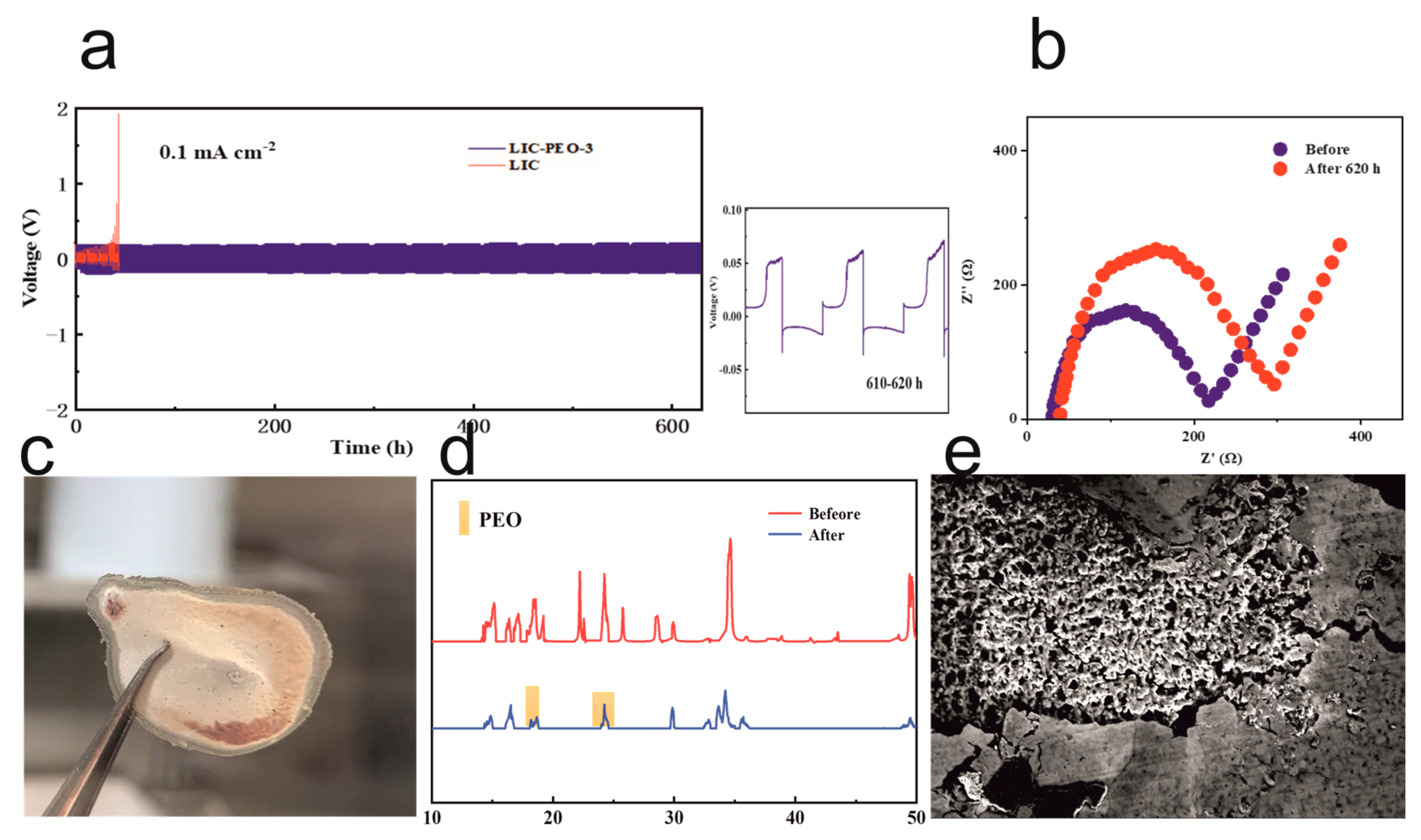
Given the importance of symmetrical Li-Li cells for SSE stability testing, symmetrical Li-Li cells were assembled for galvanostatic cycling testing to assess the cycling and lithium deposition stability of the LIC-PEO electrolyte compared with LIC symmetrical Li-Li cells [46]. Before testing, the resistances of the Li/LIC-PEO/Li and Li/LIC/Li cells were measured. Even under pressurized conditions, the resistance of LIC remained significantly higher than that of LIC-PEO, indicating that LIC-PEO has better interfacial wettability with lithium metal (Figure S12). As shown in Figure 3a, the Li/LIC-PEO/Li cell showed stable cycling over 620 h at a current density of 0.1 mA cm−2. In contrast, the overpotential of the Li/LIC/Li cell increased to 2 V in only 40 h. Meanwhile, the overpotential of the Li/LIC-PEO/Li cell increased from 0.025 V to 0.071 V. Figure 3b compares the EIS results before galvanostatic cycling and after 620 h of testing. As with the overpotential, the resistance gradually increased, but the curve’s contour did not change significantly, indicating interface deterioration due to regular Li plating/stripping. After 40 h of testing, analysis of the disassembled cell revealed that the LIC pellet had undergone a significant color change from white to purple-black and had become more brittle. Additionally, a thick interfacial layer formed on the surface, indicating a substantial interaction between LIC and lithium metal. Furthermore, trace amounts of oxygen, water, and other impurities were found to participate in the reaction (Figure S13) [47].
After the 620 h test, the LIC-PEO film showed only a thin, uneven red-purple interface layer at the edge and still maintained its pre-test state (Figure 3c). The side reaction between LIC and lithium metal was effectively suppressed after the addition of PEO. Because the color of the LIC-PEO film changed after testing the symmetrical cell, XRD was performed again (Figure 3d). The results showed that some characteristic peaks representing LIC and PEO remained. PEO crystal peaks were assigned at 19.0° ((120) plane) and 23.4° ((112) plane). Strong characteristic peaks at 13.5°, 29.5°, and 34.2°, etc., can be attributed to LIC. However, the overall pattern changes were more pronounced, indicating that although LIC-PEO can greatly slow the occurrence of side reactions compared with LIC, interface degradation is inevitable, especially during repeated intercalation and de-intercalation cycles of Li+. Some characteristic peaks with lower intensity disappeared. This may be because amorphous byproducts produced during the operation of lithium metal and LIC-PEO increased the background noise, making it impossible to distinguish the characteristic peaks with low intensity [48]. The detailed image shows that the characteristic peaks of PEO only changed in intensity (Figure S14). To evaluate the structural evolution of LIC-PEO after Li|LIC-PEO|Li cycling, we compared the XRD pattern of the cycled electrolyte with that of a pristine replicate specimen prepared from the same batch. In contrast to Figure 1d,e, which shows full-range patterns to compare multiple compositions, Figure 3d presents only the 15–20° (2θ) window because this low-angle region is the most sensitive for assessing characteristic changes upon cycling, and a magnified view improves visual contrast. After testing, the main body of LIC-PEO still appeared as a gray, smooth film under SEM. The damaged part was PEO erosion caused by the high-energy electron beam, and no penetration traces caused by lithium dendrites were found. After manually tearing apart part of the surface interface, the dense three-dimensional structure of LIC could be seen (Figure 3e).
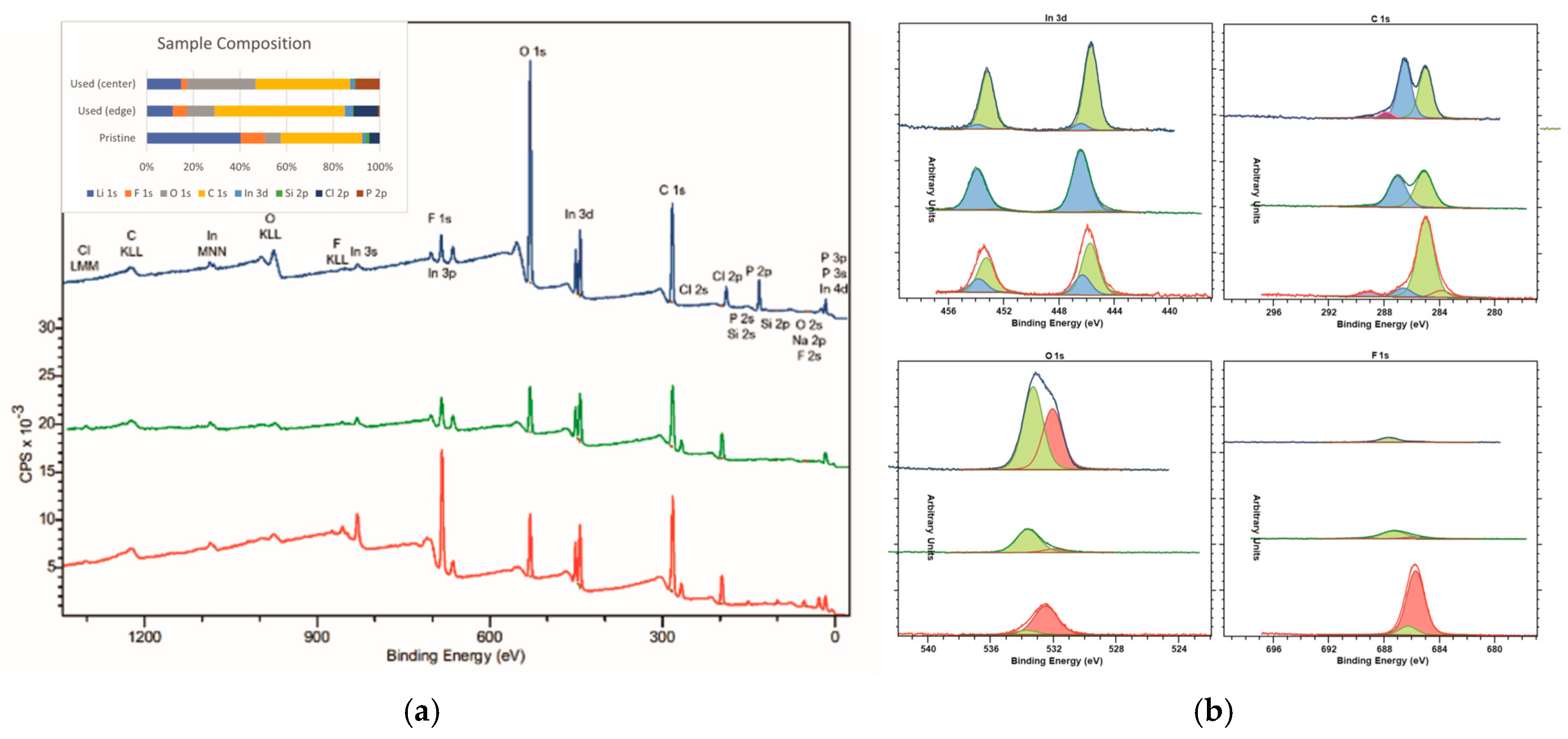
To further verify the changes in the composition of the pristine and used LIC-PEO samples b, we also performed XPS analysis on both samples. The spectra were aligned on the main carbon component of the PE/PP membrane (El-Cell FS-5P separator membrane), C-C at 285.0 eV [49,50]. Considering that LIC-PEO is in the form of a film, the composition uniformity of different parts of the pristine sample film was first verified. As shown in Figure S15, the XPS spectra measured at various sampling points were very similar, and further element concentration analysis also proves the uniformity of the pristine sample.
For the used samples, because the center and edge parts showed a significant color difference, these two parts were also sampled and measured separately. We then compared the pristine sample (red), the used sample near the edge area (green), and the used sample in the center area (blue) (Figure 4a). The two used samples were more similar to each other than to the pristine sample. The main difference between the pristine sample and the used samples was a decrease in lithium from 40% to about 13%. The ratio of lithium to indium was about 26 in the pristine sample. The used (edge) sample had less lithium than the used (center) sample. The pristine sample also contained a larger amount of fluorine than the used samples. The main differences between the two sampled areas in the used sample were phosphorus and oxygen, which were present in larger amounts in the central area. Silicon was present in the pristine sample and was reduced or absent in the used samples. Small quantities of Si can be considered as introduced impurities.
Further analysis of the characteristic peaks for each element, as shown in Figure 4b, indicates that indium is predominantly in the In3+ state (green component), which may be associated with the presence of In2O3 and Li3O4 (supported by the oxygen components) but is also compatible with compounds like LixIn1−xO3 [51]. A secondary component associated with the LiCl3 phase was present in both the pristine and used (center) samples [52,53]. This is consistent with the higher relative chlorine content in this sample. A small component at lower binding energy corresponded to indium in the metallic (0) state and was barely detectable.
The central carbon component (green) at 285.0 eV was due to the C-C bond in the PE/PP membrane (El-Cell FS-5P). A small component at lower binding energy (283.8 eV, red) may be due to adventitious carbon or metallic carbides. Additional components appeared at higher binding energy and can be assigned to C-OH, C-O, and PEO (286.6 eV, light blue); C=O/O-C-O and O=C-O (288 eV); and O=C-O (289.1 eV, purple). Oxygen contained at least two different species, one centered around 532.4 eV associated with O/CO3/O-C=O and one centered around 533.6 eV, which may be due to C-O/O-C=O. All of these can be attributed to PEO and to the products after the reaction [54]. The main fluorine component (red) in the pristine sample was centered at 685.7 eV and was due to LiF. Additional components at higher binding energies (686.2–686.8, green) were due to LiPF6 and various dissociation compounds, LixPFyOz. The appearance of oxygen-containing compounds was due to side reactions between LiPF6 and components such as PEO.
In summary, the reduction in lithium content indicates that lithium dendrite deposition is not severe. There is also the possibility that a certain amount of ions is lost during sample stripping. The color difference at the center of the used sample can be attributed to enrichment in oxygen and phosphorus and to their reactions with lithium. Changes in the composition of phosphorus and oxygen support this. XPS results demonstrate that the element distribution and binding energies change to some extent before and after use. Although the side reaction between LIC-PEO and lithium metal is inevitable, it can be suppressed over long-term operation, and the performance far exceeds that of pure LIC.

3.3. Characterization of Electrochemical Performance of LIC-PEO

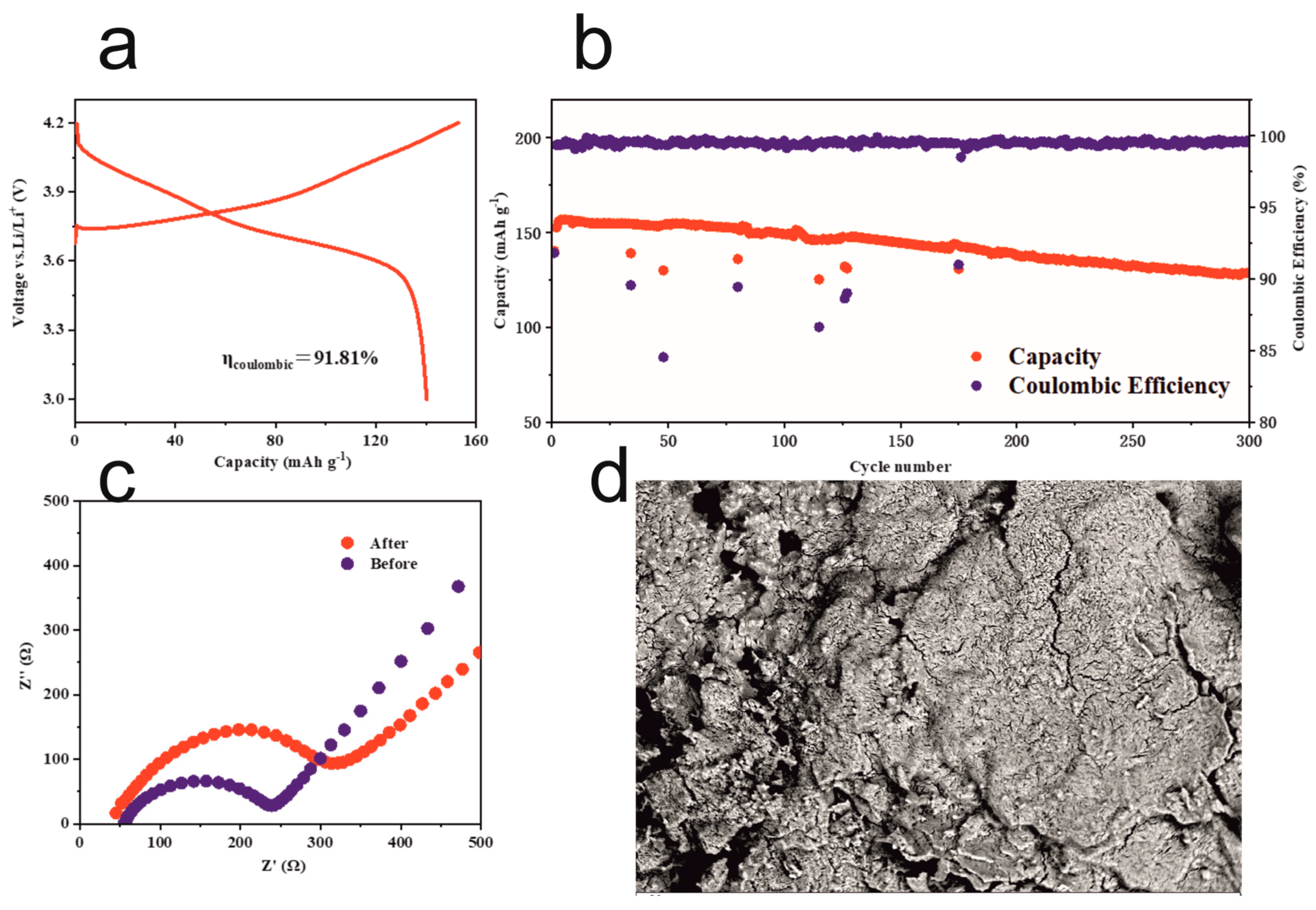
The electrochemical performance of LIC-PEO ASSB was also verified in the experiments. The cyclic charge and discharge results under different currents are also important indicators of SSE performance. Therefore, ASSBs with LIC-PEO as the electrolyte were prepared using a lithium-foil anode and a composite NCM 111 cathode. The cells are termed Li/LIC-PEO/NCM. The electrochemical performance was evaluated at 35 °C and 0.2 C. The Coulombic efficiency of the first cycle was 91.81%, and after the first cycle, it was always over 99%, except for some unusual cycles (Figure 5a). After activation, the cell exhibited a specific discharge capacity of 152. 7 mAh g−1 and delivered a specific discharge capacity of 128. 6 mAh g−1 for 300 cycles, with a capacity retention of 84.2% (Figure 5b). The overcharging reflects kinetic limitations from initial interface imperfections, not material instability. The slightly higher charge capacity observed in the initial cycles is likely related to interfacial polarization and incomplete contact in the assembled state. The profiles gradually stabilized after several cycles, consistent with improved interfacial wetting/compaction during cycling. The EIS curves before and after cycling are shown in the figure. The bulk resistance in the high- frequency region decreased slightly after cycling. This can be attributed to cycling activating the PEO polymer chain and opening additional ion channels. The interface resistance in the low- frequency region gradually increased. On the one hand, this is due to the continuous deterioration of the interface during cycling. On the other hand, it may be due to the generation of a small amount of SEI. The overall resistance of LIC-PEO increased after cycling (Figure 5c). The LIC-PEO film after the 0.2 C cycle still appeared relatively smooth under SEM. However, after increasing the magnification, some noticeable cracks could be found in the dense LIC structure. At higher magnification, microcracks could be observed within some LIC domains (Figure 5d). Such cracking may interrupt local ion-transport pathways and increase resistance, which is consistent with the gradual capacity fade during long-term cycling.
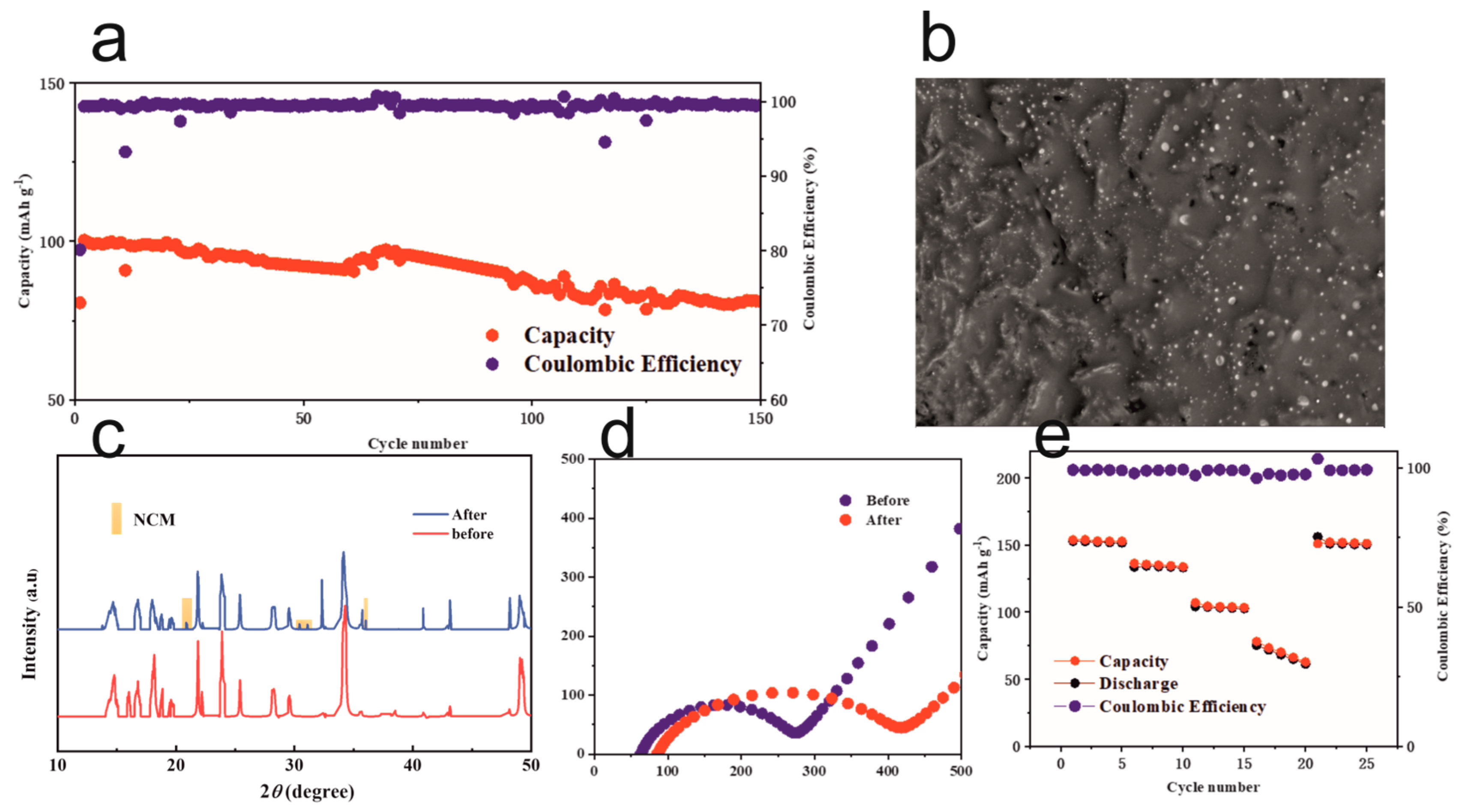
The Li/LIC-PEO/NCM cells could also stably cycle at 1.2 C. The Coulombic efficiency of the first cycle was 78.97% (Figure S16). After activation, the cell exhibited a specific discharge capacity of 100.4 mAh g−1 and delivered a stable specific capacity of 81.4 mAh g−1 over 150 cycles, with a capacity retention of 81.1% (Figure 6a). Higher current densities are always a challenge for ASSBs, as lithium dendrites are more easily generated and can grow on a three-dimensional scale until a short circuit occurs. Therefore, SSEs that also act as separators must resist dendrite penetration and inhibit their growth. After the cyclic test, the cell was disassembled, and the LIC-PEO film was peeled off. Under optical microscopy, the film’s flexibility was reduced, the main part remained white, and some areas showed silver and gray spots (Figure 6b). The surface exhibited relative roughness due to prolonged high-current cycling, during which a portion of the lithium was unevenly deposited on the film surface in the form of dendrites. Despite this, LIC-PEO maintained a capacity retention of over 80% after 150 cycles at a current rate of 1.2 C, with no occurrence of short circuits or sudden capacity degradation. The decrease in Coulombic efficiency at 1.2 C was the result of the combined effects of interface degradation and lithium dendrite growth. Interface degradation leads to continuous consumption of active lithium, which hinders ion transport and increases impedance; lithium dendrites lead to the accumulation of dead lithium and a short-circuit risk; and dead lithium and lithium consumed by side reactions cannot be recovered during discharge. Notably, previous studies on LIC-based solid-state electrolytes have not achieved comparable performance under 1.2 C cycling conditions, further demonstrating the exceptional cycling stability of Li/LIC-PEO/NCM cells at high C-rates. This indicates that PEO presence reduces lithium dendrite penetration into the SSE film. Although lithium dendrites continued to grow, the LIC-PEO film remained soft and sufficiently tough, and the overall cell structure remained stable and continued to conduct ions well. Although LIC itself is very hard and seems to resist penetration, past studies have shown that tiny pores can also allow lithium dendrites to pass, and the flexibility of PEO will enable it to cover the surface of LIC and minimize the presence of pores [55,56]. In addition, since the layers were in very close contact after testing, some surface damage occurred during separation, which also increased the film’s surface roughness. XRD measurements were performed on the LIC-PEO film before and after 1.2 C cycling (Figure 6c). The results show that most of the characteristic peaks representing LIC and PEO in the XRD pattern after cycling still existed, with only the intensities changing. Among them, the favorable (131) plane still dominated. The peak width of the characteristic peak representing PEO had not changed significantly compared with before cycling, and the peak intensity only slightly decreased. Some new weak peaks could be confirmed as NCM, which may arise from a small amount of powder falling off the cathode during cycling; this can be reduced by improving the coating process in the future. The XRD results suggest that the main crystalline features of LIC and PEO are retained after cycling, with no new dominant crystalline phases detected within the XRD detection limit.
We also detected changes in the EIS curve before and after 1.2 C cycling. These changes were similar to those observed after 0.2 C cycling (Figure 6d). A minor but notable change was the increase in the ohmic resistance (Rs) in the high-frequency region after cycling. This may reflect a failure to achieve the expected electrode activation at high current density, which may have exacerbated interfacial degradation. Consequently, progressive cell deterioration during cycling likely contributed to the overall rise in both Rs and charge transfer resistance (Rct), as reflected in the enlarged semicircle and upward shift of the entire Nyquist curve. However, due to the good stability of LIC-PEO, it still performed well under high current. Compared with the LIC-PEO film after the 0.2 C cycle, the film after the 1.2 C cycle had higher tortuosity and more lithium deposition, which can be attributed to the higher charge and discharge rates at high current density, which generate more lithium dendrites. In addition, the expansion and contraction of each component were accelerated, and the film thus became curved, making it more adaptable to rapid volume changes during expansion.
Furthermore, more rate performance measurements were conducted. The reversible specific discharge capacities were 152.9, 135.1, 105.2, and 75.3 mAh g−1 at 0.2 C, 0.5 C, 1 C, and 2 C, respectively (Figure 6e). The cell still delivered a high specific discharge capacity of 151.2 mAh g−1 when the discharge rate was reset to 0.2 C. This demonstrates excellent rate performance. It can maintain about 50% of its maximum capacity at 2 C and fully restore it when reset to 0.2 C. This indicates that the various components of the cell have intimate interfacial contact and a large number of conduction channels that assist ion migration at high current densities.

4. Conclusions

A new composite SSE containing LIC and PEO was prepared by a simple slurry-casting method. Among them, PEO provides good support, with LIC evenly distributed on the surface and a certain amount distributed inside, forming a good ion-transfer network and effectively improving performance. Subsequently, a series of tests was carried out on SSE films with different component contents to determine the optimal ratio. The best LIC-PEO SSE exhibited an ionic conductivity of 1.19 mS cm−1 at 35 °C, tLi+ of 0.405, and an electrochemical stability window of more than 5 V, which was better than most SPEs at this temperature. Due to its flexibility, it can operate without intense external pressure, and its moisture resistance and the stability of the metal anode were greatly improved compared with LIC. It can work stably for more than 620 h in Li-Li symmetrical cell tests. At 35 °C, the cell showed a capacity retention of 84.2% after 300 cycles at 0.2 C, as demonstrated by galvanostatic cycling. XRD/XPS provide complementary insights into the structural integrity and interfacial chemistry after cycling. It also shows good cycle stability at 1.2 C, with a capacity retention of 80.6% after 150 cycles. At a current density of 2 C, it could maintain 50% of the maximum specific capacity. In summary, the LIC-PEO composite SSE performed well, but there is still much room for improvement in performance, cost, etc. Therefore, this study has significant guidance for the design of practical ASSEs.

Supplementary Materials

The following supporting information can be downloaded at: https://www.mdpi.com/article/10.3390/batteries12010021/s1, Figure S1. Structure of test bench setup for ionic conductivity; Figure S2. Image of test bench setup for LIC; Figure S3. Crystal structure of standard LIC in the database of Materials Project; Figure S4. Partial enlargement of XRD pattern; Figure S5. Comparison of ionic conductivity between LIC and LIC-PEO-3 and 10 sample measurement results with standard error; Figure S6. Li+ transference number measurement of the LIC-PEO; Figure S7. EDX of LIC-PEO; Figure S8. Measuring LIC-PEO thickness by electronic caliper; Figure S9. Measuring LIC-PEO thickness by electronic caliper; Figure S10. Plots of ionic conductivity as a function of exposure time and humidity; Figure S11. The plot of Ea with time; Figure S12. EIS plots of LIC and LIC-PEO in Li-Li symmetrical cell; Figure S13. Digital photos of LIC pellet before and after testing; Figure S14. Partial enlargement of XRD pattern; Figure S15. Overall XPS spectrum of LIC-PEO pristine sample as a homogeneity check; Figure S16. Plot of the first charge and discharge cycle and CE. Table S1. The comparison of Ionic conductivity of different LIC electrolytes from representative works [16,21,39,57,58,59,60].

Author Contributions

Conceptualization, H.-X.M. and P.P.; methodology, H.-X.M.; validation, P.P., R.S.; investigation, H.-X.M. and P.P.; resources, H.-X.M., P.P. and R.S.; data curation, H.-X.M.; writing—original draft preparation, H.-X.M.; writing—review and editing, P.P. and R.S.; project administration, funding acquisition, P.P. All authors have read and agreed to the published version of the manuscript.

Funding

This project was supported by research cooperation with Phase Motion Control S.p.A. (Genoa, Italy).

Data Availability Statement

The original contributions presented in the study are included in the article, further inquiries can be directed to the corresponding author.

Conflicts of Interest

The authors declare that this study received funding from Phase Motion Control S.p.A. The funder was not involved in the study design, collection, analysis, interpretation of data, the writing of this article or the decision to submit it for publication.

References

  1. Lim, H.-D.; Park, J.-H.; Shin, H.-J.; Jeong, J.; Kim, J.-T.; Nam, K.-W.; Jung, H.-G.; Chung, K.-Y. A review of challenges and issues concerning interfaces for all-solid-state batteries. Energy Storage Mater. 2020, 25, 224–250. [Google Scholar] [CrossRef]
  2. Tan, D.H.; Banerjee, A.; Chen, Z.; Meng, Y.-S. From nanoscale interface characterization to sustainable energy storage using all-solid-state batteries. Nat. Nanotechnol. 2020, 15, 170–180. [Google Scholar] [CrossRef]
  3. Albertus, P.; Anandan, V.; Ban, C.; Balsara, N.; Belharouak, I.; Buettner-Garrett, J.; Chen, Z.; Daniel, C.; Doeff, M.; Dudney, N.; et al. Challenges for and pathways toward Li-metal-based all-solid-state batteries. ACS Energy Lett. 2021, 6(4), 1399–1404. [Google Scholar] [CrossRef]
  4. Nair, J.R.; Imholt, L.; Brunklaus, G.; Winter, M. Lithium metal polymer electrolyte batteries: Opportunities and challenges. Electrochem. Soc. Interface 2019, 28, 55. [Google Scholar] [CrossRef]
  5. Barai, P.; Higa, K.; Srinivasan, V. Lithium dendrite growth mechanisms in polymer electrolytes and prevention strategies. Phys. Chem. Chem. Phys. 2017, 19, 20493–20505. [Google Scholar] [CrossRef]
  6. Fan, Q.; Zhang, W.; Jin, Y.; Zhang, D.; Meng, X.; Peng, W.; Wang, J.; Mo, J.; Liu, K.; Liu, L.; et al. In-situ construction of Li-Ag/LiF composite layer for long cycled all-solid-state Li metal battery. Chem. Eng. J. 2023, 477, 147179. [Google Scholar] [CrossRef]
  7. Quartarone, E.; Mustarelli, P.; Magistris, A. PEO-based composite polymer electrolytes. Solid State Ion. 1998, 110, 1–14. [Google Scholar] [CrossRef]
  8. Liu, L.; Xu, R.; Tu, J.; Zhou, R.; Mo, J.; Yang, T.; Zhao, Q.; Zhang, M.; Zhang, D.; Li, M.; et al. Thin Polymer Electrolytes with 3D Nanofiber Skeletons Enabling High-Performance Solid-State Lithium Metal Batteries. J. Phys. Chem. C 2025, 129, 6138–6147. [Google Scholar] [CrossRef]
  9. Zhang, D.; Meng, X.; Zhang, W.; Mo, J.; Zhao, Q.; Wang, B.; Fan, Q.; Liu, L.; Yang, T.; Jin, Y.; et al. A Thin and Ultrahigh-Ionic-Conductivity Composite Electrolyte With 3D Aramid Nanofiber Networks Toward Ambient-Temperature Lithium Metal Batteries. Adv. Energy Mater. 2025, 15, 2403565. [Google Scholar] [CrossRef]
  10. Liu, L.; Mo, J.; Zhou, R.; Yang, T.; Xu, R.; Tu, J.; Zhao, Q.; Zhang, M.; Zhang, D.; Wang, B.; et al. Ultrathin solid composite electrolytes for long-life lithium metal batteries. J. Energy Storage 2025, 114, 115777. [Google Scholar] [CrossRef]
  11. Liu, L.; Zhang, D.; Yang, T.; Hu, W.; Meng, X.; Mo, J.; Hou, W.; Fan, Q.; Liu, K.; Jiang, B.; et al. Flexible ion-conducting membranes with 3D continuous nanohybrid networks for high-performance solid-state metallic lithium batteries. J. Energy Chem. 2022, 75, 360–368. [Google Scholar]
  12. Liu, L.; Lyu, J.; Mo, J.; Yan, H.; Xu, L.; Peng, P.; Li, J.; Jiang, B.; Chu, L.; Li, M. Comprehensively-upgraded polymer electrolytes by multifunctional aramid nanofibers for stable all-solid-state Li-ion batteries. Nano Energy 2020, 69, 104398. [Google Scholar]
  13. Asano, T.; Sakai, A.; Ouchi, S.; Sakaida, M.; Miyazaki, A.; Hasegawa, S. Solid halide electrolytes with high lithium-ion conductivity for application in 4 V class bulk-type all-solid-state batteries. Adv. Mater. 2018, 30, 1803075. [Google Scholar] [CrossRef] [PubMed]
  14. Mei, H.-X.; Piccardo, P.; Cingolani, A.; Spotorno, R. Unconventional solid-state electrolytes for lithium-based batteries: Recent advances and challenges. J. Power Sources 2023, 553, 232257. [Google Scholar] [CrossRef]
  15. Mei, H.-X.; Piccardo, P.; Carraro, G.; Smerieri, M.; Spotorno, R. Thin-film Li3InCl6 electrolyte prepared by solution casting method for all-solid-state batteries. J. Energy Storage 2023, 72, 108244. [Google Scholar]
  16. Li, X.; Liang, J.; Luo, J.; Banis, M.; Wang, C.; Li, W.; Deng, S.; Yu, C.; Zhao, F.; Hu, Y.; et al. Air-stable Li3InCl6 electrolyte with high voltage compatibility for all-solid-state batteries. Energy Environ. Sci. 2019, 12, 2665–2671. [Google Scholar] [CrossRef]
  17. Bruce, P.G.; Evans, J.; Vincent, C.A. Conductivity and transference number measurements on polymer electrolytes. Solid State Ion. 1988, 28, 918–922. [Google Scholar]
  18. Elashmawi, I. Effect of LiCl filler on the structure and morphology of PVDF films. Mater. Chem. Phys. 2008, 107, 96–100. [Google Scholar] [CrossRef]
  19. Yang, S.; Liu, Z.; Liu, Y.; Jian, Y. Effect of molecular weight on conformational changes of PEO: An infrared spectroscopic analysis. J. Mater. Sci. 2015, 50, 1544–1552. [Google Scholar]
  20. Epp, J. X-ray diffraction (XRD) techniques for materials characterization. In Materials Characterization Using Nondestructive Evaluation (NDE) Methods; Elsevier: Amsterdam, The Netherlands, 2016; pp. 81–124. [Google Scholar]
  21. Luo, X.; Cai, D.; Wang, X.; Xia, X.; Gu, C.; Tu, J. A novel ethanol-mediated synthesis of superionic halide electrolytes for high-voltage all-solid-state lithium–metal batteries. ACS Appl. Mater. Interfaces 2022, 14, 29844–29855. [Google Scholar] [CrossRef]
  22. Pillai, A.M.; Ghosh, R.; Dey, A.; Prajwal, K.; Rajendra, A.; Sharma, A.K.; Sampath, S. Crystalline and amorphous PEO based ceramic coatings on AA6061: Nanoindentation and corrosion studies. Ceram. Int. 2021, 47, 14707–14716. [Google Scholar] [CrossRef]
  23. Appetecchi, G.; Henderson, W.; Villano, P.; Berrettoni, M.; Passerini, S. PEO-LiN(SO2CF2CF3)2 Polymer Electrolytes: I. XRD, DSC, and Ionic Conductivity Characterization. J. Electrochem. Soc. 2001, 148, A1171. [Google Scholar] [CrossRef]
  24. Muhammed, D.S.; Brza, M.A.; Nofal, M.M.; Aziz, S.B.; Hussen, S.A.; Abdulwahid, R.T. Optical dielectric loss as a novel approach to spinecify the types of electron transition: XRD and UV-vis as a non-destructive techniques for structural and optical characterization of PEO based nanocomposites. Materials 2020, 13, 2979. [Google Scholar] [CrossRef]
  25. Xue, S.; Teeters, D.; Crunkleton, D.W.; Wang, S. Ab initio calculations for crystalline PEO6: LiPF6 polymer electrolytes. Comput. Mater. Sci. 2019, 160, 173–179. [Google Scholar] [CrossRef]
  26. Wang, C.; Yang, Y.; Liu, X.; Zhong, H.; Xu, H.; Xu, Z.; Shao, H.; Ding, F. Suppression of lithium dendrite formation by using LAGP-PEO (LiTFSI) composite solid electrolyte and lithium metal anode modified by PEO (LiTFSI) in all-solid-state lithium batteries. ACS Appl. Mater. Interfaces 2017, 9, 13694–13702. [Google Scholar]
  27. Zagórski, J.; del Amo, J.M.L.; Cordill, M.J.; Aguesse, F.; Buannic, L.; Llordes, A. Garnet–polymer composite electrolytes: New insights on local Li-ion dynamics and electrodeposition stability with Li metal anodes. ACS Appl. Energy Mater. 2019, 2, 1734–1746. [Google Scholar] [CrossRef]
  28. Zhou, D.; Zhang, M.; Sun, F.; Arlt, T.; Frerichs, J.; Dong, K.; Wang, J.; Hilger, A.; Wilde, F.; Kolek, M. Performance and behavior of LLZO-based composite polymer electrolyte for lithium metal electrode with high capacity utilization. Nano Energy 2020, 77, 105196. [Google Scholar] [CrossRef]
  29. Zhu, L.; Zhu, P.; Fang, Q.; Jing, M.; Shen, X.; Yang, L. A novel solid PEO/LLTO-nanowires polymer composite electrolyte for solid-state lithium-ion battery. Electrochim. Acta 2018, 292, 718–726. [Google Scholar] [CrossRef]
  30. Guo, Q.; Han, Y.; Wang, H.; Xiong, S.; Sun, W.; Zheng, C.; Xie, K. Flame retardant and stable Li1.5Al0.5Ge1.5(PO4)3-supported ionic liquid gel polymer electrolytes for high safety rechargeable solid-state lithium metal batteries. J. Phys. Chem. C 2018, 122, 10334–10342. [Google Scholar] [CrossRef]
  31. Ding, W.-Q.; Lv, F.; Xu, N.; Wu, M.T.; Liu, J.; Gao, X.P. Polyethylene oxide-based solid-state composite polymer electrolytes for rechargeable lithium batteries. ACS Appl. Energy Mater. 2021, 4, 4581–4601. [Google Scholar] [CrossRef]
  32. Duan, T.; Cheng, H.; Liu, Y.; Sun, Q.; Nie, W.; Lu, X.; Dong, P.; Song, M.K. A multifunctional Janus layer for LLZTO/PEO composite electrolyte with enhanced interfacial stability in solid-state lithium metal batteries. Energy Storage Mater. 2024, 65, 103091. [Google Scholar] [CrossRef]
  33. Xu, H.; Huang, S.; Qian, J.; Liu, S.; Li, L.; Zhao, X.; Zhang, W. Safe solid-state PEO/TPU/LLZO nano network polymer composite gel electrolyte for solid state lithium batteries. Colloids Surf. A Physicochem. Eng. Asp. 2022, 653, 130040. [Google Scholar]
  34. Su, Y.; Zhang, X.; Du, C.; Yang, L.; Chen, J.; Yan, J.; Zhu, D.; Geng, L.; Liu, S.; Zhao, J.; et al. An All-Solid-State Battery Based on Sulfide and PEO Composite Electrolyte. Small 2022, 18, 2202069. [Google Scholar]
  35. Gorecki, W.; Jeannin, M.; Belorizky, E.; Roux, C.; Armand, M. Physical properties of solid polymer electrolyte PEO (LiTFSI) complexes. J. Phys. Condens. Matter 1995, 7, 6823. [Google Scholar]
  36. Przyłuski, J.; Such, K.; Wyciślik, H.; Wieczorek, W.; Floriańczyk, Z. PEO-based polymer blends as materials for solid electrolytes. Synth. Met. 1990, 35, 241–247. [Google Scholar] [CrossRef]
  37. Reddy, M.J.; Kumar, J.S.; Rao, U.S.; Chu, P.P. Structural and ionic conductivity of PEO blend PEG solid polymer electrolyte. Solid State Ion. 2006, 177, 253–256. [Google Scholar] [CrossRef]
  38. Li, W.; Quirk, J.A.; Li, M.; Xia, W.; Morgan, L.M.; Yin, W.; Zheng, M.; Gallington, C.L.; Ren, Y.; Zhu, N.; et al. Precise Tailoring of Lithium-Ion Transport for Ultra-long-cycling Dendrite-free All-Solid-State Lithium Metal Batteries. Adv. Mater. 2023, 36, 2302647. [Google Scholar] [CrossRef]
  39. Deng, Z.; Jin, Z.; Chen, D.; Tian, M.; Zhan, Y.; Li, S.; Sun, Y.; Huang, X.; Zhao, Y. Bilayer halide electrolytes for all-inorganic solid-state lithium-metal batteries with excellent interfacial compatibility. ACS Appl. Mater. Interfaces 2022, 14, 48619–48626. [Google Scholar]
  40. Hussain, F.; Zhu, J.; Xia, H.; Zhao, Y.; Xia, W. Theoretical Insights on the Comparison of Li-Ion Conductivity in Halide Superionic Conductors Li3MCl6, Li2M2/3Cl4, and LiMCl4 (M = Y, Sc, Al, and Sm). J. Phys. Chem. C 2022, 126, 13105–13113. [Google Scholar]
  41. Wu, X.; Whitacre, J.F. Reevaluating the stability of the PEO-based solid-state electrolytes for high voltage solid-state batteries. J. Energy Storage 2023, 63, 107052. [Google Scholar] [CrossRef]
  42. Zhang, Y.; Feng, W.; Zhen, Y.; Zhao, P.; Wang, X.; Li, L. Effects of lithium salts on PEO-based solid polymer electrolytes and their all-solid-state lithium-ion batteries. Ionics 2022, 28, 2751–2758. [Google Scholar] [CrossRef]
  43. Wang, S.; Bai, Q.; Nolan, A.M.; Liu, Y.; Gong, S.; Sun, Q.; Mo, Y. Lithium chlorides and bromides as promising solid-state chemistries for fast ion conductors with good electrochemical stability. Angew. Chem. Int. Ed. 2019, 58, 8039–8043. [Google Scholar] [CrossRef]
  44. Fisher, S.G.; Chiang, H.-C.; Iverson, E.T.; Chang, E.; Grunlan, J.C. Hydrogen bonded polymer complex thin films for highly stretchable gas barriers. RSC Appl. Polym. 2024, 2, 356–364. [Google Scholar] [CrossRef]
  45. Idígoras, J.; Aparicio, F.J.; Contreras-Bernal, L.; Ramos-Terrón, S.; Alcaire, M.; Sánchez-Valencia, M.; Borras, A.; Barranco, A.; Anta, J. Enhancing moisture and water resistance in perovskite solar cells by encapsulation with ultrathin plasma polymers. ACS Appl. Mater. Interfaces 2018, 10, 11587–11594. [Google Scholar] [CrossRef] [PubMed]
  46. Nölle, R.; Beltrop, K.; Holtstiege, F.; Kasnatscheew, J.; Placke, T.; Winter, M. A reality check and tutorial on electrochemical characterization of battery cell materials: How to choose the appropriate cell setup. Mater. Today 2020, 32, 131–146. [Google Scholar] [CrossRef]
  47. Riegger, L.M.; Schlem, R.; Sann, J.; Zeier, W.G.; Janek, J. Lithium-metal anode instability of the superionic halide solid electrolytes and the implications for solid-state batteries. Angew. Chem. Int. Ed. 2021, 60, 6718–6723. [Google Scholar] [CrossRef]
  48. Geise, N.R.; Kasse, R.M.; Nelson Weker, J.; Steinruck, H.G.; Toney, M.F. Quantification of efficiency in lithium metal negative electrodes via operando X-ray diffraction. Chem. Mater. 2021, 33, 7537–7545. [Google Scholar] [CrossRef]
  49. Martin, L.; Martinez, H.; Poinot, D.; Pecquenard, B.; Cras, F. Comprehensive X-ray photoelectron spectroscopy study of the conversion reaction mechanism of CuO in lithiated thin film electrodes. J. Phys. Chem. C 2013, 117, 4421–4430. [Google Scholar] [CrossRef]
  50. Rjeb, A.; Letarte, S.; Tajounte, L.; Chafik El Idrissi, M.; Adnot, A.; Roy, D.; Claire, Y.; Kaloustian, J. Polypropylene natural aging studied by X-ray photoelectron spectroscopy. J. Electron Spectrosc. Relat. Phenom. 2000, 107, 221–230. [Google Scholar] [CrossRef]
  51. Shi, L.; Xu, A.; Zhao, T. Formation of Li3O4 nano particles in the discharge products of non-aqueous lithium–oxygen batteries leads to lower charge overvoltage. Phys. Chem. Chem. Phys. 2015, 17, 29859–29866. [Google Scholar] [CrossRef]
  52. Goodall, R.E.; Parackal, A.S.; Faber, F.A.; Armiento, R.; Lee, A. Rapid discovery of stable materials by coordinate-free coarse graining. Sci. Adv. 2022, 8, eabn4117. [Google Scholar] [CrossRef]
  53. Wang, H.-C.; Botti, S.; Marques, M.A. Predicting stable crystalline compounds using chemical similarity. npj Comput. Mater. 2021, 7, 12. [Google Scholar] [CrossRef]
  54. Tatara, R.; Karayaylali, P.; Yu, Y.; Zhang, Y.; Giordano, L.; Maglia, F.; Jung, R.; Schmidt, J.; Lund, I.; Yang, S. The effect of electrode-electrolyte interface on the electrochemical impedance spectra for positive electrode in Li-ion battery. J. Electrochem. Soc. 2019, 166, A5090–A5098. [Google Scholar] [CrossRef]
  55. Cao, D.; Sun, X.; Li, Q.; Natan, A.; Xiang, P.; Zhu, H. Lithium dendrite in all-solid-state batteries: Growth mechanisms, suppression strategies, and characterizations. Matter 2020, 3, 57–94. [Google Scholar] [CrossRef]
  56. Ji, X.; Hou, S.; Wang, P.; He, X.; Piao, N.; Chen, J.; Fan, X.; Wang, C. Solid-state electrolyte design for lithium dendrite suppression. Adv. Mater. 2020, 32, 2002741. [Google Scholar]
  57. Wang, K.; Ye, Q.; Zhang, J.; Huang, H.; Gan, Y.; He, X.; Zhang, W. Halide electrolyte Li3InCl6-based all-solid-state lithium batteries with slurry-coated LiNi0.8Co0.1Mn0.1O2 composite cathode: Effect of binders. Front. Mater. 2021, 8, 727617. [Google Scholar]
  58. Li, X.; Liang, J.; Chen, N.; Luo, J.; Adair, K.R.; Wang, C.; Banis, M.N.; Sham, T.K.; Zhang, L.; Zhao, S. Water-mediated synthesis of a superionic halide solid electrolyte. Angew. Chem. 2019, 131, 16579–16584. [Google Scholar]
  59. Molaiyan, P.; Mailhiot, S.E.; Voges, K.; Kantola, A.M.; Hu, T.; Michalowski, P.; Kwade, A.; Telkki, V.-V.; Lassi, U. Investigation of the structure and ionic conductivity of a Li3InCl6 modified by dry room annealing for solid-state Li-ion battery applications. Mater. Des. 2023, 227, 111690. [Google Scholar] [CrossRef]
  60. Li, W.; Liang, J.; Li, M.; Adair, K.R.; Li, X.; Hu, Y.; Xiao, Q.; Feng, R.; Li, R.; Zhang, L. Unraveling the origin of moisture stability of halide solid-state electrolytes by in situ and operando synchrotron X-ray analytical techniques. Chem. Mater. 2020, 32, 7019–7027. [Google Scholar] [CrossRef]
Figure 1. (a) Synthesis process of LIC-PEO. (b) Digital photo of a well-stirred precursor. (c) Bending test of LIC-PEO. (d) XRD patterns of LIC and LIC-PEO. Only the major reflections are marked to preserve readability; minor/low-intensity peaks are not annotated due to space constraints. (e) Details of the XRD pattern. The ICSD No. 89617 pattern is shown as a reference for peak indexing; all other traces are experimental XRD patterns.
Batteries 12 00021 g001
Figure 2. (a) EIS plots of different samples of LIC-PEO at 35 °C. (b) Arrhenius plot of LIC-PEO-3. (c) The electrochemical stability window of the LSV curve. (d) SEM image of LIC-PEO-3. (e) Digital photo of LIC-PEO-3 before and after exposure (indicated with the red circle). (f) Plot of temperature on LIC-PEO-3 hygroscopicity.
Batteries 12 00021 g002
Figure 3. (a) Galvanostatic stripping/plating voltage profiles of a symmetric Li |LIC-PEO| Li cell during 620 h cycling and amplified voltage profiles. (b) EIS plot of Li |LIC-PEO| Li cell at cycle 0 h and 620 h. (c) Optical images of LIC-PEO after cycling of a symmetric Li-Li cell. (d) XRD patterns of LIC-PEO in the pristine state and after Li|LIC-PEO|Li cycling, shown as a magnified view of 15–20° (2θ) to highlight subtle changes in the characteristic low-angle region. The pristine pattern was collected from a replicate specimen from the same synthesis batch (not the identical piece used for electrochemical testing). (e) SEM image of LIC-PEO after cycling of a symmetric Li-Li cell.
Batteries 12 00021 g003
Figure 4. (a) Overall XPS spectrum of the LIC-PEO pristine and used sample. (b) In 3d, C 1s, O 1s, and F 1s, XPS spectra of the LIC-PEO pristine and used samples. Color code is: Pristine sample in red, Used (edge) in green and Used (center) in blue.
Batteries 12 00021 g004
Figure 5. (a) Plot of the first charge and discharge cycle and CE. (b) Cycling performance and CE of LIC-PEO ASSB at 0.2 C. (c) EIS plot of LIC-PEO ASSB before and after cycles. (d) SEM image after the 0.2 C cycle.
Batteries 12 00021 g005
Figure 6. (a) Cycling performance and CE of LIC-PEO ASSB at 1.2 C. (b) SEM image after 1.2 C cycle. (c) XRD patterns of LIC-PEO before and after cycles at 1.2 C (d) EIS plot of LIC-PEO ASSB before and after cycles at 1.2 C. (e) Rate capacity of LIC-PEO ASSB.
Batteries 12 00021 g006
Disclaimer/Publisher’s Note: The statements, opinions and data contained in all publications are solely those of the individual author(s) and contributor(s) and not of MDPI and/or the editor(s). MDPI and/or the editor(s) disclaim responsibility for any injury to people or property resulting from any ideas, methods, instructions or products referred to in the content.