Article

Experimental Investigation of the Impact of V2G Cycling on the Lifetime of Lithium-Ion Cells Based on Real-World Usage Data


by
George Darikas
*,
Mehmet Cagin Kirca
,
Nessa Fereshteh Saniee
,
Muhammad Rashid
,
Ihsan Mert Muhaddisoglu
,
Truong Quang Dinh
and
Andrew McGordon
Warwick Manufacturing Group (WMG), University of Warwick, Coventry CV4 7AL, UK
*
Author to whom correspondence should be addressed.
Batteries 2026, 12(1), 22; https://doi.org/10.3390/batteries12010022
Submission received: 9 December 2025 / Revised: 30 December 2025 / Accepted: 6 January 2026 / Published: 8 January 2026

Abstract

This work investigated the impact of vehicle-to-grid (V2G) cycling on the service life of lithium-ion cells, using real-world V2G data from commercial electric vehicle (EV) battery chargers. Commercially available cylindrical lithium-ion cells were subjected to long-term storage and V2G cycling under varying state of charge (SOC), depth of discharge (DOD), and temperature conditions. The ageing results demonstrate that elevated temperature (40 °C) is the dominant factor accelerating degradation, particularly at a high storage SOC (>80% SOC) and increased cycle depths (30–80% SOC, 30–95% SOC). A comparison between V2G cycling and calendar ageing over a similar storage period revealed that shallow V2G cycling (30–50% SOC) leads to comparable capacity fade to storage at a high SOC (≥80% SOC). The comparative analysis indicated that 62% of a full equivalent cycle (FEC) of V2G cycling can be achieved daily, without compromising the cell’s lifetime, demonstrating the viability of V2G adoption during EV idle/charging periods, which can offer potential operational benefits in terms of cost reduction and emissions savings. Furthermore, this work introduced the concept of a V2X capability metric as a novel cell-level specification, along with a corresponding experimental evaluation method.

1. Introduction

The performance characteristics of lithium-ion batteries, including high energy and power density, long cycle life and low self-discharge, in combination with declining production costs have rendered them the energy storage solution of choice for various applications, from portable electronics to electric vehicles (EV) and broader electromobility [1,2,3]. Their widespread adoption has also been facilitated by the transition of automotive manufacturers towards electrification, in order to meet the stricter emission targets laid out by legislature, standards and directives [4,5]. Meanwhile, the scale-up of EV manufacturing and their market adoption have introduced a surge of deployed battery capacity, which creates challenges and opportunities in terms of energy management and recycling [6,7]. EV batteries are designed with long service lives (typically 8 years); however, their gradual degradation renders their vehicle operation suboptimal once they reach approximately 80% of their rated capacity [8]. Although 80% remaining capacity is typically used as the end-of-life (EoL) criterion for automotive applications, the battery’s storage and performance characteristics can still be effectively utilised in less demanding applications [9,10].
The gap between automotive and actual end of life (EoL) is generating interest and research focus in “second life” applications, particularly in the field of stationary energy storage [11,12]. Repurposed battery systems present a cost-effective means of expanding the grid storage capacity to manage peak loads, improve grid resilience, and support the growth of intermittent renewable generation, while delaying recycling and disposal and reducing the demand of battery production. As well as second-life reuse, EV batteries can also be leveraged for secondary utilisation during their service life through vehicle-to-grid (V2G) or broader vehicle-to-everything (V2X) technologies [13,14]. In these applications, the EV battery acts as a mobile energy storage unit enabling bidirectional power flow, from/to the vehicle to/from the grid, which enables EV owners to better manage their energy import (and potentially export), yielding additional monetary benefits. This not only enhances the value proposition of EV ownership but can also maximise carbon and cost savings by smart scheduling the battery’s usage depending on the grid’s pricing and CO2 forecasts [15,16]. However, V2X cycling increases the battery’s utilisation, which can compromise the total service life; therefore, this additional factor needs to be taken into account when considering V2X opportunities and benefits [17].
Battery ageing is one of the primary factors affecting the durability and service life of lithium-ion battery systems, due to the gradual performance decrease in lithium-ion cells in terms of capacity and cycling efficiency. Lithium-ion batteries degrade over time and use through two primary ageing modes: calendar and cycle ageing [18]. Calendar ageing describes the cell degradation during storage due to parasitic electrochemical side-reactions, and is influenced by the storage SOC and temperature [19,20]. Cycle ageing refers to the degradation during cycling, which involves multiple mechanisms, depending on the temperature, charge direction, current and depth-of-discharge (DOD) [21,22]. Depending on the application, the battery service life is determined by a combination of both ageing modes; however, the separation of their effects is complicated, since they are not simply additive [23,24].
Although cycle ageing is typically considered to be the dominant factor limiting battery life in EVs, a recent study has suggested that under certain conditions, such as low-rate cycling (<0.4 C), the impact of calendar ageing may be comparable or even dominant [25]. Furthermore, large deviations in the state of health (SOH) for similar mileages were reported for real-world EV data, indicating that besides cycling, factors arising from consumer habits, including charging and usage patterns, can significantly affect EV battery life [26]. This underlines the importance of storage conditions in an EV’s total service life, considering that household vehicles are typically parked ~95% of the time [27,28]. Furthermore, it has also been demonstrated that battery service life can be maintained or even prolonged through optimised V2G cycling during the vehicle’s idle periods [29,30]. Based on the fact that V2G can yield significant monetary benefits to end-users, utilising V2G cycling during the vehicle’s idle periods, without the compromise of a potentially reduced battery lifetime, can serve as an additional commercial incentive for EV adoption. Therefore, the comparative analysis of the impact of each ageing mode, in the form of storage and V2G cycling, is essential to estimate and optimise the usage and exploitation of EV battery systems.
Previous studies have employed battery ageing models, combined with laboratory data, to estimate, forecast and optimise the battery service life and V2G benefits under different utilisation scenarios and conditions (i.e., DOD, temperature, current, etc.) [30,31,32,33,34,35]. However, in the majority of published works, the experimental data used to parameterise and validate the V2G ageing models relies on conventional constant current cycling lab tests. Other authors have used real-world cycles, or synthetic duty cycles based on real-world data, to quantify the additional degradation incurred by V2G cycling, compared to pure driving profiles [36,37,38,39]. However, the impact of V2G is typically only evaluated in terms of cycle life, with relatively few studies presenting V2G cycling results relative to calendar ageing [40,41,42]. Since in EV applications, V2G is only possible during prolonged idle periods, i.e., when the vehicle is parked during office hours and overnight, the viability of V2G utilisation in comparison to calendar storage also needs to be assessed. Furthermore, although laboratory ageing data are widely used in the literature’s degradation studies, application of specific dynamic cycling profiles needs to also be considered, since lab-based data can lead to significant cycle life underestimations [25].
This work addresses the gap of a lack of consideration of V2G battery effects in real world usage cases when compared to storage ageing. This work provides an experimental assessment of the effect of vehicle-to-grid (V2G) cycling on the service life of lithium-ion cells for realistic operational conditions by generating cell-level V2G profiles from in-use real-world electric vehicle charger data. Overall, this study demonstrates that, with proper scheduling, V2G can be implemented with minimal impact on battery lifespan, offering tangible economic and environmental benefits for electric vehicle owners and energy systems.
The remainder of this paper is organised as follows: Section 2 outlines the V2G profile generation methodology and experiment design. Section 3 presents the results of the calendar and V2G ageing tests, as well as the diagnostic analysis of the underlying degradation modes. Section 4 discusses the impact of V2G cycling on the cell lifetime and highlights the potential benefits of V2G utilisation. Finally, the overall contributions of this work are summarised in Section 5.

2. Materials and Methods

2.1. V2G Profile Generation

V2G data collected by commercial vehicle chargers was used to capture real-world usage patterns and seasonal consumer habits. The charger data were then analysed, modified and scaled appropriately to generate cell-level current profiles. Multiple V2G cycle profiles were created, considering seasonality and depth-of-discharge (DOD), and cylindrical lithium-ion cells were subjected to long-term V2G cycling at different cycle temperatures in order to investigate the impact of each parameter on the cell cycle life. Furthermore, additional cells were subjected to calendar ageing at different storage SOCs and temperatures, enabling the direct comparison between storage and V2G cycling. The ageing results in terms of capacity fade were compared after approximately one year of storage/cycling.
To generate accurate V2G profiles, real-world data were collected from users that signed up for Sciurus: Domestic V2G Demonstration [43]. All of the user vehicles were Nissan Leaf models, and the users agreed to the collection of charger data to observe the V2G controller behaviour. The charged data included battery voltage, current and SOC, and was collected for approximately one year.
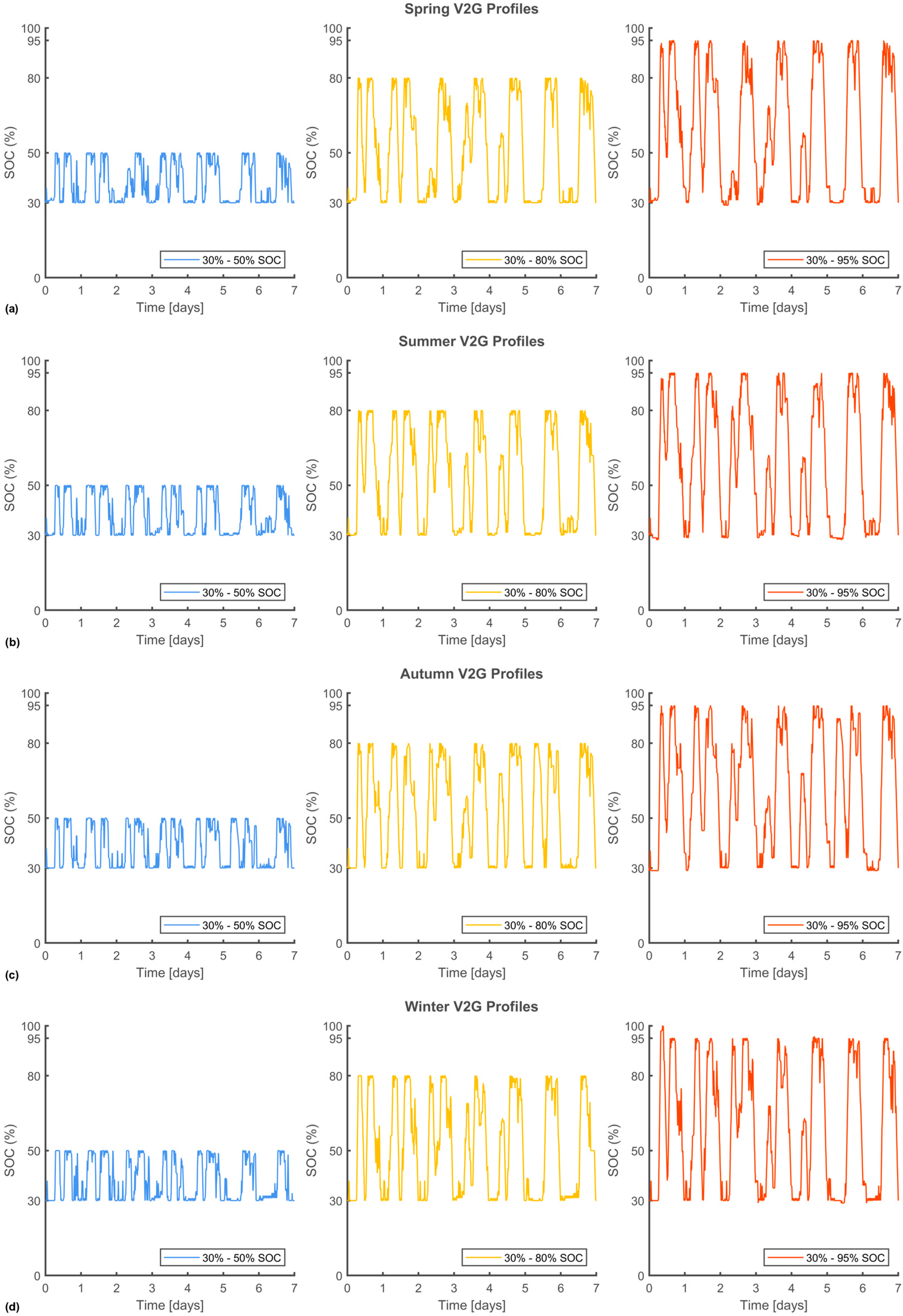
After a preliminary analysis, seasonal patterns were observed in the yearly V2G SOC data in terms of V2G utilisation frequency, potentially reflecting owner/consumer habits and energy arbitrage patterns. Therefore, the dataset was segmented into four seasons (spring, summer, autumn and winter), with each one containing 12 weeks of data. The weekly data within each season showed high degrees of similarity, which allowed for the simplification of the SOC profiles, using data from a single week as a representative case. The mid-week of each season was selected as the baseline, and any breaks or abrupt jumps in the SOC profile on any day of that week were replaced with daily data from one of the previous/subsequent weeks. Thus, a week-long (Sunday–Saturday) V2G SOC profile was generated for each season.
The tests were designed to assess the impact of season, depth of discharge (DOD) and the ambient temperature on the V2G financial and environmental benefits and cell longevity. The DOD of the raw data was between 30 and 95% SOC. In [44], it is suggested that keeping the SOC window between 40 and 60% during V2G operation could lead to a decrease in battery degradation. Based on that suggestion, two more SOC windows were defined for the tests, using 95% SOC as the typical maximum of the usable SOC window, and 80% SOC as the maximum recommended for lifetime benefits [45]. As a result, three sets of SOC windows were defined, which are 30% SOC–50% SOC, 30% SOC–80% SOC and 30% SOC–95% SOC, in order to assess the impact of V2G cycle depth in the cell cycle life. This was achieved by capping the SOC trace of the charger profile at 30% SOC and 50% SOC/80% SOC/95% SOC accordingly, when it was exceeding the defined lower/upper limits. Furthermore, to eliminate any high-current spikes, the SOC trace was filtered, and the SOC change rate was limited to a maximum of 0.0125%/s.
Finally, the generated SOC traces were converted to current profiles, which can be programmed into a battery cycler for the purpose of the cycle ageing test. This approach also eliminates the need to convert the voltage/power traces from pack to cell level, since the battery pack SOC trace can be directly converted to the cell-level current, using Equation (1):
C u r r e n t   A =   ( S O C d Q n o m / 100 )   ( S O C d 1 Q n o m / 100 ) t d t d 1 3600
where SOC is the cell/battery state of charge (SOC), d is the index of the data, t is the time in seconds, and nominal cell capacity is in ampere-hours. The V2G SOC profiles for each season are presented in Figure 1. The limited SOC change rate (0.0125%/s) also limited the current demand of the generated profiles, with the maximum charge/discharge C-rates being <0.45 C across all investigated seasons and depths of discharge cases.

2.2. Long-Term Ageing Test

2.2.1. Investigated Cell

The cells used in this study are commercially available high-power cylindrical lithium-ion cells with a nominal capacity of 4.5 Ah. The cell parameters, as provided by the manufacturer, are presented in Table 1.

2.2.2. Test Set up

The long-term ageing experiment was conducted using an immersion cooling test rig, with the investigated cells being fully immersed in dielectric fluid. Immersion cooling offers improved heat dissipation and heat transfer characteristics compared to conventional convection air cooling systems [46], allowing for accurate temperature control in lithium-ion cell testing. The dielectric fluid used in this study was MIVOLT DF7 [47], due to its excellent thermal properties and minimal environmental impact. A heat exchanger was used to regulate the oil bath temperature, controlled via a 50:50 water–glycol closed loop system, and the dielectric fluid was kept circulating around the immersed cells, using two miniature pumps. The dielectric oil temperature was monitored by using a PT-100 temperature sensor placed in the centre of the oil bath. A detailed description of the experimental rig can be found in [48,49].
For the purpose of this experiment, the investigated cells were organised in six oil baths, with each containing 16 cells, based on their corresponding test temperature. The cells were cycled using a commercial lithium-ion cell battery cycler and the cell surface temperature was monitored using K-type thermocouple temperature sensors placed on the axial midpoint of each cell.

2.2.3. Test Matrix

In terms of storage ageing, the cell calendar life was investigated at different storage SOCs and storage temperatures. The selected storage SOC test points were 30% SOC, 50% SOC, 80% SOC and 95% SOC, enabling the investigation of the entire SOC spectrum, including low, medium, high and very high SOC, which has been reported to severely limit the cell calendar life [20,50]. During storage, the cells remained in open-circuit conditions, and four cells were used for each test case. The calendar ageing test matrix is presented in Table 2.
In terms of V2G cycling, different V2G cycle profiles were generated based on real-world data, as described in Section 2.1. The V2G cycle profiles were performed at three cycling temperatures: 5 °C, 25 °C and 40 °C. The full V2G ageing test matrix is presented in Table 2. As the current was used as the trace for the V2G profiles, and the generated traces were considering the cell capacity to convert the SOC trace to the cell-level current, the profiles were updated between each seasonal iteration of the ageing cycles, with the cell capacity measured at the corresponding reference performance test. Each seasonal current profile was performed twice.

2.2.4. Test Protocol

At the beginning of the experiment and at regular intervals thereafter, reference performance tests (RPT) were performed to capture the cell ageing conditions. The reference performance tests were conducted at 25 °C for all test conditions. At each RPT, a capacity test and a pseudo-OCV test were performed to determine the cell capacity and obtain low-rate voltage-capacity data for differential voltage (DV) and incremental capacity (IC) analysis. The cell capacity was obtained by a constant current (CC) discharge at C/3, until the cells reached their lower cut-off voltage limit of 2.5 V. Prior to the capacity measurement, the cells were fully charged to 4.2 V with a constant current constant voltage protocol (CCCV) at C/3, with a termination current of C/10. For the pseudo-OCV tests, one full charge–discharge cycle was performed at C/10 to obtain the cell voltage characteristic.
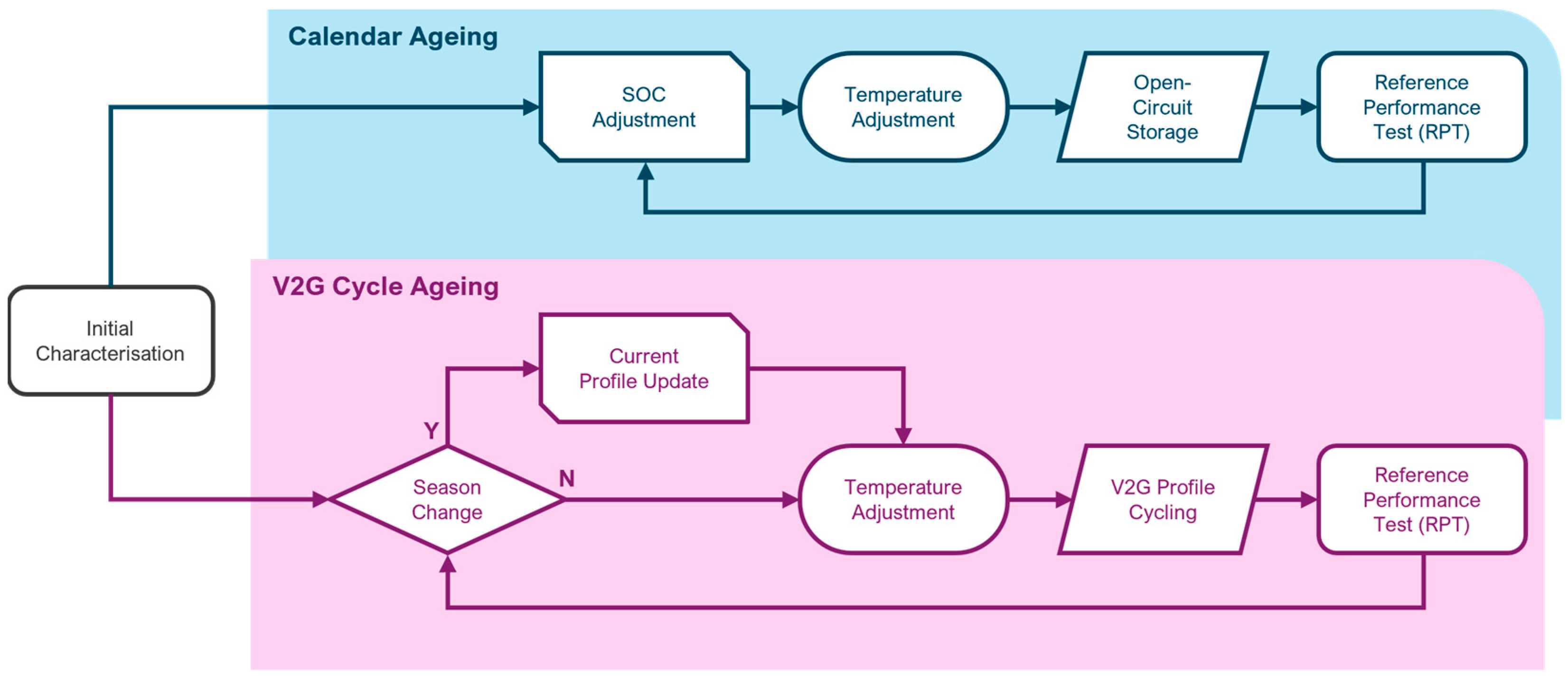
The long-term ageing test methodology is outlined in the flowchart shown in Figure 2. For the calendar ageing tests, the cell SOC was adjusted at 25 °C prior to the start of the storage period, to ensure that the storage SOC of all cells is consistent, irrespective of the storage temperature. The SOC adjustments are performed with respect to the cells’ relative capacity at each RPT, instead of the cells’ nominal capacity, since the cells’ capacity fades as the cells age. The capacity value obtained in the pseudo-OCV C/10 discharge cycle is used in the SOC adjustment in order to minimise the impact of polarisation losses. The cell SOC is then set by a C/10 constant current charge, which is terminated once the respective amount of capacity (Ah) is charged into the cell. For the V2G cycling, the same protocol was used to set the starting SOC for the cells at 30% SOC.

2.3. Diagnostic Framework

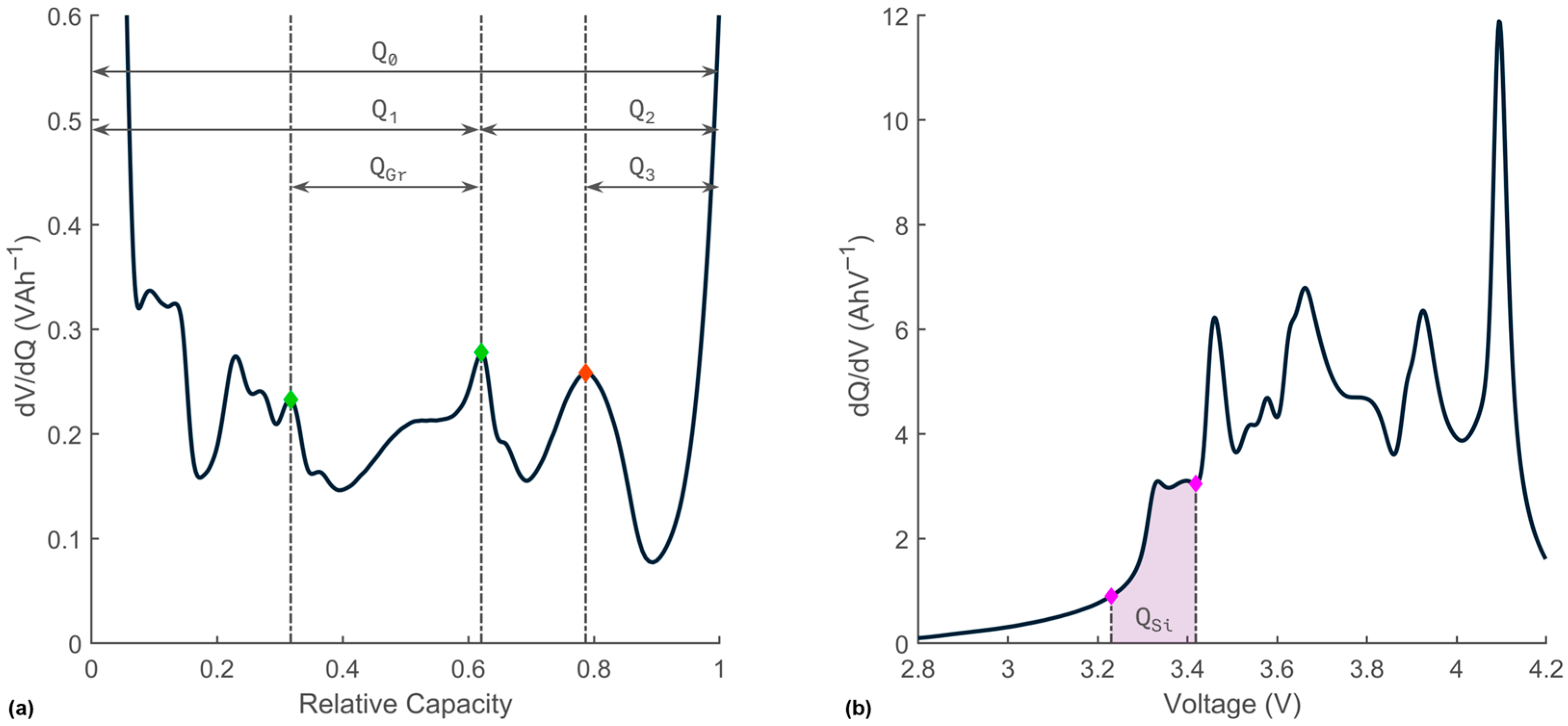
Figure 3 presents an indicative full-cell DV curve for the cell investigated in this study. The curve is obtained from a C/10 charge cycle. For the investigation of the degradation modes affecting the ageing behaviour of the calendar and cycle-aged cells, specific features of the DV curve are used as indicators of the different ageing modes, including LLI and LAM (Figure 3a). The capacity Q1, between the start of charge (0% SOC) and graphite’s characteristic peak at the mid-SOC region (~60% SOC), is considered to be indicative of the anode’s lithium storage capability [51]. Therefore, any reduction in Q1 can be interpreted as anode active material loss (LAMNE). Since the cells used in this study feature a silicon–graphite composite anode, LAMNE refers to a reduction in the total blended anode’s capacity. In order to track graphite’s active material loss (LAMGr), the distance between graphite’s peak at the low SOC region (~30% SOC) and the main graphite peak, which corresponds to the capacity QGr, is used instead, since this capacity is defined based solely on graphite DV features. Silicon’s active material loss (LAMSi) is quantified by using the methodology introduced in [52], by calculating the area under the curve (QSi) of the characteristic silicon ‘shoulder’ in the IC curve (Figure 3b). In terms of the cathode, the loss of active material (LAMPE) was tracked using the capacity Q3, between the NMC peak in the high SOC region (~80% SOC) and the end of charge, as suggested in previous studies [50,53]. The capacity Q2, defined as the capacity between the graphite’s main peak and the end of charge is used to detect changes in the electrode balancing, caused by progressive LLI [54].

3. Results

3.1. Calendar Ageing

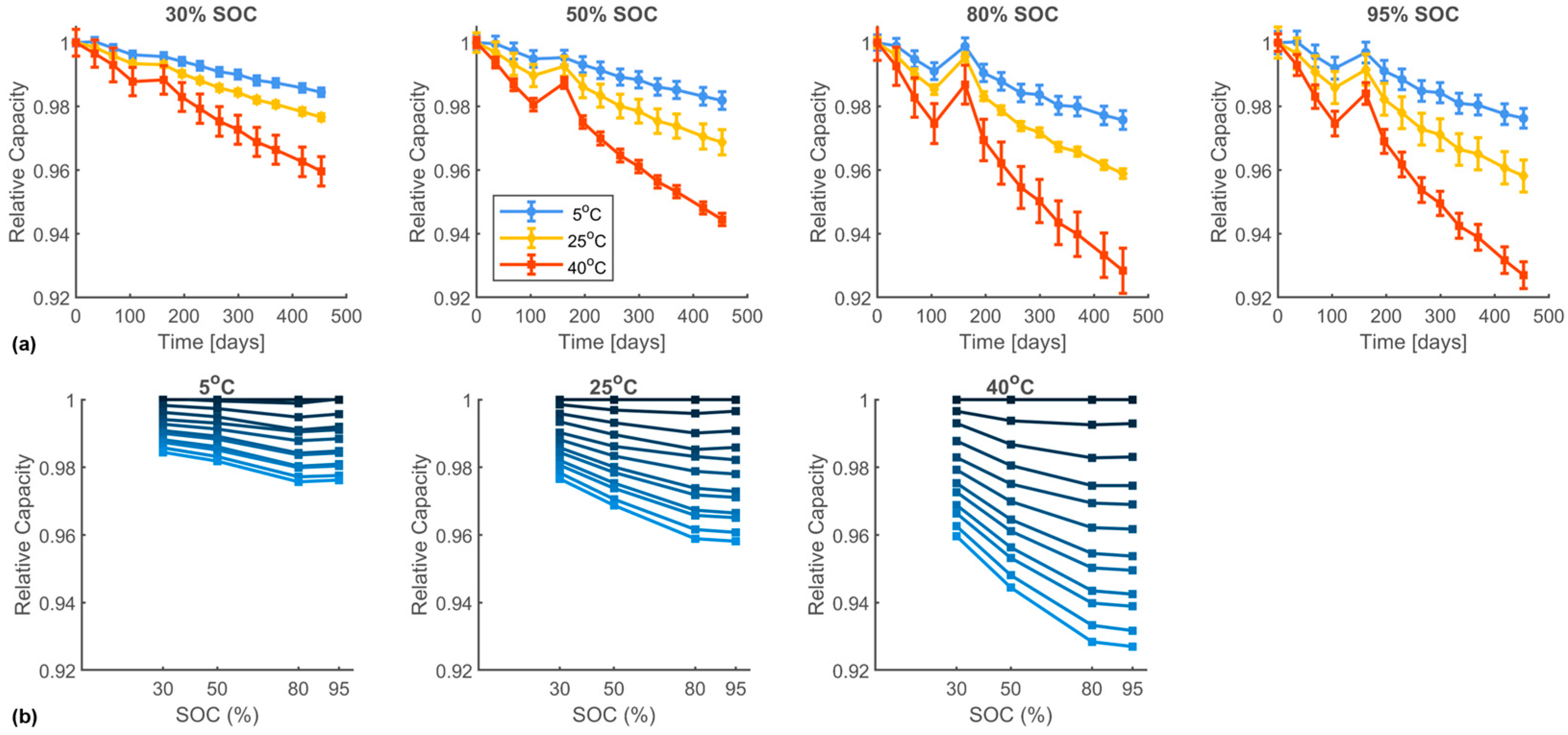
The cell capacity fade after approximately 450 days (15 months) of storage is presented in Figure 4a. The abrupt capacity increase observed after approximately 6 months was as a result of a prolonged facility shutdown, during which the SOC of all cells was adjusted and kept at 30% SOC, as per the institution’s safety protocols. While this period did influence the overall result, especially for the high SOC test cases, due to reversible effects originating from the anode overhang [55,56], the capacity fade rate prior and after this period remained consistent. Therefore, for the discussion and analysis of the calendar ageing results presented in the following sections, the underlying ageing mechanisms driving the cell capacity fade are considered to remain unaffected by the prolonged facility shutdown.
As expected, cells stored at an elevated temperature and high SOC exhibited a higher capacity fade. A fairly linear fade rate was observed for all test cases, which is in line with recent calendar ageing studies that report deviations from the previously established t 0.5 time dependency [57,58,59]. Storage temperature was the dominant factor affecting the cell calendar life, as cells stored at 40 °C suffered from aggravated capacity fade, irrespective of the storage SOC (Figure 4a). The temperature influence was especially pronounced in the high storage SOC test cases, with the capacity fade of the cells stored at 95% SOC increasing from ~4.2% to ~7.3% for 25 °C and 40 °C, respectively. At 5 °C, calendar degradation was minimised, with cells stored at 95% SOC retaining 97.6% of their initial capacity after the 15 months of storage.
Figure 4b presents the mean relative capacity obtained at each SOC point after each RPT measurement at different storage temperatures. Although the capacity fade increased with storage SOC, a plateau was observed in the very high SOC region (≥80% SOC), with cells stored at 80% SOC and 95% SOC exhibiting very marginal differences in their ageing rate. The strong correlation between the storage SOC and ageing rate has been previously reported and is shown to correspond to the anode’s potential plateaus [50]. Very high storage SOC has been reported to further accelerate calendar ageing in previous studies [60,61]; however, this was not observed in the cells investigated in this study, potentially due to the storage SOC not being high enough to trigger any additional side-reactions (˂100%). Furthermore, although the cells investigated in this study contained silicon, they did not exhibit the recently reported ‘spoon’ effect at a high storage SOC [62].

3.2. V2G Cycle Ageing

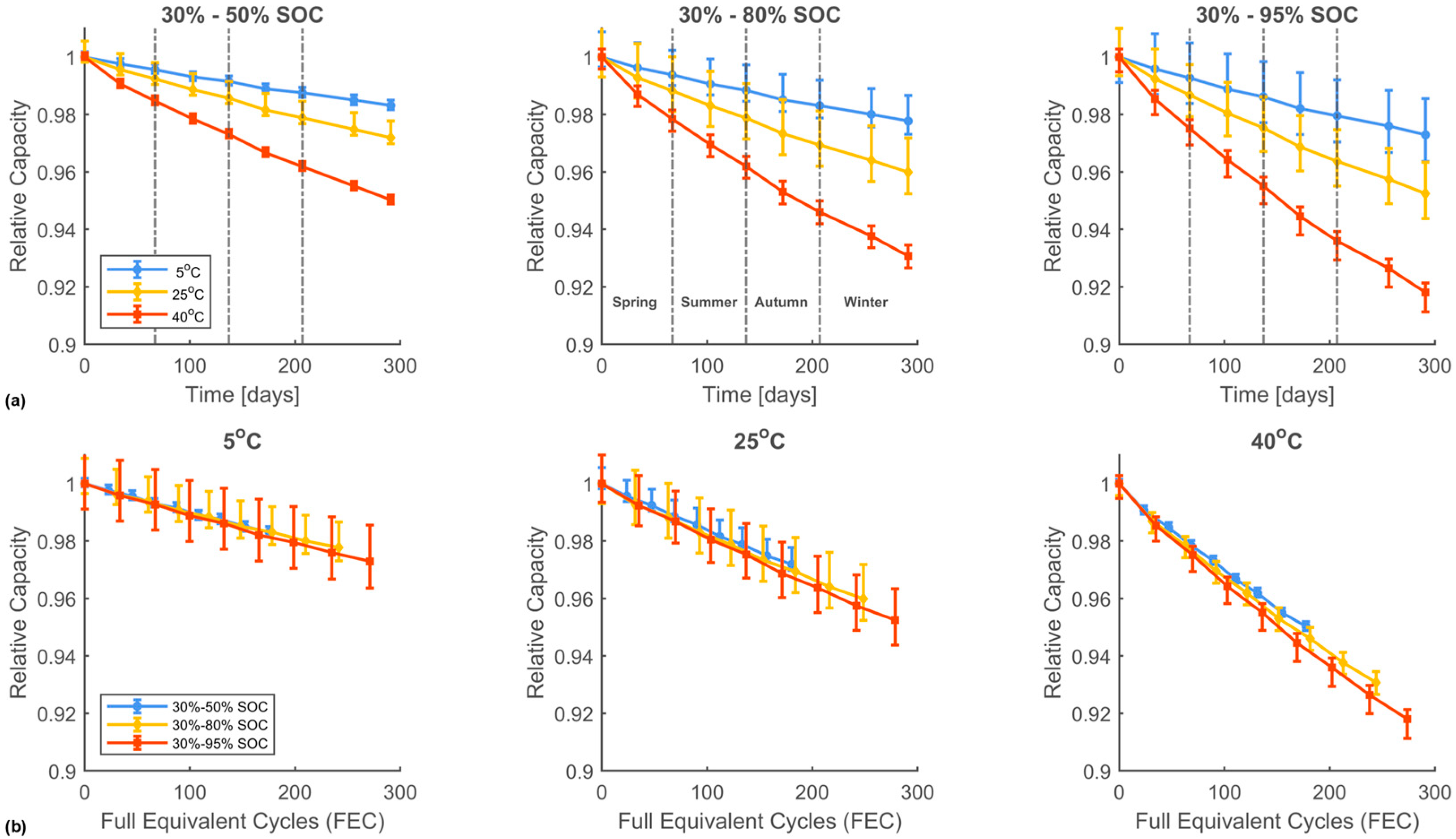
The V2G ageing results in terms of relative capacity fade are presented in Figure 5. In Figure 5a, the capacity fade is plotted versus time to enable the visualisation of the different seasonal cycling profile periods. A linear capacity fade rate was observed in all test cases, which suggests that the seasonal profile characteristics did not have a significant influence on the cells’ cycle life. Since the primary cycle characteristics, i.e., DOD, temperature and current rates, were similar across the season profiles, the minor differences in V2G utilisation frequency did not seem to have a significant impact on the cell ageing rate. The marginal difference in utilisation between the seasonal profiles is also underlined by the fact that the exchanged capacity, or full equivalent cycles performed by the cells in each season, were consistent. As in the case of calendar ageing, the cells’ ageing rate was primarily affected by the cycling temperature, exhibiting an increasing monotonic dependency, i.e., the cells’ capacity fade increased with increasing temperature. Previous cycle ageing studies have reported an increase in cell degradation, both with increasing and decreasing temperature, with an optimum temperature range in the region of 25–35 °C [22,63]. This behaviour is attributed to the prominence of two different degradation mechanisms, with lithium plating considered to be the main driver under sub-ambient cycling conditions, and SEI growth and cathode degradation dominating during high-temperature cycling. However, the charging current rates used in this study (<0.5 C) are much lower than the maximum allowable current (3 C) specified by the cell manufacturer (Table 1), which minimises the risk of lithium plating, even at the low temperature (5 °C). Therefore, the cycle ageing results suggest that the underlying degradation mechanisms remain consistent for all the investigated cases of V2G cycling, with the capacity fade being primarily driven by side-reactions due to the positive correlation between the ageing rate and temperature [64].
In order to analyse the influence of the cycling SOC window on the cell cycle life, the capacity fade results were plotted versus full equivalent cycles (FEC) in Figure 5b. In this study, full equivalent cycles (FEC) are defined as the cells’ total charge–discharge capacity throughput divided by twice the cells’ nominal capacity. A linear capacity fade rate was observed in terms of FEC across all investigated test cases. At each test temperature, the ageing rate was approximately constant, irrespective of the SOC window, with only minor deviations observed at 40 °C. Therefore, the higher capacity fade of the cells subjected to deeper V2G cycles can be attributed to the additional capacity throughput, i.e., a greater number of performed cycles. This further emphasises the dominant influence of temperature in the cycle life of the investigated cells under V2G cycling conditions.

3.3. Degradation Diagnostics

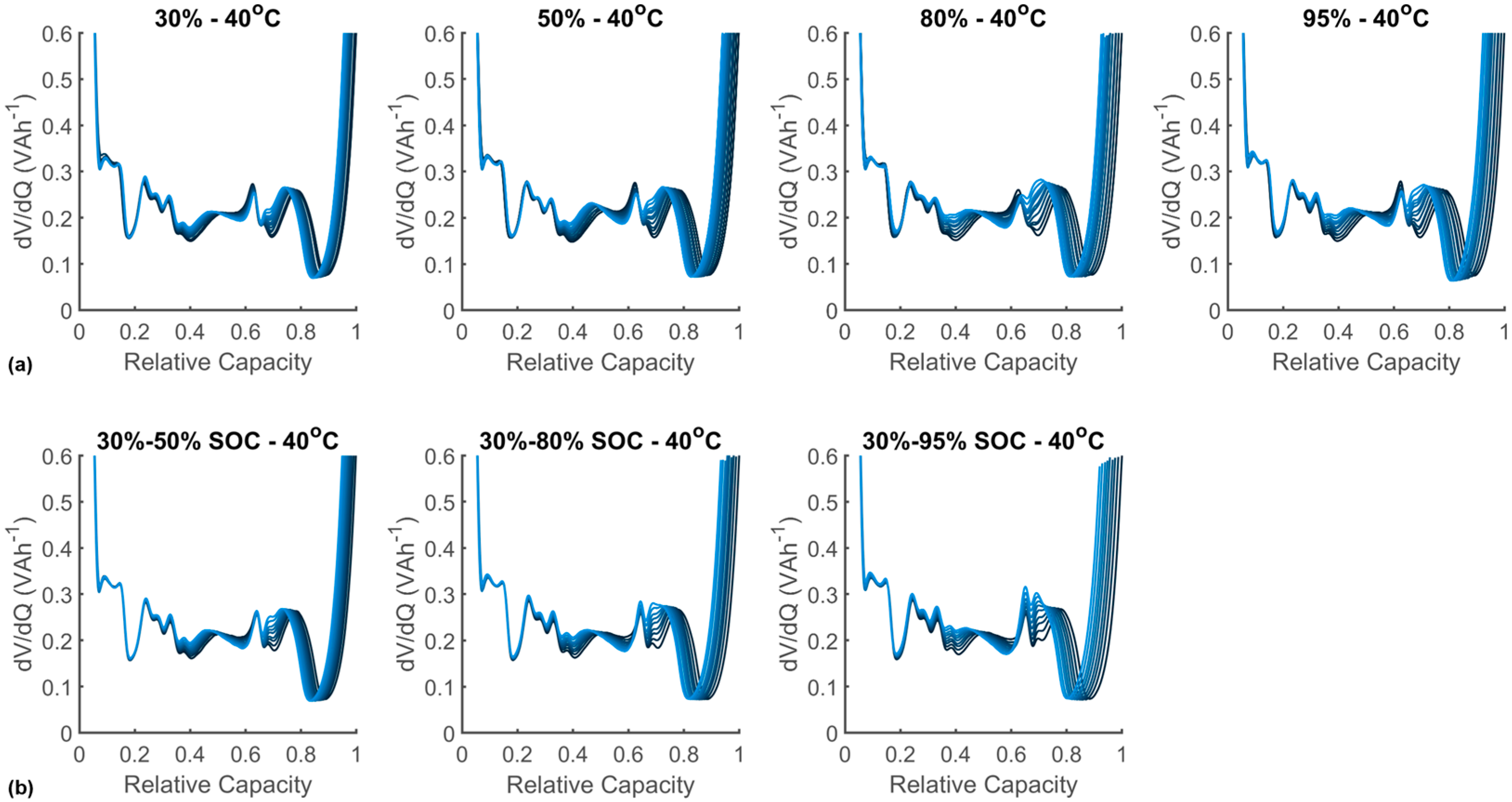
Figure 6 presents the DV curve evolution at each RPT of calendar and V2G-aged cells. The 40 °C test cases, which led to the highest capacity fade at each respective SOC/DOD condition, were used for visualisation, to ensure that trends and changes in DV curves can be clearly discerned. In both cases, a progressive shift in the charge endpoint can be observed towards the lower capacity, which is indicative of loss of active lithium limiting the available capacity. The charge end point shift increases at an elevated temperature, since the cells aged at an elevated temperature are expected to be affected more severely by LLI due to parasitic side reactions. Furthermore, the NMC peak at high SOC (~80% SOC) is also affected and shifts towards lower capacity, almost merging with the anode’s peak features in certain cases. The location and intensity of the rest of the characteristic peaks, which correspond to the anode electrode, have not changed significantly with ageing, which further implies that the capacity fade is mainly driven by LLI for both calendar and V2G ageing.
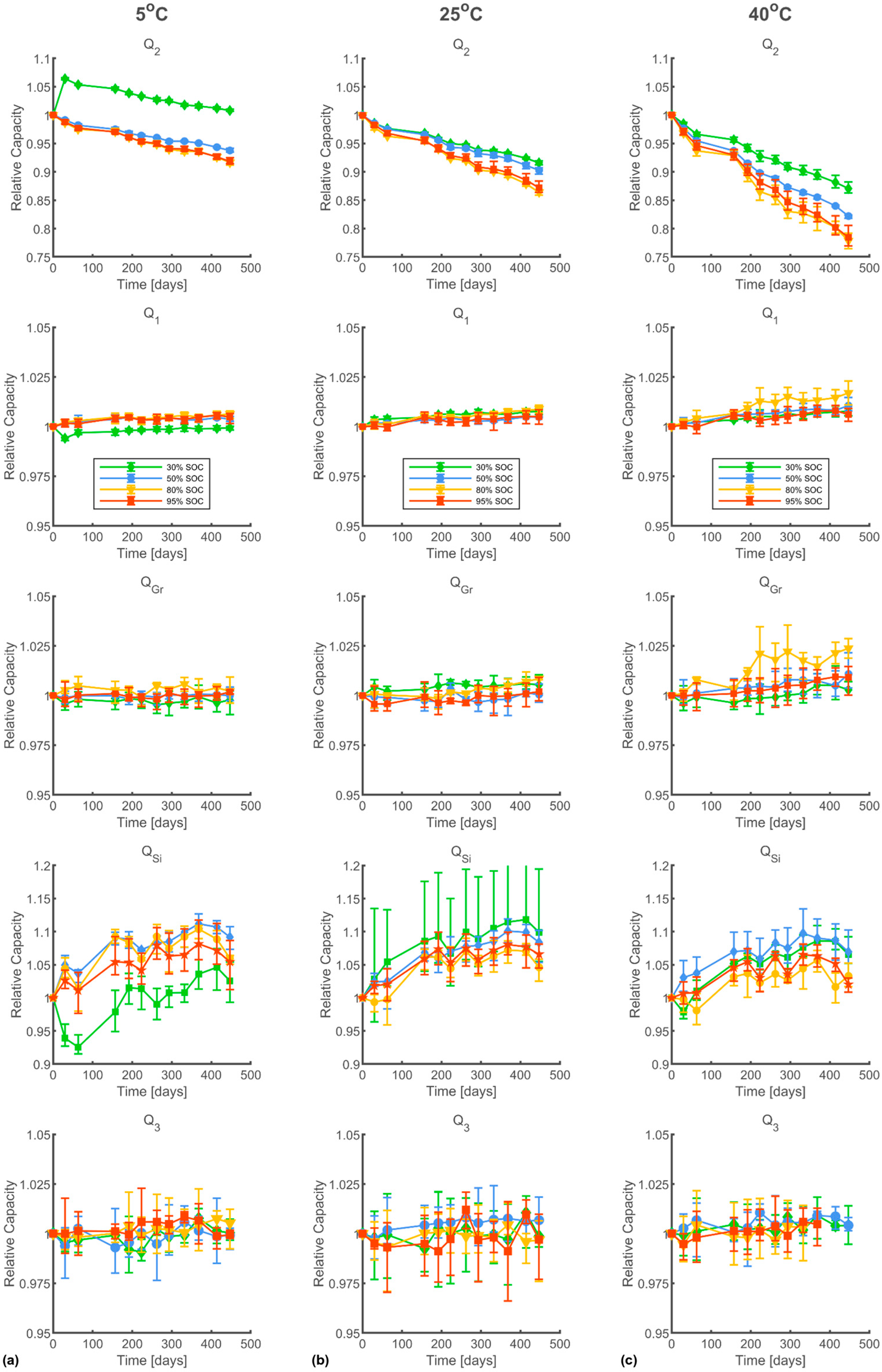
Figure 7 presents the evolution of the IC/DV characteristic capacities, defined in Figure 3, for calendar-aged cells. As observed in the DV curves in Figure 6a, the anode’s characteristic capacities, Q1 and QGr, remained approximately constant throughout the calendar ageing test, irrespective of the storage SOC and temperature. Minor fluctuations and a marginal increase were observed for both Q1 and QGr, especially at 40 °C; however, these fluctuations are in the order of <2% and can be attributed to the uncertainties and noise associated with the graphical method adopted in this work. In terms of QSi, the fluctuations were larger than those observed for QGr, but no significant decrease in QSi was observed by the end of the test. Minor fluctuations were also observed for Q3, with no clear trend being observed between the different storage conditions. Therefore, since the characteristic capacities remained relatively stable throughout the duration of the experiment, the loss active material, including graphite (LAMGr), silicon (LAMSi), and positive active material (LAMPE), are expected to be minimal, and the capacity fade during calendar ageing can be primarily attributed to LLI. Looking at the evolution of Q2, a drastic decrease can be observed, especially for storage at an elevated temperature (40 °C). A clear dependency can also be observed between the storage SOC and Q2, with the fade in Q2 increasing at a higher SOC. As has been previously explained in [50,51], a reduction in Q2 without a corresponding reduction in Q1 is indicative of electrode slippage due to LLI. Progressive SEI growth is considered to be the dominant mechanism during calendar ageing [65], which consumes active lithium and results in capacity fade. The increasing decay of Q2 with an elevated temperature and storage SOC is consistent with SEI growth-dominated degradation, since the occurrence of side-reactions between the electrolyte and SEI is promoted with high-temperature and low-anode potential.
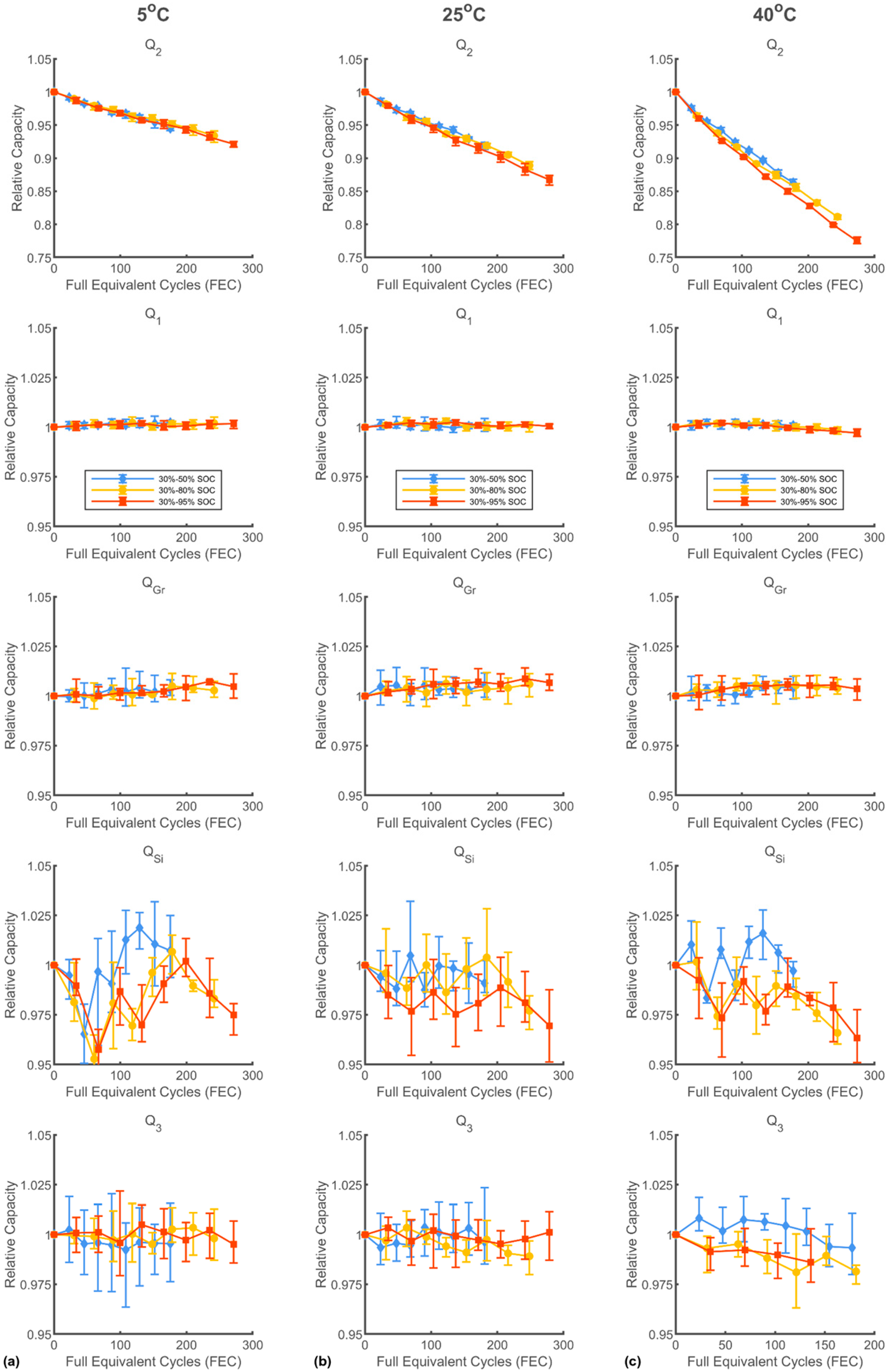
The evolution the DV characteristics capacities for V2G-aged cells as a function of full equivalent cycles is presented in Figure 8. Similarly to the calendar-aged cells, the V2G-cycled cells do not exhibit any significant changes in QGr, suggesting that graphite’s active material properties remain broadly unaffected. Conversely, a decreasing trend is observed for QSi, for the cells that were cycled in the extended SOC windows (30–80% SOC, 30–95% SOC), indicating the deterioration of silicon in the anode’s active material blend. However, LAMSi is relatively limited, since the total decrease in QSi remained within 5%. Considering that the ratio of silicon in silicon–graphite blends of commercially available lithium-ion cells is still relatively low (<5 wt%) [66,67], this explains why the reduction in QSi did not result in a significant decrease in Q1. Although previous studies have shown that silicon can degrade rapidly during cycling in composite anode electrodes [68,69], the silicon–graphite active material blend in this study showed good cycling stability. The reduced cycling window of the V2G profiles, which completely avoided the low SOC region (<30% SOC) may have contributed to the observed cycling performance, as previous studies have demonstrated that cycling in this SOC region can significantly aggravate silicon degradation [70,71].
Q2 is decreasing across all test cases, with the fade rate increasing marginally in the large DOD test cases (30% SOC–80% SOC, 30% SOC–95% SOC) at 40 °C. In terms of LAMPE, no significant trend was observed in Q3 for the cells tested at 5 °C and 25 °C. For 40 °C cycling, deep cycles (30% SOC–80% SOC, 30% SOC–95% SOC) resulted in an increased, approximately double, fade rate for Q3, which reached the same values midway through the 40 °C tests, as the end-of-test values for the 25 °C cases. However, Q3 was not evaluated for the final two RPT points of the 30–95% SOC/40 °C test case, since the location of the NMC peak could not be systematically discerned due to its pronounced shift towards lower capacity, which led to the merging of the NMC peak with graphite DV features. As discussed in the analysis of calendar ageing, the trends observed in the DV feature evolution is indicative of shifting in the electrode balancing, caused by progressive LLI. Furthermore, LLI causes electrode slippage, which promotes additional mechanisms associated with the degradation of the NMC cathode, which is driven to a progressively higher voltage, especially in the high SOC (>80% SOC) region [72]. Although the DV feature evolution contains preliminary evidence of cathode degradation in the test cases with the highest LLI, the inability to reliably track the NMC peak and Q3 limits the extractable information regarding the extent of LAMPE and its interaction with LLI. Nevertheless, the results of the diagnostic investigation indicate that under the mild cycling conditions of this study, loss of lithium, likely caused by progressive SEI growth, is the primary ageing mode limiting the cell capacity. As expected for SEI driven degradation, the cycling temperature was the dominant factor determining the capacity fade rate. Conversely, when comparing the rate of cell degradation in terms of FEC, it is evident that the SOC cycling window did not significantly affect the cells’ cycle life. Similar findings of LLI-dominated degradation have been reported by other authors for cycle ageing tests [73,74].

4. Discussion

4.1. Calendar–V2G Comparison

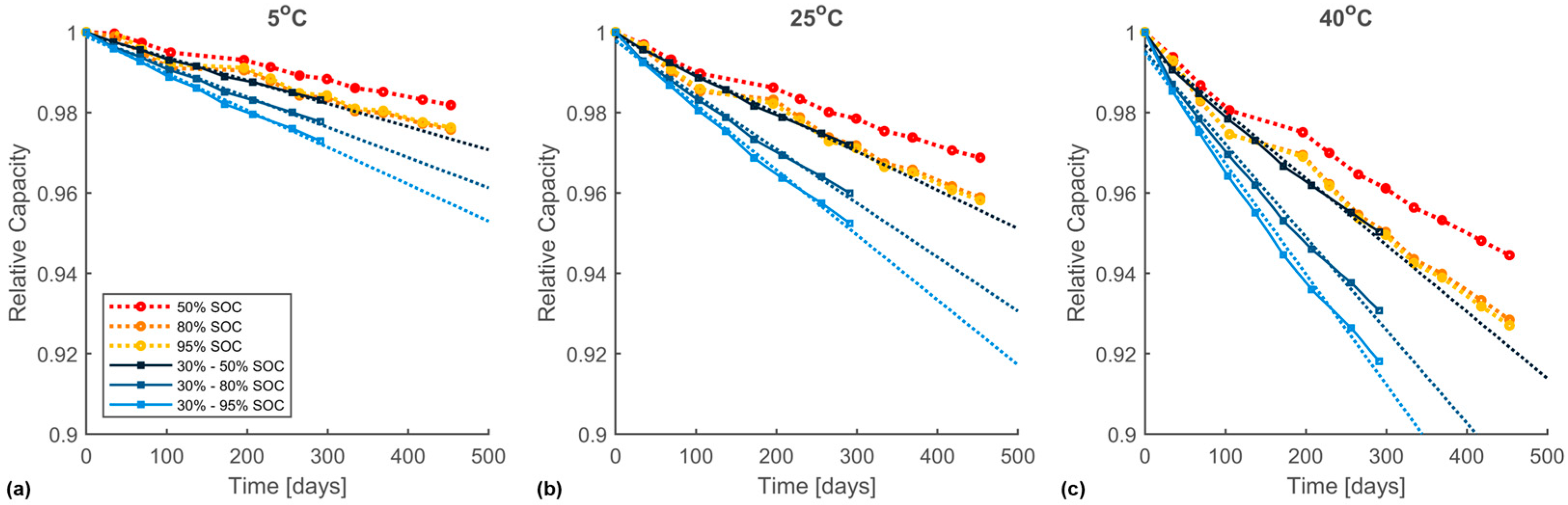
The mean capacity fade for both the investigated calendar and V2G ageing conditions as a function of time is presented in Figure 9. Due to the different durations of the two tests, the V2G results were extrapolated over the total calendar ageing time, using a linear regression model. Although V2G utilisation leads to an accelerated capacity fade, in cases of an extended SOC window (30–80% SOC, 30–95% SOC), the shallow V2G cycling (30–50% SOC) capacity fade rate is comparable to pure storage. Specifically, the calendar ageing results for cells kept at a relatively high, but not maximum, SOC (80% SOC, 95% SOC) maintain only a marginally higher capacity after 15 months of storage, compared to the extrapolated shallow cycling V2G values, with this behaviour being consistent across all test temperatures. These results suggest that under the mild cycling conditions investigated in this study, the mechanical stresses on the electrodes from (de)intercalation in a constrained SOC region are comparable to the electrochemical stresses caused by the high/low electrode potentials during storage at a high SOC. Calendar and cycle ageing have typically been investigated separately in the published literature, due to their different stress factors and test procedures, and cycling is widely considered as the primary factor limiting the overall cell service life. Nevertheless, this study highlights that under specific conditions, this may not necessarily be true, with the degradation from mild dynamic cycling being similar to storage rates. Similar findings were also reported by the authors in [25].
From a system-level perspective, this work demonstrates that optimally designed V2G cycling schemes can be effectively adopted by users, providing additional utilisation and monetary benefits, without compromising the battery’s service life/warranty. Using the conducted experiment as a baseline, and by diving the total number of FEC performed at each temperature over the test duration in days, an estimated maximum allowance of approximately 62% FEC of shallow cycles (30–50% SOC) per day is obtained. For clarity, this is the maximum number of FEC that can be achieved by subjecting the cells to continuous 30–50% SOC V2G cycling, while the cell capacity fade remains equivalent to high SOC storage. However, in practical applications, this continuous utilisation scenario is highly unlikely, considering that most EVs are also used for daily commuting. However, this result is still particularly applicable in automotive/vehicular battery systems, since users typically charge their vehicles overnight or during work hours, which can result in prolonged stationary periods at a high SOC, during which V2G cycling can be effectively utilised. Assuming that the degradation rate observed in the V2G ageing study remains linear, the daily 62% FEC allowance equates to an average of approximately 220 FEC per year. Thus, with the use of smart/scheduled charging protocols based on the length of stay and electricity market price fluctuations, the cells could instead be subjected to up 220 FEC of V2G cycling, without compromising their service life.

4.2. Summary and Outlook

Depending on the application and battery system, the 62% FEC of V2G capability equates to different amounts of available exchangeable energy with the grid per day. In the case of an average EV with a battery pack of 40–60 kWh, 24–36 kWh of V2G utilisation can be leveraged to achieve cost and emissions benefits for the end-users. For context, the average household usage of electricity per day is approximately 8.94 kWh, which is three to four times less than the amount of the allowable cyclable battery energy. From this perspective, it is evident that instead of unoptimised storage at a high SOC, V2G cycling can yield significant monetary and emissions benefits to EV users, maximising the value of their investment financially and environmentally over the course of the vehicle’s service life. However, in real-world scenarios, the vehicle would not be constantly kept at a high SOC and V2G cycling would only be feasible during fixed time intervals, which would limit the overall effectiveness of the V2G utilisation. Furthermore, the impact of V2G utilisation in combination with real-world driving cycles also needs to be investigated, since V2G cycling would eliminate prolonged rest periods in EV battery systems, which can influence electrochemical, mechanical and thermal relaxation phenomena, potentially altering the overall ageing behaviour.
It is important to emphasise that the observed 62% FEC of V2G capability is specific to the cell investigated in this study, and it is an ageing-related cell-specific property which may vary depending on the cell chemistry, energy density, cell format, design and mechanical properties. However, the underlying degradation trend, namely that optimised V2G cycling can be preferable to prolonged high SOC storage, is expected to also be applicable to other cells of a similar chemistry, since they are affected by similar ageing mechanisms. Beyond the results of this study, we propose that the methodology adopted in this work can be universally applied to assess V2G or more generalised V2X cell capabilities under a future standardised V2X cycle. A standardised approach, similar to the standardised drive cycles used to assess the EV range (WLTP, EPA), would enable consistent V2X evaluation and comparison across different cell types and manufacturers. Furthermore, in this work, the concept of a V2X capability metric is introduced as a novel cell-level specification, along with a corresponding experimental evaluation method. This metric can be particularly significant for the automotive sector, due to the frequent and prolonged periods that EV battery systems remain idle, during which they could be effectively utilised in V2X services. Consequently, the establishment and adoption of a standardised V2X assessment methodology would be instrumental in optimising EV battery utilisation and enhancing the overall value proposition of EV battery systems.
While the results of this study demonstrate the prospect of V2G/V2X integration in EV batteries, the scope and benefits of V2G utilisation are still limited by the relatively shallow cycling SOC window (30–50% SOC). Advances in battery materials, both in terms of electrodes and electrolytes, can reduce the sensitivity to a high SOC and extended DOD, and therefore help maximise the V2G energy throughput without significant cycle life compromises. Furthermore, combining BMS control strategies with real-world fleet data and emerging technologies such as the Internet of Vehicles (IoV) [75,76] can further optimise V2X operations by integrating vehicle, charging network, and grid data to support fleet-level V2X optimisation within a smart city framework [77,78]. Meanwhile, the quantification of V2G-induced degradation provides further insights into the assessment of the second-life suitability of retired EV batteries for stationary storage applications, enabling the informed deployment of repurposed battery systems and the optimisation of their operational strategy.

5. Conclusions

This study investigated the impact of V2G cycling on the lifetime of lithium-ion cells compared to the pure long-term storage, using data collected from real-world electric vehicle chargers. The ageing results demonstrate that temperature is the dominant factor accelerating the capacity fade across all tested storage and cycling conditions, especially when combined with high SOC storage or deep depth-of-discharge cycles. Diagnostic analysis revealed that the loss of lithium inventory (LLI) is the dominant ageing mechanism under both storage and V2G cycling, with minimal loss of active material. Importantly, shallow V2G cycling (30–50% SOC) was shown to induce comparable degradation to high SOC (≥80% SOC) storage, suggesting that a scheduled bidirectional energy exchange between vehicle and grid can be achieved without compromising the vehicle’s battery warranty and service life. Specifically, the results highlight that up to 62% FEC of daily V2G cycling can be achieved, offering substantial opportunities for cost saving and emissions reductions. By clarifying the relative impacts of storage and cycling under real-world conditions, this work underscores the potential for smart V2G scheduling to enhance the value proposition of EV ownership while maintaining an acceptable service life. The cell V2X capability metric introduced in this work can also be incorporated into the cell selection and system design processes, as well as in techno-economic feasibility analyses and the development of smart-charging algorithms to further optimise V2G utilisation strategies.

Author Contributions

Conceptualization, G.D., M.C.K., N.F.S., M.R. and A.M.; methodology, G.D., M.C.K., N.F.S., M.R. and A.M.; software, G.D. and M.C.K.; validation, G.D.; formal analysis, G.D.; investigation, G.D. and N.F.S.; resources, A.M.; data curation, G.D. and M.C.K.; writing—original draft preparation, G.D.; writing—review and editing, M.C.K., N.F.S., I.M.M., T.Q.D. and A.M.; visualisation, G.D.; supervision, A.M.; project administration, A.M.; funding acquisition, A.M. All authors have read and agreed to the published version of the manuscript.

Funding

This research was funded by APC UK, project number 10020994—“ZEN (Zero Emission Norton)” through “APC19: Developing automotive technologies and growing capability”.

Data Availability Statement

The datasets presented in this article are not readily available because of a third-party confidentiality agreement. Requests to access the datasets should be directed to Andrew McGordon.

Acknowledgments

The authors acknowledge the many fruitful discussions with staff members of Norton Motorcycles.

Conflicts of Interest

The authors declare no conflicts of interest.

Abbreviations

The following abbreviations are used in this manuscript:
EVElectric Vehicle
V2GVehicle-to-Grid
V2XVehicle-to-Everything
SOCState-of-Charge
DODDepth-of-Discharge
DVDifferential Voltage
ICIncremental Capacity
FECFull Equivalent Cycle

References

  1. Ralls, A.M.; Leong, K.; Clayton, J.; Fuelling, P.; Mercer, C.; Navarro, V.; Menezes, P.L. The Role of Lithium-Ion Batteries in the Growing Trend of Electric Vehicles. Materials 2023, 16, 6063. [Google Scholar] [CrossRef]
  2. Li, M.; Lu, J.; Chen, Z.; Amine, K. 30 Years of Lithium-Ion Batteries. Adv. Mater. 2018, 30, 1800561. [Google Scholar] [CrossRef]
  3. Tsiropoulos, I.; Tarvydas, D.; Lebedeva, N. Li-Ion Batteries for Mobility and Stationary Storage Applications; Publications Office of the European Union: Luxembourg, 2018. [Google Scholar]
  4. Iacobuta, G.; Dubash, N.K.; Upadhyaya, P.; Deribe, M.; Höhne, N. National climate change mitigation legislation, strategy and targets: A global update. Clim. Policy 2018, 18, 1114–1132. [Google Scholar] [CrossRef]
  5. Singh, S.; Kulshrestha, M.J.; Rani, N.; Kumar, K.; Sharma, C.; Aswal, D.K. An Overview of Vehicular Emission Standards. MAPAN 2023, 38, 241–263. [Google Scholar] [CrossRef]
  6. Abdelbaky, M.; Peeters, J.R.; Dewulf, W. On the influence of second use, future battery technologies, and battery lifetime on the maximum recycled content of future electric vehicle batteries in Europe. Waste Manag. 2021, 125, 1–9. [Google Scholar] [CrossRef] [PubMed]
  7. Safarzadeh, H.; Di Maria, F. Progress, Challenges and Opportunities in Recycling Electric Vehicle Batteries: A Systematic Review Article. Batteries 2025, 11, 230. [Google Scholar] [CrossRef]
  8. Zhu, J.; Mathews, I.; Ren, D.; Li, W.; Cogswell, D.; Xing, B.; Sedlatschek, T.; Kantareddy, S.N.R.; Yi, M.; Gao, T.; et al. End-of-life or second-life options for retired electric vehicle batteries. Cell Rep. Phys. Sci. 2021, 2, 100537. [Google Scholar] [CrossRef]
  9. Rallo, H.; Casals, L.C.; De La Torre, D.; Reinhardt, R.; Marchante, C.; Amante, B. Lithium-ion battery 2nd life used as a stationary energy storage system: Ageing and economic analysis in two real cases. J. Clean. Prod. 2020, 272, 122584. [Google Scholar] [CrossRef]
  10. Akram, M.N.; Abdul-Kader, W. Repurposing Second-Life EV Batteries to Advance Sustainable Development: A Comprehensive Review. Batteries 2024, 10, 452. [Google Scholar] [CrossRef]
  11. Colarullo, L.; Thakur, J. Second-life EV batteries for stationary storage applications in Local Energy Communities. Renew. Sustain. Energy Rev. 2022, 169, 112913. [Google Scholar] [CrossRef]
  12. Neubauer, J.; Pesaran, A. The ability of battery second use strategies to impact plug-in electric vehicle prices and serve utility energy storage applications. J. Power Sources 2011, 196, 10351–10358. [Google Scholar] [CrossRef]
  13. Pearre, N.S.; Ribberink, H. Review of research on V2X technologies, strategies, and operations. Renew. Sustain. Energy Rev. 2019, 105, 61–70. [Google Scholar] [CrossRef]
  14. Darcovich, K.; Laurent, T.; Ribberink, H. Improved prospects for V2X with longer range 2nd generation electric vehicles. eTransportation 2020, 6, 100085. [Google Scholar] [CrossRef]
  15. Das, R.; Wang, Y.; Putrus, G.; Kotter, R.; Marzband, M.; Herteleer, B.; Warmerdam, J. Multi-objective techno-economic-environmental optimisation of electric vehicle for energy services. Appl. Energy 2020, 257, 113965. [Google Scholar] [CrossRef]
  16. Borge-Diez, D.; Icaza, D.; Açıkkalp, E.; Amaris, H. Combined vehicle to building (V2B) and vehicle to home (V2H) strategy to increase electric vehicle market share. Energy 2021, 237, 121608. [Google Scholar] [CrossRef]
  17. Ginigeme, K.; Wang, Z. Distributed Optimal Vehicle-To-Grid Approaches with Consideration of Battery Degradation Cost Under Real-Time Pricing. IEEE Access 2020, 8, 5225–5235. [Google Scholar] [CrossRef]
  18. Edge, J.S.; O’Kane, S.; Prosser, R.; Kirkaldy, N.D.; Patel, A.N.; Hales, A.; Ghosh, A.; Ai, W.; Chen, J.; Yang, J. Lithium ion battery degradation: What you need to know. Phys. Chem. Chem. Phys. 2021, 23, 8200–8221. [Google Scholar] [CrossRef]
  19. Lam, V.N.; Cui, X.; Stroebl, F.; Uppaluri, M.; Onori, S.; Chueh, W.C. A decade of insights: Delving into calendar aging trends and implications. Joule 2025, 9, 101796. [Google Scholar] [CrossRef]
  20. Dubarry, M.; Qin, N.; Brooker, P. Calendar aging of commercial Li-ion cells of different chemistries—A review. Curr. Opin. Electrochem. 2018, 9, 106–113. [Google Scholar] [CrossRef]
  21. Kirkaldy, N.; Samieian, M.A.; Offer, G.J.; Marinescu, M.; Patel, Y. Lithium-ion battery degradation: Comprehensive cycle ageing data and analysis for commercial 21700 cells. J. Power Sources 2024, 603, 234185. [Google Scholar] [CrossRef]
  22. Preger, Y.; Barkholtz, H.M.; Fresquez, A.; Campbell, D.L.; Juba, B.W.; Romàn-Kustas, J.; Ferreira, S.R.; Chalamala, B. Degradation of Commercial Lithium-Ion Cells as a Function of Chemistry and Cycling Conditions. J. Electrochem. Soc. 2020, 167, 120532. [Google Scholar] [CrossRef]
  23. Rogge, M.; Jossen, A. Path-Dependent Ageing of Lithium-ion Batteries and Implications on the Ageing Assessment of Accelerated Ageing Tests. Batter. Supercaps 2024, 7, e202300313. [Google Scholar] [CrossRef]
  24. Karger, A.; O’Kane, S.E.J.; Rogge, M.; Kirst, C.; Singer, J.P.; Marinescu, M.; Offer, G.J.; Jossen, A. Modeling Particle Versus SEI Cracking in Lithium-Ion Battery Degradation: Why Calendar and Cycle Aging Cannot Simply be Added. J. Electrochem. Soc. 2024, 171, 090512. [Google Scholar] [CrossRef]
  25. Geslin, A.; Xu, L.; Ganapathi, D.; Moy, K.; Chueh, W.C.; Onori, S. Dynamic cycling enhances battery lifetime. Nat. Energy 2025, 10, 172–180. [Google Scholar] [CrossRef]
  26. Hackmann, M.; Jeckel, P.; Knörzer, H.; Pfeuffer, J. Challenging battery aging myths–Insights from 7,000+ vehicles into battery life and vehicle residual value. In Proceedings of the 38th International Electric Vehicle Symposium and Exhibition (EVS38), Goteborg, Sweden, 15–18 June 2025. [Google Scholar]
  27. Bricka, S.; Reuscher, T.; Schroeder, P.; Fisher, M.; Beard, J.; Sun, L. Summary of Travel Trends—2022 National Household Travel Survey; Federal Highway Administration; U.S. Department of Transportation: Washington, DC, USA, 2024.
  28. Nagler, E. Standing Still; RAC Foundation: London, UK, 2021. [Google Scholar]
  29. Baure, G.; Dubarry, M. Durability and Reliability of EV Batteries under Electric Utility Grid Operations: Impact of Frequency Regulation Usage on Cell Degradation. Energies 2020, 13, 2494. [Google Scholar] [CrossRef]
  30. Uddin, K.; Jackson, T.; Widanage, W.D.; Chouchelamane, G.; Jennings, P.A.; Marco, J. On the possibility of extending the lifetime of lithium-ion batteries through optimal V2G facilitated by an integrated vehicle and smart-grid system. Energy 2017, 133, 710–722. [Google Scholar] [CrossRef]
  31. Vasylyev, A.; Vannoni, A.; Sorce, A. Optimal dispatch of Li-Ion battery energy storage, reviewing and considering cycling and calendar ageing models. Appl. Therm. Eng. 2025, 265, 125597. [Google Scholar] [CrossRef]
  32. Marongiu, A.; Roscher, M.; Sauer, D.U. Influence of the vehicle-to-grid strategy on the aging behavior of lithium battery electric vehicles. Appl. Energy 2015, 137, 899–912. [Google Scholar] [CrossRef]
  33. Guenther, C.; Schott, B.; Hennings, W.; Waldowski, P.; Danzer, M.A. Model-based investigation of electric vehicle battery aging by means of vehicle-to-grid scenario simulations. J. Power Sources 2013, 239, 604–610. [Google Scholar] [CrossRef]
  34. Khezri, R.; Steen, D.; Wikner, E.; Tuan, L.A. Optimal V2G Scheduling of an EV With Calendar and Cycle Aging of Battery: An MILP Approach. IEEE Trans. Transp. Electrif. 2024, 10, 10497–10507. [Google Scholar] [CrossRef]
  35. Huang, S.; Wang, L.; Xiong, L.; Zhou, Y.; Gao, F.; Huang, W.; Li, Y.; Guo, H.; Wang, F. Hierarchical Robustness Strategy Combining Model-Free Prediction and Fixed-Time Control for Islanded AC Microgrids. IEEE Trans. Smart Grid 2025, 16, 4380–4394. [Google Scholar] [CrossRef]
  36. Jafari, M.; Gauchia, A.; Zhao, S.; Zhang, K.; Gauchia, L. Electric Vehicle Battery Cycle Aging Evaluation in Real-World Daily Driving and Vehicle-to-Grid Services. IEEE Trans. Transp. Electrif. 2018, 4, 122–134. [Google Scholar] [CrossRef]
  37. Petit, M.; Prada, E.; Sauvant-Moynot, V. Development of an empirical aging model for Li-ion batteries and application to assess the impact of Vehicle-to-Grid strategies on battery lifetime. Appl. Energy 2016, 172, 398–407. [Google Scholar] [CrossRef]
  38. Carmeli, M.S.; Toscani, N.; Mauri, M. Electrothermal Aging Model of Li-Ion Batteries for Vehicle-to-Grid Services Evaluation. Electronics 2022, 11, 1042. [Google Scholar] [CrossRef]
  39. Gong, J.; Wasylowski, D.; Figgener, J.; Bihn, S.; Rücker, F.; Ringbeck, F.; Sauer, D.U. Quantifying the impact of V2X operation on electric vehicle battery degradation: An experimental evaluation. eTransportation 2024, 20, 100316. [Google Scholar] [CrossRef]
  40. Dubarry, M.; Devie, A.; McKenzie, K. Durability and reliability of electric vehicle batteries under electric utility grid operations: Bidirectional charging impact analysis. J. Power Sources 2017, 358, 39–49. [Google Scholar] [CrossRef]
  41. Wei, Y.; Yao, Y.; Pang, K.; Xu, C.; Han, X.; Lu, L.; Li, Y.; Qin, Y.; Zheng, Y.; Wang, H.; et al. A Comprehensive Study of Degradation Characteristics and Mechanisms of Commercial Li(NiMnCo)O2 EV Batteries under Vehicle-To-Grid (V2G) Services. Batteries 2022, 8, 188. [Google Scholar] [CrossRef]
  42. Bhoir, S.; Caliandro, P.; Brivio, C. Impact of V2G service provision on battery life. J. Energy Storage 2021, 44, 103178. [Google Scholar] [CrossRef]
  43. Sciurus: Domestic V2G Demonstration. Available online: https://www.cenex.co.uk/projects-case-studies/sciurus/ (accessed on 10 October 2025).
  44. Bui, T.M.N.; Sheikh, M.; Dinh, T.Q.; Gupta, A.; Widanalage, D.W.; Marco, J. A Study of Reduced Battery Degradation Through State-of-Charge Pre-Conditioning for Vehicle-to-Grid Operations. IEEE Access 2021, 9, 155871–155896. [Google Scholar] [CrossRef]
  45. Kostopoulos, E.D.; Spyropoulos, G.C.; Kaldellis, J.K. Real-world study for the optimal charging of electric vehicles. Energy Rep. 2020, 6, 418–426. [Google Scholar] [CrossRef]
  46. Roe, C.; Feng, X.; White, G.; Li, R.; Wang, H.; Rui, X.; Li, C.; Zhang, F.; Null, V.; Parkes, M.; et al. Immersion cooling for lithium-ion batteries—A review. J. Power Sources 2022, 525, 231094. [Google Scholar] [CrossRef]
  47. MIVOLT. MIVOLT DF7. Available online: https://www.mivolt.com/products/mivolt-df7/ (accessed on 10 October 2025).
  48. Saniee, N.F.; Koshkouei, M.J.; Smalera, M.; Gulsoy, B.; Vincent, T.; McGordon, A. In-situ Lithium-ion Cell Sensing and Thermal Runaway in an Oil Immersed Setup. In Proceedings of the 2024 IEEE Transportation Electrification Conference and Expo (ITEC), Rosemont, IL, USA, 19–21 June 2024; pp. 1–4. [Google Scholar]
  49. Saniee, N.F.; Somasundaran, N.; Gulsoy, B.; Vincent, T.; Amor-Segan, M.; Marco, J. Analysis of Internal Temperature Variations of Lithium-Ion Batteries During Fast Charging. In Proceedings of the 2022 25th International Conference on Mechatronics Technology (ICMT), Kaohsiung, Taiwan, 18–21 November 2022; pp. 1–5. [Google Scholar] [CrossRef]
  50. Keil, P.; Schuster, S.F.; Wilhelm, J.; Travi, J.; Hauser, A.; Karl, R.C.; Jossen, A. Calendar Aging of Lithium-Ion Batteries. J. Electrochem. Soc. 2016, 163, A1872–A1880. [Google Scholar] [CrossRef]
  51. Keil, P.; Jossen, A. Calendar Aging of NCA Lithium-Ion Batteries Investigated by Differential Voltage Analysis and Coulomb Tracking. J. Electrochem. Soc. 2016, 164, A6066–A6074. [Google Scholar] [CrossRef]
  52. Darikas, G.; Dubarry, M.; Barai, A.; Amor-Segan, M.; Greenwood, D. Assessment of the Impact of Silicon on Loss of Active Material Quantification in Blended Silicon/Graphite Negative Electrodes. J. Electrochem. Soc. 2025, 172, 080536. [Google Scholar] [CrossRef]
  53. Laresgoiti, I.; Yi, H.; Koster, D.; Karimi, F.; Yang, J.; Schulte, D.; Figgemeier, E. Calendar ageing of commercial 18650 cells with nickel-rich cathode and graphite-silicon anode: Influence of check-up. J. Energy Storage 2024, 98, 112918. [Google Scholar] [CrossRef]
  54. Karimi, F.; Lübke, M.; Wenzel, S.; Bobrowski, T.; Schmiegel, J.-P.; Kwade, A. Degradation investigation of three Li-ion cell chemistries under different aging scenarios through differential voltage and post mortem analysis. J. Power Sources 2024, 618, 235054. [Google Scholar] [CrossRef]
  55. Zilberman, I.; Sturm, J.; Jossen, A. Reversible self-discharge and calendar aging of 18650 nickel-rich, silicon-graphite lithium-ion cells. J. Power Sources 2019, 425, 217–226. [Google Scholar] [CrossRef]
  56. Lewerenz, M.; Fuchs, G.; Becker, L.; Sauer, D.U. Irreversible calendar aging and quantification of the reversible capacity loss caused by anode overhang. J. Energy Storage 2018, 18, 149–159. [Google Scholar] [CrossRef]
  57. Attia, P.M.; Chueh, W.C.; Harris, S.J. Revisiting the t 0.5 Dependence of SEI Growth. J. Electrochem. Soc. 2020, 167, 90535. [Google Scholar] [CrossRef]
  58. Frie, F.; Ditler, H.; Klick, S.; Stahl, G.; Rahe, C.; Ghaddar, T.; Sauer, D.U. An Analysis of Calendaric Aging over 5 Years of Ni-rich 18650-Cells with Si/C Anodes. ChemElectroChem 2024, 11, e202400020. [Google Scholar] [CrossRef]
  59. Krupp, A.; Beckmann, R.; Diekmann, T.; Ferg, E.; Schuldt, F.; Agert, C. Calendar aging model for lithium-ion batteries considering the influence of cell characterization. J. Energy Storage 2022, 45, 103506. [Google Scholar] [CrossRef]
  60. Ecker, M.; Nieto, N.; Käbitz, S.; Schmalstieg, J.; Blanke, H.; Warnecke, A.; Sauer, D.U. Calendar and cycle life study of Li(NiMnCo)O2-based 18650 lithium-ion batteries. J. Power Sources 2014, 248, 839–851. [Google Scholar] [CrossRef]
  61. Storch, M.; Hahn, S.L.; Stadler, J.; Swaminathan, R.; Vrankovic, D.; Krupp, C.; Riedel, R. Post-mortem analysis of calendar aged large-format lithium-ion cells: Investigation of the solid electrolyte interphase. J. Power Sources 2019, 443, 227243. [Google Scholar] [CrossRef]
  62. Majherova, V.; Fiamegkou, E.; Nakhanivej, P.; Bree, G.; Gott, J.A.; Menon, A.S.; Fajardo, G.J.P.; Widanalage, W.D.; Dimitrijevic, A.; Belekoukia, M. Revealing how silicon oxide accelerates calendar ageing of commercial 21700 nickel-rich lithium-ion cells. J. Electrochem. Soc. 2025, 172, 90505. [Google Scholar] [CrossRef]
  63. Waldmann, T.; Wilka, M.; Kasper, M.; Fleischhammer, M.; Wohlfahrt-Mehrens, M. Temperature dependent ageing mechanisms in Lithium-ion batteries—A Post-Mortem study. J. Power Sources 2014, 262, 129–135. [Google Scholar] [CrossRef]
  64. Feinauer, M.; Wohlfahrt-Mehrens, M.; Hölzle, M.; Waldmann, T. Temperature-driven path dependence in Li-ion battery cyclic aging. J. Power Sources 2024, 594, 233948. [Google Scholar] [CrossRef]
  65. Pinson, M.B.; Bazant, M.Z. Theory of SEI Formation in Rechargeable Batteries: Capacity Fade, Accelerated Aging and Lifetime Prediction. J. Electrochem. Soc. 2012, 160, A243–A250. [Google Scholar] [CrossRef]
  66. Moon, J.; Lee, H.C.; Jung, H.; Wakita, S.; Cho, S.; Yoon, J.; Lee, J.; Ueda, A.; Choi, B.; Lee, S.; et al. Interplay between electrochemical reactions and mechanical responses in silicon–graphite anodes and its impact on degradation. Nat. Commun. 2021, 12, 2714. [Google Scholar] [CrossRef]
  67. Kim, N.; Kim, Y.; Sung, J.; Cho, J. Issues impeding the commercialization of laboratory innovations for energy-dense Si-containing lithium-ion batteries. Nat. Energy 2023, 8, 921–933. [Google Scholar] [CrossRef]
  68. Schmitt, J.; Schindler, M.; Oberbauer, A.; Jossen, A. Determination of degradation modes of lithium-ion batteries considering aging-induced changes in the half-cell open-circuit potential curve of silicon–graphite. J. Power Sources 2022, 532, 231296. [Google Scholar] [CrossRef]
  69. Bonkile, M.P.; Jiang, Y.; Kirkaldy, N.; Sulzer, V.; Timms, R.; Wang, H.; Offer, G.; Wu, B. Is silicon worth it? Modelling degradation in composite silicon–graphite lithium-ion battery electrodes. J. Power Sources 2024, 606, 234256. [Google Scholar] [CrossRef]
  70. Kirkaldy, N.; Samieian, M.A.; Offer, G.J.; Marinescu, M.; Patel, Y. Lithium-Ion Battery Degradation: Measuring Rapid Loss of Active Silicon in Silicon–Graphite Composite Electrodes. ACS Appl. Energy Mater. 2022, 5, 13367–13376. [Google Scholar] [CrossRef]
  71. Chowdhury, N.R.; Smith, A.J.; Frenander, K.; Mikheenkova, A.; Lindström, R.W.; Thiringer, T. Influence of state of charge window on the degradation of Tesla lithium-ion battery cells. J. Energy Storage 2024, 76, 110001. [Google Scholar] [CrossRef]
  72. Dose, W.M.; Xu, C.; Grey, C.P.; De Volder, M.F.L. Effect of Anode Slippage on Cathode Cutoff Potential and Degradation Mechanisms in Ni-Rich Li-Ion Batteries. Cell Rep. Phys. Sci. 2020, 1, 100253. [Google Scholar] [CrossRef]
  73. Zhu, J.; Knapp, M.; Sørensen, D.R.; Heere, M.; Darma, M.S.D.; Müller, M.; Mereacre, L.; Dai, H.; Senyshyn, A.; Wei, X.; et al. Investigation of capacity fade for 18650-type lithium-ion batteries cycled in different state of charge (SoC) ranges. J. Power Sources 2021, 489, 229422. [Google Scholar] [CrossRef]
  74. Sordi, G.; Rondi, A.; Conti, D.; Casalegno, A.; Rabissi, C. Degradation of lithium-ion batteries under automotive-like conditions: Aging tests, capacity loss and q-OCP interpretation. Future Batter. 2024, 3, 100005. [Google Scholar] [CrossRef]
  75. Contreras-Castillo, J.; Zeadally, S.; Guerrero-Ibañez, J.A. Internet of Vehicles: Architecture, Protocols, and Security. IEEE Internet Things J. 2018, 5, 3701–3709. [Google Scholar] [CrossRef]
  76. He, C.; Wang, W.; Jiang, W.; He, Z.; Wang, J.; Xie, X. Security for the Internet of Vehicles with Integration of Sensing, Communication, Computing, and Intelligence: A Comprehensive Survey. Sensors 2025, 25, 5119. [Google Scholar] [CrossRef]
  77. Khattak, H.A.; Farman, H.; Jan, B.; Din, I.U. Toward Integrating Vehicular Clouds with IoT for Smart City Services. IEEE Netw. 2019, 33, 65–71. [Google Scholar] [CrossRef]
  78. Ang, L.M.; Seng, K.P.; Ijemaru, G.K.; Zungeru, A.M. Deployment of IoV for Smart Cities: Applications, Architecture, and Challenges. IEEE Access 2019, 7, 6473–6492. [Google Scholar] [CrossRef]
Figure 1. Seasonal V2G SOC profiles for (a) spring, (b) summer, (c) autumn, and (d) winter.
Batteries 12 00022 g001
Figure 2. Long-term ageing experiment workflow flowchart.
Batteries 12 00022 g002
Figure 3. (a) Differential voltage (DV) and (b) incremental capacity (IC) diagnostics framework with annotated characteristic capacities.
Batteries 12 00022 g003
Figure 4. (a) Relative capacity fade for the investigated storage SOC and temperature and (b) progressive capacity fade at each investigated SOC point at each storage temperature. Abrupt capacity increase resulted from a prolonged facility shutdown, during which the cells were held at 30% SOC.
Batteries 12 00022 g004
Figure 5. (a) Capacity fade as a function of time and temperature for each investigated cycling SOC range and (b) capacity fade as a function of full equivalent cycles and cycling SOC window at each test temperature.
Batteries 12 00022 g005
Figure 6. Indicative DV curve evolution for cells (a) calendar-aged at 95% SOC and (b) V2G cycle-aged with 30–95% SOC cycling window.
Batteries 12 00022 g006
Figure 7. Evolution of DV/IC characteristic capacities of calendar-aged cells at (a) 5 °C, (b) 25 °C and (c) 40 °C.
Batteries 12 00022 g007
Figure 8. Evolution of DV/IC characteristic capacities of V2G cycle-aged cells at (a) 5 °C, (b) 25 °C and (c) 40 °C.
Batteries 12 00022 g008
Figure 9. Comparison of cell life under storage and V2G ageing at (a) 5 °C, (b) 25 °C, (c) 40 °C (linear extrapolation used for V2G data).
Batteries 12 00022 g009
Table 1. Cell parameters.
Parameter
Format21700
Rated Capacity4.5 Ah
Nominal Voltage3.6 V
Max. Discharge Current Rate10 C
Max. Charge Current Rate3 C
Operating Voltage Range2.5 V–4.2 V
Operating Temperature−40–60 °C(Discharge)
0–45 °C(Charge)
Table 2. Calendar and V2G cycle ageing test matrix.
Ageing ModeSOCTemperatureNo. of Cells
Calendar30%5 °C, 25 °C, 40 °C4
50%4
80%4
95%4
SOC Range
V2G30–50%5 °C, 25 °C, 40 °C5
30–80%5
30–95%6
Disclaimer/Publisher’s Note: The statements, opinions and data contained in all publications are solely those of the individual author(s) and contributor(s) and not of MDPI and/or the editor(s). MDPI and/or the editor(s) disclaim responsibility for any injury to people or property resulting from any ideas, methods, instructions or products referred to in the content.