Article

Boron-Doped Bamboo-Derived Porous Carbon via Dry Thermal Treatment for Enhanced Electrochemical Performance

1
Material Application Research Institute, Jeonju University, Jeonju 55069, Republic of Korea
2
School of Polymer Science and Engineering, Chonnam National University, Gwangju 61186, Republic of Korea
3
Department of Energy Science, Sungkyunkwan University, Suwon 16419, Republic of Korea
4
R&BD Group 1, Industrialization Division, Korea Carbon Industry Promotion Agency, Jeonju 54853, Republic of Korea
5
Department of Materials Science and Chemical Engineering, Jeonju University, Jeonju 55069, Republic of Korea
6
Department of Advanced Materials, Jeonju University Graduate School, Jeonju 55069, Republic of Korea
*
Authors to whom correspondence should be addressed.
Batteries 2025, 11(12), 443; https://doi.org/10.3390/batteries11120443 (registering DOI)
Submission received: 11 November 2025 / Revised: 25 November 2025 / Accepted: 26 November 2025 / Published: 2 December 2025

Abstract

In this study, boron was introduced into bamboo-derived porous carbon (BPC) through dry thermal treatment using boric acid. During heat treatment, boric acid was converted to B2O3, which subsequently interacted with the oxygen-containing surface groups of BPC, leading to the formation and evolution of B–O–B and B–C bonds. This boron-induced bonding network reconstruction enhanced π-electron delocalization and surface polarity, while maintaining the intrinsic microporous framework of BPC. Among the prepared samples, B-BPC-1 exhibited an optimized balance between the conductive domains and defect concentration, resulting in lower internal resistance and improved ion transport behavior. Correspondingly, B-BPC-1 delivered a better capacitive performance than both undoped BPC and commercial activated carbon. These results indicate that controlling boron incorporation under appropriate heat-treatment conditions effectively improves charge-transfer kinetics while maintaining a stable pore morphology. The proposed dry thermal doping method provides a practical and environmentally benign route for developing high-performance porous carbon electrodes for electric double-layer capacitor applications.

1. Introduction

Porous carbon materials have been widely utilized in diverse fields such as energy storage devices, electrochemical catalysts, and adsorption and separation processes owing to their intrinsic characteristics, including high specific surface area, excellent electrical conductivity, tunable pore structures, and superior chemical and thermal stability [1,2]. In electric double-layer capacitor (EDLC) applications, porous carbon serves as an active electrode material in which electrolyte ions are physically adsorbed and desorbed within internal micropores to store charge. This process facilitates ion diffusion and charge transfer, thereby enabling a high specific capacitance and fast charge–discharge capability [3].
However, because EDLCs are increasingly required to operate under extreme conditions such as high pressure, high temperature, and low temperature, merely enhancing the surface area is insufficient to achieve the desired high energy and power densities [4]. In particular, under high-voltage conditions, EDLCs require rapid voltage response, low internal resistance, and high-power density. To meet these requirements, precise control of both the electrode microstructure and the electronic structure is essential [5].
Previous studies have attempted to improve the electrochemical performance of EDLCs by increasing the mesopore volume fraction of the porous carbon to facilitate ion transport [6]. However, an excessive increase in the mesopore fraction leads to a relative reduction in the micropore fraction responsible for the actual charge storage, consequently lowering both the specific capacitance and activation yield [7]. Therefore, adjustment of the pore structure alone cannot overcome the inherent limitations of high-performance EDLC electrodes.
Most carbon materials possess sp2-hybridized graphene-like structures that endow them with high electrical conductivities. However, their chemically inert surfaces limit ion adsorption and charge accumulation at the electrode–electrolyte interface [8]. Because the energy storage mechanism of EDLCs is based on a physical ion-accumulation process, such electrochemical inactivity is a fundamental factor that restricts the overall charge storage efficiency [9]. To address this issue, the control of the electronic structure through the doping of non-metallic heteroatoms into the carbon framework has been actively studied. Doping with heteroatoms such as nitrogen (N), sulfur (S), phosphorus (P), and boron (B) induces local charge inhomogeneity and redistributes the electron density within the carbon lattice, thereby promoting the formation of extended electronic networks and improving the charge transport efficiency [10]. As a result, the electron density around adjacent carbon atoms increases, and the asymmetry of the π-electron structure is enhanced. These electronic modifications expand the charge transport pathways and improve the electrical conductivity and electrochemical performance of porous carbon [11].
Among these dopants, boron (B) is known to form B–C and B–O–C bonds within the carbon lattice, inducing surface charge polarization and improving the interfacial affinity between the electrode and electrolyte. Consequently, boron doping enhances the efficiency of the electrochemical reactions [12]. Therefore, boron incorporation into carbon frameworks not only improves the electronic conductivity by modulating the electronic structure but also enhances the chemical stability of the surface, serving as a strategic approach to improving the electrochemical performance.
Most previously reported boron doping methods are based on wet chemical processes and chemical vapor deposition [13]. However, these techniques have several drawbacks, including difficulty in achieving homogeneous precursor dispersion, complex post-treatment procedures for solvent and byproduct removal, and challenges in controlling the reaction parameters. By contrast, dry thermal treatment allows boron doping through direct solid–solid thermal reactions between precursors without the use of solvents, providing significant advantages in terms of environmental friendliness, process simplicity, and scalability [13]. In particular, boric acid (H3BO3), a low-cost and stable solid precursor, dehydrates during pyrolysis and reacts with the oxygen-containing surface groups of carbon to form B–O–C bonds. This reaction induces covalent surface modification through elemental bonding and reorganizes the electron transport pathways, ultimately enhancing the electrochemical reactivity by controlling the surface polarity.
In this study, boron was introduced onto the surface of bamboo-derived porous carbon (BPC) via dry thermal treatment using boric acid. The correlation between the chemical structural evolution and electrochemical properties was systematically investigated. In particular, the formation mechanism of the B–O–C bonds generated during dry heat treatment was analyzed using various characterization techniques, and the influence of boron doping on the electrochemical behavior of BPC was evaluated. This study demonstrates the feasibility of a simple and environmentally friendly dry thermal process for efficient boron doping and confirms its potential as a next-generation carbon material for advanced electrochemical applications.

2. Materials and Methods

2.1. Material Preparation and Boron Doping Procedures

BPC was supplied by the Korea Carbon Industry Promotion Agency (Jeonju, Republic of Korea). BPC samples prepared via steam activation under a physical activation process were used as the base materials. The supplied BPC (50 g) was ground to a particle size below 200 μm using sieve to remove impurities and then immersed in a 1 M nitric acid solution for 1 h at approximately 25 °C. Afterward, the sample was thoroughly washed with distilled water until the pH reached 7.0 and subsequently dried in an oven at 100 °C for 24 h.
Boron doping was performed using a dry-mixing process. BPC and boric acid (Daejung Chemical & Metals Co., Siheung, Republic of Korea) were homogeneously mixed at a mass ratio of 3:1, and 20 g of this mixture was placed in an alumina boat. The mass ratio of (3:1) was chosen based on preliminary optimization to ensure efficient boron incorporation while preserving the microporous framework. Although direct quantification of B-group yield is challenging due to the solid–solid reaction mechanism, Table S2 demonstrates that boron content can be modulated through both boric acid loading and hate treatment time. The prepared sample was loaded into a cylindrical alumina tubular furnace (90 mm diameter × 1000 mm length) and heat treated at 800 °C for 30, 60, and 180 min under a nitrogen atmosphere (99.99%, 200 cc/min) at a heating rate of 5 °C/min. After heat treatment, the resulting samples were washed with distilled water to remove residual impurities and then dried in an oven at 100 °C for 24 h to obtain boron-doped BPC (B-BPC). The samples were designated as B-BPC-0.5, B-BPC-1, and B-BPC-3 according to the heat treatment time.
In addition, to compare and evaluate the electrochemical performances of BPC with and without boron doping, a reference sample (BPC-As-1) was prepared under identical thermal treatment conditions (800 °C for 1 h). For comparison with BPC and B-BPC samples, YP-50F commercial activated carbon (Kuraray Co., Tokyo, Japan) was employed as a reference material.

2.2. Materials Characterization

The crystal structures of BPC and B-BPC were analyzed using X-ray diffraction (XRD; Miniflex 600, Rigaku, Tokyo, Japan). BPC and B-BPC were prepared as powders of approximately 70 mesh without any binder (or fiber form). The XRD patterns were measured in the 2θ range of 5–60° at a scan rate of 2°/min using Cu-Kα radiation (0.1542 nm). The interplanar spacings and crystallite sizes were calculated using Bragg’s equation [14] and Scherrer’s equation [14]. The crystallite size and interlayer spacing values were calculated directly from these equations. Therefore, error bars are not included, as the values are single calculated results rather than averaged experimental measurements.
The pore characteristics were analyzed using an N2/77 K isotherm adsorption–desorption analyzer (BELSORP Max II, MicrotracBEL, Tokyo, Japan). Prior to measurement, the samples were degassed at 300 °C for 12 h under a residual pressure below 10−3 bar to completely remove adsorbed impurities and gases. Each measurement was conducted using ~0.1 g of the fibrous sample. The specific surface area was calculated from the N2/77 K adsorption–desorption isotherm curves using the Brunauer–Emmett–Teller (BET) method [15]. The pore size distribution (PSD) was determined using the Barrett–Joyner–Halenda (BJH) method [16] and nonlocal density functional theory [17]. methods. The micropore volumes of the BPC and B-BPC samples were calculated from the intercept of the t-plot [18].
The thermal decomposition behavior of BPC and B-BPC was further analyzed using temperature-programmed desorption infrared (TPD-IR) spectroscopy. The measurements were conducted under a N2 atmosphere with a gas flow rate of 50 cc/min, and the evolved gaseous species were continuously monitored by FT-IR spectroscopy.
Elemental composition and surface functional group analysis of BPC and B-BPC were carried out using X-ray photoelectron spectroscopy (XPS; Thermo Scientific NEXSA, Watertown, NY, USA) and scanning electron microscope/energy dispersive X-ray spectroscopy (SEM/EDS, SU8000, Hitachi, Kyoto, Japan and Ultim Max 100, Oxford instrument, Abingdon, UK). XPS measurements were performed under high-vacuum conditions (<3 × 10⁻⁷ Pa) using Al-Kα radiation (1486.6 eV). EDS analysis was conducted at an accelerating voltage of 15 kV under a chamber pressure lower than (1 × 10⁻⁵) torr, and the samples were analyzed without any additional treatment.
Electrical resistance was measured using a powder resistance measurement system (HPRM-M2, DASOL ENG, Cheongju, Republic of Korea), and the resistance variation under different applied forces (2000–20,000 N) was recorded to estimate the compaction-dependent electrical conductivity of the samples.

2.3. Electrochemical Measurements

To evaluate the electrochemical properties of the BPC with and without boron doping, EDLC electrodes were fabricated by mixing the active material, conductive additive, and binder in a composition ratio of 85:7.5:7.5 (wt.%). Carbon black (Super P, Timcal, Bodio, Switzerland) was used as the conductive additive, and carboxymethyl cellulose (Dai-Ichi Kogyo Seiyaku, Kyoto, Japan) and styrene–butadiene rubber (BM400B, Zeon, Tokyo, Japan) were used as binders. The electrode slurry containing the active material, conductive additive, and binders was uniformly coated onto an aluminum foil (0.1 mm thickness) using a doctor blade coater. The coated electrodes were dried in a vacuum oven at 80 °C for over 12 h and then punched into 12 mm diameter disks for use as electrodes.
The EDLC coin cells were assembled in a CR2032 configuration, and 1,1-dimethylpyrrolidinium tetrafluoroborate/acetonitrile (DMPBF4/ACN) was used as the electrolyte. The galvanostatic charge–discharge (GCD) behavior of the EDLCs was analyzed using a MACCOR 4300 battery tester (Maccor Inc., Tulsa, OK, USA) within a voltage window of 0–2.7 V at current densities ranging from 0.1 to 10 A/g. Cyclic voltammetry (CV) and electrochemical impedance spectroscopy (EIS) were conducted using a VSP-300 electrochemical workstation (Bio-Logic Science Instruments, Grenoble, France). CV curves were obtained at scan rates ranging from 5 to 400 mV/s. EIS measurements were performed with a sinusoidal AC amplitude of 10 mV, and Nyquist plots were recorded over a frequency range of 10 mHz to 300 kHz. All electrochemical measurements were conducted at room temperature, and the values were averaged over 10 repeated measurements to ensure data reliability.

3. Results and Discussion

3.1. Boron Doping Mechanism and Surface Properties

Figure 1 presents the thermal programmed decomposition–infrared (TPD–IR) analysis results used to investigate the evolution of surface functional groups on BPC during the boron-doping process. TPD–IR detects gases desorbed from the sample surface as a function of temperature, thereby allowing both qualitative and quantitative analyses of oxygen-containing functional groups, such as hydroxyl, carbonyl, and carboxyl species, on the carbon surface [19].
Figure 1a,b show the evolution of gases desorbed from the untreated BPC (BPC-As) surface as a function of temperature and time, respectively. As shown in Figure 1a, CO and CO2 evolution began at ~100 °C, and a small amount of water vapor was detected within the temperature range of 100–700 °C. The CO signal gradually increased with temperature and exhibited a distinct peak above ~600 °C. The CO evolution in this high-temperature region is attributed to the thermal decomposition of thermally stable oxygen functionalities, such as carbonyl and lactone groups [20], which can be interpreted as a reductive deoxygenation process involving the removal of oxygen functional groups from the porous carbon framework.
Meanwhile, CO2 exhibited a major desorption peak near 180 °C and progressively decreased with increasing temperature. This behavior corresponds to the decarboxylation of acidic oxygen-containing groups (e.g., –COOH) and reflects their relatively low thermal stabilities [21,22]. In Figure 1b, CO evolution was dominant, whereas CO2 was detected only in trace amounts. The amount of CO released decreased gradually with time and became nearly constant after ~60 min, indicating that the remaining oxygen groups on the BPC surface were gradually desorbed, and that the reaction reached completion during the holding stage.
Therefore, it can be inferred that during the initial heating stage, the thermal decomposition of oxygen-containing groups accompanied the surface reduction in BPC (Figure 1a), whereas during the subsequent holding stage, the thermally stable oxygen functionalities were completely removed (Figure 1b).
Figure 1c,d show the TPD–IR results for boric acid, which was used as the precursor in the dry boron-doping process, to examine the gas evolution as a function of temperature and time. No significant CO or CO2 evolution was observed, whereas H2O release was detected within the 100–500 °C range. Boric acid (B(OH)3) generates water vapor during heat treatment through a stepwise dehydration–condensation reaction in which three hydroxyl groups are progressively eliminated, producing HBO2 and subsequently B2O3 [23]. The reaction pathway is described in Equation (1).
2B(OH)3 → B2O3 + 3H2O
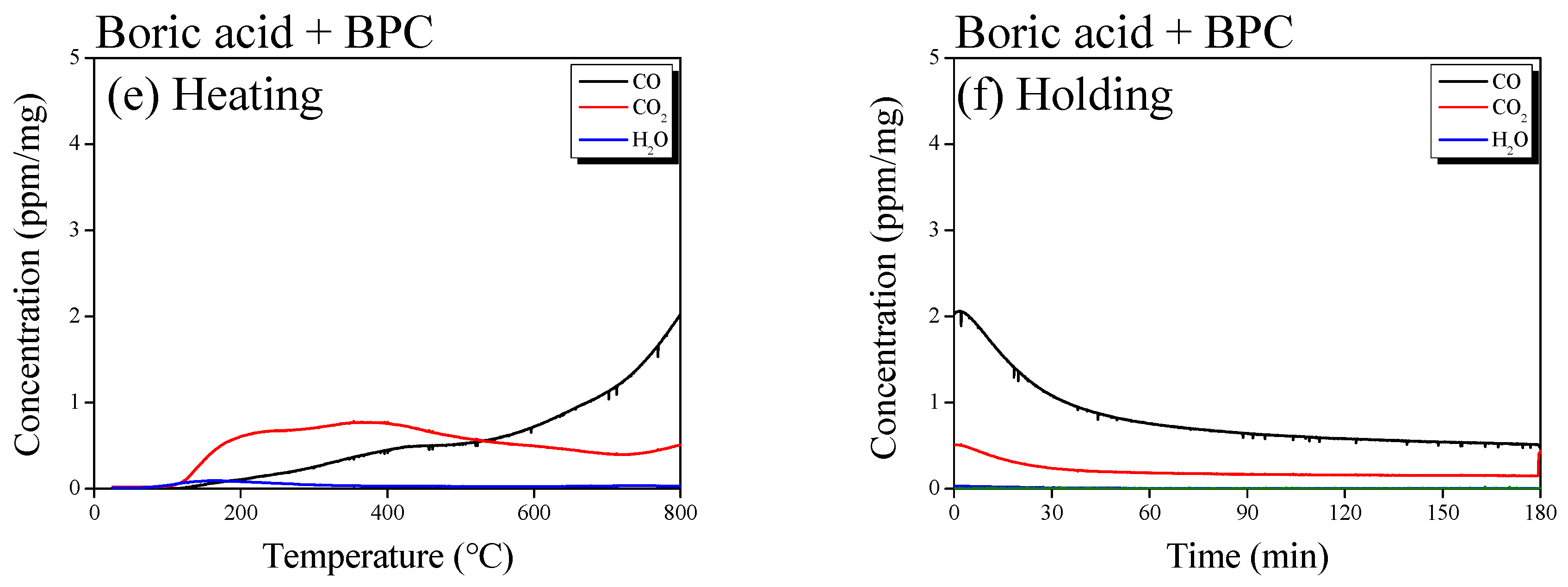
This process involves primary dehydration to form HBO2 at ~140–200 °C and secondary dehydration leading to B2O3 formation between 300 °C and 500 °C [24]. As shown in Figure 1d, minimal water vapor release was observed, indicating that the major structural transformation of boric acid was complete during the initial heating stage. Figure 1e,f show the evolution of the desorbed gases during the heat treatment of a mixture of BPC-As and boric acid at a mass ratio of 3:1. As shown in Figure 1e, a small amount of water vapor, CO, and CO2 started to appear at ~100 °C. CO2 evolution dominated up to ~450 °C, whereas CO evolution became more prominent at higher temperatures (≥700 °C). This behavior indicates that the dehydration of boric acid and the thermal decomposition of oxygen-containing surface groups on the BPC occurred simultaneously.
Specifically, the evolution of H2O and CO2 in the 100–500 °C range corresponds to the dehydration–condensation process of boric acid forming B2O3. The generated B2O3 subsequently interacts with –OH and –COOH groups on the BPC surface, resulting in the formation of oxygen-mediated B–O–C linkages such as BC2O and BCO3. This behavior may indicate a possible interaction between the in situ-generated B2O3 and the oxygen-containing groups on the BPC surface, suggesting potential chemical incorporation rather than simpel physical adsorption [25].
Furthermore, the increase in CO evolution observed above 700 °C is attributed to partial redox reactions between B2O3 (produced from boric acid dehydration) and the carbon framework of BPC, leading to the removal or rearrangement of oxygen within the B–O–C bonding network. This reaction can be expressed by the typical deoxygenation pathway shown in Equation (2) [26,27]:
B2O3 + C → 2B + CO or CO2
During the holding stage (Figure 1f), CO was continuously evolved, which can be interpreted as the gradual desorption of residual surface oxygen groups, as well as the minor decomposition and rearrangement of oxygen atoms within the B–O–C bonds maintained at elevated temperatures. Although the major conversion of H2BO3 to B2O3 is believed to occur below approximately 600 °C, the continuous CO evolution observed above this temperature indicates that some oxygen-containing functional groups still reamin and may interact with B-containing active sites during the holding stage. This coexistence could contribute to synergistic charge transfer behavior, as reported in recent sudies on dual-doped carbons.
In summary, boric acid is not merely physically adsorbed onto the BPC surface but chemically incorporated through reactions mediated by B2O3 during heat treatment, forming B-containing functional groups along the edges of the carbon framework. These surface chemical transformations are expected to alter the electronic structure and surface polarity of the BPC, thereby enhancing its electrochemical properties.

3.2. Crystallite Structure and Textural Properties

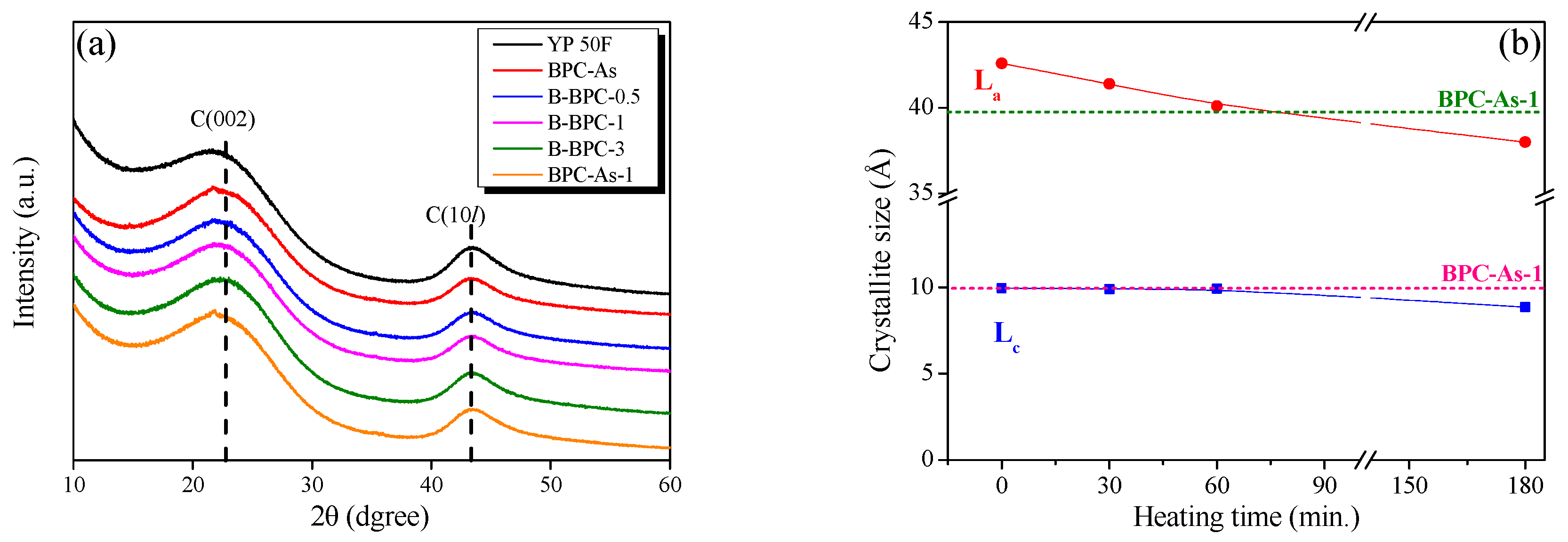
The crystallographic characteristics of B-BPC as a function of heat treatment time during the dry boron-doping process using boric acid were analyzed using XRD, and the results are presented in Figure 2. In Figure 2a, all the BPC samples exhibit characteristic diffraction peaks corresponding to the C(002) and C(10l) planes at approximately 23° and 43°, respectively, with no observable impurity peaks. This indicated that no residual byproducts or unreacted species remained after boron doping. As the heat treatment time increased, the intensities of the C(002) and C(10l) peaks gradually decreased.
Figure 2b and Table S1 summarize the interplanar spacings (d002, d101), crystallite height (Lc), and lateral crystallite size (La) of B-BPC calculated using Bragg’s equation and Scherrer’s equation [14]. According to Table S1, neither the d002 value nor the d10 value significantly changed within the margin of error with increasing heat-treatment time. However, Lc and La decreased progressively as the treatment time increased (Figure 2b). In particular, La decreased from 42.6 Å for BPC-As to 39.8 Å for B-BPC-3, representing a reduction of ~7%. This decrease is attributed to the partial oxidation (thermal decomposition) of crystallites and the expansion of amorphous carbon domains induced by prolonged heat exposure [20].
These findings are consistent with the TPD–IR results shown in Figure 1e, where the preferential CO2 evolution observed between 100 and 450 °C corresponds to the decomposition and deoxygenation of the oxygen-containing surface groups on BPC. The subsequent CO release in the 700–800 °C range indicates partial oxidation of the carbon lattice and B2O3-induced reactions at elevated temperatures [25,26,27]. During the thermal decomposition of boric acid, the in situ-generated B2O3 reacts with oxygen-containing surface groups on BPC to form B–O–C linkages such as BC2O and BCO3. The presence of these bonds was confirmed by X-ray photoelectron spectroscopy (XPS) and energy-dispersive X-ray spectroscopy (Figure S1 and Table S2).
Such stepwise surface reactions are accompanied by partial deoxygenation, resulting in carbon loss and structural heterogeneity within the BPC lattice, leading to a reduction in crystallite size. Consequently, the introduction of boron causes local electronic density perturbations and lattice distortions within the carbon framework through C–B substitution and the formation and rearrangement of B–O–C bonds [26,27]. As the crystallographic regularity decreases during this process, both La and Lc decrease. In particular, for long-term heat-treated B-BPC-3, excessive thermal exposure and incomplete edge rearrangement led to a further reduction in the crystallite domain size. This observation is consistent with the increased CO2 evolution and altered surface oxidation behavior identified in the TPD–IR analysis.
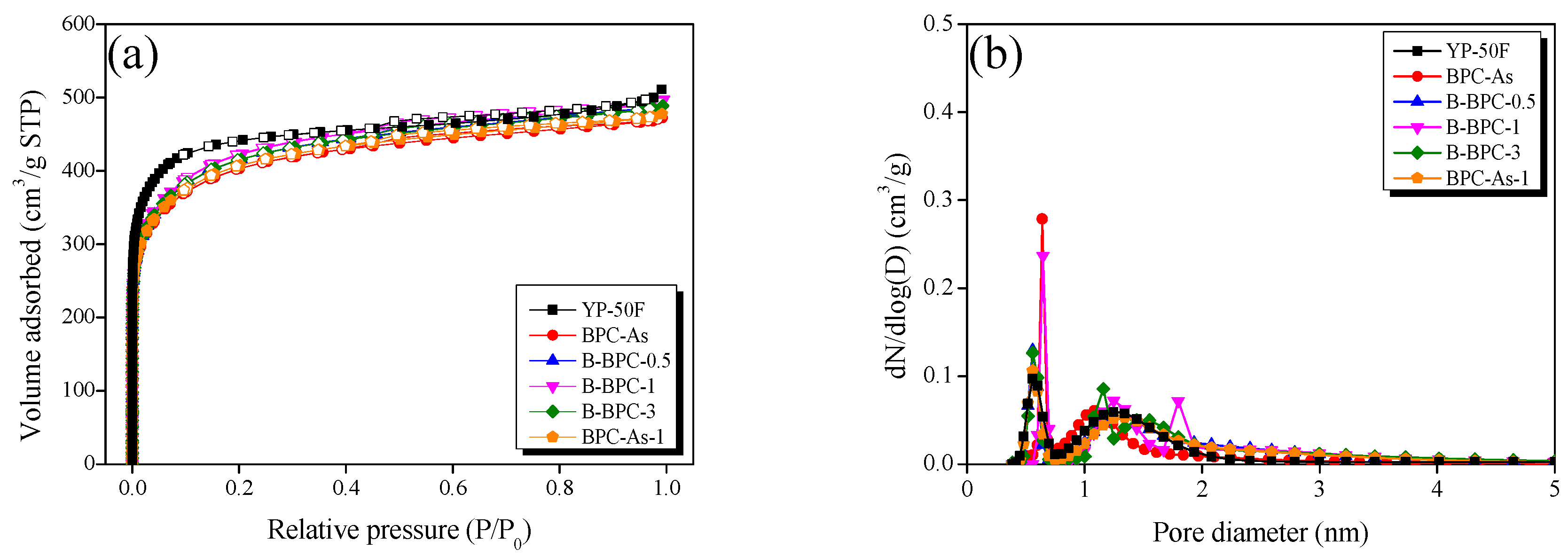
The influence of heat-treatment time during boron doping on the pore structure and adsorption behavior of BPC was further analyzed using N2/77 K isothermal adsorption–desorption measurements, as presented in Figure 3. In Figure 3a, both the commercial YP-50F and all BPC samples exhibited steep adsorption behavior in the low relative pressure region (P/P0 ≤ 0.1), corresponding to the typical Type I(a) isotherm according to IUPAC classification, indicating that micropore adsorption predominates. The specific surface areas of all samples were within the range of 1490–1560 m2/g, showing negligible variation, regardless of boron doping or heat-treatment duration. This indicates that B2O3, which temporarily forms within the pores during the boron-doping process, is subsequently removed during high-temperature treatment, thereby maintaining a stable microporous structure without pore collapse.
Figure 3b shows the PSD profiles. All the BPC samples exhibited distinct peaks in the range of 1–3 nm, indicating a micropore–submicropore-dominant structure. The changes in the PSD shape and peak position with increasing heat treatment time were minimal. The textural property data listed in Table 1 show the same tendency: both the total pore volume (Vtotal) and micropore radius (Rmicro) remained nearly constant with extended heat treatment. These results reveal that boron diffusion and substitution reactions within the carbon lattice affect only localized structural defects without significantly altering the overall pore framework.
In other words, the partial reduction of B2O3 and the formation of B–C bonds during boron doping induce minor structural defects within the carbon lattice but simultaneously enhance the structural stability of pore walls, suppressing pore collapse. Therefore, the B–C (sp2) or B–O–C (sp3) bonds formed within BPC through the dry-heat-treatment process are considered to play a crucial role in stabilizing the pore structure and improving thermal durability [28].
In contrast to the multi-step activation assisted process reported in [28], the present work achieves boron incorporation through a single solid–solid thermal step, without pore drilling or template removal. As a result, the intrinsic microporous framework is preserved, and the overall process energy consumption is substantially reduced.

3.3. Electrochemical Properties

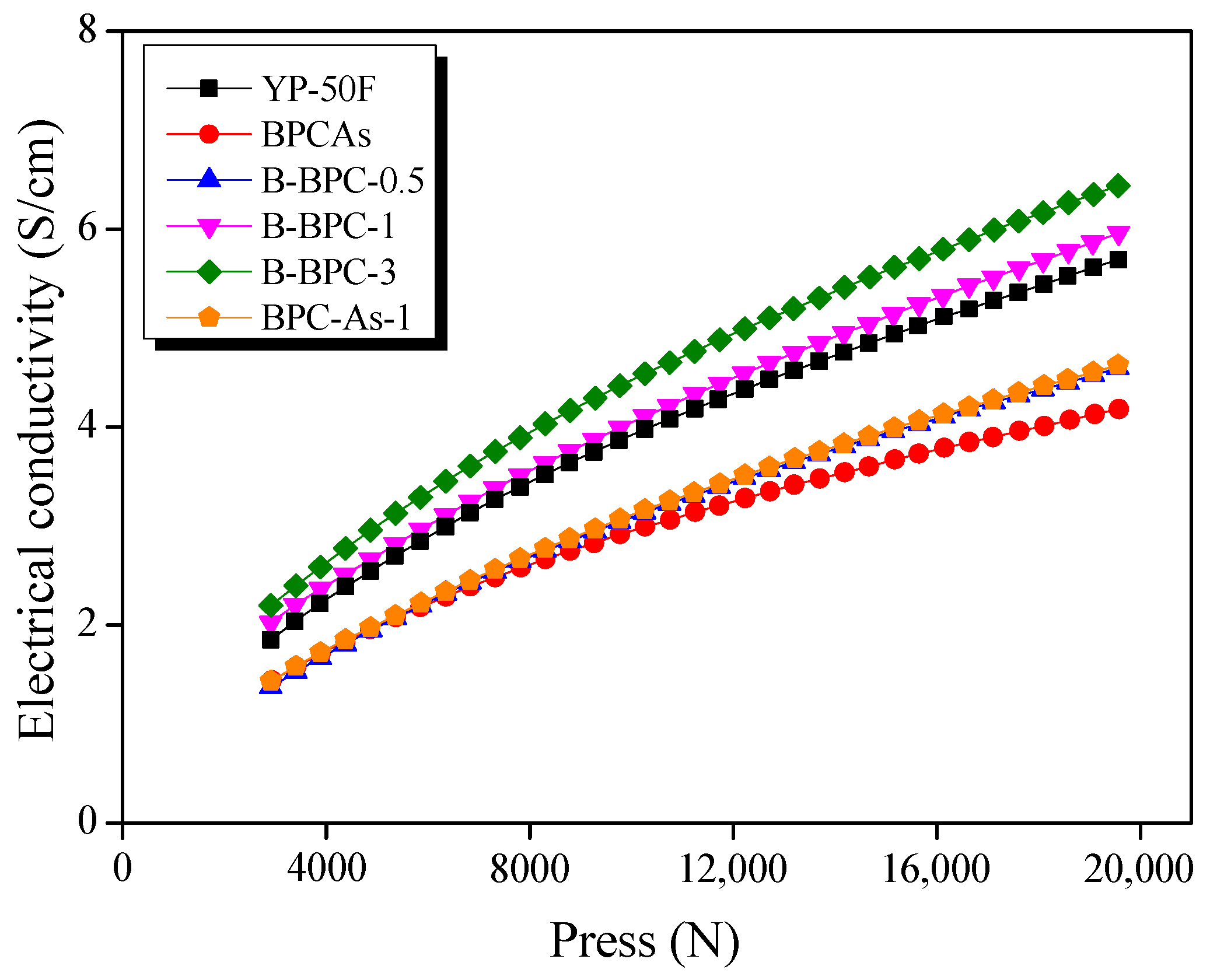
The electrical conductivity of B-BPC as a function of boron doping and heat treatment duration is presented in Figure 4, along with that of commercial EDLC-grade porous carbon (YP-50F, Kuraray) for comparison. Among the samples, B-BPC-3 exhibited the highest electrical conductivity, whereas BPC-As exhibited the lowest. This trend can be attributed to the rearrangement of the carbon lattice structure and modification of the charge transport pathways induced by boron doping. Boron atoms form B–C and B–O–C bonds within the carbon framework, generating local electronic-density inhomogeneities and structural defects. These sites act as active centers that promote π-electron transport within the conjugated network, thereby enhancing electrical conductivity [29,30].
In particular, the highest conductivity observed for B-BPC-3 is associated with the formation of well-developed B–C (sp2) bonds and continuous rearrangement of the π-electron network during the prolonged heat-treatment process, which minimizes electron transport resistance. By contrast, the undoped BPC-As-1 and BPC-As samples exhibited lower conductivity owing to the presence of numerous discontinuous defects within the π-conjugated structure, which originate from the incomplete sp3 hybridization of the amorphous carbon domains. These differences in the electronic transport characteristics of BPC are expected to directly affect the electrochemical behavior of the corresponding EDLC electrodes.
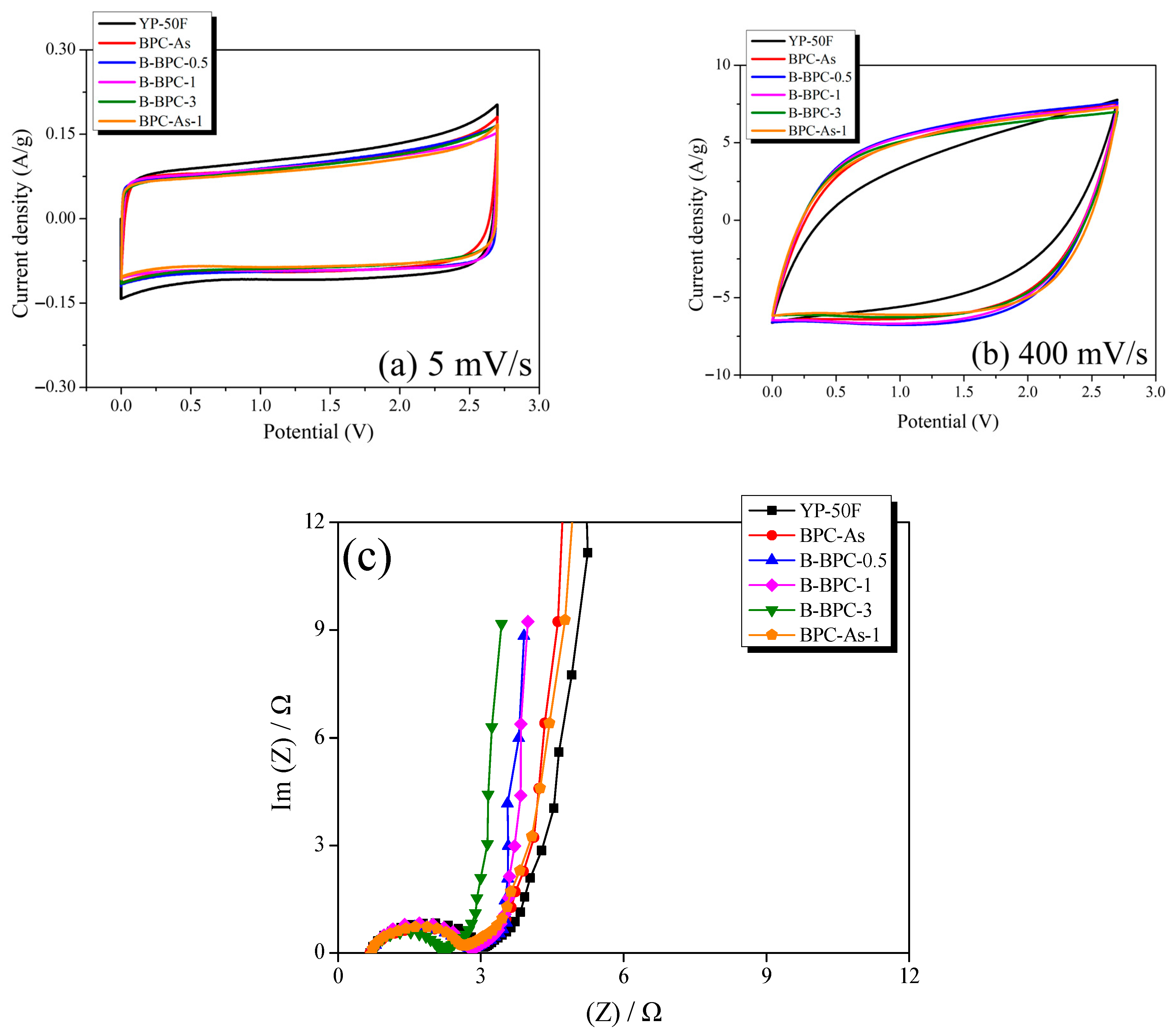
B-BPC prepared through dry heat treatment was fabricated into CR2032-type coin-cell EDLC electrodes to evaluate their electrochemical performance, as shown in Figure 5. Figure 5a,b show the CV curves of YP-50F and the BPCs prepared under various thermal conditions, measured at scan rates of 5 and 400 mV/s, respectively. The CV curves represent the charge–discharge response of the electrodes as a function of the scan rate. Unlike lithium-ion batteries, EDLCs store energy via a non-faradaic mechanism; therefore, the ideal CV curve of an EDLC exhibits a rectangular shape [31]. As shown in Figure 5a, the CV curves of YP-50F and all BPC samples display nearly ideal rectangular profiles without noticeable redox peaks, confirming that all BPC electrodes follow ideal EDLC-type charge–discharge behavior. The smaller CV area of the BPCs compared with that of YP-50F is mainly attributed to their relatively lower specific surface area (YP-50F: ~1700 m2/g; BPC: ~1500 m2/g). As the scan rate was increased to 400 mV/s (Figure 5b), the CV curves became increasingly distorted, adopting a leaf-like shape owing to the increased internal resistance of the EDLC [32]. Notably, the BPCs exhibited less distortion than YP-50F at high scan rates, indicating more efficient charge transport. Among them, B-BPC-1 maintained the broadest and most stable rectangular profile, demonstrating highly efficient electron and ion transport.
These results imply that the coexistence of uniformly distributed B–C (sp2) bonds and an appropriate concentration of active defect sites in B-BPC-1 enables the simultaneous enhancement of both electrical conductivity and ion diffusivity [33]. By contrast, the prolonged heat treatment of B-BPC-3 led to the thermal elimination of oxygen-containing groups, such as B–O–C and B–C=O, thereby reducing the density of active defects. Consequently, although its electrical conductivity was the highest, its overall electrochemical reactivity was relatively low.
Figure 5c shows Nyquist plots of the YP-50F and BPC electrodes. The Nyquist plot of an EDLC generally consists of three main components: (i) bulk solution resistance (Rs), (ii) charge-transfer resistance (Rct), and (iii) Warburg impedance (Rw) [34,35]. First, Rs, the electrolyte resistance, corresponds to the intercept in the high-frequency region on the real axis. In this study, because all EDLCs were assembled using the same 1 M DMPBF4/ACN electrolyte, YP-50F and BPC samples exhibited nearly identical Rs values.
Rct represents the resistance associated with charge transfer at the electrode–electrolyte interface, and typically appears as a semicircle in the mid-frequency region. Rct includes the contact resistance between the current collector and the electrode, the interfacial resistance between the active material and electrolyte ions, and the intrinsic electrical conductivity of the electrode [36]. As shown in Figure 5c, all BPC samples exhibited lower Rct values than YP-50F, indicating more efficient formation of charge transport pathways within the electrode.
Finally, Rw, which appears as a line with an inclination of ~45° in the low-frequency region, represents the diffusion resistance of the electrolyte ions [31]. B-BPC-3 exhibited the lowest Rct and a relatively gentle Rw slope, indicating that it had the most efficient electron- and ion-transport pathways among the samples. This improvement was attributed to the decomposition of boron-containing functional groups and the annihilation of microdefects during prolonged heat treatment, leading to reduced charge transfer resistance and improved ion diffusion. These observations are consistent with the conductivity results (Figure 4) and CV behavior (Figure 5a,b), confirming that boron incorporation and B–C (sp2) bond formation play key roles in enhancing both the electronic and ionic conductivities.
The influence of the chemical bonding states of boron on the electrochemical characteristics of B-BPC was further investigated through XPS analysis of the B1s spectrum, as presented in Figure S1. As shown in Figure S1, all B-BPC samples exhibited two characteristic peaks corresponding to BCO2 (192.0–192.5 eV) and BC2O (190.0–190.5 eV) bonds [37]. These peaks indicate that boron existed either in a partially substituted form within the carbon lattice or as an oxygen-coordinated species on the carbon surface. As the heat-treatment time increased, the proportion of BC2O bonds decreased from 63.90% for B-BPC-1 to 58.22% for B-BPC-3. Generally, BCO2 bonds—associated with a higher degree of B–O coordination—tend to exist as oxygen-containing surface functionalities or at the basal planes, whereas BC2O bonds result from boron substitution within the sp2-hydridized carbon framework, directly contributing to π-electron network formation [38].
Therefore, the relative decrease in the BC2O fraction in B-BPC-3 indicates that some boron species were converted into oxidized BCO2 configurations or that boron-containing active sites thermally decomposed during prolonged heat treatment. In other words, with increasing treatment time, the alignment of the π-electron network in B-BPC improved; however, the thermal decomposition of B–O, C–O, and B–O–C bonds simultaneously reduced the density of active defect sites. Such structural evolution of the surface functional groups exerts dual effects on the electrical characteristics. The thermal elimination of unstable surface functionalities and lattice rearrangement improves the electronic continuity and conductivity, thereby lowering Rct. Conversely, the decomposition of boron functionalities and the loss of microporous sites deteriorate the ion adsorption–desorption kinetics, leading to a decline in electrochemical reactivity.
Consequently, although B-BPC-3 exhibited the highest electrical conductivity, its stabilized boron bonding structure and reduced defect density resulted in relatively lower electrochemical responsiveness. By contrast, B-BPC-1 demonstrates the most balanced combination of B–C bond development, stable pore structure, and appropriate defect concentration, leading to superior electrochemical performance.
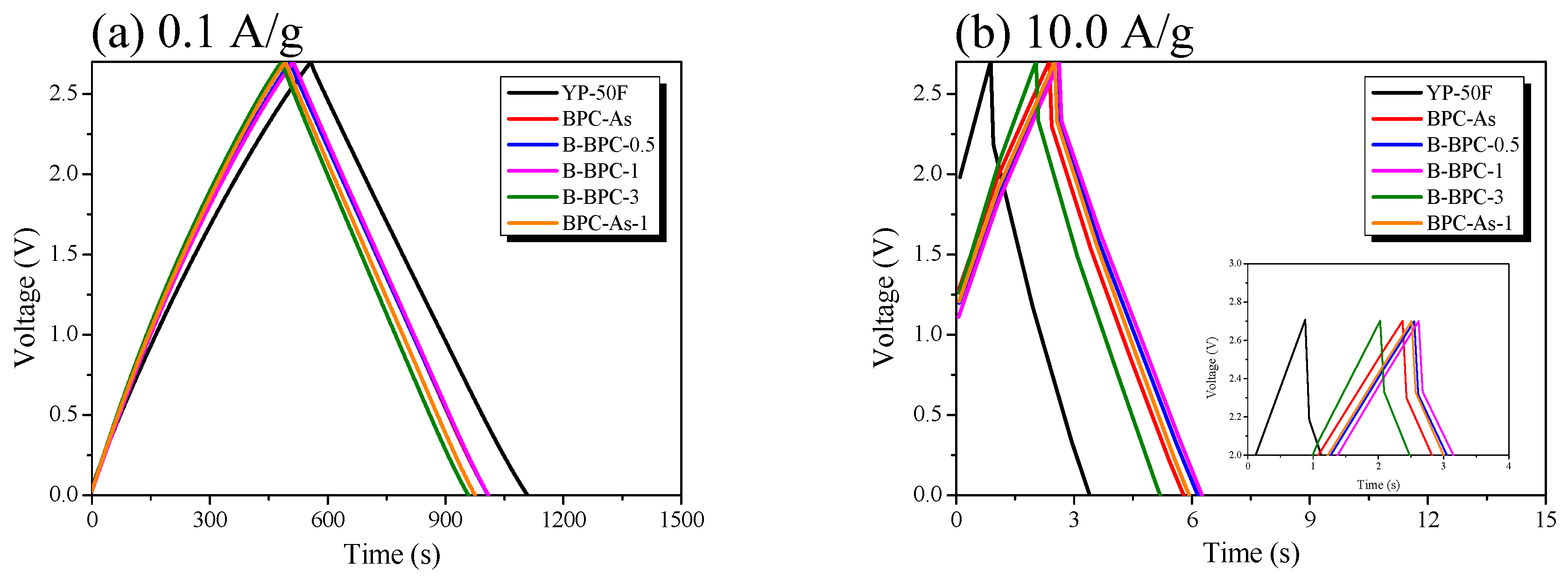
GCD measurements were conducted to analyze the charge and discharge characteristics of the EDLC electrodes [39]; the corresponding curves are shown in Figure 6a,b. The GCD curves were obtained at current densities of 0.1 and 10.0 A g−1, respectively. As shown in Figure 6a, all BPC samples exhibited symmetric charge and discharge profiles, indicating ideal EDLC-type charge–discharge behavior at 0.1 A g−1, consistent with the CV results presented in Figure 5a.
By contrast, at the higher current density of 10.0 A/g (Figure 6b), the charge–discharge curves became asymmetric, and a pronounced IR drop was observed during the discharge process. The IR drop in the GCD profiles represents the combined internal resistance of the electrode, which includes the contact resistance between the electrode and current collector, electrolyte resistance, intrinsic electronic conductivity of the electrode, and ion-diffusion resistance across the porous network [ref]. Hence, the increase in the IR drop from 0.1 to 10.0 A/g can be attributed to the increased ohmic resistance at higher current densities.
The magnitude of the IR drop for B-BPC as a function of the heat treatment time is summarized in Table 2. Among the samples, B-BPC-1 exhibited the smallest IR drop of 0.369 V, which is consistent with the electrochemical behavior discussed earlier, indicating the lowest internal resistance among all the samples. In general, the IR drop is influenced by the electrode conductivity, ion-diffusion resistance within the porous structure, and contact resistance between the electrode and current collector [40,41]. Therefore, the reduced IR drop in B-BPC-1 is interpreted as a consequence of the improved electron transport pathways induced by boron doping, where the optimally formed B–C (sp2) bonding regions under appropriate thermal conditions promote efficient charge conduction.
In other words, B-BPC-1 achieves a well-balanced structure in which boron substitution within the carbon lattice (C–B bond formation) and the partial retention of defect sites together facilitate the effective formation of both charge storage and electronic conduction networks. Conversely, despite the high electrical conductivity of B-BPC-3, prolonged heat treatment induced structural reorganization owing to the decomposition of boron-containing functional groups and the annihilation of microdefects. This process improves the electronic and ionic transport pathways but concurrently decreases the surface defect density, thereby reducing the number of electrochemically active sites. This behavior agrees well with the results shown in Figure 5 and Figure S1, indicating that thermal decomposition and rearrangement of boron-related bonds reduce the contribution of the π-electron network in B-BPC-3 compared with that of B-BPC-1 [30]. Consequently, despite the enhanced electronic conductivity, the diminished ion adsorption–desorption capability of B-BPC-3 led to an increased IR drop compared with that of B-BPC-1.
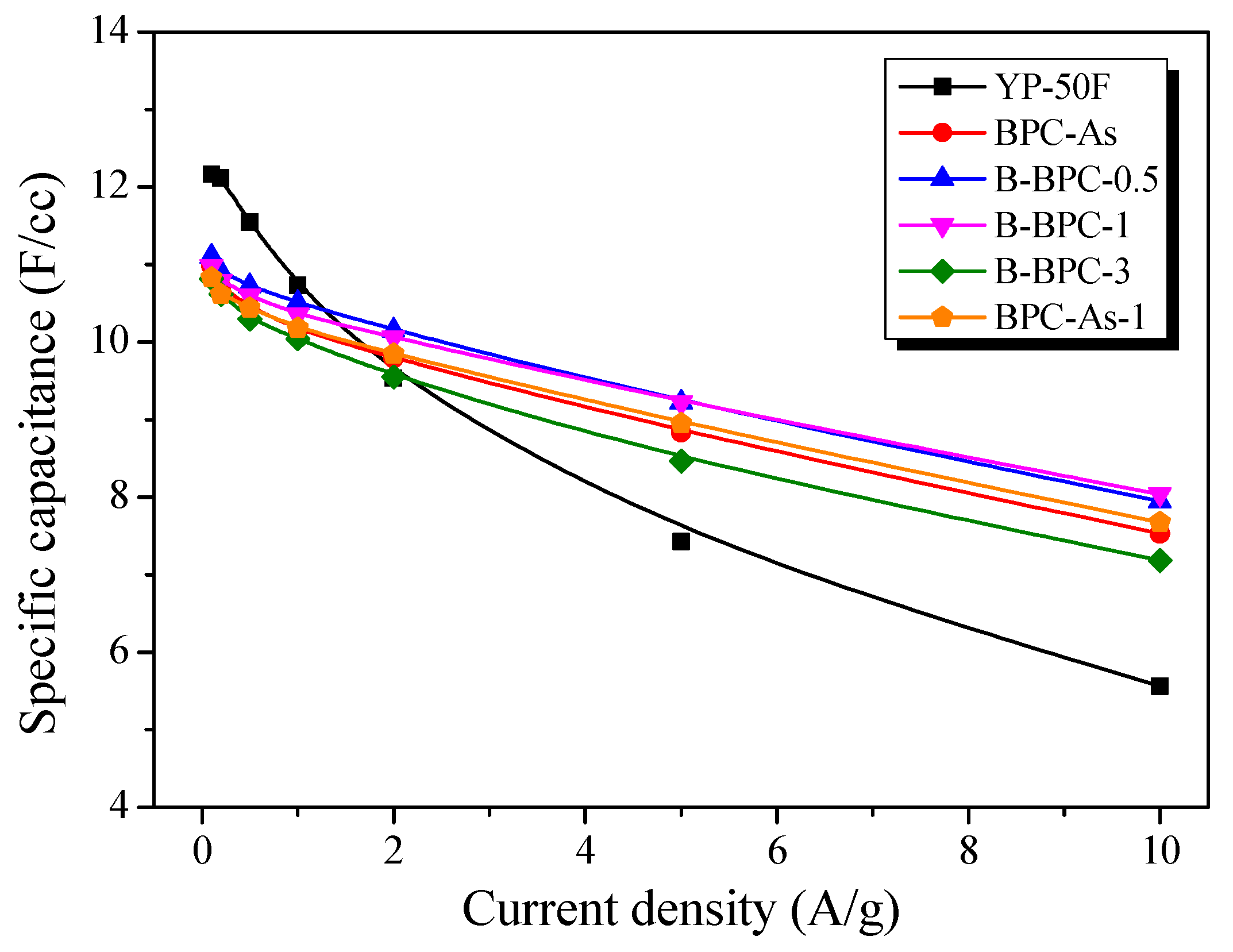
Figure 7 shows the specific capacitance (F/g) of the BPC electrodes under various heat treatment conditions as a function of current density. For all the electrodes, the specific capacitance gradually decreased with increasing current density, which can be attributed to the diffusion limitations of the electrolyte ions in the high-current-density region. Within the current density range of 0.1–5 A/g, B-BPC-0.5 exhibited the highest specific capacitance, whereas at ≥5 A/g, B-BPC-1 maintained the highest capacitance among all samples. This behavior can be interpreted in terms of the micropore distribution and electrical conductivity characteristics of BPC as a function of the heat-treatment time. B-BPC-0.5 possessed a highly developed microporous structure, providing excellent electrolyte accessibility and high capacitance at low current densities. However, in a micropore-dominant structure, the ion diffusion resistance increases with increasing current density, leading to reduced capacitance retention [42].
By contrast, although B-BPC-1 exhibited a similar micropore-dominant texture, partial C–B substitution and the growth of B–C (sp2) bonding domains enhanced both the electron transport and ion diffusion capabilities, as supported by the electrochemical analyses shown in Figure 5 and Figure 6. These improvements contribute to reduced internal resistance and enhanced conductivity, and thus a superior specific capacitance, even at high current densities.
Consequently, B-BPC-1 demonstrated the most balanced porous carbon architecture, simultaneously enhancing the electronic conductivity through sp2-hybridized bonding and improved electrolyte accessibility. As a result, B-BPC-1 exhibits the best overall electrochemical performance among all the boron-doped BPC electrodes.

4. Conclusions

In this study, a boron doping process based on a dry-heat-treatment method with excellent environmental friendliness, process simplicity, and economic efficiency was proposed. The effects of boron-induced electronic-structure modulation and defect stabilization on the crystalline structure and electrochemical behavior of BPC were systematically investigated.
Boron was incorporated into the carbon framework through the formation of B–O–C and B–C bonds, resulting from the reaction between B2O3—generated by the thermal decomposition of boric acid—and oxygen-containing surface functional groups on BPC. According to the XRD analysis (Figure 2), the crystallite dimensions (La, Lc) of B-BPC gradually decreased with increasing heat treatment time. This phenomenon was attributed to localized redox reactions and the rearrangement of B–O–C bonds during the deoxygenation of B2O3, leading to the formation of partial crystalline defects and amorphous carbon domains. Moreover, the partial reduction of B2O3 and the formation of B–C (sp2) or B–O–C (sp3) bonds during the doping process induced local structural defects within the carbon lattice. These bonds simultaneously improve the structural integrity of the pore walls and enhance the thermal durability of the material, thereby effectively suppressing excessive pore collapse. Such reactions represent covalent bonding mechanisms rather than simple physical adsorption, where boron is partially substituted within the carbon lattice, locally distorting the π-electron network and thereby improving the electronic structure of BPC (Figure 4).
Electrochemical measurements revealed that B-BPC-1 exhibited the lowest IR drop (0.369 V) and highest specific capacitance among all the samples. This superior performance was attributed to the balanced defect structure and well-aligned π-electron network formed under optimal heat-treatment conditions (1 h), which simultaneously enhanced electronic conductivity and ion diffusion. By contrast, B-BPC-3 showed reduced electrochemical reactivity owing to the thermal decomposition of B–O and B–O–C bonds and the loss of active defect sites during prolonged heat treatment. Thus, although extended heat treatment improved the electrical conductivity, it acted as a limiting factor for the capacitive performance by reducing the surface defect density.
Overall, boron doping was a key factor in optimizing the charge transport pathways and enhancing the electron mobility in the porous carbon frameworks. In particular, the boron-doped structure formed at the optimal treatment duration (1 h) provided the most effective configuration for high-performance electrode behavior by harmonizing B–C bond formation, stable pore structure maintenance, and moderate defect density.
The proposed dry-heat-treatment boron-doping process is a strategic approach that extends beyond simple surface modifications. In addition, decreasing the holding temperature may further improve process sustainability by reducing unnecessary CO evolution and preserving beneficial oxygen-containing functional groups, which could promote synergistic electrochemical interactions with boron sites. By controlling the chemical bonding states of boron, this method enables the precise tuning of the electronic structure and electrochemical reactivity of carbon materials. This environmentally friendly and cost-effective approach demonstrates strong potential for application in high-performance EDLC electrodes with maximized charge transfer efficiency. Consequently, dry-process boron doping was validated as an efficient route for controlling the electronic structure, defect stability, and electrochemical properties of porous carbon materials, providing a fundamental basis for the future design of advanced energy storage materials.

Supplementary Materials

The following supporting information can be downloaded at: https://www.mdpi.com/article/10.3390/batteries11120443/s1, Figure S1: B1s spectra of BPC as a function of various heating time with and without boric acid treatment; (a) BPC-As, (b) B-BPC-0.5, (c) B-BPC-1, (d) B-BPC-3 and (e) BPC-As-1; Table S1: Structural Parameters of B-BPC as a Function of Various Heating Treatment Time; Table S2: Boron Atomic Percent of BPC as a Function of Various Heating Treatment Time.

Author Contributions

Conceptualization, H.-H.K.; methodology, H.-H.K.; software, H.-H.K.; validation, H.-H.K.; formal analysis, H.-H.K., C.-K.C. and J.-H.K.; investigation, H.-H.K.; resources, K.-H.A. and B.-J.K.; data curation, H.-H.K., C.-K.C. and J.-H.K.; writing—original draft preparation, H.-H.K.; writing—review and editing, H.-H.K., H.-M.L., K.-H.A., D.-C.C. and B.-J.K.; visualization, H.-H.K. and C.-K.C.; supervision, K.-H.A., D.-C.C. and B.-J.K.; project administration, K.-H.A. and B.-J.K.; funding acquisition, K.-H.A. All authors have read and agreed to the published version of the manuscript.

Funding

This research was supported by the Regional Innovation System and Education (RISE) program through the Jeonbuk RISE Center, which is funded by the Ministry of Education (MOE) and Jeonbuk State, Republic of Korea (2025-RISE-13-JJU). This work was also supported by the Korea Institute of Energy Technology Evaluation and Planning (KETEP) and the Ministry of Climate, Energy, and Environment (MCEE), Republic of Korea (RS-2025-07852969). This study was also supported by the Project for the Development of Innovative Technologies for Plastic Value-Up in Response to Global Recycling Regulations, funded by the Ministry of Trade, Industry and Resources (MOTIR), Republic of Korea (RS-2025-25447226).

Data Availability Statement

The original contributions presented in the study are included in the article/Supplementary Materials, further inquiries can be directed to the corresponding author.

Conflicts of Interest

The authors declare no conflicts of interest.

References

  1. Li, H.; Yan, Q.; Li, J.; Qiu, J.; Zhang, H. Porous Carbon Materials: From Traditional Synthesis, Machine Learning-Assisted Design, to Their Applications in Advanced Energy Storage and Conversion. Adv. Funct. Mater. 2025, 35, 2504272. [Google Scholar] [CrossRef]
  2. Lei, D.; Zeng, Y.; Zhong, J.; Chen, J.; Ye, Y.; Wang, W. Ultra-high specific surface area porous carbons derived from Chinese medicinal herbal residues with potential applications in supercapacitors and CO2 capture. Colloids Surf. A Physicochem. Eng. Asp. 2023, 666, 131327. [Google Scholar] [CrossRef]
  3. Kim, J.H.; Lee, H.M.; Jung, S.C.; Chung, D.C.; Kim, B.J. Bamboo-Based Mesoporous Activated Carbon for High-Power-Density Electric Double-Layer Capacitors. Nanomaterials 2021, 11, 2750. [Google Scholar] [CrossRef]
  4. Chen, M.; Zhang, Y.; Xing, G.; Chou, S.; Tang, Y. Electrochemical energy storage devices working in extreme conditions. Energy Environ. Sci. 2021, 14, 3323–3351. [Google Scholar] [CrossRef]
  5. Selvaraj, A.R.; Muthusamy, A.; Inho-Cho; Kim, H.; Senthil, K.; Prabakar, K. Ultrahigh surface area biomass derived 3D hierarchical porous carbon nanosheet electrodes for high energy density supercapacitors. Carbon 2020, 174, 463–474. [Google Scholar] [CrossRef]
  6. Lee, H.M.; An, K.H.; Park, S.J.; Kim, B.J. Mesopore-Rich Activated Carbons for Electrical Double-Layer Capacitors by Optimal Activation Condition. Nanomaterials 2019, 9, 608. [Google Scholar] [CrossRef]
  7. Urita, K.; Urita, C.; Fujita, K.; Horio, K.; Yoshida, M.; Moriguchi, I. The ideal porous structure of EDLC carbon electrodes with extremely high capacitance. Nanoscale 2017, 9, 15643–15649. [Google Scholar] [CrossRef]
  8. Wang, Y.; Zhang, L.; Hou, H.; Xu, W.; Duan, G.; He, S.; Liu, K.; Jiang, S. Recent progress in carbon-based materials for supercapacitor electrodes: A review. J. Mater. Sci. 2020, 56, 173–200. [Google Scholar] [CrossRef]
  9. Frackowiak, É.; Beguin, F. Carbon materials for the electrochemical storage of energy in capacitors. Carbon 2001, 39, 937–950. [Google Scholar] [CrossRef]
  10. Zhang, C.; Zheng, K.; Yang, D.; Ye, X.; Zhou, L.; Yun, J. Construction of metal-free heteroatoms doped carbon catalysts with certain structure and properties: Strategies and methods. Carbon Lett. 2025, 35, 963–985. [Google Scholar] [CrossRef]
  11. Choi, C.H.; Park, S.H.; Woo, S.I. Binary and Ternary Doping of Nitrogen, Boron, and Phosphorus into Carbon for Enhancing Electrochemical Oxygen Reduction Activity. ACS Nano 2012, 6, 7084–7091. [Google Scholar] [CrossRef]
  12. Wang, D.; Li, F.; Chen, Z.; Lu, G.Q.; Cheng, H. Synthesis and Electrochemical Property of Boron-Doped Mesoporous Carbon in Supercapacitor. Chem. Mater. 2008, 20, 7195–7200. [Google Scholar] [CrossRef]
  13. Agnoli, S.; Favaro, M. Doping graphene with boron: A review of synthesis methods, physicochemical characterization, and emerging applications. J. Mater. Chem. A 2016, 4, 5002–5025. [Google Scholar] [CrossRef]
  14. Biscoe, J.; Warren, B.E. An X-Ray Study of Carbon Black. J. Appl. Phys. 1942, 13, 364–371. [Google Scholar] [CrossRef]
  15. Brunauer, S.; Emmett, P.H.; Teller, E. Adsorption of Gases in Multimolecular Layers. J. Am. Chem. Soc. 1938, 60, 309–319. [Google Scholar] [CrossRef]
  16. Barrett, E.P.; Joyner, L.G.; Halenda, P.P. The Determination of Pore Volume and Area Distributions in Porous Substances. I. Computations from Nitrogen Isotherms. J. Am. Chem. Soc. 1951, 73, 373–380. [Google Scholar] [CrossRef]
  17. Neimark, A.V.; Lin, Y.; Ravikovitch, P.I.; Thommes, M. Quenched solid density functional theory and pore size analysis of micro-mesoporous carbons. Carbon 2009, 47, 1617–1628. [Google Scholar] [CrossRef]
  18. Galarneau, A.; Villemot, F.; Rodriguez, J.; Fajula, F.; Coasne, B. Validity of the t-plot Method to Assess Microporosity in Hierarchical Micro/Mesoporous Materials. Langmuir 2014, 30, 13266–13274. [Google Scholar] [CrossRef]
  19. Herold, F.; Gläsel, J.; Etzold, B.J.M.; Rønning, M. Can Temperature-Programmed Techniques Provide the Gold Standard for Carbon Surface Characterization? Chem. Mater. 2022, 34, 8490–8516. [Google Scholar] [CrossRef]
  20. Kim, J.H.; Kim, S.H.; Kim, B.J.; Lee, H.M. Effects of Oxygen-Containing Functional Groups on the Electrochemical Performance of Activated Carbon for EDLCs. Nanomaterials 2023, 13, 262. [Google Scholar] [CrossRef] [PubMed]
  21. Kohl, S.; Drochner, A.; Vogel, H. Quantification of oxygen surface groups on carbon materials via diffuse reflectance FT-IR spectroscopy and temperature programmed desorption. Catal. Today 2010, 150, 67–70. [Google Scholar] [CrossRef]
  22. Figueiredo, J.L.; Pereira, M.F.R.; Freitas, M.M.A.; Orfao, J.J.M. Modification of the surface chemistry of activated carbons. Carbon 1999, 37, 1379–1389. [Google Scholar] [CrossRef]
  23. Kozień, D.; Jeleń, P.; Stępień, J.; Olejniczak, Z.; Sitarz, M.; Pędzich, Z. Surface Properties and Morphology of Boron Carbide Nanopowders Obtained by Lyophilization of Saccharide Precursors. Materials 2021, 14, 3419. [Google Scholar] [CrossRef] [PubMed]
  24. Rotaru, A. Thermal and kinetic study of hexagonal boric acid versus triclinic boric acid in air flow. J. Therm. Anal. Calorim. 2016, 127, 755–763. [Google Scholar] [CrossRef]
  25. Chen, H.; Xiong, Y.; Yu, T.; Zhu, P.; Yan, X.; Wang, Z.; Guan, S. Boron and nitrogen co-doped porous carbon with a high concentration of boron and its superior capacitive behavior. Carbon 2016, 113, 266–273. [Google Scholar] [CrossRef]
  26. Kesavan, D.; Mariappan, V.K.; Krishnamoorthy, K.; Kim, S.J. Carbothermal conversion of boric acid into boron-oxy-carbide nanostructures for high-power supercapacitors. J. Mater. Chem. A 2020, 9, 915–921. [Google Scholar] [CrossRef]
  27. Feng, B.; Martin, H.; Michaelis, A. Synthesis of Boron Carbide Powder via Rapid Carbothermal Reduction Using Boric Acid and Carbonizing Binder. Ceramics 2022, 5, 837–847. [Google Scholar] [CrossRef]
  28. Kim, H.H.; An, K.H.; Kim, B.J. Preparation of Mesoporous Boron-Doped Porous Carbon Derived from Coffee Grounds via Hybrid Activation for Carbon Capture and Storage. Batteries 2025, 11, 158. [Google Scholar] [CrossRef]
  29. Chesnokov, V.V.; Prosvirin, I.P.; Gerasimov, E.Y.; Chichkan, A.S. Synthesis of Boron-Doped Carbon Nanomaterial. Materials 2023, 16, 1986. [Google Scholar] [CrossRef]
  30. Zhao, Z.; Chen, H.; Zhang, W.; Yi, S.; Chen, H.; Su, Z.; Niu, B.; Zhang, Y.; Long, D. Defect engineering in carbon materials for electrochemical energy storage and catalytic conversion. Mater. Adv. 2023, 4, 835–867. [Google Scholar] [CrossRef]
  31. Kang, D.J.; Lee, H.M.; An, K.H.; Kim, B.J. Preparation of polyimide-based activated carbon fibers and their application as the electrode materials of electric double-layer capacitors. Carbon Lett. 2024, 34, 1653–1666. [Google Scholar] [CrossRef]
  32. Allagui, A.; Freeborn, T.J.; Elwakil, A.S.; Maundy, B.J. Reevaluation of Performance of Electric Double-layer Capacitors from Constant-current Charge/Discharge and Cyclic Voltammetry. Sci. Rep. 2016, 6, 38568. [Google Scholar] [CrossRef]
  33. Kim, H.H.; Kim, J.H.; Jeong, J.S.; Lee, H.M.; An, K.H.; Kim, B.J. Electrochemical performance of microporous carbons derived from oak wood for electric double-layer capacitor. Carbon Lett. 2025, 35, 2381–2394. [Google Scholar] [CrossRef]
  34. Pati, S.K.; Hwang, Y.; Lee, H.M.; Kim, B.J.; Park, S.J. Porous activated carbon derived from petroleum coke as a high-performance anodic electrode material for supercapacitors. Carbon Lett. 2023, 34, 153–162. [Google Scholar] [CrossRef]
  35. Lazanas, A.C.; Prodromidis, M.I. Electrochemical Impedance Spectroscopy—A Tutorial. ACS Meas. Sci. Au 2023, 3, 162–193. [Google Scholar] [CrossRef]
  36. Patrick, J.S.J.; Subrayapillai Ramakrishna, N.; Sankar, M.; Joseph, M.; Moses, V.A.R.; Saravanabhavan, S.S.; Appusamy, M.; Ayyar, M. Examination of hybrid electrode material for energy storage device supercapacitor under various electrolytes. Carbon Lett. 2024, 34, 1639–1652. [Google Scholar] [CrossRef]
  37. Lei, Z.; Chen, H.; Yang, M.; Yang, D.; Li, H. Boron and oxygen-codoped porous carbon as efficient oxygen reduction catalysts. Appl. Surf. Sci. 2017, 426, 294–300. [Google Scholar] [CrossRef]
  38. Ghosh, S.; Barg, S.; Jeong, S.M.; Ostrikov, K. Heteroatom-Doped and Oxygen-Functionalized Nanocarbons for High-Performance Supercapacitors. Adv. Energy Mater. 2020, 10, 2001239. [Google Scholar] [CrossRef]
  39. Moya, A.A. A physically consistent electric circuit to interpret the galvanostatic charge-discharge curves of electric double layer capacitors. J. Power Sources 2025, 656, 238050. [Google Scholar] [CrossRef]
  40. Kavil, J.; Anjana, P.M.; Joshy, D.; Babu, A.; Raj, G.; Periyat, P.; Rakhi, R.B. g-C3N4/CuO and g-C3N4/Co3O4 nanohybrid structures as efficient electrode materials in symmetric supercapacitors. RSC Adv. 2019, 9, 38430–38437. [Google Scholar] [CrossRef]
  41. Duraisamy, N.; Shenniangirivalasu Kandasamy, K.; Dhandapani, E.; Kandiah, K.; Panchu, S.J.; Swart, H.C. Biomass Derived 3D Hierarchical Porous Activated Carbon for Solid-State Symmetric Supercapacitors. J. Inorg. Organomet. Polym. 2025, 1–23. [Google Scholar] [CrossRef]
  42. Wei, C.; Yu, J.; Yang, X.; Zhang, G. Activated Carbon Fibers with Hierarchical Nanostructure Derived from Waste Cotton Gloves as High-Performance Electrodes for Supercapacitors. Nanoscale Res. Lett. 2017, 12, 379. [Google Scholar] [CrossRef] [PubMed]
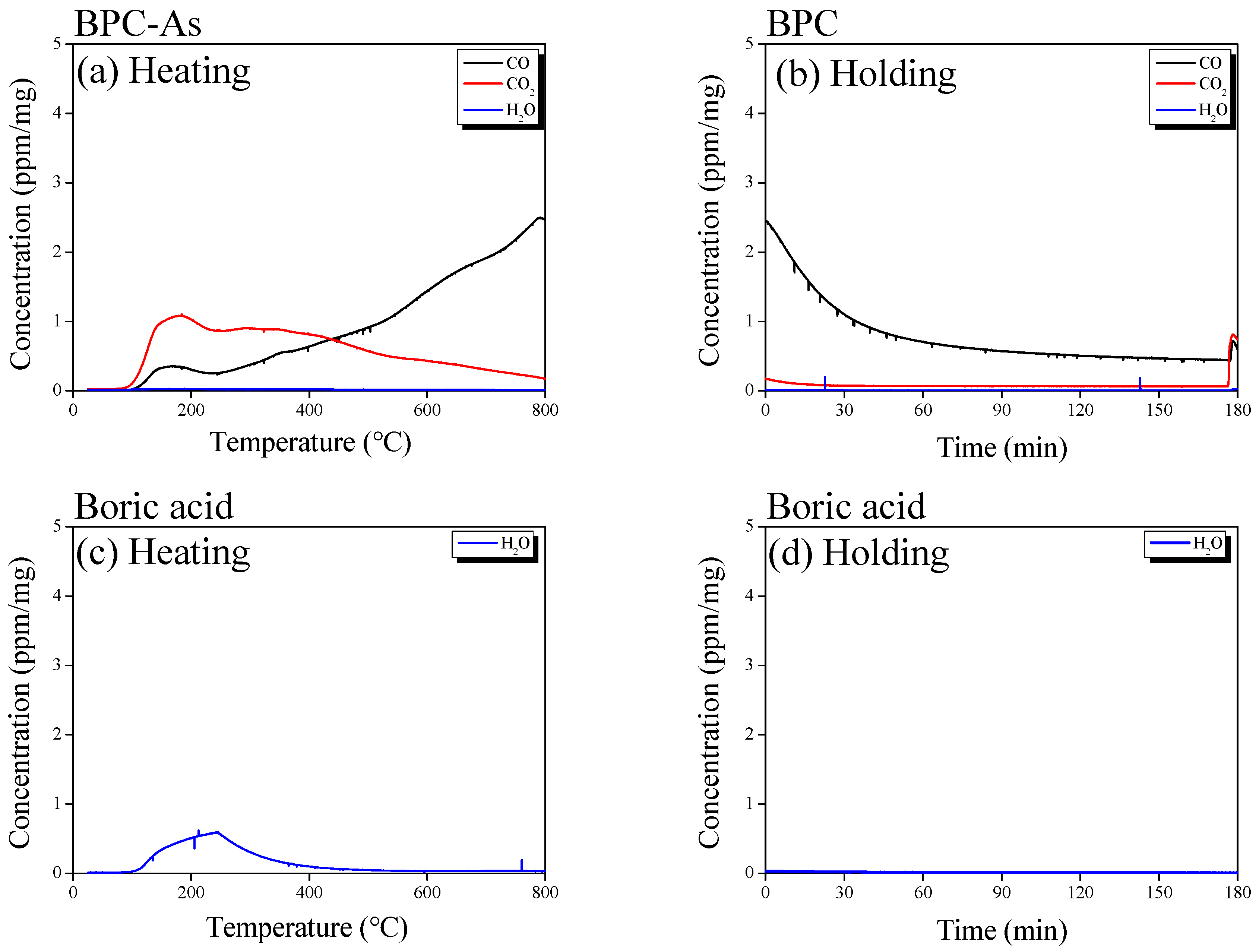
Figure 1. TPD–IR spectra of (a,b) BPC-As, (c,d) boric acid, and (e,f) BPC-As with boric acid.
Batteries 11 00443 g001aBatteries 11 00443 g001b
Figure 2. (a) XRD patterns; (b) crystallite size of B-BPC as a function of heat treatment time.
Batteries 11 00443 g002
Figure 3. (a) N2/77 K isothermal adsorption–desorption curves; (b) pore size distribution of B-BPC as a function of heat treatment time.
Batteries 11 00443 g003
Figure 4. Electrical conductivity of BPC and B-BPC as a function of pressing force (N).
Batteries 11 00443 g004
Figure 5. (a,b) CV curves and (c) Nyquist plots of BPC by dry-heat-treatment process.
Batteries 11 00443 g005
Figure 6. Galvanostatic charge–discharge curves of BPC subjected to the dry-heat-treatment process.
Batteries 11 00443 g006
Figure 7. Specific capacitance of BPC as a function of various heat treatment conditions under different current densities.
Batteries 11 00443 g007
Table 1. Textural properties of B-BPC as a function of heat treatment time.
SampleSBET a
(m2/g)
VTotal b
(cm3/g)
VMicro c
(cm3/g)
Vmeso d
(cm3/g)
RMicro eRMesof
YP-50F17100.790.620.170.780.22
BPC-As14900.730.440.290.600.40
B-BPC-0.515400.760.460.300.610.39
B-BPC-115600.770.470.300.610.39
B-BPC-315400.760.460.300.610.39
BPC-As-115100.740.450.290.610.39
a SBET: Specific surface area: BET method; P v ( P 0 P ) =   1 v m +   c 1 v m c · P P 0 . b VTotal: Total pore volume; amount of adsorbed P/P0 = 0.99. c VMicro: b VTotald VMeso. d VMeso: BJH method: r k = 2 γ V R T ln ( P / P 0 ) . e RMicro: Micropore volume ratio; V M i c r o V T o t a l . f RMeso: Mesopore volume ratio; 1 − RMicro.
Table 2. IR drop of BPC and B-BPC as a function of various surface treatment conditions.
SampleIR Drop (V)
YP-50F0.521
BPC-As0.402
B-BPC-0.50.383
B-BPC-10.369
B-BPC-30.372
BPC-As-10.373
Disclaimer/Publisher’s Note: The statements, opinions and data contained in all publications are solely those of the individual author(s) and contributor(s) and not of MDPI and/or the editor(s). MDPI and/or the editor(s) disclaim responsibility for any injury to people or property resulting from any ideas, methods, instructions or products referred to in the content.