


Abstract
Understanding the proton relaxation mechanism of hydrogen gas in porous media is critical for underground hydrogen storage. This study investigates the proton relaxation mechanisms of hydrogen gas using variable-pressure NMR experiments on idealized glass bead pack models (6.8–65.9 μm). Results indicate: (1) The proton spin–spin relaxation time (T2) of bulk H2 gas is linearly proportional to pressure, confirming the dominance of the spin–rotation (SR) interaction. (2) In pores larger than 16.4 μm, bulk relaxation prevails, rendering the T2 distribution single-peaked and pore-size independent. (3) Conversely, in 6.8 μm pores, a distinct bimodal T2 distribution emerges, separating free-gas and surface-dominated components. A theoretical critical pore size (≈11.5 μm) was estimated based on a two-phase exchange model. This work elucidates the fundamental regime transition from bulk- to surface-dominated proton relaxation in micron-scale pores.
1. Introduction
Hydrogen has emerged as a renewable, clean, and efficient energy carrier critical to driving the global energy transition and decarbonizing energy systems [1,2,3]. With the rapid development of the hydrogen energy industry, achieving large-scale underground hydrogen storage and advancing the exploration of natural hydrogen resources have become the two core driving forces for ensuring future energy security. In the field of hydrogen storage technology, large-scale, low-cost, and long-duration underground hydrogen storage can be achieved using geological formations such as salt caverns, aquifers, and depleted oil and gas reservoirs. In contrast, storage technologies suitable for small-to-medium-scale and mobile applications mainly include compressed hydrogen, liquid hydrogen, physisorption-based materials (e.g., MOFs and zeolites), and materials based on reversible chemical reactions (e.g., metal hydrides and alloys) [4,5,6,7,8,9]; In the field of resource exploration, there is an urgent need to accurately evaluate the generation, migration, and accumulation patterns of natural hydrogen in deep geological bodies [10,11,12]. However, whether in artificial storage reservoirs or natural gas reservoirs, the exceptionally low density and high diffusivity of hydrogen result in transport and retention behaviors in porous media that differ fundamentally from those of conventional fluids, with more complex occurrence states, adsorption mechanisms, and dynamic processes [13]. Therefore, effective techniques are urgently needed for the in situ and non-destructive detection and characterization of hydrogen occurrence states, distribution, and dynamic behavior in porous media. This capability is essential for optimizing underground hydrogen storage design, guiding natural hydrogen exploration, evaluating material performance, and ensuring the safety and efficiency of hydrogen energy utilization.
Nuclear magnetic resonance (NMR), as a non-invasive detection method, with its high resolution and unique sensitivity to hydrogen-containing fluids, has become one of the primary techniques for characterizing fluids in porous media. It has been widely applied in geological energy exploration and porous material characterization for identifying fluid components in various occurrence states and finely evaluating pore structure [14,15,16,17]. By combining NMR spin–spin relaxation time (T2) measurements with physical or geochemical experiments such as centrifugation and rock pyrolysis, it is possible to effectively distinguish fluid components in complex reservoirs like sandstone and shale, including bound water and movable water [18,19], adsorbed oil and free oil, and quantitatively evaluate the saturation of each component [20,21]. NMR offers distinct advantages in pore-structure characterization and has spurred the development of numerous well-established evaluation methods. By integrating fractal theory, combining mercury injection with gas adsorption experiments, and applying capillary-pressure-curve prediction models, researchers have successfully achieved comprehensive characterization of microscopic heterogeneity, full-size pore–throat distribution, and macroscopic percolation capacity in complex reservoirs such as tight sandstones and shales [22,23,24]. It is worth noting that a key prerequisite underlies these mature applications: in conventional rock reservoirs and porous materials, fluid molecules are in the “fast diffusion regime” [25]. In this regime, the relaxation process of the fluid is dominated by the surface relaxation mechanism, resulting in a direct positive correlation between T2 relaxation time and pore size. With the simultaneous growth in demand for underground hydrogen storage projects and natural hydrogen exploration, low-field NMR is gradually being applied to probe proton (1H) relaxation of hydrogen gas in porous media. However, unlike the relatively mature and unified understanding of water or oil, current knowledge of the occurrence state and dynamic characteristics of hydrogen in porous media shows significant “medium-dependent” differences.
On one hand, hydrogen exhibits complex surface adsorption in organic-rich tight micro- and nanopores. For example, experimental studies on shale have shown that hydrogen in organic-matter pores does not exist solely as a free phase but resolves into two distinct relaxation components—“free-state” and “adsorbed-state”. Hysteresis during adsorption/desorption further leads to partial hydrogen retention and irreversible signal loss [26]. Studies on high-specific-surface-area geological materials also confirm that, within nanoscale confined spaces, adsorbed-state and free-state hydrogen exhibit markedly different T2 relaxation times [27]. Kinetic simulations further elucidate the underlying microscopic mechanism, revealing that hydrogen diffusion in kerogen slit pores (approximately 0.5–2 nm) is strongly constrained by pore confinement [28]. Additionally, certain clay minerals, such as sepiolite, have been shown to exhibit measurable hydrogen adsorption capacity [29]. On the other hand, hydrogen in conventional sandstone reservoirs displays different characteristics. Studies on Berea sandstone indicate that, whether in dry or fluid-saturated conditions, injected hydrogen consistently appears as a single “free gas” signal, with no significant surface adsorption features observed [30]. Relevant geochemical experiments also support this inert behavior, noting that hydrogen rarely undergoes chemical reactions in sandstone matrices [31]. Even for clays like montmorillonite, thermodynamic calculations suggest that hydrogen struggles to enter hydrated interlayers, and its solubility in confined interlayer water is extremely limited [32]. Furthermore, NMR proton spectroscopy and multidimensional NMR techniques have also been employed to observe the chemical shift and diffusion behavior of hydrogen [33,34], providing new perspectives for understanding its occurrence state in porous media [35]. Although the above studies have preliminarily revealed the NMR response characteristics of hydrogen in porous media from various angles, research in this field remains in its early stages. The interplay of multiple factors in natural rocks, including pore size, mineral composition, and surface properties, makes it challenging to isolate the contribution of any individual factor. Currently, the NMR response mechanism of hydrogen-bearing fluids in porous media under varying pressures and pore structures remains incompletely understood.
Therefore, to address the above issues, this study takes sandstone reservoirs as the research scenario and employs glass bead packs with stable surface properties and graded particle sizes to construct an “ideal porous medium model” for simulating sandstone. We conducted variable-pressure low-field NMR relaxation measurements on bulk hydrogen and confined hydrogen across different pore-size scales, with water-saturated experiments under identical pore conditions serving as a benchmark reference. By comparing the relaxation behavior of hydrogen and water in confined spaces, we reveal the distinctive NMR response characteristics of hydrogen that differ fundamentally from those of conventional liquids and clarify the critical control of pore size on gas relaxation mechanisms and molecular exchange kinetics. This work provides critical experimental evidence and theoretical guidance for applying NMR to natural hydrogen exploration and underground hydrogen storage assessment.
2. Material and Methods
2.1. Materials
In this study, four industrial-grade standard glass bead packs with different particle sizes (425 μm, 180 μm, 106 μm, and 44 μm) were used to construct porous medium models. The glass beads were composed of SiO2, had a density of 2.3 g/cm3, and were purchased from Shanghai Huizhi Biotechnology Co., Ltd., Shanghai, China. Based on the close-packed sphere theory, the equivalent pore size can be related to the glass bead particle size by , where the geometric factor . Accordingly, the corresponding average pore sizes for the above particle sizes were calculated to be 65.9 μm, 27.9 μm, 16.4 μm, and 6.8 μm, respectively. The hydrogen gas used in the experiments had a purity of 99.99% and was supplied from a high-pressure cylinder with injection pressure precisely controlled by a high-precision pressure-reducing valve.
To eliminate magnetic field interference from metallic materials and ensure safety during pressurized experiments, the sample holder was fabricated from high-strength zirconia (ZrO2) ceramic material, following the design of A. Papaioannou et al. (2015) [36]. The device employs a “metal-ceramic” threaded sealing structure and is equipped with fluorinated rubber O-rings and threaded interfaces, providing excellent sealing performance while achieving a pressure resistance of up to 30 MPa.
2.2. NMR Measurement
NMR measurements were performed on a MicroMR12-025V nuclear magnetic resonance analyzer (Suzhou Niumag Analytical Instrument Corporation, Suzhou, China). The instrument operates at a 1H resonance frequency of 12 MHz, with the magnet temperature maintained at 32.0 ± 0.01 °C, and is equipped with a 1.5-inch diameter RF probe. T2 measurements were conducted using the Carr-Purcell-Meiboom-Gill (CPMG) pulse sequence. The acquisition parameters were set as follows: waiting time (TW) = 6000 ms, echo spacing (TE) = 0.1 ms, number of echoes (NECH) = 10,000, and multiple accumulations were applied to ensure that the signal-to-noise ratio of all sample data exceeded 100. The acquired echo data were processed using inversion software independently developed by the research team to obtain the T2 distribution.
2.3. Experimental Procedure
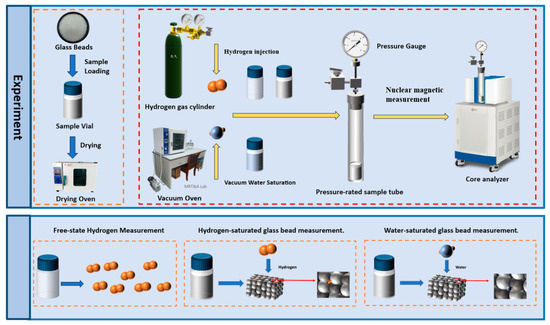
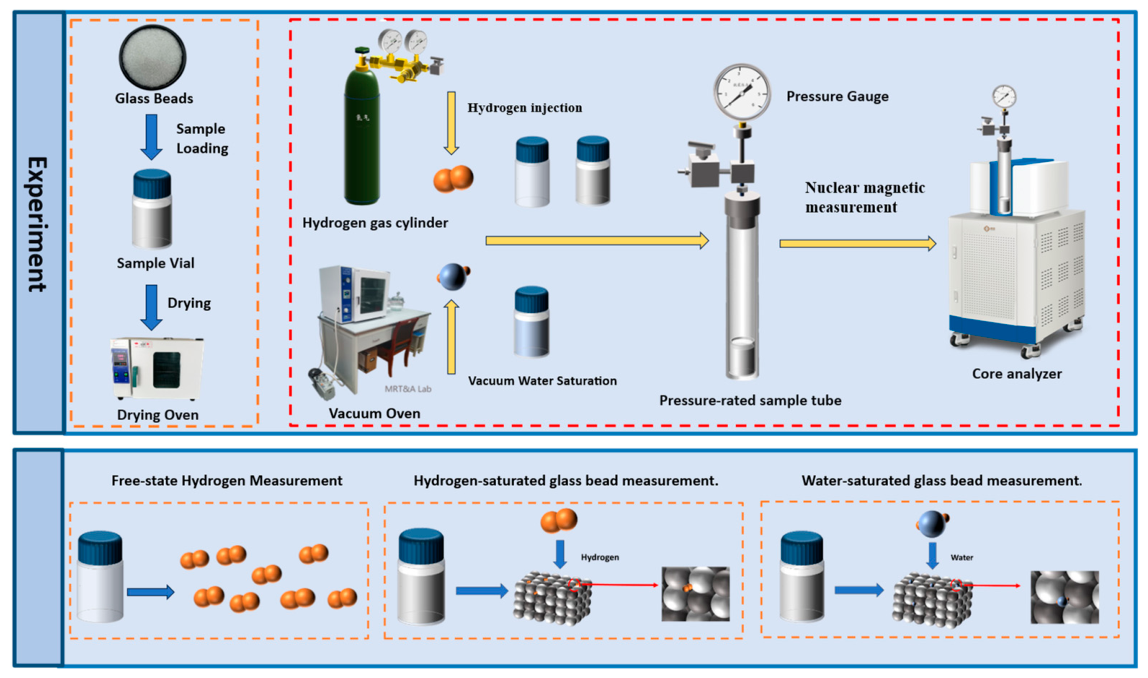
To investigate the NMR relaxation characteristics of hydrogen in both its bulk state and confined state within porous media, we designed three sets of experiments: variable-pressure relaxation measurements on bulk hydrogen, confined-hydrogen relaxation measurements in glass bead packs with different pore sizes, and reference experiments on fully water-saturated samples. The overall experimental workflow is shown in Figure 1. For clarity, in the following text, bulk hydrogen refers to unconfined gaseous H2, and free-state hydrogen refers to hydrogen not adsorbed on pore surfaces.
Figure 1.
Schematic diagram of the experimental procedure.
Sample Preparation and Pretreatment: (1) Porous medium samples: Before the experiments, glass beads of different particle sizes were separately packed into custom glass sample vials, and mechanical vibration was applied to ensure dense and uniform particle stacking. The packed samples were then placed in an oven at 120 °C for 24 h to thoroughly remove residual moisture within the pores and adsorbed impurities on the surfaces. (2) Background correction sample: To eliminate interference from bulk hydrogen signals generated in the annular space between the pressure-resistant tube and the sample vial, a background sample filled with epoxy resin was prepared, with a filling volume identical to that of the glass bead samples.
Gas Injection and Measurement: All experiments employed the custom-designed zirconia pressure-resistant sample tube, which enabled offline NMR measurements after disconnection of the external gas lines. (1) Variable-pressure relaxation measurements of bulk hydrogen: An empty glass sample vial was placed inside the pressure-resistant tube and connected to the high-pressure gas injection system. Under constant temperature conditions, the system was allowed to stabilize for 20 min. Then, using a precision pressure-reducing valve, the hydrogen pressure was sequentially adjusted to 1 MPa, 2 MPa, 3 MPa, 4 MPa, and 5 MPa. After stabilization at each pressure point, the connecting lines were disconnected, and the pressure-resistant tube was placed into the NMR probe for T2 measurement. (2) Proton relaxation measurements of confined H2 gas in glass bead packs of different pore sizes: The pretreated glass bead samples were loaded into the zirconia pressure-resistant tube. High-purity hydrogen was injected via the gas injection system, and pressure was raised to 5 MPa using a precision pressure-reducing valve. After pressure stabilization, the gas lines were disconnected, and the tube was transferred to the NMR probe for T2 measurement. (3) Background signal correction experiment: The epoxy resin background sample was placed in the pressure-resistant tube and subjected to NMR T2 measurement under the same 5 MPa hydrogen pressure and acquisition parameters. The resulting signal served as the system background baseline and was subtracted from the total signal of the glass bead samples during subsequent data processing.
Fully Water-Saturated Reference Experiments: The dried glass bead samples of identical specifications were placed in a vacuum saturation device, and distilled water was slowly injected under negative pressure until complete saturation was achieved. The saturated samples were then transferred to the pressure-resistant sample tube for T2 measurement.
3. Theory
3.1. Relaxation Mechanism of Bulk Fluids
The motion of molecules in free liquids can be approximately regarded as random diffusion within an infinite spatial range. The relaxation process is primarily dominated by intramolecular and intermolecular dipole–dipole (DD) interactions. According to the Bloembergen-Purcell-Pound (BPP) theory, the relaxation rate (1/ of liquid molecules is determined by the spectral density function JBPP(ω) of the DD interaction [37]:
where μ0 is the vacuum permeability, γ is the nuclear gyromagnetic ratio, ħ is the reduced Planck constant, is the distance between interacting hydrogen nuclei, is the angular frequency of the magnetic field, is the correlation time of the liquid molecule, and is the spectral density function of the liquid molecule under this interaction. Under the extreme narrowing condition ( << 1), the T2 relaxation time of liquid molecules is proportional to their diffusion coefficient D (T2 ∝ 1/D).
However, the motion of dilute gas molecules differs fundamentally from that of liquid molecules. Gas molecules undergo nearly free flight over infinite spatial ranges, interrupted only by instantaneous, random binary collisions. More importantly, for molecules such as hydrogen, both intramolecular and intermolecular dipole–dipole (DD) interactions contribute negligibly. Instead, the relaxation process is dominated by the spin–rotation (SR) interaction between the nuclear spin and the rotational angular momentum within the molecule, an interaction that is repeatedly interrupted by frequent molecular collisions [38,39,40,41]. Consequently, the correlation time assumes a completely different physical meaning: its value no longer reflects the diffusive characteristics of rotational motion but rather represents the average time interval between collisions that effectively alter the rotational state of the gas molecule. Owing to the extremely rapid motion of gas molecules, the extreme narrowing condition is always satisfied, and the relaxation rate (1/ of gas molecules can then be expressed as:
where Ceff is the effective spin–rotation coupling constant, and is the thermodynamic average of the molecular rotational angular momentum squared.
The gas correlation time is inversely proportional to gas density (i.e., ∝ 1/), while both Ceff and remain constant at a fixed temperature. Therefore, when spin–rotation (SR) interaction dominates the relaxation process, the T2 relaxation time is directly proportional to the gas molecular density . Under isothermal conditions, this relationship also translates into a linear dependence of T2 on pressure.
3.2. Relaxation Mechanism of Fluids in Porous Media
In porous media, the motion of fluid molecules is restricted by the pore space. The classical two-phase fast-exchange relaxation model divides the confined fluid into a bulk-phase fraction and a pore-surface fraction [42]. In real porous-media systems, the surface relaxivity is regarded as an effective macroscopic parameter that encapsulates both the microscopic spin dynamics and the intensity of fluid–surface interactions, ultimately governing the weighting of the surface relaxation contribution within the competing relaxation mechanisms.
Based on this, the classical two-phase fast-exchange model divides the confined fluid into two fractions: the bulk-phase fluid and the pore-surface fluid. Assuming that the two fractions are in the fast-exchange regime—that is, the residence time of molecules in the surface layer is much shorter than their relaxation time—the observed total relaxation rate 1/T2 is the volume-fraction-weighted sum of the relaxation rates of the two fractions [42]:
where T2 is the observed relaxation time, is the relaxation time of the pore-surface fluid, is the relaxation time of the bulk-phase fluid, and are the numbers of hydrogen nuclei in the surface and bulk-phase fluids, respectively, is the transverse surface relaxivity, and S/V is the specific surface area of the pore. Equation (3) indicates that the total relaxation rate of the fluid is the sum of two competing terms: the bulk relaxation rate and the surface relaxation rate. For water in conventional rocks, the condition 1/ ≫ 1/ is typically satisfied; therefore, the overall relaxation is predominantly governed by surface properties.
However, it must be emphasized that the validity of Equation (3) strictly depends on the dynamic regime of fluid molecules within the pore, which is governed by the competition between the diffusional exchange rate (1/τex ∝ D/r2) and the surface relaxation rate (1/τsurf ∝ /r). When molecular diffusion across the confined space is sufficiently fast to allow traversal of the entire pore before significant surface relaxation occurs, the system resides in the “fast-exchange regime”, resulting in a single averaged T2 peak. Conversely, if the surface relaxivity is extremely high or the pore size is such that the diffusional exchange time becomes relatively long, causing molecules to undergo rapid relaxation at the surface before returning to the bulk phase, the system transitions into the “slow-exchange regime” [25]. Under these conditions, the magnetization vectors of the bulk-phase fluid and the surface-affected fluid cannot be adequately averaged, and the T2 spectrum will no longer exhibit a single averaged peak but may instead split into distinct peaks corresponding to different relaxation components.
4. Results and Discussion
4.1. T2 Relaxation of Bulk Hydrogen
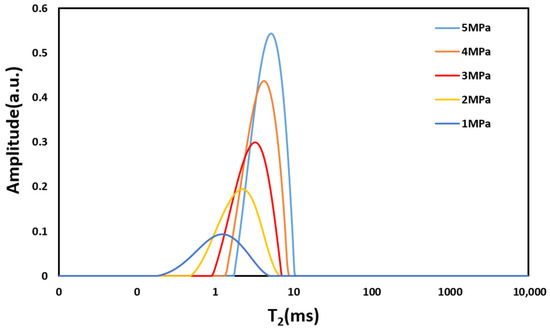
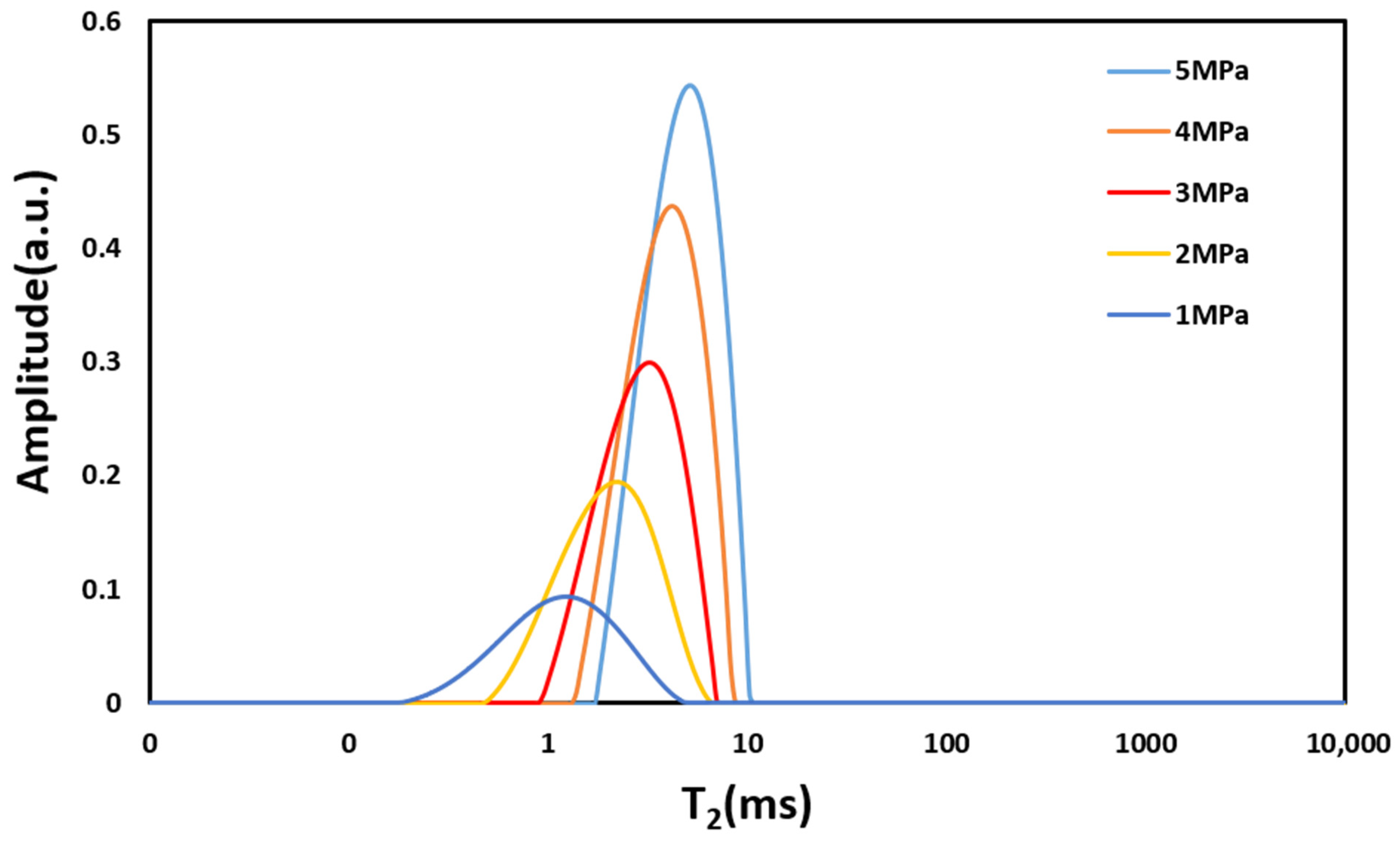
Figure 2 presents the distribution of 1H T2 relaxation times of bulk hydrogen gas at 32 °C as the pressure increases from 1 MPa to 5 MPa.
Figure 2.
Distribution of 1H T2 relaxation times of bulk hydrogen under different pressure conditions (1, 2, 3, 4, and 5 MPa). The signal amplitudes are normalized.
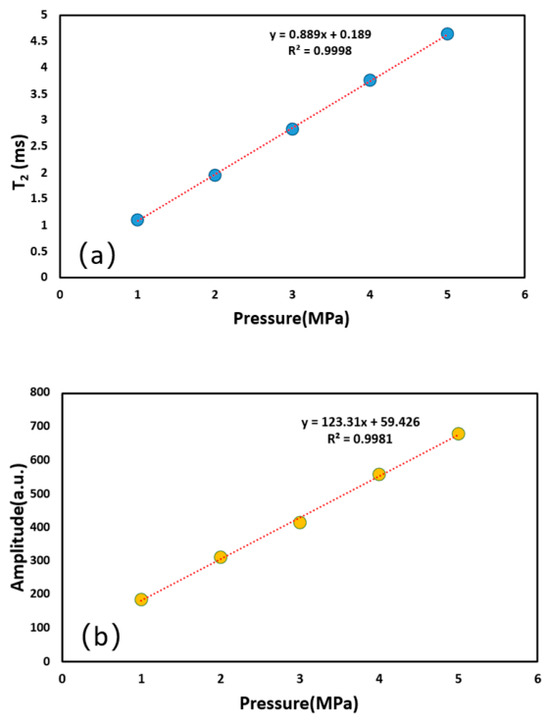
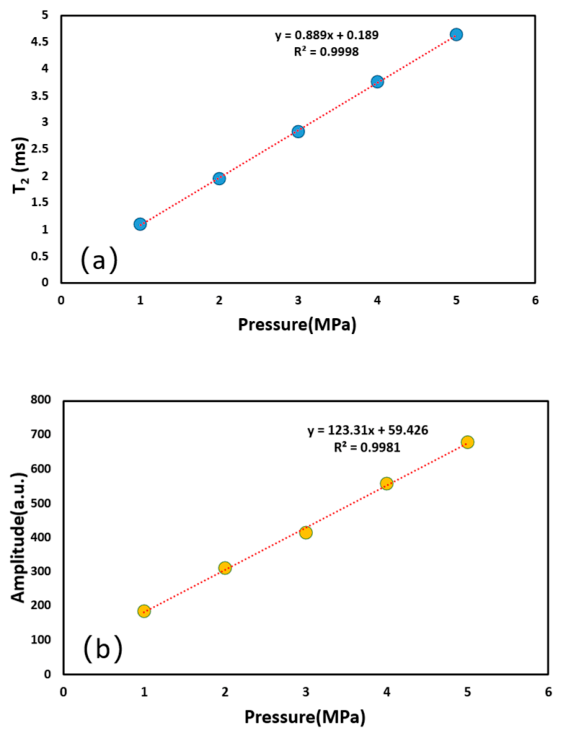
The results show that, at all tested pressures, the T2 distribution of hydrogen exhibits a single-peak structure. At 1 MPa, the T2 distribution of bulk hydrogen is centered at T2 ≈ 1.2 ms. As pressure increases, the peak center gradually shifts toward longer relaxation times. At 2 MPa, the T2 peak shifts rightward to approximately 2.4 ms, with the signal amplitude approximately doubling. When the pressure reaches 5 MPa, the peak center further shifts to approximately 5 ms, accompanied by a significant increase in signal amplitude. Figure 3 shows the quantitative relationships between T2 relaxation time, signal amplitude, and pressure. Linear fitting reveals that both parameters exhibit extremely high linearity with pressure, with coefficients of determination (R2) of 0.9998 and 0.9997, respectively. The linear increase in signal amplitude with pressure arises from the increase in hydrogen molecular density per unit volume, which also confirms that NMR signal amplitude can quantitatively characterize the number of spinning nuclei.
Figure 3.
NMR measurements of bulk hydrogen: (a) relaxation time and (b) signal amplitude as a function of pressure.
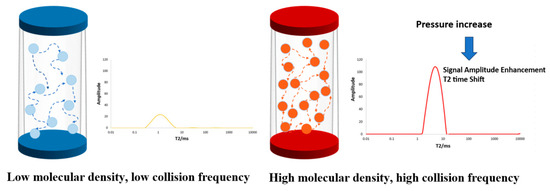
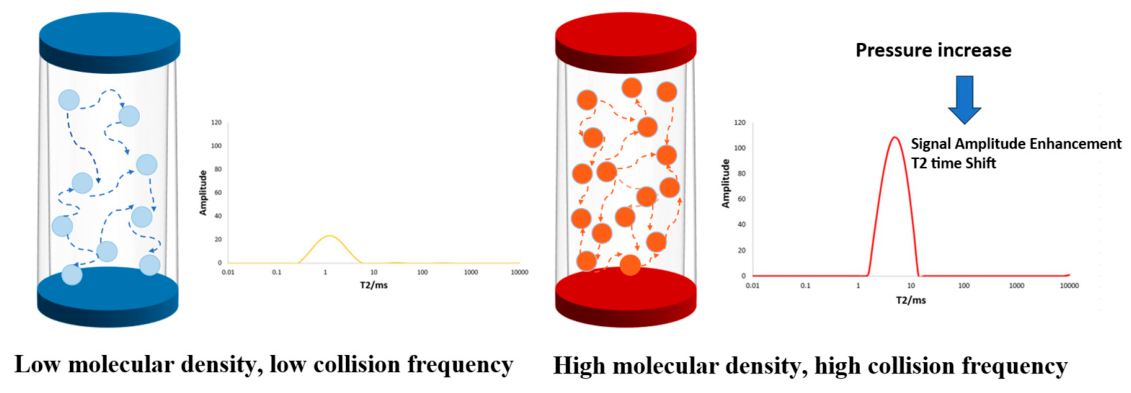
The linear proportionality between T2 relaxation time and pressure confirms that the relaxation mechanism of bulk hydrogen is dominated by the spin–rotation interaction. According to the theoretical expression in Equation (2) of Section 2.1, the relaxation rate of hydrogen molecules is primarily governed by their rotational correlation time . As illustrate in Figure 4, under low-pressure conditions, the gas is dilute and the intermolecular collision frequency is low, resulting in a longer rotational correlation time in which the molecular rotational state is preserved, thereby accelerating the transverse relaxation rate. As pressure increases, the rising gas density significantly increases the intermolecular collision frequency, which accelerates the randomization of molecular orientations and thereby shortens the rotational correlation time . Since T2 ∝ under the extreme narrowing regime, the reduction in directly leads to the observed prolongation of T2 relaxation time. This experimental phenomenon is fully consistent with the classical theoretical prediction of Lipsicas and Bloom (1961) [39].
Figure 4.
Schematic diagram of the relaxation characteristics of hydrogen gas.
4.2. Relaxation in Porous Media
4.2.1. Relaxation Characteristics of Confined Water
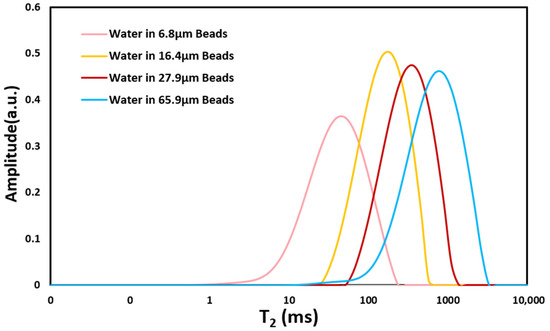
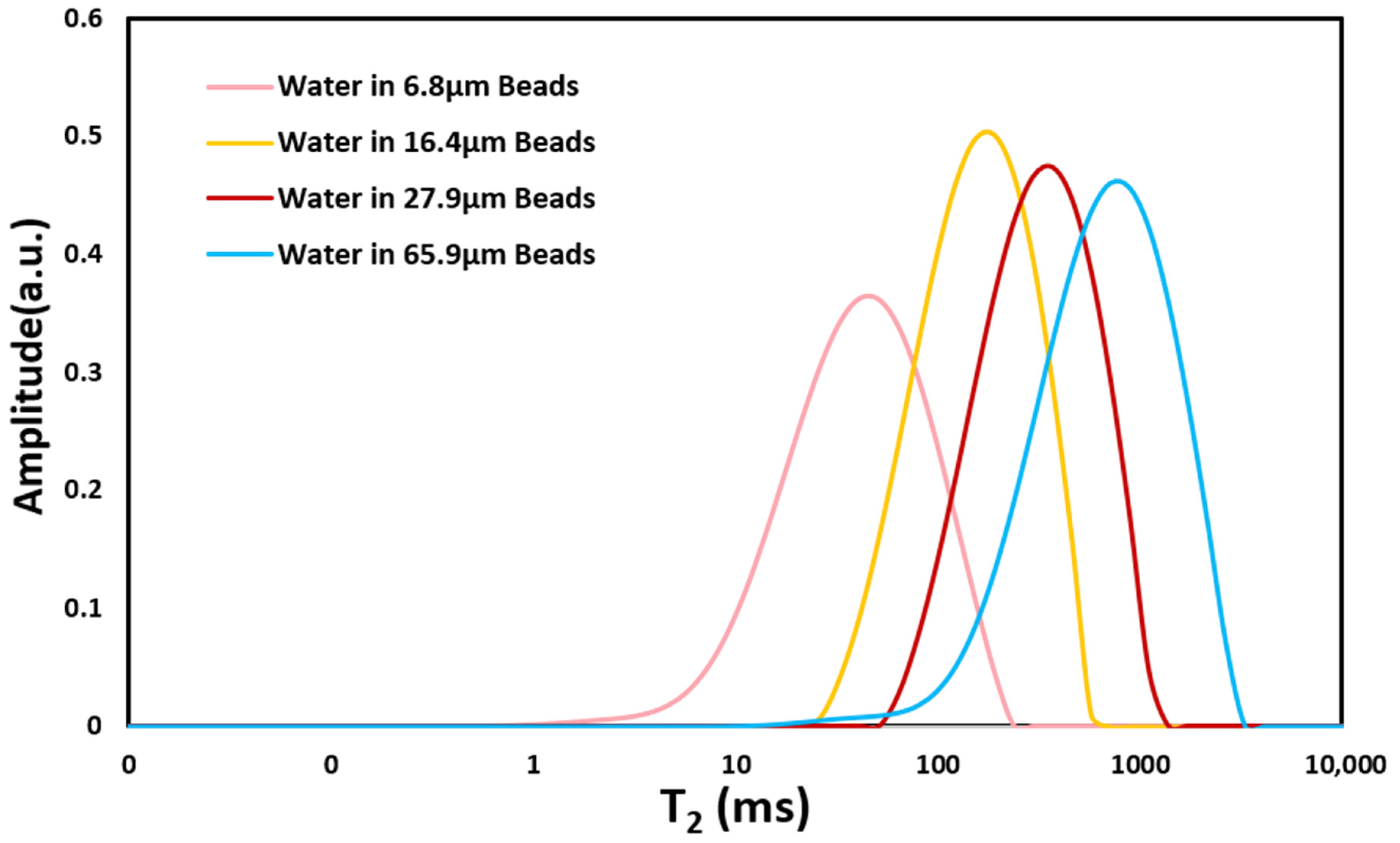
Figure 5 presents the T2 relaxation time distributions of the four glass bead samples with different pore sizes (65.9 μm, 27.9 μm, 16.4 μm, and 6.8 μm) under fully water-saturated conditions. The experimental results show that, as the pore size decreases, the relaxation time of water exhibits a clear shift toward shorter relaxation times. In the 65.9 μm pores, the T2 distribution peak of the water-saturated sample is centered at approximately 896 ms. As the pore size decreases to 16.4 μm, the peak center shifts leftward to 193 ms. When the pore size is further reduced to 6.8 μm, the peak center continues to shift leftward to 53 ms.
Figure 5.
T2 distributions of water-saturated glass beads with different pore sizes. The signal amplitudes are normalized.
This phenomenon is consistent with the “two-phase fast-exchange” relaxation model described in Section 2.2. Since the bulk relaxation time of water (T2,bulk ≈ 2–3 s) is considerably longer than the experimentally observed values in confined porous media, the overall relaxation rate of water is dominated by the surface term 1/T2,sulf. According to Equation (3), the surface relaxation rate is primarily governed by surface-related parameters, exhibiting a positive correlation with the specific surface area (or surface-to-volume ratio, S/V) while being inversely proportional to pore size. Therefore, as the glass bead particle size and the corresponding pore size decrease, the specific surface area increases significantly, resulting in an enhanced surface relaxation contribution, which macroscopically manifests as a shortening of the T2 relaxation time.
4.2.2. Relaxation of Hydrogen Gas in Porous Media
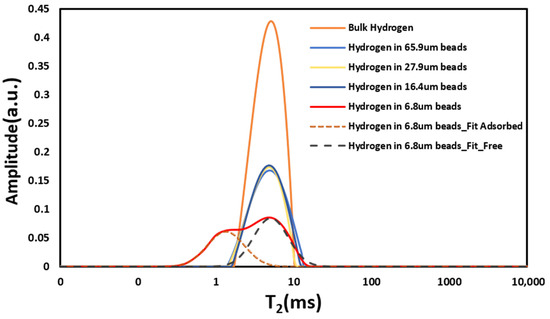
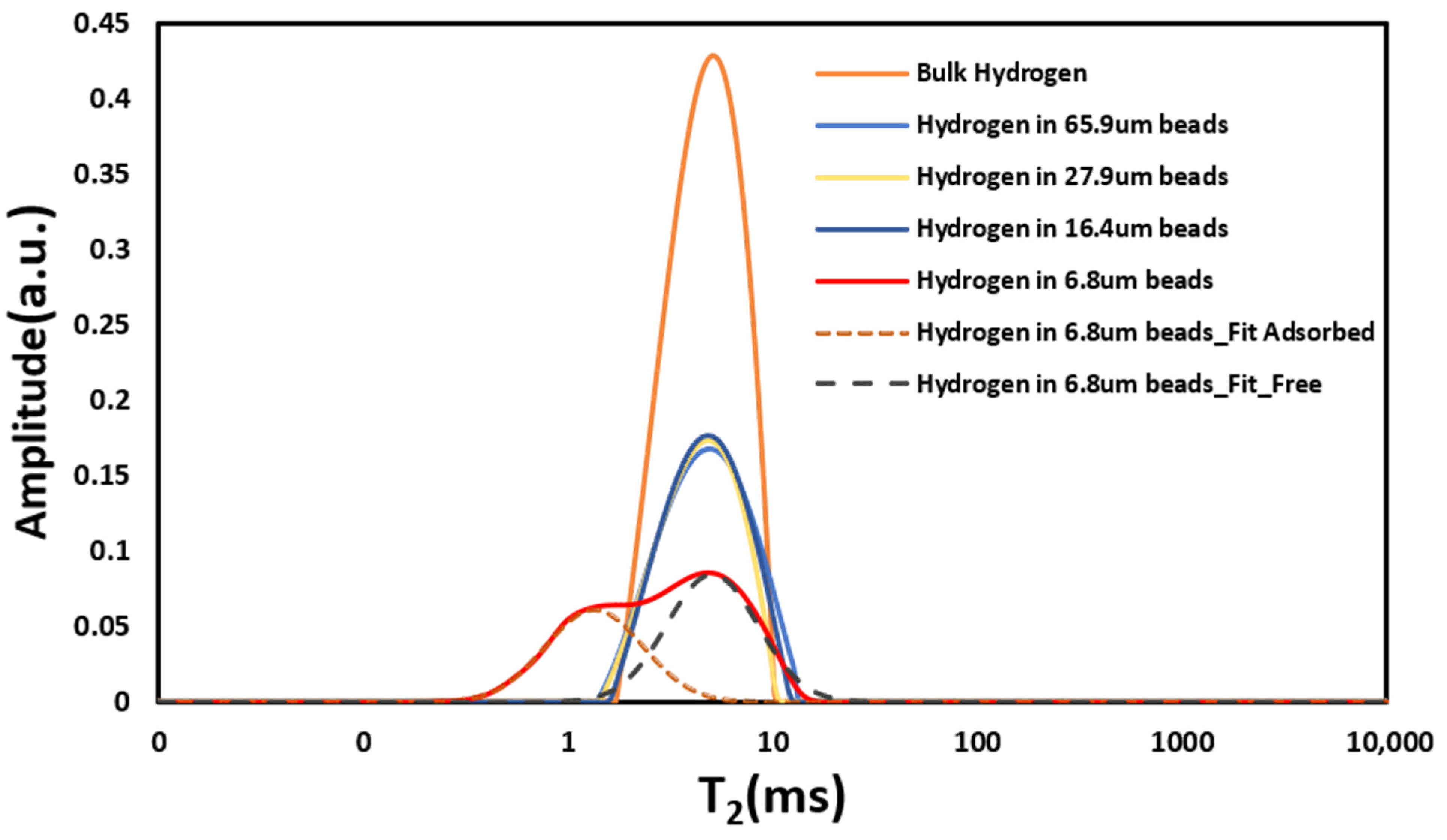
Figure 6 compares the T2 relaxation time distributions of confined hydrogen in glass bead packs with different pore sizes (65.9 μm, 27.9 μm, 16.4 μm, and 6.8 μm) at 5 MPa with those of bulk hydrogen at the same pressure. All T2 distributions have been background-subtracted. The signal amplitude of confined hydrogen is consistently lower than that of bulk hydrogen and decreases with reducing pore size, primarily because the solid matrix occupies part of the sampling volume, thereby reducing the amount of hydrogen filled.
Figure 6.
Comparison of NMR T2 relaxation time distributions between hydrogen confined in glass beads of different pore sizes and bulk hydrogen. The signal amplitudes are normalized.
In contrast to the single-peak relaxation behavior exhibited by water, the relaxation characteristics of hydrogen in porous media display pronounced pore-size-dependent differences. As shown in Figure 6, in the three larger pore-size media (65.9 μm, 27.9 μm, and 16.4 μm), the T2 distributions of confined hydrogen all exhibit a single-peak structure, with distribution ranges and peak positions highly overlapping those of bulk hydrogen (T2 ≈ 4.8 ms). This indicates that, at pore scales larger than 16.4 μm, the relaxation process of hydrogen remains dominated by the bulk spin–rotation (SR) mechanism, and the confinement effect of the pore surface has not yet significantly altered its relaxation behavior. The entire pore–fluid system remains in a bulk-dominated fast-exchange regime. However, when the pore size is reduced to 6.8 μm, a qualitative change occurs in the relaxation behavior of hydrogen. The T2 spectrum no longer maintains a single-peak feature but instead exhibits a distinct bimodal structure. The right-hand peak coincides with the characteristic position of bulk hydrogen, corresponding to free-state hydrogen within the pores that is minimally influenced by the surface. The left-hand peak appears at T2≈1 ms, with a markedly shorter T2 value, representing adsorbed-state hydrogen constrained by the pore surface. The emergence of this short-relaxation peak signifies that, in micron-scale small pores, the relaxation rate of a portion of the hydrogen molecules is significantly accelerated. The observed shift from a unimodal to a bimodal T2 distribution indicates a departure from fast diffusion averaging as pore size approaches the lower-micron scale. Under these conditions, hydrogen molecules transition into an intermediate- or slow-exchange regime, allowing surface relaxation to manifest as a separate short-T2 peak. This bimodal structure implies that in micron-scale small pores, the surface and bulk relaxation of hydrogen can no longer be fully averaged through rapid diffusion, which provides a key basis for assessing reservoir homogeneity in underground hydrogen storage environments.
4.2.3. Discussion
T2 measurements on fully water-saturated glass bead packs show that variations in specific surface area strongly influence the T2 relaxation time of water. In contrast, the T2 relaxation behavior of hydrogen remains virtually unaffected by pore-size changes over a wide range of larger pores.
In porous media, the total relaxation rate of a fluid is jointly determined by the bulk relaxation rate (1/T2,bulk) and the surface relaxation rate (1/T2,surf). As discussed in Section 4.2.1, the relaxation behavior of water is governed by dipole–dipole interactions at the solid–liquid interface. Given that the bulk relaxation time of water, T2,bulk, is approximately 2–3 s, the corresponding bulk relaxation rate 1/T2,bulk is nearly negligible (~0.3–0.5 s−1). Consequently, the relaxation process of water is entirely dominated by the surface relaxation term 1/T2,surf, resulting in a strong pore-size dependence.
However, the relaxation characteristics of hydrogen in porous media differ markedly from those of water. Based on the analyses in Section 2.1 and Section 4.1, the bulk relaxation of hydrogen is dominated by the spin–rotation (SR) interaction. At 5 MPa, its T2,bulk is only approximately 5.08 ms, corresponding to an extremely high bulk relaxation rate of 1/T2,bulk ≈ 197 s−1. This bulk relaxation rate, which is nearly three orders of magnitude higher than that of water, shifts the pore-size threshold required to produce observable surface relaxation effects in hydrogen to values far smaller than those for water.
In pores ranging from 16.4 μm to 65.9 μm, the relatively small specific surface area S/V results in a surface relaxation contribution 1/T2,surf that is much smaller than the bulk relaxation term 1/T2,bulk. Consequently, although hydrogen molecules diffuse extremely rapidly and satisfy the “fast diffusion” condition, the total observed relaxation rate 1/T2 is almost entirely governed by the bulk relaxation rate 1/T2,bulk. This causes the characteristics of the T2 distribution peak to primarily reflect the intrinsic properties of the fluid itself, showing no dependence on pore size.
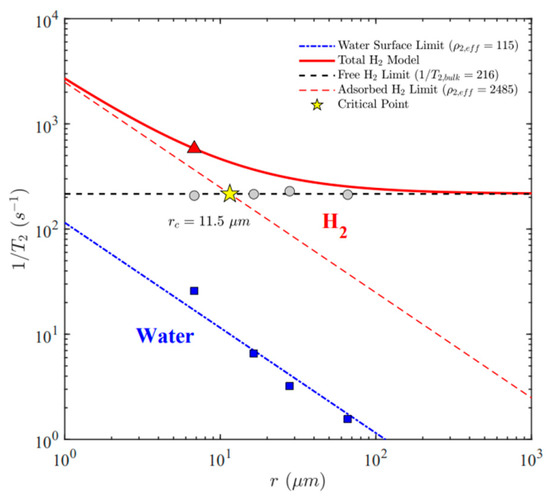
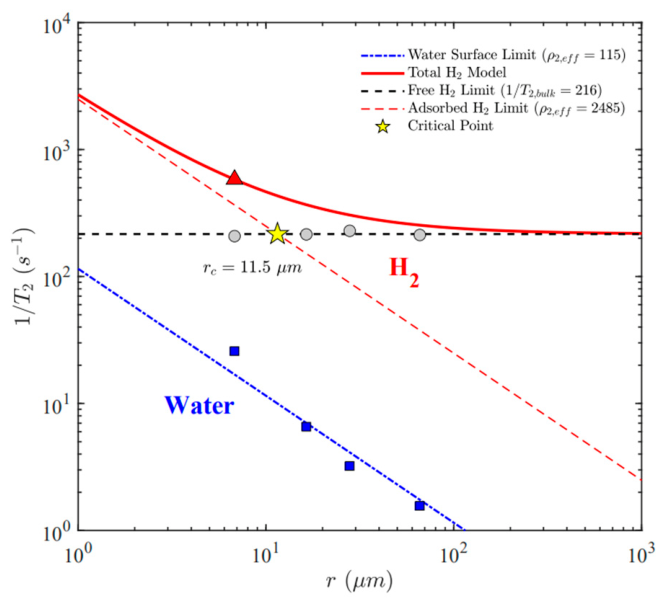
To further quantify the evolution of the proton relaxation mechanism of H2 gas with pore size, a relaxation-rate competition model based on pore size r was established, as shown in Figure 7. The pore geometry is assumed to follow the spherical packing relation S/V ≈ 3/r. The blue points in the figure represent the experimentally measured relaxation rates of water at different pore sizes, whose relaxation is entirely dominated by surface effects. As indicated by the blue dashed line, the experimental results for water conform to the theoretical relationship , yielding a fitted surface relaxivity for water of . In contrast, over the larger pore size range, hydrogen exhibits a constant bulk relaxation rate, as represented by the horizontal black dashed line. The gray points correspond to the measured values for hydrogen. The red dashed line in the figure denotes the surface relaxivity of hydrogen, and the red line represents the total hydrogen model that integrates both surface relaxation and bulk relaxation. The red triangle in the figure corresponds to the adsorbed-state hydrogen separated from the 6.8 μm sample, whose relaxation is dominated by surface effects. Using the T2 value of this component and its corresponding pore size, the surface relaxivity of hydrogen can be back-calculated. For pores formed by packed spherical particles, the specific surface area is related to the pore radius by , where is the geometric factor (typically taken as 3 for spherical pores). When the observed relaxation time originates entirely from the adsorbed-state component, Equation (3) can be rearranged to yield the surface relaxivity expression [42]:
where is the surface relaxivity of hydrogen, and is the T2 relaxation time of the adsorbed-state hydrogen. The calculated effective surface relaxivity of hydrogen under confined conditions is approximately 2485 μm/s. Notably, this value is substantially higher than that of water (115 μm/s). Rather than solely implying a stronger chemical interaction energy between hydrogen and the pore wall, this likely reflects an apparent enhancement in surface relaxation efficacy inherent to the gas–solid system. We speculate this high value to two primary factors: First, paramagnetic impurities: Industrial-grade glass beads often contain trace amounts of paramagnetic elements (e.g., Fe3+). Unlike water molecules, which are shielded by hydration layers, gas molecules collide directly with surface sites. The presence of paramagnetic centers can dramatically enhance the relaxation efficiency upon collision via the Paramagnetic Relaxation Enhancement (PRE) mechanism. Second, collision efficiency: The surface relaxation mechanism for gases differs fundamentally from that of liquids. For hydrogen, collision with the pore wall effectively interrupts the molecular spin–rotation state. Given the high diffusivity and collision frequency in the 6.8 μm pores, this boundary-induced dephasing is extremely efficient, manifesting as a large apparent surface relaxivity. This microscopic mechanism warrants further verification through future experimental or numerical studies. From a reservoir evaluation perspective, this highly effective surface relaxivity explains why the separation of proton relaxation components of H2 gas is observable even in micron-scale pores, a behavior distinct from that of liquids. Based on this parameter, a theoretical critical pore size is defined for the transition of H2 proton relaxation behavior. This threshold corresponds to the point at which the bulk relaxation rate equals the surface relaxation rate:
Figure 7.
Variation in H2 proton relaxation rate with pore size and theoretical analysis of the critical pore-size threshold. Blue points: Measured relaxation rates of water at different pore sizes. Gray points: Measured relaxation rates of hydrogen at different pore sizes. Total H2 model: The theoretical relationship between relaxation rate and pore size obtained by integrating both bulk and surface contributions to hydrogen relaxation.
Substituting the experimental parameters yields ≈ 11.5 μm. This theoretically predicted value is consistent with the experimental observation of a bimodal T2 spectrum at 6.8 μm. When the pore size r > 11.5 μm, the bulk relaxation rate far exceeds the surface contribution, resulting in a single-peak T2 spectrum. When the pore size decreases to 6.8 μm, the surface contribution increases sharply and surpasses the bulk term. At this stage, a conflict arises between the extremely high surface relaxation rate of the adsorbed phase and the molecular exchange rate within the confined space, causing the pore-fluid system to transition from the “fast-exchange” regime to the “slow-exchange” regime. Consequently, the T2 spectrum exhibits a bimodal structure corresponding to adsorbed-state and free-state hydrogen, respectively. Therefore, the separation of adsorbed-state and free-state hydrogen into two distinguishable T2 components occurs only when pore dimensions drop below the critical pore-size threshold of approximately 11.5 μm, governed by the competition between surface and bulk relaxation. The shale, organic-matter nanopores, and high-specific-surface-area geological materials studied by Ho (2024), Guerrero (2024), and Raza (2022) all possess pore sizes at the nanoscale, far below this critical threshold [26,27,28]. Under these conditions, surface relaxation (DD mechanism) dominates, enabling the observation of coexisting adsorbed and free states in bimodal spectra. In contrast, the Berea sandstone investigated by Dang (2025) exhibits pore sizes mainly in the range of tens to hundreds of micrometers, far exceeding 11.5 μm [30]. At such scales, bulk relaxation (SR mechanism) prevails, resulting in hydrogen consistently appearing as a single free-state signal with no observable adsorbed component. However, it is crucial to clarify the nature of the ‘adsorbed-state’ identified in the 6.8 μm samples. Unlike the strong physical adsorption observed in organic-rich shale or microporous carbons, hydrogen interaction with glass bead surfaces is relatively weak. Therefore, the short- T2 component observed in the 6.8 μm pores should be more accurately interpreted as a ‘surface-relaxation-dominated component.’ This signal arises from hydrogen molecules that are dynamically interacting with the pore walls. Due to the rapid diffusion in the small confined space, these molecules experience frequent collisions with the solid surface, allowing the surface relaxation mechanism to dominate over the bulk spin–rotation mechanism.
In summary, the relaxation behavior of hydrogen in confined spaces reveals the competitive interplay between the SR and DD mechanisms at different scales. Only when the pore size decreases below the critical threshold does the surface-relaxation-dominated adsorbed component separate from the bulk signal and manifest independently in the T2 spectrum. In this study, the experimental pressure was limited to 5 MPa to isolate the fundamental relaxation mechanisms in the dilute gas regime. We observed a strict linear relationship between T2 and pressure, confirming the dominance of the spin–rotation (SR) interaction. We acknowledge that underground hydrogen storage typically operates at significantly higher pressures (>10 MPa). If the fundamental relaxation mechanisms remain unchanged at these higher pressures, the corresponding increase in pressure would theoretically shift the critical pore-size threshold to larger values. Under such high-pressure conditions, gas deviation from ideality (fugacity effects) and potential multimer formation may introduce non-linear relaxation behaviors. While the critical pore-size threshold identified here provides a fundamental baseline, future work will focus on extending these measurements to high-pressure environments to evaluate deviations from the SR mechanism.
5. Conclusions
This study systematically investigated the NMR T2 relaxation characteristics of hydrogen in both free and confined states through variable-pressure relaxation experiments on bulk hydrogen and variable-pore-size relaxation experiments in micron-scale porous media (glass bead packs). The relaxation behaviors are interpreted and quantitatively validated against the classical two-phase exchange theory. The main conclusions are as follows:
(1) The T2 relaxation time of bulk hydrogen exhibits an excellent linear relationship with pressure P. The experimental results confirm that its relaxation process is dominated by bulk relaxation induced by spin–rotation interaction, resulting in an extremely short bulk relaxation time T2,bulk (approximately 5.08 ms at 5 MPa).
(2) Within the micron-scale pore size range of 16.4 μm to 65.9 μm, the T2 distribution of hydrogen displays a single-peak structure, with hydrogen existing predominantly in the free state. The T2 response is dominated by bulk relaxation, reflecting the intrinsic properties of the fluid itself and showing no pore-size dependence.
(3) When the pore size decreases to 6.8 μm, the T2 spectrum of hydrogen becomes bimodal, corresponding to “free-state” and “adsorbed-state” hydrogen, respectively. A critical pore-size threshold exists (theoretically estimated at ≈11.5 μm). Below this threshold, the molecular exchange rate within the confined space cannot compensate for the extremely high surface relaxation rate, causing the T2 response of hydrogen to exhibit pore-size dependence. The contribution from surface adsorption then manifests independently in the T2 spectrum.
While this study establishes a foundational understanding under the current experimental scope (up to 5 MPa and micron-scale pores), future work will expand the coverage of pressure and pore sizes. By incorporating real core samples under higher pressures, we will further explore the complex relaxation mechanisms of hydrogen to better adapt to a broader range of actual underground hydrogen storage environments.
Author Contributions
Conceptualization, Y.L. and C.X.; methodology, Y.L. and C.X.; software, C.X.; validation, Y.L. and C.X.; formal analysis, Y.L.; investigation, C.X.; resources, Y.L. and C.X.; data curation, Y.L.; writing—original draft preparation, Y.L. and C.X.; writing—review and editing, Y.L. and C.X.; visualization, Y.L.; supervision, G.Z.; project administration, G.Z.; funding acquisition, G.Z.. All authors have read and agreed to the published version of the manuscript.
Funding
This research was funded by the National Science and Technology Major Project (Project: Large-scale Intelligent Well Logging Industrial Processing Software [grant number 2025ZD1401100]; Subject: Intelligent Processing and Interpretation System for Imaging Logging [grant number 2025ZD1401104]). And the APC was funded by the National Science and Technology Major Project.
Data Availability Statement
The data presented in this study are available on request from the corresponding author due to the following reason: the data are part of an ongoing study and have not yet been publicly released.
Conflicts of Interest
The authors declare no conflict of interest.
References
- Jeje, S.O.; Marazani, T.; Obiko, J.O.; Shongwe, M.B. Advancing the hydrogen production economy: A comprehensive review of technologies, sustainability, and prospects. Int. J. Hydrogen Energy 2024, 78, 642–661. [Google Scholar] [CrossRef] [Scilit]
- Bhuiyan, M.M.H.; Siddique, Z. Hydrogen as an alternative fuel: A comprehensive review of challenges and opportunities in production, storage, and transportation. Int. J. Hydrogen Energy 2025, 102, 1026–1044. [Google Scholar] [CrossRef] [Scilit]
- Akpasi, S.O.; Smarte Anekwe, I.M.; Tetteh, E.K.; Amune, U.O.; Mustapha, S.I.; Kiambi, S.L. Hydrogen as a clean energy carrier: Advancements, challenges, and its role in a sustainable energy future. Clean Energy 2025, 9, 52–88. [Google Scholar] [CrossRef] [Scilit]
- Abe, J.O.; Popoola, A.P.I.; Ajenifuja, E.; Popoola, O.M. Hydrogen energy, economy and storage: Review and recommendation. Int. J. Hydrogen Energy 2019, 44, 15072–15086. [Google Scholar] [CrossRef] [Scilit]
- Bade, S.O.; Taiwo, K.; Ndulue, U.F.; Tomomewo, O.S.; Oni, B.A. A review of underground hydrogen storage systems: Current status, modeling approaches, challenges, and future prospective. Int. J. Hydrogen Energy 2024, 80, 449–474. [Google Scholar] [CrossRef] [Scilit]
- Leng, G.; Yan, W.; Chen, Z.; Li, Z.; Liu, B.; Deng, P.; Zhang, C.; Liu, W.; Qi, H. Technical challenges and opportunities of hydrogen storage: A comprehensive review on different types of underground storage. J. Energy Storage 2025, 114, 115900. [Google Scholar] [CrossRef] [Scilit]
- Jimenez-Lopez, L.; Ospino, R.M.; de Araujo, L.G.; Celzard, A.; Fierro, V. Latest developments in the synthesis of metal–organic frameworks and their hybrids for hydrogen storage. Nanoscale 2025, 17, 6390–6413. [Google Scholar] [CrossRef] [Scilit]
- Gao, X.; Yang, S.; Zhang, Y.; He, B.; Wang, M.; Hu, J.; Shen, B.; Zhao, E. Integrated modeling and economic assessment of hydrogen storage with wellbore-reservoir-thermo-hydro-mechanical-diffusion coupling. Energy 2026, 353, 141065. [Google Scholar]
- Gao, X.; Yang, S.; Bi, L.; Zhang, Y.; Hu, J.; Wang, M.; Shen, B.; Zhao, E. Pore-scale simulation of multi-fluid flow transport dynamics for hydrogen geological storage in depleted gas reservoirs. Gondwana Res. 2025, 147, 321–334. [Google Scholar] [CrossRef] [Scilit]
- Zgonnik, V. The occurrence and geoscience of natural hydrogen: A comprehensive review. Earth-Sci. Rev. 2020, 203, 103140. [Google Scholar] [CrossRef] [Scilit]
- Ballentine, C.J.; Karolytė, R.; Cheng, A.; Lollar, B.S.; Gluyas, J.G.; Daly, M.C. Natural hydrogen resource accumulation in the continental crust. Nat. Rev. Earth Environ. 2025, 6, 342–356. [Google Scholar] [CrossRef] [Scilit]
- Wang, S.; Jiang, S.; Huang, X.; Qi, S.; Lin, J.; Han, Y.; Wang, Y.; Wu, X.; Zheng, G. Enrichment mechanisms of natural hydrogen and predictions for favorable exploration areas in China. Appl. Geochem. 2025, 182, 106316. [Google Scholar] [CrossRef] [Scilit]
- Wang, K.; Zhou, Y.; Zhao, W.; Fan, L.; Liu, S. Hydrogen storage in subsurface porous media: Mechanisms, challenges, and safety. Renew. Sustain. Energy Rev. 2026, 226, 116351. [Google Scholar] [CrossRef] [Scilit]
- Song, Y.Q.; Kausik, R. NMR application in unconventional shale reservoirs—A new porous media research frontier. Prog. Nucl. Magn. Reson. Spectrosc. 2019, 112, 17–33. [Google Scholar] [CrossRef] [Scilit]
- Korb, J.P. Multiscale nuclear magnetic relaxation dispersion of complex liquids in bulk and confinement. Prog. Nucl. Magn. Reson. Spectrosc. 2018, 104, 12–55. [Google Scholar] [CrossRef] [Scilit]
- Elsayed, M.; Isah, A.; Hiba, M.; Hassan, A.; Al-Garadi, K.; Mahmoud, M.; El-Husseiny, A.; Radwan, A.E. A review on the applications of nuclear magnetic resonance (NMR) in the oil and gas industry: Laboratory and field-scale measurements. J. Pet. Explor. Prod. Technol. 2022, 12, 2747–2784. [Google Scholar] [CrossRef] [Scilit]
- Velasco, M.I.; Franzoni, M.B.; Chávez, F.V.; Acosta, R.H. Characterization of structure and functionality of porous materials. J. Magn. Reson. Open 2023, 14, 100099. [Google Scholar] [CrossRef] [Scilit]
- Kausik, R.; Fellah, K.; Rylander, E.; Singer, P.M.; Lewis, R.E.; Sinclair, S.M. NMR relaxometry in shale and implications for logging. Petrophysics 2016, 57, 339–350. [Google Scholar]
- Li, J.; Huang, W.; Lu, S.; Wang, M.; Chen, G.; Tian, W.; Guo, Z. Nuclear magnetic resonance T1–T2 map division method for hydrogen-bearing components in continental shale. Energy Fuels 2018, 32, 9043–9054. [Google Scholar]
- Mukhametdinova, A.; Habina-Skrzyniarz, I.; Krzyżak, A. NMR relaxometry interpretation of source rock liquid saturation—A holistic approach. Mar. Pet. Geol. 2021, 132, 105165. [Google Scholar]
- Xu, C.; Xie, R.; Guo, J.; Jin, G.; Fan, W.; Xiao, L. Comprehensive characterization of petrophysical properties in shale by solvent extraction experiments and 2D NMR. Fuel 2023, 335, 127070. [Google Scholar]
- Xiao, L.; Zou, C.; Mao, Z.; Jin, Y.; Zhu, J.-C. A new technique for synthesizing capillary pressure (Pc) curves using NMR logs in tight gas sandstone reservoirs. J. Pet. Sci. Eng. 2016, 145, 493–501. [Google Scholar] [CrossRef] [Scilit]
- Liu, M.; Xie, R.; Xu, H.; Wu, S.; Zhu, R.; Mao, Z. A new method for predicting capillary pressure curves based on NMR logging in tight sandstone reservoirs. Appl. Magn. Reson. 2018, 49, 1043–1058. [Google Scholar] [CrossRef] [Scilit]
- Wu, B.; Xie, R.; Xu, C.; Wei, H.; Wang, S.; Liu, J. A new method for predicting capillary pressure curves based on NMR echo data: Sandstone as an example. J. Pet. Sci. Eng. 2021, 202, 108581. [Google Scholar] [CrossRef] [Scilit]
- Kleinberg, R.L.; Kenyon, W.E.; Mitra, P.P. Mechanism of NMR relaxation of fluids in rock. J. Magn. Reson. Ser. A 1994, 108, 206–214. [Google Scholar] [CrossRef] [Scilit]
- Ho, T.A.; Dang, S.T.; Dasgupta, N.; Choudhary, A.; Rai, C.S.; Wang, Y. Nuclear magnetic resonance and molecular simulation study of H2 and CH4 adsorption onto shale and sandstone for hydrogen geological storage. Int. J. Hydrogen Energy 2024, 51, 158–166. [Google Scholar]
- Guerrero, C.; Santamarina, J.C. Assessment of hydrogen adsorption in high specific surface geomaterials using low-field NMR-Implications for storage and field characterization. Int. J. Hydrogen Energy 2024, 95, 417–426. [Google Scholar] [CrossRef] [Scilit]
- Raza, A.; Alafnan, S.; Glatz, G.; Arif, M.; Mahmoud, M.; Rezk, M.G. Hydrogen diffusion in organic-rich porous media: Implications for hydrogen geo-storage. Energy Fuels 2022, 36, 15013–15022. [Google Scholar] [CrossRef] [Scilit]
- Wolff-Boenisch, D.; Abid, H.R.; Tucek, J.E.; Keshavarz, A.; Iglauer, S. Importance of clay-H2 interactions for large-scale underground hydrogen storage. Int. J. Hydrogen Energy 2023, 48, 13934–13942. [Google Scholar] [CrossRef] [Scilit]
- Dang, S.T.; Mamoudou, S.; Rai, C.S.; Ho, T.A. Evaluation of hydrogen storage in sandstone reservoirs using 1 H nuclear magnetic resonance spectroscopy. Phys. Chem. Chem. Phys. 2025, 27, 1237–1240. [Google Scholar]
- Hassanpouryouzband, A.; Adie, K.; Cowen, T.; Thaysen, E.M.; Heinemann, N.; Butler, I.B.; Wilkinson, M.; Edlmann, K. Geological hydrogen storage: Geochemical reactivity of hydrogen with sandstone reservoirs. ACS Energy Lett. 2022, 7, 2203–2210. [Google Scholar] [CrossRef] [Scilit]
- Ho, T.A.; Jove-Colon, C.F.; Wang, Y. Low hydrogen solubility in clay interlayers limits gas loss in hydrogen geological storage. Sustain. Energy Fuels 2023, 7, 3232–3238. [Google Scholar] [CrossRef] [Scilit]
- Anderson, R.J.; McNicholas, T.P.; Kleinhammes, A.; Wang, A.; Liu, J.; Wu, Y. NMR methods for characterizing the pore structures and hydrogen storage properties of microporous carbons. J. Am. Chem. Soc. 2010, 132, 8618–8626. [Google Scholar] [CrossRef] [Scilit]
- Yang, K.; Kobeissi, S.; Ling, N.; Li, M.; Esteban, L.; May, E.F.; Johns, M.L. Measurement of hydrogen dispersion in rock cores using benchtop NMR. Int. J. Hydrogen Energy 2023, 48, 17251–17260. [Google Scholar] [CrossRef] [Scilit]
- Golub, T.P.; Meyer, K.; Paul, A.; Tuma, D.; Kipphardt, H. Exploring the potential of a setup for combined quantification of hydrogen in natural gas–Raman and NMR spectroscopy. Spectrochim. Acta Part A Mol. Biomol. Spectrosc. 2025, 325, 125087. [Google Scholar] [CrossRef] [Scilit]
- Papaioannou, A.; Kausik, R. Methane storage in nanoporous media as observed via high-field NMR relaxometry. Phys. Rev. Appl. 2015, 4, 024018. [Google Scholar] [CrossRef] [Scilit]
- Bloembergen, N.; Purcell, E.M.; Pound, R.V. Relaxation effects in nuclear magnetic resonance absorption. Phys. Rev. 1948, 73, 679. [Google Scholar] [CrossRef] [Scilit]
- Moriya, T. Nuclear Magnetic Relaxation in Liquid Hydrogen. Prog. Theor. Phys. 1957, 18, 567–572. [Google Scholar] [CrossRef] [Scilit]
- Lipsicas, M.; Bloom, M. Nuclear magnetic resonance measurements in hydrogen gas. Can. J. Phys. 1961, 39, 881–907. [Google Scholar] [CrossRef] [Scilit]
- Lalita, K.; Bloom, M.; Noble, J.D. Nuclear spin relaxation in hydrogen gas. Can. J. Phys. 1969, 47, 1355–1369. [Google Scholar] [CrossRef] [Scilit]
- Govil, G. Nuclear magnetic resonance studies in gases. Appl. Spectrosc. Rev. 1973, 7, 47–78. [Google Scholar] [CrossRef] [Scilit]
- Dalas, F.; Korb, J.P.; Pourchet, S.; Nonat, A.; Rinaldi, D.; Mosquet, M. Surface relaxivity of cement hydrates. J. Phys. Chem. C 2014, 118, 8387–8396. [Google Scholar] [CrossRef] [Scilit]
Disclaimer/Publisher’s Note: The statements, opinions and data contained in all publications are solely those of the individual author(s) and contributor(s) and not of MDPI and/or the editor(s). MDPI and/or the editor(s) disclaim responsibility for any injury to people or property resulting from any ideas, methods, instructions or products referred to in the content. |
© 2026 by the authors. Licensee MDPI, Basel, Switzerland. This article is an open access article distributed under the terms and conditions of the Creative Commons Attribution (CC BY) license.