
Article

Predicting Pt-195 NMR Chemical Shift in Pt(II)-Sn(II) Complexes

by
Milena A. Pereira
1,
Larissa P. N. M. Pinto
1,
Hélio F. Dos Santos
2 and
Diego F. S. Paschoal
1,*
1
NQTCM: Núcleo de Química Teórica e Computacional de Macaé, Polo Ajuda, Instituto Multidisciplinar de Química, Centro Multidisciplinar UFRJ-Macaé, Universidade Federal do Rio de Janeiro, Macaé 27971-525, RJ, Brazil
2
NEQC: Núcleo de Estudos em Química Computacional, Departamento de Química-ICE, Universidade Federal de Juiz de Fora, Campus Universitário, Juiz de Fora 36036-900, MG, Brazil
*
Author to whom correspondence should be addressed.
Magnetochemistry 2026, 12(4), 49; https://doi.org/10.3390/magnetochemistry12040049
Submission received: 22 January 2026 / Revised: 13 March 2026 / Accepted: 26 March 2026 / Published: 13 April 2026
(This article belongs to the Special Issue 10th Anniversary of Magnetochemistry: Past, Present and Future)

Abstract

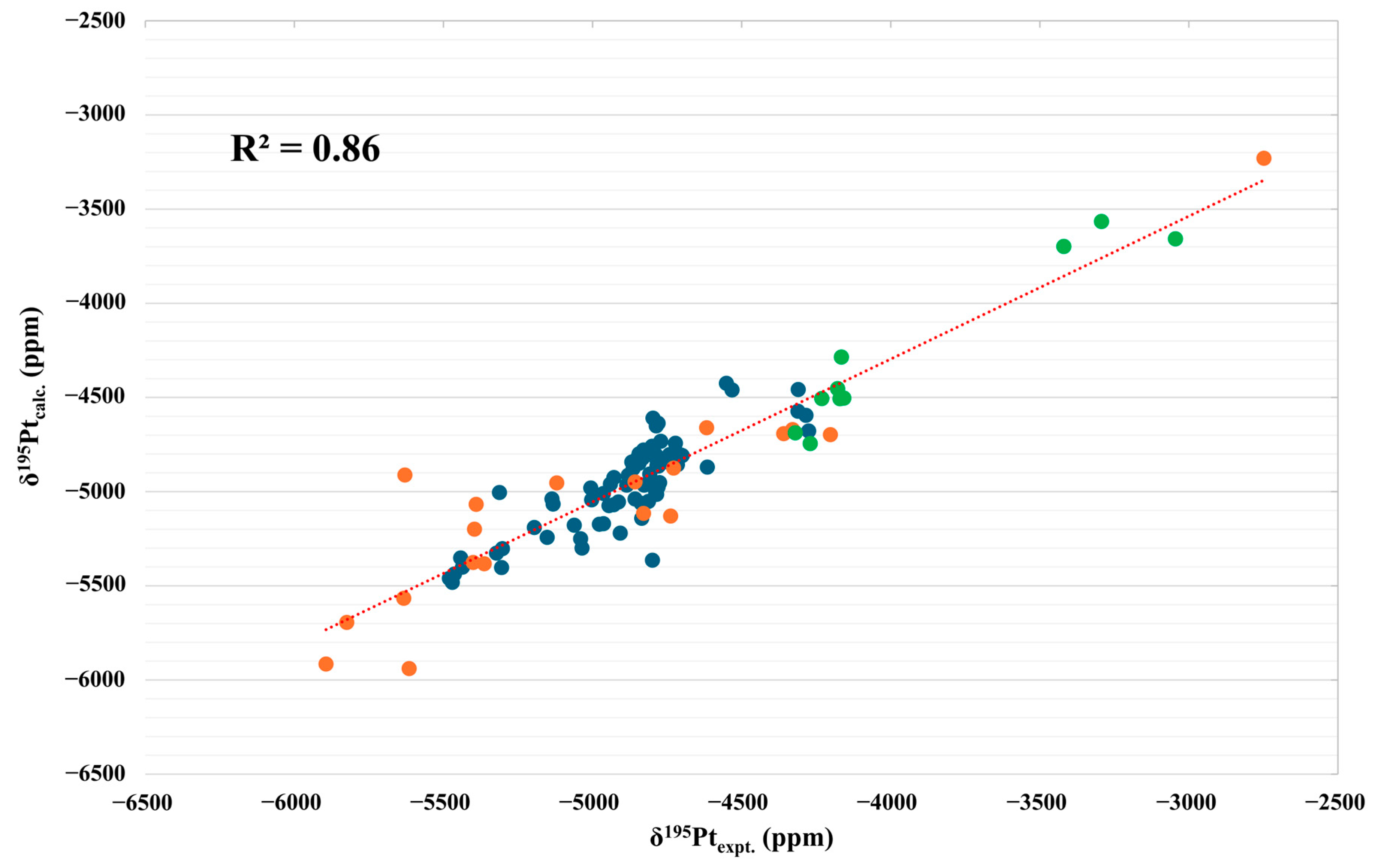
Platinum chemistry covers a wide range of applications, including homogeneous and heterogeneous catalysis as well as cancer therapy. Numerous Pt complexes have been synthesized and studied in recent years, with NMR spectroscopy serving as the primary technique for structural characterization. The 195Pt nucleus has favorable features for NMR studies, being highly sensitive to ligand type and structural environment. From a computational perspective, factors such as solvent effects, relativistic corrections, and the electronic structure of the ligands strongly influence the calculated NMR parameters. Consequently, establishing a general computational protocol for 195Pt NMR prediction remains a challenging task. In this work, we present a systematic validation and extension of our previously developed computational protocol, originally proposed for Pt(II) complexes, in studying 195Pt NMR chemical shifts in Pt(II)-Sn(II) complexes. A benchmark set of 100 Pt(II)-Sn(II) complexes was analyzed, yielding good agreement with experimental data (R2 = 0.86, MRD = 3.6%, MAD = 163 ppm), which is remarkable given the structural diversity and broad range of chemical shifts covered.

1. Introduction

Platinum chemistry encompasses a wide range of applications, including heterogeneous catalysts for automobile exhaust treatment, homogeneous catalysts for organic synthesis, and potential anticancer drugs [1,2,3,4,5,6,7]. In catalysis, Pt(II) complexes coordinated with Sn(II) are recognized as highly efficient homogeneous catalysts for hydrogenation, hydroformylation, carbonylation, and dehydrogenation reactions [8,9,10,11,12,13,14,15]. These complexes exhibit remarkable activity for C-H bond activation and a low propensity for C-C bond cleavage, offering significant advantages over the Rh- and Co-based catalysts widely used in industry [9,10,16]. A representative example is the conversion of acetic acid to ethanol, where Pt-Sn catalysts promote direct ethanol formation with high selectivity [17].
Pentacoordinate complexes of Pt(II) and Sn(II) were first investigated in 1964. The main species of interest was [Pt(SnCl3)5]3−, characterized by a central Pt(II) atom coordinated by five SnCl3 ligands [18]. This complex highlighted the importance of strong trans activation in both catalytic activity and ligand exchange reactions [19]. Notably, [Pt(SnCl3)5]3− is one of the few species capable of catalyzing the hydrogenation of ethylene and acetylene under mild conditions, and it can serve either as a catalyst or as a precursor in reactions such as vinyl halide coupling and styrene hydrogenation [12,20]. Later, in 1984, Pregosin and Ruegger studied Pt and Pd salts with excess Sn(II) chloride. From their NMR spectra, new complexes containing SnCl3 ligands were identified and recognized as effective homogeneous hydrogenation catalysts [11].
The 195Pt nucleus is the only NMR-active platinum isotope and possesses several favorable properties (I = 1/2, γ(195Pt) = 5.768 × 10⁷ rad s−1 T−1, resonance frequency 64.5 MHz at 7.05 T, natural abundance of 33.8%, relative sensitivity 0.00994 vs. 1H = 1.00, and absolute sensitivity 0.00336). In addition, its chemical shift (δ195Pt) is highly sensitive to conformation, oxidation state, and molecular environment. The chemical shift range for 195Pt is unusually large, spanning approximately 15,000 ppm (from +8000 to −7000 ppm) relative to the reference compound [PtCl6]2− [21,22]. The relevance of Pt(II)-Sn(II) complexes in homogeneous catalysis, combined with the attractive spectroscopic properties of 195Pt, makes 195Pt NMR an important analytical tool [23]. Moreover, NMR plays a fundamental role in elucidating reaction mechanisms [24].
The theoretical prediction of 195Pt NMR chemical shifts can provide support to experimental studies of Pt(II)-Sn(II) complexes. However, this task is far from trivial, as the computed values are strongly influenced by many factors, including solvent effects, relativistic contributions, and the geometry and electronic structure of the coordinated ligands. Gilbert and Ziegler [25] showed that calculations employing DFT with the inclusion of relativistic effects in predicting the δ195Pt in neutral PtX2L2 type compounds showed good agreement with experimental data. The importance of including solvent effects (implicit/explicit) for an adequate description of δ195Pt is well explored in the literature [26,27,28,29,30]. Gabano et al. [31] employed a chemometric approach using an artificial neural network algorithm in 185 Pt(II) complexes with good agreement with experimental data. Models using machine learning have also been successfully employed in the study of 195Pt NMR [32,33]. Studies employing relativistic four-component calculations were performed by Semenov et al. [34,35]. On the other hand, Tsipis and Karapetsas calculated δ195Pt with good agreement with experimental data using nonrelativistic Hamiltonians [36,37,38,39].
Despite several studies addressing the prediction of δ195Pt, computational studies of Pt(II) complexes with direct Pt-Sn bonding are scarce, even with rich experimental literature on 195Pt NMR in Pt-Sn compounds.
Paschoal et al. [40] developed an effective nonrelativistic computational protocol to predict δ195Pt shifts for Pt(II) complexes. To partially recover relativistic effects, the authors constructed a dedicated Gaussian basis set, named NMR-DKH, for Pt and all ligand atoms. The δ195Pt values were obtained using an empirical model based on the linear correlation between experimental δ195Pt chemical shifts and the corresponding calculated shielding constants (σ195Pt). The σ195Pt values were computed at the GIAO-PBE/NMR-DKH/IEF-PCM(UFF)//B3LYP/LANL2DZ/def2-SVP/IEF-PCM(UFF) level of theory, where geometries were optimized at B3LYP/LANL2DZ/def2-SVP/IEF-PCM(UFF) and shielding constants were calculated at GIAO-PBE/NMR-DKH/IEFPCM(UFF). This protocol was applied to a dataset of 258 Pt(II) complexes (with 183 used as the training set and 75 used as the external validation set), and yielded a mean relative deviation (MRD) of only 5% and a mean absolute deviation (MAD) of 168 ppm with respect to experimental data. Among the 258 complexes, only two contained Sn(II) ligands: trans-[PtCl(SnCl3)(PEt3)2] (MRD = 0.4%, MAD = 100 ppm) and trans-[PtH(SnCl3)(PEt3)] (MRD = 0.5%, MAD = 126 ppm).
Recently, Kondrashova and Latypov [41] evaluated different DFT functionals, basis sets, and the inclusion of relativistic effects in predicting δ195Pt in Pt(II) and Pt(IV) complexes. The results obtained by the authors showed that the NMR-DKH basis set is particularly suitable for studying the 195Pt NMR, since it presents a better description of the electron density in the core region.
Considering the multiple factors that strongly influence 195Pt NMR, the theoretical prediction of δ195Pt chemical shifts remains an extremely challenging task, highlighting the need for a robust and general computational protocol. In this context, the present work applies our previously proposed nonrelativistic protocol [40] to Pt(II)-Sn(II) complexes, with the aim of evaluating and validating its performance in predicting δ195Pt shifts for a representative set of complexes containing Pt-Sn bonds.

2. Methodology

A set of 100 Pt(II)-Sn(II) complexes for which experimental δ195Pt chemical shifts are available was selected [11,22,42,43,44,45,46,47,48,49,50]. The geometries of these complexes were optimized and characterized as minima on the potential energy surface (PES) at the B3LYP/LANL2DZ/def2-SVP/IEFPCM(UFF) level of theory. This approach combines the hybrid DFT functional B3LYP [51,52,53] with the LANL2DZ effective core potential (ECP, 60 electrons) and corresponding valence basis set for Pt [54], and the def2-SVP basis set for the ligand atoms [55,56]. It is important to note that the def2-SVP basis set for Sn also includes an ECP for the 28 core electrons [55]. Solvent effects on both the geometry and the NMR calculations were incorporated using the IEF-PCM (Integral Equation Formalism for the Polarizable Continuum Model) with atomic radii set according to the UFF (Universal Force Field) [57]. The solvents employed in the experimental NMR measurements were considered in the calculations. All geometry optimizations were carried out with the GAUSSIAN 16 Rev. C.01 program [58].
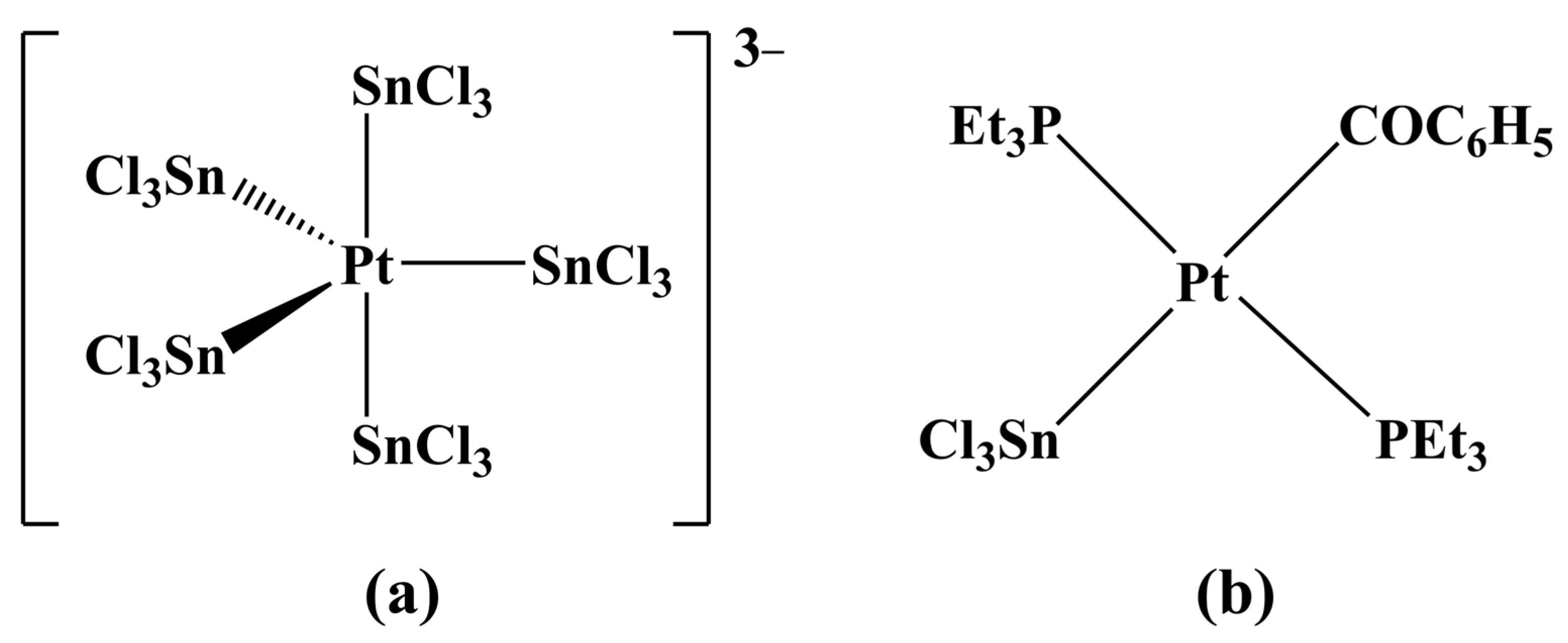
For the complexes [Pt(SnCl3)5]3− (Cpx39) [59] and trans-[Pt(COC6H5)(SnCl3)(PEt3)2] (Cpx61) [50] (Figure 1), experimental X-ray structures are available in the literature. These structures were therefore used as benchmarks to assess the performance of the computational protocol in predicting the geometries of Pt(II)-Sn(II) complexes.
The δ195Pt chemical shifts were calculated using Equation (1), where σ195Pt represents the shielding constant obtained with the GIAO (Gauge-Independent Atomic Orbital) [60,61,62,63,64] approximation at the PBE/NMR-DKH/IEF-PCM(UFF) level of theory. This approach combines the GGA DFT functional PBE [65,66] with the NMR-DKH basis set, which is an all-electron basis set specifically designed for all atoms, with particular emphasis on accurately describing NMR properties [40,67,68,69,70,71,72].
δ 195 P t = 2065.7558 0.9250 σ 195 P t
The NMR properties were calculated using the GAUSSIAN 16 Rev. C.01 program [58].

3. Results and Discussion

3.1. Structural Analysis

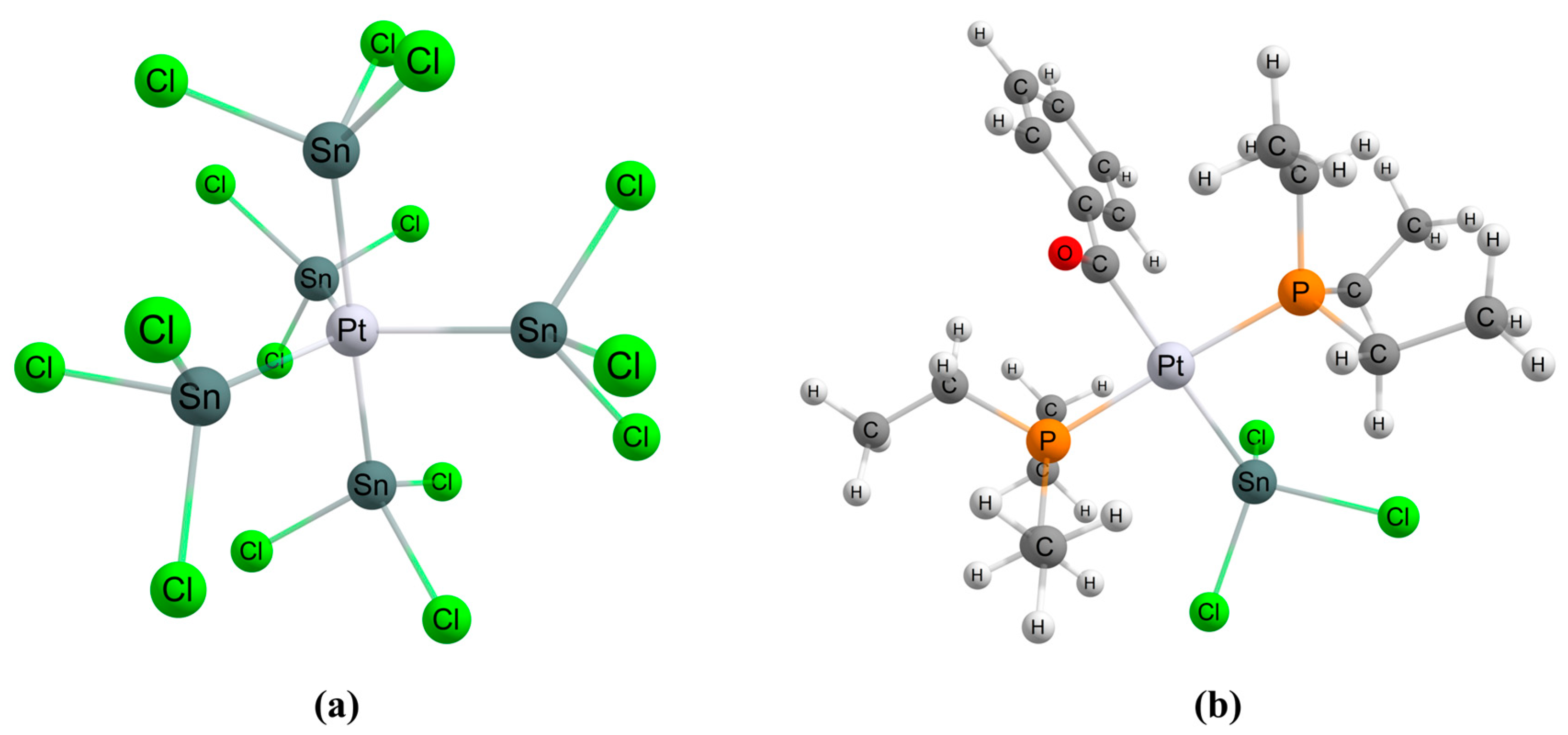
The geometries of the complexes Cpx39–[Pt(SnCl3)5]3− and Cpx61–trans-[Pt(COC6H5)(SnCl3)(PEt3)2] were optimized and characterized as a minimum point on the PES (all harmonic frequencies found real) at B3LYP/LANL2DZ/def2-SVP/IEF-PCM(UFF) level (Figure 2). Calculated bond lengths and angles were compared to the solid-state X-ray structures [50,59] (Table 1).
For Cpx39, the calculated Pt-Sn(axial) and Pt-Sn(equatorial) bond lengths showed relative deviations (RD) of 3.7% and 5.0%, respectively. In contrast, the bond angles were less sensitive, with Sn-Pt-Sn(equatorial) and Sn-Pt-Sn(axial) angles showing RD of only 0.3% and 0.0%. For Cpx61, which contains Pt-Sn, Pt-C, and Pt-P bonds in the coordination sphere, the RD were 5.8%, 0.3%, and 3.3%, respectively. The corresponding bond angles (P-Pt-P, C-Pt-Sn, P-Pt-C, and P-Pt-Sn) showed deviations below 2.5%. Overall, the MRD across all structural parameters was 2.2% for both complexes. Most of the deviation is due to the Pt-Sn bond, which was consistently overestimated. These results demonstrate that the theoretical level used for geometry optimization provides a reliable description of Pt(II)-Sn(II) complex structures. It is important to note that some differences are expected, as the calculations represent solution-phase structures (continuous model), whereas the experimental data are obtained in a solid state.

3.2. Calculation of δ195Pt

Equation (1) was first applied to predict the δ195Pt chemical shifts of complexes Cpx39 and Cpx61, where the shielding constant (σ195Pt) was calculated at the GIAO-PBE/NMR-DKH/IEF-PCM(UFF) level of theory. In these calculations, the all-electron NMR-DKH basis set was employed for all atoms. The predicted values were −5916 ppm and −4460 ppm, respectively, both in excellent agreement with the experimental data (−5894 ppm [11] and −4532 ppm [50]). Next, we applied the same computational protocol to a broader set of Pt(II)-Sn(II) complexes for which experimental data are available (Table S1).
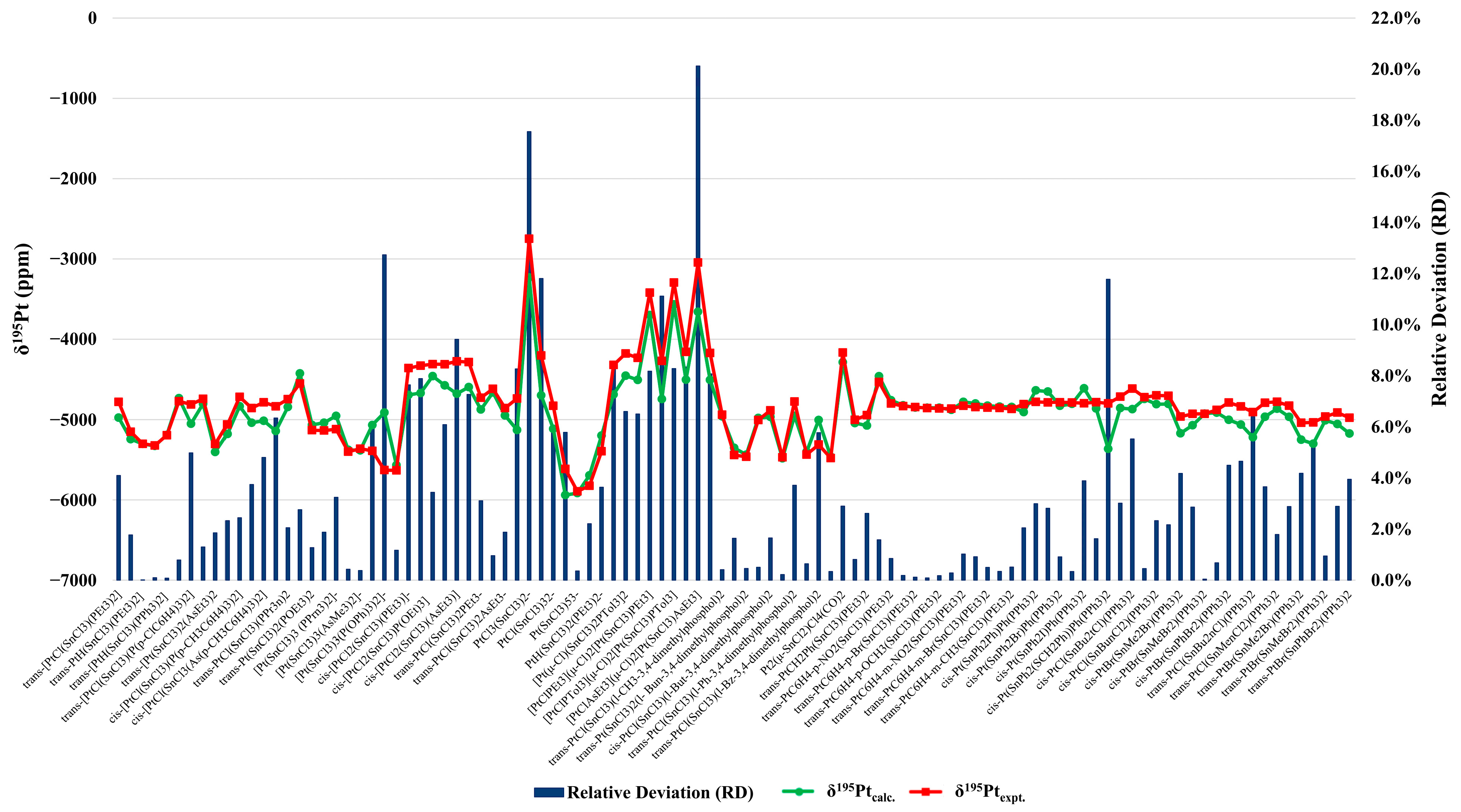
The experimental shifts range from −2748 to −5894 ppm and show a strong correlation with the predicted values (Figure 3), with the regression explaining about 86% of the variance (R2 = 0.86). Statistical analysis further indicates a mean absolute deviation (MAD) of 163 ppm, corresponding to a mean relative deviation (MRD) of only 3.6%. The largest deviation was found for [PtClAsEt3](μ-Cl)2[Pt(SnCl3)AsEt3] (20.1%), [PtCl3(SnCl3)2] (17.6%), followed by [Pt(SnCl3)3(P(OPh)3)2] (12.7%), cis-[PtCl2(SnCl3)2]2− (11.8%), cis-[Pt(SnPh2(SCH2Ph))Ph(PPh3)2] (11.8%), and [PtClPEt3](μ-Cl)2[Pt(SnCl3)PEt3] (11.1%). For the remaining 94 complexes, the absolute RD was below 10%, demonstrating that the computational protocol is robust and applicable to a broad set of Pt(II)-Sn(II) complexes.
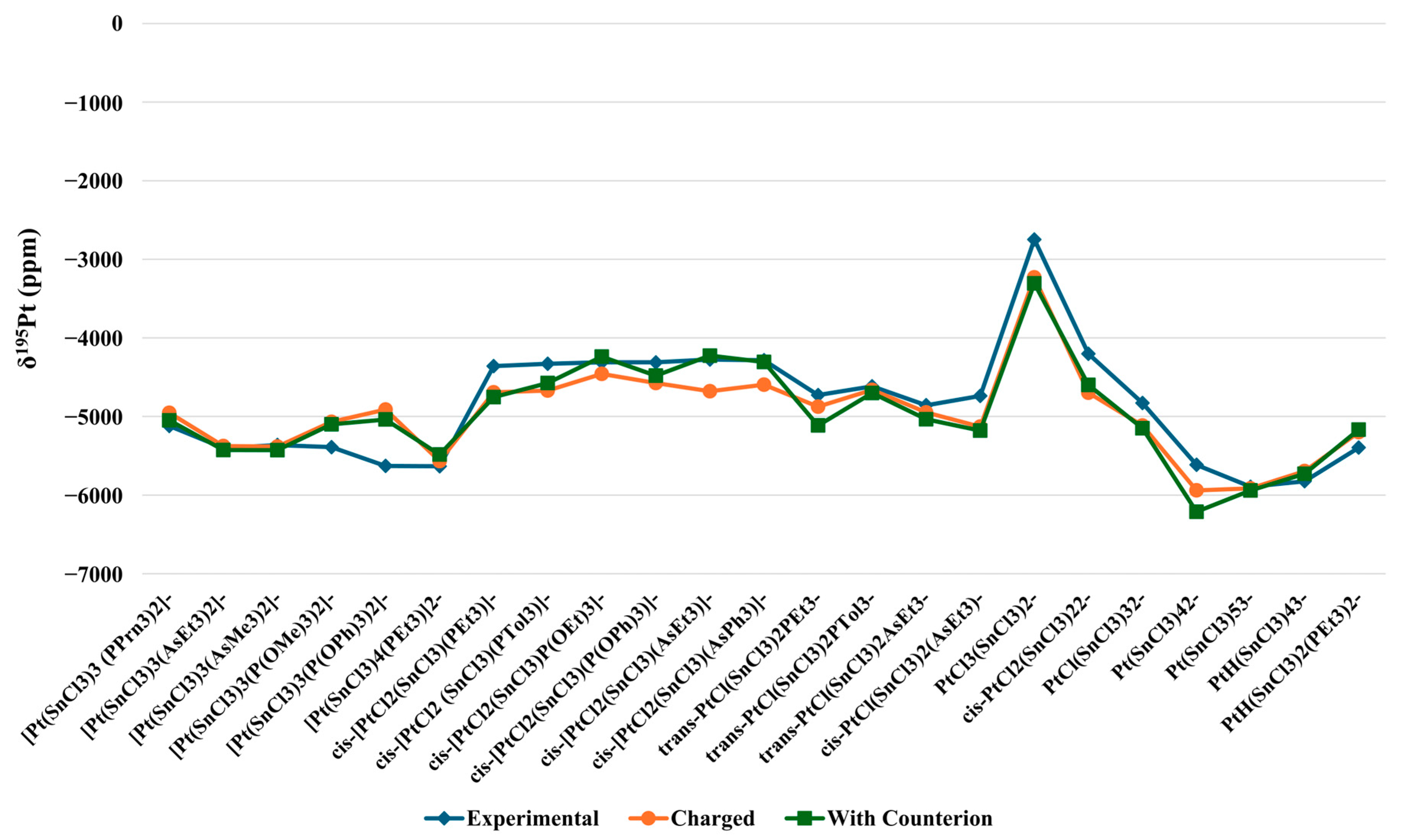
When a direct comparison between calculated and experimental values is performed (Figure 4), good agreement is observed for most complexes. To better assess the reliability of the computational protocol, the dataset was divided into groups according to their net charge (0, −1, −2, and −3; see Table S1). For neutral complexes (81 compounds), the MRD was 3.2%, increasing to 4.7% for anionic complexes with charge −1 (12 compounds) and 8.5% for those with charge −2 (5 compounds). For the group with net charge −2, the calculated δ195Pt values are generally more negative than the experimental values, indicating that the 195Pt nucleus is more shielded than observed experimentally. The larger MRD observed for these complexes can therefore be attributed, at least in part, to counterion effects that were not included in original protocol and consequently in the calculations of the present work. By contrast, the two complexes with charge −3 were satisfactorily described by the computational protocol, with RD values below 2.5%.
Tsipis et al. [37,38] showed that in solution, ion-pairing interactions between charged complexes and their counterions can result in changes in the geometry and electronic structure around the coordination sphere of the Pt nucleus, which would result in changes in the calculated δ195Pt values. In order to evaluate the effect of the counterion on Pt(II)-Sn(II) anionic complexes, the computational protocol was applied to the study of these complexes with the explicit inclusion of counterions.
From the calculated results (Figure 5 and Table S2), it can be seen that the inclusion of counterions results in small variations in the calculated δ195Pt, with variations of around 20 to 300 ppm being observed. Despite the variations, the general trends observed in the calculated δ195Pt remain the same when the counterions are included, with the experimentally observed trend being adequately described with and without the inclusion of counterions. These results indicate that the computational protocol employed can recover the electronic effects that influence the shielding of the 195Pt nucleus in Pt(II)-Sn(II) complexes. It should also be kept in mind that the applied protocol was not constructed with the inclusion of counterion effects in the charged complexes.
When the subset of complexes containing two Pt centers is considered (7 complexes with 10 signals; see Table S3), the MRD increases to 8.7%. This higher deviation can be attributed to stronger relativistic effects arising from the presence of two Pt nuclei. However, it is observed that the calculated values adequately describe the experimentally observed trends.
The complexes were also analyzed with respect to the number of SnCl3 ligands, which ranged from one to five (see Table S4). It can be observed that the values of δ195Pt vary between −2748 and −5322 ppm for one SnCl3 ligand, −4178 and −5480 ppm for two ligands, −4829 and −5629 ppm for three ligands, −5615 and −5824 ppm for four ligands, and −5894 ppm for five ligands. The observed trends in δ195Pt values can also be qualitatively interpreted in terms of ligand electronic effects. In general, stronger σ-donor ligands increase electron density at the platinum center, leading to increased shielding and therefore more negative δ195Pt values. The presence of SnCl3 ligands significantly influences the Pt electronic environment due to their strong trans influence and σ-donor character, which contributes to the large shielding observed for many complexes.
In general, the MRD increased with the number of SnCl3 ligands, except for the complexes containing four or five ligands. For complexes with one SnCl3 ligand (42 compounds with 45 signals), the MRD was 4.0%, being 2.9% without the three bimetallic complexes that presented the highest RD in this series. The MRD increased to 3.4% for complexes with two ligands (19 complexes) and to 4.8% for complexes with three ligands (6 compounds). In contrast, the MRD values were lower for complexes containing four and five SnCl3 ligands, 3.1% (3 compounds) and 0.4% (1 compounds), respectively. Overall, the increase in MRD can be attributed to the higher negative charge generally associated with a greater number of SnCl3 ligands, as well as to stronger relativistic effects resulting from the increasing number of Pt-Sn bonds.
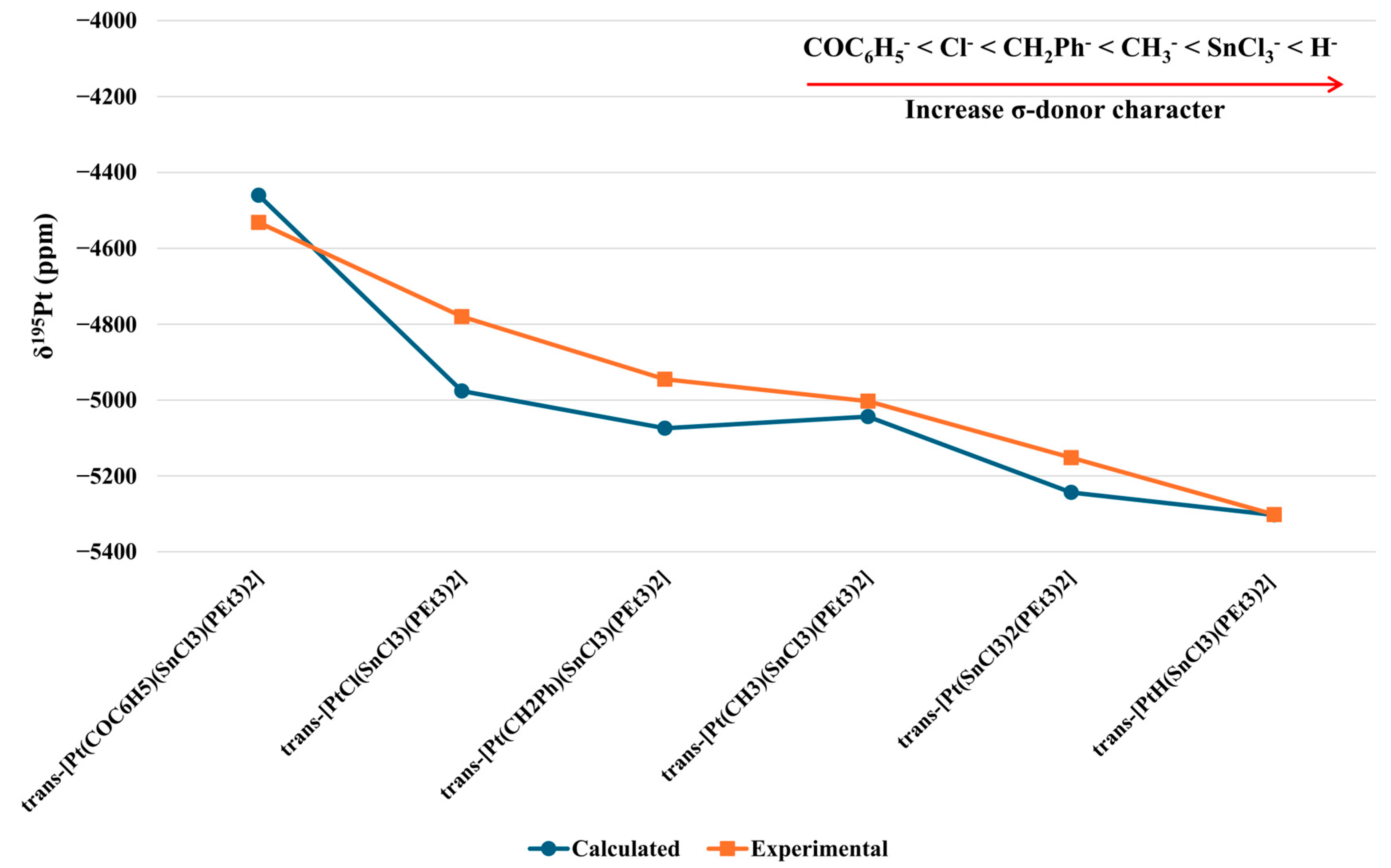
The nature of the ligand trans to the SnCl3 group also influences the δ195Pt. A clear trend can be observed for the series trans-[PtX(SnCl3)(PEt3)2], where X (COC6H5, Cl, CH2Ph, CH3, SnCl3, and H) represents different ligands coordinated to platinum. The δ195Pt values (Figure 6) become progressively more negative as the σ-donor strength of the ligand increases. For example, the acyl ligand COC6H5, which has significant π-acceptor character, leads to the least negative chemical shift (−4532 ppm), indicating reduced shielding at the Pt nucleus. In contrast, strongly σ-donating ligands such as hydride (H) and SnCl3 produce substantially more negative chemical shifts (−5302 and −5152 ppm, respectively), reflecting increased electron density at the Pt center. Alkyl ligands such as CH3 and CH2Ph show intermediate behavior, consistent with their strong σ-donor but weak π-acceptor character. This trend demonstrates that the computational protocol can reproduce subtle electronic effects associated with ligand donor properties.
Lastly, nine of the complexes studied present coordination number (CN) = 5, adopting trigonal bipyramidal geometry (see Table S5). For this subset, the MRD was 3.4%. Although the computational protocol was originally developed for Pt(II) complexes with CN = 4 and square-planar geometry, the MRD obtained for these nine complexes is of the same order as the average of the full dataset (3.6%). The similar level of accuracy observed for four- and five-coordinate complexes suggests that the protocol captures the main electronic factors governing the 195Pt shielding in these systems. This finding also indicates that the method may be applicable to a broader range of Pt(II) coordination geometries, which may be largely attributed to the use of the all-electron NMR-DKH basis set for Pt and the coordinating ligand atoms.
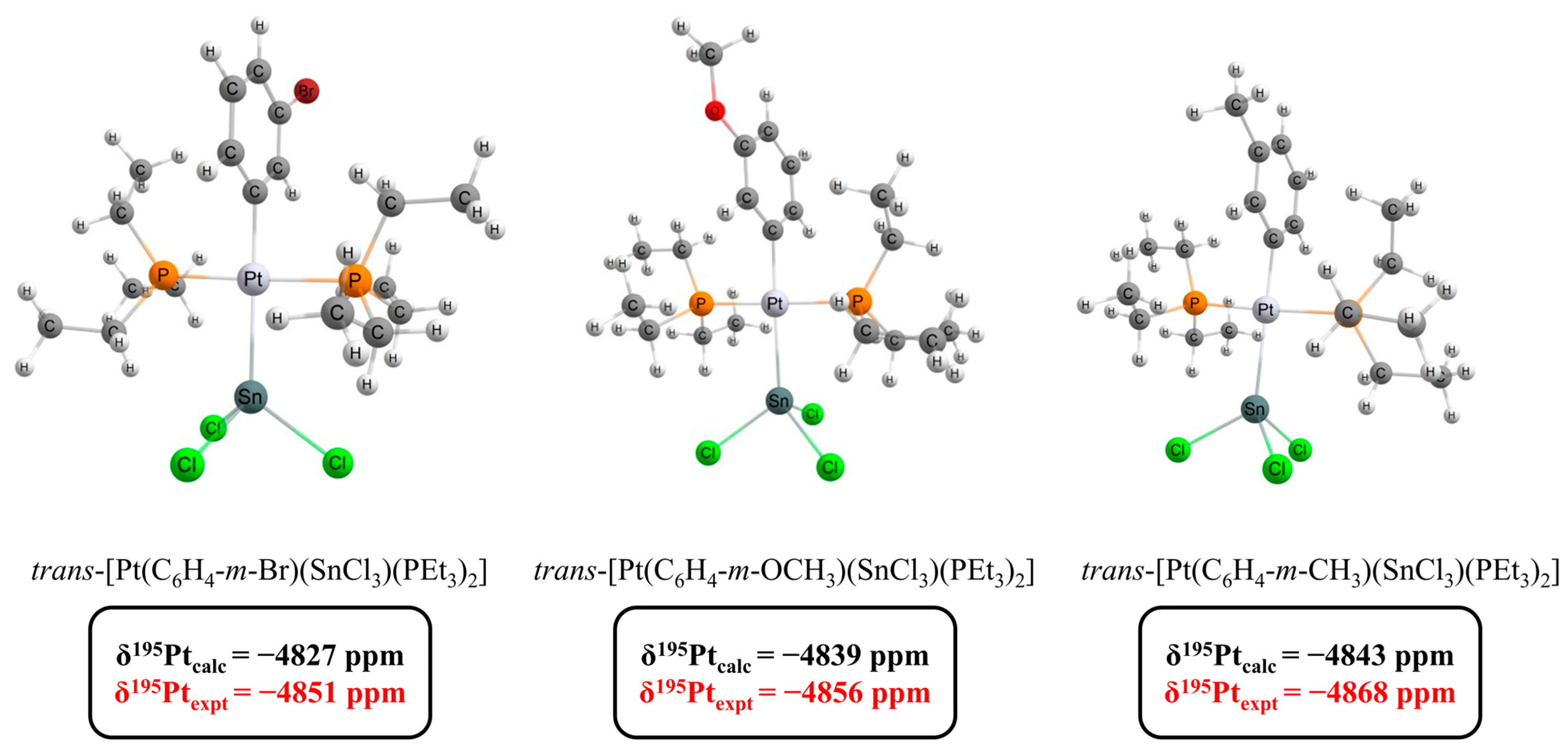
Finally, a subset of structurally related complexes was selected to evaluate the ability of the computational protocol to distinguish subtle structural differences. Figure 7 shows the series of complexes with general formula trans-[Pt(C6H4-m-L)(SnCl3)(PEt3)2], where L = Br, OCH3, or CH3. The experimental δ195Pt values for this series range from −4851 ppm (L = Br) to −4868 ppm (L = CH3). The calculated δ195Pt values were −4827 ppm (L = Br), −4839 ppm (L = OCH3), and −4843 ppm (L = CH3). The experimental variation in chemical shift across the three complexes was 17 ppm, while the calculated variation was 16 ppm. Moreover, the computational protocol correctly reproduced the experimental trend, confirming its ability to capture subtle substituent effects on δ195Pt.
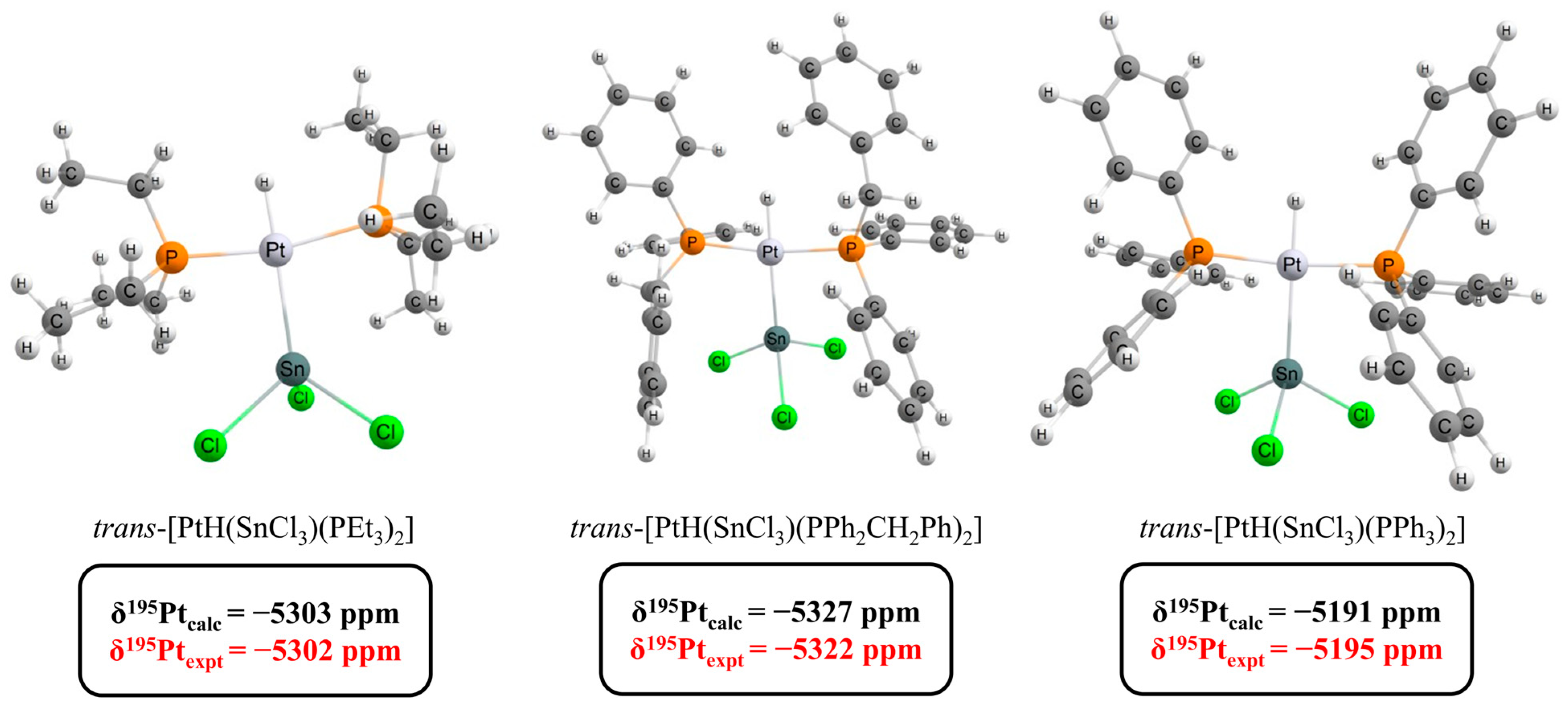
A comparison was also performed for the complexes with general formula trans-[PtH(SnCl3)(PL)2], where L = Et3, Ph2CH2Ph, or Ph3 (Figure 8). These species differ only in the nature of the phosphine ligands, leading to experimental δ195Pt values ranging from −5302 ppm (L = Et3) to −5195 ppm (L = Ph3). The calculated values reproduced the experimental trends with high accuracy, with the largest absolute deviation being only 5 ppm for the complex with L = Ph2CH2Ph.
In summary, the computational protocol previously proposed for Pt(II) complexes [30], satisfactorily reproduced the δ195Pt chemical shifts of Pt(II)-Sn(II) complexes. Furthermore, the protocol was sensitive enough to distinguish subtle variations in ligand environments, making it a reliable and practical tool for assigning 195Pt NMR spectra of these complexes.

4. Conclusions

In this work, the 195Pt chemical shifts were calculated for a set of 100 Pt(II)-Sn(II) complexes (103 δ195Pt). The computational protocol employed was previously developed for Pt(II) complexes and incorporated our custom basis set for NMR predictions, named NMR-DKH. The protocol consisted of three steps: (i) geometry optimization at the B3LYP/LANL2DZ/def2-SVP/IEF-PCM(UFF) level; (ii) calculation of shielding constants (σ195Pt) at the GIAO-PBE/NMR-DKH/IEF-PCM(UFF) level; and (iii) determination of δ195Pt values from a linear scaling relationship: δ195Pt = −2065.7558 − 0.9250σ195Pt.
The first part of the protocol was evaluated using two probe complexes for which experimental X-ray structures were available: [Pt(SnCl3)5]3− (Cpx39) and trans-[Pt(COC6H5)(SnCl3)(PEt3)2] (Cpx61). The mean relative deviation (MRD) for both complexes was 2.2%, with most of the discrepancy arising from the Pt-Sn bond lengths, which were predicted to be ~6% longer than observed experimentally.
For the NMR analysis, δ195Pt values were calculated for 100 complexes with experimental shifts ranging from −2748 ppm to −5894 ppm. The computed values showed satisfactory agreement with experimental values, with R2 = 0.86, MAD = 163 ppm, and MRD = 3.6%. Among these, 26 complexes exhibited MRD > 5%, and only 6 had MRD > 10%. Part of the deviation can be attributed to the increase in negative charge: the MRD was 3.2% for neutral complexes, rising to 4.7% and 8.5% for complexes with net charges of −1 and −2, respectively. Complexes containing two Pt nuclei also showed deviations above the average (MRD = 8.7%), suggesting more pronounced relativistic effects that are not fully captured by the current protocol. Nevertheless, the methodology proved capable of distinguishing subtle differences between isomers of Pt(II)-Sn(II) complexes.
Overall, the NMR-DKH basis set combined with the computational protocol previously proposed for Pt(II) complexes provides a reliable approach for predicting δ195Pt in Pt(II)-Sn(II) complexes and demonstrates that it may serve as a practical computational tool for future studies of Pt coordination chemistry, including octahedral Pt(IV) complexes.

Supplementary Materials

The following supporting information can be downloaded at https://www.mdpi.com/article/10.3390/magnetochemistry12040049/s1: Tables S1–S5 provide molecular formulas, NMR data, and classification of complexes by net charge, counterions, Pt content, number of SnCl3 ligands, and Pt coordination number 5.

Author Contributions

Conceptualization, D.F.S.P.; Methodology, M.A.P. and L.P.N.M.P.; Software, D.F.S.P.; Validation, M.A.P. and L.P.N.M.P.; Formal Analysis, M.A.P., L.P.N.M.P., H.F.D.S. and D.F.S.P.; Investigation, M.A.P. and L.P.N.M.P.; Resources, H.F.D.S. and D.F.S.P.; Data Curation: M.A.P. and L.P.N.M.P.; Writing—original draft, M.A.P. and L.P.N.M.P.; Writing—review and editing: H.F.D.S. and D.F.S.P.; Visualization: M.A.P. and L.P.N.M.P.; Supervision, D.F.S.P.; Project Administration, D.F.S.P. All authors have read and agreed to the published version of the manuscript.

Funding

The authors would like to thank the PIBIC-CNPq and the Brazilian agency FAPERJ (E-26/200.934/2018—BOLSA) for the research grants for the students. Diego F. S. Paschoal would also like to thank FAPERJ (E-26/210.070/2022—DCTR, and E-26/201.336/2022—BOLSA) and CNPq (443784/2023-0) for the financial support. HFDS is thankful for the financial support from the Brazilian Agencies FAPEMIG (APQ-01772-24) and CNPq (307018/2021-0). This study was financed in part by the Coordenação de Aperfeiçoamento de Pessoal de Nível Superior—Brasil (CAPES)—Finance Code 001.

Informed Consent Statement

Not applicable.

Data Availability Statement

The data that support the findings of this study are available from the corresponding author upon reasonable request.

Acknowledgments

D.F.S.P. thanks the FAPERJ and CNPq for supporting the NQTCM laboratory. H.F.D.S. thanks the FAPEMIG and CNPq for supporting the NEQC laboratory. The authors would like to thank the CAPES.

Conflicts of Interest

The authors declare no conflicts of interest.

References

  1. Gandhi, H.S.; Graham, G.W.; McCabe, R.W. Automotive Exhaust Catalysis. J. Catal. 2003, 216, 433–442. [Google Scholar] [CrossRef]
  2. Omrani, M.; Goriaux, M.; Liu, Y.; Martinet, S.; Jean-Soro, L.; Ruban, V. Platinum Group Elements Study in Automobile Catalysts and Exhaust Gas Samples. Environ. Pollut. 2020, 257, 113477. [Google Scholar] [CrossRef]
  3. Meister, T.K.; Riener, K.; Gigler, P.; Stohrer, J.; Herrmann, W.A.; Kühn, F.E. Platinum Catalysis Revisited—Unraveling Principles of Catalytic Olefin Hydrosilylation. ACS Catal. 2016, 6, 1274–1284. [Google Scholar] [CrossRef]
  4. Zhou, Y.; Xu, X.; Sun, H.; Tao, G.; Chang, X.-Y.; Xing, X.; Chen, B.; Xu, C. Development of Highly Efficient Platinum Catalysts for Hydroalkoxylation and Hydroamination of Unactivated Alkenes. Nat. Commun. 2021, 12, 1953. [Google Scholar] [CrossRef] [PubMed]
  5. Wang, X.; Du, P.; Cheng, K.; Hua, X.; Xie, M.; Li, Y.; Zheng, Y.; Wang, Y.; Pi, C.; Zhang, S. Structural Regulation of Advanced Platinum-Based Core-Shell Catalysts for Fuel Cell Electrocatalysis. Minerals 2025, 15, 235. [Google Scholar] [CrossRef]
  6. Sahoo, D.; Deb, P.; Basu, T.; Bardhan, S.; Patra, S.; Sukul, P.K. Advancements in Platinum-Based Anticancer Drug Development: A Comprehensive Review of Strategies, Discoveries, and Future Perspectives. Bioorg. Med. Chem. 2024, 112, 117894. [Google Scholar] [CrossRef] [PubMed]
  7. Jin, S.; Guo, Y.; Wang, X. Development of Platinum Complexes for Tumor Chemoimmunotherapy. Chem.—Eur. J. 2024, 30, e202302948. [Google Scholar] [CrossRef]
  8. Clarke, M.L. Recent Advances in Homogeneous Catalysis Using Platinum Complexes. Polyhedron 2001, 20, 151–164. [Google Scholar] [CrossRef]
  9. Rebo, H.P.; Blekkan, E.A.; Bednářová, L.; Holmen, A. Deactivation of Pt-Sn Catalyst in Propane Dehydrogenation. Stud. Surf. Sci. Catal. 1999, 126, 333–340. [Google Scholar] [CrossRef]
  10. Bariås, O.A.; Holmen, A.; Blekkan, E.A. Propane Dehydrogenation over Supported Pt and Pt–Sn Catalysts: Catalyst Preparation, Characterization, and Activity Measurements. J. Catal. 1996, 158, 1–12. [Google Scholar] [CrossRef]
  11. Pregosin, P.S.; Rüegger, H. 119Sn and 195Pt NMR Spectroscopy of SnCl3 Complexes of Platinum and Palladium. Some Chemistry of the Complexes (Ph4P)2[PtCl4] and [Pt(μ-Cl)Cl(PEt3)]2 with SnCl2. Inorg. Chim. Acta 1984, 86, 55–60. [Google Scholar] [CrossRef]
  12. Yasumori, I.; Hirabayashi, K. Homogeneous Catalysis by Pt(II)–Sn(II) Chloride Complex. Part 1.—Kinetics and Mechanisms of the Hydrogenations of Acetylene and Ethylene. Trans. Faraday Soc. 1971, 67, 3283–3296. [Google Scholar] [CrossRef]
  13. Dias, R.P.; Rocha, W.R. DFT Study of the Homogeneous Hydroformylation of Propene Promoted by a Heterobimetallic Pt–Sn Catalyst. Organometallics 2011, 30, 4257–4268. [Google Scholar] [CrossRef]
  14. Zhang, F.; Chen, K.; Jiang, Q.; He, S.; Chen, Q.; Liu, Z.; Kang, J.; Zhang, Q.; Wang, Y. Selective Transformation of Methanol to Ethanol in the Presence of Syngas over Composite Catalysts. ACS Catal. 2022, 12, 8451–8461. [Google Scholar] [CrossRef]
  15. Fricke, C.H.; Bamidele, O.H.; Bello, M.; Chowdhury, J.; Terejanu, G.; Heyden, A. Modeling the Effect of Surface Platinum–Tin Alloys on Propane Dehydrogenation on Platinum–Tin Catalysts. ACS Catal. 2023, 13, 10627–10640. [Google Scholar] [CrossRef]
  16. Rocha, W.R. Hydrogen Activation and Aldehyde Elimination Promoted by Homogeneous Pt–Sn Catalyst: A Theoretical Study. J. Mol. Struct. THEOCHEM 2004, 677, 133–143. [Google Scholar] [CrossRef]
  17. Johnston, V.J.; Chen, L.; Kimmich, B.F.; Chapman, J.T.; Zink, J.H. Direct and Selective Production of Ethanol from Acetic Acid Utilizing a Platinum/Tin Catalyst. U.S. Patent 2011/0263911A1, 27 October 2011. [Google Scholar]
  18. Young, J.F.; Gillard, R.D.; Wilkinson, G. 992. Complexes of Ruthenium, Rhodium, Iridium, and Platinum with Tin(II) Chloride. J. Chem. Soc. 1964, 5176. [Google Scholar] [CrossRef]
  19. Cramer, R.D.; Lindsey, R.V.; Prewitt, C.T.; Stolberg, U.G. Five-Coordinate Platinum(II) Complexes. J. Am. Chem. Soc. 1965, 87, 658. [Google Scholar] [CrossRef]
  20. Nelson, J.H.; Alcock, N.W. Crystal and Solution Structure of Triphenylmethylphosphonium Pentakis(Trichlorostannyl)Platinate(II), [Ph3PCH3]3[Pt(SnCl3)5]. Inorg. Chem. 1982, 21, 1196–1200. [Google Scholar] [CrossRef]
  21. Still, B.M.; Kumar, P.G.A.; Aldrich-Wright, J.R.; Price, W.S. 195Pt NMR-Theory and Application. Chem. Soc. Rev. 2007, 36, 665–686. [Google Scholar] [CrossRef]
  22. Pregosin, P.S. Platinum NMR Spectroscopy. Annu. Reports NMR Spectrosc. 1986, 17, 285–349. [Google Scholar] [CrossRef]
  23. Momeni, B.Z.; Baleh, L.J.; Hamzeh, S.; Rominger, F. Insertion of SnCl2 into Pt–Cl Bonds: Synthesis and Characterization of Four- and Five-Coordinate Trichlorostannylplatinum(II) Complexes. J. Coord. Chem. 2007, 60, 285–293. [Google Scholar] [CrossRef]
  24. Priqueler, J.R.L.; Butler, I.S.; Rochon, F.D. An Overview of 195Pt Nuclear Magnetic Resonance Spectroscopy. Appl. Spectrosc. Rev. 2006, 41, 185–226. [Google Scholar] [CrossRef]
  25. Gilbert, T.M.; Ziegler, T. Prediction of 195Pt NMR Chemical Shifts by Density Functional Theory Computations: The Importance of Magnetic Coupling and Relativistic Effects in Explaining Trends. J. Phys. Chem. A 1999, 103, 7535–7543. [Google Scholar] [CrossRef]
  26. Koch, K.R.; Burger, M.R.; Kramer, J.; Westra, A.N. 195Pt NMR and DFT Computational Methods as Tools towards the Understanding of Speciation and Hydration/Solvation of [PtX6]2− (X = Cl, Br) Anions in Solution. Dalton Trans. 2006, 3277–3284. [Google Scholar] [CrossRef]
  27. Sterzel, M.; Autschbach, J. Toward an Accurate Determination of 195Pt Chemical Shifts by Density Functional Computations: The Importance of Unspecific Solvent Effects and the Dependence of Pt Magnetic Shielding Constants on Structural Parameters. Inorg. Chem. 2006, 45, 3316–3324. [Google Scholar] [CrossRef]
  28. Truflandier, L.A.; Autschbach, J. Probing the Solvent Shell with 195Pt Chemical Shifts: Density Functional Theory Molecular Dynamics Study of PtII and PtIV Anionic Complexes in Aqueous Solution. J. Am. Chem. Soc. 2010, 132, 3472–3483. [Google Scholar] [CrossRef]
  29. Autschbach, J.; Le Guennic, B. Solvent Effects on 195Pt and 205Tl NMR Chemical Shifts of the Complexes [(NC)5Pt-Tl(CN)n]n- (N=0-3), and [(NC)5Pt-Tl-Pt(CN)5]3- Studied by Relativistic Density Functional Theory. Chem.—Eur. J. 2004, 10, 2581–2589. [Google Scholar] [CrossRef] [PubMed]
  30. Truflandier, L.A.; Sutter, K.; Autschbach, J. Solvent Effects and Dynamic Averaging of 195Pt NMR Shielding in Cisplatin Derivatives. Inorg. Chem. 2011, 50, 1723–1732. [Google Scholar] [CrossRef] [PubMed]
  31. Gabano, E.; Marengo, E.; Bobba, M.; Robotti, E.; Cassino, C.; Botta, M.; Osella, D. 195Pt NMR Spectroscopy: A Chemometric Approach. Coord. Chem. Rev. 2006, 250, 2158–2174. [Google Scholar] [CrossRef]
  32. Ondar, E.E.; Polynski, M.V.; Ananikov, V.P. Predicting 195Pt NMR Chemical Shifts in Water-Soluble Inorganic/Organometallic Complexes with a Fast and Simple Protocol Combining Semiempirical Modeling and Machine Learning. ChemPhysChem 2023, 24, e202200940. [Google Scholar] [CrossRef]
  33. Meßler, A.; Bahmann, H. Uncertainty-Aware Prediction of 195Pt Chemical Shifts from Limited Data. J. Chem. Inf. Model. 2026, 66, 1498–1510. [Google Scholar] [CrossRef]
  34. Semenov, V.A.; Samultsev, D.O.; Rusakova, I.L.; Krivdin, L.B. Computational Multinuclear NMR of Platinum Complexes: A Relativistic Four-Component Study. J. Phys. Chem. A 2019, 123, 4908–4920. [Google Scholar] [CrossRef]
  35. Semenov, V.A.; Rusakov, Y.Y.; Samultsev, D.O.; Krivdin, L.B. Geometries and NMR Properties of Cisplatin and Transplatin Revisited at the Four-Component Relativistic Level. Mendeleev Commun. 2019, 29, 315–317. [Google Scholar] [CrossRef]
  36. Tsipis, A.C.; Karapetsas, I.N. Accurate Prediction of 195Pt NMR Chemical Shifts for a Series of Pt(II) and Pt(IV) Antitumor Agents by a Non-Relativistic DFT Computational Protocol. Dalton Trans. 2014, 43, 5409–5426. [Google Scholar] [CrossRef]
  37. Tsipis, A.C.; Karapetsas, I.N. Accurate Prediction of 195Pt-NMR Chemical Shifts for Hydrolysis Products of [PtCl6]2− in Acidic and Alkaline Aqueous Solutions by Non-Relativistic DFT Computational Protocols. J. Coord. Chem. 2015, 68, 3788–3804. [Google Scholar] [CrossRef]
  38. Tsipis, A.C.; Karapetsas, I.N. Prediction of 195Pt NMR Chemical Shifts of Dissolution Products of H2[Pt(OH)6] in Nitric Acid Solutions by DFT Methods: How Important Are the Counterion Effects? Magn. Reson. Chem. 2016, 54, 656–664. [Google Scholar] [CrossRef] [PubMed]
  39. Tsipis, A.C.; Karapetsas, I.N. Prediction of 195Pt NMR of Photoactivable Diazido-and Azine-Pt(IV) Anticancer Agents by DFT Computational Protocols. Magn. Reson. Chem. 2017, 55, 145–153. [Google Scholar] [CrossRef] [PubMed]
  40. Paschoal, D.; Fonseca Guerra, C.; de Oliveira, M.A.L.; Ramalho, T.C.; Dos Santos, H.F. Predicting Pt-195 NMR Chemical Shift Using New Relativistic All-Electron Basis Set. J. Comput. Chem. 2016, 37, 2360–2373. [Google Scholar] [CrossRef]
  41. Kondrashova, S.A.; Latypov, S.K. Reliable DFT Protocol for Calculation of 195Pt NMR Chemical Shifts. Russ. Chem. Bull. 2025, 74, 2970–2979. [Google Scholar] [CrossRef]
  42. Carr, S.; Colton, R.; Dakternieks, D. Phosphorus-31, Tin-119 and Platinum-195 NMR Studies on Some Platinum(II)-Tin Bonded Compounds. J. Organomet. Chem. 1983, 249, 327–334. [Google Scholar] [CrossRef]
  43. Starzewski, K.A.O.; Pregosin, P.S. 195Pt-NMR Spectroscopy of Catalytically Active Complexes. Extremely Large Spin-Spin Coupling between Platinum and Tin. Angew. Chem. Int. Ed. Engl. 1980, 19, 316–317. [Google Scholar] [CrossRef]
  44. Pregosin, P.S. The Multinuclear NMR Approach. Contributions to the Chemistry of Platinum. Chimia 1981, 35, 43. [Google Scholar] [CrossRef]
  45. Pregosin, P.S.; Sze, S.N. The Reaction of SnCl2 with the Complexes cis-PtCl2(Phosphorus Ligand)2 as Studied by 31P and 195Pt NMR. Helv. Chim. Acta 1978, 61, 1848–1855. [Google Scholar] [CrossRef]
  46. Starzewski, K.H.A.O.; Pregosin, P.S.; Rüegger, H. 31P-, 119Sn- and 195Pt-NMR. Studies of Trichlorostannate Complexes of Pt(II) and Pd(II). 2J(119Sn, 117Sn)-Values. Helv. Chim. Acta 1982, 65, 785–797. [Google Scholar] [CrossRef]
  47. Albinati, A.; Pregosin, P.S.; Ruegger, H. Trichlorostannate Complexes of Platinum. Synthesis, Multinuclear NMR Spectroscopy and x-Ray Crystallography of trans-[Pt(SnCl3)2(P(OPh)3)2] and Related Complexes. Inorg. Chem. 1984, 23, 3223–3229. [Google Scholar] [CrossRef]
  48. Holt, M.S.; MacDougall, J.J.; Mathey, F.; Nelson, J.H. A Multinuclear NMR Investigation of Stannous Chloride Promoted Ligand Exchange of Platinum Phosphole Complexes. Inorg. Chem. 1984, 23, 449–453. [Google Scholar] [CrossRef]
  49. Goodfellow, R.J.; Herbert, I.R. An NMR Study of the Insertion of Tin(II) Halides into a Platinum-Platinum Bond. Inorg. Chim. Acta 1982, 65, L161–L162. [Google Scholar] [CrossRef]
  50. Albinati, A.; Von Gunten, U.; Pregosin, P.S.; Ruegg, H.J. 195Pt, 119Sn and 31P NMR Studies of Alkyl, Aryl and Acyl Trichlorostannate Complexes of Platinum(II). The Crystal Structure of trans-[Pt(SnCl3)(COC6H5)(PEt3)2]. J. Organomet. Chem. 1985, 295, 239–256. [Google Scholar] [CrossRef]
  51. Lee, C.; Yang, W.; Parr, R.G. Development of the Colle-Salvetti Correlation-Energy Formula into a Functional of the Electron Density. Phys. Rev. B 1988, 37, 785–789. [Google Scholar] [CrossRef] [PubMed]
  52. Stephens, P.J.; Devlin, F.J.; Chabalowski, C.F.; Frisch, M.J. Ab Initio Calculation of Vibrational Absorption and Circular Dichroism Spectra Using Density Functional Force Fields. J. Phys. Chem. 1994, 98, 11623–11627. [Google Scholar] [CrossRef]
  53. Becke, A.D. Density-functional Thermochemistry. III. The Role of Exact Exchange. J. Chem. Phys. 1993, 98, 5648–5652. [Google Scholar] [CrossRef]
  54. Hay, P.J.; Wadt, W.R. Ab Initio Effective Core Potentials for Molecular Calculations. Potentials for K to Au Including the Outermost Core Orbitals. J. Chem. Phys. 1985, 82, 299–310. [Google Scholar] [CrossRef]
  55. Metz, B.; Stoll, H.; Dolg, M. Small-Core Multiconfiguration-Dirac–Hartree–Fock-Adjusted Pseudopotentials for Post- d Main Group Elements: Application to PbH and PbO. J. Chem. Phys. 2000, 113, 2563–2569. [Google Scholar] [CrossRef]
  56. Weigend, F.; Ahlrichs, R. Balanced Basis Sets of Split Valence, Triple Zeta Valence and Quadruple Zeta Valence Quality for H to Rn: Design and Assessment of Accuracy. Phys. Chem. Chem. Phys. 2005, 7, 3297. [Google Scholar] [CrossRef]
  57. Scalmani, G.; Frisch, M.J. Continuous Surface Charge Polarizable Continuum Models of Solvation. I. General Formalism. J. Chem. Phys. 2010, 132, 114110. [Google Scholar] [CrossRef]
  58. Frisch, M.J.; Trucks, G.W.; Schlegel, H.B.; Scuseria, G.E.; Robb, M.A.; Cheeseman, J.R.; Scalmani, G.; Barone, V.; Petersson, G.A.; Nakatsuji, H.; et al. Gaussian 16; Revision C.01; Gaussian, Inc.: Wallingford, CT, USA, 2016. [Google Scholar]
  59. Alcock, N.W.; Nelson, J.H. The [PtCl2(SnCl3)2]2- Ion: Crystal Structure of Two Salts. J. Chem. Soc. Dalt. Trans. 1982, 2415–2418. [Google Scholar] [CrossRef]
  60. London, F. Théorie Quantique Des Courants Interatomiques Dans Les Combinaisons Aromatiques. J. Phys. Le Radium 1937, 8, 397–409. [Google Scholar] [CrossRef]
  61. McWeeny, R. Perturbation Theory for the Fock-Dirac Density Matrix. Phys. Rev. 1962, 126, 1028–1034. [Google Scholar] [CrossRef]
  62. Ditchfield, R. Self-Consistent Perturbation Theory of Diamagnetism. Mol. Phys. 1974, 27, 789–807. [Google Scholar] [CrossRef]
  63. Wolinski, K.; Hinton, J.F.; Pulay, P. Efficient Implementation of the Gauge-Independent Atomic Orbital Method for NMR Chemical Shift Calculations. J. Am. Chem. Soc. 1990, 112, 8251–8260. [Google Scholar] [CrossRef]
  64. Cheeseman, J.R.; Trucks, G.W.; Keith, T.A.; Frisch, M.J. A Comparison of Models for Calculating Nuclear Magnetic Resonance Shielding Tensors. J. Chem. Phys. 1996, 104, 5497–5509. [Google Scholar] [CrossRef]
  65. Perdew, J.P.; Burke, K.; Ernzerhof, M. Generalized Gradient Approximation Made Simple [Phys. Rev. Lett. 77, 3865 (1996)]. Phys. Rev. Lett. 1997, 78, 1396. [Google Scholar] [CrossRef]
  66. Perdew, J.P.; Burke, K.; Wang, Y. Generalized Gradient Approximation for the Exchange-Correlation Hole of a Many-Electron System. Phys. Rev. B 1996, 54, 16533–16539. [Google Scholar] [CrossRef]
  67. Carvalho, J.; Paschoal, D.; Fonseca Guerra, C.; Dos Santos, H.F. Nonrelativistic Protocol for Calculating the 1J(195Pt-15N) Coupling Constant in Pt(II)-Complexes Using All-Electron Gaussian Basis-Set. Chem. Phys. Lett. 2020, 745, 137279. [Google Scholar] [CrossRef]
  68. E Silva, J.H.C.; Dos Santos, H.F.; Paschoal, D.F.S. Predicting Pt-195 Nmr Chemical Shift and 1J(195Pt-31P) Coupling Constant for Pt(0) Complexes Using the NMR-DKH Basis Sets. Magnetochemistry 2021, 7, 148. [Google Scholar] [CrossRef]
  69. Paschoal, D.F.S.; Dos Santos, H.F. Predicting the Structure and NMR Coupling Constant 1J(129Xe-19F) of XeF6 Using Quantum Mechanics Methods. Phys. Chem. Chem. Phys. 2021, 23, 7240–7246. [Google Scholar] [CrossRef] [PubMed]
  70. de Andrade, T.F.C.B.; Dos Santos, H.F.; Fonseca Guerra, C.; Paschoal, D.F.S. Computational Prediction of Tc-99 NMR Chemical Shifts in Technetium Complexes with Radiopharmaceutical Applications. J. Phys. Chem. A 2022, 126, 5434–5448. [Google Scholar] [CrossRef]
  71. Gomes, M.G.R.; De Souza, A.L.F.; Dos Santos, H.F.; De Almeida, W.B.; Paschoal, D.F.S. Assessment of a Computational Protocol for Predicting Co-59 NMR Chemical Shift. Magnetochemistry 2023, 9, 172. [Google Scholar] [CrossRef]
  72. Gomes, M.G.R.; de Souza, C.R.S.; Paschoal, D.F.d.S.; De Almeida, W.B. Predicting Ti-49 NMR Chemical Shift with New NMR-DKH Basis Set. J. Comput. Chem. 2025, 46, e70258. [Google Scholar] [CrossRef]
Figure 1. Pt(II)-Sn(II) complexes with experimental X-ray diffraction data available. (a) [Pt(SnCl3)5]3− (Cpx39) [59] and (b) trans-[Pt(COC6H5)(SnCl3)(PEt3)2] (Cpx61) [50]. Straight lines represent bonds in the plane of the page; solid wedges represent bonds projecting out of the plane toward the observer, whereas hashed wedges represent bonds projecting behind the plane.
Magnetochemistry 12 00049 g001
Figure 2. Optimized structures for the Pt(II)-Sn(II) complexes. (a) Cpx39–[Pt(SnCl3)5]3−, (b) Cpx61–trans-[Pt(COC6H5)(SnCl3)(PEt3)2]. The level of theory employed was B3LYP/LANL2DZ/def2-SVP/IEF-PCM(UFF).
Magnetochemistry 12 00049 g002
Figure 3. Correlation between the calculated and experimental values of δ195Pt for 100 Pt(II)-Sn(II) complexes. Charged complexes are highlighted in orange, bimetallic complexes in green, and other complexes in blue.
Magnetochemistry 12 00049 g003
Figure 4. Comparison between the calculated (green line) and experimental (red line) δ195Pt values for the 100 Pt(II)-Sn(II) complexes studied. The relative deviation (RD) is shown as blue bars. δ195Pt values are displayed on the left vertical axis, while RD values are plotted on the right vertical axis.
Magnetochemistry 12 00049 g004
Figure 5. Comparison between the experimental and calculated with (MRD = 5.2%) and without (MRD = 5.5%) the inclusion of counterions δ195Pt values for the charged Pt(II)-Sn(II) complexes studied.
Magnetochemistry 12 00049 g005
Figure 6. Assessment of nature of the ligand trans to the SnCl3 in the δ195Pt chemical shift values for the series trans-[PtX(SnCl3)(PEt3)2], where X = COC6H5, Cl, CH2Ph, CH3, SnCl3, and H.
Magnetochemistry 12 00049 g006
Figure 7. Comparison of the δ195Pt chemical shift of the three compounds with a trans-[Pt(C6H4-m-L)(SnCl3)(PEt3)2] profile of L = Br, OCH3 and CH3.
Magnetochemistry 12 00049 g007
Figure 8. Comparison of the chemical shift of the three compounds with trans-[PtH(SnCl3)(PL)2] molecular formula with L = Et3, Ph2CH2Ph e Ph3.
Magnetochemistry 12 00049 g008
Table 1. Bond lengths (in Å) and bond angles (in degrees) for the complexes Cpx39–[Pt(SnCl3)5]3− and Cpx61–trans-[Pt(COC6H5)(SnCl3)(PEt3)2] obtained at the level B3LYP/LANL2DZ/def2-SVP/IEF-PCM(UFF). The experimental X-ray data are also included.
Cpx39–[Pt(SnCl3)5]3Calc.Expt. [59]RD a
Pt-Sn (axial)2.642.553.7%
Pt-Sn (equatorial)2.702.575.0%
Sn-Pt-Sn (axial)179.5180.00.3%
Sn-Pt-Sn (equatorial)120.0120.00.0%
MRD b 2.2%
Cpx61–trans-[Pt(COC6H5)(SnCl3)(PEt3)2]Calc.Expt. [50]RD a
Pt-Sn2.792.636.1%
Pt-P2.402.323.4%
Pt-C2.042.050.5%
P-Pt-P173.8170.81.8%
C-Pt-Sn171.9173.10.7%
P-Pt-C90.990.30.7%
P-Pt-Sn90.392.22.1%
MRD b 2.2%
a RD = relative deviation; b MRD = mean relative deviation.
Disclaimer/Publisher’s Note: The statements, opinions and data contained in all publications are solely those of the individual author(s) and contributor(s) and not of MDPI and/or the editor(s). MDPI and/or the editor(s) disclaim responsibility for any injury to people or property resulting from any ideas, methods, instructions or products referred to in the content.