Article

Electromagnetic Control of Ferromagnetic Particle Movement Using PID and PWM

by
Jesús Alexis Salcedo Muciño
1,
Juan Alejandro Flores Campos
2,*,
Adolfo Angel Casares Duran
1,
Juan Carlos Paredes Rojas
3,
José Juan Mojica Martínez
1 and
Christopher René Torres-SanMiguel
1
1
Instituto Politécnico Nacional, Escuela Superior de Ingeniería Mecánica y Eléctrica, Unidad Profesional “Adolfo López Mateos”, Gustavo A. Madero, Col. Lindavista, Ciudad de México 07738, Mexico
2
Instituto Politécnico Nacional, Unidad Profesional Interdisciplinaria en Ingeniería y Tecnologías Avanzadas, Av. IPN No. 2580, La Laguna Ticomán, Gustavo A. Madero, Ciudad de México 07340, Mexico
3
Instituto Politécnico Nacional, Escuela Superior de Ingeniería Mecánica y Eléctrica, Unidad Culhuacán, Santa Ana 1000, Coyoacán, CTM Culhuacán, Ciudad de México 04440, Mexico
*
Author to whom correspondence should be addressed.
Magnetochemistry 2026, 12(4), 48; https://doi.org/10.3390/magnetochemistry12040048
Submission received: 7 February 2026 / Revised: 20 March 2026 / Accepted: 24 March 2026 / Published: 10 April 2026
(This article belongs to the Topic Magnetic Nanoparticles and Thin Films)

Abstract

In this article, the motion control of ferromagnetic particles through varying a non-invasive magnetic field is addressed. Within an experimental test bench, three experiments are proposed to verify motion control, which consist of control of the distance between electromagnets, retention of particles over the flow, and manipulation of the direction of particle flow at a “Y”-type bifurcation emulating an “OR” gate. At each experimental stage, instrumented test benches were integrated with current, distance, and flow sensors, enabling measurement and feedback of the system’s physical variables. These benches were configured using pulse-width-modulation (PWM) and Proportional–Integral–Derivative (PID) controllers to regulate the current supplied to the electromagnets and, thereby, control the intensity of the induced electromagnetic field according to the requirements of each experiment. Different study cases were defined to analyze the operational limits of the system by varying the current influencing the electromagnetic field and the configuration of the electromagnets. The results describe the response of the magnetic field, the induced force, and the behavior of the suspended particles under each condition, providing elements to characterize the performance of the electromagnetic system in operational scenarios and contributing to the understanding of the phenomena associated with the non-invasive manipulation of ferromagnetic particles by means of controlled magnetic fields.

1. Introduction

The interaction between electromagnetic fields and ferromagnetic materials has enabled the development of systems capable of manipulating particles without direct physical contact, facilitating applications in complex fluids, microchannels, and environments where mechanical mechanisms present limitations associated with geometric precision and operating conditions. The fundamental principles established by Maxwell [1] and Faraday [2] constitute the theoretical basis for the design of devices capable of generating controllable forces through the regulation of electric current, a central aspect in technologies oriented toward the suspension, transport, and guidance of particles in rheological media. These foundations have driven the use of external magnetic configurations to act on microrobots, ferromagnetic particles, and magnetized agents, as documented in soft actuators, biomimetic systems, and contactless manipulation platforms [3,4], as well as in magnetic control schemes applied at the micro- and nanoscale [5,6]. Control strategies such as Proportional–Integral–Derivative (PID) controllers and pulse-width modulation (PWM) are commonly used to regulate magnetic actuators in particle manipulation systems. Prior studies have applied PID loops to stabilize magnetic traps and to control actuator position or coil current for particle capture and release [7,8], while PWM has been widely used to modulate coil currents for power-efficient magnetic field control in microfluidic and biomedical testbeds [9,10]. These works demonstrate the effectiveness of closed-loop control for improving repeatability and response time in magnetic manipulation. However, most prior studies focus on either static trapping or single-mode actuation; comprehensive experimental test benches that combine motorized electromagnet spacing (closed-loop PID) with coil current PWM for three complementary flow-based experiments remain limited [11,12,13]. The present study addresses this gap by integrating both control modalities into a single, modular test bench and by characterizing particle behavior across the three scenarios described below. Non-invasive control through variable magnetic fields has gained relevance due to its ability to modify spatial distributions, trajectories, and concentrations of particles suspended in fluids without direct mechanical intervention. Various studies have analyzed strategies to implement selective and independent control of magnetic agents through adjustable gradients and homogeneous fields [14,15], as well as the generation of stable equilibrium points for the organization, retention, or confinement of individual particles or swarms [16,17]. Complementarily, model-learning and adaptive control schemes have been proposed for remote, contactless manipulation in viscous media or non-ideal environments [18]. Likewise, the use of mobile permanent magnets has demonstrated feasibility for the decoupled actuation of multiple magnetic devices [19], while hybrid configurations based on mobile electromagnetic coils have enabled the synchronization of position and orientation at the microscale.
These approaches have enabled the addressing of applications associated with particle separation, guidance at bifurcations, oriented transport, and manipulation in microchannels, where the magnetic force depends directly on the field intensity, system geometry, and environmental permeability [20,21]. In particular, the manipulation of tetherless devices through rotating fields and electromagnetic configurations has provided additional capabilities for displacement and guidance in viscous fluids [22,23], demonstrating the versatility of electromagnetic systems in the remote control of particles and magnetic agents. In this context, current regulation through techniques such as pulse-width modulation (PWM) and stabilization via PID controllers has become established as a recurring tool for modifying, in real time, the magnitude of the generated fields and, consequently, the force applied to particles or ferromagnetic cores [24,25].
Based on this framework, the present work develops an experimental bench oriented toward the non-invasive electromagnetic control of ferromagnetic particles. The system integrates the selection and incorporation of electromagnets within an instrumented experimental structure, the design of the power stages required for their operation, and the implementation of control strategies based on PWM and PID to regulate the current and, consequently, the magnitude of the applied field. The platform is employed in three experimental configurations focused on controlling the distance between ferromagnetic cores, particle capture in a continuous flow, and selective guidance at a “Y”-type bifurcation. Each stage allows for the analysis of the relationship between electrical variables, system geometry, and the behavior of suspended particles under different operating conditions, to study retention, dosing, and redirection phenomena in hydraulic media without direct physical contact [11,12,13]. The novelty of this work lies in the integrated experimental platform that combines motorized electromagnet spacing under PID control with PWM-based coil current modulation, enabling three complementary experimental scenarios on a single bench: (1) closed-loop control of electromagnet separation to study field geometry effects, (2) retention tests of ferromagnetic particles under controlled flow, and (3) active trajectory manipulation of particles in flow. This integration, together with hardware-level characterization (coil geometry, measured field maps, and control loop performance) and repeatability tests, provides a reproducible benchmark for future studies and differs from prior work that typically addresses only one control modality or a single experimental scenario.

2. Materials and Methods

The experimental methodology was structured into three stages aimed at analyzing the non-invasive electromagnetic control of ferromagnetic particles under controlled conditions. In each stage, an experimental bench was developed and adapted to a specific set of physical parameters. The general procedure comprised the design and integration of electromagnets, the implementation of control systems based on pulse-width modulation (PWM) and proportional–integral–derivative (PID) controllers, as well as instrumentation for the acquisition of electrical and flow variables [7,26].
Figure 1 shows the general diagram of the experimental system, where the modular configuration employed in the three stages is observed, allowing for the independent analysis of the behavior of the electromagnetic field and its interaction with suspended ferromagnetic particles [10].

2.1. Materials and Experimental Setup

Ferromagnetic iron oxide (Fe3O4) nanoparticles were suspended in water as the working fluid. An average concentration of 0.05 g/mL was quantified, and experimental results demonstrated localized particle accumulation and retention zones dependent on the applied magnetic field intensity. Carbonyl iron powder (CIP) was used as a ferromagnetic material. Particle size was measured by laser diffraction with a mean diameter of 5 μm and a distribution spanning approximately 1–10 μm. The manufacturer-reported relative magnetic permeability is μr ≈ 1000. Particles were suspended in the working fluid at a nominal concentration of 0.1% w/v (1 gL−1) for the experiments reported here; deviations for specific tests are noted in the Results. Electromagnets: soft iron cores (AISI 1010) 40 mm × 8 mm, wound with 200 turns of AWG 24 enamelled copper (DC resistance 6.0 Ω, inductance 12 mH). Pole face fields were measured with a Hall probe (HHP 100) and ranged 0–50 mT for separations 5–30 mm. Coils were driven by a H- bridge using IRF540N MOSFETs; current was sensed via a 0.1 Ω shunt and sampled at 1 kHz (INA219). Positioning used a NEMA 17 stepper (Model 17HS4401) with an A4988 driver (1/16 micro stepping) controlled by an Arduino Mega 2560 (16 MHz). Position PID gains were Kp = 2.0, Ki = 0.5 s−1, Kd = 0.1 s (update rate 200 Hz); current PID gains were Kp = 0.8, Ki = 20 s−1 (update rate 2 kHz). PWM carrier frequency was 20 kHz with 8-bit resolution: duty cycle limited to 80% to prevent overheating. Control hardware and implementation. The motorized spacing stage is driven by a stepper motor (NEMA 17) with an A4988 driver and is controlled by an Arduino Mega 2560 running a discrete PID loop for position control. Coil actuation is performed via microcontroller PWM outputs driving MOSFET switches (IRF540N) in a H-bridge configuration; coil current is monitored with a shunt resistor and sampled by the microcontroller ADC. PID tuning followed Ziegler–Nichols initial settings and was refined empirically to achieve stable, low overshoot responses for both position and, when enabled, current regulation.

2.2. General Description of the Experimental System

The experimental bench was designed using a structure that supports the electromagnets and the measurement sensors. Each electromagnet was powered by a regulated direct current supply, controlled by a PWM signal generated by a microcontroller. The control signal was applied to an H-bridge power stage, allowing regulation of the current supplied to the coils according to the requirements of each study case [27,28].
The instrumentation included current sensors, distance measurement devices, and a digital flowmeter for the hydraulic tests. These measurements made it possible to characterize the system response to variations in electromagnetic excitation and to analyze the relationship between electromagnetic and flow variables [9,10]. Control architecture: A primary PID loop controls the stepper-driven linear stage to set and maintain the electromagnet separation (stage 1). Coil actuation for stages 2 and 3 is performed via PWM to modulate the effective magnetic field and to enable rapid field changes for particle steering. For experiments that require precise coil current (for example, long-duration retention tests where supply or thermal drift can alter current), a secondary PID current control loop is enabled to regulate the measured coil current to the PWM setpoint. The control block diagram (Figure 1) shows: (a) position PID for spacing, (b) PWM drive for coil actuation, and (c) optional PID current loop for current stabilization.

2.3. Control of Distance Between Electromagnets

In Figure 2, the first experiment, the interaction between two opposing electromagnets was studied with the objective of maintaining a stable distance through control of the applied current. The control system was implemented using a proportional–integral–derivative (PID) controller, responsible for adjusting the electromagnetic field as a function of the error between the measured distance and the established reference [7,8].
The electromagnetic behavior of the system was analyzed by considering the relationship between the magnetic induction generated by the supplied electric current and the distance between the cores. The general model of the controller PID (Proportional–Integral–Derivative controller) is expressed as:
i t = K p e t + K i e t d t + K d d e ( t ) d t
where i(t) represents the current applied to the system, e(t) the position error, and Kp, Ki, and Kd the proportional, integral, and derivative gains, respectively [29].
The magnetic field generated by each electromagnet was estimated through the relationship between the flux density and the core area. The attraction force was approximated by:
F = B 2 · A 2 μ 0
where F is the magnetic force, B the magnetic induction, A is the cross-sectional area of the core, and μ 0 = 4 π × 10 7 the air gap permeability. The equation is the Maxwell form used to estimate magnetic forces, which can be found in the chapter Magnetostatics [30,31].
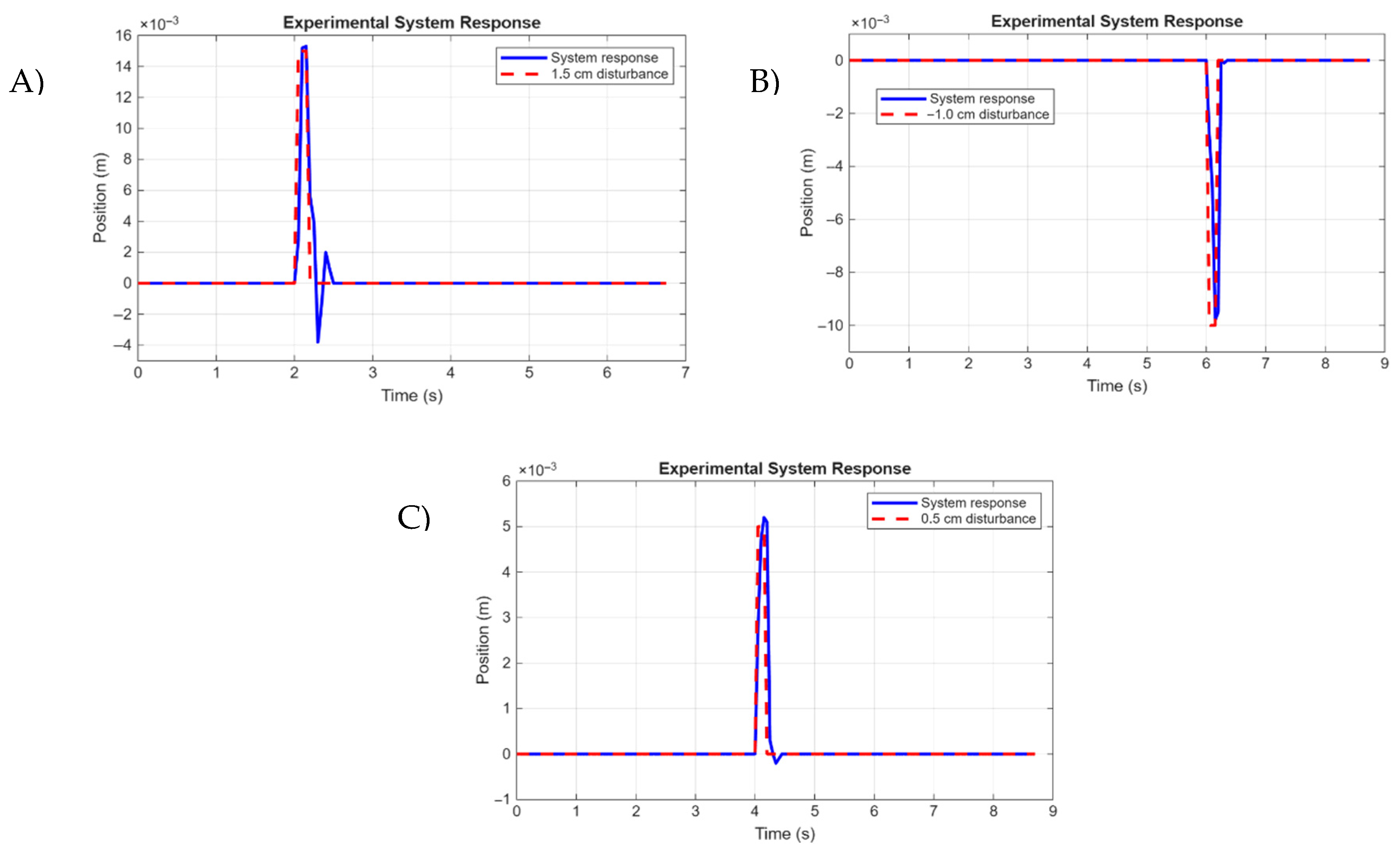
The experiment was structured into three study cases defined by controlled perturbations in the separation between the electromagnets: The behavior of the distance and the control current is shown. Case C represents a 0.5 cm disturbance. In this scenario, the system compensated for the perturbation by generating a stable magnetic field response. In Case B, the 1.0 cm disturbance produced a higher maximum current prior to stabilization. In Case A, the attraction perturbation caused direct contact followed by correction of the distance to the nominal value. In each scenario, the current applied to the electromagnets and the relative position between them were measured. The results showed that the system responded in a controlled manner to the applied perturbations, restoring the reference distance after each disturbance. The magnetic force was controlled for different distances based on the experimental parameters of the system. The position error and the control current remain within the operational margins of the control loop, complying with the rela-tionship modeled in Equation (3).

2.4. Capture of Ferromagnetic Particles in Hydraulic Flow

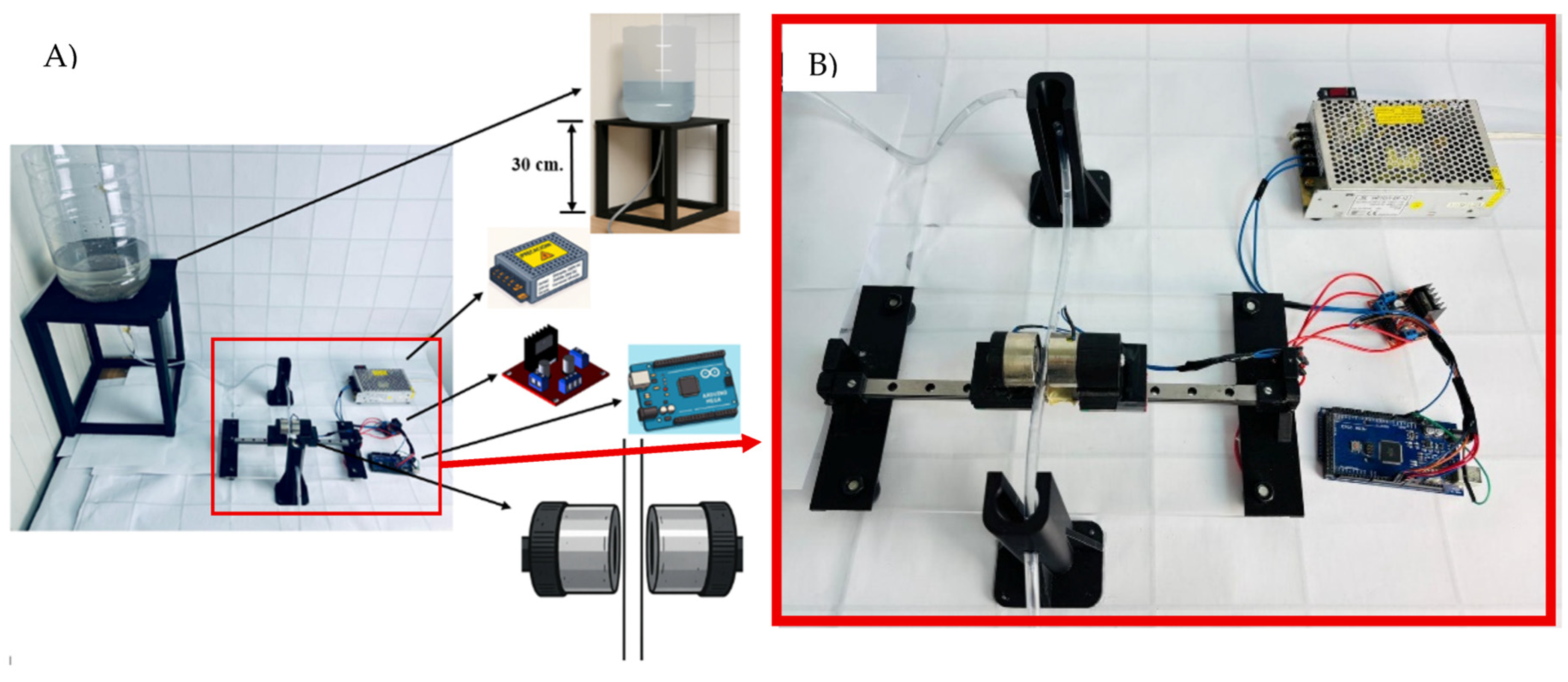
The second experiment was oriented toward the analysis of the capture of ferromagnetic particles suspended in a hydraulic flow through the application of external electromagnetic fields. The objective of this stage was to evaluate the influence of the induced field on particle behavior in the presence of continuous flow [9]. Figure 2 presents the general schematic of the hydraulic system employed.
Figure 2 shows experimental results. The experimental bench consisted of a main water conduit operated in a closed-loop configuration, instrumented with a flow sensor. Two electromagnets were arranged laterally to the conduit to generate a magnetic field transverse to the flow. The intensity of the electromagnetic field was regulated through pulse-width modulation (PWM), allowing control of the excitation of the coils without modifying the system supply voltage [9].
The interaction between the induced magnetic field and the ferromagnetic particles was analyzed based on the magnetic flux density B. From this magnitude, the magnetic pressure exerted by the field was defined, generally expressed as:
P = B 2 2 μ 0
where P represents the magnetic pressure and μ0 the magnetic permeability of free space [30,32]. This relationship made it possible to establish the link between the intensity of the applied electromagnetic field and the force exerted on the particles, considering the effective interaction area through:
F = P · A
The experimental trials were organized into three study cases defined by the duty cycle of the PWM signal applied to the electromagnets. For each condition, the flow behavior and particle response were recorded, allowing analysis of the relationship between the level of electromagnetic excitation and the capture of ferromagnetic particles in a continuous hydraulic flow [9,10]. The magnetic force acting on particles arises from the spatial gradient of the applied field, and its magnitude depends on the particle susceptibility. In the manuscript, Equation (4) was introduced as a simplified representation of this force term under our experimental conditions. To avoid ambiguity, we have revised the text to explicitly state that Equation (4) is applied in the context of a non-uniform magnetic field, where the gradient drives particle motion, and that the susceptibility determines the proportionality of the force.

2.5. Guidance of Ferromagnetic Particles in a “Y”-Type Bifurcation

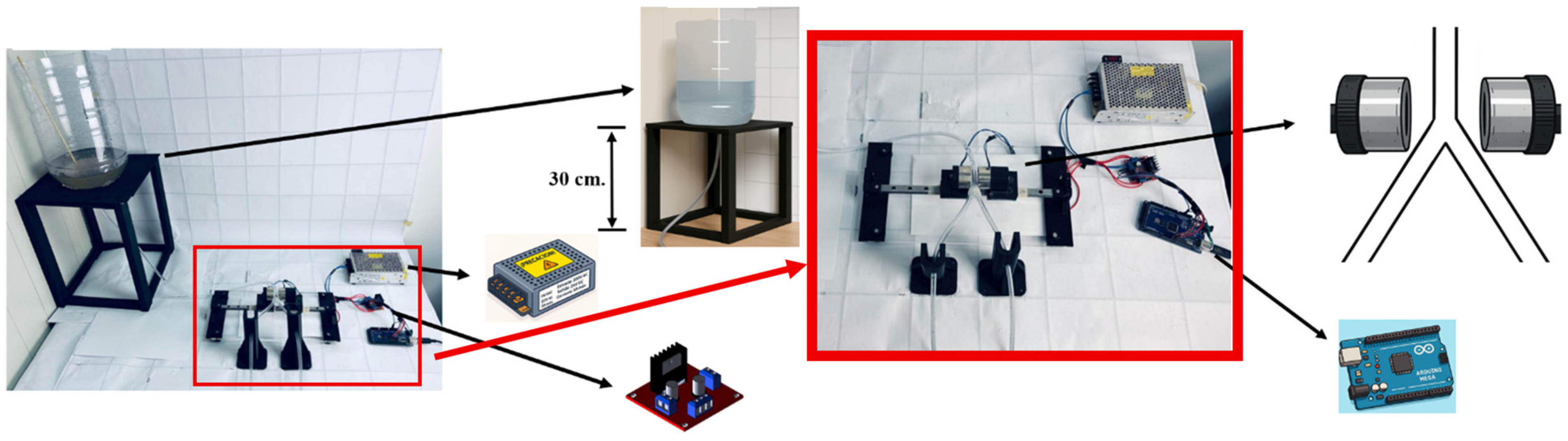
In Figure 3, the third experiment, focused on the guidance of ferromagnetic particles suspended in a hydraulic flow passing through a symmetric “Y”-type bifurcation. This stage was developed with the purpose of analyzing the influence of electromagnetic control on particle trajectories without modifying the hydraulic conditions of the system [26]. Figure 3 shows the experimental configuration employed.
The Figure 3 representative experimental bench consisted of an inlet conduit that splits into two geometrically equivalent outlet branches. An electromagnet was installed in each branch, independently powered by a power stage controlled by pulse-width-modulated (PWM) signals. The selection of the active electromagnet was performed by means of a demultiplexer-type logic circuit, allowing the alternate activation of each outlet.
Electromagnetic field control was implemented through regulation of the PWM duty cycle, establishing a direct relationship between the duty cycle and the average voltage applied to each electromagnet, expressed as:
V a v g = D · V s
Similarly, the average current supplied to each electromagnet was described by:
I a v g = D · I s
where D is the diffusion coefficient of the particles, V s the sedimentation velocity, and I s field intensity in the studied region. These relationships made it possible to control the electromagnetic excitation in each branch of the bifurcation and, consequently, to induce a local magnetic field capable of modifying the trajectory of ferromagnetic particles [30].
Under this scheme, three experimental conditions were defined: Case G, corresponding to activation of the left electromagnet; Case H, associated with activation of the right electromagnet; and Case I, corresponding to the flow condition without electromagnetic excitation. In each case, particle displacement toward the corresponding branch or their natural distribution in the absence of an applied field was observed [32].

3. Results

The results obtained are presented in three sections corresponding to the experiments developed. Each section addresses a specific phenomenon of electromagnetic control applied to ferromagnetic particles under different physical conditions. Taken together, the tests made it possible to record system behavior under different control schemes (PID and PWM), as well as particle responses to variations in field, distance, and flow. The results are presented descriptively, including the study cases established for each experiment and the operating conditions under which the tests were conducted. Panels A–C correspond to the three experimental scenarios: A: distance control; B: retention under flow; and C: trajectory manipulation under flow.

3.1. Experiment 1: Control of Distance Between Electromagnets Using Electromagnetic Fields

The first experiment focused on controlling the distance between two electromagnets subjected to external physical perturbations. A proportional–integral–derivative (PID) control system was employed to adjust the induced current in the coils and maintain a stable separation between the magnetic cores. The experimental system integrated distance and current sensors, as well as an Arduino Mega controller that enabled the acquisition and recording of the control variables.
The behavior of the distance and the control current is shown in Figure 3, Figure 4 and Figure 5. In Case A, the system compensated for the 0.5 cm separation by generating a stable magnetic field response. In Case B, the 1.5 cm perturbation produced a higher maximum current before stabilization. In Case C, the attraction perturbation caused direct contact followed by correction of the distance to the nominal value.
The results in Table 1 showed that the system responded in a controlled manner to the applied perturbations, restoring the reference distance after each disturbance. The magnetic force was controlled for different distances based on the experimental parameters of the system.
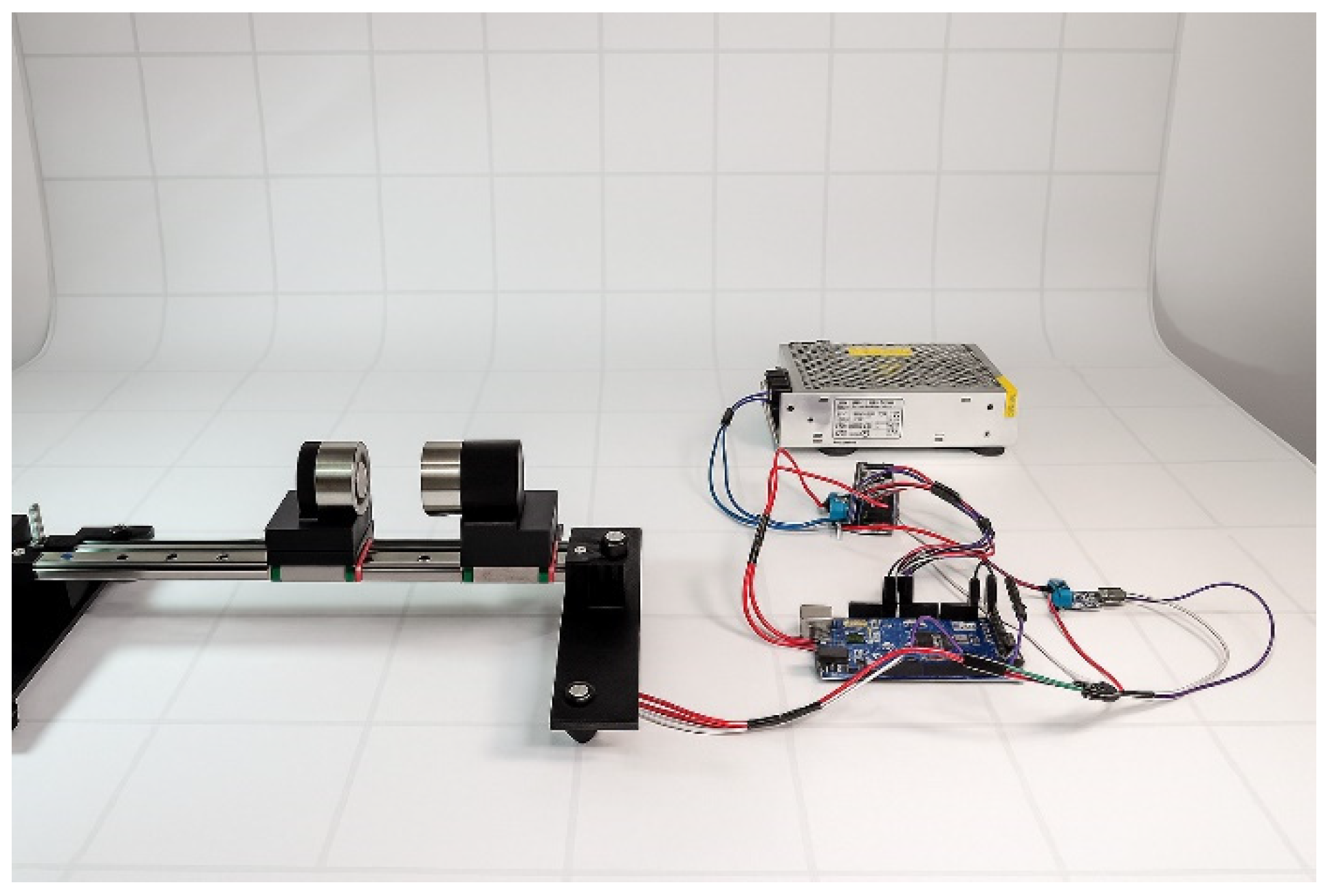
The purpose of Figure 4 is not only to show the presence of two electromagnets on a movable support, but to illustrate the experimental setup that allows us to vary both the relative position and the spatial gradient of the applied magnetic field. By adjusting the supports, we can control the distance and orientation of the electromagnets, which directly influences the distribution of the magnetic field and, consequently, the force acting on the particles. This configuration was essential to validate the theoretical model presented in Section 2, since it enabled us to experimentally reproduce different gradient conditions and analyze particle mobility under controlled variations.
The position error (e(t)) and the control current (i(t)) remained within the operational margins of the control loop, complying with the relationship modeled in Equation (3).
Table 1. Current values for each study case of Experiment 1.
Case StudyDistance Under Perturbation (cm).Perturbation (cm)Current
(mA)
Voltage (V)
A0.5+0.548012
B2.5+1.552212
C0−152212

3.2. Experiment 2: Capture of Ferromagnetic Particles in a Hydraulic Flow Under Induced Magnetic Field

The second experiment analyzed the capture of ferromagnetic particles suspended in a continuous hydraulic flow. System control was implemented through pulse-width modulation (PWM), with three duty cycle configurations: 58.8%, 78.4%, and 100%. These configurations made it possible to vary the intensity of the induced magnetic field, with measured values of 6150 G, 8150 G, and 12,000 G, respectively, at 5 mm from the electromagnet core, which approximates the diameter of the conduit flow.
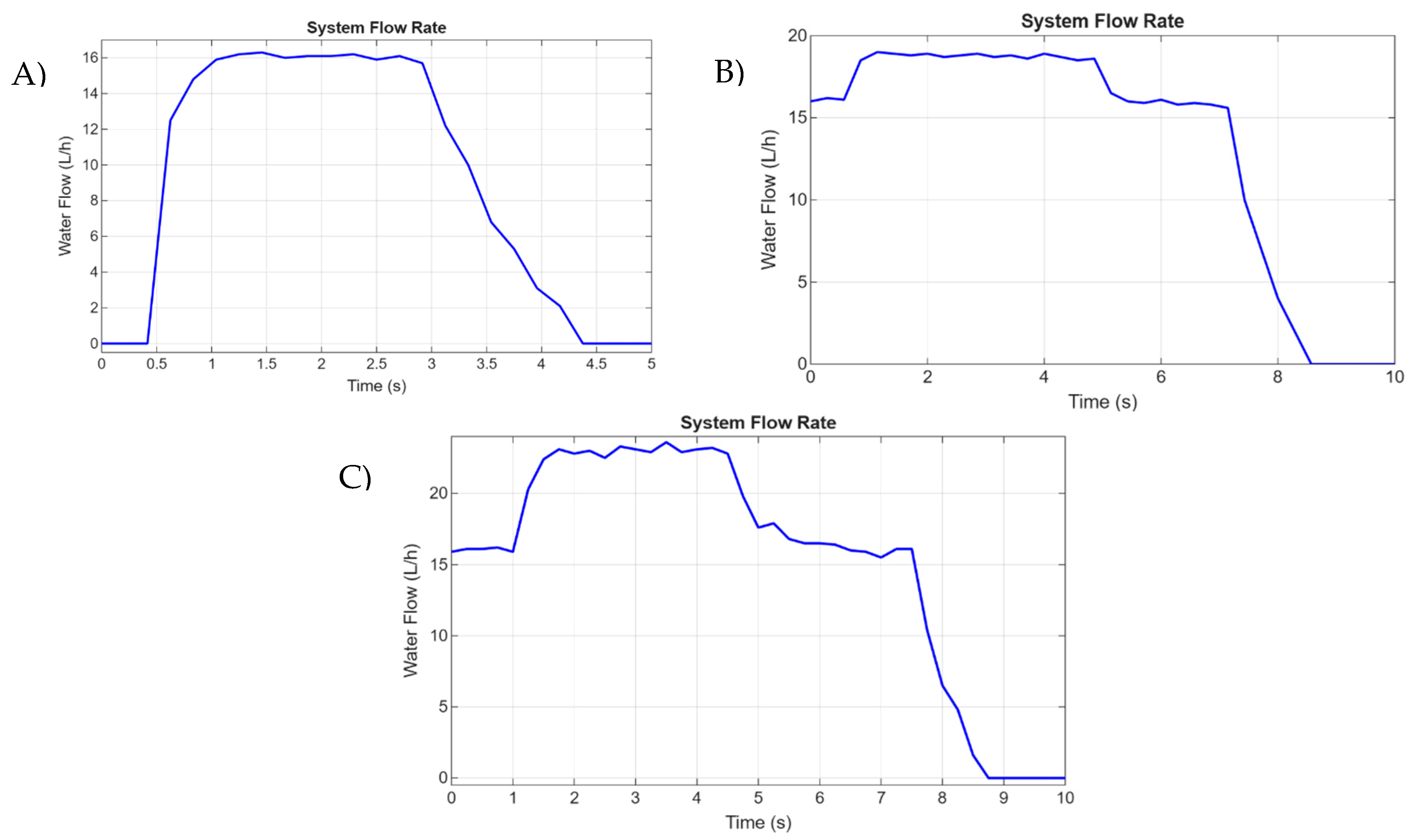
In Table 2, the induction values measured at 5 mm from the core were 6500 G (F), 7820 G (E), and 12,000 G (D). Figure 6, Figure 7 and Figure 8 show the behavior of the flow rate during the activation and deactivation of the electromagnetic field. In Case F, the applied field produced a complete obstruction of the flow, with a flow rate close to 0 L/h. In Case D, partial capture was observed, with a transient increase in flow rate up to 19 L/h. In Case E, the field–fluid interaction was greater, and the flow rate increased up to 24 L/h.
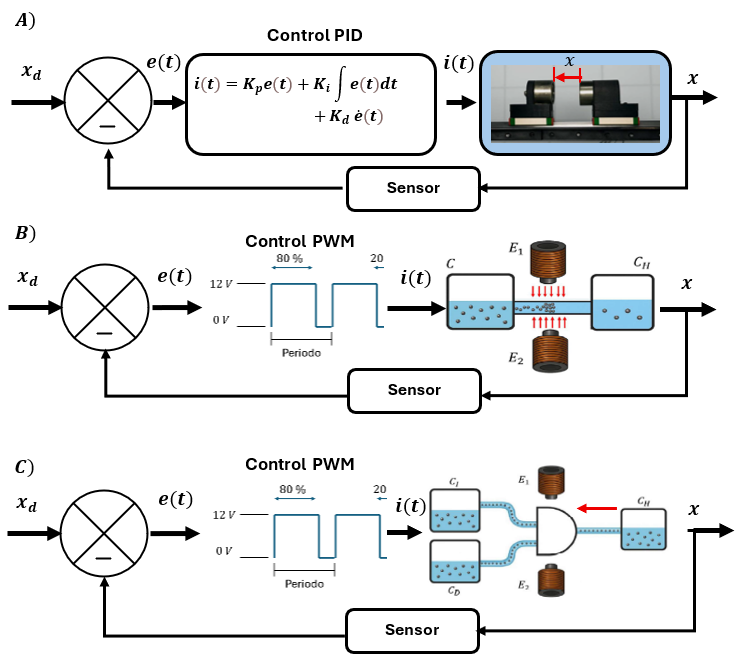
Figure 6 show a simplified schematic of the three experimental setups for magnetic control of iron oxide particles on water. Two distinct strategies are illustrated: PID (Proportional–Integral–Derivative) control and PWM (Pulse-Width Modulation) control. In Figure 6A, PID control continuously adjusts the current supplied to electromagnets based on the error signal, enabling fine trajectory regulation and smooth dynamic response. In Figure 6B,C, PWM control modulates the duty cycle of the current to electromagnets or coils, producing a pulsating magnetic field that directs particle movement. PID offers higher precision but requires complex tuning, while PWM provides energy-efficient and scalable actuation, suitable for coarse positioning or periodic activation.
The relationship between the applied average voltage and the duty cycle was verified according to Equation (4), maintaining direct proportionality. Likewise, the magnetic pressure calculated using Equation (5) was consistent with the magnitude of the field experimentally recorded.
Table 2. Operating conditions and magnetic field magnitude for each PWM configuration.
Case StudyFlow Rate (L/h)Magnetic Field (Gauss)Magnetic Force
(N)
Voltage
(V)
Current
(mA)
D012,000132.9612522
E24782058.108.95325
F19.5650036.126.31273
In all three scenarios, the formation of particle retention regions around the induced magnetic field was observed, affecting the flow profile within the hydraulic conduit. The experimental results confirmed the relationship between field intensity and the concentration of captured particles.
Figure 6. Diagram of the ferromagnetic particle system PID and applied PWM control. (A) PID control; (B) PWM control—coil excitation; (C) PWM control—particle steering.
Magnetochemistry 12 00048 g006
Figure 7. Flow diagrams for Cases D, E, and F under particle retention generated by different electromagnetic inductions using PWM signal control. (A) PWM duty cycle 58.8%; (B) PWM duty cycle 78.4%; (C) PWM duty cycle 100%.
Magnetochemistry 12 00048 g007

3.3. Experiment 3: Control of Ferromagnetic Particle Guidance in a Bifurcation Using Electromagnetic Fields
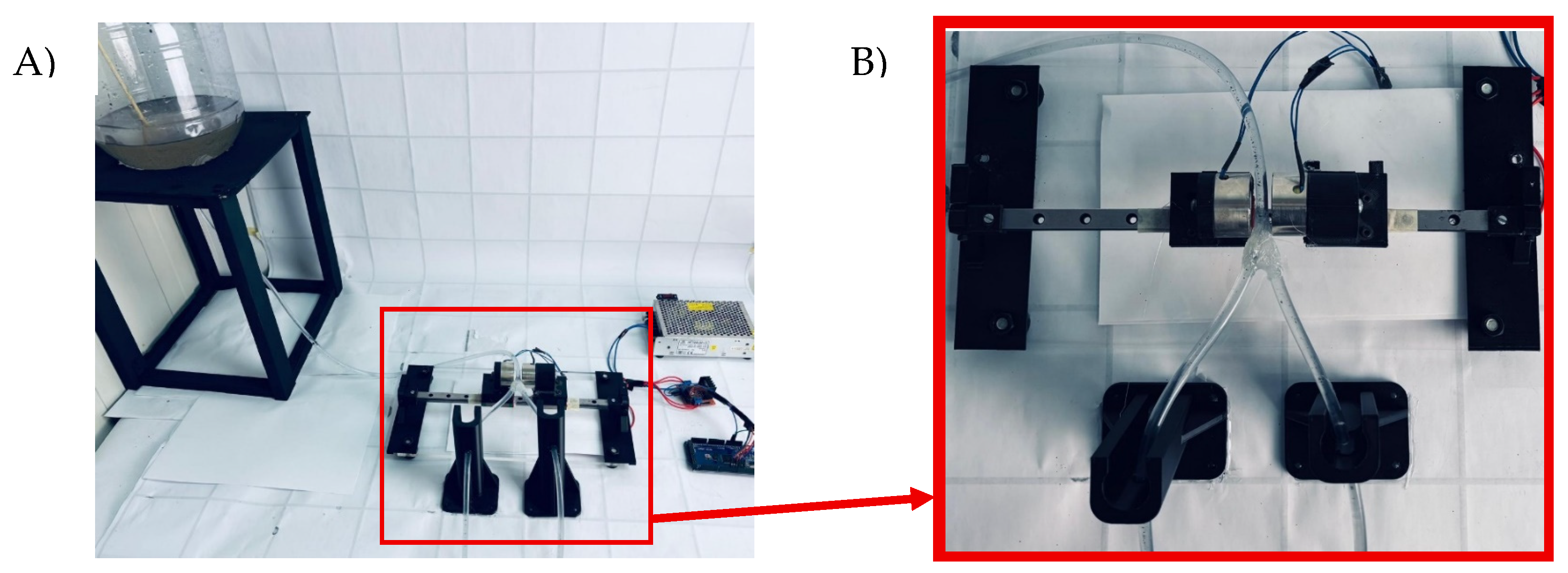
The third experiment was oriented toward controlling the guidance of ferromagnetic particles in a “Y”-type bifurcation using variable electromagnetic fields. The system employed electromagnets located at the bifurcation, controlled through a PWM scheme with demultiplexer-based logic emulation, which allowed independent activation of each electromagnet and guidance of the flow toward the desired outlet.
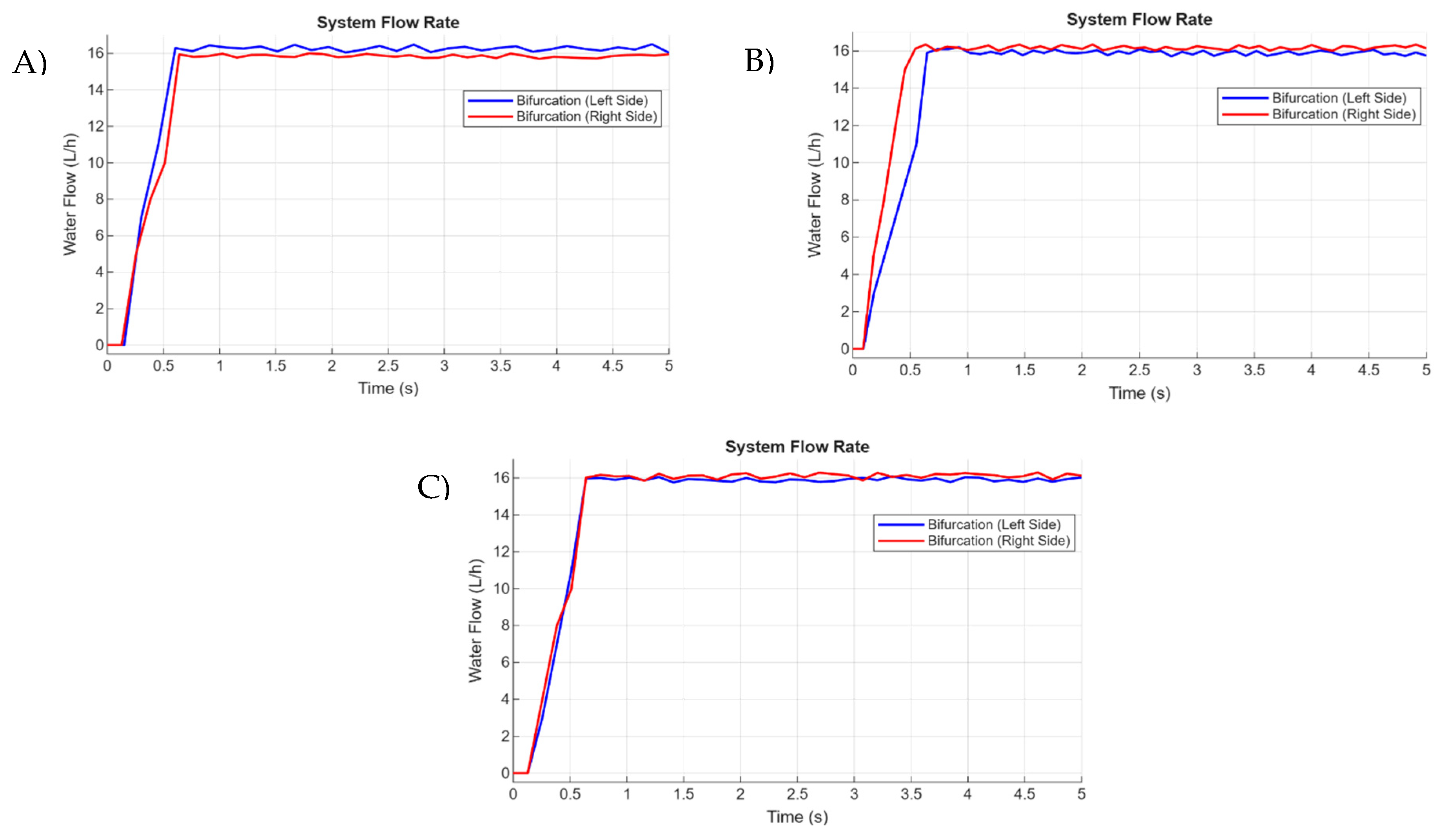
Flow rate records at the two outlets are presented in Figure 8 and Figure 9. In Cases G and H, the flow increased in the activated branch, with average flow rates between 15.9 and 16.4 L h−1, while the non-activated outlet exhibited values between 15.6 and 16.0 L h−1. In Case I, both flow rates remained symmetric. During the tests, particle trajectories and flow variations were recorded. In Cases G and H, controlled deviation of the particles toward the corresponding outlet was observed, whereas in Case I, the flow remained symmetric. The system demonstrated effective control in the guidance of ferromagnetic particles under the selective action of magnetic fields.
Figure 8. Experimental setup of the bifurcation system and electromagnet arrangement. (A) general bifurcation setup; (B) left branch electromagnet.
Magnetochemistry 12 00048 g008
Figure 9. Representation of particle trajectories in Cases G, H, and I. (A) left electromagnet activation; (B) right electromagnet activation; (C) no electromagnetic excitation.
Magnetochemistry 12 00048 g009
In Table 3, the voltage and current measurements in both electromagnets remained within the operational limits established in the design. The average voltage values during PWM (~80%) ranged between 9.4 and 9.7 V, according to the recorded experimental data.
Table 3. Measured particles count at the left and right collection ports (Left, Right).
Case StudyFlow Rate
(L/h)
PWMMagnetic Force
(N)
Voltage
(V)
Current
(mA)
GLeft16.18058.609.6417.6
Right15.60000
HLeft15.90000
Right16.48058.609.6417.6
ILeft160000
Right16.10000

4. Discussion

Based on the three experiments conducted, it was possible to analyze the behavior of the electromagnetic system under different operating conditions. Each configuration allowed observation of how the applied current and system geometry influence the response of ferromagnetic particles within the hydraulic medium. Rather than exhibiting uniform behavior, variations were observed that depend directly on how the magnetic field is established.
In the first experiment, control of the distance between ferromagnetic cores using a PID regulator made it possible to evaluate the relationship between the supplied current and the displacement of the mobile actuator. The results show that the separation between the electromagnets does not respond instantaneously but is instead conditioned by the system’s settling time. This delay is inherent to electromechanical systems and reflects the combined influence of the control signal and the dynamics of the mechanical elements involved.
The second experiment highlighted the effect of PWM on magnetic field intensity and on particle distribution within the hydraulic flow. By modifying the duty cycle, clear changes were observed in the regions where particles tended to concentrate or be transported by the fluid. This indicates that the observed behavior does not depend solely on the magnetic field, but rather on the balance between magnetic force and system flow rate. Comparable behavior has been reported under similar conditions in magnetorheological suspensions, where the applied field alters particle mobility and aggregation [33,34].
In the case of the third experiment, the analysis focused on particle guidance in a “Y”-type bifurcation through alternate activation of the electromagnets. The recorded trajectories show that small variations in the magnetic field distribution are sufficient to modify particle paths toward one channel or the other. The geometry of the bifurcation plays a determining role, as it conditions the way the field interacts with the hydraulic flow.
Overall, the results obtained allow characterization of system performance under controlled conditions and provide experimental evidence of non-invasive electromagnetic manipulation of ferromagnetic particles in fluid media. The observed trends in current, magnetic field, and flow rate are consistent with the physical principles describing the interaction between ferromagnetic particles and variable fields. These results are relevant for the development of systems aimed at controlling, guiding, or dosing particles in applications where direct mechanical intervention is not a viable option.

5. Conclusions

In this work, an experimental bench intended for the non-invasive electromagnetic control of ferromagnetic particles was developed and analyzed. Introduces a modular experimental platform that integrates PID-controlled electromagnet spacing with PWM-based current modulation, enabling three complementary scenarios: distance regulation, particle retention under flow, and trajectory manipulation at bifurcations. This combination of control strategies, together with hardware-level characterization and reproducibility tests, distinguishes the study from prior literature that typically addresses only one modality or a single scenario. The results highlight the relevance of the system for biomedical and microfluidic applications, while its originality lies in bridging theoretical models with experimental validation in dynamic hydraulic environments. The implementation of control strategies based on PWM and PID enabled the regulation of the current supplied to the electromagnets and analysis of its effect on the dynamics of suspended particles. In the first experiment, system response under PID control applied to the distance between ferromagnetic cores was evaluated, revealing a direct relationship between current variations and the displacement of the mobile core. In the second experiment, the influence of PWM on the formation of particle accumulation zones was analyzed, demonstrating that flow rate plays a determining role by favoring or limiting particle retention within the system.
In turn, the third experiment enabled analysis of particle redirection in a “Y”-type bifurcation through alternate activation of the electromagnets.
Overall, the obtained results make it possible to characterize the behavior of the electromagnetic system under controlled conditions and to document its response to different operating parameters and control schemes. The developed experimental bench is presented as a suitable platform for studying particle capture, dosing, and guidance phenomena in hydraulic media without physical contact. Furthermore, this work establishes a solid foundation for future research aimed at particle manipulation in microchannels, magnetorheological systems, and other applications requiring non-invasive electromagnetic actuation.

Author Contributions

Conceptualization, Formal analysis, and Writing—original draft, J.A.S.M.; Conceptualization, Formal analysis, Writing—review & editing, Supervision, and Project administration, J.A.F.C.; Software, Methodology, and Data curation, A.A.C.D.; Validation, Software, and Methodology, J.C.P.R.; Visualization, Software, and Investigation, J.J.M.M.; Conceptualization, Formal analysis, Funding acquisition, Writing—review & editing, and Resources, C.R.T.-S. All authors have read and agreed to the published version of the manuscript.

Funding

This research was funded by Instituto Politécnico Nacional through SIP 20250106, SIP 20250115, and SIP 20250288, and the Secretaría de Educación, Ciencia, Tecnología e Innovación (SECTEI) through the project SECTEI/025/2025.

Institutional Review Board Statement

Not applicable.

Informed Consent Statement

Not applicable.

Data Availability Statement

The raw data supporting the conclusions of this article will be made available by the authors on request.

Acknowledgments

The authors would like to acknowledge the Secretary of Science, Humanities, Technology, and Innovation, as well as the support from the Secretaría de Educación, Ciencia, Tecnología e Innovación (SECTEI) through the project SECTEI/025/2024 “Desarrollo numérico experimental de lesión de medula espinal implantada con polímero derivado del pirrol mediante DTI y MRS en murinos”.

Conflicts of Interest

The authors declare no conflicts of interest.

References

  1. Maxwell, J.C. A Treatise on Electricity and Magnetism, 3rd ed.; Clarendon Press: Oxford, UK, 1892. [Google Scholar]
  2. Faraday, M. Experimental Researches in Electricity; 1839–1855; Richard Taylor: London, UK; Volume 1–3.
  3. Li, S.; Liu, D.; Hu, Y.; Su, Z.; Zhang, X.; Guo, R.; Li, D.; Lu, Y. Soft magnetic microrobot doped with porous silica for stability-enhanced multimodal locomotion in a nonideal environment. ACS Appl. Mater. Interfaces 2022, 14, 10856–10874. [Google Scholar] [CrossRef]
  4. Ebrahimi, N.; Bi, C.; Cappelleri, D.J.; Ciuti, G.; Conn, A.T.; Faivre, D.; Habibi, N.; Hošovský, A.; Iacovacci, V.; Khalil, I.S.M.; et al. Magnetic actuation methods in bio/soft robotics. Adv. Funct. Mater. 2021, 31, 2005137. [Google Scholar] [CrossRef]
  5. Cao, Q.; Han, X.; Li, L. Configurations and control of magnetic fields for manipulating magnetic particles in microfluidic applications: Magnet systems and manipulation mechanisms. Lab Chip 2014, 14, 2762–2777. [Google Scholar] [CrossRef]
  6. Xu, R.; Xu, Q. A survey of recent developments in magnetic microrobots for micro-/nano-manipulation. Micromachines 2024, 15, 468. [Google Scholar] [CrossRef]
  7. Becerril Arreola, R. Nonlinear Control Design for a Magnetic Levitation System; University of Toronto: Toronto, ON, Canada, 2003. [Google Scholar]
  8. Xu, J.; Sun, Y.; Gao, D.; Ma, W.; Luo, S.; Qian, Q. Dynamic modeling and adaptive sliding mode control for a maglev train system based on a magnetic flux observer. IEEE Access 2018, 6, 31571–31579. [Google Scholar] [CrossRef]
  9. Escárcega Pliego, E.A. Introducción a Los Conceptos Sobre Fuerza Magnética y Campo Magnético; UNAM—CCH Plantel Sur: Ciudad de México, Mexico, 2025. [Google Scholar]
  10. Kraus, J.D.; Fleisch, D.A. Electromagnetics with Applications, 5th ed.; McGraw-Hill: New York, NY, USA, 1999. [Google Scholar]
  11. Liu, G.; Gao, M.; Sun, D.; Jiang, R.; Fan, L. Three-dimensional active magnetic levitation actuating and control system for curved pipes. Appl. Sci. 2024, 14, 10871. [Google Scholar] [CrossRef]
  12. Subendran, S.; Wang, C.-F.; Loganathan, D.; Lu, Y.-H.; Chen, C.-Y. An aquatic microrobot for microscale flow manipulation. Sci. Rep. 2022, 12, 5041. [Google Scholar] [CrossRef] [PubMed]
  13. Zhang, Y.; Teng, Y.; Song, K.; Wang, X.; Chen, X.; Liu, Y.; Zhao, Y.; Li, H.; Mao, L.; Liu, Y. Ferrohydrodynamic microfluidics for bioparticle separation and single-cell phenotyping: Principles, applications, and emerging directions. arXiv 2025, arXiv:2510.26950. [Google Scholar] [CrossRef]
  14. Wang, M.; Wu, T.; Liu, R.; Zhang, Z.; Liu, J. Selective and independent control of microrobots in a magnetic field: A review. Engineering 2023, 24, 21–38. [Google Scholar] [CrossRef]
  15. Zhu, G.-P.; Wang, Q.-Y.; Ma, Z.-K.; Wu, S.-H.; Guo, Y.-P. Droplet manipulation under a magnetic field: A review. Biosensors 2022, 12, 156. [Google Scholar] [CrossRef]
  16. Yousefi, M.; Khalesi, R.; Nejat Pishkenari, H.; Vossoughi, G. Manipulation of magnetic microrobot swarm by creation of stable equilibrium points. Robot. Auton. Syst. 2025, 192, 105058. [Google Scholar] [CrossRef]
  17. Tottori, S.; Zhang, L.; Qiu, F.; Krawczyk, K.K.; Franco-Obregón, A.; Nelson, B.J. Magnetic helical micromachines: Fabrication, controlled swimming, and cargo transport. Adv. Mater. 2012, 24, 811–816. [Google Scholar] [CrossRef] [PubMed]
  18. Jia, Y.; Miao, S.; Zhou, J.; Jiao, N.; Liu, L.; Li, X. Efficient model learning and adaptive tracking control of magnetic micro-robots for non-contact manipulation. arXiv 2024, arXiv:2403.14414. [Google Scholar] [CrossRef]
  19. Davy, J.; da Veiga, T.; Pittiglio, G.; Chandler, J.H.; Valdastri, P. Independent control of two magnetic robots using external permanent magnets: A feasibility study. In Proceedings of the 2023 International Symposium on Medical Robotics (ISMR), Atlanta, GA, USA, 19–21 April 2023; IEEE: Piscataway, NJ, USA, 2023; pp. 1–6. [Google Scholar] [CrossRef]
  20. Zhang, L.; Abbott, J.J.; Dong, L.; Kratochvil, B.E.; Bell, D.; Nelson, B.J. Artificial bacterial flagella: Fabrication and magnetic control. Appl. Phys. Lett. 2009, 94, 064107. [Google Scholar] [CrossRef]
  21. Cai, G.; Yang, Z.; Chen, Y.-C.; Huang, Y.; Liang, L.; Feng, S.; Zhao, J. Magnetic bead manipulation in microfluidic chips for biological application. Cyborg Bionic Syst. 2023, 4, 0023. [Google Scholar] [CrossRef]
  22. Zhang, Z.; Klingner, A.; Misra, S.; Khalil, I.S.M. Design and control of a permanent magnet-based robotic system for navigating tetherless magnetic devices in viscous environments. Sci. Rep. 2025, 15, 31041. [Google Scholar] [CrossRef]
  23. Palagi, S.; Fischer, P. Bioinspired microrobots. Nat. Rev. Mater. 2018, 3, 113–124. [Google Scholar] [CrossRef]
  24. Ogata, K. Modern Control Engineering, 5th ed.; Prentice Hall: Upper Saddle River, NJ, USA, 2010. [Google Scholar]
  25. Åström, K.J.; Hägglund, T. PID Controllers: Theory, Design, and Tuning, 2nd ed.; ISA: Research Triangle Park, NC, USA, 1995. [Google Scholar]
  26. Barone, M. Levitación magnética aplicada al transporte: Un estado de la cuestión. Rev. Segur. Oper. 2023, 2, 4–11. [Google Scholar]
  27. Álvarez Pulido, M. Electromagnets; McGraw-Hill: Madrid, Spain, 2002; p. 537. [Google Scholar]
  28. Álvarez Ramos, M.E.; Duarte Zamorano, R.P.; Rodríguez Jáuregui, E.; Castillo, S.J. Magnetismo; Universidad de Sonora—Departamento de Física: Sonora, Mexico, 2017. [Google Scholar]
  29. Mao, Q.; Xu, Y.; Chen, J.; Chen, J.; Georgiou, T.T. Maximization of gain/phase margins by PID control. IEEE Trans. Autom. Control 2024, 70, 34–49. [Google Scholar] [CrossRef]
  30. Griffiths, D.J. Introduction to Electrodynamics, 4th ed.; Pearson: Boston, MA, USA, 2013. [Google Scholar]
  31. Furtado, R.; Silveira, Z.; Cavalca, K.; Butzek, N.; Nordmann, R. Study of magnetic actuator parameters influence in the magnetic force. In Proceedings of the 12th IFToMM World Congress–Machine and Mechanisms, Besançon, France, 18–21 June 2007. [Google Scholar]
  32. Xu, J.; Chen, Y.-H.; Guo, H. Robust levitation control for Maglev systems with guaranteed bounded airgap. ISA Trans. 2015, 59, 205–214. [Google Scholar] [CrossRef]
  33. Kumaran, V. The effect of inter-particle hydrodynamic and magnetic interactions in a magnetorheological fluid. J. Fluid Mech. 2022, 944, A49. [Google Scholar] [CrossRef]
  34. Castro-Merino, J.; Bonilla-Fernandez, M.A.; Aldama-Reyna, C.W.; Vela, E.A.; Diestra-Cruz, H.; DeLaCruz-Araujo, R.A.; Vidal-Urquiza, G.C.; Rubio, O. Field-induced particle dispersion in extremely bidisperse magnetorheological fluids. J. Magn. Magn. Mater. 2025, 621, 172922. [Google Scholar] [CrossRef]
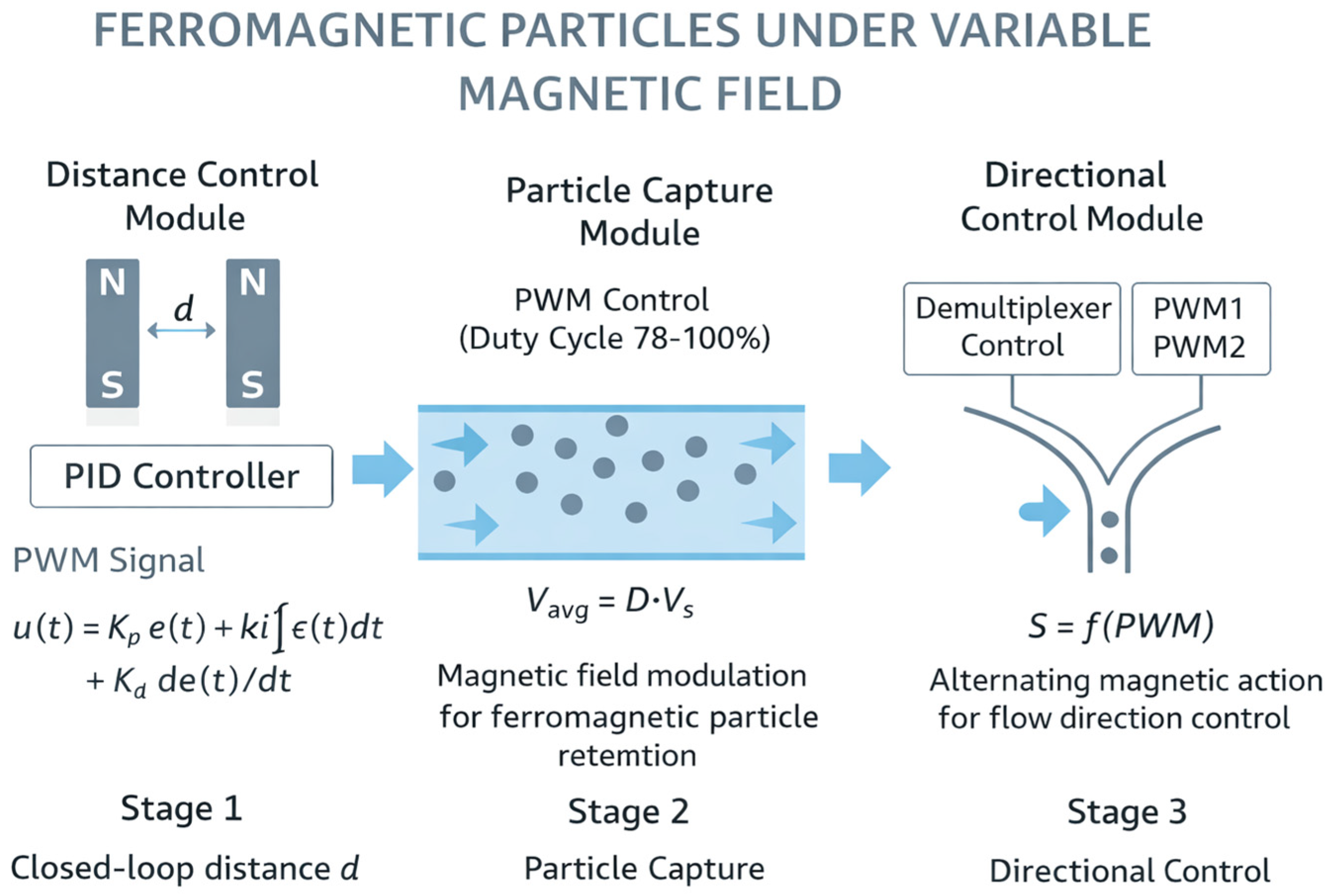
Figure 1. General diagram of the experimental setup used for the three studies.
Magnetochemistry 12 00048 g001
Figure 2. Hydraulic system diagram for capturing ferromagnetic particles. (A) corresponds to the complete hydraulic system used for particle capture. It integrates the water conduit, flow sensor, and lateral electromagnets, enabling the generation of a transverse magnetic field across the flow. (B) represents the zoomed-in view of the hydraulic conduit section where particle retention occurs. This detail highlights the localized interaction zone between the suspended ferromagnetic particles and the ap-plied magnetic field, allowing precise observation of capture phenomena.
Magnetochemistry 12 00048 g002
Figure 3. Experimental configuration for the directional control of ferromagnetic particles in a “Y”-shaped bifurcation.
Magnetochemistry 12 00048 g003
Figure 4. Experimental setup and magnetic field simulation for Experiment 1.
Magnetochemistry 12 00048 g004
Figure 5. Position control graphs under an externally induced perturbation applied to the system for Cases A, B, and C. (A) a repulsive perturbation of 1.5 cm; (B) a repulsive perturbation of 1.0 cm; (C) a repulsive perturbation of 0.5 cm.
Magnetochemistry 12 00048 g005
Disclaimer/Publisher’s Note: The statements, opinions and data contained in all publications are solely those of the individual author(s) and contributor(s) and not of MDPI and/or the editor(s). MDPI and/or the editor(s) disclaim responsibility for any injury to people or property resulting from any ideas, methods, instructions or products referred to in the content.