


Abstract
The structural and magnetic properties and band structure results of HoCo3−xSix compounds are reported. First-principles GGA+U+SO calculations, compared with magnetometry experiments, provide deep insight on the magnetic properties of the HoCo3 compound. They show that HoCo3 is a robust ferrimagnet, with strongly localized Ho-4f moments in excellent agreement with neutron data and itinerant Co-3d magnetism, where inclusion of the interstitial contribution brings the Co moments into very good agreement with the experimental data. The electronic structure reveals sharp Ho-4f states well below EF, exchange-split Co-3d bands crossing EF, and noticeable Ho-5d–Co-3d hybridization that mediates the antiparallel Ho–Co coupling and explains the non-negligible interstitial moment, providing a consistent microscopic picture that supports the experimentally observed increase in magnetization upon Co-Si substitution. Metamagnetic transitions are shown in magnetization isotherms. The observed transitions are broad and can be explained by the distribution of internal magnetic fields which arises from differences in the local environments of cobalt atoms. The magnetic properties were correlated with the theoretical results. Two transitions were revealed below room temperature, one due to a transition to a noncollinear magnetic structure and the other due to a temperature-induced metamagnetic transition.
1. Introduction
Rare-earth–3d transition-metal compounds have been extensively investigated because of the interaction between the localized magnetic moments of the rare-earth elements and the itinerant magnetism of the 3d transition metals, which gives rise to a wide range of magnetic structures [1]. These compounds have attracted researchers because of their remarkable physical properties and their wide range of technological applications, including permanent magnets, magnetostrictive devices, magneto-mechanical sensors and actuators, hydrogen storage systems, magneto-optical storage media, and magnetic refrigeration [2,3,4,5,6,7,8,9,10,11,12]. In rare-earth–cobalt (R–Co) intermetallic compounds, the itinerant Co magnetic sublattice exhibits a magnetic moment that varies significantly with composition. It was shown that on compounds with a high R concentration like R3Co, the Co sublattice displays paramagnetic behavior, while on compounds with a high Co concentration like R2Co17, it becomes ferromagnetic with a stable magnetic moment of approximately 1.6 μB per Co atom [13,14,15,16]. In the intermediate compositions, the Co magnetic moment strongly depends on the rare-earth sublattice. As an example, in RCo2-type compounds, the Co sublattice undergoes a transition from a paramagnetic to a ferromagnetic state as the strength of the f–d exchange interaction increases. Similarly, in RCo3 compounds, the Co sublattice evolves from a weak to a strong magnetic state [15].
The magnetic properties of these systems arise from the interplay between the localized magnetic moments of rare-earth metals and the itinerant magnetism of 3d transition metals. The 4f shell of rare-earth elements gives rise to large magnetic moments and strong magnetocrystalline anisotropy, whereas the magnetic transition temperatures are, in principle, determined by the Co–Co (3d–3d) exchange interactions which are stronger compared to R–R and R–Co ones [1,3,9].
RCo3 compounds crystallize in a rhombohedral PuNi3-type structure described by the space group with two inequivalent crystallographic sites for the R atoms (3a and 6c) and three inequivalent sites for Co (3b, 6c and 18h) [17]. The magnetic properties of RCo3 intermetallic compounds (R = Ce, Pr, Nd, Gd, Tb, Dy, Ho, Er, and Tm) were first investigated by Lemaire et al. [18]. It was shown that the compound HoCo3 is ferrimagnetically ordered with a compensation point at 326 K, a saturation magnetization of 5.6 μB and a transition temperature of 418 K. The magnetic structure of HoCo3 determined by neutron diffraction was reported [19]. It was shown that the magnetic anisotropies of the rare-earth ions at the two crystallographic sites (RI for the 3a site and RII for the 6c site) are of comparable magnitude but opposite sign. As a result, at 5 K the RI sublattice aligns along the b-axis, thereby forcing the cobalt sublattice to align as well, since the cobalt anisotropy is much weaker than the Co–RI exchange interaction. This, in turn, induces the alignment of the RII sublattice. Consequently, a collinear magnetic structure along the b-axis is obtained, consistent with the experimentally observed ferrimagnetic structure. The magnetic anisotropy and exchange interactions are of comparable magnitude. At 5 K, the system adopts a common magnetic structure in which the moments are collinear within the basal plane. In contrast, at room temperature the moments become collinear along the c-axis; however, their magnitude is very small at temperatures on the order of 400 K, the magnetic moments being 2.1 μB at RI site and 3.4 μB at RII site. According to the authors, at 400 K, cobalt orders ferromagnetically along its easy magnetization direction, which is the c-axis. The cobalt–rare-earth exchange interactions generate a molecular field that weakly polarizes the rare-earth ions along the c-axis. Because the c-axis is an easy magnetization direction for the RII sublattice but a hard direction for the RI sublattice, the induced magnetic moment at the RII site is expected to be larger than that at the RI site. Upon lowering the temperature, cooperative ordering of the rare-earth ions develops. The strong anisotropy of the rare-earth ions at site I then drives the magnetic moments into the basal plane, leading to the magnetic structure observed at 5 K.
Later, it was reported that the HoCo3 intermetallic compound had revealed a variety of intriguing magnetic phenomena associated with its complex magnetic states, including ferrimagnetic transitions, spin reorientation and cone-axis transitions, itinerant-electron metamagnetism, and anomalous thermal expansion [20,21,22,23]. These studies indicate that the magnetic states of HoCo3 are strongly influenced by the external magnetic field, the spin orientation of the Co sublattice, and the rotation of the 4f orbitals in Ho atoms.
In HoCo3, the easy magnetization direction for temperatures below 55 K lies parallel to the b-axis within the basal plane [24]. Around 55 K, a reorientation of the easy axis occurs. Above this temperature, the easy direction is tilted by approximately ±15° with respect to the basal plane, and its projection onto the basal plane coincides with the a-axis. The magnetic structure in this phase is therefore considered to be noncollinear. In the temperature range 200–220 K, a further spin reorientation takes place, and the easy magnetization direction becomes parallel to the c-axis [25].
At low temperatures, the magnetic properties are strongly affected by the magnetic instability of the cobalt sublattice, which gives rise to metamagnetic behavior and induces a spin reorientation in the holmium sublattice. Gratz et al. demonstrated, in 2001 [21], the existence of a temperature-induced metamagnetic transition in the cobalt sublattice at , driven by Ho–Co and Co–Co exchange interactions. This transition is highly sensitive to both the applied magnetic field and external pressure.
A single anomaly was observed in specific heat, CP, measurements on HoCo3 in the versus curve up to 250 K, occurring at 55 K [21]. This anomaly was associated with a spin reorientation in which the easy magnetization axis rotates out of the basal plane, leading to a noncollinear magnetic structure. The anomaly expected near 175 K, related to the magnetic instability of the cobalt sublattice, was not detected in the measurements and was explained by the dominant lattice contribution to the specific heat in this temperature range, which masks anomalies of magnetic origin. Similarly, the second spin reorientation anticipated near 200 K in HoCo3—corresponding to a transition from a noncollinear to a collinear magnetic structure with the easy axis aligned along the c-axis—was also not visible in the versus data.
Song et al. showed that the negative lattice thermal expansion of HoCo3 is equivalent to the application of a uniaxial strain along the c-axis. Owing to magnetoelastic coupling, this negative thermal expansion modifies several magnetic parameters, such as the dipole–dipole interaction. As a result, the balance of magnetic interactions is altered, creating conditions favorable for biskyrmion formation [26]. The authors reported, in bulk HoCo3, the presence of high-density, spontaneous magnetic biskyrmions in a large temperature range in the absence of an external applied magnetic field. The generation of biskyrmions in HoCo3 arises from changes in the magnetization state induced by the lattice’s negative thermal expansion via magnetoelastic coupling.
Previously, we demonstrated that the average cobalt magnetic moment in GdCo3−xSix depends strongly on composition [27]. The variations in the cobalt magnetic moments at the different crystallographic sites upon substitution of cobalt by silicon can be attributed to Co 3d–Si 3p hybridization effects. Furthermore, the reduction in Gd 5d band polarization with increasing silicon content arises from the weakening of short-range 5d–3d exchange interactions as a consequence of the substitutions.
In this paper, we report the effects of silicon substitution on the electronic structure and magnetic properties of a HoCo3 compound. We found that the obtained samples are single phases for small silicon concentrations of less than 0.3. Band structure calculations provided insight into the magnetic behavior of these compounds and allowed us to correlate the variations in cobalt magnetic moments with the substituent concentration. To achieve a comprehensive characterization of the physical properties of these transition-metal compounds, both magnetic measurements and band structure calculations were employed.
2. Materials and Methods
2.1. Sample Preparation and Structural and Magnetic Measurements
The HoCo3−xSix compounds with x = 0, 0.1, 0.2 and 0.3 were prepared from high-purity Ho (99.99 wt.%), Co (99.99 wt.%) and Si (99.99 wt.%) produced by Alfa Aesar through induction melting of the component elements in a high-purity Ar atmosphere. The samples were melted several times to ensure homogeneity. Samples prepared by this method usually have high purity since the melt is floating inside the coils. The samples were then wrapped in tantalum foil and thermally treated in a vacuum at 850°C for 7 days, followed by slow cooling to room temperature.
X-ray diffraction (XRD) patterns were recorded at room temperature on powder samples, using a Bruker D8 Advance AXS diffractometer (Bruker-AXS GmbH, Karlsruhe, Germany) with Cu Κα radiation (λ = 1.5405 Å), for a scanning range of 10° to 90° (2θ) with a step size of 0.02° and an acquisition time of 5 s per step. The limit of experimental errors was less than 1%. The lattice parameters were determined using FullProf Suite software through Rietveld refinement of the XRD patterns [28].
Magnetic measurements were performed in external applied fields up to 12 T and in the 5–300 K temperature range using a vibrating sample magnetometer (VSM) made by Cryogenic Limited London, UK. The saturation magnetizations, Ms, were determined from measured magnetization isotherms according to the approach to saturation law:
where b denotes the coefficient of magnetic hardness and χo represents a Pauli-type contribution to magnetization.
M = Ms(1 − b/H) + χoH
2.2. Band Structure Calculation Within the GGA+U Framework
The magnetic properties of the HoCo3 compounds were investigated using the full-potential linearized augmented plane wave (FP-LAPW) method as implemented in the WIEN2k code within a fully relativistic spin–orbit scheme [29]. The Brillouin zone was sampled using a 10 × 10 × 10 k-point mesh, which was selected based on a preliminary convergence study of the total energy with respect to the number of k-points. Given the strong sensitivity of such calculations to the energy convergence parameters in WIEN2k—particularly when relativistic local orbitals (LAPW+lo) are included—we employed a size of the 2nd variational Hamiltonian, Emax = 100. This choice ensures that all scalar-relativistic eigenstates are taken into account when spin–orbit coupling is enabled. The basis set size for the wavefunction expansion was chosen as R × Kmax = 9, where R is the smallest muffin-tin radius, RMT, and Kmax is the largest reciprocal lattice vector. The magnitude of the largest vector in the charge density Fourier expansion GMAX was set to 12. To accurately describe the strongly correlated states of holmium, the GGA+U framework was employed using the Self-Interaction Correction (SIC) to density functional theory (DFT), designed to mitigate the self-interaction error inherent in standard local and semilocal exchange–correlation functionals (LDA/GGA), developed by Anisimov et al. [30] and Liechtenstein et al. [31]. This approach implements the Perdew–Zunger self-interaction correction by subtracting unphysical self-Coulomb and self-exchange–correlation energies from selected localized orbitals. It improves the description of localized electrons without empirical parameters. The computational protocol ensured physical consistency through four stages: (1) spin-polarized non-relativistic convergence; (2) structural optimization (net force/atom < 1 mRy/a.u.); (3) convergence of the orbital potential (U) and (4) full convergence including spin–orbit (SO) and orbital contributions (U) followed by a final structural relaxation. The selected Hubbard parameters U = 0.55 Ry and J = 0.05 Ry correspond to an effective Hubbard energy Ueff = U − J ≈ 0.50 Ry (≈ 6.8 eV), which lies in the commonly adopted range for Ho 4f shells in rare-earth intermetallics [32]. In metallic RE–TM compounds, screening reduces the bare atomic 4f Coulomb interaction, but the effective on-site repulsion remains large enough to enforce the localized nature of the 4f electrons. Using an effective Hubbard energy Ueff ∼6–7 eV ensures that occupied Ho-4f states are shifted well below the Fermi level and unoccupied 4f states are shifted above it, suppressing spurious f-weight at EF and stabilizing physically meaningful magnetic moments and total-energy differences and escaping metastable low-moment states that may arise in rare-earth calculations due to the highly localized nature of the 4f shell. The calculation was initialized using a predefined density matrix for the 4f subshell accounting for 4f initial occupation of the Ho 4f orbitals with ml = –1, –2, –3.
Finally, we would like to briefly explain why the GGA+U+SO computational methodology used in our calculations represents the right level of theory for the HoCo3-type compounds. They contain a heavy rare-earth element with partially filled 4f states and a transition-metal 3d subsystem. Semi-local GGA fails to describe the strong on-site correlation of Ho 4f electrons, typically placing them too close to the Fermi level and leading to an incorrect magnetic ground state. Moreover, the DFT+U correction restores the localized character and appropriate energetic separation of occupied and unoccupied 4f states. In addition, the relativistic spin–orbit coupling, introduced using a second variational scheme applied after the scalar-relativistic eigenfunction calculations, is essential in Ho-based compounds because it allows us to estimate the orbital moments and tackle the magnetocrystalline anisotropy that cannot be captured in the simple scalar-relativistic calculation scheme. Furthermore, spin–orbit coupling (SOC) is essential in HoCo3 compounds because holmium is a heavy rare-earth element with strong relativistic effects. SOC couples the spin and orbital angular momenta of the localized 4f electrons, producing a large orbital moment and stabilizing the correct J-multiplet character of Ho. Consequently, SOC significantly affects the total magnetic moment, the partition between spin and orbital contributions, and the magnetocrystalline anisotropy energy (MAE). From an electronic-structure perspective, SOC lifts degeneracies within the f manifold and modifies the near-EF band dispersion through f–d hybridization, which can in turn influence the Co spin polarization. Without SOC, the orbital moment is severely underestimated, and the anisotropy cannot be described, making scalar-relativistic calculations inadequate for quantitative magnetic predictions in Ho-based intermetallics. Therefore, the combined GGA+U+SO framework represents the minimal level of theory that includes both strong correlation and relativistic effects relevant to HoCo3-type compounds. While hybrid functionals can improve localization, they offer no clear advantage over the GGA+U+SO framework for describing magnetism and anisotropy in rare-earth intermetallics. In metallic systems, the non-local Fock exchange scales poorly with the dense-point grids required for convergence, making hybrids computationally prohibitive without providing a demonstrated improvement in ground-state magnetic properties over a carefully parameterized DFT+U model [33,34].
3. Results and Discussions
3.1. X-Ray Diffraction
Structural Properties of HoCo3−xSix Compounds
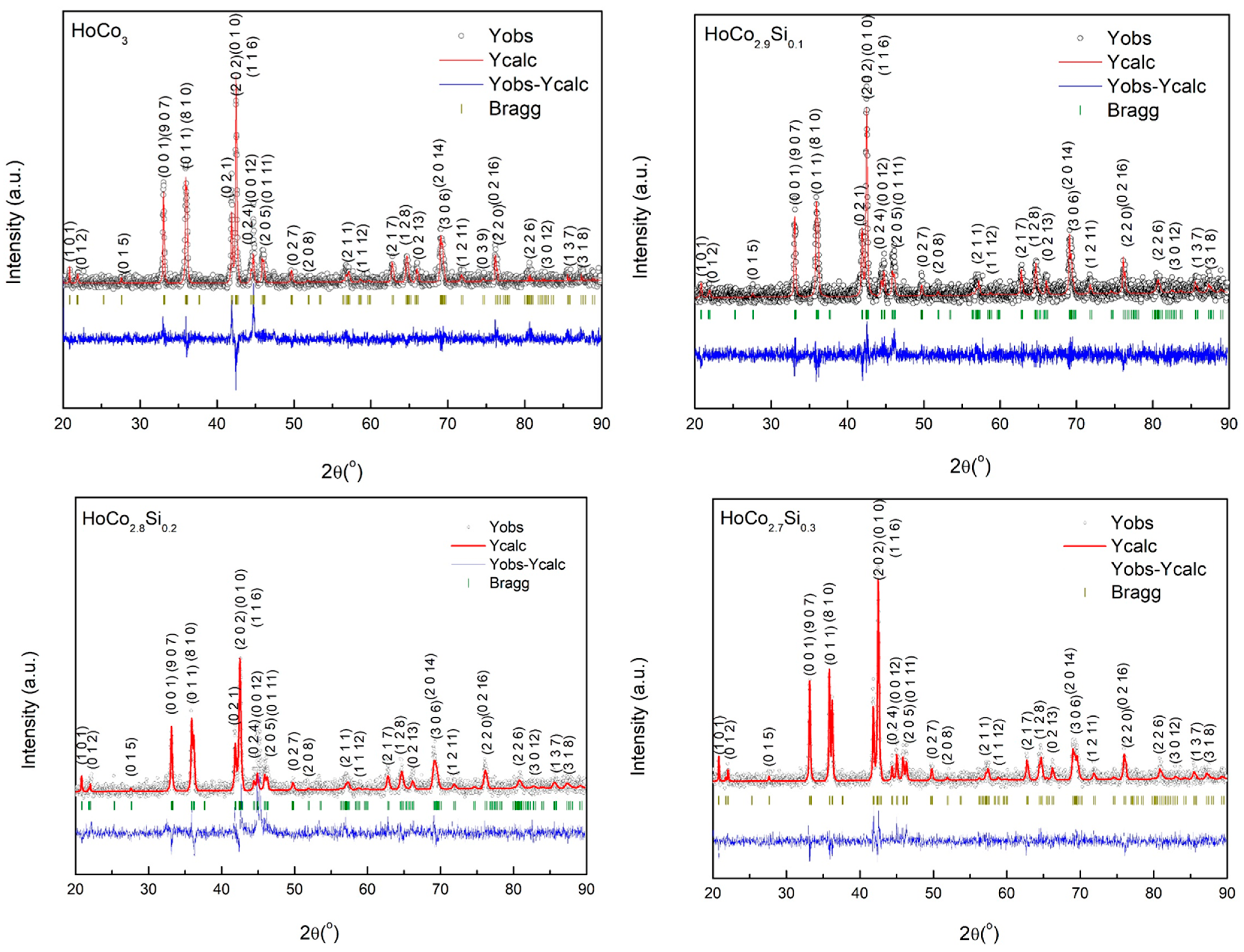
The X-ray diffraction patterns for the prepared compounds are shown in Figure 1. HoCo3 crystallizes in a PuNi3-type structure, which belongs to the rhombohedral space group R-3m (No. 166) and is commonly described in the hexagonal setting. The structure can be viewed as a layered stacking of CaCu5- and MgCu2-type blocks along the c-axis. Holmium atoms occupy two high-symmetry Wyckoff positions (3a and 6c), while cobalt atoms are distributed over three crystallographically distinct sites (3b, 6c, and 18h) [15]. This arrangement results in a rhombohedral unit cell containing 36 atoms (Z = 9), consistent with the HoCo3 stoichiometry, and is characteristic of rare-earth–cobalt intermetallic compounds exhibiting strong anisotropic magnetic properties. The X-ray diffraction patterns recorded for HoCo3−xSix samples were Rietveld-refined using the Thompson–Cox–Hastings pseudo-Voigt (with axial divergence asymmetry) function for the Bragg peak shape, assuming full occupancy of the metallic site and allowing only substitution of Co by Si atoms. The stoichiometry was constrained according to the initial chemical composition and the absence of a secondary phase in the diffraction pattern. Rietveld refinement showed that all studied samples crystallize in a rhombohedral type of lattice with the R m space group. Our Rietveld analysis yielded the best results when Si substituted the Co ions in the 18h sites. The calculated patterns for HoCo3−xSix compounds considering the preferential occupation of Si at the 18h site and the differences between theoretical and experimental values are shown in Figure 1. A full refinement of the site’s occupancy was not possible due to the increased background generated by performing room-temperature measurements on powders obtained by crushing the melted samples. Nevertheless, Rietveld analysis yielded the best results, in terms of agreement factors (lower χ2 values), when preferential occupation of Si at the 18h site was considered, compared to when Si replaced cobalt at the 3b or 6c sites. The refined parameters are listed in Table 1. From the parameters presented in Table 1, it is easy to see that the studied compounds exhibit a small decreasing trend in the c lattice parameter, whereas the a parameter remains nearly constant with increasing silicon content. Since the atomic radius of Co (1.26 Å) differs significantly from that of Si (1.11 Å) and Ho (1.92 Å), substitution of Si for Co leads to lattice distortion triggering a reconstruction of the structural framework [35]. To further discuss the size effect, an effective atomic radius ratio between Ho and the (Co, Si) site is defined as:
where is the effective atomic radius ratio, is the holmium atomic radius and is the average radius of Co and Si atoms which is defined as
where and are the cobalt and silicon atomic radii, respectively. It was shown that for a rhombohedral phase, the value of is at least 1.381 or higher [23].
Figure 1.
X-ray diffraction pattern for HoCo3−xSix compounds.
Table 1.
Structural parameters obtained from Rietveld refinement of HoCo3−xSix XRD patterns recorded at room temperature.
The calculated values for our compounds are listed in Table 2. The obtained values are around 1.5, confirming the rhombohedral structure. Local environment analysis reveals that the shorter Co–Co nearest-neighbor distances of 2.49 Å are characteristic of both Co 18h and Co 3b sites. Atomic size effects favor the 18h site because its shorter interatomic distances are better accommodated by the smaller Si radius.
Table 2.
Lattice parameters, Co and Si average atomic radii, and the effective atomic radius ratio for HoCo3−xSix compounds.
This observation is consistent with the analysis of atomic ordering in the ErFe3−xNix system [36], which demonstrated that smaller atoms tend to prefer 18h sites. This is also in good agreement with the studies on GdCo3−xSix that indicate the 18h site as the most energetically favorable for Si [27].
3.2. Band Structure Calculations
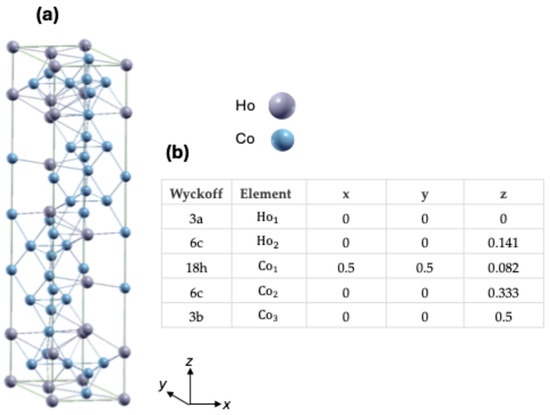
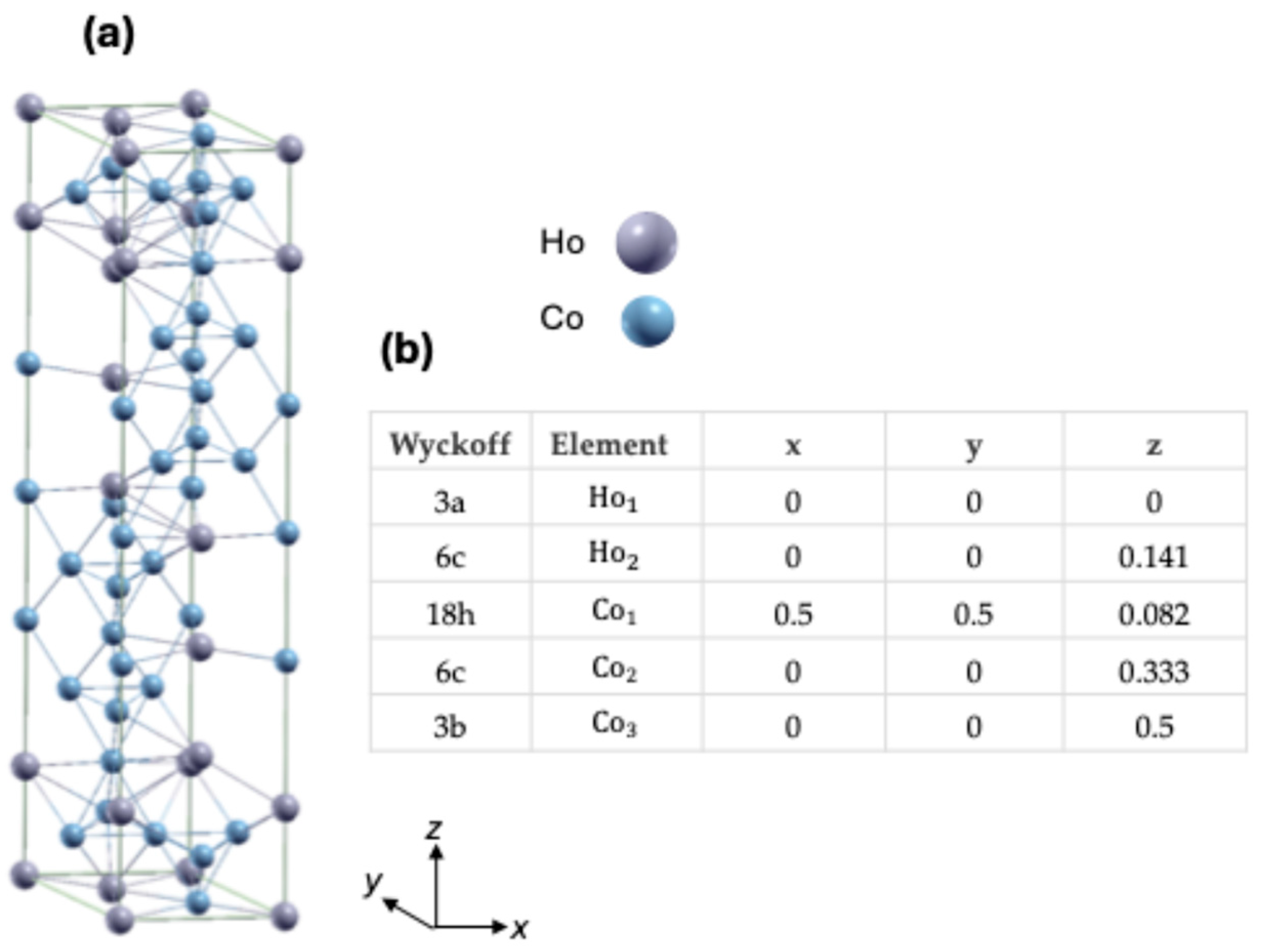
Our calculation uses a supercell model, as illustrated in Figure 2a, based on the HoCo3-specific crystallographic characteristics [1]. The supercell model used in the ab initio calculations corresponding to a hexagonal symmetry cell is shown in Figure 2a. The initial structural positions of Ho and Co atoms, before the structural relaxation, are indicated in Figure 2b in units of lattice parameters a = b = 0.4995 nm and c = 2.4307nm, corresponding to our experimental findings from X-ray diffraction measurements and in agreement with the Wyckoff atomic sites in RM3 compounds with a rhombohedral R-3m (166) space group [1].
Figure 2.
(a) Supercell model used in the ab initio calculations corresponding to a hexagonal symmetry cell. (b) The table depicts the crystallographic positions of the atoms corresponding to the Wyckoff notations corresponding to the rhombohedral R-3m (166) space group.
A key finding of our calculations is the persistent ferrimagnetic alignment between the Ho and Co sublattices, where the total cell moment is defined by . Moreover, our calculations lead to an average robust Ho total magnetic moment, including orbital and spin components within the muffin-tin sphere, of Lz ≈ 6.028 μB ( and ) and Sz ≈ 3.704 μB ( and ), respectively, which corresponds to an average total angular momentum Jz ≈ 9.732 μB.
In the FP-LAPW framework, the local properties of the 4f shell are fully described by the spin-resolved density matrix, , where m and m′ represent the magnetic quantum numbers (ranging from −3 to +3 for l = 3) and σ denotes the spin state up/down (). The magnetic moments are calculated as the expectation values of their respective operators using the trace of the density matrix product. In WIEN2k, the density matrix handles the electron correlations in the LDA+U and LDA+U+SO (Spin–Orbit) and DM (density matrix) schemes. It acts as a bridge between the itinerant Bloch waves and the localized nature of the d or f orbitals. The density matrix, for a specific atom site and angular momentum l (e.g., for Ho 4f states) is calculated by projecting the occupied Kohn–Sham eigenfunctions onto the local orbital basis (spherical harmonics within the muffin-tin sphere (RMT):
where are the occupation numbers and , with being the radial function, which is the solution to the radial Schrödinger equation at a specific energy , being the spherical harmonic, which carries the angular dependence ( projections), and being the Spinor, representing the spin state (↑ or ↓).
The orbital magnetic moment, () is determined by the occupation asymmetry across the projections. On the basis of spherical harmonics, the operator is diagonal, and its expectation value is calculated by summing the diagonal elements of the density matrix weighted by their respective values:
In the case of Ho3+, the majority spin channel (↑) is almost fully occupied (), resulting in a negligible contribution to due to the cancelation of positive and negative states (see Table 3 and Table 4). Therefore, the large orbital moment arises primarily from the minority channel (↓), where the specific occupation of states with (as shown in the provided matrices; see Table 5 and Table 6) yields a theoretical , which is found to be preserved in the crystalline environment, with for Ho1 and for Ho2. From the density matrix tables, one can observe that the off-diagonal elements are zero or negligible, confirming that the 4f states are highly localized and exhibit minimal mutual hybridization. Moreover, the imaginary part of all the matrix elements is zero, which indicates that the chosen quantification axis, (001) hexagonal or (111) in orthorhombic coordinates, is indeed a symmetry axis for the orbitals (providing purely colinear magnetization).
Table 3.
Final density matrix after LDA+U+SO+DM convergence for the up (↑) Ho1 (Lz = 6.034 μB; Sz = 3.702 μB). Each cell contains the real and imaginary occupation number of the state () or the coherence (mixing) of the states (. Trace of the matrix: 6.81705.
Table 4.
Final density matrix after LDA+U+SO+DM convergence for the down () Ho1 (Lz = 6.034 μB; Sz = 3.702 μB). Each cell contains the real and imaginary occupation number of the state () or the coherence (mixing) of the states (. Trace of the matrix: 3.11513.
Table 5.
Final density matrix after LDA+U+SO+DM convergence for the up (↑) Ho2 (Lz = 6.026 μB; Sz = 3.705 μB). Each cell contains the real and imaginary occupation number of the state () or the coherence (mixing) of the states (. Trace of the matrix: 6.81766.
Table 6.
Final density matrix after LDA+U+SO+DM convergence for the down () Ho2 (Lz = 6.026 μB; Sz = 3.705 μB). Each cell contains the real and imaginary occupation number of the state () or the coherence (mixing) of the states (. Trace of the matrix: 3.11239.
Note that, as mentioned in the main text, we started our calculations from a population of the down density matrix with 1.0 spin for each of the levels , which corresponds to a maximum of 6 (. During the self-consistent relativistic calculation with spin–orbit and orbital potential contributions, the system slightly relaxed towards the occupation numbers of the levels illustrated in Table 3, Table 4, Table 5 and Table 6.
The spin magnetic moment (spin-only contribution) is derived from the net difference between the total populations of the two spin channels within the muffin-tin sphere:
as implemented in the WIEN2k framework.
Looking at Table 3, Table 4, Table 5 and Table 6, the trace of the up and down matrices lead to and , resulting in a spin moment of approximately 3.702 μB for Ho1. Similar analysis led to about 3.705 for Ho2. These values are consistent with the 4f10 high-spin configuration (S = 2) dictated by Hund’s first rule that corresponds to a maximum = 4 with if the spins are fully aligned along the z quantification axis. The slight reduction in the ideal integer value to 4 μB is attributed to the hybridization of the states with the valence manifold, resulting in residual occupations of minority levels and a fractional depletion of the majority subshell.
The total magnetic moment of the holmium, which is the quantity directly comparable to experimental magnetometry and neutron diffraction measurements, is defined as the sum of its orbital () and spin () components. Within the FP-LAPW framework, the orbital moment is calculated as , where . The spin magnetic moment, on the other hand, corresponds to which is directly represented by the spin–density imbalance within the muffin-tin sphere. Consequently, the total angular momentum contribution to the saturation magnetization is expressed as in units of consistent with the Landé g-factor formalization for 4f systems.
While the density matrix would remain purely diagonal for a perfectly isolated atom, in a crystalline system such as HoCo3, the neighboring atoms exert crystal field effects that distort the electronic cloud into linear combinations of various spherical harmonics, while spin–orbit coupling further promotes the mixing of different and spin states. Consequently, the off-diagonal elements, in the converged density matrix represent the degree of inter-orbital coherence induced by the local environment. In our calculation, the presence of these terms (though small compared to the diagonal occupations) indicates that the 4f wavefunctions adapted to the rhombohedral symmetry of the Ho site, which is a necessary condition for calculating the magnetocrystalline anisotropy and the true crystal-field-quenched orbital moment. The use of the Hubbard U and Orbital Polarization (OP) corrections is essential to maintain the integrity of these matrices; without them, the 4f states would hybridize excessively with the valence bands, leading to a “quenching” of the diagonal elements in and a significant underestimation of the total .
Note that the equivalence of the magnetic moments per Ho site comes from the final structural relaxation of the system with both spin–orbit and orbital contributions to the Hamiltonian. We underline the very good agreement of our theoretical results compared with neutron diffraction data (≈9.73 μB average magnetic moment per Ho atom) [1] and with the theoretical projected value expected for the Ho3+ ion. Moreover, the relative invariance of the magnetic moments upon increasing the muffin-tin radius from 2.4 to 2.6 a.u. underscores the high degree of localization of the 4f shell.
On the other hand, the calculated Co spin moment was found to be slightly overestimated at an average of /atom (, , and ), compared with the experimental average value of about /atom obtained from neutron diffraction. This discrepancy is typical for GGA-based functionals in 3d itinerant magnets, as they often overemphasize exchange splitting at T = 0 K and neglect spin fluctuations. The effect of Hubbard correlations on Co was found to be negligible, as the magnetic moment of the Co atoms showed negligible dependence on the value of U. Furthermore, as is typical for a transition metal, the orbital contribution to the total magnetic moment was insignificant compared to the spin contribution. On the other hand, our calculation emphasizes the presence of an itinerant magnetic moment within the interstitial region of our muffin-tin-based model of . This moment can mainly be associated with the itinerant Co electrons and therefore, the magnetic moment of the Co can be reasonably corrected considering this interstitial moment to , and , respectively. This would lead to an average Co moment of which is in very good agreement with the experimental value of /atom extracted from neutron diffraction experiments. Note that the positive interstitial moment reflects the polarization of itinerant electrons by the dominant Ho 4f exchange field and therefore aligns with Ho rather than with the local Co 3d moments. We underline that, beyond some possible effects related to the theoretical GGA+U limitations, the slight larger value of the magnetic moments compared with experiments (<1.4%) can be associated with the fact that the calculations are performed at T = 0K and do not consider finite temperature effects and thermal fluctuations that are inherent in diffraction and magnetometry experiments performed at T = 5K.
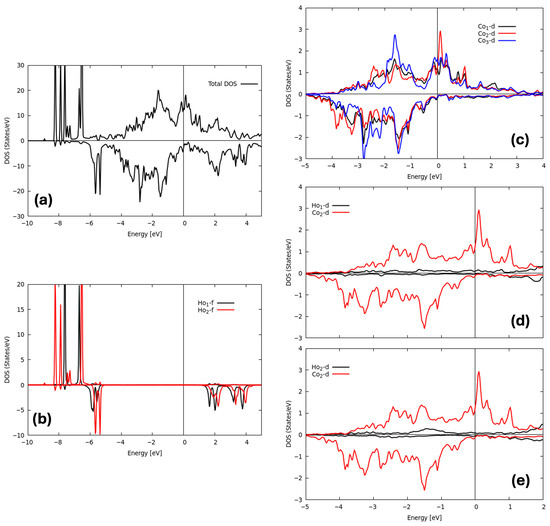
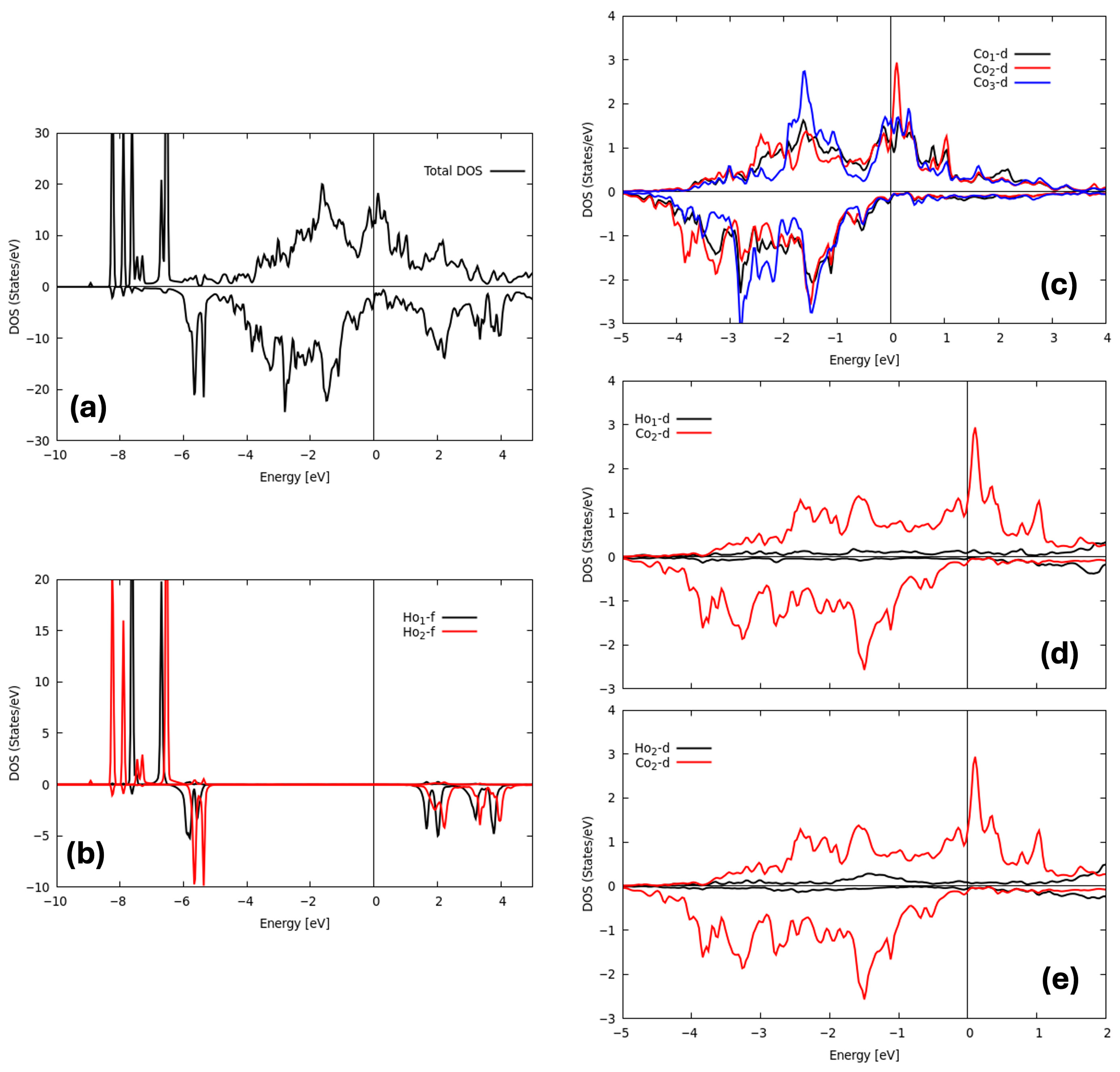
Beyond this qualitative comparison with the experiments, a deeper insight into the electronic structure and the underlying magnetic exchange mechanisms of the HoCo3 system is gained from the analysis of the calculated partial density of states (PDOS), shown in Figure 3a–g.
Figure 3.
Calculated partial density of states (PDOS) for the HoCo3 system. Panels (a,b) display the highly localized and correlated Ho-4f states, with occupied peaks positioned deep below the Fermi level (EF) due to the Hubbard potential. Panel (c) shows the Co-3d itinerant states for the three inequivalent Cobalt sites, highlighting the exchange splitting responsible for the transition-metal magnetism. Panels (d,e) provide magnified views of the electronic structure near the Fermi level, illustrating the significant hybridization between the Ho-5d and Co-3d states. This inter-orbital mixing facilitates the ferrimagnetic exchange coupling and accounts for the magnetic polarization observed in the interstitial region. The Fermi level is set at zero energy and indicated by the vertical line.
The holmium 4f states, illustrated in panels (a) and (b), display a strongly localized character. The occupied 4f bands appear as sharp, high-intensity peaks located well below the Fermi level (EF), predominantly in the energy range between −6 eV and −8 eV. Their pronounced separation from EF is a direct consequence of the applied Hubbard U correction (0.55 Ry). This treatment appropriately accounts for the strong intra-atomic electron–electron correlations within the Ho 4f shell, suppressing unphysical delocalization and stabilizing the large local magnetic moment associated with the holmium ions. In contrast, the Co-3d states shown in panels (c), (d), and (e) exhibit a broad, itinerant character, extending over a wide energy window from approximately −5 eV to +2 eV. Clear exchange splitting between the spin-up and spin-down components is observed, indicating that the Co-3d electrons are the primary contributors to itinerant magnetism across the different Cobalt sublattices. The enlarged PDOS near the Fermi level, presented in panels (d) and (e), reveals noticeable hybridization between the Ho-5d and Co-3d states.
An overlap of these orbitals occurs from about −4 eV up to EF, indicating the presence of mixing between the rare-earth and transition-metal constituents. While the rare-earth contribution is comparatively small in the immediate vicinity of the Fermi energy, the observed hybridization provides a plausible microscopic pathway for ferrimagnetic exchange coupling between the rare-earth and transition-metal sublattices. Specifically, the localized Ho-4f moments interact indirectly with the itinerant Co-3d electrons via the spin-polarized Ho-5d states, leading to an antiparallel alignment of the holmium and cobalt magnetic moments. Furthermore, this Ho–Co hybridization also explains the polarization of valence electrons in the interstitial region. Because the Ho-5d and Co-3d states contribute significantly at EF, part of the magnetic moment is delocalized outside the atomic spheres and distributed within the interstitial space. As a result, the total magnetization of the unit cell includes a non-negligible interstitial contribution, rather than being entirely confined to the atomic sites. This interstitial contribution is estimated in our calculation to produce a total itinerant magnetic moment of about aligned with the magnetic moment of Ho, the itinerant electrons being polarized by the dominant Ho 4f exchange field.
Beyond the immediate interest of the calculations performed in elucidating the mechanisms of ferrimagnetic coupling and the specific magnetic properties of HoCo3-type compounds, our results also have a predictive character. In particular, the electronic and magnetic structure obtained from DFT for the parent HoCo3 compound provides a microscopic framework that can be used to qualitatively interpret the behavior of substituted systems. Experimental evidence shows that, upon substitution of cobalt with silicon, Si preferentially occupies the 18h crystallographic site of the initial intermetallic structure. One of the primary experimental observations in such Si-substituted compounds is an increase in the total magnetic moment per formula unit. This trend can be qualitatively interpreted on the basis of the magnetic picture revealed by our DFT calculations for the pure HoCo3 compound. Since the Ho and Co sublattices are coupled antiparallelly, substitution of magnetic Co atoms by non-magnetic Si reduces the magnitude of the antiparallel contribution associated with the Co sublattice. Consequently, the compensation between the two sublattices is weakened and the net magnetic moment per unit cell increases, consistent with the experimental observations (see Section 3.3). A more quantitative description of the substituted materials, however, would require explicit DFT calculations for realistic substitutional models. In particular, subtle effects related to changes in local hybridization and electronic structure cannot be reliably captured by simple extrapolation from the parent compound. These effects are expected to depend sensitively on the locally reduced symmetry induced by substitution and on the specific crystallographic site occupied by the Si atoms. Such an investigation would involve extensive calculations over multiple substitutional configurations with reduced symmetry, making it computationally demanding. For this reason, it lies beyond the scope of the present work, but it constitutes one of the main theoretical perspectives opened by our results.
3.3. Magnetic Properties
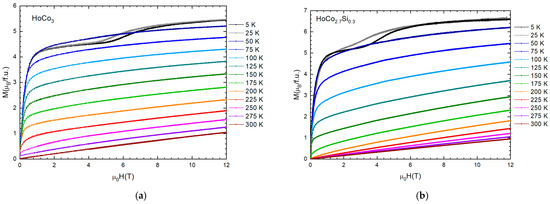
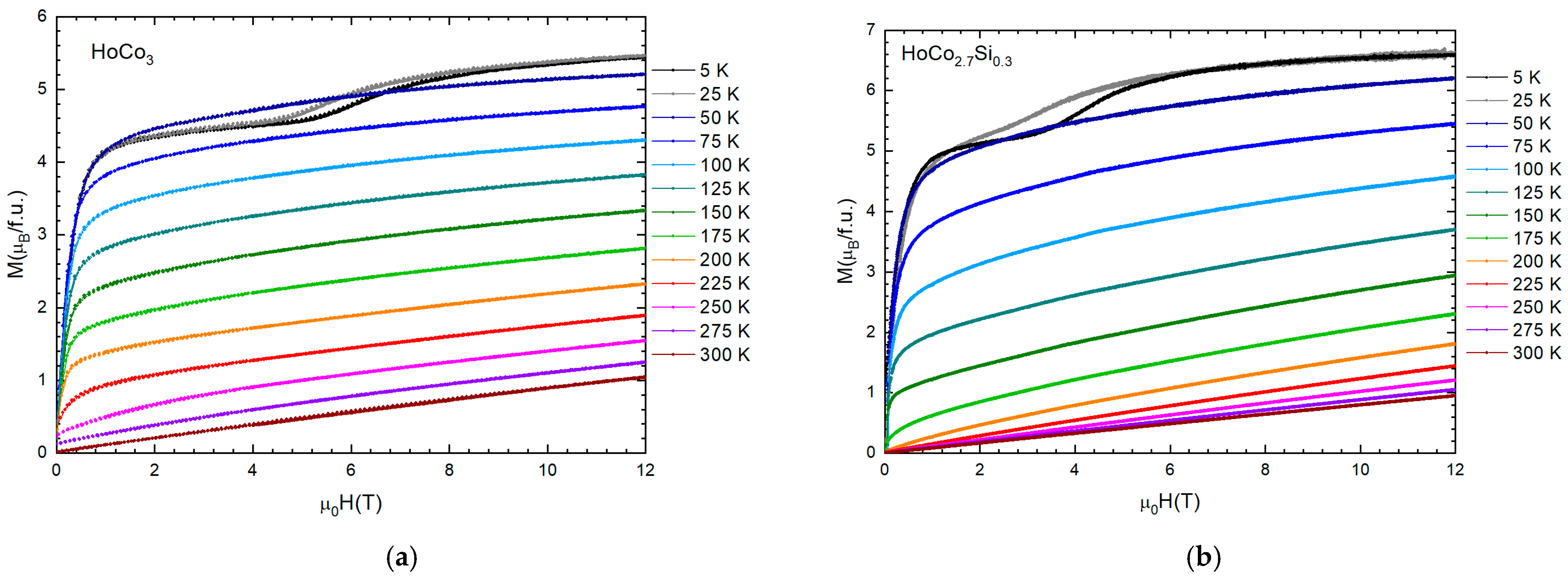
Field-dependent magnetization curves, measured up to 12 T, are depicted in Figure 4. It can be observed that saturation is not reached in a magnetic field of 12 T, a behavior that is consistent across all studied samples. Transitions toward a higher magnetization state are observed at 5 K and 25 K for the sample with x = 0, and at 5 K for the compound with x = 0.3, occurring at μ0HC ≅ 5 T (for x = 0) and ≈ 4 T (for x = 0.3), respectively. The transition field, μ0HC, is defined by the onset of the transition. No such behavior was observed at higher temperatures. The corresponding increases in magnetization are small, being approximately 0.36 μB (x = 0.0) and 0.24 μB (x = 0.3). Metamagnetic transitions have previously been reported for cobalt in YCo3 [37], ThCo5 [38], ErCo3, HoCo3, and Nd2Co7 single crystals [24] and Y(CoxNi1−x)3 [39]. The observed transitions in our compounds are broad and can be explained by the distribution of internal magnetic fields which arises from small differences in the local environments of cobalt atoms in the structure. There is evidence that the metamagnetic transition in YCo3 occurs at an applied magnetic field of approximately 60 T [37]. Similarly, an itinerant-electron metamagnetic transition has been reported at about 70 T in rare-earth cobalt Laves-phase compounds [40]. Therefore, the increase in magnetization observed at 4 to 5 T cannot be attributed to cobalt. The structure of RCo3 can be imagined like the stacking of the structure blocks of RCo2 and RCo5, making 2RCo2 + RCo5 [24]. The different cobalt sublattices could be combined in only one way due to the strong ferromagnetic coupling between Co atoms. The Co sublattice anisotropy energy, , is positive, and the easy axis of the Co magnetic moment is parallel to the c-axis [24]. The anisotropy energy sign of the RI atoms at sites with local uniaxial crystal symmetry in the RCo5 structural block is [41]. This indicates that the HoI moment lies in the basal plane. When considering anisotropy within the basal plane, the HoI moment preferentially aligns along the a-axis. It was shown, by crystal field calculation, that the anisotropy energies ERI and ERII have opposite signs [19]. When the magnetic field is applied to HoCo3, the field-induced magnetic transitions can be attributed to the reorientation (flip) of the RII moments toward <111> easy directions [24]. In conclusion the magnetization along the c-axis exhibits a collinear-to-noncollinear transition at magnetic fields between 4 and 5 T.
Figure 4.
Magnetization isotherms of HoCo3 (a) and HoCo2.7Si0.3 (b).
The saturation magnetizations were determined using the approach to saturation law. The thermal variations in saturation magnetizations, MS, are presented in Figure 5. The compounds are ferrimagnetically ordered, the Ho and Co magnetic moments being antiparallelly oriented.
Figure 5.
The thermal variation in saturation magnetizations of HoCo3−xSix compounds.
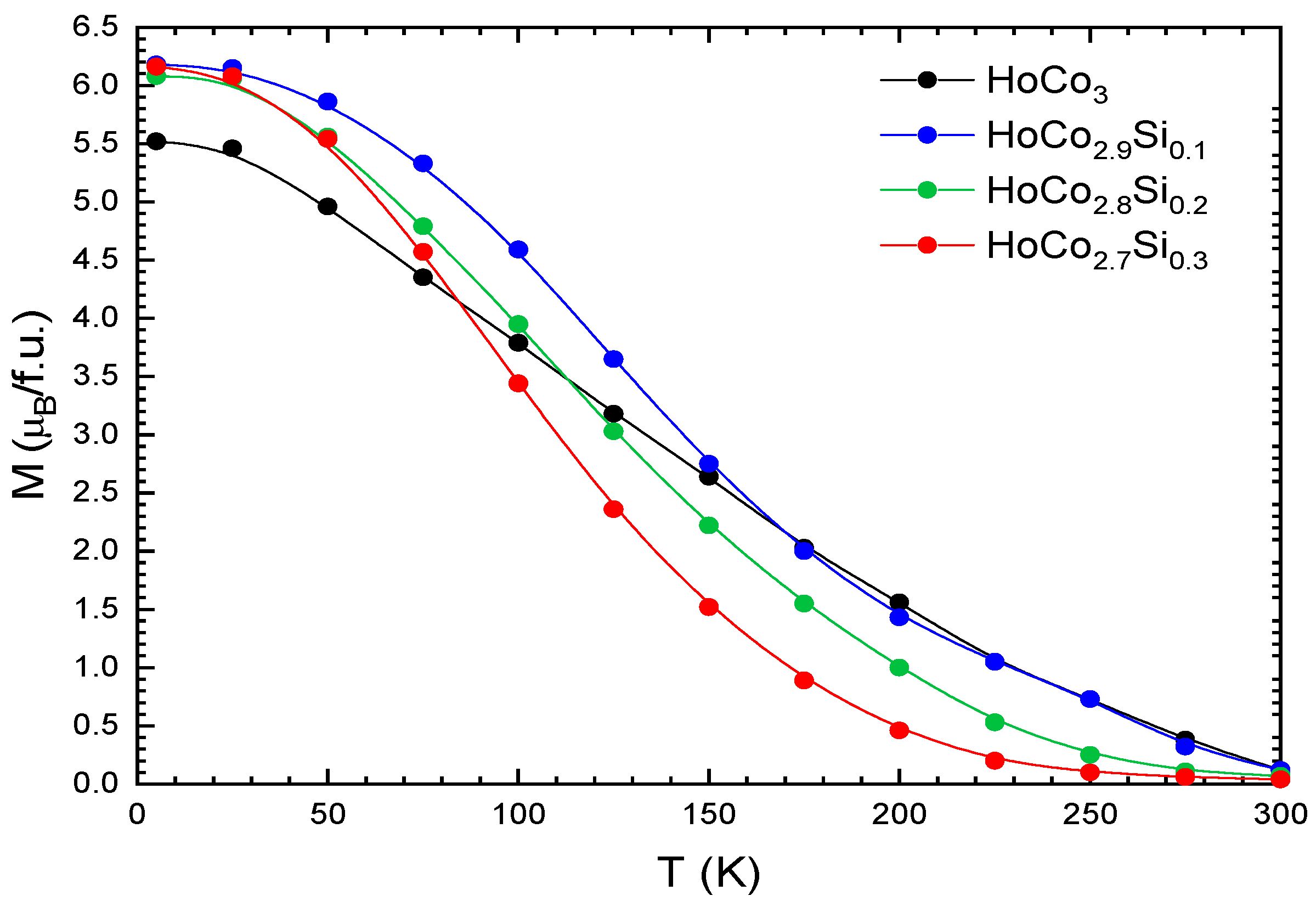
One can see that the ferrimagnetic–paramagnetic transition temperature is above 300 K. On the other hand, the saturation magnetization values are close to zero around room temperature, suggesting that the compensation point temperature is in this temperature range, very close to 326 K as was reported for a HoCo3 compound [18]. The MS values, at 5 K, increase when the silicon content increases, with values of 5.52 μB/f.u. (x = 0), 6.18 μB/f.u. (x = 0.1), 6.08 μB/f.u. (x = 0.2) and 6.16 μB/f.u. (x = 0.3) respectively. The MS values obtained by us are close to those reported for HoCo3 by Lemaire et al. (5.6 μB/f.u.) [18] and Bartashevich et al. (6.26 μB/f.u.) [24].
The average magnetic moment of the Co atoms at 5 K was calculated under the assumption that the average magnetic moment of Ho—determined for HoCo3 by neutron diffraction (10 µB/atom for the RI crystallographic site and 9.6 µB/atom for the RII site)—remains unchanged [18]. The obtained values, at 5 K, are 9.733 μB/atom for Ho and 1.40 μB/atom (x = 0.0), 1.22 μB/atom (x = 0.1), 1.30 μB/atom (x = 0.2) and 1.32 μB/atom (x = 0.3) for Co. The obtained average cobalt magnetic moment in HoCo3 is very close to the 1.27 μB/atom, calculated for the average cobalt magnetic moment using the data obtained by Lemaire from neutron diffraction data considering the three different crystallographic positions, and the 1.278 μB/atom obtained by our band structure calculations. The DFT results for the parent HoCo3 compound are in good agreement with the experimental data, reproducing well the total magnetic moments associated with both the Ho and Co sublattices. On this basis, the calculations for the pure compound also provide a consistent qualitative framework to understand the experimentally observed increase in the net magnetic moment per formula unit upon partial substitution of Co by Si. However, the substituted compounds involve additional, more subtle effects, most notably changes in the local electronic structure and Si–Co hybridization, which cannot be captured by a simple extrapolation from the pure HoCo3 model. Consequently, a direct extrapolation of the theoretical results for the parent compound is not sufficient to account for the experimentally observed reduction in the Co magnetic moment with increasing Si content. A conclusive explanation of this trend would require explicit DFT calculations for realistic substitutional models with reduced local symmetry, including statistical sampling over the possible Si configurations and crystallographic sites. As already mentioned, this perspective approach lies beyond the purpose of the current paper. Previously it was reported that the Gd(5d) band polarizations in GdCo3−xSix compounds are parallel to the 4f moments and decrease only slightly with increasing Si content. Replacing Co with Si induces Co 3d–Si 3p hybridization, altering the exchange splitting of the Co 3d bands. Consequently, the centers of gravity of the Co 3d bands shift markedly toward the Fermi level, while the Si 3p band shows only a minor shift. Similar behavior is expected in our case. The exchange interactions in the studied samples can be described within the 4f–5d–3d model [42]. This model includes local 4f–5d exchange interactions as well as short-range 5d–3d interactions between Ho atoms and their neighboring Co atoms. Both types of interactions contribute to the polarization of the 5d band. The values of the magnetic moments can be attributed to the changes in the Co neighboring atoms as a result of substitution as well as Co 3d–Si 3p hybridization effects.
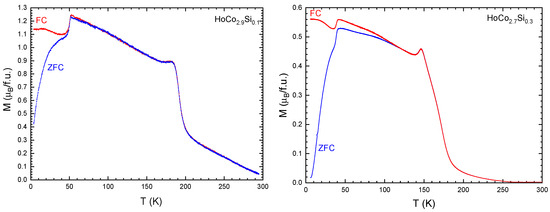
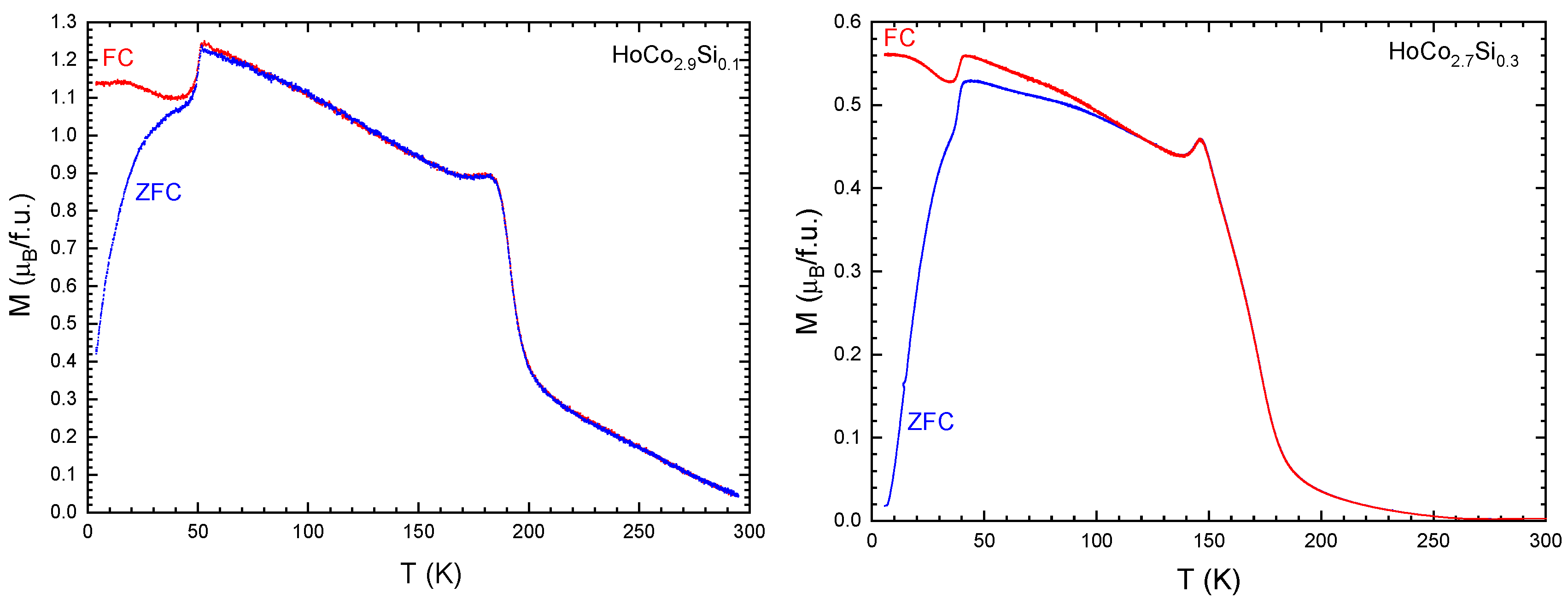
Zero-field-cooled (ZFC) and field-cooled (FC) magnetization curves, for the samples with x = 0.1 and 0.3, measured under a small external magnetic field of 0.05 T, are shown in Figure 6. All studied compounds show a similar behavior. The bifurcation between the ZFC and FC curves below 150 K could indicate a spin-glass-like behaviour because it signifies the onset of magnetic irreversibility and metastability below the freezing temperature. Below this temperature, the spins become trapped in a complex energy landscape, preventing the ZFC-cooled system from reaching equilibrium. In contrast, the FC-cooled system aligns with the applied field, resulting in distinct non-equilibrium magnetization behaviors. Bifurcation temperatures slowly decrease with increasing silicon content, equaling 130 K for the sample with x = 0.3. The emergence of this feature in our samples may be attributed to the presence of partial magnetic disorder or to magnetocrystalline anisotropy, which is related to the magnitude of the coercivity at low temperatures. Above the bifurcation point, the ZFC and FC curves overlap, followed by a transition at 225 K (x = 0), 195 K (x = 0.1), 175 K (x = 0.2) and 165 K (x = 0.3). The transition to a paramagnetic state is expected to be at higher temperatures.
Figure 6.
The temperature dependences of zero-field-cooled (ZFC) and field-cooled (FC) magnetization for x = 0.1 and 0.3 samples.
In the temperature range between 165 and 225 K, a decrease in magnetization is observed. Within this interval, the magnetic properties are strongly affected by the magnetic instability of the Co sublattice, which gives rise to metamagnetic behavior and induces a spin reorientation in the Ho sublattice. Gratz et al. [21] demonstrated the existence of a temperature-induced metamagnetic transition, IEM, in the Co sublattice of HoCo3 at 175 K, originating from Ho–Co and Co–Co exchange interactions. We therefore propose that a similar behavior occurs in the present compounds. Goto et al. have shown that in HoCo3, the easy magnetization direction gradually rotates from the basal plane toward the hexagonal c-axis over the temperature range below 55 K [43]. The transition observed at 165–225 K cannot be attributed to this magnetization rotation, as the associated volume change is small (<10−4) and therefore negligible on this scale, particularly at 55 K [21]. IEM arises from a subtle feature in the energy dependence of the density of states near the Fermi level [44]. A necessary condition for the occurrence of IEM is that lies close to a sharp peak in . Under these circumstances, an applied external magnetic field can enhance , eventually leading to fulfillment of the Stoner criterion at a critical field. In our case it was shown by band structure calculation that the upper condition is fulfilled. This transition could be explained by the Co sublattice changes, from a strong ferromagnetic to a “weaker” magnetic state.
Below the bifurcation temperatures another transition is observed around 55 K. It was reported that in a HoCo3 compound, the easy direction is along the b-axis in the basal plane for temperatures below 55 K [24]. The transition observed at 55 K could be attributed to a change in the direction of the easy axis. Above 55 K, the magnetic moment likely deviates by about ±15° within the basal plane, while its projection aligns along the a-axis, as previously reported by Bartashevich et al. [24]. As a consequence, a noncollinear magnetic structure is likely to emerge in our samples at 55 K. This transition was confirmed by Gratz et al. by specific heat and resistivity measurements [21].
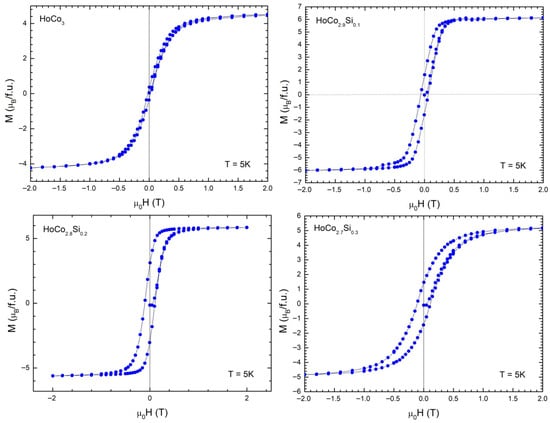
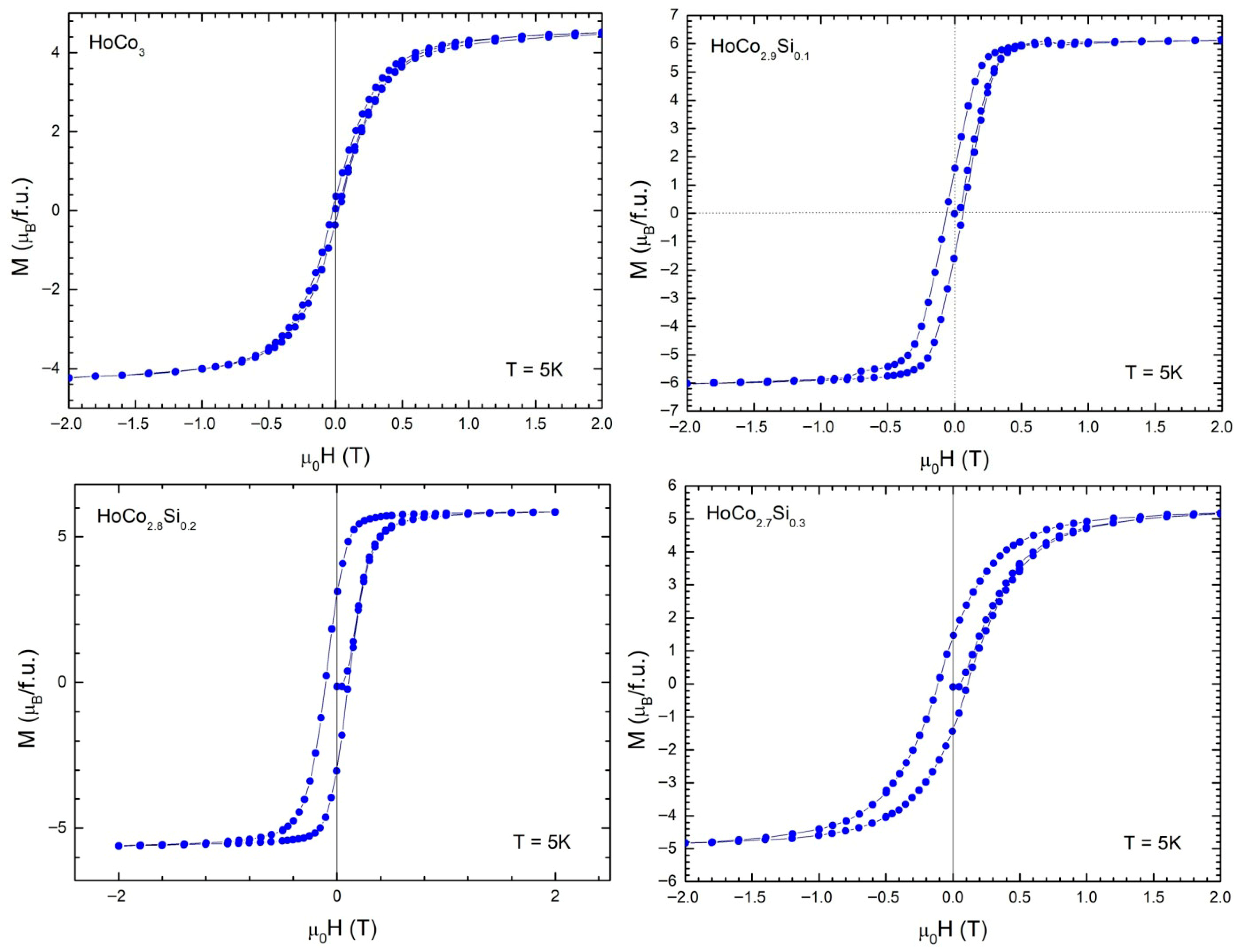
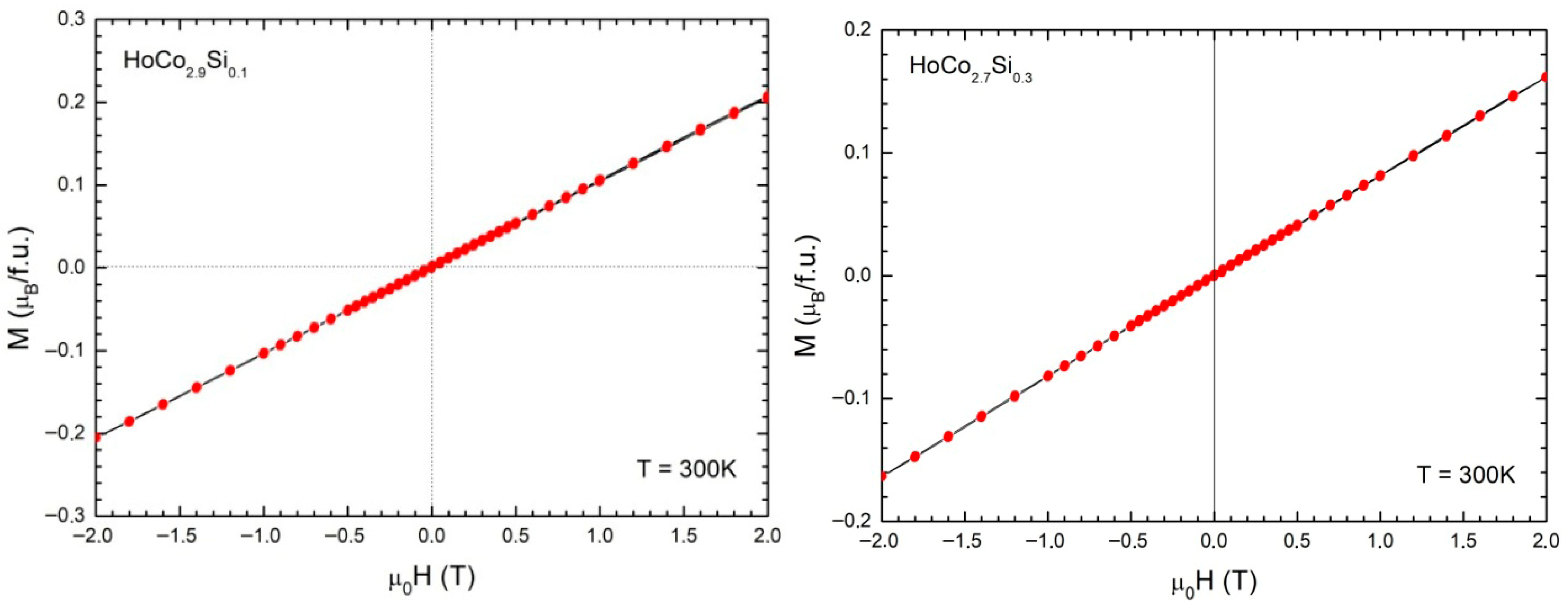
The magnetic hysteresis curves measured at 5 K between -2T and 2T are presented in Figure 7. One can see that the coercive field is low, showing that the magnetocrystalline anisotropy is very small. The coercive field decreases slowly with increasing Si content, the obtained values being μ0HC = 0.02 T for x = 0, 0.06 T (x = 0.1), 0.10 T (x = 0.2) and 0.11 T for x = 0.3. Magnetic hysteresis loops measured at 300 K in external magnetic fields between—2T and 2T are presented in Figure 8. The coercive field at 300 K is almost zero, with this being an advantage for using in technical applications around room temperature. They have high potential for applications requiring low energy losses, high efficiency, and high permeability, such as transformer cores, inductors, electric motors, magnetic shielding, etc.
Figure 7.
Magnetic hysteresis loops recorded at T = 5 K for HoCo3−xSix.
Figure 8.
Magnetic hysteresis loops recorded at T = 300 K for samples with x = 0.1 and x = 0.3.
4. Conclusions
The band structure and structural and magnetic properties of HoCo3−xSix were investigated. The samples were prepared by an induction melting technique and all of them are single phases with a cubic PuNi3-type structure, as revealed by X-ray diffraction measurements. Rietveld refinement showed that all studied samples crystallize in a rhombohedral type of lattice with the R m space group. A small decreasing trend in the c lattice parameter is revealed, while the a parameter remains nearly constant with increasing silicon content. Since the atomic radius of Co differs significantly from that of Si and Ho, substitution of Co with Si leads to lattice distortion and induces reconstruction of the lattice structural framework.
To get deeper insight on the magnetic properties of the HoCo3 compound, we performed first-principles DFT calculations within the GGA+U+SO framework. Our calculations confirm that HoCo3 is a robust ferrimagnet, with antiparallel alignment between the Ho and Co sublattices. The holmium ions carry a strongly localized 4f moment, with an average total angular momentum Jz ≈ 9.73 μB, in excellent agreement with neutron diffraction data and the expected Ho3+ value from the Hund’s rules. The Co sublattice exhibits itinerant magnetism, with spin moments slightly overestimated by standard GGA but brought into very good agreement with experimental data when the interstitial magnetic contribution is included. The partial density of states reveals sharply localized Ho-4f bands well below the Fermi level EF and broad, exchange-split Co-3d states crossing EF, together with pronounced Ho-5d–Co-3d hybridization near EF. This hybridization mediates the ferrimagnetic coupling and explains both the antiparallel Ho–Co alignment and the non-negligible interstitial moment aligned with Ho. The relative invariance of the Ho moments with respect to the muffin-tin radius further underscores the strong localization of the 4f shell. Overall, these results provide a consistent microscopic picture of magnetism in HoCo3 and validate the GGA+U framework for rare-earth–transition-metal intermetallics. Moreover, the magnetic results issued from our DFT analysis are in very good agreement with the experimental magnetometry results and support the experimentally observed increase in net magnetization upon Co→Si substitution, offering a predictive basis for future compositional tuning and targeted magnetic property optimization.
Metamagnetic transitions are shown in magnetization isotherms measured at very low temperatures and external magnetic fields between 4 T and 5 T. The observed transitions are broad and can be explained by the distribution of internal magnetic fields which arises from small differences in the local environments of cobalt atoms in the structure. The Co sublattice anisotropy energy, , is positive, and the easy axis of the Co magnetic moment is parallel to the c-axis. The HoI moment lies in the basal plane and when considering anisotropy within the basal plane, the HoI moment preferentially aligns along the a-axis. The anisotropy energies ERI and ERII have opposite signs. When the magnetic field is applied to HoCo3, the field-induced magnetic transitions can be attributed to the reorientation (flip) of the RII moments toward <111> easy directions. The compounds are ferrimagnetically ordered. The ferrimagnetic–paramagnetic transition temperature is above 300 K, while the saturation magnetization values are close to zero around room temperature, suggesting that the compensation point temperature is in this temperature range, very close to 326 K as was reported earlier for a HoCo3 compound. The MS values, at 5 K, increase when the silicon content increases. It was found that the magnetic moment per formula unit is much closer to experimental data, if silicon substitutes cobalt in 18h sites in agreement with structural data. The obtained average cobalt magnetic moment in HoCo3 is very close to the value calculated for the average cobalt magnetic moment using the data obtained by Lemaire from neutron diffraction data considering the three different crystallographic positions and the results obtained by our band structure calculations. Replacing Co with Si induces Co 3d–Si 3p hybridization, altering the exchange splitting of the Co 3d bands. Consequently, the centers of gravity of the Co 3d bands shift markedly toward the Fermi level, while the Si 3p band shows only a minor shift. The exchange interactions in the studied samples can be described within the 4f–5d–3d model. This model includes local 4f–5d exchange interactions as well as short-range 5d–3d interactions between Ho atoms and their neighboring Co atoms. The values of the magnetic moments can be attributed to the changes in the Co neighboring atoms as a result of substitution as well as Co 3d–Si 3p hybridization effects. The bifurcation between the ZFC and FC curves below 150 K could indicate spin-glass-like behavior. Bifurcation temperatures slowly decrease with increasing silicon content and this is attributed to the presence of partial magnetic disorder or to magnetocrystalline anisotropy. In the temperature range between 165 and 225 K, a decrease in magnetization is observed. Within this interval, the magnetic properties are strongly affected by the magnetic instability of the Co sublattice, which gives rise to a temperature-induced metamagnetic transition. Another transition occurs at 55 K due to a change in the easy axis direction. When the temperature becomes higher than 55 K, a deviation by a ±15° angle on the basal plane appears while its projection aligns with the a-axis. As a result, a noncollinear magnetic structure appears in our samples at 55 K. The coercive field at 5 K is low, showing that the magnetocrystalline anisotropy is very small. The coercive field decreases slowly with increasing Si content. At room temperature the coercive field is almost zero, showing high potential for applications requiring low energy losses, high efficiency, and high permeability, such as transformer cores, inductors, electric motors, magnetic shielding, etc.
Author Contributions
Conceptualization, R.T. and C.T.; methodology, R.D., C.T. and R.T.; software, C.T.; validation, R.D., C.T. and R.T.; formal analysis, M.C., R.D. and R.G.H.; investigation, M.C., R.G.H. and R.D.; resources, R.T.; data curation, M.C. and R.D.; writing—original draft preparation, M.C., C.T. and R.T.; writing—review and editing, C.T. and R.T.; supervision, R.T.; funding acquisition, R.D. and R.T. All authors have read and agreed to the published version of the manuscript.
Funding
This research received no external funding.
Data Availability Statement
The original contributions presented in this study are included in the article. Further inquiries can be directed to the corresponding author.
Conflicts of Interest
The authors declare no conflicts of interest.
References
- Burzo, E.; Chelkowski, L.; Kirchmayr, H.R. Compounds Between Rare Earth Elements and 3d, 4d, or 5d Elements. In Landolt-Börnstein—Group III Condensed Matter; Springer: Berlin/Heidelberg, Germany, 1990; Volume 19D2. [Google Scholar] [CrossRef] [Scilit]
- Buschow, K.H.J. Intermetallic compounds of rare-earth and 3d transition metals. Rep. Prog. Phys. 1977, 40, 1179–1256. [Google Scholar] [CrossRef] [Scilit]
- Coey, J.M.D. Magnetism and Magnetic Materials; Cambridge University Press: Cambridge, UK, 2010. [Google Scholar] [CrossRef] [Scilit]
- Gschneidner, K.A.; Eyring, L. Handbook on the Physics and Chemistry of Rare Earths; North-Holland: Amsterdam, The Netherlands, 1978. [Google Scholar]
- Gutfleisch, O.; Willard, M.A.; Brück, E.; Chen, C.H.; Sankar, S.G.; Liu, J.P. Magnetic materials and devices for the 21st century: Stronger, lighter, and more energy efficient. Adv. Mater. 2011, 23, 821–842. [Google Scholar] [CrossRef] [Scilit]
- Wallace, W.E.; Swearingen, J.T. Magnetic Characteristics of LaCo5-ThCo5 Pseudobinary System. J. Solid State Chem. 1973, 8, 37. [Google Scholar] [CrossRef] [Scilit]
- González, J.A.; Andrés, J.P.; López Antón, R. Applied Trends in Magnetic Rare Earth/Transition Metal Alloys and Multilayers. Sensors 2021, 21, 5615. [Google Scholar] [CrossRef] [Scilit]
- Stein, F.; Leineweber, A. Laves phases: A review of their functional and structural applications and an improved fundamental understanding of stability and properties. J. Mater. Sci. 2021, 56, 5321–5427. [Google Scholar] [CrossRef] [Scilit]
- Kuz’min, M.D.; Tishin, A.M. Theory of Crystal-Field Effects in 3d-4f Intermetallic Compounds. In Handbook of Magnetic Materials; Buschow, K.H.J., Ed.; Elsevier: Amsterdam, The Netherlands, 2008; Volume 17, pp. 149–293. [Google Scholar] [CrossRef] [Scilit]
- Bessais, L. Structure and Magnetic Properties of Intermetallic Rare-Earth-Transition-Metal Compounds: A Review. Materials 2022, 15, 201. [Google Scholar] [CrossRef] [Scilit]
- Gschneidner, K.A.; Pecharsky, V.K. Binary rare earth Laves phases—An overview. Z. Krist. 2006, 221, 375–381. [Google Scholar] [CrossRef] [Scilit]
- Wiesinger, G.; Hilscher, G. Magnetism of hydrides. In Handbook of Magnetic Materials, 1st ed.; Buschow, K.H.J., Ed.; Elsevier B.V.: Amsterdam, The Netherlands, 2007; Volume 17, pp. 293–456. [Google Scholar] [CrossRef] [Scilit]
- Strnat, K.; Hoffer, G.; Ostertag, W.; Olson, J.C. Ferrimagnetism of the Rare-Earth-Cobalt Intermetallic Compounds R2Co17. J. Appl. Phys. 1966, 37, 1252–1253. [Google Scholar] [CrossRef] [Scilit]
- Markosyan, A.S. Magnetism of Alloys of 4f (R) and 3d Elements (T). In Encyclopedia of Materials: Science and Technology; Elsevier Science Ltd.: Oxford, UK, 2001; pp. 78–85. [Google Scholar]
- Franse, J.J.M.; Radwanski, R. Magnetic properties of binary rare-earth 3d-transition-metal intermetallic compounds. In Handbook on Magnetic Materials; Buschow, K.H.J., Ed.; Elsevier: Amsterdam, The Netherlands, 1993; Volume 7, pp. 307–501. [Google Scholar] [CrossRef] [Scilit]
- Gaidukova, I.Y.; Markosyan, A.S. d-magnetism instability in R-Co intermetallic compounds. J. Sci. Adv. Mater. Devices 2016, 1, 105–112. [Google Scholar] [CrossRef] [Scilit]
- Dubenko, I.S.; Gaidukova, I.Y.; Gratz, E.; Inoue, K.; Markosyan, A.S.; Rodimin, V.E. Magnetic instability of the Co sublattice in the Ho1−xYxCo3 system. Phys. B 2002, 319, 21–27. [Google Scholar] [CrossRef] [Scilit]
- Lemaire, R.; Pauthenet, R.; Schweizer, J.; Silvera, I.S. Propriétés Magnétiques Des Alliages De Formule TCo3, Dans Laquelle T Désigne L’yttrium Ou Une Terre Rare. J. Phys. Chem. Solids 1967, 28, 2471–2475. [Google Scholar] [CrossRef] [Scilit]
- Yakinthos, J.; Rossat-Mignod, J. Interprétation des structures magnétiques des composés TCo3 (T = Pr, Nd, Tb, Ho, Er). Phys. Status Solidi B 1972, 60, 747. [Google Scholar] [CrossRef] [Scilit]
- Meschel, S.V.; Nash, P.; Gao, Q.N.; Wang, J.C.; Du, Y. Standard enthalpies of formation of some Lanthanide–Cobalt binary alloys by high temperature direct synthesis calorimetry. J. Alloys Compd. 2013, 578, 465. [Google Scholar] [CrossRef] [Scilit]
- Gratz, E.; Markosyan, A.S.; Gaidukova, I.Y.; Rodimin, V.E.; Berger, S.; Bauer, E.; Michor, H. Temperature induced itinerant electron metamagnetism in ErCo3 and HoCo3: Influence of an external field and pressure. Solid State Commun. 2001, 120, 191–194. [Google Scholar] [CrossRef] [Scilit]
- Gaidukova, I.Y.; Granovsky, S.A.; Markosyan, A.S.; Rodimin, V.E. The thermal expansion and Co magnetic state in light RCo3 intermetallics (R = Pr, Nd, Sm). J. Magn. Magn. Mater. 2006, 301, 124–130. [Google Scholar] [CrossRef] [Scilit]
- Chen, S.; Guo, Y.; He, Q. Phase evolution and magnetic properties of HoIn3-xCox. J. Appl. Phys. 2015, 117, 123910. [Google Scholar] [CrossRef] [Scilit]
- Bartashevich, M.I.; Goto, T.; Yamaguchi, M. Field induced magnetic phase transition and magnetostriction in ErCo3, HoCo3 and Nd2Co7 single crystals. J. Magn. Magn. Mater. 1992, 111, 83–89. [Google Scholar] [CrossRef] [Scilit]
- Shcherbakova, Y.V.; Ermolenko, A.S. Magnetic Properties of Single Crystals of Compounds RCo3 (R = Ho, Tm). Phys. Met. Metallogr. 1982, 54, 53–59. [Google Scholar]
- Song, Y.; Xu, T.; Zhao, G.; Xu, Y.; Zhong, Z.; Zheng, X.; Shi, N.; Zhou, C.; Hao, Y.; Huang, Q.; et al. High-density, spontaneous magnetic biskyrmions induced by negative thermal expansion in ferrimagnets. Sci. Adv. 2003, 9, eadi1984. [Google Scholar] [CrossRef] [Scilit] [PubMed]
- Tetean, R.; Burzo, E.; Chioncel, L. Magnetic properties and electronic structures of GdCo3−xSix compounds. J. Alloys Compd. 2007, 430, 19–21. [Google Scholar] [CrossRef] [Scilit]
- Rietveld, H.M. A Profile Refinement Method for Nuclear and Magnetic Structures. J. Appl. Crystallogr. 1969, 2, 65–71. [Google Scholar] [CrossRef] [Scilit]
- Blaha, P.; Schwarz, K.; Tran, F.; Laskowski, R.; Madsen, G.K.H.; Marks, L.D. WIEN2k: An APW+lo program for calculating the properties of solids. J. Chem. Phys. 2020, 152, 074101. [Google Scholar] [CrossRef] [Scilit]
- Anisimov, V.I.; Solovyev, I.V.; Korotin, M.A.; Czyzyk, M.T.; Sawatzky, G.A. Density-functional theory and NiO photoemission spectra. Phys. Rev. B 1993, 48, 16929. [Google Scholar] [CrossRef] [Scilit] [PubMed]
- Liechtenstein, A.I.; Anisimov, V.I.; Zaanen, J. Density-functional theory and strong interactions: Orbital ordering in Mott-Hubbard insulators. Phys. Rev. B 1995, 52, R5467. [Google Scholar] [CrossRef] [Scilit]
- Cococcioni, M.; de Gironcoli, S. Linear response approach to the calculation of effective interaction parameters in the LDA + U method. Phys. Rev. B 2005, 71, 035105. [Google Scholar] [CrossRef] [Scilit]
- Paier, J.; Marsman, M.; Kresse, G. Dielectric properties and excitons for extended systems from hybrid functionals. Phys. Rev. B 2008, 78, 121201. [Google Scholar] [CrossRef] [Scilit]
- Paier, J.; Marsman, M.; Hummer, K.; Kresse, G.; Gerber, I.C.; Ángyán, J.G. Dielectric properties and Hartree–Fock exchange of surface systems and solids. J. Chem. Phys. 2006, 124, 154706. [Google Scholar] [CrossRef] [Scilit]
- Available online: https://www.sciencegeek.net/tables/AtomicRadius.pdf (accessed on 25 October 2025).
- Tharp, D.; Yang, Y.; James, W.; Yelon, W.; Xie, D.; Yang, J. Atomic and magnetic structure of Er(Fe1−xNix)3 intermetallic compounds. J. Appl. Phys. 1987, 61, 4249–4251. [Google Scholar] [CrossRef] [Scilit]
- Goto, T.; Katori, H.A.; Sakakibara, T.; Yamauchi, M. Successive phase transitions in ferromagnetic YCo3. Phys. B 1992, 177, 255. [Google Scholar] [CrossRef] [Scilit]
- Givord, D.; Laforest, J.; Lemaire, R. Polarized neutron study of the itinerant electron metamagnetism in ThCo5. J. Appl. Phys. 1979, 50, 7489–7491. [Google Scholar] [CrossRef] [Scilit]
- Burzo, E.; Deac, I.G.; Tetean, R.; Creanga, I. Magnetic properties of Y(CoxNi1−x)3 compounds. Optoelectron. Adv. Mater.-Rapid Commun. 2008, 2, 643–645. [Google Scholar]
- Burzo, E. Magnetic properties and resonance studies of Gd(CoxAl1−x)2 compounds. J. Less-Common Met. 1981, 77, 251–364. [Google Scholar] [CrossRef] [Scilit]
- Sinnema, S.; Franse, J.J.M.; Radwański, R.J.; Menovsky, A.; de Boer, F.R. High-field magnetisation studies on the Ho2(Co,Fe)17 intermetallics. J. Phys. F Met. Phys. 1987, 17, 233–267. [Google Scholar] [CrossRef] [Scilit]
- Campbell, I.A. Indirect exchange for rare earths in metals. J. Phys. F Met. Phys. 1972, 2, L47. [Google Scholar] [CrossRef] [Scilit]
- Goto, T.; Bartashevich, M.I.; Aruga Katori, H.; Shcherbakova, Y.V.; Yermolenko, A.S. Field-induced transitions of RCo3 (R = Ho, Er and Tm) in ultrahigh magnetic fields up to 110 T. Phys. B 1995, 211, 131–133. [Google Scholar] [CrossRef] [Scilit]
- Yamada, H.; Inoue, J.; Terao, K.; Kanda, S.; Shimizu, M. Electronic structure and magnetic properties of YM2 compounds (M = Mn, Fe, Co and Ni). J. Phys. F Met. Phys. 1984, 14, 1943. [Google Scholar] [CrossRef] [Scilit]

Disclaimer/Publisher’s Note: The statements, opinions and data contained in all publications are solely those of the individual author(s) and contributor(s) and not of MDPI and/or the editor(s). MDPI and/or the editor(s) disclaim responsibility for any injury to people or property resulting from any ideas, methods, instructions or products referred to in the content. |
© 2026 by the authors. Licensee MDPI, Basel, Switzerland. This article is an open access article distributed under the terms and conditions of the Creative Commons Attribution (CC BY) license.