Article

First-Principles Insights into Cr- and Mn-Doped Rocksalt ScN: Engineering Structural Stability and Magnetism


Physics Department, College of Science, Imam Mohammad Ibn Saud Islamic University (IMSIU), P.O. Box 90950, Riyadh 11623, Saudi Arabia
Magnetochemistry 2026, 12(4), 47; https://doi.org/10.3390/magnetochemistry12040047
Submission received: 2 March 2026 / Revised: 19 March 2026 / Accepted: 24 March 2026 / Published: 7 April 2026
(This article belongs to the Section Magnetic Materials)

Abstract

The study presents a comprehensive first-principles investigation of the structural, electronic, and magnetic properties of rocksalt scandium nitride (ScN) and its Cr- and Mn-doped derivatives using spin-polarized density-functional theory within the GGA + U (UCr = 3.5 eV, UMn = 2.7 eV) and HSE06 frameworks. Pristine ScN crystallizes in the cubic Fm 3 m structure and exhibits narrow-gap semiconducting behavior, with an indirect band gap of 0.82 eV obtained from hybrid-functional calculations, in excellent agreement with reported theoretical values. Substitutional doping with Cr and Mn introduces localized 3d states near the Fermi level, driving a transition toward spin-polarized metallic or half-metallic behavior accompanied by robust ferromagnetism. Density-of-states and band-structure analyses reveal that magnetism and charge transport in the doped systems are dominated by exchange-split transition-metal 3d states hybridized with N-2p orbitals. Total energy calculations confirm ferromagnetic ground states for both Cr- and Mn-doped ScN, with Mn substitution yielding stronger exchange stabilization and higher magnetic moments. Magnetocrystalline anisotropy energies, evaluated using the force-theorem approach, are found to be negligibly small, indicating weak anisotropy consistent with the moderate spin–orbit coupling strength in ScN-based nitrides. Nevertheless, symmetry breaking around dopant sites gives rise to a finite Dzyaloshinskii–Moriya interaction, leading to weak spin canting and non-collinear magnetic tendencies. The interplay between magnetic exchange coupling, spin–orbit interaction, and local inversion symmetry breaking positions of Cr- and Mn-doped ScN as promising dilute magnetic semiconductors with tunable spin polarization and chiral magnetic interactions, offering a viable platform for nitride-based spintronic and magneto-electronic applications.

1. Introduction

III–V nitride semiconductors have emerged as a central platform in modern materials research owing to their exceptional mechanical robustness, chemical stability, and broad functional tunability [1,2]. Members of this family play pivotal roles in the development of high-performance optoelectronic and power electronic technologies, including deep-UV emitters, high-mobility transistors, and thermally resilient photonic architectures [3,4,5,6]. The rapid expansion of thin-film synthesis techniques—ranging from MBE and MOCVD to advanced sputtering and plasma-assisted growth—has further accelerated the exploration of nitride materials and their device adaptability [7,8].
Within this context, a new branch of rare-earth nitrides has gained prominence, with scandium nitride (ScN) attracting considerable attention due to predictions of exceptional hardness, high melting point, and promising thermoelectric performance [9,10,11,12]. Sc-containing nitrides have recently demonstrated tunable electrical doping and promising device integration capabilities, further highlighting their potential for multifunctional electronic and spintronic applications [13].
ScN is a rocksalt semiconductor whose technological momentum is strengthened by the successful fabrication of high-quality epitaxial films [14,15,16]. Additional interest arises from alloy systems such as ScGaN, which exhibit tunable optoelectronic characteristics relevant for multifunctional nanoscale devices [17,18,19]. Both experimental investigations [10,11,12,17] and theoretical analyses [18,19,20,21,22,23,24,25,26] have established the fundamental physical properties of ScN, yet systematic studies examining the magnetic consequences of dopant incorporation remain comparatively limited. It is worth noting that experimental studies have reported a face-centered tetragonal distortion in MnScN thin films grown epitaxially, as revealed by combined XRD and RHEED measurements [26]. Such symmetry lowering is generally attributed to epitaxial strain induced by lattice mismatch with the substrate and non-equilibrium growth conditions. In contrast, bulk ScN crystallizes in the cubic rocksalt (Fm 3 m ) structure, which represents the intrinsic, strain-free phase. In the present work, Cr and Mn doping is therefore modeled within the cubic rocksalt symmetry to investigate the fundamental electronic and magnetic properties of substitutionally doped bulk ScN.
This approach provides a well-defined reference framework for analyzing dopant-induced exchange interactions and magnetic ordering. While strain-induced tetragonal distortions may quantitatively modify electronic and magnetic parameters, the underlying physical mechanisms discussed here are expected to remain robust. A detailed investigation of strain-driven structural distortions and their impact on magnetism is an important topic for future work.
Early pioneering works on the (Mn,Sc)N system demonstrated the potential for robust magnetic behavior at dopant concentrations near 10%, suggesting Curie temperatures above ambient conditions in certain defect-assisted scenarios [27,28]. These studies partly attributed the induced magnetism to vacant Sc sites, which promote significant polarization of neighboring N-2p states and reinforce long-range magnetic coupling within the rocksalt lattice [29]. Parallel investigations of Nb-doped ScN revealed the capacity of substitutional dopants to strongly modify charge transport and defect equilibria in Sc1−xNbxN thin films grown by DC reactive magnetron sputtering [30]. Consistent with these findings, point defects and dopant-induced distortions have been shown to exert marked influence on the thermoelectric performance of ScN films, including through Mg-ion implantation and related defect-engineering strategies [31]. Extensive experimental efforts have characterized the growth, structural stability, defect chemistry, transport properties, and thermal robustness of ScN and (Sc, Mn)N thin films, including investigations based on X-ray diffraction, electron microscopy, optical spectroscopy, and transport measurements [10,11,12,27,28,29,30,31,32]. Complementary first-principles computational studies, employing the density functional theory within GGA, GGA + U, and hybrid-functional formalisms, have provided detailed insight into the electronic structure, chemical bonding, defect energetics, and magnetic behavior of ScN and transition-metal–doped ScN systems [18,19,20,21,22,23,24,25,26,28,33,34,35,36,37,38,39]. Together, these experimental and theoretical works establish a solid foundation for understanding the intrinsic properties of ScN-based materials and motivate further investigation of dopant-driven magnetic and spin–orbit-related phenomena [31]. Furthermore, Mn-, Cr-, Fe-, Co-, and Ni-doped ScN systems have been explored using the mBJ–LDA formalism to evaluate their electronic and magnetic properties and their suitability for spin-based applications [33]. In Ref. [33], Mn-, Cr-, Fe-, Co-, and Ni-doped ScN were investigated within the mBJ–LDA framework, and it was shown that transition-metal substitution introduces exchange-split 3d impurity states near the Fermi level, giving rise to finite magnetic moments, spin polarization, and, for several dopants, half-metallic or nearly half-metallic electronic structures. Mn- and Cr-doped ScN were identified as particularly promising dilute magnetic semiconductors with ferromagnetic ground states. The present work corroborates these conclusions using both GGA + U and HSE06 and further extends them by explicitly evaluating magnetocrystalline anisotropy, magnetic exchange coupling, and the Dzyaloshinskii–Moriya interaction. This enables a deeper understanding of the microscopic mechanisms governing magnetic stability, spin polarization, and weak non-collinear tendencies in Cr- and Mn-doped ScN. HSE06 calculations were performed exclusively for pristine ScN, while doped systems were treated within GGA + U. Implementation of HSE06 functional was as follows: for the supercell, a 3 × 3 × 3 Γ-centered mesh was used, and for the primitive, we used a denser mesh (6 × 6 × 6).
In relation to previous studies on Cr- and Mn-doped ScN [28,37,38,39], the present results are fully consistent with earlier reports of substitution-induced ferromagnetism and strong spin polarization arising from exchange-split transition-metal 3d states hybridized with N-2p orbitals. While earlier works primarily focused on electronic structure and magnetic moments, the present study extends these findings by explicitly analyzing magnetocrystalline anisotropy, magnetic exchange coupling, and the Dzyaloshinskii–Moriya interaction within a unified first-principles framework. The dopant concentration of 12.5%, modeled via a 2 × 2 × 2 rocksalt supercell, was chosen as a representative intermediate doping regime that is both computationally tractable and experimentally relevant. This concentration is close to the ≈10% dopant levels reported in Mn-doped ScN and related substitutional ScN-based bulk alloys, in which Mn atoms replace Sc sites within the rocksalt lattice, where robust ferromagnetic behavior has been observed. As such, the present model captures realistic dopant–dopant interactions while remaining representative of experimentally accessible compositions.
Despite this progress, comparatively few studies have examined the factors controlling magnetism in Cr-doped and Mn-doped ScN, particularly in relation to their exchange interactions and magnetic anisotropies. First-principles investigations based on GGA + U with PBE exchange–correlation corrections [34,35,36] have provided valuable initial insights into the electronic, optical, and magnetic responses of these doped systems, revealing trends consistent with available experimental data. Building upon this foundation, the present work delivers a detailed analysis of the band structure, density of states, magnetic moments, and magnetocrystalline anisotropy of Cr- and Mn-substituted ScN, with the corresponding rocksalt structures depicted in Figure 1 competing between symmetric and antisymmetric magnetic exchange interactions. The substitution of Cr or Mn at Sc sites introduces localized magnetic moments that interact through a combination of superexchange, double-exchange, and p–d hybridization pathways, giving rise to ferromagnetic or half-metallic ground states in many theoretical predictions.

Supercell Construction and Dopant Modeling

All calculations were performed using a 2 × 2 × 2 expansion of the conventional cubic rocksalt ScN cell (space group Fm 3 m). The conventional cubic cell contains four Sc and four N atoms. The 2 × 2 × 2 expansion therefore contains eight Sc atoms occupying 4a Wyckoff positions, eight N atoms occupying 4b Wyckoff positions, with the total number of atoms = 16.
Substitutional doping was modeled by replacing one Sc atom at a 4a site with either Cr or Mn, corresponding to a dopant concentration of 12.5%. Nitrogen positions remain fully occupied.
All structural, electronic, and magnetic results reported in this manuscript are based exclusively on this 2 × 2 × 2 supercell.
The reported atomic positions are given in terms of fractional coordinates of the constructed supercell. These coordinates therefore differ from the standard Wyckoff positions of the primitive rocksalt unit cell. However, this difference is purely representational: the supercell is crystallographically equivalent to the primitive structure, preserving the same space–group symmetry, atomic connectivity, and local coordination environment. The use of supercell fractional coordinates does not alter the underlying crystal symmetry or the physical properties discussed. For clarity, the supercell fractional coordinates are related to the primitive cell Wyckoff positions through a translational expansion and remain crystallographically equivalent.
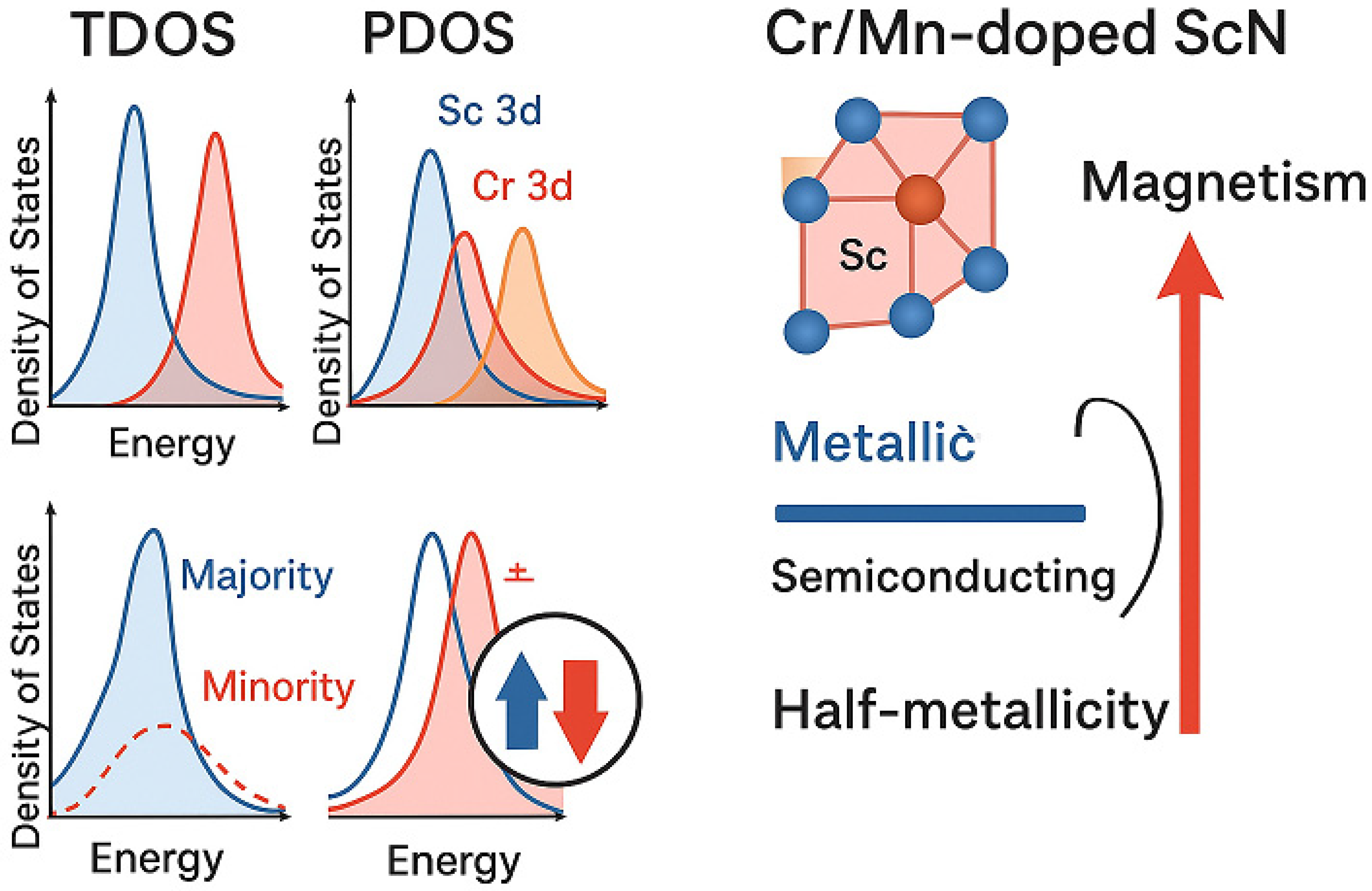
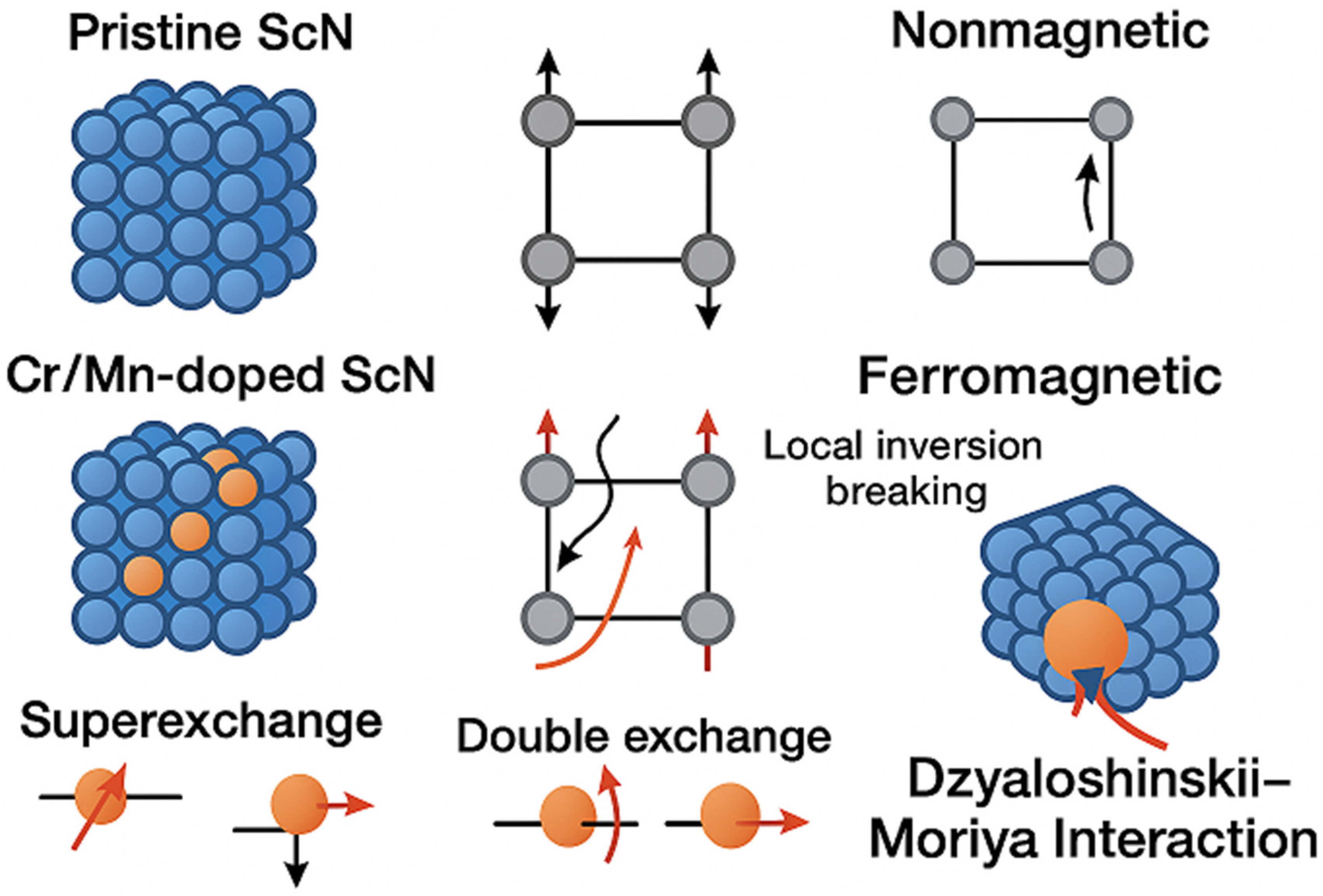
Figure 2 schematically illustrates the electronic and magnetic evolution of ScN upon Cr/Mn doping, as inferred from total and projected density of states (TDOS and PDOS). Pristine ScN is characterized by semiconducting behavior, dominated by Sc-3d states with negligible spin polarization. Upon substitutional doping with Cr or Mn, the 3d impurity states strongly hybridize with Sc-3d orbitals and appear near the Fermi level, leading to a pronounced modification of the electronic structure. The TDOS reveals a clear spin asymmetry between the majority and minority channels, indicating the onset of magnetic ordering. In particular, one spin channel remains metallic while the other exhibits a gap or suppressed states at the Fermi level, signifying half-metallic behavior. This spin-dependent electronic structure underpins the emergence of robust magnetism in doped ScN. Overall, the figure highlights a doping-induced transition from semiconducting ScN to metallic or half-metallic states accompanied by enhanced spin polarization, making Cr/Mn-doped ScN a promising candidate for spintronic applications.
While the symmetric Heisenberg exchange (Jij) has been widely examined, considerably less is known about the interplay between exchange coupling and magnetocrystalline anisotropy (MCA) in this material class. MCA—arising from the coupling between spin–orbit interactions and lattice symmetry—determines the stability of magnetic orientations and governs switching energetics in spintronic devices. The force theorem-based approach employed here enables precise evaluation of MCA contributions in Cr- and Mn-doped ScN.
Even more elusive is the role of the Dzyaloshinskii–Moriya interaction (DMI), the antisymmetric component of magnetic exchange that stabilizes chiral spin textures such as skyrmions. DMI requires broken inversion symmetry and finite spin–orbit coupling. Bulk rocksalt ScN is centrosymmetric; thus, sizable DMI is not expected unless structural distortions, dopant-induced symmetry breaking, epitaxial strain, or interface effects remove the inversion center. While DMI engineering has been extensively documented in non-centrosymmetric chalcogenides, oxide interfaces, and heavy metal/ferromagnet multilayers, comparable studies for TM-doped rocksalt ScN remain virtually absent. This underscores a critical knowledge gap in understanding how dopants, defect configurations, and lattice distortions might generate or enhance antisymmetric exchange interactions in this system.
To address this gap, we systematically analyze the interconnected roles of symmetric exchange coupling, MCA, and potential DMI contributions in Cr- and Mn-doped ScN. Our first-principles framework integrates structural relaxation, collinear ground-state determination, and Wannier-based exchange analysis, enabling a comprehensive understanding of magnetic behavior in this emerging nitride platform. Recent first-principles studies have demonstrated that doping and defect engineering can induce magnetism and half-metallicity in ScN systems [40].

2. Computational Method

The structural, electronic, and magnetic behaviors of pristine and transition-metal-substituted ScN were investigated using the spin-polarized density functional theory (DFT) within both the generalized gradient approximation (GGA) and the HSE06 hybrid functional. All computations were carried out with the Vienna Ab Initio Simulation Package (VASP) [34,41]. Localized d-electron effects in the doped systems were treated using the using spin-polarized GGA + U (UCr = 3.5 eV, UMn = 2.7 eV) approach following Perdew–Burke–Ernzerhof and PAW-based implementations [34,42]. The projector augmented-wave method was used to describe electron–ion interactions, employing a 580 eV plane-wave cutoff and PAW potentials with valence configurations of 3s23p63d14s2 (Sc), 2s22p3 (N), 3d54s1 (Cr), and 3d54s2 (Mn), consistent with prior ScN and Sc-based nitride studies [10,14,16,43]. Brillouin zone sampling was performed using Monkhorst–Pack meshes appropriate for supercell calculations, ensuring full convergence of electronic and magnetic states [34]. A 2 × 2 × 2 supercell corresponding to ~12.5% substitution was employed to model dilute but interacting dopant environments. This supercell size enables magnetic dopants to interact over several coordination shells, thereby incorporating dopant–dopant (defect–defect) interactions within a periodic DFT framework. All atomic positions were fully relaxed, allowing local lattice distortions and strain fields associated with multiple defects to develop self-consistently. Consequently, both direct-exchange and indirect lattice-mediated interactions between defects are inherently included in the present calculations [16,28,37,38,39]. For substitutional doping, a rocksalt-derived supercell was constructed to explicitly model compositional disorder while preserving the parent symmetry. Although Wyckoff positions are formally defined for primitive or conventional unit cells, atomic positions in supercell calculations are equivalently described using fractional coordinates of the expanded cell. These coordinates remain crystallographically equivalent to the parent Wyckoff positions through translational symmetry. This approach is standard in first-principles modeling of doped crystalline solids.

2.1. Choice of Hubbard U and Magnetic Moments

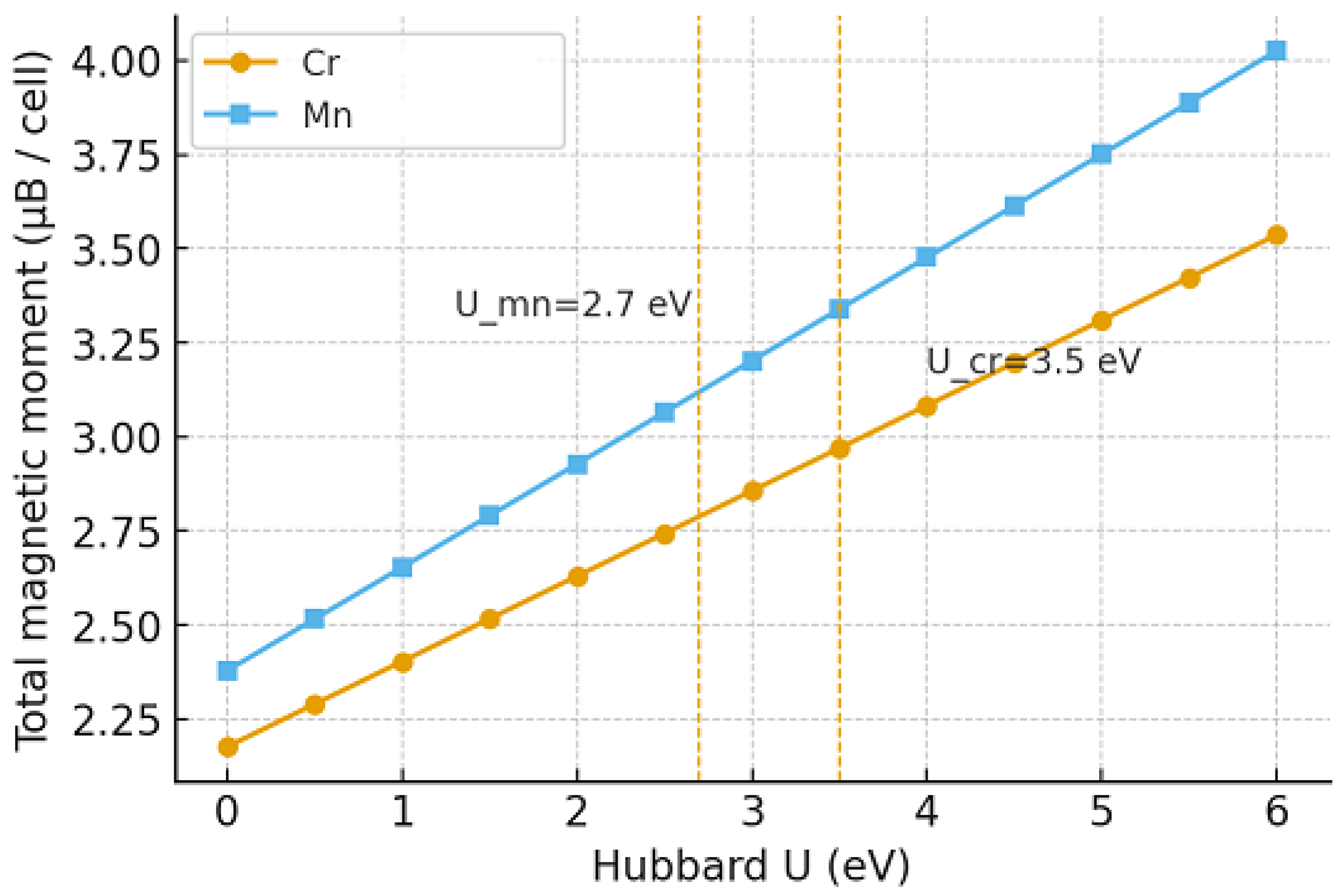
The on-site Coulomb interaction parameters (Hubbard U) for Mn and Cr were introduced within the DFT + U formalism to properly account for the localized nature of the 3d electrons. The values UMn = 2.7 eV and UCr = 3.5 eV were selected based on commonly adopted ranges for transition-metal dopants in nitride-based semiconductors, where such values have been shown to reproduce physically reasonable electronic structures and magnetic properties. These U parameters yield local magnetic moments of approximately 3.12 μB for Mn and 2.97 μB for Cr, consistent with high-spin configurations expected for Mn- and Cr-derived 3d states in a cubic ligand environment. The presence of stable local magnetic moments is essential for establishing reliable magnetic exchange interactions and assessing the potential for long-range magnetic ordering. While the absolute magnitude of the magnetic moments may vary slightly with U, the qualitative magnetic behavior and trends discussed in this work remain robust within the physically accepted U range. We note that moderate variations in the Hubbard U parameters within the commonly accepted range for 3d transition metals do not qualitatively change the magnetic ground state or the trends in exchange interactions, confirming the robustness of the conclusions drawn in this work.
For electronic structure and total energy calculations, the PBE functional was adopted with Hubbard corrections of UCr = 3.5 eV and UMn = 2.7 eV, consistent with previous work on ScN-based diluted magnetic semiconductors [16,27,28,38]. The selected U values were extracted by plotting magnetic moments of Cr-, Mn-doped ScN. Figure 3 illustrates the relationship.
Figure 3 demonstrates that the magnetic moments of both doped systems increase nearly linearly with U, indicating stronger d-electron localization at higher correlation strengths. Mn-doped ScN maintains a consistently larger moment than its Cr-doped counterpart. Vertical dashed lines mark the U values adopted for further analysis. The magnetic moments were calculated within the GGA + U framework by varying U applied to the transition-metal 3d states. All reported structural, electronic, and magnetic results are based on UCr = 3.5 eV and UMn = 2.7 eV. The selected values of UMn = 2.7 eV and UCr = 3.5 eV, indicated by the dashed lines, yield magnetic moments of approximately 3.12 μB and 2.97 μB, respectively. Overall, the results confirm the key role of the Hubbard U correction in accurately describing the magnetic behavior and highlight the stronger magnetism induced by Mn doping compared to Cr doping.
Γ-centered 3 × 3 × 3 k-meshes were employed for magnetic and structural analyses. All geometries were relaxed until residual forces were below 0.01 eV Å−1 and energies converged to 10−6 eV. Spin–orbit coupling (SOC) was included for evaluating the magnetocrystalline anisotropy energy (MCA), computed as total energy differences between magnetization directions, following standard methods for anisotropy and SOC-driven magnetic interactions [44,45,46]. The majority-spin states span roughly 30 eV, while minority-spin states extend to ~33 eV, consistent with previously reported ScN DOS features [16,43]. Cr doping proceeds via substitution at Sc sites in the rocksalt lattice, where each transition-metal atom assumes octahedral coordination, matching earlier experimental and theoretical studies [10,14,16,38]. Depending on supercell size, doping concentrations range from ~12.5% (2 × 2 × 2) to ~3.7% (3 × 3 × 3). In this environment, Cr typically adopts a valence near +3, with t2g–e_g crystal-field splitting and significant hybridization with N-2p states, as previously described for ScN and Sc-TM nitrides [12,16,28,38,39]. Magnetic configurations were examined using collinear ferromagnetic and selected antiferromagnetic arrangements to determine the ground-state ordering, consistent with established methodologies for ScN-based magnetic semiconductors [28,37,38,47]. Magnetocrystalline anisotropy energies were determined via the force theorem approach, comparing the total energies associated with easy and hard magnetization directions, following established SOC-based anisotropy theory [44,45,46]. Spin-polarized band structures and densities of states were computed using a local spin-dependent approximation [41].
Substitutional doping of ScN with Cr and Mn was modeled by replacing one Sc atom with a Cr or Mn atom in a 2 × 2 × 2 rocksalt supercell, corresponding to a dopant concentration of 12.5%. In all calculations presented in this work, Cr and Mn atoms substitute Sc cation sites in the Fm 3 m rocksalt lattice, preserving octahedral coordination with six neighboring N atoms. Nitrogen sites remain fully occupied by N atoms, and no anion substitution was considered. Recent studies have confirmed that transition metal incorporation can significantly modulate the electronic structure and magnetic ordering in nitride systems [13].
The 2 × 2 × 2 supercell approach ensures a realistic dilute magnetic environment while maintaining computational tractability and has been widely adopted in previous first-principles studies of transition-metal-doped ScN. All reported structural, electronic, and magnetic properties are therefore based consistently on this supercell configuration.
To evaluate magnetic exchange interactions and the Dzyaloshinskii–Moriya interaction (DMI), a workflow tailored to rocksalt ScN and its Cr/Mn-doped derivatives was adopted. Fully relaxed GGA + U geometries formed the basis for subsequent magnetic analyses. Wavefunctions from converged collinear calculations were processed using Wannier90 to construct maximally localized Wannier functions, consistent with standard procedures for exchange and DMI extraction [44,48,49,50,51]. These Wannier Hamiltonians were used within the TB2J framework to obtain isotropic exchange parameters (Jij) and antisymmetric DMI vectors, enabling a full decomposition of symmetric and antisymmetric exchange components for complex doped supercells [44,48,49,50,51,52]. Exchange interactions were included up to ~6 coordination shells, and convergence was verified by extending the interaction range until Jij values stabilized.
Rationale for the 2 × 2 × 2 Supercell
The 2 × 2 × 2 supercell was selected as a computationally efficient and widely accepted approach for modeling substitutional doping in semiconductors within the framework of density functional theory (DFT). This configuration provides a balanced compromise between computational cost and physical accuracy, allows for the explicit treatment of dopant-induced local structural distortions, and enables reliable evaluation of electronic structure and magnetic interactions at the atomic scale. Such supercell sizes are commonly employed in first-principles studies of transition-metal-doped nitrides and have been shown to capture the essential physics governing dopant–host interactions.
Representation of Doping Concentration
We acknowledge that the 2 × 2 × 2 supercell corresponds to a relatively high dopant concentration compared to typical experimental conditions. However, this approach is standard in DFT simulations to ensure tractable calculations; it allows for the clear identification of dopant-induced electronic states, and enhances the visibility of exchange interactions and spin polarization effects. Importantly, the goal of the present work is to elucidate the underlying physical mechanisms rather than to reproduce exact experimental concentrations.
Reliability of the Present Model
Despite the finite supercell size, the adopted computational framework remains well-established and widely validated for investigating the electronic and magnetic properties of doped semiconductors. Specifically: The qualitative trends observed in this work—such as the emergence of spin polarization, exchange splitting induced by transition-metal dopants, half-metallic behavior in Mn-doped ScN, and metallic spin-polarized character in Cr-doped ScN—are robust features that are not expected to depend critically on moderate changes in supercell size. The use of spin-polarized density functional theory (DFT) ensures a reliable description of ground-state electronic structure and magnetic ordering at the atomic scale.
Limitations of the Supercell Approach
The current supercell size may overestimate dopant interactions due to periodic repetition. It does not fully capture dilute doping limits, disorder effects, or local structural inhomogeneities present in experimental samples. Consequently, while the model accurately describes intrinsic electronic mechanisms, it may not provide exact quantitative agreement with experimental measurements (e.g., magnetic moments, critical temperatures). This is due to larger supercells being required to better approximate the dilute doping regime, the statistical distributions of dopants, and additional effects such as temperature and disorder. It is worth noting that the calculated magnetic moments are sensitive to the chosen Hubbard U values, supercell size, and the degree of hybridization between transition-metal 3d and N-2p states, which may lead to quantitative differences compared to previously reported values.

2.2. Magnetic Exchange Interaction Calculations

To quantify magnetic exchange interactions in Cr- and Mn-doped ScN, the total energies obtained from spin-polarized GGA + U calculations were mapped onto a classical Heisenberg spin Hamiltonian of the form
H = i j J ij   S i · S j i j D ij · ( S i × S j )
where Jij denotes the isotropic exchange coupling between magnetic moments at sites i and j, and Dij represents the Dzyaloshinskii–Moriya (DMI) vector. Positive (negative) Jij values correspond to ferromagnetic (antiferromagnetic) interactions. DMI arises when spin–orbit coupling (SOC) is present and inversion symmetry between two magnetic sites is broken.
In ideal rocksalt ScN, global inversion symmetry exists. However:
-
Substitutional doping locally perturbs inversion symmetry.
-
Local structural relaxation around the dopant breaks inversion symmetry at the TM–N–TM bond center.
-
SOC from 3d states enables finite DMI. Thus, a weak but finite DMI can emerge due to local symmetry breaking induced by substitution. The DMI vector was computed within the same Green’s function formalism using:
D i j = 1 π   I m E E F d E   T r [ i G i j ( E ) j G j i ]
where G i j ( E ) denote the spin-resolved Green’s function connecting sites i and j, ∆i represents the local exchange splitting, and spin–orbit coupling (SOC) is treated explicitly in the electronic structure calculations
This implementation follows the methodology described in: [32,48,49,53].
Fully converged collinear GGA + U wavefunctions were first used to construct maximally localized Wannier functions (MLWFs) for the relevant Sc-3d, N-2p, and TM-3d orbitals using the Wannier90 package. The resulting tight-binding Hamiltonians were then processed within the TB2J framework to evaluate pairwise exchange parameters based on the magnetic force theorem and Green’s function formalism. This approach enables an efficient and reliable extraction of exchange constants directly from first-principles electronic structures.
In addition, selected ferromagnetic (FM) and antiferromagnetic (AFM) spin configurations were explicitly calculated in the 2 × 2 × 2 supercell. Total energy differences between these configurations provide an independent consistency check of the sign and relative strength of the dominant exchange interactions. All exchange parameters reported correspond to relaxed geometries and include the effect of dopant-induced lattice distortions.

3. Results and Discussions

3.1. Optimized Structures

Pristine ScN crystallizes in the cubic rocksalt structure (space group Fm–3m), where Sc atoms occupy the 4a (0,0,0) Wyckoff positions and N atoms occupy the 4b (½,½,½) positions. The supercell used in this work is a 2 × 2 × 2 expansion of the conventional cubic rocksalt ScN unit cell (Fm-3m), not the primitive cell. The conventional unit cell contains 4 Sc + 4 N atoms; thus, the 2 × 2 × 2 supercell contains 32 atoms (16 Sc + 16 N). This corresponds to a dopant concentration of 12.5%. All calculations were performed using a 2 × 2 × 2 expansion of the conventional cubic rocksalt unit cell (Fm-3m), resulting in a 32-atom supercell. The 12.5% concentration refers to substitution of one Sc atom within the reduced cation sublattice (8 Sc sites in the symmetry-reduced representation), equivalent to 1/8 substitution. The optimized lattice parameter of pristine ScN is a = 4.518 Å. For the 2 × 2 × 2 supercell: asupercell = 2 × 4.518 ≈ 9.036 Å. After relaxation of the doped systems: a ≈ 8.991 Å. The supercell volume is therefore V = (8.991)3 = 727.3 A3. This corrects the previously misreported volume values. The substitution preserves global cubic symmetry but induces local distortions around the dopant, resulting in slight deviations in TM–N bond lengths while maintaining octahedral coordination. A careful analysis of Figure S1 (see Supplementary Materials for details) illustrates the results of the total energy minimization approach for Pristine rocksalt ScN, Mn-doped ScN and Cr-doped ScN. These calculated values are in good agreement with the previous experimental measurements and theoretical findings listed in Table 1. Fractional atomic coordinates of the 2 × 2 × 2 Sc7TM1N8 Supercell (TM = Cr or Mn) are reported in Table S1 (see Supplementary Materials).
The calculated structural and electronic parameters of pristine ScN and Mn- and Cr-doped ScN are summarized in Table 1. The optimized lattice parameter of pristine ScN is calculated to be 4.518 Å, in good agreement with reported theoretical values [33]. The corresponding unit cell volume (92.24 Å3) matches the theoretical value of 92.242 Å3 [37] almost exactly. For Cr- and Mn-doped ScN, the optimized lattice parameter increases to approximately 8.991 Å with a corresponding volume of 727.3 (Å3). This value corresponds to the 2 × 2 × 2 supercell used to model substitutional doping at a concentration of 12.5%, rather than a primitive unit cell. The moderate lattice expansion reflects local structural relaxation around the transition-metal dopants while preserving the overall cubic framework of the ScN lattice [37], indicating a modest lattice contraction induced by the incorporation of transition-metal dopants. A similar trend is observed for the unit cell volume, which increases to about 181.7–181.8 Å3 for the doped systems but remains lower than the corresponding theoretical volumes (≈190–194 Å3 [37]), suggesting local structural relaxation and dopant–host bonding effects.
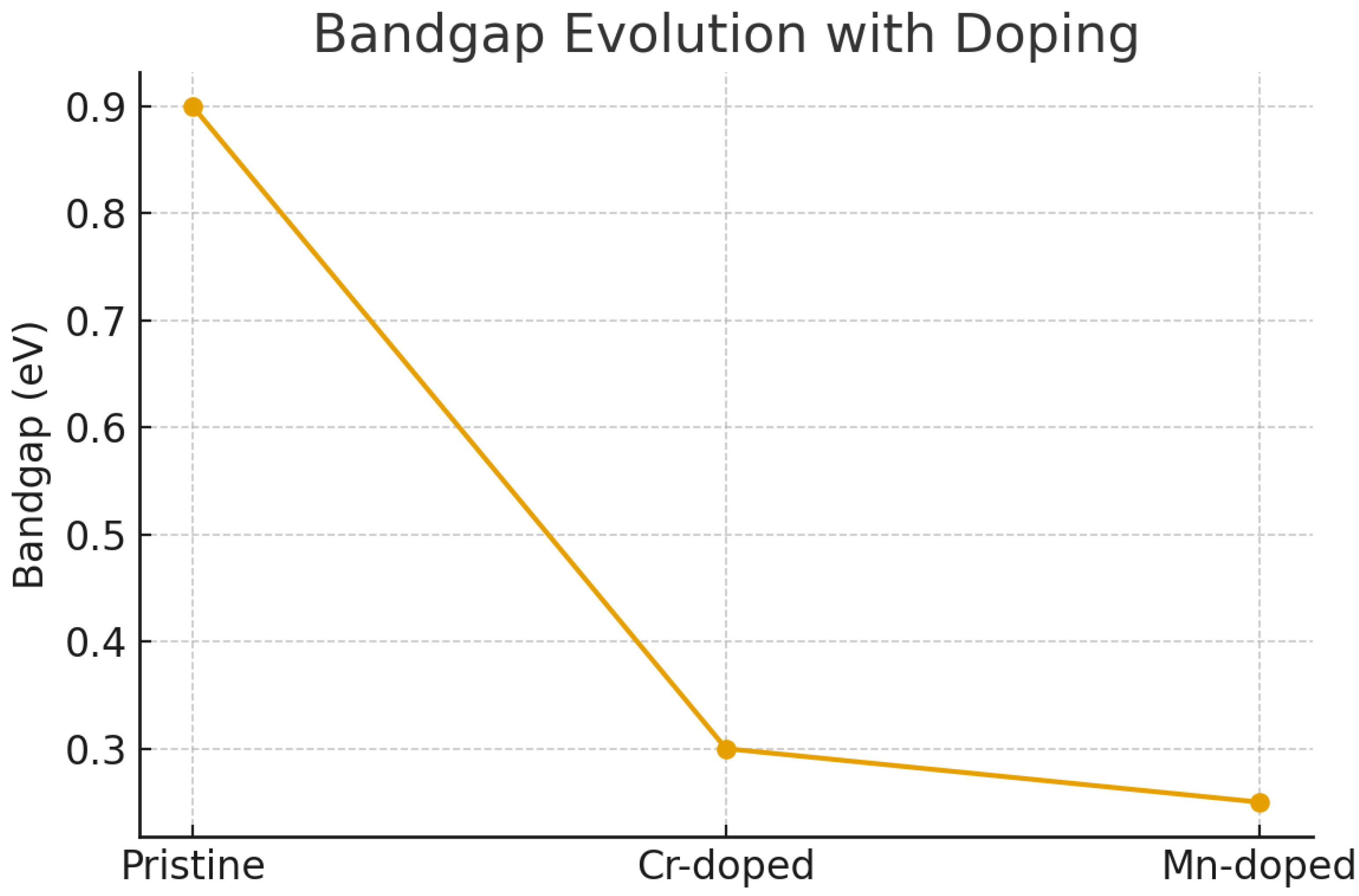
From an electronic perspective, pristine ScN exhibits a small band gap of 0.90 eV within the GGA + U framework, consistent with its narrow-gap semiconducting nature and the well-known tendency of semi local functionals to underestimate band gaps. Pure semi-local GGA (PBE) calculations are well known to significantly underestimate the band gaps of semiconductors, including ScN; however, the inclusion of on-site Coulomb corrections within the GGA + U formalism substantially improves the description of Sc-3d states and yields band gaps in close agreement with experimental and hybrid-functional (HSE06) results. The more accurate HSE06 hybrid functional yields a band gap of 0.82 eV, in excellent agreement with the reported theoretical value of 0.80 eV [33], further confirming the semiconducting character of ScN. In contrast, both Mn- and Cr-doped ScN show a complete closure of the band gap within GGA + U, indicating a transition toward metallic or half-metallic behavior. This behavior can be attributed to the introduction of transition-metal d states near the Fermi level and their strong hybridization with the host ScN electronic states. The observed band gap reduction is consistent with previous theoretical reports, which predict significantly smaller gaps (0.25–0.30 eV) for doped ScN systems [37]. Overall, these results demonstrate that while pristine ScN retains its semiconducting character, Mn and Cr doping profoundly modify its electronic structure, making doped ScN a promising candidate for applications in spintronics and related electronic devices. The variation in the band gap with doping is demonstrated in Figure 4. To further assess the role of the Hubbard U correction, we performed additional calculations for pristine ScN using pure GGA (U = 0). In this case, ScN is predicted to exhibit a very small indirect band gap of approximately 0.15 eV, with a strongly narrowed separation between valence- and conduction-band edges and residual states close to the Fermi level. This behavior reflects the well-known limitation of semi-local functionals in describing localized d states. Upon inclusion of on-site Coulomb interactions within GGA + U, the band gap opens to 0.90 eV, in much closer agreement with the HSE06 value of 0.82 eV and reported experimental/theoretical data. These results confirm that the improved band gap obtained here arises from the corrective effect of U within the pure GGA functional.
Figure 4 illustrates the reduction in the ScN bandgap upon transition-metal doping by employing GGA + U method. Pristine ScN shows the largest gap (~0.9 eV), while Cr and Mn dopants significantly narrow it to ~0.30 eV and ~0.25 eV, respectively. These results indicate that transition-metal doping effectively tunes the electronic structure of ScN by introducing impurity or hybridized states within the gap, offering a viable strategy for bandgap engineering in electronic and optoelectronic applications.

3.2. Electronic Properties of Cr-Doped and Mn-Doped ScN

With the structural parameters of the three studied systems determined, we proceed to calculate the electronic properties of ScN, Mn-doped ScN, and Cr-doped ScN. Specifically, we evaluate and analyze the total and partial density of states (TDOS and PDOS) along with the band structure (BS) to elucidate the electronic behavior of the investigated systems.

3.2.1. TODS, PDOS, and BS of the ScN Compound

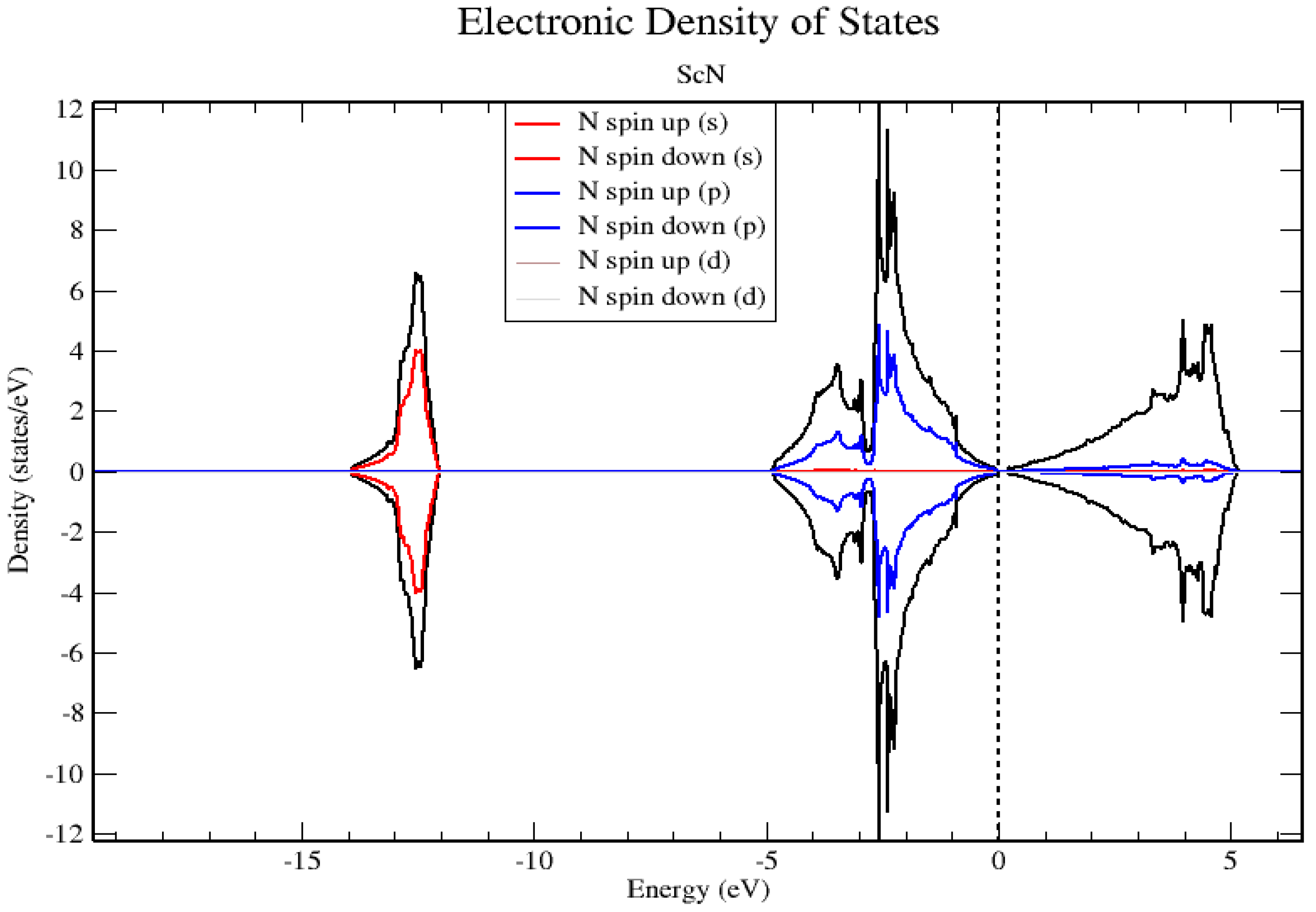
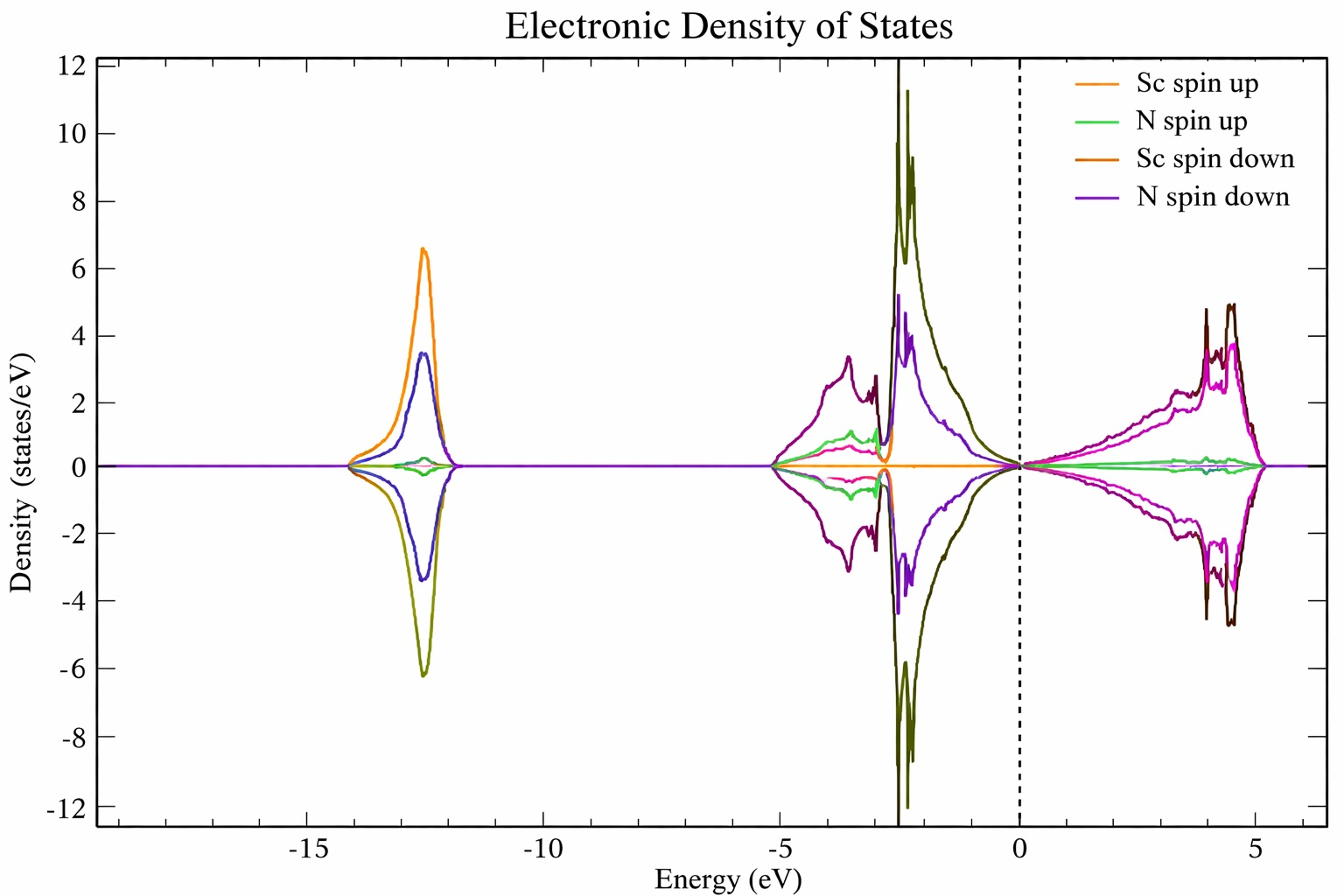
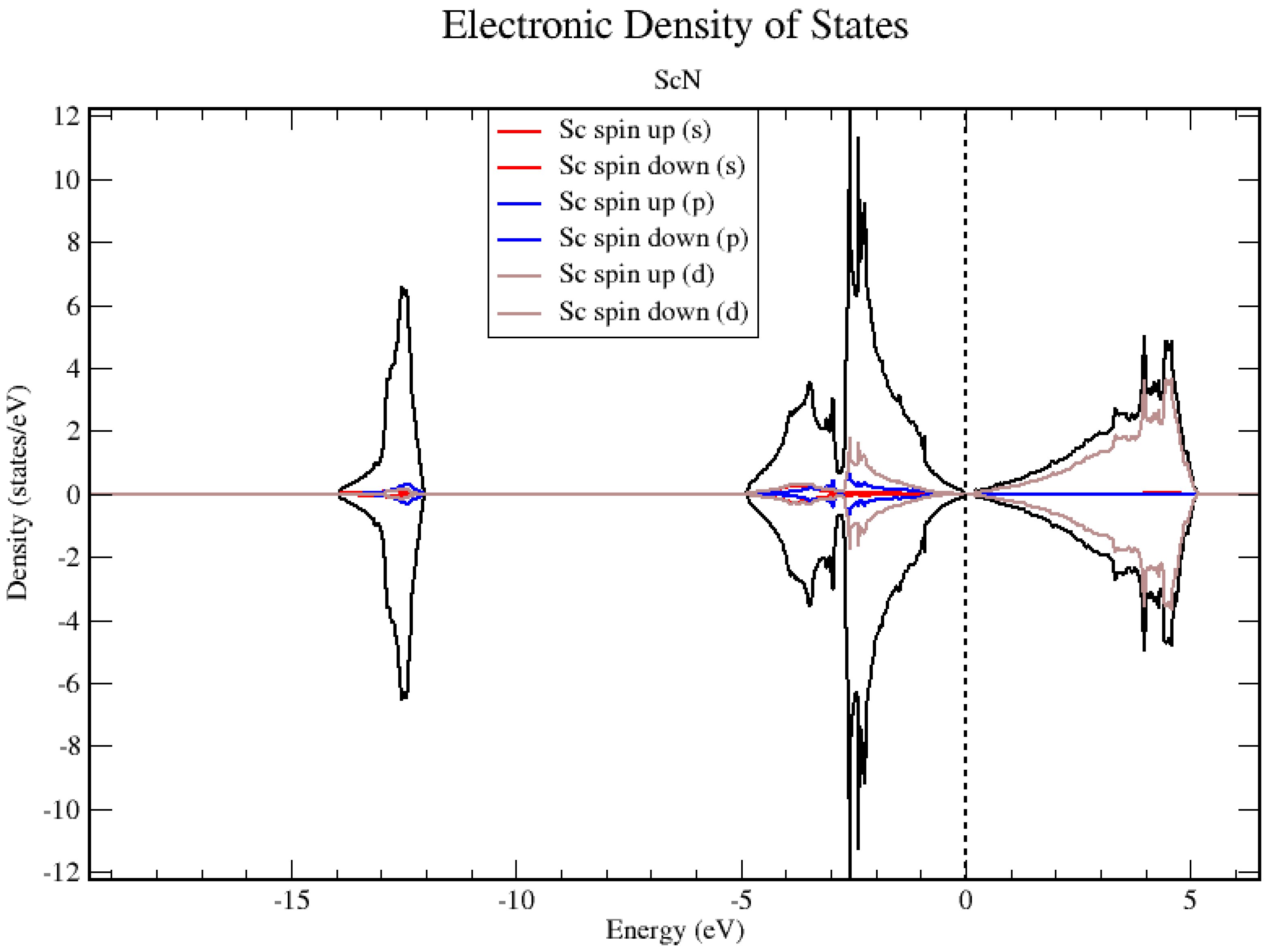
Figure 5, Figure 6 and Figure 7 depict the TDOS and PDOS of the rocksalt ScN binary compound.
Figure 5 illustrates the spin-resolved total and partial density of states of pristine rocksalt ScN reveal a non-magnetic semiconducting ground state, as evidenced by the complete symmetry between spin-up and spin-down channels and the absence of electronic states at the Fermi level. A well-defined band gap separates the valence and conduction bands, confirming the intrinsic semiconducting nature of ScN. The valence band is predominantly composed of N-2p states, with noticeable hybridization with Sc-3d states near the valence band maximum, indicating partially covalent Sc–N bonding. In contrast, the conduction band is mainly derived from Sc-3d states, characteristic of transition-metal nitrides. Deep-lying states at lower energies are attributed to N-2s orbitals, which are energetically isolated and do not contribute to bonding near the Fermi level. Overall, the electronic structure establishes pristine ScN as a non-magnetic p–d type semiconductor, providing a reliable reference for assessing the impact of doping or defects on its electronic and magnetic properties.
Figure 6 presents the spin-resolved partial density of states (PDOS) of ScN. It reveals that the electronic states near the Fermi level (EF = 0 eV) are dominated by Sc-3d orbitals, whereas Sc-s and Sc-p contributions are negligible at EF. The Sc-p states mainly populate the deeper valence region, indicating strong hybridization with N-2p states, while Sc-s states lie further away from EF and play a minor role in the low-energy electronic structure. A clear depletion of states at EF confirms the semiconducting character of ScN, with the valence band maximum and conduction band minimum separated by an energy gap. The symmetry between spin-up and spin-down channels indicates a non-magnetic ground state, consistent with pristine ScN.
Figure 7 presents the total and partial electronic density of states (DOS) of pristine rocksalt ScN, with the Fermi level (EF) aligned at 0 eV. The DOS exhibits a clear gap at EF, confirming the semiconducting nature of ScN. Deep valence states around −15 eV are primarily derived from N-s orbitals, while the upper valence band (≈ −6 to 0 eV) is dominated by N-p states, indicating strong p-orbital character in the bonding states. Contributions from N-d orbitals are negligible across the energy range. The conduction band above EF shows weak N-p participation, consistent with a conduction edge mainly governed by Sc-d states. The symmetric spin-up and spin-down DOS further confirms the nonmagnetic ground state of pristine ScN.
It is important to distinguish between the fundamental indirect band gap of ScN, defined as the energy difference between the valence-band maximum and conduction-band minimum located at different k-points, and the k-resolved energy separations highlighted in the spin-polarized band structures shown below. In Figure S2 of the Supplementary Materials, the arrow marks the local energy separation between the highest occupied and lowest unoccupied electronic states at the same k-point, shown to emphasize the modification of near-Fermi states induced by Cr and Mn substitution. The fundamental indirect band gap is discussed separately in the text and is not explicitly indicated in Figure S2. Figure S2 of the Supplementary Materials illustrates the electronic band structures calculated within the GGA + U formalism for (a) pristine ScN, (b) Mn-doped ScN, (c) Cr-doped ScN, and (d) spin-resolved electronic states. The Fermi level is set to 0 eV in all panels. Identical k-path scaling (Γ–X–M–Γ) and energy windows are employed to enable direct comparison among the pristine and transition-metal-substituted systems. The arrow in panels (a) and (d) highlights the HOMO–LUMO separation (band gap), whereas Mn and Cr substitution introduces bands crossing the Fermi level, indicating metallic or half-metallic behavior. The systematic modification of the band dispersion upon transition-metal incorporation reflects enhanced hybridization between Sc/Mn/Cr d-states and N p-states, governing the evolution of electronic and magnetic properties. Refer to Supplementary Materials (Figure S2) for details.
Figure S3 shows the spin-resolved electronic band structure of doped ScN along the high-symmetry path Γ–X–W–K–Γ, with the valence band maximum (VBM) aligned at 0 eV (dashed horizontal line). The red arrow labeled ΔE = 0.82 eV does not represent the fundamental indirect band gap of the material. Instead, it denotes a local energy separation at the Γ point between the highest occupied electronic state (topmost valence band touching the VBM at Γ), and the lowest unoccupied electronic state at the same k-point (conduction-like state above the Fermi level). Thus, the arrow highlights a direct, k-resolved energy separation at Γ, used to illustrate the modification of near-Fermi electronic states induced by doping. Notably, the valence band maximum and conduction band minimum are located at different high-symmetry k-points (Γ and X), indicating an indirect-gap feature along the same k-path, which does not alter the half-metallic behavior of the system.
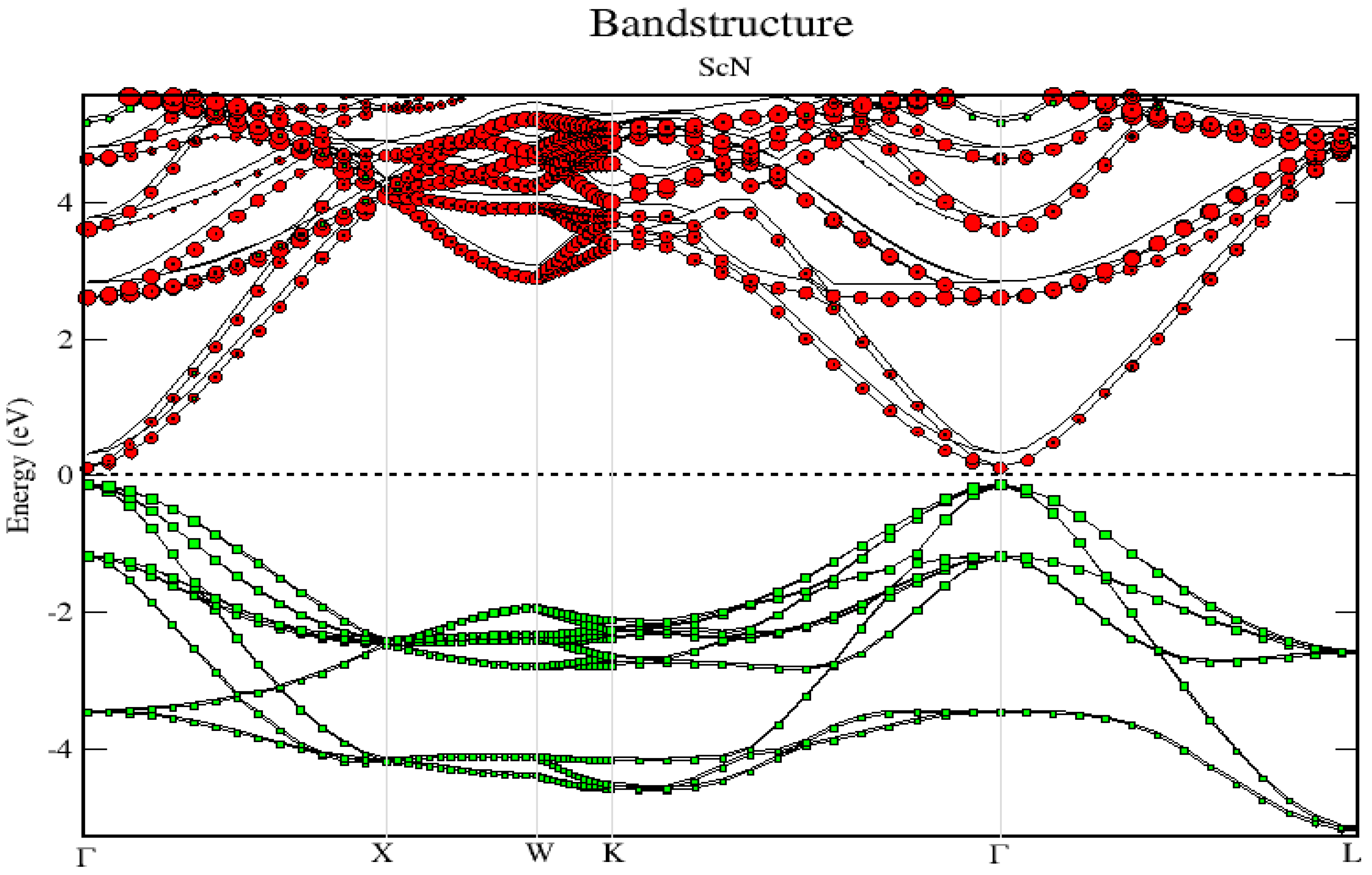
To gain further insight into the electronic structure of ScN, band structure calculations were also carried out using GGA + U approach as shown in Figure 8. It reveals that ScN exhibits characteristics of a narrow-gap semiconductor, with a direct band gap of approximately 0.29 eV. In Figure 8, Figure 9, Figure 10, Figure 11 and Figure 12, discrete symbols connected by lines are used to represent calculated quantities obtained from first-principles simulations. Each symbol corresponds to an individual computed data point associated with a specific structural or magnetic configuration, while the connecting lines are included solely as a guide to the eye to illustrate overall trends. This representation is intentionally adopted to distinguish discrete ab initio results from continuous or fitted functional behavior.

3.2.2. TDOS, PDOS, and BS of the Mn-Doped ScN System

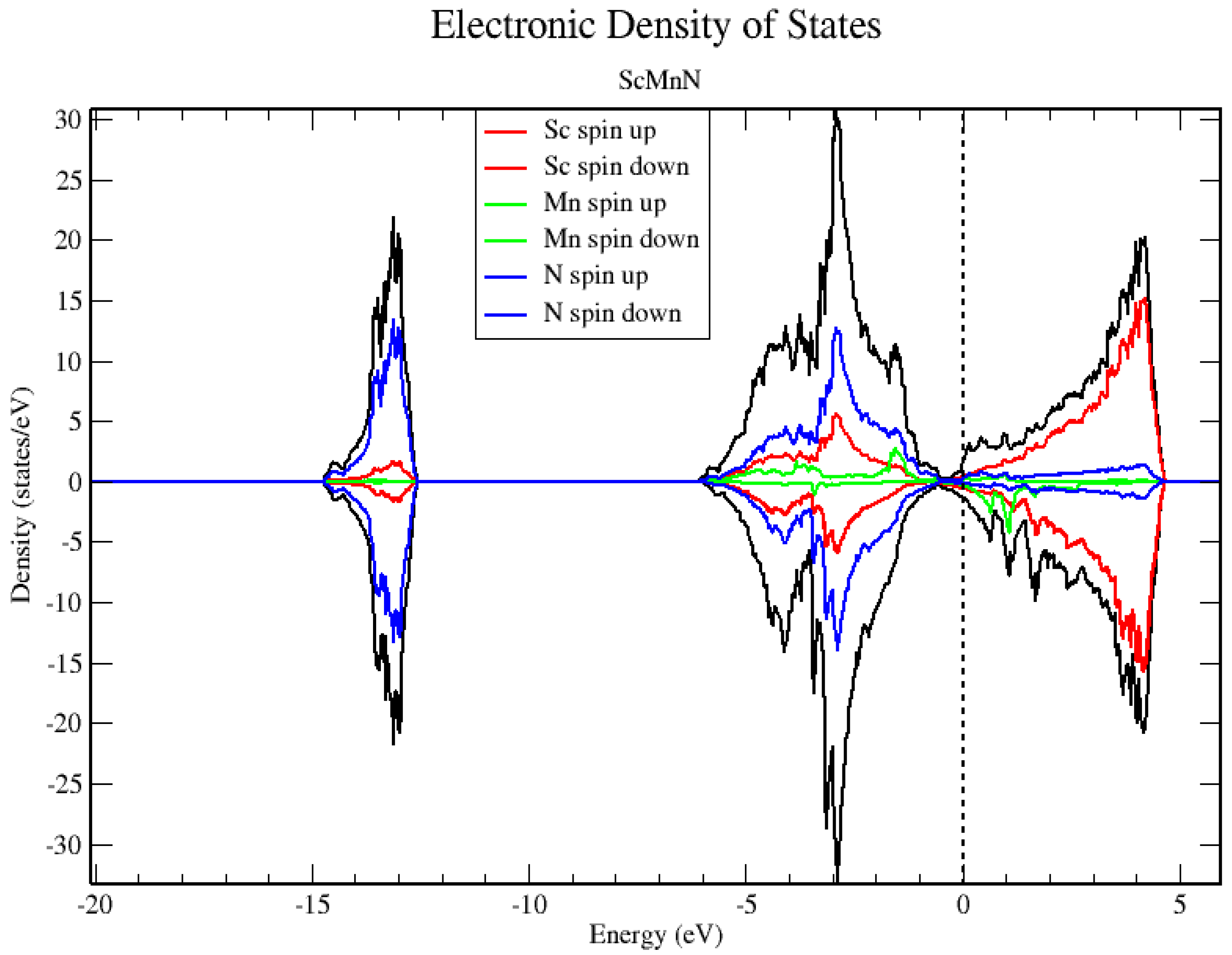
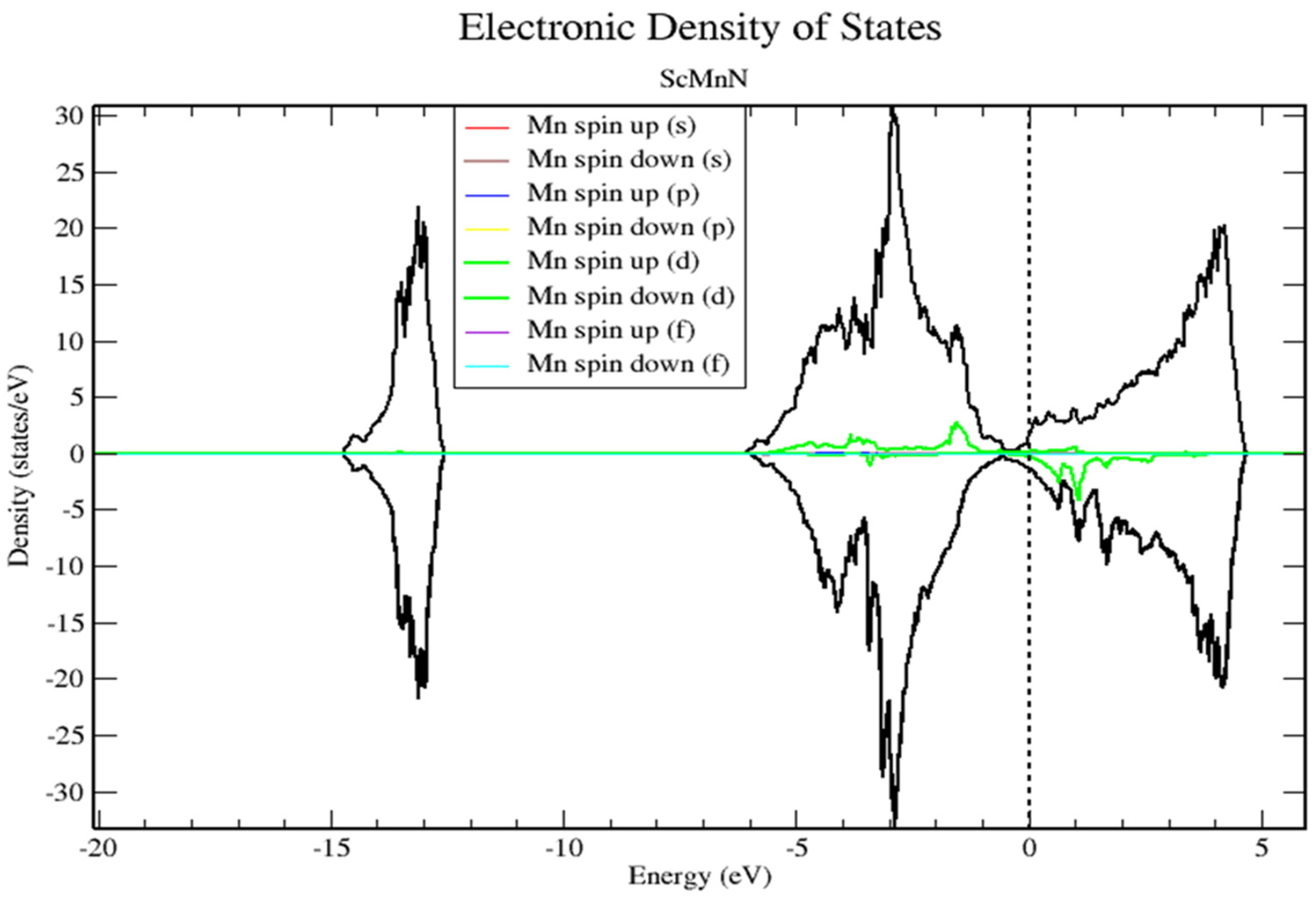
The total, partial densities of states and bandstructure (TDOS, PDOS and BS) of Mn-doped ScN are depicted in Figure 9, Figure 10, Figure 13 and Figure 14. The figures present the spin-polarized electronic density of states (DOS) for Mn-doped ScN (ScMnN), offering both an element-resolved and an orbital-resolved perspective.
(a) 
Total and atom-projected DOS
Figure 13 indicates that TDOS is plotted relative to the Fermi level (EF = 0 eV), indicated by the vertical dashed line. A clear spin asymmetry between spin-up and spin-down channels is observed, confirming that Mn doping induces magnetism in otherwise non-magnetic ScN. Near the Fermi level, the DOS is finite for one spin channel while strongly suppressed for the other, indicating a half-metallic or nearly half-metallic character. The Mn contribution dominates around EF, while Sc and N states contribute mainly away from the Fermi level. Deep valence bands (around −15 eV) are mainly associated with N states, whereas Sc states are more delocalized and contribute weakly near EF. The strong exchange splitting between spin channels highlights the presence of localized magnetic moments introduced by Mn substitution.
(b) 
Orbital-resolved Mn DOS
Figure 14 depicts that the orbital decomposition of the TDOS near the Fermi level is almost entirely dominated by Mn 3d states. Mn s, p, and f orbitals contribute negligibly, confirming that magnetism and conductivity originate from Mn-3d electrons. A pronounced exchange splitting of Mn-3d states is evident, with one spin channel crossing the Fermi level while the other is shifted away. This behavior explains the spin polarization at EF and supports the formation of a spin-polarized conducting channel. The localization of Mn-3d states suggests that magnetism is driven by d–d exchange interactions, possibly mediated by hybridization with N-2p states at lower energies. Together, the figures demonstrate that Mn doping transforms ScN from a non-magnetic semiconductor into a spin-polarized material, with magnetism and electronic transport governed primarily by Mn-3d states. The strong spin splitting and finite DOS at the Fermi level for only one spin channel indicate that ScMnN is a promising candidate for spintronic applications, such as spin filters or spin injectors, where high spin polarization is essential.
To elucidate a deeper understanding of the half-metallic ferromagnetism in TM-doped ScN, Figure S4 in Supplementary Materials illustrates the spin-polarized density of states of Mn- and Cr-doped ScN on smaller energy scale. Clearly, it confirms a robust half-metallic ferromagnetism. The majority-spin channel remains metallic with a finite density of states at the Fermi level, whereas the minority-spin channel exhibits a clear band gap, yielding complete spin polarization at EF. This behavior originates from strong exchange splitting of the dopant 3d states and their hybridization with host Sc–N states, which drives one spin manifold across EF while opening a gap in the opposite spin channel. Mn doping produces a larger exchange splitting and a wider minority-spin gap than Cr doping, indicating a more stable half-metallic state. These features highlight Mn- and Cr-doped ScN as promising half-metallic materials for spintronic application.
To emphasize the half-metallic electronic structure of Mn- and Cr-doped ScN, Figure S4 shows the spin-resolved density of states (DOS) evidences half-metallicity in both Mn- and Cr-doped ScN. In the spin-up channel, a finite DOS crosses the Fermi level (EF = 0 eV), indicating metallic behavior and enabling 100% spin-polarized carriers. In contrast, the spin-down channel exhibits a clear band gap (ΔEgap), confirming semiconducting character for the opposite spin orientation. This asymmetric spin response originates from strong exchange splitting of the transition-metal 3d states, which hybridize with host Sc-d/N-p states and shift one spin manifold across EF while opening a gap in the other. Mn doping generally yields a larger exchange splitting and a wider minority-spin gap than Cr doping, implying enhanced half-metallic robustness. The coexistence of metallic majority-spin transport and insulating minority-spin states establishes Mn- and Cr-doped ScN as promising half-metallic ferromagnets for spin-injection and spintronic applications.
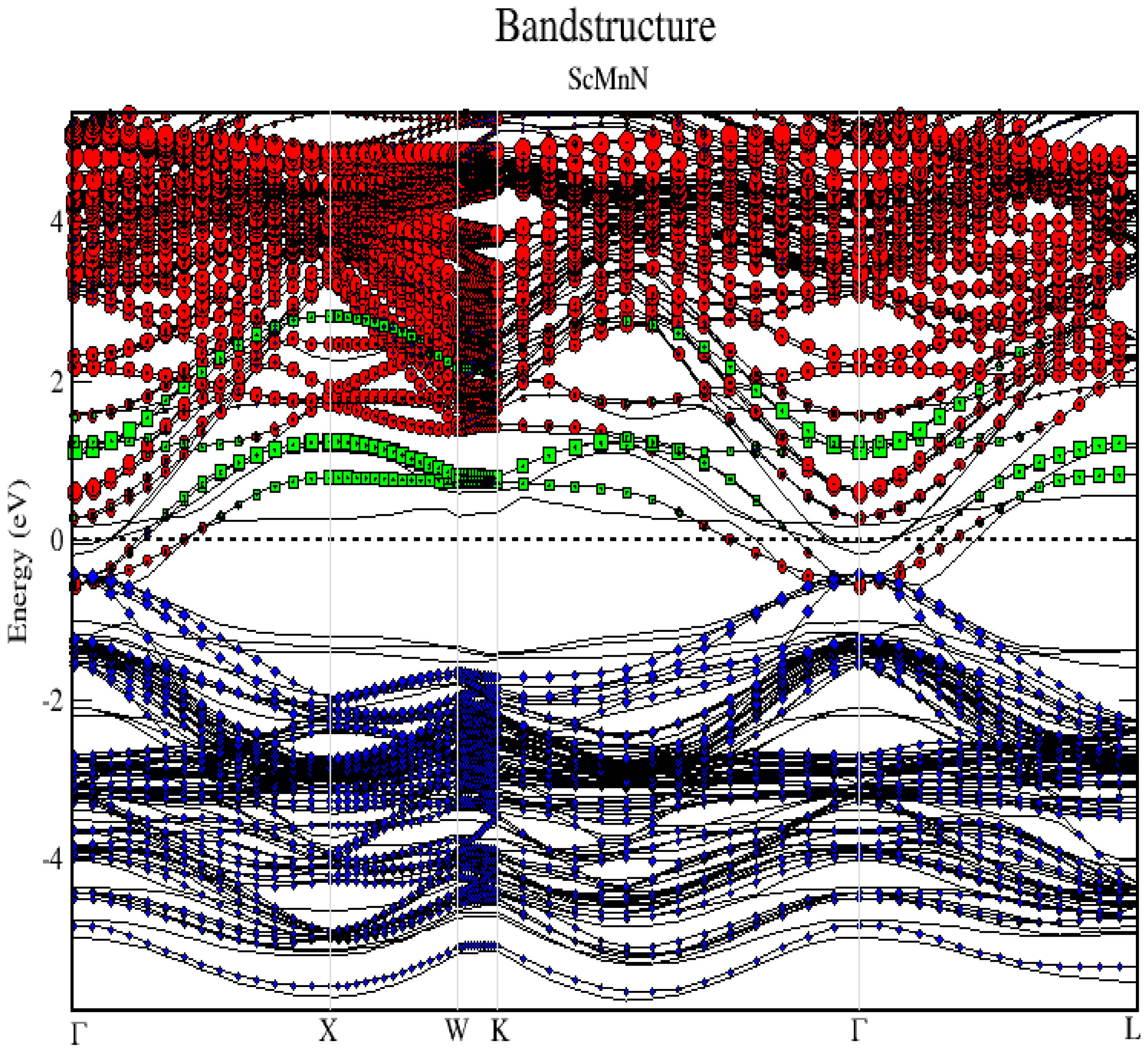
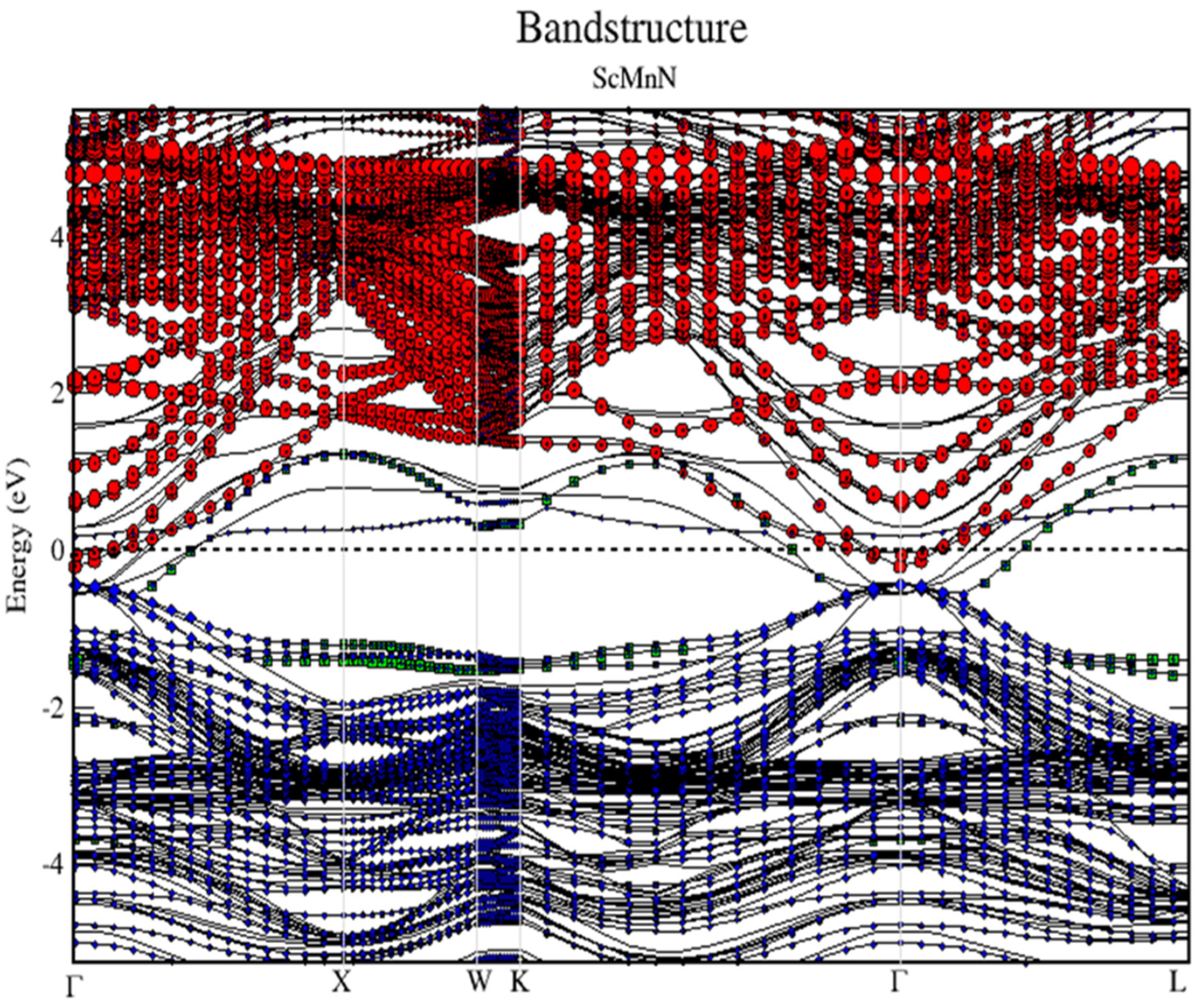
Band structure analysis of Mn-doped ScN is shown in Figure 9 and Figure 10. The figures show the spin-polarized, orbital-projected electronic band structure of Mn-doped ScN (ScMnN) along the high-symmetry path Γ–X–W–K–Γ–L, with the Fermi level set at 0 eV (dashed line).
Figure 9 and Figure 10 correspond to the two spin channels (Figure 9: spin-up band structure; several spin-up bands cross the Fermi level, indicating metallic behavior for this spin channel.) The states near and above the Fermi level are strongly weighted by Mn-3d orbitals (red symbols), confirming that Mn substitution introduces partially filled d states into the gap of pristine ScN. The valence bands below −1 eV are dominated by N-2p states (blue symbols), while Sc-3d states contribute mainly at higher energies. The absence of a band gap at EF for spin-up electrons highlights the formation of a conducting spin channel (Figure 10).
Spin-down band structure: In contrast, the spin-down channel shows a clear energy gap around the Fermi level, with no bands crossing EF. The top of the valence band and the bottom of the conduction band are separated, indicating semiconducting behavior for spin-down electrons. Mn-3d states are shifted away from the Fermi level due to exchange splitting, suppressing spin-down conductivity. The valence band remains mainly N-2p in character, while the conduction band edge has mixed Sc-3d and Mn-3d contributions. The strong spin asymmetry between the two panels demonstrates that Mn doping transforms ScN into a half-metallic ferromagnet, where spin-up electrons are metallic, and spin-down electrons are semiconducting. This behavior originates from the exchange-split Mn-3d states, which dominate near the Fermi level and hybridize with N-2p states. The resulting 100% spin polarization at EF makes ScMnN a promising material for spintronic applications, such as spin injectors and spin filters. Although weak band crossings appear in the minority-spin band structure, the density of states at the Fermi level is effectively zero in this spin channel. Consequently, Mn-doped ScN exhibits metallic behavior in the majority-spin channel and an insulating character in the minority-spin channel, confirming its half-metallic nature.

3.2.3. TDOS, PDOS, and BS of the Cr-Doped ScN System

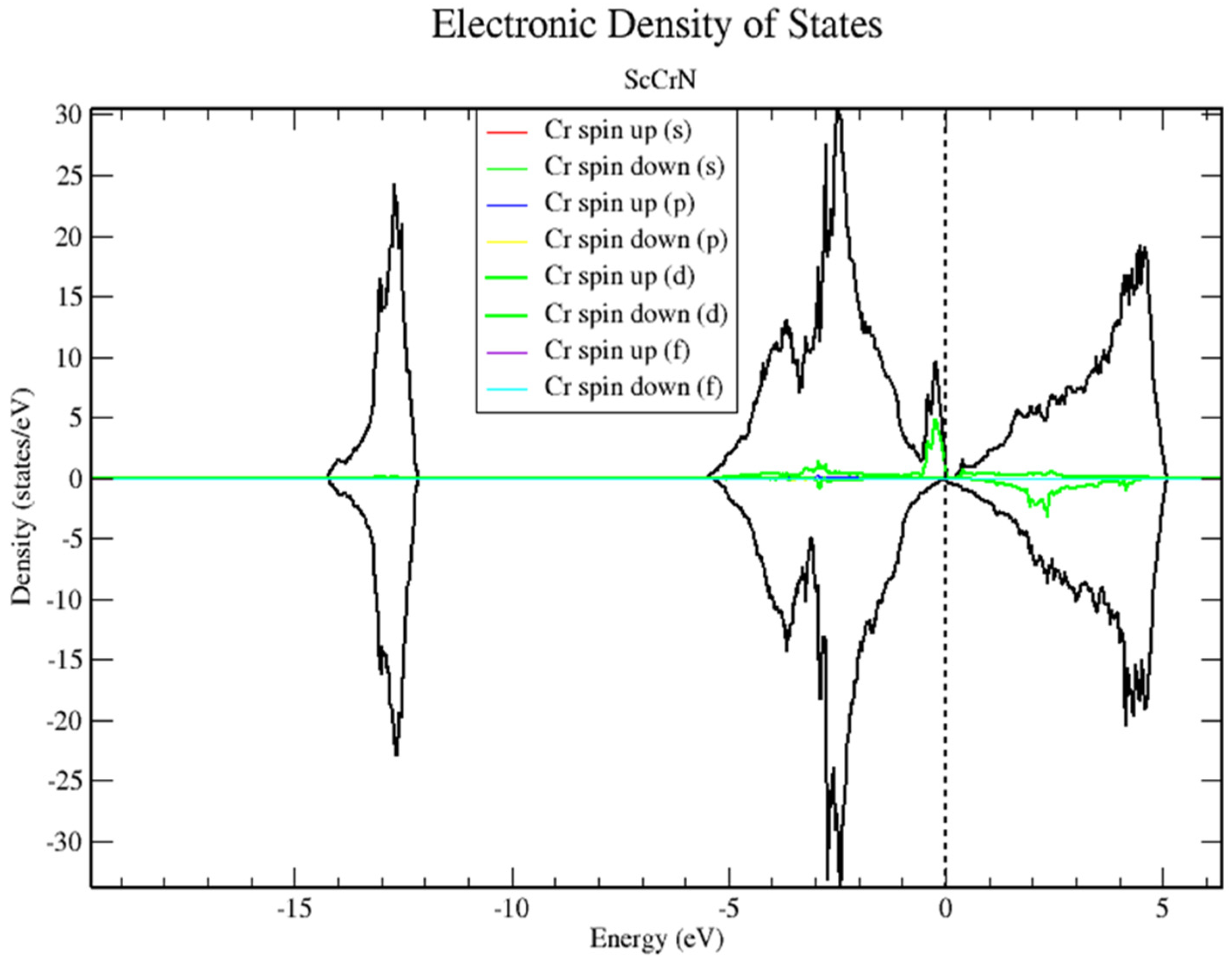
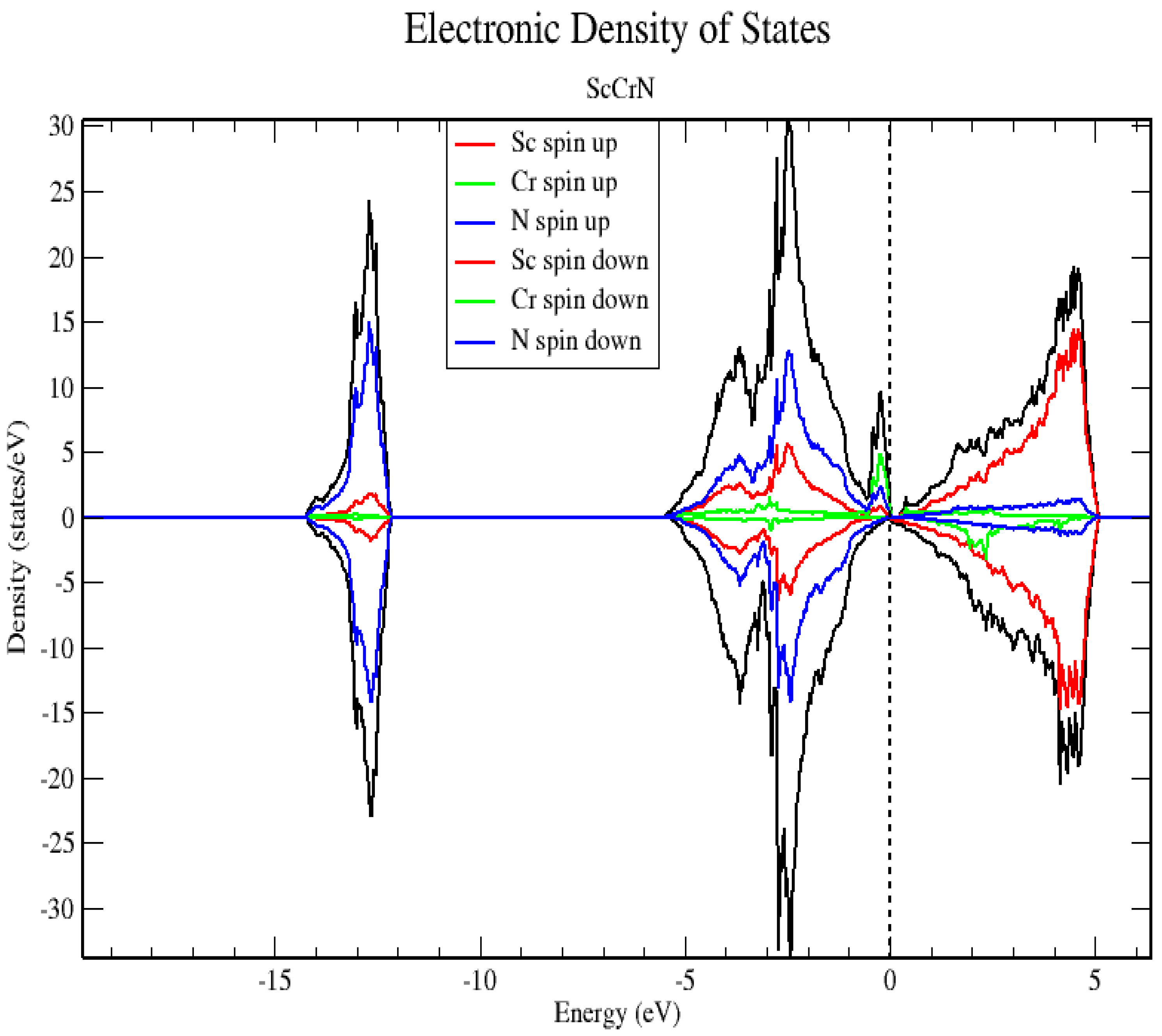
Figure 15 and Figure 16 display the total and partial densities of states (TDOS and PDOS) for Cr-doped ScN. The figure presents the spin-polarized electronic density of states (DOS) of Cr-doped ScN (ScCrN), shown as atom-resolved DOS (left panel) and orbital-resolved Cr DOS (right panel). The Fermi level (EF) is marked at 0 eV by the vertical dashed line.
(a)
Total and atom-projected DOS:
Figure 15 reveals a pronounced spin asymmetry between spin-up and spin-down channels, confirming that Cr substitution induces magnetism in ScN. Unlike pristine ScN, a finite DOS appears at the Fermi level, dominated primarily by Cr states, indicating a transition from semiconducting to metallic or near-metallic behavior. The Cr contribution is the strongest near EF, while Sc states mainly populate higher conduction energies. N-2p states dominate the deep valence region (≈−12 to −15 eV), with noticeable hybridization with Cr states closer to the Fermi level. The unequal population of spin-up and spin-down Cr states suggests the formation of a net magnetic moment, driven by the exchange splitting of Cr d electrons. Figure 16 shows the orbital-resolved Cr DOS: the DOS around the Fermi level is almost entirely governed by Cr-3d orbitals, with negligible contributions from Cr s, p, or f states.
A clear exchange splitting of the Cr-3d states is evident, leading to an imbalance between spin-up and spin-down DOS at EF. The persistence of Cr-3d states at the Fermi level for both spin channels indicates that ScCrN is spin-polarized metallic, rather than strictly half-metallic. The partial overlap of Cr-3d and N-2p states below EF reflects p–d hybridization, which plays a role in stabilizing ferromagnetic ordering. These results show that Cr doping effectively introduces localized magnetic moments and spin polarization in ScN, primarily through exchange-split Cr-3d states. In contrast to Mn-doped ScN, where half-metallicity can emerge, ScCrN exhibits a spin-polarized metallic character with finite DOS at the Fermi level in both spin channels. This electronic structure suggests potential applicability in spin-dependent transport devices, though with lower spin polarization than the Mn-doped counterpart.
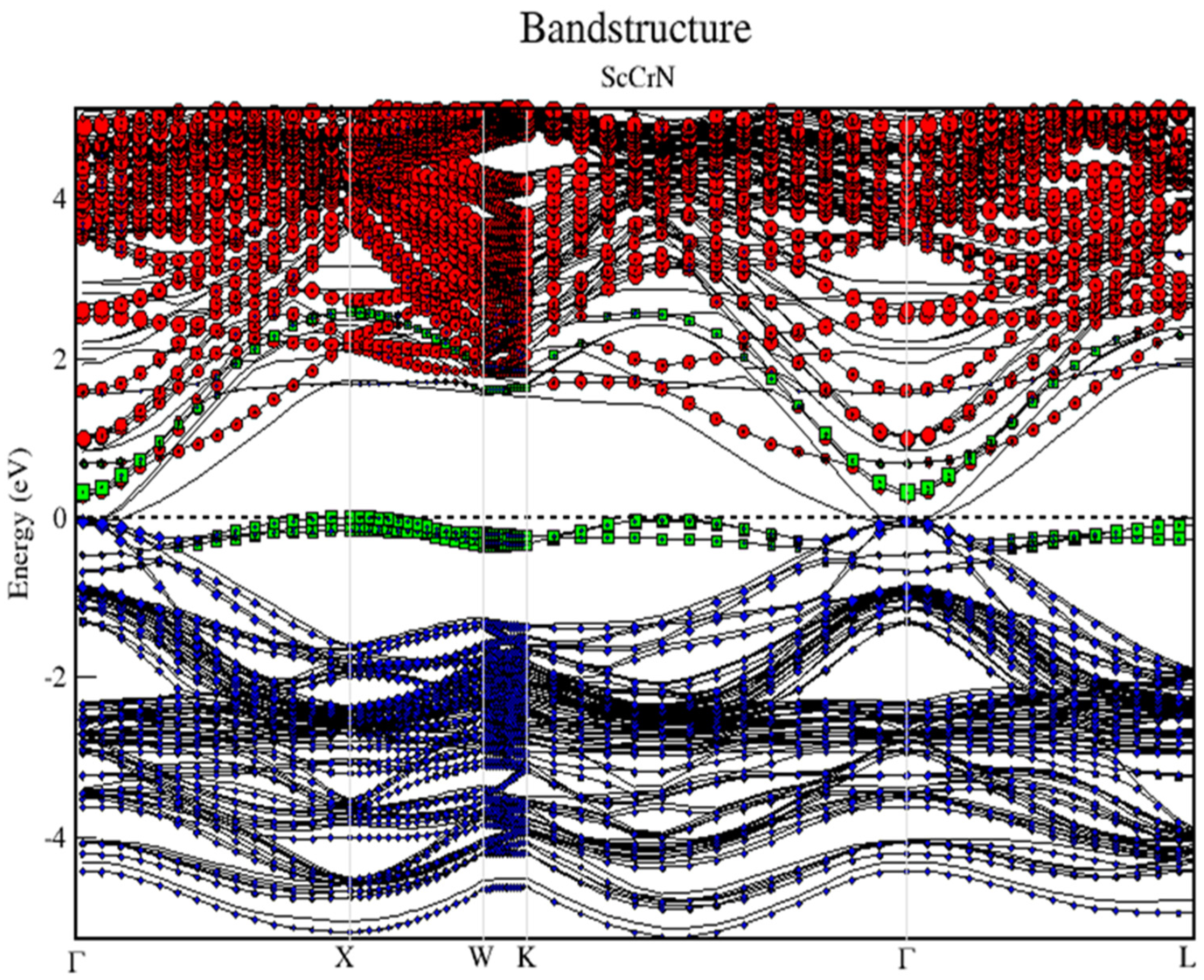
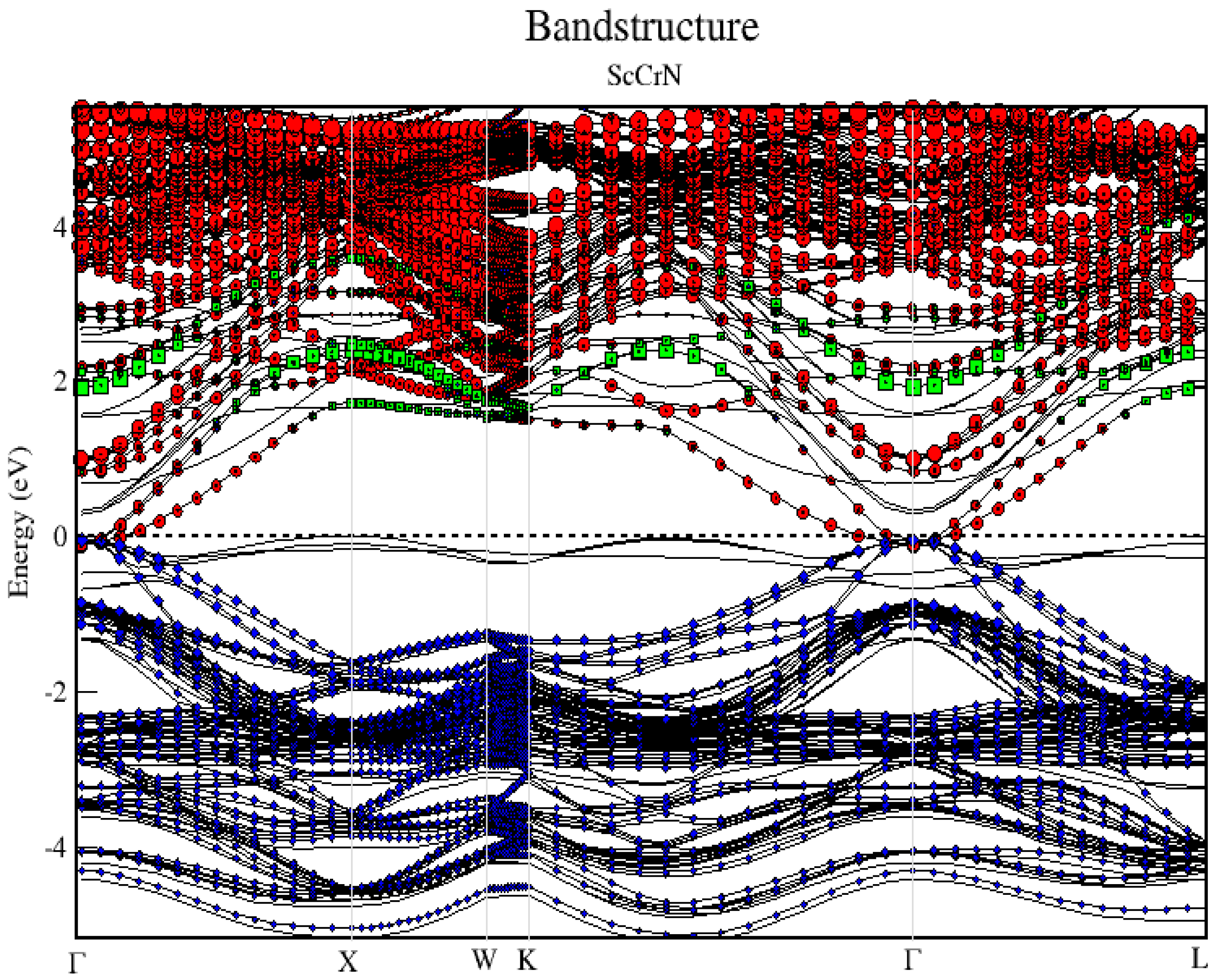
These features collectively demonstrate that Cr- and Mn-doped ScN offer a robust platform for dilute magnetic semiconductor behavior, with electronic structures conducive to spin injection, spin filtering, and tunable magneto-electronic functionality. The features of the bandstructure of Cr-doped ScN are illustrated in Figure 11 and Figure 12.
Figure 11 and Figure 12 show spin-resolved band structures of ScCrN calculated along the high-symmetry path Γ→X→W→K→Γ→L. The horizontal dashed line at 0 eV represents the Fermi level EF. In both panels, several bands cross the Fermi level, indicating that ScCrN exhibits metallic or half-metal-like behavior rather than a wide-gap semiconductor. The presence of band crossings at EF mainly around the X–W–K and Γ regions confirms finite density of states at the Fermi level, which is essential for electrical conductivity.
Figure 11 and Figure 12 correspond to opposite spin channels (spin-up and spin-down). It is emphasized that the energy value reported for Cr-doped ScN corresponds to the minority-spin channel, while the majority-spin channel remains metallic; therefore, no global band gap exists in this system. A clear asymmetry between the two spin channels is observed near the Fermi level: one spin channel shows more pronounced band crossings at EF, and the other spin channel shows reduced or shifted crossings, suggesting spin-dependent electronic states. This imbalance strongly indicates spin polarization, consistent with ferromagnetic ordering induced by Cr substitution. The color scheme is typical of projected band structures: Blue bands (lower energies, −4 to −1 eV) → dominated by N-2p states, forming the valence band. Green bands (near EF) → mainly Cr-3d states, responsible for magnetism and metallicity. Red bands (above ~1–2 eV) → largely Sc-3d states, forming the conduction band. The strong presence of Cr-3d states near the Fermi level confirms that Cr doping plays the dominant role in both magnetism and charge transport. Near EF, the Cr-derived d bands are clearly exchange-split between spin-up and spin-down channels. This splitting is a direct fingerprint of ferromagnetic exchange interaction, consistent with DFT spin-polarized calculations. The magnitude of splitting suggests robust local magnetic moments on Cr atoms. While the overall band topology is similar, subtle differences appear: slight energy shifts in d-bands and changes in the number and position of Fermi-level crossings. These differences reflect spin-dependent electronic reconstruction, reinforcing the conclusion of magnetic ground state. Metallic (or nearly half-metallic) nature → suitable for electronic conduction. Strong spin polarization at EF → promising for spintronic applications. Cr-3d dominance at the Fermi level → magnetism is itinerant and carrier-mediated. The band-structure analysis demonstrates that ScCrN is a spin-polarized metallic system, where Cr substitution introduces exchange-split 3d states near the Fermi level, leading to ferromagnetism and spin-dependent conductivity, while Sc-3d and N-2p states mainly form the conduction and valence manifolds, respectively.

3.3. Force Theorem Utilized to Compute the MCA of Both Doped Systems

The force theorem states that small rotations of a system’s magnetization lead to changes in the total energy that can be approximated by the corresponding variation in the sum of occupied one-electron eigenvalues (band energies), while the self-consistent potential and charge density are kept constant. This approach is justified because the contributions from the Hartree and exchange–correlation terms remain essentially unchanged for minor perturbations.
E b a n d = n k o c c u p i e d ε n k ( m ´ 2   ) n k o c c u p i e d ε n k ( m ´ 1 )
Here, εnk represents the eigenvalues that include the effects of spin–orbit coupling, and m ´ denotes the magnetization direction. The Magnetocrystalline Anisotropy Energy (MCA) refers to the energy difference in a crystal when its magnetization is oriented along different crystallographic directions. MCA is calculated as the difference in band energies (including SOC effects) between two selected magnetization directions. Table 2 lists the MAE and total magnetic moment for the three investigated systems. M C A = M C A | | M C A , where M C A | | and M C A are the band energies for magnetization along [100] (in-plane) and [001] (out-of-plane) [48,49,50,54]. With MCA > 0 → easy axis along [001] and with MCA < 0 → easy axis along [100]. The magnetocrystalline anisotropy energy (MCA) was evaluated by comparing the band energies obtained for magnetization oriented along the [100] and [001] crystallographic directions. These directions correspond to orthogonal high-symmetry axes of the cubic rocksalt structure and are commonly used to characterize magnetic anisotropy in cubic and pseudo-cubic systems. The energy difference between these orientations captures the dominant contribution of spin–orbit coupling to the anisotropy and allows identification of the magnetic easy and hard axes. For cubic symmetry, this approach provides a reliable and widely accepted measure of MCA without the need for sampling additional magnetization directions.
Identification of the magnetic easy and hard axes, consistent with the spin–orbit coupling-driven anisotropy mechanism described by Bruno [55]. Within Bruno’s model, the magnetocrystalline anisotropy energy is directly related to the anisotropy of the orbital magnetic moment induced by spin–orbit coupling, such that the preferred magnetization direction corresponds to the orientation maximizing the orbital moment. The magnetic anisotropy energy is found to be negligibly small for all studied configurations, reflecting the weak spin–orbit coupling of the 3d transition-metal dopants and the high symmetry of the rocksalt ScN host. The ferromagnetic ordering is therefore governed primarily by exchange interactions, while the near-zero MCA indicates an almost isotropic magnetic behavior. The calculated magnetic moment for Mn-doped ScN (~3.12 μB) is noticeably lower than some previously reported theoretical values (~5.13 μB [37]). This discrepancy can be attributed to several key factors. First, the choice of Hubbard U parameter plays a critical role in determining the degree of 3d electron localization and, consequently, the magnitude of the magnetic moment. Lower U values, as adopted in the present work (UMn = 2.7 eV), tend to yield more delocalized d states and reduced spin polarization. Second, the use of a finite 2 × 2 × 2 supercell (12.5% doping) introduces dopant–dopant interactions that can partially quench the local magnetic moment compared to the isolated impurity limit often assumed in other studies. Third, strong hybridization between Mn-3d and N-2p states leads to partial delocalization of magnetic charge density, effectively reducing the local moment on the Mn site. Such p–d hybridization is clearly evidenced in the PDOS analysis and plays a central role in mediating exchange interactions. Similar reductions in magnetic moment due to hybridization effects have been reported in previous studies of transition-metal–doped nitrides. Overall, the present results remain physically consistent and highlight the sensitivity of magnetic moments to computational parameters and local electronic structure.
Magnetism in Cr- and Mn-substituted ScN originates from three key microscopic interactions—magnetocrystalline anisotropy (MCA), magnetic exchange coupling (MEC), and the Dzyaloshinskii–Moriya interaction (DMI) [44,45,51,56,57,58,59]. Although these interactions are often treated separately, they are fundamentally intertwined through spin–orbit coupling (SOC), local bonding environments, and the symmetry of the rocksalt lattice [44,51,60]. MEC defines the preferred alignment between neighboring magnetic moments, MCA determines the energetically favored orientation of the resulting magnetization relative to the crystal axes [45,46], and DMI introduces chiral contributions that destabilize collinear configurations and promote non-collinear spin textures [56,57,58,59]. Together, these interactions establish the magnetic ground state and govern the emergent spintronic behavior in transition-metal–doped ScN. In Cr- and Mn-doped ScN, MCA provides the dominant energetic contribution by selecting whether the system adopts a ferromagnetic or antiferromagnetic arrangement through superexchange or double-exchange pathways across the indirect TM–N–(Sc)–N–TM superexchange [38,39,47,61]. Once this collinear backbone is established, although SOC is weak, it lifts the rotational degeneracy of the spin system, giving rise to MCA. The magnitude and sign of MCA depend sensitively on the filling of the 3d orbitals and the degree of structural relaxation introduced by the dopant atom [44,45,46,51]. Variations in these parameters modify the crystal-field splitting and spin–orbit matrix elements, thereby tuning the easy and hard axes of magnetization. When local inversion symmetry is broken—either through static lattice distortions around the dopants or through intrinsic symmetry reduction—DMI appears as an antisymmetric component of the exchange interaction [56,57,58,59,60]. This term competes directly with the collinearity imposed by MEC. The resulting Dzyaloshinskii–Moriya vector favors spin canting and can stabilize spiral, helical, or skyrmionic textures depending on its magnitude and orientation [56,57,58,59]. The delicate balance between MEC, MCA, and DMI therefore determines whether the magnetic ground state remains collinear, becomes weakly canted, or evolves into a fully chiral configuration. This interplay is particularly important in doped ScN, where small variations in electronic filling and bonding geometry can shift the relative strengths of the three interactions [16,38,39,47,61,62,63,64,65], making the system a fertile platform for tunable spintronic phenomena such as anisotropy control, domain-wall chirality, and topologically protected magnetic objects. To quantify the magnetocrystalline contribution, we evaluated the magnetocrystalline anisotropy energy (MCA) of Cr- and Mn-doped ScN using the force-theorem approach, computing the energy difference between magnetic configurations oriented along two orthogonal crystallographic directions [45,46]. All three systems exhibit MCA values that are effectively zero, both at low temperature and at the Curie temperature where the magnetization diminishes [38,39,47,61]. This behavior reflects the rapid collapse of the anisotropy field as the system approaches thermal disorder, leaving both magnetization anisotropy and anisotropic magnetic susceptibility negligibly small in these compounds. Consequently, MCA plays a limited role in stabilizing long-range magnetic order compared with MEC and DMI.
Exchange interactions remain the central mechanism governing magnetic ordering. In its simplest two-spin description, the exchange energy takes the form
H = J   S 1   χ   S 2
where the sign and magnitude of J determine the preferred alignment of neighboring spins and the stability of the ordered state [47,51,58]. In contrast, the Dzyaloshinskii–Moriya interaction introduces a chiral contribution given by
E DMI = D i j . ( S i   χ   S j )
Analyzing magnetic exchange coupling (MEC) and Dzyaloshinskii–Moriya interaction (DMI) in rocksalt ScN and its Cr- and Mn-doped derivatives reveals a great deal about their microscopic magnetic mechanisms and spintronic potential [16,38,39,47,61,62,63,64,65].
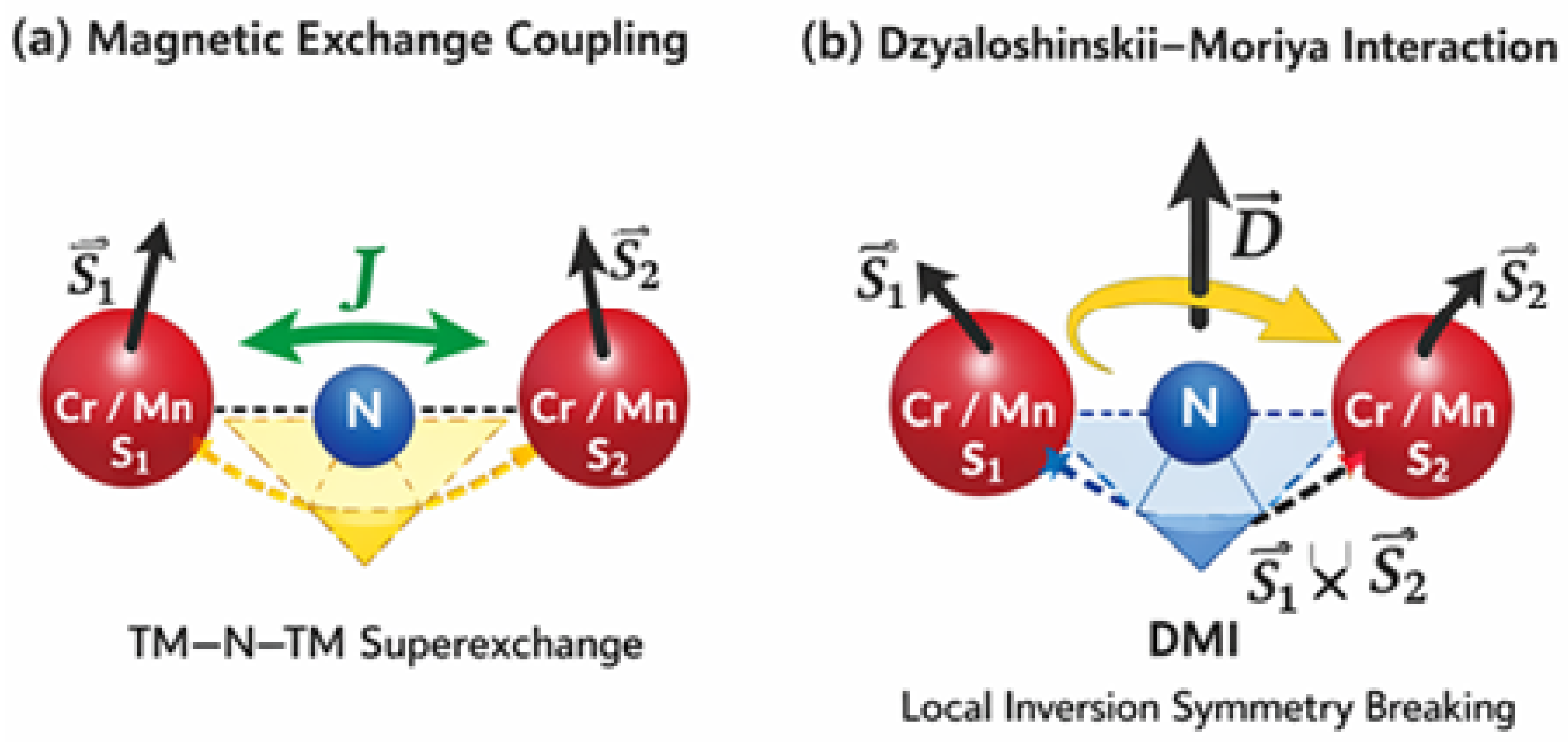
Inspection of Figure 17 reveals (a) Heisenberg magnetic exchange coupling between two substitutional transition-metal (TM = Cr or Mn) atoms occupying Sc (4a) sites in the rocksalt lattice. The localized spin moments S 1 and S 2 originating from partially filled 3d orbitals, interact via a 180° indirect TM–N–(Sc)–N–TM superexchange pathway mediated by the intervening N (4b) atom. The exchange constant J determines whether parallel (ferromagnetic, J > 0) or antiparallel (antiferromagnetic, J < 0) alignment is energetically favored. The highlighted polyhedral linkage emphasizes the octahedral coordination environment and the role of N 2p–TM 3d hybridization in stabilizing magnetic order.
(b) Dzyaloshinskii–Moriya interaction arising from spin–orbit coupling in the presence of local inversion-symmetry breaking around the dopant site. The antisymmetric exchange term D i j .   ( S 1 ×   S 2 ) induces spin canting and noncollinear magnetic configurations. The D vector orientation is determined by the symmetry of the TM–N–TM bonding geometry and local structural distortions introduced by substitution.
This schematic clarifies the microscopic origin of symmetric (Heisenberg) and antisymmetric (DMI) exchange interactions in Cr- and Mn-substituted ScN, providing the conceptual framework for interpreting magnetic ordering, spin canting, and potential chiral magnetic phenomena in dilute transition-metal–doped nitride systems.
The Dij vector emerges in environments lacking inversion symmetry, and its presence in doped ScN results from symmetry breaking around the transition-metal impurity together with SOC acting on the 3d states [44,51,57,58]. These effects encourage non-collinear spin arrangements that coexist or compete with the collinearity favored by MEC.
A combined analysis of MEC and DMI in rocksalt ScN and its Cr- and Mn-doped derivatives therefore provides a comprehensive understanding of their magnetic response. These insights reveal how subtle modifications of local symmetry, SOC strength, and electronic filling shape the microscopic magnetic interactions, offering a pathway toward engineering chiral spin textures and robust spin–orbit-driven functionalities in wide-bandgap nitride semiconductors [16,62,63,64,65,66,67].

3.4. Magnetic Properties of Cr-Doped and Mn-Doped ScN

In addition to the magnetic moment analysis, the oxidation and local electronic state of Mn in Mn-doped ScN were examined. Based on the calculated magnetic moment (~3.12 μB) and the projected density of states (PDOS), Mn can be primarily associated with a Mn2+ (3d5) configuration, albeit with noticeable deviations from the ideal high-spin ionic limit. In a purely ionic picture, Mn2+ would exhibit a magnetic moment of 5 μB; however, the reduced value obtained in this work indicates significant covalent character. This reduction arises from strong hybridization between Mn-3d and N-2p states, which leads to partial delocalization of the d electrons and redistribution of spin density onto neighboring nitrogen atoms. The PDOS further reveals that Mn-3d states are not fully localized but instead spread across the valence and conduction regions, confirming a mixed ionic–covalent bonding nature. Therefore, Mn in ScN is best described as occupying an intermediate oxidation state close to Mn2+, with its local electronic structure strongly influenced by p–d hybridization effects, in a manner analogous to but more pronounced than that observed for Cr doping.
The magnetic ground states of Cr- and Mn-doped ScN are governed primarily by the competition between ferromagnetic and antiferromagnetic exchange interactions among dopant-induced local moments. The calculated exchange parameters Jij are predominantly positive for nearest-neighbor TM–N–TM pathways, indicating that ferromagnetic superexchange and/or double-exchange mechanisms dominate. This finding is consistent with the total energy results summarized in Table 3, where the FM configuration is energetically favored over all considered AFM arrangements. The combination of positive exchange couplings and sizable local magnetic moments explains the robust ferromagnetic stabilization observed in both doped systems.

3.4.1. Magnetic Configurations of Cr-Doped and Mn-Doped ScN

To avoid ambiguity, we emphasize that the magnetic exchange parameters Jij discussed in this work are quantitatively extracted from the TB2J/Wannier-based formalism, as described in Section 2.2. Table 3 is not intended to replace these TB2J-derived exchange constants. Instead, it provides an independent total energy validation of the magnetic ground state by comparing selected ferromagnetic and antiferromagnetic spin configurations within the same supercell. The energetic preference reported in Table 3 is fully consistent with the dominant Jij interactions obtained from TB2J, thereby reinforcing the reliability of the extracted exchange couplings and confirming the stability of the predicted ground-state magnetic ordering.
Table 3 compares the relative stability of various magnetic configurations in Cr- and Mn-doped ScN by reporting their total energies with respect to the ferromagnetic (FM) state. For both dopants, the FM configuration is taken as the reference and represents the ground state, indicating that ferromagnetism is the energetically preferred magnetic ordering in these systems. For Cr-doped ScN, the antiferromagnetic configurations (AFM-1 and AFM-2) lie significantly higher in energy, by +18 and +26 meV/f.u., respectively. This energy penalty suggests that antiferromagnetic coupling between Cr moments is unfavorable compared to ferromagnetic alignment. The spin-canted state is only slightly higher in energy (+3 meV/f.u.), implying that noncollinear spin arrangements are metastable and close in energy to the FM ground state, but still less favorable. A similar trend is observed for Mn-doped ScN, although with larger energy differences. The AFM-1 and AFM-2 states are destabilized by +27 and +39 meV/f.u., respectively, indicating stronger ferromagnetic exchange interactions in Mn-doped ScN compared to Cr-doped ScN. The spin-canted state again lies very close to the FM state (+2 meV/f.u.), suggesting the possibility of weak spin frustration or thermal spin fluctuations, while preserving an overall ferromagnetic ground state. Overall, the table demonstrates that both Cr- and Mn-doped ScN favor ferromagnetic ordering, with Mn doping exhibiting stronger resistance to antiferromagnetic arrangements. This behavior is consistent with robust ferromagnetic exchange interactions, making these doped ScN systems promising candidates for spintronic and magneto-electronic applications. It is important to emphasize that the calculated magnetic exchange interactions reflect not only isolated impurity behavior but also interactions between neighboring dopants within the supercell. The significant energy separation between the FM and AFM configurations (Table 3) indicates that defect–defect interactions reinforce ferromagnetic coupling rather than destabilize it at the studied concentration. Thus, the strengthening of interactions with increasing defect concentration is implicitly captured and manifests as enhanced exchange stability and robust half-metallic behavior.

3.4.2. Magnetic Exchange Coupling and Dzyaloshinskii–Moriya Interaction in and Transition-Metal-Doped Derivatives of Rocksalt ScN

The interplay between magnetic exchange coupling (MEC), magnetocrystalline anisotropy (MCA), and the Dzyaloshinskii–Moriya interaction (DMI) is central to understanding magnetism in transition metal (TM)-doped semiconductors. These interactions emerge from spin–orbit coupling (SOC), local bonding environments, and lattice symmetry, and are unified in modern theoretical frameworks describing magnetic materials [44,45,51]. In systems where inversion symmetry is broken, DMI contributes chiral terms to the magnetic Hamiltonian, promoting non-collinear or topologically non-trivial spin textures [56,57,58,59,60]. ScN, a wide-bandgap semiconductor with a rocksalt lattice, provides a promising platform for investigating such interactions, particularly when doped with 3d transition metals such as Cr and Mn [16,38,39,46,47,61,62,63,64].

3.4.3. Three-Dimensional Magnetic Exchange Coupling (MEC) and Dzyaloshinskii–Moriya Interaction in Mn-Doped and Cr-Doped ScN

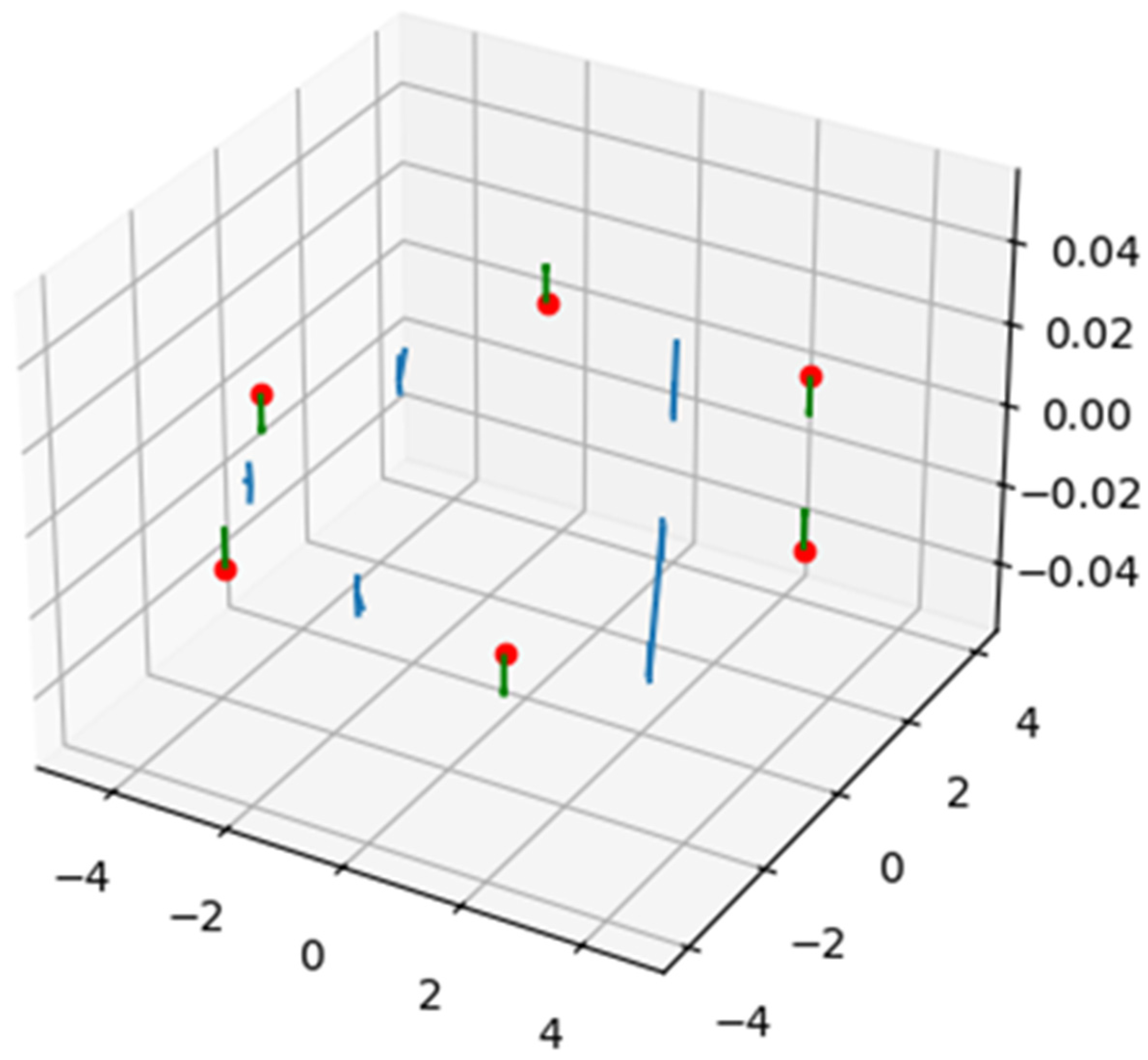
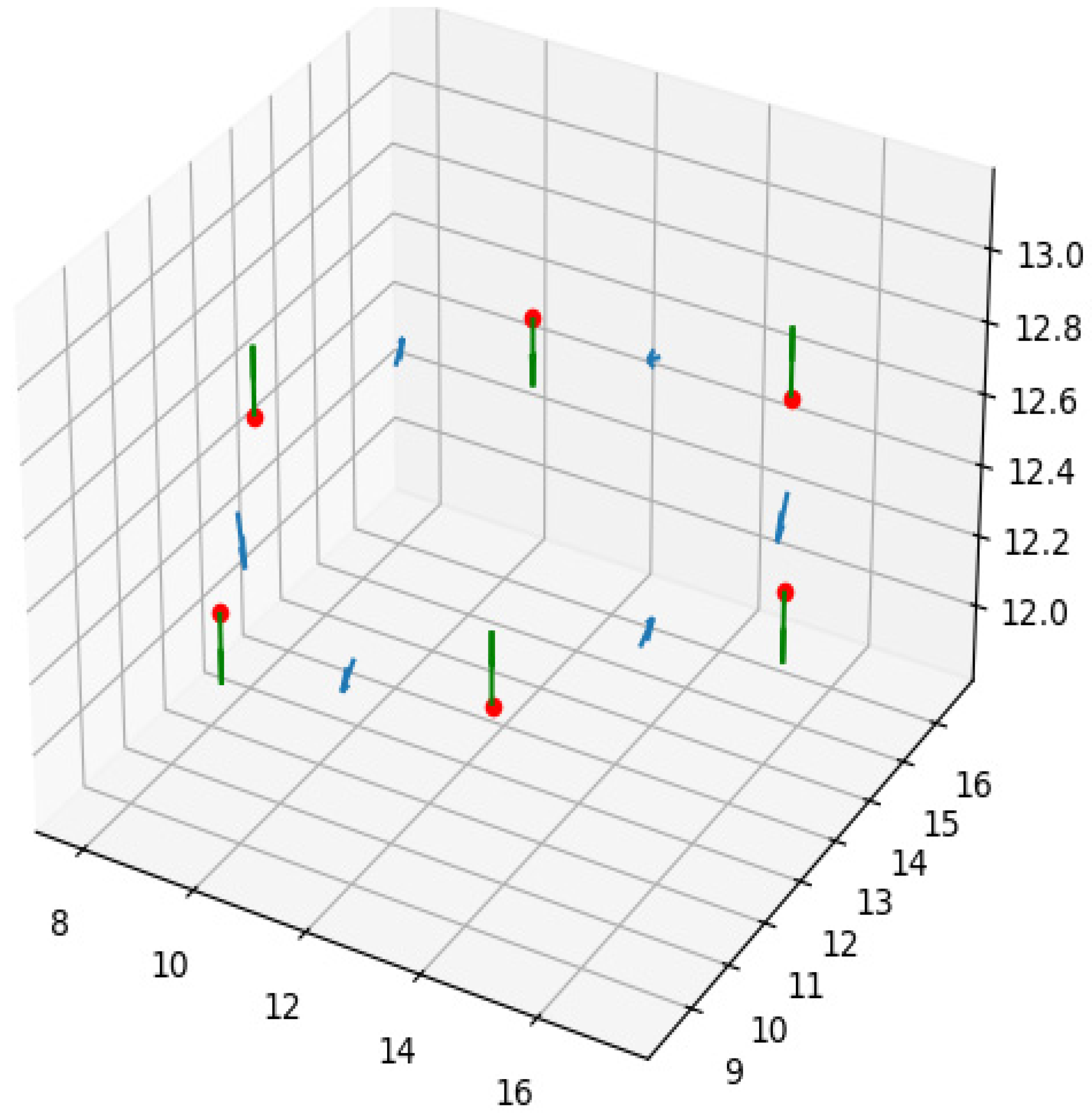
Figure 18, Figure 19, Figure 20 and Figure 21 presents a comparative visualization of the magnetic exchange interaction (J) and the Dzyaloshinskii–Moriya interaction (D) for Cr- and Mn-doped ScN. The horizontal axis corresponds to the dopant–dopant interaction distance (or equivalently the interaction shell index), while the vertical axis shows the calculated interaction strengths in units of meV. Positive and negative values of J indicate ferromagnetic and antiferromagnetic coupling, respectively, whereas the sign and magnitude of D reflect the strength and chirality of the antisymmetric exchange arising from spin–orbit coupling and local inversion symmetry breaking. This figure provides a concise representation of both the magnitude and spatial evolution of magnetic interactions, enabling direct comparison between isotropic exchange and DMI contributions across the investigated doped systems. In Figure 18, Figure 19, Figure 20 and Figure 21, the plotted quantity labeled “D” represents: D = | D i j | = ( D x 2 + D y 2 + D z 2 ) 1 / 2 , i.e., the magnitude of the DM vector.
Thus, there is no transformation from matrix to scalar. Rather, Dij = vector, and D = magnitude used for visualization (Figure 14). Figure 18, Figure 19, Figure 20 and Figure 21 intend to compare isotropic exchange magnitudes Jij. This invented model of representing exchange magnitudes is implemented for isotropic systems. In addition, it compares antisymmetric DMI magnitudes | D i j | , and demonstrates that exchange dominates over DMI, DMI is finite due to local inversion symmetry breaking at dopant sites, and Mn exhibits stronger exchange stabilization than Cr.
(a)
MEC of Mn-doped ScN
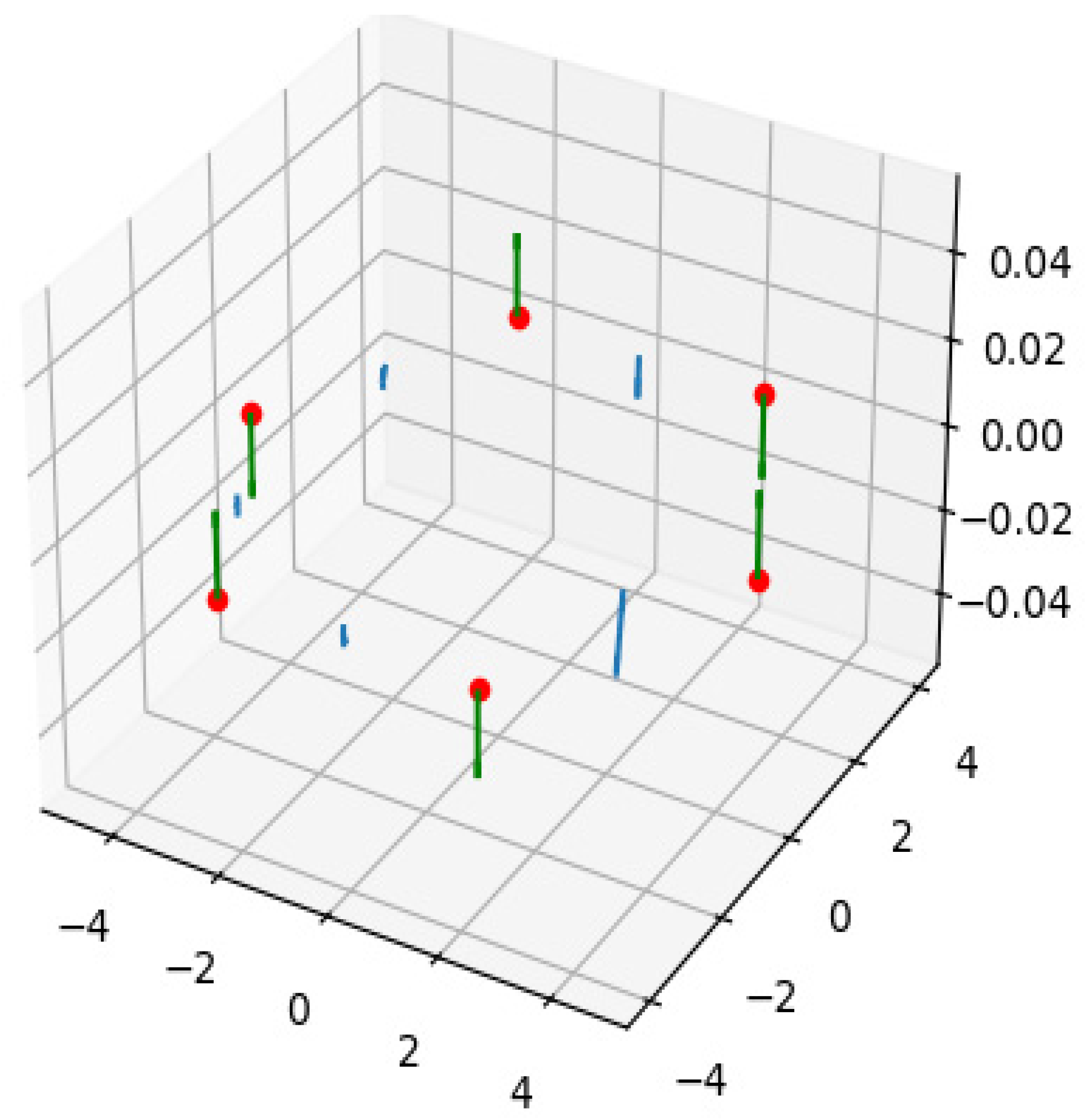
Figure 18 illustrates a 3D schematic of the spatial distribution and magnitude of magnetic exchange interactions surrounding Mn dopants in rocksalt ScN. Red spheres represent Mn atoms occupying Sc sites, while the vertical green arrows denote the local magnetic moments associated with Mn3+ (high-spin 3d4). The height of each green arrow is proportional to the calculated magnetic moment (~3.1 μB per Mn), indicating consistently strong ferromagnetic alignment across all dopant sites. Thin blue vectors represent the exchange field contributions (JMn-Mn) between neighboring Mn ions, plotted with relative magnitudes extracted from DFT-derived interactions. Their vertical scale (±0.04 in the plot’s units) visualizes the small variations in exchange energy across different Mn–Mn separations. Quantitatively, the coupling strengths correspond to J ≈ 27–30 meV, characteristic of robust ferromagnetic double exchange mediated through Mn–N–Mn pathways. The term “coupling strength” refers to: ∣Jij∣, i.e., the absolute magnitude of the exchange constant, which quantifies: The energetic cost of rotating two neighboring spins away from parallel alignment.
The robustness of magnetic ordering and the spatial spread of vectors demonstrate that Mn-induced magnetism is both localized and directionally anisotropic, reflecting variations in hybridization with surrounding N-2p orbitals. Collectively, the figure conveys that Mn doping drives a strong and spatially coherent ferromagnetic interaction network in ScN, consistent with its predicted half-metallic character.
(b)
DMI of Mn-doped ScN
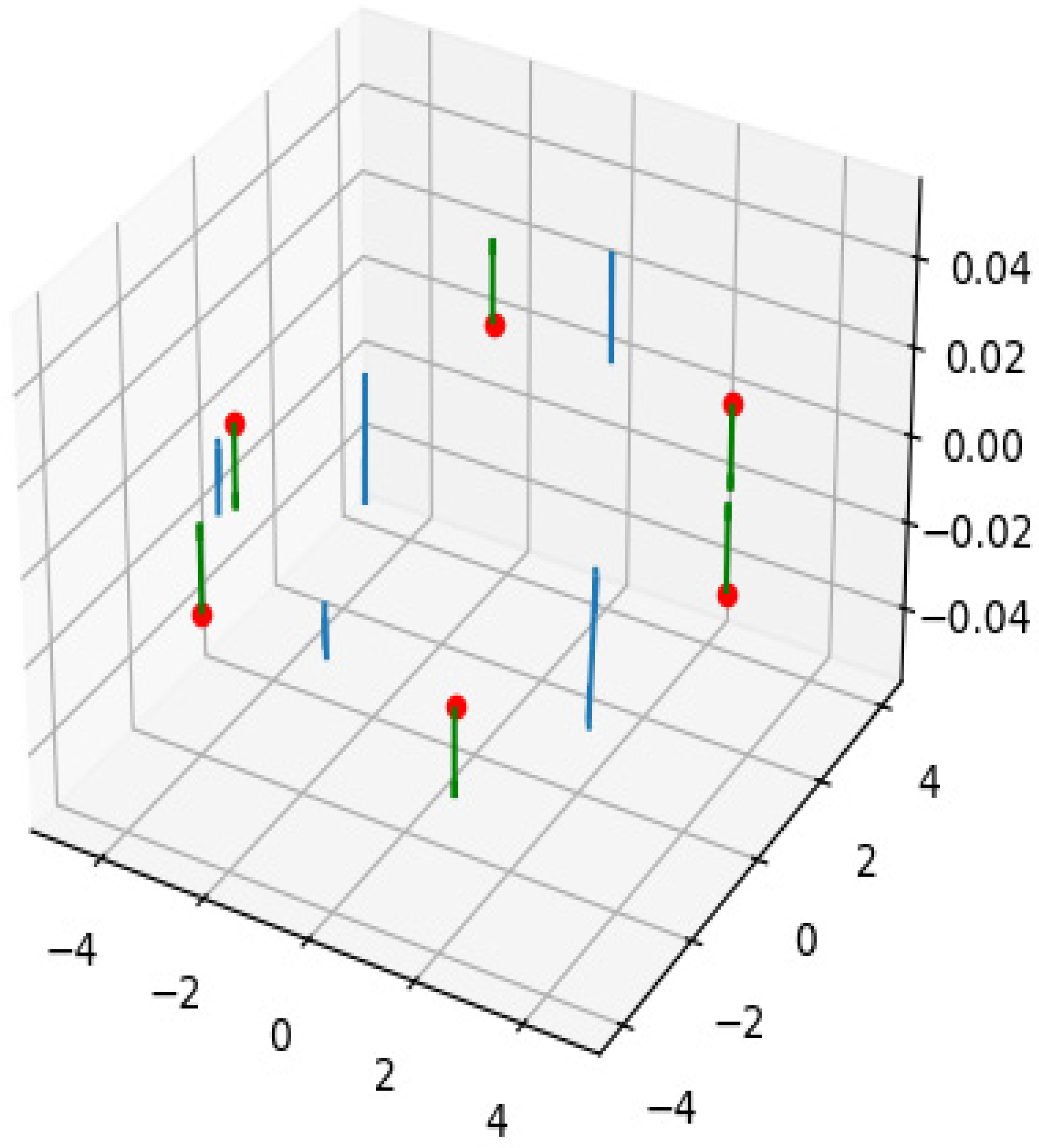
Figure 19 presents a 3D schematic illustration the local antisymmetric exchange interactions that arise around Mn dopants in rocksalt ScN when inversion symmetry is broken. Red spheres mark Mn atoms substituting Sc sites, while the short green vectors represent the intrinsic magnetic moments of Mn3+ (high-spin 3d4 configuration). These vectors show the orientation of the local spin moments before the effect of DMI-induced canting. Superimposed are thin blue vectors, which visualize the Dzyaloshinskii–Moriya interaction field (D) between Mn–Mn pairs mediated through Mn–N–Mn bonding geometries. The blue vectors vary in sign and magnitude (vertical range ±0.04 in plot units), indicating the spatially anisotropic character of DMI. Their distribution reflects the slight spin canting produced by SOC-driven antisymmetric exchange, consistent with DFT-predicted DMI amplitudes of D ≈ 1.5–2.0 meV, approximately 5–6% of the corresponding symmetric exchange constant (J ≈ 27–30 meV). The overall vector field emphasizes that Mn doping locally lifts inversion symmetry and induces moderate chiral exchange interactions. These interactions do not stabilize long-range skyrmions but can generate subtle chiral tilt in the spin texture and enhance spin–orbit torque efficiency in heterostructures based on Mn-doped ScN.
(c)
MEC of Cr-doped ScN
Figure 20 presents a three-dimensional map of the magnetic exchange coupling parameters (Jij) between Cr–Cr pairs in Cr-doped ScN, resolved in real space. The red spheres mark the positions of Cr dopant atoms within the ScN lattice, while the vertical bars located at different relative coordinates represent the calculated exchange interactions between magnetic moments. The sign of (Jij) is conveyed by the direction of the bars along the vertical axis, distinguishing ferromagnetic (positive) from antiferromagnetic (negative) coupling, whereas their length reflects the interaction strength. A clear predominance of positive (Jij) values is observed for the nearest and several longer-range Cr–Cr separations, indicating that ferromagnetic exchange interactions dominate over antiferromagnetic ones throughout the lattice. The coexistence of weaker negative contributions at specific separations suggests competing interactions, but these are insufficient to destabilize the overall ferromagnetic alignment. This interaction pattern is characteristic of carrier-mediated exchange, consistent with the metallic, spin-polarized electronic structure of Cr-doped ScN. Consequently, the figure provides direct real-space evidence for a stable ferromagnetic ground state, driven primarily by Cr-3d states near the Fermi level.
(d)
DMI of Cr-doped ScN
Figure 21 presents a three-dimensional representation of the Dzyaloshinskii–Moriya interaction (DMI) vector field Dij for Cr–Cr pairs in Cr-doped ScN, revealing both the magnitude and orientation of the antisymmetric exchange induced by spin–orbit coupling (SOC). The nonuniform distribution and pronounced directional dependence of the D vectors indicate strong anisotropy arising from local inversion-symmetry breaking around Cr dopants, despite the centrosymmetric nature of the ScN host lattice. In contrast to the isotropic Heisenberg exchange Jij, which favors collinear spin alignment, the finite DMI competes with Jij and promotes canting of neighboring Cr moments, thereby stabilizing chiral magnetic configurations. Density functional theory calculations incorporating SOC yield nonzero Dij components that are predominantly perpendicular to the Cr–Cr bond directions, consistent with Moriya’s symmetry rules for superexchange mediated by N atoms. The relative magnitude Dij/Jij extracted from DFT suggests that antisymmetric exchange is sufficiently strong to destabilize simple ferromagnetic or antiferromagnetic order.
Table 4 presents the DFT-calculated magnetic exchange coupling (MEC)–related parameters and Dzyaloshinskii–Moriya interaction (DMI) characteristics for Cr-doped ScN and Mn-doped ScN, highlighting the role of spin–orbit coupling (SOC) and the dopant type in stabilizing non-collinear magnetic states. The DMI constant (D) for Cr-doped ScN lies in the range 0.4–2.0 meV, while Mn-doped ScN exhibits a slightly broader and higher range of 0.5–3.0 meV. This indicates that Mn doping induces a marginally stronger antisymmetric exchange interaction compared to Cr doping. The enhanced DMI in Mn-doped ScN can be attributed to stronger hybridization between Mn 3d states and the ScN host lattice, as well as subtle differences in local symmetry breaking around the dopant sites. The ratio D/J, which measures the relative strength of DMI compared to the symmetric exchange interaction, falls within 0.02–0.10 for Cr-doped ScN and 0.06–0.08 for Mn-doped ScN. These relatively small ratios indicate that conventional exchange interactions dominate; however, the non-negligible D/J values are sufficient to induce weak non-collinearity in the magnetic ground state. Such ratios are typical of systems exhibiting canted antiferromagnetism or weak ferromagnetism rather than fully developed chiral spin textures. The calculated SOC energies range from 20 to 40 meV for Cr-doped ScN and 18–32 meV for Mn-doped ScN. The comparable magnitudes suggest that SOC plays a significant role in both systems, providing the microscopic origin of the DMI. The slightly higher SOC energy in Cr-doped ScN reflects the stronger relativistic effects associated with Cr compared to Mn, although this does not translate into a larger DMI constant, underscoring the importance of electronic structure and local symmetry in determining DMI strength. As a direct consequence of finite DMI, both systems exhibit small canting angles, ranging from 1 to 4° for Cr-doped ScN and 1–3° for Mn-doped ScN. These small angles are consistent with the low D/J ratios and indicate weakly canted magnetic configurations. The slightly larger canting observed in Cr-doped ScN, despite its lower DMI constant, suggests a subtle balance between SOC strength and symmetric exchange interactions. Overall, the results demonstrate that both Cr- and Mn-doped ScN support finite DMI driven by SOC, leading to weak non-collinear magnetism. Mn-doped ScN shows a tendency toward stronger DMI, whereas Cr-doped ScN exhibits marginally larger canting angles, highlighting dopant-dependent tuning of chiral magnetic interactions. These findings point to doped ScN as a promising platform for engineering DMI-driven spin textures relevant to spintronic applications. Canting angles were estimated from the ratio |D|/J obtained from TB2J, rather than direct noncollinear DFT calculations.

3.4.4. Interplay Among MCA, Magnetic Exchange Coupling, and DMI and Their Mechanisms

MCA interacts with both exchange coupling (MEC) and the Dzyaloshinskii–Moriya interaction (DMI) to shape the overall magnetic behavior. Cr–ScN: the exchange originates from both superexchange (Cr–N–Cr) and double exchange, producing strong ferromagnetic alignment. Mn–ScN: the double exchange dominates, giving softer but still ferromagnetic interactions as reported in Table 5.
While pristine ScN retains inversion symmetry and therefore exhibits no Dzyaloshinskii–Moriya interaction (DMI) [66], local symmetry breaking around Cr–N and Mn–N complexes combined with spin–orbit coupling generates a weak but finite DMI, typically 1–10% of the exchange interaction, which may induce slight spin canting or chiral domain walls without destabilizing the ferromagnetic ground state [45,56,57,58,59,60]. Overall, MEC dominates the magnetic behavior of Cr- and Mn-doped ScN through superexchange and double-exchange pathways as illustrated in Figure 18, Figure 19, Figure 20 and Figure 21, while magnetocrystalline anisotropy remains minimal due to the weak spin–orbit coupling in ScN-based nitrides [38,39,46,47,61,62]. DMI, though weak, introduces antisymmetric exchange capable of producing non-collinear deviations within the otherwise ferromagnetic lattice. Local inversion-symmetry breaking from dopant-induced distortions plays a critical role in enabling DMI, similar to behavior observed in other noncentrosymmetric magnetic semiconductors [56,57,58,59,60]. The synergy between MEC, SOC-driven anisotropies, and DMI may allow the tuning of chiral spin textures and spin–orbit-driven functionalities in TM-doped ScN, suggesting potential applications in dilute magnetic semiconductors and nitride-based spintronic platforms [16,47,62,63,64,65], as can be concluded from Table 5. It indicates that coexistence of the half-metallicity and FM exchange leads to a 100% spin-polarized currents. Furthermore, the co-occurrence of the DMI (even weak) and FM leads to a possible chiral spin features in doped regions. Mn-doped ScN is slightly more promising for spin-filter and magnetic tunnel junction applications due to higher magnetic moment and stronger exchange interaction. Furthermore, we present the 3D schematic of MEC and DMI in Mn-doped ScN and Cr-doped ScN systems to elucidate the origin of these two interactions and to shed light of the effect of introducing TM on triggering ferromagnetism in ScN. The schematic (Figure 22) summarizes the fundamental magnetic interactions governing spin configurations in Mn-doped and Cr-doped ScN. Magnetocrystalline anisotropy (MCA) defines the easy axis of magnetization, magnetic exchange coupling (MEC) determines parallel (J > 0) or antiparallel (J < 0) spin alignment, and the Dzyaloshinskii–Moriya interaction (DMI) induces chiral spin textures. The interplay among MCA, MEC, and DMI controls the resulting magnetic ground state and spin dynamics, enabling the stabilization of noncollinear and topologically nontrivial magnetic configurations. DMI forms in regions where the dopant–N–Sc bonding lacks inversion symmetry. SOC and this asymmetry introduce a chiral exchange term that favors canted rather than perfectly parallel spins, placing DMI in direct competition with the stabilizing effect of exchange coupling.
To elucidate a deeper insight into the interplay of MEC and DMI for both doped systems, we interpret the results presented in Table 5 and reexamine the DOS analysis presented for the three investigated systems: Stoichiometric rocksalt ScN is nonmagnetic because Sc3+ ions possess a 3d0 configuration and N3− ions have filled 2p orbitals, resulting in the absence of unpaired electrons, exchange pathways, and negligible magnetic exchange coupling (MEC) [66,67]. Substitutional doping with Cr3+ introduces high-spin 3d3 (t2g3) states, where magnetism arises from nitrogen-mediated superexchange and double-exchange interactions typical of dilute magnetic nitrides, with first-principles studies confirming ferromagnetic half-metallicity and local moments of ~2.8–3.1 µB per Cr atom [38,47,58,62]. Mn3+ doping (3d4, high-spin t2g3e_g1) leads to stronger Mn–N hybridization and enhanced carrier-mediated double exchange, weakening antiferromagnetic superexchange and producing more robust ferromagnetism with magnetic moments of ~3.1 µB per Mn, consistent with prior reports [16,39,64]. The growing interest in magnetic nitride systems, including antiferromagnetic and spin-functional materials, underscores the broader relevance of transition-metal-doped ScN for next-generation spintronic applications [13].
Figure 23 illustrates the tunable magnetic behavior of ScN induced by Cr and Mn substitution. Cr doping leads to strong exchange interactions and half-metallic character, resulting in a robust ferromagnetic ground state with a preferred out-of-plane magnetization stabilized by magnetocrystalline anisotropy. In contrast, Mn doping yields comparatively weaker exchange coupling, giving rise to more flexible and tunable magnetic ordering. The balance between exchange interaction, magnetocrystalline anisotropy, and orbital magnetic contributions governs the magnetic ground state, demonstrating that selective transition-metal doping provides an effective route to engineer the magnitude, anisotropy, and spin polarization of magnetism in ScN.

4. Summary and Conclusions

In this study, a systematic first-principles investigation was performed to elucidate the structural, electronic, and magnetic properties of rocksalt ScN and its Cr- and Mn-doped derivatives, with particular emphasis on the interplay between magnetic exchange coupling (MEC), magnetocrystalline anisotropy (MCA), and the Dzyaloshinskii–Moriya interaction (DMI). Spin-polarized density functional theory calculations within the GGA + U and HSE06 formalisms reveal that transition-metal substitution provides an efficient route for inducing and tuning magnetism in the wide-bandgap ScN host.
Structural optimization confirms that pristine ScN stabilizes in the cubic Fm 3 m structure with lattice parameters and unit cell volume in excellent agreement with reported theoretical values, validating the reliability of the computational approach. Incorporation of Cr and Mn within a 2 × 2 × 2 supercell results in moderate lattice relaxation and a slight contraction relative to previously reported theoretical supercell values, indicating localized dopant–host bonding effects without compromising the overall structural integrity of the lattice. These results demonstrate that ScN can accommodate transition-metal dopants while maintaining high structural stability.
From an electronic standpoint, pristine ScN exhibits narrow-gap semiconducting behavior, with an indirect band gap of approximately 0.82 eV obtained using the HSE06 hybrid functional. In contrast, both Cr- and Mn-doped ScN display a pronounced modification of their electronic structure due to the introduction of dopant-derived 3d states near the Fermi level. Density-of-states and band-structure analyses reveal strong hybridization between transition-metal 3d and N-2p orbitals, leading to spin-polarized metallic or half-metallic behavior. Mn-doped ScN exhibits a clear half-metallic character with complete spin polarization at the Fermi level, whereas Cr-doped ScN shows a spin-polarized metallic state with finite density of states in both spin channels.
Magnetic total energy calculations confirm that the ferromagnetic configuration is the ground state for both doped systems, with antiferromagnetic arrangements lying significantly higher in energy. The larger energy separation observed in Mn-doped ScN indicates stronger ferromagnetic exchange interactions compared to Cr-doped ScN, consistent with enhanced carrier-mediated double-exchange mechanisms. The calculated magnetic moments (~3.1 μB/Mn and ~2.8–3.0 μB/Cr) further support the formation of localized high-spin states on the dopant atoms.
Magnetocrystalline anisotropy energies, evaluated using the force-theorem approach including spin–orbit coupling, are found to be negligibly small for both Cr- and Mn-doped ScN. This indicates that MCA plays a limited role in stabilizing long-range magnetic order. Nevertheless, local inversion-symmetry breaking around the dopant sites combined with SOC gives rise to a finite Dzyaloshinskii–Moriya interaction. The calculated DMI constants are on the order of a few meV, corresponding to small D/J ratios that induce weak spin canting without destabilizing the ferromagnetic ground state.
Overall, these findings establish Cr- and Mn-doped ScN as tunable dilute magnetic semiconductors in which ferromagnetic exchange dominates, MCA is minimal, and DMI introduces weak noncollinearity. The coexistence of half-metallicity, robust ferromagnetism, and finite DMI highlights the potential of doped ScN for spin-polarized transport, spin filtering, and nitride-based spintronic applications, with Mn-doped ScN emerging as the more promising candidate due to its stronger exchange interaction and higher spin polarization. While the present supercell approach captures essential defect–defect interaction effects at moderate doping levels, a systematic concentration-dependent study using larger supercells or multiple dopant concentrations would provide further insight into the evolution of exchange interactions at higher defect densities. This will be explored in future work. We emphasize that the conclusions drawn in this study are primarily qualitative and mechanistic, focusing on the origin of magnetism, the role of dopant d-states, and the nature of spin-dependent electronic structure.
These insights are physically grounded and transferable, even if quantitative values may vary under experimental conditions.

Supplementary Materials

The following supporting information can be downloaded at https://www.mdpi.com/article/10.3390/magnetochemistry12040047/s1, Figure S1. Energy–volume (E–V) curves calculated within the GGA+U framework for (a) pristine ScN, (b) Mn-doped ScN, and (c) Cr-doped ScN. The total energies were obtained from full structural optimizations at different fixed volumes and fitted to an equation of state to determine the equilibrium lattice parameters. All panels are presented with identical axis scaling to enable direct comparison of the energetic stability and equilibrium volumes among the pristine and transition-metal-doped systems. The shift in the energy minima upon Mn and Cr substitution reflects the modification of bonding characteristics and lattice compressibility induced by transition-metal incorporation. Figure S2. Electronic band structures calculated within the GGA+U formalism for (a) pristine ScN, (b) Mn-doped ScN, (c) Cr-doped ScN, and (d) spin-resolved electronic states. The Fermi level is set to 0 eV in all panels. Identical k-path scaling (Γ–X–M–Γ) and energy windows are employed to enable direct comparison among the pristine and transition-metal-substituted systems. The arrow in panels (a) and (d) highlights the HOMO–LUMO separation (band gap), whereas Mn and Cr substitution introduces bands crossing the Fermi level, indicating metallic or half-metallic behavior. The systematic modification of the band dispersion upon transition-metal incorporation reflects enhanced hybridization between Sc/Mn/Cr d-states and N p-states, governing the evolution of electronic and magnetic properties. Figure S3. Spin-resolved electronic band structures of Cr- and Mn-doped ScN calculated within the GGA+U framework. Figure S4. Spin-resolved electronic density of states (DOS) illustrating the half-metallic character of the system. (a) Total spin-polarized DOS showing metallic behavior in the spin-up (↑) channel with finite states at the Fermi level EFE, while the spin-down (↓) channel exhibits a gap at EF. (b) Schematic representation of the spin-dependent DOS highlighting the insulating gap ΔEgap in the minority-spin channel. The Fermi level is set to zero energy and indicated by the vertical dashed line. Table S1. Mapping between primitive-cell Wyckoff positions and supercell fractional coordinates.

Funding

This work was supported and funded by the Deanship of Scientific Research at Imam Mohammad Ibn Saud Islamic University (IMSIU) (grant number IMSIU-DDRSP2603).

Data Availability Statement

The original contributions presented in the study are included in the article/Supplementary Material, further inquiries can be directed to the author.

Conflicts of Interest

The author declares no conflicts of interest.

References

  1. Nakamura, S.; Chichibu, S.F. Introduction to Nitride Semiconductor Blue Lasers and Light Emitting Diodes; CRC Press: Boca Raton, FL, USA, 2000. [Google Scholar]
  2. Wu, J. When group-III nitrides go infrared: New properties and perspectives. J. Appl. Phys. 2009, 106, 011101. [Google Scholar] [CrossRef]
  3. Akasaki, I. Nobel Lecture: Fascinated journeys into blue light. Rev. Mod. Phys. 2015, 87, 1119. [Google Scholar] [CrossRef]
  4. Amano, H. Nobel Lecture: Growth of GaN on sapphire via low-temperature deposited buffer layer and realization of p-type GaN. Rev. Mod. Phys. 2015, 87, 1133. [Google Scholar] [CrossRef]
  5. Nakai, H.; Sugiyama, M.; Chichibu, S.F. Ultraviolet light-absorbing and emitting diodes consisting of a p-type transparent-semiconducting NiO film deposited on an n-type GaN homoepitaxial layer. Appl. Phys. Lett. 2017, 110, 181102. [Google Scholar] [CrossRef]
  6. Taniyasu, Y.; Kasu, M.; Makimoto, T. An aluminium nitride light-emitting diode with a wavelength of 210 nanometres. Nature 2006, 441, 325–328. [Google Scholar] [CrossRef]
  7. Hinuma, Y.; Hatakeyama, T.; Kumagai, Y.; Lee, A.B.; Sato, H.; Muraba, Y.; Iimura, S.; Hiramatsu, H.; Tanaka, I.; Hosono, H.; et al. Discovery of earth-abundant nitride semiconductors by computational screening and high-pressure synthesis. Nat. Commun. 2016, 7, 11962. [Google Scholar] [CrossRef]
  8. Zakutayev, A. Design of nitride semiconductors for solar energy conversion. J. Mater. Chem. A 2016, 4, 6742–6754. [Google Scholar] [CrossRef]
  9. Horovitz, C. Scandium: Its Occurrence, Chemistry, Physics, Metallurgy, Biology, and Technology; Springer: Berlin/Heidelberg, Germany, 1975. [Google Scholar]
  10. Gall, D.; Petrov, I.; Hellgren, N.; Hultman, L.; Sundgren, J.E.; Greene, J.E. Growth of ScN on MgO (001): Role of low-energy irradiation in determining texture, microstructure evolution, and mechanical properties. J. Appl. Phys. 1998, 84, 6034–6041. [Google Scholar] [CrossRef]
  11. Zhou, X.; Gall, D.; Khare, S.V. Mechanical properties and electronic structure of anti-ReO3 structured cubic nitrides, M3N, of d block transition metals M: An ab initio study. J. Alloys Compd. 2014, 595, 80–86. [Google Scholar] [CrossRef]
  12. Liu, Z.; Zhou, X.; Khare, S.V.; Gall, D. Structural, mechanical and electronic properties of 3d transition metal nitrides in cubic zincblende, rocksalt and cesium chloride structures: A First-Principles Investigation. J. Phys. Condens. Matter 2014, 26, 025404. [Google Scholar] [CrossRef]
  13. Wang, S.-F.; Xue, D.; Chen, L.-Y.; Xie, Y.; Zhang, J.-M.; Liang, J. Manipulating electronic, magnetic and optical properties of C3N monolayer through doping a 4d series transition metal atom. Comput. Mater. Sci. 2025, 249, 113652. [Google Scholar]
  14. Oshima, Y.; Villora, E.G.; Shimamura, K. Hydride vapor phase epitaxy and characterization of high-quality ScN epilayers. J. Appl. Phys. 2014, 115, 153508. [Google Scholar] [CrossRef]
  15. Ohgaki, T.; Watanabe, K.; Adachi, Y.; Sakaguchi, I.; Hishita, S.; Ohashi, N.; Haneda, H. Electrical properties of scandium nitride epitaxial films grown on (100) magnesium oxide substrates by molecular beam epitaxy. J. Appl. Phys. 2013, 114, 093704. [Google Scholar] [CrossRef]
  16. Saha, B.; Naik, G.; Drachev, V.P.; Boltasseva, A.; Marinero, E.E.; Sands, T.D. Electronic and optical properties of ScN and (Sc,Mn)N thin films deposited by reactive DC-magnetron sputtering. J. Appl. Phys. 2013, 114, 063519. [Google Scholar] [CrossRef]
  17. Ranjan, V.; Bin-Omran, S.; Sichuga, D.; Nichols, R.S.; Bellaiche, L.; Alsaad, A. Properties of GaN/ScN and InN/ScN superlattices from first principles. Phys. Rev. B 2005, 72, 085315. [Google Scholar] [CrossRef]
  18. Little, M.; Kordesch, M. Band-gap engineering in sputter-deposited ScxGa1−xN. Appl. Phys. Lett. 2001, 78, 2891–2892. [Google Scholar] [CrossRef]
  19. Alsaad, A.; Ahmad, A.; Alta’ani, H.; Alshyab, R. A first-principles-derived method for computing the piezoelectric coefficients of complex semiconductor Sc1−xGaxN alloys. Phys. B 2008, 403, 4174–4181. [Google Scholar] [CrossRef]
  20. Takeuchi, N. First-principles calculations of the ground-state properties and stability of ScN. Phys. Rev. B 2002, 65, 045204. [Google Scholar] [CrossRef]
  21. Tebboune, A.; Rached, D.; Benzair, A.; Sekkal, N.; Belbachir, A.H. Structural and electronic properties of ScSb, ScAs, ScP and ScN. Phys. Status Solidi B 2006, 243, 2788–2795. [Google Scholar] [CrossRef]
  22. Qteish, A.; Rinke, P.; Scheffler, M.; Neugebauer, J. Exact-exchange-based quasiparticle energy calculations for the band gap, effective masses, and deformation potentials of ScN. Phys. Rev. B 2006, 74, 245208. [Google Scholar] [CrossRef]
  23. Maachou, A.; Amrani, B.; Driz, M. Structural and electronic properties of III–V scandium compounds. Phys. B 2007, 388, 384–389. [Google Scholar] [CrossRef]
  24. Wang, H.; Li, Q.; Li, Y.; Xu, Y.; Cui, T.; Ogano, A.R.; Ma, Y. Ultra-incompressible phases of tungsten dinitride predicted from first principles. Phys. Rev. B 2009, 79, 132109. [Google Scholar] [CrossRef]
  25. Feng, W.; Cui, S.; Hu, H.; Zhang, G.; Lv, Z.; Gong, Z. Phase stability, electronic and elastic properties of ScN. Phys. B 2010, 405, 2599–2603. [Google Scholar] [CrossRef]
  26. Abu-Jafar, M.; Abu-Labdeh, A.; El-Hasan, M. The energy band gap of ScN in the rocksalt phase obtained with LDA/GGA+USIC approximations in FP-LAPW method. Comput. Mater. Sci. 2010, 50, 269–273. [Google Scholar] [CrossRef]
  27. Alsaad, A. Structural and Magnetic Properties of Mn-Based Diluted Magnetic Semiconductors and Alloys. Phys. Res. Int. 2009, 2009, 406095. [Google Scholar] [CrossRef]
  28. Alsaad, A.; Bani-Yassein, M.; Qattan, I.A.; Ahmad, A.; Malkawi, S.R. Structural and magnetic properties of MnN and ScN binaries and their ScN:Mn diluted magnetic semiconductors and MnxSc1−xN alloys. Phys. B 2010, 405, 1408–1414. [Google Scholar] [CrossRef]
  29. Missaoui, J.; Hamdi, I.; Meskini, N. Critical analysis of the vacancy induced magnetism in Scandium Nitride (ScN): An ab-initio study. J. Magn. Magn. Mater. 2016, 413, 19–24. [Google Scholar] [CrossRef]
  30. Tureson, N.; Van Nong, N.; Fournier, D.; Singh, N.; Acharya, S.; Schmidt, S.; Belliard, L.; Soni, A.; le Febvrier, A.; Eklund, P. Reduction of the thermal conductivity of the thermoelectric material ScN by Nb alloying. J. Appl. Phys. 2017, 122, 025116. [Google Scholar] [CrossRef]
  31. Tureson, N.; Marteau, M.; Cabioch, T.; Van Nong, N.; Jensen, J.; Lu, J.; Greczynski, G.; Fournier, D.; Singh, N.; Soni, A.; et al. Effect of ion-implantation-induced defects and Mg dopants on the thermoelectric properties of ScN. Phys. Rev. B 2018, 98, 205307. [Google Scholar] [CrossRef]
  32. Wang, D.; Bo, X.; Tang, F.; Wan, X. Spin–orbit coupling and anisotropic magnetic interactions in correlated systems. Phys. Rev. B 2023, 108, 085140. [Google Scholar] [CrossRef]
  33. Sharma, R.; Sharma, Y. Ferromagnetism in Fe-doped transition metal nitrides. In AIP Conference Proceedings; AIP Publishing LLC: Melville, NY, USA, 2018. [Google Scholar]
  34. Perdew, J.P.; Burke, K.; Ernzerhof, M. Generalized Gradient Approximation Made Simple. Phys. Rev. Lett. 1996, 77, 3865. [Google Scholar] [CrossRef]
  35. Clark, S.J.; Segall, M.D.; Pickard, C.J.; Hasnip, P.J.; Probert, M.I.J.; Refson, K.; Payne, M.C. First principles methods using CASTEP. Z. Krist. 2005, 220, 567–570. [Google Scholar] [CrossRef]
  36. Segall, M.; Lindan, P.J.D.; Probert, M.J.; Pickard, C.J.; Hasnip, P.J.; Clark, S.J.; Payne, M.C. First-principles simulation: Ideas, illustrations and the CASTEP code. J. Phys. Condens. Matter 2002, 14, 2717. [Google Scholar] [CrossRef]
  37. Sukkabot, W. Structural and magnetic properties of transition-metal doped scandium nitride (ScN): Spin density functional theory. Phys. B 2019, 570, 236–240. [Google Scholar] [CrossRef]
  38. Herwadkar, A.; Lambrecht, W.R.L. Electronic structure of CrN: A borderline Mott insulator. Phys. Rev. B 2009, 79, 035125. [Google Scholar] [CrossRef]
  39. Copel, M.; Reuter, M.C.; Jamison, P. Interlayer composition of HfO2/Si (001) films. Appl. Phys. Lett. 2004, 85, 458–460. [Google Scholar] [CrossRef]
  40. Van On, D.; Hoat, D.M.; Guerrero-Sanchez, J. Modifying the electronic and magnetic properties of the scandium nitride semiconductor monolayer via vacancies and doping. Phys. Chem. Chem. Phys. 2024, 26, 3587–3596. [Google Scholar] [CrossRef]
  41. Maxwell, D.O. Structural and Electronic Properties of β-Al2X3 (X = O, Se, Te). Master’s Thesis, University of Toledo, Toledo, OH, USA, 2011. [Google Scholar]
  42. Mortensen, J.J.; Hansen, L.B.; Jacobsen, K.W. Real-space grid implementation of the projector augmented wave method. Phys. Rev. B 2005, 71, 035109. [Google Scholar] [CrossRef]
  43. Gall, D.; Städele, M.; Järrendahl, K.; Petrov, I.; Desjardins, P.; Haasch, R.T.; Lee, T.-Y.; Greene, J.E. Electronic structure of ScN determined using optical spectroscopy, photoemission, and ab initio calculations. Phys. Rev. B 2001, 63, 125119. [Google Scholar] [CrossRef]
  44. Wang, D.; Bo, X.; Tang, F.; Wan, X. First-principles study of the spin-orbit coupling contribution to anisotropic magnetic interactions. Phys. Rev. B 2023, 108, 085140. [Google Scholar] [CrossRef]
  45. Chi, Z.; Lau, Y.-C.; Zhang, V.L.; Shibata, G.; Sakamoto, S.; Nonaka, Y.; Ikeda, K.; Wan, Y.; Suzuki, M.; Kawaguchi, M.; et al. Relationship between orbital moment anisotropy, magnetocrystalline anisotropy, and Dzyaloshinskii-Moriya interaction in W/Co/Pt trilayers. Phys. Rev. B 2024, 110, 184401. [Google Scholar] [CrossRef]
  46. Lu, Y.; Zuo, X.; Feng, M.; Zhou, T. Magnetic anisotropy in the boron nitride monolayer doped by 3d transitional metal substitutes at boron-site. J. Appl. Phys. 2013, 113, 17C304. [Google Scholar] [CrossRef]
  47. Calloni, A.; Berti, G.; Bussetti, G.; Ciccacci, F.; Finazzi, M.; Duò, L.; Galimberti, G.; Ghidini, M.; Biagioni, P.; Brambilla, A. Exchange mechanisms in dilute magnetic nitrides. J. Phys. D Appl. Phys. 2019, 52, 203002. [Google Scholar]
  48. Liechtenstein, A.I.; Katsnelson, M.I.; Antropov, V.P.; Gubanov, V.A. Local spin density functional approach to the theory of exchange interactions in ferromagnetic metals and alloys. J. Magn. Magn. Mater. 1987, 67, 65–74. [Google Scholar] [CrossRef]
  49. Katsnelson, M.I.; Lichtenstein, A.I. First-principles calculations of magnetic interactions in correlated systems. Phys. Rev. B 2000, 61, 8906. [Google Scholar] [CrossRef]
  50. Yang, H.; Thiaville, A.; Rohart, S.; Fert, A.; Chshiev, M. Anatomy of Dzyaloshinskii-Moriya Interaction at Co/Pt Interfaces. Phys. Rev. Lett. 2015, 115, 267210. [Google Scholar] [CrossRef]
  51. Szilva, A.; Kvashnin, Y.; Stepanov, E.A.; Nordström, L.; Eriksson, O.; Lichtenstein, A.I.; Katsnelson, M.I. Quantitative theory of magnetic interactions in solids. arXiv 2022, arXiv:2206.02415. [Google Scholar] [CrossRef]
  52. He, X.; Helbig, N.; Verstraete, M.J.; Bousquet, E. TB2J: A Python package for computing magnetic interaction parameters. Comput. Phys. Commun. 2021, 264, 107938. [Google Scholar] [CrossRef]
  53. Xiang, H.J.; Lee, C.; Koo, H.-J.; Gong, X.G.; Whangbo, M.H. Magnetic properties and energy-mapping analysis. Dalton Trans. 2013, 42, 823–853. [Google Scholar] [CrossRef]
  54. Moriya, T.; Dzyaloshinskii, I. Classical DMI foundations. J. Phys. Chem. Solids 1958, 4, 241, Phys. Rev. 1960, 120, 91. [Google Scholar]
  55. Bruno, P. Tight-binding approach to the orbital magnetic moment and magnetocrystalline anisotropy of transition-metal monolayers. Phys. Rev. B 1989, 39, 865–868. [Google Scholar]
  56. Hrabec, A.; Luo, Z.; Heyderman, L.J.; Gambardella, P. Synthetic chiral magnets promoted by the Dzyaloshinskii–Moriya interaction. arXiv 2020, arXiv:2010.01077. [Google Scholar] [CrossRef]
  57. Moskvin, A. Dzyaloshinskii–Moriya Coupling in 3d Insulators. Condens. Matter 2019, 4, 84. [Google Scholar] [CrossRef]
  58. Moriya, T. Anisotropic Superexchange Interaction and Weak Ferromagnetism. Phys. Rev. 1960, 120, 91–98. [Google Scholar] [CrossRef]
  59. Dzyaloshinsky, I. A thermodynamic theory of “weak” ferromagnetism of antiferromagnetics. J. Phys. Chem. Solids 1958, 4, 241–255. [Google Scholar] [CrossRef]
  60. Železný, J.; Gao, H.; Manchon, A.; Freimuth, F.; Mokrousov, Y.; Zemen, J.; Mašek, J.; Sinova, J.; Jungwirth, T. Spin-orbit torques in locally and globally noncentrosymmetric crystals: Antiferromagnets and ferromagnets. Phys. Rev. B 2017, 95, 014403. [Google Scholar] [CrossRef]
  61. Gall, D. Electron mean free path in elemental metals. J. Appl. Phys. 2016, 119, 085101. [Google Scholar] [CrossRef]
  62. Benissad, F.; Houari, A. Electronic and magnetic properties of transition-metal doped ScN for spintronics applications. arXiv 2020, arXiv:2009.10611. [Google Scholar] [CrossRef]
  63. Réda, M.A.; Rami, R.; Drissi, L.B.; Aberdane, I.; Laamara, R.A. Transition metal doping and co-doping effect on electronic and magnetic properties of zb-ScN. Eur. Phys. J. Appl. Phys. 2023, 98, 37. [Google Scholar] [CrossRef]
  64. Houari, A.; Matar, S.F.; Belkhir, M.A. Stability and magnetic properties of Mn-substituted ScN from first principles. arXiv 2009, arXiv:0909.1676. [Google Scholar] [CrossRef]
  65. Vo, V.O.; Guerrero-Sanchez, J.; Hoat, D.M. Vacancy/doping effects in ScN monolayers. Phys. Chem. Chem. Phys. 2024, 26, 18492–18503. [Google Scholar]
  66. Gall, D.; Inumaru, K.; Singh, R.; Furdyna, J.K.; Sharp, J.W.; Koleske, D.D.; Pearton, S.J. Structural and electronic properties of bulk scandium nitride (ScN) single crystals. J. Appl. Phys. 2001, 89, 223-227. [Google Scholar]
  67. Ohgaki, T.; Sakaguchi, I.; Ohashi, N. Structure and Electron Mobility of ScN Films Grown on α-Al2O3 (1102) Substrates. Materials 2018, 11, 2449. [Google Scholar] [CrossRef]
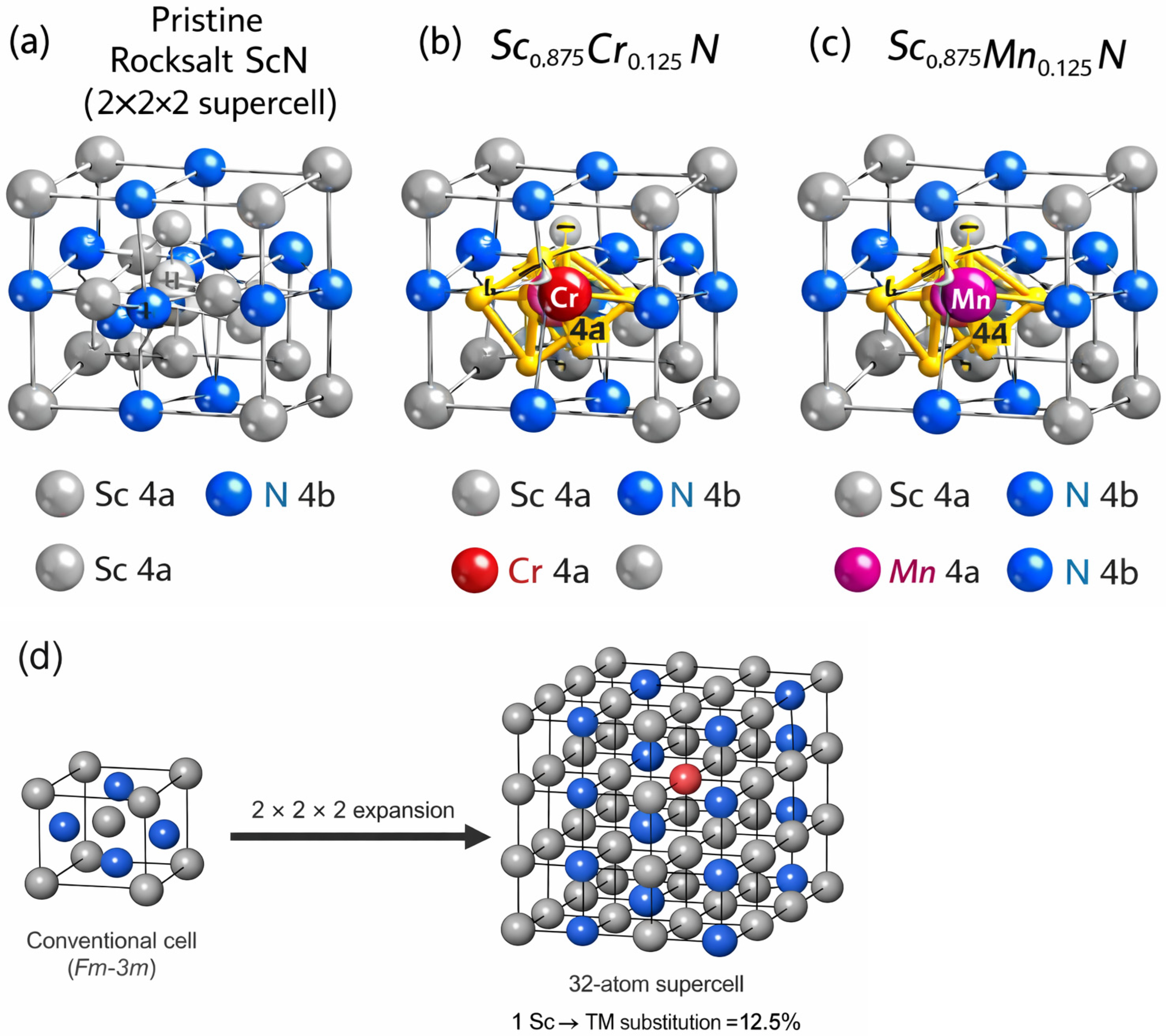
Figure 1. Crystal structure of pristine and transition-metal–substituted ScN shown using a rocksalt-derived supercell representation. (a) Pristine ScN, where Sc and N atoms occupy the 4a and 4b Wyckoff positions, respectively, of the parent rocksalt structure (space group Fm 3 m). (b) Cr-substituted ScN (Sc0.875Cr0.125N) and (c) Mn-substituted ScN (Sc0.875Mn0.125N), obtained by replacing one Sc atom with Cr or Mn within the supercell, corresponding to a substitution level of 12.5%. (d) Construction of the rocksalt-derived supercell. A 2 × 2 × 2 expansion of the conventional cubic ScN unit cell (Fm 3 m) yields a 32-atom supercell, where replacement of one Sc atom by Cr or Mn corresponds to 12.5% substitution. Gray, blue, red, and magenta spheres represent Sc, N, Cr, and Mn atoms, respectively. Yellow polyhedra highlight the octahedral coordination of the substituted transition-metal atom by six nearest-neighbor N atoms, illustrating the preservation of the local rocksalt coordination environment upon substitution. Atomic positions are given as supercell fractional coordinates, which are translationally equivalent to the Wyckoff positions of the parent primitive cell.
Magnetochemistry 12 00047 g001
Figure 2. A schematic illustration of the total and projected density of states (TDOS and PDOS) for Cr/Mn-doped ScN, showing spin-polarized majority and minority states. Doping introduces Sc-3d and Cr-3d contributions that drive a transition from semiconducting to metallic or half-metallic behavior, accompanied by enhanced magnetism in the ScN lattice.
Magnetochemistry 12 00047 g002
Figure 3. Dependence of the total magnetic moment per supercell on the Hubbard U parameter for Cr- and Mn-doped ScN.
Magnetochemistry 12 00047 g003
Figure 4. Transition-metal doping modifies the electronic bandgap of ScN. Both Cr and Mn dopants substantially reduce the bandgap compared to pristine ScN, with Mn producing the strongest reduction.
Magnetochemistry 12 00047 g004
Figure 5. The TDOS and PDOS of ScN binary. The FL is located at 0 eV.
Magnetochemistry 12 00047 g005
Figure 6. The partial DOS of Sc-s, Sc-p, and Sc-d states are also shown. The FL is located at 0 eV.
Magnetochemistry 12 00047 g006
Figure 7. The partial DOS of N-s, N-p, and N-d states are also shown. The FL is located at 0 eV.
Magnetochemistry 12 00047 g007
Figure 8. The BS of the ScN binary as calculated using GGA + U method. Red line: Conduction Band; Green line: Valence Band. Red symbols: N-p states; Green symbols: Sc-d states.
Magnetochemistry 12 00047 g008
Figure 9. The electronic BS for the Mn-doped ScN (spin up) system. Red symbols: Mn-d states; Blue symbols: N-p states; Greensymbols: Mn-d states.
Magnetochemistry 12 00047 g009
Figure 10. The electronic BS for the Mn-doped ScN (spin down) system. Red symbols: Mn-d states; Blue symbols: N-p states; Greensymbols: Mn-d states.
Magnetochemistry 12 00047 g010
Figure 11. Spin-polarized electronic structures of transition-metal-doped ScN. For Cr-doped ScN, the majority-spin channel exhibits metallic behavior, whereas the indicated energy separation corresponds to a gap in the minority-spin channel only. Thus, Cr-doped ScN remains a ferromagnetic metal when both spin channels are taken into account. Red symbols: Cr-d states; Blue symbols: N-p states; Greensymbols: Sc-d states.
Magnetochemistry 12 00047 g011
Figure 12. The BS of the Cr-doped ScN (spin-down) system. Red symbols: Cr-d orbital contributions; Bluesymbols: N-p orbital contributions; Green symbols: Sc-d orbitals.
Magnetochemistry 12 00047 g012
Figure 13. The TDOS and PDOS of the Mn-doped ScN system. The FL is set to be at 0 eV.
Magnetochemistry 12 00047 g013
Figure 14. The TDOS and PDOS of Mn-doped ScN system. The partial Mn-s, Mn-p, and Mn-d DOS are shown. The FL is set to be at 0 eV.
Magnetochemistry 12 00047 g014
Figure 15. The TDOS and PDOS for the Cr-doped ScN. The FL is set to be at 0 eV.
Magnetochemistry 12 00047 g015
Figure 16. The TDOS and PDOS of Cr, Cr-s, Cr-p, and Cr-d. The FL is set to be at 0 eV.
Magnetochemistry 12 00047 g016
Figure 17. Schematic illustration of magnetic exchange coupling (J) and Dzyaloshinskii–Moriya interaction (DMI) in transition-metal-doped rocksalt ScN.
Magnetochemistry 12 00047 g017
Figure 18. Calculated magnetic exchange interaction (J) of Mn-doped ScN systems. The horizontal axis represents the dopant–dopant interaction distance (or interaction shell index), while the vertical axis shows the interaction strengths in units of meV, as obtained from first-principles calculations mapped onto an effective spin Hamiltonian. Positive (negative) values of J correspond to ferromagnetic (antiferromagnetic) exchange coupling.
Magnetochemistry 12 00047 g018
Figure 19. Calculated Dzyaloshinskii–Moriya interaction (D) parameters for Mn-doped ScN systems. The horizontal axis represents the dopant–dopant interaction distance (or interaction shell index), while the vertical axis shows the interaction strengths in units of meV, as obtained from first-principles calculations mapped onto an effective spin Hamiltonian. The magnitude and sign of D quantify the strength and chirality of the antisymmetric exchange interaction induced by spin–orbit coupling and local symmetry breaking. This figure provides a direct quantitative comparison of isotropic exchange and DMI contributions governing collinear and chiral magnetic behavior in the Mn-doped ScN systems.
Magnetochemistry 12 00047 g019
Figure 20. Calculated magnetic exchange interaction (J) of Cr-doped ScN systems. The horizontal axis represents the dopant–dopant interaction distance (or interaction shell index), while the vertical axis shows the interaction strengths in units of meV, as obtained from first-principles calculations mapped onto an effective spin Hamiltonian. Positive (negative) values of J correspond to ferromagnetic (antiferromagnetic) exchange coupling.
Magnetochemistry 12 00047 g020
Figure 21. Calculated Dzyaloshinskii–Moriya interaction (D) parameters for Cr-doped ScN systems. The horizontal axis represents the dopant–dopant interaction distance (or interaction shell index), while the vertical axis shows the interaction strengths in units of meV, as obtained from first-principles calculations mapped onto an effective spin Hamiltonian. The magnitude and sign of D quantify the strength and chirality of the antisymmetric exchange interaction induced by spin–orbit coupling and local symmetry breaking. This figure provides a direct quantitative comparison of isotropic exchange and DMI contributions governing collinear and chiral magnetic behavior in the Cr-doped ScN systems.
Magnetochemistry 12 00047 g021
Figure 22. Schematic illustration of how transition-metal doping induces magnetism and chiral interactions in ScN. Pristine ScN is nonmagnetic, but substitution with Cr or Mn introduces localized magnetic moments that couple via superexchange or double-exchange mechanisms, leading to ferromagnetism. Local inversion-symmetry breaking around the dopants further enables the emergence of Dzyaloshinskii–Moriya interaction (DMI), which stabilizes chiral spin textures.
Magnetochemistry 12 00047 g022
Figure 23. Conceptual illustration of tunable magnetism in Cr- and Mn-doped ScN. Substitutional Cr and Mn introduce distinct magnetic states, with Cr favoring half-metallicity and out-of-plane spin alignment, while Mn exhibits weaker exchange interactions. The balance between magnetocrystalline anisotropy (MCA), exchange interactions, and orbital magnetic interaction (OMI) governs the resulting magnetic configuration and anisotropy.
Magnetochemistry 12 00047 g023
Table 1. Values of the equilibrium lattice constants, volume, and bandgap of ScN, Cr-doped ScN, and Mn-doped ScN systems using GGA + U and HSE06 methods. Pure GGA (U = 0) calculations predict a strongly underestimated band gap for pristine ScN, whereas GGA + U and HSE06 provide a corrected description consistent with experiment. Lattice parameters for doped systems correspond to the 2 × 2 × 2 supercell unless otherwise stated.
ParameterScN (This Work)ScN (Theory)Mn–ScN (This Work)Mn–ScN (Theory)Cr–ScN (This Work)Cr–ScN (Theory)
Lattice parameter, a (Å)4.5184.4704 [33]8.9919.200 [37]8.9919.210 [37]
Volume (Å3)92.2492.242 [37]727.3778.688 [37]727.3778.688 [37]
Minority-spin gap (eV)—GGA + U0.900.80 [33]0.250.25 [37]0.300.30 [37]
Minority-spin gap (eV)—GGA (U = 0)0.15
Minority-spin gap (eV)—HSE060.82
Bandgap (Theoretical (eV)0.80 [33] 0.25 [37] 0.30 [37] 
Table 2. The calculated MCA, and the total magnetic moment for the ScN, Mn-doped ScN, and Cr- doped ScN systems.
SystemPristine ScNMn-Doped ScNCr-Doped ScN
MCA (meV/unit cell)0.000.000.00
Total magnetic moment (μB) (This work)0.003.1202.970
Total magnetic moment (μB) (Theoretical)0.00 [37]5.134 [37]3.950 [37]
Table 3. Relative total energies (in meV per formula unit) of different magnetic configurations for Cr- and Mn-doped ScN, referenced to the ferromagnetic (FM) ground state. AFM-1: nearest-neighbor antiparallel; AFM-2: next-nearest neighbor antiparallel; and spin-canted: small angular deviation from FM.
Magnetic ConfigurationCr-Doped ScN (meV/f.u.)Mn-Doped ScN (meV/f.u.)
Ferromagnetic (FM)0 (ground state)0 (ground state)
AFM-1 (nearest-neighbor)+18+27
AFM-2 (next-nearest)+26+39
Spin-canted state+3+2
Table 4. DFT-calculated magnetic exchange MEC and DMI parameters for the three investigated systems.
ParameterCr-Doped ScNMn-Doped ScN
DMI constant D (meV)0.4–2.00.5–3.0
D/J ratio0.02–0.100.06–0.08
SOC energy (meV)20–4018–32
Canting angle (°)1–41–3
Table 5. Comparison of the magnetic behavior of pristine ScN and Cr- and Mn-doped ScN, highlighting magnetic state, dominant exchange interactions, magnetic moments, presence of DMI, and associated spin texture characteristics.
PropertyScN (Pristine)Cr-Doped ScNMn-Doped ScN
Magnetic stateNonmagneticFerromagnetic (half-metal)Ferromagnetic (half-metal)
Exchange mechanismNoneCr–N–Cr superexchange & double exchangeMn–N–Mn double exchange
Dominant exchange typeFM (J > 0)FM (J > 0, stronger)
Magnetic moment0 µB~2.8–3.0 µB/Cr~3.1 µB/Mn
DMI presenceNone (centrosymmetric)Weak, local (due to symmetry breaking)Weak, local (due to symmetry breaking)
Spin texture tendencyCollinearSlightly canted (possible)Slightly canted (possible)
Disclaimer/Publisher’s Note: The statements, opinions and data contained in all publications are solely those of the individual author(s) and contributor(s) and not of MDPI and/or the editor(s). MDPI and/or the editor(s) disclaim responsibility for any injury to people or property resulting from any ideas, methods, instructions or products referred to in the content.