1. Introduction
Recently, the need for cooling technologies to replace classical gas-based refrigeration, without causing environmental problems, has increased dramatically. Magnetic refrigeration can provide high efficiency due to the reversibility of the magnetization and demagnetization cycle, while having low environmental impact by using solid non-toxic materials and avoiding using polluting gases. Other advantages are low energy consumption and lower production costs by using more convenient miniaturization of highly chemically stable materials than conventional vapor-compression refrigeration [
1].
Perovskite manganites are intensively studied materials for magnetic refrigeration, exhibiting relatively large magnetic entropy, small magnetic or thermal hysteresis and high chemical stability [
2,
3]. Among them, La
0.7Ca
0.3−xSr
xMnO
3 (LCSMO) is most promising as a magnetic refrigerator due to low preparation costs, chemical stability, the large magnetocaloric effect around the paramagnetic-to-ferromagnetic transition temperature (Curie temperature,
TC) and the possibility to tune the Curie temperature in the temperature range of 235 K to 345 K by changing doping concentration [
4,
5,
6].
In order to maximize the heat transfer between the magnetocaloric material and the heat-exchange fluid, the magnetocaloric materials need be shaped into heat exchangers with specific geometries. While some peroskites have very good magnetocaloric properties, their mechanical properties can be somewhat lacking, and therefore, while the construction of heat exchangers from pure perovskite materials has been demonstrated [
7,
8,
9], their inherent brittleness often complicates the fabrication of intricate architectures. In this context, the use of composite filaments for 3D printing offers a significant advantage, enabling the realization of complex regenerator geometries—such as optimized porous structures or micro-channels—that are challenging to produce through traditional ceramic manufacturing routes. One method to overcome this hurdle is fused filament deposition 3D printing with polymer–nanoparticle composite filaments. This method has several advantages over other methods such as effective usage of the materials (low waste) and tool-less manufacturing (aside from the printer itself) [
10]. These advantages are especially suited for the rapid prototyping of heat exchangers, as shape and porosity play an important role in applications [
9].
Recent studies have demonstrated increasing interest in polymer-based composite filaments incorporating micro- and nanoscale fillers for fused filament fabrication, motivated by the possibility of combining functional properties with the geometric flexibility and scalability of additive manufacturing. In particular, nanomaterial-reinforced filaments have been shown to enable multifunctionality in printed components, including enhanced thermal, electrical, and magnetic responses, while maintaining printability in complex geometries [
11,
12,
13]. However, the existing literature also highlights key challenges associated with high nanoparticle loadings, such as agglomeration, weak interfacial bonding, and micro-void formation, which can adversely affect mechanical integrity and thermal transport [
11,
12]. While carbon-based nanofillers have been extensively investigated in this context [
13], comparatively fewer studies have addressed oxide or magnetic nanoparticles embedded in thermoplastic filaments for functional applications. Within this framework, the present work explores the incorporation of La
0.
7Ca
0.25Sr
0.05MnO
3 magnetocaloric nanoparticles into a PA12-based composite filament.
2. Materials and Methods
Filament containing magnetic nanoparticles was produced for this study, with 20%-by-weight La0.7Ca0.25Sr0.05MnO3 (LCSMO) nanoparticle content. Higher weight ratios were attempted, but the extruder would jam; however, we assume that this is an equipment issue and not inherent to the material. The nylon polymer used was Polymaker Polymide PA12 (10% carbon fiber). The variant with carbon fiber was chosen for the increase in thermal conductivity and reduced warping tendency during 3D printing.
La0.7Ca0.25Sr0.05MnO3 perovskite nanoparticles were synthesized via a green, sucrose- and pectin-based sol–gel combustion method. All reagents—La(NO3)3·6H2O (Lanthanum(III) nitrate hexahydrate 99%), Ca(NO3)2·4H2O (Calcium nitrate tetrahydrate 99%), Sr(NO3)2 (Strontium nitrate, anhydrous 98%), and Mn(NO3)2·6H2O (Magnesium nitrate hexahydrate 98%)—were purchased from Alfa Aesar. In order to obtain 140 mmol La0.7Ca0.25Sr0.05MnO3 (≈30 g), stoichiometric quantities of each precursor were weighed and dissolved in Milli-Q water under vigorous magnetic stirring at 60 °C. While the precursor solutions were homogenized, 1022 mmol (≈350 g) of sucrose was weighed. This quantity was divided and added to each solution proportionally to the ionic charge of the metallic element. After 30 min the solutions were mixed together and the pH was lowered to approximately 2 using a 65% HNO3 solution. As a chelating agent, pectin was slowly added to the solution. The quantity of pectin was calculated to be at a 1:5 weight ratio of pectin to sucrose. After 20 more minutes of stirring, the solution was poured into ceramic capsules and placed in a sand bath at 240 °C for 24 h in order to evaporate the water and obtain the gel. The spongy, dried gel was then annealed in air at 700 °C for 2 h in order to decompose the organic part of the gel. A dark blue nanopowder was obtained.
The method used to coat the nanoparticles (1:4 weight ratio of LCSMO to PA12 + carbon fiber), along with extrusion and printing parameters, is identical to previous work [
14].
The phase composition of the embedded particles was studied by X-ray Diffraction on a Bruker D8 Advance diffractometer, equipped with a Cu Kα source. The measured patterns were investigated by Rietveld refinement.
The morphology of the synthesized nanoparticles was investigated by transmission electron microscopy (TEM) and scanning transmission electron microscopy (STEM), using a Hitachi HD2700 CFEG STEM (Hitachi High-Tech Corporation, Tokyo (Global Headquarters) / Hitachinaka (Manufacturing Plant), Japan) at 200 kV with secondary electron imaging capability.
The microstructure and particle sizes of the covered powders were investigated by electron microscopy using a Jeol-JSM 5600 LV scanning electron microscope (SEM) (JEOL Ltd. (Japan Electron Optics Laboratory Co., Ltd.) Akishima, Tokyo (Corporate Headquarters and main manufacturing facility), Japan). The images were acquired at 15 kV.
The thermal properties of the powders covered with polymers were analyzed by differential scanning calorimetry (DSC) and thermogravimetry (TGA) in a simultaneous thermal analysis unit (STA) Q600 produced by TA-Instruments (TA Instruments (a subsidiary of Waters Corporation), New Castle, DE (Corporate Headquarters and primary manufacturing facility for thermal analysis equipment), United States (USA)). Measurements were performed at an air flow of 200 mL/min and at a heating rate of 10 °C/min.
The thermal conductivity was measured in a Hot Disk TPS 2500S (Hot Disk AB, Kagaku, Sweden) apparatus by means of the transient plane source (TPS) method. The experiment was performed by measuring the voltage variations over the TPS sensor while its temperature was slightly increased by a constant pulse (time of measurements). The sensor was mounted between two identical cylindrical-shaped sample pieces to ensure a very good thermal contact between the sensor and the sample. The equipment included the possibility of also determining the diffusivity and specific heat of materials.
The tensile strength of the produced filaments was tested using a Mecmesing OnmiTest single-column material tester, while the density was measured using the specific gravity method in Propanol.
Magnetization measurements were performed on the extruded filaments using a vibrating-sample magnetometer produced by Cryogenics. The magnetic measurements were done at fields of up to 10 T at temperatures between 4 K and 310 K.
The spontaneous magnetization (
Ms) of the samples at different temperatures was deduced from Arrott–Belov plots [
15,
16]. The temperature dependence of the spontaneous magnetization was fitted with the Kuz’min equation [
17] in order to obtain a more reliable value of
Tc:
where
Ms is the spontaneous magnetization at temperature
T,
M0 is the spontaneous magnetization at 0 K,
Tc is the Curie temperature,
s is the shape parameter (determines the shape of the corresponding curve in the
MT plane) and
β is the critical exponent. As the equation is meant for ferromagnets, in this work we only give the result for
Tc of the fitting.
The magnetic entropy changes were determined from magnetization isotherms [
18] between zero magnetic field and a maximum field (
H0) using the thermodynamic relation
with an increment in temperature between measured magnetization isotherms of Δ
T = 5 K. It should be noted that this method is not a direct method of measurement of magnetic entropy change, and as such the results of the calculations are only estimations. The refrigerant capacity or the relative cooling power (RCP), used to evaluate the magnetic refrigeration of materials, is calculated using the relation RCP(S) = −Δ
Sm(
T,
H0) ×
δTFWHM, where Δ
Sm represents the maximum magnetic entropy change and
δTFWHM its full width at half maximum, while the RCP(S) over 50 K was calculated by numerical integration of the −Δ
S curve over an interval of 50 K around |Δ
S|
max.
The thermal conductivity of the 3D-printed composites was discussed using two models, presented in depth in [
19].
(i) The Maxwell–Eucken (ME) model assumes inclusions embedded in a matrix material and that the inclusions do not interact with each other directly. We present two edge cases: when the conductivity of the inclusions is lower than the thermal conductivity of the matrix material:
and the converse, when the conductivity of the inclusions is higher than that of the matrix material:
(ii) In Effective Medium Theory (EMT), the distribution of the inclusions within the matrix is random, and therefore some inclusions may interact with each other, forming conduction pathways:
where (in Equations (3)–(5))
ke is the effective thermal conductivity of the composite,
k1 is the thermal conductivity of the matrix material,
k2 is the conductivity of the inclusions and
f2 is the volume fraction of the inclusions.
3. Results and Discussion
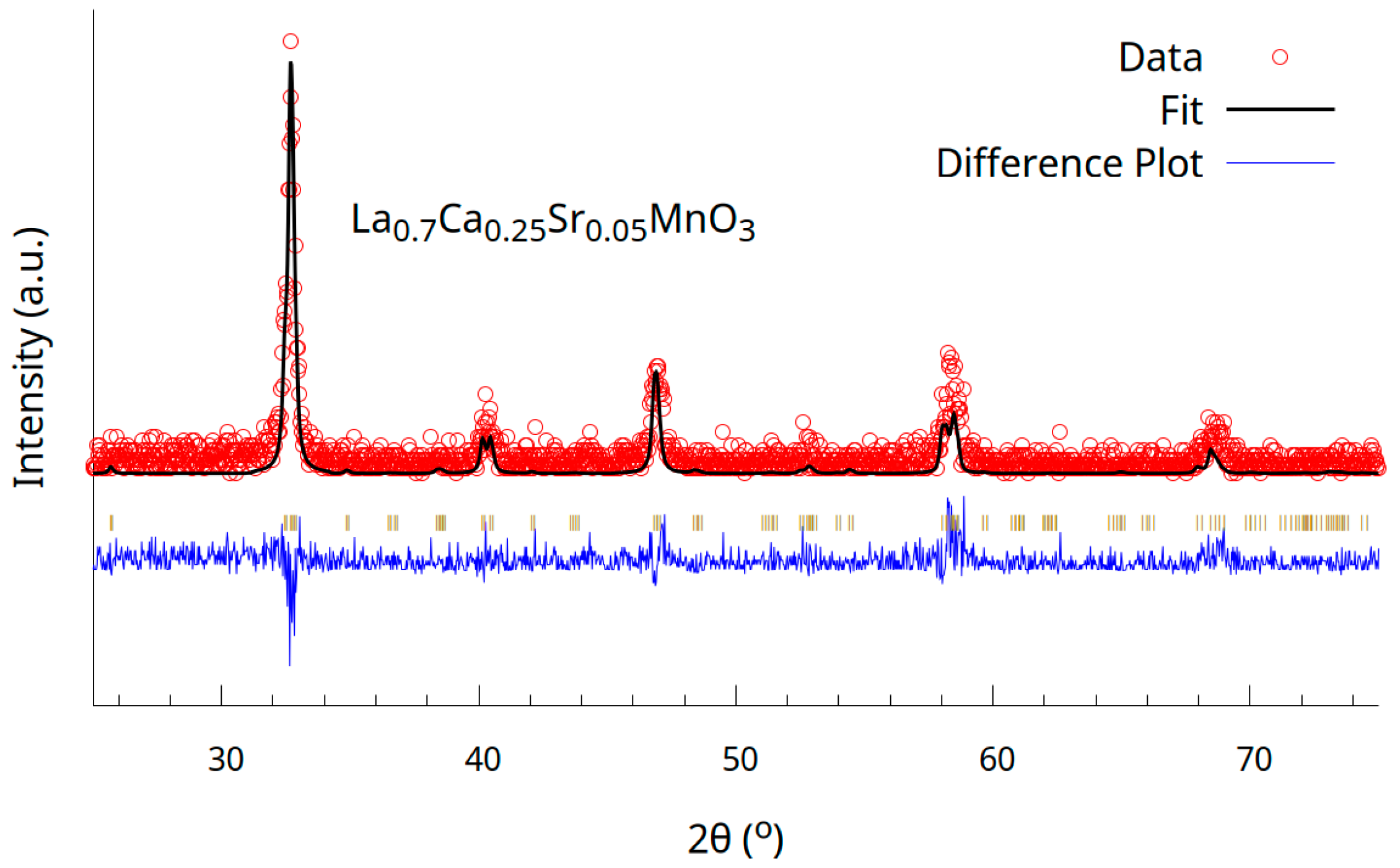
The XRD pattern and refinement for the LCSMO nanoparticles are given in
Figure 1. The diffraction pattern was fitted with the corresponding peroskite structure, space group Pbnm (space group no. 62). The refinement yielded lattice parameters of
a = 0.545(1) nm,
b = 0.774(1) nm, and
c = 0.551(1) nm. It is observed that the lattice parameter is slightly larger than for the composition used as initial parameters for the fit, La
0.7Ca
0.3MO
3 (Crystallography Open Database, entry 1521154); this, however, is expected since Sr has a slightly larger radius than Ca. The microstructure was also evaluated; strain had to be fixed to 0 in order to avoid divergence, while the size fit yielded an estimated mean crystallite size of 50 nm.
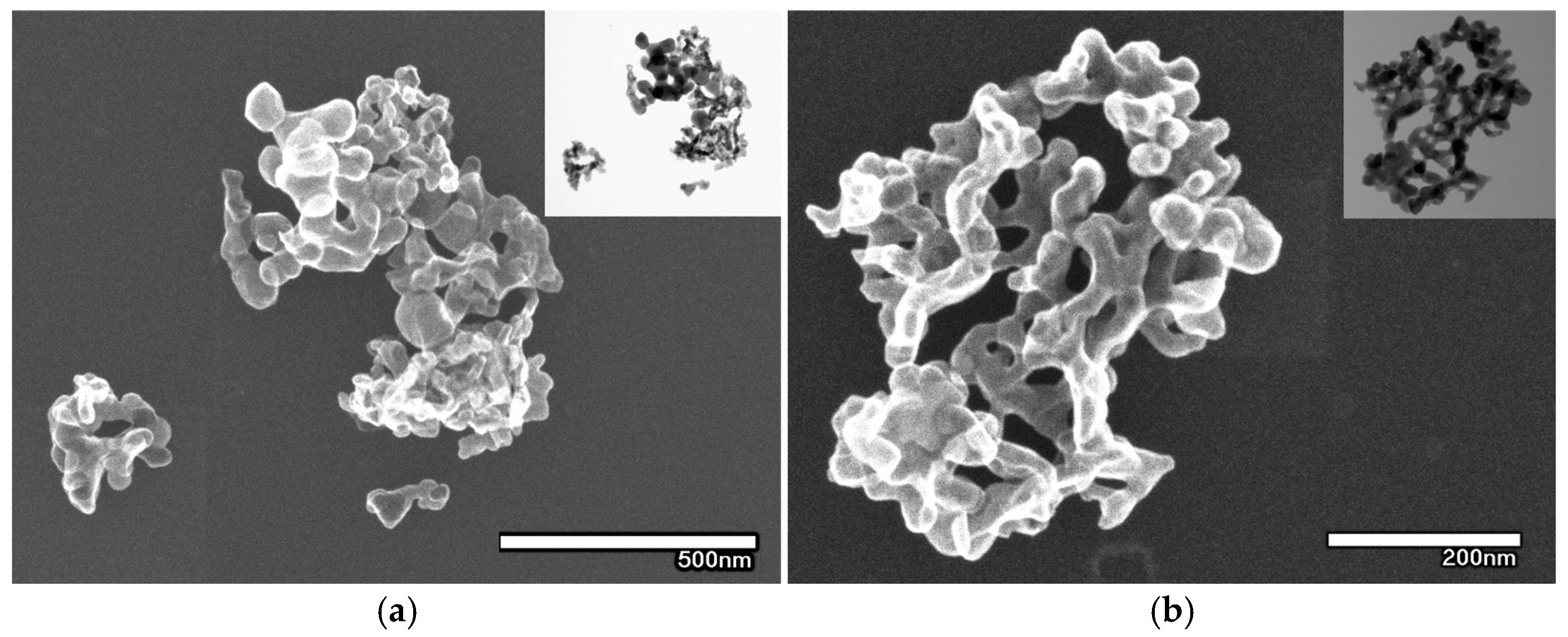
STEM images of the nanoparticles are given in
Figure 2. We can see that the particles form agglomerations, which range drastically in size from 100 to 500 nm, as shown in
Figure 2a. The agglomerations are formed of elongated particles fused together in a tendril-like shape—
Figure 2b—a typical result for the type of synthesis method used. In the agglomerations we can make out individual shapes of approximately 50 nm in diameter, which correlate well with the crystallite size estimations from XRD.
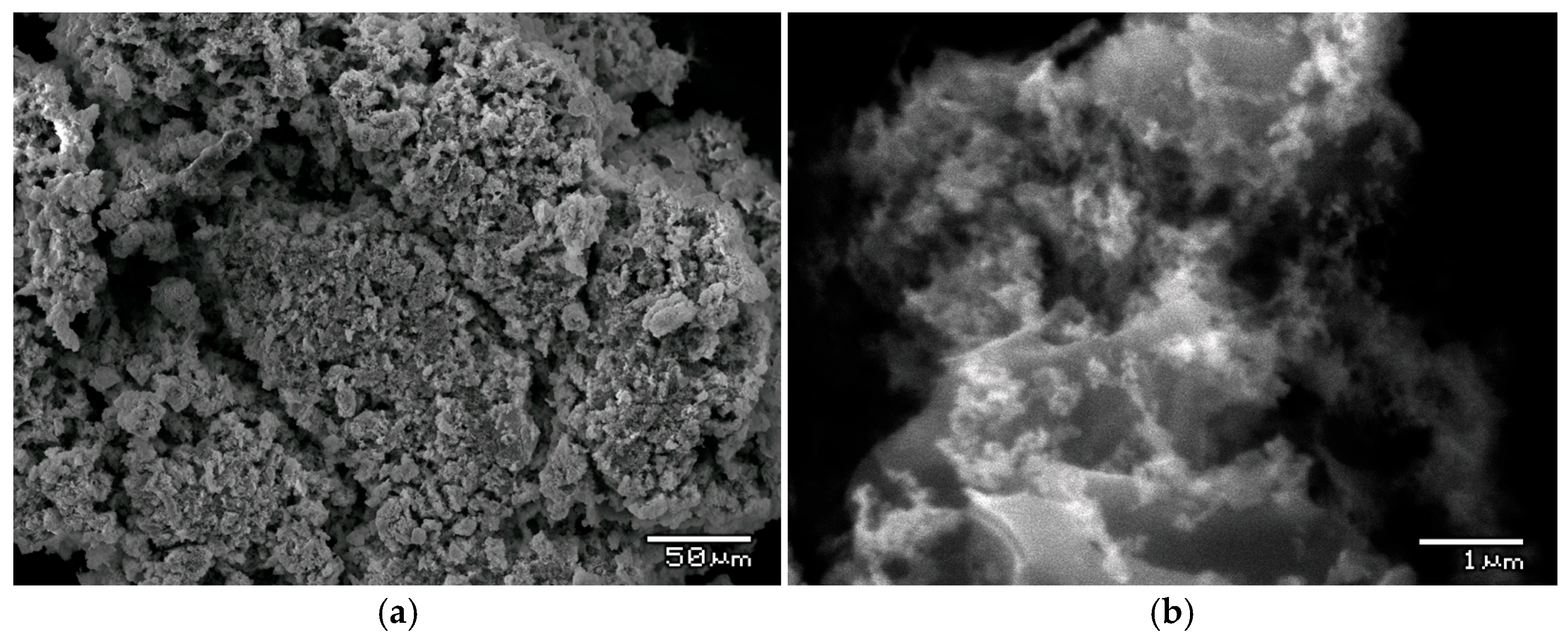
Once covered with PA12, the nanoparticles become embedded in micron-sized agglomerations, glued together by the polymer, as shown in
Figure 3. The relatively large polymer particles are in turn made up of smaller polymer particles 1 to 5 micron in size with embedded La
0.7Ca
0.25Sr
0.05MnO
3 nanoparticles, as shown in
Figure 3a. At a higher resolution, the LCSMO nanoparticle agglomerations become visible in the SEM images, as shown in
Figure 3b, as small spots along the polymer matrix tens to hundreds of nanometers in size. The nanoparticles are close to the resolution limit of the SEM. The intimate binding between the nanoparticles and the matrix material is desirable for application [
20]. This being said, at a scale of 50 microns, it does seem that the particle sizes and number of small pores are much larger than in the case of previously coated micropowders [
14].
Following microscopic characterization, the powders were extruded into filaments. The distribution of magnetic particles within the filaments was examined using SEM; however, effective imaging was not possible due to limited electron beam penetration through the polymer matrix. The resulting filaments had a diameter of 1.40(2) mm.
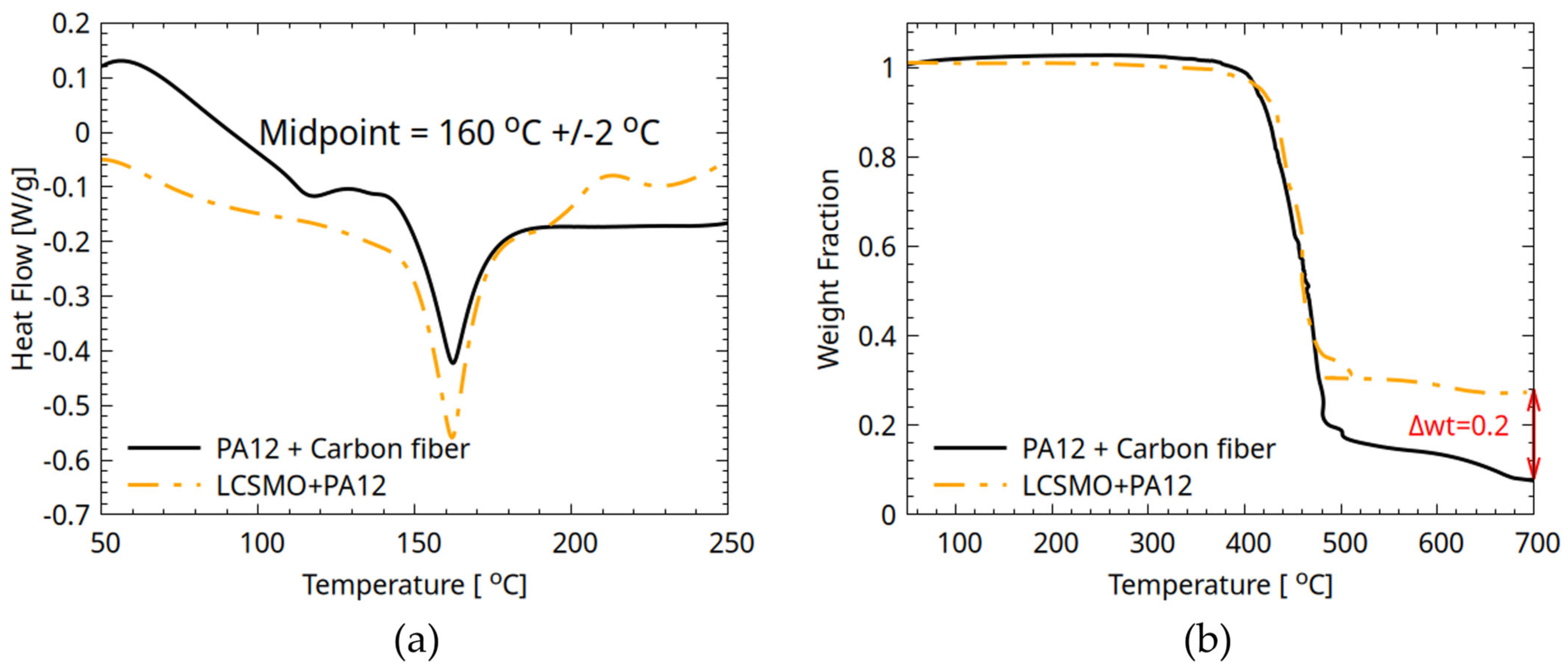
Differential scanning calorimetry (DSC) was performed on the extruded filament, with the results presented in
Figure 4a. A commercial carbon-fiber-reinforced PA12 filament from Polymaker is included for comparison. The data indicate that neither extrusion nor the coating process alters the polymer melting temperature, which remains at 160 °C, consistent with the commercial reference material. The DSC thermograms are truncated at 250 °C, as the exothermic events associated with PA12 combustion are several orders of magnitude larger than the melting endotherm and obscure the relevant thermal transitions.
Evidence of polymer degradation is more clearly observed in the thermogravimetric analysis (TGA) results shown in
Figure 4b. All samples exhibit the onset of mass loss at approximately 400 °C. Complete combustion occurs at around 700 °C for the commercial filament. In contrast, filaments containing encapsulated magnetic particles display an approximately 20 wt% residual mass relative to the reference material, which is attributed to the incorporated nanoparticle content.
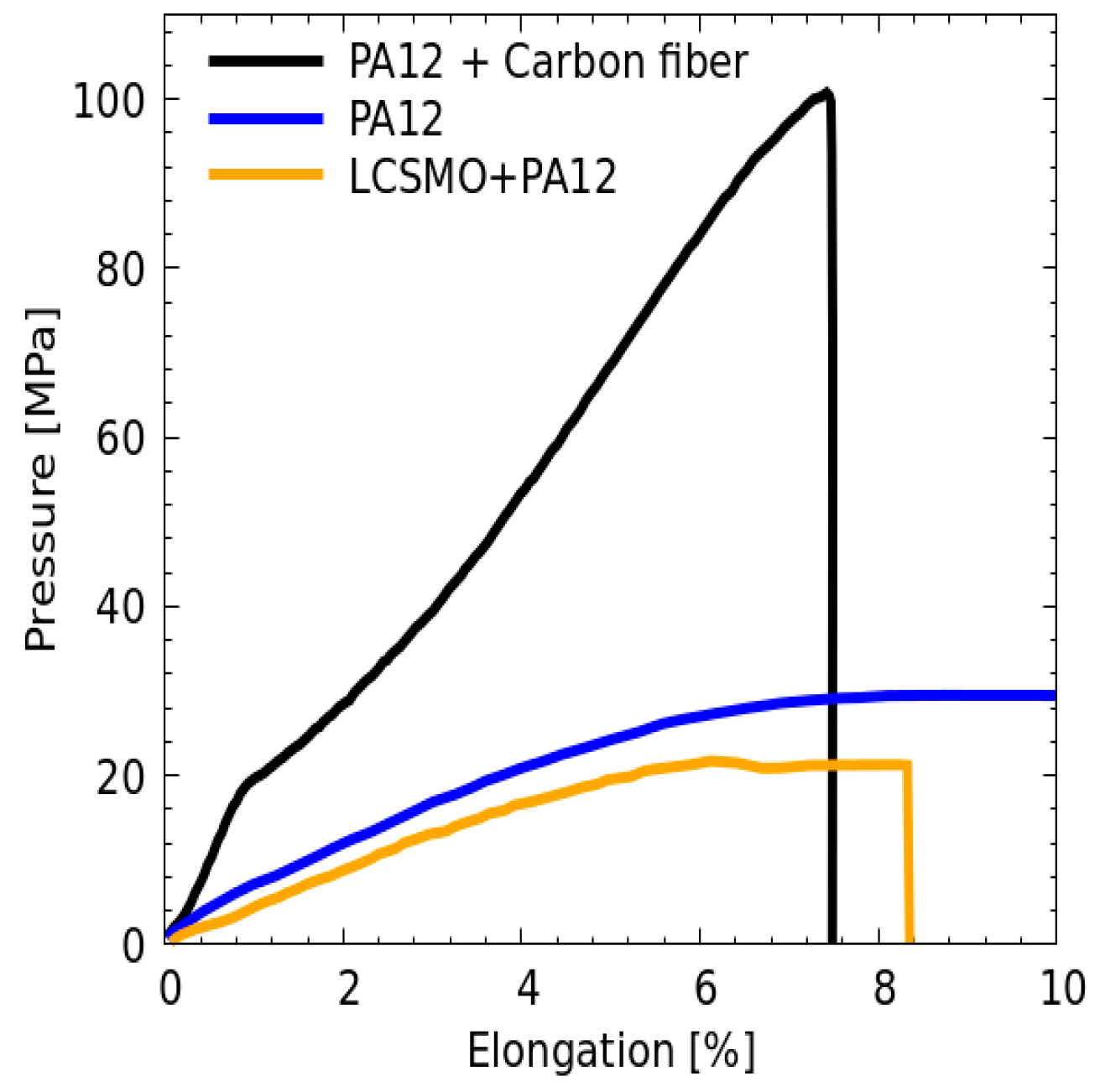
Tensile testing was conducted directly on the extruded filaments, with the results shown in
Figure 5. Because the measurements were performed on the filament geometry rather than on standardized test specimens, the mechanical resolution may be limited in certain cases. The unfilled PA12 filament exhibits a tensile strength of 30 MPa and a maximum elongation of approximately 200% (not shown in full on the plot). In contrast, PA12 reinforced with 10 wt% carbon fiber demonstrates a substantially higher tensile strength of 100 MPa, accompanied by a markedly reduced elongation at break of 7.5%.
Filaments incorporating magnetic particles display intermediate mechanical performance, with a tensile strength of 21 MPa and a maximum elongation of 8.1%. The inclusion of nanoparticles therefore results in a significant reduction in tensile strength, corresponding to an approximately 30% decrease relative to neat PA12. Despite this reduction, the measured mechanical properties remain adequate for the intended applications.
The density of the filaments was also measured by the specific gravity method. The commercial filament’s data sheet gives a density of 1060 kg/m
3, which is in good agreement with the measured value of 1062 kg/m
3. Surprisingly, the addition of 20 wt% nanoparticles causes the density to drop to 930 kg/m
3. We suspect that because the nanoparticles do not bind chemically to the filament, during cooling, the particles cause small cavities to form in their vicinity. A back-of-the-envelope calculation, which assumes spherical particles 50 nm in diameter and that the voids form a spherical shell around the particles, shows that the difference in density can be accounted for by a void a few tens of nm thick around the nanoparticles, which is in our opinion a plausible scenario. Moreover, from the STEM images (
Figure 2b), we can see that some of the agglomerations of nanoparticles have geometries that could lead to the formation of voids.
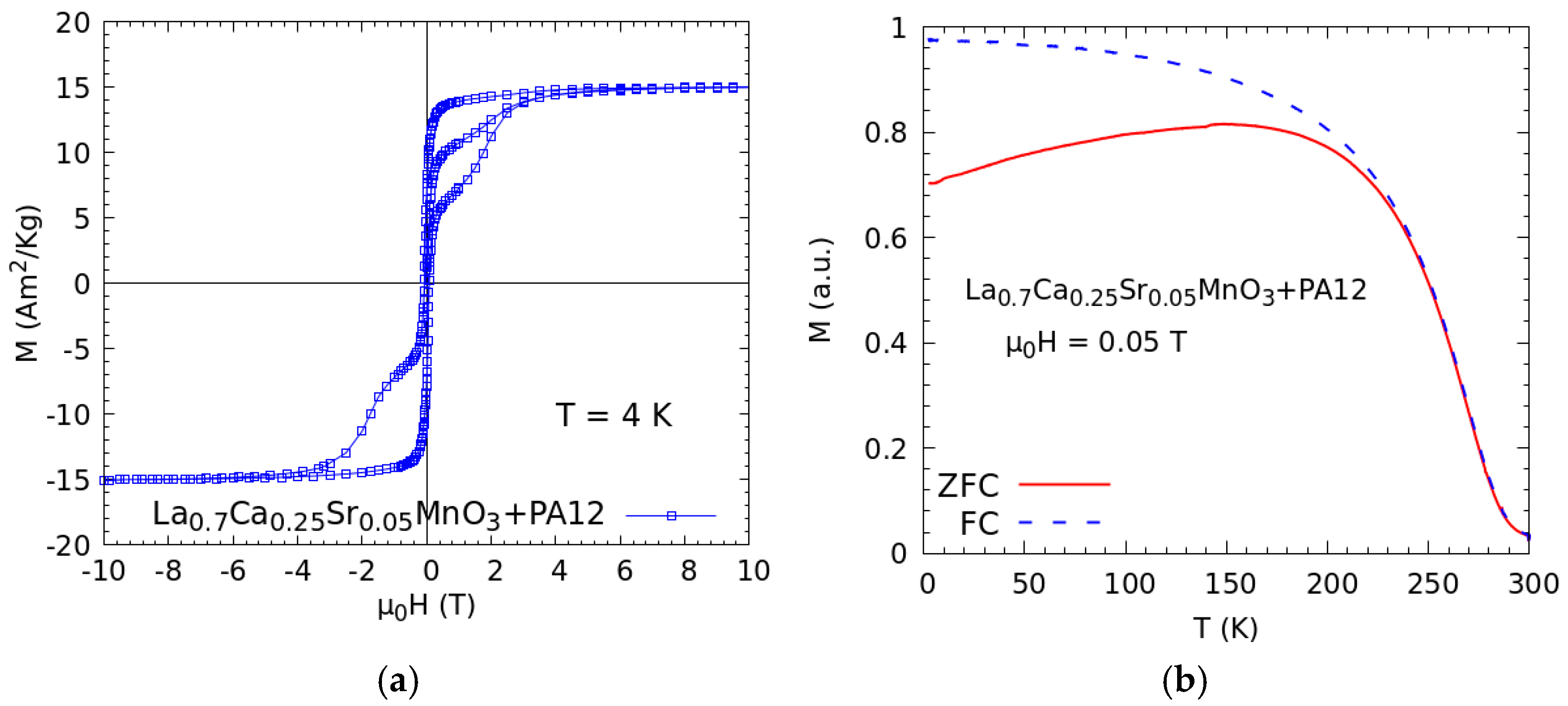
The magnetic properties of the extruded filaments were investigated at 4 K, as shown in
Figure 6a. The hysteresis curve shows no coercive field; however, there are features of hysteresis at non-zero applied fields. The odd shape of the curve is due to the broad distribution of the LCSMO nanoparticle sizes, observed in the TEM images in
Figure 2, with the smaller particles presenting low to no hysteresis, while the larger particles present hysteresis. Moreover, at least some of the particles present significant anisotropy up to 220 °C, as can be seen from the zero-field-cooled, field-cooled (ZFCFC) measurements, as shown in
Figure 6b, the two curves coinciding only very close to the transition temperature.
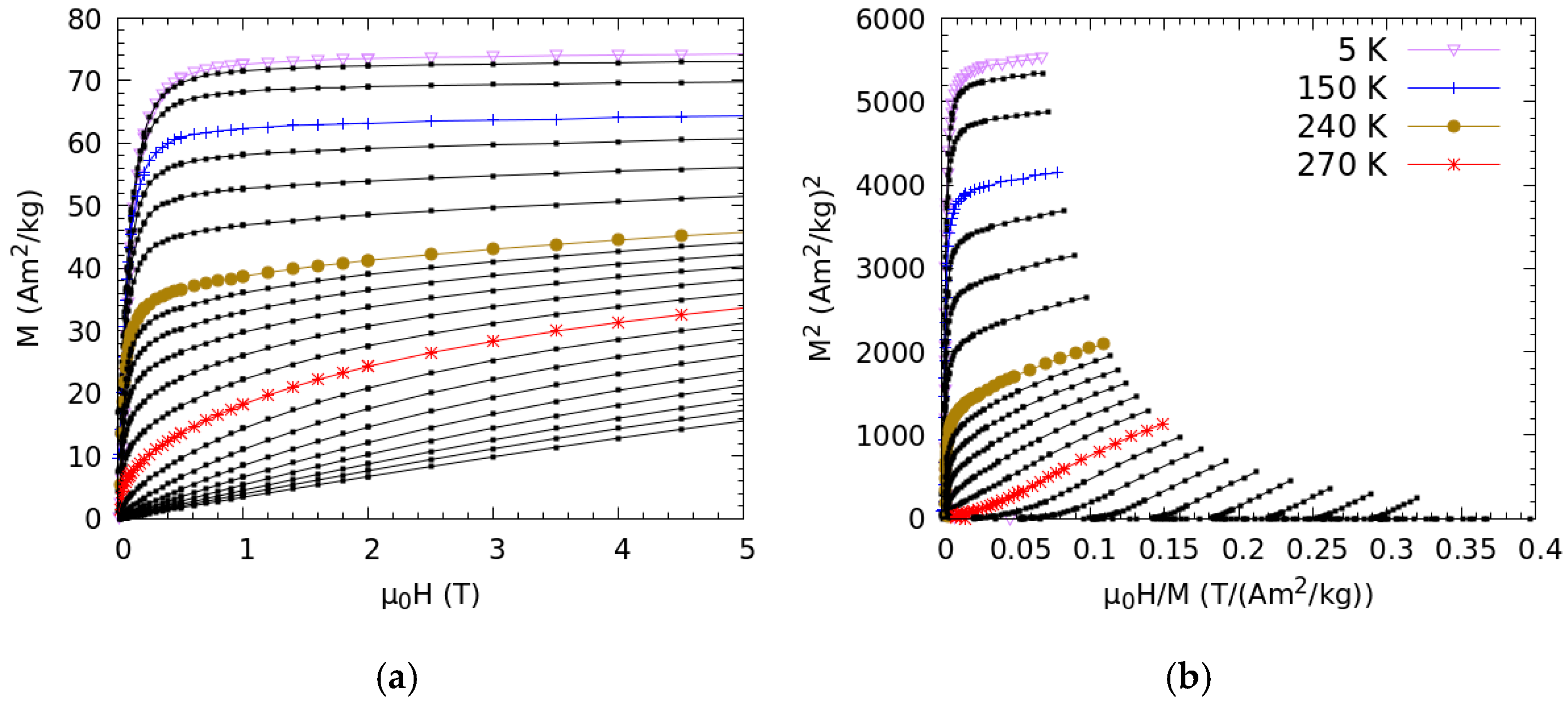
The magnetization isotherms, normalized to powder mass, as shown in
Figure 7a, between 4 K and 310 K, show a saturation magnetization at 4 K of 74 Am
2/kg for the LCSMO nanoparticles. The saturation magnetization decreases with increasing temperature, and ultimately the shape of the curves becomes linear as we pass the Curie temperature of the nanoparticles around room temperature. To better investigate the transition temperature, the Arrott–Belov plots were calculated. The transition temperature seems to be approximately 270 K (red curve), and by the slope of the curves, the LCSMO nanoparticles present a second-order transition. The observed negligible magnetic hysteresis in the composite filaments is a crucial factor for application in magnetic refrigeration. According to Tishin and Spichkin [
18], hysteresis represents a source of energy loss that reduces the net cooling power and the cycle efficiency; therefore, the high reversibility of the magnetization process in these LCSMO nanoparticles is highly beneficial for practical cooling cycles.
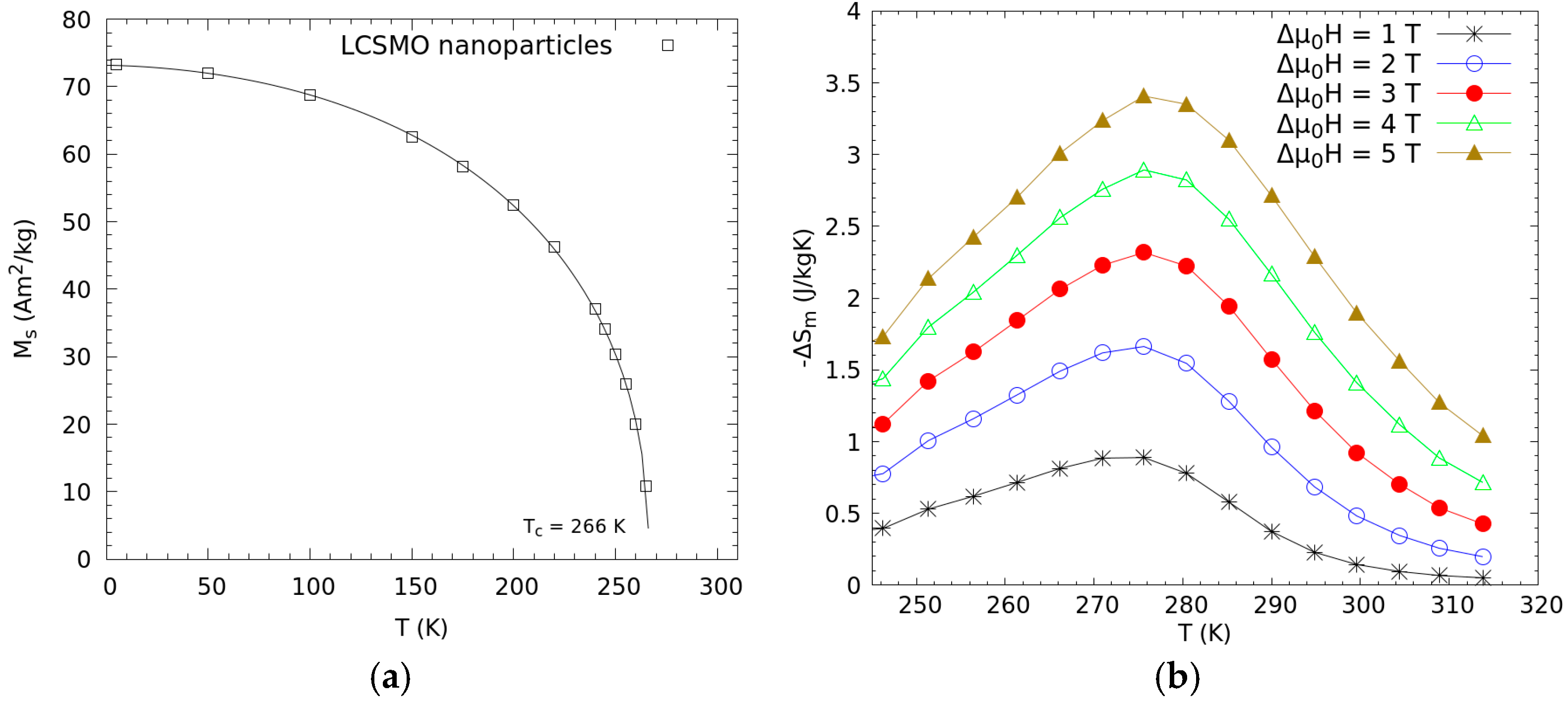
In order to get a better estimation of the Curie temperature for the embedded LCSMO nanoparticles, the spontaneous magnetization (
Ms) was extracted by fitting the linear part of the Arrott–Belov curves. The obtained data was fitted using Equation (1), as shown in
Figure 8a. The fitting gives an estimation close to the one from the Arrott plots, namely
Tc = 266 K. The obtained value is slightly lower than that obtained in single crystals (275 K) [
4]; however, this is expected in nanoparticles, due to the larger contribution of the surface.
The magnetic entropy change (obtained from the magnetization isotherms,
Figure 7, using Equation (2)) for the nanoparticles inside the extruded filaments is given in
Figure 8b. As the transition temperature is large, the peak of the magnetic entropy change follows suit, spanning over 50 K at high fields. The maximum entropy change is centered around 275 K and varies from 0.89 J/kg·K at 1 T applied magnetic field to 3.41 J/kg·K at 5 T, a 14% increase over the value obtained in polycrystalline bulk, 2.97 [
21], but only a third that of single crystals [
4]. Interestingly, although the Curie temperature of the nanoparticles is lower than that in the compared works, the maximum entropy change is at 275 K (slightly above
Tc), just like in single crystals. The complete list of |Δ
SM| values is given in
Table 1, along with the computed values for RCP.
The calculated RCP at 5 T for the nanoparticles is 194.4 J/kg, a nearly 47% increase over the value reported in polycrystalline bulk [
21]. The RCP(S) values normalized to the applied field show that the largest entropy change per Tesla is observed for the relatively low field of 1 T (50.7 J/kg), with every subsequent Tesla producing an average of approximately 38 J/kg. However, if we only look at a useful 50 K interval around the maximum entropy change, the story changes. The nanoparticles produce a useful RCP of around 30 J/kg·T up to 3 T, which then drops off slightly to around 25 J/kg for every additional Tesla.
This being said, the practical relevance of the produced materials is not determined solely by the magnitude of the isothermal magnetic entropy change, but by the resulting adiabatic temperature change achievable in a heat-exchange configuration. In composite systems, the latter is not only reduced by the dilution of the magnetocaloric phase, but is further affected by the total heat capacity of the polymer matrix and fillers, which can significantly suppress the temperature variation compared to the bulk magnetocaloric material. Consequently, although the observed entropy change demonstrates a clear magnetocaloric response at room temperature, the effective temperature change in the present composites is expected to be further reduced, in agreement with previous studies on magnetocaloric composites [
20,
22]. To this end, two capsules were 3D-printed and the heat conduction of the polymer matrix and that of the polymer with embedded nanoparticles were measured, shown in
Table 2. It should be pointed out that the 3D printer had no issues using the produced materials. The conductivity of the commercial material was measured to be 0.4312 W/(m·K), while for samples with embedded nanoparticles the value was 0.2154 W/(m·K) at 300 K. The measured heat capacity is similar for the two samples, 5.28 MJ/(m
3·K) for PA12 with carbon fiber and 4.27 MJ/(m
3·K) for filaments with embedded nanoparticles.
The significantly lower thermal conductivity for the filament with encapsulated LCSMO nanoparticles of 0.21 W/(m·K) is very close to the literature value reported for neat PA12 [
23,
24]. In order to explain this result, the thermal conductivity of the system was modeled.
The volume fraction of LCSMO to PA12 + CF was taken as 0.04. The amount of air-filled cavities was calculated to be 23% of the total volume. The estimation was done from the final density of the composite, knowing that the density of PA12 + CF is given by the manufacturer as 1060 kg/m3, and using the theoretical density of the LCSMO material from XRD (6296 kg/m3), along with the estimated density of air (1.2 kg/m3).
Because we know that the two measured pellets were printed identically, for the first calculations we used the experimental value of the polymer matrix of 0.43 W/(m·K) to try and add air pockets and nanoparticles. The thermal conductivity of air was taken as 0.026 W/(m·K) and the value for LCSMO was taken as 1.2 W/(m·K) according to [
23]. The results are shown in
Table 3. For the inclusions we have considered air gaps alone, as well as air pockets containing nanoparticles (Equations (4) and (5)). The inclusions were then placed in the polymer + CF matrix (Equations (3) and (5)). For the inclusions, EMT gives a much smaller result than ME; this holds true for the complete filament as well. All types of inclusion lower the thermal conductivity of 0.43 W/(m·K) of the matrix, with the best-fitting result being that obtained from EMT into EMT—the completely random arrangement, 0.264 W/(m·K), fairly close to the experimental result of 0.21 W/(m·K). All other results yield a positive deviation of about 50% from experimental results. Running a calculation on the matrix itself, taking a value of 0.24 W/(m·K) for pure PA12 from [
24] and a ballpark value of 10 W/(m·K) for the types of carbon fibers used [
25], we observed that from ME, ordered fibers in PA12 + CF give a conductivity of 0.643 W/(m·K) while disordered fibers (EMT) yield a value of only 0.288 W/(m·K). If we recalculate using the lower bound (the EMT result), the obtained values for all models become significantly closer to the experimental results. Of course, the 5% deviation from the experiment is dependent on the exact material values utilized. This being said, the calculations show that cavitation around nanoparticles cannot account for the entire drop in thermal conductivity, and therefore it is likely accompanied by a disordering in carbon fiber conduction pathways.
Some of these shortfalls may be mitigated in the future. Functionalizing the surface of the nanoparticles may prevent the formation of voids, by ensuring strong chemical bonding between the polymer matrix and the particles. Likely this process would also significantly increase the tensile strength of the material, as nanoparticles would no longer hinder the binding between polymer chains, a real issue since nanoparticles have three orders of magnitude more surface area than micro particles.
In the case of the addition of carbon fibers for thermal conductivity, they should likely be co-extruded with the filament in order to preserve the interconnectivity required for optimal thermal transfer.
4. Conclusions
We successfully synthesized La0.7Ca0.25Sr0.05MnO3 (LCSMO) nanoparticles in large quantities (30 g) within a single batch. The synthesis utilized a green, sucrose- and pectin-based sol–gel combustion method, proving to be an effective route for producing perovskite manganites.
The synthesized nanoparticles were successfully embedded into a PA12 polymer matrix containing carbon fibers and extruded into filaments with a diameter of 1.40(2) mm. The extrusion and coating process did not negatively impact the polymer’s fundamental thermal characteristics, as the melting temperature remained unaffected at 160 °C.
The produced composite filaments proved highly compatible with standard fused filament fabrication equipment. 3D printing was performed successfully without nozzle clogging or equipment issues.
The composite materials exhibited a clear room-temperature magnetocaloric effect, which was proportional to the nanoparticle loading (20% by weight). The studies indicated a second-order phase transition. The resulting lack of thermal hysteresis is a desirable trait for magnetic refrigeration cycles.
At the current loading of magnetic powder, the filaments retained reasonable mechanical properties for application purposes. The composite filaments demonstrated a tensile strength of 21 MPa and a maximum elongation of 8.1%.
The observed drop in thermal properties of the magnetocaloric filaments, compared to PA12 + carbon fiber, were attributed to the lowering of the connectivity of the carbon fiber network and the formation of small voids around the embedded nanoparticles.
To address the issues of micro-void formation and low density, the surface of the LCSMO nanoparticles should be functionalized. Creating a strong chemical bond between the inorganic particles and the organic polymer matrix would prevent the formation of cavities during cooling. Furthermore, this functionalization is expected to significantly improve the material’s tensile strength by allowing better binding between polymer chains, which are currently hindered by the high surface area of the nanoparticles. However, it is important to note a practical trade-off: such functionalization typically involves additional chemical processing steps and the use of coupling agents or organic solvents. This could increase the environmental footprint and complexity of the production, potentially detracting from the inherent sustainability and simplicity of the current green, water-based sol–gel combustion method. Future studies should therefore focus on identifying bio-based or solvent-free functionalization agents to maintain the ecological advantages of the process.
The current mixing method resulted in random/broken connections within the carbon fiber network, leading to lower-than-expected thermal conductivity. To remedy this, carbon fibers should be co-extruded with the filament rather than simply mixed. This approach aims to preserve the structural interconnectivity of the fibers, which is essential for optimal thermal transfer between the magnetocaloric material and the heat-exchange fluid.
In summary, this work confirms that fused filament deposition is a feasible method for shaping magnetocaloric heat exchangers. The ability to print complex geometries using these chemically stable composites offers significant advantages for rapid prototyping in magnetic refrigeration technologies




 ,
,