Article

Improved Wide-Temperature-Range Magnetocaloric Properties of (Mn,Fe)2(P,Si) Alloys by Mg-Co Co-Doping

1
College of Mechanical Engineering, Guangzhou City University of Technology, Guangzhou 510800, China
2
School of Materials Science & Engineering, South China University of Technology, Guangzhou 510640, China
*
Authors to whom correspondence should be addressed.
Magnetochemistry 2026, 12(2), 17; https://doi.org/10.3390/magnetochemistry12020017
Submission received: 25 November 2025 / Revised: 29 December 2025 / Accepted: 15 January 2026 / Published: 2 February 2026
(This article belongs to the Special Issue Advance of Magnetocaloric Effect and Materials)

Abstract

To enhance the wide-temperature-range magnetocaloric performance of (Mn,Fe)2(P,Si) alloys, the effects of Mg-Co co-doping on their structural and magnetocaloric properties were systematically investigated. Mn1.05−yCoyFe0.9P0.5Si0.48Mg0.02 alloys were prepared by the arc melting method. The results show that Mg-Co co-doping can tune the lattice parameters and ferromagnetic coupling between Mn and Fe atoms. The Mn1.03Co0.02Fe0.9P0.5Si0.48Mg0.02 alloy exhibited an effective refrigeration capacity of 425.4 J·kg−1 and an effective working temperature span of 52 K. During the temperature-induced ferromagnetic transition, coupling between the magnetic moment of Fe-Si layers and the crystal lattice drives a magnetoelastic transition, leading to a giant magnetocaloric effect. The Mg-Co co-doping strategy effectively tunes the crystal structure and local electron density distribution of the Fe-Si layer, thereby influencing the total magnetic moment and magnetothermal properties of the alloys.

1. Introduction

Magnetic refrigeration technology is considered a promising alternative to conventional gas-compression refrigeration due to its low carbon emissions, safety, and reliability. Giant magnetocaloric effect materials are used in magnetic refrigeration prototype to achieve the purpose of refrigeration. Up to now, materials with giant magnetocaloric effect have been discovered, including Gd [1], Gd(Si,Ge)4 [2], Ni-Mn-X-based [3,4,5], La(Fe,Si)13 [6], and (Mn,Fe)2(P,Si) [7] alloys. Among them, (Mn,Fe)2(P,Si) alloys have abundant raw materials, low cost, and broad application prospects. In addition to their giant magnetothermal effect, (Mn,Fe)2(P,Si) alloys have a large hysteresis effect [8] and a narrow effective temperature span [9]. A large hysteresis effect will significantly weaken the refrigeration efficiency of the magnetic refrigeration prototype in practical application, while a narrow effective working temperature span will limit the system temperature span of the magnetic refrigeration prototype. Generally, magnetic materials with first-order phase transition (FOPT) have large MCE, but with large thermal hysteresis and phase transformation stress, while magnetic materials with second-order phase transition (SOPT) have small MCE with negligible thermal hysteresis stress. When they are under the critical state between FOPT and SOPT, magnetic alloys might achieve large MCE and small thermal hysteresis, which is beneficial for magnetic refrigerators. Recently, it has been found that some types of large-atom doping [10,11,12,13] can bring the material to the critical state of phase transition from FOPT to SOPT, so as to reduce thermal hysteresis and increase the effective working temperature span.
In our earlier work [14], Mg doping was found to notably increase the effective temperature span and reduce thermal hysteresis in (Mn,Fe)2(P,Si) alloys, though without improving the effective refrigeration capacity. It has also been found that a proper amount of Co doping can improve the magnetic and magnetocaloric properties of (Mn,Fe)2(P,Si) alloys [15]. In order to further improve the wide-temperature-range magnetocaloric properties of (Mn,Fe)2(P,Si) alloys, the Mg-Co co-doping method was used to regulate the magnetocaloric properties of the alloys, and the effects of Mg-Co co-doping on the magnetoelastic transition mechanism of the alloys were clarified through first-principles calculations.

2. Materials and Methods

The alloy ingots Mn1.05−yCoyFe0.9P0.5Si0.48Mg0.02 (y = 0, 0.01, 0.02, 0.03) were prepared by vacuum arc melting. Raw materials included Mn (99.9 wt.%), Fe (99.9 wt.%), Fe3P alloy (95.8wt.%), Si (99.9 wt.%), MgMn5 alloy (99.9 wt.%), and Co (99.9 wt.%). As Mn metal is easily volatilized in the smelting process, an additional 5% Mn was added to compensate for the loss. After the ingots were broken into an appropriate size, they were put into a quartz tube and sealed with Ar gas. The quartz tube with the ingots was placed in a heat treatment furnace and annealed at 1100 °C × 72 h.
Crystal structure was characterized in a multi-position automatic injection X-ray diffractometer (XRD) for X’Pert Powder produced by Panalytical Company (Malvern, UK). The test conditions were as follows: the target of Cu Kα, the wavelength of 0.154056 nm, the angle range of 20°~70°, and the speed of 3°/min. The refinement of crystal structure was performed by Rietveld Refinement Method with Rietica software (version 4.2) [16]. The refined parameters included background, phase content, lattice parameters, atomic occupation and peak pattern. The phase and element distribution were characterized by scanning electron microscopy (SEM) of Phenom ProX Desk (Thermo Fisher Scientific, Waltham, MA, USA). The DSC (differential scanning calorimeter) test with N2 atmosphere is performed on the DSC 25 model made by TA Instruments (New Castle, DE, USA). The magnetic measurements were made using the Quantum Design PPMS (San Diego, CA, USA) equipped with a vibration sample magnetometer (VSM). To eliminate the initial effects of the sample, the sample was pre-cooled to 150 K before magnetic measurements. M–H curve was measured by Loop method [17] to avoid the influence of magnetization history.
The density of states (DOS) was calculated based on density functional theory (DFT) using Castep module in Materials Studio software 2023. The Perdew-Burke-Ernzerhof (PBE) exchange correlation functional with the ultra-soft pseudo potential and generalized gradient approximation (GGA) was used in the calculation process. The Broyden-Fletcher-Goldfarb-Shanno (BFGS) method was used to optimize the geometric structure. The criterion of force convergence in the optimization process was 5 × 10⁻² eV/A. The cut-off energy was 520 eV, the K-point grid was 2 × 2 × 4, and the energy convergence criterion was 10−6 eV/atom.

3. Results and Discussion

3.1. Phase Structure Analysis

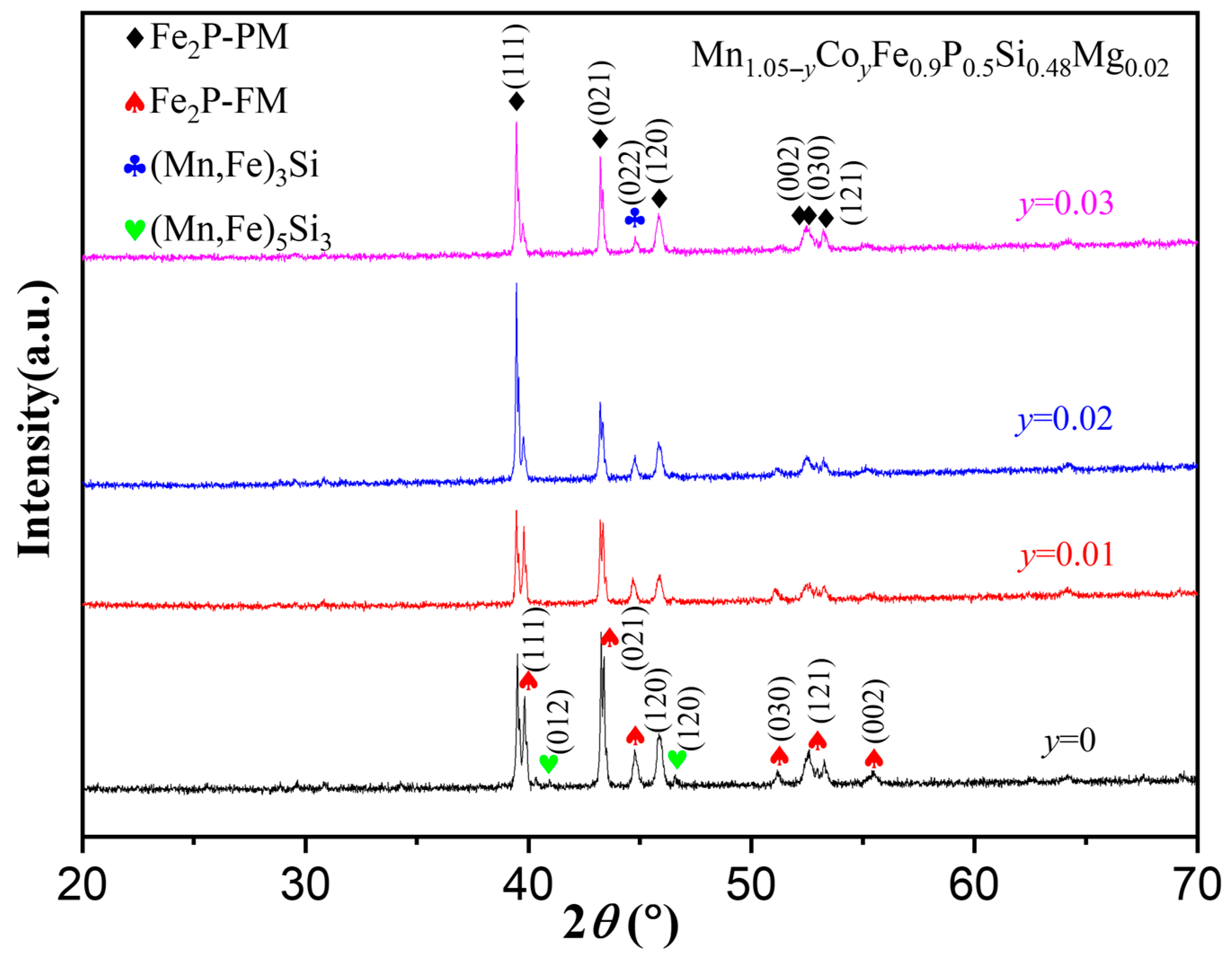
Figure 1 shows the XRD figure of Mn1.05−yCoyFe0.9P0.5Si0.48Mg0.02 (y = 0, 0.01, 0.02, 0.03) alloys at room temperature. As shown in Figure 1, Fe2P main phase and a small amount of (Mn,Fe)3Si and (Mn,Fe)5Si3 impurity phases were formed in all samples. The addition of Co does not affect the formation of Fe2P main phase. Among them, the hexagonal Fe2P paramagnetic phase (PM) and Ferromagnetic phase (FM) are present in all samples. Since the ferromagnetic phase is below the phase transition temperature, the presence of the coexistence of FM and PM in the room-temperature XRD pattern indicates that the Curie temperature (Tc) of the samples might be near room temperature.
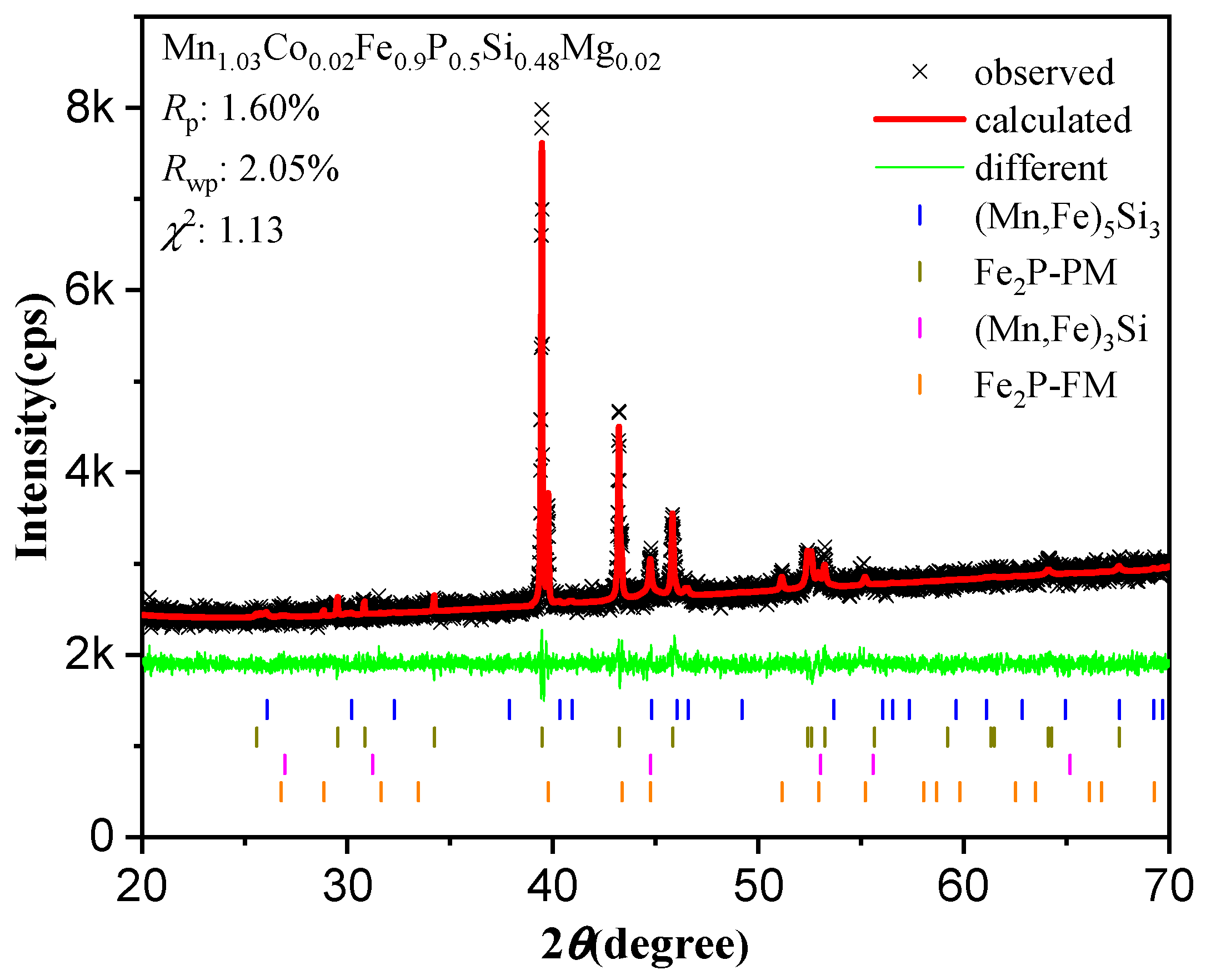
In order to further investigate the variation of crystal structure and phase composition for Mn1.05−yCoyFe0.9P0.5Si0.48Mg0.02 (y = 0, 0.01, 0.02, 0.03) alloys, Rietveld refinement method was utilized to refine XRD data. Figure 2 shows Rietveld refinement patterns of Mn1.03Co0.02Fe0.9P0.5Si0.48Mg0.02 alloys. The other samples’ refinement patterns can be found in Figure S1 in Supplementary Documents. Table 1 lists the mass percentage of each phase for Mn1.05−yCoyFe0.9P0.5Si0.48Mg0.02 (y = 0, 0.01, 0.02, 0.03) alloys and refined structural parameters for Fe2P-PM phase. As shown in Table 1, with the increase of Co content y from 0 to 0.03, the content of main phase, including FM and PM phase, gradually decreases from 96.76 wt.% to 89.63 wt.%, while the content of impurity increases from 3.24 wt.% to 10.37 wt.%. The addition of Co obviously promotes the formation of (Mn,Fe)3Si impurity. As the Co doping amount y increases from 0 to 0.03, the lattice parameters a and b gradually decrease from 6.049(0) Å to 6.039(6) Å, while the lattice parameter c first decreases from 3.480(6) Å to 3.476(3) Å and then increases to 3.477(6) Å. In addition, the cell volume v gradually decreases from 110.29(6) Å3 to 109.86(0) Å3 with the increase of Co doping y from 0 to 0.03. The change of cell parameters shows that the Co atoms enter into the lattice of Fe2P main phase.
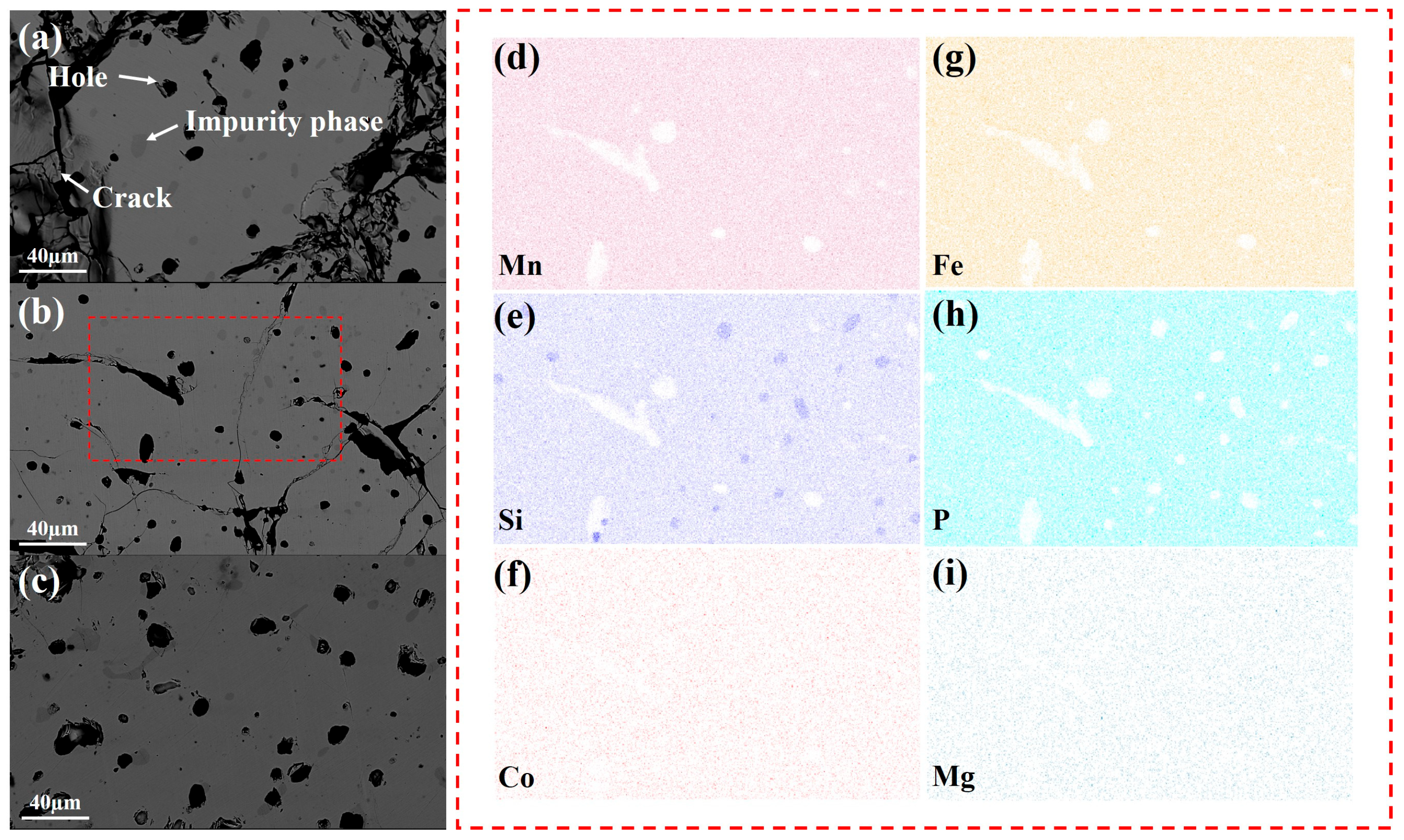
Figure 3 shows the backscattered electron images of Mn1.05−yCoyFe0.9P0.5Si0.48Mg0.02 alloys and the EDS (Energy Dispersive Spectrometer) maps images of Mn1.03Co0.02Fe0.9P0.5Si0.48Mg0.02 alloy. As shown in Figure 3d–i, without considering the influence of pores, Mn, Fe, Co and Mg elements are relatively evenly distributed, while P and Si elements are not. Combined with backscattered electron images, it can be found that the light gray area of rich P elements is the main phase of Fe2P, while the dark gray area of rich Si elements is the (Mn,Fe)3Si and (Mn,Fe)5Si3 impurity phase. The elliptic impurity phase is uniformly distributed in the matrix of the main phase. With the increase of Co doping amount, the number and morphology of impurity phase have little change, but the crack defects in the alloy become less, which may be related to the decrease of Curie temperature. As can be seen from Figure 1, with the Co doping amount y increasing from 0.01 to 0.03, the relative intensity of the diffraction peak of Fe2P-FM phase in the XRD patterns gradually decreases, which indicates that there are less ferromagnetic phases and more paramagnetic phases in the alloy at room temperature, and the Curie temperature of the alloy is lower. It has been reported [18] that the ferromagnetic phase of quenched (Mn,Fe)2(P,Si) alloy usually has a large number of cracks and other defects, which is mainly due to the occurrence of paramagnetic to ferromagnetic phase transition, during which there is a large stress and cracks are easy to initiate and expand at those defects.

3.2. Magnetocaloric Properties Analysis

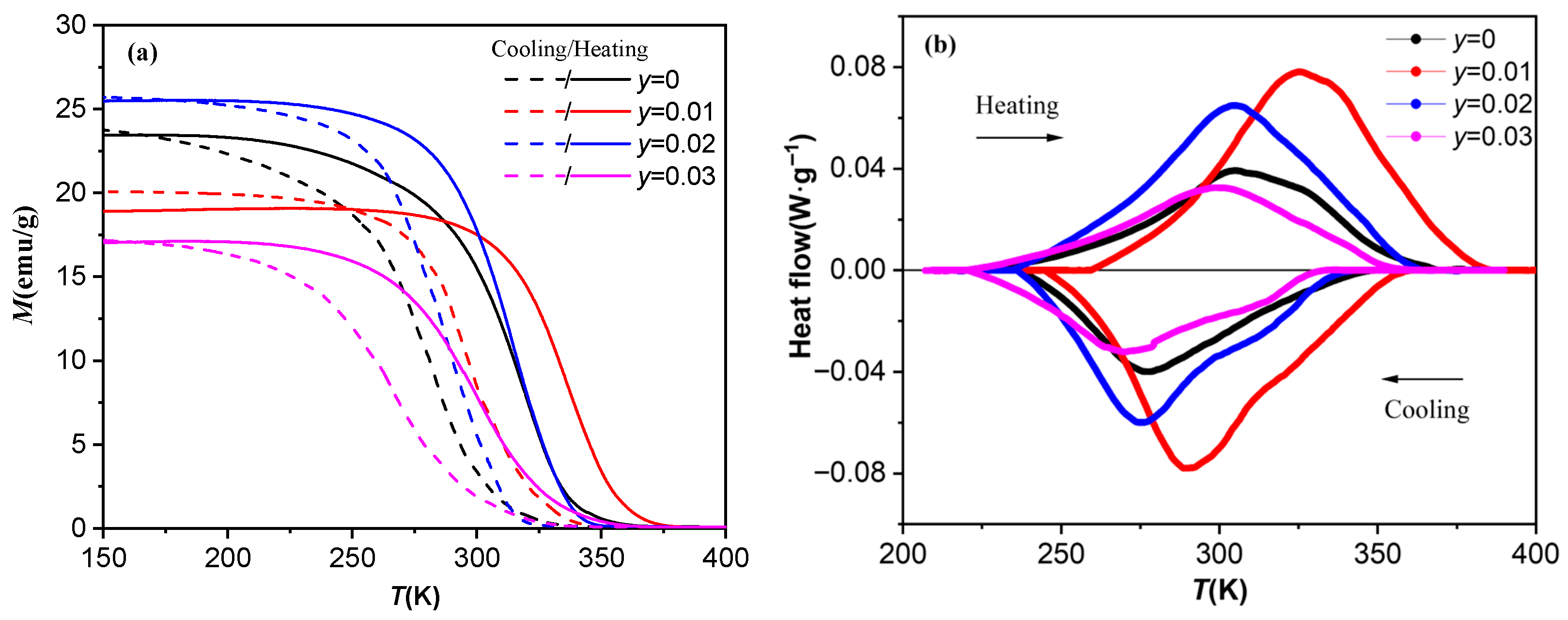
Figure 4 shows (a) Temperature dependence of magnetization for Mn1.05−yCoyFe0.9P0.5Si0.48Mg0.02 (y = 0, 0.01, 0.02, 0.03) alloys (the solid/dashed line represent the heating/cooling process respectively) and (b) DSC curves of Mn1.05−yCoyFe0.9P0.5Si0.48Mg0.02 (y = 0, 0.01, 0.02, 0.03) alloys. Table 2 lists phase transition temperature (Tt–H and Tt–C calculated respectively from DSC date of heating and cooling process), thermal hysteresis (ΔThys and ΔThys* calculated respectively from MT plots and DSC date), and latent heat (L) of Mn1.05−yCoyFe0.9P0.5Si0.48Mg0.02 (y = 0, 0.01, 0.02, 0.03) alloys. As shown in Table 2, with the increase of Co doping y from 0 to 0.01, the Curie temperature (TC) of the alloy increases from 319 K to 337 K. When the amount of Co doping is further increased to 0.03, TC of the alloy gradually decreases from 337 K to 300 K. This shows that the Curie temperature of (Mn,Fe)2(P,Si) alloys can also be regulated by Co doping method. In the (Mn,Fe)2(P,Si) alloy system, the alloy undergoes a magnetoelastic transformation, and the changes in magnetic properties and structural parameters are coupled together [19]. In other words, the lattice parameter c of the alloy is closely related to the ferromagnetic coupling between the magnetic atomic layers. The smaller the lattice parameter c is, the stronger the ferromagnetic coupling between Mn and Fe atoms. The ferromagnetic state tends to be stable, and the Curie temperature of the alloy is higher. As shown in Table 1, with the increase of amount of Co doping, the lattice parameter c of first decreases and then increases, while TC first increases and then decreases, which is consistent with the above magnetoelastic transition theory. As shown in Table 2, with the increase of Co doping content y from 0 to 0.02, ΔThys of the alloy first increases from 35 K to 44 K, and then decreases to 30 K. When the Co doping content further increases to 0.03, ΔThys basically stabilizes at about 30 K. The thermal hysteresis of (Mn,Fe)2(P,Si) alloy is mainly related to the amount of impurity phase and first-order magnetic phase transition [8]. It can be seen from Table 1 that with the increase of Co doping, impurity phase content in the alloy gradually increases by about 10%. The higher impurity phase content is, the larger the energy barrier of the phase transition and the larger the thermal hysteresis of the alloy is. However, after Co doping, the thermal hysteresis of the alloy increases first and then decreases. This may be due to Co doping can also affect the degree of first-order magnetic phase transition. Co doping may weaken the first-order magnetic phase transition of the alloy, resulting in a weaker structural change during the magnetic phase transition process, and then resulting in a decrease in thermal hysteresis of the alloy after further doping Co.
As shown in Figure 4b, the DSC curves of Mg-Co co-doped samples are all wide, and there is no sharp characteristic peak type of first-order magnetic phase transition, which indicates that Mg-Co co-doped samples still exhibit the characteristics of second-order magnetic phase transition. It can be seen from Table 2 that the change rules of phase transition temperature and thermal hysteresis obtained by DSC are consistent with the results of the thermomagnetic curves. With the increase of Co doping amount, the latent heat first increases and then decreases. When Co doping amount y is 0.01, the maximum latent heat of the alloy is 27.6 J·g−1. This shows that the energy produced during the temperature-induced magnetic phase transition of the alloy can be increased by proper Co doping. Proper Co doping has little effect on the peak width of the DSC curve, but increases the peak height of the DSC curve and thus increases the latent heat, which implies that the alloy doped with Co will have greater effective cooling capacity.
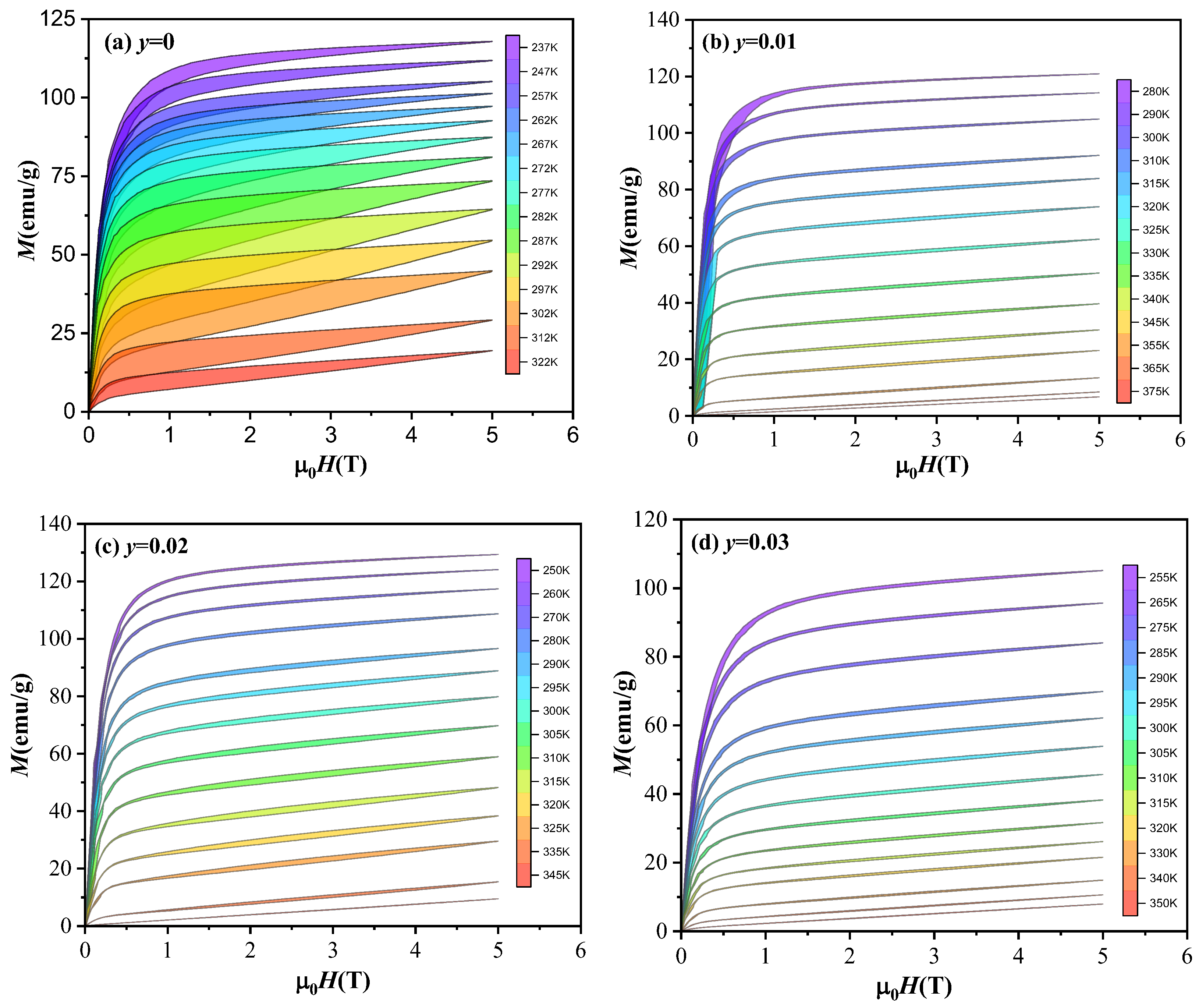
Figure 5 shows Magnetization (M) versus magnetic field (H) curves of Mn1.05−yCoyFe0.9P0.5Si0.48Mg0.02 (y = 0, 0.01, 0.02, 0.03)alloys. After Co doping, the area surrounded by magnetization curve and demagnetization curve decreases, and the hysteresis of the alloy decreases obviously. Table 3 lists the average magnetic hysteresis loss (HLav), maximum isothermal magnetic entropy change (−ΔSM), refrigeration capacity (RC), effective refrigeration capacity (RCeff), effective working temperature span (ΔTETS) and the peak temperature of maximum magnetic entropy change for Mn1.05−yCoyFe0.9P0.5Si0.48Mg0.02 (y = 0, 0.01, 0.02, 0.03) alloys at 5 T magnetic field. As shown in Table 3, with the increase of Co doping from 0 to 0.03, the average hysteresis loss of the alloy gradually decreases from 45.4 J·kg−1 to 4.5 J·kg−1. Considering the instrument error, the Mg-Co co-doped alloy is basically free of hysteresis. In addition, it can be found from Figure 5 that with the increase of Co doping, the saturation magnetization of the alloy increases first and then decreases. It indicates that a small amount of Co doping can increase the magnetic moment of the alloy, while excessive Co doping will weaken the magnetic moment of the alloy. As for the reasons about this phenomenon, it will be discussed in the section of Computation result discussion. This is basically consistent with the research results of literature [15].
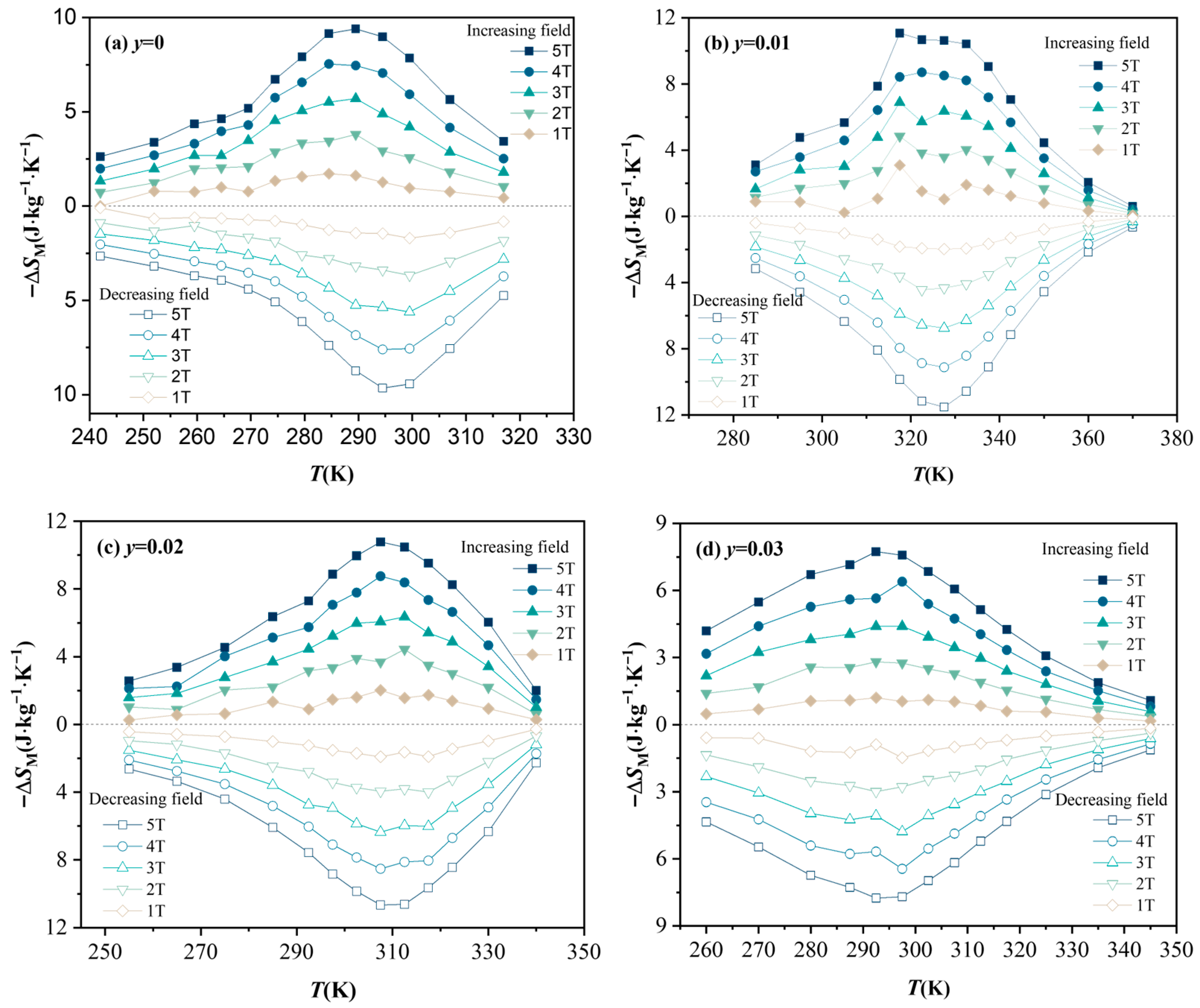
Figure 6 shows the temperature dependence of isothermal magnetic entropy change of Mn1.05−yCoyFe0.9P0.5Si0.48Mg0.02 (y = 0, 0.01, 0.02, 0.03) alloys. The isothermal magnetic entropy change can be derived from Maxwell relationship and magnetization curve data, as shown in Equation (1). For samples with Co doping of 0, 0.01, 0.02 and 0.03, the maximum isothermal magnetic entropy changes during magnetization are 9.4, 11.1, 10.8 and 7.7 J·kg−1K−1, respectively. With the increase of Co doping, the maximum isothermal magnetic entropy of the alloy increases first and then decreases. As shown in Figure 6, the magnetic entropy curve of all samples are broader, which indicates that the alloy will have a wider working temperature span. This shows that a small amount of Co doping can increase the magnetic entropy change of the alloy and maintain a wider magnetic entropy change peak pattern, so as to have a greater effective cooling capacity. However, after excessive Co, the magnetic properties of the alloy become weaker, resulting in the decrease of magnetic entropy.
Δ S M T , H = H i H j M T H d H = i M i ( T n + 1 , H ) M i ( T n , H ) T n + 1 T n δ H
T E C Δ T H C = 1 Δ T H C max T mid Δ T H C 2 T mid + Δ T H C 2 Δ S ( T ) d T
The ΔTH–C in Equation (2) represents the temperature span, and Tmid is approximated as the temperature corresponding to the maximum magnetic entropy change.
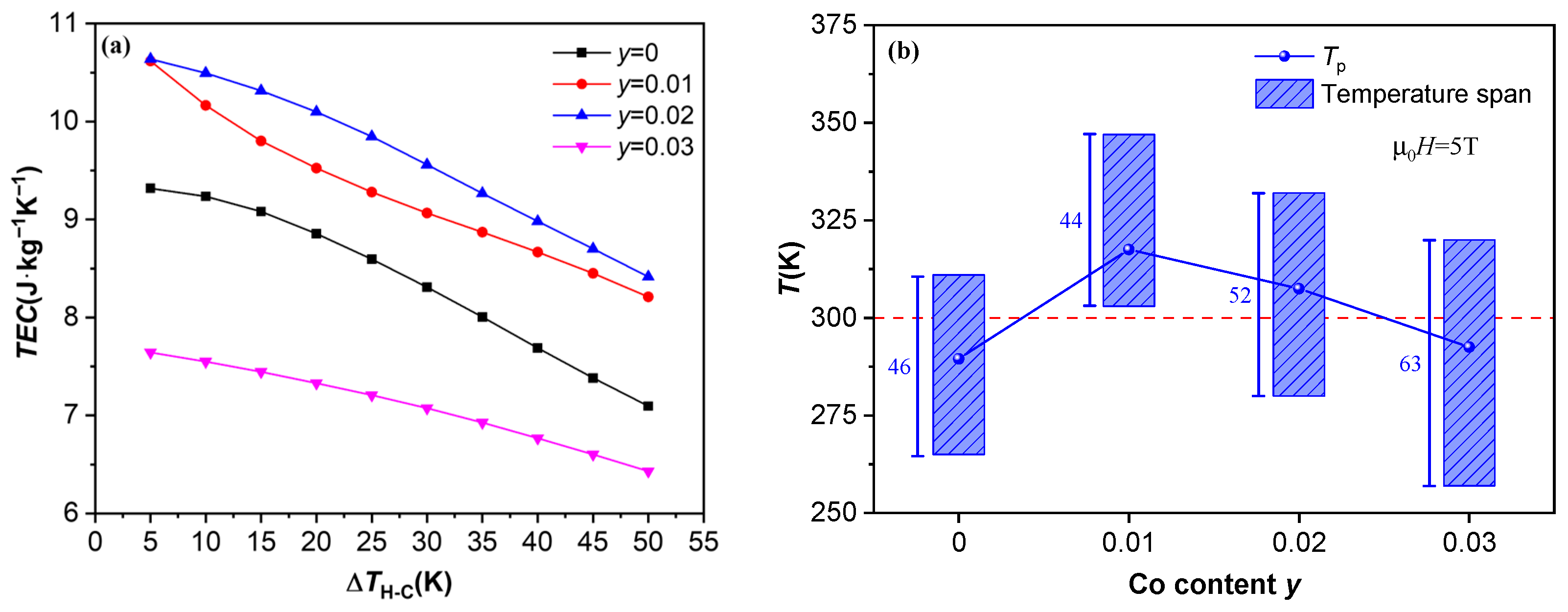
In order to further evaluate the attenuation situation of average magnetic entropy change for magnetocaloric materials under different temperature span, the Temperature averaged Entropy Change (TEC) [20] of Mn1.05−yCoyFe0.9P0.5Si0.48Mg0.02 (y = 0, 0.01, 0.02, 0.03) alloys is calculated by Equation (2). Figure 7a shows the TEC curves of Mn1.05−yCoyFe0.9P0.5Si0.48Mg0.02 (y = 0, 0.01, 0.02, 0.03) alloys under 5 T magnetic field. At the same temperature span, the TEC value of the alloy increases first and then decreases with the increase of Co doping, and the TEC value reaches the maximum when Co doping content is 0.02. When the amount of Co doping is constant, the TEC value decreases with the increase of temperature span. When the temperature span ΔTH–C increases from 5 K to 50 K, the TEC values of alloys with Co doping y of 0, 0.01, 0.02 and 0.03 decrease by 24%, 23%, 21% and 16%, respectively. This shows that with the increase of Co doping, the alloy is less and less sensitive to the change of temperature span, and there will be a wider effective working temperature span.
R C = T cold T hot Δ S M d T
R C eff = R C H L a v
In order to further evaluate the magnetocaloric performance of Mn1.05−yCoyFe0.9P0.5Si0.48Mg0.02 alloys, the cooling capacity (RC) and effective refrigeration capacity (RCeff) are calculated by Equations (3) and (4). The effective working temperature span (ΔTETS) is the half-height width of the isothermal magnetic entropy curve. As shown in Table 3, the RC of the alloy gradually increases from 337.1 J·kg−1 to 432.3 J·kg−1 as the Co doping content y increases from 0 to 0.02. The RC of the alloy decreases to 378.7 J·kg−1 when the Co doping amount is further increased to 0.03. When hysteresis loss is considered, the variation trend of the RCeff is similar. The RCeff of the alloy increases from 291.7 J·kg−1 to 425.4 J·kg−1 with the increase of Co doping y from 0 to 0.02. When the amount of Co doping is further increased to 0.03, the RCeff is reduced to 374.2 J·kg−1. The magnetic entropy change increases after proper Co doping, the average hysteresis loss is further reduced, and the magnetic entropy peak pattern still remains wide, which lead to the enhancement of the effective cooling capacity.
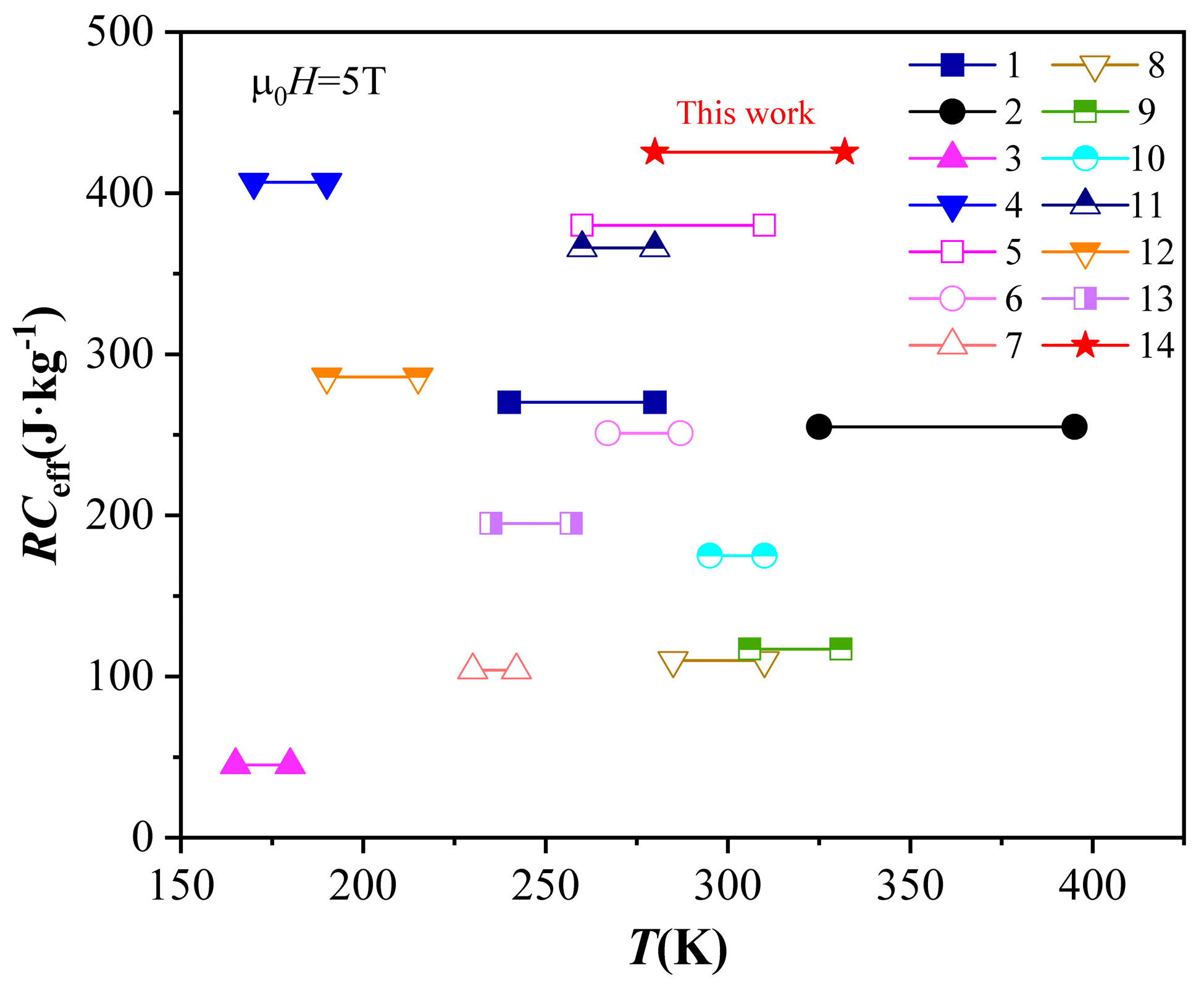
Figure 7b shows Co content y dependence of effective working temperature span (ΔTETS) and peak temperature (TP) for Mn1.05−yCoyFe0.9P0.5Si0.48Mg0.02 (y = 0, 0.01, 0.02, 0.03) alloys. The ΔTETS of Mn1.05−yCoyFe0.9P0.5Si0.48Mg0.02 (y = 0, 0.01, 0.02, 0.03) alloys is 46 K, 44 K, 52 K and 63 K, respectively. With the increase of Co doping amount, the ΔTETS of the alloy decreases slightly at first, and then increases gradually. In addition, with the increase of Co doping amount, the TP is first increased and then decreased, which is basically located near the room temperature, and the degree of change is small. Considering RCeff, TP and ΔTETS, Mn1.03Co0.02Fe0.9P0.5Si0.48Mg0.02 alloys have excellent wide temperature range magnetocaloric performance, it would have the potential to be used in the room temperature magnetic refrigeration equipment with wide temperature span. Figure 8 shows the comparison of present RCeff and ΔTETS with some room temperature magnetocaloric materials reported in the literature [21,22,23,24,25,26,27,28,29,30,31,32]. The RCeff and ΔTETS of Mn1.03Co0.02Fe0.9P0.5Si0.48Mg0.02 alloys are greater than that of the classic room temperature magnetocaloric materials Gd. Furthermore, Table 4 lists the main magnetocaloric property parameter of Mn1.05−yCoyFe0.9P0.5Si0.48Mg0.02 (y = 0, 0.01, 0.02, 0.03) alloys and some reported MCE materials. From Table 4, one can see that Mn1.05−yCoyFe0.9P0.5Si0.48Mg0.02 alloys have average magnetocaloric performance although having large temperature span. It is note that choosing an excellent MCE material is difficulty because these parameters are mutually constrained and form a trade-off relationship. Therefore, these materials can only be selected based on the actual situation.
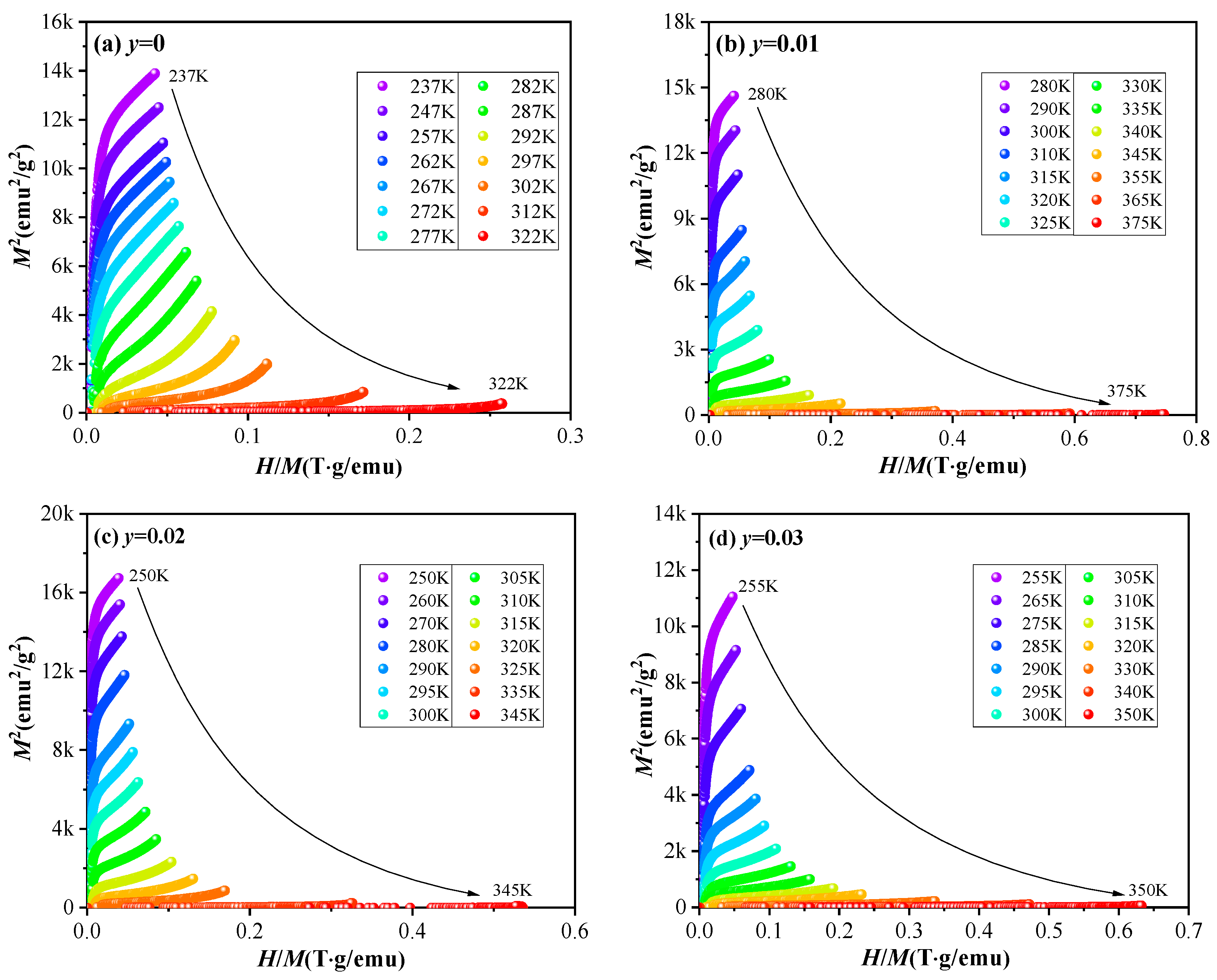
Figure 9 shows the Arrot plots of Mn1.05−yCoyFe0.9P0.5Si0.48Mg0.02 alloys (a) y = 0, (b) y = 0.01, (c) y = 0.02, and (d) y = 0.03 derived from isothermal magnetization curves. Based on Banerjee criterion [37], the presence of negative slope in the Arrot curve indicates that the material has first-order magnetic phase transition characteristics, while the presence of positive slope indicates that the material has second-order magnetic phase transition characteristics. As shown in Figure 8, the Arrot curves of all samples only have positive slope, and they all exhibit second-order magnetic phase transition characteristics, which is consistence with the characteristics of DSC curves. There is almost no magnetic hysteresis after Co doping, but there is also a small thermal hysteresis, which may be related to the (Mn,Fe)3Si and (Mn,Fe)5Si3 impurity phases in the alloy after Co doping. The impurity phase obstructs the motion of magnetic domains, which increases the energy barrier of magnetic phase transition and leads to the appearance of thermal hysteresis.

3.3. Computation Result Discussion

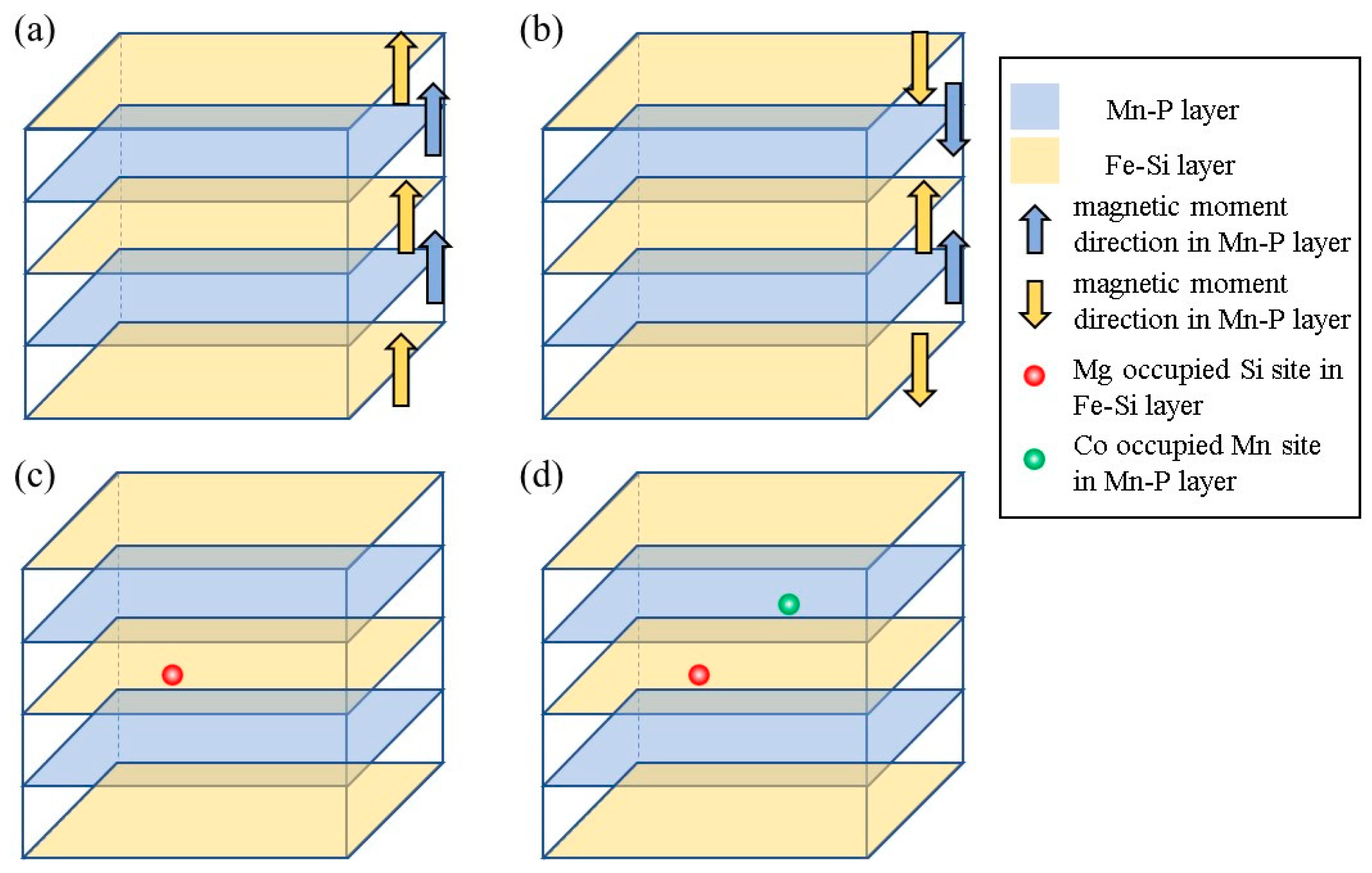
Figure 10 shows the schematic diagrams of (a) ferromagnetic (FM) structural model for Mn24Fe24P8Si16 compound, (b) antiferromagnetic (AFM) structural model for Mn24Fe24P8Si16 compound, (c) structural model for Mn24Fe24P8Si15Mg compound and (d) structural model for Mn23CoFe24P8Si15Mg compound. The crystal structure of (Mn,Fe)2(P,Si) alloy is hexagonal structure of Mn-P layer and Fe-Si layer arranged alternately along the c-axis. As shown in Figure 10a,b, in order to simulate the magnetic characteristics of the ferromagnetic state, the magnetic moment directions of the Fe and Mn atomic layers are set to be parallel in the same direction. In order to simulate the magnetic characteristics of the paramagnetic state, the paramagnetic state is simplified to an antiferromagnetic configuration, where the magnetic moments of adjacent Fe layers and adjacent Mn layers are set to be antiparallel [38,39]. As shown in Figure 10c, in a 2 × 2 × 2 supercell structure, an Si atom is replaced with an Mg atom to simulate the Mg-doped structure. As shown in Figure 10d, in a 2 × 2 × 2 supercell structure, one Si atom is replaced by an Mg atom and one Mn atom is replaced by a Co atom to simulate the Mg-Co co-doped structure.
The crystal structure information at the lowest energy of the system can be obtained through structural optimization, and the relevant calculation results are shown in Table 5. When the Mn24Fe24P8Si16 alloy changes from ferromagnetic state to antiferromagnetic state, the lattice parameters a and b decrease from 6.423 Å to 6.375 Å, while the lattice parameter c increases from 3.198 Å to 3.269 Å. The results show that the alloys undergo anisotropic magnetoelastic transformation, which is consistent with the experimental results. In addition, the binding energy of the ferromagnetic state is smaller than that of the antiferromagnetic state, which indicates that the ferromagnetic state is more stable. After large atom Mg doping, the lattice parameters a and b increase, c decreases, and the crystal cell expands. This is consistent with previous work [14]. After Mg-Co co-doping, the lattice parameters a and b decrease, c increases, and the crystal cells shrink.
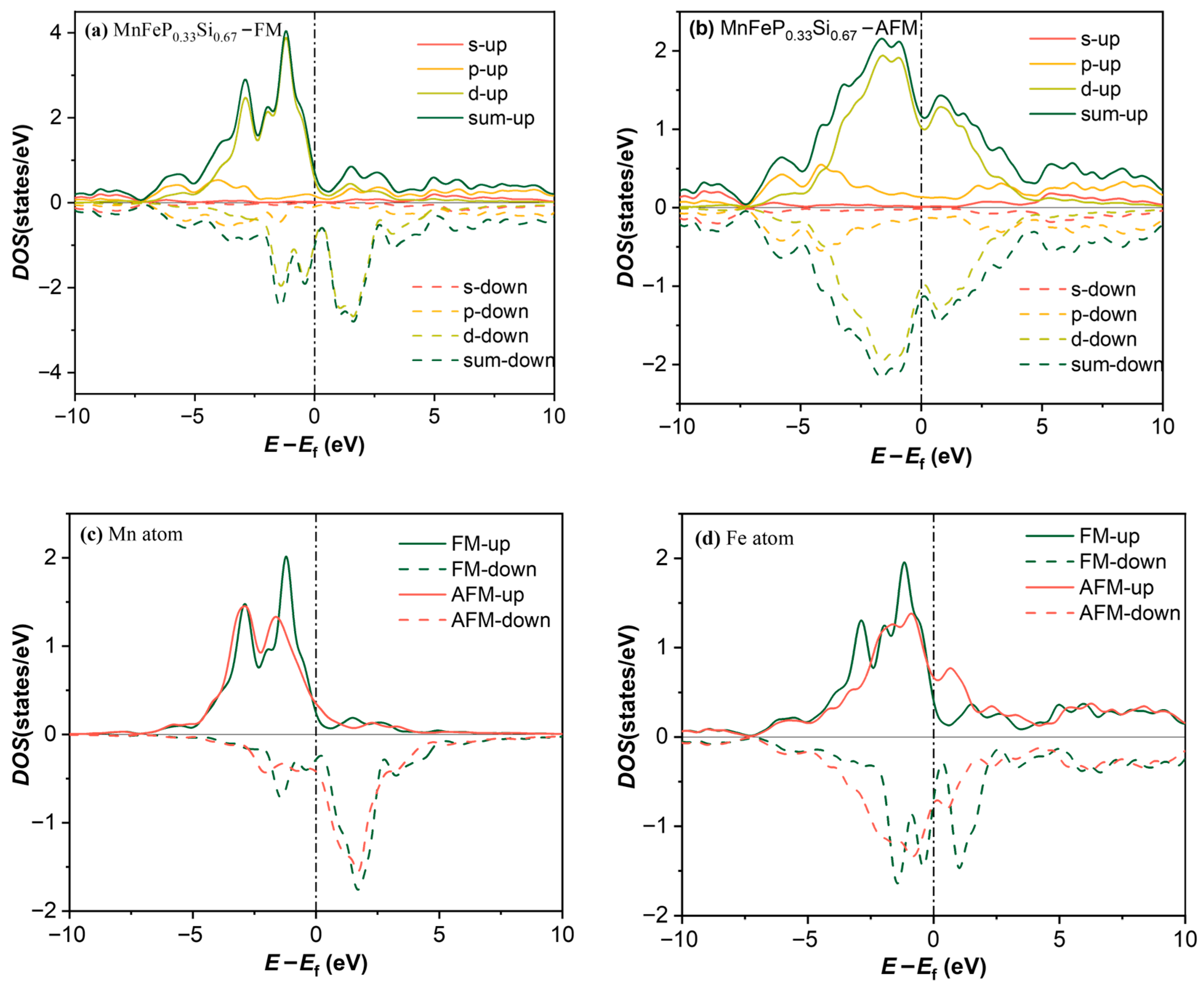
In order to deeply understand the magnetic differences of (Mn,Fe)2(P,Si) alloy under different magnetic states, the density of state (DOS) diagrams of the ferromagnetic (FM) and antiferromagnetic (AFM) states of MnFeP0.33Si0.67 units were calculated, as shown in Figure 11a,b. The MnFeP0.33Si0.67(FM) exhibits a large net magnetic moment, while the MnFeP0.33Si0.67 (AFM) exhibits almost zero net magnetic moment. The total DOS curve is close to the d-orbital DOS curve, suggesting that the magnetic properties of the (Mn,Fe)2(P,Si) alloy are mainly derived from the unpaired electrons in the d-orbital. In the FM state, the Mn 3d orbital PDOS displays obvious spin polarization near the Fermi level, with distinct separation between spin-up (↑) and spin-down (↓) electron occupation peaks (seen on Figure 11c). This corresponds to a high atomic magnetic moment of 3.16 µB (listed in Table 4), indicating that a large number of unpaired 3d electrons endow Mn with stable, strong magnetic contributions. In the AFM state, the spin polarization of the Mn 3d orbital is only slightly weakened, with the spin up (↑) and spin down (↓) peaks maintaining a certain degree of separation, and the atomic magnetic moment marginally decreases to 3.08 µB. On the other hand, from Figure 11d and Table 4, during the ferromagnetic to antiferromagnetic transition, the Fe atomic magnetic moment decreases from 1.56 µB to 0.09 µB. The rapid decrease of magnetic moment of Fe atom is probably related to the change of crystal structure during magnetic transformation. During the magnetic phase transition, the reduction of lattice parameters a and b results in a shorter distance between Fe and Fe. This short Fe-Fe distance at antiferromagnetic state may lead to excessive overlap of 3d orbits between adjacent Fe atoms, weakening the spin magnetic moments generated by the spin electrons in the 3d orbits, and ultimately rapidly decreasing the magnetic moments of the Fe atom. In addition, the magnetic moment of Mn atom is greater than that of Fe atom regardless of ferromagnetic state or antiferromagnetic state. This mixed magnetic phenomenon of alternating arrangement of the strong magnetic Mn-P layer and the weak magnetic Fe-Si layer is consistent with the results of the literature [40]. The strong magnetic properties of the Mn-P layer in both the ferromagnetic and antiferromagnetic states allow the Curie temperature of the (Mn,Fe)2(P,Si) alloy to be adjusted to near room temperature. During the ferromagnetic to antiferromagnetic transition, there is a strong coupling effect between the obvious magnetic moment reduction of Fe-Si layer and the change of crystal structure, which makes (Mn,Fe)2(P,Si) alloy perform the giant magnetocaloric effect.
As shown in Table 4, after doping Mg atom, the magnetic moment of Mn atom in the ferromagnetic structure changes little while the magnetic moment of Fe atom decreases from 1.56 µB to 1.53 µB. The decrease of the total magnetic moment of Mg doped system is caused by the decrease of the magnetic moment of Fe atom. After Mg-Co co-doping, the magnetic moment of Mn atom in the ferromagnetic state does not change while the magnetic moment of Fe atom increases from 1.53 µB to 1.55 µB. When Co is doped, one Mn atom is replaced by one Co atom. Since the magnetic moment of Mn atom (3.15µB) is significantly larger than that of Co atom (1.11µB), the total magnetic moment of the system will be diluted. Because the magnetic moments of Mn and Fe are arranged in opposite directions, Co doping would decrease the Mn atoms, then to enhance the total magnetic moment of the system. From other view point, this is equivalent to enhance the magnetic moment of Fe. On the one hand, Co doping might dilute the total magnetic moment of the system die to its small magnetic moment. Therefore, when the amount of Co doping is small, the enhancement effect of Co doping is dominant, which increases the total magnetic moment of the system. When the amount of Co doping is too much, the dilution effect of Co doping on the total magnetic moment of the system is dominant, which will reduce the total magnetic moment of the system.
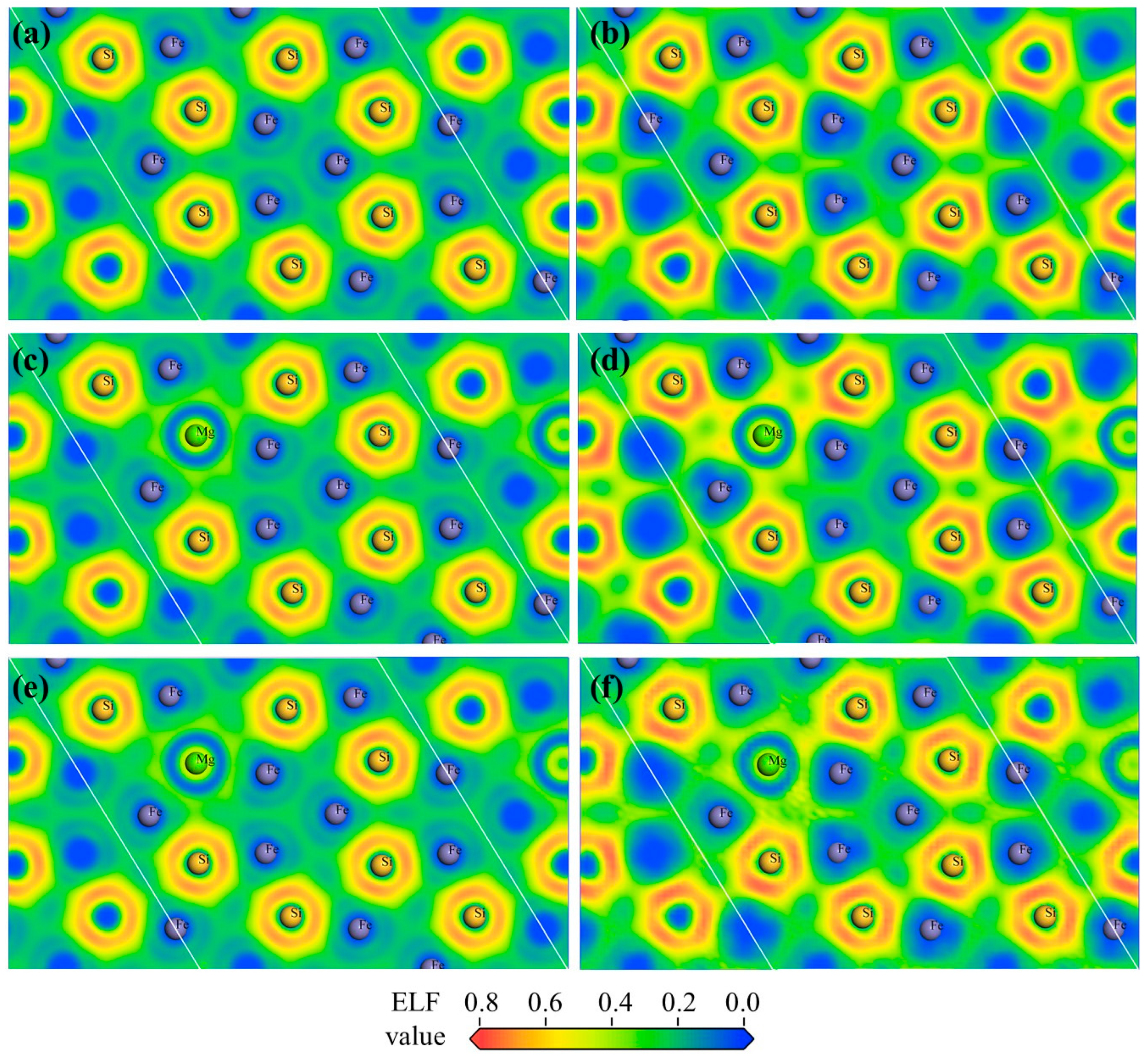
As shown in Figure 12, the ELF (Electron Localized Function) value ranges from 0 to 1, when the ELF value of a region is 0, it indicates that the electrons are completely delocalized or have no electrons, and when the ELF value of a region is 1, it indicates that the electrons are completely localized. The regions of higher ELF value will be more localized electrons, and it will perform stronger covalent bonding. During the magnetic phase transition, the local electron density between Fe and Si atoms increases, which indicates that the antiferromagnetic Fe–Si covalent bond is stronger. There may be competition between the electrons around Fe for contributing magnetic moments and for p–d orbital hybridization to form covalent bonds [10]. The strengthening of Fe–Si covalent bond leads to the weakening of magnetic moment of Fe atom.
When Mg atoms are doped in Fe–Si layer, the localized electron density of Fe and Si atoms around Mg atoms changes obviously. An area of high localized electron density appears around Mg atoms, which will strengthen the nearby Fe–Si covalent bond strength, resulting in a decrease in the magnetic moment of Fe atoms. After Mg-Co co-doping, the area of high localized electron density around Mg atoms decreases. This indicates that the Fe–Si covalent bond strength is weakened and the magnetic moment of Fe atom is enhanced. When the amount of Co doping is small, the increase of the magnetic moment of Fe atom will lead to the increase of the total magnetic moment of the ferromagnetic alloy, and the magnetic moment change during the magnetic phase transition will be greater, which will increase the magnetic entropy change of alloys.

4. Conclusions

Mg-Co co-doping effectively tunes the crystal structure and magnetocaloric properties of (Mn,Fe)2(P,Si) alloys. Mn1.03Co0.02Fe0.9P0.5Si0.48Mg0.02 alloy achieves a high RCeff of 425.4 J·kg−1 and a broad ΔTETS of 52 K. These large magnetocaloric effect might stem from strong magnetostructural coupling in the Fe-Si layer, which can be modulated by co-doping through electronic and structural modifications. This work demonstrates a viable strategy for designing high-performance magnetocaloric materials for wide-temperature-range magnetic refrigeration.

Supplementary Materials

The following supporting information can be downloaded at: https://www.mdpi.com/article/10.3390/magnetochemistry12020017/s1, Figure S1: Rietveld refinement patterns of Mn1.05−yCoyFe0.9P0.5Si0.48Mg0.02 (y = 0, 0.01, 0.02, 0.03) alloys.

Author Contributions

Conceptualization, Z.Z. and H.W.; software, H.W.; formal analysis, Z.Z.; investigation, J.N. and H.W.; resources, Z.Z.; data curation, J.N.; writing—original draft preparation, H.W.; writing—review and editing, J.N.; visualization, J.N.; supervision, Z.Z.; project administration, Z.Z. All authors have read and agreed to the published version of the manuscript.

Funding

This research was funded by the Natural Science Foundation of Guangdong Province, grant number 2023A1515010655. This work is partially supported by High Performance Computing Platform of South China University of Technology.

Institutional Review Board Statement

Not applicable.

Informed Consent Statement

Not applicable.

Data Availability Statement

The original contributions presented in this study are included in the article/Supplementary Material. Further inquiries can be directed to the corresponding authors.

Conflicts of Interest

The authors declare no conflicts of interest.

Abbreviations

The following abbreviations are used in this manuscript:
PMParamagnetic phase
FMFerromagnetic phase
AFMAntiferromagnetic
EDSEnergy Dispersive Spectrometer
Tt–HPhase transition temperature calculated from DSC date of heating process
Tt–CPhase transition temperature calculated from DSC date of cooling process
ΔThysThermal hysteresis calculated respectively from M-T plots
ΔThys*Thermal hysteresis calculated respectively from DSC date
LLatent heat
TCCurie temperature
MMagnetization
HMagnetic field
ΔSMMagnetic entropy change
RCRefrigeration capacity
RCeffEffective refrigeration capacity
HLavMagnetic hysteresis loss
ΔTETSEffective working temperature span
TECTemperature averaged Entropy Change
ELFElectron Localized Function

References

  1. Brown, G.V. Magnetic heat pumping near room temperature. J. Appl. Phys. 1976, 47, 3673. [Google Scholar] [CrossRef]
  2. Pecharsky, V.K.; Gschneidner, K.A., Jr. Giant Magnetocaloric Effect in Gd5(Si2Ge2). Phys. Rev. Lett. 1997, 78, 4494–4497. [Google Scholar] [CrossRef]
  3. Hu, F.X.; Shen, B.G.; Sun, J.R. Magnetic entropy change in Ni51.5Mn22.7Ga25.8 alloy. Appl. Phys. Lett. 2000, 76, 3460–3462. [Google Scholar] [CrossRef]
  4. Law, J.Y.; Díaz-García, Á.; Moreno-Ramírez, L.M.; Franco, V. Increased magnetocaloric response of FeMnNiGeSi high-entropy alloys. Acta Mater. 2021, 212, 116931. [Google Scholar] [CrossRef]
  5. Zhao, X.; Yan, Y.; Wen, J.; Li, Y.; Li, L. Enhancement of magnetocaloric effect in all-d-metal Heusler Mn52.6Ni30.5Co7.8Ti9.1/PVA/PET flexible composite by mechanical strains. J. Alloys Compd. 2022, 897, 163116. [Google Scholar] [CrossRef]
  6. Hu, F.X.; Shen, B.G.; Sun, J.R.; Zhang, X.X. Great magnetic entropy change in La(Fe,M)13 (M = Si, Al) with Co doping. Chin. Phys. 2000, 9, 550–553. [Google Scholar]
  7. Tegus, O.; Brück, E.; Buschow, K.H.J.; de Boer, F.R. Transition-metal-based magnetic refrigerants for room-temperature applications. Nature 2002, 415, 150–152. [Google Scholar] [CrossRef]
  8. Miao, X.F.; Sepehri-Amin, H.; Hono, K. Structural origin of hysteresis for hexagonal (Mn,Fe)2(P,Si) magneto-caloric compound. Scr. Mater. 2017, 138, 96–99. [Google Scholar] [CrossRef]
  9. Cheng, F.; Ma, S.; Wang, Y.; Ke, X.; Wang, J.; Yang, S. Tuning Magnetocaloric Effect of a Mn-Cr-Sb-Ga alloy by the Nonvolatile Residual Strain of a Ti-Ni Shape Memory Alloy. Acta Mater. 2021, 210, 116849. [Google Scholar] [CrossRef]
  10. Miao, X.; Gong, Y.; Zhang, F.; You, Y.; Caron, L.; Qian, F.; Guo, W.; Zhang, Y.; Gong, Y.; Xu, F.; et al. Enhanced reversibility of the magnetoelastic transition in (Mn,Fe)2(P,Si) alloys via minimizing the transition-induced elastic strain energy. J. Mater. Sci. Technol. 2022, 103, 165–176. [Google Scholar] [CrossRef]
  11. Lai, J.; Huang, B.; Miao, X.; Van Thang, N.; You, X.; Maschek, M.; van Eijck, L.; Zeng, D.; van Eijk, N.; Brück, E. Combined effect of annealing temperature and vanadium substitution for magnetocaloric Mn1.2−xVxFe0.75P0.5Si0.5 alloys. J. Alloys Compd. 2019, 803, 671–677. [Google Scholar] [CrossRef]
  12. Hu, S.; Miao, X.; Liu, J.; Ou, Z.; Cong, M.; Haschuluu, O.; Gong, Y.; Qian, F.; You, Y.; Zhang, Y.; et al. Small hysteresis and giant magnetocaloric effect in Nb-substituted (Mn,Fe)2(P,Si) alloys. Intermetallics 2019, 114, 106602. [Google Scholar] [CrossRef]
  13. Liu, D.M.; Zhang, H.; Wang, S.B.; Xiao, W.Q.; Zhang, Z.L.; Tian, N.; Liu, C.X.; Yue, M.; Huang, Q.Z.; Zhang, J.X.; et al. The effect of Al doping on the crystal structure and magnetocaloric behavior of Mn1.2Fe0.8P1−xGex compounds. J. Alloys Compd. 2015, 633, 120–126. [Google Scholar] [CrossRef]
  14. Wang, H.Y.; Zheng, Z.G.; Chen, X.L.; Da, S.; Qiu, Z.G.; Zeng, D.C.; Xia, Q.B. Improving work temperature span and reversibility of magnetoelastic transition of (Mn,Fe)2(P,Si) alloys by Mg doping. J. Magn. Magn. Mater. 2023, 574, 170696. [Google Scholar] [CrossRef]
  15. Kiecana, A.; Batashev, I.; Dugulan, A.I.; Kwakernaak, C.; Pieter, L.; Zhang, F.; Van Dijk, N.; Brück, E. Effect of Co and Ni doping on the structure, magnetic and magnetocaloric properties of Fe-rich (Mn,Fe)2(P,Si) compounds. J. Magn. Magn. Mater. 2022, 561, 169710. [Google Scholar] [CrossRef]
  16. Hunter, B.A.; Howard, C.J. Menai Rietica, 2nd AINSE Symposium on Neutron Scattering Powder Diffraction and Australian Neutron Beam Users Group Meeting. In Symposium Handbook; Australian Nuclear Science and Technology Organization: Lucas Heights, Australia, 2000; p. 24. [Google Scholar]
  17. Caron, L.; Ou, Z.Q.; Nguyen, T.T.; Cam Thanh, D.T.; Tegus, O.; Brück, E. On the determination of the magnetic entropy change in materials with first-order transitions. J. Magn. Magn. Mater. 2009, 321, 3559–3566. [Google Scholar] [CrossRef]
  18. Fries, M.; Pfeuffer, L.; Bruder, E.; Gottschall, T.; Ener, S.; Diop, L.V.; Gröb, T.; Skokov, K.P.; Gutfleisch, O. Microstructural and magnetic properties of Mn-Fe-P-Si (Fe2P-type) magnetocaloric compounds. Acta Mater. 2017, 132, 222–229. [Google Scholar] [CrossRef]
  19. Gercsi, Z.; Delczeg-Czirjak, E.K.; Vitos, L.; Wills, A.S.; Daoud-Aladine, A.; Sandeman, K.G. Magnetoelastic effects in doped Fe2P. Phys. Rev. B 2013, 88, 024417. [Google Scholar] [CrossRef]
  20. Griffith, L.D.; Mudryk, Y.; Slaughter, J.; Pecharsky, V.K. Material-based figure of merit for caloric materials. J. Appl. Phys. 2018, 123, 034902. [Google Scholar] [CrossRef]
  21. Yan, H.L.; Huang, X.M.; Yang, J.H.; Zhao, Y.; Fang, F.; Jia, N.; Bai, J.; Yang, B.; Li, Z.; Zhang, Y.; et al. A strategy of optimizing magnetism and hysteresis simultaneously in Ni-Mn-based metamagnetic shape memory alloys. Intermetallics 2021, 130, 107063. [Google Scholar] [CrossRef]
  22. Qian, M.F.; Zhang, X.X.; Li, X.; Zhang, R.C.; Martin, P.G.; Sun, J.F.; Geng, L.; Scott, T.B.; Peng, H.X. Magnetocaloric effect in bamboo-grained Ni-Mn-Ga microwires over a wide working temperature interval. Mater. Des. 2020, 190, 108557. [Google Scholar] [CrossRef]
  23. Shamba, P.; Debnath, J.C.; Zeng, R.; Wang, J.L.; Campbell, S.J.; Kennedy, S.J.; Dou, S.X. Reduction of hysteresis losses in the magnetic refrigerant La0.8Ce0.2Fe11.4Si1.6 by the addition of boron. J. Appl. Phys. 2011, 109, 07A940. [Google Scholar] [CrossRef]
  24. Gschneidner, K.A.; Pecharsky, V.K.; Tsokol, A.O. Recent developments in magnetocaloric materials. Rep. Prog. Phys. 2005, 68, 1479–1539. [Google Scholar] [CrossRef]
  25. Huang, L.; Cong, D.Y.; Suo, H.L.; Wang, Y.D. Giant magnetic refrigeration capacity near room temperature in Ni40Co10Mn40Sn10 multifunctional alloy. Appl. Phys. Lett. 2014, 104, 132407. [Google Scholar] [CrossRef]
  26. Sharma, V.K.; Chattopadhyay, M.K.; Roy, S.B. Large inverse magnetocaloric effect in Ni50Mn34ln16. J. Phys. D Appl. Phys. 2007, 40, 1869. [Google Scholar] [CrossRef]
  27. Jeffrey, B.; Mahmud, K. Large refrigeration capacities near room temperature in Ni2Mn1−xCrxln. J. Magn. Magn. Mater. 2017, 425, 1–5. [Google Scholar]
  28. Qian, M.; Zhang, X.; Jia, Z.; Wan, X.; Geng, L. Enhanced magnetic refrigeration capacity in Ni-Mn-Ga micro-particles. Mater. Des. 2018, 148, 115–123. [Google Scholar] [CrossRef]
  29. Li, Z.; Jiang, Y.; Li, Z.; Sánchez Valdés, C.F.; Sánchez Llamazares, J.L.; Yang, B.; Zhang, Y.; Esling, C.; Zhao, X.; Zuo, L. Phase transition and magnetocaloric properties of Mn50Ni42−xCoxSn8 (0 ≤ x ≤ 10) melt-spun ribbons. IUCRJ 2018, 5, 54–66. [Google Scholar] [CrossRef]
  30. Zhao, J.L.; Shen, J.; Hu, F.X.; Li, Y.X.; Sun, J.R.; Shen, B.G. Reduction of magnetic hysteresis loss in La0.5Pr0.5Fe11.4Si1.6Hx hydrides with large magnetocaloric effects. J. Appl. Phys. 2010, 107, 113911. [Google Scholar] [CrossRef]
  31. Zheng, Z.G.; Wang, W.H.; Zhou, Q.; Lei, L.; Hong, Y.; Zeng, D.C.; Mozharivskyj, Y. Microstructure and magnetocaloric effects of Mn1.2Fe0.8P0.6Si0.4B0.05 alloys prepared by ball milling and spinning methods. J. Magn. Magn. Mater. 2019, 477, 203–208. [Google Scholar] [CrossRef]
  32. Samanta, S.; Ghosh, S.; Chatterjee, S.; Mandal, K. Large magnetocaloric effect and magnetoresistance in Fe-Co doped Ni50−x(FeCo)xMn37Ti13 all-d-metal Heusler alloys. J. Alloys Compd. 2022, 910, 164929. [Google Scholar] [CrossRef]
  33. Banerjee, B.K. On a generalised approach to first and second order magnetic transitions. Phys. Lett. 1964, 12, 16–17. [Google Scholar] [CrossRef]
  34. Vincent, O.; Mulwa, W.M.; Kirui, M.S.K. Investigation of magnetic properties of FeMnP1−xAx (A = In, Se and Sn, where x = 0.33) by use of GGA functionals. Physica B 2021, 613, 412777. [Google Scholar] [CrossRef]
  35. Roy, P.; Torun, E.; de Groot, R.A. Effect of doping and elastic properties in (Mn,Fe)2(Si,P). Phys. Rev. B 2016, 93, 094110. [Google Scholar] [CrossRef]
  36. Dung, N.H.; Ou, Z.Q.; Caron, L.; Zhang, L.; Cam Thanh, D.T.; De Wijs, G.A.; de Groot, R.A.; Jürgen Buschow, K.H.; Brück, E. Mixed Magnetism for Refrigeration and Energy Conversion. Adv. Energy Mater. 2011, 1, 1215–1219. [Google Scholar] [CrossRef]
  37. Luo, L.; Law, J.Y.; Shen, H.X.; Moreno-Ramírez, L.M.; Franco, V.; Guo, S.; Duc, N.T.M.; Sun, J.F.; Phan, M.H. Enhanced Magnetocaloric Properties of Annealed Melt-Extracted Mn1.3Fe0.6P0.5Si0.5 Microwires. Metals 2022, 12, 1536. [Google Scholar] [CrossRef]
  38. Lai, J.W.; Bolyachkin, A.; Terada, N.; Dieb, S.; Tang, X.; Ohkubo, T.; Sepehri-Amin, H.; Hono, K. Machine learning assisted development of Fe2P-type magnetocaloric compounds for cryogenic applications. Acta Mater. 2022, 232, 117942. [Google Scholar] [CrossRef]
  39. Zheng, Z.G.; Zhu, Z.R.; Yu, H.Y.; Zeng, D.C.; Li, Y.H.; He, A.; Mozharivskyj, Y. Large magnetic entropy change and magnetic phase transitions in rapidly quenched bulk Mn-Fe-P-Si alloys. J. Alloys Compd. 2017, 725, 1069–1076. [Google Scholar] [CrossRef]
  40. Grebenkemper, J.H.; Bocarsly, J.D.; Levin, E.E.; Seward, G.; Heikes, C.; Brown, C.; Misra, S.; Seeler, F.; Schierle-Arndt, K.; Wilson, S.D.; et al. Rapid Microwave Preparation and Composition Tuning of the High-Performance Magnetocalorics (Mn,Fe)2(P,Si). ACS Appl. Mater. Interfaces 2018, 10, 7208–7213. [Google Scholar] [CrossRef] [PubMed]
Figure 1. XRD patterns of Mn1.05−yCoyFe0.9P0.5Si0.48Mg0.02 (y = 0, 0.01, 0.02, 0.03) alloys at room temperature.
Magnetochemistry 12 00017 g001
Figure 2. Rietveld refinement patterns of Mn1.03Co0.02Fe0.9P0.5Si0.48Mg0.02 alloys.
Magnetochemistry 12 00017 g002
Figure 3. Backscattered SEM images of Mn1.05−yCoyFe0.9P0.5Si0.48Mg0.02 alloys (a) y = 0.01, (b) y = 0.02, (c) y = 0.03 and (di) the corresponding EDS maps of the Mn1.03Co0.02Fe0.9P0.5Si0.48Mg0.02 alloy. The scanning zone is the red box in (b).
Magnetochemistry 12 00017 g003
Figure 4. (a) Temperature dependence of magnetization for Mn1.05−yCoyFe0.9P0.5Si0.48Mg0.02 (y = 0, 0.01, 0.02, 0.03) alloys (the solid/dashed line represent the heating/cooling process respectively) and (b) DSC curves of Mn1.05−yCoyFe0.9P0.5Si0.48Mg0.02 (y = 0, 0.01, 0.02, 0.03) alloys.
Magnetochemistry 12 00017 g004
Figure 5. Magnetization (M) versus magnetic field (H) curves of Mn1.05−yCoyFe0.9P0.5Si0.48Mg0.02 alloys (a) y = 0, (b) y = 0.01, (c) y = 0.02, and (d) y = 0.03.
Magnetochemistry 12 00017 g005
Figure 6. The temperature dependence of isothermal magnetic entropy change of Mn1.05−yCoyFe0.9P0.5Si0.48Mg0.02 alloys (a) y = 0, (b) y = 0.01, (c) y = 0.02, and (d) y = 0.03 in magnetization process (filled symbols) and demagnetization process (open symbols).
Magnetochemistry 12 00017 g006
Figure 7. (a) The TEC curves of Mn1.05−yCoyFe0.9P0.5Si0.48Mg0.02 (y = 0, 0.01, 0.02, 0.03) alloys under 5 T magnetic field and (b) Co content y dependence of effective working temperature span (ΔTETS) and peak temperature (TP) for Mn1.05−yCoyFe0.9P0.5Si0.48Mg0.02 (y = 0, 0.01, 0.02, 0.03) alloys.
Magnetochemistry 12 00017 g007
Figure 8. The comparison of present effective refrigeration capacity (RCeff) and effective working temperature span (ΔTETS) with some room temperature magnetocaloric materials reported in the literature [21,22,23,24,25,26,27,28,29,30,31,32]. (1 Ni45Co5Mn36In13.3Cu0.7 [20], 2 Ni50.6Mn28Ga21.4 [21], 3 La0.8Ce0.2Fe11.4Si1.6 [22], 4 La0.8Ce0.2Fe11.4Si1.6B0.1 [22], 5 Gd [23], 6 Ni40Co10Mn40Sn10 [24], 7 Ni50Mn34In16 [25], 8 Ni2Mn0.95Cr0.05ln [26], 9 Ni54.3Mn21.3Ga24.4 [27], 10 Mn50Ni35Co7Sn8 [28], 11 La0.5Pr0.5Fe11.4Si1.6H0.9 [29], 12 Mn1.2Fe0.8P0.6Si0.4B0.05 [30], 13 Ni30(FeCo)20Mn37Ti13 [31], 14 This work.)
Magnetochemistry 12 00017 g008
Figure 9. The Arrot plots of Mn1.05−yCoyFe0.9P0.5Si0.48Mg0.02 alloys (a) y = 0, (b) y = 0.01, (c) y = 0.02, and (d) y = 0.03 derived from isothermal magnetization curves.
Magnetochemistry 12 00017 g009
Figure 10. The schematic diagrams of (a) ferromagnetic (FM) structural model for Mn24Fe24P8Si16 compound, (b) antiferromagnetic (AFM) structural model for Mn24Fe24P8Si16 compound, (c) structural model for Mn24Fe24P8Si15Mg compound and (d) structural model for Mn23CoFe24P8Si15Mg compound.
Magnetochemistry 12 00017 g010
Figure 11. (a) The partial and total DOS plots of MnFeP0.33Si0.67-FM, (b) The partial and total DOS plots of MnFeP0.33Si0.67-AFM, (c) The total DOS plots of Mn atom, and (d) The total DOS plots of Fe atom.
Magnetochemistry 12 00017 g011
Figure 12. The ELF contour maps of (a) Mn24Fe24P8Si16-FM on the Fe-Si layer, (b) Mn24Fe24P8Si16-AFM on the Fe–Si layer, (c) Mn24Fe24P8Si15Mg-FM on the Fe–Si layer, (d) Mn24Fe24P8Si15Mg-AFM on the Fe–Si layer, (e) Mn23CoFe24P8Si15Mg-FM on the Fe–Si layer, (f) Mn23CoFe24P8Si15Mg-AFM on the Fe–Si layer.
Magnetochemistry 12 00017 g012
Table 1. The mass percentage of each phase for Mn1.05−yCoyFe0.9P0.5Si0.48Mg0.02 (y = 0, 0.01, 0.02, 0.03) alloys and refined structural parameters for Fe2P-PM phase.
y00.010.020.03
Fe2P-PM (wt.%)54.2445.9065.4369.05
Fe2P-FM (wt.%)42.5246.4224.4020.58
(Mn,Fe)3Si (wt.%)0.765.125.487.31
(Mn,Fe)5Si3 (wt.%)2.482.564.693.06
a and b (Å)6.049(0)6.041(5)6.040(9)6.039(6)
c (Å)3.480(6)3.476(3)3.476(4)3.477(6)
v3)110.29(6)109.88(7)109.86(8)109.86(0)
Rp (%)1.511.661.601.73
Rwp (%)2.042.132.052.29
χ21.471.151.131.31
Table 2. Phase transition temperature (Tt–H and Tt–C calculated respectively from DSC date of heating and cooling process), thermal hysteresis (ΔThys and ΔThys* calculated respectively from MT plots and DSC date), and latent heat (L) of Mn1.05−yCoyFe0.9P0.5Si0.48Mg0.02 (y = 0, 0.01, 0.02, 0.03) alloys.
Co Content yTC (K)ΔThys (K)Tt–H (K)Tt–C (K)ΔThys* (K)L (J·g−1)
0319353052782715.1
0.01337443252903527.6
0.02315303052762924.1
0.03300322992702912.8
Table 3. The average magnetic hysteresis loss (HLav), maximum isothermal magnetic entropy change (−ΔSM), refrigeration capacity (RC), effective refrigeration capacity (RCeff), effective working temperature span (ΔTETS) and the peak temperature of maximum magnetic entropy change for Mn1.05−yCoyFe0.9P0.5Si0.48Mg0.02 (y = 0, 0.01, 0.02, 0.03) alloys at 5 T magnetic field.
Co Content yHLav
(J·kg−1)
−ΔSM
(J·kg−1·K−1)
RC
(J·kg−1)
RCeff
(J·kg−1)
ΔTETS
(K)
Tp
(K)
045.49.4337.1291.746290
0.0113.511.1386.3372.844318
0.026.910.8432.3425.452307
0.034.57.7378.7374.263293
Table 4. The magnetocaloric property parameters comparison of some reported MCE materials and Mn1.05−yCoyFe0.9P0.5Si0.48Mg0.02 (y = 0, 0.01, 0.02, 0.03) alloys.
SamplesTC (K)−ΔSM
(J·kg−1·K−1)
RC
(J·kg−1)
ΔThys (K)ΔTETS
(K)
Ref.
y = 0.0231510.8@5T432.33052This work
Mn1.3Fe0.6P0.5Si0.513810.5@5T440--[33]
Mn1.7Fe0.3P0.63Si0.3711011.5@5T---[34]
Mn1.15Fe0.85P0.50Si0.45B0.0524417@2T-11.5-[35]
(Mn0.5Fe0.5)1.88P0.5Si0.530224.1@5T-27-[36]
Table 5. Computed lattice parameters (a, b and c), binding energy per formula unit, covalent bond length, total magnetic moments per formula unit and atomic magnetic moments for different compositions in the FM and AFM configurations.
Compositiona and b (Å)c
(Å)
Binding Energy (eV/f.u.)Fe–Si Bond Length (Å)µTot
B/f.u.)
µMn
B)
µFe
B)
Mn24Fe24P8Si16
(FM)
6.4233.198−16.122.4114.443.161.56
Mn24Fe24P8Si16
(AFM)
6.3753.269−15.962.39403.080.09
Mn24Fe24P8Si15Mg
(FM)
6.5083.131−15.402.4334.413.151.53
Mn24Fe24P8Si15Mg
(AFM)
6.4253.259−15.202.40703.100.22
Mn23CoFe24P8Si15Mg
(FM)
6.4963.135−16.032.4294.363.151.55
Mn23CoFe24P8Si15Mg
(AFM)
6.4113.256−15.832.40203.110.07
Disclaimer/Publisher’s Note: The statements, opinions and data contained in all publications are solely those of the individual author(s) and contributor(s) and not of MDPI and/or the editor(s). MDPI and/or the editor(s) disclaim responsibility for any injury to people or property resulting from any ideas, methods, instructions or products referred to in the content.