
Ferrofluids Based on Anionic Polysaccharide-Coated Magnetic Nanoparticles for Targeted Magnetocatalytic-Driven Multimodal Anticancer Therapy

 , ,
, , 
Abstract
1. Introduction
2. Materials and Methods
2.1. Materials
2.2. Ferrofluid Synthesis
2.3. Polymer and Ferrofluid Characterization
2.4. Cellular Experiments
3. Results and Discussion
3.1. Colloidal Characterization of Ferrofluids Stabilized by HA and CMC Anionic Polysaccharides
3.2. Characterization of Ferrophase Stabilized by HA and CMC Polysaccharides
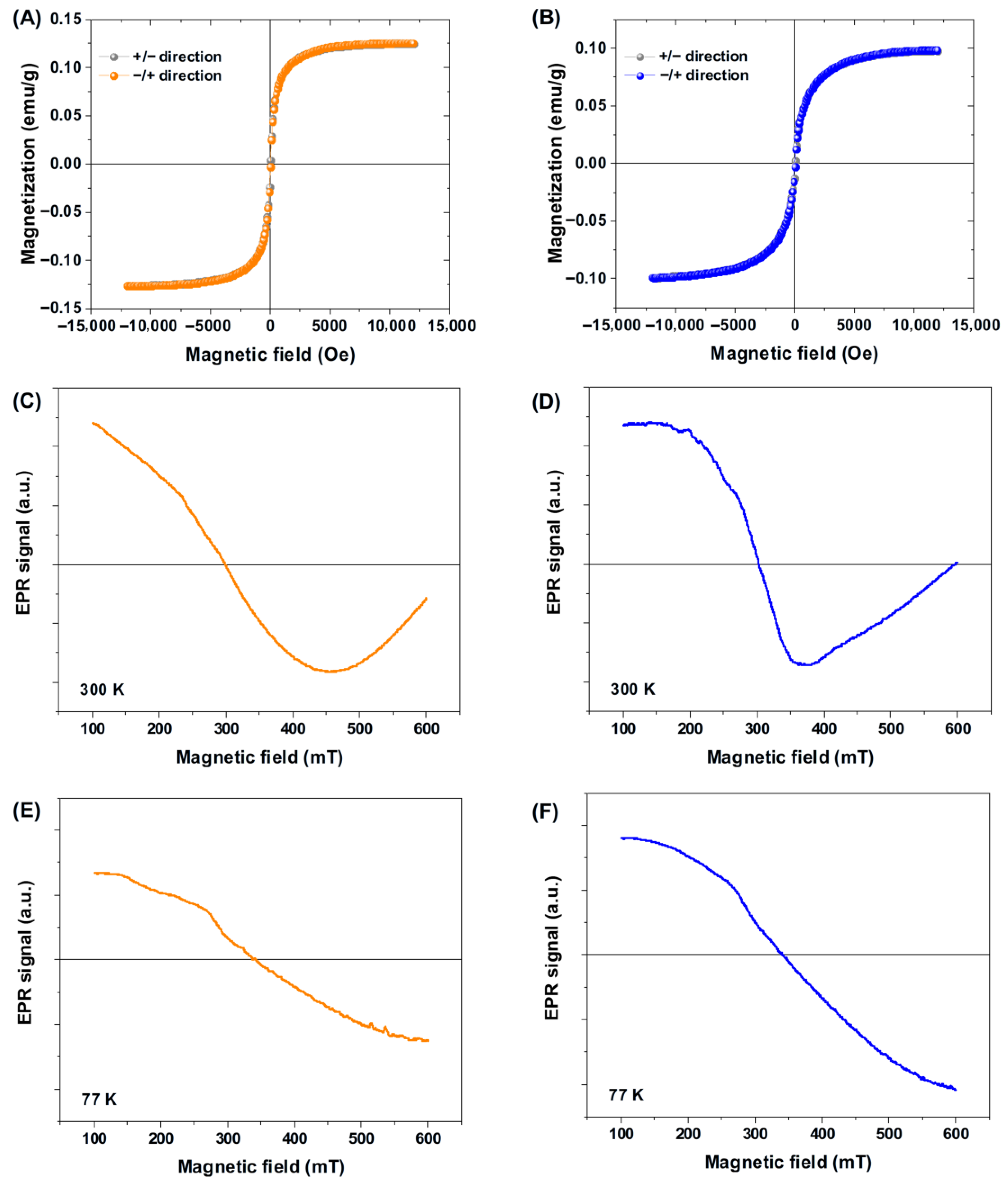
3.3. Characterization of Magnetic Properties of Ferrofluids
3.4. Characterization of Catalytic Behavior of Ferrofluids
3.5. Magnetocatalytic Therapy in 2D Cell Model
3.6. Magnetocatalytic Therapy in 3D Neurospheroids
4. Conclusions
Supplementary Materials
Author Contributions
Funding
Institutional Review Board Statement
Informed Consent Statement
Data Availability Statement
Acknowledgments
Conflicts of Interest
Abbreviations
| GBM | glioblastoma multiforme |
| Co-MNP | cobalt-doped magnetic iron oxide nanoparticles |
| MNP | Magnetic nanoparticles |
| HA | hyaluronic acid sodium salt |
| CMC | sodium carboxymethylcellulose |
| BBB | (blood–brain barrier) |
| CSCs | cancer stem cells |
| DS | degree of substitution |
| MM | molar mass |
| HA@Co-MNP | hyaluronic acid-coated Co-MNP (HA@Co-MNP) |
| CMC@Co-MNP | carboxymethylcellulose-coated Co-MNP (CMC@Co-MNP) |
| M | metal |
| Lpol | anionic polymer used as a ligand |
| AMF | alternating magnetic field |
| POD | peroxidase |
| ROS | reactive oxygen species |
| MHT | magnetic hyperthermia therapy |
| CDT | chemodynamic therapy |
| XPS | X-ray photoelectron spectroscopy |
| ZP | zeta potential |
| DLS | dynamic light scattering |
| TEM | transmission electron microscopy |
| EDX | energy-dispersive X-ray spectroscopy |
| XRD | X-ray diffraction |
| WD-XRF | X-ray fluorescence spectrometry |
| EPR | electron paramagnetic resonance |
| VSM | vibrating-sample magnetometer |
| H | magnetic field strength |
| f | magnetic field frequency |
| SAR | specific absorption rate |
| c | specific heat capacity of the colloid |
| ρ | colloid density |
| ϕ | metal concentration |
| RT | room temperature |
| ΔT/Δt | heating rate |
| SARBox-Lucas | specific absorption rate calculated using the Box-Lucas model |
| C | heat capacity of the colloid |
| L | linear loss parameter and (t-t0) |
| a and b | fitting parameters of the Box-Lucas model |
| mMNP | mass of metal in nanoparticles |
| t − t0 | experimental time |
| TMB | tetramethylbenzidine hydrochloride |
| TMBox | oxidized TMB |
| M-M | Michaelis–Menten |
| v0 | initial velocity of the catalytic reaction |
| ε | molar extinction coefficient |
| [S] | substrate concentration |
| Vmax | maximal velocity of the catalytic reaction |
| Km | Michaelis constant |
| DMPO | 5,5-dimethyl-1-pyrroline n-oxide |
| U-87 MG/U87 | human glioblastoma cell line |
| ATCC | American Type Culture Collection |
| HEK 293T/HEK | human embryonic kidney cell line |
| DMEM | Dulbecco’s modified Eagle medium |
| FBS | fetal bovine serum |
| DCF-DA | 2′,7′-dichlorodihydrofluorescein diacetate |
| MDA | malondialdehyde |
| TBAR | thiobarbituric acid method |
| MTT | 3-(4,5-dimethylthiazol-2yl-) 2,5-diphenyl tetrazolium bromide |
| ROS− | reference sample for ROS-based therapy (without Co-MNP) |
| ROS+ | sample treated with Co-MNP at 0.6 μg/mL |
| ROS++ | sample treated with Co-MNP at 6.0 μg/mL |
| EC50 | half-maximal effective concentration |
| AMF+ | exposure to AMF |
| AMF− | without AMF |
| N | nucleation |
| G | growth |
| S | stabilization |
| GlcNAc | N-acetyl-D-Glucosamine |
| ν | stretching vibration |
| δ | bending vibration |
| HR-XPS | high-resolution X-ray photoelectron spectroscopy |
| BE | binding energy |
| DH | hydrodynamic diameter |
| JCPDS | Joint Committee on Powder Diffraction Standards |
| SAED | selected area electron diffraction |
| HR-TEM | high-resolution transmission electron microscopy |
| TME | tumor microenvironment |
| ESR | electron spin resonance |
| •OH | hydroxyl radical |
| •OOH | hydroperoxyl radical |
| CD44 | cell membrane receptor |
| CD44+ | cells that overexpress the CD44 membrane receptor |
| CD44− | cells with low expression of the CD44 membrane receptor |
| HPA | Human Protein Atlas |
| SI | selectivity index |
References
- Rahman, M.A.; Jalouli, M.; Yadab, M.K.; Al-Zharani, M. Progress in Drug Delivery Systems Based on Nanoparticles for Improved Glioblastoma Therapy: Addressing Challenges and Investigating Opportunities. Cancers 2025, 17, 701. [Google Scholar] [CrossRef]
- Salvato, I.; Marchini, A. Immunotherapeutic Strategies for the Treatment of Glioblastoma: Current Challenges and Future Perspectives. Cancers 2024, 16, 1276. [Google Scholar] [CrossRef]
- Zeinali, R.; Zaeifi, D.; Zolfaghari-Moghaddam, S.Y.; Paul, M.K.; Biazar, E. Current Advances in Nanocarriers for Cancer Therapy. Int. J. Nanomed. 2025, 20, 12217–12262. [Google Scholar] [CrossRef]
- PN, N.; Mehla, S.; Begum, A.; Chaturvedi, H.K.; Ojha, R.; Hartinger, C.; Plebanski, M.; Bhargava, S.K. Smart Nanozymes for Cancer Therapy: The Next Frontier in Oncology. Adv. Healthc. Mater. 2023, 12, 2300768. [Google Scholar] [CrossRef]
- Xu, M.; Zhao, R.; Liu, B.; Geng, F.; Wu, X.; Zhang, F.; Shen, F.; Lin, H.; Feng, L.; Yang, P. Ultrasmall copper-based nanoplatforms for NIR-II light-triggered photothermal/photodynamic and amplified nanozyme catalytic therapy of hypoxic tumor. Chem. Eng. J. 2024, 491, 151776. [Google Scholar] [CrossRef]
- Mansur, A.A.P.; Mansur, H.S. Nanozyme-Based Cancer Nanotheranostics: Emerging Applications and Challenges in Brain Cancer Therapeutics. J. Nanotheranostics 2025, 6, 4. [Google Scholar] [CrossRef]
- Mansur, A.A.P.; Carvalho, S.M.; Mansur, H.S. Engineered hybrid nanozyme catalyst cascade based on polysaccharide-enzyme-magnetic iron oxide nanostructures for potential application in cancer therapy. Catal. Today 2022, 388–389, 187–198. [Google Scholar] [CrossRef]
- de Almeida, A.A.; Fabris, F.; da Silva, G.S.; Pirota, K.R.; Knobel, M.; Muraca, D. Control of anisotropy and magnetic hyperthermia effect by addition of cobalt on magnetite nanoparticles. ACS Appl. Mater. Interfaces 2025, 17, 13083–13093. [Google Scholar] [CrossRef] [PubMed]
- Cross, S.N.; Fataftah, M.; Jonderian, A.; McCalla, E.; Szuchmacher Blum, A. Preparation and characterization of ultra-small, monodisperse CoxFe3−xO4 nanoparticles. J. Magn. Magn. Mater. 2023, 567, 170345. [Google Scholar] [CrossRef]
- Socoliuc, V.; Avdeev, M.V.; Kuncser, V.; Turcu, R.; Tombácz, E.; Vékás, L. Ferrofluids and bio-ferrofluids: Looking back and stepping forward. Nanoscale 2022, 14, 4786–4886. [Google Scholar] [CrossRef]
- Pucci, C.; Degl’Innocenti, A.; Gümüş, M.B.; Ciofani, G. Superparamagnetic iron oxide nanoparticles for magnetic hyperthermia: Recent advancements, molecular effects, and future directions in the omics era. Biomater. Sci. 2022, 10, 2103–2121. [Google Scholar] [CrossRef]
- Iacob, N. Pitfalls and Challenges in Specific Absorption Rate Evaluation for Functionalized and Coated Magnetic Nanoparticles Used in Magnetic Fluid Hyperthermia. Coatings 2025, 15, 345. [Google Scholar] [CrossRef]
- Aurélio, D.; Mikšátko, J.; Veverka, M.; Michlová, M.; Kalbáč, M.; Vejpravová, J. Thermal Traits of MNPs under High-Frequency Magnetic Fields: Disentangling the Effect of Size and Coating. Nanomaterials 2021, 11, 797. [Google Scholar] [CrossRef]
- Sonia, L.C.; Phanjoubam, S. Structural and magnetic studies of cobalt substituted magnetite ferrofluids. J. Magn. Magn. Mater. 2022, 544, 168675. [Google Scholar] [CrossRef]
- Miao, T.; Ju, X.; Zhu, Q.; Wang, Y.; Guo, Q.; Sun, T.; Lu, C.; Han, L. Nanoparticles surmounting blood–brain tumor barrier through both transcellular and paracellular pathways to target brain metastases. Adv. Funct. Mater. 2019, 29, 1900259. [Google Scholar] [CrossRef]
- Mittapalli, R.K.; Liu, X.; Adkins, C.E.; Nounou, M.I.; Bohn, K.A.; Terrell, T.B.; Qhattal, H.S.; Geldenhuys, W.J.; Palmieri, D.; Steeg, P.S.; et al. Paclitaxel–hyaluronic nanoconjugates prolong overall survival in a preclinical brain metastases of breast cancer model. Mol. Cancer Ther. 2013, 12, 2389–2399. [Google Scholar] [CrossRef]
- Lin, J.; Sun, Z.; Huang, Y.; Liu, Q.; Shen, M.; Shao, C.; Liao, W.; Yang, Y.; Song, Y.; Wang, Y.; et al. Glioma stem cell membrane-camouflaged photothermal nanozyme for synergistic antitumor via dual-targeted drug delivery across blood-brain barrier. Chem. Eng. J. 2025, 507, 160181. [Google Scholar] [CrossRef]
- Beguš, S.; Bojkovski, J.; Drnovšek, J.; Geršak, G. Magnetic effects on thermocouples. Meas. Sci. Technol. 2014, 25, 035006. [Google Scholar] [CrossRef]
- Lu, J.; Wang, J.; Yang, K.; Zhao, J.; Quan, W.; Han, B.; Ding, M. In-situ measurement of electrical-heating-induced magnetic field for an atomic magnetometer. Sensors 2020, 20, 1826. [Google Scholar] [CrossRef]
- Shir, F.; Mavriplis, C.; Bennett, L.H. Effect of magnetic field dynamics on the copper-constantan thermocouple performance. Instrum. Sci. Technol. 2005, 33, 661–671. [Google Scholar] [CrossRef]
- Lanier, O.L.; Korotych, O.I.; Monsalve, A.G.; Wable, D.; Savliwala, S.; Grooms, N.W.F.; Nacea, C.; Tuitt, O.R.; Dobson, J. Evaluation of magnetic nanoparticles for magnetic fluid hyperthermia. Int. J. Hyperth. 2019, 36, 686–700. [Google Scholar] [CrossRef]
- Leonel, A.G.; Mansur, A.A.P.; Carvalho, S.M.; Outon, L.E.F.; Ardisson, J.D.; Krambrock, K.; Mansur, H.S. Tunable magnetothermal properties of cobalt-doped magnetite–carboxymethylcellulose ferrofluids: Smart nanoplatforms for potential magnetic hyperthermia applications in cancer therapy. Nanoscale Adv. 2021, 3, 1029–1046. [Google Scholar] [CrossRef]
- Wildeboer, R.R.; Southern, P.; Pankhurst, Q.A. On the reliable measurement of specific absorption rates and intrinsic loss parameters in magnetic hyperthermia materials. J. Phys. D Appl. Phys. 2014, 47, 495003. [Google Scholar] [CrossRef]
- Papadopoulos, C.; Efthimiadou, E.K.; Pissas, M.; Fuentes, D.; Boukos, N.; Psycharis, V.; Kordas, G.; Loukopoulose, V.C.; Kagadis, G.C. Magnetic fluid hyperthermia simulations in evaluation of SAR calculation methods. Phys. Med. 2020, 71, 39–52. [Google Scholar] [CrossRef] [PubMed]
- Huo, M.; Wang, L.; Chen, Y.; Shi, J. Tumor-selective catalytic nanomedicine by nanocatalyst delivery. Nat. Commun. 2017, 8, 357. [Google Scholar] [CrossRef]
- Mansur, A.A.P.; Carvalho, S.M.; Lobato, Z.I.P.; Leite, M.F.; Krambrock, K.; Mansur, H.S. Bioengineering stimuli-responsive organic–inorganic nanoarchitectures based on carboxymethylcellulose–poly-L-lysine nanoplexes: Unlocking the potential for bioimaging and multimodal chemodynamic–magnetothermal therapy of brain cancer cells. Int. J. Biol. Macromol. 2025, 290, 138985. [Google Scholar] [CrossRef] [PubMed]
- Carvalho, S.M.; Mansur, A.A.P.; da Silveira, I.B.; Pires, T.F.S.; Victória, H.F.V.; Krambrock, K.; Leite, M.F.; Mansur, H.S. Nanozymes with Peroxidase-like Activity for Ferroptosis-Driven Biocatalytic Nanotherapeutics of Glioblastoma Cancer: 2D and 3D Spheroids Models. Pharmaceutics 2023, 15, 1702. [Google Scholar] [CrossRef]
- Shakun, M.; Heinze, T.; Radke, W. Determination of the DS distribution of non-degraded sodium carboxymethyl cellulose by gradient chromatography. Carbohydr. Polym. 2013, 98, 943–950. [Google Scholar] [CrossRef]
- Dicker, K.T.; Gurski, L.A.; Pradhan-Bhatt, S.; Witt, R.L.; Farach-Carson, M.C.; Jia, X. Hyaluronan: A simple polysaccharide with diverse biological functions. Acta Biomater. 2014, 10, 1558–1570. [Google Scholar] [CrossRef]
- Yang, J.; Wang, Z.; Wu, K.; Ruan, J.; Nie, B.; Zhou, Q.; Li, L.; Luo, L.; Zhang, F.; Shi, M.; et al. Identification of glucuronic acid as a biomarker of poor prognosis in acute myeloid leukemia based on plasma metabolomics. Clin. Exp. Med. 2025, 25, 111. [Google Scholar] [CrossRef]
- Chen, J.K.; Shen, C.R.; Liu, C.L. N-acetylglucosamine: Production and applications. Mar. Drugs 2010, 8, 2493–2516. [Google Scholar] [CrossRef]
- Gilli, R.; Kacuráková, M.; Mathlouthi, M.; Navarini, L.; Paoletti, S. FTIR studies of sodium hyaluronate and its oligomers in the amorphous solid phase and in aqueous solution. Carbohydr. Res. 1994, 263, 315–326. [Google Scholar] [CrossRef]
- Răcuciu, M.; Oancea, S.; Barbu-Tudoran, L.; Drăghici, O.; Agavriloaei, A.; Creangă, D.A. Study of Hyaluronic Acid’s Theoretical Reactivity and of Magnetic Nanoparticles Capped with Hyaluronic Acid. Materials 2024, 17, 1229. [Google Scholar] [CrossRef]
- Mansur, A.A.P.; de Carvalho, F.G.; Mansur, R.L.; Carvalho, S.M.; de Oliveira, L.C.; Mansur, H.S. Carboxymethylcellulose/ZnCdS fluorescent quantum dot nanoconjugates for cancer cell bioimaging. Int. J. Biol. Macromol. 2017, 96, 675–686. [Google Scholar] [CrossRef] [PubMed]
- Pan, N.C.; Pereira, H.C.B.; da Silva, M.L.C.; Vasconcelos, A.F.D.; Celligoi, M.A.P.C. Improved production of hyaluronic acid by Streptococcus zooepidemicus in sugarcane molasses. Appl. Biochem. Biotechnol. 2017, 182, 276–293. [Google Scholar] [CrossRef]
- López, G.P.; Castner, D.G.; Ratner, B.D. XPS O 1s binding energies for polymers containing hydroxyl, ether, ketone and ester groups. Surf. Interface Anal. 1991, 17, 267–272. [Google Scholar] [CrossRef]
- Liu, Y.; Hu, H.; Yang, X.; Lv, J.; Zhou, L.; Luo, Z. Hydrophilic modification on polyvinyl alcohol membrane by hyaluronic acid. Biomed. Mater. 2019, 14, 055009. [Google Scholar] [CrossRef] [PubMed]
- Grulich, O.; Kregar, Z.; Modic, M.; Vesel, A.; Cvelbar, U.; Mracek, A.; Ponizil, P. Treatment and Stability of Sodium Hyaluronate Films in Low Temperature Inductively Coupled Ammonia Plasma. Plasma Chem. Plasma Process. 2012, 32, 1075–1091. [Google Scholar] [CrossRef]
- Zeinoun, M.; Domingo-Diez, J.; Rodriguez-Garcia, M.; Garcia, O.; Vasic, M.; Ramos, M.; Olmedo, J.J.S. Enhancing magnetic hyperthermia nanoparticle heating efficiency with non-sinusoidal alternating magnetic field waveforms. Nanomaterials 2021, 11, 3240. [Google Scholar] [CrossRef]
- Jeyadevan, B. Present status and prospects of magnetite nanoparticles-based hyperthermia. J. Ceram. Soc. Jpn. 2010, 118, 391–401. [Google Scholar] [CrossRef]
- Liu, X.; Zhang, Y.; Wang, Y.; Zhu, W.; Li, G.; Ma, X.; Zhang, Y.; Chen, S.; Tiwari, S.; Shi, K.; et al. Comprehensive understanding of magnetic hyperthermia for improving antitumor therapeutic efficacy. Theranostics 2020, 10, 3793–3815. [Google Scholar] [CrossRef]
- Sahayaraj, R.; Enoch, K.; Pati, S.S.; Somasundaram, A.A. Cobalt-doped Fe3O4 nanoparticles with improved magnetic anisotropy and enhanced hyperthermic efficiency. Ceram. Int. 2025, 51, 20786–20797. [Google Scholar] [CrossRef]
- Sezer, N.; Arı, İ.; Biçer, Y.; Koç, M. Superparamagnetic nanoarchitectures: Multimodal functionalities and applications. J. Magn. Magn. Mater. 2021, 538, 168300. [Google Scholar] [CrossRef]
- Shah, S.A.; Reeves, D.B.; Matthew Ferguson, R.; Weaver, J.B.; Krishnan, K.M. Mixed Brownian alignment and Néel rotations in superparamagnetic iron oxide nanoparticle suspensions driven by an ac field. Phys. Rev. B 2015, 92, 094438. [Google Scholar] [CrossRef] [PubMed]
- Cotin, G.; Perton, F.; Blanco-Andújar, C.; Pichon, B.; Mertz, D.; Bégin-Colin, S. Design of anisotropic iron-oxide-based nanoparticles for magnetic hyperthermia. In Nanomaterials for Magnetic and Optical Hyperthermia Applications; Micro and Nano Technologies; Fratila, R.M., Martínez de la Fuente, J., Eds.; Elsevier: Amsterdam, The Netherlands, 2019; pp. 41–60. [Google Scholar] [CrossRef]
- Botez, C.E.; Musslewhite, Z. Effect of Microstructural Changes on the Magnetization Dynamics Mechanisms in Ferrofluids Subjected to Alternating Magnetic Fields. Magnetochemistry 2025, 11, 74. [Google Scholar] [CrossRef]
- Kötitz, R.; Weitschies, W.; Trahms, L.; Semmler, W. Investigation of Brownian and Néel relaxation in magnetic fluids. J. Magn. Magn. Mater. 1999, 201, 102–104. [Google Scholar] [CrossRef]
- Soleymani, M.; Velashjerdi, M.; Shaterabadi, Z.; Barati, A. One-pot preparation of hyaluronic acid-coated iron oxide nanoparticles for magnetic hyperthermia therapy and targeting CD44-overexpressing cancer cells. Carbohydr. Polym. 2020, 237, 116130. [Google Scholar] [CrossRef]
- Epherre, R.; Goglio, G.; Mornet, S.; Duguet, E. Hybrid magnetic nanoparticles for targeted delivery. In Comprehensive Biomaterials; Ducheyne, P., Ed.; Elsevier: Oxford, UK, 2011; pp. 575–593. [Google Scholar] [CrossRef]
- Obaidat, I.M.; Narayanaswamy, V.; Alaabed, S.; Sambasivam, S.; Muralee Gopi, C.V.V. Principles of Magnetic Hyperthermia: A Focus on Using Multifunctional Hybrid Magnetic Nanoparticles. Magnetochemistry 2019, 5, 67. [Google Scholar] [CrossRef]
- Kita, E.; Oda, T.; Kayano, T.; Sato, S.; Minagawa, M.; Yanagihara, H.; Kishimoto, M.; Mitsumata, C.; Hashimoto, S.; Yamada, K. Ferromagnetic nanoparticles for magnetic hyperthermia and thermoablation therapy. J. Phys. D Appl. Phys. 2010, 43, 474011. [Google Scholar] [CrossRef]
- Khan, F.; Lahiri, B.B.; Srujana, M.; Vidya, R.; Philip, J. Induction heating of magnetic nanoparticles: Role of thermo-physical properties of the coating moieties. Colloids Surf. A Physicochem. Eng. Asp. 2024, 692, 133982. [Google Scholar] [CrossRef]
- Mbuyazi, T.B.; Ajibade, P.A. Influence of different capping agents on the structural, optical, and photocatalytic degradation efficiency of magnetite (Fe3O4) nanoparticles. Nanomaterials 2023, 13, 2067. [Google Scholar] [CrossRef]
- Sathish, S.; Balakumar, S. Influence of physicochemical interactions of capping agent on magnetic properties of magnetite nanoparticles. Mater. Chem. Phys. 2016, 173, 364–371. [Google Scholar] [CrossRef]
- Ilg, P.; Kröger, M. Dynamics of interacting magnetic nanoparticles: Effective behavior from competition between Brownian and Néel relaxation. Phys. Chem. Chem. Phys. 2020, 22, 22244–22259. [Google Scholar] [CrossRef]
- Radu, T.; Iacovita, C.; Benea, D.; Turcu, R. X-Ray Photoelectron Spectroscopic Characterization of Iron Oxide Nanoparticles. Appl. Surf. Sci. 2017, 405, 337–343. [Google Scholar] [CrossRef]
- Grosvenor, A.P.; Kobe, B.A.; Biesinger, M.C.; McIntyre, N.S. Investigation of multiplet splitting of Fe 2p XPS spectra and bonding in iron compounds. Surf. Interface Anal. 2004, 36, 1564–1574. [Google Scholar] [CrossRef]
- Wan, L.; Yan, D.; Xu, X.; Li, J.; Lu, T.; Gao, Y.; Yao, Y.; Pan, L. Self-assembled 3D flower-like Fe3O4/C architecture with superior lithium ion storage performance. J. Mater. Chem. A 2018, 6, 24940–24948. [Google Scholar] [CrossRef]
- Liu, H.; Wei, G.; Xu, Z.; Liu, P.; Li, Y. Quantitative analysis of Fe and Co in Co-substituted magnetite using XPS: The application of non-linear least squares fitting (NLLSF). Appl. Surf. Sci. 2016, 389, 438–446. [Google Scholar] [CrossRef]
- Kessler, A.; Hedberg, J.; Blomberg, E.; Odnevall, I. Reactive Oxygen Species Formed by Metal and Metal Oxide Nanoparticles in Physiological Media—A Review of Reactions of Importance to Nanotoxicity and Proposal for Categorization. Nanomaterials 2022, 12, 1922. [Google Scholar] [CrossRef]
- Nguyen, K.D.; Tran, K.D.; Le, H.V.; Pham, V.T.T.; Ho, P.H. Enhanced Fenton–photocatalytic degradation of Rhodamine B over cobalt ferrite nanoparticles synthesized by a polyvinylpyrrolidone-assisted grinding method. Inorg. Chem. 2024, 63, 23586–23600. [Google Scholar] [CrossRef] [PubMed]
- Gao, L.; Fan, K.; Yan, X. Iron oxide nanozyme: A multifunctional enzyme mimetic for biomedical applications. Theranostics 2017, 7, 3207–3227. [Google Scholar] [CrossRef] [PubMed]
- Hu, Y.B.; Dammer, E.; Ren, R.-J.; Wang, G. The endosomal–lysosomal system: From acidification and cargo sorting to neurodegeneration. Transl. Neurodegener. 2015, 4, 18. [Google Scholar] [CrossRef]
- Jo, Y.; Choi, N.; Kim, K.; Koo, H.J.; Choi, J.; Kim, H.N. Chemoresistance of cancer cells: Requirements of tumor microenvironment-mimicking in vitro models in anticancer drug development. Theranostics 2018, 8, 5259–5275. [Google Scholar] [CrossRef] [PubMed]
- Hartheimer, J.S.; Park, S.; Rao, S.S.; Kim, Y. Targeting hyaluronan interactions for glioblastoma stem cell therapy. Cancer Microenviron. 2019, 12, 47–56. [Google Scholar] [CrossRef]
- Lin, C.-Y.; Basu, K.; Ruusala, A.; Kozlova, I.; Li, Y.-S.; Skandalis, S.S.; Heldin, C.-H.; Heldin, P. Hyaluronan-induced CD44–iASPP interaction affects fibroblast migration and survival. Cancers 2023, 15, 1082. [Google Scholar] [CrossRef]
- The Human Protein Atlas. The Open-Access Resource for Human Proteins. Available online: https://www.proteinatlas.org (accessed on 1 December 2025).
- Thul, P.J.; Åkesson, L.; Wiking, M.; Mahdessian, D.; Geladaki, A.; Blal, H.A.; Alm, T.; Asplund, A.; Björk, L.; Lundberg, E. A subcellular map of the human proteome. Science 2017, 356, eaal3321. [Google Scholar] [CrossRef]
- Katerji, M.; Filippova, M.; Duerksen-Hughes, P. Approaches and methods to measure oxidative stress in clinical samples: Research applications in the cancer field. Oxid. Med. Cell. Longev. 2019, 2019, 1279250. [Google Scholar] [CrossRef] [PubMed]
- Mansur, A.A.P.; Carvalho, S.M.; Oliveira, L.C.A.; Souza-Fagundes, E.M.; Lobato, Z.I.P.; Leite, M.F.; Mansur, H.S. Bioengineered Carboxymethylcellulose–Peptide Hybrid Nanozyme Cascade for Targeted Intracellular Biocatalytic–Magnetothermal Therapy of Brain Cancer Cells. Pharmaceutics 2022, 14, 2223. [Google Scholar] [CrossRef]
- Kinter, M. Analytical technologies for lipid oxidation products analysis. J. Chromatogr. B Biomed. Sci. Appl. 1995, 671, 223–236. [Google Scholar] [CrossRef] [PubMed]
- Bieszczad, B.; Garbicz, D.; Switalska, M.; Dudek, M.K.; Warszycki, D.; Wietrzyk, J.; Grzesiuk, E.; Mieczkowski, A. Improved HDAC Inhibition, Stronger Cytotoxic Effect and Higher Selectivity against Leukemias and Lymphomas of Novel, Tricyclic Vorinostat Analogues. Pharmaceuticals 2021, 14, 851. [Google Scholar] [CrossRef]
- Jiang, D.; Ni, D.; Rosenkrans, Z.T.; Huang, P.; Yan, X.; Cai, W. Nanozyme: New horizons for responsive biomedical applications. Chem. Soc. Rev. 2019, 48, 3683–3704. [Google Scholar] [CrossRef]
- Zhu, Y.; Kang, E.; Wilson, M.; Basso, T.; Chen, E.; Yu, Y.; Li, Y.-R. 3D Tumor Spheroid and Organoid to Model Tumor Microenvironment for Cancer Immunotherapy. Organoids 2022, 1, 149–167. [Google Scholar] [CrossRef]
- Zheng, J.; Peng, W.; Shi, H.; Zhang, J.; Hu, Q.; Chen, J. Emerging engineered nanozymes: Current status and future perspectives in cancer treatments. Nanoscale Adv. 2025, 7, 1226–1242. [Google Scholar] [CrossRef] [PubMed]
- Zhang, Y.; Wang, X.; Chu, C.; Zhou, Z.; Chen, B.; Pang, X.; Lin, G.; Lin, H.; Guo, Y.; Ren, E.; et al. Genetically engineered magnetic nanocages for cancer magneto-catalytic theranostics. Nat. Commun. 2020, 11, 5421. [Google Scholar] [CrossRef]
- Rais Sadati, S.M.M.; Zamanian, J.; Moshiri, M.; Ghayour Mobarhan, M.; Abnous, K.; Taghdisi, S.M.; Etemad, L. Advancing cancer treatment with nanozyme frameworks: Integrating photothermal, photodynamic, sonodynamic, and chemodynamic therapies. Iran. J. Basic Med. Sci. 2025, 28, 533–552. [Google Scholar] [CrossRef]
- Yulong, Y.; Weiheng, Z.; Xianglin, Y.; Rui, L. Progress and prospects of nanozymes for enhanced antitumor therapy. Front. Chem. 2022, 10, 1090795. [Google Scholar] [CrossRef]
- Hu, Z.; Zhou, X.; Zhang, W.; Zhang, L.; Li, L.; Gao, Y.; Wang, C. Photothermal amplified multizyme activity for synergistic photothermal-catalytic tumor therapy. J. Colloid Interface Sci. 2025, 679, 375–383. [Google Scholar] [CrossRef] [PubMed]





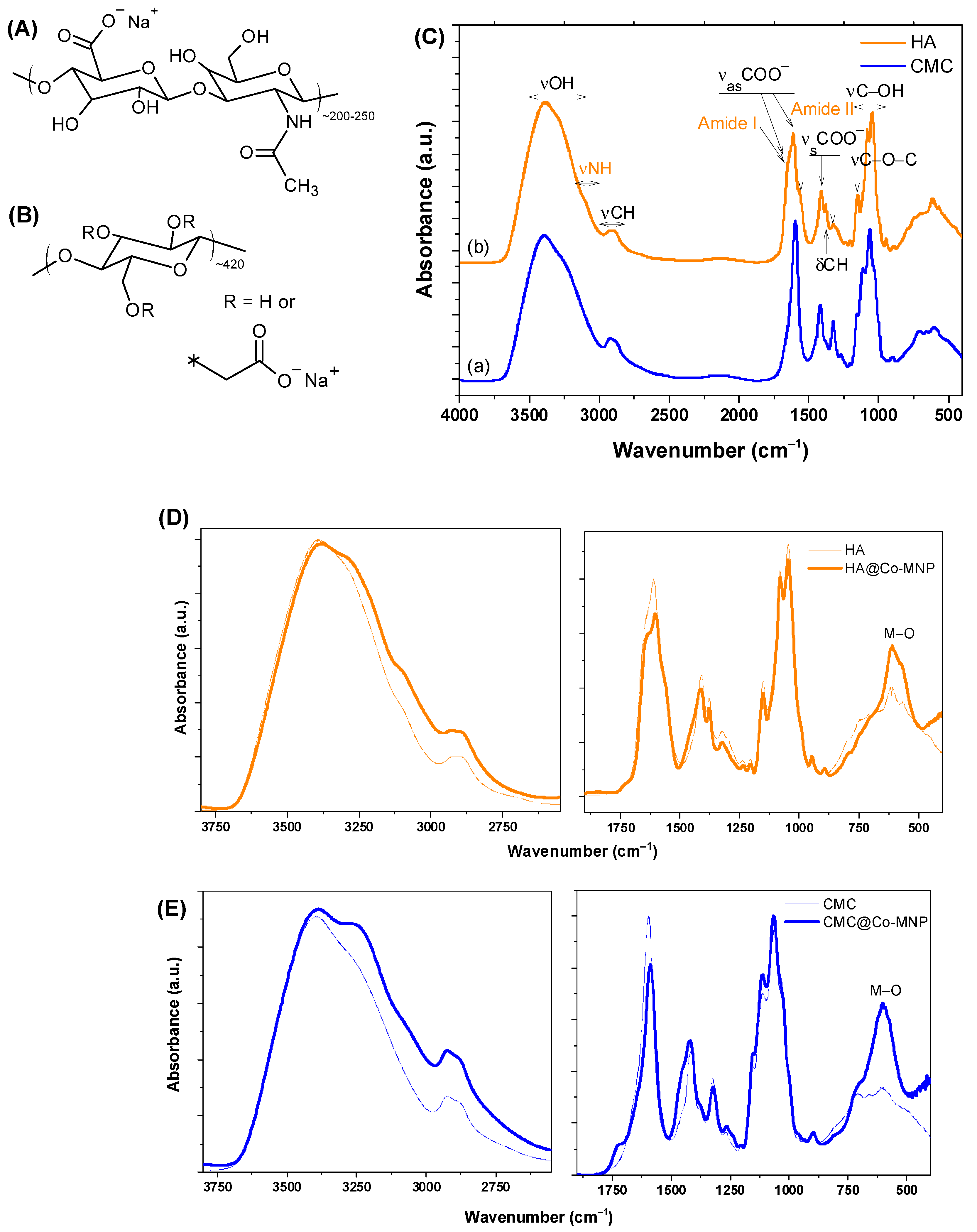
| Assignment | Wavenumber (cm−1) | |
|---|---|---|
| HA | CMC | |
| νOH (H–bonded) | 3500–3100 | 3500–3100 |
| νN-H (H–bonded) | 3150–3050 | - |
| νC–H | 3000–2800 | 3000–2800 |
| νasCOO− | 1650 and 1610 | 1650 and 1590 |
| νsCOO− | 1420 and 1325 | 1410 and 1325 |
| Amide I | 1650 | - |
| Amide II | 1560 | - |
| δC–H | 1380 | 1380 |
| νC–OH primary alcohol | 1080 | 1024 and 995 |
| νC–OH secondary alcohol | 1046 | 1100 and 1060 |
| νC–O–C | 1152 | 1155 |
Disclaimer/Publisher’s Note: The statements, opinions and data contained in all publications are solely those of the individual author(s) and contributor(s) and not of MDPI and/or the editor(s). MDPI and/or the editor(s) disclaim responsibility for any injury to people or property resulting from any ideas, methods, instructions or products referred to in the content. |
© 2026 by the authors. Licensee MDPI, Basel, Switzerland. This article is an open access article distributed under the terms and conditions of the Creative Commons Attribution (CC BY) license.
Share and Cite
Angelo, L.A.S.; Mansur, A.A.P.; Carvalho, S.M.; Krambrock, K.; Carvalho, I.C.; Mansur, H.S. Ferrofluids Based on Anionic Polysaccharide-Coated Magnetic Nanoparticles for Targeted Magnetocatalytic-Driven Multimodal Anticancer Therapy. Magnetochemistry 2026, 12, 31. https://doi.org/10.3390/magnetochemistry12030031
Angelo LAS, Mansur AAP, Carvalho SM, Krambrock K, Carvalho IC, Mansur HS. Ferrofluids Based on Anionic Polysaccharide-Coated Magnetic Nanoparticles for Targeted Magnetocatalytic-Driven Multimodal Anticancer Therapy. Magnetochemistry. 2026; 12(3):31. https://doi.org/10.3390/magnetochemistry12030031
Chicago/Turabian StyleAngelo, Liliane A. S., Alexandra A. P. Mansur, Sandhra M. Carvalho, Klaus Krambrock, Isadora C. Carvalho, and Herman S. Mansur. 2026. "Ferrofluids Based on Anionic Polysaccharide-Coated Magnetic Nanoparticles for Targeted Magnetocatalytic-Driven Multimodal Anticancer Therapy" Magnetochemistry 12, no. 3: 31. https://doi.org/10.3390/magnetochemistry12030031
APA StyleAngelo, L. A. S., Mansur, A. A. P., Carvalho, S. M., Krambrock, K., Carvalho, I. C., & Mansur, H. S. (2026). Ferrofluids Based on Anionic Polysaccharide-Coated Magnetic Nanoparticles for Targeted Magnetocatalytic-Driven Multimodal Anticancer Therapy. Magnetochemistry, 12(3), 31. https://doi.org/10.3390/magnetochemistry12030031