
Article

Engineering Cobalt Ferrite Nanofilms for Magnetically Assisted Oxygen Evolution: Interplay of Doping, Nanostructure, and Electrode Magnetism
by
Viviana B. Daboin
1,
Julieta S. Riva
1,* and
Paula G. Bercoff
2,*
1
Instituto de Investigaciones en Fisicoquímica de Córdoba (INFIQC), Consejo Nacional de Investigaciones Científicas y Técnicas (CONICET), Facultad de Ciencias Químicas, Universidad Nacional de Córdoba, Ciudad Universitaria, Córdoba X5000HUA, Argentina
2
Instituto de Física Enrique Gaviola (IFEG), Consejo Nacional de Investigaciones Científicas y Técnicas (CONICET), Facultad de Matemática, Astronomía, Física y Computación, Universidad Nacional de Córdoba, Ciudad Universitaria, Córdoba X5000HUA, Argentina
*
Authors to whom correspondence should be addressed.
Magnetochemistry 2026, 12(3), 30; https://doi.org/10.3390/magnetochemistry12030030
Submission received: 15 January 2026 / Revised: 7 February 2026 / Accepted: 27 February 2026 / Published: 2 March 2026
(This article belongs to the Special Issue Recent Progress of Magnetic Field Effect on Catalysts)

Abstract

Magnetic-field-assisted electrocatalysis offers a powerful route to enhance the oxygen evolution reaction (OER) by coupling spin-dependent effects with magnetohydrodynamic phenomena. Here, we present a unified study of cobalt ferrite (CoFe2O4)-based nanofilms, elucidating the combined roles of rare-earth doping, nanoparticle size, film morphology, and electrode substrate magnetism on OER performance under external magnetic fields. The effect of UV-light irradiation is also investigated. CoFe2O4 and yttrium-doped CoFe2O4 nanoparticles were synthesized via thermal decomposition and self-combustion routes, yielding single-domain particles with distinct structural and magnetic properties, and assembled into homogeneous nanofilms using the Langmuir–Blodgett technique. Electrocatalytic measurements in alkaline media reveal that intrinsic OER activity is primarily governed by film compactness and charge-transfer efficiency, while the magnitude of magnetic-field-induced enhancement depends on the magnetic response of both the nanofilms and the supporting electrode. Ferromagnetic substrates promote enhanced catalytic activity under magnetic fields, whereas diamagnetic substrates can exhibit suppressed performance. Across all systems, the strongest enhancement is observed when the magnetic field is applied parallel to the electrode surface, reflecting the combined effects of spin polarization and Lorentz-force-driven mass transport. UV-light irradiation is also evaluated as an external stimulus to promote the reaction. Our findings establish a comprehensive framework for designing magnetically assisted OER electrocatalysts and demonstrate that magnetic-field effects can rival or complement rare-earth doping or UV-light irradiation, offering a sustainable pathway toward high-efficiency water oxidation.

1. Introduction

The ever-increasing global energy demand, together with the urgent need to mitigate environmental degradation, has driven intensive research toward the development of efficient and sustainable energy conversion and storage technologies. Among the various strategies proposed, electrochemical water splitting powered by renewable electricity stands out as a promising route for storing surplus energy in the form of hydrogen, commonly referred to as green hydrogen. This process is environmentally friendly and offers a clean pathway for large-scale energy storage [1,2,3].
Electrochemical water splitting consists of two half-reactions: the hydrogen evolution reaction (HER) and the oxygen evolution reaction (OER). The overall efficiency of water electrolysis is predominantly limited by the sluggish kinetics of the OER, which involves a complex multistep proton-coupled electron transfer process and requires a substantial overpotential to proceed at practical current densities. Consequently, the development of efficient electrocatalysts capable of reducing the OER overpotential is a critical requirement for advancing water-splitting technologies [1].
OER electrocatalysts based on noble metals, such as RuO2 and IrO2, exhibit excellent catalytic activity; however, their scarcity and high cost significantly restrict their large-scale and sustainable implementation. As a result, extensive efforts have been devoted to the design of low-cost, durable, and efficient electrocatalysts based on earth-abundant elements. In this context, transition-metal-based materials, particularly those containing Ni, Co, and Fe, have emerged as highly promising candidates due to their favorable electronic structures, variable oxidation states, corrosion resistance in alkaline environments, considerable electrochemical activity, low cost and stability, and abundant availability [2].
Compared with single metal oxides, a myriad of studies revealed that bimetallic oxides and alloys have superior catalytic activity towards OER electrocatalysis due to the different redox potential, synergetic effect, adjustable electronic structure, and structural ordering triggered by the dissimilarity of the lattice strain [1]. Among these materials, various cobalt-containing compounds, including oxides, phosphides, sulfides, hydroxides, and perovskites, have demonstrated notable OER activity [1,2,3,4,5].
In particular, spinel-type oxides such as cobalt ferrite (CoFe2O4) have emerged as attractive OER catalysts since this material combines low cost, high chemical stability, and relatively good electrical conductivity, making it a suitable platform for electrocatalytic applications [2,4,5].
The physicochemical properties of pure Co ferrite nanoparticles for specific applications, including the magnetic properties, can be tailored by controlling size and shape, thus varying the synthesis method. Thermal decomposition is a widely used approach to synthesize CoFe2O4 nanoparticles, enabling the production of spherical, highly monodisperse particles stabilized by organic surfactants such as oleylamine and oleic acid. By adjusting synthesis parameters and precursors, various morphologies, including nanospheres, nanocubes, and nanohexagons, can be obtained [6]. However, this method involves complex procedures, costly reagents, and limited scalability. In contrast, the self-combustion method offers advantages such as low cost, short reaction times, and high yield. This approach relies on exothermic reactions between metal nitrates and organic fuels (e.g., urea, glycine, or citric acid) at temperatures around 400 °C, making it suitable for large-scale nanoparticle production [6].
On the other hand, the physicochemical properties of CoFe2O4 nanoparticles for specific applications can be achieved by introducing elemental substitutions. In particular, doping CoFe2O4 spinel ferrites with rare-earth ions such as Y3+, Gd3+, Ho3+, Sm3+, and Nd3+ induces lattice distortion, leading to structural disorder and strain. These substitutions modify magnetic coupling interactions and, consequently, influence the crystal structure (e.g., lattice parameters, crystallite size, and grain morphology) as well as the dielectric, magnetic, electrical, magnetostrictive, and electrochemical properties of the material [7,8]. In this work, we compare the OER performance of CoFe2O4 nanoparticles synthesized by different methods and evaluate the effect of yttrium doping on their electrocatalytic activity.
In addition to the development of efficient catalytic materials, the use of external fields to enhance the activity of water electrolysis has attracted increasing attention, like the application of light irradiation or external magnetic fields [9]. In this context, magnetic-field-assisted water electrolysis has attracted increasing attention in recent years, since it can directly affect electrocatalytic performance by enhancing charge-transfer processes or by modulating reaction pathways through spin-related effects in the electrocatalyst. Ren et al. [10] found that the OER can be enhanced using ferromagnetic ordered catalysts as spin polarizers for spin selection under a constant magnetic field, which does not apply to non-ferromagnetic catalysts. Additionally, the application of an external magnetic field can enhance electrochemical performance through magnetohydrodynamic (MHD) effects arising from the Lorentz force, which acts on moving charged species in an electromagnetic field, inducing convective mass transport, being maximized when the magnetic field is applied perpendicular to the current direction. As a result, MHD convection improves reactant transport, facilitates gas bubble detachment from the electrode surface, and reduces polarization resistance and ohmic losses [11,12]. Consequently, the superposition of an external magnetic field can lower cell overpotential and enhance reaction kinetics, being largely independent of the electrode material, provided other conditions remain constant. The combination of optimized electrode design and an appropriately applied magnetic field, therefore, represents an effective strategy to improve water electrolysis efficiency [9,11].
Also, it is known that CoFe2O4 is a photocatalytic material. In this regard, Zhang et al. recently used CoFe2O4 through coupling a conjugated poly(vinyl chloride) derivative to the photodegradation of Cr(VI) under visible light [13].
Although both magnetic and optical fields have been shown to enhance electrocatalytic performance, the development of multifunctional catalysts capable of responding independently to both stimuli is particularly attractive. In our previous work, we fabricated magnetite-based anodes doped with an organic photosensitizer for the OER, which exhibited enhanced activity under both magnetic field and light irradiation. However, the presence of the organic component resulted in relatively high electrical resistance, thereby limiting the overall electrocatalytic performance [11].
Among the established techniques for producing two-dimensional nanoparticle deposits, the Langmuir–Blodgett technique is particularly promising, as it enables the fabrication of highly reproducible films with a low density of defects. In our previous studies, we have extensively characterized films prepared by this method using various magnetic nanoparticles [6,8,11].
In this work, we present a comprehensive and unified study of OER enhancement in CoFe2O4-based nanofilms assembled via the Langmuir–Blodgett technique. By integrating and extending results from complementary experimental approaches, the manuscript establishes a coherent framework describing how magnetism, nanostructure, chemical doping, substrate properties, and UV-light irradiation collectively or individually govern electrocatalytic performance.
The originality of the present contribution lies not only in reporting isolated effects, but in elucidating the interplay between multiple external and intrinsic parameters (namely nanoparticle size, rare-earth (Y3+) doping, substrate magnetic character, applied magnetic fields, and light irradiation) and how their combined action modulates charge transfer, spin polarization, and mass transport during OER. In particular, we demonstrate that magnetic-field-induced enhancement can rival chemical doping strategies, that the magnetic nature of the substrate critically determines the response to external fields, and that photo-assisted effects also amplify catalytic activity.
The paper introduces a unified mechanistic picture that bridges spin-dependent electrocatalysis, magnetohydrodynamic effects, and photo-assisted processes, providing general insights relevant to the rational design of next-generation water-splitting electrodes.

2. Materials and Methods

2.1. Synthesis of Co-TD Nanoparticles by Thermal Decomposition

Cobalt ferrite nanoparticles (Co-TD) were synthesized via a thermal decomposition route adapted from previously reported methods [14,15,16]. All reagents were commercially obtained and used as received. In a typical preparation, iron (III) acetylacetonate and cobalt (II) acetylacetonate were dissolved in benzyl ether together with hexadecanediol, oleic acid, and oleylamine, acting as reducing and stabilizing agents. The mixture was magnetically stirred under a nitrogen atmosphere at room temperature, followed by a dehydration step at 100 °C to eliminate residual moisture. The reaction temperature was then increased to 200 °C to trigger nanoparticle nucleation and subsequently raised to 280 °C to allow controlled particle growth. After completion of the thermal treatment, the system was cooled to ambient temperature, and ethanol was added to promote nanoparticle precipitation. The resulting nanoparticles were separated by magnetic decantation, thoroughly washed with ethanol, and dried at 60 °C. The as-synthesized nanoparticles remain coated with oleic acid, which acts as a stabilizing surface ligand during the thermal decomposition process.

2.2. Synthesis of Co-SC and CoY-SC Nanoparticles by Self-Combustion

Cobalt ferrite (Co-SC) and yttrium-doped cobalt ferrite (CoY-SC) nanoparticles were synthesized using a self-combustion approach adapted from previously reported procedures [8,17]. Aqueous precursor solutions were prepared by dissolving appropriate stoichiometric amounts of iron (III) nitrates and cobalt oxalates in deionized water, maintaining a total metal ion concentration of 1 M. An equal volume of a 3 M citric acid solution was added to each metal precursor solution under continuous stirring. The resulting mixture was heated at a moderate temperature to promote complexation, followed by further heating below 200 °C to induce solvent evaporation and gel formation. Upon continued heating, the viscous gel underwent spontaneous ignition, leading to a self-sustained combustion process and the formation of a precursor powder. This residue was subsequently calcined at 800 °C for 2 h to obtain crystalline cobalt ferrite nanoparticles.
Yttrium-doped cobalt ferrite nanoparticles (CoY-SC) were prepared following the same protocol, incorporating stoichiometric amounts of yttrium nitrate into the initial metal precursor solution in 3 M citric acid.
After synthesis, the nanoparticles were surface-modified using stearic acid following established procedures [8,18]. Briefly, a fixed number of nanoparticles was dispersed in a mixed solution of absolute ethanol and stearic acid, followed by sonication at an elevated temperature to promote surface functionalization. Excess stearic acid was removed through multiple washing steps, and the modified nanoparticles were finally dried at 60 °C.

2.3. Nanofilm Fabrication by the Langmuir–Blodgett Technique

Nanofilms based on Co-TD, Co-SC, and CoY-SC nanoparticles were fabricated using the Langmuir–Blodgett (LB) technique, following procedures adapted from previously reported works [6,8,11]. Indium tin oxide (ITO)-coated glass substrates were used for all nanoparticle systems, while graphite substrates (SIGRAFLEX®, flexible graphite foil provided by SGL (Wiesbaden, Germany) Carbon company) were additionally employed for Co-TD nanoparticles only. ITO-coated glass substrates were obtained from Delta Technologies (Loveland, CO, USA). The ITO thickness in the sheets was approximately 180 nm, and the surface roughness was approximately 32.9 Å. Prior to deposition, the substrates were sequentially cleaned with acetone, ethanol, and Milli-Q water, followed by treatment with hexane.
Nanoparticle suspensions were prepared in chloroform/methanol mixtures, with concentrations adjusted according to the nanoparticle system. For Co-TD nanoparticles, a suspension with a concentration of 1.5 mg·mL−1 was prepared, and 150 µL of the dispersion was spread onto the air/water interface. For Co-SC and CoY-SC nanoparticles, suspensions with a concentration of 3 mg·mL−1 were used, and a volume of 300 µL was deposited in each case. The dispersions were spread using a microsyringe onto a Milli-Q water subphase (18.2 MΩ·cm) contained in a Langmuir trough.
After solvent evaporation (~20 min), surface pressure-area isotherms were recorded using a Wilhelmy plate coupled to a KSV Mini-Trough system (36.4 cm × 7.5 cm, KSV Model 2000, KSV Instruments Ltd., Helsinki, Finland). The monolayers were compressed at a constant rate of 10 mm min−1 and transferred onto the ITO substrates at a surface pressure of 40 mN⋅m−1 by vertical immersion and emersion of the substrate in the subphase, at a dipping speed of 3 mm min−1. To ensure homogeneous and reproducible coverage, the deposition process was repeated twice for each sample. Throughout the manuscript, nanofilms deposited on ITO are referred to as ITO/Co-TD, ITO/Co-SC, and ITO/CoY-SC, while nanofilms of Co-TD nanoparticles deposited on graphite substrates are denoted as Graphite/Co-TD.

2.4. Experimental Techniques

Co-TD, Co-SC, and CoY-SC nanoparticles and the corresponding nanofilms were characterized using a combination of structural, morphological, and magnetic techniques. The crystalline structure of the nanoparticles was analyzed by X-ray powder diffraction (XRD) using a PANalytical (Almelo, The Netherlands) X’Pert Pro diffractometer operating in Bragg–Brentano geometry with Cu Kα radiation (λ = 1.5418 Å), at 40 kV and 40 mA.
The morphology and size of the nanoparticles were examined by transmission electron microscopy (TEM) using a Hitachi (Tokyo, Japan) 7800 microscope operated at an accelerating voltage of 100 kV. In contrast, the surface morphology of the nanofilms was analyzed by field-emission scanning electron microscopy (FE-SEM) using a Sigma Zeiss (Oberkochen, Baden-Württemberg, Germany) microscope.
Magnetic properties were investigated using a vibrating sample magnetometer (VSM, Cryogenic Ltd., London, UK) at 300 K with applied magnetic fields up to ±2 T. For magnetic measurements, the nanoparticles were compacted into thin pellets. The nanofilms were measured with the external magnetic field applied both parallel (in-plane, IP) and perpendicular (out-of-plane, OoP) to the substrate surface. The magnetic contribution of a bare glass (or graphite) substrate was measured under identical conditions and subtracted from the nanofilm data.

2.5. Electrochemical Measurements

The electrochemical performance of ITO/Co-TD, ITO/Co-SC, ITO/CoY-SC, and Graphite/Co-TD nanofilms was evaluated using a conventional three-electrode configuration connected to a CHI 760C electrochemical workstation. The nanofilm-modified ITO or graphite substrates were used directly as working electrodes, while a platinum wire and an Ag/AgCl electrode (in 1 M KOH) served as the counter and reference electrodes, respectively. The carbon-based working electrode consisted of high-purity Sigraflex® graphite foil (99.85% C). All electrochemical measurements were carried out in a 0.1 M KOH aqueous solution (pH = 13.0). The measured potentials were converted to the reversible hydrogen electrode (RHE) scale according to the Nernst equation: ERHE = EAg/AgCl + 0.059 × pH + 0.197 V. The overpotential (η) was calculated as η (V) = ERHE − 1.23 V. Polarization current densities were normalized to the geometric surface area of the working electrode, which was (2.8 ± 0.1) cm2 in all cases. The temperature in the laboratory was maintained at (24 ± 1) °C during the measurements.
Linear sweep voltammetry (LSV) was carried out at a scan rate of 25 mV·s−1. Tafel slopes were derived from the polarization curves by fitting the data to the Tafel equation η = a + b·log J, where J is the current density and b represents the Tafel slope. Electrochemical impedance spectroscopy (EIS) measurements were performed at 1.7 V vs. RHE over a frequency range from 0.01 Hz to 1000 Hz using a perturbation amplitude of 5 mV. The impedance spectra were analyzed by fitting to a Randles equivalent circuit model in every case, using ZPLOT/ZVIEW 4.0 software (Scribner Associates, Inc., Southern Pines, NC, USA).

3. Results and Discussion

3.1. Nanoparticle Characterization

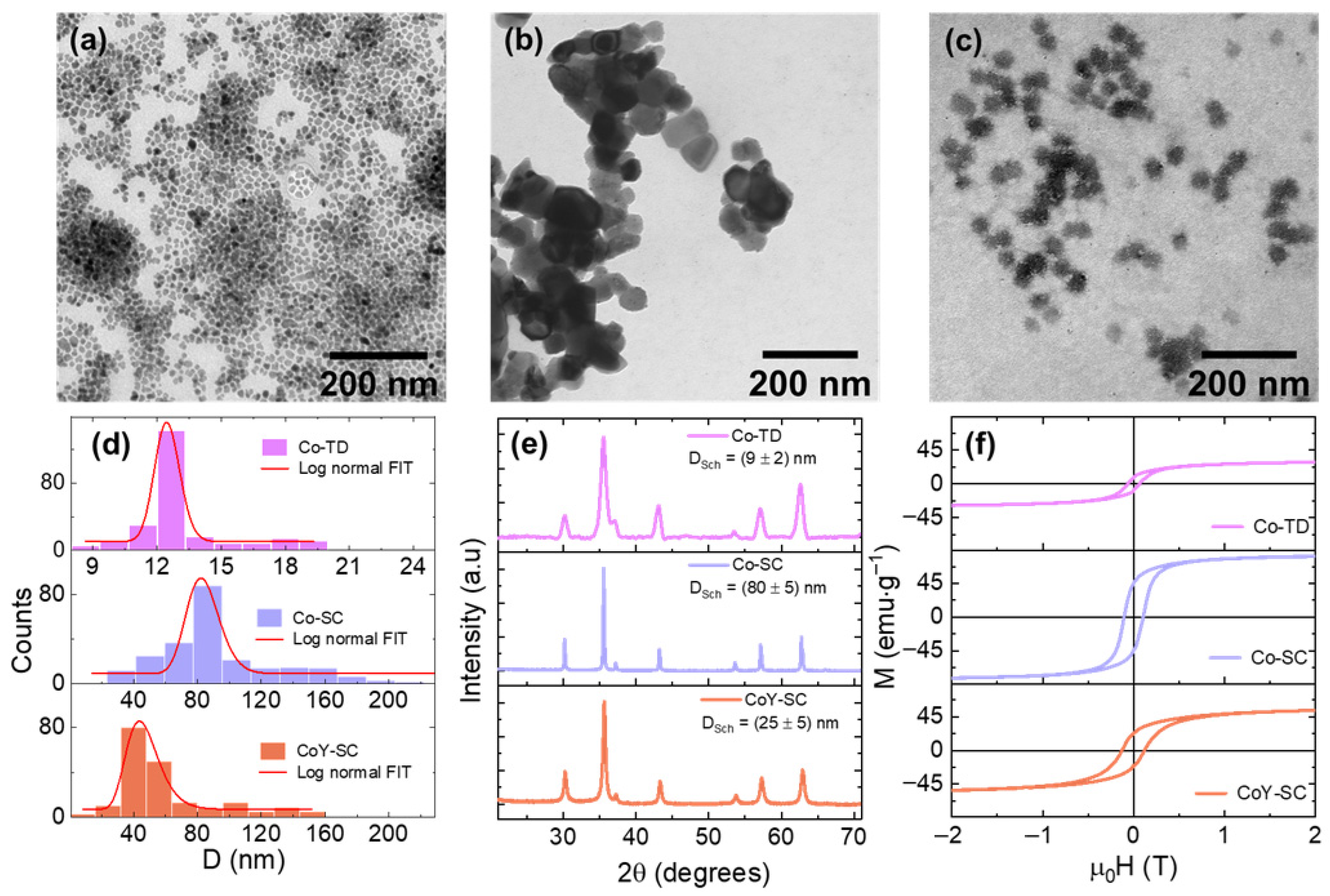
Figure 1 displays representative TEM images of the nanoparticles synthesized by (a) thermal decomposition (Co-TD) and by (b,c) the self-combustion route, without and with yttrium doping (Co-SC and CoY-SC, respectively).
Co-TD nanoparticles exhibit a nearly spherical morphology with a high degree of size uniformity, as evidenced by the narrow particle size distribution shown in Figure 1d. The size histograms were constructed using at least 240 particles. The average particle diameter, obtained from a log-normal fit of the histogram, is (12 ± 1) nm. The nanoparticles are well dispersed and show limited aggregation, reflecting the effective control over nucleation and growth achieved through the thermal decomposition method.
In contrast, nanoparticles obtained by the self-combustion route display a markedly different morphology. As shown in Figure 1b,c, both Co-SC and CoY-SC nanoparticles present larger sizes and more faceted shapes. The corresponding size distributions (Figure 1d) yield mean diameters of (84 ± 2) nm for Co-SC and (46 ± 2) nm for CoY-SC. Despite their larger dimensions, no extensive agglomeration is observed, indicating that the synthesis conditions and subsequent surface treatment were effective in limiting particle clustering. Notably, yttrium incorporation results in a marked reduction in particle size compared to the undoped Co-SC sample, indicating that the presence of Y affects the nanoparticle growth during the self-combustion process [17].
The crystalline structure of the nanoparticles was analyzed by X-ray diffraction (XRD), as shown in Figure 1e. All diffraction patterns can be indexed to the cubic spinel structure of cobalt ferrite (CoFe2O4, JCPDS-PDF 22-1086), with no detectable secondary phases, confirming the successful formation of the ferrite phase irrespective of the synthesis route or yttrium incorporation [17]. The nominal composition of the ferrites was confirmed by ICP, being CoFe2O4 for Co-SC and CoFe1.70 Y0.18O4 for CoY-SC [17]. In Ref. [8], a comprehensive XPS analysis provides direct evidence of yttrium incorporation in the spinel lattice and its chemical environment. Pronounced differences are observed when comparing nanoparticles synthesized by thermal decomposition and self-combustion. The diffraction peaks of Co-TD are noticeably broader and less intense than those of Co-SC and CoY-SC, which is consistent with the significantly smaller crystallite size of Co-TD nanoparticles. This behavior is associated with the reduced crystallite size, which limits the number of atomic planes contributing to diffraction and increases the surface-to-volume ratio, thereby introducing structural imperfections [19,20].
The average crystallite size estimated from the Scherrer equation using the (311) reflection of each diffraction pattern is approximately (9 ± 2) nm for Co-TD, (80 ± 5) nm for Co-SC, and (25 ± 5) nm for CoY-SC. For Co-TD nanoparticles, the crystallite size is comparable to the particle diameter obtained from TEM, suggesting a predominantly single-crystalline nature. In contrast, for Co-SC and CoY-SC nanoparticles, the smaller crystallite sizes relative to the particle diameters indicate a polycrystalline structure composed of multiple coherently diffracting domains. The lattice parameters, calculated from the XRD patterns, are a = 8.4051(3) Å for Co-TD, a = 8.3718(4) Å for Co-SC, and a = 8.3574(6) Å for CoY-SC. The slight lattice contraction observed upon yttrium incorporation is consistent with the incorporation of Y3+ ions into the spinel lattice and supports their influence on crystal growth and structural ordering during the self-combustion process.
These nanoparticles have been extensively characterized in our previous works. For more details, the reader may refer to Refs. [6,8,11,17].
Magnetic hysteresis loops measured at room temperature for Co-TD, Co-SC, and CoY-SC nanoparticles are shown in Figure 1f. All the samples exhibit well-defined ferrimagnetic behavior, characterized by finite coercivity HC and remanent magnetization MR. Pronounced differences in the magnetic response are observed depending on the synthesis route and yttrium incorporation.
Saturation magnetization MS is highest for Co-SC nanoparticles, reaching values close to those reported for bulk cobalt ferrite [6,8,21], whereas significantly lower magnetization is observed for Co-TD. This reduction can be ascribed to the much smaller particle size of Co-TD, which enhances surface-related effects such as spin canting and magnetic disorder at the nanoparticle boundaries, limiting full spin alignment under the applied field [22]. Upon yttrium incorporation, a further decrease in saturation magnetization is observed for CoY-SC, reflecting the combined influence of non-magnetic Y3+ ions within the spinel lattice and the reduced nanoparticle size.
The coercive field exhibits a size- and composition-dependent behavior consistent with single-domain nanoparticles in all samples. In the case of CoY-SC, the enhancement of HC with respect to Co-SC can be rationalized within the Stoner–Wohlfarth framework, where a reduction in saturation magnetization and particle size leads to an increase in coercivity (HC ∝ 1/MS) [8]. In contrast, Co-TD nanoparticles display a lower coercive field despite their much smaller size. Although superparamagnetic behavior could be expected for particles of ~12 nm, the finite coercivity observed at room temperature arises from the high magnetocrystalline anisotropy of cobalt ferrite, combined with surface effects and single-domain behavior. These factors increase the energy barrier for magnetization reversal, allowing a measurable coercive field [6,23].
The saturation magnetization (MS), remanent magnetization (MR), and coercive field (HC) values extracted from the hysteresis loops of the three kinds of nanoparticles are summarized in Table 1.

3.2. Pressure–Area Isotherms

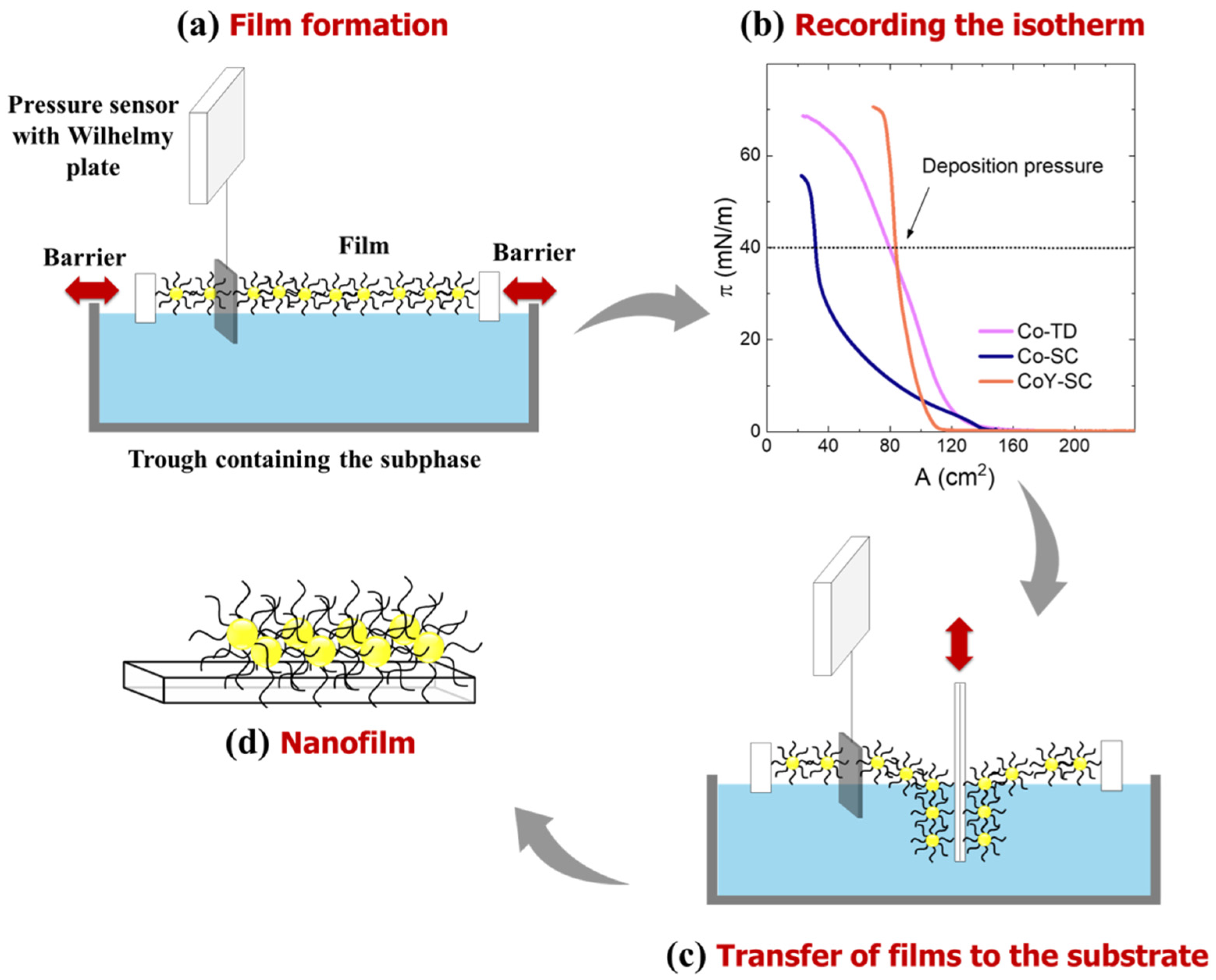
Scheme 1a illustrates the first step of the Langmuir–Blodgett (LB) process used to fabricate the nanoparticle nanofilms. In this stage, Co-TD, Co-SC, and CoY-SC nanoparticles were independently dispersed onto the aqueous subphase using a microsyringe, one system per experiment, forming a film at the air–water interface.
Upon compression of the movable barriers, the nanoparticles are progressively forced into closer lateral contact, giving rise to the surface pressure–area (π-A) isotherms shown in Scheme 1b. These isotherms, recorded for Co-TD, Co-SC, and CoY-SC nanoparticles (magenta, blue, and red curves, respectively), provide information about the compressibility and packing behavior of the nanoparticle monolayers and were used to determine the optimal conditions for nanofilm transfer. In large areas, all systems exhibit a low-pressure region characteristic of a gaseous-like state, in which the nanoparticles are fully dispersed at the air–water interface with negligible lateral interactions. As compression proceeds, the available surface area per nanoparticle decreases continuously, driving a transition toward more compact, solid-like films.
Clear differences arise upon compression. The CoY-SC isotherm (red) exhibits a sharp and nearly vertical increase in surface pressure over a narrow area range, indicating a rapid transition to a densely packed solid-like phase, followed by film collapse at higher compression. This behavior reflects a high degree of compressibility and efficient nanoparticle rearrangement during monolayer formation. In contrast, the Co-SC isotherm (blue) displays a broader compression profile, with a gradual increase in surface pressure over a wider area range. The absence of a well-defined plateau and the smoother slope suggest limited nanoparticle mobility at the interface, likely associated with nanoparticle aggregation, which hinders close packing during compression. The Co-TD isotherm (magenta) shows an intermediate behavior, with a progressive increase in surface pressure after the gaseous phase and a clearly defined solid-like regime. These differences in isotherm shape and transfer behavior reflect variations in nanoparticle aggregation and interparticle interactions at the air–water interface, which play an important role in determining nanoparticle compressibility and the final organization of the nanofilms. Based on these isotherms, a surface pressure of 40 mN·m−1 (horizontal dotted line in Scheme 1b) was selected for film transfer, ensuring deposition within the solid-like regime for all nanoparticle systems.
Scheme 1c illustrates the transfer of the compressed nanoparticle monolayers onto solid substrates (placing two of them together in order to obtain duplicate samples) by controlled vertical immersion and emersion through the subphase. This process yields compact nanoparticle coatings on ITO or graphite substrates, resulting in nanofilms, as schematically shown in Scheme 1d.
The efficiency of the LB deposition was evaluated through the transfer ratio, defined as the quotient between the decrease in monolayer area at the air–water interface and the area of the substrate. Under these conditions, transfer ratios close to unity were obtained for all studied systems, indicating an efficient and reproducible nanofilm transfer.

3.3. Nanofilm Characterization

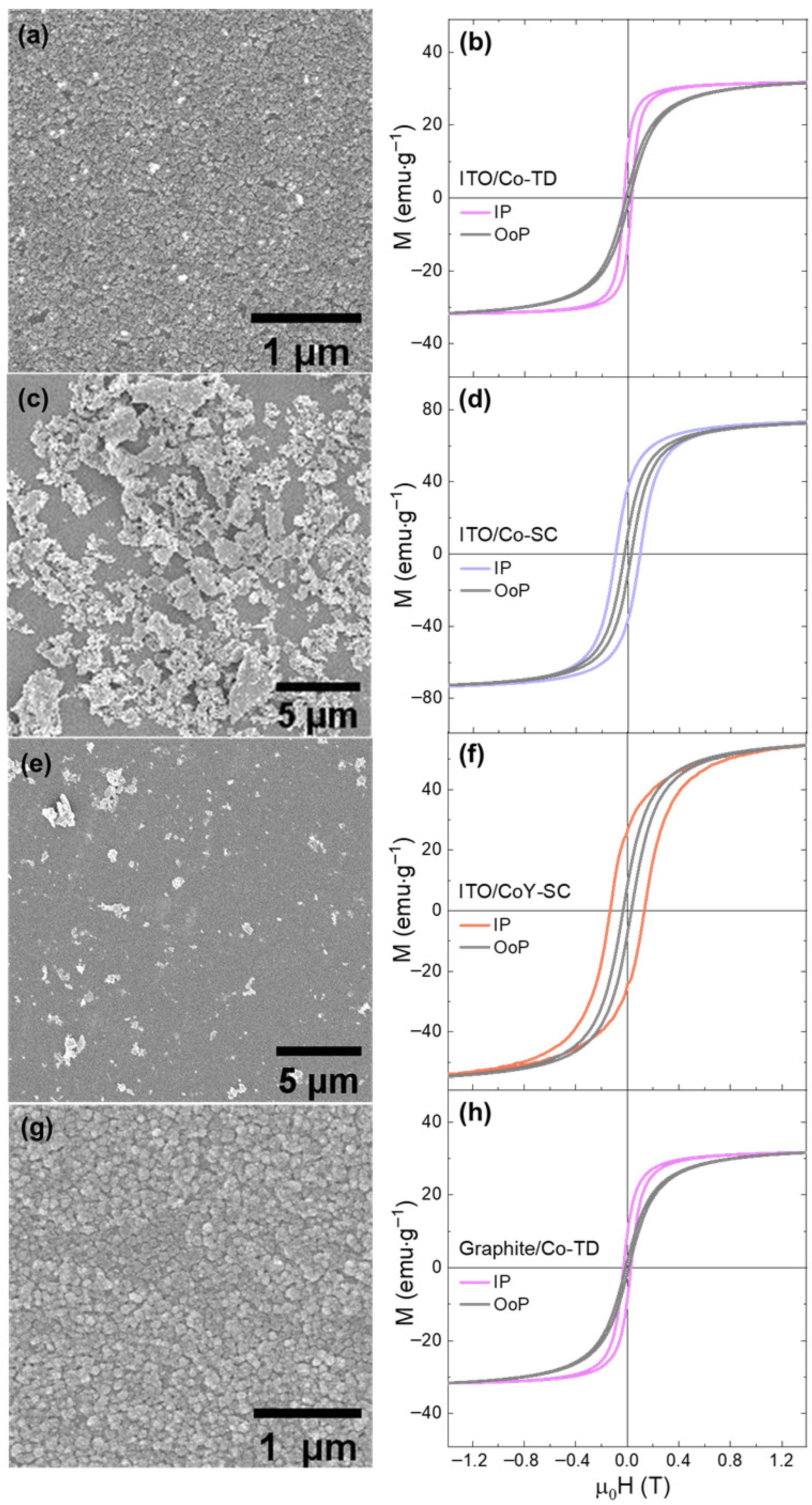
Figure 2 depicts the morphological and magnetic characterization of the nanofilms obtained by Langmuir–Blodgett deposition of cobalt ferrite nanoparticles, including yttrium-doped cobalt ferrite, onto conductive substrates. SEM images corresponding to ITO/Co-TD, ITO/Co-SC, ITO/CoY-SC, and Graphite/Co-TD nanofilms are shown in Figure 2a, Figure 2c, Figure 2e and Figure 2g, respectively.
In ITO/Co-SC and ITO/CoY-SC nanofilms (Figure 2c,e), the nanoparticles form compact layers with occasional clustered domains distributed across the surface. These local variations in packing density are commonly observed in LB films and reflect subtle differences in nanoparticle organization at the interface. Importantly, the presence of these domains does not disrupt the overall film continuity, which remains preserved over large substrate areas.
The Co-TD nanofilms deposited on ITO (Figure 2a) also display a uniform and continuous morphology, characterized by dense lateral packing of nanoparticles and the absence of large agglomerates. A comparable film structure is observed for the Co-TD nanofilm deposited on graphite (Figure 2g), demonstrating that the LB method yields consistent nanoparticle assemblies on both oxide and carbon-based substrates. Overall, despite differences in nanoparticle composition and substrate nature, all four nanofilms share a common structural feature: the formation of compact, continuous, and laterally homogeneous nanoparticle layers.
The thicknesses of these films were determined from cross-sectional profiles extracted from multiple previously reported AFM images [6,8]. These analyses yielded thicknesses of 160 nm for ITO/Co-SC [6], 140 nm for ITO/CoY-SC [8], and 12 nm for ITO/Co-TD [6]. Given the mean nanoparticle sizes of each ferrite (84 nm for Co-SC, 46 nm for CoY-SC, and 12 nm for Co-TD), these results indicate that the ITO/Co-SC and ITO/CoY-SC nanofilms comprise approximately two to three nanoparticle layers, while the ITO/Co-TD nanofilm consists of a single layer.
Figure 2b,d,f,h show the room-temperature hysteresis loops of the ITO/Co-TD, ITO/Co-SC, ITO/CoY-SC, and Graphite/Co-TD nanofilms, measured with the magnetic field applied parallel (in-plane, IP) and perpendicular (out-of-plane, OoP) to the substrate surface. In all cases, the maximum applied field was ±2 T; however, a reduced field range is presented in the figures for clarity. The magnetic contributions from the ITO and graphite substrates (shown in Figure S1 of the Supplementary Information) were subtracted from the raw data.
All nanofilms exhibit clear ferrimagnetic behavior at room temperature, with well-defined hysteresis loops in both measurement configurations. For each sample, the saturation magnetization (MS) is independent of the field orientation. Nevertheless, marked differences are observed between the IP and OoP configurations at low magnetic fields. When the field is applied in-plane, the nanofilms display higher remanent magnetization (MR) and larger coercive fields (HC) compared to the out-of-plane direction. This behavior reveals the presence of a magnetic easy plane parallel to the film surface, which is characteristic of two-dimensional nanostructures dominated by shape anisotropy arising from the planar geometry and the dense lateral arrangement of nanoparticles.
It is interesting to note that Co-TD nanofilms deposited on ITO and graphite display small differences in their magnetic parameters, such as MR and HC (see Table 2), despite being composed of the same nanoparticles and prepared under identical conditions. This observation indicates that the nature of the substrate plays an important role in determining the magnetic behavior of the nanofilms, as the substrates interact differently with the nanoparticles: ITO exhibits a ferromagnetic contribution [24], whereas carbon is diamagnetic [25]. The magnetic parameters extracted from the hysteresis loops of all the nanofilms are summarized in Table 2.
The use of two substrates with distinct magnetic responses (ITO ferromagnetic and graphite diamagnetic) was to evaluate the influence of the substrate on the magnetic and electrochemical properties of the nanofilms.

3.4. Different Effects on the Oxygen Evolution Reaction (OER)

3.4.1. Effect of the Material

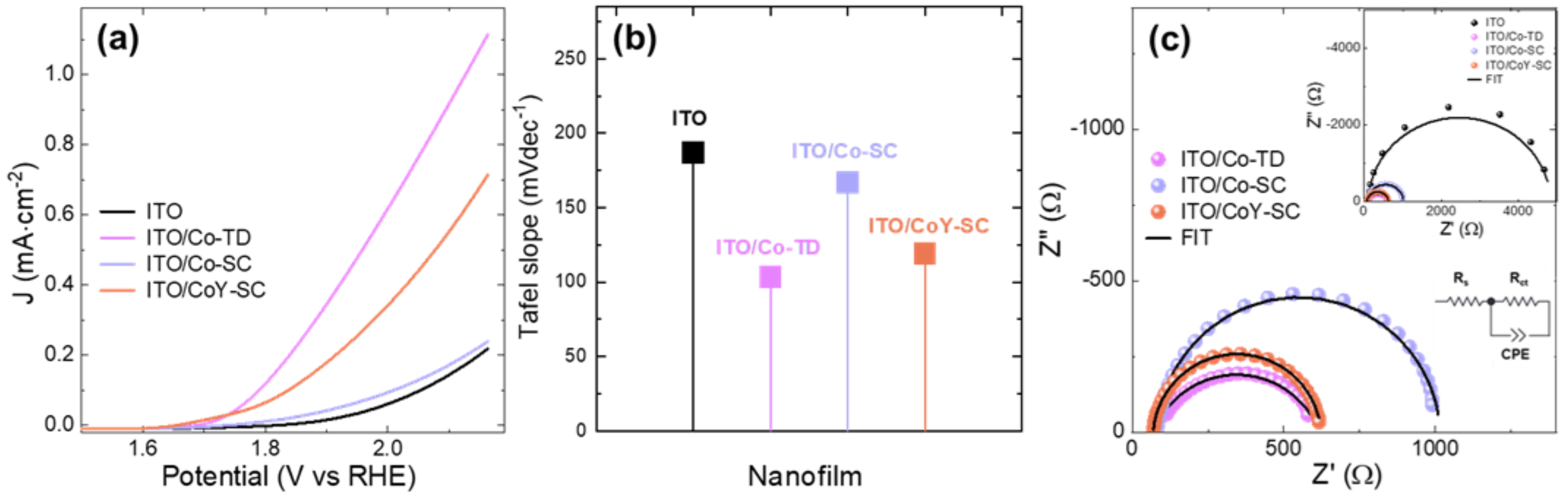
Figure 3 compares the electrocatalytic OER performance of a bare ITO electrode and ITO electrodes modified with Co-based nanoparticle films at a scan rate of 25 mV s−1.
The LSV curves displayed in Figure 3a show that all nanoparticle-modified electrodes exhibit higher current densities than bare ITO, indicating enhanced OER activity. Among them, the ITO/Co-TD electrode delivers the highest current density over the entire potential range, followed by ITO/CoY-SC and ITO/Co-SC, highlighting the strong influence of the synthesis method and composition on catalytic performance. The superior activity observed for the ITO/Co-TD electrode can be attributed to the in situ surface modification of the Co-TD nanoparticles during the synthesis, which results in a more homogeneous coating and scarce aggregation. This process produces more hydrophobic nanoparticles, enabling the formation of more compact and uniform films when deposited using the LB technique. For nanoparticles obtained via the self-combustion method, the incorporation of Y3+ cations leads to a noticeable improvement in OER performance, indicating a beneficial compositional effect on the catalytic activity.
The Tafel slopes extracted from the LSV data (Figure 3b) further corroborate these trends. Bare ITO displays the highest Tafel slope with a value of 187 mV·dec−1, reflecting sluggish OER kinetics, whereas all modified electrodes show significantly lower values. The ITO/Co-TD film exhibits the smallest Tafel slope, with a value of 119 mV·dec−1, indicating faster reaction kinetics and more favorable charge-transfer processes compared to the SC-derived films.
The EIS measurements (presented as Nyquist plots in Figure 3c) reveal a pronounced reduction in semicircle diameter for the nanoparticle-modified electrodes relative to bare ITO, corresponding to a lower charge-transfer resistance (Rct). The response obtained from the bare ITO electrode is displayed as an inset in Figure 3c, as well as the Randles model circuit used for the fitting, where Rs is the solution resistance, and CPE is a constant phase element. The solution resistance values (Rs) obtained from the EIS measurements and the corresponding fittings were very similar for all electrodes; therefore, the LSV curves were not corrected for iR drop. The extracted Rs values and fitting parameters have been included in the Supplementary Information (Tables S1–S3). Consistent with the LSV and Tafel analyses, the ITO/Co-TD electrode shows the smallest semicircle, confirming improved interfacial charge-transfer kinetics. The LSV responses were normalized by the real surface area of each electrode by calculating the electrochemically active surface area (ECSA) from the CV scans at varying scan rates in a non-Faradaic potential range of as-prepared electrodes, as shown in Figures S2 and S3 of the Supplementary Information. The same trend is observed after ECSA normalization, indicating that the observed current enhancements are associated with the material properties rather than being a surface area effect.

3.4.2. Effect of External Magnetic Fields

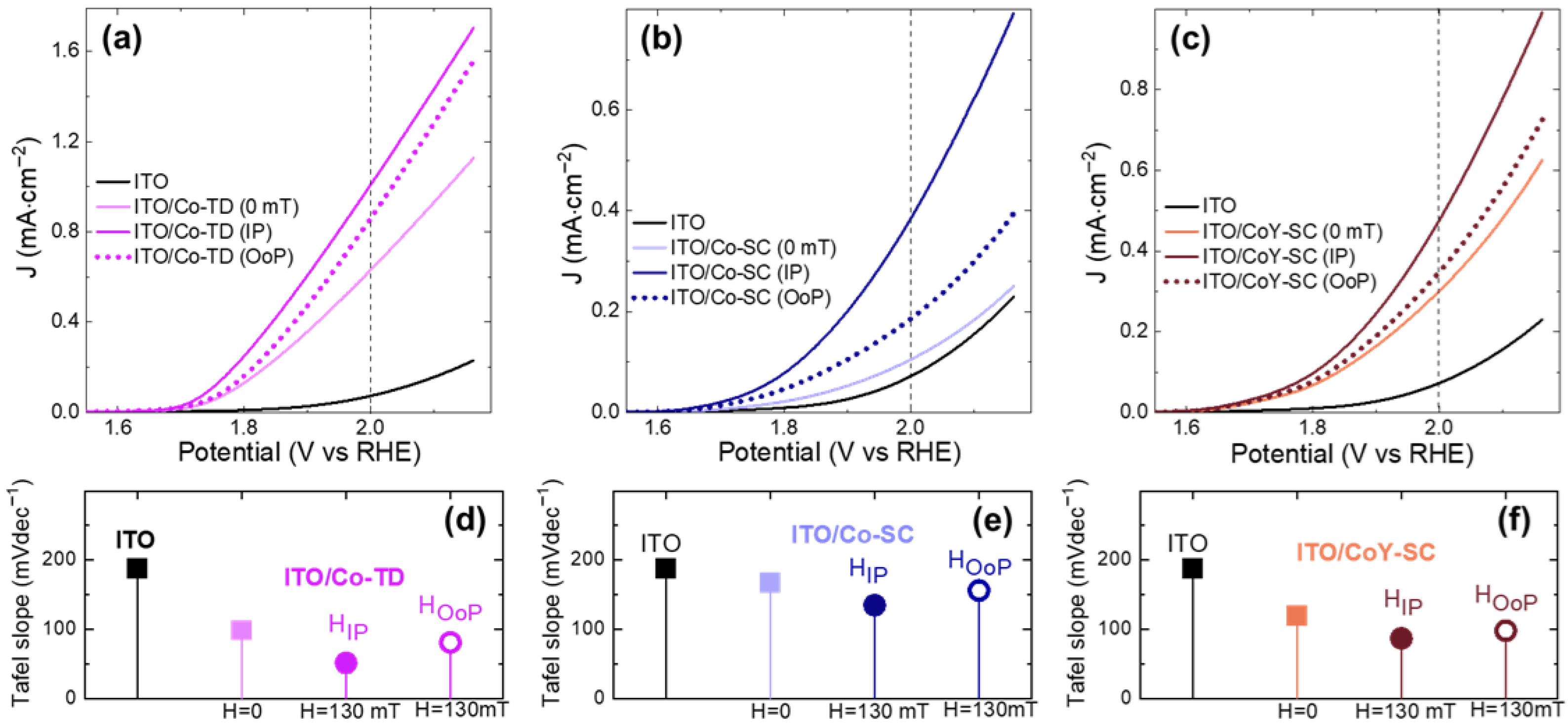
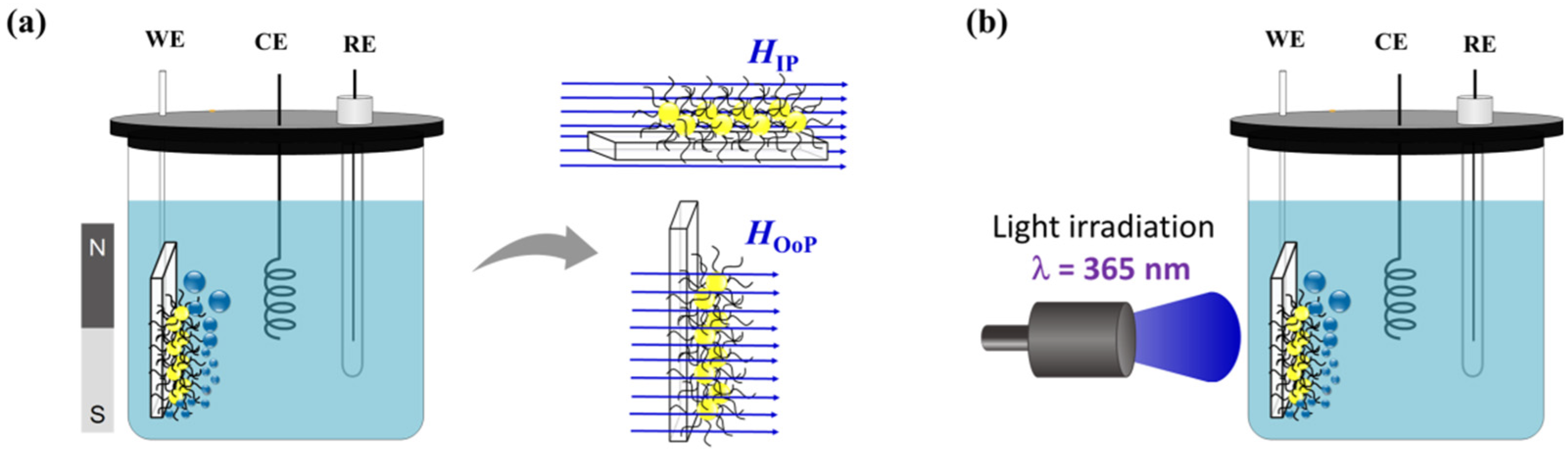
To evaluate the effect of an external magnetic field on the OER performance of the different anodes, a magnetic field of 130 mT was applied either parallel (in-plane, IP) or perpendicular (out-of-plane, OoP) to the film surface, as illustrated in Scheme 2a, in order to assess possible magnetic anisotropy effects. The corresponding LSV curves and Tafel slope values are presented in Figure 4. Solid lines correspond to the IP configuration, whereas dotted lines represent the OoP configuration.
For all nanofilms, the application of an external magnetic field leads to an enhancement of the OER current density compared to the zero-field condition, evidencing a magnetically induced improvement of the electrocatalytic activity. This enhancement shows a clear dependence on the orientation of the magnetic field with respect to the film surface.
It is well known that an external magnetic field can promote ion migration through magnetohydrodynamic (MHD) effects, thereby improving electrocatalytic performance [26]. In the specific case of the OER, an additional advantage arises from the fact that the thermodynamically stable product is molecular oxygen in its triplet ground state. Therefore, spin polarization of the electrocatalyst can significantly improve OER efficiency by reducing the kinetic barrier associated with O-O bond formation, i.e., the transformation of spin-parallel-aligned oxygen atoms to triplet molecular oxygen (↑O-O↑). As a result, parallel alignment of the oxygen radicals is favored, facilitating O-O coupling and producing paramagnetic triplet O2 with an activation energy approximately 1 eV lower than that observed in the absence of a magnetic field [10,27].
In our case, in the absence of a magnetic field, the magnetic domains of the anode materials are randomly oriented. When an external magnetic field is applied, these domains align in the field direction, inducing a strong spin polarization. Under these conditions, the spin states of the outer electrons of the Fe and Co atoms interact with the adsorbed oxygen intermediates, reducing electron–electron repulsion. This spin-dependent interaction enhances electronic conductivity and lowers the energy barrier of the rate-limiting electron transfer step in the OER, thereby accelerating the overall reaction kinetics.
In the three ITO-modified electrodes, the increase in current density is more pronounced when the magnetic field is applied in the IP configuration, while a more moderate enhancement is observed for the OoP configuration (Figure 4a–c).
At an applied potential of 2.0 V vs. RHE (vertical dotted line in Figure 4a–c), the current density of the nanofilms under a 130 mT in-plane magnetic field increases by 60% in ITO/Co-TD, 270% in ITO/Co-SC, and 58% in ITO/CoY-SC, with respect to the corresponding field-free nanofilms, highlighting a clear magnetic-field-dependent catalytic response. The pronounced enhancement in OER activity observed for the ITO/Co-SC anode is associated with the higher magnetization of this electrode under an applied magnetic field of 130 mT compared to the other materials, as shown in Table 2. Figure S4 shows the relationship between the magnetization of the materials at 130 mT and the enhancement of the OER at 2.0 V, expressed as a gain factor, in order to highlight the correlation between material magnetization and catalytic performance.
Notably, in the three anodes, the enhancement obtained under IP fields is consistently larger than that observed for the OoP configuration. In the latter, the electric current flows parallel to the applied magnetic field (θ = 0°), resulting in a vanishing Lorentz force since FL = q v B sinθ = 0. Consequently, any observed improvement in catalytic activity can be attributed exclusively to spin polarization effects at the electrode surface. In contrast, the IP configuration positions the magnetic field perpendicular to the current (θ = 90°), maximizing the Lorentz force magnitude (FL = q v B) acting on charge carriers and ionic species. As discussed previously, this force can enhance electrocatalytic performance through the magnetohydrodynamic (MHD) effect, inducing convective mass transport leading to a reduction in polarization resistance and minimizing the ohmic drop associated with gas bubble accumulation by facilitating bubble detachment from the electrode surface [12]. The substantially greater catalytic enhancement observed in this geometry thus stems from the synergistic contributions of spin polarization (which operates in both IP and OoP configurations) and Lorentz-force-driven mass transport, the latter being active exclusively when the field is perpendicular to the current density or charge carrier velocity.
The kinetic parameters extracted from the Tafel plots (Figure 4d–f) further confirm these observations. For all ITO-supported nanofilms, the application of a magnetic field leads to a reduction in the Tafel slope compared to the zero-field condition, indicating accelerated reaction kinetics and facilitated charge-transfer processes. Consistent with the LSV results, the lowest Tafel slope values are obtained when the magnetic field is applied in the in-plane configuration, confirming the anisotropic nature of the magnetic-field-induced enhancement. Figures S5–S7 in the Supplementary Information show the corresponding Tafel slope curves.
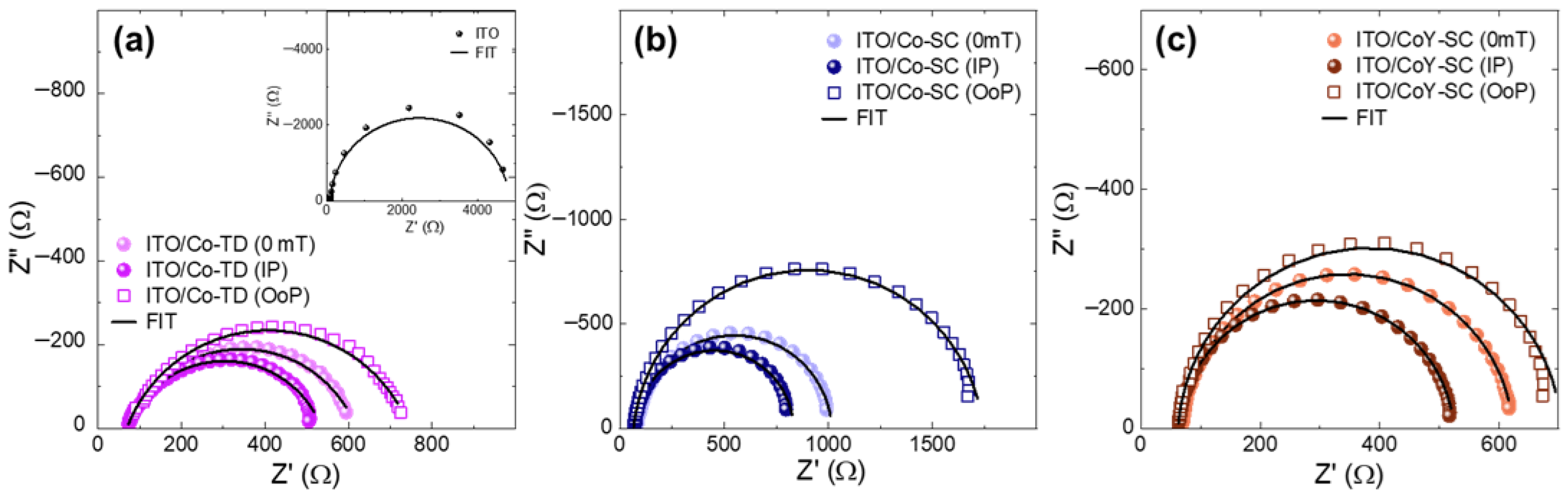
Figure 5 presents the electrochemical impedance spectroscopy (EIS) response of bare ITO and ITO electrodes modified with Co-TD, Co-SC, and CoY-SC nanofilms during the OER. The Nyquist plots were recorded in the absence of a magnetic field and under an external magnetic field of 130 mT applied either parallel (in-plane, IP) or perpendicular (out-of-plane, OoP) to the film surface. In every case, good fits were obtained using the simple Randles model schematized in Figure 5b.
For reference, the impedance response of bare ITO is included as an inset in Figure 5a, showing a large semicircle diameter associated with a high charge-transfer resistance (Rct) and sluggish OER kinetics. Upon modification with cobalt-based nanoparticle nanofilms, a pronounced reduction in the semicircle size is observed, evidencing a substantial improvement in interfacial charge-transfer processes.
For all three nanofilms, the application of an in-plane magnetic field leads to a further contraction of the Nyquist semicircle compared to the field-free condition, indicating a decrease in Rct and enhanced charge-transfer kinetics. In contrast, when the magnetic field is applied in the out-of-plane configuration, an increase in the semicircle diameter is observed, reflecting a higher Rct relative to both the IP and zero-field cases.
Among the investigated systems, the ITO/Co-TD electrode exhibits the lowest charge-transfer resistance under IP magnetic fields, in agreement with its superior electrocatalytic performance observed in the LSV and Tafel analyses. The consistent reduction in Rct under IP fields and its increase under OoP fields across all nanofilms highlight a pronounced magnetic anisotropy effect in the interfacial charge-transfer processes.
Overall, the combined analysis of polarization curves, Tafel slopes, and EIS measurements demonstrates that the application of an external magnetic field systematically enhances the OER activity of ITO-supported nanofilms in an anisotropic manner. The in-plane magnetic field not only increases the current density and reduces the Tafel slopes, but it also leads to a significant decrease in the charge-transfer resistance, whereas the out-of-plane configuration results in a less favorable interfacial charge-transfer response because the Lorentz force is null in this configuration, thus not contributing to the MHD effect. This behavior underscores the relevance of magnetic anisotropy and suggests that magnetohydrodynamic and spin polarization effects are more efficiently activated in the in-plane configuration, highlighting the strong coupling between magnetic field orientation and electrocatalytic performance.
These observations are consistent with a growing body of literature reporting magnetic-field-assisted enhancement of the OER, where both spin-related effects and magnetohydrodynamic (MHD) phenomena have been invoked to rationalize improved catalytic performance. In particular, recent studies on spin-polarized electrocatalysis have shown that magnetic fields can influence reaction kinetics by modifying spin selection rules and the population of spin-polarized intermediates, especially in oxygen-evolution pathways involving triplet O2 formation [9,10,27]. In parallel, several reports emphasize the role of MHD-induced convection and modified bubble detachment dynamics, which can enhance mass transport and reduce local concentration gradients near the electrode surface [9,12,26].
In this context, the anisotropic response observed here (where the in-plane magnetic field produces a more pronounced decrease in charge-transfer resistance and improved OER activity compared to the out-of-plane configuration) is compatible with both enhanced Lorentz-force-driven convection and possible spin-dependent interfacial effects. However, it should be noted that the present experimental design does not allow for a quantitative separation of these contributions. Factors such as changes in local hydrodynamics, bubble nucleation behavior, and field-induced modifications of the electrode–electrolyte interface may all contribute to the observed trends. Future studies combining operando diagnostics and controlled hydrodynamic measurements will be necessary to disentangle these effects and to more definitively assess the relative roles of MHD and spin polarization mechanisms.

3.4.3. Effect of UV-Vis Light Irradiation

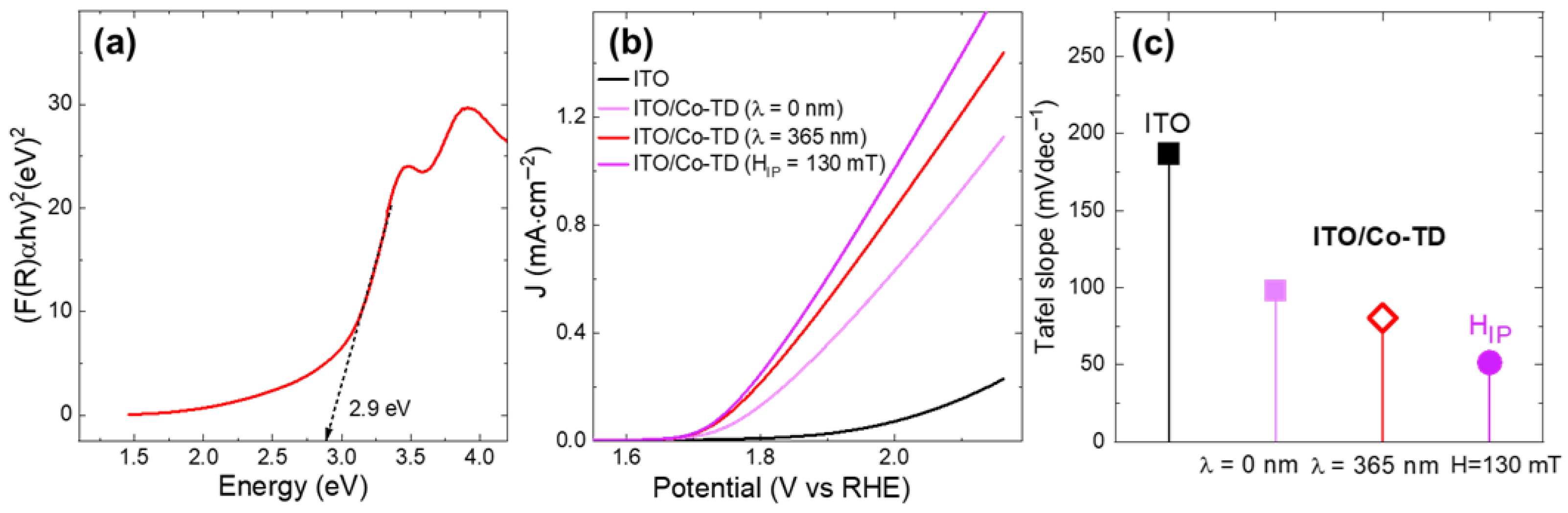
The optical properties of the Co-TD nanoparticles were investigated by UV-Vis absorption spectroscopy on nanoparticles dispersed in a chloroform–methanol solution. The optical band gap Eg was estimated using a Tauc plot (shown in Figure 6a), assuming a direct allowed electronic transition. For this purpose, the absorption coefficient α was calculated from the measured absorbance, and (αhν)2 was plotted as a function of the photon energy . The linear region of the curve was extrapolated to (αhν)2 = 0 to determine the optical band gap. The resulting value of Eg = 2.9 eV is consistent with previously reported band gaps for CoFe2O4 nanoparticles [28,29]. Moreover, Chandekar et al. [30] demonstrated that the band gap in CoFe2O4 nanoparticles decreases as the crystallite size increases, indicating that relatively high Eg values are expected for smaller crystallites such as those obtained for Co-TD (DSch = (9 ± 2) nm).
Subsequently, the electrochemical response of the ITO/Co-TD anode was evaluated for the OER under UV-Vis irradiation (λ = 365 nm). A 365 nm LED light source was positioned at a fixed distance of 1 cm from the electrochemical cell to ensure reproducible irradiation conditions (as illustrated in Scheme 2b). Figure 6b shows that modification of the ITO electrode with Co-TD nanoparticles leads to a significant increase in current density in the LSV curves compared to bare ITO (already discussed above, in Figure 3a). Upon UV irradiation, a further enhancement of the catalytic response is observed, indicating a photo-assisted contribution to the electrocatalytic process. Since CoFe2O4 is a semiconductor, irradiation with photons of sufficient energy ( > Eg) leads to the generation of electron-hole (e/h+) pairs that participate in the redox processes. The photogenerated electrons are extracted through the external circuit, while the holes migrate toward the electrode surface. During the OER, the enhanced oxidative activity accelerates the consumption of photoexcited holes [31,32].
However, as shown in Figure 6b, the photocatalytic enhancement is smaller in magnitude than that obtained when the OER is carried out under an external magnetic field of 130 mT applied in the in-plane (IP) direction relative to the electrode surface. This observation indicates that, under the present experimental conditions, the application of a 130 mT IP magnetic field is more effective than 365 nm light irradiation in enhancing OER performance. For instance, at an applied potential of 2.0 V, the current density in the LSV increases by 29% under UV irradiation, whereas an increase of 41% is observed when the anode is exposed to a 130 mT magnetic field, relative to the stimulus-free condition.
Moreover, the Tafel slopes extracted from the LSV curves (Figure 6c) decrease markedly for Co-TD-modified electrodes relative to bare ITO, with an additional reduction under UV illumination. This trend reflects faster reaction kinetics and a more favorable OER mechanism. The photogenerated holes lower the energy barrier of the electron-transfer steps, thereby accelerating the reaction kinetics and resulting in a decreased Tafel slope. The Tafel slope is lower under photo-assisted conditions, reaching approximately 88 mV·dec−1, yet higher than the 61 mV·dec−1 obtained in the magnetically assisted OER condition using the same anode.
Overall, these results demonstrate that light-assisted electrocatalysis is also a viable strategy to improve OER.

3.4.4. Effect of the Substrate

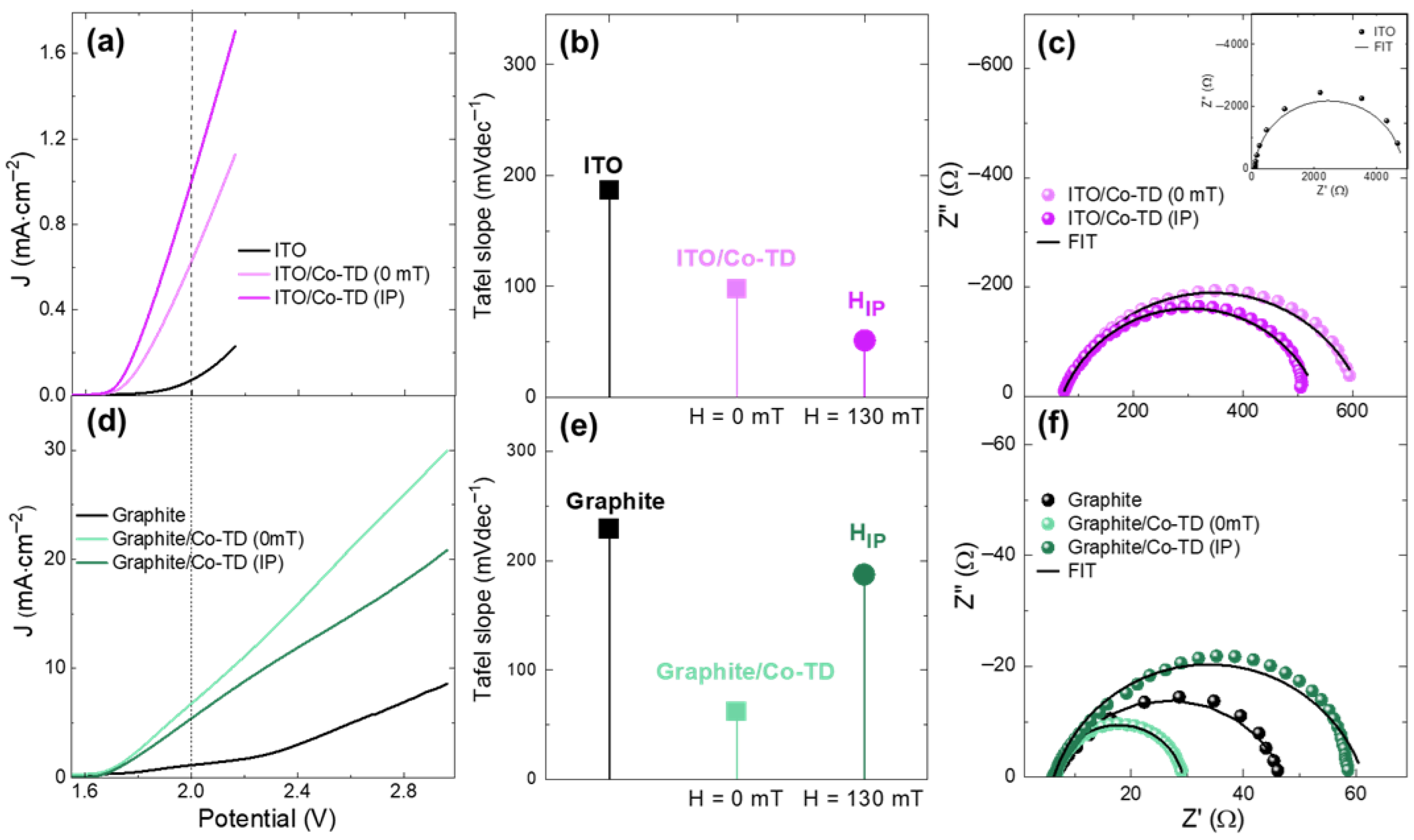
Figure 7 illustrates the electrochemical response of bare and Co-TD nanoparticle-modified ITO and graphite electrodes during the OER, evaluated in the absence and presence of an in-plane magnetic field of 130 mT.
For the ITO-based system (Figure 7a–c), functionalization with Co-TD nanoparticles results in a pronounced enhancement of the OER activity compared to bare ITO, as evidenced by the higher current densities observed in the LSV curves. At an applied potential of 2.0 V (vertical dotted line in Figure 7a), the current density of the ITO/Co-TD electrode increases by 400% relative to the unmodified substrate. Upon application of the external magnetic field, a further increase in current density of approximately 60% is observed, indicating that the magnetic stimulus promotes the electrocatalytic process on this electrode.
This positive effect is also reflected in the kinetic parameters derived from the Tafel analysis (Figure 7b). Under the applied magnetic field, the Tafel slope decreases to 52 mV·dec−1 compared to the field-free condition, suggesting facilitated charge-transfer kinetics and a lower apparent activation barrier for the OER. Consistently, electrochemical impedance spectroscopy (EIS) measurements (Figure 7c) show a reduction in the charge-transfer resistance upon nanoparticle deposition, which is further decreased in the presence of the magnetic field, as determined from fitting the impedance data using a Randles-type equivalent circuit, confirming an enhancement of interfacial electron-transfer processes.
In contrast, a different trend is observed for the graphite-based electrodes (Figure 7d–f). Modification of the graphite substrate with Co-TD nanoparticles significantly improves the OER performance compared to bare graphite, with an increase in current density of 500% at the same applied potential of 2.0 V (vertical dotted line in Figure 7d). However, when the magnetic field is applied, the electrocatalytic response is attenuated, as evidenced by a reduction in current density relative to the field-free Co-TD-modified electrode.
This inhibitory effect is further supported by the Tafel analysis (Figure 7e), where the slope increases to 188 mV·dec−1 under the magnetic field, indicating slower reaction kinetics. A similar tendency is observed in the EIS data (Figure 7f), where the charge-transfer resistance increases in the presence of the magnetic field, as obtained from the same Randles-type equivalent circuit analysis, suggesting that the magnetic stimulus hinders interfacial charge transport on the diamagnetic graphite substrate.
In summary, the electrochemical results indicate that the influence of an external magnetic field on the OER is strongly governed by the magnetic nature of the substrate. While Co-TD nanoparticle-modified ITO electrodes benefit from the application of an in-plane magnetic field, exhibiting enhanced charge-transfer kinetics and higher current densities, the same magnetic stimulus leads to a deterioration of the electrocatalytic response when graphite is used as the support.
For the Co-TD-modified ITO substrate, the observed improvements can be attributed to the synergistic contribution of magnetohydrodynamic effects and spin-polarization phenomena. In contrast, for Co-TD-modified graphite, an additional mechanism appears to operate that counteracts the beneficial effect of the magnetic field and requires further investigation to be fully understood.

4. Conclusions

In this work, we have established a comprehensive framework for understanding and optimizing magnetically and photo-assisted oxygen evolution in cobalt ferrite-based nanofilms. By systematically correlating chemical composition, nanoparticle size, film morphology, substrate magnetism, and external stimuli, we demonstrate that OER performance in these systems is governed by a delicate interplay between intrinsic catalytic activity and field-responsive magnetic and transport phenomena.
Our results show that the intrinsic activity of CoFe2O4 nanofilms is primarily dictated by film compactness and interfacial charge-transfer efficiency, which are strongly influenced by nanoparticle size and assembly quality achieved through Langmuir–Blodgett deposition. Smaller nanoparticles favor homogeneous, densely packed films and enhanced baseline OER activity, while larger nanoparticles, despite lower intrinsic performance, provide stronger magnetic responses that enable more pronounced enhancement under applied magnetic fields. Rare-earth Y3+ doping further modifies the structural and magnetic properties of the spinel lattice, improving charge-transfer kinetics and reducing overpotentials, but its impact can be matched (or even surpassed) by magnetic-field-assisted activation of undoped cobalt ferrite.
A key outcome of this unified study is the identification of substrate magnetism as a critical and previously underappreciated parameter. Ferromagnetic supports promote magnetic-field-induced enhancement of OER through facilitated spin-dependent charge transport and favorable coupling with the magnetic nanofilm, whereas diamagnetic substrates can suppress catalytic performance under identical conditions. This finding establishes a fundamental criterion for the rational design of magnetic-field-responsive electrodes and underscores the importance of considering the entire electrode architecture rather than the catalyst alone.
Across all the investigated systems, the strongest enhancement is consistently observed when the magnetic field is applied parallel to the electrode surface, highlighting the cooperative action of spin polarization at the catalyst–electrolyte interface and Lorentz-force-driven magnetohydrodynamic convection in the electrolyte. In addition, UV-light irradiation emerges as an effective external stimulus also capable of promoting OER activity, reinforcing the multifunctional nature of these nanostructured electrodes.
Overall, this work demonstrates that magnetic fields and light irradiation can act as powerful, non-invasive tools to boost electrocatalytic performance, offering viable alternatives or complements to chemical doping strategies. By revealing how nanostructure, magnetism, substrate properties, and external fields jointly control water oxidation, our findings provide general design principles for next-generation OER electrocatalysts and open new paths for sustainable, high-efficiency energy conversion technologies with reduced reliance on critical raw materials.

Supplementary Materials

The following supporting information can be downloaded at: https://www.mdpi.com/article/10.3390/magnetochemistry12030030/s1, Figure S1: M vs. H loops of both bare (a) graphite and (b) ITO substrates together with the diamagnetic and ferromagnetic contributions, where appropriate; Figure S2: CV scans in a non-Faradaic potential range of as-prepared electrodes (a) ITO, (b) ITO/Co-SC, (c) ITO/CoY-SC and (d) ITO/Co-TD in 1 M KOH at scan rates of 10 mV·s−1, 25 mV·s−1, 50 mV·s−1, 75 mV·s−1, 100 mV·s−1,125 mV·s−1and 150mV·s−1; Figure S3: ECSA normalized activity of different ITO-anodes; Figure S4: Correlation between the current enhancement at 2.0 V and the magnetization of the material measured under an external magnetic field of 130 mT; Figure S5: Tafel curves for ITO and ITO/Co-SC in 1 M KOH at scan rate of 25 mV·s−1, with the magnetic field applied in plane (IP) and out of plane (OoP); Figure S6: Tafel curves for ITO and ITO/CoY-SC in 1 M KOH at scan rate 25 mV·s−1, with the magnetic field applied in plane (IP) and out of plane (OoP); Figure S7: Tafel curves for ITO and ITO/Co-TD in 1 M KOH at scan rate 25 mV·s−1, with the magnetic field applied in plane (IP) and out of plane (OoP); Table S1: Electrochemical impedance parameters obtained from fitting the Nyquist plots of ITO and ITO/Co-TD films, presented in Figure 5a of the main text. Rs: solution resistance; Rct: charge-transfer resistance; Q: CPE coefficient; n: phase exponent; Table S2: Electrochemical impedance parameters obtained from fitting the Nyquist plots of ITO and ITO/Co-SCfilms, presented in Figure 5b of the main text. Rs: solution resistance; Rct: charge-transfer resistance; Q: CPE coefficient; n: phase exponent; Table S3: Electrochemical impedance parameters obtained from fitting the Nyquist plots of ITO and ITO/CoY-SC films, presented in Figure 5c of the main text. Rs: solution resistance; Rct: charge-transfer resistance; Q: CPE coefficient; n: phase exponent.

Author Contributions

Conceptualization, J.S.R. and P.G.B.; methodology, V.B.D., J.S.R. and P.G.B.; validation, V.B.D., J.S.R. and P.G.B.; formal analysis, V.B.D., J.S.R. and P.G.B.; investigation, V.B.D., J.S.R. and P.G.B.; resources, J.S.R. and P.G.B.; data curation, V.B.D.; writing—original draft preparation, V.B.D., J.S.R. and P.G.B.; writing—review and editing, J.S.R. and P.G.B.; visualization, V.B.D., J.S.R. and P.G.B.; supervision, J.S.R. and P.G.B.; project administration, J.S.R. and P.G.B.; funding acquisition, J.S.R. and P.G.B. All authors have read and agreed to the published version of the manuscript.

Funding

This research was funded by Secyt-Universidad Nacional de Córdoba (Projects Consolidar and Formar) and Conicet (Project PIP 11220200102625CO). The APC was kindly waived by the Editorial.

Institutional Review Board Statement

Not applicable.

Informed Consent Statement

Not applicable.

Data Availability Statement

The raw data supporting the conclusions of this article will be made available by the authors on request.

Acknowledgments

V.B.D. acknowledges a doctoral fellowship from Conicet, Argentina. The authors thank LAMARX (https://lamarx.famaf.unc.edu.ar) for granting access to their facilities. During the preparation of this manuscript, ChatGPT-5 was used to produce the graphical abstract under the specific instructions given to the IA. The authors have reviewed and edited the output and take full responsibility for the content of this publication.

Conflicts of Interest

The authors declare no conflicts of interest. The funders had no role in the design of the study; in the collection, analyses, or interpretation of data; in the writing of the manuscript; or in the decision to publish the results.

Abbreviations

The following abbreviations are used in this manuscript:
EISElectrochemical Impedance Spectroscopy
IPIn Plane
ITOIndium Tin Oxide
LBLangmuir–Blodgett
LSVLinear Sweep Voltammetry
MHDMagnetohydrodynamic
OEROxygen Evolution Reaction
OoPOut of Plane
RHEReversible Hydrogen Electrode
SEMScanning Electron Microscopy
TEMTransmission Electron Microscopy
VSMVibrating Sample Magnetometer
XRDX-Ray Diffraction

References

  1. Gebreslase, G.A.; Martínez-Huerta, M.V.; Sebastián, D.; Lázaro, M.J. Transformation of CoFe2O4 spinel structure into active and robust CoFe alloy/N-doped carbon electrocatalyst for oxygen evolution reaction. J. Colloid Interface Sci. 2022, 625, 70–82. [Google Scholar] [CrossRef]
  2. Davis, E.M.; Bergmann, A.; Zhan, C.; Kuhlenbeck, H.; Roldan Cuenya, B. Comparative study of Co3O4(111), CoFe2O4(111), and Fe3O4(111) thin-film electrocatalysts for the oxygen evolution reaction. Nat. Commun. 2023, 14, 4791. [Google Scholar] [CrossRef]
  3. Davis, E.M.; Bergmann, A.; Kuhlenbeck, H.; Roldan Cuenya, B. Facet dependence of the oxygen evolution reaction on Co3O4, CoFe2O4, and Fe3O4 epitaxial film electrocatalysts. J. Am. Chem. Soc. 2024, 146, 13770–13782. [Google Scholar] [CrossRef]
  4. Sagu, J.S.; Mehta, D.; Upul, K.G. Electrocatalytic activity of CoFe2O4 thin films prepared by AACVD towards the oxygen evolution reaction in alkaline media. Electrochem. Commun. 2018, 87, 1–4. [Google Scholar] [CrossRef]
  5. Afaq, M.; Shahid, M.; Ahmad, I.; Yousaf, S.; Alazmi, A.; Mahmoud, M.H.H.; El Azab, I.H.; Warsi, M.F. Large-scale sonochemical fabrication of a Co3O4-CoFe2O4@MWCNT bifunctional electrocatalyst for enhanced OER/HER performances. RSC Adv. 2023, 13, 19046–19057. [Google Scholar] [CrossRef]
  6. Daboin, V.B.; Riva, J.S.; Bercoff, P.G. Magnetic behavior of nanofilms prepared by assembling different Co ferrite nanoparticles. Mater. Res. Bull. 2025, 184, 113229. [Google Scholar]
  7. Jain, P.; Biswas, R.; Saikia, L.; Dutta, A.; Thakur, O.P.; Shankar, S. Production of cost-effective green energy using Mn/Gd co-substituted cobalt ferrites hydroelectric cells and their oxygen evolution reaction. J. Alloys Compd. 2025, 1010, 177419. [Google Scholar] [CrossRef]
  8. Daboin, V.B.; Riva, J.S.; Bercoff, P.G. Magnetic nanofilms prepared by Langmuir-Blodgett nanoarchitectonics using Co and Co-Y ferrite nanoparticles. Mater. Res. Bull. 2025, 189, 113449. [Google Scholar]
  9. Sun, Y.; Lv, H.; Yao, H.; Gao, Y.; Zhang, C. Magnetic field-assisted electrocatalysis: Mechanisms and design strategies. Carbon Energy 2024, 6, e575. [Google Scholar] [CrossRef]
  10. Ren, X.; Wu, T.; Sun, Y.; Li, Y.; Xian, G.; Liu, X.; Shen, C.; Gracia, J.; Gao, H.J.; Yang, H.; et al. Spin-polarized oxygen evolution reaction under magnetic field. Nat. Commun. 2021, 12, 2608. [Google Scholar] [CrossRef]
  11. Daboin, V.B.; Moya Betancourt, S.N.; Farías, E.D.; Riva, J.S.; Bercoff, P.G. Enhancement of the electrochemical oxygen evolution reaction by light and external magnetic fields using hybrid electrodes made by Langmuir-Blodgett. Electrochim. Acta 2024, 480, 143910. [Google Scholar] [CrossRef]
  12. Liju, E.; Chitharanjan Hegde, A. Effect of Magnetic Field on HER of Water Electrolysis on Ni-W Alloy. Electrocatalysis 2017, 8, 375–382. [Google Scholar]
  13. Zhang, Y.; Guo, J.; Ji, Z.; Hou, J. Synthesis and photocatalytic application of magnetic CoFe2O4/conjugated poly(vinyl chloride) derivative nanocomposite. Langmuir 2024, 40, 16642–16652. [Google Scholar] [CrossRef] [PubMed]
  14. Briceño, S.; Silva, P.; Bramer-escamilla, W.; Zabala, J. Magnetic water-soluble rhamnose-coated Mn1-xCoxFe2O4 nanoparticles as potential heating agents for hyperthermia. Biointerface Res. Appl. Chem. 2015, 5, 910–915. [Google Scholar]
  15. Daboin, V.; Briceño, S.; Suárez, J.; González, G. Effect of the dispersing agent on the structural and magnetic properties of CoFe2O4/SiO2 nanocomposites. J. Magn. Magn. Mater. 2018, 451, 502–506. [Google Scholar] [CrossRef]
  16. Daboin, V.; Briceño, S.; Suárez, J.; Carrizales-Silva, L.; Alcalá, O.; Silva, P.; González, G. Magnetic SiO2-Mn1-xCoxFe2O4 nanocomposites decorated with Au@Fe3O4 nanoparticles for hyperthermia. J. Magn. Magn. Mater. 2019, 479, 91–98. [Google Scholar] [CrossRef]
  17. Haïk Dunn, I.; Jacobo, S.E.; Bercoff, P.G. Structural and magnetic influence of yttrium-for-iron substitution in cobalt ferrite. J. Alloys Compd. 2021, 691, 130–137. [Google Scholar] [CrossRef]
  18. Zuluaga, J.D.; Sánchez, S.; Ramos, L.F.; Beltrán, F.I.; da-Silva, L.; Ramírez, E.; Vázquez, S.; Flores, S.; Méndez, J.; Valera, M.; et al. A novel method for the modification of magnetite nanoparticles for the enhancement of its dispersibility in hydrophobic media. J. Magn. Magn. Mater. 2020, 514, 167–169. [Google Scholar] [CrossRef]
  19. Mourdikoudis, S.; Pallares, R.M.; Thanh, N.T.K. Characterization techniques for nanoparticles: Comparison and complementarity upon studying nanoparticle properties. Nanoscale 2018, 10, 12871–12934. [Google Scholar] [CrossRef]
  20. Abd El-Sadek, M.S.; Wasly, H.S.; Batoo, K.M. X-ray peak profile analysis and optical properties of CdS nanoparticles synthesized via the hydrothermal method. Appl. Phys. A 2019, 125, 283. [Google Scholar] [CrossRef]
  21. Nam, P.H.; Lu, L.T.; Linh, P.H.; Manh, D.H.; Thanh Tam, L.T.; Phuc, N.X.; Phong, P.T.; Lee, I.J. Polymer-coated cobalt ferrite nanoparticles: Synthesis, characterization, and toxicity for hyperthermia applications. New J. Chem. 2018, 42, 14530–14541. [Google Scholar] [CrossRef]
  22. Li, L.; Yang, Y.; Ding, J.; Xue, J. Synthesis of magnetite nanooctahedra and their magnetic field-induced two-/three-dimensional superstructure. Chem. Mater. 2010, 22, 3183–3191. [Google Scholar]
  23. Gandha, K.; Elkins, K.; Poudyal, N.; Liu, J.P. Synthesis and characterization of CoFe2O4 nanoparticles with high coercivity. J. Appl. Phys. 2015, 117, 17A736. [Google Scholar]
  24. Majumdar, H.S.; Majumdar, S.; Tobjörk, D.; Österbacka, R. Ferromagnetism in indium tin-oxide (ITO) electrodes at room temperature. Synth. Met. 2010, 160, 303–306. [Google Scholar] [CrossRef]
  25. McClure, J.W. Diamagnetism of Graphite. Phys. Rev. 1956, 104, 666. [Google Scholar]
  26. Garcés-Pineda, F.A.; Blasco-Ahicart, M.; Nieto-Castro, D.; López, N.; Galán-Mascarós, J.R. Direct magnetic enhancement of electrocatalytic water oxidation in alkaline media. Nat. Energy 2019, 4, 519–525. [Google Scholar] [CrossRef]
  27. Ma, Y.; Zhou, Y.; Wang, C.; Gao, B.; Li, J.; Zhu, M.; Wu, H.; Zhang, C.; Qin, Y. Photothermal-Magnetic Synergistic Effects in an Electrocatalyst for Efficient Water Splitting under Optical-Magnetic Fields. Adv. Mater. 2023, 35, 2303741. [Google Scholar] [CrossRef] [PubMed]
  28. Darwish, M.S.A.; Kim, H.; Lee, H.; Ryu, C.; Lee, J.Y.; Yoon, J. Synthesis of Magnetic Ferrite Nanoparticles with High Hyperthermia Performance via a Controlled Co-Precipitation Method. Nanomaterials 2019, 9, 1176. [Google Scholar] [CrossRef]
  29. Ullah, F.; Ahmad, I.; Zaib, S.; Abrar, M.; Khalil, M.M.H.; Ebdah, M.A.; Ramay, S.M.; Saleem, M. A comprehensive study on Ni-Doped cobalt ferrites for optical response and anti-bacterial activity. Dig. J. Nanomater. Biostruct. 2023, 18, 975–984. [Google Scholar] [CrossRef]
  30. Chandekara, K.V.; Shkirb, M.; AlFaify, S. Tuning the optical band gap and magnetization of oleic acid coated CoFe2O4 NPs synthesized by facile hydrothermal route. Mater. Sci. Eng. B 2020, 259, 114603. [Google Scholar] [CrossRef]
  31. Benlembarek, M.; Salhi, N.; Benrabaa, R.; Djaballah, A.M.; Boulahouache, A.; Trari, M. Synthesis, physical and electrochemical properties of the spinel CoFe2O4: Application to the photocatalytic hydrogen production. Int. J. Hydrogen Energy 2022, 47, 9239–9247. [Google Scholar] [CrossRef]
  32. Haoxuan, M.; Chunli, L. A mini-review of ferrites-based photocatalyst on application of hydrogen production. Front. Energy 2021, 15, 621–630. [Google Scholar]
Figure 1. TEM images of nanoparticles: (a) Co-TD, (b) Co-SC, and (c) CoY-SC. (d) Particle size distributions obtained from TEM analysis, presented as histograms arranged in a three-row, one-column layout. (e) X-ray diffraction (XRD) patterns and (f) room-temperature magnetization (M vs. H) curves of the three nanoparticle systems. In panels (df), Co-TD, Co-SC, and CoY-SC are indicated by magenta, blue, and red bars/curves, respectively.
Magnetochemistry 12 00030 g001
Scheme 1. Schematic representation of the Langmuir–Blodgett deposition process and experimental setup: (a) Dispersion of Co-TD, Co-SC, and CoY-SC nanoparticles at the air–water interface. (b) Surface pressure–area (π-A) isotherms during film compression (magenta: Co-TD; blue: Co-SC; red: CoY-SC); the dotted line indicates the deposition pressure (40 mN·m−1). (c) Transfer of the compressed monolayer onto two solid substrates placed together, by vertical immersion/emersion. (d) The resulting substrate-supported nanoparticle nanofilm.
Magnetochemistry 12 00030 sch001
Figure 2. (a,c,e,g) SEM images and (b,d,f,h) in-plane (IP) and out-of-plane (OoP) hysteresis curves of ITO/Co-TD, ITO/Co-SC, ITO/CoY-SC, and Graphite/Co-TD nanofilms, respectively.
Magnetochemistry 12 00030 g002
Figure 3. (a) Linear sweep voltammetry, (b) Tafel plots, and (c) Nyquist impedance spectra of ITO-modified electrodes recorded during the OER, together with a scheme of the Randles model circuit used for fitting. The inset also displays the bare ITO response, which is notably larger and needs an extended range to be fully shown.
Magnetochemistry 12 00030 g003
Scheme 2. (a) Schematic representation of the electrochemical cell under the applied magnetic field. To obtain an in-plane (HIP) configuration, the magnet was placed as shown in the figure, while for the out-of-plane (HOoP) configuration, the magnet was placed in a perpendicular position. (b) Electrochemical cell under UV irradiation (λ = 365 nm) during electrochemical measurements.
Magnetochemistry 12 00030 sch002
Figure 4. Linear sweep voltammetry curves and corresponding Tafel plots for (a,d) ITO/Co-TD, (b,e) ITO/Co-SC, and (c,f) ITO/CoY-SC nanofilms recorded during the OER in the absence of a magnetic field and under a 130 mT magnetic field applied parallel (in-plane, IP) or perpendicular (out-of-plane, OoP) to the film surface.
Magnetochemistry 12 00030 g004
Figure 5. Nyquist plots recorded during the oxygen evolution reaction for (a) ITO/Co-TD, (b) ITO/Co-SC, and (c) ITO/CoY-SC nanofilms in the absence of a magnetic field and under an external magnetic field of 130 mT applied parallel (in-plane, IP) or perpendicular (out-of-plane, OoP) to the film surface. The inset in panel (a) shows the impedance response of bare ITO. Solid lines correspond to the fits using a Randles-type equivalent circuit, schematized in Figure 3c.
Magnetochemistry 12 00030 g005
Figure 6. (a) Tauc plot used to estimate the optical band gap, whose value is indicated with the arrow. (b) LSV obtained with ITO and ITO/Co-TD anodes, in the presence and absence of UV light. The curve of ITO/Co-TD with HIP = 130 mT is also included, for comparison. (c) Tafel slope values.
Magnetochemistry 12 00030 g006
Figure 7. Linear sweep voltammetry (LSV) curves, corresponding Tafel slope values, and Nyquist impedance spectra of bare and Co-TD nanoparticle-modified ITO and graphite electrodes measured during the OER, in the absence and presence of an external magnetic field of 130 mT applied in plane (IP). Figures (ac) show the results for bare ITO and ITO/Co-TD electrodes, whereas Figures (df) correspond to bare graphite and Graphite/Co-TD electrodes.
Magnetochemistry 12 00030 g007
Table 1. Magnetic parameters of Co-TD, Co-SC, and CoY-SC nanoparticles obtained from room-temperature hysteresis loops: saturation magnetization (MS), remanent magnetization (MR), and coercive field (HC).
SampleMS [emu g−1]MR [emu g−1]HC [mT]
Co-TD(33 ± 3)(8 ± 1)(65 ± 1)
Co-SC(84 ± 3)(45 ± 1)(105 ± 1)
CoY-SC(58 ± 3)(23 ± 1)(124 ± 1)
Table 2. Magnetic parameters of ITO/Co-TD, ITO/Co-SC, ITO/CoY-SC, and Graphite/Co-TD nanofilms obtained from room-temperature hysteresis loops: saturation magnetization (MS), remanent magnetization (MR), magnetization at 130 mT derived from the M(H) curves, and coercive field (HC).
SampleMS
[±3 emu g−1]
MR
[±1 emu g−1]
M (130 mT)
[±1 emu g−1]
Hc
[±1 mT]
IPOoPHIPHOoPIPOoP
ITO/Co-TD3313227173015
ITO/Co-SC844322564612357
ITO/CoY-SC58258383315030
Graphite/Co-TD339225162413
Disclaimer/Publisher’s Note: The statements, opinions and data contained in all publications are solely those of the individual author(s) and contributor(s) and not of MDPI and/or the editor(s). MDPI and/or the editor(s) disclaim responsibility for any injury to people or property resulting from any ideas, methods, instructions or products referred to in the content.