


Abstract
This work presents a detailed micromagnetic analysis of the magnetization reversal process in hollow iron nanospheres with a shell thickness of 16 nm. Using the Ubermag computational framework coupled to the OOMMF, we demonstrate that these nanospheres exhibit high coercivity and remanence, producing elongated hysteresis loops, consistently with previous experimental findings. The reversal process is governed by the nucleation and evolution of non-collinear magnetic domains and domain walls, as revealed by magnetization mapping. A comprehensive energetic evaluation indicates a dynamic competition among anisotropy, exchange, Zeeman, and demagnetizing energies, with the latter exerting a dominant influence on the final magnetic configuration. These results enhance our understanding of the magnetic behavior in hollow nanostructures and provide a theoretical foundation for their application in spintronic and biomedical systems.
1. Introduction
Nanotechnology has become a multidisciplinary field with transformative applications in medicine, electronics, and spintronics [1,2,3,4]. In biomedical research, it has enabled advanced strategies for cancer diagnosis and treatment through early detection, targeted drug delivery, and personalized therapeutic approaches. Nanomaterials such as nanoparticles, nanoemulsions, and nanotubes have also shown promise in immunology, paving the way for new generations of vaccines, adjuvants, and immunomodulatory systems with improved clinical outcomes [5,6,7,8].
Among the numerous nanostructured materials, hollow nanospheres have attracted significant interest because of their unique geometry, low density, high surface-to-volume ratio, and magnetic tunability. For example, hollow mesoporous silica spheres encapsulating iron oxide nanoparticles combine magnetic and chemical versatility, allowing efficient drug loading and pH-controlled release of therapeutic agents such as doxorubicin hydrochloride (DOX) with excellent biocompatibility [9]. These hybrid systems illustrate the potential of magnetic nanostructures in precision nanomedicine.
Recent studies have shown that hollow magnetic nanoparticles with topologically non-trivial domain structures, such as vortex configurations, exhibit enhanced magnetic heating efficiency while maintaining biocompatibility for magnetic hyperthermia therapy (MHT). For example, hollow spherical nanoparticles of Mn0.5Zn0.5Fe2O4 synthesized by solvothermal methods demonstrated superior heat generation efficiency due to vortex-type magnetic textures [10,11,12,13]. Similarly, hollow nanospheres Fe3O4 display nucleation and annihilation of vortex domains, suggesting their applicability as multifunctional magnetic carriers for drug delivery and controlled release [14,15,16].
The magnetic response of nanoparticles strongly depends on their size, morphology, and topology. Various magnetization textures—such as vortex, onion, skyrmion, and leaf states—have been observed during magnetization reversal in geometries, including nanodisks, nanorings, nanocylinders, thin films, and solid or hollow nanospheres [17,18,19,20,21,22]. These systems have been extensively studied using micromagnetic simulations, magnetic force microscopy (MFM), and electron holography [23,24,25]. Despite this progress, understanding the detailed mechanisms of magnetization reversal and quantifying the energetic contributions to the total magnetic Hamiltonian remain open challenges, especially in hollow geometries where surface and volume effects coexist.
This study aims to elucidate the magnetization reversal process in hollow iron nanospheres through micromagnetic simulations using the Ubermag framework. By analyzing the interplay between exchange, anisotropy, Zeeman, and demagnetizing energies, we reveal how the hollow geometry with an internal radius of 24 nm and an external radius of 40 nm influences the domain formation and magnetic stability of the system. Although simulations are performed at T = 0 K, it is expected that the conclusions will remain qualitatively valid for T < , where thermal fluctuations do not fully suppress the ferromagnetic order. This clarification recognizes that intrinsic parameters ( and A) vary with temperature, yet general reversal trends remain consistent below the Curie point (). The findings provide fundamental insight into the magnetization dynamics of hollow nanostructures and their thermal stability, which is relevant for the design of spintronic devices, nanoscale actuators, and targeted therapeutic agents.
2. Materials and Methods
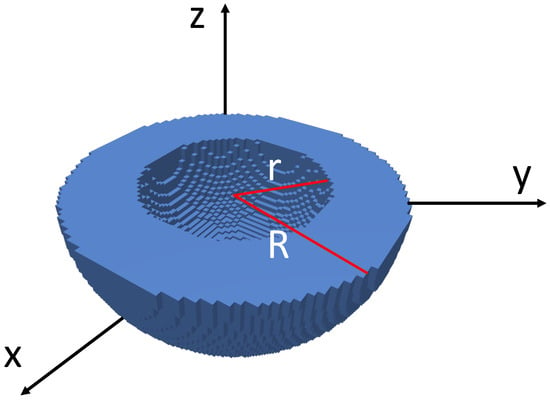
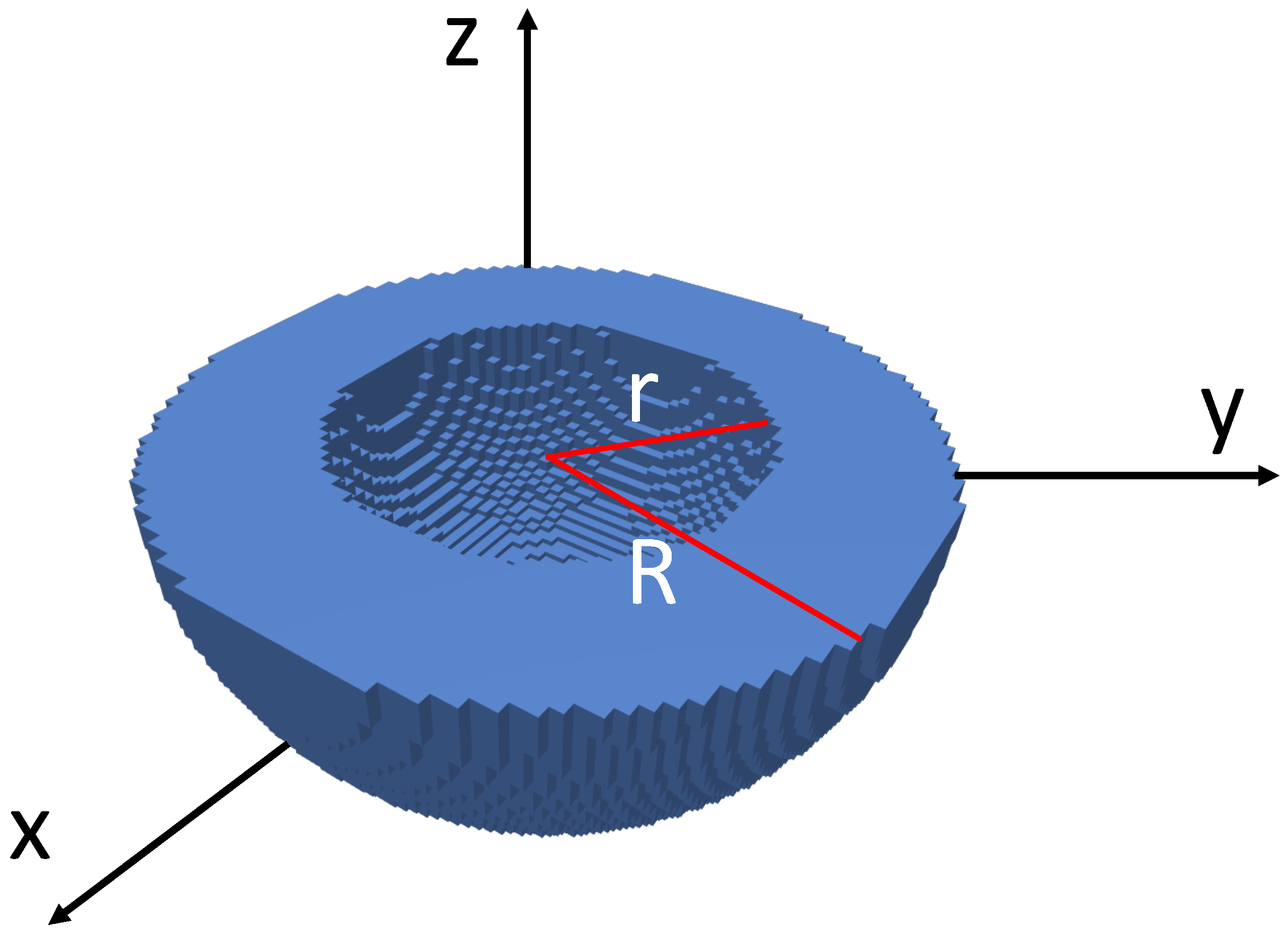
A nanoscale system of iron was modeled in the form of a hollow sphere with internal (r) and external (R) radii of 24 and 40 nm, respectively, at zero temperature (see Figure 1). A uniform external magnetic field ranging from −200 to 200 mT was applied along the x-axis. Computational micromagnetic simulations were carried out using the Ubermag framework [26,27], which interfaces with the Object Oriented MicroMagnetic Framework (OOMMF) as the numerical back end [28]. The physical parameters for iron [29] are summarized in Table 1.
Figure 1.
Lower half of a hollow iron nanosphere with internal (r) and external (R) radius of 24 and 40 nm, respectively, following a horizontal cut.
Table 1.
Physical input parameters for Fe.
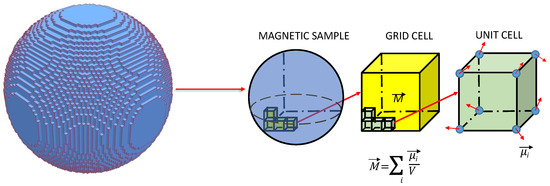
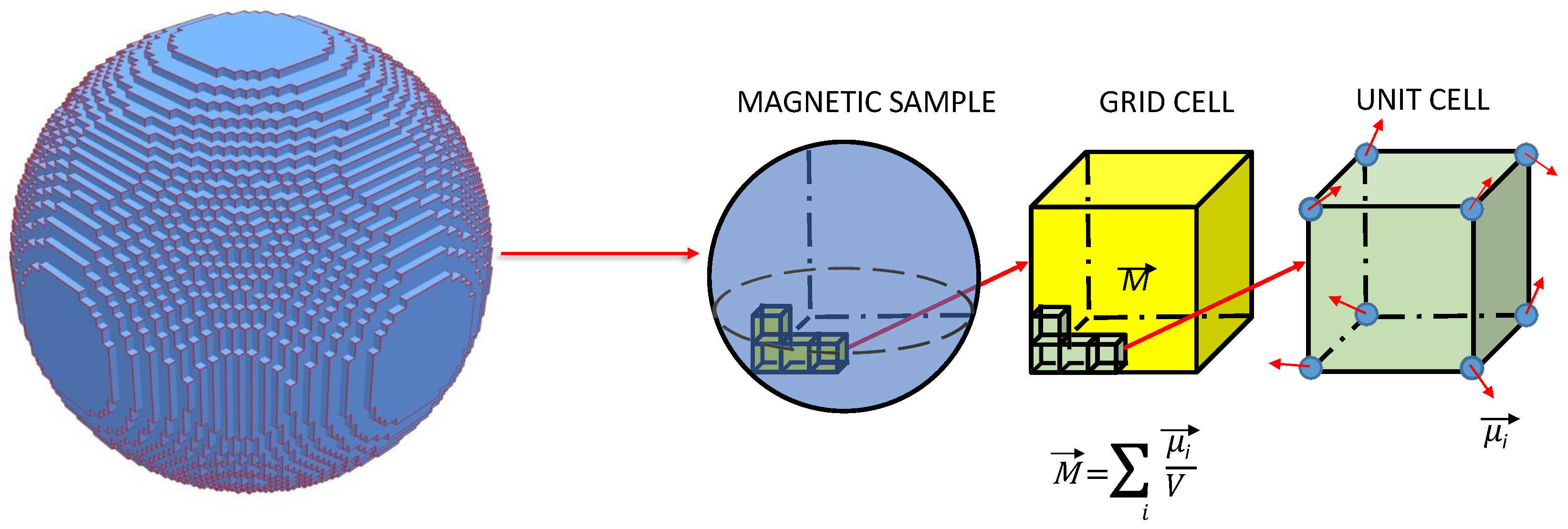
The finite difference method (Figure 2) was selected for its compatibility with the Ubermag–OOMMF computational framework and its demonstrated precision when the cell size is smaller than the exchange length of the material. Although the finite element method offers a more detailed description of curved surfaces, test simulations performed with finer discretization showed that variations in the demagnetizing energy remained below 2%, validating the suitability of the finite difference approach adopted in this study. The cubic mesh cell size was 2 nm. This resolution was less than the exchange length, given by nm, where A is the exchange stiffness constant, the saturation magnetization, and the magnetic permeability of the free space [30]. An additional mesh refinement test was conducted using a smaller cell size of 1.5 nm. The results showed variations below 2% in both the demagnetizing energy and the coercive field compared to the 2 nm mesh, demonstrating that the selected discretization provided stable and reliable numerical results. Maintaining a small angular variation between neighboring magnetization vectors prevents artificial broadening of domain walls and ensures that each wall—whose effective width in confined Fe nanostructures is typically on the order of a few nanometers—is represented by several mesh cells. This condition preserves numerical stability and enables an accurate and physically consistent description of domain nucleation and annihilation processes [31,32].
Figure 2.
Graphical representation of the finite-difference discretization scheme.
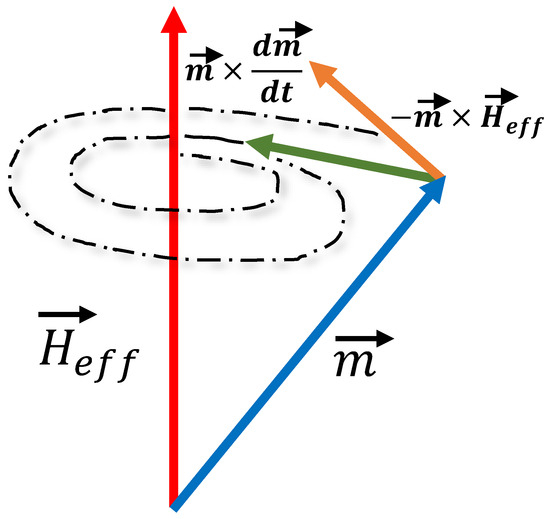
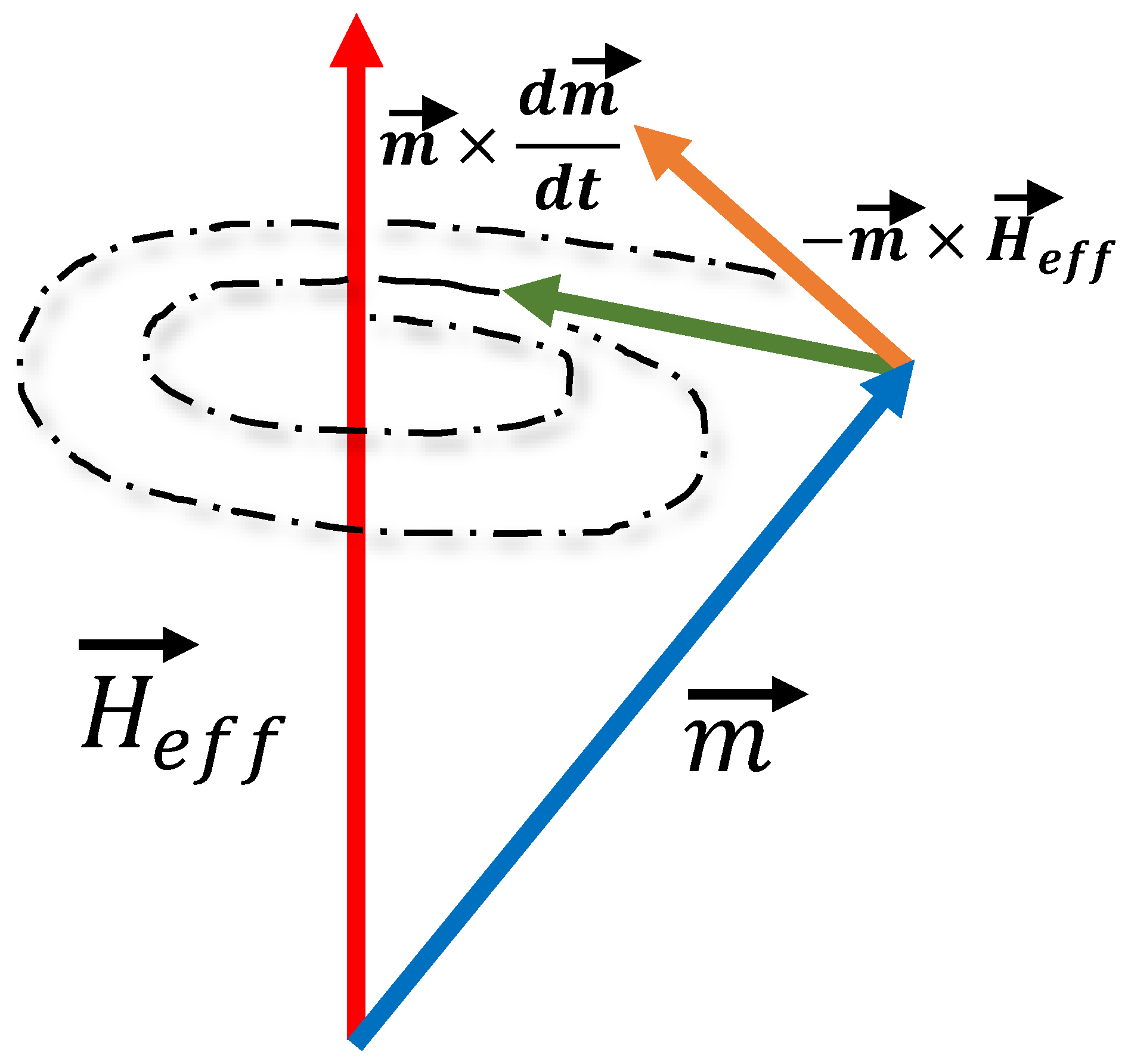
Magnetization dynamics was simulated by numerically solving the Landau–Lifshitz–Gilbert (LLG) equation (see Figure 3), which accounts for both precessional and damping contributions.
Figure 3.
Graphical representation of the LLG equation, illustrating both precession and damping motions.
The first term on the right-hand side represents the precession of the normalized magnetization vector around the effective field , with denoting the gyromagnetic ratio (see Figure 3). The second term represents the damping contribution, governed by the Gilbert damping constant (). Although this value exceeds typical experimental estimates for bulk Fe, it was deliberately chosen to accelerate numerical convergence without altering the equilibrium magnetic configuration. The system is considered to operate in a pseudo-equilibrium regime, since hysteresis phenomena inherently involve irreversible torque contributions [33,34,35].
The hysteresis loop was calculated using a quasi-static field sweep rate of , allowing the system to relax after each field increment until the time derivative of the magnetization satisfied the condition . This approach ensured that the magnetization at every field step corresponded to a fully converged equilibrium configuration, thereby preserving both numerical stability and physical consistency.
The effective field is obtained from the variational derivative of the functional total energy density, which comprises four main energy terms that contribute to the Hamiltonian of the system:
The Hamiltonian of the system is expressed as follows:
Here, the first term corresponds to the exchange energy associated with the nearest-neighbor spin interactions, modulated by the exchange stiffness constant A. The second term describes the cubic magnetocrystalline anisotropy energy, where , , and denote the crystallographic unit vectors along the [1, 0, 0], [0, 1, 0], and [0, 0, 1] axes, respectively. The third term represents the demagnetization energy, dependent on the geometry of the sample and the distribution of the internal magnetic charge, with denoting the demagnetization field; for a uniformly magnetized solid sphere, the demagnetization factor is isotropic (). In hollow spheres, the demagnetizing field remains nearly isotropic, with a slight reduction as the inner radius increases. In this work, the demagnetizing energy term in Equation (3) is computed independently by OOMMF, without assuming a fixed analytical factor. Finally, the Zeeman term quantifies the interaction of with the external magnetic field , governing the magnetization reversal process and determining the shape of the hysteresis loop.
3. Results
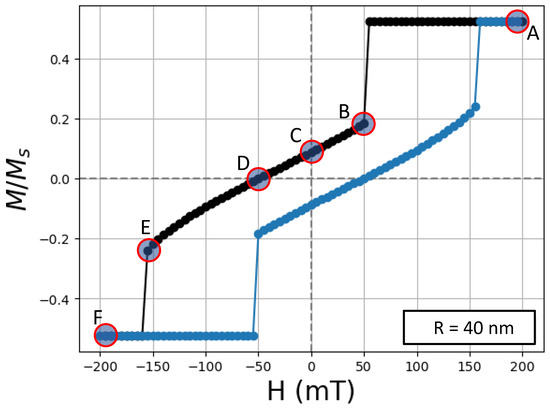
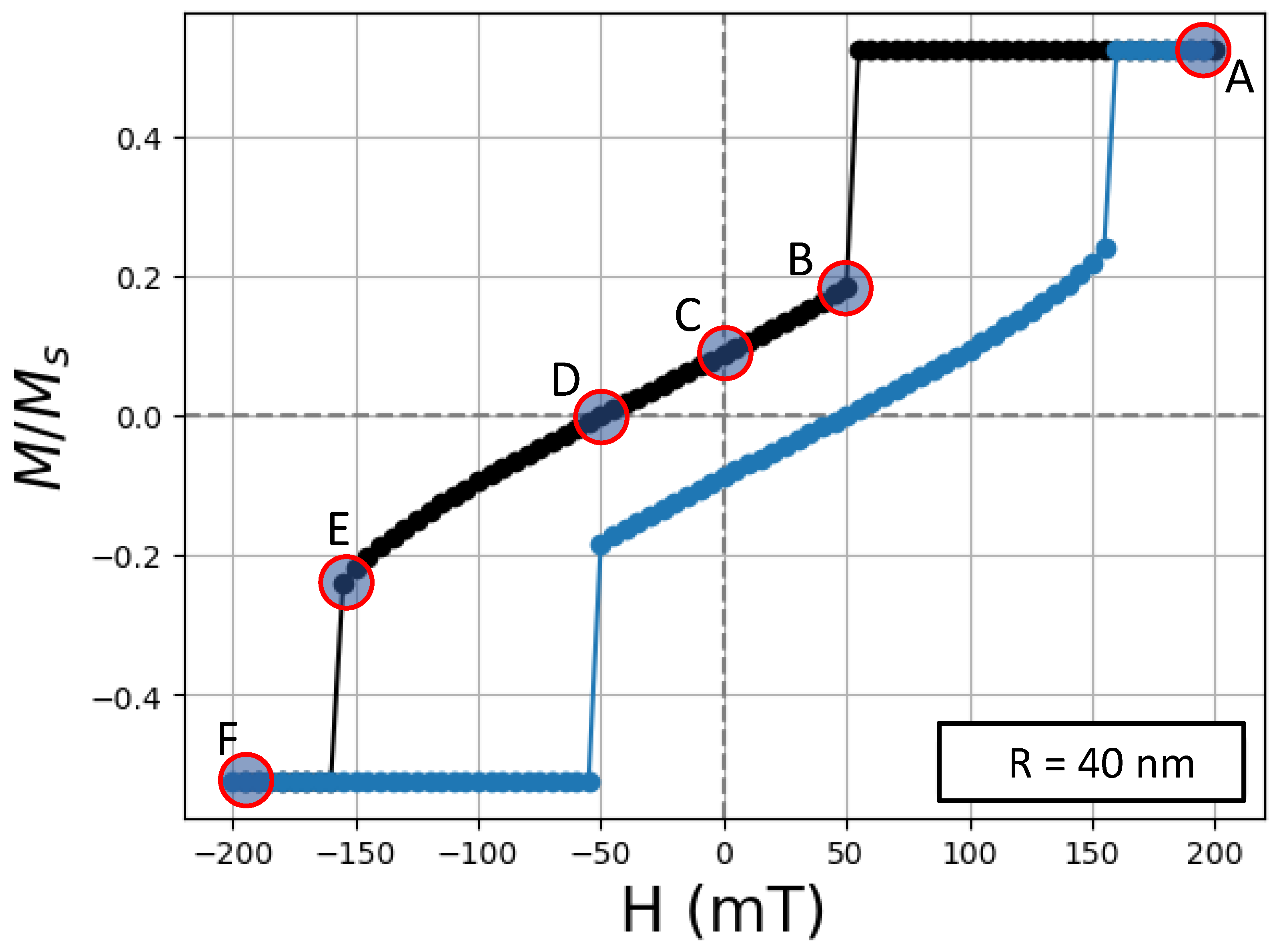
Figure 4 shows that the simulated hysteresis loop exhibits a well-defined coercive field and remanent magnetization, evidencing magnetically stable configurations that resist complete magnetization reversal under moderate external fields, consistent with previous micromagnetic and experimental reports for hollow cobalt and nickel nanospheres [36,37,38,39]. The square-like profile and nonzero remanent magnetization reflect the presence of complex internal domain structures that stabilize magnetization reversal through nonuniform spin reorientation.
Figure 4.
Hysteresis loop of a hollow iron nanosphere with internal and external radius of 24 and 40 nm, respectively, under the influence of an external magnetic field of ±200 mT.
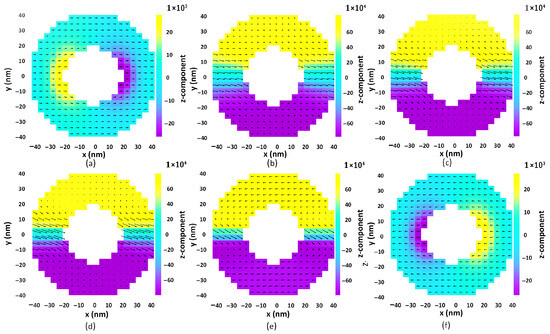
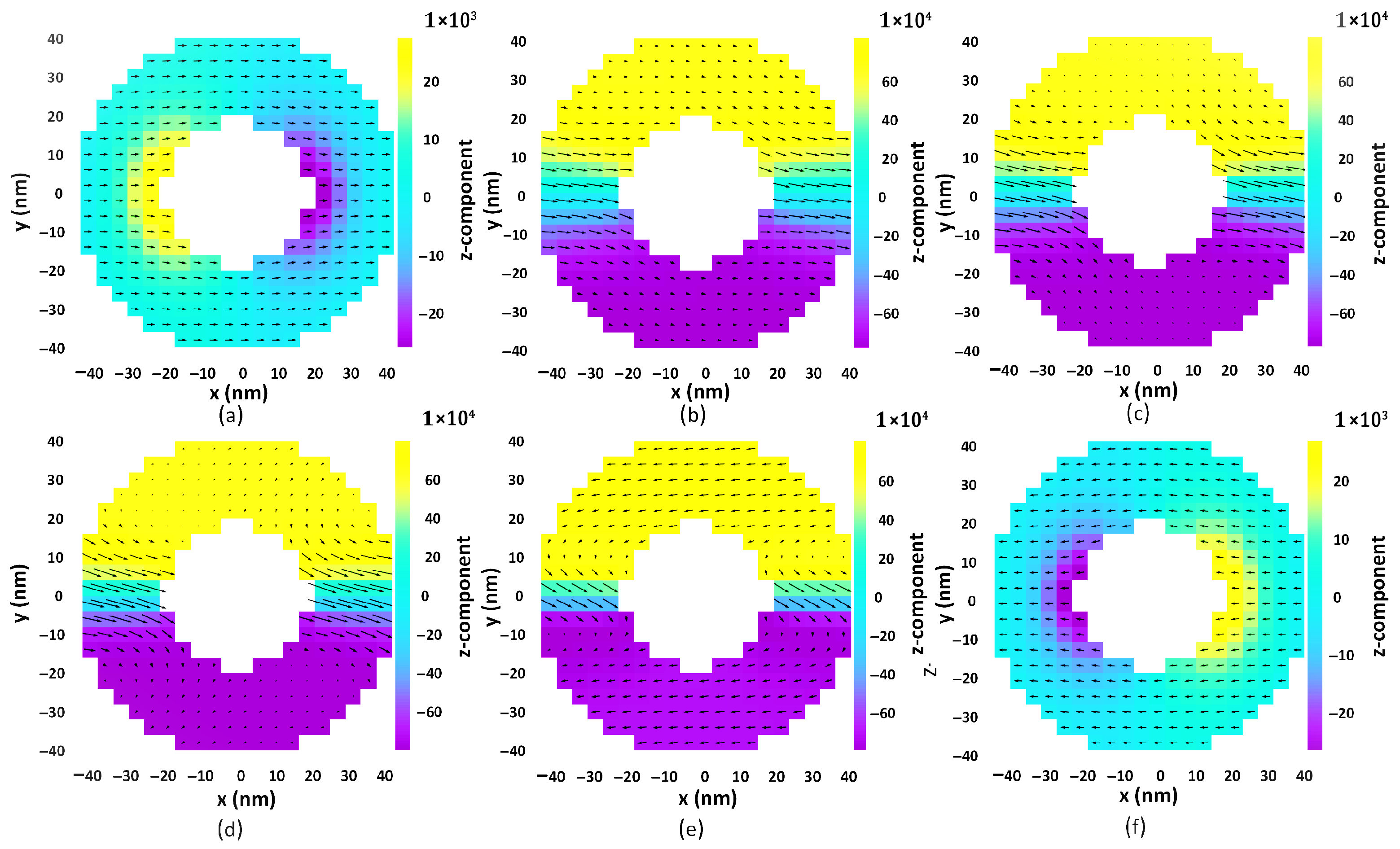
Analyzing the upper branch of the loop, marked by black circles and following the path from right to left beginning at point A, the system starts from the state of saturation magnetization. In this configuration, all magnetic moments are nearly aligned with the applied field direction. However, as shown in Figure 5a, the hollow geometry induces internal deviations, where many spins exhibit components perpendicular to the basal plane (). These out-of-plane components () arise from demagnetizing effects near the inner cavity and curvature-induced surface anisotropies.
Figure 5.
Magnetization configurations of the hollow Fe nanosphere under an external field applied along the x-axis. Panels (a–f) correspond to successive stages of the hysteresis loop. The color scale represents the z-component of the magnetization, and the arrows denote the in-plane magnetization vectors. The regions where highlight the position of domain walls. Simulations were performed for the entire 3D nanosphere, and only a central cut is shown for clarity.
When the applied field is reduced to 50 mT (B), the magnetization gradually evolves into a noncollinear configuration (Figure 5b). The spatial distribution reveals the emergence of regions with significant out-of-plane components (purple and yellow areas), whereas central regions retain in-plane orientation. This transition marks the nucleation of magnetic domains, which minimize the total energy through partial flux closure.
At C (H = 0 mT), after the field is turned off, a remanent configuration is established, preserving a domain topology similar to that at 50 mT. When the field is reversed (D, Figure 5d), the magnetization begins to rotate collectively, initiating the propagation process of the domain-wall. The outer shell spins, with dominant perpendicular components, begin to realign with the reversed field, while inner regions resist the reversal, resulting in transient mixed-domain states.
Upon further increase in the reverse field (E, H = −155 mT, Figure 5e), a larger fraction of spins reorient parallel to the new field direction. Most of the magnetization components return to the basal plane, except near the inner surface, where slight misalignments persist. The reduction in counter-aligned regions leads to the annihilation of several domain walls and a decrease in local demagnetizing fields.
Finally, at F (H = −200 mT), the system reaches a fully saturated state in the opposite direction (Figure 5f). The overall configuration mirrors that of the initial state, but with the magnetization reversed. Minor residual components from the out-of-plane remain localized near the inner cavity, demonstrating that the curvature of the shell inherently stabilizes small nonuniformities even in the saturated regime.
To provide a more comprehensive understanding of the reversal mechanism, the magnetization dynamics described in Figure 5 were analyzed in terms of domain nucleation and wall motion. The reversal initiates through the nucleation of non-collinear regions near the inner cavity, where demagnetizing fields are locally enhanced by curvature effects. These localized nucleation sites evolve into domain walls that propagate across the shell, identified by the regions where , which mark the transition boundaries between oppositely oriented magnetization vectors. The interplay between exchange and demagnetizing energies favors a curling-like, nonuniform rotation mode rather than a coherent switching process. This noncoherent behavior explains the square-like hysteresis loop observed in Figure 4 and the corresponding energy variations shown in Figure 6, indicating that the demagnetizing energy dominates the reversal dynamics. This interpretation agrees with previous studies on nucleation and curling mechanisms in nanostructured ferromagnets [40].
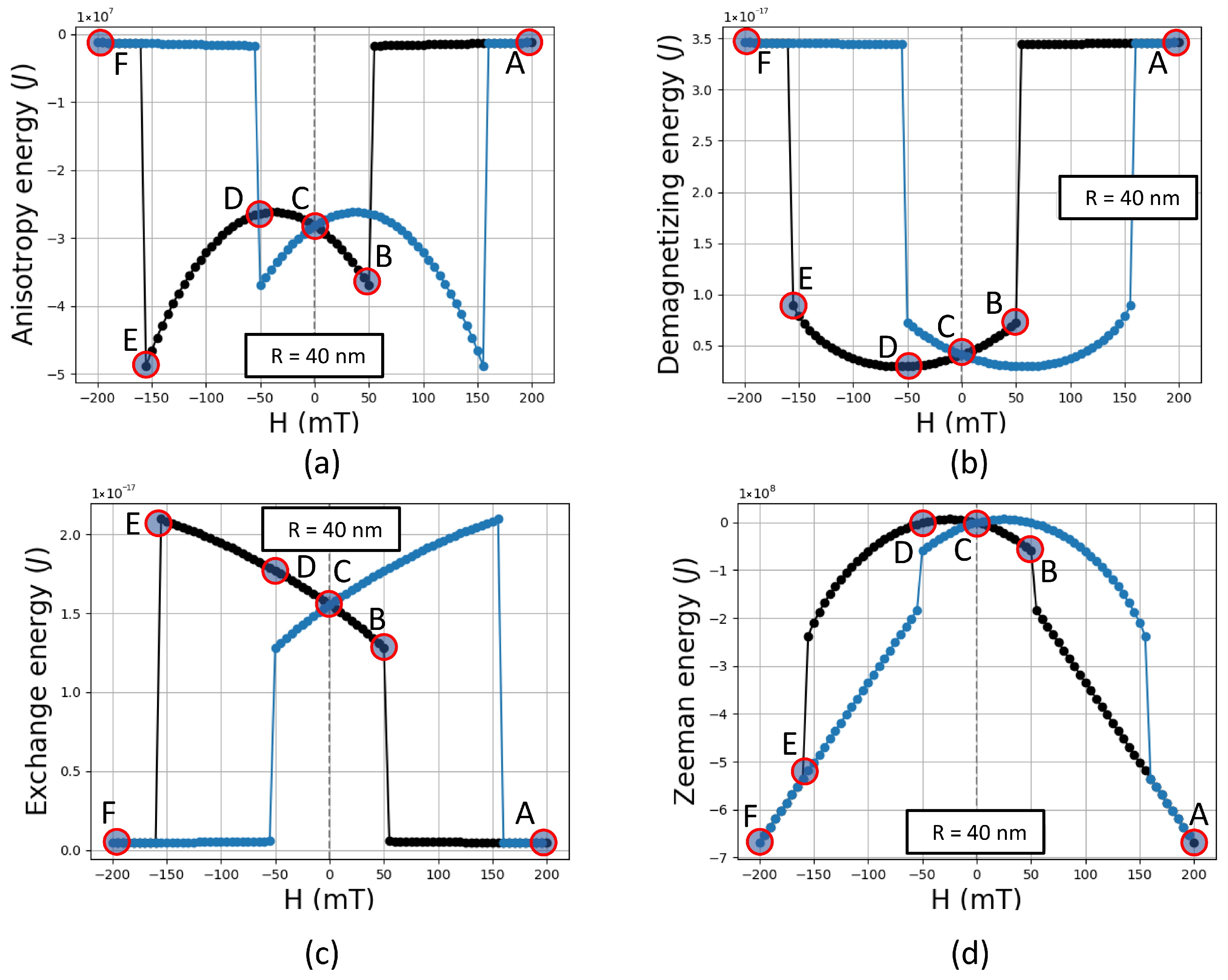
Figure 6.
Energy plots of a hollow iron nanosphere with internal and external radius of 24 and 40 nm, respectively, under the influence of an external magnetic field of ±200 mT. (a) Anisotropy energy, (b) Demagnetizing energy, (c) Exchange energy, and (d) Zeeman energy.
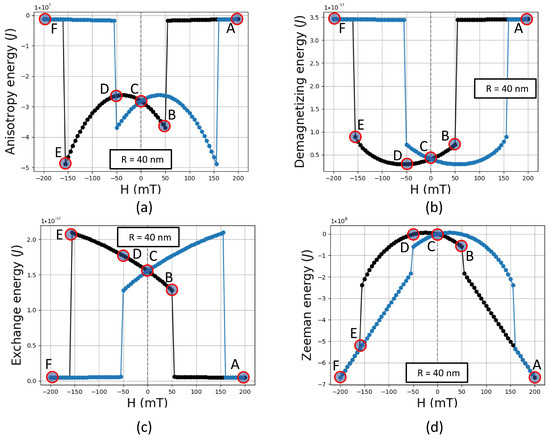
The evolution of the magnetic energies during the magnetization and reversal processes is presented in Figure 6. Each contribution—anisotropy, exchange, demagnetizing, and Zeeman—is plotted as a function of the external field.
At point A (H = 200 mT), most magnetic moments are aligned with the applied field, minimizing both the Zeeman and exchange energies. Conversely, the demagnetizing and anisotropy energies reach their maximum values due to the absence of flux-closure domains and the misalignment of many spins with respect to the easy axes of cubic anisotropy.
As the field decreases to the point B (H = 50 mT), both the Zeeman and the exchange energies increase, reflecting the onset of spin nonuniformity and the formation of magnetic domains. The anisotropy and demagnetizing energies exhibit local minima, corresponding to partial relaxation of the magnetostatic and crystalline anisotropy constraints.
At C (H = 0 mT), the system achieves a metastable remanent configuration, maintaining an energy balance similar to that at point B. Upon field reversal (D, H = −50 mT), the nucleation of the domain and wall propagation intensify, leading to an absolute minimum in demagnetizing energy and relative maxima in the other energy terms.
Moving to E (H = −155 mT), the anisotropy energy reaches its minimum as most spins align along the easy axes of magnetization, distributed among six equivalent crystallographic directions. Meanwhile, the exchange energy exhibits an absolute maximum as a result of the high spatial gradient in magnetization across the shell, whereas the Zeeman term continues to decrease. The demagnetizing energy begins to rise again as uniform alignment is re-established.
At full negative saturation (F, H = −200 mT), all energy components recover values comparable to those at the initial positive saturation, confirming the reversibility and symmetry of the magnetic process. The dominant contribution of the demagnetizing energy throughout the cycle highlights its key role in stabilizing noncollinear magnetic states and governing the magnetization reversal mechanism in hollow geometries.
4. Conclusions
Micromagnetic simulations reveal that the magnetization reversal in hollow iron nanospheres with a 16 nm shell thickness arises from a delicate competition among exchange, anisotropy, Zeeman, and demagnetizing energies. The process is primarily governed by the demagnetizing energy, which drives the nucleation and propagation of magnetic domain walls and promotes noncollinear spin arrangements throughout the switching sequence.
The hollow architecture reduces the effective saturation magnetization compared to bulk iron, introducing pronounced surface-related effects that influence the stability and evolution of magnetic domains. Such geometrical constraints foster localized, nonuniform magnetization configurations even under high external fields, emphasizing the strong coupling between curvature and magnetic anisotropy.
Overall, these findings provide quantitative insight into the magnetization dynamics of hollow ferromagnetic nanostructures and highlight the critical role of the internal cavity geometry in determining their magnetic behavior. This understanding contributes to the rational design of next-generation spintronic elements, high-density magnetic storage devices, and functional nanomaterials with tunable reversal mechanisms.
Author Contributions
Conceptualization, M.G.; methodology, M.G.; software, M.G.; validation, M.G. and F.M.; formal analysis, C.L.L.-C.; investigation, M.G. and C.L.L.-C.; writing—original draft preparation, M.G.; writing—review and editing, C.L.L.-C. and F.M.; supervision, C.L.L.-C. All authors have read and agreed to the published version of the manuscript.
Funding
This research received no external funding.
Data Availability Statement
The original contributions presented in this study are included in the article. Further inquiries can be directed to the corresponding author.
Acknowledgments
The authors acknowledge financial support from the Fundación Universitaria Los Libertadores.
Conflicts of Interest
The authors declare no conflicts of interest.
References
- Rashidi, L.; Khosravi-Darani, K. The applications of nanotechnology in food industry. Crit. Rev. Food Sci. Nutr. 2011, 51, 723–730. [Google Scholar] [CrossRef] [Scilit]
- Nasrollahzadeh, M.; Sajadi, S.M.; Sajjadi, M.; Issaabadi, Z. Applications of nanotechnology in daily life. Interface Sci. Technol. 2019, 28, 113–143. [Google Scholar] [CrossRef] [Scilit]
- Ramos, A.P.; Cruz, M.A.E.; Tovani, C.B.; Ciancaglini, P. Biomedical applications of nanotechnology. Biophys. Rev. 2017, 9, 79–89. [Google Scholar] [CrossRef] [Scilit] [PubMed]
- Aydogdu, A.; Burmaoglu, S.; Saritas, O.; Cakir, S. A nanotechnology roadmapping study for the Turkish defense industry. Foresight 2017, 19, 354–375. [Google Scholar] [CrossRef] [Scilit]
- Sahu, T.; Ratre, Y.K.; Chauhan, S.; Bhaskar, L.V.K.S.; Nair, M.P.; Verma, H.K. Nanotechnology-based drug delivery system: Current strategies and emerging therapeutic potential for medical science. J. Drug Deliv. Sci. Technol. 2021, 63, 102487. [Google Scholar] [CrossRef] [Scilit]
- Misra, R.; Acharya, S.; Sahoo, S.K. Cancer nanotechnology: Application of nanotechnology in cancer therapy. Drug Discov. Today 2010, 15, 842–850. [Google Scholar] [CrossRef] [Scilit] [PubMed]
- Halwani, A.A. Development of pharmaceutical nanomedicines: From the bench to the market. Pharmaceutics 2022, 14, 106. [Google Scholar] [CrossRef] [Scilit]
- Smith, D.M.; Simon, J.K.; Baker, J.R. Applications of nanotechnology for immunology. Nat. Rev. Immunol. 2013, 13, 592–605. [Google Scholar] [CrossRef] [Scilit]
- Teng, Y.; Du, Y.; Shi, J.; Pong, P.W.T. Magnetic iron oxide nanoparticle-hollow mesoporous silica spheres: Fabrication and potential application in drug delivery. Curr. Appl. Phys. 2020, 20, 320–325. [Google Scholar] [CrossRef] [Scilit]
- Hirano, N.; Kobayashi, S.; Nomura, E.; Chiba, M.; Kasai, H.; Akase, Z.; Akashi, T.; Sugawara, A.; Shinada, H. Magnetic vortex structure for hollow Fe3O4 spherical submicron particles. Appl. Phys. Lett. 2021, 119, 132403. [Google Scholar] [CrossRef] [Scilit]
- Si, Y.; Chen, M.; Wu, L. Syntheses and biomedical applications of hollow micro-/nano-spheres with large-through-holes. Chem. Soc. Rev. 2016, 45, 690–714. [Google Scholar] [CrossRef] [Scilit]
- El Mel, A.A.; Nakamura, R.; Bittencourt, C. The Kirkendall effect and nanoscience: Hollow nanospheres and nanotubes. Beilstein J. Nanotechnol. 2015, 6, 1348–1361. [Google Scholar] [CrossRef] [Scilit]
- Li, Z.; Xu, K.; Qin, L.; Zhao, D.; Yang, N.; Wang, D.; Yang, Y. Hollow nanomaterials in advanced drug delivery systems: From single- to multiple shells. Adv. Mater. 2023, 35, 2203890. [Google Scholar] [CrossRef] [Scilit]
- Chiba, M.; Kobayashi, S.; Noguchi, K.; Murakami, T.; Szpunar, J.A.; Manjanna, J. Magnetic vortex formation in hollow Fe3O4 submicron particles studied using first-order reversal curves. J. Magn. Magn. Mater. 2020, 512, 167012. [Google Scholar] [CrossRef] [Scilit]
- Ziarani, G.M.; Malmir, M.; Lashgari, N.; Badiei, A. The role of hollow magnetic nanoparticles in drug delivery. RSC Adv. 2019, 9, 25094–25106. [Google Scholar] [CrossRef] [Scilit] [PubMed]
- Li, Y.; Shi, J. Hollow-structured mesoporous materials: Chemical synthesis, functionalization and applications. Adv. Mater. 2014, 26, 3176–3205. [Google Scholar] [CrossRef] [Scilit] [PubMed]
- Steiner, M.; Nitta, J. Control of magnetization states in microstructured permalloy rings. Appl. Phys. Lett. 2004, 84, 939–941. [Google Scholar] [CrossRef] [Scilit]
- Kläui, M.; Vaz, C.A.F.; Heyderman, L.J.; Rüdiger, U.; Bland, J.A.C. Spin switching phase diagram of mesoscopic ring magnets. J. Magn. Magn. Mater. 2005, 290, 61–67. [Google Scholar] [CrossRef] [Scilit]
- Dumas, R.K.; Liu, K.; Li, C.P.; Roshchin, I.V.; Schuller, I.K. Temperature-induced single domain–vortex state transition in sub-100 nm Fe nanodots. Appl. Phys. Lett. 2007, 91, 2007. [Google Scholar] [CrossRef] [Scilit]
- Girgis, E.; Schelten, J.; Shi, J.; Janesky, J.; Tehrani, S.; Goronkin, H. Switching characteristics and magnetization vortices of thin-film cobalt in nanometer-scale patterned arrays. Appl. Phys. Lett. 2000, 76, 3780–3782. [Google Scholar] [CrossRef] [Scilit]
- Park, S.J.; Kim, S.; Lee, S.; Khim, Z.G.; Char, K.; Hyeon, T. Synthesis and magnetic studies of uniform iron nanorods and nanospheres. J. Am. Chem. Soc. 2000, 122, 8581–8582. [Google Scholar] [CrossRef] [Scilit]
- Goll, D.; Macke, S.; Berkowitz, A.E.; Bertram, H.N. Magnetic ground states and the role of vortices in ferromagnetic hollow nanospheres. Phys. B Condens. Matter 2006, 372, 282–285. [Google Scholar] [CrossRef] [Scilit]
- Kazakova, O.; Puttock, R.; Barton, C.; Corte-León, H.; Jaafar, M.; Neu, V.; Asenjo, A. Frontiers of magnetic force microscopy. J. Appl. Phys. 2019, 125, 060901. [Google Scholar] [CrossRef] [Scilit]
- Gavagnin, M.; Wanzenboeck, H.D.; Belic, D.; Shawrav, M.M.; Persson, A.; Gunnarsson, K.; Svedlindh, P.; Bertagnolli, E. Magnetic force microscopy study of shape-engineered FEBID iron nanostructures. Phys. Status Solidi A 2014, 211, 368–374. [Google Scholar] [CrossRef] [Scilit]
- Park, H.S.; Yu, X.; Aizawa, S.; Tanigaki, T.; Akashi, T.; Takahashi, Y.; Matsuda, T.; Kanazawa, N.; Onose, Y.; Shindo, D.; et al. Observation of the magnetic flux and three-dimensional structure of skyrmion lattices by electron holography. Nat. Nanotechnol. 2014, 9, 337–342. [Google Scholar] [CrossRef] [Scilit]
- Beg, M.; Pepper, R.A.; Fangohr, H. User interfaces for computational science: A domain-specific language for OOMMF embedded in Python. AIP Adv. 2017, 7, 056025. [Google Scholar] [CrossRef] [Scilit]
- Beg, M.; Lang, M.; Fangohr, H. Ubermag: Toward more effective micromagnetic workflows. IEEE Trans. Magn. 2021, 58, 1–5. [Google Scholar] [CrossRef] [Scilit]
- Donahue, M.J.; Porter, D.G. OOMMF User’s Guide, Version 1.0; Technical Report; National Institute of Standards and Technology: Gaithersburg, MD, USA, 1999. Available online: https://math.nist.gov/oommf/ (accessed on 2 February 2025).
- Hahn, M.B. Temperature in micromagnetism: Cell size and scaling effects of the stochastic Landau–Lifshitz equation. J. Phys. Commun. 2019, 3, 075009. [Google Scholar] [CrossRef] [Scilit]
- Abo, G.S.; Hong, Y.K.; Park, J.; Lee, J.; Lee, W.; Choi, B.C. Definition of magnetic exchange length. IEEE Trans. Magn. 2013, 49, 4937–4939. [Google Scholar] [CrossRef] [Scilit]
- Tsiantos, V.; Scholz, W.; Suess, D.; Schrefl, T.; Fidler, J. The effect of the cell size in Langevin micromagnetic simulations. J. Magn. Magn. Mater. 2002, 242, 999–1001. [Google Scholar] [CrossRef] [Scilit]
- Wang, S.; Wei, D.; Gao, K.Z. Limits of discretization in computational micromagnetics. IEEE Trans. Magn. 2011, 47, 3813–3816. [Google Scholar] [CrossRef] [Scilit]
- Kirschner, M.; Schrefl, T.; Dorfbauer, F.; Hrkac, G.; Suess, D.; Fidler, J. Cell size corrections for nonzero-temperature micromagnetics. J. Appl. Phys. 2005, 97, 10. [Google Scholar] [CrossRef] [Scilit]
- Galvis, M.; Mesa, F.; Restrepo, J. Field-driven magnetic phase diagram and vortex stability in Fe nanometric square prisms. Nanomaterials 2022, 12, 4243. [Google Scholar] [CrossRef] [Scilit]
- Fidler, J.; Schrefl, T.; Scholz, W.; Suess, D.; Dittrich, R.; Kirschner, M. Micromagnetic modelling and magnetization processes. J. Magn. Magn. Mater. 2004, 272–276, 641–646. [Google Scholar] [CrossRef] [Scilit]
- Guerra, Y.; Peña-García, R.; Padrón-Hernández, E. Dipolar magnetic interaction effects in 2D hexagonal array of cobalt hollow-spheres. J. Magn. Magn. Mater. 2018, 451, 269–275. [Google Scholar] [CrossRef] [Scilit]
- Guerra Dávila, Y.; Peña García, R.R.; Padrón Hernández, E. Magnetic reversal by mixed modes in two-dimensional hexagonal array of hollow cobalt nanospheres. IEEE Magn. Lett. 2018, 9, 4105704. [Google Scholar] [CrossRef] [Scilit]
- Guerra, Y.; Peña-García, R.; Delgado, A.; Padrón-Hernández, E. Magnetic configurations and switching processes in cobalt ferromagnetic hollow nanospheres. J. Phys. D Appl. Phys. 2017, 50, 445003. [Google Scholar] [CrossRef] [Scilit]
- Guerra, Y.; Gomes, J.L.; Peña-García, R.; Delgado, A.; Farias, B.V.M.; Fuentes, G.P.; Gonçalves, L.A.P.; Padrón-Hernández, E. Micromagnetic simulation in hexagonal arrays of nanosized hollow nickel spheres. IEEE Trans. Magn. 2016, 52, 7100706. [Google Scholar] [CrossRef] [Scilit]
- Li, W.F.; Hou, Y.; Gao, R.W. Coercivity mechanisms in nanostructured permanent magnets. Chin. Phys. B 2019, 28, 077505. [Google Scholar] [CrossRef] [Scilit]

Disclaimer/Publisher’s Note: The statements, opinions and data contained in all publications are solely those of the individual author(s) and contributor(s) and not of MDPI and/or the editor(s). MDPI and/or the editor(s) disclaim responsibility for any injury to people or property resulting from any ideas, methods, instructions or products referred to in the content. |
© 2026 by the authors. Licensee MDPI, Basel, Switzerland. This article is an open access article distributed under the terms and conditions of the Creative Commons Attribution (CC BY) license.