Article

Horticultural Activities Participation and College Students’ Positive Mental Characters: Mediating Role of Academic Self-Efficacy


1
School of Architecture, Harbin Institute of Technology, Harbin 150006, China
2
Key Laboratory of Cold Region Urban and Rural Human Settlement Environment Science and Technology, Ministry of Industry and Information Technology, Harbin Institute of Technology, Harbin 150001, China
3
Psychological Science and Health Management Center, Harbin Medical University, Harbin 150081, China
*
Authors to whom correspondence should be addressed.
Horticulturae 2023, 9(3), 334; https://doi.org/10.3390/horticulturae9030334

Submission received: 7 February 2023 / Revised: 23 February 2023 / Accepted: 1 March 2023 / Published: 3 March 2023
(This article belongs to the Section Outreach, Extension, and Education)

Abstract

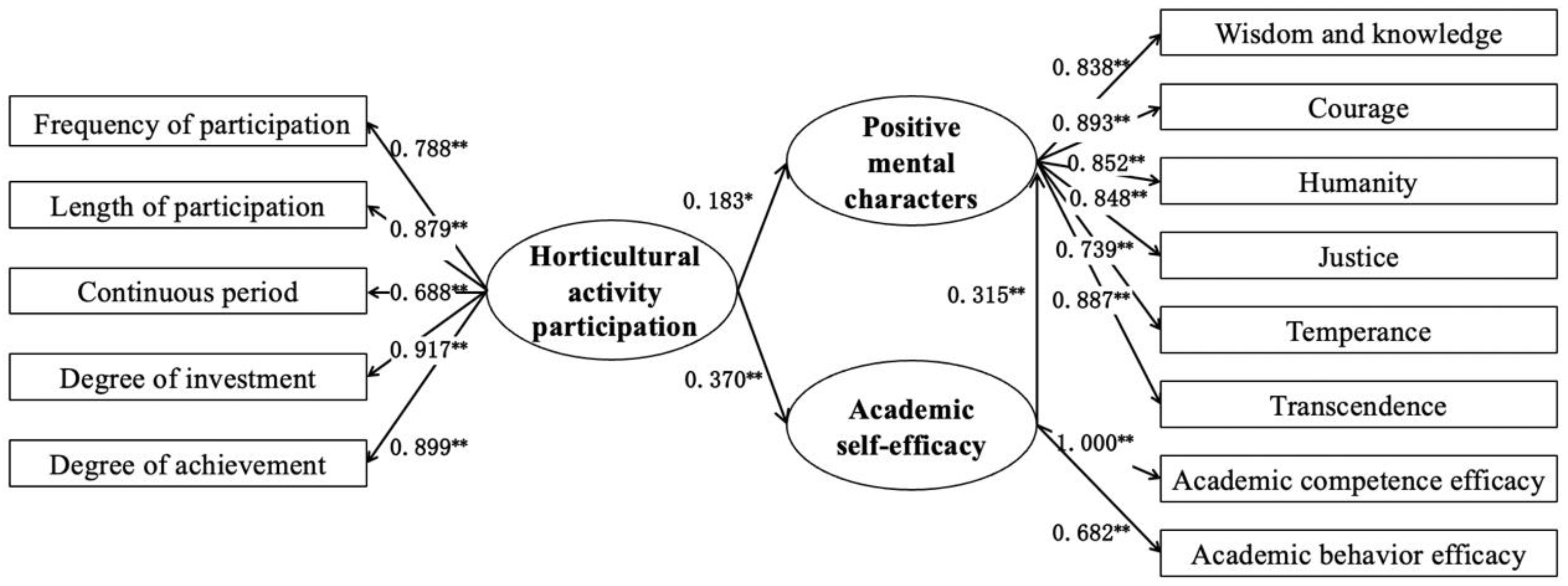
In recent years, the ongoing impact of the COVID-19 epidemic, irregular closed school life and frequent online teaching have negatively impacted the mental health and academic performance of many college students. Doing horticultural activities is an effective way to promote physical and mental health and enhance academic performance. This paper explores the relationship between horticultural activities participation, academic self-efficacy and positive mental characters under the perspective of disciplinary integration, with a view to promoting the mental health status and academic performance of college students and the application of horticultural therapy on college campuses. Questionnaires such as the Positive Mental Characters Scale for Chinese College Students (PMCS-CCS) and Academic Self-Efficacy Scale (ASES) are used to investigate 160 college students from four universities in China. The results show that horticultural activity participation is significantly positively correlated with academic self-efficacy (r = 0.345; p < 0.01) and positive mental characters (r = 0.298; p < 0.01), and horticultural activity participation can positively affect positive mental characters (B = 0.135, p < 0.01). At the same time, academic self-efficacy has a partial mediating effect between horticultural activity participation and positive mental characters. Universities can actively carry out campus horticultural activities to enhance students’ horticultural activity participation, which in turn promotes academic self-efficacy and further enhances the positive psychological level of college students.
Keywords: horticultural activity; positive psychology; academic self-efficacy; mediating role; college students horticultural activity; positive psychology; academic self-efficacy; mediating role; college students