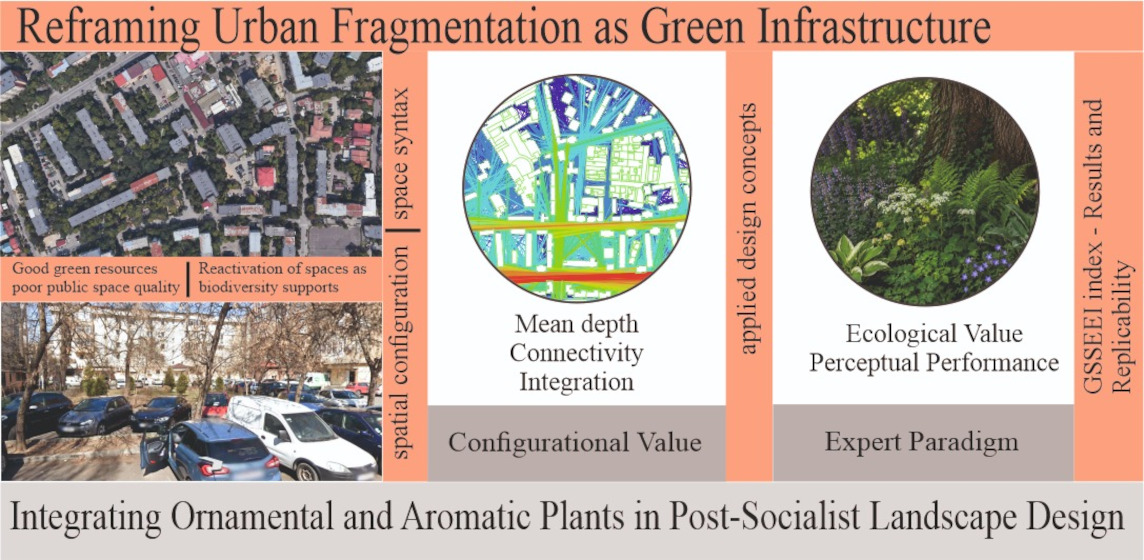
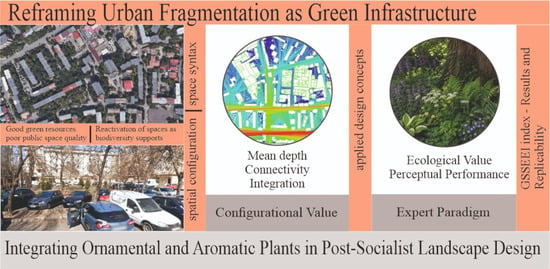
Reframing Urban Fragmentation as Green Infrastructure: Integrating Ornamental and Aromatic Plants into Post-Socialist Landscape Design


Abstract
1. Introduction
2. Materials and Methods
2.1. Study Area
2.2. Plant Material and Landscape Intervention
2.3. Spatial Modeling and Design Scenarios
2.4. Evaluation Framework
2.5. Data Analysis and Development of a Composite Index
3. Results and Discussion
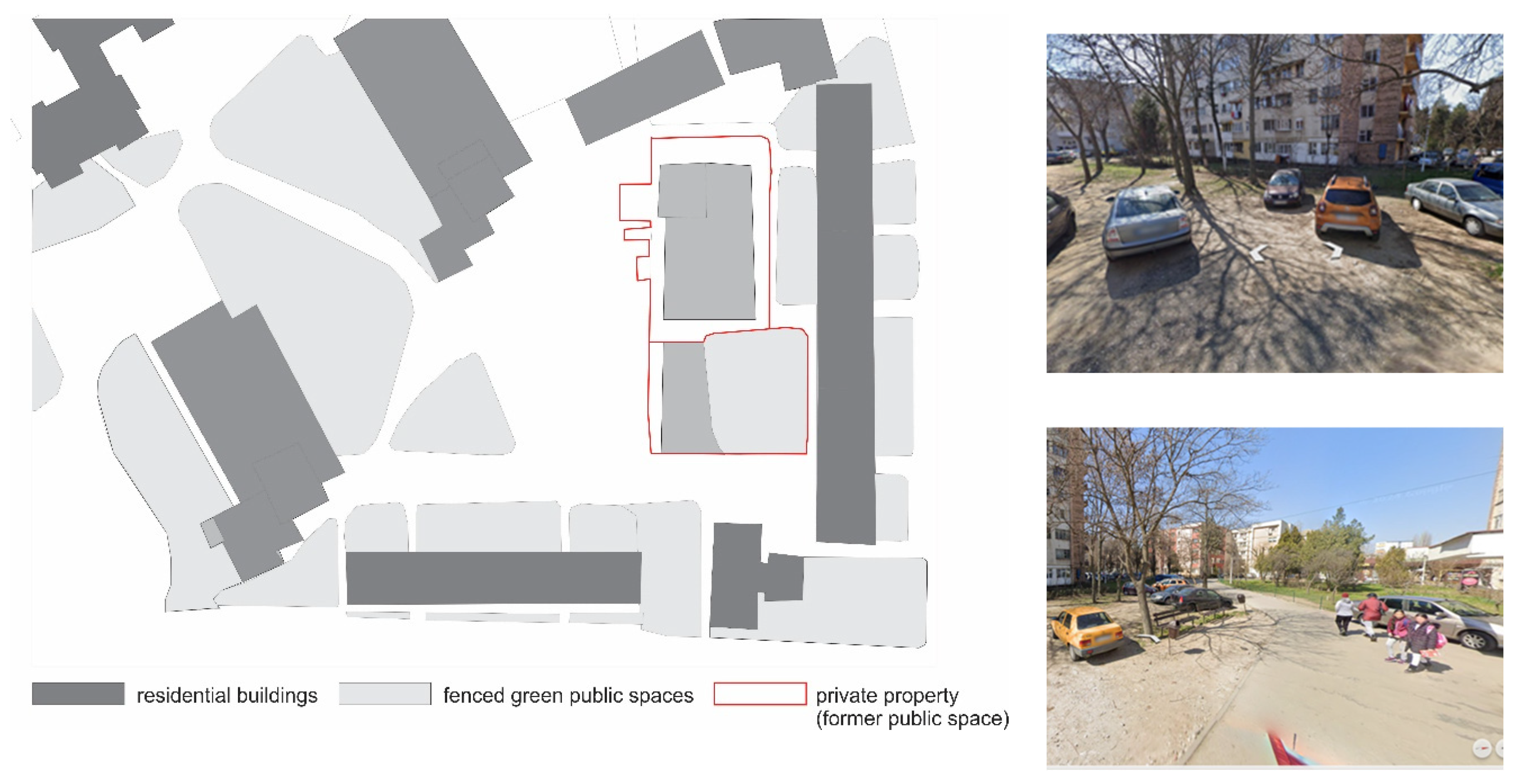
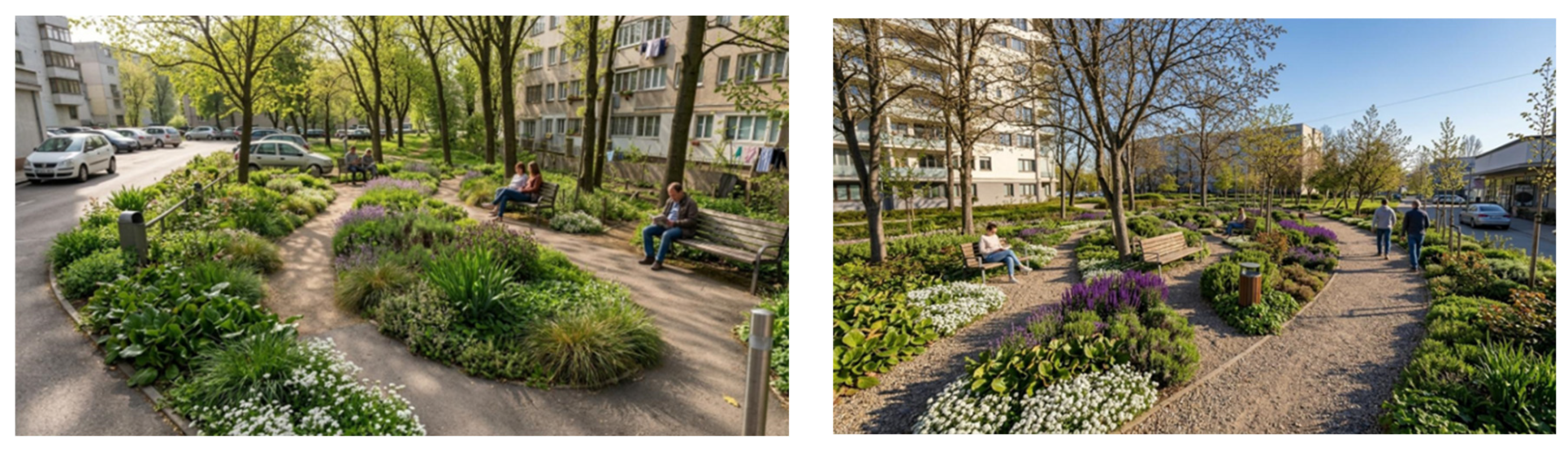
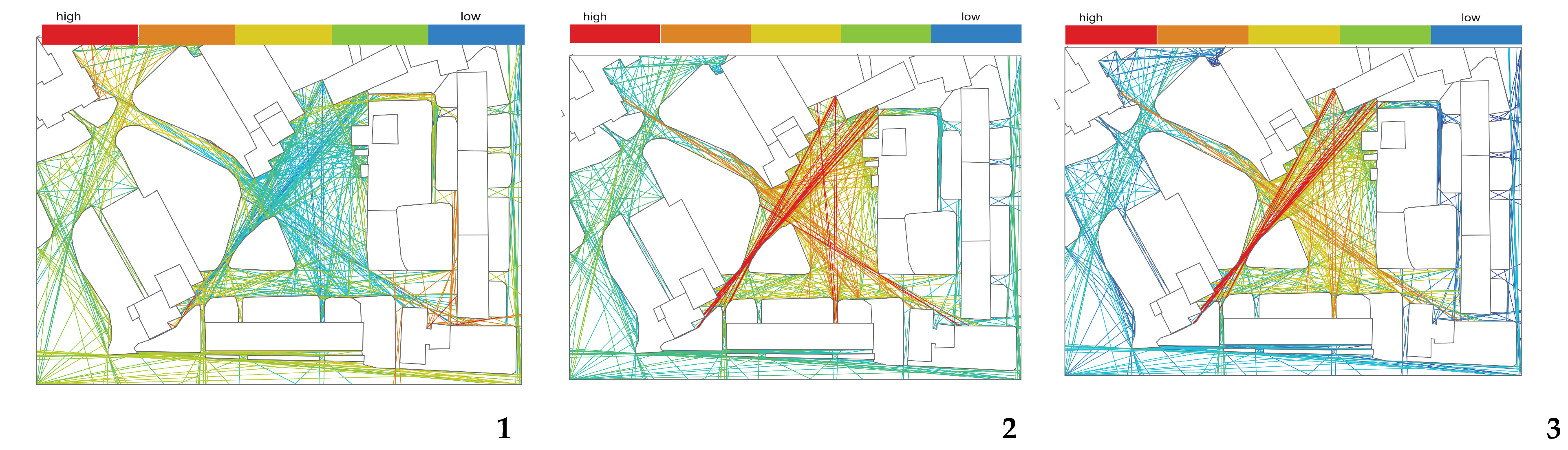
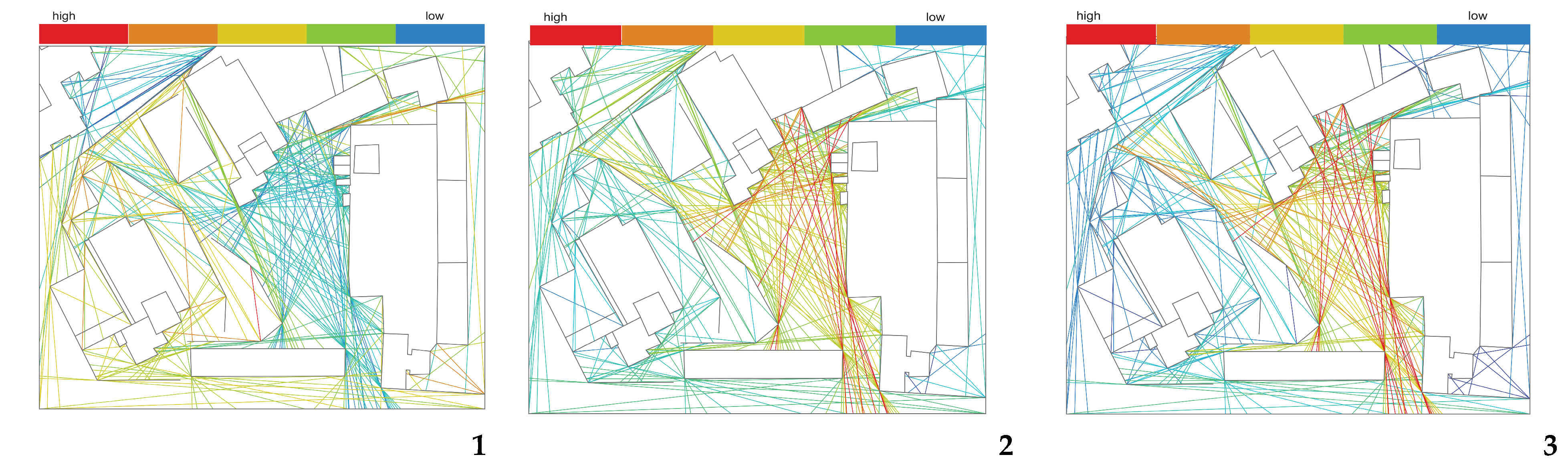
3.1. Spatial Transformation and Landscape Design Intervention
3.2. Ecological and Perceptual Landscape Performance
3.3. GSSEEI Assessment and Sensitivity Analysis
4. Conclusions
Supplementary Materials
Author Contributions
Funding
Data Availability Statement
Conflicts of Interest
References
- Stanilov, K. (Ed.) The Post-Socialist City: Urban Form and Space Transformations in Central and Eastern Europe After Socialism; Springer Science & Business Media: Dordrecht, The Netherlands, 2007; Volume 92. [Google Scholar]
- Anees, M.M.; Banzhaf, E.; Wang, J.; Joshi, P.K. Quality index approach for analysis of urban green infrastructure in Himalayan cities. Land 2023, 12, 279. [Google Scholar] [CrossRef] [Scilit]
- Hansen, R.; Pauleit, S. From multifunctionality to multiple ecosystem services? A conceptual framework for multifunctionality in green infrastructure planning for urban areas. AMBIO 2014, 43, 516–529. [Google Scholar] [CrossRef] [Scilit] [PubMed]
- Li, F.; Liu, X.; Zhang, X.; Zhao, D.; Liu, H.; Zhou, C.; Wang, R. Urban ecological infrastructure: An integrated network for ecosystem services and sustainable urban systems. J. Clean. Prod. 2017, 163, S12–S18. [Google Scholar] [CrossRef] [Scilit]
- Tzoulas, K.; Korpela, K.; Venn, S.; Yli-Pelkonen, V.; Kaźmierczak, A.; Niemela, J.; James, P. Promoting ecosystem and human health in urban areas using Green Infrastructure: A literature review. Landsc. Urban Plan. 2007, 81, 167–178. [Google Scholar] [CrossRef] [Scilit]
- Zhang, L.; Tan, P.Y.; Diehl, J.A. A conceptual framework for studying urban green spaces effects on health. J. Urban Ecol. 2017, 3, jux015. [Google Scholar] [CrossRef] [Scilit]
- Ta, D.T.; Wang, H.; Furuya, K. The Concept of Informal Green Space in Academic Research: A Comprehensive Literature Review on the Terminology Used. Land 2024, 14, 43. [Google Scholar] [CrossRef] [Scilit]
- Miao, X.; Pan, Y.; Chen, H.; Zhang, M.J.; Hu, W.; Li, Y.; Teng, S.N. Understanding spontaneous biodiversity in informal urban green spaces: A local-landscape filtering framework with a test on wall plants. Urban For. Urban Green. 2023, 86, 127996. [Google Scholar] [CrossRef] [Scilit]
- Ilie, D.; Cosmulescu, S. Spontaneous plant diversity in urban contexts: A review of its impact and importance. Diversity 2023, 15, 277. [Google Scholar] [CrossRef] [Scilit]
- Ljubojević, M.; Narandžić, T.; Ostojić, J.; Božanić Tanjga, B.; Grubač, M.; Kolarov, R.; Pušić, M. Rethinking horticulture to meet sustainable development goals—The case study of Novi Sad, Serbia. Horticulturae 2022, 8, 1222. [Google Scholar] [CrossRef] [Scilit]
- Hangan, A.M.R.; Cojocaru, A.; Teliban, G.C.; Amişculesei, P.; Stoleru, V. Preliminary study regarding the use of medicinal and decorative plants in the concept of peri-urban gardens with role on environmental protection. Sci. Pap. Ser. B Hortic. 2020, 64, 2. [Google Scholar]
- Priya, U.K.; Senthil, R. Framework for enhancing urban living through sustainable plant selection in residential green spaces. Urban Sci. 2024, 8, 235. [Google Scholar] [CrossRef] [Scilit]
- Melinescu, A.; Cosmulescu, S. Perception and assessment of fruit trees visual quality during spring in public green spaces and private gardens. Sci. Pap. Ser. B Hortic. 2022, 66, 706–711. [Google Scholar]
- Melinescu, A. Residents’ perception and preferences with regard to fruit species in public spaces and private gardens. In Proceedings of the SUPTM 2022: 1st Conference on Future Challenges in Sustainable Urban Planning & Territorial Management, Online, 17–19 January 2022. [Google Scholar] [CrossRef] [Scilit]
- Melinescu, A.; Cosmulescu, S. The autumn leaf chromatics of fruit tree species and their aesthetic effect. Sci. Pap. Ser. B Hortic. 2025, 69, 632–638. [Google Scholar]
- Francini, A.; Romano, D.; Toscano, S.; Ferrante, A. The contribution of ornamental plants to urban ecosystem services. Earth 2022, 3, 1258–1274. [Google Scholar] [CrossRef] [Scilit]
- Maknea, K.I.; Asănică, A.; Fabian, C.; Peticilă, A.; Tzortzi, J.N.; Popescu, D. The use of co-cultivation of aromatic, medicinal plants and vegetables in sustainable urban horticulture. AgroLife Sci. J. 2022, 11, 1. [Google Scholar] [CrossRef] [Scilit]
- Chen, J.; Chen, Y.; Geng, L. Optimal visitor experience at urban horticultural expositions: Antecedents and positive social outcomes. Urban For. Urban Green. 2025, 112, 129000. [Google Scholar] [CrossRef] [Scilit]
- Toscano, S.; Romano, D.; Lazzeri, V.; Leotta, L.; Bretzel, F. How can plants used for ornamental purposes contribute to urban biodiversity? Sustainability 2025, 17, 4061. [Google Scholar] [CrossRef] [Scilit]
- Othman, J.; Rosli, N.S. Whether perception or expert paradigm? Assessing scenic beauty of nature based landscape. Int. J. Res. Emerg. Sci. Technol. 2014, 1, 36–43. [Google Scholar]
- Zhou, C.; Teng, J.; Liu, C.; Zhang, Y.; Ouyang, B.; Zeng, T.; Zhang, C. Landscape preferences of recreational walkways in urban green spaces: Bada Shanren Meihu Scenic Area, China. Sustainability 2025, 17, 9931. [Google Scholar] [CrossRef] [Scilit]
- Jin, W.; Miao, W. How the ecological structure affects the aesthetic atmosphere of the landscape: Evaluation of the landscape Beauty of Xingqing Palace Park in Xi’an. PLoS ONE 2024, 19, e0302855. [Google Scholar] [CrossRef] [Scilit] [PubMed]
- Daniel, T.C. Whither scenic beauty? Visual landscape quality assessment in the 21st century. Landsc. Urban Plan. 2001, 54, 267–281. [Google Scholar] [CrossRef] [Scilit]
- Nardo, M.; Saisana, M.; Saltelli, A.; Tarantola, S.; Hoffman, A.; Giovannini, E. Handbook on Constructing Composite Indicators: Methodology and User Guide; OECD Statistics Working Papers; OECD Publishing: Paris, France, 2005. [Google Scholar]
- Yamu, C.; Van Nes, A.; Garau, C. Bill Hillier’s legacy: Space syntax—A synopsis of basic concepts, measures, and empirical application. Sustainability 2021, 13, 3394. [Google Scholar] [CrossRef] [Scilit]
- Qi, J.; Mazumdar, S.; Vasconcelos, A.C. Understanding the relationship between urban public space and social cohesion: A systematic review. Int. J. Community Wellbeing 2024, 7, 155–212. [Google Scholar] [CrossRef] [Scilit]
- Han, T.; Tang, L.; Liu, J.; Jiang, S.; Yan, J. The influence of multi-sensory perception on public activity in urban street spaces: An empirical study grounded in land senses ecology. Land 2024, 14, 50. [Google Scholar] [CrossRef] [Scilit]
- Zeng, H.; Wang, J.; Guan, M.; Lu, Y.; Liu, H.; Zhao, D. Effects of vegetation structure and environmental characteristics on pollinator diversity in urban green spaces. Urban For. Urban Green. 2023, 84, 127928. [Google Scholar] [CrossRef] [Scilit]
- Shikov, A.N.; Pozharitskaya, O.N.; Makarova, M.N.; Makarov, V.G.; Wagner, H. Bergenia crassifolia (L.) Fritsch—Pharmacology Phytochemistry. Phytomedicine 2014, 21, 1534–1542. [Google Scholar] [CrossRef] [Scilit] [PubMed]
- Koul, B.; Kumar, A.; Yadav, D.; Jin, J.O. Bergenia genus: Traditional uses, phytochemistry and pharmacology. Molecules 2020, 25, 5555. [Google Scholar] [CrossRef] [Scilit] [PubMed]
- Syed Othman Thani, S.K.; Hussein, H.; Siew Cheok, N. Landscape attributes as stimuli for cognitive restoration in the outdoor environment: A systematic review and thematic analysis. J. Leis. Res. 2024, 55, 441–461. [Google Scholar] [CrossRef] [Scilit]
- Lee, S.M.; Jang, H.J.; Yun, H.K.; Jung, Y.B.; Hong, I.K. Effect of apartment community garden program on sense of community and stress. Int. J. Environ. Res. Public Health 2022, 19, 708. [Google Scholar] [CrossRef] [Scilit] [PubMed]
- Melinescu, A. Approaching the design of apartment block gardens: Benefits for mental and physical health and ecological impact. J. Hortic. For. Biotehnol. 2025, 29, 167–172. [Google Scholar] [CrossRef] [Scilit]
- Bahadori, M.B.; Asghari, B.; Dinparast, L.; Zengin, G.; Sarikurkcu, C.; Abbas-Mohammadi, M.; Bahadori, S. Salvia nemorosa L.: A novel source of bioactive agents with functional connections. LWT 2017, 75, 42–50. [Google Scholar] [CrossRef] [Scilit]
- Salehi, B.; Stojanović-Radić, Z.; Matejić, J.; Sharopov, F.; Antolak, H.; Kręgiel, D.; Sharifi-Rad, J. Plants of genus Mentha: From farm to food factory. Plants 2018, 7, 70. [Google Scholar] [CrossRef] [Scilit] [PubMed]
- Rahbardar, M.G.; Hosseinzadeh, H. Therapeutic effects of rosemary (Rosmarinus officinalis L.) and its active constituents on nervous system disorders. Iran. J. Basic Med. Sci. 2020, 23, 1100–1112. [Google Scholar] [CrossRef] [Scilit] [PubMed]
- Krzeptowska-Moszkowicz, I.; Moszkowicz, Ł.; Miłosz, Z. Application of aromatic medicinal plants for creating a therapeutic environment that has a sensory impact in the built environment. Space Form|Przestrz. Forma 2025, 61, 134–160. [Google Scholar] [CrossRef] [Scilit]
- Krzeptowska-Moszkowicz, I.; Moszkowicz, Ł.; Porada, K. Urban sensory gardens with aromatic herbs in the light of climate change: Therapeutic potential and memory-dependent smell impact on human wellbeing. Land 2022, 11, 760. [Google Scholar] [CrossRef] [Scilit]
- Erdoğdu, S.; Kartal, H. Evaluation of aromatic greens used as vegetables for their ornamental potential and applications. Int. J. Landsc. Archit. Res. 2025, 9, 151–170. [Google Scholar]
- Lehner, S.; Schulz, S.; Dötterl, S. The mystery of the butterfly bush Buddleja davidii: How are the butterflies attracted? Front. Plant Sci. 2022, 13, 994851. [Google Scholar] [CrossRef] [Scilit] [PubMed]
- Strzalkowska-Abramek, M.; Tymoszuk, K.; Jachula, J.; Bozek, M. Nectar and pollen production in Arabis procurrens Waldst. and Kit. and Iberis sempervirens L. (Brassicaceae). Acta Agrobot. 2016, 69, 1656. [Google Scholar] [CrossRef] [Scilit]
- Mara, F.; Altafini, D.; Salardi-Jost, M.; Cutini, V. Visualising the visibility graph analysis: A comparative analysis of VGA metrics representation and significance at micro-urban scale. In Proceedings of the 14th International Space Syntax Symposium, Nicosia, Cyprus, 24–28 June 2024; Available online: https://www.tabedizioni.it/shop/product/space-syntax-symposium-14-1734 (accessed on 16 March 2026).
- Karimi, K. The configurational structures of social spaces: Space syntax and urban morphology in the context of analytical, evidence-based design. Land 2023, 12, 2084. [Google Scholar] [CrossRef] [Scilit]
- Sechi, G.; Golubchikov, O. Neoliberalism as space fragmentation: A Lefebvrian gaze at post-socialist urban transitions. Urban Stud. 2025, 62, 2725–2747. [Google Scholar] [CrossRef] [Scilit]
- Holt-Lunstad, J. Social connection as a critical factor for mental and physical health: Evidence, trends, challenges, and future implications. World Psychiatry 2024, 23, 312–332. [Google Scholar] [CrossRef] [Scilit] [PubMed]
- Liu, Y. Space reproduction in urban China: Toward a theoretical framework of urban regeneration. Land 2022, 11, 1704. [Google Scholar] [CrossRef] [Scilit]
- Hillier, B. Space is the Machine: A Configurational Theory of Architecture; Cambridge University Press: Cambridge, UK, 1996. [Google Scholar]
- Hillier, B.; Hanson, J. The Social Logic of Space; Cambridge University Press: Cambridge, UK, 1984. [Google Scholar]
- Benedict, M.A.; McMahon, E.T. Green Infrastructure: Linking Landscapes and Communities; Island Press: Washington, DC, USA, 2006. [Google Scholar]
- Ahern, J. Urban landscape sustainability and resilience: The promise and challenges of integrating ecology with urban planning and design. Landsc. Ecol. 2013, 28, 1203–1212. [Google Scholar] [CrossRef] [Scilit]



| Landscape Value | Evaluation Parameter | Parameter Description |
|---|---|---|
| Aesthetic Value (A) | A1. Visual Preference | Degree of visual appreciation and attractiveness perceived by observers. |
| A2. Color Diversity | Variety and richness of colors present within the landscape composition. | |
| A3. Form and texture | Visual characteristics related to the shape, structure, and texture of vegetation. | |
| A4. Landscape Harmony | Visual coherence and compatibility between vegetation and surrounding elements. | |
| Functional Value (B) | B1. Landscape Comfort | Extent to which the landscape provides a pleasant and relaxing environment through a balanced composition. |
| B2. Safety Perception | Degree to which the landscape conveys a sense of safety, order, and stability. | |
| Expert-Assessed Ecological Value (C) | C1. Species Diversity | Expert assessment of the expected diversity of plant species within the proposed landscape composition. |
| C2. Vegetation Community Stability | Expert assessment of species compatibility and their potential to maintain a stable plant community over time. | |
| C3. Environmental Improvement | Expert assessment of the potential contribution of vegetation to climate regulation and local environmental quality. | |
| C4. Potential to support pollinators | Expert assessment of the potential of the landscape to provide floral resources and habitat for pollinators. |
| Evaluated Dimension | Existing Condition | Proposed Design Scenario | ||
|---|---|---|---|---|
| Mean | SD | Mean | SD | |
| Aesthetic Value (A) | ||||
| A1. Visual Preference | 1.40 | 0.78 | 4.36 | 0.89 |
| A2. Color Diversity | 1.36 | 0.75 | 4.12 | 0.94 |
| A3. Form and Texture | 1.40 | 0.77 | 4.25 | 0.93 |
| A4. Landscape Harmony | 1.39 | 0.72 | 4.33 | 0.80 |
| Mean A | 1.39 | 0.75 | 4.27 | 0.89 |
| Functional Value (B) | ||||
| B1. Landscape Comfort | 1.44 | 0.77 | 4.34 | 0.86 |
| B2. Safety Perception | 1.69 | 0.97 | 4.33 | 0.88 |
| Mean B | 1.56 | 0.88 | 4.34 | 0.87 |
| Expert-assessed ecological value (C) | ||||
| C1. Species Diversity | 1.45 | 0.84 | 4.36 | 0.85 |
| C2. Vegetation Community Stability | 1.45 | 0.88 | 4.40 | 0.84 |
| C3. Environmental Improvement | 1.48 | 0.86 | 4.39 | 0.88 |
| C4. Potential to support pollinators | 1.41 | 0.88 | 4.45 | 0.86 |
| Mean C | 1.45 | 0.86 | 4.40 | 0.85 |
| Species | Planting Location | Planting Layer | Aesthetic Contribution | Functional Contribution | Ecological Contribution |
|---|---|---|---|---|---|
| Lavandula angustifolia | pedestrian borders, sunny beds | herbaceous perennial | Seasonal color and textural accent | Aromatic and recreational value | Attractive to pollinators; drought tolerant |
| Salvia nemorosa | mixed perennial beds | herbaceous perennial | Color and structural diversity | Aromatic and sensory function | Nectar-rich species; tolerant to drought and frost |
| Mentha spp. | shaded beds | herbaceous perennial | Diversity of textures and colors | Aromatic and multisensory use | Supports pollinator communities |
| Thymus vulgaris | ground cover | ground cover | Ground cover and color contrast | Aromatic and repellent properties | Drought tolerant; attractive to pollinators |
| Rosmarinus officinalis | focal beds | low shrub | Persistent structure and visual contrast | Aromatic and recreational function | Evergreen species; attractive to pollinators |
| Rosa spp. | focal planting | shrub | High ornamental diversity | Recreational and sensory value | Supports urban biodiversity |
| Buddleja davidii | background | shrub | Seasonal accent and vertical structure | Ornamental value | Attracts butterflies and other pollinators |
| Bergenia crassifolia | tree bases | ground cover | Evergreen foliage and textural contrast | Year-round decorative function | Drought tolerant; supports pollinators |
| Iberis sempervirens | borders | ground cover | Floral ground cover and compositional unity | Seasonal aesthetic value | Nectar-rich species; drought tolerant |
| Scenario | Integration | Connectivity | Inverse Mean Depth | C | ΔC (%) |
|---|---|---|---|---|---|
| Existing scenario | 3.0 | 2.2 | 2.0 | 2.40 | – |
| Proposed design scenario | 3.6 | 3.1 | 3.5 | 3.40 | +41.6% |
| Stage | Configurational Component (Table 4) | Ecological Component (Mean C from Table 2) | Perceptual–Visual Component (Mean of A and B from Table 2) | GSSEEI |
|---|---|---|---|---|
| Existing condition | 2.40 | 1.45 | 1.48 | 1.90 |
| Proposed design scenario | 3.40 | 4.40 | 4.30 | 4.01 |
| Weighting Scheme | Weights (C, V, E) | Existing Scenario | Proposed Scenario |
|---|---|---|---|
| Proposed formula | 0.35/0.35/0.30 | 1.90 | 4.01 |
| Equal weighting | 0.333/0.333/0.333 | 1.88 | 4.03 |
| Configurational emphasis | 0.40/0.30/0.30 | 1.96 | 3.98 |
| Perceptual emphasis | 0.30/0.40/0.30 | 1.84 | 4.00 |
| Ecological emphasis | 0.30/0.30/0.40 | 1.86 | 4.06 |
Disclaimer/Publisher’s Note: The statements, opinions and data contained in all publications are solely those of the individual author(s) and contributor(s) and not of MDPI and/or the editor(s). MDPI and/or the editor(s) disclaim responsibility for any injury to people or property resulting from any ideas, methods, instructions or products referred to in the content. |
© 2026 by the authors. Licensee MDPI, Basel, Switzerland. This article is an open access article distributed under the terms and conditions of the Creative Commons Attribution (CC BY) license.
Share and Cite
Cosmulescu, S.; Trif, A.; Melinescu, A. Reframing Urban Fragmentation as Green Infrastructure: Integrating Ornamental and Aromatic Plants into Post-Socialist Landscape Design. Horticulturae 2026, 12, 877. https://doi.org/10.3390/horticulturae12070877
Cosmulescu S, Trif A, Melinescu A. Reframing Urban Fragmentation as Green Infrastructure: Integrating Ornamental and Aromatic Plants into Post-Socialist Landscape Design. Horticulturae. 2026; 12(7):877. https://doi.org/10.3390/horticulturae12070877
Chicago/Turabian StyleCosmulescu, Sina, Andreea Trif, and Andreea Melinescu. 2026. "Reframing Urban Fragmentation as Green Infrastructure: Integrating Ornamental and Aromatic Plants into Post-Socialist Landscape Design" Horticulturae 12, no. 7: 877. https://doi.org/10.3390/horticulturae12070877
APA StyleCosmulescu, S., Trif, A., & Melinescu, A. (2026). Reframing Urban Fragmentation as Green Infrastructure: Integrating Ornamental and Aromatic Plants into Post-Socialist Landscape Design. Horticulturae, 12(7), 877. https://doi.org/10.3390/horticulturae12070877