Article

Influence of Dwarfing Rootstocks on Growth and Fruit Quality of ‘Fuji’ Apple
1
Shandong Institute of Pomology, Shandong Academy of Agricultural Sciences, Taian 271000, China
2
Linyi Agriculture School, Linyi 277700, China
3
Shandong Academy of Agricultural Sciences, Jinan 250100, China
4
Department of Horticulture, College of Horticulture, Jilin Agricultural University, Changchun 130118, China
*
Authors to whom correspondence should be addressed.
Horticulturae 2026, 12(7), 876; https://doi.org/10.3390/horticulturae12070876
Submission received: 13 May 2026 / Revised: 15 July 2026 / Accepted: 16 July 2026 / Published: 17 July 2026
(This article belongs to the Collection Advances in Fruit Quality Formation and Regulation)

Abstract

Dwarfing rootstocks are widely used in apple production to control tree vigor and improve fruit quality. However, their adoption in ‘Fuji’ orchards remains limited by high production costs and unstable field performance. In this study, five rootstock materials, namely GM256, GM310, MD001, LiaoZhen 2, and Malus hupehensis Rehd (CK), were evaluated for their effects on cold tolerance, tree growth, and fruit quality in ‘Fuji’ apple. Cold tolerance was assessed using electrolyte leakage and related physiological indicators under low-temperature stress. MD001 and GM256 exhibited significantly stronger cold tolerance than the control, as indicated by lower LT50 values and more favorable physiological responses (p < 0.05). Regarding tree growth, GM310 showed the weakest dwarfing effect, while LiaoZhen 2 had a relatively high proportion of long shoots, suggesting excessive vegetative growth. Meanwhile, GM256 produced the highest yield among all combinations. Principal component analysis of fruit-quality traits indicated that GM256 and GM310 performed better overall than the other combinations. In addition, GM256 produced significantly higher soluble solids, vitamin C content, and sugar–acid ratio than the control and most other rootstocks (p < 0.05). Overall, GM256 combined strong cold tolerance, a balanced shoot composition, moderate tree vigor, and high fruit quality, suggesting that it is a promising rootstock for ‘Fuji’ apple cultivation in Shandong Province.

1. Introduction

Malus domestica Borkh. is the most widely cultivated pome fruit tree in the world, and China contributes approximately 50% of the global apple production in terms of both planting area and total yield [1]. Over the past 30–40 years, the use of dwarfing rootstocks in apple production has increased markedly. In Europe and the United States, the adoption rate of apple dwarfing rootstocks has already exceeded 90% [2,3,4]. In China, however, approximately 90% of orchards still rely on vigorous rootstocks. Although dwarfing rootstocks have become increasingly important with the promotion of modern intensive orchard systems, their application remains below 20%, indicating relatively slow development. By contrast, medium- and short-branch dwarfing planting systems are now widely used [5,6]. ‘Fuji’ dominates apple production in China, accounting for about 70% of total plantings. However, the use of dwarfing rootstocks in ‘Fuji’ orchards is still constrained by high production costs and several management challenges. Therefore, developing suitable dwarfing and high-density cultivation systems for ‘Fuji’ apples remains an important goal for improving orchard efficiency and profitability in China [7,8,9].
The foundation of modern apple dwarfing was established by the East Malling Research Station in the UK through the development of the M-series rootstocks between the 1920s and 1950s. Since then, breeding programs around the world have produced a diverse range of dwarfing germplasm, including the R/CG series in the USA, the B-series in the former Soviet Union, and the SH/GM/LiaoZhen series in China [10,11]. In recent years, the molecular basis of rootstock-induced dwarfing has begun to be clarified. Genome-wide association studies and QTL mapping have identified Dw1 (LG5) and Dw2 (LG11) as major loci controlling scion dwarfing in ‘M9’-derived rootstocks, with Dw1 alone explaining up to 48% of the phenotypic variance [12]. More recently, Li et al. assembled near-gapless, chromosome-level genomes of ‘M9’, ‘MM106’, and ‘Fuji’, and identified a 9723-bp LTR-RT insertion (DwTE) upstream of the auxin response factor gene MdARF3 as a candidate determinant of the dwarfing phenotype, which was further supported by heterologous overexpression in Arabidopsis [13]. In addition, rootstock–scion communication mediated by mobile mRNAs has emerged as an important regulatory layer, which can now be explored more effectively using high-quality reference genomes and bioinformatic approaches [13,14].
The rational selection of rootstock–scion combinations had a major influence on tree growth, yield, and fruit quality, whereas unsuitable combinations can reduce orchard productivity and economic returns. Different dwarfing rootstocks show distinct effects on dwarfing capacity, graft compatibility, yield formation, and fruit quality traits [15,16]. In addition, specific rootstock–scion combinations may perform better under particular environmental and geographical conditions [17]. Beyond genetic factors, physiological mechanisms also play an important role in dwarfing. Stable isotope analyses (δ13C, δ18O, and δ15N) have shown that dwarfing rootstocks can restrict hydraulic conductance, reduce stomatal conductance and transpiration, and alter carbon allocation, even under hydroponic conditions where soil constraints are absent [18]. These findings support the idea that rootstock-induced dwarfing is closely related to limitations in water and solute transport across the graft union and root xylem [18]. Meanwhile, cold tolerance, a critical trait for apple production in northern China, varies considerably among rootstocks. For example, certain elite apple rootstocks have shown strong freezing resistance, as reflected by improved survival under low-temperature stress, which may be associated with enhanced antioxidant capacity, membrane stability, and anthocyanin accumulation [19].
Several Chinese dwarfing rootstocks have been developed to improve the regional adaptability of apple production, particularly in cold and cold–temperate areas. Previous studies have shown that apple dwarfing rootstocks can markedly affect scion vigor, canopy development, fruit quality, mineral nutrition, and stress responses, indicating that rootstock performance is strongly dependent on both genotype and environment [7,8,16]. Among Chinese materials, GM256 has been included in physiological evaluations of elite apple rootstocks and showed relatively strong cold-stress resistance [19]. GM310, derived from a ‘Hongtaiping’ × ‘M9’ cross, is a cold-hardy dwarfing rootstock with good graft compatibility and flexible shoots, whereas Liaozhen No. 2 is characterized by a strong dwarfing ability, early bearing, high yield potential, and good compatibility with Fuji. However, comparative field evaluations of these Chinese dwarfing rootstocks, especially MD001, GM256, GM310, and LiaoZhen 2, remain limited under the ecological conditions of Shandong Province.
Based on these findings, we hypothesized that different Chinese dwarfing rootstocks would differentially regulate cold tolerance, tree vigor, canopy structure, and fruit quality of ‘Fuji’ apple. Therefore, five rootstock materials, GM256, GM310, MD001, LiaoZhen 2, and Malus hupehensis Rehd. (control), were evaluated in a major ‘Fuji’-producing region of Shandong Province, China. By integrating morphological, physiological, and fruit-quality measurements with principal component analysis, this study aimed to identify a suitable rootstock–scion combination for efficient and high-quality ‘Fuji’ apple production in cold–temperate regions.

2. Materials and Methods

2.1. Experimental Site

The experiment was conducted at the Tian’ping Lake Experimental Station of the Shandong Provincial Fruit Research Institute, located in Taishan District, Taian City, Shandong Province, China, within a temperate monsoon climate zone. The annual mean temperature is 12.9 °C, with the highest monthly mean temperature of 26.4 °C in July and the lowest monthly mean temperature of −2.6 °C in January. Mean annual precipitation is approximately 700 mm, most of which falls from May to September; July receives the highest rainfall, averaging about 170 mm. The annual mean relative humidity is approximately 70%, reaching a maximum of about 80% in August and a minimum of about 50% in January.

2.2. Experimental Materials

In spring 2011, semi-dwarfing grafted seedlings of Malus domestica ‘Yishuihong Fuji’ were planted using five dwarfing rootstocks: GM256, GM310, LiaoZhen 2, MD001, and Malus hupehensis Rehd. (Table 1). The rootstock length was 30 cm, and the trees were planted on a hillside at a spacing of 2.0 m × 4.0 m. The soil was loamy, with good water-holding conditions, and the orchard was managed under uniform cultural practices throughout the study period. ‘Otohime’ was used as the pollinizer cultivar. For each rootstock treatment, 15 trees with similar growth and the same rootstock–scion combination were selected, with three biological replicates (five trees per replicate). Tree growth and yield traits were evaluated annually over three consecutive years (2023, 2024, and 2025), whereas cold tolerance and fruit quality traits were measured in representative seasons according to the corresponding experimental protocols.

2.3. Determining the Cold Resistance of Apple Rootstock Branches

2.3.1. Experimental Treatment

One-year-old rootstock branches with uniform growth and free from diseases and pests were collected as experimental materials for the cold resistance assay. The branches were divided into seven groups according to the set temperatures. Each group contained 10 branches, with one group maintained at 4 °C as the control (CK). The remaining six groups were wrapped in clean gauze, placed in plastic bags, labeled, and subjected to freezing at −15, −20, −25, −30, −35, and −40 °C, respectively. During freezing and thawing, the temperature was changed at a rate of 4 °C h−1. After reaching the target temperature, the samples were held for 12 h, thawed to room temperature, and then equilibrated for another 12 h before further analysis. To evaluate branch cold tolerance, relative electrical conductivity, proline content, soluble sugar content, SOD activity, POD activity, and MDA content were measured.

2.3.2. Relative Electrical Conductivity and Low-Temperature Semi-Lethal Point (LT50)

For relative electrical conductivity, the branches were cut into 10 mm segments away from the buds. Five segments were selected for each sample, placed in 30 mL of deionized water, and then subjected to vacuum infiltration. The initial conductivity (E1) was measured using a DDS-11A conductivity meter (INESA Scientific Inc., Shanghai, China). The tissue samples were subsequently boiled in a water bath for 30 min and allowed to cool to room temperature, after which the final conductivity (E2) was recorded. Relative electrical conductivity (E) was calculated: E = E1/E2 × 100%.The temperature-dependent leakage data were fitted with a logistic model, and LT50 of the rootstock was calculated accordingly [20].

2.3.3. Proline Content

For determining proline content, the treated branches were ground in liquid nitrogen, and 1 g of each sample was extracted with 5 mL of 3% (w/v) sulfosalicylic acid. After centrifugation, 1 mL of the supernatant was reacted with an equal volume of ninhydrin solution, heated in a boiling water bath, and extracted with 2 mL of toluene. The absorbance value of 1 mL of the reaction solution was measured at 520 nm using a spectrophotometer (UV-2600i, Shimazu, Tokyo, Japan), and proline content was calculated from a standard curve.

2.3.4. Soluble Sugar Content

Soluble sugar content was determined by the anthrone colorimetric method. Briefly, 1 g of frozen sample was ground and extracted with 5 mL of 80% ethanol. After centrifugation at 10,000 rpm, 1 mL of the supernatant was mixed with 2 mL of 2% anthrone reagent, heated in a boiling water bath for 10 min, and cooled. Absorbance was then measured at 620 nm, and values were calculated using a glucose standard curve.

2.3.5. Antioxidant Enzyme Activity

For determining superoxide dismutase (SOD) and peroxidase (POD) activity, frozen sample (1 g) was homogenized in 5 mL of 0.1 M phosphate buffer (pH 7.8) and centrifuged at 10,000 rpm for 10 min at 4 °C. The supernatant was used for enzyme assays. SOD activity was determined by the NBT photoreduction method using a reaction mixture containing 0.1 M sodium phosphate buffer (pH = 7.8), 0.66 mM EDTA, 10 mM L-methionine, 33 μM NBT, and 3.3 μM riboflavin [21]. Absorbance was measured at 560 nm, and one unit of SOD activity was defined as a 0.01 change in absorbance per minute. POD activity was assayed by the guaiacol method with 3 mL guaiacol (25 mM), 0.2 mL H2O2 (0.5 M), and 0.5 mL enzyme extract [22]. Absorbance at 470 nm was recorded for 5 min, and one unit of POD activity was defined as a 0.01 change in absorbance per minute.

2.3.6. MDA Content

For determining MDA determination, 1 g of frozen sample was homogenized with 3 mL of 0.1 M phosphate buffer (pH 7.8) and centrifuged at 10,000 rpm for 10 min at 4 °C. Then, 1 mL of the supernatant was reacted with 3 mL of 0.5% TBA, heated in a boiling water bath for 10 min, and left to stand for 60 min. The absorbance value of 1 mL of the reaction solution was measured at 450, 532, and 600 nm [23].

2.4. Measuring Apple Tree Physiological Indices

The growth of the tree body was measured, encompassing new shoot growth, tree height, canopy width, trunk diameter, and branch type composition. Select 15 trees with similar growth patterns for each treatment, with 5 trees in each group and three replicates. Use a 300 mm vernier caliper (D&B, Shanghai Dibai Biotechnology Co., Ltd., Shanghai, China) to measure the trunk thickness at the graft interface of different rootstocks, 10 cm above and below the interface, and calculate the ratio of stock to scion. Measure tree height after leaf fall using a tape measure to determine the vertical height from the highest point of the tree canopy to the ground. In the fall after leaf fall, use a steel tape to measure the crown width of the tree (east–west and north–south) and calculate the average. Conduct a survey on the number of different types of branches of varying lengths in the tree canopy (<5 cm, 5–15 cm, 15–30 cm, and >30 cm) and calculate and analyze the number of main branches and branch composition.

2.5. Measuring Apple Fruit Yield

After fruit maturity, 15 trees with similar growth vigor were selected from each rootstock–scion combination, and the number of fruits per experimental tree was recorded. The experiment was conducted continuously for three years (2023, 2024, and 2025). Apple yield per tree was calculated based on the average single-fruit weight and fruit number of each tree. The average yield per ha was then calculated according to the mean yield per tree and the planting density of each combination.

2.6. Determining the Quality of Apple Fruits

At full maturity, three fruits were harvested from each tree in the same orientation, totaling 45 fruits, which were then transported to the laboratory for quality assessment. The experiment assessed apple fruit quality traits, including fruit color, single fruit weight, firmness, fruit shape index, soluble solid content, titratable acidity, soluble sugar content, and vitamin C content. Fruit physiological quality was evaluated following the measurement methods described in a previous study [24].

2.6.1. Fruit Physiological Quality

Single fruit weight was measured using a balance with 1% precision. The fruit shape index was calculated as the fruit longitudinal diameter divided by the fruit transverse diameter after the two diameters were determined with a vernier caliper. Fruit firmness was measured at three equatorial positions on each fruit using a GY-2 fruit firmness tester (GY-2, Zhejiang Top Yunnong Technology Co., Ltd, Hangzhou, China), and the mean value was used for analysis. Fruit color was assessed using a WR-10 colorimeter (Shenzhen Wave Opto-Electronic Technology Co., Ltd, Shenzhen, China) at three equatorial positions on each fruit, and the average value was recorded. The soluble solid (TSS) content was determined from extracted apple juice using a handheld refractometer (Atago PAL-1, Tokyo, Japan). Titratable acidity (TA) was measured by titration with 0.1 mol L−1 NaOH. The solid–acid ratio was calculated as TSS/TA × 100%. The soluble sugar content was determined by the anthrone colorimetric method. The sugar–acid ratio was calculated as soluble sugar/TA × 100%.

2.6.2. Vitamin C Content

The vitamin C content was determined using the molybdenum blue colorimetric method according to a previously described protocol [25]. Briefly, the sample (1 g) was ground into a homogenate with oxalic acid-EDTA solution. Then, dilute to 25 mL and centrifuge at 4000 rpm for 10 min. Mix 1 mL of supernatant with 1 mL of metaphosphoric acid–acetic acid solution, 2 mL of 5% (w/v) sulfuric acid, and 4 mL of 5% (w/v) ammonium molybdate. Incubate at 30 °C for 20 min for color development. The absorbance value of 1 mL of the reaction solution was measured at 560 nm, and the vitamin C content was calculated from a standard curve.

2.7. Data Statistics

Data were processed using Microsoft Excel 2016 and analyzed using SPSS 26.0. Before one-way ANOVA, the assumptions of normality and homogeneity of variance were checked. Differences among treatments were evaluated by one-way analysis of variance (ANOVA), and means were compared using Duncan’s multiple range test at p < 0.05. Figures were generated using Origin 2021 (9.8.0.200).

3. Results

3.1. Effects of Different Dwarfing Rootstocks on Cold Resistance in ‘Fuji’ Apple

3.1.1. The Impact of Various Low-Temperature Treatments on the Relative Conductivity of Branches

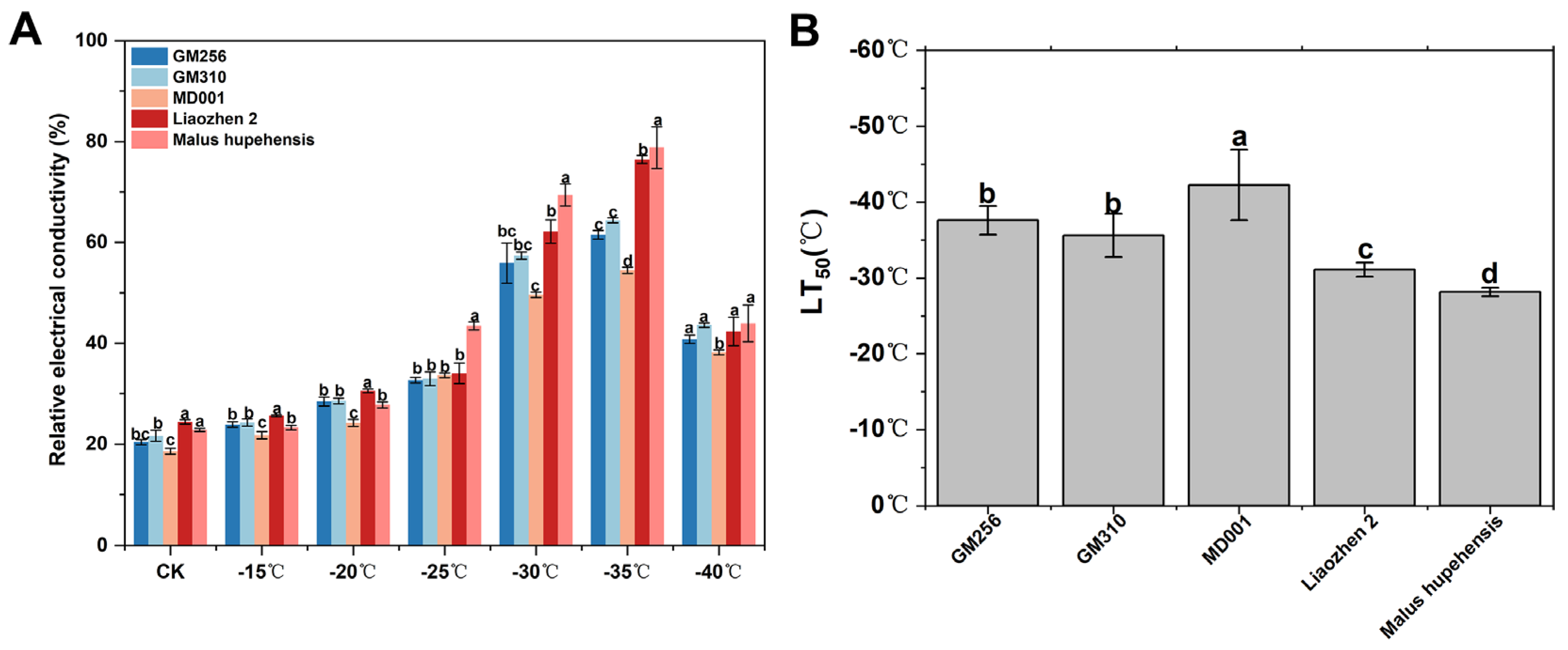
The variations in relative electrical conductivity of branches under different low-temperature treatments are shown in Figure 1A. The conductivity values for each rootstock exhibited a pattern of initial increase followed by a decrease as the temperature progressively declined, peaking at approximately −35 °C before gradually diminishing. At −35 °C, the relative electrical conductivity of the branches ranked in ascending order as follows: MD001 < GM256 < GM310 < LiaoZhen 2 < CK.
The low-temperature half-lethal temperature (LT50) of each tested rootstock was estimated using the Logistic equation for data fitting (Figure 1B). Among the rootstocks, MD001 exhibited the lowest LT50 at −42.24 °C, while CK showed the highest LT50 at −28.17 °C. The LT50 values for GM256, GM310, and LiaoZhen 2 were −37.59 °C, −35.60 °C, and −31.12 °C, respectively. A comprehensive analysis of electrolyte leakage rates in branches subjected to low-temperature treatment indicated that MD001 and GM256 demonstrated superior cold resistance compared with CK.

3.1.2. Changes in Physiological Indicators of Apple Branches Under Different Low-Temperature Treatments

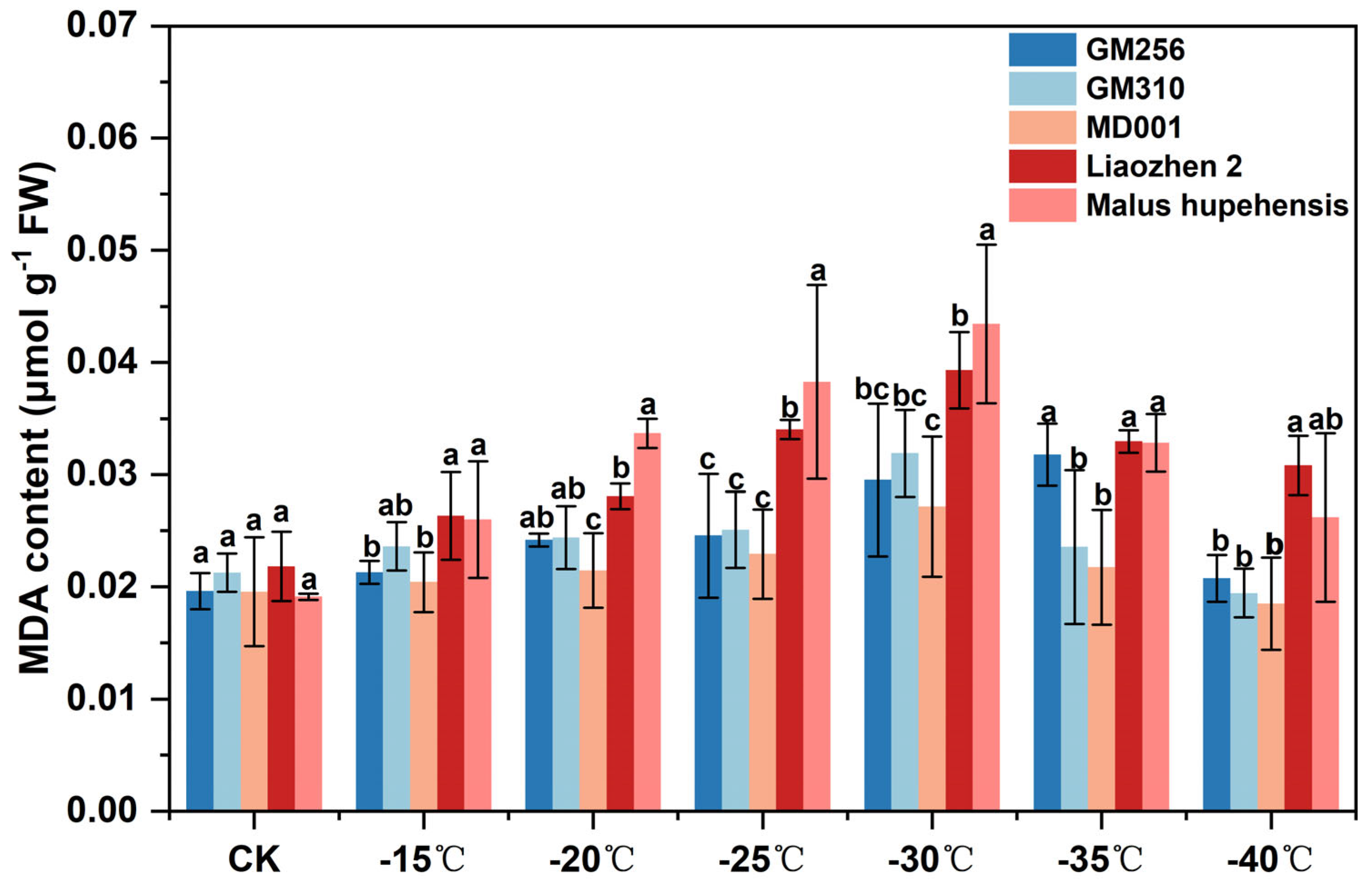
Changes in MDA Content
The variations in malondialdehyde (MDA) content in branches subjected to various low-temperature treatments are illustrated in Figure 2. As the treatment temperature decreases, the MDA content of all branches initially increases and subsequently declines. The MDA levels for the five apple rootstocks peak at approximately −30 °C; beyond −35 °C, a general decline in MDA content is observed across all rootstocks. This suggests that when temperatures fall below a certain threshold, plant cells undergo death, leading to the loss of physiological functions of the cell membrane and cessation of metabolic activities.
Changes in Antioxidant Enzyme Activity
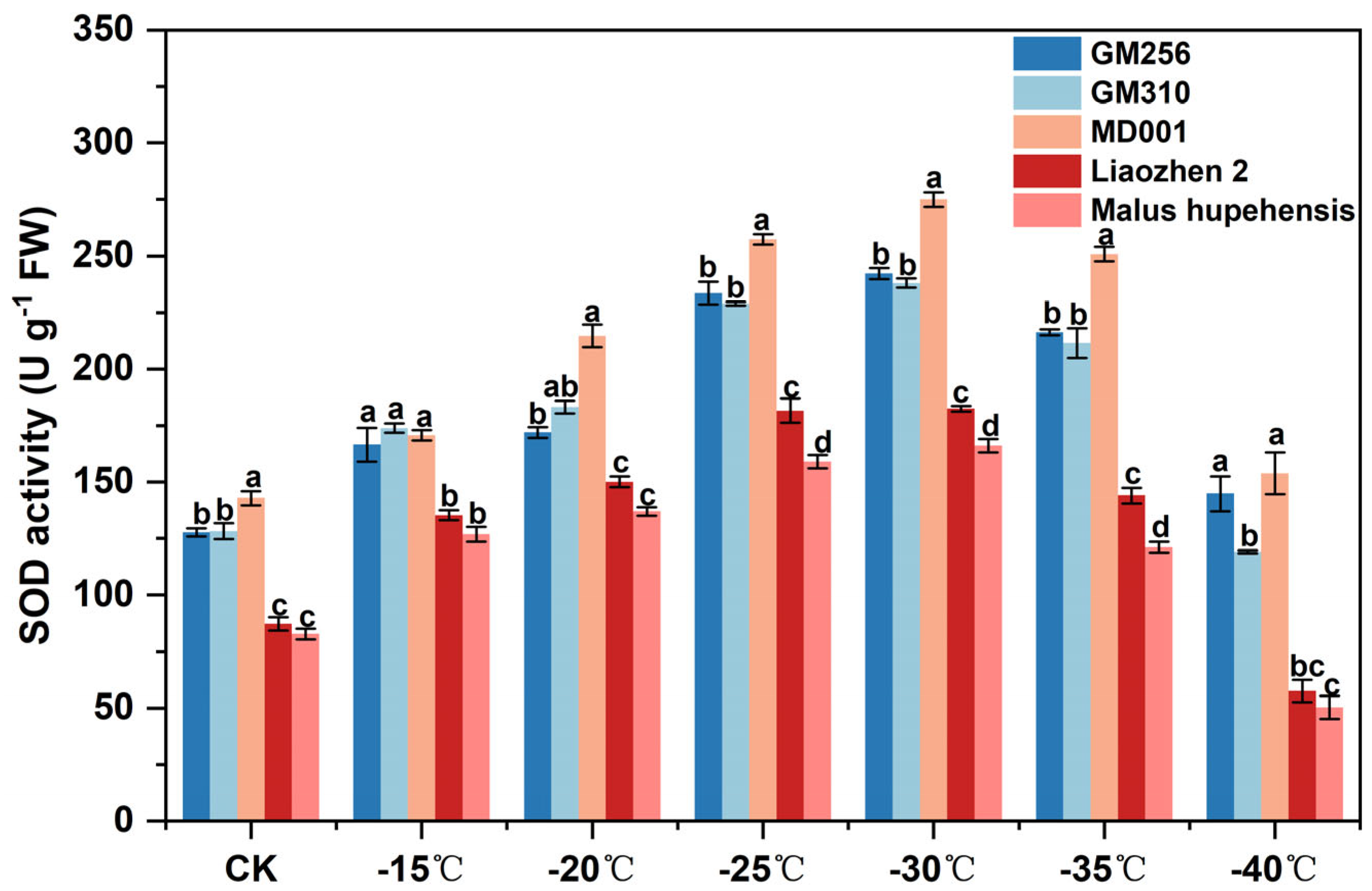
The variations in SOD activity of branches under different low-temperature treatments are shown in Figure 3. As the treatment temperature drops, the SOD activity of all tested branches first increases and then decreases. The peak SOD activity of all tested branches is around −30 °C. Among the five apple rootstocks, the order of peak SOD activity from highest to lowest is MD001 > GM256 > GM310 > LiaoZhen 2 > CK.
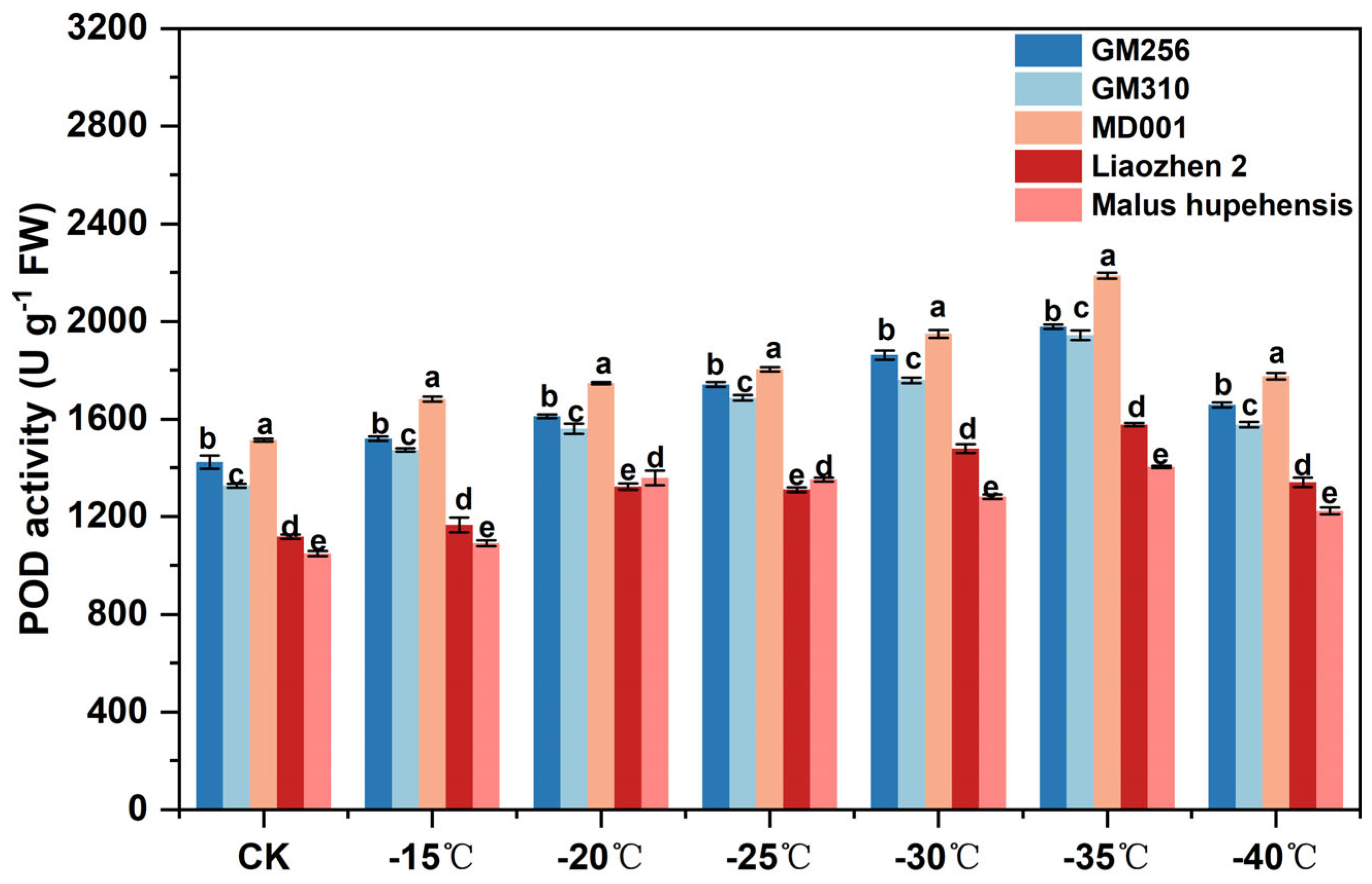
As shown in Figure 4, the POD activity trend is to increase first and then decrease with temperature drop. When the temperature lowers to a certain level, the activity of peroxidase begins to decline. At −40 °C, the POD activity of all tested rootstocks decreases, indicating a weakened ability to remove hydrogen peroxide. The peak POD activity of the five apple rootstocks is in the order of MD001 > GM256 > GM310 > LiaoZhen 2 > CK.
Changes in the Content of Osmotic Regulating Substances
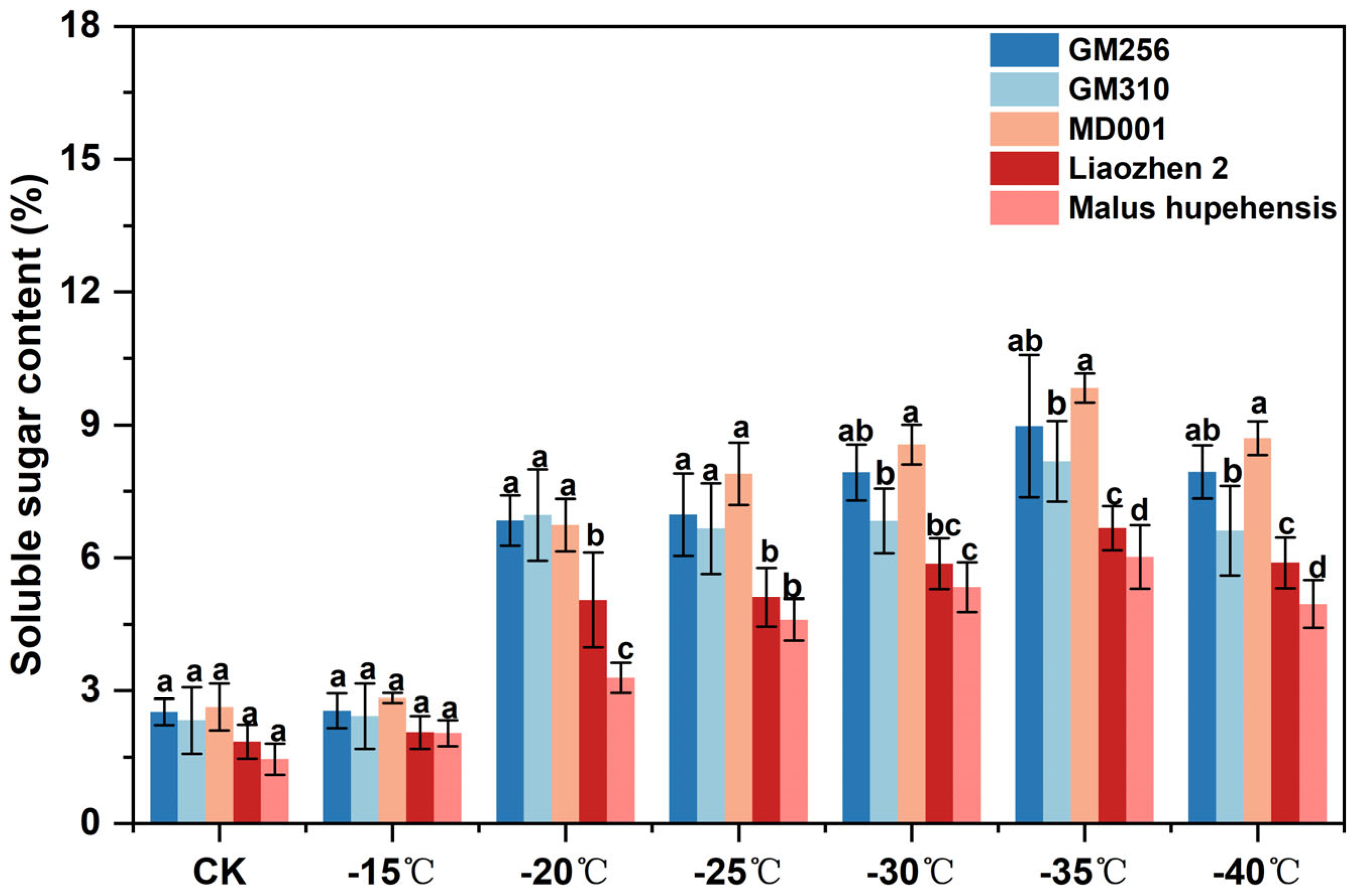
As illustrated in Figure 5, apple branches exhibiting strong cold resistance are capable of maintaining elevated levels of soluble sugar content. With decreasing treatment temperatures, the soluble sugar content across all branches demonstrates a trend of initial increase followed by a decline. Specifically, within the temperature range from CK to −15 °C, the soluble sugar content for all tested varieties shows a gradual increase; this is followed by a sharp rise between −15 °C and −20 °C; subsequently, the rate of increase slows down from −20 °C to −35 °C. Finally, it begins to decrease slowly in the range of −35 °C to −40 °C. The soluble sugar content among apple branches ranks as follows: MD001 > GM256 > GM310 > LiaoZhen 2 > CK.
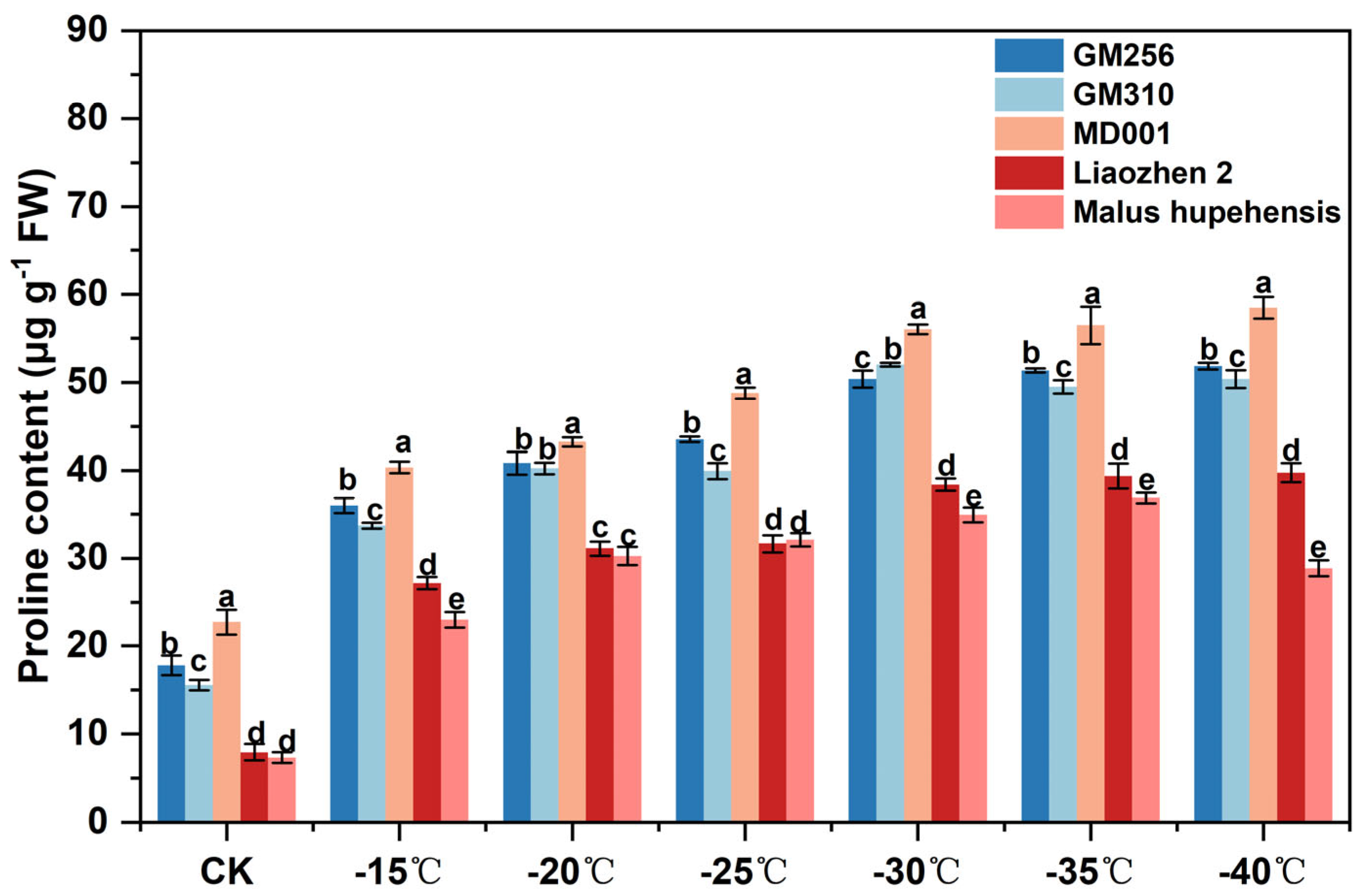
The overall content of free proline increased with decreasing temperature (Figure 6). Notably, the proline content in branches of all tested varieties exhibited a sharp rise within the low-temperature treatment range from CK to −15 °C. In the subsequent interval of −15 °C to −40 °C, proline content continued to show an upward trend; however, the rate of increase began to decelerate, with MD001 and GM256 demonstrating more rapid increases. The ranking of proline content among apple branches from highest to lowest is as follows: MD001 > GM256 > GM310 > LiaoZhen 2 > CK.

3.2. The Effect of Different Dwarfing Rootstocks on the Growth of ‘Fuji’ Apple Trees

Table 2 shows that the tree height, crown diameter, ratio of stock to scion, total number of branches, and branch composition varied among the five rootstock combinations. GM310 and CK produced the tallest trees, with no clear difference in height, while CK also had the largest canopy diameter. In contrast, GM256 showed relatively restrained tree growth. Based on both tree height and canopy spread, GM310 and CK exhibited weaker dwarfing effects than the other combinations. LiaoZhen 2 had the highest rootstock–scion ratio (1.18), indicating the greatest size imbalance between stock and scion. The total branch number followed the order MD001 > CK > GM310 > LiaoZhen 2 > GM256, with MD001 producing the most branches among the dwarfing rootstocks. Overall, the five rootstocks differed clearly in their effects on tree vigor and canopy structure.
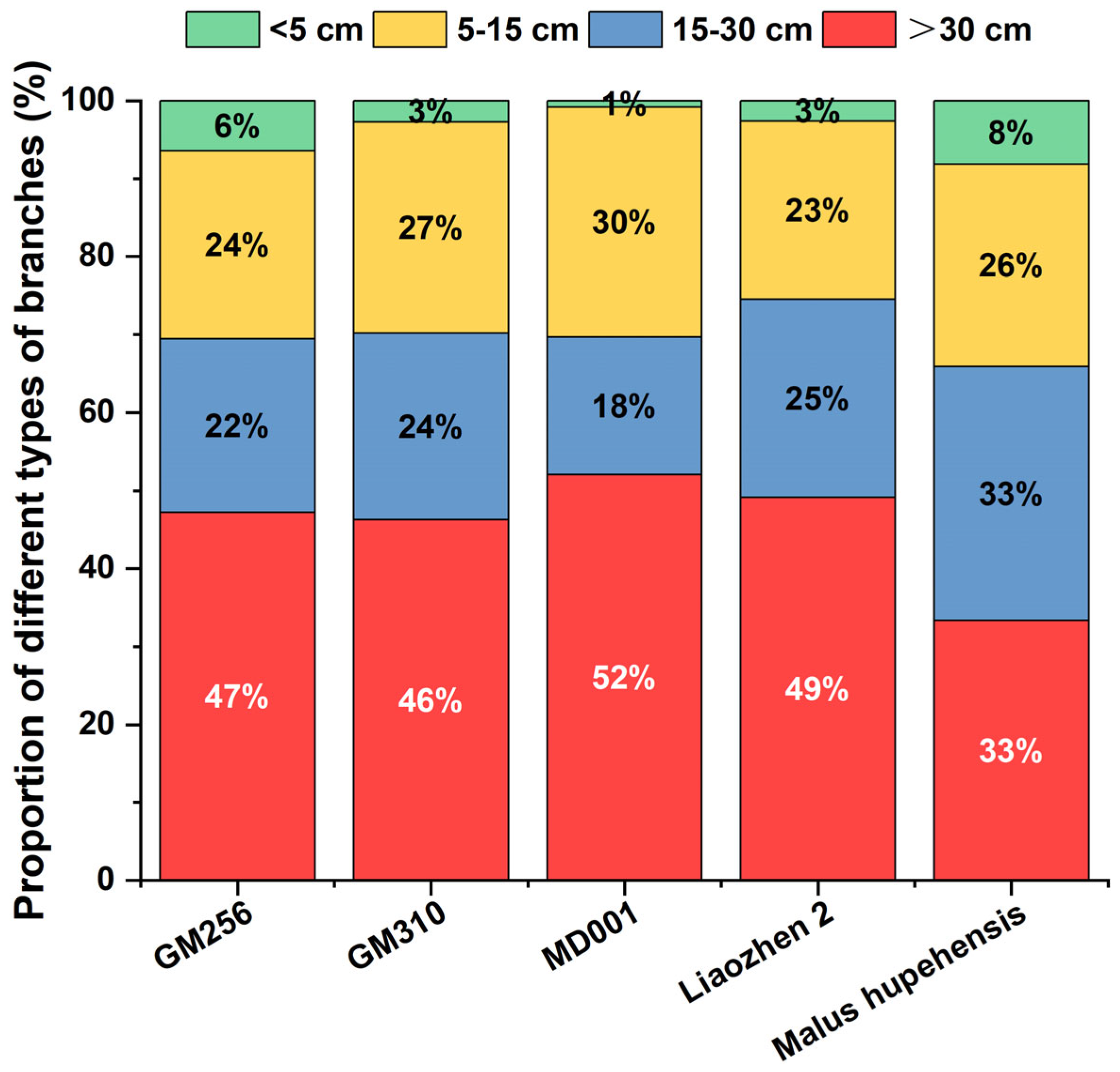
Figure 7 illustrates significant differences in branch composition among the five different dwarfing rootstocks of apple trees. MD001 exhibits the highest proportion of short branches (52%) and the lowest proportion of long branches (18%), with virtually no nutrient branches, leading to weakened tree vigor. In contrast, LiaoZhen 2, excluding CK, displays the highest proportion of long branches (25%), resulting in excessive growth.

3.3. The Effects of Different Dwarfing Rootstocks on Yield Formation and Fruit Quality of ‘Fuji’ Apple

Table 3 shows that rootstock choice significantly affected yield formation in ‘Fuji’ apple. GM256 produced the highest number of fruits per plant, yield per plant, and yield per hectare, indicating the best overall productivity among the tested rootstocks. GM310 ranked second and was statistically comparable to GM256 in fruit number per plant, but showed a slightly lower yield per plant and yield per hectare. MD001 and CK had intermediate yields, with CK performing slightly better than MD001 in all three yield-related traits. LiaoZhen 2 consistently showed the poorest performance, with the lowest fruit number, yield per plant, and orchard yield.

3.4. The Effects of Different Dwarfing Rootstocks on the Fruit Characteristics and Intrinsic Quality of ‘Fuji’ Apple

3.4.1. Differences in Fruit Characteristics

Table 4 shows clear rootstock effects on fruit appearance and physical traits. CK had the highest peel brightness (L*) and yellow–blue chroma (b*), whereas GM256 showed the highest red–green chroma (a*), indicating stronger red coloration. GM310 exhibited the highest chroma (C*), reflecting greater color vividness. The fruit shape index did not differ significantly among treatments. In addition, GM256 produced the heaviest and firmest fruits among the five combinations. Overall, GM256 showed the most favorable fruit characteristics, combining improved coloration, larger fruit size, and higher firmness.

3.4.2. Differences in the Internal Nutritional Quality of Fruit

Significant differences exist in the intrinsic quality of ‘Fuji’ fruit derived from five dwarfing rootstocks (Table 5). GM256 exhibits the highest soluble solid content, whereas CK shows the lowest. Additionally, GM256 has a markedly higher vitamin C content compared to the other four rootstocks and possesses the highest soluble sugar content. Notably, there are substantial variation in citric acid content among the rootstocks, with GM310 exhibiting the highest levels while LiaoZhen 2 and GM256 display lower concentrations.

3.4.3. Correlation Analysis of Quality Indicators Among Different Apple Fruits

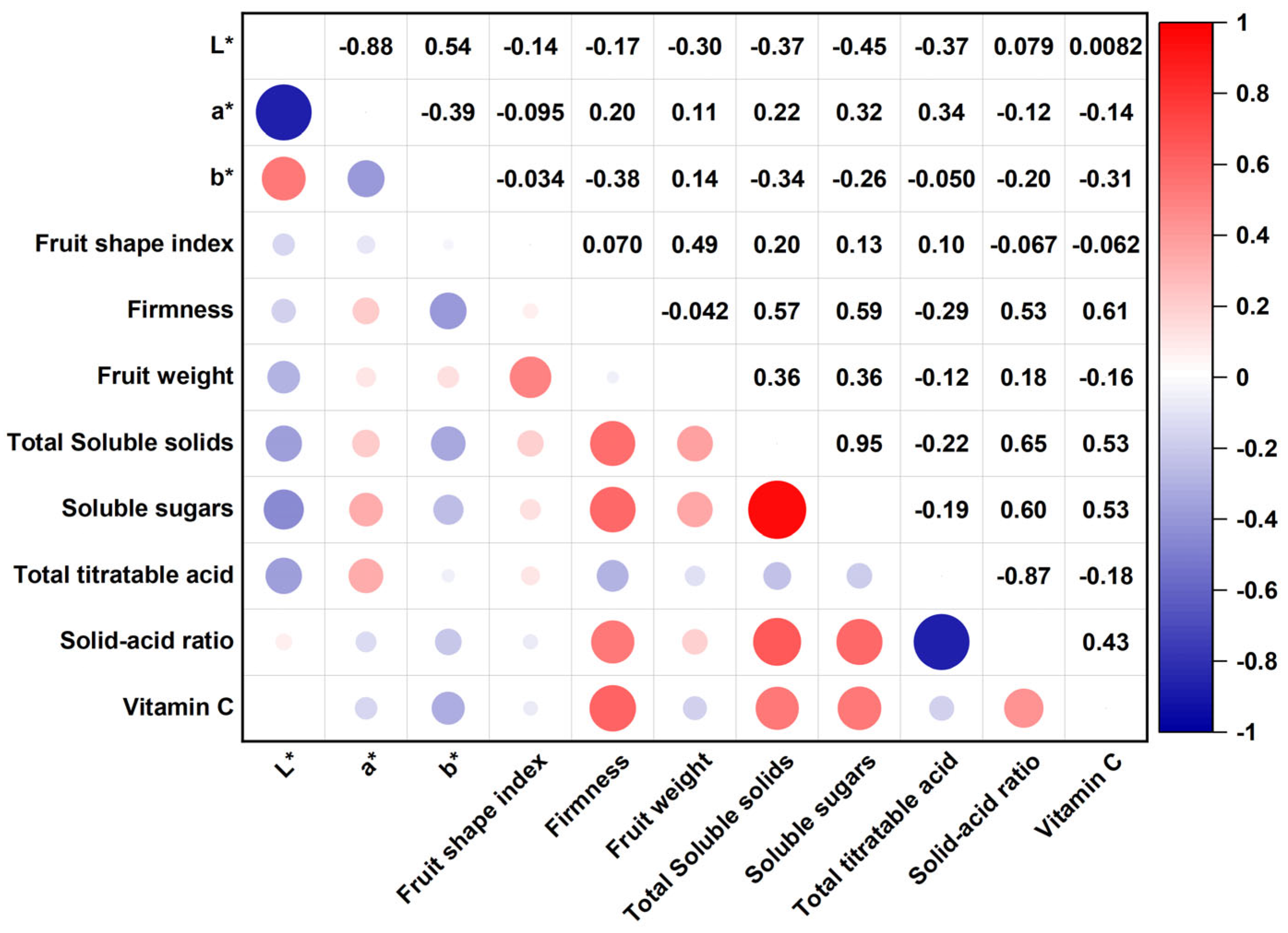
Figure 8 illustrates that L* is significantly negatively correlated with a*, while exhibiting a positive correlation with b*, with correlation coefficients of −0.88 and 0.54, respectively. Additionally, b* shows a significant negative correlation with both total titratable ratio and vitamin C, yielding correlation coefficients of −0.2 and 0.31, respectively. The fruit shape index demonstrates a significant positive correlation with fruit weight, reflected by a correlation coefficient of 0.49. Furthermore, the soluble solid content is significantly positively correlated with both soluble sugar and vitamin C, presenting correlation coefficients of 0.95 and 0.53, respectively. Soluble sugar also exhibits a significant positive correlation with vitamin C (correlation coefficient: 0.53). Lastly, titratable acidity displays a significant negative correlation with acidity ratio, indicated by a coefficient of −0.87.

3.4.4. Principal Component Analysis of Quality Indicators of Different ‘Fuji’ Apple Fruits

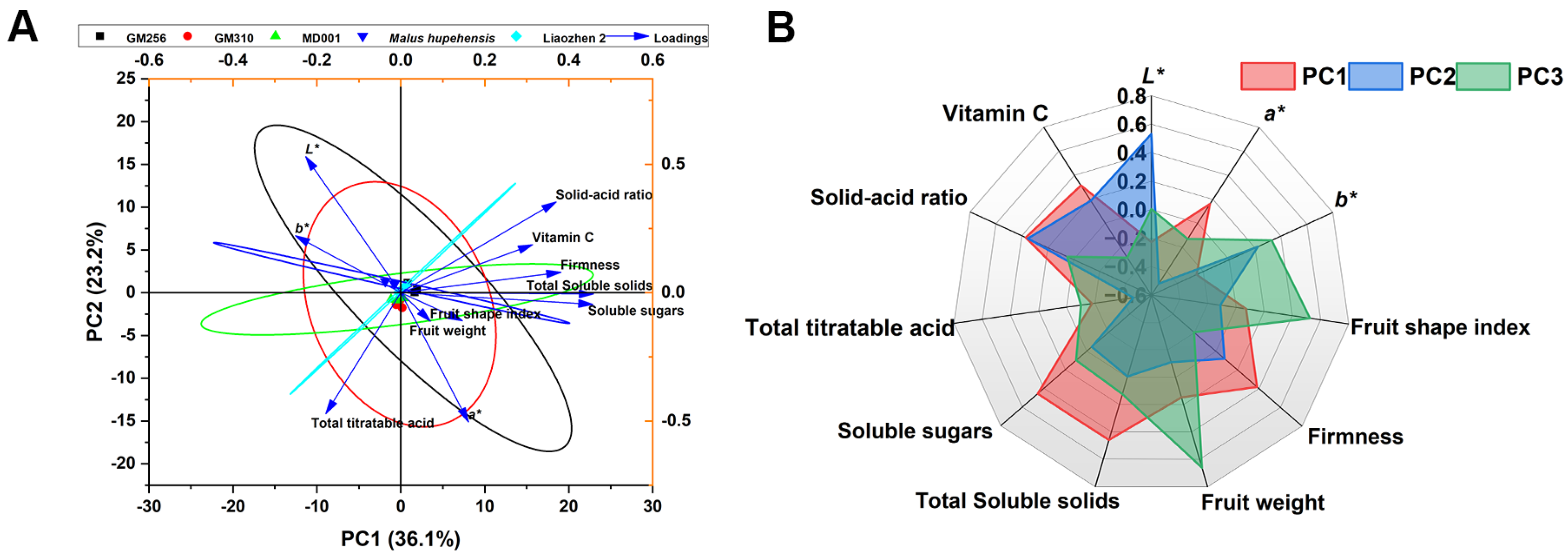
The principal component analysis (PCA) of the five cultivars is presented in Figure 9. PC1 explained 36.1% of the total variance and was strongly and positively correlated with soluble sugar, soluble solids, vitamin C, sugar–acid ratio, firmness, and b* value, indicating that this component mainly represented overall fruit internal quality and sweetness-related attributes. PC2 explained 23.2% of the variance and was mainly associated with a*, L*, and titratable acidity, reflecting differences in peel color and acid composition. Based on the PCA scores, GM256, GM310, and LiaoZhen 2 were separated from CK and MD001, suggesting that these combinations had a comparatively better overall fruit quality performance (Figure 9A). Among them, GM256 showed the most balanced profile across the major quality traits. To further support the separation observed, Figure 9B showed that PC1 was mainly associated with sweetness- and quality-related traits, including soluble sugars, total soluble solids, vitamin C, solid–acid ratio, firmness, and fruit weight, whereas PC2 and PC3 were more closely related to peel color traits and fruit morphological characteristics.

4. Discussion

4.1. The Effect of Different Dwarfing Rootstocks on the Cold Resistance of Apple

Cold resistance constitutes a crucial metric for the appraisal of apple rootstocks. When exposed to cold stress, plant tissues undergo a succession of elaborate physiological and biochemical reactions, rendering it infeasible to assess cold resistance via a solitary indicator [26,27]. In apple rootstocks, cold tolerance is generally associated with membrane lipid peroxidation, antioxidant capacity, and osmotic adjustment [19]. In this study, MD001 and GM256 exhibited lower MDA accumulation, higher SOD and POD activities, and greater soluble sugar and proline accumulation under low-temperature stress, suggesting more effective protection of membrane integrity and stronger ROS scavenging and osmotic regulation. This integrated response is consistent with previous studies on apple rootstocks and other perennial fruit crops [28,29]. Meanwhile, the electrolyte leakage combined with logistic regression provided an effective way to estimate LT50 and compare the freezing tolerance of different rootstocks. This approach has been widely used in alfalfa (Medicago sativa L.) [30], pepper (Capsicum annuum L.) [31], grape (Vitis vinifera L.) [32], Korla fragrant pear (Pyrus sinkiangensis) [33], and apple (Malus domestica) [8,19], demonstrating its reliability for assessing cold resistance across diverse crops. Among the five tested rootstocks, MD001 showed the lowest LT50, followed by GM256, GM310, LiaoZhen 2, and CK, indicating that MD001 had the strongest cold resistance. Considering that the extreme minimum temperature in Tai’an City reached −27.5 °C, all five rootstocks should be able to survive local winter conditions, but their safety margins against freezing injury differed considerably.
Malondialdehyde (MDA) is a common indicator of membrane lipid peroxidation, and its accumulation generally reflects the severity of oxidative damage under stress [34,35]. In the present study, the MDA content increased as temperature decreased, suggesting progressive membrane injury during freezing exposure. However, MD001 and GM256 maintained relatively lower MDA levels than CK and the weaker rootstocks, indicating that their membrane systems were less damaged under low-temperature stress. This result is consistent with previous studies on apple rootstock [19,36], which showed that stronger cold tolerance is usually associated with lower oxidative membrane damage.
Antioxidant enzymes play a central role in protecting plants from reactive oxygen species (ROS) generated under chilling or freezing conditions [37]. In this study, SOD and POD activities first increased and then declined as temperature decreased further. The initial increase likely reflected activation of the antioxidant defense system in response to stress, whereas the subsequent decline at lower temperatures may have resulted from excessive membrane damage and enzyme inactivation caused by severe freezing injury [38]. Rootstocks with stronger cold resistance, such as MD001, GM256, and GM310, generally showed higher SOD and POD activities than the weaker rootstocks. In contrast, Malus hupehensis and LiaoZhen 2 maintained relatively low enzyme activities under severe stress. Similar patterns have been reported in sweet cherry [39] and pear [40], suggesting that enhanced antioxidant capacity is an important component of cold tolerance in woody fruit species.
Soluble sugars and proline are important osmotic adjustment substances that help plants maintain cellular water balance and stabilize membrane structures under adverse conditions [41,42]. Their accumulation can reduce the harmful effects of freezing by protecting proteins and membranes from ROS-induced injury. In this study, both soluble sugar and proline contents increased with decreasing temperature and then declined slightly at the lowest temperature, indicating an active osmotic adjustment response followed by metabolic inhibition under extreme stress. MD001 and GM256 accumulated soluble sugars more rapidly than CK, especially near the semi-lethal temperature threshold, suggesting that these two rootstocks had a stronger capacity to enhance osmotic protection and improve freezing tolerance.
Overall, the combined patterns of LT50, MDA, antioxidant enzyme activity, and osmoprotectant accumulation indicate that MD001 had the highest cold resistance, followed by GM256. These findings suggest that cold tolerance in dwarfing rootstocks is not determined by a single physiological parameter, but rather by the coordinated regulation of membrane stability, ROS scavenging, and osmotic adjustment.

4.2. The Effect of Different Dwarfing Rootstocks on the Growth and Fruit Quality of ‘Fuji’ Apple Trees

In the present study, significant differences were observed among rootstocks in tree growth, branch composition, trunk ratio, fruit appearance, and internal quality, confirming that dwarfing rootstocks strongly influence the overall performance of ‘Fuji’ apple trees in Shandong Province. These differences are mainly attributed to the interaction between scion and rootstock, which affects tree vigor through changes in water transport, nutrient absorption, endogenous hormones, and canopy architecture [43,44,45].
Tree vigor varied substantially among the tested combinations. Malus hupehensis (CK) and GM310 produced taller trees and larger canopy diameters, indicating stronger vegetative growth, whereas MD001 showed the strongest dwarfing effect. This pattern is consistent with previous studies showing that dwarfing rootstocks significantly suppress scion vigor and reduce tree size [43,46]. The ratio of stock to scion also suggested differences in compatibility and growth balance among combinations. LiaoZhen 2 showed the most pronounced stock–scion imbalance, whereas the other combinations were closer to 1.0, indicating relatively better graft compatibility. In general, a stable stock–scion relationship is essential for maintaining balanced growth and achieving a desirable orchard architecture. Although LiaoZhen 2 had the highest ratio of scion to stock, this ratio alone is insufficient to diagnose graft incompatibility, which is usually accompanied by anatomical or physiological abnormalities at the graft union, including disrupted vascular continuity, necrosis, cracking, or growth decline [47,48].
Branch composition further reflected the differences in vegetative vigor. In high-density apple orchards, excessive vegetative growth, particularly a high proportion of long shoots, is often associated with delayed fruiting, reduced light interception, and lower fruit quality [49]. In this study, LiaoZhen 2 and GM310 had a relatively high proportion of long branches, exceeding the threshold associated with excessive vegetative growth. By contrast, MD001 produced the highest proportion of short branches and the lowest proportion of long branches, indicating a compact canopy and weak vegetative growth. GM256 showed a more balanced branch structure, with a relatively high proportion of short branches and moderate tree vigor. This architecture may be more favorable for light distribution, flower bud differentiation, and stable yield formation.
The rootstock type clearly influenced fruit characteristics and quality in ‘Fuji’ apple. Fruit weight varied among combinations, with MD001 and GM256 producing larger fruits than CK, GM310, and LiaoZhen 2, suggesting that dwarfing rootstocks may promote fruit enlargement by improving assimilate partitioning and source–sink balance [8]. However, the fruit shape index was not significantly affected, indicating a limited effect of rootstock on fruit morphology. For peel color, GM256 and GM310 enhanced coloration, whereas CK showed higher L* and b* values, reflecting a brighter and more yellowish peel. Since red color is an important commercial trait in ‘Fuji’ apple, the improved coloration of GM256 is a desirable quality feature. Although MD001 showed the strongest cold resistance, it did not produce the best fruit quality. This indicates that enhanced freezing tolerance does not necessarily translate into a superior fruit performance, probably because rootstock effects on stress adaptation, hydraulic function, carbon allocation, and fruit development are regulated through partly distinct physiological processes [50,51].
Rootstock effects were also evident in internal fruit quality. GM256 gave the highest soluble solids, vitamin C, soluble sugar content, sugar–acid ratio, and TSS/TA ratio, indicating the best eating quality among the five combinations. Although MD001 showed the strongest dwarfing effect and the highest cold tolerance, its fruit quality was less favorable than that of GM256. These results suggest that stronger stress tolerance or dwarfing intensity does not necessarily lead to a better fruit performance. GM256 therefore appears to offer a more favorable balance between stress adaptation and fruit development. Notably, it also produced the highest yield, which further supports its practical value for commercial orchards.
Overall, the five rootstocks differed clearly in their effects on cold resistance, tree architecture, and fruit quality. MD001 was superior in cold tolerance and dwarfing intensity, whereas GM256 showed the most balanced performance across growth control, yield, and fruit quality. Thus, GM256 appears to be the most promising rootstock for ‘Fuji’ apple in regions with climatic conditions similar to Shandong Province. Future work should validate these findings across locations and seasons.

5. Conclusions

The grafting of different dwarfing rootstocks onto ‘Yishuihong’ Fuji apple significantly influences both tree growth and fruit quality. Among them, MD001 exhibited the strongest cold resistance, as reflected by the lowest LT50 and the most favorable physiological responses under low-temperature stress. GM256 ranked second in cold tolerance and showed stable stress adaptation. For tree growth, MD001 produced the strongest dwarfing effect, with the highest proportion of short shoots and the lowest proportion of long shoots, while LiaoZhen 2 showed excessive vegetative growth. In terms of fruit quality, GM256 performed best overall, with higher fruit weight, firmness, soluble solids, vitamin C, and sugar–acid ratio. Taken together, GM256 appears to be the most suitable rootstock for ‘Fuji’ apple in Shandong Province, because it combines relatively strong cold tolerance, moderate tree vigor, and superior fruit quality. Future studies should validate these findings across different locations, seasons, and stages of fruit growth and development.

Author Contributions

Y.-X.W.: Designed the experiment and performed the study, Wrote original draft, Funding acquisition; S.-L.X.: Investigation, Performed the study; Y.-S.C.: Validation, Investigation; W.-Y.Z.: Investigation, Data curation; X.-W.H.: Data curation, Investigation: X.-N.W.: Methodology, Investigation; P.H.: Methodology, Investigation; H.-B.W.: Managed the material, Investigation, Funding acquisition; C.-Z.W.: Methodology, Investigation; L.-G.L.: Managed the material, Designed the experiment; S.W.: Review and editing, Communication; Y.W.: Review and editing, Communication. All authors have read and agreed to the published version of the manuscript.

Funding

The work was financially supported by the Key R&D Program of Shandong Province (2025LZGC005), the earmarked fund for China Agriculture Research System (CARS-27), Tai’an Agricultural Improved Variety Project (2025NYLZ12) and the Youth Foundation of Shandong Institute of Pomology (GSS2022QN08).

Data Availability Statement

The original contributions presented in this study are included in the article. Further inquiries can be directed to the corresponding author(s).

Conflicts of Interest

The authors have no conflicting interests, and all authors have approved the manuscript and agree with its submission to Horticulturae.

References

  1. Wang, N.; Joost, W.; Zhang, F.S. Towards sustainable intensification of apple production in China-Yield gaps and nutrient use efficiency in apple farming systems. J. Integr. Agric. 2016, 15, 716–725. [Google Scholar] [CrossRef]
  2. Di Vaio, C.; Cirillo, C.; Buccheri, M.; Limongelli, F. Effect of interstock (M.9 and M.27) on vegetative growth and yield of apple trees (cv “Annurca”). Sci. Hortic. 2009, 119, 270–274. [Google Scholar] [CrossRef]
  3. Robinson, T.L. Recent Advances and Future Directions in Orchard Planting Systems. Acta Hortic. 2007, 732, 367–381. [Google Scholar] [CrossRef]
  4. Ladon, T.; Chandel, J.S.; Sharma, N.C.; Verma, P. Optimizing apple orchard management: Investigating the impact of planting density, training systems and fertigation levels on tree growth, yield and fruit quality. Sci. Hortic. 2024, 334, 113329. [Google Scholar] [CrossRef]
  5. Wang, D.J.; Wang, G.Y.; Sun, S.M.; Lu, X.; Liu, Z.; Wang, L.; Tian, W.; Li, Z.C.; Li, L.W.; Gao, Y.; et al. Research Progress on Cuttings of Malus Rootstock Resources in China. Horticulturae 2024, 10, 217. [Google Scholar] [CrossRef]
  6. Wang, Y.; Li, W.; Xu, X.F.; Qiu, C.P.; Wu, T.; Wei, Q.P.; Ma, F.W.; Han, Z.H. Progress of Apple Rootstock Breeding and Its Use. Hortic. Plant J. 2019, 5, 183–191. [Google Scholar] [CrossRef]
  7. Zhao, T.; Sun, Q.; Hu, D.-G. Unveiling rootstock-induced dwarfing from comparative genomic analysis. Mol. Hortic. 2024, 4, 18. [Google Scholar] [CrossRef] [PubMed]
  8. Li, S.; Zhang, Y.; Chen, H.; Li, B.; Liang, B.; Xu, J. The Effect of Dwarfing Interstocks on Vegetative Growth, Fruit Quality and Ionome Nutrition of ‘Fuji’ Apple Cultivar ‘Tianhong 2’—A One-Year Study. Plants 2023, 12, 2158. [Google Scholar] [CrossRef] [PubMed]
  9. Costes, E.; García-Villanueva, E. Clarifying the effects of dwarfing rootstock on vegetative and reproductive growth during tree development: A study on apple trees. Ann. Bot. 2007, 100, 347–357. [Google Scholar] [CrossRef] [PubMed]
  10. Cummins, J.N.; Aldwinckle, H.S. Breeding Apple Rootstocks. In Plant Breeding Reviews; Janick, J., Ed.; Springer: Boston, MA, USA, 1983; Volume 1, pp. 294–394. [Google Scholar]
  11. Zhou, Z.; Zhang, L.; Shu, J.; Wang, M.Y.; Li, H.; Shu, H.R.; Wang, X.Y.; Sun, Q.H.; Zhang, S.Z. Root Breeding in the Post-Genomics Era: From Concept to Practice in Apple. Plants 2022, 11, 1408. [Google Scholar] [CrossRef] [PubMed]
  12. Foster, T.M.; Celton, J.-M.; Chagné, D.; Tustin, D.S.; Gardiner, S.E. Two quantitative trait loci, Dw1 and Dw2, are primarily responsible for rootstock-induced dwarfing in apple. Hortic. Res. 2015, 2, 15001. [Google Scholar] [CrossRef] [PubMed]
  13. Li, W.; Chu, C.; Li, H.; Zhang, H.; Sun, H.; Wang, S.; Wang, Z.; Li, Y.; Foster, T.M.; López-Girona, E.; et al. Near-gapless and haplotype-resolved apple genomes provide insights into the genetic basis of rootstock-induced dwarfing. Nat. Genet. 2024, 56, 505–516. [Google Scholar] [CrossRef] [PubMed]
  14. Montesinos, Á.; Rubio-Cabetas, M.J.; Grimplet, J. Characterization of Almond Scion/Rootstock Communication in Cultivar and Rootstock Tissues through an RNA-Seq Approach. Plants 2023, 12, 4166. [Google Scholar] [CrossRef] [PubMed]
  15. Martínez-Ballesta, M.C.; Alcaraz-López, C.; Muries, B.; Mota-Cadenas, C.; Carvajal, M. Physiological aspects of rootstock–scion interactions. Sci. Hortic. 2010, 127, 112–118. [Google Scholar] [CrossRef]
  16. Li, Y.; Ma, Z.; Li, Y.; Li, W.; Sun, L.; Xu, J.; Mao, J.; Chen, B. Modification of Fruit Quality and Leaf Mineral Composition of ‘Nagafu No.2’ Apple Grafted onto Four Dwarfing Interstocks. J. Plant Growth Regul. 2023, 42, 7240–7256. [Google Scholar] [CrossRef]
  17. Chauhan, P.; Kumar, P.; Sharma, D.P.; Sharma, U.; Ladon, T.; Saini, S.; Mehta, H. Rootstock mediated modulation of growth, flowering and nutrient content in Apple (Malus×domestica Borkh.) scion cultivars in high density planting system in north-west Himalayas. BMC Plant Biol. 2026, 26, 250. [Google Scholar] [CrossRef] [PubMed]
  18. Liu, W.; Wang, Q.; Zhang, R.; Liu, M.; Wang, C.; Liu, Z.; Xiang, C.; Lu, X.; Zhang, X.; Li, X.; et al. Rootstock–scion exchanging mRNAs participate in the pathways of amino acid and fatty acid metabolism in cucumber under early chilling stress. Hortic. Res. 2022, 9, uhac031. [Google Scholar] [CrossRef] [PubMed]
  19. Wang, Y.-X.; Hu, Y.; Chen, B.-H.; Zhu, Y.-F.; Dawuda, M.M.; Svetla, S. Physiological mechanisms of resistance to cold stress associated with 10 elite apple rootstocks. J. Integr. Agric. 2018, 17, 857–866. [Google Scholar] [CrossRef]
  20. He, X.Y.; Ye, H.; Ma, J.L.; Zhang, R.Q.; Chen, G.; Xia, Y.Y. Semi-lethal high temperature and heat tolerance of eight Camellia species. Phyton 2012, 81, 177–180. [Google Scholar] [CrossRef]
  21. Kurt, Z.; Ateş, S. Application of Silicon Iron and Silver Nanoparticles Improve Vegetative Development and Physiological Characteristics of Boysenberry Plants Grown under Salinity Stress In Vitro Cultivation Conditions. Horticulturae 2024, 10, 1118. [Google Scholar] [CrossRef]
  22. Trentin, E.; Ferreira, P.A.; Ricachenevsky, F.K.; Morsch, L.; Belles, S.W.; Hindersmann, J.; Tarouco, C.P.; Nicoloso, F.T.; Berghetti, Á.L.; Stefanello da Silva, L.O.; et al. Identifying Grapevine Rootstocks Tolerant to Copper Excess. Horticulturae 2024, 10, 883. [Google Scholar] [CrossRef]
  23. Ma, Y.-H.; Ma, F.-W.; Zhang, J.-K.; Li, M.-J.; Wang, Y.-H.; Liang, D. Effects of high temperature on activities and gene expression of enzymes involved in ascorbate–glutathione cycle in apple leaves. Plant Sci. 2008, 175, 761–766. [Google Scholar] [CrossRef]
  24. Wang, Y.; Zhang, J.; Wang, X.; Zhang, T.; Zhang, F.; Zhang, S.; Li, Y.; Gao, W.; You, C.; Wang, X.; et al. Cellulose Nanofibers Extracted From Natural Wood Improve the Postharvest Appearance Quality of Apples. Front. Nutr. 2022, 9, 881783. [Google Scholar] [CrossRef] [PubMed]
  25. Lemmens, E.; Alós, E.; Rymenants, M.; De Storme, N.; Keulemans, W. Dynamics of ascorbic acid content in apple (Malus×domestica) during fruit development and storage. Plant Physiol. Biochem. 2020, 151, 47–59. [Google Scholar] [CrossRef] [PubMed]
  26. Kidokoro, S.; Shinozaki, K.; Yamaguchi-Shinozaki, K. Transcriptional regulatory network of plant cold-stress responses. Trends Plant Sci. 2022, 27, 922–935. [Google Scholar] [CrossRef] [PubMed]
  27. Kim, J.-S.; Kidokoro, S.; Yamaguchi-Shinozaki, K.; Shinozaki, K. Regulatory networks in plant responses to drought and cold stress. Plant Physiol. 2024, 195, 170–189. [Google Scholar] [CrossRef] [PubMed]
  28. Hezema, Y.S.; Shukla, M.R.; Ayyanath, M.M.; Sherif, S.M.; Saxena, P.K. Physiological and Molecular Responses of Six Apple Rootstocks to Osmotic Stress. Int. J. Mol. Sci. 2021, 22, 8263. [Google Scholar] [CrossRef] [PubMed]
  29. Li, X.; Ma, Z.; Song, Y.; Shen, W.; Yue, Q.; Khan, A.; Tahir, M.M.; Wang, X.; Malnoy, M.; Ma, F.; et al. Insights into the molecular mechanisms underlying responses of apple trees to abiotic stresses. Hortic. Res. 2023, 10, uhad144. [Google Scholar] [CrossRef] [PubMed]
  30. Xu, H.; Li, Z.; Tong, Z.; He, F.; Li, X. Metabolomic analyses reveal substances that contribute to the increased freezing tolerance of alfalfa (Medicago sativa L.) after continuous water deficit. BMC Plant Biol. 2020, 20, 15. [Google Scholar] [CrossRef] [PubMed]
  31. Juan, L.; Ping, Y.; Jian, L.; Hongbin, D.; Ruopeng, Y.; Jie, L. The duration of priming, elimination and maintenance of low temperature stress memory response to periodic chilling risk in pepper (Capsicum annuum L.). Environ. Exp. Bot. 2024, 226, 105914. [Google Scholar] [CrossRef]
  32. Zhao, Y.; Wang, Z.-X.; Yang, Y.-M.; Liu, H.-S.; Shi, G.-L.; Ai, J. Analysis of the cold tolerance and physiological response differences of amur grape (Vitis amurensis) germplasms during overwintering. Sci. Hortic. 2020, 259, 108760. [Google Scholar] [CrossRef]
  33. Yan, L.; Shen, X.; He, Z.; Li, J.; Yang, L.; Chai, Z. Effects of potassium fertilization on cold resistance in Korla fragrant pear. Sci. Hortic. 2026, 356, 114615. [Google Scholar] [CrossRef]
  34. Petrov, V.; Hille, J.; Mueller-Roeber, B.; Gechev, T.S. ROS-mediated abiotic stress-induced programmed cell death in plants. Front. Plant Sci. 2015, 6, 69. [Google Scholar] [CrossRef] [PubMed]
  35. Li, Y.; Han, L.; Wang, B.; Zhang, J.; Nie, J. Dynamic degradation of penconazole and its effect on antioxidant enzyme activity and malondialdehyde content in apple fruit. Sci. Hortic. 2022, 300, 111053. [Google Scholar] [CrossRef]
  36. Xu, G.; He, M.; Zhao, D.; Lyu, D.; Qin, S. Physiological and Structural Changes in Apple Tree Branches of Different Varieties during Dormancy. Horticulturae 2023, 9, 947. [Google Scholar] [CrossRef]
  37. Habibi, F.; Liu, T.; Shahid, M.A.; Schaffer, B.; Sarkhosh, A. Physiological, biochemical, and molecular responses of fruit trees to root zone hypoxia. Environ. Exp. Bot. 2023, 206, 105179. [Google Scholar] [CrossRef]
  38. Chen, L.J.; Xiang, H.Z.; Miao, Y.; Zhang, L.; Guo, Z.F.; Zhao, X.H.; Lin, J.W.; Li, T.L. An Overview of Cold Resistance in Plants. J. Agron. Crop Sci. 2014, 200, 237–245. [Google Scholar] [CrossRef]
  39. Zhao, H.; Liu, B.; Zhang, W.; Cao, J.; Jiang, W. Enhancement of quality and antioxidant metabolism of sweet cherry fruit by near-freezing temperature storage. Postharvest Biol. Technol. 2019, 147, 113–122. [Google Scholar] [CrossRef]
  40. Bao, J.; Sha, S.; Zhang, S. Changes in germinability, lipid peroxidation, and antioxidant enzyme activities in pear stock (Pyrus betulaefolia Bge.) seeds during room- and low-temperature storage. Acta Physiol. Plant. 2011, 33, 2035–2040. [Google Scholar] [CrossRef]
  41. Couée, I.; Sulmon, C.; Gouesbet, G.; El Amrani, A. Involvement of soluble sugars in reactive oxygen species balance and responses to oxidative stress in plants. J. Exp. Bot. 2006, 57, 449–459. [Google Scholar] [CrossRef] [PubMed]
  42. Khalid, M.; Rehman, H.M.; Ahmed, N.; Nawaz, S.; Saleem, F.; Ahmad, S.; Uzair, M.; Rana, I.A.; Atif, R.M.; Zaman, Q.U.; et al. Using Exogenous Melatonin, Glutathione, Proline, and Glycine Betaine Treatments to Combat Abiotic Stresses in Crops. Int. J. Mol. Sci. 2022, 23, 12913. [Google Scholar] [CrossRef] [PubMed]
  43. Foster, T.M.; McAtee, P.A.; Waite, C.N.; Boldingh, H.L.; McGhie, T.K. Apple dwarfing rootstocks exhibit an imbalance in carbohydrate allocation and reduced cell growth and metabolism. Hortic. Res. 2017, 4, 17009. [Google Scholar] [CrossRef] [PubMed]
  44. Hayat, F.; Iqbal, S.; Coulibaly, D.; Razzaq, M.K.; Nawaz, M.A.; Jiang, W.; Shi, T.; Gao, Z. An insight into dwarfing mechanism: Contribution of scion-rootstock interactions toward fruit crop improvement. Fruit Res. 2021, 1, 3. [Google Scholar] [CrossRef]
  45. Lordan, J.; Fazio, G.; Francescatto, P.; Robinson, T. Effects of apple (Malus×domestica) rootstocks on scion performance and hormone concentration. Sci. Hortic. 2017, 225, 96–105. [Google Scholar] [CrossRef]
  46. Seleznyova, A.N.; Tustin, D.S.; Thorp, T.G. Apple Dwarfing Rootstocks and Interstocks Affect the Type of Growth Units Produced during the Annual Growth Cycle: Precocious Transition to Flowering Affects the Composition and Vigour of Annual Shoots. Ann. Bot. 2008, 101, 679–687. [Google Scholar] [CrossRef] [PubMed]
  47. Camalle, M.D.; Sikron, N.; Zurgil, U.; Khadka, J.; Pivonia, S.; Pěnčík, A.; Novák, O.; Fait, A.; Tel-Zur, N. Does scion–rootstock compatibility modulate photoassimilate and hormone trafficking through the graft junction in melon–pumpkin graft combinations? Plant Sci. 2021, 306, 110852. [Google Scholar] [CrossRef] [PubMed]
  48. Thomas, H.; Van den Broeck, L.; Spurney, R.; Sozzani, R.; Frank, M. Gene regulatory networks for compatible versus incompatible grafts identify a role for SlWOX4 during junction formation. Plant Cell 2022, 34, 535–556. [Google Scholar] [CrossRef] [PubMed]
  49. Marini, R.P.; Fazio, G. Apple Rootstocks. In Horticultural Reviews; John Wiley & Sons: Hoboken, NJ, USA, 2018; pp. 197–312. [Google Scholar]
  50. Valverdi, N.A.; Kalcsits, L. Apple rootstock genotype affects scion responses to water limitations under field conditions. Acta Physiol. Plant. 2021, 43, 97. [Google Scholar] [CrossRef]
  51. Biasuz, E.C.; Kalcsits, L. Rootstock effects on leaf function and isotope composition in apple occurred on both scion grafted and ungrafted rootstocks under hydroponic conditions. Front. Plant Sci. 2023, 14, 1274195. [Google Scholar] [CrossRef] [PubMed]
Figure 1. Changes in relative electrical conductivity of five apple rootstock hardwoods treated with different low temperatures. (A) Relative electrical conductivity value. (B) LT50 value. Different letters represent significant differences according to Duncan’s new multiple range test (p < 0.05).
Horticulturae 12 00876 g001
Figure 2. Changes in malondialdehyde content in five apple rootstock hardwoods under low-temperature stress. Different letters represent significant differences according to Duncan’s new multiple range test (p < 0.05). Error bars, mean ± standard deviation.
Horticulturae 12 00876 g002
Figure 3. Changes in superoxide dismutase activity in five apple rootstock hardwoods under low-temperature stress. Different letters represent significant differences according to Duncan’s new multiple range test (p < 0.05). Error bars, mean ± standard deviation.
Horticulturae 12 00876 g003
Figure 4. Changes in peroxidase activity in five apple rootstocks under low-temperature stress. Different letters represent significant differences according to Duncan’s new multiple range test (p < 0.05). Error bars, mean ± standard deviation.
Horticulturae 12 00876 g004
Figure 5. Changes in soluble sugar content in five apple rootstock hardwoods under low-temperature stress. Different letters represent significant differences according to Duncan’s new multiple range test (p < 0.05). Error bars, mean ± standard deviation.
Horticulturae 12 00876 g005
Figure 6. Changes in proline content in five apple rootstock hardwoods under low-temperature stress. Different letters represent significant differences according to Duncan’s new multiple range test (p < 0.05). Error bars, mean ± standard deviation.
Horticulturae 12 00876 g006
Figure 7. The proportion of current year branches of different lengths.
Horticulturae 12 00876 g007
Figure 8. Correlation analysis between apple quality indicators. The lower triangle shows the correlation bubble plot, and the upper triangle shows Pearson’s correlation coefficients. Red and blue indicate positive and negative correlations, respectively, and bubble size represents correlation strength.
Horticulturae 12 00876 g008
Figure 9. PCA biplot of fruit quality traits among different rootstock–scion combinations. (A) PCA scores. The circle represents the 95% confidence interval. The blue arrow indicates the load. (B) PCA load matrix radar maps.
Horticulturae 12 00876 g009
Table 1. Dwarfing rootstocks and breeding units.
No.StockSource
1GM310Institute of Pomology, Jilin Academy of Agricultural Sciences
2GM256Institute of Pomology, Jilin Academy of Agricultural Sciences
3LiaoZhen 2Liaoning Institute of Pomology Science
4MD001Mudanjiang Branch of Heilongjiang Academy of Agricultural Sciences
5Malus hupehensis Rehd. (CK)Pingyi County, Shandong Province
Table 2. Effects of different dwarfing rootstocks on tree growth.
StockHeight (m)Crown Diameter (m)Ratio of Stock to Scion Total Number of Branches
GM2563.13 ± 0.12 c2.42 ± 0.13 c0.92 ± 0.02 c541.20 ± 16.36 d
GM3103.78 ± 0.06 a2.74 ± 0.13 b0.90 ± 0.03 c626.45 ± 15.05 c
MD0013.10 ± 0.08 c2.88 ± 0.16 b0.98 ± 0.03 b790.16 ± 21.36 a
LiaoZhen 23.36 ± 0.17 b2.52 ± 0.14 c1.18 ± 0.06 a572.67 ± 20.79 d
CK3.65 ± 0.04 a3.33 ± 0.05 a1.0 ± 0.01 b677.28 ± 25.76 b
p-value1.21 × 10−51.19 × 10−58.75 × 10−51.01 × 10⁻⁶
Note: Different letters represent significant differences according to Duncan’s new multiple range test (p < 0.05). Error bars, mean ± standard deviation.
Table 3. Effects of different dwarfing rootstocks on fruit yield.
StockNumber of Fruits per Plant
(n)
Yield per Plant
(kg)
Yield per ha
(t ha−1)
GM256206.88 ± 35.34 a52.57 ± 9.12 a57.54 ± 14.67 a
GM310195.25 ± 51.33 a45.02 ± 12.01 b56.47 ± 15.08 b
MD001125.71 ± 35.44 b32.39 ± 9.13 c40.33 ± 11.37 c
LiaoZhen 2102.57 ± 23.08 c20.47 ± 7.30 e25.50 ± 9.09 e
CK129.77 ± 38.82 b28.47 ± 8.51 d35.43 ± 10.6 d
p-value9.59 × 10−101.22 × 10−116.09 × 10⁻¹¹
Note: Different letters represent significant differences according to Duncan’s new multiple range test (p < 0.05). Error bars, mean ± standard deviation.
Table 4. Effects of different dwarfing rootstocks on fruit characters of apple.
StockFruit Weight
(g)
Fruit Shape IndexFruit Firmness
(kg cm−2)
Color of Apple Pericarp
L* a* b* C*
GM256254.14 ± 11.59 a0.90 ± 0.03 a9.77 ± 0.32 a42.65 ± 2.23 bc26.90 ± 2.99 b9.66 ± 1.49 bc28.66 ± 2.51 b
GM310221.20 ± 13.42 b0.87 ± 0.02 a9.29 ± 0.49 b38.97 ± 2.44 c33.47 ± 1.70 a9.08 ± 1.00 c34.70 ± 1.55 a
MD001257.71 ± 4.41 a0.89 ± 0.02 a8.90 ± 0.17 b41.25 ± 1.39 c31.63 ± 2.11 ab11.26 ± 0.88 a33.58 ± 2.19 a
LiaoZhen 2221.23 ± 10.44 b0.83 ± 0.03 a9.43 ± 0.28 ab43.76 ± 0.74 b31.58 ± 0.85 ab10.36 ± 1.25 b33.25 ± 1.20 a
CK219.31 ± 10.99 b0.88 ± 0.02 a9.00 ± 0.30 b51.94 ± 0.71 a21.17 ± 2.40 c11.72 ± 1.91 a24.33 ± 1.74 c
p-value2.22 × 10−160.0731.12 × 10−71.23 × 10−206.75 × 10−101.49 × 10−55.89 × 10−13
Note: Different letters represent significant differences according to Duncan’s new multiple range test (p < 0.05). Error bars, mean ± standard deviation.
Table 5. Effects of different dwarfing rootstocks on fruit nutritional quality of apple.
StockSoluble Solids
(%)
Vitamin C
(mg 100 g−1)
Soluble Sugar (%)Titratable Acid (%)Sugar–Acid Ratio (%)Solid–Acid Ratio (%)
GM25617.70 ± 0.45 a12.44 ± 0.39 a16.1 ± 0.57 a0.32 ± 0.02 bc49.72 ± 3.65 a54.86 ± 3.93 a
GM31015.27 ± 0.82 b11.41 ± 0.48 b13.93 ± 0.69 b0.48 ± 0.03 a28.79 ± 0.42 d31.56 ± 0.18 b
MD00115.27 ± 1.51 b9.54 ± 0.63 c13.87 ± 1.64 b0.40 ± 0.02 b35.01 ± 4.32 c38.57 ± 3.58 b
LiaoZhen 215.40 ± 0.43 b10.96 ± 0.45 b14.07 ± 0.54 b0.30 ± 0.02 c46.66 ± 4.66 b51.33 ± 4.38 a
CK14.13 ± 0.57 b10.99 ± 0.24 b12.47 ± 0.46 b0.36 ± 0.02 b34.53 ± 2.27 c39.40 ± 4.05 b
p-value1.89 × 10−81.45 × 10−101.02 × 10−81.23 × 10−91.67 × 10−102.34 × 10⁻⁹
Note: Different letters represent significant differences according to Duncan’s new multiple range test (p < 0.05). Error bars, mean ± standard deviation.
Disclaimer/Publisher’s Note: The statements, opinions and data contained in all publications are solely those of the individual author(s) and contributor(s) and not of MDPI and/or the editor(s). MDPI and/or the editor(s) disclaim responsibility for any injury to people or property resulting from any ideas, methods, instructions or products referred to in the content.