Article

Effects of CO2 Concentration on Postharvest Quality of ‘Jinyan’ Kiwifruit Under Controlled Atmosphere Storage: Evidence of Low CO2 Sensitivity

1
Horticultural Research Institute, Henan Academy of Agricultural Sciences, Zhengzhou 450002, China
2
College of Life Sciences and Agricultural Engineering, Nanyang Normal University, Nanyang 473061, China
*
Author to whom correspondence should be addressed.
These authors contributed equally to this work.
Horticulturae 2026, 12(6), 725; https://doi.org/10.3390/horticulturae12060725 (registering DOI)
Submission received: 25 April 2026 / Revised: 9 June 2026 / Accepted: 11 June 2026 / Published: 12 June 2026
(This article belongs to the Section Postharvest Biology, Quality, Safety, and Technology)

Abstract

The ‘Jinyan’ kiwifruit is valued for its flavour and storability, but softens and decays rapidly after harvest. Controlled atmosphere (CA) storage offers an alternative to 1-methylcyclopropene (1-MCP), yet the CO2 tolerance of this cultivar was unknown. The fruit was stored at 1 ± 0.5 °C under 5% O2 with 1–4% CO2, plus 1-MCP and air controls. A key finding is that ‘Jinyan’ is sensitive to low CO2 in terms of firmness and SOD activity: 2% CO2 induced abnormal softening and reduced SOD activity within 40 days, indicating a critical safe range between 2% and 3% CO2. Targeting 3% CO2 risks injury under typical commercial fluctuations (±0.5%). To provide a safety margin, we recommend 5% O2 + 4% CO2. This regime delayed losses of firmness, acidity and vitamin C (Vc), and reduced decay (by 43.7% at 200 days). First-order kinetics confirmed a 39.2% reduction in softening rate. For commercial application, we recommend a maximum storage period of 160 days, during which 4% CO2 provides higher firmness (26.01 N), lower decay (6.67%) and better colour retention (h° = 106.44). Thus, 1 °C, 5% O2 + 4% CO2 is recommended as a safety buffer against low CO2 injury.

1. Introduction

Kiwifruit is valued for its flavor and high vitamin C (Vc) content. However, as a climacteric fruit, it undergoes rapid postharvest softening and decay, leading to economic losses [1,2]. Given consumer demand for natural and healthy foods, developing efficient, green preservation technologies is an urgent priority.
‘Jinyan’ kiwifruit (Actinidia eriantha × A. chinensis) is the first commercially grown yellow-fleshed interspecific hybrid, widely cultivated in China for its eating quality and storage life [3]. Nevertheless, ‘Jinyan’ exhibits rapid softening, sugar accumulation, and flavor loss after harvest [4]. The ethylene antagonist 1-methylcyclopropene (1-MCP) is commonly used to delay ripening and senescence [5,6,7] and effectively inhibits ethylene perception, slowing softening and quality loss [8,9]. However, consumer preferences for ‘chemical-free’ preservation methods have limited the acceptance of 1-MCP in some markets, even though it is scientifically recognized as safe [10].
Controlled atmosphere (CA) storage, which regulates oxygen (O2) and carbon dioxide (CO2) concentrations, offers a sustainable alternative. Lowering O2 suppresses respiration and ethylene production, while elevated CO2 reduces ripening-related enzyme activity [11]. CA effectiveness is cultivar-dependent, and CO2 sensitivity varies considerably among kiwifruit cultivars [12]. For instance, ‘Hayward’ maintains quality at 0 °C under 5% CO2 + 2% O2 [13]; ‘Jintao’ stores for 210 days under 5% O2 + 3% CO2 [14]; and red-fleshed kiwifruit stores well under 2% O2 + 5% CO2 [15]. Excess CO2 may cause flesh browning and off-flavors, with high-CO2 injury reported in kiwifruit [15,16]. Thus, determining the CO2 tolerance range for each cultivar is essential for safe CA application. Although CA has been studied in various kiwifruit cultivars, systematic data on optimal CO2 concentrations for ‘Jinyan’ remain lacking.
Our previous study on ‘Jintao’ established optimal CA conditions for that cultivar [14], but several key differences distinguish the two studies. First, ‘Jintao’ and ‘Jinyan’ are different cultivars. Second, the ‘Jintao’ study did not include a 1-MCP treatment. Third, while ‘Jintao’ was injured by 4% CO2 and stored optimally under 5% O2 + 3% CO2, we hypothesized that ‘Jinyan’ would show different CO2 sensitivity due to its distinct genetic background.
To address this gap, the present study had four main objectives. First, to bracket the critical CO2 range for ‘Jinyan’ kiwifruit under CA storage (5% O2, 1 ± 0.5 °C) based on the four tested concentrations (1%, 2%, 3%, and 4% CO2). Second, to evaluate the concentration-dependent effects of CO2 levels on long-term storage quality. Third, to assess the storage performance of 1-MCP treatment under the same temperature condition (1 °C) as the CA treatments. Fourth, to screen for suitable CA parameters for ‘Jinyan’ kiwifruit and to provide a scientific basis for its commercial application.

2. Materials and Methods

2.1. Plant Material and Treatments

‘Jinyan’ kiwifruit were harvested in 2024 from an 8-year-old orchard in Neixiang County, Nanyang City, China (33°34′14″ N, 111°39′35″ E). This study followed standard commercial practices for ‘Jinyan’ kiwifruit in this growing region, employing pre-harvest bagging to improve peel colour uniformity, reduce sunscald and pest damage, and minimize pesticide use. Fruit were harvested on 12 October 2024. The optimal commercial harvest window for ‘Jinyan’ kiwifruit is defined by a flesh firmness of 98.0–117.6 N (10–12 kg·cm−2), TSS content of 7.5–8.5%, and TA of 1.5–1.8% [17]. Zhang et al. also reported an optimal TSS range of 7.05–8.56% for this cultivar [18]. The day-0 measurements in the present study (firmness: 101.77 N; TSS: 7.9%; TA: 1.66%) confirm that the fruit were harvested at the intended maturity.
Fruits, uniform in color, maturity, and size, and free from defects, were boxed in the orchard and transported to the Henan Modern Agricultural Research and Development Base on the same day. After harvest, the fruit were cured for 24 h in a shaded, ventilated room at ambient temperature (approximately 20 °C) to allow wound healing at the stem end, which reduces the risk of fungal infection during subsequent cold storage [19,20].
All treatments were conducted in separate but identical 250 L CA cabinets (Milano2, FCE Italia S.r.l., Milan, Italy). Each cabinet can independently control temperature, humidity, and gas composition. All cabinets were set to the same temperature of 1.0 ± 0.5 °C and 90–95% relative humidity throughout the entire storage period. For CA treatments (1%, 2%, 3%, and 4% CO2), cabinets were additionally set to actively maintain 5% O2 with the specified CO2 concentration (±0.25% accuracy). For the refrigerated control (CK) and the 1-MCP treatment, cabinets were operated with no active gas control—the gas composition was not artificially set but was determined solely by fruit respiration (i.e., passive modified atmosphere). Temperature and humidity, however, were maintained at the same levels as the CA treatments. For 1-MCP fumigation, six SmartPacks (0.625 g per sachet; 0.014% active ingredient; AgroFresh, Philadelphia, PA, USA) were placed in the cabinet. The cabinet was then sealed for 24 h at 20 ± 1 °C (room temperature, for fumigation only) to achieve an estimated 1-MCP concentration of approximately 0.95 µL·L−1. After fumigation, the cabinet was ventilated and then reset to the standard storage condition of 1.0 ± 0.5 °C with no active gas control for the remainder of the storage period. Each treatment comprised three replicates of 10 fruit. Measurements were taken every 40 days (0, 40, 80, 120, 160, 200 d).
At each sampling time, respiration rate was measured first. Subsequently, flesh colour (L*, a*, b*, C*, h°), fruit firmness, total soluble solids (TSS), titratable acidity (TA), and Vc were measured on the same fresh fruit. After completion of these measurements, the fruit were immediately frozen in liquid nitrogen and stored at −80 °C for subsequent analyses of antioxidant enzyme activities (CAT, catalase; POD, peroxidase; SOD, superoxide dismutase).

2.2. Quality Attribute Measurements and First-Order Kinetic Modelling

For each treatment at each time point, 10 fruit per replicate (three replicates, total 30 fruit) were measured for all quality attributes. Flesh firmness was measured on peeled fruit using a penetrometer (GS-15, GÜSS, Pretoria, South Africa) fitted with an 11 mm probe [14]. After firmness measurement, the fruit were juiced, and the juice was filtered through four layers of gauze.
Total soluble solids (TSS) were measured directly from filtered juice using a PAL-1 digital refractometer (Atago Co., Ltd., Tokyo, Japan). Titratable acidity (TA) was determined using a ZDJ-4B automatic titrator (Ray Magnetic Instrument Co., Ltd., Shanghai, China). A total of 1 mL of filtered juice was mixed with 24 mL of distilled water and titrated with 0.03 mol·L−1 NaOH, with 1% phenolphthalein as indicator. TA was calculated using the conversion factor for citric acid (0.064) and expressed as a percentage of citric acid equivalents.
Vitamin C (Vc) content was measured by potentiometric titration using the same automatic titrator. An amount of 1 mL of filtered juice was mixed with 24 mL of 2% (w/v) oxalic acid solution. The DCPIP solution was standardized against a freshly prepared ascorbic acid standard solution (20 mg·L−1). The mixture was then titrated with the standardized DCPIP solution to the endpoint potential. Vc concentration was calculated from the DCPIP titration volume and expressed as mg·100 mL−1 juice.
First-order kinetic modelling. The degradation of firmness, TA, and Vc over time was modelled using first-order kinetics. The rate constant (k, per day) was derived by linear regression of ln(C/C0) versus time, where C is the value at time t and C0 is the initial value at day 0 [21]. A lower k value indicates slower degradation and better preservation.
Decay rate assessment. Decay rate was assessed visually at each sampling time point. A fruit was recorded as decayed if it exhibited any of the following symptoms: (1) visible mycelial growth on the surface; (2) water-soaked, sunken, or collapsed areas; (3) soft rot upon gentle pressure; or (4) abnormal softening or tissue browning not attributable to normal ripening.
Each fruit was evaluated independently by two trained assessors. Both assessors are research assistants with three years of experience in kiwifruit postharvest research, including regular participation in storage experiments, quality evaluation, and symptom recognition. Disagreements were resolved by consensus. Decay rate was calculated as the percentage of decayed fruit per replicate:
Decay rate (%) = (Number of decayed fruit/Total number of fruit per replicate) × 100

2.3. Flesh Colour Measurement

Flesh color was measured using a CR-400 colorimeter (Konica Minolta, Inc., Tokyo, Japan) equipped with illuminant D65 and a 10° observer angle. The instrument was calibrated against a white standard plate before each measurement session. For each fruit, the peel was removed, and three measurements were taken at equally spaced positions around the equator (approximately 120° apart). The average of the three measurements was used for statistical analysis. The colorimeter directly recorded lightness (L*), green–red axis (a*), and blue–yellow axis (b*). Chroma (C*) and hue angle (h°) were calculated as: C* = ( a * 2 + b * 2 ) and h° = arcta2(b*, a*) (with a* < 0 indicating green coloration). All color measurements were performed on fresh fruit immediately after sampling.

2.4. Respiration Rate Determination

Respiration rate was measured using an SP-7890 plus gas chromatograph (Shandong Lunan Ruihong Chemical Instrument Co., Ltd., Tengzhou, China) equipped with a hydrogen flame ionization detector (FID) and a nickel-catalyzed methanator. The methanator converts CO2 to CH4 in a hydrogen-rich flame at 360 °C, enabling FID detection of CO2. Gas separation was performed on a stainless steel packed column (1 m × 3 mm i.d.) filled with TDX-01 carbon molecular sieve (60–80 mesh). The column oven temperature was maintained at 80 °C. High-purity N2 at 0.5 MPa was used as the carrier gas. The combustion gases were air and H2, with pressures set at 0.4 MPa and 0.2 MPa, respectively. The FID temperature was 160 °C.
For each replicate, two fruit were placed in a sealed 1.4 L plastic container for 1 h. A 1 mL headspace gas sample was then withdrawn using a syringe and injected into the gas chromatograph. CO2 concentration was quantified against an external standard (2000 μL·L−1 CO2). Respiration rate was calculated and expressed as mg CO2·kg−1·h−1. Each treatment was repeated three times, with two fruit per replicate.

2.5. Antioxidant Enzyme Activity Assays

CAT and SOD were assayed using commercial kits (Solarbio Science & Technology Co., Ltd., Beijing, China; CAT BC0200, SOD BC5160) following the manufacturer’s instructions. POD activity was measured by the guaiacol method: the reaction mixture contained 50 mM phosphate buffer (pH 7.0), 20 mM guaiacol, 40 mM H2O2, and 0.1 mL enzyme extract; absorbance change at 470 nm was recorded for 3 min. One unit of POD activity was defined as an increase of 0.01 absorbance per minute.

2.6. Data Analysis

Data were analyzed using two-way analysis of variance (ANOVA) with treatment (six levels) and storage time (six levels) as fixed factors, including their interaction. Type III sums of squares were used. The main effects of treatment and storage time were analyzed using two-way ANOVA followed by Tukey’s HSD post hoc test (p < 0.05). When a significant treatment × time interaction was detected, one-way ANOVA followed by Tukey’s HSD post hoc test (p < 0.05) was performed to compare treatment effects at each storage time.
In the figures, lowercase letters indicate significant differences among treatments at the same storage time (one-way ANOVA), while uppercase letters indicate significant differences across storage time for the main effect of time (two-way ANOVA). The main effect of treatment (averaged across all storage times) is described in the text and is not marked in the figures. Each replicate consisted of ten fruit, and the replicate mean was used for analysis (n = 3).
For decay rate, statistical comparisons were performed using one-way ANOVA at 200 days, as the high proportion of zero values in early storage precluded two-way ANOVA.
All analyses were performed using SPSS 20.0 (IBM Corp., Armonk, NY, USA). Two-way ANOVA results for all parameters are summarized in Table 1. Data are presented as means ± standard deviation (SD). Figures were prepared using Origin 2024 (OriginLab Corp., Northampton, MA, USA).

3. Results

3.1. Overall Effects of Treatment and Storage Time

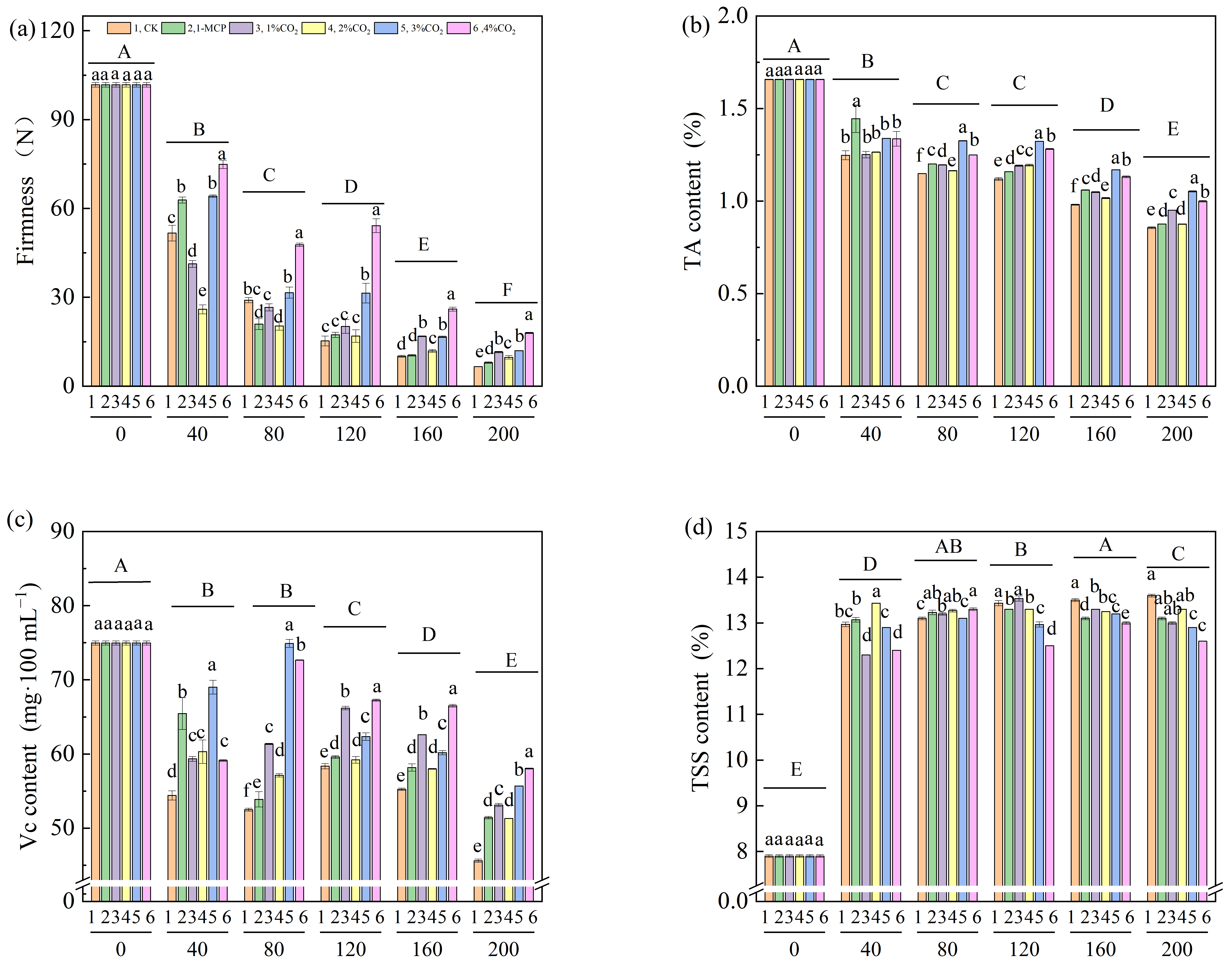
A two-way analysis of variance (ANOVA) revealed that treatment, storage time, and their interaction each had a significant effect on all quality parameters assessed (p < 0.05; Table 1). For most parameters, the interaction was highly significant (p < 0.001), whereas for b* and C, the interaction was significant but weaker (p = 0.026 and 0.015, respectively). Storage time consistently produced the largest F-values, indicating that time was the dominant factor driving postharvest changes. Given the significant interactions, one-way ANOVA was performed separately for treatment effects at each storage time and for time effects within each treatment. The results are presented in Figure 1, Figure 2, Figure 3 and Figure 4.

3.2. Effects of Different Treatments on Quality Attributes of ‘Jinyan’ Kiwifruit During Storage

Two-way ANOVA revealed significant main effects of treatment and storage time, as well as a significant treatment × time interaction, for all quality parameters (firmness, TA, Vc, and TSS) (all p < 0.05; Table 1). Simple effects analyses were therefore conducted to compare treatments at each storage day and to assess temporal changes within each treatment (Figure 1).
Firmness. Treatment significantly affected firmness throughout storage (p < 0.001; Table 1). Tukey’s HSD test grouped treatments into four homogeneous subsets. The 4% CO2 treatment (53.75 N) formed the highest subset, significantly firmer than all others (p < 0.05). The 3% CO2 treatment (42.97 N) formed the second highest subset. The 1-MCP (36.83 N), 1% CO2 (36.36 N), and control (35.71 N) belonged to the same intermediate subset, with no significant differences among them (p > 0.05). The 2% CO2 treatment (31.06 N) formed the lowest subset, indicating abnormal softening. Storage duration also significantly influenced firmness (p < 0.001; Table 1). Firmness declined continuously from harvest (day 0: 101.77 N) to day 200 (10.97 N), an 89% reduction. Each successive time point showed significantly lower firmness than the previous one (p < 0.05; Figure 1a). At day 40, the 4% CO2 treatment maintained the highest firmness (74.89 N), whereas the 2% CO2 treatment dropped sharply to 25.94 N (p < 0.05). At day 160, firmness in the 4% CO2 treatment (26.01 N) remained significantly higher than in the control (10.09 N) and all other treatments (p < 0.05). At day 200, firmness in the 4% CO2 treatment (17.98 N) was still significantly higher than in the control (6.57 N) and the 1-MCP treatment (7.95 N) (p < 0.05, Figure 1a).
Titratable acidity (TA). Treatment significantly affected TA (p < 0.001; Table 1). Tukey’s HSD test grouped treatments into five homogeneous subsets. The 3% CO2 (1.311%) and 4% CO2 (1.276%) treatments showed the highest TA, followed by 1-MCP (1.233%) and 1% CO2 (1.216%). The 2% CO2 (1.195%) and control (1.168%) treatments exhibited the lowest values, with the control being significantly lower than all others (p < 0.05). Storage duration also significantly influenced TA (p < 0.001; Table 1). TA peaked at harvest (1.657%) and then declined progressively. Mean values decreased to 1.314% at day 40, remained stable at approximately 1.21% from day 80 to 120 (p > 0.05), and then fell to 1.067% at day 160 and 0.935% at day 200, representing a 44% overall reduction (Figure 1b). At day 160, TA differed significantly among treatments. The 3% CO2 (1.17%) and 4% CO2 (1.13%) treatments retained significantly higher TA than the control (0.98%) and the 1-MCP treatment (1.06%) (p < 0.05).
Vc. Treatment significantly affected Vc content (p < 0.001; Table 1). Tukey’s HSD test grouped treatments into four homogeneous subsets. The 4% CO2 (66.4 mg·100 mL−1) and 3% CO2 (66.2 mg·100 mL−1) formed the highest subset (p > 0.05). The 1% CO2 (63.0 mg·100 mL−1) formed the second subset. The 1-MCP (61.6 mg·100 mL−1) formed the third. The 2% CO2 (60.2 mg·100 mL−1) and control (58.3 mg·100 mL−1) formed the lowest subset (p > 0.05). Storage duration also significantly influenced Vc content (p < 0.001; Table 1). Vc peaked at harvest (75.0 mg·100 mL−1) and decreased to 61.3 mg·100 mL−1 at day 40. It then increased slightly at day 80 (62.1 mg·100 mL−1) and day 120 (62.2 mg·100 mL−1), with no significant difference between these two time points (p > 0.05). Vc then declined to 60.1 at day 160 and reached a minimum at day 200 (52.5 mg·100 mL−1), a 30% reduction from harvest (Figure 1c). At day 160, Vc in the 4% CO2 treatment (66.5 mg·100 mL−1) was significantly higher than in the 3% CO2 (60.2 mg·100 mL−1), 1-MCP (58.2 mg·100 mL−1), and control (55.3 mg·100 mL−1) (p < 0.05). At day 200, Vc in the 4% CO2 treatment remained significantly higher than in the control (45.6 mg·100 mL−1), 1-MCP (51.4 mg·100 mL−1), and 1% and 2% CO2 treatments (51.3–53.1 mg·100 mL−1) (p < 0.05), but no longer differed from the 3% CO2 treatment (55.7 mg·100 mL−1) (p > 0.05).
TSS. Treatment significantly affected TSS content (p < 0.001; Table 1). The control (12.42%) and 2% CO2 (12.41%) showed the highest TSS, with no significant difference between them (p > 0.05). The 1-MCP (12.28%) and 1% CO2 (12.21%) exhibited intermediate values, followed by 3% CO2 (12.16%). The 4% CO2 treatment (11.95%) recorded the lowest TSS (p < 0.05). Storage duration also significantly influenced TSS (p < 0.001; Table 1). TSS increased sharply from harvest (7.90%) to day 40 (12.85%), then further rose to day 80 (13.08%). From day 80 to day 200, TSS remained consistently high, with no significant differences among days 80, 120, 160, and 200 (p > 0.05). The peak value (13.23%) was observed at day 160 (Figure 1d). At day 160, TSS in the control (13.50%) was significantly higher than in all other treatments (p < 0.05). At day 200, TSS in the 3% CO2 (12.90%) and 4% CO2 (12.60%) treatments were both significantly lower than in the control (13.60%) (p < 0.05).
Firmness and TA followed first-order kinetics in all treatments (Table 2). Compared with the control, the 4% CO2 treatment reduced the softening rate constant by 39.2%, while the 3% CO2 treatment reduced the TA loss rate constant by 33.9%. All treatments showed good linear fits for firmness (R2 > 0.83) and TA (R2 = 0.847–0.961).
For Vc, the content did not decline monotonically in several treatments (Figure 1c). In the 1-MCP, 2% CO2, and 3% CO2 treatments, Vc increased transiently between 40 and 80 days of storage before decreasing. Nevertheless, first-order kinetics were fitted to these treatments for comparative purposes, with the rate constants k interpreted as approximate descriptors of overall trends rather than strictly valid kinetic parameters. Under these conditions, first-order fitting was significant for the 1-MCP, 2% CO2, and 3% CO2 treatments (R2 = 0.620–0.783). In contrast, fits for the control, 1% CO2, and 4% CO2 treatments were not significant (p > 0.05), indicating that Vc degradation did not follow a simple first-order pattern under these conditions.

3.3. Flesh Colour Evolution of ‘Jinyan’ Kiwifruit Under Different Treatments During Cold Storage

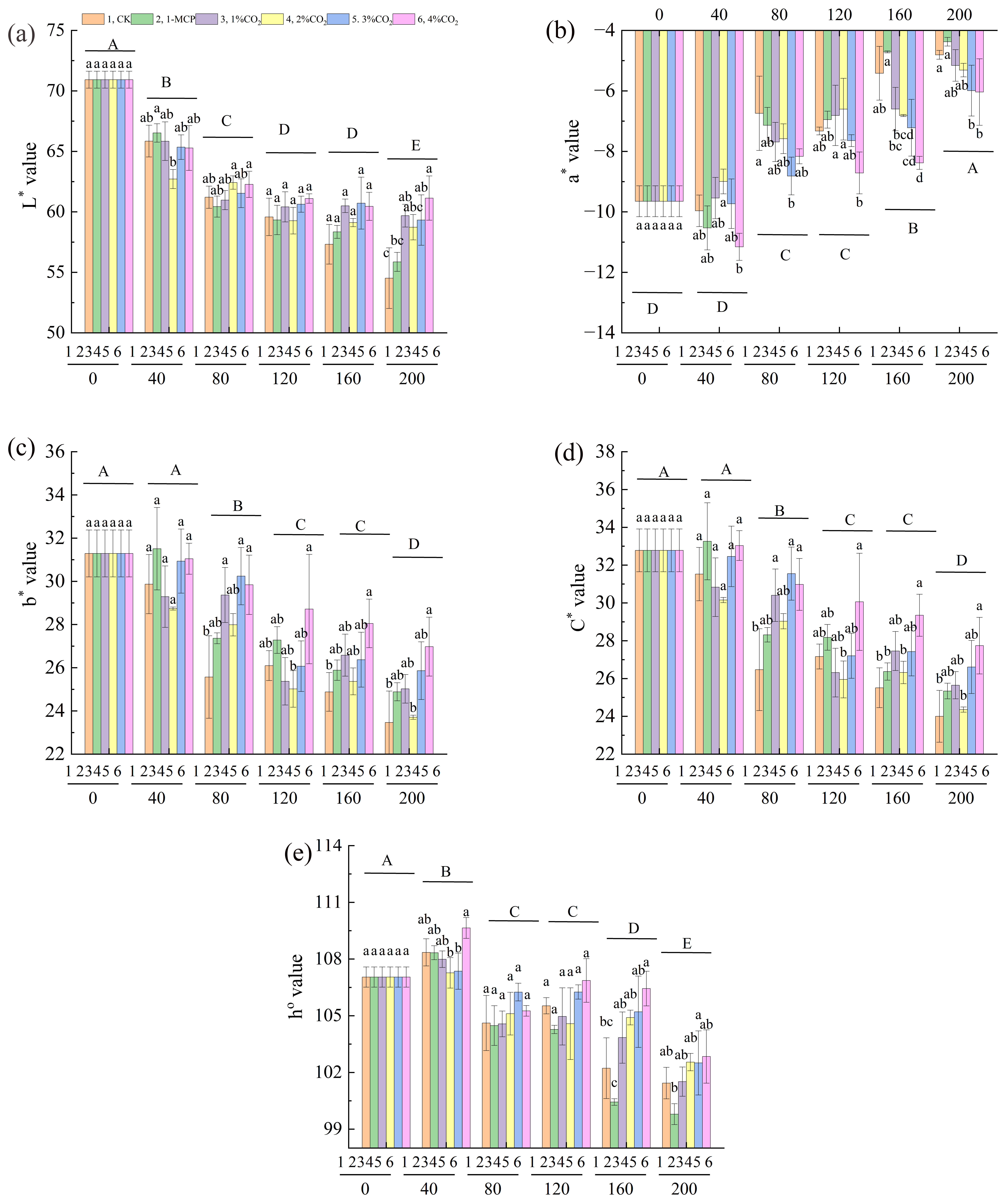
Throughout storage, flesh color of ‘Jinyan’ kiwifruit showed significant treatment-dependent changes (p < 0.05). L* decreased progressively. a* increased (became less negative), indicating loss of greenness. b* and C* first increased, then decreased. h° declined, reflecting a shift from yellow-green to dull yellow-brown. The control showed the greatest reductions in L*, b*, C*, and h°, and the fastest increase in a*.
Treatment significantly affected L* (p < 0.001; Table 1). The 4% CO2 treatment (63.53) had the highest L*, followed by 3% CO2 (63.08) and 1% CO2 (63.06), which were statistically similar. The 2% CO2 (62.19), 1-MCP (61.90), and control (61.57) showed lower L* values, with no significant differences among them (p > 0.05). L* decreased progressively from harvest (70.93) to day 200 (58.21). Most time points differed significantly, except between day 160 (59.41) and day 120 (60.05) (p > 0.05). At day 200, the 4% CO2 treatment maintained significantly higher L* (61.14) than the control (54.52) and all other treatments (p < 0.05; Figure 2a), indicating that elevated CO2 delayed flesh browning.
Treatment significantly affected a* (p < 0.001; Table 1). The 4% CO2 treatment (−8.68) had the most negative (greenest) a, followed by 3% CO2 (−8.18). The remaining treatments showed less negative values, with no significant differences among them (p > 0.05). A became progressively less negative over time. The most negative values occurred at day 40 (−9.99) and day 0 (−9.65) (p > 0.05), then increased to −7.69 at day 80 and −7.34 at day 120 (p > 0.05), followed by −6.52 at day 160 and −5.28 at day 200 (Figure 2b). At day 160, the 4% CO2 treatment maintained the most negative a* (−8.38), significantly lower than the control (−5.42) and 1-MCP (−4.71) (p < 0.05). At day 200, both 4% CO2 (−6.04) and 3% CO2 (−5.99) maintained significantly more negative a* than the control (−4.81) and 1-MCP (−4.38) (p < 0.05).
Treatment significantly affected b* and C* (p < 0.001; Table 1). For both parameters, the 4% CO2 treatment showed the highest values (29.32 and 30.66), followed by 3% CO2 (28.46 and 29.67). The control and 2% CO2 exhibited the lowest values. Over time, b* and C* decreased from harvest to day 200. At day 160, both parameters in the 4% CO2 treatment (28.05 and 29.35) were significantly higher than in the control (24.88 and 25.51) (p < 0.05). At day 200, the 4% CO2 treatment maintained the highest b* (26.97) and C* (27.74) among all treatments (Figure 2c,d).
Treatment significantly affected h° (p < 0.001; Table 1). The 4% CO2 treatment (106.35) exhibited the highest h°, followed by 3% CO2 (105.77) and 2% CO2 (105.24). The 1% CO2 (104.99), control (104.87), and 1-MCP (104.06) showed the lowest values. Storage duration also significantly influenced h° (p < 0.001; Table 1). At harvest (day 0), h° was 107.05, indicating a green-yellow hue. It then increased slightly to a peak of 108.16 at day 40, reflecting a greener color. Thereafter, h° declined progressively, reaching 105.05–105.41 at days 80–120, 103.84 at day 160, and 101.77 at day 200. This downward trend indicates a gradual shift from green toward yellow as storage progressed, with h° approaching 90 (Figure 2e). At day 160, h° in the 4% CO2 treatment (106.44) was significantly higher than in the control (102.22) and 1-MCP (100.43) (p < 0.05), indicating that 4% CO2 better retained the green-yellow hue and delayed yellowing. The 3% CO2 treatment also showed strong color retention, though slightly less effective than 4% CO2. Low CO2 (1–2%) had no significant effect on color compared with the control (p > 0.05).
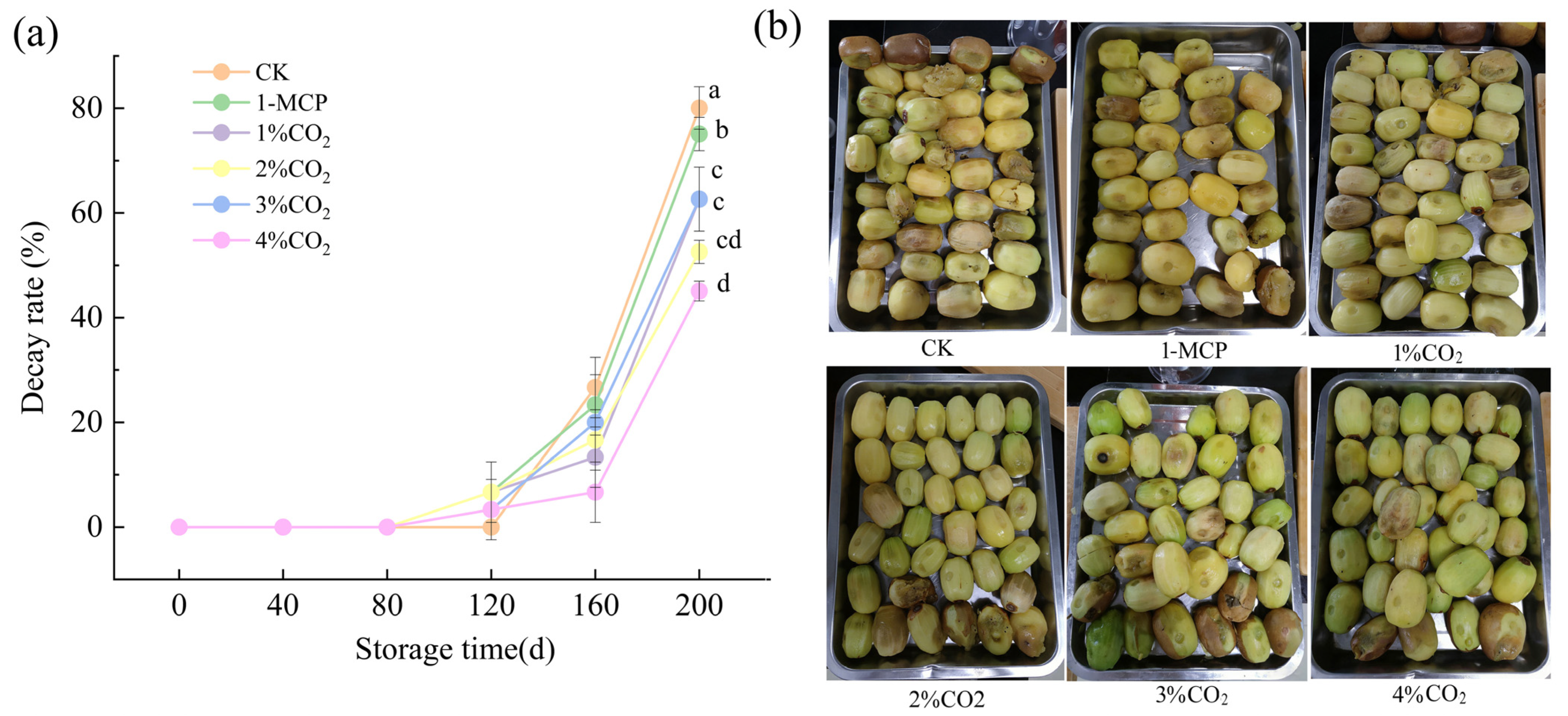
During storage, the decay rate increased gradually, with observable differences among treatment groups (Figure 3a). In the early storage period (0–80 days), decay remained very low across all treatments. By day 120, decay first appeared, ranging from 3.33% to 6.67%. The 4% CO2 treatment showed the lowest rate (3.33%).
By day 160, decay had worsened considerably. The control group had the highest decay rate (26.67%), followed by the 1-MCP treatment (23.33%). In contrast, the 4% CO2 treatment continued to show the lowest decay rate (6.67%), compared with 26.67% in the control and 23.33% in the 1-MCP group. The decay rates in the 1% CO2 (13.33%), 2% CO2 (16.67%), and 3% CO2 (20.00%) treatments were intermediate. Notably, the 4% CO2 treatment was the only one that kept decay below 10% at day 160, suggesting a trend toward better rot control during mid-storage.
On day 200, the control group had the highest decay rate (80.04%), followed by the 1-MCP treatment (75.09%). A significant difference was observed (p < 0.05): the 4% CO2 treatment resulted in the lowest decay rate (45.05%), which was significantly lower than those of CK, 1-MCP, 1% CO2, and 3% CO2 treatments. However, no significant difference was found between the 4% CO2 and 2% CO2 treatments (52.56%, p > 0.05; Figure 3a). Although there was no statistical difference between the 4% and 2% CO2 treatments at day 200, the 2% CO2 treatment induced abnormal softening as early as day 40 (Figure 1a), making it unsuitable for commercial storage despite its moderate decay rate.
The 1-MCP treatment (75.09%) and low CO2 concentrations (1–2%) exhibited higher decay rates at day 200 than the 3% and 4% CO2 treatments. These results indicate that elevated CO2 concentrations (3–4%) effectively suppressed decay development, particularly during the critical mid-to-late storage period. Visual inspection (Figure 3b) confirmed that the 4% CO2 treatment best preserved flesh greenness and minimized rot.

3.4. Respiration and Antioxidant Enzyme Responses of ‘Jinyan’ Kiwifruit to Different Treatments During Cold Storage

Two-way ANOVA revealed significant treatment × time interactions for all antioxidant enzymes (POD: F = 19.60, p < 0.001; CAT: F = 3.19, p < 0.001; SOD: F = 36.05, p < 0.001; Table 1). These interactions indicate that treatment effects on enzyme activities were time-dependent, with differences becoming more pronounced during late storage (160–200 days).
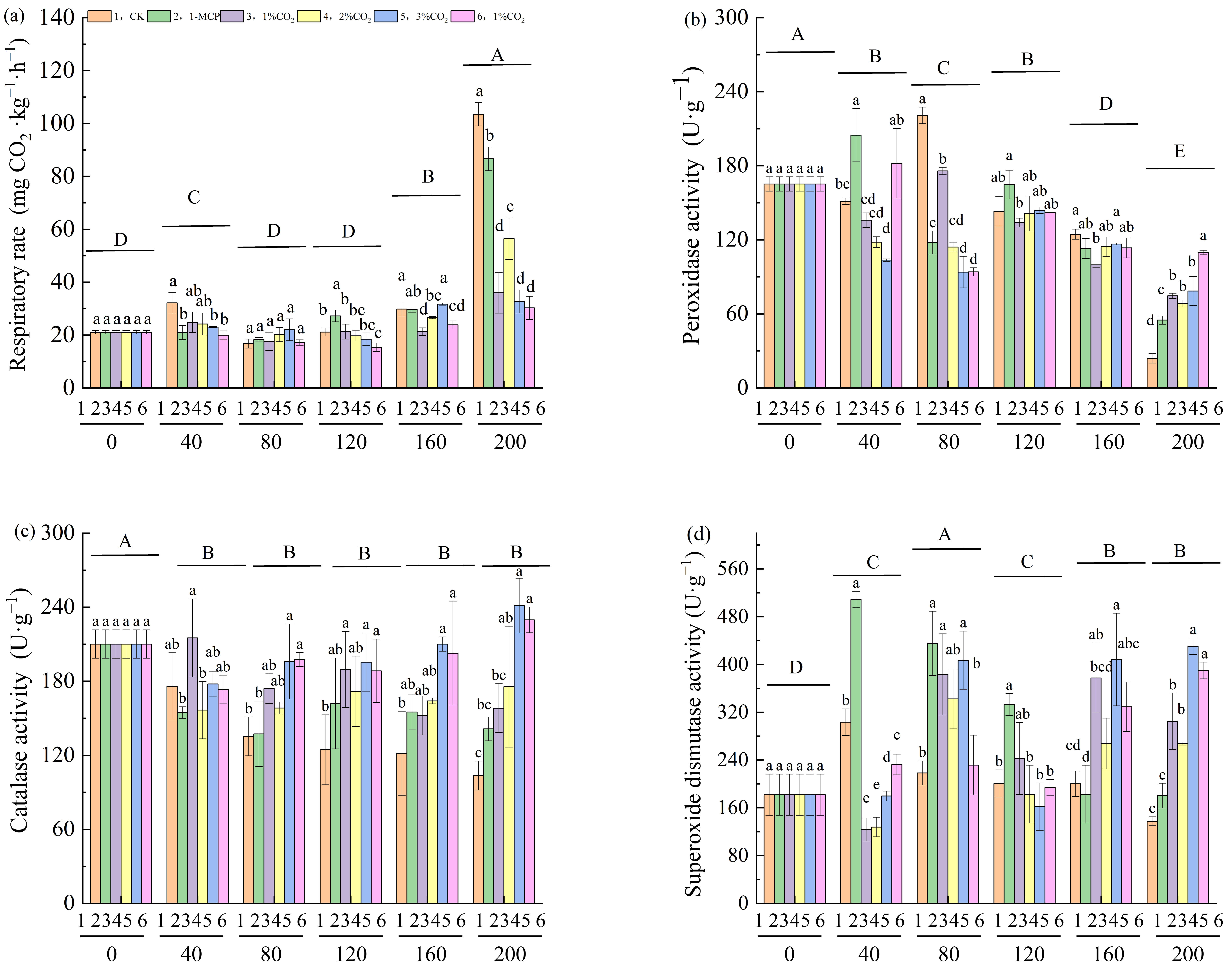
Respiration rate. Treatment significantly affected respiration rate throughout storage (p< 0.001; Table 1). Tukey’s HSD test grouped treatments into five homogeneous subsets. The 4% CO2 treatment had the lowest respiration rate (21.25 mg CO2·kg−1·h−1), significantly lower than all others (p < 0.05). The 1% CO2 (23.65 mg CO2·kg−1·h−1) and 3% CO2 (24.79 mg CO2·kg−1·h−1) treatments did not differ significantly (p > 0.05), but both showed significantly lower rates than the 2% CO2 treatment (27.99 mg CO2·kg−1·h−1). The 1-MCP treatment (33.94 mg CO2·kg−1·h−1) and control (37.79 mg CO2·kg−1·h−1) exhibited the highest rates, with the control being significantly higher than all others (p < 0.05). Storage duration also significantly influenced respiration rate (p < 0.001; Table 1). The mean rate decreased from day 0 to a minimum at day 80 (18.64), then increased to a maximum at day 200 (57.56 mg CO2·kg−1·h−1), which was significantly higher than at all other time points (p < 0.05). No significant differences were found among days 0, 40, and 120 (p > 0.05). During early storage (0–80 days), most treatments showed no significant differences. From mid to late storage (120–200 days), however, the 4% CO2 treatment consistently maintained the lowest respiration rate, whereas the control and 1-MCP treatments increased substantially, with the control peaking at day 200 (Figure 4a).
POD activity. Across all treatments, POD activity varied significantly with treatment and storage time (p < 0.001; Table 1). The 3% CO2 (116.93 U·g−1) and 2% CO2 (120.24 U·g−1) treatments showed the lowest mean activities, whereas the remaining treatments formed a higher subset with no significant differences among them (p > 0.05). Over time, mean POD activity was highest at harvest (day 0: 165.22 U·g−1) and decreased progressively to a minimum at day 200 (68.34 U·g−1), a 59% reduction. At day 200, the 4% CO2 treatment exhibited the highest POD activity (109.69 U·g−1), significantly exceeding that of the control (23.96 U·g−1) and all other treatments (p < 0.05; Figure 4b).
CAT activity. CAT activity also differed significantly among treatments and over time (p < 0.001; Table 1). The 3% CO2 treatment (205.08 U·g−1) had the highest mean activity, followed by 4% CO2 (200.27 U·g−1). The 1% CO2 (183.17 U·g−1) and 2% CO2 (172.70 U·g−1) treatments were intermediate, whereas the 1-MCP (160.06 U·g−1) and control (145.11 U·g−1) treatments showed the lowest activities (p < 0.05). Temporally, mean CAT activity peaked at harvest (day 0: 210.09 U·g−1) and then declined sharply. From day 40 onward, activity remained consistently lower, with no significant fluctuations among days 40, 80, 120, 160, and 200 (p > 0.05). At day 80, the 3% CO2 and 4% CO2 treatments displayed significantly higher CAT activity than the control and 1-MCP treatments (p < 0.05). At day 160, CAT activity in the 3% CO2 treatment (210.07 U·g−1) was nearly double that of the control (121.50 U·g−1). At day 200, the 3% CO2 (241.22 U·g−1) and 4% CO2 (229.69 U·g−1) treatments continued to show significantly higher CAT activity than the control, 1-MCP, and 1% CO2 treatments (p < 0.05; Figure 4c).
SOD activity. SOD activity varied significantly with treatment and storage time (p < 0.001; Table 1). The 1-MCP treatment (303.61 U·g−1) had the highest mean activity, followed by 3% CO2 (294.86 U·g−1) and 1% CO2 (268.92 U·g−1), which belonged to the same statistical subset. The 4% CO2 (259.77 U·g−1) and 2% CO2 (228.26 U·g−1) treatments were intermediate, whereas the control (206.98 U·g−1) showed the lowest activity (p < 0.05). Over time, mean SOD activity reached its lowest at day 0 (181.77 U·g−1), increased to intermediate levels at days 120 (219.12 U·g−1) and 40 (245.94 U·g−1), and peaked at day 80 (336.29 U·g−1), significantly higher than at all other time points (p < 0.05). Days 160 (294.22 U·g−1) and 200 (285.05 U·g−1) showed similarly high activity (p > 0.05). At individual time points, notable treatment-specific patterns emerged. In the 1-MCP treatment, SOD activity peaked at day 40 (508.78 U·g−1), 1.7 times that of the control (303.42 U·g−1), and then declined rapidly. In contrast, the 2% CO2 treatment exhibited very low activity at day 40 (127.69 U·g−1), only 42% of the control value, consistent with the abnormal softening observed in this treatment (Figure 1a).
Collectively, these results indicate that 4% CO2 most effectively suppressed respiration and maintained POD and CAT activities during late storage, whereas 1-MCP enhanced SOD activity primarily at the early storage stage.

4. Discussion

This study evaluated the effects of 1–4% CO2 (with fixed 5% O2) on postharvest quality of ‘Jinyan’ kiwifruit (Actinidia eriantha × A. chinensis) during long-term cold storage at 1 ± 0.5 °C. The results show that ‘Jinyan’ exhibits sensitivity to low CO2 levels in a parameter-specific manner, primarily evidenced by abnormal softening and reduced SOD activity at 2% CO2. Specifically, 2% CO2 induced abnormal softening within 40 days. Therefore, a 4% CO2 setpoint provides a necessary safety margin to accommodate typical fluctuations in commercial controlled-atmosphere storage (≥±0.5%). Compared with 1-MCP or lower CO2 concentrations, 4% CO2 significantly delayed quality deterioration, reduced decay, and better preserved green flesh color. Although the experiment lasted 200 days to capture long-term physiological dynamics, quality parameters at 160 days support a recommended maximum commercial storage duration of 160 days for ‘Jinyan’ kiwifruit.

4.1. Low CO2 Sensitivity and the Critical Safety Range

A key finding of this study is the sensitivity of ‘Jinyan’ kiwifruit to low CO2 levels, as evidenced by abnormal softening and reduced SOD activity under the 2% CO2 treatment (Figure 1a). Within 40 days, firmness in the 2% CO2 treatment dropped sharply to 27.95 N, significantly lower than in the control (51.71 N) or the 1% CO2 treatment (41.29 N). In contrast, the 4% CO2 treatment maintained the highest firmness (74.87 N). However, other quality parameters—including TA, Vc, color, decay rate, and respiration rate—did not exhibit similarly abnormal patterns at 2% CO2. Thus, the low CO2 sensitivity of ‘Jinyan’ is parameter-specific rather than reflecting a general physiological collapse, with firmness and SOD activity being the primary indicators of low CO2 stress.
To understand why 2% CO2 induces abnormal softening while 1% CO2 does not, it is necessary to examine the underlying physiological mechanisms. Kiwifruit is highly sensitive to ethylene; even trace amounts can trigger a ripening cascade [22]. When CO2 falls below a critical range, the fruit enters a vulnerable sub-optimal CA state. Under 2% CO2, ethylene biosynthesis is insufficiently suppressed, allowing accumulation of ACC and ethylene. Residual ethylene activates downstream signaling via the CTR1–EIN2–EIN3 cascade, up-regulating transcription factors such as AcERF61 and promoting cell wall degradation gene expression [23,24].
Under effective CO2 control, pectinases, phospholipases, cellulases, and β-galactosidases are significantly reduced, preserving pectin and cellulose [25]. However, under 2% CO2, these enzymes remain active, leading to rapid pectin solubilization and cellulose degradation. Concurrently, low O2 combined with low CO2 induces fermentative metabolism. Accumulation of ethanol and acetaldehyde disrupts cell membrane integrity, favoring acidic hydrolases such as polygalacturonase (PG) [26]. In the 2% CO2 treatment, the sharp firmness decline at day 40 coincided with the period of typical fermentative metabolite accumulation.
Why did 1% CO2 not induce similar abnormal softening? The answer likely lies in a non-linear, U-shaped dose–response relationship. At 2% CO2, the concentration is low enough to disrupt normal metabolic suppression (e.g., inadequate inhibition of ethylene biosynthesis) yet high enough to induce a stress response that paradoxically accelerates ripening. At 1% CO2, the concentration may fall below the range required to trigger this stress response, allowing a more typical ripening pattern. A similar phenomenon has been observed in other fruits; for example, low CO2 concentrations can stimulate rather than suppress ethylene production in pear [27]. This U-shaped response warrants further investigation into the underlying molecular mechanisms in kiwifruit.
Control fruit followed a normal ripening pattern, with no abnormal softening. Thus, the critical range appears to lie within a narrow range around 2% CO2, where low CO2 acts as a metabolic stressor rather than a suppressor. The lower injury at 1% CO2 compared with 2% supports the interpretation that a minimum CO2 concentration is needed to disrupt normal metabolism. These findings indicate that the concentration-dependent effects of CO2 on ‘Jinyan’ kiwifruit under CA storage are not linear.
The sensitivity of ‘Jinyan’ to low CO2 has direct commercial implications. If a CA system is set to 3% CO2, typical fluctuations of ±0.5% may lower the concentration to 2.5%, which falls within the stress-response range. A target of 4% CO2 is recommended not because it outperforms 3% CO2 in every quality metric, but because it provides a necessary safety margin for this sensitive cultivar. Quantitatively, 4% CO2 also offers commercially meaningful advantages over 3% CO2, including significantly lower decay rates and better retention of green flesh color. These benefits have important economic implications for long-term storage of ‘Jinyan’ kiwifruit.

4.2. Physiological Mechanisms of Quality Preservation Under Elevated CO2

In ‘Jinyan’ kiwifruit, the quality benefits of elevated CO2 (3–4%) arise from three interrelated mechanisms: suppression of respiration, sustained antioxidant enzyme activity, and preservation of fruit quality. Compared with the control (103.5 mg CO2·kg−1·h−1), 4% CO2 significantly reduced the peak respiration rate to 30.3 mg CO2·kg−1·h−1. This aligns with observations in ‘Hayward’ kiwifruit under CA storage [28]. High CO2 inhibits citric acid cycle enzymes, reducing metabolic flux and delaying senescence [12].
During late storage, CAT and POD activities in the 3% and 4% CO2 treatments were significantly higher than in other treatments. Within the recommended 160-day storage period, CAT activity in the 4% CO2 treatment was 202.69 U·g−1 at day 160, nearly double that of the control (121.50 U·g−1). Beyond this period (at day 200), CAT activity in the control decreased to 103.45 U·g−1, whereas the 3% and 4% CO2 groups maintained 241.22 and 229.69 U·g−1, respectively. Increased CAT activity likely enhances hydrogen peroxide scavenging, reducing oxidative damage to cell membranes and delaying senescence [29].
This pattern may reflect a low-consumption adaptive strategy under high CO2. Early in storage (day 40), 4% CO2 suppressed respiration and reduced the demand for antioxidant enzymes [30]. SOD and POD activities in the 4% CO2 group did not differ significantly from the control. This temporary downregulation may represent an energy-saving adaptive mechanism. When ROS production intensified during late storage, fruit under high CO2 rapidly upregulated CAT and POD activities, alleviating oxidative stress more effectively [31]. This pattern is consistent with findings in fresh-cut pears, where 10% CO2 enhanced antioxidant enzyme activity and reduced ROS accumulation [32]. Thus, high CO2 maintains fruit quality not only by increasing antioxidant enzyme levels but also by promoting their timely activation and functional balance.
Within the recommended 160-day storage period, the 4% CO2 treatment significantly outperformed the control and 1-MCP treatments. At day 160, it maintained higher firmness (26.01 N vs. 10.09 N and 12.94 N), TA (1.13% vs. 0.98% and 1.06%), and Vc (66.5 vs. 55.3 and 58.2 mg·100 mL−1) (p < 0.05; Figure 1a–c). Thus, 4% CO2 effectively delayed the loss of key quality attributes during the recommended storage period.
A methodological note is warranted regarding the application of first-order kinetics to Vc data. As shown in Figure 1c, Vc content did not decline monotonically in several treatments; it increased transiently between 40 and 80 days of storage before decreasing. This non-monotonic pattern violates the monotonic decline assumption required for first-order kinetic modeling. Therefore, the kinetic parameters reported for Vc (Table 2) should be interpreted with caution. They provide approximate descriptors of overall degradation trends, not strictly valid kinetic constants. With this caveat, first-order kinetic analysis showed that 4% CO2 reduced the softening rate constant by 39.2%, and 3% CO2 reduced TA loss by 33.9%.
A temporary increase in Vc content occurred during mid-to-late storage, appearing earliest and most pronounced in the 3% and 4% CO2 treatments. Similar observations have been reported in ‘Cuixiang’ kiwifruit under CA storage [33]. Elevated CO2 inhibits ethylene biosynthesis and signal transduction, delaying rapid senescence and creating a window during which the antioxidant system remains functional [34]. Within this window, moderate oxidative stress induced by high CO2 acts as a signal to pre-activate antioxidant defenses, upregulate the ascorbate–glutathione (AsA-GSH) cycle, and enhance dehydroascorbate reductase (DHAR) and monodehydroascorbate reductase (MDHAR) activities [35,36]. Consequently, Vc regeneration temporarily exceeds degradation, producing the observed mid-storage peak. This effect was most pronounced under 3–4% CO2, whereas 1-MCP produced only a slight and delayed increase.
Flesh color is critical to ‘Jinyan’ quality. The 4% CO2 treatment effectively delayed the transition from green to yellow to brown. The hue angle (h°) data (Figure 2e) showed that the 4% CO2 treatment consistently maintained higher h° values than the control and 1-MCP treatments, particularly at day 160 (106.44 vs. 102.22 in the control) and at day 200 (102.84 vs. 101.44 in the control), indicating better retention of the green-yellow hue. Within the 1–4% CO2 range, h° increased gradually with rising CO2 concentration. This result is consistent with findings in broccoli, where elevated CO2 maintained green color by inhibiting chlorophyll catabolism [37].
The suppression of decay under 4% CO2 agrees with reports on strawberry and blueberry, where high CO2 reduced fungal growth and maintained firmness [38,39]. We observed no symptoms of CO2 injury in the 4% CO2 treatment. Within the recommended 160-day period, decay in the 4% CO2 treatment was only 6.67%, compared with 26.67% in the control. Beyond 160 days (at day 200), decay increased to 45.05% in the 4% CO2 treatment, although this remained significantly lower than the control (80.04%). This reduction likely results from direct pathogen inhibition and indirect effects, including maintained cell integrity and reduced oxidative stress.

4.3. Time-Dependent Effects of Treatments and Implications for Storage Duration

A key finding is the significant treatment × time interaction for all quality parameters (Table 1). This indicates that treatment effects are not constant over time, with important practical implications. It should be noted, however, that for b* and C*, the interactions, while statistically significant, were much weaker (F = 1.82 and 1.94, respectively; p = 0.026 and 0.015) than for other color parameters (L*, a*, h°). This suggests that the effect of CO2 treatment on yellowness and color saturation was less time-dependent than its effect on lightness and greenness, possibly because browning (reflected by a* and L*) is more sensitive to CA conditions than yellow pigment accumulation.
1-MCP effectively delayed softening during early storage (0–80 days), but its efficacy gradually diminished thereafter. By 160–200 days, fruit quality in the 1-MCP group (firmness: 8.00–10.42 N) did not differ significantly from the control. This discrepancy from previous reports [8,9] may be due to gradual ethylene accumulation and recovery of ethylene sensitivity over extended storage [40].
In contrast, CA treatments provided sustained benefits throughout storage. The 3% CO2 treatment was effective between 80 and 160 days, while 4% CO2 performed best during late storage (120–200 days). The optimal CA combination for ‘Jinyan’ (5% O2 + 4% CO2) is slightly higher than the CO2 level used for ‘Hayward’ (5% CO2 + 2% O2) [13] and that used for ‘Jintao’ (5% O2 + 3% CO2) [14]. This contrasts with our previous study on ‘Jintao’, where 4% CO2 caused injury and 3% CO2 was optimal [14]. The opposite CO2 responses of these two yellow-fleshed cultivars highlight the necessity of cultivar-specific CA optimization.
We observed no symptoms of CO2 injury (e.g., internal browning or off-flavors) in the 4% CO2 treatment. Beyond the recommended 160-day period (at day 200), normal senescence-associated decay and surface browning occurred, but the decay rate in the 4% CO2 treatment (45.05%) was significantly lower than in the control (80.04%). Within the recommended 160-day period, the benefits of 4% CO2 were fully evident at 160 days, including higher firmness (26.01 N), TA (1.13%), Vc (66.51 mg·100 mL−1), h° (106.44), and lower decay (6.67%). These values exceed the minimum commercial range for kiwifruit after cold storage (approximately 14.0–18.6 N, equivalent to 1.5–2.0 kg·cm−2). In contrast, the control had firmness of 10.14 N and decay of 23.3% at 160 days. Therefore, we recommend 5% O2 + 4% CO2 at 1 °C, with a maximum commercial storage period of 160 days for ‘Jinyan’ kiwifruit.
Based on these time-dependent trends, we propose the following storage strategies. For short-term storage (<80 days), 1-MCP is a cost-effective option. For medium-to-long-term storage (80–160 days), 5% O2 + 3% CO2 balances quality preservation and cost. For optimal quality retention with a safety margin, 5% O2 + 4% CO2 is recommended. While our lab-scale system achieved high precision (±0.25%), many commercial CA facilities may experience fluctuations of ±0.5% or more. A setpoint of 3% CO2 could drift to 2.5%, entering the critical range where abnormal softening occurred. Therefore, we recommend a target of 4% CO2 to provide a practical safety margin for commercial application.

4.4. Limitations of the Study and Future Directions

This study had several limitations. The fruit was sourced from a single orchard, only one storage temperature (1 °C) was tested, and combined 1-MCP plus CA treatments were not evaluated. No molecular-level analyses were performed. Additionally, several postharvest parameters were not assessed, including sensory evaluation, shelf life after storage, and ethylene production. Reliable ethylene data could not be obtained due to a technical issue with the flame ionization detector. Nevertheless, under CA conditions with low O2 and elevated CO2, ethylene production is known to be strongly suppressed, partially mitigating this limitation.
Future studies should incorporate these parameters. Multi-season and multi-location trials are needed to validate the robustness of the recommended 4% CO2 regime. Commercial operators should validate this protocol under their specific conditions before large-scale application. If control precision is uncertain, increasing the safety margin or monitoring frequency should be considered.
Since elevated CO2 can induce off-flavors in some fruits, future research should include sensory evaluation and volatile profiling to confirm that high CO2 does not impair flavor. Transcriptomic and metabolomic approaches should be employed to investigate how high CO2 regulates pigment metabolism, antioxidant enzyme expression, and ethylene signaling in ‘Jinyan’ kiwifruit, as well as the mechanisms underlying the abnormal softening observed at 2% CO2.

5. Conclusions

This study demonstrates that ‘Jinyan’ kiwifruit exhibits sensitivity to low CO2 in a parameter-specific manner, with abnormal softening and reduced SOD activity as the primary indicators at 2% CO2. The critical safe range lies between 2% and 3% CO2. Exposure to 2% CO2 induced abnormal softening within 40 days; therefore, concentrations below 3% should be avoided in commercial practice.
Typical commercial CA fluctuations (±0.5% or more) can lower a 3% CO2 setpoint to 2.5%, which is potentially injurious for ‘Jinyan’. Thus, we recommend targeting 4% CO2 (with 5% O2 at 1 °C). This regime provides a necessary safety margin while maintaining excellent quality. The 4% CO2 treatment significantly delayed softening, reduced losses of TA and Vc, suppressed respiration, and maintained higher CAT and POD activities. No symptoms of CO2 injury (e.g., internal browning or off-flavors) were observed in the 4% CO2 treatment. The transient mid-storage increase in Vc is consistent with activation of the ascorbate–glutathione cycle, although direct measurement of this pathway was not performed.
Although the experiment lasted 200 days, the benefits of 4% CO2 were fully evident within the recommended 160-day storage period, including higher firmness (26.01 N), lower decay (6.67%), and better color retention (h° = 106.44). For commercial application, we therefore recommend a maximum storage period of 160 days under 5% O2 + 4% CO2 at 1 °C.
In conclusion, CA storage with 5% O2 + 4% CO2 at 1 °C is recommended as a cultivar-specific alternative to 1-MCP for long-term storage of ‘Jinyan’ kiwifruit. It offers superior quality retention and a practical safety margin against low CO2 injury under commercial conditions.

Author Contributions

Conceptualization, S.Z., J.N., W.C., K.Z. and Y.L.; methodology, J.N., S.Z., W.C., K.Z. and Y.L.; software, J.N. and S.Z.; validation, J.N., S.Z., K.Z., W.C., and Y.L.; formal analysis, J.N. and S.Z.; investigation, K.Z. and W.C.; resources, Y.L. and S.Z.; data curation, J.N. and S.Z.; writing—original draft preparation, J.N. and S.Z.; writing—review and editing, J.N. and S.Z.; visualization, J.N. and S.Z.; supervision, J.N.; project administration, J.N. and S.Z.; funding acquisition, S.Z. All authors have read and agreed to the published version of the manuscript.

Funding

This work is financially supported by the Modern Agricultural Industry Technology of Henan Province (HARS-22-09-G5).

Data Availability Statement

The original contributions presented in this study are included in the article. Further inquiries can be directed to the corresponding author.

Conflicts of Interest

The authors would like to declare that there are no conflicts of interest in this paper.

References

  1. Mworia, E.G.; Yoshikawa, T.; Salikon, N.; Oda, C.; Fukuda, T.; Suezawa, K.; Asiche, W.O.; Ushijima, K.; Nakano, R.; Kubo, Y. Low-Temperature-Modulated Fruit Ripening Is Independent of Ethylene in ‘Sanuki Gold’ Kiwifruit. J. Exp. Bot. 2012, 63, 963–971. [Google Scholar] [CrossRef]
  2. Huang, Z.H.; Guo, L.F.; Wang, H.; Qu, H.X.; Ma, S.M.; Liu, Y.F.; Huang, H.W.; Jiang, Y.M. Energy Status of Kiwifruit Stored under Different Temperatures or Exposed to Long-Term Anaerobic Conditions or Pure Oxygen. Postharvest Biol. Technol. 2014, 98, 56–64. [Google Scholar] [CrossRef]
  3. Zhong, C.H.; Wang, S.M.; Jiang, Z.W.; Huang, H.W. ‘Jinyan’, an Interspecific Hybrid Kiwifruit with Brilliant Yellow Flesh and Good Storage Quality. HortScience 2012, 47, 1187–1190. [Google Scholar] [CrossRef]
  4. Yan, H.L.; Chen, H.X.; Zhao, J.L.; Yao, T.; Ding, X.C. Postharvest H2O2 Treatment Affects Flavor Quality, Texture Quality and ROS Metabolism of ‘Hongshi’ Kiwifruit Fruit Kept at Ambient Conditions. Food Chem. 2023, 405, 134908. [Google Scholar] [CrossRef]
  5. Wang, Q.; An, X.X.; Xiang, M.L.; Chen, X.; Luo, Z.Y.; Fu, Y.Q.; Chen, M.; Chen, J.Y. Effects of 1-MCP on the Physiological Attributes, Volatile Components and Ester-Biosynthesis-Related Gene Expression during Storage of ‘Jinyan’ Kiwifruit. Horticulturae 2021, 7, 381. [Google Scholar] [CrossRef]
  6. Jiang, L.H.; Zhan, M.X.; Chen, Y.Y.; Zeng, L.C.; Ma, Q.L. Quality Evaluation of 1-MCP Treated ‘Jinyan’ Kiwifruit during Ambient Storage and Post-Cold Storage Shelf Life. Storage Process 2025, 25, 21–32. [Google Scholar] [CrossRef]
  7. Tang, F.Y.; Li, W.J.; Wang, T.; Wang, J.; Li, L.J.; Deng, Q.X. Effect of 1-MCP Treatment on Preservation and Quality of ‘Jinyan’ Kiwifruit. IOP Conf. Ser. Earth Environ. Sci. 2021, 267, 062039. [Google Scholar] [CrossRef]
  8. Zhang, J.; Ma, Y.C.; Dong, C.; Terry, L.A.; Watkins, C.B.; Yu, Z.F.; Cheng, Z.-M. Meta-Analysis of the Effects of 1-Methylcyclopropene (1-MCP) Treatment on Climacteric Fruit Ripening. Hortic. Res. 2020, 7, 208. [Google Scholar] [CrossRef] [PubMed]
  9. Huang, H.; Guo, L.F.; Wang, L.; Wang, H.; Ma, S.M.; Jiang, Y.Y.M.; Qu, H.X. 1-Methylcyclopropene (1-MCP) Slows Ripening of Kiwifruit and Affects Energy Status, Membrane Fatty Acid Contents and Cell Membrane Integrity. Postharvest Biol. Technol. 2019, 156, 110941. [Google Scholar] [CrossRef]
  10. European Food Safety Authority (EFSA). Evaluation of Confirmatory Data Following the Article 12 MRL Review for 1-Methylcyclopropene. EFSA J. 2020, 18, e05963. [Google Scholar] [CrossRef]
  11. Lee, J.G.; Lee, J.-H.; Chang, M.-S.; Baek, D.-R.; Yang, H.; Eum, H.L. Exploring Ripening Suppression in Peach Fruit during Controlled Atmosphere Storage with Transcriptome Insights. Sci. Rep. 2025, 15, 14178. [Google Scholar] [CrossRef]
  12. Irving, D.E. High Concentrations of Carbon Dioxide Influence Kiwifruit Ripening. Postharvest Biol. Technol. 1992, 2, 109–115. [Google Scholar] [CrossRef]
  13. Burdon, J.; Lallu, N.; Billing, D.; Burmeister, D.; Yearsley, C.; Wang, M.; Gunson, A.; Young, H. Carbon Dioxide Scrubbing Systems Alter the Ripe Fruit Volatile Profiles in Controlled-Atmosphere Stored ‘Hayward’ Kiwifruit. Postharvest Biol. Technol. 2005, 35, 133–141. [Google Scholar] [CrossRef]
  14. Zhang, S.P.; Wang, X.R.; Cui, W.; Zhang, K.; Hu, Q.X.; Lu, Y.F.; Miao, J.Y.; Liu, C.; Niu, J.J. Effects of Controlled Atmosphere Storage on the Shelf Quality of Jintao Kiwifruit. J. Henan Agric. Sci. 2022, 51, 162–171. [Google Scholar] [CrossRef]
  15. Li, H.J.; Zhu, Y.Q.; Luo, F.Y.; He, H.Y.; Yuan, H.Y.; Gao, J.; Zeng, X.D.; Huang, C. Use of Controlled Atmospheres to Maintain Postharvest Quality and Improve Storage Stability of a Novel Red-Fleshed Kiwifruit (Actinidia chinensis Planch. var. Rufopulpa [C.F. Liang et R.H. Huang] C.F. Liang et A.R. Ferguson). J. Food Process. Preserv. 2014, 39, 907–914. [Google Scholar] [CrossRef]
  16. Zhang, P.; Chen, X.R.; Jia, X.Y.; Li, J.K. Effects of CO2 Injury on the Flavor Quality of Actinidia arguta. Sci. Technol. Food Ind. 2023, 44, 378–386. [Google Scholar] [CrossRef]
  17. Huang, W.J.; Wang, Z.Q.; Yang, J.; Zhang, Q.; Xu, Y.P.; Tu, G.Q.; Han, F.; Zhong, C.H. Effects of Different Temperatures and Ethylene Treatments on Fruit Fast Softening and Ripening of ‘Jinyan’ Kiwifruit. China Fruits 2024, 11, 39–45+52. [Google Scholar] [CrossRef]
  18. Zhang, Q.; Li, Q.L.; Li, S.H.; Ge, K.D.; Zhang, W. Effects on fruit quality and storability of “Jinyan” kiwifruit under differentharvest time. J. Food Saf. Qual. 2020, 11, 3913–3918. [Google Scholar] [CrossRef]
  19. Pennycook, S.R.; Manning, M.A. Picking Wound Curing to Reduce Botrytis Storage Rot of Kiwifruit. N. Z. J. Crop Hortic. Sci. 1992, 20, 357–360. [Google Scholar] [CrossRef]
  20. Wei, X.; Mao, L.; Han, X.; Lu, W.; Xie, D.; Ren, X.; Zhao, Y. High Oxygen Facilitates Wound Induction of Suberin Polyphenolics in Kiwifruit. J. Sci. Food Agric. 2017, 98, 2223–2230. [Google Scholar] [CrossRef]
  21. Yi, B.; Kan, A.K.; Peng, H.; Wang, N.; Sun, X.G. Prediction of Quality Indicators of Strawberries under Hypobaric Storage Using Kinetic Modeling. J. Food Meas. Charact. 2024, 18, 1473–1482. [Google Scholar] [CrossRef]
  22. Binder, B.M. Ethylene Signaling in Plants. J. Biol. Chem. 2020, 295, 7710–7725. [Google Scholar] [CrossRef]
  23. Wang, W.; Wang, J.; Wu, Y.; Li, D.; Allan, A.C.; Yin, X. Genome-wide Analysis of Coding and Non-coding RNA Reveals a Conserved miR164-NAC Regulatory Pathway for Fruit Ripening. New Phytol. 2019, 225, 1618–1634. [Google Scholar] [CrossRef] [PubMed]
  24. Zhang, A.; Hu, X.; Kuang, S.; Ge, H.; Yin, X.; Chen, K. Isolation, Classification and Transcription Profiles of the Ethylene Response Factors (ERFs) in Ripening Kiwifruit. Sci. Hortic. 2016, 199, 209–215. [Google Scholar] [CrossRef]
  25. Chang, E.-H.; Lee, J.-S.; Kim, J.-G. Cell Wall Degrading Enzymes Activity Is Altered by High Carbon Dioxide Treatment in Postharvest ‘Mihong’ Peach Fruit. Sci. Hortic. 2017, 225, 399–407. [Google Scholar] [CrossRef]
  26. Ali, M.; Raza, M.A.; Li, S.; Zhou, L.; Huan, C.; Shuling, S.; Zheng, X. 1-MCP Regulates Ethanol Fermentation and GABA Shunt Pathway Involved in Kiwifruit Quality During Postharvest Storage. Hortic. Plant J. 2021, 7, 23–30. [Google Scholar] [CrossRef]
  27. Wang, Z.H.; Wang, W.H.; Jia, C.S.; Jiang, Y.B. Effects of carbon dioxide concentrations on the physiological indexes of ‘Hongxiangsu’ pears during shelf-life after controlled atmosphere storage. J. Fruit. Sci. 2020, 37, 1562–1572. [Google Scholar] [CrossRef]
  28. Li, H.; Billing, D.; Pidakala, P.; Burdon, J. Textural Changes in ‘Hayward’ Kiwifruit during and after Storage in Controlled Atmospheres. Sci. Hortic. 2017, 222, 40–45. [Google Scholar] [CrossRef]
  29. Li, R.; Yang, S.; Wang, D.; Liang, J.; Huang, T.; Zhang, L.; Luo, A. Electron-Beam Irradiation Delayed the Postharvest Senescence of Kiwifruit during Cold Storage through Regulating the Reactive Oxygen Species Metabolism. Radiat. Phys. Chem. 2021, 189, 109717. [Google Scholar] [CrossRef]
  30. Xia, Y.; Chen, T.; Qin, G.; Li, B.; Tian, S. Synergistic Action of Antioxidative Systems Contributes to the Alleviation of Senescence in Kiwifruit. Postharvest Biol. Technol. 2016, 111, 15–24. [Google Scholar] [CrossRef]
  31. Del Olmo, I.; Romero, I.; Alvarez, M.D.; Tarradas, R.; Sanchez-Ballesta, M.T.; Escribano, M.I.; Merodio, C. Transcriptomic Analysis of CO2-Treated Strawberries (Fragaria Vesca) with Enhanced Resistance to Softening and Oxidative Stress at Consumption. Front. Plant Sci. 2022, 13, 983976. [Google Scholar] [CrossRef]
  32. Wang, D.; Li, W.; Li, D.; Li, L.; Luo, Z. Effect of High Carbon Dioxide Treatment on Reactive Oxygen Species Accumulation and Antioxidant Capacity in Fresh-Cut Pear Fruit during Storage. Sci. Hortic. 2021, 281, 109925. [Google Scholar] [CrossRef]
  33. Liao, Z.Y.; Zhou, H.L.; Yao, Z.X.; Wang, X.R.; Ma, H. Effects of Dynamic Controlled Atmosphere Storage on Postharvest Qualities of ‘Cuixiang’ Kiwi Fruits. Storage Process 2021, 21, 31–37. [Google Scholar] [CrossRef]
  34. Zhang, Y.; Wang, K.; Xiao, X.; Cao, S.; Chen, W.; Yang, Z.; Shi, L. Effect of 1-MCP on the Regulation Processes Involved in Ascorbate Metabolism in Kiwifruit. Postharvest Biol. Technol. 2021, 179, 111563. [Google Scholar] [CrossRef]
  35. Hasanuzzaman, M.; Bhuyan, M.H.M.B.; Anee, T.I.; Parvin, K.; Nahar, K.; Mahmud, J.A.; Fujita, M. Regulation of Ascorbate-Glutathione Pathway in Mitigating Oxidative Damage in Plants under Abiotic Stress. Antioxidants 2019, 8, 384. [Google Scholar] [CrossRef] [PubMed]
  36. Ding, H.; Wang, B.; Han, Y.; Li, S. The Pivotal Function of Dehydroascorbate Reductase in Glutathione Homeostasis in Plants. J. Exp. Bot. 2020, 71, 3405–3416. [Google Scholar] [CrossRef]
  37. Zhang, Y.X.; Chen, Y.; Guo, Y.Y.; Ma, Y.L.; Yang, M.; Fu, R.Q.; Sun, Y.P. Elevated CO2 Delayed Yellowing by Maintaining Chlorophyll Biosynthesis and Inhibiting Chlorophyll Degradation and Carotenoid Accumulation of Postharvest Broccoli. Postharvest Biol. Technol. 2022, 194, 112089. [Google Scholar] [CrossRef]
  38. Eum, H.L.; Han, S.H.; Lee, E.J. High-CO2 Treatment Prolongs the Postharvest Shelf Life of Strawberry Fruits by Reducing Decay and Cell Wall Degradation. Foods 2021, 10, 1649. [Google Scholar] [CrossRef]
  39. Smrke, T.; Cvelbar Weber, N.; Razinger, J.; Medic, A.; Veberic, R.; Hudina, M.; Jakopic, J. Short-Term Storage in a Modified Atmosphere Affects the Chemical Profile of Blueberry (Vaccinium corymbosum L.) Fruit. Horticulturae 2022, 10, 194. [Google Scholar] [CrossRef]
  40. Nguyen, T.M.V.; Tran, D.T.; Van de Poel, B.; Hertog, M.L.A.T.M.; Nicolai, B. The Impact of Growing Season on the Ethylene Biosynthesis and Signaling Pathways of a Heat Tolerant Tomato during Off-Vine Postharvest Ripening. Postharvest Biol. Technol. 2024, 207, 112637. [Google Scholar] [CrossRef]
Figure 1. Changes inquality attributes of ‘Jinyan’ kiwifruit during cold storage: (a) Firmness, (b) Titratable acidity (TA), (c) Vitamin C (Vc) content, (d) Total soluble solids (TSS). Values are means ± SD (n = 3). Two-way ANOVA revealed a significant treatment × time interaction for all parameters. Therefore, simple effects analyses were conducted in both dimensions: treatment main effects (averaged across storage time) are described in the text; time main effects (averaged across all treatments) were analyzed using two-way ANOVA followed by Tukey’s HSD test and are shown as uppercase letters above the x-axis; treatment effects at each storage time were analyzed using one-way ANOVA followed by Tukey’s HSD test and are shown as lowercase letters above the columns (Tukey’s HSD test, p < 0.05).
Horticulturae 12 00725 g001
Figure 2. Changes in flesh colour parameters of ‘Jinyan’ kiwifruit during cold storage: (a) Lightness (L*), (b) Greenness (a*), (c) Yellowness (b*), (d) Chroma (C*). (e) Hue angle (h°). Values are means ± SD. Different letters indicate significant differences (p < 0.05, Tukey’s HSD test). Time main effects (averaged across all treatments) were analyzed using two-way ANOVA followed by Tukey’s HSD test and are shown as uppercase letters above the x-axis; treatment effects at each storage time were analyzed using one-way ANOVA followed by Tukey’s HSD test and are shown as lowercase letters above the columns (Tukey’s HSD test, p < 0.05).
Horticulturae 12 00725 g002
Figure 3. Decay rate and visual appearance of ‘Jinyan’ kiwifruit during cold storage under different treatments. (a) Changes in decay rate (%) over the 200-day storage period. (b) Representative images of fruit from each treatment after 200 days of cold storage, showing differences in decay severity and flesh appearance. Minor surface holes on the fruit are artifacts of the firmness measurement process. Values are means ± SD (n = 3 biological replicates). Different lowercase letters at day 200 indicate significant differences among treatments (p < 0.05, one-way ANOVA followed by Tukey’s HSD test). No statistical comparisons were performed at earlier time points due to very low decay incidence (<30%). The decay rate data at day 200 include all remaining fruit in the controlled-atmosphere storage units.
Horticulturae 12 00725 g003
Figure 4. Changes in respiration rate and antioxidant enzyme activities in ‘Jinyan’ kiwifruit during cold storage under different treatments: (a) Respiration rate, (b) Peroxidase (POD) activity, (c) Catalase (CAT) activity, (d) Superoxide dismutase (SOD) activity. Values are means ± SD. Different letters indicate significant differences (p < 0.05, Tukey’s HSD test). Time main effects (averaged across all treatments) were analyzed using two-way ANOVA followed by Tukey’s HSD test and are shown as uppercase letters above the x-axis; treatment effects at each storage time were analyzed using one-way ANOVA followed by Tukey’s HSD test and are shown as lowercase letters above the columns (Tukey’s HSD test, p < 0.05).
Horticulturae 12 00725 g004
Table 1. Two-way ANOVA results (Type III sums of squares) for quality parameters, physiological indices, and antioxidant enzyme activities of ‘Jinyan’ kiwifruit under different treatments during cold storage.
ParameterTreatment (df = 5)Time (df = 5)Treatment × Time (df = 25)
FpFpFp
Firmness678.18<0.00112,339.24<0.001111.84<0.001
TA249.98<0.0015474.13<0.00131.84<0.001
Vc725.49<0.0013459.897<0.001223.58<0.001
TSS558.27<0.00180,092.10<0.001175.80<0.001
L*7.63<0.001288.47<0.0013.18<0.001
a*14.90<0.001151.68<0.0012.96<0.001
b*11.19<0.00181.81<0.0011.820.026
C*12.43<0.00196.31<0.0011.940.015
12.19<0.001101.41<0.0012.98<0.001
Respiration rate98.31<0.001537.27<0.00164.15<0.001
POD17.66<0.00139.28<0.00119.60<0.001
CAT19.79<0.0019.761<0.0013.19<0.001
SOD18.62<0.001279.13<0.00136.05<0.001
Note: indicates significant difference at p < 0.05. Decay rate was excluded from two-way ANOVA due to a large number of zero values in the early storage period. Abbreviations: TA, titratable acidity; TSS, total soluble solids; L*, lightness; a*, green–red axis; b*, blue–yellow axis; C*, chroma; h°, hue angle; POD, peroxidase; CAT, catalase; SOD, superoxide dismutase.
Table 2. Kinetic parameters (k) and coefficients of determination (R2) for ‘Jinyan’ kiwifruit under different treatments during cold storage.
TreatmentFirmness TA Vc
k (d−1)R2k (d−1)R2k (d−1)R2
CK0.01376 a0.9910.00289 a0.9070.001670.475
1-MCP0.01309 a0.9490.00297 a0.9610.00153 0.620
1% CO20.00990 b0.9240.00236 b0.8470.001060.351
2% CO20.01018 b0.8320.00273 ab0.8750.00141 0.648
3% CO20.01053 b0.9690.00191 c0.8520.00149 0.783
4% CO20.00837 c0.9320.00215 bc0.8660.000720.082
Note: Different letters within a column indicate significant differences at p < 0.05 (Tukey’s HSD test). Daggers () indicate k values significantly different from CK (p < 0.05). For CK, 1% CO2, and 4% CO2, kinetic fits were not significant (p > 0.05); therefore, no statistical comparisons are reported. Because Vc exhibited non-monotonic behavior (transient increase followed by decline) in several treatments (Figure 1c), the reported k values for Vc should be interpreted as approximate descriptors of overall trends rather than strictly valid kinetic constants.
Disclaimer/Publisher’s Note: The statements, opinions and data contained in all publications are solely those of the individual author(s) and contributor(s) and not of MDPI and/or the editor(s). MDPI and/or the editor(s) disclaim responsibility for any injury to people or property resulting from any ideas, methods, instructions or products referred to in the content.