Article

Postharvest Biocontrol of Blue Mold in Shatangju Mandarins by the Antagonistic Yeast Meyerozyma guilliermondii SR1

1
Guangxi Key Laboratory of Health Care Food Science and Technology, Hezhou University, Hezhou 542899, China
2
College of Chemistry and Food Science, Nanchang Normal University, Nanchang 330032, China
3
College of Horticulture and Landscape Architecture, Tianjin Agricultural University, Tianjin 300394, China
4
Guangdong Provincial Key Laboratory of Postharvest Science of Fruits and Vegetables, Engineering Research Center of Southern Horticultural Products Preservation, Ministry of Education, College of Horticulture, South China Agricultural University, Guangzhou 510642, China
*
Authors to whom correspondence should be addressed.
These authors contributed equally to this work.
Horticulturae 2026, 12(6), 724; https://doi.org/10.3390/horticulturae12060724 (registering DOI)
Submission received: 27 April 2026 / Revised: 7 June 2026 / Accepted: 10 June 2026 / Published: 12 June 2026
(This article belongs to the Special Issue Postharvest Diseases in Horticultural Crops and Their Management)

Abstract

Blue mold caused by Penicillium italicum triggers severe tissue decay and limits postharvest shelf life, representing the primary constraint to the commercial supply chain of Shatangju mandarins (Citrus reticulata cv. Shatangju). In this study, the biocontrol efficacy of an antagonistic yeast, Meyerozyma guilliermondii SR1, against postharvest blue mold in Shatangju mandarins was evaluated. The results showed that SR1 significantly inhibited the in vitro growth of P. italicum, delayed disease progression and restricted pathogen sporulation in inoculated fruits during storage. Furthermore, SR1 rapidly colonized fruit wounds to establish a population advantage and enhanced the antioxidant defense capacity of the host fruits. Meanwhile, SR1 treatment significantly reduced postharvest weight loss, with no significant differences in total soluble solids (TSS) and titratable acidity (TA) compared with the control. In conclusion, M. guilliermondii SR1 showed significant biocontrol efficacy against postharvest blue mold in Shatangju mandarins, which provides an experimental basis for the research and development of green citrus postharvest preservatives.

1. Introduction

Shatangju mandarins (Citrus reticulata cv. Shatangju) have important commercial value, yet their thin peel with fragile oil glands makes them susceptible to mechanical damage during the postharvest supply chain [1,2]. These wounds are readily infected by Penicillium italicum, leading to severe postharvest decay and mycotoxin contamination [2,3,4]. With the evolution of pathogen drug resistance and the global strict restrictions on chemical pesticide residues, traditional chemical fungicides can no longer meet the demands of the current green fresh fruit market [5,6,7]. Therefore, the development of safe and eco-friendly biocontrol strategies for fruit wound protection has become a key research direction in the field of citrus postharvest preservation [8,9].
Antagonistic yeast-based biocontrol technology has been widely studied as a green alternative strategy for postharvest disease control, as they naturally colonize the fruit surface microecosystem, and most strains are generally recognized as safe (GRAS) and do not produce toxic secondary metabolites [7,10]. Previous studies have confirmed that various antagonistic yeasts can effectively control postharvest blue mold of citrus. For example, Metschnikowia spp. that produce pulcherriminic acid exhibit significant inhibitory effects on postharvest Penicillium pathogens [11]. In addition, Wickerhamomyces anomalus (formerly known as Pichia anomala) [12], Cryptococcus laurentii [13], and Rhodotorula mucilaginosa [14] have also been widely demonstrated to significantly inhibit the development of Penicillium pathogens in citrus and other fruits. The widely recognized biocontrol mechanisms of antagonistic yeasts include wound colonization and spatial occupation, contact-dependent inhibition of pathogen development, and enhancement of the activities of core antioxidant enzymes peroxidase (POD) and catalase (CAT) to enhance the antioxidant capacity of fruits, thereby reducing postharvest disease incidence [10,15,16,17,18].
Meyerozyma guilliermondii has been reported to have broad-spectrum antagonistic activity and has shown biocontrol effects in postharvest preservation of various fruits and vegetables [19,20]. Specifically, M. guilliermondii SQUCC-33Y effectively controlled postharvest fruit rot of strawberries caused by Alternaria alternata by inhibiting mycelial growth and reducing lesion expansion [21]. Strain LMA-Cp01 exhibited significant biocontrol activity against mango anthracnose caused by Colletotrichum gloeosporioides, and its efficacy could be further enhanced by formulation optimization (e.g., microencapsulation) and combination with GRAS salts such as sodium benzoate, which showed a synergistic antifungal effect [22,23,24]. Notably, M. guilliermondii has also been successfully applied to control blue mold decay caused by Penicillium expansum in pears, where it induced the expression of defense-related proteins and enhanced host antioxidant enzyme activities [25]. Beyond postharvest fruit preservation, M. guilliermondii has also shown potential as a seed coating agent to promote plant growth and induce systemic resistance against Fusarium crown rot in durum wheat, demonstrating its versatile application prospects in agricultural disease management [26].
However, the biocontrol efficacy of antagonistic yeasts is highly dependent on the host cultivar, pathogen species, and environmental conditions. Although existing studies have demonstrated the efficacy of M. guilliermondii on citrus cultivars such as Wogan mandarins and lemons [19,27], its specific inhibitory effect against P. italicum in Shatangju mandarins remains largely unknown. Furthermore, while wound colonization and the activation of host antioxidant defenses are widely recognized as general biocontrol mechanisms [15,17], the specific colonization dynamics and defense-eliciting processes of M. guilliermondii within the highly susceptible tissues of Shatangju mandarins have yet to be systematically elucidated.
In this study, an antagonistic yeast strain SR1 was isolated from the surface of healthy strawberry fruits and identified as M. guilliermondii. Its biocontrol efficacy against postharvest blue mold caused by P. italicum in Shatangju mandarins was evaluated via in vitro antagonistic assays and fruit inoculation experiments under room temperature storage (25 °C). The biocontrol mechanisms of SR1, including wound colonization dynamics and its effect on host antioxidant defense enzyme activities, were investigated. Simultaneously, the changes in basic quality attributes (total soluble solids, TSS; titratable acidity, TA; weight loss rate) of Shatangju mandarins after SR1 treatment were monitored. This study aims to provide an experimental basis for the development of yeast-based biocontrol agents for citrus postharvest preservation.

2. Materials and Methods

2.1. Fruit Materials and Pathogenic Fungi

Healthy and undamaged Shatangju mandarins (Citrus reticulata cv. Shatangju) fruits were surface-sterilized with 2% sodium hypochlorite for 2 min, rinsed with sterile water for 3 times, and air-dried at room temperature for subsequent use. The pathogenic fungus P. italicum was obtained from the internal culture collection of the Laboratory of Plant-Beneficial Microbe Interaction, Tianjin Agricultural University. The fungus was cultured on Potato Dextrose Agar (PDA) solid medium at 25 °C for 7 days. To achieve the target concentration for subsequent inoculation, the spores were counted using a hemocytometer under a light microscope, and the suspension was appropriately diluted with sterile distilled water [28] to a final concentration of 5 × 10⁵ spores/mL.

2.2. Isolation, Identification and Growth Characteristics of Strain SR1

The antagonistic yeast SR1 was isolated from the surface of healthy, untreated strawberries (Fragaria ananassa Duch.). Five grams of strawberry fruit tissue were homogenized with 20 mL sterile water under aseptic conditions; homogenates were centrifuged at 6000 rpm for 2 min, and supernatants were 10-fold serially diluted to 10−1, 10−2, 10−3 and 10−4 [14]. After autoclaving at 121 °C for 20 min, PDA was poured into plates, 100 μL of each dilution was spread onto medium in triplicate [15], and plates were incubated inverted at 28 ± 1 °C for 72 h; yeast-like colonies with creamy, smooth and glossy appearance were selected and purified by streaking on Yeast Extract Peptone Agar, followed by functional screening whereby SR1 was verified as the optimal biocontrol strain, which was preserved in glycerol and used for further application assays. Furthermore, the strain SR1 has been officially deposited in the China General Microbiological Culture Collection Center (CGMCC) under the registration number CGMCC NO.34445. Molecular identification was performed by amplifying and sequencing the D1/D2 domain of the 26S rDNA using universal primers NL1 (5′-GCATATCAATAAGCGGAGGAAAG-3′) and NL4 (5′-GGTCCGTGTTTCAAGACGG-3′) [29]. The amplified sequences were subjected to BLAST homology alignment on NCBI, and a phylogenetic tree was constructed via the Maximum Likelihood method with 1000 bootstrap replicates using MEGA 12 software. (MEGA Software, State College, PA, USA), with related type strains as references. The growth kinetics of SR1 were monitored in Yeast Extract Peptone Dextrose (YPD) liquid medium using a Bioscreen C microplate reader. The experiment was performed with three biological replicates, each containing 10 technical replicates. The optical density at 600 nm (OD600) was recorded every 2 h for 72 h at 28 ± 0.5 °C.

2.3. Evaluation of Biocontrol Efficacy

2.3.1. In Vitro Interaction Assays

The in vitro direct antagonistic activity and the secretion of diffusible substances by SR1 against P. italicum were evaluated based on the principles of the agar well diffusion assay described by Balouiri et al. [30], with modifications tailored for postharvest biocontrol. For the dual culture assay, 20 mL of PDA medium was poured into Petri dishes. After solidification, a single well (10 mm in diameter) was punched in the center. An aliquot of 100 μL of SR1 suspension (1 × 10⁸ to 5 × 10⁸ CFU/mL, calibrated by a hemocytometer) was injected into the well, with sterile water used as the control. After a 2 h pre-incubation based on the growth kinetics of SR1, 100 μL of P. italicum spore suspension (5 × 10⁵ spores/mL) was co-inoculated into the same central well. For the plate confrontation assay, three equidistant wells (5 mm in diameter) were punched along the equator of the PDA plate. A volume of 100 μL of the P. italicum spore suspension was inoculated into the central well. After 2 h, 100 μL of the SR1 suspension was injected into the two lateral wells, while sterile water was used for the control.

2.3.2. Fruit Inoculation Assay

Standardized wounds (3 mm wide, 5 mm deep) were made on the fruit equator. Each wound was inoculated with 25 μL of SR1 suspension (1 × 10⁸ colony-forming units (CFU)/mL). After 2 h of pre-colonization, 25 μL of P. italicum spore suspension (1 × 10⁵ spores/mL) was inoculated into the same wound. Fruits treated with sterile water served as controls. Following the inoculation, the treated fruits were placed evenly into sterile plastic containers (7 fruits per container). These containers were then transferred to a climate-controlled incubator and maintained at 25 °C and 85% relative humidity (RH). The lesion diameters were measured at 3, 5, and 7 days after inoculation (DAI). The phenotypic disease evaluation experiment was conducted with 3 biological replicates, and each replicate contained 7 technical replicates (individual fruits).

2.3.3. Whole Fruit Immersion

For the immersion assay, fruits were completely submerged in SR1 suspension (1 × 10⁸ CFU/mL) or sterile water for 12 h and air-dried. Subsequently, fruits were wounded, inoculated with P. italicum spore suspension (5 × 10⁵ spores/mL), and stored at 25 °C to assess lesion expansion.

2.4. Determination of Colonization, Storage Quality, and Defense Enzymes

2.4.1. Colonization Dynamics in Fruit Wounds

The population dynamics of SR1 in fruit wounds following the wound inoculation treatment (described in Section 2.3.2) were determined via the serial dilution plating method on YPD agar according to the protocol described by Nie et al. [31]. Samples were collected from day 0 to day 7, and results were expressed as log10 CFU/wound.

2.4.2. Basic Quality Attributes and Defense Enzyme Activities

To evaluate the basic quality attributes (TSS, TA, and weight loss), sound, non-inoculated fruits were completely submerged in the SR1 suspension (1 × 10⁸ CFU/mL) or sterile water (Control) for 12 h and air-dried. Subsequently, the fruits were packed into sterile plastic containers (7 fruits per container) and stored in a climate-controlled incubator at 25 °C and 85% RH without any pathogen inoculation. At 3, 5, and 7 days after the immersion treatment, the basic quality attributes (TSS and TA) were measured. For TSS determination, the fruit tissue was homogenized, and the homogenate was directly measured using a PAL-1 portable digital refractometer (Atago, Tokyo, Japan). For TA determination, fruit tissues were ground with liquid nitrogen, and 4.0 g of the powder was diluted to 250 mL with distilled water. After filtration, a 25 mL aliquot of the filtrate was titrated with 0.1 mol/L NaOH standard solution using 1% phenolphthalein as an indicator. The titration endpoint was reached when a faint pink color persisted for 30 s, and TA was expressed as a percentage of citric acid. The determination of TSS and TA was performed with 3 biological replicates, each containing 3 technical replicates. To determine the weight loss rate, fruits were weighed immediately after the air-drying process to record the initial fresh weight. The weights of the same individual fruits were then continuously monitored during the 9-day storage period. The weight loss rate was calculated as the percentage of weight reduction relative to the initial weight, with 5 technical replicates for each group.
In contrast, the activities of defense enzymes (POD and CAT) were evaluated using completely healthy, uninoculated fruits (Sound), fruits inoculated with P. italicum alone (Control), and fruits co-inoculated with SR1 and P. italicum (SR1). Internal pulp tissues surrounding the inoculation sites (or equivalent equatorial tissues for disease-free fruits) were collected at 5 days after inoculation and assayed spectrophotometrically according to the method of Bui et al. [17]. An aliquot of 1.0 g of the isolated pulp tissue was homogenized in ice-cold phosphate buffer and centrifuged to collect the crude enzyme extract. POD activity was assayed by measuring the oxidation of guaiacol at 470 nm. CAT activity was determined by monitoring the decomposition of hydrogen peroxide at 240 nm. The activities were expressed as U/g fresh weight (FW). The POD and CAT enzyme activity assays were conducted with 7 biological replicates, each containing 3 technical replicates.

2.5. Data Statistics and Analysis

All data were statistically analyzed using SPSS 26.0 software (IBM Corp., Armonk, NY, USA). The specific number of biological and technical replicates for each assay is detailed in the respective methodology sections above. Differences among treatments were evaluated by one-way analysis of variance (ANOVA) followed by Duncan’s multiple range test. The level of statistical significance was established at p < 0.05.

3. Results

3.1. Isolation, Identification and Growth Characteristics of Strain SR1

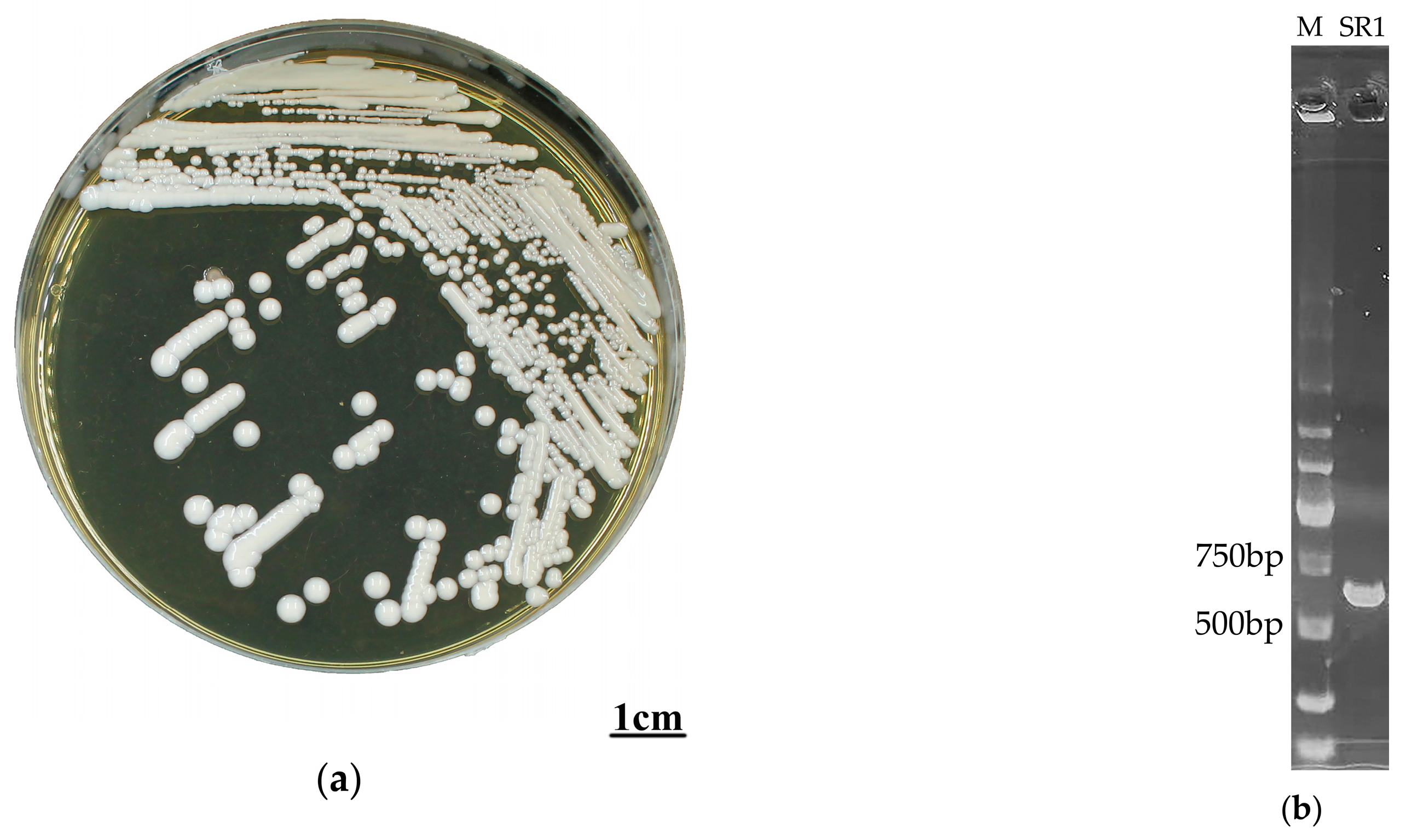
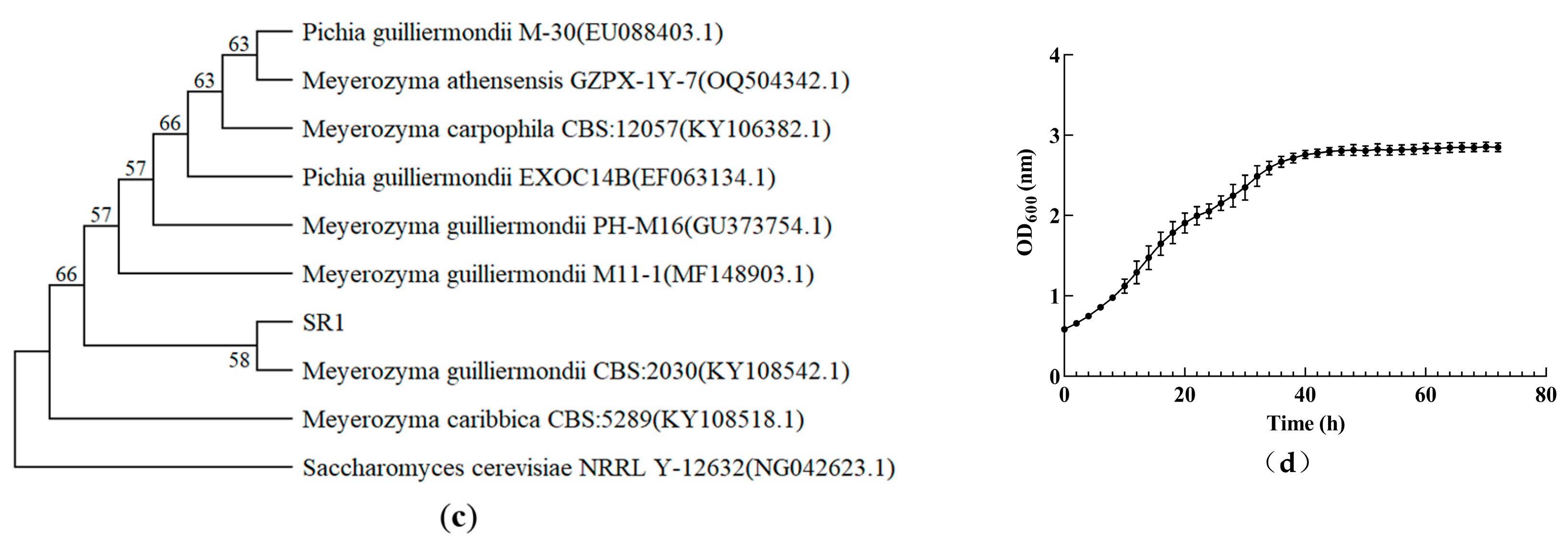
The morphological, molecular, and growth characteristics of the antagonistic yeast SR1 were evaluated (Figure 1). Following basic morphological observation (Figure 1a), the strain was molecularly identified via the amplification of the 26S rDNA D1/D2 region, which yielded a single 628 bp target band (Figure 1b). BLAST sequence alignment of this sequence (GenBank accession pending) and subsequent phylogenetic analysis confirmed that SR1 shares a 99.8% similarity with the type strain of Meyerozyma guilliermondii and clusters tightly within the same clade (Figure 1c). Furthermore, the growth kinetics curve revealed that SR1 possesses a rapid proliferation capacity, entering the exponential growth phase at merely 10 h post-inoculation and reaching the stationary phase at 38 h (Figure 1d).

3.2. In Vitro Interaction Assays

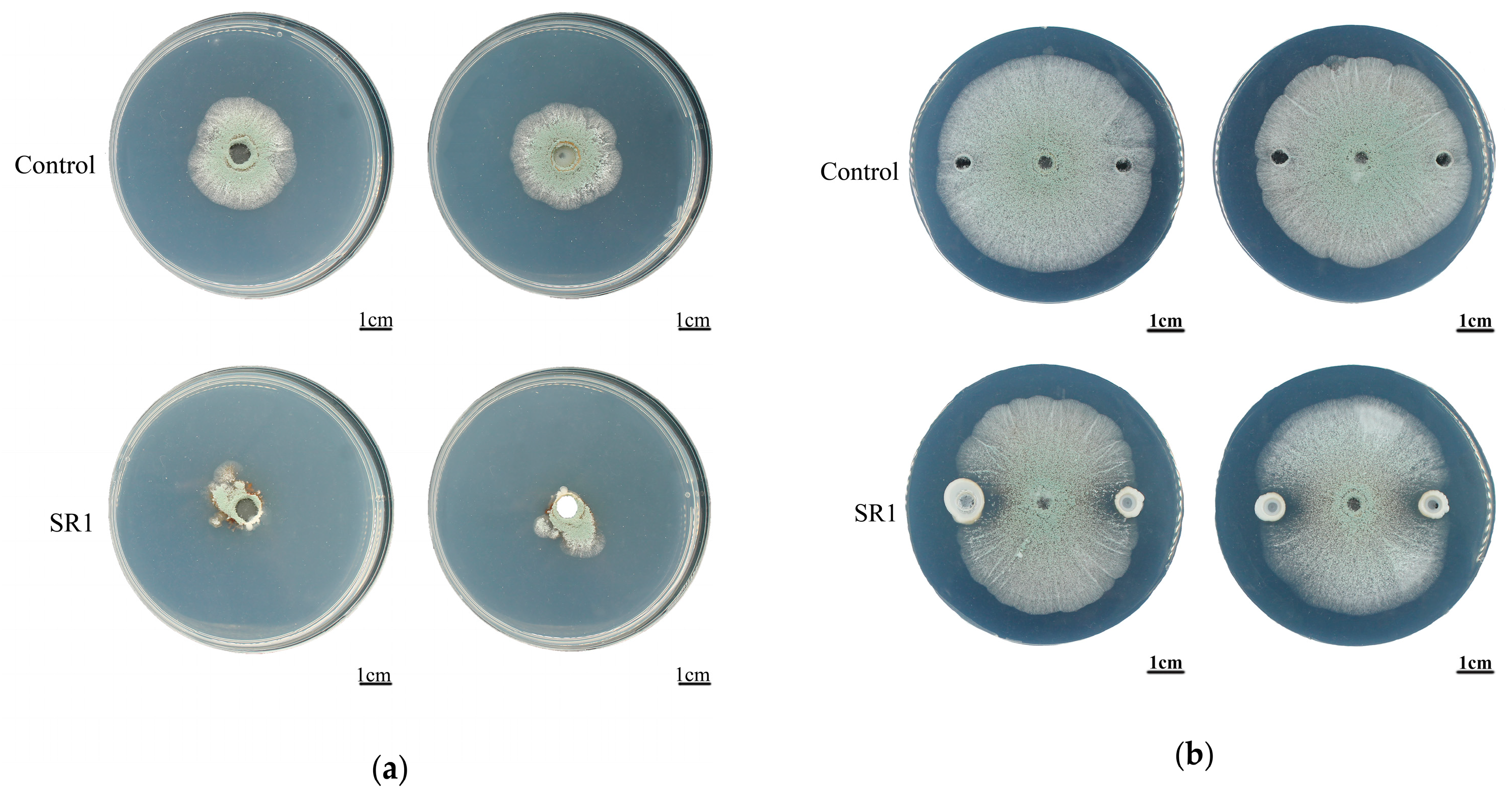
The in vitro antagonistic effect of SR1 against P. italicum was evaluated based on the agar well assays. In the dual culture assay (where SR1 and the pathogen were co-inoculated into the same central well), the control plates were completely covered by the mycelia of P. italicum at 5 days, whereas the mycelial growth of P. italicum in the SR1 treatment group was significantly inhibited (Figure 2a). Furthermore, in the plate confrontation assay (where the pathogen and SR1 were inoculated into separate equidistant wells), a slight inhibition zone was observed around the SR1 wells at the colony junction between SR1 and P. italicum, suggesting the potential partial involvement of diffusible antifungal molecules after 7 days of incubation (Figure 2b).

3.3. Evaluation of Biocontrol Efficacy in Fruits

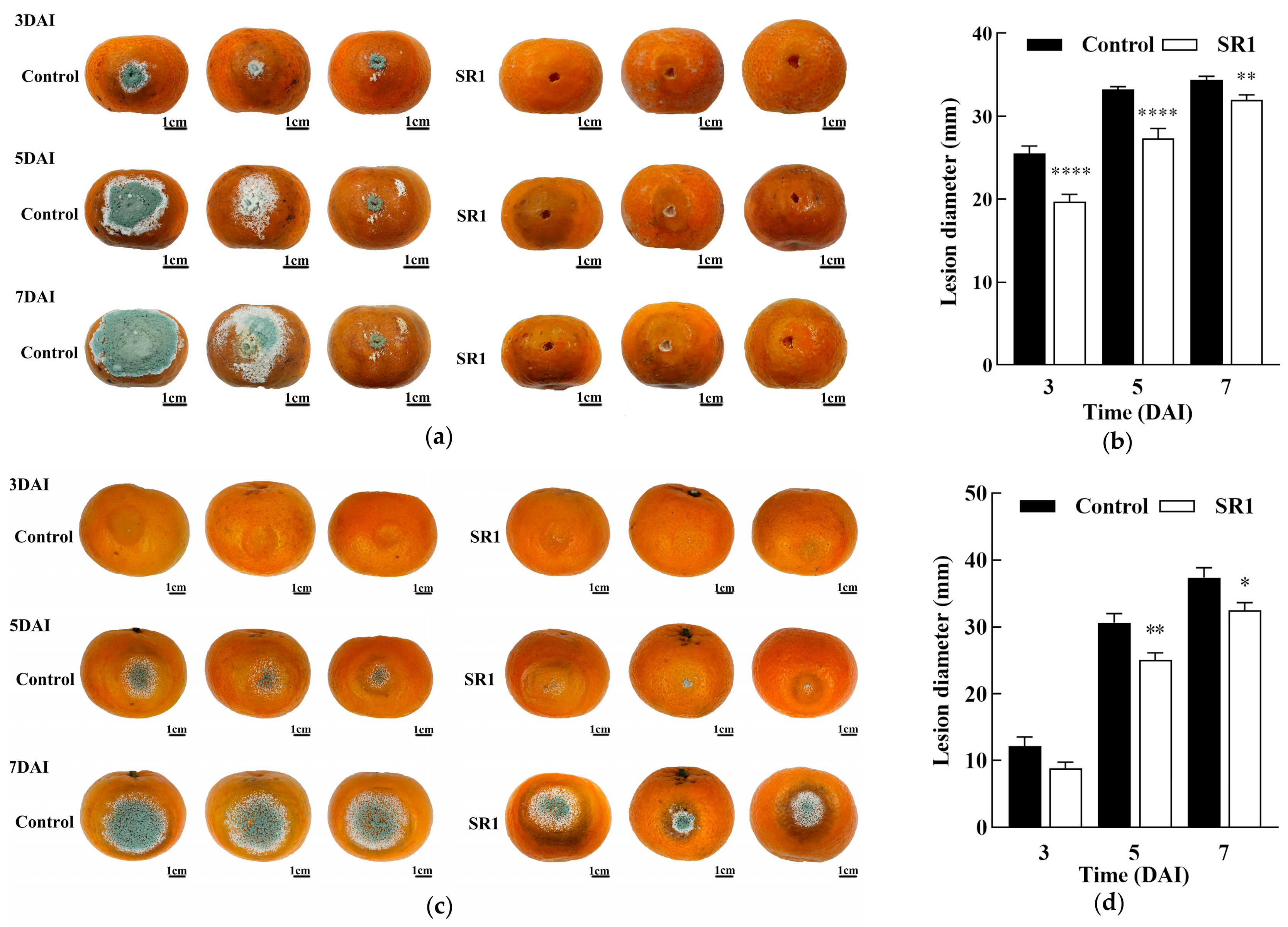
The biocontrol efficacy of SR1 against blue mold caused by P. italicum in Shatangju mandarins was evaluated via two inoculation strategies, with sterile water-treated fruits set as the control group (CK). The results showed that both wound inoculation pre-treatment (Figure 3a,b) and whole-fruit immersion pre-treatment (Figure 3c,d) with SR1 significantly suppressed lesion expansion in fruits at 3, 5, and 7 DAI under 25 °C storage. Wound inoculation pre-treatment of SR1 exerted a significant control effect on lesion development, and whole-fruit immersion pre-treatment also significantly reduced the lesion diameters of inoculated fruits.

3.4. Colonization Dynamics and Defense Enzyme Activities

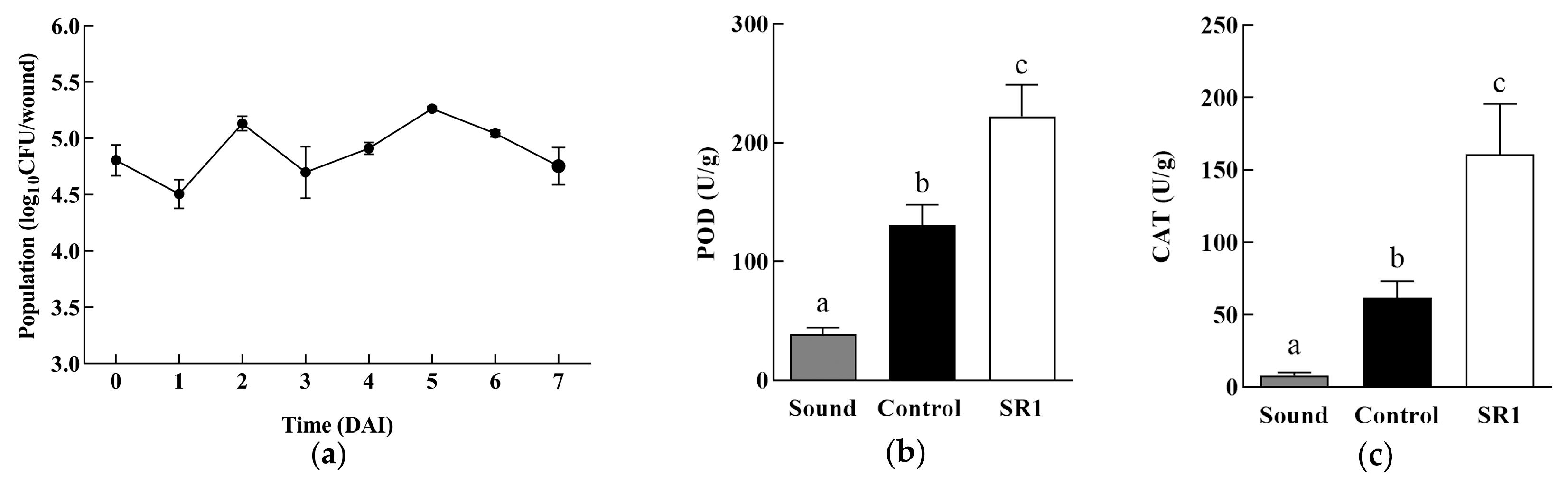
The colonization dynamics of SR1 in fruit wounds and its effect on the defense enzyme activities in the fruit were evaluated. The results showed that after inoculation into fruit wounds, the population of SR1 increased continuously; however, the population of SR1 exhibited dynamic fluctuations rather than continuous growth. Specifically, the population slightly declined at 1 day post-inoculation, recovered to its initial level (approximately 105 CFU/wound) by day 2, and subsequently experienced minor fluctuations while successfully maintaining a stable colonization level throughout the storage period (Figure 4a). Biochemical assays showed that completely healthy, uninoculated fruits (Sound) maintained low basal activities of POD and CAT (approximately 38. 9 U/g and 8.2 U/g, respectively). Following infection with P. italicum alone (Control), these activities increased significantly to 131.1 U/g and 61.6 U/g, reflecting the host’s natural basal defense response. Notably, the SR1 treatment further significantly enhanced the activities of both enzymes to 222.2 U/g and 160.8 U/g, respectively, which were significantly higher than those in the pathogen-only control group (Figure 4b,c).

3.5. Basic Quality Attributes

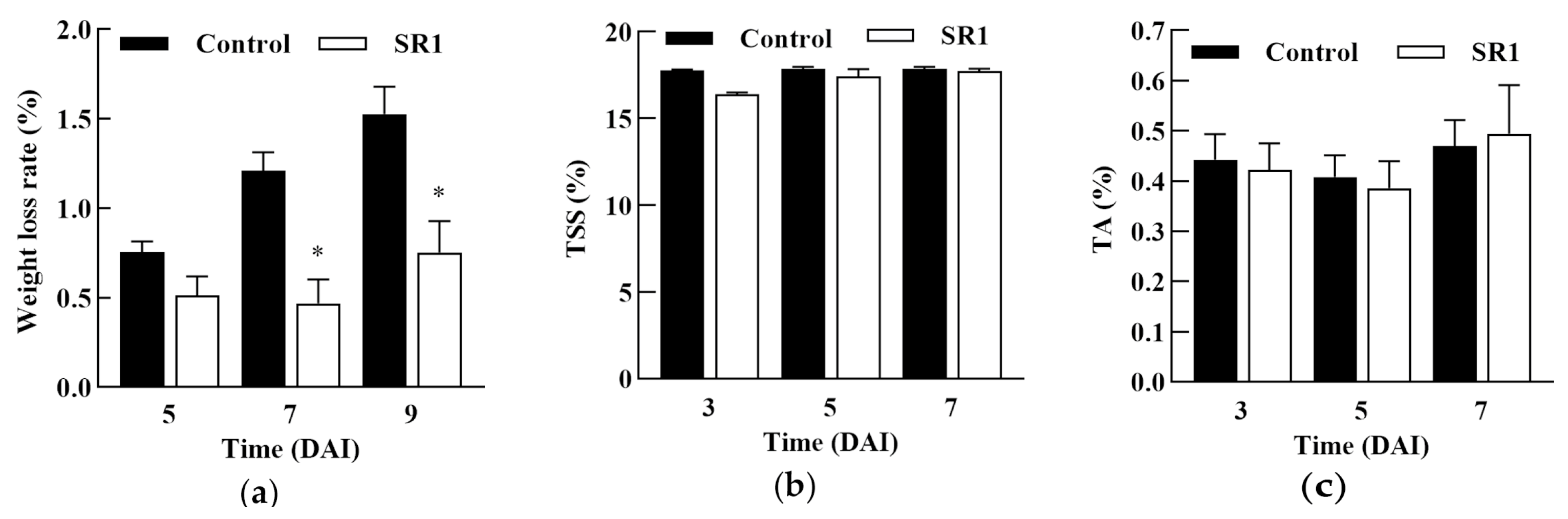
The effect of SR1 treatment on the weight loss and basic physicochemical parameters of Shatangju mandarin fruits was evaluated. During the 9-day storage period, the weight loss rates of fruits in both the SR1-treated and control groups showed a continuous upward trend. However, the weight loss rate of the SR1-treated group was consistently lower than that of the control group, with a significant difference at 7 days and a significant difference at 9 days of storage. Specifically, at the end of the 9-day storage period, the weight loss rate in the SR1-treated group was only 0.75%, which was significantly lower than the 1.53% observed in the control group (Figure 5a). Furthermore, the dynamic monitoring of internal quality revealed that the core nutritional parameters remained relatively stable over the storage period. Specifically, during the 7-day storage, the TSS contents of both the control and SR1-treated groups were maintained between 15.9% and 18.7%, while the TA contents fluctuated between 0.36% and 0.57%. At 3, 5, and 7 days after the immersion treatment, there were no significant differences in these observed TSS and TA values between the SR1-treated group and the control group (Figure 5b,c).

4. Discussion

Postharvest blue mold represents a primary factor limiting the shelf-life of Shatangju mandarins. In this study, the robust biocontrol efficacy exhibited by M. guilliermondii SR1 highlights its immense potential as an alternative to synthetic fungicides. Although SR1 could not completely prevent tissue maceration once the infection was initiated, its robust effect in delaying disease progression and significantly restricting pathogen sporulation suggests that SR1 effectively interrupts the initial infection and subsequent colonization phases of P. italicum within the susceptible fruit tissues. The in vitro assays indicated that although the secretion of diffusible antifungal substances may partially contribute to the inhibition (as evidenced by a slight clear zone), the primary antagonistic effect of SR1 likely relies on other mechanisms, which is consistent with the characteristics of some postharvest antagonistic yeasts [32]. Furthermore, SR1 demonstrated a short lag phase and strong proliferation capacity. When applied to fruit wounds, SR1 rapidly adapted to the microenvironment [33] and reached a high population density. By establishing this physical microecological barrier locally, SR1 effectively occupies the spatial and nutritional resources at the wound site, thereby hindering the initial establishment and subsequent mycelial development of P. italicum [28].
In addition to spatial competition, the colonization of SR1 also significantly altered the disease-resistant biochemical indices of the host fruit [34]. Pathogen infection typically triggers intense oxidative stress, leading to the accumulation of reactive oxygen species (ROS) and cellular membrane destruction [18,35]; however, SR1 treatment significantly enhanced the activities of POD and CAT in Shatangju mandarin fruits. This enhancement of the antioxidant defense system helps reduce the oxidative damage caused by P. italicum, maintaining cellular homeostasis and improving the overall disease resistance of the host [17,18].
Maintaining postharvest storage quality is a critical index for the practical application of antagonistic yeasts. In commercial practice, there is no universal statutory limit for weight loss in citrus; marketability relies primarily on the absence of visual defects. However, due to its exceptionally thin peel and abundant oil glands, a weight loss exceeding 5% typically induces visible peel shriveling and an immediate loss of commercial value in citrus fruits [36,37,38]. Consequently, modern supply chains strive to control total weight loss within 3–5% [39]. Our findings indicate that SR1 treatment effectively mitigates this critical moisture loss. This alleviation is primarily attributed to rapid wound colonization; by establishing a physical barrier within the micro-cracks, SR1 directly seals the injured sites, thereby limiting excessive water vapor transpiration [7,10]. Furthermore, this protective effect did not negatively interfere with the core sugar-acid metabolism (TSS and TA).
In conclusion, M. guilliermondii SR1 exhibits strong biocontrol efficacy against postharvest blue mold in Shatangju mandarins. To translate this green preservation technology into an industrial context, SR1 could be developed into stable bio-fungicide formulations (e.g., liquid suspensions, wettable powders, or edible coating additives). In modern commercial packinghouses, these biological formulations could be seamlessly integrated into existing postharvest processing lines and applied via standard drenching or inline spray systems prior to cold chain distribution [9]. However, it is important to acknowledge that the extended immersion time (12 h) utilized in our experimental proof-of-concept must be further optimized into rapid dipping or spraying protocols (e.g., 1–2 min) to meet the real-world throughput demands of commercial citrus processing. This study provides a robust theoretical and practical basis for the development of such yeast-based biocontrol strategies.

Author Contributions

Conceptualization, F.Y., Y.Y., L.S. and Z.L.; methodology, Y.L. (Ying Liu), Z.M.; software, Y.L. (Ying Liu) and Z.M.; validation, X.Y., L.Z. and Y.C.; formal analysis, F.Y. and Y.L. (Ying Liu); investigation, Z.M., Y.L. (Yunfen Liu) and T.L.; resources, Y.Y. and L.S.; data curation, F.Y. and Y.L. (Ying Liu); writing—original draft preparation, F.Y.; writing—review and editing, L.S. and Y.Y.; visualization, Y.L. (Ying Liu) and Z.M.; supervision, L.S.; project administration, Y.Y.; funding acquisition, Y.Y. and L.S. All authors have read and agreed to the published version of the manuscript.

Funding

This work was supported by the Jiangxi Training Project of High-level and High-skill Leading Talents, the National Natural Science Foundation of China (Grant No. 32260611), the Opening Project of Guangxi Key Laboratory of Health Care Food Science and Technology (Grant Nos. GXKYSYS202206; GXKYSYS202208), as well as the Guangxi Natural Science Foundation (Grant No. 2022GXNSFBA035001).

Data Availability Statement

The original contributions presented in this study are included in the article. Further inquiries can be directed to the corresponding authors.

Conflicts of Interest

The authors declare no conflicts of interest.

Abbreviations

The following abbreviations were used in this manuscript:
TSSTotal soluble solids
TATitratable acidity
GRASGenerally recognized as safe
PODPeroxidase
CATCatalase
PDAPotato dextrose agar
YPDYeast extract peptone dextrose
OD600Optical density at 600 nm
DAIDays after inoculation
RHRelative humidity
FWFresh weight
ROSReactive oxygen species
YPAYeast extract peptone dextrose
CGMCCChina General Microbiological Culture Collection Center (CGMCC)

References

  1. Cao, J.; Kang, C.; Chen, Y.; Karim, N.; Wang, Y.; Sun, C. Physiochemical changes in Citrus reticulata cv. Shatangju fruit during vesicle collapse. Postharvest Biol. Technol. 2020, 165, 111180. [Google Scholar] [CrossRef]
  2. Li, T.; Shi, D.; Wu, Q.; Yin, C.; Li, F.; Shan, Y.; Duan, X.; Jiang, Y. Mechanism of cell wall polysaccharides modification in harvested ’Shatangju’ mandarin (Citrus reticulata Blanco) fruit caused by Penicillium italicum. Biomolecules 2019, 9, 160. [Google Scholar] [CrossRef] [PubMed]
  3. Wang, Z.; Sui, Y.; Li, J.; Tian, X.; Wang, Q. Biological control of postharvest fungal decays in citrus: A review. Crit. Rev. Food Sci. Nutr. 2022, 62, 861–870. [Google Scholar] [CrossRef]
  4. Ezzouggari, R.; Bahhou, J.; Taoussi, M.; Seddiqi Kallali, N.; Aberkani, K.; Barka, E.A.; Lahlali, R. Yeast warriors: Exploring the potential of yeasts for sustainable citrus post-harvest disease management. Agronomy 2024, 14, 288. [Google Scholar] [CrossRef]
  5. Stojićević, M.; Đurović, S.; Popović, M.M.; Jovanović, L.; Pavićević, V.; Đurišić-Mladenović, N. Multivariate assessment and risk ranking of pesticide residues in citrus fruits. Foods 2023, 12, 2454. [Google Scholar] [CrossRef]
  6. Xie, X.; Cheng, X.; Yao, H.; Guo, L.; Tian, F.; Wang, C.; Qiao, C.; Wang, R.; Xie, H.; Pang, R. Analysis of the maximum residue limits of pesticides in fruits according to GB 2763-2021. J. Fruit Sci. 2023, 40, 166–180. [Google Scholar] [CrossRef]
  7. Hernandez-Montiel, L.G.; Droby, S.; Preciado-Rangel, P.; Rivas-García, T.; González-Estrada, R.R.; Gutiérrez-Martínez, P.; Ávila-Quezada, G.D. A sustainable alternative for postharvest disease management and phytopathogens biocontrol in fruit: Antagonistic yeasts. Plants 2021, 10, 2641. [Google Scholar] [CrossRef]
  8. Wisniewski, M.; Droby, S.; Norelli, J.; Liu, J.; Schena, L. Alternative management technologies for postharvest disease control: The journey from simplicity to complexity. Postharvest Biol. Technol. 2016, 122, 3–10. [Google Scholar] [CrossRef]
  9. Droby, S.; Wisniewski, M.; Teixidó, N.; Spadaro, D.; Jijakli, M.H. The science, development, and commercialization of postharvest biocontrol products. Postharvest Biol. Technol. 2016, 122, 22–29. [Google Scholar] [CrossRef]
  10. Di Francesco, A.; Martini, C.; Mari, M. Biological control of postharvest diseases by microbial antagonists: How many mechanisms of action? Eur. J. Plant Pathol. 2016, 145, 711–717. [Google Scholar] [CrossRef]
  11. Wang, S.; Tan, Z.; Wang, C.; Liu, W.; He, X.; Ye, D.; Li, L.; Hang, F. Iron competition as an important mechanism of pulcherrimin-producing Metschnikowia sp. strains for controlling postharvest fungal decays on citrus fruit. Foods 2023, 12, 4249. [Google Scholar] [CrossRef] [PubMed]
  12. Hua, S.S.T.; Beck, J.J.; Sarreal, S.B.L.; Gee, W. The major volatile compound 2-phenylethanol from the biocontrol yeast, Pichia anomala, inhibits growth and expression of aflatoxin biosynthetic genes of Aspergillus flavus. Mycotoxin Res. 2014, 30, 71–78. [Google Scholar] [CrossRef] [PubMed]
  13. Wu, H.; Wang, F.; Yang, L.; Chen, L.; Tang, J.; Liu, Y.; Liu, D.; Toktarbay, Z.; Algadi, H.; Deng, J. Carboxymethyl chitosan promotes biofilm-formation of Cryptococcus laurentii to improve biocontrol efficacy against Penicillium expansum in grapefruit. Adv. Compos. Hybrid Mater. 2024, 7, 23. [Google Scholar] [CrossRef]
  14. Sukmawati, D.; Shabrina, A.; Indrayanti, R.; Kurniati, T.H.; Nurjayadi, M.; Hidayat, I.; Al Husna, S.N.; Ratnaningtyas, N.I.; El Enshasy, H.; Dailin, D.J.; et al. Antifungal mechanism of Rhodotorula mucilaginosa and Aureobasidium sp. nov. isolated from Cerbera manghas L. against the growth of destructive molds in post harvested apples. Recent Pat. Food Nutr. Agric. 2020, 11, 219–228. [Google Scholar] [CrossRef]
  15. Parafati, L.; Vitale, A.; Restuccia, C.; Cirvilleri, G. Biocontrol ability and action mechanism of food-isolated yeast strains against Botrytis cinerea causing post-harvest bunch rot of table grape. Food Microbiol. 2017, 64, 44–51. [Google Scholar] [CrossRef]
  16. Freimoser, F.M.; Rueda-Mejia, M.P.; Tilocca, B.; Migheli, Q. Biocontrol yeasts: Mechanisms and applications. World J. Microbiol. Biotechnol. 2019, 35, 154. [Google Scholar] [CrossRef]
  17. Bui, T.T.; Wright, S.A.; Falk, A.B.; Vanwalleghem, T.; Van Hemelrijck, W.; Hertog, M.L.; Davey, M.W. Botrytis cinerea differentially induces postharvest antioxidant responses in ‘Braeburn’ and ‘Golden Delicious’ apple fruit. J. Sci. Food Agric. 2019, 99, 5662–5670. [Google Scholar] [CrossRef] [PubMed]
  18. Macarisin, D.; Droby, S.; Bauchan, G.; Wisniewski, M. Superoxide anion and hydrogen peroxide in the yeast antagonist–fruit interaction: A new role for reactive oxygen species in postharvest biocontrol. Postharvest Biol. Technol. 2010, 58, 194–202. [Google Scholar] [CrossRef]
  19. Ye, L.; Wang, X.; Han, J.; He, S.; Wei, S.; Zhu, Q.; Meng, J.; Zhou, L. Effects of Meyerozyma guilliermondii PJ15 on the biocontrol of Penicillium crustosum causing postharvest decay in Orah and its influence on the microbial diversity of Orah. Food Qual. Saf. 2024, 8, fyae041. [Google Scholar] [CrossRef]
  20. Zhao, Y.; Tu, K.; Shao, X.; Jing, W.; Su, Z. Effects of Pichia guilliermondii and hot air treatment on the postharvest preservation of Red Fuji apple quality attributes. J. Food Prot. 2018, 81, 43–51. [Google Scholar] [CrossRef]
  21. Al-Rahbi, B.A.A.; Al-Sadi, A.M.; Al-Mahmooli, I.H.; Al-Maawali, S.S.; Al-Mahruqi, N.M.T.; Velazhahan, R. Meyerozyma guilliermondii SQUCC-33Y suppresses postharvest fruit rot of strawberry caused by Alternaria alternata. Australas. Plant Pathol. 2021, 50, 349–352. [Google Scholar] [CrossRef]
  22. López-Cruz, R.; Ragazzo-Sánchez, J.A.; Calderón-Santoyo, M. Microencapsulation of Meyerozyma guilliermondii by spray drying using sodium alginate and soy protein isolate as wall materials: A biocontrol formulation for anthracnose disease of mango. Biocontrol Sci. Technol. 2020, 30, 1116–1132. [Google Scholar] [CrossRef]
  23. López-Cruz, R.; Segarra, G.; Torres, R.; Teixidó, N.; Ragazzo-Sanchez, J.A.; Calderon-Santoyo, M. Biocontrol efficacy of Meyerozyma guilliermondii LMA-Cp01 against post-harvest pathogens of fruits. Arch. Phytopathol. Plant Prot. 2023, 56, 1003–1020. [Google Scholar] [CrossRef]
  24. López-Cruz, R.; Ragazzo-Sánchez, J.A.; Calderón-Santoyo, M. Enhancement of biocontrol activity of Meyerozyma guilliermondii LMA-Cp01 with GRAS salts for the postharvest control of mango anthracnose caused by Colletotrichum gloeosporioides. J. Plant Pathol. 2026, 108, 1207–1217. [Google Scholar] [CrossRef]
  25. Yan, Y.; Zhang, X.; Zheng, X.; Apaliya, M.T.; Yang, Q.; Zhao, L.; Zhang, H. Control of postharvest blue mold decay in pears by Meyerozyma guilliermondii and it’s effects on the protein expression profile of pears. Postharvest Biol. Technol. 2018, 136, 124–131. [Google Scholar] [CrossRef]
  26. Kthiri, Z.; Jabeur, M.B.; Chairi, F.; López-Cristoffanini, C.; López-Carbonell, M.; Serret, M.D.; Araus, J.L.; Karmous, K.; Hamada, W. Exploring the potential of Meyerozyma guilliermondii on physiological performances and defense response against Fusarium crown rot on durum wheat. Pathogens 2021, 10, 52. [Google Scholar] [CrossRef] [PubMed]
  27. Agirman, B.; Erten, H. Biocontrol ability and action mechanisms of Aureobasidium pullulans GE17 and Meyerozyma guilliermondii KL3 against Penicillium digitatum DSM2750 and Penicillium expansum DSM62841 causing postharvest diseases. Yeast 2020, 37, 437–448. [Google Scholar] [CrossRef]
  28. Chen, O.; Deng, L.; Ruan, C.; Yi, L.; Zeng, K. Pichia galeiformis induces resistance in postharvest citrus by activating the phenylpropanoid biosynthesis pathway. J. Agric. Food Chem. 2021, 69, 2619–2631. [Google Scholar] [CrossRef]
  29. Kurtzman, C.P.; Robnett, C.J. Identification and phylogeny of ascomycetous yeasts from analysis of nuclear large subunit (26S) ribosomal DNA partial sequences. Antonie Leeuwenhoek 1998, 73, 331–371. [Google Scholar] [CrossRef]
  30. Balouiri, M.; Sadiki, M.; Ibnsouda, S.K. Methods for in vitro evaluating antimicrobial activity: A review. J. Pharm. Anal. 2016, 6, 71–79. [Google Scholar] [CrossRef]
  31. Nie, X.; Zhang, C.; Jiang, C.; Zhang, R.; Guo, F.; Fan, X. Trehalose increases the oxidative stress tolerance and biocontrol efficacy of Candida oleophila in the microenvironment of pear wounds. Biol. Control 2019, 132, 23–28. [Google Scholar] [CrossRef]
  32. Droby, S.; Wisniewski, M.; Macarisin, D.; Wilson, C. Twenty years of postharvest biocontrol research: Is it time for a new paradigm? Postharvest Biol. Technol. 2009, 52, 137–145. [Google Scholar] [CrossRef]
  33. Sui, Y.; Wisniewski, M.; Droby, S.; Liu, Y. Responses of yeast biocontrol agents to environmental stress. Appl. Environ. Microbiol. 2015, 81, 2968–2975. [Google Scholar] [CrossRef]
  34. Romanazzi, G.; Sanzani, S.M.; Bi, Y.; Tian, S.; Martínez-Romero, D.; Valero, D. Induced resistance to control postharvest decay of fruit and vegetables. Postharvest Biol. Technol. 2016, 122, 82–94. [Google Scholar] [CrossRef]
  35. Ballester, A.R.; Lafuente, M.T.; González-Candelas, L. Spatial study of antioxidant enzymes, peroxidase and phenylalanine ammonia-lyase in the citrus fruit–Penicillium digitatum interaction. Postharvest Biol. Technol. 2006, 39, 115–124. [Google Scholar] [CrossRef]
  36. Porat, R.; Lichter, A.; Terry, L.A.; Harker, R.; Buzby, J. Postharvest losses of fruit and vegetables during retail and in consumers’ homes: Quantifications, causes, and means of prevention. Postharvest Biol. Technol. 2018, 139, 135–149. [Google Scholar] [CrossRef]
  37. Gidado, M.J.; Gunny, A.A.N.; Gopinath, S.C.B.; Ali, A.; Wongs-Aree, C.; Salleh, N.H.M. Challenges of postharvest water loss in fruits: Mechanisms, influencing factors, and effective control strategies—A comprehensive review. J. Agric. Food Res. 2024, 17, 101249. [Google Scholar] [CrossRef]
  38. Kim, S.S.; Nguyen, Q.-A.; Park, Y.; Han, S.-G.; Kim, H.-J.; Kim, D.-S. Metabolomic and quality profiling of Citrus hybrid cv. Yellowball during long-term storage at different temperatures. J. Food Meas. Charact. 2024, 18, 6510–6521. [Google Scholar] [CrossRef]
  39. Sun, Y.; Li, Y.; Xu, Y.; Sang, Y.; Mei, S.; Xu, C.; Yu, X.; Pan, T.; Cheng, C.; Zhang, J.; et al. The Effects of Storage Temperature, Light Illumination, and Low-Temperature Plasma on Fruit Rot and Change in Quality of Postharvest Gannan Navel Oranges. Foods 2022, 11, 3707. [Google Scholar] [CrossRef] [PubMed]
Figure 1. Morphological, molecular, and growth characteristics of the antagonistic yeast strain SR1. (a) Colony morphology of SR1 cultivated on YPD agar. (b) Electrophoretogram of the PCR amplification product for the 26S rDNA D1/D2 region of SR1. (c) Phylogenetic tree of SR1 constructed based on the 26S rDNA D1/D2 region sequence using the Maximum Likelihood method with 1000 bootstrap replicates. (d) Growth kinetic curve of SR1 in YPD liquid medium at 28 °C, demonstrating its rapid entry into the exponential growth phase. Error bars in (d) represent the standard error of the mean (SEM).
Horticulturae 12 00724 g001aHorticulturae 12 00724 g001b
Figure 2. In vitro interaction assays evaluating the antagonistic activity of M. guilliermondii SR1 against P. italicum. (a) Mycelial growth inhibition in the dual culture assay after 5 days of incubation. The control well was co-inoculated with sterile water and pathogen spores, whereas the treatment well was co-inoculated with SR1 suspension and pathogen spores. (b) Evaluation of diffusible antifungal substances in the plate confrontation assay after 7 days of incubation, showing no distinct inhibition zones.
Horticulturae 12 00724 g002
Figure 3. In vivo biocontrol efficacy of M. guilliermondii SR1 against blue mold decay in Shatangju mandarin fruits stored at 25 °C. (a) Phenotypic changes and (b) dynamic changes in lesion diameters in fruits subjected to the wound inoculation pre-treatment. (c) Phenotypic changes and (d) dynamic changes in lesion diameters in fruits subjected to the whole-fruit immersion pre-treatment. In all assays, the “Control” represents fruits treated with sterile water, while “SR1” represents fruits treated with the yeast suspension (1 × 10⁸ CFU/mL). Asterisks indicate significant differences between the SR1 treatment and the control group at the same time point (* p < 0.05, ** p < 0.01, **** p < 0.0001) as determined by one-way ANOVA. Data are expressed as the mean ± SEM (n = 21).
Horticulturae 12 00724 g003
Figure 4. Colonization dynamics of SR1 in the wounds of Shatangju mandarin fruits and its elicitation of host defense enzyme activities during storage at 25 °C. (a) Dynamic changes in the SR1 population size in fruit wounds over a 7-day period. DAI: days after inoculation. (b) Effect of SR1 treatment on POD activity and (c) CAT activity in the surrounding fruit tissues at 5 DAI. “Sound” represents completely healthy, uninoculated fruits. The “Control” represents fruits inoculated with sterile water and subsequently challenged with P. italicum. Different letters (a, b, c) above the bars indicate significant differences among treatments according to Duncan’s multiple range test (p < 0.05). Data are expressed as the mean ± SEM (a, n = 6; b, c, n = 5).
Horticulturae 12 00724 g004
Figure 5. Effect of SR1 treatment on the physicochemical quality of uninoculated Shatangju mandarin fruits during ambient storage (25 °C). (a) Dynamic changes in the fruit weight loss rate over a 9-day storage period. (b) Dynamic changes in TSS contents and (c) TA contents at 3, 5, and 7 days after the immersion treatment. The results demonstrate that SR1 effectively reduces moisture loss without negatively impacting core nutritional parameters. Asterisks indicate significant differences compared to the control (* p < 0.05). Data are expressed as the mean ± SEM.
Horticulturae 12 00724 g005
Disclaimer/Publisher’s Note: The statements, opinions and data contained in all publications are solely those of the individual author(s) and contributor(s) and not of MDPI and/or the editor(s). MDPI and/or the editor(s) disclaim responsibility for any injury to people or property resulting from any ideas, methods, instructions or products referred to in the content.