Article

Trait-Mediated Facilitation and Stress Tolerance in Two Globose Cactus Species from the Mexican Desert

by
Cecilia Leonor Jiménez-Sierra
1,
Erika Arroyo-Pérez
1,*,
Omar Díaz-Segura
1,
María Loraine Matías-Palafox
2,
Joel Flores
3 and
María De Los Angeles González-Adán
1
1
Department of Biology, Universidad Autónoma Metropolitana-Unidad Iztapalapa, Av. Ferrocarril San Rafael Atlixco, No. 186, Col. Leyes de Reforma 1 a Sección, Alcaldía Iztapalapa, Mexico City 09310, Mexico
2
Departamento de Gestión de Información y Evaluación de Especies, Comisión Nacional para el Conocimiento y Uso de la Biodiversidad, CONABIO, Periférico-Insurgentes Sur No. 4903, Parques Del Pedregal, Mexico City 14010, Mexico
3
División de Ciencias Ambientales, Instituto Potosino de Investigación Científica y Tecnológica, Colonia Lomas 4 Sección, Camino a La Presa San José 2055, San Luis Potosí 78216, Mexico
*
Author to whom correspondence should be addressed.
Horticulturae 2026, 12(4), 447; https://doi.org/10.3390/horticulturae12040447

Submission received: 28 February 2026 / Revised: 23 March 2026 / Accepted: 1 April 2026 / Published: 4 April 2026

Abstract

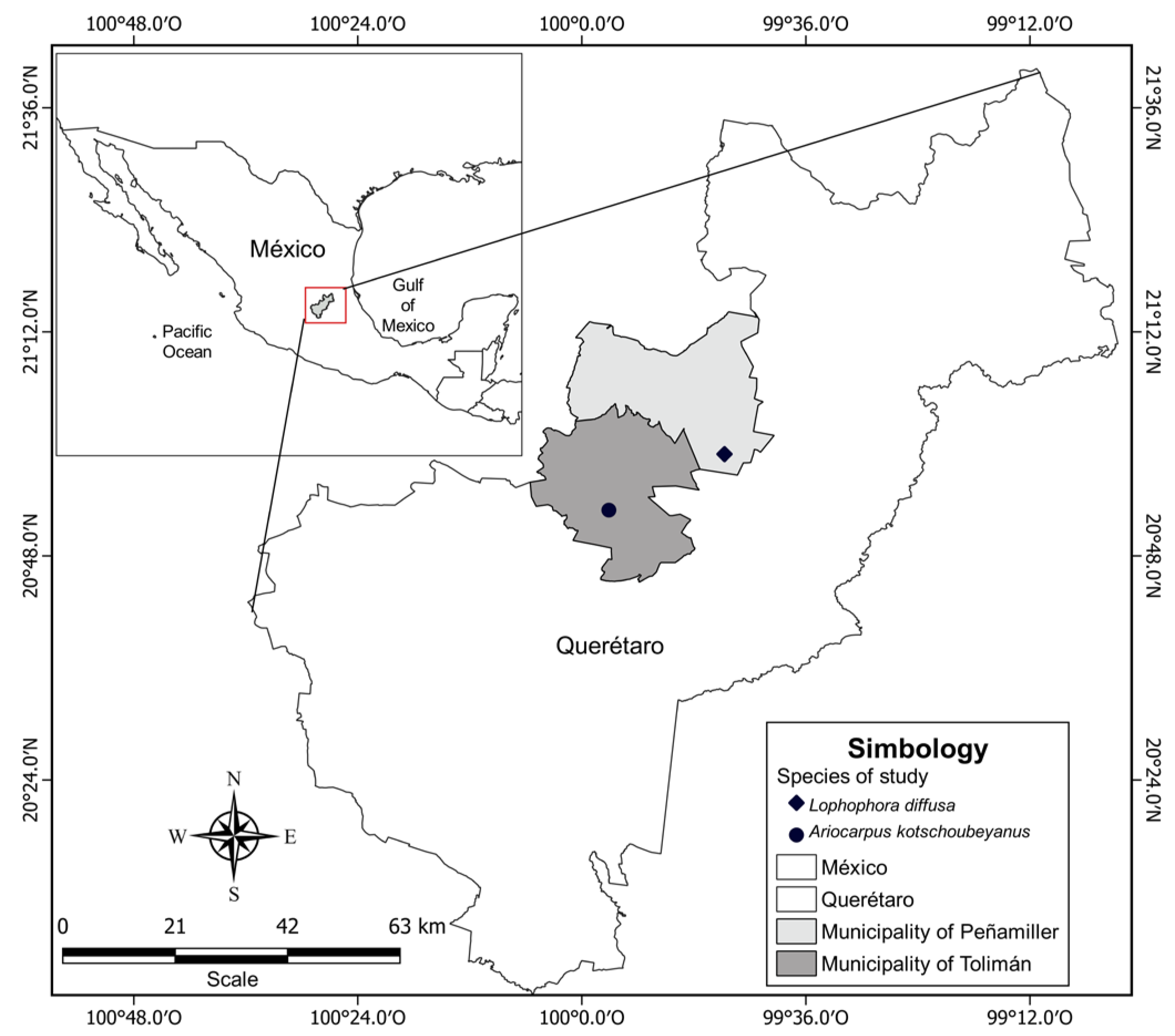
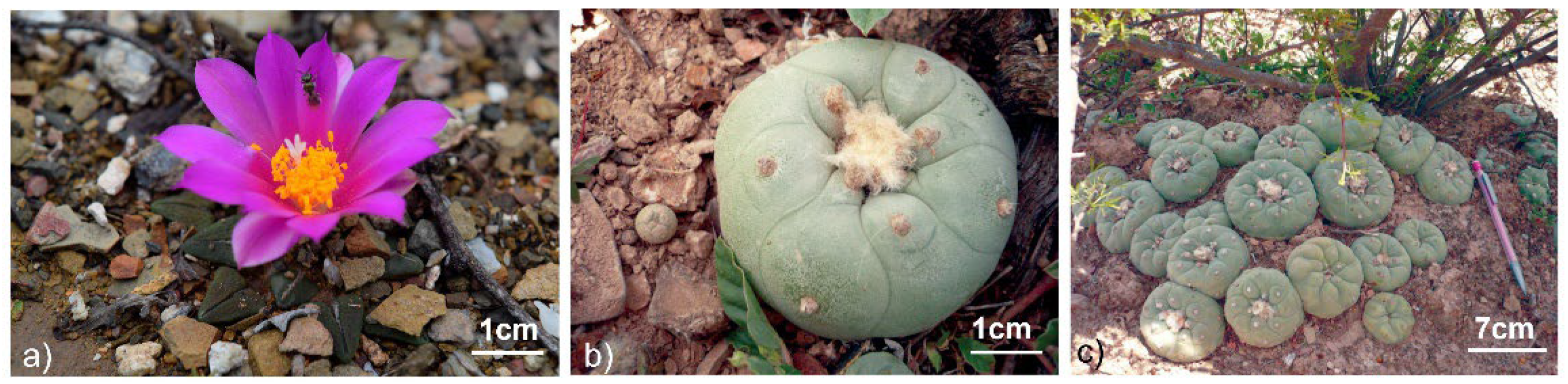
Succulent plants in arid ecosystems exhibit contrasting strategies to cope with high irradiance, thermal stress, and water limitation. We evaluated spatial distribution, microhabitat use, nurse identity, and orientation beneath canopies for two threatened globose cacti from the Querétaro semi-desert (Mexico): Ariocarpus kotschoubeyanus and Lophophora diffusa. One site with high population density was selected for each species, where 10 plots were established (9 m2 for A. kotschoubeyanus and 49 m2 for L. diffusa). The study aims to evaluate whether species-specific recruitment patterns are associated with differential dependence on nurse-plant microhabitats under conditions of radiation and thermal stress. We hypothesized that: (1) both species exhibit aggregated spatial distributions but differ in their reliance on nurse-mediated microclimatic buffering; and (2) nurse-plant identity and orientation patterns vary between species, reflecting species-specific ecophysiological thresholds to irradiance and heat stress. Both species showed strongly aggregated spatial distributions (Hopkins index > 0.8), indicating recruitment constrained by microsite heterogeneity. However, their stress-adaptation strategies differed markedly. A. kotschoubeyanus occurred predominantly in open microsites (79%), consistent with its geophytic growth form and tolerance to high radiation and temperature extremes. In contrast, L. diffusa was strongly associated with nurse plants (78%), particularly Larrea tridentata and Bursera fagaroides, and preferentially established on eastern canopy exposures that reduce afternoon heat load. These patterns reflect species-specific ecophysiological thresholds linked to radiation tolerance and microclimatic buffering. Facilitation in globose cacti is therefore trait-mediated and context-dependent. Maintaining perennial shrub diversity is essential to preserve the microhabitats that sustain recruitment and persistence of stress-sensitive succulents under increasing climatic aridity.
Keywords: Cactaceae; desert succulents; microclimatic buffering; nurse-plant facilitation; safe-site dynamics; stress tolerance; spatial aggregation Cactaceae; desert succulents; microclimatic buffering; nurse-plant facilitation; safe-site dynamics; stress tolerance; spatial aggregation