
Article

Agave triangularis Transcriptome Reveals Candidate SRO Genes Involved in Leaf Development and Stress Response of Agave


1
School of Life Science and Technology, Wuhan Polytechnic University, Wuhan 430023, China
2
National Key Laboratory for Tropical Crop Breeding, Environment and Plant Protection Institute, Chinese Academy of Tropical Agricultural Sciences, Haikou 571101, China
3
College of Horticulture and Landscape Architecture, Hubei Vocational College of Bio-Technology, Wuhan 430070, China
4
College of Plant Science and Technology, Huazhong Agricultural University, Wuhan 430070, China
5
School of Geography and Planning, Sun Yat-sen University, Guangzhou 510006, China
6
Guangxi Subtropical Crops Research Institute, Nanning 530001, China
7
Sanya Research Institute, Chinese Academy of Tropical Agricultural Sciences, Sanya 572025, China
*
Authors to whom correspondence should be addressed.
These authors contributed equally to this work.
Horticulturae 2026, 12(2), 249; https://doi.org/10.3390/horticulturae12020249
Submission received: 29 December 2025 / Revised: 13 February 2026 / Accepted: 17 February 2026 / Published: 19 February 2026

Abstract

Agave triangularis Jacobi is an ornamental agave species that represents a valuable genetic resource for enhancing resistance and tolerance in cultivated agaves such as A. tequilana and A. H11648. In this study, we performed the first de novo transcriptome assembly of A. triangularis using Illumina sequencing. A total of 131,321 transcripts were assembled, comprising 119,764,849 bp. Functional annotation revealed a close evolutionary relationship between A. triangularis and Asparagus officinalis, supporting its phylogenetic placement within the Asparagaceae family. We further identified five SRO genes in both A. triangularis and A. H11648. Their expression profiles in A. H11648, analyzed by qRT-PCR, suggested involvement in leaf development. Notably, AhSRO2 and AhSRO3 were significantly up-regulated following oomycete infection, while AhSRO3 was markedly induced under low-temperature stress. These findings highlight AhSRO2 and AhSRO3 as promising candidate genes for further functional investigation. This study provides the first reference transcriptome for A. triangularis, offering a valuable resource for gene discovery and comparative evolutionary studies in agave. The expression patterns of SRO genes establish a framework for understanding their potential roles in leaf development and stress responses, supporting future efforts toward genetic improvement in agave species.

1. Introduction

Agave triangularis Jacobi is a stemless, evergreen, succulent agave plant, with leaves that vary in thickness, stiff, olive-green and triangular [1]. It is commonly planted for ornamental uses due to its external features and tolerance to drought, high temperature, and low temperature. As a part of the species diversity of the agave genus, A. triangularis has similar features to other wild agave germplasms, such as A. deserti, A. striata and A. schidigera [2]. These species are important resources to investigate the molecular mechanisms of economically important traits and import tolerance or resistance to commercially cultivated agave species [3,4]. A. H11648 ((A. amaniensis × A. angustifolia) × A. amaniensis) and A. tequilana are typical cultivated agave species for producing sisal fiber and tequila spirit, respectively [5,6]. The hybrid agave cultivar A. H11648 was selected and released from Tanzania, which has been widely cultivated in tropical areas of Africa, Asia and South America [7]. It has been planted for decades and faced several devastating diseases, including zebra disease and purple curl leaf disease [8]. A. tequilana is also threatened by wilt disease, which is caused by Fusarium solani or F. oxysporum [9]. It has been reported that the disease resistance of A. americana was successfully imported to A. H11648 to generate new varieties with resistance to Phytophthora nicotianae [8]. In addition, sisal fiber production is also affected by frequent extreme low temperatures, which damage agave leaves and cause yield loss [10,11]. A. H11648 has been planted for decades, which requires genetic improvement for its traits of resistance and tolerance [8]. Wild germplasms have been successfully used to screen new genes for resistance and tolerance in model plants, which indicates that A. triangularis is also a useful genetic resource for genetic improvement of agave traits [12].
The SIMILAR TO RCD ONE (SRO) gene is a kind of plant-specific gene family with multiple functions in plant development and stress response [13]. The first SRO gene was identified in Arabidopsis and named RADICAL-INDUCED CELL DEATH1 (RCD1) [14]. There are three conserved structural domains in the SRO gene family, including PARP (Poly ADP-ribose polymerase, PF00644), RST (RCD-SRO-TAF4, PF12174) and WWE (PF02825) [13]. PARP is the main structure for biological functions, and RST is responsible for protein interactions together with WWE [14,15]. The loss-of-function mutants of AtRCD1 revealed its biological functions in regulating root architecture, reproductive development, meristematic fate, root–shoot communication, and ROS homeostasis in mitochondria and chloroplast [16,17,18,19]. AtSRO1 has similar functions to AtRCD1 and is also involved in plant tolerance of mercury stress [18,19,20]. AtSRO2, a noncanonical ADP-ribosyltransferase, has functions of mono(ADP-ribosy)lation with two key regulators (AtSZF1 and AtSZF2) of immune gene expression [21]. The expression of AtSRO3 and AtSRO4 does not change significantly after stress treatments [22]. AtSRO5 is involved in siRNA-mediated salt tolerance [23]. The biological functions of SRO genes are still not well characterized in Arabidopsis, even with the small number of genes in the family. The SRO gene family has been characterized in many plant species at a genome-wide scale with the increasing number of available plant genomes, including rice, wheat, maize, potato, cotton, rapeseed, sesame, cabbage, tomato, banana, tea and poplar [24,25,26,27,28,29,30,31]. Rice SRO1c is regulated by the SNAC1 transcription factor to modulate stomatal closure and oxidative stress tolerance [32]. The natural variations of ZmSRO1d could be used to modulate the trade-off between yield and drought tolerance in maize [33]. ZmSRO1e has functions to repress anthocyanin accumulation and ROS tolerance under abiotic stress [34].
To date, little is known about the gene information of A. triangularis and SRO genes in agave species. To address this, we performed a de novo transcriptome assembly of A. triangularis using Illumina sequencing, providing a valuable resource for future gene identification. Furthermore, we identified agave SRO genes and validated their expression patterns during leaf development and under stress conditions in A. H11648. These results will facilitate future functional studies on SRO genes in agave.

2. Materials and Methods

2.1. Plant Materials and Treatments

The leaf sample of A. triangularis was collected for RNA-Seq from Shanghai Chenshan Botanical Garden (31.08° N, 121.19° E). The plants of A. H11648 were planted for validation of gene expression patterns in the Environment and Plant Protection Institute, Chinese Academy of Tropical Agricultural Sciences (19.99° N, 110.33° E). Samples from different leaf stages were collected from two-year-old plants, including expanded leaf (L2), unexpanded leaf (L1) and shoot (L0) [2]. Phytophthora nicotianae Breda was selected as a biotic stress, inoculated on agave leaves, and sampled at 0 h (T0), 24 h (T1) and 48 h (T2) [7]. The plants of A. H11648 are tolerant to heavy metals such as copper and lead [35]. The seedlings were treated with CuSO4 (1 g/Kg, Cu) and Pb(NO3)2 (1.3 g/Kg, Pb) solutions as heavy metal stresses, with water as the control (CK) [35]. Samples were collected 2 weeks after treatment. The seedlings were placed in an incubator (6 °C) as low-temperature treatment and sampled at 0 h (C0), 12 h (C1) and 24 h (C2) [11]. All samples were collected in triplicate from different leaves or plants as biological repeats. These samples were used to extract total RNA with a Tiangen Biomart RNA extraction kit (Beijing, China) and were stored at −80 °C until further experiments.

2.2. Transcriptome Sequencing and Analysis

The RNA samples of A. triangularis were pooled and sent to Genoseq Technology Co., Ltd. (Wuhan, China) for transcriptome library construction and sequencing, as described in a previous study [36]. Raw reads were obtained and submitted to the Sequence Read Archive (SRA) under accession number PRJNA1379501 [37]. The raw reads were further processed using Cutadapt and Trimmomatic (v0.39) software to generate clean data, which were then assembled into transcripts using Trinity software (v2.8.5) [38,39,40]. Transcripts were annotated against five public databases: Nr, Swiss-Prot, KOG, GO and KEGG [41,42,43,44,45].

2.3. Characterization of Agave SRO Genes

SRO proteins from Arabidopsis, rice, and maize were used as queries to screen for orthologous sequences in the agave transcriptome datasets of A. triangularis and A. H11648 [7,14,24]. Orthologous transcripts were identified using tblastn with an e-value threshold of 10−6 [46]. These transcripts were further examined for coding regions using ORF-FINDER [47]. ProtParam tool was used to predict protein lengths (aa), molecular weights (Da) and theoretical isoelectric points (pI) for transcripts with complete coding regions [48]. Subcellular localization was predicted using CELLO [49]. MEGA 5.0 was employed to construct the maximum likelihood phylogenetic tree based on SRO proteins of Arabidopsis, rice, maize, Asparagus officinalis, A. triangularis and A. H11648 [50]. These protein sequences were aligned using Clustal X to identify conserved domains [51].

2.4. Expression Validation by qRT-PCR Analysis

Five SRO genes from A. H11648 were selected to validate their expression patterns during leaf development and under stress conditions. The primers used are listed in Table 1, along with those for protein phosphatase 2A (PP2A) and tubulin β (TUB), which served as endogenous reference genes [2,52]. Total RNA was reverse transcribed into cDNA using the GoScript Reverse Transcription System (Promega, Madison, WI, USA). The components of the reaction mixture are detailed in Table 2. qRT-PCR was performed using a QuantStudio 6 Flex Real-Time PCR System (Thermo Fisher Scientific, Waltham, MA, USA). The thermal cycling conditions consisted of an initiation stage (30 s at 94 °C), a cycling stage (5 s at 94 °C and 30 s at 60 °C) repeated 40 times, and a final dissociation stage. Melt curves are shown in Figure S1. Each sample was analyzed in triplicate as technical replicates. Relative expression levels were calculated using the ΔΔCt method with the two reference genes, as described previously [2,7,53].

3. Results

3.1. De Novo Transcriptome Assembly of A. triangularis

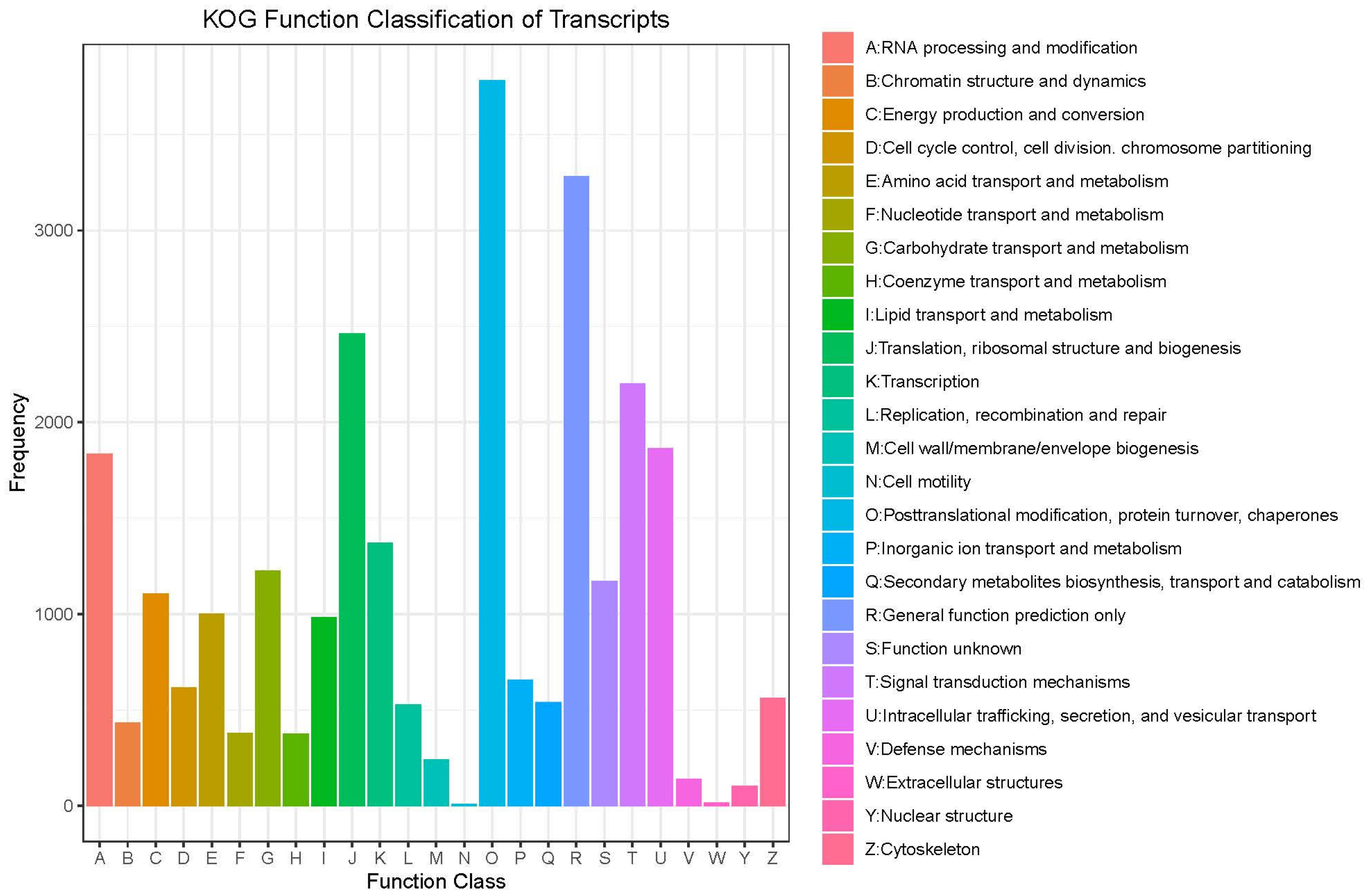
Illumina sequencing produced 17,740,850 pairs of clean reads, comprising 5,219,372,530 bp, with a GC content of 46.47%, a Q20 value of 98.88%, a Q30 value of 96.46%, and an error rate of 0.17%. The data were assembled into 131,321 transcripts totaling 119,764,849 bp (Table S1). Transcript lengths ranged from 185 bp to 10,713 bp, with a mean length of 912 bp, a median length of 518 bp and an N50 length of 1556 bp. Functional annotation of these transcripts was performed using five public databases: Nr, Swiss-Prot, KOG, GO and KEGG (Table S1). Among them, 74,318 (56.59%) and 53,879 (41.03%) transcripts mapped orthologous sequences in Nr and Swiss-Prot, respectively. In the KOG database, 24,079 (18.34%) transcripts were assigned functional categories, with the most represented being ‘Secondary metabolites biosynthesis, transport and catabolism’, ‘General function prediction only’, ‘Translation, ribosomal structure and biogenesis’ and ‘Signal transduction mechanisms’ (Figure 1). GO annotation covered 50,172 transcripts (38.21%), with the most frequent terms being ‘intracellular’ (18,692), ‘cytoplasm’ (11,544) and ‘binding’ (8247) (Figure S2). KEGG pathway analysis identified the top three enriched pathways as ‘Folding, sorting and degradation’ (3125), ‘Translation’ (3101) and ‘Carbohydrate metabolism’ (2889) (Figure S3).

3.2. Identification of SRO Genes in Agave

SRO genes from Arabidopsis, rice, and maize were used as queries to screen the transcriptomes of A. triangularis and A. H11648. Five SRO genes were identified in each species (Table S2). Their transcript lengths ranged from 1104 to 2666 bp in A. triangularis and from 1393 to 3031 bp in A. H11648, encoding proteins of 325-623 and 325-631 amino acids, respectively. The predicted molecular weights were between 36,504.63 Da and 69,016.47 Da for A. triangularis and between 36,326.56 Da and 70,310.92 Da for A. H11648. Theoretical pI values ranged from 7.07 to 9.06 and 7.05~ to 9.13 in the two species. Most agave SRO genes were predicted to localize to the nucleus except for AtrSRO3 and AhSRO3, which were predicted to localize to the chloroplast and plasma membrane.

3.3. Phylogenetic Analysis of Agave SRO Genes

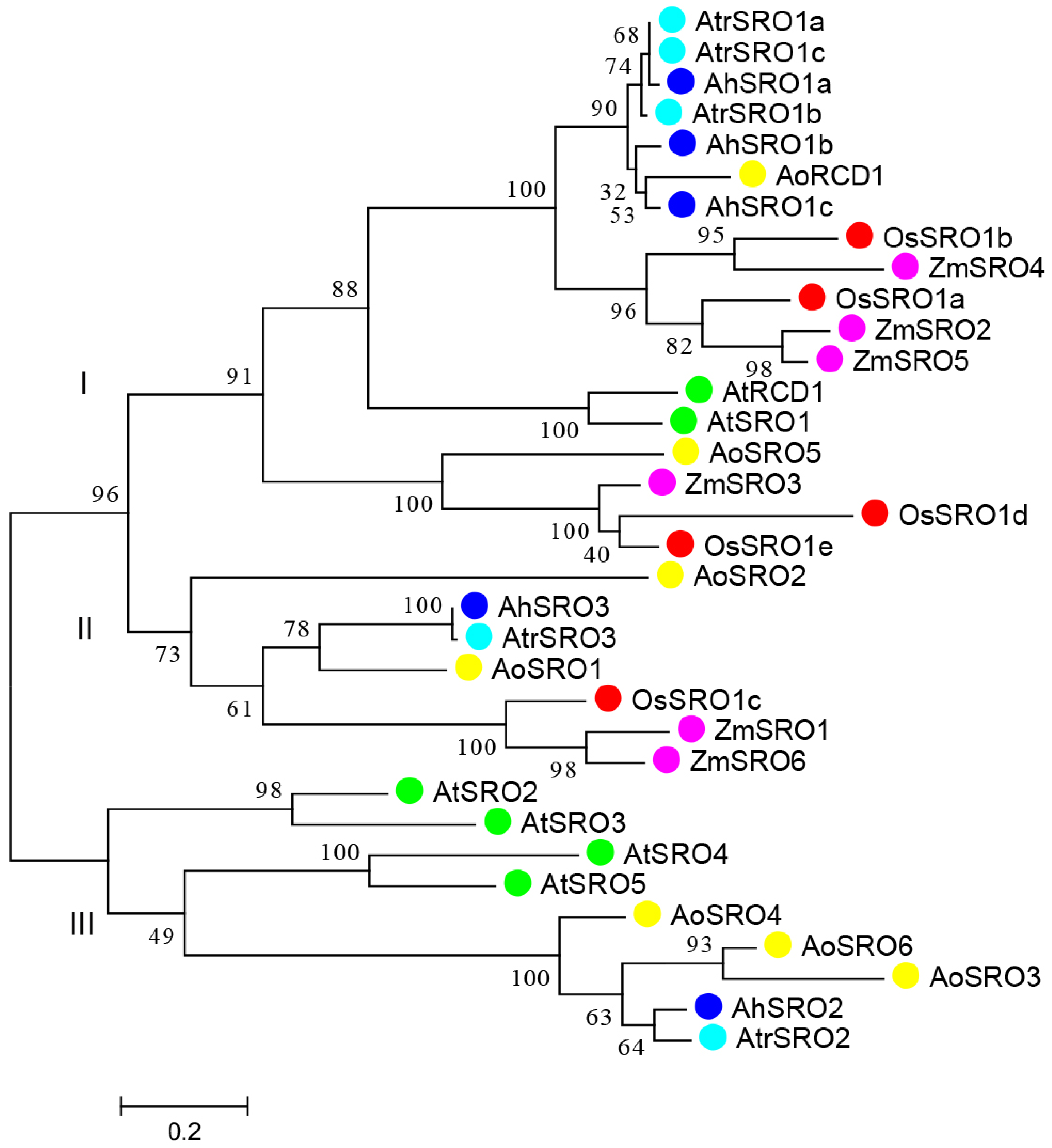
The protein sequences were selected for phylogenetic analysis in five species, including Arabidopsis, rice, maize, asparagus, A. triangularis and A. H11648 (Figure 2, Table S3). These 34 proteins were divided into three groups. The five species shared similar amounts of SRO genes in Groups I and II. There were no rice and maize sequences clustered into Group III. Most asparagus sequences were grouped together with agave sequences except for AoSRO2 and AoSRO5. These proteins were further aligned for conserved domains, which indicated the existence of WWE, PARP and RST domains (Figure S4).

3.4. Expression Patterns of Agave SRO Genes

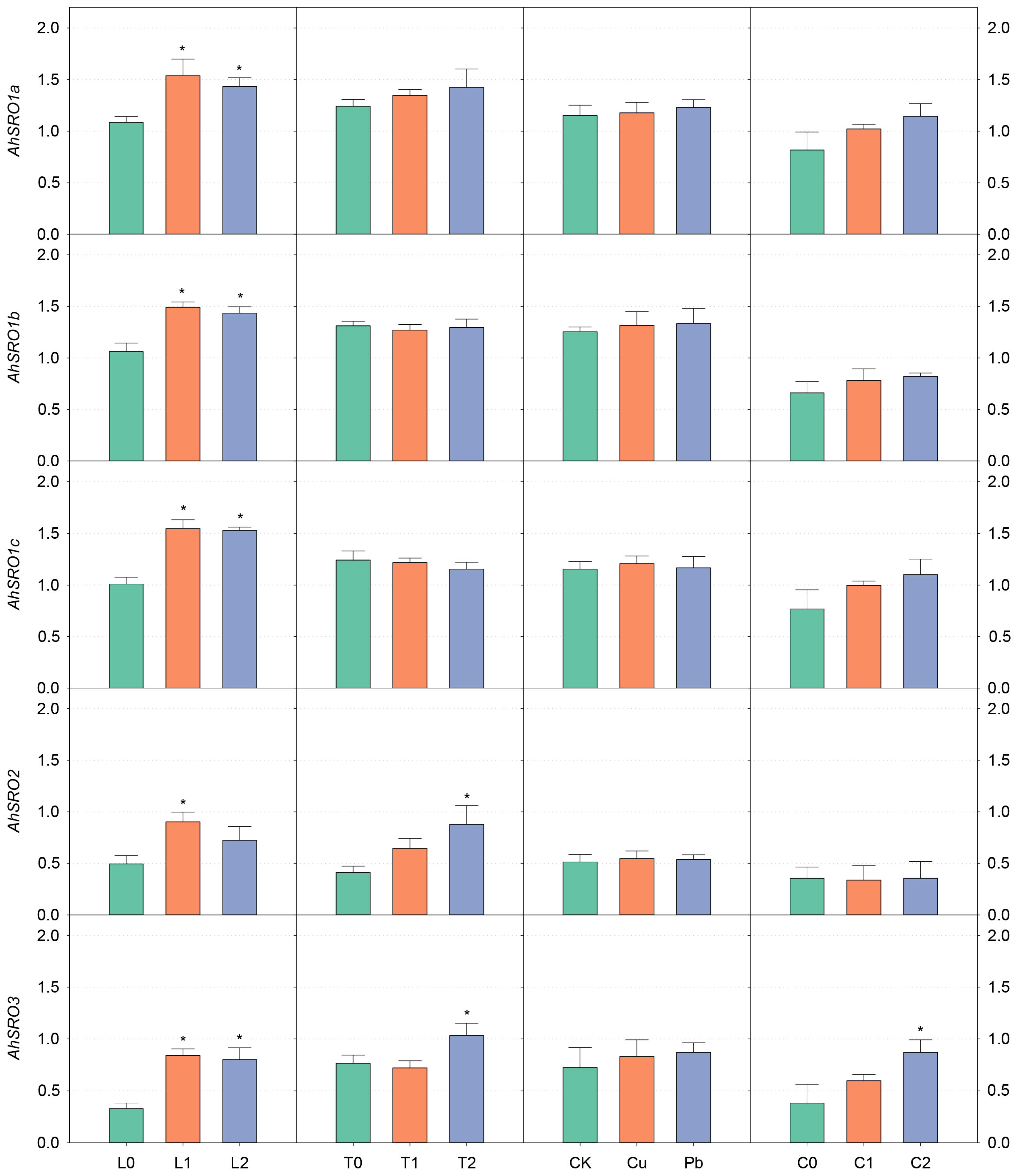
Transcript per million (TPM) values were calculated based on read counts, with 15.61% of sequences showing TPM values above 10 (Table S4). The expression patterns of five agave SRO genes were examined during leaf development, following oomycete infection, and under abiotic stresses, including heavy metal exposure and low temperature (Figure 3). The results indicated that all five genes were significantly up-regulated and maintained stable expression during late leaf developmental stages compared with the shoot stage. While the three AhSRO1 genes showed no significant change in expression after oomycete infection, AhSRO2 and AhSRO3 were significantly induced at 48 h post-infection. None of the five genes responded significantly to copper or lead treatment. Under low-temperature stress, the three AhSRO1 genes exhibited a slight upward trend in expression. AhSRO2 was not sensitive to low temperature, whereas AhSRO3 was significantly up-regulated at 24 h after treatment.

4. Discussion

4.1. Features of A. triangularis Transcriptome

A. triangularis is a typical ornamental species within the agave genus and differs substantially from the economically cultivated A. tequilana and A. H11648, which have been domesticated for their commercial traits [3]. In contrast, A. triangularis can be regarded as a largely wild species with minimal artificial selection, making it a valuable subject for studying evolutionary and domestication patterns in agave [2]. However, genomic resources for this genus remain limited, hindering genome-level analyses of such patterns [11]. Based on Nr annotations, we found that 48,124 transcripts showed orthology to genes in asparagus, whereas only 335 transcripts matched known genes within the agave genus (Table S1). The result reflects both the close evolutionary relationship between A. triangularis and asparagus and the current scarcity of agave gene data in public databases such as NCBI [36]. The total number of transcripts obtained here is comparable to those reported for other agave species, including A. H11648, A. macroacantha and A. striata [2,11,36]. A considerable proportion of transcripts were shorter than 500 bp, which may be attributed to the limitations of Illumina short-read sequencing. Future studies using long-read technologies such as PacBio could significantly improve transcript continuity and completeness [7]. In addition, the BUSCO value was calculated to be 91.1%, with 83.5% complete and 7.6% fragmented BUSCOs, indicating satisfactory assembly quality. In summary, we have successfully assembled the first transcriptome of A. triangularis, providing a valuable bioinformatic resource for gene discovery and evolutionary comparative studies in agave.

4.2. Candidate SRO Genes Involved in Agave Leaf Development and Stress Response

The SRO gene family is a plant-specific family that plays functionally diverse roles in regulating plant development and stress responses [13]. To date, few studies have focused on agave SRO genes, limiting our understanding of this gene family. Through orthologous gene screening, we successfully identified five SRO genes in agave transcriptome datasets (Table S2). These results suggest that the SRO gene family is evolutionarily conserved despite species-specific variations evident in the phylogenetic tree (Figure 2). The qRT-PCR results confirmed expression of all five SRO genes in agave, providing direct evidence for their potential functions (Figure 3). All five genes were significantly up-regulated during leaf development, with consistent expression patterns observed in maize [24], which may relate to the complex regulation of ROS homeostasis in differentiated leaf tissues [54,55]. The three AhSRO1 genes were expressed at consistently high levels under stress conditions without significant variations, suggesting that AhSRO1 may be constitutively expressed during stress responses. In contrast, AhSRO2 and AhSRO3 were differentially expressed following oomycete infection. Similarly, in wheat, TaSRO2a.1-1D and TaSRO2b.3-4A were reported to be significantly up-regulated after Fusarium graminearum infection in wheat, supporting a potential role for SRO genes in biotic stress responses [26]. In addition, AhSRO3 expression was significantly increased under low-temperature stress. A similar expression pattern was observed for six SRO genes in cabbage, which indicates the potential functions of SRO genes in response to low temperature, indicating that SRO genes may also function in cold stress responses [29]. Interestingly, none of the five genes showed significant expression changes under heavy metal stress, although SRO genes have been implicated in salt stress responses of banana, cabbage, maize, poplar, sesame, tomato, and wheat [24,26,27,28,29,30,31]. This discrepancy may be due to differences in sampling time, which was later in agave compared to other reported species. We speculate that SRO genes may function primarily during early stages of heavy metal stress. In summary, this study has provided a framework for understanding the potential roles of SRO genes in regulating leaf development and stress responses in agave.

5. Conclusions

In this study, we assembled the first transcriptome of A. triangularis, yielding a total of 131,321 transcripts. This dataset will serve as a valuable bioinformatic resource for gene characterization and evolutionary studies in agave species. Five SRO genes were identified in both A. triangularis and A. H11648. Expression analysis in A. H11648 indicated their potential involvement in leaf development, with two SRO genes responding specifically to oomycete infection and low temperature. These findings provide a foundation for functional studies on the roles of SRO genes in agave development and stress responses.

Supplementary Materials

The following supporting information can be downloaded at https://www.mdpi.com/article/10.3390/horticulturae12020249/s1: Figure S1: Melt curves of each pair of primers; Figure S2: GO classification of all transcripts; Figure S3: KEGG classification of all transcripts; Figure S4: Alignment of SRO proteins; Table S1: Details of A. triangularis transcripts; Table S2: Details of agave SRO genes; Table S3: Details of asparagus SRO genes; Table S4: Details of read counts and TPM values.

Author Contributions

Conceptualization, H.Q. and X.H. (Xing Huang); formal analysis, H.Q. and Y.F.; investigation, H.Q., Y.F., B.W., X.H. (Xiaoli Hu), G.X., J.L., S.T., T.C. and X.H. (Xing Huang); writing—original draft preparation, H.Q. and X.H. (Xing Huang); writing—review and editing, L.C. and J.L.; funding acquisition, H.Q. and X.H. (Xing Huang). All authors have read and agreed to the published version of the manuscript.

Funding

This research was funded by the Scientific Research Project of Wuhan Polytechnic University (2024Y15), the China Agriculture Research System of MOF, MARA (CARS-15, CARS-16), the Central Public-interest Scientific Institution Basal Research Fund (1630042022005, 1630042025008), and the Hainan Provincial Collaborative Innovation Center for Flexible Talent Introduction.

Data Availability Statement

The original contributions presented in this study are included in the article/Supplementary Material. Further inquiries can be directed to the corresponding authors.

Acknowledgments

We would like to thank Qingqing Liu and Chen Lin from the Shanghai Chenshan Botanical Garden for their help in sample collection. We would also like to thank Bo Wang from Genoseq Technology Co., Ltd. (Wuhan, China) for his technical support.

Conflicts of Interest

The authors declare no conflicts of interest.

References

  1. Thiede, J. Agave triangularis. In Sukkulenten-Lexikon Band I, 1st ed.; Eggli, U., Ed.; Ulmer: Stuttgart, Germany, 2001; p. 68. [Google Scholar]
  2. Xu, G.; Tan, S.; Hu, X.; Mkapa, D.; Xie, Z.; Wu, W.; Fahad, S.; Yi, K.; Huang, X. Agave striata transcriptome reveals candidate cellulose synthase A genes involved in sisal cellulose biosynthesis. Int. J. Biol. Macromol. 2025, 321, 146458. [Google Scholar] [CrossRef] [Scilit] [PubMed]
  3. Huang, X.; Wang, B.; Xi, J.; Zhang, Y.; He, C.; Zheng, J.; Gao, J.; Chen, H.; Zhang, S.; Wu, W.; et al. Transcriptome comparison reveals distinct selection patterns in domesticated and wild Agave species, the important CAM plants. Int. J. Genom. 2018, 2018, 5716518. [Google Scholar] [CrossRef] [Scilit] [PubMed]
  4. Wu, Y.; Li, D.; Hu, Y.; Li, H.; Ramstein, G.P.; Zhou, S.; Zhang, X.; Bao, Z.; Zhang, Y.; Song, B.; et al. Phylogenomic discovery of deleterious mutations facilitates hybrid potato breeding. Cell 2023, 186, 2313–2328. [Google Scholar] [CrossRef] [Scilit] [PubMed]
  5. Gross, S.M.; Martin, J.A.; Simpson, J.; Abraham-Juarez, M.J.; Wang, Z.; Visel, A. De novo transcriptome assembly of drought tolerant CAM plants, Agave deserti and Agave tequilana. BMC Genom. 2013, 14, 563. [Google Scholar] [CrossRef] [Scilit]
  6. Robert, M.L.; Lim, K.Y.; Hanson, L.; Sanchez-Teyer, F.; Bennett, M.D.; Leitch, A.R.; Leitch, I.J. Wild and agronomically important Agave species (Asparagaceae) show proportional increases in chromosome number, genome size, and genetic markers with increasing ploidy. Bot. J. Linn. Soc. 2010, 158, 215–222. [Google Scholar] [CrossRef] [Scilit]
  7. Huang, X.; Hu, X.; Liu, Q.; Xie, Z.; Tan, S.; Qin, X.; Yi, K. Full-length agave transcriptome reveals candidate glycosyltransferase genes involved in hemicellulose biosynthesis. Int. J. Biol. Macromol. 2024, 274, 133508. [Google Scholar] [CrossRef] [Scilit]
  8. Hu, X.; Li, Y.; Tan, S.; Chen, L.; Mkapa, D.S.; Lin, C.; Liu, Q.; Jin, G.; Chen, T.; Qin, X.; et al. Population Structure and Genetic Diversity of Agave Germplasms in China. Agronomy 2025, 15, 722. [Google Scholar] [CrossRef] [Scilit]
  9. Mantilla-Blandon, R.G.; Mancilla-Margalli, N.A.; Molina-Montes, J.A.; Uvalle-Bueno, J.X.; Avila-Miranda, M.E. Agave Wilt Susceptibility by Reduction of Free Hexoses in Root Tissue of Agave tequilana Weber var. azul Commercial Plants in the Fructan Accumulation Process. Int. J. Mol. Sci. 2024, 25, 7357. [Google Scholar] [CrossRef] [Scilit]
  10. Zhang, Y.; Li, Y.; Yang, J.; Yang, X.; Chen, S.; Xie, Z.; Zhang, M.; Huang, Y.; Zhang, J.; Huang, X. Genome-Wide Analysis and Expression of Cyclic Nucleotide–Gated Ion Channel (CNGC) Family Genes under Cold Stress in Mango (Mangifera indica). Plants 2023, 12, 592. [Google Scholar] [CrossRef] [Scilit]
  11. Li, Y.; Hu, X.; Mkapa, D.S.; Xie, L.; Guo, P.; Tan, S.; Zhang, W.; Chen, H.; Huang, X.; Yi, K. Agave macroacantha Transcriptome Reveals Candidate CNGC Genes Responsive to Cold Stress in Agave. Plants 2025, 14, 513. [Google Scholar] [CrossRef] [Scilit]
  12. Lin, X.; Jia, Y.; Heal, R.; Prokchorchik, M.; Sindalovskaya, M.; Olave-Achury, A.; Makechemu, M.; Fairhead, S.; Noureen, A.; Heo, J.; et al. Solanum americanum genome-assisted discovery of immune receptors that detect potato late blight pathogen effectors. Nat. Genet. 2023, 55, 1579–1588. [Google Scholar] [CrossRef] [Scilit] [PubMed]
  13. Jaspers, P.; Overmyer, K.; Wrzaczek, M.; Vainonen, J.P.; Blomster, T.; Salojärvi, J.; Reddy, R.A.; Kangasjärvi, J. The RST and PARP-like domain containing SRO protein family: Analysis of protein structure, function and conservation in land plants. BMC Genom. 2010, 11, 170. [Google Scholar] [CrossRef] [Scilit] [PubMed]
  14. Ahlfors, R.; Lång, S.; Overmyer, K.; Jaspers, P.; Brosché, M.; Tauriainen, A.; Kollist, H.; Tuominen, H.; Belles-Boix, E.; Piippo, M.; et al. Arabidopsis RADICAL-INDUCED CELL DEATH1 belongs to the WWE protein-protein interaction domain protein family and modulates abscisic acid, ethylene, and methyl jasmonate responses. Plant Cell 2004, 16, 1925–1937. [Google Scholar] [CrossRef] [Scilit] [PubMed]
  15. Jaspers, P.; Blomster, T.; Brosché, M.; Salojärvi, J.; Ahlfors, R.; Vainonen, J.P.; Reddy, R.A.; Immink, R.; Angenent, G.; Turck, F.; et al. Unequally redundant RCD1 and SRO1 mediate stress and developmental responses and interact with transcription factors. Plant J. 2009, 60, 268–279. [Google Scholar] [CrossRef] [Scilit]
  16. Delaforge, E.; Due, A.D.; Theisen, F.F.; Morffy, N.; O’Shea, C.; Blackledge, M.; Strader, L.C.; Skriver, K.; Kragelund, B.B. Allovalent scavenging of activation domains in the transcription factor ANAC013 gears transcriptional regulation. Nucleic Acids Res. 2025, 53, gkaf065. [Google Scholar] [CrossRef] [Scilit]
  17. Jin, T.; Wu, H.; Deng, Z.; Cai, T.; Li, J.; Liu, Z.; Waterhouse, P.M.; White, R.G.; Liang, D. Control of root-to-shoot long-distance flow by a key ROS-regulating factor in Arabidopsis. Plant Cell Environ. 2022, 45, 2476–2491. [Google Scholar] [CrossRef] [Scilit]
  18. Teotia, S.; Lamb, R.S. The paralogous genes RADICAL-INDUCED CELL DEATH1 and SIMILAR TO RCD ONE1 have partially redundant functions during Arabidopsis development. Plant Physiol. 2009, 151, 180–198. [Google Scholar] [CrossRef] [Scilit]
  19. Teotia, S.; Lamb, R.S. RCD1 and SRO1 are necessary to maintain meristematic fate in Arabidopsis thaliana. J. Exp. Bot. 2011, 62, 1271–1284. [Google Scholar] [CrossRef] [Scilit]
  20. Zhao, X.; Gao, L.; Jin, P.; Cui, L. The similar to RCD-one 1 protein SRO1 interacts with GPX3 and functions in plant tolerance of mercury stress. Biosci. Biotechnol. Biochem. 2018, 82, 74–80. [Google Scholar] [CrossRef] [Scilit]
  21. Kong, L.; Feng, B.; Yan, Y.; Zhang, C.; Kim, J.H.; Xu, L.; Rack, J.G.M.; Wang, Y.; Jang, J.C.; Ahel, I.; et al. Noncanonical mono(ADP-ribosyl)ation of zinc finger SZF proteins counteracts ubiquitination for protein homeostasis in plant immunity. Mol. Cell 2021, 81, 4591–4604. [Google Scholar] [CrossRef] [Scilit]
  22. Zhao, X.; Gao, L.; Ren, J.; Pan, F. Arabidopsis SIMILAR TO RCD-ONE genes are ubiquitous and respond to multiple abiotic stresses through diverse signaling pathways. J. Biosci. 2019, 44, 129. [Google Scholar] [CrossRef] [Scilit] [PubMed]
  23. Borsani, O.; Zhu, J.; Verslues, P.E.; Sunkar, R.; Zhu, J.K. Endogenous siRNAs derived from a pair of natural cis-antisense transcripts regulate salt tolerance in Arabidopsis. Cell 2005, 123, 1279–1291. [Google Scholar] [CrossRef] [Scilit]
  24. Jiang, H.; Xiao, Y.; Zhu, S. Genome-wide identification, systematic analysis and characterization of SRO family genes in maize (Zea mays L.). Acta Physiol. Plant. 2018, 40, 40. [Google Scholar] [CrossRef] [Scilit]
  25. Jiang, H.; Zhang, Y.; Li, J.; Tang, R.; Liang, F.; Tang, R.; Zhou, Y.; Zhang, C. Genome-wide identification of SIMILAR to RCD ONE (SRO) gene family in rapeseed (Brassica napus L.) reveals their role in drought stress response. Plant Signal. Behav. 2024, 19, 2379128. [Google Scholar] [CrossRef] [Scilit] [PubMed]
  26. Jiang, W.; Geng, Y.; Liu, Y.; Chen, S.; Cao, S.; Li, W.; Chen, H.; Ma, D.; Yin, J. Genome-wide identification and characterization of SRO gene family in wheat: Molecular evolution and expression profiles during different stresses. Plant Physiol. Biochem. 2020, 154, 590–611. [Google Scholar] [CrossRef] [Scilit]
  27. Li, N.; Xu, R.; Wang, B.; Wang, J.; Huang, S.; Yu, Q.; Gao, J. Genome-Wide Identification and Evolutionary Analysis of the SRO Gene Family in Tomato. Front. Genet. 2021, 12, 753638. [Google Scholar] [CrossRef] [Scilit]
  28. Liu, A.; Wei, M.; Zhou, Y.; Li, D.; Zhou, R.; Zhang, Y.; Zhang, X.; Wang, L.; You, J. Comprehensive analysis of SRO gene family in Sesamum indicum (L.) reveals its association with abiotic stress responses. Int. J. Mol. Sci. 2021, 22, 13048. [Google Scholar] [CrossRef] [Scilit]
  29. Qiao, Y.; Gao, X.; Liu, Z.; Wu, Y.; Hu, L.; Yu, J. Genome-Wide Identification and Analysis of SRO Gene Family in Chinese Cabbage (Brassica rapa L.). Plants 2020, 9, 1235. [Google Scholar] [CrossRef] [Scilit]
  30. Wang, Y.; Wang, R.; Yu, Y.; Gu, Y.; Wang, S.; Liao, S.; Xu, X.; Jiang, T.; Yao, W. Genome-Wide Analysis of SIMILAR TO RCD ONE (SRO) Family Revealed Their Roles in Abiotic Stress in Poplar. Int. J. Mol. Sci. 2023, 24, 4146. [Google Scholar] [CrossRef] [Scilit]
  31. Zhang, L.; Zhou, D.; Hu, H.; Li, W.; Hu, Y.; Xie, J.; Huang, S.; Wang, W. Genome-wide characterization of a SRO gene family involved in response to biotic and abiotic stresses in banana (Musa spp.). BMC Plant Biol. 2019, 19, 211. [Google Scholar] [CrossRef] [Scilit]
  32. You, J.; Zong, W.; Li, X.; Ning, J.; Hu, H.; Li, X.; Xiao, J.; Xiong, L. The SNAC1-targeted gene OsSRO1c modulates stomatal closure and oxidative stress tolerance by regulating hydrogen peroxide in rice. J. Exp. Bot. 2013, 64, 569–583. [Google Scholar] [CrossRef] [Scilit] [PubMed]
  33. Gao, H.; Cui, J.; Liu, S.; Wang, S.; Lian, Y.; Bai, Y.; Zhu, T.; Wu, H.; Wang, Y.; Yang, S.; et al. Natural variations of ZmSRO1d modulate the trade-off between drought resistance and yield by affecting ZmRBOHC-mediated stomatal ROS production in maize. Mol. Plant 2022, 15, 1558–1574. [Google Scholar] [CrossRef] [Scilit] [PubMed]
  34. Qin, L.; Sun, L.; Wei, L.; Yuan, J.; Kong, F.; Zhang, Y.; Miao, X.; Xia, G.; Liu, S. Maize SRO1e represses anthocyanin synthesis through regulating the MBW complex in response to abiotic stress. Plant J. 2021, 105, 1010–1025. [Google Scholar] [CrossRef] [Scilit] [PubMed]
  35. Tan, S.; Liang, Y.; Huang, Y.; Xi, J.; Huang, X.; Yang, X.; Yi, K. Phylogeny and Expression Atlas of the NITRATE TRANSPORTER 1/PEPTIDE TRANSPORTER FAMILY in Agave. Plants 2022, 11, 1434. [Google Scholar] [CrossRef] [Scilit]
  36. Huang, X.; Xiao, M.; Xi, J.; He, C.; Zheng, J.; Chen, H.; Gao, J.; Zhang, S.; Wu, W.; Liang, Y.; et al. De novo transcriptome assembly of Agave H11648 by Illumina sequencing and identification of cellulose synthase genes in Agave species. Genes 2019, 10, 103. [Google Scholar] [CrossRef] [Scilit]
  37. Katz, K.; Shutov, O.; Lapoint, R.; Kimelman, M.; Brister, J.R.; O’Sullivan, C. The Sequence Read Archive: A decade more of explosive growth. Nucleic Acids Res. 2022, 50, D387–D390. [Google Scholar] [CrossRef] [Scilit]
  38. Bolger, A.M.; Lohse, M.; Usadel, B. Trimmomatic: A flexible trimmer for Illumina sequence data. Bioinformatics 2014, 30, 2114–2120. [Google Scholar] [CrossRef] [Scilit]
  39. Martin, M. Cutadapt removes adapter sequences from high-throughput sequencing reads. EMBnet J. 2011, 17, 10–12. [Google Scholar] [CrossRef] [Scilit]
  40. Grabherr, M.G.; Haas, B.J.; Yassour, M.; Levin, J.Z.; Thompson, D.A.; Amit, I.; Adiconis, X.; Fan, L.; Raychowdhury, R.; Zeng, Q.; et al. Full-length transcriptome assembly from RNA-Seq data without a reference genome. Nat. Biotechnol. 2011, 29, 644–652. [Google Scholar] [CrossRef] [Scilit]
  41. Galperin, M.Y.; Vera Alvarez, R.; Karamycheva, S.; Makarova, K.S.; Wolf, Y.I.; Landsman, D.; Koonin, E.V. COG database update 2024. Nucleic Acids Res. 2025, 53, D356–D363. [Google Scholar] [CrossRef] [Scilit]
  42. Kanehisa, M.; Furumichi, M.; Sato, Y.; Kawashima, M.; Ishiguro-Watanabe, M. KEGG for taxonomy-based analysis of pathways and genomes. Nucleic Acids Res. 2023, 51, D587–D592. [Google Scholar] [CrossRef] [Scilit] [PubMed]
  43. Pruitt, K.D.; Tatusova, T.; Maglott, D.R. NCBI Reference Sequence (RefSeq): A curated non-redundant sequence database of genomes, transcripts and proteins. Nucleic Acids Res. 2005, 33, D501–D504. [Google Scholar] [CrossRef] [Scilit] [PubMed]
  44. Schneider, M.; Tognolli, M.; Bairoch, A. The Swiss-Prot protein knowledgebase and ExPASy: Providing the plant community with high quality proteomic data and tools. Plant Physiol. Biochem. 2004, 42, 1013–1021. [Google Scholar] [CrossRef] [Scilit] [PubMed]
  45. The Gene Ontology Consortium. The Gene Ontology Resource: 20 years and still GOing strong. Nucleic Acids Res. 2019, 47, D330–D338. [Google Scholar] [CrossRef] [Scilit]
  46. Altschul, S.F.; Gish, W.; Miller, W.; Myers, E.W.; Lipman, D.J. Basic local alignment search tool. J. Mol. Biol. 1990, 215, 403–410. [Google Scholar] [CrossRef]
  47. Rombel, I.T.; Sykes, K.F.; Rayner, S.; Johnston, S.A. ORF-FINDER: A vector for high-throughput gene identification. Gene 2002, 282, 33–41. [Google Scholar] [CrossRef] [Scilit]
  48. ProtParam Tool. Available online: https://web.expasy.org/protparam/ (accessed on 16 December 2025).
  49. Yu, C.S.; Lin, C.J.; Hwang, J.K. Predicting subcellular localization of proteins for Gram-negative bacteria by support vector machines based on n-peptide compositions. Protein Sci. 2004, 13, 1402–1406. [Google Scholar] [CrossRef] [Scilit]
  50. Tamura, K.; Peterson, D.; Peterson, N.; Stecher, G.; Nei, M.; Kumar, S. MEGA5: Molecular evolutionary genetics analysis using maximum likelihood, evolutionary distance, and maximum parsimony methods. Mol. Biol. Evol. 2011, 28, 2731–2739. [Google Scholar] [CrossRef] [Scilit]
  51. Larkin, M.A.; Blackshields, G.; Brown, N.P.; Chenna, R.; McGettigan, P.A.; McWilliam, H.; Valentin, F.; Wallace, I.M.; Wilm, A.; Lopez, R.; et al. Clustal W and Clustal X version 2.0. Bioinformatics 2007, 23, 2947–2948. [Google Scholar] [CrossRef] [Scilit]
  52. Chen, Y.; Tan, Z.; Hu, B.; Yang, Z.; Xu, B.; Zhuang, L.; Huang, B. Selection and validation of reference genes for target gene analysis with quantitative RT-PCR in leaves and roots of bermudagrass under four different abiotic stresses. Physiol. Plant. 2015, 155, 138–148. [Google Scholar] [CrossRef] [Scilit]
  53. Livak, K.J.; Schmittgen, T.D. Analysis of relative gene expression data using real-time quantitative PCR and the 2(-Delta Delta C(T)) Method. Methods 2001, 25, 402–408. [Google Scholar] [CrossRef] [Scilit]
  54. Singh, V.P.; Jaiswal, S.; Wang, Y.; Feng, S.; Tripathi, D.K.; Singh, S.; Gupta, R.; Xue, D.; Xu, S.; Chen, Z.H. Evolution of reactive oxygen species cellular targets for plant development. Trends Plant Sci. 2024, 29, 865–877. [Google Scholar] [CrossRef] [Scilit]
  55. Zhu, J.K. Abiotic Stress Signaling and Responses in Plants. Cell 2016, 167, 313–324. [Google Scholar] [CrossRef] [Scilit]
Figure 1. KOG classifications of A. triangularis transcripts.
Horticulturae 12 00249 g001
Figure 2. Phylogenetic analysis of SRO proteins of Arabidopsis (green), rice (red), maize (pink), asparagus (yellow), A. triangularis (light blue) and A. H11648 (blue).
Horticulturae 12 00249 g002
Figure 3. The expression patterns of SRO genes in A. H11648. The x-axis represents different stages or treatments, including shoot (L0), unexpanded leaf (L1), expanded leaf (L2), oomycete infection (T0 for 0 h, T1 for 24 h and T2 for 48 h), heavy metal treatments (CK for water, Cu for copper and Pb for lead) and low-temperature treatments (C0 for 0 h, C1 for 12 h and C2 for 24 h). The y-axis represents relative expression levels (* t-test, p < 0.05). The error bars represent the standard error.
Horticulturae 12 00249 g003
Table 1. Primers used for qRT-PCR validation.
Gene IDForward PrimerReverse Primer
AhSRO1aTAGCAGCAAAAGCATCATGGCTGGCAACTTTCTCATGCAA
AhSRO1bAGCCAATTGCTTGGATTGACGCTTCCGAACTTGTGCTTTC
AhSRO1cTCCCAGACGCAAGTTTTTCTCAGGCTGAACTCCTCGTTTC
AhSRO2TCGCTCTGCCTCCAGTATTTGCAACAGCTCTCCACATCAA
AhSRO3CGGAGAGTCTGAGGTTGAGGGAAATGTGGTGGCGAGAGAT
PP2ACCTCCTCCTCCTTCGGTTTGGCCATGAATGTCACCGCAGA
TUBTTCCCATCACCAAAGGTCTCCGCTCATTGTGGCAGAGATA
Table 2. Reaction solution for qRT-PCR validation.
SolutionVolume
TransStart Tip Green qPCR Supermix (Transgen Biotech, Beijing, China)10 μL
Passive Reference Dye (50×) (Transgen Biotech, Beijing, China)0.4 μL
Forward Primer (10 μM)0.5 μL
Reverse Primer (10 μM)0.5 μL
cDNA1 μL
ddH2O7.6 μL
Total20 μL
Disclaimer/Publisher’s Note: The statements, opinions and data contained in all publications are solely those of the individual author(s) and contributor(s) and not of MDPI and/or the editor(s). MDPI and/or the editor(s) disclaim responsibility for any injury to people or property resulting from any ideas, methods, instructions or products referred to in the content.