Article

Trait-Mediated Facilitation and Stress Tolerance in Two Globose Cactus Species from the Mexican Desert

by
Cecilia Leonor Jiménez-Sierra
1,
Erika Arroyo-Pérez
1,*,
Omar Díaz-Segura
1,
María Loraine Matías-Palafox
2,
Joel Flores
3 and
María De Los Angeles González-Adán
1
1
Department of Biology, Universidad Autónoma Metropolitana-Unidad Iztapalapa, Av. Ferrocarril San Rafael Atlixco, No. 186, Col. Leyes de Reforma 1 a Sección, Alcaldía Iztapalapa, Mexico City 09310, Mexico
2
Departamento de Gestión de Información y Evaluación de Especies, Comisión Nacional para el Conocimiento y Uso de la Biodiversidad, CONABIO, Periférico-Insurgentes Sur No. 4903, Parques Del Pedregal, Mexico City 14010, Mexico
3
División de Ciencias Ambientales, Instituto Potosino de Investigación Científica y Tecnológica, Colonia Lomas 4 Sección, Camino a La Presa San José 2055, San Luis Potosí 78216, Mexico
*
Author to whom correspondence should be addressed.
Horticulturae 2026, 12(4), 447; https://doi.org/10.3390/horticulturae12040447
Submission received: 28 February 2026 / Revised: 23 March 2026 / Accepted: 1 April 2026 / Published: 4 April 2026

Abstract

Succulent plants in arid ecosystems exhibit contrasting strategies to cope with high irradiance, thermal stress, and water limitation. We evaluated spatial distribution, microhabitat use, nurse identity, and orientation beneath canopies for two threatened globose cacti from the Querétaro semi-desert (Mexico): Ariocarpus kotschoubeyanus and Lophophora diffusa. One site with high population density was selected for each species, where 10 plots were established (9 m2 for A. kotschoubeyanus and 49 m2 for L. diffusa). The study aims to evaluate whether species-specific recruitment patterns are associated with differential dependence on nurse-plant microhabitats under conditions of radiation and thermal stress. We hypothesized that: (1) both species exhibit aggregated spatial distributions but differ in their reliance on nurse-mediated microclimatic buffering; and (2) nurse-plant identity and orientation patterns vary between species, reflecting species-specific ecophysiological thresholds to irradiance and heat stress. Both species showed strongly aggregated spatial distributions (Hopkins index > 0.8), indicating recruitment constrained by microsite heterogeneity. However, their stress-adaptation strategies differed markedly. A. kotschoubeyanus occurred predominantly in open microsites (79%), consistent with its geophytic growth form and tolerance to high radiation and temperature extremes. In contrast, L. diffusa was strongly associated with nurse plants (78%), particularly Larrea tridentata and Bursera fagaroides, and preferentially established on eastern canopy exposures that reduce afternoon heat load. These patterns reflect species-specific ecophysiological thresholds linked to radiation tolerance and microclimatic buffering. Facilitation in globose cacti is therefore trait-mediated and context-dependent. Maintaining perennial shrub diversity is essential to preserve the microhabitats that sustain recruitment and persistence of stress-sensitive succulents under increasing climatic aridity.

1. Introduction

Vegetation in arid and semi-arid ecosystems is typically arranged in discrete patches or “islands of fertility”, embedded within open matrices characterized by extreme abiotic conditions [1]. In these systems, plant establishment occurs under intense solar radiation, high soil surface temperatures, large vapour pressure deficits, and chronic water limitations. For succulent species, recruitment therefore depends not only on dispersal and microsite availability but also on the capacity to maintain water balance, photochemical stability, and resistance to thermal and oxidative stress during early ontogeny [2,3]. Positive plant–plant interactions, particularly nurse-plant facilitation, may mitigate these constraints by buffering microclimatic extremes [4,5].
Nurse plants modify local microclimatic conditions by reducing incident photosynthetic photon flux density (PPFD), buffering thermal extremes, enhancing soil moisture retention, and improving nutrient availability [5,6]. These modifications can reduce photoinhibition, stabilize maximum quantum efficiency of photosystem II (Fv/Fm), and enhance electron transport rates (ETR), thereby improving carbon gain under stress [3]. For many cacti, early recruitment is markedly enhanced beneath shrub or tree canopies, particularly during seasonal drought [5,7,8]. However, facilitative effects are not universal; their magnitude depends on species-specific physiological thresholds, ontogenetic stage, and environmental context [9,10,11].
Globose cacti exhibit contrasting recruitment strategies that reflect differences in structural and physiological stress tolerance. Some species are strongly dependent on nurse plants [5,12,13], whereas others establish successfully in open microsites despite exposure to extreme radiation and temperature [14]. Tolerance to open conditions may involve geophytic growth forms, reduced surface exposure, crassulacean acid metabolism (CAM), which enhances water-use efficiency by shifting CO2 uptake to nighttime and reducing daytime transpirational water loss, and the capacity to maintain high effective quantum yield of photosystem II (ΦPSII) under intense irradiance [15]. Conversely, facilitation-dependent species may rely on canopy-mediated buffering to avoid chronic photoinhibition and hydraulic stress [3].
Within Cactaceae, the genus Ariocarpus exemplifies this variability. In some localities, species are closely associated with nurse plants [16]; in others, associations are facultative [14,17,18], and in certain contexts individuals occur independently of nurse canopies [19]. Nevertheless, demographic performance—particularly survival and long-term persistence—often improves beneath nurse plants [18], suggesting that facilitation may enhance physiological performance under stress [3].
In contrast, species of Lophophora are consistently reported as nurse-dependent, with little evidence of variability in association strategies. For example, Lophophora williamsii depends on nurse plants in Tamaulipas [20] and Coahuila [21], while L. diffusa exhibits similar dependence in Cadereyta, Qro. [22]. Such patterns suggest narrower ecophysiological tolerance to open-site stress relative to some congeners.
Here, we evaluated spatial distribution patterns, microhabitat preference, nurse plant identity, and orientation beneath nurse canopies for two threatened globose cacti from central Mexico: Ariocarpus kotschoubeyanus and Lophophora diffusa. By linking spatial patterns with known physiological responses to radiation and thermal stress, we aimed to infer whether recruitment strategies reflect contrasting stress-adaptation mechanisms. We hypothesised that (1) both species exhibit aggregated spatial distributions but differ in their dependence on nurse-mediated microclimatic buffering; and (2) nurse-plant identity and orientation patterns differ between species, reflecting species-specific ecophysiological thresholds to radiation and heat stress, as inferred from previous studies.

2. Materials and Methods

2.1. Study Area

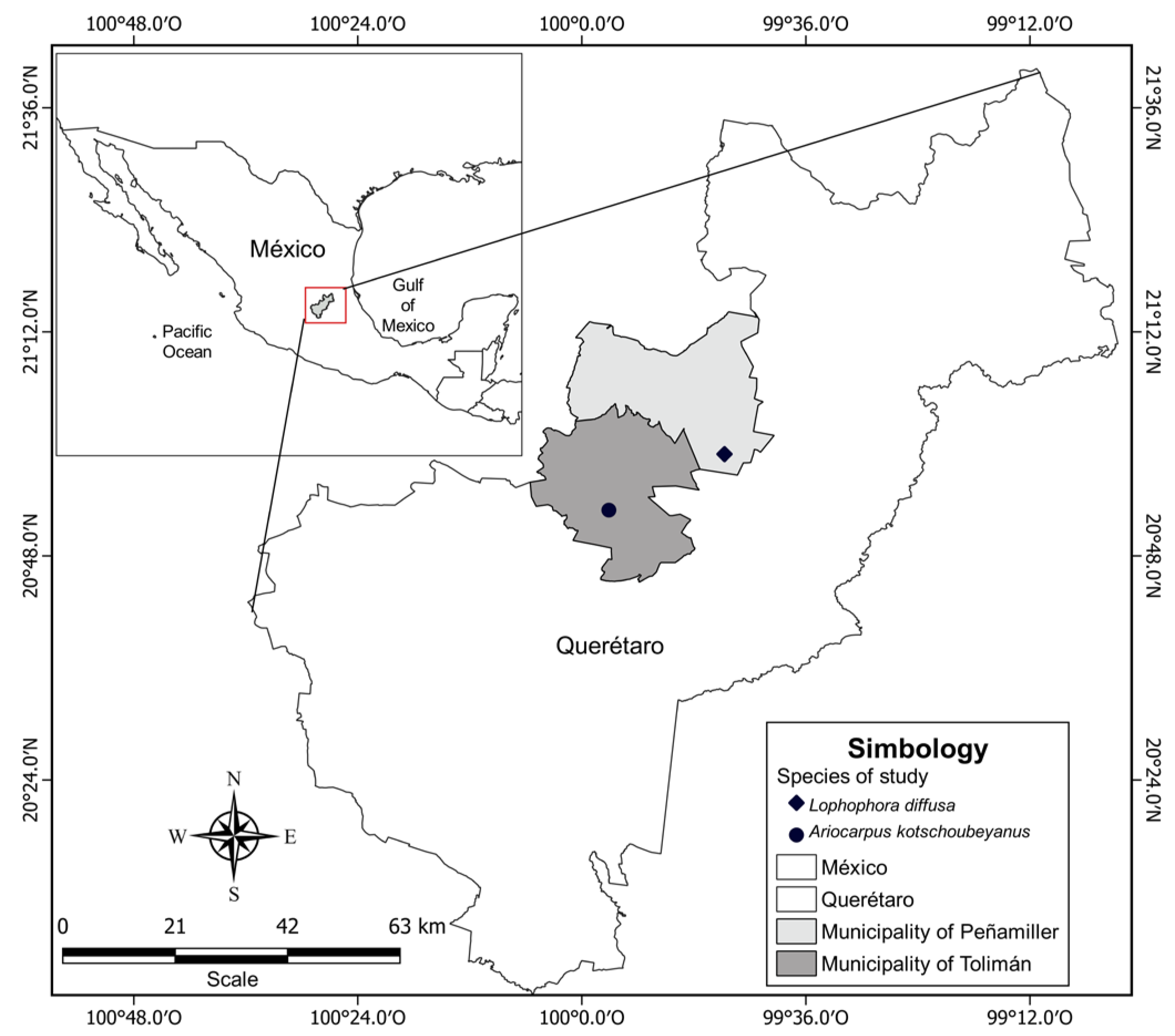
The study was conducted in the Querétaro semi-desert (southern Chihuahuan Desert, Mexico) (Figure 1). Two sites with high densities of the target species were selected. The A. kotschoubeyanus site is located in the municipality of Tolimán (20°52′ N, 99°57′ W; 1200 m a.s.l.), characterised by thorny xerophilous shrubland. Dominant perennial species include Fouquieria splendens, Karwinskia humboldtiana, Parthenium incanum and Vachellia vernicosa. The L. diffusa site is located in the municipality of Peñamiller (20°58′ N, 99°44′ W; 1454 m a.s.l.), within microphyllous xerophilous shrubland dominated by Larrea tridentata, Vachellia vernicosa, Mimosa depauperata and Neltuma laevigata. Both sites have mean annual temperatures of 18–22 °C and annual precipitation of 380–470 mm [16,23].

2.2. Study Species

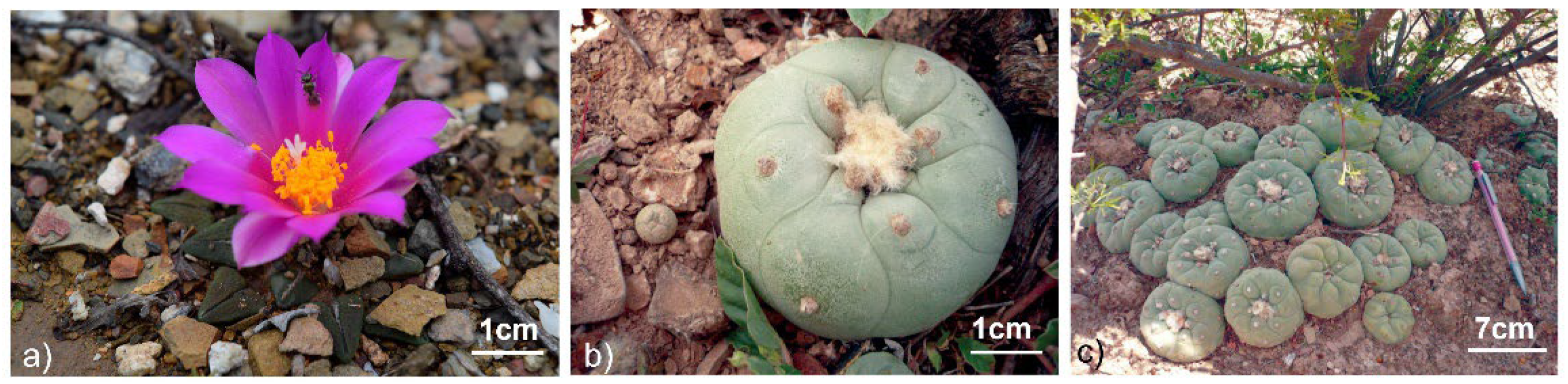
Ariocarpus kotschoubeyanus is a small, globose-depressed, geophytic cactus with triangular, flattened tubercles (Figure 2a). It is listed as Near Threatened by the IUCN and under Appendix I of CITES [16]. Lophophora diffusa is an endemic globose cactus from Querétaro and San Luis Potosí, with solitary (Figure 2b) or clumped stems (Figure 2c), listed as Vulnerable by the IUCN and under Appendix II of CITES [23].

2.3. Spatial Distribution and Density

Ten plots per species were established (9 m2 for A. kotschoubeyanus; 49 m2 for L. diffusa). All individuals were mapped. Density was calculated as the number of individuals per sampled area. Intrapopulation spatial distribution was evaluated using the Hopkins index to determine whether distributions were uniform, random, or aggregated [24].

2.4. Microhabitat and Nurse Plants Associations

Microhabitat preference (open vs. beneath vegetation) was assessed using χ2 tests [25]. Associations with nurse species were evaluated by comparing observed vs. expected frequencies based on canopy cover. Adjusted standardized residuals (Haberman test) were used; values exceeding ±1.96 were considered significant [26].

2.5. Orientation Beneath Nurse Plants

Orientation relative to nurse stems was recorded using compass (Brunton Transit F-5021, Riverton, WY, USA) bearings. Canopies were divided into four quadrants (north, east, south, west). A Chi-square test was performed [25], and standardized residuals were used to test the significance of each cell (Haberman test; [26]) under the premise of equitability in the number of individuals at any cardinal point.

3. Results

3.1. Population Density and Spatial Distribution

For Ariocarpus kotschoubeyanus, a total of 305 individuals were recorded. Mean density within plots was 3.41 ± 0.17 ind m−2, while density at the site scale was considerably lower (0.06 ind m−2). Spatial distribution was aggregated (Hopkins index = 0.99). The plant species with the greatest cover were Karwinskia humboldtiana, which had the highest cover (52.71%), followed by Parthenium incanum (36.73%), Vachellia vernicosa (6.80%), Jatropha dioica (3.61%), and Cylindropuntia leptocaulis (0.15%).
For Lophophora diffusa, a total of 380 individuals were recorded. Mean plot-level density was 0.78 ± 0.10 ind m−2, with aggregated spatial distribution (Hopkins index = 0.83). The three species with the greatest cover were Larrea tridentata (36.7%), Acacia constricta var. vernicosa (21.2%), and Opuntia leptocaulis (18.3%), which together account for 76.2% of the total vegetation cover and host 82.8% of the peyote individuals found in protected habitats.

3.2. Microhabitat Preference

For Ariocarpus kotschoubeyanus, most individuals (79.0%) occurred in open sites, significantly more than expected by chance (χ2 = 40.60; p < 0.0001) (Table 1). In contrast, L. diffusa occurred predominantly (78%) beneath perennial vegetation (χ2 = 64.89; p < 0.0001) (Table 2).

3.3. Nurse Plant Species Preference

Although most of the individuals were found in open spaces, A. kotschoubeyanus plants were positively associated with Karwinskia humboldtiana2 = 4.46; p < 0.05), negatively associated with Parthenium incanum2 = 11.59; p < 0.0001), and not associated with Vachellia vernicosa2 = 1.61; p > 0.10), Jatropha dioica2 = 1.24; p > 0.25), and Cylindropuntia leptocaulis2 = 0.09; p > 0.75) (Table 3).
Chi-square (χ2) tests and adjusted residuals indicate that L. diffusa preferentially establishes beneath the canopy of Larrea tridentata2 = 18.19; p < 0.001) and Bursera fagaroides2 = 19.07; p < 0.001). However, individuals are scarce beneath the canopy of Opuntia leptocaulis2 = 9.87; p < 0.002) and Fouquieria splendens2 = 6.71; p < 0.01), where the association is significantly negative (Table 4).

3.4. Orientation Under Nurse Plants

Ariocarpus kotschoubeyanus showed a significant preference for the northern orientation under nurse plants (χ2 = 6.25; p < 0.01; Table 5), whereas L. diffusa showed a preference for the eastern side of nurse plants (χ2 = 14.1; p < 0.005) (Table 6).

4. Discussion

Our first hypothesis, “both species exhibit aggregated spatial distributions but differ in their dependence on nurse-mediated microclimatic buffering”, was supported. Both cactus species exhibited markedly aggregated spatial distributions, yet only L. difussa showed clear dependence on nurse plants. Spatial clustering is a pervasive feature of plant populations in arid and semi-arid ecosystems, where establishment is constrained by fine-scale heterogeneity in soil moisture, temperature, and resource availability [27].
In both species, aggregation is partly attributable to limited dispersal. Seeds of Ariocarpus kotschoubeyanus are primarily redistributed by runoff [28], promoting short-distance transport and localized seed deposition. In Lophophora diffusa, ant-mediated dispersal and frequent retention of seeds near the maternal plant—including occasional germination within tubercles [29]—further restrict dispersal distances as also has been reported in Ariocarpus kotschoubeyanus [30]. These mechanisms favour clustered recruitment.
However, dispersal limitation alone cannot explain the pronounced aggregation observed (Hopkins index > 0.8). Instead, clustering likely reflects microsite filtering, whereby only a subset of patches provides the microenvironmental conditions necessary for germination and early seedling survival [31].
In arid systems, recruitment windows are narrow and episodic, confining successful cohorts to spatially predictable “safe sites”. Aggregation therefore emerges from the interaction between environmental heterogeneity and ecophysiological thresholds during early life stages. Under projected climate warming, dependence on buffered microsites may intensify further, potentially strengthening spatial aggregation as only the most favorable patches remain suitable for recruitment [32].
Population density patterns reinforce this interpretation. The density of A. kotschoubeyanus (0.06 individuals m−2) was substantially lower than values reported for northern Mexican populations (0.68 individuals m−2; [16]) and lower than densities documented for related congeners [16,33]. This low density aligns with estimates from disturbed habitats in northeastern Mexico, suggesting that site condition and disturbance history strongly influence demographic structure.
For L. diffusa, density reached 0.78 individuals m−2 in high-abundance plots but declined to 0.04 individuals m−2 at the hectare scale, highlighting pronounced spatial patchiness. The broader-scale estimate is comparable to nearby populations, though lower than densities reported for Lophophora williamsii in southwestern Tamaulipas (0.75 individuals m−2; [20]). Together, these results indicate sparse, but locally dense populations consistent with safe-site dynamics.

4.1. Contrasting Recruitment Strategies

The two species exhibited contrasting recruitment strategies. A. kotschoubeyanus occurred primarily in open microsites, consistent with its geophytic growth form and tolerance to high irradiance and temperature extremes [16]. Its depressed, partially subterranean stem reduces exposure to extreme surface temperatures and limits transpirational demand [34]. In addition, geophytism and contractile roots reported in related taxa [35] may facilitate vertical repositioning within the soil profile, buffering thermal extremes.
Although open microsites expose seedlings to intense midday radiation, elevated soil surface temperatures, and reduced moisture due to the absence of canopy-mediated buffering of vapour pressure deficit, A. kotschoubeyanus maintains a high effective quantum yield of photosystem II (ΦPSII values approaching 0.83; [36]) in both exposed and sheltered microsites [16]. Such values indicate efficient photochemical performance and limited chronic photoinhibition. This physiological capacity supports a stress-tolerant strategy in which facilitation is advantageous but not obligatory.
In contrast, L. diffusa showed strong positive associations with perennial vegetation, particularly Larrea tridentata and Bursera fagaroides, consistent with previous reports in nearby sites [22]. This pattern indicates greater sensitivity to open-site stress [23]. Nurse plants reduce incident PPFD, buffer maximum temperatures, increase relative humidity, and enhance soil moisture retention [32]. In L. diffusa, higher maximum PSII efficiency (Fv/Fm) and electron transport rate (ETR) have been recorded beneath nurse plants, particularly during seasonal drought [22], indicating improved photochemical performance under buffered microclimates. Thus, L. diffusa appears to follow a facilitation-dependent strategy, in which nurse plants function as microclimatic refugia [5]. These results underscore that facilitative effects in globose cacti are species-specific and mediated by ecophysiological thresholds rather than taxonomic affinity alone.

4.2. Nurse Identity and Orientation

The second hypothesis, “nurse-plant identity and orientation patterns differ between species, reflecting species-specific ecophysiological thresholds to radiation and heat stress”, was supported. Nurse identity and orientation patterns differed between species and sites, underscoring the context dependency of facilitation [37]. Although largely associated with open microsites, A. kotschoubeyanus showed a positive association with Karwinskia humboldtiana at Tolimán. Elsewhere, congeners have been linked to different nurse taxa [19,38], indicating that nurse identity varies geographically and likely reflects local environmental filters.
Orientation beneath nurse canopies was also non-random. When occurring under shrubs, A. kotschoubeyanus established more frequently on the northern exposures, which reduce annual radiation load and buffer extreme temperatures [4]. Such positioning likely minimizes thermal stress during establishment.
In contrast, L. diffusa occurred preferentially on eastern exposures and avoided northern positions. Eastern microsites receive substantial morning irradiance while avoiding peak afternoon heat, thereby reducing evaporative demand [39]. This pattern suggests microclimatic optimization, particularly avoidance of excessive afternoon radiation, as a key driver of establishment [5].

4.3. Synthesis

Overall, facilitation in globose cacti is neither uniform nor obligatory. Recruitment patterns arise from the interactions between dispersal limitation, microsite heterogeneity, and species-specific ecophysiological thresholds. By linking spatial structure with ecological function, this study demonstrates how species-specific microhabitat associations underpin divergent regeneration strategies in arid environments. Under future warming scenarios, increasing dependence on buffered microhabitats may reinforce spatial aggregation and amplify interspecific differences in recruitment strategies, with important implications for the conservation of threatened desert cacti.

5. Conclusions

Both globose cacti exhibited strongly aggregated spatial distributions yet differed markedly in microhabitat strategy. Ariocarpus kotschoubeyanus established predominantly in open sites, consistent with its physiological tolerance to high irradiance and thermal extremes. In contrast, L. diffusa showed strong dependence on nurse plants, which mitigate environmental stress through microclimatic buffering. Species-specific patterns of nurse identity and orientation beneath canopies indicate that recruitment is governed by fine-scale microclimatic optimization and ecophysiological thresholds. Facilitation in globose cacti is therefore context-dependent and mediated by functional traits rather than taxonomic relatedness alone. Maintaining perennial shrub diversity is critical to preserve the microhabitats that sustain recruitment and long-term persistence of threatened cactus species in arid landscapes, particularly under ongoing climate warming.

Author Contributions

Conceptualization, C.L.J.-S. and J.F.; methodology, C.L.J.-S., E.A.-P. and J.F.; formal analysis, C.L.J.-S., M.D.L.A.G.-A. and O.D.-S.; investigation, C.L.J.-S., E.A.-P. and M.L.M.-P.; data curation, C.L.J.-S.; writing—original draft preparation, C.L.J.-S. and J.F.; writing—review and editing, J.F., E.A.-P., O.D.-S. and M.L.M.-P.; supervision, J.F.; project administration, J.F. All authors have read and agreed to the published version of the manuscript.

Funding

This research was funded by the Secretaría de Ciencia, Humanidades, Tecnología e Innovación (SECIHTI) (266150) to Erika Arroyo-Pérez and (374872) Omar Días Segura. Additional support was provided by the project Ecología y aprovechamiento de los recursos en las zonas semiáridas de México (UAM-I: 14305026) to Cecilia L. Jiménez-Sierra.

Data Availability Statement

The data presented in this study are available on request from the corresponding author due to conservation concerns related to threatened species locations.

Acknowledgments

Our deep gratitude goes to Juanita Montoya Jiménez and her son Jesús Miguel Santiago, inhabitants of the town of San Miguel Toliman, who kindly welcomed us into their home and shared their knowledge about nature. The authors are grateful to E. Vazquez-Díaz and D. Torres-Orozco Jiménez for their assistance with fieldwork and especially to Municipio de Peñamiller, Querétaro, México, for allowing the study of peyote in this locality.

Conflicts of Interest

The authors declare no conflicts of interest.

References

  1. Schade, J.D.; Hobbie, S.E. Spatial and temporal variation in islands of fertility in the Sonoran Desert. Biogeochemistry 2005, 73, 541–553. [Google Scholar] [CrossRef] [Scilit]
  2. Mittler, R. Oxidative stress, antioxidants and stress tolerance. Trends Plant Sci. 2002, 7, 405–410. [Google Scholar] [CrossRef] [Scilit] [PubMed]
  3. Pérez-Sánchez, R.M.; Flores, J.; Jurado, E.; González-Salvatierra, C. Growth and ecophysiology of succulent seedlings under the protection of nurse plants in the Southern Chihuahuan Desert. Ecosphere 2015, 6, 36. [Google Scholar] [CrossRef] [Scilit]
  4. Alcántara, J.M.; Garrido, J.L.; Montesinos-Navarro, A.; Rey, P.J.; Valiente-Banuet, A.; Verdú, M. Unifying facilitation and recruitment networks. J. Veg. Sci. 2019, 30, 1239–1249. [Google Scholar] [CrossRef] [Scilit]
  5. Flores, J.; Jurado, E. Are nurse-protégé interactions more common among plants from arid environments? J. Veg. Sci. 2003, 14, 911–916. [Google Scholar] [CrossRef]
  6. Franco, A.C.; Nobel, P.S. Effect of nurse plants on the microhabitat and growth of cacti. J. Ecol. 1989, 77, 870–886. [Google Scholar] [CrossRef] [Scilit]
  7. Cares, R.A.; Muñoz, P.A.; Medel, R.; Botto-Mahan, C. Factors affecting cactus recruitment in semiarid Chile: A role for nurse effects? Flora 2013, 208, 330–335. [Google Scholar] [CrossRef] [Scilit]
  8. Snell Cordero, J.; Godínez-Álvarez, H. Association between cacti and nurse plants: A quantitative literature review. Bot. Sci. 2024, 102, 1032–1042. [Google Scholar] [CrossRef] [Scilit]
  9. Yeaton, R.I. A cyclical relationship between Larrea tridentata and Opuntia leptocaulis in the northern Chihuahuan Desert. J. Ecol. 1978, 66, 651–656. [Google Scholar] [CrossRef] [Scilit]
  10. Flores-Martínez, A.; Ezcurra, E.; Sánchez-Colón, S. Water availability and the competitive effect of a columnar cactus on its nurse plant. Acta Oecol. 1998, 19, 1–8. [Google Scholar] [CrossRef] [Scilit]
  11. Maestre, F.T.; Bautista, S.; Cortina, J. Positive, negative, and net effects in grass–shrub interactions in Mediterranean semiarid grasslands. Ecology 2003, 84, 3186–3197. [Google Scholar] [CrossRef] [Scilit]
  12. Mandujano, M.C.; Flores-Martínez, A.; Golubov, J.; Ezcurra, E. Spatial distribution of three globose cacti in relation to different nurse-plant canopies and bare areas. Southwest. Nat. 2002, 47, 162–168. [Google Scholar] [CrossRef] [Scilit]
  13. Larrea-Alcázar, D.M.; Murillo, J.J.; Figueredo, C.J.; Soriano, P.J. Spatial associations between two globose cacti and two dominant mimosoid bushes in a tropical semiarid enclave. Ecotrópicos 2008, 21, 97–105. [Google Scholar]
  14. Jurado, E.; Flores, J.; Pérez, G.M.; Rodríguez, H.G.; Moreno, M.P.; Doria, O. Are nurse plants always necessary for succulent plants? Observations in northeastern Mexico, including endangered and threatened species. Bradleya 2013, 31, 150–156. [Google Scholar] [CrossRef] [Scilit]
  15. Arroyo-Pérez, E.; Flores, J.; González-Salvatierra, C.; Matías-Palafox, M.L.; Jiménez-Sierra, C. High tolerance to high-light conditions for the protected species Ariocarpus kotschoubeyanus (Cactaceae). Conserv. Physiol. 2017, 5, cox042. [Google Scholar] [CrossRef] [Scilit] [PubMed]
  16. López, G.J.; García, G.P. Distribution and evaluation of natural populations of the genus Ariocarpus (Scheidweiler) in Coahuila, Mexico. Cact. Suc. Mex. 2004, 49, 68–79. [Google Scholar]
  17. Martínez-Avalos, J.G.; Suzán-Azpiri, H. Geographic distribution patterns of the genus Ariocarpus (Cactaceae) in Tamaulipas, Mexico. Sida 2000, 19, 175–183. [Google Scholar]
  18. Cárdenas-Ramos, D.; Sosa, V.J.; Valverde, P.L.; Mandujano, M.C. Facilitation and its effect on vital rates of the living rock cactus Ariocarpus retusus. J. Arid Environ. 2024, 225, 105265. [Google Scholar] [CrossRef] [Scilit]
  19. Suzán-Azpiri, H.; Malda, G.; Caiceros, A.; Sánchez, A.; Guevara, A.; García, O. Spatial analysis for management and conservation of Cactaceae and Agavaceae species in Central Mexico. Procedia Environ. Sci. 2011, 7, 329–334. [Google Scholar] [CrossRef] [Scilit]
  20. Schwertner-Charão, L.; Delgado-Martínez, R.; Treviño-Carreón, J.; Jiménez-Sierra, C.L.; Astudillo-Sánchez, C.C.; Osorio-Hernández, E. Interactions between facilitator species and Lophophora williamsii (Lem. ex Salm-Dyck) JM Coult. (Cactaceae) in a rosetophyllus desert scrub in México. J. Arid Environ. 2022, 205, 104824. [Google Scholar] [CrossRef] [Scilit]
  21. García-Naranjo, O.H.A.; Mandujano, M.C. Spatial distribution pattern and nurse effect of peyote (Lophophora williamsii) in Cuatrociénegas, Mexico, México. Cact. Suc. Mex. 2010, 55, 36–55. [Google Scholar]
  22. Zúñiga, B.; Malda, G.; Suzán, H. Interacciones planta-nodriza en Lophophora diffusa (Cactaceae) en un desierto subtropical de México. Biotropica 2005, 37, 351–356. [Google Scholar] [CrossRef] [Scilit]
  23. González-Salvatierra, C.; Flores, J.; Díaz-Segura, O.; Matías-Palafox, M.L.; Jiménez-Sierra, C.L. Seasonal chlorophyll fluorescence before and after rapid light curves in the endangered species Lophophora diffusa (Cactaceae) across two microenvironments. Flora 2024, 320, 152623. [Google Scholar] [CrossRef] [Scilit]
  24. Hopkins, B.; Skellam, J.G. A new method for determining the type of distribution of plant individuals. Ann. Bot. 1954, 18, 213–227. [Google Scholar] [CrossRef] [Scilit]
  25. Zar, J.H. Biostatistical Analysis (Books a la Carte), 5th ed.; Pearson India: Bangalore, India, 2010. [Google Scholar]
  26. Greig-Smith, P. Quantitative Plant Ecology, 3rd ed.; Blackwell: Oxford, UK, 1983. [Google Scholar]
  27. Phillips, D.L.; MacMahon, J.A. Competition and spacing patterns in desert shrubs. J. Ecol. 1981, 69, 97–115. [Google Scholar] [CrossRef] [Scilit]
  28. Bregman, R. Forms of seed dispersal in Cactaceae. Acta Bot. Neerl. 1988, 37, 395–402. [Google Scholar] [CrossRef] [Scilit]
  29. Briseño-Sánchez, M.I.; Martorell, C.; Valverde, P.L.; Mandujano, M.C. Biotic interactions prior to seed dispersal determine recruitment probability of peyote (Lophophora diffusa, Cactaceae), a threatened species pollinator-dependent. Plant Ecol. 2022, 223, 1193–1206. [Google Scholar] [CrossRef] [Scilit]
  30. Jiménez-Sierra, C.L.; Arroyo-Pérez, E.; Flores, J.; Zavala-Hurtado, J.A. Serotiny as a reproductive strategy in the specially protected species Ariocarpus kotschoubeyanus (Cactaceae). Plant Species Biol. 2022, 37, 361–368. [Google Scholar] [CrossRef] [Scilit]
  31. Castillo-Landero, J.P.C.; Valiente-Banuet, A. Species specificity of nurse plants for the establishment, survivorship, and growth of a columnar cactus. Am. J. Bot. 2010, 97, 1289–1295. [Google Scholar] [CrossRef] [Scilit]
  32. Guerra-Coss, F.A.; Flores, J.; Aragón-Gastelum, J.L.; Badano, E.I.; Ramírez-Tobías, H.M. Do nurse plants enhance cactus survival under global warming? Experimental evidence from Coryphantha maiz-tablasensis, a threatened species. J. Arid Environ. 2025, 231, 105461. [Google Scholar] [CrossRef] [Scilit]
  33. Mandujano, M.C.; Verhulst, J.A.; Carrillo-Angeles, I.G.; Golubov, J. Population dynamics of Ariocarpus scaphirostris Bödeker (Cactaceae): Evaluating the status of a threatened species. Int. J. Plant Sci. 2007, 168, 1035–1044. [Google Scholar] [CrossRef] [Scilit]
  34. García-Servín, M.A.; Cruz-Moreno, B.A.; Rodríguez-Guadarrama, A.H.; Guzmán-Cruz, R. Ariocarpus kotschoubeyanus root description at Querétaro. In Proceedings of the 2018 XIV International Engineering Congress (CONIIN), Queretaro, Mexico, 14–19 May 2018; pp. 1–5. [Google Scholar] [CrossRef] [Scilit]
  35. Garrett, T.Y.; Huynh, C.V.; North, G.B. Root contraction helps protect the “living rock” cactus Ariocarpus fissuratus from lethal high temperatures when growing in rocky soil. Am. J. Bot. 2010, 97, 1951–1960. [Google Scholar] [CrossRef] [Scilit] [PubMed]
  36. Maxwell, K.; Johnson, G.N. Chlorophyll fluorescence—A practical guide. J. Exp. Bot. 2000, 51, 659–668. [Google Scholar] [CrossRef]
  37. Riginos, C.; Milton, S.J.; Wiegand, T. Context-dependent interactions between adult shrubs and seedlings in a semi-arid shrubland. J. Veg. Sci. 2005, 16, 331–340. [Google Scholar] [CrossRef]
  38. García Mayén, J.A.; Vela Correa, G.; Rodríguez Gamiño, M.D.L. Soil characteristics associated with the distribution and abundance of Ariocarpus bravuanus at the Núñez Guadalcázar Station in San Luis Potosí, MexicoMéxico. Cact. Suculentas Mex. 2012, 57, 100–113. [Google Scholar]
  39. Haase, P. Can isotropy vs. anisotropy in the spatial association of plant species reveal physical vs. biotic facilitation? J. Veg. Sci. 2001, 12, 127–136. [Google Scholar] [CrossRef] [Scilit]
Figure 1. Study sites in the Querétaro semi-desert, Mexico.
Horticulturae 12 00447 g001
Figure 2. (a) Ariocarpus kotschoubeyanus; (b) solitary individual of Lophophora diffusa; (c) clumped individual of L. diffusa.
Horticulturae 12 00447 g002
Table 1. Distribution of Ariocarpus kotschoubeyanus individuals according to microhabitat type. Adjusted standardised residuals are shown; values ± 1.96 indicate significant deviations from expected frequencies (p < 0.05).
ConditionArea (m2)Area (%)Individuals
Observed
Individuals
Expected
Adjusted Residuals
With vegetation42.6947.4464145−6.71
Open sites47.3152.562411606.37
Total90100305305
Table 2. Distribution of Lophophora diffusa individuals according to microhabitat type. Adjusted standardised residuals are shown; values ± 1.96 indicate significant deviations from expected frequencies (p < 0.05).
ConditionArea (m2)Area (%)Individuals
Observed
Individuals
Expected
Adjusted Residuals
With vegetation281.5757.52962185.25
Open sites208.4342.584162−6.11
Total490100380380
Table 3. Nurse-plant species associated with A. kotschoubeyanus in Tolimán, Querétaro. Adjusted standardised residuals are presented; values ± 1.96 indicate significant associations (p < 0.05).
SpeciesFamilyTotal
Coverage (m2)
Relative
Coverage (%)
Individuals
Observed
Individuals
Expected
Adjusted
Residual
Karwinskia humboldtianaRhamnaceae22.5152.7146342.11
Parthenium incanumAsteraceae15.6836.73723−3.40
Acacia constrictaLeguminosae2.906.80741.26
Jatropha dioicaEuphorbiaceae1.543.61421.11
Cylindropuntia leptocaulisCactaceae0.060.1501−0.30
Total 42.691006464
Table 4. Nurse-plant species associated with L. diffusa in Peñamiller, Querétaro. Adjusted standardised residuals are presented; values ± 1.96 indicate significant associations (p < 0.05).
SpeciesFamilyTotal
Coverage (m2)
Relative
Coverage (%)
Individuals
Observed
Individuals
Expected
Adjusted
Residual
Larrea tridentataZygophyllaceae103.336.7153108.64.27
Acacia vernicosaFabaceae59.821.26162.9−0.24
Opuntia leptocaulisCactaceae51.518.33154.1−3.14
Karwinskia mollisRhamnaceae22.27.92323.4−0.08
Lippia graveolensVerbenaceae23.18.21724.3−1.48
Fouquieria splendensFouquieriaceae11.44.0312.0−2.59
Prosopis laevigataFabaceae6.32.246.6−1.01
Bursera fagaroidesBurseraceae0.20.120.24.37
Coryphantha spCactaceae0.50.210.50.63
Jatropha dioicaEuphorbiaceae0.80.310.90.14
Total281.6100296296
Table 5. Orientation preferences of A. kotschoubeyanus individuals beneath nurse-plant canopies. Adjusted standardised residuals are shown; values ± 1.96 indicate significant deviations from an equal distribution (p ≤ 0.05).
OrientationIndividuals
Observed
Individuals
Expected
Adjusted Residuals
North5174−2.67
South6774−0.81
East92742.09
West86741.39
Total296296
Table 6. Orientation preferences of L. diffusa individuals beneath nurse-plant canopies. Adjusted standardised residuals are shown; values ± 1.96 indicate significant deviations from an equal distribution (p < 0.05).
OrientationIndividuals
Observed
Individuals
Expected
Adjusted Residuals
North26162.5
South516−2.75
East1116−1.25
West22161.5
Total6464
Disclaimer/Publisher’s Note: The statements, opinions and data contained in all publications are solely those of the individual author(s) and contributor(s) and not of MDPI and/or the editor(s). MDPI and/or the editor(s) disclaim responsibility for any injury to people or property resulting from any ideas, methods, instructions or products referred to in the content.