Article

Effect of Corn Cobs Replacing Cottonseed Hulls on the Cultivation of Pleurotus giganteus

1
Quzhou Agricultural Specialty Industry Development Center, Quzhou 324000, China
2
Quzhou Xianglong Agricultural Development Co., Quzhou 324000, China
3
Quzhou Academy of Agricultural and Forestry Sciences, Quzhou 324000, China
4
Institute of Edible Fungi, Shanghai Academy of Agricultural Sciences, National Engineering Research Center of Edible Fungi, Shanghai 201403, China
5
Hangzhou Academy of Agricultural Science, Hangzhou 310024, China
6
Qujiang Agricultural Specialty Industry Development Center, Quzhou 324000, China
*
Authors to whom correspondence should be addressed.
These authors contributed equally to this work.
Horticulturae 2026, 12(2), 213; https://doi.org/10.3390/horticulturae12020213
Submission received: 30 December 2025 / Revised: 27 January 2026 / Accepted: 4 February 2026 / Published: 9 February 2026
(This article belongs to the Special Issue Advances in Propagation and Cultivation of Mushroom)

Abstract

To reduce the production cost of Pleurotus giganteus and to valorize agricultural waste, this study investigated the effects of substituting cottonseed hull with corn cob (a major lignocellulosic by-product of maize production) on the mycelial growth, agronomic traits, nutrient composition, commercial quality, and economic benefits of P. giganteus ‘Shenxun No.1’. The aim was to verify the feasibility of this substitution and screen optimal substrate formulations for industrial cultivation. Four substrate formulations with corn cob substitution ratios of 0% (T1), 15% (T2, control), 30% (T3), and 45% (T4) were designed, while adjusting cottonseed hull proportions to 45%, 30%, 15%, and 0%, respectively. Mycelial colonization performance, fruiting body agronomic traits (yield and cap/stipe characteristics), nutrient contents (crude protein, crude fiber, etc.), and commercial traits (marketable yield and production cost) were systematically determined and analyzed. The results showed that corn cob content exceeding 15% prolonged the substrate bag colonization time by 5–7 days, but T4 (45% corn cob) resulted in the densest mycelia with excellent structural development. In terms of fruiting bodies, T4 exhibited the highest yield in the second harvest flush and the highest total yield across three flushes. Nutritionally, crude protein content of fruiting bodies decreased by 10.48% in T4 compared to T1, while crude fiber content increased with rising corn cob proportion; no significant difference in crude polysaccharide content was observed among formulations. Importantly, corn cob substitution did not impair the commercial traits of fruiting bodies, and T4 achieved the lowest material cost per bag (0.78 CNY) with an optimal cost–benefit ratio. In conclusion, corn cob is a viable and cost-effective substitute for cottonseed hull in P. giganteus cultivation, and the 45% substitution formulation (T4) is recommended for industrial production due to its superior yield performance and economic benefits. This study provides a theoretical basis for sustainable utilization of agricultural waste and optimization of P. giganteus cultivation systems.

1. Introduction

With the rising global food demand and the urgent need for sustainable agricultural waste management, the recycling of agricultural by-products is becoming increasingly critical. In China, maize—a principal grain crop—has shown consistent production growth since 1997 [1], reaching 300 million tons in 2025. Corn cob, a major lignocellulosic by-product constituting ~30% of maize waste [2], is composed of 45–55% cellulose, 25–35% hemicellulose, and 20–30% lignin [3], giving it significant bioconversion potential. This has driven extensive research into its valorization, including as a source of dietary fiber [4], a substrate for edible fungi cultivation [5,6], a feed additive [7], and a feedstock for biofuels [8].
Edible mushrooms can degrade lignocellulose through the secretion of extracellular enzymes [9], converting this recalcitrant material into edible protein and thus facilitating the recycling of agricultural waste. This enzymatic capability, however, varies among species, leading to distinct requirements for cultivation conditions. Consequently, a diverse array of agricultural wastes—including corn cob [10], bagasse [11], coffee grounds [12], wheat bran, and livestock manure [13]—have been successfully utilized as substrates in mushroom cultivation.
P. giganteus is an edible basidiomycete fungus, commonly known in China as “Zhudugu.” As a notable summer specialty mushroom, its cultivation history spans more than twenty years [14], originating from its domestication at the Sanming Mycology Institute in Fujian Province [15]. Consequently, cultivation practices have expanded from the southeastern coast into inland areas, driven by its high economic value in the summer market. Increased research efforts have concurrently elucidated its biological characteristics and optimized cultivation techniques, enabling industrial-scale production—particularly via the bag-filling and soil-covering model [16]—which allows efficient spatial arrangement and reduces environmental interference. As with many edible fungi, P. giganteus can be grown on diverse agricultural wastes. Mainstream substrates typically contain 25–35% cottonseed hull. In contrast, steadily rising cottonseed hull prices have escalated production costs, whereas corn cob remains relatively stable in price due to the large-scale cultivation of maize. From an industrial standpoint, it is therefore imperative to identify alternative raw materials that are both cost-effective and environmentally sustainable.
Within this framework, the present study systematically evaluates the feasibility of partially or completely substituting cottonseed hulls with corn cobs in P. giganteus cultivation. Based on different cultivation recipes, mycelial colonization rate, agronomic traits, fruiting body yield, nutrient composition, and economic viability are assessed to explore the optimized substrate formulations suitable for large-scale industrial production.

2. Materials and Methods

2.1. Test Strain and Materials

The test strain of P. giganteus ‘Shenxun No.1’ was provided by the National Microbial Preservation Center of China (Shanghai, China). The experimental strain was inoculated on 15 December 2024, and all fruiting bodies for the trial were harvested upon the completion of the third flush on 17 June 2025.

2.2. Medium Formulation, Culture Bag Preparation and Fruiting Management

The test strain of P. giganteus was activated on potato dextrose agar (PDA) medium and subsequently used to prepare grain spawn. The substrate formula currently employed for commercial production at Xianglong Company (Quzhou, China) (serving as the control treatment) consisted of 30% cottonseed hull, 30% hardwood sawdust, 15% corn cob, 18% wheat bran, 5% corn flour, 1% soybean meal, and 1% gypsum (dry weight basis). The experimental groups were set with corn cob proportions of 0%, 15%, 30%, or 45%, and with cottonseed hull proportions of 45%, 30%, 15%, or 0%, respectively (Table 1). Each treatment group included 200 bags.
All the ingredients were gathered and thoroughly mixed with water at a ratio of 1:1.2 to make the final water content reach 60–65%. The mixed substrate was filled in polyethylene bags (18 cm × 36 cm) to make the final weight reach approximately 1200 g. The lignocellulose composition of the substrate formulations was analyzed in accordance with the Chinese National Standard NY/T 3494-2019 [17]. For each powdered and sieved sample, lignin content was quantified via the acetyl bromide method, wherein lignin dissolution is followed by colorimetric determination of total cell wall lignin. Cellulose content was determined by trifluoroacetic acid hydrolysis; the resulting non-hydrolyzed residue, corresponding to cellulose, was assayed using the anthrone method. Hemicellulose content was assessed by subjecting samples to trifluoroacetic acid hydrolysis, with the hydrolyzed sugars (representing hemicellulose) quantified by the DNS method. After autoclaving, the culture bags were inoculated with spawn then incubated in the dark at 25 °C for mycelium growing. Following full colonization, mycelium underwent a two-week period of maturation; then, the bags were opened for fruiting stimulation and development. The fruiting bodies were harvested at their funnel-shaped stage.

2.3. Evaluation of Mycelial Growth and Agronomic Traits of Fruiting Bodies

The cultivation room was configured with four vertically stacked production racks. Each rack layer accommodated 50 cultivation bags, amounting to a total of 200 bags. A systematic sampling approach was employed for mycelial assessment: three replicate bags were selected from corresponding positions on each layer, yielding a final sample size of 12 bags. The mycelium growth was recorded at 10 dpi and continued to be measured every 5 days. Mycelium growth rate was calculated by using the following formula: mycelial growth rate (mm/d) = mycelial growth extension (mm)/incubation time (d). The number of days for mycelium to colonize the full bag was logged for each treatment. Mycelium quality was assessed visually based on mycelium density (dense > moderate > sparse) and color (pure white > bright white). The mycelial growth of P. giganteus was evaluated based on the Chinese National Standard NY/T 4504-2025 [18], with key assessment parameters including growth density, colony pigmentation, and growth rate.
The agronomic characters of P. giganteus were evaluated across eight key traits, including total fruiting bodies per bag, total yield per bag (g), cap diameter (mm), cap thickness (mm), stipe length (mm), stipe diameter (mm), and the length (mm) and weight (g) of the saleable mushroom. All measurements were performed by following established methods [19], and commercial grading was conducted according to standard market practices.

2.4. Nutritional Components Determination of Fruiting Bodies

For each treatment method, 15 uniformly growing samples were randomly selected from the first batch of harvested fruiting bodies. The fruiting bodies were harvested by collecting the caps and the adjacent 3–4 cm portion of the stipe, then oven-dried to constant weight. The nutritional components of remaining stipes were quantified, including crude protein, crude polysaccharides, crude fat, and crude fiber. For crude protein, the content was determined by the Kjeldahl method. Samples were digested with concentrated sulfuric acid to convert organic nitrogen into ammonium salts. Following alkalization and distillation, the liberated ammonia was absorbed in boric acid and titrated with standardized hydrochloric acid. Nitrogen content was calculated from the titration results and converted to crude protein using a specific conversion factor. Crude polysaccharide content was quantified using the phenol-sulfuric acid method. After ultrasonic extraction and centrifugation, the extract was dehydrated with concentrated sulfuric acid to form furfural derivatives, which then reacted with phenol to produce an orange–yellow chromogen. Absorbance was measured at 490 nm, and content was calculated via an external standard calibration curve. For crude fat, the content was determined by Soxhlet extraction using anhydrous ethyl ether. After repeated extraction cycles, the solvent was evaporated, and the residue was dried to obtain the free fat content. Crude fiber content was analyzed by using successive acid and alkali hydrolysis. Samples were first treated with sulfuric acid to remove sugars, starch, and hemicellulose, followed by sodium hydroxide treatment to dissolve proteins and fatty acids. The remaining residue was quantified as crude fiber [20,21,22,23].

2.5. Data Analysis

Data are expressed as mean ± SD. Statistical analysis was performed using SPSS 24.0 software (IBM Corporation, Armonk, NY, USA) to assess the significance of differences in all measured agronomic traits and nutritional components across the four substrate formulations. One-way analysis of variance (ANOVA) was applied to compare the mean values of the following parameters: substrate composition, mycelial growth rate, agronomic traits of fruiting bodies, contents of crude polysaccharides, crude fat, crude protein, and crude fiber in fruiting bodies, as well as their marketable characteristics. The aim of these analyses was to determine whether statistically significant differences existed in the growth performance and nutritional quality of P. giganteus among the different formulations. After verifying normality and variance homogeneity (p > 0.05), data were subjected to ANOVA followed by Duncan’s multiple range test (p < 0.05) for post hoc comparisons among formulations. Additionally, Pearson’s correlation analysis was employed to examine potential correlations among the agronomic traits, nutritional components, and marketable characteristics of P. giganteus across the different formulations.
Data visualization was performed using Origin 2018 software (OriginLab Corporation, Northampton, MA, USA). Bar charts, scatter plots, and heatmaps were generated to illustrate the variation trends of agronomic traits and nutritional component contents among different substrate formulations, as well as their correlations.

3. Results

3.1. Differences in Composition of Different Substrate Formulations

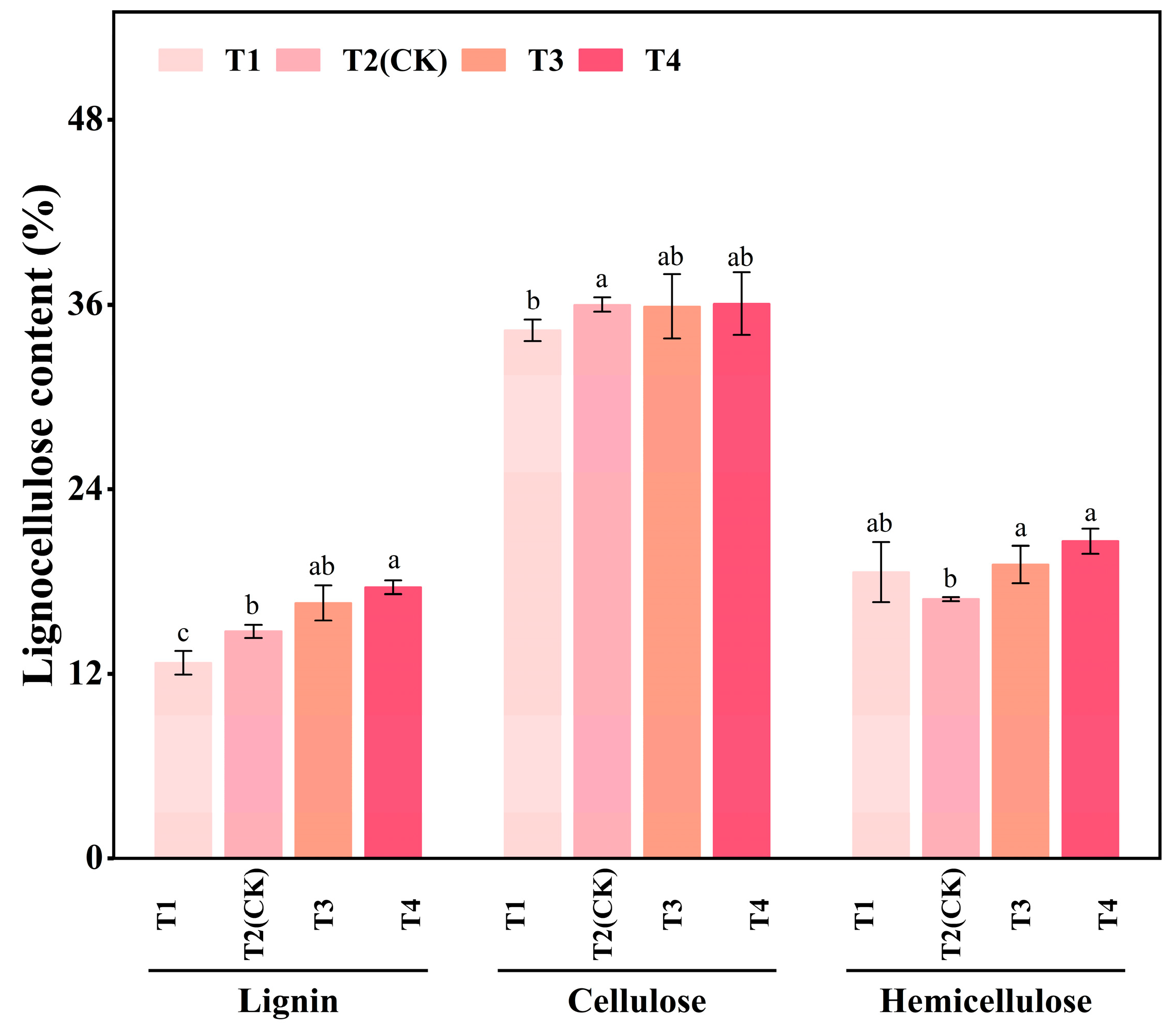
Different substrate recipes considerably affected the final lignocellulose content of cultivation bags. As shown in Figure 1, formula T4 had the highest content of lignin, formula T1 resulted in the lowest cellulose content, and formula T2 showed reduced hemicellulose content. Overall, formula T4 had the highest ratio of total lignocellulose content, followed by formula T3, owing to the elevated corn cob contents in the cultivation substrate formulation T3 and T4.

3.2. The Influence of Medium Formulations on the Growth Rate and Vitality of the Mycelium of P. giganteus

Table 2 shows that there are significant differences in the growth performance of the mycelium of P. giganteus under the four medium formulations. Both the control (T2) and the T1 formulation supported the fastest growth rate (4.56 mm/d), with complete bag colonization achieved in approximately 40 days. In contrast, formulations T3 and T4 showed slower growth rates of 3.84 mm/d and 4.09 mm/d, respectively, requiring longer colonization times of 47 and 45 days. Although the mycelium of T3 and T4 has a longer coverage time, the mycelium of T4 is the most dense, indicating the best development of the mycelium structure. Since the mycelium of P. giganteus needs about 30 days for the “post-germination” after filling the bag, the speed of mycelium coverage time does not have a significant impact on the cultivation stage in production. Overall, the above results highlight the impact of using corn cob instead of cottonseed hull in the medium formulation on the mycelium growth of oyster mushroom, indicating that although increasing the proportion of corn husk in the formulation will have a certain impact on the growth speed of the mycelium, it does not have an actual impact on the cultivation cycle in production. Instead, it can increase the density of the mycelium.

3.3. The Influence of Substrate Composition on Agronomic Traits of P. giganteus

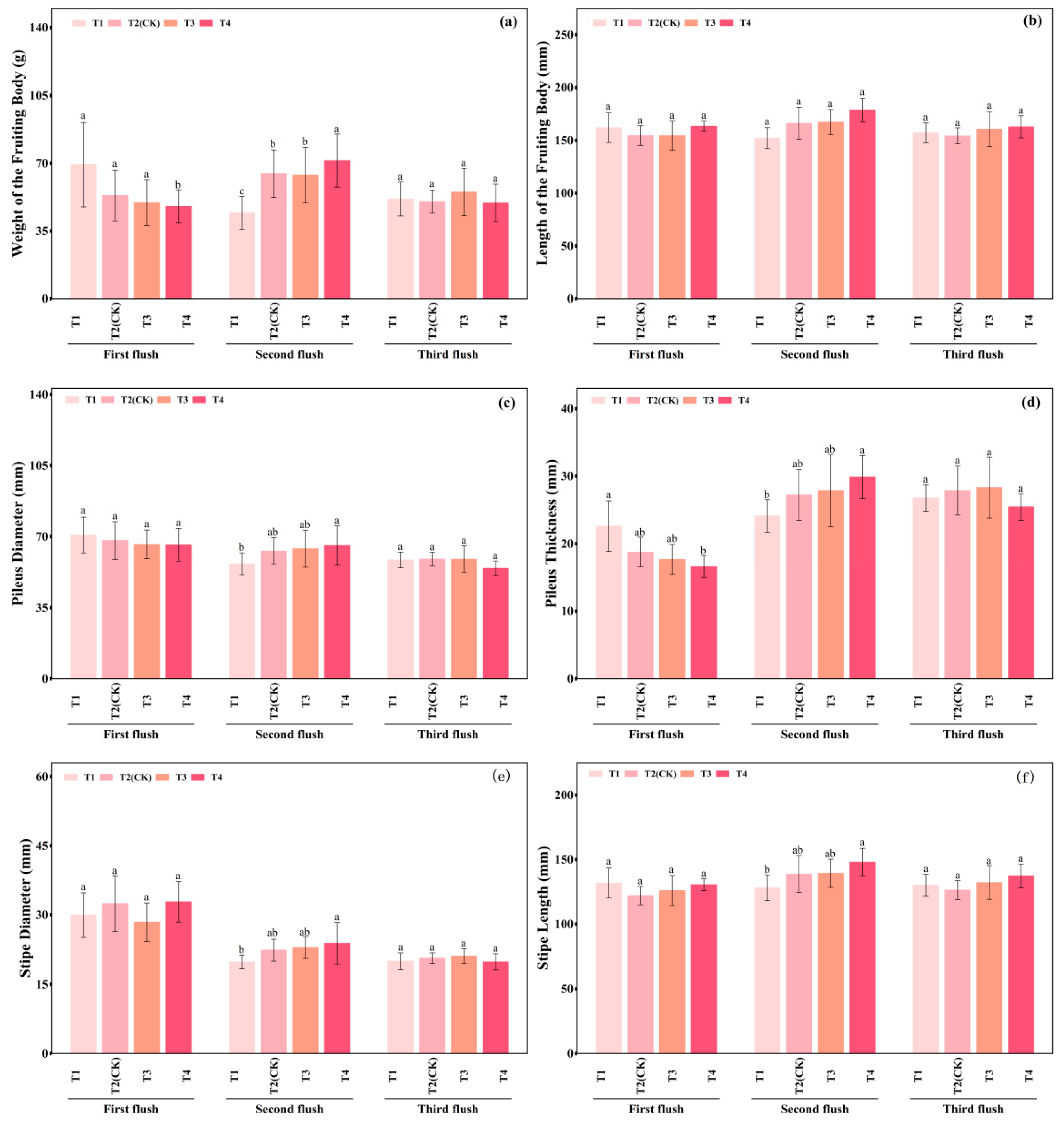
The agronomic performance of P. giganteus fruiting bodies across three successive harvest flushes upon four substrate formulations (T1–T4) is shown in Figure 2. The results disclose significant and dynamic formulation-specific effects on yield and morphological traits, with performance varying notably between flushes.
In the first flush, formulation T1 produced the highest yield of fruiting bodies (69.20 g), which was significantly greater than those from T4 (47.67 g). No significant differences were observed in other morphological traits (length, pileus diameter, or stipe dimensions) among the formulations, except for pileus thickness, where T1 yielded the thickest pileus. The second flush presented a distinct difference in fruiting body performance. Here, T4 generated the highest weight (71.36 g), followed by T2 and T3, while T1 produced the meaningfully lowest yield (44.40 g). Furthermore, T4 exhibited the highest values upon the other size parameters, namely stipe length, stipe diameter, and pileus thickness. By the third flush, all formulations exhibited comparable agronomic performance, with no statistically significant differences in the measured traits, demonstrating that productivity converged as the cultivation cycle advanced.
In summary, the optimal substrate formulation depends critically on the targeted harvest flush. T1 demonstrated a high yield advantage in the first crop of mushrooms, but the yield dropped sharply in the second and third crops. The total yield of the three crops was the lowest. During the first crop, the yield of T4 was initially low. However, its yield in the second flush was significantly higher than that of the other three formulations, and it also produced the highest total yield across three flushes. This may indicate that the T4 formulation possesses a potential advantage in nutrient retention or exhibits delayed-release characteristics. In contrast, the control group (T2) and T3 maintained stable yields at a medium level in each cycle. Overall, using corn cob instead of cottonseed hull in the production of P. giganteus shows a certain yield-increasing effect. Particularly, the T4 formulation performs better in controlling the yield distribution and providing a continuous supply of nutrients for P. giganteus.

3.4. Effects of Different Substrate Formulations on Nutritional Composition of P. giganteus Fruiting Bodies

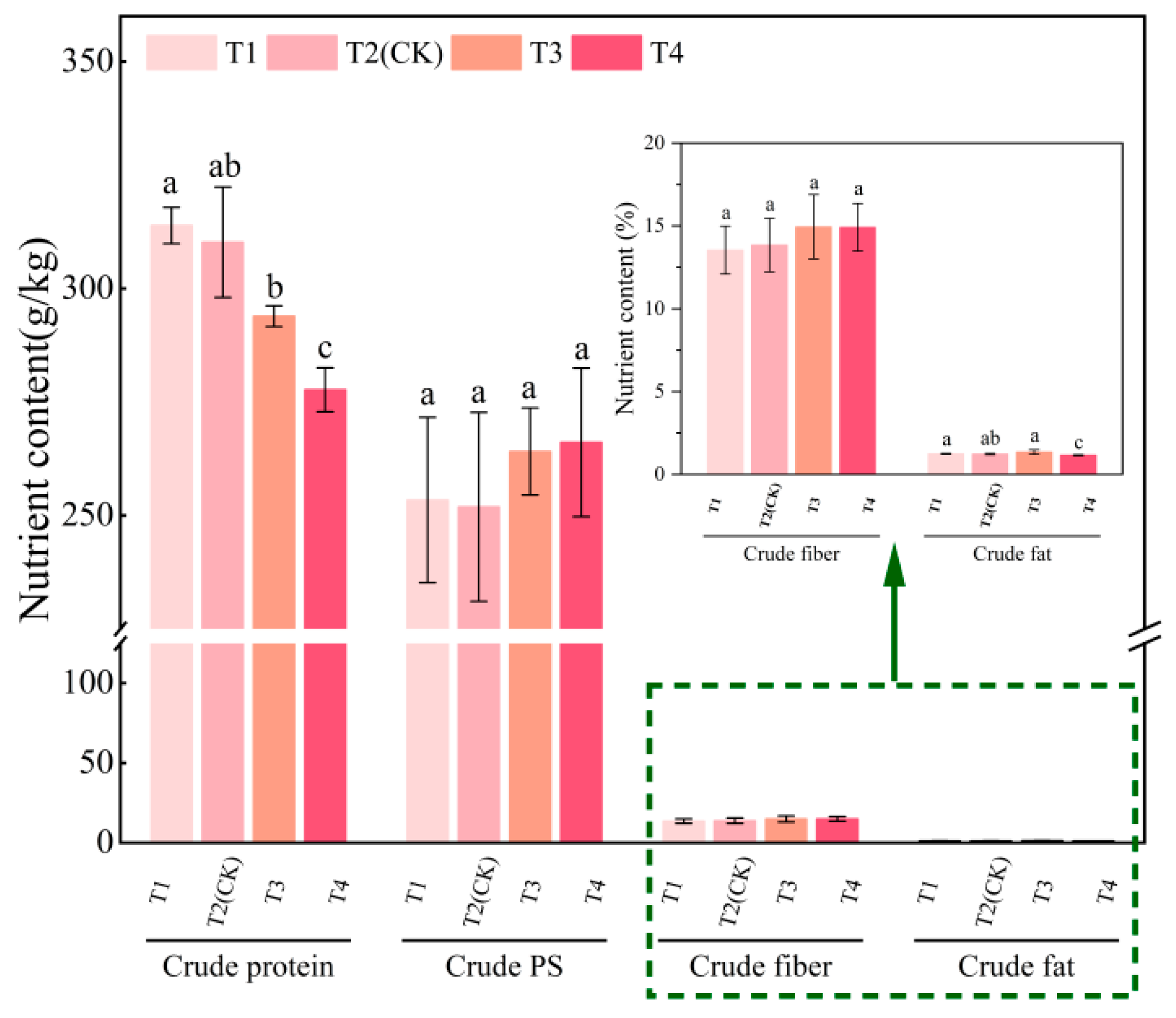
Differences in substrate formulation resulted in different levels of nutritional composition in P. giganteus fruiting bodies (Figure 3). The contents of crude fiber, crude protein and crude fat displayed distinct patterns upon different formulations, while no significant differences in crude polysaccharide concentration were observed.
In Figure 3, crude protein content in the fruiting bodies showed a declining trend with increasing corn cob inclusion. When corn cob reached 45% of the substrate, crude protein content decreased by 10.48% compared with the control treatment without corn cob. Concomitantly, crude fiber content in the fruiting bodies increased progressively with higher corn cob proportions, a trend consistent with the measured crude fiber levels in the corresponding substrates (Figure 1). Crude fat content peaked when corn cob was incorporated at 30%. In summary, substrate formulations with different corn cob contents significantly altered the protein, fiber, and fat content of P. giganteus fruiting bodies but did not affect their polysaccharide concentration.

3.5. Effects of Different Substrate Formulations on Commercial Properties of P. giganteus Fruiting Bodies

The effects of different substrate formulations on the commercial traits of P. giganteus fruiting bodies are shown in Table 3. The commercial metrics varied substantially between formulations, while no significant differences were observed with respect to the biological yield per bag. Formulation T4 achieved the highest commercial performance, generating the greatest total weight per bag (243.42 g) and highest number of fruiting bodies (6.15), which were both significantly higher than T1. Although the yield (commercial weight), output value, and commercial rate were statistically similar across all formulations, T4 generated the highest numerical values for these parameters. Crucially, T4 also incurred the lowest material cost per bag (0.78 CNY), resulting in the most favorable cost–benefit profile. In contrast, T1, while producing an equivalent commercial yield and value, required the highest material cost (1.01 CNY) and yielded the lowest total weight and fruiting body count, marking it as the least economically efficient option. The control (T2) and T3 showed an intermediate performance. In summary, T4 emerges as the most commercially viable formulation, optimizing both output and input efficiency, thereby maximizing potential profit margins for P. giganteus cultivation.

3.6. Relationships Among Commercial Grading, Nutritional Composition, and Corn Cob Formulation

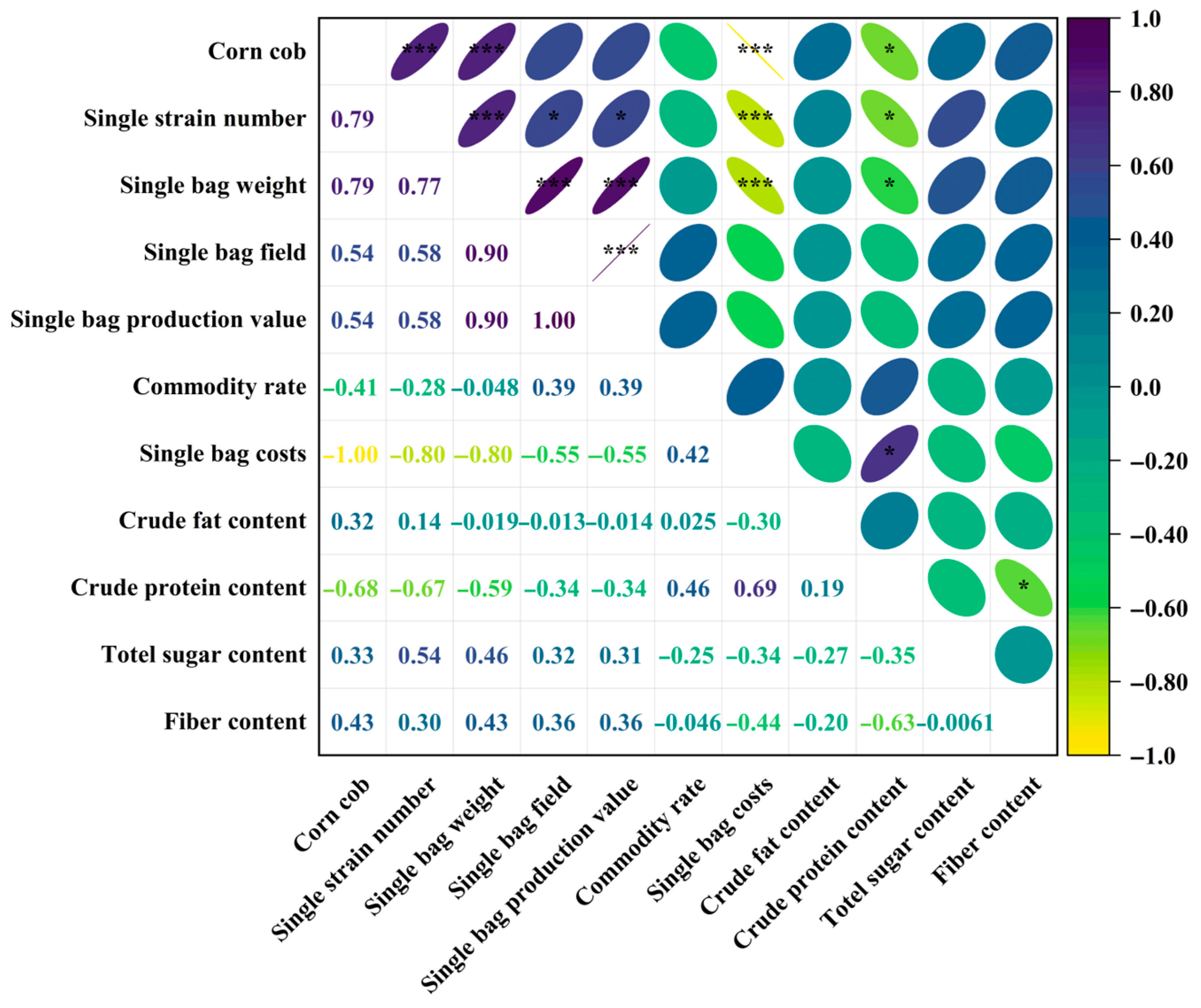
Correlation analyses were conducted between corn cob content and key commercial and nutritional traits of P. giganteus (Figure 4). The number of fruiting bodies per bag, total fresh weight per bag, and crude fiber content showed a highly significant positive correlation with corn cob content (p < 0.01), while total sugar content exhibited a significant positive correlation (p < 0.05). These results indicated that the increased corn cob content in substrate enhanced overall yield, crude fiber, and total sugar accumulation in the fruiting bodies. Conversely, substrate cost per bag and crude protein content were in a highly significant negative correlation with corn cob content (p < 0.01). This suggested that while higher corn cob inclusion reduced substrate cost, it also resulted in lower crude protein content in the harvested mushrooms. Therefore, corn cob content presents a clear trade-off between improving certain yield and cost parameters and reducing nutritional quality, specifically protein content.

4. Discussion

China, as the global leader in edible fungi production, is continually advancing its cultivation techniques, thereby enriching the diversity of mushrooms available to consumers. P. giganteus (Zhudugu) is one of such mushroom species that has emerged as a popular cultivar owing to its rich nutritional profile comprising carbohydrates, amino acids, crude fiber [24], polysaccharides [25], and essential trace elements [26].
As a wood-decaying fungus, P. giganteus derives all of its nutrition from the cultivation substrate. The increasing cost of conventional substrates for its growth, like cottonseed hull, has driven the need for exploring alternative formulations. In line with the principle of agricultural waste valorization, lignocellulosic by-products like corn cobs, corn stover, sugarcane bagasse, and spent coffee grounds have gained much attention as alternates [27]. Multiple agro-wastes (e.g., bagasse [28] and coffee grounds [29]) are viable mushroom substitutes. Based on the principle of local availability, corn cob was chosen as the substitute material for this study, given its abundance in our subtropical research location. This study systematically evaluated the effects of partially or fully replacing cottonseed hulls with corn cobs on the mycelial growth, fruiting body quality, yield, and commercial performance of P. giganteus. The aim was to reduce dependency on the single substrate components, lower production costs, and optimize the cultivation system for this species.
In this study, the substitution of cottonseed hull with corn cob proportionally increased the total lignocellulose content of the substrate, which aligns with previous findings [30]. Lignocellulose, as an abundant, biodegradable, and environmentally benign material, is primarily composed of cellulose, hemicellulose and lignin [31,32]. A common mechanism for nutrient acquisition in edible fungi involves the enzymatic degradation of lignin into absorbable compounds via extracellular enzymes [33]. However, the specific substrate preferences and enzymatic efficiency for this degradation can fluctuate significantly among different species.
This study employed a gradient substitution design with corn cob at levels of 0%, 15%, 30%, and 45%, using the commercial 15% formulation (T2) as the control. While mycelial growth was satisfactory across all treatments, the time for complete substrate colonization higher corn cob content, extending to 47 days (a 7-day delay) at the 45% substitution level. Conversely, these higher proportions promoted denser, whiter mycelium and ultimately increased fruiting body yield. A similar pattern of delayed colonization with maintained or enhanced yield has been reported for Lentinula edodes [34], Pleurotus eryngii [35], and Pleurotus ostreatus [36]. Although enzyme activity was not measured here, it is plausible that the observed delay relates to increased lignocellulose content, reflecting a mycelial adaptation to substrate composition. Notably, Auricularia heimuer exhibits a different response, where corn cob initially promotes then inhibits growth [37]. These comparative findings indicate that the proportion and type of agricultural waste in the substrate significantly influence the cultivation cycle, an effect that is both pronounced and species-specific.
Substrate composition is a decisive factor for the nutritional quality of fungal fruiting bodies [38]. Consistent with studies on Pleurotus eryngii [39] and Pleurotus ostreatus [40], we observed a significant decrease in crude protein content with higher corn cob substitution. This trend aligns with the reduced nitrogen availability and elevated carbon-to-nitrogen (C/N) ratio in corn cob [40], supporting the established positive correlation between substrate nitrogen and fungal protein content [6].
Nevertheless, two important considerations emerge. First, the presented nutritional data are derived primarily from the first harvest flush. The composition of subsequent flushes may vary due to diminishing mycelial vitality and altered substrate nutrient pools [41], suggesting that direct extrapolation to the entire production cycle requires caution. Future studies should therefore systematically analyze the nutritional trajectory across multiple flushes. Second, it is also critical to contextualize the observed protein reduction within a broader dietary framework. Even at its lowest level (277.70 ± 4.83 g/kg), the protein content remained substantially higher than that of most common vegetables [42]. Furthermore, the nutritional value of edible mushrooms is multifaceted, encompassing essential vitamins [43], minerals [44], and bioactive compounds [45]. Thus, while protein is a key quality indicator, a holistic perspective that integrates these diverse components is essential for a comprehensive assessment of their overall nutritional contribution.
Furthermore, increased substrate lignocellulose correlated with both higher crude fiber and greater total yield in P. giganteus. In contrast, a negative correlation between lignocellulose and yield was reported for shiitake [46], highlighting species-specific differences in lignocellulose utilization. Building on the principle that fungal degradation of complex carbon is coupled with growth and morphogenesis, and considering the link between lignin degradation and fruiting [47], a mechanistic hypothesis can be proposed. To efficiently harness carbon from corn cob lignin, P. giganteus may have upregulated the biosynthesis of structural β-glucans, thereby supporting cell wall development during fruiting.
Given the well-documented bioactivities of β-glucans in Pleurotus mushrooms, particularly their immunomodulatory effects [48,49], the observed compositional shift may signify more than a simple nutrient trade-off; it may represent a value-oriented transition from foundational protein nutrition towards the targeted accumulation of higher-value functional components. This hypothesis, while speculative, is grounded in the compositional and enzymatic logic of fungal metabolism. It therefore underscores the imperative for future research to directly quantify bioactive polysaccharides, such as β-glucans, in P. giganteus grown on varied substrates. This direct validation constitutes a critical frontier for our subsequent work, promising to elucidate the true functional value of such substrate-driven compositional changes.
Under industrial cultivation conditions, P. giganteus usually requires about 30 days of post-ripening after the spawn bags are fully filled with mycelium. The harvesting process is typically completed 3 to 4 times within a 3 to 4 month cycle [50]. The 7-day extension in mycelial colonization by using the 45% corn cob formulation therefore has a negligible impact on overall production scheduling. From a commercial perspective, this substitution drastically reduces substrate cost while maintaining yield and efficiency.
In conclusion, the optimized substitution of cottonseed hull with corn cob enables high-quality P. giganteus production. The 45% corn cob formulation, which achieved the highest biological efficiency and lowest production cost, is highly suitable for yield-driven commercial production. This advantage, however, is accompanied by a concomitant reduction in fruiting body crude protein content—a distinct trade-off between economic and nutritional optimization. Adopting this formulation therefore entails a conscious compromise. Consequently, while this substitution strategy successfully broadens resource use and improves economics, the optimal formulation is context-dependent and should be aligned with specific operational goals and market positioning. The ultimate objective is to develop integrated production systems that maintain high yield and low cost while strategically managing the nutritional and functional profile of the final product.

5. Conclusions

This study demonstrates that corn cob is a viable substitute for cottonseed hull in the cultivation of P. giganteus. A comprehensive evaluation revealed that while increasing the corn cob proportion gradually slowed mycelial colonization, it resulted in denser, whiter, and more vigorous mycelia. Fruiting body formation proceeded normally across all substitution ratios. Notably, higher corn cob content significantly increased stipe length, the number of fruiting bodies per bag, and overall yield. Nutritionally, fruiting bodies from the 0% corn cob formulation were rich in crude protein, whereas those from the 45% substitution group had a higher crude fiber content. These findings expand the substrate options for the industrial production of P. giganteus and provide a theoretical foundation for leveraging agricultural waste in the edible mushroom industry, thereby promoting sustainable development.

Author Contributions

Conceptualization, H.-L.Y. and X.C.; formal analysis and writing—original, J.-W.Z.; software and validation, W.-H.C. and H.-R.D.; resources, G.H.; data curation, J.-L.S. All authors have read and agreed to the published version of the manuscript.

Funding

This study was supported by the Key R&D Program of Shandong Province (2023LZGCQY013); Shanghai Science and Technology Commission Action of Scientific and Technological Creation (23N61900300); and the Shanghai Academy of Agricultural Sciences (SAAS) Program for Excellent Research Team ([2022]001).

Data Availability Statement

The raw data supporting the conclusions of this article will be made available by the authors on request.

Acknowledgments

Thank you to all the units and individuals who contributed to the article.

Conflicts of Interest

Author Gang Huang was employed by the company Quzhou Xianglong Agricultural Development Co. The remaining authors declare that the research was conducted in the absence of any commercial or financial relationships that could be construed as a potential conflict of interest.

References

  1. Zhang, A.N.; Zeng, Q.P.; Tian, F.; Li, Z. Analysis of changes in maize planting area and yield in China from 1997 to 2020. Crop Res. 2024, 38, 329–333. [Google Scholar]
  2. Laltha, M.; Sewsynker-Sukai, Y.; Gueguim Kana, E.B. Development of microwave-assisted alkaline pretreatment methods for enhanced sugar recovery from bamboo and corn cobs: Process optimization, chemical recyclability and kinetics of bioethanol production. Ind. Crops Prod. 2021, 174, 114166. [Google Scholar] [CrossRef]
  3. Maqsood, S.; Navaf, M.; Kumar, P.; Yücetepe, A.; Thuy, N.N.T.; Ozkan, G.; Moreno, A.; Capanoglu, E.; Khalid, W.; Esatbeyoglu, T. Sustainable utilization of corn waste and their role toward the circular economy. J. Agric. Food Res. 2025, 23, 102165. [Google Scholar] [CrossRef]
  4. Fan, C.C. Research status on the recycling and utilization of corn cobs. Recycl. Resour. Circ. Econ. 2023, 16, 38–41. [Google Scholar]
  5. Zhao, D.G.; Tao, H.; Bu, W.W.; Niu, J.X. Study on cultivation techniques of Pleurotus eryngii using corn cobs. North Hortic. 2012, 5, 168–170. [Google Scholar]
  6. He, P.X.; Zhang, Y.; Song, Y.F. C/N ratio measurement in crop straws for edible mushroom cultivation. Edible Fungi 2001, 4, 15–16. [Google Scholar]
  7. Zhao, K.Q.; Gao, Y.C.; Che, Y.Y.; Wu, Z.C.; Zhang, X.X.; Wang, J.M.; Li, S.L. Production of fermented corn cob feed and its effect on the production performance of beef cattle. Feed Rev. 2022, 2, 1–5. [Google Scholar]
  8. Xu, Y.-Y.; Zhang, B.; Bao, J. Whole-Cell Catalytic Synthesis of Cadaverine by Recombinant Corynebacterium glutamicum Using Corncob Residue as Carbohydrate Feedstock. Biochem. Eng. J. 2025, 220, 109760. [Google Scholar] [CrossRef]
  9. Kumla, J.; Suwannarach, N.; Sujarit, K.; Penkhrue, W.; Kakumyan, P.; Jatuwong, K.; Vadthanarat, S.; Lumyong, S. Cultivation of mushrooms and their lignocellulolytic enzyme production through the utilization of agro-industrial waste. Molecules 2020, 25, 2811. [Google Scholar] [CrossRef]
  10. Ma, X.Y.; Yan, S.Y.; Wang, M.L. Spent mushroom substrate: A review on present and future of green applications. J. Environ. Manag. 2025, 373, 123970. [Google Scholar] [CrossRef]
  11. Karpagavalli, S.; Manisha, R.; Mageshwari, S.; Sowbharnika, M. Influence of growth substrates on bioactive compounds and yield of oyster mushroom (Pleurotus florida). Sci. Hortic. 2024, 329, 112959. [Google Scholar] [CrossRef]
  12. Dedousi, M.; Melanouri, E.-M.; Karayannis, D.; Kaminarides, E.-I.; Diamantopoulou, P. Utilization of spent substrates and waste products of mushroom cultivation to produce new crops of Pleurotus ostreatus, Pleurotus eryngii and Agaricus bisporus. Carbon Resour. Convers. 2024, 8, 100196. [Google Scholar] [CrossRef]
  13. Boukary, A.A.; Olou, A.B.; Piepenbring, M.; Yorou, N.S. Mushroom cultivation in tropical Africa: Successes, challenges, and opportunities. J. Agric. Food Res. 2024, 18, 101264. [Google Scholar] [CrossRef]
  14. Yan, M.M.; Cheng, X.; Zhai, D.D.; Jiang, N.; Li, Q.Z.; Huang, G.; Li, Y.; Yu, H.L. Research Progress of P. giganteus. Acta Edulis Fungi 2025, 32, 116–122. [Google Scholar]
  15. Dong, H.X.; Cai, D.H.; Li, Y. Research status and prospects of Panus giganteus. Edible Fungi China 2010, 29, 3–6. [Google Scholar] [CrossRef]
  16. Li, R.F.; Chen, Y.G. High-quality and high-yield cultivation techniques for Panus giganteus. Edible Fungi 2020, 42, 51–52. [Google Scholar] [CrossRef]
  17. NY/T 3494-2019; Agricultural Biomass Raw Materials—Determination of Cellulose, Hemicellulose, and Lignin. Ministry of Agriculture and Rural Affairs of the People’s Republic of China: Beijing, China, 2019.
  18. Guidelines for the Conduct of Tests for Distinctness, Uniformity and Stability—Big Clitocybe [Pleurotus giganteus (Berk.) Corner]. NY/T 4504-2025Ministry of Agriculture and Rural Affairs of the People’s Republic of China: Beijing, China, 2025. Available online: https://std.samr.gov.cn/hb/search/stdHBDetailed?id=350FE9C4D00690D2E06397BE0A0A963B (accessed on 3 February 2026).
  19. Li, Q.Z.; Shen, X.F.; Zhang, M.Y.; Tan, Q.; Lu, Z.X.; Li, Y.Y. Effects of different cultivation modes on agronomic traits and quality of Panus giganteus fruiting bodies. Acta Agric. Shanghai 2021, 37, 23–28. [Google Scholar] [CrossRef]
  20. ISO 20483:2013; Cereals and Pulses—Determination of the Nitrogen Content and Calculation of the Crude Protein Content—Kjeldahl Method. International Organization for Standardization: Geneva, Switzerland, 2013.
  21. ISO 6492:1999; Animal Feeding Stuffs—Determination of Fat Content. International Organization for Standardization: Geneva, Switzerland, 1999.
  22. ISO 6865:2000; Animal Feeding Stuffs—Determination of Crude Fibre Content—Method with Intermediate Filtration. International Organization for Standardization: Geneva, Switzerland, 2000.
  23. GB/T 15672-2009; Determination of Total Sugar in Edible Fungi. Standardization Administration of the People’s Republic of China: Beijing, China, 2009.
  24. Carrasco-González, J.A.; Serna-Saldívar, S.O.; Gutiérrez-Uribe, J.A. Nutritional composition and nutraceutical properties of the Pleurotus fruiting bodies: Potential use as food ingredient. J. Food Compos. Anal. 2017, 58, 69–81. [Google Scholar] [CrossRef]
  25. Tang, Q.; Yu, J.P. Study on the extraction process of water-soluble polysaccharides from Panus giganteus. Food Sci. 2008, 2, 180–183. [Google Scholar] [CrossRef]
  26. Lin, Y.M. Qualitative and quantitative determination of trace elements in the fruit of Clitocybe maxima. Fujian Anal. Test. 2004, 13, 1996–1998. [Google Scholar] [CrossRef]
  27. Koutrotsios, G.; Tagkouli, D.; Bekiaris, G.; Kalogeropoulos, N.; Tsiaka, T.; Danezis, G.P.; Zervakis, G.I. Enhancing the nutritional and functional properties of Pleurotus citrinopileatus mushrooms through the exploitation of winery and olive mill wastes. Food Chem. 2022, 370, 131022. [Google Scholar] [CrossRef]
  28. Taweengern, K.; Thapsamut, T.; Khaobang, C.; Areeprasert, C.; Aramrak, S. Circular utilization of sugarcane bagasse for water and nutrient retention in two-type of sugarcane cultivation soil by biochar and hydrochar addition. Fuel 2025, 392, 134870. [Google Scholar] [CrossRef]
  29. Zuluaga, R.; Hoyos, C.G.; Velásquez-Cock, J.; Vélez-Acosta, L.; Valencia, I.P.; Torres, J.A.R.; Rojo, P.G. Exploring spent coffee grounds: Comprehensive morphological analysis and chemical characterization for potential uses. Molecules 2024, 29, 5866. [Google Scholar] [CrossRef]
  30. Xiong, J.Y.; Chen, Q.J.; Zhang, G.Q.; Zhang, Y.; Li, N.; Zhang, W.H.; Wang, W.J. Effects of sawdust and agricultural straw on mycelial growth of Stropharia rugosoannulata. J. Beijing Univ. Agric. 2023, 38, 16–22. [Google Scholar] [CrossRef]
  31. Kim, J.-Y.; Lee, H.W.; Lee, S.M.; Jae, J.; Park, Y.-K. Overview of the recent advances in lignocellulose liquefaction for producing biofuels, bio-based materials and chemicals. Bioresour. Technol. 2019, 279, 373–384. [Google Scholar] [CrossRef]
  32. Tišma, M.; Bucic-Kojic, A.; Planinic, M. Bio-based products from lignocellulosic waste biomass: A state of the art. Chem. Biochem. Eng. Q. 2021, 35, 139–156. [Google Scholar] [CrossRef]
  33. Guo, Y.; Song, S.; Gao, Q.; Yan, D.; Rong, C.B.; Qin, W.T.; Liu, Y.; Wang, S.X. Progress in the resource utilization of edible fungus spent substrate. Acta Edulis Fungi 2022, 29, 103–114. [Google Scholar] [CrossRef]
  34. Ji, Z.Y. Effects of Different Culture Materials on Mycelium Growth, Yield and Nutrients of Letinous edodes. Master’s Dissertation, Anhui Agricultural University, Hefei, China, 2018. [Google Scholar]
  35. Zhang, W.J.; Lei, P.; Sun, Y.Y. Comparison of mycelial growth and yield of Pleurotus nebrodensis cultivated on different substrate formulations. Edible Fungi 2010, 32, 32–33. [Google Scholar] [CrossRef]
  36. Hu, Y.R.; Ni, Z.Y.; Zhang, J.X.; Yu, H.Y.; Qi, Y.C.; Shun, J.W.; Wen, Q. Effects of Nitrogen Content and C:N Ratio on Growth and Nutritional Components of Pleurotus ostreatus. Acta Edulis Fungi 2022, 29, 36–40. [Google Scholar]
  37. Yang, D. Formula Screening and Extracellular Enzyme Activity Study of Auricularia heimuer Cultivation with Corn Cob. Master’s Dissertation, Jilin Agricultural University, Changchun, China, 2023. [Google Scholar]
  38. Elkanah, F.; Oke, M.; Adebayo, E. Substrate composition effect on the nutritional quality of Pleurotus ostreatus (MK751847) fruiting body. Heliyon 2022, 8, e11841. [Google Scholar] [CrossRef]
  39. Zou, Y.J.; Du, F.; Zhang, H.J.; Hu, Q.X. Evaluation of Korshinsk peashrub (Caragana korshinskii Kom.) as a substrate for the cultivation of Pleurotus eryngii. Waste Biomass Valoriz. 2019, 10, 2879–2885. [Google Scholar] [CrossRef]
  40. Hoa, H.T.; Wang, C.L.; Wang, C.H. The effects of different substrates on the growth, yield, and nutritional composition of two oyster mushrooms (Pleurotus ostreatus and Pleurotus cystidiosus). Mycobiology 2015, 43, 423–434. [Google Scholar] [CrossRef] [PubMed]
  41. Song, Y.; Liu, N.; Yang, R.H.; Lyu, L.T.; Zhang, S.Y.; Deng, H.C.; Zhang, M. Study on the changes of agronomic traits and nutritional components in different flushes of Lentinula edodes. Hortic. Seed 2022, 42, 1–3. [Google Scholar] [CrossRef]
  42. Canazza, E.; Tessari, P.; Mayr Marangon, C.; Lante, A. Nutritional Profile and Chlorophyll Intake of Collard Green as a Convenience Food. Nutrients 2024, 16, 4015. [Google Scholar] [CrossRef]
  43. Chen, J.S.; Yang, Z.Y.; Wang, Y.S.; Gong, Z.Q.; Wang, W.L.; Jia, F.J.; Song, S.S. Research progress on nutritional composition, functional activities, and processing status of edible mushrooms. Sci. Technol. Food Ind. 2024, 45, 358–366. [Google Scholar]
  44. Deng, Y.Y.; You, J.K.; Hua, R.; Wang, J.; Yang, L.M.; Sun, D.F. Nutritional analysis of three common wild Boletus spp. and three staple artificial edible fungi. Edible Fungi China 2022, 41, 45–48. [Google Scholar]
  45. Sharma, E.; Bairwa, R.; Lal, P.; Pattanayak, S.; Chakrapani, K.; Poorvasandhya, R.; Kumar, A.; Altaf, M.A.; Tiwari, R.K.; Lal, M.K.; et al. Edible mushrooms trending in food: Nutrigenomics, bibliometric, from bench to valuable applications. Heliyon 2024, 10, e36963. [Google Scholar] [CrossRef]
  46. Desisa, B.; Muleta, D.; Dejene, T.; Jida, M.; Goshu, A.; Martin-Pinto, P. Substrate optimization for shiitake (Lentinula edodes (Berk.) Pegler) mushroom production in Ethiopia. J. Fungi 2023, 9, 811. [Google Scholar] [CrossRef] [PubMed]
  47. Liu, L.N.; Li, S.F.; Xu, F.F.; Cui, G.M.; Gao, S.P.; Wang, A.J.; Wei, S.X. Variation characteristics of lignocellulose in Lentinula edodes cultivation substrates at different growth stages. Henan Agric. Sci. 2024, 53, 110–117. [Google Scholar] [CrossRef]
  48. Pérez-Bassart, Z.; Bäuerl, C.; Fabra, M.J.; Martínez-Abad, A.; Collado, M.C.; López-Rubio, A. Composition, structural properties and immunomodulatory activity of several aqueous Pleurotus β-glucan-rich extracts. Int. Biol. Macromol. 2023, 253, 127255. [Google Scholar] [CrossRef]
  49. Wang, X.; Qu, Y.; Wang, Y.; Wang, X.; Xu, J.; Zhao, H.; Zheng, D.; Sun, L.; Tai, G.; Zhou, Y.; et al. β-1,6-Glucan From Pleurotus eryngii Modulates the Immunity and Gut Microbiota. Front. Immunol. 2022, 13, 859923. [Google Scholar] [CrossRef]
  50. Li, R.F.; Chen, Y.G. Cultivation techniques of Clitocybe maxima with grape branches. Edible Med. Mushrooms 2020, 28, 353–355. [Google Scholar] [CrossRef]
Figure 1. Lignocellulose content of different cultivation substrate formulations. (Note: Different lowercase letters denote significant differences (p < 0.05)).
Horticulturae 12 00213 g001
Figure 2. Yield and agronomic traits under different formulations: (a) fruiting body weight; (b) fruiting body length; (c) pileus diameter; (d) pileus thickness; (e) stipe diameter; and (f) stipe length. (Note: Lowercase letters indicate significant differences at p < 0.05. Different lowercase letters represent significant differences, while the same letter indicates no significant difference).
Horticulturae 12 00213 g002
Figure 3. Nutrient content under different formulations. (Note: 1. Lowercase letters indicate significant differences at p < 0.05. Different lowercase letters represent significant differences, while the same letter indicates no significant difference; 2. Crude PS means crude polysaccharides).
Horticulturae 12 00213 g003
Figure 4. Correlation analysis between corn cob content and key commercial and nutritional traits of P. giganteus (Note: *, *** indicate significant differences between groups at p < 0.05, and p < 0.001 respectively).
Horticulturae 12 00213 g004
Table 1. Experimental design of cultivation substrate formulations.
FormulaRaw Material Proportion %
Cottonseed HullSawdustCorn CobWheat BranCorn FlourSoybean MealGypsum
T14530018511
T2 (CK)30301518511
T315303018511
T40304518511
Table 2. Mycelial growth of P. giganteus under different formulations.
FormulaTime for Full Colonization/dMycelial Growth Rate/(mm/d)Mycelial Growth StatusComprehensive Mycelial Growth Evaluation
T140 ± 24.56 ± 0.42 aPure White, sparse++
T2 (CK)40 ± 24.56 ± 0.59 aPure White, moderate+++
T347 ± 23.84 ± 0.28 bBright White, moderate+++
T445 ± 24.09 ± 0.40 abBright White, dense++++
Note: Growth rate values are mean ± SD. Different letters indicate significant differences (p < 0.05). Subjective rating: ++ (fair), +++ (good), ++++ (excellent).
Table 3. Differences in commercial properties of P. giganteus under different formulations.
FormulaNumber per/BagTotal Weight/Bag (g)Commercial Yield/Bag (g)Output Value/
Bag (CNY)
Commercial Rate (%)Material Cost/Bag (CNY)Profit per/Bag (CNY)
T14.24 ± 0.64 b210.23 ± 13.64 b134.17 ± 13.46 a3.49 ± 0.35 a63.82%1.011.48 ± 0.35
T2 (CK)5.56 ± 0.42 ab227.58 ± 3.71 ab145.38 ± 3.07 a3.78 ± 0.08 a63.88%0.931.85 ± 0.08
T36.03 ± 0.59 a237.69 ± 7.84 ab147.40 ± 9.88 a3.83 ± 0.26 a62.02%0.851.98 ± 0.26
T46.15 ± 0.46 a243.42 ± 14.71 a150.64 ± 12.40 a3.91 ± 0.32 a61.89%0.782.13 ± 0.32
Note: 1. Different letters indicate significant differences (p < 0.05). Data in the table represent the total yield, total revenue, and gross output value per bag over three flushes. Yield is defined as the weight of fruiting bodies after removal of overlong stipes, on which the output value is assessed. 2. Market price: 13 CNY per 500 g (December 2025 market price for P. giganteus). This unit price was applied for the valuation of output across all treatments.
Disclaimer/Publisher’s Note: The statements, opinions and data contained in all publications are solely those of the individual author(s) and contributor(s) and not of MDPI and/or the editor(s). MDPI and/or the editor(s) disclaim responsibility for any injury to people or property resulting from any ideas, methods, instructions or products referred to in the content.