Article

Genome-Wide Identification of the CAD Gene Family and Effects of Exogenous Gibberellin on Lignin Accumulation in Oenanthe javanica


1
Sanya Institute, Nanjing Agricultural University, Sanya 572024, China
2
State Key Laboratory of Crop Genetics & Germplasm Enhancement and Utilization, Ministry of Agriculture and Rural Affairs Key Laboratory of Biology and Germplasm Enhancement of Horticultural Crops in East China, College of Horticulture, Nanjing Agricultural University, Nanjing 210095, China
*
Author to whom correspondence should be addressed.
Horticulturae 2026, 12(2), 208; https://doi.org/10.3390/horticulturae12020208
Submission received: 25 December 2025 / Revised: 2 February 2026 / Accepted: 5 February 2026 / Published: 8 February 2026

Abstract

Cinnamyl alcohol dehydrogenase (CAD) is essential for the synthesis of plant lignin precursors and the response to various abiotic stresses. In this study, we identified 17 OjCAD genes distributed across the genome of Oenanthe javanica. The members of the OjCAD gene family were unevenly distributed on six chromosomes, and subcellular localization was predicted in the cytoplasm. Based on phylogenetic analysis, these OjCADs were divided into four groups. Members in group I, containing OjCAD15 and OjCAD17, are the core regulatory genes involved in lignin synthesis. The conserved region of protein sequence contained two Zn2+ binding motifs and NADP(H) cofactor-binding motifs, which belonged to the typical CAD protein. Collinearity analysis showed that there were two tandem repeats and three fragment repeats in OjCAD gene, and there were three pairs of collinear gene pairs. A cis-acting element component analysis displayed that most CAD genes were involved in mediating responses to light, stress, and plant hormones. Following GA3 treatment, the lignin content in petioles and leaf blades of water dropwort initially increased significantly, leading to a decline in palatability. In contrast, lignin content decreased markedly after uniconazole treatment. Anatomical structure analysis and UV fluorescence in the petiole also confirmed the results. In the expression profiling analysis and RT-qPCR results, the expression trend of OjCAD16 in leaves was consistent with the transcriptional expression profile. Following GA3 treatment, the gene expression changes in petioles for four genes (OjCAD13, OjCAD15, OjCAD16, and OjCAD17) aligned with the trends in lignin content, suggesting they may positively regulate lignin synthesis in O. javanica. These findings highlighted the multifunctional role of the CAD gene family in regulating lignin in water dropwort under gibberellin action, providing a potential basis for improving flavor quality by modulating lignin content.

1. Introduction

Water dropwort (Oenanthe javanica (Blume) DC.) is a perennial aquatic herb belonging to the Oenanthe genus in the Apiaceae family, which mainly grows in tropical and temperate regions [1,2,3]. As a characteristic aquatic vegetable in China, water dropwort contains a variety of bioactive substances, such as parsinic acid, apigenin, rutin, quercetin, and so on. Water dropwort contains the medicinal effects of promoting digestion, lowering blood pressure and blood sugar, and acts as an antioxidant and anti-inflammatory agent, and it is deeply loved by consumers [4,5,6,7,8]. The edible parts of water dropwort primarily consist of the petiole and leaf blades. As lignin content increases, the higher plant gradually lignifies, significantly affecting its texture. Effective regulation of lignin content plays a crucial role in enhancing the quality of water dropwort [9,10].
Lignin is a phenolic polymer widely distributed in plants, whose primary biological function is believed to be associated with plant defense mechanisms. Lignin deposition is the key mechanism for plants to adapt to the environment [11]. Lignin content in natural compounds of higher plants is second only to cellulose, and it is mainly polymerized from lignin monomer [12]. This process of lignin biosynthesis mainly involves 11 enzyme families. Among the enzyme families, cinnamyl alcohol dehydrogenases (CADs) are the last step in lignin biosynthesis before cell wall polymerization, which was responsible for converting cinnamaldehyde into p-hydroxyphenyl (H), guaiacyl (G), and syringyl (S) lignin monomers [13]. The types and activity of CADs may lead to significant variations in total lignin content and composition and play a crucial role in lignin synthesis [14]. In higher plants, CAD genes were first identified from the stems of Nicotiana tobacum (tobacco) [15]. Subsequently, CAD genes were also identified in Arabidopsis thaliana and other plant species. The ADH_N domain and two highly conserved ADH_zinc_N domains within CAD proteins were typically present in A. thaliana and other species [16]. In recent years, comprehensive genome-wide identification and functional analysis of the CAD gene family have been completed for multiple plant species. However, the identification and functional characterization of this gene family in O. javanica remain to be explored in depth [17,18,19].
Gibberellin (GA3) is a group of tetracyclic diterpene plant hormones, one of the five major plant hormones. Research indicated that gibberellic acid promoted the polar transport of auxin, regulating stem elongation and secondary xylem growth [20]. In cotton (Gossypium hirsutum), gibberellic acid induced lignification that altered the structure of the secondary cell wall. Cotton seedlings exhibited a dwarf phenotype [21]. Gibberellin treatment enhanced expression of the OsCAD2 gene in rice (Oryza sativa) to regulate lignin synthesis [22]. Exogenous GA3 treatment modulated expression of VvCAD1 in grape (Vitis vinifera), altering cell wall composition and pedicel structure while increasing lignin deposition in the cortex [23]. Exogenous GA3 treatment has promoted lignification and cell wall remodeling of carrot (Daucus carota) and celery (Apium graveolens) in the Apiaceae family [24,25,26,27,28]. Until now, the regulatory mechanism of the OjCAD gene in the synthesis of lignin of water dropwort in response to GA3 remains unclear.
This study investigated how GA3 and uniconazole (UNZ, a GA inhibitor) treatment modulated lignin composition in water dropwort. By conducting bioinformatics analysis of the OjCAD gene family and examining the expression patterns of relevant OjCAD genes under different treatments, it aimed to advance breeding efforts for improved cultivars and elucidate the specific roles of CAD gene family members in regulating lignin synthesis in water dropwort.

2. Materials and Methods

2.1. Plant Materials and Growth Conditions

The plants of water dropwort ‘Liyangbaiqin’ with well-growing and consistent state were used as plant material. These plant materials were planted in the climate room of Sanya Research Institute of Nanjing Agricultural University (18°20′55″ N, 109°8′42″ E). The climate chamber was set to 25 °C with a photoperiod of 16 h light/8 h dark, light intensity of 200 μmol m−2 s−1, and humidity maintained at 60–70%. Based on prior research, 30-day-old seedlings of water dropwort were treated with 80 mg/L gibberellic acid (GA3) and 50 mg/L uniconazole [29]. The plants of water dropwort treated with distilled water served as the control group (CK), leaf blades and petioles were harvested from 65-day-old water dropwort plants, immediately immersed in liquid nitrogen, and stored at −80 °C for subsequent analysis. All plants were considered homogeneous prior to the experiment and randomly assigned to different spray treatment groups, with deionized water serving as the control group. Three biological replicates were established for each treatment.

2.2. Identification of CAD Family Genes from O. javanica

The nine CAD proteins (AT3G19450.1, AT4G39330.1, AT4G34230.1, AT4G37970.1, AT2G21890.1, AT2G21730.1, AT1G72680.1, AT4G37990.1, AT4G37980.1) retrieved from the A. thaliana genome (data source: TAIR database, https://www.arabidopsis.org/, accessed on 14 June 2025) were used as query sequences. We employed TBtools-BLAST (v2.420) and the NCBI blastp program (https://blast.ncbi.nlm.nih.gov/Blast.cgi?PROGRAM=blastp&PAGE_TYPE=BlastSearch&BLAST_SPEC=&LINK_LOC=blasttab&LAST_PAGE=blastp, accessed on 14 June 2025) against the protein database of O. javanica to initially identify a set of candidate sequences [30]. Duplicate entries were manually removed from the dataset, retaining sequences validated by interpro as containing characteristic CAD domains (PF00107 and PF08240). This process ultimately identified 17 members of the CAD gene family in O. javanica [31,32]. Tbtools-protein Parameter Calc was used to predict the number of amino acid residues, molecular weight (MW, Da), isoelectric point, instability coefficient, aliphatic index, and total average hydrophilicity coefficient for each CAD protein. Subcellular localization prediction was performed using the online tool Plant Cell-PLoc 2.0-mPLoc (http://www.csbio.sjtu.edu.cn/bioinf/plant-multi/, accessed on 20 June 2025) [33].

2.3. Phylogenetic Analysis and Sequence Alignment of CAD Family Genes

To visualize conserved domains, T-Coffee (https://www.ebi.ac.uk/jdispatcher/msa/tcoffee?stype=dna, accessed on 20 June 2025) and Jalview 2 software version 10.0.7 (http://www.jalview.org/, accessed on 20 June 2025) were used for multiple sequence alignment [34]. The conserved regions were identified using WebLogo (https://weblogo.threeplusone.com/create.cgi, accessed on 20 June 2025) [35]. To further elucidate the evolutionary relationships among CAD gene families, a phylogenetic tree was constructed using the Neighbor-Joining (NJ) method in MEGA 11.0 software, with 1000 bootstrap values [36]. The tree was optimized and visualized via the Evolview website (https://evolgenius.info//evolview-v2/, accessed on 2 July 2025) [35].

2.4. Conserved Motifs and Gene Structure Analysis of CAD Family Genes

The Multiple Expectation Maximization for Motif Elucidation (MEME) was conducted to identify conserved motifs in CAD proteins, with the number of motifs set to 12 and all other parameters kept at their default values [37]. The MEME Suite was accessible online at https://meme-suite.org/meme/doc/meme.html (accessed on 3 July 2025). The annotated General Feature Format (GFF) genome file and TBtools software were employed to visualize the identified evolutionary relationships and motif structures [38].

2.5. Chromosome Distribution and Collinearity Analysis of CAD Family Genes

Chromosomal localization information for CAD genes was extracted from the GFF genome file of O. javanica. OjCAD gene family members were mapped to their corresponding chromosomes, and their distribution was visualized using TBtools software. To identify gene duplication patterns and perform intraspecific synteny analysis, the TBtools-One Step MCScanX module was employed. The Ka/Ks calculator module was used to compute the non-synonymous substitution rate (Ka) and synonymous substitution rate (Ks), with the Ka/Ks ratio utilized to assess selective pressures during gene evolution [39].

2.6. cis-Element Analysis of OjCAD Promoters

To investigate the response mechanisms of OjCAD genes, the TBtools Gtf/GFF3 sequence extraction tool was used to obtain 2000 bp upstream sequences for these genes. These sequences were submitted to the Plant CARE database (http://bioinformatics.psb.ugent.be/webtools/plantcare/html/, accessed on 20 July 2025) to predict potential cis-acting elements [40]. The identified elements were visualized and analyzed using Tbtools-Simple BioSequence Viewer.

2.7. Determination of Lignin Content

Lignin content was determined using the modified thioglycolic acid (TGA) method. A dried sample (10 mg) was weighed, mixed with 2 mol·L−1 hydrochloric acid (HCl) and thioethanol, and placed in a boiling water bath for 8 h. The mixture was then centrifuged, and the precipitate was washed. Next, 1 mol·L−1 sodium hydroxide (NaOH) solution was added, and the mixture was shaken at 80 rpm for 18 h. The supernatant was collected for analysis. The concentrated hydrochloric acid was added to stand for 4 h and centrifuged. The supernatant was removed to dissolve the sediment with 1 mol·L−1 NaOH solution, and the absorbance was measured at 280 nm using an enzyme-linked immunosorbent assay and 1 mol·L−1 NaOH solution was used as the blank control. The content was calculated in combination with the standard curve of commercial alkali lignin. Each treatment was conducted in triplicate. Three biological replicates were detected for each treatment.

2.8. Histochemical Staining and Ultraviolet Autofluorescence Observation

Histochemical staining and ultraviolet autofluorescence observation were determined using Liu’s method [41]. The petioles of O. javanica under different treatments were cut into small segments and immersed in FAA fixed solution at the same time. The samples were dewaxed and dehydrated using xylene and ethanol, respectively. After dehydration, they were stained with safranin and green of malachite. The red color of the sample tissue sections observed under the optical microscope was the location of lignin distribution, and the lignified cell wall showed blue fluorescence under ultraviolet light (330–380 nm) [42]. Fluorescence microscope Olympus bx-53 (Olympus, Tokyo, Japan) was used to observe the luminescence of lignin under UV fluorescence and record the image.

2.9. Expression Analysis of OjCAD Family Genes

To identify the expression patterns of identified OjCAD genes under different treatments (CK, GA3, UNZ) in O. javanica, a previously published transcriptome dataset was utilized, which is publicly accessible via NCBI BioProject ID PRJNA977200 [29]. Transcript abundance was quantified using fold-proportional-to-kilobase-exon-mapped-read-counts (FPKM). OjCAD expression profiles were extracted from this data, and heatmaps were generated using TBtools software. Data underwent normalization processing. The experiment employed three biological replicates.
Among the 17 OjCAD genes identified in O. javanica, 4 highly expressed CAD genes, including OjCAD13, OjCAD15, OjCAD16, and OjCAD17, were selected for further investigation into their roles in lignin biosynthesis. These selection genes were based on published RNA-Seq data. Using the plant total RNA extraction kit (Vazyme, RC411, Nanjing, China), 0.1 g of tissue in water dropwort was weighed according to the manufacturer’s instructions for total RNA extraction. The quality and concentration of total RNA extracted from the samples were determined using a Nanodrop ND-1000 micro-volume UV spectrophotometer (Thermo Fisher Scientifc, Waltham, MA, USA). Following the reaction system and operational steps outlined in the manual, use the All-in-One First-Strand Synthesis MasterMix (Yugong Biotech, Lianyungang, China) to reverse transcribe 1 μg of total RNA into first-strand cDNA (complementary DNA). Quantitative real-time PCR (RT-qPCR) was performed using SYBR Green Master Mix (Yeasen, Shanghai, China). The total reaction volume for RT-qPCR is 20 μL, comprising 1 μL cDNA, 10 μL 2× Super Mix, 1 μL each of forward and reverse primers (10 μM), and 7 μL ddH2O. The amplification program was set as follows: initial denaturation at 95 °C for 5 min, followed by 40 cycles of 10 s at 95 °C, 20 s at 58 °C, and 20 s at 72 °C. Real-time quantitative PCR was performed using the QuantStudio 3 system (Applied Biosystems, Foster City, CA, USA). Design RT-qPCR primers randomly using DNAMAN software (v6.0) based on the sequences of the genes (Table 1). The eukaryotic translation initiation factor 4α (OjeIF-4α) gene of O. javanica served as the normalized internal reference [43,44]. The 2−∆∆CT method was employed to normalize the control group for expression level analysis [45]. Three biological replicates were completed for each treatment.

2.10. Data Processing and Analysis

Data processing was performed using Microsoft Excel 2007 software. Statistical analysis was conducted using IBM SPSS Statistics 27 software. Evaluations were performed using one-way analysis of variance (ANOVA). When ANOVA indicated a significant overall effect (p < 0.05), Duncan’s multiple range test was used for post-hoc comparisons of treatment means. Data are presented as mean ± standard deviation (SD).

3. Results

3.1. Identification of CAD Family Genes

A total of 17 CAD proteins were identified from O. javanica, designated as OjCAD1 to OjCAD17 based on their chromosomal locations. All OjCADs contained the CAD domain as confirmed by interpro analysis. As shown in Table 2, the physiological and biochemical properties of the lengths of OjCAD proteins ranged from 357 (OjCAD7, OjCAD10) to 367 (OjCAD13) amino acids, with molecular weights (MWs) ranging from 38,536.09 Da (OjCAD3, OjCAD4) to 39,462.2 Da (OjCAD13). The isoelectric point (pI) ranged from 5.42 (OjCAD17) to 6.91 (OjCAD7), with pI values less than 7 indicating that the OjCAD protein was acidic. The instability coefficient of these proteins ranged from 19.46 (OjCAD15) to 31.74 (OjCAD13) and the aliphatic index ranged from 85.15 (OjCAD7) to 97.4 (OjCAD11). The subcellular localization of all CAD proteins were localized in the cytoplasm, consistent with the findings of Hu et al. [46].

3.2. Phylogenetic Analysis and Sequence Alignment of CAD Family

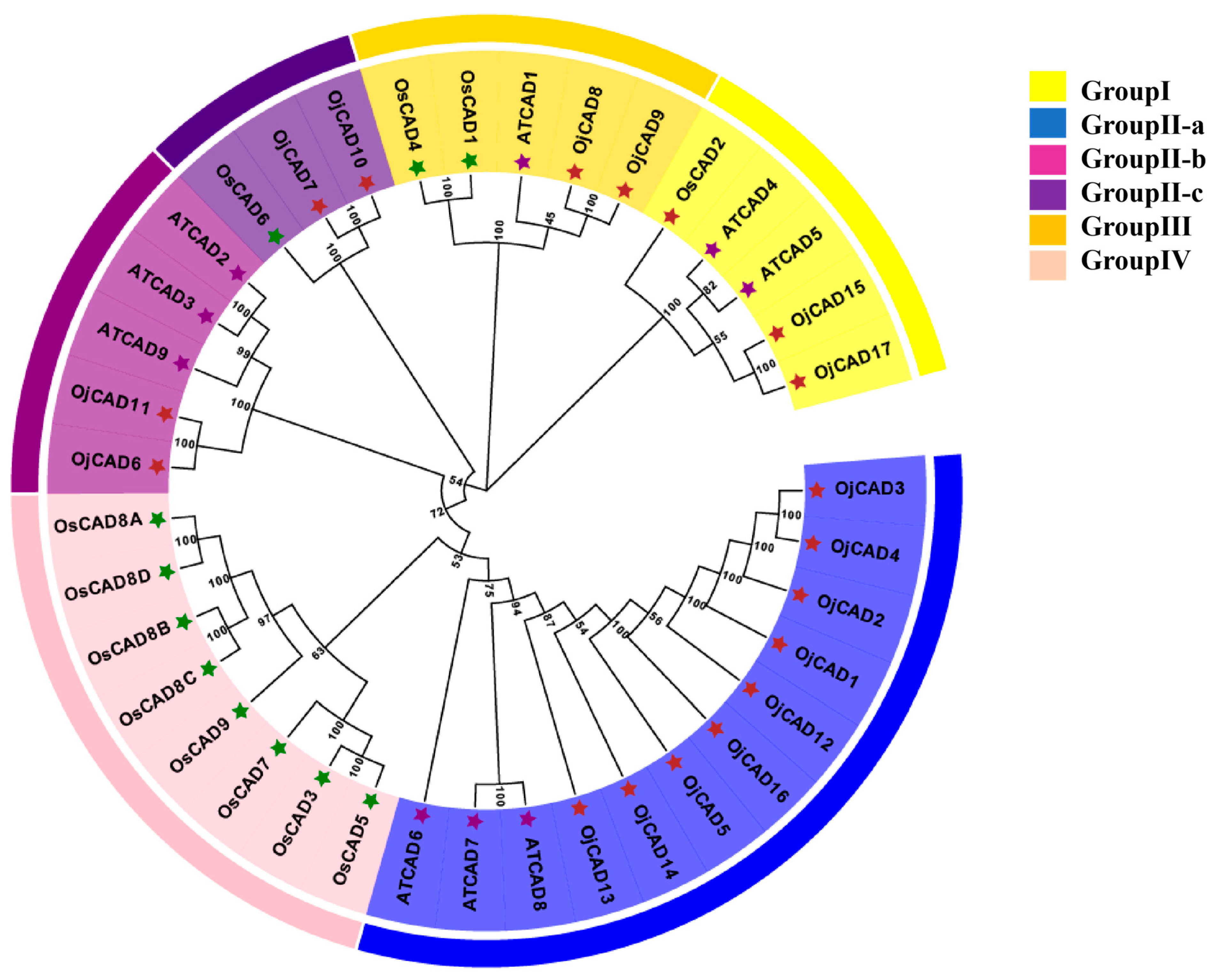
CAD proteins from O. javanica and other species (from A. thaliana and O. sativa) were used to construct a phylogenetic tree (Figure 1). The results indicated that CAD proteins from different species can be classified into four distinct groups, designated Groups I to IV. OjCAD15 and OjCAD17 in Group I were likely key genes in lignin biosynthesis in O. javanica, as they cluster together with AtCAD4 and AtCAD5 from A. thaliana, and OsCAD2 from O. sativa which were confirmed to be core regulators in the lignin synthesis process [47]. Group II contained 13 OjCAD proteins, which were clustered in the same branch as the known resistance-related proteins AtCAD2, AtCAD3, AtCAD6~9, and OsCAD6 [12]. Group III contained OjCAD8, OjCAD9, and ATCAD1, with low catalytic activity for aggregated lignin synthesis [47]. Group IV contains only a member of OsCAD.
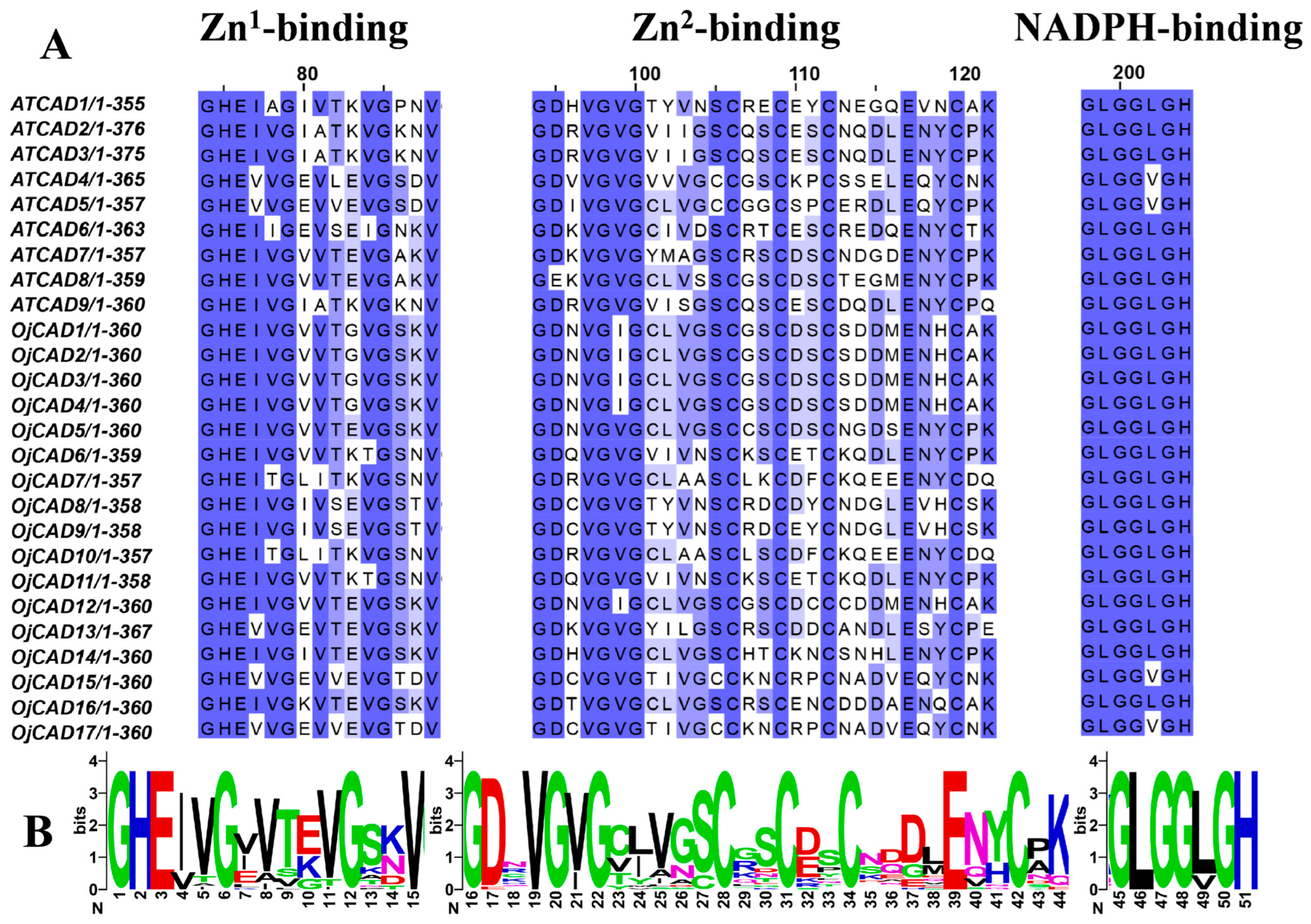
The conservative domains of the CAD protein sequences of O. javanica and A. thaliana were analyzed and visualized using the weblogo (Figure 2A,B). It was found that the CAD protein generally contained three conservative domains: GHE (X) 2G (X) 5G (X) 2V and GDXVGVG (X) 5C (X) 2C (X) 2C (X) 7C, which were involved in catalyzing the binding of Zn1 and Zn2 domains and G (X) GG (X) G which played roles in the combination of NADP (H) cofactor, respectively. The conservative sequences of the O. javanica and A. thaliana were also similar.

3.3. Conserved Motifs and Gene Structure Analysis of CAD Family Genes

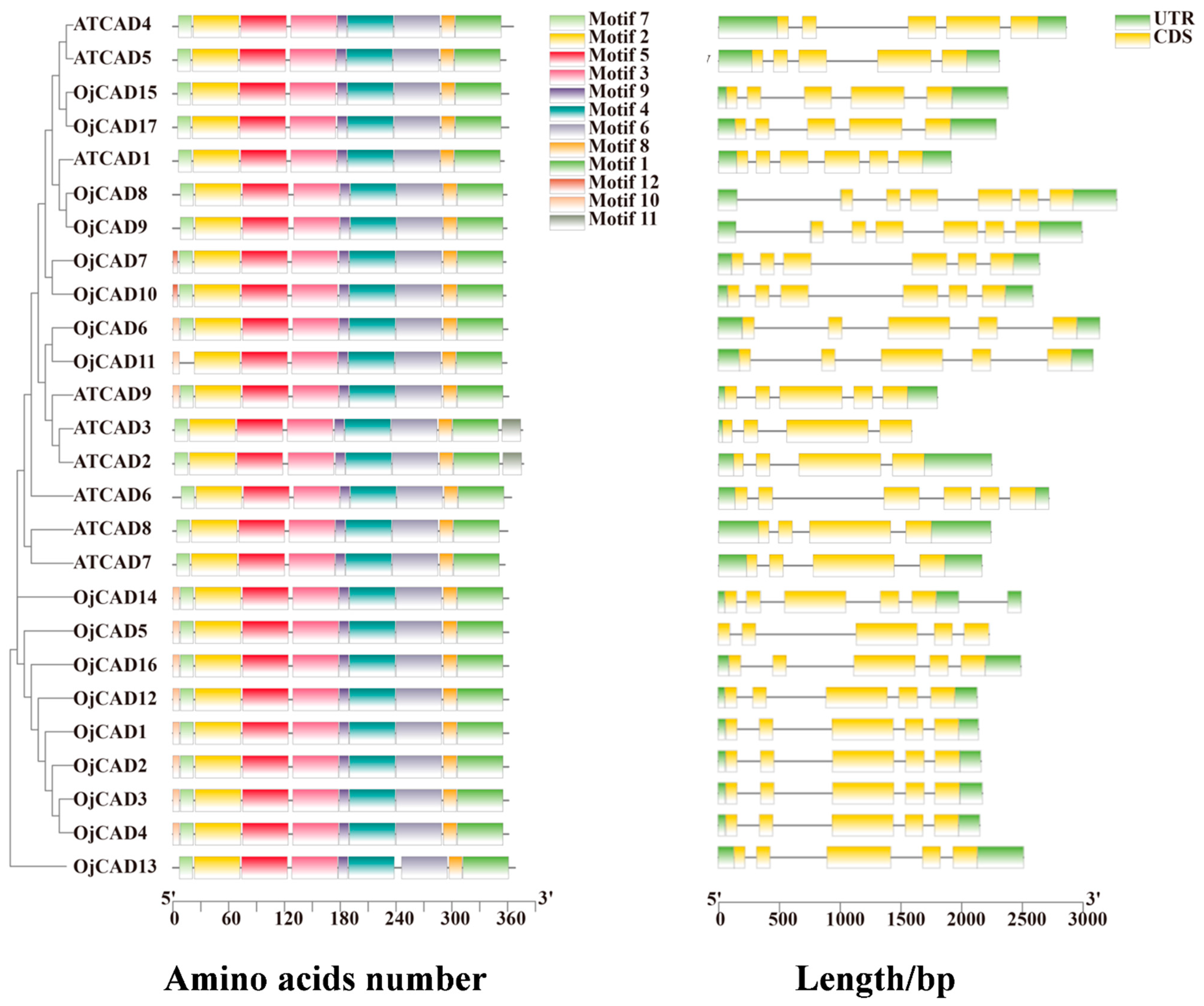
Based on the evolutionary relationships depicted in Figure 3, the exon-intron structure and conserved motifs of the exon/intron of the OjCAD genes were analyzed. The results revealed that genes within the same branch typically exhibited similar numbers of exons and introns. Genes including 13 OjCAD (OjCAD1–6 and OjCAD11–17) proteins contained five exons, whereas the remaining four OjCAD genes (OjCAD13, OjCAD15, OjCAD16, and OjCAD17) possessed six exons. Variations were observed in both the length and number of introns among OjCAD genes. The majority of OjCAD genes had four introns, whereas OjCAD4, OjCAD7, and OjCAD10 had five introns, and OjCAD8 and OjCAD9 had six introns. MEME analysis identified 12 conserved motifs within CAD proteins. Results indicated that OjCAD genes within the same group share similar gene structures and conserved motifs, suggesting functional similarity among these genes. Significant differences existed between subfamilies, with members OjCAD1 to OjCAD4 containing 10 motifs, implying these four genes may possess similar functions. Motifs 1–6 and 8–9 were present in all CAD proteins, indicating these motifs constituted the potential core conserved domains of the CAD family. The presence of motif deletions or acquisitions in some proteins suggested that different members of the OjCAD may possess unique functions.
Figure 2. Multiple sequence alignment of CAD proteins in A. thaliana and O. javanica. (A) Conserved domain sequence alignment. Darker blue shades indicated higher sequence conservation. (B) WebLogo logos for the three conserved domains. The higher the frequency of an amino acid at a given position, the larger the letter, indicating that it was more conserved.
Horticulturae 12 00208 g002

3.4. Chromosome Distribution and Collinearity Analysis of CAD Family Genes

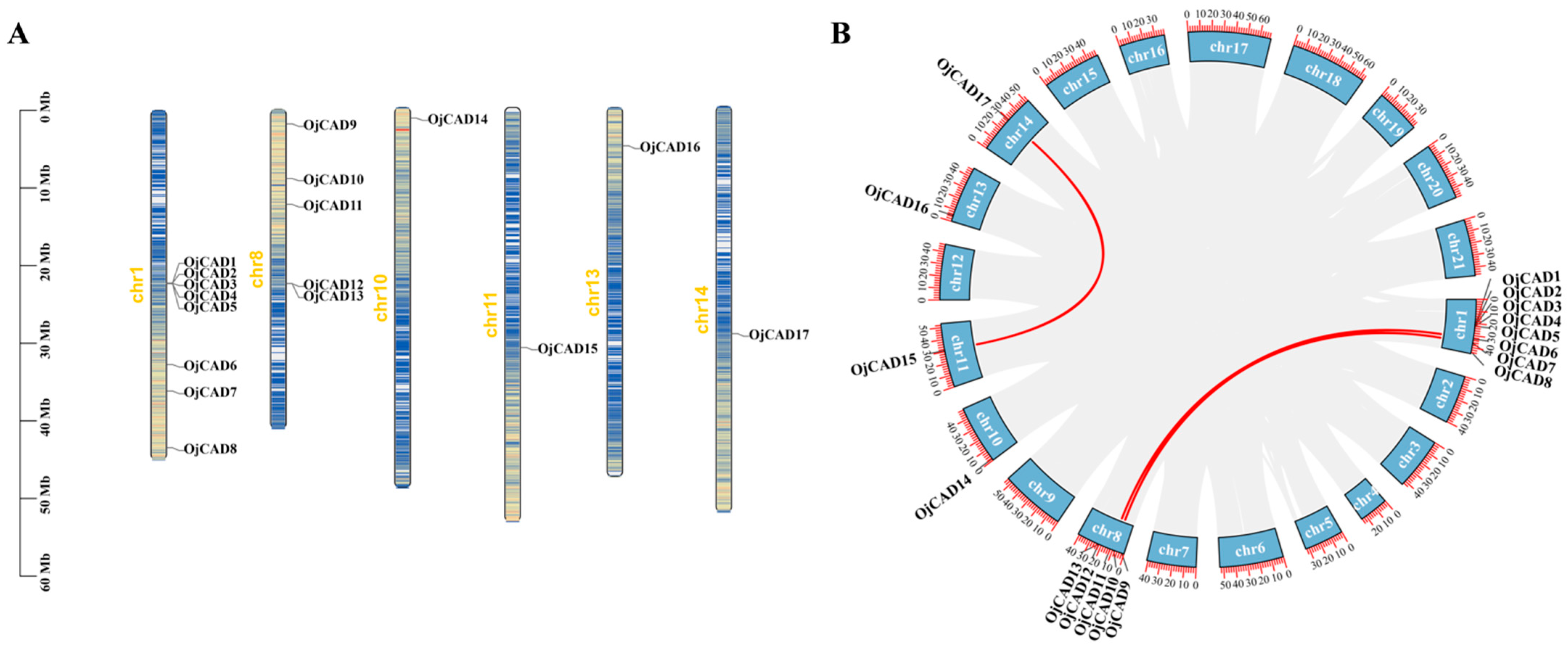
In order to further study the genetic divergence of the CAD gene family, by searching water dropwort genome databases, the chromosome location was mapped using TBtools. The analysis of the chromosomal location of the OjCAD gene revealed that 17 genes were unevenly distributed across 6 chromosomes: Chromosome 1, 8, 10, 11, 13, and 14, respectively. Among the 17 OjCAD gene family members in O. javanica, 8 members were distributed on Chromosome 1, which had the highest number of CAD genes. Chromosomes 10, 11, 13, and 14 each had only one OjCAD gene (Figure 4A).
There were tandem repeats and fragment repeats in the evolution of OjCAD genes were found by further exploring intra species collinearity. OjCAD genes were scattered on four chromosomes. The findings indicated two tandem duplication events: OjCAD15 were tandemly duplicated on Chromosome 1, and OjCAD12 and OjCAD13 were tandemly duplicated on Chromosome 8. Additionally, three segmental duplication events were identified: OjCAD6 with OjCAD11, OjCAD7 with OjCAD10, and OjCAD15 with OjCAD17 (Figure 4B). The Ka/Ks analysis revealed that the Ka/Ks ratios for all three pairs of OjCAD genes were less than 1 (Table 3). A Ka/Ks ratio less than 1 indicated purifying selection. A ratio equal to 1 indicated neutral selection, while a ratio greater than 1 suggested positive selection. The OjCAD gene has undergone strong purifying selection during evolution and plays a significant role in the evolution of the OjCAD gene. The results of collinearity analysis between species showed that there were eight collinear genes between O. javanica and A. thaliana. We found that A. thaliana genes expanded on O. javanica genome (Figure 5).
Figure 3. Conserved motifs and gene structure distribution of the OjCAD gene. In the conserved motifs of the CAD protein, different motifs are highlighted with boxes of different colors. In the gene structure of CAD protein, UTR denotes the untranslated region, while CDS represents the coding region. Yellow boxes indicate exons, black lines denote introns, and green boxes indicate untranslated regions.
Horticulturae 12 00208 g003
Figure 4. Chromosomal localization and intraspecific collinearity of OjCAD gene family members. (A) Chromosomal localization of OjCAD genes, with chromosome numbers displayed to the left of each chromosome. Vertical bars of varying lengths represent the chromosome of O. javanica, while black short lines indicate the position of each OjCAD gene. The scale bar beside the chromosomes denote megabase (Mb) lengths. (B) Intraspecific synteny analysis of OjCAD genes. Repeated gene pairs are connected by red lines.
Horticulturae 12 00208 g004
Figure 5. Interspecies colinearity relationships between CAD genes in O. javanica and A. thaliana. Gray background lines represent colinear blocks across genomes, while CAD gene pairs are highlighted with red lines.
Horticulturae 12 00208 g005

3.5. cis Acting Element Analysis of OjCAD Family Genes

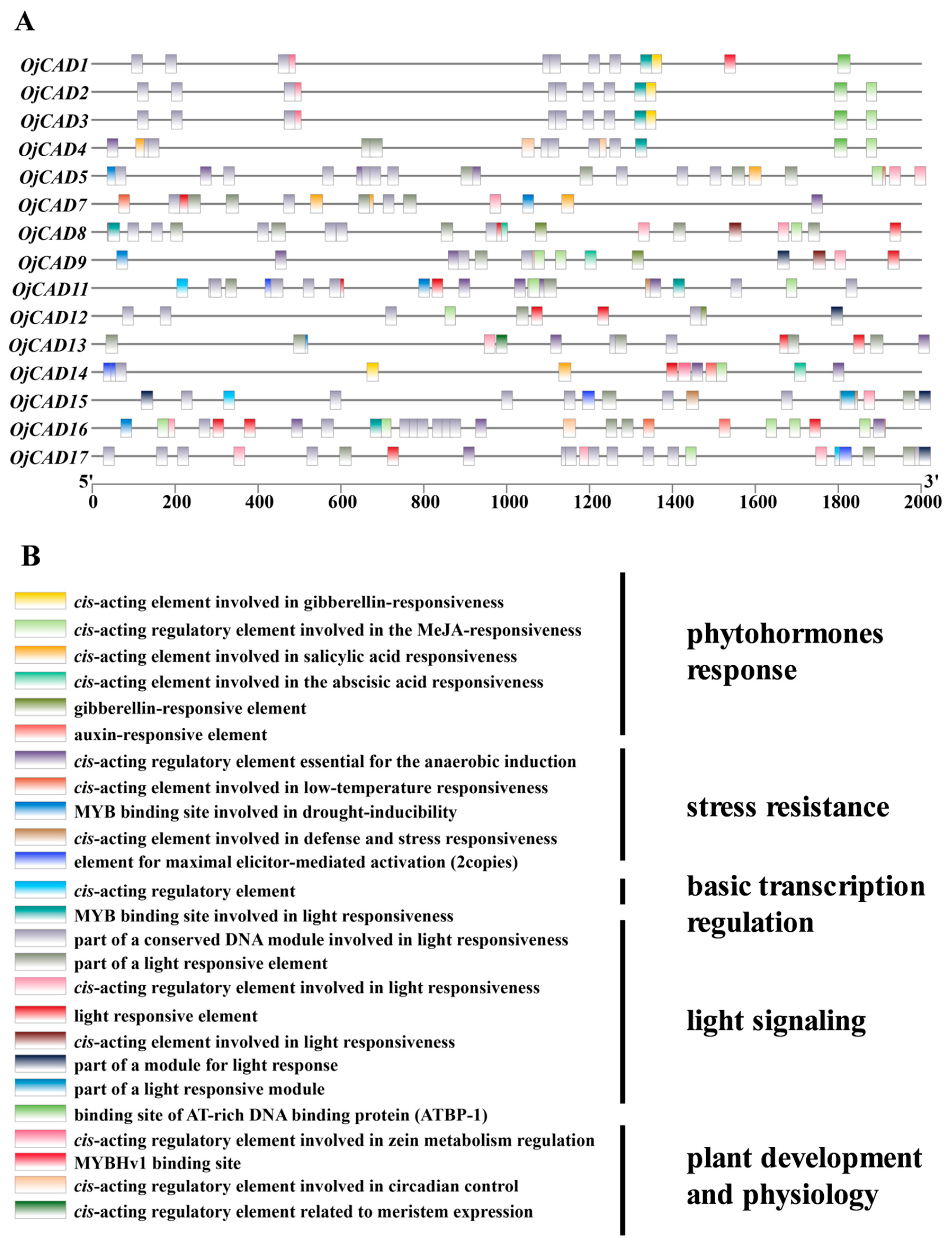
A total of 25 distinct cis-acting elements were identified and categorized into 5 major groups based on their primary functions in transcriptional regulation (Figure 6). These included hormone response elements (6 elements), stress resistance elements (5 elements), basic transcriptional regulation element (1 element), light signal regulation elements (8 elements), and development and physiological regulation (5 elements). Multiple hormone response elements were present, including gibberellin response elements, methyl jasmonate (MeJA) response elements, auxin (IAA) response elements, abscisic acid (ABA) response elements, and salicylic acid (SA) response elements. This indicated that OjCAD gene expression may be regulated by different hormonal signals. Stress response elements, light response elements, drought response elements, and cold response elements were present in the promoter regions of some OjCAD genes. Research findings indicated that OjCAD genes may participate in the light response and environmental stress adaptation mechanisms of water dropwort species, playing a crucial role in regulating endogenous hormones and abiotic stress responses [48].

3.6. Response Analysis of Lignin in OjCAD Family Genes

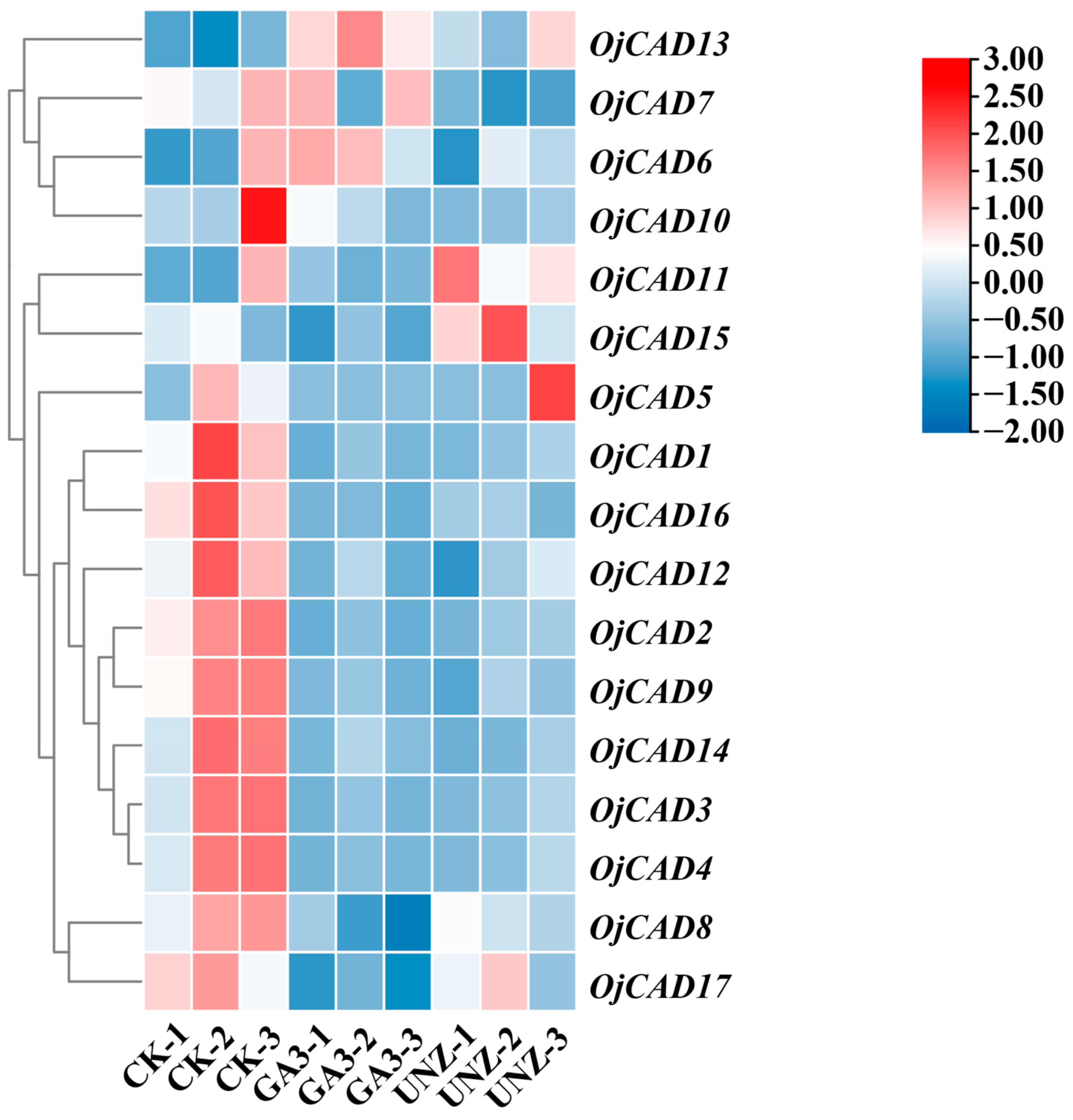
To analyze OjCAD gene expression patterns under GA3 and uniconazole treatments, we used publicly available RNA-seq data of upland water dropwort. After log2-conversion of FPKM values, the expression profiles of OjCAD genes were shown in Figure 7. The majority of OjCAD genes exhibited down-regulated expression under GA3 treatment. The RNA-seq data indicated that four OjCAD genes might serve as core regulatory genes involved in lignin synthesis. The different OjCAD genes exhibited distinct response patterns. OjCAD13 showed up-regulated expression after both GA3 and uniconazole treatments compared to the control, whereas OjCAD16 displayed down-regulated expression following GA3 and uniconazole treatments. In addition, OjCAD15 and OjCAD17 were significantly down-regulated after GA3 treatment and up-regulated after uniconazole treatment, potentially indicating a negative regulatory role in lignin synthesis.
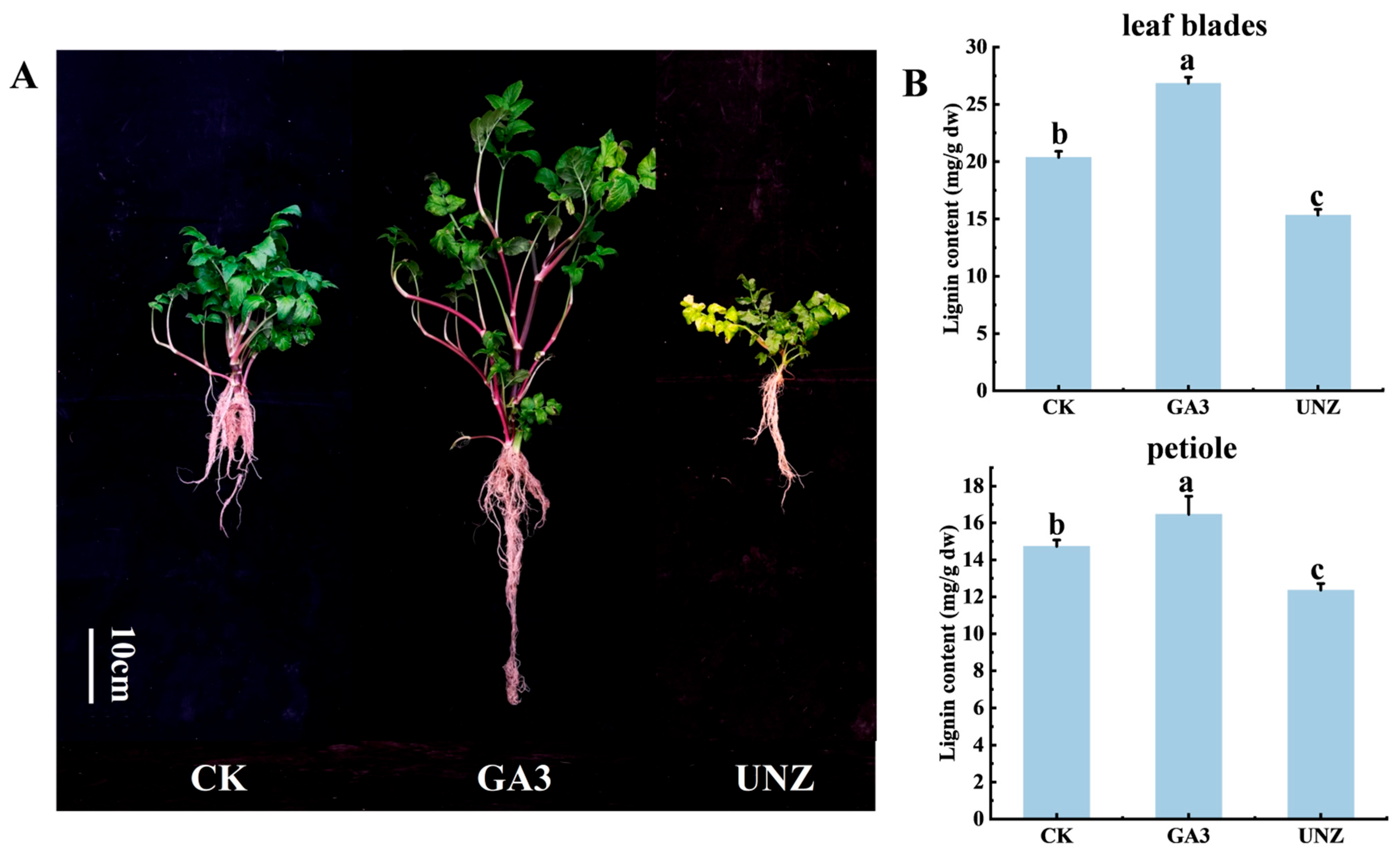
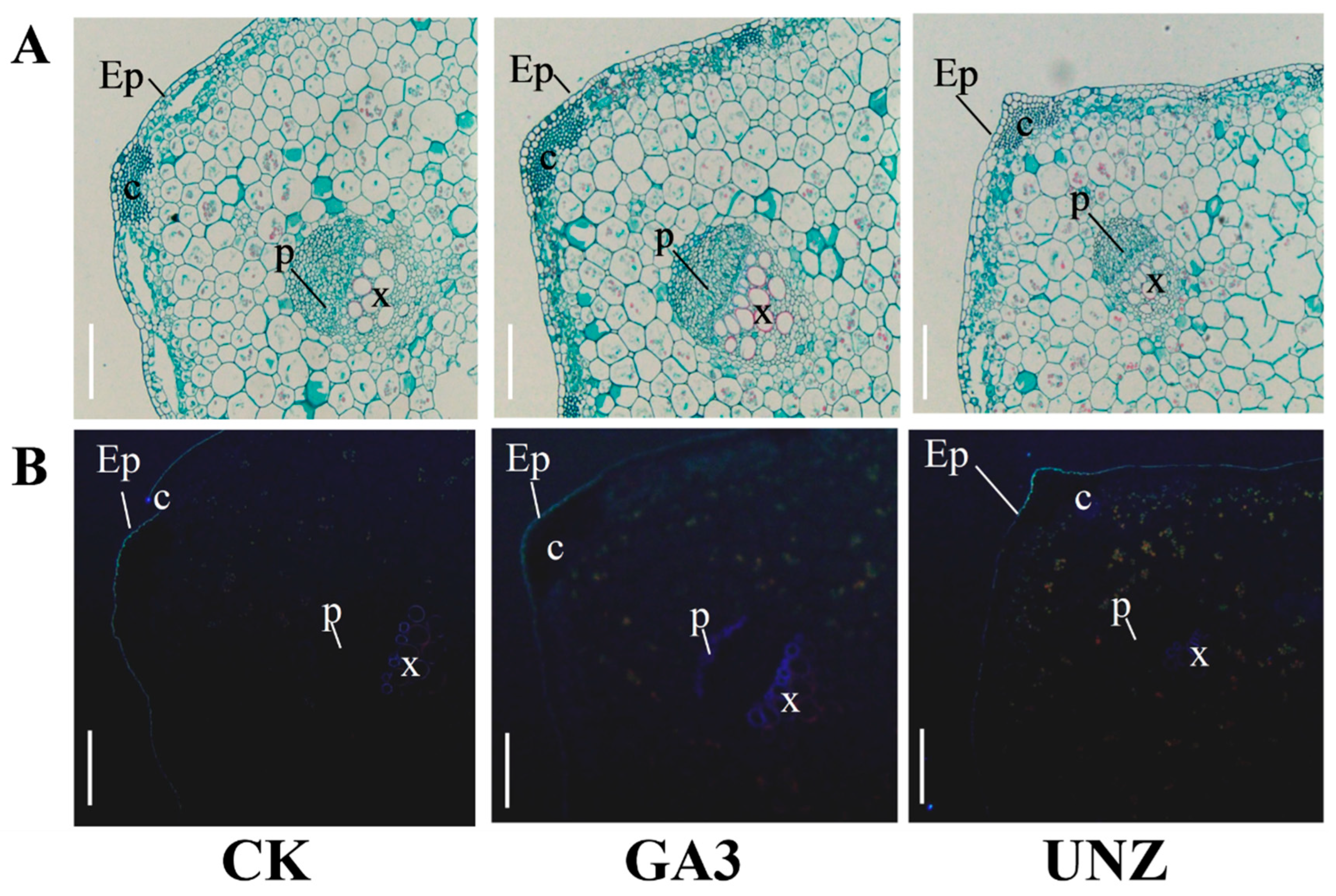
To investigate the effects of GA3 treatment on the growth of water dropwort, the plants were treated with GA3 and uniconazole. Measurements and sampling were conducted 30 days after treatment. GA3 treatment improved the visual quality of water dropwort. Compared to the control group, GA3 treatment significantly increased the lignin content in both leaf blades and petioles. Conversely, uniconazole treatment resulted in decreased lignin content in both leaf blades and petioles of water dropwort (Figure 8A,B). Under GA3 and uniconazole treatments, the anatomical structure of petioles was analyzed. Results indicated that lignin in watercress was primarily distributed in the epidermis, parenchyma tissue, and vascular bundles. Following GA3 treatment, lignin content in the vascular bundles of petioles in water dropwort significantly increased. Conversely, treatment with uniconazole resulted in a decrease. Consistent trends were observed under UV autofluorescence—lignified cell walls exhibited enhanced autofluorescence under UV light after GA3 treatment, while autofluorescence diminished following uniconazole treatment (Figure 9A,B).
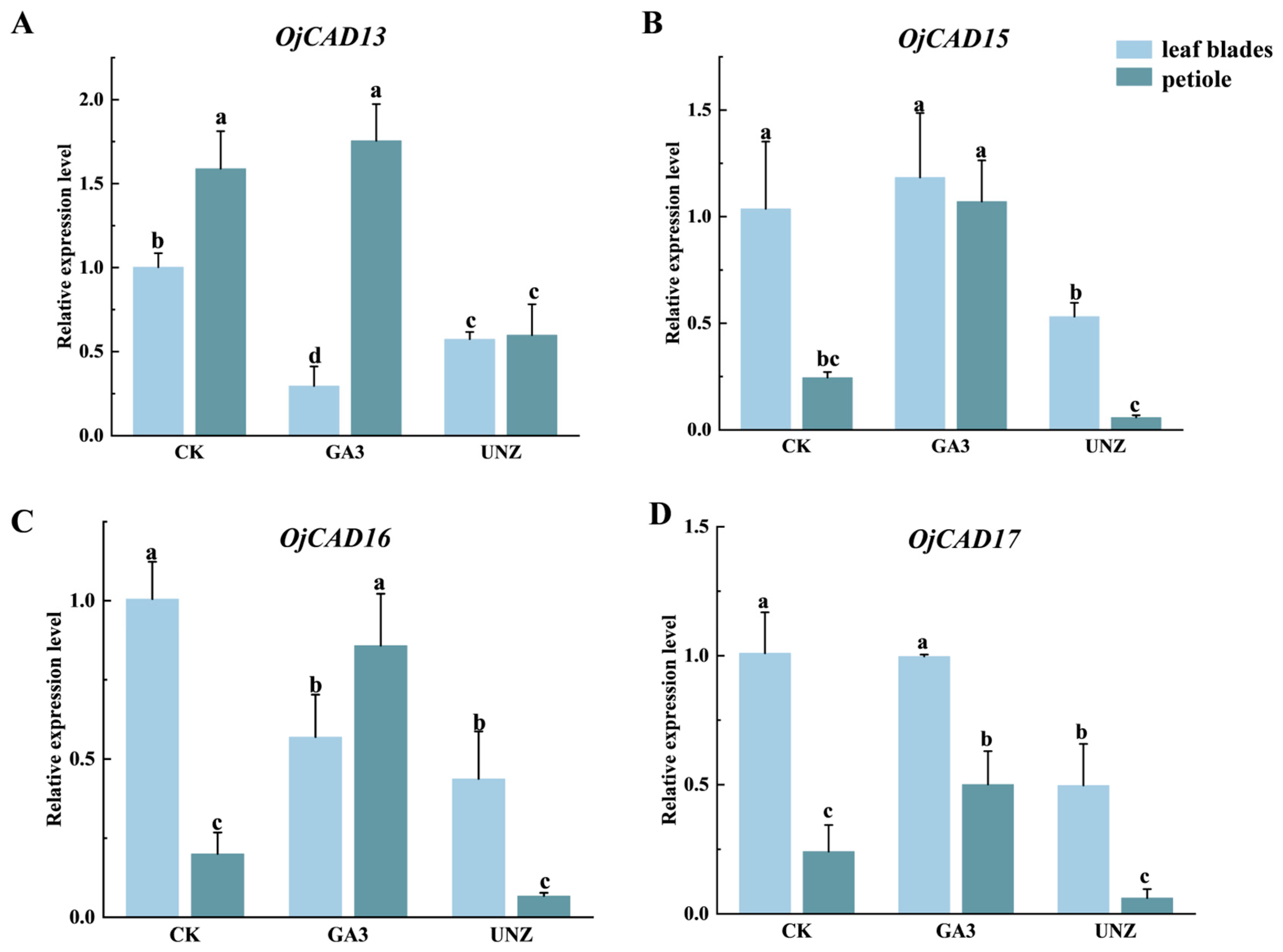
To further confirm the function of OjCAD genes in response to GA3 and uniconazole treatments, the expression levels of OjCAD genes in different treatments were detected. The expression levels of the four genes under GA3 and uniconazole treatments were illuminated in Figure 10, including OjCAD13, OjCAD15, OjCAD16, and OjCAD17. The results showed that the expression trend of OjCAD13 genes in leaf blades and petioles was completely opposite. The trend of OjCAD16 genes in leaf blades was similar to that observed in the transcriptional expression profiles. The expression trend of OjCAD17 genes in petioles aligned with the changes in lignin content, while OjCAD15 genes showed a markedly opposite trend to the transcriptional expression profile. The result showed that OjCAD15 and OjCAD17 genes in petioles may have a potential positive regulatory effect on lignin synthesis.

4. Discussion

In higher plants, CAD serves as the primary rate-limiting enzyme in lignin biosynthesis. In this study, 17 OjCAD members were identified in O. javanica, and the numbers were similar to 18 members in Juglans regia (walnut) and 16 members in Linum usitatissimum (Linum) [49,50]. These results indicated that the CAD gene typically exists in the form of a gene family in higher plants. The differentiation of gene function was related to the classification of its subfamilies to some extent [51]. Here, the number of introns of the CAD gene in O. javanica ranged from 4 to 6, while the number of introns of the CAD gene in most plants was less than 6, which was similar to the results of our study. This phenomenon may be attributed to the general prevalence of low intron gain and loss rates during plant evolution, which imposes stronger selective pressure on CAD genes with fewer introns [14,43,52]. The similarities and differences in motif distribution across different branches further validated the accuracy of the OjCAD subfamily phylogenetic tree. OjCAD15 and OjCAD17 were clustered together with AtCAD4, AtCAD5, and OsCAD2 in Group I. Within Group I, AtCAD4, AtCAD5, and OsCAD2 played crucial roles in lignin biosynthesis [51]. We speculated that OjCAD15 and OjCAD17 in Group I of O. javanica may possess functions involved in lignin synthesis. Group IV exclusively contained only OsCAD gene family members, consistent with findings in cassava [53].
Gene replication primarily expands gene families through tandem duplication and segmental duplication [54]. A total of three pairs of segmental duplication events (accounting for 35%) were identified in water dropwort, suggesting that more than half of the CAD genes in water dropwort may not have originated from the same ancestor. Segmental duplication events contributed to the amplification of the CAD gene, which was also consistent with the expansion of genes in A. thaliana in the genome of O. javanica [55]. The Ka/Ks ratio served as a key indicator for assessing evolutionary pressure on genes. All three pairs of OjCAD genes identified in O. javanica exhibited purifying selection, with Ka/Ks ratios below 1. This finding suggested that the core functions of these genes, such as lignin synthesis, remain highly conserved throughout evolution. Translational elements within promoters serve as fundamental transcriptional regulatory units, playing a crucial role in elucidating the regulatory networks governing stress responses and gene expression. This study identified five plant hormone-responsive cis-elements (gibberellin, auxin, methyl jasmonate, naphthaleneacetic acid, and abscisic acid) and stress-responsive cis-elements within the OjCAD gene promoters. Those results suggested that OjCAD gene expression patterns may be regulated by multiple signaling pathways involved in both hormone responses and stress adaptation. The study found that all OjCAD gene promoter regions contained light-responsive cis-acting elements, implying that light exposure may influence lignin biosynthesis by regulating the expression of these genes. Interestingly, OjCAD13, OjCAD15, OjCAD16, and OjCAD17 exhibited higher expression levels in the transcriptome data, with most identified as containing MYB-binding sites. MYB-binding sites represented a large family of transcription factors extensively involved in phenylpropanoid metabolism, regulating lignin synthesis, stress resistance, and other physiological processes [2,43]. This suggested that transcription factors may respond to hormones by binding to the upstream promoters of OjCAD genes, thereby regulating the transcriptional expression levels of downstream genes.
The mechanisms of plant hormone regulation in growth hold significant application value in agricultural production. GA3 was a crucial plant hormone that regulates various processes of plant growth and development and was also involved in secondary wall formation. Plant growth was constrained by the extensibility of the cell wall, and lignin deposition is closely linked to cell wall extensibility [56]. Exogenous GA3 treatment could promote xylem growth in the leaf blades of celery. In the current study, the plants of water dropwort were treated with GA3 and uniconazole. The lignin content of water dropwort was significantly increased after exogenous GA3 treatment, which indicated that the GAs mainly affected xylem thickening. The lignin content of water dropwort decreased after exogenous uniconazole treatment. Anatomical structure analysis and UV fluorescence indicated that GA3 treatment increased the lignin content of water dropwort, while uniconazole treatment decreased the lignin content. Some studies have indicated that GA3 and its inhibitors exert opposite effects on lignin. Exogenous application of GA3 can significantly reduce lignin content, whereas the application of uniconazole can increase lignin content in buckwheat stems, thereby preventing lodging and enhancing yield [57]. The reason for the differences in lignification synthesis and localization after GA3 treatment and uniconazole treatment may be due to various stages of plant development or different growth conditions.
In recent years, it was documented that CAD genes played a vital role in lignin biosynthesis. In A. thaliana, the expression of AtCAD5 could promote the lignin biosynthesis in floral stems [16]. Overexpression of AtCAD1 could positively increase lignin content, which makes seedlings vigorous and enhances resistance to pathogens [58]. In O. sativa (rice), the OsCAD2 gene served as a core regulatory gene in lignin biosynthesis by directly catalyzing the conversion of lignin precursors [59]. The knockout mutant of OsCAD2 in rice exhibited a significant reduction in lignin content [60], confirming its critical role in lignin biosynthesis. In Zea mays (maize), the expression of ZmCAD4 was strongly correlated with lignin accumulation and enhanced drought resistance, highlighting their dual function in structural integrity and stress adaptation [61]. In Gossypium hirsutum (cotton), transient silencing of GhCAD35, GhCAD45, or GhCAD43 triggered defense-related lignification in stems, thereby impairing resistance to Verticillium dahlia [62]. These findings proved the role of lignin polymerization and degradation in the response of plants to various stresses [63]. In this study, four OjCAD genes in petioles of O. javanica showed consistent upregulation under GA3 treatment and downregulation under uniconazole treatment. In leaf blades, the expression of OjCAD13, OjCAD16, and OjCAD17 was downregulated by both GA3 treatment and uniconazole treatment, whereas OjCAD15 displayed an initial upregulation followed by downregulation. This may be attributed to the fact that OjCADs were regulatory genes, and their differential expression in different tissues of O. javanica were mainly regulated by both developmental and environmental factors.
In summary, the initial significant increase followed by a decrease in lignin content after GA3 and uniconazole application to water dropwort aligns with the coordinated changes in four highly expressed CAD genes within the petiole along the lignin biosynthesis pathway. To gain a deeper understanding of the underlying transcriptional regulatory mechanisms behind this synergistic gene activation, we analyzed cis-acting elements in the promoter regions of relevant genes and identified binding sites for MYB family transcription factors. Research has confirmed that OsCAD2 co-expresses with Os-MYB110/30/55 and multiple lignin metabolites, synergistically regulating lignin biosynthesis [64]. StMYB168 activated StCAD14 by directly binding its promoter, forming a complex that actively regulates lignin biosynthesis in potato (Solanum tuberosum) [65]. Here, we hypothesized that GA3 may induce or activate MYB transcription factors, which then bind to the promoters of CAD genes involved in lignin biosynthesis. This binding drives their coordinated expression, ultimately leading to the observed increase in lignin deposition.
Although functional validation of specific transcription factor binding was not performed in this study, the co-occurrence of these regulatory motifs provides a robust bioinformatics foundation and concrete targets for future studies elucidating the precise signaling and transcriptional cascades involved.

5. Conclusions

This study comprehensively identified the CAD gene family in O. javanica, identifying a total of 17 OjCAD genes and elucidating their roles in lignin biosynthesis. Results indicated that exogenous gibberellin treatment enhances lignin content in O. javanica. The study also proposed a strategy to improve flavor quality by regulating water dropwort lignin content through exogenous gibberellin treatment. Subsequent studies will focus on validating the functions of key OjCAD genes associated with lignin synthesis.

Author Contributions

Conceptualization, B.-Q.L. and A.-S.X.; methodology, B.-Q.L.; investigation, B.-Q.L., X.S., C.C., X.-B.L. and G.-F.T.; data curation, B.-Q.L.; project administration, A.-S.X.; writing—original draft preparation, B.-Q.L.; writing—review and editing, B.-Q.L. and A.-S.X. All authors have read and agreed to the published version of the manuscript.

Funding

This research was supported by the Fundamental Research Funds for the Central Universities (KYLH2025002), Priority Academic Program Development of Jiangsu Higher Education Institutions Project (PAPD), and the Bioinformatics Center of Nanjing Agricultural University.

Institutional Review Board Statement

Not applicable.

Informed Consent Statement

Not applicable.

Data Availability Statement

The original contributions presented in this study are included in the article. Further inquiries can be directed to the corresponding author.

Conflicts of Interest

The authors declare that there are no competing interests.

References

  1. Lu, C.L.; Li, X.F. A Review of Oenanthe javanica (Blume) DC. as Traditional Medicinal Plant and Its Therapeutic Potential. Evid. Based Complement. Altern. Med. 2019, 2019, 6495819. [Google Scholar] [CrossRef]
  2. Wang, X.J.; Luo, Q.; Li, T.; Meng, P.H.; Pu, Y.T.; Liu, J.X.; Zhang, J.; Liu, H.; Tan, G.F.; Xiong, A.S. Origin, evolution, breeding, and omics of Apiaceae: A family of vegetables and medicinal plants. Hortic. Res. 2022, 9, uhac076. [Google Scholar] [CrossRef] [PubMed]
  3. Que, F.; Hou, X.L.; Wang, G.L.; Xu, Z.S.; Tan, G.F.; Li, T.; Wang, Y.H.; Khadr, A.; Xiong, A.S. Advances in research on the carrot, an important root vegetable in the Apiaceae family. Hortic. Res. 2019, 6, 69. [Google Scholar] [CrossRef] [PubMed]
  4. Feng, K.; Xu, Z.S.; Que, F.; Liu, J.X.; Wang, F.; Xiong, A.S. An R2R3-MYB transcription factor, OjMYB1, functions in anthocyanin biosynthesis in Oenanthe javanica. Planta 2018, 247, 301–315. [Google Scholar] [CrossRef] [PubMed]
  5. Kim, J.K.; Shin, E.C.; Park, G.G.; Kim, Y.J.; Shin, D.H. Root extract of water dropwort, Oenanthe javanica (Blume) DC, induces protein and gene expression of phase I carcinogen-metabolizing enzymes in HepG2 cells. SpringerPlus 2016, 5, 5413. [Google Scholar] [CrossRef]
  6. Yang, S.A.; Jung, Y.S.; Lee, S.J.; Park, S.C.; Kim, M.J.; Lee, E.J.; Byun, H.J.; Jhee, K.H.; Lee, S.P. Hepatoprotective effects of fermented field water-dropwort (Oenanthe javanica) extract and its major constituents. Food Chem. Toxicol. Int. J. Publ. Br. Ind. Biol. Res. Assoc. 2014, 67, 154–160. [Google Scholar] [CrossRef]
  7. Liu, J.X.; Jiang, Q.; Tao, J.P.; Feng, K.; Li, T.; Duan, A.Q.; Wang, H.; Xu, Z.S.; Liu, H.; Xiong, A.S. Integrative genome, transcriptome, microRNA, and degradome analysis of water dropwort (Oenanthe javanica) in response to water stress. Hortic. Res. 2021, 8, 262. [Google Scholar] [CrossRef]
  8. Park, J.H.; Cho, J.H.; Kim, I.H.; Ahn, J.H.; Lee, J.C.; Chen, B.H.; Shin, B.N.; Tae, H.J.; Yoo, K.Y.; Hong, S.; et al. Oenanthe javanica Extract Protects Against Experimentally Induced Ischemic Neuronal Damage via Its Antioxidant Effects. Chin. Med. J. 2015, 128, 2932–2937. [Google Scholar] [CrossRef] [PubMed]
  9. Feng, K.; Yao, C.; Lv, H.; Yang, Z.Y.; Liu, J.L.; Zhou, Z.Q.; Sun, N.; Zhao, S.P.; Wu, P.; Xiong, A.S.; et al. Callus-mediated plant regeneration and CRISPR/Cas9-targeted mutagenesis in Oenanthe javanica. Hortic. Res. 2026, 13, uhaf327. [Google Scholar] [CrossRef]
  10. Feng, K.; Xing, G.M.; Liu, J.X.; Wang, H.; Tan, G.F.; Wang, G.L.; Xu, Z.S.; Xiong, A.S. AgMYB1, an R2R3-MYB factor, plays a role in anthocyanin production and enhancement of antioxidant capacity in celery. Veg. Res. 2021, 1, 2. [Google Scholar] [CrossRef]
  11. Liu, Q.; Luo, L.; Zheng, L. Lignins: Biosynthesis and Biological Functions in Plants. Int. J. Mol. Sci. 2018, 19, 335. [Google Scholar] [CrossRef]
  12. Baucher, M.; Chabbert, B.; Pilate, G.; Van Doorsselaere, J.; Tollier, M.T.; Petit-Conil, M.; Cornu, D.; Monties, B.; Van Montagu, M.; Inze, D.; et al. Red Xylem and Higher Lignin Extractability by Down-Regulating a Cinnamyl Alcohol Dehydrogenase in Poplar. Plant Physiol. 1996, 112, 1479–1490. [Google Scholar] [CrossRef]
  13. Boudet, A.M.; Hawkins, S.; Rochange, S. The polymorphism of the genes/enzymes involved in the last two reductive steps of monolignol synthesis: What is the functional significance? Comptes Rendus Biol. 2004, 327, 837–845. [Google Scholar] [CrossRef]
  14. Li, Y.; Wang, R.; Pei, Y.; Yu, W.; Wu, W.; Li, D.; Hu, Z. Phylogeny and functional characterization of the cinnamyl alcohol dehydrogenase gene family in Phryma leptostachya. Int. J. Biol. Macromol. 2022, 217, 407–416. [Google Scholar] [CrossRef]
  15. Knight, M.E.; Halpin, C.; Schuch, W. Identification and characterisation of cDNA clones encoding cinnamyl alcohol dehydrogenase from tobacco. Plant Mol. Biol. 1992, 19, 793–801. [Google Scholar] [CrossRef]
  16. Sibout, R.; Eudes, A.; Pollet, B.; Goujon, T.; Mila, I.; Granier, F.; Séguin, A.; Lapierre, C.; Jouanin, L. Expression pattern of two paralogs encoding cinnamyl alcohol dehydrogenases in Arabidopsis. Isolation and characterization of the corresponding mutants. Plant Physiol. 2003, 132, 848–860. [Google Scholar] [CrossRef] [PubMed]
  17. Liu, Y.; Weng, Z.; Liu, Y.; Tian, M.; Yang, Y.; Pan, N.; Zhang, M.; Zhao, H.; Du, H.; Yin, N.; et al. Identification of the Cinnamyl Alcohol Dehydrogenase Gene Family in Brassica U-Triangle Species and Its Potential Roles in Response to Abiotic Stress and Regulation of Seed Coat Color in Brassica napus L. Plants 2025, 14, 1184. [Google Scholar] [CrossRef]
  18. Wu, M.; Li, Y.; Liu, Z.; Xia, L.; Xiang, Y.; Zhao, L.; Yang, X.; Li, Z.; Xie, X.; Wang, L.; et al. Genome-wide identification of the CAD gene family and functional analysis of putative bona fide CAD genes in tobacco (Nicotiana tabacum L.). Front. Plant Sci. 2024, 15, 1400213. [Google Scholar] [CrossRef]
  19. Peracchi, L.M.; Brew-Appiah, R.A.T.; Garland-Campbell, K.; Roalson, E.H.; Sanguinet, K.A. Genome-wide characterization and expression analysis of the CINNAMYL ALCOHOL DEHYDROGENASE gene family in Triticum aestivum. BMC Genom. 2024, 25, 816. [Google Scholar] [CrossRef] [PubMed]
  20. Zhou, Z.; Li, Z.; Fan, F.; Qin, H.; Ding, G. Effects of exogenous GA3 on stem secondary growth of Pinus massoniana seedlings. Plant Physiol. Biochem. 2024, 206, 108254. [Google Scholar] [CrossRef] [PubMed]
  21. Zhou, L.L.; Wang, Y.L.; Wang, J.M.; Wang, P.L.; Lu, G.Q.; Su, X.F.; Afridi, M.; Guo, H.M.; Cheng, H.M. CRISPR/Cas9-mediated mutation of GhCAD decreases the gossypol content of cottonseed. J. Biol. Eng. 2025, 30, 83. [Google Scholar] [CrossRef]
  22. Liu, Y.; Wu, Q.; Qin, Z.; Huang, J. Transcription factor OsNAC055 regulates GA-mediated lignin biosynthesis in rice straw. Plant Sci. 2022, 325, 111455. [Google Scholar] [CrossRef]
  23. García-Rojas, M.; Meneses, M.; Oviedo, K.; Carrasco, C.; Defilippi, B.; González-Agüero, M.; León, G.; Hinrichsen, P. Exogenous gibberellic acid application induces the overexpression of key genes for pedicel lignification and an increase in berry drop in table grape. Plant Physiol. Biochem. 2018, 126, 32–38. [Google Scholar] [CrossRef]
  24. Wang, G.L.; An, Y.H.; Wang, Y.H.; Liu, J.X.; Wang, J.Z.; Sun, M.; Xiong, A.S. Gibberellin-Induced Alterations to the Expression of Cell Wall-Related Genes in the Xylem of Carrot Root. J. Plant Growth Regul. 2021, 40, 787–797. [Google Scholar] [CrossRef]
  25. Duan, A.Q.; Feng, K.; Wang, G.L.; Liu, J.X.; Xu, Z.S.; Xiong, A.S. Elevated gibberellin enhances lignin accumulation in celery (Apium graveolens L.) leaves. Protoplasma 2019, 256, 777–788. [Google Scholar] [CrossRef] [PubMed]
  26. Duan, A.Q.; Feng, K.; Liu, J.X.; Que, F.; Xu, Z.S.; Xiong, A.S. Elevated gibberellin altered morphology, anatomical structure, and transcriptional regulatory networks of hormones in celery leaves. Protoplasma 2019, 256, 1507–1517. [Google Scholar] [CrossRef] [PubMed]
  27. Wang, G.L.; Xiong, F.; Que, F.; Xu, Z.S.; Wang, F.; Xiong, A.S. Morphological characteristics, anatomical structure, and gene expression: Novel insights into gibberellin biosynthesis and perception during carrot growth and development. Hortic. Res. 2015, 2, 15028. [Google Scholar] [CrossRef]
  28. Jia, M.; Wang, Y.; Chen, C.; Zhang, R.R.; Wang, G.L.; Xiong, A.S. DcGA20ox2 and DcGA2ox1 alter endogenous gibberellin contents and adjust lignin accumulation in carrot. Hortic. Plant J. 2024, 10, 1398–1413. [Google Scholar] [CrossRef]
  29. Feng, K.; Li, X.; Yan, Y.; Liu, R.; Li, Z.; Sun, N.; Yang, Z.; Zhao, S.; Wu, P.; Li, L.J. Integrated morphological, metabolome, and transcriptome analyses revealed the mechanism of exogenous gibberellin promoting petiole elongation in Oenanthe javanica. Front. Plant Sci. 2023, 14, 1225635. [Google Scholar] [CrossRef] [PubMed]
  30. Liu, J.X.; Liu, H.; Tao, J.P.; Tan, G.F.; Dai, Y.; Yang, L.L.; Feng, K.; Wang, H.; Li, T.; Liu, Y.H.; et al. High-quality genome sequence reveals a young polyploidization and provides insights into cellulose and lignin biosynthesis in water dropwort (Oenanthe sinensis). Ind. Crops Prod. 2023, 193, 116203. [Google Scholar] [CrossRef]
  31. Sayers, E.W.; Bolton, E.E.; Brister, J.R.; Canese, K.; Chan, J.; Comeau, D.C.; Connor, R.; Funk, K.; Kelly, C.; Kim, S.; et al. Database resources of the national center for biotechnology information. Nucleic Acids Res. 2022, 50, D20–D26. [Google Scholar] [CrossRef] [PubMed]
  32. Chen, C.; Chen, H.; Zhang, Y.; Thomas, H.R.; Frank, M.H.; He, Y.; Xia, R. TBtools: An Integrative Toolkit Developed for Interactive Analyses of Big Biological Data. Mol. Plant 2020, 13, 1194–1202. [Google Scholar] [CrossRef] [PubMed]
  33. Chou, K.C.; Shen, H.B. Plant-mPLoc: A top-down strategy to augment the power for predicting plant protein subcellular localization. PLoS ONE 2010, 5, e11335. [Google Scholar] [CrossRef]
  34. Waterhouse, A.M.; Procter, J.B.; Martin, D.M.; Clamp, M.; Barton, G.J. Jalview Version 2—A multiple sequence alignment editor and analysis workbench. Bioinformatics 2009, 25, 1189–1191. [Google Scholar] [CrossRef]
  35. Crooks, G.E.; Hon, G.; Chandonia, J.M.; Brenner, S.E. WebLogo: A sequence logo generator. Genome Res. 2004, 14, 1188–1190. [Google Scholar] [CrossRef] [PubMed]
  36. Kumar, S.; Stecher, G.; Li, M.; Knyaz, C.; Tamura, K. MEGA X: Molecular Evolutionary Genetics Analysis Across Computing Platforms. Mol. Biol. Evol. 2018, 35, 1547–1549. [Google Scholar] [CrossRef]
  37. Subramanian, B.; Gao, S.; Lercher, M.J.; Hu, S.; Chen, W.H. Evolview v3: A webserver for visualization, annotation, and management of phylogenetic trees. Nucleic Acids Res. 2019, 47, W270–W275. [Google Scholar] [CrossRef]
  38. Bailey, T.L.; Johnson, J.; Grant, C.E.; Noble, W.S. The MEME Suite. Nucleic Acids Res. 2015, 43, W39–W49. [Google Scholar] [CrossRef]
  39. Li, J.; Zhang, Z.; Vang, S.; Yu, J.; Wong, G.K.; Wang, J. Correlation between Ka/Ks and Ks is related to substitution model and evolutionary lineage. J. Mol. Evol. 2009, 68, 414–423. [Google Scholar] [CrossRef]
  40. Lescot, M.; Déhais, P.; Thijs, G.; Marchal, K.; Moreau, Y.; Van de Peer, Y.; Rouzé, P.; Rombauts, S. PlantCARE, a database of plant cis-acting regulatory elements and a portal to tools for in silico analysis of promoter sequences. Nucleic Acids Res. 2002, 30, 325–327. [Google Scholar] [CrossRef]
  41. Liu, J.X.; Feng, K.; Wang, G.L.; Xu, Z.S.; Wang, F.; Xiong, A.S. Elevated CO2 induces alteration in lignin accumulation in celery (Apium graveolens L.). Plant Physiol. Biochem. 2018, 127, 310–319. [Google Scholar] [CrossRef]
  42. Donaldson, L.A.; Knox, J.P. Localization of cell wall polysaccharides in normal and compression wood of radiata pine: Relationships with lignification and microfibril orientation. Plant Physiol. 2012, 158, 642–653. [Google Scholar] [CrossRef]
  43. Jiang, Q.; Wang, F.; Li, M.Y.; Ma, J.; Tan, G.F.; Xiong, A.S. Selection of suitable reference genes for qPCR normalization under abiotic stresses in Oenanthe javanica (BI.) DC. PLoS ONE 2014, 9, e92262. [Google Scholar] [CrossRef]
  44. Feng, K.; Yang, Z.Y.; Yan, Y.J.; Sun, N.; Zhou, Z.Q.; Liu, J.L.; Zhao, S.P.; Wu, P.; Li, L.J. Selection of suitable reference genes for qPCR normalization in different developmental stages of Oenanthe javanica. Front. Plant Sci. 2023, 14, 1287589. [Google Scholar] [CrossRef]
  45. Schmittgen, T.D.; Livak, K.J. Analyzing real-time PCR data by the comparative C(T) method. Nat. Protoc. 2008, 3, 1101–1108. [Google Scholar] [CrossRef]
  46. Hu, L.; Zhang, X.; Ni, H.; Yuan, F.; Zhang, S. Identification and Functional Analysis of CAD Gene Family in Pomegranate (Punica granatum). Genes 2022, 14, 26. [Google Scholar] [CrossRef] [PubMed]
  47. Kim, S.J.; Kim, M.R.; Bedgar, D.L.; Moinuddin, S.G.; Cardenas, C.L.; Davin, L.B.; Kang, C.; Lewis, N.G. Functional reclassification of the putative cinnamyl alcohol dehydrogenase multigene family in Arabidopsis. Proc. Natl. Acad. Sci. USA 2004, 101, 1455–1460. [Google Scholar] [CrossRef] [PubMed]
  48. Wang, L.; Sun, G.; Wang, J.; Zhu, H.; Wu, Y. Systematic characterization of cinnamyl alcohol dehydrogenase members revealed classification and function divergence in Haplomitrium mnioides. J. Plant Res. 2025, 138, 173–187. [Google Scholar] [CrossRef]
  49. Wu, P.; Zhang, R.; Yu, S.; Fu, J.; Guo, Z.; Li, D.; Pan, Z.; Hu, H. Genome-Wide Identification and Expression Analysis of the CAD Gene Family in Walnut (Juglans regia L.). Biochem. Genet. 2023, 61, 1065–1085. [Google Scholar] [CrossRef] [PubMed]
  50. Preisner, M.; Wojtasik, W.; Kostyn, K.; Boba, A.; Czuj, T.; Szopa, J.; Kulma, A. The cinnamyl alcohol dehydrogenase family in flax: Differentiation during plant growth and under stress conditions. J. Plant Physiol. 2018, 221, 132–143. [Google Scholar] [CrossRef]
  51. Cheng, C.Z.; Liu, F.; Shen, X.L.; Wang, B.; Liu, J.P.; Ni, X.T.; Hu, C.H.; Deng, G.M.; Tong, Z.; Zhang, Y.Y.; et al. Genome-wide identification of FAD gene family and their contributions to the temperature stresses and mutualistic and parasitic fungi colonization responses in banana. Int. J. Biol. Macromol. 2022, 204, 661–676. [Google Scholar] [CrossRef] [PubMed]
  52. Roy, S.W.; Penny, D. Patterns of intron loss and gain in plants: Intron loss-dominated evolution and genome-wide comparison of O. sativa and A. thaliana. Mol. Biol. Evol. 2007, 24, 171–181. [Google Scholar] [CrossRef] [PubMed]
  53. An, F.; Chen, T.; Zhu, W.; Xiao, X.; Xue, J.; Luo, X.; Wei, Z.; Li, K.; Chen, S.; Cai, J. Systematic Analysis of Cinnamyl Alcohol Dehydrogenase Family in Cassava and Validation of MeCAD13 and MeCAD28 in Lignin Synthesis and Postharvest Physiological Deterioration. Int. J. Mol. Sci. 2024, 25, 11668. [Google Scholar] [CrossRef]
  54. An, F.; Xiao, X.; Chen, T.; Xue, J.; Luo, X.; Ou, W.; Li, K.; Cai, J.; Chen, S. Systematic Analysis of bHLH Transcription Factors in Cassava Uncovers Their Roles in Postharvest Physiological Deterioration and Cyanogenic Glycosides Biosynthesis. Front. Plant Sci. 2022, 13, 901128. [Google Scholar] [CrossRef]
  55. Wang, Z.Q.; Sun, S.R.; Wang, H.Y.; Bi, Z.W.; Chang, H.L.; Zhang, S.H.; Chen, J.L.; Qin, Y.X.; Wu, J.T.; Zhang, W.; et al. Functional divergence of CAD-like family genes in Saccharum complex under biotic and abiotic stress. Plant Cell Rep. 2025, 44, 85. [Google Scholar] [CrossRef] [PubMed]
  56. Li, J.; Zhang, Y.; Li, Z.; Dai, H.; Luan, X.; Zhong, T.; Chen, S.; Xie, X.M.; Qin, G.; Zhang, X.Q.; et al. OsPEX1, an extensin-like protein, negatively regulates root growth in a gibberellin-mediated manner in rice. Plant Mol. Biol. 2023, 112, 47–59. [Google Scholar] [CrossRef]
  57. Wang, C.; Hu, D.; Liu, X.; She, H.; Ruan, R.; Yang, H.; Yi, Z.; Wu, D. Effects of uniconazole on the lignin metabolism and lodging resistance of culm in common buckwheat (Fagopyrum esculentum M.). Field Crops Res. 2015, 180, 46–53. [Google Scholar] [CrossRef]
  58. Jiang, S.; Tian, X.; Huang, X.; Xin, J.; Yan, H. Physcomitrium patens CAD1 has distinct roles in growth and resistance to biotic stress. BMC Plant Biol. 2022, 22, 518. [Google Scholar] [CrossRef] [PubMed]
  59. Tobias, C.M.; Chow, E.K. Structure of the cinnamyl-alcohol dehydrogenase gene family in rice and promoter activity of a member associated with lignification. Planta 2005, 220, 678–688. [Google Scholar] [CrossRef]
  60. Shad, M.A.; Li, X.; Rao, M.J.; Luo, Z.; Li, X.; Ali, A.; Wang, L. Exploring Lignin Biosynthesis Genes in Rice: Evolution, Function, and Expression. Int. J. Mol. Sci. 2024, 25, 10001. [Google Scholar] [CrossRef]
  61. Hu, Y.; Li, W.C.; Xu, Y.Q.; Li, G.J.; Liao, Y.; Fu, F.L. Differential expression of candidate genes for lignin biosynthesis under drought stress in maize leaves. J. Appl. Genet. 2009, 50, 213–223. [Google Scholar] [CrossRef] [PubMed]
  62. Xiao, J.; Sui, X.; Xu, Z.; Liang, L.; Tang, W.; Tang, Y.; Sun, B.; Lai, Y.; Huang, Z.; Zheng, Y.; et al. CaNAC76 enhances lignin content and cold resistance in pepper by regulating CaCAD1. Int. J. Biol. Macromol. 2025, 285, 138271. [Google Scholar] [CrossRef] [PubMed]
  63. Berthet, S.; Demont-Caulet, N.; Pollet, B.; Bidzinski, P.; Cézard, L.; Le Bris, P.; Borrega, N.; Hervé, J.; Blondet, E.; Balzergue, S.; et al. Disruption of LACCASE4 and 17 results in tissue-specific alterations to lignification of Arabidopsis thaliana stems. Plant Cell 2011, 23, 1124–1137. [Google Scholar] [CrossRef] [PubMed]
  64. Yang, C.; Shen, S.; Zhou, S.; Li, Y.; Mao, Y.; Zhou, J.; Shi, Y.; An, L.; Zhou, Q.; Peng, W.; et al. Rice metabolic regulatory network spanning the entire life cycle. Mol. Plant 2022, 15, 258–275. [Google Scholar] [CrossRef]
  65. Yang, R.R.; Wang, Q.H.; Wang, Y.; Zhang, X.J.; Zheng, X.Y.; Li, Y.C.; Prusky, D.; Bi, Y.; Han, Y. MYB168 and WRKY20 transcription factors synergistically regulate lignin monomer synthesis during potato tuber wound healing. Plant Physiol. 2025, 197, 573. [Google Scholar] [CrossRef]
Figure 1. Phylogenetic tree of the CAD gene family in water dropwort (O. javanica), A. thaliana, and rice (O. sativa). All CAD proteins were grouped into four groups (I, II, III, IV), represented by different colored backgrounds. Oj denotes water dropwort, At denotes A. thaliana, Os denotes rice, and different species are indicated by stars of varying colors: brown for water dropwort (O. javanica), purple for A. thaliana, and green for rice (O. sativa).
Horticulturae 12 00208 g001
Figure 6. cis-acting elements in the CAD gene promoter region of O. javanica. (A) Distribution and localization of cis-acting elements within the OjCAD promoter region, with differently colored boxes indicating distinct elements. (B) Functional classification of cis-acting elements within the OjCAD promoter region.
Horticulturae 12 00208 g006
Figure 7. Transcriptional expression profiling of CAD gene family members in O. javanica under treatments of water (CK) spray, gibberellic acid (GA3), and uniconazole (UNZ). Heatmaps were generated based on normalized absolute FPKM values for each gene row. The color scale indicates gene expression levels with blue representing low expression and red indicating high expression.
Horticulturae 12 00208 g007
Figure 8. Effects of exogenous GA3 and uniconazole treatment on lignin in water dropwort. (A) Morphological growth of water dropwort plants treated with exogenous GA3 and uniconazole (UNZ) sprays. Spray with clean water as a control (CK). The white line is the scale bar (10 cm). (B) Exogenous GA3 and uniconazole sprayed alter lignin content in leaf blades and petioles of water dropwort. Letters above the horizontal line indicate significant differences based on the Student’s t-test (p < 0.05). Three biological replicated were analyzed, and error bars represent standard deviation.
Horticulturae 12 00208 g008
Figure 9. Effects of exogenous GA3 treatment on the anatomical structure of petioles in O. javanica. (A) Effects of exogenous GA3 and uniconazole treatment on petiole anatomy of O. javanica. From left to right, it represents control sprayed with distilled water, gibberellic acid spray, and uniconazole spray. Letters denote vascular bundle components: c denotes cortex, x denotes xylem, p denotes phloem, and Ep denotes epidermis. The white line indicates the scale bar (200 μm). The same scale is applied to the following figure. (B) Ultraviolet autofluorescence observation of anatomical structures in O. javanica treated with exogenous GA3 and uniconazole.
Horticulturae 12 00208 g009
Figure 10. RT-qPCR expression analysis of lignin-related OjCAD genes in water dropwort. OjeIF-4α gene was used as a housekeeping gene. The x-axis represents different treatments, including spraying with water, spraying with gibberellic acid, and spraying with paclobutrazol. The y-axis shows the relative expression levels of the OjCAD gene. Letters above the horizontal line indicate significant differences based on the Student’s t-test (p < 0.05). Different letters indicate significant differences. Three biological replicated were analyzed, and error bars represent standard deviation.
Horticulturae 12 00208 g010
Table 1. Primer information for RT-qPCR.
Gene NamePrimer NameFull-Length/bpAmplicon Length/bpPrime Sequences (5′-3′)Tm/°C
OjCAD13OjCAD13-F1104447AGTGGGAGATAAAGTGGGTG55
OjCAD13-RGGATTACGGCTAACCAGAAA 53
OjCAD15OjCAD15-F1083528AATAGGATGGGCAGCAAG 53
OjCAD15-RCCACCTCTCAGTCCAGAAA55
OjCAD16OjCAD16-F1083512TTCTGGAACTCTTGCTCCTT53
OjCAD16-RAACCTACGATGCCTACCTTAGT55
OjCAD17OjCAD17-F1083528 CAATAGGATGGGCAGCAA53
OjCAD17-RCACCTCTCAGTCCAGCAAT55
OjeIF-4αOjeIF-4α-F1242120CCGCTCTGGTTCTTCTCGTGTG61
OjeIF-4α-RTGGAGGTAGTTCTCTGGCTGAGTC61
Table 2. Information of OjCAD family members in O. javanica.
NameGene IDCorresponding Arabidopsis NameCorresponding Arabidopsis IDNumber of Amino Acids/aaMolecular
Weight/Da
Isoelectric Point/pIInstability IndexAliphatic IndexGrand Average
of Hydropathy
Subcellular Location
OjCAD1Oenanthe_sinensis0359360.1ATCAD8AT4G37990.136038,565.175.9425.4889.81−0.007Cytoplasm
OjCAD2Oenanthe_sinensis0359380.1ATCAD8AT4G37990.136038,536.095.9425.2488.72−0.029Cytoplasm
OjCAD3Oenanthe_sinensis0359400.1ATCAD8AT4G37990.136038,536.095.9425.2488.72−0.029Cytoplasm
OjCAD4Oenanthe_sinensis0359420.1ATCAD8AT4G37990.136038,536.095.9425.2488.72−0.029Cytoplasm
OjCAD5Oenanthe_sinensis0359430.1ATCAD9AT4G39330.136038,735.746.4224.3688.19−0.052Cytoplasm
OjCAD6Oenanthe_sinensis0368420.1ATCAD9AT4G39330.135939,144.176.3228.0190.36−0.064Cytoplasm
OjCAD7Oenanthe_sinensis0372490.1ATCAD9AT4G39330.135739,143.16.9128.3785.15−0.148Cytoplasm
OjCAD8Oenanthe_sinensis0381730.1ATCAD1AT1G72680.135839,014.555.9326.3489.22−0.065Cytoplasm
OjCAD9Oenanthe_sinensis0406650.1ATCAD1AT1G72680.135839,037.65.9425.9587.6−0.055Cytoplasm
OjCAD10Oenanthe_sinensis0415640.1ATCAD9AT4G39330.135739,1026.729.5285.15−0.139Cytoplasm
OjCAD11Oenanthe_sinensis0419640.1ATCAD9AT4G39330.135838,976.155.828.7697.4−0.013Cytoplasm
OjCAD12Oenanthe_sinensis0428590.1ATCAD8AT4G37990.136038,698.455.7824.2790.080.018Cytoplasm
OjCAD13Oenanthe_sinensis0428600.1ATCAD9AT4G39330.136739,462.26.2731.7487.9−0.039Cytoplasm
OjCAD14Oenanthe_sinensis0202330.1ATCAD8AT4G37990.136039,089.996.8626.294.5−0.013Cytoplasm
OjCAD15Oenanthe_sinensis0123820.1ATCAD4AT3G19450.136038,940.855.5219.4690.36−0.004Cytoplasm
OjCAD16Oenanthe_sinensis0282740.1ATCAD8AT4G37990.136038,740.475.8223.2987.69−0.022Cytoplasm
OjCAD17Oenanthe_sinensis0178840.1ATCAD4AT3G19450.136039,026.865.4221.2489.56−0.029Cytoplasm
Table 3. Ka/Ks ratios of OjCAD genes.
Gene Pairs KaKsKa/Ks
Gene 1Gene 2
OjCAD6OjCAD110.0434155680.0712023280.609749273
OjCAD7OjCAD100.002421310.0962015520.025169133
OjCAD15OjCAD170.006051470.0581002450.104155673
Disclaimer/Publisher’s Note: The statements, opinions and data contained in all publications are solely those of the individual author(s) and contributor(s) and not of MDPI and/or the editor(s). MDPI and/or the editor(s) disclaim responsibility for any injury to people or property resulting from any ideas, methods, instructions or products referred to in the content.