Article

Study on Comprehensive Evaluation of Agronomic Traits and High-Yield Breeding Selection Strategy of Brassica napus L.

1
Zhangye Academy of Agricultural Sciences, Zhangye 734000, China
2
College of Agriculture and Ecological Engineering, Hexi University, Zhangye 734000, China
3
Nanjing Institute of Agricultural Mechanization, Ministry of Agriculture and Rural Affair, Nanjing 210014, China
*
Authors to whom correspondence should be addressed.
Horticulturae 2026, 12(2), 209; https://doi.org/10.3390/horticulturae12020209
Submission received: 7 January 2026 / Revised: 4 February 2026 / Accepted: 5 February 2026 / Published: 8 February 2026
(This article belongs to the Special Issue Production, Cultivation, and Breeding of Brassicaceae Crops)

Abstract

In order to elucidate the trait structure of yield formation and optimize the selection strategy for breeding high-yield spring rapeseed, this study systematically evaluated the genetic variation, interrelationship, and contribution to yield of 10 key agronomic traits. A comprehensive assessment of 26 varieties across five test environments was conducted using the coefficient of variation, phenotypic correlation, path analysis, principal component analysis, and grey relational analysis. The results showed that the variations in plant height, branch position, and the number of primary effective branches were the most abundant (CV > 0.20), indicating high genetic improvement potential. Among the yield components, a significant positive correlation was observed between the number of effective pods per plant and the number of seeds per pod. The direct positive effect of pod length on yield per plant was the strongest (path coefficient = 0.467), indicating that yield formation was more dependent on pod structure and grain filling ability. Principal component analysis showed that PC1 had a contribution rate of 94.2%, driven mainly by the effective pod number of the whole plant. This could be used as a comprehensive index to distinguish between different ecological groups and evaluate the overall growth potential. Grey correlation analysis further clarified that the effective length of the main inflorescence was most closely related to yield per plant (correlation degree = 0.847). In summary, this study proposes a high-yield breeding strategy of ‘quality first, collaborative improvement’, whereby pod length, 1000-grain weight, and effective length of the main inflorescence are used as core selection traits. This novel study involves coordinating and optimizing the number of effective branches and inflorescence structure, as well as screening stable genotypes through multi-environment identification, in order to achieve the efficient integration of yield components.

1. Introduction

Rapeseed (Brassica napus L.) is a crucial oil crop in China, and enhancing its yield is a key objective for securing edible oil supply [1,2]. Over the past 40 years, the global average rapeseed yield has increased at an annual rate of 27 kg/ha; however, yield stability has not improved correspondingly, and significant disparities exist in growth trends across different countries [3]. As a complex quantitative trait, yield is affected by multiple agronomic traits, and there are complex genetic correlations and interaction effects among traits [4]. Adhi Shankar et al. [5] also clarified that yield-related traits are controlled by both additive and non-additive gene effects. Zhang et al. [6] suggested that increasing pod number per plant, seed number per pod, and branch number was beneficial for increasing yield. Researchers such as Yang and Peng [7], Zhang et al. [8], Ni et al. [9], and Bai et al. [10] have shown that it is an effective way to increase yield by selecting varieties with great potential in main inflorescence length, branch number, effective pod number, and 1000-grain weight. In recent years, quantitative genetic analysis methods, such as phenotypic correlation analysis, path analysis, principal component analysis, and grey correlation analysis, have provided powerful tools for analyzing complex trait structures, quantifying trait contributions, and guiding comprehensive selection. International research has deepened the understanding of rapeseed yield formation from multiple perspectives. At the genetic breeding level, the study not only confirmed that the number of pods per plant, the number of seeds per pod, and the 1000-grain weight were the key yield components but also identified a large number of related genetic loci through genome-wide association analysis and developed efficient prediction models such as genome selection to accelerate the breeding process [11]. At the physiological level of cultivation, the study emphasizes the interactive effects of genotype, environment, and management measures [12].
Furthermore, studies addressing climate change have highlighted the detrimental impact of stressors, such as high temperatures during flowering, on yield [13], and the integration of remote sensing and machine learning offers novel solutions for the accurate field-scale yield prediction and management [14]. Zheng et al. [4] employed correlation analysis, path analysis, multiple regression analysis, and principal component analysis to determine the key traits affecting yield, identifying plant height, seed number per pod, primary effective branch height, and primary effective branch number as the most influential factors. Guan et al. [15] carried out grey correlation degree, path analysis, and factor analysis on yield per plant and agronomic traits. They found that the strongest associations were exhibited by effective pods per plant, seeds per pod, and branch number, with significant correlations being shown by plant height, effective pods per plant, and seeds per pod with yield per plant. Wang et al. [16] found that the number of pods and secondary effective branches of the whole plant should be considered in the high-yield breeding of Brassica juncea using correlation and path analyses.
Although a lot of research has been carried out on the yield and agronomic traits of Brassica napus by predecessors, most of this research has focused on a specific region or local main cultivars. A multi-environment test is a key means to evaluate the stability and adaptability of varieties, and systematic research on multiple varieties in different ecological regions by using correlation analysis, path analysis, principal component analysis, and grey correlation analysis has rarely been reported. Therefore, in this study, 26 spring rapeseed varieties (lines) were used as materials to carry out systematic planting and phenotypic identification in five different ecological test areas, and 10 key agronomic traits, including plant height, branch, and silique traits, were determined. Based on the phenotypic data of multiple environments, a variety of quantitative genetic methods such as variation analysis, correlation analysis, and path analysis were used to quantify the genetic variation characteristics of key agronomic traits in multiple environments and to analyze the phenotypic correlation and causality between traits. The operable high-yield breeding selection strategy for spring rapeseed provides a theoretical basis and practical guidance for parent selection and offspring screening.

2. Materials and Methods

2.1. Experimental Design and Method

A total of 26 varieties (lines) were tested, which were derived from new and excellent varieties bred by 9 key breeding units in China in recent years. The genetic background of the varieties was clear, and the purity was reliable. They were not improved by transgenic or gene editing technology. Qingza No.5 was used as the control, and the specific name and source are shown in Table 1.

2.1.1. Experimental Site

In this experiment, rapeseed was sown in March 2024 and harvested in August. In order to clarify the application potential of the research results in this region and similar ecological regions, a total of 5 sites were involved in the experiment, and all of them were the main rapeseed producing areas in Gansu Province, including Xijiazhuang Village (L1), Yeliguan Town, Lintan County, Gannan Prefecture, Gansu Province, with an altitude of 2280 m, and longitude and latitude of (34.404581, 103.661957); Qianjin Village (L2), Xinzhuang Township, Hezheng County, Linxia Hui Autonomous Prefecture, Gansu Province, with an altitude of 2300 m, and longitude and latitude of (35.342069, 103.261545); Maying Village (L3), Damaying Town, Shandan County, Zhangye City, Gansu Province, with an altitude of 2456 m, and longitude and latitude of (38.080157, 101.352855); Yongquan Village (L4), Fengle Town, Minle County, Zhangye City, Gansu Province, with an altitude of 2103 m, and longitude and latitude of (38.404888, 100.922104); and Gaji Village (L5), Liugou Township, Jishishan County, Linxia Hui Autonomous Prefecture, Gansu Province, with an altitude of 2320 m, and longitude and latitude of (35.659607, 102.877307).

2.1.2. Experiment Design

A randomized block design with 3 repetitions was implemented. Each plot covered an area of 20 m2 and was separated from the next by a walkway. There were also more than four rows of protection around the test site. The fertility level was medium, the land was leveled, and irrigation and drainage were convenient. Field management was carried out according to the local field production and cultivation management level. During the whole growth period of rape, irrigation was performed 1–2 times, and weeding was performed 1–2 times according to the actual local situation. The disease was mainly controlled by Sclerotinia sclerotiorum, and the pest was mainly controlled by Phyllotreta striolata and Aphid. According to the local situation, base fertilizer borax was applied at a rate of approximately 15 kg/ha. Seeds without any treatment, artificial sowing, timely sowing, timely seedling after emergence, or seedlings had a density of 300,000 plants/ha.

2.2. Traits Investigation and Methods

At the maturity stage, 10 representative plants were randomly selected from each plot, and the following 10 traits were measured [17]:
(1)
Plant height (PH): the length from the cotyledon node to the top of the main inflorescence (cm).
(2)
Branches position (BP): the height from the cotyledon node to the lowest effective branch (cm).
(3)
Number of primary effective branches (FBN): The number of primary effective branches on the main inflorescence.
(4)
Effective length of main inflorescence (MRL): the length of pods on the main inflorescence (cm).
(5)
Effective pod number of main inflorescence (MRS): The total number of effective pods on the main inflorescence.
(6)
Effective pod number of whole plant (TPS): The total number of effective pods per plant.
(7)
Number of seeds per pod (SPS): 20 pods were randomly selected to calculate the average number of seeds per pod.
(8)
Silique length (SL): the same as the average length (cm) of the above 20 siliques.
(9)
Thousand grain weight (TSW): Thousand grain weight (TSW) was measured by thousand-grain method, and the average value (g) was repeated three times.
(10)
Yield per plant (YPP): the total weight of all grains per plant (g).

2.3. Data Analysis Methods

The coefficient of variation, grey correlation degree, and path coefficient were calculated using Microsoft Excel 2021 (version 16, Microsoft Corporation, Rodmond, WA, USA) software. The correlation and principal components were analyzed using IBM SPSS Statistics 20.0 (IBM Corporation, Armonk, NY, USA) and MetaboAnalyst 6.0 online platform (www.metaboanalyst.ca, accessed on 18 November2025, Version 2024). The path diagram was drawn using draw.io (version 29.0.3, JGraph Ltd., Northampton, Northamptonshire, UK).

3. Results

3.1. Variation Analysis of Agronomic Traits and Yield Traits

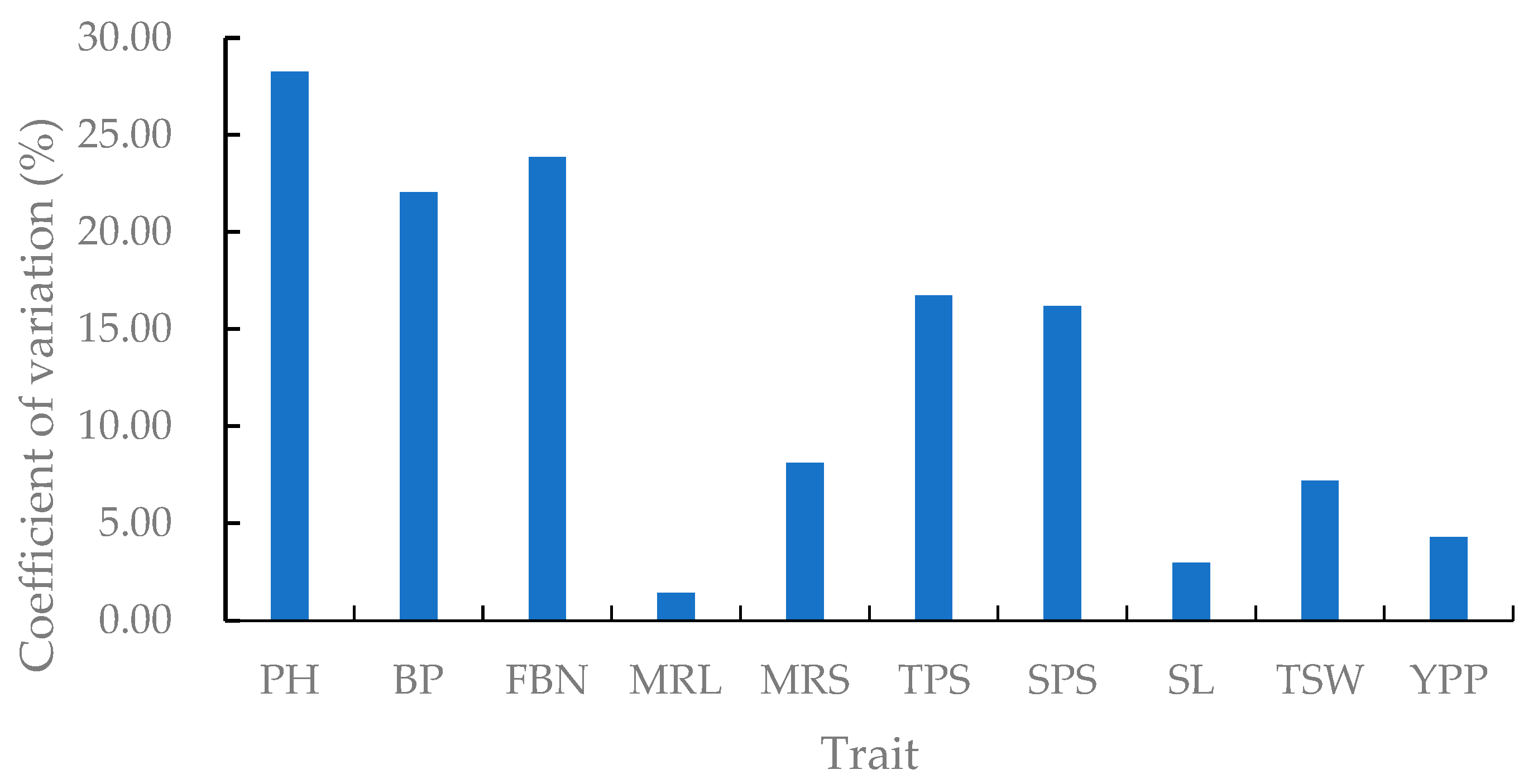
In order to quantify the degree of phenotypic variation of each trait in the test population, the coefficients of variation (CVs) of the agronomic traits of 26 varieties (lines) in five test sites were calculated. The results showed that (Table 2, Figure 1) the coefficients of variation of the agronomic traits of different B.napus varieties in different test sites were different, which were 1.41–28.25%, and the coefficient of variation of PH was the highest (28.25%). Followed by FBN (23.87%), BP (22.04%), TPS (16.74%), SPS (16.20%), MRS (8.10%), TSW (7.20%), YPP (4.29%), SL (2.98%), and MRL (1.41%).
PH, BP, and FBN have high coefficients of variation, which indicate rich phenotypic diversity within the population and sensitivity to environmental or genetic regulation. This also suggests substantial potential for genetic improvement and selection. TPS and SPS had moderate coefficients of variation, reflecting that they have a considerable variation basis and maintain certain stability in the population, which is an important selection target for both yield potential and trait stability. In contrast, MRL, MRS, SL, TSW, and YPP display low coefficients of variation, suggesting high genetic stability and minimal variability within the population. Notably, YPP, as the final target trait, exhibits the least variability, and this may be attributed to its regulation by multiple relatively stable traits or strict control under experimental conditions.

3.2. Correlation Analysis Between Agronomic Traits and Yield

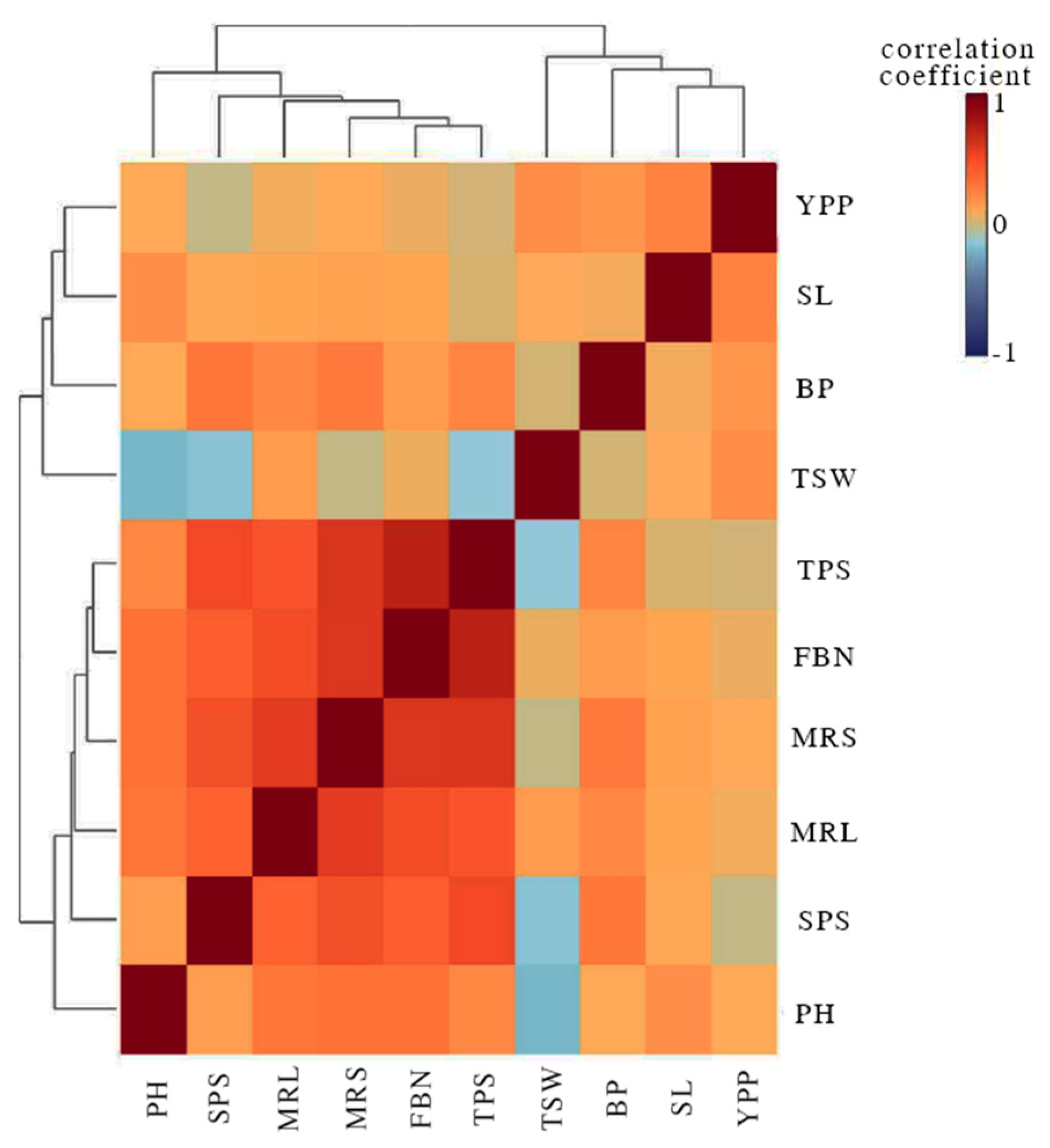
In order to clarify the correlation model between agronomic traits and their correlation with yield, the correlation analysis between agronomic traits and yield was carried out in this study. The results are presented in a correlation coefficient matrix (Table 3) and visualized using a heat map (Figure 2).
The analysis revealed that there was a significant positive correlation between multiple traits of different varieties in different test areas. TPS was significantly positively correlated with BP, FBN, MRL, MRS, and SPS; MRS was also significantly positively correlated with BP, FBN, MRL, and SPS; YPP was only significantly positively correlated with SL, and positively correlated with other traits but did not reach a significant level; FBN was significantly positively correlated with MRL and SPS, significantly positively correlated with BP, and positively correlated with SL, TSW, and YPP; PH was significantly positively correlated with MRS, TPS, and SPS, and significantly negatively correlated with TSW, but had no significant correlation with other traits; BP was significantly positively correlated with MRL and SPS, and significantly correlated with FBN number.

3.3. Path Analysis of the Effect of Agronomic Traits on Yield

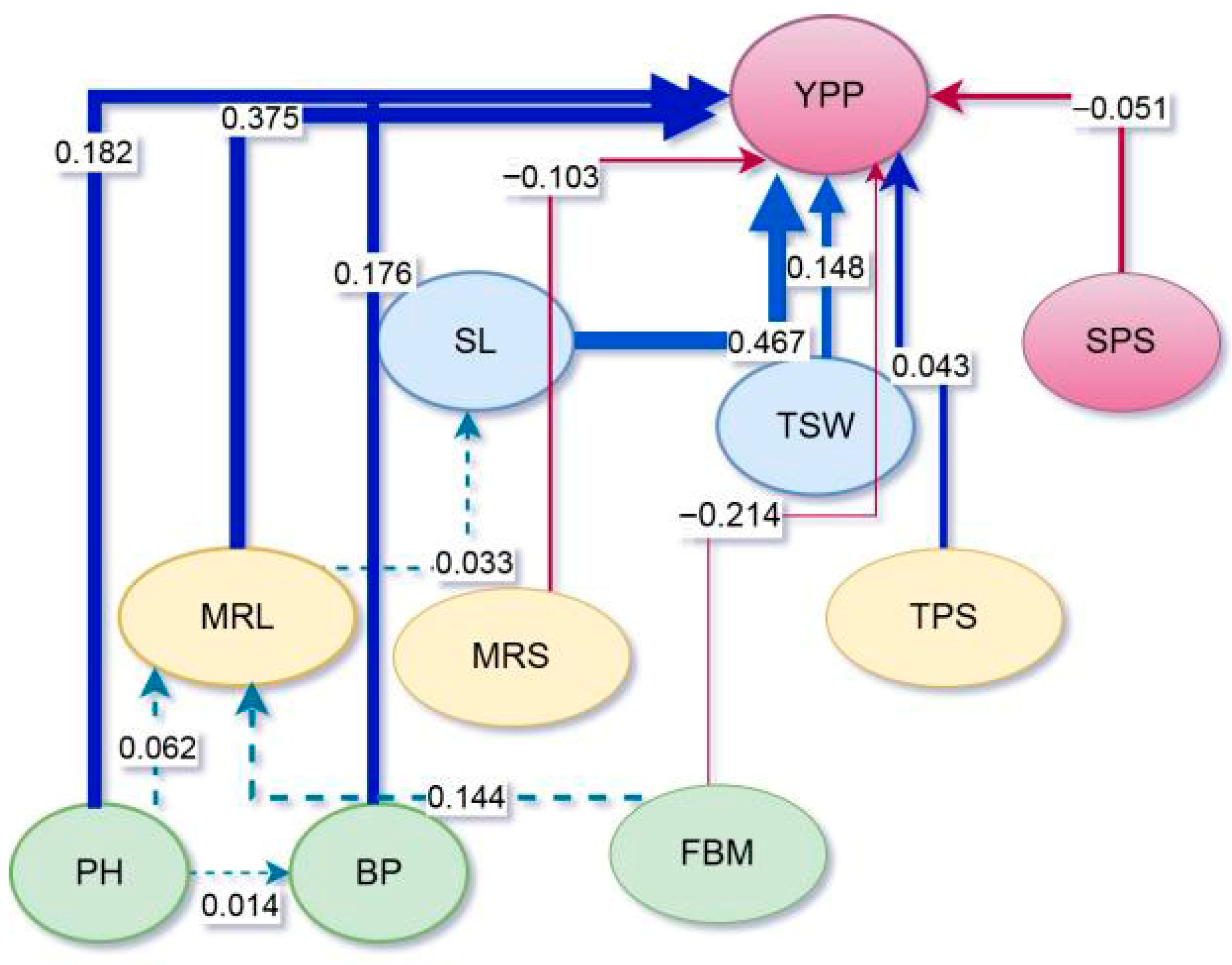
In order to further analyze the effect of the agronomic traits on YPP, the path analysis was carried out. As shown in Table 4, the direct contributions of the nine agronomic traits across 26 varieties at different test sites to YPP ranked as follows: SL (0.467) > MRL (0.375) > FBN (|−0.214|) > PH (0.182) > BP (0.176) > TSW (0.148) > MRS (|−0.103|) > SPS (|−0.051|) > TPS (0.043). SL and MRL had a significant positive effect on YPP, and SL had a significant positive correlation with YPP, indicating that they had the strongest direct positive effect on the target traits. FBN and MRS had negative direct path coefficients, indicating that they had a direct inhibitory effect on the target traits.
Among the indirect comprehensive effects of the nine agronomic traits on YPP through other traits, FBN, MRS, SPS, and TSW demonstrated negative effects, and the other traits demonstrated positive effects, followed by MRL, BP, SL, PH, and TPS.
To illustrate the causal relationships and directional effects among traits more intuitively, a path diagram (Figure 3) was developed based on path analysis. Besides the direct and indirect comprehensive effects described above, it was found that BP indirectly and positively influences yield traits via PH (0.014). This suggests that BP can promote plant growth to some extent. In addition to its direct effect, MRL also contributed positively via indirect pathways involving PH (0.066) and FBN (0.144), indicating that it enhances yield potential in conjunction with plant architecture traits.

3.4. Principal Component Analysis of Agronomic Traits Structure

Based on the principal component analysis of the agronomic traits of 26 varieties in different test sites, the agronomic traits were affected by multiple factors such as genotype, environment, and interaction, and the source of variation was complex. Therefore, it can be seen from Table 5 that the cumulative contribution rate of the first three principal components was 59.73%, of which the contribution rate of principal component 1 was 34.53%, and its high-load traits included TPS, MRS, and FBN, which can be defined as ‘yield and pod-setting ability factor’. Principal component 2 is mainly related to SL and YPP, which is defined as ‘pod structure factor’; principal component 3 was mainly determined by TSW, which was defined as ‘grain weight factor’.
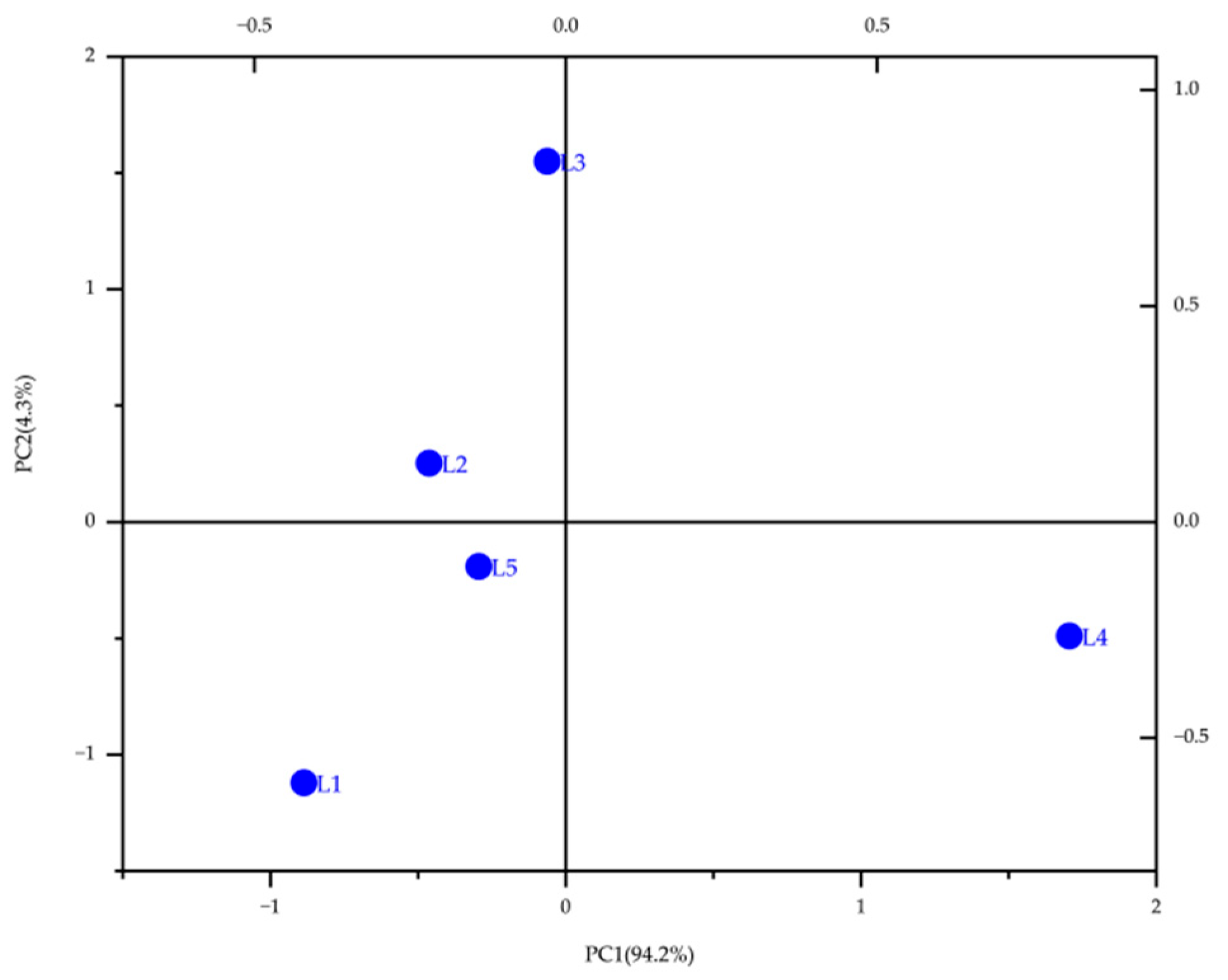
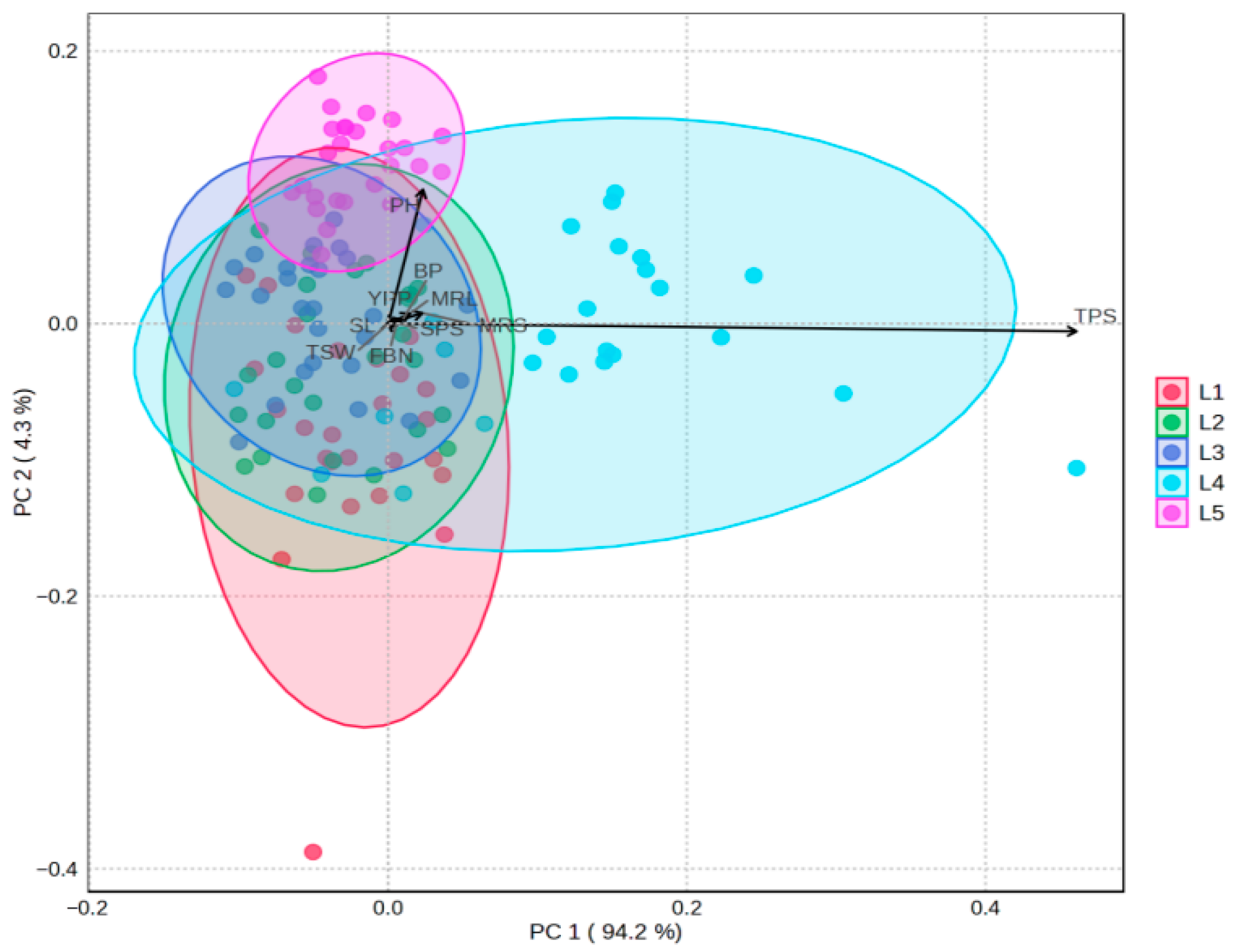
To clarify the overall differences in phenotypic traits among different locations, a multivariate analysis of variance (MANOVA) was first conducted using SPSS. The results indicated that the location effect had a highly significant impact on the combination of 10 traits (Pillai’s Trace = 2.371, F(40, 476) = 17.315, p < 0.001). To visualize the specific pattern of this significant difference, a principal component analysis (PCA) was performed based on the average values of each location, and a scatter plot of the experimental sites was drawn according to the principal component analysis scores of the average values of the 10 agronomic traits at each experimental site (Figure 4). The biplot (Figure 5) and the scatter plot (Figure 4) showed that the first two principal components cumulatively explained 98.5% of the total variation, with PC1 contributing 94.2% and PC2 contributing 4.3%. L1 was located at the farthest end in the positive direction of PC1, L2 was located near the positive end, and L3, L4, and L5 were all located in the negative direction of PC1, with L5 being at the farthest left. The direction and length of the arrows representing each agronomic trait indicated that the trait vectors pointing in the positive direction of PC1 were longer, which was the absolute dominant dimension for distinguishing locations. This dimension was almost entirely defined by the total number of effective pods per plant (load > 0.99), indicating that the total number of effective pods per plant was the most dominant and sensitive single trait driving the trait differentiation among locations. This result was consistent with the conclusion from the previous principal component analysis based on the entire data set that the “yield and pod-setting ability factor” was the most important dimension.

3.5. Grey Correlation Analysis of Agronomic Traits and Yield

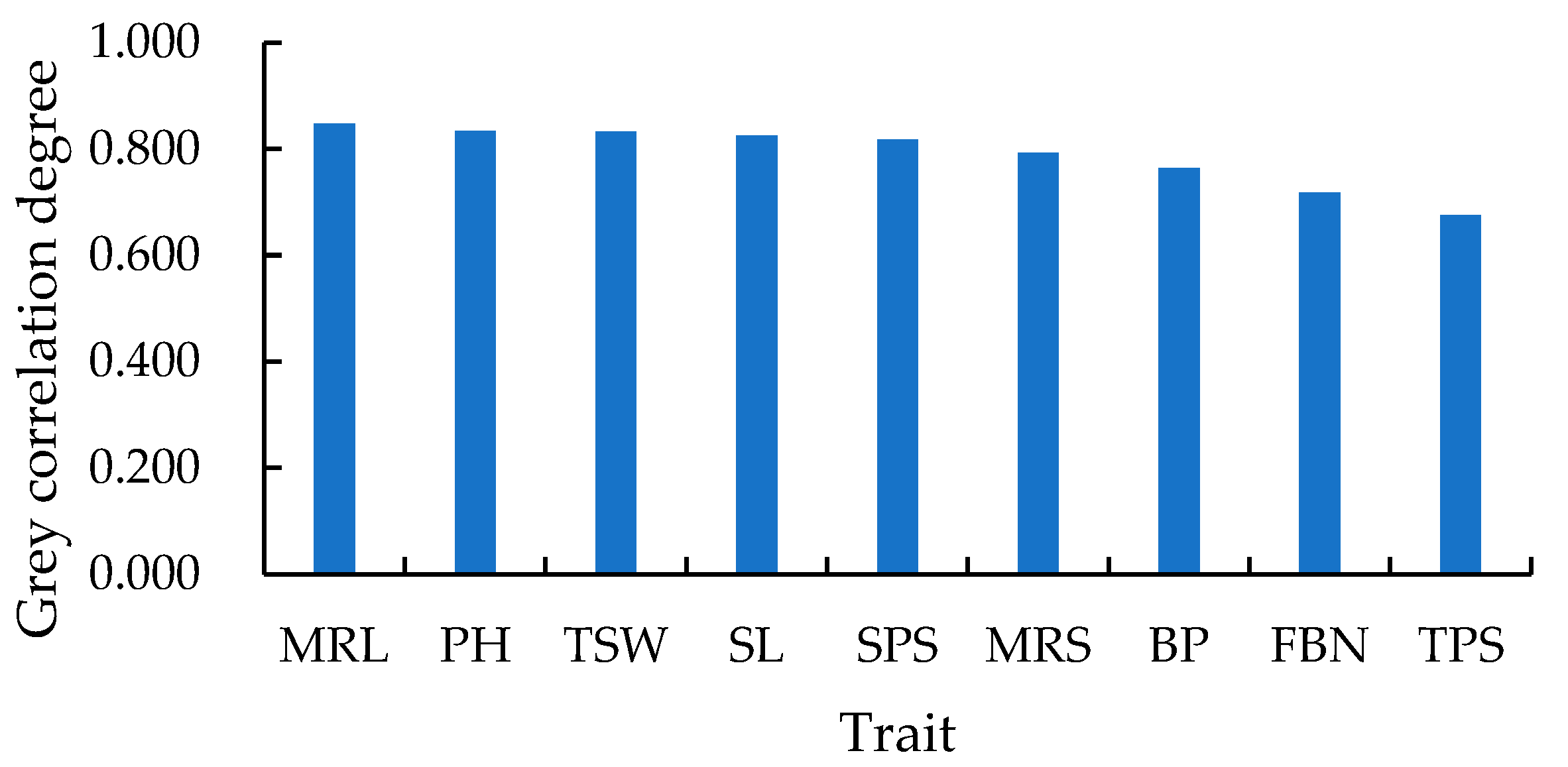
To further quantify the correlation degree and stability of each agronomic trait with YPP according to the grey system theory, the grey system theory was used to analyze the correlation degree of nine agronomic traits and the yield of 26 different rapeseed varieties. The phenotypic stability parameters of each trait were calculated. The results are shown in Table 6 and Figure 6.
The grey correlation analysis revealed that MRL exhibited the highest correlation degree (0.847), significantly exceeding that of most other traits. This indicates that MRL showed the strongest synchrony with the dynamic changes in YPP and is a key index influencing the target traits. The correlation between PH (0.834) and TSW (0.833) followed, and the difference between the two was not significant, which together constituted a high correlation trait group. The correlation degree of TPS was the lowest (0.676), and it was significantly different from the traits of the high association group, indicating that the degree of synergistic change with the target traits was weak.
The coefficients of variation of all the traits were greater than 0.10, and the stability level was ‘low’, indicating that all the traits showed high phenotypic plasticity in the environment. Among them, the coefficients of variation of the number of FBN and TPS were the highest (23.371%, 24.314%), their ranges were the largest, their stabilities were the worst, and they were the most sensitive to environmental changes. In contrast, MRL had the lowest coefficient of variation (0.117) and the best stability, though it still fell within the “low” stability category.

4. Discussion

In this study, we systematically analyzed the structural characteristics of agronomic traits in spring rapeseed and their contributions to yield formation using multiple analytical approaches. PH, BP, and FBN showed high phenotypic variation, indicating that these traits were greatly affected by genetic and environmental interactions and had high improvement potential [18]; therefore, the yield potential can be further explored through ideal plant type design. The moderate variation of TPS, which has both selection space and certain stability, is an important goal to coordinate yield and adaptability. YPP has the smallest variation, suggesting that it is regulated by multiple relatively stable traits, or there is a compensation effect between traits [19], which may be an important reason for the current population yield performance to be balanced. Therefore, in high-yield breeding programs for rapeseed, prioritizing improvements in TPS may represent a more effective strategy than focusing solely on thousand-seed weight (TSW).
Correlation analysis showed that there was a significant positive correlation between FBN and TPS, MRS, and SPS, which was consistent with the previous research conclusions on rapeseed [4,20,21,22]. In breeding practice, using FBN as a key selection index is expected to achieve synergistic improvement of effective pod number and SPS, break the constraints between traits, and then improve YPP. There was a significant positive correlation among TPS, MRS, and SPS, indicating that the yield components were mainly synergistic rather than trade-off, which means that it is feasible to increase the number of pods and SPS simultaneously through genetic improvement or cultivation management. High-yield breeding can be achieved by taking into account such traits and the synergy between traits [23,24,25], rather than seeking extreme breakthroughs in a single trait. It is worth noting that YPP is only significantly positively correlated with SL, which is consistent with previous research results [6,15,26,27]. This indicates that direct selection for yield alone may be inefficient, and greater emphasis should be placed on its key component traits. There was a significant negative correlation between TSW and PH, indicating that the ideal plant type should maintain a reasonable height, ensure the ventilation and light transmittance of the population and lodging resistance, and optimize the transport efficiency of assimilates to grains.
The path analysis further revealed the direct and indirect contribution of each trait to yield, and the pod length had the greatest direct positive contribution to yield per plant, which should be used as a key selection index in breeding. The MRL also showed a significant positive effect, while the direct effect of the FBN was negative, suggesting that the increase in the number of branches may lead to competition within the plant, thereby limiting per-plant productivity. Therefore, high-yield breeding should focus on the optimization of branch quality, especially the development of main inflorescence branches. Wang et al. [20] showed that the direct effects of plant height, yield per plant, pod length, pod grain number, and 1000-grain weight on yield were positively correlated, and the direct effect of plant height on plot yield was the largest, which was consistent with the conclusion of this study. The difference in the order of trait importance was mainly due to the specificity between different ecological types and genetic populations.
The multi-level principal component analysis showed that the cumulative contribution rate of the first three principal components based on variety × location data was 59.73%, and the cumulative contribution rate of the first two principal components of PCA based on location average was as high as 98.5%, which was not contradictory to the above results but provided complementary information. There were significant environmental gradients in the average performance of agronomic traits in the five experimental sites selected in this study, among which PC1 (contribution rate of 94.2%) was the dominant dimension driving site differentiation. The scatter plot clearly divided the test sites into high-value groups (L1 and L2) and low-value groups (L3, L4, and L5), and the number of effective pods per plant was the dominant trait driving phenotypic differentiation between different test sites (the contribution rate of PC1 was 94.2%), indicating that environmental factors mainly regulated the final yield performance by affecting pod-setting ability, which provided a clear direction for ecological adaptive breeding: when breeding wide-adaptability varieties, attention should be paid to the stability and response ability of the number of effective pods per plant in different environments.
Grey correlation analysis revealed that MRL had the closest association with YPP and exhibited relatively high phenotypic stability, making it a suitable key index for synergistic high-yield selection. This is different from the research results of Wang et al. [28] and Zhang et al. [29]. This is caused by the large differences in environmental effects, genetic background, compensation between traits, and other factors. In the varieties with high pod numbers, the contribution rate of the main inflorescence may be relatively reduced, and in this experimental group, the direct contribution of the pod-setting ability of the main inflorescence to the overall yield is more prominent. Plant height, 1000-grain weight, and silique length constitute a highly correlated trait group, suggesting that the synergistic improvement of these traits should be paid attention to in breeding, so as to avoid the over-selection of a single trait from destroying the overall balance.

5. Conclusions

PH, BP, and FBN exhibit high potential for genetic variation and can serve as key targets for plant architecture improvement; SL contributes the most directly to YPP and represents a core selection trait for high-yield breeding in rapeseed; TPS is a key trait that drives phenotypic differences between environments and should be used as a key response index in breeding in different ecological regions; and MRL is most closely related to yield and has good stability, which is suitable as a key reference trait for high-yield collaborative selection. It is recommended to adopt a breeding strategy of “quality first, coordinated improvement,” focusing on SL, TSW, and MRL, coordinating the optimization of branching structure and pod-setting ability, and achieving efficient integration of yield-related traits through multi-environment evaluation.

Author Contributions

Conceptualization, W.W., S.Z. and J.L.; methodology, W.W. and S.Z.; software, J.B. and J.L.; validation, S.Z., W.W., C.W. and H.C.; formal analysis, J.L., H.C. and L.R.; investigation, J.L., W.W., Q.Z., Z.Y. and H.L.; resources, J.L.; data curation, W.W., J.B., and J.L.; writing—original draft preparation, J.B. and S.Z.; writing—review and editing, J.L. and S.Z.; visualization, S.Z.; supervision, J.L.; project administration, S.Z.; funding acquisition, J.L. All authors have read and agreed to the published version of the manuscript.

Funding

This research was funded by the Special Project for Science & Technology Commissioner of Gansu Province Technology Innovation Guidance Program—“Integrated Demonstration and Promotion of Key Technologies for Introduction and Breeding of new Brassica napus L. Spring Rapeseed and green and efficient cultivation” (24CXNG005); the China Agriculture Research System of MOF and MARA (CARS-12-60).

Institutional Review Board Statement

Not applicable.

Informed Consent Statement

Not applicable.

Data Availability Statement

The original contributions presented in this study are included in the article. Further inquiries can be directed to the corresponding authors.

Conflicts of Interest

The authors declare no conflicts of interest.

References

  1. Wang, H.Z. Medium and Long-Term Development Strategy of Rapeseed Variety Improvement in China. China J. Oil Crop Sci. 2004, 26, 98–101. [Google Scholar]
  2. Tu, J.X.; Zhang, D.X.; Zhang, Y.; Fu, T.D. Discussion on Some Standards of Variety Registration and Breeding Goals of Brassica napus in China. China J. Oil Crop Sci. 2007, 29, 350–352. [Google Scholar]
  3. Ray, D.K.; Ramankutty, N.; Mueller, N.D.; West, P.C.; Foley, J.A. Recent Patterns of Crop Yield Growth and Stagnation. Nat. Commun. 2012, 3, 1293. [Google Scholar] [CrossRef] [PubMed]
  4. Zheng, B.C.; Cui, C.; Zhang, J.F.; Li, H.J.; Chai, L.; Jiang, J.; Jiang, L.C. Correlation Analysis of Yield per Plant and Agronomic Traits in Breeding Lines in Brassica napus L. J. Plant Genet. Res. 2019, 20, 113–121. [Google Scholar] [CrossRef]
  5. Shankar, A.; Reddy, R.V.S.K.; Sujatha, M.; Pratap, M. Combining ability and gene action studies for yield and related traits in canola (Brassica napus L.) using diallel and biplot analysis. Helix 2013, 6, 431–435. [Google Scholar]
  6. Zhang, F.; Zhao, Y.G.; Gu, T.C.; Zhang, D.X.; Liu, F.L.; Guo, R.X.; Fu, G.P.; Zhang, X.K. Yield and Agronomic Traits of Winter Rapeseed Cultivars Registered in China from 2001 to 2010. China J. Oil Crop Sci. 2012, 34, 239–244. [Google Scholar]
  7. Yang, A.Z.; Peng, C.H. Correlation Analysis Between Yield per Plant and Some Agronomic Traits in Rapeseed. Anhui Agric. Sci. Bull. 2006, 12, 33–34. [Google Scholar] [CrossRef]
  8. Zhang, J.F.; Pu, X.B.; Li, H.J.; Zhang, Q.X.; Jiang, L.C. Correlation Analysis Between Major Agronomic Traits and Yield per Plant in Rapeseed (Brassica napus L.) from Different Sources. Southwest China J. Agric. Sci. 2007, 20, 587–590. [Google Scholar] [CrossRef]
  9. Ni, Z.B.; Sun, H.Q.; Wan, L.S. Grey Correlation Analysis of Yield and Main Agronomic Traits of Brassica napus. Zhejiang Agric. Sci. 2017, 58, 1146–1149. [Google Scholar] [CrossRef]
  10. Bai, G.P.; Liu, K.Z.; Tan, Y.Q.; Yin, Y.F.; Yu, H.Q.; Wang, H.Z. Effect of Agronomic Traits on Seed Yield in High-Yielding Rapeseed Populations. Crops 2015, 6, 33–38. [Google Scholar] [CrossRef]
  11. Chen, W.; Zhang, Y.S.; Yao, J.B.; Ma, C.Z.; Tu, J.X.; Fu, T.D. Quantitative trait loci mapping for two seed yield component traits in an oilseed rape (Brassica napus) cross. Plant Breed. 2011, 130, 640–646. [Google Scholar] [CrossRef]
  12. Ma, B.L.; Zhao, H.; Zheng, Z.; Caldwell, C.; Mills, A.; Vanasse, A.; Earl, H.; Scott, P.; Smith, D. Optimizing Seeding Dates and Rates for Canola Production in the Humid Eastern Canadian Agroecosystems. Agron. J. 2016, 108, 1869–1879. [Google Scholar] [CrossRef]
  13. Ngezimana, W.; Agenbag, G.A. The effect of nitrogen and sulphur on the grain yield and quality of canola (Brassica napus L.) grown in the Western Cape, South Africa. S. Afr. J. Plant Soil 2014, 31, 69–75. [Google Scholar] [CrossRef]
  14. Zhou, X.; Kono, Y.; Win, A.; Matsui, T.; Tanaka, T.S. Predicting within-field variability in grain yield and protein content of winter wheat using UAV-based multispectral imagery and machine learning approaches. Plant Prod. Sci. 2020, 24, 137–151. [Google Scholar] [CrossRef]
  15. Guan, Z.B.; Tian, J.H.; Zheng, L.; Yao, X.Y.; Wei, S.H.; Li, S.Q.; Dong, Y.H.; Li, D.R. Correlation Analysis of Agronomic Traits and Yield Per Plant in Brassica napus L. Suitable for Mechanized Planting and Study on Breeding of Close-Planting-Tolerant Canola. China Agric. Sci. Bull. 2013, 29, 79–83. [Google Scholar]
  16. Wang, L.L.; Zhang, C.; Huang, S.; Tang, R. Correlation and Path Analysis on Main Characters and Yield of Brassica juncea in Guizhou. Southwest China J. Agric. Sci. 2022, 35, 526–529. [Google Scholar] [CrossRef]
  17. Huang, T.C.; Huang, G.W.; Zhao, L.; Guo, Z.X.; Wang, P.J.; Meng, Y.Q.; Huang, M.J.; Li, L. The effects of different planting densities and different varieties on the growth and yield of rapeseed. Mod. Agric. Sci. Technol. 2020, 4, 11–13. [Google Scholar]
  18. Wang, J.S.; Zhang, W.X.; Tian, J.H.; Li, D.R. Study on Inheritance and Heterosis of Plant-Type Traits in Compact Rapeseed Lines. Acta Agric. Boreali-Occident. Sin. 2006, 15, 31–36. [Google Scholar]
  19. Zheng, B.C.; Cui, C.; Li, H.J.; Zhang, J.F.; Chai, L.; Jiang, J.; Jiang, L.C. Genetic Variation, Correlation and Principal Component Analysis of Agronomic Traits of Breeding Parents of Brassica napus L. in the Yangtze River Basin. J. South. Agric. 2019, 50, 2196–2204. [Google Scholar]
  20. Wang, H.Y.; Meng, L.; Li, H.S.; Ai, H.F.; Jia, D.H. Correlation and Path Analysis of Main Traits and Yields of Brassica napus L. in the Ta’erken Area. Seed 2023, 42, 127–132. [Google Scholar] [CrossRef]
  21. Guan, Z.B.; Zheng, L.; Li, D.R.; Tian, J.H.; Li, S.Q.; Wei, S.H.; Yao, X.Y.; Ta, N. Grey Correlation Degree Analysis Between the Yield of Brassica napus and Related Economic Traits in Arid and Semi-Arid Regions. Shaanxi Agric. Sci. 2012, 58, 19–22. [Google Scholar]
  22. Dai, X.L.; Zhao, J.X.; Xiang, Y.; Ren, T.B.; Cheng, G.P. Correlation Analysis of Main Inflorescence Length and Plant Traits in Hybrid Brassica napus. China Agric. Sci. Bull. 2018, 34, 42–48. [Google Scholar]
  23. Cai, D.B.; Ding, D.H.; Liu, Q.; Chen, X.M.; Wang, L.F.; Chen, J.B. Path Analysis of Yield-Related Traits and Selection of High-Yield Germplasm in Mung Bean. J. Sichuan Agric. Univ. 2022, 40, 472–480+542. [Google Scholar]
  24. Huang, M. Preliminary Analysis of Drought Resistance of Upland Rice and Its Mutant and Genetic Aggregation Effects of Heterosis in Rice. Master’s Thesis, China Agricultural University, Beijing, China, 2018. [Google Scholar]
  25. Li, Y.L.; Ma, Y.H.; Hu, X.H. Correlation and Path Analysis of Main Agronomic Characters and Yield of Different Maize Varieties. Sugar Crops China 2020, 42, 30–35. [Google Scholar] [CrossRef]
  26. Li, H.J.; Yang, H.; Zhu, C.X.; Hu, J.R.; Xue, G.S.; Huang, L.; Zhu, J.Z.; Luo, X.L.; Zhang, Y.; Wen, Y.F.; et al. Analysis on Agronomic Traits of Rapeseed Varieties in Hunan Province. Crops 2015, 3, 41–44. [Google Scholar] [CrossRef]
  27. Song, X.; Liu, F.L.; Zheng, P.Y.; Zhang, X.K.; Lu, G.Y.; Fu, G.P.; Cheng, Y. Correlation Analysis Between Agronomic Traits and Yield of Rapeseed (Brassica napus L.) for High-Density Planting. Sci. Agric. Sin. 2010, 43, 1800–1806. [Google Scholar]
  28. Wang, Y.; Pang, J.P.; Dong, Y.; Jin, F.W.; Xu, Y.Y. Grey Relation Analysis on Yield and Main Agronomic Traits of Rapeseed. Seed 2011, 30, 99–101. [Google Scholar] [CrossRef]
  29. Zhang, J.G.; Yuan, B.W.; Liu, D.M.; Shu, Z.M. Grey Correlation Analysis of Single-Plant Yield of Rapeseed Hybrid and Related Factors. Shaanxi Agric. Sci. 2001, 1, 9–11. [Google Scholar]
Figure 1. Comparison chart of variation coefficients of main traits.
Horticulturae 12 00209 g001
Figure 2. Heatmap of the correlation between agronomic traits and yield traits. Note: The color depth represents the correlation intensity, red indicates positive correlation, blue indicates negative correlation, and the darker the color, the stronger the correlation.
Horticulturae 12 00209 g002
Figure 3. Path diagram of key traits to yield. Note: Red represents the target yield; blue represents the yield components; yellow represents inflorescence traits; green represents branching traits; the solid arrow is a direct path; the dotted arrow is an indirect path; blue arrows represent positive effects; red arrows represent negative effects.
Horticulturae 12 00209 g003
Figure 4. L1–L5 score scatter plot. Note: The position of samples L1–L5 on the PC1 axis reflects their score on the principal component. The farther the distance between the samples, the greater the difference in the direction of variation represented by PC1.
Horticulturae 12 00209 g004
Figure 5. Principal component biplot. Note: L1–L5 represent five different test sites. The closer the distance is, the more similar the features of the samples in the original data are. The farther the distance, the greater the sample difference. Arrow/direction: Indicates the direction and contribution of each agronomic trait in the principal component space. The smaller the angle between the arrow and the coordinate axis, the stronger the correlation. The longer the arrow, the greater the impact of the variable. The point represents the average value of all varieties of traits at each test point.
Horticulturae 12 00209 g005
Figure 6. Grey correlation degree ranking diagram of agronomic traits and yield.
Horticulturae 12 00209 g006
Table 1. Information table of tested varieties.
Variety OriginVariety Name
Shanxi Hybrid Rapeseed Research CenterQinyou1618, Qinzayou109
Oil Crops Research Institute, Chinese Academy of Agricultural Sciences (OCRI CAAS)22Zhongyou10, 21BP191
Sichuan Academy of Agricultural SciencesChuanyou117, Chuanyou228
Qinghai UniversityQH3365, QH33, QH403, Chunyou267, Chunyou254
commercially purchasedQingza5(CK)
Hubei Kangnong Seed Co., Ltd.KR2401, KR2402
Hunan Agricultural UniversityXiangzayou20, Xiangyou078
Huazhong Agricultural UniversityY43024, Y43039, Y90466, 23Min1, 23Min4, Huaruiyou704, Huaruiyou706
Gansu Agricultural UniversityYunyouza15, 2019qw-1, L737
Table 2. Variation analysis of the agronomic traits of different rapeseed varieties (lines).
ItemsPHBPFBNMRLMRSTPSSPSSLTSWYPP
Minimum value190.7080.0017.0079.9078.00935.0030.009.706.6024.60
Maximum value12.0016.001.0033.0021.00100.0014.004.402.6814.80
Mean value138.4241.715.0450.1943.63259.4221.827.113.9319.77
standard deviation39.109.191.200.713.5443.423.540.210.280.85
Coefficient of variation (%)28.2522.0423.871.418.1016.7416.202.987.204.29
Note: PH represents plant height; BP represents branches position; FBN represents number of primary effective branches; MRL represents effective length of main inflorescence; MRS represents effective pod number of main inflorescence; TPS represents effective pod number of whole plant; SPS represents number of seeds per pod; SL represents silique length; TSW represents thousand grain weight; YPP represents yield per plant. The same as below.
Table 3. Correlation analysis of the agronomic traits of different rapeseed varieties (lines).
PHBPFBNMRLMRSTPSSPSSLTSWYPP
PH1
BP0.0781
FBN0.1160.238 *1
MRL0.1660.287 **0.383 **1
MRS0.225 *0.398 **0.550 **0.523 **1
TPS0.197 *0.296 **0.792 **0.466 **0.641 **1
SPS0.237 *0.381 **0.544 **0.492 **0.579 **0.576 **1
SL0.0840.0780.0290.0710.0880.0270.1461
TSW−0.352 **0.0290.0220.121−0.035−0.129−0.140.0441
YPP0.1010.1860.0570.0750.0740.0210.0240.249 *0.171
Note: The table shows the Pearson correlation coefficients. * p < 0.05, ** p < 0.01.
Table 4. Path coefficients of 9 main traits to YPP.
FactorCorrelation CoefficientDirect Path CoefficientIndirect Path CoefficientComprehensive Effect
PHBPFBNMRLMRSTPSSPSSLTSW
PH0.1010.182-0.0140.0210.0300.0410.0360.0430.015−0.064 0.137
BP0.1860.1760.014-0.0420.0510.0700.0520.0670.0140.005 0.314
FBN0.057−0.214−0.025 −0.051-−0.082−0.118−0.169−0.116−0.006−0.005 −0.572
MRL0.0750.3750.062 0.108 0.144 -0.1960.1750.1850.0270.0450.941
MRS0.074−0.103−0.023 −0.041 −0.057 −0.054 -−0.066−0.060−0.009 0.004−0.306
TPS0.0210.0430.008 0.013 0.034 0.020 0.028 -0.0250.001−0.006 0.123
SPS0.024−0.051−0.012 −0.019 −0.028 −0.025 −0.030−0.029-−0.007 0.007−0.144
SL0.249 *0.4670.039 0.036 0.014 0.0330.0410.0130.068-0.0210.265
TSW0.170.148−0.052 0.004 0.003 0.018−0.005−0.019−0.0210.007-−0.065
Note: The * shows the indicates the strongest correlation.
Table 5. Principal component analysis table.
IndexPC1PC2PC3
PH0.2950.44−0.597
BP0.3900.2070.113
FBN0.8150.073−0.036
MRL0.7330.1580.090
MRS0.8260.126−0.081
TPS0.838-0.084−0.139
SPS0.692-0.066−0.151
SL0.0460.752−0.113
TSW0.0490.2270.859
YPP0.0360.7150.252
c-value3.4531.4171.103
Contribution rate (%)34.53514.16811.026
Cumulative contribution rate (%)34.53548.70259.728
Table 6. Grey Correlation Analysis between Agronomic Traits and Crop Yield.
TraitGrey Correlation DegreeSortingStandard DeviationCoefficient of Variation (%) Extreme DifferenceStability LevelProminence
PH0.83420.10112.104 0.320lowab
BP0.76470.13517.698 0.418lowcd
FBN0.71880.16823.371 0.660lowd
MRL0.84710.09911.732 0.312lowa
MRS0.79360.12615.871 0.486lowc
TPS0.67690.16424.314 0.607lowd
SPS0.81750.13616.585 0.495lowbc
SL0.82540.12014.582 0.396lowb
TSW0.83330.10712.856 0.360lowab
Note: The closer the grey correlation degree is to 1, the closer the correlation between the trait and the target trait is. Different letters in the same column indicated that there were significant differences in the correlation between traits at the p < 0.05 level.
Disclaimer/Publisher’s Note: The statements, opinions and data contained in all publications are solely those of the individual author(s) and contributor(s) and not of MDPI and/or the editor(s). MDPI and/or the editor(s) disclaim responsibility for any injury to people or property resulting from any ideas, methods, instructions or products referred to in the content.